Sydney Near Miss!

On November 14, a major runway incursion was narrowly avoided involving an Airbus A380 and Boeing 737. It sounds like the incident may have been caused by an ATC error – although an ATSB investigation is still underway.

Despite millions being spent in recent years to improve runway safety at the airport, this incident is a timely reminder that incursions can and will continue to happen in Sydney.

Here’s a look at why, and what you can do about it.

The Layout.

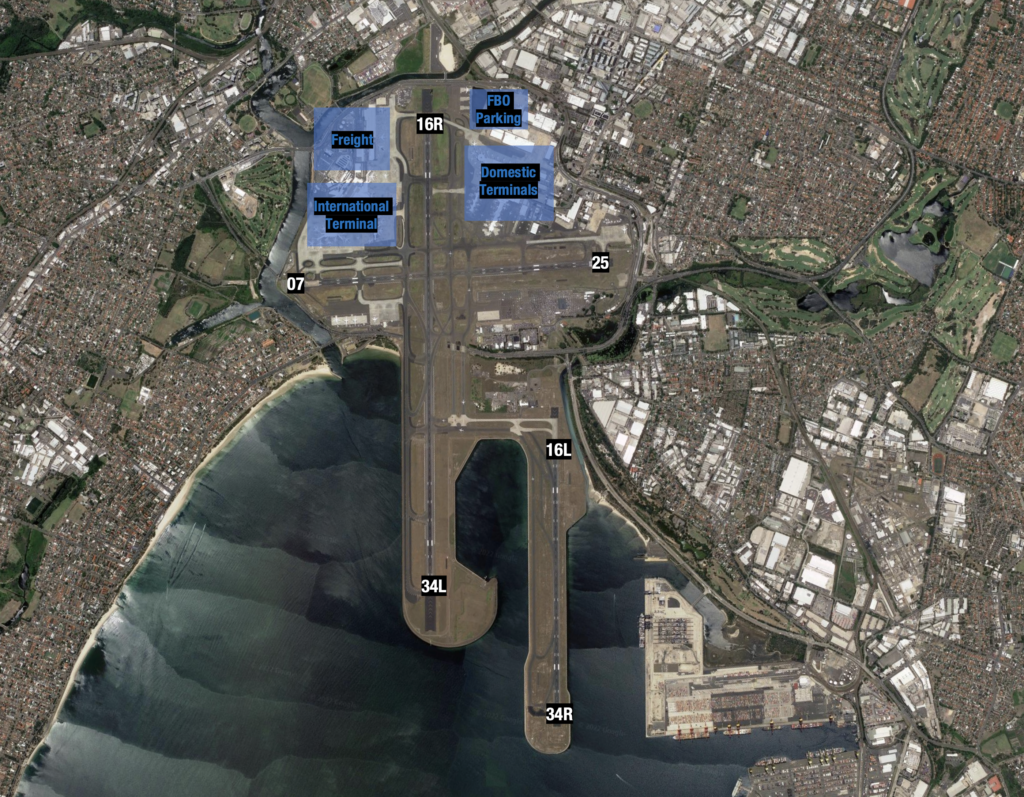
Sydney’s runway layout is complex. There are three runways – two parallel ones (16/34 LR) and another runway that runs perpendicular to them (07/25). The airport itself sits perched on the edge of Botany Bay, with the parallel runways extending well out over water. And all terminals and FBOs are found clustered together on the northern side of the airport, near the 16R threshold.

Which means taxis to/from all the other runways are lengthy and potentially confusing. And during those taxis, almost every aircraft will need to cross a runway. Often twice.

That’s a lot of crossing traffic when you consider that the airport processes up to eighty movements an hour at peak times – it is literally Australia’s busiest.

Mistakes Happen.

Authorities are well aware of the risk of runway incursions at Sydney airport. So much so that they have spent a commendable amount of time and money to improve runway safety.

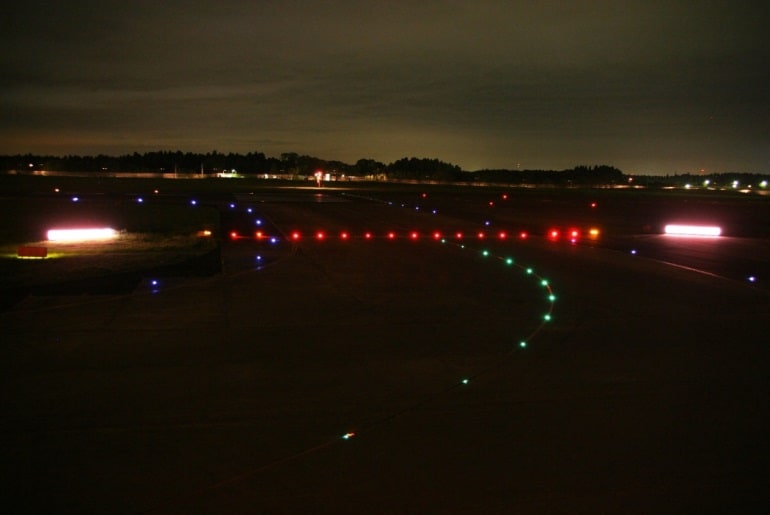
Possibly the best advancement in recent years has been the installation of stop bar lighting at every single runway holding point, along with improved signage and markings.

And yet mistakes keep happening. The November incident is a great example – here’s what went down.

The November 14 Incident.

  • In CAVOK conditions, a Boeing 737-800 was cleared to land on Runway 25. With their clearance they were informed that an Airbus A380 was holding position on Runway 34 waiting to depart.
  • When the 737 had cleared the intersection of the two runways, the A380 was cleared for take-off and began to roll.
  • After landing the 737 received its taxi clearance from ground which instructed them to cross runway 34L on Golf back to the domestic terminal.
  • As the 737 crew approached the active runway, they were surprised to see it was still occupied with the departing A380. They queried the clearance with ATC who immediately told them to hold short.
  • The closest the two aircraft came to each other was 300m (just shy of 1000’) thanks in part to the vigilance of the 737 crew. While not a particularly close shave, there was potential for this to have become a major accident. Which is why the ATSB are asking questions they are.

Here’s a simple animation of the incident with a bird’s eye view:


What can we learn from this?

Future incursions, although rare, will happen. But there are steps that all crew can take to help reduce those statistics and stay safe.

A good place to start is this. To cross a runway in Sydney always remember the ‘hat-trick.’ You know all about cricket right? Well if you’re headed to Australia, this phrase can also be used to impress Aussies at the bar over a cold Fosters  (disclaimer: no one drinks it there, and whatever you do never call a prawn a shrimp). It means three successes of the same kind. Or in other words: a set of three good things.

So, there are three things that you’ll need:

  • A clearance from ATC
  • Confirmation that the stop bar is out
  • Runway is visually clear out both sides

If any of them are missing (or uncertain), do not enter the runway.

The crew of the 737 above captured a potential accident because at least one of their hat-trick was missing.

Remember the hat-trick every time you cross a runway.

The stop bars themselves are worth a mention too. What’s more obvious than a big row of blazing hot red lights to make you get on the brakes, right? They work really well, but in their simplicity, there can be confusion.

A while back, IFALPA released some pretty good stuff that is still relevant today. You can read it here, but there are a few scenarios to take away:

The stop bar’s out, but we haven’t been cleared…
Stop. An extinguished stop bar on its own is not an indication you are cleared to cross. It may have been turned off in error, or for a preceding aircraft.

We’re cleared, but the stop bar is still lit…
Yep you guessed it, stop. And this happens really often. You’ll need to ask ATC to turn it off. Never, ever cross a lit stop bar.

But didn’t he say we were cleared?

Help from ICAO

Did you know they have a whole manual dedicated to helping controllers and pilots alike avoid runway incursions? You can download it here.

Have some stories of your own to share?

We’d love to hear from you. They don’t need to be from Sydney, but we can all learn from them. You can reach our team completely anonymously at news@ops.group.


MOT for aircraft? It’s actually a tax

We had a question sent in about “MOT’ and three things crossed my mind.

One – I need to get my car’s MOT booked, it is due really soon, thanks for reminding me (possibly something only UK folk will get).

Two – Do aircraft have to have MOTs? I don’t think they do.

Three – Ah, they mean Mineral Oil Tax… of course… I’ve definitely heard of that…

What is MOT, and why do you need to know about it?

So, MOT (in aviation) stands for Mineral Oil Tax, which basically means a big tax on your fuel.

It also goes by the names TIPP, TICPE, fuel tax, excise tax, excise duty, fuel duty tax, oil tax… you get the idea.

It is usually added to the fuel price so you’re paying it without knowing you’re paying it. The MOT can be as much as 43% of your fuel bill, so if you don’t know about it you might want to.

Good news though – you might be able to reclaim some of it.

Can I reclaim it?

The rules seems to be that if you are one of the following then yes, you probably can:

  • A private air charter company
  • An executive airplane-leasing company
  • A business who owns its own private jet which is used for business purposes only

Some countries specify that you must be a ‘non-established aircraft operator’.

Great, I’m one of those. So where can I reclaim it?

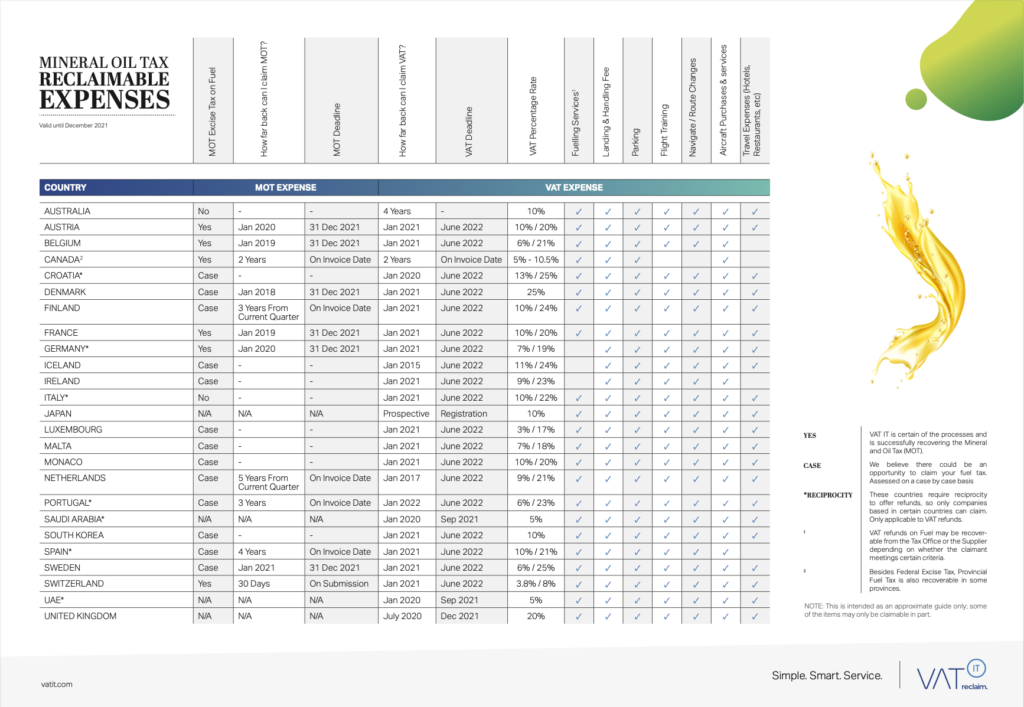
Here is a handy table to give you some idea of where you might be able to:

I don’t see a 43% in there, but a fair few in the 20% region. So some big savings to be had, if this does apply to you.

If I should be exempt can I just not pay it?

You can’t reclaim it everywhere – some places just don’t have an exemption at all, and in some places you can’t reclaim after paying, so you have to make sure it is taken off the bill before you pay.

So make sure: 

  • Your crew know about it, and to ask about it.
  • Make sure your AOC is available for crew to show to fuelers to confirm they are exempt.
  • Make sure the fueling company and customs have the right info on your flight so everyone knows you’re exempt.

Tell me more about all this.

Well, that is actually all we really know on it.

The cost, as we said, is often added in at the fuel truck, and the rules for reclaiming it seem to be a little ‘uncoordinated’ (messy!) This is particularly the case, it seems, for France, Germany and Austria.

So much so that the EBAA wrote this very thorough guide on the legal impact of the ‘European Energy Taxation Directive on Business Aviation in Germany, France and Austria’.

In case the word ‘thorough’ put you off reading it, here’s our little, much less thorough summary of it:

  • It is an analysis of the legal impact of the European Energy Taxation Directive on Business Aviation in Germany, France and Austria.
  • It says that states can exempt aviation fuel from excise duties (tax), provided aircraft are use for purposes other than private pleasure flying.
  • But it isn’t always consistently applied or understood, and operators have to provide a whole load of info which is often very annoying, verging on impossible.
  • It also takes ages to get the money back, so folk are missing out on interest which doesn’t seem very fair.

There is a lot of info in the guide (we won’t try and re-write it all out) but it is definitely worth a read if you are running into difficulties reclaiming your MOT in any of these three spots.

The main issue in France

France won’t let you reclaim it if the passenger is also (directly or indirectly) the owner of the aircraft carrying them, but of course it isn’t that simple. What they define as ‘commercial’ is often confusing, and it gets even messier for charters.

The main issue in Germany

No-one is entirely sure how it is all applied in Germany, it seems to be really inconsistent and dependent on where you file your reclaim. It is also very complicated when it comes to corporate flights.

And it hasn’t been decided whether to apply it to training flights, maintenance flights or positioning flights…

The main issue in Austria

Austria apparently have the worst ‘burden of proof’ on the operator of any country.

Basically you have to disclose loads of information, including stuff about your passengers, which could breach any NDAs you have. So it might be worth highlighting this to them and saying if we try and get you money off the fuel, we’re going to have to share loads of info about you, is that ok?”

OK, I know enough. How do I reclaim it?

You need to make sure you have your AOC to hand (to move you are worthy of exemption) along with the purchase invoice (showing the MOT levied) and fuel delivery notes (showing the correct aircraft registration, signed etc).

Some but not all countries allow for retrospective refunds which is why not paying it where possible is a better option. For those that do, you have to submit your claim to the local customs office (there isn’t a centralised claims office), and there are deadlines for this.

Gimme some links

We shall. We discovered VATIT who have the title of “world leading expert in aviation tax” (self-titled). We got a lot of this info, including that rather handy table, off their site so reckon they might be the folk to talk to. Here’s their website, and here is a very useful post they wrote on Canadian Excise Duties on Fuel Bills if that’s something you want to find out about as well.

The EBAA posted the legal guide we mentioned above so also worth getting in touch with them if you have some specific questions or concerns.


New Zealand Fuel Supply Issue

Update 19 Dec: The fuel shortage at NZAA/Auckland due the contaminated batch has been resolved now (they got more fuel delivered).


New Zealand is facing a (hopefully brief) jet fuel shortage after receiving a batch which failed quality control testing.

What is the current situation?

On December 7, a fuel shipment into the main import terminal on New Zealand’s north island failed a quality check. The fuel was bound for NZAA/Auckland, the country’s main international airport.

The next fuel shipment is expected on December 18 and will hopefully resolve the temporary shortage.

How short is the shortage?

Airlines have been told to expect rationing at NZAA/Auckland. Initial reports suggest uplifts will be limited to 75% of an operator’s usual allotment.

However, it is not clear if other airports will receive reduced fuel supplies, with some diverted to support NZAA/Auckland or if the only airport affected is the main international one.

Air Centre One FBO at NZAA/Auckland has told us that World Fuel Services (WFS) has canceled all releases due to the current fuel shortage. Uplifts are still available via the FBO’s account which will be invoiced with your handling charges, but they are recommending refueling elsewhere if possible. WFS releases are apparently still being accepted at other major airports in New Zealand.

Here are the Notams we’ve spotted so far:

NZAA/Auckland B7158/22 - AIR BP, EXXON MOBIL/CHEVRON AND Z ENERGY JET A1 FUEL 
RATIONING IN PLACE. CHECK WITH YOUR FUEL SUPPLIER FOR AVAILABILITY. 
08 DEC 01:56 2022 UNTIL 17 DEC 10:59 2022.
NZWN/Wellington B7097/22 - Z ENERGY JET A1 FUEL (WESTERN APRON) NOT AVBL. 
06 DEC 02:33 2022 UNTIL PERM. CREATED: 06 DEC 02:33 2022

What should you do?

Speak to your agent or supplier at NZAA/Auckland and confirm what the allocation will be for you prior to operating in so you can plan accordingly.

Check with other New Zealand airport agents in advance if you plan to make fuel stops at them, since the fuel availability is not currently clear.

Look at fuel tech stop options if you are operating long haul, or consider payload adjustments to manage the reduced fuel uplift.

Tanker fuel if you are able to.


ATC radio outage in Johannesburg Oceanic

CPDLC has been fixed in the FAJO/Johannesburg Oceanic FIR following yesterday’s outage. That’s the only thing ATC have currently got to communicate with aircraft, as their radios have been out of action since November.

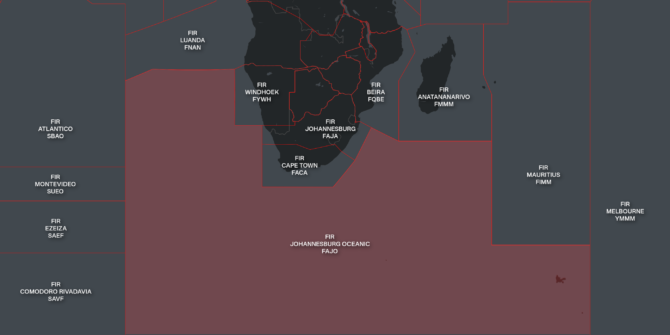
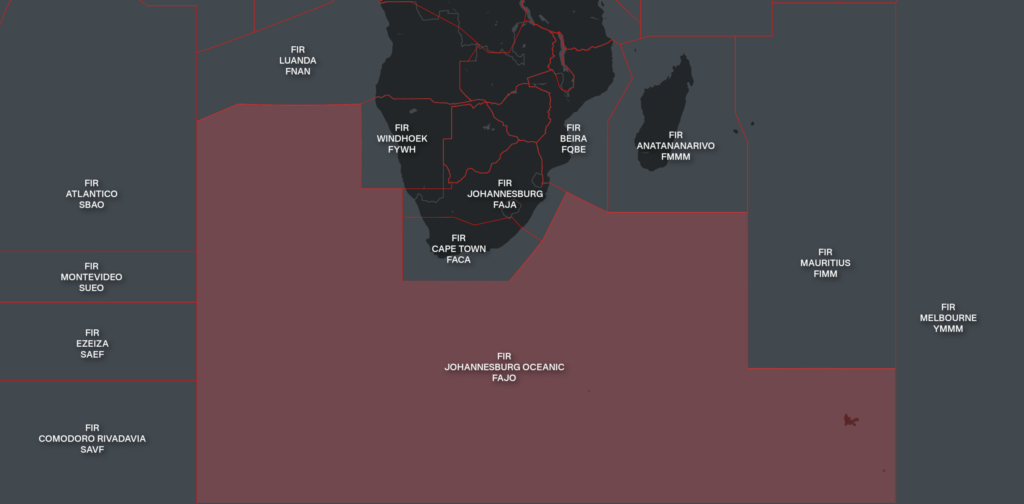
The FAJO/Johannesburg Oceanic FIR covers a pretty big chunk of airspace:

Aircraft not equipped with CPDLC will have to broadcast on the emergency In-Flight Broadcast Procedure (IFBP) VHF frequency 126.9, and maintain a continuous listening watch on 123.45. Here’s the Notam for that:

A3931/22 - TRANS AND REC U/S. PRI COM IS CPDLC. ACFT NOT CPDLC/ADS-C EQUIPPED MUST BCST 
AND MNT IFBP (IATA IN-FLIGHT BROADCAST PROCEDURE) ON 126.9 MHZ. 
11 NOV 17:57 2022 UNTIL 31 DEC 23:59 2022 ESTIMATED. CREATED: 11 NOV 18:06 2022

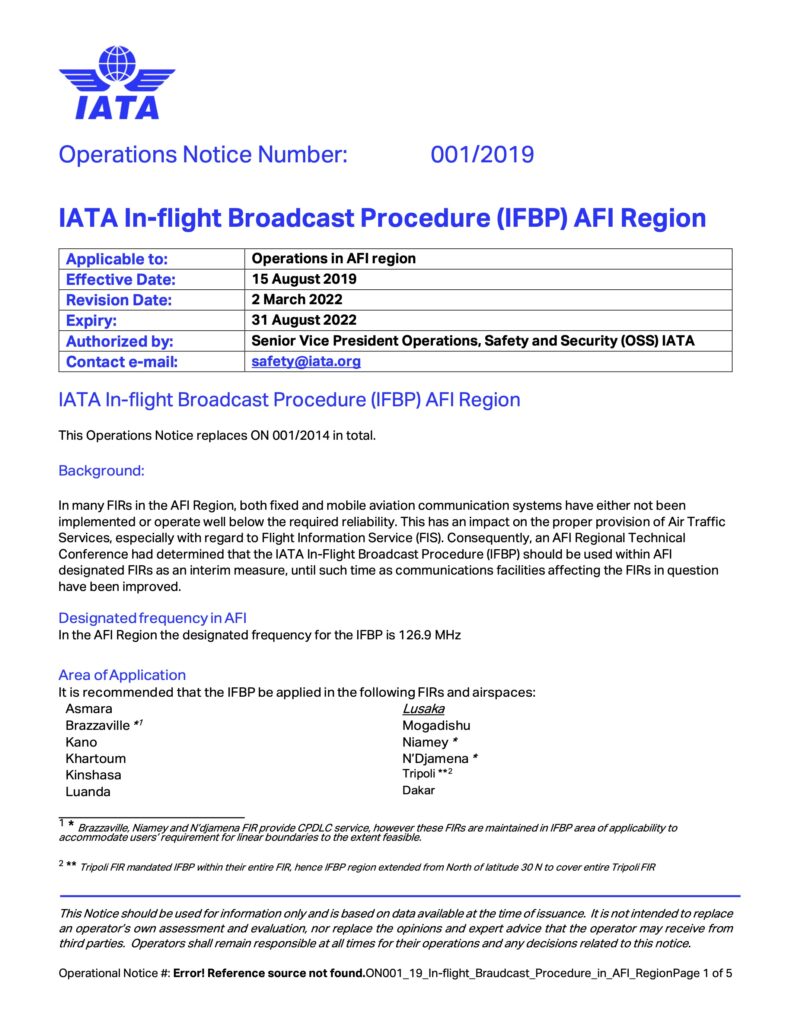
You can check IATA’s doc for a quick summary of IFBP here:

As far as we can tell, South Africa hasn’t published its own Contingency Plan to help us work out what to expect when we’re flying through their oceanic airspace and we can’t reach ATC.

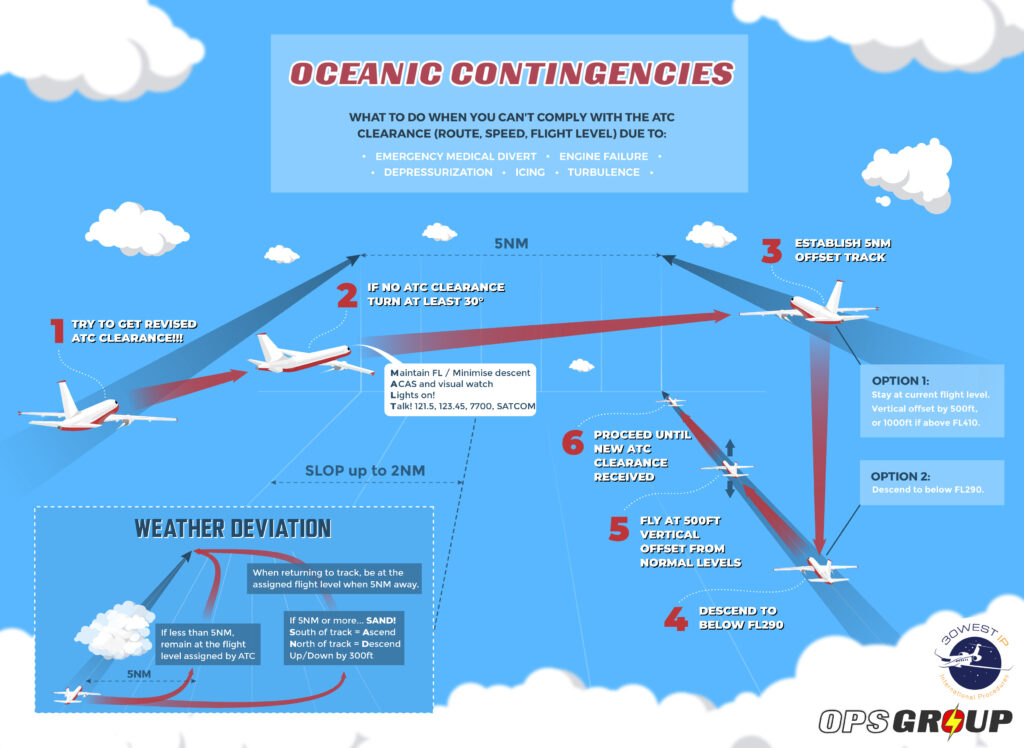
But ICAO harmonized the contingency procedures for all oceanic airspace worldwide back in 2020. The basic rule is this: turn from the route by at least 30°, offset by 5 NM, stay at your current level or descend below FL290, then apply a cheeky little vertical offset.

Power Outages

Power outages are an ongoing issue in South Africa. Airports remain unaffected, directly. However, yesterday’s CPDLC outage coincided with a breakdown of several ESKOM powerplants. We aren’t sure whether this was a coincidence on not.

The continued power outage crisis may lead to delays with certain services which have a knock on effect on your operation. The likelihood of civil unrest is also growing so caution on the ground in the country is recommended at this time.


What’s the Time, Mr Mexico?

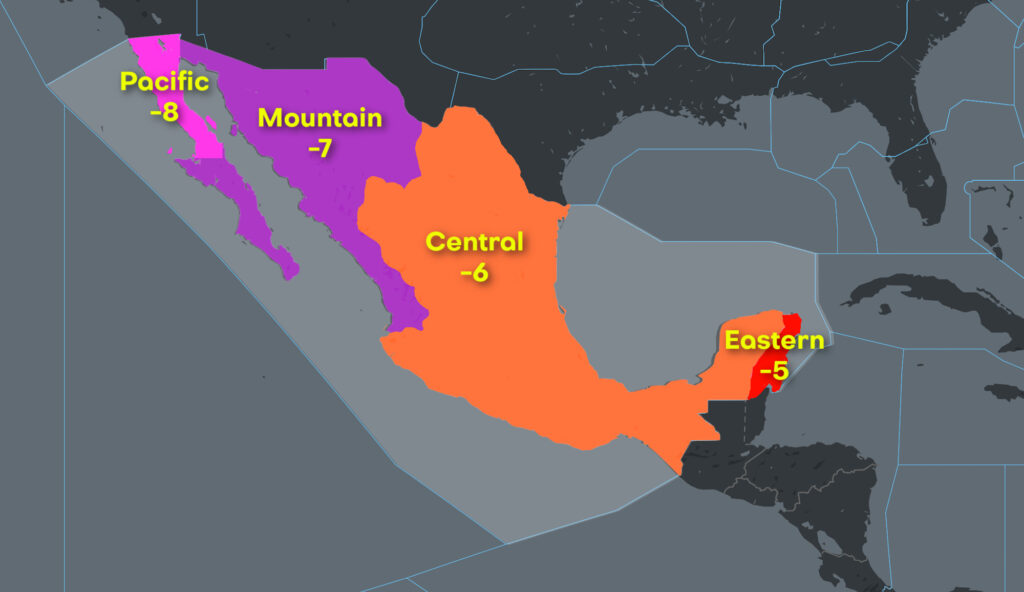
Mexican time is changing! They currently have 4 time zones:

  • PST (Pacific standard time) GMT-8 (which is just Tijuana)
  • EST (eastern) GMT-7
  • CST (central) GMT-6
  • MST (mountain) GMT-5

Here is a map (complete with ticking times) showing these. Or a more fixed one below if you prefer.

So what’s the problem?

Daylight saving is the problem!

Most of us forget/are confused by it/just let our phones do their thing and wake up feeling slightly less/more well rested depending on which way they’re moving. (Just remember: Spring Forward, Fall Back.)

In other words, when daylight saving starts (in the summer which frankly is confusing because there is already more sunlight then so why is it called ‘saving’) then you wind the clock forward an hour, losing one, and you wind it back again in the fall (autumn) meaning you live the same hour twice, to help make better use of the natural daylight.

Then there is the confusion of who does it and who doesn’t. Arizona, USA for example opted out of DST. Except for the Navajo Nation who opted in.

Who should we thank for this confounding thing? Some say the USA’s Benjamin Franklin, some say NZ’s George Hudson, some say the UK’s William Willett, some say “I have no idea who two of those three people are, tell me something useful?!”

Back to the Mexico problem

Mexico is cancelling DST from 2023. Which isn’t the worst thing ever given the confusion (see above)

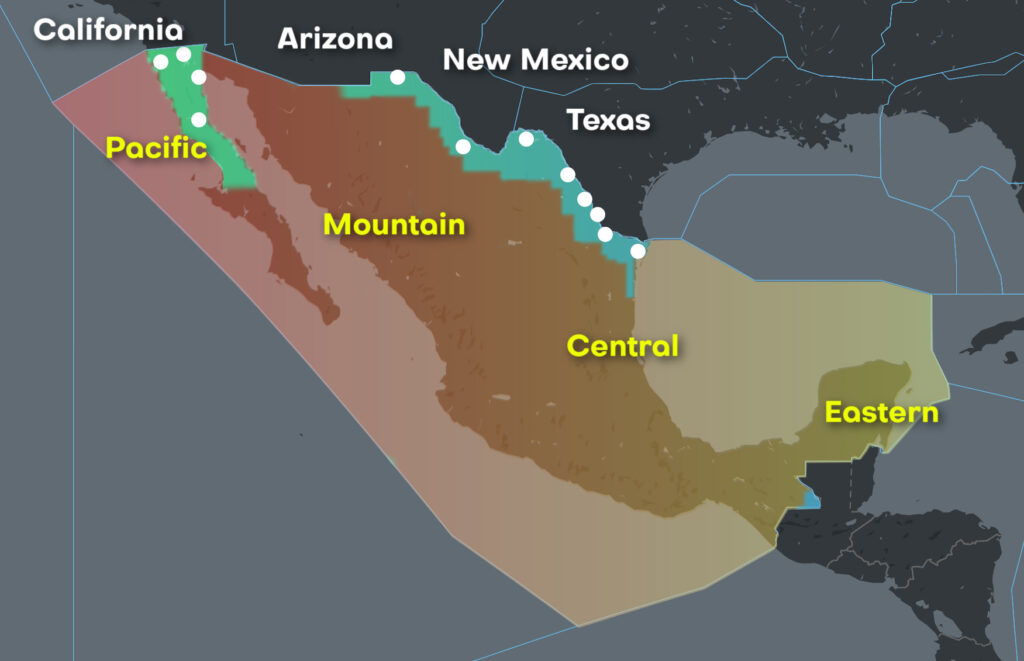
The problem is… not all of Mexico is going to. Some border towns are not not going to do DST.

Wait, now I’m confused.

The ten municipalities bordering the USA have decided to stay synched with their American neighbors, presumably to avoid confusion with border crossing.

  • Acuna
  • Anahuac
  • Juarez
  • Matamoros
  • Mexicali
  • Nuevo Laredo
  • Ojinaga
  • Piedras Negras
  • Reynosa
  • Tijuana

So all of these will still apply DST, which means it will look something like this:

When is this all happening?

Well, the no-more-DST starts in April 2023 when the rest of Mexico just won’t wind their clocks forward.

The clocks will still wind forward in those 10 places though. Which, for you, might mean confusion if you’re heading into any airports along the border area. Like MMCS/Ciudad Juárez International.

Some fun time zone facts

If asked which country has the most time zones, most probably guess the USA or Russia. Both actually “only” have 11 though. The top spot goes to France with a whopping 13 different zones (ok, they own random bits of land all over the world so not really a fair game).

Next up are the countries with 9, which includes Australia, Antartica and the UK. Yup, the UK boast a fair few ‘unattached’ areas in the world too.

China is another oddity. It should have 5 time zones. It only has 1, based off what suits the Beijing sun best! 😎 🇨🇳


France says take trains not planes

France have implemented their ban on short-haul domestic flights, with it going into effect on December 2, 2022.

So what, and who, does this apply to?

The What.

It applies to short-haul domestic flights. In France.

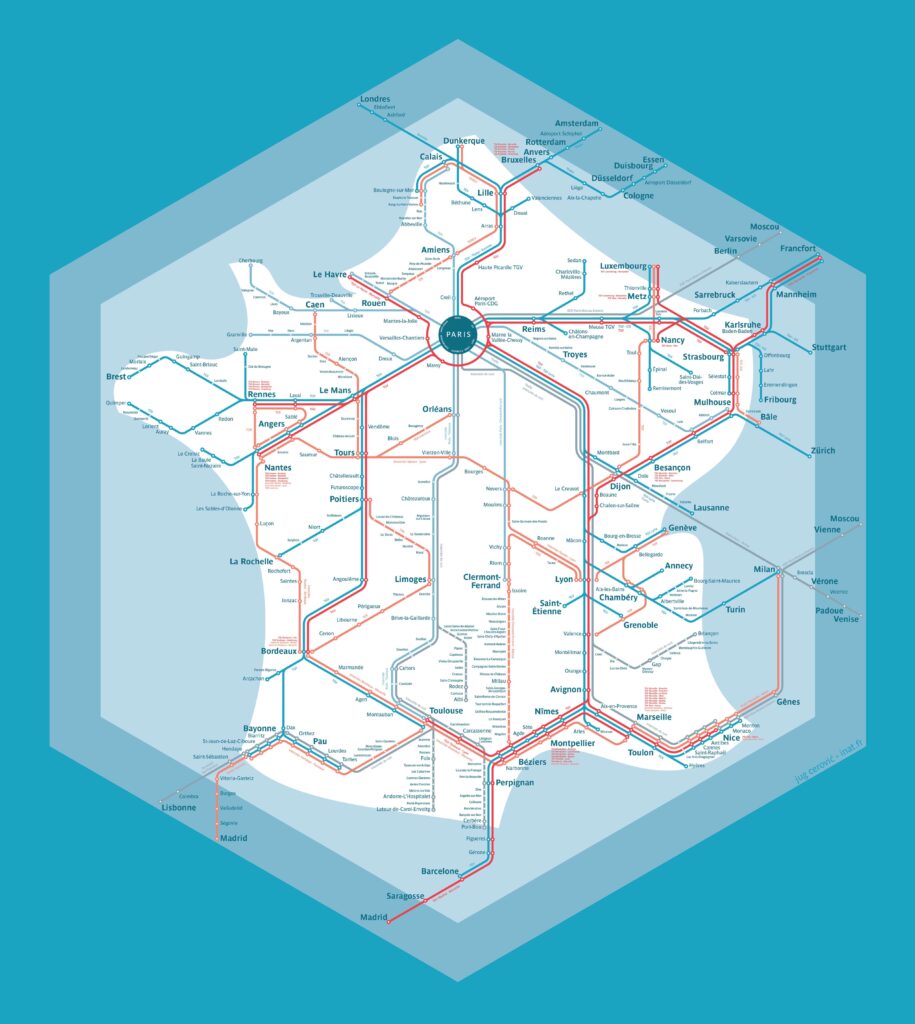
Basically any route that can be reached by train within 2.5 hours is now a no-go for flights.

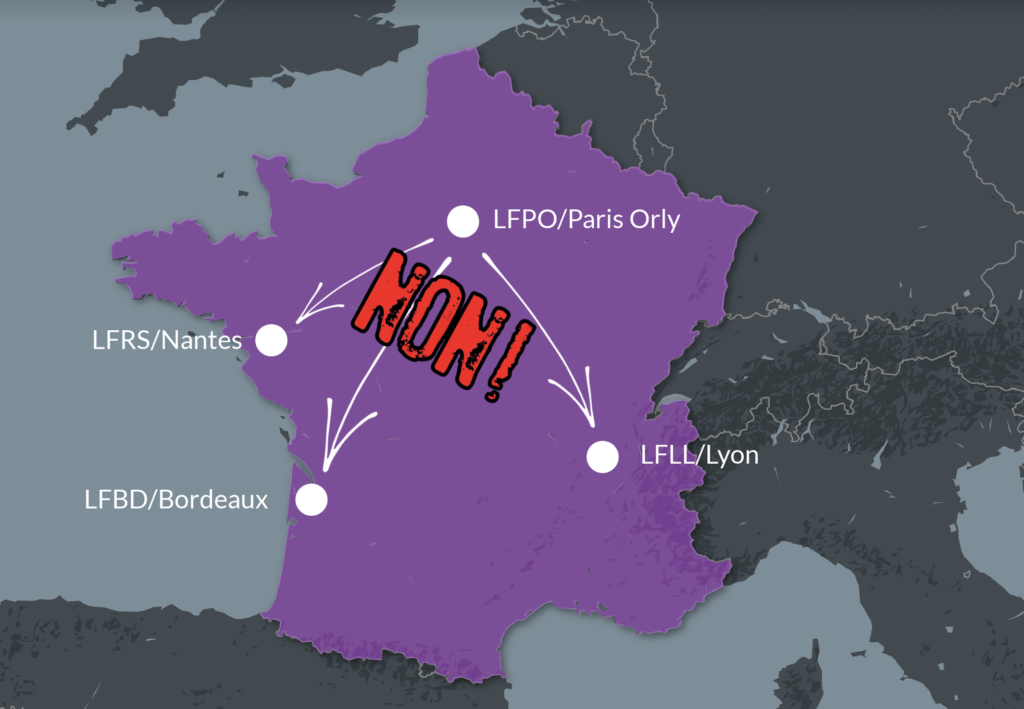
There are three initial scheduled routes that meet the criteria, and they’re all from LFPO/Paris Orly:

  • LFPO/Orly to LFBD/Bordeaux
  • LFPO/Orly to LFRS/Nantes
  • LFPO/Orly to LFLL/Lyon 

Originally there were 8 proposed routes which also included LFPG/Charles de Gaulle to LFBD/Bordeaux and LFRS/Nantes, LFPG/Charles de Gaulle to LFRS/Rennes and LFLL/Lyon, and also LFLL/Lyon to LFML/Marseille.

However, the train services aren’t quite there yet in terms of frequencies and timings. As soon as they are though… expect these to be reviewed as well.

The Who.

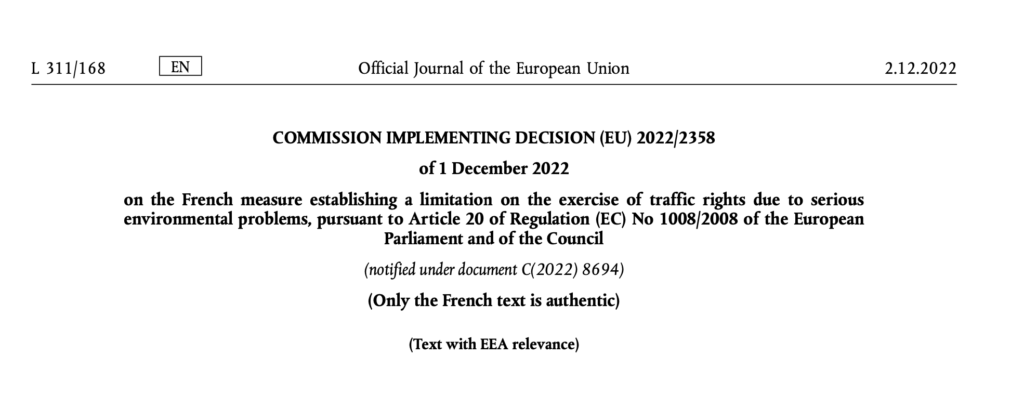
The official notice? Treaty? Regulation? Amendment to a treaty? Journal of the EU… We’re not actually sure what to call it, but the official thing says (and before we forget, here it is for you to read yourself), that the routes are “prohibited for any carrier”.

Which means, we guessed, all flights including BizAv. But, this is the EU, and we all remember the misery of working out what they meant by the term “carrier” for all things EU-LISA related…

And of course, there is the big question of whether this applies to non-French registered ‘carriers’ as well?

So, who else?

Well, we had a little re-read and what it actually says is this:

  1. Article 145.I of the Law prohibits, on the basis of Article 20 of the Regulation, scheduled public passenger air transport services on all air routes within French territory for which there are several direct rail connections per day of less than two and a half hours.

Phew, ok, that is actually not so bad.

So, we figure it means this:

  • It only applied to scheduled services.
  • It only applies to public (so not your private) flights.
  • It might apply to any EU registered (not just French registered) aircraft though.
  • They have specifically listed routes with connections that make this ruling applicable.

So if you are heading to France (and have some cabotage deal), and want to fly internally, then chances are you are still fine to do it. If you are an EU registered aircraft then you might want to have a closer look at what it means for you on these specific routes though.

And while they do say “scheduled public service” if there is a sudden uptick of private services on these routes it probably won’t go down very well, so perhaps don’t go having a cunning plan about setting up a ‘private’ route.

Still fine… for now…

France has the highest number of private aircraft movements of any country in Europe (over 120,000 at the last proper count in 2019), and there is a plan to crackdown on this too.

What this means right now is that if you regularly fly private jets into France, have a think about how to reduce this because it is being monitored and could have a big impact in the future.

The Why.

Well, for environmental reasons mostly.

The prohibiting of these three routes alone will lead to a reduction of around 55,000 tonnes of CO2 emissions from air transport. Using more trains on them is still calculated to lead to an overall reduction of around 50% (worst case) and as high as 98% (in a really best case world).

The impact on BizAv.

The impact on BizAv is not big now. In fact, the reduction of scheduled services into LFBD/Bordeaux, LFLL/Lyon and LFRS/Nantes might mean some additional space for your private flights. Not so much LFPO/Orly because its a fairly busy airport and 3 routes probably won’t mean much extra space. But this might also mean an increase in charges as the airports look to reduce the loss in revenue from having these routes cancelled.


Bali bound and no place to go…

If you’re bound for Bali there are a few things you need to know, especially if it is your first time there. Ops there often seem to get disrupted, and you’ll need the option of having someplace else to go. Figuring out where – especially at night – may be harder than you think.

Let’s take a closer look.

At face value, ops at Bali seem straight forward. The runway is long, there is an instrument approach at both ends, SIDs and STARs link everything up and the place is towered 24/7.

But after years of flying in there with a scheduled operator, the number one biggest threat remained fuel in the tanks when it all went pear-shaped – which it sometimes did.

The airport just seems to have a habit of eroding your fuel margins. You may be carrying a healthy alternate enroute, but beware of giving it all away while holding once you arrive.

Delays and short notice closures.

The airport is especially vulnerable to them, and they can be unpredictable. Here’s why.

 1. Weather 

If you’re flying into Bali during rainy season (November – March), weather is likely to be a major factor. Like clockwork, towering cumulus clouds strengthen throughout the day into powerful thunderstorms in the afternoon and evening.

While the TAF may look identical day in and out, it is luck of the draw whether the airport itself will be affected. And when it is, traffic backs up quickly.

 2. Volcanic Ash 

Indonesia rests on the western portion of the Ring of Fire which renders it the third most volcanically active region on earth. There are no less than one hundred and forty-seven volcanoes there, seventy-six of which are currently active.

Eruptions are frequent and occur with little warning causing major disruptions to airports throughout the country – and extensive ash plumes. They can close airports like Bali for days on end, like one did in 2017. And the situation can develop when you’re already airborne.

The closest volcano to WADD/Bali airport is less than 40nm away.

Mount Agung erupted in 2017, closing Bali for several days. Courtesy: IBTimes UK

 3. VIP Movements 

Yep, someone important is inbound. And guess who has to make way? The airport often gets closed for short periods for VIP movements. You’ll find them in the Notams from time-to-time. Take it from me – apply a healthy buffer to either side as ATC will not necessarily be able to provide you with an accurate time the airport will re-open while you’re racing around that holding pattern.

4. Traffic Jams 

WADD/Denpasar is Indonesia’s second busiest airport second only to Jakarta. Which means it sees a lot of traffic. It also occupies a busy air corridor linking Europe to Oceania. Controllers manage a steady flow of both regional and international traffic from both directions.

It can be difficult to predict the effect of this ahead of time, but it is not unusual to hold inbound on your STAR. And you likely won’t have a head’s up beforehand that it is coming. Extra fuel for traffic holding is absolutely necessary.

 5. Congested Frequencies 

If you’re getting low on fuel, make a decision early. Don’t wait.

ATC has to manage large pieces of airspace here. On Ujung especially it can be challenging getting heard. Controllers are often managing multiple frequencies – it may seem like you’re being ignored, but you may not be able to hear everyone else talking to controllers over the top of you.

The language barrier can also be an issue – English will likely not be your controller’s first language, and their accents can make them hard to understand. The moral of the story is to be assertive on the radio, and speak slowly and clearly. Try and stick to standard phraseology such as ‘minimum fuel.’ And don’t take a back seat when trying to get an urgent request granted.

But where to go?

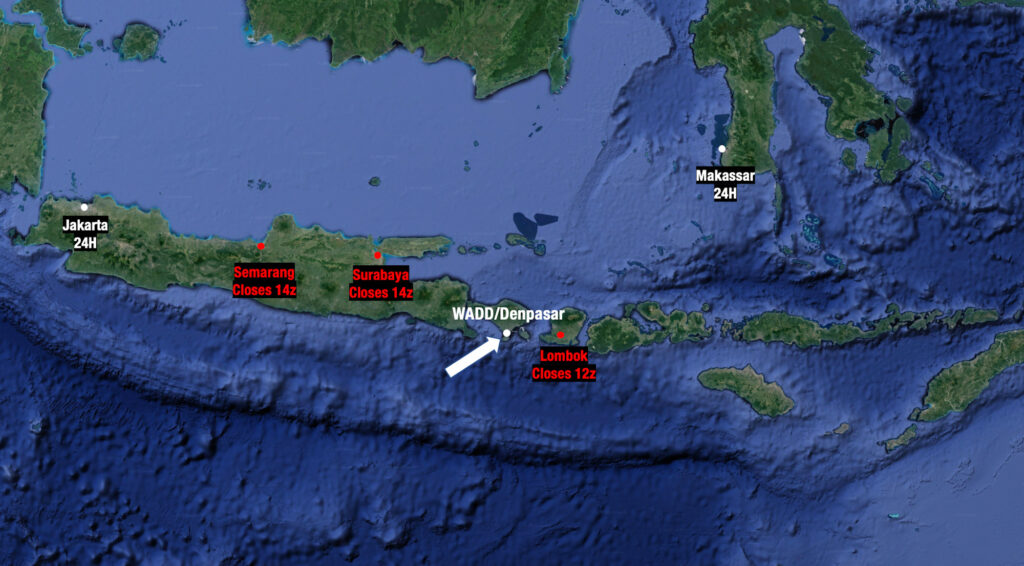
If you’re heading into Bali late, you’ll need to pay special attention to alternate planning. All the airports in the region still have special operating hours in place to “avoid the spread of Covid”, as per their notams. At present, WADD/Bali itself is open until 18z (02:00am local) but its closest alternatives are not.

Lombok (WADL/Praya), 85nm. Closed each night from 12z (20:00 local). [Notam B2226/22, valid until Feb 19].

Surabaya (WARR/Juanda) , 160nm. Closed each night from 14z (22:00 local). [Notam A2938/22, valid until Feb 18, actually due to runway closure for works].

Semarang (WAHS/Semarang), 295nm. Closed each night from 12z (20:00 local). [Notam B2231/22, valid until Feb 18].

If it’s late, you’ll need to carry more fuel than usual to reach WAAA/Makassar 320nm away, or WIII/Jakarta 512nm away.

And finally – watch out for terrain!

There are some big hills out there. If you’re flying into Bali, there’s a good chance you may yourself under radar vectors at night or in IMC nearby. Protect your aircraft – keep a close eye on where you are relative to that terrain at all times. Especially when it’s busy!

Aircraft arriving from or departing to the northwest need to be particularly wary. Sector MSA just north of the airport rises steeply to 9700’. Further west you’ll find Central and East Java with grid MORAs as high as 14,000’. Also be aware of escape routes if your cabin springs a leak.


China Crew Hotel 101

This is one for any crew who head into China. 

What happened in Urumqi?

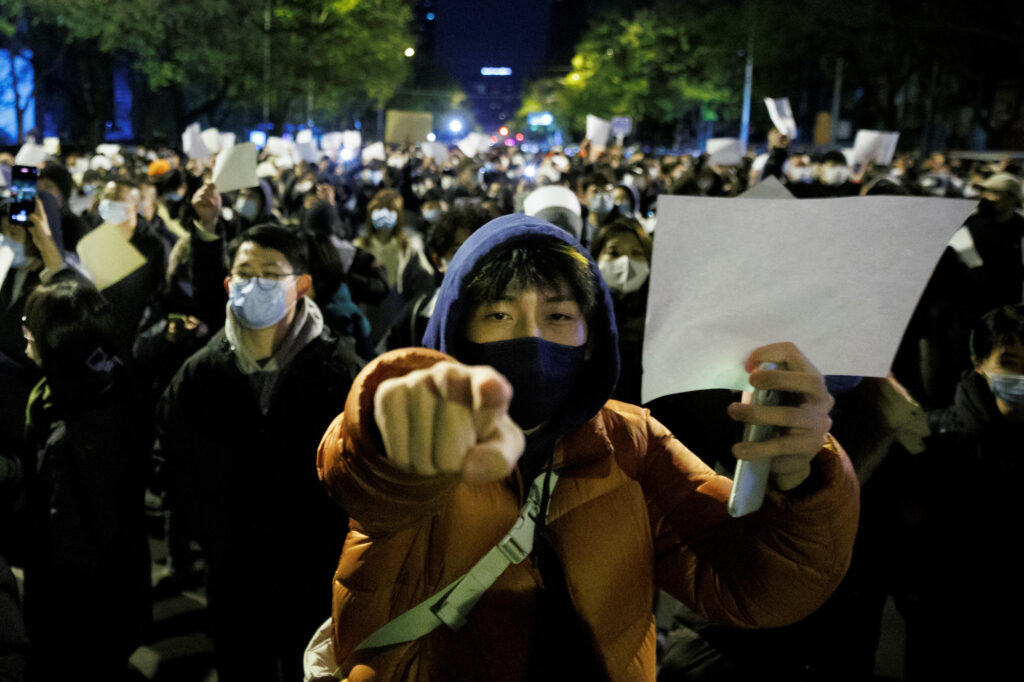
People in China are angry. 

There are currently protests across many major Chinese cities, including Beijing and Shanghai. Which is unusual because protests are very frowned upon in China, and generally lead to quite a heavy handed police response.

So when they do protest, you know it is over something they feel strongly about. 

They are angry over Covid lockdown rules which saw a 10 people perish in a tower block fire in Urumqi. Questions have been asked over whether residents were allowed to leave their homes, and whether the fire exits were clear.

What does this have to do with crew?

There are two things worth considering if operating into China:

  • The security situation
  • The hotel room safety situation

The Security Situation

Crew are not allowed out of their quarantine hotels, so the protests themselves will not impact you directly. However, a stricter level of Covid rule compliance might.

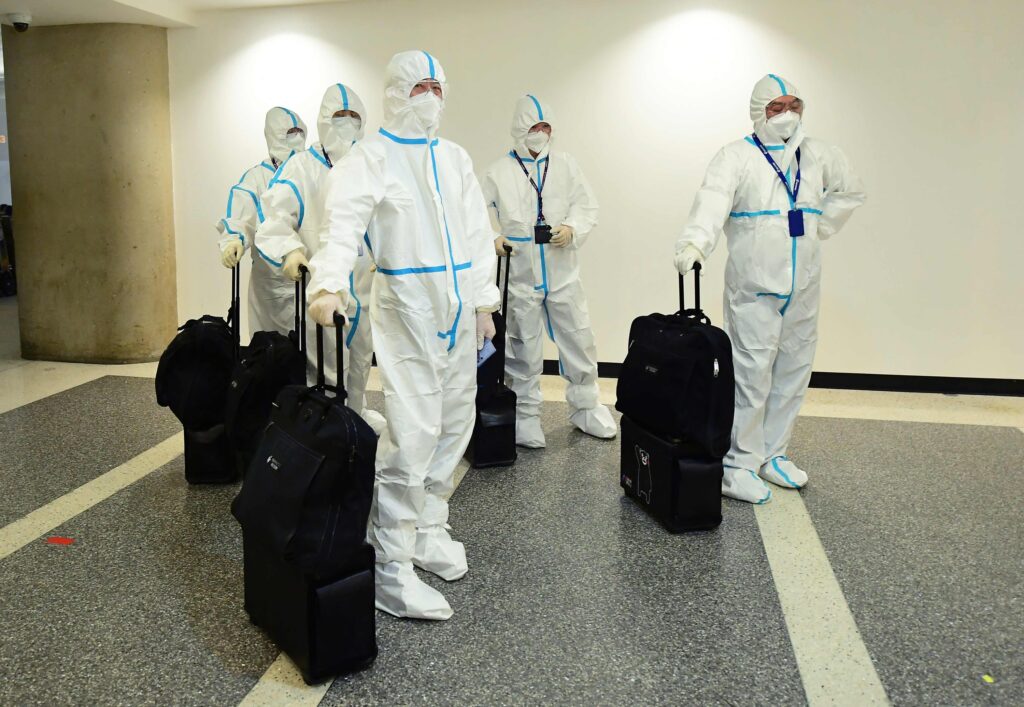
Currently, crew are required to don full ‘anti-Covid’ suits on arrival (while still on the aircraft), and are accompanied through airports, bused to hotels, and required to remain within their hotel rooms.

Member Top Tip: “They don’t generally provide big sizes. If you need an XL it might be worth getting your local agent to arrange this, or you’re going to find yourself trussed up like a sausage inside an ‘average”‘sized suit.”

The rules have eased a little, but are still subject to change at short notice, and entry requirements for crew are not always entirely clear. The best people to ask are your local agents at whatever airport you are heading into.

We recommend that you:

  • Follow the rules pretty strictly. Easier in the winter months when it is not baking hot (those suits are the worst in the summer). Non-compliance is likely to lead to fines, potentially banning your operator from returning to China, or you may be subject to more quarantine.
  • Prepare for lengthy delays in and out of the airport and factor this into your report times.
  • Do not vocally criticise in a way that might be perceived as a protest against Chinese law or the government.

But what’s this about hotel room safety?

Some crew have reported that they are not only quarantined in their hotel rooms, but they are locked inside their hotel rooms, unable to open the door from the inside. 

This is not safe. 

If you or your operator has experienced this, please let us know at news@ops.group. We might not be able to do anything to help, but we can share the hotel info with other operators so they know about it.

You must be able to unlock your hotel room from the inside in order to evacuate in an emergency. Your hotel room should also be equipped with a smoke mask.

  • Checking with the hotel prior to operating in and raising this is a good idea. Doing so once there may prove difficult. Bear in mind, these are generally government selected hotels for crew as well. You don’t get much say in where to stay.
  • On arrival, crew should pay particular attention to how to access emergency exits because these hotels tend to have significant ‘plastic coating’ on their interiors, and it may be difficult to locate exits in an emergency.
  • If in doubt over your safety, don’t remain in the room because they’ve told you to. Get yourself out and safe, and worry about the repercussions of that afterwards. I’m pretty certain they’ll be less serious than the consequences of staying locked inside a burning hotel!
  • Make sure your crew have contact information in case of a medical emergency while in China.

Monitor the food situation

Folk report this is slowly improving. 

If you haven’t been, then here’s the deal – basically your hotel is going to provide you with meals. These are usually left in boxes at specific times outside the room, and you’re allowed to open up and take them inside.

There are two issues here:

  • They are not always catering to ‘Western’ food preferences.
  • There doesn’t appear to be any way to report allergies.
  • Chinese good often contains MSG, which you may have an allergy to without knowing.
  • They often provide them based on Chinese meal timings, which can be tough with jet lag/sleep plans etc.

Good news is you can get in touch in advance and ensure you request food that your crew can eat, and that it is provided at times they will want to be eating at. Alternatively, recommend crew take their own food with them.

A little note on Customs

China readopted their Health Declaration Measures, since November 16. Make sure you submit the form and download the QR code before heading over. There is an APP for it that makes it handier, and the website is here for all the info you might need.


Don’t say Hi to Jack!

Attempted hijackings of major airlines have decreased because of big advances in security and safety.

But, reports of an apparent attempt on an Emirates aircraft surfaced on November 10, so we thought we would take a look at those security procedures, ops procedures and some FAA door related news, to help you stay safe in the skies.

The ‘was it a hijack attempt?’ reports.

Look, we don’t know, and we aren’t into speculation.

All we’ve seen is a bunch of news sites saying a 777 was diverted back to Athens after taking off for New York, possibly accompanied by F-16s, possibly with reports of a possible suspect onboard, possibly under a ‘Code Renegade’.

It landed safely, and there will likely be detailed reports out about it at some point so we are going to leave it there.

Hijack attempts are not common anymore, mainly because security procedures have been developed so much to help prevent them.

But we don’t want to get complacent about it, because most of those procedures fall on us (the operators and the air crew).

So we figured a recap on what some of these procedures are, and what it might mean for you ops-wise could be handy.

On the ground

Security stuff starts on the ground. Actually it hopefully (if the systems work) should start and also end here.

If you’re up for a lengthy read, then check out the minutes of a major meeting which took place 10 years after Sep 11th (in 2011, so over ten years ago now) on changes to TSA procedures and processes. Here they are. Read away.

Basically, there are A LOT of procedures and processes for ensuring only ‘good’ passengers get on airplanes, and a lot of this lies in the Customs systems that are now in place.

We are going to be super lazy here and say ‘go read this NBAA post’ if you have questions on the specifics of customs and regulations stuff. It’s a big old topic and all we’re really trying to do here is say “make sure you get the customs bit right” (not actually tell you how to).

*But if you do have questions, let us know and we’ll root out some answers for you.

  • In general, if you’re a big airline or commercial operator, a lot of this is going to be done for you at the airport
  • If you’re a private or business jet operator (that doesn’t just fly the owner around) then you might need to do some more checks yourself (or more stuff to ensure you’re compliant with required security and document checking regulations).

Here are some vaguely helpful links:

  • The US CBP website is filled with info on all things US Customs and Bordery, along with a bunch of info on things to help speed up the process for pax.
  • Your US pre-clearance airports are listed here, along with info on that.
  • For international folk arriving into the US, you might want to look at APIS (Advance Passenger Information System Manifest) Transmissions if you don’t already know what these are.
  • There are fairly hefty fines for the PIC of a private aircraft if you don’t follow the US regulations. If you have any questions, try these folk – GAsupport@cbp.dhs.gov
  • There is some CANPASS info here for if you want to fly to Canada.
  • There is some ETIAS info here for those of you planning trips to Europe.

In the air

Let’s jump right in with some regulatory stuff:

The US, UK, Europe (and a fair few other places) have fairly strict procedures in place for who can sit in the flight deck jump seat. This doesn’t just apply to aircraft registered in whichever place either. If you are operating into their airspace you probably still need to be thinking about this.

And we’re talking about what the authorities say, not what your company says. This might be stricter (so check that out for yourself).

The basic rule for most places is that during the flight anyone in the flight deck needs to be authorised to be in the flight deck.

What this means can vary though.

In the UK for example, only members of the operating crew (the pilots actually flying the thing on that flight) may be in there. No supernumerary crew. No pilots who work for the company, have that type rating, but are just positioning. 

There are other authorised folk too:

  • Like an aviation authority air carrier inspector.
  • A DOD commercial air carrier evaluator.
  • An ATC person (but only if authorised by the administrator, and only so they can observe ATC procedures).

You know what, rather than us writing it all out:

Remember German Wings?

The German Wings event brought in a bunch of big new regulations in the EU. The main ones being:

  • Regulation 175 which requires airlines ensure all pilots receive a psychometric evaluation within 24 months of employment and before they start their line flying
  • A requirement to always have more than one person in the flight deck

The second one was problematic. It added an extra layer of hassle when pilots needed to leave the flight deck to use the toilet, (and an added layer of embarrassment when you’ve had to ask for the fourth time in under an hour). This has been removed and is now just a requirement within certain operator policies, rather than a state or authority requirement.

Not letting random passengers in, in flight, is still a thing though. As is looking after the well-being and mental resilience of your crew and colleagues.

The FAA Flight deck barrier policy.

September 11th brought about a new focus on flight deck security. Namely, folk can no longer fly with their doors open, and access must be controlled. This applies to commercial aircraft, it may not apply to your private aircraft.

So, for those it does definitely apply to – a secured door with an access code, or a secure access procedure is required. This is covered in § 121.587 Closing and locking of flightcrew compartment door and says:

Recently, the FAA have recently published a new thing on flight deck door barriers. Something the likes of ALPA have been asking for since 9/11.

The summary is that it will apply to “certain airplanes used to conduct domestic, flag, or supplemental passenger-carrying operations”. This won’t apply to Part 129 (which is foreign operators heading into the US, or US registered ones that only operate outside the US).

The ‘secondary barrier’ creates an extra level of security by requiring that, prior to the flight deck door being opened, this must be secured shut like a sort of cattle gate.

Knock knock. Who’s there? Jack!

If you do have a hijacker onboard then remember three things:

  • Don’t open the flight deck door
  • Don’t open the flight deck door!
  • Do squawk 7500

If you don’t want ATC thinking you have a hijacker onboard:

At any point in flight, (sort of goes without saying, but we’ll say it anyway), maintain good radio communication. 

There are a lot of ADIZ (military airspaces) out there where you must check in, in advance. There are also a lot of conflicts going on which mean countries are particularly cautious when it comes to aircraft not in contact with who they should be in contact with.

If you don’t want some F16s to come swooping up alongside you then:

  • Don’t miss radio calls.
  • Do check in (in advance) if the airspace requires you to.
  • Do try other systems or get relays if you lose contact.
  • Don’t accidentally stray into airspace you aren’t cleared to fly into.

And if you don’t have an attempted hijacking going on then definitely don’t do what a South African crew accidentally did in 2016, or what  a 747 crew for a major US airline did in 1999. You read about those embarrassing incidents here.


What is going on in Myanmar?

A new airspace warning for Myanmar was issued by Germany on 23 November 2022. EDWW B1361/22 is valid through to February 2023, and looks like this:

Take potential risk into account if planning on heading below FL160 in the YYYF/Yangon FIR.

You might not be a German operator, and as far as we know this is the only warning out there.

The UK hasn’t issued one. France hasn’t issued one. EASA haven’t mentioned it, the FAA haven’t either… but since Germany has, it is probably worth thinking about (whoever you are) if you operate in any way in the Yangon FIR.

So, what is going on in Myanmar?

Myanmar had a military coup in February 2021. You might remember it because a sudden, significant lack of ATC occurred across their airspace.

We covered that here in a whole lot of detail, but in short: the majority of ATC and AIS staff went on strike, leading to contingency procedures (ATC zero) and very limited notams for a while. Since then, ATC and AIS services are back up and running.

But there has been growing unrest in the country with increasing numbers of strikes and mass protests by opposition groups. The response has been an increase in military force resulting in clashes as well as airstrikes on areas where militia are known to be active.

Security and safety within the country is deteriorating, and airspace risk is increasing because of the potential risk from military ops, surface-to-air fire and anti-aviation weaponry.

Passenger injured by bullet.

On Sep 30, 2022, a Myanmar National Airlines passenger was reportedly shot in the face as bullets passed through the fuselage of the ATR 72 aircraft on approach to VYLK/Loikaw.

Myanmar’s military gave a statement at the time saying the aircraft came under fire at a height of approx 1,000 m about 4 miles north of Loikaw Airport, and blamed the attack on two resistance forces – the Karenni National Progressive Party (KNPP) and the People’s Defence Force. KNPP reportedly said that they were not involved, and avoid civilian targets.

The military are also a concern.

Cambodia recently ‘disinvited’ Myanmar from attending a major defense meeting involving the Southeast Asian Nations (ASEAN), as they wish to ‘diplomatically isolate the military regime’. 

This isn’t quite ‘sanctions level’ from Myanmar’s neighbours, but it is an indication that the ruling government’s method of controlling the situation is not one which is ensuring safety and security in the country.

There are travel warnings in place, including ones from the UK and the US, and the US Embassy issued a new warning on Nov 29 warning of a general increase in violent attacks in the country. If you do have crew heading in, consider the information in these, and think how it might impact your crew:

  • Security and safety due military response to gatherings and protests is a concern
  • Airspace risk due military traffic and airstrikes is a concern

US Sanctions?

The FAA doesn’t have an airspace warning, but they do have something, and it can be read here (it’s under the FAA prohibitions, restrictions and notices bit).

Re-issued in January 2022, this advisory is from the OFAC (Office of Foreign Assets Control) and it talks about the “Risks and Considerations for Businesses and Individuals with Exposure to Entities Responsible for Undermining Democratic Processes, Facilitating Corruption, and Committing Human Rights Abuses in Burma.”

Basically, be careful doing any sort of business with anyone there, because if it’s with Tatmadaw (that’s the military folk) you could get into trouble with the US, or with Tatmadaw (because they’re apparently quite corrupt).

Most goods from Myanmar cannot be imported back to the US. While other sanctions have eased off a bit, you can still run into issues with paying for fees (overflight permits etc) so using a 3rd party service (that has an OFAC licence) to organise these may prove easier.

Some general considerations.

Here are some general considerations and info, to help you plan:

  • VECC/Kolkata, India, is a good diversion airport if needed to the west of Myanmar. It has 2 runways, 01/19 L/R and both are over 3000m. There are CAT II/III approaches available.
  • VOMM/Chennai, India, is a good option if on a more southerly routing. 07/25 is over 3500m and has an ILS. 12/30 is 2800m and RNP only.
  • VTBS/Bangkok Suvarnabhum and VTBD/Bangkok Don Meang, Thailand, are decent options just to the east of Myanamar. VTBS has 01/19 L/R which are both over 3500m and CAT II. VTBD has 03/21 L/R, over 3000m and CAT II capable.
  • More southerly routings will take you across the Bay of Bengal and you will only cross a thin sliver of Myanmar land, but the airspace itself continues quite far south. This may be preferable if routing towards Malaysia, Singapore or Indonesia.
    • L301 is mostly offshore, crossing the small sliver of land prior to the Thai border. M770 is offshore, routing SE.
  • If routing towards Hanoi, Hong Kong and Taiwan you may find a more northerly routing which crosses central Myanmar is required.

Myanmar airspace and airport considerations.

  • VYYY/Yangon airport has runway 03/21 which is 3414m, with an ILS CAT I.
    •  MJets are the main FBO +951 401 590 / +95 978 639 5811 / yangon@mjets.com
    • There were reports of explosions and gunfire at an army checkpoint near VYYY/Yangon airport during protests in 2021
    • There were reports of difficulty uplifting fuel at VYYY/Yangon due to local political restrictions. While this was in 2021, ongoing concerns regarding military airstrikes against civilians may lead to fuel sanctions from foreign suppliers, leading to a shortage for civilian aircraft as well.
  •  VYMD/Mandalay airport is an international airport. Runway 17/35 is over 4000m, with an ILS CAT I on 17.
    • There are notams downgrading RFF to 7, and advising the AWOS is u/s.
    • The city itself has seen heavy military action and is considered a security and safety risk on the ground.
  • There is an ADIZ within the Yangon FIR. You do need to check in in advance with them, and they do sometimes request confirmation of your ADC number.
  • There may be an increase in military traffic. Caution with radio comms and accurate navigation is important.
  • Weather can be challenging in the entire region. Consider it in advance in case detours are required.
  • Yangon has CPDLC (VYYF) but it isn’t compulsory.
  • M770, L301 remain offshore. L524 passes over the southern tip. N895 routes across Myanmar.

Last but not least, permits:

  • You need a permit for everything here. Takeoff, landing, overflights, and regardless of whether you’re private or commercial.
  • Navigation fees have to be paid in advance. If you have time you can set up an account with the CAA and apply for your permits directly. If not you can use an agent who can pay these on your behalf (and we recommend that). You need to give five days notice for landing and three days notice for overfly permits. Here’s a handy list from Asia Flight Services for all the prices in the region.
  • DCA +95 1 533015 / dgdca@dca.gov.mm
  • Asia Flight Services +66 2329 5938 / occ@asiaflight.aero

Member Top Tip: If you are planning of fly any sort of business jet into Myanmar, be prepared to have a lot of cash (USD preferred). They assume that business jets are full of wealthy individuals and ‘expediting fees’ are often liberally requested. This is one of those places you don’t want to negotiate, just pay and get in the air as soon as possible.”

Member Top TIP: Paying in USD is preferred. Some pointers on condition of the notes that will be accepted:
1. Notes have to be new ones
2. Notes have to be clean, devoid of any writing, marking, stamp, bank seal etc
3. Notes cannot be folded or with creases
4. No hole or tear allowed on the note”


PIREPs of the Caribbean

It is heading, at a chillingly fast pace, into winter in the northern hemisphere, which means we usually write posts on ski season spot ops. But we did that last year, so this year, we thought a nice hot weather one could be fun instead.

Which is why this is a post all about operating to the Caribbean.

*There is nothing about PIREPs in this at all, I just thought that was too good a pun to not use.

When is peak season?

That would be now: Late November to mid April.

It is peak for two reasons:

  • One, its still nice weather there while the northern hemisphere is generally in the midst of cold and wet misery so like winged sunflowers, or maybe moths, everyone starts heading for the sunshine.
  • Two, there are a bunch of big holidays like Christmas and New Years and people like to go somewhere nice to celebrate.

All this means a lot more GA traffic which means busy airspace, delays, and parking problems if you haven’t pre-planned.

What to pre-plan?

Read this very helpful post from the folk at Universal Weather. We could re-write it all out for you here but seems pointless when they’ve done such a good job. And all that permit parking slot stuff is dull.

So, on to more interesting stuff.

We thought we might take a look at the airports themselves instead, because there are challenges that will really shiver yer timbers if you don’t know about them.

While looking up information, we also discovered this old pirate map in an ancient bottle of rum 🙂 🏴‍☠️

The Airports

TNCM/Princess Juliana, St. Maarten, Netherlands Antilles

Hours: 0700-2100L, O/T O/R PNR available for non-scheduled flights
Runway/Approach info: 10/28 7546’/2300m RNAV/Visual RFF9
Timber shivering stuff: You’re going to need a special qualification to head in here. It has some unusual procedures because of the big old mountains near it. There is Class C airspace right above it and it all gets super congested there.

TIST/ Cyril E King, St. Thomas, Virgin Islands

Hours: 0700-2300L, US preclearance airport
Runway/Approach info: 10/28 7000’/2134m ILS 10 RFF7
Contact Info: Airport +1 340-774-5
Ahoy matey! What else can yer tell me?: Another one needing special qualification due hills. They also have noise sensitive areas, class c airspace and all the congestion that comes with it, and turbulence and wind shear to deal with.

TUPJ/Terrance B Lettsome (Roadtown), Tortola, Virgin Islands

Hours: M-F 1230-2030Z, O/T PPR
Runway/Approach Info: 07/25 is only 4646’/1416m with an RNAV to 25 RFF5
Contact Info: Airport +1 284-394-8000/ FBO: IAM jet centre +1 284-495-0303 eisops@iamjetcentre.com
Yarr! Argh! stuff: Smaller airport. It is hilly around the airport, and the short runway ends in water… There are also no VFR ops by night.

TBPB/Grantley Adams, Bridgetown, Barbados

Hours: H24
Runway/Approach Info: 09/27 11017’/3358m ILS 09/RNAV RFF 9
Contact Info: Airport +1 246-536-1302FBO: IAM jet centre 1 246-428-1704 aviation@iamjetcentre.com
Avast, ye scurvy threats: This big one can handle big aircraft, although there are some ground restrictions for the medium and heavy folk. There are NABT procedures too. Nice one for tech stopping and maintenance action.

MYNN/Lyndon Pindling, Nassau, Bahamas

Hours: H24R US Pre-Clearance Airport
Runway/Aroach Info: 14/32 10925’/3330m ILS 14/RNAV RFF8 and 10/28 8302’/2530m RNAV/VOR
Contact Info: Airport +1 242-702-1010 feedback@nas.bs / FBO: Jet Aviation jnas@jetaviationnassau.com +1 242 377 3355 / Odyssey Bahamas info.mynn@odysseyaviation.com +1 242 702 0200
Yo ho ho: One of the biggers. Not without its challenges though. There are prohibited and danger areas near the airport to look out for. These mean some special IFR departure procedures if heading W, SW or NW (basically anyway involving some westwardly way). Lots of traffic below 10,000’ here too

MWCR/Owen Roberts, Georgetown,  Grand Cayman, Cayman Islands

Hours: Ops 0700-2100L, O/T O/R; Admin M-F 0830-1700L
Runway/Approach Info: 08/26 7867’/2398m RNAV RFF7
Contact Info: Airport +1 345-943-7070 ciaa@caymanairports.com / FBO: Island air +1 345-949-5252 2 0200
Here be treasure, matey: They don’t have radar here, but they do have noise sensitive areas so navigate carefully.

TAPA/VC Bird, St.John’s, Antigua

Hours: H24R
Runway/Approach Info: 07/25 9967’/3038m RNAV (GNSS) RFF8
Contact Info: Airport +1 268-484-2300 info@abairportauthority.com / FBO: Signature +1 268-462-2522 ANU@signatureflight.com
May yer compass be true:This has some skinny little taxiways that anything over 65000lbs, or with wings over 100’ (30m) isn’t allowed to use (and they can only use by day). This means backtracking aircraft on the runway which means you’ll probably have to hold on arrival for spacing. It is quite a popular tech stop airport though.

MBPV/Providenciales, Turks and Caicos

Hours: M-F 1230-2030Z, O/T PPR
Runway/Approach Info: 10/28 9199’/2804m RNP/VOR RFF 7
Contact Info: Airport +1 649-946-2137
Wall the plank: A bigger airport, this also has a lot go GA traffic and also some parasailing hazards to add to the fun.

TQPF/Clayton J Lloyd (Wallblake), The Valley, Anguilla

House: 1200-2000z
Runway/Approach Info: 11/29 5459’/1664m RNP RFF5
Contact Info: Airport +1264-497-2384/ FBO: Lloyd Aviation +1 264-498-4141 info@lloyd-aviation.com
Scallywags: Another little one that only allows IFR by night. There are a lot of poles, antenna and also birds around the airport. So keep a good look out (probably why its IFR only at night).

MKJS/Sangster, Montega Bay, Jamaica

Hours: H24R
Runway/Approach Info:  07/25 8735’/2662m ILS 07/RNAV 25 RFF 9
Contact Info: Airport +1 876-952-3124 Slots slotrequest@mbjairport.com/ FBO: IAM jet centre +1 876-979-3855 mbj@iamjetcentre.com
Batten down them hatches: A good tech stop spot, but look out for the mountains and the high minimas and the noise sensitive bits. Also look out for the many small airports (and traffic heading into them) which fill the airspace. They have some specific NABT procedures to look into, and it can get windsheary.

MDSD/Las Americas, Santo Domingo, Dominican Republic

Hours: H24
Runway/Approach Info: 17/35 11004’/3354m ILS 17/RNAV RFF9
Contact Info: Airport +1 809-947-2225 operador@aerodom.com/ FBO: Servair +1 809 549 1404 fbo@servair.com.do
Other stuff: Don’t confuse San Isidro AB for MDSD. And don’t head in unless you have the qualification – it’s one of those because of the airbase and prohibited areas nearby. Terrain nearby is also a bit of a concern, as is FOD on the runway (not sure why, but enough to permanently mention it apparently). There are also minimum ceiling restrictions of approaches so worth familiarising yourself with the charts before heading in.

MDLR/La Romana Casa de Campo intl, Dominican Republic

Hours: H24
Runway/Approach Info: 11/29 9678’/2950m RNAV(GNSS) RFF8
Contact Info: Airport +1 809-813-9000 info@lrm.com.do/ FBO: Swissport Dominicana +1 809 813 9123 lrmexecutive@swissport.com.do / Universal Aviation +1 809 813 9070
Hoist the mainsail: This place requires a 180 turn and backtrack on both ends of the runway and has limited taxiway and apron space. There is a nearby restricted area and noise sensitive bits.
ATC often seek in Spanish for local traffic so watch out.

TJSJ/San Juan Luis Munoz Marin, Puerto Rico

Hours:H24
Runway/Approach Info: 08/26 10400’/3170m ILS 08 / RNAV RFF8 and 10/29 8016’/2443m ILS 10 / RNAV
Contact Info:  Airport +1 787-253-2329 info@aerostarairports.com/ FBO: Airport Aviation Services +1 787 791 8500/
Jet Aviation San Juan +1 787 791 7005 hector.vasquez@jetaviation.com
Pazo’s fuel services +1 787-791-7005 fboservices@pazosfbopr.com
Down to Davy Jones’ locker with ye: A good tech stop option. It does have some mountains nearby, and it is in primary Class C airspace.
Also don’t get confused by TJIG/Fernando Luis Ribas Dominicci nearby

Where else can I get info?

Opsgroup wise: we have a library of Airport Lowdowns that you might find useful. If you’re a member you can also head to Airport Spy and read a whole load of reviews from other members sharing what they experienced.

For example:

AOPA make some very handy slot guides which you can find here.

They include useful stuff like info on airports, stuff to do while you’re there, and photos of pineapples.

The Caricom e-APIS site is here. You’ll need this for advance information sending about passengers.

The FAA guide to the Caribbean en-route stuff can be discovered here. This is a treasure trove of information on en-route stuff, weather stuff, and all things to do with operating in the airspaces.


Turkey, Syria and Iraq: Airspace Risk

The airspace risk in Syria and Iraq are both discussed regularly, with numerous warnings and prohibitions from major authorities.

However, Turkey is seeing an increase in security and safety concerns along its southern border with Syria, and the eastern region which borders Iraq, because of the conflict and tensions in this region. And not a lot is said about it.

Why is Turkey seeing increased risk?

Keeping this as simple and non-political as possible because it is really just for context – Kurdish people are an ethnic group native to Kurdistan which is a big area spanning southeastern Turkey, northwestern Iran, northern Iraq and northern Syria.

Here’s a map of it:

Turkey has an ongoing conflict with armed Kurdish groups, particularly one called the PKK who have fought against Turkish authorities since the 1980’s, hoping to establish an independent Kurdish state.

In addition to this, Syria have their own civil war also involving their Kurdish population, as does Iraq. Turkey borders each of these countries, and spillover from these has led to more and more military action by Turkey.

Risks for aviation:

There are two main risks previously highlighted:

1. Misidentification and anti-aircraft weaponry

The primary risk is misidentification by local militia who infrequently target Turkish military aircraft with MANPADS and weaponsied drones. Operations to LTAJ/Gaziantep should be carefully reviewed given its proximity to the Syrian border.

The US FAA published a note on Turkey in 19 May 2021 referring to the threat from militia with access to anti-aircraft weaponry.

2. GPS jamming

The secondary risk is GPS Jamming. Turkey has long been an area which sees significant GPS Jamming. There are frequent reports from crews of GPS signal interference in Turkish airspace – with some as far away as abeam Baghdad. GPS jamming is common through the LTAA/Ankara FIR, and especially on the border between the ORBB/Baghdad and OIIX/Tehran FIRs.

Turkey Notam LTAA A6691/22, valid through to 6 January 2023 relates to GPS Jamming.

Other growing risks for air crew and air operations:

1. Security on the ground

Security in major cities, and in regions along the border, in southern Turkey is a growing concern. Crew should be aware of these and should avoid travelling close to the border regions.

Caution should be taken if visiting large public spaces and tourist areas as there is a heightened risk of terrorism.

Prepare for potential disruption and delays due heightened security in airports.

Consider the implications of diverting to airports where you have no ground contacts, engineering or support. There may be political concerns to consider as well depending on the nationality of your crew or passengers.

2. Risk in southern Turkish airspace

Along the border with Syria and Iraq in proximity to conflict zones, there is a higher level of airborne military traffic, UAS and the risk of proximity to airstrikes.

Most major authorities advise operators to exercise caution when operating in the airspace within 200 NM of the Damascus FIR (OSTT), which should be considered to include the southern region of Turkey as well as the countries neighbouring Syria to the west.

Major events

  • On Nov 21, the Turkish border town of Karkamis was hit by artillery and rockets from across the Syrian border.
  • On Nov 13, a bomb attack in Istanbul attributed to the PKK resulted in Turkey carrying out airstrikes against Syria and Iraq. Operation Claw-Sword is reported to have involved 70 aircraft and drones.
  • In May 2021 an attempted drone attack by local militia on LTCC/Diyabakir airport in South Eastern Turkey.
  • In Jan 2019, Turkish security forces intercepted three weaponised drones during attempted attacks against sites in southern Turkey.

A full briefing on Turkey can be found on Safeairspace.net

Syria

There is a high risk to civil aircraft. Syrian airspace (OSTT/Damascus FIR) should be avoided entirely. Airspace adjoining the Damascus FIR is also at risk: Cyprus, Turkey, Israel. Total flight ban for US, UK and German operators, and several other countries have issued warnings to avoid the airspace of Syria.

The primary risk is a misidentification by Syrian air defense systems. Civil aircraft may be targeted in error, or caught in crossfire during ongoing air attacks involving Israel, Russia, Iran. Missiles may erroneously lock on to civil aircraft. Israeli airstrikes on Syria are regular, and do not show any regard for civil traffic.

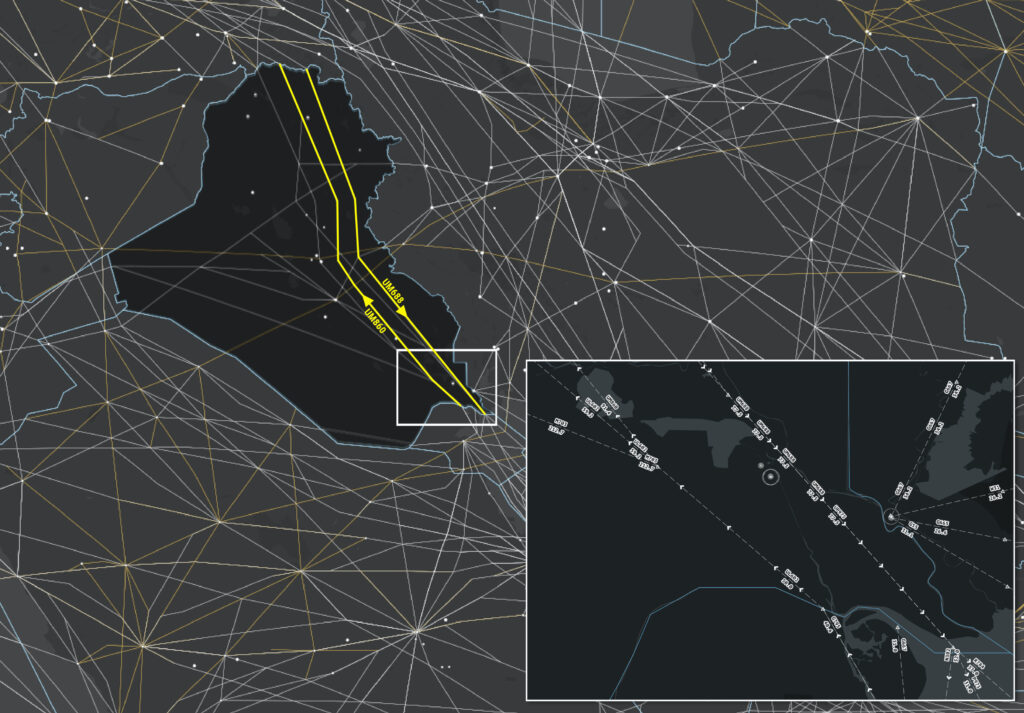
There is a clear risk to civil aircraft operating on airways UL620, UW74, UR18, and UP62. 

The FAA information on Syria warns the threat is extended to adjacent FIRs in the Eastern Mediterranean region including the LLLL/Tel Aviv, OJAC/Amman, OLBB/Beirut and LCCC/Nicosia FIRs. Use caution if operating in the area.

A full briefing on Syria can be read here.

Iraq

Most major authorities advise against operations below FL320 in the ORBB/Baghdad FIR. The US FAA amended their KICZ Notam from prohibiting all operations, to this in October 2021.

In Sep 2022, Iran closed a section of airspace in the north of the country along the border with Iraq, and is using the area to launch missile and drone attacks at targets near ORER/Erbil Airport. Iran are warning their own operators against flying in Iraqi airspace.

ORER/Erbil is the primary airport located in the Iraqi Kurdistan region and regular artillery, rocket and missile attacks target this region. Operations into the airports including diversions, should be avoided.

A full briefing on Iraq can be read here.


Keep an eye on Shiveluch

Shiveluch is a 70,000 year old volcano with quite a bad temper. We thought we might introduce you to this hot headed fellow because it might have an impact on aviation in the not too distant future.

It has been reported as ‘extremely active’ since November 20, and an eruption is expected imminently.

Say hello to Shiveluch.

Or Шивелуч to give him his Russian name since he is, after all, Russian.

Shiveluch lives on the Kamchatka Peninsula (the far east bit of Russia that sticks out into the Pacific Ocean, and the Sea of Okhotsk). Shiveluch and Karymsky are the most active volcanoes on this bit of land.

What’s the eruption history?

He’s been blowing his top for about 10,000 years, but the current eruption period started in 1999 and he’s kept it up with a fair few explosions, frequent ash cloud spitting along with ‘incandescent block avalanches, and lava dome growth’ since then.

In February 2015 the ash cloud (which is really the bit we’re worried about in aviation) shot up to 30,000′ and crossed the Bering Sea and into Alaska.

In June 2022 it hocked up a dense ash plume which reached about 7 km in altitude.

Where will a big ash cloud potentially affect?

Unfortunately this is dependant on how much ash he coughs up (historically quite a lot), and which way the wind blows:

  • UHPP/Yelizovo Airport (Petropavlovsk-Kamchatsky)

This airport lies south of the volcano, on the peninsula, and is popular fuel/tech stop for BizAv aircraft but is currently not available anyway due prohibitions against operations into Russia airspace.

  • Alaska

Alaskan airspace was affected back in 2015 and more recently in April 2022. Ash reached 32,000′ and moved across the Pacific Ocean, impacting traffic routing over the northeast region and the Gulf of Alaska.

PANC/Anchorage could be affected, along with smaller airports such as PADK/Adak and airport along the Aleutian Islands currently used as fuel/tech stops while Russian airports are unavailable.

  • North Pacific/Bering Sea

Aircraft heading between the USA and Asia utilise routings here which may be impacted by large ash clouds.

  • Japan

Winds don’t predominantly blow this way, but ash could potentially still disrupt airports and airspace in this direction.

Keep an eye on him.

You can read his full history here. They post regular bulletins and reports on the ongoing action.

The Tokyo and Anchorage VAACs monitor this volcano. You can find links to their sites here.

Volcano Discovery also provides some handy info on volcanoes and their current action.

Look out for ASHTAMs and SigWx information for the North Pacific and Alaska region.


Ukraine-Russia Spillover Risks: Nov 2022

A missile involved in the Russia-Ukraine conflict fell in Poland on Nov 15, close to the border with Ukraine. There are no prohibitions or warnings for Polish airspace, however the border region is (clearly) high risk and operators should avoid flights in or over this area.

The following map shows two airways which lie in proximity to the border and which may be used by overflying aircraft. The airways routing into Ukraine, Belarus or utilised for routes into prohibited airspaces have not been highlighted.

The ongoing conflict between Russia and Ukraine continues to pose challenges and risks to international flight operations.

We covered these previously in this post which looked at:

  • Ukraine, Moldova, Russia and Belarus airspace closures.
  • Which countries have banned Russian aircraft and operators, and which countries has Russia banned in response?
  • The differences between the sanctions imposed on Russia by the US, the UK, and the EU, and the nuances of how these sanctions may impact your flight.
  • Considerations for operators now looking to route around Russian airspace.
  • Information on Humanitarian relief missions.

What has changed?

In terms of the above, very little. Ukrainian airspace remains closed and poses a significant risk to aircraft.

All the major countries who regularly issue airspace warnings (the US, UK, Canada, France, Germany, plus several more) have issued total flight bans for Ukraine due to risk from military activity at all levels.

The primary risk is an unintended targeting of civil aircraft by military, including misidentification (as with MAS17, UIA752).

What has changed is the potential spillover risk. The FAA has released an Information Note regarding this, which you can read here.

What does it say?

Pretty much an updated report of what we said in this post back in March 2022.

In a nutshell – “Russia’s increased use of developmental weapons, use of weapons in nontraditional roles, and long-range missile strikes into western Ukraine increases potential spillover risk concerns for U.S. civil aviation operations in adjacent airspace.”

In other words, the risks and hazards are not necessarily confined to the geographical borders which are used to define ‘risky airspace’ (the areas covered by current conflict-related flight prohibition NOTAMs and other warnings).

The three main points in the FAA Information Note are these:

  1. Russia periodically launches missiles targeting Ukraine which transit Moldovan airspace.
  2. There have been reports of comms and GPS jamming outside the conflict zone, particularly over the Black Sea and Caspian Sea.
  3. Drone/UAS activity has expanded, especially around Crimea and eastern Ukraine.

1. Missile launches

Russia periodically launches missiles targeting Ukraine from positions in the Black Sea and Caspian Sea. The flight paths for these generally route across Moldovan airspace.

Moldova initially closed all their airspace, but have since opened a section on their western border with the LRBB/Bucharesti FIR for flights to LUKK/Chisinau airport.

On Nov 15, a missile fell in Poland, close to the border with western Ukraine. It is not clear whether this was launched by Russia or by Ukrainian Air Defenses, but it signifies a heightened level of risk in regions bordering the conflict zone which are not necessarily covered in prohibitions and warnings.

An awareness of the proximity to significantly high risk airspace is advised.

The FAA SFAR related to the conflict and listing the prohibited airspaces can be read here.

2. GPS Jamming

This has been reported beyond the regions outlined in NOTAMs and airspace warning areas.

Civil aircraft flights who route close to the borders of the conflict zone, or which transit the southern Black Sea or northern Caspian Sea may experience jamming.

A member reported – “Flew recently from the UAE over Iraq and Turkey and over the western edge of the Black Sea. Once inside Turkey, the GPS signal was lost and remained out until northwest of the of western Black Sea. Dual GPS plus a portable GPS receiver confirmed the loss of signal. Also, no satellite wifi during same period.”

EASA has issued Safety Information Bulletin on Global Navigation Satellite System (GNSS) jamming in the Baltic Sea area which you can find here.

3. Drone/UAS hazard

The use of Unmanned Aircraft Systems (UAS) has been increasing, on the Russia side.

These fly at lower altitudes (they say a max of about 16,000′) and there is a risk of ‘errant activity’ ie not flying where they should fly. In June 2022, one such errant UAS was reported in eastern Turkey.

These represent a hazard to aircraft given their size, the fact they are generally weaponised, and the fact they are not always where they are supposed to be.

Other spillover risks

These are not covered in the FAA note, but we figured worth mentioning anyway:

  • Increased traffic levels: Turkey is seeing higher traffic levels due airspace closures, as aircraft now transit their airspace. There is also an increase in military traffic in airspace bordering the conflict zones.
  • Crew fatigue: Longer routes, more challenges en-route, operational and planning challenges have not gone away, we are just staring to see them as the ‘status quo’.
  • Ongoing fuel and energy supply issues: These are more indirect, but the increase in costs and availability has led to some supply issues, as well as protests across many regions which means potential disruptions and security concerns.

Stay updated!

A full briefing on the airspace risks with up to date notice and NOTAM references can be found at Safeairspace.net

Please report back to us any new info you come across (be it airspace risk related, or simply sharing your experience of a recent flight) and we can help redistribute that info back out to the group so that all are aware.

You can email us at news@ops.group, or file a report of a recent trip on our Airport Spy page here: ops.group/blog/spyreport


The Safety Watchlist 2022

The Transportation Safety Board of Canada released its Watchlist for 2022, highlighting what they think the bigs and the bads to look at in the industry are. We figured it would be a lot of specifically Canadian things like grizzly bears on runways, and whether a hockey stick counts as a dangerous weapon when brought on board.

Turns out that it’s all things which are globally big and bad. What’s more, now the Covid stuff has (mostly) gone away (you might remember the whole pulling airplanes out of storage and finding bugs nesting in them fear), these are big, bad things which we’ve been talking about in the industry for quite some time.

So, because it’s November 2022, which is basically December, which means the year is pretty much over, we figured we’d tell you all about it.

The Highlights

Seems an odd choice of word, theirs not ours.

So, the first one on the list was something about commercial fishing safety. We aren’t sure if we have any commercial fisherfolk at Opsgroup, apologies if we do, but we don’t think so, so figured we would not pause too long on this one.

Same for railway signal indications. Not so relevant to aviation. We will say that following signals as a pilot is important though. If you don’t know your interception signals, you can swot up on them here.

Onto the Aviation highlights

There are 5. We reckon they are going to be quite familiar:

  • Runway Excursions
  • Runway Incursions
  • Fatigue
  • Safety Management Systems
  • Regulatory oversight

We’re going to ignore the last two, just because we don’t know much about them.

Runway Excursions

The biggest one. The baddest one. Aircraft going off the end of the runway. It happens way too often, and the outcome is often severe.

In Canada, between January 2005 and June 2022 there were on average 9.3 runway overrun occurrences per year, most of these during the landing phase.

Here’s the TSB’s graph:

Now, they do in all fairness get some ‘overrun encouraging’ weather in the deep and distant north because it gets so cold and icy up there.

But then again this isn’t limited to Canada.

You find places all over which have strong winds (tailwinds, ballon inducing gusts…), heavy rain (slippery runways), stuff that reduces visibility on short finals (increases chances of getting unstabilised), hot and high spots (increases the ROD required), unusual terrain (increases the chances of becoming unstabilised), short runways (possible performance mishaps), or just places which are totally easy-peasy so you think it will definitely all be fine and get complacent…

Runway excursions are a global problem that don’t seem to be going away. We might have mentioned this before.

So what can we do about it?

  • Know what GRF is and use it. If you haven’t heard of the (new) Global Reporting Format that came in 2021 then you can read about it here
  • Use arresting systems. OK, pilots can’t really do much about whether this is available at an airport, but knowing what it is and where it is, is important because some pilots have actively swerved to avoid it. If you’re heading off a runway then that sucks but if it has EMAS then USE IT, it might save your life.
  • Fly a stabilised approach. Or ask the question why you or your crew aren’t going around.
  • Do performance calculations… properly. Not much else to say on that.
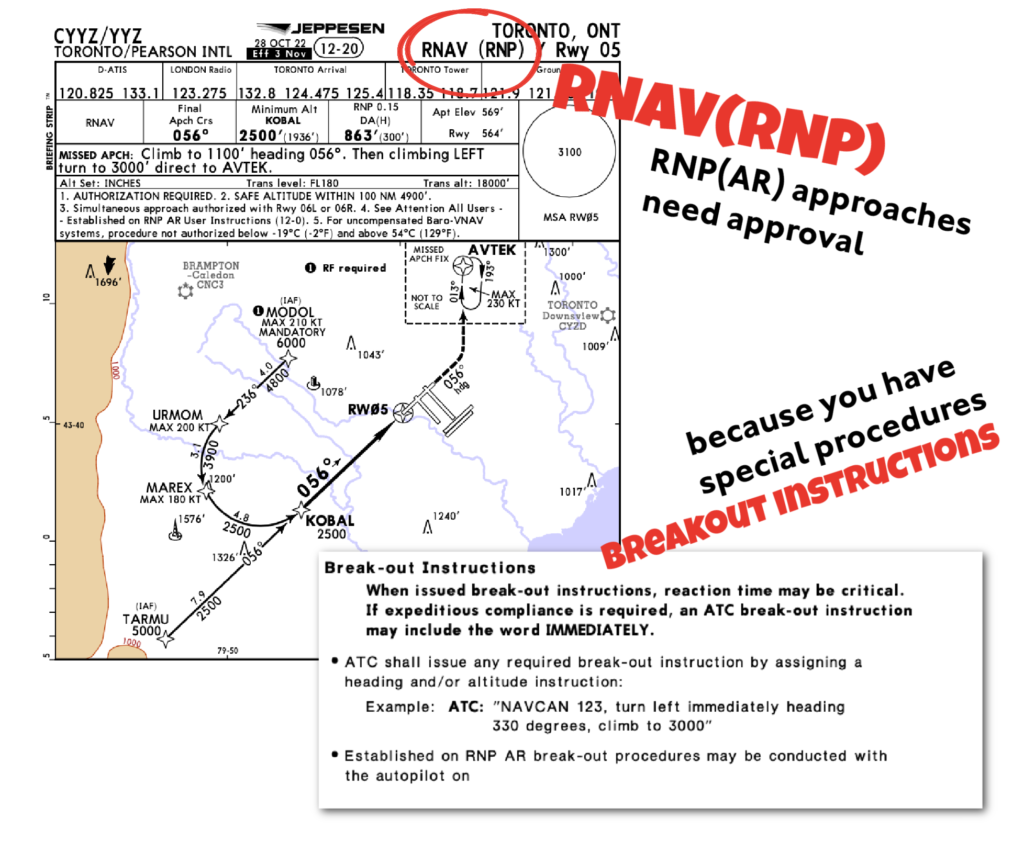
  • Be go-around minded. Air France learned a thing or two about this in 2005 heading into CYYZ/Toronto when the weather deteriorated and they didn’t go-around. It led to a runway excursion. Read about it here if you’re not familiar with this one.
  • Read this. It’s the full TSB rundown on runway overruns.

Runway Incursions

If the risk of heading off the end isn’t enough, then there is also a big risk of heading onto the runway when we shouldn’t be.

The rate has doubled in 12 years. Thankfully it hasn’t resulted in a collision, but still… not ideal.

Here’s another graph. because we like their graphs:

There are some big numbers on there.

What can we do about it?

  • Know your hotspot symbols. The US have recently changed up their hotspot symbols to help with situational awareness on the taxi.
  • Brief. Talk about the taxi, especially in poor visibility.
  • Stop! If you ain’t sure, stop taxiing. Rolling about willy-nilly never ends well.
  • Think about de-icing/anti-icing. There have been changes to HOTs in the FAA winter manual. Taking off with ice on your wings is going to make the takeoff roll hair-raising. Don’t risk it, de-ice!
  • Read this. The TSB’s stuff on incursions, in full.

Fatigue

Yep. Where to start. This is a big conversation which needs to be had more in the industry. Aside from FTLs and roster patterns (a can we won’t open now), we do think there are some things which aren’t getting mentioned enough which can lead to fatigue:

  • Staffing issues
    “Wait,” I hear you say. “What’s that got to do with fatigue?”
    Well, staffing issues in airports lead to delays, which lead to longer hours for crew, which can lead to tiredness and fatigue.
  • The Russia Ukraine conflict
    Longer routings mean more time in the air which can lead to, you guessed it, more tiredness and fatigue.
  • Strikes
    Strikes = delays and disruption = … same old story.

Now, just identifying random things which might be increasing fatigue levels isn’t really going to fix it. Having some real, human conversations about it might.

  • If you’re a pilot, don’t just think about now, think about 10 hours later.
  • Get some decent controlled rest policies into your operation.
  • Consider ways to improve sleep management, especially if you’re doing hideous time zone crossing flights.
  • Stop using tees like “sleep science” and harping on about circadian rhythm. Start talking about how to recognise fatigue, what that means for your performance, and what to do about it.

The Full Monty

So, that is the (Canadian) Safety Watchlist 2022 and if you want to, you can read the full thing here, (including the bits on fishing).


Jeppesen Ransomware Attack Update

On November 3rd a ransomware attack took down the majority of Jeppesen planning products.

We heard that:

  • Jetplan.com was down
  • Milplanner.com was down
  • Jetplanner (standalone) was not working
  • Chart viewer products was not working (eg. Elink portal, and Icharts)
  • FliteDeck Pro was not working
  • Foreflight (now a Boeing company) was working but their Notam feed was not.

Find the post on this here.

Update: November 16

We asked around and it sounds like it took longer to fix than expected, and some bits still aren’t working quite as they were:

  • Foreflight notams remained down for several days
  • Ice crystal areas are not showing
  • There is an ongoing issue with expired charts and updates being unavailable
    • Jeppesen has advised that “The most recent Jeppesen chart downloads are currently effective and in compliance. Any “expired” messages prior to Dec 1 do not indicate that the charts are expired from a regulatory perspective.”
    • However, they do also have this note up. We suggest checking with them direct if unsure whether to update or not:

You can read their response to the attack here, including an explanation of whether or not you need an update.

The NBAA has also posted this:

So how big was the impact?

It was pretty big for some. The most disruptive seemingly for those reliant on the planning software.

Let us know if you were impacted (or still are).

What can you do if this happens again?

We aren’t sure actually. It raised more questions for us than we have answers for:

  • Can you use old route plans?
  • Can you use old fuel plans?
  • Where else can you get weather, Notam and planning info from?
  • Are there any back-ups for charts?
  • What else haven’t we thought of?

We’ve asked the question to members who were impacted by this.

If you were, and have some feedback on what the impact was and what you did about it, then send us the info at team@ops.group We will keep it anonymous, but if you have anything that can help others plan for/mitigate disruption if it occurs again in the future, then we want to hear it.

Has this happened before?

Computer and software glitches have caused numerous issues in the past, but most of these have been related to passenger booking info.

A problem with Aerodata, which several major US airlines use for weight and balance, caused disruption in 2019.

In 2021, a cyber attack on a major fuel pipeline in the USA led to significant disruption at east coast airports due to fuel supply issues.

The cyber security threat.

You’ve probably had to sit through a Cyber Security training thing at your organisation. They are basically common sense: don’t open random links and don’t give out passwords (or information that helps people guess passwords).

Cyber criminal cunningness is increasing though. We wrote about some of it here, and it is worth upping the caution levels and making sure you ain’t a weak link in security.


Hurricane Nicole: Florida Airport Closures – Nov 10 1000z

Hurricane Nicole made landfall this morning over east-central Florida as a large tropical storm, with winds of around 60kts. Nicole is forecast to move across Florida this morning towards the Gulf Coast, and then move north up along the Florida Panhandle and Georgia tonight and Friday.

National Hurricane Center’s Advisory, issued 4am EST Nov 10:

At 400 AM EST (0900 UTC), the center of Tropical Storm Nicole was
located inland over east-central Florida near latitude 27.8 North, 
longitude 80.7 West. Nicole is moving toward the west-northwest 
near 14 mph (22 km/h). A turn toward the northwest and 
north-northwest is expected later today and tonight, followed by an 
acceleration toward the north and north-northeast on Friday. On 
the forecast track, the center of Nicole will move across central 
Florida this morning, possibly emerge over the far northeastern 
Gulf of Mexico this afternoon, and then moving across the Florida 
Panhandle and Georgia tonight and on Friday.

Maximum sustained winds have decreased to near 70 mph (110 km/h) 
with higher gusts. Additional weakening is forecast while 
Nicole moves over land during the next day or two, and the storm is 
likely to become a tropical depression over Georgia tonight or 
early Friday. Nicole is expected to merge with a frontal boundary 
over the Mid-Atlantic United States by Friday night.

Nicole remains a large tropical storm. Tropical-storm-force winds 
extend outward up to 450 miles (720 km) from the center, 
especially to the north. A sustained wind of 47 mph (76 km/h) and a 
gust to 62 mph (100 km/h) were recently reported at Patrick Air 
Force Base, Florida. Winds are increasing near the west coast of 
Florida. A sustained wind of 38 mph (61 km/h) and a gust to 45 mph 
(72 km/h) were recently reported at Clearwater Beach.

The estimated minimum central pressure based on surface 
observations is 981 mb (28.97 inches).

Airport Closures

Several airports across the region are now closed for the passage of the storm. Here are the ones we know about as of 1000z on Nov 10:

And here are the Notams that carry the announcements of the closures:

MYGF/Grand Bahama
A0604/22 – AD CLSD. 08 NOV 22:30 2022 UNTIL 14 NOV 11:30 2022. CREATED: 08 NOV 15:07 2022

KPBI/Palm Beach
A2072/22 – AD AP CLSD EXC MIL, EMERG ACFT 1HR PPR 561-471-7440. 09 NOV 14:00 2022 UNTIL 10 NOV 13:00 2022. CREATED: 09 NOV 11:02 2022

KSUA/Witham Field
11/130 – AD AP CLSD EXC MIL OPS AND EMERG ACFT. 09 NOV 19:00 2022 UNTIL 10 NOV 17:00 2022. CREATED: 09 NOV 13:53 2022

KMLB/Melbourne
A0565/22 – AD AP CLSD EXC MIL OPS AND EMERG ACFT 1HR PPR 321-508-1319. 09 NOV 19:00 2022 UNTIL 10 NOV 21:00 2022. CREATED: 08 NOV 19:51 2022

KISM/Kissimmee
A0400/22 – AD AP CLSD. 09 NOV 17:00 2022 UNTIL 11 NOV 11:59 2022. CREATED: 08 NOV 23:29 2022

KMCO/Orlando
A3251/22 – AD AP CLSD EXC EMERG ACFT AND MIL OPS AND CARGO. 09 NOV 22:00 2022 UNTIL 11 NOV 17:00 2022. CREATED: 09 NOV 21:30 2022

KORL/Orlando Executive
A3204/22 – ORL AD AP CLSD TO FIXED WING EXC HEL AND EMERG HEL AND MIL HEL OPS. 09 NOV 21:00 2022 UNTIL 11 NOV 17:00 2022. CREATED: 08 NOV 21:48 2022

KSFB/Orlando Sanford
A1063/22 – AD AP CLSD EXC EMERG ACFT AND SAR 1HR PPR 407-247-1212. 09 NOV 21:00 2022 UNTIL 11 NOV 14:00 2022. CREATED: 09 NOV 14:27 2022

KDAB/Daytona Beach
A1969/22 – AD AP CLSD EXC MIL, EMERG ACFT 1HR PPR 386-547-0298. 09 NOV 19:09 2022 UNTIL 11 NOV 11:00 2022. CREATED: 09 NOV 19:09 2022

More info

  • Cyclocane have a tracker page for Nicole here, which includes tracking map and source info from the National Hurricane Center.
  • The FAA have a page on airport closures here.
  • The NBAA have a page on Nicole here, which includes airport closures, equipment shutdowns, and route info.

If you have any additional info to add, please email us at news@ops.group

Jetplanner, FD Pro, Charts – down

Hi members,

As those of you immediately affected by this will already be well aware of, the majority of Jeppesen planning products are not working at the moment.

Currently:

  • Jetplan.com is down
  • Milplanner.com is down
  • Jetplanner (standalone) is not working
  • Chart viewer products are not working (eg. Elink portal, and Icharts)
  • FliteDeck Pro is not working
  • Foreflight (now a Boeing company) is working but their Notam feed is not.

There is a note on the “outage” on the Jeppesen website, but reports from members here indicate that phone support is not available, and information is scarce.


However, it does appear that Jeppesen is dealing with a ransomware attack, meaning they have a choice of paying a ransom to restore service, or find an alternate way of providing service. Much as the impact of the outage will weigh heavy on some operators, our thoughts are with Jeppesen – not a nice situation to be in at all.

Given the situation it seems lilkely that the outage may continue for some time yet.

We will post any updates here and in the #flightops channel on OPSGROUP Slack.

If you have any information, please share with the OPSGROUP Team.


Cloaking Devices: The ADS-B Privacy Issue

ADS-B is fantastic bit of technology that has big safety and efficiency benefits for air traffic. The trouble is, there is also a growing level of insecurity about security surrounding it, because it doesn’t just allow ATC to know precisely where you are at all times – anyone who wants to can find that info too.

Are you ADS-Being watched?

We said all this about it before.

If you can’t be bothered to read it, then it basically says this:

  • Big benefit because it gives ‘radar like coverage’ in remote regions like the North Atlantic.
  • Big problem because it reduces privacy, and this could lead to security issues.

Whilst airlines don’t mind/aren’t really bothered about this as much (you can kinda tell where they are heading to and from, and get other info on the airplanes, with relative ease), the business aviation and private aviation world are more concerned.

The OPSGROUP ‘All Call’.

Here’s the frustration: The FAA runs a program called LADD which offers “hiding” of our ID on tracking sites (like FlightRadar24). The theory is good, but we’re now at a point here LADD simply highlights your aircraft on tracking sites that don’t play by those rules (like ADS-B exchange).

Here’s a video. One click shows everyone airborne that has requested privacy!

And then there is the issue of everywhere not the US because the FAA PIA system only works in US airspace. Cross the invisible boundary and you’re visible again. This includes offshore routes to the Caribbean or across the Gulf of Mexico.

Changing the PIA back to the ICAO one is a bit of a mission, and if you aren’t using it, then you’re not going to be able to log on to Domestic Enroute CPDLC, ARINC and SITA stations won’t recognise you. You’ll have to switch to a new flight plan provider to get the required call sign. In other words, it is not practical for a lot of operators.

We wanted to get an idea of how bothered folks are, and to share some of the info, so we sent out an ‘All Call’ to our members. The response was big. The concern and frustration is big.

So what has been happening?

ICAO held their 41st assembly earlier in 2022, and Saudi Arabia submitted a technical paper asking ICAO to fix the problem. Read it here.

The key points from the paper:

  • ADS-B Tracking of flights creates safety, security and privacy concerns.
  • There are some ways to hide your ID, but they don’t really work.
  • ICAO, please fix this.

So, maybe ICAO will take a look at it, but there isn’t an easy fix. It’s an inherent system problem that needs the system to change (maybe encryption, maybe dynamic hex codes, maybe something else…)

The NBAA are on it.

A panel to discuss the growing issue was held at NBAA-BACE on Oct 19, 2022. There is a great article on it which you can read here.

Here’s what we picked out of it:

  • Pre-ADS-B systems worked on interrogation – so you knew who was asking for the info.
  • The issue got bigger with ADS-B Out.
  • ADS-B isn’t going away because it is useful.

So they laid out a 4 step plan:

  • Aircraft registration should be held by a trust or LLC so there is a layer of separation between the principle owner and the name on the certificate of registration (because that’s on the public record and anyone can view it).
  • Folk should make sure their aircraft is participating in the LADD program (it does still do something). Find that here.
  • Use a third-party call sign. You can get this from a bunch of vendors like Foreflight and FltPlan.com.
  • The most important one: Take steps to change your 24-bit code associated with your registration. You can do this through the PIA system. Basically, the FAA assigns you an alternate 24-bit code to fool the sneaky flight trackers into seeing a different registration number.

The FAA are on it.

They have a whole site dedicated to ADS-B privacy which you can find here.

The info is pretty much everything we’ve said above, but they have some handy links and things too.

Is it enough though?

We aren’t sure it is.

It is an ongoing thing, which lots of people are looking into. In the meantime, we do have these questions, and your answers to them might help:

  • How have you solved this problem?
  • Have you worked out some black magic that hides your ID?
  • Have you found something that other operators can use?
  • Since LADD appears almost pointless, does PIA work for you?
  • Have you experienced any security or privacy issues because of public tracking?
  • Any suggestions or thoughts to share?

Drop us an email at news@ops.group if you have any answers/idea/suggestions/tips/questions/queries or other…
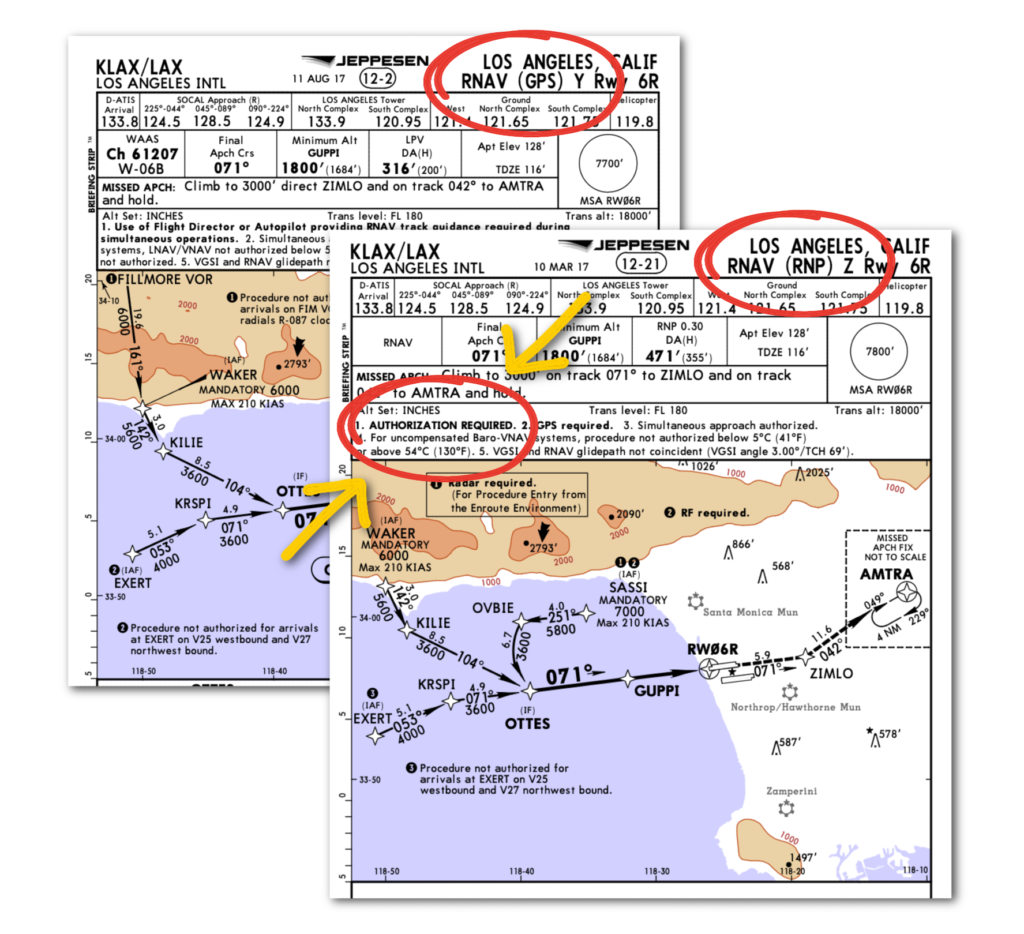

Shannon, BizJets and Level Busts

Level busts at EINN/Shannon Airport are a problem. A big problem. Big enough that the IAA have made a presentation on them, alongside the NBAA. Why the NBAA? Well, because a disproportionate number involve North American Business jets.

We’ll start with a little story.

Once upon a time, not so long ago, a pilot called Hank* (*name changed for anonymity) was flying his Business Jet over from the US to Europe, and he decided to stop off at Shannon airport. Shannon is, after all, on the Emerald Coast so it’s very pretty but more importantly its just on the other side of the Atlantic, you can do your US customs stuff there, and they have fuel for your airplane and Guinness for you.

So off Hank heads, and he’s done his homework. He’s planned for the whole NAT HLA bit. Alas, though, he has not planned for the actual landing into Shannon bit. Tired, distracted by the thoughts of Guinness and caught out by a much lower transition altitude, Hank forgets to change his altimeter from inches mercury to hectopascals, and when ATC says “Set QNH 988” what does he do?

He sets 2988inHg…

And so he descends down, aiming to level off at a nice safe altitude. Only his altimeter is over-reading by 720 feet. Hank gets within 2nm and 500ft of some pretty sticky-uppy terrain before ATC spots the errant aircraft and saves the day…

So, Hank was added to a long list of North American Business Jet operators who had a nasty level bust in Shannon and was embarrassed.

Now, the story really begins…

I am not a North American BizJet operator so it doesn’t apply to me?

Well, it could and it’s useful for anyone to think about really. Level busts are an issue all over, and if you operate into any high traffic density spot (London is a particularly good example) then even the most minor of busting can result in a traffic conflict.

Then there is the risk of CFIT – controlled flight into terrain. Busting downwards in areas with high terrain could lead to this. In fact, most CFITs occur during the approach and landing phase.

300 feet is your limit. Anything beyond that and you’ve got a bust on your hands.

What’s with Shannon and North American BizJet operators?

EINN/Shannon is a US Customs and Border pre-clearance airport, and it is in a handy spot on the west coast of Ireland making it perfect for aircraft with slightly less range to hop between the US and Europe. So it gets a higher number of BizJets from the US. In fact, 30% of their flights are North American BizJets (out of 25,000 or so flights a year).

But despite being only 30% of traffic, they are involved in the majority of level busts. In 2019, 68% of busts in Shannon were, you guessed it, by the NABJ brigade. So far, in 2022, they’ve been responsible for a whopping 100%!

So why does Shannon see so many?

Well, in all fairness, there are some things that make it more complicated if you’re used to flying in the US. 

Shannon, like most of Europe, uses hPa instead of inches of mercury, and this can lead to “mis-setting” on the QNH. Like we saw with poor Hank (based on an actual true story) – this is probably the most common cause of level busts in Shannon.

Then there is the transition altitude. Unlike the US and their nice standard always 18,000ft, Shannon uses 5000ft which can lead to a late (or early) change to and from local QNH. Chuck in some weather and particularly non-ISA one and there’s your problem.

And of course, folk heading in from a long North Atlantic night flight might be tired, unfamiliar, or just not planning it very well.

So what can pilots do to avoid level busts?

  • Add a mention of the risk into your briefing if you’re heading to Shannon. Or anywhere where level busts are an issue.
  • Remember “High to low: careful go!”
  • Don’t forget to set QNH in hectopascal and not inches mercury when operating into Europe.
  • Check the transition altitude, and plan ahead if it’s a low one.
  • Avoid aggressive descents – you can ask ATC for more track miles if you need.
  • Read the NBAA/IAA presentation for more info.


Africa ATC Strike

Update 01NOV

The threat of further ATC strikes in West Africa and Madagascar hasn’t completely gone away. The air traffic controllers union USYCAA have published an update claiming that ASECNA (the ATC agency) haven’t been sticking to the terms of an agreement reached on Oct 17 – they have been forcibly returning controllers to their countries of origin, cutting salaries, and freezing leave. There’s another meeting planned for Nov 7, so we should know more then.

You can read the original announcement (in French) here, or this translated copy.


Update 19OCT

USYCAA has cancelled any further strike action, following a meeting with ASECNA on Oct 17.

It looks like ASECNA have agreed to some demands (suspend pay cuts, provide indemnity insurance, set up a committee to talk with the union) but some still need to be resolved – mainly to restore all sanctioned controllers to their positions.

You can read the original announcement (in French) here, or this translated copy.


Update 11OCT

USYCAA has accused ASECNA of intimidating behaviour towards controllers ahead of a planned meeting on Oct 17 for negotiations to avert any further strike action. They cite “freezing without explanation of annual leave, verbal invectives, the unwritten suspensions of several air traffic controllers” among their claims.

You can read the original announcement (in French) here, or this translated copy.


Update 27SEP

USYCAA has suspended all strike action to allow for further negotiation with ASECNA planned for Oct 17.

You can read the original announcement (in French) here, or this translated copy.

ASECNA have also released a statement, which essentially claims there were no safety incidents during the strike, but doesn’t really say much more. You can read it from the source here (in French) or this translated copy.


Update 24SEP

As of 1200Z today, the ASECNA ATC strike action itself has ended. Per the controllers union, ops normal now. Arrested controllers have been freed, suspended controllers reinstated. However, caution should still be taken by crews as their grievances remains unresolved – both sides are now entering further negotiations for 10 days.

With so many FIR’s, ACC’s, and Terminal areas involved, the strike action has caused chaos in parts of African airspace. The heavy handed response by ASECNA, which included arresting striking controllers, has created a very sour atmosphere for ATC. This creates potential for lapses in judgement and safety concerns, even with the strike action over.

The major concern yesterday was the replacement of licensed controllers with military and other non-qualified staff, without any Notam or notification. Coordination between different units was unreliable, and many ATC centres were confused as to what the situation was.

For now, ops normal to some degree again – but all crews should still take great care until things settle down.

You can read the original announcement (in French) here, or this translated copy.


Update 23SEP

A very dangerous situation is developing today in the African ATC strike. Crews and operators should be aware that in a number of FIRs/ACCs/Towers, the normal controllers have been replaced earlier today with unqualified and unrated people. In simple terms, the voice on the radio is NOT an Air Traffic Controller.

From local sources we understand that GOOO/Dakar Oceanic and domestic, DXXX/Lomé, and FKKD/Douala all have unlicensed staff that have taken over the faciltiies. In FCBB/Brazzaville and FMCX/FMCH/Comoros, controllers have been arrested. In Niger and Madagascar, controllers have been suspended.

The situation is chaotic in many places and still developing. As of now, OPSGROUP recommends avoiding ALL ASECNA airspace unless you have certainty that the ATC service is licensed and safe, and until the situation is more clear.

If you do have to operate through these FIR’s, be careful and cautious. ASECNA controls these areas: FMMM/Antananarivo, FCCC/Brazzaville, GOOO/Dakar Oceanic and Terrestrial, DRRR/Niamey, FTTT/N’Djamena, and the airspace of Togo and Benin.

We will update this further as we get more information. We also ask members to share any information they may have – email team@ops.group or WhatsApp the OPSGROUP Team at +1 747 200 1993
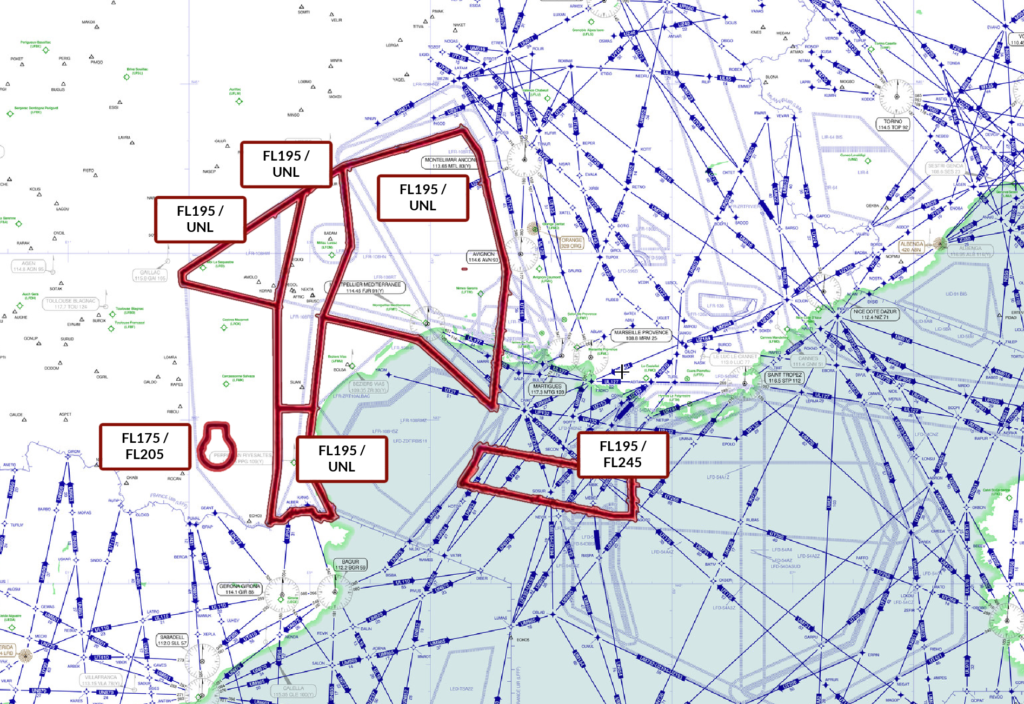
IFALPA have just published a bulletin about the situation.

And an update from USYCAA, the ASECNA Controllers union:


Update 22SEP

Note: These updates relate to the situation when the strike was routine – before reports of unlicensed controllers started to emerge. Please use the info as background only.

  • The ATC strike in West Africa and Madagascar is now underway, and is scheduled to continue until 0800z on Sep 25.
  • The strike is taking place across several African countries covered by ASECNA: the FIRs of FMMM/Antananarivo, FCCC/Brazzaville, GOOO/Dakar Oceanic and Terrestrial, DRRR/Niamey and FTTT/N’Djamena; and the airspace of Togo and Benin.
  • For flights in these regions, the Contingency Plans now apply. Check here for those.
  • The strike is also affecting flights in neighbouring airspace of GCCC/Canarias and DAAA/Algiers – Eurocontrol have published some rules and restrictions on flight planning there until the strike is over (see below).

GCCC/Canarias:

  • Traffic crossing GCCC and exiting to the south into Cabo Verde will be restricted with low rates to FL340 and 380 on UN741 as well as FL300, 340, 360 and 380 on UN873 (except traffic arriving to GV).
  • UN857 will be closed southbound from LZR to GUNET (except traffic arriving to GV).
  • Traffic crossing GCCC and arriving to GV must file via EDUMO or IPERA.
  • Traffic departing GC via LPPOOCA to GV can not fly via GOBEG, INSAD, IXILU, KUXOV, LAPTU.

DAAA/Algiers:

  • Flight plans exiting DAAA airspace southbound not flying the contingency available routes will be invalidated with EU restrictions (i.e. For flights from Europe transiting through Algeria and into GOOO or DRRR airspace where the strike is happening, you have to make sure you flight plan to join where one of the contingency routes starts, otherwise Eurocontrol will reject your flight plan).

Where the ATC strike is happening:

ATC will ensure a minimum service is provided for flights involving:

  • heads of state and government
  • military
  • carrying out medical evacuations
  • of a purely humanitarian nature
  • participating in search and rescue operations.

The Contingency Plans

ASECNA publish Contingency Plans, with a focus on maintaining overflights for international operations in cases of no, or limited, ATC services. You can find all the Contingency Plans here.

The Contingency plans effectively transfer control to neighbouring ATC controllers. An ‘ASECNA wide’ strike will therefore disrupt the level of effectiveness of these contingency plans.

There does tend to be a prioritisation, or at least measures to help ensure overflights can continue to a certain extent. Parts of African airspace already operate or have provisions for IFBP.

Other issues for ASECNA states

The ASECNA states have faced a fair few disruptions over the past few years.

ECOWAS states closed their land and air borders to Mali following a military coup.

Chad (FTTJ/Ndjamena FIR) had some issues back in 2021 during a period of escalating conflict and military control. Initially airspace and airports were closed, before contingency procedures came into force.

The African region is volatile, with security concerns on the ground in many countries, and some overflight cautions and warnings. Libya is a ‘No Fly’ country. There are warnings in place for Sudan, South Sudan, Eritrea, (northern) Ethiopia, Somalia, Kenya (bordering other countries), Western Sahara and Mali.

The limited diversion options across certain parts of the region due to safety and security concerns present planning issues for flights routing over northern and central Africa in particular. You can find more information on this by visiting Safeairspace.


Germany don’t like it if you’re late

There is an old stereotype about Germans blocking poolside seats with their towels so others can’t use them. Well, it turns out they do something similar at their airports – sticking strict night flight restrictions and curfews on them so no-one else can use them until morning.

OK, that isn’t actually remotely similar, but the bit about the night flight restrictions is, so we thought a little refresher on them might be handy since we are heading into Christmas market season soon and Germany is one of the very best spots for that.

Why do they have such strict restrictions and curfews?

Noise mainly. They like their people to get a good nights sleep.

What do the restrictions look like?

It differs from airport to airport depending on the laziness of the locals (that’s a joke), but in general it looks like a strict cut-off time followed by no flying at night.

You can find them in the Aerodrome bit of the AIP.

There is also a very handy tool on the German Slot Coordination website. It has info on night restrictions at IATA level 2/3 airports, (much easier than scrolling through the AIP).

But here is a brief look at some of the main airports and their restrictions (all times in local) to give you an idea:

EDDH/Hamburg

The restriction is from 23:00-06:00

If you are scheduled to land before 23:00 and you’ve got a really good reason (ie not your fault you’re late), then they do have some special regulations allowing flights to take off and and up to midnight.

EDDB/Berlin

Berlin’s retraction is 00:00-05:00 for all regular scheduled flights.

They have a reduced number of movements between 23:00 and midnight, and between 05:00 and 06:00 (31 movements are allowed), and they reserve 05:00-05:30 and 23:30-00:00 for delayed flights only.

EDDP/Leipzig

23:30-05:30 with a 30 minute window either side for late flights.

Cargo flights have no restriction but no, you can’t call passengers cargo. 

EDDL/Dusseldorf

22:00-06:00, but they allow landings up to 23:00 (up to 23:30 if you’re on their “bonus” list)

You can also get in even later/earlier if Dusseldorf is a proper maintenance base for you (basically a home base)

EDDF/Frankfurt

23:00-05:00

Frankfurt has a bunch of special regulations based on your noise certs, scheduled movement restrictions, if you’re trying to land on the north-west runway. Basically…. 11pm to 5am is going to apply unless you’re lucky or special.

EDDS/Stuttgart

22:00-06:00, but you’ve got a 30 minute lateness window for landing.

There are some different exemptions if you’re a prop aircraft for example.

EDDM/Munich

10pm to 6am as part of a ‘modern, restrictive noise quota system’.

That noise thing can win you a spot of their bonus list which means you might be able to land within the restricted hours (but probably not between midnight and 5am which is their ‘core night’ period).

What’s “noisy”? 

Well, again it differs from airport to airport but generally something around the 75dB[A] mark is what the likes of EDDM/Munich measure.

But then they say this, so we aren’t really sure:

You’re better checking it directly at the airport than us trying to summarise them all.

What is the bonus list?

It is something published by the “Bundesministrium für Verkehr, Bau und Wohnungswesen” and basically lists a bunch of types which are exempt from the noise regulations. We can’t find it, but we do know that the B737-600/700/800 is included on it, if that helps anyone.

Who is restricted?

Probably you. The restrictions reply to pretty much everyone, save a few exceptions.

These are the exceptions (that we know of):

  • Emergency diversions
  • Flights needing to use them as an alternate due weather, tech or safety reasons (that doesn’t mean planning them as weather alternates after hours though)
  • Disaster relief flight
  • Medical flights
  • Search and rescue flights
  • Police flights
  • Mail flights
  • Flights that have special permits pre-arranged

What do I do if I’m late?

Well, try not to be, but if you really can’t help it…

Whatever the lateness reason, getting a message to your handler at the airport to help pre-arrange things is probably a good idea.

These are strict curfews though, there ain’t no wiggle room. The only way you’ll be getting in inside of them is if it is a genuine emergency.

  • If you are delayed en-route then chances are you will not be cleared the arrival or approach and will be sent on a diversion elsewhere
  • If you are on the arrival this doesn’t mean you’ll definitely be allowed to land
  • If you are on the approach then you may not be given landing clearance. Harsh, but I’ve heard it happening
  • If you have been cleared to land then you have been cleared to land and all should be good
  • If you end up flying a missed approach then whether they can accept you for a second approach and landing depends on the situation. No ATC is going to prioritise a noise curfew over safety, but, we’ll say it again, those curfews are strict! It may need to be an emergency
  • If you are delayed on the ground then you’re not going anywhere

When considering alternates, remember it isn’t just in Germany – there are several spots in Europe with similar restrictions.


Seven things about Hong Kong

The Hong Kong Sevens is a major rugby tournament, and one which hasn’t taken place for three years. So this one is probably going to be quite popular.

Here are seven things for you to know about if you’re planning on heading to Hong Kong during this event.

1. Tournament Info

The tournament takes place November 4-6.

You can find all the info on it here, but from a flying perspective the main thing to know is that teams from 16 countries will be taking part and that means a lot of extra BizAv airplanes heading to Hong Kong around these dates.

2. Hong Kong Covid Info

Hong Kong have been one of the stricter (and slower) countries in terms of easing up on Covid entry stuff, but at the start of October 2022 they made it a lot easier for crew and passengers to head in.

The main thing was the dropping of mandatory hotel quarantine for fully vaccinated crew.

Essentially, crew can choose between entering without isolating if they take multiple PCR & RAT tests during their stay in Hong Kong, or not entering under closed loop arrangements to self-isolate at the Airport Hotel (Skycity Marriott Hotel) until their next departure.

They also have to complete their online health declaration and get a QR code before they board the flight into Hong Hong. You can find that here.

We received a report from someone who operated there recently, and they said they were not able to test on arrival as crew, but were offered the option to declare themselves a passenger and pay for a $2000HK test in the terminal. Otherwise, they were not allowed out.

3. Permits and Slots.

You need to talk to HKCAD to get prior clearance if you’re a private, non-revenue flight. They take about 3 days so hurry up if you haven’t already sorted this.

We actually wrote a whole load on the process here, but in general they need what you’d expect them to need:

  • What you are flying
  • Where it is registered
  • Who the operator is
  • Which ground handling agent you are using
  • Dates and times
  • Insurance stuff
  • Proof you meet all their AIP specifications.

Slots are mandatory as well. Thankfully the airport operates 24/7 but they do have restrictions between 10pm and 7am local so don’t assume you can avoid the crowds by heading in in the middle of the night.

There is a whole load of info in here which the Airport and Authority posted about slots in 2021. The main bits are probably this:

  • Generally you need 14 days to set up a new account and get slots booked (or your handling agent can do this for you through their account)
  • It isn’t just the runway slot you need. You need a parking ‘slot’ and ground handling arranged
  • The online slot system is here
  • Talk to the folk at Hong Kong Business Aviation Centre – hkbac@hkbac.com – for help with your slots.

4. Parking

Parking at Hong Kong isn’t too big an issue because its a big airport. Here is an unhelpful picture out of their AIP:

If you do find you can’t get a space there though, then there are some alternate options which you could use to swing by Hong Kong from:

  • VMMC/Macau Right next door, 11,024’/3360m runway, smaller and more limited parking options though
  • RCTP/Taipei A little bit further away, a 12,467’/3800m and a 12,008’/3660m runway, and a big airport with a load of parking
  • VVNB/Hanoi About the same distance as Taiwan, a 10,499’/3200m and a 12,467’/3800m runway to pick from and plenty of parking.

What we don’t recommend is China Mainland because…

5. China Mainland stuff

They get a bit funny about it. Not half as funny a they do with Taiwan-China Mainland operations, but it can still be a real hassle with visas for your crew and maintenance for your aircraft, and all that.

And a little thing called Covid which will probably still have you in boiler suits, escorted to and from locked hotel rooms.

6. Operational Stuff at Hong Kong

Here is the online AIS which is a good spot to start if you’ve not been to Hong Kong before.

It is a well managed airport, but there are a few things to know about.

  • They just got a new runway Well, earlier in 2022, but they did and you might not have used it yet so here is a post about it.
  • Issues with the ILS An ongoing thing which has earned its own special AIC. It basically says watch out for false capture because terrain means it doesn’t totally conform to standard ICAO ILS specs
  • Terrain is annoying there It gets in the way of things like the go-around and one engine out stuff. You might want to check the gradients because they are quite high
  • You need ADS-B or you’ll be stuck down at rubbish levels

If you’re an Opsgroup member, then give VHHH a search on Airport Spy because there are a lot of reviews, documents and other useful things there on Hong Kong, including an Airport Lowdown.
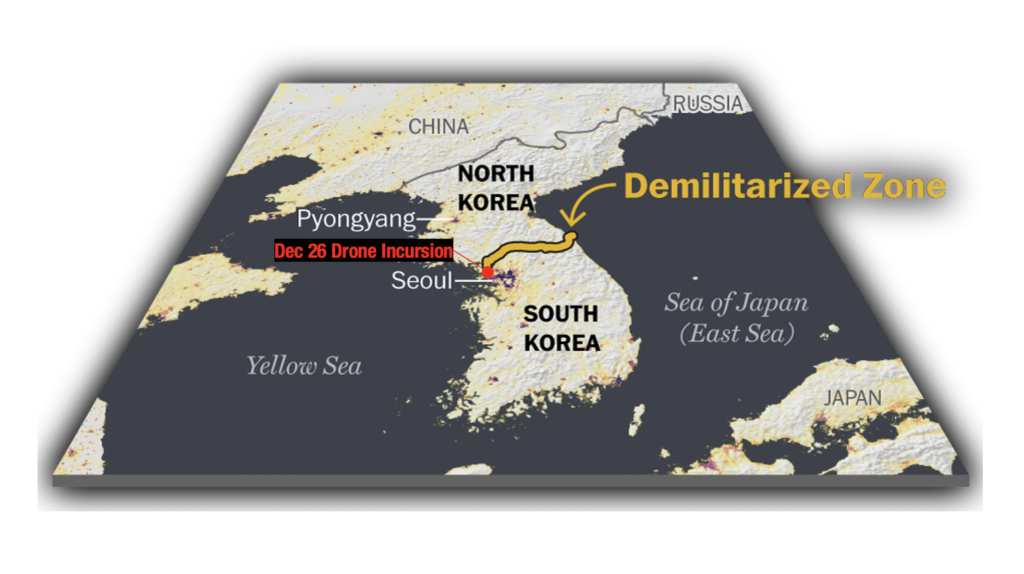
7. What else…

I said 7 because of the Rugby Sevens thing, but I can’t think of another one.

Oh, ok, weather – ’tis the season of typhoons so keep a look out for them. This is a good page to do it on.

Don’t just worry about the weather at Hong Kong, check it for your alternates as well because the whole region can get some pretty nasty weather when these storms start brewing.


Winter is Coming: Updated Holdover Time Guidelines

Sorry, the GoT reference still hasn’t grown old. Anyway, every year the FAA & Transport Canada releases a new set of Holdover Time (HOT) guidelines for the winter season. The one for winter 2022 is available here. So if you want to update your de-icing procedures, manuals, and training in line with the guidance from the feds, here’s what you need to know…

What’s changed?

They’ve added some fluids and removed some fluids which are really good for middle speed aircraft. So basically, check what fluid is being used on your aircraft, confirm it is a good one for your aircraft Vr, and then make sure you use the right table.

Standard Winter Ops 101.

Type II generic holdover times have increased (because they removed a fluid called Beijing Something or other that was holding them back). How much by? A few minutes here, a few minutes there, mainly in the -3 °C and above (27 °F and above) section.

They also did a load of tests which means you now get HOTs for very cold snow (cold enough to turn your legs to ice blocks if you accidentally step into it because its colder than -14°C cold). This applies to a bunch of new Type II and IV fluids and is great because that’s the sort of stuff you’re going to want to escape from for sure.

Double check those tables!

If you’re heading into the generic fluid tables then that’s fine but you actually need to make sure the Type II or Type IV fluid is listed in table 55 or 57.

It might seem a little contrary to the point of a ‘generic table’ but there we go. If it isn’t in the table, and if it doesn’t have its own specific table, then chances are you’re in some dodgy airport where they’re spraying you with homemade, bootlegged moonshine and it might not be very safe.

Freezing Fog.

There are changes to the HOTs for FZFG if it’s mixed with ice crystals or mist. Same for snow mixed with ice crystals.

My opinion: You need some pretty trustworthy Met officer telling you exactly what is out there to start getting this specific. If in doubt, always go with the most limiting and then take a good look before taking off!

A note on a note.

You can takeoff up to 90 minutes after the start of fluid application with a few conditions. This isn’t a new change, this has always been the case, but still worth mentioning.

Small Hail.

This hasn’t changed but it is a confusing one so they’ve added a new note on it. It says this (give or take one or two inaccuracies):

  • GR in the Metar means small hail, which means hail less than 1/4 inch… if you’re in the US.
  • Outside the US, small hail is anything less than 5mm, and is reported as GS. If it says GR that means big hail (5mm or more). Don’t get them mixed up.
  • If it doesn’t specify intensity then use the moderate ice pellets or small hail times.
  • If you aren’t sure and don’t have a tape measure then send your FO out and check the bruise sizes when they return.

‘Snowfall intensities as a function of prevailing visibility’.

You know the one – they use it in your yearly Winter Ops sim to try and catch you out by overcomplicating which table you want to use and hoping you forget or get confused and then they can enjoy lecturing you on it during the debriefing…

Anyway, it has been changed, reformatted and updated. Compare them at your leisure. We like the new one much better.

Must, shall, required, and should…

The document has these new disclaimer sheets at the start of each section:

In case you aren’t familiar with these nuances of aviation lingo, here you go:

  • Must: Really no grey area. You gotta do it no question, no bending, no ignoring. Just do it.
  • Shall: A little bit more ambiguous – not quite the same level of necessity but a strong assertion of importance!
  • Required: More a regulatory, meeting standards sort of a thing. If you want to two step de-ice then some de-icing fluid is required. You can try without but won’t get very far…
  • Should: A wonderful word but don’t get carried away – it’s more of a “really should unless you really can’t” rather than an “only if you fancy it” sort of a meaning. So a shall *unless you have a good reason not to.

A final thought.

Don’t forget GRF changed in November 2021. You might not have operated in conditions needing a runway surface condition assessment since then so it’s worth a quick read of what it now looks like.

Also, thanks to Avioscribe for this handy video on the main highlights and changes to the Holdover Time Guidelines for Winter 2022-2023. Trying to compare the two documents was a mission we weren’t prepared to undertake and you’ve done a spot on job.


Ops Planning for the World Cup 2022

Here’s some info on Qatar to help prepare if you’re planning on heading there during the World Cup 2022.

UPDATE: Bombardier are trying to negotiate support for Challengers and Globals / QAS just put their prices up

The dates to know about.

The World Cup takes place from November 20 to December 18. So anytime during those dates (and probably a few days either end) it is going to be just a little bit busier.

Get parking requests, handling requests, and permit requests in early!

Before we get into it, I’m going to share THIS LINK because it takes you through to the full slot coordination page which has a lot of info on to you might need. Not just on slots, but on regulations, handling stuff, and all that jazz.

There is also a new AIP SUP 32/2022 effective Nov 3 which contains , and if you still ain’t sure then daily CDM conferences take place at 0800 UTC, with an ATFM Daily Plan published at 1000 UTC.

The airports to know about.

You have two choices if you want to actually fly to the World Cup – OTHH/Doha International (actually called Hamad) or OTBD/Doha International (actually called Doha).

You should probably also be aware of OTBH/Al Udeid Airbase because it is fairly close to the Double Dohas, has two big runways and has been known to confuse some people.

OTHH/Hamad is the main international airport in Qatar.

You will find:

  • 2 giant runways (4250m and 4850m)
  • All the runways are CAT II/III
  • RFF 10

If you want to head in here, then bear in mind this is the main international airport for the country and it is already busy with scheduled airline traffic.

You can find info on the general fees for operating here in the AIM. 

The official FBO is Qatar Executive reachable at request@qatarexec.com.qa or +974 4022 1700

All their rates and fees are available here. There may be different charges for operating during the World Cup though so get in touch with them soon!

We discovered this updated fee list from QAS. It has jumped up just a little during the World Cup period so don’t rely on old fees…

OTBD/Doha is the older international airport and was pretty much decommissioned for a while there. It looks like it will be used for charter and private stuff, and some airline overflow traffic. 

You have:

  • One runway – RWY 15/33
  • 4570m / 14,993’
  • CAT I ILS 15 / CAT II/III ILS 33
  • RFF 9

A quick bit on Slots, because they are quite a big deal.

Slots are already filling up fast. And they are mandatory. And there is an official process for requesting them which you can read about here.

If you haven’t already organised it then get on this fast. I can’t stress that enough. Do it now!

There are a few things to know:

  • You will need to pay a 5000USD deposit
  • The deposit will be deducted from airport charges
  • There will be hefty penalties applied for:
    • No shows or Go shows
    • Misuse (seriously late aircraft)
    • Using a different aircraft type to the one mentioned in the slot request
    • Cancelling on the day

There are exceptions to the penalties. Basically for anything outside the operator’s control:

  • If your airplane gets damaged (presumably not through your own fault)
  • If the weather is particularly adverse
  • Delays due to issues with Air Traffic management
  • Industrial action
  • Security related stuff (of the mandatory sort)

What sort of penalties are you looking at?

  • If you cancel on the day or don’t show up then on top of losing the slot booking deposit, you can expect the following penalties:
    • 100USD per seat (per flight) if you’re a passenger charter flight
    • 20,000USD if you’re a GA/BA flight
    • 30,000USD if you’re a charter cargo flight
  • If you just ‘misuse’ your slot then they’ll fine you the following:
    • 5,000 USD for arrivals more than 20 minutes outside the approved slot time, for flights 5 hours or less
    • 5,000USD for arrivals outside 35 minutes of the slot, for flights longer than 5 hours
  • Finally, if you take a different type in then expect a 5,000USD fine for each higher ICAO category than the one approved.

We got all this info from here – the official local slot rule spot.

If you sort it all out, get your slot, and plan to use it properly, then on the day, you’ll need to do this:

If you don’t want to stick around in Qatar…

There are some handy and fairly close other places which you might want to consider using instead (if you can’t get parking in Doha). These are probably what you’ll file as your alternates for Doha anyway, given the size and airport numbers in Qatar (2).

Next to Qatar you have Bahrain and OBBI/Bahrain International. A very good alternate, although we are currently checking whether flights direct between the two countries are possible.

Just past Bahrain you have Saudi Arabia, and OEDF/Dammam International. This is a good alternate, although not as good as OBBI. A little bit further into Saudi and you have OERK/Riyadh.

On the other side of Qatar you have some water and then the UAE with OMAA/Abu Dhabi, OMDB/Dubai, OMDW/Another Dubai are all good alternates. We also heard that OMSJ/Sharjah FBO Gama Aviation is offering 7 days free parking there.

Head north and you’ll find OKBK/Kuwait. Also a good alternate. I forgot to put it on the map, it is up there just outside the edge of the picture though.

Some things to know about the country.

You need permits for both landings and overflights. To get all your flight clearances stuff,  try these folk at the Civil Aviation Authority Qatar: doha.comm@caa.gov.qa / khalid.alnsiri@caa.gov.qa / rakesh.attavar@caa.gov.qa / airlines.affairs@caa.gov.qa or AFTN: OTBDYAYX / AFTN: OTBDYFYX

Their AIP is available online, for free, if you need it. You can find it here.

They have a new airspace. Yes indeed. Read about that here.

You really, really can’t take alcohol into Qatar. Or a lot of medication (anything containing Codeine will get you into trouble. Anything else, just carry a prescription for it).

Because Qatar is fairly small and hotel rooms fairly limited, most are requiring tickets to the game so you might have trouble finding space for your crew if they’re overnighting.

It will be mandatory to have a maintenance agreement in place with your ground handling agent if you are operating into Qatar, or else you’ll have to carry your own engineer/maintenance person with you onboard – even for a drop and go.

  • Bombardier are negotiating with Qatar Executive for them to provide support for the Challenger and Global series of aircraft. It’s not been finalised yet, but hopefully will all be in place before things ‘kick off’ (if you’ll pardon the pun).

Some Covid stuff.

As of at the moment, Air Crew can enter Qatar for 96 hours. To do this, you need a vaccination certificate and a PCR taken in Qatar within 72 hours of your arrival. Unvaccinated crew will not be allowed in.

A quick definition.

Football = Soccer (if you’re American).