Russia: Aircraft Shot Down, New EASA Airspace Warning

Key Points
  • EASA has issued a new airspace warning for Russian airspace following the likely shoot down of Azerbaijan Airlines Flight 8243 on approach to URMG/Grozny Airport on December 25 by a surface-to-air missile.
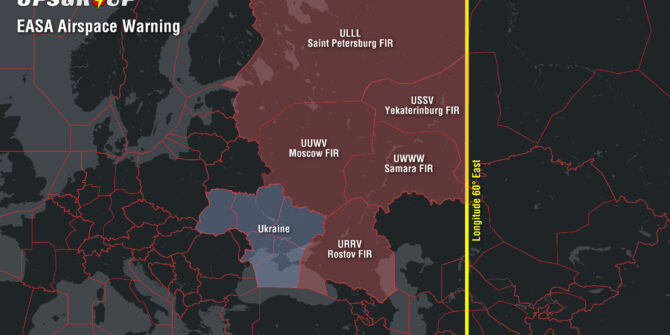
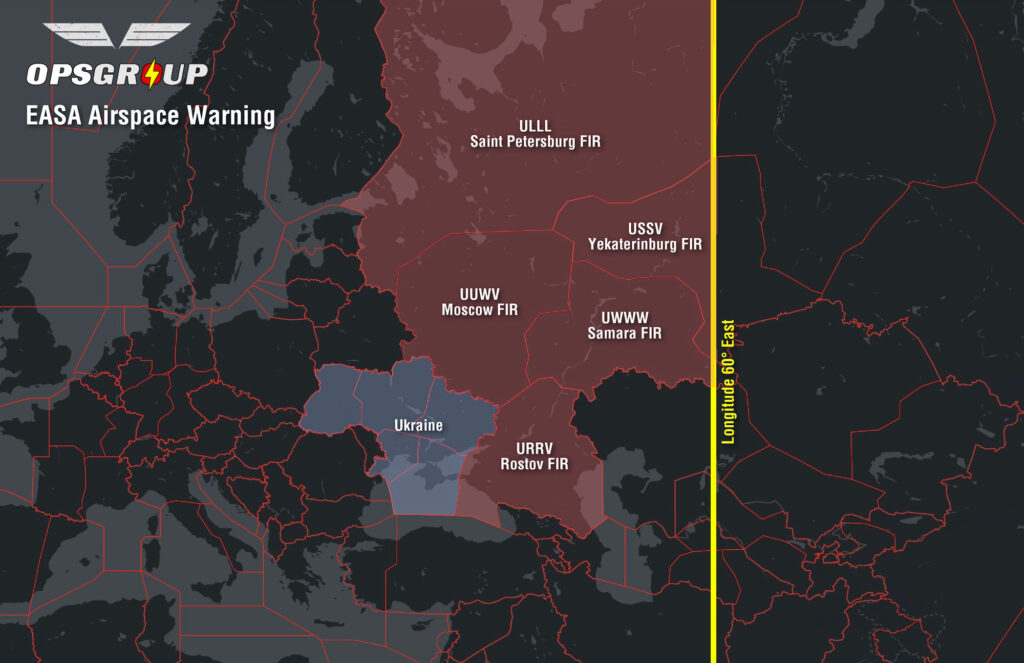
  • Operators are advised not to enter Russian airspace west of longitude 60 degree east (the entirety of Western Russia) at all levels due to the risk of being unintentionally targeted by air defence systems, and extensive GPS interference.
  • Previous state-issued airspace warnings have been confined to areas in close proximity to the Ukrainian border. The new EASA warning suggests a significant escalation in airspace risk.

What’s changed?

Ukraine has strengthened the frequency and intensity of missile and drone attacks on targets well within Russian territory.

The latest occurred this week on January 14 – a combination of cruise and ballistic missiles and the largest drone strike yet (over one hundred and forty devices) against infrastructure across Western and Southern Russia, as far as 680 miles from the border. Russian air defences reportedly shot down a number of them.

The war with Ukraine has entered a new phase which no longer limits airspace risk to the primary conflict zone.

Azerbaijan Airlines Flight 8243

EASA’s new airspace warning appears to be in direct response to the downing of an Embraer passenger jet on December 25 at URMG/Grozny airport, Southern Russia.

The crew were on approach when the aircraft suffered sudden damage which was initially misidentified as a bird strike.

The aircraft later crash landed following a diversion to UATE/Aktau airport in Kazakhstan.

Limited analysis of the wreckage appears to indicate shrapnel damage consistent with a surface-to-air missile. The most likely culprit was a Pantsir air defence system – a radar guided medium range SAM not dissimilar to the Buk system used to shoot down MH17 over Eastern Ukraine in 2014.

Photos of AZ8243 seems consistent with shrapnel damage likely caused by the impact of a surface-to-air missile.

It was later confirmed that air defence systems were responding to a Ukrainian drone strike in the area at the time.

While not official, it is almost certain AZ 8243 was mistakenly targeted. In any event we will have more answers soon – ICAO Annex 13 requires a preliminary report to be issued within thirty days of the accident (of which Russia is a member state).

No one’s overflying Russia anyway, right?

This simply isn’t the case. It’s true the Russia has imposed reciprocal airspace bans on aircraft registered to a large number of countries (including the US, Canada and the EU). This is in response to political sanctions, not risk.

It may keep us away, but this is a sanction – not an airspace warning.

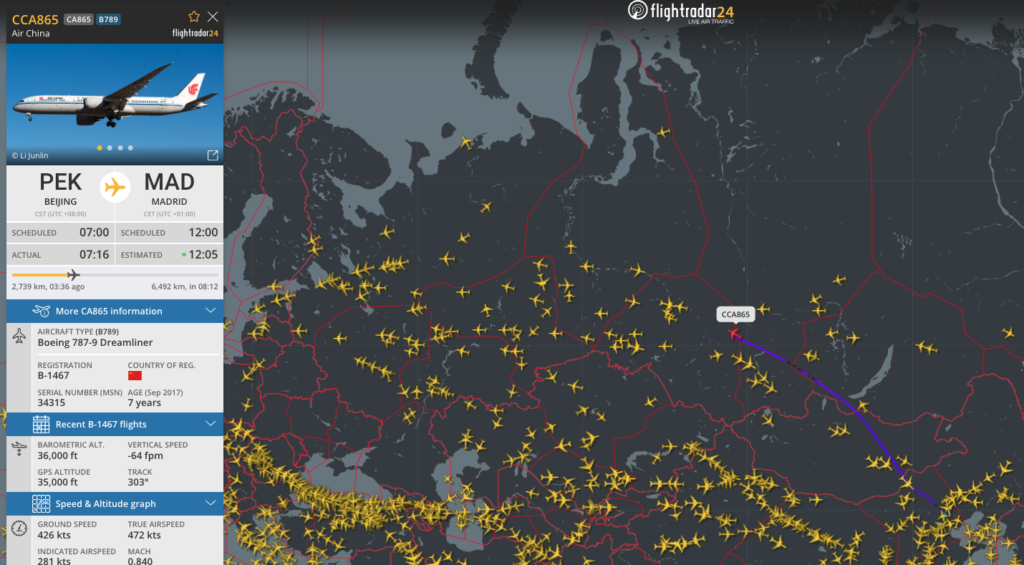
Those from China, Turkey, the Gulf States and others are still allowed. And until now, they have been overflying airspace with no active warnings in place.

Russian airspace was (and still is) receiving international air traffic.

The EASA warning

EASA issued its new warning on January 9 via a Conflict Zone Information Bulletin (CZIB).

A note about EASA. Its advice isn’t binding – it is provided for the consideration of its member states and does not represent an actual flight prohibition.

However, history has shown it does have a strong bearing on the rules imposed – as a result, we are likely to see to number of new state-issued warnings for Russia in the coming weeks.

The CZIB recommends operators do not enter Russian airspace (west of longitude 60 degrees east) at all levels. This affects the Moscow, Rostov, Saint Petersburg, Yekaterinburg and Samara FIRs.

EASA advises that the deployment of Russian air defence systems to these areas in response to Ukrainian drone and missile attacks could directly threaten the safety of overflying aircraft.

It argues Russia does not have adequate protections and procedures in place to ensure the safety of civil aviation. The apparent downing of AZ8243 is testament to that fact.

Beyond the risk of misidentification, the warning also cites dangers related to GPS interference (including spoofing) being used to deter aerial threats with little regard to the effect on civil aircraft in the area.

Safe Airspace

At safeairspace.net, our team faces a conundrum.

Russia oversees well over 6.6 million square miles of sky and is transcontinental in scale.

Towards its south-eastern borders with China and Mongolia the risks associated with the conflict in Ukraine are low to non-existent.

To the west, the risk is high which is why EASA’s new warning makes a distinction based on a line of longitude that divides the country in two.

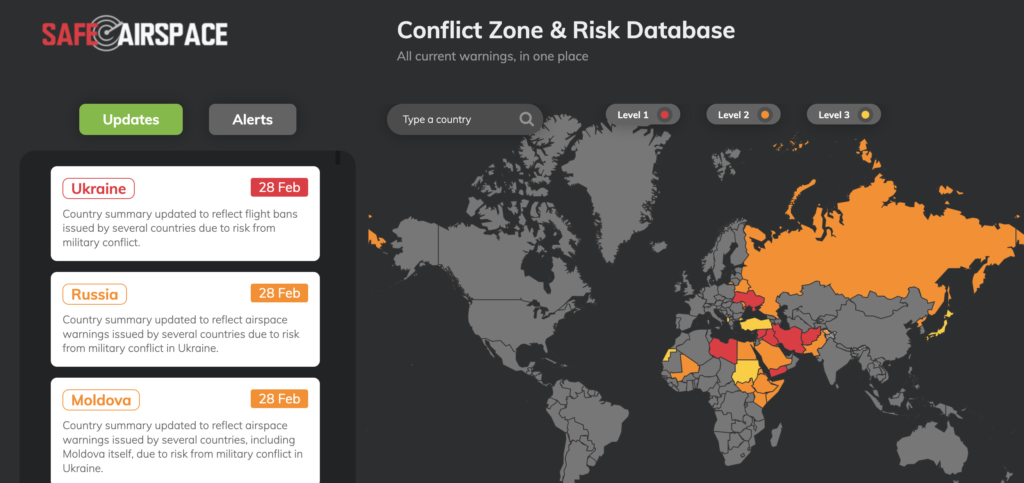
The same applies to our level of warning for Russia at safeairspace.net – where a Level 2 (Danger Exists) remains in place. But in light of recent events, we would advise against overflights of Western and Southern Russia at this time.

Get in touch with us

Our team is available around the clock. You can reach us at blog@ops.group – we’d be happy to help with any questions you may have.


Ukraine-Russia Spillover Risks: Nov 2022

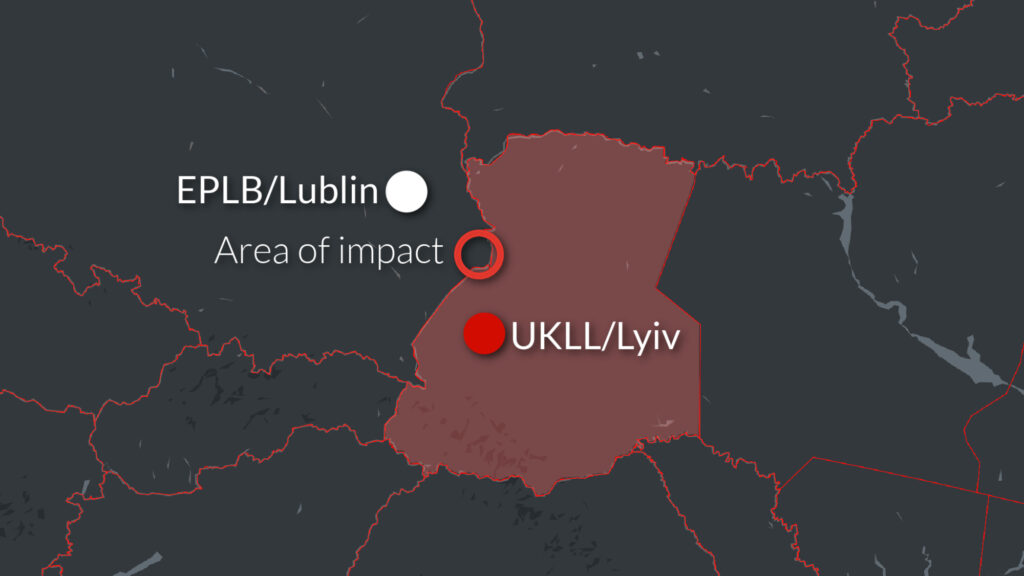
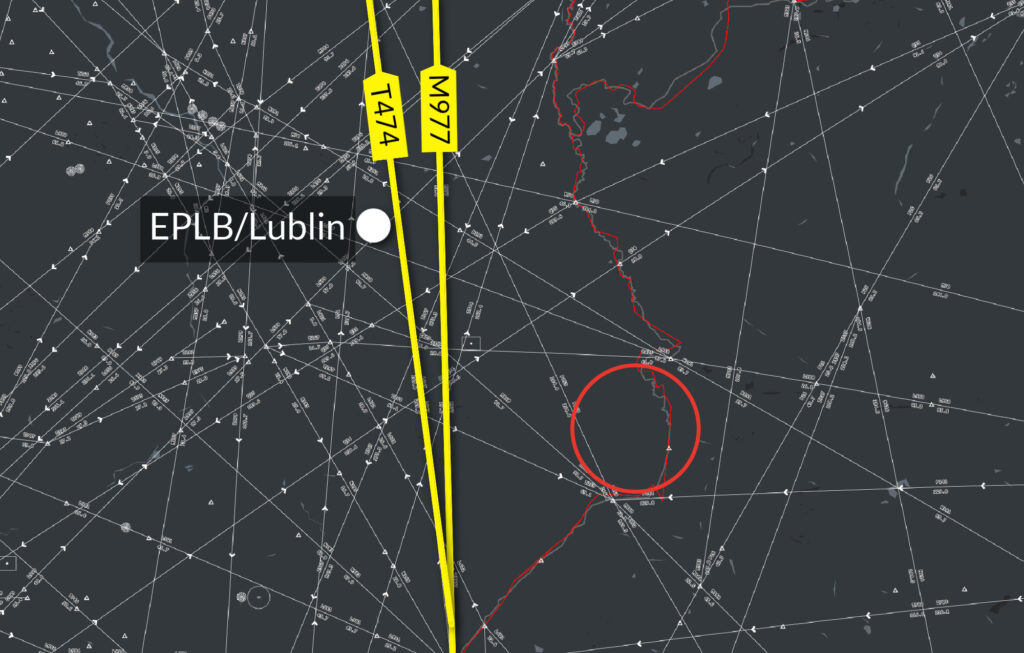
A missile involved in the Russia-Ukraine conflict fell in Poland on Nov 15, close to the border with Ukraine. There are no prohibitions or warnings for Polish airspace, however the border region is (clearly) high risk and operators should avoid flights in or over this area.

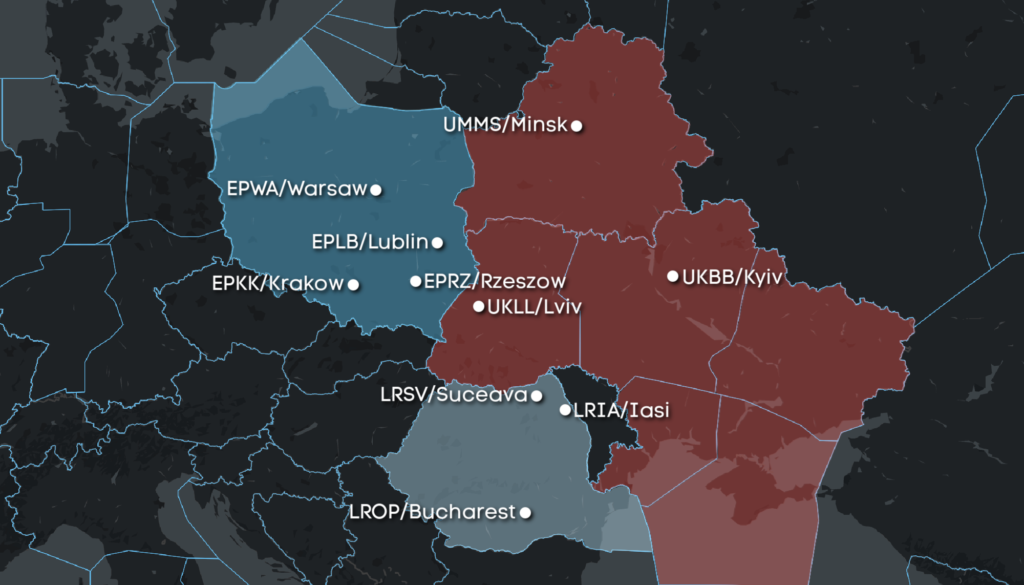
The following map shows two airways which lie in proximity to the border and which may be used by overflying aircraft. The airways routing into Ukraine, Belarus or utilised for routes into prohibited airspaces have not been highlighted.

The ongoing conflict between Russia and Ukraine continues to pose challenges and risks to international flight operations.

We covered these previously in this post which looked at:

  • Ukraine, Moldova, Russia and Belarus airspace closures.
  • Which countries have banned Russian aircraft and operators, and which countries has Russia banned in response?
  • The differences between the sanctions imposed on Russia by the US, the UK, and the EU, and the nuances of how these sanctions may impact your flight.
  • Considerations for operators now looking to route around Russian airspace.
  • Information on Humanitarian relief missions.

What has changed?

In terms of the above, very little. Ukrainian airspace remains closed and poses a significant risk to aircraft.

All the major countries who regularly issue airspace warnings (the US, UK, Canada, France, Germany, plus several more) have issued total flight bans for Ukraine due to risk from military activity at all levels.

The primary risk is an unintended targeting of civil aircraft by military, including misidentification (as with MAS17, UIA752).

What has changed is the potential spillover risk. The FAA has released an Information Note regarding this, which you can read here.

What does it say?

Pretty much an updated report of what we said in this post back in March 2022.

In a nutshell – “Russia’s increased use of developmental weapons, use of weapons in nontraditional roles, and long-range missile strikes into western Ukraine increases potential spillover risk concerns for U.S. civil aviation operations in adjacent airspace.”

In other words, the risks and hazards are not necessarily confined to the geographical borders which are used to define ‘risky airspace’ (the areas covered by current conflict-related flight prohibition NOTAMs and other warnings).

The three main points in the FAA Information Note are these:

  1. Russia periodically launches missiles targeting Ukraine which transit Moldovan airspace.
  2. There have been reports of comms and GPS jamming outside the conflict zone, particularly over the Black Sea and Caspian Sea.
  3. Drone/UAS activity has expanded, especially around Crimea and eastern Ukraine.

1. Missile launches

Russia periodically launches missiles targeting Ukraine from positions in the Black Sea and Caspian Sea. The flight paths for these generally route across Moldovan airspace.

Moldova initially closed all their airspace, but have since opened a section on their western border with the LRBB/Bucharesti FIR for flights to LUKK/Chisinau airport.

On Nov 15, a missile fell in Poland, close to the border with western Ukraine. It is not clear whether this was launched by Russia or by Ukrainian Air Defenses, but it signifies a heightened level of risk in regions bordering the conflict zone which are not necessarily covered in prohibitions and warnings.

An awareness of the proximity to significantly high risk airspace is advised.

The FAA SFAR related to the conflict and listing the prohibited airspaces can be read here.

2. GPS Jamming

This has been reported beyond the regions outlined in NOTAMs and airspace warning areas.

Civil aircraft flights who route close to the borders of the conflict zone, or which transit the southern Black Sea or northern Caspian Sea may experience jamming.

A member reported – “Flew recently from the UAE over Iraq and Turkey and over the western edge of the Black Sea. Once inside Turkey, the GPS signal was lost and remained out until northwest of the of western Black Sea. Dual GPS plus a portable GPS receiver confirmed the loss of signal. Also, no satellite wifi during same period.”

EASA has issued Safety Information Bulletin on Global Navigation Satellite System (GNSS) jamming in the Baltic Sea area which you can find here.

3. Drone/UAS hazard

The use of Unmanned Aircraft Systems (UAS) has been increasing, on the Russia side.

These fly at lower altitudes (they say a max of about 16,000′) and there is a risk of ‘errant activity’ ie not flying where they should fly. In June 2022, one such errant UAS was reported in eastern Turkey.

These represent a hazard to aircraft given their size, the fact they are generally weaponised, and the fact they are not always where they are supposed to be.

Other spillover risks

These are not covered in the FAA note, but we figured worth mentioning anyway:

  • Increased traffic levels: Turkey is seeing higher traffic levels due airspace closures, as aircraft now transit their airspace. There is also an increase in military traffic in airspace bordering the conflict zones.
  • Crew fatigue: Longer routes, more challenges en-route, operational and planning challenges have not gone away, we are just staring to see them as the ‘status quo’.
  • Ongoing fuel and energy supply issues: These are more indirect, but the increase in costs and availability has led to some supply issues, as well as protests across many regions which means potential disruptions and security concerns.

Stay updated!

A full briefing on the airspace risks with up to date notice and NOTAM references can be found at Safeairspace.net

Please report back to us any new info you come across (be it airspace risk related, or simply sharing your experience of a recent flight) and we can help redistribute that info back out to the group so that all are aware.

You can email us at news@ops.group, or file a report of a recent trip on our Airport Spy page here: ops.group/blog/spyreport


Ukraine Relief Missions

If you are an operator who is looking to offer relief aid services as part of the Ukraine conflict, read on.

We have compiled a list of handy contacts, general ops information, and other bits which we hope might help. If you are looking for other support or info then let us know at team@ops.group

If you need support with trip planning you also might want to get in touch with Universal Weather because their Universal Trip Support department are waiving all fees on trip-feasibility assessments, research, and consultation services, as well as ground-handling setup charges for any humanitarian missions.

POLAND

Poland borders the Ukraine, however it also borders Belarus, and caution should be taken if operating into the eastern regions of Polish airspace along the border because of high levels of military traffic operating in this area.

Permits

Permits are not required for private flights but you do need to make a declaration in advance.  Private flight also counts as less than 20 seats. Other flights need to make their landing and overflight permit application 3 days in advance.

The Polish Air Navigation Services Agency can be contacted via email at planning.dept@pansa.pl and at trafficrights@ulc.gov.pl, or by telephone on +48 22 520 7309

EPRZ/Rzeszów

The closest airport to the Ukrainian border, where most relief efforts will be focused, is EPRZ/Rzeszów-Jasionka airport (pronounced “jejov”… kinda).

Here is some data on the airport:

  • 10,499’ / 3200m x 45m Runway 09/27
  • CAT II ILS 27 / RNP or VOR 09
  • Restricted H24 operating hours
  • RFF 8 (RFF 9 on request)
  • PCN 82/R/A/W/T
  • Jet A1 available
  • Customs available without restriction
  • Unknown if any maintenance or other support facilities
  • Closest airports for alternates:
    • EPKK/Kraków Large international airport 2550m/8366’
    • EPKT/Katowice Large international airport 2799m/9183’
    • EPWA/Warsaw Major international airport 3690m/12106’
    • EPLL/Lodz Medium airport 2445m/8022’

Here is some “heads up” operational info:

  • Elevation 693’
  • Highest MSA 3400’ and a few close in obstacles
  • Runway 27 has a significantly displaced threshold
  • A lot of VFR traffic operates in the area (on nice weather days) so be cautious. There are dedicated VFR light aircraft runways at the airport as well
  • Do not mistake the highway or the runway at EPRJ 
  • There is no radar vectoring possible due to the high amount of VFR traffic, so expect to follow procedures including procedure turns, and exercise caution with your tracking
  • There are speed and altitude restrictions on SIDs and STARs to be aware of.

Some contact info for you:

  • There are several Handling and Support agents who operate through Poland and neighbouring countries who might be well placed to assist:

EPLB/Lublin

EPLB is about mid-way between EPRZ and EPLL/EPWA, and is far less busy but also well equipped to handle larger aircraft.

Here is some data on the airport:

  • 8268’ / 2520m x 45m Runway 07/25
  • CAT II ILS 25 / RNP 97
  • Operating hours are only 0400-0100, but extendable with 48 hours notice
  • RFF 7
  • PCN 50F/B/X
  • Jet A1 available
  • Customs available without restriction
  • Unknown if any maintenance or other support facilities
  • Closest airports for alternates:
    • See above

Here is some “heads up” operational info:

  • Elevation 636’
  • No terrain to worry about, but a close in obstacle end of runway 25 – MAPP has early turn to avoid
  • Limited taxiways – backtrack required if landing runway 07
  • Big temporary restricted area nearby may impact arrivals and departures when active
  • No radar

Some contact info for you:

  • There are several Handling and Support agents who operate through Poland and neighbouring countries who might be well placed to assist:

EPWA/Warsaw

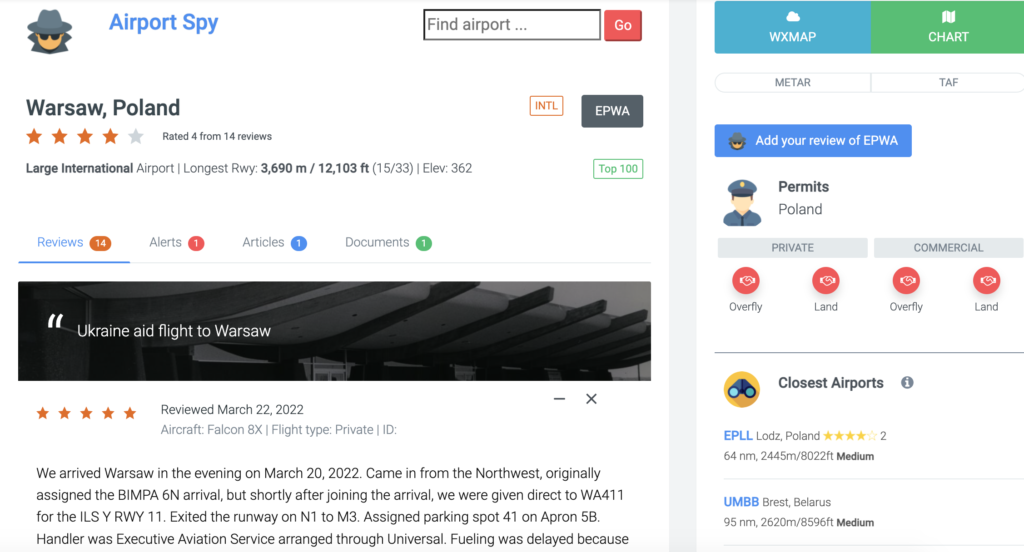
We received a great report from an OPSGROUP member who operated a flight with humanitarian aid to EPWA/Warsaw on March 20.

Here is a copy of their report:

We arrived Warsaw in the evening on March 20, 2022. Came in from the Northwest, 
originally assigned the BIMPA 6N arrival, but shortly after joining the arrival, 
we were given direct to WA411 for the ILS Y RWY 11. Exited the runway on N1 to M3. 
Assigned parking spot 41 on Apron 5B. 

Handler was Executive Aviation Service arranged through Universal. Fueling was 
delayed because local handler did not have a copy of the World Fuel release.
Lav service was prompt. 

Crew took the opportunity to bring in some items for Ukrainian refugees. 
Crew sent a message to Universal to ask the local handler for drop off information. 
The following website was provided: 
https://en.um.warszawa.pl/-/what-and-where-can-you-bring-for-refugees 

This is a Municipal organization which has over 18 drop off locations. 
The government locations are looking for mostly food, baby products, hygiene products, 
and first aid products. The crew had mostly brought in clothing items, new socks, 
new underwear, hard candy, hygiene products, and small children’s toys. 

These products were not a good match for the requests at the government donation sites. 
The crew asked the Handler for another donation center contact that would welcome 
the clothing. The following contact was provided: 
https://www.tpu.org.pl/en/chcesz_pomoc.html 
email sekretariat@tpu.org.pl or by telephone: +48 691-41-41-59. 

This donation center is run by professionals who have other careers and are helping 
with relief. The site says they are only open on Tuesdays. We happened to be in Warsaw 
on a Tuesday, so it worked perfectly for us. We took an Uber from the Westin 
(downtown Warsaw) to the donation center. 20 minute drive. $5 US via Uber.

If you have operated to the region recently, please get in touch so we can share the info with everyone else looking to do similar trips. You can email us at news@ops.group, or file a report of a recent trip on our Airport Spy page here.

ROMANIA

Some relief efforts are also being arranged through Romania which borders the Ukraine to the south, as well as Moldova.

International flights may be best operating into LROP/Bucharest, LRCL/Cluj Napoca, LRIA/Iasi, LRTR/Timisoara international airports and then fly internally to LRSV/Suceava which is a domestic airport and not an airport of entry, lying close to the border.

Permits

Permits are not required for private or tech-stop flights, but you still need that advance notification. Commercial flights need at leas 2 days notice for permits, and these are required for landing only, not overflights.

The Romanian CAA can be contacted via email at overflight@caa.ro and at dgav@mt.ro, or by telephone on +40 21 319 6209 / +40 21 208 1500

Here is some data on the LRSV/Suceava:

  • 8071’ / 2460m x 45m Runway 16/34
  • CAT II ILS 34 / VOR 16
  • The airport control tower is H24, but Admin operates limited hours confirm with handling agent
  • RFF 7
  • PCN 110/F/C/W/T
  • Jet A1 available
  • Customs available without restriction
  • Unknown if any maintenance or other support facilities
  • Closest airports for alternates:
    • LRIA/Iasi Medium airport 1780m/5840’
    • LRCL/Cluj-napoca Medium airport 1850m/6070’
    • LRSB/Sibiu Medium airport 2000m//6562’
    • LROP/Bucharest Large international airport 3500m/11483’

Here is some “heads up” operational info:

  • Elevation 1375’
  • Highest MSA 5500’ with terrain in the southwest
  • Runway 34 has displaced threshold
  • Limited taxi and apron space
  • Backtrack on runway required
  • VOR oscillations due terrain are likely
  • Very low platform altitude and short final approach
  • Higher than usual SID climb gradients due close in structures

Some contact info for you:

  • There is a large Handling and Support agent who operates through Romania and neighbouring countries who might be well placed to assist:

How to help

The two agencies we’d encourage people to go check out are Airlink and DirectRelief – these two have already flown in shipments of aid and have more scheduled this month. So those are good places to go find out exactly what’s needed, and how to help.

IFALPA and the European Cockpit Association have also put out a letter for members of the aviation community wanting to help support the pilot community in Ukraine. They suggest you reach out to local organizations to help, or donate to larger ones such as Red Cross who are on the ground there. You can read the letter here. 

If you need assistance with anything to help prepare for humanitarian flights, please get in touch.

What do we need?

  • Feedback on your operation if you have carried out a humanitarian mission recently.
  • Any local contacts you have who can assist others.
  • Any other relevant information and advice which we can share to other members.

You can email us at news@ops.group, or file a report of a recent trip on our Airport Spy page here: ops.group/blog/spyreport


Spillover Effect: New Airspace Risks in Europe

As the war in Ukraine continues, the risk to aircraft in European airspace may be changing.

There have been several incidents in recent weeks that highlight that the spillover effects of the conflict have begun putting aircraft at risk in nearby FIRs. Or in other words – busy, open airspace with no airspace warnings in effect.

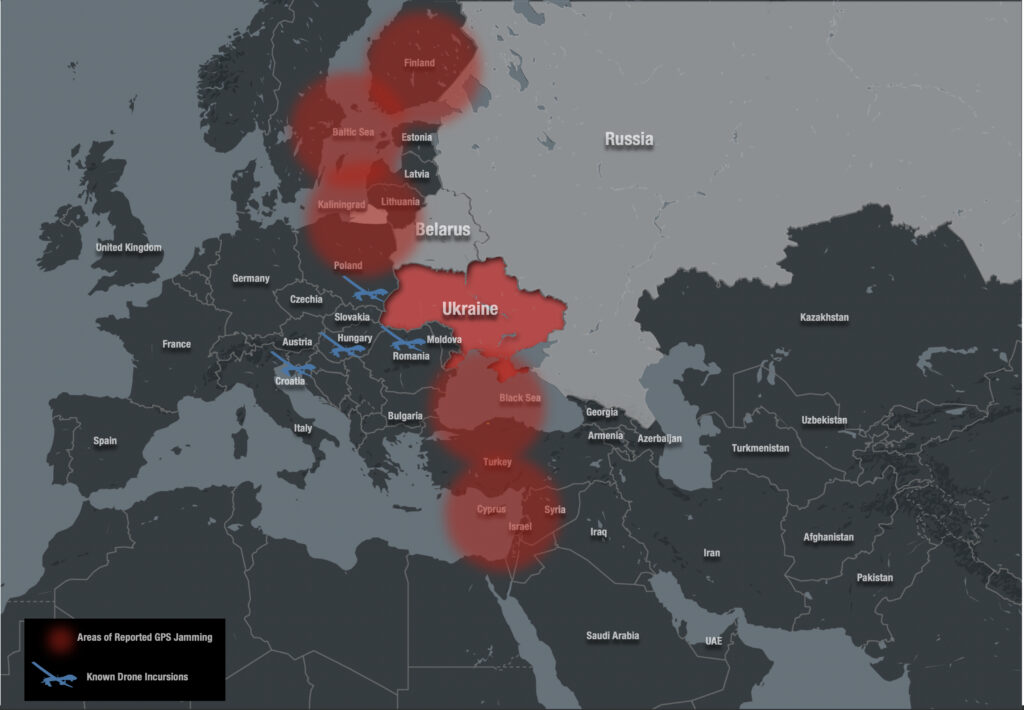
These include undetected military drone incursions in NATO member airspace and extensive GPS interference for aircraft operating across different regions of Europe.

And it is a new and emerging issue. So concerned are IFALPA and EASA, that they both published new bulletins last week to both operators and ANSPs regarding these risks.

Here’s a break-down of what you need to know.

Drone Incursions

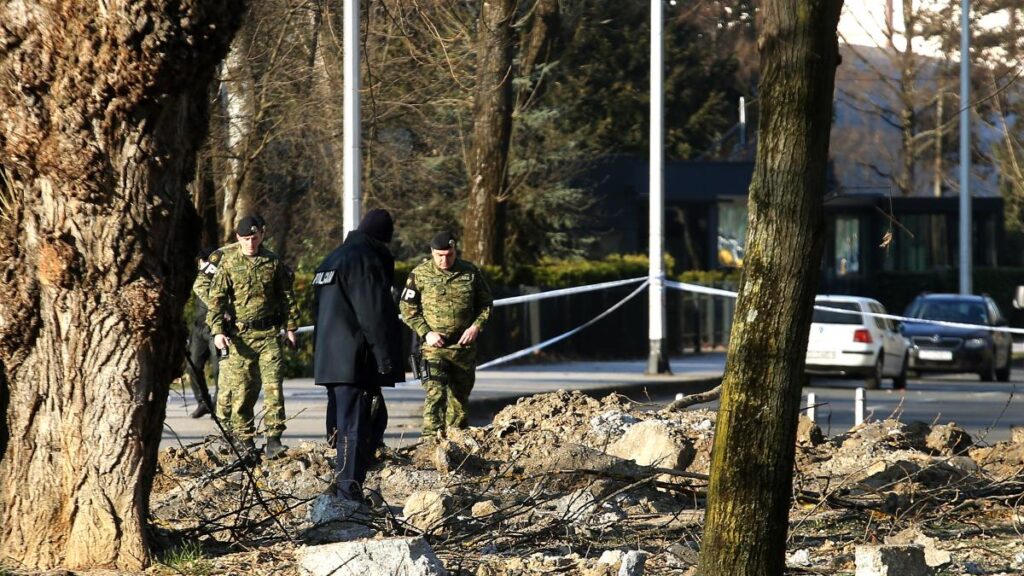
On March 12, a large weaponised military drone malfunctioned and left the Ukrainian conflict zone. It flew undetected through the airspace of Romania and Hungary, before entering Croatia and crash landing on the outskirts of the capital, Zagreb.

This was followed by an incident on March 14, where widespread reports emerged that a surveillance drone had briefly entered Polish airspace before being shot down by Ukrainian military as it re-entered their own.

Around the same time, yet more news surfaced that a Russian surveillance drone had been discovered crashed in a village of Northern Romania – the exact date of the incursion isn’t known.

IFALPA responded by issuing a Safety Bulletin on March 16. They report that these incursions are highly likely to re-occur as fighting continues. This may pose a threat to aircraft both on the ground or in the air. The risk comes from the drones themselves, as well as from air defence activities that attempt to destroy them.

This is all in addition to the political impact of Russian aircraft entering NATO member airspace without clearance. While there has been no indication that these incursions were intentional, it does increase military surveillance of the skies over these countries, including the remote risk that a civilian aircraft may be misidentified and targeted in error.

GPS Interference

Since February EASA has identified four regions near Ukraine where GPS interference has significantly increased. This includes instances of jamming and spoofing – if you’re unfamiliar with the latter, it means to deliberately introduce errors into the signal so that GPS receivers become inaccurate or erroneous.

The four hotspot regions are:

  • Kaliningrad, the Baltic Sea, and neighbouring states.
  • Eastern Finland
  • The Black Sea (a portion of which is currently part of a major air corridor between the Middle East and Europe).
  • The Eastern Mediterranean near Cyprus, Turkey, Lebanon, Syria, and Israel.

Reports have come from various phases of flights and had led to re-routing and even diversions.

For operating aircraft, the effects can be significant. A complete loss of GPS is immediately noticeable and leads to issues navigating, or carrying out ops that require RNP.

More worrying is spoofing, which can be far more insidious. Erroneous GPS signals can lead to false triggering of hard GPWS warnings, inaccurately displayed information, loss of ADS-B, faults with wind shear and terrain warnings, failure of aircraft systems that rely on GNSS for reference and even airspace busts. All nasty stuff.

On March 17, EASA published a Safety Information Bulletin on the issue. It includes a list of things that both operators and ANSPs can do to help mitigate the risks during this time. Absolutely worth a read if you’re flying in European airspace right now.

Proximity to the Fight

These events indicate that risk is present near the conflict zone, not just within it. And with flight tracking indicating aircraft frequenting open airways near the Ukraine border, but clear of closed airspace, perhaps we need to be collectively paying a bit more attention.

Case-in-point. On March 13, Russia carried out an air strike near the city of Lviv, in Western Ukraine where at least thirty missiles were fired towards various targets. This occurred just 15 miles (25km) from the Polish border, along with open airways that run adjacent to the border (particularly T344 and Z367).

There are currently no active airspace warnings in Poland.

Stay Updated

Both IFALPA and EASA have agreed that operators need to carry out their own risk assessments when operating in the region at the moment. That starts with verified, accurate and timely information. Make sure you keep checking safeairspace.net – our conflict zone and risk database.

And please report back to us any new info you come across (be it airspace risk related, or simply sharing your experience of a recent flight) and we can help redistribute that info back out to the group so that all are aware.

You can email us at news@ops.group, or file a report of a recent trip on our Airport Spy page here: ops.group/blog/spyreport


Ukraine/Russia Update: Airspace closures, Flight bans, Sanctions, Routing considerations

Here’s everything we know right now about the Ukraine/Russia situation with regards to the impact to international flight ops. We’ll edit and add to this post as more information becomes available.

The main topics:

  1. Ukraine, Moldova, Russia and Belarus airspace closures.
  2. Which countries have banned Russian aircraft and operators, and which countries has Russia banned in response?
  3. The differences between the sanctions imposed on Russia by the US, the UK, and the EU, and the nuances of how these sanctions may impact your flight.
  4. Considerations for operators now looking to route around Russian airspace.
  5. Information on Humanitarian relief missions.

Airspace closures

These are pretty well known by most of us at this stage, but just to reiterate:

  • The entire airspace of Ukraine remains closed to all civil flights.
  • The airspace of Moldova is also closed, but they have been accepting flights to LUKK/Chisinau Airport on a case by case basis (we’ve seen several cargo flights go in there in the past week). But you have to apply to the Ministry of Defence and sign a declaration accepting “the risks that may arise as a result of operating in conflict areas”. So that’s a pretty stark warning of the risk of operating in here at the moment.
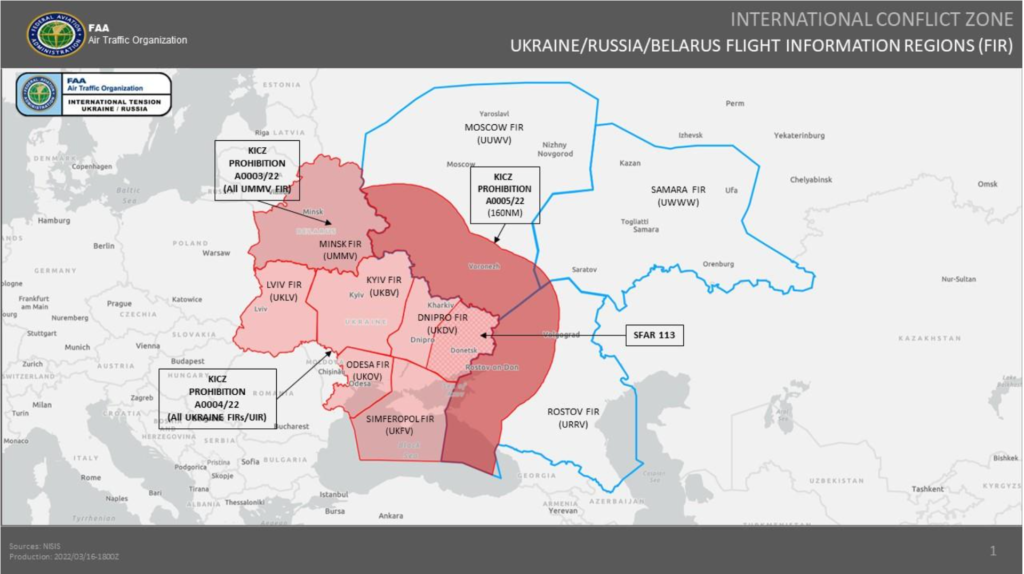
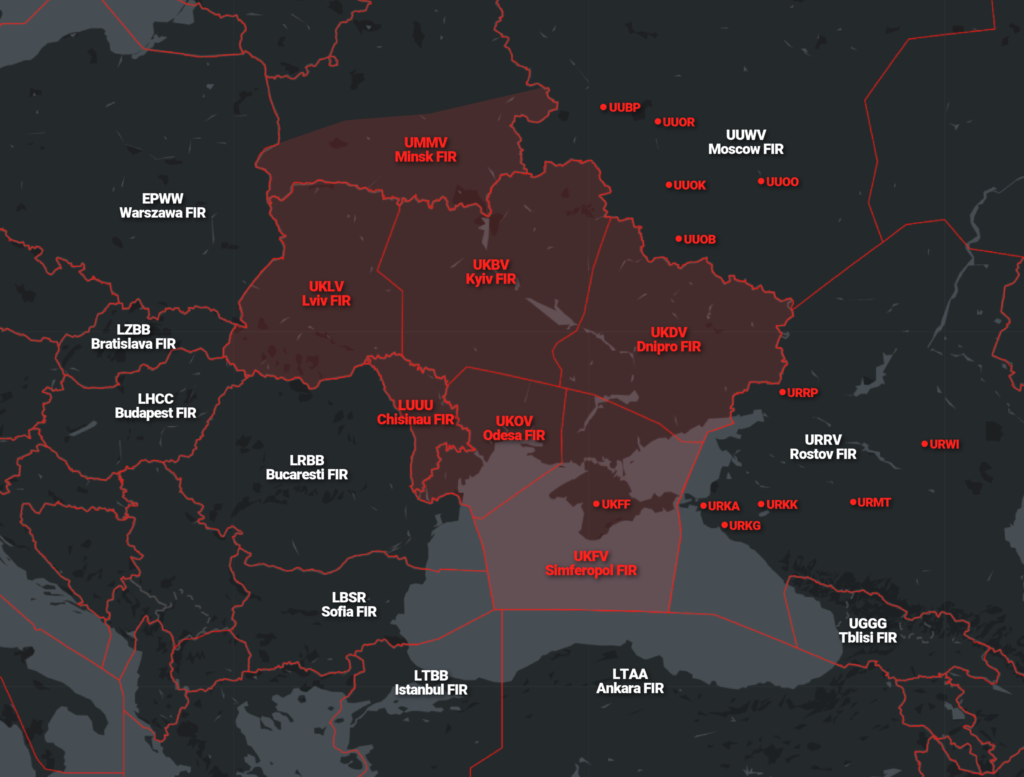
  • Belarus has closed the southern half of its airspace along the FIR boundary with Ukraine.
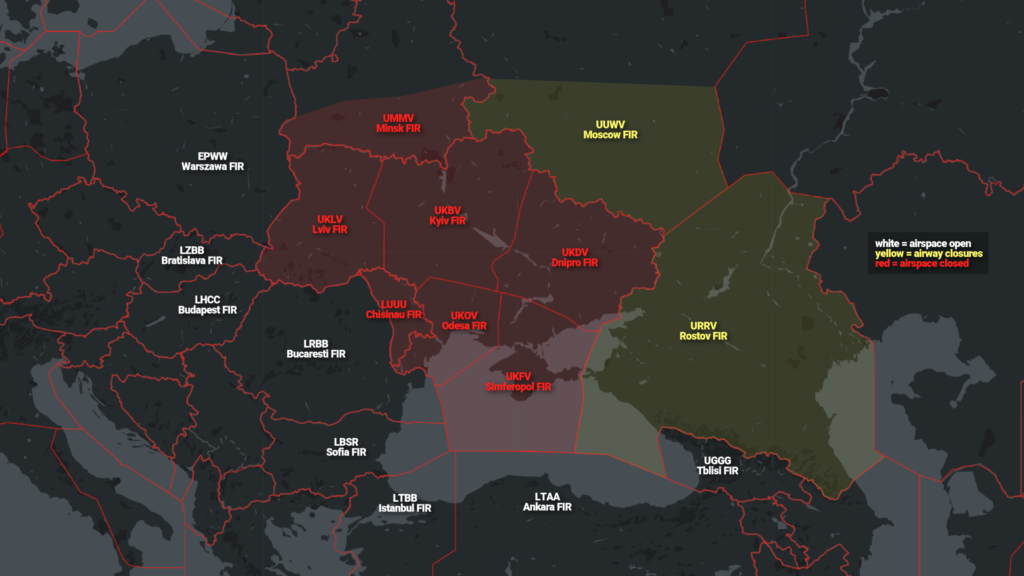
  • Russia has closed most airways in the URRV/Rostov FIR and in the southern part of the UUWV/Moscow FIR.

Here’s what all that looks like:

Reciprocal bans on aircraft/operators

Several countries have now banned Russian aircraft and operators from their airspace – The European Union along with some non-EU countries, the US, Canada, the UK, along with some Caribbean states – Anguilla, Aruba, Bermuda, British Virgin Islands, Cayman Islands, Turks and Caicos.

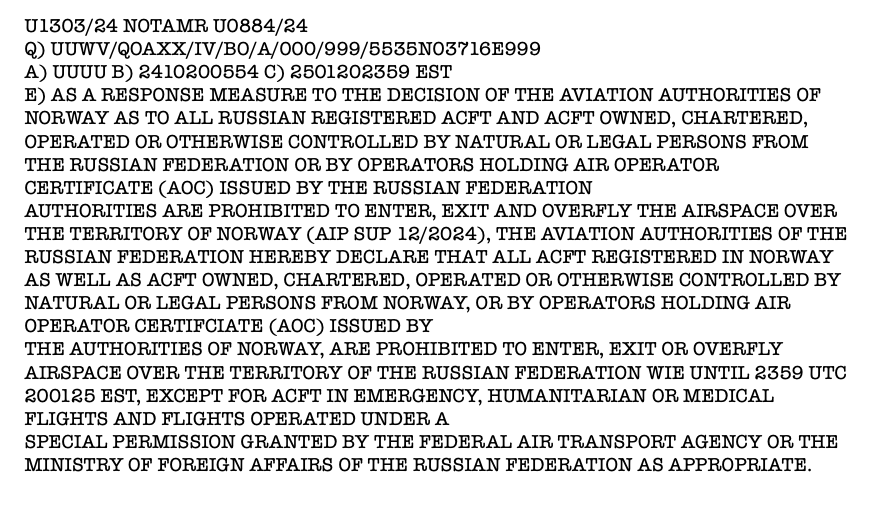
In response, Russia has banned aircraft and operators from most of these countries from Russian airspace, announcing the bans via Notams under the UUUU code. The notable exception, so far, is the US.

However, several local agents in Russia have reported that that they are not able to provide Russian landing and overflight permits to US registered aircraft and operators, and we’ve had similar reports from some locally based OPSGROUP members. With all US airlines avoiding Russian airspace, that is sensible action to follow given the uncertainty.

To keep updated on which countries have issued bans for Russian aircraft/operators, and which countries Russia has banned in response, Makgas are keeping an updated list here.

UK/US/EU sanctions

The EU, the UK and the US have each taken different approaches with their sanctions in terms of how they impact jet travel.

The US – For aircraft not registered in Russia – there’s now a list online, published by the International Trade Administration, and if your aircraft is “owned, chartered, leased, operated or controlled by, for, or for the benefit” of someone on that list, you can’t operate “to, from, within, or through” US territorial airspace. For more info on this, check our dedicated article here.

The UK bans aircraft owned, operated or chartered by anyone connected with Russia or designated individuals or entities – but unlike the US they haven’t published a list of who those individuals or entities might be. You can see the most recent UK announcement on this here.

The EU rules are the least specific – essentially the ban in Europe applies to Russian passport holders, even dual citizens. So Russian citizens can still travel as passengers, but they can’t charter the plane (and EU companies/people can’t charter it on their behalf either). You can read the EU’s official announcement here.

There have been a couple of incidents over the past couple of weeks where certain operators have fallen foul of the rules pertaining to sanctions.

  • Canada: a Falcon 900 registered in the Cayman Islands was detained at CYZF/Yellowknife airport, along with its crew and passengers, after landing from Geneva. The aircraft was released and flew back to Europe later that week, but the Russian charter customer was fined $3,000, as was the jet’s pilot. And the aircraft’s owner was fined $15,000.
  • The UK: a Global 6500 registered in Luxembourg was detained at EGLF/Farnborough airport because the authorities suspected it was linked to a Russian oil tycoon. The aircraft will only be allowed to leave Farnborough if the inquiry they’ve set up shows it is not a Russian-owned or controlled jet.

The bottom line – don’t charter a sanctioned aircraft, and make sure that you don’t charter your aircraft to a banned individual or entity. The potential impact to getting this wrong could range from having your payments frozen, to fines, to potentially having your aircraft impounded somewhere.

Routing around Russian airspace

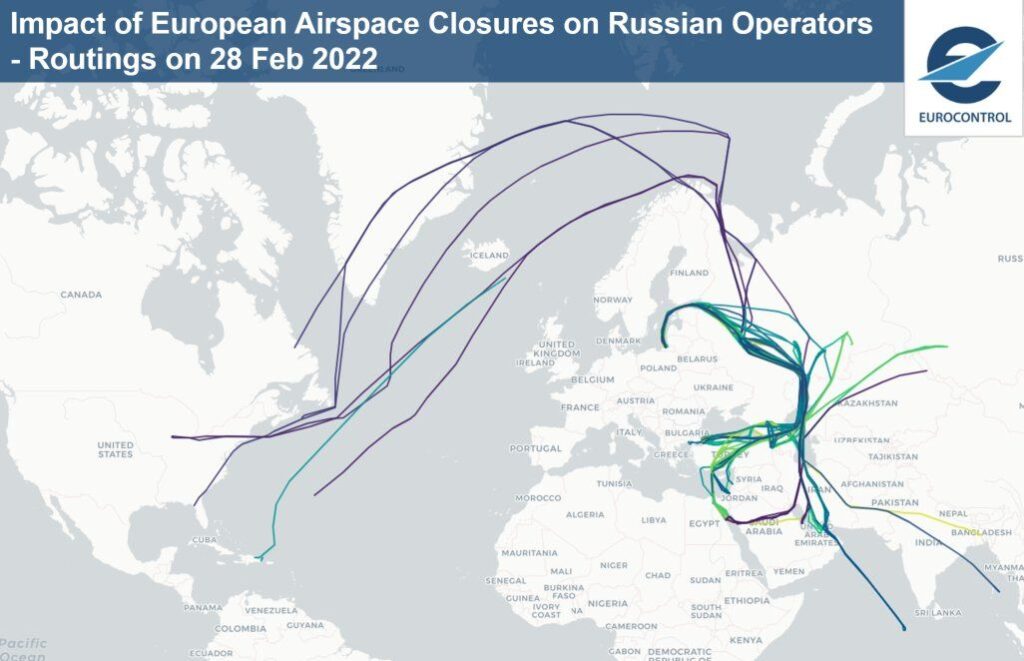
“Is it safe to overfly?” and “Is it safe to land” are in many ways the same question – because if you’ve elected to fly over a certain bit of airspace, and something goes wrong, the chances are you’re going to be landing there. Most operators are now avoiding Russian airspace, either because they’re banned from it, or because they’ve decided the risks of having to divert to Russia are too high.

Europe focus:

European carriers are generally having to change more routes than the US airlines… but higher fuel costs of having to route around Russia are offset against the fact that they’re now saving thousands on not having to pay Russia overflight nav fees.

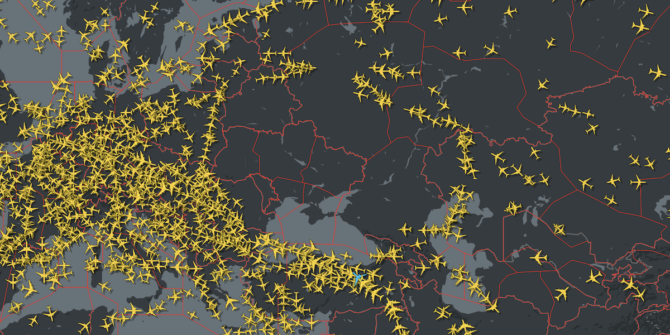
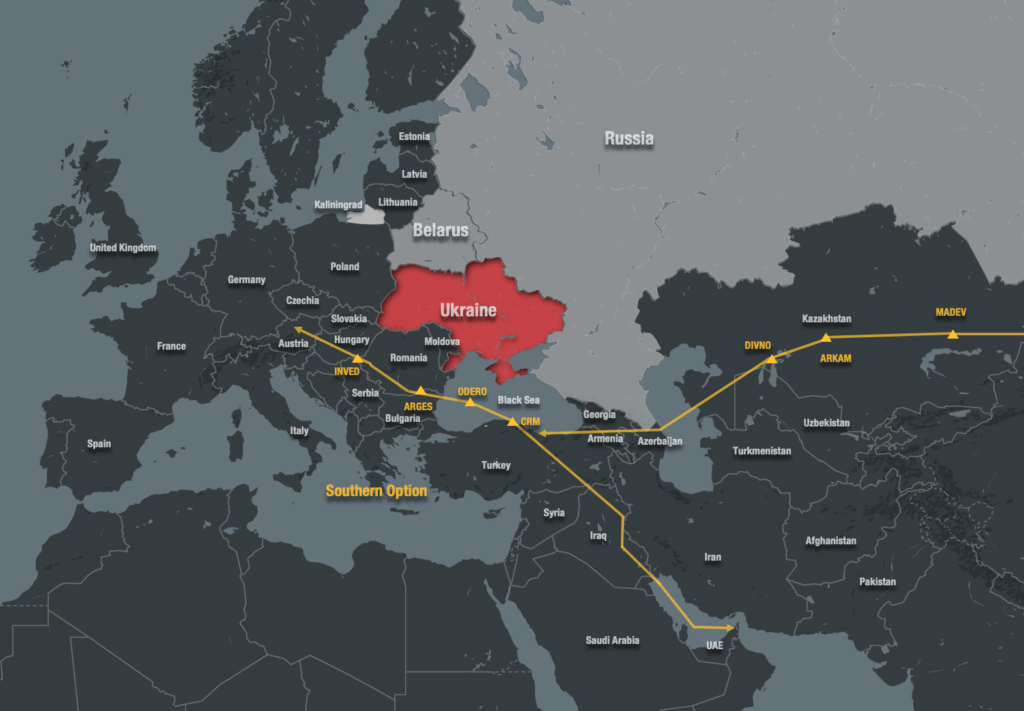
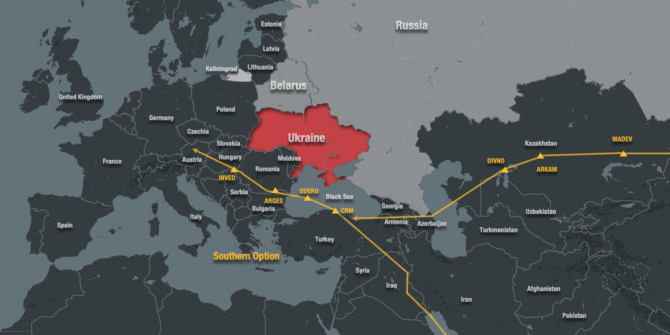
Options to overfly Europe have become increasingly complicated – especially for aircraft transiting between Western Europe and the Middle East and Asia. Major carriers in the region now appear to be following two major air corridors – one that extends from the Persian Gulf to Romania, the other from China to the Black Sea. Here’s what that looks like.

These routes take aircraft in close proximity to several danger spots, including Iraq, Iran, and Syria. For more info on this, check out the article we wrote here.

US focus:

A lot of US airline flights won’t be too badly impacted from their current levels – flights to the likes of China, Hong Kong, Japan, South Korea – just because they weren’t doing that many flights here anyway because of Covid restrictions.

From a routing point of view, there’s not a lot of impact to flights from the US to Europe, even the US to the Middle East – heading East is not an issue because there’s really only Russia’s Kaliningrad FIR to watch out for.

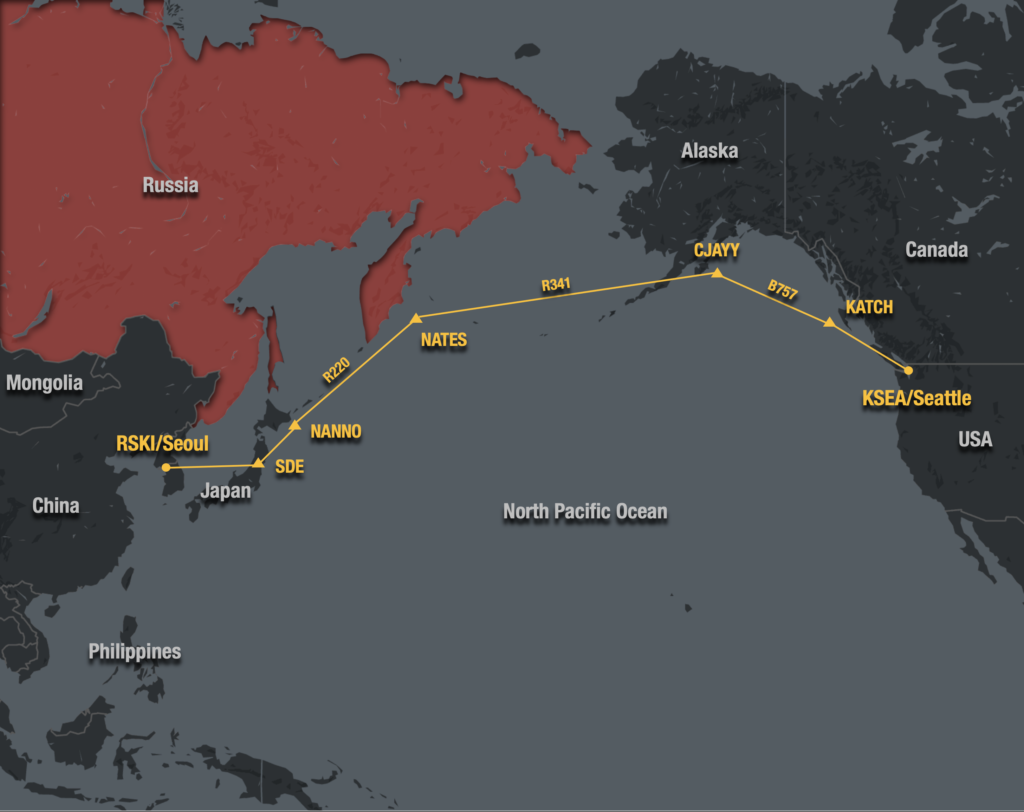
But for US flights heading West, avoiding Russian airspace does have an impact – routing via the NOPAC routes, down to Japan and China. There’s a 1700nm stretch of airspace here between PADK/Adak in the Aleutian Islands and RJCC/Sapporo in Japan where your options are extremely limited except for airports in Russia (mainly UHPP/Petropavlovsk, but also UHSS/Sakalin Island just before you get to Japan).

The considerations for general/business aviation are different to the airlines here – it’s more a question of do you have the aircraft range to safely operate this section of airspace over water? And do you have decent divert alternates available in case you need them, to ensure that you don’t find yourself 3 hours away from a non-Russian airport in a 1LE scenario?

Ukraine Relief Missions

Humanitarian flights for Ukraine are taking place into Poland, Romania and other neighbouring countries. We have compiled a list of handy contacts, general ops information, and other bits which we hope might help – you can read the article here.

The two agencies we’d encourage people to go check out are Airlink and DirectRelief – these two have already flown in shipments of aid and have more scheduled this month. So those are good places to go find out exactly what’s needed, and how to help.

IFALPA and the European Cockpit Association have also put out a letter for members of the aviation community wanting to help support the pilot community in Ukraine. They suggest you reach out to local organizations to help, or donate to larger ones such as Red Cross who are on the ground there. You can read the letter here. 

If you need assistance with anything to help prepare for humanitarian flights, please get in touch. Similarly, if you have already operated similar missions, please get in touch to share your contacts, feedback and experience so we can support others in their operations as well.

CofA’s revoked!

A final word on this. We put it right down here at the bottom because although it’s fairly big news and worth knowing about, it probably won’t impact your operation very much.

Aviation authorities in Bermuda and Ireland have now revoked airworthiness certificates for leased aircraft detained in Russia – mainly because they’re no longer able to check these aircraft to see if they are still airworthy. They’ve done this ahead of the March 28th deadline set by the EU to terminate leases and recover planes from Russian airlines.

From most reports, it seems there are around 500 aircraft owned by foreign leasing companies which are rented to Russian operators.

The response from Russia has been to create a new law which basically allows Russian carriers to re-register these aircraft, and continue operating them domestically – despite the termination of the leases. And reports suggest something like 200 of these aircraft have already been re-registered in the past week.

Added to that, all the major manufacturers are now no longer supplying spare parts to Russia. Airlines and operators using these aircraft in Russia will therefore almost immediately have the issue how to keep them functioning and airworthy, but the point worth noting for all the rest of us is this – do you want to risk potentially having to divert somewhere where your aircraft might get stuck on the ground with a tech issue that can’t be fixed?

Ultimately, we’re now approaching a situation in Russia very similar to the Soviet Union days. Russia is essentially now in the same basket as Iran and North Korea in terms of being shut off from the rest of the aviation world, and operators need to plan accordingly.


Impact of Russia Sanctions on Corporate Aviation

As the conflict in Ukraine continues, the world has been responding with sanctions against Russia. This includes the US, Canada, the UK and EU.

The problem is that these sanctions are having far-reaching impacts on aviation – especially for charter operators who may not even be aware that they are breaking the rules. And it’s important to stay on the right side of the law, as the penalties can be severe – even if the lines are blurry.

Here is a rundown of what we know for US operators, and things to be aware of.

First up, what actually is a sanction?

Simply put, commercial and financial penalties that are applied by one or more countries against another state or group.

They are a tool that falls short of military force for punishing or deterring some form of action. In this case – Russia’s ongoing military offensive in Ukraine. Sanctions mean that our ways of doing business, or interacting financially, are restricted by law – including the payment for, and delivery of, services for those restricted by the sanction. This is where things start to become complicated for aviation. Perhaps more than you may realise.

So, what can’t we do?

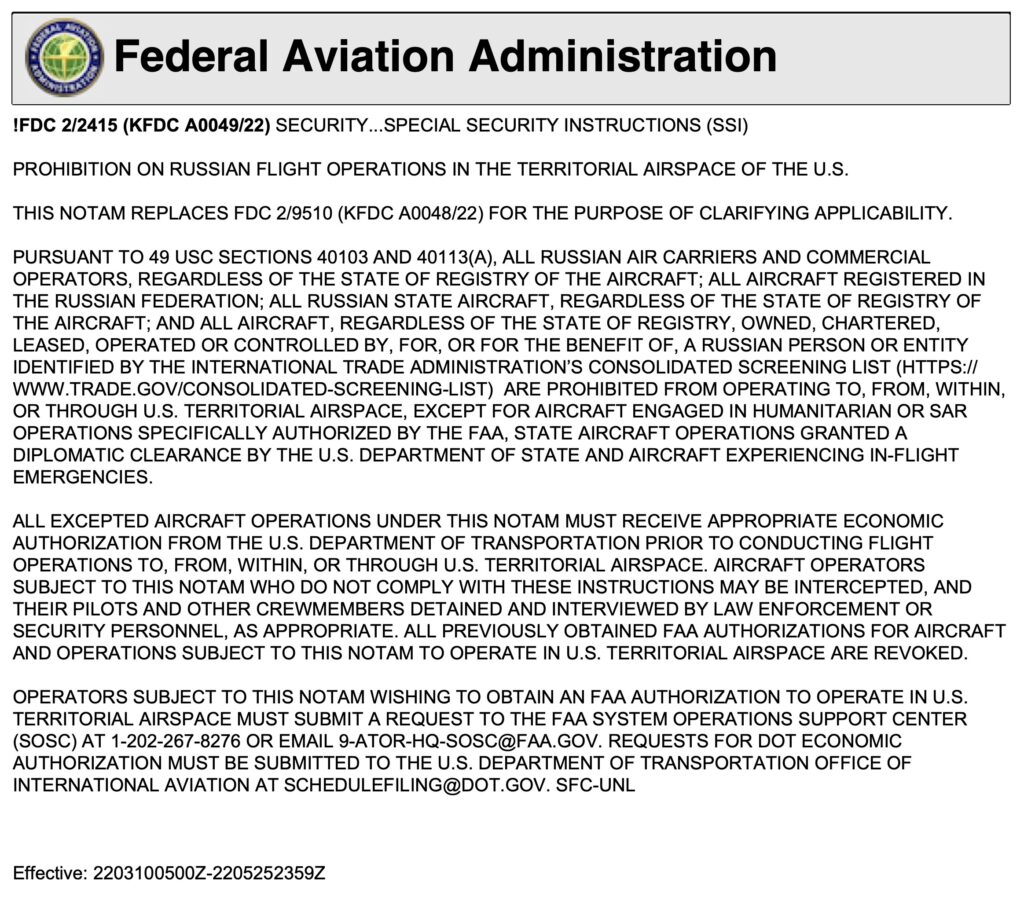
US operators can find that information in KFDC Notam 2/2415 below:

So, regardless of where an aircraft is registered – if it is owned, chartered, leased, operated or controlled by or for the benefit of a Russian person or entity on a specific list (www.trade.gov/consolidated-screening-list), it can cannot be operated in US airspace. This includes overflights. Exemptions are available but only with special diplomatic approval.

The issue is that the italicised words above are open to interpretation which can lead commercial operators, especially charter providers up the garden path. And as the Notam eludes to, rule breakers can be detained or even face prison time. It may be tempting to try and sneak under the radar but be careful. The US Government has established a task force known as ‘KleptoCapture’  to actively enforce the sanctions. They have the ability to arrest, prosecute and even seize the assets of anyone breaking the rules.

Let’s take a closer look at what you need to be careful of.

Who owns the bird?

Fractional ownership of private jets can be complicated. There can be numerous owners of a single tail number. It may have a N-Reg, but that doesn’t mean part of that tail isn’t owned by Russian interests. Even if it’s only a small part. Which means just flying it will put you on the wrong side of the law. The reality right now is that ownership share may need to be re-allocated.

Things can become more complicated  too – it may not be an individual that owns a share, but a company. And what if that company is, or has since been purchased, by those with interests in Russia? This can also be buried deep in the legalities of business.

I need a ride – the charter conundrum.

As they stand, current sanctions do allow you to carry Russian passengers. But, they can’t be the ones who have specifically chartered your aircraft. Or in other words, Russian nationals and companies can’t be the ones to thumb the ride – but they can take a seat if someone else is picking up the tab.

There is also the issue of dual citizenship, or dual passports. Where does the duty of care for operators lie, and how would they know? It is a question to which we are still looking for answers.

Buying new airplanes.

Purchasing an aircraft is also currently problematic – particularly if it is currently owned by Russian interests. That is also no-bueno. If you’re in the market for a new ride, make sure you understand exactly who you are buying it from – in terms of legal and beneficial owners, along with the broker you are using and how you plan on financing and insuring your purchase.

Stuck on the ground.

The effect of sanctions and airspace restrictions means that moving expensive aviation assets out of Russia right now is a risk. Put it this way – there are currently somewhere in the vicinity of five hundred leased jets effectively grounded there. That’s literally billions of dollars’ worth of aviation assets waiting to be recovered, with no obvious solution in sight.

And even if you get airborne, are you allowed to be operating in their airspace? Russia has been reciprocating western airspace bans with bans of their own – check out the UUUU Notams for the lengthy list of those.

Then there is the issue of what happens if your airplane breaks. You will struggle to secure the supply of parts, services and other support for aviation assets in Russia as you would effectively be in breach of sanctions. Be aware that even if you can operate an aircraft into Russia right now, you may find yourself stuck when it is time to leave again.

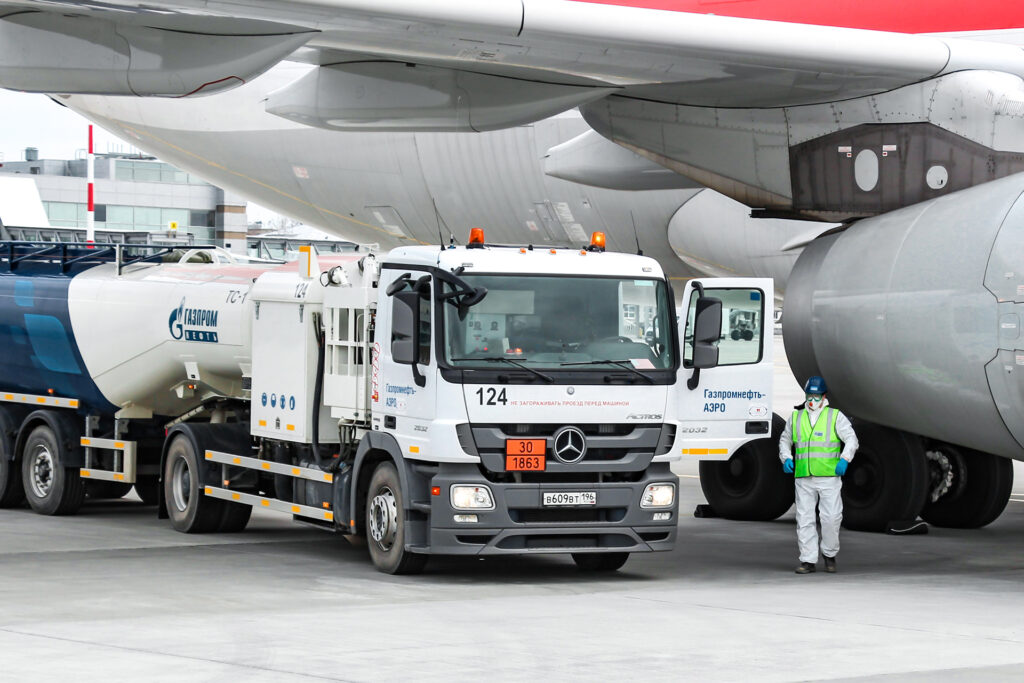
Fuel.

Sanctions are also having an impact on operating costs around the world. Restrictions on the importation of Russian oil has seen oil prices, and the cost of jet fuel, sky rocket in recent weeks. It has increased by thirty percent in the last week alone, and has effectively doubled compared to this time last year. That’s rampant inflation.

Add to that that the majority of the world’s traffic are having to bypass over six million square miles of airspace to and from Western Europe and you can quickly begin to get your head around the combined costs of these issues to our industry.

And in Russia there is also an emerging problem of availability. Earlier this week we reported to OPSGROUP members that at least one major carrier had cancelled flights to Moscow due to being unable to uplift fuel. It is important to gauge availability ahead of time.

Getting an exemption.

So you have a pressing reason to break the rules of the sanctions? You may still be able to fly, but it’s vital you get diplomatic approval first – even if only operating domestically in US airspace. There are two things you’ll need. First is an economic approval from the US Department of Transport Office via schedulefiling@dot.gov. You’ll also need to submit a request to the FAA System Operations Support Centre (SOSC). You can reach them on 1-202-267-8276 or via the email 9-ator-hq-sosc@faa.gov.

Permission is most likely to be granted to flights engaged in humanitarian, SAR or other essential work.

Where else to look for help.

If in doubt, it is better to seek clarification on the rules before you fly. This may mean seeking legal advice. The OPSGROUP team may also be able to help – you can reach us on team@ops.group and we’ll do our best to give you a hand.


Dodging Airspace: The Bendy Road to Western Europe

Update Mar 4, 2100z:

Some local agents are now saying that they are not able to provide Russian landing and overflight permits to US registered aircraft and operators. We’ve had similar reports from some locally based OPSGROUP members. Russian authorities still haven’t published a UUUU Notam for this yet, but for most operators planning trips in the region ensure you avoid Russian airspace entirely for the time being.


Original story from Mar 2:

In just a short week the skies over Europe have dramatically changed.

In response to the conflict in Ukraine, the EU, the US, Canada, along with several other countries have now introduced blanket bans on Russian aircraft and operators from their airspace. Russia has responded by banning many of these countries’ aircraft and operators from Russian airspacewe’re still waiting for Russia to ban those from the US, but we expect it to be issued soon.

In addition to the complete closure of Ukrainian, Moldovan and portions of Russian and Belarusian airspace, options to overfly Europe have become increasingly complicated – especially for aircraft transiting between Western Europe and the Middle East, Asia and Australasia.

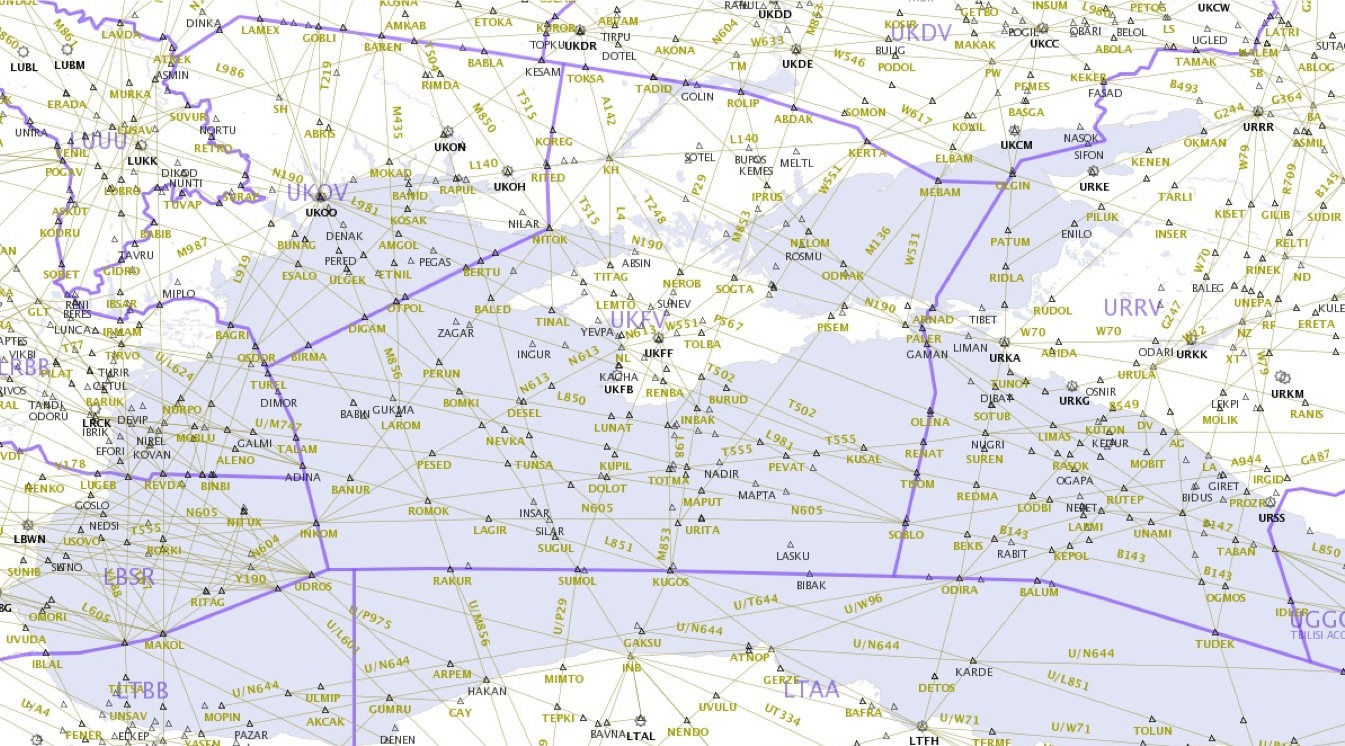
Major carriers now appear to be following two major air corridors – one that extends from the Persian Gulf to Romania, the other from China to the Black Sea. Here’s what that looks like:

The routes take aircraft in close proximity to several danger spots, and so here is a guide to what you need to know…

The Middle East

The southerly route begins over the Persian Gulf through both the OBBB/Bahrain and OKAC/Kuwait FIRs which are considered safe.

It is, however, a narrow corridor that takes aircraft close to Iranian airspace to the east that should be avoided entirely. Following the shoot down of a Boeing 737 there in January 2020, several countries have active airspace warnings in place for the OIIX/Tehran FIR – including the FAA’s outright ban on US operators. The risk there is from the use of advanced anti-aircraft weaponry at levels.

See the official airspace warnings for Iran here.

Beyond the Persian Gulf, this route continues through Iraqi airspace. Iraq itself remains an active conflict zone so the airways and levels used should be considered carefully.

But is it safe? The general consensus is on eastern airways UL602, UM860 and UM688 at or above FL320, yes. Elsewhere, no. Although the US FAA recently re-allowed Iraqi overflights throughout the ORBB/Baghdad FIR, it is not advisable. Canada, the UK and France also recommend against flights at lower levels where aircraft are at risk of being intentionally targeted by terrorist groups.

See the official airspace warnings for Iraq here.

To the West lies Syria – the OSTT/Damascus FIR should be considered extremely dangerous. There is a high risk to aircraft here at all levels due to active fighting, and the potential to be misidentified by Syrian air defence systems. Give it a wide berth.

See the official airspace warnings for Syria here.

Europe

The flight path then threads North through Turkish airspace where there are some risks to be aware of, despite being considered safe.

The first is mistaken identity – there are militia active in the country who infrequently target Turkish military aircraft with anti-aircraft weaponry at lower levels. The second is due to GPS jamming. There are reports of widespread signal interference in the LTAA/Ankara FIR especially on the border between the ORBB/Baghdad and OIIX/Tehran FIRs.

More on the risks in Turkish airspace, here.

Further north the route being flown heads over the Black Sea before a westerly turn towards Romania. The further north you route, the higher the risk. Most operators appear to be heading no further than the waypoint ODERO.

Beyond that you will approach the active conflict zone in Ukraine. While all Ukrainian airspace is closed, there is likely ongoing military activity in the Black Sea – including naval and air force operations with little regard for civilian traffic. The consensus of OPSGROUP members is to avoid the area as much as possible.

The route then continues through Romania and Hungary. There are no airspace warnings for these countries which are considered safe and reliable. It is worth remembering though that they share a border with Ukraine. If flight planning further north be careful of your proximity to it – risks may be present on either side of the border.

The more northerly route – China and the ‘Stans.’

Aircraft crossing Europe from the Far East, such as Japan and China, may also follow routes through China’s airspace. Airways in mountainous regions such as the Himalayas require extra planning – especially with regards to escape routes in event of engine failure or depressurisation.

As such, OPSGROUP members report that Chinese authorities have been reluctant to allow foreign operators to use routes such as L888 (also known as the ‘Silk Road’) without meeting special requirements – you can read more about this here, and if you’re heading this way make sure you download our Himalayan Routing Guide here.

Flights over Afghanistan should be avoided. The OAKX/Kabul FIR is still uncontrolled following the Taliban’s offensive late last year. There are also serious threats to aircraft at low level from anti-aircraft fire, in addition to serious security issues for crew on the ground. You can find more info on these risks here.

There are also active airspace warnings for Pakistan, although it is generally considered safe for overflights. Care should be taken in the disputed northeastern part of the country (the Kashmir region). The general consensus is that higher is better in the OPLR/Lahore and OPKR/Karachi FIRs. For more on these warnings, click here.

Assessing the Risk

With such dramatic changes to the risk picture of Europe’s airspace it can be challenging to wrap your head around just how much risk is acceptable, and how much is not. It is also important to remember that you shouldn’t enter airspace unless you are able and willing to land there.

There’s a few ways that OPSGROUP can help. The first is with safeairspace.net, our Conflict Zone & Risk Database which we update with official state warnings and our own analysis around the clock. We’ve also written an article about how to assess risk which you can read here.

Help and support from others in OPSGROUP

Every Tuesday at 2000z we hop online to talk about these things in our regular OPS CHAT. You can read about these here.

This week our members discussed the situation in Ukraine and its impact on international flight ops.

Here’s the link to the replay of yesterday’s OPS CHAT, plus a text summary of all the main topics discussed: Russian operator ban, Russia reroutes, areas of concern in Polish airspace, aircraft getting stuck in Russia, and how OPSGROUP might be able to help with operational support and information.

Or reach out to the team with your question – we’re always around at team@ops.group, and we’d love to hear from you.


OPSCHAT Summary 01 MAR

Hello members,

We had a rather busy OPSCHAT call this afternoon; here is an outline of the topics discussed.
– The full call is available to replay in your Members Dashboard: OPSCHAT 01MAR Recording.
– The full text summary of the discussion points, with useful links and FAQ, is here: OPSCHAT Call Summary 01MAR.

Topics discussed:

  • Russian operator ban – We clarified some of the rules regarding who specifically is affected. EU definition, impact on operators, impact on Russian passport holders, how this is already working in practice. FAQ on sanctions also uploaded.
  • Russia Reroutes – Many operators looking at new routes and unfamiliar airports. Caution especially Himalyan routes if these are unfamiliar – high terrain, challenging airports. OPSGROUP preparing some specific guidance to assist
  • Polish Airspace – Area of concern in south east portion of Warsaw FIR. High level of military activity. Short notice airspace closures are happening in Poland, be prepared – especially in the northern part of Polish airspace.
  • Aircraft stuck in Russia – Discussion regarding leased aircraft and other foreign aircraft potentially being held in Russia.
  • OPSGROUP assistance – Offer from Team to assist where possible with any operational support, information, questions – as well as #flightops or #questions in the OPSGROUP Slack channels.

Please see the full text summary and recording in the Dashboard for full details.


Russian airspace closures escalate, aircraft diverting to exit

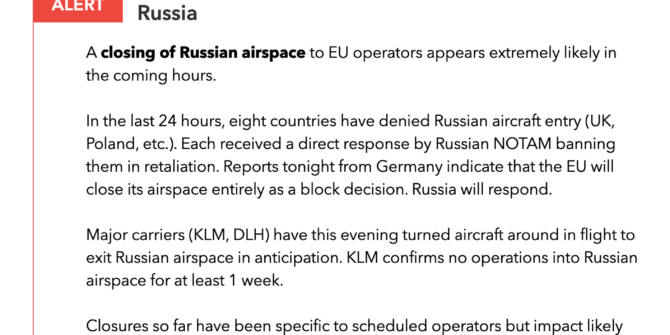
OPS ALERT – UUZZ/RUSSIA

A closing of Russian airspace to EU operators appears extremely likely in the coming hours.

In the last 24 hours, eight countries have denied Russian aircraft entry (UK, Poland, etc.). Each received a direct response by Russian NOTAM banning them in retaliation. Reports tonight from Germany indicate that the EU will close its airspace entirely as a block decision. Russia will respond.

Major carriers (KLM, DLH) have this evening turned aircraft around in flight to exit Russian airspace in anticipation. KLM confirms no operations into Russian airspace for at least 1 week.

Closures so far have been specific to scheduled operators but impact likely to spread. So far no closures directly targeting US operators, but avoiding Russian airspace is sensible given the uncertainty.


More on this in the Flight Ops channel

For the latest on this, head to the #Flight Ops channel on OPSGROUP Slack. We’ve just posted a copy of this alert there, and you can discuss and share updates on this specific topic with other members. The team will also post updates and further info there as we get news.

If you know more about this situation, please share an update in the channel, or email the team. Thank you!


Russia-Ukraine Conflict Timeline

The tensions between Russia and the Ukraine continue to rise, and questions over whether Russia will mobilise troops into the Ukraine is raising concerns for the safety of the region and its airspace.

For a full background to the situation, you can read this post.

Here is a timeline of the current situation and risk warnings, with latest updates on any changes as they occur.

Timeline – Airspace Risk

Jan 26 2022 – **Latest Update**

  • Belarus and Russia advise they will holding joint exercise through to February 20. These will take place near the southern border with the Ukraine. The drills will involve tests of the air defense systems which use advanced anti-aircraft weaponry, able to reach all levels of civilian utilised airspace.

January 2022

  • Russia warned of “the most unpredictable and grave consequences for European security” in relation to plans for the Ukraine to join NATO which is further destabilising the situation.
  • NATO has increased air forces in Eastern Europe in case intervention is required.
  • Warnings and prohibitions remain in place for the airspace along the border between Russia and Ukraine.

December 2021

  • The FAA published updated information on overflight risks near the border, particularly in the URRV/Rostov FIR near the UKDV/Dnipro FIR boundary. This is the region where MH17 wash shot down in 2017.

November 2021

  • Russia increased military activity along their border with the Ukraine, and based significant numbers of troops around URRP/Platov International Airport in Roston-On-Don Oblast.
  • The Ukraine hold drills of their airborne units in the Kyiv region, in response to increased Russian activity.

October 2021 

  • The FAA extended their ban on US operators overflying the eastern part of the UKDV/Dnipro FIR. This is in force until October 2023.

April 2021

  • Russia established several large danger areas throughout the UKFZ/Simferopol FIR airspace over the Crimea, increasing tensions between Russia and the Ukraine. ICAO does not recognise Russia’s jurisdiction over this airspace.
  • Increasing reports of GPS jamming along the border and in east Ukraine suggestion heightened surveillance. Increasing military presence was reported.
  • The FAA and Canada published updated airspace warnings. Canada recommended operators avoid the UKFV/Simferopol and the UKDV/Dnipro FIR.

Within the Ukraine

January 2022

  • Cyberattacks caused disruption to government and public services, and are likely to continue.
  • Several countries including the UK and Canada have now advised their nationals to leave, and advise against all but essential travel.
  • Provinces located in the eastern and northern regions of Ukraine, including capital Kyiv and Odessa are on elevated travel alert, with significant concerns about safety and security on the ground.

December 2021

  • Protests in major cities, particularly Kyiv, occurred as civil unrest increases. The security situation in major cities is worsening.


Airspace update: The Russia-Ukraine border conflict

Long-standing airspace warnings are in place for the Russia/Ukraine border region due to the ongoing conflict. But with recent reports of increased military activity along the Russian side, the concern is Russia may be considering renewed military action including incursions into the Ukraine which would further destabilise the region.

The most recent report suggests large escalation in activity near Maslovka in Belgorod Oblast and around URRP/Platov International Airport in Roston-On-Don Oblast.

URRP/Platov International Airport is the main airport serving this region, and is relatively new – only having opened at the latter end of 2017. It is primarily used by short haul operators to connect to Middle East and Eastern European destinations. The airport has a single runway 05/23 which is 11811ft/3600m in length and has CAT II capability.

Reports suggest Russia is using equipment to jam Ukrainian surveillance drones. Such equipment could affect civilian aircraft, although the range would most likely be limited to the region along the border where airspace warnings already apply.

Further implications.

The US and Europe are encouraging de-escalation. If sanctions were taken against Russia, this could lead to potential gas and fuel shortages as Russia is a major contributor to Europe for these.

There are some tensions between Russia and Europe due to sanctions imposed against Belarus back in May, following the interception of an international flight bound for Lithuania and forced to land in Minsk.

What is the background?

There is an active conflict zone in eastern Ukraine along the border with Russia. The main hotspot is the Line of Contact which runs through the UKDV/Dnipro FIR.

The FAA warned of increased tensions in April 2021, but these were thought to be easing with reports of Russia withdrawing much of their forces. In October 2021 the FAA updated their SFAR extending the flight ban on eastern part of the UKDV FIR to Oct 2023.

What are the current warnings?

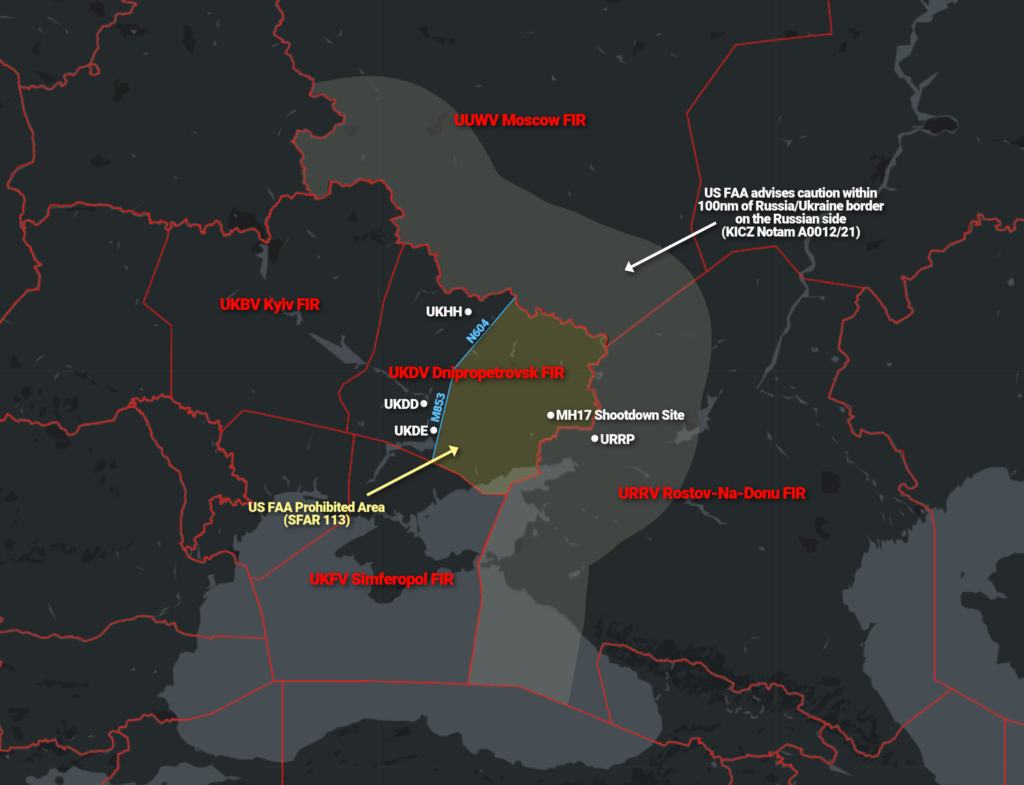
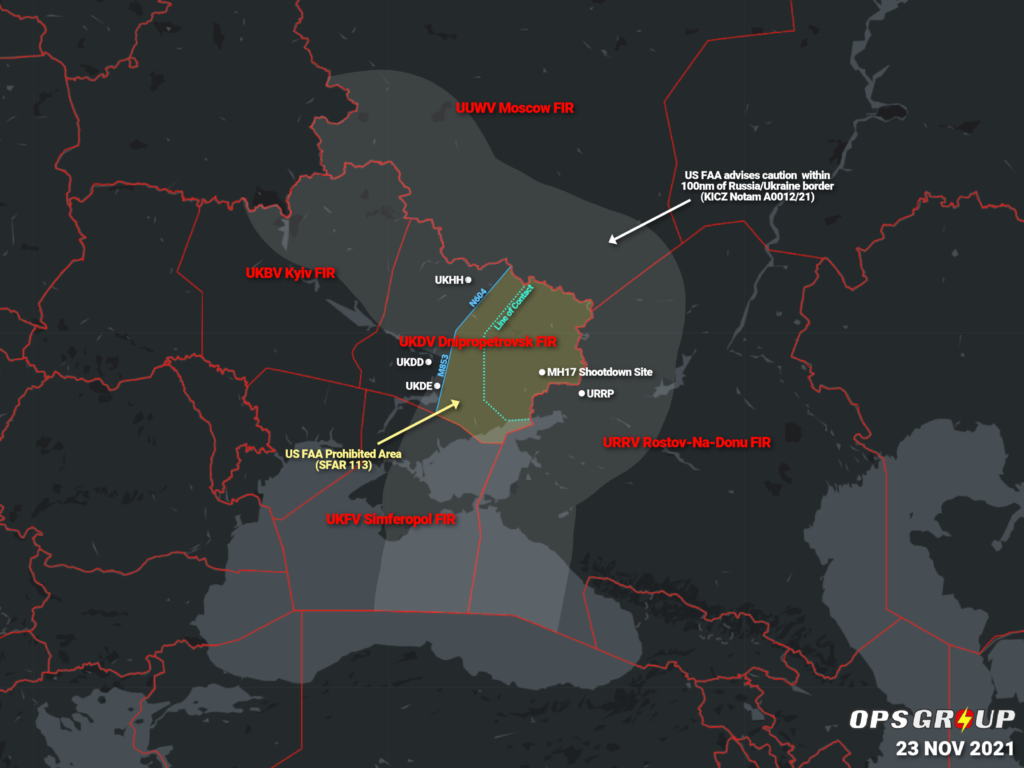
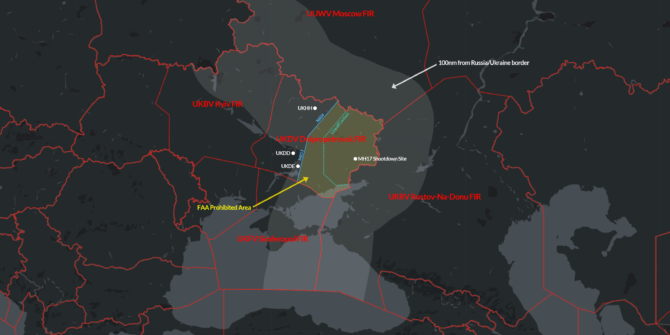
The FAA bans US operators from overflying the eastern part of the UKDV FIR, and warns operators to exercise extreme caution within 100nm of the entire Russia-Ukraine border. Several other states have also issued airspace warnings for eastern Ukraine.

A full review of the major warnings can be found at safeairspace.net

What is the risk leading to these warnings?

The primary risk is for operations near the Russia-Ukraine border in the UKDV/Dnipro FIR. Should hostilities escalate here, the airspace on both sides could be exposed to potential weapons activity posing a risk to civil aircraft from misidentification or miscalculation.

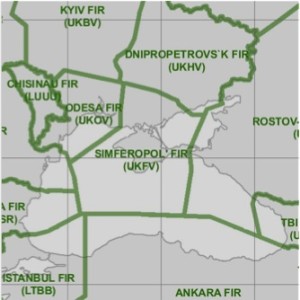
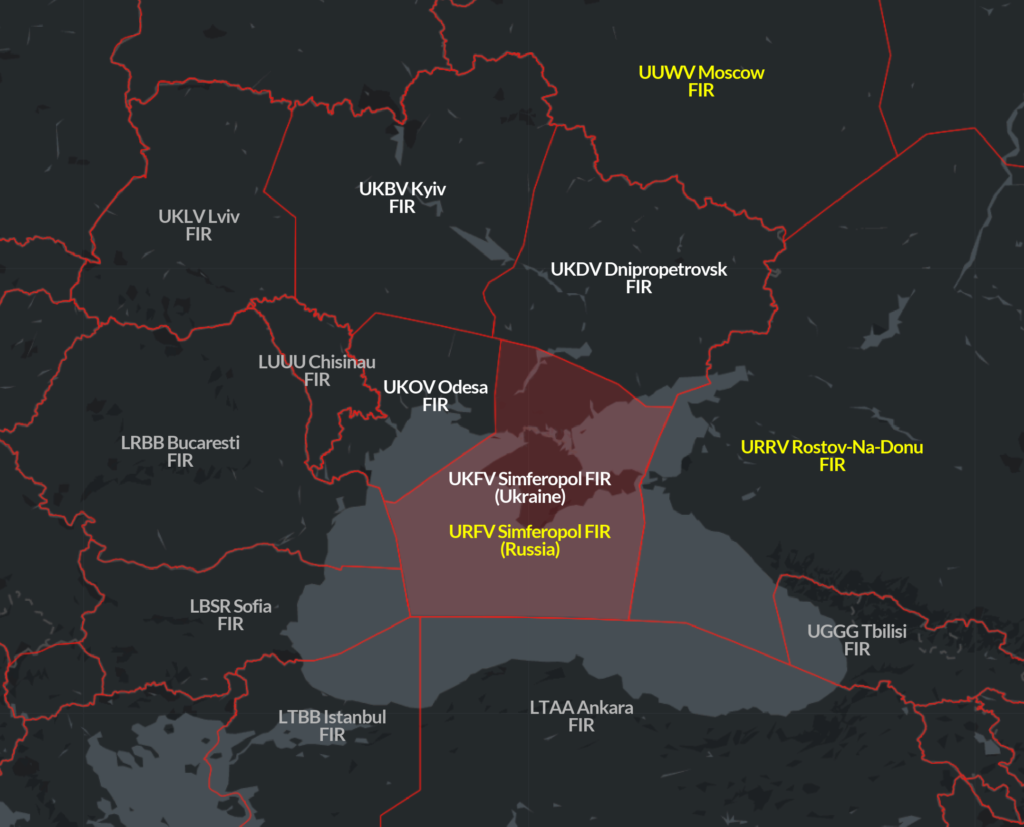
The secondary risk affects the UKFV/Simferopol FIR which is disputed airspace. (Ukraine:UKFV, Russia:URFV). The risk here stems from aircraft potentially receiving confusing and conflicting air traffic control instructions from both Ukrainian and Russian ATC when operating over the region.


Russia restricts flights over Crimea and Black Sea

The airspace warnings for the Ukraine are on the rise again, and for good reason – Russia seem to be going on a renewed military offensive, focusing their efforts on the area of disputed airspace over Crimea.

Following Russia’s annexation of Crimea in March 2014, the ATC Center in Simferopol has been run by Russia. Russia claims the airspace, and publishes Notams under the URFV code they invented for it. Ukraine refuses to recognise the change, and still controls the airspace under the internationally-recognised UKFV code.

So what jurisdiction do Russia have, and how much attention should we be paying to the Notams which they issue for an area of airspace that is not theirs to control?

What are Russia saying?

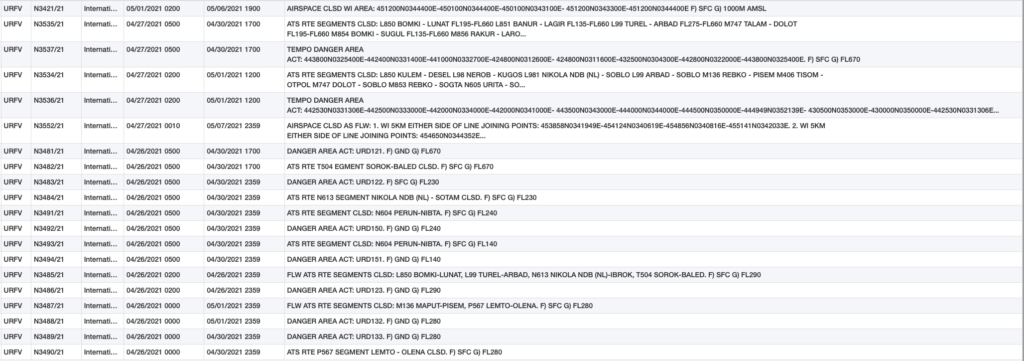
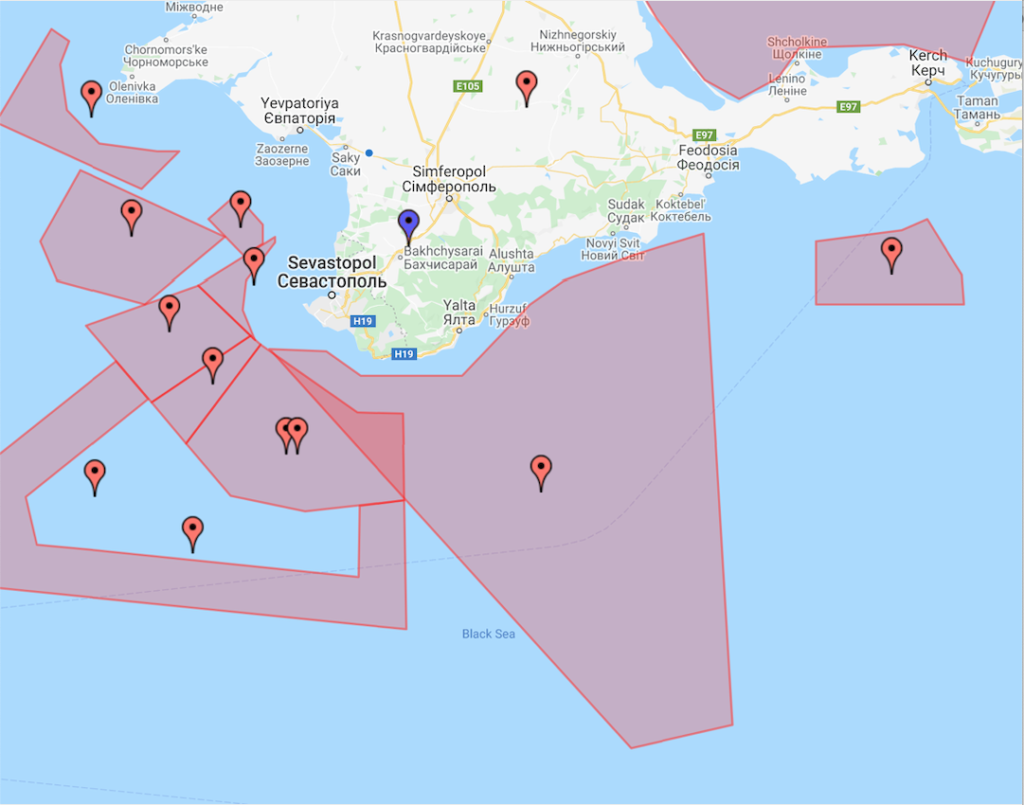
Russia have published a long series of URFV Notams advising of danger areas and limitations to airways across the Simferopol FIR. These run from April 20-30 – some only apply from FL350 upwards; others apply to all flights from SFC right up to altitudes higher than most aircraft can fly (we saw a FL670 thrown in there). These danger areas are most likely due to military activity, which may include live firing exercises.

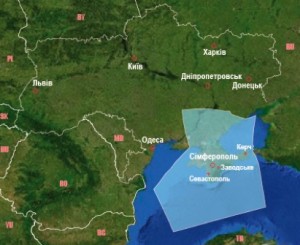
The zone of restriction of flights includes some areas over the southern part of Crimea, from Sevastopol to Feodosia, the territorial waters adjacent to the Southern coast of Crimea, and part of the international waters of the Black Sea, and are possibly in relation to Russia’s plan to move warships into the area.

What are Ukraine saying?

Ukraine aren’t happy about it, and have issued a bunch of Notams for the same periods effectively establishing danger areas at all levels in the portions of the FIR that are over water – i.e big chunks of the Black Sea and Sea of Azov (to the northeast of Crimea).

All the Ukrainian UKFV Notams advising about these danger areas carry this note:

DUE ACTIVITY PUBLISHED BY RUSSIAN FEDERATION.
THE PUBLICATION BY RUSSIAN FEDERATION OF INFORMATION 
RELATED TO AIRSPACE UNDER RESPONSIBILITY OF UKRAINE 
DOES NOT COMPLY WITH THE PROVISIONS OF THE ICAO 
AIR NAVIGATION PLAN - EUROPEAN REGION (DOC 7754) 
AND THE ICAO ANNEXES 11 AND 15.

In other words – although Russia do not have jurisdiction in this airspace, they have published a bunch of danger areas here, so we (Ukraine) had better do the same, to make the warning “official”.

What are other authorities saying?

So far, none of the other state authorities around the world have published or updated their own warnings in response to this recent issue specific to the airspace over Crimea.

Just last week, the US FAA updated their airspace warning for Ukraine – but this was in relation to the UKDV/Dnipropetrovsk FIR in the east of the country along the border with Russia. The US warning to operators in this region was to exercise extreme caution within 100nm of the entire Russia-Ukraine border, due to risks associated with recent increased tensions between the two countries. They said that if hostilities escalate here, the airspace on both sides could be exposed to potential weapons activity posing a risk to civil aircraft from misidentification or miscalculation.

The most recent US advice for the UKFV/Simferopol FIR came in October 2020, when they actually removed their restrictions on overflights of this airspace. At that time, they said the security situation had sufficiently improved here – while Russia continued to assert territorial claims over the region, Ukraine had established appropriate risk management measures to ensure safe operations for aircraft along the Black Sea routes.

Several other states have existing warnings in place for Ukraine. Canada advise operators to avoid the UKFV/Simferopol and UKDV/Dnipropetrovsk FIRs entirely, whereas the UK and France say that overflights of eastern Ukraine should only be planned on airways over the Black Sea to the south of Crimea.

For more details on Ukraine and other airspace warnings, head to SafeAirspace.net

What are we saying?

Two major points –

  1. Russia do not have jurisdiction over the Simferopol airspace, so the Notams to follow are those published by Ukraine under the UKFV code.
  2. Regardless of what is out there, clearly extreme caution in this area is required. Russia are making all the moves to increase their military presence and potentially reignite the ongoing conflict.


US FAA issues new airspace warning for Russia and Ukraine

On April 17, the US FAA published new Notams warning operators to exercise extreme caution within 100nm of the entire Russia-Ukraine border, due to risks associated with recent increased tensions between the two countries. Should hostilities escalate here, the airspace on both sides could be exposed to potential weapons activity posing a risk to civil aircraft from misidentification or miscalculation.

The eastern part of Ukraine along the border with Russia is still an active conflict zone. The main hotspot is the Line of Contact which runs north-south through the UKDV/Dnipropetrovsk FIR. Throughout April 2021 there has been a large military build-up and an increase in ceasefire violations in this area, plus reports of GPS jamming and surveillance of civil flights by military systems – similar conditions to those prior to the shoot-down of MH17 in 2014.

This new airspace warning from the FAA follows the Information Note they published on April 13, which provides more background on the situation.

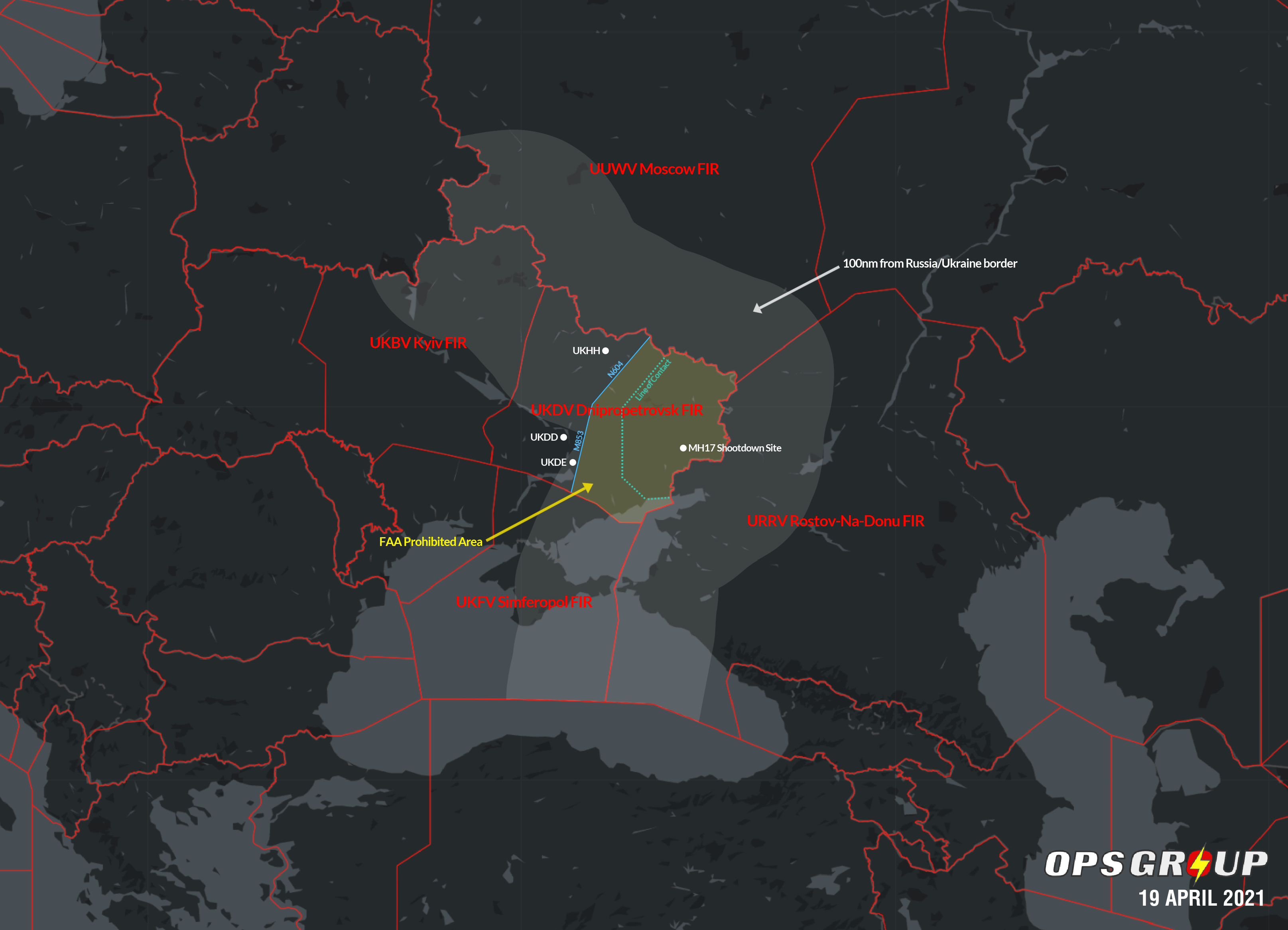
The FAA’s previous warning for Ukraine, as per SFAR 113, remains in place – US operators are banned from overflying the eastern part of the UKDV/Dnipropetrovsk FIR due to a continued threat of arms fire in the region. Essentially, everything east of ABDAR–M853–NIKAD–N604–GOBUN is prohibited. Airways M853 and N604 are off-limits as well. Flights to UKHH/Kharkiv, UKDD/Dnipropetrovsk and UKDE/Zaporizhzhia airports are permitted.

Put that all together – the old warning and the new one – and here’s how it looks:

Several other countries have airspace warnings in place for eastern Ukraine, including Canada who recently published a Notam advising operators to avoid the UKFV/Simferopol and UKDV/Dnipropetrovsk FIRs due to the risk from heightened military activity and anti-aviation weaponry. Check SafeAirspace.net for more info.

What about the UKFV/Simferopol FIR?

For the past few years, the risk here has been quite separate to that affecting the UKDV/Dnipropetrovsk FIR. It stems from the fact that the UKFV/Simferopol is disputed airspace, with aircraft potentially receiving confusing and conflicting air traffic control instructions from both Ukrainian and Russian ATC. 

In March 2014, Russia annexed Crimea, and Ukraine disputed this. The ATC Center is in Simferopol, Crimea, and is now run by Russia. Russia claims the airspace, and now refer to it as the URFV FIR. Ukraine refuses to recognise the change, and still calls it the UKFV FIR – and asks crews to talk to Ukrainian controllers in Dnipro/Odesa ACC instead of Simferopol ACC.

In October 2020, the US entirely removed their restrictions on overflights of the UKFV/Simferopol FIR, as they said the security situation had sufficiently improved here. While Russia continued to assert territorial claims over this region, Ukraine had established appropriate risk management measures to ensure safe operations for aircraft along the Black Sea routes.

In simple terms – since 27th October 2020, US operators have been able to overfly the Simferopol FIR.

However, tensions have been on the rise in this region throughout 2021. Russia seem to be going on a renewed military offensive here, focusing their efforts on the area of disputed airspace over Crimea, and establishing several large danger areas over the water surrounding the Crimea Peninsula at all flight levels. These danger areas are most likely due to military activity which may include live firing exercises –  so use extreme care in the UKFV/Simferopol FIR at this time as the situation is unpredictable.

For more info on these latest developments in the UKFV/Simferopol FIR, see our dedicated article here.

What are other countries saying about Ukraine?

Aside from the US, several other countries consistently publish airspace warnings: the UK, Germany, France, and Canada

UK and France: both have warnings in place advising against all ops over both of these Ukrainian FIRs, with the exception of airways Black Sea routes in the UKFV/Simferopol FIR.

Germany: does not have any published warnings in place at all.

Canada: avoid the UKFV/Simferopol and UKDV/Dnipropetrovsk FIRs due to risk from heightened military activity and anti-aviation weaponry. Exercise caution across the rest of Ukraine’s airspace.

For more details on Ukraine and other airspace warnings, head to SafeAirspace.net


Germany issue new warnings, Manila may not ban GA after all

Germany issues new warnings 25JAN Germany has issued fresh warnings on the airspace of EgyptSouth Sudan, and North Korea, in three separate Notams issued in the last week. We have updated the SafeAirspace.net country information pages with the specifics. Read the article


Manila may not ban GA after all 25JAN RPLL/Manila is not moving as quickly towards a complete ban of non-scheduled and General Aviation traffic as feared. This is good news for International Operators. Read the article.


HEZZ/Egypt, HSZZ/South Sudan, ZKZZ/North Korea Germany has issued fresh warnings on the airspace of EgyptSouth Sudan, and North Korea, in three separate Notams issued in the last week. We have updated the SafeAirspace.net country information pages with the specifics.

RPLL/Manila is not moving as quickly towards a complete ban of non-scheduled and General Aviation traffic as feared. This is good news for International Operators. Read the article.

NTAA/Tahiti The airport is open again as of Monday morning local time, after closing due to flooding after torrential rains, but many taxiways remain flooded. Expect delays in handling and tech stops.

KZZZ/USA Announced yesterday and expected to come into force this week, is an immediate ban on US visas (and therefore US travel) for citizens from 7 countries: Iraq, Iran, Syria, Yemen, Sudan, Somalia and Libya. This is distinct from the Visa Waiver Program ban in effect since January 2016.

GBZZ/Gambia FSB Risk Level changed from Level Three to “No Warnings” on Jan 24. New president has taken power. Parliament revoked State of Emergency. Situation calm.

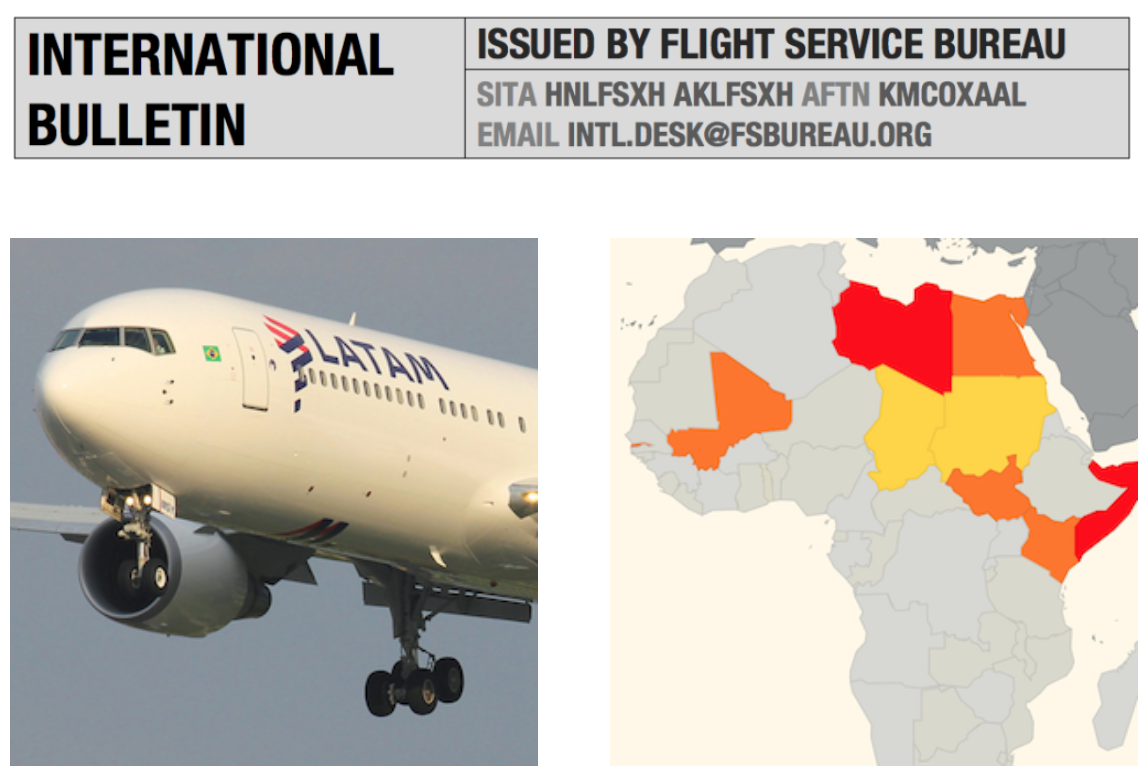
SBZZ/Brazil In the last bulletin we had a headline about a Boeing 767 shot on approach in Brazil. A bullet was found lodged in the wing. Some updates to that story are here, and safeairspace.net’s Brazilpage is updated.

VZZZ/Southeast Asia Don’t forget it’s New Year in Asia this weekend. Travel-related delays and government office and business interruptions will peak 27 Jan to 01 Feb, and could last longer in Taiwan, Vietnam and China, where the holiday will be celebrated through 02 Feb.

EDDB/Berlin Brandenburg will now not open until 2018, as they found more problems with the fire system this week. This is a recurring story, which dates back to 2012. So, for the foreseeable, you’re stuck with Tegel and Schoenefeld.

LTFJ/Sabiha Gökçen (Istanbul) Due to insufficient capacity at LTFJ, applications for individual non-scheduled flights will be refused, and private/charter flights can only be operated at “non-busy hours”.

KBPI/Palm Beach is going to see some new TFR restrictions due to the proximity of Donald Trumps Mar-a-Lago estate. If operating when he’s down here, you’ll have to depart from a gateway airport to PBI – those are TEB, HPN, IAD, MCO and FLL. NBAA has the details.

LSGG/Geneva EBACE is on from Monday, 22 May through Wednesday, 24 May 2017. Now would be a good time to get those slots booked if you’re planning to head over.

LFMN/Nice has a new procedure where ATC will alert crews to windshear.

MSLP/San Salvador‘s only runway 07/25 will be closed from 1600-1700 each day until Feb 3rd.

VGHS/Dhaka The UK Department for Transport (DfT) announced today that it recently carried out assessments of security at Dhaka International Airport. Following this, the DfT has assessed that security at Dhaka airport does not meet some international security requirements (they haven’t said which).

OMAD/Abu Dhabi (Al Bateen) is hosting the International Defence Exhibition in February, so will not be available to IFR traffic daily between 0600-0800Z until Feb 23rd. There are also restrictions on using it as an alternate.

DNAA/Abuja The latest on the Abuja closure is that it will be completely closed to all traffic from March 8th – April 19th.

SKCG/Cartagena‘s only runway 01/19 is closed daily 0530-1100Z until Feb 6th.

NVZZ/Vanuatu Health authorities have declared a dengue outbreak following a large increase in suspected cases in December 2016 and January 2017. Protect yourself against mosquito bites

WSZZ/Singapore is implementing the new ICAO SID/STAR phraseologies from March 2nd. Read AIP SUP 29/17.

LIRF/Rome Fiumicino is working on 16R until March, so 25 will be used for deps and 16L for arrivals. This means delays, especially if you want 16L/34R for departure – they say up to a 60 minute taxi time.

UKZZ/Ukraine amended the military boundaries of its airspace on Monday Jan 23rd, identifying the Donbas conflict zone region as a separate area. More details here.


View the full International bulletin 25JAN2017


International Bulletin: B767 shot on approach to Rio, Updated SafeAirspace Map

B767 Shot on approach to Rio 

18JAN A B767-300 was fired on last night during approach to Runway 15 SBGL/Rio de Janeiro. One 7.62mm bullet lodged in the left wing. Read the article.

Updated SafeAirspace Risk Map 

18JAN We have updated SafeAirspacewith information for Aircraft Operators on The GambiaNorth KoreaBrazilUkraine, and Turkey.


GBZZ/The Gambia State of emergency declared on 17th January. Foreign citizens being evacuated. Banjul International Airport (GBYD/BJL) and land borders remain open, for now. More at safeairspace.net/information/the-gambia.

UKZZ/Ukraine Flight Service Bureau has issued an updated summary for Ukraine’s airspace. There are two risk issues in Ukraine. First: arms fire. Including MH17, multiple aircraft (the others all military) have been shot down since the beginning of the Donbass region war in 2014. The 10th ceasefire was declared in December 2016, but not holding. This risk is contained within the Dnipropetrovsk FIR – UKDV. The second issue affects the Simferopol FIR which is Disputed Airspace. (Ukraine:UKFV, Russia:URFV). In March 2014, Russia annexed Crimea. The ATC Center is in Simferopol, Crimea, and is now run by Krymaeronavigatsiya. Russia claims the airspace. Ukraine refuses to recognise the change, and asks crews to talk to Ukrainian controllers in Dnipro/Odesa ACC instead of Simferopol ACC. Four routes are approved by EASA through the high seas portion of the airspace.

KIAD/Washington and area airports – guaranteed busy during the Presidential Inauguration this Friday, Jan 20. Updated restrictions here. Departure slots required for aircraft departing IAD between Friday, Jan. 20 and Sunday, Jan. 22. Departure slots can be obtained through an IAD FBO of choice (Ross Aviation or Signature Flight Support). Slots will be divided equally between the two FBOs at IAD.

VZZZ/Southeast Asia Lunar New Year holiday season, which falls on 28th Jan. Travel-related delays and government office and business interruptions will peak 27 Jan to 01 Feb, and could last longer in Taiwan, Vietnam and China, where the holiday will be celebrated through 02FEB.

BGBW/Narsarsuaq A seasonal reminder that if you’re planning to use Narsarsuaq as a destination, alternate, or enroute alternate outside of the operating hours (MON-SAT 1000-1900z daily until 03APR), you must contact the airport in advance to apply for them to stay open for you:
Email: bgbw@mit.gl. Also make sure you file your ATC FPL including the AFTN address: BGBWZTZX.

EKCH/Copenhagen A copy of the AOC must accompany fuel release or expect an MOT charge of approximately $1.70 USD to be charged. Next destination must be shown on the fuel release or expect delays.

EGPH/Edinburgh, Scotland Until Apr 1st, you will need PPR to operate to Edinburgh, due to reduced parking capacity.

RPLB/Subic Bay will be closed for maintenance bewtween 0100-0800z until January 20th.

SKZZ/Colombia New Tower and ACC for Bogota. From 16th Jan – 15th Feb moving of Bogota’s ACC will take place. ATS/AIS/COM/MET/ATFM services transition process should not affect operations, however, due to the large change extent foreseen, some failures might occur in the process.  AIC 1/17 outlines contingency procedures in place

SVZZ/Venezuela has closed its land borders with Colombia and Brazil periodically in the last 12 months. Border closures occur frequently, often with short notice. The Venezuelan government will withdraw the 100 bolivar note (VEF 100) from circulation as of 20 January 2017.

LYBA/Beograd If you have any outstanding navigation fees in Serbia, better get them paid, or they’ll add a 9.88% interest charge.

HSSS/South Sudan Flight Service Bureau has issued an updated summary for South Sudan’s airspace: Conflict Zone. South Sudanese Civil War since 2013. The security situation in Juba has been relatively calm since the July 2016 crisis. Daily reports of fighting throughout the rest of the country. The security situation is especially unstable in the Equatorias in the south. MANPADS risk to overflights. In addition, the South Sudanese army has declared intention to shoot down Aircraft without permits. Most Authority guidance recommends min FL260. We think FL300 is a better minimum for overflights.

ZKKP/North Korea Flight Service Bureau has issued an updated summary for DPRK North Korea’s airspace: The level of tension on the Korean peninsula can change with little notice. Multiple missile launches in 2016, increasingly without prior notice to ICAO. The range of these has increased – previously safe airways B467 and G711 are now at risk. Over 1000 reports of GPS jamming issues reported by operators in the vicinity of the North/South Korean border. SFAR79 prevents US operators from operating west of 132E, other Authorities restrict operationseast of that line.

ZZZZ/Worldwide How have you been getting on with the new ICAO SID/STAR phraseolgies? In short, some countries are implementing, and others aren’t. What is your country doing? Tell us at bulletin@fsbureau.org.


View the full International Bulletin 18JAN2017


Ukraine ban on Russian flights extended

Ukraine has extended the ban on Russian registered operators until November 10th, 2016. In an operational notice issued by each of the countries Flight Information Regions on August 9th, Ukraine has extended the closure of it’s airspace to Russian airlines and commercial operators.

The original ban was issued in November 2015, when  Ukraine’s Prime Minister Arseny Yatsenyuk declared during a cabinet meeting that “Russian airlines and Russian aircraft are not entitled to use Ukrainian airspace anymore”

The ban is in response to a similar edict by the Russian State authorities, banning Ukrainian flights from operating to and through Russian airspace.


Midweek Briefing 01JUN: EASA Updates ‘Suspect Aircraft’ Guidelines, 8th French ATC Strike

EASA Updates ‘Suspect Aircraft’ Guidelines 01JUN EASA has published new guidelines for inspectors to assess which aircraft should be prioritised for SAFA ramp checks in Europe and SAFA compliant states. Read the article.

8th French ATC strike this weekend 01JUN Notification has been given by French ATC Unions of a Three Day Strike this coming weekend from Friday-Monday, starting at 0400Z Friday 03JUN. Read the article.


ZZZZ/China The new 144 hour visa-free rule is extended to Nanjing Lukou Airport of Jiangsu, Hangzhou Xiaoshan Airport of Zhejiang, and all air, sea and railway ports of Shanghai, including Pudong Airport, Hongqiao Airport, Shanghai Port International Cruise Terminal, Wusong Passenger Transport Center and all railway stations in Shanghai.

CYMM/Fort McMurray is scheduled to reopen 10JUN to regular commercial operations. The airport has been closed to normal traffic due to a significant forest fire.

MMAA/Acapulco after an outage lasting several years the ILS for RWY 10/28 is operational again.

KSEA/Seattle has runway 16C/34C closed until 27JUN for repairs. ATC initiatives possible through the construction.

EINN/Shannon and EICK/Cork will be testing a new “Remote Tower” system from 06JUN until September, where at quieter times the controller in Dublin will provide the ATC service to flights at Shannon and Cork. The IAA says airspace users will not notice the change. We think you might.

LFLL/Lyon will be re-numbering their runway to 17/35 from 18/36 in September.

VOTP/Tirupati will begin International operations beginning the end of June with flights to the U.S. The airport had recently upgraded their customs systems and other procedures.

LZZZ/Mediterranean Despite some reports, NATO operations in Libya appear unlikely. There are several new airspace NOTAMs, but is anyone still flying to Libya?

LFZZ/France due to ongoing protests at french oil refineries and fuel shortages the French CAA has advised to tanker in as much fuel as possible to help mitigate any issues. Please check with local handlers for any specific fuel constraints.

SPZZ/Ecuador Volcano Sangay is producing ash that extends up to 20,000 feet. Movement is towards the west at 10 knots. Please check with the Washington VAAC for the latest advisories.

LLBG/Tel Aviv, Israel On 26-27MAY strike action in the form of a work go-slow took place.The slowdown has primarily affected outgoing flights by increasing the time between takeoffs, but it has been reported that if the slowdown continues it will begin to affect incoming flights.

NVZZ/Vanuatu 27MAY a 5.0 magnitude earthquake struck west of Vanuatu. The quake was centered approximately 60 mi/95 km northwest of Port Vila and was measured at a depth of about 6 mi/10 km. No tsunami warning has been issued.

DAZZ/Algeria At 0054 local time (2354 UTC) on 28MAY, a magnitude 5.2 earthquake struck approximately 35 mi/55 km southeast of Algiers, the capital of Algeria. The epicenter of the earthquake registered a depth of approximately 7 mi/ 12 km. Following the quake, there were no reports of injuries or damage.

FNZZ/Angola A yellow fever outbreak has caused 301 deaths so far this year. The number of suspected cases is 2,536. The outbreak began in Luanda and has since spread to areas throughout the country, particularly along the coast and in the central regions, despite a large-scale vaccination program.

VDPP/Cambodia Political tensions are high in Cambodia following contested national elections in 2013. Arrest warrants have been issued for the leaders of the opposition CNRP party and the situation is unpredictable. On 30 May police blocked roads in southern Phnom Penh to prevent opposition CNRP supporters from carrying out a planned protest march. Further disruption is possible if the remaining leader is arrested. The opposition party has announced it will hold mass, non-violent, demonstrations and a number of unions have said they will strike in support.

LFZZ/France Despite recent strikes, the French government has stated it will not back down from labor reforms despite street protests and refinery blockades. The CGT Union has threatened to disrupt the upcoming Euro 2016 soccer tournament if the government does not back down; however, after meeting with representatives of the oil industry, government officials stated that the situation at fuel depots is improving.

Ramadan starts on 06JUN, for one month. If you are operating to any Islamic countries, expect the usual slowdown in work, longer processing times for permits, and closures.

OEZZ/Saudi FIR Saudi Arabia has intercepted a ballistic missile that was fired from Yemen, after which Saudi aircraft bombarded the missile’s platform. A Saudi official stated that the country may reconsider the kingdom’s truce with Yemen, as a result of the strike. The missile launch was the second strike in May.

RCZZ/Taiwan On 31MAY, a 6.1 magnitude earthquake struck approximately 70 mi/115 km northeast of Taipei. The quake was measured at a depth of about 150 mi/240 km. There were no reports of damage, and no tsunami warning was issued.

UKZZ/Ukraine On 29MAY, attacks by pro-Russian rebels in eastern Ukraine, violating the ceasefire signed in February 2015, killed five Ukrainian military officers and wounded four others. The latest attacks follow a 24 May report released by Ukrainian authorities, stating seven soldiers were killed on that day, making it the deadliest day for Ukrainian forces since August last year.

KZZZ/USA The State Dept has issued a warning to arriving travellers this summer to make sure that they have all necessary documents to enter the United States – there have been multiple changes to the rules this year (see Active Bulletins below for more on this).

View the full International Bulletin 01JUN2016


Midweek Briefing:EU Border Controls Expanded, New NAT Plotting Chart published

EU Border Controls expanded 02MAR Travellers and crews operating to Denmark, Belgium and other EU countries will need to present travel documents to enter from another Schengen country. The security checks will likely cause travel delays for EU and non-EU travellers into the Schengen area.

New NAT Plotting Chart published 02MAR With the multitude of changes on the North Atlantic in the last few months, including new Tracks, end of MNPS, new HLA, RNP4 – we have published an updated and revised Plotting Chart for the NAT region, showing all new requirements and with updated Airport and Fuel pricing. It’s effective 03MAR.


VOXX/India has expanded its e-Tourist Visa (eTV) program to applicants from 37 additional countries. Eligible visitors under the eTV include business visitors and those traveling to sightsee, visit friends or relatives or to make short medical visits. Nationals from a total of 150 countries are now eligible for the program.

EXXX/Europe Due to the introduction and continuation of border controls in the European Union, travellers to Denmark, Belgium and other EU countries will need to present travel documents to enter from another Schengen country. The security checks will likely cause travel delays for EU and non-EU travellers into the Schengen area. Belgium has instituted border controls at its borders with France. The security checks will remain in place until at least 23MAR.

KTEB/Teterboro will close 0500-1700Z (12 hour closure) this weekend – from midnight Saturday until noon Sunday. This closure is necessary to install new, mandatory hold short signs on Runway 19, which will close the runway intersection. Helicopter operations will be permitted during the closure.

HKXX/Kenya A visa on arrival is now available again at Nairobi, reversing the previous procedure established last year forcing all visitors to obtain one prior to flying. Online visas are still available. http://evisa.go.ke/evisa.html

NFXX/Fiji As of 25FEB, there are 42 confirmed deaths in Fiji due to the damage caused by Cyclone Winston, which made landfall over the 20-21 February weekend. Approximately 35,000 people are sheltering in evacuation centers. There has been little to no contact with remote islands; therefore, the number of casualties and people displaced is likely much higher. Concern about the outbreak of mosquito-borne viruses, such as Zika and dengue fever.

WAXX/Indonesia Australian DFAT updated its travel advice for Indonesia, which reads: “We advise you to exercise a high degree of caution in Indonesia, including Jakarta, Bali and Lombok, due to the high threat of terrorist attack. We continue to receive information that indicates that terrorists may be planning attacks in Indonesia”

SKXX/Colombia is introducing ADS-B, with associated new phraseologies that crew should be aware of. ATC may ask “Notify capacity ADS-B”; response “ADS-B transmitter”, “ADS-B Receiver”, or “Negative ADS-B”. Full AIC.

LOWW/Vienna has a couple of new RNP AR (Authorisation Required) approaches to RWY 16 and 34 on test.

LIXX/Italy is joining the Free Route Airspace (FRA) bandwagon, airspace trial this coming weekend 05-07MAR at FL370 and above in Roma, Milano, Padova and Brindisi ACC, and Malta ACC.

UKXX/Ukraine Did you know that there was reduced horizontal separation in Ukraine airspace (RHSM)? Neither did we. Check out AIC 02/16.

UIBB/Bratsk has fuel supply issues again, current shortage until 31MAR.

View the full International Bulletin 02MAR2016


Midweek Briefing: Residual Disinsection for Italy, New Moscow Airport

Italy  now requiring Residual Disinsection 17FEB In light of the spreading global coverage of Zika Virus cases, countries are rapidly changing rules related to Quarantine and Health. Italy is now requiring residual aircraft disinsection for every aircraft coming from any area, not only Zika affected ones.

Moscow Ramenskoye opens to civil traffic 17FEB UUBW/Moscow Ramenskoye, which previously served as a military airfield, is scheduled to open to civil traffic as an International Airport on 16MAR, becoming the fourth Moscow Airport. Read more … 


UUBW/Moscow Ramenskoye, which previously served as a military airfield, is scheduled to open to civilians as an International Airport on 15MAR2016. The airport will be Moscow’s fourth largest and is expected to serve approximately 1.9 million passengers per year. Russian Railways is planning on constructing a direct rail link between the facility and Moscow. Read the full article.

Worldwide As the mosquito-borne Zika virus spreads worldwide, some health and aviation authorities have begun targeting business aircraft to be treated with insecticide – similar to requirements that have been in place for commercial aircraft arriving from certain points of origin. The most prominent to date is Italy, which has reported several recent cases of the Zika virus affecting people who returned from trips to South America and the Caribbean. A “Certificate of Residual Disinsection” is now required for all aircraft operating in Italy, following recommended WHO and International Civil Aviation Organization Annex 9 procedures. Italy had originally limited the certificate requirement to aircraft arriving from Zika-affected countries, but “within 36 hours that changed” to all countries. Authorities in Costa Rica are requiring that aircraft arriving from affected countries be sprayed on arrival – with crew, passengers and luggage aboard – with an insecticide provided by the local agriculture department.

UADD/Taraz, Kazakhstan has been upgraded to RFF/Rescue Fire CAT9, and with regular international flights starting in June, should have customs available. Maybe become a useful Central Asian en-route alternate.

UKLV/Lviv FIR, Ukraine A new Notam (A0193/16) is issued to extend the ban in Ukrainian Airspace of any aircraft operator registered in the Russian Federation until 09MAY.

NWWW/Noumea has multiple runway (and therefore airport) closures until 25FEB, check Notams carefully if operating.

NZAA/Auckland Work is currently in progress on the threshold of RWY 23L with the threshold inset 2,270m.  The information is contained within AIP updates and not via NOTAM. Operators should note there is are no ILS approaches available at Auckland until 30MAR. While weather is usually very good during February and March operators can expect delays in poor wx.

NZQN/Queenstown is closed from 1800 each day until 31MAR for runway widening works.

AYPY/Port Moresby Telecoms outage continues. To contact ATC Centre
use (675) 325 8704 instead of published numbers. Multiple VHF freqs out of service, use HF 5565 as alternate.

RPHI/Manila has a radar outage on 18-19FEB meaning procedural control will affect the Luzon island area within the FIR, 10/15 minute enroute separation as standard.

Somalia A local terrorist organisation claimed responsibility for the bombing of a Daallo Airlines passenger aircraft on 02FEB shortly after it took off from Mogadishu’s Aden Adde International Airport (HCMM/MGO). The bombing forced the Airbus A321-111 to make an emergency landing at Mogadishu’s airport.

South Africa Refurbishment will affect Johannesburg’s OR Tambo International Airport (FAOR/JNB) beginning 13FEB when security and immigration will move from Terminal A to the Central Terminal. Slow processing expected until end March.

US and Cuba advance Air Service agreement US officials will travel to Havana to officially sign the agreement that will make the two countries a step closer for its first commercial flights. Once the  US-Cuba air travel pact that was agreed upon on 16DEC2015 will be finalized, airlines will have about two weeks to submit applications for US-Cuba routes with the US Department of Transport and get approval from Cuban authorities to obtain space at Cuban airports. Industry experts expect that the first Cuba-bound flights will be in the air sometime in 2016.

View the full International Bulletin 17FEB2016


Monday Briefing: NAT Track Changes, Russia-Ukraine airline ban

26OCT2015 In around two weeks time, significant changes will occur to the design and structure of North Atlantic Tracks (NAT OTS), which have existed in their current lateral structure since the OTS introduction in 1965. The key changes are: a reduction in separation to ‘half-track’ compared to the existing structure, introduction of 24 new Oceanic Entry Points (OEP’s), and a new requirement for RNP4. A special briefing on these changes is below.

26OCT2015 With effect from yesterday, almost all Ukrainian and Russian airlines are barred from each others airports and airspace. Ukraine issued a sanctions list in September barring all except one Russian airline from operating, and in return Russia banned the three Ukrainian airlines from operating to Russia. GA, Business Aviation, and non-scheduled flights are not affected.


EGPX/Scottish FIR High delays this morning 26OCT in Scottish airspace due to ATC radio system failure. EGPF/Edinburgh airport departures were suspended, now resumed, with enroute traffic rerouted to avoid Antrim, Galloway, Tay, and Talla sectors. Situation is slowly improving but potential for afternoon delays exists.

KORD/Chicago O’Hare There will be a TFR in effect for Oct 27 and Oct 28 due to VIP movement. Please see NOTAM 5/1931 for further details.

MMXX/Mexico The impact of Hurricane Patricia was less than feared. MMPR/Puerto Vallarta Airport, MMZH/Ixtapa, and MMZO/Manzanillo have all reopened and are operating normally.

KXXX/USA Current runway closures: BWI-RWY 10/28 CLOSED, IAD-RWY 01R/19L CLOSED, DTW-RWY 03R/21L 09L/27R CLOSED, SEA-RWY 16C/34C CLOSED

NAT/North Atlantic ASD15 Exercise Trident Juncture (At Sea Demonstration) military exercise until 31OCT. The designated firing areas incorporate elements of Scottish FIR/UIR, Shanwick and Reykjavik FIR as well as notified UK Danger areas. Flight planning restrictions will be applied affecting NAT Traffic on northerly routes, monitor NOTAMs.

South Pacific Tropical Cyclone Season 2015-16 begins on 01NOV. Tropical cyclone warnings in the South Pacific region, please consult the Joint Typhoon Warning Center, Fiji’s regional meteorological center responsible for tropical cyclone warnings in the South Pacific region, or Australia’s Bureau of Meteorology.

View the full International Ops Bulletin for 26OCT2015.


Monday Briefing: Confusion over Crimea, Kosovo Upper Airspace reopens

Confusion over Crimea: Special Report Apr 3 : Simferopol ACC re-opened 03APR creating confusion as to who should be providing ATC service in the Crimea region. We have published a Special 6 page International Ops Notice (03/2014) “2014 Airspace and Regulatory Changes in Crimea”.

Kosovo Upper Airspace re-opens Apr 3 : After 15 years, the last remaining chunk of European airspace closed to overflying traffic in the Balkans has reopened. The KFOR sector over Kosovo became available on 03APR, with route savings immediately apparent to operators.

Kxxx/USA Operators should be aware of the new FAA ATC phraseologies effective 03APR. The FAA will implement “climb via” phraseology and procedures for departure operations consistent with existing “descend via” phraseology and procedures. “Climb via” and “descend via” are abbreviated ATC clearances that require compliance with the procedure’s lateral path, associated speed restrictions, and altitude restrictions published on the SID or STAR. Some good information at http://www.nbaa.org/ops/cns/pbn/climb-via/

LLOV/Ovda, Israel will be closed to all flights 01MAY-07MAY

DGAA/Accra, Ghana Until 23JUN, The main runway (03/21) is open daily from 0500-2300Z only; no traffic accepted outside these hours.

LFMN/Nice Change in parking procedure; if approval is granted for parking, but operator changes to another, larger aircraft, then the previous approval will be cancelled. Co-ordinate all aircraft changes with Airport Ops.

YPXM/Christmas Island has reopened after the recent Cyclone in the Indian Ocean.

OSDI/Damascus FIR – For those still overflying, Syria has closed airway L513 from BURSA to LEBOR UFN.

HSSM /Malakal, South Sudan is only accessible with permission from the government security services. This is very difficult to obtain and makes the airport effectively shut.

HSWW /Wau, South Sudan is open without any specific additional permission being required.

MGGT/Guatemala City ChevronTexaco, for any fueling on the east and military ramps from 0900-1600 LT, requires a minimum of 24 hours’ notice.

HLLS/Sebha, Libya remains closed until 07APR.

CAA Closures. Myanamar has an extended closure due to public holidays from 12-21APR. The Chinese CAA are celebrating National Tomb-Sweeping Day on 07APR.

UK Charter Permits. Significant changes to the approval process for Landing Permits for the UK will take effect on 06 APR. CAA will take over the responsibility for issuing approvals from the Department for Transport (DFT). Also, previously, a cabotage objection could be raised by a group of UK Charter Operators – this is removed. A fee is likely to be charged by the CAA for permits from this point forward.

Turkey. Effective 10APR2014 Visa on Arrival is no longer available at Turkish Airports. Visitors must apply online through https://www.evisa.gov.tr/en/ for an e-Visa.

Australia. A reminder to all operators who are not ADS-B equipped, of the restrictions when operating into Australian Airspace effective from 15DEC13. If you not ADS-B equipped you must file with CASA, a Form 208 exemption application 14 days in advance of proposed operations into Australian Airspace. Then operations will be confined to the SSR radar coverage area extending from 200 nm north of Cairns down the East coast to 200 nm west of Adelaide. This is commonly referred to as the J curve. If you intend operating into the Brisbane or Melbourne FIRs from the west and north west of Australia, and are not ADB-B equipped you will be required to operate at FL290 or below.


Special Report: Crimea and Simferopol FIR

Crimea & Simferopol FIR
Following the recent events in Ukraine and Crimea, we received a high volume of requests for information on the airspace and current situation. The information below is a majority extract from our International Ops Notice 03/14 published on 05APR.

SUMMARY

Effective April 2014 a significant number of changes will affect Airports and Airspace in the Crimean Peninsula.

BACKGROUND – What happened?

Following the removal of Ukrainian President Viktor Yanukovych on 21 February, Russia moved to take control of Crimea, an autonomous republic that until now has been part of Ukraine. While the referendum that ceded authority is disputed internationally, Crimea is now under de facto control of Russia, creating a political standoff with Europe and the US that has led to a complicated airspace situation.

AIRSPACE AND AIRPORTS INVOLVED

  • Simferopol FIR A large and significant FIR covering busy Black Sea routes, with a predominant east/west flow, with ATC service provided from Simferopol Airport.
  • Simferopol Airport A large airport in the centre of Crimea with International and Domestic Air Service, with TWR/APP
  • Sevastopol Airport A smaller civil, domestic airport beside the town of Sevastopol in the southwest of Crimea, with TWR.
  • Zavodskoe Airport Another smaller domestic airport beside Simferopol, with an AFIS Unit.
  • Kerch Airport Used only by general aviation, currently bankrupt.

Some History – MARCH DEVELOPMENTS

  • 13 March Russian troops took control of the Towers, Airports, and ATC Centre. Simferopol and Sevastopol closed to civil traffic. ATC Service from Simferopol was terminated.
  • 14 March ATC Service for the Simferopol FIR is now provided by other ATC Centres in Ukraine. Odesa took control of the western portion (Sectors 3,4,5) and Dnipropetrovsk the eastern portion (Sectors 1,2)
  • 16 March Referendum held in Crimea, result determines wish to join Russia.

Current Status – CHANGES SINCE RUSSIAN CONTROL OF CRIMEA

  • 24 March Rouble adopted as official currency of Crimea
  • 24 March Russian Passports issued to existing population. Russian Visa required to enter for non-Ukrainians/Crimeans
  • 31 March Clocks move forward 2 hours, Crimea is now on Moscow time
  • 03 April Simferopol ACC re-opens, providing ATC Service in the Simferopol FIR
  • 03 April Permit now required to enter Airspace over Crimea, according to NOTAM from Russia


Simferopol ACC

The Simferopol FIR is normally controlled from an Area Control Centre located at Simferopol Airport. It was closed on 13 March (picture taken same day) when Russia took control of facilities in the peninsula, and service for the FIR was provided using remote radar data by Ukrainian controllers from Odesa and Dnipropetrovsk.

At 10am on 3 April Simferopol ACC was reopened, managed by a new service provider called “Krymaeronavigatsiya”. The controllers in the centre are mostly the same controllers that operated Simferopol ACC for the Ukrainian National Authority.

To reactivate control of the airspace from Simferopol, Russia issued several NOTAMs on 28 March which were subsequently disputed by Ukraine and Eurocontrol. This has led to an unsafe situation leading to an ICAO letter and recommendation to avoid the Simferopol FIR until the situation is resolved.

NEW ICAO CODES

URFB Sevastopol Belbek (was UKFB)
URFF Simferopol (was UKFF)
URFV Simferopol FIR/ACC (was URFV)

* Issued by Russia, not (yet) recognised outside Russia.

Aircraft Reports

Since the re-opening of Simferopol ACC on 03 APR, Eurocontrol has rejected FPL’s containing routings through the Simferopol FIR with the exception of the L851 airway which runs along the southern part of the FIR.

Traffic operating through the Simferopol FIR on Friday 04APR reported issues with “Joint Authority”:

B747 enroute Europe-ME:
Instruction from Bucharest ACC to contact Odessa on 134.675
On initial contact with them, they advised us to comply only to their instructions!
Then Simferopol ACC calls on 121.5 and advised to switch on 120.4.
Also they advised us to comply only to their instructions!
Both performed radio check to see if the aircraft is still on frequencies Both provide instructions (position report), fortunately the same
.”

CL601 enroute LOWW/Vienna-URKK/Krasnodar
We were passed onto Odessa Radar and checked in with them. We were then told to maintain our altitude and also warned NOT to get in contact with Simferopol as it is not a legal ATC station.
We were also given another frequency in case we lost comms with Odessa.
We were contacted on 121.5, the emergency frequency by Simferopol advising us to contact them on their frequency numerous times. We decided as a crew to stay with Odessa. We were then passed onto Rostov control and continued the flight with no incident.


ANALYSIS

At present, there is effectively a stand off between Russia and Ukraine over recognititon of who is the rightful Authority to manage the airspace over Crimea. Russia has determined that it is Simferopol ACC, and is providing full service for the airspace from the existing ATC Centre. Ukraine, through Eurocontrol, determined that it should continue to provide service from remote sites, and therefore asserts its authority over the airspace.

The result, is that two Authorities are both stating claim over what has become Disputed Airspace, in a very similar situation to that in Northern Cyprus. So, who is right? There is no correct answer. The political situation is complex at present, and it difficult to determine what the future will bring.

Purely on a practical analysis however, it can be said with relative certainty, that Crimea will remain under Russian control, and it is likely to be a matter of time before Russian managed operation of Simferopol ACC is accepted internationally, either on a safety case or a relaxing of political stance.
Until such time, operation within the Simferopol FIR is operationally possible but carries with it the risks associated with Disputed Airspace.

Questions and Answers

What’s happening?
Russia has claimed territorial control over Crimea, leading to the reopening of Simferopol ACC after a three week closure, and the same claim over airspace. Ukraine, under a new government, has defied the move, issuing its own NOTAMs to declare Russia’s move invalid.

Can we enter the Simferopol FIR?
In short, Yes. The airspace is not closed. However, it’s probably not a good idea, if you can avoid it. Two countries have claimed authority over the running of ATC – Russia and Ukraine, and there is no clear winner. For some operators there will be no choice but to enter, so see below for advice.

Can I file a flight plan to enter the Simferopol FIR?
Yes, if you’re outside Europe. However, any FPL filed within the IFPS Region (ie. Eurocontrol) will be rejected if it contains a routing through the Simferopol FIR.

What if we decide to enter the airspace? Are there any sanctions or restrictions?
No, there aren’t any legal or diplomatic sanctions preventing this, only Flight Planning restrictions from Eurocontrol. On the first day that Simferopol ACC was open, 145 flights were handled through the FIR, primarily non-European operators. If you do enter, we recommend:
•    Two VHF sets – one on Simferopol frequency, one on Odesa or Dnipropetrovsk frequency
•    Contact and remain in contact with both controllers, as long as possible
•    Fly standard levels, do not request a level change
•    Monitor TCAS
•    Consider any instruction to change level or routing carefully, and coordinate with both ATC’s.

Is this is the same situation as Ercan (Cyprus) ?
Kind of. Since 1974 there has been Disputed Airspace over the northern part of Cyprus, and two stations vie for control of the airsapce – Ercan and Nicosia. However, there are a couple of important differences. First, ICAO has declared it’s recognition only of Nicosia, this is not the case in Crimea, where ICAO has only said it’s unsafe at present, so avoid. Second, there are clear instructions for crossing that airspace – for Crimea, at present, there are no procedures – again, only an advice to avoid.

Do I need a permit to enter Simferopol FIR?
Not at present, but this could change fast. Officially, Russia has declared the FIR to fall under the same rules as the rest of Russia, which means that a permit should be required to enter the airspace. However, there are two complicating factors.

1. A number of “Non-Sovereign routes” run through the Black Sea that Russia does not require a permit for (as the next sector is Rostov-on-Don airspace), requiring only advance notification to UUUWZDZX. Simferopol FIR would likely follow the same logic, though this has not been published.

URRV FIR (Rostov) Non- Sovereign Routes
GAMAN G277 BANUT
OLENA R230 LAMET A277 BANUT
BANUT A277 LAMET R230 OLENA
BANUT B147 TISOM
SOBLO B143 IDLER

2. The second factor is that the confusion at present is allowing leniency for overflight permits. However, if the situation is resolved with Russia being recognised as the sole controlling Authority, then flights over Crimean landmass will absolutely require a permit to overfly.

What about the Airports in Crimea? Is Simferopol open?
Yes, Simferopol is open to civil traffic, and a permit is required from the Russian Authorities. The process follows the same procedure as in the rest of Russia, with local Crimean approval, and also Federal approval required. Sevastopol is lesser used in any case, but may be available.

Is there any security risk in overflying Crimea?
No. The situation on the ground in Crimea is very stable, and there is no determined risk of any ground-air strikes or anything affecting security of flight.

Is there a safety risk in overflying Crimea, or entering the Simferopol FIR?
At the moment, yes. There is a risk level, although relatively minimal, due to the potential for confusion as to the correct controlling authority. The risk is highest near the airspace boundaries with other Ukrainian sectors. There is likely to also be an increased volume of traffic speaking Russian and therefore reducing situational awareness for international crews overflying.

So, is Simferopol an “Illegal” ATC Station?
No. Their authority is questioned by Europe, but they are fully trained, valid controllers, with ICAO recognised licenses. It’s worth remembering that although Simferopol is currently declared “illegal” by some adjacent sectors, they are the same controllers that were operating that airspace just three weeks ago, and have done so for decades. If you are in there, you should at least be talking to them, not least because they will have control of conflicting westbound Russian traffic that will not be in contact with other sectors.

What happens westbound from Russia?
If you are entering Simferopol FIR from Rostov-na-Donu FIR, you will be transferred in a normal fashion to Simferopol ACC on the usual (historic) frequencies. Once approaching the boundary with Odessa or Dnipro you should make contact at least 10 minutes in advance.

Is there any co-ordination between Simferopol and Odesa, or Dnipropetrvosk ATC ?
We’re uncertain, but we believe flight information is being exchanged in terms of boundary estimates and OLDI interchange. However, verbal communications are not likely cooperative at the moment, given the disputed control of the airspace.

When will this be resolved?
Hard to say, and the question that everyone is asking. The Ukraine NOTAMS are valid until 14APR, but that indicates little. A long term avoidance of the Simferopol FIR is unlikely due to commercial pressure. At a minimum, the airspace south of the landmass, ie. L850 and south, could be expected to be made available in the event of an ongoing standoff.
Map_Block FIR_Block Crimea_Airspace