Aug 2022 NAT Doc 006 Changes

Are you Trevelyan across the NAT HLA anytime soon? Then here is a summary of the changes that just came out in NAT Doc 006.

What is Doc 006?

It is the Air Traffic Management Operational Contingency Plan for the North Atlantic Region, and we are talking about the Second Edition, August 2022 version which you can find here if you want a look. The last time it was updated was back in Feb 2021, and we covered those changes here.

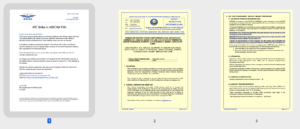
Page 1

“Aha, a handy list of all the changes,” think Rebecca and Dave as they glance  at page one. “This will be easy. Our job is done already.”

“What does it say?” Rebecca asks.

“It says that there is a new chapter on Common Procedures which were there but are now here…” replies Dave. “And also something about a Notam and some route something somethings…”

“There’s still a lot of red again, isn’t there?” whispers Rebecca.

“Yes, there is,” sighs Dave.

“Should we read it for them?” Rebecca says wearily.

Dave nods.

All the changes are in red.

Finding the changes isn’t hard. Understanding them is the annoying bit. So we shall try and make sense of what all those changes are for you so you don’t have to.

(But before we go on though, here is the record of amendments so you can see if any of it looks remotely interesting to you. If not then you can go and do something much more interesting with your time instead of reading further.)

The Changes.

Chapter 1

They have updated the information on contingency situations thats might affect multiple FIRs. What could cause that? Volcanic ash could cause that.

They have also added in Reykjavik.

Chapter 1

Sorry, that bit before was just an intro or something.

So, Chapter 1 – Common Procedures.

  • Limited Service: If ANSPs are going to only be able to provide a limited service they will try and let everyone know at least 12 hours in advance by Notam. This is for times like if datalink going to be down or if there are some huge solar flares heading their way that might take out their HF for a bit.
  • No Service: It’s the No Service Situations we really need to worry about. If this happens then they will get a message to whoever they can, and whoever gets the message will help share it out to as many people as they can.

In any region, the results will be the same. With Comms disruption, they will obviously attempt other methods. There is likely to be a fair amount of frequency congestion on whatever methods are still working.

With control services, there may be some additional restrictions which affect traffic flows, and there may well be reroutings. Where possible, these will be limited to those not yet in the NAT (a bit easier for the old fuel planning). 

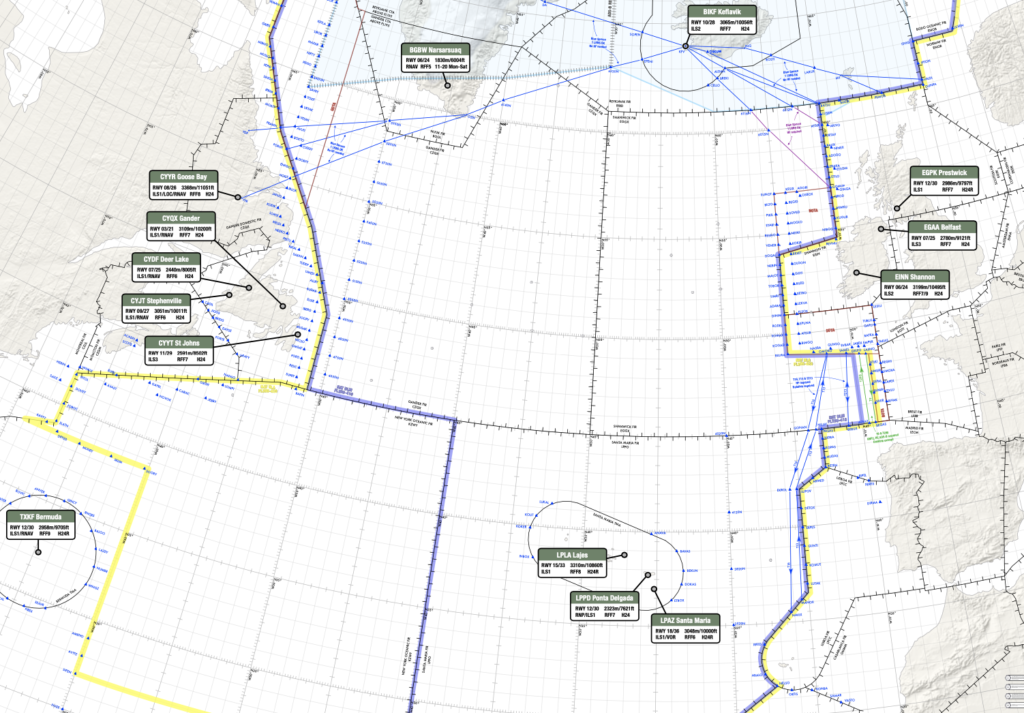
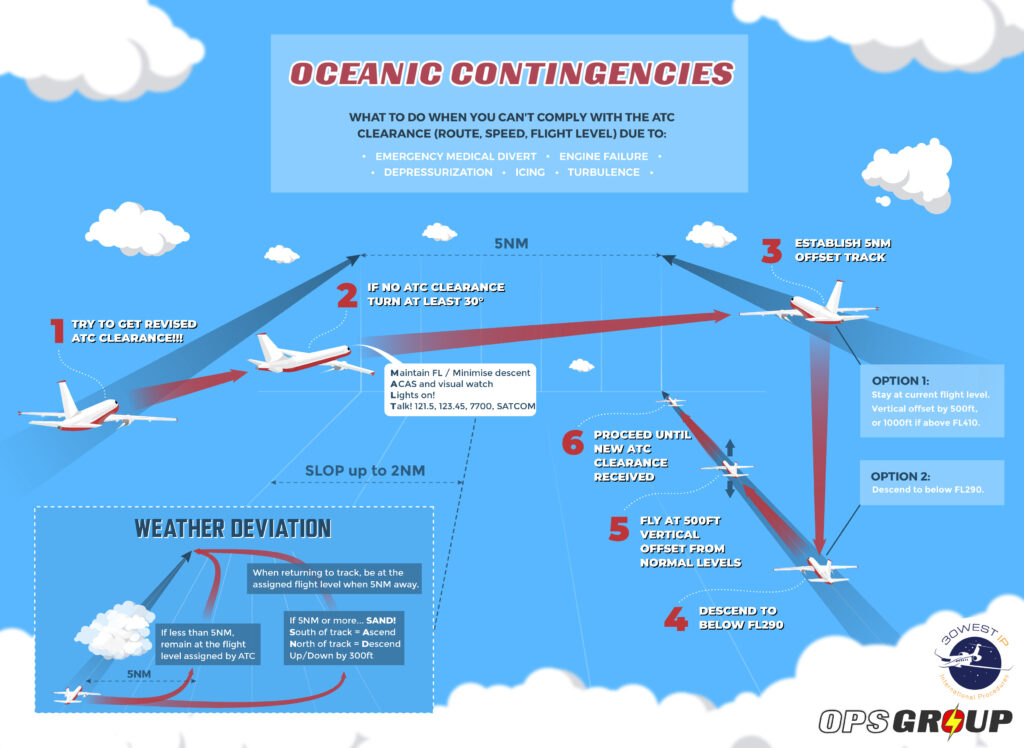
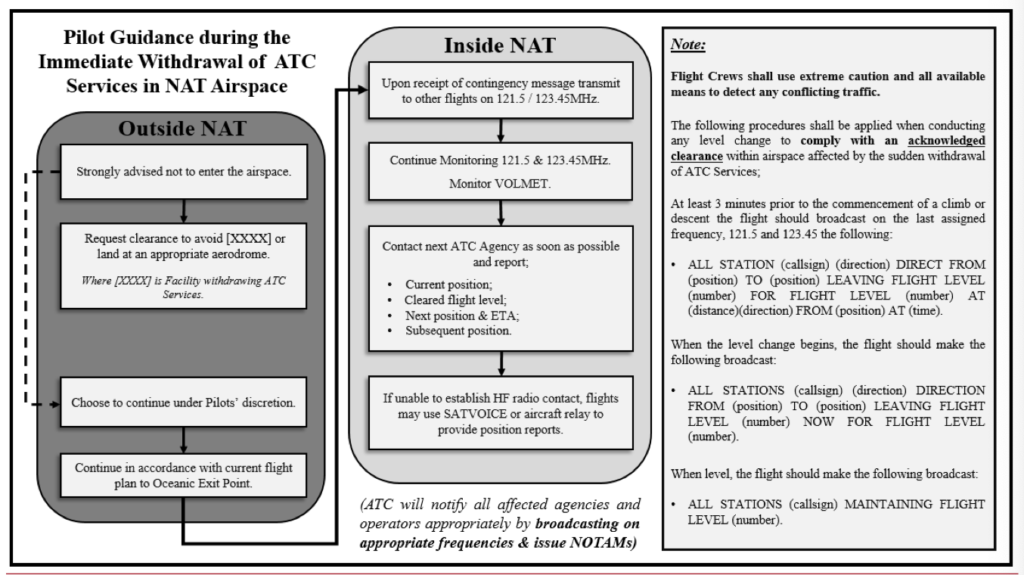
In the event of a sudden withdrawal of services, here is an excellent chart for pilots to print out and have handy.

Strongly advised…

Immediate withdrawal of services

It’s what the handy guide says, but in case you don’t want to read that:

  • Already in the NAT? Basically, stick with the last received and acknowledge clearance, try and talk to anyone you can and make sure you give position reports. You can use SATVOICE for this too. If you’re in the middle of a level change, complete it as quickly as you can. If it’s a control centre evacuation and you’re on ADS then revert to voice.
  • Approaching the NAT? If you’re within 20 minutes and it is getting evacuated then stick with your last clearance. Only aircraft less than 60 minutes from their OEP can transit Gander. They guarantee no conflict profiles.

The Next Chapters

Shanwick: Contingency procedures have moved to chapter 11.

Gander: Nil Red

Reykjavik: This has a lot of new info, although not specifically in this section. The main thing is, if you can’t get hold of Iceland Radio HF then try Shanwick radio first, then Gander or Bodø if still no luck. Reykjavik is the only FIR without supporting procedures.

Santa Maria: If Comms are down and you have ATS safety SATVOICE (INMARSAT or IRIDIUM) then you can call them on 426302 or 426305. If you have a non ATS safety satellite network (some big old sat phone from the 80’s onboard) then try +351 296 886 655 but only if you really, really need to.

New York: Nein Rot.

Bodø: Bodø ACC includes Domestic control, Oceanic and Radio (HF). Thankfully it can be supported by basically all its neighbours FIRs (except Reykjvik).

Shannon: Non Rouge.

Brest: No roja.

Chapter 10 – Notification Messages

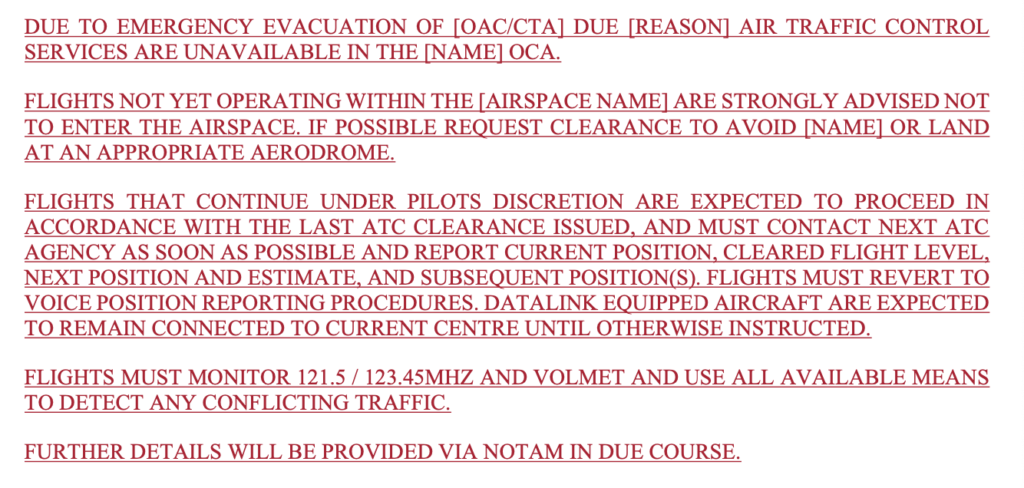
Or ‘The Great River of Red’ as I know call it. Actually, most of this can be looked at in the below image (it’s a picture of their example of a Notam).

Limited service? Info will be sent via other ANSPs.

No service? It has probably been evacuated and notifications of this will be sent via the NAT track messages and transmitted on any appropriate frequencies.

The example Notam. Although it probably won’t actually be red if you see it for real.

Chapter 11 – Route Structures

This contains info on the routes for each region. Mainly Reykjavik because they’ve added all of those in. There are some nice diagrams in this bit.

Chapter 12 – Contact Info

This is the contact details. Lots of red for the new Reykjavik folk.


That’s it. We’re off to play some Goldeneye on our N64. Found something important that we missed? Let us know! news@ops.group


Is breaking the rules always bad?

“So, Rebecca, tell us about a time when you didn’t follow an SOP?”

I don’t know about everyone else, but this question always seemed to pop up in interviews for me. Maybe I come across as ‘rigidly adherent’ to rules, or perhaps I tick too many of the “like finding alternative solutions” answer on the personality questionnaire and they think I will constantly be bending the SOPs into elaborate balloon animal shapes for the fun of it…

Here’s the question: 

When can we ‘go outside’ the SOPs? How do we justify it? How do we actually do it?

It turned into three questions, sorry.

First up, what is the point of an ‘SOP’?

To prevent wild cowboy pilots from jaunting about willy nilly? Yes, probably that. But at the root of it, I think a fair definition could be “to help with safety”.

By the very vague ‘help with safety’ term, I mean all the stuff – providing guidance to help us stick to rules and regulations, helping us deal with situations, ensuring we all know what to do and how to do it, and what to expect. They create a sort of script, a choreographed dance to lead us.

Basically, making sure we’re all playing by the same rules.

Standard operating procedures are put out there not just to be a “that’s how we do it” rule book, but more a “that’s how we can do it, because it should help with safety” guidance book.

So compliance equals safety?

Now, a quick interlude on the word ‘compliance’ because I don’t like it much. If you search the definition of someone who is compliant it says they are “disposed to agree with others or obey rules, especially to an excessive degree”.

OK, the rules bit is fine, but the excessive degree? Following rules for rules sake, excessively? Nope.

But… 

But compliance is necessary in aviation, and much of my dislike really comes from the fact I think it is generally misunderstood, misused and misapplied. 

Someone wise said that ‘compliance is the foundation and structure which helps build safety’ (I may have not quoted that completely right), but it sounds good to me. 

So being compliant doesn’t automatically equal being safe. Rigid adherence for the sake of saying you adhered does not automatically lead to safety. The two can absolutely go hand in hand, but just ticking boxes and saying “I ticked them all, so I’m compliant, so I’m safe” doesn’t actually work, at least not all the time.

Sometimes it might, but it’s not a guarantee.

The same goes for SOPs. Sort of…

An SOP generally isn’t (shouldn’t be) created for the sake of creating an SOP. Then you just end up in a hideous loop of ‘the SOP says I must follow the SOP that says I must follow the SOP that says…’ you get the picture.

This is pointless.

Any procedure should be put in place because it does ‘something safetyish’, and so following it will help you be ‘safetyish’. 

Which brings me, finally, to the two occasions where I think it is ok to let something non-standard occur.

First up: The ‘letting it slide’ situation.

If I say “checked” instead of “check” on a checklist then I might not be compliant with the checklist terminology, my ‘knowing the correct response on the checklist SOP’ might be subpar, but has that really impacted safety? No, it hasn’t, because the same outcome has been achieved. 

You pulling me up on it might impact safety though because it will make me angry at you!

So ‘non-standard’ stuff, for me, has to have some common sense applied to it. If it hasn’t impacted safety, then the balance between rubbish CRM versus helping correct a bad habit (that could become more of a thing) has to be considered.

That’s letting something slide.

Secondly: The ‘blind obedience’ situation.

Fastidiously following for following’s sake.

There could be times when an SOP might actually decrease safety, and that’s probably when you might want to bend it, break it, or work outside of it. I guess this is what all those interviewers are hoping to get at by asking this question?

Ultimately, safety is the aim of SOPs, and if they don’t achieve it – do what will.

And this can be tough to do, because often we fall into the trap of thinking SOPs are everything, and we become reliant on them to keep everything OK, rather than using them alongside our professional judgement and experience.

What about less black and white situations?

You’re stuck in a box that says ‘no permission, no can do’ and the operation is grinding to a halt? This is when to really think about the “instructions” that go with that box, so to speak. The actual intent or purpose of the procedure, and what you can do to maintain that. Because not being able to tick ‘exactly compliant with procedure’ is less important that ticking the ‘compliant with safety awareness and standards’.

The procedure might turn out different, but the outcome will still be achieved.

If you’re not getting my point on intent, refer back to the earlier paragraph where I used the splendid word ‘safetyish’ – it’s not in the dictionary, but you understood it, and it got the point across (hopefully).

Be Effective!

The final question then, if we’re going with the “same purpose, so all good!” principle is the “Effectiveness Test”. Quick definition – doing something effectively means doing it the best way.

Which is what SOPs are sort of there for. Getting us to the most efficient (safest) outcome, the most effective way.

So I can’t just ignore a load of SOPs and say “but the outcome was the same, what’s the problem!” And if that’s the case, then how much should we be considering the effectiveness (rightness) of our process alongside the outcome?

To try to comply with the Effectiveness Test, we can fall down a rabbit hole of ticking every box, crossing every ‘T’, dotting every ‘I’ so to speak – basically, worrying about the effectiveness versus the outcome too much. Which is exactly what this whole post started out talking about.

But I can’t swing the other way and barrel roll an airplane down an approach disregarding every stabilisation criteria but touchdown on speed not the blocks and say “hey, the outcome was fine.”

So where do we draw this line? Is it even a line?

It comes down to airmanship. This might feel like it’s not really an answer at all, but I think it will be different for each of us at the time, on the day, when we’re faced with something that has us asking it.

And this leads to a last question, that came up as I thought through all of this – “Is there a chance that too stringent SOPs actually stop us from thinking and judging, because we expect there to be an answer to every situation?” Because SOPs help keep everything predictable, but often the situations are anything but.

My motto is this.

Let’s aim for safety, and use the SOPs because they provide us with the most effective way of achieving that. Until they don’t. And that’s when we will do what we need to to maintain safety. But we’ll try and do it with the SOPs, rules, regulations in mind as best we can.


New US Terrorism Warning: What’s the impact to aviation?

On August 2, the US Department of State updated its worldwide terrorism warning for the first time since 2019 – terrorist groups around the world may be actively planning attacks on US interests. This follows news on July 31 that the leader of a major terrorist organisation was killed during a military operation in Afghanistan.

My flight is tomorrow, what does this all mean?

For starters, no new airspace warnings have been issued due to the recent events. But it is equally important that operators (especially N-registered ones) heed the information that is already out there.

This comes from a combination of FAA SFARs, KICZ Notams and Background Information notes.

In the most dangerous airspace, the FAA bans US operators at all levels. In which case, the decision to overfly is an easy one because it has already been made for you. You just can’t do it.

But it’s not always that clear cut. Risk may be present, but not enough of it to justify closing entire pieces of airspace. So the FAA carries out assessments and decides on what precautions operators should take to stay safe.

This is where the lines start to get a little blurry because these assessments take time, and security risks can evolve more quickly than the papers can be signed. In other words, what was safe yesterday may not be safe today.

And so operators may need to re-evaluate their exposure to known risks, based on what is happening right now. With that in mind, here are some hotspots US aircraft are permitted to overfly that we think deserve a second look.

Iraq

Back in October, the FAA lifted its long running Notam barring US operators from entering the ORBB/Baghdad FIR. The SFAR is now in effect, meaning overflights are technically okay provided you stay above FL320. But just because you can, doesn’t mean you should.

Militant groups are active throughout the country and are known to have access to anti-aircraft weaponry. The have also have a proven track record of targeting US interests in the country. Scour through the OPSGROUP archives and you’ll see report after report of rocket, drone and mortar attacks on ORBI/Baghdad along with other regional airports.

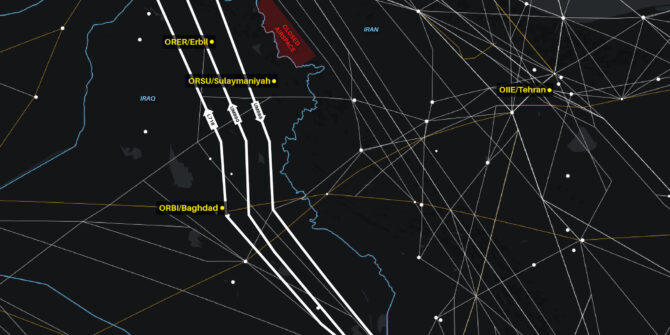
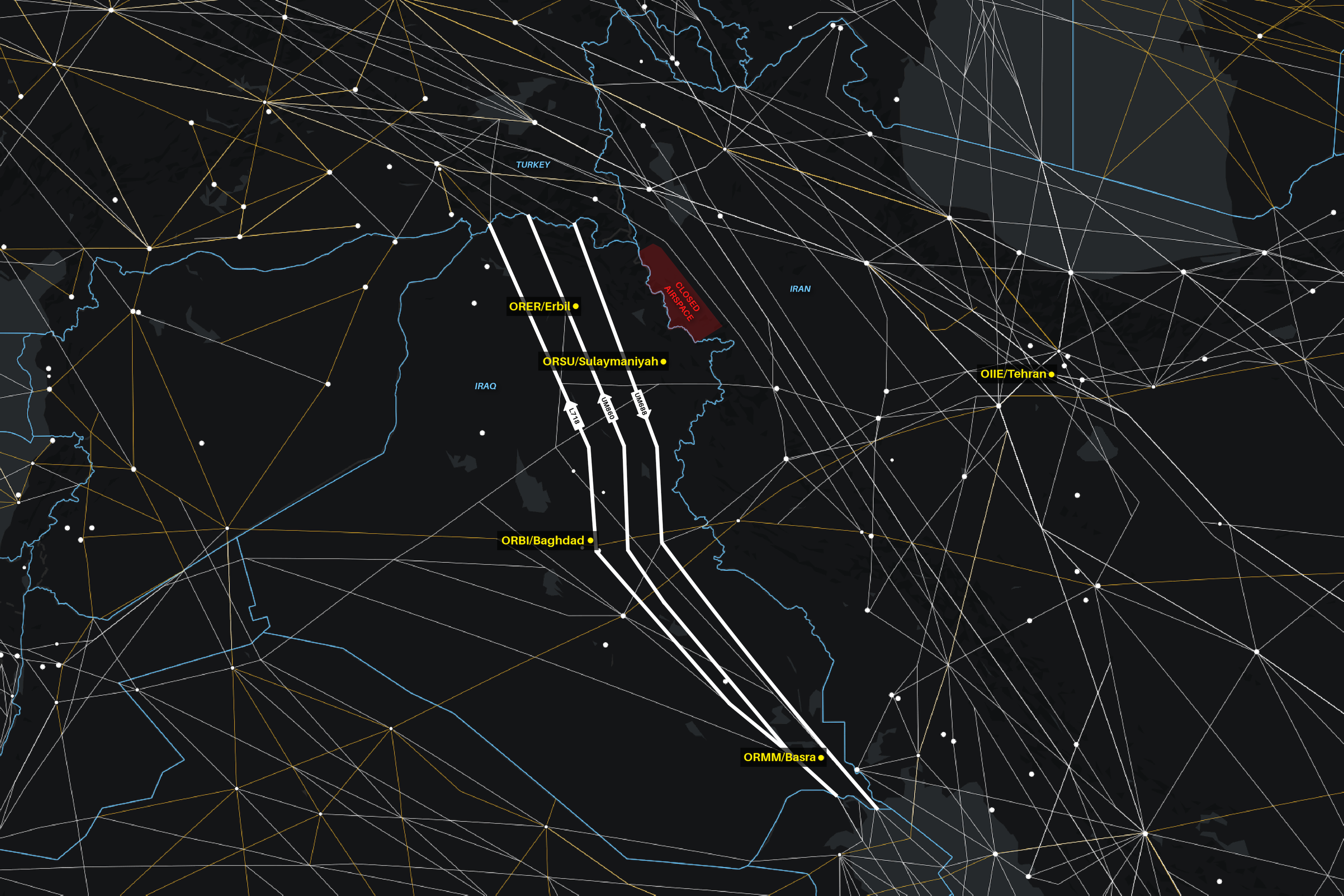
Our advice hasn’t changed – avoid overflights at all levels if possible. Although the eastern airways UM860, UM688 and UL602 are frequently used and considered safe options by some major carriers.

See: SFAR 77, Background Info Note.

Mali

The FAA currently advises US operators to use extra caution if overflying Mali below FL260. The main issue is the ever-fragile security situation on the ground. The FAA cites extremist or militant groups that may actively target civil aircraft with various weapons.

And things seem to be getting worse. On July 29, the US Embassy ordered the urgent departure of non-emergency US Government employees due to the risk of terrorism. Which is a warning sign for us that these risks may be escalating.

See: KICZ Notam A0009/22, FAA Background Information.

Somalia

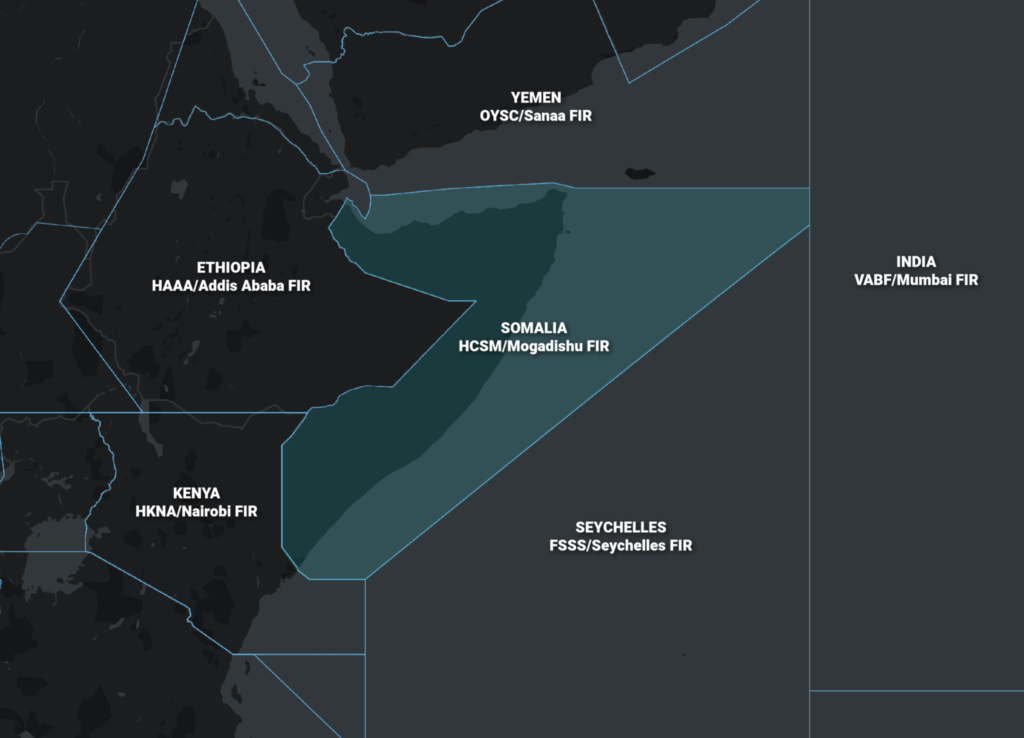
The FAA currently allows US operators to overfly the HCSM/Mogadishu FIR above FL260. It’s important to remember though that the security situation on the ground there is unstable – especially since a controversial election back in April.

Terrorist groups are active in the country, and may have been motivated by recent events. These groups have a proven track record of targeting civilians and aviation interests. In June this year news broke that several local carriers were considering suspending flights over security concerns onboard aircraft and at airports.

There is also currently an active trial of Class A airspace throughout the Mogadishu FIR, which means Somalia may be seeing higher numbers of overflights than normal. The problem is that emergencies and diversions may put aircraft at risk, especially US-registered tail numbers.

See: SFAR 107, KICZ Notam A0028/19.

Egypt

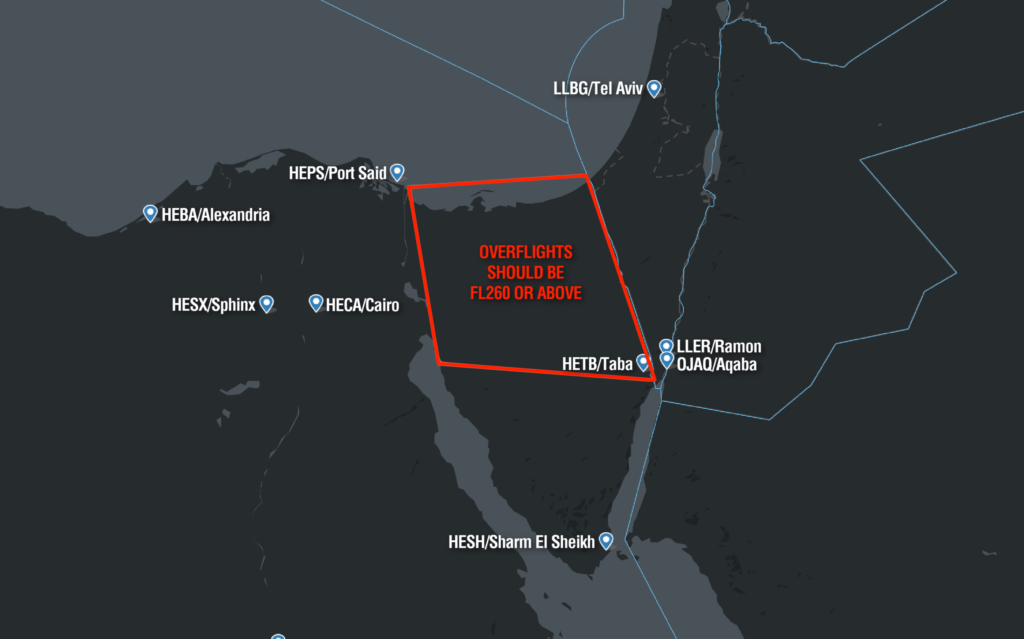
Back in March the FAA lifted its airspace warning for the HECC/Cairo FIR. It previously advised operators to stay above FL260 over the Sinai Peninsula – in the east of the country dividing the Red Sea from the Med.

The issue was the presence of extremist groups who may attempt to target civil aircraft. It’s not clear what improvements led to the warning being lifted, but other countries have kept theirs in place – including the UK and Germany.

Recent events have proven that all is not well. An attack in Western Sanai in May this year was one of the most significant in the past two years – and was a clear indicator that terrorist groups are still active in the region. If they have been motivated by the happenings in Afghanistan, this may put aircraft at renewed risk.

Where else to look.

As things change, airspace warnings get updated. For US operators the starting point is here – it contains everything officially put out by the FAA.

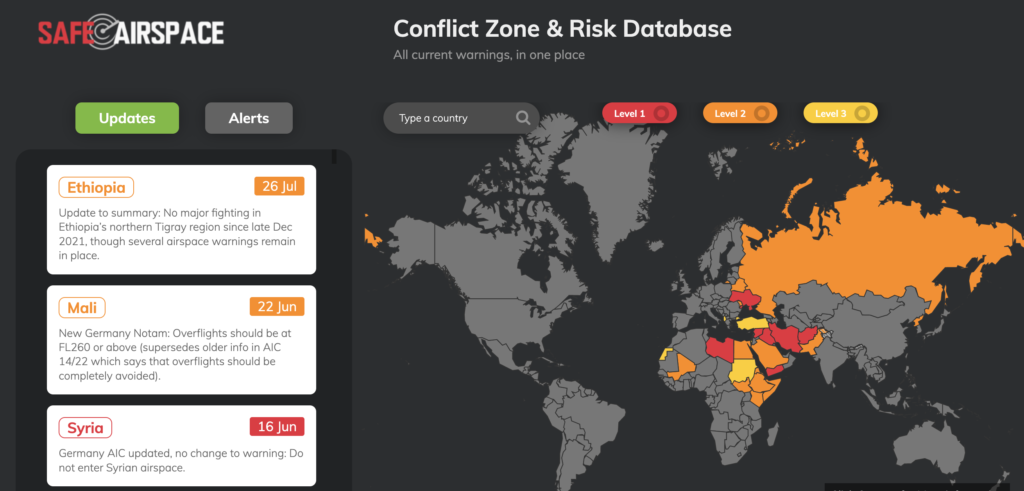
There’s also safeairspace.net – our conflict zone and risk database. The OPSGROUP team keeps this updated as new information comes to hand. You can view a global risk briefing by clicking here.


We Need to Talk About China!

China held new drills near Taiwan on Monday, a sign that they may intend to normalize their military presence around Taiwan. This came a day after the Chinese military ended their extensive 3-day exercises encircling Taiwan, effectively simulating a blockade.

During those exercises, there were significant impacts to flight ops in the region. Xiamen Airlines and Korean Airlines made adjustments to several flights to avoid the airspace, Cathay Pacific pilots were reportedly advised to carry an extra 30 minutes of fuel, and there were cancellations at RCTP/Taipei airport in Taiwan and ZSAM/Xiamen and ZSFZ/Fuzhou airports in mainland China.

China published ZBBB Notam A2119/22 which set out the six Danger Areas where flights were prohibited at all levels:

Here they all are, plotted on a map:

And here are all the main airways that intersect those Danger Areas:

The Danger Areas affected major routes between Southeast Asia and Northeast Asia.

For any future exercises that China announces, if you’re planning on transiting the RCAA/Taipei, ZSHA/Shanghai or RPHI/Manila FIRs then make sure you check the ZBBB Notams as it might not show up as part of your flight briefing pack.

Hypersonic missile launch

China launched an unannounced hypersonic missile on Aug 1 (we could not find any Notams for it). This marked the 95th anniversary of the Peoples Liberation Army being founded, and coincided with an announcement from the US that they might visit Taiwan.

The missile was only fired towards Taiwan, falling some 120km off the coast into the Taiwan Strait.

Taiwan-China procedures

Specific procedures regarding international flights into Taiwan have existed for years, and you can find more in-depth information on these here, and a post on general tips for China Ops here.

A brief summary:

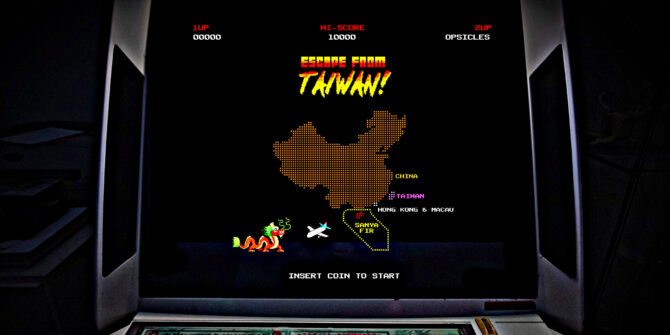
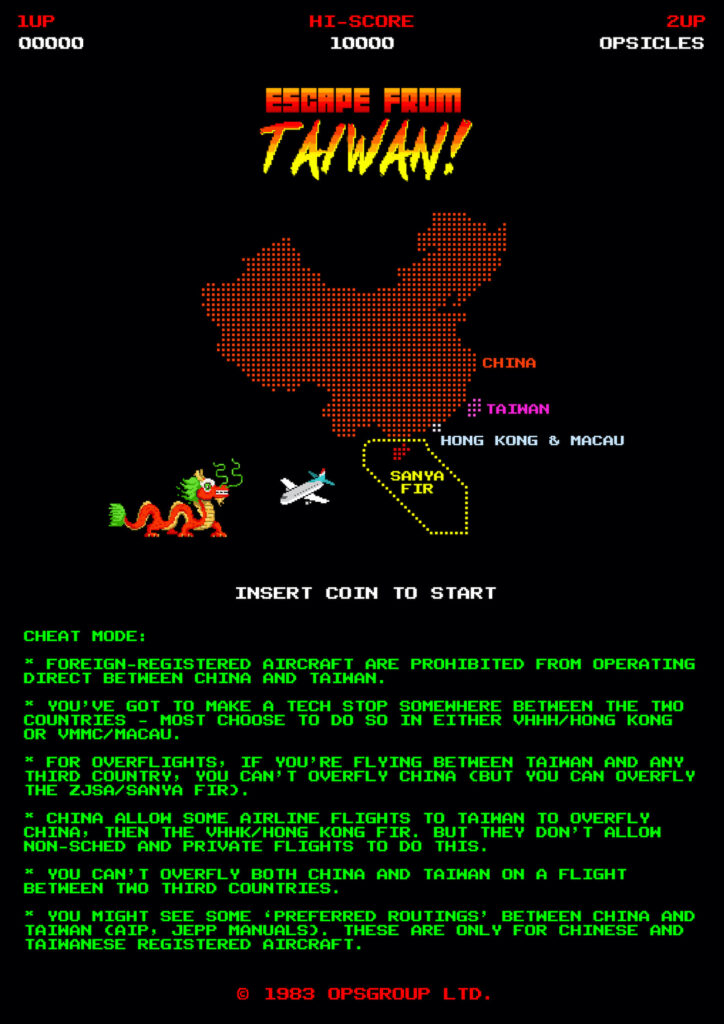
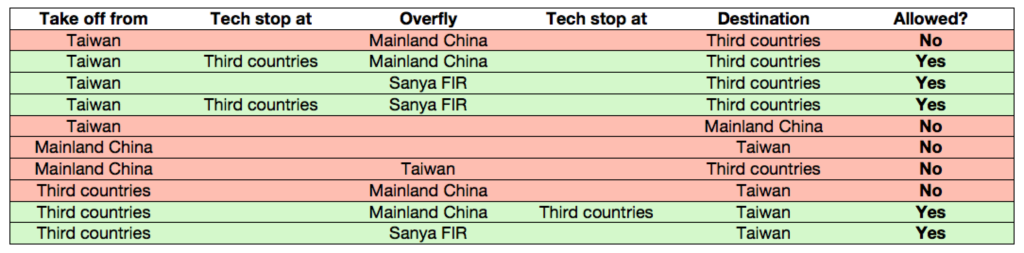
  • Foreign registered aircraft are prohibited from operating directly between China and Taiwan.
  • If you need to make a tech stop between the two, VHHH/Hong Kong or VMMC/Macau are good options.
  • The same rules apply for China overflights – if you’re flying to Taiwan from any third country, you can’t overfly China.
  • Only Chinese and Taiwanese registered aircraft are able to operate directly between China and Taiwan.

Because of these, the airspace over the Taiwan Strait is not hugely busy and the missile posed a limited risk to aircraft.

Heightened military activity

China have been showing heightened military activity in and around the South China Sea, ownership of which is disputed by neighbouring countries. This is not directly linked with the Taiwan situation, but provides some further political (and flight ops) awareness, particularly because of the strategic military positions China hold in this region.

In addition, China have been carrying out military drills in various areas, mainly near the East China and Bohai seas. These rarely impact flight operations, with the prohibited zones focused on maritime traffic. However, increased offshore helicopter traffic and some flight disruptions into coastal airports do occur.

China have been increasing their incursions into Taiwanese airspace for a while, with a spate of them towards the end of 2021. These pose some risk to commercial operations for several reasons – increased military traffic being the obvious one. A lesser risk of misidentification is heightened as well, along with the potential response if a civilian aircraft accidentally encroaches on out of bounds Chinese military airspace (well, all of it is military, but some of the really ‘don’t go in there’ parts).

What if China shut their airspace?

We are not saying it will.

However, China are initiating a major offensive in Taiwan, and this does draw parallels to Ukraine and Russia. If the US military becomes involved, this may lead to sanctions between the two countries. Some early consideration as to what airspace closures might mean is therefore a good idea.

China is a major air corridor, particularly with Russian airspace currently closed to the US and Europe. Reduced access or closure of the airspace will see flights routing far further south via Japan, and potentially across the South China Sea before routing across Thailand, India and Pakistan and the Middle East.

The impacts would be significant for various reasons:

  • This will significantly increase flight times and distances, and likely be prohibitive for aircraft with lesser range capability (without fuel stops).
  • The South China Sea may see increased risk levels if China increase their military presence there as well.
  • Summer weather patterns can create further routing difficulties particularly around the Bay of Bengal area.

Other threats to consider.

The Cyber Threat
Chinese action in terms of cyber security breaches have been questioned more than once. 

The political stuff
China and the US have a history of ‘messy’ visas for aircrew already. Further tensions are likely to increase this. Security for certain nationalities will need consideration.

Trade
China is a major trade partner with the US and Europe and sanctions on trade may impact aircraft parts manufacture.


Moldova Bomb Threats: Russia-Ukraine Conflict Spillover

Moldova is seeing a lot of spill over repercussions from the Russia-Ukraine conflict, but it has been hitting the international flight ops news more in the last few weeks because of a series of bomb threats.

Tell me more about Moldova.

Moldova is a small nation sandwiched between Ukraine and Romania, bordering the Black Sea. They were granted candidate status into the EU alongside Ukraine when all the current conflict started kicking off.

What about their involvement in the Russia Ukraine conflict?

While considered a military neutral country, they also broke away from the Soviet Union in 1991, and have had ongoing trouble in the Transnistria region. This is a breakaway republic in eastern Moldova, bordering Ukraine, with its main city Tiraspol.

This region is of interest to Russia because of its access down to the Black Sea, the close ties any in the area retain with Russia, and because of what it means for Moldova’s EU entry bid – having full control of borders is a pre-requisite for this. All this means concerns for Moldova that Russia might take steps towards them, or at least the Transnistria region in a similar way as they have Ukraine.

The current conflict impact

Moldova initially closed all their airspace, but later reopened a section on their western border with LRBB/Bucharest FIR in order to enable flights to LUKK/Chisinau airport. 

However, several countries have active warnings for Moldovan airspace. The primary risk is an unintended targeting of civil aircraft by military near the Moldova-Ukraine border, including misidentification (as with MAS17, UIA752).

A full post on the airspace situation from the Russia Ukraine conflict is available here.

You can also read the main warnings for Moldova on Safeairspace. As a brief overview of the big ones –

  • French operators should not enter the airspace of Ukraine, Belarus, and Moldova, and should also not enter the airspace of Russia within 200nm of the FIR boundaries with Ukraine
  • Canadian operators are prohibited from the airspace of Moldova.

Why are we talking about Moldova now?

There has been a spate of bomb threats made at LUKK/Chisinau airport, the latest occurring on July 30 and another August 2. No explosives have been discovered, but the threats are treated as real and have resulted in evacuations each time, which has resulted in a fair amount of disruption. Up to 100 institutions and buildings have apparently been targeted with fake bomb threats over the summer so far.

What is the impact on international flight operations though?

LUKK/Chisinau Airport:

There are special procedures in place for operating into LUKK/Chisinau, and new SIDs and STARs have been published. However, only some of these are available.

Special care is recommended if arriving on runways 26/27 or departing 08/09.

Full details of the airspace changes are available here in Moldova’s updated AIP SUP.

Overflights:

Moldovan airspace is not required for overflights. The primary routes from the Middle East and Asia, into or from Europe, bring aircraft over the Black Sea and Romania, remaining well clear of Moldovan and Ukraine airspace.

However, the proximity to airspace with identified risks, and the increased traffic because of the limited routes available, should be considered.

En-route Alternates:

Aircraft requiring an enroute alternate or diversion airport in this region should consider LROP/Bucharest or LROV/Brasov instead of LUKK/Chisinau.

Security concerns:
If operating into Moldova, review your own measures and responses for bomb threat or other security threats, and consider organising additional security.

The US have recommended caution for their citizens in Moldova, and advise that all alerts be treated as genuine (and report anything that looks dodgy).


London Airports Top Tips

Here’s some basic info we put together on the London Airport options, made with help from the London Underground tube map publishers, circa 1962.

How many airports are there around London?

Well, you have the big international ones – EGLL/Heathrow, EGKK/Gatwick and EGSS/Stansted. 

Then you have EGMC/Southend which is also quite big but a bit less big really, it mainly just serves European routes really. Same for EGGW/Luton. FYI – both of these are officially ‘London’ as well. 

Then you have smaller or predominantly business aviation airports – EGLC/London City, EGLF/Farnborough (not a London, but closeish), EGTK/Oxford Kidlington (this is a London), EGKB/Biggin Hill (really near London but not called London) and EGWU/Northolt (8nm from Heathrow and actually a military base).

Back in 2015, the UK handled something like 2 million flights a year and 1.2 million of them were in and out of the 5 main London airports. In fact, here’s a cool video of 24 hours in London (also from 2015 so probably wildly inaccurate at this point, but has some nice neon colours.)

Right, so, it’s busy. What are some things you need to know.

  • The constant frequency changes. So many of them. But generally well managed on ATC.
  • The headings after departure. For reasons known only to ATC, it seems to be easier for them to manage all the traffic out of the London area by keeping you on a heading for lengthy times.
  • Transition levels and altitudes. Not set at a specific number – they can change with the weather, and at different airports. Watch out if there are extreme QNHs going on.
  • The airspace. Actually, this can have its own section…

The airspace.

It only has 3 FIRs – London, Scottish and Shanwick, although these are split in UIRs as well.

All the airspace in the UK is split into 7 types classes – A to G. Here is a picture:
I will point out, in case you miss it, that Class G is uncontrolled.

Class G airspace (and Class E a bit)

If you’re in Class G (and some class E if you’re VFR) then you get Flight Information Services. These work like this:

  • Basic service. ATC might tell you about activities that might affect you if they have time. Up to you to miss it all.
  • Traffic service. The use a radar to tell you about specific conflicting aircraft. You only get this if they have time, and still up to you to not fly into it.
  • Deconfliction service. This is only for IFR flights in class G. It’s basically the traffic service but they’ll throw in some ‘how to miss it’ guidance as well, which you can ignore if you want.
  • Procedural service. I don’t really understand this so have just copied and pasted their description – Only available to IFR flight. A non-surveillance service in which deconfliction advice is provided against other aircraft in receipt of a Procedural Service from the same ATCO; the ATCO will not be aware of any other aircraft.

All this information is in here, with some more information if you need to know more. 

When will you ever be in Class G?

Remember this started as a post about London, sort of? Well, now it is a post about Biggin Hill specifically, because that’s where you – a BizAv aircraft maybe routing over from the US on some nice business trip – might find yourself in Class G airspace.

First, let’s talk Air Traffic Zones (ATZ). If the longest runway is longer than 1850m, then these zones are generally 2000’ high and 2.5nm around the aerodrome – if shorter than that you generally have a 2nm ring.

To go in or out of an ATZ you need to either:

  • Have permission from the ATC unit there if it has one
  • Have information from flight information service if it has one
  • If there is no ATC or FIS, then be talking to an air/ground communication service.

Read more here.

So, Biggin Hill has an ATZ and it’s a funny sized one and it’s right in Class G airspace, and if you fly there you probably want to know about the procedures to go in before you.

Biggin Hill stuff

We were told this by a very helpful Opsgroup member who had just been there.

It is in class G, has an ATZ, and a tower. The tower give you all the permissions and clearances you need.

Right above Biggin Hill you’re straight up into Class A (2500’). Your instrument approach starts below Class A and is outside the ATZ… so many non radio carrying, non transponder transmitting aircraft could be wafting about all around you. You might get one of those service I mentioned above, but you might not, and you will always have to make sure you don’t fly into stuff. So watch out.

Also because of its airspace, you can probably expect some extra track miles as you head in and out from the west. Arriving –  count on an extra 15 minutes, departing – be prepared for an extra 10 minutes or so.

They also only really land onto runway 21, and if you depart 21 then it’s an EARLY right hand turn for noise abatement.

Here’s an Airport Lowdown on all of this.

Finally, some other bits on other London airports.

1. Don’t go to London City unless you have been trained (it needs prior training) and your aircraft is certified for steep approaches or its going to get quite embarrassing fairly quickly. If you are going to London City then take a look at the platform and missed approach altitudes because they’re low. Why? Because it is directly under the flight paths for Heathrow and Gatwick.

2. Don’t head to Heathrow without a bit of fuel for holding. You usually hold for Heathrow. 

3. Don’t fly level for too long if you’re heading to Heathrow. They have quite strict NABT arrival procedures and you might get fined (and will definitely get shamed!) if you don’t try and do a CDA.

4. Don’t plan on using many of them at night. Really, Southend and Stansted are your only options at night – everywhere else is either closed or has noise curfews in place. Here’s something we said on that.

5. If you’re not from the UK you’re more than likely going to need to register for a TCO before December 2022 if you want to operate any kind of commercial flight into the UK. It looks like a hideous process and we don’t know much about it so if you have questions, email these folk – TCO@caa.co.uk

6. London is awesome. If you want some recommendations on top spots to visit then ask.


Morocco ATC Strike Cancelled!

Update 1500z Aug 3: And bam! Just like that, the ATC strike in Morocco is cancelled! There’s no more info yet, but normal ops now expected for the whole period Aug 3-18. So say Eurocontrol on the NOP site.

—————–

Story from Aug 2:

News broke last week that Moroccan ATC are threatening to strike for a full two weeks from August 3 – 18, and it will affect the entire GMMM/Casablanca FIR. Similar strikes elsewhere typically last just hours or at worst a day or two.

While it will not be a complete walk-out, the airspace may be heavily restricted – a busy air corridor linking Western Europe to Sub-Saharan Africa and South America. On average Moroccan airspace services over a thousand flights a day, and ATC want to put the brakes on hard.

It’s all found in this letter written by the union responsible. Here’s our breakdown of what it says, along with some nice pictures.

Let Me In!

If you want to come in, you had better get in line. If the strike goes ahead, only one aircraft per hour will be allowed through each entry point to the GMMM/Casablanca FIR.

Trickle effect at airports.

All major airports in Morocco will be affected by heavy restrictions on aircraft movements. In each case, only two aircraft will be allowed depart each hour.

Who’s not affected?

There will be limited exemptions, but they won’t apply to most operations. Aircraft engaged in state, RFF, medevac or humanitarian ops will be exempt. And if you experience an emergency, of course you’ll be allowed in asap.

You will also be able to get special handling permission by including ‘STS/AFTMX’ in Item 18 of your flight plan to get around the restrictions. This will be by prior approval only though. To ask for it, you’ll need to contact the CAA directly. You can reach them at civilair@menara.ma or on +212 537 67 94 07.

Watch out for Western Sahara

If you’re hoping to avoid the hold-ups in the GMMM/Casablanca FIR, you may be tempted to route further south over the Western Saharan region.

Something to be aware of first – there are still active airspace warnings in place for this disputed territory. Despite being quiet in the news lately,  there is a long running conflict happening there. Anti-aircraft weaponry has previously been identified as a possible threat to low flying aircraft below FL200. The risk to overflights in the upper flight levels is very low, but take extra care if planning for diversions or emergencies.

You can read a full briefing on the situation here. We’ve also written this article which may also help.

Right now it’s just a “potential” strike.

The nature of industrial action is that it can be hard to predict until it actually happens. On August 1, Eurocontrol advised the strike was imminent but also noted that the GMMM Notams were conspicuously quiet. We also reached out directly to the Moroccan CAA, but so far *crickets*.

Other ATC strikes in Africa

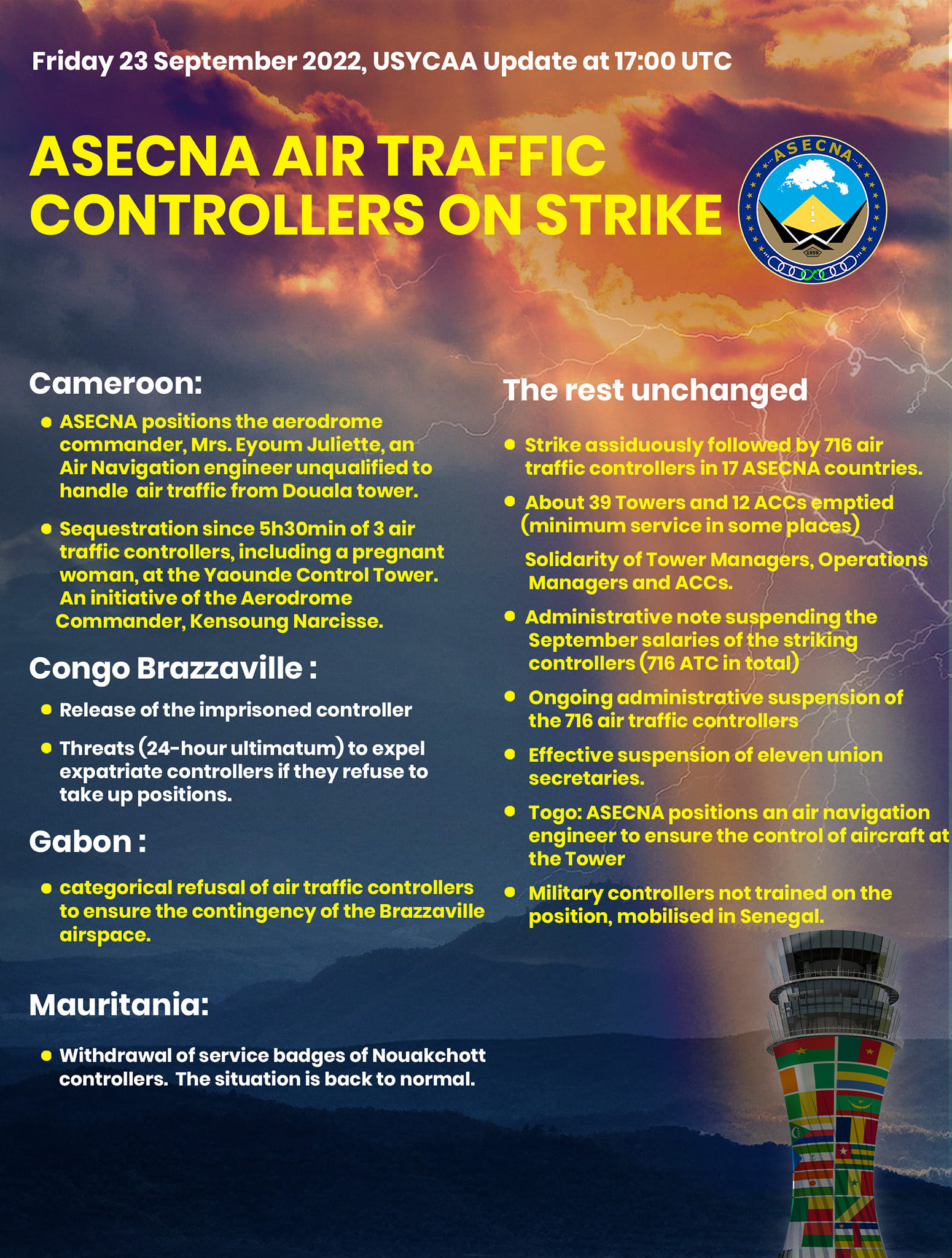
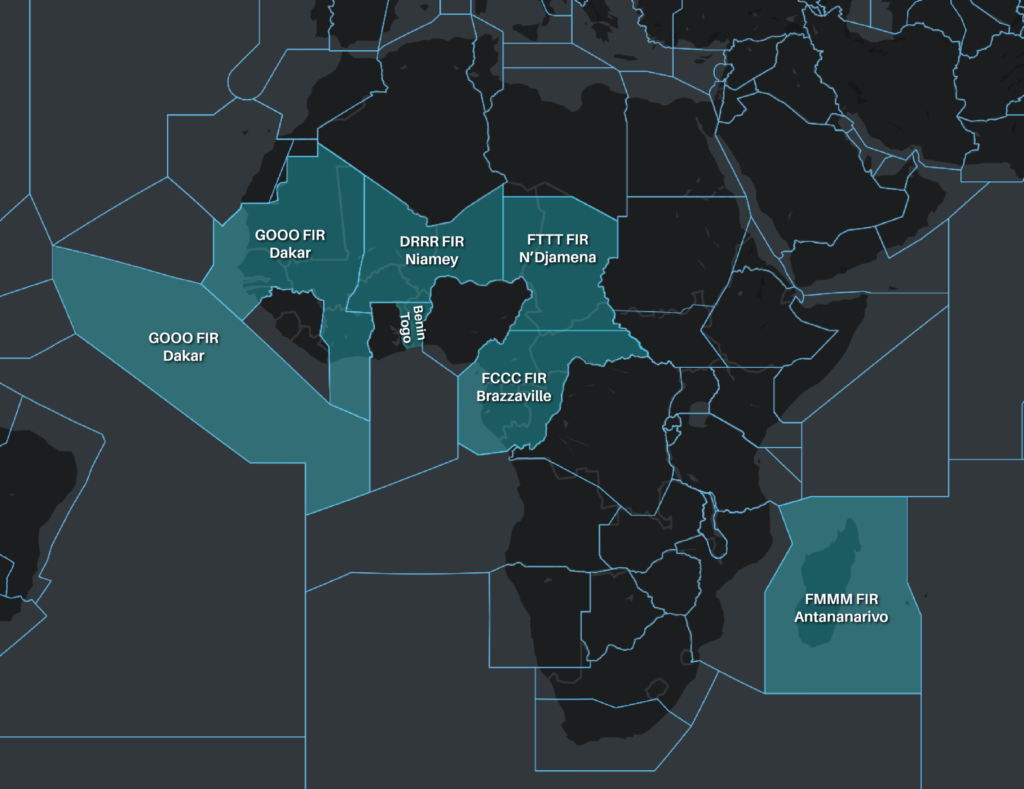
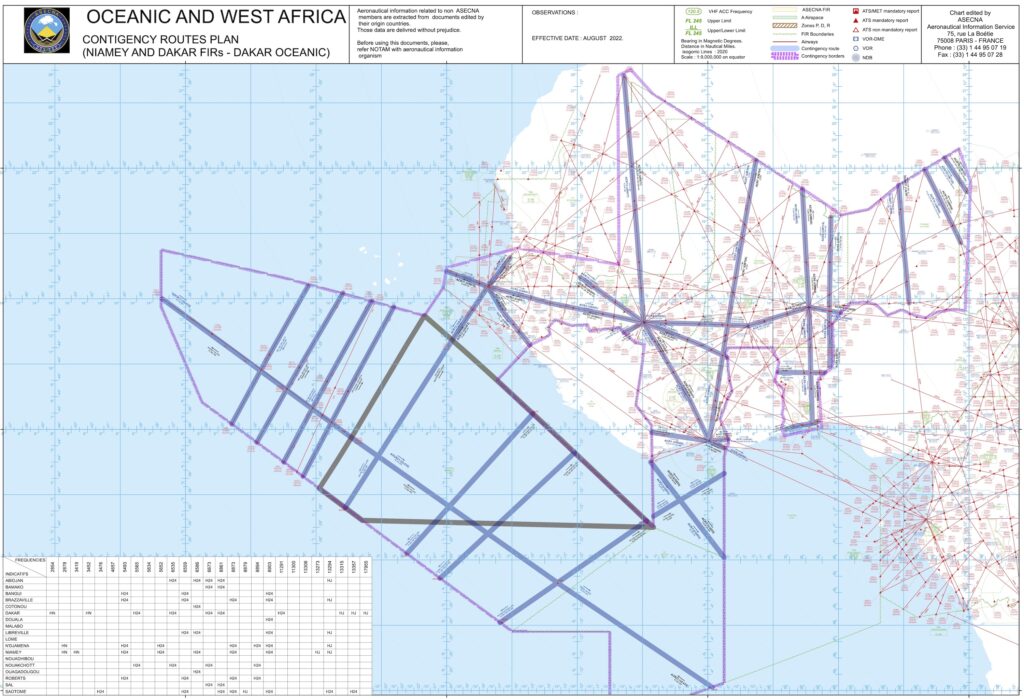
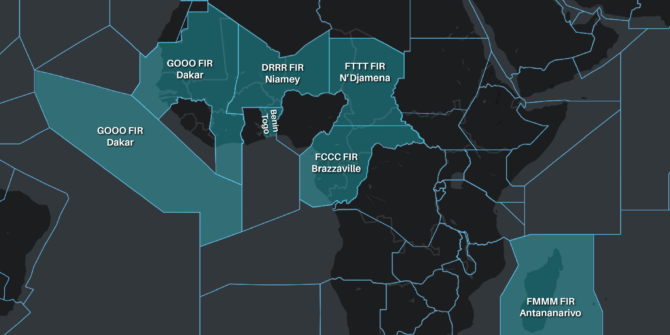
It must be the season! Also be aware that on August 25 another major strike is planned affecting five FIRs in Western Africa, along with another over Madagascar in the east. You can read more about that one here.


NAT Conundrums Volume III: To GOTA and beyond!

Ah, NAT conundrums! We love them so much, we’re into our third Volume already!

Volume I covered the following three conundrums:

1. To SLOP, or not to SLOP?
2. What’s the difference between the NAT Region and the NAT HLA?
3. Can I fly across the North Atlantic without Datalink?

Volume II covered these additional three:

4. Do you need to plot on Blue Spruce Routes?
5. Do we still fly Weather Contingency Procedures on Blue Spruce routes?
6. When can we disregard an ATC clearance and follow the contingency procedure instead?

And this post, Volume III, looks at GOTA airspace. It’s such a juicy topic, it gets an entire Volume all of its own.

So here goes…

Where is GOTA airspace?

This section of airspace is found off the coast of North-eastern Canada, FL290 to FL600 inclusive.

Here it is, outlined in red:

Why are we talking about it?

Because lots of aircraft transit this area when flying across the North Atlantic. Also because the requirements here were very tricky for us to track down on “paper” (i.e. the Canada AIP, NAT Doc 007, etc), and were only really made clear after speaking with a real human being at Transport Canada. We like human beings!

So here’s what we discovered…

You don’t need datalink in GOTA airspace

No, you don’t. We thought you did, but we were wrong.

When we sat down to update our North Atlantic Plotting chart last year, we wanted to draw nice clear lines on the map to show where datalink was required. But we were bamboozled by GOTA.

The ICAO NAT Doc 007 says that you don’t need datalink in:

“Airspace where an ATS surveillance service is provided by means of radar, 
multilateration and/or ADS-B, coupled with VHF voice communications as depicted 
in State Aeronautical Information Publications (AIP), provided the aircraft is 
suitably equipped (transponder/ADSB extended squitter transmitter).”

It then says to check in State AIPs to see if any of their airspace fulfils this criteria.

So that’s what we did. But checking in Canada’s AIP brought up this for GOTA:

And this for Data Link Mandate (DLM) Airspace:

So none of that really answered our question of whether or not you need datalink in GOTA airspace. The trail went cold…


via GIPHY

Our chat with Transport Canada in 2021:

Deep in the doldrums of lockdown, we sent Transport Canada (TC) some emails asking them the question directly. Here’s a massively paraphrased transcript of that email exchange:

Us: We have been trying to determine if the GOTA requires datalink? It appears to meet the definition of ATS Surveillance Airspace but we can’t identify anywhere in the Canadian AIP which specifically states this.

TC: The GOTA is in fact DLM airspace.

Us:  Really? So operators without datalink must cap their flight below FL290 through the GOTA airspace until they reach that datalink exempt airspace over Greenland, at which point they can climb to the higher levels?

TC: Yes. Well… flights equipped with ADS-B may operate at DLM levels within the GOTA.

Us:  Oh. Now we’re confused. Oh well, it’s Christmas now. Chat next year!

TC: Merry Christmas.

Our chat with Transport Canada in 2022:

Us: We have been trying to determine if the GOTA requires datalink? It appears to meet the definition of ATS Surveillance Airspace but we can’t identify anywhere in the Canadian AIP which specifically states this.

TC: Didn’t you ask this exact same question last year?

Us: Yep. But then… you know… Christmas…

TC: Ah yeah. Ok. As long as you are HLA Certified (MNPS & RVSM) and you have ADS-B, transponder and VHF you wouldn’t require all the DLM equipage. GOTA is technically Gander Oceanic airspace (NAT HLA airspace), but as they have Ground based Radar sources, space-based ADS-B and VHF coverage in the area it has been delegated to Gander Domestic. Due to this, the airspace is considered Class A surveillance airspace and follows the similar regulations as you would in other Canadian domestic Class A airspace.

Us: What about that ADS-B requirement?

TC: Well, technically ADS-B isn’t required as it is considered class A surveillance airspace. So lack of ADS-B wouldn’t prevent you from entering the GOTA area. That said, ADS-B equipage is preferred by many of the controllers. This is because the ground based radar isn’t always guaranteed to the outer limits of the GOTA airspace. This makes identification and separation easier for the domestic controllers when the aircraft have ADS-B.

Us: So tell us again, what do you need in GOTA airspace?

TC: Required equipment for GOTA airspace is transponder, automatic pressure-altitude reporting equipment and VHF. As soon as you leave that airspace you would need other equipment depending on what airspace you enter.

“As soon as you leave that airspace…”

Yes indeed, a good point, worthy of further investigation! Because no-one just zips around solely in GOTA airspace, do they?

So here’s a look at the airspace adjacent to GOTA, and what you need where…

Datalink Exempt airspace over Greenland, Iceland, and a bit of Gander Oceanic

There’s an interesting picture in the NAT Doc 007 doc that looks like this:

This the datalink exempt ATS Surveillance airspace over Greenland, Iceland, and a bit of Gander Oceanic where you can still fly if you don’t have datalink.

This area is bounded by the following:

Northern boundary: 65N000W – 67N010W – 69N020W – 68N030W – 67N040W – 69N050W – 69N060W – BOPUT.
Southern boundary: GUNPA – 61N007W – 6040N010W – RATSU – 61N020W – 63N030W – 62N040W – 61N050W – SAVRY

So, putting that on our nice NAT Plotting Chart, it looks like this (outlined in green):

Us: What are the requirements for this airspace?

TC: HLA Certification (MNPS & RVSM), ADS-B & VHF.

Us: Nice.

HLA airspace

So now we’re talking about the bit to the south of the datalink exempt airspace, outlined here in fruity pink:

Us: What are the requirements for this airspace?

TC: HLA Certification and full DLM certification, FANS 1/a (ADS-C(D1) & CPDLC(J2, J5 or J7)). Depending on the route of flight and the tracks that day there may be other requirements as well (ie. PBCS Certification for PBCS tracks).

The Blue Spruce Routes

So here’s what we said in a previous post on these…

The Southerly ones: These go over Greenland linking Canada with Iceland via waypoint OZN, and are not fully contained in the exempted airspace. So if you’re flying these southerly Blue Spruce routes you will have to meet the NAT DLM requirements or fly outside of the vertical parameters of DLM airspace (i.e. below FL290 or above FL410). In other words: you need datalink to fly on the southerly Blue Spruce routes between FL290-410.

The Northerly ones: These are the ones going overhead BGSF/Sondrestrom airport. These do fall within the exempted area of airspace – so datalink is not mandatory if you’re flying here.

Us: All that stuff we told people in our previous post… did we get that right?

TC: Yeah, pretty much. The primary purpose of Blue Spruce routes is for aircraft with only one long range navigation system. This would normally exclude them from the exemption area anyway, as they are usually kept below HLA airspace (FL280 or below) as they would normally need state HLA approval to fly a blue spruce route with one long range navigation system at FL290 and above.

Gander’s datalink exempt airspace won’t be datalink exempt for much longer!

You: Hold on… which bit of airspace are we talking about now??

Us: This bit, outlined in black. It’s the bit of airspace in the datalink exempt area which is controlled by Gander Oceanic.

So, this is where the plot thickens!

Us: Can you tell us why the plot has thickened, exactly?

TC: Yes, we can. Do you guys actually know anything, or do just come to us for all your answers?

Us: We only know how to massively paraphrase email exchanges.

TC: Okay. So here’s the deal. As we are decommissioning the VHF and ground based ADS-B sites in southern Greenland we will no longer have the datalink exempt area in the northern portion of Gander oceanic HLA airspace. At that point, all Gander oceanic airspace will become DLM airspace. Although GOTA will stay datalink exempt.

Us: Decommissioning VHF and ground based thingies, you say?

TC: That’s right. Nav Canada put out a circular last year and updated it again this year advising that the ADS-B and VHF sites in that area will be decommissioned. The current circular is AIC 15/22. The tricky part is, it discusses just the ADS-B and VHF sites, but many people don’t make the connection from that to the exemption area. When the VHF sites are decommissioned we won’t have the equipment to qualify for DLM exemption in that area. Nav Canada is keeping one frequency until December 29, 2022 to enable users to continue to use the area for this year, but that final one will be decommissioned at that time. The 127.9 frequency will continue to be used by Gander IFSS for the Blue Spruce Routes. When it gets closer to that date, there should be an ICAO NAT Ops Bulletin out and NAT Doc 007 will be amended. So just to clarify, barring any major unexpected changes, that airspace will become strictly DLM airspace on December 29, 2022. At that point it will follow the same regulations as the rest of the NAT DLM airspace.

Us: Bonza.

So, to recap…

  • Datalink Airspace: Remember, NAT DLM airspace only applies from FL290-410. Below or above that, you don’t need datalink in the North Atlantic.
  • If you have full datalink (CPDLC and ADS-C): You can go where you like, and you didn’t really need to read this post.
  • For GOTA airspace: You need a transponder, automatic pressure-altitude reporting equipment and VHF. If you have ADS-B, that’s helpful for ATC.
  • For the Blue Spruce Routes: You need datalink for the southerly ones, but not the northerly ones. (If you’re flying on these then you’re probably doing so below FL290 anyway, in which case you’re below NAT DLM airspace and don’t need datalink).
  • For the datalink exempt airspace over Greenland, Iceland, and a bit of Gander Oceanic: You don’t need datalink, but from 29 Dec 2022 you will do in the bit controlled by Gander.

Questions

Just send us an email at news@ops.group and we’ll try to find out the answer.


Canada: The AGN and what to do with it

What’s an AGN, I hear you cry? Aviation Grid Network? Active Galactic Nucleus? Angry Goat Notams?

Well, unless you’re a Canadian operator, operate a regular scheduled service there, or work in the tiny room in the corner of the basement in Transport Canada’s Ellesmere Island Office where this was invented then you possibly won’t know.

But if you operate at all into Canada then you probably-might not-but maybe should-know what it is. It is the Aircraft Group Number, and because someone asked us about it and we didn’t have a clue, we figured some of you may not either.

Disclaimer: We have no idea if there is a Transport Canada office on Ellesmere Island, we made that up. We just found it really, really hard to find anyone at Transport Canada who seemed to know anything about it until we emailed a really important person whose name was on one of the advisory circulars. They were really helpful.

The Aircraft Group Number.

Anyway, so the AGN is basically the  Canadian equivalent of the FAA’s ADG stuff for aircraft classification and airport design (we think).

It is published for Canadian airports, and the whole point is to provide information on stuff like runway or taxiway width, length and other physical characteristics, and also things like separation from obstacles in the runway environment.

Basically, a lot of important stuff you need to know if you want to operate there. It is measured based on the ‘most critical’ aircraft operating in. They measure, consider and then the relevant AGN plops out the other end and is assigned.

Any given aircraft might actually end up with more than one AGN depending on the airfield element being looked at.

  • So it ‘aligns the certification standards to the actual (or planned) operation at the site by linking the standards to specific aircraft characteristics, aerodrome operating visibility conditions, and level of service.”
  • In other words, it provides a simple “method for interrelating the numerous technical specifications concerning the aerodrome and the characteristics of the critical aircraft.”
  • In other other words, it checks what can safely get in and out, and then anyone wanting to go there can see if its suitable for their aircraft type (and its AGN).

Here’s the Advisory Circular on it if you want a read.

So why are we telling you about it?

It is actually something you are probably familiar with even if you didn’t know the acronym, and when you’re thinking about heading to an airport you (hopefully) check stuff like this anyway.

But, what we aren’t sure about is whether it is a guidance thing or a restriction thing?

The original question

The question which sent us spiralling into an endless pit of Advisory Circulars and uncertainty came from a non-canadian BizAv operator (you know who you are, and thanks for that!).

They did have a valid question though.

They wondered if they could still plan and airport for things like tech stops and medical emergencies if it’s a category below the aircraft AGN (but is perfectly landable at)? Because your AGN varies for different elements…

So we read through the bundle of ACs and frankly still didn’t have a clue. So we started emailing everyone at Transport Canada and finally got a nice response from someone pretty important and knowledgable.

The answer.

Well… 

Let’s start in Advisory Circular 602-005 (effective 2021-06-04), the subject of which is ‘Publication Enhancements to Airport Information in the Aeronautical Publications.’ Don’t be put off by the title, this is all about the AGN.

First up we get to the background and its in Section 3.0 that we discover this very important statement straight out of the Canadian Aviation Regulations – 

“Before taking off from, landing at or otherwise operating an aircraft at an aerodrome, the pilot-in-command of the aircraft shall be satisfied that

(a) there is no likelihood of collision with another aircraft or a vehicle; and

(b) the aerodrome is suitable for the intended operation.”

So, the AGN helps determine this.

But then there is this…

If an air operator is conducting scheduled passenger services at the airport then they are bound by Part VII regulations in respect to the AGN limitations and any other limitation related to the airports’ certification…

So we still weren’t entirely sure…

A non-scheduled flight (so a lot of BizAv sorts) doesn’t fall under that particular regulation, but the AGN is considered a limitation and part of an airport’s certification.

Given it is telling us whether (very simply) our aircraft will fit (ok, whether obstacle clearance, runway width, etc etc is suitable), then it doesn’t sound like something you would really want to shrug at and say “ah well I reckon I still will…”

But by the same token, AGNs are determined using the most critical aircraft currently doing scheduled operations. So if you’re looking at a military base (that is available for civilian ops when needed) then that AGN might not “work” on paper, but the airport may well work for you in reality.

Then came the answer

Hot off the press – “It’s the pilot-in-command’s decision to verify if the aerodrome is capable of accommodating the AGN of the aircraft. The published AGN serves as a tool and aids in the decision making.”

There it is, clear as can be.

You still have to make the decision!

For that, throw in some common sense and airmanship.

On fire? All bets off, anywhere works.

Tech stop of medical diversion? Probably not the wisest to plan to use an airport whose AGN falls below the category you require. Chances are if you mess up there are going to be some pretty big insurance and legal questions getting asked like “the AGN literally told you the obstacle clearance wasn’t enough so why did you try?”

And remember it isn’t the whole picture.

Just using the AGN also isn’t a good idea because it doesn’t take into account all the info you need. It doesn’t, for example, cover airport operating hours which is quite important if you’re intending on using an airport because – if it ain’t open, then that’s going to be difficult.

There is a whole load of information you’ll need beyond just the AGN in order to determine suitability. The AGN is only one piece of information (albeit it a piece filled with a lot of smaller pieces of information).

We are happy to ask some more questions if you need.

We hadn’t come across this before and this isn’t a solid answer, so get in touch if this impacts your planning, and if you’ve spotted an airport whose AGN is lower than your aircraft’s. Especially if you know for a fact your aircraft has operated into there perfectly safely.

Send us some specific details and we’ll dig deeper! Email us at: news@ops.group


It’s raining space junk over Europe

Update July 31: Space debris from a rocket launch in China last week splashed down harmlessly in the Indian Ocean on July 30. It made headlines for a few reasons – it was very large, was on an uncontrolled trajectory, and could have landed in Western Europe. Future launches may carry the same risks – the next one is planned for October.

——————

Something big this way falls.

A large bit of space junk is due to re-enter, and so far they aren’t exactly sure where.

The Space Junk.

It is part of the Long March CZ-5B – the core stage of the rocket launched July 24 to send models of the Chinese Space Station up into space.

This hefty lump of junk is actually one of the biggest bits to ever re-enter, weighing in at an impressive 17 to 23 tonnes and measuring 53 meters. That’s after bits have burnt off…

The Re-Entry.

It is due to fall back around July 30 or July 31.

It is being tracked by the EUSST (EU Space Surveillance and Tracking) agency which you can visit here.

Here is the current re-entry window. The latest is saying Sunday July 31 at 1107z (but with a +/- 29 hour uncertainty window which is about 38 orbits).

And here is the current re-entry track…

It is predicted to most likely effect parts of Southern Europe – Bulgaria, France, Greece, Italy, Malta, Portugal, Spain being the most likely “fall” areas. Again, as it falls closer, this will be narrowed down.

Are we worried?

Not really. They’re tracking it and as it gets closer and a clear idea of where it will fall is available, Notams on airspace closures will be issued.

Here is the EASA SIB with all their information and advice to date on it.

And here are a few other Space related things to read while you wait for CZ-5B to make its blazing appearance in our skies.


Feeling the Heat

It’s getting hot outside. Actually scrap that, it already is hot out, and in some places it’s getting even hotter! Which means our poor little airplanes are suffering, struggling, sweating their little airplane socks off.

We’ve written up some bits on this before, and you know it all already – watch the temperatures, watch the performance, watch the climb gradients, watch the big old storms puffing up around hot spots.

If you want a full recap then you can read that all here.

Here’s a quick refresher.

A swig of cool lemonade for the pilot brain…

  • Planning: Make sure you’re not at risk of heading outside the operating envelope.
  • MELs: Check the APU, the packs, basically anything that produces cold air because if there are problems there, you might need to think about your crew, passengers and freight too.
  • Engines: Keep an eye on them, particularly during start.
  • Brakes: Watch them brake temps. Plan the taxi, and think about how best to brake to keep them as cool as you can.
  • Fuel: It has hot limits as well as cold limits.
  • Performance: Yup, hot = not so dense = not so good.
  • Climb: Hot, high, heavy? You might not meet those restrictions and it’s better knowing that before you go than trying to drag your airplane up over stuff.
  • Approach and Landing: Turbulence from thermals can get testing.

And here are some pointers on the really ‘scorching’ issues…

Batteries.

The one in your airplane is fixed so not much you can do about it other than turn the APU on/ plug in some cold air tubes or push your airplane into a shady hanger. But all the other removable bits filled with Lithium Ion batteries are worth considering.

Things like your Defibrillators for example. These usually have max temperatures (50 degrees rings a bell) so you may find you need to move them, remove them, take them off with you overnight.

Cargo

Passengers can complain and you can throw water on them. Cargo less so. 

A sad result of excessive heat at KMIA/Miami airport was the death of thousands of baby chicks recently. Whilst air temperature might be reading ok, asphalt can be 40-60 degrees F hotter than the air around it.

Storms

Hot weather means storms. If you see something in front of you, or on the weather radar, be careful about going over the top – if they are building then you’re going to meet some pretty rough air up there if you aren’t well clear.

A general recommendation is 5000’ for big’uns.

Then there are tornadoes.

Actually, the number of days each year that see tornado activity has fallen, but the number of mega outbreaks (30 or more in a day), the density of clusters and the general strength have gone up. So 3:1 to tornadoes really.

NOAA has a tornado watch page that is worth watching (checking out during the season).

The National Weather Service Twitter account is also a good spot for live updates.

They can be hard to predict, but do cause disruptions if they are near airports (not to mention potential damage). Texas is the most hit state, but there have been numerous warnings and watches out across the US including Pennsylvania, Ohio of late.

And then there are fires.

Wildfires are cropping up across the US. This site is good for monitoring these.

The risk of fires to aviation is less burning destruction, and more smoky ash visibility reduction. They can also create a secondary risk from increased airborne firefighting traffic in the areas.

Europe has seen a big increase in serious wildfires this this year, with the Mediterranean area particularly badly affected. Portugal, Spain, Greece, Italy, Croatia – all burning to varying degrees. This may cause some inflight disruption, and may cause parking issues and ground disruption particularly at smaller airports.

Humidity

This is for you and your passengers. 

India in particular has been hitting the ‘wet-bulb’ limit for human survival. Sounds doomsdayish? Well, it can be.

The wet-bulb temperature is basically what you get if you wrap a water soaked cloth around a thermometer. If this exceeds around 35 degrees C then that’t the time to really start sweating, so to speak, because above this we actually become unable to reduce our body temperature even by sweating, sitting in the shade, or drinking water. Prolonged exposure to this will result in potentially fatal heatstroke.

So keep an eye on the temperature, the dew point, and any staff you have outside!

Environmental stuff.

The real reason I wrote this post…

It was so hot in England (yes, England!) that EGGW/Luton airport’s runway melted. OK, melted might be an exaggeration, but a chunk of asphalt shifted and caused a lot of disruption for a day, and it was only only 37 degrees C.

EGVN/Brize Norton experienced a similar problem.

Airports, or rather the folk who manage them, in the likes of Dubai and the Middle East are used to these temperatures and what it can do to asphalt, which is probably why they regularly overhaul them. But places less familiar with soaring temperatures aren’t.

Watching those Notams is the best advice for this.

Keep an eye on airports in countries with less infrastructure as well. Again, India has been struggling with power cuts and blackouts due to extreme temperature and this may well impact airports just as much.

Climate change?

Here is something Eurocontrol said about it all. Don’t worry, it’s not a “what to do about it” lecture, but more “things to look out for because of it” guidance.


Ethiopia Airspace Update

Update – July 26, 2022

There has been no major fighting in Ethiopia’s northern Tigray region since late Dec 2021. A ceasefire agreed in March 2022 has mostly been upheld, and Ethiopia’s federal and Tigray regional governments look set for negotiations soon.

For the time being though, airspace in the north of the country should still be avoided – several states maintain active airspace warnings for the HAAA/Addis FIR, and Ethiopia still have a Notam in place banning all flights at FL290 and below.

Here’s the current version of the Notam, the content of which hasn’t changed since its first iteration:

HAAA A0220/22 - FLIGHT IS PROHIBITED TO FLY AT OR BELOW FL290 WITHIN
MEKELE TMA AND WITHIN THE AIRSPACE DEFINED BY JOINING
THE FOLLOWING SUCCESSIVE POINTS AND LINES
135914.7N 0362048.9E
130042.8N 0365122.9E
ETOBU(132132N 0373433E)
TILUD(134116N 0375950E)
EVITO(142911N 0382424E)
THE COMMON FIR BOUNDARY BETWEEN ADDIS AND ASMARA AND
THE COMMON FIR BOUNDARY BETWEEN ADDIS AND KHARTOUM
REF AIP SUP A 04/2021. GND - FL290, 27 MAY 09:00 2022 UNTIL 27 AUG 09:00 2022. 
CREATED: 27 MAY 09:00 2022

Better yet, here’s a picture of what this actually looks like:

Update – Nov 18, 2021:

  • The US published a new airspace warning and Background Information Note for Ethiopia, cautioning against overflights of the HAAA/Addis Ababa FIR below FL290. The conflict between the Ethiopian military and opposition forces had intensified. Aircraft below FL290 were at increased risk from anti-aircraft fire.
  • The US, the UK, Germany and France all issued security warnings advising their citizens to leave immediately.

Update – Nov 9, 2021:

  • Ethiopia is on the verge of civil war. The government declared a six-month nationwide state of emergency on Nov 2, following increased fighting between the Ethiopian military and opposition forces in the Tigray region in the north of the country.
  • Concern that ATC services in the HAAA/Addis FIR may be affected with little notice. Overflights of Ethiopia may be at increased risk of anti-aircraft fire at all levels.
  • Several factors impacting risk to overflights: military aircraft being used in combat roles, unmanned aircraft operating in region, unstable political situation on the ground, and conflict spilling over into adjacent regions. All of this pointed to an increased risk of misidentification and miscalculation – aircraft mistaken for something of military interest, or simply caught in the crossfire.
  • Opposition forces in Tigray have access to conventional surface-to-air missile systems that can reach aircraft as high as FL260. They have also previously shown an intent to target aviation interests with rockets and ballistic missile attacks on airports within the region, as well as across the border in Eritrea. Other military interests in the area have weapons capable of reaching much higher – including the Ethiopian military. More sophisticated systems are present in or near the region that are capable of reaching as high as FL490. For context, in August 1999 the Ethiopian military shot down a Learjet near the border with Eritrea. Then in May 2020 they also downed an Embraer 120 in Somalia. Both were misidentified.

Further reading

SafeAirspace.net is our conflict zone and risk database. Click here for a full briefing on the situation in Ethiopia.


Hedging Bets: Why Africa is Low on Fuel

Scour the OPSGROUP vault over the past twelve months, and you’ll find a bunch of alerts we’ve posted about jet fuel shortages. In fact, we even wrote an article about the problem.

You’ll also see that a disproportionate number of them are for Africa – or more accurately, Sub-Saharan Africa. Also known as the epicentre of ‘tricky tech stops.’

Cape Verde, Nigeria, Sierra Leone, Senegal, Zimbabwe, Burundi, and South Africa have all graced our news feed in recent times for being low on gas. The problem for ops is that it is no coincidence. And for the next year at least, fuel availability is set to become public enemy number one there for flight planners and pilots alike…

Feeling the pinch.

From an air travel perspective Covid is (more or less) behind us, and demand for jet fuel is surging. But at the same time, the world’s ability to produce it has fallen for the first time in three decades. Sanctions on Russia have been a big part of this – not surprising considering it produces ten percent of the world’s oil.

The pinch becomes higher prices for everyone. In more developed economies, supply isn’t a problem – the turbulence of the market is absorbed with price hikes. Which is why refuelling jets at your local FBO has become so eye-waveringly expensive. But if your pockets are deep enough, the fuel is there to be used.

But this just isn’t the case in less developed regions –  especially Africa, which is facing its worst supply shortage in forty years.

Drip Feeding

Many sub-Saharan countries have limited ability to refine their own oil domestically. And the refineries often operate below capacity. And so they are reliant on imports – so much so that the continent ships in three quarters of what it needs.

The problem then becomes the balance sheets of importers. Their pockets aren’t that deep, so they can only import small amounts at a time, effectively drip feeding their economies.

Combine the two issues, and there just isn’t much room for fuel reserves to ride out any bumps in the road. This strategy of storing less and refining less can be risky, especially in 2022.  It leaves African countries extremely vulnerable to market forces they can’t predict or control – exactly what is happening right now. Local crises such as civil war can also deepen the problem.

Hedging Bets

It’s no secret that oil exporters are in it to make money – like most businesses. The big gamble is what will happen next. When prices are low, exporters may store oil in expectation of things picking up again. This often takes the form of full oil tankers, which can supply African countries with small shipments of oil while in transit.

But right now, jet fuel is in demand. Fuel hedging doesn’t help either. Importers hedge their bets and if they think that more prices rises are coming, they enter into contract to secure prices now as it will save them money later. That’s where the cash flow to buy and store it comes in handy. Many African countries aren’t that lucky, and their lines of supply have been drying up as bullish prices charge on.

The result? Long term fuel shortages, and no guarantees things will get better in a hurry.

Crystal Ball

So, if fuel shortages at African airports are so intrinsically related to global prices, what does the future hold? There may be some relief on the horizon.

The super-charged rise of oil (and therefore jet fuel prices) is set to slow down, and in some forecasts even abate. But none show an outright collapse from the giddy heights they have reached today.

But of course, this is all conjecture. As Covid taught us, the world and the reaction of markets are unpredictable. Things have a habit of going either way, driven by forces we often don’t see coming. But while the cost of jet fuel remains high, shortages are set to become a feature of the landscape for operations in Africa for some time yet.


US LOAs: What’s the point of the C052?

Someone asked us about C052. Here’s the answer.

Do you need it?

Well, my friend, to answer that you will need to answer these:

  1. Are you Part 91, registered in the US?
  2. Do you want to fly approaches that uses GPS RNAV stuff?
  3.  Do you want to fly these outside the US National Airspace System?

If you answered ‘yes’ to the above 3 then you probably need a C052

Are you now wondering ‘Why exactly do I need it?’ or ‘I have no clue about the C052!“?

If you answered yes, read on. If you answered no, then move on.

Tell me about the C052

The C052 is a LOA.

In fact, it is ‘an optional LOA provided upon the request of part 91 operators in order to show evidence of authorization and training to conduct Area Navigation (RNAV) Global Positioning System (GPS) approaches should they be required to provide such evidence to a civil aviation authority (CAA) outside of the United States.’

So you need C052 if you want to fly RNAV GPS approaches outside of the the US, in countries where approval from your home state is required. Like anywhere that falls under EASA for example.

The C052 tells foreign authorities that you are trained and approved to fly GNSS based approaches, and this keeps them happy.

Hang on, do I actually want to fly GNSS based approaches?

Well, take a look at airports you visit and see if they have the following –

  • A non-precision approach without vertical guidance, like an LNAV or an LP?
  • An approach with vertical guidance like an LNAV/VNAV or LPV?
  • A GLS approach?
  • Titles which say RNAV (GNSS) or RNP approach?
  • PRM?

Ok, then yeah, C052 is still for you.

I don’t fly to Europe though. So where else do I need it?

Europe is the main spot, but there are others as well. Hong Kong for example. This LOA will allow you to fly them anywhere that authorisation is required.

One of the best ways to confirm is on the approach charts (it might say authorisation required) or in the Country Rules and Regs.

The UK used to have more stuff like LPV approaches, but since the UK lost access to EGNOS after Brexit, these LPV approaches haven’t been possible.*

*Good news here though – Inmarsat have recently run tests on the new satellite system stuff that will replace EGNOS access for the UK. Watch this space for LPVs again. And C052 requirements for the UK. We aren’t sure yet if it will be needed (it wasn’t in the past).

Something else to know about it.

The older LOA C052 used to mention LOA B034, but this is now out of use.

Because you also don’t need approval to fly RNAV GPS approaches in US airspace, the best way to confirm your aircraft is eligible and airworthy for C052 stuff is through your airplane flight manual (from the manufacturer).

You might also want to get the C052 if you want a C073. The C073 authorises you to use MDA as a DA/DH, and you gotta have the C052 to get the C073

These guys can help.

Aviation Manuals can help you actually get the LOA if you want. We’ve mentioned them before, and actually they’ve mentioned the subject of C052 LOAs before, so here’s a link to that.

I’m sure there are other places who can help too, we just happen to find these guys really helpful because they always answer our questions on stuff.

Some useful other things to read.


No SELCAL On The NAT?

ICAO are hurriedly upgrading the SELCAL system to allow for new codes. There’s only a finite number of them available, and double ups are becoming are a problem. The potential for more than one aircraft to receive the same call in the same airspace is cause for concern.

ICAO have been onto it for some time, and on November 3 there is a soft deadline for Air Navigation Service Providers (ANSPs) to upgrade their ground equipment to communicate with the new codes.

But there is a problem on the NAT. Most of the ANSPs won’t be ready in time. Which means if an aircraft has one of the new codes, for up to six months they will not have SELCAL when crossing the pond.

Here’s a quick rundown of why, and what the impact will be.

SELCAL 101

If you are one of the few who already know what ’32-tone’ SELCAL is, top marks and feel free to skip this part.

If you don’t, fear not. This ain’t no radio shack, but a little bit of tech stuff will help here. All you need to know is the alphabet and how to count to ten. Chances are if you’re flying a plane, you already have that covered. Let me explain.

Unless you actually like the soothing sounds of static for hours on end, or distorted mumblings from halfway across the globe, chances are you have heard of Selective Calling (SELCAL). It does the listening, so we don’t have to.

In a nutshell it is a signaling system that lets us know via HF or VHF when ATC is trying to get a hold of us, so we don’t need to listen out all the time.

Here’s how it works. On the ground a SELCAL encoder transmits four audio tones at a time. Each tone is assigned a letter. When the four tones correspond to your aircraft’s four-letter code, a decoder in your avionics hears it and triggers a SELCAL with a noise and flashing light. That’s your cue to call ATC back. Simple.

Enter the problem. Until now, only 16 letters (and therefore tones) have been available. That means there are just shy of 11,000 codes for aircraft to use. And so far, 37,000 have been allocated. Which means double ups. And the problem isn’t going away.

There is an increasing risk that multiple aircraft in the same airspace may receive the same SELCAL, and that could spell danger. ICAO knows that, and so they’re adding 16 new tones (comprised of letters and numbers). That will bring the total to 32. And voila, ‘32-tone’ SELCAL.

This will create almost a quarter of a million unique code options and will cut the problem off at the knees.

But there’s a problem on the NAT…

On the ground, ANSPs need to upgrade their SELCAL encoders to include the new tones. ICAO has set them a target of November 3 to get it done.

However, three of the five ANSPs covering the NAT region (Gander, Shanwick and Santa Maria) have already indicated they won’t be ready until at least Spring next year. In the interim, they won’t be able to issue SELCALs to aircraft featuring the new codes (ones that contain T-Z or 1-9).

It’s not clear yet how many operators this will affect, so Nav Canada has reached out looking for more info.

They want to hear from you if:

  • You are planning on equipping your aircraft with the capability to use the new codes.
  • You have already applied for one.

You can email that info to kelly.mcilwaine@navcanada.ca, and cc in ocarrollk@iata.org. They want hear from you before August 31.

What will the procedure be without it?

NAT Doc 007 (6.1.22) seems to have the answer, and it’s not great. As a general rule, any aircraft that can’t be reached by SELCAL must maintain a listening watch on the assigned frequency – and unfortunately that means hours of annoying static (even if your CPDLC is working just fine). Hardly ideal.

Nav Canada has confirmed to us that this will indeed will be the case. An AIC will soon be published, which is due out in September.

Need more info?

You can read more on ICAO’s SELCAL upgrade project here.

Or feel free to reach out to us directly on news@ops.group and we’ll do our best to help find the answers you’re looking for.


EASA Fuel Rules: A Picture Book

The new EASA Fuel Rules. A horrendous, confusing document that seems to have been written in the form of an unsolvable riddle. Last time I tried to read it I did actually give up and read some (generally quite lame) aviation riddles instead to relax.

Here’s my favourite.

You are sitting on an aeroplane. There is a horse in front of you, and a car behind you. Where are you?

Back to the EASA riddle.

We are on attempt four thousand now and are slowly managing to wade through it, with the help of some useful input from other people along the way. Thanks people, you know who you are.

We have taken what (we think) we know, and have made a book. Well, a PDF actually which you can download here.

Before you read this, we do think you should read this though. It’s our first post on the EASA fuel rules and it covers who this actually applies to.

Click above for the PDF version (which you can also download directly).

If you prefer, try this “Book” version …

What it is.

A handy thing in PDF form, filled with old Sci-Fi book covers, because I like them, which you can maybe use alongside the actual EASA document to help you wade through it a lot more easily.

What it isn’t.

A replacement to EASA’s document, something to actually use as an official fuel policy decider guide or an actual textbook.

Think you’ve spotted an error?

Well don’t be shy, share it! We’ll even add your name into the book (only if you want us to). Email us at: news@ops.group

Don’t worry, we won’t be offended. Like I said, fourth or fifth thousandth attempt and still not sure we’ve totally got to grips with it. We’re also not an actual fuel planning operator so chances are a lot of you do know more than us on this so let us know and we’ll let others know, and hopefully the combined heads of all might help us finally and definitively solve this riddle.

If you want more (official) info, then check out the Webinars EASA has recorded on it all here.

FYI, the answer to the other riddle is: On the aeroplane.


The FAA Northeast Corridor Atlantic Coast Routes Project

Update 18 July 2022: The FAA has postponed the final phase of its ‘Northeast Corridor Atlantic Coast Routes Project.’ A whole bunch of new and modified routes along the East Coast were meant to become active from Nov 3. This has been pushed back until 20 April 2023 to avoid the busy summer and winter peaks. The new procedures will still be published in September, but will not be authorized for use until then.

Where are we talking about?

The Airspace: All along the Atlantic East coast of the US.

The Airports:

  • KBWI/Baltimore Washington
  • KIAD/Dulles
  • KDCA/Ronald Reagan
  • KHEF/Manassas
  • KADW/Joint Base Andrews
  • KPHL/Philadelphia
  • KEWR/Newark
  • KTEB/Teterboro
  • KLGA/La Guardia
  • KDOV/Dover Air Force Base
  • KWRI/McGuire Air Force Base
  • KCHS/Charleston
  • KJZI/Charleston Executive
  • KATL/Hartsfield-Jackson
  • KRDU/Raleigh-Durham

What’s changing?

Q, Y and J Routes are changing – some have been amended, some have been deleted and some are brand new. There are also someone SIDs and STARs. Basically, the whole airspace is getting PBN-ed up!

The main change is a large number of new or modified routes (more than 150 in fact) which will replace the existing high-altitude route structure up and down the East Coast. Basically, J Routes are out, new or amended Q and Y Routes are in.

Why? Because PBN (less ground-based Navaids).

This will include super high sector routes (that’s FL400 and above). The full details of the Sector 30 super high sector routes are not yet known but we are expecting:

  • 09 DIW Ultra High from FL360-390.
  • 50 YKT Ultra High between FL360-390.
  • 30 MSN Super High FL400 and above.

Tell me the specifics.

22 Q-Routes (including 9 new ones) and 4 Y-Routes are getting amended.

If you want the full list, go check out the official FAA presentation which you can download via the NBAA site.

What does it all mean for folk flying there?

It means much more efficient ATC as it will help reduce their workload, and also the messiness of the current route structure. This means time and fuel savings for the operators operating in this region, as well as increased safety!

What has happened so far?

You’re going to have been seeing a lot of this already, it’s been going on since 2019 with 106 route changes implemented so far.

  • In May 2021 two Q-Routes (Q75 and Q475) were amended.
  • Through the rest of 2020 a large number of J-Rouete were deleted, and modified Q-Route were brought in. 
  • AR7 and AR25 were removed.
  • There was also the whole Florida Metroplex stuff, which we mentioned before here.
  • And a bunch of new, amended, deleted SIDs and STARs at the major airports along this region

So what do you really need to know?

The route changes will be published September 8. They will go active 20 April 2023. If you do absolutely nothing else, just be aware that if you file a flight plan from that date you’re going to be filing the new Q-Routes, and you’re also going to be PBN-ing a lot more.

Where can you go for more info?

The official FAA presentation is probably the best spot to find the answers to your questions. Here the link (to the link) is again.

And here is some other stuff on NAS changes like the Northwest Corridor.

You can also ask folk directly, depending on where you are/which area you want to know about, or contact the lead FAA people on the project: paul.m.withers@faa.gov /joseph.b.tinsley@faa.gov


Go-Arounds Aren’t Normal

Go-arounds are often described as routine. And the guiding principle is that we should be ready to execute them safely, accurately, and immediately on every approach, and without hesitation.

It sounds good on paper, but this expectation is among a myriad of niceties we tell ourselves that all competent pilots have covered. And I’m not sure I agree.

For starters go-arounds aren’t routine. They’re just not.

We know this to be true. On average, a long-haul pilot will do one every five to ten years.

Secondly there are the reasons behind them. Weather related go-arounds tend not to be the ones we’re struggling with. Why? Here’s one suggestion –  because when conditions are marginal, we are ready for it – we’ve briefed it, we believe it may happen. Our brains are primed for action.

But what about when we’re not expecting it – when we’re not primed? When the weather is good, the airplane is on rails and sign-off is within arm’s reach. Are we as prepared then?  

Incident histories are littered with go-arounds gone awry, and they often have a major trend in common – the crew weren’t ready for them. Because the reason for the go-around was unexpected, it wasn’t routine.

And when we encounter a non-routine event, we become fallible to limitations that all pilots possess in times of surprise or emergencies. Enter our ‘inner ape.’ It’s hard to tame, so when we have an emergency we fall back on one particular mantra. Ape repellent, if you will – ‘aviate, navigate, communicate.’ The idea is to break down an overwhelming situation into manageable chunks.

So why then are we failing to apply the same idea to unexpected go arounds?

A healthy dose of ‘deer in headlights’ might be the answer. It’s no secret that when we are surprised, our brains stop for moment. It is hard wired into us from the days when we were running away from woolly mammoths.

Our instinct is to act now, and think later. And those big ol’ TOGA switches are a huge trigger. Once we push them, it’s on. We are bombarded with rapid fire mode changes, oodles of thrust, noise, configuration changes, high nose attitudes, and typically we’re going up faster than a fart in a bath.

Our brains can switch into overload mode – there is too much information coming at us and too fast to stay ahead of the airplane, or even with it.

Here’s a couple of scenarios to mull over – how would you manage your airplane?

  • You’re instructed to go-around above the published missed approach altitude.
  • ATC instructs you ‘caution traffic 1 o’clock 2 miles. Cancel published missed, maintain 1500′, turn left heading 180 degrees, expect visual circuit.’
  • The pilot flying is about to bust through your missed approach altitude, but isn’t responding to you or ATC.

Had we not briefed the missed approach as routine, along with the runway lighting, expected taxiway turn-off and our parking bay, we might be more prepared. But the evidence is suggesting that we’re not.

Our approach to go-around training, along with other abnormals, needs to focus on the unexpected, the non-routine. The industry has already discovered that we learn less when we know what is coming in the sim, and that the real world is rarely as forgiving.

Danger Club returns!

We’re starting the conversation at sunset. Almost dark. A French Bee A350 is landing in Paris Orly, after an 11 hour flight from SFO. Almost home. But 3 miles out, the machine says “WINDSHEAR“, and the flight goes from routine to 🤡 go-around circus 🤡 in about 10 seconds.

The F/O checks out. Startled and frozen. The captain is now single pilot, but doesn’t know it. The airplane doesn’t know it either, so keeps flying- busting the altitude, heading for departing traffic. But nobody’s flying it.

Here’s your challenge: park any judgement on the crew at the door. Step inside DANGER CLUB, and ask, with your curious-raccoon-mind: “How could this happen to me?”

This is where we might start, but we don’t know where we’re going with this one …

> Go-Arounds ain’t always easy (even if they tell us they should be)
> How bad can startle be?
> How do we get ourselves back in the game?
> Was this all the Captains doing? (Even if the report focuses on the FO)
> Do we HAVE to go-around right away?

That’s where we start … this Thursday, July 14, at 1730Z.
Will you join us, curious raccoon?

> The (very readable) accident report is here.
> Also, there is an excellent – as always – video from Mentour Pilot  about the whole incident. Highly recommend!


EASA All Weather Ops Changes: Part I

EASA are bringing in new “All Weather Ops” stuff and like usual, they’ve published the up-and-coming changes in an online document that is harder to wade through than a murky swamp, during monsoon season, filled with hungry hippos.

So we’ve tried to wade through it a bit for you. Full disclaimer, we might have missed a hippo or two, which is why this is Part I…

You can read it yourself if you want to.

The full 330 page draft document is on the EASA website, along with a 2 hour webinar involving all stakeholders. So if you really want to, go have a listen.

We don’t particularly recommend it though. It’s not that their ‘Holistic Rules Making Tasks’ aren’t super interesting, or that hearing what the aerodromes are doing to implement isn’t gripping stuff, but a lot of it won’t apply to you and you’ll have to try and work out what does and there is a lot of blue highlighting fog to find your way through.

So instead, if you read on, we have actually done most of it for you.

But before we get to that…

Before we get into the specifics of what you really need to know, here is a ‘quicker than a fly with a jet pack’ summary of what is going on.

EASA are taking a ‘Total System Approach’ to AWOs. Currently airports have equipment, airplanes have equipment, there are no real standards between the certifications of each. Plus, runway suitability really should be determined by aircraft type because trying to define what is regular, irregular, suitable, not suitable doesn’t really work unless you’re thinking about what the aeroplanes can actually do…

So, a Total System Approach has been taken to create a regulatory framework that fits for everyone. A one-size-fits-all (and hopefully looks good on everyone) pair of lovely AWO unisex pants.

  • On March 30 the aircraft equipment manufacturers got filled in
  • Aerodromes will be from August 1
  • Then from October 30, Air Operators and all the flight crew licensing stuff will have its ‘entry into force’. Which sounds very Star Warsy but basically mean you’ll probably want to have read about it all by then.

What are we reading at the moment?

We are reading the New CS-AWO Issue 2. It is divided into three subparts. Subpart A has all the info on the ‘Enabling Equipment’ (ALS, HUD, EFVS, SVGS, CVS…) and Subparts B and C basically contain the performance requirements and airworthiness type stuff.

The (very basic) idea

The (very basic) idea is aerodromes won’t change – their existing equipment already pretty much works for this. You (the operator) can check out the new AWOs and look at your aircraft equipment, and look at the performance specs and work out what you can do where allweatheropswise.

90% of airports basically fit with this already. Of the remaining 10%, if you’ve been operating safely into them already then you’re going to be able to sort out some “grandfather” rights to keep operating into there. All the rest (ie if its a totally new route) you’ll need to get talking to your aircraft manufacturer equipment provider folk to get approval.

What does it mean?

It means for smaller operators, and especially ones who don’t have CAT II/III approval it should be a lot easier for you to operate into places during nasty weather conditions.

It also means a lot of those gadgety bits and bobs you might use are now going to be included in it making permissions to use it much easier.

OK, so October 30 – What do you need to know?

If you’re an operator then we think these are the questions you’ll want to be asking (and the new AWO stuff will hopefully be answering for you):

  • What equipment do I have?
  • What do I want to do with it?
  • Does it meet the performance specifications?
  • What do I need to do to get the approval?
  • What training does my crew need?

If you’re a pilot then these are your recommended questions:

  • Where am I going?
  • What are the new limitations and regulations (in terms of DH, RVR etc)?
  • What occurrences do I need to report?

The answers

Sorry! We don’t have them for you (yet)! But we reckon if you’re heading into this then do so with these questions in mind, and watch this space for our ‘answers’ once we get that far with it.

If you have answers then email us at team@ops.group and help us out.


Safety used to be SEXY

You know those Safety magazines I’m talking about, right?

The ones that sit in the corner of the crew room.

The ones that literally nobody reads, but might be useful to scribble on, kill a fly, or jam a window open.

These ones.

They all look the same, right?

What you probably don’t know, is they are all the same because they are all put together in the same place.

This place.


This is Aviation Safety Publishing Ltd. They are in the south-east corner of the Croydon Business Park (between Wendy’s and Push Pilates). Their Company Number is 2713662 and their VAT No. is GB444553891.

Each month, the creative team gets together in the “Lindbergh” conference room. There’s free (drip) coffee and donuts (the dry supermarket ones). It’s a good time.

Shall we do something different this month?”, asks the intern. After a moment of silence and some side-eye, everyone has a good laugh and gets back to selecting the airplane type for the front covers. The meeting is wrapped up by eleven. Back to the desks.

It’s been the same since 1990. That’s when computers came along and ruined everything. Before that, pilots actually read safety magazines. Instead of “What airplane goes on the cover”, the editors asked a different question: “How can we make this engaging and actually get pilots to read this stuff“?

That’s weird, huh: in the old days, the safety people cared whether or not pilots read it!

They had (actual) creative meetings. They had artists, and cartoonists, and designers. They pushed boundaries. They weren’t afraid to use humour, swear words, and satire. They weren’t even afraid to make it actually sexy!

Now, chill. I’m not saying this is a perfect example. Stripes are very 1950’s. But let’s have a look at some of the artwork and artistry from the pre-1990 era of aviation safety!


That feels different, doesn’t it?

Could it be, that if we are brave enough to think differently about safety, that we might get more pilots reading the very important messages that we want them to?

Here’s the thing. If safety is SEXY (my byword for engaging, exciting, attention-grabbing, and attractive), then it cannot feel sterile, corporate, empty, and aloof. And these are the reasons I don’t read the 2022 magazines.

But in the past, the whole vibe was different. It’s light, it’s easy, it’s fun. When I read that “olden days” safety magazine, it makes me want to participate. I want to read the articles, enjoy the art, and get involved. I’ll pass it along to a colleague. I’ll leave it on the flight deck  for the next person.

These days, the only reason I’d leave a safety magazine for the next person, is for that fly I didn’t manage to swat before we landed.


Further reading

  • A treasure trove of old-time safety magazines: Air Force Safety (but make sure to read the pre-1990 ones!)
  • A trove (minus the treasure) of present day ones featured in the image:
  • Office pictures are in fact from Steve Algren, view the story here.


Hong Kong: New Runway Opening

In Honkers, things are about to change. The airport’s shiny new northerly runway (07L/25R) will become operational on July 8 – earlier than expected. Although there will still be some restrictions on its use.

AIP SUP 6/22 (an 111-page ‘über-sup’) which literally swallowed a bunch of other smaller sups, was published back in April with everything you might want to know about the new runway.

Now that you stand a pretty good chance of actually using it, let us help you out by hand-picking some of the more vital ‘need-to-know’ info to keep you out of trouble.

The basics.

The recently constructed 07L/25R is  12,467′ (3,800m long) and 197′ (60m) wide.

There are ILS/LOC approaches at both ends. There are also RNP (AR) approaches, but as their names suggest, you’ll need prior approval to shoot those.

Runway 07L is also equipped with CAT II goodies (25R is CAT I only). A big head’s up though – you need to get permission from HK authorities to conduct low viz ops at VHHH before you get there. There’s a form to fill out, and of course you’ll also need to provide evidence of your state-issued approval (OpSpec C060 for US operators).

As you would expect, along with the runway will be a bunch of new taxiways too. The layout is quite straight forward:

The new ‘normal’ configuration.

The new runway (07L/25R) will normally be used for arrivals, while the southerly runway (07R/25L) will be used for departures. When winds are light or easterly, expect to land on 07L for noise abatement which is preferred.

Squashed in the middle is 07C/25C. It will be closed from July 7 until further notice, but recalled if another runway becomes blocked.

Keep an eye out for routine closures for maintenance, which may reduce the airport to single runway ops at quieter times. The weekly schedule for those closures has been published in this (much more bite-sized) SUP.

Watch those ‘fly-overs.’

There are new RNAV SIDs and STARs for 07L/25R. Tracking is straight forward, but the major thing to look out for are fly-over waypoints. They can be lost a little in the noise of a chart, but if there is a circle around a waypoint, turn-anticipation is a no-no. Make sure the fly-over is correctly coded in your FMS. There are also speed restrictions to keep your turn radius down. The reason for these is to keep traffic well clear of high terrain just a stone’s throw away – spot heights within a mile or two of the airport reach as high as 2000.’

Wind shear.

High terrain north of the airport means that in some conditions, wind shear is a real problem.

The new runway is the closest of all of them to those hills, which means it may be the most susceptible.

Be on alert when the wind is from the Northwest through to the Northeast above 20kts, it’s going to be sporty – especially if landing on 25R. Carry fuel for a comfortable missed approach, and possible diversion.

Bad signals and false captures.

ILS interference has long been reported at VHHH due to the effects of the terrain around it. It can lead to nasty stuff like false captures and excessive descent rates. Boeing aircraft are especially susceptible (although don’t ask us why). It is often recommended that the LOC is captured first, before arming the glide slope. This has been reported on both existing runways, and so it stands to reason the new one (07L/25R) will be no different. Keep an eye on the chart notes for this one. If it happens to you, its really important to report it – there’s a form available here.

IFALPA warning…

IFALPA has issued a safety bulletin for the new runway (07L/25R). Due to terrain, the ILS is broken into two parts – an RNAV transition, and the approach itself which are found on two different charts. The bulletin has useful recommendations to stay on the correct profile, and to avoid nuisance GPWS warnings – essentially slow down and configure early. It’s also important not to arm the glideslope before the point TOPUN, due to the risk of false captures.

We need your help!

As the new runway configuration gets up and running, we’d love to hear any feedback from operators heading in there. You can reach us on news@ops.group. Or if you’d prefer, you can submit a report to Airport Spy.


The DOs and DON’Ts of Controlled Rest

Fatigue and tiredness are big topics in aviation, and something we definitely need to have more conversations on. Particularly with some CEOs who are helping add the ‘ZZs’ into their airlines name…

But today we are focusing on just one thing: In-flight rest. Actually, we’re focusing on three things to do with in-flight resting. Basically, the what to do in flight when you find yourself in those “I’m tired, getting tired, think I might get tired, probably should have gone to bed earlier before my flight but now it’s too late” type situations.

You’re there, in the airplane and are tired, so what can you do about it?

It’s not too late.

Actually, it is too late to not get into that position. If we could zoom back in time and somehow sleep better then that would be great, but for obvious reasons (the lack of time machine) we can’t. 

Additionally, complaining about being tired, moaning about how your airline pushes FTLs to the limit, preparing a ranting post for PPrune, or lecturing the other pilot (because they’re the tired one) on better sleep management are not going to help.

Why not? Because they aren’t going to change the fact that right then, sat in that flight deck, you’re tired and do still have to eventually land the damn thing.

But, good news, it isn’t totally too late to try and fix it. So, here are some things that might help, right then and there:

  1. Take your allocated rest, and make the most of it
  2. Take some controlled rest (if you’re allowed)
  3. Some other things which other pilots say also help.

This isn’t a “treat your body as a temple” post.

If you’re looking for diet tips, exercise info or any of that, move on. That’s not what this post is about. It also isn’t a ‘Let’s learn about sleep science and Circadian Rhythms and Fatigue Risk Management’ post. If you want all that then you can read the ICAO thing on it here.

Allocated rest strategies.

Right, let’s start with these.

These are the things all operators have to let you do if you fly over a certain length of time. If you have more than two crew onboard for a flight and one or two of them are referred to as ‘augmenting’ crew, then you can take some allocated rest. 

How you take it depends on the strategies your operator publishes and also what works best for you.

Don’t be that captain that hogs the entire cruise for themselves. Not cool. The aim here is to split the rest fairly (doesn’t always mean evenly) between the crew. The focus is on making sure the operating crew are best rested because they’re the ones who are going to have to land the airplane. So most recommend they take the last rest period, and wake up about an hour or so before landing so they’re fresh and ready for it.

Now, to get these really right, you do need to plan it before you even get on the airplane because you’ll need to manage your sleep, think about those timezones and all that joyous stuff. We’ve posted some pretty generic ones for you. 

If you are reading this for the first time and work for an airline or operator that uses different strategies and you like ‘em, then tell us about them! We won’t share your info, just the strategy details to help others.

‘How to do it’ – generic strategies

  • Make sure the temperature is set to something normal
  • Think about your liquid consumption before hand because having to go to the bathroom halfway through will be annoying
  • Don’t watch a movie or play on your phone, this won’t help
  • Don’t keep checking the time. Also won’t help

To be honest, these are all fairly common sense ‘how to sleep better 101’ facts so I’m going to stop there, and instead move onto the ‘my allocated rest didn’t work/ isn’t for hours/ I don’t get any and I’m really, really tired’ section.

My allocated rest didn’t work/isn’t for hours/I don’t get any and I’m really, really tired.

Also known as ‘Controlled Rest’.

Now, I take controlled rest for granted and am particularly good at it, but I realise a lot of places don’t actually allow it? Or authorities haven’t approved it? This is frankly ridiculous. If you’re doing long flights at weird hours then you’re going to get tired because no brain can overcome the perfectly natural and necessary requirement to sleep.

Which is why controlled rest should be allowed and if it isn’t, get onto your operator and make them let you do it. I will add that it does need to be done properly though. There are some times when it isn’t appropriate.

Times when controlled rest isn’t appropriate:

  • When you’re about to land
  • When the other pilot is also taking it
  • When there is something going on that probably needs the attention of both pilots like a huge section of stormy weather up ahead, or anytime you’re in Chinese airspace, or if something has broken on the airplane that’s quite important…

There are also ways to do it.

First of all, don’t wait until your head is bouncing off the MCP from repeated micro naps. You want to start it when starting to feel snoozy. Having some caffeine before hand is also a good idea because this starts to kick in around the 30 minute mark which means when you wake up, you hopefully won’t feel even more dreadful.

Different operators have different rules and methods, but the ones I know are these:

  • Let the cabin crew know so they don’t bug you during it
  • Set a time with the cabin crew where if they haven’t heard from the other pilot by, they check in. In case the other pilot has fallen asleep as well
  • The other pilot should wear their headset. You should turn your speaker up, but only have 121.5 on it. That way, if other pilot nods off, you’ll hopefully wake up to the bellowing voice of ATC trying to get hold of you

Then get a pillow and blanket, slide your chair back, put your eye mask on, sleep…

Or just rest. Resting is also good. Maybe not as good as a full out snooze fest, but it will help. You should be woken up around the 45 minute mark, and take another 15 minutes to get back to fully alert.

Just to be clear, there are a few things the other pilot shouldn’t do:

  • Also sleep
  • Watch downloaded Netflix on their iPad (had this happened to me once)
  • Call a cabin crew member in and talk incessantly because they’re bored
  • Not wake you up if something starts going wrong

The basics, in juicy Opsicle format

The other things you can do

You’re in flight, you can’t take allocated rest or controlled rest and you’re fast approaching exhausted. What other things can you do?

I mean, this feels like common sense again but here we go.

  • Drink coffee. Caffeine helps. But don’t drink so much you’re constantly having to go to the toilet because that gets annoying for everyone else.
  • Stand up and stretch them limbs out. A good old stretch and walk around can be invigorating
  • Turn the temperature down. Not to artic cold, but fresh keeps you more alert

I want controlled rest and my operator says no.

They suck. To help convince them here are some more resources.


Declassified: New Crew Rules in Japan

On June 13, crew entry rules were eased – under certain conditions, you no longer have to isolate in your hotel room. It’s great news for layovers – icy cold Asahi beer and delicious gyoza await.

The problem is where to find that information. The guidance online is all for passengers. So, we reached out to a local agent, who provided us with an ‘Administrative Circular’ recently issued by Japan’s CAA with all the rules just for crew.

But for some reason, we are not allowed to share it. Why? We’re not sure – it is apparently top secret. Before it becomes mission impossible and self-destructs, here is a rundown of what it contains. But you’ll have to take our word for it…

Blue, Yellow and Red

Japan has broken the world’s countries down into three categories – yep you guessed it, the colours above.

The rules you need to follow depend on where you have been in the past fourteen days – the most restrictive country applies.

Blue Countries:

This includes the US, Canada and much of Western Europe. If you haven’t been outside the list of blue countries, you will only need to provide a Covid test that is less than 72 hours old – more on that in a moment.

There is no need to provide proof of vaccination.

Yellow Countries:

Many South American, Caribbean and Eastern European countries fall into this category.

If you’ve been in one of these, you will need the same test as above with the additional requirement of being triple vaccinated – yep, all three jabs of an approved vaccine.

Red Countries:

There’s only a few of these. At the time of writing, just Pakistan, Fiji, Albania and Sierra Leone .

Unfortunately, if you have been in one of them, you will need to isolate in the hotel in addition to all the other requirements.

What Covid tests are accepted?

You can view the list in full here, which of course includes the gold standard PCR test.

The biggest gotcha is that rapid antigen tests (the super easy ones you can do at home) are not allowed. They are what are known as ‘qualitative’ antigen tests, and Japan has said no bueno. ‘Quantitative’ antigen tests are allowed, but they are not the same thing.

Here’s a little graphic that might help you get your head around which tests are okay for entry. Some of the details are in Japanese, but effectively the ones on the left in are okay, the ones on the right with crosses are no good.

A word about vaccines too.

 Any vaccine certificate must be issued by the government, or other official source. In either English or Japanese is fine.

You need to have received one of the following:

  • Pfizer
  • Astra Zeneca
  • Moderna
  • Janssen
  • Bharat Biotech
  • Novavax

In some cases, a single dose counts as two. You can also mix vaccine doses. More on that here.

I don’t meet some of these requirements – can I still go?

 Yep! But you’ll have to isolate in a hotel and use private transport to and from the airport.

Can I present a ‘Certificate of Recovery’ instead of a Covid test?

 It’s not mentioned in the official guidance, but local agents advise the answer is no. At this stage, you’ll have to stick to the guidelines above if you don’t want to isolate.

What do operators have to do?

Effectively screen all crew for symptoms beforehand – anyone with signs of cold and flu are not allowed to operate to Japan.

In flight, if someone starts feeling unwell, the operator needs to let the authorities know – the crew member will be tested on arrival. It will then be on the operator to get the rest of the crew tested too.

Just a note though – pilots and cabin crew are considered as being in ‘segregated’ areas. So there is no need to test a pilot if a flight attendant becomes unwell, and vice versa.

So, there you have it.

Crew are free to enjoy their layovers in Japan, as long as they meet these requirements. It also goes without saying that common precautions apply when out of your hotel – including hand washing and mask wearing.

Never washed your hands before? We’ve got you covered. Here is a detailed ‘how-to’ video along with some soothing electric keyboard.

Still have a question?

Reach out to us on news@ops.group, and we’d be happy to help.


Shush! Keep the Sound Down!

Sometimes, folk who live in and around airport areas get cranky because, well, airplanes are quite noisy. So airports have some methods in place to help reduce complaints – noise sensitive areas, decibel monitoring, night flight restrictions, noise level regulations, and the thing we’re going to look at in this post – noise abatement procedures.

Where do we use noise abatement procedures?

Contrary to popular belief these aren’t just for departure. You get noise abatement routings, and noise abatement approaches.

These are fairly boring though, and by boring I really mean fairly obvious. A noise abatement routing just doesn’t fly you low over sensitive areas. Noise abatement approaches generally say stuff like “try and do a CDA” or “don’t fly level for more than 2 nm” or “don’t fly in with all your flaps dangling out from 10,000”.

EGLL/London Heathrow has a particularly exciting bunch of rules for the arrivals and approaches (probably because English people really like to complain a lot) if you do want to check these out.

The Takeoff ones

For folk who’ve been around a while, you might remember TKOF Proc A and B. Well, forget ‘em. They don’t exist anymore.

Actually, just checked and some random airports do still use these, but most use NADP I or NADP II so that’s what we’re going to talk about.

NADP I

Also known as the “close in” procedure, this keeps folk living directly next to the airport, and birds and things happy.

You take-off, reduce your thrust at 800 feet (that’s above ground level!) then climb at a speed somewhere between V2+10 and V2+20 to 3000 feet, at which point you accelerate to your en-route climb speed. 

Accelerate smoothly is what it actually says, and as you do it, retract them flaps and slats and any other dangling bits you have hanging out.

NADP 2

The “distant” procedure. Although not that distant.

This one has you take-off and at 800 feet you clean up all the sticky-outy stuff, and then you reduce your thrust and fly at your Vzf speed. Which is probably something near to your minimum clean speed. So climb away at something safe and sensible, until you get to 3000 feet, then accelerate.

Right. You knew that already. So why are we talking about them?

Well, you’d be surprised how many people don’t entirely ‘get’ NABTs. There are a few pointers to consider to as well…

  • The amount of noise reduction gained is going to vary a lot depending on aircraft type. These are a sort of “fits all” procedures. Which means that just because you think your aircraft is particularly quiet, you shouldn’t think you don’t have to do them. You do – they’re a regulation.
  • However, you can change up your procedure to suit your aircraft so long as it conforms to the general intent of the procedure – which is to reduce noise! In other words, you can do something else so long as it maximises the noise benefits obtainable from your aircraft.
  • You also shouldn’t follow these at the risk of safety. Obviously, that comes first. Which means if it’s mega windsheary out, you can take TOGA and blast the eardrums away of anyone under you if you need to (particularly if you need to in order to avoid crashing on them. They’d probably prefer the noise over that.)

Some questions (and answers).

These are based off genuine questions folk have asked on this subject. The answers are what we’d have given if they had sent those questions directly to us.

V2+10 to 20 knots is too slow and my aircraft will buffet and potentially stall.
No, it won’t! V2 is literally called your “takeoff safety speed”. If it’s gusty and windy out then you have a margin there anyway. If it’s windsheary out then you can disregard the procedure. But no, flying at V2+anything is not going to result in your aircraft stalling.

20 degrees + nose up is uncomfortable for my passengers.
Again, margin. You don’t have to rocket climb, and you can adjust the procedure for your aircraft type. Just use a little common sense. If you’re light and empty and tiny and quiet then do something appropriate.

An engine failure at V2+15 with huge nose up attitude would cause a dangerous yawing motion and stall if you’re not on top of it.
Presumably V2+15 is above VMCA? Yes, it is. Which means no, it won’t cause a dangerous yawing motion and make you stall, unless you don’t know how to handle an engine failure. Which you should because we practice them all the time. Also, surprisingly, this is actually something the aircraft manufactures test.

Departures with larger flap deflections are bad for the flaps.
I checked and there is no flap warranty sticker saying “don’t use me for more than x number if flights or I might get all wobbly” attached to the flaps of my aircraft, or stuck anywhere in the FCOM.

These procedures are designed for a 777 taking off at MTOW, not my little Embraer G-whatever.
Actually, they’re designed to ensure noise limits are met. They are regulatory procedures so follow them, or get something approved in your OM-A as an alternative. A lot of Aircraft Operating Instructions do specify that NABT departures are based on a certain climb rate that needs achieving, for example. So you don’t have to blindly apply NABT I if you can meet the requirements without it.

I won’t be able to meet the climb constraints if I follow the NABT procedure.
It’s unlikely you’re going to find a NABT at an airport that has incredibly horrifying terrain right at the end of the runway. But if there is, the best way over that terrain is going to be to climb at the best rate you can. Which probably isn’t going to be altogether that different from what the procedure requires anyway.

If you really do find somewhere where the NABT procedure will genuinely impact your safety margins, then safety is the priority and you might just want to tell ATC about it before taking off to avoid some hefty fines.

So there we go…

The Opsgroup guide to NABTs. If you’re still unsure then here are some handy references to read:


The Art of the Threat Based Briefing

Have your briefings become a “one-size fits all solution serving as a repository for redundant verbal crew crosschecks of highly automated, highly reliable systems”?

If the briefings at your operation sound a bit like that, then read on for some suggestions on ways you might fix ‘em up…

First up, a reminder of why we brief?

We brief because we want to try to identify anything that might mess up our flight up, and work out how to stop it before it gets the chance to. That includes identifying anything silly the other person might be planning on doing, so it’s good to include them on it too.

The word ‘brief’ actually means a bunch of things – of short duration, a set of instructions, underwear – which all seem fairly appropriate to what we are using it for (underwear being the inner line of support, defence and protection when things get really scary…)

So, what do we want our brief to contain?

We want our briefing to cover any threats and possible errors we spot out in the big wide world, and we also want it to involve some ideas on how to mitigate against these.

If you’re not sure then we find this list handy. If you say yes to any of these, talk about it:

  • Does something feel scary?
  • Does something look hard?
  • Does anything seem weird?
  • Is there a chance you’ll do something stupid?

And what don’t we want it to contain?

  • Too much waffle.
  • Too much explaining ‘how to fly’ to the person next to you (they probably know already).
  • Stating the obvious or listing SOPs that you both know anyway.
  • A plan for absolutely everything possible, including what to do if a Pterodactyl attacks. It just isn’t necessary.

Any of these will definitely result in your co-pilot shutting off and not listening even to the bits you do need them to hear.

So how do we do this?

Well, we can play a sort of ‘I-Spy’ game.

I spy with my little eye, something beginning with M.”

“Merr.. Muu…Maaa…Mountain?”

“Yes, one point to the co-pilot!”

Or we can be a little more structured about it and follow a method which helps remind us of the big stuff to look out for. We have one to share, which is summed up in the nice tidy acronym: C-TWO-F-U. You might like it, you might not. But here it is.

C is for Charts

We probably want to take a fairly close look at these since they are what we need to follow, and they often lay out some of the big threats for us.

Taxi charts, arrival, departure, approach charts… A quick confirmation of the date to make sure it is the valid one is important, but after that really you are looking to do two things here:

  1. Look for anything unusual, threatish or dangerous on the charts. A lot of them include some really useful little notes actually. 
  2. It is no good briefing a chart to death if it isn’t what you then fly. A confirmation that what you’re talking about is what you’ve programmed into the box (tracks, altitudes, speed constraints etc) is also important. Think of it as briefing your airplane too.

T is for Terrain

Why does terrain get its own section? Well, because it’s big and if you get it wrong it’s nasty. C-FITs (Controlled Flight Into Terrain) are one of the biggest common accident types. From 2001-2020, CFIT accidents were the second largest category (21%) behind LOC-I (33%).

So, take a look at the terrain and more importantly what it might do to you.

  • Turbulence.
  • Weird turns required.
  • Mega RODs (after you’re over it).
  • Constraints on the way out. Or the way in for that matter.
  • High elevation.
  • Climb performance problems.
  • Missed approach gradient problems.

But remember – don’t just scare the pilot next to you with a list of horrifying ‘death threats’ – try to explain how you reckon you should deal with it all as well.

W is for Weather

Another big one. Review it for that specific flight. No point talking about wind shear if it’s a lovely calm day – what would be the point?

It isn’t a lovely calm day? Well, whatcha gonna do about it? Which heading do you want to avoid that mega storm? Do you maybe want to run the performance again since the runway is covered in ice?

O is for Operational

You might have covered some of this earlier so don’t go re-listing it all again. Here are some ideas though:

  • Aircraft: Talk about any MELs, CDLs, random or specific procedures you might have to consider for that flight. 
  • Airport: Are there any NOTAMs, specific procedures (Noise Abatement Procedures perhaps?), altimeter setting procedures (metric, or low transition alts)? 
  • Crew: Talk about yourselves, any threats there? I like to mention things like how irritable I might be because I didn’t have lunch.
  • How you’ll fly it all: Share your autopilot usage plans and stuff like that.
  • Performance: A good time to check this and make sure you’ve done it, and you’ve set it up in the box properly in terms of speeds, flex, all that stuff.

F is for Fuel

Check you have what you wanted and check it’s still what you need.

U is for yoU?

I added this in because I thought ‘FU’ sounded funny. Really this is just a last “any questions?” Or a “anything I’ve missed that yoU can think of?” moment.

How do we brief?

If we do the briefing out loud then it definitely helps – few of us are mind readers. If you make it interactive – well then now you’ve got two pilots both thinking about it and working it out together. Bonus.

I said it before, a quick reminder again – a good threat based briefing is about identifying threats specific for that day, for that flight, and then coming up with strategies for preventing them.

What?: A steeper than normal approach gradient? Ok, great, spotted it.

Why?: That could be a threat to our stabilisation and speed control. So what to do about it?

How?: Configure early, get the PM to keep an eye on that speed, be prepared to go-around if it becomes unstabilized.

Any other methods?

Airbus have recently changed their recommended briefing method and it is now super simple. All SOPs, standard stuff, checks etc are out, and the briefing now follows this format:

PM: Begins the briefing with the general plan – runway, SID, stop altitude and any extra fuel

PF: Talks through the general strategy – how to get to the runway (including any taxi hotspots), how to fly the SID (use of automation), any Notams or operational stuff to affect it all, and any other relevant stuff specific for that flight on that day.

PM: Raises any threats they spot

PF: Talks through how to mitigate those threat.

Watch it in action here (and you don’t have to be Airbus to use this!)

Brief done!

That’s the why, the what and the how…

A decent threat based briefing any time you head in or out of any airport is important. If you’ve just been there earlier that day, maybe don’t repeat the whole thing all over again though.

And what about when you are heading to an airport you are not familiar with? At Opsgroup we like to put together Airport Lowdowns. These are briefing aids that you might find handy because they include information from other members (other people who have been there before!) to try and give you a heads up on what to expect.

They are just trying to capture some of those Big Threats that you might want to think about and talk about in your briefings. You can find them in the Documents Library on your Dashboard, but if you want email us and we’ll see if we can put together one for you.

Further Reading

  • Here’s the article on how arrival and departure briefings might not be up to scratch, which sparked the lightbulb for us with our article.