


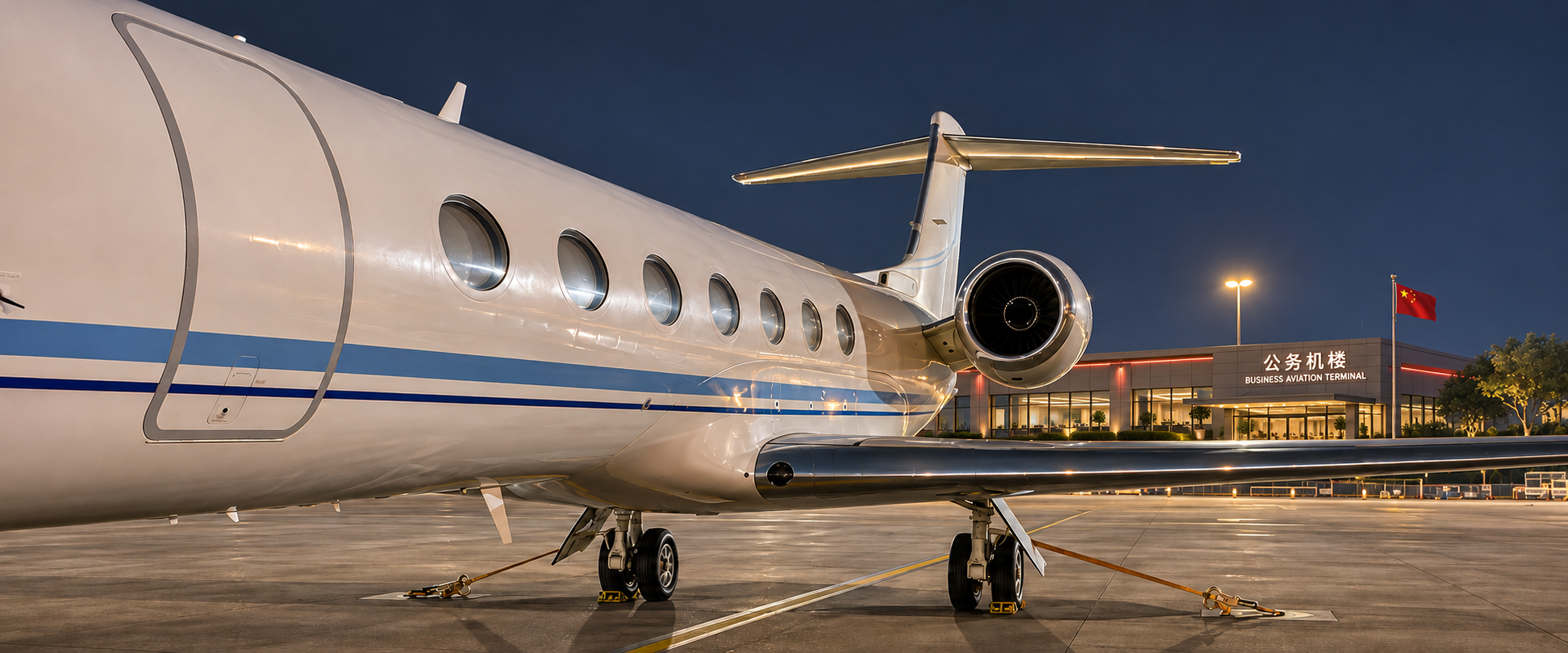

Quick Summary
- An updated guide to operating business aircraft into China, with a few lessons learned from 20 years flying around Asia.
- All the most important things to know: importance of using a decent local handler, airports open to foreign business aviation, permits, route restrictions, metric flight levels, radio comms, parking limits, customs, catering, crew visas, GPS interference, in-flight connectivity, Alipay and WeChat.
I’ve been based in Asia for the past 20 years and regularly fly into China. It’s a great place to fly, but it can also be one of the more challenging countries to operate into, particularly if you’re not familiar with the region.
My biggest advice? Be prepared, use standard ICAO English, be flexible, have a trusted ground handler and above all, be patient.
China is busy, really busy, just like the US and Europe, there is a huge domestic and international airline flights. Where it differs is how much restricted airspace there is (hint: a lot). And to compound things, there are some fairly restrictive rules about where foreign aircraft can fly. When you add permits, parking, customs and the occasional last-minute restriction, it is a lot to think about. Here are my top tips…
Get yourself a good handler.
I’m putting this first because, in my experience, it’s probably the single most important thing you can do. Good handling won’t be cheap, but trust me, you want good. Having a good handler who knows the local authorities, understands the airport restrictions and can get answers when things change is the best thing you can do to ensure a successful trip.
If it’s your first trip to China, ask other crews who fly here regularly for recommendations. There are plenty of options, and some trip support companies also have local agents who work directly with the airport handlers.
To give you some perspective on what a great handler looks like, I have a support team in a WeChat group. Day or night, I can drop a message and almost immediately have somebody helping me. I cannot stress enough how valuable that is when operating in China.
When I think back to my first trip to Shanghai and compare it to my last one just two weeks ago, I’m amazed at how much things have changed, and for the better. But be mindful that changes can happen overnight, so having a good local contact is a must.
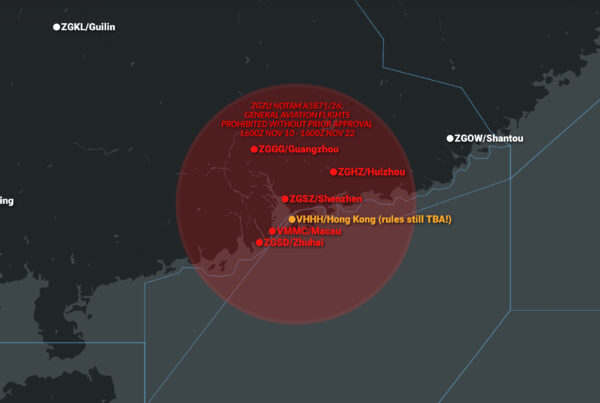
Recently, we’ve seen business aviation restrictions introduced at Beijing and Xiamen with little warning, with significant operational impacts lasting days or even weeks. An airport that was perfectly accessible when you started planning might not be available when you’re ready to depart.
My trusted handler is Yini Lin at Affinity Aviation, which recently rebranded from Universal Aviation. I’ve worked with Yini on my own flights into China, and she’s the person I have on speed dial when I need something sorted. (Don’t let the name change fool you. It’s still the same ground handling business, with the same teams and, most importantly in China, the same relationships.)
Email: ylin@affinityaviation.com
Mobile: +86 180 0119 8220
Website: https://www.affinityaviation.com/
Not every airport is open to foreign business aviation
This has caught me out before. You get told the boss wants to visit a golf resort somewhere in China. There’s an airport nearby with a big runway, so naturally, the assumption is that you can fly them there.
Unfortunately, it’s not that simple. China only opens certain airports to foreign business aviation. Whilst we can call it a “list”, it’s not quite that clear-cut. If your destination isn’t on it, things become considerably more complicated.
You’ll need a government sponsor letter and a CAAC navigator onboard. The navigator brings the local airport charts, which won’t be available in your usual charting system (Jeppesen/Lido), and handles communications with ATC. They must be part of your crew.
Getting a permit for an airport that’s not on the list is difficult. Without the right local government support, it may simply not be possible. Even with a local sponsor, give yourself plenty of time, generally three weeks or more.
Things are easier when operating into an ‘open’ airport, but just because foreign aircraft can apply for permits doesn’t mean access is guaranteed. Parking restrictions, military activity, major events and short-notice government requirements can all affect your plans.
My best advice is to stay in close contact with your handler before getting too far into the planning phase. They’ll be able to keep you informed when something changes.
The following list was provided by my handler and was current as of October 2026.
Airports open to foreign business aviation:
| ICAO | Airport | ICAO | Airport |
| ZBAA | Beijing Capital | ZBAD | Beijing Daxing |
| ZBTJ | Tianjin Binhai | ZBSJ | Shijiazhuang Zhengding |
| ZBYN | Taiyuan Wusu | ZBHH | Hohhot Baita |
| ZBLA | Hailar Dongshan | ZBOW | Baotou Donghe |
| ZYTX | Shenyang Taoxian | ZYTL | Dalian Zhoushuizi |
| ZYCC | Changchun Longjia | ZYYJ | Yanji Chaoyangchuan* |
| ZYHB | Harbin Taiping | ZSPD | Shanghai Pudong |
| ZSSS | Shanghai Hongqiao | ZSNJ | Nanjing Lukou |
| ZSWX | Wuxi Shuofang | ZSCG | Changzhou Benniu |
| ZSXZ | Xuzhou Guanyin | ZSYN | Yancheng Nanyang* |
| ZSLG | Lianyungang Baitabu | ZSHC | Hangzhou Xiaoshan |
| ZSNB | Ningbo Lishe | ZSWZ | Wenzhou Longwan |
| ZSZS | Zhoushan Putuoshan | ZSOF | Hefei Xinqiao |
| ZSTX | Huangshan Tunxi | ZSFZ | Fuzhou Changle |
| ZSAM | Xiamen Gaoqi | ZSQZ | Quanzhou Jinjiang |
| ZSCN | Nanchang Changbei | ZSJN | Jinan Yaoqiang |
| ZSQD | Qingdao Jiaodong | ZSYT | Yantai Penglai |
| ZSWH | Weihai Dashuibo* | ZHCC | Zhengzhou Xinzheng |
| ZHHH | Wuhan Tianhe | ZGHA | Changsha Huanghua |
| ZGDY | Zhangjiajie Hehua | ZGGG | Guangzhou Baiyun |
| ZGSZ | Shenzhen Bao’an | ZGOW | Jieyang Chaoshan |
| ZGNN | Nanning Wuxu | ZGKL | Guilin Liangjiang |
| ZJHK | Haikou Meilan | ZJSY | Sanya Phoenix |
| ZUCK | Chongqing Jiangbei | ZUUU | Chengdu Shuangliu |
| ZUTF | Chengdu Tianfu | ZUGY | Guiyang Longdongbao |
| ZPPP | Kunming Changshui | ZPLJ | Lijiang Sanyi |
| ZPJH | Xishuangbanna Gasa | ZLXY | Xi’an Xianyang |
| ZLLL | Lanzhou Zhongchuan | ZLDH | Dunhuang Mogao |
| ZLXN | Xining Caojiabao | ZLIC | Yinchuan Hedong |
| ZWWW | Urumqi Diwopu | ZWSH | Kashgar Laining |
ZYYJ, ZSYN and ZSWH are listed as open only to Korean-registered aircraft.
Please don’t use this list as a reference, it is just a guide to show you which are currently open airports. Airport restrictions can change overnight so please check with your handler before committing to a trip.
Permits: Don’t wait, get started early
There are two types of permits you’ll need to consider when operating in China:
- Landing Permit
- Overflight Permit
And this is generally where things start to get a little more complicated.
Back in March 2025, the CAAC (Civil Aviation Administration of China) introduced additional documentation requirements through what it calls the “Preflight Permit Application System”. You have to provide your aircraft registration certificate, certificate of airworthiness, radio licence, insurance, noise certificate, cabin layout and an authorisation letter.
The good news is that these docs can be kept on file, so the most painful part is usually the first application. If have not done this before, then your handler will need to complete that process at least five working days before submitting a landing permit application.
If you think you might come to China one day then this is something you can do in advance – just because you’ve got nothing on the schedule doesn’t mean you can’t get the paperwork ready.
There was another change on April 1, 2026 (and no, sadly it wasn’t an April Fools’ joke). All ATC charges must now be prepaid, or covered by a registered Letter of Guarantee (LOG), before CAAC will accept a landing or overflight permit application. This includes enroute and approach control charges.
The LOG isn’t really an option for most operators, so letting your handler be the middle man will make your life much simpler.
You should also try to avoid unnecessary last-minute changes to your routing or schedule. China isn’t particularly forgiving when permits need repeated revisions, and too many changes can put your approval at risk.
Don’t expect your requested flight level
This is probably one of the biggest differences you’ll notice when flying in China.
There is a LOT of traffic, and a LOT of restricted airspace.
Next time you’re there, turn on the airspace display on ForeFlight or your ND. It will help explain why the airways go where they do. Foreign operators are restricted to certain routes, so you won’t always be able to fly the most direct route or at the level you’d normally expect.
When flying domestically, I generally plan to be somewhere in the high FL200s or low FL300s. If I’m transiting Chinese airspace on my way to or from Europe, I might get as high as FL411, although FL391 is often more realistic.
And when ATC keeps you low, repeatedly asking for higher generally isn’t going to help.
It’s really important to plan your fuel around these constraints. Do your planning on the assumption that you’ll be kept low. If you manage to get your optimum level shortly after departure, I’ll buy you a gin and tonic. Sadly, this generally doesn’t happen, and if you plan for a level you’re unlikely to get, you’re going to get caught out.
It’s not unusual to remain lower for a considerable portion of the flight, and reroutes are always a possibility.
Don’t expect too many direct-to clearances either. The route structure is heavily influenced by military airspace, and ATC often has very little flexibility. If you need weather deviations, I’ve found that requesting a heading is more likely to be approved than a track offset. If neither works and you genuinely cannot avoid hazardous weather, don’t hesitate to declare PAN PAN if the situation warrants it.
I do a lot of long-haul flying out of the region, and while I have no issue planning Hong Kong or Macau to the US East Coast, I don’t plan the same flight nonstop out of China. We normally stop in Nagoya to pick up fuel before continuing to the US.
While we’re talking about fuel, it’s worth knowing that at many airports, fuel uplift is restricted to departure because of the local customs process. So don’t plan on refuelling on arrival without checking first.
The good news is that fuel in China can be relatively inexpensive. I’ve recently seen prices around US$4-5 per US gallon, although this varies by airport and supplier.
We always tanker fuel out of China because the price and aircraft performance make sense to our operation, but make sure you understand the local fuelling arrangements first.
Remember the metric flight levels
China uses metric cruising levels. Your aircraft and crew need to be set up for this, and you should be familiar with the metric-to-feet conversion procedures before entering Chinese airspace. You’ll notice that assigned flight levels don’t correspond to the usual ICAO levels. Think FL271, FL391, etc.
Use the published Flight Level Allocation Scheme (FLAS) conversion table and your approved aircraft procedures. Don’t try to calculate the conversions on the fly.
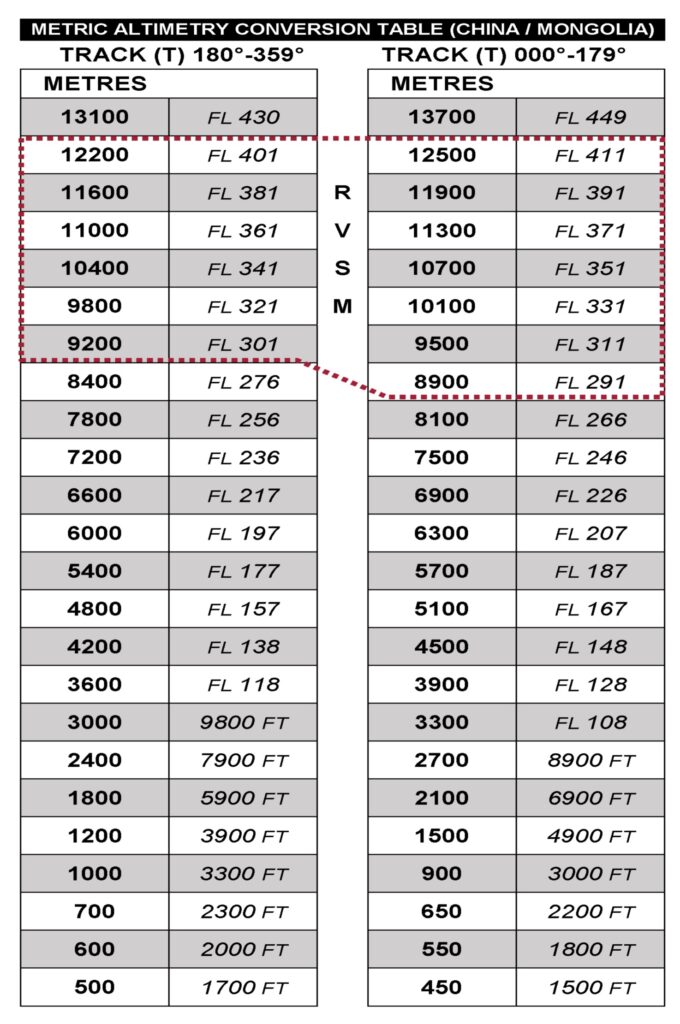
Metric levels are assigned by ATC in China. In my experience, when entering Chinese airspace, ATC will generally move you to the nearest metric cruising level. This is often only 100-200 feet from your previous level. When leaving China, you can expect a new clearance around 20 NM before leaving Chinese airspace.
Something that caught me off guard during my early years flying in China was the altimeter setting phraseology. ATC will clear you to climb or descend “on standard” – meaning you’re flying a flight level. If they clear you to climb or descend “on QNH” – you’re flying an altitude using the local QNH.
For years, I thought they were saying “non-standard”.
Finally, it’s very common to be asked to descend at 2,000 fpm or greater due to overlying airspace restrictions. If you work with ATC and help them out, you’ll generally find they’re very accommodating.
Keep your radio work simple
There are a lot of frequency changes in China, and sometimes they come fairly quickly. Pay attention and make sure you’ve copied the next frequency correctly.
The use of standard ICAO English is a must. Speak clearly, keep it simple and avoid conversation. ATC generally works well, but English proficiency varies sector to sector. Standard phraseology makes everybody’s life easier.
It is becoming more common for the bigger airports to have D-ATIS and PDC. However enroute datalink is a different story – CPDLC isn’t available across most Chinese airspace. Limited services exist on the L888 and Y1 routes, but these routes require special approvals and aren’t generally available to business aviation operators.
Keep a listening watch on 121.5 MHz as well. If you miss a frequency change, you may receive a call asking you to contact ATC. CAAC takes communication failures seriously, and if you do loose comms during your flight, even for a short while, it’s probably that you will get a RAMP check on arrival. I always use my Bose headsets rather than relying on the cockpit speaker when operating in China.
Parking can be the hardest part
Getting a landing permit doesn’t necessarily mean you’ll get the parking you want.
China’s two biggest aviation hubs, Beijing and Shanghai, are great examples of where business aviation parking can be limited and restrictions can change at short notice. Sometimes you won’t receive final parking confirmation until quite close to arrival. At other times, you may need to reposition the aircraft after dropping off passengers.
If you need to go into Beijing, ZBAA/Capital generally limits business aviation parking to 24 hours and requires a local invitation letter. ZBAD/Daxing and ZBTJ/Tianjin can be useful alternatives, as they don’t normally require special approvals and long-term parking is generally available.
Shanghai has similar challenges, with ZSSS/Hongqiao and ZSPD/Pudong having different operating and parking limitations. Don’t assume an airport that worked for your last trip will work the same way next time.
At some airports, hangar space is available and may help secure your parking. Whenever we operate into ZSSS/Hongqiao, we arrange a hangar, which allows us to get parking confirmed much earlier.
One final point about parking: at many Chinese airports, GA aircraft, including large-cabin Gulfstreams, are required to be tied down to the apron.
Yes, just like we used to do with our Cessnas.
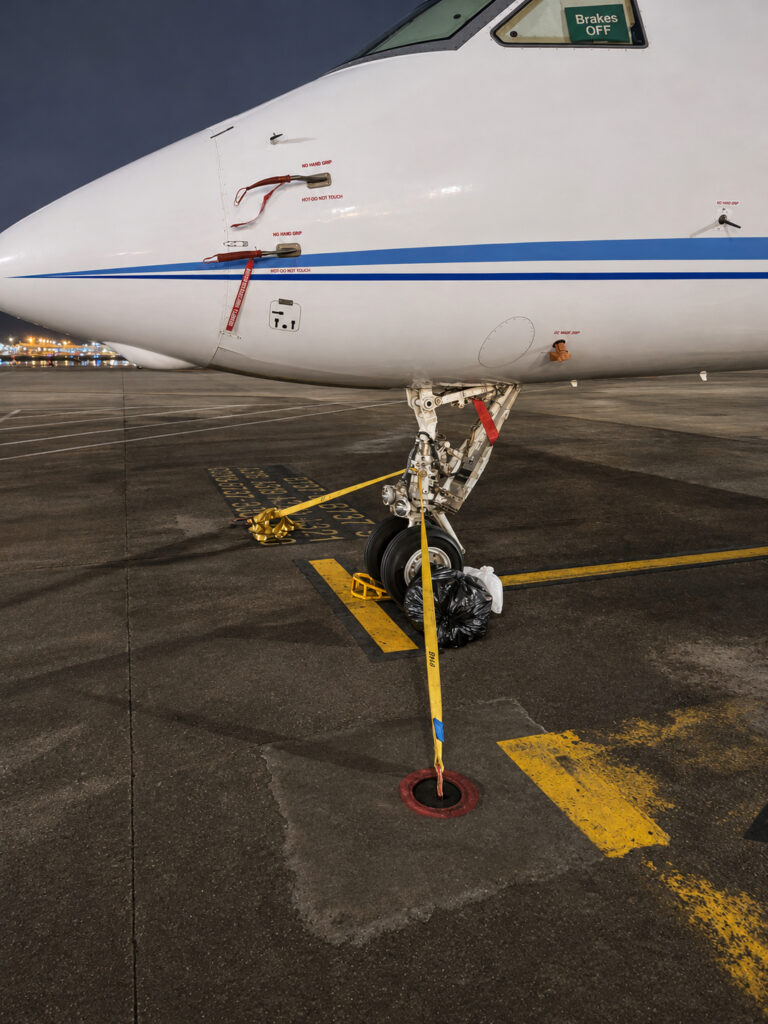
G550 Nose Tie Down.
The ground handler will arrange the straps, but I’d recommend checking with your engineer how they should be fitted to your aircraft. Typically, one strap is provided for each wheel, secured to two tie-down points on the apron. Most larger airports have an MRO presence, so getting an engineer or mechanic to help generally isn’t too difficult. Just plan ahead.
During typhoon season (May-October), airports may require aircraft to be moved if there’s a typhoon threat. Depending on the storm’s track, Japan or Korea may be practical relocation options. Otherwise, check whether a local hangar is available.
Customs will inspect everything
Be prepared for very thorough customs inspections on both arrival and departure. In my experience, every drawer, cupboard and door on the aircraft will be opened and checked. Be patient. It’s their process, and getting frustrated won’t make it go any faster. They also tend to carry body cameras, so make sure you smile!
Keep the cabin organised, have your paperwork ready and allow plenty of time for the inspection. I usually allow around 30 minutes for customs on both arrival and departure.
It’s also normal for your passport to be taken away during the customs and immigration process. Don’t be alarmed, you’ll get it back before leaving the airport.
One final tip for crews: once you’ve cleared customs and left the airport, you generally won’t be able to return to the aircraft until departure. If you need to update navigation databases, complete a fuel sump check or carry out any other work onboard, make sure it’s done before leaving the airport. Otherwise, plan to arrive earlier on departure day. Customs will normally allow crews airside access within three hours of ETD.
Getting back to the aircraft during your layover is generally not possible, so plan accordingly.
Catering needs some planning
Your cabin crew is going to have a harder time sorting out the catering than you are probably used too. At most airports, security restrictions mean you can’t just carry food through the terminal and take it onboard. Try and arrange catering through your handler, they will then arrange it to get onboard. Often they will be able to recommend local restaurants or hotels that can help you as well.
If you have special catering requirements, or you’re planning to bring food from outside the airport, discuss this before arrival. It’s much easier to sort out in advance than discover on departure day that your catering can’t get through security.
And if you decide to grab a coffee while you’re in the terminal, drink it quickly! Security probably won’t let you take it onboard.
Check everyone’s visa, especially positioning crew
This is something I regularly see catch people out.
Operating crew WILL need a Chinese crew visa (C visa), unless they hold a valid Home Return Permit.
I recommend that any crew coming into China also get a business visa (M visa). Chinese consulates will generally issue both, and having the M visa gives you another option if you unexpectedly need to position into or out of China on an airline.
Remember that China’s visa-free entry arrangements don’t apply to operating crew. Make sure everyone has the correct docs, including cabin crew and engineers.
Getting an engineer to the aircraft if they didn’t arrive with you can be particularly difficult. I always carry mine with me when we’re doing China flights. If you’re planning a crew change, check the requirements with your handler well in advance.
Your handler will usually need to issue supporting letters for crew arriving or departing on an airline flight. I also ask my handler to arrange an escort for positioning crew. It saves a lot of stress at airline check-in and immigration.
GPS interference and Joint Civil/Military Airports
GPS interference has been reported in China. OPSGROUP has received reports of GPS jamming and spoofing around Beijing, including aircraft experiencing navigation position errors, synthetic vision problems and false terrain warnings.
More recently, there have also been reports around ZGGG/Guangzhou and nearby VHHH/Hong Kong.
China has numerous mixed civil/military airports, where restrictions on photography and aircraft movements can be very strict. At some airports, you’ll be instructed to close all cabin window shades during approach, taxi and departure.
Don’t ignore these instructions from your handler. Compliance is checked. You must follow these local instructions, and don’t photograph military aircraft or facilities. Crews have been detained while their phones and cameras were checked, so don’t be that crew.
Starlink won’t work in China
If you have Starlink, you will need a backup plan because it won’t work in Chinese airspace.
The service is geofenced automatically and, in my experience, disconnects as you enter China’s FIR.
Other satellite connectivity systems, including Viasat and Inmarsat’s Ka-band or Ku-band systems, generally continue to work. If your aircraft has a one of these connectivity systems, it is probably wise to make sure you have it working.
Finally be sure to let the passengers know that they are likely to have internet issues during the flight, this will solve any heartache that might come from an unexpected Zoom call dropout.
Alipay and WeChat – get both.
This last one has nothing to do with flying the aircraft, but it might be the most useful tip for your layover.
You really do need Alipay and WeChat in China.
China is practically cashless, and these two apps are used for just about everything. When I say cashless, I really do mean it. I haven’t spent a single RMB note in a decade.
Whilst cash is legally accepted in China, in practice you’ll find very few people want to take it. Save yourself the hassle and get the apps set up before you arrive.
The good news is that foreign visitors can now link international credit cards to both apps. You’ll use them for paying in restaurants and shops, communicating with people locally and booking transport.
For taxis, I would recommend using DiDi which is China’s equivalent of Uber and can be accessed through the apps. I always prefer DiDi over picking up a taxi on the street. You know who’s collecting you, where you’re going and what the trip should cost.
My advice is to install both apps, register your accounts, link your credit cards and make sure everything works before you arrive in China. If you need help, your hotel concierge can usually sort you out, or just ask your handler on arrival, they will be able to get you on track before you leave the airport. Another advantage of these two apps is the translation service, using Didi through Alipay or WeChat will automatically make the app English, and allow you to communicate with your driver as well.
Get these apps up and running before you you’re standing outside a hotel trying to go for dinner.
We also use WeChat to communicate with our local handlers.
Finally, remember that when you connect to local Wi-Fi in China, apps such as WhatsApp and Facebook generally won’t work. If you’re using an international data roaming package, these services will often continue working without a VPN. And speaking of VPNs, don’t assume yours will work. China’s internet restrictions block many of them.
For me, international roaming is generally the easiest option, and it’s how I keep in touch with the rest of the world. Remember that roam e-sims such as Airalo etc, will be the same as using a local SIM card, so it is probable that the Chinese firewall settings will apply.
Final thoughts
China isn’t difficult because of any one particular rule. It’s the combination of restricted airspace, traffic, permits, airport access and procedures that can change with very little notice.
I have spent 20 years based in Asia, and my approach has always been simple. Prepare properly, always carry extra fuel for the levels and routing you’re likely to get, not just the ones you’d like. Be patient with ATC and customs, and make sure the paperwork is right.
Finally and above all, have a good local handler you trust. That’s what makes the difference between a stressful trip and a great experience, both for you and your pax.

More on the topic:
- More: APEC 2026: Business Aviation restrictions around Shenzhen
- More: Beijing’s New 600km Restricted Area
- More: China-Taiwan M503 Airway Dispute
- More: The Annual Shanghai Airports Meltdown
- More: Shanghai: ZSSS closed to non-sched traffic
More reading:
- Latest: 2027: What’s changing on the North Atlantic?
- Latest: APEC 2026: Business Aviation restrictions around Shenzhen
- Latest: Top Tips on China Ops
- Safe Airspace: Risk Database
- Weekly Ops Bulletin: Subscribe
- Membership plans: Why join OPSGROUP?





 Get the famous weekly





Amazing work on this guide, Andy. Thank you!