Singapore Ops Update: Two New Rules to Know Before You Go

If you’re planning ops to Singapore this year, expect it to be busier than ever. Traffic into Singapore exceeded previous records last year, and slots and parking are already harder to secure than they used to be.

In addition to the capacity challenges, there have also been changes to immigration and operator procedures that can catch you out if they’re not on your radar. They’re not complicated, but they do mean doing things earlier than before. These include the new No-Boarding Directive (NBD) for passengers and updated requirements around the Singapore Foreign Air Operator Certificate (FAOC).

NBD – No-Boarding Directive

Effective 30 Jan 2026, all operators (private or commercial) must check passengers in advance for a clearance (or refusal) to enter Singapore.

You can check the official announcement on this here. The process sounds more complicated than it really is. In the past, passengers who were denied entry would only be identified after arrival, once immigration determined they were ineligible to enter Singapore. This could be due to a lack of visa, being assessed as an undesirable or prohibited traveller, or a red flag arising from their SG Arrival Card submission.

Previously, the system waited until the passenger was already on Singapore soil, which was always somewhat counter-intuitive. From 30 January, however, an operator must receive confirmation that a passenger is cleared to enter (effectively a green light). If you carry a passenger into Singapore without this clearance (even if that passenger ultimately would have been approved) the operator is liable for significant penalties under the Immigration Act.

So what do you need to do?

As the operator, your role is actually very simple. You must submit your general declaration / passenger manifest to your agent or handler ahead of departure. Current guidance is no later than two hours before departure. This allows the handler to submit the passenger details via a dedicated ICA portal.

That portal will return one of two responses: “OK to Board” or “Do Not Board.”

The key takeaway is this: you must receive one of these two responses before departure. In this case, no news does not mean good news.

The upside is that operators do not need access to the portal themselves (and cannot access it anyway). Everything is handled by your agent. Your only responsibility is to ensure the passenger manifest is submitted in good time before departure.

FAOC – Singapore Foreign Air Operators Certificate

In Singapore, any foreign AOC holder (Part 121 or Part 135) is now required to apply for a FAOC (local validation of your AOC). This process is completed online via the Flight SG portal.

You should allow 2-3 weeks to receive your FAOC, which is typically valid for 3-6 months on the first application. Subsequent approvals generally come with a longer validity period. Be aware that CAAS conducts ramp checks on all FAOC holders, and in particular, operators are more likely to be ramped during the renewal period. CAAS follows the standard SAFA inspection methodology.

The FAOC itself is not new. What has changed is the introduction of ANR-129, which is now in force. This replaces the old FOSP (Foreign Operator Surveillance Programme) and the permit rules that went with it.

So what does ANR-129 change?

Quite simply, any aircraft listed on an AOC must now hold both a valid FAOC and a permit to operate into Singapore. CAAS no longer exempts ferry, positioning, or so-called “private” flights if the aircraft is on an AOC.

The only operations exempt from the FAOC requirement are private aircraft (Part 91 / CAT 2) and certain emergency situations. Overflights are also exempt. This means that any aircraft operated commercially overseas must still hold a FAOCif it is coming to Singapore for maintenance, or even if it is operating an owner-only flight.

The FAOC application process is well documented on the CAAS website, so I won’t repeat it here. The key point is to apply well in advance of your planned operation to avoid any last-minute surprises.

CAAS is currently conducting frequent ramp checks to ensure compliance, and ground handlers are now verifying FAOC permits before confirming airport slots.

More info on Singapore ops

If you’re flying a bizjet into Singapore, WSSL/Seletar is your only option. Our recent guide covers the key survival tips – from managing the visual-only arrivals to dealing with limited parking and other quirks that can catch you out. OPSGROUP members can access the guide via your members dashboard here.


March 2024 Singapore Airspace Changes

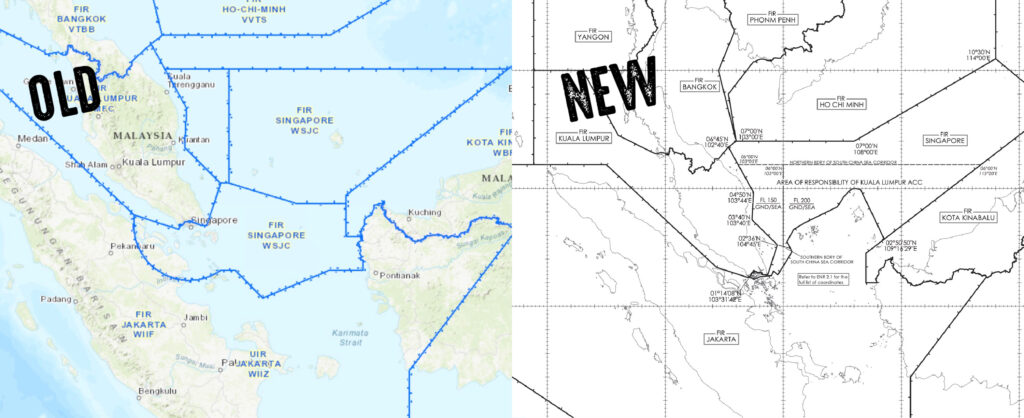
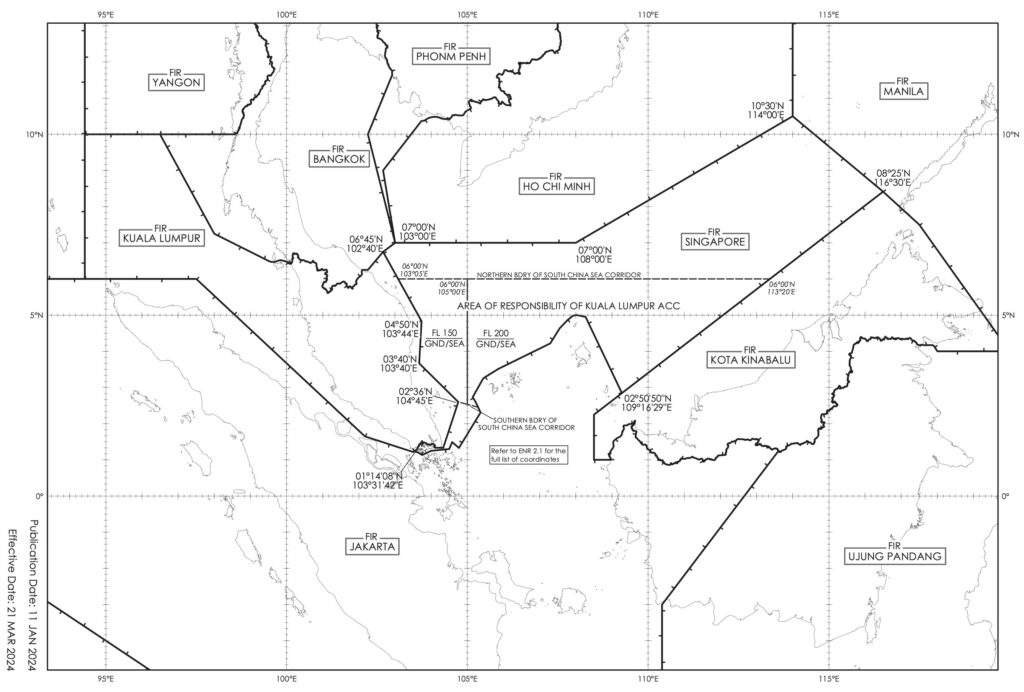
Singapore and Indonesia will realign their FIRs from 21 Mar 2024.

They agreed to do this so that the new FIR boundary (between the WSJC/Singapore and WIIF/Jakarta FIRs) will be generally more aligned with Indonesia’s territorial boundaries.

It looks like not much will change in terms of flight ops, as Singapore will continue to control the airspace. For full details of the upcoming change, check SUP 18/2024.

But there is one important issue this FIR realignment will hopefully fix for good – it will now be more clear that overflights of Indonesia’s Riau Islands require an Indonesia overflight permit!

This has been an issue in the past, with some flights not realizing they needed an Indonesia overflight permit to overfly these islands – as they sat under the WSJC/Singapore FIR. 

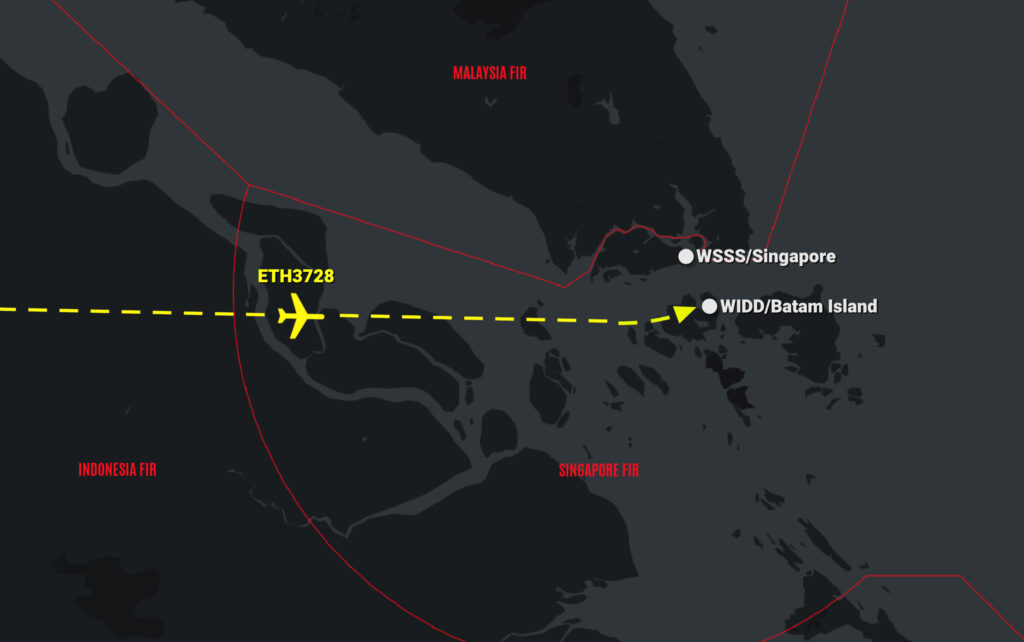
In 2019, two Indonesian F-16s intercepted an Ethiopian Airlines cargo flight for flying across Indonesian airspace without permission. The aircraft was initially supposed to operate from HAAB/Addis Ababa to VHHH/Hong Kong, but was modified at the last minute to route via WSSS/Singapore instead. The aircraft was intercepted forced to land at WIDD/Batam Island.

There have been several other incidents both before and since then, including some where Indonesia blamed US and Indian military planes of violating their airspace without permission.

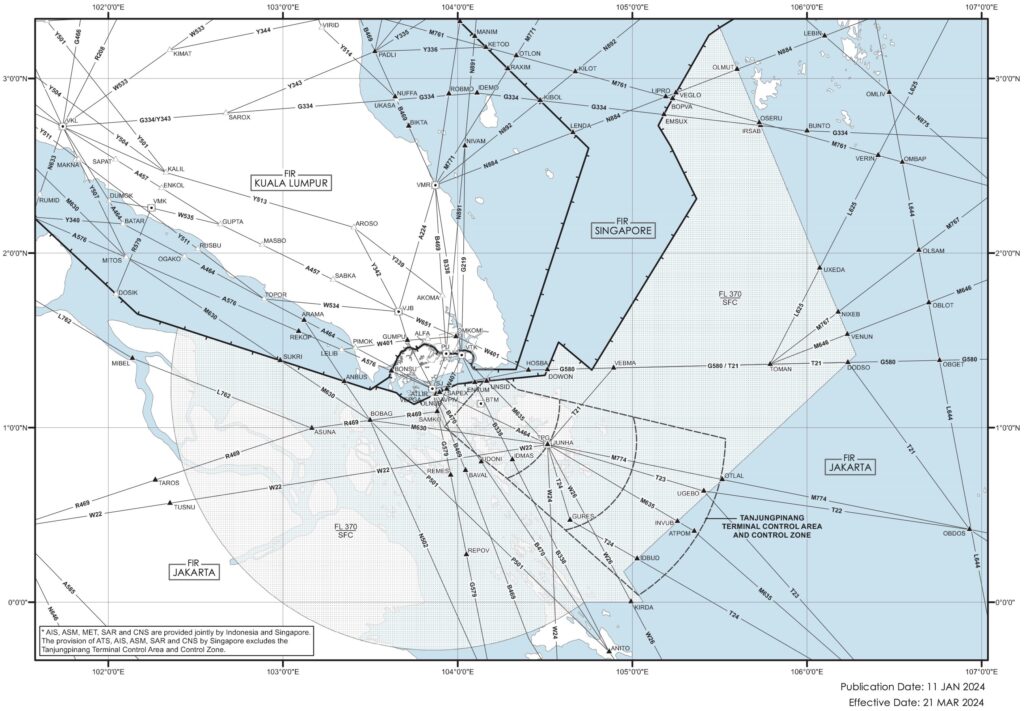
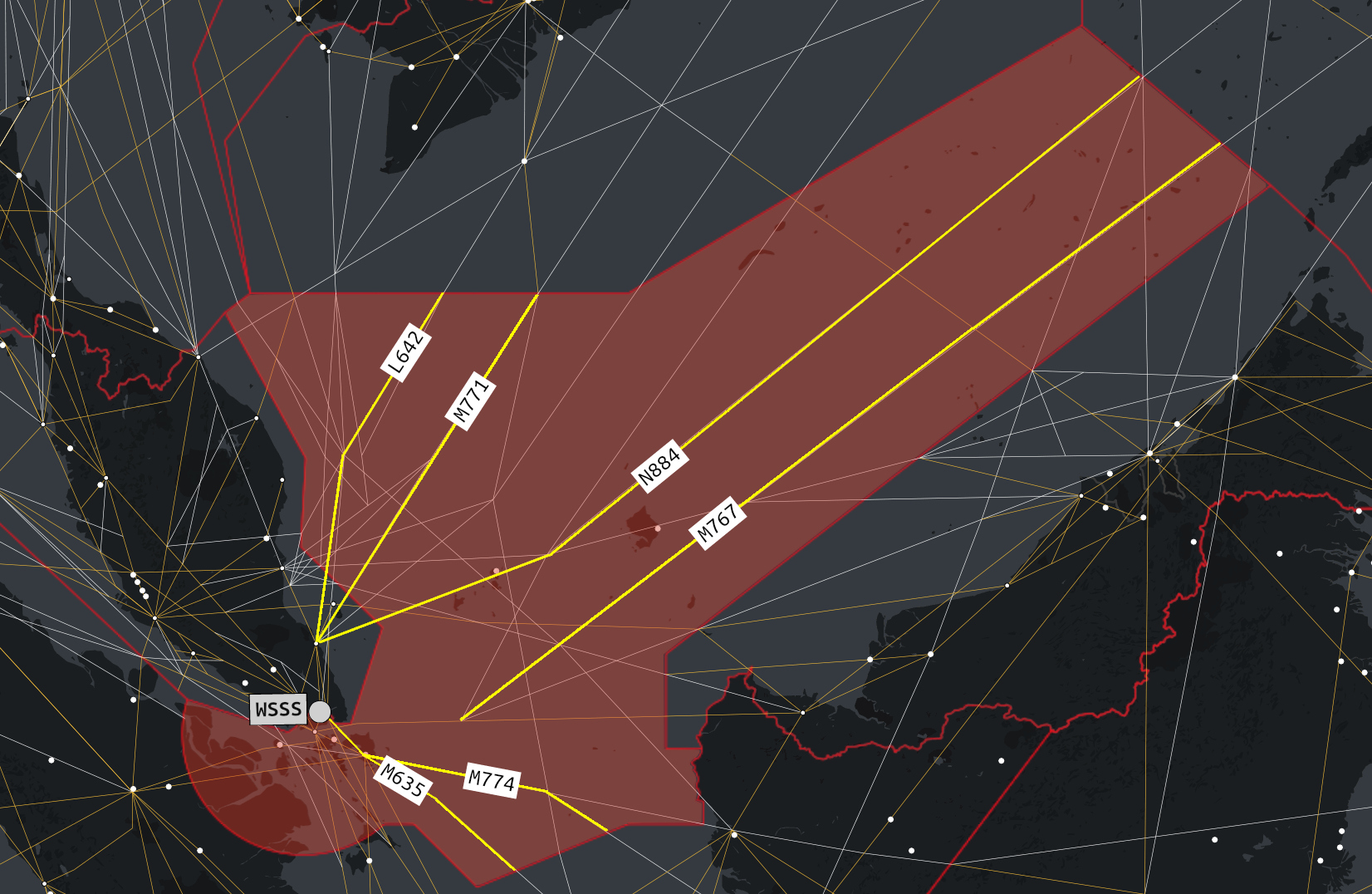
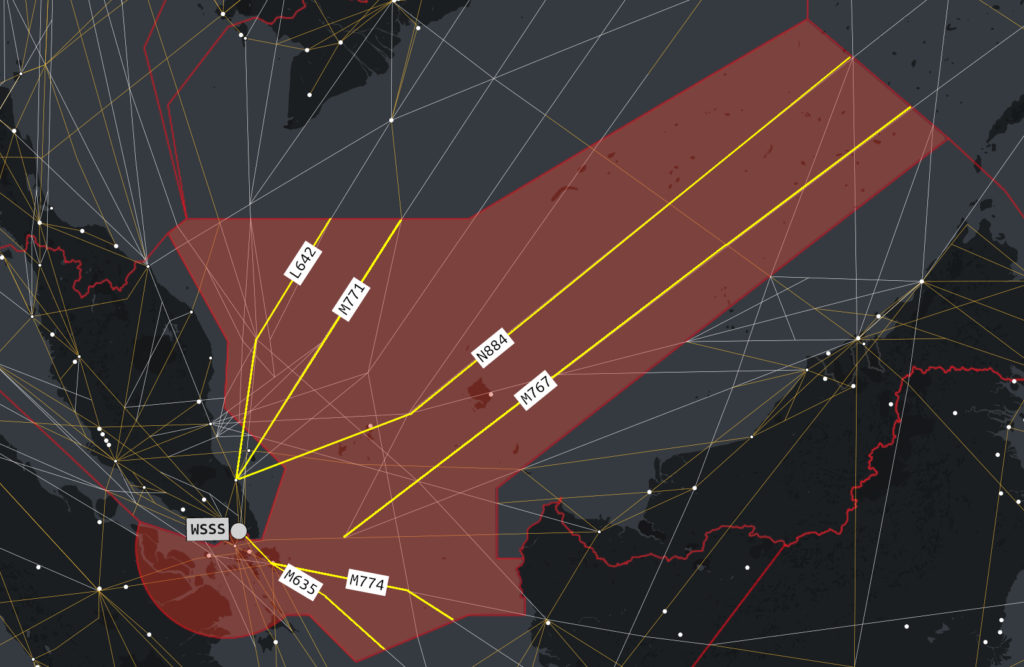
But when the FIRs realign on 21 Mar 2024, there should hopefully be no more confusion about permit requirements for this chunk of airspace! You can find all the details in SUP 18/2024, but here’s how it’s going to look:

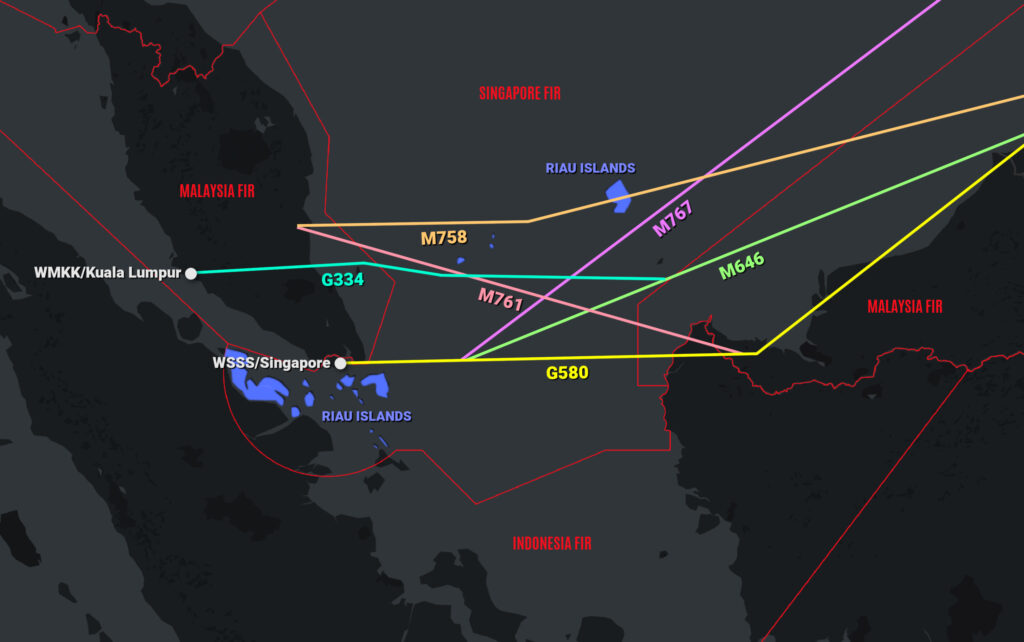
And this one is maybe useful too – this shows the airspace which will continue to be controlled by Singapore ATC:


South East Asia: Open for Business

The world is steadily emerging from the pandemic, and the Northern Hemisphere has arguably been leading the charge.

South-East Asia on the other hand has been lagging behind. The region’s countries have resisted joining the world’s ‘new normal’, instead relying on strict ‘zero-covid’ strategies that kept foreigners out, citizens in hotel quarantine, and crews cooped up in hotels. Until now.

In recent weeks and months, we have seen several major announcements from these countries that at last, they are willing to re-join the rest of the world – and that’s good news for the industry.

Here’s a rundown of the biggest changes happening right now.

Singapore

The News

From April 1, fully vaccinated foreigners (from anywhere) are once again be able enter the city-state without quarantine.

The existing ‘Vaccinated Travel Lane (VTL)’ scheme has been scrapped. For operators this means that passenger flights flying into the Lion City will no longer need approval to operate under strict VTL protocols.

Passenger Rules

For fully vaccinated passengers, click here.

For non-vaccinated passengers, click here. *Special approval is required, and in most cases non-vaccinated foreigners will not be allowed. Seven days of self-quarantine also applies.

Crew Rules

There are new rules for crew – one set for vaccinated crew (no restrictions on movement), and another set for unvaccinated crew (you have to stay in one of three approved hotels, and you’re confined to your room!).

But watch out for one important stipulation: if any crew are unvaccinated, ALL of you have to follow the unvaccinated set of rules.

Check new CAAS Circular 18/2022 Rev 2 for full details.

Malaysia

The News

It’s also good. From April 1, the country completely reopened to fully vaccinated passengers with no quarantine. Foreigners also no longer need to seek approval before travelling.

Passenger Rules

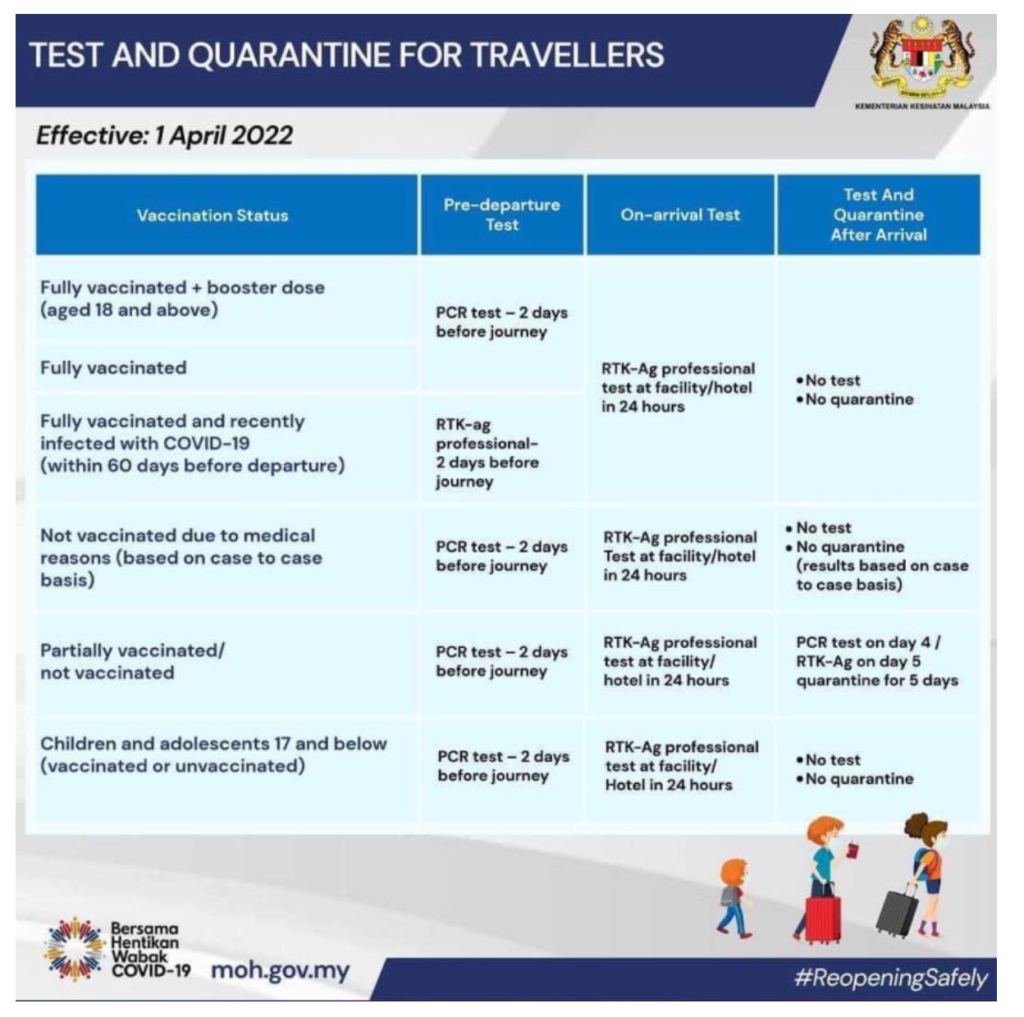
They’re complicated. And depend on vaccination status (they also take into account whether you have received a booster dose).

You can find that information here, but here’s a picture, because pictures are always better:

Crew Rules

Crew can only enter Malaysia through WMSA/Subang, WMKK/Kuala Lumpur or WMKL/Langkawi airports.

In all cases they require a PCR test that is less than 72 hours old at time of arrival. Subang seems to be the best option, with no quarantine or maximum stay. In Kuala Lumpur crew can only stay for 24 hours and must isolate in the hotel, while in Langkawi crew can stay for 72 hours and don’t have to isolate if they follow the same rules as tourists.

Indonesia

What’s the news?

They’ve dropped quarantine for both passengers and crew throughout the entire country. This follows a successful trial on the holiday island of Bali.

Passenger Rules

They’ll need a PCR test taken within 48 hours before departure for Indonesia. Keep in mind this can be a tight turn around for busy labs – the global standard seems to be 72 hours.

Crew Rules

You’ll need a certificate or card proving you are fully vaccinated, along with a PCR test. The rules are a little easier for crew – you have 72 hours to get that done before you leave for Indonesia. There will also be a travel declaration to fill out, but you’ll be free to leave the hotel and enjoy your layover.

Vietnam

What’s the news?

Borders are now open to all foreigners, with no quarantine, as long as they hold a valid visa. Watch out for this gotcha though: the only visas available on arrival are currently for business travellers (not tourists). Everyone else will need to apply beforehand online. There’s a long list of countries that this applies to (including the US, Canada and UK) which you can access here. There are also visa exemptions available for select countries, see the image below.

Passenger Rules

They’ll need to get tested first, and there’s two options. A PCR test that is less than 72 hours old, or a rapid antigen test that is less than 24 hours old – both at time of departure for Vietnam. There’s an opt clause too, if they can’t provide proof of a test they can still travel but will need to get tested within 24 hours of touching down.

Crew Rules

Local agents advise that all the same requirements apply to crew as for passengers (including a valid visa or exemption) – that is if you want to enter the country.

Japan

What’s the news?

Ok, so not really South-East-Asia but we thought we’d include it anyway – given that Japan lifted its entry ban on foreigners from over a hundred countries on April 8 (including the US and UK). One big gotcha though – tourists will still have to wait. Pax will need to be entering for business, study or some other essential reason.

Passenger Rules

Depending on their vaccination status, where they are travelling from, and whether they are identified as a close contact of a positive case, they may be subject to up to 7 full days of quarantine and/or self-isolation on arrival.

For Japan’s horribly complex entry rules in their official format, click here.

Crew Rules

The crew rules remain a bit of a mystery. We’ve had some reports from crew saying they were unable to apply for any of the visas available to passengers (business, study, etc).

We haven’t seen any published rule changes here from how it worked before – crew can enter on a ‘shore pass’ arranged through their handler, but must self-isolate in the hotel for 7 days or until departure.

Opsgroup members have reported the following: “The guidance we received from our company is that crew members must stay in their rooms but can leave the hotel for exercise and to obtain food to bring back to eat in the room. No dining out, no shopping for anything other than food to eat in your room. We enter on a shore pass. For quarantine, we fill out two forms that ask about where we have been in the world and if we are feeling healthy, where we are staying, and if we have transportation (another quarantine requirement is that we don’t use public transportation). We also sign a pledge that we are going to follow the rules. They then give us a quarantine card to go with our shore pass. When we arrive for our return trip, we initial a paper saying that we followed the rules.”

If you’re considering a trip to Japan, try contacting a local handler (iajops@interavia.co.jp and fltops@aeroworks.jp are decent options) and check if there’s any update to these rules – especially those for crew (and please let us know what you find out!)

A note on Thailand.

Borders have been open to foreigners for a while now via three main entry schemes:

  • Test and Go (a quarantine free option)
  • Sandbox (restricted movement)
  • Alternative Quarantine Scheme (quarantine reduced to five days from April 1).

The main news is that in all cases the requirement for passengers to get tested before arriving has been scrapped from April 1. Crew can make use of the same schemes and enter under the same conditions as pax.

For more info on passenger entry rules, check out the official page here, as well as the handy checklist document put together by local handling agent Asia Flight Services (eff Apr 6).

Still closed for business.

Not all of South East Asia is open to foreigners yet, watch out for these ones:

Myanmar – International passenger flights are still not allowed to land. Visas are not currently being issued for foreigners.

Brunei – Entry is still severely restricted. Any foreigner needs approval first and non-essential travel is off limits.

Laos – Special permission is still required for foreigners, and tourism is a no-go.

Unsure? Ask the team.

Entry rules change quickly and can be frustratingly confusing to get your head around. If there is a specific country you are looking for info on, try the #questions channel in Slack, or reach out to us at team@ops.group and we’ll do our best to help you find the answers you’re looking for.


Ops Planning for the 2022 Singapore Airshow

The Singapore Airshow is back, and taking place from Feb 15-18 at WSSS/Changi airport.

As one of the largest aviation events in Asia, things are going to get busy.

If you’re flying in, here is a rundown of everything you’ll need to know before you get there.

Airport Closures

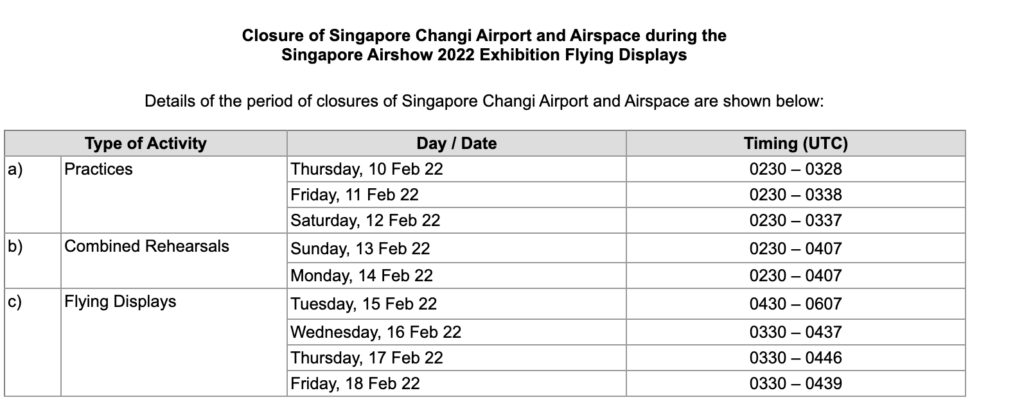
From Feb 10-18 Changi will close to all arrivals and departures for over an hour in the middle of each day. This is to allow for practice displays and then the main event.

The closures all commence late in the morning and vary slightly each time. You can find the exact timings below – Singapore’s time zone is UTC + 8.

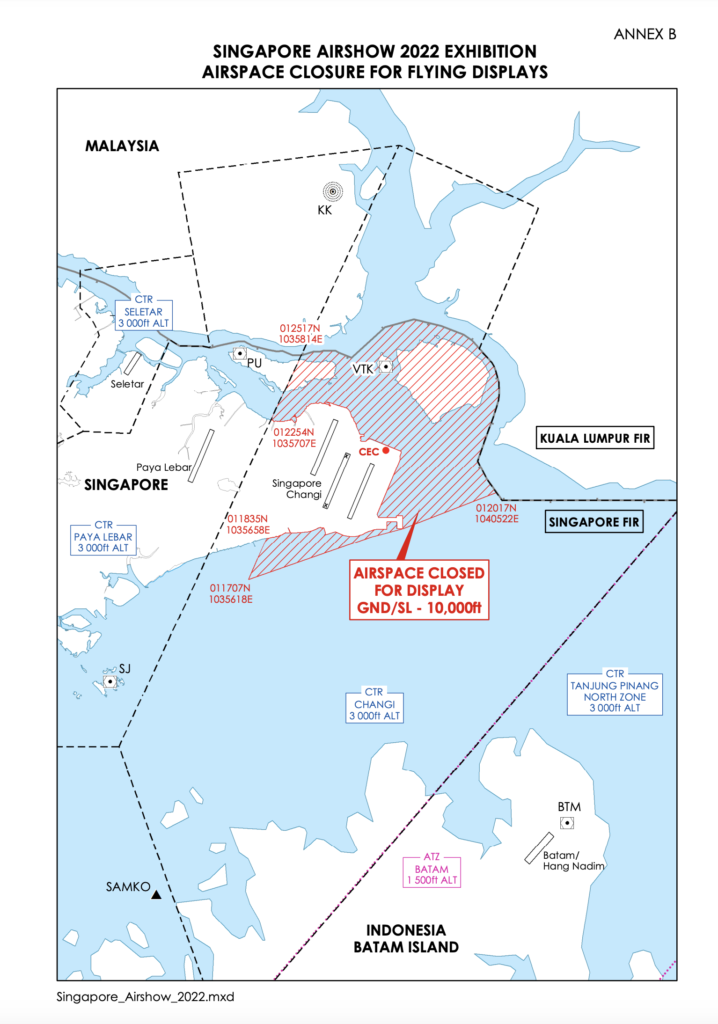
The restricted airspace covers a large portion of Changi’s CTR and will apply from surface to 10,000 feet.

Here’s a picture:

Nearby WSSL/Seletar will not be affected by the closures.

Rush Hour

Avoid planning to take-off or land on either side of the closure windows. There will likely be a back log of traffic and extensive delays. Arriving aircraft are advised to plan for at least an extra twenty minutes of holding fuel.

If you’re arriving from a major airport in the Asian region, also be aware of Singapore’s ground delay program which may be activated. Here’s the relevant page from Singapore’s AIP, but if you are departing an affected airport for Changi, you may need to stick to a calculated take off time (CTOT). The allowance is -5/+10 min. Outside of this window you’ll need to ask for a new CTOT.

Once airborne, if you get held up by more than 15 minutes make sure you let them know. Their AFTN address is WSJCZQZX.

Permits

Both private and commercial operators need a landing permit for Singapore. Commercial ones reportedly take a number of working days to process so apply early. You can speak to the CAA directly on +65 65 42 1122 or caas_atlas_admin@caas.gov.sg. If you’d prefer the help of a local agent, we’d suggest SG World Aviation Services. You can reach them on +65 85 774830 or ops@sgworld.net.

Weather

Singapore is found just one degree north of the equator, and so convective thunderstorms are common all year round, and can be quite severe. The worst times are in the afternoon and evenings. Expect to use additional fuel for deviations or holding.

Covid Entry Rules

The rules for foreigners to enter Singapore are tight. But there are ways they can enter with no quarantine. The most common is via the ‘Vaccinated Travel Lane,’ which most travellers are eligible for. There’s a bunch of boxes to tick here, so we recently put together this article that should help.

Crew have two choices. You can enter under the standard rules which don’t require a vaccination or Covid test. But you’ll be stuck isolating in the hotel until departure. If you want to get out (and enjoy the show) you can also apply for the VTL above if you follow the same requirements as your passengers.

Seletar

If you’re planning on flying into nearby WSSL/Seletar, the biggest issue is likely to be parking. If you haven’t already, make sure you get in touch with your agent to make sure you reserve a spot as the airport can quickly fill up.

The airport itself can be operationally challenging – there are no instrument approaches, and it is in close proximity to military airspace. Click here for a full briefing on what to expect.

The Official Word

You can find the official Singapore AIP Supp (026/2022) for the event here.


Demystifying Singapore’s Entry Rules

Ah, Singapore. The Lion City. Home to chilli mud crab, Clarke Quay, Raffles and some of the most confusing entry rules we have ever seen.

If you’re feeling particularly motivated, they’re all found on the official Safe Travel website. But brace yourself for bewilderment…

Or you could try this summary. It is a super simple break down of how the current entry rules work for passengers and crew alike. So hop aboard the Singapore Flyer and crack open a fresh Tiger Beer. We promise it’ll be a smooth ride.

Lanes, Lanes and more Lanes

All foreigners must apply for entry using an approved ‘travel lane’. Then they’ll get an approval letter before they travel.

For the vast majority of foreigners, the options are limited. There are lanes for those who live in Singapore, have immediate family there, study there or work there.

Surprisingly there is no general lane for business travel. Only ones with special rules for travellers from select Asian countries.

Which means the vast majority of foreigners headed to Singapore right now will only be using one lane – The Vaccinated Travel Lane, and it’s only for countries who have been good. It made headlines this week because the US, Canada, and the UK among others have been added to it.

Travellers from these countries can enter for any reason – as long as they’re vaccinated. So, let’s take a closer look.

The Vaccinated Travel Lane (VTL)

As the name suggests, all passengers must be fully vaccinated at least two weeks before they arrive. Click here for those requirements.

Passengers will need to prove it with either:

All passengers need to apply at least 7 days in advance to use the VTL. Don’t leave it until the last minute!

Here’s what they’ll need:

  • Their pre-approval.
  • A PCR test less than 48 hours prior to departure.
  • A PCR test on arrival (book and pay beforehand).
  • Travel insurance which includes at least $30K cover for Covid.

On arrival they will need to self-isolate in their hotel until the result comes back (about 24 hours). That’s it!

Can private aircraft use the VTL?

Great question – yes! Despite causing some confusion among FBOs there, Singapore’s CAA have clarified this with a new circular. If you’re operating a charter flight there, make sure you follow the rules. This includes getting approval from CAAS – apply at least a week in advance.

Jet Aviation, the handling agent based at WSSL/Singapore Seletar Airport, provided this FAQ on Oct 18, which includes some good info here:

  1. How do business jet pax apply for VTL?
    a) Foreign passengers must hold a valid VTP (Safe Travel). Take note that the trip must be a direct flight from VTL country to Singapore.
    Click on this link to apply for VTP – https://eservices.ica.gov.sg/STO/VTL
    **Recommended Internet Browser to be used – Google Chrome**
    Once approved, an email by Safe Travel will be sent to passengers via the contact details provided (eg. passenger’s email address).
    Alternatively, operators can “Check VTP status” (as shown above)
    b) Once VTP is approved, another application to CAAS must be submitted at https://go.gov.sg/nsvtl1
    CAAS VTL application for entry should be made at least 7 calendar days before the start of the flight, and approvals will be issued at least 2 calendar days before the indicated start date of the flight.
  2. In case of fuel stops, does the routing below qualify for VTL?
    VTL country > non-VTL country (fuel stop) > Singapore.
    (for example, London (origin) > Dubai (fuel stop) > Singapore. Is this a VTL?)
    No, this route arrangement does not qualify for VTL. Arriving from a VTL country, you must do a tech stop in another VTL country to qualify for VTL.
  3. What happens if there is a diversion of flight?
    VTL will not qualify if a flight is diverted from VTL country, to a non-VTL country, prior to arriving in Singapore.
  4. Can VTL be applied to Part 135 flights?
    Yes. Please ensure FOP and AT permits are in place first before VTP can be applied for the passengers.
  5. Do foreign crew qualify for VTL?
    CAAS strongly recommends crew to apply for entry into Singapore via existing schemes. The different types of entry approval for crew are as follows:
    — CAAS BAGA LAYOVER (for non-scheduled flights)
    — CAAS ANNEX A C33 LAYOVER (for maintenance flights only)
    However, foreign crew does qualify if they apply via https://safetravel.ica.gov.sg/vtl/requirements-and-process.
  6. Maintenance-related aircraft?
    Crew under VTP can perform post-maintenance Local Test Flights in Singapore.
  7. Will Long-Term Pass Holders (eg, EP), need both MOM approval and VTP?
    Yes. LTP Holders must obtain the necessary approvals to enter Singapore (applies to both Commercial Airlines and Non-Scheduled).
  8. Do passengers still need to have MTI and PBP passes?
    Yes. Passengers who have existing MTI and Pre-approved Business Passes approval must also apply for VTP to qualify for VTL. All passengers (if there are more than 01 passenger) must be fully vaccinated.
    We must emphasize that the purpose of VTL is to exempt passengers from serving SHN in Singapore.
  9. Are Guam and Hawaii considered part of the US territory, for VTL?
    Both Hawaii and Guam are considered part of the US continent. As such, tech stops at Guam are allowed for flights carrying VTL passengers.
  10. Are Monaco and Vatican City considered part of France or Italy?
    As for Monaco and Vatican City, these are city-states, and are not part of France or Italy respectively, so travel history for these locations within the last 14 days would disqualify pax from the VTL scheme currently.

Crew Layovers

So, you’ve scored yourself a layover in Singapore eh? Nice work! There are two options for crew:

The “I’d like to isolate in my hotel room” option.

 Then follow the standard procedures found in CAAS Circular 2021/08. Both operating and positioning crew are allowed.

You’ll need CAAS approval – make sure you apply at least two weeks in advance by emailing CAAS_FS_FOS@caas.gov.sg. When you get there, make sure you all have three bits of paper – your approval, a letter from your operator to say you are on layover and your crew passes.

For transport to your hotel you can only use one transport company – Woodlands Transport Service. You must then isolate in one of two hotels – the Crowne Plaza Changi Airport, or the Holiday Inn Orchard City Centre. Both are decent.

This is probably the easiest option if you’re staying for less than 24 hours.

The “I’m sick of isolating, I want to enjoy my layover” option.

We don’t blame you. In which case your only option is the Vaccinated Travel Lane – you’ll need to meet all the same requirements as the passengers including pre-approval, and *24 hours of isolation.

* you have to isolate until you get the SMS with a negative PCR test result. This is likely to arrive within 24 hours, but for scheduled arrivals at Changi airport it is taking 6 hours or less (reportedly as few as 2).

So probably only worth the fuss it if you’re staying for longer.

The Other Lanes

If you’ve made it this far, well done! If you’re only interested in the VTL the show ends here. But if you’re carrying passengers in other lanes, there’s one more thing you should know about – travel categories.

For almost all other lanes, testing and self-quarantine is required. The rules depend on where you have been in the last 14 days (including transit). Singapore divides the world up into four categories – 1 is the lowest risk, and 4 is the highest. The length of quarantine and where you have to do it depends on where you have been. You can find those breakdowns here.

We’re here to help.

Navigating entry rules in these times can be confusing and frustrating. If you still have questions reach out to us on team@ops.group, and we’ll do our best to help you find the answer you’re looking for.

Headed to Seletar?

We wrote an article on ops there recently, check it out here.


Surviving Seletar: Singapore’s Second Airport

Update Oct 2025

OPSGROUP members can access an updated version of this guide, effective Oct 2025, on the members Dashboard here.

Original Article from Sep 2021

If you’re planning to operate a business jet into Singapore, there’s a good chance you won’t be bound for WSSS/Changi Airport at all. Instead you may be headed for the lesser known WSSL/Seletar – Singapore’s secondary commercial airport, and it can be a lot more challenging.

Here’s a basic rundown of just what to expect to keep you ahead of the game next time you are flying into Seletar.
The Basics

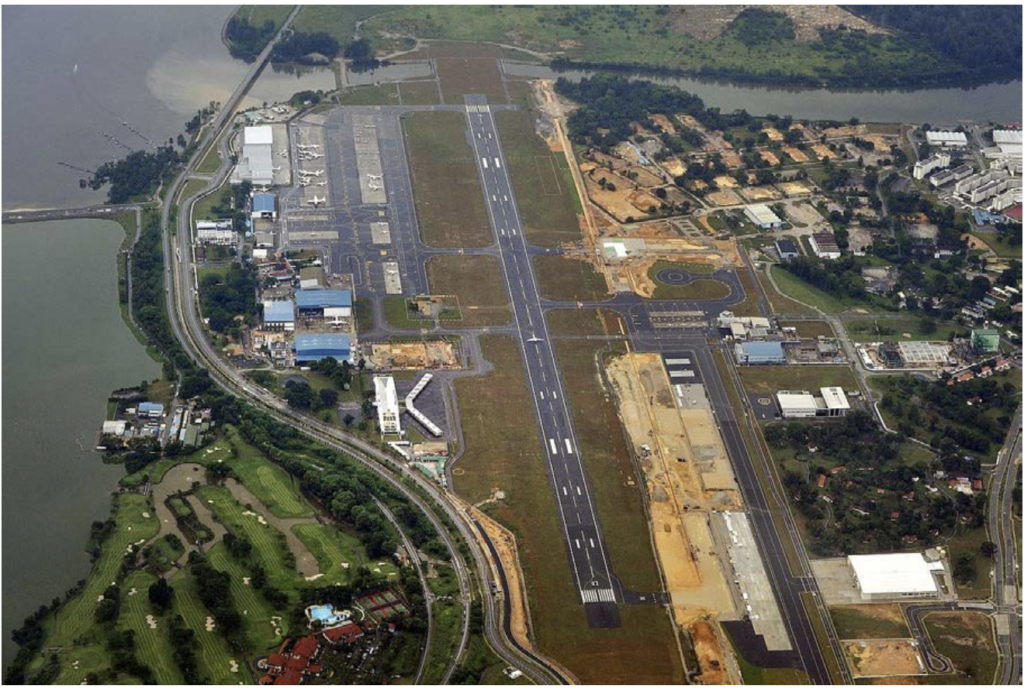
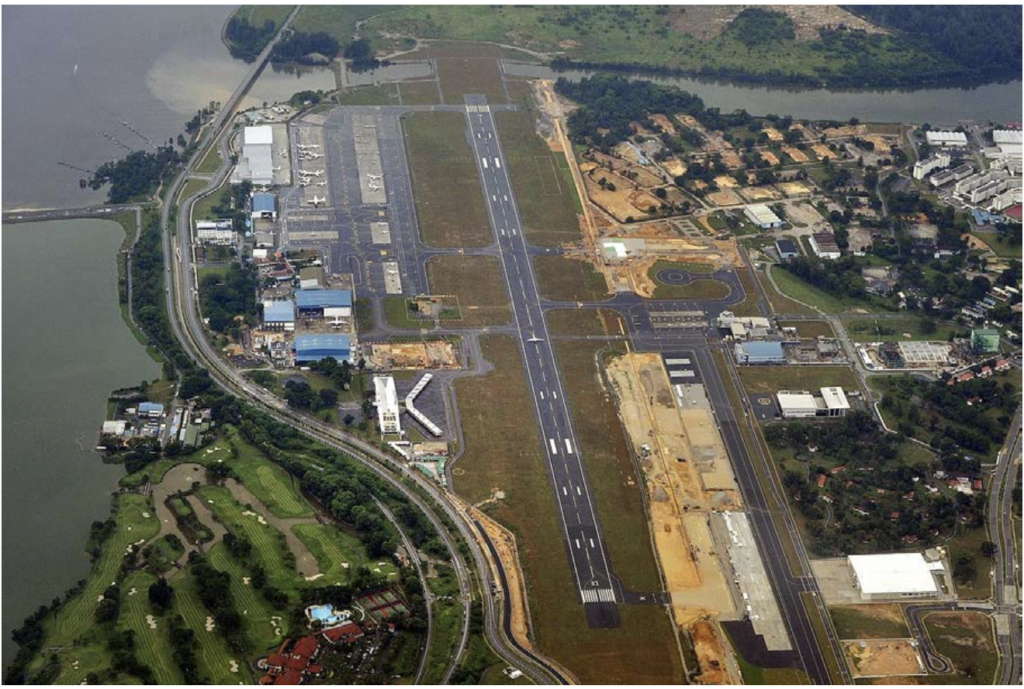
Seletar is a stone’s throw (8nm) northeast of WSSS/Changi. It has a single 6020ft/1840m long runway and serves predominantly turbo prop and corporate jet traffic. It has fuel and good facilities for business ops.

Just getting in there at all can be a pain – the airport is surrounded with prohibited and restricted airspace, noise abatement areas, training areas, military airports; as well as a bunch of buildings, cranes, boats, and other obstacles to the north of the airport on the Malaysian side – just across the Strait of Johor.

And since Malaysia effectively killed the plans for ILS at Seletar back at the start of 2019, there are no available instrument approaches at all, requiring visual approaches to be flown onto both runways.

The Airspace Picture

Operations at Seletar are difficult because of the complicated airspace that surrounds it, and it is the reason why there are no instrument approaches. There just isn’t enough room.

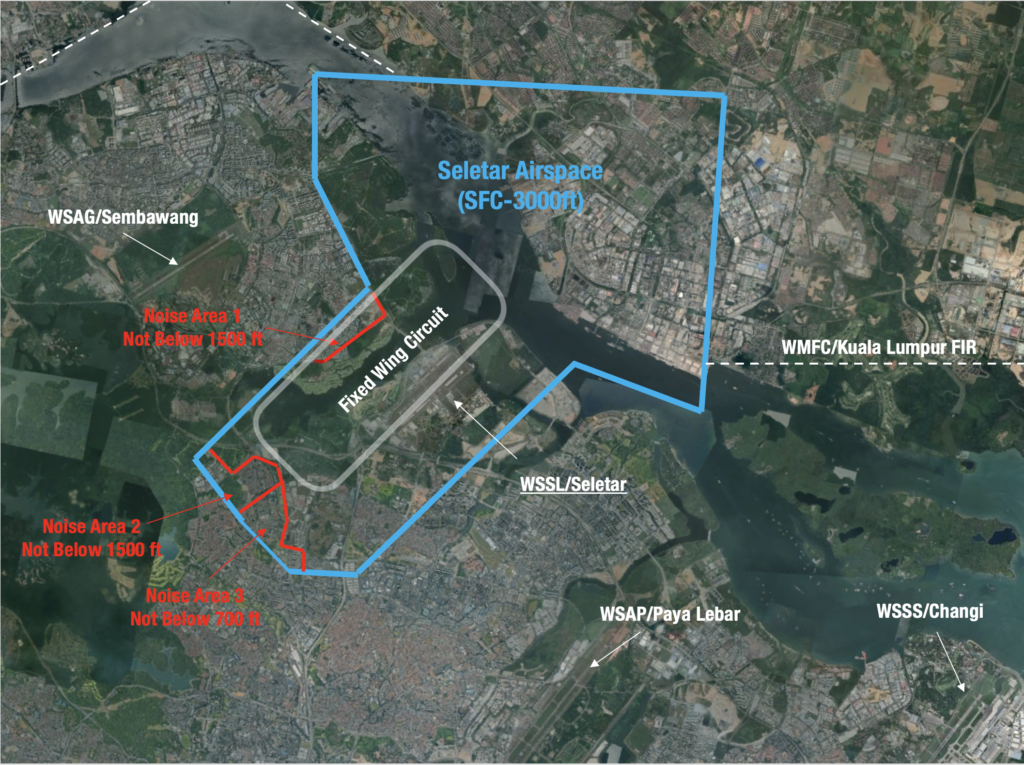
Seletar is literally boxed in by a variety of restricted airspace. To the west lies the Sembawang airbase, and to the east the Payar Lebar airbase. Both are strictly military.

Then just a smidge to the north is the boundary with Malaysian airspace, the WMFC/Kuala Lumpur FIR. South of the airport is highly noise sensitive, with three noise abatement areas where hefty fines await.

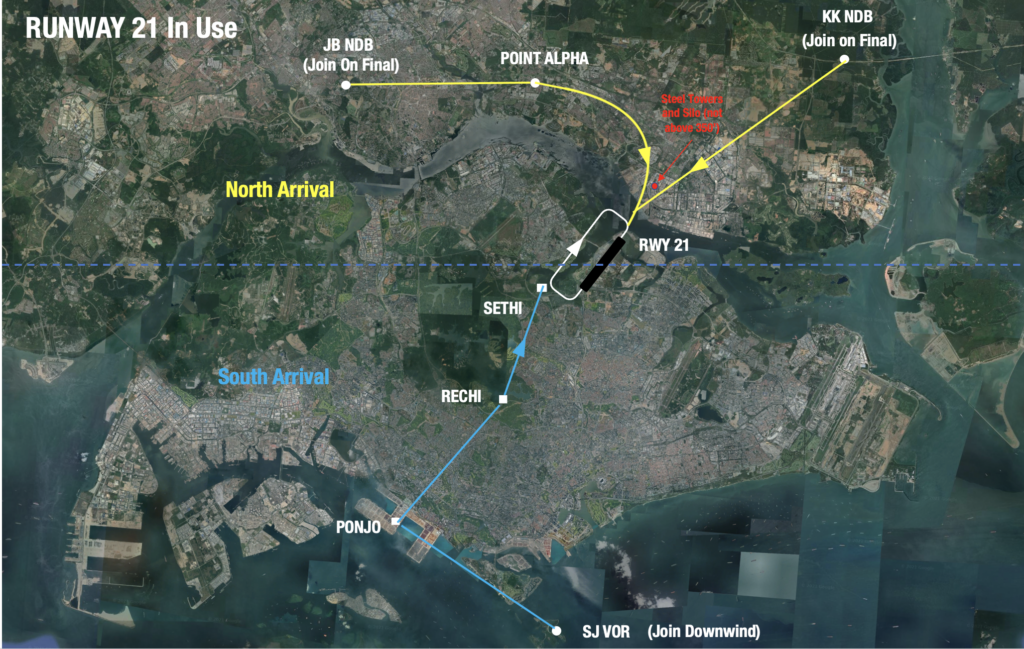
Throw these things together and you have the Seletar ‘Fish Bowl’ – a small bubble of airspace where there is precious little room to manoeuvre. Here’s a picture of what this all looks like.
Arrival Procedures

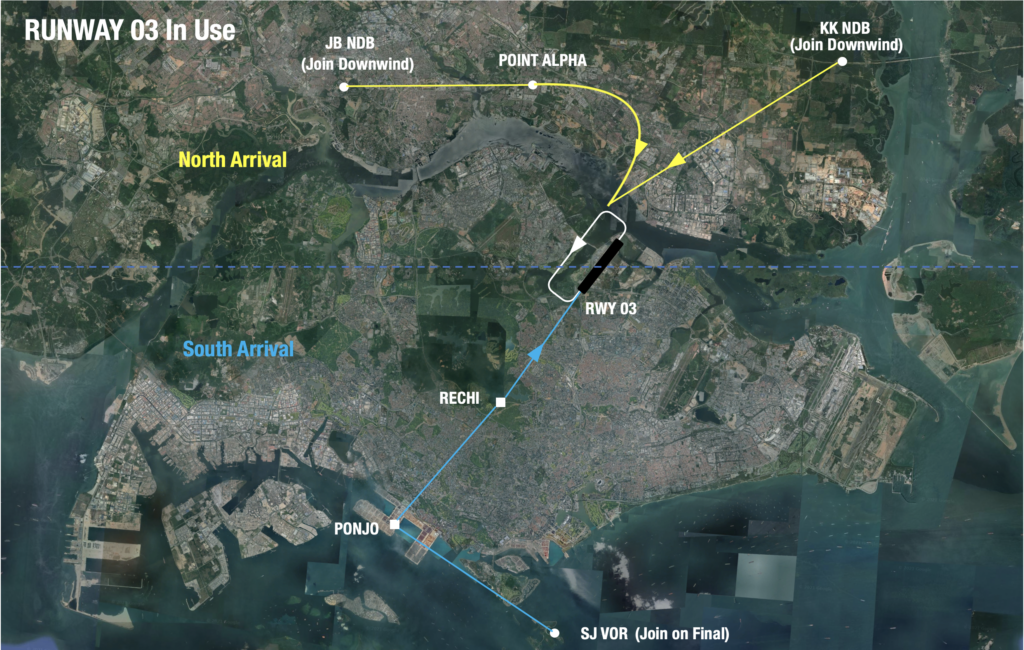
To keep things simple, the end game is to join the circuit and fly a visual approach, without busting any airspace. To help you with this there are a number of visual arrivals that require you to be in VMC conditions. If you can’t get visual, you’ll need to hold or divert to nearby Changi.

There are essentially two arrival procedures – North and South. And all arriving aircraft will join them through one of three feeder points – Jaybee NDB (JB), Sinjon VOR (SJ) or Kong Kong NDB (KK). From there you will either join downwind, straight in or even overhead if you need the extra track miles.

You can view the current plates for those procedures in the Singapore AIP online. But to make it easy, here’s a couple of pictures.
Things to look out for

Day and night closures: The airport is closed every night between 22-07 local time except for medevac and SAR. And then during the daytime, there are several infuriating closures to accommodate training flights. So essentially, GA/BA flights can only operate to Seletar at these times : 0700-0930, 1030-1200, 1300-1500, 1600-1700, 1800-2200 local time.

The circuit is tight. It is always on the western side of the airport and you cannot fly your circuit wider than 1.5nm due to Sembawang’s airspace. Which means the turn onto final is also going to be tight.

The profile is steeper than normal. 3.2 degrees on Runway 03, and 3.5 degrees on Runway 21. Which means you will need higher rates of descent than a standard visual circuit ‘outta the book’.

You need to be visual. If you’re not VMC, you can’t land at Seletar. Thunderstorms are common in Singapore with heavy rain, and they tend to be slow moving. The worst times are afternoons and evenings.

‘Steel Structures and Silos’  – You’ll hear it on the ATIS, and you need to report you have them in sight if arriving on Runway 21. They’re on the Malaysian coastline north of Seletar. Spot them early and you’ll get an earlier approach clearance from ATC which will make your job easier.

Mistaken Identity: Both nearby Sembawang and Paya Lebar airports have similar runway orientations to Seletar and it is easy to line up with the wrong one. Tune up Seletar’s NDB (220) – the needle doesn’t lie!

Missed Approaches. Expect to re-enter the circuit for both runways – which means a prompt turn downwind and not above 1500ft.

Ops on the Ground

You’ll be pleased to know, pretty straight forward. Parking can become limited, and so it always pays to book a spot with your handling agent well in advance.

Departures

Both runways have noise abatement. Just the standard stuff here – NADP 1 or 2. Your call.

There are published visual departure procedures for both runways. Essentially they involve a climb straight ahead to 1000ft, followed by a turn onto a radar heading.

For departures downwind, the challenge is to stay within the ‘Fish Bowl.’ Which means keeping your turn tight, and your speed down. Ironically the noise abatement procedures help here.

Your Layover

Assuming Covid isn’t still ruining the party, Singapore is famous for food. Three words: Chilli Mud Crab. Jumbo Seafood Restaurant in Clarke Quay is the place to go. And if you’re beer inclined, Tiger is the perfect accompanying drop. For the time being, you may need to rely on Uber Eats. Don’t worry though, Jumbo also delivers.

Handling

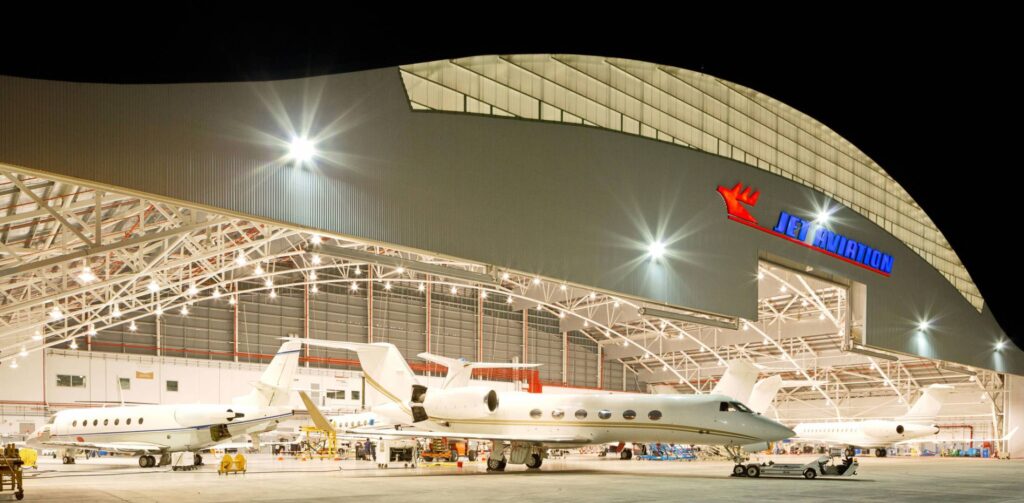
 There’s a few good options to choose from. Here are some contacts:
Other options?

Technically, bizav operators are still allowed to go to WSSS/Changi, but will normally only be allowed quick turnarounds subject to runway/bay availability, and then you’ll have to go elsewhere for parking.

Another option is WMKJ/Johor Bahru, on the Malaysian side, around 25nm north of Singapore. It’s open from 06-00 local time, with extensions possible with prior notice. It has a separate FBO with its own VIP lounge and hangars with maintenance support, and has no slots or parking restrictions for bizav ops. Check out the brochure!
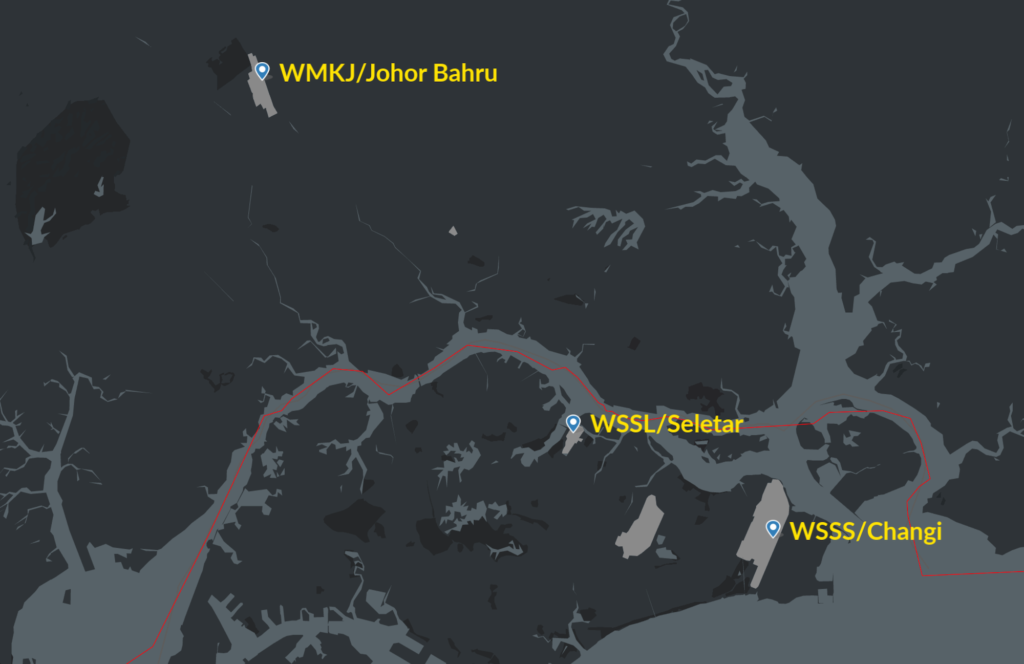
The only downside in WMKJ is that it can sometimes take a bit of time for immigration when you cross the road border heading south into Singapore – sometimes 2-3 hours during busy travel periods.

Opsgroup members can read reports on all these airports in Airport Spy.

Permits and stuff

If you’re operating as a private flight to either Changi or Seletar, things don’t get too complicated, as permits are not required for private flights. Just make sure you have parking arranged, and file your inbound ATC flight plan 12 hours in advance, being sure to copy in the Singapore ATC AFTN address WSJCZQZX.

If you’re doing a charter flight on the other hand, you’re going to need a landing permit, which means you’re going to have to jump through a few hoops.

For this, you’ll need to get an Operations Permit from Singapore CAA, which is basically a blanket approval to conduct revenue flights to Singapore, valid for up to one year. You’ll then need to get an Air Transport Permit, which is required for every individual charter schedule into Singapore (Changi or Seletar). Save yourself some hassle and get a local handler to help arrange these for you.

Airport Lowdowns

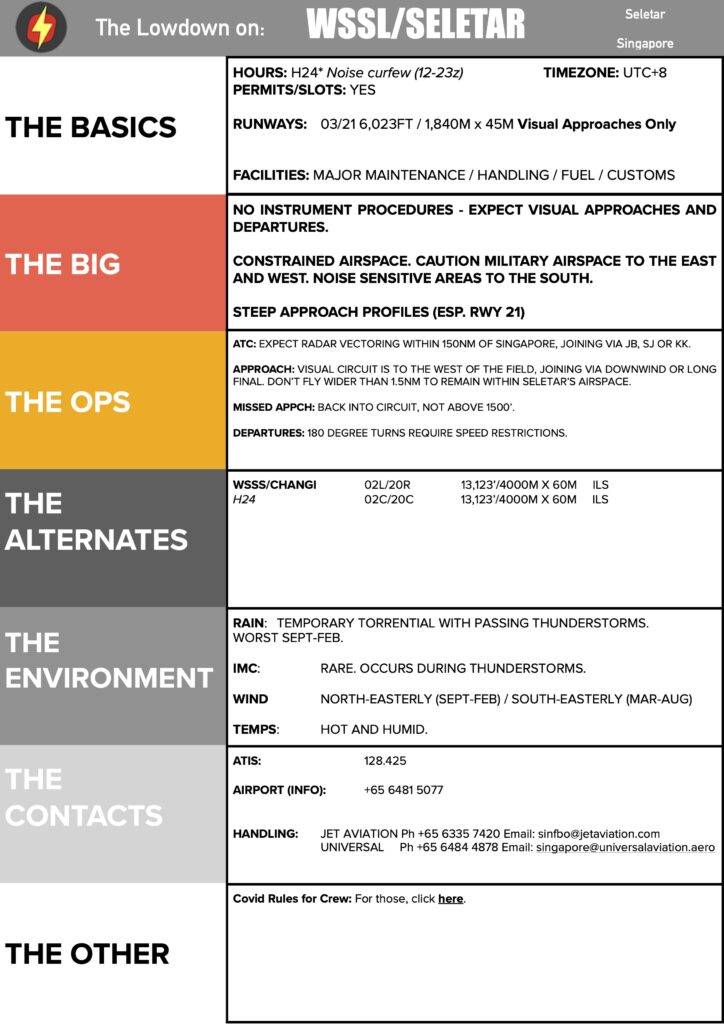
Have you heard of them? We make a bunch, especially if you ask for one! They’re what you need to know from crew who have been there. And they’re on one small, simple piece of paper. You can read more about them here.

We’ve got you covered. Check out Seletar’s here.

Malaysia and Singapore agree truce over Seletar airspace closure

Update Apr 6: The Malaysian authorities have now lifted the airspace closure north of Seletar again, and in return Singapore will abandon plans for ILS at the airport – and will now draw up plans for GPS approaches instead. The new agreement brings an end to days of disruption, with operators having to take off and circle overhead to 6000ft before being cleared enroute; it will also allow Malaysian airline Firefly to commence planned flights to Singapore, which had been postponed since Dec 2018 due to the dispute.

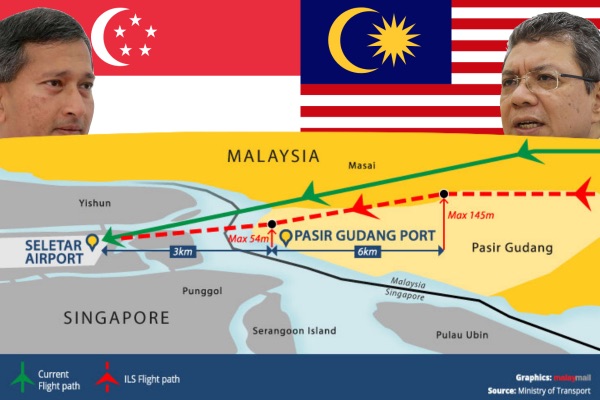
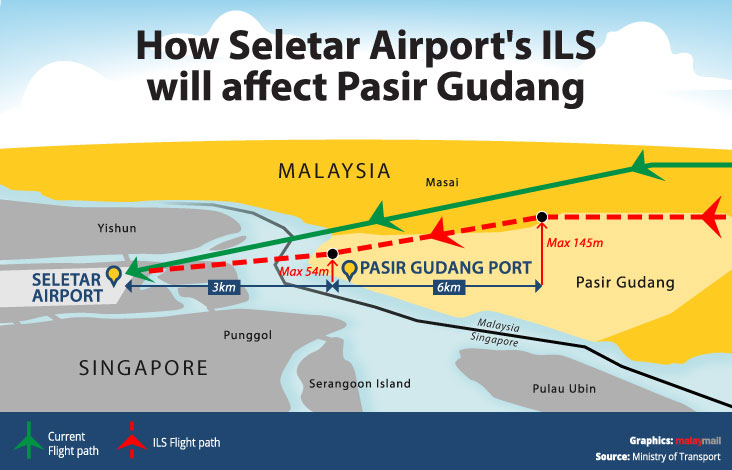
The new ILS approach on RWY 21 at WSSL/Seletar airport was due to take effect on 3rd Jan 2019, but Malaysia effectively killed it.

They claimed that the ILS approach –most of which lies within Malaysia’s airspace to the north of the airport– would impose height restrictions around the Pasir Gudang industrial area, and would stunt growth in the area.

Malaysia decided to create a no-fly-zone across an entire chunk of airspace just across the border from Singapore, up to 6000ft. This ultimately would have made RWY 21 ILS approaches at WSSL/Seletar impossible.

Singapore and Malaysia’s foreign ministers have met multiple times this year to discuss the issue, eventually resulting in Malaysia agreeing to cancel the restricted airspace they imposed, and in return Singapore agreeing to abandon the ILS procedures.

Discussions are set to continue regarding a wider ongoing dispute over airspace sovereignty, with Malaysia saying it wants to take back airspace delegated to Singapore under an agreement in 1974.

In other news: The night curfew at Seletar is now in effect. AIP SUP 86/2018 confirms that with effect from 1st Jan 2019, the airport will be closed to all flights (except medevac and emergency diverts) nightly from 22-07 local time.


Indonesia is intercepting aircraft – outside their airspace

If you are operating in the Singapore FIR, consider this carefully: you may be overflying Indonesia without knowing it. Indonesia will know though, and they want you to have an overflight permit.

You will find out in one of three ways:

  1. You’ll be intercepted by two Indonesian Air Force fighter jets and brought to Indonesia
  2. You’ll receive a nastygram via your National Authority
  3. You’ll get a fine

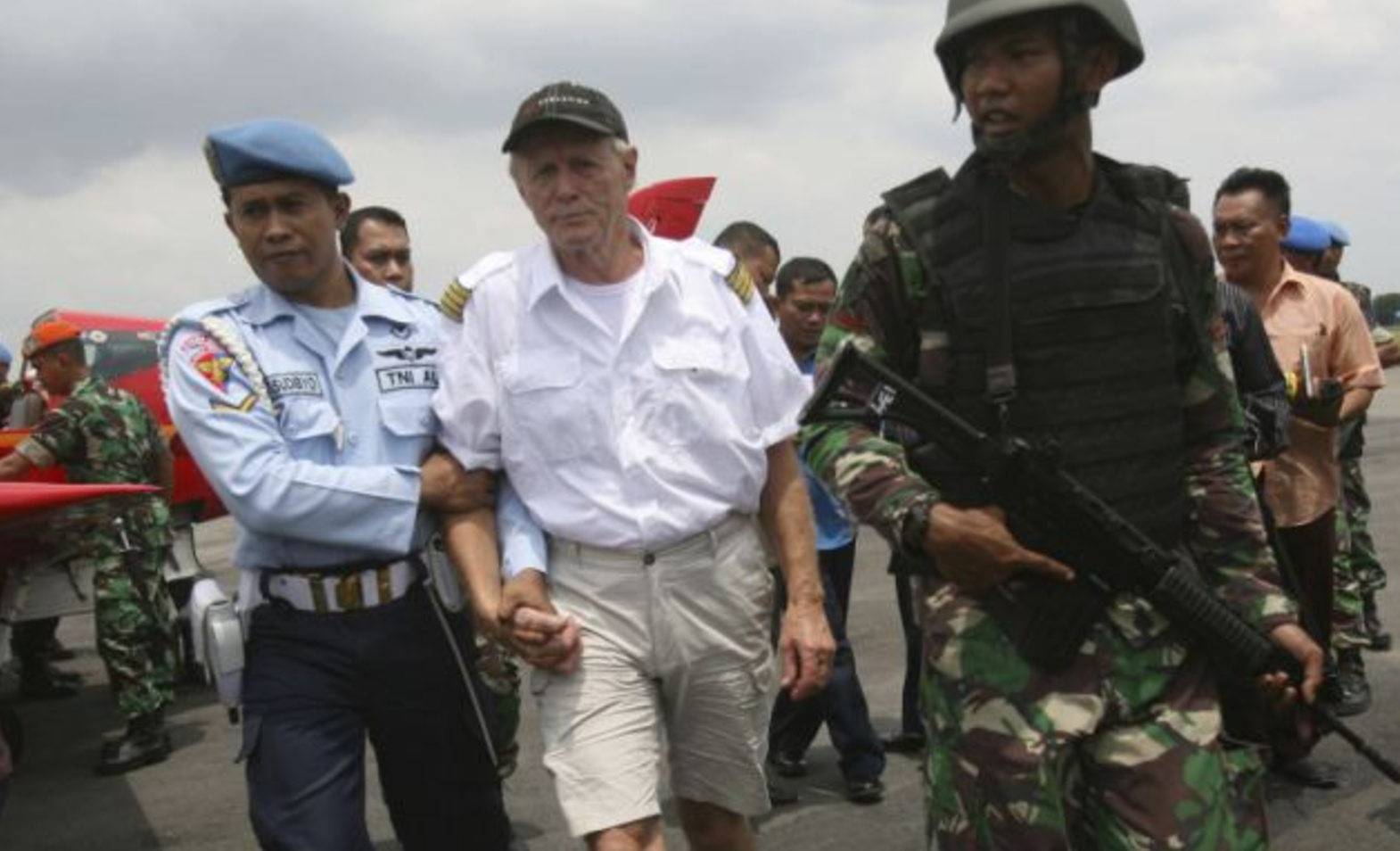
2. and 3. are not cool, but 1. is something to avoid at all costs. The inside of military/police cells at outlying Indonesian Airports is not pretty.

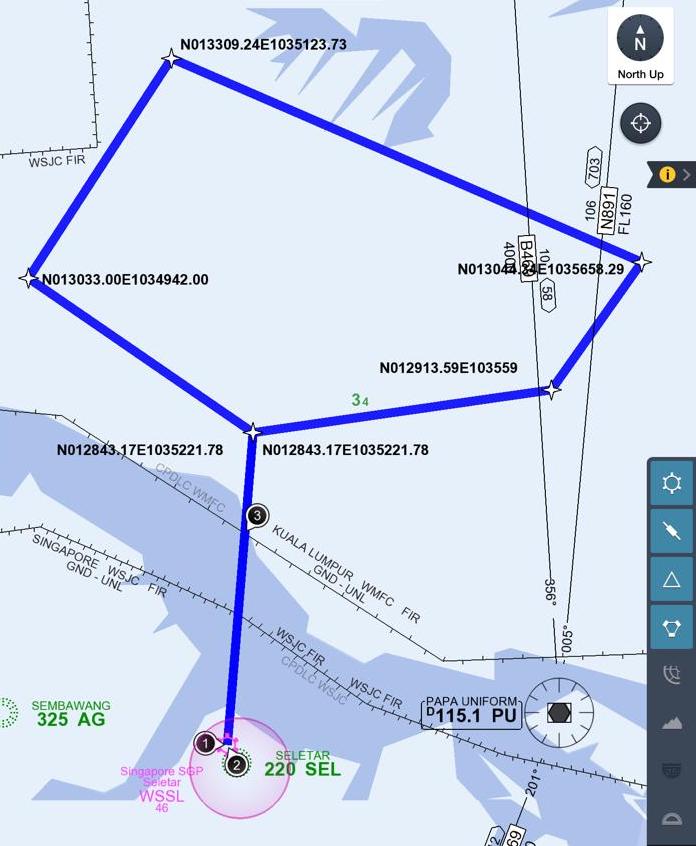
Watch out for the following airways – M758, M646, M767, G334, M761, G580. These all pass over Indonesian territory, even though the area is actually part of the Singapore and Malaysia FIRs.

Indonesia has a reputation for excessively strict enforcement of permit rules.

On 14 Jan 2019, two Indonesian F-16s intercepted an Ethiopian Airlines cargo flight ETH3728 for flying across Indonesian airspace without permission. The aircraft was initially supposed to operate from HAAB/Addis Ababa to VHHH/Hong Kong, but was modified at the last minute to route via WSSS/Singapore instead, to make a delivery of Rolls-Royce Trent 1000 engines.

The Ethiopian Airlines aircraft was intercepted forced to land at WIDD/Batam Island – which lies right in the middle of the chunk of airspace controlled by Singapore.

Another incident happened back in 2014, where a King Air plane en-route from WBGG/Kuching to WSSS/Singapore was intercepted by Indonesian fighter jets in the same airspace managed by Singapore, and forced to land at WIOO/Pontianak Airport in Indonesia.

The reason? Because they were overflying some Indonesian islands out in the ocean, the Indonesian Air Force claimed they were overflying Indonesia’s sovereign skies – without a permit.

Indonesia still hasn’t updated its AIP, but the rules they enforce are clear: if you’re overflying any Indonesian territory, you must get an overflight permit, regardless of the flight level.

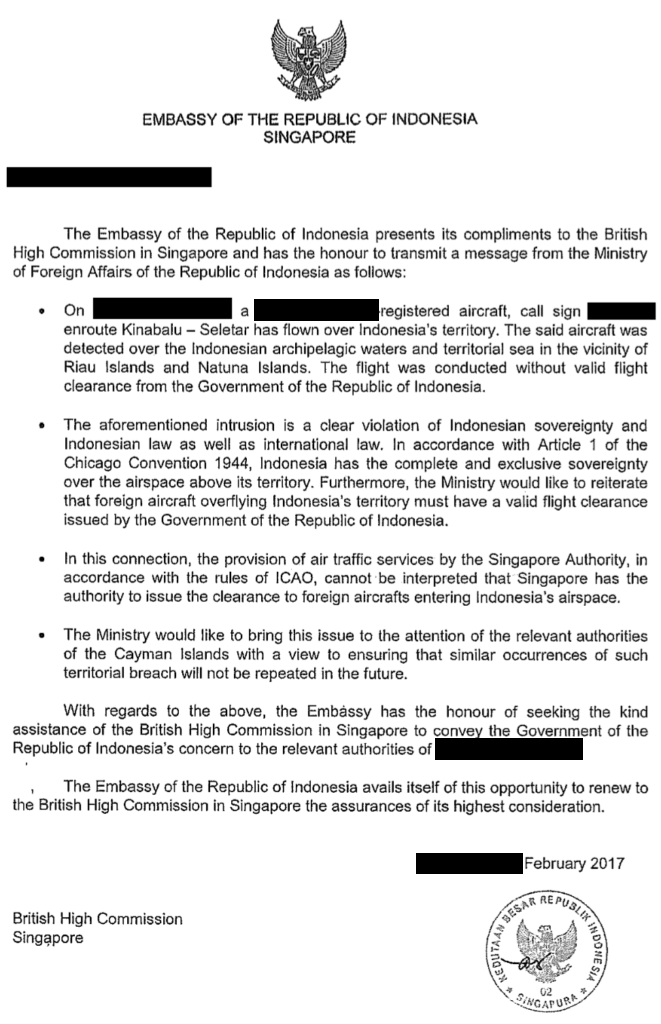
Here’s a nastygram to an OPSGROUP member, received in February 2017:


Bottom line: check your airways carefully, and make sure there are no Indonesian Island underneath. If there are, get a permit.


Seletar launches new terminal

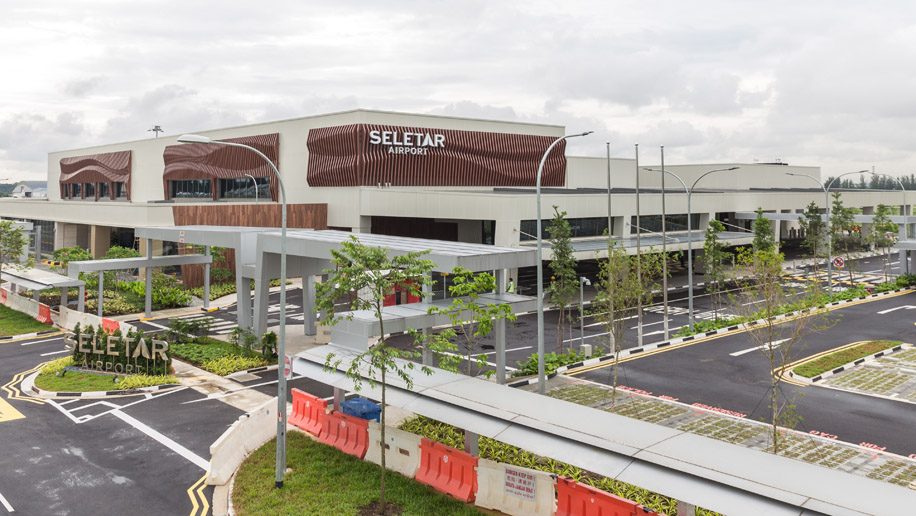
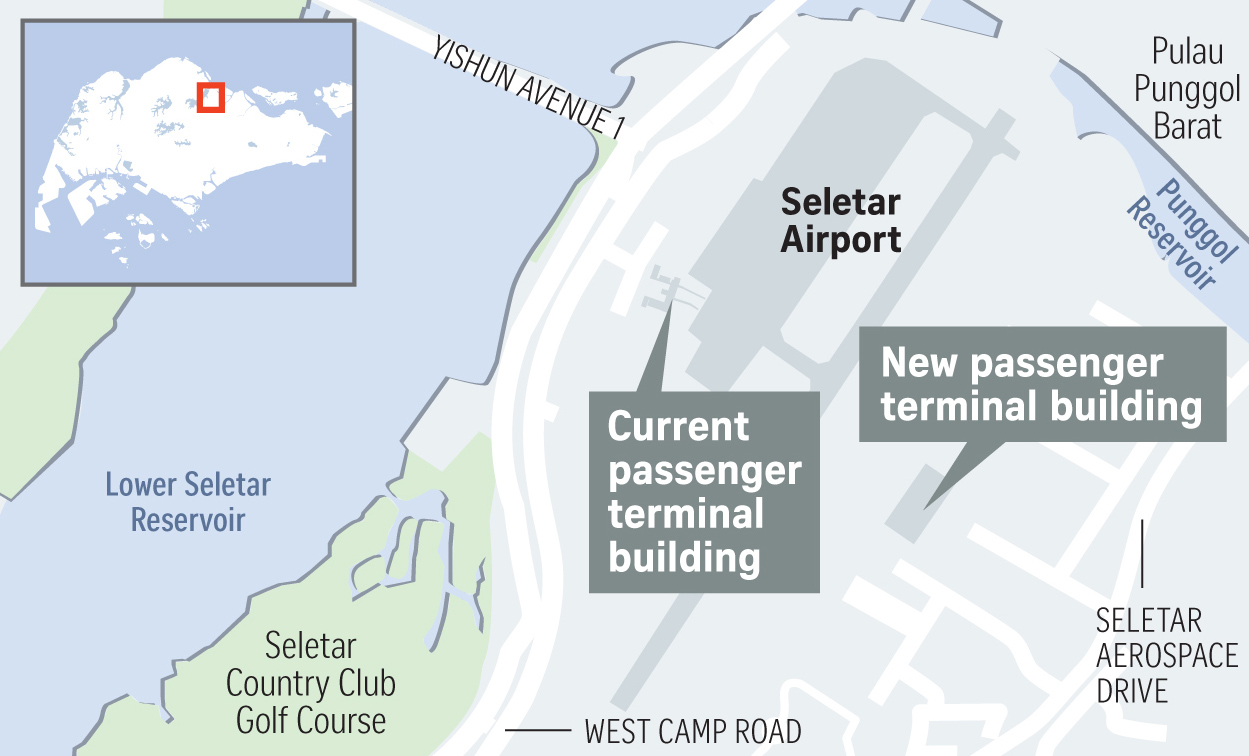
As WSSL/Seletar prepares to open its new $80 million terminal on Nov 19, the authorities have announced that WSSL is now a “schedules facilitated” airport.

Don’t panic – at least, not yet. This basically just means that because demand is now getting close to the airport’s capacity, all airline and charter flights must confirm their schedules with the airport in advance  – BA/GA flights don’t need to do this.

It does not mean that the airport has become slot coordinated, although that might happen at some point in the future if congestion continues to be a problem.

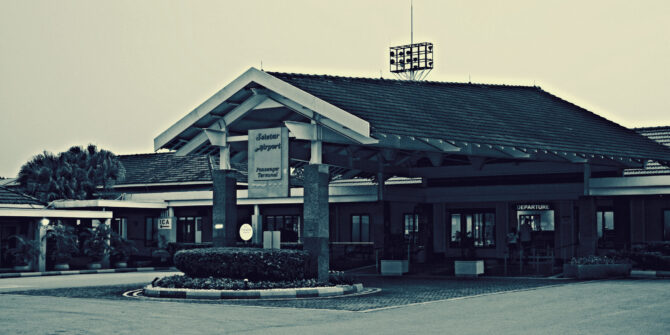
As for the new terminal, it looks like it will be a decent improvement on the old one…

The new facility – six times bigger than the old terminal – will be split in two, with one large section for airline flights, and another separate section dedicated for GA/BA.

Here’s a video of what the new terminal looks like!

The idea is to free up capacity at WSSS/Singapore by moving all scheduled turboprop flights to WSSL/Seletar when the new terminal opens. At the moment, the only airline that falls into this category is Malaysia’s Firefly – which currently operates 20 daily flights at WSSS – to and from WMSA/Subang, WMKI/Ipoh and WMKD/Kuantan.

Important to note – all BA/GA traffic must switch to using the new terminal when it opens on Nov 19 at midnight local time. Jet Aviation have provided a handy printout which tells you all you need to know about using the new terminal. Note that the new terminal is on the other side of the runway from the old terminal!


Singapore Changi (WSSS) Departure Clearance by Datalink

Starting April 23rd, 2018, Changi Airport (WSSS) will begin giving departure clearance (DCL) via datalink, on certain routes. The idea is to clear up voice communications when DCL can be used. Full details listed in CAAS AIP SUP 013/2018.

To use this, you’ll need ACARS, and be compliant with EUROCAE ED85-A. You’ll login to the ground system at WSSS.

The departures are as below:

– Destinations in Peninsular Malaysia via ATS Routes A457 and B466
– Destinations in Thailand via ATS Routes B466 and B469 / M751
– Destinations in Indonesia via ATS Route A457, R469 and B470
– Destinations in Australia and New Zealand via ATS Route B470
– Flights with allocated Calculated Take-Off Time (CTOT) under Bay of Bengal Cooperative Air Traffic Flow Management (BOBCAT)

A few other notes:

-The DCL message will not include requested crusing levels and final cruising levels. Your planned flight level in 15b will be used, and ATC will give cruise FL when airborne. Sounds like they won’t entertain any requests for a different FL while on the ground.

-No revisions allowed over datalink, all changes must be made by voice comms.

-Make your request with RCD message (see format in attached AIC) no more than 20 minutes before TOBT. If you’ve got a CTOT under BOBCAT, you’l need to put that in the message. If you’re routing via ANITO B470, list your FL at ANITO crossing.

If your DCL is rejected, you’ll get a “revert to voice procedures” message. A few auto-rejects:
-Flight routes not applicable.
-RCD message doesn’t comply with ED-85A or inaccurate data.
-Invalid TOBT
-When required due to flow restrictions.

Operating out of WSSS soon?  CAAS AIP SUP 013/2018 is worth a read.


PBCS is coming to Singapore

It’s not only the North Atlantic that will be seeing PBCS being implemented on March 29th – on that same date, the weird acronym is coming to Singapore too!

However, the requirements for Singapore airspace are slightly different to that for crossing the NAT.

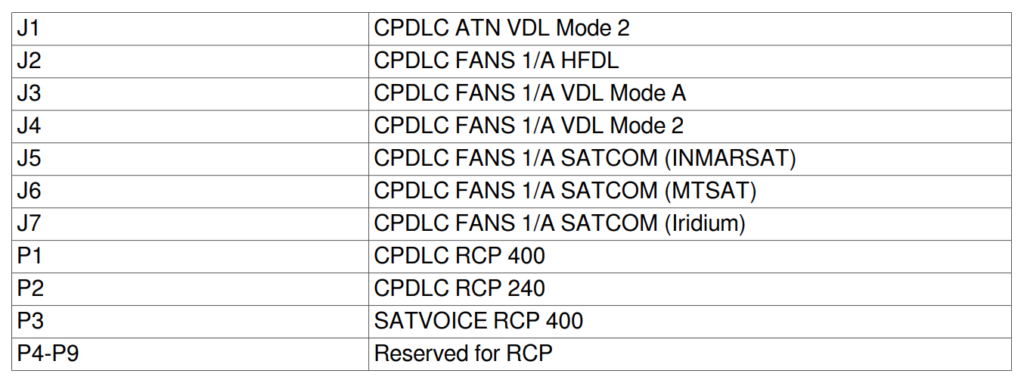
The short of it – compliant aircraft will be allowed a reduced separation of 50NM (or 10 minutes in trail) on certain airways: L642, M635, M767, M771, M774 and N884. For everyone else, it’ll be 80NM (or 20 minutes in trail). For Singapore, ‘compliant aircraft’ basically means anything with RNP10, CPDLC and ADS-C capable of the RCP240 / RSP180 performance requirement.

You’ll still need to obtain some kind of operator approval from your State of Registry. As we mentioned in our article on PBCS on the NAT – the best way to do that will probably be to submit an AFM Statement of Compliance for PBCS, showing exactly what data link communication systems you aircraft has, along with the selected performance.

For Singapore, if you want to operate on those airways at the reduced separation, here’s what you’ll need to remember to include in your ATC FPL:

In 10a:

In 10b:

In Item 18:
Make sure you include SUR/RSP180 to show you’re capable of the RSP180 performance requirement.

For more info, check out the full AIC published by Singapore here.


Germany issue new warnings, Manila may not ban GA after all

Germany issues new warnings 25JAN Germany has issued fresh warnings on the airspace of EgyptSouth Sudan, and North Korea, in three separate Notams issued in the last week. We have updated the SafeAirspace.net country information pages with the specifics. Read the article


Manila may not ban GA after all 25JAN RPLL/Manila is not moving as quickly towards a complete ban of non-scheduled and General Aviation traffic as feared. This is good news for International Operators. Read the article.


HEZZ/Egypt, HSZZ/South Sudan, ZKZZ/North Korea Germany has issued fresh warnings on the airspace of EgyptSouth Sudan, and North Korea, in three separate Notams issued in the last week. We have updated the SafeAirspace.net country information pages with the specifics.

RPLL/Manila is not moving as quickly towards a complete ban of non-scheduled and General Aviation traffic as feared. This is good news for International Operators. Read the article.

NTAA/Tahiti The airport is open again as of Monday morning local time, after closing due to flooding after torrential rains, but many taxiways remain flooded. Expect delays in handling and tech stops.

KZZZ/USA Announced yesterday and expected to come into force this week, is an immediate ban on US visas (and therefore US travel) for citizens from 7 countries: Iraq, Iran, Syria, Yemen, Sudan, Somalia and Libya. This is distinct from the Visa Waiver Program ban in effect since January 2016.

GBZZ/Gambia FSB Risk Level changed from Level Three to “No Warnings” on Jan 24. New president has taken power. Parliament revoked State of Emergency. Situation calm.

SBZZ/Brazil In the last bulletin we had a headline about a Boeing 767 shot on approach in Brazil. A bullet was found lodged in the wing. Some updates to that story are here, and safeairspace.net’s Brazilpage is updated.

VZZZ/Southeast Asia Don’t forget it’s New Year in Asia this weekend. Travel-related delays and government office and business interruptions will peak 27 Jan to 01 Feb, and could last longer in Taiwan, Vietnam and China, where the holiday will be celebrated through 02 Feb.

EDDB/Berlin Brandenburg will now not open until 2018, as they found more problems with the fire system this week. This is a recurring story, which dates back to 2012. So, for the foreseeable, you’re stuck with Tegel and Schoenefeld.

LTFJ/Sabiha Gökçen (Istanbul) Due to insufficient capacity at LTFJ, applications for individual non-scheduled flights will be refused, and private/charter flights can only be operated at “non-busy hours”.

KBPI/Palm Beach is going to see some new TFR restrictions due to the proximity of Donald Trumps Mar-a-Lago estate. If operating when he’s down here, you’ll have to depart from a gateway airport to PBI – those are TEB, HPN, IAD, MCO and FLL. NBAA has the details.

LSGG/Geneva EBACE is on from Monday, 22 May through Wednesday, 24 May 2017. Now would be a good time to get those slots booked if you’re planning to head over.

LFMN/Nice has a new procedure where ATC will alert crews to windshear.

MSLP/San Salvador‘s only runway 07/25 will be closed from 1600-1700 each day until Feb 3rd.

VGHS/Dhaka The UK Department for Transport (DfT) announced today that it recently carried out assessments of security at Dhaka International Airport. Following this, the DfT has assessed that security at Dhaka airport does not meet some international security requirements (they haven’t said which).

OMAD/Abu Dhabi (Al Bateen) is hosting the International Defence Exhibition in February, so will not be available to IFR traffic daily between 0600-0800Z until Feb 23rd. There are also restrictions on using it as an alternate.

DNAA/Abuja The latest on the Abuja closure is that it will be completely closed to all traffic from March 8th – April 19th.

SKCG/Cartagena‘s only runway 01/19 is closed daily 0530-1100Z until Feb 6th.

NVZZ/Vanuatu Health authorities have declared a dengue outbreak following a large increase in suspected cases in December 2016 and January 2017. Protect yourself against mosquito bites

WSZZ/Singapore is implementing the new ICAO SID/STAR phraseologies from March 2nd. Read AIP SUP 29/17.

LIRF/Rome Fiumicino is working on 16R until March, so 25 will be used for deps and 16L for arrivals. This means delays, especially if you want 16L/34R for departure – they say up to a 60 minute taxi time.

UKZZ/Ukraine amended the military boundaries of its airspace on Monday Jan 23rd, identifying the Donbas conflict zone region as a separate area. More details here.


View the full International bulletin 25JAN2017


Sorry, you gotta go to Seletar: Ops to Singapore

Singapore Changi Airport has been named the best airport in the world by Skytrax for the past four years running.

It already has a butterfly garden, free 24-hour cinema, rooftop swimming pool and spa, but soon it’s going to become even more awesome – work is currently underway on the new ten-storey ‘Jewel Terminal’, scheduled for completion in 2018, with a gigantic ‘rain vortex’ waterfall cascading from the ceiling, indoor rainforest park, playgrounds, shopping mall and hotel complex. If it ends up looking anything like the pictures in the brochure, it will be pretty spectacular…

Unfortunately, if you’re operating a business jet to Singapore, you probably won’t be allowed to go there!

The Singapore authorities will not allow overnight parking at Changi for charter flights under any circumstances, and parking for private flights is limited to a maximum of 48 hours. Slots are required, and with the amount of scheduled traffic currently in place, unless you’re planning to do a really quick turn at super off-peak times (ie. the middle of the night), your request will probably be denied.

This is where the authorities would like all corporate flights to go instead:

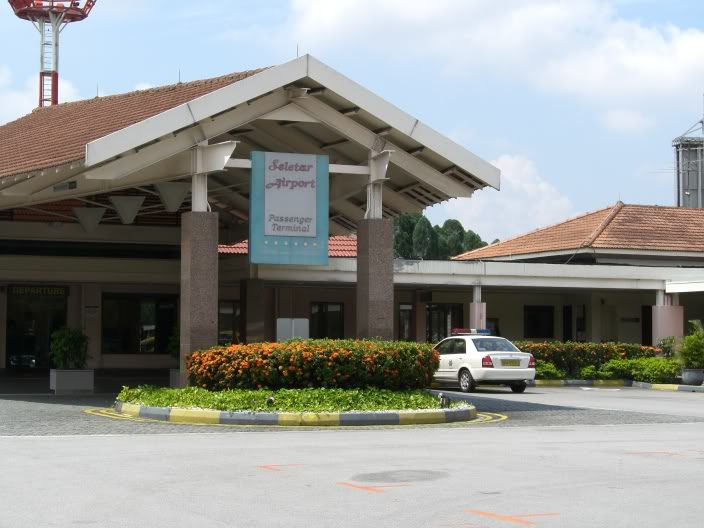
Seletar Airport. Doesn’t look quite as fantastic, does it?

The good news is that unlike Changi, at Seletar there is much less congestion, no parking time limits, and much lower handling costs. However, it does only have a 6024 ft runway and is not due to have ILS installed until some time next year. Added to that, fuel is around $1 per US gallon more expensive than at Changi.

Whether you end up going to Changi or Seletar, if you’re operating as a non-scheduled commercial flight you’re going to need a landing permit, which means you’re going to have to jump through a few hoops.
Here’s a quick breakdown of how to organise that non-sked flight:

Step 1: Get an ‘Operations Permit’ (OP)

You will need to open an ATLAS Account with CAAS and then log in to appoint a handling agent. Then either you or the handling agent will be able to liaise with the authorities to obtain the Operations Permit (OP).

This is basically a blanket approval for that operator to conduct revenue flights to Singapore, and you may have up to 20 aircraft on this permit.

Once this permit is approved, CAAS will advise the validity period which may be up to one year, although the OP will only remain valid for as long as the other aircraft documents are valid for. The OP usually takes 3 working days for approval by CAAS if all paperwork submitted is in order.


Step 2: Get an ‘Air Transport Permit’ (AT)

After securing the OP, it means CAAS have in principle approved you as an operator to carry out charter flights to Singapore.

With the OP in place, you can then apply for an Air Transport Permit (AT) which is required for every individual charter schedule into Singapore (WSSS or WSSL). The AT Permit for WSSS usually takes around 3-5 working days for approval by CAAS, although they will often reject your request and demand that you operate to WSSL instead. The AT Permit for WSSL usually takes around 3 working days for approval.

For the OP and AT permits, you should register an account here:
https://appserver1.caas.gov.sg/ATLAS/welcome.do


Step 3: Slots –  but only if you’re going to Changi!

Remember, slots are only required at Changi, and not at Seletar. You can only obtain slots after you’ve obtained an OP and an AT. Slots will likely take several hours to obtain, and available slot times may differ from what you’ve requested, due to other scheduled traffic. You can only submit requests for slots a maximum of 7 days prior to ops, and a minimum of 24 hours prior. And you will nearly always need to change your schedule in order to match available slot options!

For more information than you could ever possibly need about slot requests at Changi, check the Singapore AIC 2/13:
http://www.caas.gov.sg/caasWeb2010/export/sites/caas/en/Regulations/Aeronautical_Information/AIC/AIC_PDFs/2-13.pdf

For requesting Changi airport slots, if you already have an account then you should use the online system:
https://www.online-coordination.com

Or if you don’t have an account then just send an email with your request in the standard SCR format to:
csc@changiairport.com

Other things to consider…

  • If you’re operating as a private flight to Singapore (instead of non-scheduled commercial), life suddenly gets considerably easier, as permits are not required for private flights! Just make sure you have parking arranged, and file your inbound ATC flight plan 12 hours in advance, being sure to copy in the Singapore ATC AFTN address WSJCZQZX. You’ll still need slots if operating to Changi, but at least you don’t have the added hassle of having to obtain the OP/AT.
  • Permits are not required for Singapore overflights either. The only exception to this is for special airworthiness flights, where for both overflights and landings you basically follow same process – apply for a Singapore Permit To Fly. To do that, complete the form at the following link: http://www.caas.gov.sg/caasWeb2010/export/sites/caas/en/PDF_Documents/Others/aw101.doc
  • It’s also worth noting that in the Singapore FIR, ADS-B is now mandatory for aircraft wishing to fly at or above FL290.


International Bulletin: Sharm El Sheikh reopens, New ICAO Phraseologies 10NOV

Sharm El Sheikh reopens 03NOV  HESH/Sharm El Sheikh, Egypt has reopened to international traffic, with a number of airlines starting services again on 01NOV. However, there are conflicting views on security at the airport, depending on your state of registry. Read article.

New ICAO Phraseologies 03NOV From 10NOV, new international aviation phraseology for SIDs and STARs is effective, but there’s a problem. Read article.


OEJN/Jeddah, Saudi Arabia On 27OCT, Saudi Arabia intercepted and destroyed a ballistic missile launched from Houthi-controlled territory in Yemen. The Houthis confirmed the launch via the Saba news agency, saying that the missile was targeting Jeddah International Airport (OEJN), not the holy city of Mecca, as some other news reports had claimed.

EHEH/Eindhoven has new procedures for PPR effective 30OCT – if you’re flying there, get PPR direct from the airport. You can read all the info on their new GA page. Oh, and there’s now a fee. €300 for PPR for a 21 ton aircraft, for example.

LFMN/Nice Runway 04R/22L will be closed during November.

WARR/Juanda Airport is closed due to works in progress except for helicopter medical evacuations from until 15NOV

UTZZ/Tajikistan Disagreement between Russia and Tajikistan may lead to operational restrictions between the two countries. Air traffic between Moscow and Dushanbe may be suspended from 08NOV.

FAZZ/South Africa Reports this week suggest that foreign nationals entering South Africa through any port of entry should expect delays up to four hours due to a new enhanced security measure that requires the capture of fingerprints and a photograph. OR Tambo in Jo’burg seems to be the worst offender.

BGKK/Kulusuk has updated opening hours: 1100-1900Z Tuesday to Saturday. They ask for 3 hours minimum notice PPR.

PLCH/Christmas Island Fuel is in short supply, notified as being only available for Scheduled service and emergency flights. PLCH is often used on Pacific crossings as an alternate, so any diversion would be considered an ‘emergency’, but check before actually planning a tech stop.

LEZZ/Spain Previously notified fuel strike now appears to be one provider only, so it looks like impact minimal.

DGAA/Accra ATC is having a few VHF issues, primarily on 126.7 – if you can’t reach them, call HF 8903 instead.

EDDT/Berlin Tegel will be busy 14-18 NOV due to state visits, they won’t accept GA/Private traffic during this time, but you can check specifics with them at vvd-txl@berlin-airport.de

HLLS/Sabha, Libya The airport has been closed for over 2 years due to fighting in the area. A new Notam has been issued which officially extends the closure period to 26DEC, as talks continue between the authorities and local groups to find a way to re-open the airport.

LYBE/Belgrade Jet A1 not available through the airport fuel service provider until the end of the month. Make sure you get a confirmed fuel release through a third-party fuel provider before operating here.

LTZZ/Turkey On 29 October, the US Department of State ordered the departure of family members of employees posted to the US Consulate General in Istanbul due to security information indicating extremist groups continued aggressive efforts to attack US citizens in Istanbul. US Operators should consider ops into airports in Turkey carefully.

OMDB/Dubai Traffic was stopped for approx 1.5 hours on 29OCT due to a drone. The Airport closed from 1930-2050 LT, and some flights were diverted. OMSJ/Sharjah was also briefly closed due to the same drone. Unauthorized drones have halted airport operations in Dubai twice in recent months.

GMZZ/Morocco is busy from 4-20NOV, GA and non-sched traffic will see restrictions. Check their Notam A0896 from 01NOV. If you’re part of the event, put RMK/COP22 in your FPL. No long stays will be allowed.

WSSL/Singapore Seletar We’ve received crew reports of challenges with visual approaches into Seletar (there are no instrument approaches). There are unlighted obstacles on the approach to Runway 21. After dark, approaches are only possible to Runway 03. More importantly, noise rules will soon demand a challenging base turn, greater than 5 degrees, to a half-mile 3.5 degree final, to a 1% down slope runway. We welcome further comments (bulletin@fsbureau.org).

LGZZ/Greece There will be a ferry strike between the Greek mainland and all Islands on 24NOV. No services will operate that day.

FTZZ/Chad Reports of nationwide public service strike including Airport operations at N’Djamena. The unions stated that the strike will persist until the government pays overdue wage arrears.

View Full International Bulletin 03NOV2016


Midweek Briefing: Oceanic and Remote Procedures Update, Rome Airport Closed Friday

Oceanic and remote procedures updated: 12OCT The FAA this week issued a significantly updated version of their “Oceanic and Remote Airspace” procedures document. There’s a lot of good stuff here, even if you’re not operating an N-reg. Take a look at the PDF.

Rome Airport to close Friday 12OCT A reminder that LIRA/Rome Ciampino will close fully from Friday, for two weeks, as a result of urgently required runway maintenance. You can use LIRF/Fiumicino instead, but with significant restrictions.


LLBG/Tel Aviv starts winter runway maintenance work on 01Nov until 17Nov – Runway 21 will become primary landing runway, associated restrictions, not available as alternate during this time – check AIC 3/16.

LOWI/Innsbruck starting December 14th, the airport will introduce parking restrictions for private flights every week from 1800Z Weds until 1800Z Sunday.

TXKF/Bermuda Tropical Storm Nicole is approaching, expect some disruption and check before using as an alternate over the next few days.

HAZZ/Ethiopia The Ethiopian government has declared a six month State of Emergency from 9 October 2016. While details of emergency arrangements are not formalised, measures to restrict communication, movement and political expression are expected. Carry identification, avoid all large gatherings and protests, monitor the media for details on the application of the State of Emergency and follow all instructions issued by local authorities.

SPIM/Lima radar will be off the air on Friday from 19-21Z for repairs, procedural control, expect enroute delays.

EGGX/Shanwick. An exercise to test to the Volcano eruption response is underway, you may see multiple references to an eruption in Iceland – it hasn’t happened, it’s just a test. Stand down. Katla is also back to code Green.

UZZZ/Russia Karymsky volcano in the Kamchatka peninsula is active with colour code Orange, check before operating.

OKAX/Kabul FIR continues to have comms issues in the north east portion of Afghanistan airspace, VHF comms are not working on 118.3 or 128.5. There are some “Nordo” procedures, refer to AIP ENR 1.6-1.

MUFH/Havana has a couple of new entry points to the FIR – FUNDI and IKBIX – but they’re not for use yet, so don’t.

OPRN/Islamabad If operating to OPRN, be aware that on Saturdays and Mondays ATC will be practising non-radar procedural approach from 0500-0900Z until the end of the year.

SPJC/Lima has overnight parking restrictions from 14-21NOV, check with Airport company or handler prior to operating.

FZZZ/Democratic Republic of the Congo: the security picture is uncertain following recent political protests and there have been calls for further protests in Kinshasa, including on 19 October; you should follow travel advice and monitor local media for updates

SPZO/Cusco will not allow overnight parking from 10-20OCT.

FOZZ/Gabon Following the results of recent elections in Gabon, further strikes or demonstrations could occur in the capital Libreville and in Port Gentil. Avoid demonstrations, large crowds and rallies as they may turn violent.

UAZZ/Kyrgyz Republic Multiple embassies located in Bishkek have issued warnings to their citizens of an increased threat of a terrorist attack in the Kyrgyz Republic, possibly involving kidnapping and hostage taking, against Kyrgyz authorities and foreign diplomats during October 2016.

TQPF/Anguilla has introduced a ban on visitors from Guinea, Liberia and Sierra Leone, with a view to mitigating Ebola risk. Anyone who has been to those three countries in the last 21 days will not be allowed to enter.

VTSP/Phuket is suffering from ramp congestion, and will not allow non-scheduled flights to stay overnight until the end of the year.

WSSS/Singapore Changi has a couple of closures on 18 and 19 OCT due to a military exercise, check local Notams.

ZUUU/Chengdu has a new speed restriction inbound – fly 183 knots from IAF to IF, then 160 knots to 4nm. Notam U2748/16.

View full International Bulletin 12OCT2016


Midweek Briefing: Tokyo Typhoon, New NAT Procedure

Typhoon for Tokyo 07SEP Tropical Storm Malou is tracking towards Tokyo and expected to intensify. Multiple Japanese airports are likely to be affected … Read the article

New Shanwick / NAT procedure 07SEP Shortly all FANS 1/A flights will get a “CONFIRM ASSIGNED ROUTE” message from Oceanic ATC (Shanwick, Reykjavik, Gander) shortly after entering their OACC, to mitigate against Gross Nav Errors. Read the article


HHZZ/Eritrea The US State Dept has issued a Travel Warning for Eritrea which warns of the risks of travel to Eritrea due to the unpredictable security situation along Eritrea’s borders and restrictions imposed by local authorities on travel within the country. All foreign nationals, including U.S. government employees, must obtain permits to travel outside of the capital Asmara. This restriction limits the ability of the U.S. Embassy to provide consular/emergency services anywhere outside of Asmara. This replaces the Travel Warning dated May 6, 2015. Avoid travel along all border regions. In June 2016, fighting in the Ethiopia-Eritrea border region reportedly caused several deaths. Continued political and military tensions between Eritrea and the neighboring countries of Djibouti and Ethiopia pose the threat of possible renewed conflict. Due to regional sensitivities, the State Department also recommends against travel to the border region with Sudan.

WSSS/Singapore will be super busy during the Grand Prix weekend 14-18SEP. Ask for a slot before operating, if you don’t get one, use Seletar instead.

RPLL/Manila has a couple of new procedures for non-scheduled flights. First, traffic arriving between 2200-0400Z daily – the peak period – should look for a slot from Manila FSS – who are at mfss.staff@gmail.com, or call 2 944 2098/99. Once you have the slot, get your EDCT from Manila ATC. If operating domestically, file the flight plan between 2 and 24 hrs prior departure.

DNBC/Bauchi is a new airport designator in Nigeria for the Tafawa Balewa International Airport.

VLVT/Vientiane, Laos The 28th and 29th ASEAN Annual Heads of State Summit is being held in Vientiane from 5 to 9 September; there will be road closures and delays in arrivals and departures of both international and domestic flights at Wattay International Airport.

FOZZ/Gabon has seen multiple security warnings in the last few days, following a disputed election result. Widespread, violent demonstrations, rioting, looting, and road blocks continue, both in Libreville and other cities throughout Gabon. At this time the airport in Libreville is open and operational and commercial flights are available. The US Embassy recommends U.S. citizens remain in a safe location and avoid non-essential movement.

MMSD/Los Cabos, Mexico Hurricane Newton has passed and Los Cabos airport has officially re-opened its commercial operations, no major damage reported.

EBOS/Ostende Air BP is no longer providing Jet A1 fuel here.

EKOD/Odense will be closed on 22SEP due to an event. Jet fuel not available. You can email twr@hca-airport.dka for further.

HELX/Luxor Radio, which previously operated on HF5859 and 2562, is now off the air.

LZIB/Bratislava will required slots for all operations 15-17SEP, small GA aircraft not welcome on these days. Email slots@bts.aero.

FNZZ/Angola The WHO has provided an update on the yellow fever outbreak in Angola and the Democratic Republic of Congo (DRC). The WHO estimates that there have been 6,000 suspected and 1,000 laboratory confirmed cases of yellow fever since the outbreak began in Angola in December 2015. More than 400 people have died from the mosquito-borne disease since that time. However, the last confirmed case in Angola was on 23 June and in the DRC was on 12 July, which the WHO believes is an encouraging sign. Nevertheless, the organization still characterizes the outbreak as “serious” and as requiring “sustained, controlled measures.” Thus far, 22 million people in Angola and 14 million people in the DRC have received vaccinations against yellow fever as part of a large-scale initiative that was prompted by this outbreak.

SARI/Cataratas is permanently downgraded to RFF Category 6.

URRR/Rostov wins the prize this week for clogging up the Notam system; the runway there is closed 29 times between now and October 21st, and they have therefore issued 29 Notams. Perfect.

SPQU/Arequipa, Peru is not allowing overnights until 11SEP due capacity. Non-scheduled flights limited to 3 hours parking.


View full International Bulletin 07SEP2016


Midweek Briefing: End of Canada Leniency, Two hurricanes inbound Hawaii

End of Canada Leniency 31AUG Earlier this year Canada introduced a requirement for an eTA – like the US Esta. For a while, it was OK to travel without one. That’s ending in September … Read the article

Two hurricanes inbound Hawaii 31AUG Madeline is first, followed by Lester – both are tracking west towards Hawaii with landfall expected – should it occur – on Wednesday and Thursday. Read the article


LTCC/Diyarbakir, Turkey Kurdish militants fired rockets at Diyarbakir Airport in southeastern Turkey. The militants reportedly targeted a security check-point outside the airport lounge. All personnel were taken inside terminal building for safety reasons. No flights were disrupted, and there were no reports of casualties.

EHAM/Amsterdam It’s that time of year again, watch out for the migrating geese in Amsterdam at sunrise and sunset. They operate between 300 and 700ft without transponder.

VVVV/Hanoi FIR If you’re cutting a line through the Hanoi FIR on the W1 airway, you’ll be held down at FL290 unless you have RNAV5. ATC says so.

DNZZ/Nigeria Members of aviation unions staged rallies at four major airports in Nigeria to protest the planned concession of the facilities to private investors. Protests occurred at Abuja (DNAA/ABV), Kano (DNKN/KAN), Lagos (DNMM/LOS) and Port Harcourt. So far, the protests have not disrupted ops. Lagos has been suffering from some power outages lately as well.

SOCA/Cayenne, French Guyana has staff shortages, and from September 1st will not accept any diversions unless in an emergency. Do not plan SOCA as an enroute alternate. If inbound, with an ETA for SOCA 0200-1100Z, you need to call for an arrival slot. If you need it, ATC phone is +594 594 35 9372 or 9302.

OIZZ/Iran has approved the use of its airbases by Russian fighter aircraft; Russia has notified intention to launch missiles in the direction of Syria from the Caspian Sea fleet. The Russian Air Force has deployed six Tu-23M3 BACKFIRE bomber aircraft and multiple Su-34 FULLBACK strike fighter jets to Hamedan Air Base (OIHS/NUJ).

ORBB/Baghdad FIR/Iraq The Iraqi government has given permission to the Russian MoD to use its airspace in support of air operations in Syria. Russian media outlets are also reporting the Russian MoD has requested use of the FIR for the “passage of cruise missiles” as well, highlighting the potential for such activity to occur in the coming days from the airspace over the Caspian Sea.

LTZZ/Turkey Russia has lifted it’s ban on charter flights to Turkey.

HAZZ/Ethiopia Reports indicate that flights to HAGN/Gondar (GDQ) and HABD/Bahar Dar (BJR) have been indefinitely suspended. The suspension of flights comes amid ongoing unrest in Gondar and Bahir Dar, as well as in other cities in the Amhara and Oromia regions, over the marginalization of ethnic groups by the Tigray-dominated Ethiopian People’s Democratic Front (EPRDF) regime. Ethiopian government officials have not commented on the cancellation of flights to those cities or international flights to Addis Ababa, which has not been largely affected by the unabated unrest occurring in outlying regions.

WSSS/Singapore air quality has deteriorated to a Pollution Standards Index (PSI) of 105, due to the cross-border haze from Indonesian slash-and-burn fires. The agricultural practice, during which farmers burn a patch of land in order to clear land for new crops, creates haze, which then drifts through the region. Experts believe the level of pollution — which in 2015 cost the region more than 700 million US dollars in damage and severely disrupted the aviation sector — will be lower in 2016 due to a rainy dry season.

NFNA/Suva, Fiji is closed during September for runway repairs. Available wirh 30 mins PN in an emergency. Call them on 9906102.

SUEO/Montevidedo Air Traffic Controllers strike until end of September, closures and departure restrictions in place. Info is sketchy, got some updates? Let us know … bulletin@fsbureau.org.

View full International Bulletin 31AUG2016


Midweek Briefing 06JUL: Hong Kong capacity problems, Iceland: The fun continues

Hong Kong capacity problems 06JUL During this year, the Hong Kong CAA has issued a couple of warnings to operators to stick carefully to their allocated slots, but it’s not making much of a difference to operations there. Read the article.

Iceland: The fun continues 06JUL Last week there were some really positive indications that the ATC strike in Iceland was coming to an end, but it’s now worse than ever, with Westbound, Eastbound, and landing traffic all affected. Read the article.


HECC/Cairo FIR A restriction exists for traffic to and from the Amman FIR, so if overflying Jordan and then Egypt, or vice versa, you can only use the waypoint METSA.

OMAE/Emirates FIR has some updated peak times. Departures need a slot between 0630-0730Z and 1700-0000Z. Arrivals will be spaced 5 mins apart during these times also, as will aircraft entering the OMAE FIR from nearby airports like Muscat, Isa, and Baghdad.

EIDW/Dublin Runway 10/28 is closed overnight until 09JUL.

OERK/Riyadh, Saudi Arabia will be hosting the ‘Global Ministerial Aviation Summit’ 29AUG-31AUG. 55 different ministers from various countries are expected to be in attendance. Be aware of potential restrictions leading up to and after the event.

CYFB/Iqaluit Another NAT alternate favourite, CYFB has some runway closures throughout July.

EGCC/Manchester is doing some work on 05L/23R overnight until 08JUL and has advised operators to carry some extra gas due possibility of holding.

LOWW/Vienna has published a helpful list of rush hour periods – worth avoiding these times as holding is common at VIE. The times are: 0530-0750, 0920-1030, 1140-1240, 1340-1500, 1615-1800, and 1840-1940Z.

BIZZ/Iceland Despite optimistic reports of a resolution to the ATC dispute in Iceland last week, the situation remains unresolved. Last night BIRD Oceanic was closed to most Eastbound traffic once again, as was BIKF. A new addition to restrictions is a closure to many Westbound flights on Wednesday 06JUL – “DUE TO STAFF SHORTAGE IN REYKJAVIK OACC WESTBOUND TFC PLANNING TO ENTER BIRD FROM ENSV VIA GUNPA,VALDI, IPTON, INGAL, ISVIG AND EGPX VIA LIRKI, GONUT, OLKER, MATIK AND RATSU AND THEN PROCEEDING INTO EGGX OR CZQX SHALL REMAIN SOUTH OF BIRD CTA” Read the article.

EDYY/Maastricht ATC have requested crews operating through the Maastricht UIR to log on to CPDLC EDYY, if you have datalink. While voice remains the primary comms method, you might get an uplink message if the frequency is busy – it’s not a test, you should confirm – most of these uplinks are likely to be frequency changes.

EPZZ/Poland has advised operators to check carefully whether permission is required in advance of operations at airports other than EPWW/Warsaw. Many countries including Poland have reinstated Border Controls within the Schengen zone. Best advice is to treat each country as having full Border Controls for the moment (so think Passport, GenDec, etc.)

SPIM/Lima FIR (Note that the airport is now SPJC, distinct from the FIR code) is shutting down airway UG427 after 21JUL.

SUEO/Montevideo ACC (Uruguay) has some comms issues in it’s airspace, and has advised of some extreme spacing between aircraft irrespective of FL – 40nm. For now, this ends today (06JUL) but may happen again.

WSZZ/Singapore Qualifying citizens of Singapore are now eligible to apply for US Global Entry membership – and benefit from expedited entry to the United States at designated airports. Similarly, qualified U.S. citizens are eligible for enrolment in Singapore’s enhanced-Immigration Automated Clearance System (eIACS).

ZMUB/Ulaanbaatar, Mongolia is downgraded to RFF Cat 7 until 10JUL. Also, from 12-16JUL, you can’t file this as an alternate which may limit your options somewhat.

LFPG/Paris due to maintenance on the ILS for Runway 08L/26R from 18JUL to 02OCT. The only approaches that will be available will be RNAV based procedures (LNAV/VNAV, LPV, LNAV) and VOR/DME.

GQNN/Nouakchott, Mauritania has moved to a new international airport this June. Located approximately 10nm north of the city, it has an annual passenger capacity of 2 million. Infrastructure from the capital’s old airport was transported to the new one.

SECU/Cuenca Following the landing incident on 28APR of an E190, all inbound flights will be reportedly be held if the runway is wet – until end of August.

LFMH/St Etiennee Fuel outage on 07JUL, 0800-1100 UTC.

Canada/Mexico From 01DEC2016, Mexican nationals will be able to travel to Canada without a visa for business and tourism for up to 90 days.

Turkey/Russia Russia has lifted the travel restrictions on tourists between the two countries. The ban was put in place following the downing of a Russian military aircraft last year.

Bangladesh Germany, Australia and the U.K. have banned direct cargo flights from Bangladesh due to security concerns.

Israel/China The Israeli parliament has ratified a multiple-entry visa agreement with China, under which Chinese business visitors and tourists can enter Israel multiple times with the same ten-year visa and vice versa.

EZZZ/Europe the European Union updated Air Safety list (aka the Airline Blacklist) on 17JUN, and lifted a ban on Zambian air carriers.

Uganda Introduction of ‘e-visa’ system. You must show a valid yellow fever vaccination certificate on arrival.

ZJSA/Sanya FIR, China has an ADS-B trial up and running on L642 and M771. Radar is still the primary separation tool, but ATC ask that you check your Flight ID matches your FPL.

View the full International Bulletin 06JUL2016


Midweek Briefing 11MAY: Reykjavik Oceanic Closure, Australia to turn off Navaids

Reykjavik Oceanic Closure 11MAY Operators planning eastbound flights across the NAT should be aware of a NOTAM issued earlier by Reykjavik Oceanic/Iceland ATC, that essentially asks traffic to avoid the airspace wherever possible, due to further ATC Industrial Action. Read the article.

Australia to turn off Navaids 11MAY On 26MAY, Australia will switch off around 180 different VOR’s, NDB’s, and other ground-based Navaids. All international operators will be required to have GNSS/GPS as primary navigation. Read the article.


CYMM/Fort McMurray, Canada is closed due to Forest Fires; only emergency and evacuation flights are allowed.

EGPX/Scottish Expect delays from 17MAY when controllers change to a new ATC system. ATC advises a fundamental level of change in the method of operation within Scottish Upper Airspace will result. There is no change to the Oceanic Operation, and Domestic CPDLC will be available at all times from 17MAY.

KATL/Atlanta closed one of its three security checkpoints in the domestic terminal for three weeks and will reopen 25MAY. They have added additional security lines to the other 2 checkpoints in hopes of reducing the impact. Plan for extra time if you are heading through ATL in the next few weeks.

LGZZ/Greece An update on 09MAY was issued for the slot allocation Rules and Guidelines for all Greek Coordinated Airports. The updated document can be found at GABA report.

YZZZ/Australia CASA has issued clarification as to who is responsible for Terrain Clearance when ATC instructs an aircraft to “resume own navigation”. Consistent with ICAO standard, while under radar vectors below the MSA, ATC assumes responsibility for Terrain Clearance. The AIC is worthwhile refresher reading as this applies to most International Ops.

OYRN/Mukalla has reopened after it was recently re-captured by government and Emirati soldiers. It is currently only accepting humanitarian and aid flights.

HKIS/Isiolo is a new airport in Kenya that will be operational in early JUN. The new facility will cater to domestic and international flights and will have annual passenger capacity of 125,000 and a 1400m runway. Isiolo is located near many national reserves, approximately 125 mi/200 km northeast of Nairobi.

BIRD/Reykjavik Oceanic Operators planning eastbound flights across the NAT should be aware of a NOTAM issued earlier by Reykjavik Oceanic/Iceland ATC, that essentially asks traffic to avoid the airspace wherever possible, due to further ATC Industrial Action. Eastbound flights in particular will not be accepted into the airspace unless … Read Full Article.

LIZZ/Italy Another ATC Industrial Action in Eurore has been announced for 14MAY, this time in Italy and affecting only part of operational personnel. Only some air navigation services may be affected. The following NOTAM has been issued.

EGLL/London Heathrow has been identified as the airport most affected in the UK by laser strike incidents with 121 in 2015, followed by EGBB/Birmingham with 94, EGCC/Manchester recording 93 and EGNM/Leeds Bradford with 77.

SKBO/Bogota has introduced a significant enhancement to the current ATC infrastructure by adding Secondary Surveillance Radar or SSR. The Columbian CAA issued AIC A07/16 to cover the upgrade. This will help increase the level of safety for operations in SKBO, especially given the terrain in the vicinity.

WZZZ/Indonesia The Visa-Free Program has expanded to Nationals from a total of 169 countries and are now eligible to enter Indonesia without a visa.  Although the regulation is silent on the allowable activities under this status, the previous version of the law restricted its use to tourism.

LFPG/Paris The first IFR LPV approach was implemented at LFPG for Runway 26L on 03MAY The new approach mirrors Cat I ILS approach minimums, including a 200-foot decision height, and it is supported by the European Geostationary Navigation Overlay Service (EGNOS).

WSZZ/Singapore has introduced a system called ATLAS (Air Transportation License and Administration System), for obtaining the application, renewal and administration of licences and permits for scheduled and non-scheduled air services.

View the full International Bulletin for 11MAY2016


Midweek Briefing 04MAY: New US CBP Airport, Iceland ATC Strike continues

New US CBP Airport 04MAY A new US Customs facility opened in KMTH/Marathon on 20APR, to facilitate increased traffic to Cuba. Read the article.

Iceland ATC Strike continues 04MAY Icelandic controllers are in a pay dispute with Isavia, leading to multiple strike actions at BIKF/Keflavik and BIRK/Reykjavik. Last week BIKF was closed overnight at short notice. Read the article.


EHAM/Amsterdam and other Dutch airports will observe a two minute silence on ATC frequencies today, 04MAY, from 1800-1803Z. ATC will arrange traffic flow so that no aircraft will land or taxi during this period, meaning likely delays, albeit for a short period.

SECU/Cuenca, Ecuador remains closed after an E190 slid off the main runway on 29APR, latest estimate is no reopening before 06MAY.

CZZZ/Canada Visa-exempt foreign nationals can enter and exit Canada by air without an Electronic Travel Authorization until 29SEP2016. After that date, these travelers will need to obtain online authorization to visit.

BIZZ/Iceland Multiple ATC Strike actions for BIRK and BIKF are ongoing, check NOTAMS and with handler for latest. Read article.

TFFR/Guadeloupe has ongoing main runway closures due to WIP, current shown are 04MAY 0200-1015Z, 17MAY 1000Z- 18MAY 1600Z. Only helicopters will be allowed to operate during these periods.

UIBB/Bratsk has a fuel shortage until 31MAY, non-scheduled movements are by PPR only.

NWWW/Tontouta has an ATC staff shortage and requires slots for arrival until 31MAY, Tel +687 352437. Work on 11/29 is also ongoing, check NOTAMS for any current outages, which will close the airport.

EGGX/Shanwick is trialling transferring westbound flights direct to a HF frequency rather than via an initial VHF frequency, using CPDLC. The default frequencies will be HF 5649 H24, 2872 0000-0900 and 1800-2400, and 8879 0900-2100.

PAZA/Anchorage has published new procedures Eff 28APR for User Preferred Routes within the PAZA FIR, refer A0075/16.

SVZZ/Venezuela changed timezones on 01MAY to UTC-4. In addition, all public offices, including public ministries, will only operate on Mondays and Tuesdays until further notice.

TTZP/Piarco FIR is trialing ADS-C and CPDLC with ident TTZP until 31MAY. Flights entering the FIR east of 57W should log on 15 minutes prior to the boundary with TTZP.

UHSS/Yuzhno has advised that B777 aircraft are limited to 310T during the summer period.

UIAA/Chita is only available as alternate for one specific airline (Aurora) between 0930-2100Z. Outside these times ops normal.

WSZZ/Singapore has introduced a fingerprint clearance system to verify the thumbprints of arriving and departing travelers ages six and above at select immigration checkpoints. The system will be progressively implemented starting at the manned immigration counters of sea and land checkpoints, followed by air checkpoints until full implementation is completed in the months ahead. Travelers should be prepared for slightly longer immigration clearance times at manned checkpoints, especially during the initial implementation stage of the project.

YZZZ/Australia Border Force employees have been banned from taking industrial action at airports for three months; the threat of ongoing strike action caused much concern for operations in March.

RJTT/Haneda the airport authority has changed the number of slots available for general aviation aircraft. Effective 25APR, slots for GA during the daytime (0600-2259 local) will be increased to 16 total for arrival and departure (from eight in the past). Note that there are no slots restrictions for night time operations (2300-0559 local).

CYVR/Vancouver will have one of its main runways 08R/26L closed nightly between the hours of 05-13Z 08MAY-02SEPT for construction. During the day (13-05Z) the runway will have the ILS on 08R/26L out of service, along with no approach lighting on runway 26L.

SLZZ/Bolivia Certain medications prescribed for personal use are treated as narcotics in Bolivia, with severe penalties for import or export without a valid prescription from a doctor; make sure you carry a letter from a doctor describing the medical condition and any prescribed drugs and that they are in their original containers and clearly labelled.

EBBR/Brussels has partially reopened the departure hall, which has remained closed since 22MAR. 110 Check-in counters will be open in the airport departure hall along with an additional 36 counters that are housed in temporary buildings. The EBBR airport authority expects this will bring the airport up to 80% of capacity.

EZZZ/Europe Bulgaria, Turkey and Romania will begin a project to interface their ATC systems so they can handle a significant build-up of airspace traffic in the Black Sea area. New routes are expected by mid 2016.

LEZZ/Spain The Spanish F1 Grand Prix is being held from 13MAY-15MAY and will bring heavier than normal traffic to LEBL/Barcelona and LEGE/Girona.

HEZZ/Egypt Individual travellers will in the future require a visa before entering Egypt. The exact date of the implementation of this rule is not yet determined. The visa must be applied for from the Egyptian embassy and the consulate generals before departure.

GVZZ/Cape Verde Aviation officials issued a statement announcing that national airports are open and operational. The statement was released following reports that flight operations had been suspended at the country’s airports.

ORZZ/Iraq Iran canceled all flights to Baghdad following a breach of the International Area by protesters on 30APR. The demonstrations have caused problems for pilgrimage flights to Baghdad, and those flights will operate instead to ORNI/Najaf.

VIDP/Delhi has opened a new ATC tower (which is the country’s tallest at 60 metres). VIDP will also be starting construction on a 4th runway this year and is expected to be completed by 2018 which will increase the airport arrival rate to 105 landings an hour, and will mitigate the common airborne holding.

View the full International Bulletin for 04MAY 2016


Earthquakes: Japan & Ecuador, South America – New Timezone: Midweek Briefing 20APR

Earthquakes: Japan, Ecuador 20APR Two large earthquakes struck Japan and Ecuador in the past week, with a longer term impact on International Flight Ops. RJFT/Kumamoto and SEMT/Manta are both closed UFN. Read full article.

South America – New Timezone 20APR In an unusual move, a new time zone will take effect in South America from the 1st of May. As part of a measure to battle an energy crisis in Venezuela, the entire country will change timezone from UTC -4h30 to UTC-5, to ensure more daylight in the evening when energy consumption peaks. Read full article.


EGLL/London Heathrow An A320 was struck by a drone on approach to LHR on 17APR. This is the first incident of its kind, though there have been many close calls to date.

FMZZ/Madagascar Cyclone Fanatala is currently north of Madagascar, the equivalent of a Category 5 Hurricane. It is expected to miss the island nation and the main airport of FMMI but the close proximity of the cyclone to the island may cause flight disruptions.

BIKF/Keflavik beginning 01MAY, BIKF will be imposing a new Terminal Navigation Charge. This charge is to be applied to all flights arriving at BIKF. The airport authority has issued an Air Navigation Chargedocument to assist in determining the impact of the new fee.

LTZZ/Turkey. We’ve been alerted to a change in Overflight Requirements – aircraft with M- and VP- registrations, and any other countries without a bilateral agreement, require an Overflight Permit. See the new Turkey Lowdown for full information.

TIZZ/U.S. Virgin Islands authorities, assisted by the FBI, began investigating reports of a plot to attack airports on the Virgin Islands, notably the Terrance B. Lettsome International Airport (Beef Island Airport). The U.S. Coast Guard first received information of a terrorist attack plot circulating on social media. The threat focused on Terrance B. Lettsome International Airport but also mentioned airports on St. Croix, St. Thomas and St. John as possible targets. No information is available on what level of credibility authorities attach to these threats.

EBBR/Brussels A recent report from the Brussels Airport CEO has stated that EBBR will be 100% operational by the beginning of June.

EDNY/Friedrichshafen will be hosting the AERO 2016 exhibition from 20APR to 23APR. There is an expected increase in IFR traffic to the airport during the event. Please refer to NOTAM C0933/16 for further details.

LCCC/Nicosia FIR due to a Russian Navy Exercise and rocket test firings in the Mediterranean Sea, there are NOTAM’d route closures for W/UW17 from BALMA-NIKAS, R/UR78 and M/UM978 daily from 0500-1500Z on 21APR and 22APR. The NOTAMS covering the closure are A0308/16 and A0310/16.

SBZZ/Brazil The Canadian government has issued a helpful health notice for crew/passengers planning to travel to Brazil for the upcoming Olympic Games, which has advice on how to contend with the Zika virus.

MGZZ/Guatemala Volcano Santa Maria has had some recent high level ash dispersed into the atmosphere up to FL250. The Washington VAAC provides advisories and forecasts.

ZBAA/Beijing is not available for Non-Emergency diversions or planned as an alternate due to gate/stand shortage daily from 13-23Z daily until 28OCT16.

VIZZ/India The Government of India has introduced the e-TOURIST VISA (eTV) scheme for UK nationals travelling to India. All guests travelling under this scheme must carry a printed copy of the approved eTV for verification at the check-in counter prior to boarding.

WSZZ/Singapore the CAAS has issued 2 AIP supplements outlining the upcoming military exercise Bersama Shield 16. AIP SUP 40-16 covers Kuala Lumpur and Singapore FIR airspace restrictions and AIP SUP 41-16 covers additional Singapore FIR airspace restrictions. The exercise will be running from 21APR to 28APR.

HSZZ/South Sudan The UK FCO has issued a travel warning against travel to South Sudan and in particular to Juba due to the return of the First Vice President as “tensions and disturbances” may increase across the country in the coming weeks.

FNZZ/Angola The CDC has upgraded the yellow fever in Luanda Province to an Alert Level 2. The government of Angola requires all travellers older than 9 months to show proof of yellow fever vaccination on arrival. In addition, CDC recommends that all travellers aged 9 months or older be vaccinated against yellow fever.

DNMM/Lagos a new protocol issued by customs and immigration officials is causing congestion in the arrival hall. There are 2 forms being given to passengers only once they enter the arrival processing area. Please ask your handler if these forms can be provided ahead of time.

View the full International Bulletin for 20APR2016


Monday Briefing: Your Attention Please, US Airport Disruptions

Your Attention Please 18JAN As we reach 25,000 readers, your help is requested. We want to make sure we’re delivering the best bulletin to you, so if you have a few moments, please answer 3 questionsYou’ll receive a gift token for use in the Flight Service store.

US Airport Disruptions 18JAN Airport workers plan disruptions in nine U.S. cities on MLK Day (Monday). Watch out for industrial action in Boston, New York City, Newark, Philadelphia, Miami, Chicago, Portland, and Seattle.


FJDG/Diego Garcia is closed from 15JAN to 19JAN.

WSSS/Singapore 2016 Airshow takes place 16-21FEB at Changi. Planning for parking, accommodation and when required permits should be arranged as early as possible.

LTBA/Istanbul is expecting a significant snow event on Monday. Commercial carriers have already preemptively canceled flights until the storm passes. Please check latest weather advisories and plan accordingly.

Kxxx/United States Airport workers plan disruptions in nine U.S. cities on MLK Day (Jan 18th). Watch out for industrial in Boston; New York City; Newark, N.J.; Philadelphia;  Miami; Chicago; Portland, Oregan; and Seattle.

LSZH/Zurich Delays this week due to World Economic Forum in Davos.

KMCO/Orlando A two-phase runway construction project at is scheduled to begin 12JAN and continue into April 2016. Runway 17R/35L will be closed during phase one, and Runway 18L/36R will close during phase two.

TBPB/Bardados is closed nightly from 0400-1000Z UTC due to work on the ATS building from Jan 13th to Jan 28th. Airspace is also downgraded to Class G to FL245 on the 13th, 14th, 20th, 21st, 27th and 28th. Please see NOTAM A0030/16 for full details.

URSS/Sochi reports of low fuel availability, check with Airport for latest, tankering recommended regardless.

NZxx/New Zealand The Aviation Security Officers Union advised on 14JAN of a possible strike. The union identified no date for the possible strike. Airport officials stated that if security officers strike, the air transportation will come to a standstill nationwide.

VIDP/New Delhi Airspace closed to commercial flights for more than an hour every day beginning next week in view of the Republic Day celebrations. 1035-1215 local, on 19-24JAN, and 26JAN.

West Africa The World Health Organization announced last week that the Ebola epidemic in West Africa is officially over. For the first time since the outbreak began in December 2013, all three of the hardest-hit West African nations — Liberia, Guinea and Sierra Leone — have had zero reported cases of Ebola for 42 days in a row, a period equal to two full incubation cycles of the virus.

VHHH/Hong Kong According to reports on 13JAN, thieves targeted a South African national aboard South African Airways flight 286 from Johannesburg to Hong Kong on 21 December. The victim stated that a fellow passenger alerted him that other passengers had taken his baggage while he was sleeping and rummaged through it in the aircraft lavatory. When the victim subsequently inspected his baggage, he found that the lock had been broken and foreign currency worth approximately $1200, as well as items of jewelry, were missing. Hong Kong police officers searched several suspects when the aircraft landed, but the stolen items were not found. This type of crime is reportedly a significant problem on international flights bound for Asian destinations, particularly Hong Kong. According to statistics released by Hong Kong authorities in August 2015, a total of 45 in-flight robberies had been reported up to that point in 2015; 48 cases occurred in 2014. Cash, jewelry and smartphones are especially targeted.

Lxxx/Turkey Foreign nationals filing certain visa applications at a consular post must now upload their application documents online through the Turkish electronic visa application system prior to appearing at a consular post. Applicants must still submit their visa application forms and supporting documents in person at a Turkish consular post. This system does not impact electronic visas for those nationals eligible for E-visas, but does impact business visitors who must acquire a consular visa.

Int Ops Bulletin As we reach 25,000 readers, your help is requested. We want to make sure we’re delivering the best bulletin to you, so if you have a few moments, please answer 3 questions. You’ll receive a gift token for use in the Flight Service store.

View the full International Bulletin 18JAN2016