Kazakhstan: Improving Safety

Kazakhstan have been working with the UK CAA and ICAO to improve their safety and compliance, and they’ve done well. ICAO’s recent audit of them, in August, noted an 84% effective implementation of ICAO standards and recommended practices.

So, what does this mean for you practically if you are operating into Kazakstan?

Some background info for you

Before all this, they were not doing so well.

The previous audit carried out in 2016 had them scoring pretty poorly on a bunch of areas, most noticeably their Civil Aviation Organisation was lacking and their Accident Investigation skills were poor, both scoring less than 50%. The operational impact of this was safety – a lack of information to operators and crew, and a lack of regulation and oversight.

Their Aerodromes and Radio Aids also fell short, scoring 60%. Which probably meant you would often see Notams advising of unserviceability, and potentially reduced approach or low visibility capabilities at airports, amongst other things.

And now?

Now they are 15% higher than the global average.

To improve their audit rankings they have done things like implement:

  • better operational regulations
  • improved oversight from the authority
  • better trained technical personnel

Tell us what we need to know operationally

The new (and improved) Aviation Administration of  Kazakhstan have implemented legislation which aligns with EASA/EU legislation. Their new regulator is bringing better technical control and is improving safety levels across the country to be more in line with international requirements.

This means big changes to basic aviation law, including 61 new by-laws and a bunch of legal acts. But if you operate into Kazakhstan, don’t stress – this won’t mean huge changes and new laws for you to learn – since they now are aligned with ICAO SARPs and EASA legislation it should be fairly familiar.

Airport names are changing

In June 2020, UACC/Nursultan Nazarbayev International Airport amended its IATA code from TSE to NQZ – the former code being one harking back to the old Soviet Union days when the capital city was called Tselinograd.

There are 25 certified airports in the country, including 18 international ones (although there are 9 main ones you would probably be interested in.) The point is – other airports may well follow suit and update their names and codes, so double check those IATA codes carefully.

They haven’t changed the sign yet

They are implementing GRF

The new ICAO Global Reporting Format will be implemented meaning pilots should receive better contamination reports and standardised Snowtam info.

How else is safety improving?

They have done a big review of risks at airports. They’ve listed the problems, the risk scores, their targets and the trend for improvement.

The biggest problems seemed to lie in:

  • Wildlife and habitat management seemed to be a big issue at some of the airports
  • De-icing procedures, facilities and equipment was another high scoring risk
  • Ground ops resulting in potential collisions, and FOD on the runway
  • Contaminated fuel and general fuel and handling services

And all these are improving across the major airports.

Winter conditions are challenging here

I think I would like to head there now?

Great, well you are going to need an overflight permit or a landing permit, depending on what you want to do. They are easy to get direct from the authority.

Technically, the overflight permit requirement doesn’t apply anymore, but it is easier if you do get one because they want all navigation fees paid in advance or they won’t let you into the FIRs.

You can use AFTN: UAAKQFNS / +7 7172 704 345 / caf@ans.kz

Any recommendations on where to go?

The main airports used for Tech Stops (if overflying) are:

  • UAAA/Almaty Open H24 with a 14,764′ / 4500m and 14,436′ / 4400m runways with CAT III approaches
  • UACC/Nur Sultan (Astana) H24 (but restricted) 11,483′ / 3500m runway with CAT III approach capability

Both airports apparently have Jet A1 fuel, although you might find TS-1 at other airports (the Russian “Jet A1′ with a -50°C freezing point).

You also have some decent ones in neighbouring countries:

  • UBBB/Baku
  • UTTT/Tashkent
  • UTAA/Ashgabat

Anything else to know before I go?

The airspace is safe, with no warnings. It does border Russia which has some specific procedures and comm requirements.

It also borders China so for flight planning there are specific waypoints and airways to use, and you will need to change to metric flight levels (metres from feet) as you cross into Chinese airspace.

Kazakhstan uses an (almost) standard Contingency Procedure – 30 degrees off route and offset at 20km (which is 5.4nm).


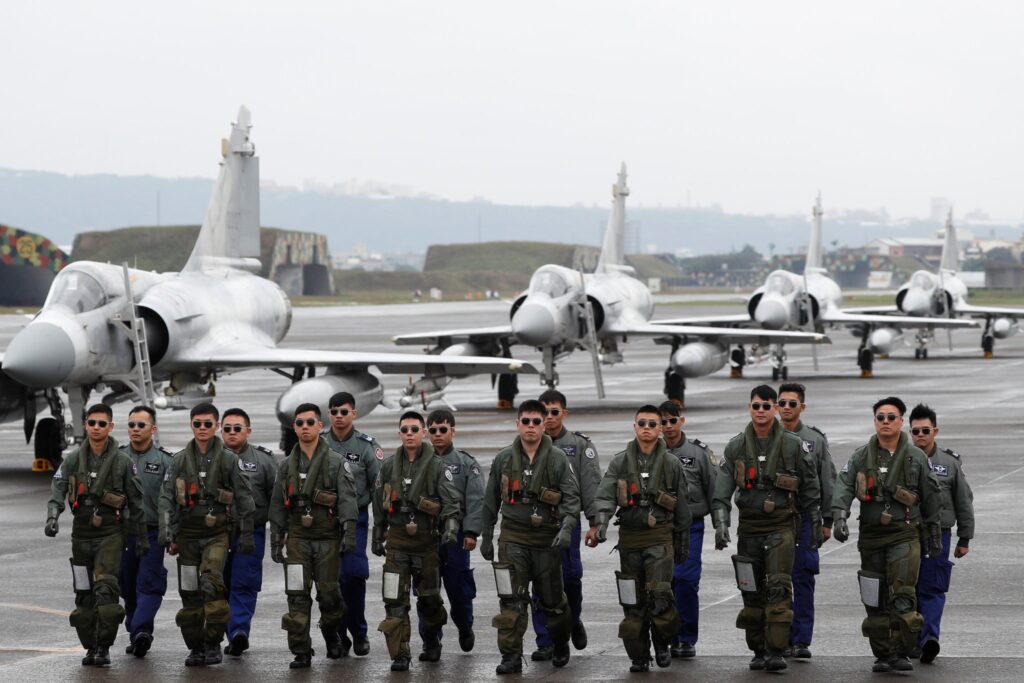
China steps up incursions into Taiwan’s ADIZ

Relationships between Taiwan and China have become increasingly strained over the last month and officials are starting to question whether this might be impacting aviation safety in the region. Here is a look at the conflict and the potential impact it may have on commercial operations.

The background.

Taiwan and China have a long and ongoing dispute over whether Taiwan is Taiwan – an independent country, or Taiwan – a breakaway province that is still part of China. China is officially known as the People’s Republic of China (PRC), while Taiwan refers to themselves as the Republic of China (ROC).

Similar to Hong Kong, Taiwan has retained a high level of independence from mainland China, and effectively governs itself, having its own constitution, democratically-elected leaders, and own armed forces.

Unlike Hong Kong however, Taiwan rejected China’s “one country, two systems” formula which would have enabled them to retain autonomy, while reunifying with China. It remains a disputed country with few countries around the world recognising it as a sovereign nation independent of China.

This is at the root of this conflict, and in recent months China has become more assertive in their control over Taiwan.

Here is a good summary of the political situation.

What are China doing?

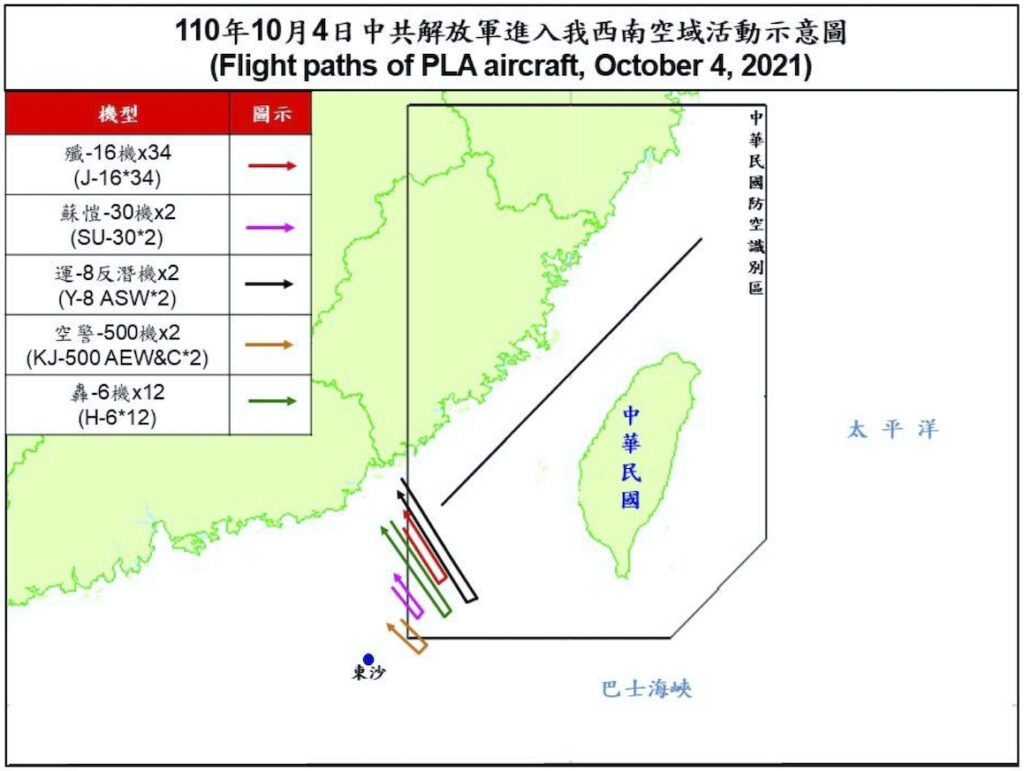
China have been “re-asserting” themselves over Taiwan by carrying out repeated incursions into the Taiwanese Air Defense zone. A recent incursion saw 39 military jets fly into the zone, for the second day in a row. The aircraft included 2 Y-8 anti-submarine aircraft, 26 J-16 fighter jets, 10 Su-30 fighters and a KJ-500 early warning and control aircraft.

They are reports of a 52 aircraft incursion which included 16 nuclear-capable H-6 bombers.

PLA (Peoples’ Liberation Army) = China’s military forces.

Where is the airspace?

Taiwanese national airspace is the airspace over Taiwanese land, extending to 12nm off their coast over the territorial waters. Military aircraft are not allowed to enter any national airspace without express permission from the state. China did not violate the national airspace, but did violate the ADIZ.

An ADIZ is different to national airspace, and is specifically declared by a state for reasons of military air defence. Some states designate their entire airspace as an ADIZ (Iran being a good example).

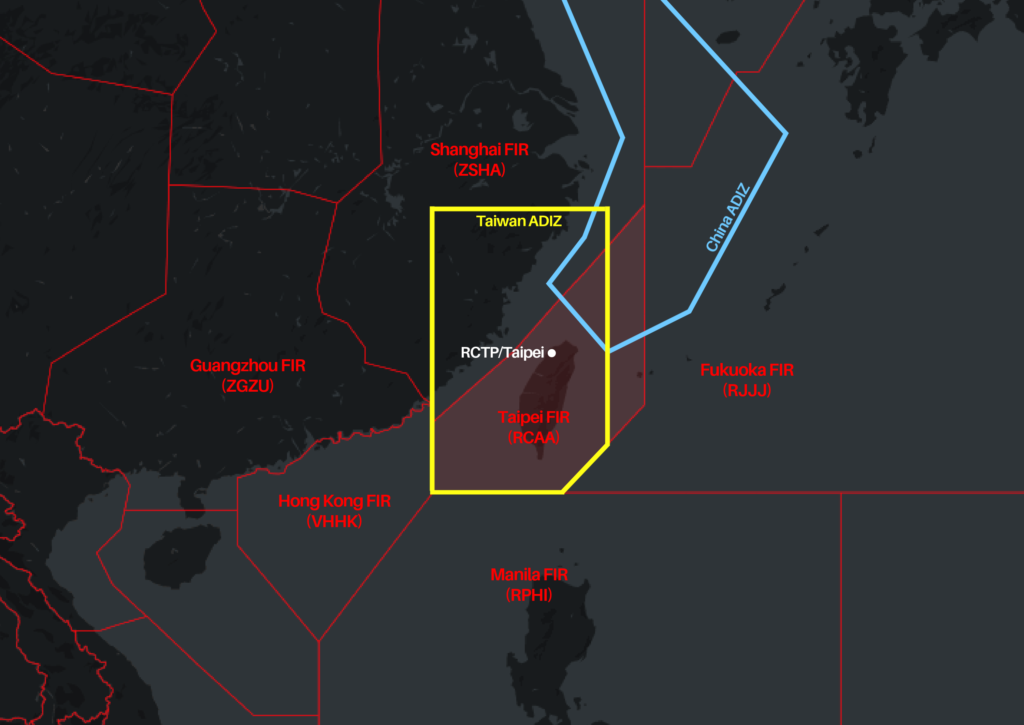
Taiwan’s ADIZ sits between Taiwan and continental Asia, over the South China Sea (the Taiwan Strait), shown (approximately) below. The ADIZ itself is disputed as well though since it overlaps and includes disputed territories.

Is there any threat to civil aircraft?

The ADIZ overlaps international civil flight routes. The increase in military traffic and activity in the area is a potential threat.

Taiwan’s response to the repeated incursions has been to scramble their own military aircraft, issue radio warnings and deploy their air defence missile systems. The deployment of air defence systems could raise the risk of misidentification between civil and military aircraft, if Chinese aircraft do stray beyond the ADIZ and into national airspace.

The Vice Defense Minster for Taiwan suggested the incursions “are affecting the safety of international flights,” but the statement was possibly political and as yet there has been no report of civil aircraft being impacted by the situation.

Procedures in Taiwan’s ADIZ.

You can read the procedures in full in Taiwan’s AIP ENR 1.12.1, or download a PDF here. But here’s a summary of how it works:

  • There are restrictions for non-tactical aircraft in the area including no flight below 4000’, and to maintain flight along designated airways. ATC contact must be obtained prior to entry.
  • Aircraft will be intercepted by the Chinese Air Force if they fail to follow ADIZ procedures, or if they exceed 5 mins ETA of a designated reporting point, deviate more than 20nm from the airway entrance or have greater than a 2000’ difference from assigned altitude.
  • Basically, if you are flying in the ADIZ, make sure you’re in contact with ATC, and don’t do anything without telling them first. Pretty standard stuff for operating through an ADIZ.

The Taiwanese do have their own Air Force, partly funded by the US.

General ops.

We wrote about operations to Taiwan back in 2019 and it is worth having a quick read because if you are a foreign registered aircraft because:

  • You are not allowed to operate directly between China and Taiwan
  • If you need to make a tech stop between the two then aim for VHHH/Hong Kong or VMMC/Macau
  • You probably aren’t going to get permission to overfly China if you are routing to Taiwan from anywhere else.

You can read more on this here.

Back in 2018, there was also a dispute over China’s M503 airway. The airway is a main north-to-south route for aircraft heading to Hong Kong or Macau from Southeast Asia. Taiwan didn’t like it because it lies so close to the FIR boundary separating Chinese and Taiwanese airspace.

The result of the dispute seemed to be a sort of “tough luck” from China, and aircraft still regularly use the airway. More on this here.

The risk level?

While the ongoing conflict and aggressions do threaten the general peace and stability of the region, there is no immediate threat to commercial operations. Maintain a good listening watch if operating in the area and ensure you are in contact with ATC if operating through the ADIZ.


BACE in Vegas: Special Airspace Procedures

Caution! This is previous year info – 2023 to come!


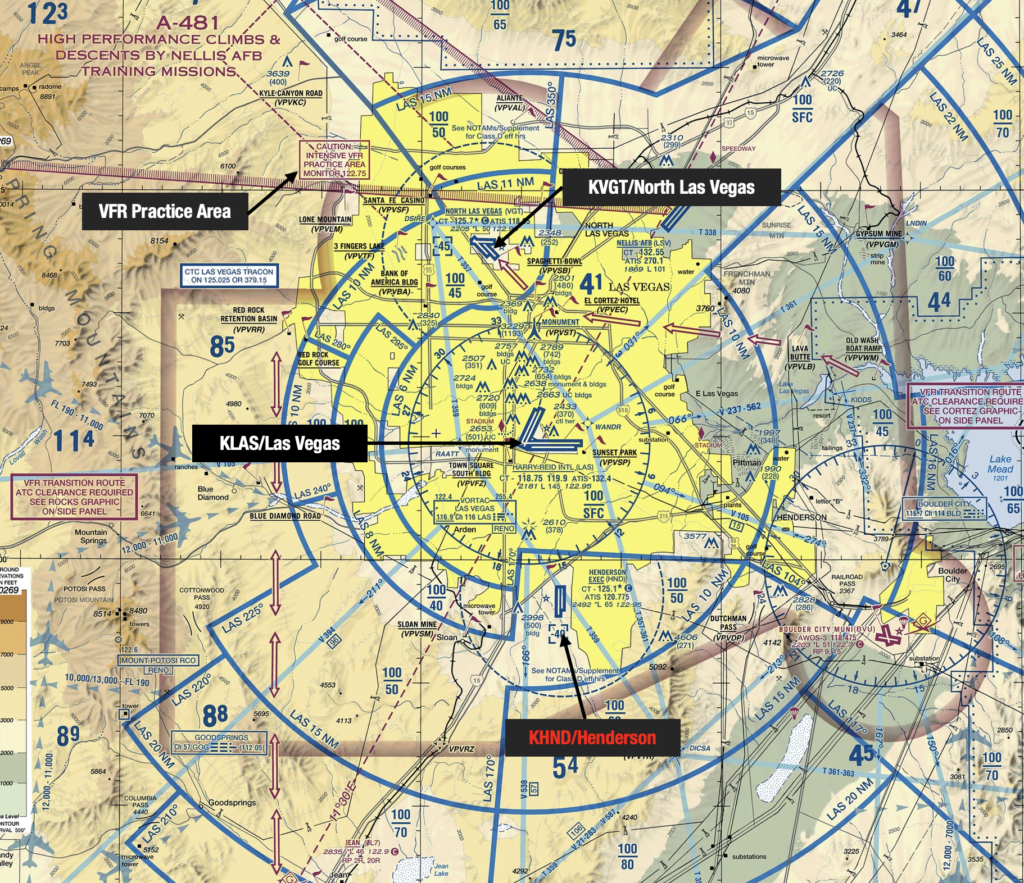
If you’re headed to Las Vegas in October, look out for special airspace procedures at three main airports – KLAS/Las Vegas, KVGT/North Las Vegas and especially KHND/Henderson Executive.

What’s going on?

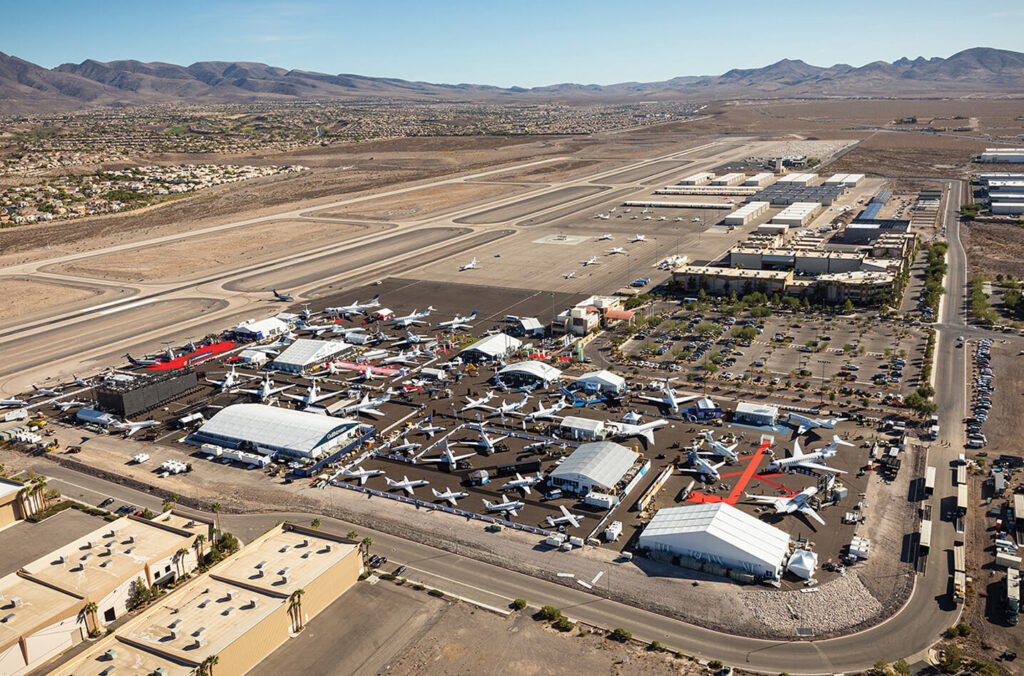
The NBAA Business Aviation Convention & Exhibition (‘BACE’ for those in the know) is happening at KHND/Henderson Executive airport from Oct 12-14, and things are going to get busy.

To keep the traffic flowing, the FAA has published special airspace procedures you’ll need to know about. They will apply from 14z on Oct 8 until 06z on Oct 14.

Here’s how they work.

Watch how you file.

For starters if you’re within 100nm of Las Vegas don’t try to pick up an IFR clearance once airborne.

In fact, they want all flight plans bound for any of the three major airports filed at least 12 hours in advance (but no more than 22). Any requests to change destinations between the airports once wheels up will be denied.

There may also be other methods that ATC use to put the brakes on the flow. This may include the use of ‘expect departure clearance times’ – IFR flights bound for Vegas will need to depart within five minutes of them. And of course, don’t rule out the chance of dreaded ground holds.

To keep track of these delays, the FAA NASS website is the best place to start.

Terminal area in Vegas – KHND/Henderson where the event is happening is south of the city.

Headed to Henderson?

Here’s what the FAA have to say about it…

From 0900:LT on Oct 9 until 22:00LT on Oct 10 all landings of aircraft not based here will need a PPR. Contact HND Ops on (702) 261 – 4858 to reserve yours (and get in early as they can fill up). Make sure you include your PPR number in the remarks section of your flight plan.

You’ll need to fly one of three RNAV arrivals. From the NW, the GAMES ONE. From the NE, the BOEGY ONE. And anything from the south, the NTNDO ONE.

Once you’ve landed, they want you off quickly. Take the first available exit. Stay on tower until they tell you to change ground.

Then there’s parking. You probably would like to stop your airplane at some stage after landing? Good plan, but you’ll need a reservation for that. Get in touch with the HND FBO on (702) 261 – 4800 or you can do it online here. But don’t show up unannounced – there’s a $1,000 fine, and the house always wins.

You need to reserve your parking spot at Henderson – don’t arrive without one as fines apply!

What about departures?

Don’t try and jump the queue. They don’t want you to ask for taxi until you have an IFR clearance and are clear to enter a taxiway from the ramp.

Showing off a ride at the show?

If you’re exhibiting, there’s a lengthy set of rules you’ll need to follow. You can access those here.

There are also special procedures for demonstration flights. Issues with airspace make these tricky for ATC who may not be familiar with the profiles of demo flights. Be sure to let Las Vegas TRACON know if you need anything special in advance, and they’ll do their best to help. You can contact them on (752) 600 7011.

Planning to go IFR? You’ll need TRACON’s approval on the same number. Your call sign will be ‘DEMO’ followed by the last three characters of the aircraft reg.

There will only be two routes available:

  • FL230 and below: KHND.OYODA2.BOJAC..BYSEN.NTNDO1.KHND
  • FL240 and above: KHND.SCAMR2.IWANS..BOEGY.BOEGY1.KHND

What about if you want to go VFR?

Yep, that’s okay too. You’ll need to use the practice area to the northwest of KVGT. Listen out on 122.75, and let others know where you are and what you’re doing. Click here for the Las Vegas VFR chart.

Keep an eye on NOTAMs

Other procedures may be published before the event.

If we’ve missed something, we’d love to hear from you. Get in touch with the OPSGROUP team on team@ops.group.


Introducing MEL: A guide to Minimum Equipment Lists

Setting up your MEL can be a tricky business. It is definitely not something we know anything about. Thankfully though, we know some folk who do. AviationManuals have just issued an updated version of their MEL guide for clear info on what you need, how to use it, and how to maintain it.

So here is a little guide to their guide, plus some other things we think you might find helpful as well.

Why are we telling you about MELs?

Because it’s easy to get confused about what equipment is needed in certain areas, or to do certain things, or to go certain places.

So, first up, a quick “what’s the difference?” – when do you consult your MEL, and when do you consult the AIP or some other regulation document?

The MEL is all about your aircraft.

Actually, probably a better way to put it is it is all about your aircraft’s ability to fly safely, as opposed to being about specific operations it might want to do. The MEL can tell you whether, if you try to get airborne, it might become a bit of a Lethal Weapon…

More accurately, it is what “makes it possible to temporarily operate with inoperative equipment or instruments.”

Can it safety fly without Datalink? Yes. Can it safely fly without the nose wheel attached? No. The MEL will make that clear. It will also tell you how long you can operate without something being fixed, provides amended procedures (if needed) and maintenance guidance.

So – the MEL is a “Can I fly?” tool.

What you need to remember though is even if your MEL allows you to go fly, you still need to check that where you are going to fly doesn’t need that bit equipment or instrument. This is the gotcha.

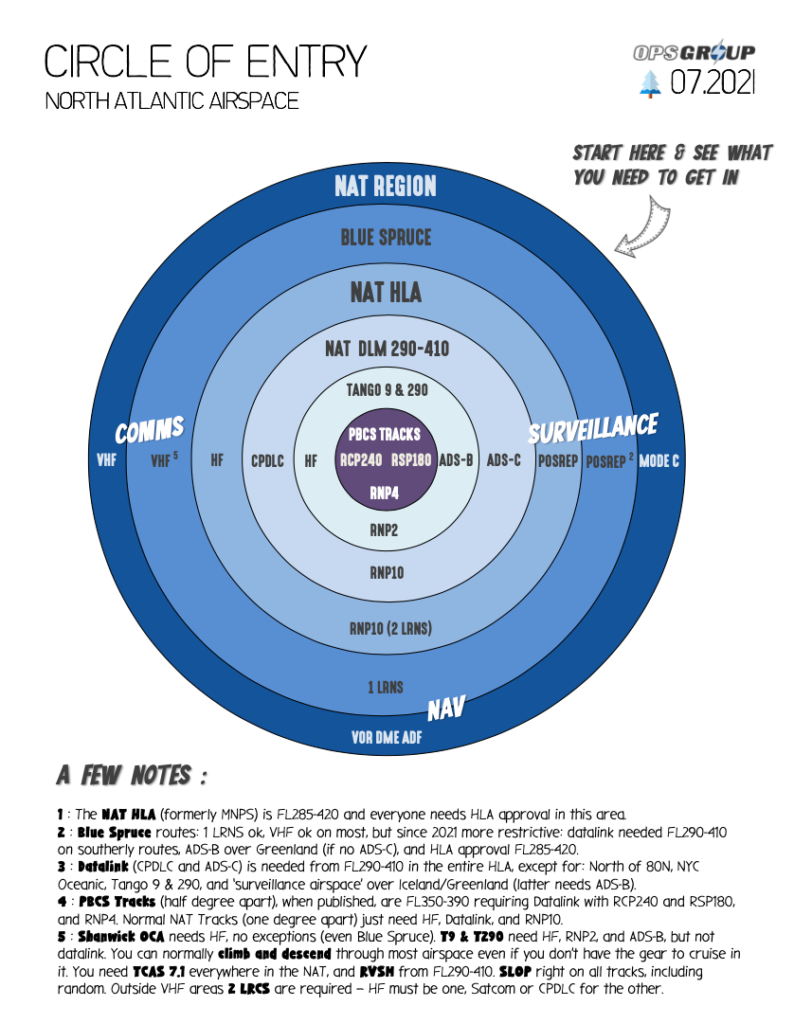
Can I safely fly without Datalink working? Yes, the MEL says I can. So I am good to go on my flight through the NAT HLA? Well, hang on, that’s a different thing you’re asking. Your aircraft can can fly perfectly well without it, but you are going to have some planning considerations.

Throwing this in to be helpful. Click to download PDF.

Do you have anymore examples of this?

We said it once, and we’ll add it in again –  even after establishing via the MEL that it is safe to go, you still need to confirm you are capable and compliant in the airspace you are planning on flying through, and that is not what your MEL is telling you.

The NAT HLA is probably the best and clearest one, but there are a lot of places and situations that this might be the case.

Your autopilot for example is not necessarily an MEL items, meaning you could take that airplane without it functioning. It would be annoying. It would make drinking coffee more difficult, but you could. However, if you want to fly through RVSM airspace then an autopilot is a requirement. So what the MEL might let you go without, the airspace you want to go to might not.

So, the MEL is confirming what your airplane needs to safely fly, but it is not (necessarily) confirming that your aircraft will meet all the capability requirements for where it is planning to fly.

When should you use your MEL?

Basically anytime before you start your takeoff roll, because it is the document that is going to guide you on whether your airplane needs what just broke to safely get up (and stay up) in the air. Once rollin’ though, your failure warning system is what you’re going to want to be consulting.

But an MEL is also a handy reference to consult in the air (when you’ve done everything else) because it will help you plan for the other end – can you dispatch without that ‘whatever just broke’ working. When you’re back on the ground the MEL is going to become the “controlling” document once more, so it is worth a look.

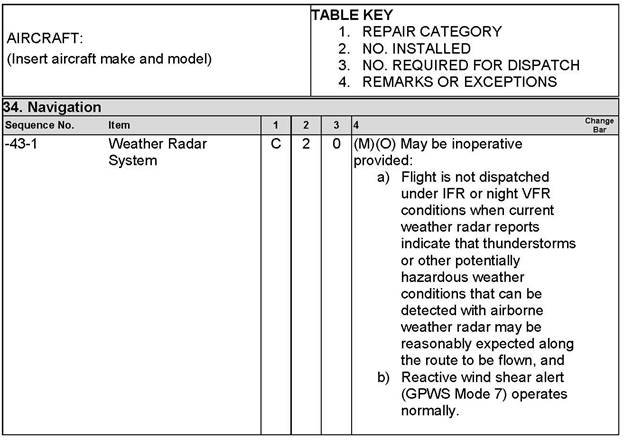
Here’s a sample example.

OK, I understand the MEL’s purpose, but…

We have gotten to the bottom of how, and what, to use the MEL for, and what its intentions and limitations are. But I know what your next question will be – 

“I already have an MMEL, so why can’t I just use that?”

The MMEL is a Master Minimum Equipment list. This is made by the authority and the aircraft manufacturer for the aircraft type in general. Some of what is in it might not be useful for you though because you might not actually have all the equipment installed. Maybe you didn’t want it, or maybe your airplane is just a way more modern version of the type that the massive all inclusive MMEL is covering.

Which is why you want an MEL.

It is tailored to your actual aircraft, and your operation and procedures. This makes it shorter, easier to use and more relevant (but not less restrictive).

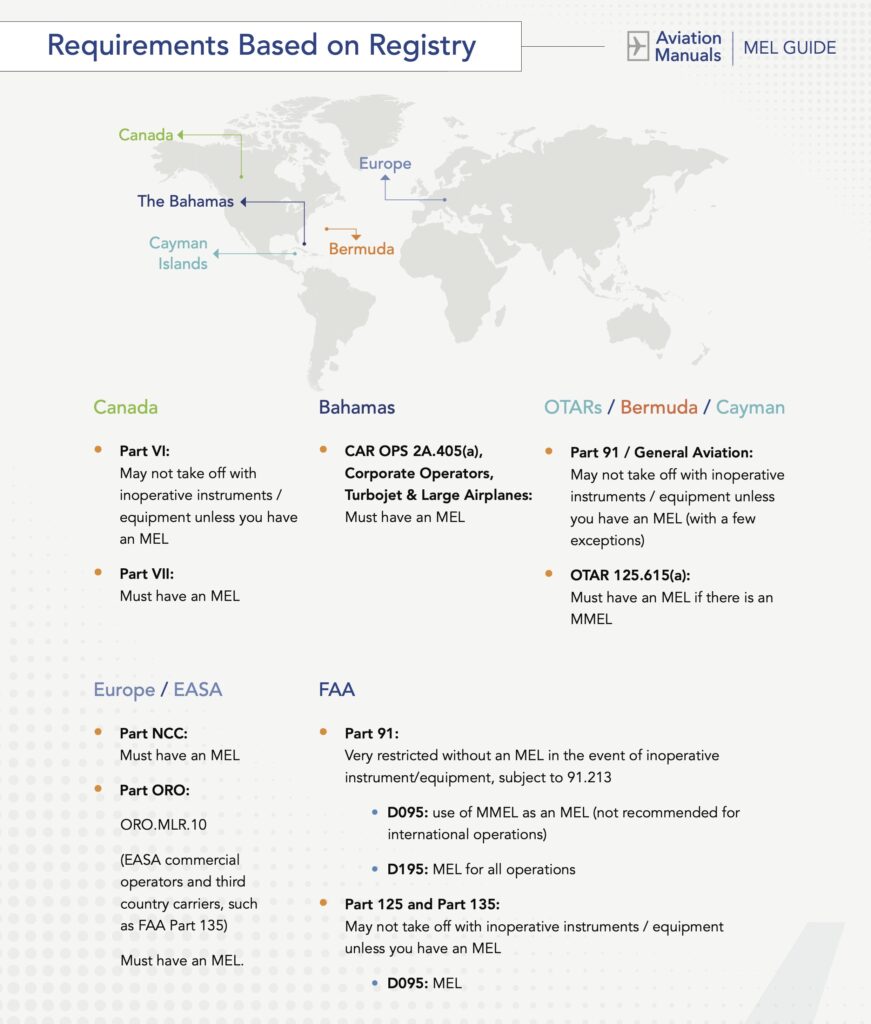
Now, the FAA do allow Part 91 operators to use their MMEL as an MEL. You need a D095 LOA and some other paperwork for this. But a lot of places don’t allow this, or just aren’t used to it, so you’re probably going to need an MEL (not just the MMEL) if you’re heading abroad.

An MEL is actually a requirement for dispatch so if they don’t accept your MMEL as an MEL you could be in for some lengthy debates and delays if you’re ramp checked.

Here’s something we wrote about it back in 2019 when it started to become a thing.

The FAA are also planning to do away with the D095 in the possibly not too distant future, meaning all US operators will need a D195 – the custom MEL.

From AviationManuals updated MEL Guide. Click to download PDF.

In case you aren’t familiar with the terms, Part ORO establishes organisational requirements to be followed by an air operator conducting specialised and non-specialised commercial air operations and specialised and non-specialised non-commercial air operations with complex motor-powered aircraft.”

Part NCC refers to “non-commercial operations with complex motor-powered aircraft.” So chances are this is going to apply to you and your aeroplane.

Our Guide to their Guide

The AviationManual folk put it better than we can so go check out the website for info on what is involved in the MEL setting up process.

It does look fairly simple though:

  • Complete a simple questionnaire
  • Get a copy of the draft manual for your review
  • Send feedback (and probably some money at some point) and receive your Final Copy. And off you go.

That’s it!

A summary of who to ask?

“I need an MEL written up” – Talk to the folk at AviationManuals, they can help. Here is the link direct to their guide.

“I am on my airplane, ready to go on a flight and something has broken” – Consult your MEL.

“I am flying and something has broken, is my MEL useful now?” – Check your checklist and read through your FCOM. When you’ve done that, know the plan and have a few minute to spare, take a look in the MEL as well to see if it will cause issues for the return flight.

“I am a Flight Planning Person and I’ve just been told that an aircraft is flying tomorrow but its *insert something random* isn’t working, can it still fly on the usual route?” –  Check the AIP, or drop us a quick email and we’ll see if we can fathom it out for you.


Oct 2021: Iraq Airport Closures

Please note the date on this story – Oct 2021. We’re keeping the info here for reference purposes only.


Iraq is closing for a few days while their elections take place.

Here is a quick look at what this will mean for traffic who are planning to operate over or into Iraq over the closure dates.

Why and what are they closing?

They are closing all airports and border crossings for security reasons. 

The election will take place Oct 10th. The closures will run from 2300LT on Saturday Oct 9th to the morning of Oct 11th. You will not be able to operate in or out of Iraq during this time.

Any further information on this has not yet been provided, but when elections took place in 2018, there were a number of strikes which reduced public services to nearly zero, as well as violent protests and riots across the country. This resulted in a 24 hour closure in May 2018.

In September 2018, several Katyusha rockets were fired directly at Basra airport during further protests against the government and elections.

It is volatile at the best of times.

ORBI/Baghdad airport is situated around 100nm southeast of a major airbase which is often targeted by rockets and weaponised drones. Baghdad itself is a target for rebel groups, and while attacks are generally low level, they do pose a risk to civil aviation and also heighten the risk of misidentification by air defense systems.

Rockets fired at Basra airport

But can you still overfly?

The Notam published by ORBI/Baghdad Airport suggests you can:

A0239/21 - AD CLSD DUE TO IRAQ ELECTION DAY. WITH EXEMPTION TO EMERGENCY
SITUATIONS DECLARED BY FLIGHTS OVERLYING IRAQ. 09 OCT 18:00 2021 UNTIL 11 OCT
03:00 2021. CREATED: 30 SEP 19:11 2021

ATC through Baghdad is provided by a large, international air traffic services provider, Serco, and you often hear US accents on frequency. Kuwait also provide some control of the southern sector when they hand over. So ATC control is not thought to be impacted.

The days leading up to and following the elections may well see some increased traffic across Iraq as dignitaries, government officials etc fly in, out and about.

Iraq and the ORBB/Baghdad FIR are a main connection between the Middle East and Far East to Europe. There are really only 4 options – 

  • Via Iraq
  • Via Iran
  • Via Saudi Arabia
  • Via Pakistan into Eastern Europe

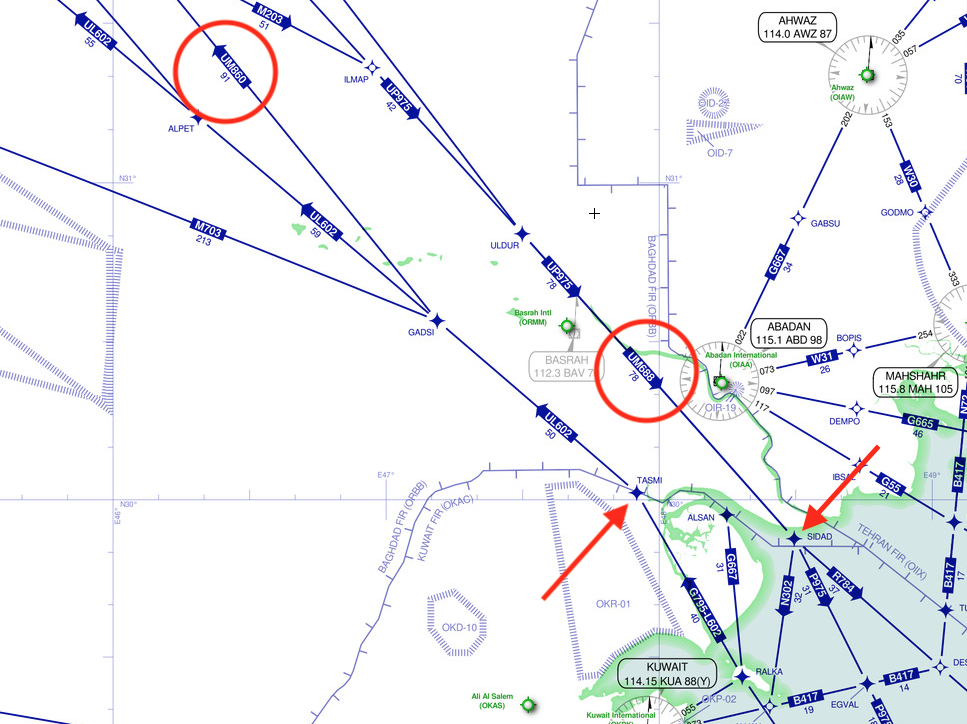
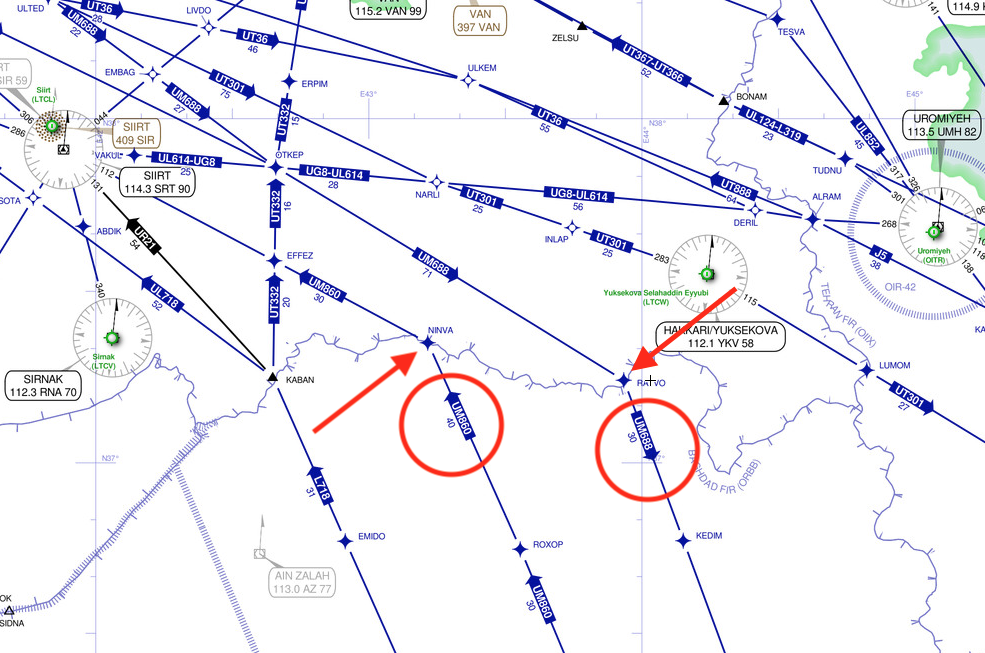
ORBB/Baghdad FIR Notams A0235/21 and A0236/21 advise on the routes available for civilian aircraft overflying the region. This is also covered in their AIP ENR 1.10-2 section 4.5.3.

Heading Northbound you can file TASMI SEPTU ROXOP UM860 NINVA

Heading Southbound you can file RATVO SISIN UM688 SIDAD

Entry/Exit in the south of Iraq


Entry/Exit in the north of Iraq

Airports

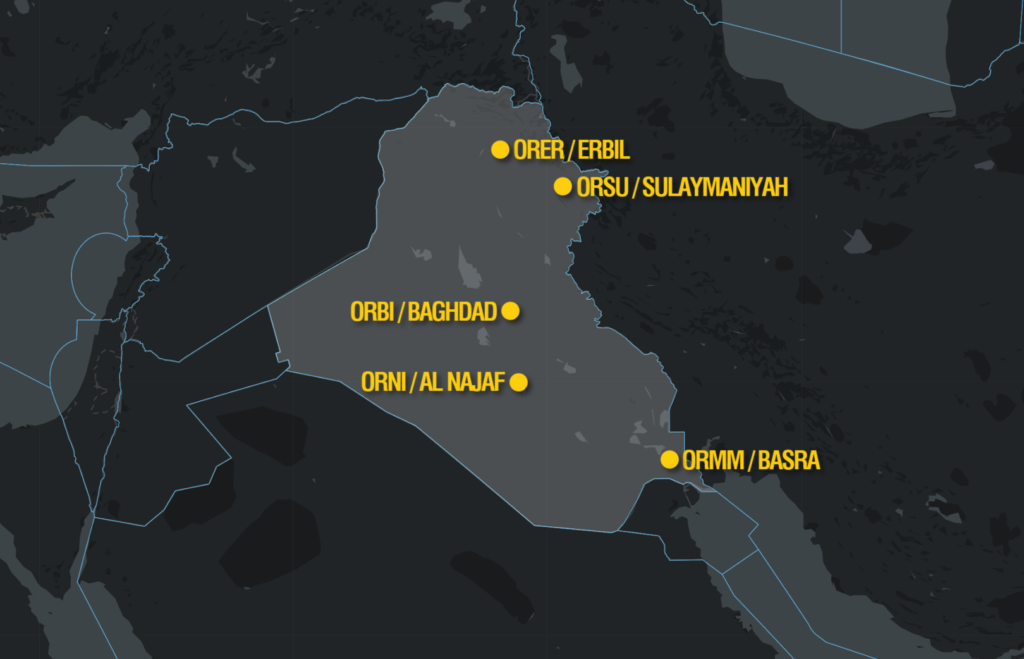
The airports will be closed. All international airports (ORER, ORSU, ORNI, ORMM) have published identical Notams to the one for ORBI/Baghdad, saying that they will remain available for emergency diverts, but they will not be available for “general” en-route alternates.

Iraq borders Iran (another region with airspace warnings in place) and Syria to the other side (which is a No Fly Zone) so  you may be limited on where you can go – turning around and heading back to Kuwait and Saudi, or routing to Turkey (depending on which direction you are heading from).

Eastern Turkish airports are generally smaller and less capable than the larger ones to the West. There are also often skirmishes along the border between Iraq and Turkey, with military on both sides sometimes closing portions of airspace during military activities.

What should you do?

Continue to plan overflights, but be aware that diversions will likely not be supported during this time.

Be aware that government offices and services will likely be closed and unavailable during the election period, so don’t submit overflight and permit requests last minute because they won’t be handled until afterwards.

What is available (when they aren’t closed for elections?)

Check out SafeAirspace – US Operators are banned from operating over or into Iraq, and other authorities advise against flights below FL260.

ORBI/Baghdad airport, in the capital, has a decent runway, however they do currently have works on 15L/33R and it is closed (when the weather permits) and between 0300-0500z.

Runway 15R/33L is only available during daylight hours and in VMC because the instrument approaches are suspended. 33L also currently has a displaced threshold (400m) and the declared distances are now 2901m.

So keep an eye on the weather and be aware of what might or might not be available. Notams A0222/21 and A0193/21 are the ones to read.


Don’t snow where to go? Here’s an Alps Ski Airports Guide

Winter is coming, and that means two big things to think about in aviation. Operating in cold, wintery conditions and operating into cold, wintery ski destinations.

So, to help you avoid getting ‘piste’ with airport restrictions, parking problems and other annoying operational obstacles, here is a look at some of the main Alpine ski destination airports which you might be thinking about flying into later in the year.
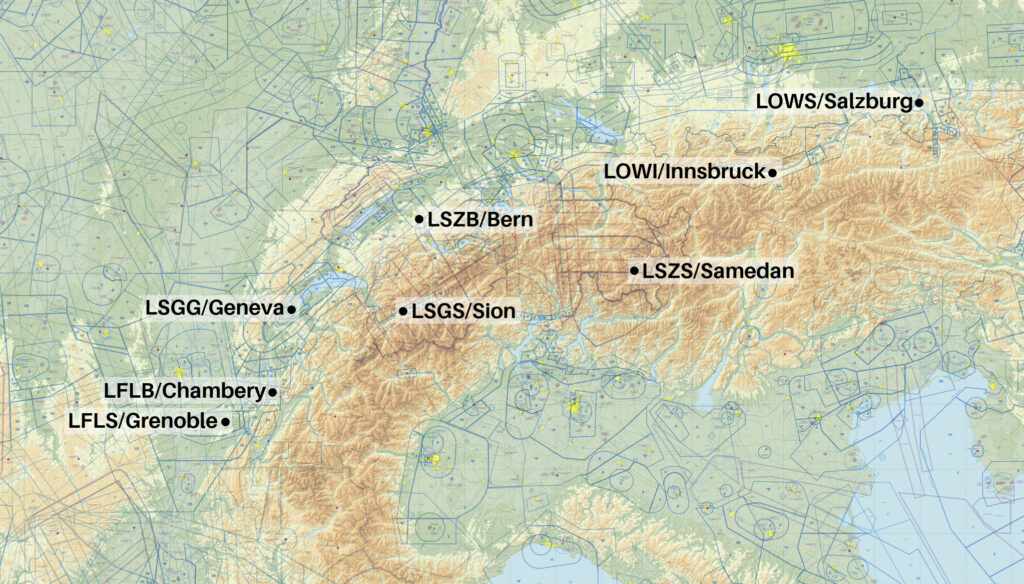
Innsbruck – Austria

LOWI/Innsbruck will get you as close as you can to Lech, St Anton, Zurs and Kitzbuhel.

It is 1hr 15 from Kitzbuhel by road, 90 minutes from Zurs or Lech, and 70 minutes from St Anton. Or about 25 minutes by helicopter from them all.

Innsbruck is one that you need to be familiar with, and have briefing material set up for, prior to operating in. The airport administration can provide a sample briefing, but you’ll need to tailor it for your operation. ernst.wieser@austrocontrol.at / ernstwieser@hotmail.com can help with that.

The full info is available in the Austria AIP, but you basically needed to have practiced in an FSTD before heading in with weather less than 3000’ ceiling or 5km visibility.

Slots are required here and the best folk to talk to are operations@innsbruck-airport.com

Innsbruck is not a big airport so parking is likely to be limited.

Airport Spy reviews give this a 3.5/5 rating.

Zurs is high in the Austrian mountains

Salzburg – Austria

LOWS/Salzburg requires special permissions from Austrocontrol – special.procedures@austrocontrol.at

This is a larger airport with a 9022′ runway, ILS to 15 and CAT III capability. However, terrain at the end of runway 15 means there is a specific and challenging missed approach procedure fo runway 15, and a very challenging RNP procedure for runway 33.

Historically, a PPR has been required during the busy season from mid-December. Notams are usually issued in November confirming this, along with confirmations of charter and corporate slot availability.

Get your requests in early with +43 662 8580-261 / sas.ops@salzburg-airport.at

Chambery – France

LFLB/Chambery is best used if you want to head into Courcheval, Meribel or Val d’Isere.

You have probably heard of LFLJ/Courcheval Airport – it is the one in the mountains that is always on the top 10 scariest airport list. Chambery is *less of a challenge but you’re still going to need some training before heading in here, particularly if you plan to head in after dark, if the ceiling is less than 3500 or visibility is below 5000m. The airport has some terrain challenges of its own, sits at an elevation of 779′ and offers an ILS (in only one direction) to a 6627’/2020m runway.

The AIP says “Due to mountainous terrain in the vicinity of Chambery APT, it is considered essential that pilots are well familiar with approach, missed approach, circling maneuvers, and departure procedures. Therefore, concerned operators have to set specific operational instructions for the use of Chambery APT as well as provisions for their pilots’ training. The responsibility for the preparation of such information rests on the operator (or pilot-in-command for non-commercial flights).”

If you need ops assistance, the main business aviation FBO is available at +33 4 79 54 49 52 / fbo@chambery-airport.com

All the fees and charges are available here on the airport website.

The first 60 minutes of parking are free, after which they start to charge you 0.36 euro per ton (MTOW) per hour. Parking is arranged though SEACA (handling@chambery-ariport.com).

There is a dedicated business terminal and a good 30 parking spots at the airport, however, during peak times where forecast traffic exceeds capacity, they do ave scheduling in place. This means any take-off needs a PPR from the COHOR association.

Peak time is weekends (and some Fridays) from mid December to April, and the first week of January. You can email hdqcoxh.scr@cohor.org or slots@chmbery-airport.com to organise, or cy.myhandlingsoftware.com if you are a general or business aviation operator.

Contact the BRIA de Bordeaux : +33 5 57 92 60 84 and ensure you have a gendec for customs at least 24 hrs before arrival/departure.

Airport Spy reviews give this a 4/5 rating. 
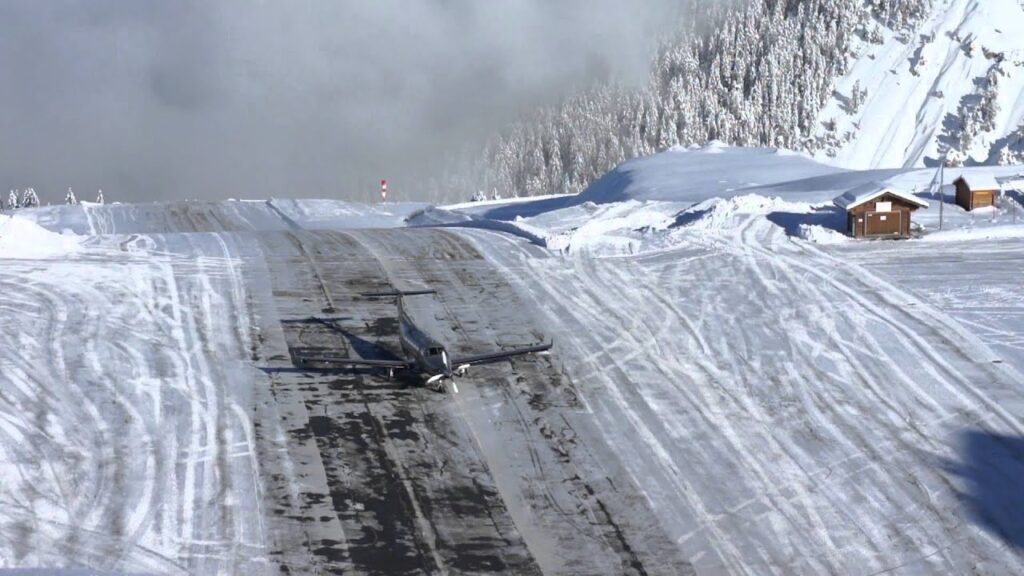
LFLJ/Courcheval is Chambery’s scarier neighbour, about 1 hour 15 minutes drive away

Grenoble –  France

LFLS/Grenoble airport is well situated for at least 10 different ski resorts. It is an hour’s drive from Saint Pierre de Chartreuse, Chamrousse and Lans en Vercors, and up to 2 hours from other major resorts.

The airport has a 3050m runway and no specific qualification requirements for the ILS or RNAV procedures. They also up their RFF to a level 7 during the peak winter season (normally an RFF 5 with 7 on request).

The opening hours during the winter season will be 0700 to 2100 local time and can offer full security and customs without PPR.

However, it gets busy! It is the second most convenient after Chambery and particularly during February tends to fill up fast so you are going to need PPRs, slots and to confirm parking in advance. Slots and apron space are handled though the same myhandlingsoftware.

You can find the fees and charges on their main site.

We got in touch with businessaviation@grenoble-airport.com / +22 4 76 93 49 24 and they are very helpful and can assist in handling support.

We don’t have any Airport Spy reports for here yet! Send us one!

Bern – Switzerland

LSZB/Bern airport will get you close to Gstaad.

They have a very handy airport site with info for GA flights including an airport manual.

They don’t require slots and advised that they rarely see restrictions or capacity issues even during the busy season. As with many of these airports, they are not H24, but can offer different hours on request if required.

There is no pre-training required, but the airport is challenging. They have cold temperature corrections for the terrain (highest MSA is 15,800’) and the airport elevation itself is 1675’. The arrivals also take you through Class E airspace and VFR traffic without transponder and radio is common in the vicinity.

Reports for the airport suggest you may get terrain alerts, and preparing for the circle to land runway 32 with waypoints is a good idea. Our Airport Spy reviews gave it 4/5 stars and called it ‘tricky’.

Ground handling is mandatory here so get in touch with groundservices@bernairport.ch / +41 31 960 21 31 for info.

Gstaad does have its own airport – LSGK/Saanen – which, like so many, requires pre-training before you head there. You will need a PPR as well, but only a few hours before. The airport can handle jets up to at least a MTOW of 15,000kg and requiring up to RFF 5, but in winter they don’t have jets landing because of runway condition. So if you’re anything other than a Pilatus PC-12 or equivalent, stick with Bern.
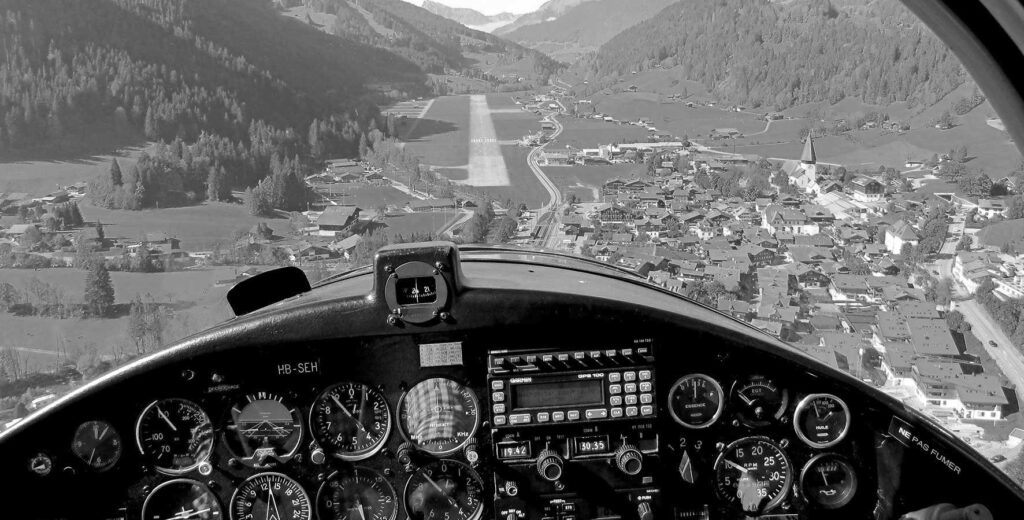
You can get in touch directly with them at +41 33 748 33 22 / info@gstaad-airport.ch

An old photo but gives a good idea of the challenges of this airport

Engadin (Samedan) – Switzerland

LSZS/Engadin, also known by some as Samedan is the closest airport for the St Moritz ski spot. It is actually a dedicated private jet airport just for St Moritz, and is barely a 10 minute drive from the ski chalets.

Parking here can get tight during Christmas, New Year and White Turf (weekends in February). There are limitations for jets with fire & rescue category 4 and higher.

Engadin was built, literally, into the mountains and you need prior training (and have to pass an exam) before going here. The main website provides some good briefing info on all this.

There are also some specific flight plan filing requirements for the airport – which you can read about here.

For handling support, get in touch with +41 81 851 08 51 / info@engadin-airport.ch

Airport Spy reports rated this airport 4.5/5 stars.
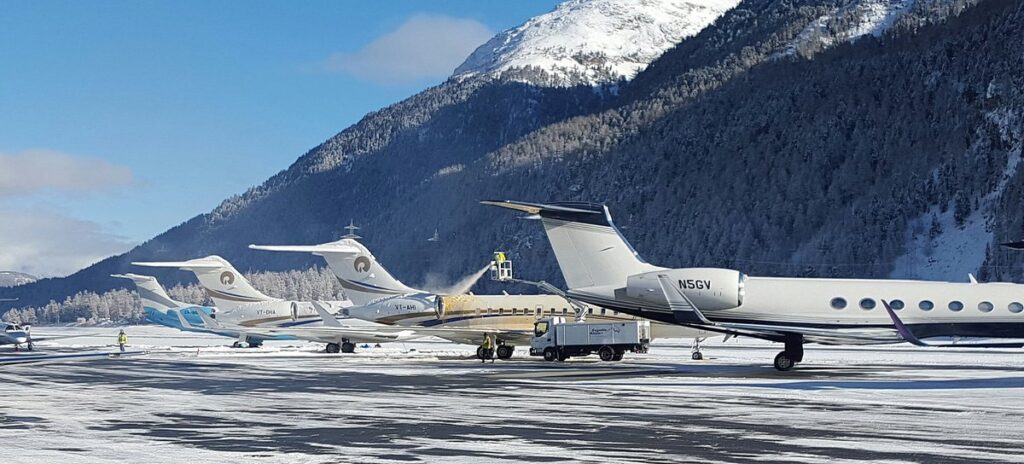
Anyone you know in this picture?

Geneva – Switzerland

LSGG/Geneva is the closest airport for the Chamonix resort, and is about 1 hour 20 minutes drive away, or has multiple helicopter transfer options.

There is no particular pre-training required to operate into Geneva, however it is a relatively challenging airport with very high terrain in close proximity. Check out our Airport Lowdown here.

Geneva is busy in the summer and busy in the winter. All year around really. But it does get particularly busy from December 15 to the end of April, and there are generally restrictions (and Notams) issued around this time.

You will need a PPR slot for arrival and departure. In the past there has been a maximum slot reservation window of 21 days. 

This is where you need to head to check for info on all things PPR at Geneva.

Geneva has a dedicated business aviation terminal which is pretty convenient for the main terminal. There are three big hangars here, however, hangar space is limited during peak times and in the busiest part of winter often only the hangar run by the airport is available to “general public”. So get in touch and make arrangements early if you need them!

The main FBOs are:

You can find full details of Geneva Airport charges direct from the airport website.

Our Airport Spy reviews gave it 4/5 stars.

Sion – Switzerland

LSGS/Sion is the main airport for the Verbier, Zermatt and Villars resorts. The really posh ones.

Before we go any further into planning and operating there, you need to know that Sion does require special authorisation from the Swiss Authority because of the challenging procedures due terrain.

This authorisation requires pilots to undergo training before operating there, but there is a decent list of places where you can do this training, including training facilities in the US. They also have some great airport briefing info on their website.

Possibly because it is so challenging (guessing less folk fly there), the FBO we contacted advised that they don’t have any parking limitations at the airport, and that aircraft can stay for as long as they like, in a hangar too if needed.

For queries on handling, try Signature Flight support +41 27 305 2424 / sir@sigantureflight.ch

Our Airport Spy reports only rate this 3.5/5 stars. The VFR traffic makes it tough, but less challenging than some.

Where else?

We haven’t covered some of the bigger European airports which can be used for parking and to reach Alpine ski destinations.

LSZH/Zurich and the Milans (LIML/Milan Linate and LIMC/Milan Malpensa), as well as EDDM/Munich are all relatively convenient for ski destinations in the Alps and are larger airports which offer better parking, hangarage and easier operating options.

If you are familiar with other airports which are good options for winter ski destinations, then please share those “gotchas” or need to know “heads ups” – and we will share them on to everyone in the group. You can file an Airport Spy report here: ops.group/blog/spyreport


Canary Islands Volcano: What’s the Operational Impact?

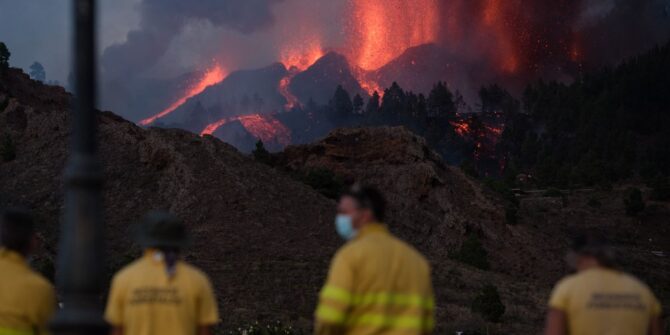
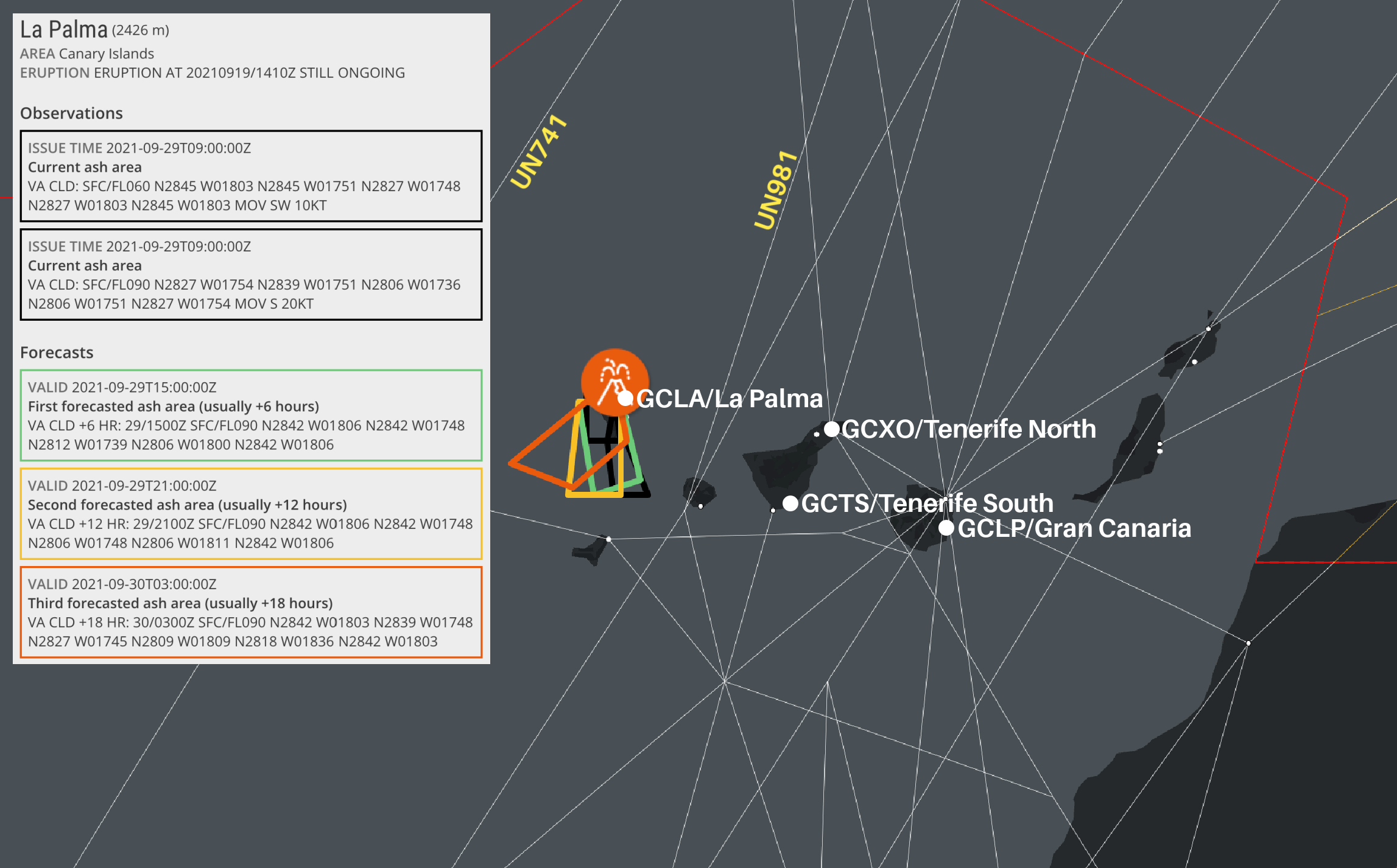
Eruptions have been ongoing since Sep 19 at the Cumbre Vieja volcano on La Palma in the Canary Islands.

Volcanic Ash

The latest VAAC report (eff 29 Sep 08:55z) shows the ash cloud only up to FL050 around the vicinity of the volcano and GCLA/La Palma airport.

If the wind changes it may impact GCTS/Tenerife airport and arrivals from the south of Tenerife may be impacted.

Thanks to FlightRadar24 for their awesome graphics.

GCLA/La Palma Airport

Operations were suspended at the airport on Sep 19 and again on Sep 25 after ash fall reduced visibility at the airport.

The volcano continues to release ash at low levels, and further short notice closures are possible.

La Palma is an international airport which also serves as an alternate for GCTS/Tenerife and GCLP/Gran Canaria.

The Airspace

UN741 is a major airway for routing south southwest. Currently the ash cloud is not impacting this area.

UN981 is a major northerly routing airway crossing the area of ash, but the level of the ash cloud is not impacting it.

GCCC/Canarias ACC, who control the airspace, have said they currently do not plan to close any airways due to the volcanic activity, but recommend using specific SIDs and STARs if operating to airports in the area – check the ‘Latest News’ section on the NOP homepage for details.


The US rules for carrying Covid in the air

Since January this year, any passenger boarding an international flight bound for the US must have a Covid test within 3 days of their departure.

Great when it’s negative. Not so much if its positive – what happens then?  How do you carry them back to the US? And what about their close contacts? Are they good to go?

Let’s take a closer look…

The US law says you cannot knowingly carry someone with known or suspected Covid-19 to or within the US on regular passenger flights. You can’t even board them.

Instead, as a general rule they won’t be able to travel until they meet CDC quarantine or isolation guidelines (typically staying put for ten days and more testing), in addition to whatever local laws apply. A great reason to have travel insurance.

But what if they have to travel?

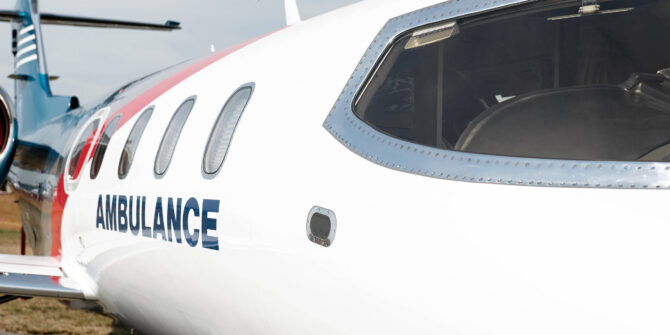
There are important reasons why a Covid-positive passenger might have to fly. The most common one is that they are being medically evacuated or transferred to better medical facilities. It may also be part of the passenger’s insurance policy.

Either way, it falls upon charter or medevac operators to make it happen because the rules say that this is the only way. The airlines just can’t be used.

Forget ‘the brush.’

If you’re chartered to carry Covid positive passengers – or those suspected of having it – you need to be familiar with the CDC’s procedure for transport by air. Spoiler alert: you need permission, so whatever you do don’t show up unannounced.

You can read that procedure here in all its glory. But here’s a quick rundown of how it works.

It starts with the phone.

If you’re operating an international flight, the first step is to contact the relevant US Embassy. There may be local laws or restrictions that prevent a Covid positive patient from being allowed out of quarantine early.

Then, over in the US, there are three important agencies that you’ll need approval from:

  • The FAA – yep, make sure they’re cool with it.
  • Customs and Border Protection – they will work with you to decide on the best port-of-entry.
  • The CDC – This involves contacting the relevant quarantine station for where you’re headed – and you’ll need to give them at least 24 hours’ notice before you take-off. There’s a bunch of info they’ll need – click here for that list.

You’ll also need to think about the logistics of your flight including transport, permission from other CAAs and airport authorities – including where you may need to divert to.

Pre-travel.

Prior to the big day it goes without saying that your unwell passenger(s) should stay in isolation. They’ll need a medical exam beforehand to make sure they are well enough for the level of care you can provide them in the air.

You’ll also need to work with airport authorities for a plan. If you have to enter a terminal, your passengers will need to be separated from the public.

Choose your ride.

When it comes to transporting unwell passengers, not all airplanes are created equally.

The CDC has guidelines for this too. They were developed back when MERS was thing. Remember MERS? It was like Covid’s lesser known cousin that appeared a few years back but was way less memorable at the party.

In a nutshell they need to be large enough to be able to separate passengers and crew into different parts of the airplane. Ventilation is also important – ideally, cockpit air should have positive pressure relative to the main cabin and not be mixed.

Don’t forget to think about range. Every stop you make will become a logistical challenge to manage. If you can make it in one go, you should.

On-board.

First things first, keep that air flowin’. At all times. Even on the ground during long delays, you need to keep ventilating the airplane.

Passengers and crew must wear masks – don’t worry you can remove them to sip on your coffee. You can get away with basic ones, but the CDC recommends the fancier N95 masks or better.

Here’s the kicker – crew need to remain separated from passengers unless there is an emergency or to provide single-serve meals. You can put up placards or barriers but they need to be obvious and not stop anyone from reaching emergency exits or seeing cabin signs.

If you can, seat passengers at the rear of the aircraft and keep cabin crew at the front – at least six feet away. The reasons for six feet will become clear in a sec. Pax should have their own bathrooms.

After landing.

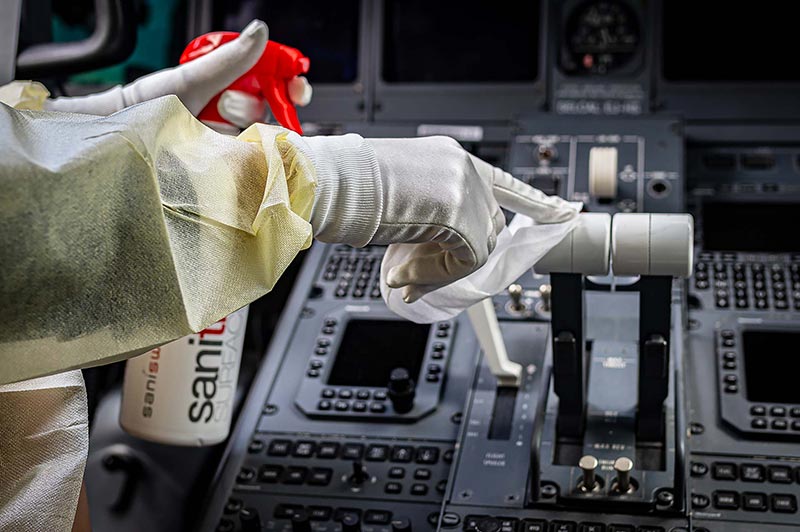
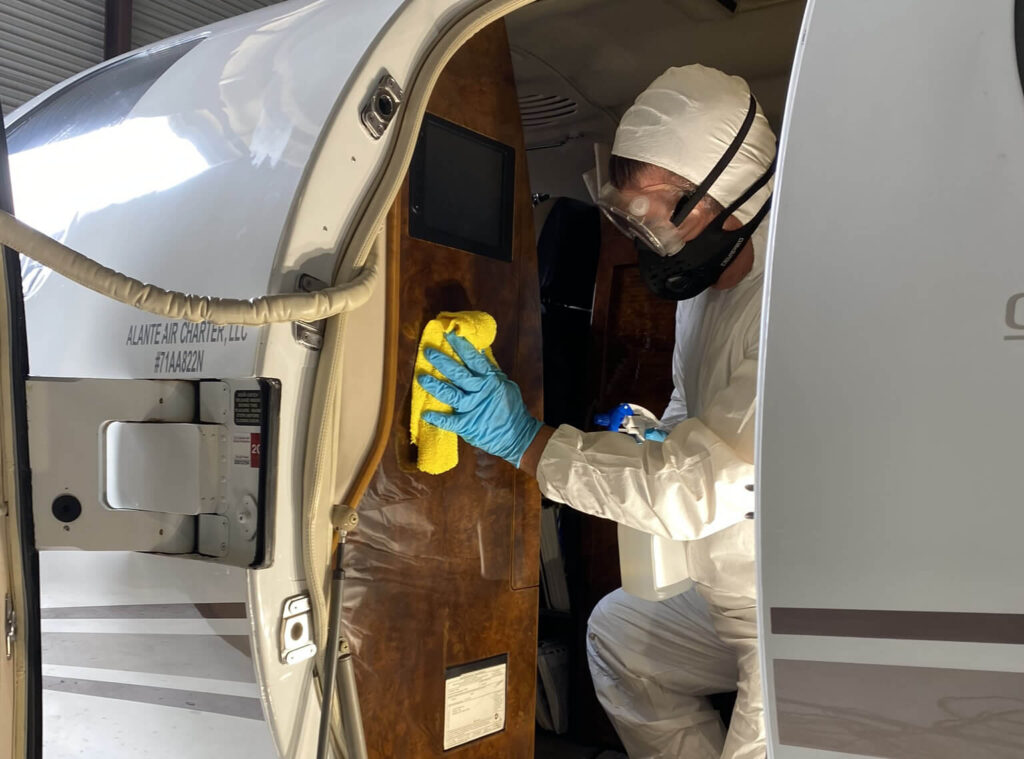
 The airplane will need to be thoroughly cleaned. As in squeaky clean. There are rules for what types of products need to be used – you can read about that here.

Post-flight cleaning needs to be squeaky clean.

As for crew, as long as you’ve followed the rules, you don’t need to be tested or quarantine. But make sure you self-monitor for symptoms for 14 days afterwards, just in case.

The ‘close contact’ conundrum.

This is where things start to get tricky…

Being a ‘close contact’ of a known Covid case for all intents and purposes means you have been exposed.

But what counts as ‘close’? Brace yourself, because the CDC have that base covered – it means anyone who has been within six feet of a confirmed case for a cumulative total of 15 minutes over 24 hours.  Cumulative being important here – so for example, three 5 minute exposures counts as ‘close’. It doesn’t need to be all in one hit.

So, what happens when a known close contact still tests negative?

 There’s effectively three scenarios here:

  • The close contact is fully vaccinated and has no symptoms: Okay, they can still travel.
  • The close contact is fully vaccinated but has symptoms:  No bueno, it’s off to quarantine.
  • The close contact hasn’t been vaccinated:  No bueno, it’s off to quarantine.

Cool, so can Covid positive passengers be transported with their close contacts?

No. But you can transport multiple positive pax together, you just can’t mix positive ones with those who have tested negative.

Still have questions? We don’t blame you. Here are some handy places to start.

The CDC website, you can visit it here.

The US FAA, their Covid specific stuff is found here.

If you’re trying to reach Customs and Border Protection, you can reach em’ here.


Mount Etna Operational Impact

Mount Etna erupts a lot! Opsgroup have issued about 20 alerts in 2021 because of its continued activity.

Here is a brief summary on the airspace sectors and contingency procedures to know about for if (when) it next erupts.

The Airport

Mount Etna is situated approximately 33km in a straight line from LICC/Catania-Fontanarossa international airport. Which is why, when she blows her top, it often results in an alert for the airport and surrounding airspace – the main issues being ash in the atmosphere and the potential risk to engines, and ash fall at the airport reducing visibility.

Mount Etna, on a good non-exploding day, is still a 10,922’ hulk of a hill requiring an MSA for LICC/Catania airport of 13,300’ in the North quadrant.

The volcano also causes an area of magnetic abnormality.

LICR/Calabria airport is a smaller, domestic and VFR traffic airport on the SW tip of Italy which is also impacted by ash from Mount Etna when the wind is from a westerly direction.

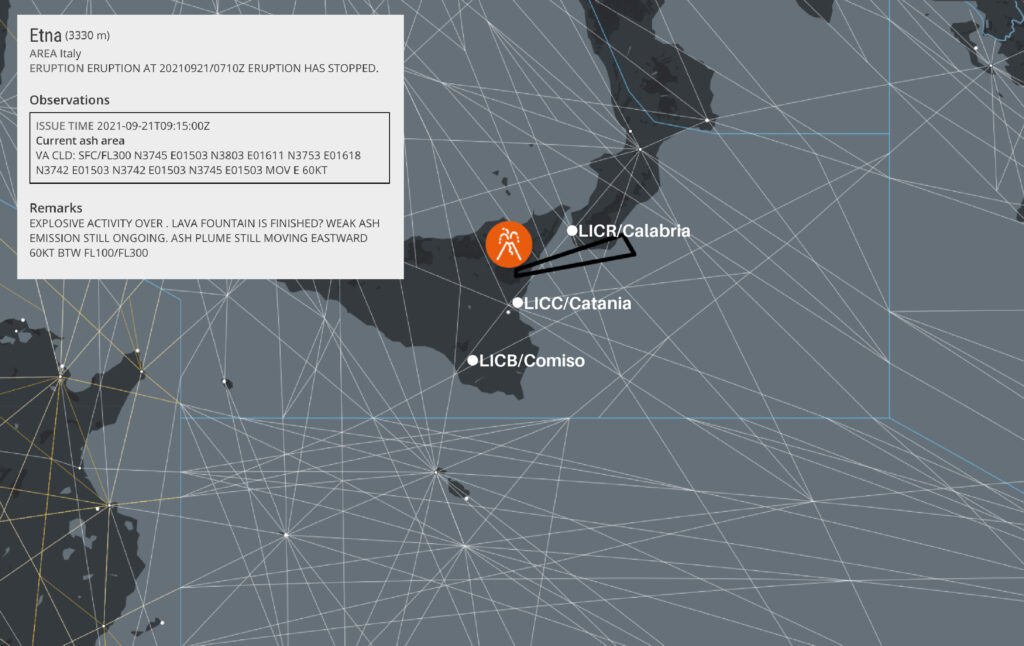
September 21 2021 eruption impact

The Airspace

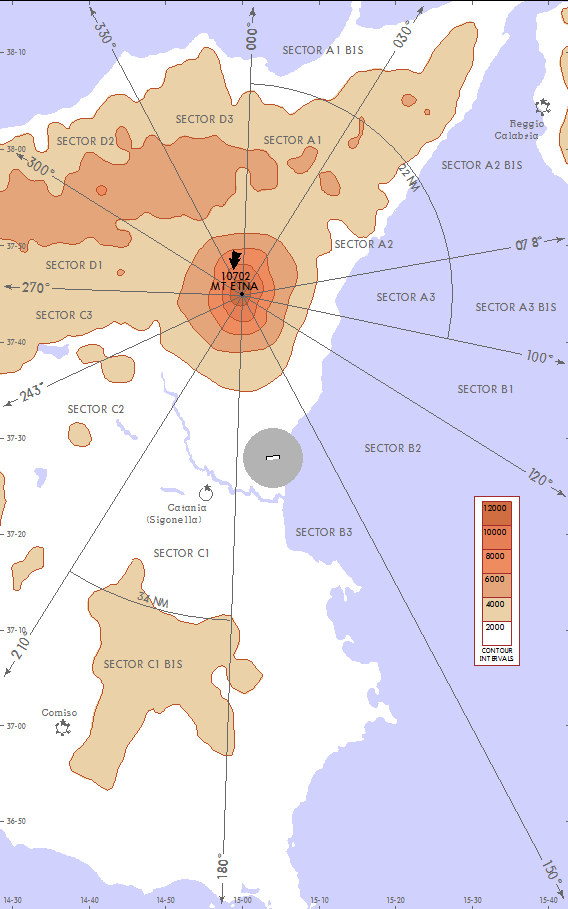
The airspace surrounding LICC and Sicily is broken down as this rather tidy chat from Jeppesen shows. The sectors are centred on Mount Etna and allow ATC to close those which ash drifts into.

The Sectors (thanks Jeppesen)

The 21 Sep 2021 eruption has initially closed sector A3 and is impacting sector A2 BIS and low level traffic into Calabria airport.

The ash cloud often reaches altitudes above FL150 impacting both local traffic, and overflight traffic at lower levels.

Contingency Procedures – Arrivals and Departures

Arrivals and Departures to LICC/Catania avoid overflying Mount Etna entirely – the 13,000’ MSA area is from radial 300° to radial 050° based off the CTF VFR.

However, variable winds in the region mean forecasting the impact of ash clouds is difficult.

The sectors help establish which SIDs/STARs can be utilised on a given ash day. The full list is fairly long, but worth having a look over in advance to ensure you are aware of which arrivals, departures and approaches are being suspended or utilised.

Notams

Eurocontrol publish and share Notams advising of airspace closures and contingency procedures. You can view these in the ‘Latest News’ section on the NOP homepage.


What’s the news at Newark?

KEWR/Newark Liberty International is the other, other international airport serving the New York metropolitan area – the busiest airport system in the US – along with KJFK/New York JFK and KLGA/La Guardia.

Whilst JFK airport is the largest, Newark is actually the busiest in terms of number of flights. It is also the 6th busiest airport in the US in terms of international traffic, and 15th busiest in general in the country.

So, what is happening now?

Runway works. And a general redevelopment program which includes a plan to replace Terminal A, due to be fully finished by 2022. You can read about that here.

But it is the runway rehabilitation we are most interested in, because it involves runway 04R/22L. The runway was last upgraded in 2012 so this is long overdue, particularly given that it serves 47 percent of the airport’s traffic load.

Of course, there is a Notam to warn everyone about the closure.

Does anyone remember AC Flight 759?

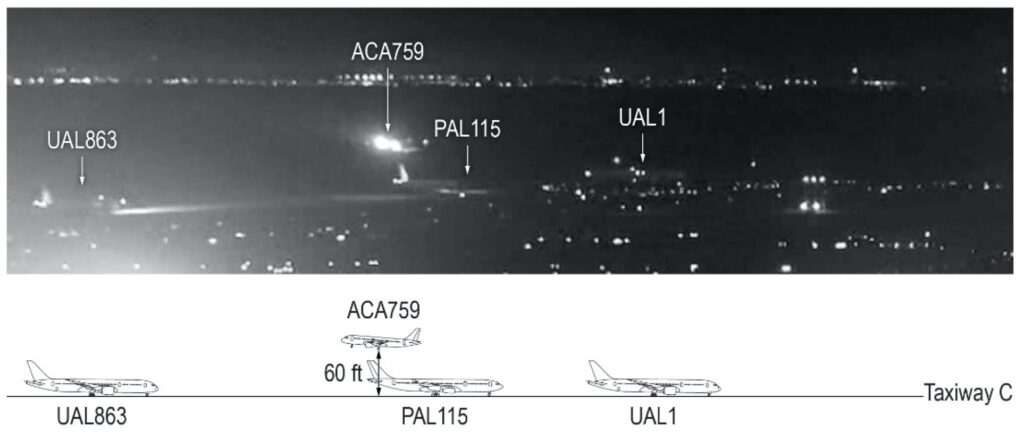
Air Canada Flight 759 is the one that, in 2017, very nearly had a very nasty accident at KSFO/San Francisco. By very nearly, we mean avoided it by less than about 14 feet. That was the reported distance between the bottom of the Air Canada aircraft and the tail of a Phillippine Airlines A340 sitting on Taxiway C.

One of the probable causes the NTSB cited was the pilots mistaking taxiway C for runway 28R because they had overlooked the closure of runway 28L in the Notam report.

So, let’s take a look at the Notams you will see for KEWR/Newark should you operate in there today.

We downloaded a report straight from the FAA Notam site, and it is here if you would like a look.

This may well differ to what you would receive in your flight plan pack, we have not included any filters and the layout is a little less user friendly. It is possible your flight planning department / system / whatever you use does present this in a clearer way, but it is also possible it does not.

We had this highlighted to us by a member whose exact words were “Talk about getting lost in the weeds – that’s just crazy.”

So, what is the concern?

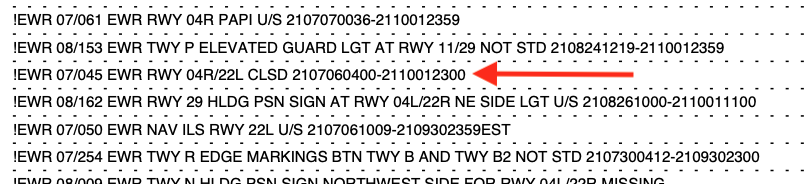
Well, there are 5 pages, with 108 Notams in total and hidden away on page 4 is Notam 07/045

In case you couldn’t spot it

Which is why we mentioned the KSFO incident.

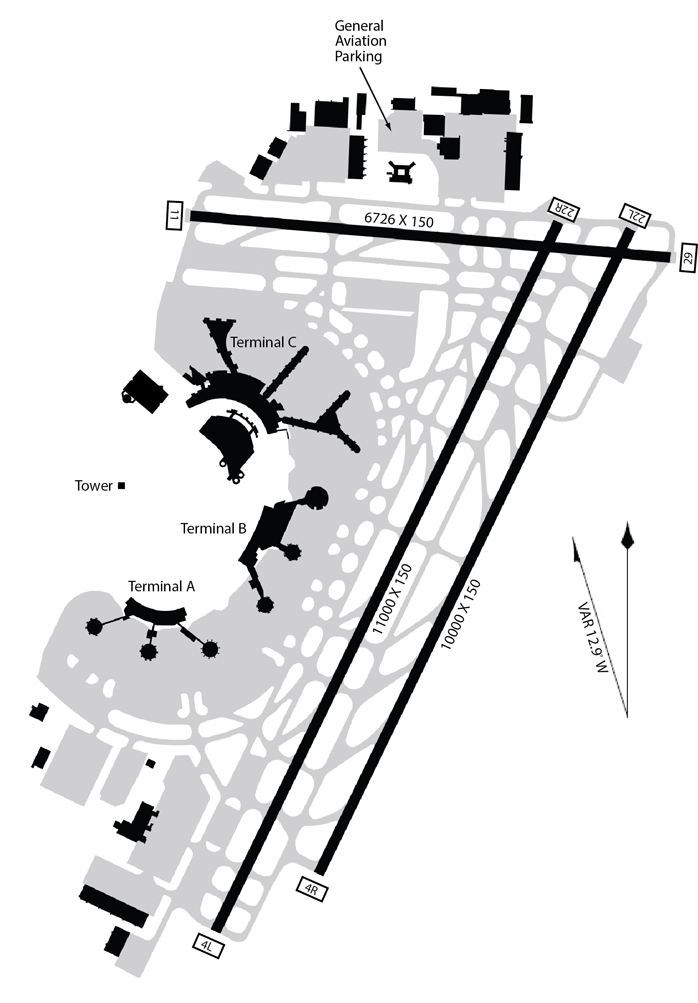
Newark’s runway layout looks like this – 

04R/22L is closed

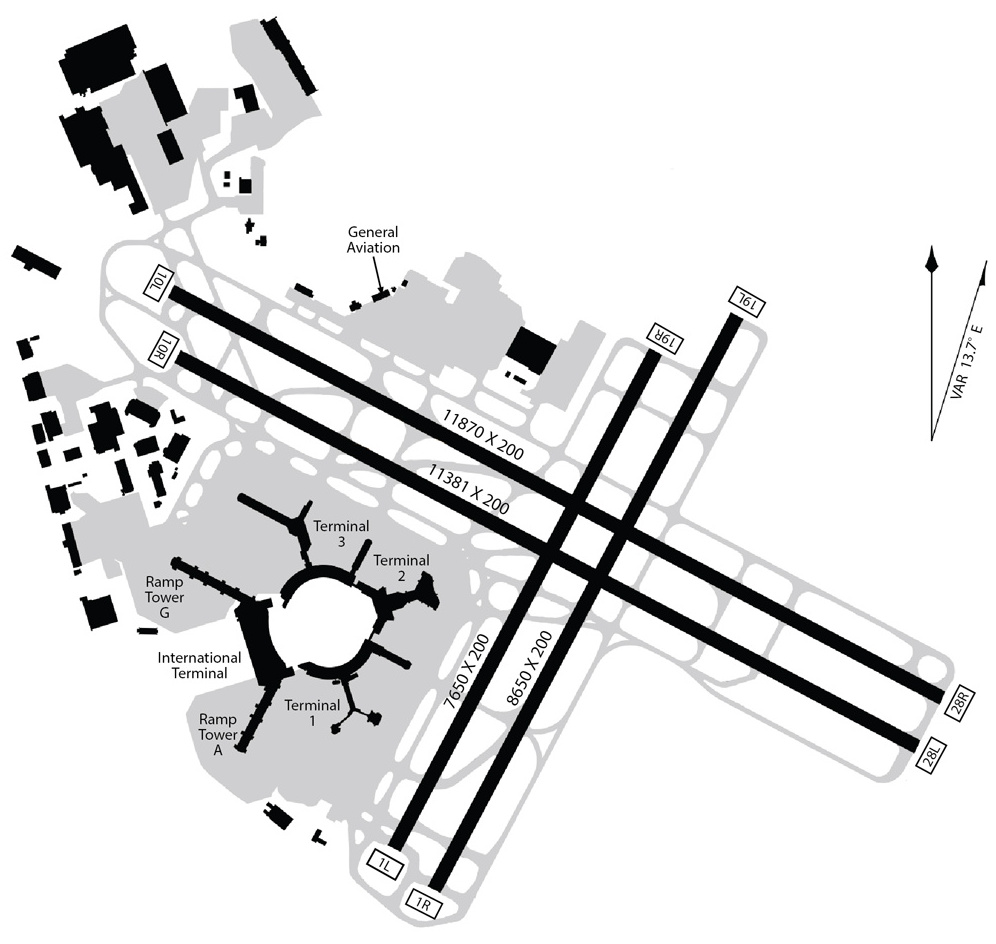
San Fran’s runway layout is this –

28L/10R was closed

And while KSFO’s layout, with taxiway C to the outer side of runway 28R led to a more likely visual mistake, the mixing of this Notam within a swamp of over 100 others does mean it might be missed, particularly by an operator who is not familiar with the airport.

Notam 07/045

The Notam advises that runway 04R/22L will be closed from 06 July 2021 until 01 October 2021.

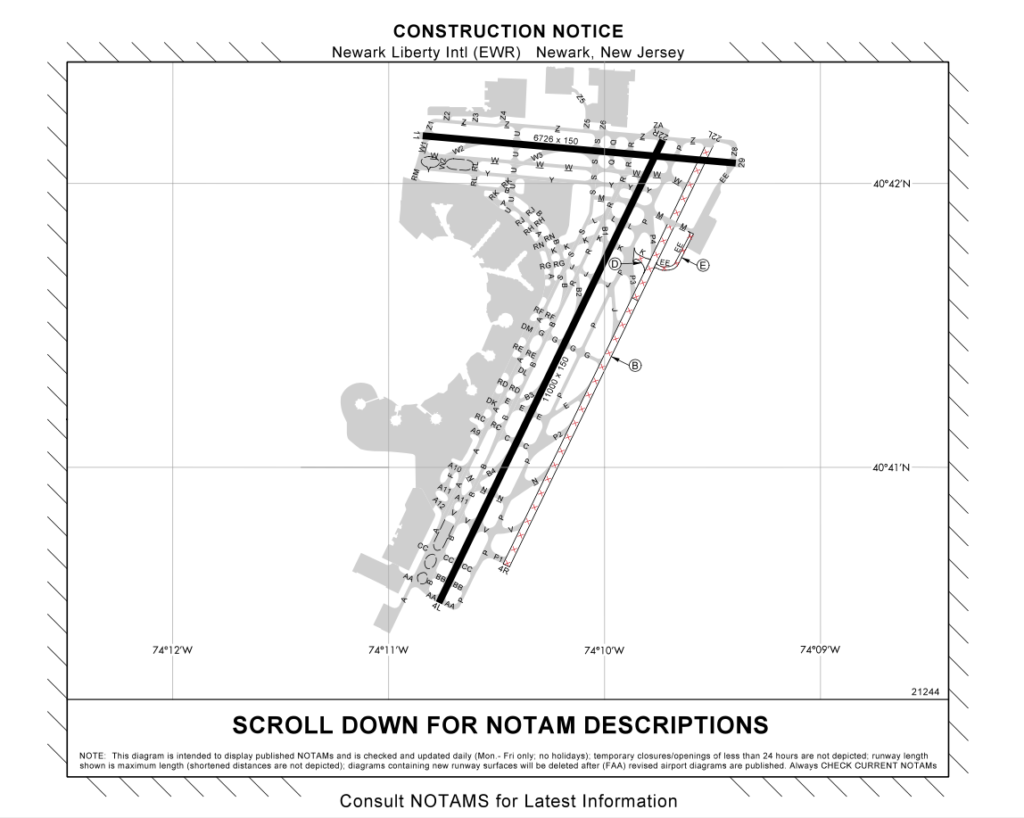
There is, if your filter includes it, also a construction plan.

The construction notice

What about the other 107 notams?

Nothing can substitute flight planners and pilots reading the Notam packs thoroughly. However, faced with 108 Notams for an airport (especially if you’re not familiar with it), it might be daunting.

So here is a summary of what to look out for, (as of September 15 2021).

In the air:

  • Rwy 11 has PAPIs but no VASIs. The visual glide slope indicators should not be used as they do not coincide with the ILS of RNAV glide paths
  • There are a lot of  VORs which have been permanently taken out of service, but many of the arrivals and some of the missed approaches require them. If you don’t have a suitable GPS equipped RNAV system then you are not gong to be able to fly a fair few arrivals and departures to the airport, or the ILS or VOR DME approaches for runway 11
      • TEB, COL, CRI, OTT, SBJ
  • The ILS and the LOC/DME procedures for 04L are not available
  • You cannot circle to runway 29 or 11 at night. The RNAV visual for 29 is also unavailable
  • There are a lot of cranes in the area. Some as high as 150′
  • The approaches for 04R/22L are not available… probably because the runway is closed
  • Runway 04R/22L is closed

On the ground:

  • A lot of the ground markings are faded so watch out while taxying.
  • The centre line markings for 11/29 are also in pretty poor condition. Actually, a lot of lead off lines and other runway markings for the other runways are faded too
  • And a lot of signs are missing or are missing lights, or are non-standard. So a general caution while on the taxiways.

Any other notices to know?

There is a long list of Letters to Airmen published for Newark. If you have not been there before, or seen these, then they are worth a read because they give helpful info on operations for the airport, and for the general NY area.

LTA-EWR-47 highlights the procedures for engrossing and egressing the ramp. So in plain English, entering and exiting. If you have just arrived then call ground control with your ramp entrance once you’ve crossed 04L/22R. If you’re departing then let ground control know which ramp exit you want when you request your taxi clearance.

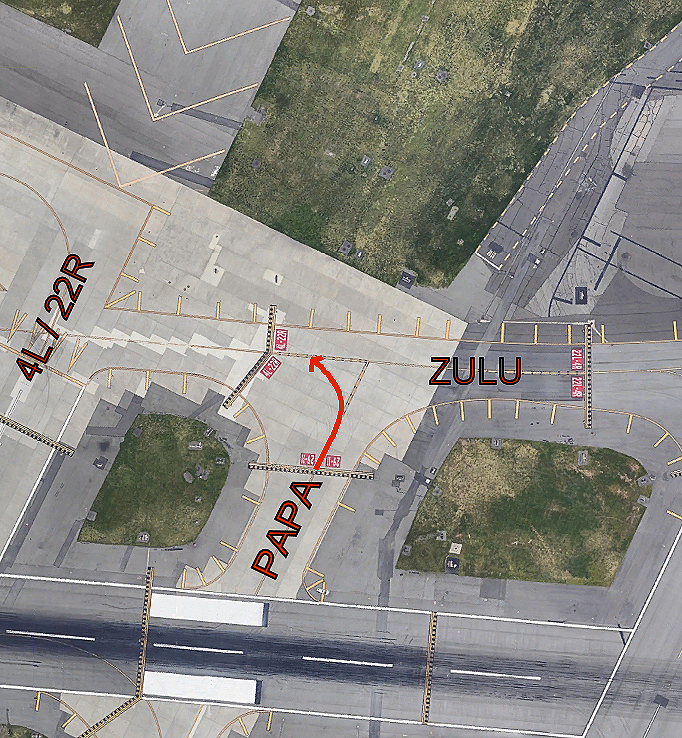
LTA-EWR-44 talks about the big Hotspot at the end of 22R/04L. A lot of GA flights make the mistake here. You’re going to be told to taxi PAPA, cross runway 11 then turn left on SULU and hold short runway 04L”. The turn is tight and the hold short is right there so don’t go too far!

Taken straight from the LTA

And the others…

  • LTA 51 is warning operators about non-visible areas – basically where ATC can’t see you so be extra careful of other traffic.
  • LTA 45 says be ready for takeoff when cleared, don’t dawdle on the runway.
  • LTA 46 is about helicopter departures.
  • LTA 48 is your info on LAHSO.
  • LTA 49 warns that ATC might issue multiple runway crossings using various different taxiways. Watch out for other traffic, but its not a race!
  • LTA 50 is all about line up and wait clearances at night.
  • LTA 52 is about simultaneous intersecting runways ops for arrives to 4Rand 29 – and the fact ATC are allowed to do it.
  • LAT 53 is your available distances for intersection departures.
  • LAT N90-67 warns to watch your climbs and descents in busy NY airspace.
  • LAT N90-73 It is really busy and aircraft often get vectored in and out of Class B airspace. This lists the airspace “hotspots” for traffic in the areas surrounding each major airport.

Any other things to share?

Aircraft are reporting they have been given the Stadium Visual when heading in from the North. One to look over if not familiar, particularly if you’re not familiar with visual approaches and are expecting a nice straightforward ILS of some sort.

We only have one Airport Spy review for KEWR/Newark and yet it is a challenging airport in a challenging region where we know a lot of folk have flown. So here is our call for your operational hints and tips!

If you are familiar with KEWR/Newark then please share those “gotchas” or need to know “heads ups” – and we will share them on to everyone in the group. You can file an Airport Spy report here: ops.group/blog/spyreport

How to find the latest Covid flight restrictions

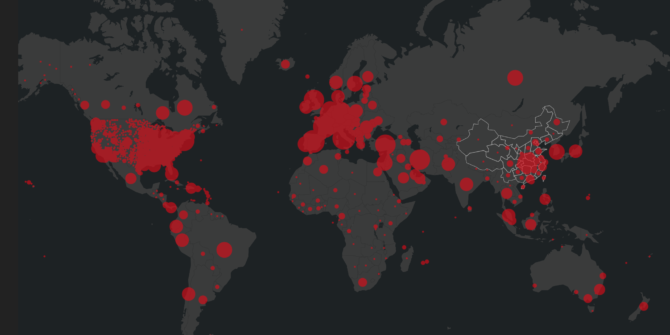
With Covid now present on every continent except Antarctica, travel restrictions for countries around the world are changing almost daily. Keeping tabs on everything is hard work, but if you want to know what the restrictions are for specific countries, there are some really good resources out there to make this easier.

1. Check the Notams!

We never thought we’d say it, but we are seeing these slowly starting to improve, with most countries issuing Notams containing specific information about exactly what kind of flights are allowed. Make sure to check the FIR ICAO code of the country (check here if you’re unsure what code to use). Search the Notams using the updated FAA Notam Search site; or if you prefer the old-fashioned version, use this site instead.

2. UK Foreign and Commonwealth Office website

Click here. The UK has eyes on the ground pretty much everywhere. Each country has a dedicated page, with a specific section on the coronavirus and the latest restrictions on inbound travel, which gets updated regularly. The focus is on the rules for UK travelers, but it’s still very useful.

3. US website

Click here. This US TravelStateGov website lists the Covid-related entry rules and requirements for all countries around the world, as published by the US Embassy in those countries. So pretty handy for US travelers.

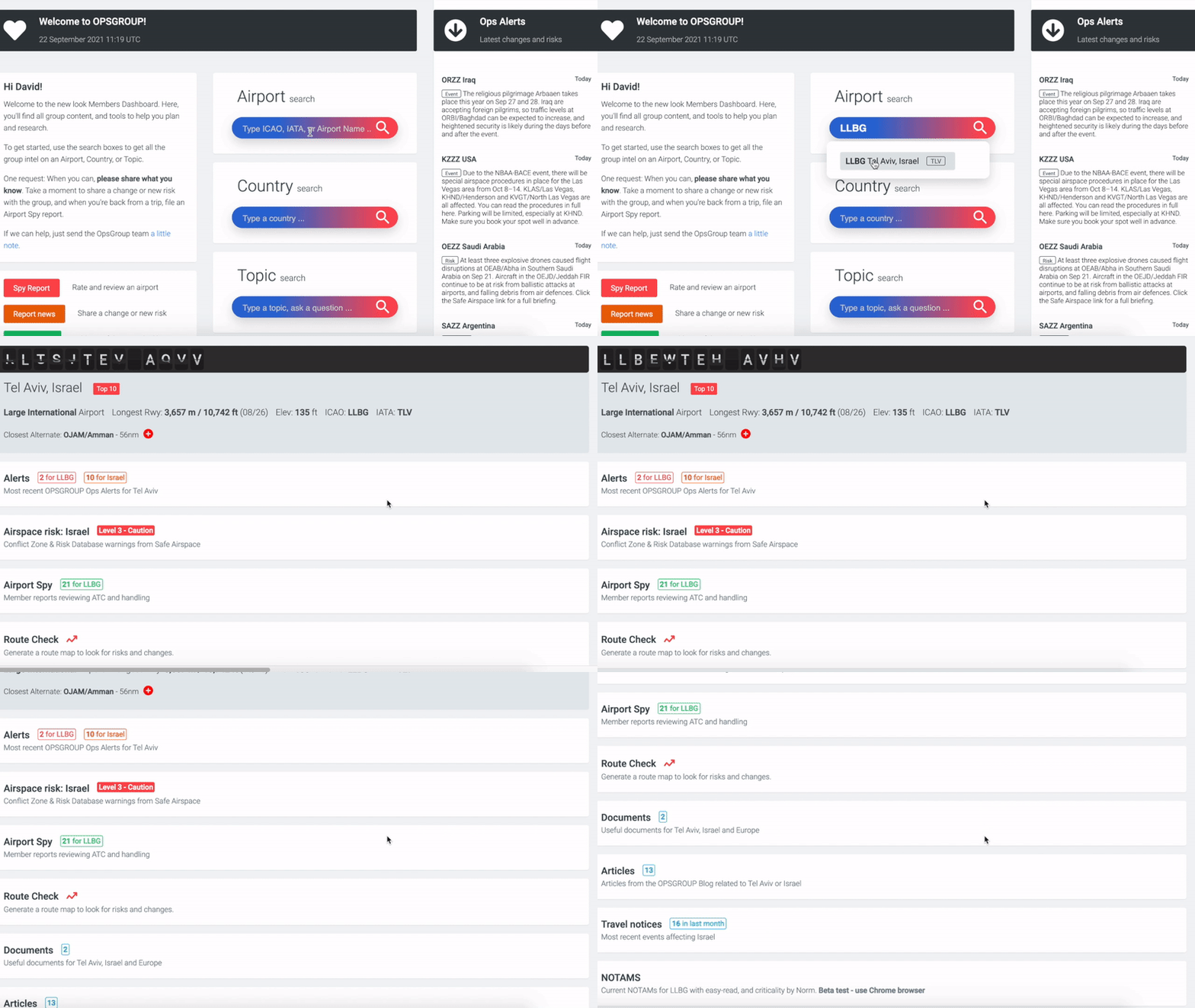
4. OPSGROUP Dashboard

For more info on the latest travel and flight restrictions, OPSGROUP members can head over to the Dashboard and use the search function.

Click here to head to the Dashboard.

If you’re still stuck for an answer, ask other members in the group in the #questions channel, or shoot us an email and we’ll see what we can dig up.

5. Travel within the EU

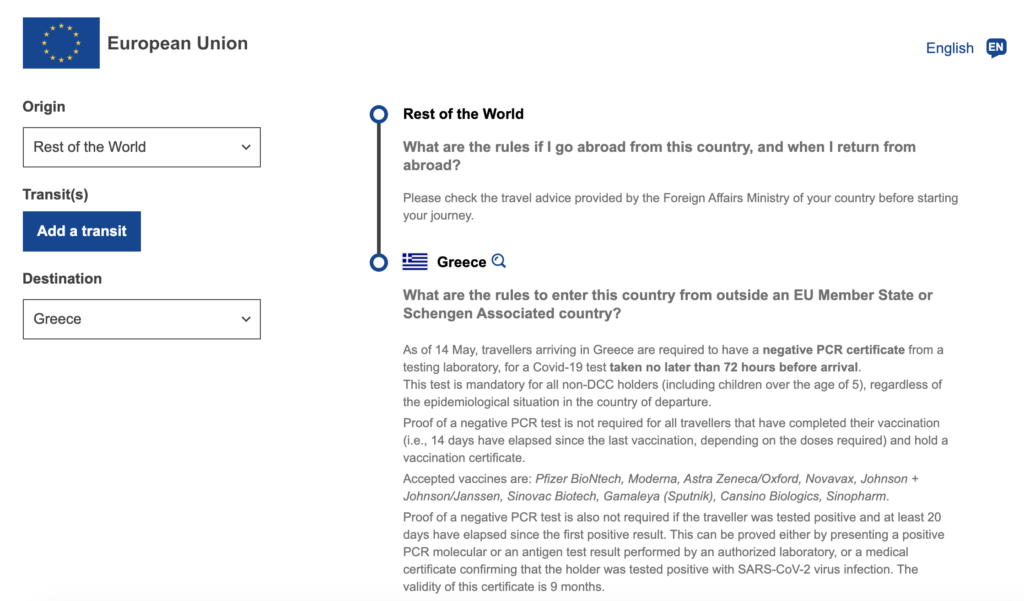
The EU has created a simple tool for us to check exactly what travel rules are currently in place for each European country – check it out.

Click here to open the EU tool.


Changes at Teterboro: What you might have missed

The skies over New York have been quieter over the past year or so, and it’s not hard to guess why. With lower traffic levels, there have been a number of operational changes at nearby KTEB/Teterboro. Here’s a rundown of what you might have missed recently…

Noise is a bigger issue than ever

It may seem ironic, but Covid hasn’t helped. With less airplanes in the skies, nearby residents have become more aware of Teterboro’s noise, and complaints have been on the rise.

If you’re headed to KTEB, be aware that there are extensive noise abatement procedures. There’s a handy summary of these available online, but here are some of the biggest gotchas to get you started.

If your ride is a jet and you’re new to KTEB, you’ll need permission first. There’s a form to fill out for that.

The most noise sensitive time is between 22:00 and 06:00LT, and it’s when you’re the most likely to get yourself into trouble. There’s a ‘voluntarily restraint’ in place after 23:00  – in other words if your flight isn’t essential, it should wait.

Sprinkled through the surrounding suburbs are noise monitoring devices, and there are strict decibel limits. The most restrictive is Runway 24 at night (only 80dB). Bust em’, and you can be served a violation – too many of those and you can say sayonara to operating there. And they take two years to expire.

Remote noise monitoring sites around Teterboro – be careful, strict decibel limits apply!

The least noise sensitive area is to the south of the airport. So if departing on the back of the clock and the weather is playing ball, try to use Runway 19 for departures and Runway 01 for arrivals.

Speaking of noise, the new RNAV X RWY 19

Back in July, an offset RNAV noise sensitive approach was introduced for Runway 19. It’s a quieter alternative to the straight-in ILS. It’s recommended for night ops at KTEB on request (and you may hear it mentioned on the ATIS). But there’s some important stuff you should know before you go ahead and shoot it.

If conditions are less than ‘tropical’, keep in mind the approach is significantly offset (13 degrees) and minimas are high. The visual descent point is almost three miles from the threshold. There’s also a big unfriendly radio antenna at the business end of the approach. At the VDP on the correct 3 degree path, you’ll be uncomfortably close to it – check out this article for just how close.

What’s the moral of the story? In marginal conditions, the approach can quickly become challenging – consider the ILS if in doubt.

Escape Routes

Tired of waiting at the hold? We don’t blame you!

There are new departure routes to help business jet operators get airborne out of KTEB when the weather is bad, or New York’s majors airports are especially busy. New York TRACON is responsible for co-ordinating those with the tower.

A head’s up though – they are designed with the performance of business jets in mind and may require steeper climb profiles than you’re used to.

You need to fly them from start to finish too. Don’t accept the clearance unless you are sure you can meet the requirements, and asking for track shortening after wheels up is a no-no.

Works

Construction and runway maintenance are ongoing. Single runway closures are common and can happen during the day. The good news is that full closures are pretty rare.

Something to look out for – if Runway 06/24 is closed in southerly conditions, extended delays are common at KTEB due to the flow at nearby KEWR/Newark, just 10nm to the South. You might need to carry some extra gas.

The Teterboro Users Group publish weekly Maintenance Bulletins for Runway and Taxiway closures which you can access here. Of course, if you prefer your info capitalised and abbreviated, you’ll find the information in  Notams too.

Covid

We’re all well over it. But there are some procedures to follow, especially if operating an international flight into KTEB.

US Customs and Border Protection are up and running at the airport, but will only accept international arrivals between 07:15 and 23:15 local. Don’t show up after hours. Standard CDC rules apply here including the pre-travel testing requirement for all pax.

For a full break down of these and other health protocols, you can view a full rundown here.

CBP can only process international flights between 07:15 and 23:15 local each day.

Have we missed something?

We’d love to hear from you! You can reach us at blog.team@ops.group.

Also check out our recent Airport Lowdown for KTEB/Teterboro – it’s the biggest threats all in one place, built by pilots who have been there.

Click to download PDF.


North Korea missile risk in the Sea of Japan

North Korea fired two short-range ballistic missiles across its east coast and into the Sea of Japan on Sep 15. It was North Korea’s second weapons test in recent days, after the launch of a new long-range cruise missile at the weekend, which state media claim has a range capable of hitting much of Japan.

North Korea has in the past tested intercontinental ballistic missiles (ICBMs) said to be capable of reaching nearly all of the US mainland and western Europe.

UN sanctions forbid North Korea from testing ballistic missiles (the ones that go up into space and then back down again, spraying debris all over international airways), but not cruise missiles (the ones that fly at low altitudes).

As usual, North Korea did not provide any warning prior to these recent tests – which is the key issue with regards to the airspace safety risk.

A quick history of developments in the last few years:

  • Until around 2014, North Korea notified ICAO of all missile launches, so that aircraft could avoid the launch and splashdown areas.
  • In 2015, they gradually stopped doing this, reaching a point where there could be no confidence in an alert being issued to airlines by North Korea.
  • In 2016, airlines and aircraft operators started avoiding the Pyongyang FIR entirely, by the end of 2016 almost nobody was entering the airspace.
  • In 2017, more and more of these missiles came down in the Sea of Japan, increasingly closer to the Japanese landmass. OPSGROUP researched the locations and produced a map of the risk area, together with the article: “Here’s why North Korean missiles are now a real threat to Civil Aviation”. In September 2017, the US announced a ban on flights across all North Korean airspace, including the oceanic part of the ZKKP/Pyongyang FIR over the Sea of Japan. That ban is still in effect today. Several other countries have airspace warnings in place which advise caution due to the risk posed by unannounced rocket launches.
  • In 2018, following talks with the US, North Korea agreed with ICAO that it would provide adequate warning of all “activity hazardous to aviation” within its airspace.
  • In May 2019, North Korea resumed its practice of launching missiles into the Sea of Japan without providing any warning by Notam.

Determining risk

The critical question for any aircraft operator is whether there is a clear risk from these missiles in the airspace through which we operate.

The chances of a missile, or part of it, striking the aircraft are not as low as they may initially appear – particularly given that all the missile re-entries in recent years are occurring in quite a focused area over the Sea of Japan. The risk to overflying traffic is arguably greater from ballistic missiles than cruise missiles, because these can break up on re-entry to the atmosphere (as happened with the 2017 tests) meaning that a debris field of missile fragments passes through the airspace, not just one complete missile.

Click for larger version.

Advice to operators

  • Consider rerouting to remain over the Japanese landmass or east of it. It is unlikely that North Korea would risk or target a landing of any test launch onto actual Japanese land.
  • Check routings carefully for arrivals/departures to Europe from Japan, especially if planning airways which connect with the UHHH/Khabarovsk FIR at waypoints IGROD and AVGOK.
  • Read OPSGROUP’s Note To Members #30: Japan Missile Risk published in Aug 2017.
  • Monitor safeairspace.net for latest updates to airspace warnings issued for North Korea.


Afghanistan Update – September 2021

The situation in Kabul remains dynamic. An update was issued today regarding ongoing changes within the OAKX/Kabul FIR and at OAKB/Kabul airport.

The full notice issued by ICAO following their most recent video-teleconference is available here.

The ongoing situation

Qatar and Turkey continue to work with the new Afghanistan government to help bring Kabul airport back to operational status, and to restore safe overflights. This includes the repair of damaged radar and other facilities, as well assisting in restructuring the CAA.

Qatar officials are coordinating with the Afghanistan CAA are conducting assessments on capacity and needs. They have apparently deployed a technical team to Kabul to carry out work. The DME has been re-established but notams suggest the VOR remains out of operation.

Turkey maintains a military presence at Kabul airport to assist and is apparently in discussions to help run the airport again – having done so for 6 years previously.

ICAO remain in contact with the Afghanistan Civil Aviation Authority who have provided updates confirming newly appointed members, and a designated point of contact.

Operational updates

  • OAKB/Kabul airport and OAMS/Mazar-e-Sharif airport are both reported to now have limited ATS services. There is a limited tower service to support VFR operations at Kabul between 0330-1330 UTC. Mazar-e-Sharif has an FIS available, but the scope of this is unknown.
    • A shortage of ATC staff continues to reduce capability.
  • Pakistan is assisting Afghanistan in the restoration of the Afghanistan NOTAM service. The service has been partially restored as of Sep 6, and is available via https://www.afgais.com/
    • Out of date Notams remain in the system so caution is advised using the site.
  • The Kabul FIR remains effectively closed to overflights – the OAKX/Kabul FIR is uncontrolled.

Updated OAKX Notams

The following Notams are the up-to-date Notams issued by the restored office.

  • A0721/21 address contingency procedures and advises that aircraft requiring emergency descent should follow ICAO Doc 4444 procedures, but rather than advising ATS, should broadcast on the relevant TIBA frequency. 
  • A0720/21 advises flights will encounter delaying action prior to entering the Kabul FIR to ensure 15 minute separation. This is as per Notam A0715/21 which requires all traffic below FL280 to be spaced at 15 minutes prior to the FIR entry point.
  • A0719/21 advises that the AIS services including Notam office is now operational 24/7.
  • A0718/21 advises that all flight plans must be filed at least 24 hours prior to the flight. The contact email is permissions.acaa@gmail.com.
  • A0717/21 advises PSR and SSR are now available at OAKB/Kabul, with an advisory information service only.
  • A0716/21 advises that OAKB/Kabul is open for domestic and international flights. Operating hours are 0330-1330 UTC.

Our previous post covering the background to the situation can be read here.

The ICAO presentation from the recent video teleconference is available to view here.

IFALPA have updated their Safety Bulletin

Following the notice issued by ICAO, IFALPA updated their safety bulletin for the OAKX/Kabul FIR.

Here are the key changes:

  • Unknown aircraft have been observed on random tracks between FL220 and FL250.
  • There is limited ATS at OAKB/Kabul – radar services are advisory only.
  • The ILS is working, but should be monitored closely.
  • People and vehicles have been seen entering the runway.
  • The status of other airports isn’t known.

Germany have changed their warning

EDWW has issued a new Notam B1244/21 valid from Sep 13. German operators are prohibited from entering the OAKX/Kabul FIR, except for overflights above FL330 on airways P500-G500. The only change is the exception of those airways which connect Pomir in Tajikistan to Peshawar for alternate routing from Europe to Pakistan and Asia.

Airway P500/G500 in the OAKX/Kabul FIR remain available.

The US has published some new background info

On Sep 14, the US FAA published a new Background Information note for Afghanistan, following their flight ban issued in August as per KICZ A0029/21.

Click to view PDF


The primary risk on the ground and at lower altitudes relates to the ongoing threat of weapons activity and terrorist attacks – and following the withdrawal of US and coalition forces there are no longer any risk mitigation capabilities available at OAKB/Kabul airport. Although it is unlikely that Taliban would target civil aviation now that they have assumed control of the country, ISIS and other militant group are still operating in Afghanistan outside of Taliban control.

The primary risk for overflights relates to the lack of ATC service, functioning CAA and air navigation service provider.

Bottom line, US operators are banned from the OAKX/Kabul FIR except for airway P500/G500.

To view all current published airspace warnings for Afghanistan, head to SafeAirspace.net.



What’s SATVOICE I can hear?

SATVOICE. Easy peasy. Well, until until you’re routing from San Francisco to Tokyo for the first time in your shiny new G550 and its 2am, you’re passing  W177°, you think you filed M3 but aren’t sure if you’re actually M2, and there is a full moon and now you’re not so sure anymore…

Here is a look at some common questions about SATVOICE which we have seen come up.

Feel free to send us more. We aren’t experts but know one folk who are.

What is SATVOICE?

Satellite voice communications. Sometimes it is lumped in with SATCOM but this can include messaging systems as well (your Datalink type things). The ‘VOICE’ bit is the giveaway – we are specifically talking about talking.

An INMARSAT satellite

What is it used for?

Communicating. 

More specifically, communicating over big areas where there are not many ground stations (which you need for VHF comms). SATVOICE systems *can be (and note the asterix there) used as a Long Range Communications System (LRCS).

So, SATVOICE is talking, via satellites, and it can be used to do things like give voice position reports. It is also sometime used as a backup when HF is not functioning. What it is not (currently) is a replacement for HF. Just as CPDLC isn’t allowed as a replacement because it is not suitable for emergency of non-routine comms.

Where can I use it?

Anywhere where there is satellite coverage. And anywhere where ATC are using it as a means of LRCS. They may not be capable.

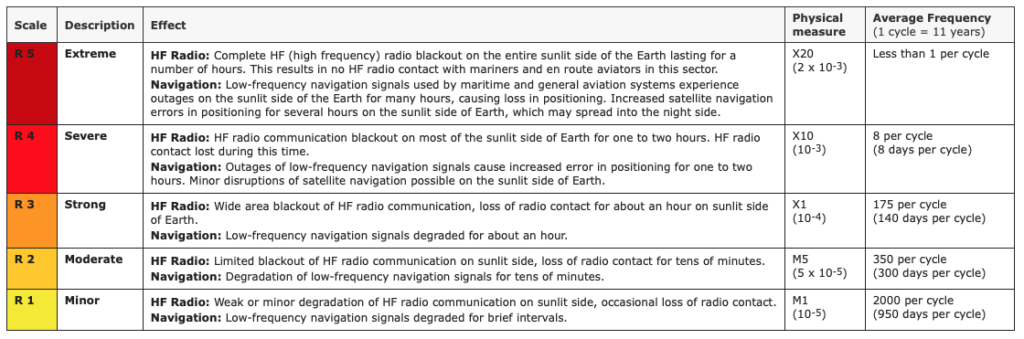
For example, the FAA provide Inmarsat and Iridium SATVOICE services for air-to-ground (and vice versa) calls directly with Oakland, NY and Anchorage ARTCCs, and New York and San Fran radio. These are, again, supplemental to HF which means they don’t expect you to use it unless there is some issue with HF. Times of bad HF propagation like HF blackouts would be a good time to give SATVOICE a go.

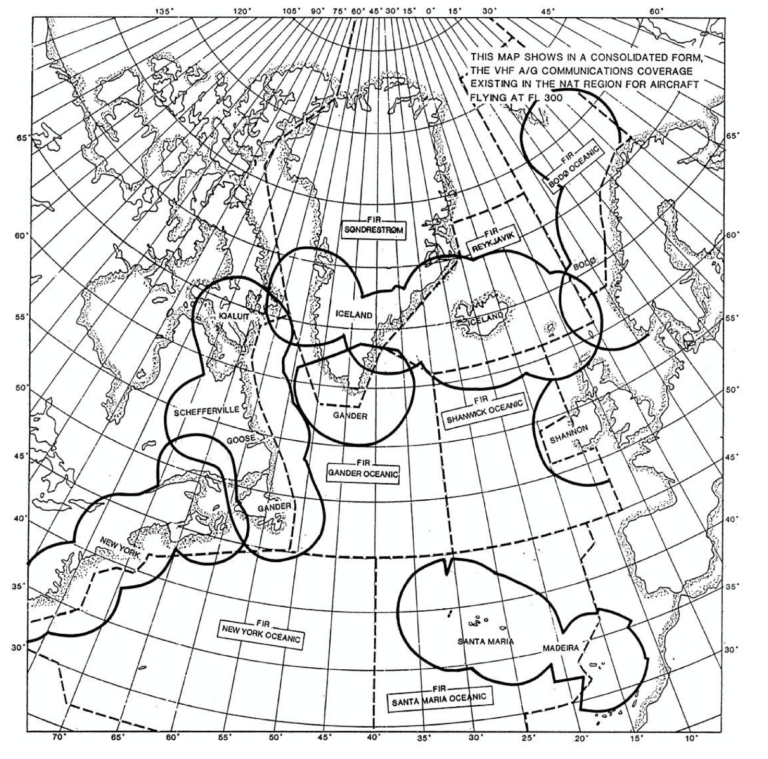
Right now, SATVOICE is not the primary means of communication in many spots. VHF and HF remain the main ones, with Datalink comms (CPDLC). So it is unlikely you will be using it all that much, unless something else is not working. When you are in CPDLC/ADS-C airspace, the controller is normally going to communicate via Datalink. They might elect to use SATVOICE, but it is not a replacement for ADS-C/CPDLC or HF/VHF.

So you also need to check out the airspace you’re flying into. The AICs will generally contain info on whether an airspace/ ATS has SATVOICE capability.

ICAO says – “Some ANSPs may allow the flight crew to use SATVOICE only for certain types of communications (e.g. of an urgent nature) or may place limitations on use of SATVOICE directly to the controller. Other ANSPs may allow its use only as an additional capability to existing radio equipment carriage requirements.” (Section 3.4, SVGM).

So, where CAN’T I use it?

Inmarsat satellites are geostationary and orbit around the equator which means above a latitude of 82° North (and South) you are in a satellite-less areas because of the (often debated, definitely real) curvature of the earth means a lack of line of sight which is required for your communications to be able to bounce back and forth from the satellites.

Some manuals suggest you might start to run into a bit of trouble from 70°N, and that trouble is most pronounced on the W120 longitude. It is also dependant on atmospheric conditions, where your antenna is and what services are contracted though.

An image of the satellite positions and coverage of the Iridium Network

Iridium satellites do not suffer the same SATCOM shadow because they operate in a low earth (as opposed to geostationary) orbit.

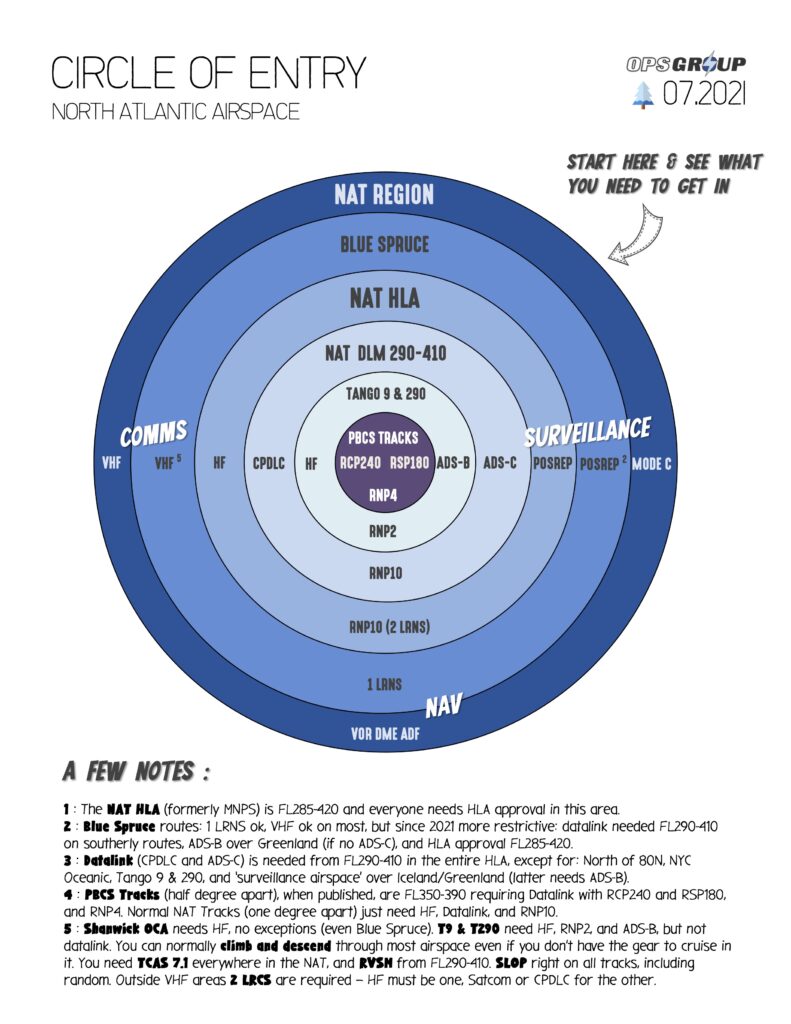
So, in the NAT HLA where HF is mandatory, and where Datalink is also mandatory (except for the bits where it isn’t), you are going to need HF and Datalink. Not one or the other. If an airspace requires two LRCS then one can be SATVOICE, but the other must be HF.

If the airspace requires 1 LRCS then that means HF.

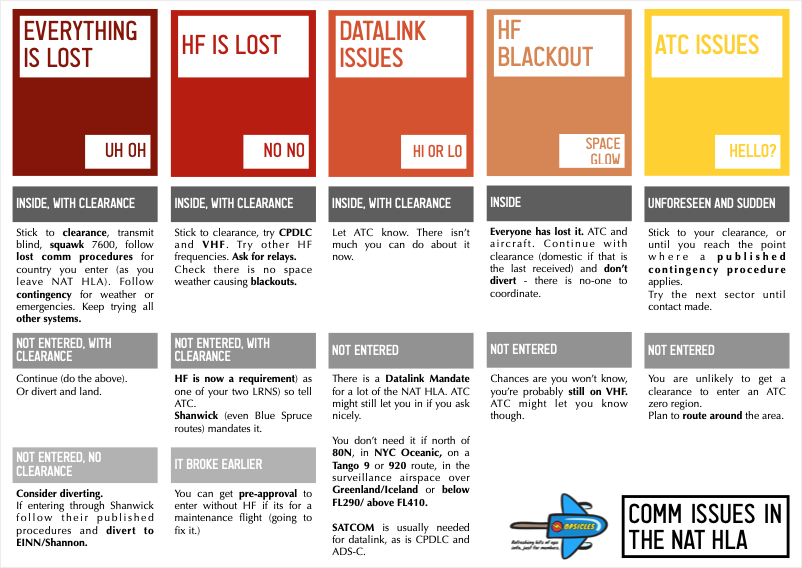
So, you cannot use your SATVOICE system as a “get out of cancelling a flight” free card if your HF is broken and you are routing through somewhere which requires LRC systems onboard.

Which brings us to the asterix…

The Asterix

*SATVOICE can be approved as a Long Range Communications System (LRCS) but whether it qualifies is something you will need to check, and that is most easily found in your MEL. It comes down to the Required Communications Performance (RCP) of your system.

In other words, just because you have a SATVOICE system onboard and are in a spot where ATS utilises SATVOICE, does not mean you are automatically allowed to do so. Not even if you put it on your flight plan.

RCP240 is the number to know – to be PBCS (performance based communication and surveillance) eligible your aircraft system must achieve RCP240 (and RSP180) standards. RCP240 is the max number of seconds (the transaction time) taken for a controller to issue an instruction and receive a response.

Your RSP180 is the surveillance standard, the RCP240 is the comms standard. We wrote all about PBCS here if you need a recap.

Oldie but still what you need to know

What do I need to do to use it then?

Go back up to our bit about having an approved system and it being in your MEL…

And read this bit as well.

So, you need it in your MEL/MMEL, and what that means is having a system which meets the requirements laid out by your authority.

The FAA put out this info on getting approved. AC 20-150B – ‘Airworthiness Approval of Satellite Voice (SATVOICE) Equipment Supporting Air Traffic Service (ATS) Communication.

It is an AIC about getting airworthiness approval for SATVOICE, and contains all the design considerations, software requirements, minimum performance requirements, CVR, and a lot of other things you probably need to know about.

ICAO recommend that Operators need to establish policy and procedures for crew involved in SATVOICE ops. This includes descriptions of the system operating procedures, limitations, flight planning requirements, what to do if it does’t work… Check out section 3.3.3 of the ICAO SVGM manual for more on this.

In summary – your system needs to be approved. To be approved it needs to meet certain standards and criteria. You also need to have procedures and policy in place for the operation of the system.

Where is all the official info on this?

In ICAO Doc 9869, also known as the PBCS manual, also known as the GOLD manual (because its full title is Global Operational Data Link). You can find the 2017 edition of this in our Doc Library if you want to take a look.

Here is the ICAO SVGM (Satellite Voice Guidance Manual) which we mentioned.

Then there is ICAO Doc 7030 which contains regional supplementary procedures and will contain some info on Datalink, for example, over the North Atlantic.

I have the system and the approval, but need to find a number?

Well, this is where it can get a little tricky. There are different systems. Inmarsat and Iridium.

There is also MTSAT, the Japanese geostationary satellite network.

If you have Inmarsat satellite compatible system then you can use those SATCOM short codes (the six digit ones starting with a 4). You can also dial the 10-digit PSTN phone number. The 6 digit numbers are converted to the PTSN number as they wiggle through the Inmarsat system.

PTSN, incase you’re going to ask, is the Public Switched Telephone Network which is what the aeronautical SATVOICE system uses. So these are what you want to call via your Iridium system.

Numbers are generally to be found in places like the AICs, in your Jeppesen, LIDO, or whatever other chart and manual provider you are signed up to.

One tip, when you do dial up – don’t be yakking away like you’re on a normal telephone. The operator the other end is going to expect standard radio etiquette. Callsigns, readbacks and all that.

What do I put in my flight plan?

You need to include your SATVOICE capability and you do this in Item 10 by inserting either:

  • M1 for Inmarsat RTF capability;
  • M2 for MTSAT RTF capability;
  • And/or an M3 for Iridium RTF capability.

In Item 18 you insert the aircraft registration and also the indicator code and the aircraft address expressed in the form of an alphanumerical code of 6 characters.

If you are operating through airspace requiring HF and yours is broken, then you may be able to file with only your SATVOICE system as the LRCS if it is a flight to return the aircraft for HF maintenance.

Again, just having a system and whacking the info about it onto a flight plan does not qualify you to use it. It needs to be approved.

An HF MEL

What if I get a random SATVOICE call?

You should only act on the clearances or instructions given to you if a SATVOICE call has a priority level 2/High/Q12 or 1/EMG/Q15. You might have to disconnect and initiate a new call to get confirmation that it is something to act on, and not just some rogue person who has discovered a way to call you on it.

I am not signed up to any provider. Can I still just sort of call?

If you can answer this then please send us your info 🤷


Coming soon: a new global format for runway surface conditions

ICAO’s new Global Reporting Format methodology comes in on November 4, 2021, but a few authorities have decided to implement it sooner than that.

So here is a quick rundown on what GRF is, and what the requirements are for implementing it.

Runway Excursions

We have talked about these before. So have ICAO. They are a big deal, but they shouldn’t be. Or rather, they shouldn’t still be happening.

Despite numerous incidents, accidents, reports, mitigation plans, you name it, runway excursions are still one of the most common (and often most dangerous) aviation events that are occurring.

A runway excursion is any lateral of longitudinal overrun (not due to any system or component failure of malfunction, or because of an abnormal runway contact).

The primary causes for runways excursions are pretty much an unstable approach was flown, or proper performance calculations weren’t done. Or a combination of both.

The arrestor system doing its job nicely here

A study of commercial aircraft accidents between 1999 and 2019 showed that 16% of all fatal accidents and 36% of all hull loss accidents were due to runway excursions.

So, if we can stop them from happening, a lot of aircraft and people will be saved.

What is GRF?

GRF stands for ‘Global Reporting Format’ and it is a new methodology which ICAO are implementing which aims to standardise how runway surface conditions assessments and reporting is done.

The issue in the past is that some places still give braking coefficients (not really handy because it means different things for different aircraft). Some places were not really assessing surface contamination properly, and some pilots were not really understanding the implications of what they were being told.

RCAM

So GRF will use RCAM – a runway condition assessment matrix – and this will give pilots a runway condition code.

1-6. Nice and easy.

The code is determined by an assessment of what it is contaminating the runway. Snow, ice, water, spilt tomato soup… and then a downgrade assessment criteria is applied. This looks at how the contaminant will impact the deceleration and the directional control of aeroplanes.

It is simplified. No more coefficients and frictions. Just simple “yep, that’s slippery and slide-y” assessments. Pilots will also give braking action reports, rating the action they experience from “Good” down to “Less than Poor”.

This matrix ties in with the new Snowtam reporting format which you can read about here.

ICAO 9981 PANS-ADR contains the RCAM info

Who does it impact?

It impacts a lot of people because it is not just a case of “here is a new format, go”.

Airport authorities will be required to train their staff to ensure they are aware of how to carry out the assessments and to ensure reporting is standardised.

Operators will need to ensure their staff (flight planners and pilots) are aware of the new format, and more importantly – that they are aware of why and how to use it!

Pilots will also need to familiarise themselves with it, and ensure they have a decent grip on what the assessments mean, how to apply them to their performance calculations, and also how they too can assist in the reporting.

What’s the official source?

ICAO Annex 14. Or rather amendment 13-B to Annex 14.

Here is the amendment letter.

Here is the main ICAO page for all things GRF.

The U.K. CAA GRF page has a nice summary of all the official references too.

November 4, 2021

This is the date to know because this is the implementation date. However, familiarising yourself with all the info on it before then might be a good idea because several authorities have already implemented this.

NAV CANADA and EASA have both brought it in on August 12, 2021

EASA have a bunch of handy info on it from how it was developed to Q&As.

And here is NAV CANADA’s page on it.

The FAA have their own project – TALPA – which has pretty much already implemented exactly this so you might not notice much of a change.

Bottom line

  • Pilots should familiarise themselves with the new format and understand what it means and how to use it.
  • Operators should ensure all their staff are trained on it (and throw in some additional unstable approach, excursion mitigation and performance calculation training and awareness too if you fancy).
  • Airports and authorities should be ensuring they are implementing the new format, and training their staff on its use and importance.

Hopefully this helps reduce the number of runway excursions due contamination and performance issues. Of course, for this to work we need to make sure we are also flying a stabilised approach, and flying one to the runway we did the performance calculation for…


Surviving Seletar: Singapore’s Second Airport

Update Oct 2025

OPSGROUP members can access an updated version of this guide, effective Oct 2025, on the members Dashboard here.

Original Article from Sep 2021

If you’re planning to operate a business jet into Singapore, there’s a good chance you won’t be bound for WSSS/Changi Airport at all. Instead you may be headed for the lesser known WSSL/Seletar – Singapore’s secondary commercial airport, and it can be a lot more challenging.

Here’s a basic rundown of just what to expect to keep you ahead of the game next time you are flying into Seletar.

The Basics

Seletar is a stone’s throw (8nm) northeast of WSSS/Changi. It has a single 6020ft/1840m long runway and serves predominantly turbo prop and corporate jet traffic. It has fuel and good facilities for business ops.

Just getting in there at all can be a pain – the airport is surrounded with prohibited and restricted airspace, noise abatement areas, training areas, military airports; as well as a bunch of buildings, cranes, boats, and other obstacles to the north of the airport on the Malaysian side – just across the Strait of Johor.

And since Malaysia effectively killed the plans for ILS at Seletar back at the start of 2019, there are no available instrument approaches at all, requiring visual approaches to be flown onto both runways.

The Airspace Picture

Operations at Seletar are difficult because of the complicated airspace that surrounds it, and it is the reason why there are no instrument approaches. There just isn’t enough room.

Seletar is literally boxed in by a variety of restricted airspace. To the west lies the Sembawang airbase, and to the east the Payar Lebar airbase. Both are strictly military.

Then just a smidge to the north is the boundary with Malaysian airspace, the WMFC/Kuala Lumpur FIR. South of the airport is highly noise sensitive, with three noise abatement areas where hefty fines await.

Throw these things together and you have the Seletar ‘Fish Bowl’ – a small bubble of airspace where there is precious little room to manoeuvre. Here’s a picture of what this all looks like.

The Seletar ‘Fish Bowl’

Arrival Procedures

To keep things simple, the end game is to join the circuit and fly a visual approach, without busting any airspace. To help you with this there are a number of visual arrivals that require you to be in VMC conditions. If you can’t get visual, you’ll need to hold or divert to nearby Changi.

There are essentially two arrival procedures – North and South. And all arriving aircraft will join them through one of three feeder points – Jaybee NDB (JB), Sinjon VOR (SJ) or Kong Kong NDB (KK). From there you will either join downwind, straight in or even overhead if you need the extra track miles.

You can view the current plates for those procedures in the Singapore AIP online. But to make it easy, here’s a couple of pictures.

Arrivals onto Runway 03

Arrivals onto Runway 21 – make sure you have the ‘steel towers and silo’ in sight for an earlier approach clearance.

Things to look out for

Day and night closures: The airport is closed every night between 22-07 local time except for medevac and SAR. And then during the daytime, there are several infuriating closures to accommodate training flights. So essentially, GA/BA flights can only operate to Seletar at these times : 0700-0930, 1030-1200, 1300-1500, 1600-1700, 1800-2200 local time.

The circuit is tight. It is always on the western side of the airport and you cannot fly your circuit wider than 1.5nm due to Sembawang’s airspace. Which means the turn onto final is also going to be tight.

The profile is steeper than normal. 3.2 degrees on Runway 03, and 3.5 degrees on Runway 21. Which means you will need higher rates of descent than a standard visual circuit ‘outta the book’.

You need to be visual. If you’re not VMC, you can’t land at Seletar. Thunderstorms are common in Singapore with heavy rain, and they tend to be slow moving. The worst times are afternoons and evenings.

‘Steel Structures and Silos’  – You’ll hear it on the ATIS, and you need to report you have them in sight if arriving on Runway 21. They’re on the Malaysian coastline north of Seletar. Spot them early and you’ll get an earlier approach clearance from ATC which will make your job easier.

Mistaken Identity: Both nearby Sembawang and Paya Lebar airports have similar runway orientations to Seletar and it is easy to line up with the wrong one. Tune up Seletar’s NDB (220) – the needle doesn’t lie!

Missed Approaches. Expect to re-enter the circuit for both runways – which means a prompt turn downwind and not above 1500ft.

Ops on the Ground

You’ll be pleased to know, pretty straight forward. Parking can become limited, and so it always pays to book a spot with your handling agent well in advance.

Departures

Both runways have noise abatement. Just the standard stuff here – NADP 1 or 2. Your call.

There are published visual departure procedures for both runways. Essentially they involve a climb straight ahead to 1000ft, followed by a turn onto a radar heading.

For departures downwind, the challenge is to stay within the ‘Fish Bowl.’ Which means keeping your turn tight, and your speed down. Ironically the noise abatement procedures help here.

Your Layover

Assuming Covid isn’t still ruining the party, Singapore is famous for food. Three words: Chilli Mud Crab. Jumbo Seafood Restaurant in Clarke Quay is the place to go. And if you’re beer inclined, Tiger is the perfect accompanying drop. For the time being, you may need to rely on Uber Eats. Don’t worry though, Jumbo also delivers.

Handling

 There’s a few good options to choose from. Here are some contacts:

Facilities and handling at Seletar are generally excellent.

Other options?

Technically, bizav operators are still allowed to go to WSSS/Changi, but will normally only be allowed quick turnarounds subject to runway/bay availability, and then you’ll have to go elsewhere for parking.

Another option is WMKJ/Johor Bahru, on the Malaysian side, around 25nm north of Singapore. It’s open from 06-00 local time, with extensions possible with prior notice. It has a separate FBO with its own VIP lounge and hangars with maintenance support, and has no slots or parking restrictions for bizav ops. Check out the brochure!

The only downside in WMKJ is that it can sometimes take a bit of time for immigration when you cross the road border heading south into Singapore – sometimes 2-3 hours during busy travel periods.

Opsgroup members can read reports on all these airports in Airport Spy.

Permits and stuff

If you’re operating as a private flight to either Changi or Seletar, things don’t get too complicated, as permits are not required for private flights. Just make sure you have parking arranged, and file your inbound ATC flight plan 12 hours in advance, being sure to copy in the Singapore ATC AFTN address WSJCZQZX.

If you’re doing a charter flight on the other hand, you’re going to need a landing permit, which means you’re going to have to jump through a few hoops.

For this, you’ll need to get an Operations Permit from Singapore CAA, which is basically a blanket approval to conduct revenue flights to Singapore, valid for up to one year. You’ll then need to get an Air Transport Permit, which is required for every individual charter schedule into Singapore (Changi or Seletar). Save yourself some hassle and get a local handler to help arrange these for you.

Airport Lowdowns

Have you heard of them? We make a bunch, especially if you ask for one! They’re what you need to know from crew who have been there. And they’re on one small, simple piece of paper. You can read more about them here.

We’ve got you covered. Check out Seletar’s here.

Click to download PDF.


Coup in Guinea: Conakry Airport Reopens

A military coup took place in Guinea’s capital, Conakry, on Sep 5. Following hours of heavy gunfire near the presidential palace, the head of the country’s special forces announced that his soldiers had detained the president and seized power.

Initially, the coup leaders announced that the country’s land and air borders were closed, including the country’s international airport – GUCY/Conakry, where all flights were temporarily suspended.

However, on Sep 6, a military spokesman announced that land and air borders have now reopened. Local handling agent Astra Aviation have advised that the airport is open and operating normally again, with all services available, but they advise against overnight stops for the time being.

GUCY/Conakry airport has issued the following Notam:

A0095/21 - AD HOURS OF SERVICE ARE NOW 0400-2100 UTC. 
DAILY: 0400 - 2100 UTC, 07 SEP 04:00 2021 UNTIL 06 OCT 21:00 2021 ESTIMATED. 
CREATED: 07 SEP 14:40

A night curfew is now in place and there have been no signs of unrest in Conakry in response to the military takeover.

Where is Guinea?

Guinea is a country on the northwest coast of Africa, bordering Guinea-Bissau to the North, and Sierra Leone to the South.

While it has a long history of civil unrest, and crime remains a risk for visiting foreigners, Guinea is generally considered a safer option when compared to its neighbours. Which is why GUCY/Conakry is often used by civil aviation as a reasonable option for tech stops in West Africa.

What about overflights?

Guinea isn’t responsible for managing the overflights in the airspace above it. That job falls to the GLRB/Roberts FIR which collectively manages the upper level airspace of Guinea, Sierra Leone and Liberia together. It has yet to issue any warnings or restrictions for its airspace, but data from Flightradar shows that overflights through the airspace have continued today.

The GLRB/Roberts FIR manages overflights over three West African countries, including Guinea.

Where to from here?

The situation is evolving, and the ongoing impact to operations there is unpredictable at the moment. We will continue to update this article as more details become available.


The India-Pakistan Conflict: Impact on Flight Operations

The current situation in Afghanistan has led to the effective closure of the OAKX/Kabul FIR to overflights, which means that some traffic routing between Europe, India and the Far East may now need to plan routes which cross the northern Pakistan/India border.

This post will take a look at the additional operational threats and info to be considered here, particularly due to the ongoing dispute over the Kashmir region, and the airspace warnings in place for Pakistan because of this.

The conflict in brief.

This conflict is rooted in who controls the region, with both India and Pakistan laying territorial claim to it. In fact, this conflict has been ongoing since 1947 and shows no signs of resolving in the near future.

Currently India control around 55% of the area, Pakistan approximately 35% and China have a third party hand in the remaining 20%.

There is also a secondary focus on the region from both sides due to cross-border terrorism and security and safety issues. Pakistan’s border with Afghanistan on the other side poses a similar threat.

The India Pakistan border is fenced with around 750km of foodlit fencing, and is still being expanded

The route structure of the region.

Aircraft routing from Europe and across to India and beyond have historically had 3 general routing options available to them:

  1. Via Saudi Arabia and then east direct to India. This avoids Pakistani airspace, or crosses just the most southerly portion of the airspace;
  2. Via Turkey and down through Iraq/Iran and then east via southern Pakistani airspace and into India;
  3. Across Eastern Europe via Azerbaijan, Turkmenistan and then south east crossing Afghanistan’s central airspace, avoiding the northerly Kashmir region.

That third routing option which utilised Afghanistan’s airspace, bypassed Saudi Arabia, Iran and Iraq – all of which have airspace safety considerations. Overflights across Iran and Iraq, for instance, are prohibited to US operators.

While Afghanistan also had airspace safety risks associated with it, these were previously generally low level and not “all altitude” concerns. That has recently changed with the Taliban takeover of Afghanistan. However, though the US and several other countries have since issued airspace bans and warnings for Afghanistan, overflights are still generally allowed on airways P500 and G500 which run along the eastern boundary of the Kabul FIR.

Aircraft now needing to re-route to avoid Afghanistan’s uncontrolled OAKB/Kabul FIR, and who do not wish, or are unable to utilise Saudi, Iran or Iraq airspace, may now be limited to this more northerly routing – via the G500/P500 airway in eastern Afghanistan, the northern portion of Pakistan and into India, potentially through the Kashmir region.

Airways are limited in the area, with no easy transfer between Pakistani and Indian ATC control.

What is the risk in this region?

Several countries have long-standing airspace warnings for Pakistan which advise against overflights below FL260, due the risk posed by small-arms fire and indirect weapons fire. There is also a potential anti-aircraft fire risk, and there have been previous attacks against airports.
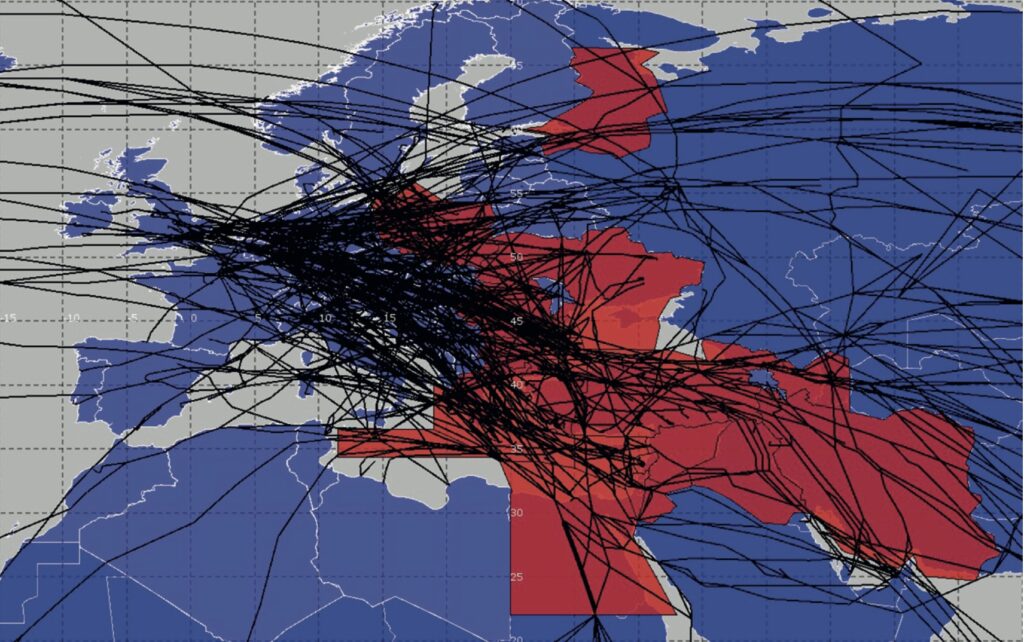
What is the current situation?

An escalation in activity across the border has been seen of late, with the number of drone attacks and activity across the line of control increasing, including several attacks against Indian Air Bases since 2019.

India possess strong air defense systems and an active air force. Historically, they have employed both fighter jets and conventional SAM systems to mitigate attacks. With the increase in both drone size and capability, and the escalation in number of attacks, there is a risk they will resort to SAM systems and fighter jets once again. If this happens, this will lead to a higher risk at all altitudes for aircraft mis-identification.

A helicopter was shot down in the Srinagar region in 2019

General considerations for operating over or into Pakistan.

Operators to OPIS/Islamabad have been reporting an increase in security measures and crew procedures. Crew can expect more stringent security and ID checks. Pakistan are actively guarding against terror threats at the airport and passengers may experience stricter security and ID controls as well.

Pakistan is an ADIZ and requires crew to check-in prior to entry. Comms handover between India and Pakistan can also be difficult so an advance confirmation of next frequencies is advisable when routing across any part of the border.

There traffic levels in Pakistan’s airspace have also increased recently, and crew should be aware of potential separation and traffic conflict concerns.

Pakistan airspace closures.

Pakistan have previously closed sections of their airspace. In Feb 2019, conflict between India and Pakistan resulted in Pakistan closing its airspace to overflights. The conflict was a result of escalating clashes between the two countries in the disputed Kashmir region, with numerous airstrikes on both sides. The airspace slowly reopened, and only became fully open again in August 2019.

Diversion options.

Both India and Pakistan allow tech stops (up to 24 hours) and are accommodating of diverting and emergency aircraft, however, avoiding Indian Military Air Bases (unless a dire emergency) will save you a fair amount of extra security checks, paperwork and grief on the ground.

OPIS/Islamabad is a major Pakistani international airport close to the border, and is used as a southerly Himalayan diversion airport. It offers two well equipped CAT II/III runways of 12,001′.

OPST/Sialkot has a single runway, 11,811′, with an ILS and an RNP approach available.

VISR/Srinagar on the Indian side has s single 12,090′ runway.

VIAR/Amritsar also offers a single CAT II/III equipped 12,001′ runway.

There are also several other smaller airports which serve domestic routes.

The main airports in the region.

Permits and overflights

Both India and Pakistan require overflight and landing permits.

For India, the lead in time for overflights is 3 days, while for landing it is 7 days. All permit applications are sent to the Ministry of Civil Aviation (MOCA) and then pass through several other government departments for security checks. You need your PPR overflight number available before reaching Indian airspace and they do often ask for it so have it handy.

India have fairly strict slot policies at several of their airports. During peak times they also might change your slot at short notice, or give you lengthy delays (2 hours+).

We recommend the use of an agent to assist with the permit process:

Freedom Air +91 11 2981 3311 / ops@freedomair.aero / freedomair@airtelmail.in

The CAA of India contact info is +91 11 2462 0784 / +91 11 2462 9221 / dgoffice.dgca@nic.inirsec.dgca@nic.in

For Pakistan, overflight and landing permits are issued through the Pakistan CAA. These take around 96 hours for overflight and 6 days for landing.

An agent can also assist with the process:

Aircraft Aviation Services (ACAS) +92 213 468 0109 / ops@acas.com.pkops1@acas.com.pk

CAA of Pakistan contact info – +91 21 997 1111 extn: 2288/2289 / +91 21 9924 2004 / support@caapakistan.com.pk / AFTN: OPHQYAYX

In summary

With the exception of US operators, flights between Europe and India/the Far East generally opt for routings via Saudi Arabia, Iran or Iraq. While routings via Tajikistan are possible, the lack of coordination between Pakistani and Indian ATC, and with few established airways, presents a planning and potential safety risk.

Pakistan has airspace safety concerns, particularly in the northern airspace (OPLR/Lahore FIR). With the closure of Afghan airspace, flights routing from Europe to Pakistan may benefit from routing via Tajikistan. However, most international flights continue to use the southerly routing for overflights.

Most Europe-Asia flights continue to route south via Saudi, UAE, Oman.

Further Information

Information on Pakistan airspace can be found on the Pakistan CAA website.

If any operators or crew have experience of overflying this region please send us any insights you have on it so we can share the information team@ops.group.


Afghanistan: Do Not Fly

US and allied forces have now pulled out of Afghanistan, and the Taliban have taken control of the country. Afghanistan’s airspace is now effectively closed to overflights – the OAKX/Kabul FIR is uncontrolled, and overflying traffic should route around the country.

Overflights

For overflights of the region, flights between Europe and parts of Asia will be those most affected by the effective closure of the OAKX/Kabul FIR. All major international airlines have now stopped using Afghanistan’s airspace for overflights, most electing to route south via the airspace over the United Arab Emirates and Arabian Sea off the south coast of Pakistan.

Map source: flightradar24.com

However, there are risk warnings to consider for the airspace here too. Several countries have warnings in place for Iran’s airspace (the OIIX/Tehran FIR), including a total flight ban by the US, which were issued following the shoot-down of Ukraine Int Airlines flight 752 over Tehran in Jan 2020. The southern part of Saudi Arabia’s airspace (the OEJD/Jeddah FIR) carries risk as well, with increasing Houthi drone and missile attacks over the past year.

To the north of Afghanistan, the options for overflights are fairly limited – via Kyrgyzstan, Kazhakstan, or even farther north via Russia. So these are not really practical unless operating from northern Europe to China, Hong Kong, Japan, etc.

Airspace Warnings

Following the Taliban takeover, several countries have updated their airspace warnings for Afghanistan. The FAA now bans US operators from Afghanistan’s airspace, only permitting overflights on airways P500 and G500 in the far east of the OAKX/Kabul FIR. EASA, along with authorities in several western countries, are now advising operators to avoid Afghanistan’s airspace entirely.
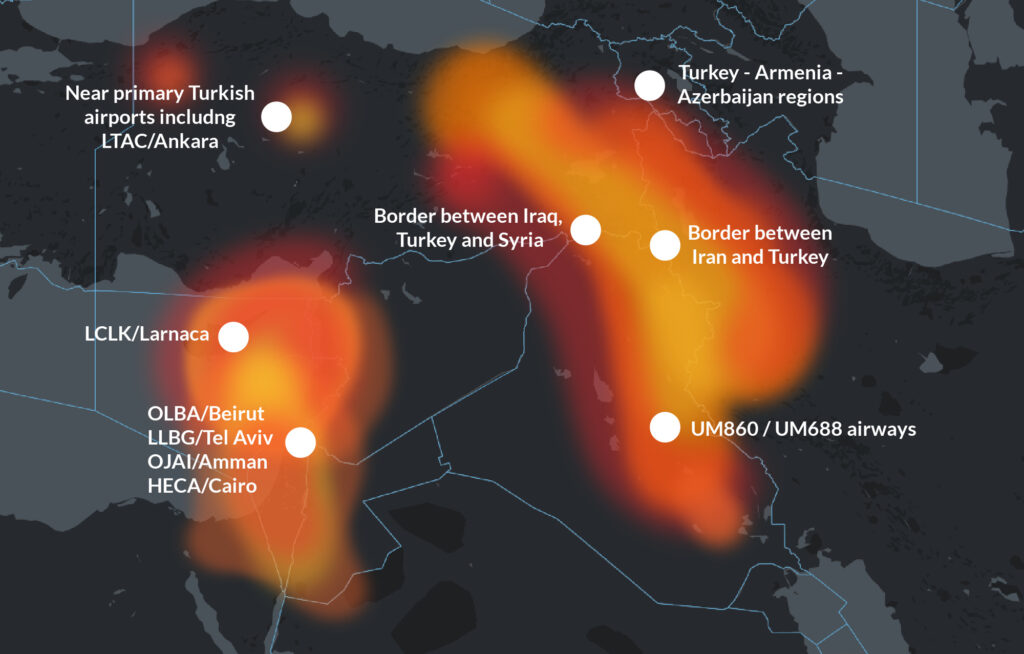
At SafeAirspace.net we are now listing Afghanistan as Level One: Do Not Fly. Check here for a full briefing.


FAA issues Emergency Order for Afghanistan (Updated)

On August 30, the FAA revised its Emergency Order for Afghanistan, with a new KICZ Notam.

Effective immediately, US operators and flight crew are prohibited from operating in the Kabul Flight Information Region (OAKX) at all levels. The FAA cites three specific risk factors: extremist/militant activity, limited risk mitigation capabilities, and disruptions to Air Traffic Services.

The main change is that flights to and from OAKB/Kabul airport are no longer exempt. 

Therefore the only exceptions are now as follows:

1. You can operate in the Kabul FIR (OAKX) if another US government agency authorizes it together with the FAA, or by way of “deviation, exemption, or other authorization” issued by the FAA Administrator. If you do plan to fly, you must call the FAA Operations Center in Washington.

2. You can overfly on one airway: Use of airway P500/G500 is authorized for transiting overflights. (That airway cross the sliver of Afghan airspace in the east of Afghanistan between Pakistan and Tajikistan)

3. If you are experiencing an emergency.

Airway P500/G500 in the OAKX/Kabul FIR is ok.

The NOTAM is issued with permanent validity, and is presented in full below.

For further on Afghanistan, pilot and local situation reports, procedures, and assistance:

Satellite image via Washington post, Maxar Technologies 2021.


KICZ Notam A0029/21
Issued Aug 30, 1955 UTC
Valid until: Permanent

SECURITY..UNITED STATES OF AMERICA PROHIBITION AGAINST CERTAIN FLIGHTS IN THE KABUL FLIGHT INFORMATION REGION (OAKX)

THOSE PERSONS DESCRIBED IN PARAGRAPH A (APPLICABILITY) BELOW ARE PROHIBITED FROM OPERATING AT ALL ALTITUDES IN THE KABUL FLIGHT INFORMATION REGION (FIR)(OAKX), EXCEPT AS PROVIDED IN PARAGRAPH B (PERMITTED OPERATIONS) AND PARAGRAPH C (ALLOWANCES) BELOW, DUE TO THE RISK POSED BY EXTREMIST/MILITANT ACTIVITY, LACK OF RISK MITIGATION CAPABILITIES, AND DISRUPTIONS TO AIR TRAFFIC SERVICES.

A. APPLICABILITY. THIS NOTAM DOES NOT APPLY TO THE UNITED STATES DEPARTMENT OF DEFENSE. IT DOES APPLY TO: ALL U.S. AIR CARRIERS AND COMMERCIAL OPERATORS; ALL PERSONS EXERCISING THE PRIVILEGES OF AN AIRMAN CERTIFICATE ISSUED BY THE FAA, EXCEPT WHEN SUCH PERSONS ARE OPERATING U.S.-REGISTERED AIRCRAFT FOR A FOREIGN AIR CARRIER; AND ALL OPERATORS OF AIRCRAFT REGISTERED IN THE UNITED STATES, EXCEPT WHEN THE OPERATOR OF SUCH AIRCRAFT IS A FOREIGN AIR CARRIER.

B. PERMITTED OPERATIONS. THIS NOTAM DOES NOT PROHIBIT PERSONS DESCRIBED IN PARAGRAPH A (APPLICABILITY) ABOVE FROM CONDUCTING FLIGHT OPERATIONS IN THE ABOVE-NAMED AREA WHEN SUCH OPERATIONS ARE AUTHORIZED EITHER BY ANOTHER AGENCY OF THE UNITED STATES GOVERNMENT WITH THE APPROVAL OF THE FAA OR BY A DEVIATION, EXEMPTION, OR OTHER AUTHORIZATION ISSUED BY THE FAA ADMINISTRATOR. OPERATORS MUST CALL THE FAA WASHINGTON OPERATIONS CENTER AT 202-267-3333 TO INITIATE COORDINATION FOR FAA AUTHORIZATION TO CONDUCT OPERATIONS.

C. ALLOWANCES. USE OF JET ROUTES P500-G500 IS AUTHORIZED FOR TRANSITING OVERFLIGHTS.

D. EMERGENCY SITUATIONS. IN AN EMERGENCY REQUIRING IMMEDIATE DECISION AND ACTION FOR THE SAFETY OF THE FLIGHT, THE PILOT IN COMMAND OF AN AIRCRAFT MAY DEVIATE FROM THIS NOTAM TO THE EXTENT REQUIRED BY THAT EMERGENCY.

THIS NOTAM IS AN EMERGENCY ORDER ISSUED UNDER 49 USC 40113(A), 44701(A)(5), AND 46105(C).

ADDITIONAL INFORMATION IS PROVIDED AT:

HTTPS://WWW.FAA.GOV/AIR_TRAFFIC/PUBLICATIONS/US_RESTRICTIONS/

SFC – FL999, 30 AUG 19:55 2021 UNTIL PERM. CREATED: 30 AUG 19:59 2021


Thunderbolts and Lightning, Very Very Frightening

Aircraft sometimes fly too close to storms which means they sometimes get hit by lightning.

Here is a refresher on the signs you’re probably too close to a storm, things to do to prevent a lightning strike, and what the risks are if you do get struck.

Avoid the flash boomers.

Not flying too close to a storm is probably your best bet for avoiding a lightning strike.

Here is a quick recap. If it is big, growing bigger and has an anvil, avoid it.

If it has lightning come out of it, definitely avoid it.

If all you can see outside is this –

Then turn your weather radar on.

Once you have turned your weather radar on, it might look like this –

Avoid the red bits.

Keeping away is Plan A.

Avoiding smaller ones by a good 10 miles (preferably upwind so they don’t move towards you) will keep you clear of lumps and bumps, thus avoiding coffee spillages and puking passengers.

Big ones should be given at least a 20nm berth. If you want to route over the top, 5000’ seems to be a good recommendation, and never fly under the anvil. 

You might also want to avoid flying between large storms. They move, and sometimes they move together. They can also combine into mega super cell storms and you really don’t want to be caught in that sandwich, especially since lightning can move sideways!

Not just a storm in a teacup!

Let’s get back to the weather radar.

This is probably one of the most misused pieces of equipment on an aircraft. Reading the manual on it is the best place to start, but if you are like most pilots and prefer to learn through practice, then here is a quick guide on how best to twiddle them knobs.

In general, your standard aircraft weather radar is going to have some sort of a tilt function, an azimuth knob and a gain knob.

  • Tilt – for the ups and downs. This is handy for seeing how high a storm might have grown. If it is particularly active, you are going to want to avoid flying too close above because there will be a lot of turbulence even over the cloud tops.
  • Azimuth – for the side to side. If you need to go around one, it is probably wise to check there isn’t another one you might run into.
  • Gain – to see inside. Well, sort of. It adjusts the sensitivity of the receiver. If you slowly turn it down, it will help identify the threatening bits a bit better.

If it is really rainy out, your radar might be saturated – reducing the gain will help show where there is the heaviest precipitation in a convective cloud. Heavy precipitation can also cause “storm shadows” – basically a black hole where the radar signal has been blocked. If you see a black hole on your display, be suspicious. There could be something lurking behind whatever the radar is bouncing off in front.

Now, weather radar can’t really “spot” lightning, but some do have predictive functions. If not, you’ll have to use your judgement when looking at the size of the red or magenta bit. And failing even that, your eyes are pretty handy instruments to use.

Airplane wing near a storm

Back to the point of this post…

Lightning. First up, what is it?

Lightning is electricity.

OK, that’s a bit of an over-simplication.

In more sciencey terms (but still very basic), it is negatively charged electrons in a storm which get attracted to the positive protons on the ground, and this all results in a big FLASH BOOM. 

The electricity part of a lightning ‘strike’ can actually go from the ground up. The ‘light’ part is everything in the air getting mega hot, and the thunder part is because of the rapid expansion of the air due to the sudden mega increase in temperature and pressure change.

Why are we talking about it?

Well, we all know the threats of flying into a storm. The bumps, the ice, the hail…

Here’s one that happened earlier

And we all know what lightning is.

The highest ever recorded thunderstorm power level came from a mega flash boomer in India. This behemoth of a storm had an electric potential of 1.3 billion volts. That’s 10 times the previous record holder. Generally household voltages are generally 100-240V so 1.3 billion is… a lot more.

We could all do with a bit of a refresher on what the RISK of lightning is.

Why?

Because aircraft keep getting hit by it so obviously folk aren’t avoiding it quite as well as they maybe could be.

A study estimated that an aircraft, on average, gets hit around once every 1,000 flight hours. So about once a year. Most of these are ‘self-triggered’ – meaning they occurred because the aeroplane was flying through a heavily charged cloud.

Lansa Flight 508, in 1971, is considered the worst crash due lightning of all time. Because of crashes like the Lansa flight, a lot of research has been done on improving aircraft resilience against lightning damage.

A deadly strike by lightning has not happened in years.

But that doesn’t mean there aren’t still other risks.

June 19, 1971. There was one survivor and they walked away from the crash site.

The Risks (and the fixes).

The three most ‘explodable by’ or ‘mess up-able by’ lightning parts of your airplane are your fuel tanks, avionics and the skin.

STRIKE 1: Your fuel tanks are protected by the skin, which must be robust enough in the tank area not to easily burnt through by lightning. The design also protects from any possible arcing and static. Fuel developments have reduced vaporisation which reduces the changes of it combusting uncontrollably.

Pan Am Flight 214 in 1963 (possibly) crashed due fuel vapours igniting from lighting, but in recent decades there have not been any accidents attributed to lightning making fuel tanks explode.

One more thing – those little sticks poking out from your wings and tail are your static wicks. They help discharge static electricity. So during your walk-around, make sure they are attached!

STRIKE 2: Modern aircraft are filled with wires. Wires which control the aircraft, the avionics, the everything really. One thing wires don’t like is too much electricity zooming through them, and that is exactly what lightning is. So aircraft wires are shielded – conductive layers around them act like Faraday cages, and these help reduce transients (oscillations caused by the movement of the lightning across the exterior of the aircraft).

Systems also contain surge suppressants to help mitigate against big surges of voltage.

But equipment, particularly the avionics, can still be damaged by lightning strikes even with protections in place.

STRIKE 3: Older, aluminium framed aircraft were actually better at withstanding strikes because they are nice and conductive – the metal skin is like a slip ‘n’ slide for the lightning. Composite skins on the other hand are not, which makes them more susceptible to damage.

They generally contain a fine mesh of aluminium to help lightning flow by providing a continuous conductive path of low resistance across the aircraft exterior, but it isn’t uncommon for burn marks and even holes to be left as a result of a strike.

Holes in the skin , if big enough, can cause decompression. Unlikely but not impossible.

Here are a few other risks to think about:

STRIKE 4: You. Not because you’re in the airplane (you’re protected by it due that whole Faraday Cage thing again). But your eyes are not – if flying near a storm turn your storm lights in the flight deck up to full bright to help protect against flash blindness.

Startle is the second big risk. In 2019, a Russian aircraft crashed in Moscow following a severe lightning strike. However, it wasn’t the strike itself, or the subsequent loss of instruments which led to the crash, but the crews reaction and “rush” to land.

STRIKE 5: Ball lightning. You know how I said it travels across the external skin of the aeroplane? Well, sometimes it can also come inside the cabin or flight deck, in a big ball.

Fact or fiction? An analysis of ball lightning in aircraft was carried out in 2009. The researchers wanted to find out if this was just “lore” or “for reals”. They analysed reports from 1938 to 2007 discovered 87 occurrences of ball lightning being witnessed in or from aircraft.

It is described as a “metastable, rare lightning type” – basically, a horrifying ball of electricity around 25cm in size that can come swooshing through the cabin. The big mitigation here is, again, to just avoid storms.

There don’t seem to be any actual photos of this phenomena

How else to tell if you’re too close?

  • Be on the look out, or rather sniff out, of an Ozone smell.
  • If you start to experience strong static on frequencies this might be an indicator or electrical activity outside.
  • St Elmo’s fire on windscreens occurs as static charge builds up – a sign you are in a highly charged area.

Impressive display of St Elmo’s Fire (Credit: Christiaan van Heijst).

What else can you do to avoid?

  • Check your weather radar as you line up for departure. Request an early turn to avoid and if ATC cannot accommodate then delay your take-off. Most strikes occur between 8,000 ft and 14,000 ft so think about the departure routing too.
  • Check up ahead and plan weather avoidance early – double check your planned route won’t lead you towards more weather, or into prohibited or unsafe airspace. Or too close to a volcano as an Air France flight accidentally did.
  • Check the charts – see what is forecast before you get there.
  • Certain areas, and certain times of year, get more storm activity. If you’re routing through the ICTZ then be ready! If you are heading into a known region, make sure that radar is on and you are looking out!
  • Use sites that show live lightning activity when planning your flight. Eurocontrol provides cross border forecasting and recommends Lightning Maps as a top site for tracking storm activity.
  • Blitzortung has worldwide lightning strike maps (and they look pretty cool).

A snapshot of live lightning strikes in the USA.

Struck by a need to read a bit more?


Get your FAA Airspace KICZ here

Our SafeAirspace website contains all the current airspace warnings from major authorities for various airspace regions around the world.
If you are a US registered operator, then you can find info on the FAA warnings here too.

But we thought we would make a brief summary for you here, just as a refresher on what the current KICZ status is for each country.

A snapshot of SafeAirspace.

Where can I find them?

SafeAirspace pulls all the latest info from the US FAA’s dedicated webpage which contains all their ‘Prohibitions, Restrictions and Notices’. This is where you can find their International Security NOTAMs (KICZ) and Special Federal Aviation Regulations (SFAR), plus information relating to the background of the situations and the prohibitions/restrictions.

A summary

Here is a summary of the countries with a US FAA airspace prohibition/restriction in force, and what it (very briefly) says for each one.

Afghanistan

US Operators are prohibited from operating in the OAKX/Kabul FIR. Overflights are still allowed on airways P500 and G500 which run alongside the eastern boundary of the Kabul FIR.

Why? There is a risk of direct and indirect fire targeting airports and from surface-to-air fire targeting aircraft operating at low altitudes. Additionally, the recent Taliban takeover has led to zero ATC control across the entire airspace and an extreme threat to aircraft and crew safety and security on the ground. Air defense forces in all neighboring states are likely at high alert status within respective border regions – target misidentification by military air defense operators remains a credible scenario.

Belarus

US operators are to exercise extra caution when operating over, within, in or out of the UMMV/Minsk FIR.

Why? Well, they recently “caused” a commercial aircraft to land and it is not entirely clear how secure the region is and if there are any safety implications for US operators at this time.

Egypt

US operators are to exercise extra caution when operating over, within, in or out of the Sinai Peninsula within the HECC/ Cairo FIR below FL260.

Why? There is ongoing fighting between military and extremist forces and they have anti-aircraft capable weapons.

Iran

US operators are prohibited from operating in the OIIX/Tehran FIR.

Why? There are signifiant security and safety issues in the region and the US and Iran are not on the best of terms. There was also an aircraft shoot-down due to mis-identification of their anti aircraft defence systems.

Iraq

US operators are prohibited from operating in the ORBB/Baghdad FIR.

Why? Similar to Iran, there are heightened military activities and increased tensions which present and inadvertent risk to US civil aircraft due potential for mis-identification.

Kenya

US operators are to exercise extra caution when operating over, within, in or out of Kenyan airspace east of 40 degrees East longitude (the border region with Somalia), at altitudes below FL260. The caution applies to the ground as well.

Why? Because there’s possible militant activity and with it a threat of damage to aircraft from mortars, rockets and anti-aircraft capable weapons.

North Korea

US operators are prohibited from operating in the ZKKP/Pyongyang FIR, including the oceanic part of the ZKKP/Pyongyang FIR over the Sea of Japan.

Why? Because there are hazards and risk to civil aircraft safety from North Korea due their military capabilities and activities, including unannounced missile and air defense weapons testing.

Libya

US operators are prohibited from overflying the HLLL/Tripoli FIR except for altitudes at or above FL300 “outside of Libyan territorial airspace” – which is basically the international airspace over the southern Mediterranean Sea that is managed by Libya.

Why? Because of ongoing conflict between the government and the Libyan National Army over territory, government control and resources – and all this means fighting, often with weapons which could damage aircraft.

Mali

US operators are to exercise extra caution when operating over, within, in or out of Mali below FL260.

Why? There is a risk of militant and extremist activity and mortars, rocket and anti aircraft fire.

Pakistan

US operators are to exercise extra caution when operating over, within, in or out of Pakistan.

Why? There is a risk of militant and extremist activity and mortars, rocket and anti aircraft fire.

Persian Gulf

Exercise caution operating in overwater airspace above the Persian Gulf and Gulf of Oman in the OKAC/Kuwait, OEJD/Jeddah, OBBB/Bahrain, OOMM/Muscat and OMAE/Emirates FIRs.

Why? There is a lot of military posturing and political tensions in the region and this bit is particularly close to the OIIX/Tehran FIR which is prohibited for US operators.

Somalia

US operators are prohibited operating below FL260 in the airspace of Somalia.

Why? There are active extremists in the region which pose a threat.

Syria

US operators are prohibited from entering the OSTT/Damascus FIR, and should exercise caution if within 200nm of Syrian airspace.

Why? It is a complex and ongoing conflict there, and it poses a risk to US operators.

Ukraine

US operators are prohibited from entering the UKDV/Dneptropetrovsk FIR (the UKFV/Simferepol FIR is ok).

Why? There is ongoing military action and the potential for aircraft misidentification there.

Venezuela

All operations below FL260 are prohibited unless specifically approved or they need to for an emergency.

Why? Mainly poor infrastructure, and political conflict between the two countries.

Yemen

US operators are basically prohibited from overflying the landmass of Yemen, but certain offshore routes within the OYSC/Sanaa FIR are allowed.

Why? Because of ongoing fighting, instability and possible terrorist activity.

An even briefer summary

US FAA KICZ and SFARs. Click to download PDF.

For further information on the situation in each country and to see the prohibitions and restrictions recommended by other authorities, visit the SafeAirspace site.

The concept of SafeAirspace is this: to have a single source for all risk warnings issued about an individual country, independent of any political or commercial motivation, so that a pilot, flight dispatcher, security department, or anyone responsible for flight safety can quickly and easily see the current risk picture.
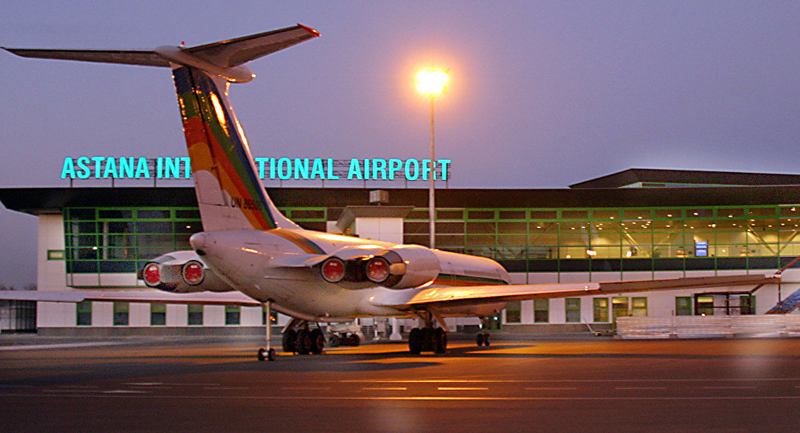
Travel Advisories

Travel Advisories and Airspace Warnings are different things. But for US operators flying internationally, it’s worth checking out the latest country-specific Travel Advisories issued by the US Dept of State. Each country’s Travel Advisory also has a link to the local US Embassy website in that country – these will show announcements on all the latest security-related news and incidents there.
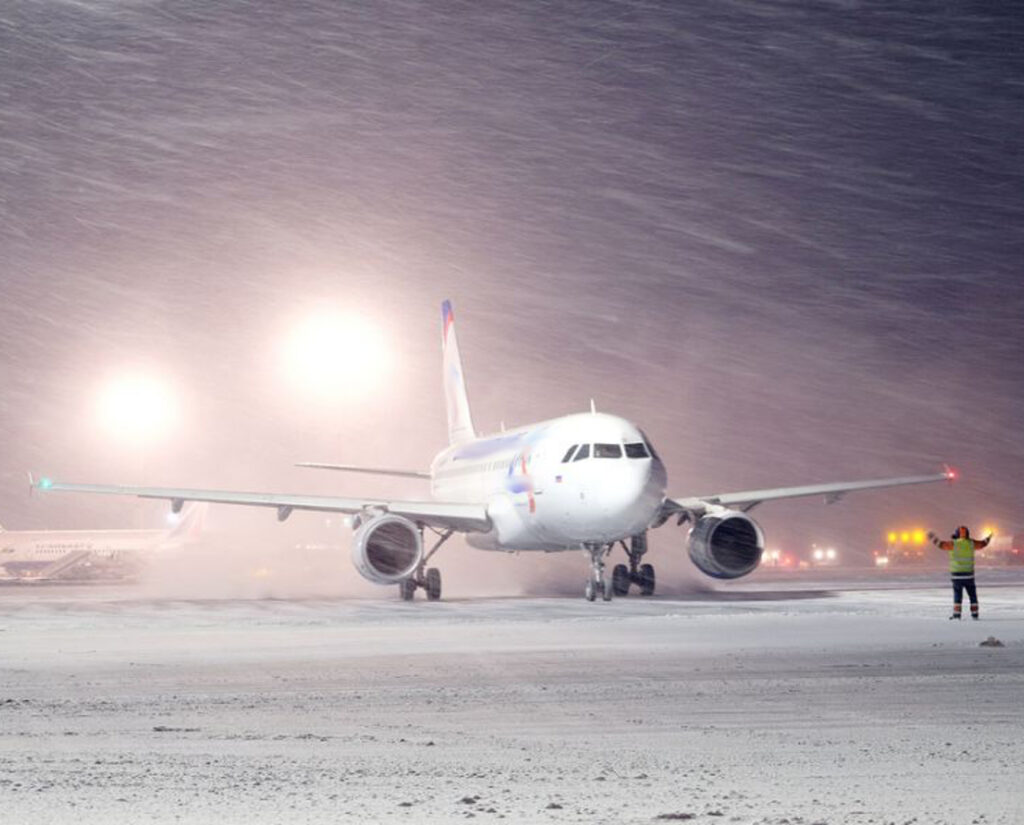
Who doesn’t appreciate a nice color-coded map.

Further reading

  • US and allied forces have now pulled out of Afghanistan, and the Taliban have taken control of the country. Afghanistan’s airspace is now effectively closed to overflights – the OAKX/Kabul FIR is uncontrolled, and overflying traffic should route around the country. Here is our latest update on what is happening.
  • The US reissued their Ukraine warnings in 2021. However, certain regions are Ukrainian airspace are now deemed safe for overflight.
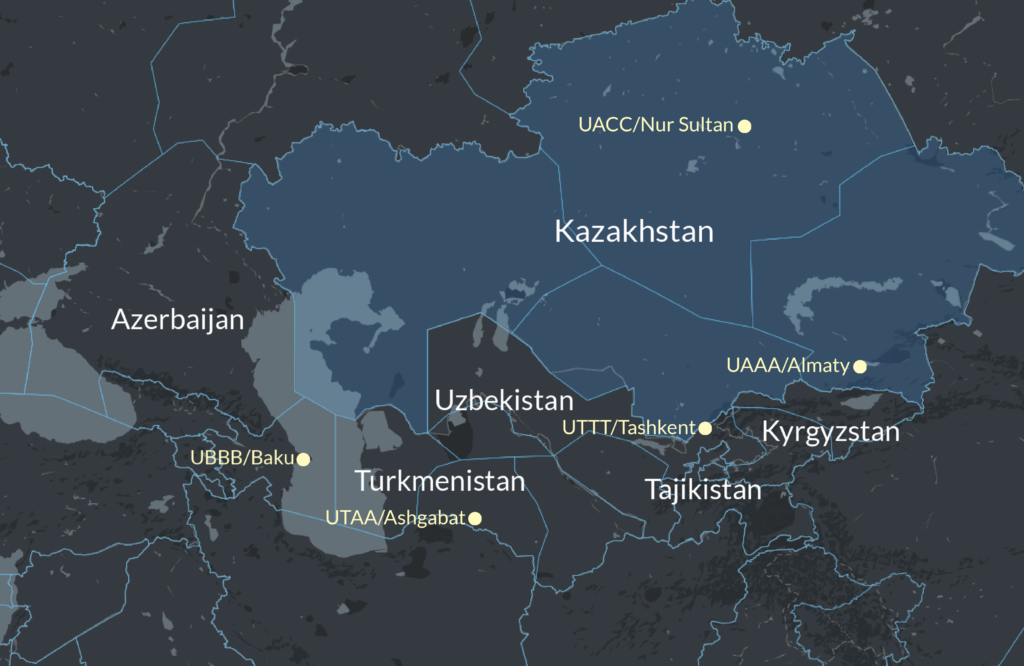
  • Information on the aircraft shootdown in Iran, and ongoing concerns with their airspace safety.
  • Assessing the risk to routing over or into conflict zones is much more than just an “is there a weapon down there?” question. Gathering and sharing information on airspace risk is still one of the biggest barriers to safety. Are we actively seeking this information, or simply waiting for it to come our way? Read our article.


Beyond Covid: The Biggest Security Risks We Face Right Now

Aviation has always been a reactive industry – because it needs to be.

Over time, forces beyond our control have continued to influence the way the industry moves forward and the way we operate.

For the past eighteen months, our reactive energies have been focussed primarily on one thing – a global pandemic. But it is important that we continue to react to other changes too – particularly when it comes to security, and the types of threats that we face are evolving.

As the industry begins to recover from Covid and press on into the decade, here are some of the biggest security threats that it will face.

Operating Near Conflict Zones

While the lines between aviation and politics are often blurry, they undeniably intersect. The point is that regardless of which side we choose to take, we continue to operate aircraft over or in close proximity to active conflict zones. Which means risk.

The past eighteen months have shown that conflicts can erupt with very little warning in busy flight corridors and with significant dangers to the aircraft flying above them.

This was the case last year in Azerbaijan, where almost all west/east bound airways were closed by the conflict below. Only months ago, Israel’s Tel Aviv FIR was heavily affected by widespread rocket attacks while just this week, Afghanistan’s Kabul FIR has been left with no ATC services following an overwhelming Taliban offensive.

More than 3000 rockets affected Israeli airspace over an eight day period in May 2021. Aircraft were immediately under threat from not only them, but widespread use of high-tech air defence systems.

Things can change quickly and the problem isn’t going away in a hurry.

But perhaps more concerning is that the aviation system relies on the sharing of information to keep us safe up there (and ICAO Annex 17 demands it). But practically speaking, concerns remain over inadequate government intelligence sharing, especially in states involved with conflicts.

Your flight is tomorrow and you’re not familiar with the politics of Western Sahara. Here’s what the notams have to say. Is it safe to overfly?

Until things change, reliable risk assessments will remain a challenge firmly on the shoulder of operators – and these will rely on timely, unbiased and accurate information. As we have often seen, that can be very hard to get.

Terrorism

Unfortunately, aviation will continue to be a target for terrorism.

While security at airports remains tight, the challenges of breaching it have led terrorist groups to develop new ways of targeting aviation interests. While large-scale attacks the likes of 9/11 seem more far-fetched with today’s protocols, there is a renewed interest by terrorist groups in attacking so-called ‘soft targets’ – primarily aircraft in flight or airports with poor security infrastructure.

To make matters worse, non-state actors and large terrorist organisations (such as ISIS and Al Shabaab) are encouraging smaller groups or even just lone-wolf individuals to attack by proxy, which makes the threat difficult to prevent. These attacks don’t need obvious leadership, and can be accomplished by low-tech means. Weapons such as rockets, mortars and man portable air defence systems (MANPADS) are of particular concern.

Non-state actors with access to MANPADs are spread throughout the world. Courtesy: US Dept of State.

Recent events at ORBI/Baghdad Airport serve as a good example, where multiple rockets were found stashed on nearby rooftops overlooking the airport.

Civil Unrest

In the past eighteen months, we’ve seen countries around the world suddenly erupt into periods of civil unrest. While beyond the realm of airspace warnings and Notams, the effects on crew safety on the ground can be dramatic.

While strikes and peaceful demonstrations can cause little more than inconvenience on the airport commute, it is when things get violent that the danger emerges.

Two examples spring to mind this year where the security situation on the ground changed rapidly and without warning.

The first is Myanmar where in February a military coup saw nationwide protests. Clashes with military police eventually turned violent with mass civilian casualties in the capital, Yangon. Disruptions continue there to this day.

The second is South Africa last month where a political and legal dispute led to widespread rioting and looting and became the worst violence that South Africa had experienced in many years.

Violent clashes between protestors and military resulted in mass casualties in Myanmar earlier this year.

Given the abundance of uncertainty that seems to characterise the modern world, it seems naive to believe that civil unrest is going anywhere in a hurry. Recent events have shown that even away from airports, aviation professionals continue to be at risk.

Cyber Threats

While the aviation industry has developed a strong track record of security practices from physical threats, it has struggled to keep pace with digital ones.

Studies have revealed some alarming numbers. EASA for instance have reported an average of one thousand reported cyber on attacks on airports every single month, while systems at airports in Israel fend off up to three million attempted breaches per day.

Unlike other industries, aviation is particularly vulnerable to cyber-attacks because the consequences can be so catastrophic. Successful attacks could literally cost lives.

Only two things are needed to open the doors to a cyber attack: a vulnerability and a pathway. We’re heavily reliant on countless connected systems that have to operate in real-time and with super-high reliability. Many of them are safety-critical, and they have to be protected.

Have a ponder for a moment about just how far that rabbit hole can go. Here’s a few suggestions just to get you started: Primary radar, secondary radar, EFBs, ADS-B, GNSS, Datalink, ACARs, even Fly-By-Wire. Heavy, heavy hitters in the safety game. This is before we even go down the road of the pilotless aircraft.

Safety critical systems such as CPDLC could potentially be targeted by cyber criminals.

As technology continues to improve our efficiency and make our jobs easier, it is also opening gateways for those with malicious intent. Aircraft are becoming smarter and more connected, but arguably also more vulnerable to attack.

The challenge in years to come will be how to protect these critical systems, or at least limit the impact when they are attacked.

Human Trafficking

The unlawful act of transporting people around the world in order to benefit from their labour or exploit them in other ways continues to be a global phenomenon. Particularly when they are suffering from economic hardship.

Recent studies have shown that as many as 700,000 people become the subjects of human trafficking every year, with reports from over 127 countries worldwide. It is aviation that is often the vehicle for this malicious trade. These unfortunate people are often travelling with forged or stolen documents, and may be under duress from the people they are travelling with.

It’s an ongoing problem. ICAO itself is directly involved in efforts to address it through better training and an understanding of where in the world the worst hotspots are. However it is likely to remain a threat to aviation security for many years to come.

Threats to aviation security aren’t new, but our reaction to them needs to be.

Moving forward our response to security in the industry must continue to evolve to meet the threat, regardless of what other industry pressures we find ourselves under. Undeniably, our safety and that of our passengers will depend on it.


New Airspace On The Way In the Middle East: The Doha FIR

Plans are underway to establish a new flight information region in a busy air corridor over the Middle East.

Since 2018, Qatar has been campaigning to control its own airspace by establishing the Doha FIR  – a process that would involve cutting the existing OBBB/Bahrain FIR in half.

For the first time, an improving political environment has led ICAO to give Qatar the go-ahead, as long as it can work directly with Bahrain to sort out all of the technical side of things. When established, over thirty percent of traffic in and out of the UAE will pass through the new airspace and so it is worth taking a closer look.

A little background.

With the exception of terminal airspace at OTHH/Doha, Qatar’s air traffic is controlled by Bahrain in a long standing agreement. Qatar first proposed to assume control over its own airspace three years back – a suggestion that was opposed by several countries including the UAE, Saudi Arabia and Bahrain.

Why?

Primarily because it came at a politically sensitive time.

Just the year before a diplomatic crisis led to Saudi Arabia, the UAE, Bahrain and Egypt (among others) cutting ties with Qatar. From an aviation perspective, a blockade was formed which prevented Qatari registered aircraft from using their airspace and vice versa. From an operational perspective there was likely little regional appetite to release a large chunk of Middle Eastern airspace into a political road block.

Thus criticisms were quickly tabled. The primary feedback was this:

  • Qatar hadn’t provided operational justification for the change.
  • An additional ANSP in this busy piece of airspace would make co-ordination more complicated.
  • Safety may be compromised, while cost would go up for operators.
  • Bahraini air traffic control had done a great job of safe and efficient flow of traffic for decades, why change?
  • Capacity would tank.

Qatar on the other hand argued that the proposal would improve safety while providing some economic award for the industry too.

Then things changed.

Earlier this year while the world continued to revel in the ‘delights’ of a certain pandemic, the political situation for aviation in the Middle East changed for the better. Following a successful GCC summit, the blockade was lifted. Meaning all parties could once again use each other’s airspace. Tensions subsided and it was good news for fuel burns and flight times.

A successful GCC Summit this year saw the Qatar Blockade lifted.

Enter the Chicago Convention.

The what? Spoiler alert: It has nothing to do with the Cubs. It’s basically the landmark agreement among all ICAO member states that establishes the core principles for international ops. It’s a big deal. Buried within its many hallowed pages is this: each state has ‘complete and exclusive sovereignty over the airspace above its territory’. And ICAO have agreed that in this case, the principle applies.

So what is the proposed airspace going to look like?

 Pictures are always better than words. So here are some pictures:

Why do ICAO only agree ‘provisionally’?

Because quite a bit of work needs to happen behind the scenes to make the proposal a reality.

Essentially Qatar has to do two things:

  1. Prove that safe and efficient systems and infrastructure are in place in their airspace to be.
  2. They need to work directly with Bahrain to report back on all of the technical arrangements that will make the proposal real. It is not the easiest task for either side given diplomatic histories but in promising signs for the region, work is under way.

What happens now?

Qatar and Bahrain are due to report back to ICAO later this year, likely November or December. How long after that meeting the changes may be implemented is still up in the air (bad pun not intended).

But keep an eye out for updates on the change which appears to now be well on its way to altering the skies over the Middle East.