Timeline of North Atlantic Changes

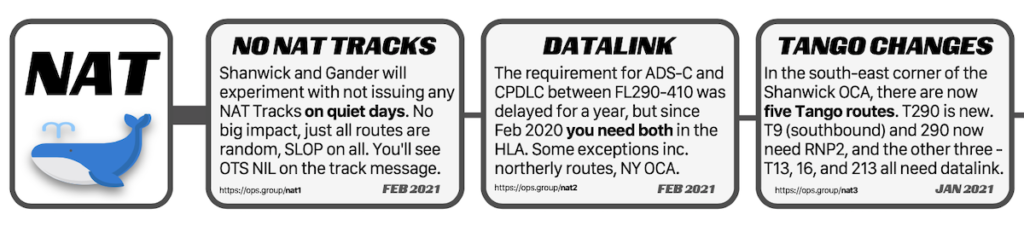
This page has a timeline of big NAT changes, for the six Oceanic Area Control Centres (OACC’s): EGGX/Shanwick, CZQX/Gander, BIRD/Iceland, ENOB/Bodø, LPPO/Santa Maria, and KZWY/New York Oceanic.

2025

  • Sep 2025: Shanwick’s move to Oceanic Clearance Removal is now delayed until after summer 2026, following challenges seen during Gander’s rollout. More info.
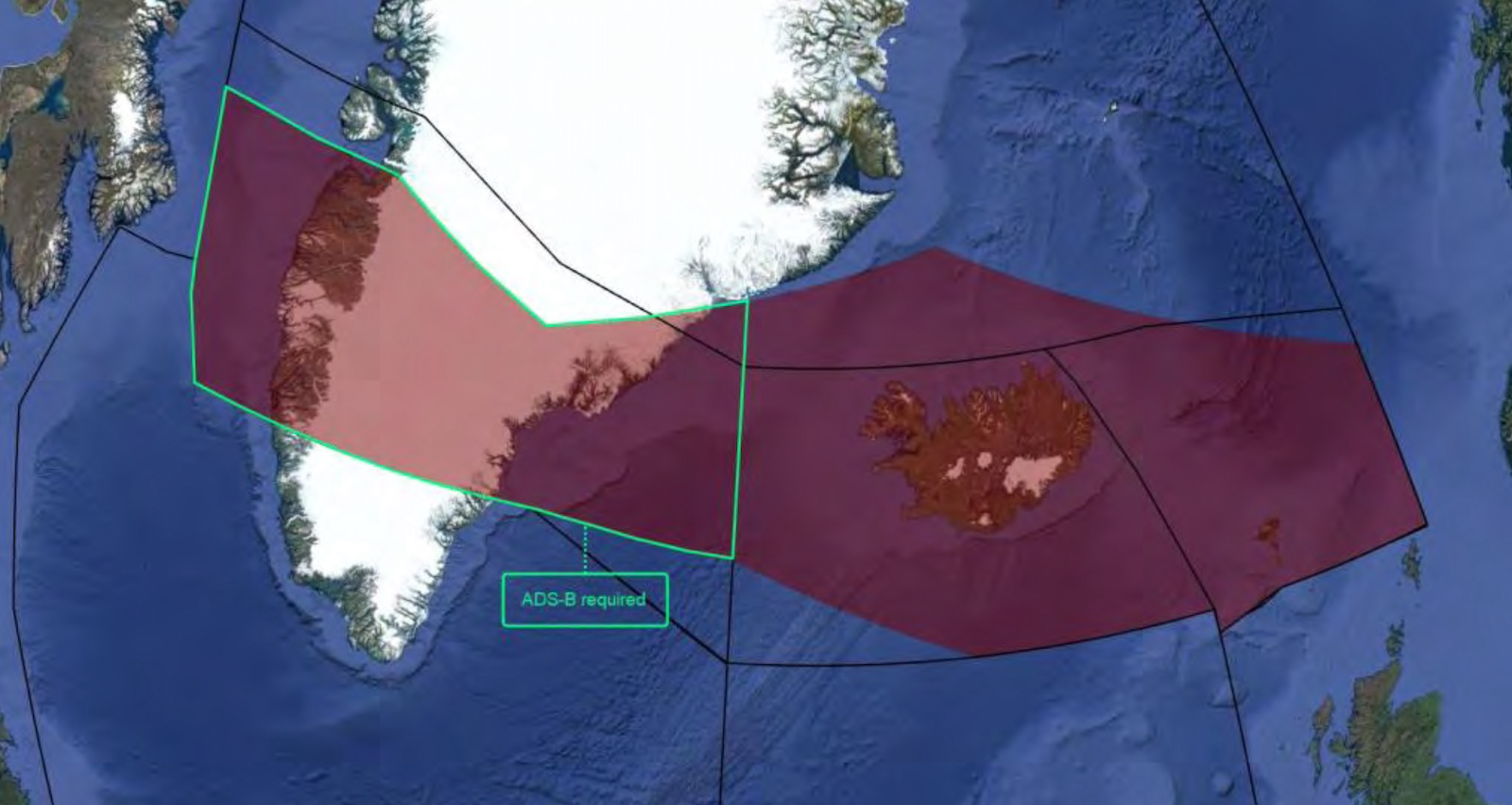
  • July 2025: ADS-B is now mandatory in the entire BIRD/Reykjavik FIR. More info.
  • June 2025: The extensively expanded BGGH/Nuuk airport in Greenland is now open, and receiving regular jet traffic. BGSF/Sondrestrom will soon downgrade ATC to AFIS. BGBW/Narsarsuaq will likely close in Spring 2026. More info.
  • May 2025: Since Canada removed Oceanic Clearances in Dec 2024, things haven’t exactly gone smoothly. Crews are confused. Controllers are overloaded. Frequencies are clogged. So from May 5, Gander will stop sending pre-Oceanic route changes via CPDLC and switch to VHF voice only. More info.
  • March 2025: Reykjavik OCA updated procedures with NAT Doc 007. Crews must now send their RCL no earlier than 15 minutes prior to the OEP (previously 20). Squawk 2000 ten minutes after the OEP is now standard everywhere except in Reykjavik CTA and Bermuda radar coverage. More info.
  • March 2025: Updated NAT Doc 007 published. Main changes: the Blue Spruce Routes were removed, new chapters on Space Weather Contingencies and GNSS Interference Events. More info.
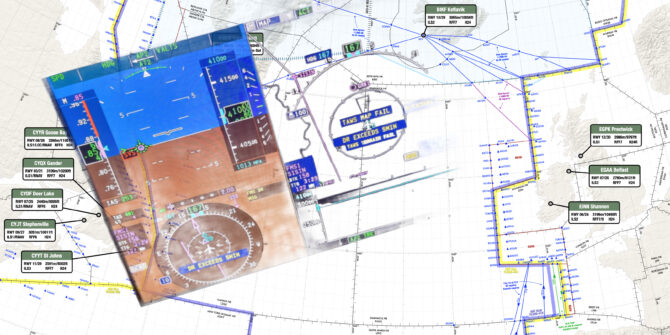
  • January 2025: NAT Ops Bulletin #1/2025 published with procedures for flights affected by GPS jamming or spoofing. Crews should advise ATC early in the RCL message to avoid being excluded from the NAT HLA. More info.

2024

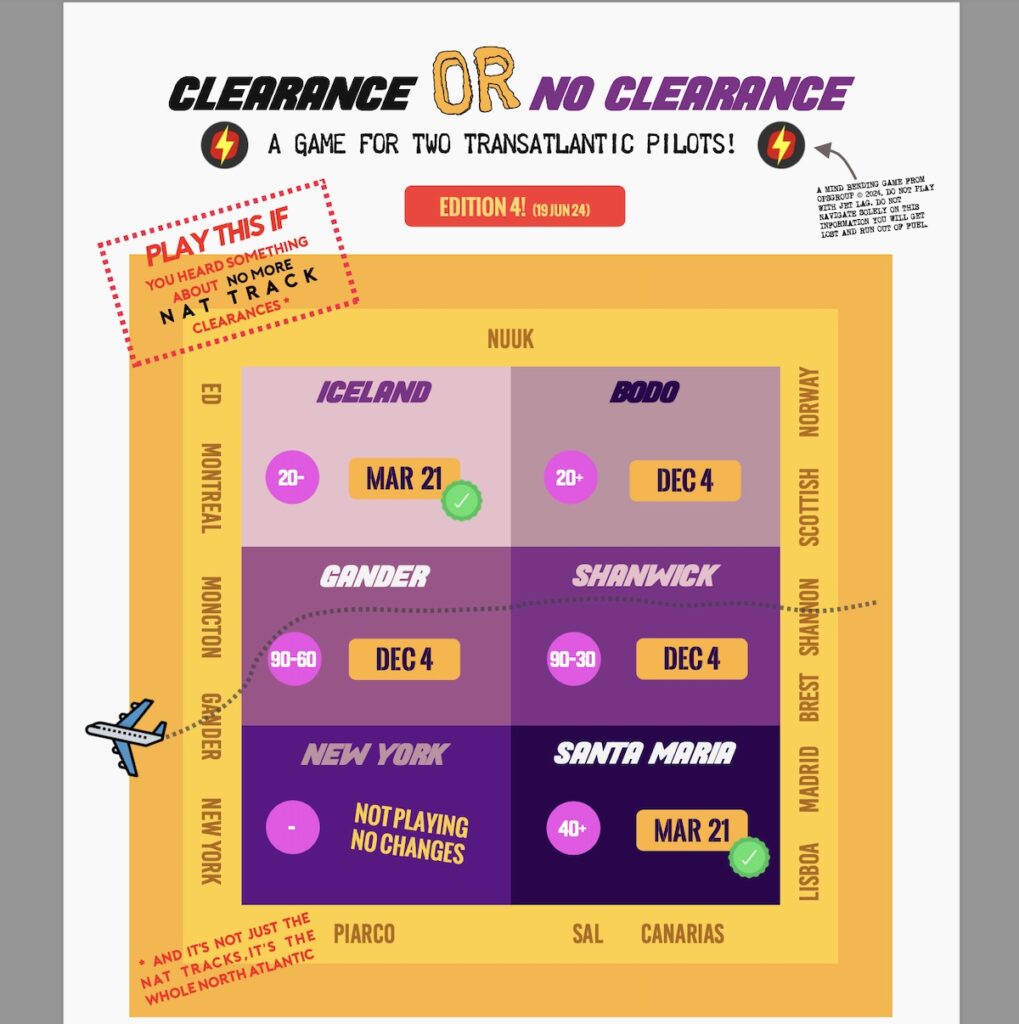
  • December 2024: Shanwick postponed its transition to Oceanic Clearance Removal (OCR), originally planned for Dec 4, 2024. By this point, Santa Maria and Iceland had already implemented OCR in March 2024, and Bodo and Gander followed in December – leaving Shanwick as the only NAT ANSP still requiring oceanic clearances to westbound flights entering from domestic airspace. More info.
  • March 2024: Beginning of the process of Oceanic Clearance Removal (OCR) for all NAT FIR’s. More info.
  • March 2024: Comms Failure Procedures simplified. More info.
  • March 2024: Squawk 2000 10 minutes after OEP is now standard in all NAT FIR’s, except Reykjavik. More info.

2023

  • Sep 2023: The US FAA officially renamed WATRS airspace to WAT. Existing B050 authorizations will be re-issued within 24 months. More info.
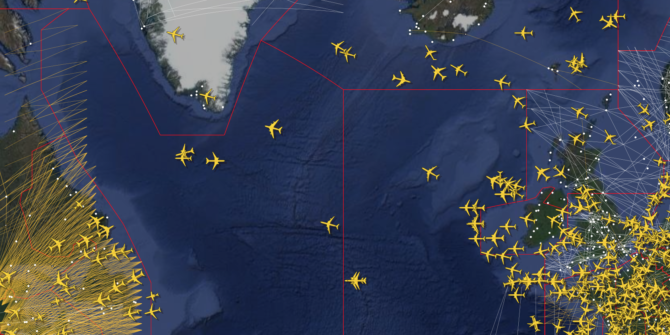
  • Jan 2023: There were some changes to the boundaries of the datalink exempt airspace in the northern bit of the North Atlantic. This used to extend down south to SAVRY, but now only goes as far as EMBOK. So now you need datalink in the NAT oceanic airspace over Greenland controlled by Gander. More info.

2022

  • June 2022: HF data link (ACARS) does not meet the satcom part of the NAT DLM requirement – you need Inmarsat or Iridium for that. So if you want to fly in NAT DLM airspace (FL290-410 in the NAT region) “J2” in field 10a of your FPL won’t work anymore – you need “J5” for Inmarsat or “J7” for Iridium. More info.
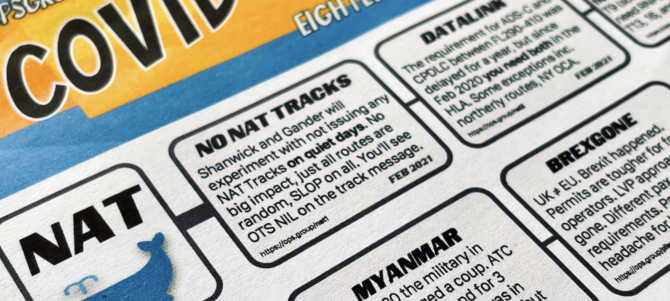
  • March 2022: All NAT Tracks at FL330 and below were abolished. It means operators will have the flexibility to file random routes at FL330 and below when flying between Europe and North America. Particularly for operators unable to file routes across NAT Tracks with active flight levels, this means much greater flexibility in choosing their own trajectory. More info.

2021

  • July 2021: The “MAX UPLINK DELAY VALUE TO 300 SECONDS” message will now be sent to all aircraft – and each time you logon to a new OACC. More info.

2020

  • Jan 2020: Update on the Datalink Mandate. Effective Jan 20, 2020, datalink (CPDLC and ADS-C) is now required between FL290-410 in the NAT region. There are exempted areas: North of 80N, Surveillance airspace over a section of Greenland and Iceland (where ATC can see you on radar or ADS-B), and New York Oceanic East. Aircraft without datalink can request to climb/descend through datalink mandated airspace, but will only be considered on a tactical basis – most likely you’ll get stuck under FL290. More info.

2019

  • Micro-SLOP. ATC don’t seem to like the term, but that’s basically what it is. Before, you could only SLOP centreline, 1NM or 2NM to the right. But since 2019, all NAT OACCs started allowing offsets right of centreline in tenths of a nautical mile up to a maximum of 2NM. More info.
  • ASEPS. Reduced longitudinal separation (down to as close as 14NM) has been happening since April 2019 in Gander, Shanwick, and Santa Maria. But from Oct 2019, lateral separation will be reduced to 19NM from the previous PBCS limit of 25NM for compliant aircraft. To be able to get this reduced separation, you’ll need ADS-B and to be fully PBCS compliant (i.e. meet the specs of RNP4, RCP240 and RSP180). Read the ICAO Bulletin for more info.
  • OWAFS Operations Without a Fixed Speed. In other words, you get to decide how fast you fly. It’s been happening in the Shanwick, Santa Maria, and New York Oceanic FIRs since Apr 2019. Iceland say they will start doing this some time around Oct-Nov 2019. You get a normal oceanic clearance, with a fixed Mach Number, like you always did. But then somewhere after the Oceanic Entry Point, you may get a CPDLC message saying RESUME NORMAL SPEED. You should reply with WILCO. What that means is: Fly ECON, or a Cost Index with Variable Mach. You can fly within 0.01 up or down of your cleared Mach, but if it varies by 0.02 or more you must advise ATC. Read the ICAO Bulletin and check out our article for more info.
  • PBCS From March 29th 2019, there may be more than just three daily PBCS tracks. They will continue to be only FL350 to FL390 inclusive and only on the designated tracks during the period the tracks are in effect. There may be days where there are no PBCS tracks, 3 PBCS tracks, 5 PBCS tracks, potentially even all the tracks.
  • Contingency Procedures From March 29th 2019, new contingency and weather deviation procedures were introduced. For contingencies, you now turn at least 30 degrees and offset by 5 NM. For weather deviations, you now do your 300ft up/down offset when 5 NM away from track. More info.

2018

  • PBCS From March 29th 2018, PBCS is a requirement for the daily mandated PBCS NAT Tracks (right now, that the 3 core tracks each day) between FL350-390.  PBCS for the NAT means having both RCP240 (4 minute comms loop) and RSP180 (3 minute position reporting). If you’re missing approval for either, then you can fly anywhere other than along the core NAT tracks FL350-390. Read more about PBCS in our article, and check out the NAT Circle of Change for an easier graphical representation.
  • RLAT  From January 4th 2018, Shanwick and Gander increase the number of RLAT tracks – most tracks between FL350-390 will now be RLAT – 25nm separation between them. RLAT replaced by the term PBCS.

2017

  • SLOP – Offsetting is now mandatory. Choose 0, 1, or 2nm right of track. We think 1 or 2 is best. Consider the recent A380 story.
  • TCAS 7.1: From January 1st, 2017, TCAS 7.1 is required throughout the entire NAT region.
  • Cruising Level: Effective 2017, you no longer need to file an ICAO standard cruising level in NAT airspace.
  • Gross Nav Error: This is now defined as greater than 10nm. Everywhere else in the world, it’s 25nm.
  • Datalink Mandate: Since Dec 2017, datalink now required throughout the NAT Region from FL350-390. Exempt areas: Tango Routes, airspace north of 80N, Surveillance airspace, Blue Spruce routes, and New York OCA.

2016

  • Confirm Assigned Route Introduced August 2016, you will see this message when you enter NAT airspace with datalink, and you should reply with the planned route in NAT airspace. Designed to catch errors.
  • NAT HLA The airspace formerly known as MNPS. Changed February 2016. NAT HLA = NAT High Level Airspace. Now includes Bodo Oceanic, and aircraft must be RNP 4 or RNP10. Previous MNPS approvals good through 2020.

2015

  • RLAT Started December 2015, spacing on the NAT Tracks reduced to “Half Track” (30nm) for 3 core tracks. RLAT=Reduced Lateral Separation Minima. Next phase of this (ie. all NAT Tracks 350-390) was introduced in Dec 2017.
  • SLOP Offsetting right of track by 1nm or 2nm became Mandatory.


NAT FAQ: No Datalink – Where can we go?

No Datalink – Where can we go?
  • You can make a crossing at FL280 or below, or FL430 or above
  • You can cross via the Iceland-Greenland corridor if you have ADS-B
  • You can enter NY Oceanic, the Bodo and Azores corridors, GOTA, and fly down T9/290.

Datalink is defined as CPDLC and ADS-C. If you’re missing either CPDLC or ADS-C, then you’re not datalink equipped. Since 2021, datalink is mandated (DLM) for the entire NAT region between FL290-410 [NAT Doc 007, Ch 1.8]. The only exception is flights STS/FFR, HOSP, HUM, MEDEVAC, SAR, or STATE.

Without datalink, you can only enter these areas on the North Atlantic FL290-410 [NAT Doc 007, 1.8.2]:

  • Anywhere north of 80N
  • New York Oceanic East
  • The Iceland-Greenland Surveillance corridor (ADS-B required west of 30W)
  • The Bodo corridor (ADS-B required)
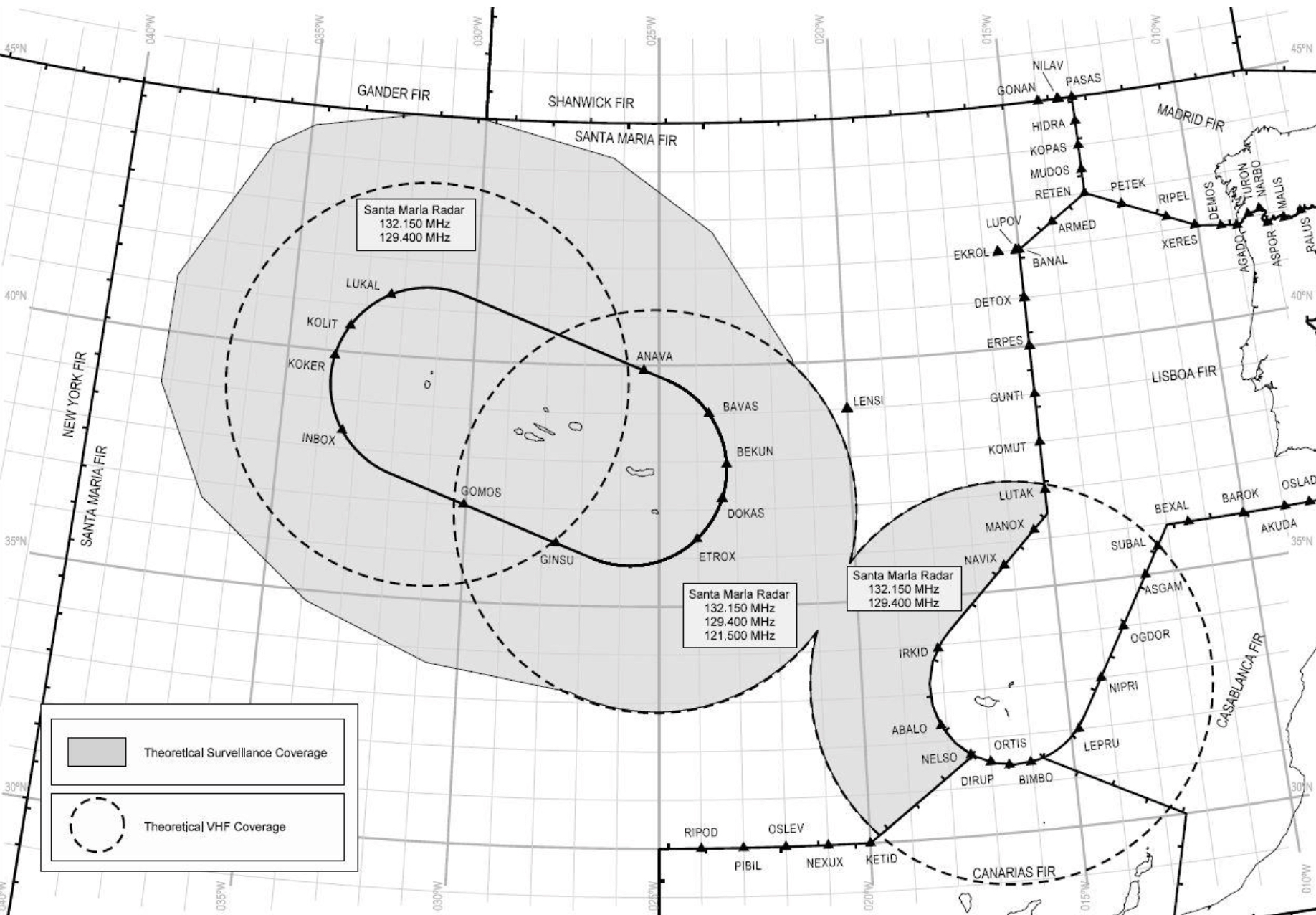
  • The Azores corridor (ADS-B required)
  • Tango 9 and 290 (ADS-B required) (per UK AIP)
  • GOTA  (ASD-B not required but please do if you can, says ATC)

The only complete crossing available is therefore via the Iceland-Greenland corridor. For this, you need ADS-B west of 30W.

So, if you have ADS-B, and the remaining NAT HLA requirements, you can make a crossing at normal altitudes (eg. FL380) through this airspace.

For planning purposes, this area is bounded by the following:
Northern boundary: 65N000W – 67N010W – 69N020W – 68N030W – 67N040W – 69N050W – 69N060W – BOPUT.
Southern boundary: GUNPA (61N000W) – 61N007W – 6040N010W – RATSU (61N010W) – 61N020W – 63N030W – 6330N040W – 6330N050W – EMBOK. [NAT Doc 007, 1.8.5]

If you don’t have ADS-B, then this crossing is not available between FL290-FL410.

In this case, you should plan to cross the ocean at FL280 or below, or FL430 or above. This in turn places you outside the NAT HLA, as the HLA levels are FL285-FL420. A crossing at FL280 may mean a fuel stop, in Iceland for example (BIKF or BIRK are commonly used).

You can request a climb or descent through Datalink Mandated airspace from ATC, and this is commonly granted, but you do need HLA approval.

Santa Maria Corridor


The Santa Maria Corridor will allow you to fly out to the Azores and back, but won’t help with a full NAT crossing due to the gap between Santa Maria surveillance and the New York oceanic boundary. To use this corridor, you need a Mode S transponder with extended squitter for ADS-B. [NAT Doc 007, 1.8.5 b]


This didn’t answer your question?

Comment below. Sadly (for us), we enjoy digging into this stuff. So, post your question below and we’ll update this page with the answer (probably quite quickly!)


Useful links for more on this … 


NAT Crossing after GPS spoofing: a guide

An increasing issue for the NAT Oceanic FIR’s is how to handle aircraft with an in-flight degradation of GPS. This normally follows a GPS Spoofing encounter somewhere prior to Oceanic Entry, leading to a degraded RNP capability.

If you run into GPS issues before entering the Ocean, you will likely end up with RNP10 as the best you can manage for navigational accuracy. This presents some issues for the Oceanic controllers, as RNP4 is commonly used to ensure separation. We’ll take a look at some scenarios and how to best handle these.


Normal RNP requirements on the NAT

NAT Doc 007 specificies two RNP options for entry into the NAT HLA.

The first is RNP10 (accuracy of 10 nm, 95% of the time). An important consideration here is that RNP10 is really RNAV10, but they call it RNP10 to keep things simple [See NAT Doc 007, 1.3.4]. The critical difference is that for RNAV10, on-board monitoring is not required. Since this can only be done by GPS, that’s an important relief when it comes to spoofed flights.

The other is RNP4 (accuracy of 4nm, 95% of the time). RNP4 is only an absolute requirement for PBCS Tracks (“Half-Tracks”). In practice, ATC commonly uses RNP4 for separation purposes on the NAT (Since the introduction of ASEPS). GPS is required for the monitoring part of RNP4; without GPS, RNP4 is not possible.


Loss of GPS Prior to the NAT

Since GPS Spoofing became prevalent in September of 2023, increasing numbers of aircraft are arriving at the Oceanic Boundary with one or both GPS sensors inoperative. A textbook GPS Spoofing encounter will initially see the GPS sensors rapidly change from the real coordinates to fake coordinates. If all GPS sensors agree on the fake coordinates, the FMS becomes confused. IRU values will increase, and in some cases, the IRS may also become “infected”.

The primary spoofing locations have not changed much since the onset of the issue: you will encounter spoofing at the Iraq/Iran border, the Sinai peninsula area (showing Tel Aviv as the spoofed location), Israel and Cyprus (showing Beirut as the spoofed location), and the Black Sea (showing Sevastopol as the spoofed location).

We have no reports in OPSGROUP that the other type of GPS interference – GPS Jamming – leads to lasting effects. Once the jamming has stopped, aircraft systems are normal.

However, we do have reports that if GPS inputs are turned off before departure, and later turned back on in flight, that issues may occur. This is mostly reported for departures from Tel Aviv (LLBG).


GPS failure, Ocean approaching

Since RNP4 requires a functioning GPS, if you encounter spoofing and lose your GPS, you can’t fly RNP4. Assuming that you have an RNP10 approval (one of the only two options for the NAT HLA), you will become RNP10.

The problem occurs when Shanwick, or the OACC at the entry point, get late notice of this fact, and you are close to other aircraft. That leaves the Planning Controller with little time to figure out how to separate you (an RNP10 aircraft) from the others (RNP4 aircraft).

In some cases, “spoofed” aircraft have had to descend  to FL280 to exit the NAT HLA, and this has caused diversions.


How to best handle a NAT crossing with a failed GPS

The key is to advise Shanwick, or the first OACC, early. Shanwick’s preference is that you use the RCL request to do this, and add a note to the end of the RCL along the lines of ATC REMARK/GPS DEGRADED RNP10 ONLY. If using voice to get your clearance, that’s what to say as well. Shanwick NOTAM EGGX G0106/24, and a note on the OTS Track message, has this information.

The RCL for Shanwick should ideally be sent 90 minutes before the Oceanic Entry in this case. Normal RCL timeframes are -30 to -90. An RCL sent any earlier will be rejected, but if you have something more unusual to discuss, you could use SATCOM to contact the supervisor and ensure a smooth crossing.


RNP10 time limit

With the change to RNP10 for your crossing, double check the time limit for RNP10. ICAO Doc 9613 (Volume II, Part B, Chapter 1) specifies that RNP is limited to 6.2 hours of flying. The timing starts from when “the systems are placed in navigation mode” or at the last point at which the “systems are updated”. The logic here is that the IRS will drift without updates enroute, and after 6.2 hours of flying, will no longer be capable of maintaining the RNP10 accuracy.

For an aircraft spoofed in the Mediterranean, or Black Sea area, it will take 4 hours before Oceanic entry, so this time limit becomes relevant. If the impact of the spoofing is severe enough, there is potential for inputs – including DME/DME or VOR/DME –  to the IRS to stop working. This is one of the potential unknowns at present.


Shanwick comments

Shanwick are encountering several GPS jammed aircraft per day, and it is sometimes difficult (or impossible) to find optimum profiles for aircraft without moving several other aircraft to accommodate. The only instance where they have to insist on FL280 and below, is when an aircraft does not meet the requirements for MNPS (such as single LRNS), and needs to be cleared outside HLA.

If a pilot advises that they have lost RNP4, but are still capable of RNP10, Shanwick controllers will look to find a solution where the aircraft can be cleared with at least 10 minutes longitudinal and 60nm lateral separation. These aircraft also need coordinating with the next Oceanic Center before clearance, and sometimes there are limited options available.

In general, the earlier they informed about the degradation, the easier it is for the Shanwick controllers to find satisfactory solutions.

 

Member input

This is a developing issue and we gratefully welcome any input from members on this. Email us at team@ops.group.


NAT Doc 007 – New Edition

A new version of NAT Doc 007 has been published today (July 4th, 2024).

NAT Doc 007 is the main go-to guidance doc for ops over the North Atlantic. All the specifics about how to operate your aircraft safely through the complex airspace of the region are here. As of this morning, the latest version is NAT Doc 007 2024 Amendment 4. Download a copy.


What’s changed?

For this particular update, not a lot. The changes relate to the language around the new RCL process, and what to expect back from ATC once you send your RCL. This is part of the Oceanic Clearance Removal project.

Earlier in the year, the new RCL response included the language “RCL RECEIVED BY [ANSP]. FLY CURRENT FLIGHT PLAN OR AS AMENDED BY ATC

That turns out to have been creating confusion, so the RCL response will now just say:
RCL RECEIVED BY [ANSP]

These changes are in section 6.2.26 onwards.


What’s the latest with the RCL/OCR project?

Santa Maria and Iceland have made the change, so entering that portion of the NAT HLA does not require an Oceanic Clearance. You do still have to send an RCL in the same way as if you were requesting an Oceanic Clearance, but once sent, and you get an ACK – that’s it. For more on the new process, read about Oceanic Clearance Removal.

Gander, Shanwick, and Bodø have postponed their change to December 4th, 2024. This means that for now, nothing has changed – you get an old-school Oceanic Clearance in the same way you always did – with an RCL, or via voice.


So there are two kinds of RCL then?

Yep. For Gander, Shanwick, and Bodø, RCL means Request Clearance. You send this message, then wait to get your Oceanic Clearance back, usually via an OCL message on datalink.

For Iceland and Santa Maria, RCL means RCL Message. This is a “Check-In” of sorts, but the format is the same as the old meaning of RCL.

Confused? You’re not alone. But by Christmas, all will be easier – once everyone is on the same page. Play “Clearance or No Clearance” to help get things straight.


The hole in NAT Doc 007

There’s one problem with NAT Doc 007 – we’re in limbo land until Christmas. All of the guidance relates to how to send an RCL in a post-Clearance world. But for the next 5 months, most of us still need an Oceanic Clearance, and there’s no information on how to actually get one.

In the previous version of NAT Doc 007, Chapters 5 and 7 related to the Oceanic Clearance process, but those have been deleted. So, here’s a copy of the old NAT Doc 007 from 2023, which details that process.


Can we help?

If you have a question about this or need some help, just write us a note and we’ll do our best: team@ops.group.


Hurricane Beryl

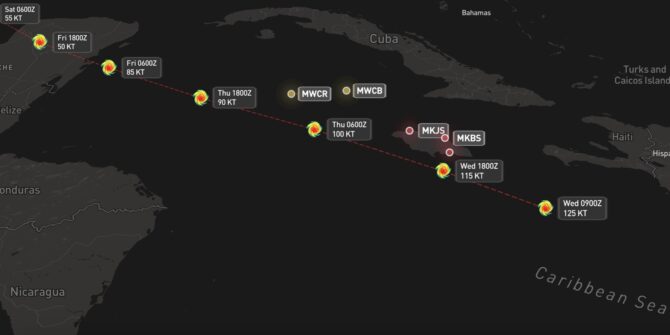
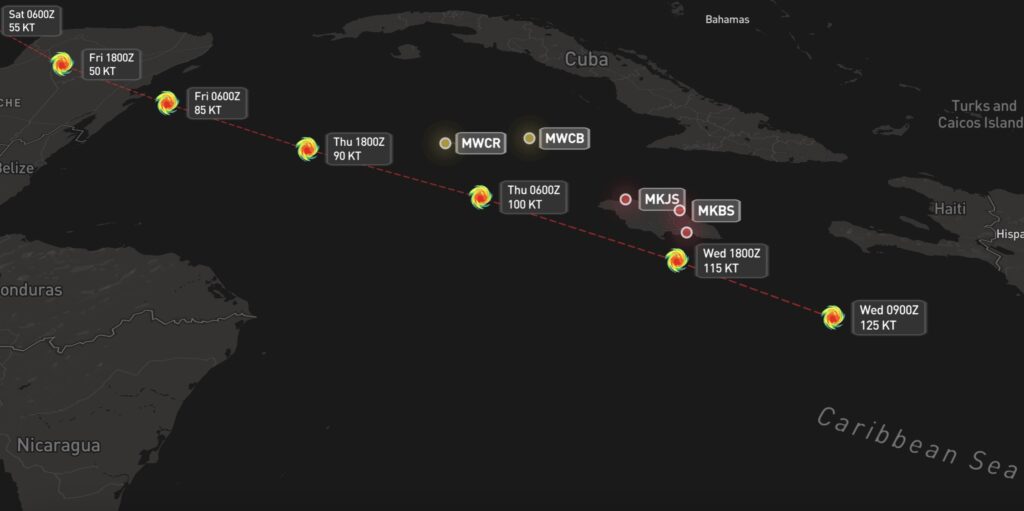
The OPSGROUP Hurricane tracker is now active for Hurricane Beryl, which is on track to hit Jamaica on Wednesday, with sustained winds of 110 kts. A hurricane warning has been issued for the entire country, along with the Cayman Islands. 

Click here for the interactive map.

MKJP/Kingston and MKJS/Montego Bay are already closed.

Further west, MWCB/Cayman Brac and MWCR/Grand Cayman will close on Wednesday at 1500 and 1800 local.

The Hurricane Beryl Situation Report is being updated as airports close, and will have information on reopening.

There has been significant damage to airports in St. Vincent & the Grenadines post-Beryl, and all are now focused on relief operations. TVSA/Argyle is open and operating for relief flights, the smaller ones (TVSB/Bequia, TVSC/Canouan, TVSU/Union & TVSM/Mustique) have different degrees of infrastructure damage and are closed other than for specific relief operations.

If you have an update to share regarding Airport Status for any affected airports, please use the link below or email news@ops.group.


Report-A-Thing is a new thing to report stuff

We love a good snitch here at OPSGROUP.

The Daily Brief, Weekly Bulletin, Ops Alerts – pretty much everything we put out usually comes from one helpful member sharing something new.


Introducing the Report-A-Thing

We just built this. It’s new. Prepare to be amazed.

Currently operating with 2Mb of RAM and an 80Mb HDD, this machine is fully set up and ready to go. You can use Report-A-Thing to share new useful things with the rest of the group, and do so anonymously.

Try it out, and bookmark the address: OPS.GROUP/RAT


What should I share?

  • Something new, something dangerous, something risky
  • Something that will annoy other pilots (like a new parking procedure at TEB)
  • Something that affects airspace risk or security
  • Something shady
  • Something scary
  • Something interesting

Up to you. If you read the Daily Brief, you’ll know what kind of stuff appears there: so … that type of thing.


Are there other ways to report stuff?

Yes.


Where is the spoofing today? Two maps to help

If you’re keen to know exactly where GPS Spoofing – or GPS Jamming – might be happening today, there are two handy live maps to share with you.

Both of these use data from flight tracking websites to look for position anomalies, and convert those into hotspots that show where the activity is.

These are very useful in-flight to get a heads up on where you might encounter issues with GPS interference.

Live GPS Spoofing tracker

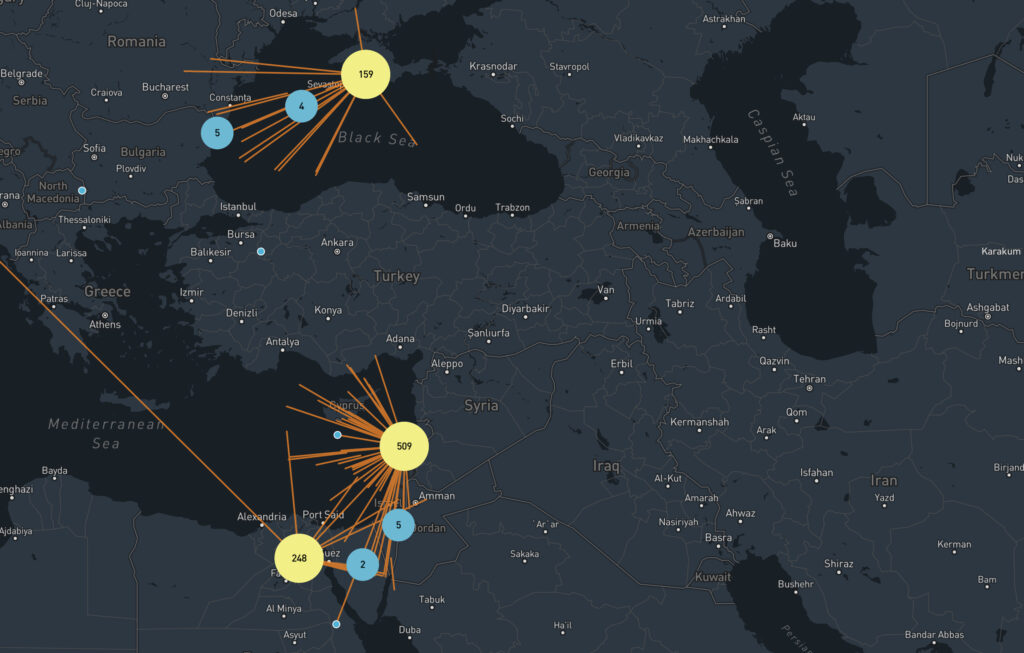
First up is this live GPS spoofing tracker from SkAI Data Services, in partnership with the Zurich University of Applied Sciences.

About a month ago, SkAI and Zurich University were following the discussions about GPS spoofing, and wondered if they could detect spoofing in real-time based on the ADS-B data from the OpenSky Network. As it turns out, they can. Having up-to-date information can help raise the situational awareness and prepare the flight crew for the possibility of spoofing.

Their algorithm can detect spoofing anywhere in the world where they have ADS-B coverage. The website is free to use. Unfortunately, the receiver network doesn’t quite have the same coverage as other ADS-B websites, let alone space-based ADS-B. Regardless, it’s a great tool for planning flights into areas of potential GPS issues.

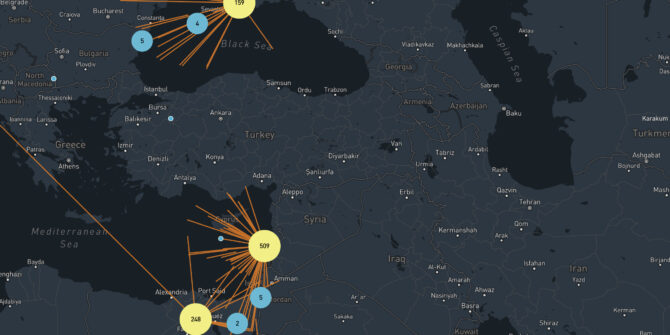
The screenshot above is from this morning, May 7th. It matches exactly the three primary GPS spoofing hotspots this year: Sevastopol, Beirut, and Cairo. These are the three locations that you can expect your GPS to “think” it’s at, when you are over the Black Sea, Eastern Med/Israel, and Egypt, respectively.

GPS Jamming tracker

This map has been around a little longer, and will be familiar to some. GPS Jam uses data from ADS-B Exchange, and looks for aircraft indicating low navigation accuracy. More details are in their FAQ.

This was created when jamming was the only type of GPS interference we encountered, but now that spoofing is on the scene, it most likely shows both jamming and spoofing. That said, when being spoofed, the aircraft doesn’t know it has an issue with navigation accuracy (and that’s the very problem). Maybe someone knows more about this.

Either way, it’s a great map to see potential GPS trouble spots.

What’s the latest on GPS Spoofing?

The spoofing tracker above is probably the best answer to that!

Since OPSGROUP first reported the new GPS Spoofing phenomenon in September last year, we continue to receive daily reports of spoofing. However, the areas affected remain largely the same. Our GPS Spoofing Pilot QRH from November last year still holds true, except that we’ve seen far fewer reports from the Iraq/Iran area, and a new area in Sevastopol affecting Black Sea transits.

We continue to ask members to report GPS spoofing events (pictures are very useful too) to us at team@ops.group, or via WhatsApp to +1 747 200 1993. Thank you!


Schengen area expands to almost all EU countries

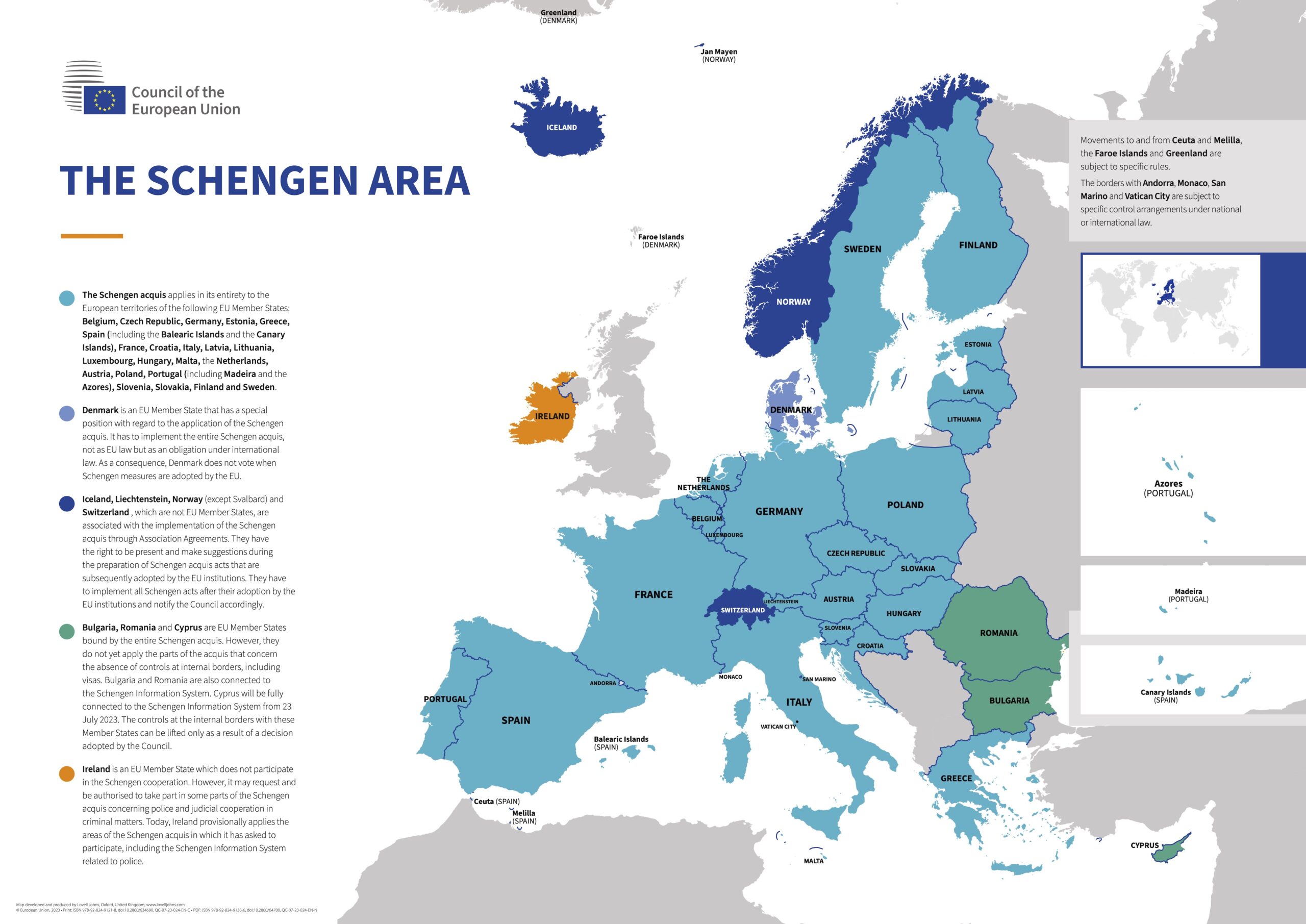
Effective March 31st, Romania and Bulgaria are now part of the Schengen area. This means that passengers and crew arriving in these countries are able to move freely within the EU (by air and sea) without any further immigration or border checks. “Schengen Flights” landing in Romania or Bulgaria are not required to clear customs.

The first “Schengen flight” landed at 0020L on March 31 at LBSF/Sofia, from Naples.

The Schengen Area was established in 1985. Before Bulgaria and Romania’s admission, it was comprised of 23 of the 27 EU member countries, along with Switzerland, Norway, Iceland and Liechtenstein. The only remaining Non-Schengen countries in the EU are Ireland (because Ireland has a common travel area with the UK, and the UK doesn’t like the Schengen idea very much), and Cyprus.

Schengen countries: Austria, Belgium, Bulgaria, Croatia, the Czech Republic, Denmark, Estonia, Finland, France, Germany, Greece, Hungary, Iceland, Italy, Latvia, Liechtenstein, Lithuania, Luxembourg, Malta, the Netherlands, Norway, Poland, Portugal, Romania, Slovakia, Slovenia, Spain, Sweden and Switzerland.

Non-Schengen countries in Europe: Ireland, the UK, Albania, Belarus, Bosnia & Herzegovina, Cyprus, Kosovo, Moldova, Montenegro, North Macedonia, Serbia and Turkey.

Non-Schengen countries in the EU: Ireland, Cyprus.


NAT FAQ: No HLA approval – Where can we go?

No HLA Approval – Where can we go?
  • You can make a crossing at FL280 or below, or FL430 or above
  • You can enter the NAT region outside HLA airspace
  • You might get special ATC approval to enter, or to climb/descend through it

The North Atlantic (NAT) High Level Airpsace (HLA) is the busiest Oceanic airspace in the world. Special approval is needed to fly in it. The NAT HLA extends from FL285-FL420, and takes in 6 different Oceanic Control Areas’s (OCA’s): Reykjavik, Shanwick (excluding SOTA & BOTA), Gander, Santa Maria, Bodo, and NY Oceanic East north of 27N.

HLA approval is issued by your country of registry, or the country of your operator.

Without NAT HLA approval, you can make a crossing at these altitudes:

  • FL280 or below
  • FL430 or above – but you should be familiar with NAT HLA procedures in case of drift-down, especially if above the NAT Tracks

ATC may approve you to (briefly) enter the HLA in some cases: if you are under radar control (or other surveillance), have VHF contact, and can navigate appropriately [NAT Doc 007, 1.5.1]

You can also get ATC approval to climb/descend through HLA airspace [1.5.2].


This didn’t answer your question?

Comment below. Sadly (for us), we enjoy digging into this stuff. So, post your question below and we’ll update this page with the answer (probably quite quickly!)


Useful links for more on this … 


NAT FAQ: No RVSM – Where can we go?

No RVSM – Where can we go?
  • You can make a crossing at FL280 or below, or FL430 or above
  • You can briefly enter RVSM airspace to climb/descend to your cruise level
  • You might get approval if on delivery flight, or ferry flight to repair.

Reduced Vertical Separation Minima (RVSM) is required throughout the NAT region. RVSM applies between FL290 and FL410, which matches the dimensions of the NAT HLA (FL285-FL420).

Without RVSM, you can only cruise at a level outside the FL290-FL410 band. However, ATC will generally approve a climb/descent through RVSM airspace to reach your cruising level. This is different to Europe, where you can’t do this.

ATC may approve you to fly within RVSM airspace [NAT Doc 007, 1.6], if you:

1. Are a delivery flight, or
2. Did have RVSM approval but returning for repairs, or
3. Humanitarian.

Contact the first Oceanic Centre by phone 4-12 hours before you plan to enter. If you get approval, note it in Field 18 on the Flight Plan. (eg. RMK/NON-RVSM APPROVED BY GANDER 23MAR2024). HLA approval is required in all cases. Use the call “Negative RVSM” on initial contact with ATC.


This didn’t answer your question?

Comment below. Sadly (for us), we enjoy digging into this stuff. So, post your question below and we’ll update this page with the answer (probably quite quickly!)


Useful links for more on this … 


GPS Spoofing Update: Map, Scenarios and Guidance

Key points in this update
  • Two new types of GPS spoofing being reported, one leading to new critical nav failures
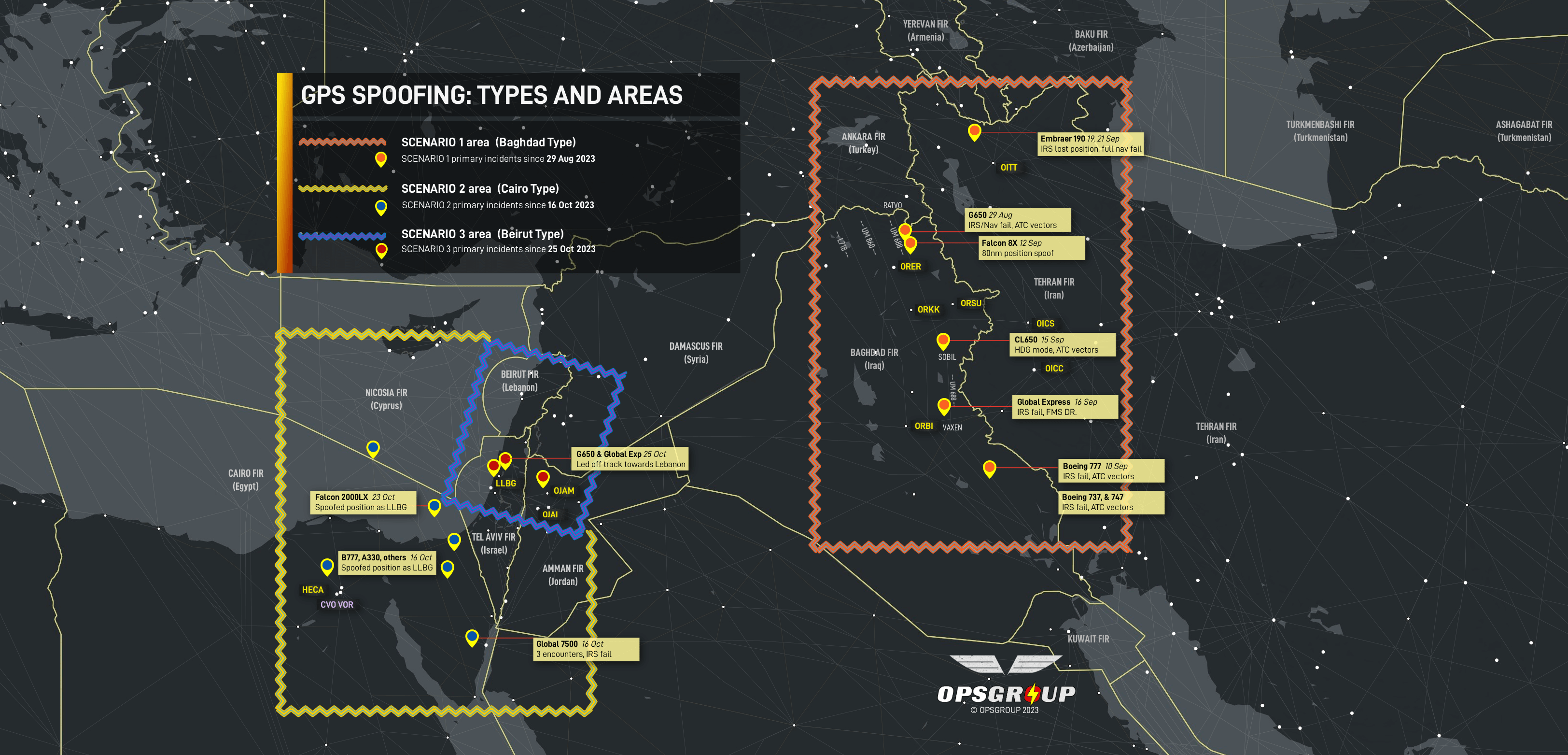
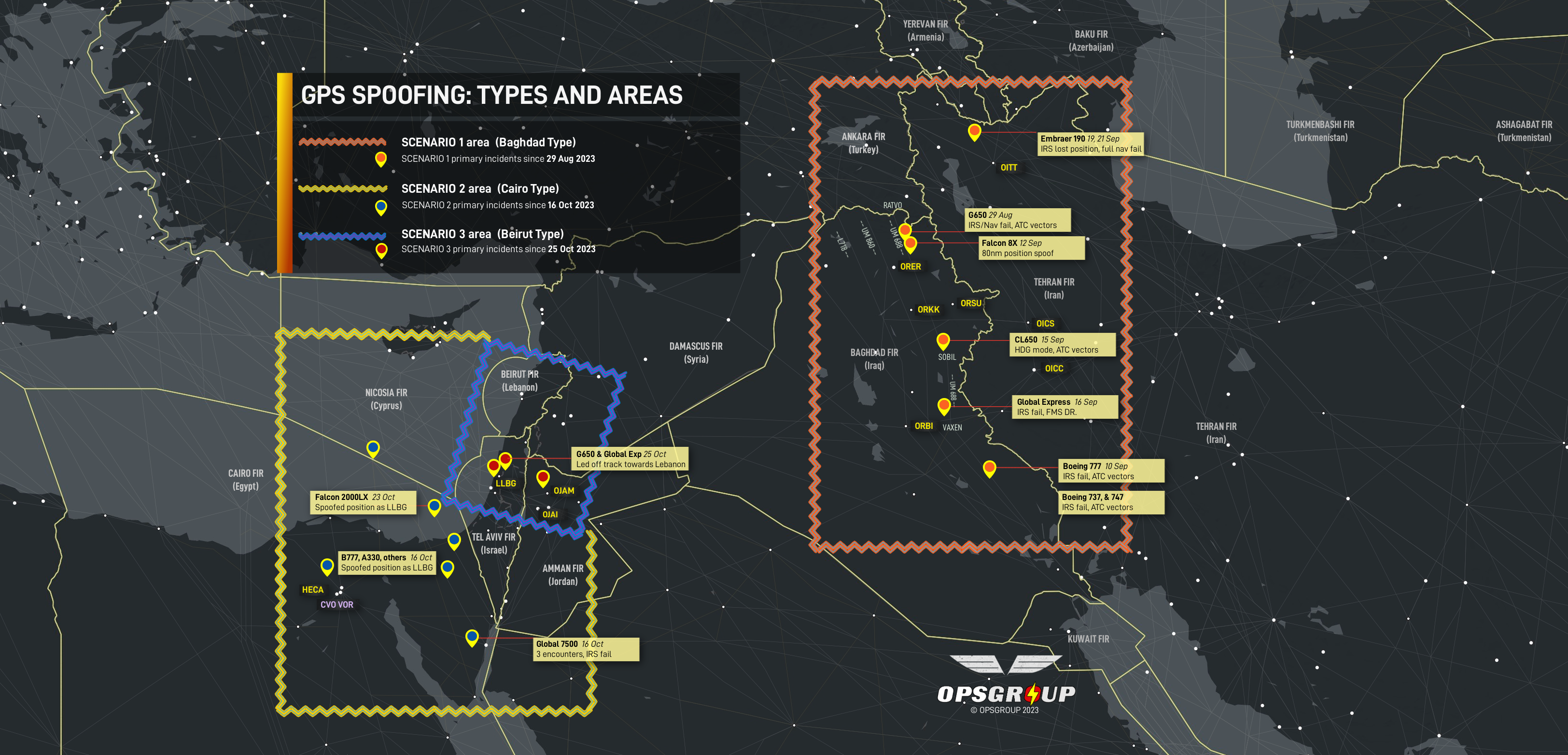
  • Three distinct scenarios (Baghdad, Cairo, and Beirut types) – Spoofing Map published
  • ALL CALL summary available in your Dashboard

It’s been 5 weeks since the real-world discovery of a fundamental flaw in avionics design: If a GPS position signal is faked, most aircraft are incapable of detecting the ruse. For many, it has lead to total navigation failure. For others, it has led to subtle and undetected erroneous tracking.

In the worst cases, the impact has been severe: complete loss of on-board nav requiring ATC vectors, IRS failure, and unnoticed off-track navigation towards danger areas and hostile airspace. The industry has been slow to come to terms with the issue, leaving flight crews alone to find ways of detecting and mitigating GPS spoofing.

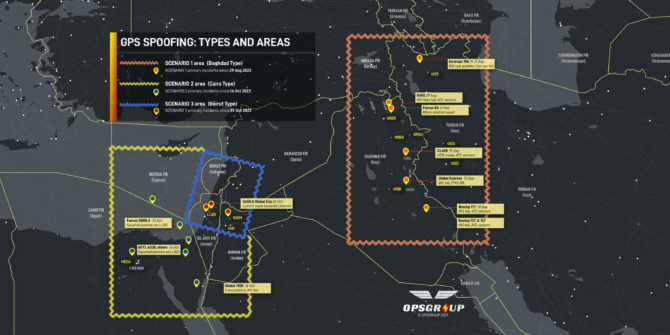
Two entirely new types of GPS spoofing have been reported in other areas since the first GPS Spoofing report we published on 26 September. These include critical nav failures on departure from Tel Aviv leading aircraft towards Lebanon, and spoofed signals received by multiple aircraft in the Cairo FIR showing a stationary position over LLBG. We have now identified three distinct spoofing scenarios, shown on the map below and detailed in this briefing.

On Friday last, we asked OPSGROUP members for a group ALL CALL to gather the latest intel that we have in the community. This article will summarize at high level what we know. Full details are in your members dashboard (Special Briefings section).

Note: This summary article is being continuously updated as we get more information. If you have anything to add or comment on, please email the team.


Three scenarios: different types of spoofing

The GPS Spoofing reports received by OPSGROUP can be divided into three main scenarios, which correspond to the areas on the map below.


Key Flight Crew concerns

  • Uncertainty as to the best way to mitigate GPS spoofing activity
  • Wide concern over IRS spoofing, previously thought to be impossible
  • Potential for the issue to recur in other geographic areas
  • Potential for surprise and startle effect with sudden loss of nav capability
  • Lack of useful guidance from aviation authorities, OEM’s and avionics manufacturers


Worst case reports

In all, OPSGROUP has received close to 50 reports of GPS spoofing activity. Further down, we identify three distinct spoofing scenarios reported by flight crew. First, we highlight the most troubling reports to show how critical the impact can be.

  • A Gulfstream G650 experienced full nav failure on departure from LLBG/Tel Aviv (25 Oct). The crew reports, “ATC advised we were off course and provided vectors. Within a few minutes our EPU was 99.0, FMS, IRS, and GPS position were unreliable. The navigation system thought it was 225nm south of our present position.” [Full report – Members Dashboard].
  • A Bombardier Global Express was spoofed on departure from LLBG/Tel Aviv (16 Oct). A false GPS position showed position as overhead OLBA/Beirut. Crew advises “The controller warned us that we are flying towards a forbidden area”. [Full report – Members Dashboard].
  • A Boeing 777 experienced a 30 minute GPS spoofing encounter in the Cairo FIR (16 Oct). A false GPS position showed the aircraft as stationary overhead LLBG for 30 minutes.
  • A Bombardier Global 7500 was spoofed 3 separate times in the Cairo FIR (16 Oct 2023). Crew advises: “The first took out one GPS, the second took out a GPS and all 3 IRS’s, and the third time took both GPS’s and all 3 IRS’s.” The distance from LLBG was roughly 220-250 miles, and the spoofing stopped once we were approx 250nm west of LLBG.
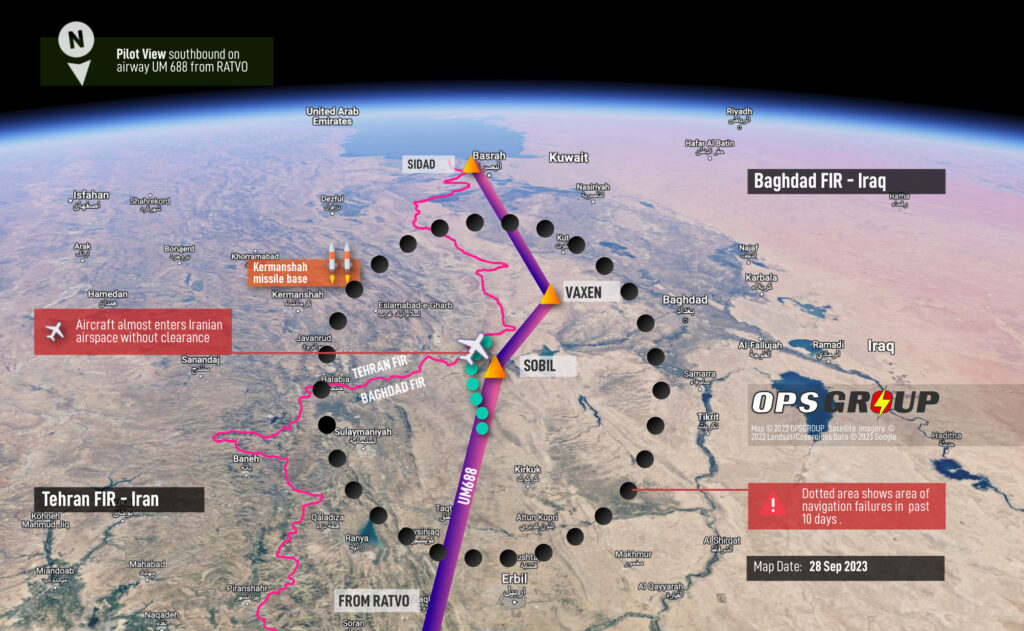
  • An Embraer Legacy 650 enroute from Europe to Dubai. They tell us, “In Baghdad airspace, we lost both GPS in the aircraft and on both iPads. Further, the IRS didn’t work anymore. We only realized there was an issue because the autopilot started turning to the left and right, so it it was obvious that something was wrong. After couple of minutes we got error messages on our FMS regarding GPS, etc. So we had to request radar vectors. We were showing about 80 nm off track. During the event, we nearly entered Iran airspace (OIIX/Tehran FIR) with no clearance.
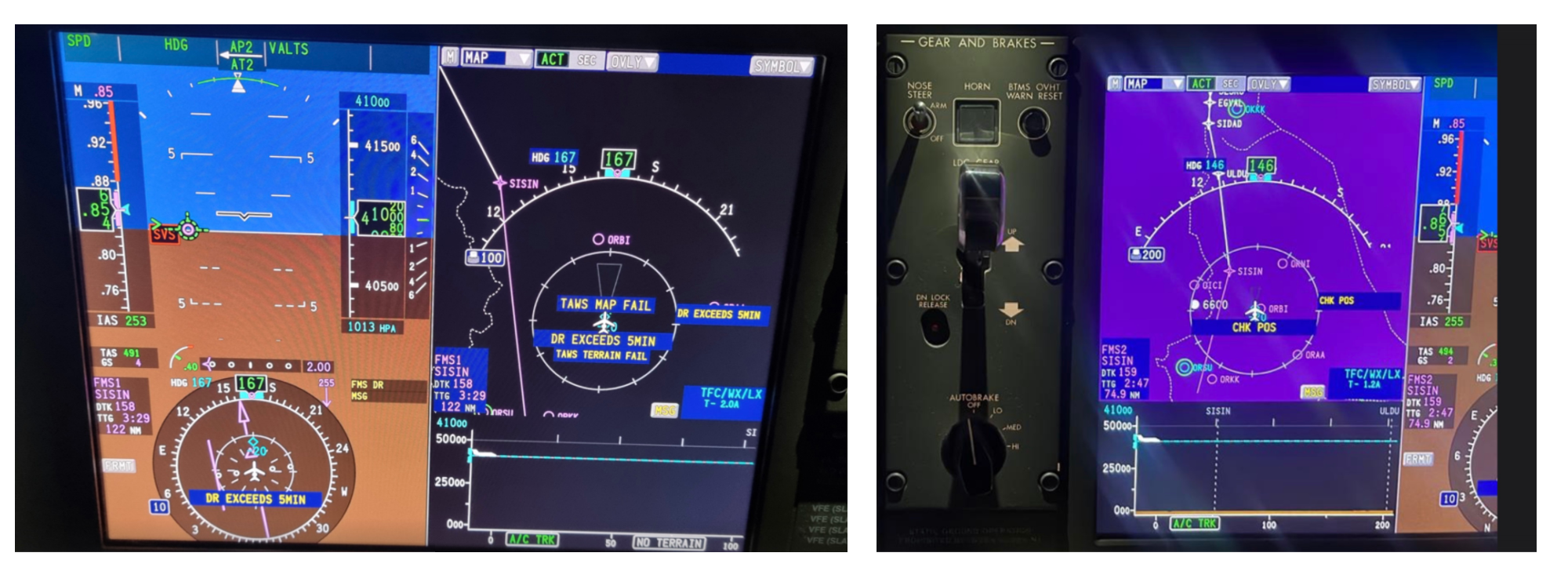
  • A Bombardier Challenger 604 experienced spoofing in the Baghdad FIR and required vectors all the way to Doha. “Nearing north of Baghdad something happened where we must have been spoofed. We lost anything related to Nav and the IRS suggested we had drifted by 70-90 miles. We had a ground speed of zero and the aircraft calculated 250kts of wind. The FMS’s reverted to DR (Dead Reckoning) and had no idea where they were.We initially took vectors to get around the corner at SISIN. Nav capability was never restored, so we required vectors all the way from Iraq to Doha for an ILS. We never got our GPS sensors back until we fired up the plane and went back to home base two days later.


Scenario 1: Baghdad type.

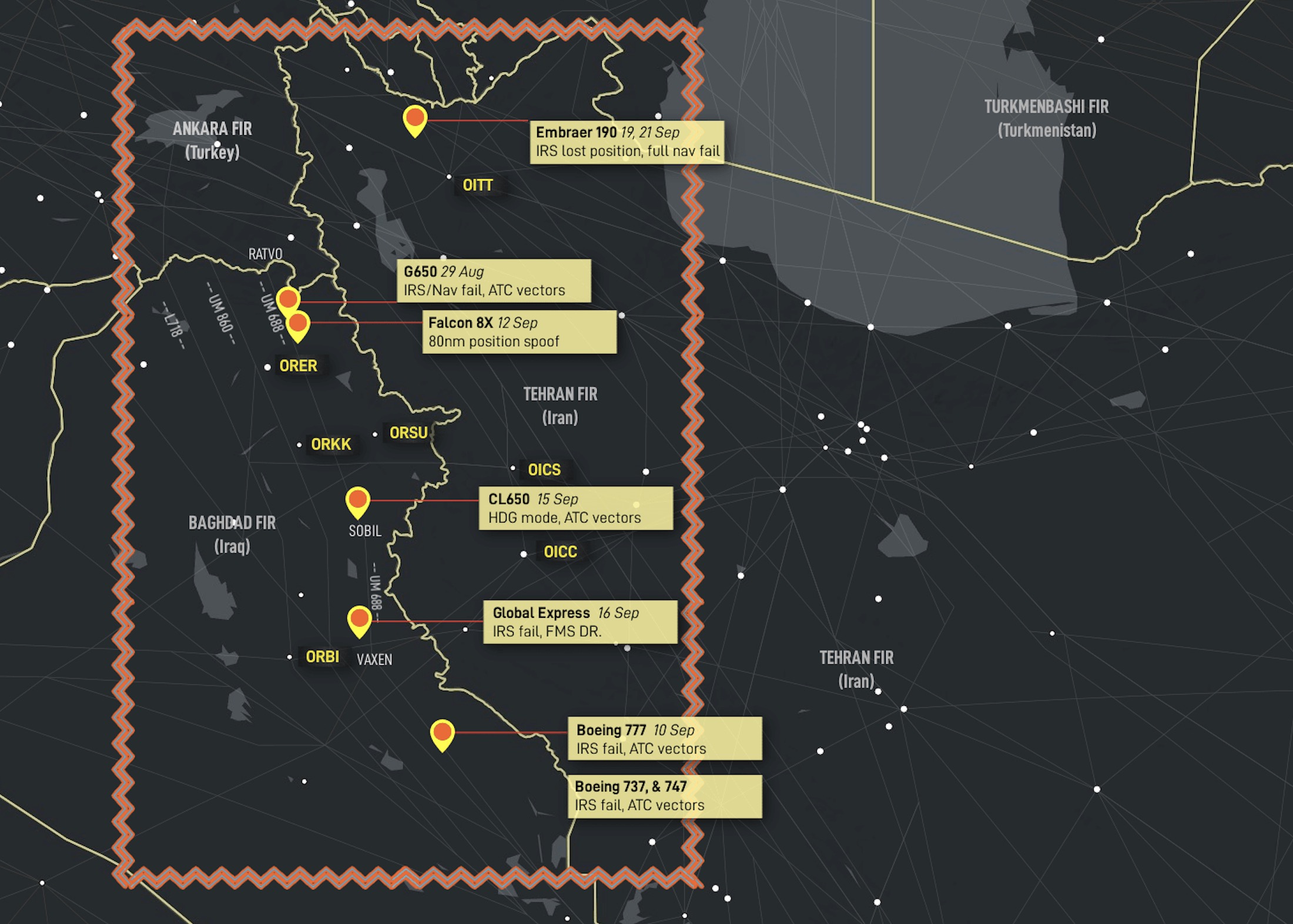
Affected area: Primarily Northern Baghdad FIR, especially on airway UM688. Also, northern Tehran FIR, Baku FIR

The Baghdad spoofing type involves GPS spoofing of enroute aircraft, nav failures follow. This was the first type of spoofing, initially reported on August 29, 2023, with a large amount of further reports starting in September 2023.

Dashboard: See full briefing on this type, with the original full crew reports.


Scenario 2: Cairo type

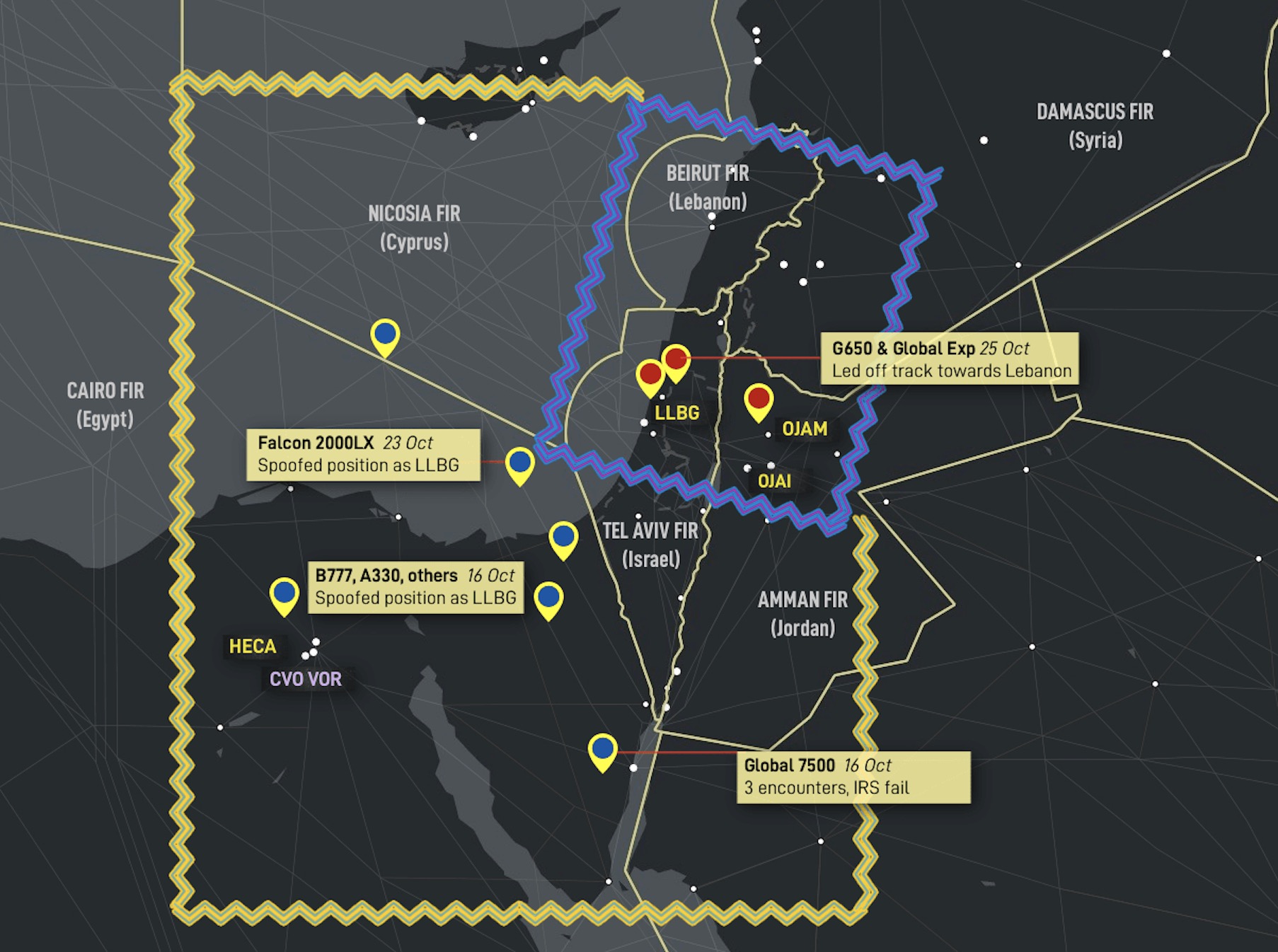
Affected area: Primarily within the Cairo FIR (L560, and locations near CVO VOR), also Nicosia FIR (Cyprus), Amman FIR (Jordan)

These reports first surfaced around Oct 16. Most reports are within the Cairo FIR. All crew reported similar circumstances, where a false or spoofed GPS position is received by the aircraft, incorrectly showing the aircraft position as being over LLBG/Tel Aviv. Locations vary from airways over the eastern Mediterranean, Egypt, and also on approach into Amman, Jordan (OJAM). Reports range from 100nm to as far as 212nm from LLBG.

Dashboard: See full briefing on this type, with the original full crew reports.


Scenario 3: Beirut type.

Affected area: Primarily within the Tel Aviv FIR, also Nicosia FIR (Cyprus), Amman FIR (Jordan)

Here, the spoofed position shows the aircraft over OLBA/Beirut, or creates subtle tracking towards OLBA. This type has been responsible for wayward tracking on SID departures from LLBG since October 25.

Dashboard: See full briefing on this type, with the original full crew reports.


How to identify spoofing

The big question for flight crew is: how do I know this is happening to us? As always, we are in the front line of dealing with this. What will you do at 2am over the Middle East when the aircraft starts drifting off course and saying “Position Uncertain”? With almost zero guidance, we’re largely on our own to figure things out.

The following are based on the reports submitted to OPSGROUP by crews that have experienced spoofing:

1. Sudden increase in EPU (Estimated Position Uncertainty). GPS jamming will not create this, but a spoofed position will cause a “jump” and hence EPU values have jumped from 0.1nm to 60nm, and >99nm in quick order.
2. An EFIS warning relating to Nav. Some aircraft have gone straight to “DR” mode (Dead Reckoning).
3. A sudden large change in the aircraft clock UTC time. Reports vary from a couple of hours to 8 hour and 12 hour changes in the aircraft clock time.

Obviously, every aircraft has different system architecture and will behave differently, but these tell-tale indicators should help to identify the first signs of spoofing.


Mitigation – BEFORE entering known areas

At base level, there is no effective way to prevent the actual GPS spoofing from happening. If it exists, a false signal will be received by the aircraft. As mentioned above, most aircraft are not able to understand that this is happening – there is no software logic that detects large sudden jumps in GPS position as being potentially false.

1. The critical first step is knowing when you are entering a potential GPS spoofing area (see locations above)
2. Consider de-selecting GPS as a sensor input to the FMS (to avoid nav uncertainty)
3. Consider, if possible, de-selecting GPS updating to the IRS (to avoid loss of IRS)
4. Monitor ATC for any other aircraft comments that indicate spoofing (time checks, position checks)
5. Identify conventional navaids that can be used instead (VOR, NDB)
6. Departure – there is uncertainty as to whether de-selecting GPS inputs on the ground before departure into known spoofing areas is sensible. Some OEM’s have said this may lead to other issues.


Mitigation – DURING active spoofing

If you experience GPS spoofing

1. As soon as possible, de-select any GPS inputs (FMS, IRS). Crew reports suggest that quick action here (within 60 seconds) can prevent wider nav failure
2. Switch to using conventional navaids (VOR, NDB)
3. If you know that for your aircraft type the IRS is not capable of being spoofed, obviously IRS navigation is preferable for accuracy.
4. Report the occurance to ATC, primarily to warn other flight crew on the same frequency.

Please also report the occurance to OPSGROUP, to continue building a picture of where these events are occuring. All reports are anonymous and de-identified.


ALL CALL Summary – GPS Spoofing

An ALL CALL to the group pools our knowledge on particular topics. This ALL CALL went out on Nov 2. View the original email, or scroll to the end of this post. If you have anything to add, please email news@ops.group. As we get updates, we’ll post them here.

View the live-updates in the ALL CALL response here.


Further reading


Flights misled over position, navigation failure follows

Update – Thursday Sep 28

Since publishing Monday’s risk warning on complex navigation failures following fake GPS signals, we have received further concerning reports from operators, mirroring the same events. The impact of the nav failures is becoming clearer, with one operator almost entering Iranian airspace without clearance, and another left requiring ATC vectors all the way to their destination in Doha.

In total we now have 20 reports of almost identical situations. Full reports are in Version 2 of our Risk Warning (PDF).

On Wednesday evening, the FAA issued a warning memo to aircraft operators as a result of the situation, warning of increased “safety of flight risk to civil aviation operations”.

See new Briefing (28SEP) – “FAA Warning Issued, Further Serious Navigation Failures Reported”


Original article follows:

Key points
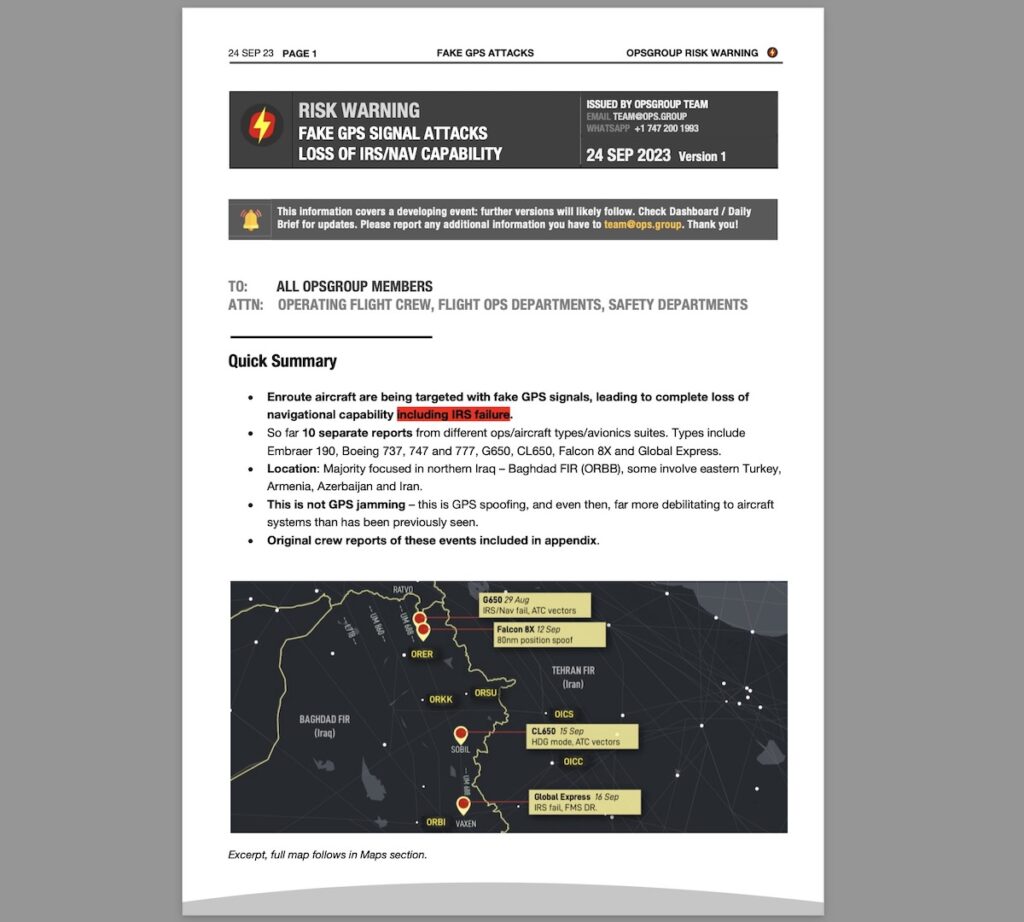
  • New RISK WARNING: Enroute aircraft are being targeted with fake GPS signals, leading to complete nav failures
  • 12 16 separate reports – types include Embraer 190, 600, Boeing 737, 747 and 777, G650, CL605, CL650, Lear 45, Falcon 8X and Global Express.
  • This type of GPS spoofing has not been seen before – IRS is quickly “infected” by false position
  • OPSGROUP Members: Suggested Guidance and Procedures, and original crew reports, in Briefing PDF below


Situation

A troubling new development in enroute airspace is emerging: aircraft are being targeted with fake GPS signals, quickly leading to complete loss of navigational capability. 12 separate reports have been now received by OPSGROUP, and in most cases the IRS becomes unusable, VOR/DME sensor inputs fail, the aircraft UTC clock fails, and the crew have been forced to request vectors from ATC to navigate.

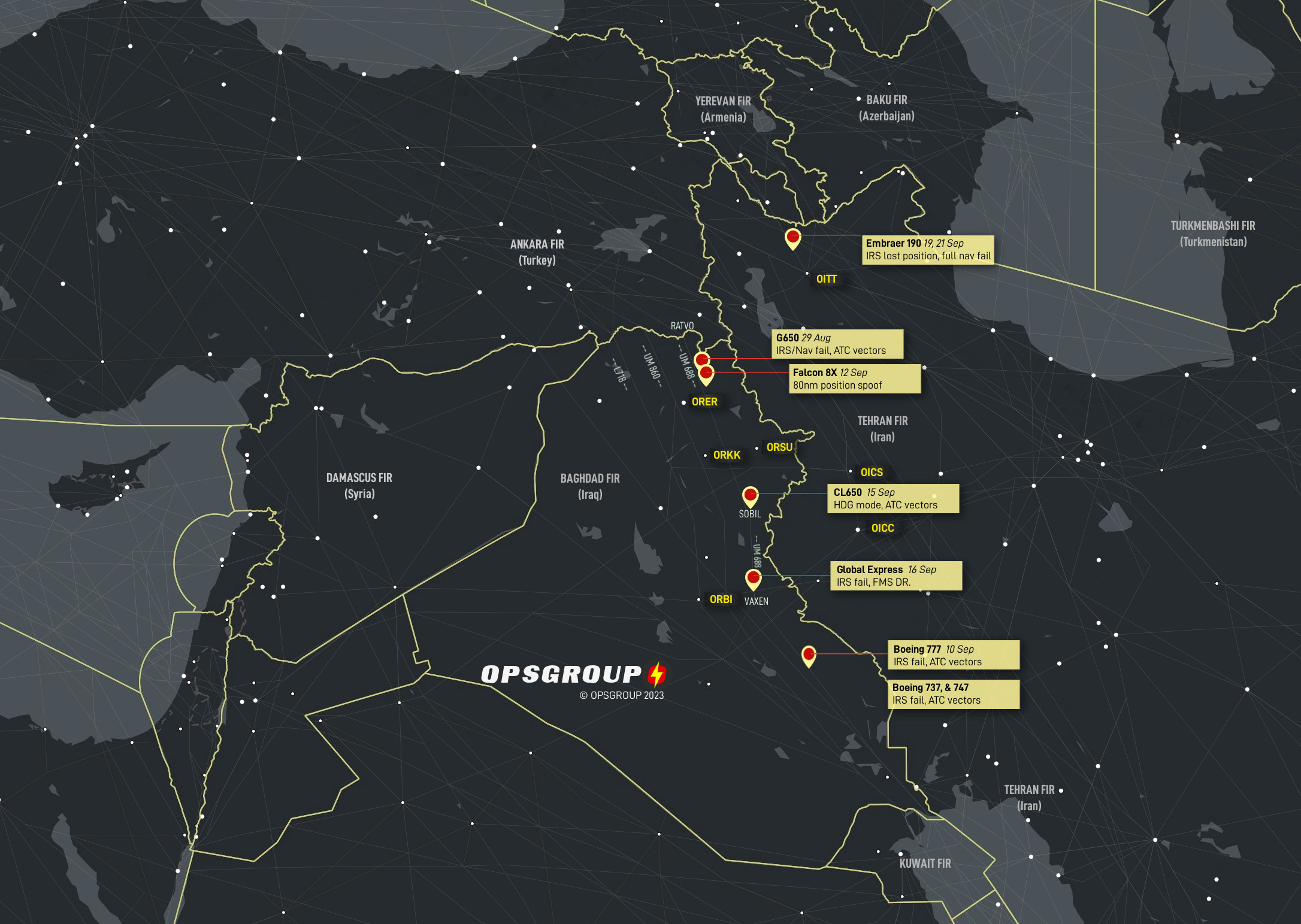
Most reports have been in the last 7 days. Aircraft involved include various Boeing types (B777, B747, B737), Embraer (190, 600), Gulfstream 650, Challenger 650, Global Express, and a Falcon 8X. The location for the majority is also quite specific: Airway UM688 in Iraq, close to the Iranian border.

This immediately sounds unthinkable. The IRS (Inertial Reference System) should be a standalone system, unable to be spoofed. The idea that we could loose all onboard nav capablity, and have to ask ATC for our position and request a heading, makes little sense at first glance – especially for state of the art aircraft with the latest avionics. However, multiple reports confirm that this has happened. The key issue appears to be the way the IRS uses GPS updates to update its position during flight. Analysis from other OPSGROUP members is contained in the Briefing (Risk Warning) below.

In the Baghdad FIR, the crew of a 777 enroute were essentially forced to ask “What time is it, and where are we? “. Almost all incidents we’ve seen result in requiring ATC vectors to navigate. Clearly, in the areas that these events are occuring, this is disconcerting.


The location of reports received is mapped out below. The primary area of concern at the moment is Airway UM688 in northern Iraq. Most crews have reported the nav failures in the vicinity of ORER/Erbil, ORSU/Sulaimaniyah, and ORBI/Baghdad.


It’s important to highlight is that this not traditional GPS jamming – which we all experience almost as routine in these areas. We have become very used to GPS dropping out in Turkish and Iraqi airspace. These recent reports are GPS spoofing – and even then, not like anything we’ve seen before.

In most reports received, the situation plays out the same. A spoofed GPS signal is directed at the aircraft, or at least, received by the aircraft. The GPS position shifts by 60nm. The onboard systems start to react. Some crews have been able to quickly disable GPS inputs, but for the majority, the spoofed signal quickly leads to a nav failure.

One of the crew reports for an Embraer 190 (see below), tells us, “I have been on the aircraft for 13 years. I tried everything I know, but nothing helped. Two IRS’s, which are updated from GPS, lost position. FMS disagree messages appeared. The main point is to disable GPS inputs at the very beginning of spoofing. If you miss a moment, you will lose navigation capability!” This crew member is also Technical Pilot for the E190 type.


Worrying scenario

Of all locations that we fly through, the one place we don’t want to have any navigation issues would be along UM688. This airway runs southbound through Iraq, above an active conflict zone, and extremely close to the border with Iran. Any indavertent straying into Iranian airspace without a flight plan risks action by the Iranian military.

And yet it is precisely here that most of these events in the last week have been happening. As such, the risk to routine flight operations is extremely elevated.

OPSGROUP recommends that all operators using airway UM688, or entering the Iraq/Iran/Turkey region, review this new risk as soon as possible. Flight Crew should be made aware of the potential for fake GPS signals, the likely impact on aircraft systems, and a plan of action should this occur.


OPSGROUP Member resources

Over this past weekend (23-24 September), OPSGROUP members provided analysis of the events, and recommended guidance. This work has been collated into Briefing: RISK WARNING 24SEP/V1, available to all members in your Dashboard. Direct links are below.

  • Download Briefing: RISK WARNING – Fake GPS signal attacks (PDF, 0.7 Mb)
    • Situation report
    • Key information for Flight Crew
    • Analysis from OPSGROUP members
    • Original Crew reports of GPS spoofing/Nav & IRS failures (First 10 reports listed)
    • Guidance and Procedures
      • Awareness of risk locations
      • Recommended Procedure – entering risk area
      • Recommended Procedure – active GPS spoofing


IRS failures

An excerpt of analysis from the Briefing Document above helps us understand the issue better:

“Most avionics suites are now engineered such that the IRS position is regularly GPS updated to ensure the highest accuracy, if the GPS fails!

Therefore if the GPS is jammed, then the IRS works from its last known position. However if it receives a spoof position, the system still believes the GPS input received to be accurate as all sources “say” the same thing, and this spoof position is then updated to the IRS(s) to match. Most avionics system know that a shift/gross-error has happened as ground based updates do not compute the correct position, and will flag a navigation/map/position warning.

However, all primary navigation systems end up being corrupted as a result. It has the potential to be very dangerous, and is part of the reason why pilots should back up navigation still, with “green needles” / ground based aids wherever possible. Our dependance on GPS is not always good!

I would recommend using conventional ground based navaids (DME/VOR/NDB) as far as practical, otherwise request assistance from ATC. Some platforms may allow IRS systems to be disconnected from GPS auto-updating, but most now do it in the background with no optional pilot interaction.

Unless the IRS systems are completely independent (the old fashioned ones that have to be initialised at startup location), GPS integration for frequent position updates, is sadly the issue due to its vulnerability to spoofing. For those that can disable the updating, they may wish to consider turning this function off, however it may impact on navigation capability, AFM requirements and operational approvals.

I would recommend that pilots and operators reach out to their OEMs for their recommendations on dealing with spoofing on their platform.”

Another member (767 operator) spoke to an IRS expert for perspective – also arguing that “the IRS system is “stand alone” and the only mixing between GPS and Inertial is inside the FMS and thus, the IRS couldn’t be spoofed. He assured me it could. Not enough to lose the alignment platform, but enough to confuse the present position and thus, none of the radio navaids are where they’re supposed to be.”


Updates

This information covers a developing event: further versions will likely follow. Check your members Dashboard / Daily Brief for updates.

Much of the information is compiled from member feedback. If you have any expertise to share, or information to add – please email team@ops.group, or send a WhatsApp message to +1 747 200 1993.

Thank you!


EU Temporary Admission of Aircraft – busting myths

Our friends at OPMAS put together this useful Myth-Busting lowdown on the process for “Temporary Admission” of aircraft within the EU. We saw it, we liked it, and so here it is for our OPSGROUP members!

There are still several myths concerning the usage of the Temporary Admission (TA) procedure when flying within the EU. Common to all these myths is the idea that TA limits operators when flying on internal EU trips with great consequences if not followed, but this is often incorrect, outdated or misunderstood.


What’s Temporary Admission?

Temporary Admission (hereafter TA) is meant to allow EU outsiders to be able to roam freely within the EU for a certain period. “Outsiders” means that the aircraft is owned, registered, operated and based outside the EU (all criteria must be fulfilled). Read the short story on Temporary Admission.


Myth #1: Temporary Admission cannot be used when carrying EU passport holders as passengers

This myth is busted because:

  • The EU Commission has – numerous times – stated that these restrictions are not meant to restrict having EU residents onboard as passengers. The restrictions are meant for the pilots who are, in customs terms, seen as the real user of the aircraft, meaning that there are NO RESTRICTIONS for carrying EU passengers. Thus, there is no need to appoint a main passenger or have a so-called authorization letter onboard.
  • The idea of a main passenger, authorization letter, and other strange demands when using TA has no foundation in the Union Customs Code. It is based on a wrong interpretation or outdated information.


Myth #2: Temporary Admission cannot be used for commercial flights, such as Part 135

This myth is busted because:

  • The EU Commission approved Part 135 traffic as correct use of TA in 2014.
  • Internal traffic was also removed as a restriction for TA in 2016 with the introduction of the Union Customs Code (UCC). The paragraph was originally intended to limit commercial traffic but has been removed for many years now.
  • The requirement for Traffic rights (also called charter permits) is often mentioned as another obstacle when using TA, yet traffic rights have absolutely nothing to do with the process of obtaining TA or full importation. It is strictly an aviation regulator issue.
  • US aircraft flying Part 135 may need to obtain traffic rights on some internal EU legs, but this is independent of the TA or full importation status. Any fully EU-imported US Part 135 aircraft will also need to obtain the exact same traffic rights. Having a fully EU-imported aircraft instead of a TA aircraft will not improve the situation. Full importation does not grant an aircraft “better” traffic rights than aircraft flying under TA or EU-registered aircraft.


Myth #3: The owner must be onboard or be present within the EU

The myth is busted because:

  • It has earlier been clarified that the owner is not needed to be present onboard or within the EU in the typical Part 91/135 scenario when flying within the EU. This paragraph in the Union Customs Code is meant to regulate a completely different scenario.
  • This issue can however be a bit tricky as aviation structures are complicated and not always easily or correctly understood by customs on the ramp, so operators should always ask a competent customs agency to approve the structure in advance and outline the correct understanding in the specific case.


Myth #4: Aircraft flying under Temporary Admission will most likely have problems when flying to Cannes, Nice, or Paris-Le Bourget

The myth is busted because:

  • Numerous aircraft are flying to these airports and other “dangerous” airports every day using TA and are ramp checked without having any problems because the crew onboard are well-prepared and able to explain and document why the aircraft is eligible to use the TA procedure. We have supported many of these operations, so we know how it works and what it takes.
  • Some aircraft encounter problems at these airports, but all known cases are based on operators either not being TA compliant or simply not prepared to prove compliance. These aircraft can remain on the ramp for hours or weeks and sometimes result in a full VAT payment.


There is a lot of noise when TA is discussed

It seems like some presenters have forgotten to read or understand the changes made to the Union Customs Code for the last many years as we see a tendency to, deliberately or not, denigrate the use of TA in favor of full importation using arguments that it is impossible or dangerous. In fact, the opposite is true.

The TA procedure has become a very well-defined customs procedure

Please note that TA can be used to fly privatelycorporately, and commercially within the EU without any problems and with EU-resident persons onboard, if applied correctly. Moreover, since 2014 the TA procedure has become a very well-defined customs procedure, especially for corporate and commercial aviation. This is thanks to the huge effort from, e.g., the EU Commission and NBAA.

More advantageous for many North American operators

The option of using TA is sometimes presented as second to full importation, with the latter presented as the only “safe and possible” option for North American operators. This is clearly NOT supported by the EU Commission. On the contrary, the use of full importation will be an extra burden and place risks on the owner and user of a corporate aircraft, also when flying outside the EU. This can be eliminated by using TA. In fact, the TA procedure is often more advantageous for many North American operators compared to full importation due to the limited scope of liability and the wide scope of use.


Thanks to OPMAS for this article! They provide importation services in relation to the EU; Temporary Admission, full importation for corporate owners and full importation for AOC holders and charter/commercial operators. That’s all they do! They do not charge for an evaluation of the particular set up you have – contact them here.


Emergency: We’re all getting MAYDAYS wrong.

Pilots and Air Traffic Controllers communicate with each other every day. But it’s not very often that we get to talk to each other in real conversation: sharing experiences, exchanging ideas, learning, and just having some fun and getting to know each other. Yesterday, in Danger Club #11, that’s what we got to do, and it was eye-opening.

150 people came along to the meeting yesterday on MAYDAY’s and Emergencies. For such a critical aspect of our intertwined worlds, we found a lot of unsolved mysteries, and a lot that we’re getting wrong. We can both make life much easier on each other, it seems!

So, let’s make this a starting point for figuring out some of these mysteries. With more collaboration, we can improve how emergencies unfold, and how we handle them in the cockpit and in front of the radar screen. In no particular order, let’s jump in!

This is a living page. We’ll update and revise this as we get more feedback, so please comment below ⬇️ or email us with your thoughts!


Declaring an Emergency 🆘 MAYDAY! 🆘

The first incident we looked at was a 747 on departure from Tokyo with a cargo fire warning. For two agonizingly long minutes, the crew tried to tell ATC they had a problem and neeeded to return: without success. Why? Primarily, phraseology. There was no mention of the word MAYDAY (or PAN-PAN). Key points on this:

  • US pilots, in particular, tend to use the phrase “Declaring an Emergency“. It’s baked into the US aviation system, but it has no legal or functional basis. Officially, it’s meaningless, but in the US it’s just the way we do things (more on this below).
  • When we go international, that becomes a problem, because it’s not something controllers are trained to understand. In airspace where English is not the first language, we must say MAYDAY, or PAN-PAN. That, and only that, is the trigger for ATC to understand and help.
  • The FAA AIM 6-3-1 covers Emergencies. The wording needs urgent improvement. The opening paragraph essentially says “Say what you want, really“. It follows with “The ICAO way (MAYDAY and PAN) is better, however“, but it doesn’t mandate using it. As a result, in the US, we have no solid guidance on how to handle emergency communications, and no phraseology guidance or examples. This looks like the root of the problem. @FAA: fix this please!
  • If your GOM(Ops Manual)/SOP’s suggest using “Declaring an Emergency” as the radio call, you’re setting your pilots up for failure, especially when going international. Make it MAYDAY!

2. What does a perfect MAYDAY call sound like?

Like this:

  • AAL001: “MAYDAY, MAYDAY, MAYDAY, American 1, Engine failure, continuing straight ahead, STAND BY”
  • DFW TWR: “American 1, Tower, MAYDAY roger

And especially internationally, these points are important (we cleared up some misunderstandings here as well):

  • It doesn’t matter if it’s the first call or you’re already in contact with ATC on the frequency, always say MAYDAY.
  • It’s a trigger for ATC. The frequency may sound quiet, but the controller may be on a phone call with another sector. Hearing “MAYDAY” will ensure immediate attention. Compare that to “Uh, we gotta problem here, and blah blah“. There’s no key phrase in there to force the controllers brain to listen immediately.
  • It’s a trigger for other aircraft on frequency. As soon as a MAYDAY call is made, everyone is listening and paying attention. If the controller doesn’t come straight back with an acknowledgement, it’s likely that another aircraft will jump in to try to get their attention. Also, everyone else will know to be silent.
  • Speak slowwwwwwwwwly. Like half normal speed. Say it once, say it clearly. When you describe the problem, use no more than three words, clear and slow “Cargo … FIRE ..  warning”.
  • That STAND BY part is not in the books, but it’s critical. If you’re lucky, you’ll get that ideal ATC response above which means “Got it, and I’ll be quiet now for a bit, so you can do your thing”. You’re not likely to be lucky, so you need to ask for that silence. STANDBY will improve the chance of that happening.

3. Everyone’s panicking for a minute

Listen to Shamrock 12G declare a MAYDAY here, just airborne from Orlando.

Listen to the voice change of the pilot. The physiological response, the startle effect: you can almost hear the increased heart rate. You can also hear the controllers stress response.

  • Despite the startle, the Shamrock pilot makes a perfect MAYDAY call. This is how it’s done. (And despite that, the controller asks “Are you Declaring an Emergency“. Back to the FAA problem – very muddled guidance on emergency phraseology in the US. @FAA: fix this please!)
  • As pilots, we might not think that “our emergency” is stressful for the controller. It is. The controller is just as startled as we are. Every controllers heart skips a beat when you say “MAYDAY”.
  • For both of us – pilots and controllers – once you’ve sorted out the immediate actions, a moment to sit on your hands and breathe is essential. For pilots, Aviate, Navigate, Communicate – get the airplane safe – and then take a moment to get your physiology into a more helpful place. For controllers, Ack the call, separate the immediate traffic, and then …  Three deep breaths, perhaps (IFALPA have been discussing this recently, as the startle effect become more understood). Bottom line is we don’t make great decisions when we are responding instinctivly.


4. Dear ATC, here is our 5 minute wishlist.

This one is going to be a work in progress, but we discussed a few things that might help a controller to understand what a pilot really wants in those first five minutes. We should try to distill this into a flash card, after some more discussion?

So, “American 1, MAYDAY, STANDBY“, ATC says “American 1, MAYDAY, Roger” … what then?

  • MAYDAY is just what we say to get attention. It very, very, very rarely means that we’re going down in flames like a bad Steven Seagal movie. Even though we’ll be startled for a moment, our training kicks in and we know exactly what we have to do.
  • The biggest obstacle to us doing that is distraction. Hence, the greatest gift you can give us is SILENCE.
  • Start by letting us know that you heard us. Acknowledge the call, and “MAYDAY Roger” is just fine.
  • Depending on traffic, terrain, and when it happens, give us an altitude and a heading. “Continue runway heading, climb 3000 feet“. We’ll tell you if we need something different. A heading is the most helpful form of lateral navigation, because we just twist the dial and engage heading mode. Don’t give us a direct-to point (heads down in FMS takes time). Don’t send us off to hold somewhere, just yet. Heading, heading, heading.
  • SILENCE. The less you talk to us, the more it helps. That MAYDAY call we make is just a small part of the procedure we’re trying to run. Getting that procedure done correctly requires both pilots to pay full attention, so stopping to talk to ATC is something we’d prefer to avoid.
  • The pilots will be having an essential conversation to check the state of the aircraft, anlayse the issue, and decide on the appropriate action. A common workflow is  Power, Performance, Analysis, Action: Power: Check Thrust, ATS engaged, set correct TOGA/CLB Performance: Flaps Up, Gear Up, Min Speed, Max Speed Analysis: MFDU Indication, OHP, Situation, Time Check, Priorities Action: [PNF] Memeory Items, MFDU, QRH, OMB, OMB Ch7, ILS minima conditions, MEL [PF] ATC call, Select approach considering situation, inform Cabin. For any engine issue, at the very least we will be retarding the throttle on the “bad engine”. Pilot 1: “Confirm thrust lever 1”; Pilot 2: (points to Thrust lever 1) ..  “Thrust lever 1, idle“. If it’s a failure, we might shut it down: ““Confirm fuel lever 1” – “Fuel lever 1, Shut”. If it’s a fire, “Confirm fire handle 1” – “Pull, discharge” – “Fire bottle 1 discharged” (Start timing) … That’s a lot, right! So, until we’ve done all that, we can’t really tell you much about our plans, we don’t know yet. We just need the space to work through all that.
  • We don’t want to land right way. In 49 cases out of 50, even with an engine failure, even a fire, we’re not going to want to enter a downwind or make a 180 to land immediately. That’s not in our training. We take any immediate action needed, but then sit on our hands, run the process, assess, analsyse, run some checklists, talk to the cabin, and form a plan. So the best thing you can do is give us vectors, keep us near the airport (within 15 miles, say).
  • Don’t ask us for souls and fuel in the first five minutes. Our brains are engaged in problem solving, and distraction make that difficult. Save that for later, if at all (more on that below!)

Question: What else should we add in here? What else is on our ATC wishlist?

More to come! But, please comment below on what we have so far …


Taking the Trash Out: Let’s fix NOTAMs

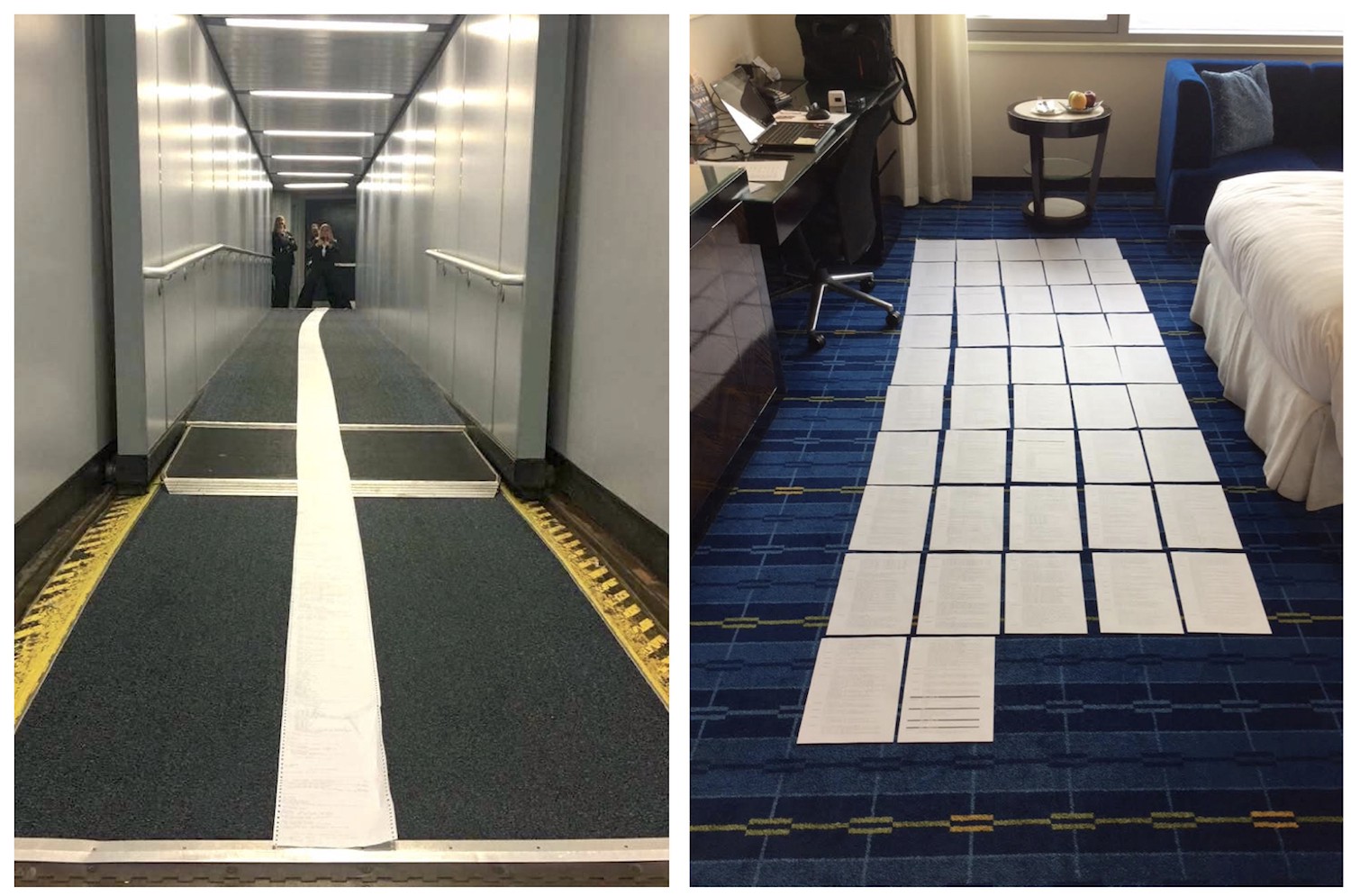
After a hiatus of a year or so, we’re back working on NOTAMs. In 2021 we ran a campaign with ICAO (and IFALPA, and IFAIMA) to improve NOTAMs. We focused on “Old” NOTAMs, ones that sit in the system for no good reason, sometimes for as long as 20 years. They are mostly gone – including the Albanian NOTAM about the Y2K problem.

That’s good, but the NOTAM problem isn’t fixed. Rob, below, summed it up nice and simply last week.

So, let’s continue the work. Why do we have a system that makes it extremely easy to miss critical items? And how do we fix it? Let’s visualize the problem.


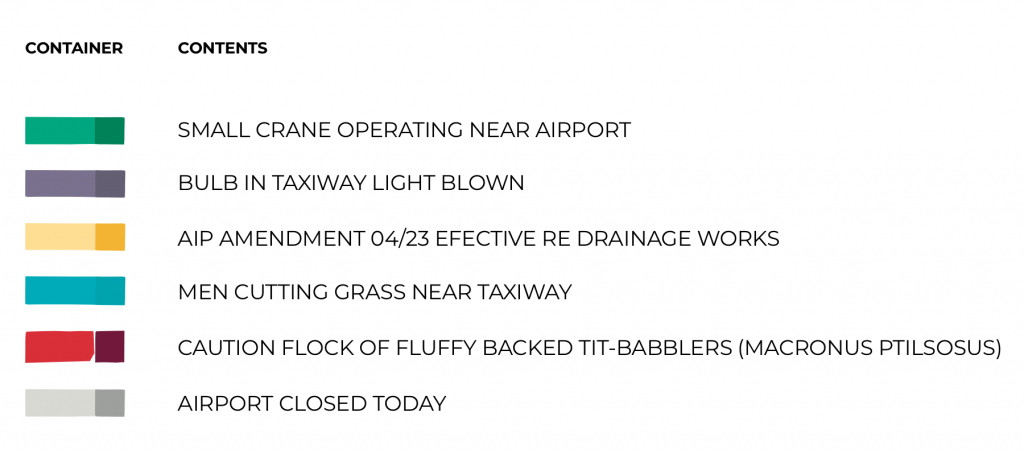
NOTAMs are like containers on a ship

Imagine you’re the pilot of a Boeing 787 about to sit down at a briefing table to review NOTAMs for your flight from Copenhagen to Bangkok today. You will get a folder containing a printout of NOTAMs for your route. Here they come.

Each container is a NOTAM. Unlike actual containers on actual ships, there is no manifest. We don’t know what’s in the container until we open it and take a look. That means that we can’t automatically sort them out beforehand, and we can’t put them in any order of importance. Therefore, the pilot gets a random list of NOTAMs, and it’s up to them to make sense of it.

If you only had six NOTAMs to take a look at, no big deal. You’ll spot that the airport is closed today. But we usually have somewhere between 100 and 1,000. The result? A system that makes it extremely easy to miss critical information.


Finding the simple fix

This is a simplified version of the problem, but not by much.

Question, then: How do we improve the NOTAM system so we can sort and filter them? 

Let’s get a technical for a moment, since we’re going to need some smart people that understand the system architecture. Here are some basics that are important.

  1. There isn’t really an international “NOTAM system”. Each country issues NOTAMs for their airspace, and keeps a local list of them for pilots in that country. Other countries can query that list (done via the AFTN, with an RQL message), and get a copy of new NOTAMs (by sending an RQN message). Not every country does this, but if they do, they’ll then have a limited database of NOTAMs from selected other countries. A tiny handful of countries, regions, and organizations do this for every country, which makes for a fairly reliable international database of NOTAMs. Examples of this are the FAA (NOTAM Search), US DoD (DINS), and Europe (EAD). These databases form the source data used by pilots and operators, often via service providers like Jeppesen, LIDO, Foreflight etc. who may apply some final processing to attempt to sort and filter them for their customers.
  2. Since there isn’t an international NOTAM system, then logically, nobody is in charge of it. ICAO sets the standards for when a country should issue a NOTAM (Annex 15), how they are formatted (Doc 10066), and what codes to use (Doc 8400). Eurocontrol publishes a guidance manual (called OPADD). That’s about it. Nobody has the job of monitoring all international NOTAMs for quality or quantity.
  3. The NOTAM structure is very limited. It uses a limited character set called ITA2, which pre-dates ASCII. This limits messages to UPPER CASE. The format is set in Doc 10066, giving a NOTAM 7 sub-parts from A to G, preceded by a Qualifier called the “Q-code“. In theory, the Q-code tells the reader what the NOTAM is about (magically solving the container problem above), but in practice, it doesn’t work. Why? There are too many choices, and therefore they are often applied incorrectly, or not at all. The Q-code categories were dreamed up in 1950, and there are 13,783 possible Q-codes. 20% of NOTAMS don’t have a Q-code at all (The NOTAM office often enters XX or XXXX, meaning “not sure”).


What’s in the NOTAM container?

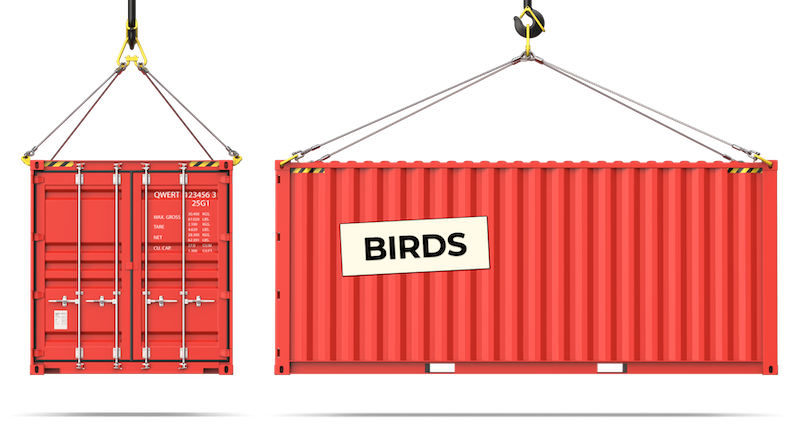
Let’s get back to the yard, and lower down one NOTAM container and take a look.

We know it came in on the NOTAM ship so it relates in some way to our route today, but we don’t know what’s in it. Therefore, we can’t sort it or filter it out. It just joins all the other NOTAMs that we load up into the pilot’s briefing, and leave it to them to make sense of.

But if the shipper (the originating NOTAM Office) puts a label on it saying “BIRDS“, then we immediately know what to do with it.

Pretty quickly we can start organizing the containers. Each operator can figure out the order they want to put them in, and which ones to leave at the back of the yard.

By knowing what the NOTAM is about, in advance, we can set up some basic processing rules. Each aircraft operator is different: Airlines don’t care about broken obstacle lights 5 miles from the airport, but a Police helicopter does. Perhaps someone cares about birds, most pilots don’t. It doesn’t matter; let the operator decide for themselves how important each label is, and what order to put them in (or discard).


Sounds easy, but is it?

In a huge list of NOTAMs, the ability to sort and filter them is the key to making them manageable. If they are sorted and filtered, then it’s unlikely a pilot will miss the big ones. Back to what Rob said (⬆️)  the problem is that it’s extremely easy to miss critical items, and that’s what we want to change.

We have some limitations:

  1. It must be a simple change. There are 193 countries that are ICAO members, each one ultimately resistant to a system-wide change that will cost money and require infrastructure investment. It would be lovely to start from scratch with a new system, but it’s not feasible. We need a simple change to the format with big impact. Conversely, if you think even that is impossible, just remember that Snowtams changed format in 2021.
  2. We can’t use Item E. To be able to sort and filter, a computer has to be able to know what the NOTAM is about, without having to read the content text. It can’t make sense of the text in Item E (the text of the NOTAM) – we tried this some years ago with machine learning, and after 2 millions passes, AI wasn’t able to formulate an algorithim that worked. There are just too many countries with different ways of writing NOTAMs to use Item E. So we must have a label of some kind.
  3. We must change the back end, not the front end. This must be a change available to everyone. Sure, Foreflight does good stuff, especially with US domestic NOTAMs. There’s a bunch of software and apps that can help to make NOTAMs more digestible. Some can be displayed graphically, but not many. Big airlines have back-office staff to organize and even rewrite some NOTAMs. But they all do it differently, and not many of them solve much of the big problem. We’re still getting dozens, even hundreds, of pages of NOTAMs to read.

That’s where the work begins. We don’t have all the answers, and we need some smart NOTAM-folk to help. It’s not the intention here to present a vague solution and say “This is it” – this article is intended to generate some critical thought and discussion on what the “Big Fix” looks like. Labelling them in some way seems the way to go, but we’re not sure.


Remember this …

There’s nothing like saying “NOTAMs, what do you think?” to generate a slew of pilot complaints, jokes (some great memes after the January outage!), and things that need to be fixed. We’ve been working on this here for a couple of years, but efforts to fix the b*rds date back almost 60 years. With that in mind, addressing the most common talking points may help.

  1. NOTAMs suck. We know. We’re just a bunch of pilots and dispatchers that really don’t like them, and we’re doing our best to make change happen. But if we want to solve them, we have to find the one thing that fixes most of the big problem in one hit. UPPER CASE is tough to read, but that’s not the big problem. Abbreviations are annoying, but that’s still not the big problem. The Big Problem is that we can’t see the critical stuff because we have to read hundreds of them before flight in no particular order. If we can sort and filter them, that means we’ll see the important stuff first, and don’t have to read such a long list.
  2. General ranting at the FAA, ICAO, IATA, or even the government doesn’t help. Instead, help us to help find a sensible solution, draw it out, think it out, test it, and we can then present it to those that can help implement it.
  3. Digital Notams. Sometimes this comes up as a solution that’s on the horizon, and will fix everything. That conversation has been happening for at least 20 years, and while a lot of good people are working on this, it doesn’t fix the problem we have right now. In a perfect world, SWIM and Digital Notams will come online in 2028 (five years from now), and start to solve some of the issues. Problem is, we live in an imperfect world, and the chances that this will solve our woes as they exist today are slim.
  4. Hey, I made a thing that solves NOTAMs. Like we said above, yes, there are some really great apps, graphical tools, and software that help make some sense of NOTAMs. Foreflight is a favourite amongst us pilots. But despite some of the advances, the originating NOTAM is still a brutalist remnant of the early 20th century, and the vast majority of pilots still get giant chunks of NOTAM text to plod through. We want to fix the problem at source. At the same time, it’s likely that the smart people that made these things can also be the smart people to solve the source problem!


So, what now?

We want to hear from you! Write to us at team@fixingnotams.org. We can only solve this as a community group, and we’re working on a few events to get people together for some discussion. We’ll set up a few group chats on Zoom to get the discussion started and some ideas flowing.

Ultimately, the plan is to start funnelling some ideas along the pipeline until we reach one that really seems to work, and take that to the organizations that can implement it. So, it’s up to you. Want to get involved? You’re awesome! Please reach out to us.


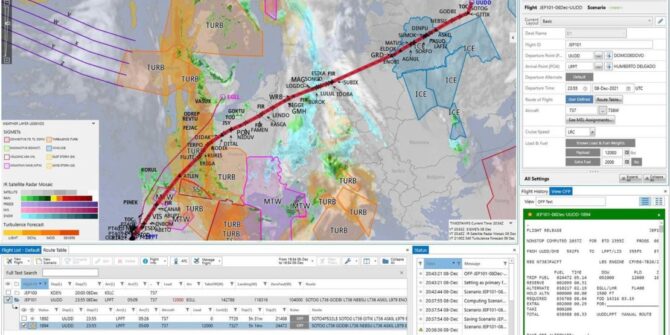
Jetplanner, FD Pro, Charts – down

Hi members,

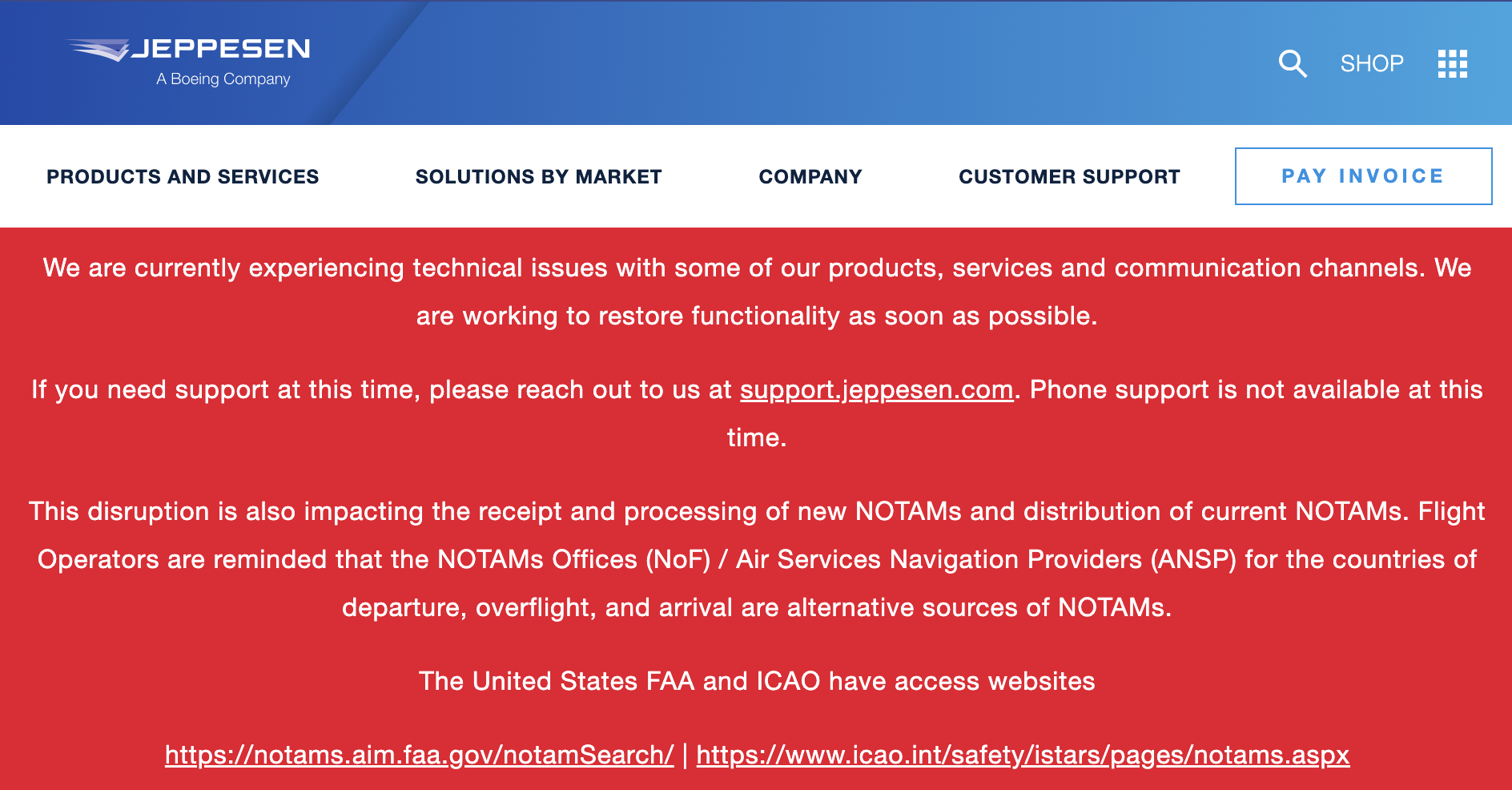
As those of you immediately affected by this will already be well aware of, the majority of Jeppesen planning products are not working at the moment.

Currently:

  • Jetplan.com is down
  • Milplanner.com is down
  • Jetplanner (standalone) is not working
  • Chart viewer products are not working (eg. Elink portal, and Icharts)
  • FliteDeck Pro is not working
  • Foreflight (now a Boeing company) is working but their Notam feed is not.

There is a note on the “outage” on the Jeppesen website, but reports from members here indicate that phone support is not available, and information is scarce.


However, it does appear that Jeppesen is dealing with a ransomware attack, meaning they have a choice of paying a ransom to restore service, or find an alternate way of providing service. Much as the impact of the outage will weigh heavy on some operators, our thoughts are with Jeppesen – not a nice situation to be in at all.

Given the situation it seems lilkely that the outage may continue for some time yet.

We will post any updates here and in the #flightops channel on OPSGROUP Slack.

If you have any information, please share with the OPSGROUP Team.


Safety used to be SEXY

You know those Safety magazines I’m talking about, right?

The ones that sit in the corner of the crew room.

The ones that literally nobody reads, but might be useful to scribble on, kill a fly, or jam a window open.

These ones.

They all look the same, right?

What you probably don’t know, is they are all the same because they are all put together in the same place.

This place.


This is Aviation Safety Publishing Ltd. They are in the south-east corner of the Croydon Business Park (between Wendy’s and Push Pilates). Their Company Number is 2713662 and their VAT No. is GB444553891.

Each month, the creative team gets together in the “Lindbergh” conference room. There’s free (drip) coffee and donuts (the dry supermarket ones). It’s a good time.

Shall we do something different this month?”, asks the intern. After a moment of silence and some side-eye, everyone has a good laugh and gets back to selecting the airplane type for the front covers. The meeting is wrapped up by eleven. Back to the desks.

It’s been the same since 1990. That’s when computers came along and ruined everything. Before that, pilots actually read safety magazines. Instead of “What airplane goes on the cover”, the editors asked a different question: “How can we make this engaging and actually get pilots to read this stuff“?

That’s weird, huh: in the old days, the safety people cared whether or not pilots read it!

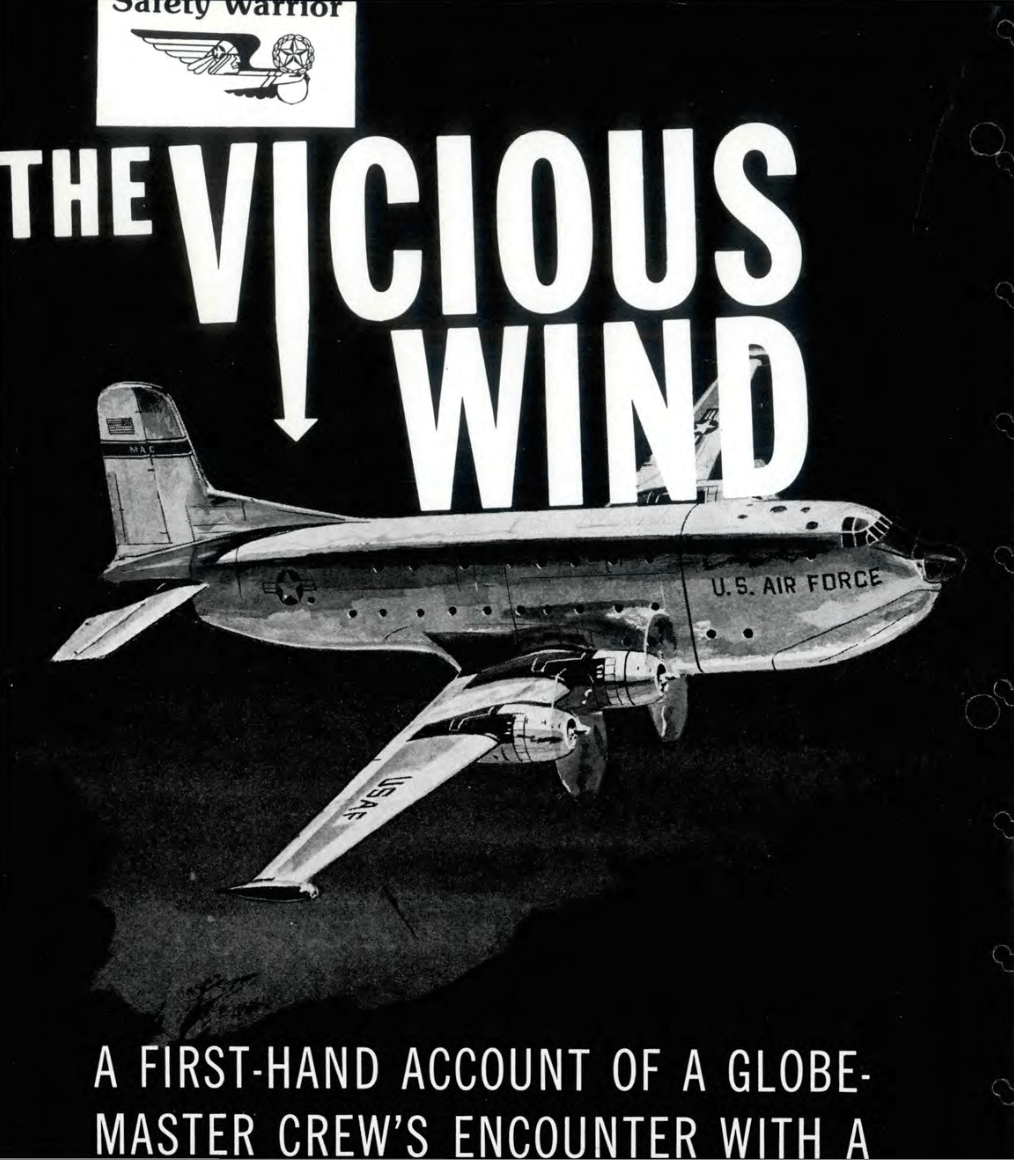
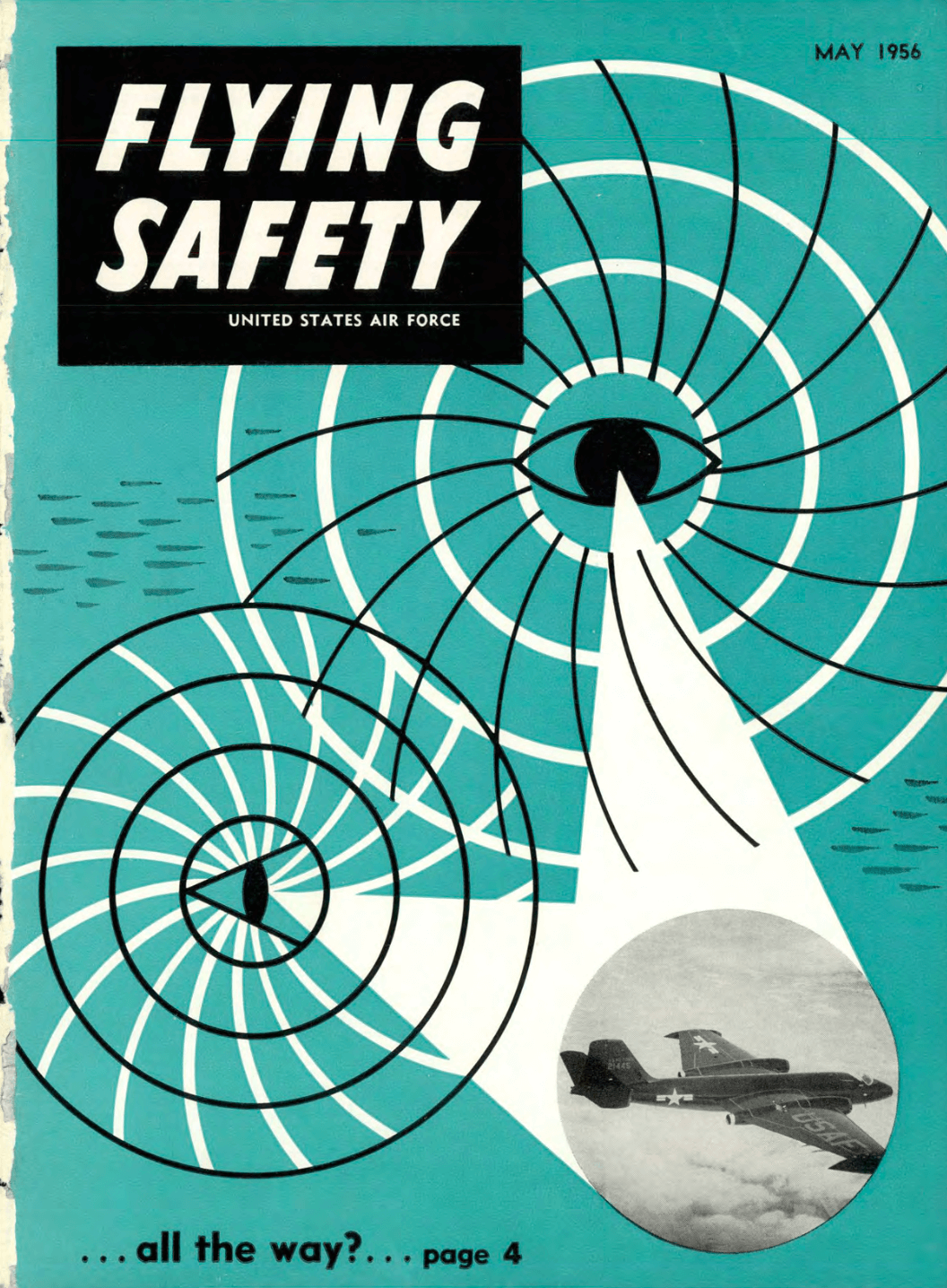
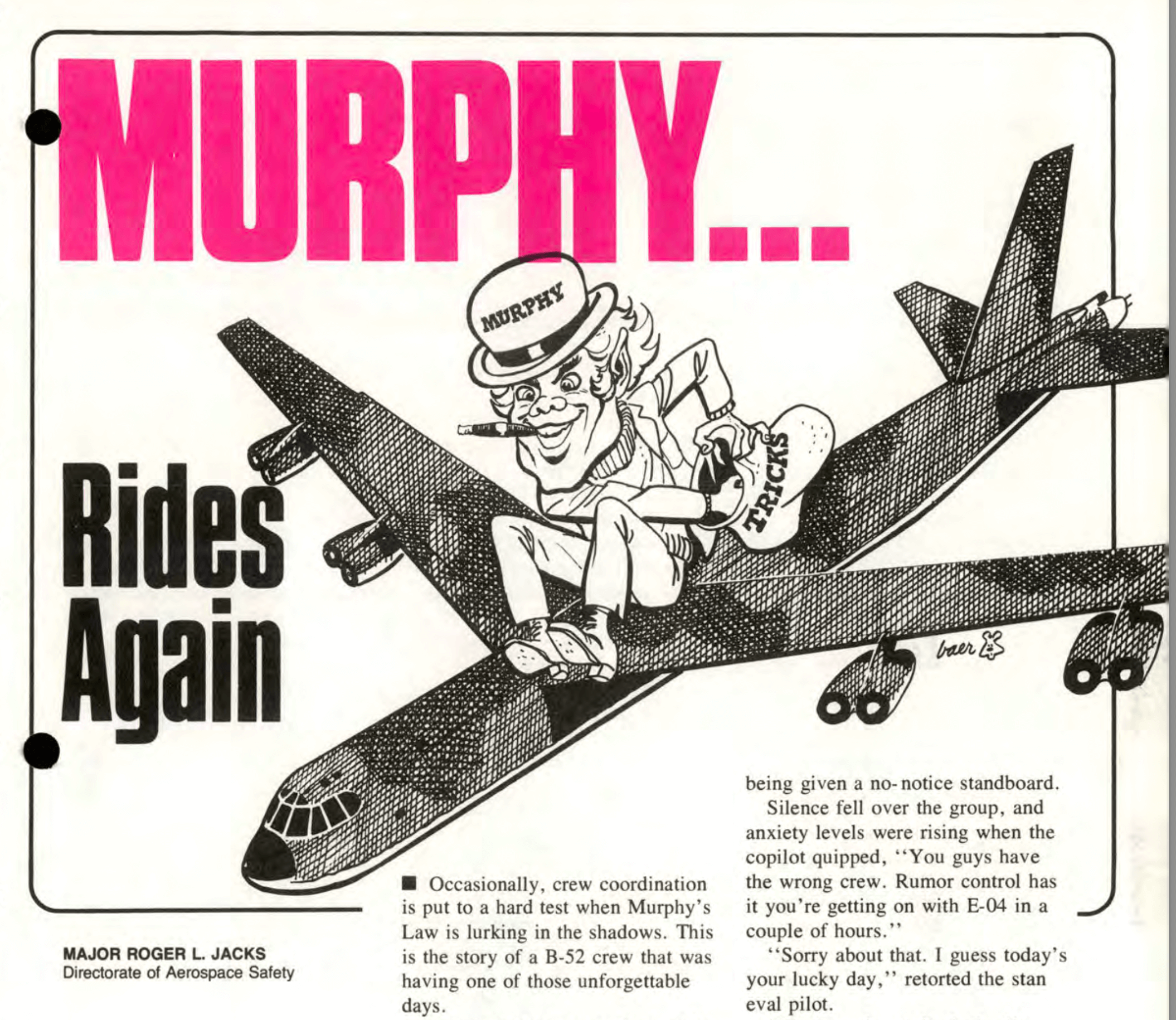
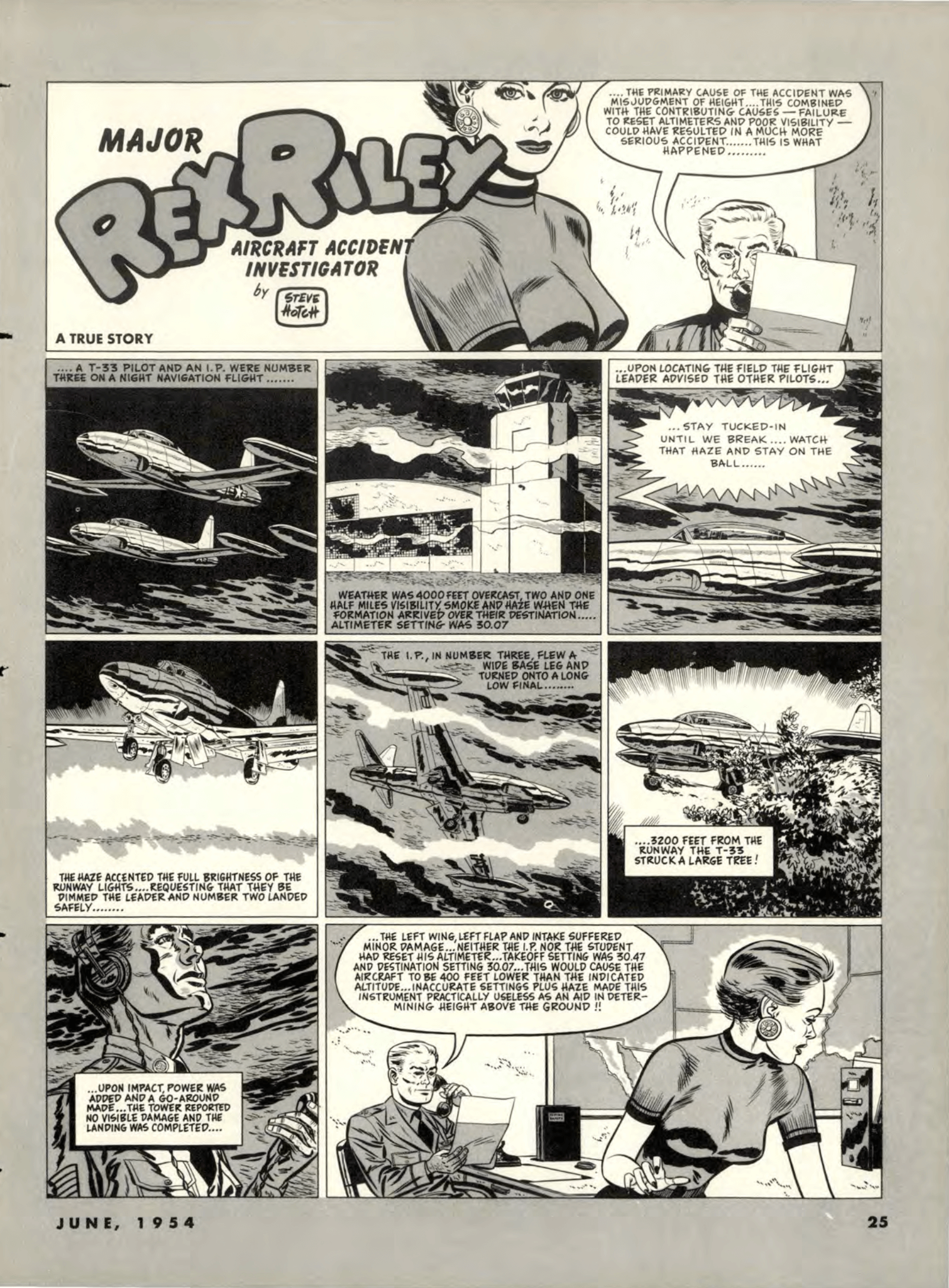
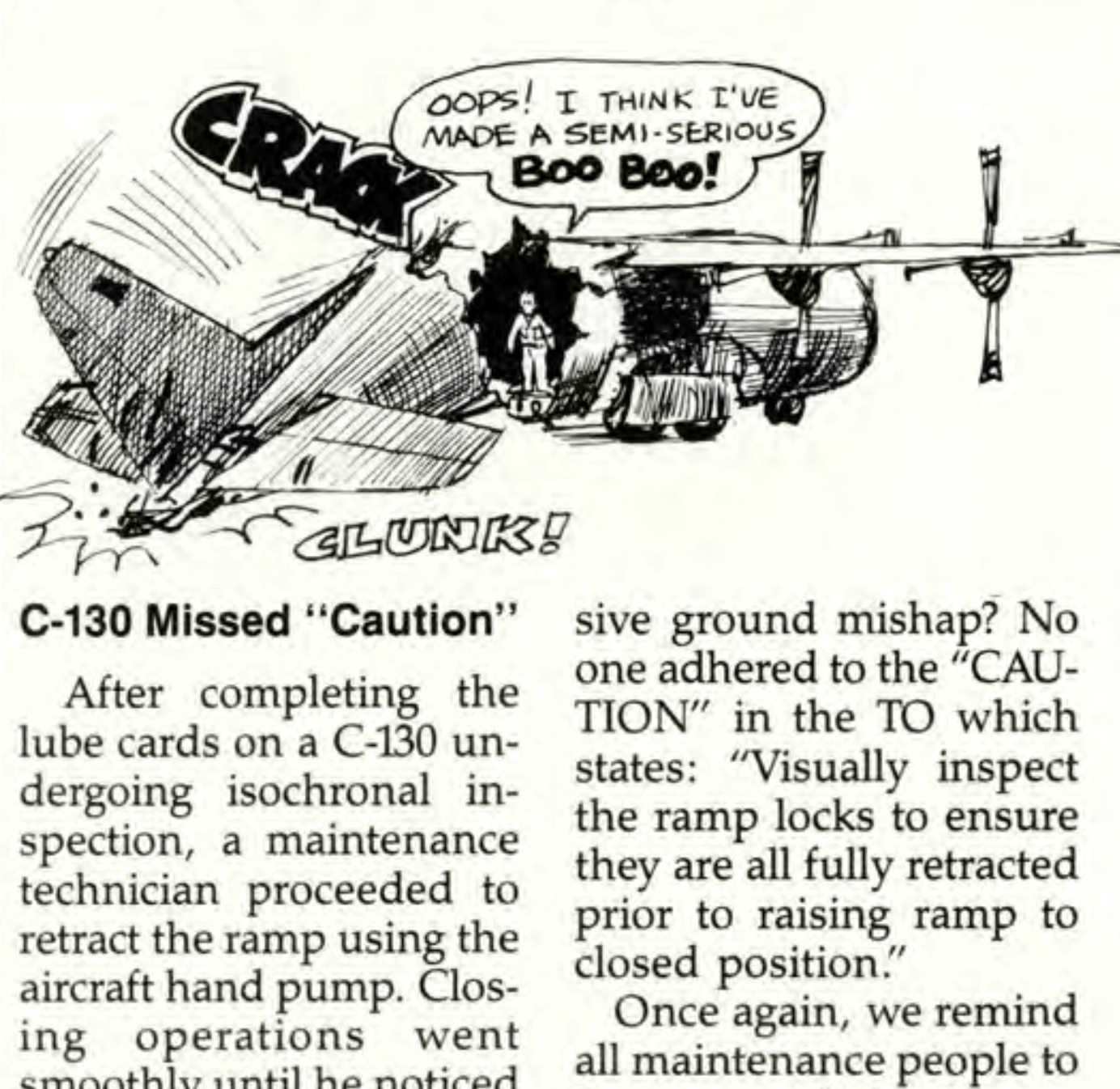
They had (actual) creative meetings. They had artists, and cartoonists, and designers. They pushed boundaries. They weren’t afraid to use humour, swear words, and satire. They weren’t even afraid to make it actually sexy!

Now, chill. I’m not saying this is a perfect example. Stripes are very 1950’s. But let’s have a look at some of the artwork and artistry from the pre-1990 era of aviation safety!


That feels different, doesn’t it?

Could it be, that if we are brave enough to think differently about safety, that we might get more pilots reading the very important messages that we want them to?

Here’s the thing. If safety is SEXY (my byword for engaging, exciting, attention-grabbing, and attractive), then it cannot feel sterile, corporate, empty, and aloof. And these are the reasons I don’t read the 2022 magazines.

But in the past, the whole vibe was different. It’s light, it’s easy, it’s fun. When I read that “olden days” safety magazine, it makes me want to participate. I want to read the articles, enjoy the art, and get involved. I’ll pass it along to a colleague. I’ll leave it on the flight deck  for the next person.

These days, the only reason I’d leave a safety magazine for the next person, is for that fly I didn’t manage to swat before we landed.


Further reading

  • A treasure trove of old-time safety magazines: Air Force Safety (but make sure to read the pre-1990 ones!)
  • A trove (minus the treasure) of present day ones featured in the image:
  • Office pictures are in fact from Steve Algren, view the story here.


Big Summer Slots (a Storybook)

This summer is going to be worst ever in Europe for delays (so we’re told), which means if you’re going there you’re going to get a nasty CTOT sooner rather than later.

So rather than writing a long and helpful blog post to help you navigate the slot rules, instead we’ve put together a vacuous and infantile story book.

But, it might still help a little to figure out how NMOC (the artists formerly known as CFMU) at Eurocontrol works, how to deal with a bad slot, requesting improvement, how and when to file, and when you should or should not contact NMOC for help.

Once you’ve enjoyed (or not) storytime, be sure to scroll down for some more “adult” links to the in-depth material 😊

Click above for the PDF version (which you can also download directly).

If you prefer, try this “Book” version …


So, onto the adult version… Eurocontrol NMOC have published a really useful guide to slots this month, for the Summer of 2022. Download that here as a PDF (31 pages)

For the full bible, you want the IFPS users manual, and the ATCFM operations manual.

Do you have any other useful links or documents about European slots? Tell us! ops.team@ops.group.


Danger Club: Grandchildren of the Magenta

Hi members!

First up, new times for Danger Club going forward! Meetings will be on Tuesday afternoons2pm Eastern Time.

That means 7pm London, 8pm Berlin, etc. In UTC, that’s Tuesday at 1900Z. These times are a little better for both the US and Europe, and we’ll keep this schedule for the rest of the year.


Danger Club 4 – this Tuesday, Nov 30

In the late 90’s, this video became perhaps the first aviation meme. “Children of the Magenta Line” was the catchphrase: kids flying these days rely on automation so much that they can’t fly the airplane anymore.

You can’t call yourself a pilot unless you can turn it all off and fly it safely“. That’s the premise.

But what if the opposite is now true? That throwing away the automation, and bravely hand-flying our airliner like a Pitts Special at Oshkosh is the real danger?

Let’s find out! In the incident for this Danger Club meeting, we look at an Airbus 319 attempting a visual approach at night into Bristol, UK. The weather was CAVOK, but the crew quickly ran out of situational awareness and ended up fumbling their way around in the darkness, narrowly missing terrain.

There are a few more interesting things to look at here:

  • What exactly is our motivation for flying visual approaches?
  • Are visual approaches higher or lower workload?
  • In this incident, there was no re-briefing or setup for the switch from ILS09 to Visual 27, so the F/O was not in the loop.
  • The F/O did call for a go-around – a topic on previous calls we’ve had in DC.
  • Hand flying Airbus aircraft: switch off all the automatics?

Read the incident report – it’s a nice short one this time.

And join us on Tuesday to talk about it!

Danger Club #4: Tuesday, Nov 30: 1400 ET / 1900 UTC
Tuesday 11am LA, 2pm New York, 7pm London, 8pm Berlin, 8am Weds Auckland.
Incident: A319 Bristol: Grandchildren of the Magenta.


Danger Club .. the story so far

What happens in Danger Club? Top secret of course, but very simple: we get together as pilots to talk about safety danger. This isn’t the usual safety meeting (hence the strikethrough): we’re just fallible humans figuring out where our faults may lie.

The first three meetings have been met with enthusiasm from all attending, and some really interesting discussions have resulted. Top topics so far: Taking control from the PF, Finding your voice as the F/O, MAYDAY calls and emergencies, over-experienced captains. It’s been fun and fascinating. Bec wrote a great article on one of the topics after last weeks call: read Fighting for Control.

So, if you have an hour on Tuesday, come along. Just register and then show up when it starts. Open to all pilot members!

Hope to see you there!


FAA issues Emergency Order for Afghanistan (Updated)

On August 30, the FAA revised its Emergency Order for Afghanistan, with a new KICZ Notam.

Effective immediately, US operators and flight crew are prohibited from operating in the Kabul Flight Information Region (OAKX) at all levels. The FAA cites three specific risk factors: extremist/militant activity, limited risk mitigation capabilities, and disruptions to Air Traffic Services.

The main change is that flights to and from OAKB/Kabul airport are no longer exempt. 

Therefore the only exceptions are now as follows:

1. You can operate in the Kabul FIR (OAKX) if another US government agency authorizes it together with the FAA, or by way of “deviation, exemption, or other authorization” issued by the FAA Administrator. If you do plan to fly, you must call the FAA Operations Center in Washington.

2. You can overfly on one airway: Use of airway P500/G500 is authorized for transiting overflights. (That airway cross the sliver of Afghan airspace in the east of Afghanistan between Pakistan and Tajikistan)

3. If you are experiencing an emergency.

The NOTAM is issued with permanent validity, and is presented in full below.

For further on Afghanistan, pilot and local situation reports, procedures, and assistance:

Satellite image via Washington post, Maxar Technologies 2021.


KICZ Notam A0029/21
Issued Aug 30, 1955 UTC
Valid until: Permanent

SECURITY..UNITED STATES OF AMERICA PROHIBITION AGAINST CERTAIN FLIGHTS IN THE KABUL FLIGHT INFORMATION REGION (OAKX)

THOSE PERSONS DESCRIBED IN PARAGRAPH A (APPLICABILITY) BELOW ARE PROHIBITED FROM OPERATING AT ALL ALTITUDES IN THE KABUL FLIGHT INFORMATION REGION (FIR)(OAKX), EXCEPT AS PROVIDED IN PARAGRAPH B (PERMITTED OPERATIONS) AND PARAGRAPH C (ALLOWANCES) BELOW, DUE TO THE RISK POSED BY EXTREMIST/MILITANT ACTIVITY, LACK OF RISK MITIGATION CAPABILITIES, AND DISRUPTIONS TO AIR TRAFFIC SERVICES.

A. APPLICABILITY. THIS NOTAM DOES NOT APPLY TO THE UNITED STATES DEPARTMENT OF DEFENSE. IT DOES APPLY TO: ALL U.S. AIR CARRIERS AND COMMERCIAL OPERATORS; ALL PERSONS EXERCISING THE PRIVILEGES OF AN AIRMAN CERTIFICATE ISSUED BY THE FAA, EXCEPT WHEN SUCH PERSONS ARE OPERATING U.S.-REGISTERED AIRCRAFT FOR A FOREIGN AIR CARRIER; AND ALL OPERATORS OF AIRCRAFT REGISTERED IN THE UNITED STATES, EXCEPT WHEN THE OPERATOR OF SUCH AIRCRAFT IS A FOREIGN AIR CARRIER.

B. PERMITTED OPERATIONS. THIS NOTAM DOES NOT PROHIBIT PERSONS DESCRIBED IN PARAGRAPH A (APPLICABILITY) ABOVE FROM CONDUCTING FLIGHT OPERATIONS IN THE ABOVE-NAMED AREA WHEN SUCH OPERATIONS ARE AUTHORIZED EITHER BY ANOTHER AGENCY OF THE UNITED STATES GOVERNMENT WITH THE APPROVAL OF THE FAA OR BY A DEVIATION, EXEMPTION, OR OTHER AUTHORIZATION ISSUED BY THE FAA ADMINISTRATOR. OPERATORS MUST CALL THE FAA WASHINGTON OPERATIONS CENTER AT 202-267-3333 TO INITIATE COORDINATION FOR FAA AUTHORIZATION TO CONDUCT OPERATIONS.

C. ALLOWANCES. USE OF JET ROUTES P500-G500 IS AUTHORIZED FOR TRANSITING OVERFLIGHTS.

D. EMERGENCY SITUATIONS. IN AN EMERGENCY REQUIRING IMMEDIATE DECISION AND ACTION FOR THE SAFETY OF THE FLIGHT, THE PILOT IN COMMAND OF AN AIRCRAFT MAY DEVIATE FROM THIS NOTAM TO THE EXTENT REQUIRED BY THAT EMERGENCY.

THIS NOTAM IS AN EMERGENCY ORDER ISSUED UNDER 49 USC 40113(A), 44701(A)(5), AND 46105(C).

ADDITIONAL INFORMATION IS PROVIDED AT:

HTTPS://WWW.FAA.GOV/AIR_TRAFFIC/PUBLICATIONS/US_RESTRICTIONS/

SFC – FL999, 30 AUG 19:55 2021 UNTIL PERM. CREATED: 30 AUG 19:59 2021


Covid Catchup: 18 months of ops changes in one game

Hi members,

I don’t know if you’re one of the many returning to international ops this summer, but quite a few of the group are.

The last 18 months have seen quite a lot of changes for international ops. If you’re just jumping back into the cockpit after a prolonged absence, it would be good to know about them – right?

We thought the best way to communicate that summary was in a game!

So we made Covid Catchup. It’s easy to play: follow the boxes, read a little, and then answer some quiz questions to see how you rate.

It’s in PDF form so you can download it, print it out, or play it on your iPad (and feel free to share with you friends that might not be group members).

How to get the game?

We’re dropping it into OPSGROUP Slack this evening. Just go to the #crewroom channel and you’ll see it there.

If you’d prefer to get the game by email instead, we can do that – just send a note to ops.team@ops.group.

Enjoy the game and let us know how you do! We’re pretty confident that if you do well on it, you’ll be up to speed on all the big changes since January 2020.

Cheers,
The O.G. Team.

How to play

1. Get the full game in OPSGROUP Slack
2. Print it out, or open the PDF on your iPad

3. Each box has a little nugget of operational change. if you don’t know about it, click the link for the full article. The date is when the change happened.

4. Answer the questions
5. Finally, check your answers and see what points you got for each correct one (all are different!)

Don’t forget to share you how did! You can humble-brag your high score claims in the #crewroom channel 😊


Global Campaign on NOTAM Improvement

Update: The NOTAM campaign was launched with 1,500 attendees on April 8th – and yes, it was the largest virtual event in ICAO history! The first update webinar on progress being made is on June 16th at 1200Z – register with this link, and join the call.


The Global Campaign on NOTAM Improvement is being launched on April 8th, 2021. Spearheaded by ICAO, and supported by OPSGROUP, IFAIMA, and IFALPA, the campaign will focus on making significant improvements to the NOTAM system to enhance its effectiveness, usefulness, and reliability as a mechanism for pilots to receive critical flight information.


Kick-Off Webinar, April 8th 2021

At 1200Z on April 8th, 2021, we will launch the campaign with a worldwide webinar. So far, we have 600 registered participants. We are on track to make this the biggest virtual event in the history of ICAO. If you think about it, that’s pretty amazing for a meeting about NOTAM’s!

This webinar is open to everyone, and we would be delighted to have you join it – to show your support for the Notam Improvement campaign, to learn more about what the plans are, get the latest update, and see how you can get involved: this is a collaborative, shared mission that needs your help, whether you are a pilot, dispatcher, AIS officer, software developer, Flight Planning provider, ANSP, CAA, or are in any other way a user or provider of some aspect of the Notam system.

So, please join us – it’s open to all:
Register for the Worldwide Webinar on Thursday, April 8th, 2021 – 1200 UTC

1200 UTC = 7am Lima, 8am New York, 1pm London, 2pm Berlin, 4pm Dubai, 7pm Bangkok, 10pm Sydney, 12am Auckland.


Why should I join the Webinar?

Over the last few years, as many as 10,000 pilots and dispatchers have supported a move to fix Notams – through petitions, surveys, comments, emails, and joining the OPSGROUP Notam Team to help fix the problem. Your voice has been heard: this work is the result. Now, we need your support for this campaign – to reinforce the message that as an industry, we really care about this. Your presence will encourage those working on solving the Notam Problem, and you will get the full picture of where we stand in the progress to fix things.

We will speak about the mission, demonstrate the problem with some real world examples of pre-flight briefings, showing how these impact the daily lives of pilots and dispatchers, clarify the definition of “Old NOTAM’s”, and show how AIS staff can use the existing regulatory framework in Annex 15 and Doc 8126 to become a gatekeeper for NOTAM quality, demonstrate the Notameter, address regional challenges, and have a Q&A session.

Our presenters and speakers will include Stephen Creamer (Director of the Air Navigation Bureau at ICAO), Alex Pufahl (ICAO Technical Officer), Mark Zee from OPSGROUP, Capt. Lauri Soini from IFALPA, Fernando Lopes and Antonio Locandro from IFAIMA, Marco Merens from ICAO, and ICAO Regional Officers.


What is the Notam Campaign all about?

First, the problem: Pre-Flight NOTAM Briefing packages are often far too big to be fully read and understood by pilots before a flight. The result: critical information is missed. Finding safe ways to decrease that volume is the key focus of this campaign.

In the Global Campaign on Notam Improvement, our aim is to solve the Notam Problem in manageable chunks, gathering energy as we solve them and make progress. Rather than re-invent the wheel, we will fix the system from within, starting with the easier aspects and progressing from there. The first phase of this campaign focuses on Old Notams. At any one time, there are about 35,000 active Notams globally, and 20% of these – one in five – are old; in other words, not respecting the existing rules of Notams being issued in principle once only for a maximum of three months (everything else should go into the AIP, an AIC, or some other publication).

We are drawing on the collective cooperation of the AIS community – the Notam Officers – to uphold the rules and get rid of Notams that don’t follow them. The result will be a potential decrease of 7,000 Notams per month, and a 20% reduction in the size of the average briefing packet. For more on the Notam Problem itself, have a look at “Why pilots are reading a Reel of Telegrams in the Cockpit“.


Who is behind it?

The Global Campaign is a meeting of minds, agreeing on one thing: Notams need fixing.

ICAO is spearheading the campaign, in the recognition that the Notam Problem is a worldwide issue that affects flight operations in every country.

Providing support, energy, and huge enthusiasm to help solve things are IFAIMA, representing the Aeronautical Information community, IFALPA, voicing the concern of Airline Pilots, and OPSGROUP, whose pilot, dispatcher, and flight operations members have been tirelessly involved in the mission to fix Notams since 2017.


What can you do to help?

Thank you for asking! If you are in the AIS community – perhaps as a Notam Officer, AIS Officer, Publisher, or Promulgator – please tell your colleagues, join the webinar, and get involved in this Campaign. If you are a Pilot or Dispatcher, join the webinar, share the news of this campaign (#NOTAM2021), voice your support, and monitor progress – we’ll want your help down the track as well. If you are a Flight Planning Provider or Software Developer – again, join the webinar, and when the time comes, get involved in the collaboration around technical improvements. If you work for an ANSP or Civil Aviation Authority – join the webinar, encourage your colleagues to join too, and help support the Campaign. If you work for an Organziation, tell your members, and share news of this campaign (#NOTAM2021). Oh, and join the webinar!


How we got here …

This is a Global Campaign for a very good reason. We only solve this problem when we solve it for all countries – so we take the lessons learned domestically from those countries that have seen NOTAM wins, and amplify that across the rest of the globe.

In terms of change so far, most notable is the work done by the AIS Reform Coalition in the United States, chaired by Heidi Williams from the NBAA. This group of people from NATCA, ALPA, AOPA, IATA, A4A, ACI, the NBAA and others have been working feverishly in partnership with the FAA to drive change and improvement. And it has had remarkable results – the US has radically improved NOTAMs in the last 2 years: NTAP gone, a big reduction in PERM Notams, a single office for AIS, a transition to the FNS, and NOTAM Search replacing Pilot Web. Canada has transitioned to ICAO format for Notams, and provided a new delivery mechanism through CFPS.

We must also recognise huge efforts from the members of OPSGROUP, who as pilots, dispatchers, and other flight operations specialists have made their voice heard, sharing support, input, ideas, and enthusiasm for change; the efforts of IFALPA to bring attention to the issue, and IFAIMA who have given full support to solving things on the AIS side.

An important distinction to make here is that this work is on “NOTAMs, Now“. There is separate, ongoing work in the field of the “Future of NOTAMs”. You may have seen acronyms like SWIM and AIXM, and terms like Digital Notams or Graphical Notams. The FAA, ICAO, Eurocontrol, and other agencies are building a model for the future, when NOTAM’s will change from the current AFTN format and transmission into an internet, IP based, transmission and follow a service-oriented approach. This work is valuable, but with a target implementation date of 2028, has a different focus. Even if it goes smoothly, it would not instigate change until 2028. Needless to say, if we don’t fix the underlying issues now, it may not even solve them then, either.


The AIS Community, Pilots, and Dispatchers, working together

Here’s the really exciting part of this Campaign: for the first time we are seeing pilots, dispatchers, and AIS staff working together on solving the issue. This is a core tenet of the campaign: only when you have all parties involved, do you have a shot at success.

The AIS Community is invaluable in solving the problem, but they need our help. First, they need to know exactly the impact of the Notam Problems we describe – this drives their will to make change and improvement. Second, they need the support – which this Campaign will provide – to stand as gatekeepers for Notams. They themselves are often under pressure to publish Notams that they know don’t align with the rules, but have no alternative.


Phase One

So, once the Campaign is launched, what does the roadmap look like? Logically enough, we start with Phase One. A simple, bite-size chunk of the problem – Old NOTAM’s. In volume terms, it’s a lot more than bite-size – it’s actually 20% of the problem. The key is that it’s easy to understand, and therefore easy to work on. We don’t need to make any structural changes, or change how the system functions. This is simply about focusing on a known issue – that 7,000 of the 35,000 active Notams that should not be there.

Even more importantly, the focus is also on the energy, enthusiasm, and goodwill to make the changes necessary. As we gain momentum, we get encouragement from each and every Old NOTAM that is removed forever. We see that through collaboration, community, and support for each other, we can make change happen.

Remembering that this is a decades old problem that has been on the agenda since 1964, and that there are 193 countries on this journey, progress may feel slow at first. But we’re going to learn from each other, and go as fast as feels right. We’ll be celebrating the small wins!


Phase Two

The next phase will look at technical improvements. In other words, what structural and systemic changes can we make to NOTAM’s to leverage quick improvement.

We envision that this stage will be best served by a great deal of collaboration and discussion. One of the key groups here will be Flight Planning software providers. The vast majority of NOTAM briefings today are provided by these companies. As things stand, each one has a different, in-house method of processing the Notam flow – usually with algorithms, keyword searches, date/time validity ordering, and some Q-code assessment. So we might ask, how can we best structure the Notam data to provide a robust, reliable format with metadata that allows sorting and filtering – the two big asks from the pilot community. In other words, show me the critical stuff first, and skip the fluff.

We also, again, need full collaboration with AIS to see what the impact of those technical improvements will be, and whether they support them. Adding pilots and dispatchers into the mix will allow us to verify that the changes being discussed will actually have an impact by the time they reach the cockpit. If they don’t, then we’re not doing it right.


More about #NOTAM2021


ATC Farm-out must be prohibited

If you’re overflying the Tirana FIR tonight, the Air Traffic Controller in whose hands the safety of your flight rests will be one of these three: a Turkish controller, who has just been drafted in and who has never seen the airspace before; or an Albanian controller who has been forced to work under huge duress, while colleagues remain in prison.

And if you think there will be a NOTAM to tell you about any of this, you’re mistaken. Albania does not want you to know.

There are a plethora of troubling issues in the ongoing Albanian ATC dispute. Arresting workers for organizing industrial action is draconian and aggressive, and an approach discarded by nations that have moved beyond totalitarian regimes of the past. But the issue that presents the greatest risk to aircraft operations is the farm-out of ATC service: a practice whereby the ATC authority recruits foreign, untrained controllers in an attempt to break a strike.

The same scenario occurred in the Ethiopian ATC strike of 2018. The Ethiopia CAA recruited stop-gap controllers from Kenya, Sudan, Zimbabwe, Malawi, and other countries, and at the same time, launched a PR campaign declaring that “everything is operating normally”, including this bizarre attempt at Photoshopping a duo of Ethiopian Airlines aircraft onto an image of Addis Tower.

In the Ethiopian case, the cover-up belied the fact that the Air Traffic Control service was in tatters – many ATCO’s were in prison, many were fired, and the idea that a busload of controllers from Sudan could somewhow safely replace the local controllers was tantamount to attempted manslaughter on the part of the Civil Aviation Authority. Safety was well down the pecking order of motivating factors – commerce, politics, and thinly-veiled vengeance came first.

In Tirana, tonight, the situation is almost identical. Three Albanian controllers are in prison, and those at work in the Tirana ACC are there only because they have been forced onto position by their government. Albcontrol has clearly signalled its intent to draft in Turkish controllers to replace the unhappy domestic ones.

This tactic carries a profound danger that at first glance may not be obvious. If we cross to the other side of the microphone, and look at pilots, we could argue that a 737-rated pilot could fly from Adelaide to Melbourne as easily as they could fly from Dublin to London, and apart from some company procedures and airport familiarisations, that would be largely true. If a group of airline pilots go on strike, management could therefore replace them with a group of other airline pilots with the same type rating – who would earn the monniker of Strikebreaker (or worse). A deeply unpopular move, which happens from time to time, but not one that carries the same risk as attempting to do this with controllers.

Why? Because safe Air Traffic Control is predicated on deeply-learned local familiarity with the airspace, the terrain, the boundaries, and above all, how the traffic flows. This is why it takes six months, on average, for a controller trained in one country to re-qualify in another. For a newly-qualifying controller, that time line is closer to two years.

OK, where are the mountains again?” is not a question you’d want to know was being asked on the floor of an Approach Control unit. But that is precisely the level of vague airspace acquaintance that a drafted-in controller, even one with thirty years experience in another unit, would have. It is simply not possible to provide a safe ATC service with a weeks training. Even more importantly, the normal time required is based on the training relationship between student and trainer being supportive and co-operative. With the resentment that a Strike breaking controller would face, that cooperation would be entirely absent: the atmosphere will be hostile.

And so, it is a fundamental breach of trust for a sovereign nation to provide ATC service to foreign aircraft under the guise of “operations normal”, when such a catastrophically misguided attempt has been made to solve the dispute.

The relationship between the ATC provider (the state), and the customer (the foreign aircraft), is an extremely unusual one. There is no written contract, no KPI’s, no audit of quality. There is nothing other than a sacrosanct, inherent commitment to safely separate aircraft, crew, and passengers flying over the state. International convention, not corporate agreement, dictates this foundational principle.

And so, international convention must make it clear to countries and ATC authorities alike, that the practice of farming out ATC to untrained, unfamiliar controllers from other countries as a strike-breaking tactic is absolutely unacceptable. Countries must find ways of solving domestic disputes without subjecting uninvolved, unaware pilots and passengers to high-risk scenarios such as this.

Organizations and agencies like CANSO, ICAO, and in this case, EASA, must ensure that this flawed and covertly dangerous pseudo-solution is placed firmly back under the rock it crawled out from.


Covid Catchup: How did I do?

Here are the correct answers to the questions on Covid Catchup. How did you do? Tougher questions get more points, so add up all the scores to get your total, and we’ll tell you below how you rate.

NAT Answers

A   Shanwick. 4 points.
B   Descend (SAND= South Ascend, North Descend). 5 points.
C   Yes (NAT OTS levels are always between 290-410, which is the new datalink altitude requirement). 7 points.
Tango 290, Northbound. 8 points.

Places Answers

A  There are restrictions. Israel has a list of about 140 airports you can depart from. 6 points.
B   No, unless you have a non-standard airworthiness or something else weird. 6 points.
C   Yes, ops normal again, no special procedures. 7 points.
D   Israel and Qatar. 8 points.

Pilot Answers

A   South Korea. 7 points.
B   The ASI (Airspeed Indicator). 8 points.
C   Nothing – sit on your hands for a few seconds, at least. More here. 10 points.
D   1998 had the same traffic levels as 2020. More here. 10 points if you answered between 1990-2010.

Risk Answers

The Polisario. 8 points.
B Vilnius, Lithuania. 5 points.
C Eritrea. 5 points.
Israel, Saudi Arabia, and Iraq. 10 points, or 6 points if you got two right.

Random Answers

A   Any two of these: VABF/Mumbai, VOMF/Chennai and VECF/Kolkata FIRs, ZJSA/Sanya FIR, SOOO/Cayenne FIR, NTTT/Tahiti FIR, GVSC/Sal Oceanic FIR, WMFC/Kuala Lumpur, FSSS/Seychelles Oceanic. 8 points.
B   ULLI/St. Petersburg (back in 2017). 7 points.
C   8 hours. 4 points.
D   Yes. Yes they do. 10 points.


Add them up! This will be a good test of how many of the changes in the last 18 months you’re up to speed on.


Thanks for playing! Did you enjoy the game? Let us know at ops.team@ops.group. Keep an eye out for more OPSGROUP games in your member dashboard.


NOTAM 2021 update: progress, at last

Here’s something you might not have been expecting: at long last, true progress on fixing NOTAMs.

If you’ve been following the story over the last few years, you’ll know that there has been an ever brightening spotlight on the problem. Here at OPSGROUP, we’ve certainly been vocal about the issue. The response to our first blog post back in 2017 was huge, and so we made it our mission: Let’s Fix NOTAMs.

We started out with a campaign to bring attention to the problem: We wrote the Field Guide to Notams, ran a Worst NOTAM competition at EBACE, held a Notam Summit in New York, conducted a pilot and dispatcher survey with 2100 responses, asked OPSGROUP members for support and input, ran a design contest, and through all of this gathered ideas on how to fix things. That led to an updated article in 2019 titled “Why Pilots are reading a Reel of Telegrams in the Cockpit” – which gathered more energy and interest around the problem. We then formed a Notam Team, started the “Fixing Notams” website, worked with other industry groups looking at the issue like the AIS Reform Coalition, and saw the FAA host the first industry gathering on NOTAMs in November 2019. We started a petition to keep momentum going, with 8800 people signing our plea to fix Notams.

In terms of specific solutions, we tried a bunch of things. We built an AI bot with ICAO, called NORM – to see if we could use machine learning to sort out the mess. In the Notam Team, we looked at the problem from the ground up, and looked at building an entirely new system, called N2. We also collaborated further with ICAO to build the Notameter, a tool to analyse the quality of existing Notams. Internally at OPSGROUP, our small team spent many hours researching, pondering, idea generating and data analysing.

The result? Much learning, much discussion, much collaboration – but no concrete results or fixes. This the way of things. NOTAMs are harder than they look. The AI was not able to make sense of Notams in the way we’d hoped, the initial Notameter was interesting but wasn’t changing anything. A brand new system wasn’t going to work: despite the failings, the existing system has buy-in and trust, and attempting to circumvent that with an entirely new mechanism sounds inspiring, but isn’t practical.

But progress doesn’t always come along the path that you expect. And in the quiet, dark days of a Covid-dominated December, a small group of die-hard Notam Fixers formed to continue the battle. Taking all the learnings of the Notam journey over the last few years, we sat down together once a fortnight over the last few months, and forged a new path. Each of us represented our own group of allies in the mission: ICAO, IFAIMA, IFALPA, and OPSGROUP. This togetherness created a renewed energy to solve the problem.

And now, we have traction.

Next month, ICAO will spearhead the launch of a Global Campaign on NOTAM Improvement. Our aim is to solve the Notam Problem in manageable chunks, gathering energy as we solve them and make progress. Rather than re-invent the wheel, we will fix the system from within, starting with the easier aspects and progressing from there. The first phase of this campaign focuses on Old Notams. At any one time, there are about 35,000 active Notams globally, and 20% of these – one in five – are old; in other words, not respecting the existing rules of Notams being issued in principle once only for a maximum of three months (everything else should go into the AIP, an AIC, or some other publication).  We are drawing on the collective cooperation of the AIS community – the Notam Officers – to uphold the rules and get rid of Notams that don’t follow them. The result will be a potential decrease of 7,000 Notams per month, and a 20% reduction in the size of the average briefing packet.

The ICAO Global Campaign on Notam Improvement will kick off with a worldwide webinar on April 8th, for which ICAO has issued an invitation to member states by State Letter. After this, a series of bi-monthly progress webinars will start on June 16th.

The backing of ICAO means we are now tackling the Notam Problem head on, with the fullest force.

The focus on “Old Notams” is just the first phase of this campaign. As well as tackling this particular aspect of the Notam Problem, we will be creating awareness of the wider issue, especially in the AIS community, and forming support mechanisms for AIS offices around the world to deal with not just Old Notams, but also further improvements down the track. In Phase Two, we plan to look more closely at how we can improve the mechanics of the system itself.

NOW, versus Later

An important distinction to make here is that this work is on “NOTAMs, Now“. There is separate, ongoing work in the field of the “Future of NOTAMs”. You may have seen acronyms like SWIM and AIXM, and terms like Digital Notams or Graphical Notams. The FAA, ICAO, Eurocontrol, and other agencies are building a model for the future, when NOTAM’s will change from the current AFTN format and transmission into an internet, or IP based, transmission and following a service-oriented approach. This work is valuable, but with a target implementation date of 2028, has a different focus. Even if it goes smoothly, it would not instigate change until 2028. Needless to say, if we don’t fix the underlying issues now, it may not even solve them then, either.

Thing-Labelling

For the enthusiasts, I’ll delve some more into the Notam Problem, what we’ve learned, and what the next phase of fixing might look like.

In Phase One, the brief is simple and clear: remove Old Notams, and reduce the count. That count – or total volume of Notams – reached about 1.9 million in 2020. Reducing that count by 20% means a reduction in the volume of Notams that pilots are presented with pre-flight. It’s a simple, quick win.

In Phase Two, we will be able to look at the first systemic change – not just reducing the count as in phase one, but finding ways to improve the quality and usability of the system as a whole.

One potential option is how we can label Notams. You might recall we built an Artificial Intelligence bot with ICAO, called NORM. The terms Artificial Intelligence (AI) and Machine Learning are in essence still interchangeable, and the latter makes things easier for most of us to comprehend. Machine learning is really just “Thing Labelling” (see this article from Cassie at Google). Very simply: tell me what this thing is about, and I can do something with it. NORM wasn’t able to “thing label” quite as well as we’d hoped, but the concept remains valid for Notams – if you can tell me what this Notam is about, I can do things with it.

We have a manual thing-labeller for NOTAMs built in: the Q-code. This five letter code, like QFAHX, which means “This NOTAM is about Birds“. The trouble is, that there are far too many choices. There are 179 Subjects (60 AGA, 47 ATM, 40 CNS, 27 Nav Warnings, 5 Other) and 77 Conditions (16 Availability, 16 Changes, 26 Hazards, 19 Limitations). The number of permutations, or possible 5 letter Q-codes, is therefore 13,783.

The result? As you might imagine, the person putting a NOTAM into the system has to choose a Q-code, and with that many choices, the same subject can have a host of different Q-codes. In a review of all Notams issued in 2020, we found 1,063 different Q-codes in common use. In addition, we found that 47% of Aerodrome Notams, and 25% of FIR Notams, used the Q-code “XX” or “XXXX”, which translates as “I don’t quite know which one to use”.

Net result: The Q-code isn’t a reliable thing-labeller as it stands. However, if we refine the number of available Q-codes to a set amount, like 50, or 100, we then have a robust and reliable way of labelling the Notam. And if we have a reliable label, then we can do two magical things: SORT and FILTER them. Sorting means that we can present critical items first (like a runway closure), and Filtering means we can exclude things we don’t care about (Birds, perhaps).

A key item on the Pilot wishlist is “Show me the critical stuff first”. If the NOTAM can be labelled to show “What is this NOTAM about”, it would allow end users (directly, or through the NOTAM distributors like Lido, Jeppesen, ARINC, etc.) to reliably filter and sort them. In other words, Closed Runways appear first and Birds and Grass Cutting appear last, if at all. The magic of refining the Q-code field to achieve this is that we don’t need to build anything new, make any structural changes to a Notam message (exceptionally challenging), nor create a burden on states to invest in new technology. It’s a simple, very effective, tweak.

There are other recognised issues: for example, the Upper Case format, Plain English vs Abbreviations, and in time, I believe we can solve those too.

Getting closer to the solution

For those of you that have been with us for a longer period,  you might remember the little chart I drew a year or two back. Fixing Notams was never going to be easy.

I think we’re somewhere around the red circle area. We have done so much, and we now have global attention, a harmonious, energised group of organizations working on the problem, and as of April 2021, the backing and full force of ICAO in this Global Campaign for Notam Improvement.

I’m excited to see what we can achieve from here.

Further reading and links