2025 Flight Ops Changes: The Big Ones

Another year, another wave of changes across international flight operations. Here are some of the key ones from 2025…

January

  • Cuba overflights still aren’t free: Some Cuban overwater routes don’t need a permit, but NAV fees still apply. Miss them and you may get blocked later. Read
  • Palm Beach TFRs are back: With Trump back in office, TFRs around KPBI/Palm Beach will be frequent again. Expect TSA screening and gateway airport rules. Read
  • New NAT GPS guidance published: A new NAT Ops Bulletin explains what to do after GPS jamming or spoofing. Tell ATC early in your RCL. Read
  • NAT fire diversion planning needs care: Not all alternates have strong fire cover or night ops. Some even need advance payment. Read
  • Mexico paperwork rules tighten again: Some airports now demand original AIU documents from your first Mexico entry. Copies may not be accepted. Read
  • Antigua nav fees move online: Low-level flights below FL245 now use a new site to pay nav fees. Mainly affects TKPK/St Kitts ops. Read
  • UK ETA expands further: From Jan 8, most non-European visa-exempt passengers need a UK ETA. Crew are exempt. Read
  • EASA warns against western Russia: After a shootdown near URMG/Grozny, EASA flagged high misidentification risk from air defence systems. Read
  • EU anti-tankering rules arrive: New ReFuelEU rules restrict tankering for large commercial operators and add heavy reporting duties. Read
  • Iceland joins Eurocontrol: All flights into Icelandic airspace now need Eurocontrol IFPS validation. Watch for rejects. Read
  • Israel updates entry rules: ETA is now mandatory for visa-exempt passengers, plus a new approved airport list for the LLLL/Tel Aviv FIR. Read

February

  • EASA flags bad SAF risk: EASA warned about out-of-spec sustainable fuel entering the market. Double-check suppliers and be cautious with new ones. Read
  • UK warns naughty charter operators: Flying charter to the UK without a Foreign Carrier Permit can lead to bans and big penalties. Calling it “private” won’t help. Read
  • Myanmar airspace warning updated: New guidance for the VYYF/Yangon FIR advises staying at or above FL260, with limited alternates due to ongoing conflict. Read
  • Qatar moves permits online: From Feb 20, all Qatar landing and overflight permits must go through the new CAA portal. Email is out. Read
  • Saudi crew visas get easier: Some BizAv crew are now being issued six-month multiple-entry visas instead of the old 72-hour limit. Read
  • New FAA LOA guide available: A fresh, practical guide explains how to get FAA LOAs approved. Free for OPSGROUP members. Read

March

  • Blue Spruce Routes officially disappear: A new ICAO NAT Doc 007 took effect on Mar 20, removing the Blue Spruce Routes. You can still cross the North Atlantic, but what you can file now depends on your aircraft equipage. Read
  • False TCAS alerts raise eyebrows: False alerts near KDCA/Washington sparked fresh debate about TCAS and cyber resilience. Read
  • Mexico shuts 1,500 smaller airports: Over 1,500 private use airports are now restricted to owners only. Major AIP airports are unaffected. Read
  • ADC numbers are a must in South Asia: Flying through ADIZ airspace in India, Pakistan, Bangladesh, Myanmar, or Nepal? No ADC number can mean delays or denied entry. Read
  • Europe approves ACAS Xa: Europe now allows ACAS Xa alongside ACAS II for larger aircraft. Another step toward next-gen collision avoidance. Read
  • EASA brings in ground handling safety rules: EASA has rolled out its first ground handling safety rules. Handlers have three years to comply, with new training and safety systems coming in. Aircraft safety still stays with the operator. Read
  • France’s higher passenger tax goes live: The new tax started Mar 1. Private flights are exempt, but commercial operators need to plan for it, including overseas territories. Read
  • France tightens CPDLC access: Most French airspace now requires Logon List registration to get CPDLC. Read
  • China opens an English AIP portal: China quietly launched a useful English AIP portal with routes and Notams. Read
  • Singapore eyes stricter rules for foreign AOCs: Singapore plans to expand permit rules to include ferry flights and add higher penalties. Foreign AOC holders should get ahead of it. Read

April

  • Mali and Algeria impose airspace bans: Reciprocal bans between Mali and Algeria are forcing longer routings across parts of Africa. Read
  • FAA tackles mixed traffic collision risk: The FAA is tightening rules where helicopters and airplanes share busy airspace, including Washington, Las Vegas, LA, and the Gulf Coast. More changes are coming. Read
  • US special event fees are here to stay: Temporary FBO surcharges around major US events are no longer rare surprises. With fees popping up more often and further ahead of time, they have become a real planning cost for many US destinations. Read
  • US visa and ESTA rules reinforced: Only Visa Waiver Program signatory operators can carry ESTA passengers into the US. If not, visas are required. Read
  • Brazil brings back visas for some visitors: US, Canadian, and Australian citizens now need a visa to enter Brazil. Crew exemptions exist. Read
  • Mexico customs rules get trickier: New checks on pills, vapes, and electronics are catching crews out at Mexican customs. Read
  • UK ETA expands to Europe: From Apr 2, most European visitors will need a UK ETA. Crew are exempt, but passengers must have approval before flying. Read
  • Hong Kong adds mandatory BizAv APIS: From Apr 29, all BizAv flights to VHHH/Hong Kong must file APIS for crew and pax, including transit passengers. Operators must file themselves. Read
  • Thailand goes digital for arrivals: From May 1, non-Thai arrivals must submit the Thailand Digital Arrival Card online. Crew likely included. Read

May

  • US tightens dog import rules: New US requirements now apply for importing dogs, including vet certificates and air waybills. Missing paperwork can stop entry. Read
  • Visual approaches get a safety warning: A new FAA alert reminds crews that visual approaches can reduce safety margins in busy airspace. Saying “unable” earlier is sometimes the safer call. Read
  • India and Pakistan extend airspace bans: Both countries prolonged their reciprocal bans. Border areas remain sensitive, with advice to avoid parts of the region below FL260. Read
  • Saudi Arabia allows domestic charter flights: Saudi Arabia lifted cabotage restrictions, opening the door to approved domestic charter legs. Read
  • Fuel limits affect flights to Israel: Turkish airports are no longer fuelling aircraft heading to Israel, adding routing and fuel planning constraints. Read
  • Europe updates lost comms procedures: New SERA rules for lost comms, emergency descents, and transponder codes apply across Europe from May 1. Read
  • Le Bourget enforces APU limits: Strict APU time limits at LFPB/Le Bourget are now actively enforced, with fines possible. Read

June

  • FAA requires a US address for foreign licence holders: Foreign FAA certificate holders must now list a US physical address. Read
  • Lithium battery fire risk keeps climbing: Incidents involving vapes, power banks and laptops continue to rise. New FAA and EASA alerts confirm this is now a standing cabin safety issue for BizAv. Read
  • Congo DRC airspace risk remains localized but serious: Canada narrowed its warning for the FZZA/Kinshasa FIR to eastern regions, advising flight at or above FL260 due to anti-aircraft fire risk. Read
  • South Africa mandates ADS-B: From Jun 12, ADS-B is required in RVSM and Class A airspace. No exemptions published. Read
  • Sydney BizAv fees rise: Sydney rolled out higher BizAv charges across parking, runway and ground services. Some free parking time remains, but costs climb fast. Read

July

  • Blue Spruce Routes are gone, but crossings are still possible: The Blue Spruce Routes were removed in March, but operators without full equipage still have ways to cross the North Atlantic. What you can file depends on what is on board. Read
  • FAA updates its oceanic guides: The FAA refreshed its guidance for the North Atlantic, Pacific, and WAT airspace, reflecting how oceanic ops are now being flown. Read
  • US eAPIS now supports border overflight exemptions: Operators can now apply for and renew US border overflight exemptions via eAPIS, with faster and more predictable processing. Read
  • More bizjets qualify for US domestic CPDLC: The FAA expanded its CPDLC list, bringing more business jet types into domestic datacom and PDC availability. Read
  • FAA cleans up charts and foreign procedure approvals: The FAA is removing clutter from approach charts and stepping back from approving foreign instrument procedures. Operators need to rely more on local state data. Read
  • Afghanistan overflight rules extended: The FAA extended Afghanistan overflight rules to Jul 2028, allowing US operators to overfly at high levels while highlighting ongoing risk. Read
  • China tightens power bank rules: China banned uncertified power banks on domestic flights, with possible knock on effects for departures. Read
  • Ceasefire eases tensions on the Cambodia-Thailand border: A ceasefire began on Jul 28 after days of fighting. Read
  • West Africa routing options keep shrinking: Closures, bans, and conflict zones are making routings into West Africa longer and more complex. Read
  • South Africa permits remain a moving target: Any change to a South Africa permit now requires full revalidation, often taking days. Confusion over rules continues to delay flights. Read
  • Cape Verde permits required despite AIP wording: Cape Verde requires permits for all overflights and landings, even though the AIP suggests otherwise. Read
  • Germany sneaky bizjet checks continue: Unannounced security checks on bizjets are still happening in Germany. Read
  • Heat and APU limits raise risk at Nice: Reports from LFMN/Nice link summer heat, strict APU limits, and weak GPUs to aircraft damage and electrical issues. Read
  • Milan ramps up fees for business jets: Private flights at LIML/Linate and LIMC/Malpensa are seeing steep increases in landing and parking fees, in some cases by hundreds of percent. Read

August

  • Cuba remains off limits for most private jets: Most private flights still cannot operate to Cuba. Any US registered aircraft needs a license that is rarely granted, and commercial ops face strict OFAC exposure tied to US people and payments. Read
  • US CBP updates add cost and admin friction: CBP rolled out new rules for Border Overflight Exemptions and small fee increases from Oct 1. Nothing dramatic, but it all adds up. Read
  • EU commercial ops still need a TCO: Commercial flights into the EU require a Third Country Operator approval. It is free and straightforward, but needs to be sorted early. Read
  • LFPM offers a calmer way into Paris: LFPM/Villaroche offers 24/7 ops with fewer restrictions than Le Bourget. It is Schengen only, but can be a smooth option for the right trip. Read
  • Phnom Penh switches to a new airport: VDTI/Techo opens on Sep 9, replacing VDPP/Phnom Penh for civil traffic. A permanent change for Cambodia operations. Read
  • Thailand adds another compliance trap for charters: Commercial charter operators flying regularly or staying over a month in Thailand now need a Foreign Aircraft Operator Security Programme. Miss it and permits can stall. Read
  • South Korea launches overnight CPDLC: From Sep 3, optional CPDLC is available above FL160 during overnight hours for non urgent messages. Correct equipage and flight plan coding are required. Read
  • Cybersecurity is now a real flight ops risk: BizAv is no longer flying under the radar. From hacked EFBs to leaked data, Part 91 and 135 operators are real targets and should treat cyber risk as an ops issue. Read
  • BizAv safety lessons go practical: The 2025 Nimbl safety report turns real BizAv reports into practical lessons on handling, approaches, fatigue, and GPS interference. Read

September

  • Russia sanctions remain a hard operational barrier: Overflights remain off limits for most operators, with rules differing between the EU, UK, and US. Expect ongoing paperwork and no quick easing. Read
  • Eastern Europe spillover risk continues to grow: Russian drones and aircraft have violated airspace over Poland, Romania, and Estonia, triggering NATO intercepts. Read
  • US aircraft trash rules keep catching operators out: Some US CBP ports still treat arrivals from Canada as regulated trash flights, even though Canada is exempt. Local interpretation varies, so check port requirements in advance to avoid fines. Read
  • Mexico introduces double APIS submission: From Sep 17, flights to Mexico must submit APIS twice, before departure and again after doors close. Easy to miss and still catching crews out. Read
  • UK GAR rules clarified: No GAR is needed for domestic UK flights, but trips to the Channel Islands or the Isle of Man still need both a UK GAR and a local one. Read
  • Qatar simplifies northern FIR overflights: The northern Doha FIR now requires a flight notification instead of a permit, while the southern FIR still needs a permit. A lasting change for routine routings. Read
  • Balloon and kite hazards return at Sao Paulo: Crews reported balloon and kite strings on landing gear at SBGR/Sao Paulo, with objects seen as high as FL150. A real hazard despite no Notams or ATIS warnings. Read

October

  • Europe’s datalink rules become a hard filing requirement: From Nov 4 2025, IFPS will reject flight plans above FL285 if CPDLC is not filed correctly. Read
  • Europe’s EU-LISA Entry Exit System starts going live: The EU Entry Exit System is rolling out now, with full expansion through Apr 2026. New checks and registrations are coming for commercial flights, with ETIAS next. Read
  • EASA keeps Middle East airspace risk guidance locked away: EASA has extended its Israel and Iran airspace Information Notes to end Jan 2026, with no change in content. The guidance remains non-public, covering the LLLL/Tel Aviv FIR and nearby airspace, and the entire OIIX/Tehran FIR. For non EU operators, official risk guidance stays hard to access, while N-reg aircraft remain banned from Iranian airspace. Read
  • EASA warns crews about QNH errors: After a near miss linked to incorrect QNH, EASA reminded crews how easy it is to end up low on final. Simple altimeter cross checks still matter. Read
  • Haiti airspace warning extended into 2026: The FAA extended its Haiti warning through Mar 2026. Restrictions remain below 10,000 ft near MTPP/Port au Prince due to ongoing security risks. This remains a planning constraint. Read
  • North Atlantic crews face extra checks after GPS interference: GPS spoofing and jamming continue to affect NAT flights. If you have GNSS issues before entry, Shanwick wants to know early. Include it in your RCL to avoid delays or reroutes. Read
  • US tightens rules on where crew visas are issued: Crew must now apply for US visas in their home country or country of residence, not third countries. This may affect renewal timelines. Read
  • Toronto tightens BizAv slot tolerance: From Oct 21, CYYZ/Toronto requires slots via the Global OCS Portal and cuts tolerance to plus or minus 30 minutes. Register early if you are not set up. Read
  • Saudi Arabia introduces optional CPDLC: From Oct 2, optional CPDLC is available above FL290 in the OEJD/Jeddah FIR for FANS 1/A aircraft. Voice remains required for urgent traffic. Read
  • Uzbekistan updates ICAO codes and transition levels: Uzbekistan has switched from UT to UZ ICAO codes and raised the transition altitude to 13,000 ft or FL150. The change simplifies cross border ops and better aligns with neighbours. Read
  • Pilot age limits clarified: A new guide confirms the basics. Commercial international flying stops at 65, private flying does not. Country specific rules still matter and can catch crews out. Read

November

  • Sudan risk remains: After an aircraft was reportedly shot down, Sudan’s airspace remains closed and nearby routings rely on narrow contingencies. Extra caution is needed when flying near Northeast Africa. Read
  • Somalia permit confusion continues in the north: Conflicting instructions between Somalia and Somaliland continue near HCSM/Mogadishu FIR. Read
  • GPS interference near Delhi triggers new reporting steps: After spoofing events near VIDP/Delhi, authorities introduced a new pilot reporting procedure. Crews should expect continued GNSS issues and follow the updated process. Read
  • North Atlantic procedures keep evolving: Iceland and Gander plan to drop RCL messages, GNSS interference reports are increasing, and the old HLA approval concept may be phased out. NAT planning continues to move away from legacy processes. Read
  • FAA restores BizAv access after US shutdown: On Nov 17, the FAA lifted flight reduction limits and cancelled Notams that had blocked bizjets at 12 major US airports. BizAv access is open again. Read
  • Paper Jepp charts head for retirement: Jeppesen confirmed that paper charts will be retired by Oct next year. Operators still using paper will need to complete the shift to digital and make sure compliance and crew readiness are covered. Read
  • UK GAR moves to One Login: The UK GAR site now uses One Login and old accounts no longer work. Operators need to set up new access and recheck their data before filing. Read
  • New runway opens at OKKK/Kuwait: Runway 16/34 is now open, with SID changes and a new Ground West frequency. Crews report runway confusion at night, so confirm assignments carefully. Read
  • Tahiti BizAv access is more restricted than it looks: Peak hour limits and alternate constraints mean Tahiti requires careful timing and backup planning. It is not a simple H24 stop. Read

December (and beyond!)

  • Airport incursions become a real European disruption risk: Drones and balloons have already forced airport closures and diversions across Europe Read
  • Venezuela best avoided: The FAA advisory still stands and the SVZM/Maiquetia FIR remains unstable and best avoided. Read
  • UK ETA checks move toward full enforcement: From Feb 25 2026, UK GAR submissions will actively check passenger permission to travel. Missing ETA or visas can trigger a “No Record” response. Read
  • UK confirms higher Air Passenger Duty for BizAv: From Apr 2027, higher APD will apply to business jets from 5.7 tonnes. On long haul flights, the cost per passenger will be significant. This is a future cost to plan for now. Read
  • Biometric border controls become mandatory for all non-US citizens: From Dec 26, facial biometric scanning is required for all non US citizens entering or leaving the US, including private aircraft. Most exemptions are being removed and refusal may mean denied boarding or entry. This is now standard US ops compliance. Read
  • US Special Event Fees stretch into 2026: The updated Special Event Fees Tracker shows FBO surcharges already published well into 2025 and 2026. These fees are now a regular planning cost, not a surprise. Read
  • Greenland keeps changing the NAT alternate picture: BGSF/Sondrestrom remains fully controlled, BGGH/Nuuk is upgraded but still restricted for BizAv, and BGBW/Narsarsuaq is heading toward closure. Greenland alternates remain a moving target. Read
  • NAT trials half degree coordinates on daily tracks: In mid January, some OTS tracks will use half degree coordinates. Planning stays the same, but it is another step toward more flexible NAT routing. Make sure your systems handle half degree points correctly. Read
  • Seletar reinforces VFR arrival discipline: After a runway misalignment incident, new guidance reinforces strict VFR arrivals at WSSL/Seletar. Visual GPS aids and strong situational awareness are now essential. Read
  • Uzbekistan opens a new BizAv tech stop: UZTP/Vostochny is now operational near UZTT/Tashkent with a long runway and full services. It is expected to take over most BizAv traffic and becomes a solid new Europe Asia tech stop. Read
  • South Pacific crossings demand serious prep: Flights between Australia and South America mean long legs, limited alternates and thin island support. Crews report this is a route where preparation really matters. Read

As the year wraps up, a huge thank you to everyone in OPSGROUP for being part of it, for sharing insights, experiences, and real-world stories, and for helping keep the whole community informed and safer throughout the year.

We’ll be taking a short break from the Daily Brief and Weekly Bulletin emails over the holidays. Our last day in the office will be Monday 22nd Dec, and we’ll be back on Friday 2nd Jan. Until then, happy holidays to all, enjoy the break, and see you in 2026! ❤️⚡✈️🧑‍✈️


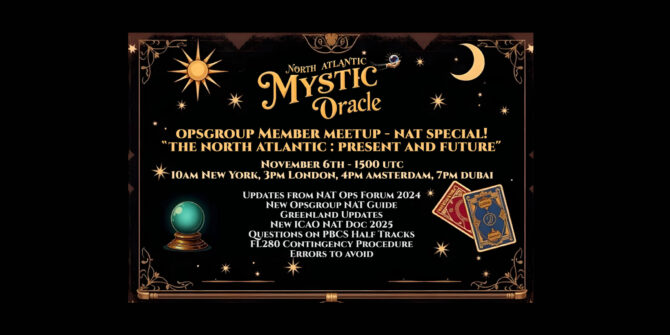
Member Meetup – NAT Special: Nov 6, 1500 UTC

Member Meetup November 2024
  • November 6, 1500 UTC
  • North Atlantic Special
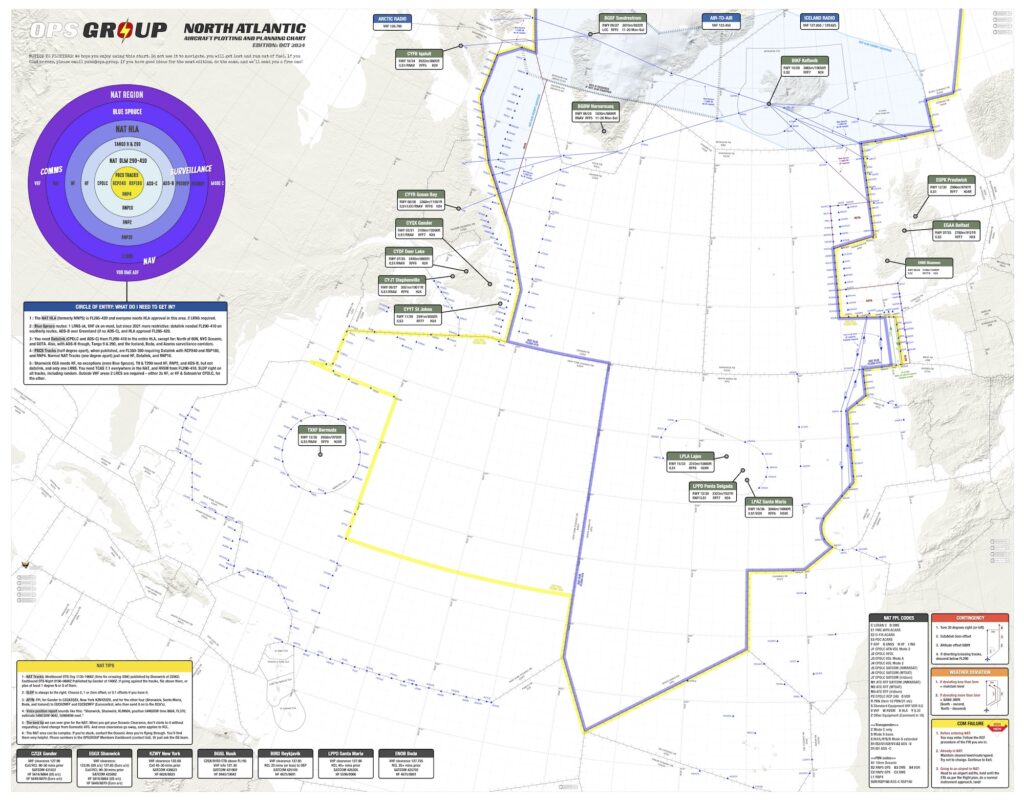
  • Release of 2025 NAT Guide and NAT Plotting/Planning Chart
  • Non-members welcome to attend this one (see below)

Member Meetup November 2024

Hi everyone! This months OPSGROUP Member Meetup has a special focus: the North Atlantic (NAT), and upcoming changes. This will be the final monthly meetup for 2024. (🎅🎅🎅)

Here is the running order of topics – yes, a long list!

  • Blue Spruce Routes removal.
  • Oceanic Clearance Removal (Shanwick/Gander) coming up on Dec 4th.
  • PBCS Half-Track usage.
  • Use of RNP4 on the NAT, more than advertised.
  • Current “Hot Errors” to avoid.
  • FL280 operations.
  • New NAT Doc 007 scheduled for March 2025.
  • New OPSGROUP NAT Chart 2025 released today! (download your copy here)

We’ll also look at:

  • New ICAO Doc 4444 coming later this month.
  • FF-ICE.
  • Greeland big changes for ETOPS/Alternate availability.
  • OPSGROUP NAT Guide 2025 walk-through.

Join fellow members to say hello, meet some new people, discuss the latest in international ops, and get the latest from the OPSGROUP Team.


OPSGROUP Members

Save your spot: Register here!

OPSGROUP Member Meetup: November 6th 1500 UTC (on Zoom)
In local times: 10am, New York / 3pm, London / 4pm, Amsterdam / 7pm, Dubai


Non-Members

For this particular NAT Special, we are inviting non-members to participate. The North Atlantic update portion is open to everyone.

OPSGROUP NAT Special: November 6th 1500 UTC (on Zoom)
In local times: 10am, New York / 3pm, London / 4pm, Amsterdam / 7pm, Dubai

Use this link to register for the call.


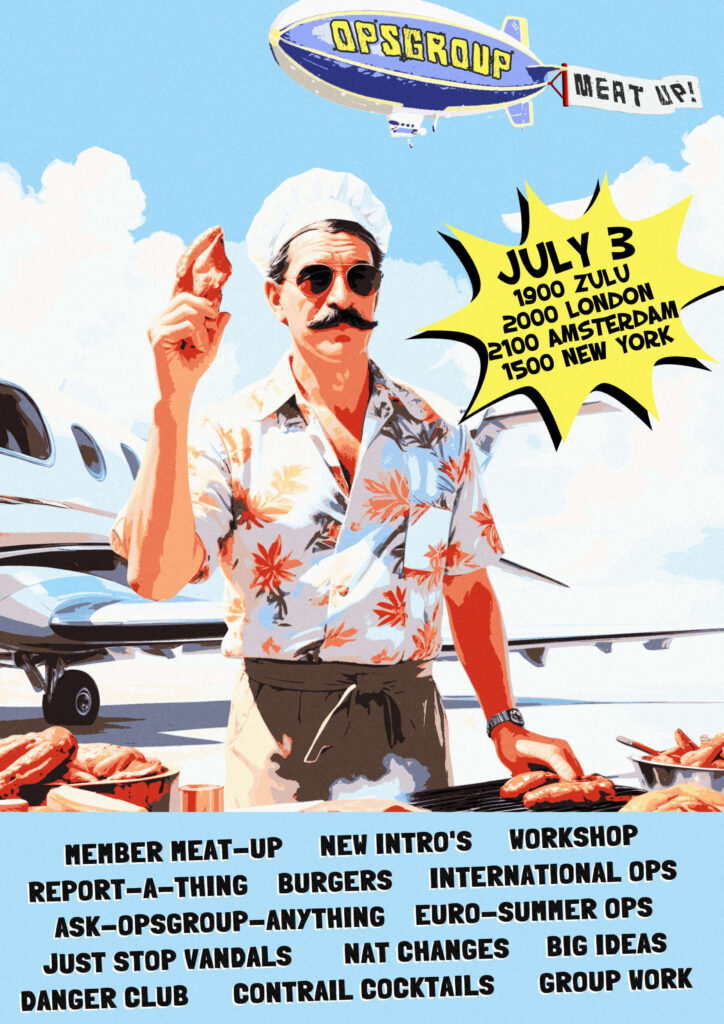
Member Meetup: July 3rd – Agenda

Member Meetup – July 3rd
  • OPSGROUP Meetup starts at 1900 UTC today
  • New member intros, Ops Topics, Workshop, OPSGROUP Updates
  • Final Agenda below: highlights are GPS Spoofing, NAT Chat, Euro Summer Ops


Hi all, here is the final agenda for today’s Member Meetup at 1900 UTC (Wednesday 3rd July)

Abbreviated Agenda

  • Welcome!
  • What’s all this about then? Quick intro to Member Meetup
  • New members – 968 new people so far this year, a round of hello’s, intro’s, where you are and what you fly or operate
  • OPS Topics – group discussion and action items
    • GPS Spoofing – discussion, locations, OEM updates, IRS/Hybrid infection, plan for Workshop on the issue.
    • NAT Chat – discussion of changes in 2024, RCL/OCR, Don’t Climb problem, NAT jamming.
    • Euro Summer – discussion of major pain points in Europe this summer: parking issues, ATC Strikes, CPDLC logon lists,  EU LISA.
  • Workshop Projects – EVS vs LED lights, Stand Guidance, GPS Spoofing, Euro First time ops, and suggestions for new projects
  • OPSGROUP Update – Report-A-Thing, Daily Brief changes, Below The Line Workshop, GoCrow/Route Check
  • Danger Club – conversations about cockpit happenings we normally don’t talk about. New series, suggestions for incidents.
  • Meetup Notepad: shared Google Doc


How do I take part?

  • Meetup starts at 1900 UTC, Wednesday 3rd July – that’s 1500 New York, 2000 London, 2100 Amsterdam, 2300 Dubai.
  • Register for the call here.
  • For full Meetup info, visit the Meetup page in your Dashboard.
  • If you have any issues registering or accessing the link, just email team @ops.group.


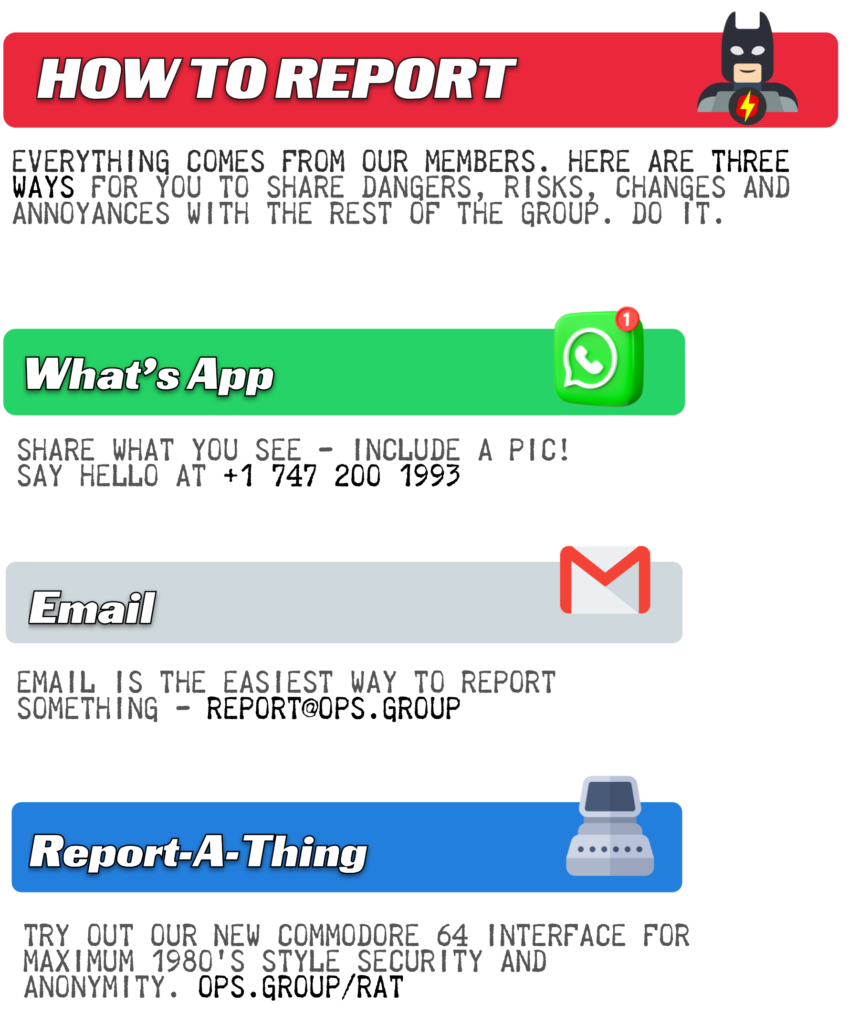
Report-A-Thing is a new thing to report stuff

We love a good snitch here at OPSGROUP.

The Daily Brief, Weekly Bulletin, Ops Alerts – pretty much everything we put out usually comes from one helpful member sharing something new.


Introducing the Report-A-Thing

We just built this. It’s new. Prepare to be amazed.

Currently operating with 2Mb of RAM and an 80Mb HDD, this machine is fully set up and ready to go. You can use Report-A-Thing to share new useful things with the rest of the group, and do so anonymously.

Try it out, and bookmark the address: OPS.GROUP/RAT


What should I share?

  • Something new, something dangerous, something risky
  • Something that will annoy other pilots (like a new parking procedure at TEB)
  • Something that affects airspace risk or security
  • Something shady
  • Something scary
  • Something interesting

Up to you. If you read the Daily Brief, you’ll know what kind of stuff appears there: so … that type of thing.


Are there other ways to report stuff?

Yes.


We Want Your Ops Stories!

Know something worth knowing about something? Got a story to share? Let us know! That’s basically how OPSGROUP works – you tell us, and we’ll tell everyone in the group.

  • Been to Nicaragua and had to use their silly new overflight permit system? Let us know!
  • Experienced one of those annoying security checks at an airport in Germany where they try to sneak onto the plane? Let us know!
  • Had to disinsect your aircraft heading into Italy? Let us know!

Or maybe your story is weirder still. Maybe it’s a NIGHTMARE. Something like this recent account of what to do when trying to take-off in a cicada swarm…

Ooh, that’s a nasty one! But an excellent story – and USEFUL!

It’s many years since we wrote this piece: What is OPSGROUP All About? It still holds true. We’re still about all the same things – keeping each other safe, being real, being human, helping each other out, speaking plainly, and sharing radically.

So tell us your story! Chances are that other pilots and operators would be interested in what you know.

Or maybe you know how specific stuff works?

  • Know how to get an Australian TSP approved with minimal misery? Let us know!
  • Got the lowdown on operating over Central Africa? Let us know!
  • Fly regularly to China and know about Himalayan routings? Let us know!

We’ve already published a bunch of posts written by people in the group who know about specific things like these. Here are some of our faves: (give em a click if you like!)

So if you’ve got a story, or you know about some specific thing, and you think other pilots and operators would be interested to hear about it, let us know!


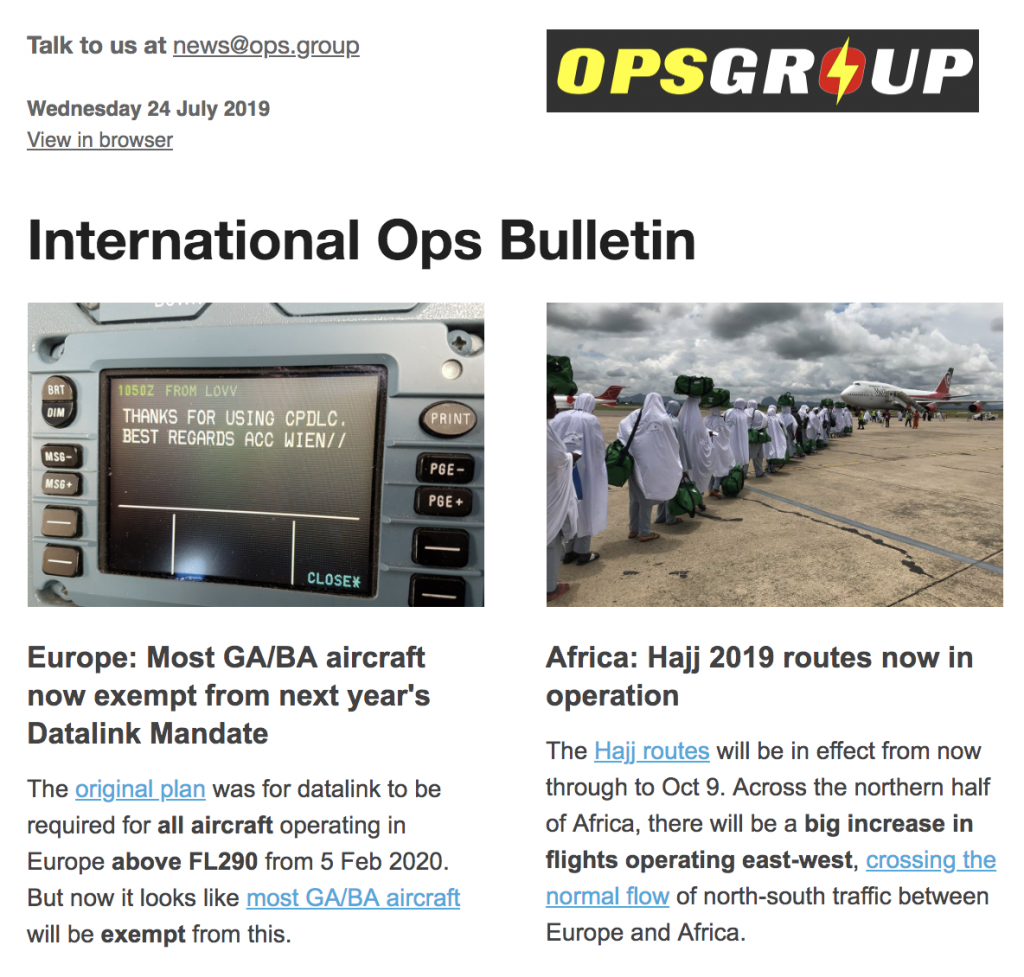
International Ops Bulletin

Hey! Are you here for our World Famous International Ops Bulletin? The one where you get all this weeks new dangers and changes in International Ops? The one that 50,000 people read every week?

Cool. Here’s how to get it.

Every Wednesday, OPSGROUP issues a weekly International Ops Bulletin for International Pilots, Dispatchers, ATC, Regulators, Authorities, Airlines and Aircraft Operators.

We cover this weeks changes to International Flight Operations – Airports, ATC, Procedures, New rules, Visas, Airspace alerts, Weather issues, and warnings and dangers to international aviation.

You got choices:

  1. Get the free version. Grab a copy!
  2. Join OPSGROUP and get the full version.


Want to see a sample first?

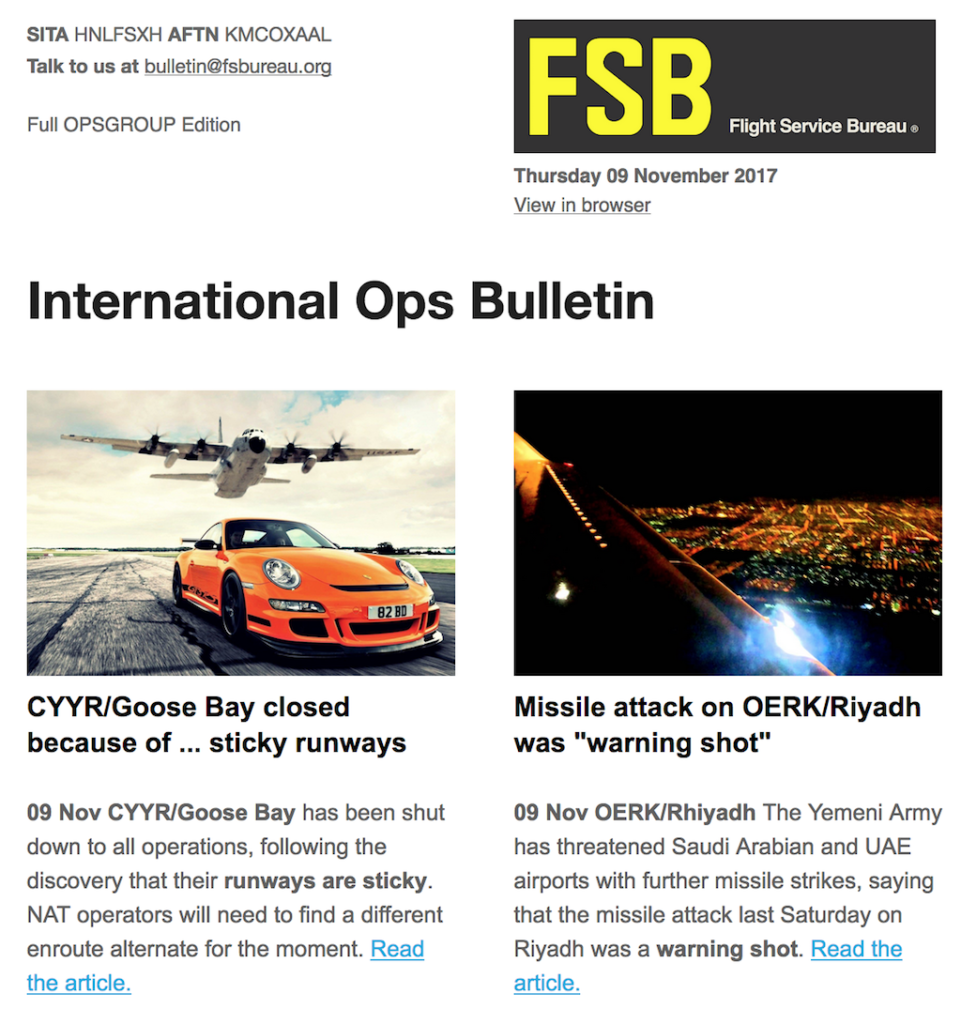
Sure thing. It looks a little like this (click to open the full sample):


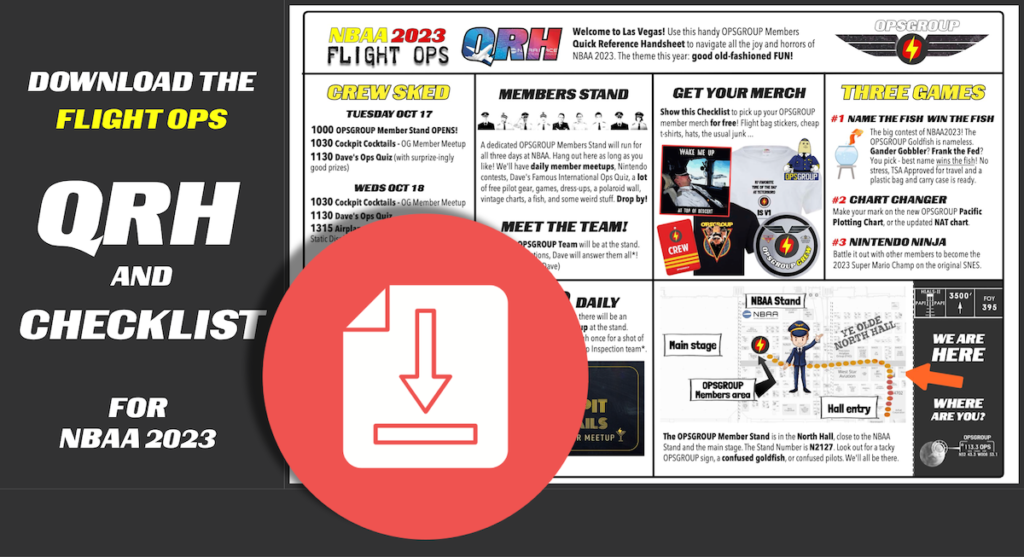
OPSGROUP at NBAA2023 – your checklist & QRH

Key points
  • The whole OPSGROUP team will be there. You better come see us.
  • Download the OPSGROUP NBAA23 QRH
  • Check off the Checklist items below

The show is almost here! OPSGROUP has a special members stand for you at NBAA 2023. There’s a lot to look forward to, and as always, our focus is on our member pilots and flight dispatchers.

Also, as always, we’ll use as few words as possible to tell you what not to miss. We warmly invite you to visit the members booth – meet the team and other members – and we reallllly look forward to seeing you there!

Start by downloading the OPSGROUP QRH for NBAA 2023.

Now, go through the checklist … then you’ll be up to speed on the happenings at the show.


Checklist Item #1 – Get Merch

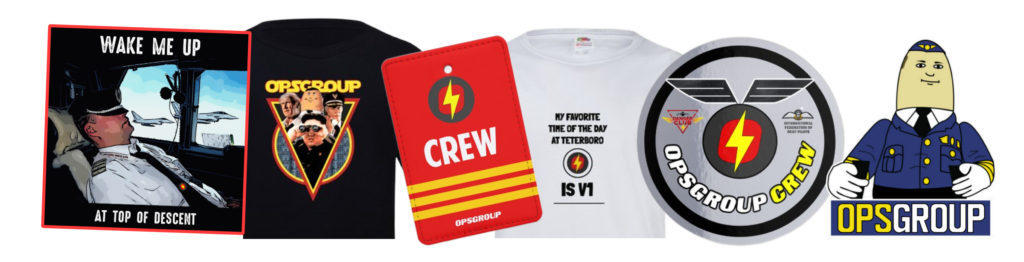
We’re paying the excess baggage and hauling suitcases full of merch to NBAA. Dodgy Flight bag stickers, unfunny T-shirts, Crew stickers, Trucker Caps (freight dog style) – all the usual junk plus some actually decent gear.

Members: Reserve some OPSGROUP gear for yourself. Lots of fun stuff that will probably go fast: if you’d like to make sure you at least get a couple of things, let us know you’re coming and we’ll put some aside for you. You can also designate someone else to come by and schlep your junk home.


#2 – Join V-FOG

Join the Vegas WhatApp group for Flight Ops: Pilots and Dispatchers. Just send a WhatsApp to +1 747 200 1993 and say “V-FOG!” and you’ll be added to the group.

Welcome to V-FOG! Nobody’s “running” this, it’s just a super informal group for flight crews at the show, so we can tell each other where the free drinks are. No ads, no “visit our booth! 😁”.

Ask a question (‘how do I get to the static’ will be #1), get directions, share some interesting talks coming up, or a selfie of you on a BBJ, good stuff. Might work out well, might be awful … let’s see how this goes.


#3 – Cockpit Cocktails: OPSGROUP Member Meetup 

1030 every morning
Come along to the OPSGROUP Member Meetup at 10:30 am Tues, Weds, and Thurs.

Hang out for a bit with some other members, play Nintendo, name the fish (don’t win the fish), play chart-changer, inspect some vintage memorabilia, dress up in your favorite outfit (costume closet at the booth), add yourself to the polaroid wall.

Codeword “Ramp Check” for a free dash of  “Irish Cream” in your coffee.


#4 – Three Games (okay four)

  • Name the Fish, Win the Fish – star of the show will be the OPSGROUP fish. It needs a name. To enter, just grab any free item of merch, and give him a name. There will be a winner – and the risk is, it might be you. Don’t stress, we’ve checked with TSA and live fish are permitted on board the aircraft. We’ll even give you a carry case and plastic bag.
  • Chart Changer – Make your mark on the new OPSGROUP Pacific Plotting Chart, or the updated NAT chart.
  • SNES champ – We have an original Nintendo in the members lounge. 2 player games: battle it out for the hotseat. Super Mario, and the original Top Gun!
  • Oh, and a fourth game: Dave’s International Ops Quiz. Every day at 11:30. There are some epic prizes here.


#5 – Join the International Federation of Okay Pilots 

We’ll have a representative from I.F.O.K.P. at the OPSGROUP members stand.

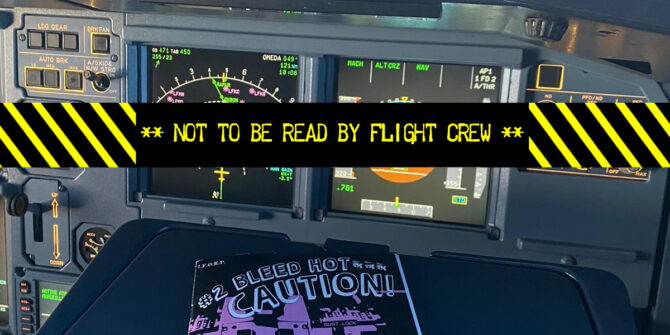
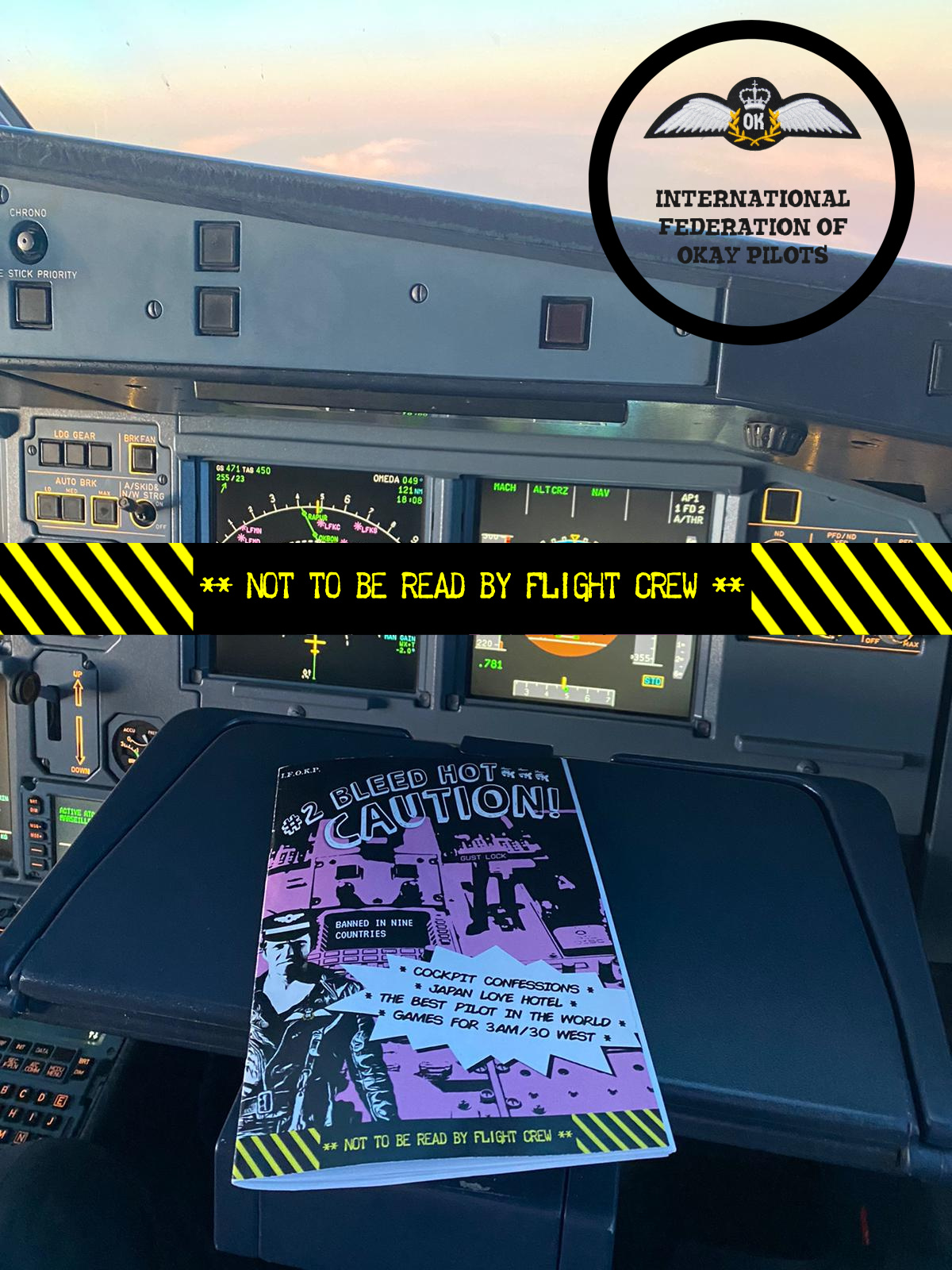
You can join (for free) at the show, and get your welcome pack, sticker, and the flight crew Zine, #2 Bleed Hot Caution.

Since first being published, #2 Bleed Hot Caution has been banned in nine countries. I.F.O.K.P. have therefore affixed a warning label to this edition.

There is a limited number of zines available, so once again for OPSGROUP members: Reserve one for yourself. Let us know you’re coming and we’ll make sure to put one aside for you.


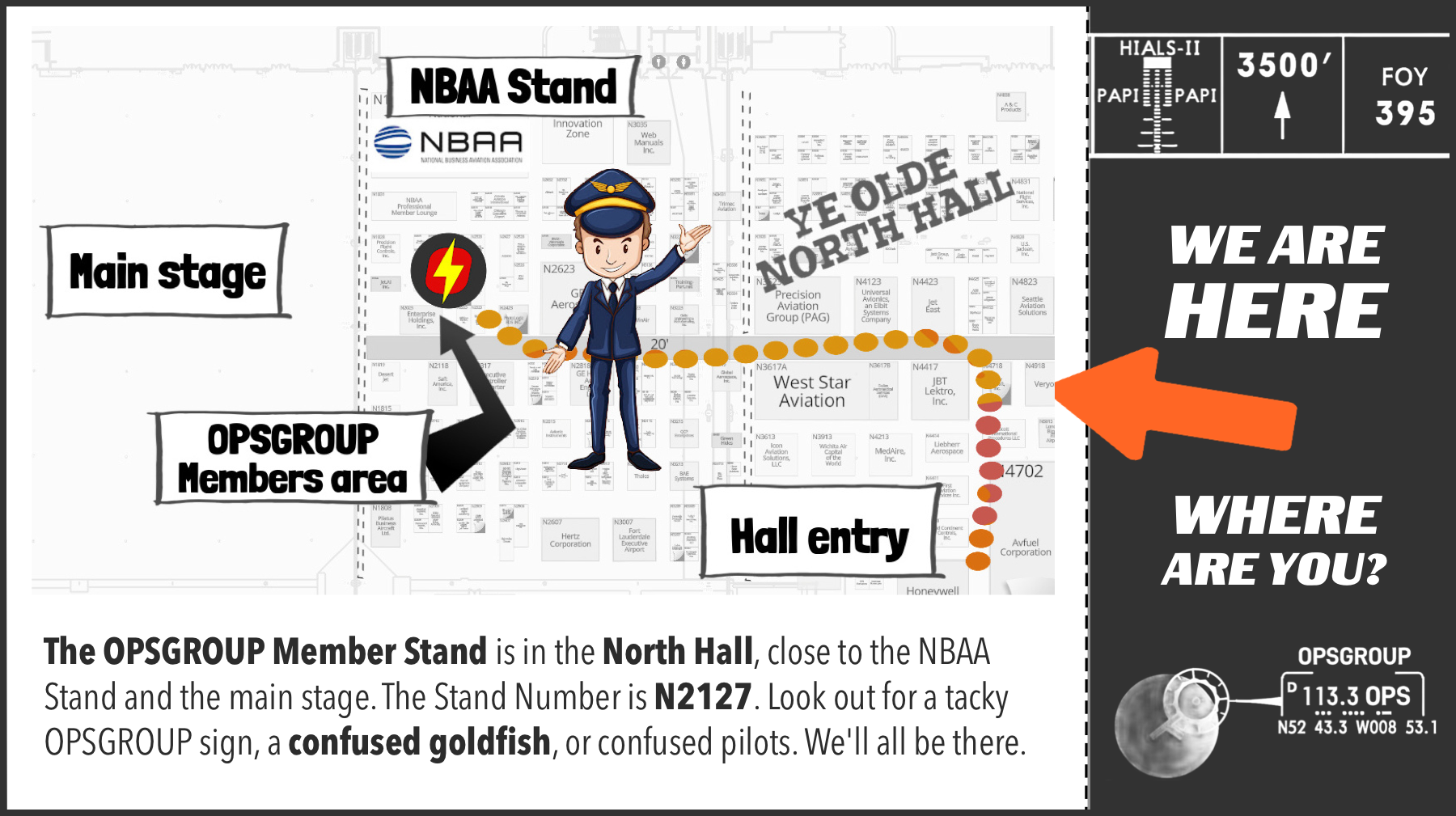
#6 – We are here. Where are you?

We’re at N2127. Find us in the show directory here, which will help you navigate your way to the member stand.


#7 – Volunteers please!

We have a handful of member volunteers already, but could really do with a few more! If anyone wants to help out at the members stand for an hour during the show, please let us know! This is an easy & fun hour – you’ll take care of saying “hi” to members dropping in, show them around, give out some fun merch, and help coordinate some of the Quiz’zes and games at the booth. Just email vegas@ops.group.


See you all soon! Any questions, ping us at vegas@ops.group. We’ll also be in the V-FOG group (join that here – just WhatsApp “V-FOG”) .

Cheers – the OPSGROUP Team


Curious happenings in the OPSGROUP village

Hello members!

We hope you’re doing well!

It’s been a few months since we wrote with a “Member Update” … and there are a lot of things to tell you about. Big ones first, little ones last, but read to the end for the best one (Dave making waffles).

#1 The New OPSGROUP Crew Room

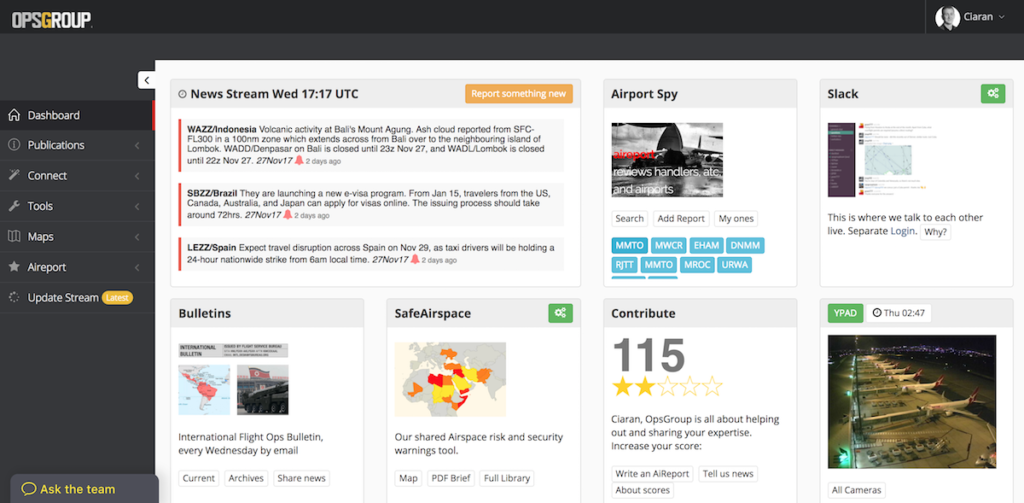
OPSGROUP is more fun when you do it with others, as the saying goes. We’re in the midst of building out our fresh new Crew Room. Other members are here and you can speak with them, and us!

Get involved:

  • Link: ops.group/crewroom
  • Check that your profile is correct, and upload a pic of yourself.
  • Draw a better logo for the Crew Room and send it to us!

#2 Crew Room access

We use an app called Slack to run the crewroomDownload it for your phone or desktop. Use your member email to login.

Once you get there, do this:

1. Check your profile: does it show your full name?
2. Upload a picture.
3. Now you have full access to the Crew Room!

#3 Ops Kitchen

The #ops_kitchen is the channel in the Crew Room where the OPSGROUP Team hangs out. We’ve made this a public channel so you can see what we’re talking about, and help out if you like. Things we talk about here: today’s ops and airspace issues, ops alert preparation, new things we’re making, maps, charts, guides, and so on.

Get involved:  If you want to be part of making new things for the group, or just curious what’s going on today, join this channel. We look forward to seeing you there!

LinkCrewRoom: #ops_kitchen


#4 OPSGROUP LOCAL

LOCAL is more fun than global. With 8000+ members, we thought it would make sense to start some local “branches”: even Antarctica and Timbuktu have a smattering of members.

The local branch is for those based there, and those visiting. You can connect with other members near you, and perhaps organize a meetup or a visit to the local ATC unit. Update the rest of the group on what’s happening where you are, and help visiting crews coming your way.

We’re starting with these locations:

#newzealand
#australia
#singapore
#hongkong
#italy

Get involved:  If you are based in any of those spots, or headed there .. join the channel and post a quick intro to say hi!

As we add more, we’ll post a note in the #crew_lounge channel. Tell us where you’d like the next local set up?


#5 Weird, new, risky, curious?

The only person that really knows what’s happening out there is YOU. Logically, if you don’t tell us, we won’t know. So if you’re downroute (or uproute) and you come across something in the wild that doesn’t make sense – tell us, please!

Not sure what to report on? Here’s the litmus test: would you mention it to another crew going to the same place? If yes, then, tell us so we can tell all the other crews.

The easiest way is to add our number to your phone: +1 747 200 1993, and send us a WhatsApp message (with photos, too!) when you spot something new.

Or, you can email us: news@ops.group.

Thank you for keeping the group up to date!


#6 Atlantic


The North Atlantic is topic-of-interest-number-one for OPSGROUP members, so we’ve set up a LOCAL channel just for the Atlantic ocean region: probably mostly about NAT (North Atlantic) flying, but also mid/south Atlantic, EUR/SAM corridor etc. NAT topics, HLA, NAT Tracks, Clearances, Procedures, etc.

In the last few days some good discussion about:

* Removal of Oceanic Clearance issuance (in next NAT Doc 007)
* New Lost Comms procedure for the NAT
* New Squawk 2000 procedure (10 mins instead of 30 mins)

Get involved:   Join that conversation in the Crew Room: #atlantic


#7 Danger Club – ideas for the next one?


Danger Club is the OPSGROUP spot for some dangerous conversations about things that happen in the cockpit. If you’ve joined any of the first eleven sessions, you know how it works. If you haven’t, join the next one (and have a look at dangerrr.club).

We have a new channel in the Crew Room for Danger Club, and if this sounds like you, join the conversation: Crew Room: #dangerclub

Get involved:  We’re planning the next Danger Club (#12) and need a good incident to look at. Have you any ideas? Remember, this is all about how we are as humans in the cockpit, so we focus on incidents with some “interesting” human behaviour to give us some talking points to start.

Also, we’re hoping to do a Danger Club Live at NBAA 2023 in Vegas – more on that below.

Link: Crew Room: #dangerclub


#8 We have a spy in our midst


Actually, we have dozens. Are you one of them?

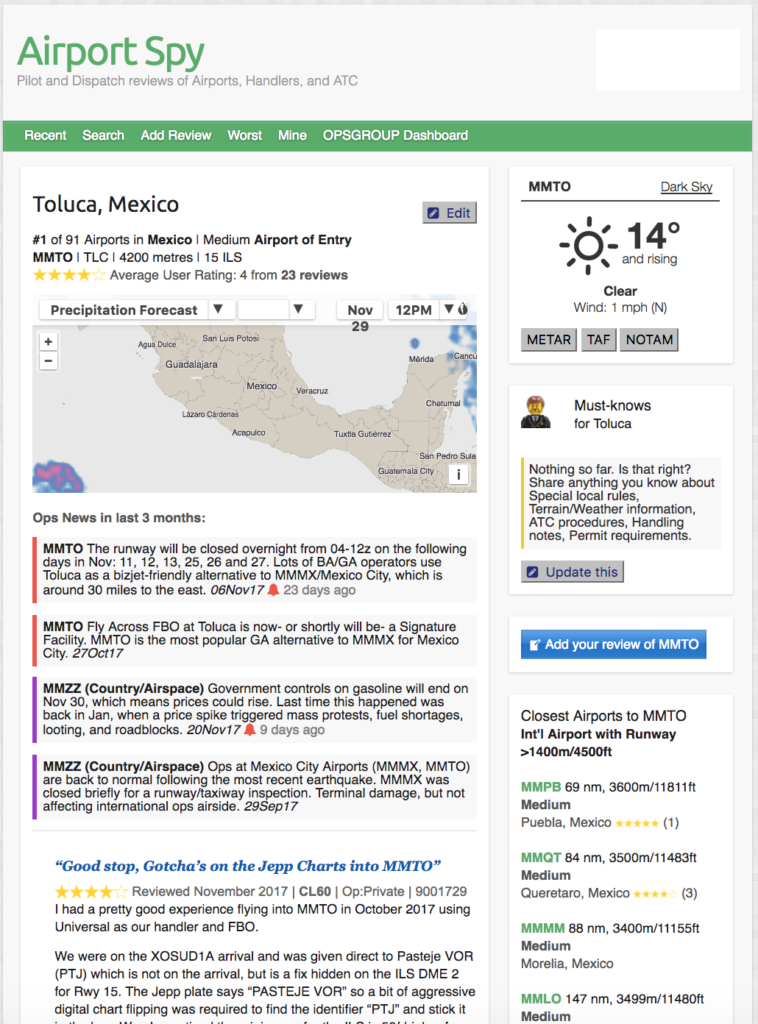
Airport Spy is getting busy lately: thank you to everyone who has been busy filing reports. You can help out too: when you get back after your trip, or downroute and bored at the hotel: use Airport Spy to write a quick summary.

These are useful for you the next time you visit the airport, but even more useful for other crews that haven’t visited yet. Sloppy handling, average ATC, or just an amazing experience – whatever you encountered, take 2 minutes and jot down the highlights.

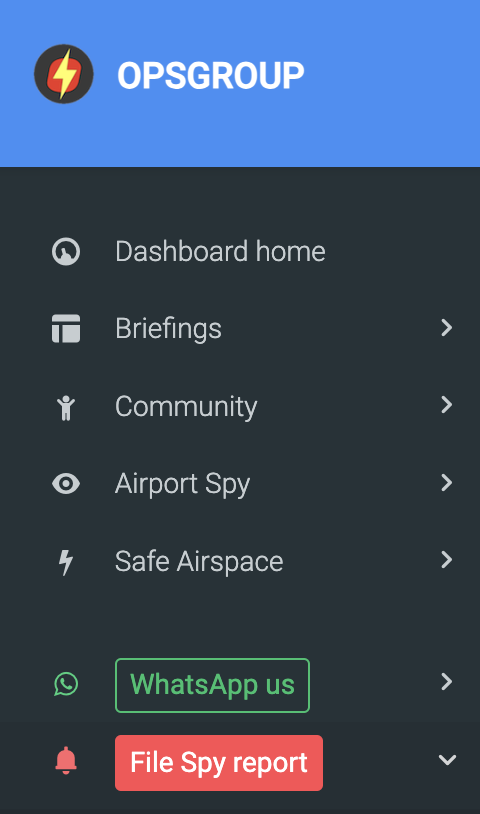
Get involved:   In the Dashboard, use the “File Spy Report” link as shown below:


#9 Vegas OPSGROUP meetup! Hands required


We’re heading for Las Vegas and the focus is: Waffles. Chef Dave will be on hand to lead the team, but we’re looking for volunteers to help run our club stand while he does the waffling.

NBAA BACE 2023 is on from Oct 17-19. If you’re going, and have some time to help out, let us know! Join the #vegas2023 channel in the Crew Room.

Our plans:

  • The OPSGROUP Team will attend in full
  • We will have a Club Stand in the North Hall of the Convention Centre
  • Get involved:  Members wanted! Help out for an hour: there will be lots to do!
  • We will have some good merch (see below) – Tshirts, pins, stickers, and Tiny Cock Pit Kits.
  • Member drop in: stop by and say hello (even if just for a minute)
  • OpsQuiz Live – we’ll host our famous Ops Quiz live (MC Dave)
  • Danger Club Live – we’re planning a live version for Vegas
  • Actual waffles
  • Actual coffee (New Zealand style Flat Whites)
  • more to come! 

Got some more Vegas ideas for us? Let us know!

LinkCrew Room: #vegas2023 


#10 Vegas Merch

Right now we’re busy desiging some flight bag stickers … and we need some member help with more ideas. We want to have a bunch ready for members at Vegas ’23 – what should we make? Ideas please either in the #vegas2023 channel in the Crew Room, or … email us.

  • T-Shirt ideas
  • Sticker ideas
  • Other ideas! 


#11 Everything else

That was a lot. Did you read it all? Good. If you’re not still here, we’ll wrap up with some snippets. These are them:

  • Coffee & Waffle : Our old Ops Chats were good, but we paused these last year and we think we can do better. We’re planning a new regular online meeting called Coffee & Waffle. It’s nothing more than an excuse to get together as members and have some good old fashioned chats. Thoughts on this? Email us. We’re thinking once a month, not recorded, no agenda, we’ll do it live!
  • Tell us stuff! We’ll ask again because we’re really keen to get your updates: scroll up for the WhatsApp number to text us new things! THANK YOU!
  • Ask us stuff! If there’s something on your mind, just email us. We like email, and we like replying, and we will!
  • And that’s the end of the end of the updates, for this time. Have a smashing weekend!


(Adventurous) Flight Ops Assistant WANTED!

Hi there!

We’re hiring again: this role is for a Flight Ops Assistant at OPSGROUP. Might this be you?

There are some hidden instructions in this post. Read carefully! At the end, you’re going to go on an adventure, so be ready!


Let’s get started!

The first question you might have is, what does a Flight Ops Assistant do? This role is a junior one, but you’ll be a core member of the OPSGROUP Team. You’ll assist with the daily work that we do for our members, and at the same time learn more than you can imagine about the weird and wonderful world of International Flight Operations. So for the right person, it’s a win-win.


A day in the life of a Flight Ops Assistant…

When we say “Every day is different”, it’s actually true here. That’s the beauty of international flight ops – Monday is a problem on the North Atlantic, Tuesday is an ATC strike in France (OK, that’s every week right now, but …), Wednesday is a typhoon heading for Tokyo. But an overview of the things you would do are this:

– Keep an eye on member messages – a request for help, or a notification of something new.
Fact-check: assess reports coming in, and communicate with CAA’s, FBO’s, ATC, Airports to nail down the skinny on the latest risks and changes.
Write crisp, clear ops alerts in plain human-friendly English for our members.
Help compile the Daily Brief for members.
– Research larger operational risks and changes for blog articles and guidance to members, and write helpful, clear articles.
Coordinate our chats, meetings, events: Danger Club, Coffee & Waffle, OPSGROUP Local.
Help with some of our focus work: NOTAM reform, Safe Airspace, Pilot-Controller workshops.
– Take part in our Team chats, and help track new ideas for member tools, resources, useful articles, maps, and other genius things.
– Keep our flight ops databases, member information, and airport info up to date.


Who are you?

Here’s the first (not so hidden) instruction – when you start your adventure down below, make sure to give us a sense of who you are. For sure, some flight ops experience is important, but we like working with people we like. That doesn’t mean “people like us”, it just means that you bring great energy.

As this is a junior role for an assistant, we’re not expecting you to have twenty years at the pointy end of international flight ops – but you should have a solid basis in flight operations: dispatch or flying, real world, a few years at least. We’ll help take that foundation and expand your world; you’ll learn, grow, and take on new challenges here.


The deets

  • Working hours: Weekdays (Monday-Friday), daytime hours, full-time. We have a target of 6 hours of good work each day, and most weeks will average out at 30-40 hours of work.  You decide (mostly) when that happens – no night shifts or back of the clock grinding required!
  • Payment: Monthly, fixed-rate. Some weeks more, some weeks less – depends what’s going on.
  • Location: Your island, cabin, apartment, garden, boat, tiny home, co-working space – wherever you have a quiet spot to yourself and some decent internet. We might have a preference for a US timezone in this regard (UTC-4 to UTC-8), but we’re open.


Ready?

You can do your first interview already! It’ll take about 20 minutes. We’ll take you on a little adventure, ask you some things, tell you some things. All you need is your big computer (couple of practical things to do, so your phone isn’t ideal) and a little time.


New Dashboard Tool – Airports and Countries

Hi Members,

If you’re planning a trip somewhere, you might have used the search tool in the Dashboard. We’ve just added a new feature, so read on.

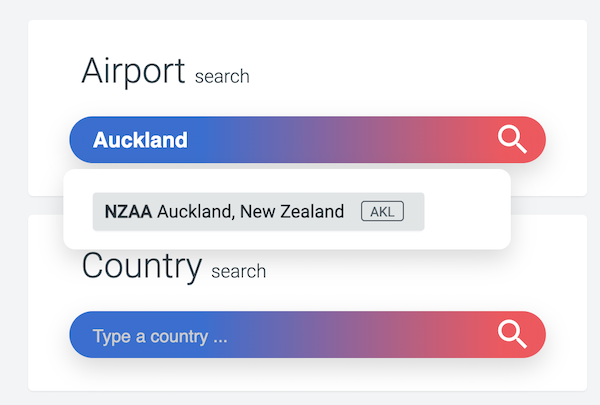
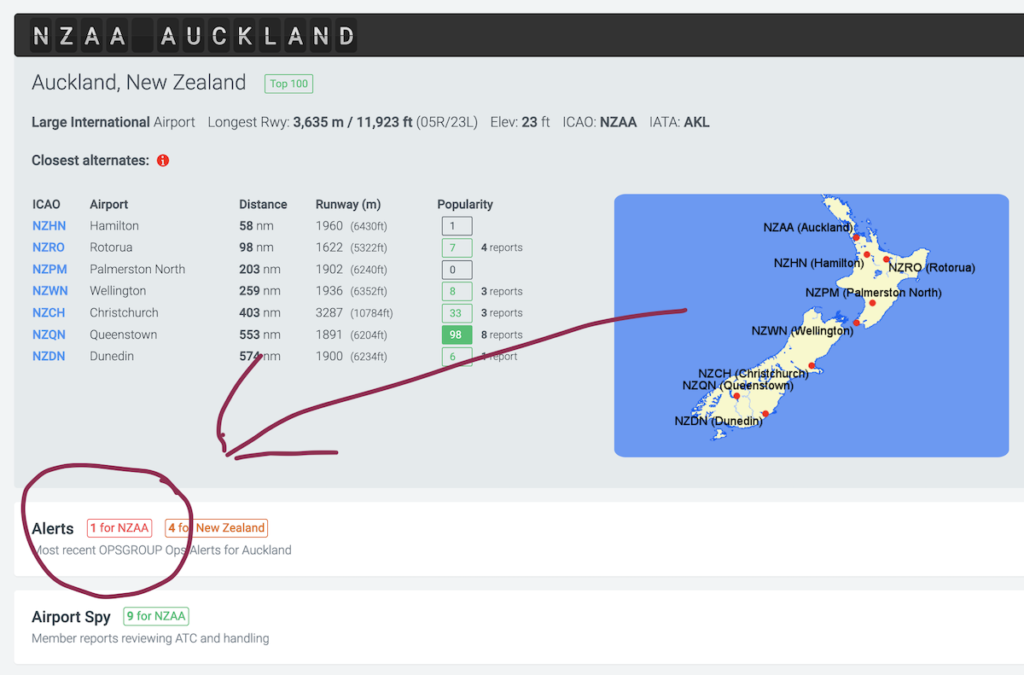
Let’s plan a quick flight to Auckland, NZ. So, on the main Dashboard page, just type “NZAA“, or “Auckl …”


You’ll get this panel showing all the things we know about Auckland in OPSGROUP.

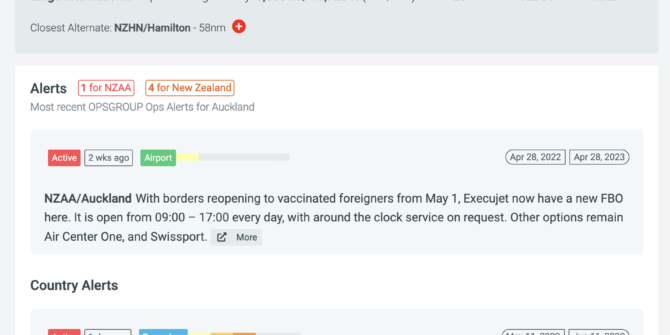
Click on the Alerts tab to see what’s been happening lately, from a flight ops point of view.


Until now, we’ve been showing current alerts, and those that expired in the last 3 months.

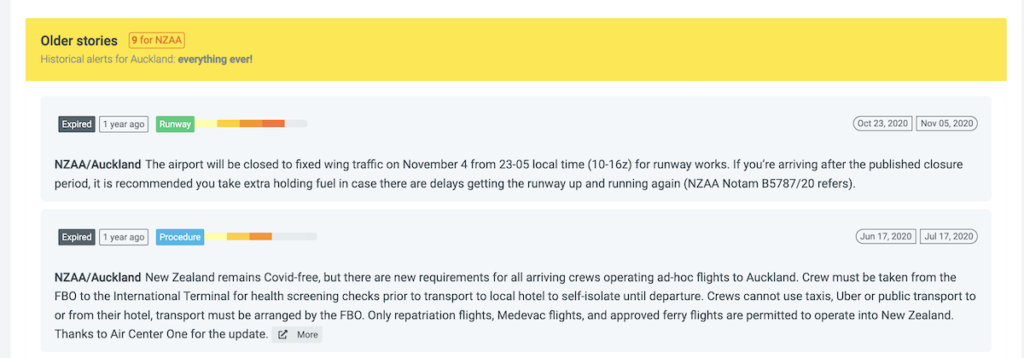
But now, we’ve added the option to see all historical alerts.


For both the Airport and Country search pages, you can go back in time to the beginning of OPSGROUP, and see everything ever said about that place. This might be handy to get an overview when operating to somewhere new.

What else?

Keep scrolling down and you’ll see the rest of the tools that will help you with that particular airport.

Airport Spy reports from other members …

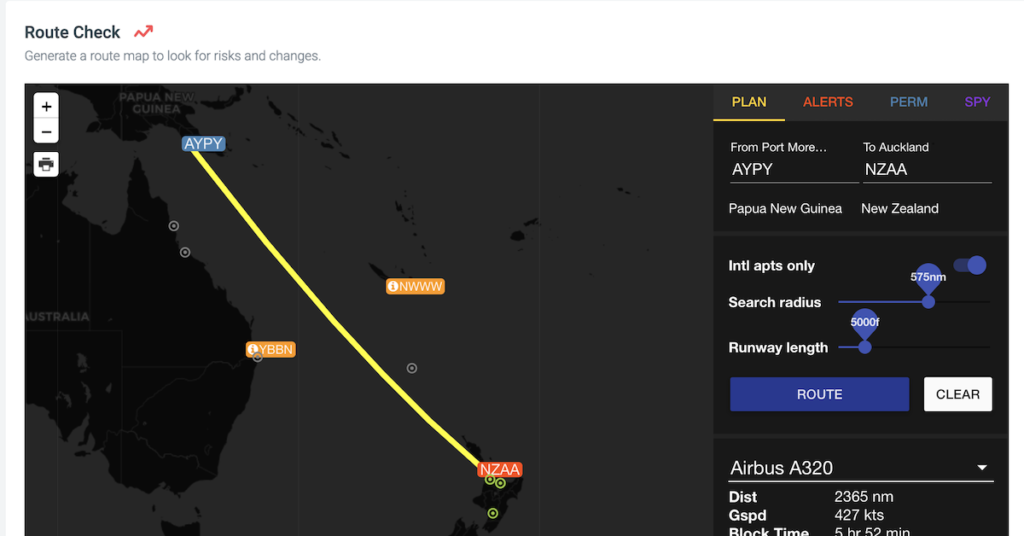
Run a quick Route Check to see what bothersome changes might affect you enroute … and your fuel, time, distance.

Here we’ll plan a flight from Port Moresby to Auckland …


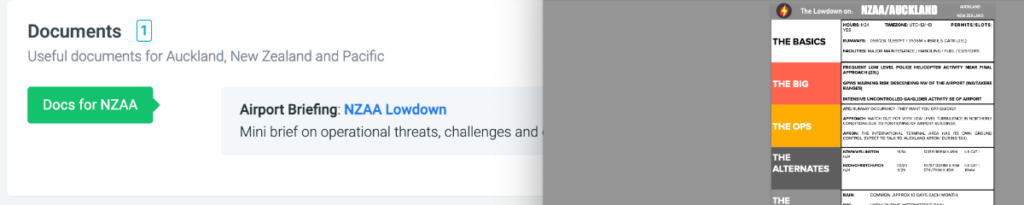
The documents tab usually has some goodies. Excellent, looks like Bec has made a Lowdown for NZAA!


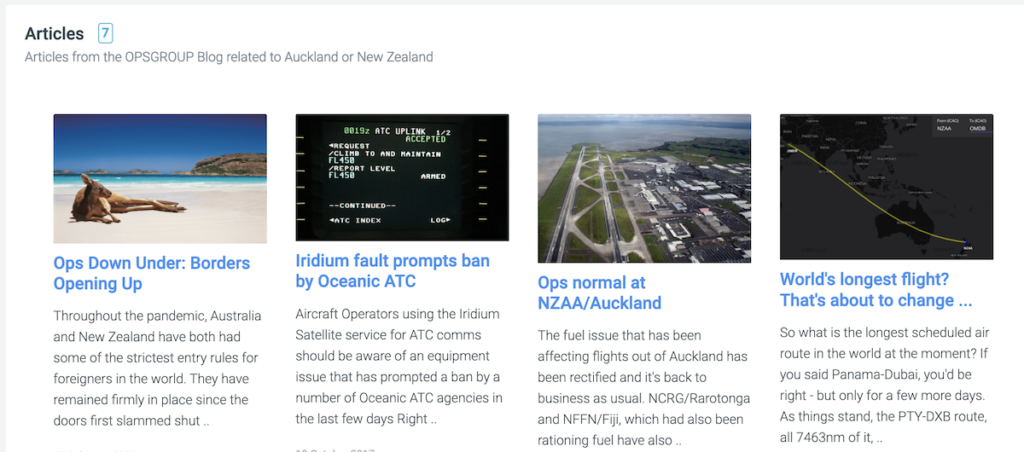
The articles tab should find any blog posts or articles the OPSGROUP Team has written affecting this airport or country.


Not interested in Auckland? Don’t blame you. The rest of New Zealand is far better! 😉 Try a search for NZCH, NZDN, or NZQN – or anywhere else in the world, in the search box at the bottom.


Enjoy! Let us know if you have any questions or we can help at all. We are always adding new features and that works best when you tell us what you need 🙂

Cheers,
The O.G. Team.
team@ops.group


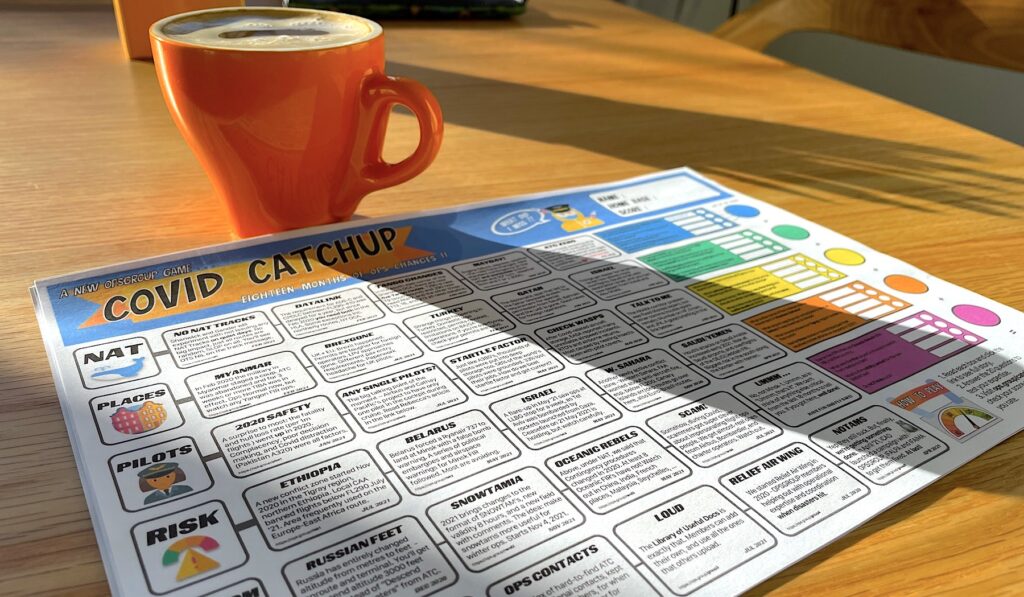
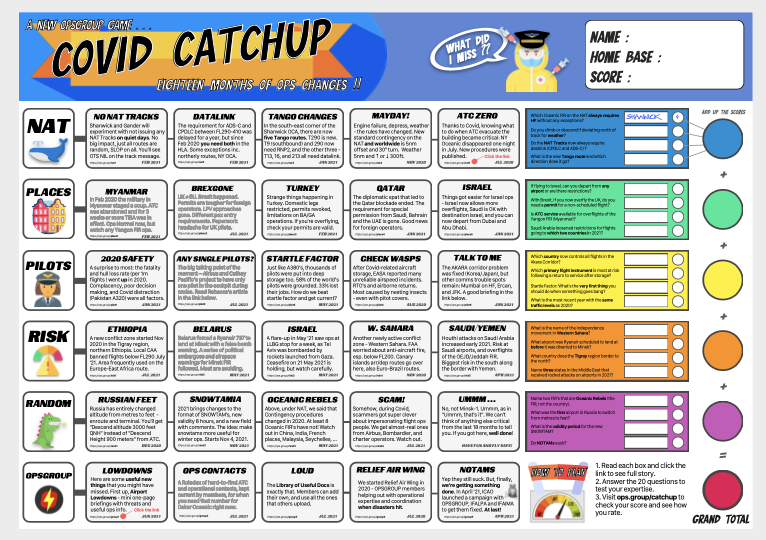
Covid Catchup: 18 months of ops changes in one game

Hi members,

I don’t know if you’re one of the many returning to international ops this summer, but quite a few of the group are.

The last 18 months have seen quite a lot of changes for international ops. If you’re just jumping back into the cockpit after a prolonged absence, it would be good to know about them – right?

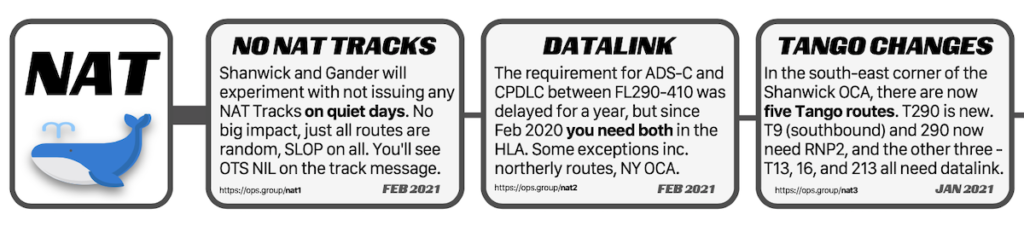
We thought the best way to communicate that summary was in a game!

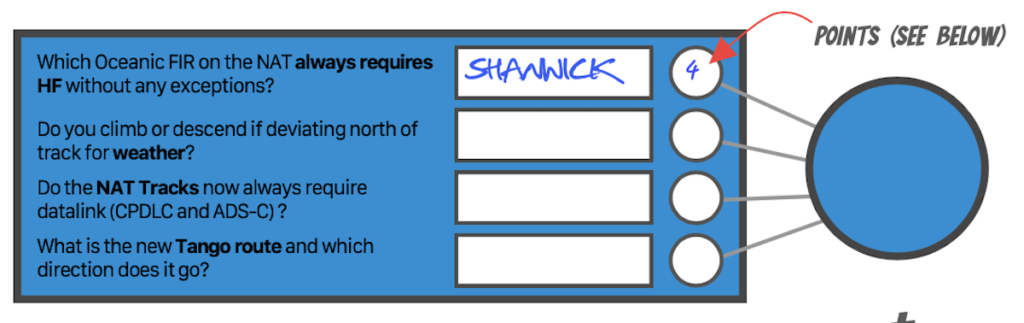
So we made Covid Catchup. It’s easy to play: follow the boxes, read a little, and then answer some quiz questions to see how you rate.

It’s in PDF form so you can download it, print it out, or play it on your iPad (and feel free to share with you friends that might not be group members).

How to get the game?

We’re dropping it into OPSGROUP Slack this evening. Just go to the #crewroom channel and you’ll see it there.

If you’d prefer to get the game by email instead, we can do that – just send a note to ops.team@ops.group.

Enjoy the game and let us know how you do! We’re pretty confident that if you do well on it, you’ll be up to speed on all the big changes since January 2020.

Cheers,
The O.G. Team.

How to play

1. Get the full game in OPSGROUP Slack
2. Print it out, or open the PDF on your iPad

3. Each box has a little nugget of operational change. if you don’t know about it, click the link for the full article. The date is when the change happened.

4. Answer the questions
5. Finally, check your answers and see what points you got for each correct one (all are different!)

Don’t forget to share you how did! You can humble-brag your high score claims in the #crewroom channel 😊


Global Campaign on NOTAM Improvement

Update: The NOTAM campaign was launched with 1,500 attendees on April 8th – and yes, it was the largest virtual event in ICAO history! The first update webinar on progress being made is on June 16th at 1200Z – register with this link, and join the call.


The Global Campaign on NOTAM Improvement is being launched on April 8th, 2021. Spearheaded by ICAO, and supported by OPSGROUP, IFAIMA, and IFALPA, the campaign will focus on making significant improvements to the NOTAM system to enhance its effectiveness, usefulness, and reliability as a mechanism for pilots to receive critical flight information.


Kick-Off Webinar, April 8th 2021

At 1200Z on April 8th, 2021, we will launch the campaign with a worldwide webinar. So far, we have 600 registered participants. We are on track to make this the biggest virtual event in the history of ICAO. If you think about it, that’s pretty amazing for a meeting about NOTAM’s!

This webinar is open to everyone, and we would be delighted to have you join it – to show your support for the Notam Improvement campaign, to learn more about what the plans are, get the latest update, and see how you can get involved: this is a collaborative, shared mission that needs your help, whether you are a pilot, dispatcher, AIS officer, software developer, Flight Planning provider, ANSP, CAA, or are in any other way a user or provider of some aspect of the Notam system.

So, please join us – it’s open to all:
Register for the Worldwide Webinar on Thursday, April 8th, 2021 – 1200 UTC

1200 UTC = 7am Lima, 8am New York, 1pm London, 2pm Berlin, 4pm Dubai, 7pm Bangkok, 10pm Sydney, 12am Auckland.


Why should I join the Webinar?

Over the last few years, as many as 10,000 pilots and dispatchers have supported a move to fix Notams – through petitions, surveys, comments, emails, and joining the OPSGROUP Notam Team to help fix the problem. Your voice has been heard: this work is the result. Now, we need your support for this campaign – to reinforce the message that as an industry, we really care about this. Your presence will encourage those working on solving the Notam Problem, and you will get the full picture of where we stand in the progress to fix things.

We will speak about the mission, demonstrate the problem with some real world examples of pre-flight briefings, showing how these impact the daily lives of pilots and dispatchers, clarify the definition of “Old NOTAM’s”, and show how AIS staff can use the existing regulatory framework in Annex 15 and Doc 8126 to become a gatekeeper for NOTAM quality, demonstrate the Notameter, address regional challenges, and have a Q&A session.

Our presenters and speakers will include Stephen Creamer (Director of the Air Navigation Bureau at ICAO), Alex Pufahl (ICAO Technical Officer), Mark Zee from OPSGROUP, Capt. Lauri Soini from IFALPA, Fernando Lopes and Antonio Locandro from IFAIMA, Marco Merens from ICAO, and ICAO Regional Officers.


What is the Notam Campaign all about?

First, the problem: Pre-Flight NOTAM Briefing packages are often far too big to be fully read and understood by pilots before a flight. The result: critical information is missed. Finding safe ways to decrease that volume is the key focus of this campaign.

In the Global Campaign on Notam Improvement, our aim is to solve the Notam Problem in manageable chunks, gathering energy as we solve them and make progress. Rather than re-invent the wheel, we will fix the system from within, starting with the easier aspects and progressing from there. The first phase of this campaign focuses on Old Notams. At any one time, there are about 35,000 active Notams globally, and 20% of these – one in five – are old; in other words, not respecting the existing rules of Notams being issued in principle once only for a maximum of three months (everything else should go into the AIP, an AIC, or some other publication).

We are drawing on the collective cooperation of the AIS community – the Notam Officers – to uphold the rules and get rid of Notams that don’t follow them. The result will be a potential decrease of 7,000 Notams per month, and a 20% reduction in the size of the average briefing packet. For more on the Notam Problem itself, have a look at “Why pilots are reading a Reel of Telegrams in the Cockpit“.


Who is behind it?

The Global Campaign is a meeting of minds, agreeing on one thing: Notams need fixing.

ICAO is spearheading the campaign, in the recognition that the Notam Problem is a worldwide issue that affects flight operations in every country.

Providing support, energy, and huge enthusiasm to help solve things are IFAIMA, representing the Aeronautical Information community, IFALPA, voicing the concern of Airline Pilots, and OPSGROUP, whose pilot, dispatcher, and flight operations members have been tirelessly involved in the mission to fix Notams since 2017.


What can you do to help?

Thank you for asking! If you are in the AIS community – perhaps as a Notam Officer, AIS Officer, Publisher, or Promulgator – please tell your colleagues, join the webinar, and get involved in this Campaign. If you are a Pilot or Dispatcher, join the webinar, share the news of this campaign (#NOTAM2021), voice your support, and monitor progress – we’ll want your help down the track as well. If you are a Flight Planning Provider or Software Developer – again, join the webinar, and when the time comes, get involved in the collaboration around technical improvements. If you work for an ANSP or Civil Aviation Authority – join the webinar, encourage your colleagues to join too, and help support the Campaign. If you work for an Organziation, tell your members, and share news of this campaign (#NOTAM2021). Oh, and join the webinar!


How we got here …

This is a Global Campaign for a very good reason. We only solve this problem when we solve it for all countries – so we take the lessons learned domestically from those countries that have seen NOTAM wins, and amplify that across the rest of the globe.

In terms of change so far, most notable is the work done by the AIS Reform Coalition in the United States, chaired by Heidi Williams from the NBAA. This group of people from NATCA, ALPA, AOPA, IATA, A4A, ACI, the NBAA and others have been working feverishly in partnership with the FAA to drive change and improvement. And it has had remarkable results – the US has radically improved NOTAMs in the last 2 years: NTAP gone, a big reduction in PERM Notams, a single office for AIS, a transition to the FNS, and NOTAM Search replacing Pilot Web. Canada has transitioned to ICAO format for Notams, and provided a new delivery mechanism through CFPS.

We must also recognise huge efforts from the members of OPSGROUP, who as pilots, dispatchers, and other flight operations specialists have made their voice heard, sharing support, input, ideas, and enthusiasm for change; the efforts of IFALPA to bring attention to the issue, and IFAIMA who have given full support to solving things on the AIS side.

An important distinction to make here is that this work is on “NOTAMs, Now“. There is separate, ongoing work in the field of the “Future of NOTAMs”. You may have seen acronyms like SWIM and AIXM, and terms like Digital Notams or Graphical Notams. The FAA, ICAO, Eurocontrol, and other agencies are building a model for the future, when NOTAM’s will change from the current AFTN format and transmission into an internet, IP based, transmission and follow a service-oriented approach. This work is valuable, but with a target implementation date of 2028, has a different focus. Even if it goes smoothly, it would not instigate change until 2028. Needless to say, if we don’t fix the underlying issues now, it may not even solve them then, either.


The AIS Community, Pilots, and Dispatchers, working together

Here’s the really exciting part of this Campaign: for the first time we are seeing pilots, dispatchers, and AIS staff working together on solving the issue. This is a core tenet of the campaign: only when you have all parties involved, do you have a shot at success.

The AIS Community is invaluable in solving the problem, but they need our help. First, they need to know exactly the impact of the Notam Problems we describe – this drives their will to make change and improvement. Second, they need the support – which this Campaign will provide – to stand as gatekeepers for Notams. They themselves are often under pressure to publish Notams that they know don’t align with the rules, but have no alternative.


Phase One

So, once the Campaign is launched, what does the roadmap look like? Logically enough, we start with Phase One. A simple, bite-size chunk of the problem – Old NOTAM’s. In volume terms, it’s a lot more than bite-size – it’s actually 20% of the problem. The key is that it’s easy to understand, and therefore easy to work on. We don’t need to make any structural changes, or change how the system functions. This is simply about focusing on a known issue – that 7,000 of the 35,000 active Notams that should not be there.

Even more importantly, the focus is also on the energy, enthusiasm, and goodwill to make the changes necessary. As we gain momentum, we get encouragement from each and every Old NOTAM that is removed forever. We see that through collaboration, community, and support for each other, we can make change happen.

Remembering that this is a decades old problem that has been on the agenda since 1964, and that there are 193 countries on this journey, progress may feel slow at first. But we’re going to learn from each other, and go as fast as feels right. We’ll be celebrating the small wins!


Phase Two

The next phase will look at technical improvements. In other words, what structural and systemic changes can we make to NOTAM’s to leverage quick improvement.

We envision that this stage will be best served by a great deal of collaboration and discussion. One of the key groups here will be Flight Planning software providers. The vast majority of NOTAM briefings today are provided by these companies. As things stand, each one has a different, in-house method of processing the Notam flow – usually with algorithms, keyword searches, date/time validity ordering, and some Q-code assessment. So we might ask, how can we best structure the Notam data to provide a robust, reliable format with metadata that allows sorting and filtering – the two big asks from the pilot community. In other words, show me the critical stuff first, and skip the fluff.

We also, again, need full collaboration with AIS to see what the impact of those technical improvements will be, and whether they support them. Adding pilots and dispatchers into the mix will allow us to verify that the changes being discussed will actually have an impact by the time they reach the cockpit. If they don’t, then we’re not doing it right.


More about #NOTAM2021


A is for Airplane: The OPSGROUP 2020 Wallchart

2020 was a long, sometimes challenging, sometimes exciting, sometimes sad… and always very Covid filled year!

We wanted to take a quick look back at some of the things which really stood out to us over the past twelve months.

So we wrote a list…

The list became a little poem…

And then, as a logical next step, the poem turned into an ABC wall chart!

Here it is in all its glory!

You can download a nice hi-res version by clicking on it. Print it out, stick it on your wall, send it to a friend – whatever you like.

The OPSGROUP 2020 Wallchart was designed by our wonderfully talented artist friend, Cecilia La Rosa, and you can see more of her amazing work here.

A is for Airplane, flying high as a bird

As always, airplanes were on our mind. The safety of them, the places they are going, and the people flying in them.


B is for Bureaucracy and unreadable words

Messy Notams, changes to charts, new regulations, old documents – we tried to keep you updated you on changes you needed to know about, mainly by writing things in an easier-to-read way.


C is for Covid not going away

No 2020 wall chart would be complete without a mention of Covid. Traffic across the world fell by almost two thirds. Then it started to improve, then it got a bit worse again, and then the vaccine came out – unfortunately, shortly followed by a new strain of the virus… Here’s hoping 2021 sees the end of it.


D is for Datalink on the NAT HLA

The Great North Atlantic Datalink Mandate. It went into the final phase on 30 Jan 2020, and if you want to fly between FL290-FL410 you must be equipped with CPDLC and ADS-C… But then due to Covid this got delayed a number of times, with Shanwick saying it will remain suspended until 25 Feb 2021.


E is for Errors of the Gross Nav variety

The FAA changed their definition of Gross Navigation Errors to mean anything more than 10nm. You used to have 25nm before you got into trouble (except for on the NAT HLA which was always 10nm).


F is for OpsFox, a secret society

Business at the Lucky Star Chicken restaurant was up in 2020. Goat Curry (number 64 on the menu) proved to be a popular favourite. Join the secret society and submit your reports.


G is for Guy Gribble, gone too soon

Our friend and colleague Guy Gribble passed away on 26th October 2020.

Guy joined OPSGROUP on Day 1 (some four and a half years ago), and was an ever-present contributor, collaborator, mentor and friend to us. If you’ve ever sent us an email with a difficult question and received a good answer, the chances are that Guy Gribble was the man behind the scenes who helped us figure it out for you. We lost count of the number of times Guy would post replies on Slack giving people advice and guidance.

The NBAA will have an award named after Guy for “Outstanding Contribution” – which tells you all you need to know about the impact he had on the industry.

Thank you Guy and Rest in Peace – your legacy continues.


H is for Humans, me and you

Our mission is to make aviation human-friendly for us all.


I is for Israel overflight clearance

Big news from the end of 2020 as Israel rebuilt relationships with the UAE, and for the first time in decades we saw a flight between the two nations. Israel then opened their airspace for overflights, and Jordan allowed Israeli bound flights to pass through their airspace as well. The overflights mean shorter, more efficient routings, and it’s a highlight of the year that friendships are being rebuilt between Israel and neighbouring regions.


J is for Jamming and GPS interference

GPS Jamming remained an issue, particular across Eastern Mediterranean, Middle East and Caucasus, with thousands of reports of jams through the year. The story is bigger than just the equipment issue though, it is a political and conflict related one too. We wrote this article on it to help give a bit more info on the issue.


K is for Kiwis showing us what to do

New Zealand led the way on how to deal with the Covid situation, managing to go nearly a month with no cases. They slowly started to reopen a travel corridor with Australia, but remain strict on their entry requirements.


L is for Lockdown, no kiwi for you

Lockdown was (and still is) a big part of 2020. For some it was a difficult time away from family, but for others it allowed time for new skills to be learned, hobbies to be enjoyed, and a fair few Zoom quizzes to take place. We will keep reporting on the big Covid changes but are definitely looking forward to a day when no Covid alerts are required anymore.


M is for Members, colleagues and friends

We’re grateful to everyone in the group for showing up, trading stories, experiences, and information, having regular chats, and in turn keeping us all safe and up to date.


N is the Notam problem again

The Notam problem hasn’t gone away, but we are getting there…


O is for OPSGROUP, share what you know

OPSGROUP is more than just the team working here – it’s all the members and the knowledge and information you all share.


P is for Pilots flying us home

2020 was a tough year on pilots, and we think they deserve a big Thank You for continuing to fly our families and cargo safely around… but we also thank the cabin crew who looked after us onboard, the ATC controllers who kept the skies safe, the engineers who fixed the airplanes, the dispatchers and planners, handlers and airport workers, and everyone else affected by Covid and who kept working hard. So P is really for People.


Q is for Quarantine in a government compound

Quarantine can be tough. Trying to work out a country’s Covid-related entry rules is one thing, but where you get locked up and how long for is quite another. So Q is for quarantine questions, queuries about Covid-cancelled flights, and all the queues of people who want to go flying again. Let’s hope 2021 is far Quieter on all things Covid.


R is for Relief Air Wing, eyes on the ground

When a hurricane hits, the world responds. But before anyone can fly in to help, they need to know what things look like on the ground. After Hurricane Dorian devastated the Bahamas in September 2019, no information was available for several days. Relief aircraft were waiting, but critical information was missing. What airports are open? Is there fuel available? Is there ATC? Where is help best directed? Learning from the lessons of Hurricane Dorian, the mission of Relief Air Wing is to get that critical information, provide it to the first responders, and help to coordinate the aviation relief effort.

S is for SafeAirspace, where not to fly

On 9th January 2020, we saw the tragic shoot-down of Ukraine Int Airlines flight 752 over Tehran by Iranian Armed Forces, having mistaken the aircraft radar return for an inbound missile. And just a month later, a passenger plane almost got shot down over Syria, after coming under fire from Syrian air defences.

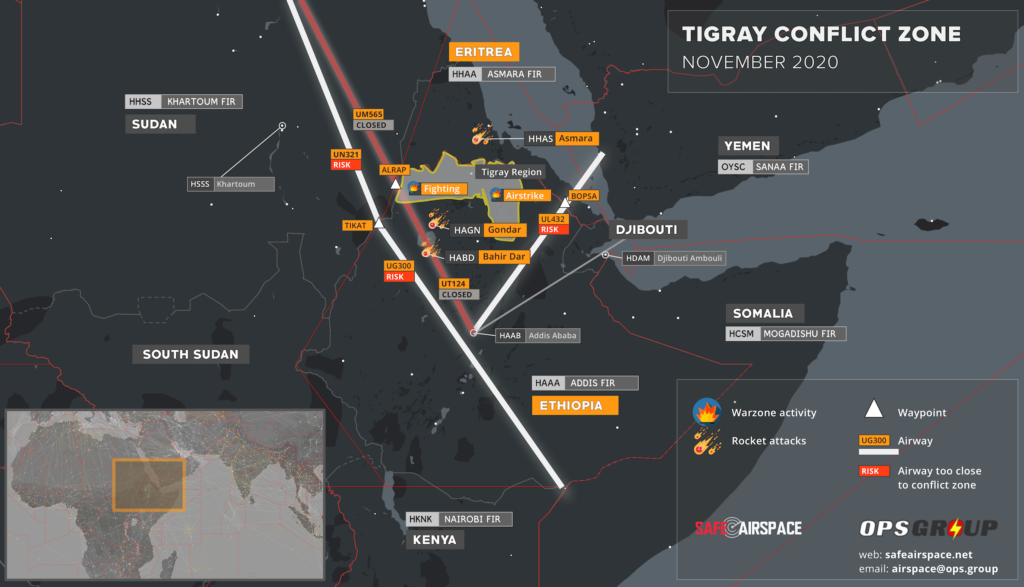
Throughout the year we’ve seen new conflict zones emerge, posing risks to overflying aircraft – from Saudi Arabia and Yemen, to Armenia and Azerbaijan, to Ethiopia and Eritrea.

Our sense of mission with Safeairspace.net is stronger than ever – to provide a single, independent, and eternally free resource for all airspace risk warnings, so that airlines and aircraft operators can easily see the current risk picture for unfamiliar airspace.

T is for Towers, controlling the skies

Towers (and the ATC folk in them) controlled the skies splendidly this year. We also looked into what happens during “ATC Zero” events, particularly over the NAT HLA after we saw Gander East close briefly in December.


U is for Unreliable speeds on aircraft stored too long

Unreliable airspeed incidents increased after bugs and beetles made nests in airplane probes – an unexpected consequence from Covid. And unreliable airspeed was not the only thing to look out for with long term storage.


V is for going Viral when you do something wrong

From men on jet packs, to pilots drawing pictures in the sky, we laughed at some of the stories we saw this year. And not all were bad – the Don’t Rush challenge went viral as aviation communities from all over created their own Don’t Rush movies.


W is for Winter Ops, cold weather tips

Winter is here – at least in the Northern Hemisphere. Here are 5 golden rules that could help you stay out of trouble during these colder months. Here’s a quick lowdown on freezing fuel problems as well.


X is for Space X, launching their ships

We reported on a fair few temporary danger airspace areas through 2020, many of which were down to Space X and other rocket launches. The operational impact for earth flights kept us reporting, but we’re also a little excited at the developments in space flight. OPSGROUP GALACTIC might be a new idea for 2021…


Y is for a big Yes to 2021

2020 has been tough – but we have faith that 2021 will be better. We hope borders open, vaccines roll out, Notams improve, airplanes get better, airspace gets safer, and aviation becomes more human!


Z is for Zoom calls – sometimes they’re fun!

Our OpsChats were a big part of our year and we loved our 2-timezones-in-1-day Zoom call.

We look forward to seeing you all again in 2021!


The November Mega OpsChat – All the Links…

The November 24th “East/West-One-Day-Two-Calls” OpsChat Bonanza was great! Thank you to all who joined us, and those who shared some useful intel with the group.

Boy, did we cover a lot! The good news is if you missed the show, you can re-watch the recording here:

During the chat, we provided a bunch of links for each topic covered. If you weren’t quick enough to catch them at the time (we don’t blame you), here’s a little summary….


November Updates…

Greenland

What? Baffling Notam issued declaring Greenland’s airports were closed.

What else? Panic not, a better one was then reissued, saying that you could still use Greenland’s airports for ETOPS and diversion alternates. We called them and they said that tech-stops and ferry flights are also allowed (although not listed in the Notam). They’ve basically just banned passenger flights, and don’t want people staying overnight.

More Info:
Greenland Closes Its Airports To (Nearly) All Passenger Flights – Opsgroup Blog Post
Official Word from The Danish Civil Aviation 

Israel

What? You can now overfly Israel (as well as Jordan, Saudi Arabia and Bahrain).

What else? You need a local sponsor, should depart from an approved airport (but they do make exceptions) and need a permit.

More Info:
Israel overflights now allowed – Opsgroup Blog Post

Hong Kong

What? Strange ILS behaviour, especially on Runway 07R/25L. Pretty much down to antennas, terrain and Boeing AFDS…

What else? They have also updated their Covid entry restrictions for crew – it’s now slightly harder to get in.

More info:
The Thing About the ILS
Hong Kong Entry Rules for Flight Crew – OpsGroup Blog Post
The Official Word

CENEMAR (Central America)

What? There are some new flight planning requirements you need to know about.

What else? You can flight plan direct above FL200, and must include the new AFTN address MHFPZYZX when filing your flight plan.

More info:
CENEMAR: New Flight Planning Requirements – Opsgroup Blog Post


Other big updates from 2020…

November 5th ICAO changes

When? Er… November 5th!

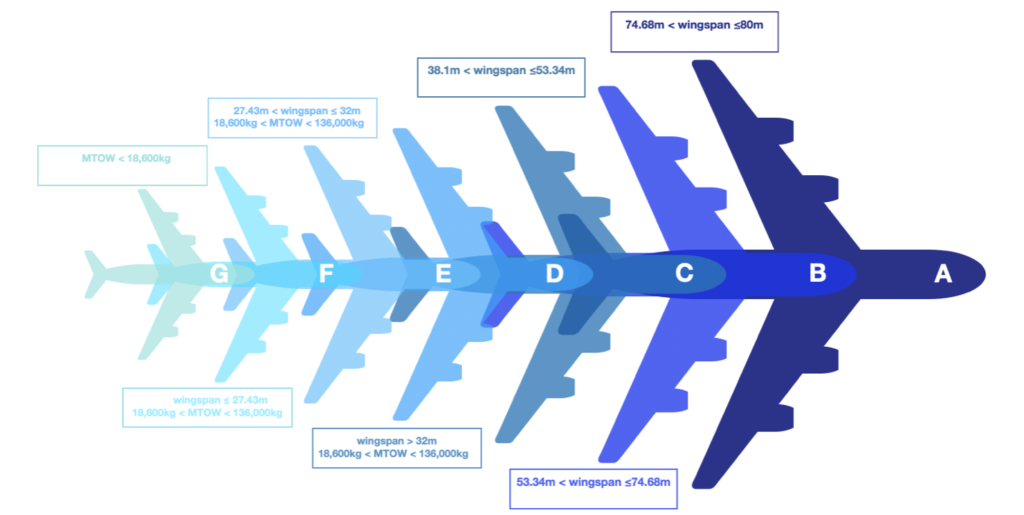
What? We are talking changes to wake turbulence categories, NAT Contingency Procedrues, SLOP and Gross Navigation Errors.

More info:
The 511 on Nov 5th Changes – Opsgroup Blog Post
Hopefully a Link to the New 4444

Other overflights that are now ok

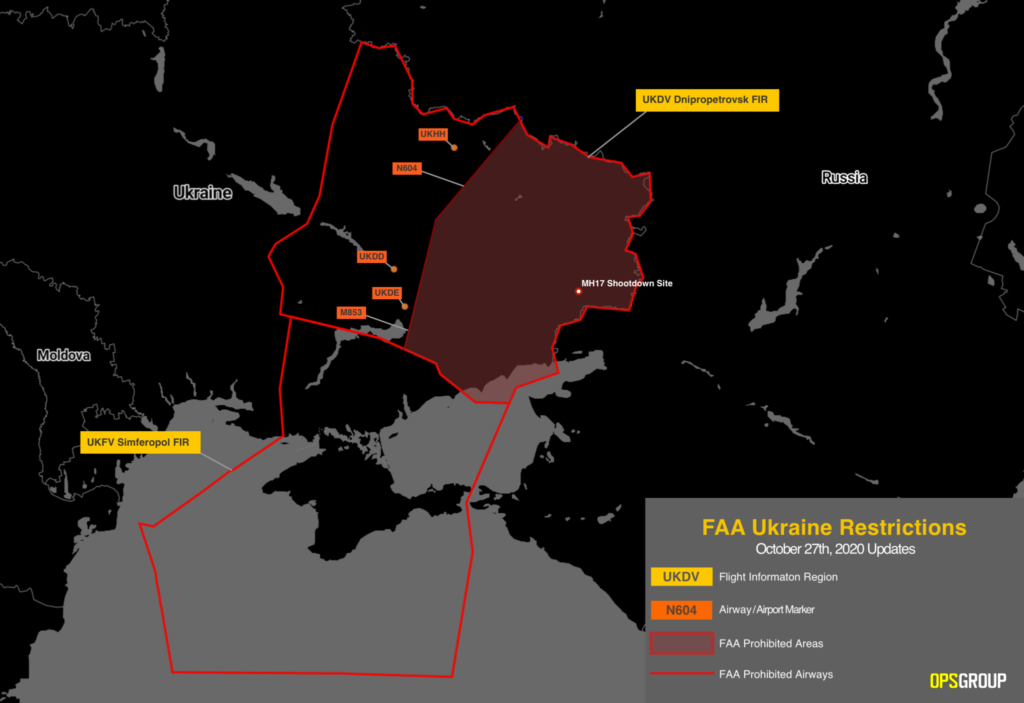
What? FAA SFAR updates – where US operators can’t go!

Where?
– Ukraine: UKFV/Simferopol FIR is ok, UKDV/Dnipro FIR is not ok.
– Iran: Not ok, but the Gulf of Oman and Persian Gulf are – Emirates, Kuwait, Bahrain and Muscat FIRs.

More info:
Safeairspace
Overflying Crimea – Opsgroup Blog Post

Russian Me-trics

What? Russia are moving to feet (referenced to QNH) below transition through their airspace, starting with major airports.

When? From December 3rd.

More info:
Russia are still playing me-trics on us – Opsgroup Blog Post
The Russian AIP (don’t worry, it is in english too)

ADS-B

What? When will you get in trouble for not having it.

Where?
– Europe: ADS-B is required from June 2023, but have your retrofit plan in by December 7 (unless your AoC is before 1995).
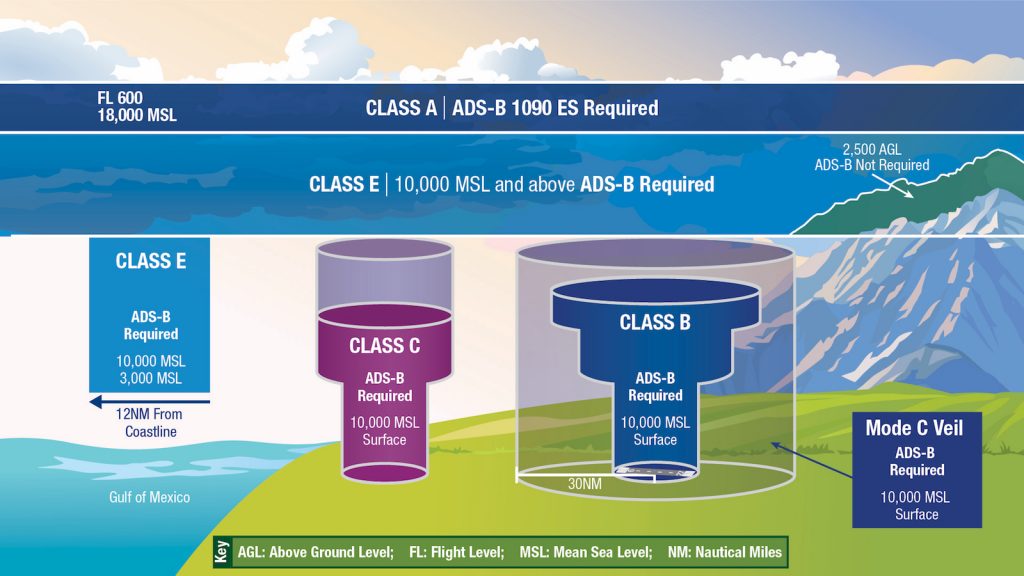
– US: ADS-B is required anywhere Mode C, or in the picture below.
– Rest of World: Above FL290, pretty much.

More info:
European ADS-B Mandate – Opsgroup Blog Post
The FAA FAQs on ADS-B

North Atlantic Datalink Mandate

What? The North Atlantic Datalink Mandate (NAT DLM) is the thing that came into effect in Jan 2020, which meant that CPDLC was then required between FL290-FL410 throughout the entire NAT region. Simply put, you must be equipped with CPDLC and ADS-C if you want to fly between these flight levels.

And then what happened? Then Covid happened. Because of the resulting reduction in traffic they suspended this mandate, and it looks set to stay this way until the end of Feb 2021. Bottom line, aircraft which do not have CPDLC and ADS-C can continue to operate across the North Atlantic between FL290-410 until then.

More info:
North Atlantic Datalink Mandate – Opsgroup Blog Post


SafeAirspace Update…

Ethiopia

What? Escalating conflict – Danger to overflying aircraft – beware of open airways!!

Where? Ethiopia – the Tigray region bordering Eritrea

More info:
Safeairspace – Ethiopia
Airspace Risk Warning: Eritrea and Ethiopia – Opsgroup Blog Post

Saudi Arabia

What? Drone and ballistic missile strikes continue from Yemen, no end in sight.

Where? Southern Saudi Arabia particularly, but Jeddah and Riyadh have also been attacked.

More info:
Safeairspace

Armenia/Azerbaijan

What? The conflict is ‘officially’ over, but the airspace remains dangerous!

Where? The airspace between Azerbaijan’s UBBA/Baku FIR and Armenia’s UDDD/Yerevan FIR.

More info:
Safeairspace

Western Sahara

What? An emerging conflict zone, with the threat of anti-aircraft weaponry. Little info or warnings, that may well affect aircraft operating into the Canarias.

Where? Northwestern Africa – a area region between Morocco and the Polisario.

More info:
Safeairspace


Stay tuned for our next Ops Chat coming up in January 2021!


OPSGROUP wants to help you find that new job.

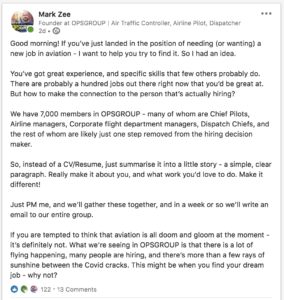
Hi. Mark here. On Saturday morning, I posted a little note to our members in Slack, and this on LinkedIn:

I got a lot of messages. In starting to compile a list, it struck me that I hadn’t quite asked for the right thing.

I felt I wasn’t doing justice to telling each persons story.

What I’d said was, condense your CV/Resume into a little paragraph, and we’ll send that out to the group. But it felt a little flat.

And I think that’s because CV’s are a little flat. It’s just a snapshot of your story, but there are better ways to tell it. I want people to read your story, and think – yep, that person could be right for us. It’s hard to do that with a list of aircraft types and places you’ve worked and what certificates you have.

So if I’m really going to help, I have to look for a better way to tell your story.

When we hire at OPSGROUP, we don’t ask the standard HR questions. They don’t work for us. “Where do you see yourself five years from now?”: Kidding, right?

What we do, is try to get to know you a little – what lights you up, what do you love working on, what do you want to change in aviation, what adventures you’ve been on. We like those questions. They may be specific to our mission, but the concept is important: something about you stands out, and we want to find it.

So, if I’m going to send an email out to our group and tell them about you, how can I tell your story so that something stands out? How do we make it engaging, so that it’s actually fun to read, and people will actually read it – and in turn, give you a decent chance of someone contacting you with a role that might fit?

And so, I had a better idea (I think). How about we make each one into a mini-feature. Like you might read in a magazine. Short and sweet, but with a few good questions that bring out more about you than a CV can. Here’s what we have to get started – If you have a great question to add, comment below or send it to me and we’ll add it to the list (this is just a starter):

* What has been your biggest adventure?
* What book has had the biggest impact on you?
* What is your superhero skill?
* What would you love to do in aviation that you haven’t done yet?
* In the last five years, what new belief, behavior, or habit has most improved your life?
* What’s the most positive impact of 2020?
* What unusual hobby do you have?
* What advice would you give to your 20-year-old self?
* Is there something that really lights you up?

* What’s the best thing about working in aviation?

So here’s the plan. Send me your paragraph, but structure it like this:

1. Your name and your ‘resume snapshot’ – where you are based, your experience, etc.
2. Choose three questions from the list and answer them
3. Put down your contact details – email, LinkedIn profile, and if you like – social.

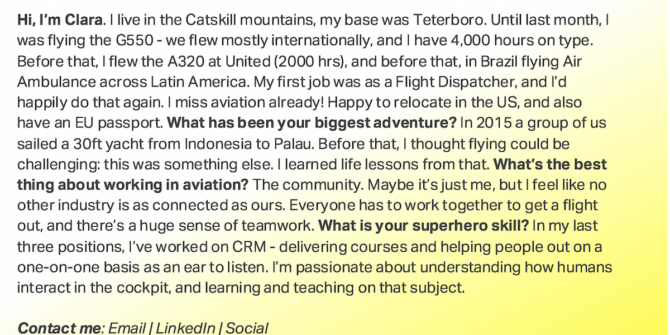
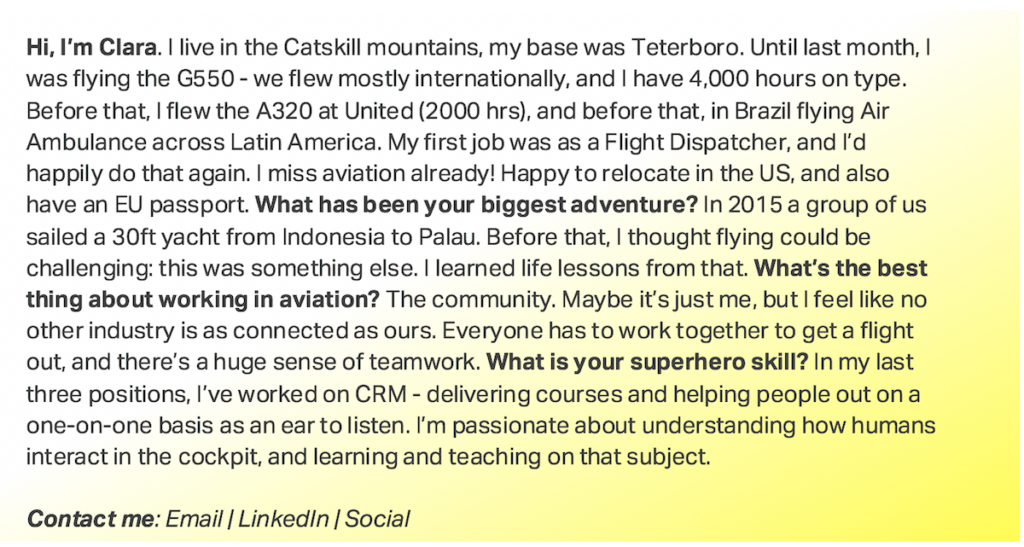
Here’s an example of what you might end up with:

So if you like, make your own paragraph, and then just email it to me. Whether you’re a member of the group or not doesn’t matter, we’ll get the word out. I suggest keeping it short and sweet! Maybe 10-15 lines, just like the one above.

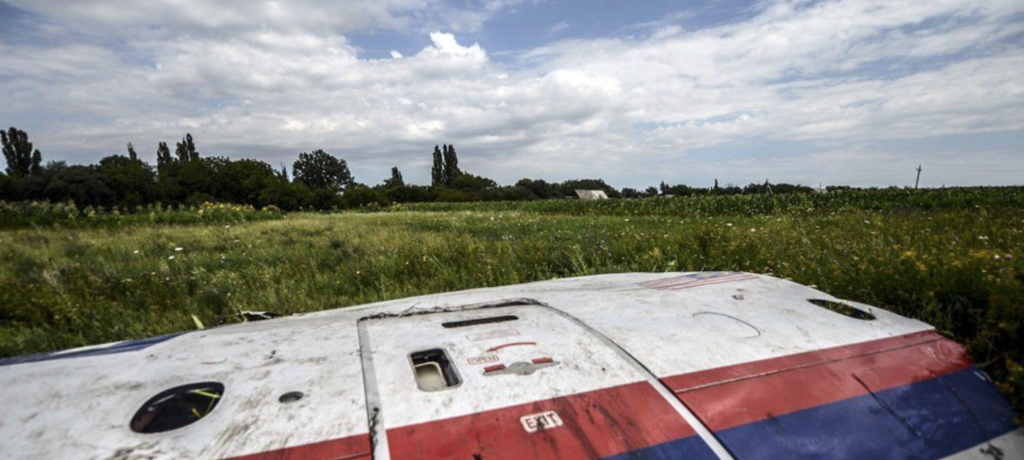
If you don’t know about OPSGROUP, here’s our own little story: OPSGROUP was formed to solve a problem. When MH17 was shot down over Ukraine, we learned that a handful of people had known about the risk, and avoided the airspace. Nobody else did, because they didn’t know. Today, OPSGROUP has 7000 individual members – We are Flight Dispatchers, Pilots, Air Traffic Controllers, and operational specialists from large airlines, small aircraft operators, Civil Aviation Authorities, ICAO, NBAA, and a multitude of other aviation organizations. We work together to share critical new information about airspace risk, procedures, and just help each other out. Most importantly, this is a group of people, not of companies or authorities.  More on us here.

What this means for you, right now, is that we have a big group of people at the heart of flight operations, who will read your story, and might have a job that suits you. I know we have a great group and if there’s a chance for someone to help, they’ll take it.

As promised, I’ll compile a list, make it into an email, and send it out to our group.

I can’t promise that you’ll get responses, but I do think that this way of doing things gives you a much better chance.

I would also love your thoughts. Maybe you have even better ideas.

Cheers – Mark.


Email: mark.z@ops.group


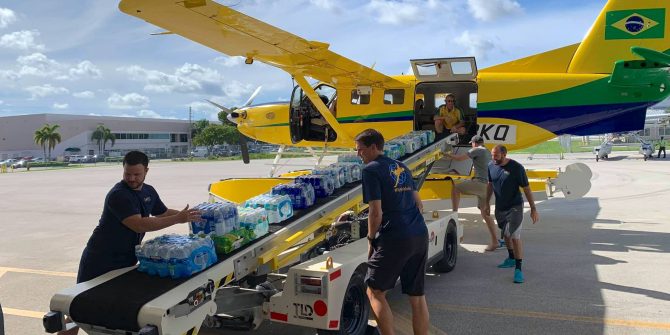
Bahamas Relief Flights – here’s what happened in the first five days

Hello all,

We’re standing down. The purpose of our involvement in the Bahamas Relief effort was twofold – to provide an accurate information flow from an aviation perspective, and to help coordinate in some way the massive amount of civil aircraft that started taking part last Thursday.

Once the winds had died down on Thursday morning, and it became safe for aircaft to start operations, what we initially saw was a void of information on the situation – which airports were available, and what the approval process from Bahamas CAA/NEMA was and how that worked. Nobody was quite sure. But hundreds wanted to help. So, we made contact with many of the pilots and operators, and Bahamas ATC, to get accurate status reports from Nassau, Freeport, Treasure Cay, Marsh Harbour, and Sandy Point – the five locations where the relief efforts were focused at the end of last week, and got that information out in a twice daily briefing. We also worked with the Bahamas CAA approvals team to get word out on how to apply, and what that process looked like.

The response from Business and General Aviation was overwhelming to say the least. Hundreds of flights were flown on Thursday and Friday bringing in much needed first-response supplies. The initial situation was challenging – airports had not been secured and there was a rush to get relief items arriving, creating an unsafe security situation for crews in some locations. Nonetheless, efforts continued. It quickly reached a saturation point. There was no ATC, and the entire Abaco area was on one Unicom frequency. Airports that normally have a few movements per hour were seeing in excess of 60 aircraft per hour at times. Some were operating without transponder and radio calls.

On Friday evening, it showed no sign of abating, and airspace safety was now the primary concern. We worked with AOPA and NBAA ATS in an effort to reduce the level of GA traffic, especially as larger aircraft were now coming on scene and could do more to help. Saturday proved to be another exceptionally busy day, and we coordinated with Miami Center to get routes in place to manage that flow of traffic, and get word out to use those routes. Freeport opened up, with limited ATC.

Finally, by Sunday afternoon, there was some respite in the traffic, and the picture of airport status was clear, but there was still a need for coordination among the many separate organizations, and individual operators, conducting relief flights. We worked with Odyssey, Aerobridge, Operation Airdrop, Banyan, numerous FBO’s, the US Coast Guard, and probably 150 individual pilots, all part of the flotilla of floatplanes, helicopters, business jets, and private aircraft helping to bring relief. At the same time, airlines and military were now providing larger aircraft for the mass evacuations from Abaco that we saw Sunday and Monday. The marine relief effort was even bigger.

Throughout, we were in contact with the NEMA coordinator, UN OCHA, Bahamas CAA and ATC – and later, NGO’s – who all did an exceptional job given the extreme circumstances. The geography of the Bahamas was the biggest challenge – scores of tiny Cay’s, and with bridges out and roads washed away, there were – and still are – many pockets of cut-off communities, all needing help.

On Thursday night I started a Facebook group to bring as much information into one place for the operators and pilots involved as we could. It’s been a tremendous success. Thanks to all the volunteers participating, we’ve had a steady stream of updated information on airports and airspace, and more importantly, we’ve been able to coordinate everything from Search and Rescue helilifts, flights for teams of Doctors, medication transport, evacuation flights, and determine very specific locations to bring aid to.

And now? The presence of the UN, the USAF, International Navy vessels, and upwards of 50 NGO’s, all at full tilt, means that the vast majority of relief efforts are being taken care of on a larger scale.

Make no mistake. The situation is still dire. People still need help, in a massive way. Whole towns are gone. The death toll is much higher than than the small numbers first reported. Individual flights can and will continue to make a difference. We’ll keep this group open and running, so you can post and share info. I and the OPSGROUP team will get back to work on what we normally do, but we’ll keep an eye here to help out where we can.

So – a big THANK YOU to every single one of you that has been part of this effort. None of us have slept much in the last five days, and it’s been heartwarming to see the massive generosity of time, effort, aircraft, pilots, and supplies, and help. Simply amazing. Much love to you all!

Mark.


Incredible people making aviation a force for good, and how you can help

What does your overnight look like when you are downroute? After you’ve checked in to the hotel, and maybe had a quick nap, what’s on your list of things to pass the time? Maybe you’ll swap your pilot uniform for a tourist t-shirt, head into the city, and explore a little. Perhaps you’ll have arranged a coffee with an old friend or colleague. Or, maybe just hang out at the crew hotel and relax.

Not Kimberly Perkins.  There’s something more rewarding to be done.

Through her non-profit organization Aviation for Humanity, Kimberly will be heading to the local school, shelter, or orphanage, to meet the children and present them with backpacks and school supplies. She’s not alone. Having started the mission in 2016, they’ve already helped hundreds of people in places like Ethiopia, Tanzania, Mongolia, Nigeria, and Puerto Rico – and closer to home, in Hawaii – where kids in need in Kona received supplies over several visits.

If you’re like me, aviation has given you a lot – not just a career, but a lifetime of wonder, beauty, excitement, and joy. Aviation is special – that’s why we’re in it. And it’s no secret that we’re going through a tough time right now in the eyes of the public. So, when I see aviation giving back – doing something for the world – it’s important to highlight and bring attention to that. We need more of this.

This is why I want to celebrate and share the work that Kimberly, and the many volunteers, are doing. So, how does it work? Pretty simple:

1. You contact Aviation for Humanity, and tell them where you’re going
2. They will locate an underfunded school or orphanage for you to visit, and arrange for the supplies.
3. You go, and share the story of the journey back with Aviation for Humanity.

Imagine using your trip abroad to make a difference in the world – just one short visit, and you can give an entire school or orphanage much needed supplies.

Running a non-profit isn’t easy, and there’s another way you can help right now. Kimberly needs a volunteer Executive Director –  to manage coordination with volunteers, logistics for shelter visits, managing social media, fundraising, writing articles, and other things that move the mission forward. Is that you? Maybe you’ve recently retired and are looking for a way to contribute back to aviation? Maybe you’ve got extra time on your hands, or you know someone that this might be suited to? 2-6 hours a week will get you started.

I love seeing the work that OPSGROUP members are doing individually. As I was ‘wow-ing’ my way through the work that Kimberly does, I found another group member featured on an Aviation for Humanity trip – namely Cheryl Pitzer. Cheryl was on our Member Chat a few weeks ago (#7, see it here in the dashboard).

Cheryl, pictured right, flies the MD-10 “Flying Eye Hospital” for Orbis International – an amazing airplane that is part of the Orbis mission of bringing people together to fight avoidable blindness. On that call, Cheryl told us about the work Orbis does, the challenges of operating the airplane internationally, and the reward of using aviation as an agent for good in the world. This is another incredible cause that you too can get involved in.

Kimberly and Cheryl are true aviation pioneers, not just for the non-profit causes that they work so hard on, but also as pioneering women in aviation. It’s no secret that this beloved industry of ours has a massive imbalance of diversity. The numbers and statistics identify the issue  – averaging out the small amounts of data that are actually published on the subject, show that the global percentage is around 5% – that’s both the number of female pilots, and the number of women in top management positions at airlines.

Changing those numbers – attracting more women to aviation – is just part of the issue. What is life like if you are one of the 5%? From an interview that I read in another publication, Kimberly said “As I moved through my flying career, I was never lucky enough to encounter a female manager mentor. As I looked up that corporate ladder, it was a sea of men. Such an environment can be lonely, unwelcoming and intimidating“.

For me, right now, that is something that we can all do something about. What is the environment like at your airline or operation? Could you see how it could be lonely, unwelcoming and intimidating? How can you change that?

Just like the work that’s being done for the non-profits, you can do something to make a difference. That difference grows, it’s exponential. It starts with the realisation that you have the power to make things better for other people, especially if you are in a leadership position. A good place to start is by realising that if you do have the power to make things better, but you don’t, then you’re simply part of the problem.

I certainly see some of the inherent aviation gender biases here in OPSGROUP. It’s usually not intentional, nor anything usually deep rooted in opinion – it’s just been built into the system over the last 80 years of how commercial aviation used to work.  Sometimes we have group calls that end with someone saying “Thank you Gentlemen”.  The very term NOTAM is indicative of the problem – Notice to (air) Men.  I like to imagine what it would be like to turn up to work every day and read a flight briefing that is headed “Notice to Women“. I certainly would feel excluded.

You might think that this is subtle, tiny, not important. But the things that create environments that are lonely, unwelcoming and intimidating are usually subtle and unintentional. Only by putting ourselves in the position of others, can we see the full impact.

It’s a process of education that starts with the willingness to see things a little differently, and then making a decision to do something that changes things for the better. Just like Kimberly and Cheryl have done.


FOCM: Flight Operations Coffee Morning
OPSGROUP is hosting the first FOCM in New York City on June12th, and we’d love you to come along.

FOCM – Flight Operations Coffee Morning – is an OPSGROUP event where you can meet other pilots, dispatchers, controllers, and Ops specialists, hang out, have a coffee, and talk flight ops.
Dave and Mark from OPSGROUP, will host a quick Q&A about International Flight Ops, and our work as a group. We’ll talk NAT Tracks, Ramp Checks, Flight planning, Airspace Risk, Notams, the latest challenges – and what we can do to make things better.

And you get to meet and connect with other people working in Flight Ops in New York, New Jersey, and beyond. We’ll have A380 Captains and Gulfstream FO’s, Corporate dispatchers, New York ATC, and a bunch of other good people.

OPSGROUP is a collective of 5000 pilots, dispatchers, controllers, and ops specialists that work together to share information and resources, making flight ops simpler and safer. We’re hosting this because we love connecting people. It’s totally free.

Event details

When: Tuesday June 12th, 2019
Where: Lower East Side, NYC – address on RSVP
Cost: None!
RSVP here: https://focm.splashthat.com/

PDF Flyer – Print it out!

Adios! That was our last International Bulletin (for non-members)

Dear Reader!

First, thanks for being part of this amazing group for the last year. We loved sharing our alerts, risks, dangers, and deviousness with you. It’s been a blast.

As we’ve mentioned, we’re now focusing our attention solely on Opsgroup members, so the International Ops Bulletin that you got yesterday was the last one for the year, and tomorrows Daily Brief will also be el final (sp? we’re good at Ops, not Spanish).

OK, so. Here’s the deal. We would like you, our favorite reader ever, to be part of this amazing group – 5000 airlines, pilots, dispatchers, airports, atcos, agencies, amazing-experts, analysts … the people that run international flight ops. Whatever the group is now, it’s going to be even more amazing – as we are adding in new contacts, better information, easier searching, and making it easier for members to connect with each other. We’ll continue the good fight against crappy circulars, mind-numbing mandates, awful AIC’s, nasty notams, and continue to remind the state bureaucrats that the people reading this stuff are Humans, not computers. We’ll continue to sniff out the security risks, and share them with those that need to know. And we’ll continue to basically make cool stuff – maps, charts, apps, guides, and winter ear-warmers – for the Opsgroup community.

We’ll also continue to manage the Clipperton FIR (ADS-B almost in place), keep adding things to Airport Spy, continue working with ICAO on Norm (he’ll be done for Christmas, we’re sure!), get SafeAirspace V2 online (coming December), and of course continue the hourly alerts, daily briefs, and weekly bulletins for members.

Bottom line, our request is that you join us! We need people like you to help this group. Put another way, we don’t want to continue without you.

Whatever your choice is, have a lovely day and rest of year, and let us be the first to wish you a happy Thanksgiving, and if we don’t see you until next year, Happy Christmas!

The Opsgroup Team – Ben, Cynthia, Igor, Dave, Dean, Slobodan, Amelia, Jamie, and Mark.

team@ops.group

PS –

If you prefer, you can also waitlist for 2019. Once we reopen membership, we may have a slightly different approval process, but you can add your name to be notified here.


How OpsGroup works – for questions

I love how the hive-mind works. We have 5000 members, and so it shouldn’t be surprising, but it’s still awesome to see it in action.

Yesterday, in slack, a member asked:

Now, I’ve never heard of Novolazarevskaya Station, but that’s not important. There are another 4,999 of us, and chances are that someone in the group has.

So, we blasted it out on the ATIS this morning:

The ATIS goes out to all group members in the OpsGroup Daily Brief.

And of course, someone got right to it, answering the question:

This is how OpsGroup works! Simple, and extremely effective. When one person knows, we all know.

Bonus: The first OpsGroup team member to see the question was @Jamie – Opsgroup Team, who has been on the ice on five separate missions for the US Antarctic program, and has spent a combined total of three years down there.


OPSGROUP featured on Al Jazeera

As a group of 4000 pilots, dispatchers, and controllers, we stand for safety ahead of commerce. Al Jazeera interviewed our founder, Mark Zee, about the current risk in Ethiopian airspace created by the ATC strike, and why we care so much about getting the truth out to our members.

https://www.facebook.com/flightservicebureau/videos/244638736242463/?t=1


It’s nice to meet you.

Yep, there is. It’s called OPSGROUP. We’re a big mix: pilots, dispatchers, controllers, managers, tech specialists, aviation authorities – all with one thing in common: International Flight Operations.

Back in 2016,  we figured out that great things happen when we solve problems together. Change is the biggest challenge, so we tell each other when we hear of something new. We keep each other safe by sharing information on risks.

Now we’d like you to get involved as well.

Why join us? Good question. Well, because if you don’t, you’ll miss a change and look like a chump. We don’t want that. You might overfly Libya. You might divert to Cayenne. You’ll only find out about the new rules when your G650 is impounded. You’ll pick the wrong handler because you didn’t get to see that Airport Spy review on Santiago from another member. You won’t know about that exemption. You won’t have anyone to ask whether you should stop at Keflavik or Reykjavik.

Life managing International Ops is hard enough without trying to do it all on your own. And we want you, because the more smart people like you we have in the group, the stronger it becomes. Pick a plan for yourself, or your team, or your entire flight department. There’s 1650 people waiting to answer your questions. And to pick your brain.

Read the reviews from existing members, and see why everyone from Airbus to the British Antarctic Survey to United Airlines is in the group. (hint: we’re all doing the same thing, and it’s getting easier).


Join OpsGroup


Welcome Pack

On joining, we will send you, and each team member if you are on a team or department plan:
– a Welcome Email, explaining the group, together with your Welcome Pack:
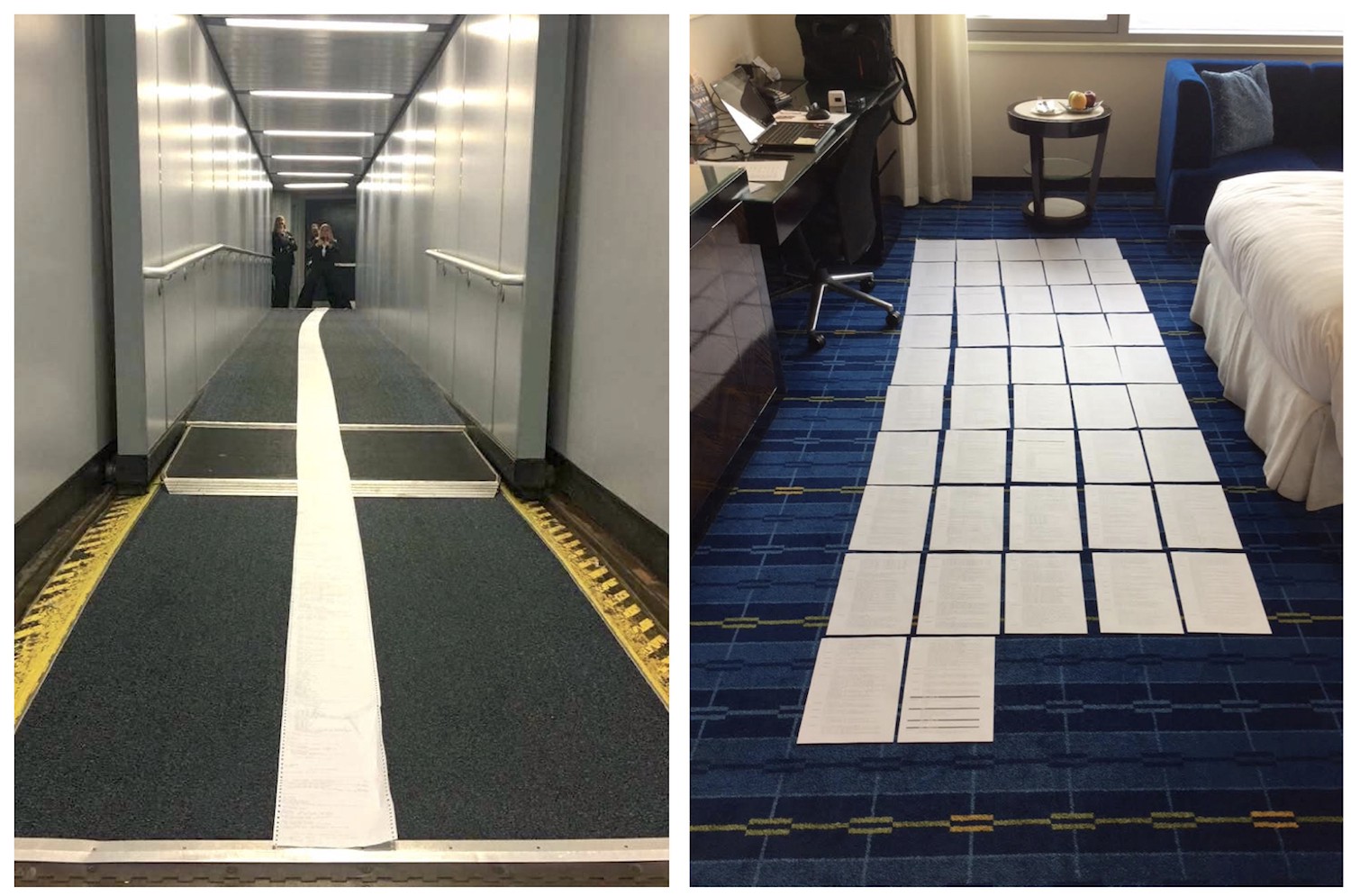
– The full FSB Airports Database (value $375)
– The current full International Ops Bulletin
– Our Polar Ops Planning Guide
– Current NAT Plotting Chart (value $35)

Everything

You (and each team member, if you choose a team plan) will then also get:
– Immediate access to our OpsGroup Dashboard
– The weekly International Ops Bulletin every Wednesday
Slack access to talk to the group
Ask-Us-Anything – we answer your International Ops questions
– Airspace warnings and overflight risk summaries
– Access to Aireport – 2300+ Airport and ATC TripAdvisor style reviews
– Everything we publish – Guides, Lowdowns, Charts, Member Notes
– Tools and Maps
– All previous content since the group started
See examples of all the above

Joining Process

2 straightforward steps:
– Choose an Individual, Team, or Department plan
– We send you everything you need to get started by email

You can cancel anytime you like, before the next billing period.

New members – that’s you – are welcomed several times a year. The current status is notified on this page. To make sure that new members are fully supported, and the existing group retains its high quality, we limit joining to window periods during the year.
If we’re closed, you can join the waitlist to be notified of the next opening window.


Join OpsGroup


OpsGroup – the power of the group

The power of the group

In the last 30 years, there has been a massive change in how the world works: thank you, internet. We are witnessing a shift from the power of a central source – like government, and large corporations – to the power of the individual. Each of us is now connected to the entirety of human knowledge through a small, handheld device, and can connect with others to effect powerful and positive change.

OPSGROUP is founded on this premise.  International Flight Operations is an inherently tricky area, full of gotcha’s and unforeseen changes for even the most diligent airline or aircraft operator. One operator versus a myriad of often unreadable government-sourced regulations and information – Notams, AIC’s, FAR’s – is a battle with guaranteed casualties.

But by connecting with other people, just like you, with the same problems and challenges, you can solve and share solutions.

When we started this group last year, we had a small handful of pilots, dispatchers, and managers that figured coming together in this way was a winner. As of November 2017, we’re now heading for 4,000 OPSGROUP members, with a great variety in operations roles: Airline and Corporate pilots, Military operators, Federal agencies, Flight Dispatchers and Schedulers, ATC, and Civil Aviation Authorities – all working together.

It’s still early days, and we have a way to go. But with some basic core principles – plain language (we call a spade a spade), operator and passenger safety ahead of lawyer-speak, cooperation instead of competition  – and a huge appetite for development, there is much to gain.

So what’s good in the group? Read on …

1. Information

First on the plate for almost every operator is staying current. Rules and regulations are changing with increased voracity. Did I miss something? Yep, almost definitely. Each week we produce the International Operations Bulletin. We try to cover all the big changes in the last 7 days. If we miss something, we’ve found that someone in the group is pretty quick to tell us, and it appears in the next one.


2. Fun (including Goats)

We promise to keep it entertaining“. Without your attention, we’ve got nothing. Not only that, but we get as bored as you do with the standard aviation legal-language speak that permeates even the most important documents. Which is why sometimes we’ll run a Goat Show. Sometimes it’s just great to be “unprofessional“.

3. Members

Like we said, approaching 4,000. All working together with the same goal: making International Flight Operations better. Click on the links to read what they say.

Airlines like United, Fedex, and Etihad
Small Part 91 Flight Departments like CAT3, Fayair, Pula
Big 135 Charter Operators like Jet Aviation, TAG and Netjets
Companies like Visa, IBM, and AT&T
Manufacturers like Boeing, Airbus, and Lockheed
International Pilots like Matt Harty, Bill Stephenson, and Timothy Whalen
Organisations like IFALPA, the NBAA, and CAA Singapore


4. Airspace Risk

MH17 was a tragedy that must not be repeated. A small handful of operators were privy to information on the risk, and the Notam writers of Ukraine that were aware of previous shoot-downs released the information in a language almost designed to confuse. Through our safeairspace.net project, we can now share risk information within OPSGROUP and make sure that every single member has access to a current picture of airspace risk.


5. Airport Spy

One of our group members came to us with a great idea last year – why don’t we share our knowledge of operations at airports around the world. So we made a TripAdvisor style section in the member Dashboard, and allowed members to add their own reports on Airports, ATC, and Handlers. We now have 3000 or so reports.


6. Member Dashboard

We don’t need to explain this one too much. Everything the group has, in one place.


7. Slack

Slack is cool. It’s a chat app, but it’s more than that. Internally, we don’t use email anymore, we use slack. There are different channels like #crewroom, #todays-ops, #usefuldocs, and #questions. When there are special events, like #FranceATCStrike or #NewYorkSnow we open a special group for that. About 1200 members use this regularly, and it’s the perfect way to connect with other crews, ATC, or the Feds.


8. George

George is a bot. He’ll fetch information for you on airports, get weather, the NAT Tracks, and a few other things. We’re working on making him a little smarter.


9. Ask Us Anything

Getting an answer to your question is what keeps us awake at night. There’s not much we can’t help with, but usually someone else in the group beats us to it. If not though, the FSB International Desk team will research that ops question that is threatening to make your life hell.


10. The future

The best part of OPSGROUP is that we’re really just getting started. The future of the group is unwritten, but placing the planning power in your hands as an operator rather than 3rd parties, and having the security of knowing that the group has your back, is a great way to start. There is much to build and develop, and we’d love you to be involved!


11. Joining

You can choose an Individual, Team, or Flight Department membership. All the information on that is on the OpsGroup website. We limit joining windows to certain months of the year, so that we can be all hands on deck with building new things for the group once membership is closed. If we’re not accepting new members at the moment, you can waitlist for the next opening.


Further


OpsGroup NYC Notam Summit – April 4th, 2017

JOIN US IN NYC

Tuesday, 4th April 2017- Manhattan, New York

 Ops Group Meetup and Notam Summit

We’ve never done this before, but we’re going to run our first OpsGroup meetup.  Emails and slacks are all fine, but human contact is where it’s at.  Come along and meet us and other awesome members of the OpsGroup!

Location: Secret downtown location in Manhattan, we’ll meet at 9am-ish on Tuesday morning, 4th April.  By 10am we’ll have kicked off into International Ops  2017 with Mark, NAT chats with Dave, Antarctica fireside stories with Jamie-Rose, and then move on to looking at stupid Notams and how to fix them.  You should come!

Here is the deal:

0900 You arrive. So will others. We will mostly be pilots, dispatchers, ATC’s and flight dept managers but whatever your specialty is, come along.

930-ish We’ll start with the International Ops Chats- NAT ops, Antarctica, 2017 changes, and your questions.

1100 We’re probably still going with the International Ops Chats

1130 We’re onto talking NOTAMS by now

1300 Powerpoint has overheated, we’re done. Off to Lunch

1330 We’ll be having a late lunch. Join us for chats and beers, war stories, jokes, or head home instead- whatever you like.

1500 That’s All Folks. We can recommend: A visit to Concorde, go see a show on Broadway like School of Rock, go see the Nicks v Bulls, visit the Comedy Cellar, or get your Uber back to the Teterboro Holiday Inn.

Afterwards, tell us what you thought: team@ops.group

Antarctica Fireside Chat

Jamie Rose McMillen from the FSB Int’l Desk is going to tell us some good stories from her six years living on the Ice.  Find out how International Ops works in Antarctica and McMurdo Station. Join us in NYC!

International Ops 2017

There have been a city-full of changes to the International Ops world so far in 2017.  A380 wake, no devices, BOE changes, ATC strike, Conflict Zones, 767 shooting, the end of Soviet QFE approaches. Mark will answer questions. Join us in NYC!

North Atlantic Changes

Dave Mumford will run through the new rules on the NAT, and answer questions from the My First Atlantic Flight guide. Just don’t ask him about the new contingency procedure. Join us in NYC!

NOTAMS

Judging is finally complete in the Notam Goat Show.  After we present the winners, we will have a good old fashioned competition, with prizes, and then get into the main event: How do we fix the Notam problem?

Join us in NYC!

COME TO NEW YORK!

RSVP


Pan Am, 727’s, and 1977 …

This afternoon I took a boat across the river to the Jersey side  and looked back at New York City; amongst the skyscrapers in Midtown one stood out – the MetLife building. It seemed familiar – and I wondered why. I realised it was once the PanAm building: in a different era, this was the headquarters of Pan American World Airways.

pan-am-3

Most interestingly, there was once a helicopter service, operated by PanAm in 1977, that connected downtown Manhattan with JFK, if you had a First or ‘Clipper Class’ ticket on a PanAm flight. The helicopter transfer, from the helipad on the roof of the PanAm building, took about 7 minutes – compare this to the 1 hour and 7 minutes it takes to get out to JFK these days – if you’re lucky.

1984-ad-pan-am-one-free

Today, a couple of blocks west of the former PanAm building sits a lonely Concorde beside the Hudson, another nod to a time when aviation seems to have offered more convenience and speed than it does today.

intrepidtws11

So, the question is whether this is nothing more than nostalgia, or whether things were indeed, in some way, better back then. Everyone will have their own answer to that – we’ve lost  Tristars with elevators, DC-8’s with their chrome and diesel and smoke and crackle, 727’s and Bac 1-11’s with their rear airstairs – and what have we gained? The newest arrivals – the C Series, the A350, the 787 – are sleek, fuel efficient, and open up new routes that weren’t possible before – but are pretty unspectacular.

No doubt though, the generation that got to fly and operate these aircraft looked back on the days of Flying Boats and DC-3 with equal fondness. I wonder whether the aircraft coming off the production lines today will evoke the same thoughts.

In International Flight Operations, though, it must be said that things are much improved. Compared to the era that spans the 70’s to the 90s, we’ve now got vastly improved flight planning systems, more direct routes, much better navigation systems, and we’ve largely moved from SITA, phone calls and fax machines to email when it comes to organising those flights. For the Dispatcher and Planner, there is no doubt that life is far easier. Even ten years ago, trying to arrange handling anywhere outside the US and Europe would take days to set up – now, the same trip can be arranged in 30 minutes.

We do have some new challenges. Airspace safety – and the risk to our aircraft overflying unstable regions, is of more concern now than at any time in history. Since MH17 two years ago,  there have been many new areas to avoid. But how to know where, and why? Through The Airline Cooperative and OPSGROUP, we’ve worked as groups of Dispatchers, Controllers, and Pilots to share information so that when one person becomes aware of new information, everyone gets to hear about it. Our shared map shows the current status at safeairspace.net.

safeairspace-net

As a group, we’ve also been creating some new tools that help us – Aireport is our shared review site, where we can let each other know about good and bad experiences with Handlers, Airports, and ATC – whether it’s service, procedures, changes, or avoiding a fuel stop that’s going to cost you a fortune.

aireport-co

Maybe the biggest problem with all this new access to information is the overload one – the internet is the equivalent of a Shannon to Singapore NOTAM briefing. 80 pages of crap with a couple of important things stuck in the middle. Sometimes those important things are good to know, sometimes it’s critical information.

So how do you find those couple of critical things on the internet? You won’t have any trouble finding Aviation sites, but if you are managing an International Flight Operation of any sort – whether you’re the pilot, the dispatcher, the controller, the regulator, the ramp agent – whoever: how do you find out what’s new that will affect your flight.

That’s the question that bothers us at FSB every day of the week. We literally work on this every single day – and every day it becomes a little easier. Every Wednesday, we squeeze and condense the things that we’ve discovered this week into our weekly International Ops Bulletin – removing as much as possible until you’re left with only the critical stuff. The biggest source, and greatest help – is our amazing group of people in OPSGROUP.

Anyhow, I digress. Back to PanAm …

https://www.youtube.com/watch?v=C0umWIPCPd4