China-Taiwan M503 Airway Dispute

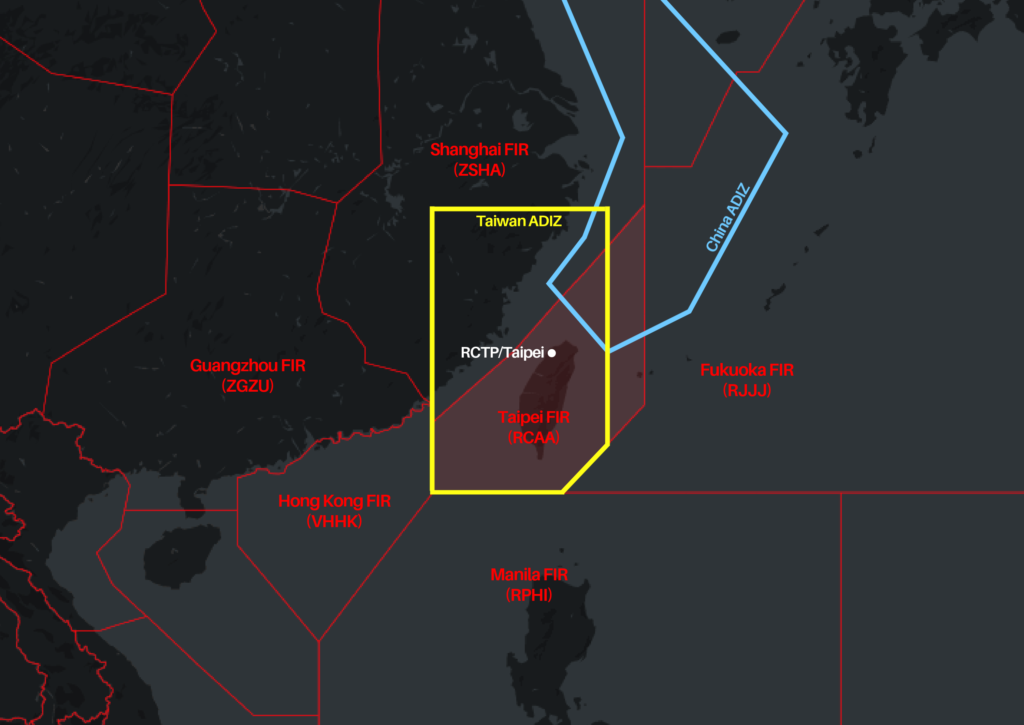
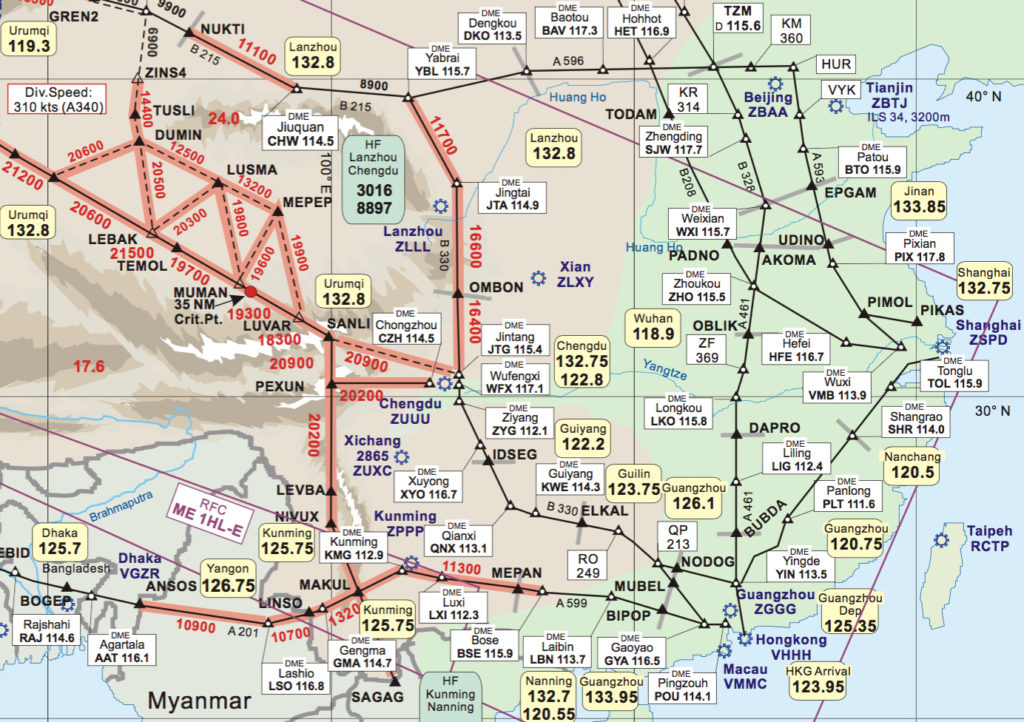
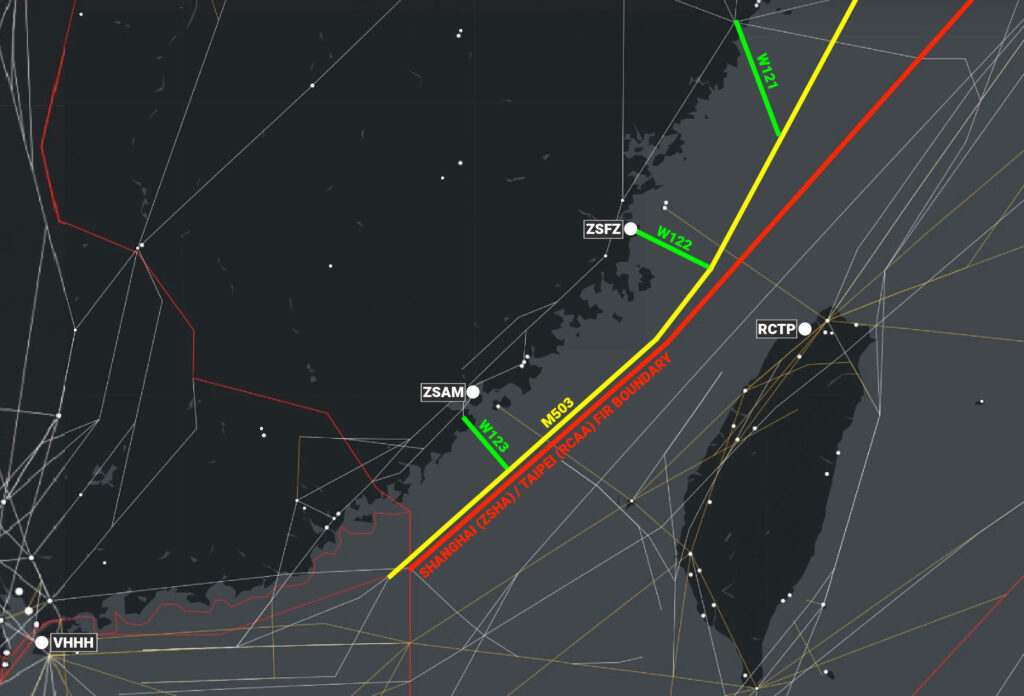
China has cancelled all concessions previously made to Taiwan regarding the M503 airway that runs along the ZSHA/Shanghai and RCAA/Taipei FIR boundary.

What does this mean in practice?

  • China have moved the airway 6nm back towards the FIR boundary.
  • They have started allowing eastbound flights on the the W122 and W123 connecting routes.

So now, of all these routes, the only one that is not bi-directional is W121 (westbound only).

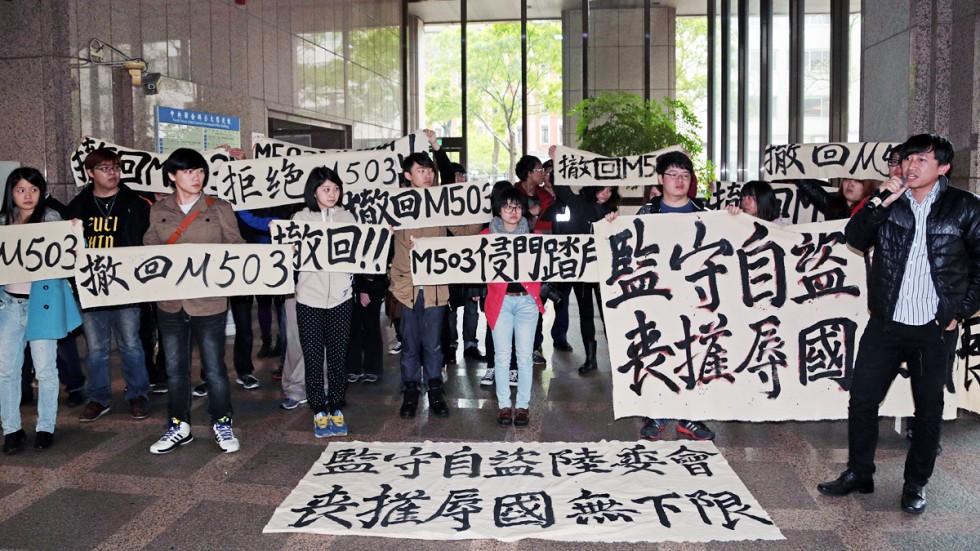
Taiwan aren’t happy, same argument as before: they say the airway is too close to existing routes that serve airports in outlying groups of Taiwan-controlled islands, and thus poses a risk to safety. China have ignored them.

Can I use M503?

China only allow airway M503 to be used under certain conditions:

  1. Aircraft must be RNAV2 capable.
  2. The flight must be going between VHHH/Hong Kong or VMMC/Macau and certain Chinese airports: ZSPD/Shanghai Pudong, ZSQD/Qingdao, ZSYT/Yantai, ZYTL/Dalian.

Everything else transiting east-west across this region will need to use the congested parallel A470 airway along the southeastern coast of mainland China.


The Annual Shanghai Airports Meltdown

Key Points
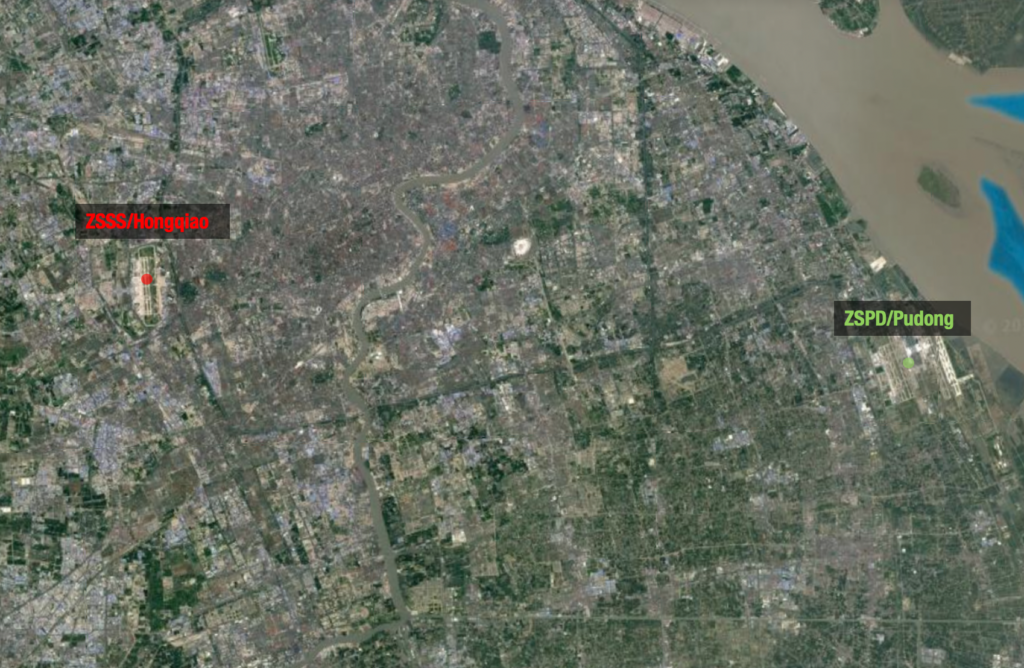
  • Shanghai’s ZSSS/Hongqiao and ZSPD/Pudong airports are effectively off-limits to bizav flights at the start of November, unless you’re heading to the China International Import Expo event.
  • Operators will need to consider nearby airports instead: ZSWX/Wuxi, ZSHC/Hangzhou, ZSNJ/Nanjing and ZSNB/Ningbo.

You won’t find it on the Notams, but there are some restrictions coming up in November at Shanghai’s ZSSS/Hongqiao and ZSPD/Pudong airports which effectively ban most business/private flights.

It’s the same meltdown every year in Shanghai. It’s all to do with the annual China International Import Expo event (CIIE) – which this year will be held from Nov 5-10.

Here are the restrictions at the main airports to watch out for this year:

ZSSS/Hongqiao

From Nov 2-8, no business/private flights allowed, including those flights participating in CIIE.

ZSPD/Pudong

From Nov 2-13, the airport will only accept participating CIIE business/private flights. Quick turns (if not participating in CIIE) are not allowed.

It’s also worth noting these two extra restrictions at ZSPD which apply year-round:

  • Take-off and landing is prohibited between 07-09 local time (23-01z).
  • Business/private flights are not allowed to have two peak hour slots between 09-22 local time (01-14z). So you can land during that period, but then you have to wait until 22 local time before you can depart!

Where else to go?

For non-CIIE flights wanting to go to Shanghai during this period, the alternative options may be limited, as parking will fill-up quickly at nearby airports ZSWX/Wuxi, ZSHC/Hangzhou, ZSNJ/Nanjing and ZSNB/Ningbo.

Here’s the lowdown on those four airports:

ZSWX/Wuxi

Operating hours? H24. But bizjets can only go here between 0700-2300 local time (and Customs are only open from 0830-2300). Outside those hours, you need permission from the airport authority. 
Does it have an FBO? Yes, but only for domestic flights.
Driving time to Shanghai? 2hrs (130km)
Other restrictions? You need permission from the military to operate here. Overnight parking is generally not allowed (and there’s no hangar for bizjets). 

ZSHC/Hangzhou

Operating hours? H24.
Does it have an FBO? Yes, but only for domestic flights.
Driving time to Shanghai? 2hrs 30mins (180km)
Other restrictions? They don’t issue arrival/departure slots to business/private flights between 0700-0859 local time. We also heard from one handler that there is a 72hr parking limit in place at the moment.

ZSNJ/Nanjing

Operating hours? H24.
Does it have an FBO? Yes.
Driving time to Shanghai? 3hrs 30mins (300km)
Other restrictions? They don’t issue arrival/departure slots to business/private flights between 0700-0859 local time.

ZSNB/Ningbo

Operating hours? H24.
Does it have an FBO? Yes, but for domestic flights only.
Driving time to Shanghai? 3hrs (220km) – providing you take the road over the Hangzhou Bay Bridge

Know a secret airport somewhere near Shanghai where bizav flights can operate to during this period? Let us know!


Shanghai: ZSSS closed to non-sched traffic

Key Points
  • You won’t find it in the Notams, but ZSSS/Hongqiao (one of Shanghai’s two international airports) will not accept non-scheduled international flights for the next four to six months.
  • This includes both private and commercial operators, and is due to FBO renovations.
  • Operators looking to clear customs will need to use ZSPD/Pudong instead.

FBO Works at Honqiao

On August 1, official notification was published that the Hongqiao FBO would be closed for major renovation – including the customs channel. You can read that here (in Mandarin).

All non-scheduled international flights now need to use the other Shanghai airport, ZSPD/Pudong.

No dates are provided for when things at ZSSS will get back to normal. We reached out and have been advised that it could be up to six months before non-scheduled international flights will be welcome again. You can contact them directly on fbo@fboshanghai.com for updates on that.

What about domestic flights?

The news is a little better. They can still land at ZSSS. Asides from the FBO being shut, there is little impact. Instead, a VIP room is being used as a replacement facility. Obviously, there will be no customs available.

Local agents advise there is no change to existing procedures or parking.

ZSPD/Pudong

For international non-scheduled flights then, ZSPD/Pudong will be the only Shanghai option for the next few months.

This maybe especially unusual for operators who commonly arrive over the city from the west.

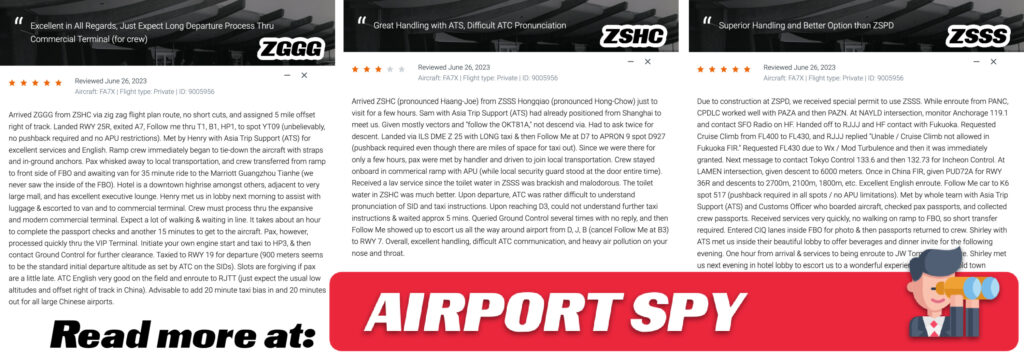
A browse of the Airport Spy reports submitted by OPSGROUP members are mostly positive. We’d welcome some new ones though, and so if you have been there lately, we’d love to hear from you. You can submit yours here.

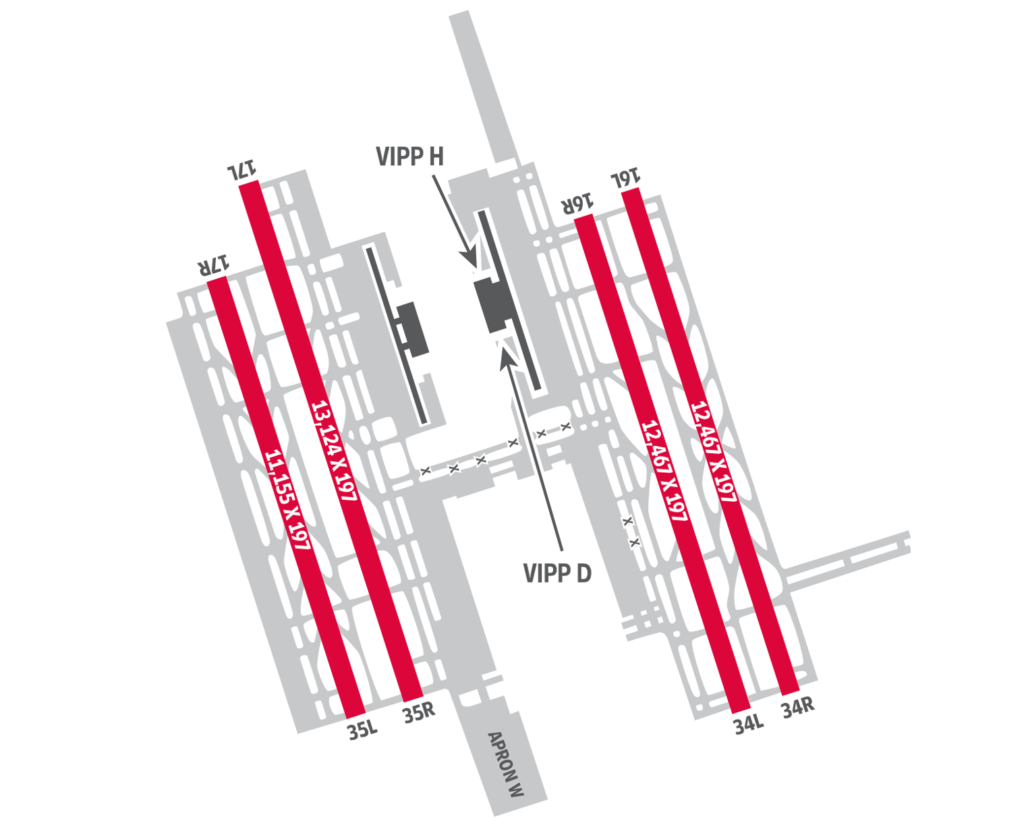
International arrivals at ZSPD can expect to be processed via VIPP-H on the chart below. Crew will need to clear customs through the regular customs channel, aka the passenger terminal.

A big heads-up – Universal advise a general parking restriction of max 48 hours still applies without a special extension. Which means for longer stays, you may be looking at a re-position to ZSSS and back.

You can reach Universal for handling and other enquiries on chinaoperations@universalaviation.aero

We’ll keep you updated.

If international non-scheduled flights resume at ZSSS earlier than expected, we’ll let you know. Also keep an eye out for new (and potentially better) procedures and facilities when the FBO re-opens its doors.


Come fly around China as much as you like!

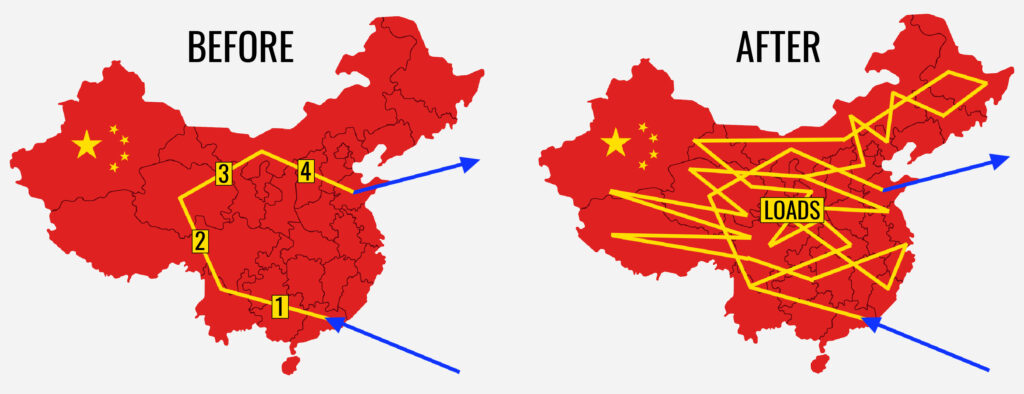
Local agents in China have confirmed that authorities have dropped the 6 sector limit on foreign private/bizav flights.

Until now, aircraft were limited to 6 flights in China – international arrival, 4 internal flights, and international departure. But from June 20 all sector limits have been removed, so you can now fly as many domestic sectors in China as you want.

Here’s a beautiful graphic we made to illustrate the change:

True to form, the authorities in China haven’t officially published this change anywhere. We heard about it from an OPSGROUP member (thanks! please tell us more things!), and double-checked it with a few local agents in China who confirmed the change.

Which local agents?

Three of them, all said the same thing. You can contact them here:
Pandaviation: ops@pandaviation.com
Mainland GroundExpress: ops@mgel.aero
Universal: Chinaoperations@universalaviation.aero

Why has this changed happened?

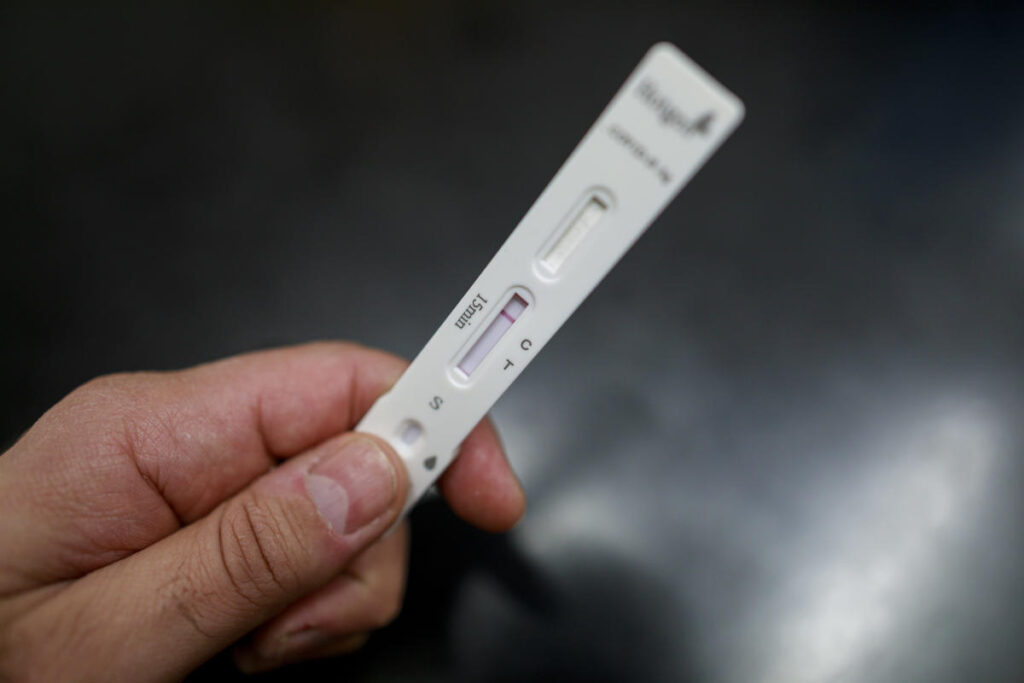
It’s all part of China’s big re-opening post-Covid, and aimed at getting traffic levels back up again. China fully reopened to tourists in March 2023, after three years of border restrictions. For pax, quarantine was dropped in Jan, and PCR tests were replaced with rapid antigen tests at the end of April. For crew, you no longer need a Covid test at all – you just need a C type visa and to fill out the online health dec form to generate a QR code which you show on arrival.

What about cabotage?

Not really an issue here – foreign reg private/bizav flights can pick up and drop off different pax on domestic flights without issue.

China treats private and charter flights as the same thing. The only difference comes when you have more than 29 seats onboard. In this case, the CAAC will treat you as non-scheduled commercial flight, which means things get more tricky – additional permit requirements including providing a charter agreement, AOC and other aircraft docs.

All interesting in theory. But what are ops to China really like?

We don’t know. But we know someone who does – YOU! – fine upstanding members of OPSGROUP!

We’ve had several reports recently from OPSGROUP members who have flown to China. Head over to Airport Spy on your dashboard to read the reports!

We want your reports!

If you’ve been to China (or anywhere else, for that matter) and can share some info on how the trip went, let us know. Or even better, skip the middle man and file an Airport Spy report!

More info on China ops

  • For all your questions on ops to/between/over/avoiding China and Taiwan, check here.
  • For some general top tips on ops to China, check here.
  • Want to know what the deal is with crew visas in China? Check here.
  • Make sure you know about the hidden permit costs of operating to China here.
  • Read about the latest goings on in the South China Sea here.
  • OPSGROUP members can download a Himalayan Routing Guide here.

New US Rule for China Arrivals

There’s mixed news from China.

On the one hand, it is finally about to get rid of quarantine on arrival. On the other, Covid is surging badly. Which means that nations around the world are beginning to introduce new rules for people who have been there – including the US.

News from the US is that from Jan 5, all passengers will need to provide a negative Covid test, or proof of recovery, to board a flight to the US.

Here’s everything you need to know.

What’s going on in China?

Its zero-covid strategy is being abandoned amidst sky-rocketing case numbers. So much so that it is estimated that up to forty percent of its 1.4 billion have had it.

It’s not panic stations yet though, as the same path has been well-trodden by other countries in the past twelve months. But there is international concern over the accuracy of the statistics being reported, and more importantly the tests that identify new or potentially dangerous strains of the virus that might emerge.

Which is why we’re seeing new rules again for passengers who have been there.

Ironically there has also just been a big announcement that anyone headed to China no longer has to quarantine from Jan 8. Which means demand for travel back to the US for those who return is about to soar.

Enough of that. What’s the impact?

From 00:01z on January 5, anyone allowing a passenger to board a flight from China to the US will need to see proof of a negative Covid test taken within two days of departure, or certified proof of recovery that is less than 90 days old.

The rule will apply to all flights from mainland China, Hong Kong and Macau including GA/BA flights.

It will apply to all passengers, including US citizens, regardless of vaccination status.

You can check the official announcement of all this from the US here.

What type of tests will be accepted?

Viral tests that have been approved by the CDC.

Self-tests (including rapid antigen) are allowed, but must include at least a tele-health service to oversee the test, and certify the results along with the traveller’s identity.

I’ve just had Covid. Do I need to test?

A certified proof of recovery is also acceptable, provided it meets two requirements – it has to be more than ten days old, but no more than 90.

I’ve only transited through China, do I still need to test?

No, provided passengers have stayed airside, they do not need to meet the new requirement.

What about crew?

Good news, you will be exempt. But you’ll need to be either operating, or positioning on the aircraft. It’s recommended you travel with a letter (paper or electronic) from your employer certifying you meet the requirements of the exemption. Another option for deadheading crew is that they are included on the gendec.

If you’re commuting, travelling for training (such as sims) or flying for other business reasons, bad luck. You will need to meet the same requirements as passengers.

Another gotcha.

The rule is also extended to passengers who have been in China, Hong Kong or Macau in the past ten days, and are arriving on flights from RKSI/Seoul, CYYZ/Toronto or CYVR/Vancouver.

What is the rest of the world doing?

It is likely we’ll see similar testing rules introduced globally, at least in the short term.

Several countries have already announced similar restrictions to the US: Canada, UK, France, Italy, Spain, Australia, India, Japan, Malaysia, Taiwan, South Korea, Morocco.

The good news is that there doesn’t appear to be any suggestion of quarantine or entry bans being added back to the mix. Just typical uncertainty of a pandemic-weary world. But we’ll continue to report on major changes that might affect you operationally as we see them.

If you’re headed to China, we recommend calling ahead.

Especially for crew.

China has had some of the most confusing and inconsistent entry rules since the start of the pandemic. They seem to vary from port-to-port. With the promise that crew no longer need to quarantine on a widespread scale, we’d love to hear from you if you’re headed there – especially if you encounter something you weren’t expecting.


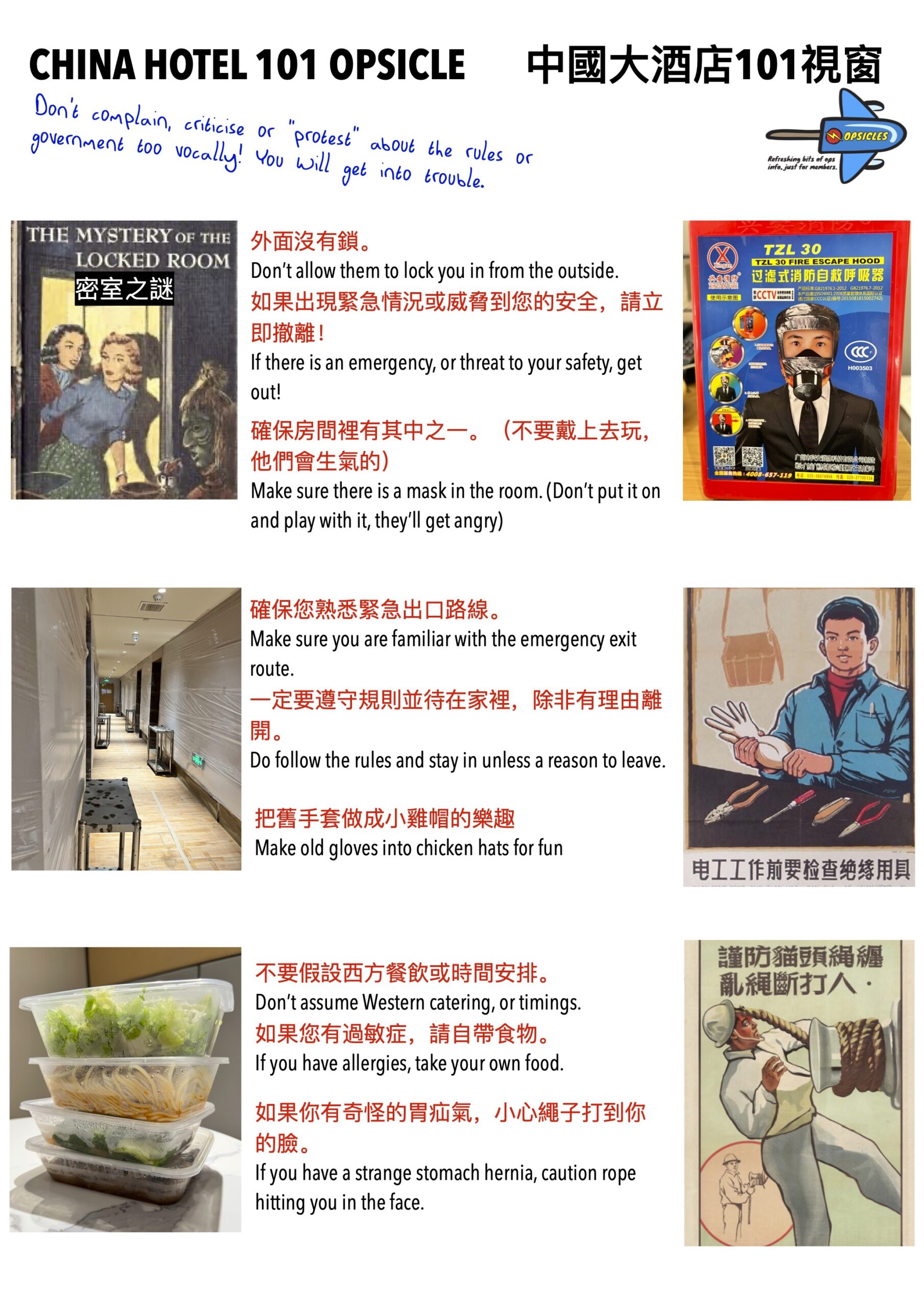
China Crew Hotel 101

This is one for any crew who head into China. 

What happened in Urumqi?

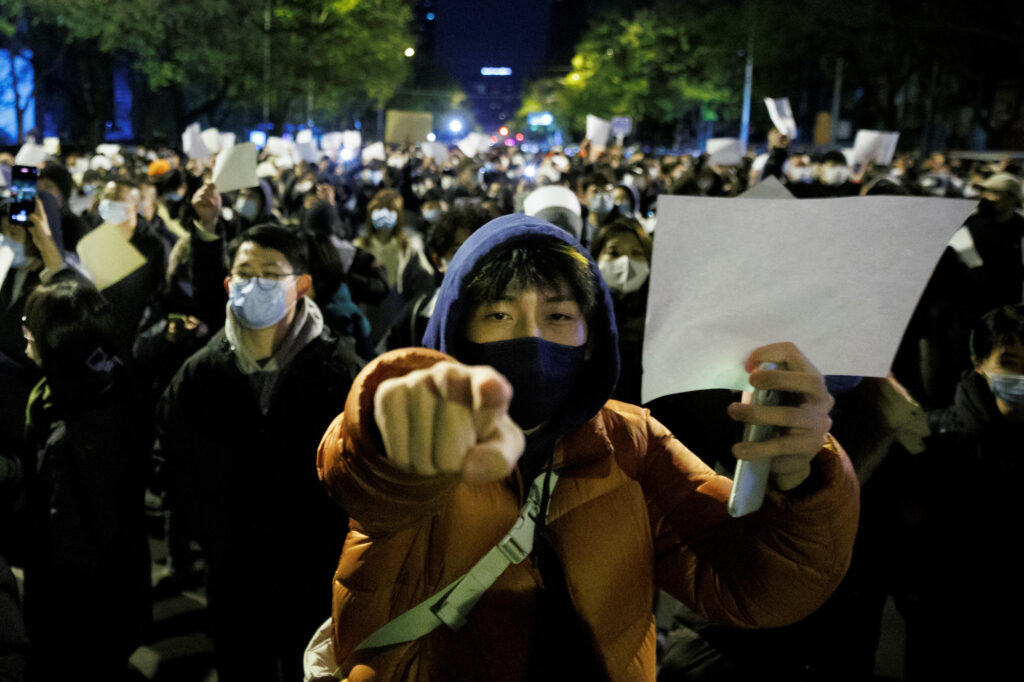
People in China are angry. 

There are currently protests across many major Chinese cities, including Beijing and Shanghai. Which is unusual because protests are very frowned upon in China, and generally lead to quite a heavy handed police response.

So when they do protest, you know it is over something they feel strongly about. 

They are angry over Covid lockdown rules which saw a 10 people perish in a tower block fire in Urumqi. Questions have been asked over whether residents were allowed to leave their homes, and whether the fire exits were clear.

What does this have to do with crew?

There are two things worth considering if operating into China:

  • The security situation
  • The hotel room safety situation

The Security Situation

Crew are not allowed out of their quarantine hotels, so the protests themselves will not impact you directly. However, a stricter level of Covid rule compliance might.

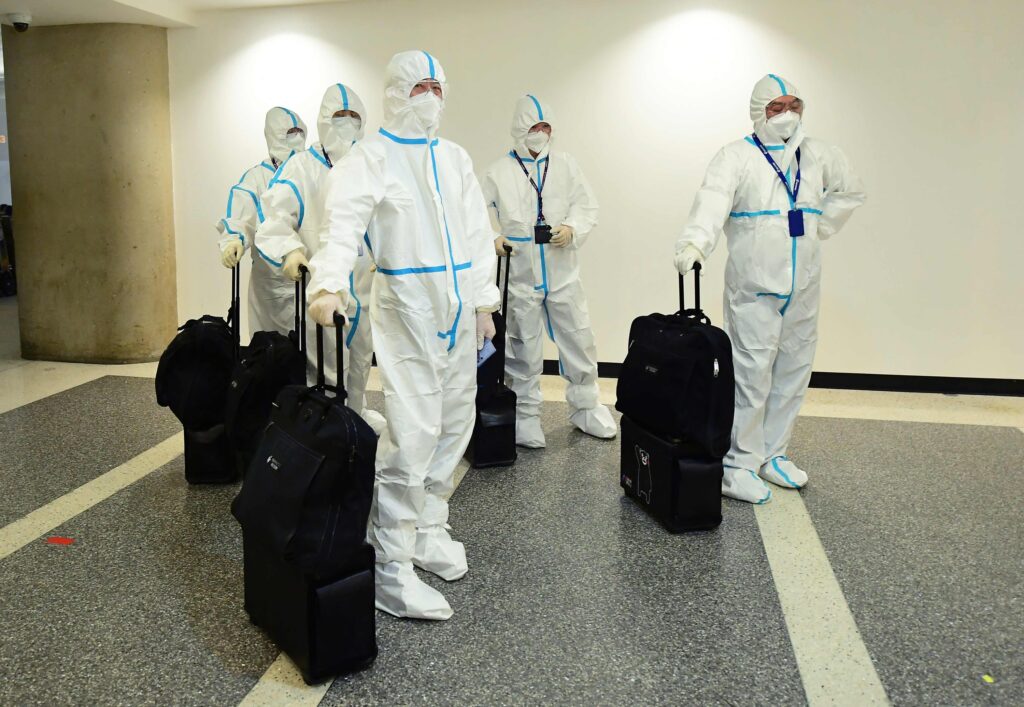
Currently, crew are required to don full ‘anti-Covid’ suits on arrival (while still on the aircraft), and are accompanied through airports, bused to hotels, and required to remain within their hotel rooms.

Member Top Tip: “They don’t generally provide big sizes. If you need an XL it might be worth getting your local agent to arrange this, or you’re going to find yourself trussed up like a sausage inside an ‘average”‘sized suit.”

The rules have eased a little, but are still subject to change at short notice, and entry requirements for crew are not always entirely clear. The best people to ask are your local agents at whatever airport you are heading into.

We recommend that you:

  • Follow the rules pretty strictly. Easier in the winter months when it is not baking hot (those suits are the worst in the summer). Non-compliance is likely to lead to fines, potentially banning your operator from returning to China, or you may be subject to more quarantine.
  • Prepare for lengthy delays in and out of the airport and factor this into your report times.
  • Do not vocally criticise in a way that might be perceived as a protest against Chinese law or the government.

But what’s this about hotel room safety?

Some crew have reported that they are not only quarantined in their hotel rooms, but they are locked inside their hotel rooms, unable to open the door from the inside. 

This is not safe. 

If you or your operator has experienced this, please let us know at news@ops.group. We might not be able to do anything to help, but we can share the hotel info with other operators so they know about it.

You must be able to unlock your hotel room from the inside in order to evacuate in an emergency. Your hotel room should also be equipped with a smoke mask.

  • Checking with the hotel prior to operating in and raising this is a good idea. Doing so once there may prove difficult. Bear in mind, these are generally government selected hotels for crew as well. You don’t get much say in where to stay.
  • On arrival, crew should pay particular attention to how to access emergency exits because these hotels tend to have significant ‘plastic coating’ on their interiors, and it may be difficult to locate exits in an emergency.
  • If in doubt over your safety, don’t remain in the room because they’ve told you to. Get yourself out and safe, and worry about the repercussions of that afterwards. I’m pretty certain they’ll be less serious than the consequences of staying locked inside a burning hotel!
  • Make sure your crew have contact information in case of a medical emergency while in China.

Monitor the food situation

Folk report this is slowly improving. 

If you haven’t been, then here’s the deal – basically your hotel is going to provide you with meals. These are usually left in boxes at specific times outside the room, and you’re allowed to open up and take them inside.

There are two issues here:

  • They are not always catering to ‘Western’ food preferences.
  • There doesn’t appear to be any way to report allergies.
  • Chinese good often contains MSG, which you may have an allergy to without knowing.
  • They often provide them based on Chinese meal timings, which can be tough with jet lag/sleep plans etc.

Good news is you can get in touch in advance and ensure you request food that your crew can eat, and that it is provided at times they will want to be eating at. Alternatively, recommend crew take their own food with them.

A little note on Customs

China readopted their Health Declaration Measures, since November 16. Make sure you submit the form and download the QR code before heading over. There is an APP for it that makes it handier, and the website is here for all the info you might need.


Ops to Taiwan? You’ll have to avoid China

  • Can I fly between China and Taiwan?
  • If I make a stop in Hong Kong, is that ok?
  • What about overflights?
  • Can I overfly China to get to Taiwan?

There’s a boring answer to these questions, and there’s a fun answer.

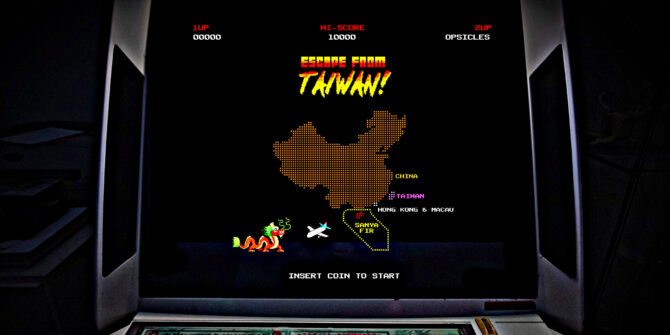
The Fun Answer

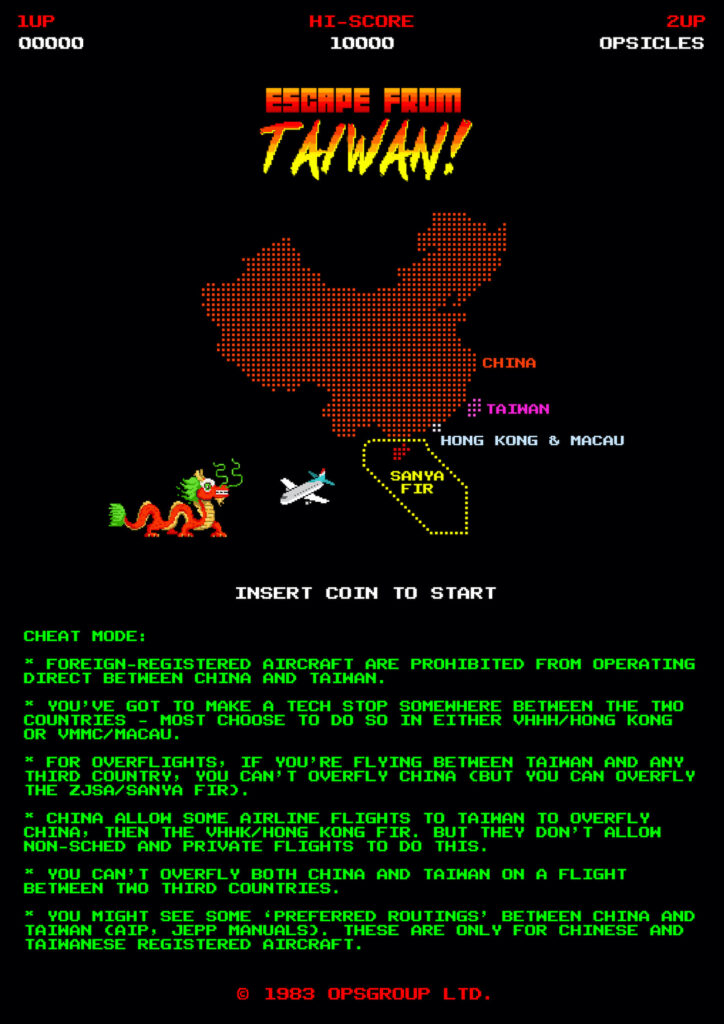
OPSGROUP members have all the fun – you guys get to play the game. We tested it out and managed to find the ‘cheat mode’, so we left the screen open for you. You can download this (along with all the other Opsicles we’ve made) via your Dashboard here.

The Boring Answer

You can’t fly between China and Taiwan in a foreign-registered aircraft.

The Chinese authorities are reluctant to provide any kind of official document stating any of this – we haven’t been able to find any precise wording anywhere in their AIP which states these restrictions.

To test the theory, we applied to the Chinese authorities for a landing permit for a direct flight from Taiwan to China. After we applied, we received an immediate call from CAAC emphasising that they will not deal with such applications for foreign registered aircraft. They advised they will not process this application and verbally rejected it.

The Chinese authorities circulate an official document to Chinese handling agents about this issue, which sets out the rules quite clearly. For some reason, they don’t like these to be distributed outside of China… so naturally, we got our hands on a translated copy:

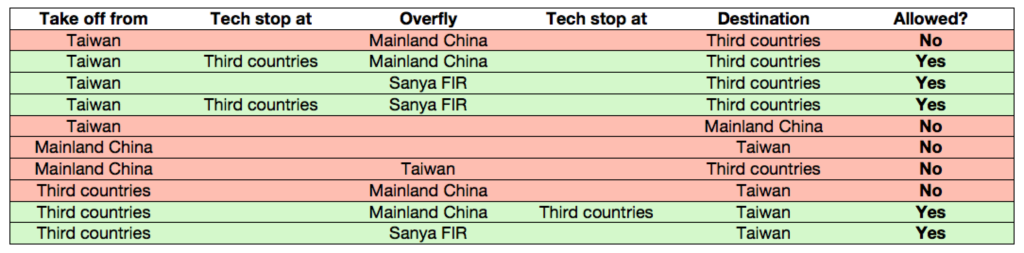
So, to summarize:

  • Foreign-registered aircraft are prohibited from operating direct between China and Taiwan.
  • You’ve got to make a tech stop somewhere between the two countries – most choose to do so in either VHHH/Hong Kong or VMMC/Macau.
  • Importantly, the same rules apply for China overflights – if you’re flying to Taiwan from any third country, you can’t overfly China. China allow some airline flights to Taiwan to overfly China, then the Hong Kong FIR. But they don’t allow non-sched and private flights to do this. 
  • Only Chinese and Taiwanese registered aircraft are able to operate direct between China and Taiwan.

There’s one more scenario that is apparently also not allowed:

You can’t overfly both China and Taiwan and then land in a third country. For example: you’re departing from RPLL/Manilla in the Philippines, then overflying Taiwan (RCAA FIR), then overflying China (ZSHA FIR), and then landing in a third country like RKSI/Seoul in South Korea – according to the Chinese authorities, this is not allowed, and they won’t issue an overflight permit!

Further reading:

  • For some general top tips on ops to China, check here.
  • Make sure you know about the hidden permit costs of operating to China here.
  • Read about the latest goings on in the South China Sea here.
  • OPSGROUP members can download a Himalayan Routing Guide here.

We Need to Talk About China!

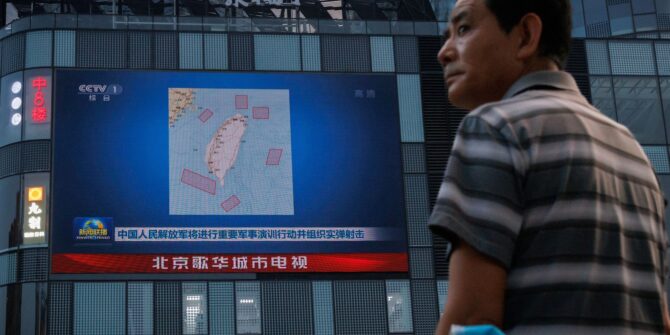
China held new drills near Taiwan on Monday, a sign that they may intend to normalize their military presence around Taiwan. This came a day after the Chinese military ended their extensive 3-day exercises encircling Taiwan, effectively simulating a blockade.

During those exercises, there were significant impacts to flight ops in the region. Xiamen Airlines and Korean Airlines made adjustments to several flights to avoid the airspace, Cathay Pacific pilots were reportedly advised to carry an extra 30 minutes of fuel, and there were cancellations at RCTP/Taipei airport in Taiwan and ZSAM/Xiamen and ZSFZ/Fuzhou airports in mainland China.

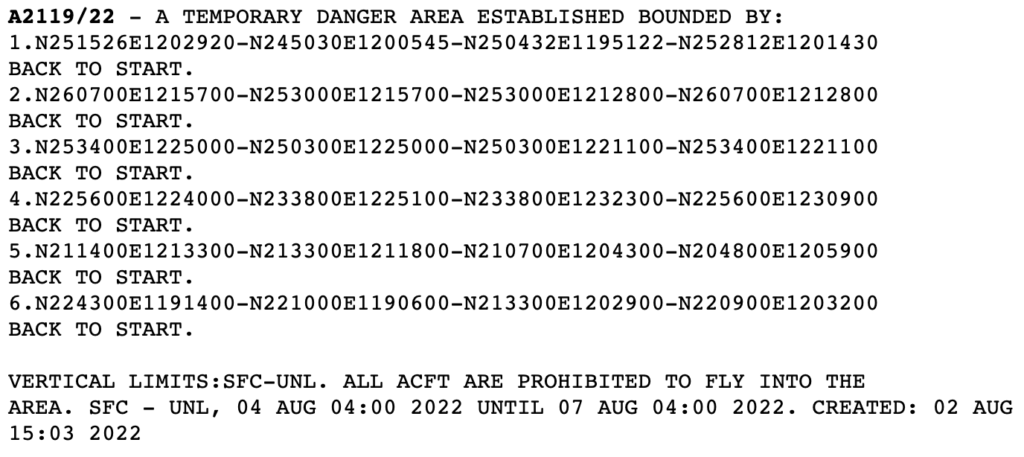
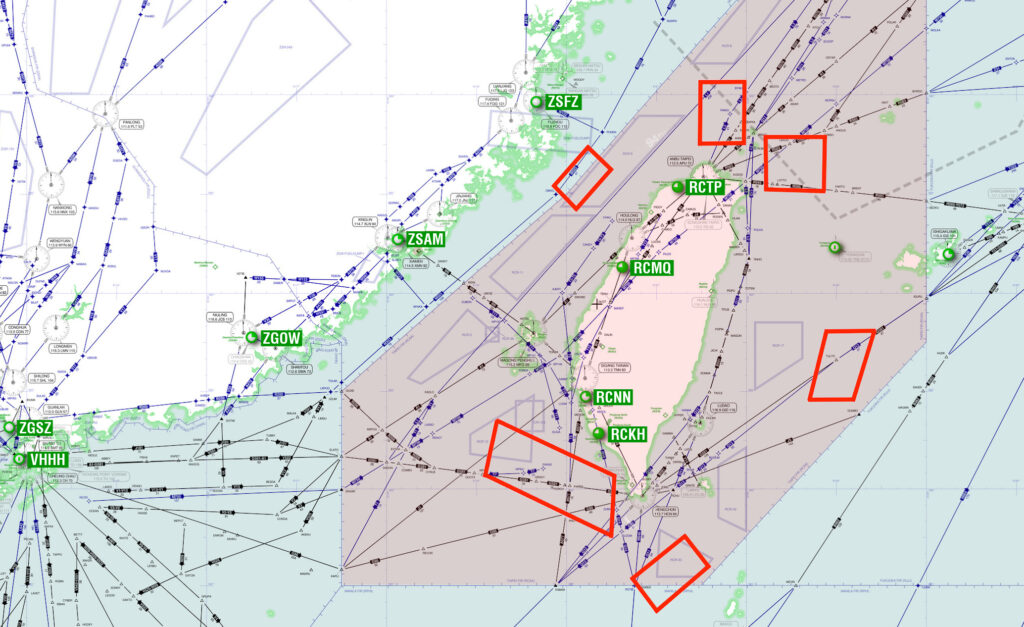
China published ZBBB Notam A2119/22 which set out the six Danger Areas where flights were prohibited at all levels:

Here they all are, plotted on a map:

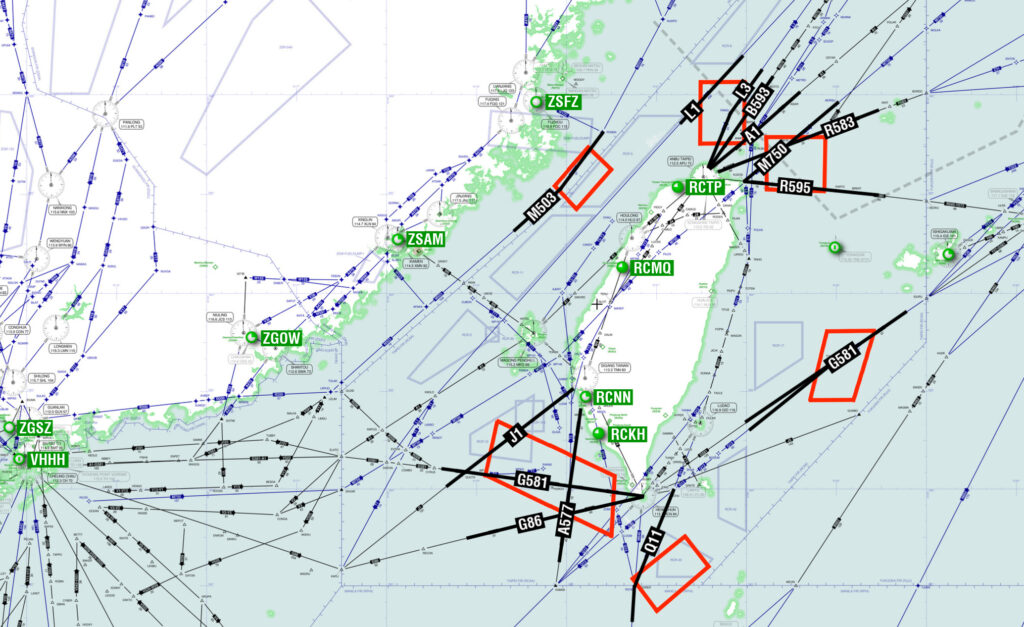
And here are all the main airways that intersect those Danger Areas:

The Danger Areas affected major routes between Southeast Asia and Northeast Asia.

For any future exercises that China announces, if you’re planning on transiting the RCAA/Taipei, ZSHA/Shanghai or RPHI/Manila FIRs then make sure you check the ZBBB Notams as it might not show up as part of your flight briefing pack.

Hypersonic missile launch

China launched an unannounced hypersonic missile on Aug 1 (we could not find any Notams for it). This marked the 95th anniversary of the Peoples Liberation Army being founded, and coincided with an announcement from the US that they might visit Taiwan.

The missile was only fired towards Taiwan, falling some 120km off the coast into the Taiwan Strait.

Taiwan-China procedures

Specific procedures regarding international flights into Taiwan have existed for years, and you can find more in-depth information on these here, and a post on general tips for China Ops here.

A brief summary:

  • Foreign registered aircraft are prohibited from operating directly between China and Taiwan.
  • If you need to make a tech stop between the two, VHHH/Hong Kong or VMMC/Macau are good options.
  • The same rules apply for China overflights – if you’re flying to Taiwan from any third country, you can’t overfly China.
  • Only Chinese and Taiwanese registered aircraft are able to operate directly between China and Taiwan.

Because of these, the airspace over the Taiwan Strait is not hugely busy and the missile posed a limited risk to aircraft.

Heightened military activity

China have been showing heightened military activity in and around the South China Sea, ownership of which is disputed by neighbouring countries. This is not directly linked with the Taiwan situation, but provides some further political (and flight ops) awareness, particularly because of the strategic military positions China hold in this region.

In addition, China have been carrying out military drills in various areas, mainly near the East China and Bohai seas. These rarely impact flight operations, with the prohibited zones focused on maritime traffic. However, increased offshore helicopter traffic and some flight disruptions into coastal airports do occur.

China have been increasing their incursions into Taiwanese airspace for a while, with a spate of them towards the end of 2021. These pose some risk to commercial operations for several reasons – increased military traffic being the obvious one. A lesser risk of misidentification is heightened as well, along with the potential response if a civilian aircraft accidentally encroaches on out of bounds Chinese military airspace (well, all of it is military, but some of the really ‘don’t go in there’ parts).

What if China shut their airspace?

We are not saying it will.

However, China are initiating a major offensive in Taiwan, and this does draw parallels to Ukraine and Russia. If the US military becomes involved, this may lead to sanctions between the two countries. Some early consideration as to what airspace closures might mean is therefore a good idea.

China is a major air corridor, particularly with Russian airspace currently closed to the US and Europe. Reduced access or closure of the airspace will see flights routing far further south via Japan, and potentially across the South China Sea before routing across Thailand, India and Pakistan and the Middle East.

The impacts would be significant for various reasons:

  • This will significantly increase flight times and distances, and likely be prohibitive for aircraft with lesser range capability (without fuel stops).
  • The South China Sea may see increased risk levels if China increase their military presence there as well.
  • Summer weather patterns can create further routing difficulties particularly around the Bay of Bengal area.

Other threats to consider.

The Cyber Threat
Chinese action in terms of cyber security breaches have been questioned more than once. 

The political stuff
China and the US have a history of ‘messy’ visas for aircrew already. Further tensions are likely to increase this. Security for certain nationalities will need consideration.

Trade
China is a major trade partner with the US and Europe and sanctions on trade may impact aircraft parts manufacture.


South China Sea Dispute: Impact To Ops

The South China Sea dispute (don’t be fooled by the sea’s name) is between a bunch of the states in the region including, of course, China. It isn’t so much over who owns it, but how much each bordering state owns.

The reason they all want as much as they can get? Well, it’s an important bit of sea for the movement of maritime trade, and for general military control.

Who has been doing what?

There has been a lot of ‘Cabbage tactics’, ‘Salami Slicing’ and sneaky island building going on by several of the nations for quite some time.

Wondering what ‘salami slicing’ and ‘cabbage tactics’ are? They are when you do small things that all add up to bigger implications, and when you start ‘wrapping’ your military around stuff.

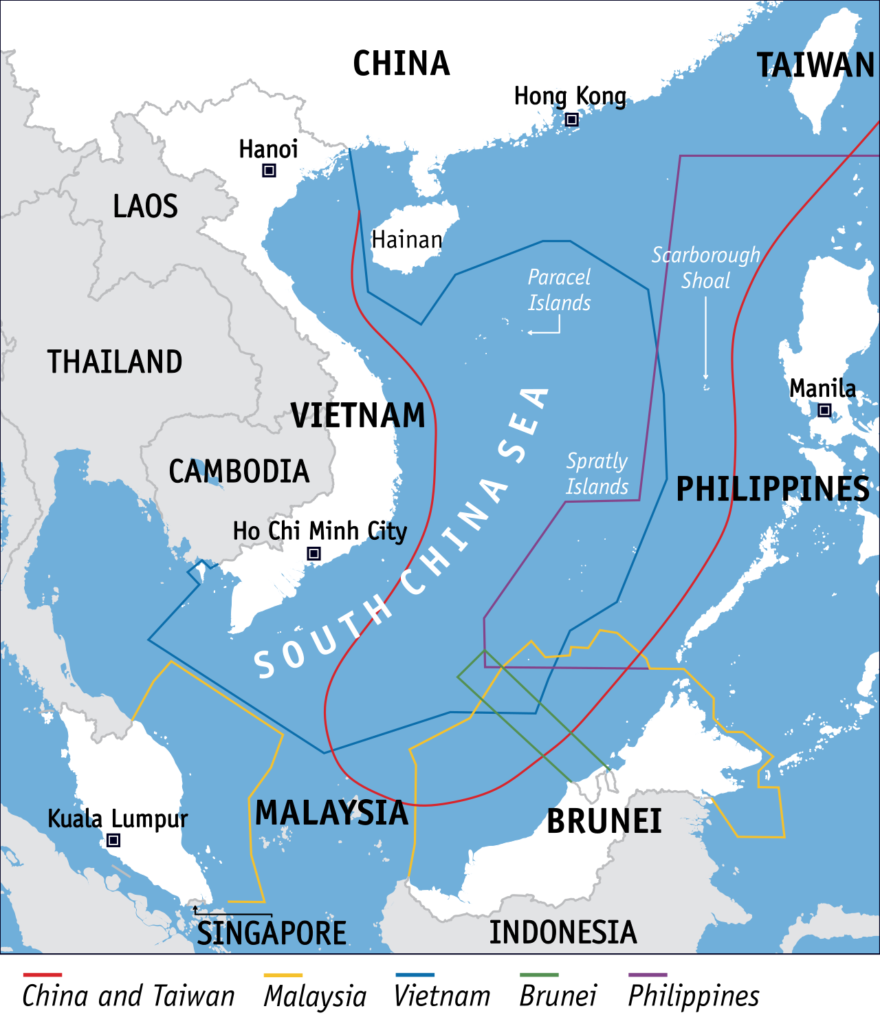
Here’s what each country’s territorial claims in the region looks like:

Why are we more concerned now?

The dispute has been going on for a long time and has rarely had much impact on aviation. However, China have recently been upping the game, carrying out large numbers of military drills across the region. We wrote about some of these a while back.

The majority of these are maritime only and the primary impact for flights ops is really just an increase in offshore helicopter traffic. Occasionally the exclusion zones have impacted aviation traffic as well because the upper limits are not always clear, and they often lie close to coastal airports.

There are drills planned through the start of June.

China are militarising islands.

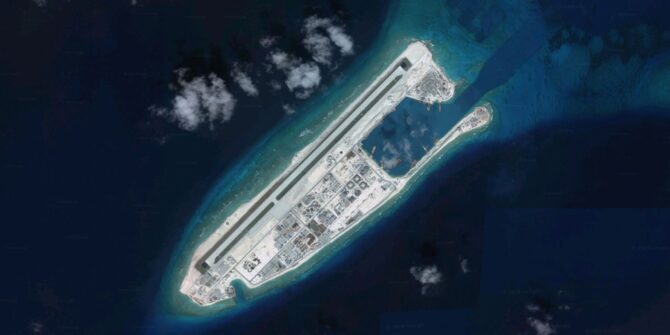
China are rumoured to have ‘fully militarised’ several islands in the South China Sea. These are purpose built islands (part of that sneaky island building strategy) designed to increase the Chinese military presence, and so control, in the region.

The militarisation is a potentially a cause for concern because the equipment on these includes anti-aircraft missile systems, laser and jamming equipment, and fighter jets.

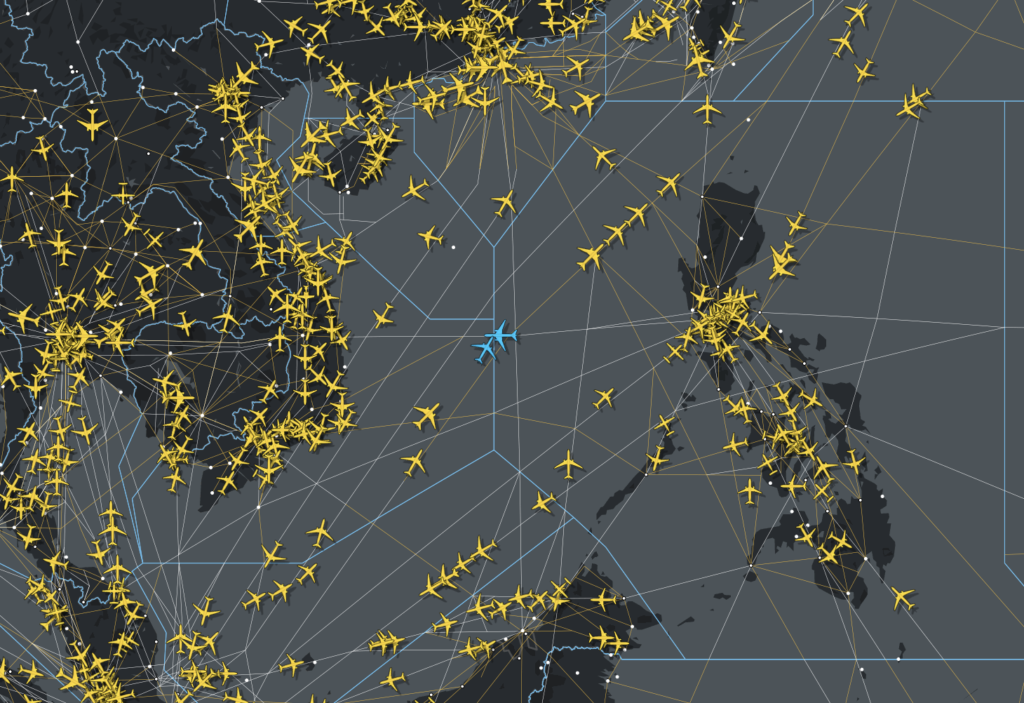
The region is a relatively busy overflight area, with numerous airways as well as the traffic routing in and out of the surrounding countries.

Previous incidents.

In 2015, an Australian RAAF aircraft was carrying out “freedom of navigation” exercises over the China Sea in international airspace, but China responded with threats against them via state owned media sites, ‘strongly advising’ Australia that such flights were not welcome.

In 2015, a BBC News crew flew over some of China’s militarised islands in a US military aircraft and the order on the radio was less than friendly.

Was a missile launched?

A video has been circulating this week, reportedly showing a missile fired into a region with commercial air traffic. The video claims to have been filmed from within an aircraft told by ATC to immediately turn 90 degrees to move out of the missile’s path.

It is unverified and the airline reportedly involved have denied it occurred.

Drills were announced from May 22-27, but these referred to maritime exclusion zones only, and made no mention of possible missile launches or airspace hazards. There were no notams issued on the day for any launches and the lack of any additional information suggests it may be a fake video.

Is there a risk here?

There is a heightened military presence, an ongoing dispute and tensions are increased however there is no verified indication that the risk to commercial operations is increased at this time.

If operating in the region, maintain a listening watch on 121.5 at all times and ensure you are aware of contingency procedures in case of an emergency.


Chinese maritime drills might impact flights

China has been carrying out a lot of military exercises over the South China Sea of late. Most of these are maritime, but that doesn’t mean they won’t have some impact on aviation as well.

So here is a look at what is going on and where to watch out for…

The Exclusion Zones.

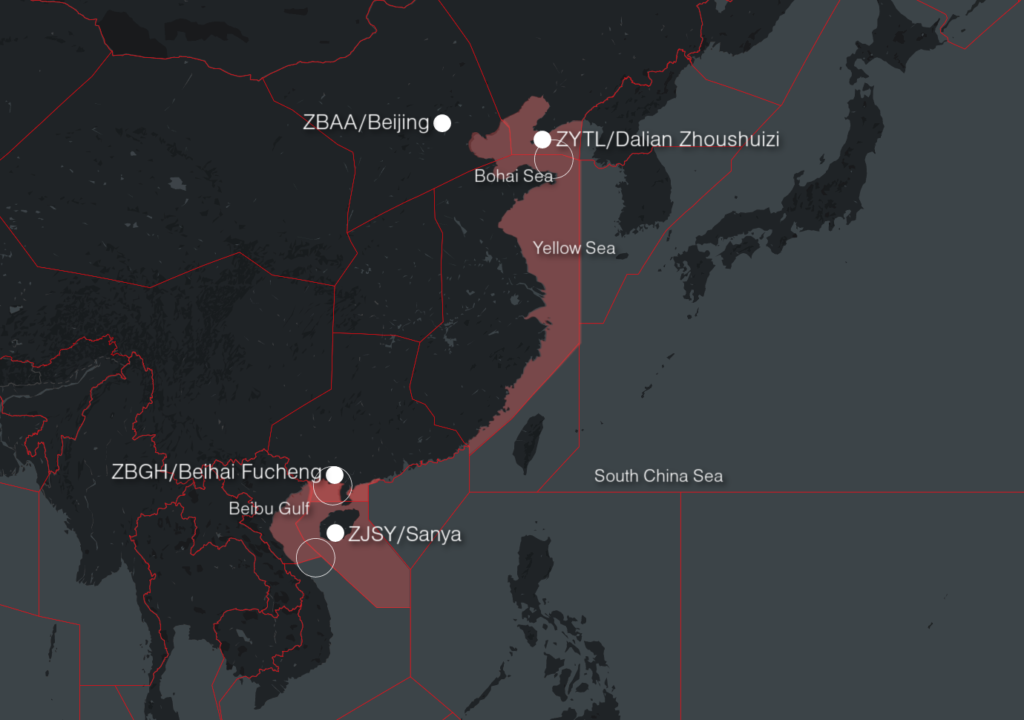
When China carry out their military drills they establish exclusion zones. These definitely apply to maritime traffic, but it is a lot less clear whether they apply to civilian aviation traffic as well. Some of them also lie in particularly close proximity to the airspace of International airports.

So best know about them just in case.

The Current Activity (that we know about).

  • Number 1

The latest one is taking place in the northern region of the South China Sea, and will run through to at least 18:00z on April 9. The no-go zone is about 90km or so in size, southwest of Sanya which means traffic in and out of ZJSY/Sanya Phoenix International may be disrupted.

There could also be an increase in helicopter traffic, so keep an eye on that TCAS and remember your contingency procedures for Sanya Oceanic, and China in general.

  • Number 2 & 3

Drills were planned in two areas – one in the Bohai Sea, and one in the Beibu Gulf (northern South China Sea). These were due to run through March 27, but have been extended to April 10.

ZYTL/Dalian Zhoushuizi International airport and ZGBH/Beihai Fucheng airport maybe impacted by the exclusion zones.

  • Number 4

This one was announced quite late, and will take place in the South China Sea, off the coast of Shantou, Guangdong Province, through March 26. As with all the others, it isn’t clear what the impact to flights will be beyond possible disruption if flying into ZGOW/Shantou Waisha Airport, and a likely increase in helicopter traffic.

China in general…

China have a huge number of unmapped military bases. In fact their entire airspace is basically one giant military zone. This means you might often find yourself descended early if heading in, kept very low when heading out, or given big detours which seem to make no sense.

All of this means a much higher fuel burn (which can be very hard to plan for!)

We wrote some stuff on China Ops a while back so take a look her for more info, but this is the bit to really think about:

While the ZJSA/Sanya FIR includes an oceanic portion in the South China Sea (a “marginal sea” that is part of the Western Pacific Ocean (marginal meaning: would just be the ocean only a bunch of islands and archipelagoes sort of divide it off a bit), the don’t apply standard ICAO Oceanic contingencies in it.

Instead, you’ll be expected to turn 90 degrees right or left, offset by 25nm and then climb or descend 500ft. China are pretty strict on deviations and detours. They even use different sized airways in some spots. So check their AIP and China specific Rules and Regs before a flight to make sure you get it right.


Top Tips on China Ops

Where you can fly

China has a bunch of flight restrictions beyond the Covid related ones. You will need overflight and landing permits for anywhere in China.

They get grumpy if you make a lot of changes to your flight planning. Particularly avoid last minute changes. Avoid diverting to an airport that is not a planned alternate, unless an absolute emergency.

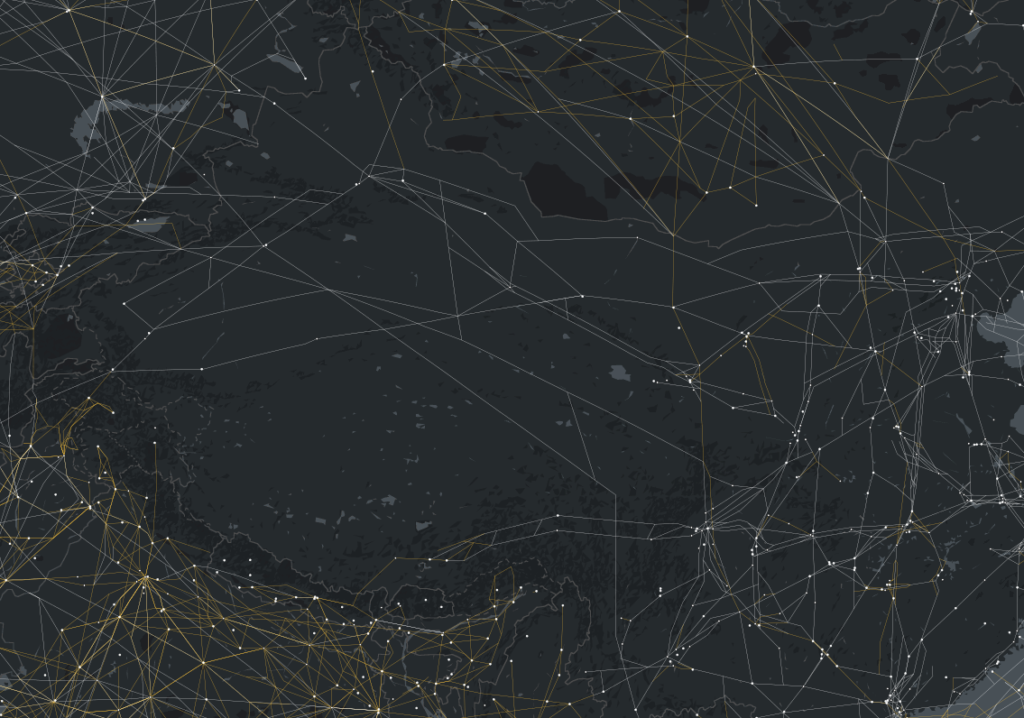
China only allow certain airways for usage by non Chinese registered aircraft. These mostly run north-south. It is often recommended to offset 1-5nm due congestion, but this is only allowed by ATC. Don’t apply SLOP without confirming with ATC first. Any other airway requires you to have a Chinese navigator onboard, and you generally won’t find these published in your Jeppesen or LIDO manuals. The same goes for some smaller domestic airfields.

There are multiple restricted areas across the country. Some of them are not always obvious… which means you will rarely get “Direct To…” clearances, and may often find your levels are restricted or you are given seemingly random re-routes. Fuel planning is critical, as is accurate route tracking.

How they do it.

China do it in meters. You should have procedures in place for this. If you are in RVSM airspace you might notice the ‘feet’ levels are all +100’. This is because the Chinese meter levels only provide 300m (900’) separation, and RVSM requires 1000’ minimum separation. 

Flights departing China and heading east often report being ‘held down’ at sub-optimal flight levels. Shanghai seems to be one of the worst spots for this, due to a corridor south of Korean and Japanese airspace.

What about parking?

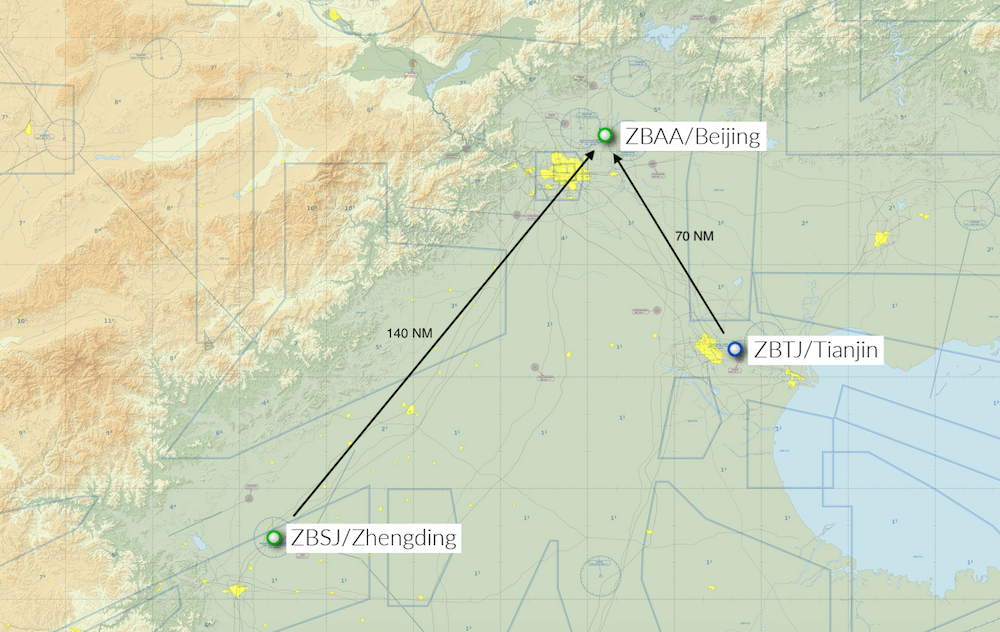
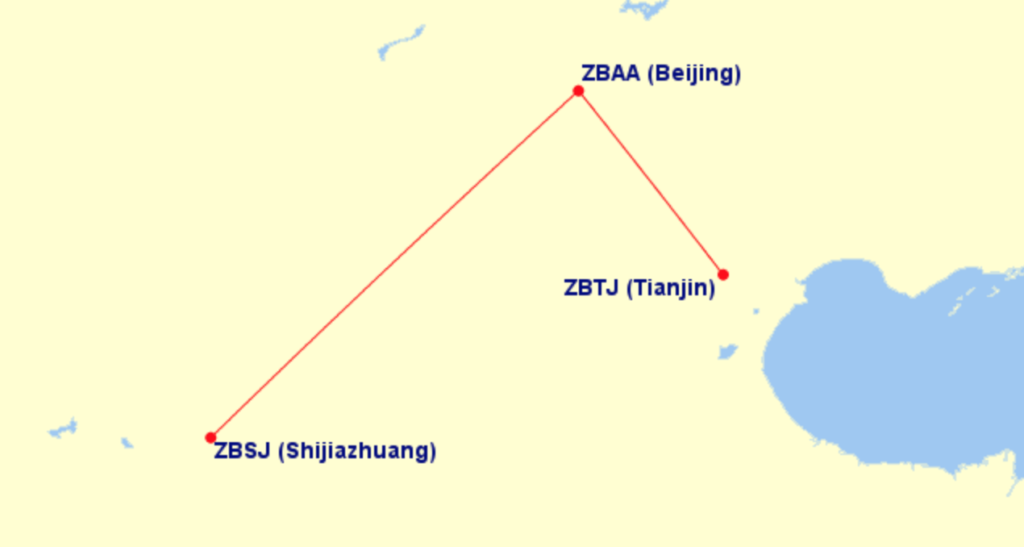
ZBAA/Beijing has had stricter parking restrictions in place since 2015. If you are GA, you are limited to 24 hours. ZBTJ/Tianjin is a good and relatively nearby alternate for parking – it is also an airport of entry, and has less parking restrictions but be warned, it also has much less in terms of facilities and is not available H24.

ZBSJ/Shijiazhuang is another option, as is ZBHH/Hohhot.

What about maintenance?

If routing in the general region, VHHH/Hong Kong and VMMC/Macau are probably easier options for finding maintenance support, or WSSS/Singapore.

Of course, if you can’t make it to these airports then ZBAA/Beijing, ZGGG/Guangzhou, ZSAM/Xiamen and ZPSD/Shanghai do have some big maintenance facilities available, but most other airports might struggle to help corporate aircraft.

Parts and support are usually sent in from Hong Kong or Singapore. Having contacts in place and a “plan” are probably a good call to avoid big delays though.

Anything else?

Different airports and regions have different customs within the airport, and outside. In Beijing you will find most social media and many websites blocked, including google. Some VPNs will enable use. Shanghai tends to be much less strict and Hong Kong is fine.


Here’s something we had Hima-layan around

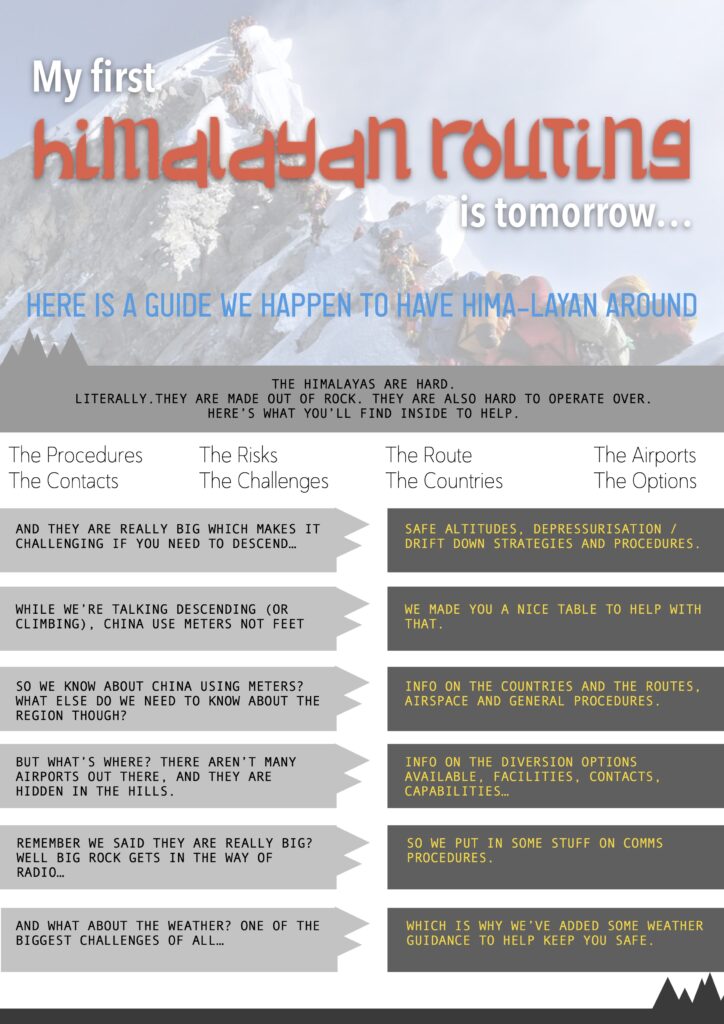
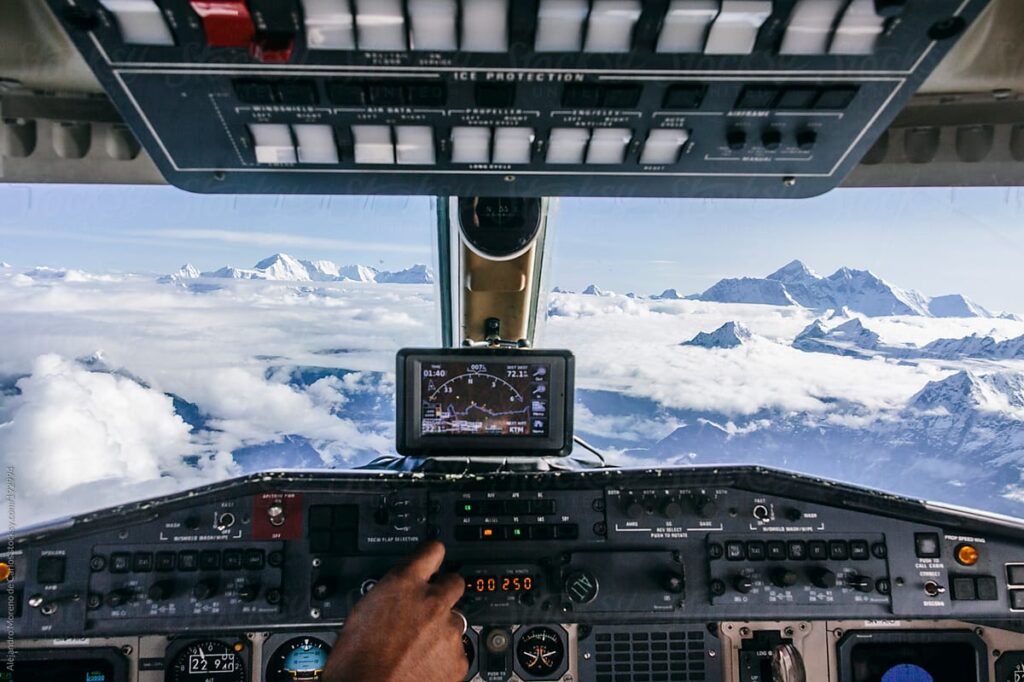
Flying over the Himalayas can be tough. It’s a challenging place and there are a lot of things to think about. Big things – like the big mountains under you. Chilly things that can send shivers down your spine – like the chilly weather. Or things that might just trip you up – like converting meters to feet.

So we decided to make a handy guide for you, filled with things to think about if you are heading over the Himalayas for the first time, or for the first time in a long time.

What is the Purpa-se of the guide?

To provide some handy info to help you on your way. It is just a guide though. Don’t use it to replace your company ops manuals, AIPs or anything else. Do use it to refresh yourself on stuff you might want to know about before you go.

(And if you don’t get the Purpa pun then check out page 5.)

We also wrote a related post a while ago.

We called it ‘The Hills have Ice’ which we found amusing. This guide expands on some of the things we put in there.

What will you find inside?

Things to think about like what your safe altitudes might be, how to plan for a depressurisation, what airports are available or weather to watch out for…

We also threw in some contacts, calculations, cold weather considerations, airspace info, comms advice and a couple more witty puns for good measure.

It won’t help you move mountains…

But maybe it will help you move over them more smoothly.

Download the Guide

Opsgroup members can download the guide as a PDF direct from the dashboard here, or click on the image:

If you want to become a member of Opsgroup, click here.


Our little disclaimer: This really is just to provide some handy insights into what you might want to study up on more. Your operator will have their own procedures, official calculations etc and this is not to replace them, more to remind you that you might want to take another look at them.


China Airport Alternate Restrictions

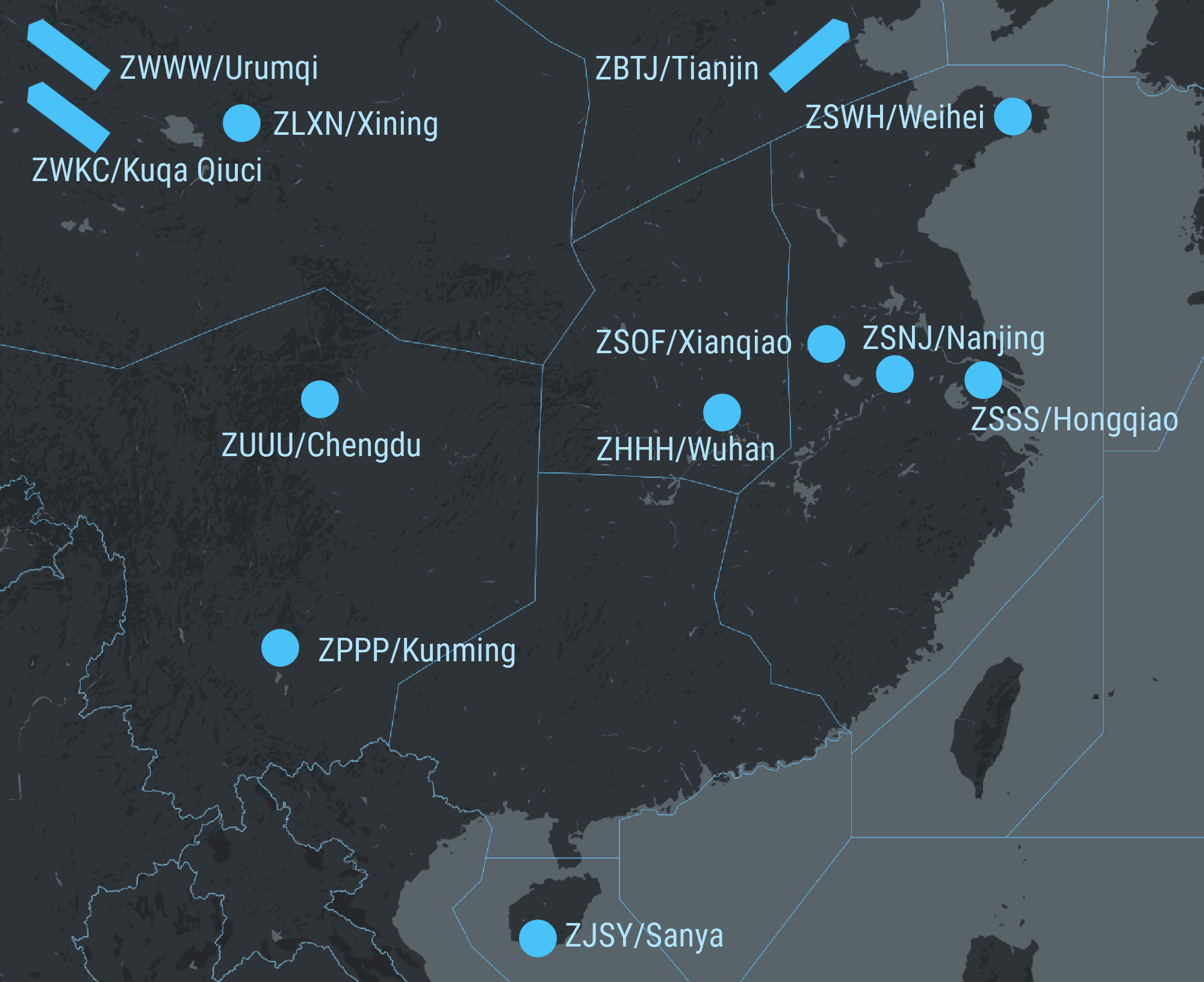
There are a multitude of Notams advising that certain airports in China are not to be used as alternates. Here is a list of those to look out for so you can plan and ensure your flight is not impacted, and a few others we thought worth mentioning.

The Notams

The ‘unavailability’ Notams, give or take slightly different dates, all say this – 

AD NOT AVBL FOR INTERNATIONAL ALTN FLIGHT(INCLUDE HONG KONG, MACAO AND TAIWAN FLIGHTS) EXCEPT EMERGENCY FLIGHT.

So don’t plan to use as an alternate, an en-route fuel or tech diversion, or anything else that wouldn’t be classified as an emergency.

The Airports

ZJSY/Sanya International – 12/31/2021

G2993/21 Sanya Phoenix International serves the Hainan region – the southernmost province of China (on the island).

ZSWH/Weihai – 12/09/2021

F6913/21 This is not a major international airport, Weihei lies on the eastern coast, north of ZSPD/Shanghai  Pudong beside the Yellow Sea and is the closest Chinese airport to South Korea.            

ZSNJ/Nanjing Lukou – 12/31/2021

F6912/21 A secondary international airport, this maybe used as an alternate for ZSPD/Shanghai Pudong. ZSHC/Hangzhou remains available, as does ZSSS/Shanghai Hongqiao (see below).

ZSSS/Shanghai Hongqiao – 12/19/2021

F6888/21 Only runway 18L/36R is unavailable, runway 18R/36L remains open and has both ILS CAT I and RNAV capability, and is 10,827’ (3300m) length.

ZSOF/Hefei Xinqiao – 01/18/2022

F6798/21 This is a secondary international airport service the Hefei region, inland from Shanghai.

ZBTJ/Tianjin Binhai – 02/28/2022

E3619/21 Runway 16R/34L is not available to any large (B747, A380) aircraft except if an emergency special transportation.

ZLIC/Yinchuan Hedong – 12/09/2021

L1155/21 Another minor international airport. It is unlikely you would feel this a an alternate as it has limited international operations. Hedong serves the autonomous Ningxia Hui region to the north east and lies in close proximity to mountainous terrain.

ZWKC/Kuqu Qiuci – 01/31/2022

W0547/21 This is a domestic airport serving the Xinjiang autonomous region and would not be recommended as an alternate.

ZWWW/Urumqi – 12/30/2021

W0500/21 Urumqi is one of the primary enroute and emergency diversion alternates for the Himalayan region flights into China. Taxiways A and B (so both main taxiways) are closed due maintenance, as is runway 07/25.

However, it remains available for emergencies, but it is not clear how much notice would be required.

ZHHH/Wuhan Tianhe – 12/31/2021

G2452/21 Wuhan is closed for all except emergencies due to stand shortages only.

ZUUU/Chengdu Shuangliu – 12/26/2021

U3453/21 Chengdu is a major international airport in central China. The airport remains open, but is not available for BizAv flights wishing to park overnight unless you are based there, or its an emergency.

ZLXN/Xining Caojiabao – 12/02/2021

L0900/21 Although an international airport, this primarily only serves domestic flights into the region. ZLLL/Lanzhou would be the closest major international airport, and this remains available.

ZPPP/Kunming – 01/31/2022

U3133/21 Kunming is also restricted in parking and not available for overnight parking to any BizAv aircraft unless based there or landing due emergency.

Diverting in China

In general, diversions in China can be problematic if you head somewhere unplanned – and by this we mean not on your flight plan.

Much of the airspace is governed by the military which can result in delays for you while ATC coordinates with them. Take extra fuel for dealing with things like not getting the flight level you wanted, en-route weather deviations, random re-routes and delays with re-clearances if you do need to divert.

China also have stringent ATC procedures and hand out fines for errors, and occasionally impose restrictions for repeated errors so know the country rules and regs, including their contingency procedures as these differ to ICAO.

China have been known to impose “do not commit to destination” policies on some operators – this basically means they expect you to have enough fuel to not get into a low fuel situation at your destination airport. If you are going to, they expect you to divert to your alternate instead (which my result in you committing to that so look at that weather well in advance).


China steps up incursions into Taiwan’s ADIZ

Relationships between Taiwan and China have become increasingly strained over the last month and officials are starting to question whether this might be impacting aviation safety in the region. Here is a look at the conflict and the potential impact it may have on commercial operations.

The background.

Taiwan and China have a long and ongoing dispute over whether Taiwan is Taiwan – an independent country, or Taiwan – a breakaway province that is still part of China. China is officially known as the People’s Republic of China (PRC), while Taiwan refers to themselves as the Republic of China (ROC).

Similar to Hong Kong, Taiwan has retained a high level of independence from mainland China, and effectively governs itself, having its own constitution, democratically-elected leaders, and own armed forces.

Unlike Hong Kong however, Taiwan rejected China’s “one country, two systems” formula which would have enabled them to retain autonomy, while reunifying with China. It remains a disputed country with few countries around the world recognising it as a sovereign nation independent of China.

This is at the root of this conflict, and in recent months China has become more assertive in their control over Taiwan.

Here is a good summary of the political situation.

What are China doing?

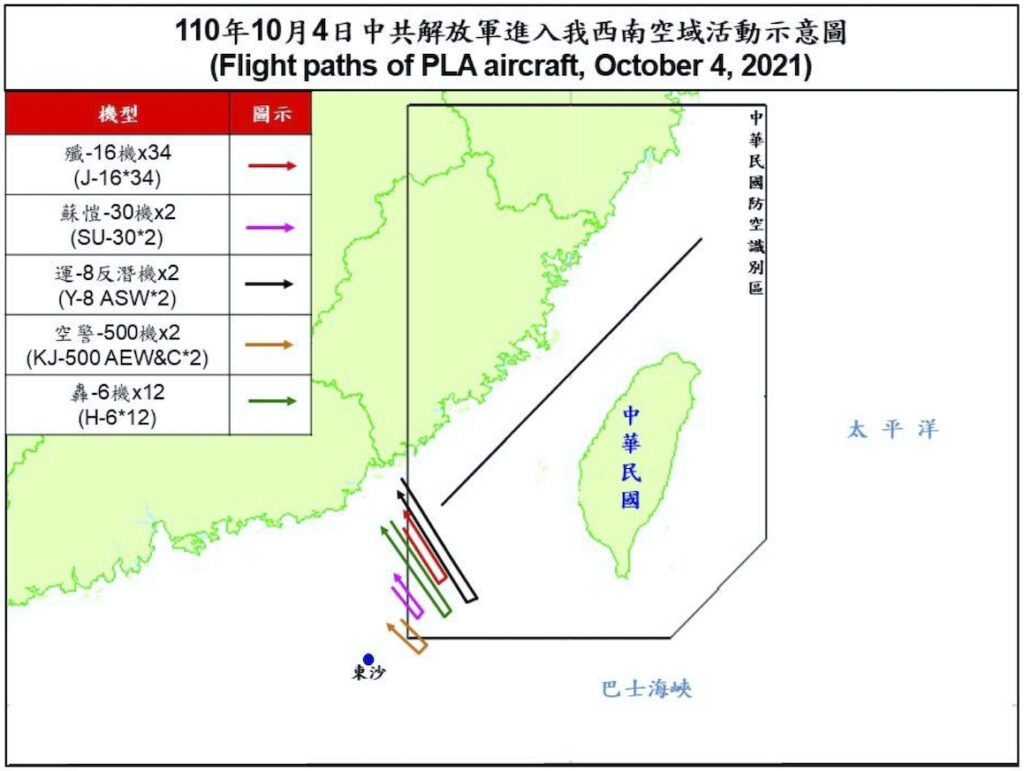
China have been “re-asserting” themselves over Taiwan by carrying out repeated incursions into the Taiwanese Air Defense zone. A recent incursion saw 39 military jets fly into the zone, for the second day in a row. The aircraft included 2 Y-8 anti-submarine aircraft, 26 J-16 fighter jets, 10 Su-30 fighters and a KJ-500 early warning and control aircraft.

They are reports of a 52 aircraft incursion which included 16 nuclear-capable H-6 bombers.

Where is the airspace?

Taiwanese national airspace is the airspace over Taiwanese land, extending to 12nm off their coast over the territorial waters. Military aircraft are not allowed to enter any national airspace without express permission from the state. China did not violate the national airspace, but did violate the ADIZ.

An ADIZ is different to national airspace, and is specifically declared by a state for reasons of military air defence. Some states designate their entire airspace as an ADIZ (Iran being a good example).

Taiwan’s ADIZ sits between Taiwan and continental Asia, over the South China Sea (the Taiwan Strait), shown (approximately) below. The ADIZ itself is disputed as well though since it overlaps and includes disputed territories.

Is there any threat to civil aircraft?

The ADIZ overlaps international civil flight routes. The increase in military traffic and activity in the area is a potential threat.

Taiwan’s response to the repeated incursions has been to scramble their own military aircraft, issue radio warnings and deploy their air defence missile systems. The deployment of air defence systems could raise the risk of misidentification between civil and military aircraft, if Chinese aircraft do stray beyond the ADIZ and into national airspace.

The Vice Defense Minster for Taiwan suggested the incursions “are affecting the safety of international flights,” but the statement was possibly political and as yet there has been no report of civil aircraft being impacted by the situation.

Procedures in Taiwan’s ADIZ.

You can read the procedures in full in Taiwan’s AIP ENR 1.12.1, or download a PDF here. But here’s a summary of how it works:

  • There are restrictions for non-tactical aircraft in the area including no flight below 4000’, and to maintain flight along designated airways. ATC contact must be obtained prior to entry.
  • Aircraft will be intercepted by the Chinese Air Force if they fail to follow ADIZ procedures, or if they exceed 5 mins ETA of a designated reporting point, deviate more than 20nm from the airway entrance or have greater than a 2000’ difference from assigned altitude.
  • Basically, if you are flying in the ADIZ, make sure you’re in contact with ATC, and don’t do anything without telling them first. Pretty standard stuff for operating through an ADIZ.

General ops.

We wrote about operations to Taiwan back in 2019 and it is worth having a quick read because if you are a foreign registered aircraft because:

  • You are not allowed to operate directly between China and Taiwan
  • If you need to make a tech stop between the two then aim for VHHH/Hong Kong or VMMC/Macau
  • You probably aren’t going to get permission to overfly China if you are routing to Taiwan from anywhere else.

You can read more on this here.

Back in 2018, there was also a dispute over China’s M503 airway. The airway is a main north-to-south route for aircraft heading to Hong Kong or Macau from Southeast Asia. Taiwan didn’t like it because it lies so close to the FIR boundary separating Chinese and Taiwanese airspace.

The result of the dispute seemed to be a sort of “tough luck” from China, and aircraft still regularly use the airway. More on this here.

The risk level?

While the ongoing conflict and aggressions do threaten the general peace and stability of the region, there is no immediate threat to commercial operations. Maintain a good listening watch if operating in the area and ensure you are in contact with ATC if operating through the ADIZ.


What’s the deal with China crew visas?

The process for obtaining a crew visa for China can be very confusing. We definitely recommend using an agent to assist with this, and with the permits for your aircraft. G3Visas are a good one – they really know their stuff. But if you are determined to go it alone then here is what we know.

What’s the deal?

Crew need a C-type visa. This are usually valid for 7 days.

Simple so far.

However, crew can actually enter China on different visas at certain locations, if pre-arranged. And if you rock up with the wrong sort, you are probably going to get a fine or be asked to go home again.

In fact, for crew entering as a passenger on a commercial flight (heading in to ferry out an aircraft for example) you cannot enter on the Crew C-Type visa. This means you are going to need a business or a tourist via.

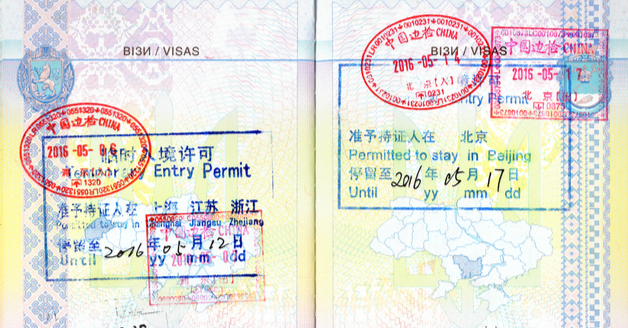
In 2013, they added in a new immigration policy for transit passengers. If you are from one of the 45 countries on their approved list, and you transit in via ZSPD/Shanghai Pudong, ZSSS/Hongqiao or ZBBB/Beijing to a third country, then there is a 72 hours without a visa regulation. The US is included on this list and we are mentioning it because of the above point about crew entering (as a tourist) to ferry an aircraft out.

You can also obtain multi-entry visas depending on your operations, but you are going to need a schedule showing the multi-operation and some sort of official company letterhead proof of why you want multiple entries. We definitely recommend having an agent assist with this because the paperwork can be daunting.

What are the Visa types (that you need to know about)?

  • C – The standard crew visa
  • L – Tourist visa generally valid for single, double or multiple entry. US and Canadian citizens may be eligible for a 10 year L-Visa
  • M – Business visa useful for folk visiting regularly or work reasons (and who aren’t employed by a Chinese company)
  • Z – Work visa (if employed by a Chinese company)
  • G – Transit visa. It is basically the same price as an L visa so probably better to just go for that one if you need one

The Bilateral Agreement

China and the US have a bilateral visa agreement and it can be a little tenuous.

Back in December 2020, the US put in new rules to try and “curtail” travel by member of the Chinese Communist Party and their immediate family members. It limited them to one travel visa a month. Prior to this a 10 year visa could be obtained. 

All very political.

This didn’t impact crew visas. However, we have heard recently that:

“Due to unilateral change of the visa application arrangements by the US side, a large number of crew visa applicants from Chinese airlines are unable to obtain US visas through the previous channel. In response, we are compelled to take necessary reciprocal countermeasures for crew visa applications from the US side.”

We have not been able to verify this, but it comes from G3 Visas who are a bit of an authority on Chinese visa getting. So get in touch with the agent you are using to help you organize your visas, and leave a little more time in case of delays. So far, there has been no further update on what the deal is at the moment.

Are there other options?

Some operators who are ferrying aircraft out report that they have flown in via Seoul or somewhere else close and not part of China (so not Taiwan or Hong Kong), and then simply hopped from one aircraft to the other and flown it out again. This circumvents the requirement for the visa since you are not really entering the country…

We are not recommending or advising against it. We will say that a fair few operators have reportedly done this, and it has worked fine. But you might want to think about what will happen if you have to divert and go into a Chinese airport because then you are going to visa-less and this could get messy.

Customs and Immigration

Don’t have any mistakes on your Gen Dec. It will cause BIG delays.

Also, be aware that certain nationalities are going to be asked a few more questions. This includes crew. 

Turkey

For reasons unknown, if you have been to Turkey and have a visa or entry stamp in your passport, then you are going to have to explain yourself. Actually, it might have something to do with the Turkic Uyghurs in Xinjiang / the Uyghurs diaspora living in Turkey…

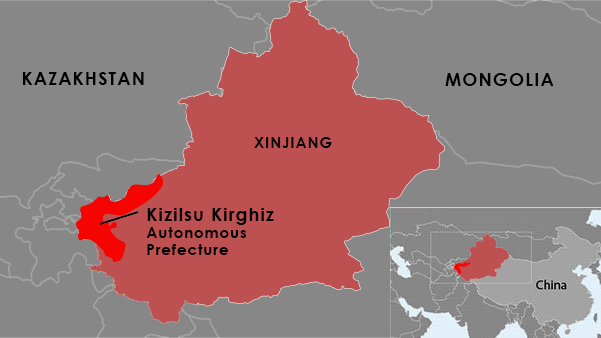
Uyghurs

If a crew member is from the Xinjiang region, expect them to be taken aside for additional checks. Nothing to be alarmed about, but good to know in advance that it will happen.

Chinese Citizens working outside of China

They can be a little “funny” with Chinese citizens who work for a foreign airline. Again, it tends to lead to additional immigration “chats” so be prepared for a brief delay.

What about permits?

Getting a permit is notoriously intimidating. They require use of AFTN/SITA, have specific routings and are only valid for exact timings given. If you want to land then you need a sponsor letter written in Mandarin by the receiving party…

Basically, use an agent. The authorities are not always the most patient or helpful. You’ll be paying around $75 for a one way overfly, $100 for a round trip landing and some extra depending on handling.

Mainland Ground Express are a helpful bunch and you can get hold of them on +86 20 8111 7474 or via email at operations@groundexpress.aero

Useful links for more info

  • The US government travel resources site has some handy info on general visa and travel stuff.
  • G3visa is a really handy agent for helping obtain any type of visa.
  • Universal Weather maintain some pretty up-to-date info on the situation as well.
  • The OPSGROUP member Forum and Slack channels. Yeah, we’re going to throw this one out to our members and say ask on there because the rules and procedures seem to change a lot and often the best info comes from someone who has just been there.

And finally…

If you have been to China recently, experienced issues (or good things) with the visa or permit getting process, or have any tips for other operators then please let us know! Your up to date experience would be very handy to pass on to everyone!


The Hills Have Ice: Considerations for Himalayan ops

Flying over the Himalayas soon? Read on! From patchy comms to limited alternates to meters that might get your feet in a twist, this briefing will have you covered…

A good place to start might be “Where are the Himalayas?”

The Himalayas border a bunch of countries, but the bits we are generally interested in lie in Pakistan and China – along the primary flight routes between the Middle East and Asia.

Interesting fact – they are the fastest moving mountains in the world, thundering along at a right old pace of 67mm a year (so don’t worry, they will still be in pretty much in the same spot when you route over them).

Are they a big deal?

They are the biggest mountains in the world so “big” – yes. “Big deal”? – well, not so much if you are cruising happily at altitude, but if for some reason you suddenly need to descend then they can become a very big deal very quickly.

With 30 peaks higher than 24,000’, and stretching over 200 miles, they are a pretty significant obstacle.
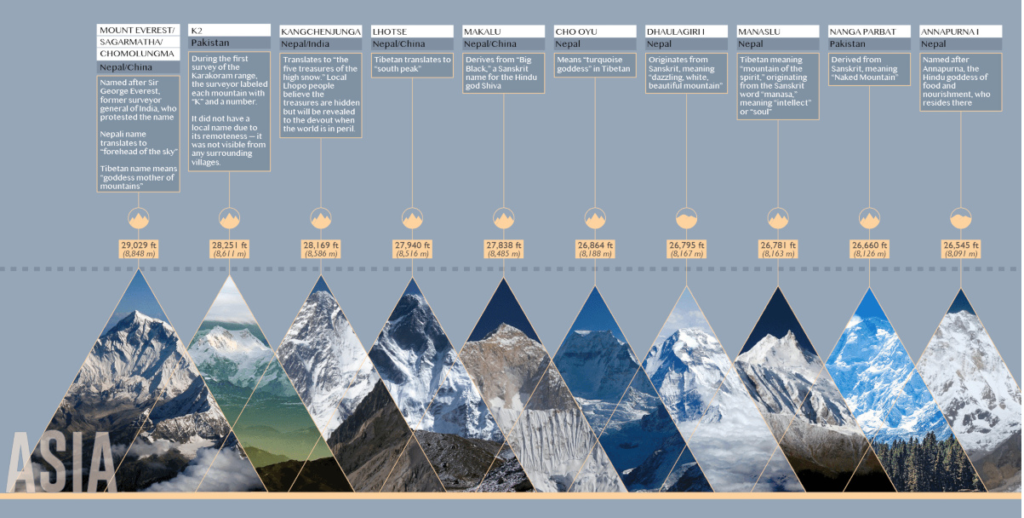
There are some good-to-know and some need-to-know points about these parts, so read on…

The Basics

Limited Alternates – Not many people live in the Himalayas, (not counting Yetis), so airports are few and far between, and are often fairly remote.

The Region – Pakistan has ongoing conflicts with India over the Kashmir region. Afghanistan is also unstable so operating near the border is not advised, particularly into OPPS/Peshawar and OPQT/Quetta airports.

Weather conditions – ‘Himalaya’ translates as ‘abode of snow’ so that should be something of an indication. The airports are remote and facilities are not always up to standard. Significant mountain waves can be experienced when crossing.

Communications – Big mountains block radio signals and this can be particularly bad around the point where you transfer from Pakistani airspace into Chinese. Which leads us onto the next point…

China – They have their own procedures including different sized airways, different contingency procedures, and of course…

Metres and Feet – China operate in metric. Keep reading for a handy feet to meter conversion table!

Oxygen – Airplanes have oxygen in them, unless they suddenly don’t anymore and then you are going to have to find some pretty rapidly. Unfortunately, oxygen is generally at its most plentiful lower down which can be problematic if routing over high terrain…

The Alternates

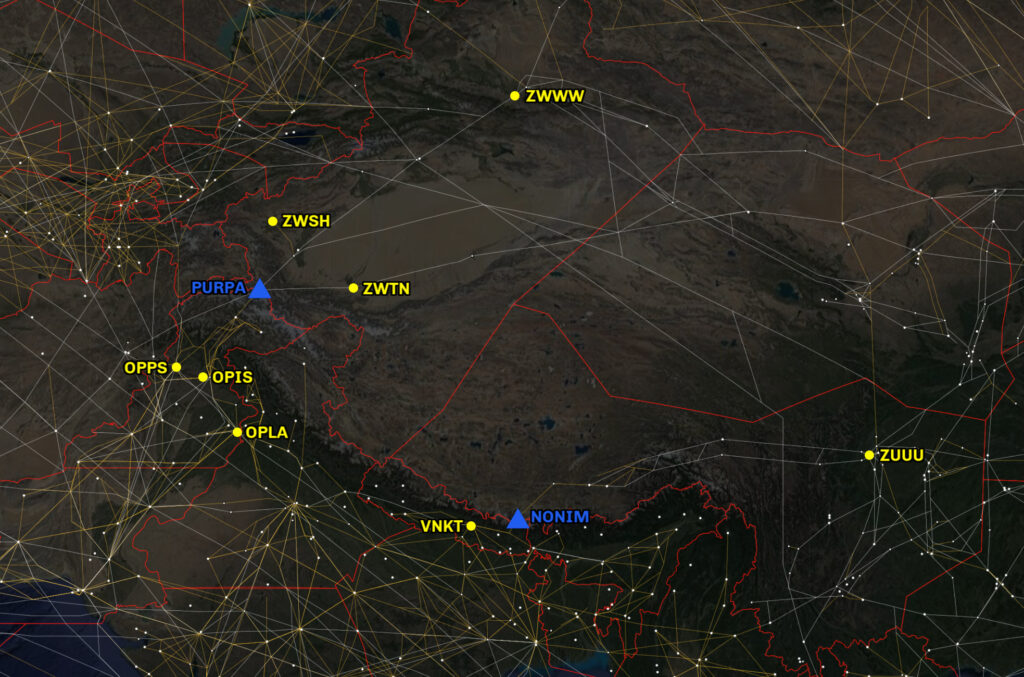
There are two published crossing points for the Himalayas – PURPA on the Pakistan/China border to the north, and NONIM on the Nepal/China border to the south. So the alternates you’re going to be interested in very much depends on which route you’re going to take.
ICAO/ IATA

Airport

Open

RWY (m)

ELEV

PCN

OPIS/ISB

Islamabad

H24

3658

1761

110FCXT

OPPS/PEW

Peshawar

H24

2743

1211

068FCXU

OPLA/LHE

Lahore

H24

3360

712

085RBXU

ZWSH/KHG

Kashi

H24

3200

4528

074RAWT

ZWTN/HTN

Hotan

HS

3200

4672

052RBXT

ZWWW/URC

Urumqi

H24

3600

2126

080FBWT

VNKT/KTM

Kathmandu

0045-1845Z

3050

4390

054FAWT

OPIS/Islamabad, Pakistan – There are two parallel runways with RNP and ILS approaches, including a CAT II on 28L. 10R has an offset final track (VOR approach). This is a destination for some major airlines and so likely has good handling and ground services, an is an RFF Category 10.Where you decide to divert to will depend on what your problem is and whether you can stay up over the mountains. Peshawar, Islamabad and Lahore are each accessible from each other and all lie south of the mountainous zone.

OPPS/Peshewar, Pakistan – This airport is situated near a No Fly Zone and is close to the Afghan border. It has CAT I capability, but report of GS fluctuations are common. Ground handling is available, but engineering and other support is likely to be limited.

OPLA/Lahore, Pakistan This is another major airport in the area with multiple runways, and Cat IIIb approaches onto 36R. Terrain is relatively low, but the airport lies close to the border with Indian airspace.

ZWSH/Kashi, China The airport is CAT I. There is serious terrain to the north and west of the airport. Particularly if you are landing onto runway 08, wind off the terrain might be a factor. Runway 08 may require a 180 degree turn at the end with a backtrack due to works. Support here will be fairly limited.

ZWTN/Hotan, China There is no customs at Hotan so offloading passengers might pose a problem. The closest alternate is not really very close, and the weather here can be a challenge. The MSA is 16,000’ and terrain lies predominantly to the south of the airport, but close to the ILS intercept for runway 29. Runway 11 only has a VOR/DME approach. Both runways require a 180 degree turn and backtrack to vacate. Engineering support is available here.

ZWWW/Urumqi, China Urumqi is a better equipped airport, with CAT I and II approaches available, and likely to have better ground support and engineering services. However, there is significant terrain in the vicinity of the airport, and it’s also a long way to have to go in an emergency (around 700nm from Pakistan/China crossing point PURPA).

VNKT/Kathmandu, Nepal – Down south, Kathmandu is really the last decent diversion airport before the endless mountains of the southern Himalayas come into view. If you don’t stop here, it’s a good 3 hours of flying time before you reach ZUUU/Chengdu on the other side. VNKT is not 24 hours (has quite specific hours), no engineering facilities but fairly good ground support as it is quite a “major” tourism spot so a fair few airlines route in there. Does not have precision approach (only VOR and RNP), and they have a lot of diversions due to weather and higher minimus due no precision approaches. Very difficult approach because you route between mountains into a sort of bowl to land.

Communications

The mountains can cause serious interference with radio comms so keep the following SATCOM codes handy in case you need them:

Urumqi 441208
Lanshou 441205
Kunming 441204
Beijing 441201
Lahore 446302

China

China has some pretty specific procedures and requirements which should probably be looked over before you route this way, but here’s a quick summary.

Contingency/ Emergency Procedures if deviation from level required:
– Aircraft must turn RIGHT and track out to 10km/ 5nm from the airway centerline.
– Once parallel with the original route climb or descend as required.
– Switch your lights on, keep talking on 121.5, and keep a good eye out.

Any deviation or reroute requests in China usually needs some serious coordination, and they are strict about any routes that take you off commercial airways or close to military airspace. ATC often send airplanes in random directions, or refuse to clear them to the flight levels they have filed for, without much explanation so be prepared for a lot of extra fuel burn.

Meter to Feet Conversion:
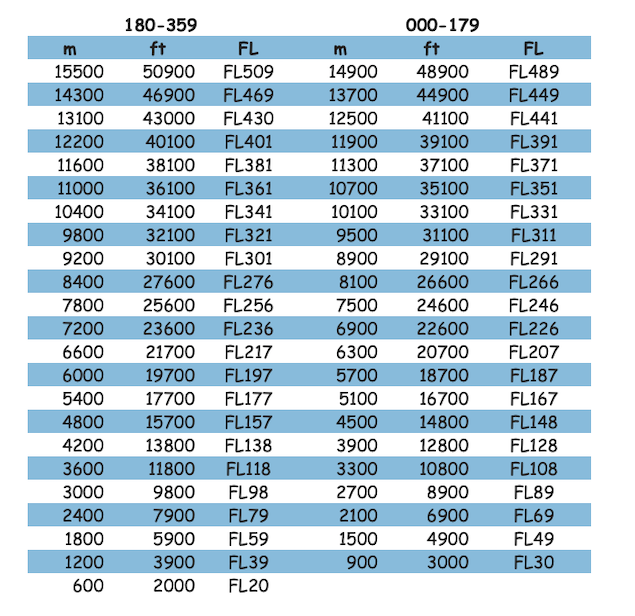
Oxygen

The most critical route is PS-G325-Purpa-B215 where the MTCA is the highest. Confirming your aircraft is equipped with suitable passenger oxygen systems and awareness of the depressurisation strategies and MSAs for each route is extremely important before operating into this area.

Permits

Pakistan requires overflight and landing permits. These must be requested by an agent. They require one day notice to arrange the permit. Operating into Pakistan airspace required an ADC at least 15 mins prior to entering Pakistan Airspace/ADIZ, and flights operating in need to establish communication at least 15 mins prior to entering.

China also require permits. These can be intimidating. They require use of AFTN/SITA, have specific routing, and are only valid for the exact timing given. Commercial landings require a sponsor later written in Mandarin by the receiving party. We recommend applying direct to a Chinese agent, as the authorities aren’t very patient and it can become frustrating at how short they’ll be on the phone. If you want to apply direct, you’ll send your application through AFTN and SITA, in the specific format required. 

China requires aircraft to be ADS-C, CPDLC and SATCOM capable on some of their routes over the Himalayas, and operators need to verify their equipment with them at least 60 days in advance! So they recommend that only regular scheduled flights apply to use these airways. For more on that, check out our dedicated article here


For some great insights into escape route planning, check out this doc from Flightsafety.org

And finally, don’t forget to take your camera because when the air is clear the views can be amazing!
Beijing Airport is filling up fast

There always seems to be some kind of random event going on in Beijing making life hard for GA/BA ops. This month it’s the Conference on Dialogue of Asian Civilizations, and already the parking situation for GA/BA is starting to look pretty bleak.

ZBAA/Beijing

There are two main periods with heavy restrictions: 

0800L on 13 May to 0800L on 17 May
0800L on 21 May to 0800L on 24 May

(Beijing local time is UTC+8, so you can read those times as 0000z).

During these periods, only one slot will be made available per hour for aircraft not connected with the event, and no overnight parking will be allowed. So that means short turnarounds might be possible, but you’ll be lucky to get a slot. 

Plus there’s the other standard ongoing rule at ZBAA to keep in mind:

Daily between 0900-2200L, GA/BA can only make one movement per aircraft.

So this means that if you arrive during this period you then have to wait til 2200L before you’re allowed to depart again! Confusing? You bet.

ZBTJ/Tianjin

Many operators like to use cheeky ZBTJ/Tianjin as an alternative to ZBAA/Beijing, but it’s now getting busy here too. Local handlers here are saying that ZBTJ is not allowing any overnight parking for GA/BA at all right now, and even some requests for short-term parking are being denied as well.

This is related to ongoing construction work planned through to the end of June, which means a bunch of stands are closed, and with an influx of aircraft shifting over from ZBAA, there’s less space all round.

ZBSJ/Zhengding

Where?? Fair question. We had to find it on a map. Zhending! Home to… well, not very much, by the looks of it. Unless temples, towers, and Olympic table tennis training centres are your thing.
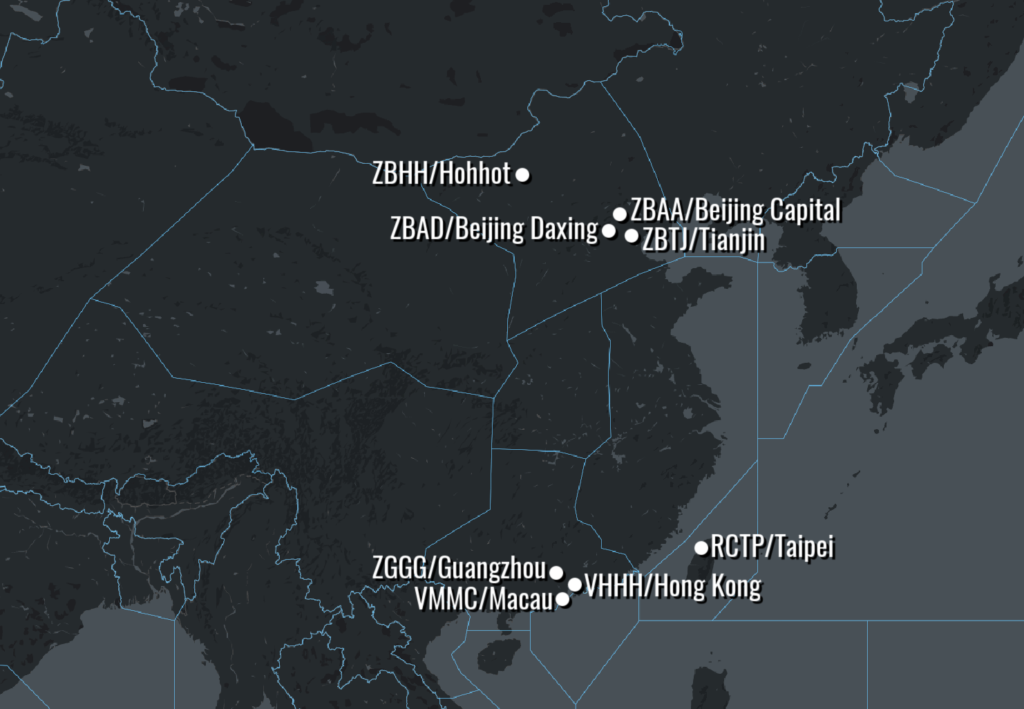
But the good news is that the airport currently has no restrictions on GA/BA flights. Although they don’t have an FBO or VIP lounge here (#notsurprised), the airport has a nice long 11,000ft runway, and is open H24. You can get in touch with Mainland GroundExpress to arrange handling here.


Beijing Airport Restrictions until September 6

Beijing is hosting the Forum on China-Africa Cooperation (FOCAC) on September 3 and 4, 2018.

As a result ZBAA/Beijing Capital airport will not allow any GA/Corporate Jet operations from Thursday, August 30 until Thursday, September 6 unless you are attending the forum itself. If you are, you will require a a sponsor letter from the organizing committee to obtain landing permission.

Further restrictions:

  • There will be no take-off for all flights between 0700-0855L, strictly landing only.
  • A maximum of two movements are allowed per hour for all flights between 0600-2355L.
  • Governmental flights require an authorization letter from the respective Embassy to arrange handling services.
  • Flights with diplomatic clearance can still operate to ZBAA even if they are not attending the forum.
  • ZBAA cannot be used as an alternate (except in an emergency) until 6 September (Refer NOTAM E1870/18).

Operators are advised to consider ZBSJ/Shijiazhuang Zhengding airport (139nm away) and ZBTJ/Tianjin Binhai airport (67nm away) as alternative destinations during this time period.

Do you know more? Let us know!

Japan scrambles record number of jets as tensions rise with China

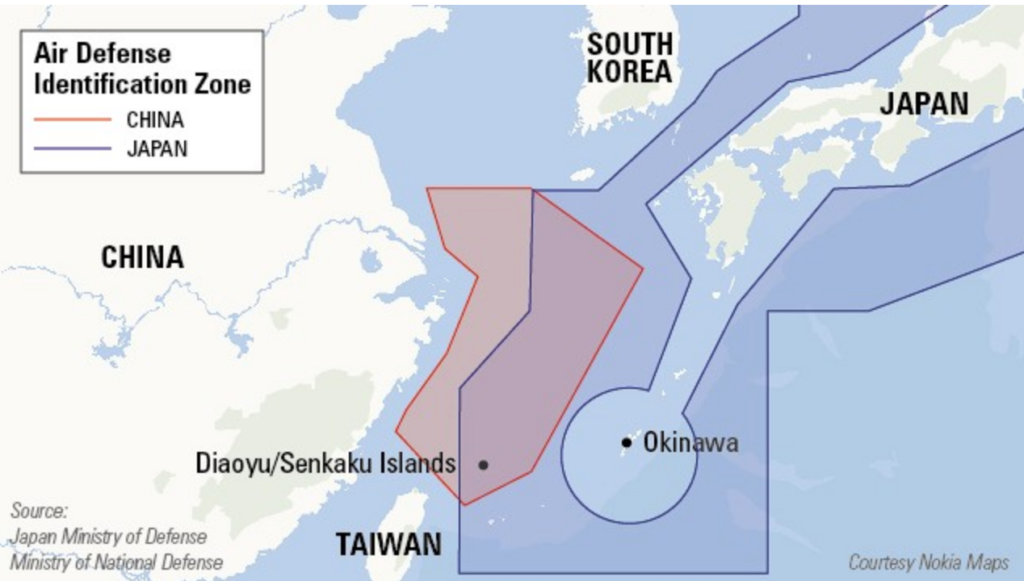
In Short: Japan scrambled a record number of fighter jets in the past year. The number rose to an all-time high of 1,168 in the year to March 2017, easily beating the previous record of 944 set at the height of the cold war in 1984. Chinese aircraft approaching Japanese airspace prompted 851 of the incidents, an increase of 280 over the previous year.

According to official figures released on Thursday, Japan’s Air Self Defense Force is scrambling fighter jets in record numbers as Chinese military activity escalates. Interceptions of Chinese planes rose by half in the year to March 31, in response to increases in the communist country’s activity in and around the East China Sea.

Japan worries that China is probing its air defences as part of a push to extend its military influence in the East China Sea and western Pacific, where Japan controls an island chain stretching 1,400 km (870 miles) south towards Taiwan. The figures highlight China’s growing assertion of military power in East Asia as it expands and modernises its armed forces in line with rapid economic growth.

For the first time, Chinese jets recently began flying through the Tsushima Strait into the Sea of Japan, and through the Miyako Strait into the Pacific Ocean.

But it’s not only China that Japan is worried about. Last week, Japanese Prime Minister Shinzo Abe warned North Korea may be capable of firing a missile loaded with sarin nerve gas towards Japan. “There is a possibility that North Korea already has a capability to deliver missiles with sarin as warheads,” he told a parliamentary national security committee.

And then there’s Russia. Scrambles by Japanese aircraft were high throughout the 1980s in response to flights by Soviet aircraft during the cold war. They fell back to 100-200 incidents a year during the 1990s and 2000s, but began to pick up again a decade ago as both China and Russia grew more assertive.

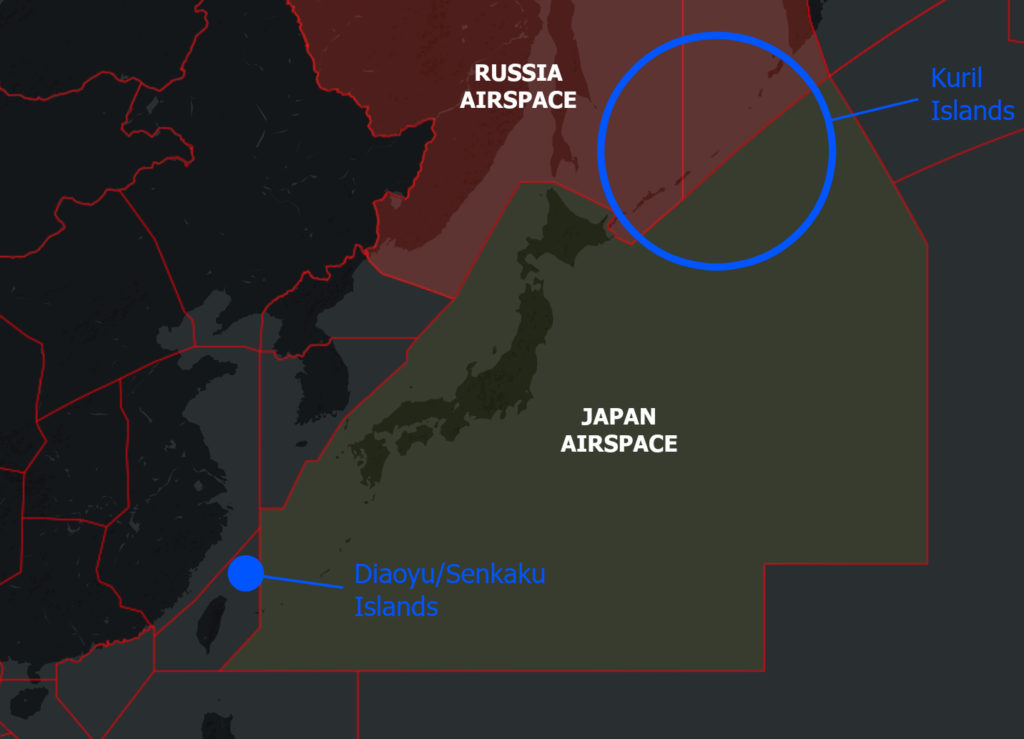
Mr Abe has been trying to negotiate with Russian president Vladimir Putin over the future of four disputed islands in the Kuril chain to Japan’s north, but has made limited progress, with the jet scrambles showing Moscow’s determination to make its presence felt on its eastern border. There were 301 scrambles to intercept Russian aircraft during the year, 13 more than the previous year, including incidents where Russian jets circumnavigated the Japanese Diaoyu/Senkaku Islands to the south.

Extra Reading:


Beijing bans charter flights

ZBAA/Beijing airport authorities have said the airport is now so busy, they will not accept any new requests for charter flights between now and Mar 31, at the earliest.

No official document has been published on this yet, and the authorities have said it will not be published on the Notams either – but the new rule is already in effect.

For GA flights, the same rules apply as usual: maximum 24hrs parking, no ops allowed from 23-01z, and an aircraft cannot have two peak hour slots between 01-14z during one day. Many operators choose to go to ZBTJ/Tianjin instead, or ferry there for parking.

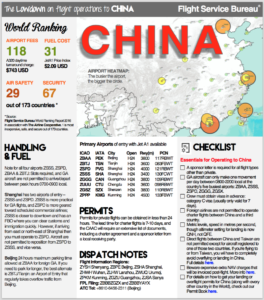
For more information on ops to China, download our Lowdown guide by clicking the image below:


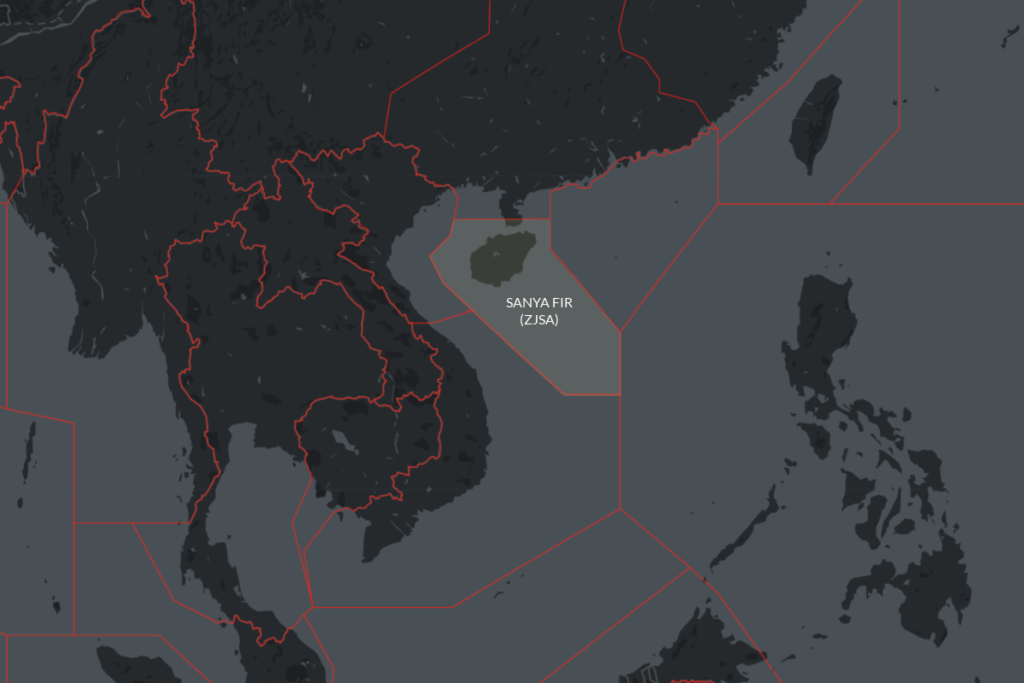
Sanya FIR: Do I need an overflight permit?

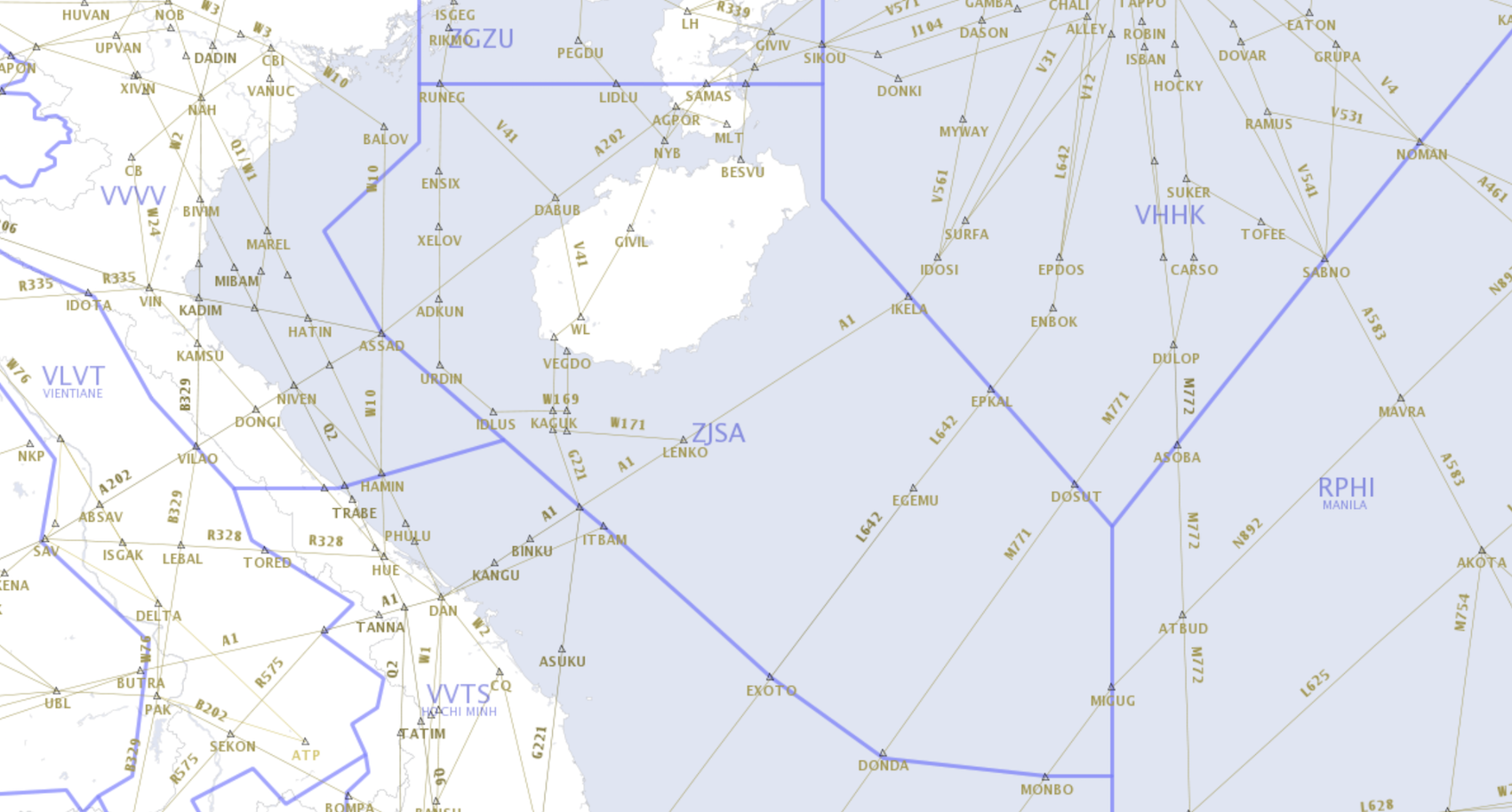
The 3-second answer: you don’t need a China overflight permit on airways: A1, L642, M771 and N892. You only need one if you’re travelling on airway A202.

That kind of makes sense, as A202 is the only airway right up there at the very top of the Sanya FIR, cutting across Sanya’s landmass, and connecting the VVVV/Hanoi FIR with the ZGZU/Guangzhou FIR. All the other airways are out over the ocean, down to the South of the Sanya FIR, and not going anywhere near the Chinese mainland.

So if you want to operate on A202, you’ll need a China overflight permit. Technically, you’re supposed to submit your request to the CAA by AFTN to: ZBBBZGZX, ZGGGZBZX and ZJSYZRZX, 3 days in advance. However, unless you’ve done it before and you know what you’re doing, we suggest you just use an agent instead – dealing with the Chinese authorities direct can often be a misery.

Regardless of which airway you use, if you’re flying on a call sign, remember to put down the aircraft reg in Field 18 of the flight plan, and fill the accumulated EET to the Sanya FIR. Also, if you’re flying on L642, M771 or N892, you’ve got to be RNP10 approved, otherwise you’ll have to stay below FL280.


US 737 tests the China ADIZ

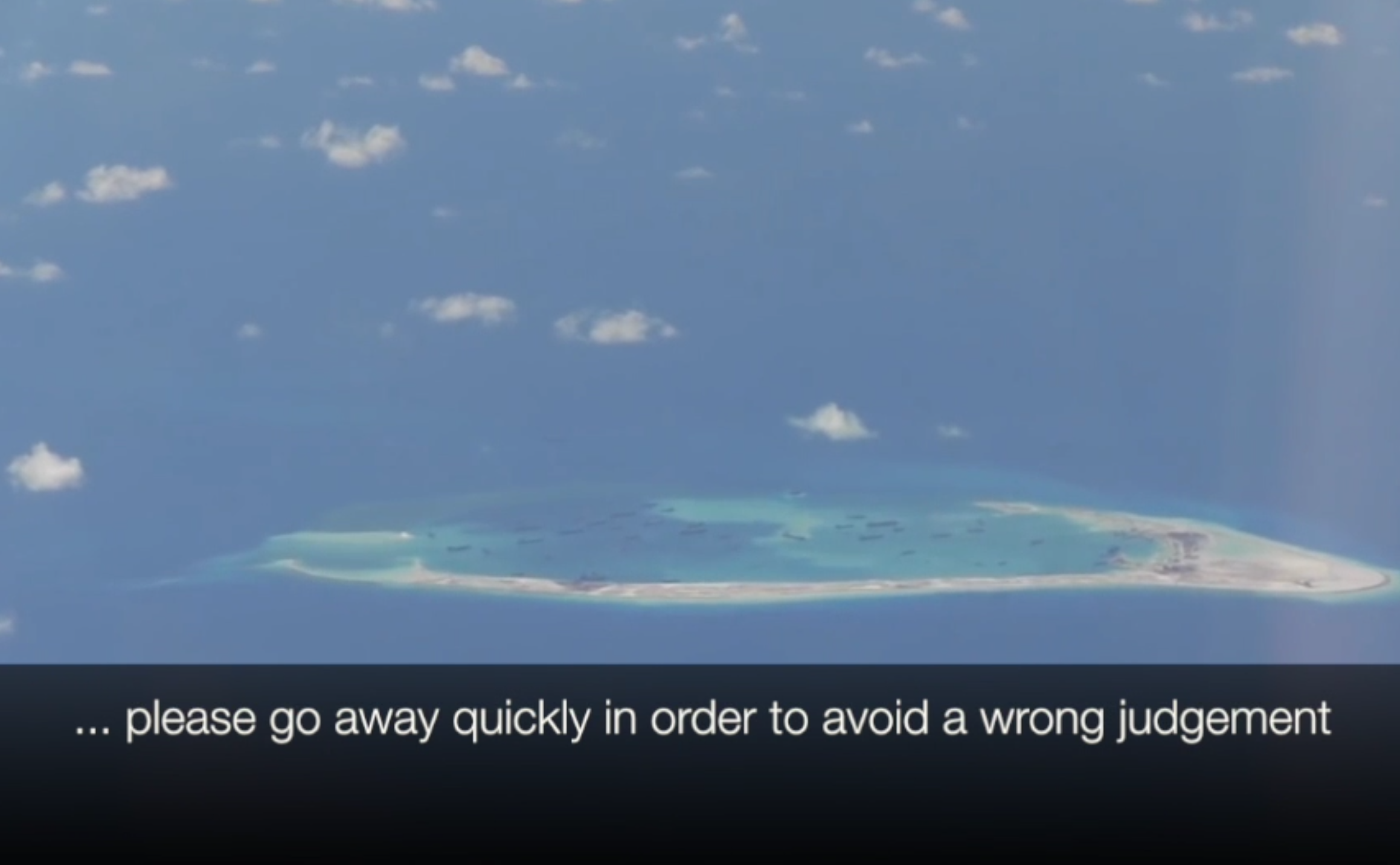
China: Go away quickly please
US Aircraft: Nope
China: Go away quickly!
US Aircraft: No!

The US is doing us all a huge favour at the moment. In fact, it’s been providing this service to the world for some time.

Every so often, a country extends its borders a little too far – outside the normal 12nm limit, for example. China has been busy. They’ve been building some things in the South China Sea. Islands, in fact. And on those islands they’ve built runways, control towers, and big radars. Naturally, they confirmed last Friday that they are for civilian use only. Hmmm.

So the US dusts off an airplane and knocks on the door. Flies around for a bit. Sees what’s going on. And reminds the country that international waters are just that. They publish a list each year of where they’ve done this. Worth a read.

In 2013 they popped up an ADIZ. And made everyone passing through it copy their Flight Plans to Beijing. In principle, ADIZ’s are a pretty good idea. The normal 12nm isn’t really much time for the military to figure out if you’re coming to bomb them. Especially on the weekend.

But you can’t tell airplanes to get out of an ADIZ. It’s an Identification Zone, not an Intercept Zone. So, normally ADIZ’s require you to squawk something and have a Flight Plan.

That much is OK. But China has been warning aircraft to get out of ‘their airspace’. And it’s not. This 737 (aka P-8 Poseidon) went for a nosey.

These operations help us all operating internationally to have less rules to worry about. Which is good.


Initially, most abided by the 2015 ADIZ rules. In 2016 that adherence quietly eroded. And China quietly didn’t care too much. It did threaten a second ADIZ in the South China Sea, but since the first one didn’t really take off, they probably won’t.

It’s part of a bigger diplomatic game. Interesting to watch, though.


China updates: ZBAA, ZBTJ, ZSAM

1. From now until the end of June, ZSAM/Xiamen airport will closed daily between 0010-0610 local time, and business flights will not be allowed to land or take-off between 0700-0900 local time daily as per the CAAC’s regulation (the same regulation applies to over 20 other airports in China including ZBAA, ZSSS, ZSPD, ZGGG and ZGSZ).


2. China’s “two sessions” begins this week – two big political conferences (CPPCC and NPC) that are held every year. ZBAA/Beijing gets busier than ever.

Even at the best of times, ZBAA only allows 24 hours maximum parking time for foreign GA, so expect to get sent to ZBTJ/Tianjin for parking: an Airport of Entry that regularly takes overflow traffic from Beijing.

As the nearest airport from ZBAA, ZBTJ is also accepting more ferry flights at the moment – the ZBTJ airport authority has been told to continue to do so until 30th April.


3. Be aware it’s going to become more and more common this year for Chinese immigration to record fingerprints of foreign travellers who enter China via international airports.


The Hidden Costs of Operating to China

China has always been challenging to operate to. Handling rates are prohibitively expensive, half the country’s airways are closed to foreign operators, and slots and parking at the major airports can often be impossible to obtain.

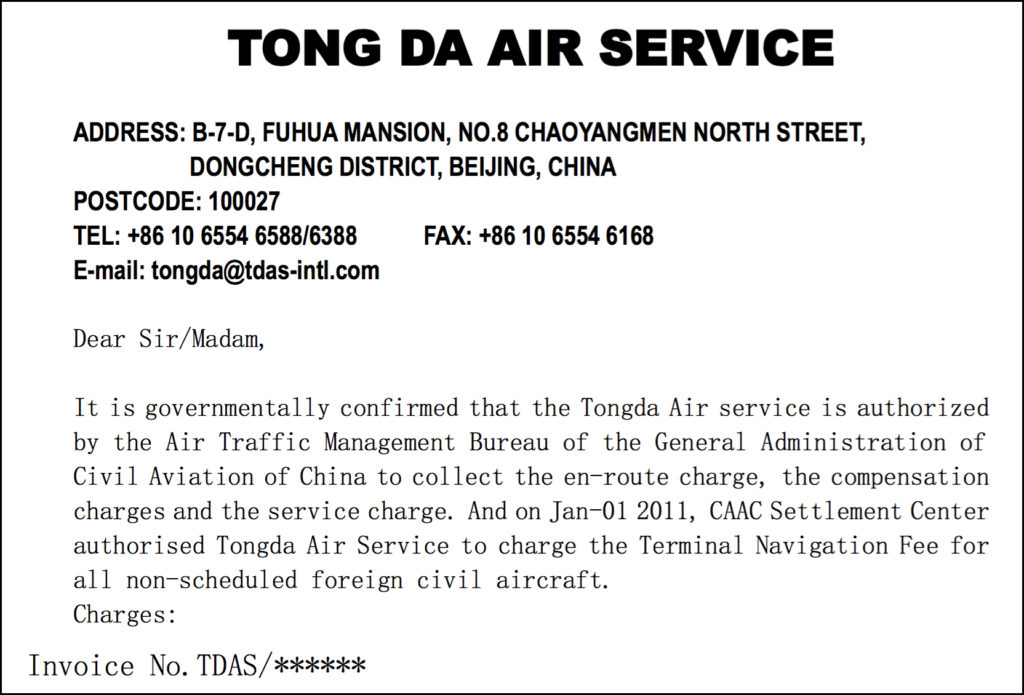
But often the most frustrating thing about operating to China is just trying to work out what all the different charges are for. If you receive a big bill post-flight from a company called Tong Da Air Service, unfortunately it’s not a scam! These guys are the government-appointed agency in China who are responsible for collecting all the NAV fees for flights by foreign operators.

It’s important to know in advance what you will get charged here, as it’s not totally clear  without doing a bit of digging – and your handling agent will likely not include all these complicated fees when they provide you with handling quotes!

For NAV fees in China, you will always get charged for four separate things:

  • En-Route Charge.
  • Terminal Navigation Charge.
  • Compensation Charge (the fee paid to the government for the permit)
  • Service Charge (Tongda Air’s charge for obtaining the permit)

Importantly…

En-Route Charge = this is charged for each individual flight

Terminal Navigation / Service Charge / Compensation Charge = these are charged per permit, and are always set costs.

So let’s say you fly RKSS-ZBAA-RKSS: you will need to pay En-Route Charges for each sector, and one set of Terminal Navigation / Service / Compensation charges.

Similarly, if your routing involves multiple domestic flights within China, (eg. RKSS-ZBAA-ZBTJ-ZSPD-RKSS) you only need one permit to cover all those stops,  which means you will only pay one set of Terminal Navigation / Service / Compensation charges. So far so good…

But let’s say you fly something like RKSS-ZBAA-VHHH-ZGSD: on this routing you will effectively be departing China when you go to VHHH, so you will need two permits – one for each stop in China (ZBAA and ZGSD). And because of this, you would need to pay two sets of Terminal Navigation / Service / Compensation charges!

china-map

So here’s how you work out the 4 charges:

1. En-Route Charge

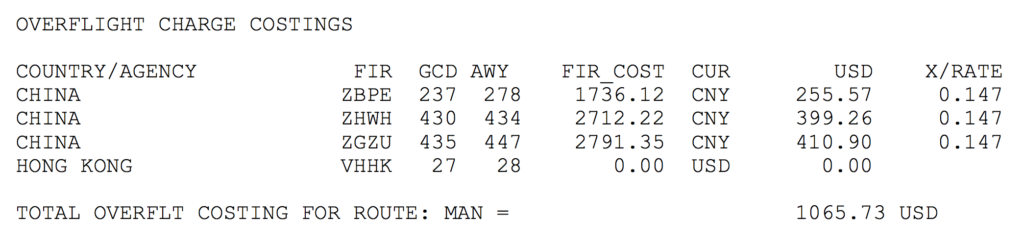
There’s a very lengthy and complicated method of working this out, but the easiest thing to do is just use your flight-planning tool to tell you the answer. Most tools have this function – just make sure you click the button that says something like ‘overflight costs’ and find the section on the output of the flight plan that looks something like this:

screen-shot-2016-11-08-at-13-34-35

(Showing costs for a B737 operating from ZBAA/Beijing to VHHH/Hong Kong)

2. Terminal Navigation Charge

MTOW                      Charges (RMB Yuan)
Up to 25                    990
26-50                         1060
51-100                      1060 + 21*(T-50)
101-200                   1920 + 23*(T-100)
above 201               3820 + 27*(T-200)

T = the actual MTOW rounded up to the nearest tonne

So for example:
an aircraft with a MTOW of 60T = 1060 + 21*(60-50) = 1270RMB
an aircraft with a MTOW of 110T = 1920 + 23*(110-100) = 2150RMB
an aircraft with a MTOW of 210T = 3820 + 27*(210-200) = 4090RMB

3. Compensation Charge

This will always be $3000.

4. Service Charge:

This will be either $1200 for landing permit, or $500 for overflight permit.


Midweek Briefing 13JUL: South Sudan off limits, New Zealand airport strike off

South Sudan off limits 13JUL The security situation in Juba, and South Sudan, has deteriorated in the last week, with HSSJ/JUB becoming off limits due to fighting. Read the article.

New Zealand airport strike off 13JUL A planned strike by Aviation Security across airports in New Zealand, which would have led to wide scale disruption, has been called off at the last minute. Read the article.


BGBW/Narsarsuaq Current hours are Monday to Saturday 1000-1900Z. If you want to plan a visit outside these hours, or even use BGBW as an alternate, get permission from bgbw@mit.gl in advance. There will be additional costs, especially heavy on a Sunday.

SBZZ/Brazil is the latest country to wield the threat of shooting down aircraft. Last month we reported on the same language from Sudan, in reference to overflight permits. Brazil’s firm stance is in relation to the Olympic Games, and says that unidentified aircraft that violate the protected airspace around facilities of the Olympic Games in Rio de Janeiro. “We are not playing,” said Defence Minister Raul Jungmann. This is more of concern to a lost C172 than commercial flights (unlike Sudan, which is the reverse), but worth being aware of.

EGPZ/Poland has effectively dispensed with the Schengen agreement for now, expect full border controls at all international airports (ie. Passport check, Gendec).

EGPZ/Scottish FIR The military are carrying out some GPS jamming trials over the ocean from 12-29JUL. If you’re operating in the region of Benbecula VOR, especially west of it, be aware that your GPS might stop working.

OAKX/Kabul Aircraft in the eastern sections of the Kabul FIR can expect some radio issues, as a comm unit (VSAT at Ghanzi) is out of action. The advice from ATC in Afghanistan is to keep trying the assigned frequency until within range of a different transmitter; in the meantime, a bit of SLOP, IFBP and TCAS should keep you out of trouble. See full article.

MKZZ/Jamaica Significant increase in the number of confirmed cases of Dengue fever in Jamaica during the first half of 2016. Dengue fever is endemic to Latin America and the Caribbean and can occur throughout the year.

ENZZ/Norway FIR Plans are afoot to raise the transition altitude to 18,000ft. It’s an age old question, why does Europe have different TA’s, and the US has just one? Together with surrounding countries, and the Irish FAB, this looks to be changing – but it may take a little while. See Norway AIC 7/16.

YBBB/Brisbane FIR (and Melbourne) will be updating their software on the night of 20JUL, with a hefty 6 hour outage of CPDLC and all the other good stuff.

OAMS/Mazar-E-Sharif Fuel payment is now only accepted in cash.

NZZZ/New Zealand A planned strike by two airport workers’ unions and New Zealand’s Aviation Security Service (Avsec) will now not go ahead. The unions sought increases in compensation, and negotiations on their demands will take place in the coming weeks. Read the article

EYPH/Paluknys is a new location indicator for the airport in Lithuania.

ZBDS/Edros – Ejin Horo, China will open to foreign flights this month. We did battle with AIP China for 30 mins to get further info but lost the fight. If you know more, tell us and we’ll share.

HSZZ/South Sudan The ceasefire announced on 11 July is holding. Juba International Airport (HSSJ/JUB) is open to charter operations; however, commercial flights have yet to resume. U.S. government aircraft evacuated personnel on 12 July; however, a security message issued by the embassy later in the day advised U.S. citizens to continue to shelter in place and not attempt to travel to the airport. Meanwhile, other countries, such as Japan, Uganda, and Germany plan to send military aircraft to evacuate their nationals.

SEZZ/Ecuador A large earthquake (6.4) struck on 10JUL just east of Muisne, on the northwest coast of Ecuador. The quake had a shallow depth and followed 10 minutes after another earthquake that had a magnitude of 5.9. Although strong tremors were reported in Esmeralda and Quito, there were no immediate reports of damage. The Pacific Tsunami Warning Center did not issue a tsunami warning following the quake.

UZZZ/Mt. Klyuchevskoy, Russia continues to produce ash that extends up to 25,000 feet. Movement is towards the east at 10 knots.

PZZZ/Pacific Two hurricanes to monitor: The National Hurricane Center is issuing advisories on Hurricane Celia, located more than 1000 miles west-southwest of the southern tip of the Baja California peninsula, and on Tropical Storm Darby, located several hundred miles west-southwest of Manzanillo, Mexico. Tropical Storm 05E (Darby) is on a strengthening trend…and may reach category 1 hurricane stage over the open ocean in a couple of days. For now both are expected to remain offshore.

DGZZ/Ghana African Union nationals whose countries do not have a visa-free agreement with Ghana are now eligible for a 30-day visa-on-arrival for business and tourism. The visa-on-arrival program will be piloted for three months starting at Kotoka Airport and will be extended to other ports of entry in the future. Travellers can extend their visa upon expiry in Ghana, and business travellers can apply for a longer-term visa at a Ghanaian consular post.

BIZZ/Iceland ATC Strike continues, primarily affecting BIKF/Keflavik, BIRK/Reykjavik, and BIRD/Reykjavik Oceanic for International Operators. Restrictions on landing, eastbound, and westbound overflying traffic. Read the article

LTBB/Istanbul FIR If you’ve got some time on your hands, have a look at the Greece-Turkey great NOTAM argument of 2016. This is an almost annual performance, the equivalent of a street argument between two kids.. If you’re busy, just skip all of it when they appear on your Pre Flight Briefing for Turkey or Greece (which they will).

View the full International Bulletin 13JUL2016