


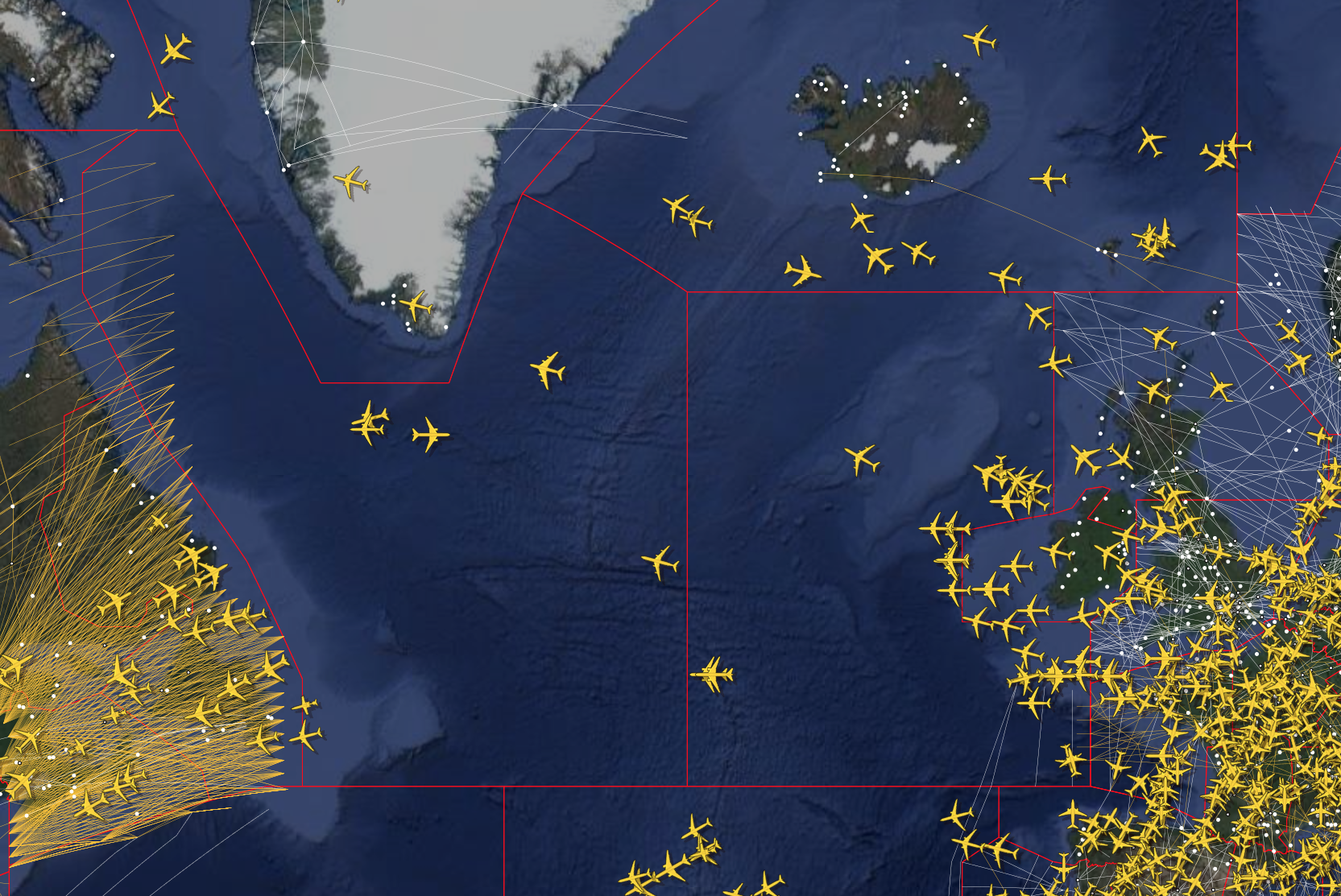

This page has a timeline of big NAT changes, for the six Oceanic Area Control Centres (OACC’s): EGGX/Shanwick, CZQX/Gander, BIRD/Iceland, ENOB/Bodø, LPPO/Santa Maria, and KZWY/New York Oceanic.
2026
- OCR still not fully implemented. Most NAT FIRs now operate “No Oceanic Clearance Required”, but Shanwick still requires a clearance and is not expected to implement OCR until after summer 2026. More info.
- No RCL for Reykjavik. Reykjavik no longer requires an RCL. If you send one, they’ll tell you it’s not needed. Flights exiting Reykjavik into Gander or Shanwick are coordinated automatically – no extra RCL required. More info.
- ETO replaces ETA. RCL timing now uses ETO (Estimated Time Over the OEP) instead of ETA – more precise and aligned with how ATC separates traffic. More info.
- FLAS removed. There is no longer a published Flight Level Allocation Scheme. You can plan any level, but expect less predictability and more tactical level changes. More info.
- GNSS interference now a normal NAT risk. Jamming and spoofing are treated as routine. Even if position recovers, timing and surveillance may not – tell ATC early (usually in the RCL). More info.
2025
- Shanwick OCR delayed. Transition to Oceanic Clearance Removal pushed to after summer 2026 following issues seen during Gander’s rollout. More info.
- ADS-B required in Reykjavik FIR. ADS-B is now mandatory across the entire BIRD FIR for IFR flights. More info.
- Greenland alternates changing. BGGH/Nuuk is now open to regular jet traffic. BGBW/Narsarsuaq is expected to close in 2026. More info.
- Gander back to voice for pre-oceanic changes. CPDLC removed for pre-entry route changes – expect VHF voice instead. More info.
- Blue Spruce concept removed. The formal Blue Spruce Routes were removed from NAT Doc 007, although VHF routings still exist in practice. More info.
- GNSS interference procedures introduced. NAT Ops Bulletin 01/2025 sets out what to do if affected by spoofing or jamming – advise ATC early to avoid reroutes or level restrictions. More info.
2024
- OCR rollout began. Transition to “No Oceanic Clearance Required” started across the NAT – but not all FIRs implemented it fully. More info.
- Shanwick OCR postponed. Shanwick delayed implementation and remains the main FIR still issuing oceanic clearances. More info.
- Comms failure simplified. Updated procedures made RCF handling more straightforward. More info.
- Squawk 2000 standardised. Squawk 2000 ten minutes after the OEP across the NAT. Exceptions: Reykjavik CTA and Bermuda radar – retain assigned code while under surveillance. More info.
2023
- WATRS renamed WAT. FAA updated terminology for North Atlantic airspace. More info.
- Datalink exempt area reduced. The northern exemption no longer extends as far south – previously down to SAVRY, now only to EMBOK. This means more of the Greenland sector controlled by Gander requires datalink. More info.
2022
- Tracks start at FL340. NAT Tracks are no longer published at FL330 and below, giving more flexibility for random routing at lower levels. More info.
- HF datalink no longer counts as Satcom. You must use Inmarsat or Iridium for NAT DLM compliance – HF ACARS alone is not sufficient. More info.
2021
- Max uplink delay standardised. Expect “SET MAX UPLINK DELAY VALUE TO 300 SECONDS” on each CPDLC logon to a new OACC. More info.
2020
- Datalink mandate introduced. CPDLC and ADS-C are required between FL290-410 across most of the NAT, with exemptions including north of 80N, surveillance airspace, and New York Oceanic East. More info.
2019
- Micro-SLOP introduced. Aircraft can now offset up to 2.0NM right of track in 0.1NM increments. More info.
- ASEPS separation reduced. Lateral separation reduced to 19NM for fully PBCS-compliant aircraft with ADS-B, RNP4, RCP240, and RSP180. Read the ICAO Bulletin.
- Free speed (OWAFS). “Resume Normal Speed” allows variable Mach within limits – advise ATC if it changes by 0.02 or more. Read the ICAO Bulletin and check out our article.
- PBCS tracks expanded. More daily PBCS tracks were introduced. Initially these were FL350-390, though current procedures now allow tactical expansion higher or lower. More info.
- Contingency procedures updated. New contingency and weather deviation procedures introduced. For contingencies, you now turn at least 30 degrees and offset by 5 NM. For weather deviations, you now do your 300ft up/down offset when 5 NM away from track. More info.
2018
- PBCS introduced. From March 2018, PBCS became a requirement for the daily mandated PBCS NAT Tracks. For the NAT, this means having both RCP240 and RSP180, along with RNP4. More info.
- RLAT expanded. From Jan 2018, Shanwick and Gander expanded half-degree spacing on more tracks before RLAT was replaced by PBCS terminology. More info.
2017
- SLOP mandatory. Offsetting right of track became standard NAT practice. Why it matters.
- TCAS 7.1 required. From Jan 2017, TCAS 7.1 became mandatory throughout the entire NAT region.
- No fixed cruising levels required. ICAO hemispheric cruising levels no longer need to be followed in NAT airspace.
- Gross Nav Error tightened. This is now defined as greater than 10NM, instead of 25NM elsewhere.
- Initial datalink mandate. Since Dec 2017, datalink became mandatory at FL350-390, with exemptions including Tango Routes, airspace north of 80N, surveillance airspace, Blue Spruce routes, and New York Oceanic.
2016
- Confirm Assigned Route message introduced. Introduced in Aug 2016, this CPDLC message requires crews to confirm the planned NAT route and helps catch routing errors early.
- NAT HLA introduced. MNPS was renamed NAT HLA in Feb 2016. Aircraft must be RNP4 or RNP10, and previous MNPS approvals remained valid through 2020.
2015
- RLAT introduced. Starting in Dec 2015, spacing on core NAT Tracks was reduced to half-track spacing (30NM). More info.
- SLOP becomes mandatory. Routine right offsets of 1NM or 2NM were introduced to reduce collision risk.
More on the topic:
- More: NAT CPDLC Route Uplinks: Crew Confusion and Errors
- More: New NAT Doc 007: North Atlantic Changes from March 2026
- More: What’s Changing on the North Atlantic?
- More: Spoofed Before the NAT? Here’s What to Do
- More: Shanwick Delays OCR Until Post-Summer 2026
More reading:
- Latest: Paris Ramp Checks: Illegal Charters and Tax Avoidance
- Latest: Middle East Airspace – Current Operational Picture
- Latest: Greenland NAT Alternates: March 2026 Update
- Safe Airspace: Risk Database
- Weekly Ops Bulletin: Subscribe
- Membership plans: Why join OPSGROUP?




 Get the famous weekly






I read the contingency turn-back procedure as follows:
FIRST turn at least 45 degrees, THEN maintain 10/15nm offset track (depending on whether you can/cannot maintain your assigned flight level), THEN climb or descend to get out of the way of the rest of the NAT traffic (above FL410 or below FL280), THEN maintain a flight level which differs from those normally used (by 1000ft if above FL410, or by 500ft if below FL410)… and then finally once all that’s done you can initiate your turn-back.
It is also contained in the NAT OPS Bulletin 2015_003 Revision 4, effective 25 JAN 2017. Section 5.8.
I have a question related to what Dave H brought up. I found the same section (13.3.5) that FSB included in their reply to Dave H. I understand that it is relevant to RLatSM because it recommends an offset of only 15nm, but it is not specific to a turn-back as it specifies “…while subsequently maintaining a same direction 15 NM offset track…”. So if I am reading it correctly, it is suggesting that you continue in the same direction, but offset 15nm, and then descend/climb as appropriate before making any turn across the OTS or making a turn-back. Am I understanding this correctly?
Hey Norm, sure:
https://ops.group/blog/2017-edition-nat-doc-007-north-atlantic-airspace-and-operations-manual/
Happy reading!
Do you have a link to the V.2017? All I can find is V.2016-1. Thanks!
Hi David, yep, the source is the new NAT Doc 007 –
Page 17: “Modifications to the Contingency Procedures, to take account of possible turn-backs when operating in RLatSM airspace, are included in Chapter 13.”
13.3.5 Before commencing any diversion across the flow of adjacent traffic or before initiating any turn-back (180°), aircraft should, while subsequently maintaining a same direction 15 NM offset track , expedite climb above or descent below the vast majority of NAT traffic (i.e. to a level above FL410 or below FL280), and then maintain a flight level which differs from those normally used: by 1000 ft if above FL410, or by 500 ft if below FL410. However, if the pilot is unable or unwilling to carry out a major climb or descent, then any diversion or turn-back manoeuvre should be carried out at a level 500 ft different from those in use within the NAT HLA, until a new ATC clearance is obtained.
I cannot find a source reference for the “Contingency Procedure: Published January 2017, a new turn-back (180) procedure is introduced – turn back to parallel previous track by 15nm.” Are you able to provide a link? Thx