



Key Points – Oct 6 update
- EASA has tightened its advice again. Jordan is back to “avoid at all levels”, while Saudi now has its own CZIB covering parts of the Jeddah FIR.
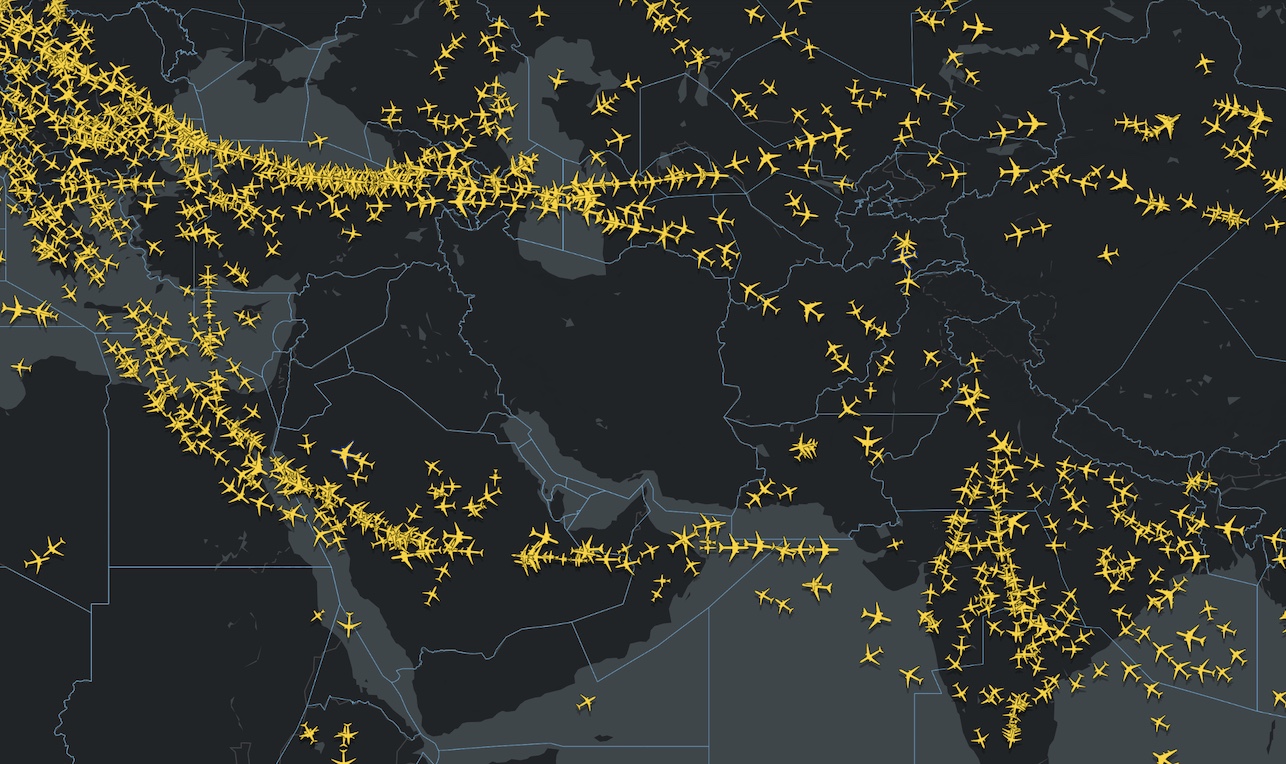
- Most Gulf FIRs remain open, but Kuwait is still closed to overflights, so there is no direct central route through the region.
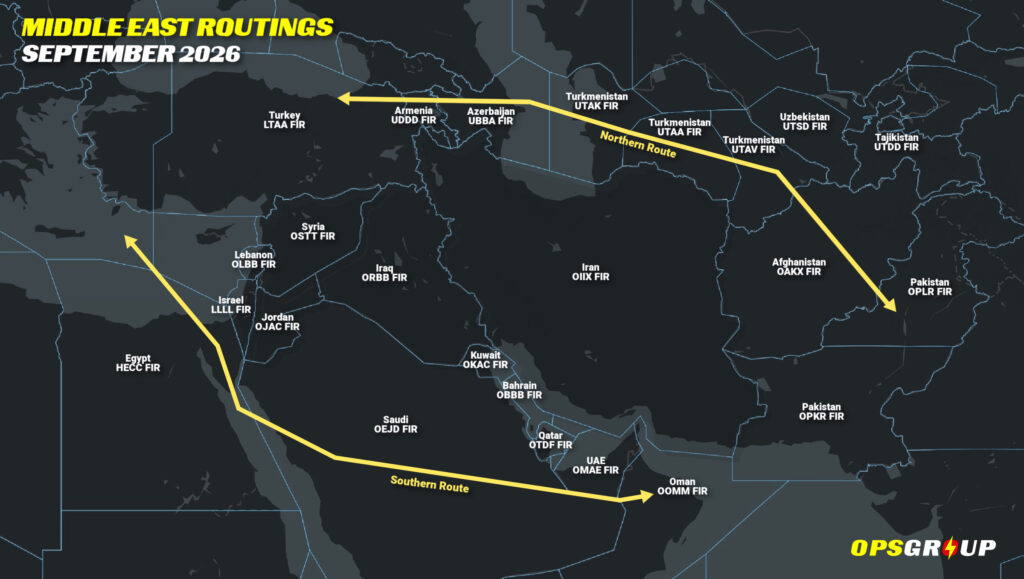
- The main Europe-Asia routes remain south via Egypt-Saudi-Oman/UAE or north via the Caucasus-Afghanistan.
- GPS jamming and spoofing remain widespread across the region.
Recent Developments
Oct 6 – Houthi attacks continue in Saudi Arabia
The Houthi campaign against Saudi Arabia is continuing, with OEGN/Jizan and OENG/Najran airports targeted again on Oct 5. Riyadh has also been targeted in recent weeks, and air defence activity is causing disruption at short notice, particularly across southern and western Saudi Arabia.
Sep 30 – EASA updates Middle East CZIBs again
EASA have updated their Middle East airspace advice again, with several changes following the renewed attacks in the region.
- Jordan: After relaxing its advice in Aug, EASA is now back to recommending that operators avoid the entire airspace at all levels. The change follows renewed Iranian missile and drone attacks in Sep.
- Saudi: EASA has issued a new dedicated CZIB. They say operators should avoid the southwestern part of the Jeddah FIR along the border with Yemen due to recent Houthi attacks deeper into the country including at Riyadh.
- Bahrain, Kuwait, Qatar & UAE: The Gulf advice has been extended to Nov 16. EASA still says to avoid the airspace over the waters of the Persian Gulf in these four FIRs, except when going to/from an airport.
- Oman: The same advice applies to the Gulf of Oman, with EASA recommending that operators avoid the airspace over the water west of 58°E.
- Lebanon: The avoid recommendation remains, except for flights to and from OLBA/Beirut over the sea.
- Iran & Iraq: Both remain avoid at all altitudes, with the CZIBs extended to Nov 16.
- Syria & Yemen: Separate CZIBs remain in place. Syria’s was revised on Oct 1, with EASA now allowing operations above FL260 in parts of the Damascus FIR.
- Israel: EASA’s separate Information Note remains in place, advising operators to take the potential risk into account rather than issuing a blanket avoid recommendation.
You can check all the CZIBs and Information notes here, along with some useful background on why EASA has made these changes and what’s been happening in the region.
Current Airspace Picture
The map below tells the short story of your overflight options! For Europe-Asia traffic or Gulf positioning, the two real options are still the same as we reported before – north via the Caucasus then Afghanistan, or south via Egypt then Saudi then Oman:
And now a quick lowdown on what’s going on in each little bit of airspace…
Kuwait
Kuwait remains closed to overflights, currently until Nov 2. Only flights arriving or departing OKKK/Kuwait are allowed with prior approval. The rest of the region is open to overflights in one form or another, but with Kuwait still closed there’s no direct central route through the Middle East.
Iran
Iran is open, but overflights are still limited to designated routes above FL285. There are ongoing warnings for conflict activity and GPS interference. Most foreign operators continue to avoid the country.
Qatar
Qatar remains open to overflights and landings. Some flow restrictions apply for traffic heading towards Oman, and GPS interference remains an issue.
UAE
The UAE is a similar story – remains open, but traffic is still being managed through temporary routings and flow restrictions. GPS interference continues here too.
Bahrain
Bahrain remains open, although restrictions in neighbouring airspace can still affect onward routing. GPS interference also an issue here too!
Iraq
Iraq remains open to overflights. But the recent US and coalition withdrawal from Erbil removes a layer of air defence, particularly in the Kurdistan Region. Some airlines are using Iraq, but most continue to prefer the northern or southern routes instead.
Saudi Arabia
Saudi Arabia remains open and is seeing a lot of traffic with operators routing on the southern option, but the risk picture has worsened. Recent Houthi missile and drone attacks have caused short-notice disruption, including at Riyadh, and further disruption seems likely at the moment. ESCAT procedures may also be activated at short notice.
Oman
Oman remains one of the most useful FIRs in the region, especially for the southern bypass. It is open, but still with flow measures and ongoing GPS interference reports.
Jordan
Jordan remains open, but the risk picture has worsened. Iranian missile attacks have recently entered Jordanian airspace, with air defences activated on several occasions, and the US base at Muwaffaq Salti has also been targeted. However, it’s still not a major transit route for overflight traffic – most operators continue to route via Egypt/Saudi, as they did before the conflict.
Israel
Israel is open, but ops still aren’t back to normal – and the security situation is still a concern. Missile and drone attacks have reduced in frequency, but remain possible, including around LLBG/Tel Aviv. Some foreign airlines have resumed services, although others continue to stay away.
Syria
Syria has quietly become part of the regional routing picture again after years of almost no international overflight traffic. Some Middle East airlines are now using Syrian airspace again as an alternative to the more restricted Iran/Iraq option – though most US and European carriers continue to avoid it.
The airspace remains high risk. Israeli military activity and missile interceptions are still a concern, particularly in the south-west. At lower levels there is also a threat from drones, rockets and MANPADS. EASA currently says EU operators should stay out of the western/south-western part of the FIR at any altitude, and stay above FL260 elsewhere.
Armenia/Azerbaijan/Afghanistan
Armenia and Azerbaijan remain important parts of the northern bypass, with steady overflight demand. The main issue is still Afghanistan – the OAKX/Kabul FIR remains Class G with no normal ATS service, so crews still need to use the published contingency routes and operate with TIBA procedures.
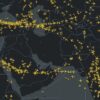
Where’s the spoofing today?
Still our favourite map to check for this – the live GPS spoofing tracker from GPSwise.
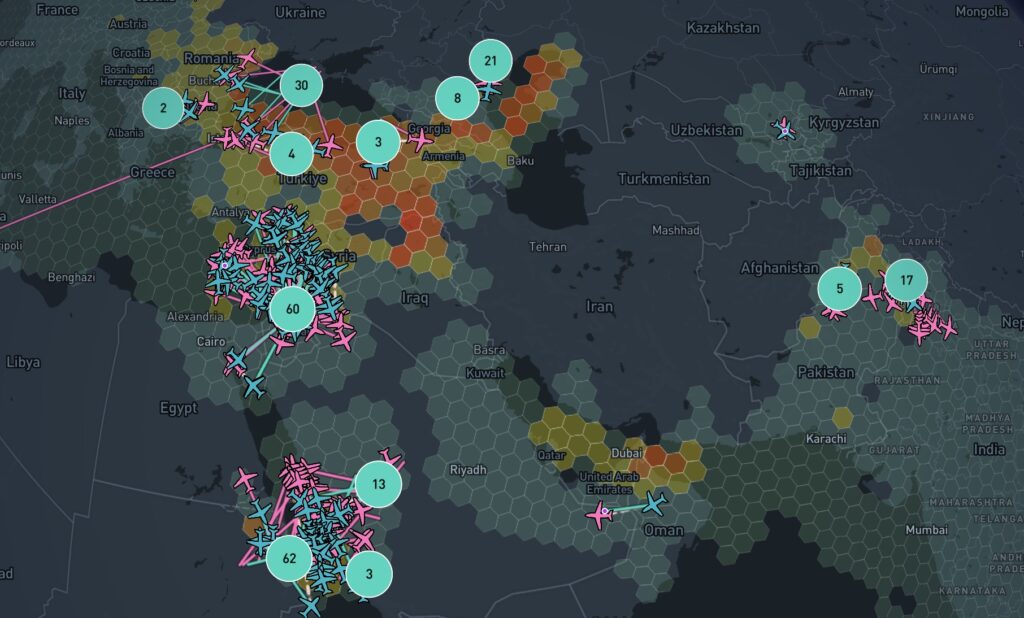
The map detects spoofing in real-time based on the ADS-B data from the OpenSky Network. Handy for a quick look at what’s been happening along your route.
Recent Opsgroup Member Reports
We’ve had a lot of useful Airport Spy reports recently from Opsgroup members operating into several Middle East airports: OMDW/Al Maktoum, OMDB/Dubai, OBBI/Bahrain, OTHH/Doha, OMSJ/Sharjah, OMAD/Abu Dhabi and OEDF/Dammam.
Big theme across all of them is the scale of the GPS jamming/spoofing currently happening around the region. Several reported complete GPS loss on arrival or departure, and interference continuing well into neighbouring FIRs. ATC seems very used to it now, with lots of runway heading departures and radar vectors being issued.
Reports also mentioned fuel delays, extra towing/hangar time, and slower ground handling at some airports. We’ve also had reports of heavy ATC congestion in the OEJD/Jeddah FIR as traffic continues concentrating on the southern bypass via Egypt and Saudi Arabia. Opsgroup members can check Airport Spy in their dashboard for the full reports.
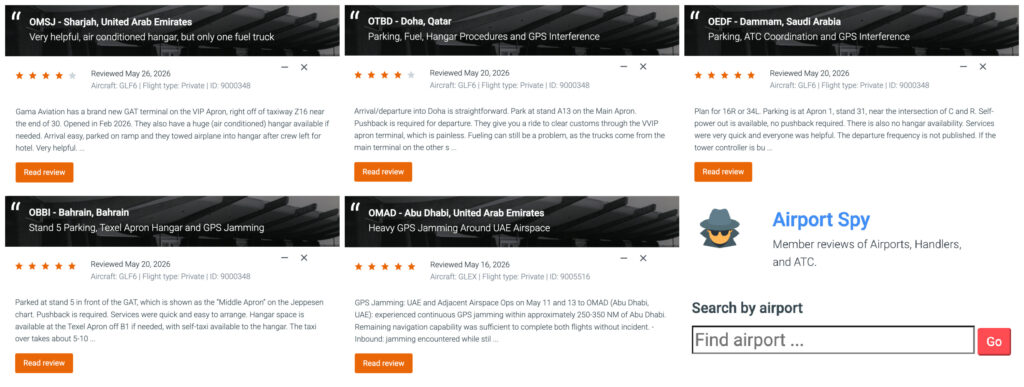
Access latest Airport Spy reports here.
If you have operated in the region recently and could share your experience, send us an anonymous Airport Spy report or email us at team@ops.group.


More on the topic:
- More: Crisis in Iran: Elevated Airspace Risk
- More: EASA Removes CZIBs: Middle East Risk Gets Harder to Read
- More: 2025 Update: BizAv Ops to Israel
- More: Why EASA has Withdrawn Airspace Warnings for Iran and Israel
- More: Dodging Danger: The Three Routes Through the Middle East
More reading:
- Latest: Beijing’s New 600km Restricted Area
- Latest: FAA Proposes to Loosen Oxy Rules for Part 91 and 135
- Latest: Australia TSP Lite Explained
- Safe Airspace: Risk Database
- Weekly Ops Bulletin: Subscribe
- Membership plans: Why join OPSGROUP?





 Get the famous weekly







I’m leaving Sydney to go to Dublin on the 23rd of July stopping down at Dubai for 3 hours .
Is this safe and is the airspace open.
Can anyone tell us how Afghanistan is collecting its overflight aero charges?? With no ATC you have to question how they keep track of all flights.
They charge a flat $700 USD to cross the OAKX/Kabul FIR, and I think that basically covers both the overflight permit and the nav fee. You request the permit from the Afghan CAA and the $700 usually gets handled through your trip support provider at the same time. More info here: https://ops.group/blog/2026-afghanistan-overflight-update/
Thanks v informative.