




There are plenty of ways to get caught out by US Customs! Wrong passport in APIS, late change, wrong airport after arriving from the south, a BOE that doesn’t actually cover the flight – these are just a few.
A lot of the problems aren’t obvious either. Some come from rules that have changed recently, some from differences between airports, and some are just things crews regularly get caught by.
So here’s a closer look at 13 of the main gotchas we’ve heard about recently…
Gotcha 1: Trusting the software instead of CBP
A green tick in your APIS software doesn’t necessarily mean you’re good to go.
Check the actual CBP response. Make sure the aircraft, airports, times and people are right. And for a US arrival, make sure you have Permission to Land too. An APIS auto-response isn’t the same thing.
Many ports now use addresses in the format ICAO_GAP@cbp.dhs.gov, such as KTEB_GAP@cbp.dhs.gov, but not all have switched yet. Check the airport’s CBP Fact Sheet for the current address.
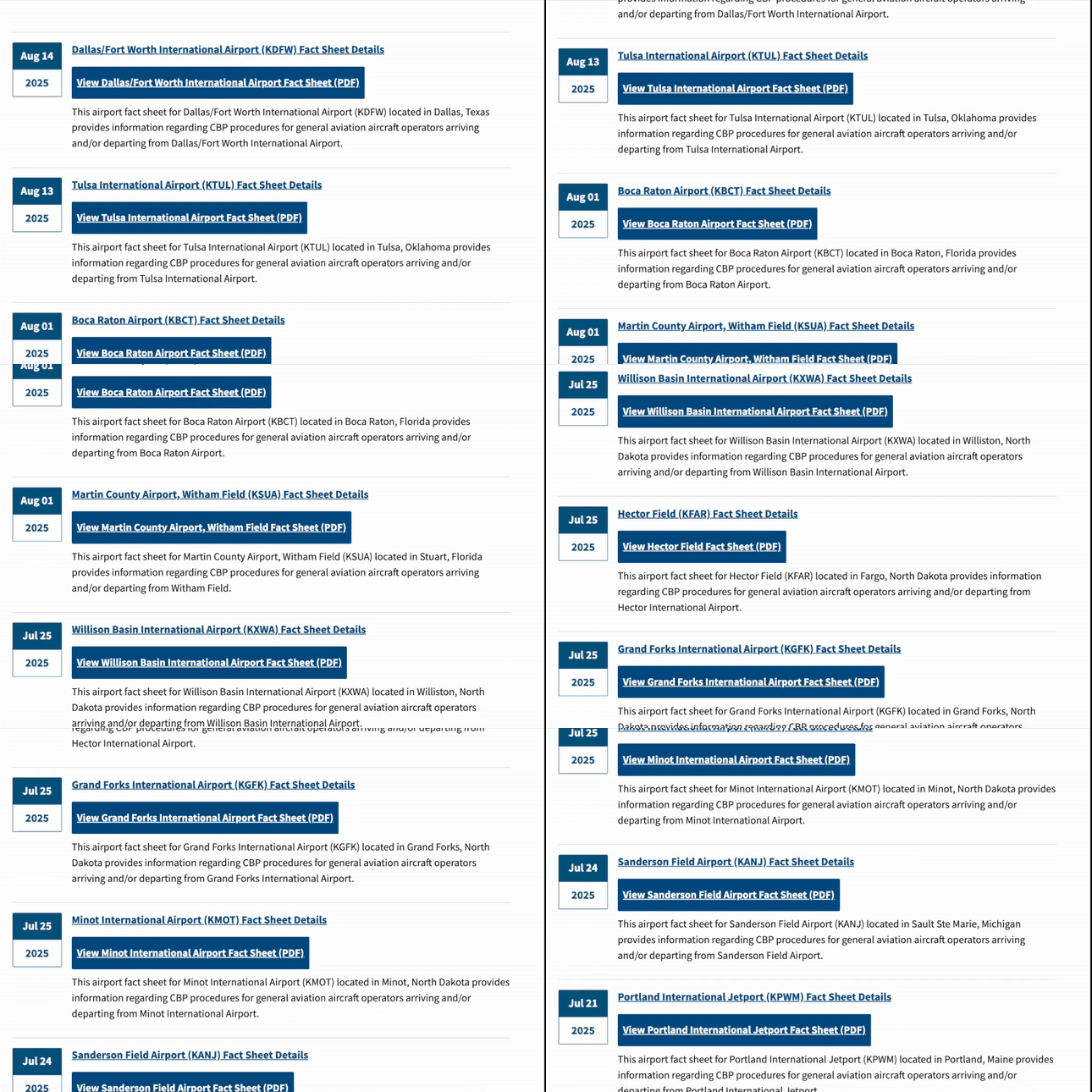
So many Fact Sheets…
Gotcha 2: Leaving the US without departure clearance
APIS is needed when leaving the US too.
For private flights, file eAPIS and wait for the CBP response before you go. You can depart from virtually any US airport, even if it isn’t listed in eAPIS. In that case, use the nearest CBP airport in the filing and put the real departure point in the “Actual Departure Location” field.
For commercial flights, file APIS and contact the CBP port responsible for your departure to get clearance. You can also depart from an airport without CBP on site, but you have to arrange it with the responsible CBP port first.
Gotcha 3: Filing the wrong person or passport
This is an easy one with saved pax profiles. Wrong family member, old passport, or a dual-national passenger turns up with a different passport to the one in APIS.
Check the actual passports against the final manifest before you go. If something doesn’t match, fix the filing and get the new APIS approval.
Gotcha 4: Making a change and assuming APIS is still good
For private flights, changes to passengers, passports, traveller details or the aircraft normally mean amending the APIS. Once you amend it, the old approval is no longer valid. So wait for the new one.
But note: if you amend the APIS less than 60 mins before departure, you don’t have to wait another 60 mins before you can depart. You just need to wait for CBP to approve the amended APIS.
Changes to times or airports can sometimes be handled directly with CBP. But if the flight moves to another calendar date, you’ll need to file a new APIS.
And if the flight gets cancelled, just cancel the APIS and tell CBP!
Gotcha 5: Assuming Part 91 means private
Part 91 doesn’t automatically mean “private” to CBP.
An empty positioning flight is a good example. CBP says if either the arrival or departure leg of a journey is commercial, it treats both legs as commercial. So flying out empty to pick up charter passengers, or returning empty after dropping them off, can still count as commercial!
Gotcha 6: Assuming your BOE covers the flight
The basic rule if you’re arriving from the south is that CBP normally requires your first landing to be at the nearest southern airport of entry. A Border Overflight Exemption lets you bypass that rule and fly straight to an approved US airport with CBP. More info here.
The gotcha is that not every BOE covers every flight.
Check the operator named on it, the airports it covers and the expiry date. The operator in APIS must be the one the BOE was issued to.
Another couple of recent BOE changes:
- Since Jan 2026: CBP has separate BOEs for private-only operators and those approved for both private and commercial flights. If yours is private-only, you can’t use it for a charter flight.
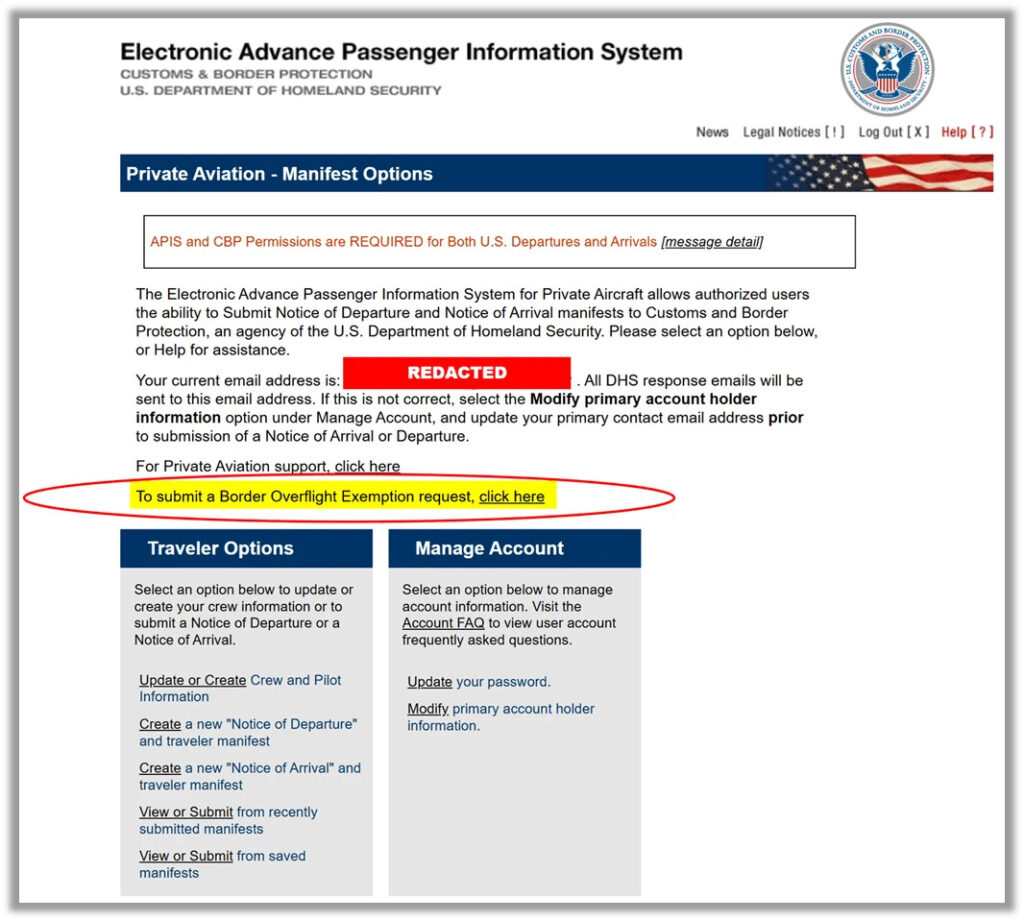
- Since July 2025: CBP has shifted BOE applications and renewals into the eAPIS web portal, instead of you having to do it all by email. So just log in with your usual APIS credentials and hit the new “Border Overflight Exemption” link under the manifest options.
Gotcha 7: Assuming every CBP airport works the same way
Every pilot’s number one complaint when it comes to CBP! The frustrating reality is that every airport does things a little differently. Notice periods, opening hours, parking and after-hours arrangements can all vary.
So the best thing you can do is check the local setup before every trip. Check the airport’s current CBP Fact Sheet and whatever instructions you get with Permission to Land.
A couple of other useful ones:
- One we get asked a lot – can you open the aircraft door before CBP arrives? Yes. There’s no nationwide rule saying you have to stay onboard. But nobody should wander off beyond the immediate aircraft area or interact with anyone else until CBP gives permission.
- And the APU: If the exhaust is less than 8ft off the ground, it needs to be shut down during CBP processing. If it’s 8ft or higher, you can normally leave it running.
Both are covered in the CBP arrival FAQs.
Gotcha 8: Assuming ESTA is enough
An approved ESTA doesn’t mean someone can arrive in the US on any BizAv flight.
For someone entering the US under the Visa Waiver Program, the operator generally needs to be a VWP signatory carrier.
So check two things: the ESTA matches the passport they’re carrying, and the operator is on CBP’s VWP signatory carrier list. If not, they’ll normally need a US visa.
There are some exceptions for people returning from Canada, Mexico or nearby islands during an existing VWP admission. But that’s not the same as an initial entry.
Gotcha 9: Assuming your decal covers every flight
For private flights, the annual CBP arrival fee is normally paid through DTOPS. But that decal only covers private flights – it doesn’t cover commercial ops. Commercial flights have their own CBP and APHIS fees. The decal is also tied to one aircraft and can’t be transferred.
If you’ve paid but the decal hasn’t arrived, put receipt in the APIS decal field and carry proof of purchase. More info is in the CBP FAQs.
Gotcha 10: Assuming Puerto Rico and the US Virgin Islands are simple domestic legs
They’re US territories, but flights to and from them aren’t always treated like normal domestic flights!
Puerto Rico: nonstop flights between the mainland US and Puerto Rico are normally treated as domestic if you fly IFR above 12,500ft with no stop en route. VFR, lower-level or stopping flights can change that.
USVI: flying from the mainland US or Puerto Rico to the islands is generally treated as domestic. Coming back is different – you need to clear CBP in the USVI before departure.
There can also be extra rules for commercial cargo, food and agricultural items.
There’s a good rundown of all the different scenarios in this operational guide, and the USDA/APHIS guidance covers the agricultural side.
Gotcha 11: Not thinking about what’s on board
Some things need more advance planning than simply declaring them when you arrive.
Cash: more than USD 10,000 is legal, but it has to be reported. Use FinCEN Form 105 or the electronic CMIR.
Valuables: CBP Form 4457 can be used to record things like jewellery and cameras before leaving the US.
Firearms: the same Form 4457 can help show that an eligible firearm left the US. It isn’t an export licence or foreign import permit.
Food, plants, pets and aircraft garbage can all have separate requirements. International aircraft garbage is covered by the APHIS rules.
Worth checking before you go, especially if the arrival airport might not be able to handle it!
Gotcha 12: Diverting and forgetting about CBP
If you divert to a different US airport: your original Permission to Land doesn’t automatically cover the new one. Contact CBP at the diversion airport as soon as you can.
If you weren’t originally heading to the US but need to divert there: send APIS before arrival if time allows. For an emergency, the standard thing applies – deal with the emergency first, then contact CBP as soon as you can.
More details are in the CBP emergency arrival rules.
Gotcha 13: Getting a penalty notice, or having a bad run-in with CBP
CST Flight Services published some good advice on this recently. Most CBP arrivals go without a problem, but occasionally you might disagree with how something has been handled, or feel that a penalty shouldn’t apply.
If that happens, ask to speak to a supervisor straight away. If a penalty is being discussed, getting a supervisor involved early may help sort it out before one is issued.
Keep a record of what happened – names, times, phone calls, APIS responses, Permission to Land and anything else useful.
If it can’t be resolved locally, you can file a formal complaint with CBP.
The standard stuff
If you’re completely new to US ops, here’s the basic process.
APIS: you need it when flying both to and from the US. File the aircraft, crew and everyone onboard, and make sure the deets match their travel docs.
Before flying to the US: contact CBP at the airport you’re flying to and get Permission to Land before you leave. Filing APIS alone isn’t enough.
Before leaving the US: APIS is required again, and you need CBP clearance before you go. (Gotcha 2 above explains how this works for private and commercial flights.)
Before every trip: check the airport’s current CBP Fact Sheet. That’s where you’ll find the local notice period, opening hours, contact details, parking and any special procedures.
That’s the basic setup. The gotchas above are the bits most likely to complicate it!
If you’ve come across any other CBP gotchas we haven’t covered here, let us know! You can email us at news@ops.group, or if you want to make it infinitely more fun, use our patented Report-A-Thing tool.

More on the topic:
- More: Can I open the aircraft door on arrival in the US?
- More: US Border Overflight Exemptions: A How-to Guide
- More: US Pre-Clearance: How does it work?
- More: US Airport Fact Sheets (CBP)
- More: US: New Rules For Outbound Private Flights
More reading:
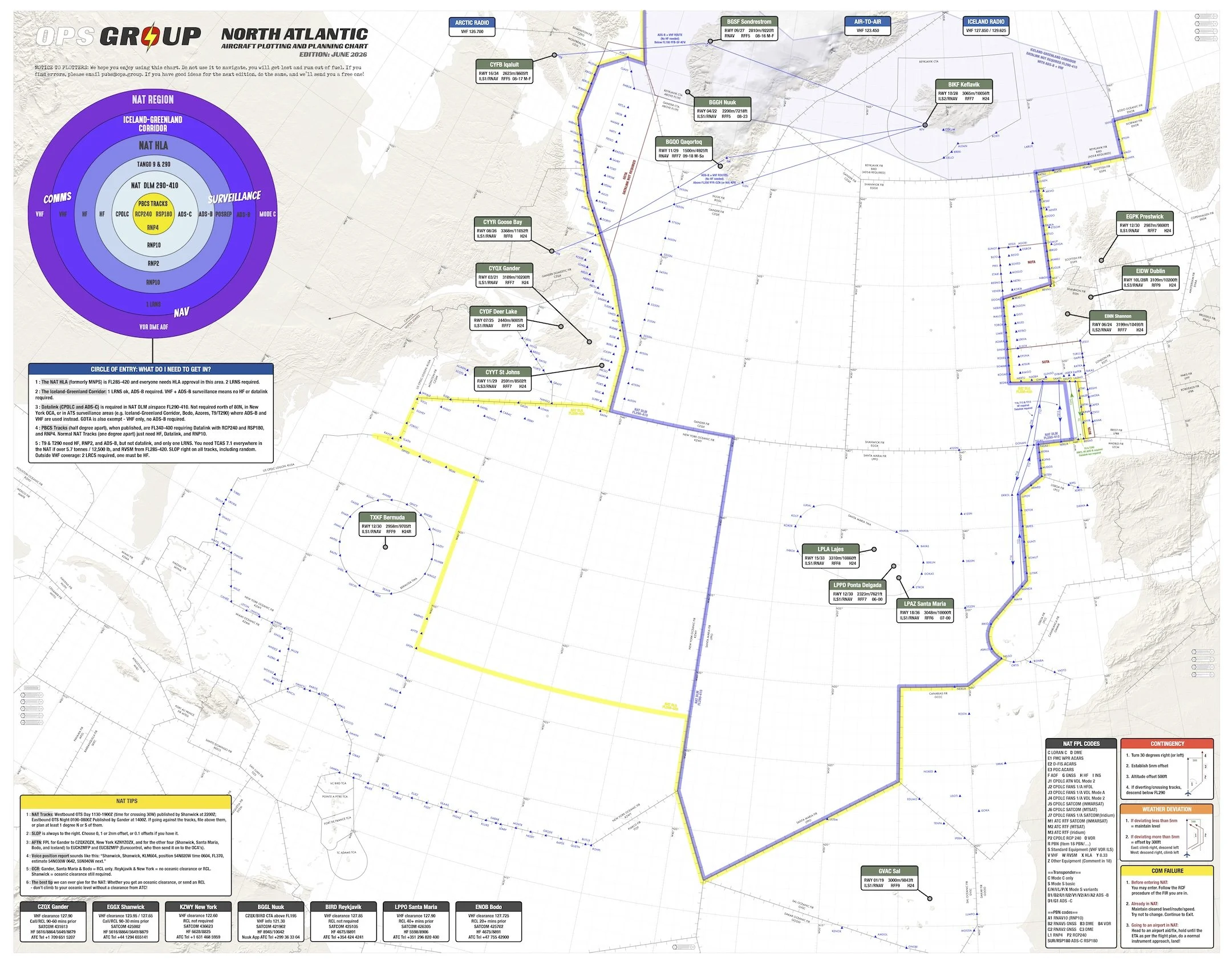
- Latest: NAT Pack 2026: All the North Atlantic goodies
- Latest: New 2026 NAT Oceanic Checklist
- Latest: The Bahamas wants your cash
- Safe Airspace: Risk Database
- Weekly Ops Bulletin: Subscribe
- Membership plans: Why join OPSGROUP?





 Get the famous weekly





Hi Katerina,
nice summary, thanks. I just stumbled across today’s (09/03) note on CBP@KFRG, where a crew apparently got into trouble due to opening the door (we have had such experiences in the past, too, e.g. at KIAD). Quite interesting in light of the CBP FAQs actually clearly stating otherwise! Therefore, though may be not “officially” required, it still seems many U.S. places expect crews to only open the door on hand signal by CBP. Just thought I’d bring it up.
Thank you so much for sharing this, Theo – you’re absolutely right. We’re gathering as much info as possible and will definitely publish a further update once we have more to share.