

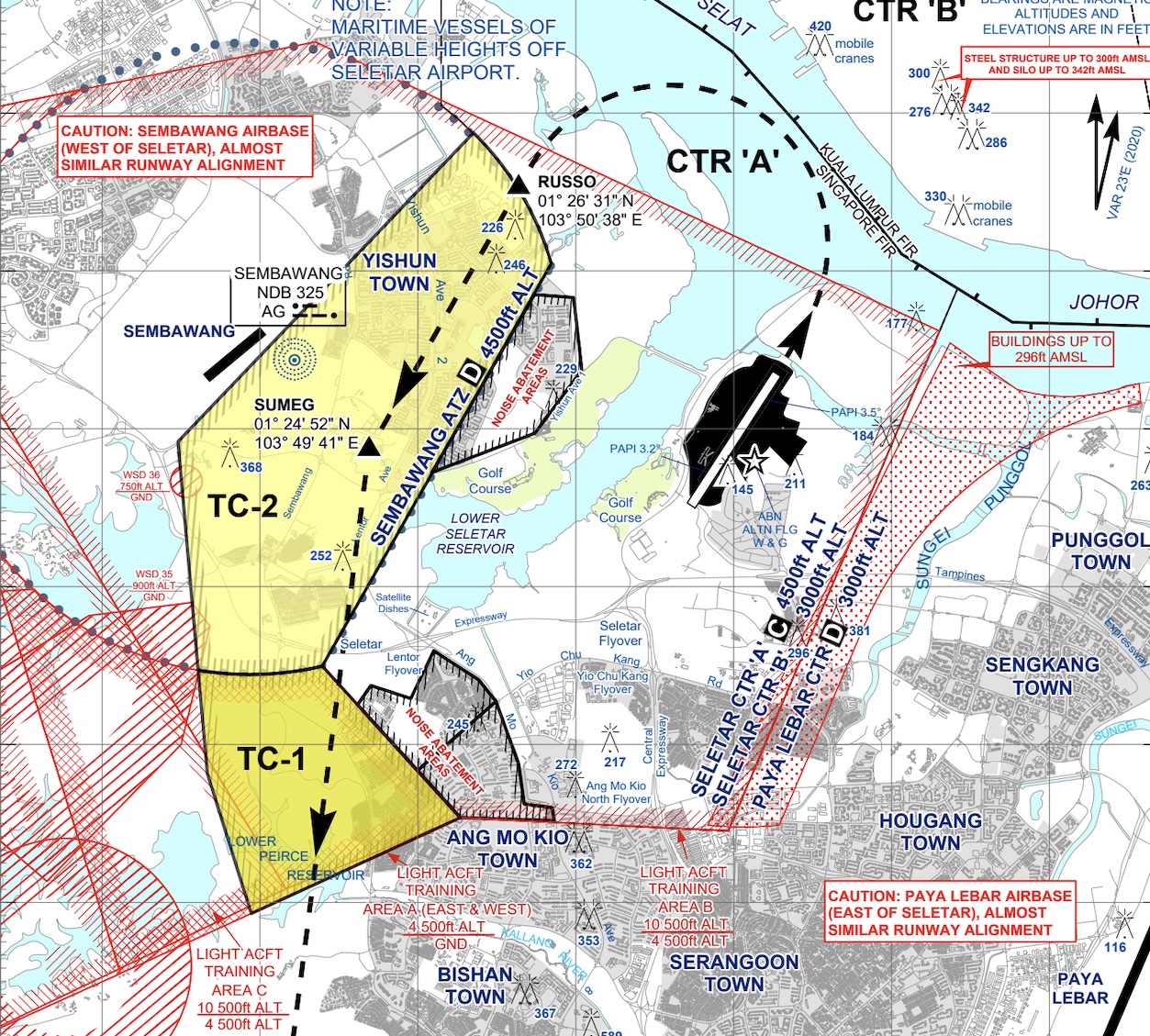

Last year we wrote about how to survive Singapore’s Seletar, one of those airports where flying a business jet can be a lot more difficult than you might expect. Between the tight airspace, nearby military operations and noise restrictions, Seletar has never been the easiest place to operate a medium or large jet.
Well, some good news is coming our way…
From 29 October 2026, Civil Aviation Authority Singapore (CAAS) is introducing two new Transit Corridors (TC-1 and TC-2) to give aircraft a little more room to manoeuvre when arriving and departing Seletar.
And there’s something else happening on the same day. Honeywell Aerospace will also publish its updated FMS-guided visual approach and departure procedures, which should make life a little easier for suitably equipped aircraft.
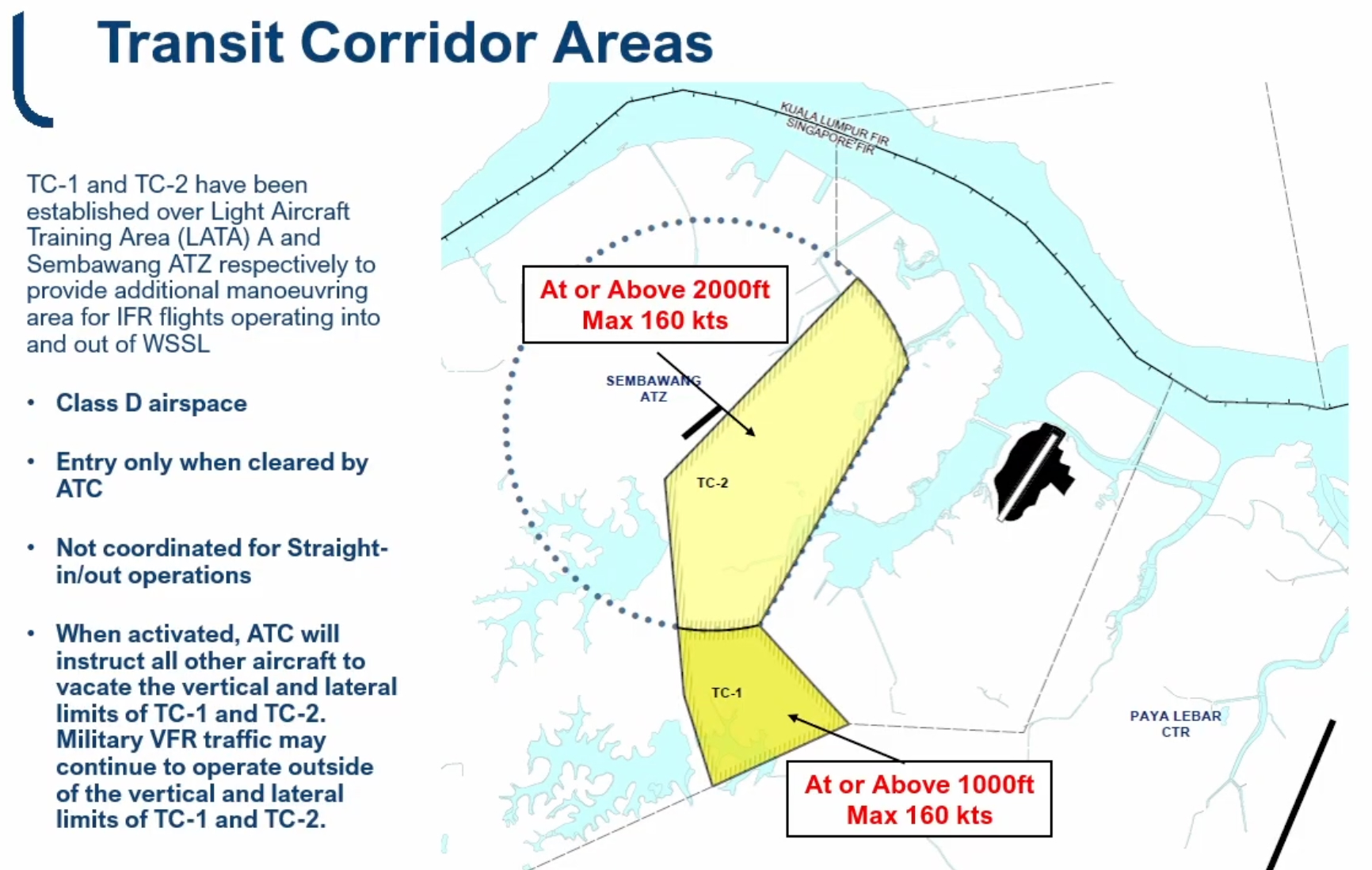
I recently attended a CAAS briefing for operators at Seletar, where they walked us through the new procedures and some of the other changes taking place at the airport.
Why do we need Transit Corridors?
The problem with Seletar has always been the airspace. The airport sits in a confined area, with Sembawang airspace immediately to the west and Paya Lebar’s airspace to the east. There isn’t much room to play with, particularly when flying visual circuits in larger aircraft.
Compounding the problem is Seletar’s location, right on Singapore’s northern border with Malaysia. This severely limits the options for instrument procedures. Seletar is a visual-only airport, where even IFR traffic arrives and departs using visual procedures.
The existing visual circuit was very tight, to say the least. As a result, it wasn’t uncommon for aircraft to unintentionally fly outside the Seletar CTR, which isn’t ideal when the airspace next door is crowded with military traffic.
The new Transit Corridors are designed to address this. TC-1 and TC-2 provide defined areas west of the airport that ATC can use for visual arrivals and departures. They give aircraft more room to manoeuvre while keeping them clear of the surrounding airspace.
The trial starts on 29 October and is expected to run until 7 July 2027. If all goes according to plan, these new corridors will become a permanent feature.
So how will it work?
The corridors come with published visual waypoints, altitude restrictions and a maximum speed of 160 knots.
For arrivals, aircraft will join the appropriate downwind and follow a series of visual waypoints through the corridors before continuing to the runway. These waypoints will be available in your FMS database, but don’t let that fool you into thinking this is an instrument procedure. All arrivals remain visual procedures. So it’s best to manually place the waypoints in your FMS to help fly the visual arrival.
For example, a Runway 03 arrival via OMKOM or GUMPU follows RUSSO-SUMEG-TAPUM at 2,000ft, then descends to 1,000ft or as cleared by ATC after TAPUM, continuing via UPLUS and VIDER for the visual approach.
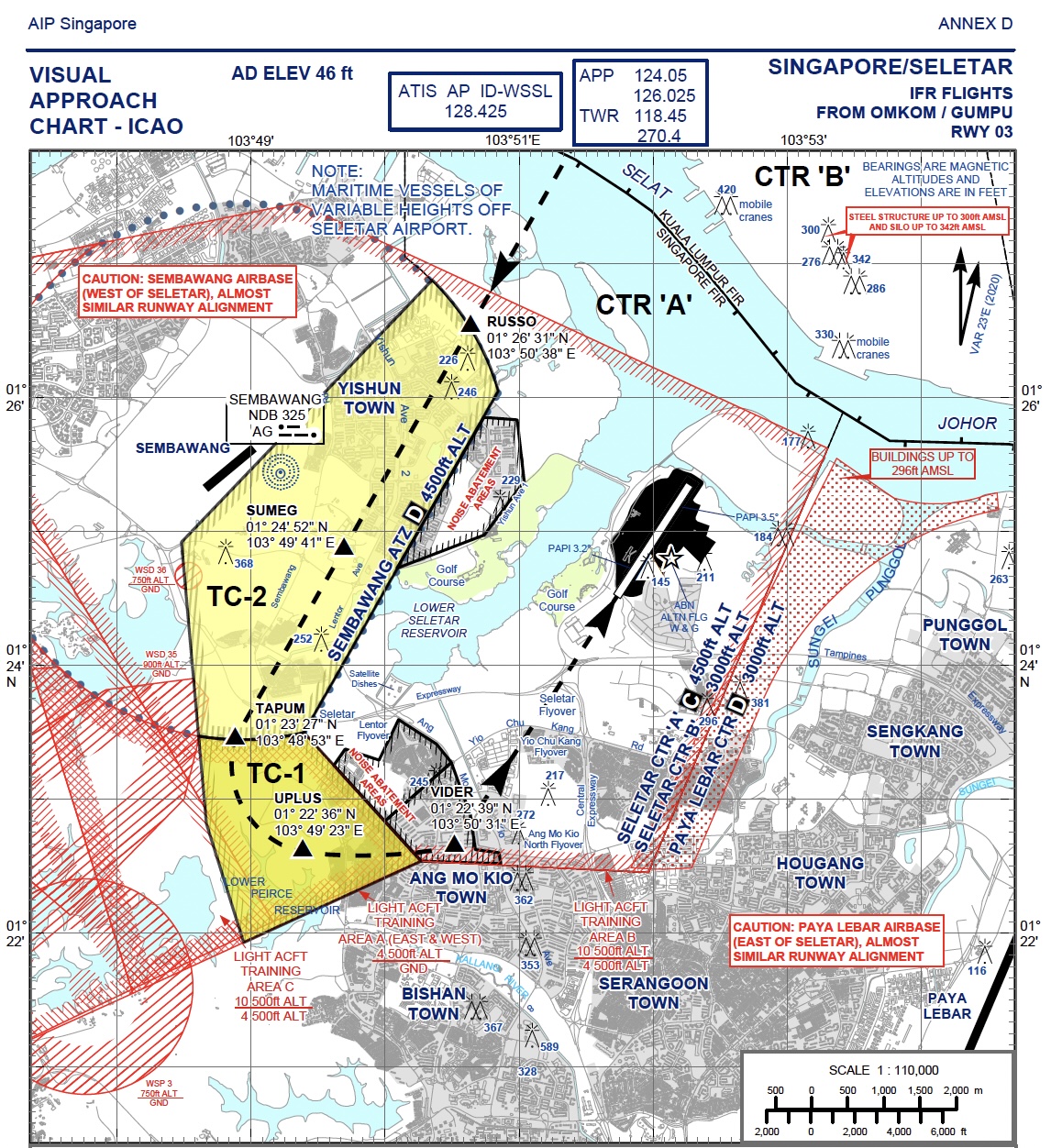
Seletar Runway 03 Arrival Procedure.
The final is now roughly 2.5nm from the threshold, a huge improvement over the previous 1.4nm final.
Runway 21 arrivals via SJ, PONJO and RECHI use SUMEG to RUSSO at 2,000ft before descending for the visual approach. One thing to be mindful of with the Runway 21 arrival is Malaysian airspace. Flying the downwind through the Transit Corridor is likely to take you into Malaysia, although keeping the base turn tight can allow you to remain within Singapore airspace.
My advice is to apply for a Malaysian overflight permit regardless. They’re relatively straightforward to obtain, and I would recommend applying for both Indonesian and Malaysian overflight permits whenever operating in or out of Singapore. Given how the weather often moves across the island, it is best to have both permits on hand should you need to change your arrival direction.
CAAS was also quite specific about aircraft configuration. Arrivals using the corridors are expected to be in landing configuration and at minimum approach speed, there is a maximum speed of 160 knots when you are positioning for landing or on a departure.
For those of us flying large-cabin jets, this is something worth thinking about before accepting the clearance. You’re going to need to be slow and configured early, so give yourself plenty of time.
Departures are a little more interesting. Straight-out departures remain unchanged. The corridors are only available when ATC cannot accommodate a straight-out departure and needs to route you around the western side of the airport.
For Runway 03, this involves a left turn towards RUSSO at or above 2,000ft, following the published visual routing through SUMEG and RECHI.
Runway 21 departures involve a right turn into TC-2 at or above 2,000ft, before routing via SUMEG and RUSSO. Importantly, TC-1 is not available for departures, so expect to commence the right turn passing 400ft AGL. Again, the maximum speed is 160 knots.
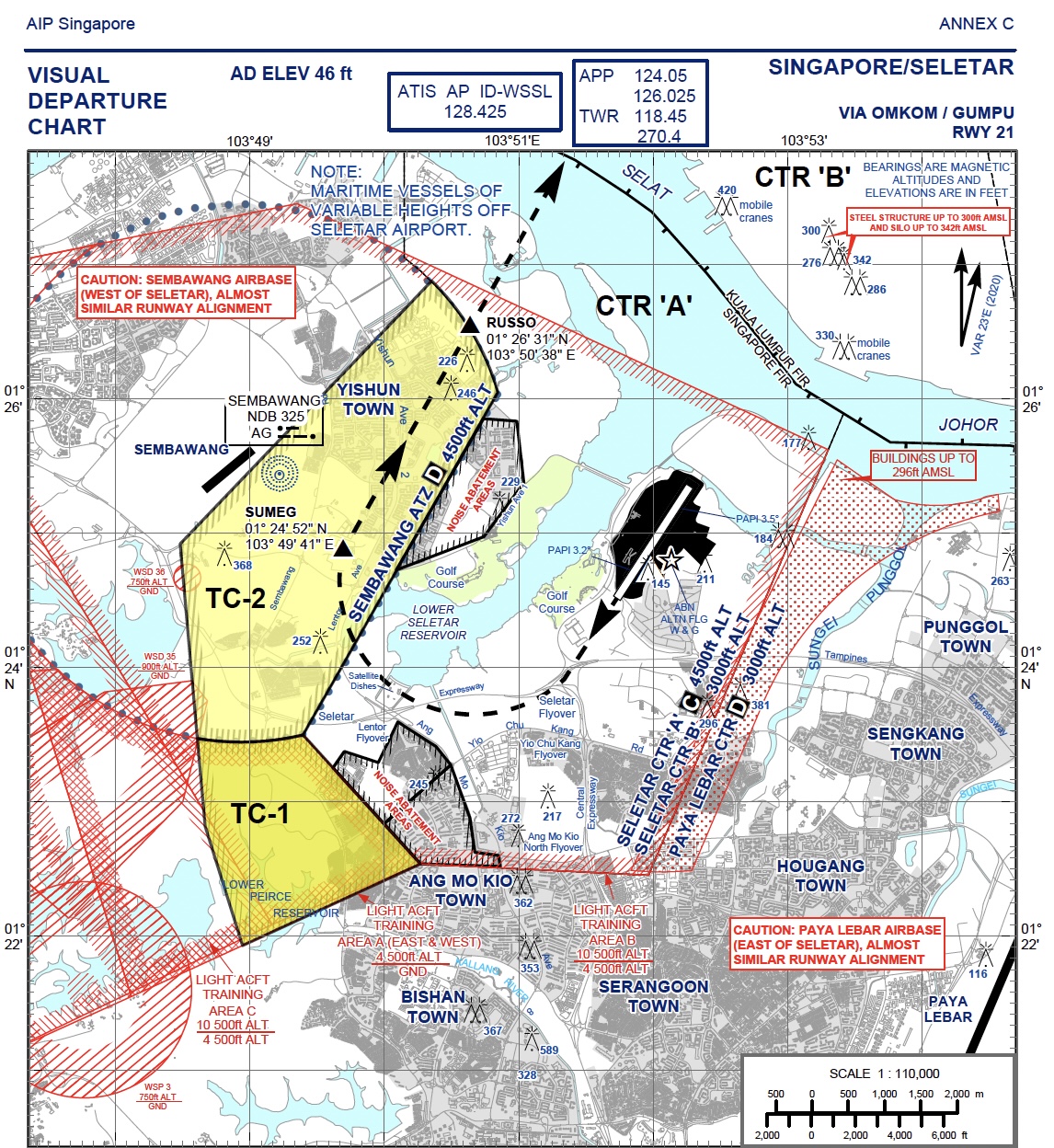
Seletar Runway 21 Departure.
One thing CAAS highlighted was the need to delay thrust reduction and acceleration after takeoff if necessary. The turn should be initiated at the departure end of the runway, and aircraft need sufficient climb performance to meet the corridor restrictions.
For departures, think of it as an NADP 1-style profile. You’ll need to prioritise climb performance over acceleration, potentially delaying thrust reduction and flap retraction to meet the 160kt speed limit and altitude requirements.
Don’t forget, you’re still responsible for remaining within the lateral and vertical limits of the corridors. CAAS made it clear that breaches could result in action against pilots or operators, including operational bans for deliberate or negligent non-compliance.
This isn’t punishment for the sake of punishment. There is training traffic operating at and below 1,000ft, so respecting the published altitudes within TC-1 and TC-2 is particularly important.
ATC will be favouring straight-in approaches, including vectoring aircraft around the western side of Singapore to position them for arrival. If you have a runway preference, tell the approach controller early. Remember that Seletar also has D-ATIS available through ACARS. Communicate early and be upfront about what you need. ATC is here to help you.
Honeywell Aerospace has something new too
On the same day that CAAS introduces the new Transit Corridors, Honeywell Aerospace will also publish its updated FMS-guided visual approach procedures for Seletar, known as the RNAV-H procedures and also visual departures.
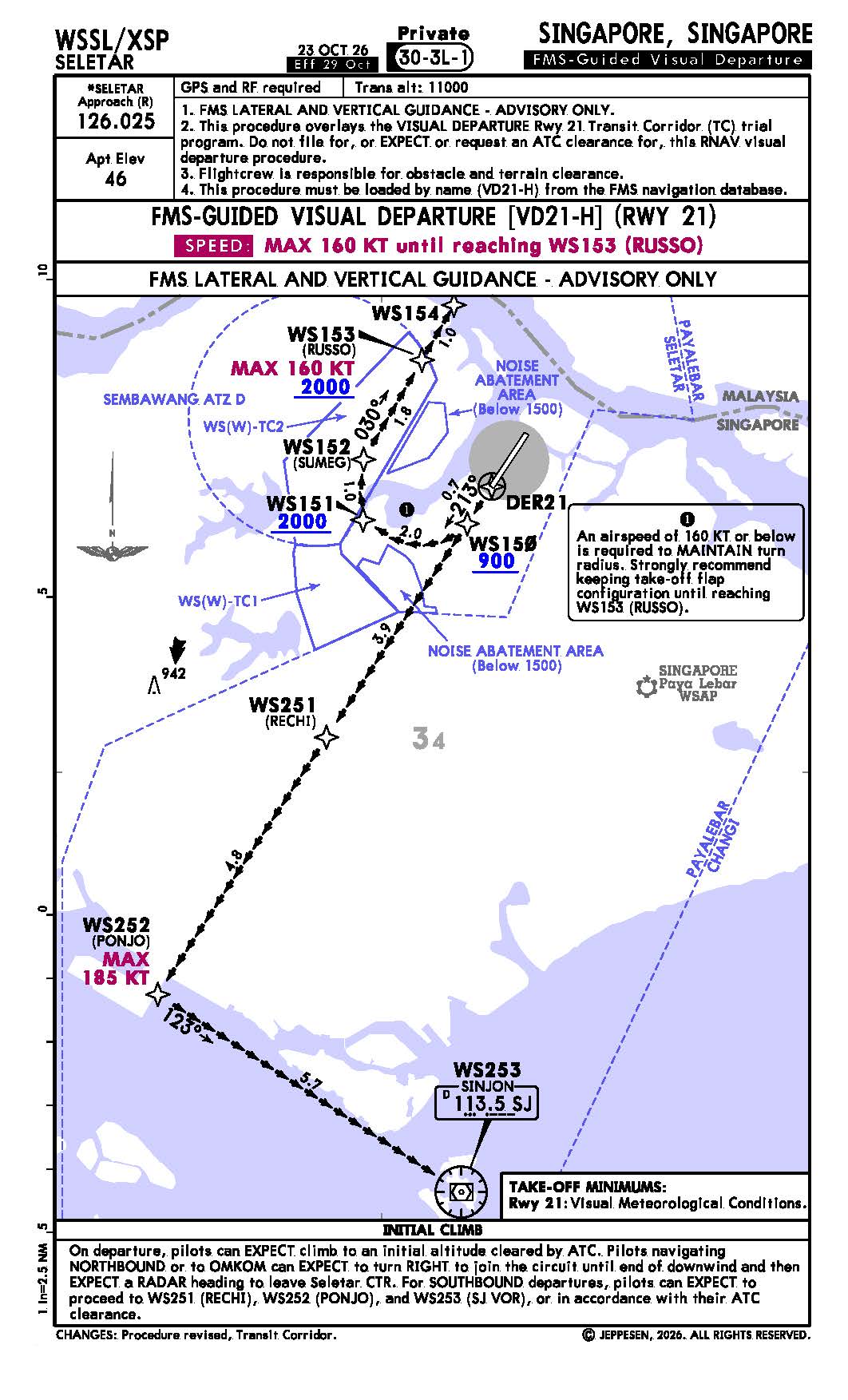
Seletar Runway 03 RNAV-H Departure.
For anyone who has flown the visual into Seletar, it’s welcome news that these procedures will be available from the outset. Rather than flying the entire visual circuit manually, the Honeywell procedures provide a defined flight path through the FMS, including both lateral and vertical guidance.
The procedures use Radius-to-Fix (RF) legs, allowing the aircraft to follow the curved tracks needed to navigate the tight airspace around Seletar.
There is one important difference. Because the Honeywell procedures use RF legs, their waypoints are slightly different from those published by CAAS for the Transit Corridors. Honeywell will publish its own waypoints alongside the procedures, so make sure you’re looking at the correct set when preparing for your arrival or departure.
How do I fly it?
My G700 can fly the Honeywell RNAV H procedures using the autopilot in LNAV/VNAV or in Approach mode. I use approach mode and let the aircraft manage the lateral and vertical profile with a FMS generated glideslope.
Both the lateral and vertical guidance are coded into the FMS, including the RF legs needed to negotiate the turns around Seletar’s rather tight airspace.
This takes a fair bit of workload out of the operation, particularly when you’re trying to manage speed and configuration while keeping an eye on the surrounding airspace.
For arrivals, you’ll need to be configured early. CAAS requires aircraft to be in landing configuration and at minimum approach speed when operating within the Transit Corridors. The maximum permitted speed is 160 knots.
For my G700, I have Flaps 20 selected before entering downwind, and then abeam the tower, I select landing configuration. This gives me plenty of time to commence the descent and maintain a stable approach speed.
Departures will require some planning too. Particularly when it comes to managing thrust reduction and acceleration while meeting the corridor restrictions. I remain in takeoff configuration until passing 2000’ when I then accelerate and clean up, whilst reducing thrust to climb thrust.
Although the autopilot is doing the flying, these remain visual procedures. Crews are still responsible for complying with ATC clearances and remaining within the published lateral and vertical limits.
Don’t be tempted to report the field in sight too early. Make sure you genuinely have visual contact with the airport before accepting the visual approach clearance. Once cleared, you’re responsible for remaining within the Transit Corridors.
There are a few catches
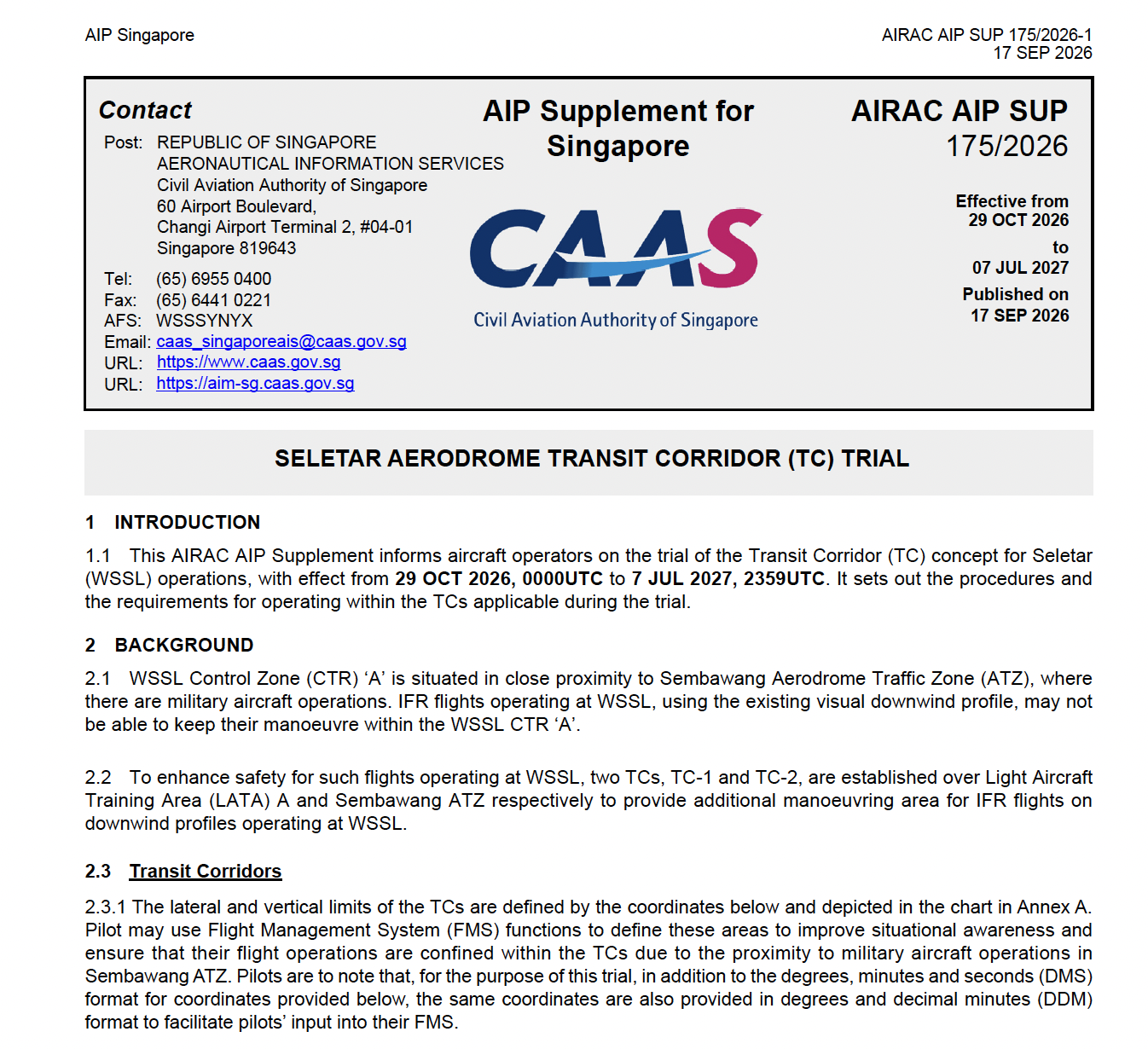
Before using the new corridors, operators are required to complete the familiarisation process, and pilots must self-certify that they understand the procedures. CAAS has included the link to this certification process in the AIP SUP.
There are also defined operating windows to work around Seletar’s training schedules. Avoid planning arrivals or departures during these periods, as there is considerable GA activity at Seletar and military training in the neighbouring Sembawang and Paya Lebar control zones.
During certain weekday periods, you can expect delays of around 15 mins. Plan around these windows rather than turning up and finding yourself with an extended delay. The full procedures are published in Singapore AIP SUP 175/2026, which you should review before operating. Do this for every flight, rather than treating it as a one-time briefing.
A few other things from the briefing
CAAS also highlighted several recent safety incidents at Seletar, including two misaligned takeoffs from Runway 03 in 2024.
Following these incidents, changes have been made to the Runway 03 turn-pad lighting, which is now only illuminated when required. CAAS also reminded crews that Seletar does not have runway centreline lights, so don’t expect a row of lights to guide you down the centre of the runway.
Several taxiway hotspots have also been identified, with additional ground markings installed and some taxi routings adjusted to reduce confusion.
Finally, in March 2026, a Gulfstream began its takeoff roll on Runway 21 without clearance. CAAS reminded crews that Seletar normally issues line-up and takeoff clearances separately. A line-up clearance is not a takeoff clearance.
Will this make Seletar easier?
I think the new Transit Corridors are a welcome change.
Anyone who has operated a large business jet into Seletar will know that the existing visual procedures can be demanding. Having a little more room, along with the new Honeywell Aerospace guided visuals, should make life easier. But don’t let the FMS waypoints or guidance fool you. These are still visual procedures, and the relatively tight lateral and vertical boundaries mean they need to be properly briefed.
If you’re planning to operate into Seletar after 29 October, review AIP SUP 175/2026 and check whether you have access to the Honeywell Guided Visual database. Make sure the procedures are available in your FMS and that you’ve completed the required familiarisation and pilot self-certification.
Seletar might be getting a little more room, but it’s certainly not becoming a mini-Changi.

More on the topic:
- More: Every flight leaving Singapore will pay a SAF fee
- More: Singapore Ops Update: Two New Rules to Know Before You Go
- More: March 2024 Singapore Airspace Changes
- More: South East Asia: Open for Business
- More: Ops Planning for the 2022 Singapore Airshow
More reading:
- Latest: Seletar 2026: New Corridors, New Procedures
- Latest: Middle East Airspace – Current Operational Picture
- Latest: The Lajes Lowdown: Atlantic Stopover and ETOPS Alternate
- Safe Airspace: Risk Database
- Weekly Ops Bulletin: Subscribe
- Membership plans: Why join OPSGROUP?




 Get the famous weekly