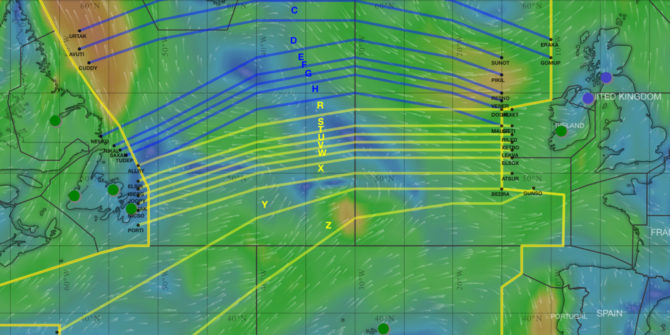
Datalink in Europe: What Are The Rules?

Update – 29 Sep 2025

Eurocontrol has confirmed that from 4 Nov 2025, the IFPS (Integrated Initial Flight Plan Processing System) will automatically reject any flight plans filed above FL285 unless CPDLC is filed correctly.

IFPS is the central system that processes and validates all flight plans in European airspace. If your plan is filed incorrectly, it will be rejected, and you won’t be able to depart until the error is fixed.

To avoid rejection:

  • If equipped:
    – Field 10a: J1
    – Field 18: CODE/XXX (Mode S hex code)
  • If exempt from the mandate or CPDLC is unserviceable:
    – Field 10a: Z
    – Field 18: DAT/CPDLCX

Important: Do not file both J1 and DAT/CPDLCX together, and do not leave both out. Either scenario will result in automatic rejection by the IFPS system.

Also important: You don’t need to file either J1 nor CPDLCX if your requested level is below FL285.

Also also important: Eurocontrol has also advised separately that if CPDLC is unserviceable, you may continue to operate above FL285 for up to 10 days under MEL relief, provided the flight plan is filed correctly using DAT/CPDLCX. After this period, you must either fix the issue or operate below FL285.

Also also also important: On 4 Nov 2025, IFPS will be unavailable between 2100-0000 UTC for a system upgrade. The outage is expected to last about one hour, but up to two hours if a rollback is needed. During this time, no flight plans can be filed or validated, so submit plans in advance.

For the full Eurocontrol notes on this latest update, check here.

Original Story – Key Points
  • There is a mandate for datalink EQUIPAGE for flights above FL285 throughout Europe. There are various different exemptions for this.
  • This mandate only applies to aircraft with ATN datalink. If your aircraft only has FANS 1/A, you don’t need to comply – but you also won’t be able to get CPDLC across most of Europe.
  • There are also some places where datalink LOGON is mandatory.

Datalink in Europe can be bamboozling – multiple chunks of airspace, all in close proximity to each other, all with varying levels of operating capability when it comes to CPDLC. Plus there’s a Logon List to consider. And a Datalink Mandate. And different considerations depending on what kind of datalink you’ve got onboard…

So here’s a simple guide on how it all works, and what the rules are.

Explain it to me in three sentences
  • You need ATN datalink for flights above FL285 in Europe (i.e. you need to have equipped aircraft and trained crews).
  • If you don’t have ATN datalink, but are exempt from the Mandate (as per one of the categories below), then you can still fly above FL285.
  • If you don’t have ATN datalink, but are not exempt from the Mandate, you can’t fly above FL285.
Is there a Datalink Mandate in Europe?

Yes. The European Datalink Mandate is for ATN datalink equipage for flights above FL285 throughout Europe. (Equipage – not necessarily for logon! More on that later…)

Is my aircraft exempt?

Quite possibly – many aircraft are exempt from the equipage mandate:

  1. Aircraft with a certificate of airworthiness first issued before 1 January 1995.
  2. Aircraft with a certificate of airworthiness first issued before 1 Jan 2018 and fitted prior to this date with FANS 1/A.
  3. Aircraft with 19 seats or less and a MTOW of 45359 kg (100000 lbs) or less, with a first individual certificate of airworthiness issued before 5 Feb 2020.
  4. Aircraft flying for testing, delivery or for maintenance purposes or with datalink temporarily
    inoperative (under MEL exemption).
  5. Aircraft in this list (Annex I).
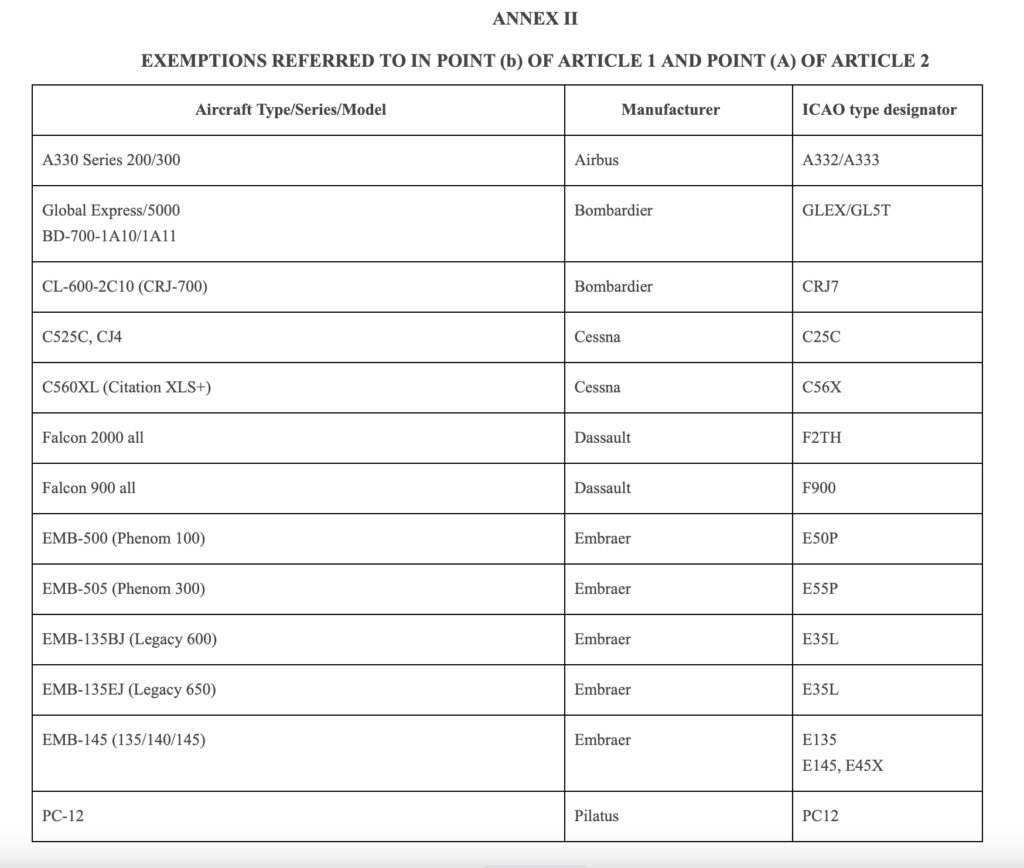
  6. Aircraft in this list (Annex II) with a CofA issued before 5 Feb 2020.

You can find these rules and exemptions in this EU doc (updated in Sep 2023).

The Logon List

This is what you need to get registered on to get CPDLC service when flying in:

  • Switzerland
  • Germany
  • Maastricht UAC (i.e. the upper airspace above FL245 over Belgium, the Netherlands and Luxembourg – one of Europe’s busiest and most complex airspace areas.)
  • Poland
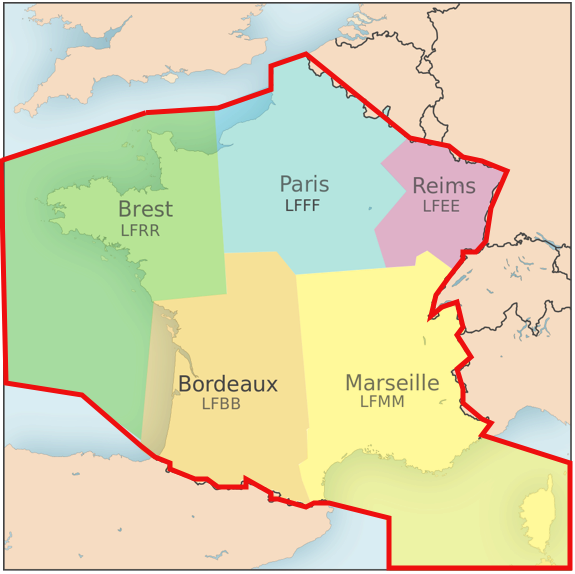
  • France (6 March 2025 for LFEE, LFMM, LFRR, LFBB / November 2025 for LFFF)
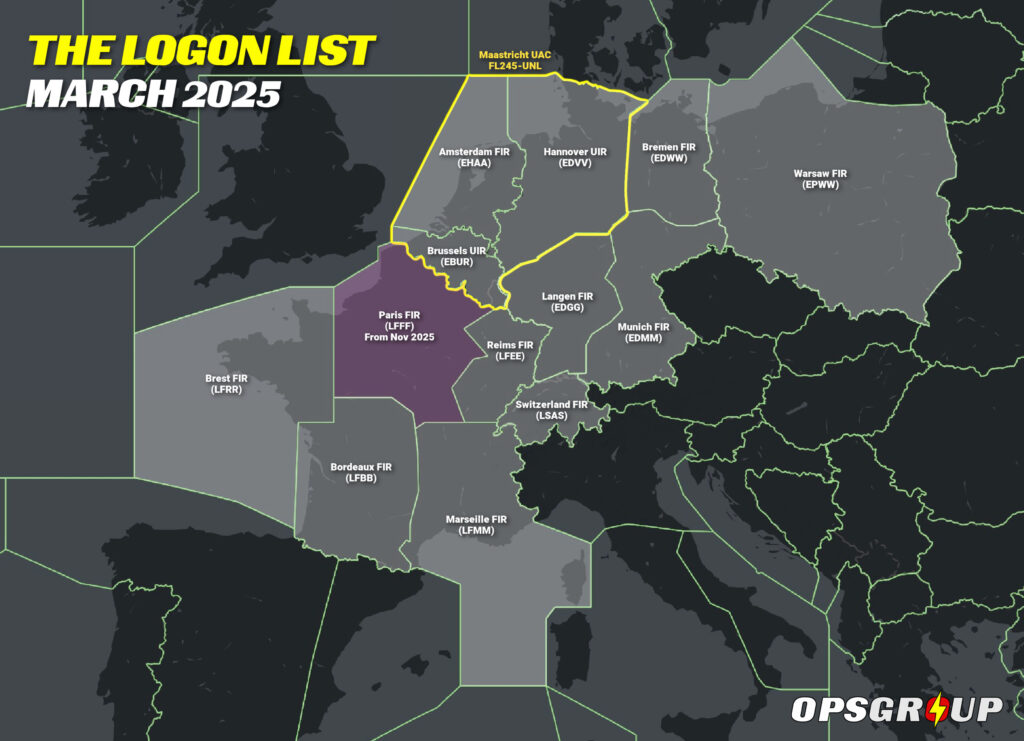
If you get your aircraft added to the Logon List, that means you’ll be able to use CPDLC in these areas and will probably get better directs and faster climbs. However, if your avionics are not eligible to be on the Logon List, ATC will not currently restrict you to the flight levels below FL285.

The Logon List is basically to ensure that aircraft with buggy avionics don’t ruin the network for everyone else – including ATC.

For more info, including details of how to get your aircraft registered on the Logon List, check Eurocontrol’s dedicated page here.

Important to note: the Logon List only applies to aircraft with ATN datalink – not FANS 1/A. So essentially, if your aircraft only has FANS 1/A, you don’t need to register – but you also won’t be able to get CPDLC across most of Europe (more on that below…)

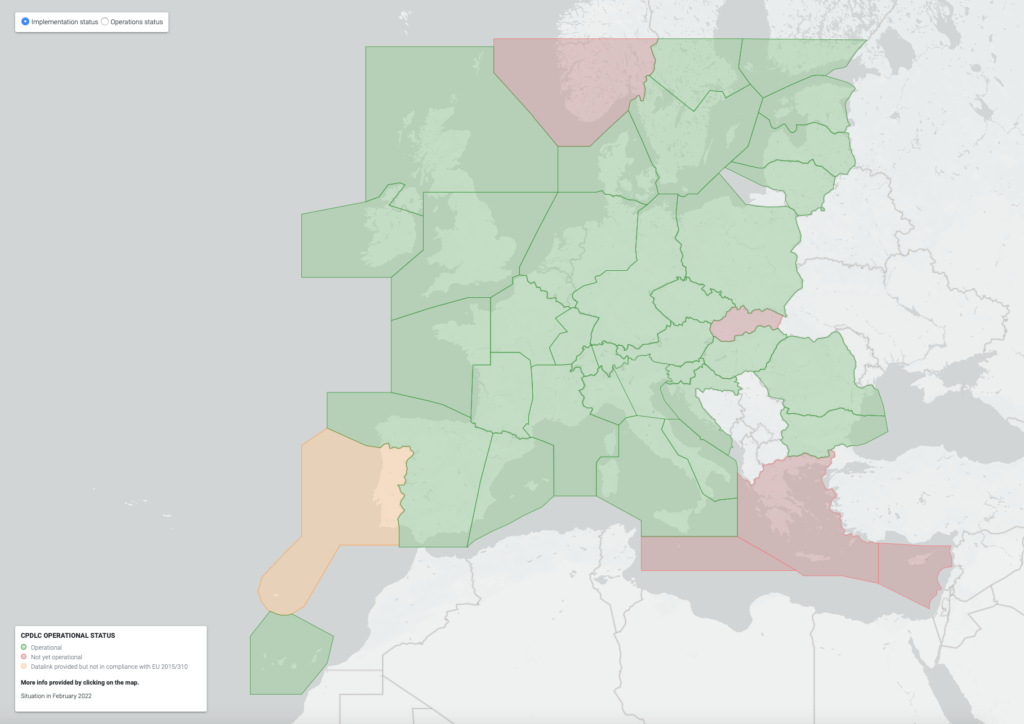
Where can I get CPDLC in Europe?

As of June 2024, these places:
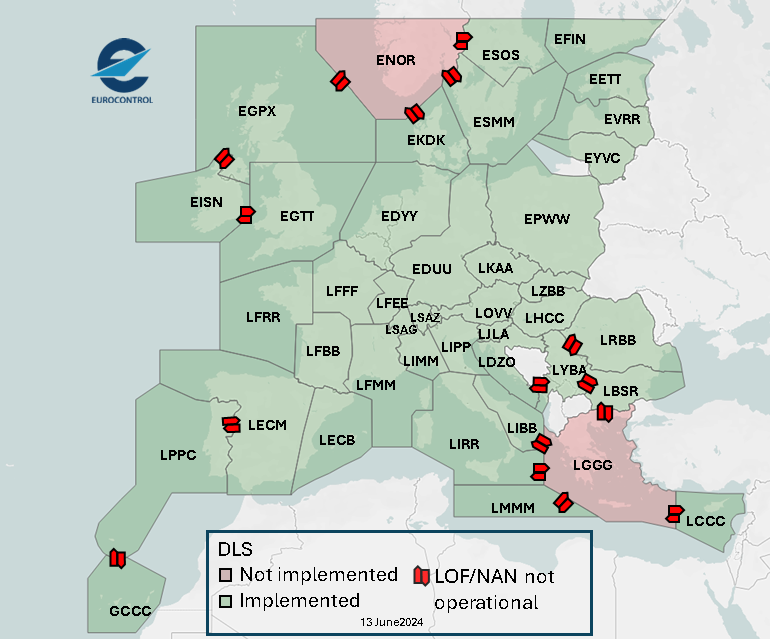
For more info about which FIRs provide datalink, and at what flight levels, check here.

Is CPDLC logon mandatory?

The European Datalink Mandate is for CPDLC equipage, not for logon.

But yes, provided you’ve got ATN CPDLC, there are some places where logon is mandatory ⬇️

Here’s a running list of the places we know where logon is mandatory, in chronological order of when they implemented the rule:

  • Maastricht UAC [EDYY] above FL245 (source: Eurocontrol) and Karlsruhe UAC [EDUU] above FL285 (source: Germany AIP GEN 3.4)
  • Cyprus [LCCC Nicosia] above FL285 (source: AIP GEN 3.4)
  • Hungary [LHCC Budapest] above FL285 (source: AIP GEN 3.4)
  • Finland [EFIN Helsinki] above FL095 (source: AIP GEN 3.4)
  • Denmark (EKDK Copenhagen] above FL285 (source: AIC 5/23)
  • Sweden [ESMM Malmo, ESOS Stockholm] above FL285 (source: AIP GEN 3.4)
  • Romania [LRBB Bucharest] above FL285 (source: AIP GEN 3.4)
  • Serbia and Montenegro [LYBA Belgrade] above FL205 (source: AIP GEN 3.4)
  • Czech Republic [LKAA Prague] above FL195 (source: AIP GEN 3.4)
  • France [LFFF Paris, LFEE Reims, LFMM Marseille, LFBB Bordeaux, LFRR Brest] above FL195 (source: AIC 10/23 and AIP GEN 3.4)
  • Switzerland [LSAG Geneva, LSAZ Zurich] above FL145 (source: AIP GEN 3.4)
  • Slovakia [LZBB Bratislava] above FL285 (source: AIP GEN 3.4)
  • Croatia [LDZO Zagreb] above FL285 (source: AIP GEN 3.4)
  • Bulgaria [LBSR Sofia] above FL215 (source AIRAC AMDT 5/24)
  • Slovenia [LJLA Ljubljana] above FL285 (source: AIP GEN 3.4)
  • Poland [EPWW Warsaw] above FL285 (source: AIP GEN 3.4)
  • Spain & Canaries – coming at some point soon!

Recent News: Some Logon and FPL Filing stuff to watch our for! ⬇️

From Nov 2025: Flight plans in Europe above FL285 without J1 or DAT/CPDLCX will be rejected. This was advised by Eurocontrol in their Feb 27 webinar on datalink guidance for aircraft operators (you can watch the replay here).

From Oct 2024: MUAC have started reporting to the relevant NSAs those aircraft which don’t comply with the requirement to file either J1 or DAT/CPDLCX in the FPL if filed above FL285. We heard this issue is especially true for bizjets – around half of which are capable but don’t log on.

From July 2024: Eurocontrol started checking correct flight plan filing regarding CPDLC. Flight plans indicating J1 capability, but missing CODE/XXX in Field 18 will be rejected.

From Feb 2024: After some issues with the new LYBA logon code for Serbia and Montenegro which you can read about here) Eurocontrol started asking operators to make sure their aircraft avionics ATN addressing database is up to date, to include all the right codes as per the latest version of ICAO EUR Doc 028.

So what do I put in my FPL?

Got ATN datalink? Put J1 in field 10a of the flight plan. Also put CODE/XXX in Field 18 – instead of the XXX you need to put your Aircraft/Mode S address in hex (e.g. CODE/A519D9).

Exempt from the Mandate? Put Z in field 10a and DAT/CPDLCX in field 18 of the flight plan. If you don’t, ATC won’t know you’re exempt, and you may struggle to fly above FL285! (And remember – you should either file J1 or DAT/CPDLCX, not the two together. Flight plans with this wrong filing will be rejected).

Only got FANS 1/A? Read the section below! ⬇️

My aircraft only has FANS 1/A. What do I do?

Assuming you qualify for the first exemption to the Datalink Mandate we mentioned at the top of this post (aircraft with a certificate of airworthiness first issued before 1 Jan 2018 and fitted prior to this date with FANS 1/A), you don’t need to comply with the Datalink Mandate, but you also won’t be able to get CPDLC across most of Europe – ATC will talk to you on the radio instead.

The only bits of airspace in Europe where you can still get CPDLC using FANS 1/A are:

  • EGTT/London, EGPX/Scottish, EISN/Shannon FIRs. But be aware that in EGTT there is no automatic logon transfer from FANS1/A to ATN – ie. if you’re flying from EGTT to EDYY and you are connected via FANS1/A to EGTT then you will have to log on again with EDYY.
  • GCCC/Canarias FIR.
  • LRBB/Bucaresti FIR.

Everywhere else in Europe is only capable of working with ATN datalink. Note that in Maastricht Upper Airspace (MUAC) they say that dual-stack aircraft must be reconfigured to logon via ATN, and aircraft with only FANS 1/A will continue to supported by conventional VHF.

So if you’ve only got FANS 1/A, here’s what you put on your FPL:

In field 10a:
Put Z and one of the following –
J5 – If using SATCOM (Inmarsat) for CPDLC
J7 – If using SATCOM (Iridium) for CPDLC

In field 18:
DAT/CPDLCX 

Download the Europe Datalink Quick Reference PDF

One page PDF of pretty much everything you need to know. Just click here.
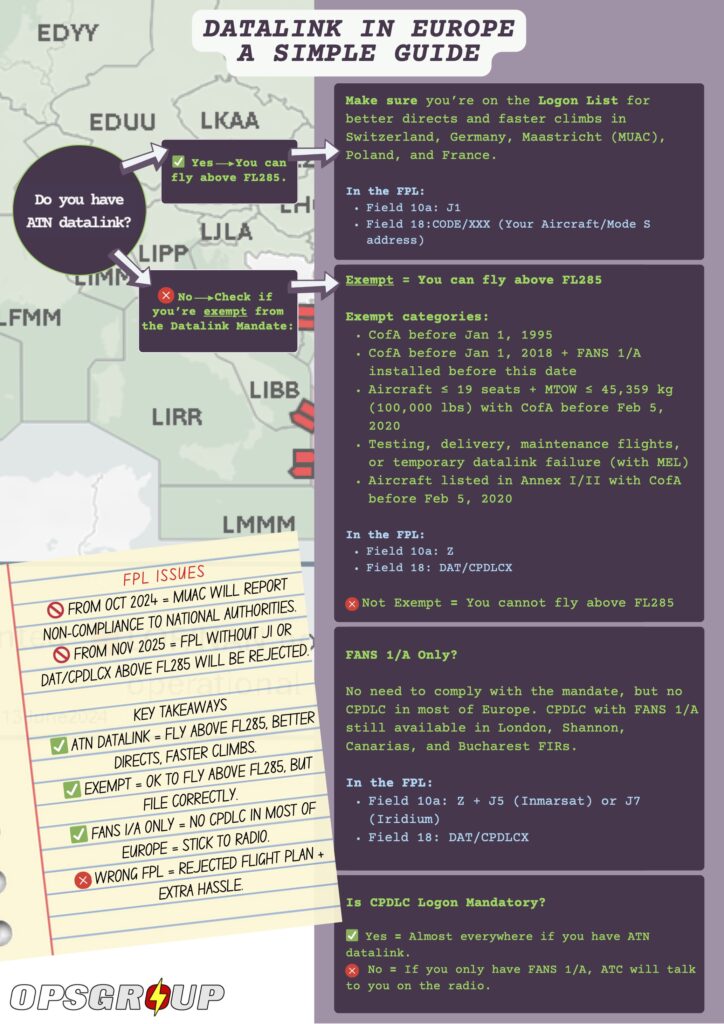
Click for PDF.

Download the Eurocontrol CPDLC guidance docs

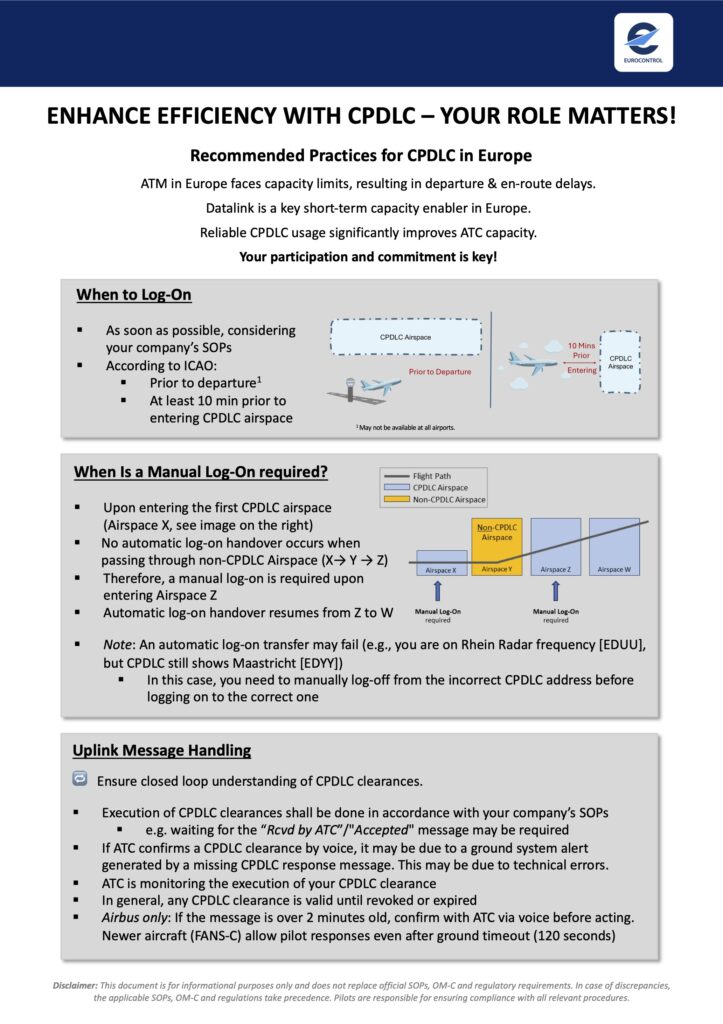
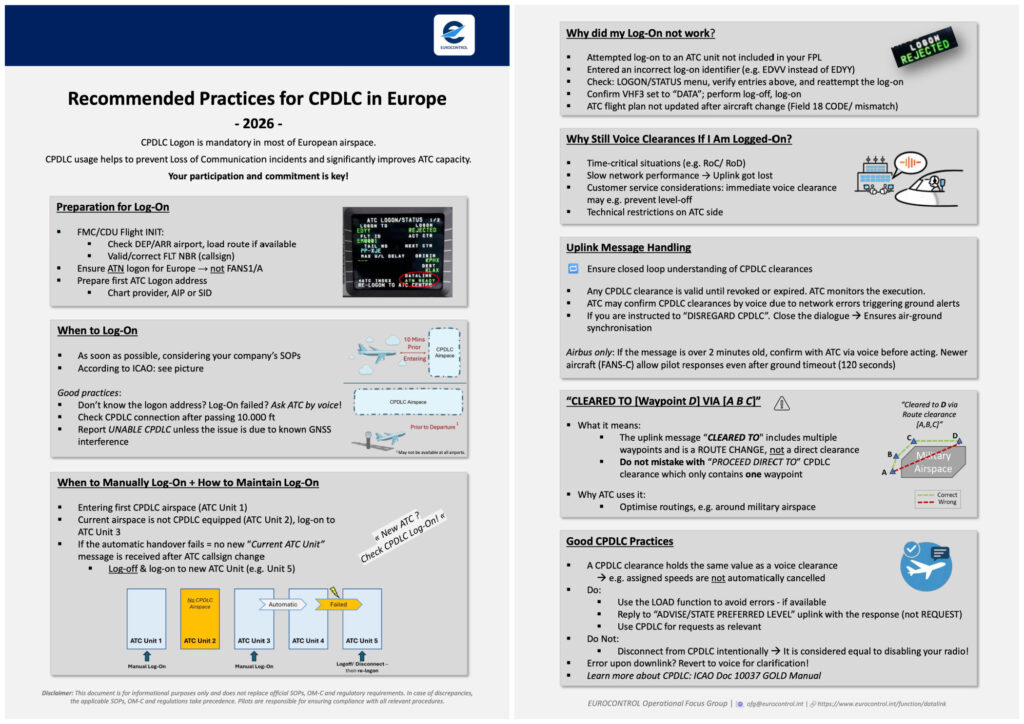
Eurocontrol’s Operational Focus Group has published some new Datalink guidance docs for pilots, effective March 2025. These include tips on when and how to log on, uplink message handling, and other good CPDLC practices. There are separate docs with specific guidance depending on whether you’re using Jeppesen, Lido, or Navblue EFBs. Download the PDFs below.
Jeppesendownload PDF.

Lidodownload PDF.

Navbluedownload PDF.

Any more questions?

This EASA Q&A site is a good place to try.

Failing that, send us an email at news@ops.group, and we’ll do our best to get it answered for you!

US Domestic Enroute CPDLC Update

Key Points
  • Domestic en-route CPDLC in the US is now available to everyone – the Notam limiting GA/BA participation to approved trial participants has been removed.
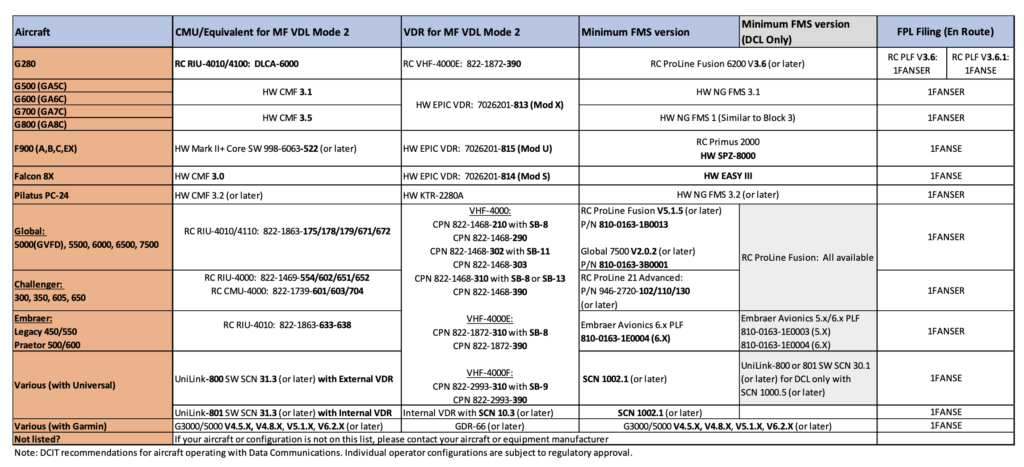
  • To get CPDLC, you’ve got to have the right avionics and submit a form – the FAA has published a list of aircraft types, which you will need to check to see if you comply.

Here’s a very brief summary. For the full, untarnished info, head to the dedicated FAA site here.

So for a long time, domestic en-route CPDLC in the US was only available to operators of bizav aircraft who were signed up to the FAA trial. That trial has now ended, and as long as your avionics make the grade, you can now make use of this service.

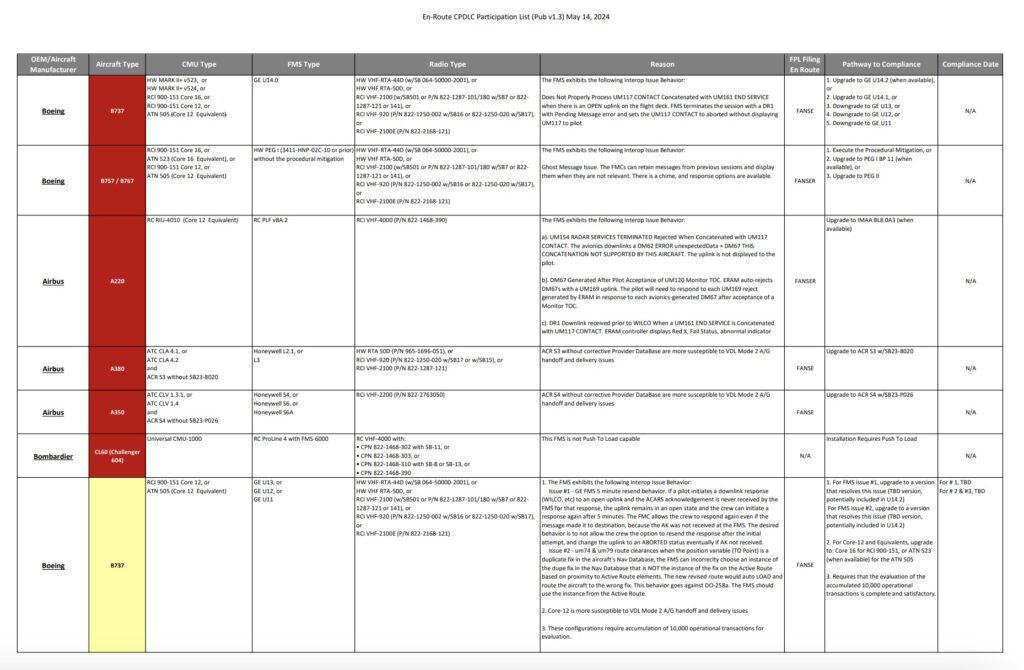
The FAA has published a list with a whole bunch of aircraft types on it.

If your aircraft is highlighted in yellow or green, you can get datalink (as long as you complete and submit the participation form).

If it’s highlighted in red (or not on the list at all), you can’t get datalink.

L3Harris have provided this guidance:

  • Ensure that your avionics are configured to use VDL Mode 2 as the primary media for U.S. Domestic En Route CPDLC. VDLM2 is the only approved media for participation in the domestic U.S.
  • Ensure that both the ‘J4’ code in the field 10a equipment field as well as the FANSE (e.g. ‘1FANSE2PDC’) DAT Code in field 18 (other information/DAT) are both included on the flight plan to indicate eligibility for U.S. Domestic En Route CPDLC (see the US Domestic Flight and Planning Guide for more information).
  • Verify that VHF3/COM3 is set to DATA.
  • The aircraft registration/tail in field 18 (other information/REG).
  • If you are still researching your avionics in response to questions from L3Harris, please continue to file for CPDLC-DCL only (FANS) until your verification of eligibility is complete.

Also, a member has reported that if you’re now eligible but tried to log on in the past when you were not eligible, your aircraft reg might have been placed on a “blocked list”. To get off this list, you need to contact L3Harris, who will forward to the FAA to ask to unblock you (should take less than 24hrs).

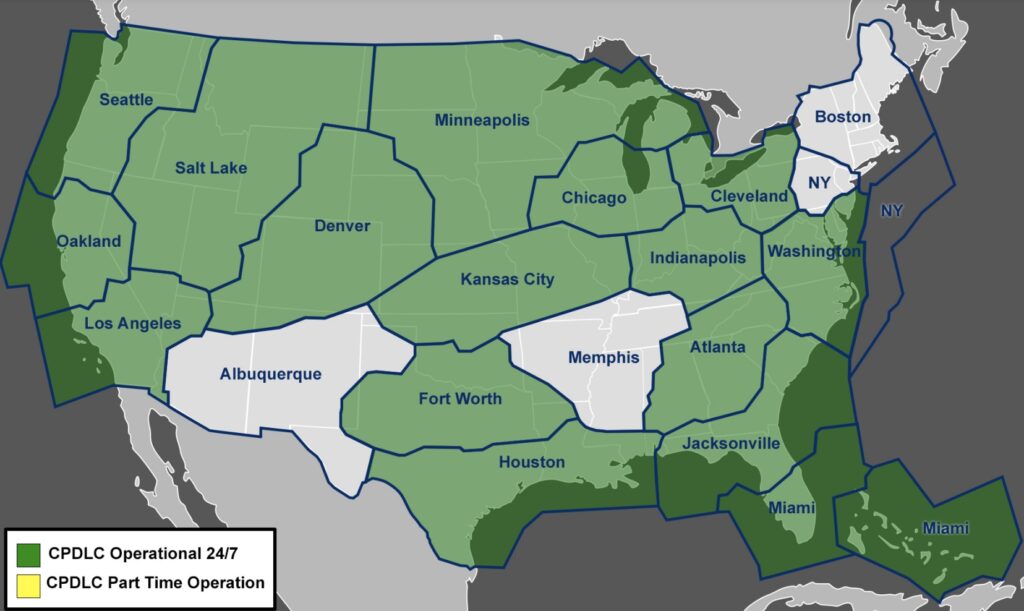
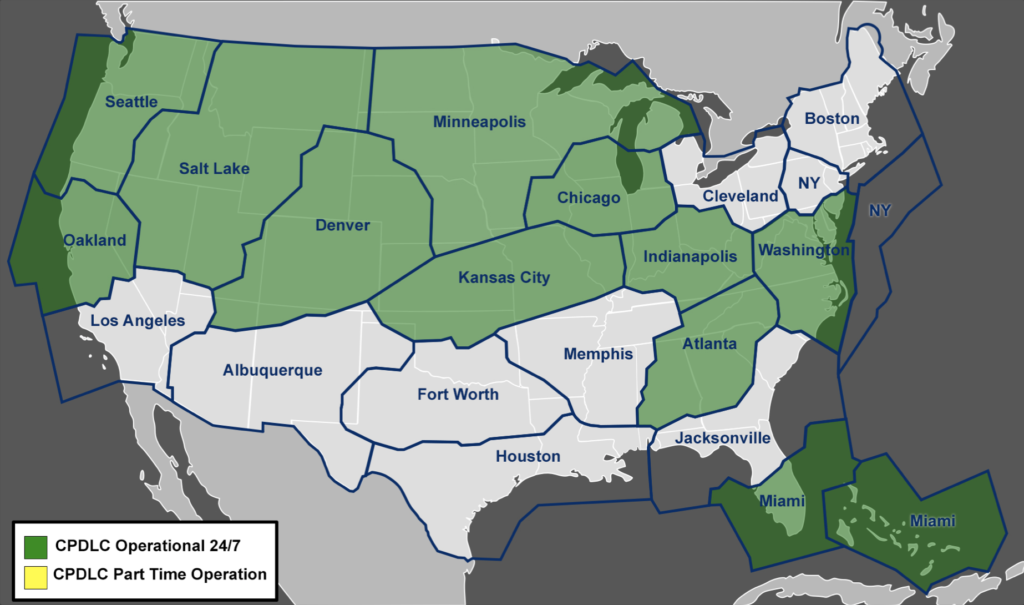
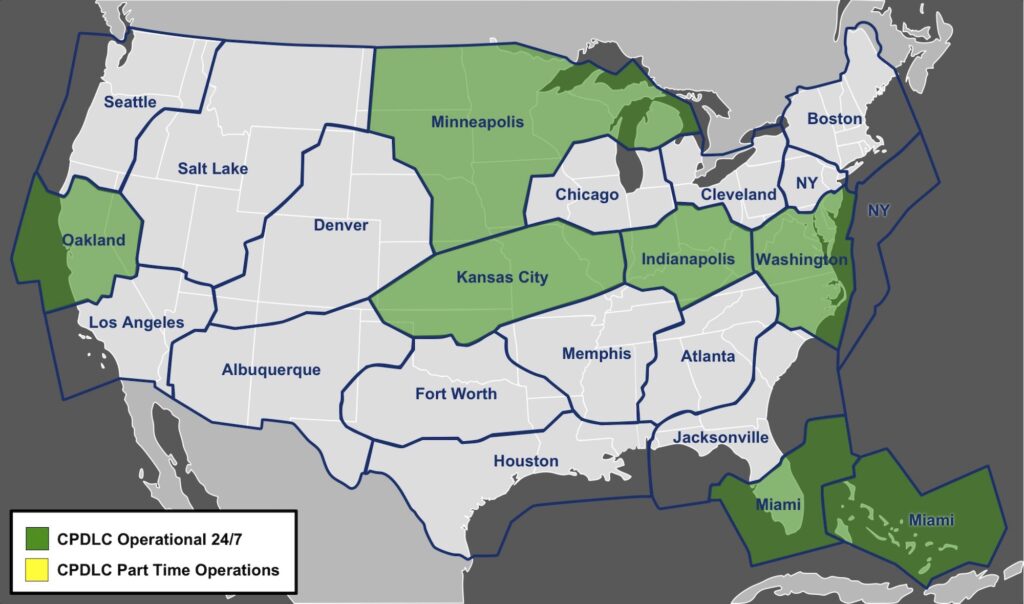
Where is CPDLC available in the US?

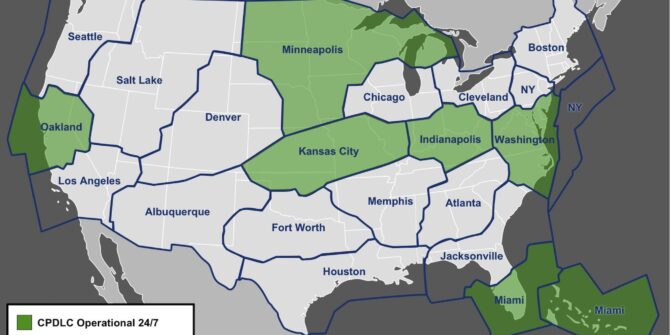
L3Harris published this updated map on 3 June 2024:

Come on, Albuquerque and Memphis!

So do I need CPDLC now?

No. US domestic datalink is not mandated.

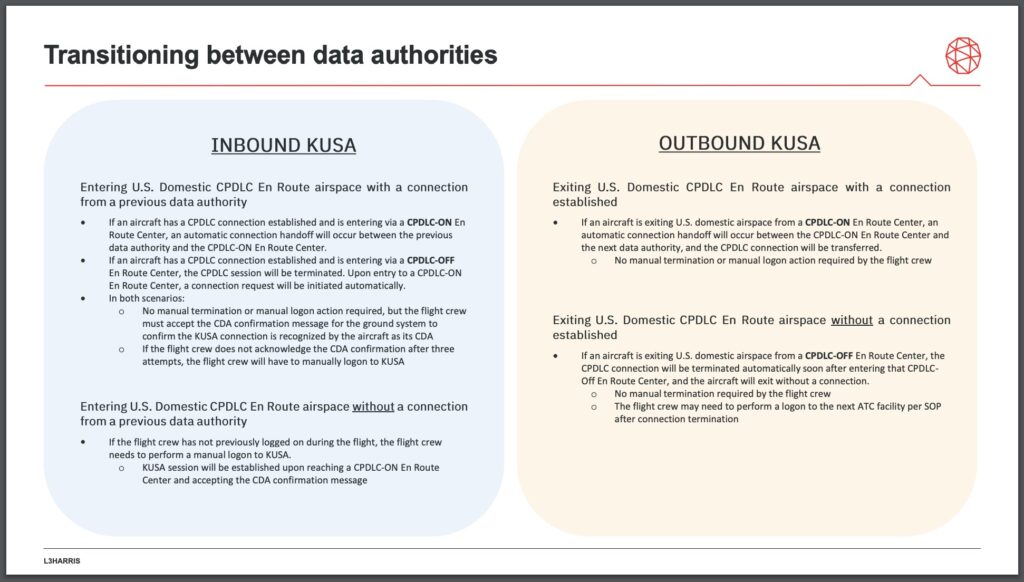
What if I’m flying into the US internationally?

L3Harris have published a guide answering this very question. You can access it here:

For those of you who aren’t so familiar with the US, KUSA is the CPDLC logon code – and that is the one and only logon code you need, all the way across.


The North Atlantic Datalink Mandate – 2024 update

A period of temporary relief of the North Atlantic Datalink Mandate (NAT DLM) rules ended in Feb 2021. So since then, aircraft need to be CPDLC and ADS-C equipped to operate between FL290-410 throughout the NAT region.

Exceptions – areas where you DON’T need datalink

– Everything north of 80°North.

– New York Oceanic East FIR.

Tango Routes T9 and T290. The other Tango routes (T213, T13, T16) all require datalink.

– GOTA airspace. We discovered this in Aug 2022, after some lengthy discussions with the authorities.

– ATS Surveillance airspace, where surveillance service is provided by means of radar and/or ADS-B, coupled with VHF. This includes the Azores, Bodo, and Iceland-Greenland corridor.

Tell me more about this “ATS Surveillance airspace”

This is a tricksy one.

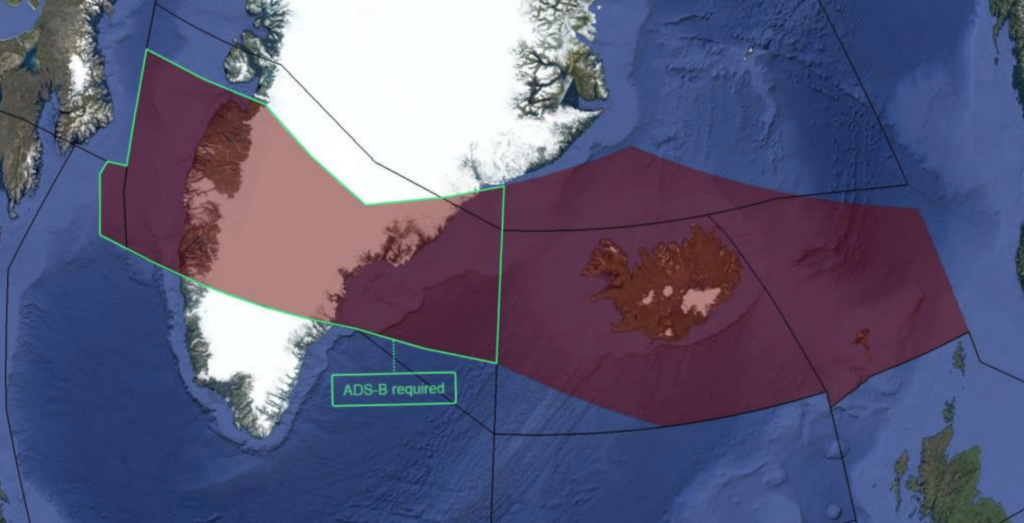
NAT Doc 007 sets out the exempted ATS Surveillance airspace over Greenland and Iceland where you can still fly if you don’t have datalink (though if you don’t have it, you must have ADS-B!)

This area is bounded by the following:

Northern boundary: 65N000W – 67N010W – 69N020W – 68N030W – 67N040W – 69N050W – 69N060W – BOPUT.
Southern boundary: GUNPA (61N000W) – 61N007W – 6040N010W – RATSU (61N010W) – 61N020W – 63N030W – 6330N040W – 6330N050W – EMBOK.

Here’s how that looks:

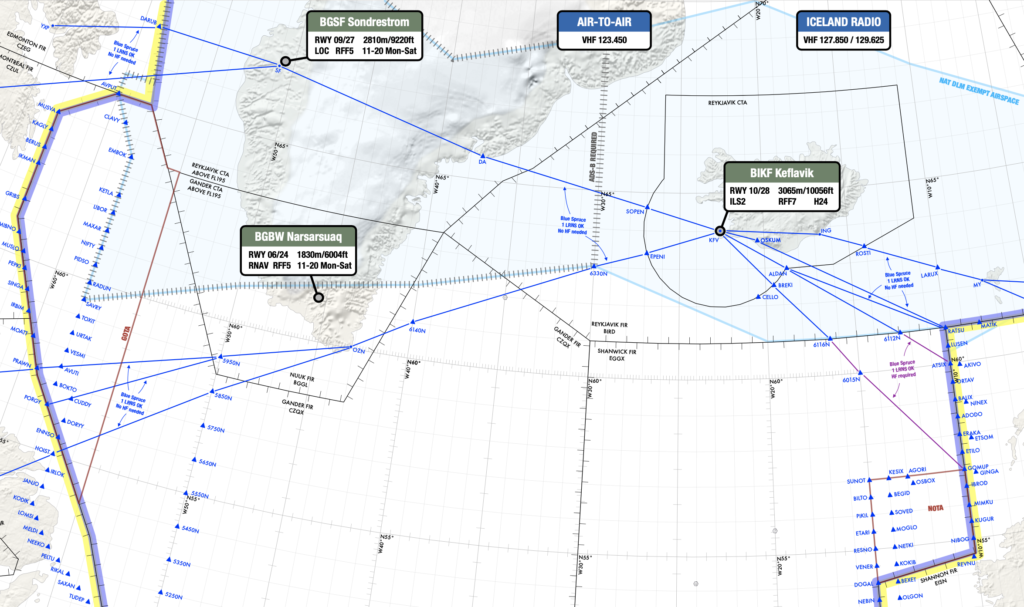
The southerly Blue Spruce routes

These go over Greenland linking Canada with Iceland via waypoint OZN, and are not fully contained in the exempted airspace. So if you’re flying these southerly Blue Spruce routes you will have to meet the NAT DLM requirements or fly outside of the vertical parameters of DLM airspace (i.e. below FL290 or above FL410). In other words: you need CPDLC and ADS-C to fly on the southerly Blue Spruce routes between FL290-410.

The northerly Blue Spruce routes

These are the ones going overhead BGSF/Sondrestrom airport. These do fall within the exempted area of airspaceso datalink is not mandatory if you’re flying here.

Aircraft without datalink can request to climb/descend through datalink mandated airspace, but will only be considered on a “tactical basis” by ATC (i.e. you have to ask them on the day, and they’ll let you know, depending on how busy it is).

Flights that file STS/FFR, HOSP, HUM, MEDEVAC, SAR, or STATE in Field 18 of the FPL, are permitted to flight plan and fly through datalink mandated airspace, but may not get their requested flight levels.

For more details about the datalink mandate, check out the NAT Doc 007 in full here.

So, to recap…

  • Datalink Airspace: Remember, NAT DLM airspace only applies from FL290-410. Below or above that, you don’t need datalink in the North Atlantic.
  • If you have full datalink (CPDLC and ADS-C): You can go where you like. But watch out here – “full datalink” means you have Inmarsat or Iridium. HF datalink alone (ACARS) does not meet the satcom part of the NAT DLM requirement. So if you want to fly in NAT DLM airspace (FL290-410 in the NAT region) “J2” in field 10a of your FPL isn’t enough – you need “J5” for Inmarsat or “J7” for Iridium.
  • For GOTA airspace: You need a transponder, automatic pressure-altitude reporting equipment and VHF. If you have ADS-B, that’s helpful for ATC.
  • For the Blue Spruce Routes: You need datalink for the southerly ones, but not the northerly ones. (If you’re flying on these then you’re probably doing so below FL290 anyway, in which case you’re below NAT DLM airspace and don’t need datalink).

NAT FAQ: No Datalink, Where can we go?

If you don’t have datalink, this is how to make a crossing.

Save


US expands CPDLC coast-to-coast

Update 4 Sep 2023:
  • The FAA had planned to allow GA/BA aircraft to use enroute CPDLC from Aug 31, but this is being delayed to sometime towards the end of Sep.
  • So until then, the status quo continues – you can only use enroute CPDLC if you’re already registered as part of the trial, as per KFDC Notam A0171/22.
  • When it gets rolled out to everyone in Sep, there will be green/yellow/red lists drawn up for aircraft depending on their avionics – but only “red” category aircraft (those with serious avionics issues) will be unable to use CPDLC.
  • More info available from our friends at NBAA here.
Original story from 28 Mar 2023:

The US has recently implemented en-route CPDLC in more centers across the country. So now, for the first time ever, you can fly coast-to-coast using CPDLC.

And what’s more – KUSA is the one and only code you need.

Who is KUSA?

For those of you who aren’t so familiar with the US, KUSA is the CPDLC logon code.

You might know KUSA from getting your clearances. The US actually gives two types of departure clearance via KUSA – a DCL or a PDC. DCL is the one where you don’t have to read it back. PDC technically requires a voice read back (but in the US they don’t seem to).

If you are flying across the NAT then this clearance usually includes your entry clearance too – so you get this when you get your departure clearance.

KUSA is the one and only logon code you need, all the way across.

So do I need CPDLC now?

US domestic datalink is not mandated. In fact, they are not currently allowing any GA aircraft to use enroute CPDLC unless they are a part of the “US Domestic En Route CPDLC Avionics Trial”. And currently, they are also not allowing any new operators to join this trial!

You can check all that out here on the L3 Harris site. They have a whole load of information on there about DCL stuff too so definitely worth a look.

What if I’m flying into the US internationally?

To make us of US domestic enroute CPDLC, foreign operators must have FAA approval (J4 on their A003). L3Harris also need to have confirmed that your aircraft avionics configurations meet the compatibility requirements per the Recommended and Required Avionics Version List (RAV-E). If in doubt about any of this, contact them at DCIT@L3Harris.com for any eligibility questions.

For eligible aircraft inbound to the US, there are some differences in logon guidance depending on whether a CPDLC connection is already established from the previous data authority, and whether the aircraft is entering via active or non-active US domestic enroute airspace.

Ultimately, all the answers can be found here. This doc lists all the inbound/outbound scenarios, and how CPDLC will work in each situation.


CPDLC Gotcha: Clearance Busts

Key Points
  • The FAA has published a new Safety Alert for CPDLC and partial route re-clearances.
  • Make sure you load your full SID manually into the FMS after you receive a partial reroute message (UM79).
  • Also, don’t mistake these partial reroute messages as being cleared to fly directly to the waypoint (a direct clearance would be a UM74 message).

Lessons from Teterboro

In 2022, the FAA recorded 20 aircraft deviations at KTEB/Teterboro Airport due to issues with CPDLC and partial reroute messages.

These incidents resulted from failure to reload SIDs after receiving a partial reroute UM79 message (where you are cleared to a particular waypoint via other waypoints en-route), requiring swift coordination with ATC to avoid traffic.

But the issue isn’t limited just to Teterboro – it could happen at any US airport, to any aircraft type receiving a clearance in this way.

Another thing to watch out for

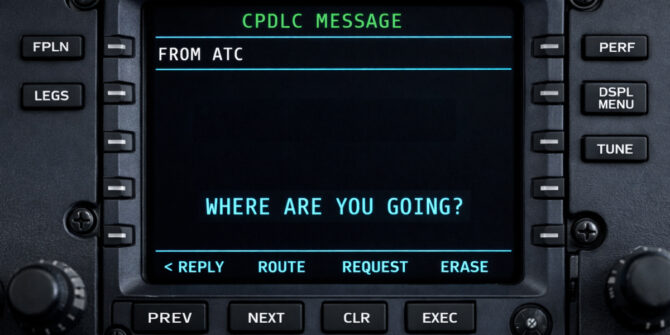
Due to limitations in the formatting of CPDLC DCLs, they can be easy to misread or misunderstand. Take the following for example, courtesy of an OPSGROUP member.

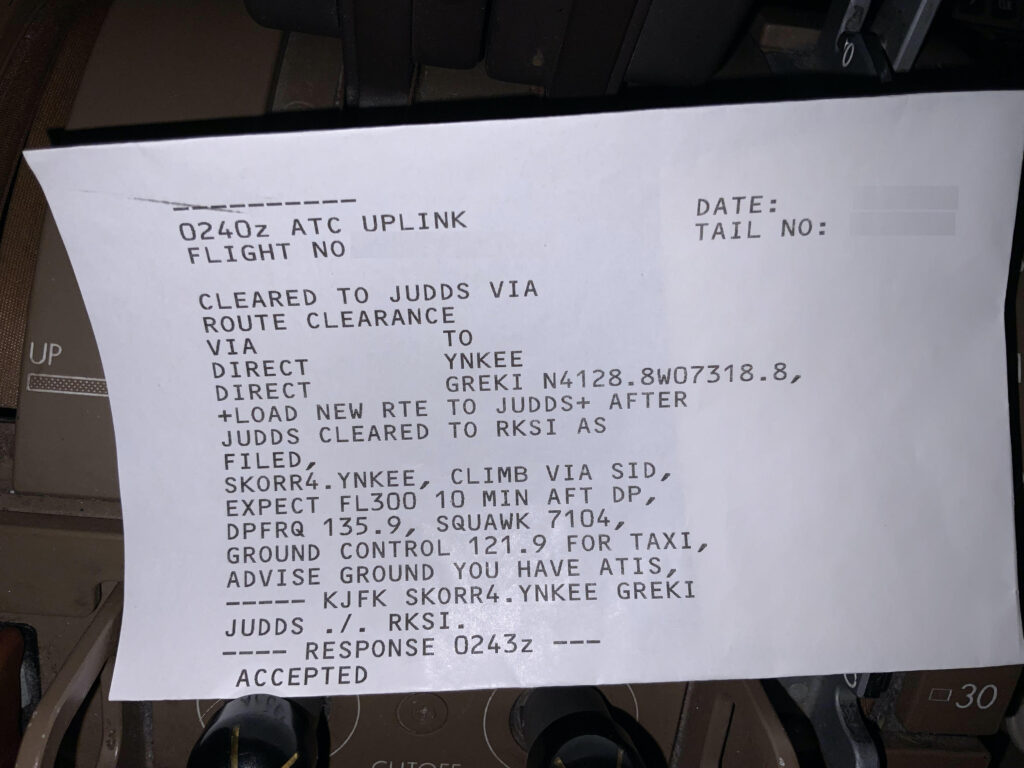
A change to a clearance was received by a B777 at KJFK/New York during taxi and under considerable pressure to get underway or out of the way:

Unfortunately, in this instance the crew mis-interpreted their clearance as direct to the waypoint YNKEE. This was further compounded by the issue above – when the new route was loaded, their SID was dropped from the flight plan.

When they got airborne, ATC immediately began asking why they weren’t following the assigned SID – the result was a clearance bust. To their surprise, further down the clearance was indeed an assigned SID – the SKORR4. It was an understandable and easy miss.

The question remained though: what then is the intention of the top part of this clearance if not to clear the aircraft direct to YNKEE? We put this to the group, and received some useful feedback.

It maybe comes down to a machine readability issue. The section above the plus signs is required because of the way the clearance is written, and is related to the same issues as above. It will not contain a SID when you insert it.

In fact, some newer CPDLC systems don’t even show that section to the crew – only the information below the plus signs which contains the assigned SID. The full version is a confusing, and seemingly contradictory set up.

What about PDCs?

It’s probably worth a mention that these issues don’t affect PDC clearances. PDCs are different and are sent by a service provider via VHF datalink. No log on is needed, and only one can be issued for a flight number at specific airport over a 24 hour period. They also have to be read back via voice. PDC’s cannot be used to notify pilots of a change to the filed route. So it’s smooth sailing in that regard.

Further reading.

You can read the FAA’s new Safety Alert for CPDLC and partial route re-clearances here.

The FAA also has a handy guide on how to use CPDLC in US airspace. It covers the basics, along with departure clearances (DCLs), en route ops, speed/time restrictions, emergency use and free text.


New Datalink Mandate in France

Effective July 13, if you’re flying in France above FL195 and you have ATN CPDLC – you must use it!

Following the recommendation of the Eurocontrol Operational Focus Group (OFG), France is the first European country to mandate CPDLC logon in their airspace after Karlsruhe UAC (EDUU), Maastricht UAC (EDYY), and Cyprus (LCCC). The OFG recommendation is the result of the review of several incidents by ATCOs from 22 ANSPs.

What do you mean by “France”?

Anywhere in the LFFF, LFEE, LFMM, LFBB, or LFRR FIRs.

Where have they announced this?

In AIC 10/23.

The AIC says the mandate only applies if you’re “capable and eligible”. What does that mean?

You’re capable and eligible if all of the following three things apply:

  • You have ATN CPDLC
  • Your equipment is not broken
  • The crew is trained on how to use datalink

If you don’t tick all three boxes, you can still fly above FL195 in France – they won’t restrict you. They’re just saying that you must logon if you can.

What if I only have FANS datalink?

This new rule in France only applies to aircraft with ATN CPDLC – those with FANS 1/A (or with no datalink at all) will continue to supported by conventional VHF. Dual-stack aircraft should be reconfigured to logon via ATN

Do I have to register my aircraft on the Logon List?

No. You don’t have to sign up to the Logon List to use CPDLC in France. France doesn’t use the Logon List yet. The only places where you need to be on this list is for flights in Switzerland, Germany, and Maastricht-UAC controlled airspace (i.e. the upper airspace above FL245 over Belgium, the Netherlands and Luxembourg). France plans to join from 2026.

Is this new rule in France the same thing as the European Datalink Mandate?

No. The European Datalink mandate is for CPDLC equipage for flights above FL285 throughout Europe. This new French mandate applies not on the carriage but on the logon for flights above FL195.

Another important distinction – none of the European Datalink exemptions apply for aircraft which are equipped with CPDLC, as this new French rule has nothing to do with the Datalink mandate! (i.e. the exemptions we detail here do not apply, such as aircraft with 19 seats or less and a MTOW less than 100,000 lbs).

Where else in Europe do I have to logon to CPDLC?

Provided you’ve got ATN CPDLC, here are the places in Europe where logon is mandatory:

  • Maastricht UAC (EDYY) and Karlsruhe UAC (EDUU) above FL285 (source: Eurocontrol)
  • Cyprus (LCCC FIR) above FL285 (source: AIP GEN 3.4.5)
  • France (LFFF, LFEE, LFMM, LFBB, LFRR FIRs) above FL195 (source: AIC 10/23)

Know of anywhere else that should be in this list? Let us know.

And for everything you need to know about the European Datalink Mandate and how it affects your flight, check our article. 


What we know about the US CPDLC trial

There is a CPDLC trial running in the US, but it isn’t open for everyone…

General CPDLC stuff

CPDLC is basically a sort of ‘text messaging’ system that lets ATC contact you, and you contact them.

Combine it with ADS-C and you’ve got Datalink, which is mandated in a bunch of places like the NAT HLA, Europe and the UK above FL290 etc.

Some other useful info:

  • Europe have a logon list. If you want an answer then register.
  • Europe use ATN, everywhere else uses FANS. If you only have FANS then you can still call yourself ‘CPDLC in Europe’ if your original certificate of registration is pre 2018.
  • Just to be clear, the US requires FANS 1/A.
  • If your airplane is younger than 2014 then the system also needs a message recording function.
  • PBCS tracks need a performance standard of RCP240 (ADS-C is RSP180).
  • AO56 is the LOA to get (or maybe A003).

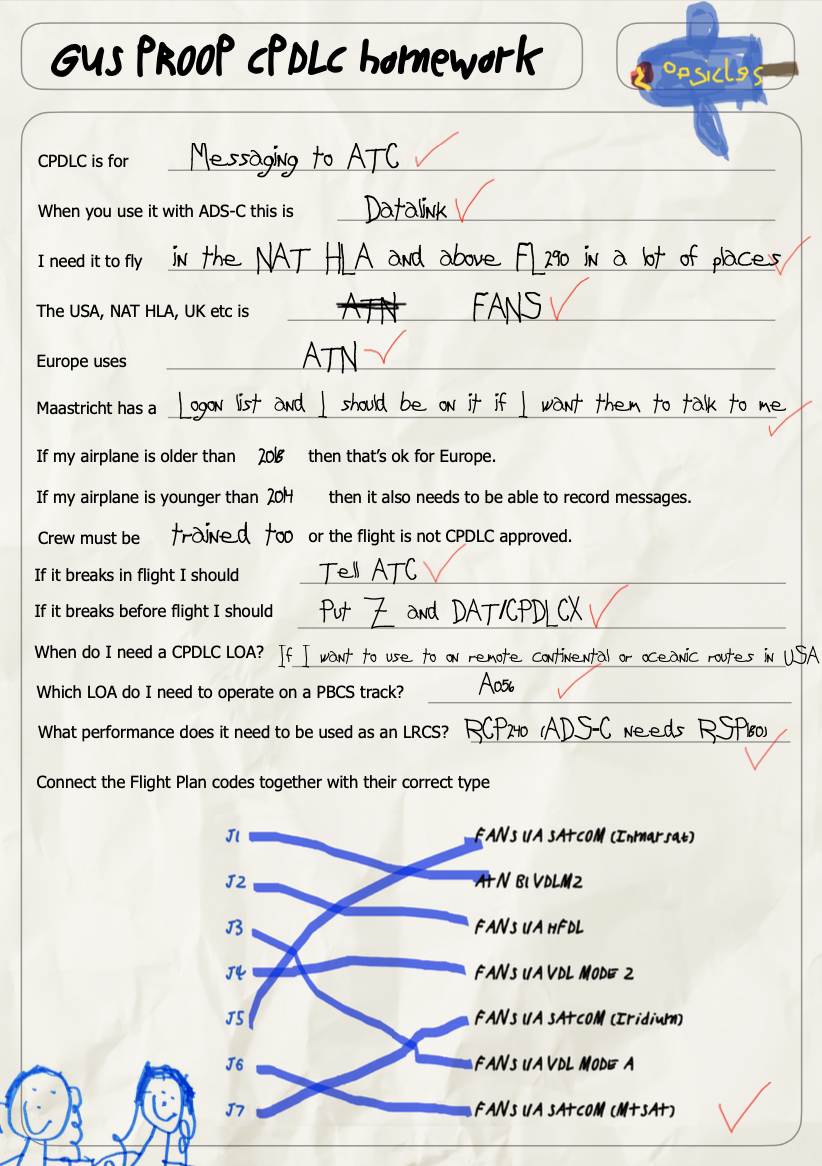
We actually made A little Opsicle on CPDLC just the other day. It is quite a silly one, but here it is if you want a look:

CPDLC in the US

The US has CPDLC in a bunch of places. It isn’t really mandatory yet though. At least not the domestic en-route CPDLC. This is the bit they are running a trial for, and they’re doing it with L3Harris.

The trial is actually, specifically, for the business and general aviation community. The likes of Boeing and Airbus (or rather their avionics configurations) have already been approved.

So, here is the FAA info on it. Or rather, this is the notice talking about who can participate in the trial. They released this because a bunch of folk were participating, but their avionics version or configuration wasn’t good enough and it was messing up the results.

So how do you know if you’ve got what it takes?

All the systems are listed on the L3Harris site. If your aircraft type is missing from the Trial List (shown below), this means that operational acceptability hasn’t been determined yet for that specific aircraft type. If that’s you, you can fill in the form and email it to them at DCIT@L3Harris.com and they will check to see whether you have the spec to participate in the trial.

If your aircraft type (system) is not on it, then don’t file as capable of en-route CPDLC and don’t try and ‘participate’.

For those of you who are on it…

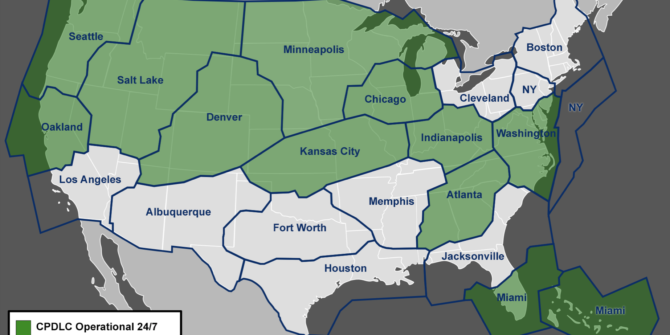
Here is a map of current active CPDLC sites:

ZID/Indianapolis, ZKC/Kansas City, ZMP/Minneapolis, ZDC/Washington, ZOA/Oakland, and ZMA/Miami en-route control facilities are all up and running 24/7 now.

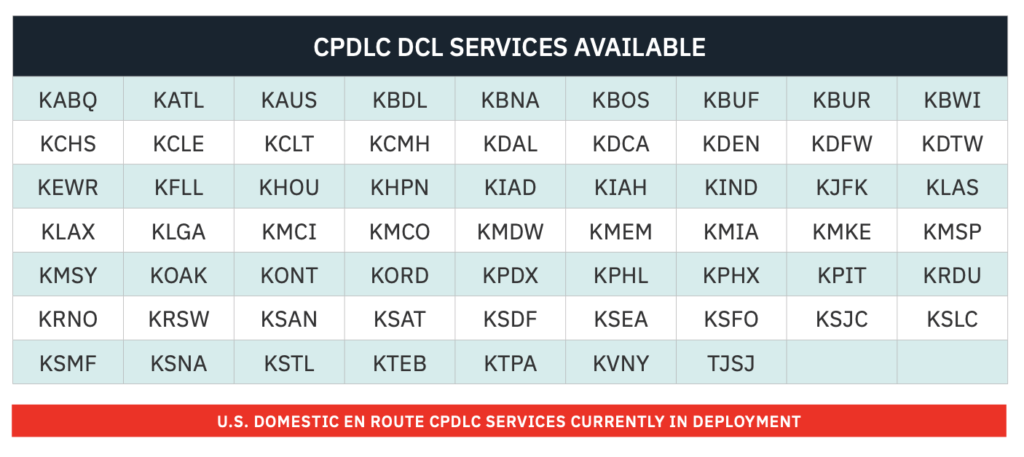
We’ve so far only found a table showing 61 airports where CPDLC DCL services are currently available:

But we know this is a bit out of date. We’ve counted 65 airports currently operational including these:

  • KJAX/Jacksonville
  • KPBI/Palm Beach
  • KCVG/Cincinnati/Northern Kentucky
  • KADW/Joint Base Andrews

Some stuff on using it

OK, so if you take-off from an airport that has CPDLC DCL and which is in an en-route CPDLC area then KUSA (because they’re who you’ll basically be logged onto on the ground) is going to stay active and there is nothing else to do once airborne.

If you take-off logged onto KUSA and only get into the en-route CPDLC bit later then again, KUSA stays on and there’s nothing more for you to do.

If you take-off logged onto KUSA and then are leaving all CPDLC airspace, it will auto log off when it needs to.

For all other scenarios, you probably need to manually log on when you reach the place where CPDLC is available.

KUSA is available on the ground in the lower 48 states, San Juan and Puerto Rico.

This info is all available here.

L3Harris are very active in all this and get in touch if they spot any irregularities with aircraft involved in the trial (nice to know they’re out there, watching).

Handing over the ‘info baton’

So far, all this has been snatched from a bunch of very handy guides that L3Harris publish, so here are the links to those for further info:

And if you are an operator in the US with questions about this, then speak to these folk – DCIT@L3Harris.com


Europe CPDLC: The Mandate We Missed

A brief little refresher on the datalink mandate in Europe, because some of the temporary exemptions have now ended.

What actually happened?

The EU had a datalink mandate which came into force from February 2020. It applied to all aircraft operating above FL285 throughout Europe.

But, there were exemptions. Two sets in fact – one of a fairly permanent sort, and another that was only temporary. It is the temporary exemptions which have now ended.

When did this happen?

5th February 2022. And no, they haven’t extended it.

What were the exemptions?

There are two articles (you can read all this ‘officially’ here if you would like).

Basically, if you fit under Article 1 then you can get a permanent exemption. If you fit under Article 2 then you probably had (but don’t have anymore) the temporary exemption.

Article 1 covers all aircraft listed in Annex I, and any in Annex II whose first certificate of Airworthiness was issued prior to Feb 5 2020. Article 2 is any aircraft listed in Annex II with an airworthiness certificate issued on or after Feb 5th 2020, and any aircraft specified in Annex III.

Give it to me straight!

Ok, ok, here are the aircraft which are permanently exempt, and those which had the temporary exemption until 5 Feb 2022 to do the avionics retrofit…

Aircraft permanently exempt:

  • Aircraft in Annex I
  • Aircraft in Annex II with a CofA issued before 5 Feb 2020

Aircraft which had up to 5 Feb 2022 to do the avionics retrofit:

  • Aircraft in Annex II with a CofA issued after 5 Feb 2020
  • Aircraft in Annex III

There are a lot of aircraft listed in these annexes, but Annex II in particular contains a fair few Bizav aircraft, so we’ve whacked that in below for you to see. We mentioned how GA/BA aircraft might be exempted here, before.

So does this affect you?

See above. It depends on those criteria.

Basically, most BizAv aircraft probably do meet the requirements of Article 3(3)(d) as well, which covers aircraft with a certified maximum seating capacity of 19 passengers or less and a maximum certified take-off mass of 45 359 Kg (100 000 lbs) or less and with a first individual certificate of airworthiness issued before 5 February 2020. If they do, they are exempted permanently.

This is all really a “reminder” of what’s already happened because if you don’t already know about this, it’s too late now anyway!

Tell us more about the mandate.

Actually, rather than do that, just head here to read what we’ve written before. This covers all the info you (hopefully) need on white list logons and all that jazz.

The entire consolidated version of Commission Regulation (EC) No 29/2009 is available here for your perusal, while the EC Implementing Decision 2019/2012 is here if needed.

The FAQs

EASA have published some (fairly) useful FAQs on all things datalink and CPDLC which you can read here on their ‘Airspace Usage requirements – DLS/CPDLC’ page.

One we see a lot, is do you have to register on the ‘White List’. The answer is no, it’s not  a regulatory requirement.

One final exemption.

If your equipment is temporarily inoperative you can still continue to operate within the applicable airspace if your MEL allows, and if you tell them about it in your flight plan. You do this with a “Z” in item 10 and the indicator “DAT/CPDLCX” in item 18 of your flight plan.


A final final one – you are also exempt if it is a delivery flight.

What EASA said when we asked for clarification.

Basically what we’ve put above, but to make it extra clear, here is a quote from their response –

“The EC Implementing Decision 2019/2012 in Article 2 refers to the 5 February 2022 date. Depending on the specific aircraft type/model and the first CofA date, the aircraft were either exempted or only temporarily exempted until 5 February 2022. There is no extension to this date and no change to this Decision since it has been adopted.

On the other hand, it should be noted that most business aircraft may meet the requirements of Article 3(3)(d) of the Commission Regulation (EC) No 29/2009 referring to aircraft which have a certified maximum seating capacity of 19 passengers or less and a maximum certified take-off mass of 45 359 Kg (100 000 lbs) or less and with a first individual certificate of airworthiness issued before 5 February 2020. If this is the case, the operator’s aircraft is exempted.

So if you were exempted under the earlier Article you are still exempted. If you weren’t but fulfil the criteria in Annex I of the new article then you are permanently exempted. If you fall in the list in the new Annex of only exempted until Feb 5th, then you are no longer exempted.

Any other questions?

You can read SIB 03 2020 here. If you have any other questions, you can ask EASA directly on atm@easa.europa.eu. We asked them some things a while ago and they took a week or two to respond but were super helpful when they did.


We have Clearance, Clarence

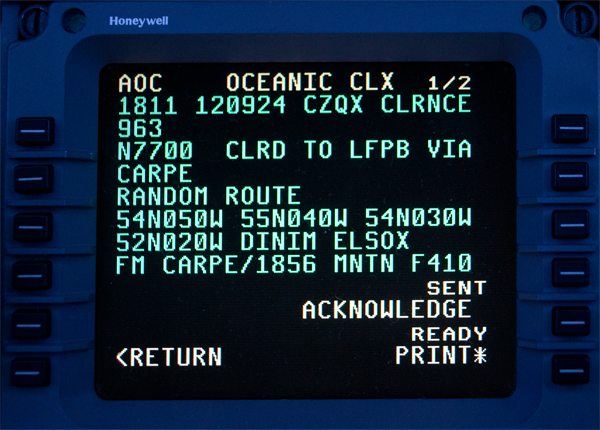
You carefully type it up, have the other pilot check it, then hit send… and wait… your airplane is creeping closer and closer to the Oceanic Entry Point and still no reply, and then DISASTER! Clearance Request Rejected! Or worse still, you just never get a response…

Here are some hints, tips (and actual procedures) related to getting your Oceanic Clearance for the NAT HLA. And what to do if you don’t…

How to get your clearance.

There is a datalink mandate across the vast majority of the NAT HLA which means everything has headed towards “messages” rather than voice. Why? Because it’s easier and there is a lot less risk of mess-ups and mix ups. So, most likely, you are going to be requesting your clearances via “message” as well. The system it goes through is generally the Arinc 623 – the same you use for things like your D-ATS. Contrary to CPDLC, A623 exchanges don’t require previous notification. But enough of that technical schtuff.

If you ttake a look through the North Atlantic section of *whichever manual* you are using and somewhere under COM and ATC Communications you will find a section on ‘Oceanic Clearance Request via Data Link’. Each OCA has its own thing to say in terms of times to send it and reverting to voice, but in general the message you want to send when requesting your clearance is the same for them all.

You need to include Entry Point, ETA for Entry Point, Requested Mach Number, Requested Flight Level and add a remark (RMK/) indicating preferred alternative (another NAT Track) and MAX FL. You only have 80 characters available to you so don’t go adding extra comments in, it will probably just get rejected.

After sending your clearance request you should receive an advisory message which says something like this –

“IF NO CLEARANCE RECEIVED WITHIN 30 MINUTES OF OCEANIC ENTRY PONT REVERT TO VOICE PROCEDURES END OF MESSAGE”

If you don’t receive this within about 5 minutes of sending the question, something has possibly gone wrong. Try sending again if you can still meet the minimum time to boundary for a request, or revert to voice.

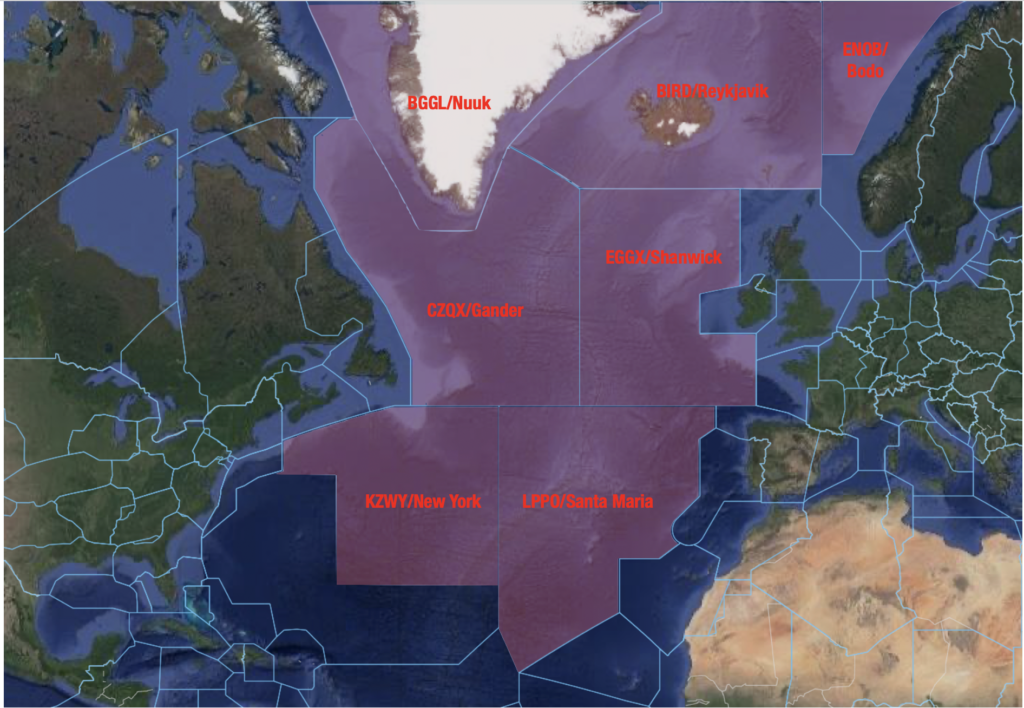
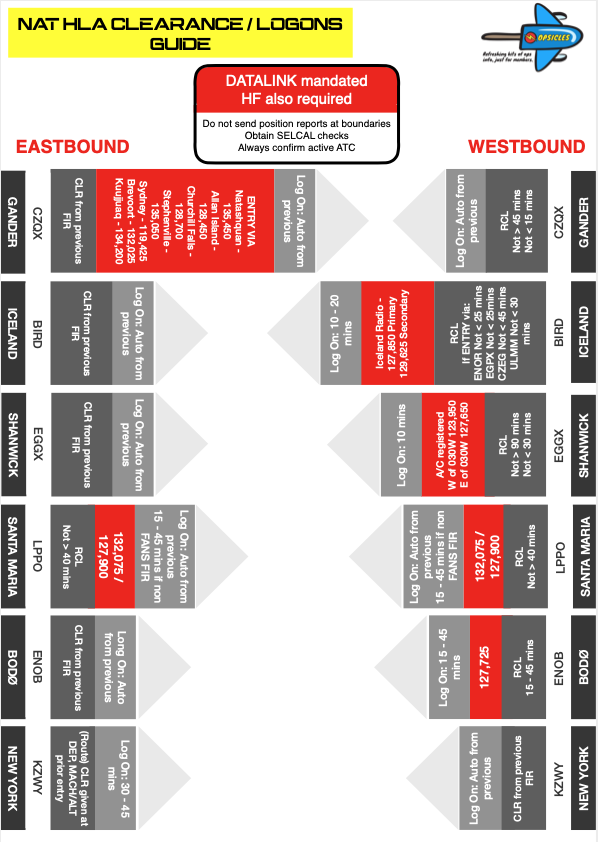
The times you want to think about sending your RCL through at vary from OCA to OCA, as do the logon addresses, so here is a rundown of each one…

Shanwick

  • The logon is EGGX.
  • Shanwick want your request sent no later than 30 minutes before the OCA boundary, but no earlier than 90 minutes or they’ll reject it.
  • If you haven’t received your clearance and are within 15 minutes of the OCA boundary then revert to voice. If you are East of 020W then try Shanwick Radio on 127.9 to help reduce chatter on HF. Only give HF a go if you are within 40 minutes of the boundary and having issues getting VHF signal.
  • For Shanwick Oceanic you have two frequencies – 123.950 is for aircraft registered in States West of 030W. 127.650 is for aircraft registered in States East of 030W.

Gander

  • The logon is CZQX
  • The request should be sent just after the aircraft gets within 90 minutes of the OEP. If you don’t receive the advisory message within 5 minutes, or if you haven’t received a clearance and are within 30 minutes of the OEP then revert to voice.
  • Gander is a little tricky with working out which frequency to use. It comes down to where you are routing via:
    • Natashquan 135.460
    • Allan’s Island 128.450
    • Churchill Falls 128.7
    • Stephenville 135.050
    • Sydney 119.425
    • Brevvoort 132.025
    • Kuujjuaq 134.2

Reykjavik

  • The logon is BIRD.
  • How far in advance you need to request your RCL depends on where you are entering from (which CTA). The time is the minimum time from the BIRD CTA Entry Point that they should receive your RCL by and the general rule is 20-25 minutes.
    • Stavanger (ENOR) 25 mins
    • Scottish (EGPX) 25 mins
    • Edmonton (CZEG) 45 mins
    • Murmansk (ULMM) 30 mins
  • If you have Inmarsat datalink then you probably won’t be able to get your clearance while north of 82°N. If you’re on an Iridium or HF datalink system then you’re in luck.
  • If you have to get your clearance via voice then you can try Iceland Radio on VHF Primary 127.850 or Secondary 129.625. They are also on the HF B, C and D families but you’re having a bad day if it’s reaching that level.

Bodø

  • The logon is ENOB.
  • Request your clearance at least 30 minutes before the NAT region boundary. Revert to voice if you’re within the 20 minutes mark on 127.725.

Santa Maria

  • The logon is LPPO.
  • Send your request 40 minutes before the OEP. If you need to request clearance by voice then talk to Santa Maria Radio on 127.9 or 132.075.

New York

  • The logon is KZWY.
  • This works a little differently if you are routing from the US because your clearance is going to be included in your departure clearance (since you’re basically in the area anyway). You can logon 30-45 minutes before.

What to do if you don’t get a clearance?

Shanwick is really the main one to worry about – having a clearance (being in contact with ATC) is pretty darned important there because it is such a big area and extremely busy.

Always give yourself time. If a clearance isn’t received, try by voice. If you can’t get through then try other frequencies and ATCs. If you reach a boundary without a clearance then chances are it’s because you have some sort of comms loss in which case this is now your bigger concern.

In theory, you could enter the NAT HLA (aside from via Shanwick) without a clearance (with loss of comms) and fly as per your flight plan route (Mach and Levels) but it really, really isn’t advisable.

What to do when you do get your clearance.

It goes without saying that first up you need to acknowledge it with ATC. After that you’ll want to check it, and get the other pilot to as well. Printing it out is a good way to do this if you have that option. “Checking it” means checking what you’ve been cleared to do is what you’re asking the aircraft to do via its nav computer.

Finally, make sure you really are flying it by monitoring it and doing your plotting (or equivalent) checks. You can read about that here if you’re not sure how.

A helpful summary.

We created a little Opsicle  – a refreshing bit of ops info, just for members. Which means if you are an OPSGROUP member you can click on the pic to get yours. This one summarises all the logon info we wrote about above!

Where is the official info?

The info is contained in AIPs, and some of it within ICAO NAT Doc 007.

We might have missed some things, or made a mistake so if you spot one let us know!


Most GA/BA aircraft now exempt from Europe’s 2020 Datalink Mandate

Europe’s datalink mandate takes effect today – 5th Feb 2020!

The original plan was that datalink would be required for all aircraft operating in Europe above FL285 from this date, but then the EU announced that this would not be required for several categories of aircraft, the main two being:

  • Aircraft with a certificate of airworthiness first issued before 1 Jan 2018 and fitted prior to this date with FANS 1/A.
  • Aircraft with 19 seats or less and a MTOW of 45359 kg (100000 lbs) or less, with a first individual certificate of airworthiness issued before 5 Feb 2020.

In other words – most GA/BA aircraft! (You can read the rule here – latest version in 2023).

Added to that, in early Decemebr 2019 the EU Commission approved plans to pass an additional resolution that makes a bunch of other aircraft exempt too:

Aircraft permanently exempt:

  • Aircraft in Annex I
  • Aircraft in Annex II with a CofA issued before 5 Feb 2020

Aircraft which have up to 5 Feb 2022 to do the avionics retrofit:

On Feb 3, EASA issued a Bulletin which says that operators who are exempt from the mandate should include the letter “Z” in Field 10 and the indicator “DAT/CPDLCX” in Field 18 of their flight plan. If you don’t, ATC won’t know you’re exempt, and you may struggle to fly above FL285!

Bottom line, for operators who are exempt from the mandate, these flights should not be restricted to the lower flight levels below FL285. Logged-on traffic might just get better directs and faster climbs, that’s all.

It should be noted that the Datalink Mandate is not the same thing as the Logon List. The Logon List is the thing you need to get registered on if you want to get CPDLC when flying in Maastricht, France, Switzerland and Portugal. And it only applies to ATN CPDLC aircraft. If you’ve only got FANS1/A, Maastricht will let you log on, but France, Switzerland and Portugal will not.


The Backstory…

This mandate was actually supposed to come into force back in Feb 2015, but got delayed to Feb 2020 due to technical issues with the system, particularly disconnections, known as ‘provider aborts’ – which is where an aircraft loses datalink connection with the ground for more than six minutes.

The high amount of these provider aborts has led some sectors (Maastricht UAC, France, Switzerland, and Portugal) to implement the Logon List (formerly known as the “White List”), which effectively means that CPDLC is only provided to those aircraft with avionics that are known to suffer a lower provider abort rate. The Logon List only applies to ATN B1 equipped aircraft, not those with FANS1/A – Maastricht are planning to introduce a similar list for FANS1/A aircraft at some point in the future, to ensure that only aircraft that have the latency timer feature will be able to log on.

In their original postponement of the mandate back in 2015, the EU said the following:

“This excessive rate of random provider aborts causes a degradation in the network performance potentially presenting aviation safety risks by increasing the pilots and controllers’ workload and creating confusion leading to a loss of situational awareness.”

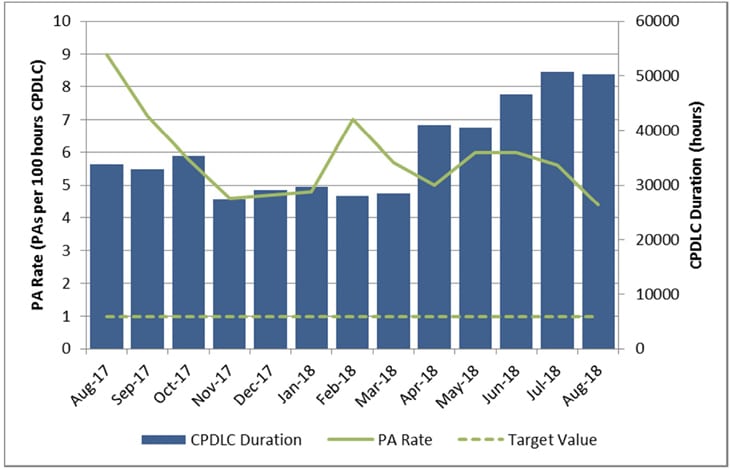
Their goal was to get the number of provider aborts down to 1 per 100 flight hours. By mid-2018, the number had dropped to a rate of 4.4 per 100 flight hours, and data from this year has that figure down to 3.9 per 100.

Added to that, they wanted to get at least 75% of flights across the network filing with datalink. Current data suggests this is still lingering at around the 40% mark. So if the datalink mandate had been implemented as planned in Feb 2020 without these new exemptions, that would have meant that approximately 60% of the traffic would have been restricted to below FL290!

As the EU make clear in their new ruling, that is ultimately why the new raft of exemptions has now been brought in, ahead of the Feb 2020 mandate:

“Acknowledging the ongoing data link implementation issues and corrective actions taken and recognising the objective that at least 75 % of the flights should be equipped with data link capability, the criteria for exemptions should be amended. Those criteria should remain effective, without placing an undue economic burden on specific operator categories which contribute significantly less to the overall number of flights. Such categories should include operators of aircraft with Future Air Navigation Systems (FANS) 1/A systems installed, operators of older aircraft, and of aircraft designed to carry 19 passengers or less.”

Ultimately, when the datalink mandate comes in on 5 Feb 2020, it now looks like most GA/BA aircraft will be exempt from this, meaning that those without CPDLC will be able to continue to operate above FL285.


Thanks to the European Business Aviation Association for their help with this article!

Article header photo by @Zelgomat


Regulatory deadlines on the horizon

Regulatory compliance – nothing quite warms the heart like reading those two words, side by side. This year has seen quite a few changes in this department already (thank you, NAT HLA!), but here is a list of some other regulatory deadlines on the horizon…

Dec 31, 2019 – Operations in North Atlantic

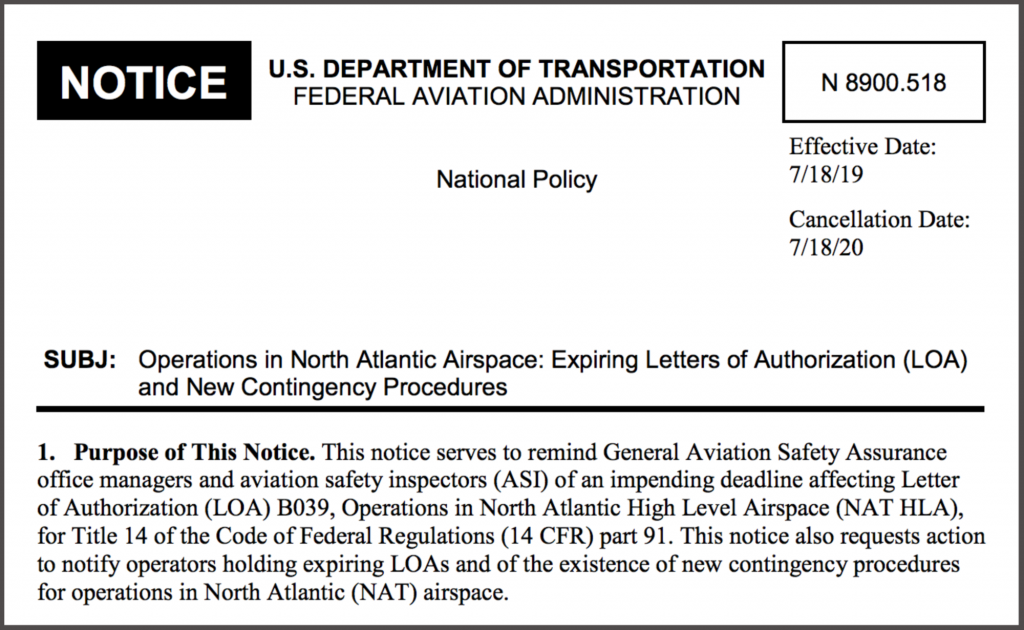
  • U.S. operators must have the revised LOA BO39: “Operations in North Atlantic High Level Airspace (NAT HLA)”. Operators holding the old MNPS LOA BO39 will not be permitted to fly in the NAT HLA beyond this date. Requirements include: RNP10, crew training and new contingency procedures incorporated in company operating handbooks. Read our article here.

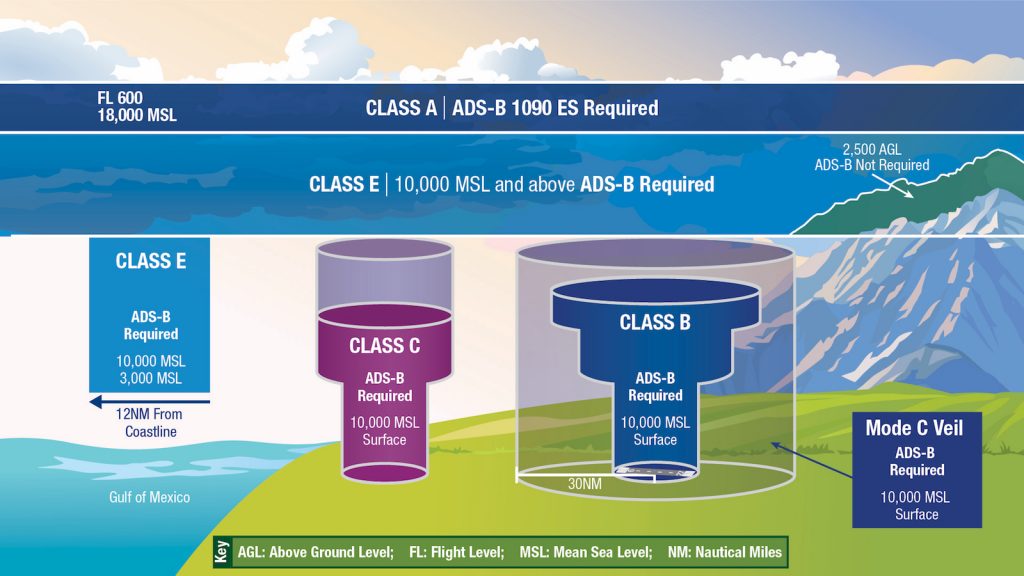
Jan 1, 2020 – US ADS-B Out Mandate

  • ADS-B Out will be required where Mode C is required AND:
  • Class A, B and C airspace, Class E at or above 10,000’ MSL (but not below 2,500’ AGL).
  • Within 30nm of Class B (Mode C veil).
  • Above the ceiling and within lateral boundaries of Class B and C up to 10,000’.
  • Class E over Gulf of Mexico, at and above 3000’ MSL within 12 nm of US coast.

Jan 30, 2020 – Expansion of Datalink Mandate in the North Atlantic

  • Phase 2C of North Atlantic Datalink Mandate. FANS 1/A CPDLC and ADS-C will be required between FL290-FL410 throughout the entire NAT region (previously FL350-390). Read our article here.

Feb 5, 2020 – European Datalink Mandate

  • Initially legacy aircraft flying above FL290 in European airspace were to be equipped with CPDLC capability by Feb 2015. But due to equipage requirements and technical issues the mandate was delayed to Feb 2020, AND, even better, most GA/BA aircraft will be exempt from this. Read our article here.

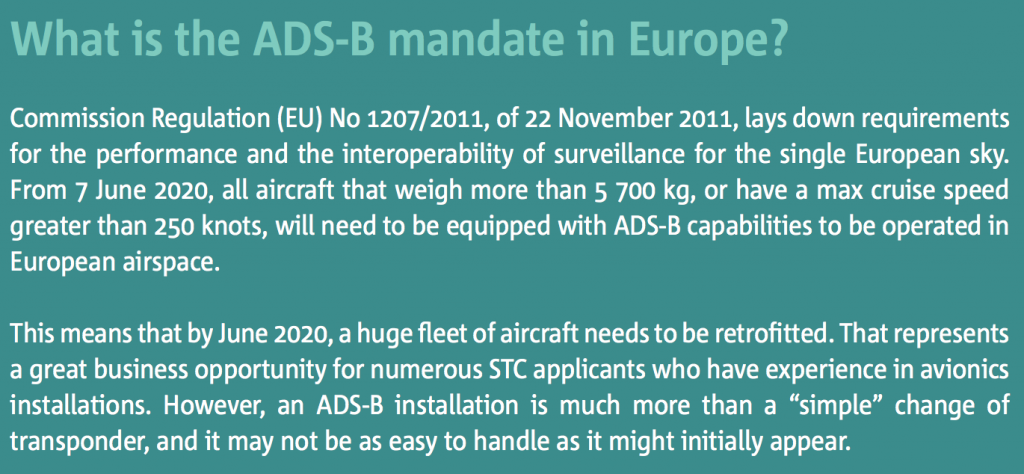
June 7, 2020 – European ADS-B Out Mandate

  • Aircraft flying IFR in Europe with max certified takeoff weight of more than 5700kg (12,566lbs) OR max cruising TAS of more than 250kts must be equipped with ADS-B. GPS sensor with at least WAAS accuracy coupled to a 1090 Extended Squitter transponder required.


DELAYED:

Canada: ADS-B Out Mandate

  • This was planned to be implemented in Class A airspace from Feb 2021, and Class B airspace from Jan 2022. But Nav Canada has now postponed this mandate. They still plan on using ADS-B for surveillance, and this will be used on a priority basis for suitably equipped aircraft starting in 2021, but they say – “non ADS-B Out equipped aircraft will be accommodated within the airspace until a performance requirements mandate can be implemented.”

ALSO ON THE HORIZON:

August 14, 2020 – EU: SAFA Ramp Checks & Pilot Mental Health

  • EASA regulations requiring alcohol testing during ramp checks will take effect across all SAFA participating countries (although some countries have already started doing this: Austria, Belgium, Czech Republic, France, Germany, Greece, Iceland, Ireland, Italy, Netherlands, Portugal, Spain, Switzerland, UK, and Singapore). Tests may also be carried out by local police at any time.
  • All pilots working for European airlines will have access to mental health support programs.
  • European airlines will perform a psychological assessment of their pilots before the start of employment.

Any other biggies that we missed? Let us know!


July 2019 North Atlantic Update

There are four new things to tell you about the North Atlantic, following the flurry of new and updated NAT Bulletins that ICAO issued last week. Get ready for some acronyms! Here’s a summary:

1. OWAFS

Operations Without an Assigned Fixed Speed
ICAO NAT Bulletin 2019_001

We wrote about this before. This Bulletin just formalises the practice that has already been in place since April 2019 in the Shanwick, Santa Maria, and New York Oceanic FIRs (not WATRS).

Here’s how it works: You’ll get a normal oceanic clearance, with a fixed Mach Number, like you always did. But then somewhere after the Oceanic Entry Point, you may get a CPDLC message saying RESUME NORMAL SPEED. You should reply with WILCO. What that means is: Fly ECON, or a Cost Index with Variable Mach. You can fly within 0.01 up or down of your cleared Mach, but if it varies by 0.02 or more you must advise ATC.


2. ASEPS

Advanced Surveillance Enhanced Procedural Separation
ICAO NAT Bulletin 2019_002

ASEPS was another trial that started in April 2019 – this time in the Shanwick, Gander and Santa Maria FIRs.

So far it has only been for longitudinal separation, which can be brought down to as close as 14NM for compliant aircraft (RVSM/HLA approval, ADS-B, and fully PBCS compliant – which means meeting the specifications of RNP4, RCP240 and RSP180).

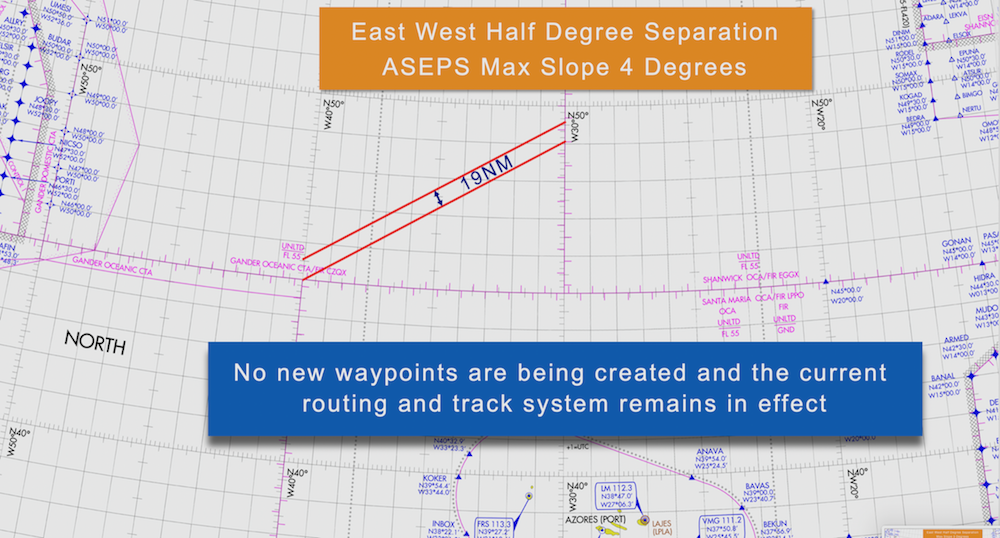
But in the new Bulletin, from October 2019 they plan to reduce lateral separation for compliant aircraft as well – down to 19NM from the previous limit of 25NM.

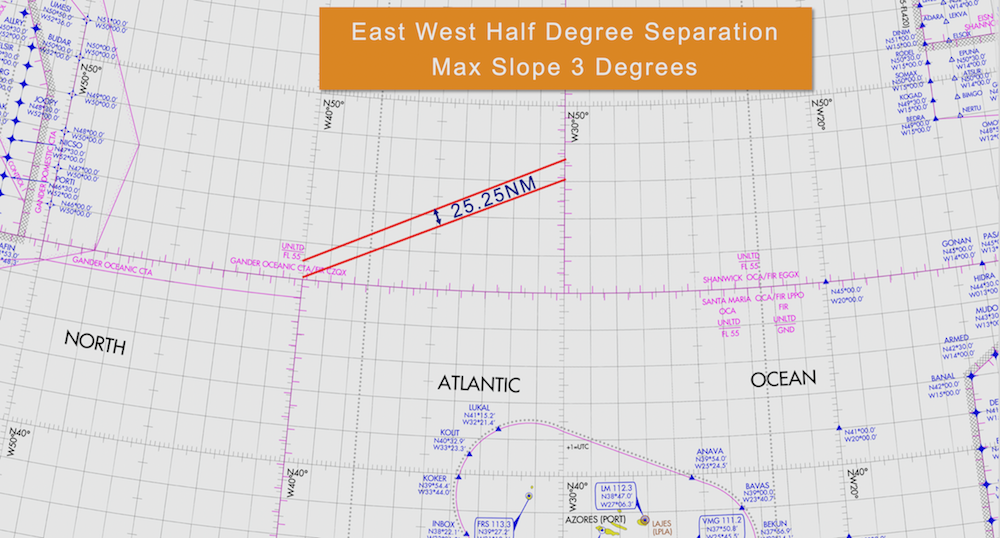
There are no plans to change the design of the NAT Tracks, which will continue to be spaced 25NM apart. The initial benefit of the 19NM lateral separation will basically just be that steeper route angles will now be available for pairs of aircraft flying parallel routes outside of the NAT Track system – the current “gentle sloping turn” limitation is 3 degrees latitude between 10 degrees of longitude, but on 10th October 2019 that will change to a limitation of 4 degrees latitude between 10 degrees of longitude. The result of this will be a lateral separation of 19NM on the steeper turning routes.

Images courtesy of 30WestIP


3. Data Link Performance Improvement Options

ICAO NAT Bulletin 2019_003

Nothing to worry about, this is just a list of common datalink errors and what to do about them.

Two key take-aways:

  1. Update your aircraft avionics software as soon as updates are available.
  2. Answer your messages within 60 seconds or send a Standby message (recent data indicates Business Aviation operators are very bad at this).


4. NAT DLM – The North Atlantic Data Link Mandate

ICAO NAT Bulletin 2017_001_Revision 04

This one is just a slight revision to the plans for the datalink mandate. Datalink is currently required between FL350-390 in the NAT region, and from 30th Jan 2020 this mandate will be extended to between FL290-410.

So with this revised Bulletin, the change is that they have decided they will cap it at FL410 – whereas previously there were no plans for any upper limit at all. This will basically match the NAT HLA and RVSM vertical limits and makes sense. This will allow non-compliant aircraft to continue to operate at FL430 and above – mostly GA/BA operators.


Further reading:

Special thanks to Mitch Launius at 30WestIP.com for help with this post. For assistance with international procedures training for business aviation crews worldwide, check out the website.


2019 North Atlantic changes

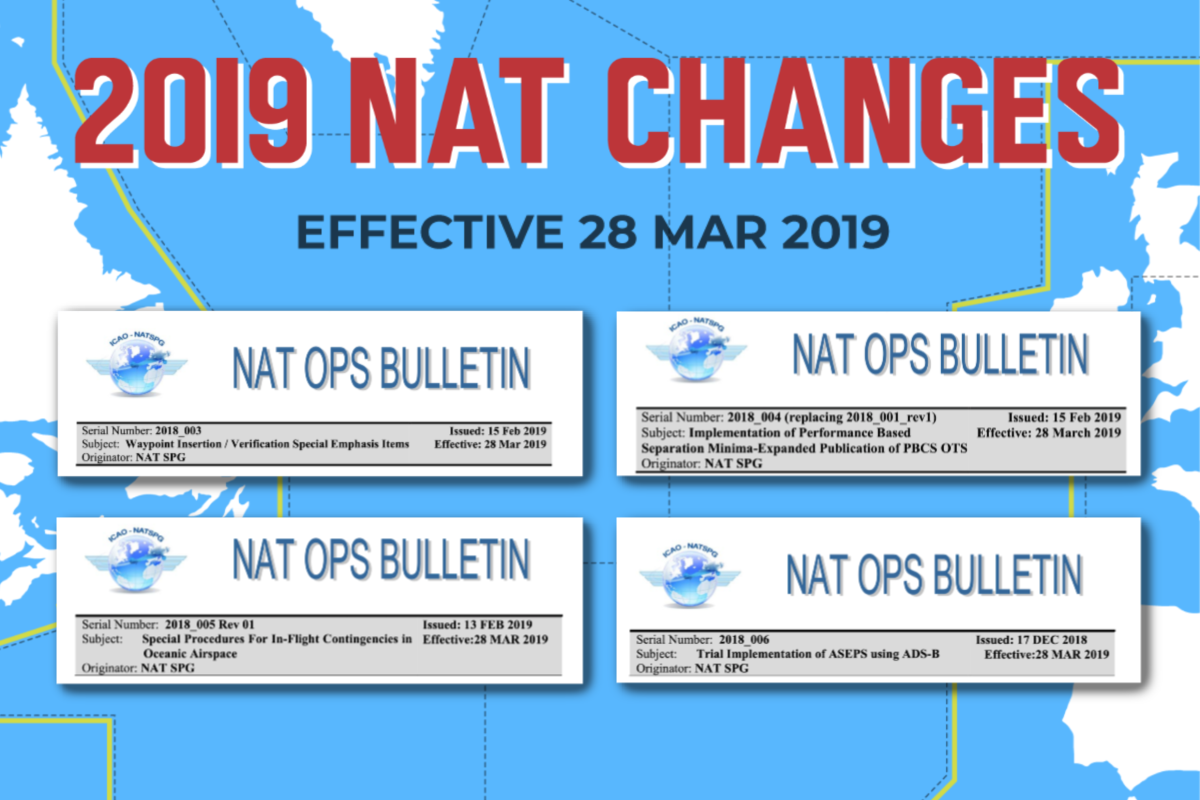
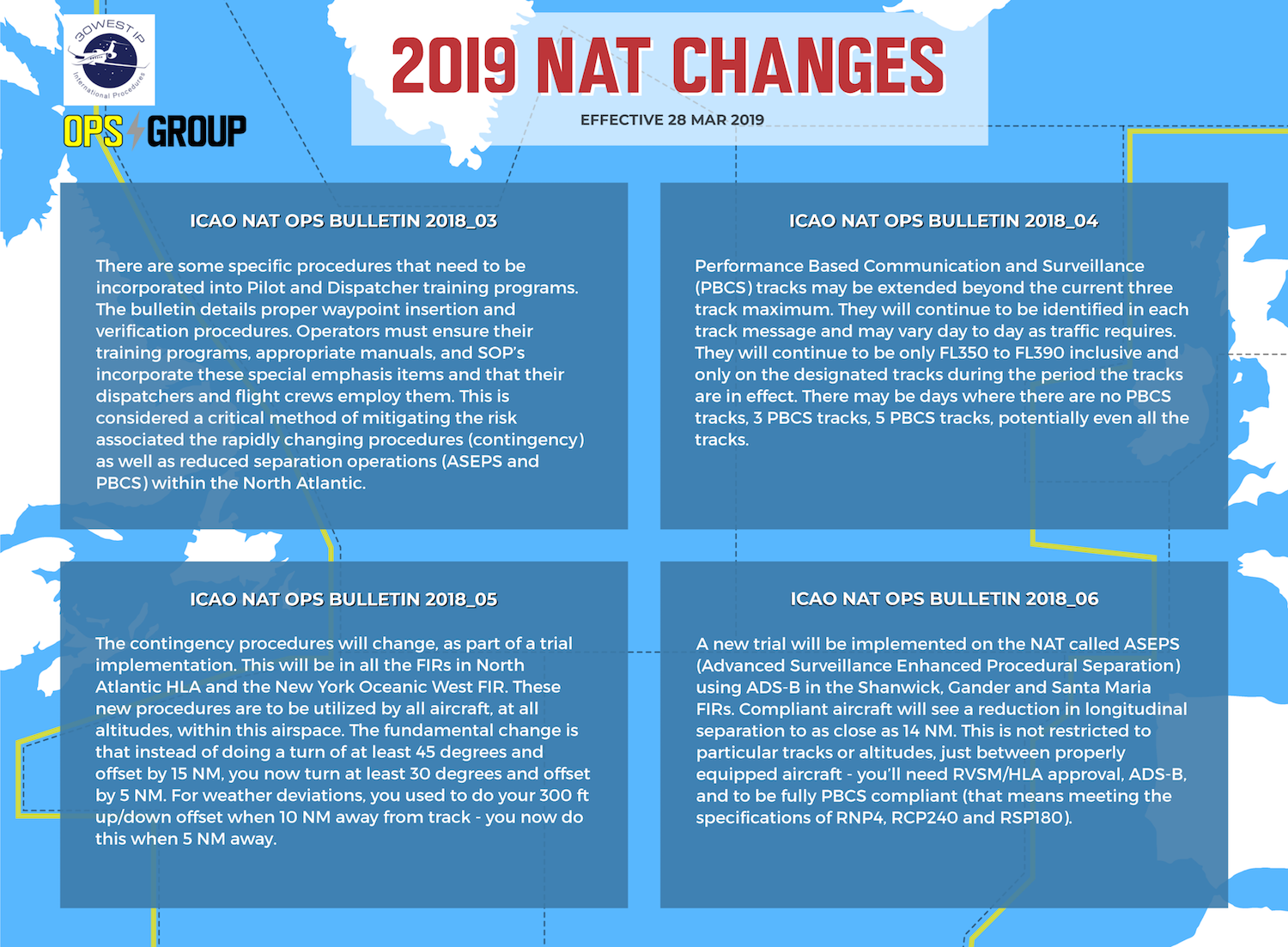
There are four ICAO NAT Ops Bulletins due to go into effect on March 28th, 2019. The PBCS tracks will be expanded, real-time Space-Based ADS-B surveillance and reduced separation standards will be introduced, and the regional contingency and weather deviation procedures will be changed.

You can click on each one, and read them in full:

We have had a good look at each of them. Here’s the lowdown:

ICAO NAT Ops Bulletin 2018_03: Waypoint Insertion / Verification Special Emphasis Items
Lowdown: There are some specific procedures that need to be incorporated into Pilot and Dispatcher training programs. The bulletin details proper waypoint insertion and verification procedures. Operators must ensure their training programs, appropriate manuals, and SOP’s incorporate these special emphasis items and that their dispatchers and flight crews employ them. This is considered a critical method of mitigating the risk associated the rapidly changing procedures (contingency) as well as reduced separation operations (ASEPS and PBCS) within the North Atlantic.

ICAO NAT Ops Bulletin 2018_04: Implementation of Performance Based Separation Minima-Expanded Publication of PBCS OTS
Lowdown: Performance Based Communication and Surveillance (PBCS) tracks may be extended beyond the current three track maximum. They will continue to be identified in each track message and may vary day to day as traffic requires. They will continue to be only FL350 to FL390 inclusive and only on the designated tracks during the period the tracks are in effect. There may be days where there are no PBCS tracks, 3 PBCS tracks, 5 PBCS tracks, potentially even all the tracks.

ICAO NAT Ops Bulletin 2018_05: Special Procedures For In-Flight Contingencies in Oceanic Airspace
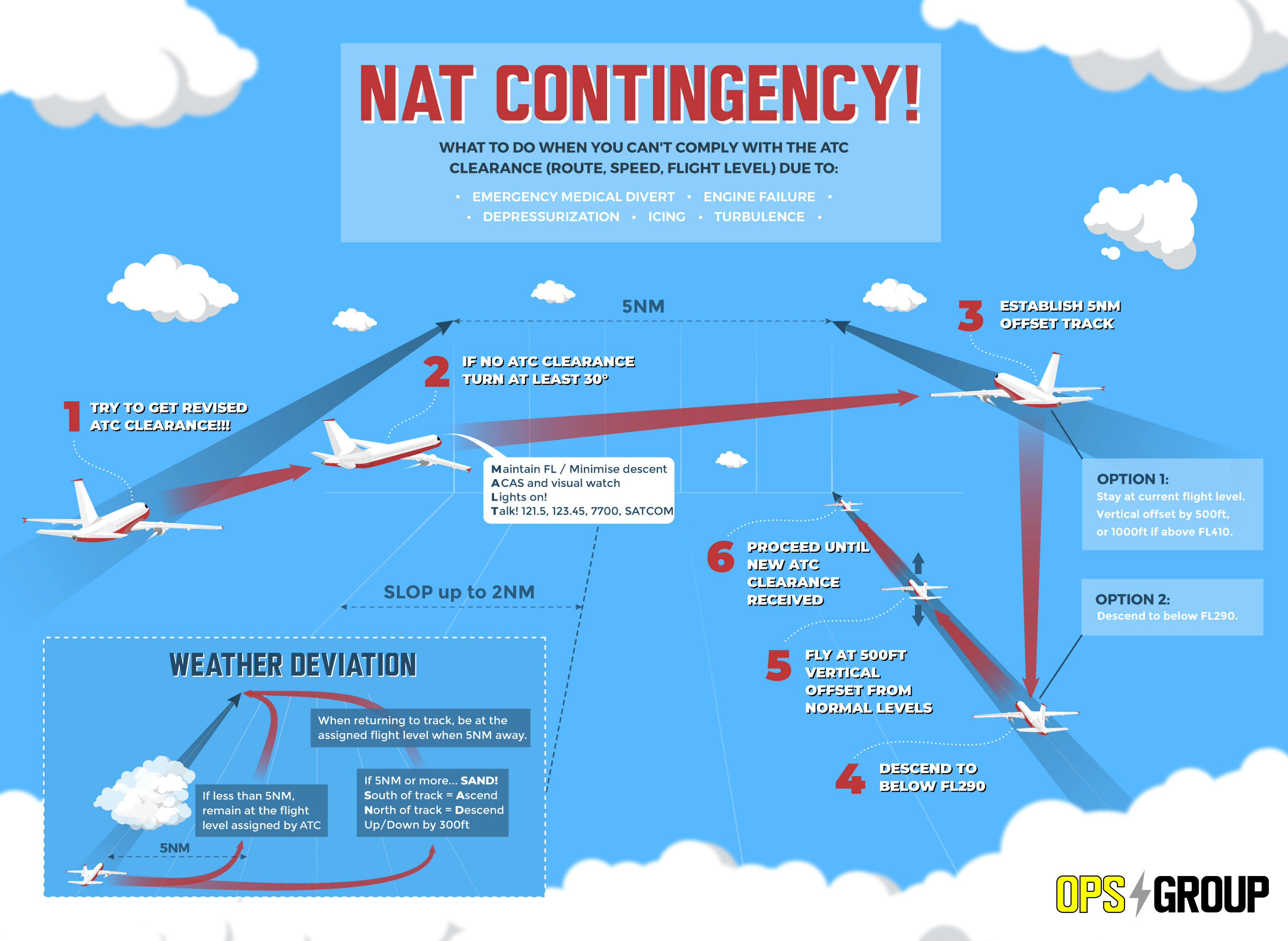
Lowdown: The contingency procedures will change, as part of a trial implementation. This will be in all the FIRs in the NAT Region and the New York Oceanic West FIR. These new procedures are to be utilized by all aircraft, at all altitudes, within this airspace. The fundamental change is that instead of doing a turn of at least 45 degrees and offset by 15 NM, you now turn at least 30 degrees and offset by 5 NM. For weather deviations, you used to do your 300 ft up/down offset when 10 NM away from track – you now do this when 5 NM away. For more info on this, read our article.

ICAO NAT Ops Bulletin 2018_06: Trial Implementation of ASEPS using ADS-B
Lowdown: A new trial will be implemented on the NAT called ASEPS (Advanced Surveillance Enhanced Procedural Separation) using ADS-B in the Shanwick, Gander and Santa Maria FIRs. Compliant aircraft will see a reduction in longitudinal separation to as close as 14 NM. This is not restricted to particular tracks or altitudes, just between properly equipped aircraft – you’ll need RVSM/HLA approval, ADS-B, and to be fully PBCS compliant (that means meeting the specifications of RNP4, RCP240 and RSP180).

So there you have it. We made a couple of handy graphics for all this. Print them out and sellotape them to your cockpit. (If you actually do this, please send us a photo!)

click on the image to open larger version

For a bit more of an in-depth look at the contingency and weather deviation procedures as shown in the image above, read our article.

And if you’re still hungry for more NAT info, we highly recommend you check out the replay of the webinar hosted by Mitch from 30WestIP, titled: ‘A North Atlantic Game Changer, 4 NAT OPS Bulletins all go into effect in one day’. This really breaks down each of the four new Bulletins which take effect from 28th March 2019 – essential viewing if you operate over the North Atlantic! View it here.

Further reading:

  • On 1st Nov 2018 we had a call with 140 OPSGROUP members about upcoming changes on the NAT in 2019, and how we can effect change. OPSGROUP members can find the PDF notes of this in your Dashboard.
  • A big thing driving the ASEPS trial is the rollout of Space-based ADS-B, which is scheduled to complete its deployment by 30 Dec 2018, giving us worldwide, pole-to-pole surveillance of aircraft. For more on that, and how it will affect operations on the NAT specifically, read the article by Mitch Launius here.
  • Use our quick guide to figure out where you are welcome on the NAT, depending on what equipment and training you have.

Indy Center kicks off CPDLC trials – the system is live!

The United States is rolling out En Route FANS CPDLC during 2018-19, for all equipped, trained and permitted operators. The FAA’s Advisory Circular AC 90-117 outlines the requirements for U.S. operators.
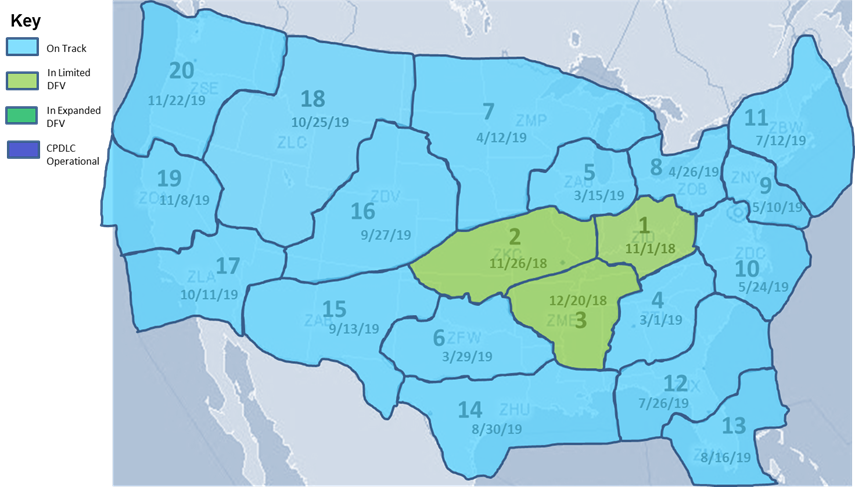
Trials have begun with KZID/Indianapolis going live with 24/7 ops starting last week.

We also understand that KZME/Memphis and KZKC/Kansas City are still in the testing phase with CPDLC and voice read back happening 1-2 nights per week during the midnight shift.

The current deployment schedule as it stands can be found in this graphic. [if you know what DFV means, let us know!]

How to participate:

  • The FANS logon is “KUSA” for the entire country and you may logon at any time. The CPDLC connection will become active after departure, and the crew is notified via a welcome message uplink. If En Route FANS CPDLC enabled airspace is active, you will stay logged on. If the aircraft transitions from En Route FANS CPDLC enabled airspace into non-Data Link airspace with an active CPDLC connection then the connection will terminate approximately seven minutes after exiting.
  • To participate, file “DAT/FANSE” in Field 18 of the ICAO Flight Plan.
  • Equipment required is VDL Mode 2, indicated as “J4” in Field 10a of the ICAO Flight Plan.
  • If an operator wants to use domestic En Route FANS CPDLC and is already using FANS DCL then the the majority of operations will fall into one of these scenarios:
    • (1) The operator uses FANS DCL via the “DAT/1FANS2PDC” preference in Field 18 of the ICAO Flight Plan. In that case, update the preference to “DAT/1FANSE2PDC“.
    • (2) The operator uses FANS DCL via the FAA’s Subscriber Database. In that case, the operator will want to add the entry “DAT/FANSE” in Field 18 of the Flight Plan.

Some things to keep in mind:

  • Domestic En Route FANS CPDLC enabled airspace will be seamlessly integrated with foreign (Canadian) and Oceanic FANS CPDLC enabled airspace.
  • The Oceanic Clearance will not be delivered via FANS CPDLC. You will still need to request the clearance via AFIS/ACARS or obtain it via voice.

Have you had the chance to try it out recently? Let us know!

Extra Reading:


New CPDLC procedure on the NAT

There’ll soon be a new CPDLC procedure on the NAT, designed to prevent pilots from acting on any old CPDLC messages that might have been delayed in the network.

ICAO have published a new Bulletin for all the NAT Air Navigation Service Providers (ANSP’s) to use as a basis for implementing this new procedure. They recommend that all aircraft should receive a message immediately after they enter each control area telling them to “SET MAX UPLINK DELAY VALUE” to a certain number of seconds. The idea is that this will prompt the pilot to enter the specified latency value into the aircraft avionics, so that it will ignore/reject any old CPDLC messages.

So far, only Iceland’s BIRD/Reykjavik FIR have implemented this procedure, effective May 24. All other sectors of NAT airspace (Gander, Shanwick, Bodo, Santa Maria, New York Oceanic) are busy writing their own AIC’s and will implement later in the year. 

So when entering the BIRD/Reykjavik FIR, expect to receive a CPDLC message from ATC instructing you to “SET MAX UPLINK DELAY VALUE TO 300 SECONDS”. A copy of their AIC with more guidance can be found here.

The latency monitor function varies from one aircraft type to another: some just automatically reject old CPDLC messages, some will display a warning to the pilot that the message has been delayed, some have deficient equipment, and some do not have the message latency monitor function implemented at all.

Because of this, ICAO note that “it is impossible for ATC to tailor the uplink of the message… to different aircraft types. It has therefore been decided among the NAT Air Navigation Service Providers (ANSPs) to uplink this message to all CPDLC connected aircraft immediately after they enter each control area. An aircraft may therefore receive this message multiple times during a flight.”

So here’s the lowdown on what you need to do:

1. Work out in advance what kind of message latency monitor function your aircraft has, and what it is designed to do when it receives the CPDLC message “SET MAX UPLINK TIMER VALUE TO XXX SECONDS”.

2. When you receive this message, respond with the voice message “ACCEPT” or “ROGER”. If your aircraft has a functioning message latency monitor, punch in the specified number of seconds. If you don’t have functioning equipment, respond with the free text message “TIMER NOT AVAILABLE”.

3. If anything goes wrong, revert to voice comms.

Back in November 2017, we reported on an equipment issue with Iridium satcom that prompted a ban by a number of Oceanic ATC agencies. Some aircraft were receiving massively delayed clearances sent by ATC via CPDLC – and one took the instruction and climbed 1000 feet, even though the message was meant for the flight the aircraft operated previously.

Although the bans were dropped after Iridium fixed the problem at ground level (by ensuring the system no longer queued CPDLC uplinks for more than five minutes), this new CPDLC procedure on the NAT should ensure this kind of situation doesn’t happen again. It’s officially being brought in as one of the safety requirements for the roll-out of reduced lateral and longitudinal separation minima across the NAT, which is predicated on Performance Based Communication and Surveillance (PBCS) specifications – that means having CPDLC capable of RCP240 (4 minute comms loop), and ADS-C capable of RSP180 (3 minute position reporting).

Further reading:
ICAO NAT Bulletin 2018_002: CPDLC Uplink Message Latency Monitor
Iceland’s AIC on the new CPDLC procedure for the BIRD/Reykjavik FIR
– The latest PBCS rumours and facts
The latest NAT changes, including EGGX/Shanwick, CZQX/Gander, BIRD/Iceland, ENOB/Bodo, LPPO/Santa Maria, and KZWY/New York Oceanic East.
IRIDIUM satcom fault fixed


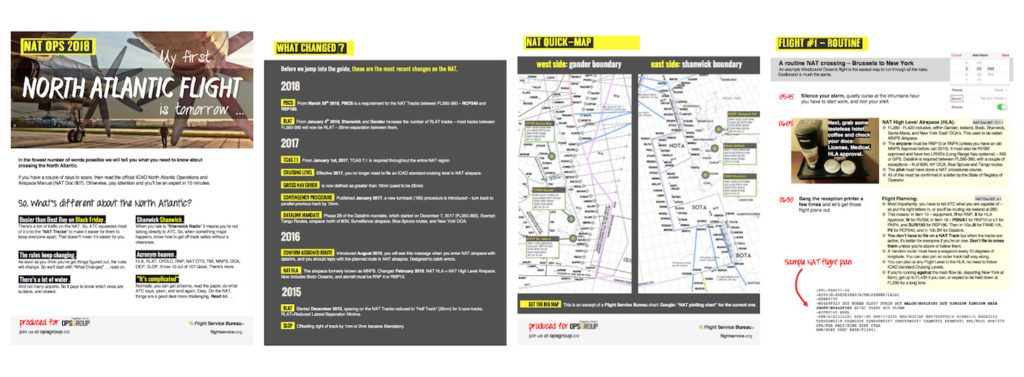
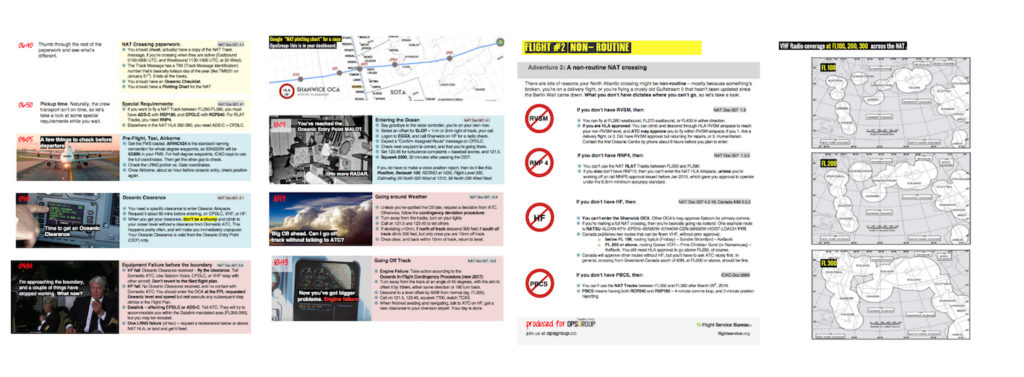
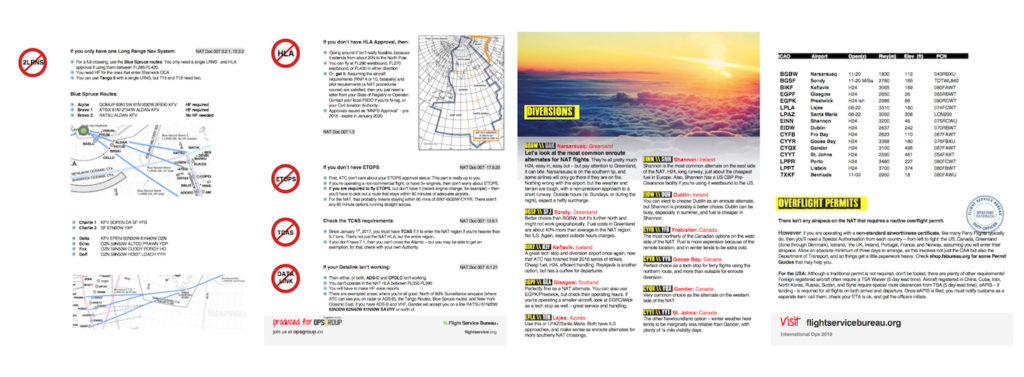
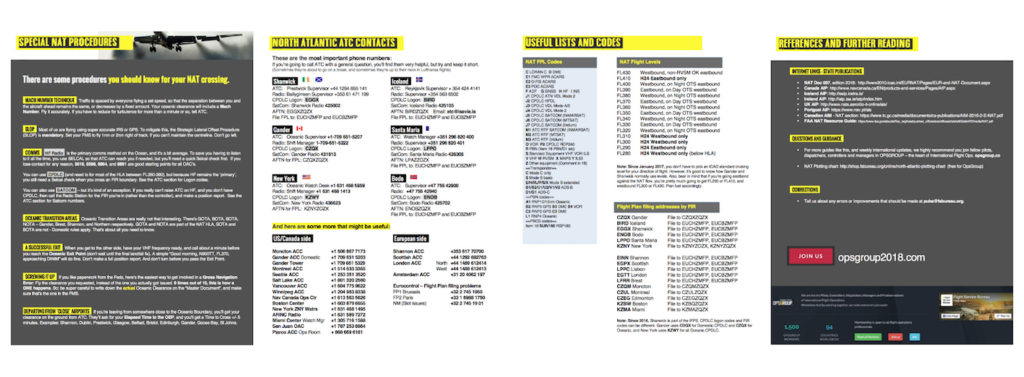
My first North Atlantic Flight is tomorrow – NAT Ops Guide (Updated 2018)

For the latest changes and updates on the North Atlantic, including our most recent Guides and Charts, use our NAT reference page at flightservicebureau.org/NAT.

Of all the hundreds of questions we see in OPSGROUP, one region stands out as the most asked about – the NAT/North Atlantic. So, we made one of our legendary guides, to get everything into one PDF.  It’s called “My first North Atlantic Flight is tomorrow” – and now we’ve updated it for 2018!

Contents:

  • 1. What’s different about the NAT?
  • 2. Changes in 2018, 2017, 2016, 2015
  • 3. NAT Quick Map – Gander boundary, Shanwick boundary
  • 4. Routine Flight Example #1 – Brussels to JFK (up at 5.45am)

  • 5. Non Routine-Flights: No RVSM, No RNP4, No HF, 1 LRNS, No HLA, No ETOPS, No TCAS, No Datalink – what you can do and where you can go
  • 6. Diversion Airports guide: Narsarsuaq, Sondy, Kef, Glasgow, Dublin, Shannon, Lajes, Fro Bay, Goose Bay, Gander, St. Johns
  • 7. Airport data
  • 8. Overflight permits – routine and special

  • 9. Special NAT procedures: Mach number technique, SLOP, Comms, Oceanic Transition Areas, A successful exit, Screwing it up, Departing from Close Airports
  • 10. North Atlantic ATC contacts for Shanwick, Gander, Iceland, Bodo, Santa Maria, New York – ATC Phone, Radio Station Phone, AFTN, Satcom, CPDLC Logon codes; and adjoining Domestic ATC units – US, Canada, Europe.
  • 11. NAT FPL Codes
  • 12. NAT Flight Levels
  • 13. Flight Plan Filing Addresses by FIR
  • 14. Links, Questions, Guidance

Excerpt from the Routine Flight #1:


Buy a copy ($20)   Get it free – join OPSGROUP

To get your copy – there are three options:

  1. OPSGROUP Members, login to the Dashboard and find it under “Publications > Guides”. All FSB content like this is included in your membership, or
  2. Join OPSGROUP with an individual, team, or department/airline plan, and get it free on joining (along with a whole bunch of other stuff), or
  3. Purchase a copy in the Flight Service Store!

More NAT half-tracks are coming

Update Jan 23: The current phase of the trial for RLatSM Tracks will come to an end on March 29, when PBCS standards will be introduced for the NAT tracks. More info on that here.

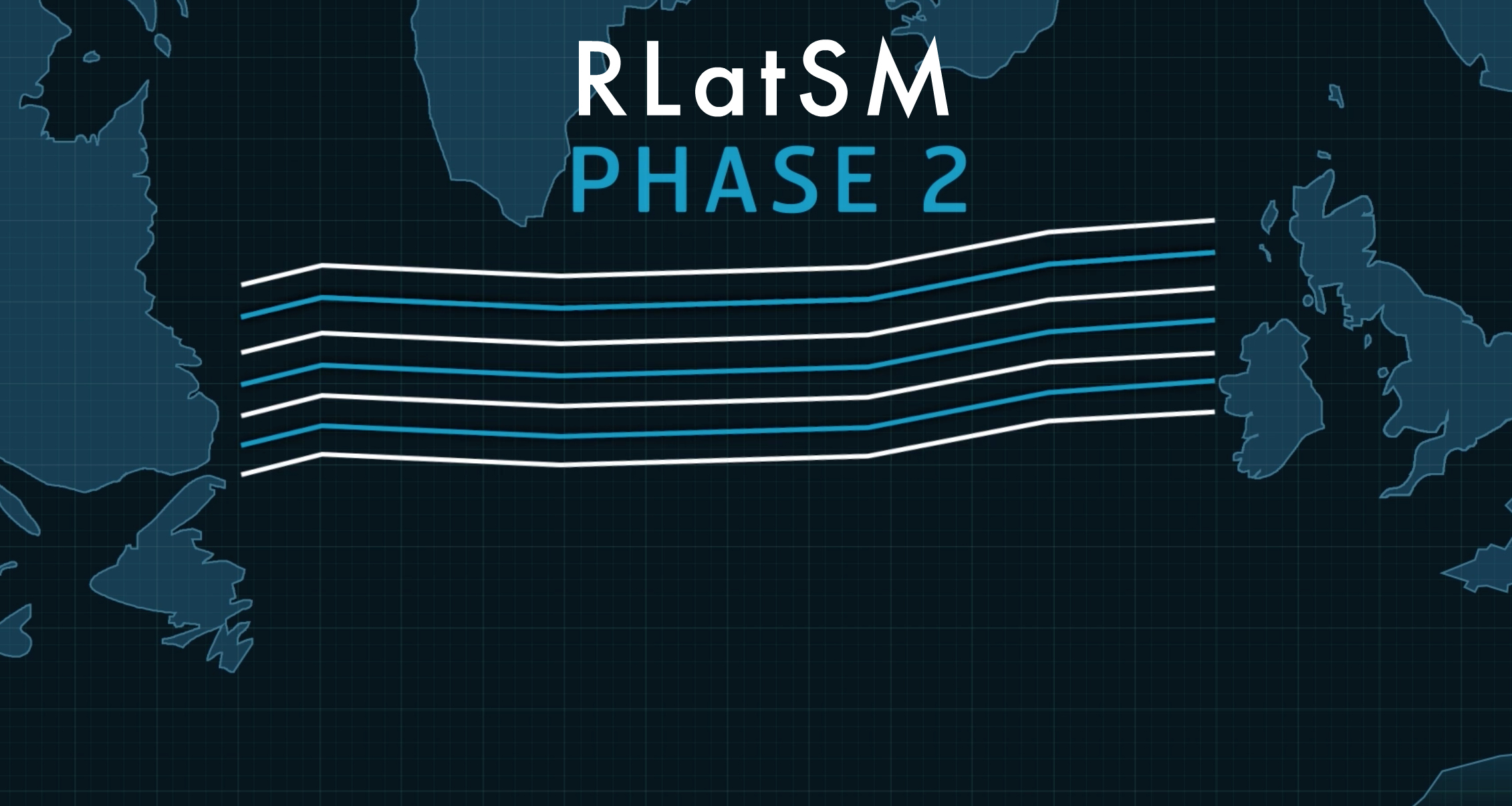
Since Dec 2015, there have been three daily NAT tracks spaced by one-half degree between FL350-390. These are officially called ‘RLatSM Tracks’ (Reduced lateral separation minima), but we all just prefer to call them ‘Half-Tracks’.

Separating flights by one-half degree of latitude rather than the standard one degree means that aircraft can be separated laterally by 25nm, which helps improve the efficiency of North Atlantic operations.

In Jan 2018 the Half-Tracks will be expanded from the three that now run each day, first by one additional track and then (maybe) to all NAT Tracks between FL350-390 inclusive. Jan 4 is the earliest day that this might happen, but because they will be decided tactically, it will most likely be the first busy day after Jan 4.

If you want to operate on the RLatSM tracks, you’re going to need CPDLC, ADS-C, and RNP4; along with the other standard pre-requisites for operating in the NAT HLA between FL350-390: an HLA approval, TCAS 7.1, RVSM approval, two LRNS, and a working HF radio. To figure out where you are welcome on the NAT, depending on what equipment and training you have, check out our quick and dirty guide here.

One thing to be cautious of when using the half-degree tracks – most aircraft FMC’s truncate lat/long waypoints to a maximum of 7 characters, so it will often show up as the same waypoint whether you’re operating along whole or half degree waypoints. So when operating on the half-tracks, just remember to double-check the full 13-character representations of the lat/long waypoints when you enter them into the FMC.

For more details about the new RLatSM procedures, have a read of the UK AIC 087/2017 here.


Iridium Fault Fixed

Last week we reported on an equipment issue with Iridium satcom that prompted a ban by a number of Oceanic ATC agencies. Some aircraft were receiving massively delayed clearances sent by ATC via CPDLC – and one took the instruction and climbed 1000 feet, even though the message was meant for the flight the aircraft operated previously.

Here were the areas which had previously published Notams restricting the use of Iridium: Brazil Atlantico (SBAO), Auckland (NZZO), Chile (SCIZ), Japan (RJJJ), Anchorage (PAZA), Oakland (KZAK), New York (KZNY and KZWY).

However, all FIR’s have now removed their notams which banned the use of Iridium for CPDLC and ADS-C. This has happened after tests were performed last week using Iridium SATCOM which confirmed that Iridium no longer queues CPDLC uplinks for more than five minutes.

Article header photo by @Zelgomat


New, single CPDLC logon for US airspace

In case you missed the several hundred Notams this week, KUSA is the new identifier for all datalink logons in the US, including CPDLC-DCL, and enroute, which came into use on October 22nd. Now, the only logon you need is KUSA.

For all you could possibly want to know about Datalink operations in the US, take a peek at the new AC90-117, ” an overview of data link communication operations for U.S. domestic
operations and in oceanic and remote continental airspace”, which we’ve uploaded here.

More readable is the FAA’s CPDLC-DCL guide, uploaded here.

There are some comments that it doesn’t work properly if you don’t have an active FPL in the box, let us know your experiences on that in the comment section below.


CPDLC Departure Clearance for US Airspace – 22Oct

Earlier this month we reported about the transition of the United States ATC system to a National Single Data Authority (NSDA). https://ops.group/blog/cpdlc-for-us-airspace-the-implementation-process/

The initial phase of this process is scheduled to start this weekend on 22Oct at 0330Z with a single CPDLC logon ID for domestic US airspace (KUSA) and ATC issuing departure clearances using CPDLC.

You can read more details about Controller-Pilot Data Link Communication–Departure Clearance (CPDLC-DCL), general procedures for logging on/notifying, loading the flight plan, receiving the CPDLC-DCL, responding to the CPDLC-DCL message, and disconnecting/logging off  here:

NAS Data Communications Guide


Oceanic ATC’s tell us their position on Iridium Satcom

Last week we reported on an equipment issue with Iridium satcom that prompted a ban by a number of Oceanic ATC agencies. Some aircraft were receiving massively delayed clearances sent by ATC via CPDLC – and one took the instruction and climbed 1000 feet, even though the message was meant for the flight the aircraft operated previously.

Today, we checked-in again with all the oceanic ATC centres, to see what their current policy is on the issue.

EGGX/Shanwick told FSB that they are aware of the issue, reviewed it, but have decided not to ban the use of Iridium for either CPDLC or ADS-C just yet. LPPO/Santa Maria have the same position. So, in this airspace, you can use Iridium, for now.

CZQX/Gander said they did a safety analysis of it, and decided not to ban it. They have all kinds of conformance alerts in place to prevent any problems from happening – so if aircraft deviate they get notified immediately.

BIRD/Reykjavik aren’t that concerned about the issue – they use HF most of the time anyway.

Chile (SCIZ)
Japan (RJJJ)
Anchorage (PAZA)
Oakland (KZAK)
New York (KZNY and KZWY)
All these centres have published Notams instructing crews not to use Iridium for CPDLC or ADS-C. Until the fault is fixed, in those regions you’ll have to either use HF for ATC comms, or use another SAT provider.

Auckland (NZZO) and Brazil (Atlantico SBAO) have applied the ban to CPDLC alone. Use ADS-C if you like.


From Iridium themselves, they told FSB: “We’ve updated their queue management system. Every minute, there is a queue check. If there is any message that is older than 4 minutes, it marks as timed out, and will not be delivered. This update was done at ground level, so it does not require any software updates by the user. We’re still waiting on feedback from FAA workgroup on the fix and if it’s sufficient to allow use of Iridium for CPDLC and ADS-C.”

That’s it for now! We’ll keep you posted, or, even better – tell us below in the comment section if you hear news.


Iridium fault prompts ban by Oceanic ATC

Aircraft Operators using the Iridium Satellite service for ATC comms should be aware of an equipment issue that has prompted a ban by a number of Oceanic ATC agencies in the last few days

Right now, Chile (SCIZ), Japan (RJJJ), Anchorage (PAZA), Oakland (KZAK), New York (KZNY and KZWY) have all told operators not to use Iridium for CPDLC or ADS-C. Until the fault is fixed, in those regions you’ll have to either use HF for ATC comms, or use another SAT provider. Auckland (NZZO) and Brazil (Atlantico SBAO) have so far only applied the ban to CPDLC alone. Nothing has been published yet by Gander (CZQX), Shanwick (EGGX), Reykjavik (BIRD) or Santa Maria (LPPO) – although we’re keeping a close eye on them for any update.

Here’s what happened:

On Sep 12th, an Alaskan Airlines flight had a failure of their CMU (Comms Management Unit) that caused the Iridium connection to stop working. An ATC message was sent to the aircraft but not delivered. On the next flight, the CMU power was reset and corrected the issue, and the pending message was delivered. The CMU did not recognise the message as being old, and so it was presented to the Flight Crew as a control instruction. FSB understands that this aircraft took the climb instruction and executed the level change, climbing 1000 feet .

Another flight, operated by Hawaiian out of Oakland, had a similar problem. This aircraft had both Iridium and Inmarsat on board, and during the flight switched over to Inmarsat as the provider. An ATC message was routed via Iridium, but didn’t reach the aircraft before the switch. Some 23 hours later, on the next flight, Iridium was activated again and again the ATC message presented as a “live” instruction. On this occasion, the crew queried the instruction and did not climb.

The problem in simple terms is that if ATC sends a CPDLC message like “Climb FL370“, which is obviously only valid for “right now”, but another crew gets the message hours later, then you have a very high risk of the new crew accepting that and climbing.

For now, Iridium has a plan to fix the ground side to not allow older SBD messages to be delivered, and they say they are testing it at the moment and expect to release it soon.

OpsGroup members will be updated directly on further news.

Notam copies below:

ANCHORAGE PAZA A0626/17 - USE OF CPDLC AND ADS-C VIA IRIDIUM SATCOM IS PROHIBITED WITHIN THE ANCHORAGE OCEANIC, DOMESTIC AND ARCTIC FLIGHT INFORMATION REGIONS (FIRS). SFC - UNL, 13 OCT 19:40 2017 UNTIL 13 NOV 00:00 2017 ESTIMATED. 
CREATED: 13 OCT 19:35 2017
NEW ZEALAND AUCKLAND NZZO B4985/17 - USE OF CPDLC (DATALINK) VIA IRIDIUM SATCOM 
IS PROHIBITED WI NZZO FIR. COMMUNICATION WI NZZO FIR IS TO BE VIA HF 
RDO ON THE APPROPRIATE SP6 FREQ. OPERATORS USING IRIDIUM SATCOM MAY 
CONTINUE TO USE ADS-C FOR POSITION REPORTING WI NZZO FIR. HF VOICE 
POSITION REPORTS ARE NOT REQUIRED UNLESS SPECIFICALLY REQUESTED. 
08 OCT 21:56 2017 UNTIL 08 JAN 21:00 2018 ESTIMATED. 
CREATED: 08 OCT 21:56 2017
OAKLAND KZAK A4306/17 - FOR ACFT EQUIPPED WITH IRIDIUM SATCOM, USE OF CPDLC AND ADS-C VIA IRIDIUM SATCOM IS PROHIBITED WITHIN OAKLAND CENTER OCEANIC AIRSPACE. COMMUNINCATION WITH KZAK MUST BE VIA HF FOR IRIDIUM USERS. 
13 OCT 19:49 2017 UNTIL 31 DEC 23:59 2017. CREATED: 13 OCT 19:54 2017
NEW YORK KZNY A0334/17 - USE OF CPDLC AND ADS-C VIA IRIDIUM SATCOM IS PROHIBITED WITHIN NEW YORK CENTER OCEANIC AIRSPACE. 13 OCT 19:27 2017 UNTIL 30 DEC 08:00 2017. CREATED: 13 OCT 19:38 2017
NEW YORK KZWY A0502/17 - USE OF CPDLC AND ADS-C VIA IRIDIUM SATCOM IS PROHIBITED WITHIN NEW YORK CENTER OCEANIC AIRSPACE. 13 OCT 19:27 2017 UNTIL 30 DEC 08:00 2017. CREATED:13 OCT 19:36 2017
BRAZIL ATLANTICO SBAO N0095/17 - FOR ACFT EQUIPPED WITH IRIDIUM SATCOM, 
USE OF CPDLC IS PROHIBITED WITHIN ATLANTICO CENTER OCEANIC AIRSPACE. 
FLIGHT CREWS CAN LOG ON SBAO TO ALLOW THE USE OF ADS-C FOR POSITION 
REPORTING. COMMUNICATION WITH SBAO MUST BE VIA HF. IF USING ADS-C 
POSITION REPORTING, HF VOICE POSITION REPORTS ARE NOT REQUIRED 
UNLESS SPECIFICALLY REQUESTED. 15 OCT 12:00 2017 UNTIL
13 JAN 12:00 2018.  CREATED: 15 OCT 01:22 2017
JAPAN FUKUOKA RJJJ J7236/17 - FOR ACFT EQUIPPED WITH IRIDIUM SATCOM, USE OF CPDLC AND ADS-C VIA IRIDIUM SATCOM IS PROHIBITED WITHIN FUKUOKA OCEANIC AIRSPACE. COMMUNINCATION WITH RJJJ MUST BE VIA HF FOR IRIDIUM USERS. 16 OCT 10:08 2017 UNTIL UFN. CREATED: 16 OCT 10:09 2017

CPDLC for US Airspace: The Implementation Process.

Update 03Oct: The FAA has released AC_90-117, which is their updated overview of Data Link Communications.

  • The United States ATC system transition to a National Single Data Authority (NSDA) is here.
  • The changeover will take place on 22Oct at 0330Z
  • A single CPDLC logon ID (KUSA) will be provided for domestic US airspace.
  • The initial phase is set up to issue departure clearances only
  • En-route CPDLC communications within US airspace will be implemented at a later time.
  • More details about the transition process are found here NSDA – Data Comm Program
  • We’ll post further information as it becomes available

Shanwick Bogus Messages

Just around New Years, a story started growing legs about Bogus CPDLC messages from Shanwick and Gander. In the most worrying version of events, the G550 crew received a “Descend at Max Rate” type message on CPDLC, and when they checked on voice with ATC it hadn’t come from them.

We had lots of replies on this – both by email and in slack, thanks everyone! So here is the event summary as pieced together by the community:

– This was a single event that happened in December, at 0500Z one morning, to a G550
– It was caused by an avionics bug in the FMS – a valid error message was parsed incorrectly and assigned a value of “Descend at max rate” by the FMS, which appeared on the screen.
– Fears of it being some kind of spoofing or hack are unfounded. The initial story spread like wildfire! But ultimately, a non-event.

Confirm Assigned Route

This was the second part of the concerns about CPDLC messages from Shanwick. Lots of crews have been getting an FMS message after passing the Oceanic Entry Point saying “Confirm Assigned Route”. We’ve probably gotten 50 distinct messages/emails/queries on this. Many crews don’t know quite what this is or what to do with it, and many wondered if it was also a “bogus message”.

This is normal. It’s a new procedure, and this message is now automatically sent by Gander, Shanwick, and Iceland. The reason for the message, is to act as a cross check, now that we’re all cruising with 30 miles between us instead of the old school 60. When you do “Confirm Assigned Route”, then ATC knows that you’re both on the same page.

We first mentioned it here in November, have a read. The only recent update is that Gander and Iceland have automated the CPDLC message, so everyone that logs on will get the “Confirm Assigned Route” message.


Monday Briefing: North Atlantic OTS Changes, Indonesia Volcano Eruption

North Atlantic OTS Changes this week 09NOV This Wednesday (12NOV) sees the implementation of the new NAT Track OTS, marking the first change to the lateral structure since the tracks were introduced in 1965. New requirements include RNP4, and 24 new Oceanic Entry Points come into effect. See below for further.

Indonesia Volcano Eruption 09NOV Operations into WADD/ Denpasar, Bali continue to be disrupted due to ongoing eruption of Mt. Rinjani on Lombok Island. Also affected are nearby WARB/Blimbingsari and WADL/Lombok.


EINN/Shannon FIR CPDLC service is withdrawn on the evening prior to implementation of the new NAT Track system, voice service only from 1715Z onwards on 11NOV.

LGGG/Athens FIR Strike of Greek Radio Operators (thereby including AFTN messaging, and AFIS) announced this morning for 12NOV. Overflights will not be affected. Full details here.

HESH/Sharm el-Sheikh remains open but subject to multiple advice notices from international Authorities. Many airlines have cancelled operations into the airport after increasing suspicions that a bomb was loaded here onto the A320 which crashed into the Sinai Desert.

HLLL/Tripoli FIR Libya has issued updated advice regarding airport availability – HLLQ, HLTQ and HLZW are only available for international arrivals, daylight hours only. PPR and Permit is required prior operations.

SCFZ/Antofagasta ACC, Chile. Crews on Airways UL780 and UL302 are requested to inform ATC of any speed changes greater than .02 Mach; if unable on VHF, use HF 10024. The procedure is to ensure separation between succeeding aircraft operating on CI speeds.

SBXX/Brazil The Brazilian Grand Prix takes place 13-15NOV making Sao Paulo operations at SBSP/Congonhas, SBGR/Guarulhos, and SBKP/Campinas busier than usual.

RPLL/Manila, Philippines APEC 2015 Summit being held 17-20NOV. Check restrictions, many commercial flights have been suspended during this period. Parking at a premium. Consider quieter alternates such as RPLC/Clark.

YXXX/Australia Australian Border Force strike commencing midnight 09NOV across Australian airports. As a result, departure and arrival processing at Australian airports may take longer then usual.

WADD/Denpasar, Indonesia Operations here continue to be disrupted due to ongoing eruption of Mt. Rinjani. Also affected are nearby WARB/Blimbingsari and WADL/Lombok. For updates monitor http://www.bom.gov.au/products/Volc_ash_recent.shtml

LIXX/Italy Possible ATC strike on 14NOV 1200-1600Z announced.

KXXX/US Airport Runway closures: BWI-RWY 10/28 CLOSED SEA-RWY 16C/34C CLOSED LAS-RWY 7L/25R CLOSED

KLAS/Las Vegas NBAA 2015 will take place 17-19NOV limiting airport capacity.

HECC/Cairo FIR, Egypt Point PASOS (LCCC FIR) is again available in both directions for flight planning. Please be aware flights departing OLBA via LCCC must file via VELOX-PASOS. Also see HECC NOTAM 1A277/15 and 1A278/15 for flight planning guidance.

VHHH/Hong Kong Arrival and Departure delays up to 30 minutes can be expected due to a flight check and maintenance on RWY 07L/25R on 09NOV 0530-0100 and 10NOV 2300-0100.

Caribbean Tropical Weather Advisory Shower and thunderstorm activity is showing signs of organization in association with a low pressure system located just north of the Turks and Caicos and the southeastern Bahamas. A tropical depression or a tropical storm is likely to form on Monday while the low moves west-northwestward to northwestward near or over the central and northwestern Bahamas. For further details see National Hurricane Center

KLAX/Los Angeles Due to military operations of the coast of LAX there is a risk of arrival delays and reroutes during the overnight periods until Nov 12th.

MWCR/Grand Cayman may be forced to shorten the runway at Owen Roberts International Airport (MCWR/GCM). The runway, which was extended to accommodate long-haul flights, may have to be shortened in order to accommodate a 400 ft/124 m safety area. An extension of the runway cannot be further extended, and the airport authority is examining all options.

CYYQ/Churchill has amended opening hours 1200-2200Z M-F.

PKWA/Bucholz has revised ATC hours from 01NOV, 0800-1230 and 1330-1600LT.

NWWW/Tontouta has a main runway closure 09-12NOV at various times, some daytime. Check NOTAM 1543/15.

EGPF/Glasgow is closed overnight 22NOV-11DEC for runway and taxiway repairs.

DRRR/Niamey Ouagadougou ACC is now operational H24 again; the previously implemented contingency plan for traffic operating outside ATC service hours is withdrawn.

View the full International Operations Bulletin for 09NOV2015.