Airspace update: The Russia-Ukraine border conflict

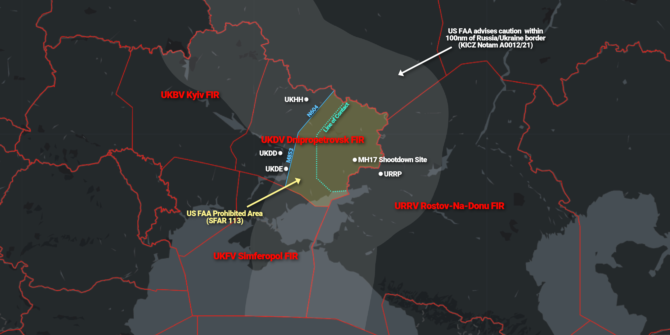
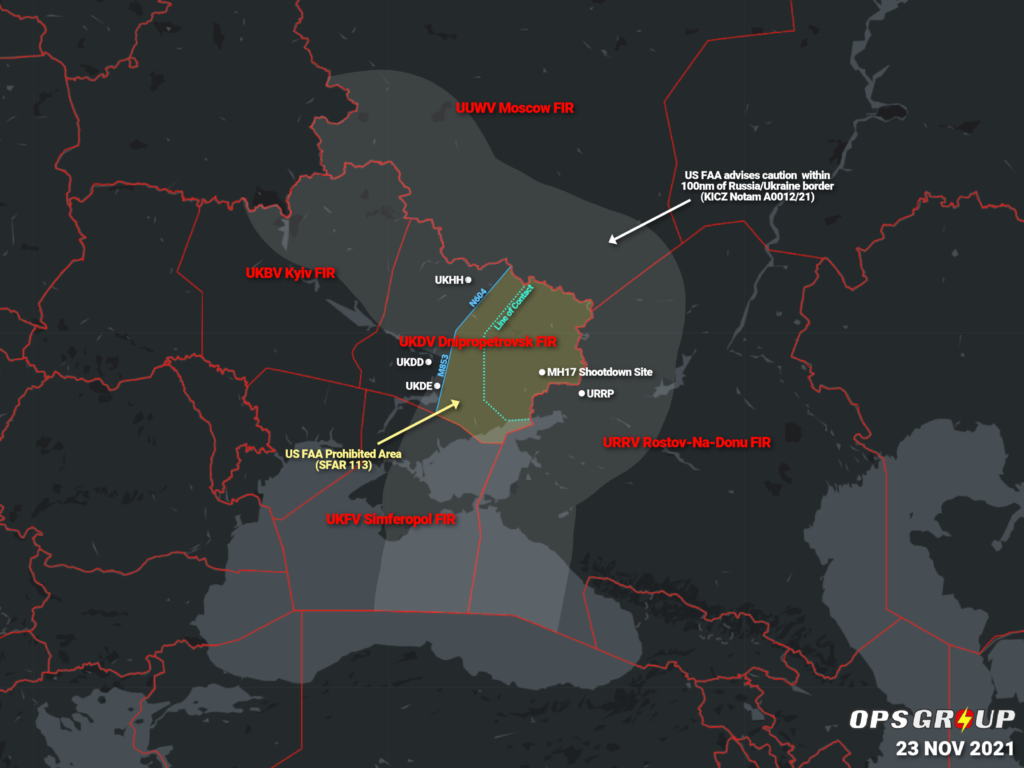
Long-standing airspace warnings are in place for the Russia/Ukraine border region due to the ongoing conflict. But with recent reports of increased military activity along the Russian side, the concern is Russia may be considering renewed military action including incursions into the Ukraine which would further destabilise the region.

The most recent report suggests large escalation in activity near Maslovka in Belgorod Oblast and around URRP/Platov International Airport in Roston-On-Don Oblast.

URRP/Platov International Airport is the main airport serving this region, and is relatively new – only having opened at the latter end of 2017. It is primarily used by short haul operators to connect to Middle East and Eastern European destinations. The airport has a single runway 05/23 which is 11811ft/3600m in length and has CAT II capability.

Reports suggest Russia is using equipment to jam Ukrainian surveillance drones. Such equipment could affect civilian aircraft, although the range would most likely be limited to the region along the border where airspace warnings already apply.

Further implications.

The US and Europe are encouraging de-escalation. If sanctions were taken against Russia, this could lead to potential gas and fuel shortages as Russia is a major contributor to Europe for these.

There are some tensions between Russia and Europe due to sanctions imposed against Belarus back in May, following the interception of an international flight bound for Lithuania and forced to land in Minsk.

What is the background?

There is an active conflict zone in eastern Ukraine along the border with Russia. The main hotspot is the Line of Contact which runs through the UKDV/Dnipro FIR.

The FAA warned of increased tensions in April 2021, but these were thought to be easing with reports of Russia withdrawing much of their forces. In October 2021 the FAA updated their SFAR extending the flight ban on eastern part of the UKDV FIR to Oct 2023.

What are the current warnings?

The FAA bans US operators from overflying the eastern part of the UKDV FIR, and warns operators to exercise extreme caution within 100nm of the entire Russia-Ukraine border. Several other states have also issued airspace warnings for eastern Ukraine.

A full review of the major warnings can be found at safeairspace.net

What is the risk leading to these warnings?

The primary risk is for operations near the Russia-Ukraine border in the UKDV/Dnipro FIR. Should hostilities escalate here, the airspace on both sides could be exposed to potential weapons activity posing a risk to civil aircraft from misidentification or miscalculation.

The secondary risk affects the UKFV/Simferopol FIR which is disputed airspace. (Ukraine:UKFV, Russia:URFV). The risk here stems from aircraft potentially receiving confusing and conflicting air traffic control instructions from both Ukrainian and Russian ATC when operating over the region.


Limited fuel in Kazakhstan for bizav flights

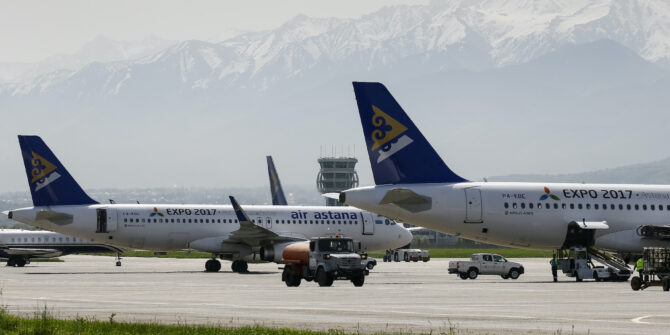
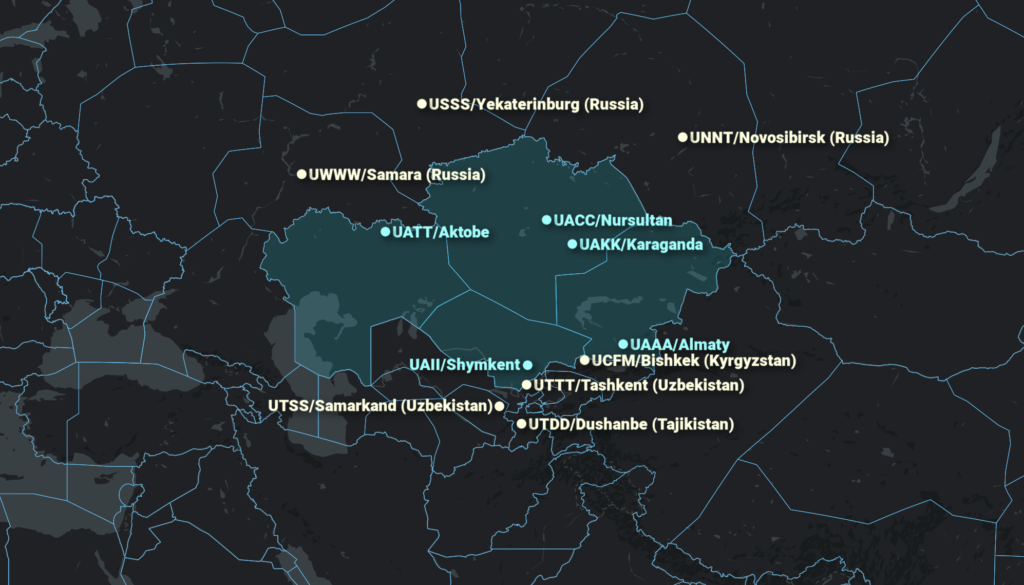
There’s currently a big fuel shortage in Kazakhstan. Local agents have said that fuel is currently only available to foreign registered bizav flights on a case-by-case basis at airports across the country, including the main international airports UAAA/Almaty, UACC/Nursultan and UAKK/Karaganda.

Fuel is still being provided to commercial flights and some charters on KZ registered aircraft, but foreign registered non-scheduled flights should tanker fuel inbound.

None of the airports have published Notams warning of fuel supply issues, but local press have reported that UACC/Nursultan has suspended refuelling of cargo aircraft, and UAAA/Almaty has confirmed interruptions in their fuel supply and has warned of possible restrictions.

Kazakhstan airports are often used as fuel stops for flights between Europe and Asia. So until the fuel shortage ends, consider using alternative airports to the south in neighbouring Kyrgyzstan and Uzbekistan, or potentially those airports to the north in Russia if headed to destinations in northern China or Japan.


We have Clearance, Clarence

You carefully type it up, have the other pilot check it, then hit send… and wait… your airplane is creeping closer and closer to the Oceanic Entry Point and still no reply, and then DISASTER! Clearance Request Rejected! Or worse still, you just never get a response…

Here are some hints, tips (and actual procedures) related to getting your Oceanic Clearance for the NAT HLA. And what to do if you don’t…

How to get your clearance.

There is a datalink mandate across the vast majority of the NAT HLA which means everything has headed towards “messages” rather than voice. Why? Because it’s easier and there is a lot less risk of mess-ups and mix ups. So, most likely, you are going to be requesting your clearances via “message” as well. The system it goes through is generally the Arinc 623 – the same you use for things like your D-ATS. Contrary to CPDLC, A623 exchanges don’t require previous notification. But enough of that technical schtuff.

If you ttake a look through the North Atlantic section of *whichever manual* you are using and somewhere under COM and ATC Communications you will find a section on ‘Oceanic Clearance Request via Data Link’. Each OCA has its own thing to say in terms of times to send it and reverting to voice, but in general the message you want to send when requesting your clearance is the same for them all.

You need to include Entry Point, ETA for Entry Point, Requested Mach Number, Requested Flight Level and add a remark (RMK/) indicating preferred alternative (another NAT Track) and MAX FL. You only have 80 characters available to you so don’t go adding extra comments in, it will probably just get rejected.

After sending your clearance request you should receive an advisory message which says something like this –

“IF NO CLEARANCE RECEIVED WITHIN 30 MINUTES OF OCEANIC ENTRY PONT REVERT TO VOICE PROCEDURES END OF MESSAGE”

If you don’t receive this within about 5 minutes of sending the question, something has possibly gone wrong. Try sending again if you can still meet the minimum time to boundary for a request, or revert to voice.

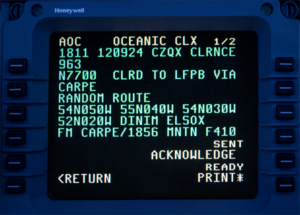
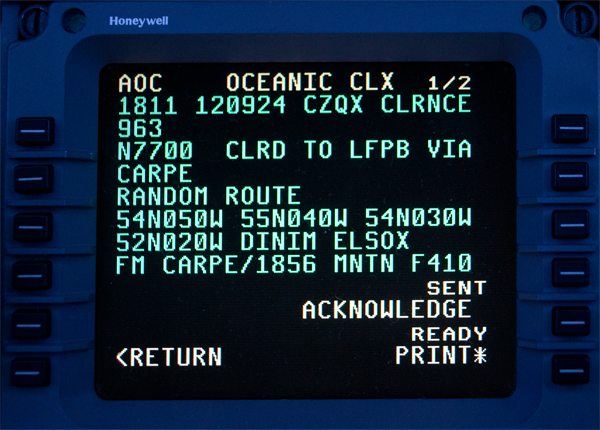
A nice example of your Oceanic Clearance

The times you want to think about sending your RCL through at vary from OCA to OCA, as do the logon addresses, so here is a rundown of each one…

Shanwick

  • The logon is EGGX.
  • Shanwick want your request sent no later than 30 minutes before the OCA boundary, but no earlier than 90 minutes or they’ll reject it.
  • If you haven’t received your clearance and are within 15 minutes of the OCA boundary then revert to voice. If you are East of 020W then try Shanwick Radio on 127.9 to help reduce chatter on HF. Only give HF a go if you are within 40 minutes of the boundary and having issues getting VHF signal.
  • For Shanwick Oceanic you have two frequencies – 123.950 is for aircraft registered in States West of 030W. 127.650 is for aircraft registered in States East of 030W.

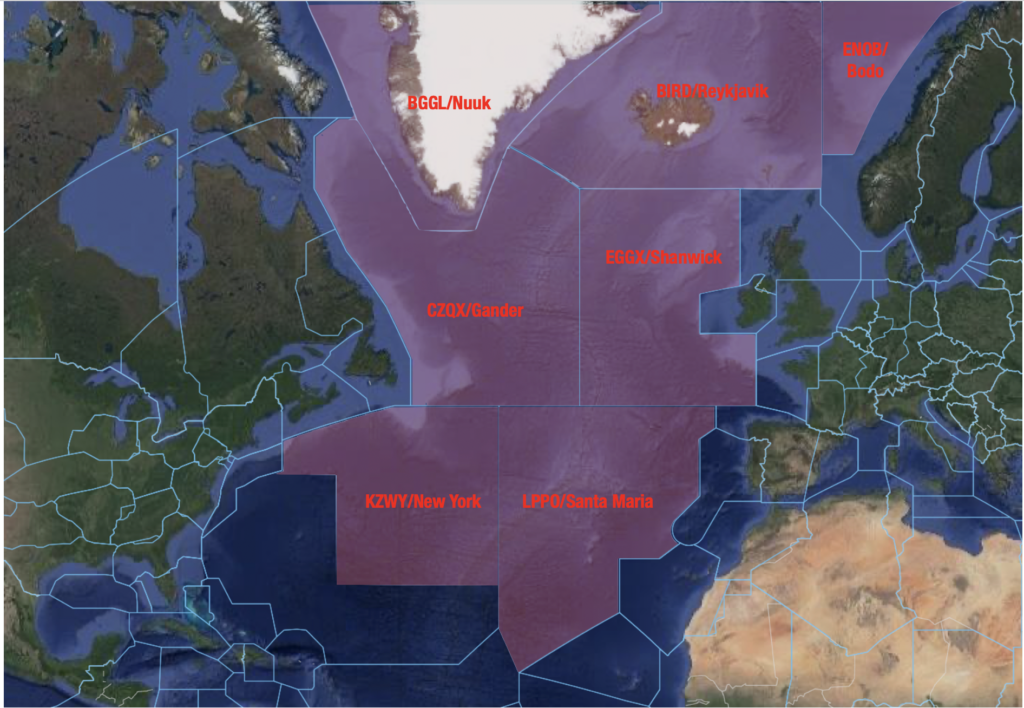
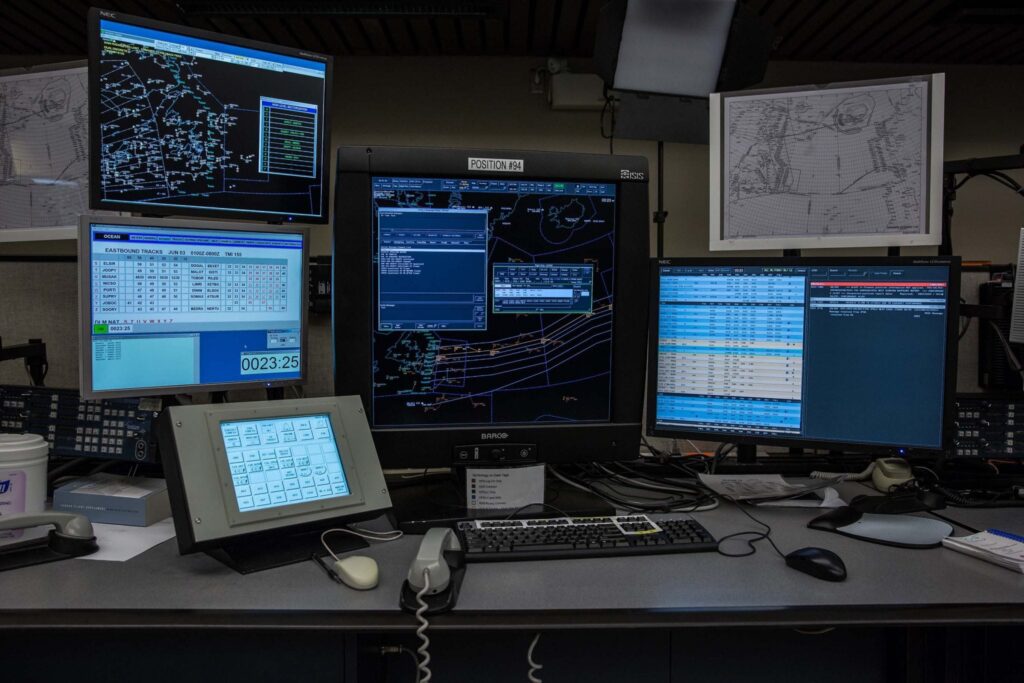
ATC NAT Controller station

Gander

  • The logon is CZQX
  • The request should be sent just after the aircraft gets within 90 minutes of the OEP. If you don’t receive the advisory message within 5 minutes, or if you haven’t received a clearance and are within 30 minutes of the OEP then revert to voice.
  • Gander is a little tricky with working out which frequency to use. It comes down to where you are routing via:
    • Natashquan 135.460
    • Allan’s Island 128.450
    • Churchill Falls 128.7
    • Stephenville 135.050
    • Sydney 119.425
    • Brevvoort 132.025
    • Kuujjuaq 134.2

Reykjavik

  • The logon is BIRD.
  • How far in advance you need to request your RCL depends on where you are entering from (which CTA). The time is the minimum time from the BIRD CTA Entry Point that they should receive your RCL by and the general rule is 20-25 minutes.
    • Stavanger (ENOR) 25 mins
    • Scottish (EGPX) 25 mins
    • Edmonton (CZEG) 45 mins
    • Murmansk (ULMM) 30 mins
  • If you have Inmarsat datalink then you probably won’t be able to get your clearance while north of 82°N. If you’re on an Iridium or HF datalink system then you’re in luck.
  • If you have to get your clearance via voice then you can try Iceland Radio on VHF Primary 127.850 or Secondary 129.625. They are also on the HF B, C and D families but you’re having a bad day if it’s reaching that level.

Bodø

  • The logon is ENOB.
  • Request your clearance at least 30 minutes before the NAT region boundary. Revert to voice if you’re within the 20 minutes mark on 127.725.

Santa Maria

  • The logon is LPPO.
  • Send your request 40 minutes before the OEP. If you need to request clearance by voice then talk to Santa Maria Radio on 127.9 or 132.075.

New York

  • The logon is KZWY.
  • This works a little differently if you are routing from the US because your clearance is going to be included in your departure clearance (since you’re basically in the area anyway). You can logon 30-45 minutes before.

What to do if you don’t get a clearance?

Shanwick is really the main one to worry about – having a clearance (being in contact with ATC) is pretty darned important there because it is such a big area and extremely busy.

Always give yourself time. If a clearance isn’t received, try by voice. If you can’t get through then try other frequencies and ATCs. If you reach a boundary without a clearance then chances are it’s because you have some sort of comms loss in which case this is now your bigger concern.

In theory, you could enter the NAT HLA (aside from via Shanwick) without a clearance (with loss of comms) and fly as per your flight plan route (Mach and Levels) but it really, really isn’t advisable.

What to do when you do get your clearance.

It goes without saying that first up you need to acknowledge it with ATC. After that you’ll want to check it, and get the other pilot to as well. Printing it out is a good way to do this if you have that option. “Checking it” means checking what you’ve been cleared to do is what you’re asking the aircraft to do via its nav computer.

Finally, make sure you really are flying it by monitoring it and doing your plotting (or equivalent) checks. You can read about that here if you’re not sure how.

A helpful summary.

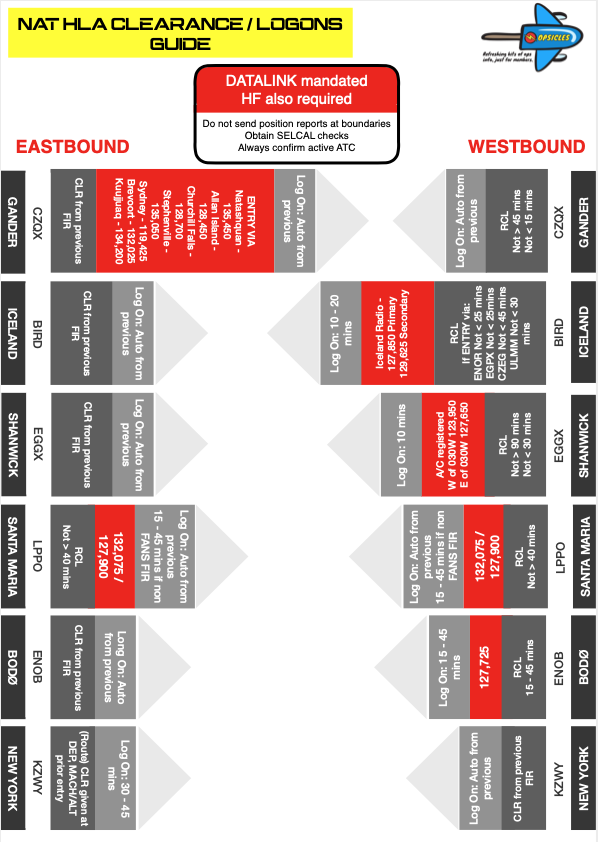
We created a little Opsicle  – a refreshing bit of ops info, just for members. Which means if you are an OPSGROUP member you can click on the pic to get yours. This one summarises all the logon info we wrote about above!

Click on the pic to get your original Opsicle stick

Where is the official info?

The info is contained in AIPs, and some of it within ICAO NAT Doc 007.

We might have missed some things, or made a mistake so if you spot one let us know!


Something to help with NAT Contingencies

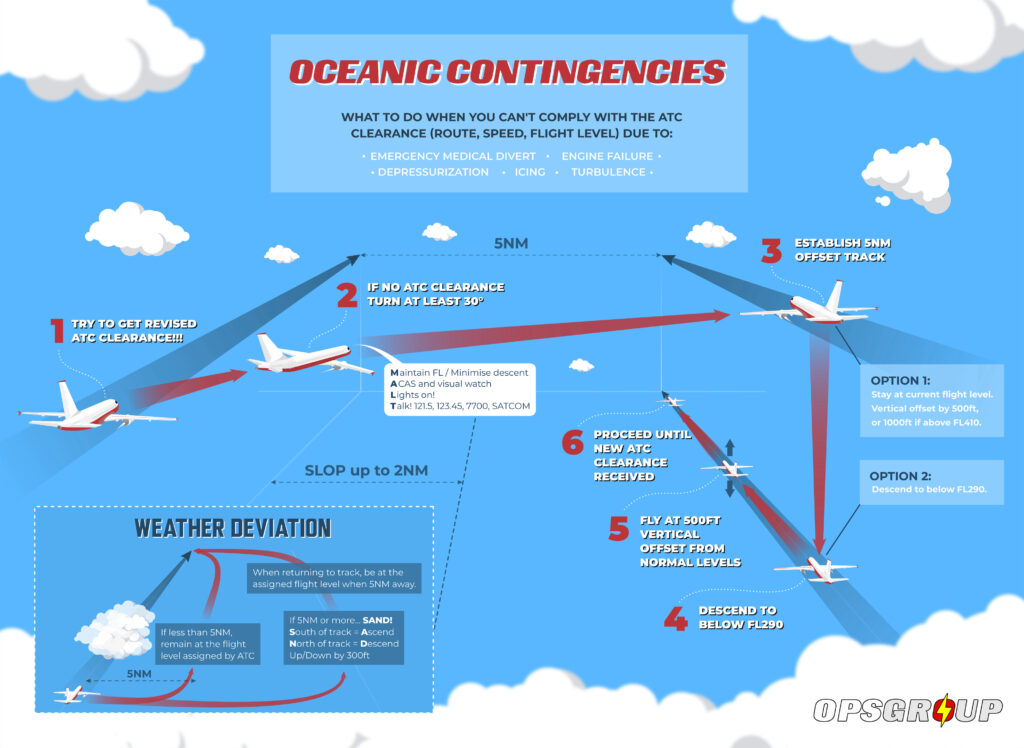
There are standard contingency procedures to follow if you are in the NAT HLA, they have been around for a while. But folk still struggle with them from time to time (so would we at 3am over the North Atlantic if we had to suddenly try to remember what they were while things were breaking or storms were flashing).

We have written about this before. Here’s how it works:

Unfortunately, sometimes folk still do get it wrong.

The most common mistakes seem to be people applying a contingency procedure when they are in contact with ATC (ATC will give you a revised clearance if you need it so check first before diving into a contingency manoeuvre).

Sometimes though, we just don’t quite do it right because there are a few little steps to follow depending on what is going on. For example, if you are deviating around weather, then the first step is to try and get a re-clearance from ATC. If you can’t get one, that’s when you follow the contingency procedure, and then what you do depends on whether your detour is less than or more than 5nm…

So we decided to make something else to help…

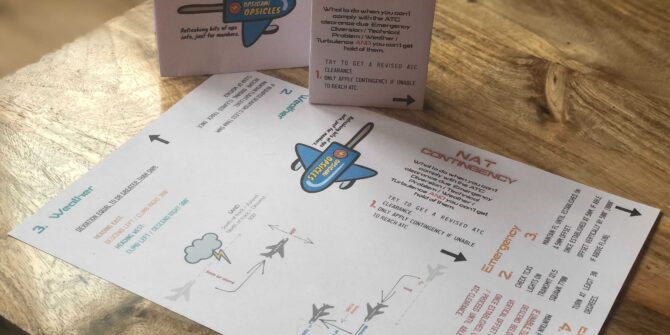
Introducing the Opsigami Opsicle

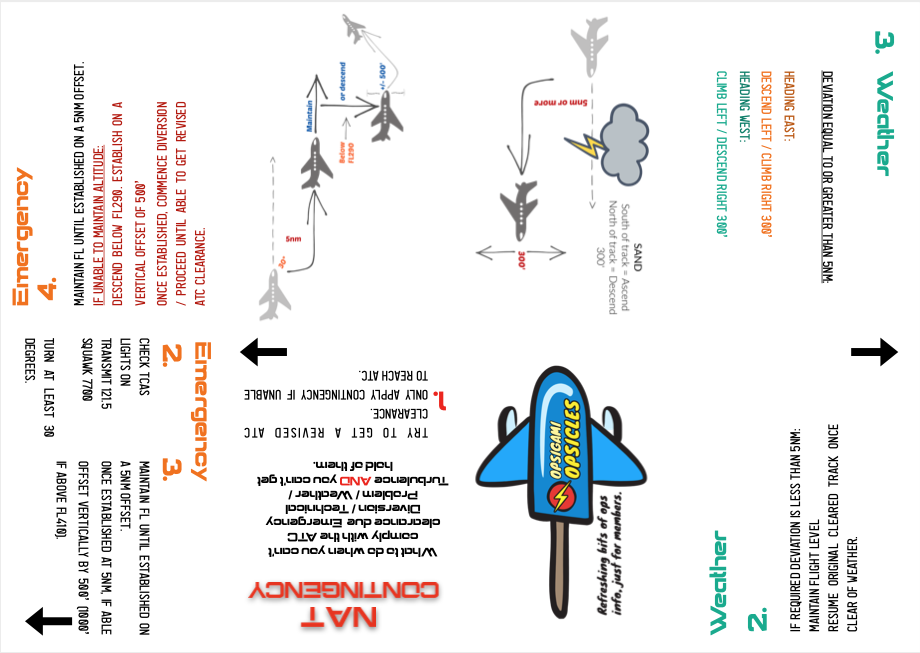
The NAT Contingency Opsigami Opsicle is less exciting than it sounds. It is the two contingencies – for emergencies and for weather – laid out step by step. That’s the Opsicle part.

The Opsigami bit(Origami with an Ops twist) is because if you print it out (and fold it correctly) then it will give you each step in order to help you follow it as you need to.

It looks like this:

Click on the pic for your downloadable version.

And it works like this:

We made this for OPSGROUP members – we hope you find it useful!

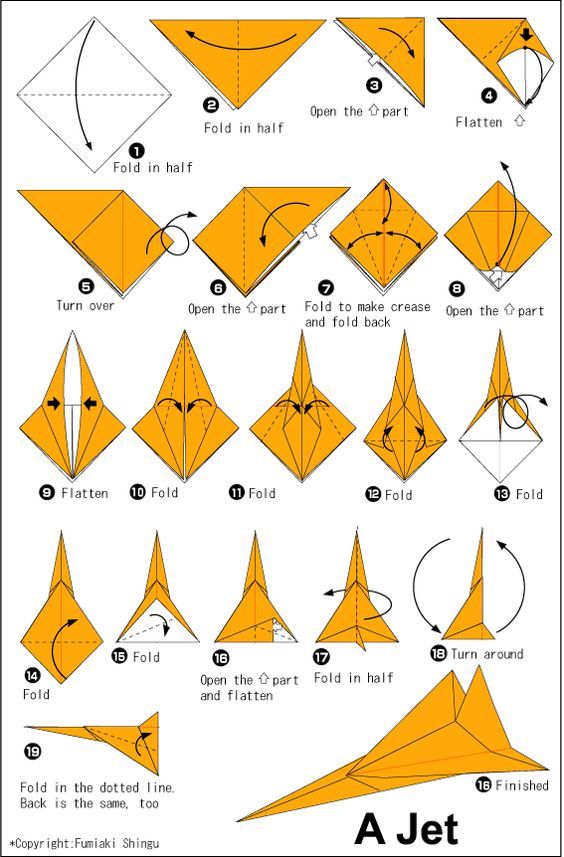
Just in case you don’t, here is a great Origami (ok, paper airline) design which you can fold it into instead 🙂

Looks like it would fly far.


Rocket Debris in Bodø

On November 16 the Arianespace Vega rocket, otherwise known as VV20, will be launched from French Guiana.

The rocket will carry some Ceres satellites for the French military into space.

Will the launch affect aviation?

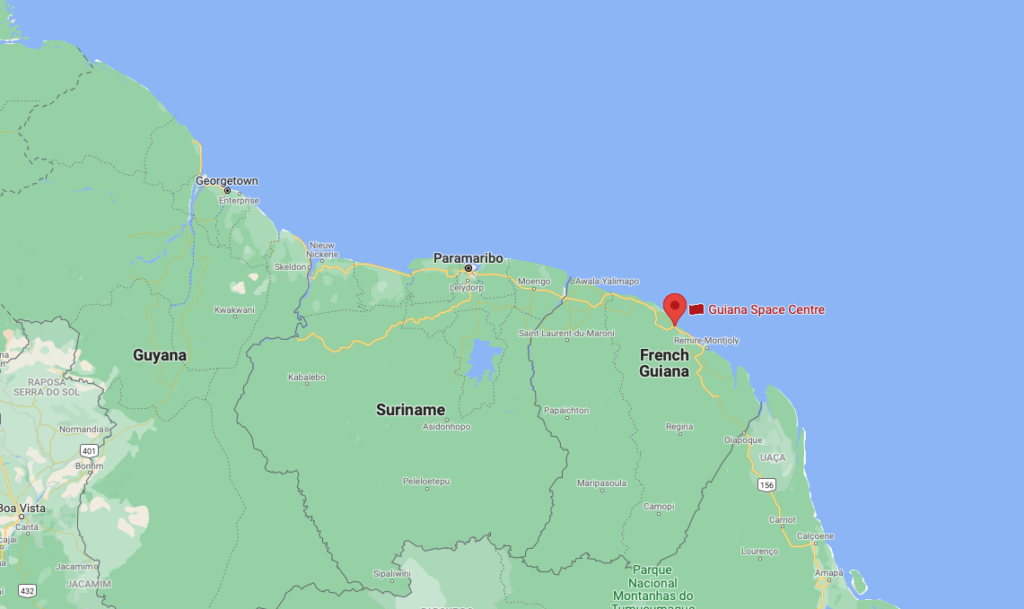
The Guiana Space Centre, also known as Europe Spaceport is a French (and rest of Europe) launch site.

It is here –

To give some worldwide context.

So if you are flying into SOCA/Cayenne or SMJO/Paramaribo airports (or any of the smaller domestic ones around there) on that day you might want to watch out for some prohibited airspace around the Space Center.

You can read more about the space centre, and this upcoming mission, on the Space Center website, and if you are in the area go check it out or even watch the launch.

But in general, the actual going-up-of-the-rocket is not the issue. It is the bits that come down again that are.

Where are the bits going to come down?

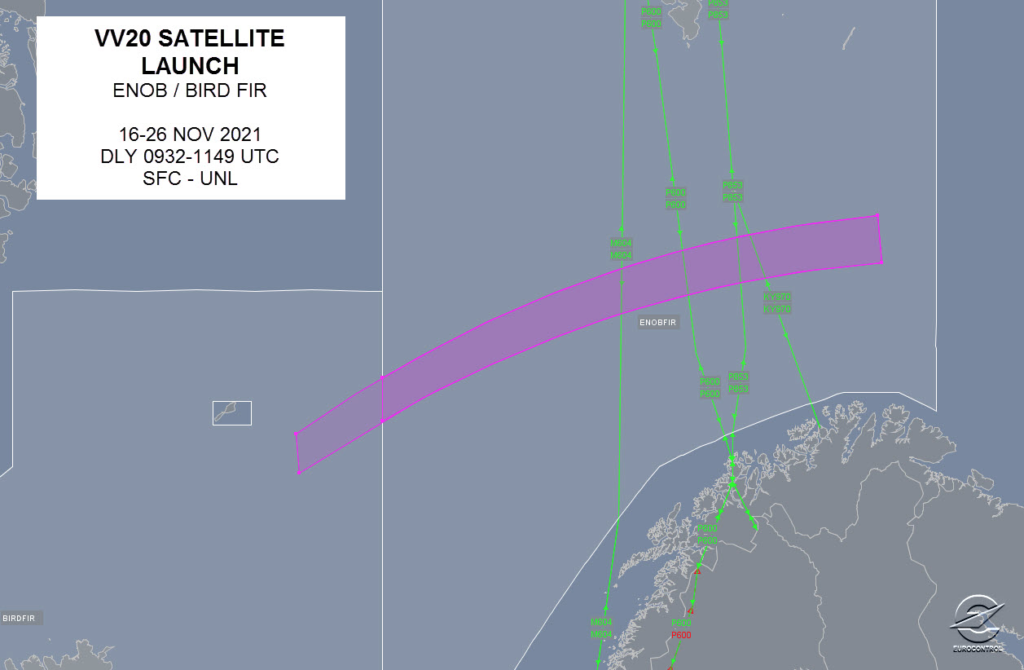
The launch has a northbound trajectory and as the third stage detaches, debris from this is expected to fall somewhere in the ENOB/Bodø or the BIRD/Reykjavik Oceanic FIRs – both of which are of course part of the North Atlantic region where a fair amount of of traffic often tends to be.

The latitude is from around 70°50N to 74°10N so is unlikely to impact the NAT HLA organised track system, but may impact some random route or polar flights.

So there will be a restricted bit of airspace, and by restricted we mean traffic totally forbidden. 

Here is a picture of it – 

Eurocontrol’s map.

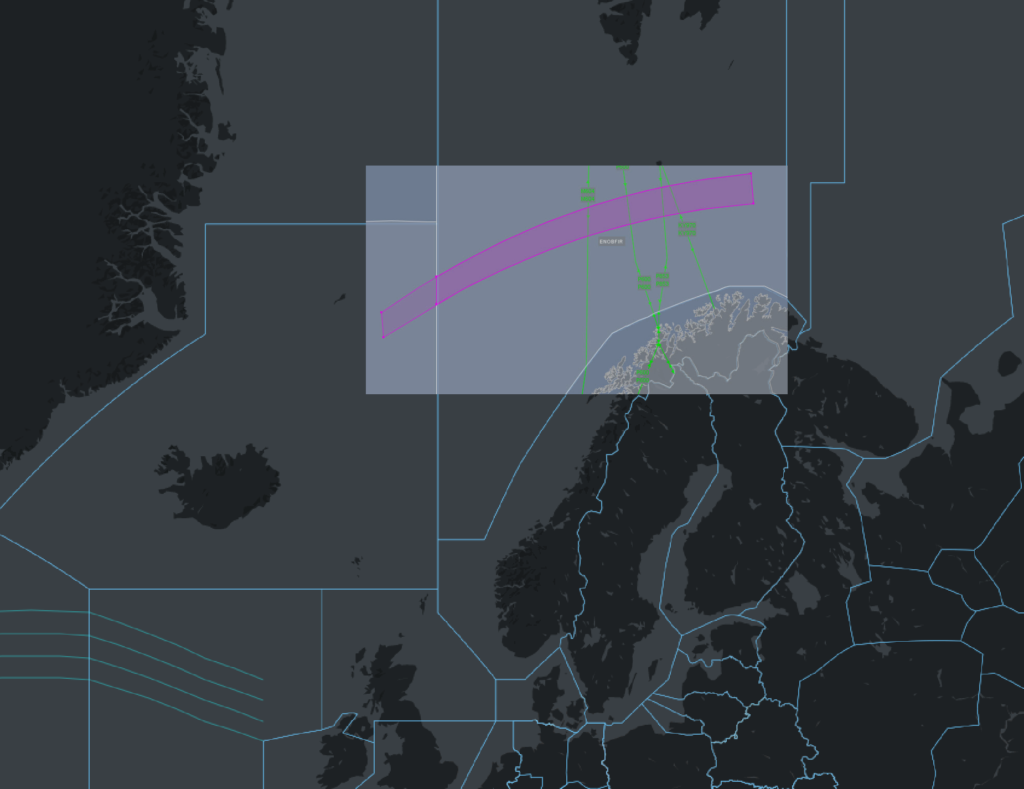
And to put that into better context, here it is superimposed on a larger area of map.

Eurocontrol’s map on top of another map.

When will it happen?

The primary launch window is on November 16, which means debris could be expected between the very specific times of 09:32 – 11:49 UTC. If this doesn’t go ahead for whatever reason then the secondary launch window is on November 26, with debris fall hazards between the same times again.

The timings of the airspace restriction will be confirmed in Notam via the Norwegian NOTAM office. For now, ENOB Notam A4648/21 has the info.

A4648/21 - TEMPO DANGER AREA 'ZC/VV20-Z9 FALLING AREA' ACTIVATED WITHIN
LIMITS OF BODOE OCEANIC (ENOB) FIR. FALLING AREA FOR SCIENTIFIC
ROCKET FROM FRENCH GUIANA SPACE CENTER. DANGEROUS ZONE BOUNDARIES 
ARE PSN 713431N 0000000E - 741000N 0265100E - 732700N 0270400E - 
705000N 0000000E - (713431N 0000000E). GND - UNL, DAILY 0932-1149, 16 NOV 09:32
2021 UNTIL 26 NOV 11:49 2021. CREATED: 08 NOV 11:21 2021

What is the overall operational impact likely to be?

It is likely to be low. It is a short window and a narrow area of airspace that is expected to be impacted, but caution should be applied if you are operating in that region during those times.

Fancy reading some more on space stuff?

Here’s an article we wrote before looking at the impact of space travel on ground based aviation.


LOAs: Got Your Number?

LOAs. Letters of Authorisation. We have mentioned before about how to get an LOA approved by the FAA. You can read that here.

This post is less about the process of getting them and more about what you actually need them for.

There are a lot of LOAs…

First up, if you’re a Part 121 operator, or a non-US registered operator then this probably isn’t going to be very useful for you. Go read something more interesting like this story about a guy who definitely didn’t have an LOA for his operation.

For those it does apply to – you need an LOA for any operation which needs a “long term, specific permission”. It lets you do stuff, and what you are approved to do via your LOAs is recorded in your Opspec. Any specific operation probably needs an LOA which is why there are a lot of them, and also why it can get confusing trying to work out what you need – when, where and for what.

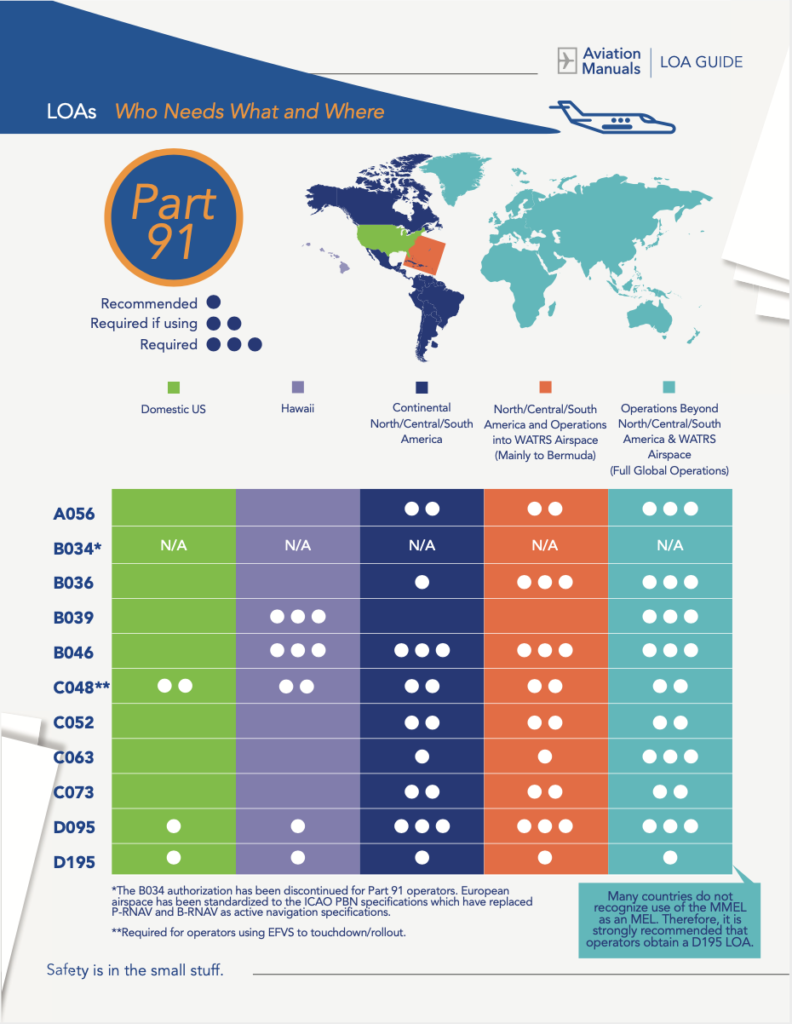
Now, we find the folk at AviationManuals really helpful with all this. They have a great (free) guide on how to get LOAs and it includes a handy bunch of tables which show you what you need for where and for what. Like this one for Part 91 ops.

Click on the picture to visit their page and download the whole guide.

Here is a quick rundown on the main LOAs you might need for your operations. If you still have questions afterwards then you know who to go ask for more info.

So, the ones to know.

Like we said, there are a lot of LOA options. The “big ones” that you are probably going to need are these…

A056

This is your Datalink Communications LOA (for CPDLC / ADS-C). If you have datalink systems installed and plan to use them outside of the US then you need this LOA. If you are Part 91 and only plan on using your datalink domestically then you don’t need an LOA.

This is not constrained by altitudes but rather to where FANS 1/A+ is mandated. If you think you will go through an airspace with a Datalink mandate, then having this LOA is probably a good idea.

B036

Oceanic and Remote Operations (RNP-10 / RNP-4 / RNP-2). This one looks at stuff like the long range navigation systems you have onboard, and your procedures for using it.

If you are planning on flying in oceanic and remote airspace, and in some spots in the Gulf of Mexico then you are going to need this LOA.

Still a bit blurry on what you need?

B039

Flights in the NAT HLA will want this LOA. It lets you put an ‘X’ in item 10a on your flight plan – confirming that your aircraft meets the new RNP10 PBN specifications (instead of the old MNPS stuff) and again, that procedures and training is in place.

Now, because this is a little more than just what equipment you got, in order to get LOA B039, you are also going to need a B036 which covers the Oceanic stuff and a B046 which covers the RVSM stuff – two other things you need to know about if you are flying across the big, reduced separation, remote oceanic area that is the NAT HLA.

You might have a B054 instead of the B036 (B054 covers Oceanic and Remote airspace using a single LRNS).

B046 

The RVSM LOA.

RVSM airspace is between FL290 and FL410. Even if you plan on flying above this, it is probably necessary to have the LOA for RVSM because there is a good chance you will, at some point, route through it or potentially have to fly in it if you are too heavy, or meet some mean turbulence or something.

Now, for US ops you don’t need RVSM authorisation if you have ADS-B installed.  Since January 2019 you are automatically authorised so long as you have ADS-B Out fitted (which is compliant with 14 CFR 91.227) and a few other things… one of which is that you don’t operate outside the USA.

So if you’re planning on taking a trip beyond the USA into Mexico or Canada, or further, then you are going to need this LOA.

The C0…s

The big Cs to think about getting are 52, 63 and 73. These give you the authorisation to fly things like RNAV (GNSS) approaches, RNAV and RNP Terminal Operations and VNAV instrument approach and approaches which use an MDA as a DA/DH.

ILS approaches are still a fair old way off becoming obsolete (mainly because of the problems with GPS jamming affecting aircraft capability to fly satellite based approaches), but having the authorisation to fly these might get you out of a spot of bother because there are a lot of parts to an ILS and they do breakdown from time to time.

And the future of navigation is satellite based so it is probably time to think about getting these now, if you haven’t already.

D095

This is the one you need if you want to use a Master Minimum Equipment List (MMEL) as a Minimum Equipment List (MEL).

We talked about that a bit here. The best plan is really to just get an MEL sorted though because the FAA are looking to change the rules on this, and the D095 actually expires fairly soon. Plus, if you fly internationally and only have an MMEL it can get very messy, even with the LOA.

Got what you need to go where you want to go?

Common Questions

We have covered the basics of what these main LOAs cover. Here are some answers to questions we have seen pop up from time to time.

What is an LOA and do I need it?

Go back to the top and read it all again.

How do I get an LOA?

Check out this post.

I am still confused, who can I talk to?

Talk to these people, they know a lot.

What does “getting an LOA” require?

An LOA is an authorisation to carry out a specific sort of operation. That means you are probably going to need
a) the equipment required for that operation,
b) procedures within your company which refer to that operation, and
c) certain training for your crew related to that operation (which might be required yearly).

So if you are considering taking on ‘some sort of operation’, looking into the requirements for the LOA in advance is a good plan – just having the equipment will not tick all the LOA boxes by any stretch, and an LOA can take several months to be approved.

I am flying internationally but plan to route above the NAT HLA say at FL430, what LOAs do I have to have?

The simple answer if we are just talking “have to have” is B036 or B054 which covers you for the Oceanic and Remote operations.

  • However, you might also want the RVSM one because there is a fairly good chance you will, at some point on that flight, be in RVSM airspace. So throw a B046 in as well.
  • There is also a good chance you will find yourself in some Datalink mandated airspace – it is pretty much all over Europe and beyond – so your A056 might be a good idea.
  • If you have those and are able RNP-10 then you really might as well get the B039 as well since you meet the requirements for it and it might save you a whole bunch of fuel (and trouble) if you have it “just in case”.

That’s all we’ve got to say on the LOA.

For now anyway, but if you think of something we haven’t covered then get in touch or drop those helpful folk at AviationManuals an email.

Our final tip – be careful ‘googling’ LOA because there are some pictures you really don’t want to see of the Loa Loa ‘eye worm’.


The Shopping for a Tech Stop Checklist

What should you be looking for in your tech stop selection?

Here are some tips and thoughts on what to look for in a tech stop, and a brief review of the most popular North Atlantic tech stop spots, as recommended by Opsgroup members (because we know a lot of folk route that way).

First up, our easy Four Point Checklist. Something we like to refer to as the “know before you go” list:

  • Where it is.
  • What it has.
  • What the rules are.
  • What the cost is.

1. Where it is 

This is probably the most important thing. St Maarten might be somewhere you’ve always wanted to see, but if you’re flying from Washington to Paris, it probably isn’t the best choice. So when thinking about where it is, you might want to actually think about these things:

  • What is your aircraft range?
  • Do you have ETOPS limitations?
  • Is it fairly central and practical on your route?

Seems obvious, but when you’re thinking about your range and route, throw in some average winds as well. Distance to an airport is not the same as time to an airport. Nor is time from there to wherever you are trying to eventually get. When we say time, we of course mean how much your fuel gives you.

2. What it has

Ok, this has a few more things to think about.

  • A Runway.

Not just any runway either, but one you can actually land on?

Great. But hang on. Can you actually land on it (and stop) if it’s wet (or worse), there’s a bit of a tailwind and you have some sort of performance penalty incurring technical problem? Might be worth checking for some “worst case” (or at least worse than normal case) situations given that you are planning this airport for a tech stop…

A quick review of the general weather you can expect is probably worthwhile as well. Some airports experience significant winter ops, low vis and other nasty conditions from time to time making them unsuitable, or at least more challenging, as a year round tech stop option. 

If you want to get really “doomsday” about it, then check out your Plan B options as well, particularly if it is remote and will be your only option. If it doesn’t have CATIII capability, or it only has RNAV type approaches then what would you do if… if your GPS is kaput? Or the weather is below CAT I? Better thought through in advance than on the day.

Finally, if you have a big, fat airplane, check the stands are suitable, the taxiways are wide enough and check the PCN is strong enough.

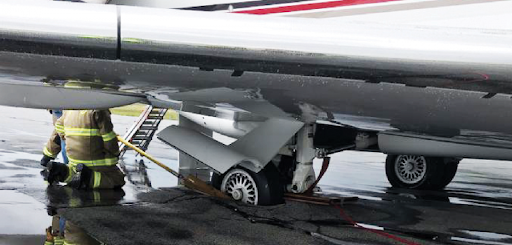
Oops. Someone taxied where they shouldn’t have

Done? Not quite. Most tech stops are actually fuel stops. And even when they aren’t, you’ll still probably need some.

  • Fuel

Does it have what you need? If yes then check if it has it when you need – not all airports offer H24 services. 

Consider the cost as well. Filling up more, earlier or elsewhere might be more cost effective.

  • Engineers

A tech stop is probably going to need an engineer. That engineer needs to be able to fix your aircraft. Bob from Bob’s Hack Shop down the road probably won’t fix it well. Find out who is available and what they can do for you on your aircraft. 

Of course, if something big breaks then even the best engineer might have to wait for parts or a more qualified engineer to come out. A decent tech stop will need decent access, one flight a week is going to see you stuck there for a while.

  • A tug

Such a small thing to think about but potentially important if you want to get out again and the airport only has taxi in stands. If you don’t carry a tug onboard then check whether your aircraft requires a specific one, and if so – confirm if there is one available there.

  • Facilities

The most important is probably good old Customs and Immigration if you don’t want to run into trouble when a tech stop turns into an overnight stop. 

Smaller airports might be limited in terms of the ground transport they can offer to you and your passengers, and smaller airports are often situated next to smaller towns with limited transport and accommodation. So checking facilities at both the airport and beyond is probably a good idea, just in case.

  • Contacts

Know who to talk to and how to get hold of them. Being unable to print a new flight plan can cause delays – if you already know who has the key to the printer this sort of little thing saves time.

3. Know the (Tech Stop) Rules

  • General Rules

Some countries (mainly in the EU) may allow passengers to disembark during a tech stop. This Ain’t the case all over. The US, for example, generally require everyone onboard to have a visa because if the aircraft is on the ground, those passengers basically are as well – even if they never actually step off the aircraft.

If you route to Russia it varies with which airport you head to, while Brazil are going to expect everyone to remain onboard. Knowing the rules is important, and making sure you have the security in place to manage your passengers is probably also a good idea. You don’t want someone scuttling off for a quick leg stretch or cigarette break and suddenly your simple tech stop has become an international incident…

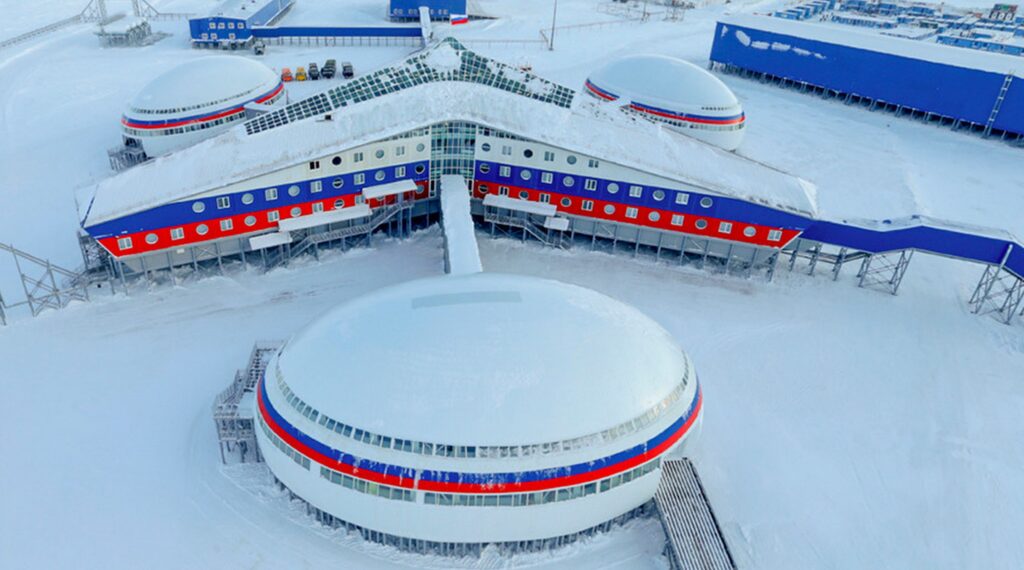
Arkticheskiy Trilistnik. Probably not the best place to use.

Bear in mind some airports also do not allow tech stops. LTBA/Istanbul for example. Or any Russian or Chinese military airport unless you want to get yourself arrested.

Airports that are happy to be used as tech stops might be less happy if you are a big airplane and decide to sit on the ground there for ages. Generally major international airports prefer you to not do this, and have fairly restrictive stopping times. If you just want fuel, EGLL/Heathrow might accommodate, but the wait might be long – EGSS/Stansted night be a better, and more efficient option.

  • Curfews

Yep, no point heading in somewhere only to find they won’t let you out again.

  • Permits

If you are heading in in an emergency then this is less of a pre-planned thing, but if you’re planning a fuel stop then you’re going to need to have a landing permit organised (if the airport requires).

4. Cost

We recommend checking out these three –

  • Handling
  • Fuel
  • Fees

It might even come down to which agent you use at the airport so get a good deal organised before heading in.

What else?

Prepare and familiarise in advance. Check them charts and notams regularly. *Assume* you will need to go and land, and have stuff set up for it in advance. A tech stop shouldn’t be a rushed diversion – it should be a pre-planned easy event.
So – where to go?

The ‘NAT Options’

We asked members, in a poll, to share the airport choices they favour for North Atlantic routing tech stops. Actually, the list was more of a “flying from the US to somewhere on the other side” which is why EFHK/Helsinki was in the mix.

We received around 150 votes and these were the finalists (in order of popularity):

  • BIKF/Keflavik
  • EINN/Shannon
  • EFHK/Helsinki
  • LPLA/Lajes

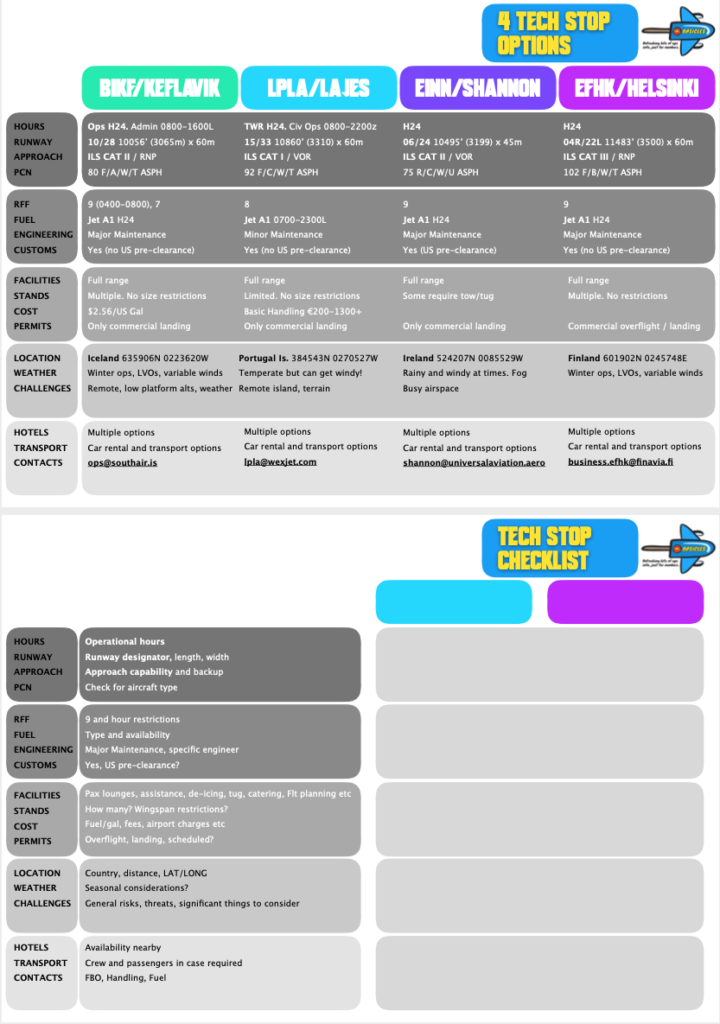
If you’re a member then check out our handy Opsicle (refreshing bits of ops info, just for members). We made one on these four airports to help with your tech stop planning. It’s called ‘4 Tech Stop Options’. It isn’t *finished* – we threw in some of the contacts and info we know, but add your own!

If you’re a member, get the real one by clicking on the picture.

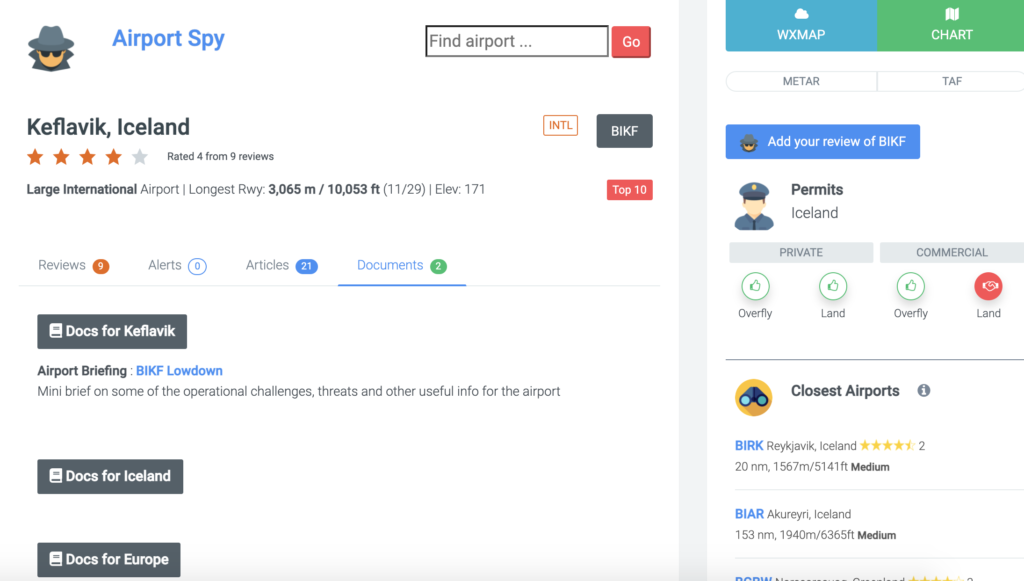
There are also Airport Lowdowns for each of these airports – Mini briefs covering the threats, operational challenges and other useful operational info for the airports. Opsgroup members can download these Airport Lowdowns via the Airport Spy app on your dashboard here.

Wondering “Where Else?”

Check out this earlier article on airports in the remote regions of Canada.


Toronto RNP-AR Plan

What does Toronto Pearson International airport and a Canadian Goose have in common?

They are both very noisy!

Which is why NavCanada are looking to change the airspace at the airport. More specifically, they are planning on implementing RNP-AR approaches in an attempt to make it cleaner, greener, quieter. Just like Canada itself. 😊

Anyway, here’s a quick look at the proposed routes and how they will help with noise and efficiency.

Runway 05/23

They are planning to introduce RNP AR approaches. The big benefit of these is they line you up with the runway sooner which means you fly less and so burn less fuel. They also help with continuous descent ops (see the traffic management bit below for how that works).

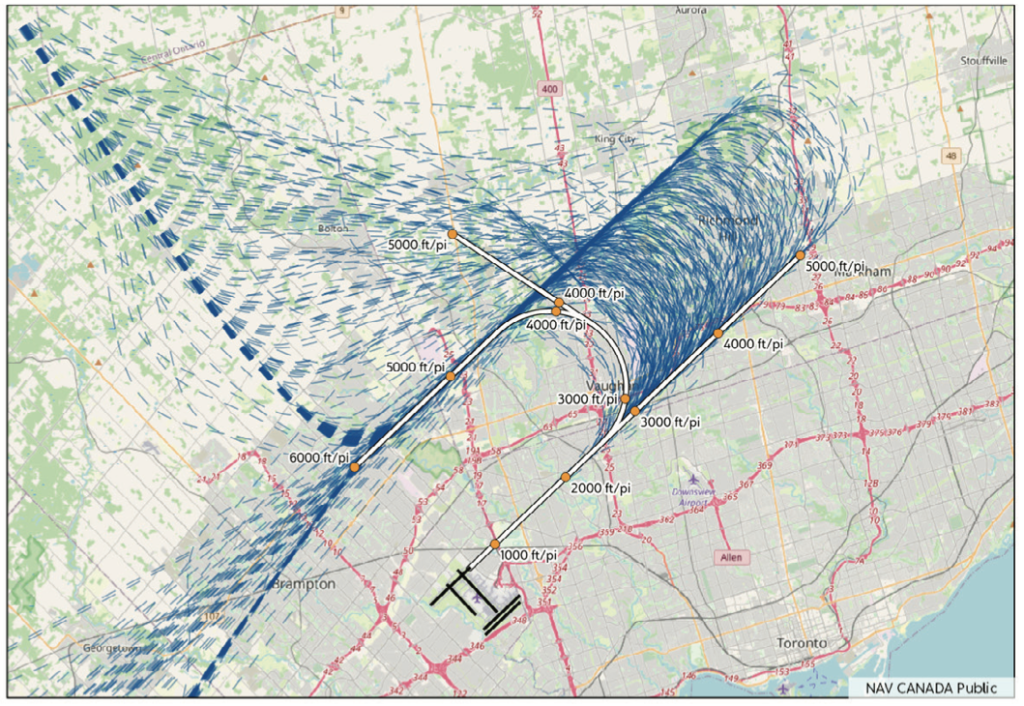
Here is a picture of how it will shorten the distances for you. The RWY23 plans can be checked out here, and the ones for RWY05 here.

The white bit versus the blue bits

Traffic Management

In standard simultaneous parallel operations, ATC apply a 1000’ or 3nm lateral separation between aircraft which usually means folk on one runway head in at 4000’ for final approach while those going to the other runway head in at 3000’. Those dropped down to 3000′ often don’t fly a CDA and it is less efficient, but also more noisy for those on the ground with aircraft flying for longer periods at lower levels.

An RNP-AR means aircraft do not have to drop down to a lower altitude because those on the RNP-AR are already ‘established’ on the procedure during the downwind curved bit that bring you onto finals.

One of the current issues with Toronto is the approaches don’t tend to link with the arrivals so there is often a messy, inefficient in-between bit where you are just sort of flying along waiting for a vector.

So why do we care about proposals?

Mainly because it’s good to know what’s changing so you can get ready for it. But also because most of the feedback received during these stages of discussion tends to be from disgruntled folk who live near the flight paths and don’t always want to see changes brought in.

Visit the NavCanada site here for the full info.


EASA withdraws Iran airspace warning. Why?

EASA has withdrawn their Iran CZIB, so what does this actually mean for the safety and security of air operations there?

What is an EASA CZIB?

First up, a CZIB is a Conflict Zone Information Bulletin (if you aren’t familiar with the term.)

These are put together by EASA based on aeronautical publications issued by worldwide states, and an assessment of the overall known risks and threats which EASA do via their Integrated EU Aviation Security Risk Assessment Group. Quite a mouthful. The point is they are sharing info on conflict zones to help operators do their own risk assessment on whether to head in there or not.

OK. So, when we take a look at EASA’s CZIBs they actually are more of a summary of references to other state and authority warnings. EASA CZIBs do not in themselves, appear to make an assessment of risk. They just share what everyone else says and contain a recommendation which more often than not goes something like this –

“Operators should take this information and any other relevant information into account in their own risk assessments, alongside any available guidance or directions from their national authority as appropriate.”

If you want to check out their active ones you can do so here.

EASA updated a large number of them in October 2021. 10 in fact, which included the likes of Iraq, Libya, Mali, Afghanistan, South Sudan… interestingly, they did not update their Iranian CZIB.

Instead, they withdrew it.

Why did they withdraw the Iranian CZIB?

That’s the big question.

Given that the EASA CZIBs do little more than summarise actual risk statements from other states, and considering other major states still have valid warnings for Iran, it does seem rather odd.

EASA have suggested their decision to withdraw this CZIB is based off an agreement from a recent meeting in which they decided that the situation in Iran has positively improved allowing to withdraw the current CZIB and to issue as replacement an Information Note shared within the European commercial aviation community on a ‘Need-to-know’ basis.

So, when EASA withdraws a CZIB, this does not mean individual states have also withdrawn their own warnings. We have not seen the ‘Information Note’.

All still valid

You can click below to read the (now withdrawn) EASA CZIB.

Withdrawn!

We think the risk remains.

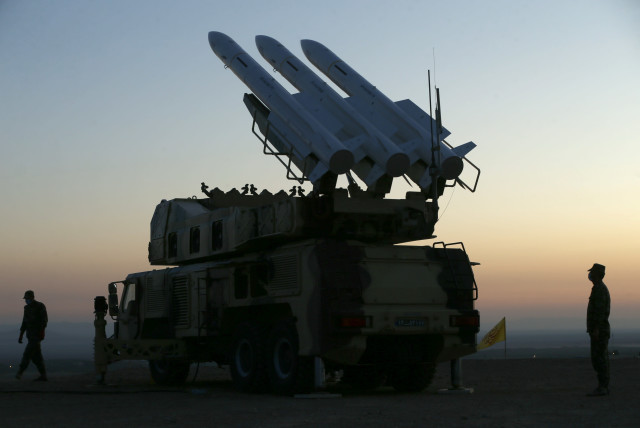
In 2020, Ukraine International Airlines flight PS752 was shot down in the vicinity of OIIE/Tehran, by the Iranian Air Defense system when it was misidentified. Iran possess significant anti-aircraft weaponry. This weaponry is in place due to ongoing conflict within Iran, and that has not changed.

The Iranian ‘Air Dome’ Defense system

As with all risk, likelihood is dependant on capability (they have that), and intent.

Intent is an interesting one. The didn’t intend to shoot anyone down with their Air Defense systems, and they don’t usually fire their anti-aircraft weaponry without good reason, which means a risk of misidentification is far higher during times of active attack, when enemy forces are being targeted.

But the situation in Iran remains volatile, and so the risk level remains.

What is the risk?

A fair few airlines do overfly Iran. The ones that don’t generally have political reasons not too – this doesn’t mean the risk isn’t there. The political tensions between some countries and Iran mean the risk of being targeted or experiencing security threats on the ground is far higher.

If the state your aircraft is registered in is on relatively good political terms with Iran then overflying the country above a safe flight level poses less risk if you remain at that level.

Descend below FL260-ish and it is a different situation. And if you overfly anywhere, there is a chance you will need to descend and even divert in for certain emergencies. So your risk assessment when “just overflying” needs to take that into account.

Remember – just because you only want to overfly and don’t plan on going into Iran does not mean the risk does not apply to you. If there is a possibility you might have to divert in then the risk must be taken into account.

This is why operators who do fly into Iran generally have “TOD” checks – a SATCOM call, for example, to their company to confirm the security situation on the ground prior to heading in below that safe altitude. Basically, a check to ask if stuff is kicking off or not.

What do other states say?

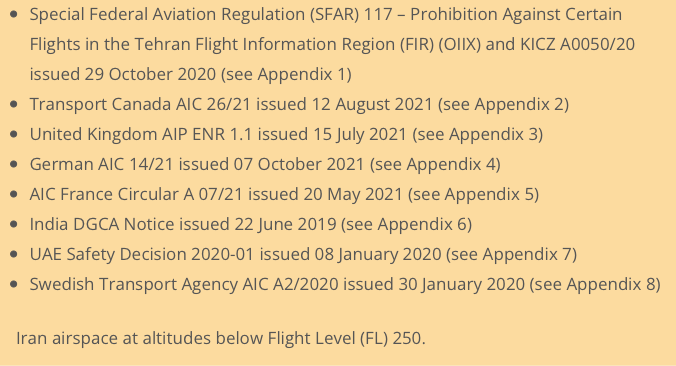
The UK CAA Notam EGTT V0012/21 was issued in July 2021. This covers a “general” airspace security warning for a whole bunch of countries, including Iran, and suggests you go check the UK AIP En-route 1.1 section 1.4.5 for more info.

1.4.5 says there is a “potential risk to aviation overflying this area at less than 25,000ft” because of “dedicated anti-aviation weaponry”. France say don’t go below FL320. The US says don’t go at all.

The risk is still there, and that risk was actually summed up pretty well in the now withdrawn CZIB – “due to the hazardous security situation, and poor coordination between civil aviation and military operations, there is a risk of misidentification of civil aircraft.”

If you want a summary of all the current warnings and details, visit our Safeairspace page.

The current situation in Iran.

The situation is volatile. There is significant political conflict between Iran and some of their regional neighbours. There is also internal conflict. The primary risk remains the potential for misidentification from the air defence systems, or surface to surface missiles targeting rebels. There are secondary risks from ballistic missile tests (often tested without Notams) and GPS jamming.

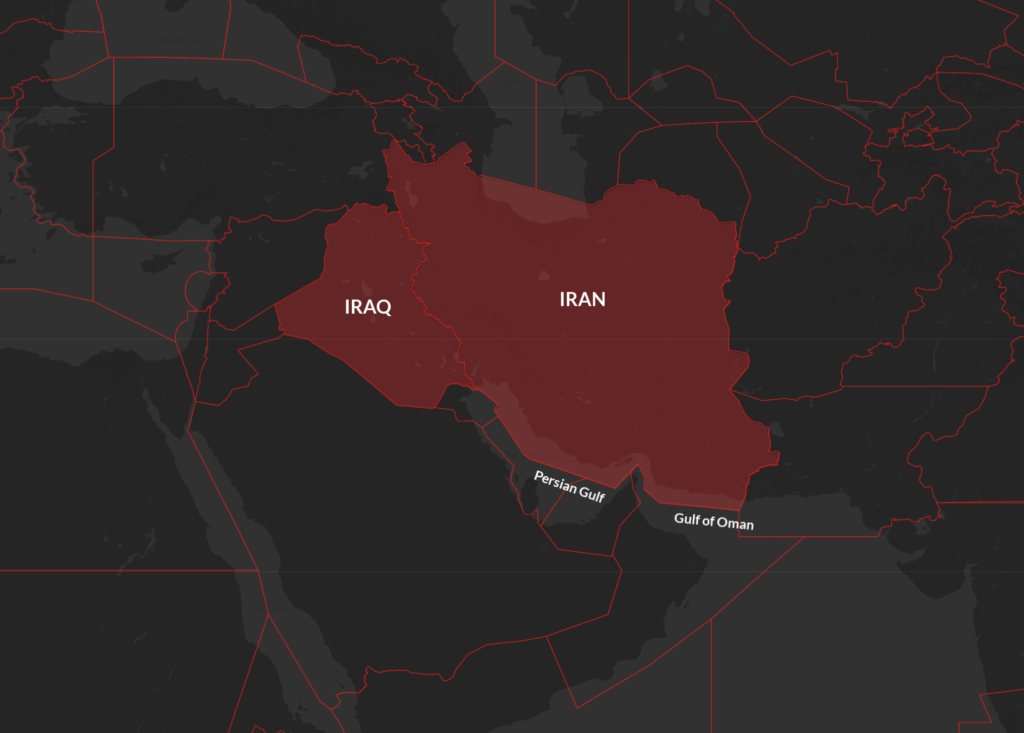
Both airspaces and the Persian Gulf pose an airspace risk.

Safeairspace Summary

Our view is that the removal of the EASA CZIB does not signify any change to the threat level in Iran. States have not removed their own warnings and so our Safeairspace warning remains the same until such time as further information is provided on how Iran have positively improved the situation.

Want a full briefing?

Just click here. SafeAirspace  is our conflict zone and risk database run by OPSGROUP. We continually assesses the risk to operators the world over. It presents that information in a way that will always be simple, clear, and free. You can also sign up to our new fortnightly risk briefing that contains only what you need to know, simply by subscribing.


US FAA allows Iraqi overflights

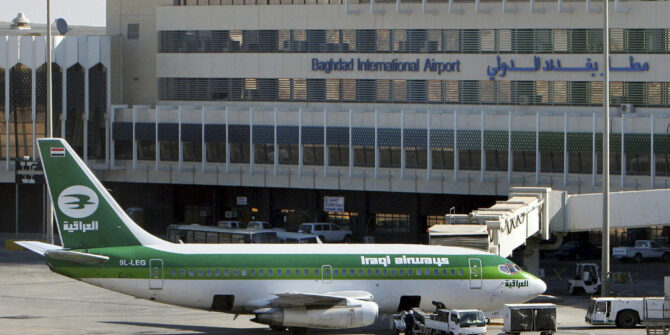
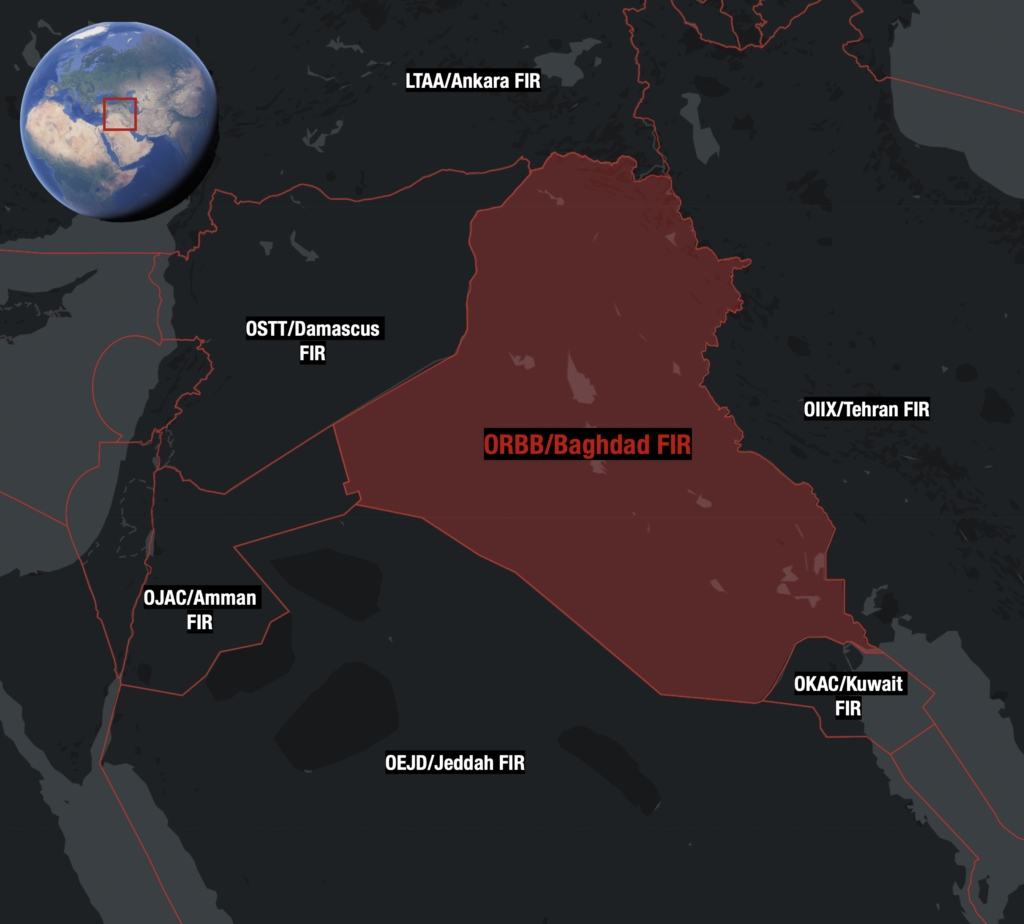
On October 22, the US FAA cancelled a long standing Notam that barred US operators from entering the ORBB/Baghdad FIR at all levels (KICZ A0036/21).

The standard SFAR for Iraq now applies, which allows overflights at or above FL320. But does that mean it’s safe?

Iraq remains an active conflict zone which exposes aviation to high levels of risk. So, let’s take a look at the dangers of operating in the Baghdad FIR and why those risks should continue to be carefully considered at all levels before you decide to overfly.

US Operators can now overfly the Baghdad FIR at or above FL320, but need to be aware of the risks.

Hang on, why was there both a SFAR and a Notam in the first place?

The political and security environment in Iraq is unpredictable. Local and foreign military continue to fight against an armed insurgency there. Things can change quickly.

To allow the FAA more flexibility with the rules, they published the Notam (now cancelled) with extra restrictions over and above the SFAR.

The idea was that they could continually assess the threat to US aircraft in Iraqi airspace, and easily reduce restrictions again to allow some operations to continue through this air corridor. This is where we are now.

But the overflight risk remains.

The primary risk to overflying aircraft hasn’t changed. Terrorist groups are still very much active in Iraq and may intentionally target civil aircraft with anti-aircraft weaponry. They are known to have conventional man portable air defence systems (MANPADS) – the ones you can move around and launch from your shoulder. These were previously assessed to reach aircraft as high as FL260, but the danger zone was later increased by the FAA to FL320.

Why?

Because these groups are being funded and armed by other political interests in the Middle East with increasingly sophisticated weapons.

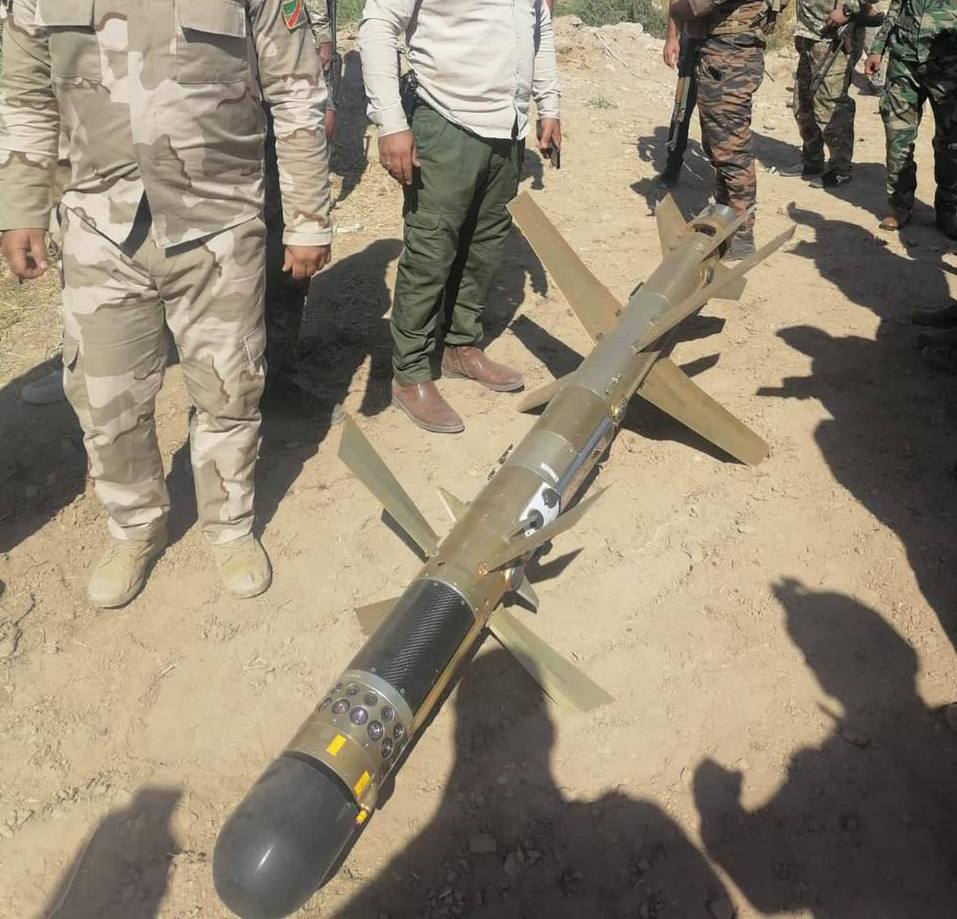
Case in point. On October 21, news broke that militia in Iraq may have access to a new type high tech anti-aircraft missile. Intelligence suggests that it is ‘loitering’, or in other words that it hangs around for a while before selecting a target. While such a weapon hasn’t been used yet in Iraq, the evidence that it is there is credible.

Militant groups are being supplied with increasingly advanced surface-to-air weaponry that can reach higher and further than ever before – such as this example of a ‘loitering’ weapon found recently in Iraq.

The same militia also have a long track record of targeting US military interests at airports such as ORBI/Baghdad with rockets. We have reported on such attacks more than a dozen times already this year alone.

Don’t forget about the military – at all levels.

Iraq is an active conflict zone, so foreign and local military have their own air defences too.

The US military have systems that can reach higher than anyone can realistically fly, while the Iraqi military have surface-to-air missiles that can target aircraft as high as FL490.

In the last 12 months, there has been an increase in the use of weaponised drones by militant groups. Which means that if these air defence systems are used to target them, it may increase the risk that civil aircraft are misidentified or mis-targeted – or in other words, being in the wrong place at the wrong time.

Other recent events.

The ability is clear, but what about the intent?

It’s important to remember that airspace risk can change quickly, based on what is happening on the ground. (Not just in Iraq, but everywhere.)

And in Iraq, there are two things to be aware of in recent times…

  • The first is that Iraq is still politically unstable. There was a big election on Oct 10 which has since been disputed. Militant groups found themselves on the wrong side of the result, which may imply an increasing desire to make some kind of statement.
  • The second is that the US Government has committed to withdraw US troops from Iraq by the end of 2021. As that time draws closer, political tensions are likely to rise. If anything, recent events in Afghanistan may serve as a warning of things to come.

A disputed election held on Oct 10 has lead to widespread political unrest. This may have increased the risk of terrorism as a form of statement.

I still want to overfly. Are some areas safer than others?

Based on active airspace warnings alone, authorities in France and the UK agree that eastern airways UL602 (between TAMSI and ALPET), UM860 and UM688 are generally acceptable – but as always, it is up to operators to carry out their own risk assessments. The US FAA regs don’t define any specific region and consider the risk present below FL320 throughout the entire Baghdad FIR.

Want a full briefing?

Just click here. Safeairspace.net is our conflict zone and risk database run by OPSGROUP. We continually assess the risk to operators the world over. It presents that information in a way that will always be simple, clear, and free. You can also add your email to our new fortnightly airspace risk briefing that contains only what you need to know, delivered every second Monday.


Bogged down in Bogota

Bogota International has a problem. Severe delays. It seems they are as long as the airport’s official name – El Dorado International Airport Luis Carlos Galán Sarmiento.

And it isn’t just the airport with the problem – delays cost money, they frustrate passengers, waste fuel, result in aircraft circling in the air, and make pilots angry.

Luckily IATA have a plan.

A set of recommendations were issued by them on October 7, 2021 suggesting how these severe delays might be severely improved.

For those who don’t speak Española, here it is (briefly) in English:

  • Elimination of the ground delay program.
  • Prioritisation of commercial services during peak hours.
  • Restriction of non-commercial services to off-peak hours without exceeding allocated quota.
  • Ensure ATC centers and control towers are adequately staffed.

Before we get into all that though…

We thought we would take a look at the airport, procedures and current situation, and ask just how bad the “severe” delays are.

How bad are the severe delays?

The main problem seems to be with the ground delays.

Since May 2021 the Ground Delay Program (the one that holds aircraft at their departure airport because there isn’t room for them at the destination) has been invoked some 300 times. On one day alone it resulted in 130 affected flights, meaning 17,600 passengers.

And on average the delays were between 2 and 4 hours.

To compare, this is more than all the US airports combined (the August stat was 63), and more than KJFK/New York, EGLL/London Heathrow or RJTT/Tokyo Haneda which, let’s face it, often have delays.

Interesting fact: It isn’t just the airport. It is also the most congested city in the world. Drivers lose on average 133 hours of their life to traffic jams every year.

Scheduled, commercial flights will be prioritised.

Elimination of the GDP

This is *normally used at airports that have some sort of bad weather type situation going on, and is designed to prevent aircraft having to hold in the air because, you know, fuel issues…

If you want to read more about it, then check out this handy article from the NBAA which is all about just that.

The way it is being applied at SKBO unfortunately is not entirely as intended and while it prevents holding in the air, it is having a knock on effect at departure airports with blocked stands, and for operators with aircraft utilisation and schedules.

So eliminating the program will hopefully *encourage better ATC traffic planning, or will require better ATC traffic planning in order to eliminate the program. Either way, that would be beneficial.

SkyTrax recognised staff at El Dorado as some of the best!

Prioritisation and Restriction

The plan is to restrict peak hour slots to scheduled commercial traffic only. The benefit of this is schedules are actually kept. Aircraft routing in will also be prioritised if they are a scheduled carrier.

For private or ad-hoc flights this will mean less availability of slots, permits (during peak times) and general flexibility in operation times.

Right now, the permit process for landing is pretty quick. If you are going to spend less than 48 hours on the ground at one airport only then you don’t need a permit. The CAA is efficient and responsive and you can contact them at +571 296 2208 / sobrevuelos@aerocivil.gov.co

ATC

A lack of qualified ATC staff means efficiency in their procedures cannot really improve. One of the issues is poor labour and pension conditions – something ATC have previously gone on strike over, back in 2019.

The current shortage has seen shift times increase from 6 to 12 hours leading to more sick leave and fatigue, leading to a cycle of longer hours.

New radio systems were installed across 36 more airport in Colombia earlier in 2021, adding to the 80 already benefiting from a system which enables a centralised network area and better redundancy for controllers. In addition, there is a specific plan for ATC at Bogota Airport. It involves installing better navigation communication systems, surveillance and management systems and more automation.

A new El Dorado

El Dorado II was under construction, due to open 2022, and the new airport would have substantially improved the capacity for the region. In 2018, the government suggested they would scrap this and expand the existing airport instead. The expansion plan includes the moving of military operations to a dedicated military base, and new terminals and infrastructure.

Anything else?

  • GDP are not the only delays you can expect coming to SKBO. Reports of 3 hour waits for fuel trucks, issues obtaining departure clearance, and hold-ups in Customs (related to passports, not bandits) are relatively common.
  • The “operational concept of TMA BOGOTA is based on defined trajectories and the homogeneity in speeds to be able to maintain an orderly, safe and efficient flow.” In other words, fly the speeds you’re told to fly, they are pretty strict on it.
  • The airport is high altitude which means your TAS will be around 15% higher than IAS. Which means you might find slowing down harder.


The Missile that Missed by a Mile (or 25)

On October 6, 2021, a Transavia Boeing 737-800 was routing from DTTJ/Djerba, Tunisia to LFPO/Paris Orly when they reported seeing a missile explode in what they thought was close proximity to the aircraft.

The Flight Report

TO-3367, registration F-GZHX was climbing through approximately FL300. Their position was around 80nm north west of DTTJ/Djerba, and about 110nm south of DTTA/Tunis when they reported a missile exploding in their 10 o’clock position, at the same altitude, and in close proximity. A second aircraft in the area also confirmed seeing an explosion.

When reported, ATC advised there was an active military area approximately 25nm west.

Where did it happen?

The FlightRadar tracking of the flight suggests they were likely routing along the UZ153 airway.

FlightRadar playback

Waypoint NEDOS appears to correspond with the approximate position of the aircraft, and this lies to the east of the DTR-20C/DTR-20D military zone suggesting this is likely to be the zone where activity was taking place.

DTR-20C and DTR-20D are the likely areas where military activity was taking place

What does the Tunisia AIP say?

ENR 5.1 – 4 details DTR 20c and 20D as being active for military exercises in VMC only. It is operational Monday to Friday from sunrise to sunset and on Saturdays from sunrise to 1300. The limits are FL105 to FL245.

Are there other active areas?

Search Notams for the DTTC/Tunis FIR and you will find a long list of military activities and firing exercises.

The ‘firings’ are for guns, rockets or missiles, but at low levels (below 2,500’ msl for the most part). The military activities are of more interest because they are not all bounded by published restricted, danger or prohibited areas, meaning you are going to need to check these by plotting them out.

A2070/12 reserves an airspace which reaches from 13,000’ to 30,000’. A second some extends from FL100 to FL250, advised via Notam A2072/21.

There are also Notams advising that ‘due to military activities new corridors are being implemented’.

While these did not impact the Transavia flight, and do not necessarily mean any risk for overflying traffic, they do pose a threat simply because of the upper limits and the sheer number of spots to avoid.

So was there a risk here?

The unusual element of the Transavia incident would be the proximity of a major airway to an active missile firing zone, or rather the firing of a missile which may have reached altitudes above the published upper limits, in close proximity to a major airway. 

However, this assumption is based off the crew’s observation of the missile altitude. Tunisia does not reportedly possess missiles which are capable of reaching altitudes of 30,000′, and the difficulty in accurately observing the altitude of an ‘object’ at a distance with little external context is extremely hard.

An investigation is underway but a highly probable explanation is that the crew misjudged the altitude and proximity of this missile, and no risk occurred.

Glance at this for 2 seconds and then determine the height of the clouds in relation to the aircraft…

Should we watch out for military exercises?

Military exercises are common, particularly across Europe, and Eurocontrol notifies of these via its Operations Portal. These often utilise airspace which has some impact on commercial operations. 

The airspace closures are advised via Notam and AIP SUP, and where required, alternative routes are advised to ensure flights are not planned through the airspace.

For the remainder of October 2021 the following exercises are planned:

Flight planners and crew should be aware of these, but generally flight plans which attempt to route through prohibited or restricted airspace will be rejected, and ATC will prevent flights from entering areas during weather avoidance or other route detours.

Tango routes are impacted during the exercise.

What can we do to maintain safety near military zones?

During any operation operators, flight planners and the crew should remain vigilant in reading Notams and ascertaining which military areas are active, the altitude of activities and restrictions or prohibitions which might affect their safe routing.

GPS jamming around major military sites is also worth considering.

Safeairspace provides information on conflict zones, and airspace where risks are high for overflying traffic.

North Korea, and certain airways which route close to their airspace and the Sea of Japan are worth mentioning because of North Korea’s recent number of un-notified missile tests.


The Golden (FAA) Rules for a Good Plot

Some people really enjoy plotting. If the other pilot has added some tiny krakens or miniature pirate ships to find on the chart, it can be a fun way to pass the time on a dark and endless North Atlantic crossing. For most though it is an irritating thing not made an easier by the somewhat confusing requirements as to how, when and why you need to do it.

So here is a brief summary of the FAA Plotting requirements.

What do the rule books say?

The place to find the info is this – AC 91-70B

It is an advisory circular providing ‘general information and guidance for commercial and General Aviation operators (“you”) planning flights in oceanic and remote continental airspace’.

Sounds good until you actually open and discover it is 114 pages long and the first chunk is a very long list of links to other documents which you also need to refer to for information and guidance. We actually started writing this post in 2019 when the current AC came out…

So, this post is just looking at plotting. That’s it. Just plotting.

Here is the Opsgroup North Atlantic 2021 chart. Click for info on how to download a copy!

Why do we need to plot?

We plot so that we can check that the airplane is actually going where it should be going, and that we are where we are supposed to be.

The North Atlantic is big and remote and unlike land, there aren’t many places to put Navaids, which means you are relying entirely on your Long Range Navigation Systems (usually something to do with satellites) to ensure you are in the correct place. 

The second problem is we make mistakes – sometimes we put the wrong things in the box (see the section on half degree waypoints below). So plotting can help catch those navigation errors before they become really ‘gross’.

The FAA say “you should use a chart, of appropriate scale, to provide yourself with a visual presentation of your intended route, regardless of your type(s) of LRNS.” (6.3.1.11)

And ICAO say… actually they pretty much say the same. (Position Plotting 8.2.10) 

When do we need to plot?

The earlier FAA AC 91-70A had a whole section (3.6) on when plotting is required:

  • Turbojet aircraft: If you are operating along a route segment where the distance between standards ground based navaids exceeds 725nm
  • Turboprop aircraft: ditto ditto 450nm

But – this was removed in the new AC. So, do you still need to plot?

Well, the simple answer is yes, and the more complicated answer is that “plotting” means something a little different now. It isn’t about drawing it on a map so much as checking and cross-checking your position.

Click to download the official FAA chart.

What is the difference between the cross-checking versus plotting?

Acceptable procedures are outlined in section 6.4.8 of AC 91-70B.

We used to plot manually in order to check we were where we were supposed to be. This cross-check hasn’t really changed – we are still cross-checking the FMS and master document (OFP) against the currently effective route clearance to prevent inadvertent deviations from the cleared route. The big difference is you don’t actually have to do it on a paper map anymore (6.4.8.2).

It is also required regardless of the distance from the nearest NAVAID.

So what do we do it on?

Up until 2019, manual plotting was required, but this changed when the FAA realised FMS-driven navigation displays and what-have-you were actually just as accurate

Opspec/MSpec A061 says you can used an electronic flight bag (EFB) for “interactive plotting” instead of a paper chart (6.3.1.11.2) – in other words an alternate “navigation display”, where the alternate means not necessarily a paper plotting chart.

Back to how do we do it…

The aircraft position check should be made at a point approximately 10 minutes after a waypoint.

  • Plot your current Lat/Long and record the time. 
    • Use the “non-steering” LRNS to find your current lat/long because if your other one is lost it won’t really help you to use it.
    • Confirm the circle/cross/miniature airplane symbol you are using (the nav system is using) to mark your current position agrees with your route clearance. I.e. its on the right track and not out in the middle of anywhere it shouldn’t be.
  • Next up, have a look at where you’re heading:
    • Check the active leg by confirming the FROM and TO waypoints of the clearance against the active flight plan
    • Confirm what is in the FMS matches the clearance
    • Check you have the right autopilot mode in. LNAV/NAv is good. HDG is not good
    • Check the “expanded” waypoint to make sure there are no rogue minutes in there
    • Confirm your ETA over the next waypoint (and check you are the flying the assigned Mach number)
    • Check you’re still SLOP-ing if you should be, and at some point, make sure the SLOP ends when it should as well
    • Give the wind a quick check as well. It’s just handy to know in case you lose all your LRNS stuff

Just an example, you might do it differently

Re-clearances.

You’ve done all of the above, prepared a beautiful map ready to go and horror of horror ATC send you a new clearance. This is annoying and is the reason most GNE’s seem to occur, or rather folk not doing it right is the reason.

  • Confirm the re-clearance with the other pilot. You both have to “receive” it
  • Make sure you tell the aircraft the new clearance otherwise it won’t fly where it is supposed to. Both should double check the inputs as well to catch any finger trouble
  • Re-plot it ready for your plotting checks
  • It can be a good idea to check the new distances between waypoints
  • Add in a little fuel check in case it is significantly different to your planned route.

A note on half degrees.

Half degree waypoint are fun little things. “Fun” because they are easy to mess up because no-one ever seems entirely sure how to type it into the aircraft computer.

Here is an ICAO paper on it. Well, actually it is on general waypoint insertion, but with a focus on half degree ones.

The issue tends to be with the identifiers. For example, ARINC 424 uses an “N-prefix” format which means you might see N5250 and be all “that looks like half of north 50” but actually this would mean 52030N 050000W. So you need to potentially check two things here.

  • First, if you receive a clearance with a half degree waypoint, confirm the identifier (N5250) has been loaded with the half degree (52030N 050W) like in the picture below
  • If you have a clearance with no half degree waypoints and are whacking in pre-loaded Idents, check they don’t have half degrees – because N5250 night not mean N52000 W050000.

The ident doesn’t show the half waypoint – so the full waypoint must be checkedStill confused about what to insert? Read this handy guide from Honeywell.

Watch this space.

The FAA are plotting a new draft – AC 91-70C – which will probably be out towards the end of 2021/ start of 2022.

All done?

We wrote a load of stuff on plotting back in February 2020. Most of it still applies and you can read it here.

We have also made a handy Opsicle (refreshing bits of ops info, just for members). This one is called The FAA North Atlantic Plotting Guide and if you are a member then you can download it here.

Click to download PDF.


US to mandate vaccines for all foreign arrivals

The US Government has revealed big changes to entry requirements. From November 8, all non-US citizens/residents will need to be fully vaccinated to enter the US – from anywhere. For Americans, the rules around pre-travel testing will be tightened too.

Here’s a quick rundown of how this will all work.

For Foreigners

Starting November 8, any foreigner who wants to board a flight to the US will need to prove that they have been fully vaccinated. This means that they will need to have received a full dose of either an FDA or WHO approved vaccine at least a full 14 days prior.

FDA and WHO approved vaccines will be accepted.

Exemptions

Spoiler alert: there are hardly any. A very small list of unvaccinated foreigners will be allowed to enter.

This includes people participating in vaccine trials, those with medical conditions or anyone travelling on non-tourist visas from countries where vaccines aren’t readily available. Exemptions may also be granted for humanitarian or emergency reasons with approval from the US Government in the form of a letter.

Seven days of self-quarantine and additional testing may be required.

Don’t forget the kids.

Anyone under 18 will be exempt from the vaccine mandate. Instead they will need a pre-departure test. If their guardian(s) are fully vaccinated this can be done within three days of departure. If they’re travelling with an unvaccinated adult or alone, this is reduced to just one day.

For US Citizens and Residents

The vaccine mandate will not apply. But the rules around pre-travel testing are being tightened.

From the same date, any US citizen or resident who isn’t fully vaccinated will need to a negative viral test (PCR or Antigen) within just one day of departure. Those who have had the vaccine will still need to get a pre-travel test too. But they will have the existing three days to do so.

What about Crew?

Both foreign and local crew entering the US will be exempt from these new rules. Instead they will need to continue following existing CDC guidelines which you can read here.

Both foreign and US-based crew will be exempt from the new mandate.

Contact Tracing

There will also be a new requirement for air operators to collect contact information from all passengers and provide it to CDC ‘quick smart’ –  just in case they need to get in touch with anyone. More details on this are set to follow.

Travel Ban

November 8 is a big day for US borders for another reason too. For the first time since the start of the pandemic the entry ban on passengers from the UK, Ireland, much of Western Europe, China, Iran, Brazil, South Africa, and India is finally being lifted. You can read more about that announcement in our recent article here.

Handy Links

The official Presidential announcement of the vaccine mandate.

The official CDC Guidance on the new rules, including a useful FAQ section.


Military coup in Sudan: Impact to ops

A military coup is underway in Sudan – the second since late September. Troops have been deployed throughout Khartoum and the military chief has dissolved the transitional government.

HSSK/Khartoum Airport is closed and all flights have been suspended (though no new Notams have been issued). Sudan’s CAA has told the media that the airport will reopen on Wednesday 27 Oct at 4pm local time (1400 GMT).

Phone and internet networks have been blocked making it hard to contact local agents for situation updates. However, security forces clashed with anti-coup protestors on Oct 25 & 26, and there are additional demonstrations and roadblocks planned over the coming days across Sudan.

The US Embassy in Sudan issued a security alert on Oct 26 advising US citizens not to travel to the embassy or the airport. “When commercial flights are confirmed to be departing, an alert will be released” it said.

Overflight impact

HSSS/Khartoum FIR covers the whole airspace. Overflights are still taking place but there have been reports of delays due to thirty-minute separation being applied in the HSSS/Khartoum FIR. A coup in 2019 saw the airspace close for 24 hours.

There is no immediate known risk to overflight safety due to the military takeover.

However, Khartoum is a main en-route alternate for this part of Africa. With the security situation on the ground now unpredictable here, there is a general risk for overflights in terms of limited alternative diversion options, given that there are several high risk airspaces including Libya, South Sudan, Eritrea, Somalia and Ethiopia (Tigray region) in the vicinity.

Airspace warnings

There is only one international airspace warning (from France) which recommends overflights above FL260 for the far southern and western edges of the country where it borders South Sudan. The risk is, in part, due to the lack of ATC services and standards below FL245 in South Sudan. Further information on this is available on our Safeairspace page.

For some more background info on the airspace safety concerns for Sudan and South Sudan, you can read our January 2021 update here.


Demystifying Singapore’s Entry Rules

Ah, Singapore. The Lion City. Home to chilli mud crab, Clarke Quay, Raffles and some of the most confusing entry rules we have ever seen.

If you’re feeling particularly motivated, they’re all found on the official Safe Travel website. But brace yourself for bewilderment…

Or you could try this summary. It is a super simple break down of how the current entry rules work for passengers and crew alike. So hop aboard the Singapore Flyer and crack open a fresh Tiger Beer. We promise it’ll be a smooth ride.

Lanes, Lanes and more Lanes

All foreigners must apply for entry using an approved ‘travel lane’. Then they’ll get an approval letter before they travel.

For the vast majority of foreigners, the options are limited. There are lanes for those who live in Singapore, have immediate family there, study there or work there.

Surprisingly there is no general lane for business travel. Only ones with special rules for travellers from select Asian countries.

Which means the vast majority of foreigners headed to Singapore right now will only be using one lane – The Vaccinated Travel Lane, and it’s only for countries who have been good. It made headlines this week because the US, Canada, and the UK among others have been added to it.

Travellers from these countries can enter for any reason – as long as they’re vaccinated. So, let’s take a closer look.

The Vaccinated Travel Lane (VTL)

As the name suggests, all passengers must be fully vaccinated at least two weeks before they arrive. Click here for those requirements.

Passengers will need to prove it with either:

All passengers need to apply at least 7 days in advance to use the VTL. Don’t leave it until the last minute!

Here’s what they’ll need:

  • Their pre-approval.
  • A PCR test less than 48 hours prior to departure.
  • A PCR test on arrival (book and pay beforehand).
  • Travel insurance which includes at least $30K cover for Covid.

On arrival they will need to self-isolate in their hotel until the result comes back (about 24 hours). That’s it!

Can private aircraft use the VTL?

Great question – yes! Despite causing some confusion among FBOs there, Singapore’s CAA have clarified this with a new circular. If you’re operating a charter flight there, make sure you follow the rules. This includes getting approval from CAAS – apply at least a week in advance.

Jet Aviation, the handling agent based at WSSL/Singapore Seletar Airport, provided this FAQ on Oct 18, which includes some good info here:

  1. How do business jet pax apply for VTL?
    a) Foreign passengers must hold a valid VTP (Safe Travel). Take note that the trip must be a direct flight from VTL country to Singapore.
    Click on this link to apply for VTP – https://eservices.ica.gov.sg/STO/VTL
    **Recommended Internet Browser to be used – Google Chrome**
    Once approved, an email by Safe Travel will be sent to passengers via the contact details provided (eg. passenger’s email address).
    Alternatively, operators can “Check VTP status” (as shown above)
    b) Once VTP is approved, another application to CAAS must be submitted at https://go.gov.sg/nsvtl1
    CAAS VTL application for entry should be made at least 7 calendar days before the start of the flight, and approvals will be issued at least 2 calendar days before the indicated start date of the flight.
  2. In case of fuel stops, does the routing below qualify for VTL?
    VTL country > non-VTL country (fuel stop) > Singapore.
    (for example, London (origin) > Dubai (fuel stop) > Singapore. Is this a VTL?)
    No, this route arrangement does not qualify for VTL. Arriving from a VTL country, you must do a tech stop in another VTL country to qualify for VTL.
  3. What happens if there is a diversion of flight?
    VTL will not qualify if a flight is diverted from VTL country, to a non-VTL country, prior to arriving in Singapore.
  4. Can VTL be applied to Part 135 flights?
    Yes. Please ensure FOP and AT permits are in place first before VTP can be applied for the passengers.
  5. Do foreign crew qualify for VTL?
    CAAS strongly recommends crew to apply for entry into Singapore via existing schemes. The different types of entry approval for crew are as follows:
    — CAAS BAGA LAYOVER (for non-scheduled flights)
    — CAAS ANNEX A C33 LAYOVER (for maintenance flights only)
    However, foreign crew does qualify if they apply via https://safetravel.ica.gov.sg/vtl/requirements-and-process.
  6. Maintenance-related aircraft?
    Crew under VTP can perform post-maintenance Local Test Flights in Singapore.
  7. Will Long-Term Pass Holders (eg, EP), need both MOM approval and VTP?
    Yes. LTP Holders must obtain the necessary approvals to enter Singapore (applies to both Commercial Airlines and Non-Scheduled).
  8. Do passengers still need to have MTI and PBP passes?
    Yes. Passengers who have existing MTI and Pre-approved Business Passes approval must also apply for VTP to qualify for VTL. All passengers (if there are more than 01 passenger) must be fully vaccinated.
    We must emphasize that the purpose of VTL is to exempt passengers from serving SHN in Singapore.
  9. Are Guam and Hawaii considered part of the US territory, for VTL?
    Both Hawaii and Guam are considered part of the US continent. As such, tech stops at Guam are allowed for flights carrying VTL passengers.
  10. Are Monaco and Vatican City considered part of France or Italy?
    As for Monaco and Vatican City, these are city-states, and are not part of France or Italy respectively, so travel history for these locations within the last 14 days would disqualify pax from the VTL scheme currently.

Crew Layovers

So, you’ve scored yourself a layover in Singapore eh? Nice work! There are two options for crew:

The “I’d like to isolate in my hotel room” option.

 Then follow the standard procedures found in CAAS Circular 2021/08. Both operating and positioning crew are allowed.

You’ll need CAAS approval – make sure you apply at least two weeks in advance by emailing CAAS_FS_FOS@caas.gov.sg. When you get there, make sure you all have three bits of paper – your approval, a letter from your operator to say you are on layover and your crew passes.

For transport to your hotel you can only use one transport company – Woodlands Transport Service. You must then isolate in one of two hotels – the Crowne Plaza Changi Airport, or the Holiday Inn Orchard City Centre. Both are decent.

This is probably the easiest option if you’re staying for less than 24 hours.

The “I’m sick of isolating, I want to enjoy my layover” option.

We don’t blame you. In which case your only option is the Vaccinated Travel Lane – you’ll need to meet all the same requirements as the passengers including pre-approval, and *24 hours of isolation.

* you have to isolate until you get the SMS with a negative PCR test result. This is likely to arrive within 24 hours, but for scheduled arrivals at Changi airport it is taking 6 hours or less (reportedly as few as 2).

So probably only worth the fuss it if you’re staying for longer.

Crew can apply to enter the VTL too so you can enjoy your layover.

The Other Lanes

If you’ve made it this far, well done! If you’re only interested in the VTL the show ends here. But if you’re carrying passengers in other lanes, there’s one more thing you should know about – travel categories.

For almost all other lanes, testing and self-quarantine is required. The rules depend on where you have been in the last 14 days (including transit). Singapore divides the world up into four categories – 1 is the lowest risk, and 4 is the highest. The length of quarantine and where you have to do it depends on where you have been. You can find those breakdowns here.

We’re here to help.

Navigating entry rules in these times can be confusing and frustrating. If you still have questions reach out to us on team@ops.group, and we’ll do our best to help you find the answer you’re looking for.

Headed to Seletar?

We wrote an article on ops there recently, check it out here.


Communication Breakdown on the NAT

Lost comm procedures in the NAT HLA (or when you’re trying to get into the NAT HLA) are a complex and confusing thing, so here is our “Natter on the NAT” – a recap on what to do when nobody wants to talk to you.

You aircraft has lost everything it uses to communicate.

The likelihood of every communication system you have breaking all at once is fairly minimal, and given the equipment requirements to enter the NAT HLA, you are going to have more than just VHF onboard. You will also have HF, datalink, probably SATCOM…

But if it does happen (maybe a freak bolt of mega lightning or something) then the first thing to do is still try each system, including back up boxes, and your headset for that matter.

Still no luck? Don’t panic. While you can’t hear anyone, or talk to anyone, they can all still hear and talk to each other. So you are the only uncoordinated thing out there right now. First up, let ATC know by squawking 7600.

This shows the minimum equipment you need for the NAT HLA.

The next thing to do depends on where in the NAT you are.

Already in it? Great, simple. You already have a clearance and you already know where you are going, so carry on as you are, transmit blind, and once you exit follow the lost comm procedures for the place you are entering.

Not in it, but have a clearance? This is up to you really. You have your clearance (and have confirmed it) so ATC know that you know that they know that you know what you are cleared to do. So if you want to stick to in and head on in you can, but you are going to have to maintain your speed, level etc all the way through. And if you have a weather issue or an emergency you are also going to be on your own.

No clearance yet? This one is a bit tougher. It probably isn’t the best plan to head in (following your flight planned route), especially if you are heading into Shanwick. Shanwick have diversion procedures in place to take you to Shannon and the best idea might be to head there and get yourself fixed.

The exact wording is “it is strongly recommended that a pilot experiencing communications failure whilst still in SHANNON FIR/UIR/SOTA/NOTA does not enter SHANWICK Oceanic Control Area”.

The Irish AIP have the procedures for comms failure if planning on entering and they are worth a read. They have a pretty handy summary of what to do for Shanwick in there.

It is unlikely you will ever lose every system. Check backup boxes and attempt contact via other methods.

You have lost HF

If you’re already in, there isn’t much you can do. Stick to your clearance and keep in contact on CPDLC. Remember, HF frequencies are pretty rubbish at the best of times so if you discovered the failure while trying to make an HF call, then try a different frequency.

Lower ones work better at night, higher ones by day, and always try the middle ones for good measure. Have a quick glance at space weather too because if there are geomagnetic storms forecast it could be there is a general HF blackout going on that is affecting everyone.

Collins Aerospace publish a daily list of HF frequency assignments for their side (the US side) of the North Atlantic and you can find them here.  Worth a look before you fly, if you’re going to be in the US North Atlantic area.

The Comms requirements changed a bit in February 2021, and basically, what they say, is that you need two long-range comms systems if routing anywhere outride VHF coverage. One of these has to be HF.

Here is a particularly horrible picture of where VHF has got you covered.

If you’re flying at FL300, this is your VHF coverage.

You can route through if your HF was already broken and you told ATC in advance (Item 18 on the flight plan) and they gave you the thumbs up, but if you are heading there and it goes suddenly before entry then you are going to need to talk to ATC.

Shanwick OCA needs HF, no exceptions (not even the Blue Spruce routes that fall within the Shackwick OCA) so don’t go diverting immediately but do get talking (on whatever else you have available) to sort it out before you enter.

We might as well cover HF blackouts while we’re here.

These happen when space weather happens. They aren’t super common and they are usually minor (lasting 10 minutes or less). But when they do happen, everyone can lose HF, including ATC.

You probably should make position reports on 123.45 to be on the safe side because there might be no coordination between traffic and ATC for the period of the blackout. Keep trying different methods to get hold of ATC as well (but don’t get all crazy at them though – they will be busy and will contact you when able).

Now, because coordination between ATC and everyone else is an issue, they actually don’t want everyone diverting all over the place, so stick with your clearances. The big point here is – if you don’t have a NAT clearance yet, you need to stick to your DOMESTIC clearance. That means you have to stick with what you were most recently told to do, not what you filed for on your flight plan.

The NOAA scales – anything above R1 or R2 is rare.

Datalink problems.

So your texting system is on the blink? Unfortunately, the Datalink Mandate is in force now so you need this to enter. If you ask ATC nicely (and have everything else working) they might still let you in.  

You don’t need it if you are north of 80N, in NYC Oceanic, on Tango 9 or 290 route, or in the ‘surveillance airspace’ over Iceland/Greenland. So if you can re-route via any of this, that might be a good plan. Otherwise you do also have the option of flying above or below the NAT HLA (so below FL290 or above FL410) if your aircraft (and your fuel) can do that.

Remember, datalink uses CPDLC and ADS-C so if either of them is broken, your datalink probably is as well.

SATCOM

Most datalink systems also require SATCOM – so while you don’t need it to use it, if your aircraft needs it for the Datalink to work, then what we said above applies.

Let’s talk ATC – Strikes.

An ATC strike is *usually notified in advance. The chances of them walking out without warning is fairly remote. So if you know about it beforehand, plan accordingly. If it happens while you’re there, treat it as an ATC Zero event.
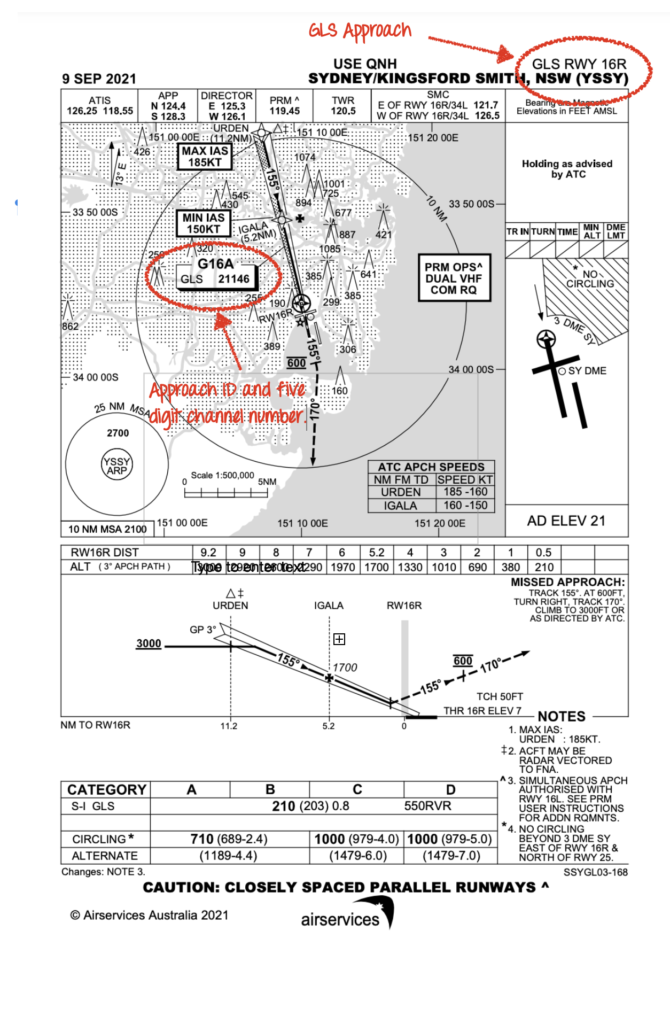
ATC Zero.

There is no-one out there. Maybe they had to evacuate? There was some sort of emergency or major technical issue that’s has taken down an entire ATC provider? Occasionally it is Notam-ed, but in that case you won’t have been given clearance to head through, so we are talking those unforeseen sudden zero events.

Each region has its own contingency procedures which you can find in their AIP, or better still in NAT Doc 006, which was also updated in Feb 2021.

These routes are really for when big stuff happens – the entire ATC for a sector is evacuated for example. In most cases, other units will try and manage control as best they are able, but it will be fairly limited.

So, if you’re already inside, continue and start trying to make contact with the next sector (as they will hopefully be managing control as much as they can). If it is a big ATC zero event you are probably going to have to follow the contingency routes to exit the NAT HLA (rather than your clearance) but this will be ‘activated’ by whichever ATC is taking over control.

If you already have your clearance to enter you can, and you can transmit position reports on 123.45, but it is not really advisable. The best plan is to organise a re-routing.

If you don’t already have a clearance then you aren’t going to be able to enter the ATC zero bit and you will need to plan a re-route around the affected sector.

Feeling the need to read more?

Here are some handy links to things on the subject.

Changes to NAT Doc 006 – our blog post summarising what these were.

The Irish AIP (again) in case you missed the link earlier.

The GOLD Manual (2017 edition) – for all your Datalink info.

Opsgroup Member?

Then click here to download our handy little Comms Issues on the NAT “Opsicle” – a refreshing bit of ops info, just for members.

OPSGROUP members: click to download PDF.

If you’re not an OPSGROUP member, but you’d like to be, you can join here.


(Not so) New on the NAT

The helpful NAT OPS elves have put out some new NAT OPS info, so here is a summary on it.

The Sample Oceanic Checklist

First up, the Sample Oceanic Checklist which was effective from October 5. Here it is if you want to read it yourself.

Page 2 of this is actually really handy if you are not super familiar with oceanic ops because it lists everything you need to think about and do for each stage of the flight. The main change here is a clarification of SLOP (and micro slop) which is up to 2nm to the right, never go left, and in increments of 0.1nm.

Fresh out the bulletin

Page 5 has updated the info on Long Range Nav Systems (LRNS) saying ya need two of ‘em, a single FMS doesn’t count even if it is receiving from two separate nav sensors, and as far as your LRCS (long range comm systems) go you need an HF as one of them.

‘Prior to Oceanic Entry’

A reminder here that both pilots must obtain the clearance. This does not mean both have to do it separately. It means both have to be there, check it, confirm it. They actually say that dual checking of the oceanic clearance must be SOP. So no toilet breaks in the middle of it.

Generally if you are going to get your clearance by voice then give it 40 minutes, if you’re using Datalink (which you most likely will be now with all the mandates in place) then 25-90 minutes before entry will work. The time varies from entry region to entry region so you’ll need to confirm the exact timing. Reykjavik for example actually says 15-45 minutes.

Oceanic Errors

The second update, also effective October 5, is all about Oceanic Errors, and it starts out with a ‘Safety Snapshot’. We’ve posted on the safety reports each year and you can read last year’s here.

This bulletin looks at the main issues that have been cropping up in the NAT – namely gross navigation errors, separation problems, weather deviations, and issues with CPDLC – and it provides some top tips on how not to mess up.

Here’s our version of the Top Tips.

CPDLC

It seems some folk have been getting confused with conditional clearances. A conditional clearance means it isn’t as simple as a “climb now” – it will have some sort of delay in it, like a climb after 20W, or a “to reach it by…”, or even a “maintain FLXX, at 14:03 descend and maintain FLXX”

There is a lot of explanation on what these mean, what is expected and how to think about it. Really, it goes back to that infamous saying we all had drilled into us through school – read the (insert swearword) question. Or in this case, clearance. RTC.

Gross Navigation Errors

These seem to be happening because clearances are differing from flight plans and folk aren’t checking and are missing the amendments. You have to fly the clearance. Which means you need to make sure your box (FMC, navigation thingamajig) has the new route programmed in.

Erosion of Longitudinal Separation

People aren’t flying the speed they’ve been been told and are getting too close up the… of another aircraft. Or another aircraft is getting too close to them.

Stick to your assigned Mach. If you have to change it because of turbulence, or you messed up and can’t actually fly that fast/slow by more than .01 of a mach, then tell ATC. ATC will tell you when you don’t need to stick to it anymore by saying something like “Resume normal speed”.

Contingencies

These came in back in March 2019. Check for convective activity early on, that way you have time to pull out the handy picture below and work out what you are going to do.

Also remember: if you have to deviate at all, then you need to tell ATC. Even if that deviation means a tiny little dog-leg around a storm that will move you off your track less than 5nm, you still need to tell them. They will see if you don’t and they will get angry. If you can’t get hold of them then that is when you will want to apply the weather contingency procedure.

Here is a picture to help.

SAND means South (of track) ascend, North descend


FAA Airspace SLOP Mini Guide

Strategic Lateral Offset Procedures (SLOP) in FAA-Controlled Oceanic Airspace and the Anchorage FIR are based off the ICAO Doc 4444 SLOP rules, and can be found in the FAA AIP ENR section 7.1.

I don’t want to read the FAA AIP ENR section 7.1

No, neither do we. Here’s what that experience looks like:

Handy info, but fairly brutal on the eyes and soul.

Is there another way to get this info?

Indeed there is!

We took all the excellent info provided by the FAA with regards to SLOP rules in FAA airspace, and turned it into a quick guide – complete with a simple map of the rules for the different regions.

OPSGROUP members can download a copy for free here.

If you’re not an OPSGROUP member, but you’d like to be, you can join here. (Or you could just screenshot the image above instead – if you’d like a grainy, pixelated JPEG instead of the full, juicy PDF).

We’re going to be publishing more of these little docs over the next few months. We’re calling them “Opsicles” – refreshing bits of ops info, just for members. So keep an eye out for the next installment!


US to lift travel ban for vaccinated travellers

From Nov 8, the US will lift its Covid travel restrictions to allow fully vaccinated passengers to enter from those countries currently on the banned list:

  • The UK
  • Ireland
  • The 26 Schengen countries in Europe without border controls (Austria, Belgium, Czech Republic, Denmark, Estonia, Finland, France, Germany, Greece, Hungary, Iceland, Italy, Latvia, Liechtenstein, Lithuania, Luxembourg, Malta, Netherlands, Norway, Poland, Portugal, Slovakia, Slovenia, Spain, Sweden, and Switzerland).
  • China
  • Iran
  • Brazil
  • South Africa
  • India

The rules right now

The travel ban has been in force since March 2020, when the pandemic first began gathering pace. Under the current policy, only certain people can travel into the US if they have been in a banned country within the previous 14 days:

  • US citizens and their immediate families.
  • Green card holders.
  • Flight crew if traveling to the US on C, D or C1/D visas.
  • Those with national interest exemptions (NIE). (Amongst other things, these also allow foreign crew to enter to pick up aircraft and do delivery/maintenance flights etc despite their travel history.)

For more details on the current restrictions and exemptions, check the US CDC webpage here.

The rules from Nov 8

There are no guidelines yet on the new requirements due to take effect in November – these are expected to be announced in the coming days. The few crumbs of info we know so far:

  • Before departure – Travellers to the US will need to show proof of vaccination in addition to a negative Covid test taken within three days of the flight. There will be some exemptions to the vaccine policy, including for children not yet eligible to be vaccinated.
  • On arrival – Travellers will not need to quarantine upon arrival in the US, but airlines will be asked to collect their contact info for contact tracing purposes.
  • Which vaccines will be accepted? All FDA and WHO approved vaccines will be accepted.
  • Any changes for US travellers? – Yes. US travellers will also be subject to stricter requirements and will need to take a Covid test a day before they leave the US, and another one when they return.

We will update this page as new info is announced.


Terrain, Tehran, Terrain, Tehran

If you are operating to OIII/Tehran Mehrabad airport then watch out – the minimum height thresholds might not be adequate.

Sounds serious!

Well, earlier in the year it was.

A Zagros Airlines A320 operating from OIAW/Ahvaz to OIII/Tehran Mehrabad was cleared the SAVEH 1N arrival and descended, under radar control, to 6000 feet. They were then vectored to the KAZ NDB in order to intercept the ILS for runway 29L.

Which was when they received a terrain alert and “pull up” order.

A quick look at the radar minimum altitudes and there are a lot of high ones – there is a lot of terrain. The adjacent sector is 7,500′ but ATC take aircraft down to the 6000’ (which covers the sector over the airport), and depending on where you arrive from this can be an issue.

Thanks LIDO

There is a 5,036 foot hill sitting in close proximity to the ILS approach, called Bibi Shahrbanoo. For ATC to ensure you are not too high for the ILS, they manage your descent down to 6000′, but that 6000’ doesn’t actually provide the typical 1000’ separation if you are near Big Bibi.

Combine all this with a higher rate of descent and you might get yourself a GPWS warning. The Zagros airlines incident was not the first.

Have they fixed the problem?

Well, Tehran’s runway positions and terrain make it a complex spot to decide what heights should be used, but it does appear that they have looked into it a bit more since a significant number of new charts have been published of late, with validity dates of October 1, 2021.

So let’s play spot the difference…

New vs Old

Let’s take a look at the ILS 29L chart from August 2018 and the new October 2021 chart.

First up, some of the MSA’s actually appear to have shrunk. The northerly sector from 090-270° used to be 17,000’ but now it is divided into two sections of 15,000’ and 16,200’.

The circle-to-land restrictions have been revised, and they have also amended the FAP – it is now set to D7.5 and 6,500’ as opposed to D4.2 and 5265’ which was pretty low given the hills around.

You might also notice (at least on LIDO) a certain 5,600′ point from just beside the inbound course has now been removed… surprising given the hill is, presumably, still there.

This is a tricky airport anyway

The glide slope here is a slightly steeper 3.3°, and you only have precision approaches for runway 29 – runway 11 involves a fairly hideous circling approach.

The area is riddled with both high terrain, and also restricted and prohibited areas, so accurate navigation is important.

The conditions in Iran can be hot, and your elevation is high – 3965ft, leading to higher speeds, and higher rates of descent required. Having this in mind, monitoring your ROD and being aware of the GPWS risk is probably the best mitigation against warnings.

Runway 11R/29L is currently closed for “recarpeting” (not a Persian rug joke, it really is what they call it). So keep an eye out for temporary charts and WIP notams. The runway is closed until March 2022 and the latest AIP SUP 27/21 covers it.

There is also a lot of GPS Jamming across Iran and there are some significant airspace safety concerns to take into account.

It’s not the only spot to worry about

OIIE/Iman Khomaini is the “main” Tehran airport and to be honest, if you are heading to OIII/Mehrabad airport (a.k.a the “other” Tehran) it is probably because you are using it as an alternate for OIIE. The terrain threat at OIIE is marginally lower than OIII, but still requires prior consideration before jetting in – as do most airports in Iran.

While you’re at it, checking the Notams is a good idea too – OIKK/Kerman, for example, has no less than 34 cavities on one side of one of its runways. OIII/Mehrabad is better maintained (just 1 hole related Notam to be seen).


Hong Kong: King of the Airports

What is happening at Hong Kong airport?

They are working on something…

They are indeed. Hong Kong is adding a new runway and they’ve just finished building it! Six years in the making and due to open 2022, the new runway is set to transform Hong Kong from a city airport to an airport city.

What’s it got now?

Hong Kong currently has two runways 07L/25R and 07R/25L, both offering 12,467’ (3800m) and a bunch of CAT II/III approach options.

The new one will be no less decent – planned to be the same length, and 60m wide.

Here’s what the computer says it will all look like when it is completed.

Why do they need it?

Hong Kong is a major hub and currently sees around 419,795 traffic movements a year, which amounted to 71.5million passengers and 4.8millions tonnes of cargo moving through it (back in 2019).

Here is the bit you are probably more interested in – it can handle just under 70 flights an hour at peak time and has 119 passengers stands, 55 cargo, 26 maintenance and 12 temporary stands.

The airport expansion will enable them to handle an additional 30 million passengers and will add 57 new parking spots.

We mentioned the slot and parking issue a few years ago. It is deceptively green at the moment, but this is probably more to do with a certain pandemic than any real improvement.
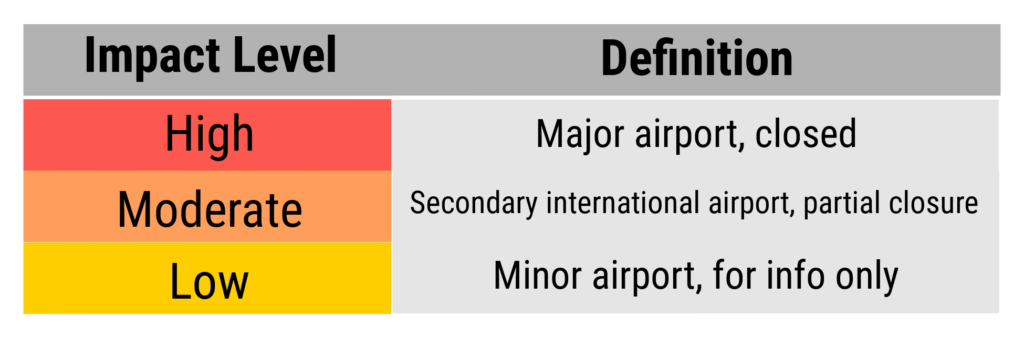
The current runways also do not run 24/7 though, there are regular maintenance closures. AIP SUP 08/21 updated on October 13 2021 has the info.

  • 07L/25R closes 3 nights a week, and 07R/25L closing for 4, between 1601-2315 UTC
  • 07L/25R also closes daily between 0116-1025 UTC.

So more runway and more parking will mean a big improvement on your chances of ad-hoc ops in.

(OK, we’ll slot in a quick slot summary)

This was issued in June 2021: The Hong Kong slot getting guide.

In brief, you probably want to do this:

It it a confusing a frustrating process so if it is your first time you might want to get some help from an agent. Hong Kong Business Aviation Centre (HKBAC) are based at Hong Kong (and you’ll be talking to them for your ground handling anyway.
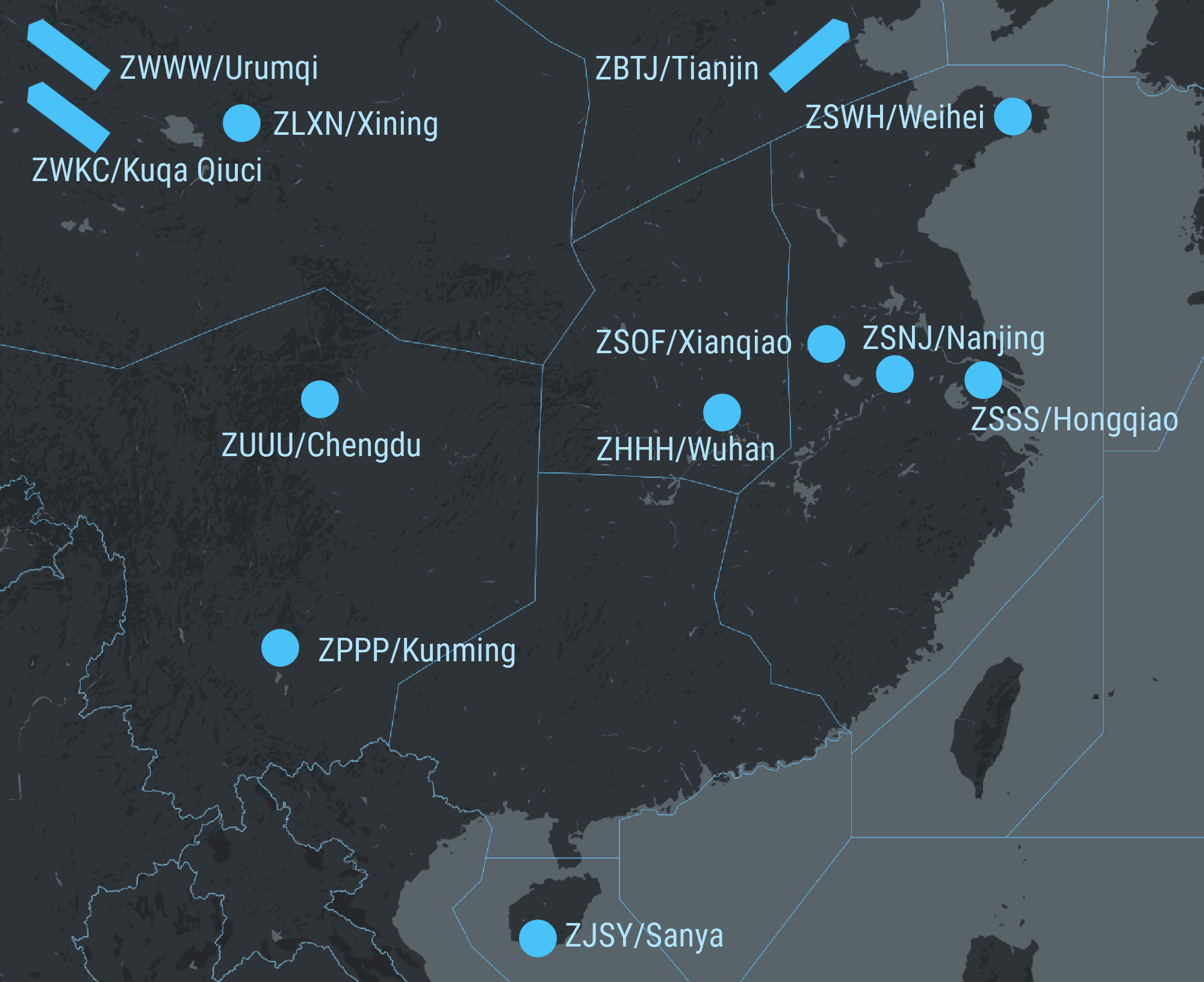
Email: hkbac@hkbac.com

Phone: +852 2949 9000

Back to the expansion plan: What stage is it at now?

The runway work is complete. This will be designated the North runway, while the current north (07L/25R) will become “Centre”. The re-designation will happen at 0000 UTC on December 2 so don’t get confused!

The full ‘three runway system’ is only due for completion in 2024 as the new terminal is yet to be constructed.

It even has some lights.

What about arrivals and things?

The new charts are likely to only be introduced from 2022, however, the current set up bring aircraft into common points which link to approaches for either runway, so chances are they will just add the 07L/25R (new) to these as well.

The plan is to equip all three runways for takeoffs and landings, but primarily use the northerly for landings, the central for take-offs and the southerly for both.

The Hong Kong CAA is also working with the Chinese and Macao CAA to re-develop and improve efficiency in the Greater Bay Area airspace. This airspace refers to the areas utilised by Macao, Guangdong and Hong Kong airports which is high density.

VHHH/Hong Kong’s traffic is restricted by the so called “air wall” between Hong Kong airspace and Pearl River Delta region airspace, and this will also be improved for better traffic efficiency.

The PRD airspace refers to the region, and includes several major airports.

The point of control handover is BEKOL, and traffic must reach set altitudes by this point.

Improvements to the airspace are not un-neededseparation issues have cropped up a few times in the past. So watch this space for changes to routings and handover procedures through to 2024.
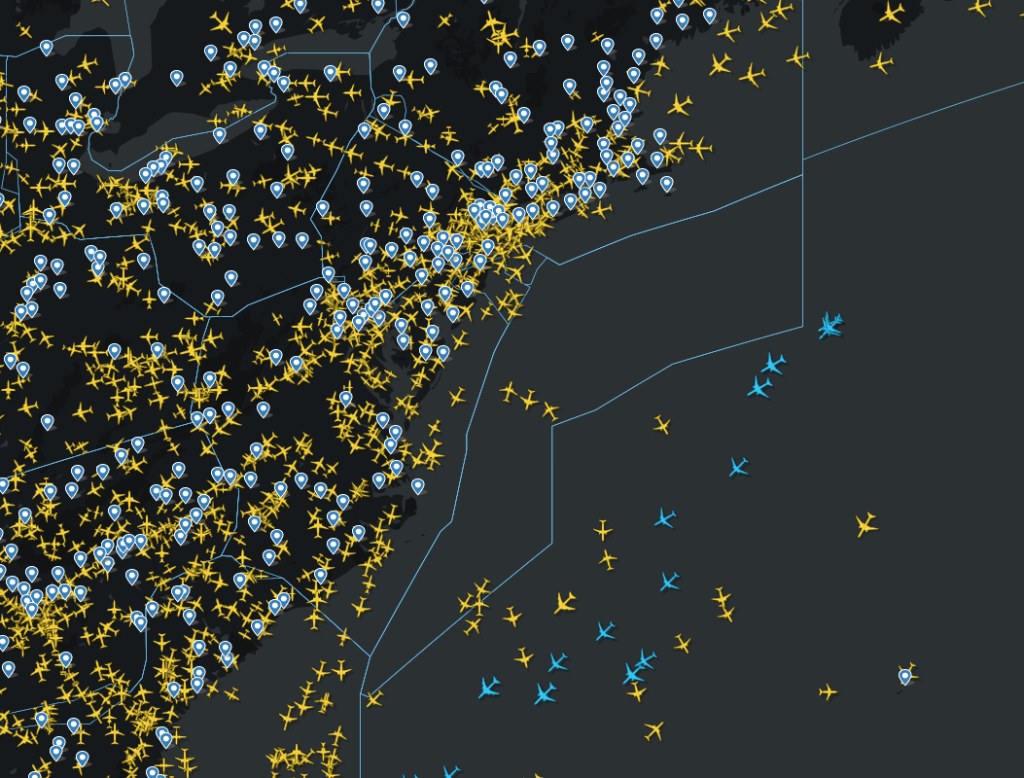
Want some more to read?

A full rundown of the expansion plan is written up pretty decently here.

Or read about it on the official HKIA Three Runway System website here

The main page for all things slot is here.


Major runway works in Sydney

From October 15 until late November, major work is taking place on the threshold of YSSY/Sydney’s world famous Runway 16R – the most used, widest and longest runway at Australia’s busiest airport.

During that time it will not be available for any arrivals (around the clock), and there will be a reduced length for departures.

Here’s a quick rundown of what this means for operations at the airport, and what to expect if you’re visiting the Emerald City in the coming months.

Crunch time

The threshold slab is over half a century old. Pavement failures have been on the rise leading to FOD damage and temporary repairs have become a common occurrence. With things being quieter at the moment, the airport is finally biting the bullet and replacing it completely.

Airport authorities looked at simply displacing the threshold for Runway 16R for arrivals but decided that operationally it wasn’t safe or efficient. So instead, procedures at the airport will temporarily change.

Arrivals

In southerly conditions (which is half the time), all arriving aircraft can expect to land on the shorter Runway 16L. It has 8,000’/2438m of hard stuff, and is narrower at 148’/45m wide. The ILS is CAT 1 only.

First of all, carry extra fuel. With all arrivals being sequenced for one runway, you can expect extensive holding and/or slow-downs during peak times. Just like the freeways, these are early morning and early evening.

Wide body traffic can expect to vacate at T6 – right down the far end. From there it’s a much lengthier (and potentially confusing) taxi to the international side of the airport which may see you cross two active runways. Remember that progressive taxi instructions are always available if you’re unfamiliar with the airport.

Runway 07/25 is also available if you need it operationally, and it is around the same length. You’ll need to request this early from ATC. Remember to use the phrase ‘operationally required’ – it will help ATC to accommodate your request.

In northerly conditions, Runway 34L will still be used for arrivals at reduced length. The LDA will be approx. 11480’/3500m. Expect to see workers and trucks at the far end. Also, a head’s up – the ILS won’t be available during the works. The GLS approach will still be an option, but if you can’t fly one in your ride, you’ll need to do an RNAV approach. They’ll cancel work for the day and switch the ILS back on if things are starting to look murky out there.

Here’s a picture of what this all looks like:

Departures

You will still be able to depart from Runway 16R, but you’ll need to roll from between taxiways Foxtrot and Golf.  Small jets and turbo props may be be cleared for take off from Foxtrot, but heavier jets can expect to taxi forward to Golf first due to jet blast. TORA from there is 9347’/2849m.

And here’s what that looks like:

Wet Season

Sydney can experience severe convective thunderstorms late in the year (the warmer months down under). If the winds are southerly, and there are thunderstorms forecast it’s time to think extra hard about fuel planning during this time.

Being part of one the busiest air corridors in the world, and with only a single runway for arrivals the queue may begin to back up in a hurry during storms. Extensive holding times and diversions are not uncommon in these conditions.

There are a few decent options as alternates, but they’re not right next door. The closest is YSCB/Canberra (132nm). A few things to think about though – it can be a challenging place in bad conditions due to the high terrain that surrounds it. Apron space can also become limited if it is receiving lots of diversions.

Most international operators use one of the below:

  • YMML/Melbourne (384nm) to the south.
  • YBCG/Gold Coast (368nm) and YBBN/Brisbane (395nm) to the north.

Diversion options for Sydney

Looking for the official word?

YSSY Notam H5212/21 is the place to start. IFALPA has also published a Safety Bulletin based on the info available from airport authorities.


Navigating the UK entry rules

England’s entry rules became much simpler from October 4, with the scrapping of the traffic light system. Now, there is just one red list, and then the rest of the world. There’s one set of rules for the red list, and one set of rules for everywhere else.

Red list rules

England removed 47 countries from its red list as of Oct 11. So from that date,the only countries remaining on the red list are now: Panama, Colombia, Venezuela, Peru, Ecuador, Haiti and the Dominican Republic.

Basically, passengers who have been to a red list country within the past 10 days can only enter England if they are a British/Irish National, or have residence rights in the UK. And when they arrive, they must stay in a managed quarantine hotel  for 10 days.

Check here for full info.

Rules for everywhere else

This depends on whether a passenger has been vaccinated or not:

Vaccinated Passengers
There is no requirement to get a test prior to travelling, or to quarantine on arrival. Pax will still have to get tested a couple of days later, but cheaper/easier options are coming.

Unvaccinated or Partially Vaccinated Passengers
It’s not great news. Unvaccinated pax will still need to get a pre-travel test within three days of their flight but here’s the real kicker: they will have to isolate for ten days on arrival (from anywhere). Fortunately, the test-to-release scheme is still be running to get out of self-isolation early.

Check here for full info.

Which vaccines are accepted?

Oxford/AstraZeneca, Pfizer BioNTech, Moderna, Janssen – plus a few other permutations.

On Oct 11, England added 37 more destinations to its list of countries and territories with approved proof of vaccination, meaning that arrivals from these places will be able to avoid more expensive post-arrival testing requirements.

The UK or England?

These rules in their entirety only affect arrivals in England. Scotland, Wales and Northern Ireland have all got their own sets of rules.

What about crew?

England has a dedicated page on the rules for crew, which you can read here.

The key points:

  • Crew do not need a Covid test to enter England, even if they have been in a red list country.
  • Crew who live in the UK do not need to quarantine, even if they have been in a red list country.
  • Crew who do not live in the UK must quarantine in their hotel until departure if they are not fully vaccinated, or for a full 10 days if they have been in a red list country.


GPS Outages: The Hotspots

We are talking about it again. Satellite signal disruptions. Jamming. Issues with your navigation equipment…

IFALPA have just released a new “watch out for it” paper so we thought we’d have a mini recap on what it is, where it is and what you can do about it.

Here’s what we said earlier about the problem.

The Big Problem

A big rise in GNSS radio frequency interference occurred in 2018 and since then (with voluntary reporting) there has been a 2000% increase sustained ever since.

A Eurocontrol Think Paper published in March 2021 suggests that 38.5% of European en-route traffic operates through regions intermittently but regularly affected by RFI, and 5% of these needed special assistance, which doesn’t sound like much until you check out the number of en-route traffic to Europe each day!

83% of disruption occurs en-route in the big red regions shown here

The Big Hotspots

The big hotspots remain around the Mediterranean, Middle East and Caucasus where they see, on average, 3,500 outages or so a year. Traffic routing along the UM860/688 airways in Iraq, and en-route crossing borders in Turkey/Iraq/Iran or close to the Syrian border are the most commonly reported areas of issue.

Reports from aircraft overflying regions near major Turkish airports have also reported signal jamming, while aircraft operating into LCLK/Larnaca or airports in the Egypt/Israel/Jordan and Lebanon areas have reported jamming during the climb, descent and approach phases.

Back in 2019, LLBG/Tel Aviv Ben Gurion airport was seeing a high number of issues with their RNAV departures and arrivals. Or rather, issues with aircraft not having the internal accuracy required (due to jamming through the Tel Aviv FIR) for them to fly RNAV procedures. Crew were advised to plan for alternatives.

IFALPA also reported on issues in Central Mexico, particularly in the area around MMLO/Guanajuato airport. The issue was further compounded by a lack of any Notams warning of potential signal disruptions. A heads-up so you know to watch out for it is always helpful.

Highlighting the major hotspots – IATA 2021.

Other spots to watch

US Military tests on systems designed to block enemy signals are unfortunately indiscriminate in what they block – and so they often impact commercial aviation as well, sometimes affecting signal as far as 400nm and up to FL400. While Notams are issued for these tests, they often cover large areas and are overlooked by crew because of this.

A test back in 2019 in Washington state highlighted the big impact these can have – the possible area affected covered 67 airports including KSEA/Seattle-Tacoma.

The jam radius from a test in Louisiana.

The FAA is working with the military to find a solution to this. They previously made 25 recommendations including a requirement that Notams be issued at least 120 hours in advance. Here is what we mentioned on this before.

What to do if it happens to you

Your aircraft is going to have checklists covering it, but in a nutshell, if you think your aircraft’s ability to accurately fly an RNAV procedure has been impacted then plan for another approach and let ATC know.

IATA and ICAO both have GNSS Interface Reporting Form which you can send to help them track areas of significant anomalies, and follow up with authorities to try and mitigate the problems. 

If you experience an issue in FAA airspace then use their dedicated reporting site.

And keep up to date with outage areas here.

Any final thoughts?

The range of RFI jamming is a lot bigger than folk realise. While it is usually centered around conflict zones, it seems to go “well beyond simple military mission effectiveness.

A cigarette light powered (illegal) personal privacy device is enough to disrupt the signals in an aircraft if the device is relatively nearby.

Thankfully ICAO, Eurocontrol, the FAA etc are on the case but until solutions are found, it will remain with the pilots to stay safe when signals are disrupted.