Every summer, everyone in the group wants to know the same thing: what levels of misery can we expect this year for BizAv parking in Europe?
So instead of publishing separate guides for Spain, Greece, Italy, France and the other hotspots, this year we’ve pulled everything together into one guide. It shows where parking is hardest, where you still have a chance, and some of the local rules that can catch you out.
As always, if you know something we don’t, tell us. We’ll keep updating this guide throughout the summer 👍
Spain
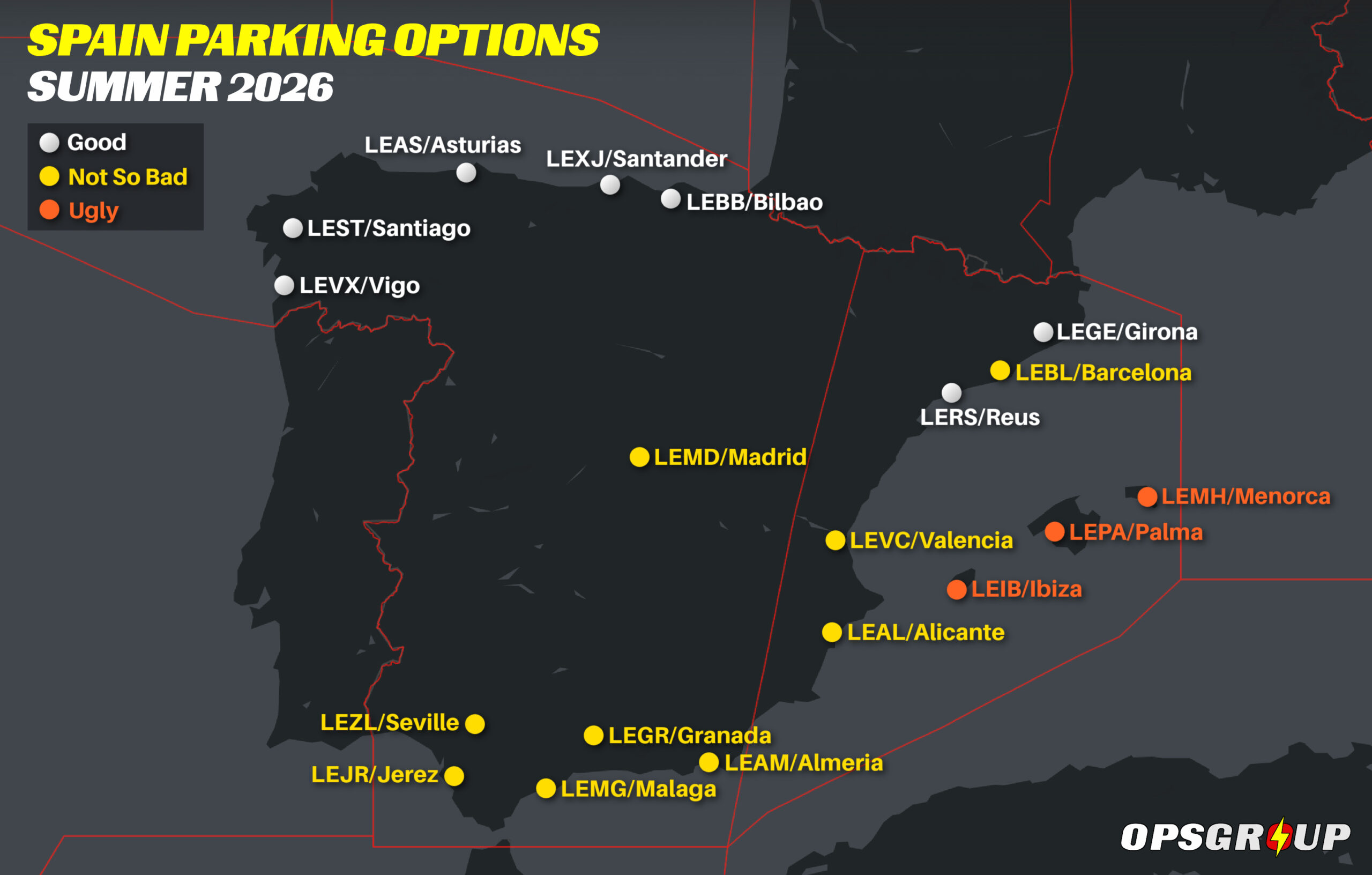
Spain remains one of Europe’s busiest summer destinations for BizAv, with the Balearics continuing to see the highest demand. Overnight parking at LEIB/Ibiza, LEPA/Palma and LEMH/Menorca is denied in many cases, and the pressure is now spreading to the mainland. Airports such as LEVC/Valencia and LEAL/Alicante are no longer the easy reposition options they once were – but still worth trying as backup options.
Parking/slot requests generally open 14-15 days before arrival. Earlier requests are not accepted, and there is no real-time parking availability. Your handler must first submit the full request before the airport authority decides whether space is available, so apply as soon as the booking window opens and always have a backup plan.
The Balearics: still the biggest challenge
LEIB/Ibiza is usually the hardest airport to secure, with overnight parking often refused. A summer PPR is also needed for aircraft with a wingspan greater than 18m planning to stay on the ground for more than 3hrs.
LEPA/Palma is slightly easier, but still heavily congested. From June – Oct, aircraft longer than 20m are limited to a max 7-day stay unless specifically approved by the airport. Fuel delays have also been reported during peak periods.
LEMH/Menorca is generally the easiest of the three, although overnight parking is still difficult, particularly over weekends.
FBO contacts: Aviapartner – leib@aviavip.com, lepa@aviavip.com, lemh@aviavip.com
Mainland Spain: where you might have a chance
When the islands are full, repositioning to the mainland is often the best option.
LEBL/Barcelona is okay-ish. It operates H24, but non-based aircraft are limited to a maximum 96-hr stay. New for this summer, aircraft below 15 tonnes MTOW cannot arrive between 0900-1330 LT. Expect taxi times of around 20 mins from the BizAv apron, and remember that A-CDM rules are strictly enforced. + The 3-hour stay limit is back. Until Jul 29, BizAv flights using aircraft with a wingspan over 19.2 m can stay for no more than 3 hours.
LEMD/Madrid is looking easier than last summer. Local FBOs tell us the previous restrictions on overnight parking and positioning flights are not currently in force, although parking approvals still depend on apron capacity and restrictions could return if demand increases later in the summer. Also, expect taxi times of 15-30 mins, and possible fuel delays if you don’t have a confirmed same-day departure, as priority is given to commercial and outbound traffic.
FBO contacts: Universal – universal.aviation@uvspain.com, bcn@uvspain.com
Other airports are also worth a look. LEGE/Girona and LERS/Reus are good options on the northeast coast. Further south, LEZL/Seville, LEJR/Jerez, LEMG/Malaga, LEGR/Granada and LEAM/Almeria may also work. For the best chance of finding parking, head north to LEBB/Bilbao, LEAS/Asturias, LEST/Santiago de Compostela, LEVX/Vigo and LEXJ/Santander, where summer traffic is generally lighter.
LEMG Member report July 1: We experienced a roughly four-hour fuel delay at LEMG/Malaga during an early morning stop, with airline traffic taking priority for refuelling. If you’re planning a fuel stop here in summer, allow extra time.
Greece
Overnight parking is the biggest challenge in Greece every summer. Even quick turns can be difficult across the islands, and LGAV/Athens is not an easy parking alternative anymore.
Most of the busiest island airports are managed by Fraport. If you’re planning an overnight stay, check two things: the Fraport PPR Handbook for the published max ground time and PPR requirements, then the hideous Notams. During July and Aug, Notams often introduce even stricter parking limits than those in the handbook!
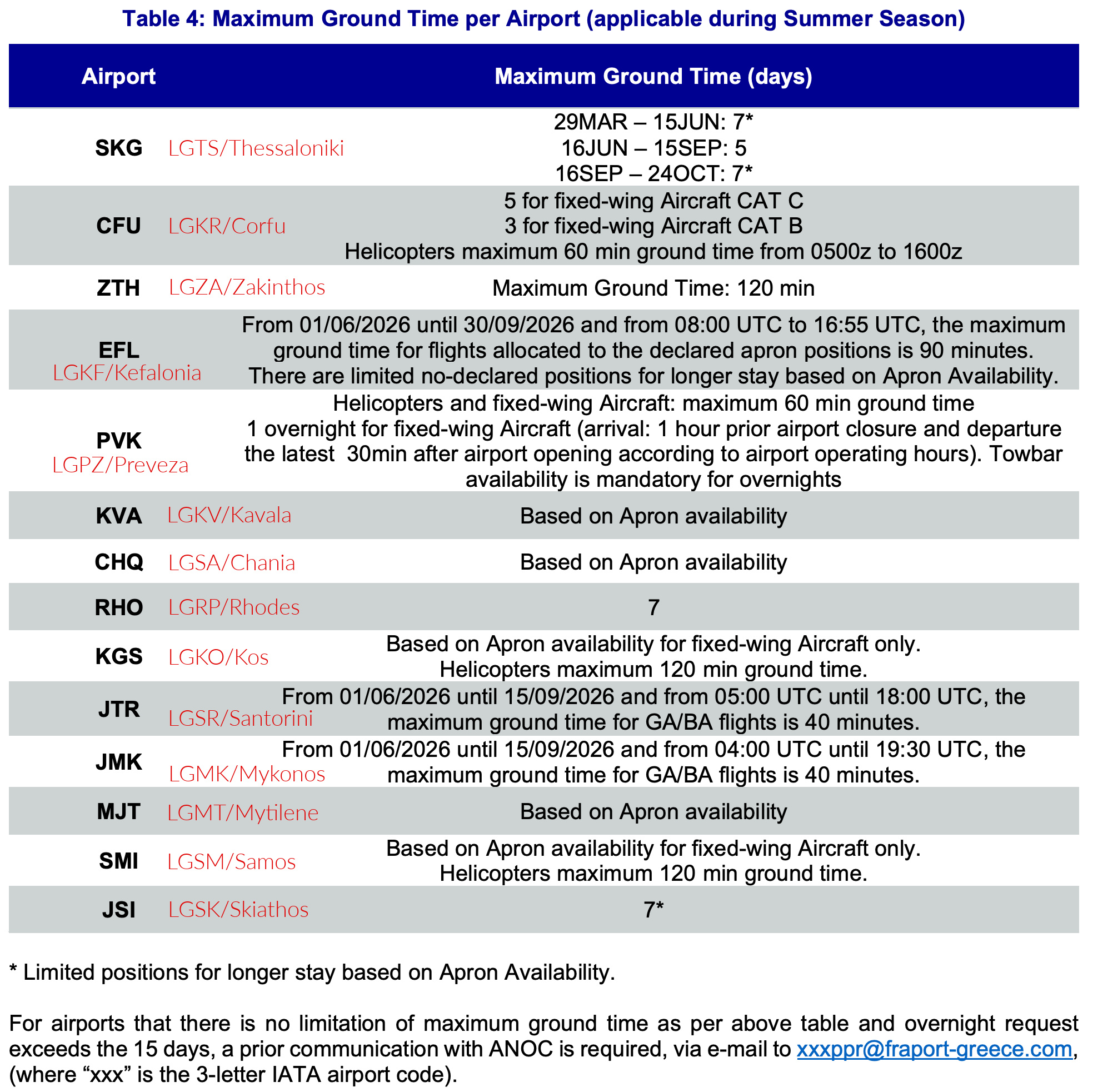
Watch out for extra summer charges at LGMK/Mykonos, LGKR/Corfu and LGKO/Kos. BizAv flights are required to use the dedicated GA Terminal, with an additional charge of EUR 2,000 per passenger-carrying sector. An inbound and outbound passenger flight will therefore cost an extra EUR 4,000, plus VAT for non-EU operators.
Don’t miss your slot
Slots are just as important in Greece. The Flight Plan Suspension (FLS) system is back for summer 2026, in effect from 29 May – 4 Oct. It applies to Level 3 coordinated airports, which basically covers most of the busiest island destinations. You can find the full list of Level 3 airports here. For full details, see SUP 05/26.
If your flight plan differs from your confirmed slot by more than ±15 mins, it will be automatically suspended. Your handler will normally obtain the airport slot from the Hellenic Slot Coordination Authority (HSCA), but make sure any schedule changes are coordinated before updating your flight plan.
The slot ID must be included in Field 18: RMK/LGXXAxxxxxxxxx for arrivals + RMK/LGXXDxxxxxxxxx for departures.
Parking alternatives
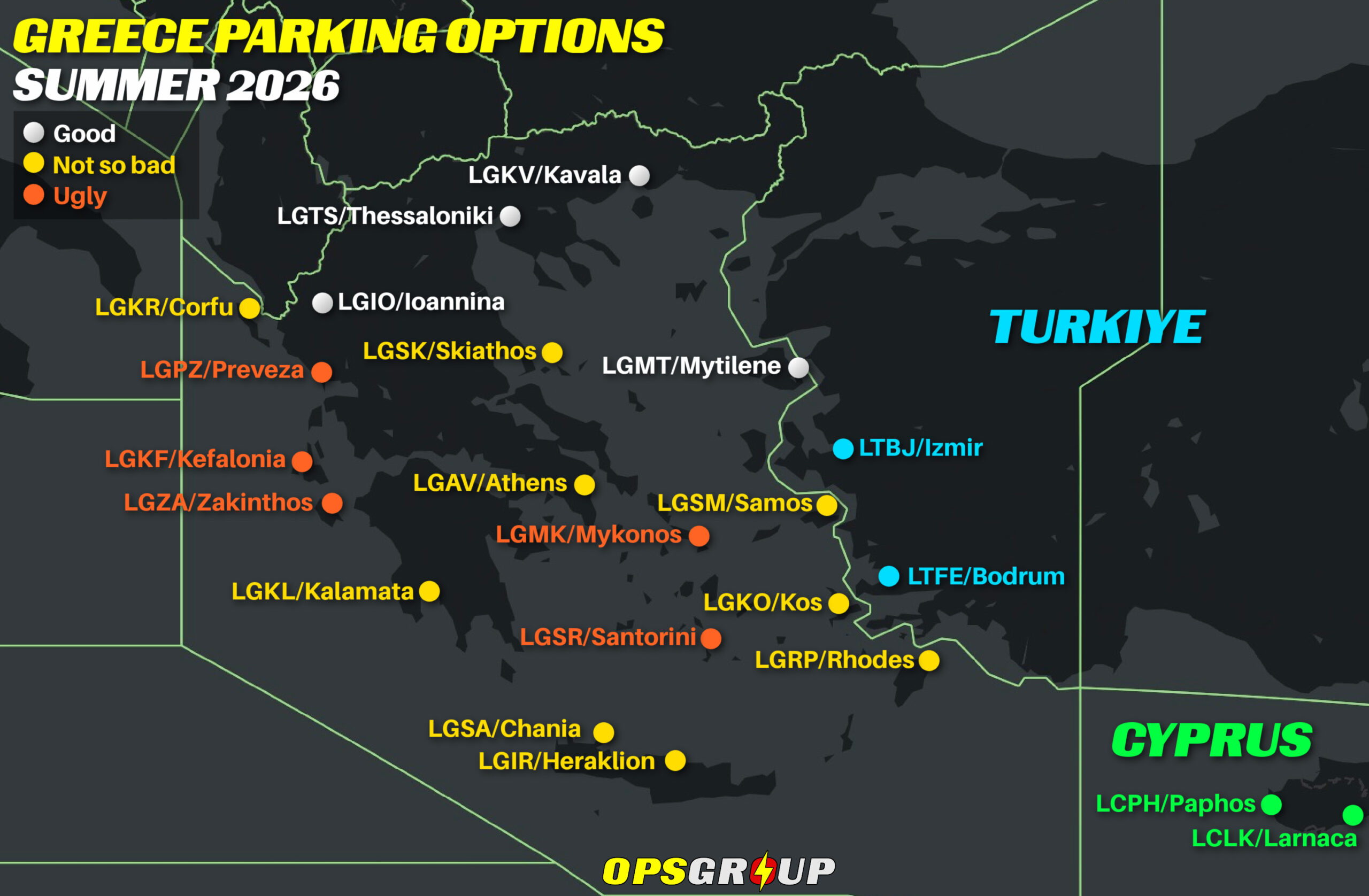
For most Greek island trips, drop-and-go with a confirmed reposition remains the safest bet.
On the mainland, LGTS/Thessaloniki, LGIO/Ioannina and LGKV/Kavala are probably the best options. LGSA/Chania, LGIR/Heraklion, LGKL/Kalamata, LGRP/Rhodes, LGKO/Kos, LGMT/Mytilene and LGSK/Skiathos may also work. We’ve also heard positive reports from members about LGBL/Almiros, wherever that is?
LGAV/Athens continues to operate under the same parking rules introduced last summer. Aircraft staying up to 90mins do not need a PPR. Longer stays require a PPR, with requests typically processed within only 24 hours of the flight! See the Slot Authority guidance for full details.
Outside Greece, LCPH/Paphos and LCLK/Larnaca may still be worth trying. Along the Turkish coast, local FBOs recommend LTFE/Bodrum for shorter stays (3-5 days) and LTBJ/Izmir for longer parking (10-15 days).
At the other end of the scale, LGMK/Mykonos, LGSR/Santorini, LGKF/Kefalonia, LGZA/Zakinthos and LGPZ/Preveza remain “peak misery” options – these are the hardest places to secure overnight parking. LGSM/Samos is generally best treated as a backup option, while LGKR/Corfu can also become difficult during peak periods.
Italy
Unlike Spain or Greece, summer demand in Italy is spread across several regions rather than one hotspot. Northern Italy, the Amalfi Coast, Sardinia and Sicily all become busy.
Watch Italy’s aircraft disinsection requirements. If you’ve operated from certain mosquito-risk countries within the previous 28 days, you may need a residual disinsection certificate or advance declaration before arrival. Check with your FBO before you fly, as requirements and enforcement seem to vary between airports!
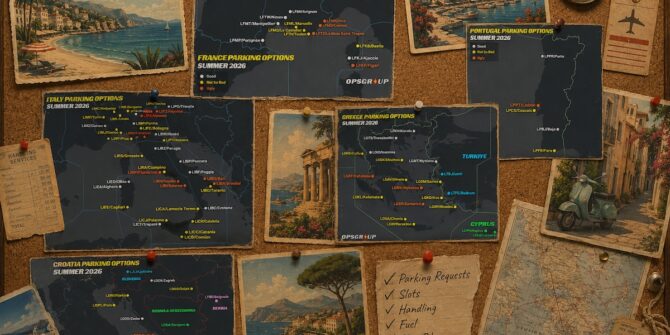
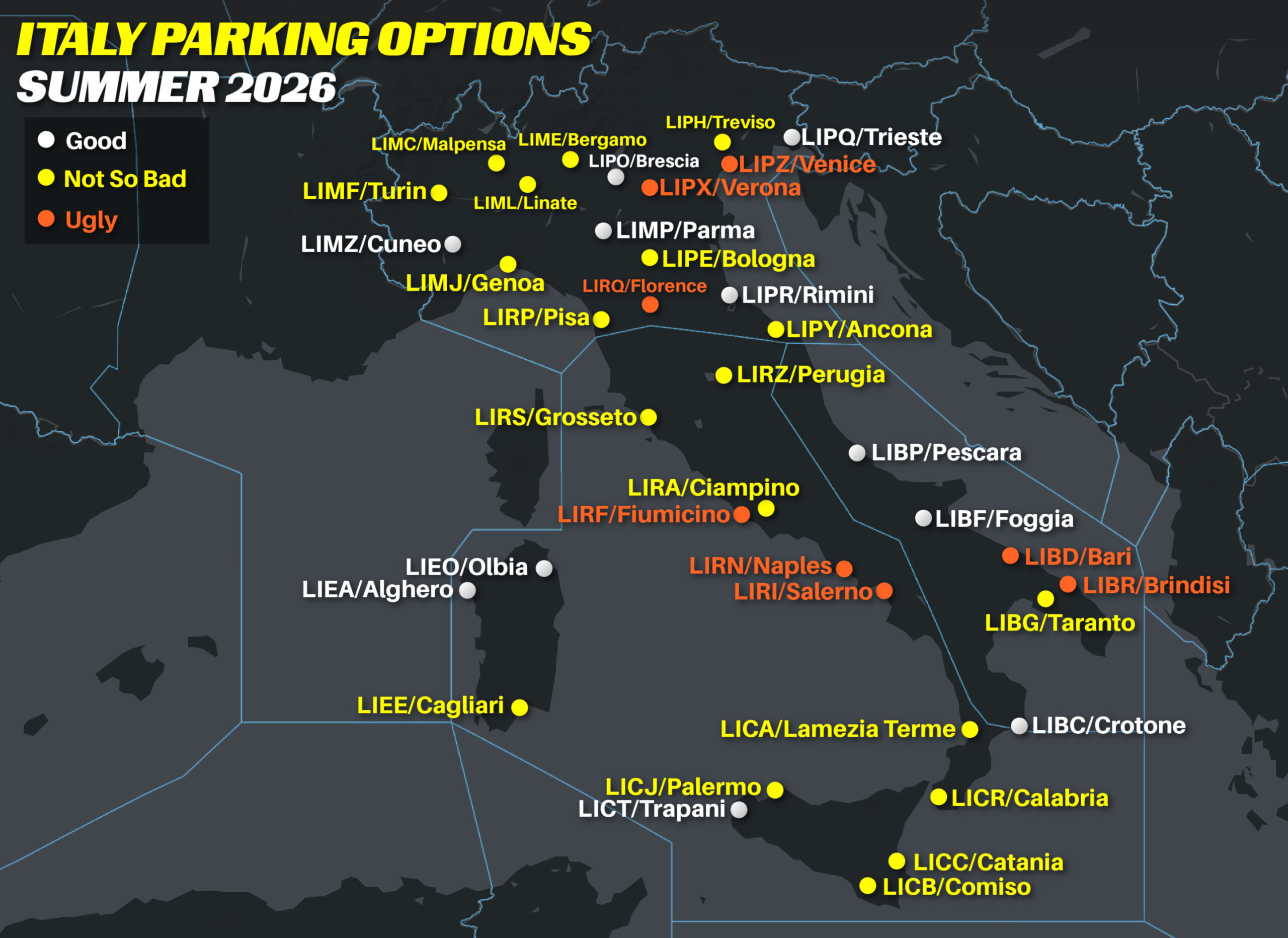
Now get ready for the most brutal map so far! An assault on the senses!
Northern Italy: Venice, Milan and Tuscany
LIPZ/Venice remains the biggest challenge in northern Italy. From mid-May to late Oct, ground time is limited to 24 hrs, and PPR is mandatory.
LIPH/Treviso has traditionally been one of the easiest nearby options, but we’ve recently heard of parking being denied even for short pax pickups. LIPX/Verona is also busy, with PPR required, overnight parking usually limited to one night, and Wednesdays and Saturdays proving the hardest days. Local FBOs recommend repositioning to LIPO/Brescia, LIPQ/Trieste, LIME/Bergamo or LIPY/Ancona. Both Bergamo and Ancona require PPR, with Ancona introducing a new PPR procedure this summer due to limited apron capacity. We’ve also had several positive reports from members using LIMJ/Genoa for longer parking, although availability appears to change quickly from week to week.
The Milan airports remain good options. LIML/Linate currently has no major seasonal restrictions and is usually the preferred airport for downtown Milan, while LIMC/Malpensa is also BizAv-friendly and better suited to larger aircraft. But longer stays at LIMC may require remote parking and fuel delays are possible during peak periods. Parking charges at both airports also remain significantly higher than pre-2025 levels. Expect the biggest pressure on parking in Sept during the Italian Grand Prix and Milan Fashion Week. LIMF/Turin is another reliable alternative with PPR required.
LIML Member report July 1: During a recent heatwave at LIML/Linate, early APU use was initially denied due to local ramp restrictions. After repositioning to another stand, it was approved 1h15 before departure. If you’re operating in hot weather, discuss APU requirements with your handler in advance.
Further south, LIRP/Pisa usually works okay, although expect delays during peak periods as available PPRs are limited by hourly runway capacity. LIRQ/Florence is much tighter, with PPR accepted only between 15 days and 24 hours before arrival and parking limited to 24 hours.
LIPE/Bologna is another okay option with PPR required. For easier parking, head to LIMZ/Cuneo, LIMP/Parma or LIPR/Rimini, where demand is generally lighter.
Central and Southern Italy: Rome, the Amalfi Coast and beyond…
Rome needs a bit of planning. LIRA/Ciampino is the main BizAv airport. From 1 May to 30 Sep, ferry-in BizAv aircraft with a wingspan over 21.40 m are limited to a max 24hr stay. LIRF/Fiumicino is not a great fallback: BizAv is normally routed there only when LIRA is unavailable or closed, with any daytime use limited to specific cases such as denied LIRA PPR, and usually capped at a max 12-hour stop. Ferry-in/ferry-out PPR requests are not approved.
Away from Rome, things get much easier. LIRS/Grosseto offers overnight and long-term parking, no formal ground time limit, and PPR with 24 hours notice. The main limitation is that civil traffic is accepted only between sunrise and sunset, with no civil night ops. LIRZ/Perugia and LIBP/Pescara are handy alternatives. LIRZ requires PPR for most BizAv, while LIBP has no notable summer parking restrictions.
The Amalfi Coast requires much more planning. LIRN/Naples is one of Italy’s most restrictive airports, with summer ground time typically limited to 3 hours, no overnight parking, and PPR. The airport operates 0600-2300 LT with no extensions. Nearby LIRI/Salerno is only slightly more flexible, allowing stays of up to 48hrs depending on parking availability. At both airports, PPR requests open only 15 days before the flight.
LIRI Member report June 12: We were held before landing despite arriving on our confirmed slot, reportedly due to commercial traffic. On arrival, ground handling was slow and customs queues were exceptionally long, as the old FBO is closed and the temporary terminal is currently handling both BizAv and airline passengers. Based on this experience, we’d recommend having a backup airport if you’re planning to use LIRI.
Further south, LICA/Lamezia Terme is one of the better parking options, typically allowing stays of 4-5 days, with PPR required. Keep in mind that despite the airport operating 24/7 most BizAv movements are limited to daylight hours. If parking is unavailable, local FBOs recommend LIBF/Foggia. LIBD/Bari operates under PPR, with most summer parking limited to 24hrs. If available, a small number of stands can accommodate stays of up to 5 days. LIBR/Brindisi is more restrictive, with ground time usually limited to 3 hours and PPR opening 10 days before the flight. LIBG/Taranto offers overnight parking with no PPR or ground time limits, but the airport operates only between 0800-2000 LT, with the last arrival at 1920 LT and the first departure at 0830 LT. LIBC/Crotone and LICR/Calabria are quieter alternatives, with no notable summer parking restrictions published in the AIP, although LICR requires prior crew qualification.
Sardinia and Sicily
Demand across Sardinia seems to increase every summer. LIEE/Cagliari requires PPR, and longer stays are not always possible during peak season. If parking is unavailable, local FBOs recommend repositioning to LIEO/Olbia or LIEA/Alghero. LIEO remains the preferred reposition option thanks to better parking availability, although PPR is required.
Sicily is generally easier than mainland hotspots, although parking still depends on apron capacity. LICC/Catania is H24 and is one of the island’s best options, with no published ground time limit and PPR required. LICJ/Palermo is more restrictive, with summer parking typically limited to 3-4 days. During the annual Google event at the end of July, long-term parking becomes particularly difficult. If parking is unavailable, local FBOs recommend repositioning to LICT/Trapani or LICB/Comiso. LICT is a military airport open to authorised civil traffic, while LICB operates 0600-2200 LT.
France
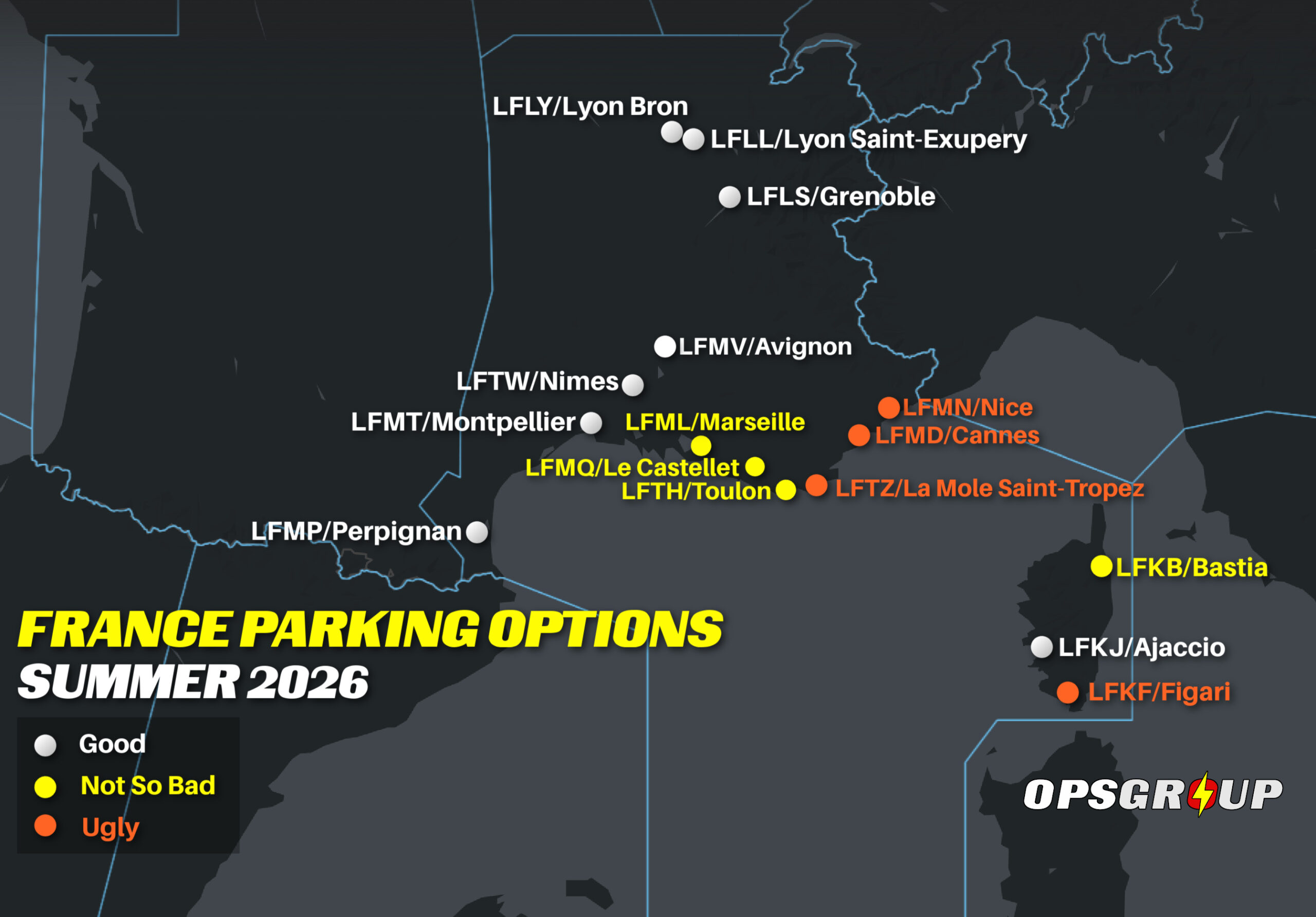
Summer demand in France is focused on the Mediterranean coast. The Cote d’Azur and Corsica see the greatest parking pressure, and several inland airports remain good alternatives.
Most airports require advance notice for parking, handling and customs details, often 24-72 hours before arrival and usually via MyHandling. Rules vary widely: some airports are slot and PPR free but limited by stand space, while others use strict PPR or slot procedures. At the busiest locations, approval may come only a few days before the flight.
The French Riviera and Southern France
LFMN/Nice is the main BizAv gateway, but parking approval is tough. Nice is fully slot-controlled, with tight tolerances: ±10 min for arrivals and -10/+15 min for departures. Any schedule change can mean losing both your slot and parking, and the confirmed slot ID must be included in Field 18 of the FPL. Fuel delays are common, as airline traffic takes priority. APU use is also limited before departure, so plan around ground power availability during hot weather.
Nearby LFMD/Cannes may be scenic, but it’s not built for bigger jets. Jets over 35 tonnes MTOW and turboprops over 22 tonnes are not accepted. The airport is coordinated from 11 May – 14 Sep, with slots required for IFR/Y/Z arrivals and departures.
LFML/Marseille is still one of the more practical alternatives. It operates H24, but summer parking is now more controlled. From 1 June – 31 Aug, all BizAv requests require airport administration approval through a handling agent. Short-turn parking is generally straightforward, but longer stays are harder to secure, with only 6 stands available for parking beyond 72hrs and they fill up quickly.
Further along the coast, LFTH/Toulon is a useful alternative, but it has limited operating hours and extra constraints as a joint civil-military airport. PPR is required. LFTZ/La Mole Saint-Tropez also has limited operating hours, restricted-use status and a short runway, so it is mainly suitable for approved operators with aircraft and crews meeting the required qualifications.
Away from the Riviera, parking generally becomes much easier. LFMT/Montpellier is an option, with PPR required for non-based BizAv aircraft. LFMV/Avignon, LFMP/Perpignan and LFTW/Nimes also have generally good parking availability, although all have more limited operating hours than the major coastal airports. LFMP requires PPR for BizAv. LFMQ/Le Castellet is a niche option, requiring slots and accepting Schengen traffic only.
LFMT Member report June 19: We repositioned to LFMT after dropping our passengers at LFMN. Parking and handling were straightforward, but be aware that the VIP terminal currently has no X-ray equipment, so all baggage is checked manually, which can significantly slow departures.
If you’re prepared to reposition further inland, LFLL/Lyon Saint-Exupery usually has parking available even during peak season and can easily accommodate larger bizjets. Nearby LFLY/Lyon Bron is another option, while LFLS/Grenoble remains one of the easiest alternatives – although with more limited operating hours.
Finally, check your alternates carefully. Some airports can only be used as alternates under specific conditions. LFTH cannot be used without PPR, LFMD is only accepted as an alternate for flights to LFTZ, and LFMQ should never be your only alternate, as it does not routinely publish TAF/METAR reports.
Corsica
LFKF/Figari is the most restrictive airport, generally allowing only quick turnarounds with no long-term parking. LFKB/Bastia offers a little more flexibility, although parking is still limited during peak periods. LFKJ/Ajaccio remains the best option on the island. Both slots and PPR are required, although local FBOs report that parking availability is generally good.
Portugal
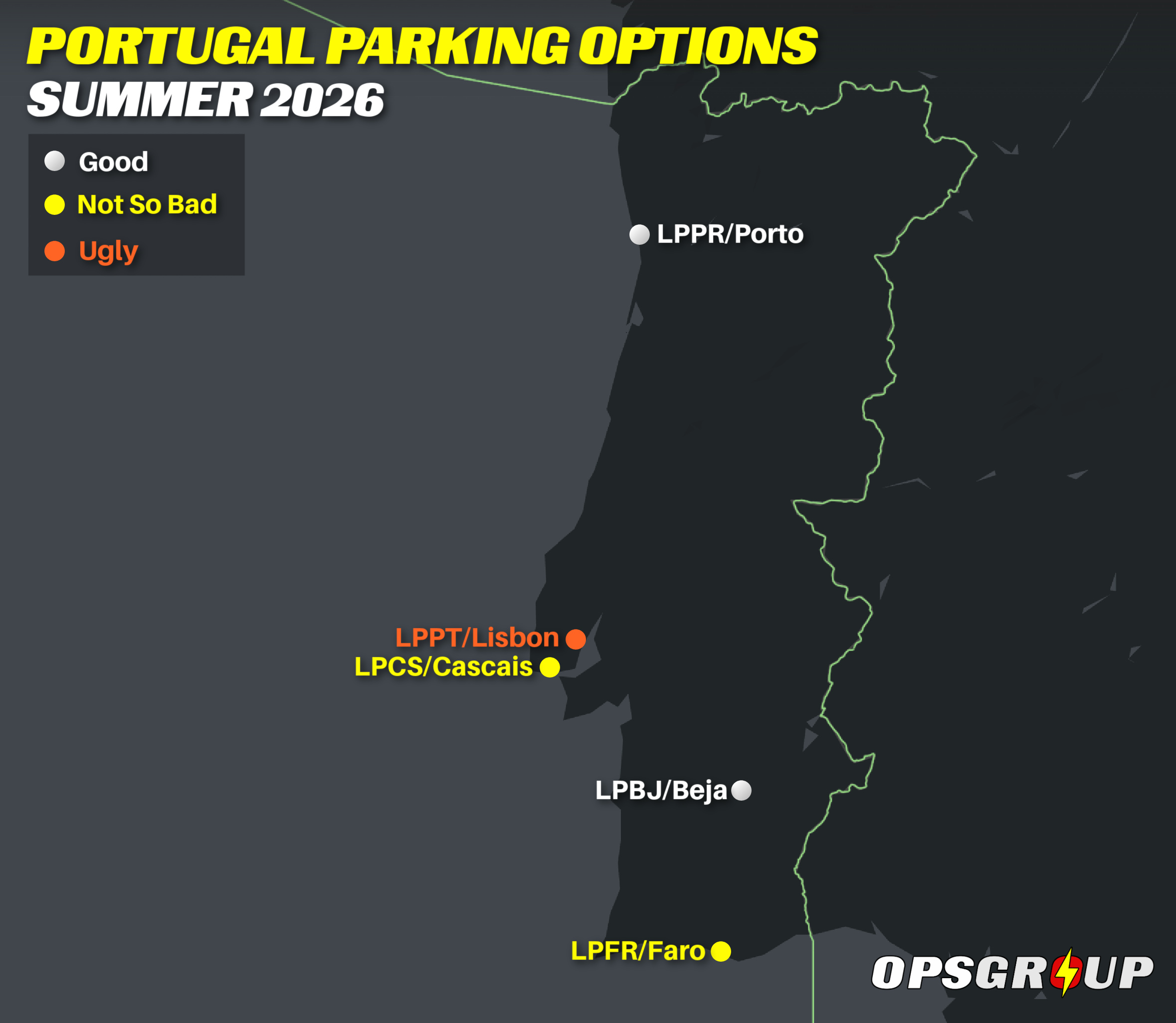
Portugal is mainly about two places: Lisbon and the Algarve. LPPT/Lisbon is notoriously difficult to get into for BizAv, with ad-hoc slots for non-based aircraft currently limited to short turnarounds: 45 min for Code A/B, 60 min for Code C/D and 90 min for Code E.
LPCS/Cascais is an option for Lisbon traffic. Overnight parking is generally available, no slots are required, and PPR is only needed for non-Schengen flights. The main limitation is operating hours: the airport is open from 0800 LT until sunset, with extensions possible until 2259 LT subject to fees and approval.
LPFR/Faro is the main Algarve airport and needs early planning! Slots are mandatory and applications are accepted no earlier than 10 days before arrival. Overnight parking is tight. Until the planned VIP terminal opens, passport control delays remain common during the summer, particularly between 0900-1300 LT.
LPBJ/Beja is the easiest parking airport in the group, with overnight parking available and no slots. LPPR/Porto is also workable. Slots are mandatory, while PPR is only required for AOC flights operating to/from international destinations.
Another thing catching some operators out is Portugal’s EORI requirement. Several handlers now report that non-EU operators may need an EORI number even for private flights or simple tech stops.
Croatia
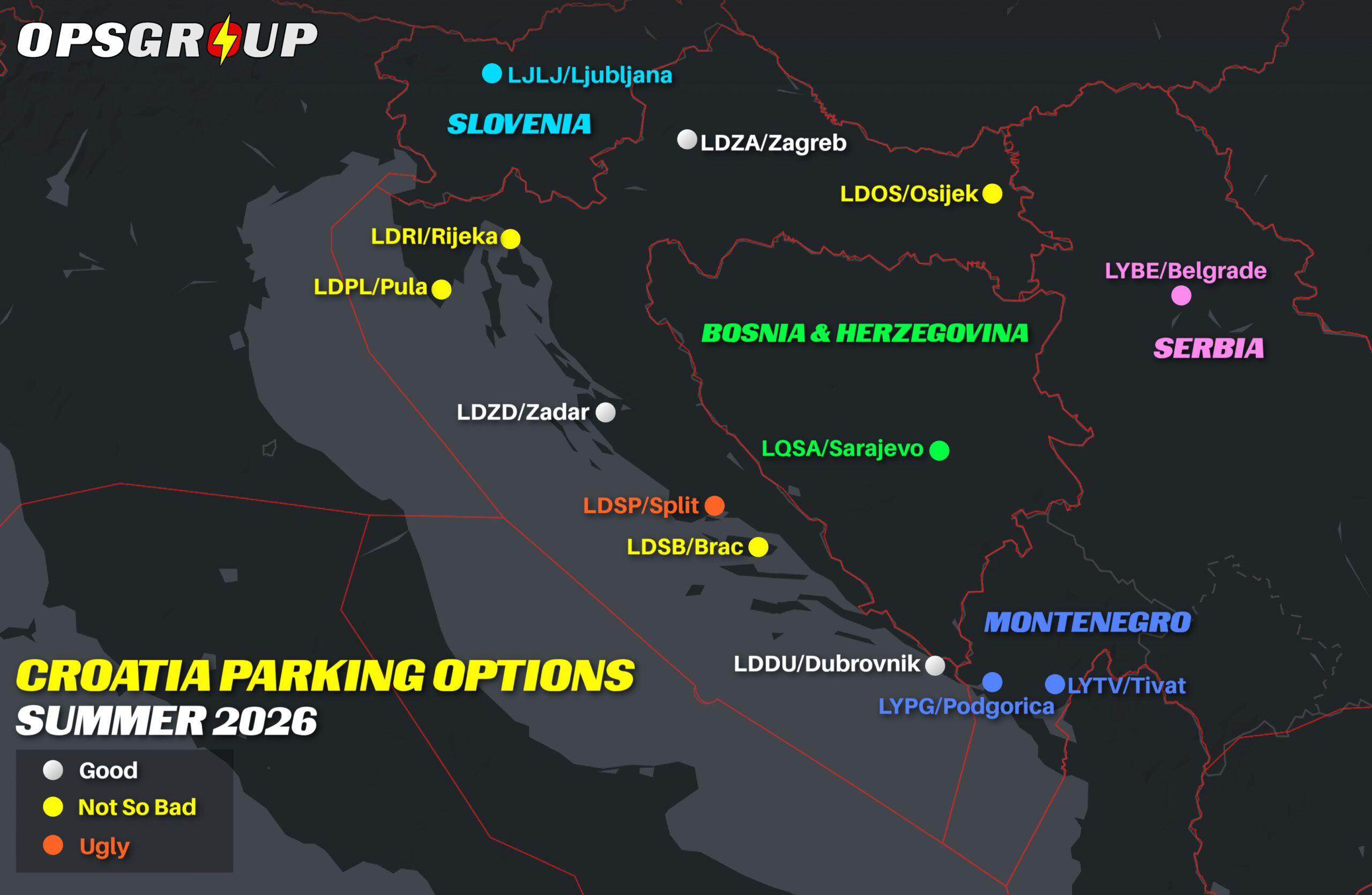
Croatia is mostly about the Adriatic coast. LDPL/Pula and LDRI/Rijeka in the north are generally workable, although local FBOs say the summer rush has already started. LDPL currently requires PPR due to apron congestion, while LDRI has no routine slot/PPR requirement.
LDPL Member report July 1: We had a smooth overnight stop at LDPL, with efficient handling and no issues on departure. Catering options were limited, so plan ahead.
Further south, LDZD/Zadar is one of the preferred reposition options recommended by local FBOs, although a PPR is currently required due to limited apron capacity.
LDZD Member report July 1: We parked at LDZD for 10 days without issue. Customs at the VIP terminal may be delayed if an international airline flight arrives first, and fuel/GSE services are prioritised for airline traffic, so allow extra ground time.
LDSP/Split is the hardest airport in the group. Overnight parking is usually not available during the summer, turnaround time is typically limited to 60 mins, and slot requests open only 14 days before the flight. LDSP is also not available as an alternate during much of July.
Nearby LDSB/Brac isn’t an easy fallback option. A PPR is currently mandatory for all flights due to limited parking, and operating hours change throughout the season, so always check the latest Notams.
LDDU/Dubrovnik is more workable and a popular reposition option recommended by local FBOs, with overnight parking possible subject to airport approval and no routine slot/PPR requirement. Out-of-hours PPR applies.
Away from the coast, LDZA/Zagreb is the strongest parking option, with overnight parking generally available and no slots/PPRs. LDOS/Osijek may also work, but not a single person has ever heard of it, and operating hours vary throughout the season, so check the latest Notams.
If parking proves difficult in Croatia, local FBOs also suggest repositioning to LYPG/Podgorica or LYTV/Tivat in Montenegro, LYBE/Belgrade in Serbia, LQSA/Sarajevo in Bosnia and Herzegovina, or LJLJ/Ljubljana in Slovenia.
FBO contacts: FCG OPS – ops@fcg.aero
Boring basics – a final note
Some general advice for ops across Europe this summer:
- Keep your EOBT (Estimated Off-Block Time) current, make sure your flight plan times match any confirmed airport slot, and don’t update times without coordinating with your handler first.
- At A-CDM and slot-coordinated airports, mismatches can trigger flight plan suspension, a worse CTOT (Calculated Take-Off Time), or no start-up clearance at all.
- For more on how Eurocontrol and CTOTs work behind the scenes, see our explainer article.
Help us keep this article updated!
These Maps of Misery come with absolutely no warranty whatsoever! Sorry friends! All of this parking stuff can go from “no problem” to “absolutely no chance” in a day.
So if you’ve been to any of these airports recently, send us an Airport Spy report. If things have changed, we’ll update the map.
What’s Airport Spy? It’s just a quick note about what happened. Was parking easier than expected? Any fuel delays? New procedures? Anything that would help the next crew.

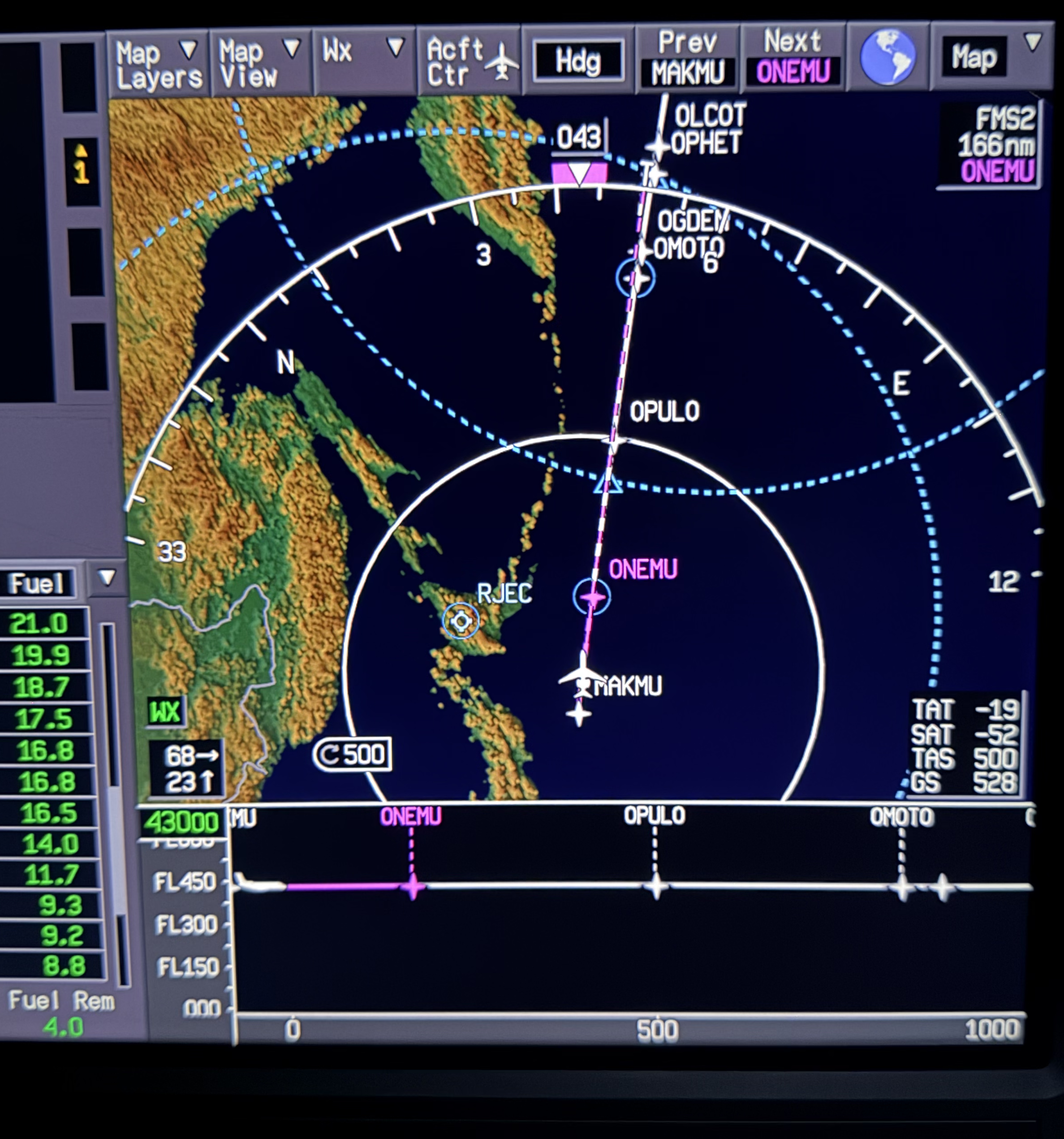
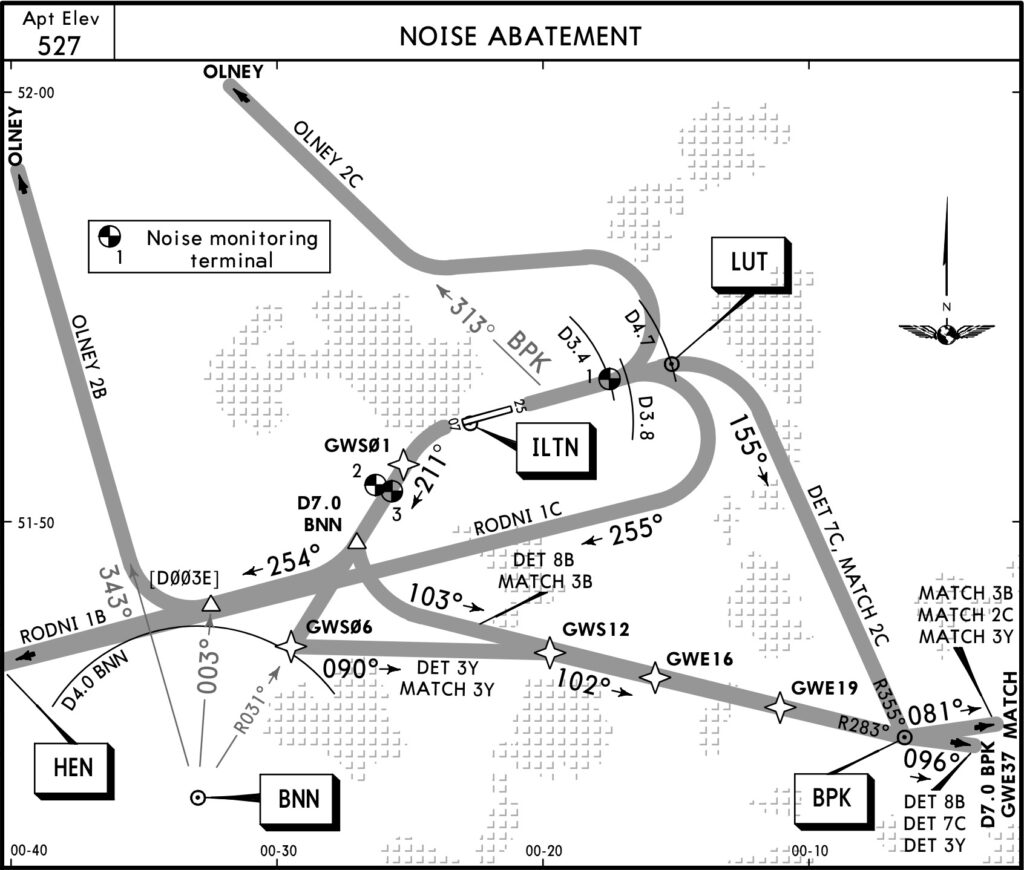
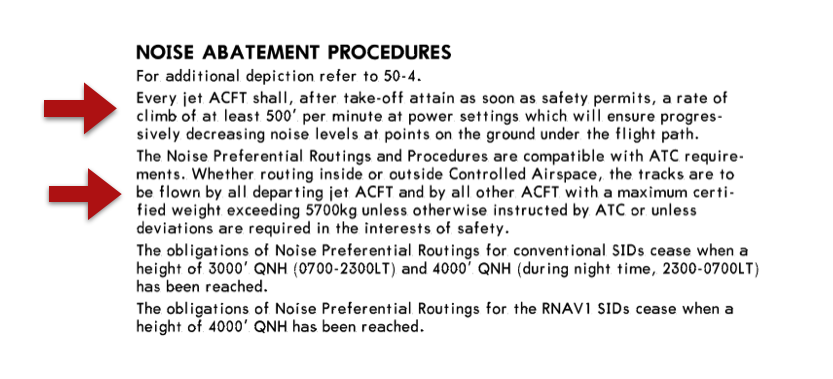 Here’s why – Luton concurrently runs a noise-monitoring program. You won’t find it in the AIP, it’s buried in the airports’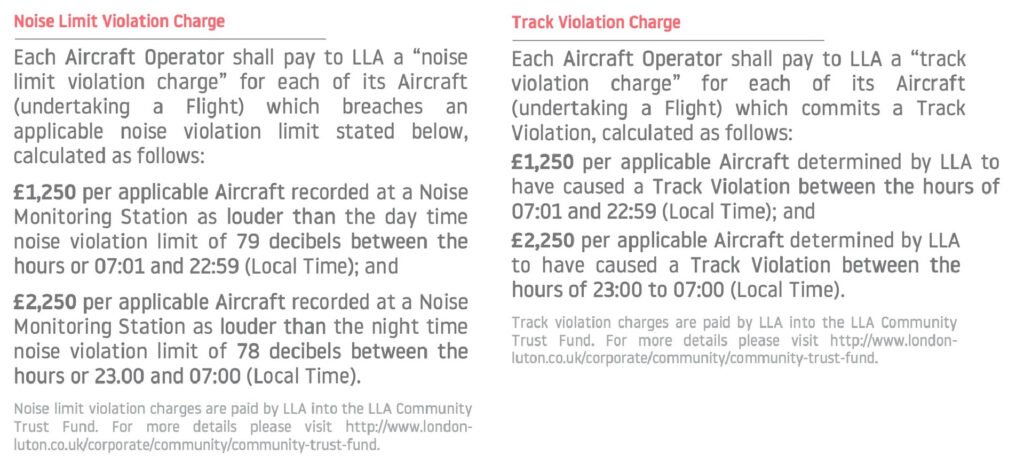
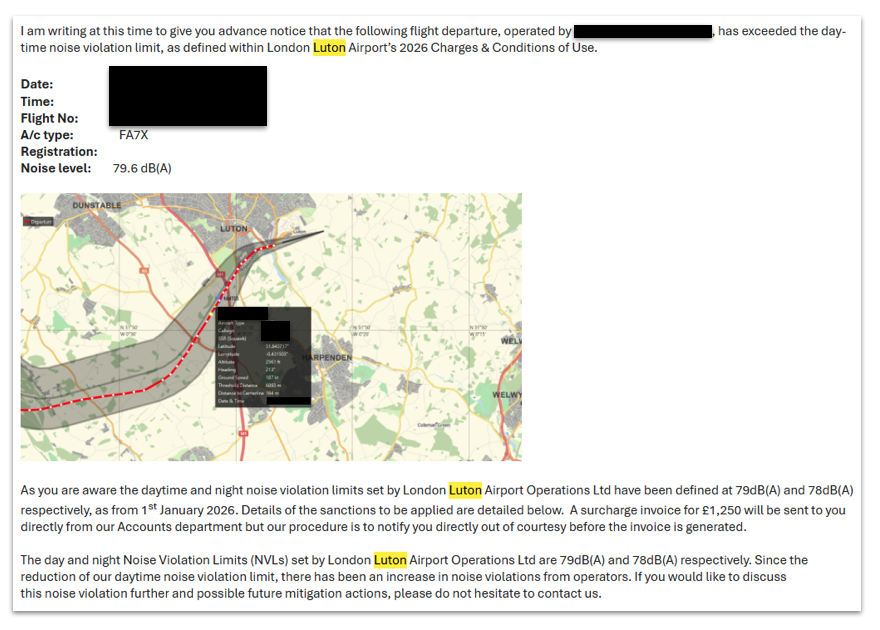 Here’s what we don’t like about this.
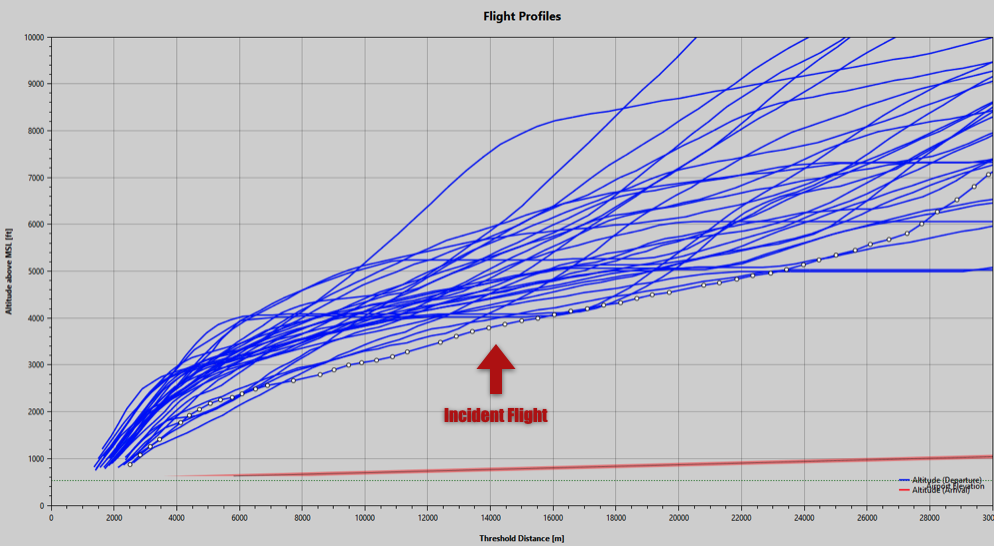 But it’s a workaround, because unlike the payment of the resulting fines, the airport doesn’t mandate it. It’s simply left up to the operators – and for that, we cry foul.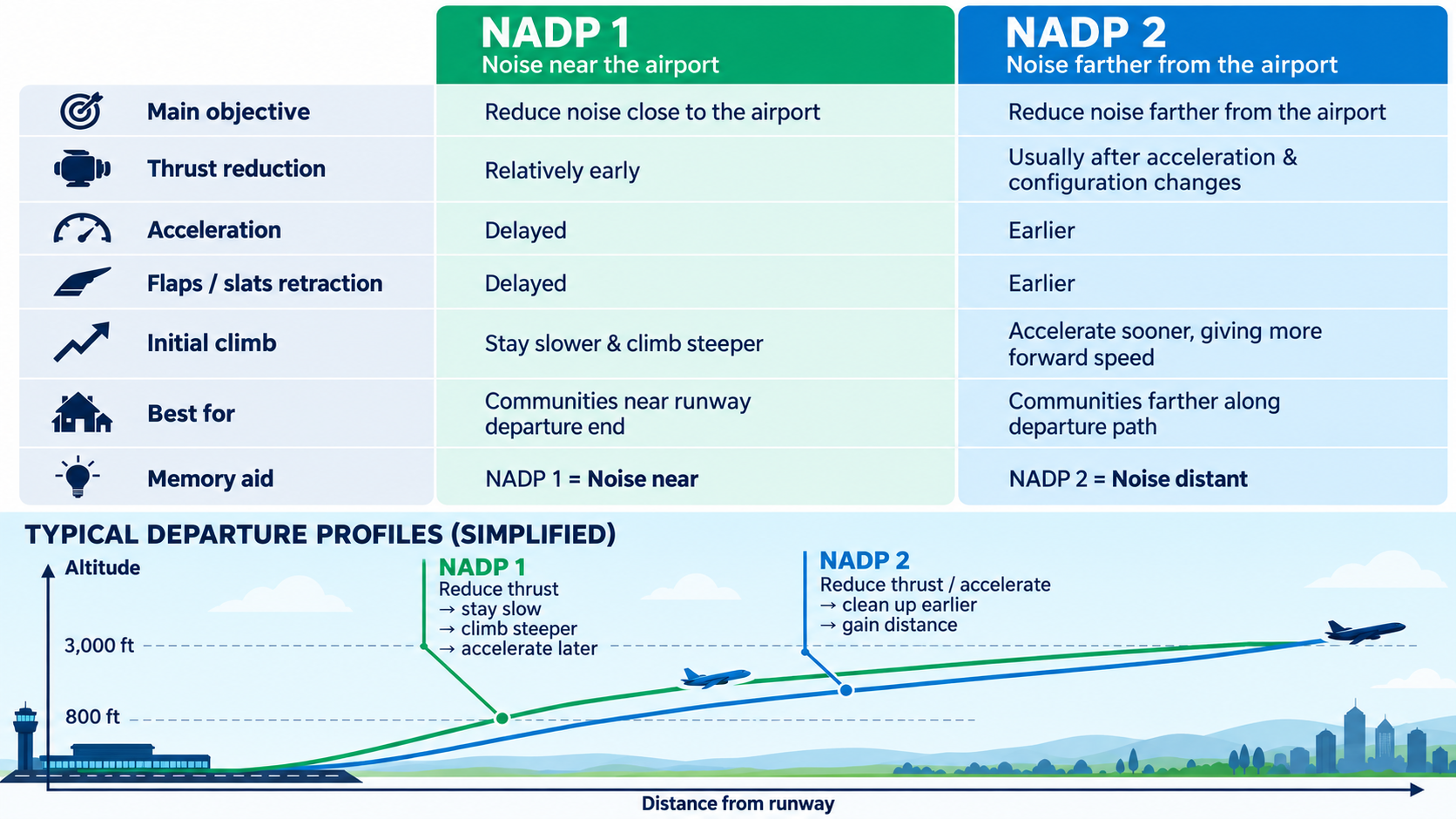




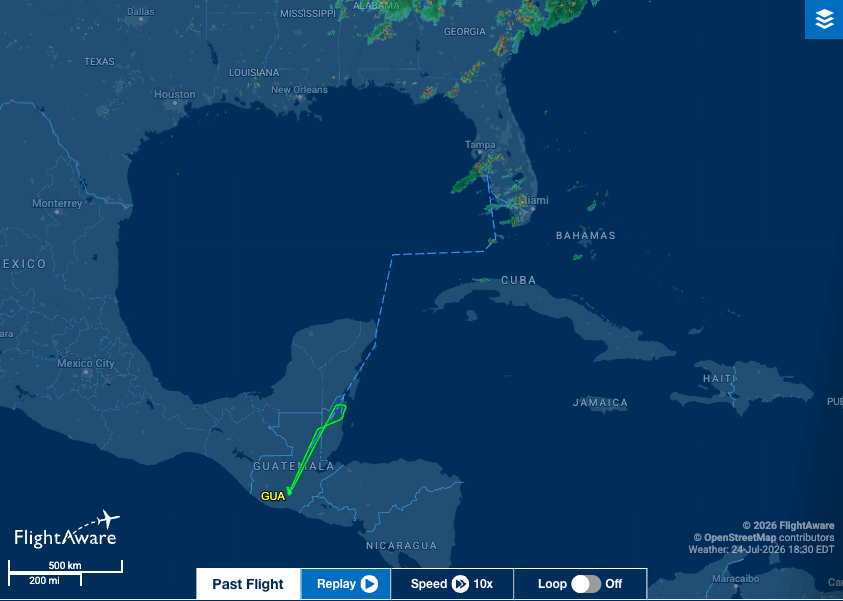
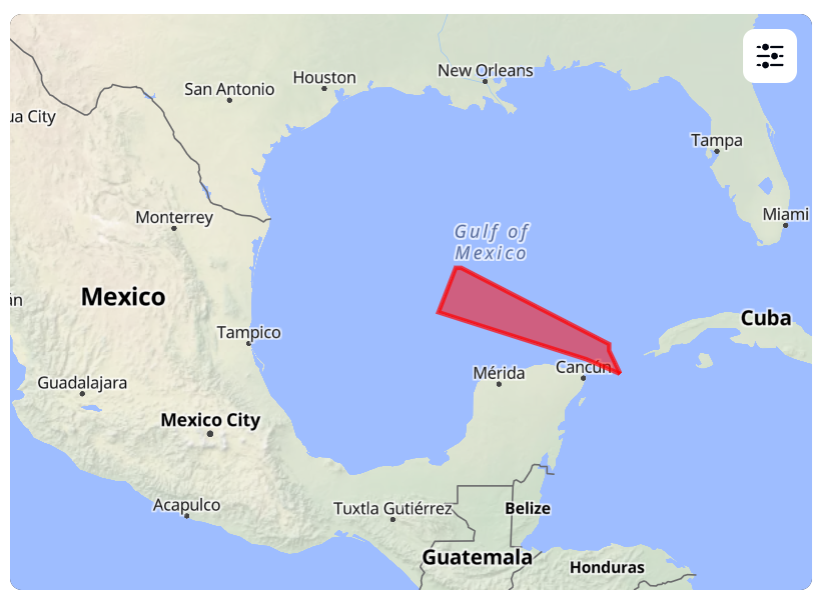
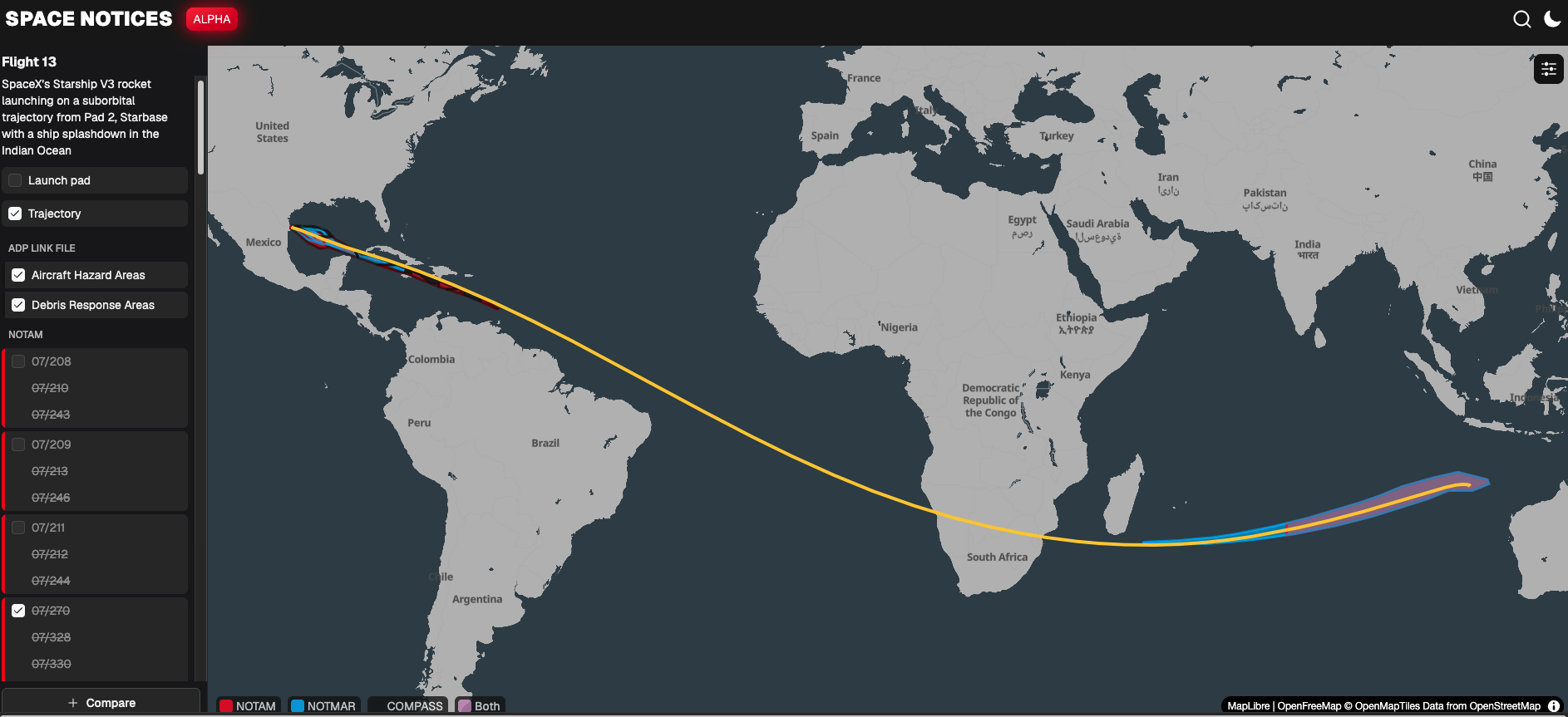
 That’s also the nature of space flight. Launches slip constantly – minutes, hours, days. It’s why we talk about launch “windows” and back-up days. Every slip means every affected FIR has to reissue its Notam, trying to stay ahead of a moving target and it get it into the system before the next crew pulls their briefing.