


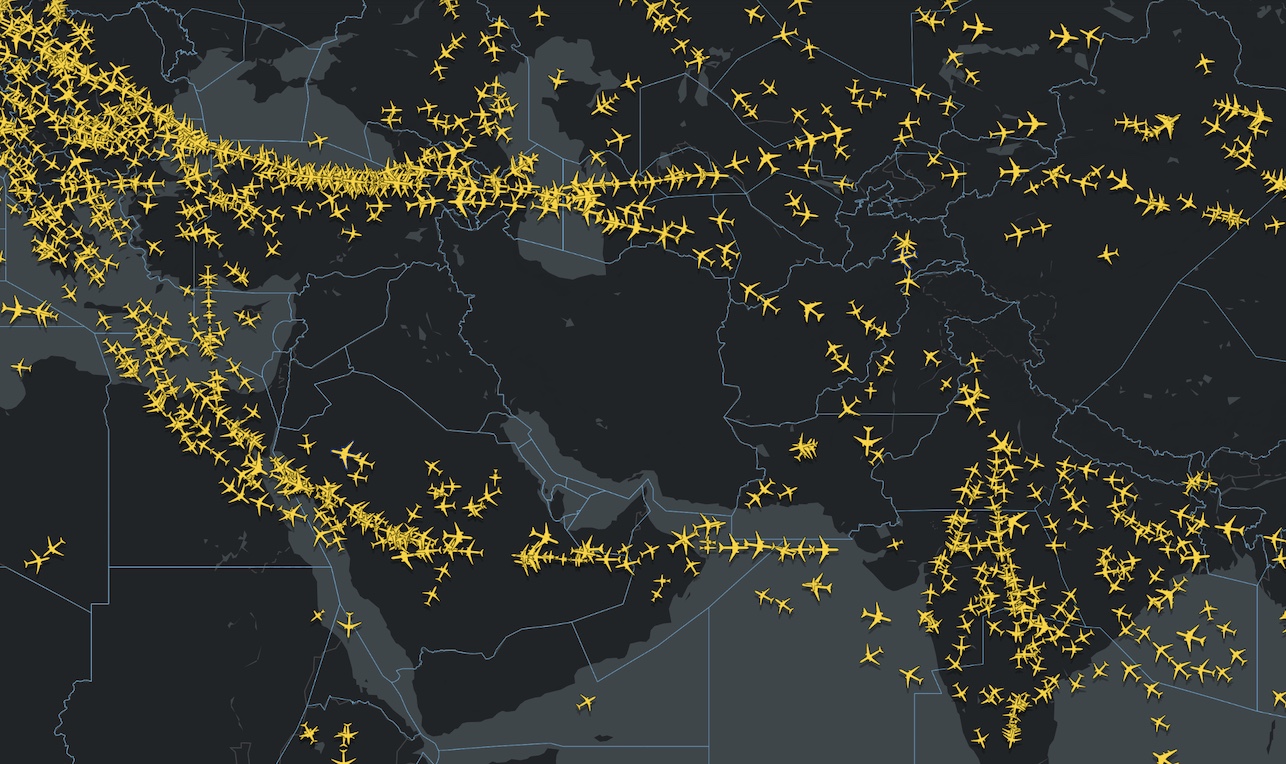

Key Points – Oct 19 update
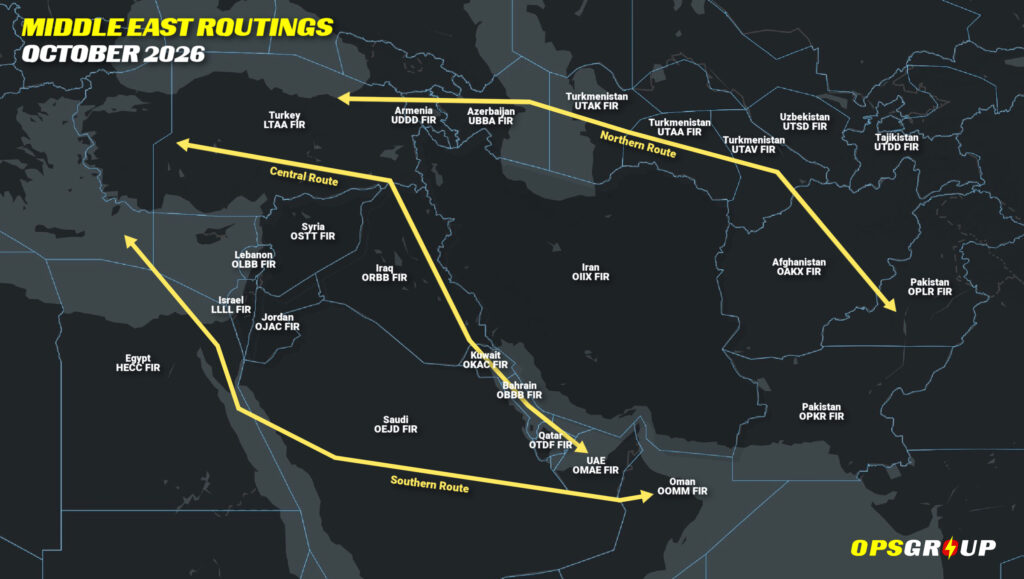
- Kuwait has reopened to overflights, restoring the central Europe-Middle East routing option via Turkey-Iraq-Kuwait-Bahrain-Qatar-UAE (for operators permitted to overfly Iraq!)
- Saudi Arabia remains high risk. Safe Airspace has raised its warning to Level 1 – Do Not Fly, and we recommend avoiding Saudi airspace entirely.
- Houthi attacks have escalated across Saudi Arabia, with repeated missile and drone strikes targeting OERK/Riyadh and other locations, including near OEDF/Dammam and airports in the southwest. OERK reopened on Oct 18 after more than a week of disruption, but the wider threat to aviation remains.
Recent Developments
Oct 19 – Houthi attacks escalate across Saudi Arabia and Yemen
Houthi attacks against Saudi Arabia have intensified, with repeated missile and drone attacks targeting airports. OERK/Riyadh was repeatedly targeted in early Oct, with fatalities and damage to airports.
On Oct 16, missiles struck OYAA/Aden airport in Yemen, landing around 500m from a passenger aircraft preparing to depart for Cairo.
Saudi forces also reported intercepting a ballistic missile headed for Yanbu on Oct 16, plus missiles over the Red Sea and drones over parts of Saudi. The attacks show that the threat extends well beyond the airports in southwest Saudi Arabia.
Oct 18 – OERK/Riyadh reopens
OERK/Riyadh reopened on Oct 18 after more than a week of disruption, but normal ops have not resumed – you need prior permission from Saudi Arabia’s GACA, and the airport is not available as an alternate. Several international airlines continue to suspend/restrict flights here.
Oct 15 – Kuwait reopens to overflights
Kuwait has reopened its airspace to overflights, restoring the central routing option for Europe-Middle East traffic via Turkey-Iraq-Kuwait-Bahrain-Qatar-UAE. The new Notam permits flights between Bahrain and Baghdad FIRs through Kuwait at FL280 or above. However, the route is not available to all operators, as EASA and several European countries advise against or prohibit overflights of Iraq.
Oct 14 – EASA updates Middle East CZIBs again
EASA updated its advice for most countries in the region at the end of Sep, but then they did extra updates for Jordan and Saudi Arabia following that. Basically, Jordan’s situation has eased a bit, and Saudi is facing more frequent Houthi attacks…
- Jordan: EASA has eased its advice after no conflict related military activity was reported here over the past month. The risk hasn’t gone away though, and attacks could resume at short notice.
- Saudi: EASA now says operators must avoid two areas of the Jeddah FIR at all altitudes (one in the southeast, one in the northwest). This follows increased recent Houthi attacks reaching further into Saudi Arabia including Riyadh.
- Bahrain, Kuwait, Qatar & UAE: The Gulf advice has been extended to Nov 16. EASA still says to avoid the airspace over the waters of the Persian Gulf in these four FIRs, except when going to/from an airport.
- Oman: The same advice applies to the Gulf of Oman, with EASA recommending that operators avoid the airspace over the water west of 58°E.
- Lebanon: The avoid recommendation remains, except for flights to and from OLBA/Beirut over the sea.
- Iran & Iraq: Both remain avoid at all altitudes, with the CZIBs extended to Nov 16.
- Syria & Yemen: Separate CZIBs remain in place. Syria’s was revised on Oct 1, with EASA now allowing operations above FL260 in parts of the Damascus FIR.
- Israel: EASA’s separate Information Note remains in place, advising operators to take the potential risk into account rather than issuing a blanket avoid recommendation.
You can check all the CZIBs and Information notes here, along with some useful background on why EASA has made these changes and what’s been happening in the region.
Current Airspace Picture
The map below tells the short story of your overflight options! Kuwait’s reopening brings the central route via Iraq back into action for those permitted to use Iraqi airspace. Others may need to stick to the northern bypass via the Caucasus-Afghan, or the southern route via Egypt-Saudi.
And now a quick lowdown on what’s going on in each little bit of airspace. One extra thing to note though for all these countries – GPS spoofing/jamming is happening pretty much everywhere! Check below for a link to a map showing live GPS interference…
Kuwait
With Kuwait now open to overflights, the so-called Central Route is back in action for operators allowed to overfly Iraq. It offers an alternative to the southern route via Saudi, where recent Houthi strikes have increased risks. But Kuwait is not completely risk-free – OKKK/Kuwait airport was hit by Iranian missiles as recently as June. Although the threat from Iranian activity has eased recently, the wider regional risk of escalation still remains.
Saudi Arabia
Saudi Arabia remains open to overflights, but the risk picture has worsened significantly. Safe Airspace has raised its warning to Level 1 – Do Not Fly, and we recommend avoiding Saudi airspace entirely, including overflights and the use of Saudi airports as en-route alternates. Recent attacks have targeted OERK/Riyadh, OEAB/Abha, OEGN/Jazan and OENG/Najran, with further reports near OEDF/Dammam.
Yemen
Yemen remains high risk, with Houthi attacks affecting Saudi Arabia as well as government-held areas in Yemen. On Oct 16, two missiles struck OYAA/Aden airport – no casualties were reported, but a passenger aircraft preparing to depart for Cairo was evacuated after the missiles landed around 500m away. Safe Airspace recommends avoiding Yemen entirely. Airspace warnings remain in place, including restrictions on US operators over Yemen’s landmass.
Iran
Iran airspace has reopened to overflights, but there’s still a risk of military activity and air-defence systems mistaking civilian aircraft if the conflict escalates again. There are several airspace warnings in place, and most foreign operators continue to avoid the country.
Qatar/UAE/Bahrain
These three remain open to overflights and landings, and there are still flow restrictions in place. EASA advises avoiding flights over Persian Gulf waters – except when needed for arrivals and departures at the airports here.
Iraq
Iraq is open to overflights – but it’s not available to all operators! EASA and several European countries advise against or prohibit overflights, and US operators are restricted to FL320 and above. Also the recent US/coalition withdrawal from Erbil removes a layer of air defence, particularly in the Kurdistan Region. Some airlines are using Iraq, but most continue to prefer the northern or southern routes instead.
Oman
Oman remains an important route around the conflict zone. EASA advises avoiding flights over Gulf of Oman waters west of 58°E, except when needed for arrivals and departures.
Jordan
Jordan remains open, but renewed attacks in early Sep show that the risk from missiles, drones and air-defence activity can quickly return. However, it’s still not a major transit route for overflight traffic – most operators continue to route via Egypt/Saudi, as they did before the conflict.
Israel
Israel is open, but ops still aren’t back to normal – and the security situation is still a concern. Missile and drone attacks have reduced in frequency, but remain possible including around LLBG/Tel Aviv. Some foreign airlines have resumed services, although others continue to stay away.
Syria
Syria has quietly become part of the regional routing picture again after years of almost no international overflight traffic. Some Middle East airlines are now using Syrian airspace again as an alternative to the more restricted Iran/Iraq option – though most US and European carriers continue to avoid it.
The airspace remains high risk. Israeli military activity and missile interceptions are still a concern, particularly in the south-west. EASA currently says EU operators should stay out of the western/south-western part of the FIR at any altitude, and stay above FL260 elsewhere.
Armenia/Azerbaijan/Afghanistan
Armenia and Azerbaijan remain important parts of the northern bypass, with steady overflight demand. The main issue is still Afghanistan – the OAKX/Kabul FIR remains Class G with no normal ATS service, so crews still need to use the published contingency routes and operate with TIBA procedures.
Where’s the spoofing today?
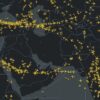
Still our favourite map to check for this – the live GPS spoofing tracker from GPSwise.
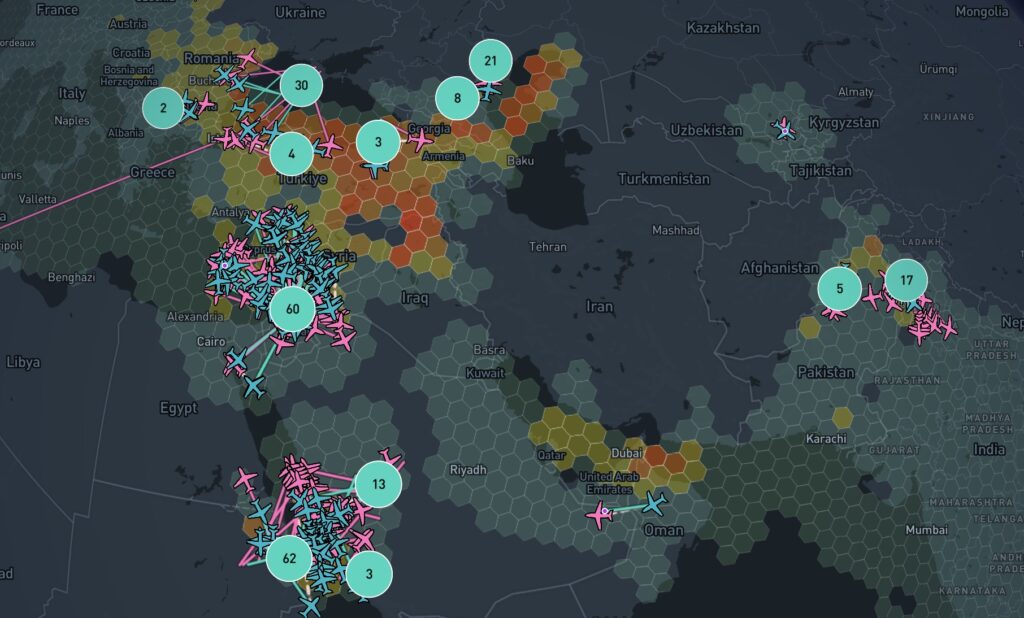
The map detects spoofing in real-time based on the ADS-B data from the OpenSky Network. Handy for a quick look at what’s been happening along your route.
Recent Opsgroup Member Reports
We’ve had a lot of useful Airport Spy reports recently from Opsgroup members operating into several Middle East airports: OMDW/Al Maktoum, OMDB/Dubai, OBBI/Bahrain, OTHH/Doha, OMSJ/Sharjah, OMAD/Abu Dhabi and OEDF/Dammam.
Big theme across all of them is the scale of the GPS jamming/spoofing currently happening around the region. Several reported complete GPS loss on arrival or departure, and interference continuing well into neighbouring FIRs. ATC seems very used to it now, with lots of runway heading departures and radar vectors being issued.
Reports also mentioned fuel delays, extra towing/hangar time, and slower ground handling at some airports. We’ve also had reports of heavy ATC congestion in the OEJD/Jeddah FIR as traffic continues concentrating on the southern bypass via Egypt and Saudi Arabia. Opsgroup members can check Airport Spy in their dashboard for the full reports.
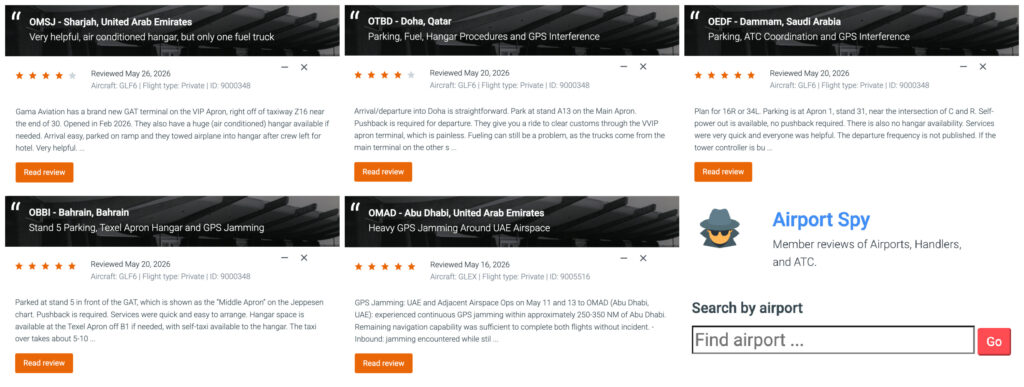
Access latest Airport Spy reports here.
If you have operated in the region recently and could share your experience, send us an anonymous Airport Spy report or email us at team@ops.group.


More on the topic:
- More: Crisis in Iran: Elevated Airspace Risk
- More: EASA Removes CZIBs: Middle East Risk Gets Harder to Read
- More: 2025 Update: BizAv Ops to Israel
- More: Why EASA has Withdrawn Airspace Warnings for Iran and Israel
- More: Dodging Danger: The Three Routes Through the Middle East
More reading:
- Latest: Seletar 2026: New Corridors, New Procedures
- Latest: Middle East Airspace – Current Operational Picture
- Latest: The Lajes Lowdown: Atlantic Stopover and ETOPS Alternate
- Safe Airspace: Risk Database
- Weekly Ops Bulletin: Subscribe
- Membership plans: Why join OPSGROUP?



 Get the famous weekly





I’m leaving Sydney to go to Dublin on the 23rd of July stopping down at Dubai for 3 hours .
Is this safe and is the airspace open.
Can anyone tell us how Afghanistan is collecting its overflight aero charges?? With no ATC you have to question how they keep track of all flights.
They charge a flat $700 USD to cross the OAKX/Kabul FIR, and I think that basically covers both the overflight permit and the nav fee. You request the permit from the Afghan CAA and the $700 usually gets handled through your trip support provider at the same time. More info here: https://ops.group/blog/2026-afghanistan-overflight-update/
Thanks v informative.