SNOWTAMS slip into a new style

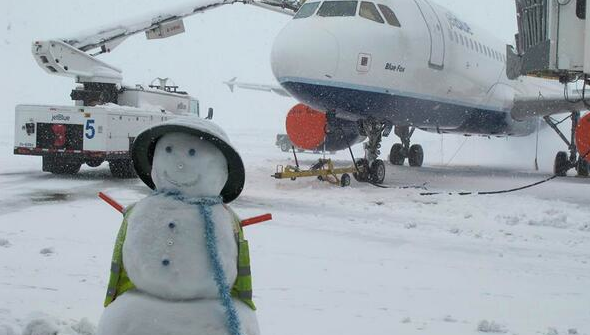
ICAO will be updating the format of SNOWTAMs later this year – the special issue Notams that deal with surface condition reports and contaminated runways. They have published updated guidance on how SNOWTAMs should be issued when the changes take effect on November 4, 2021.

Here’s a summary of what’s changing, what the new style SNOWTAM will look like, plus a handy chart to help you decode them…

The Friction Task Force

There is such a thing, and we can only assume they wear skintight suits and body surf down runways to measure the friction. Anyway, they make recommendations on global reporting formats and also how to assess runway surface conditions.

It is quite a big thing. A lot of accidents happen because runway friction is not reported correctly. Or rather, pilots don’t understand it/choose to ignore it. Just ask (several) crews flying into UEEE/Yakutsk about it.

But if you check out the RCAM (Runway Condition Assessment Matrix) below, you will notice that offering a braking action is the preferred method nowadays. Friction coefficients are not so useful.

Friction Task Force Leader

What is a SNOWTAM?

It is a special series Notam that provides a surface condition report to let pilots know what is on the runway, how much of that is on the runway, and what they can expect their airplane to do (braking wise) on said runway.

So, it is something that basically tells the pilot: “Watch out, slippery!” in a rather complicated sort of way.

SNOWTAMS use metric units, and a bunch of codes for deciphering. More about that later on.

What are ICAO changing?

As of 4 November 2021, the maximum validity of a SNOWTAM will be 8 hours. Currently they are 24 hours and a lot can change in that time meaning you have to try and discover what is still valid and relevant and what is not.

With the new ones, if they don’t say anything different after 8 hours then you can assume the runway surface condition is good and normal again. If anything changes, they will release a new one which will automatically replace the old one.

Each SNOWTAM will get its own serial number for identifying it.

What else is in the Guidance?

TTAAiiii CCCC MMYYGGgg (BBB)

Yep, that is written in it. It is an abbreviated heading demonstrating how certain things should be written. For example:

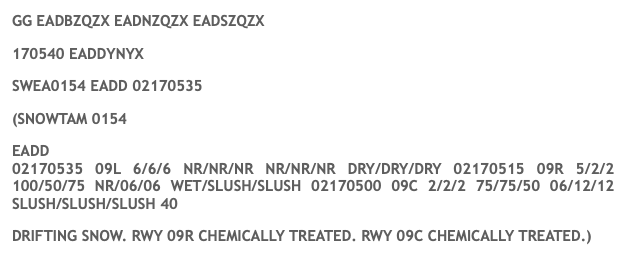
This is an example of how the new style SNOWTAM will look. Not a huge difference to the old ones, but here is a decode for you anyway.

  • GG EAD etc etc is who produced it. Not super relevant for pilots.
  • Snowtam 0154 is the serial number of the Snowtam
  • EADD is where we get interested. That is the airport identifier. Issued on the 17th February at 0535
  • Runway 09L 
  • It then gives the runway condition code for each runway third, as determined by the RCAM (runway condition assessment matrix). 6/6/6/ means dry/dry/dry.
  • Next up is the percentage coverage. NR means less than 10% or dry. Hence the many NRs
  • This SNOWTAM then moves onto 09R because frankly 09L was quite boring and dry.
  • 09R is 5/2/2 (good, medium-poor, medium-poor according to RCAM). 100% covered, 50% covered, 50% covered) and NR/06/06 is the depth – dry/ 6mm/6mm of wet/Slush/Slush
  • Then it moves onto another runway…. blah blah blah

The last bit is another change – this gives you “Situational Awareness” – a free text (i.e. real human language) section reporting other important stuff you might want to know.

A decoding device

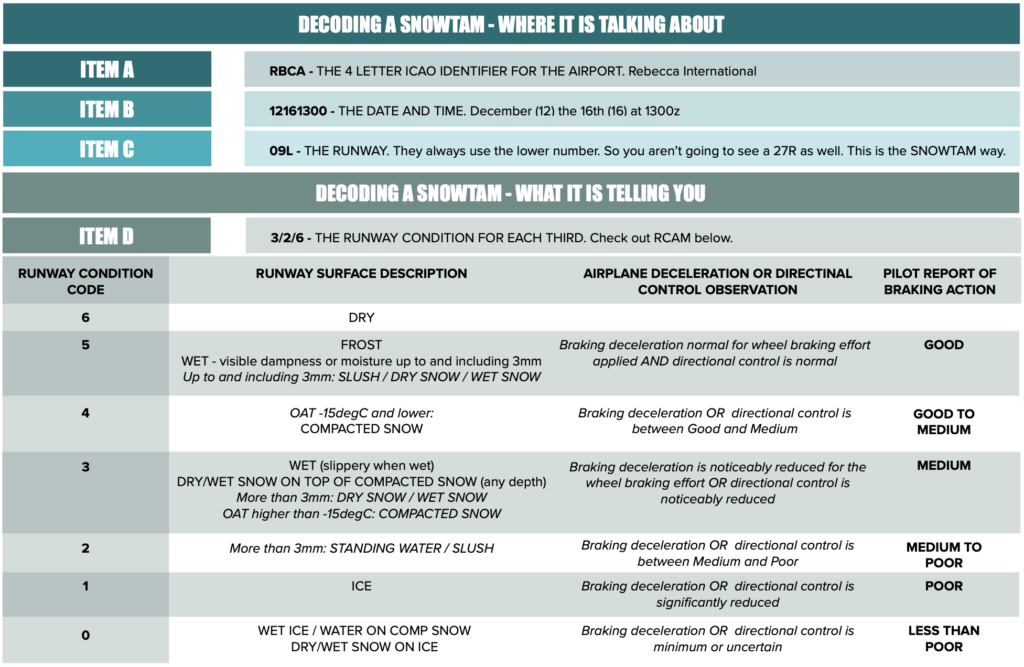
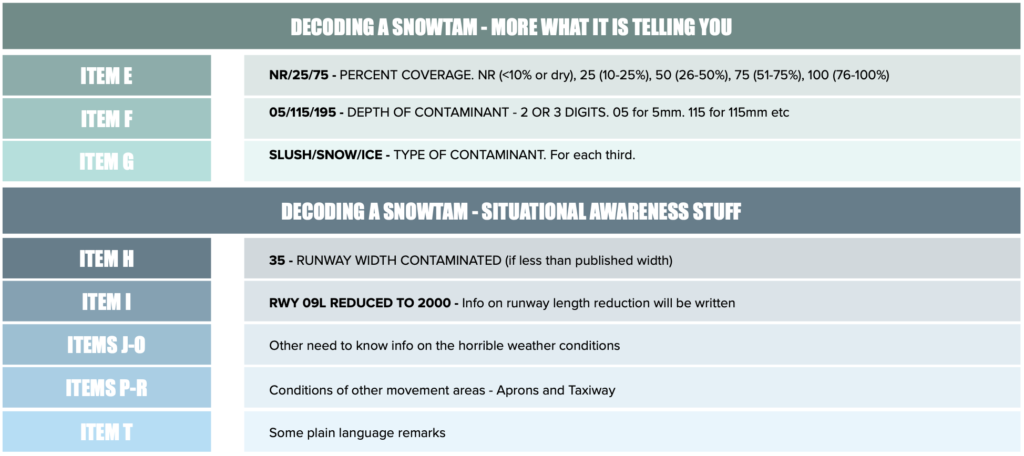
We aren’t going to be there to decode for you, so here is a decoding device we made earlier (by copying the ICAO one and adding some nice colours).

You might also want to download something like the SNOWTAM app on your smartphone (just make sure whatever you use is correct against your company manuals).

Why these changes?

Well, in order to make SNOWTAMS better, because they are fairly important. You might get some frosty toes if you step in a puddle of slushy snow, but you’re going to get more than cold feet if you go skidding off the end of a runway.

SNOWTAMs are there to make winter weather safer. They give critical information about the state of the runway, and this should be plugged into whatever performance calculating device your airplane needs you to use so that you can see whether you will stop before, or after, the end of the runway.


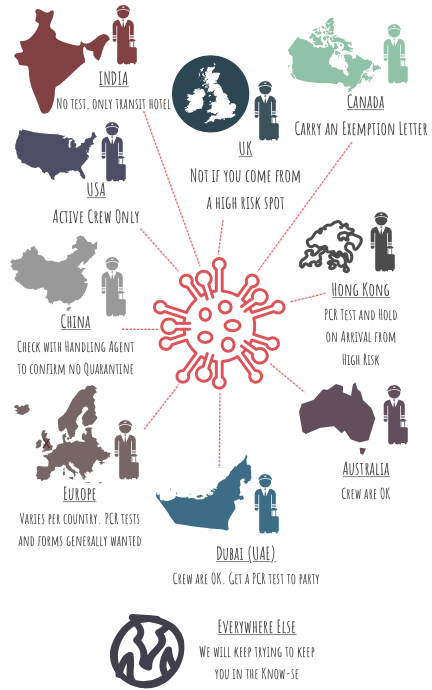
In the Know-se: Current Covid Crew Requirements

Covid has been around for nearly a year, and we have seen countries closed, reopen, close again, slightly close, close to some, not to others… It has been an endless jumble of restrictions, sticks up your snout, and “are you or aren’t you allowed” confusion.

So, we thought we would provide a quick summary of the current Covid Air Crew restrictions, because, after all, these are what you probably want to know.

AmeriCan if you’re crew

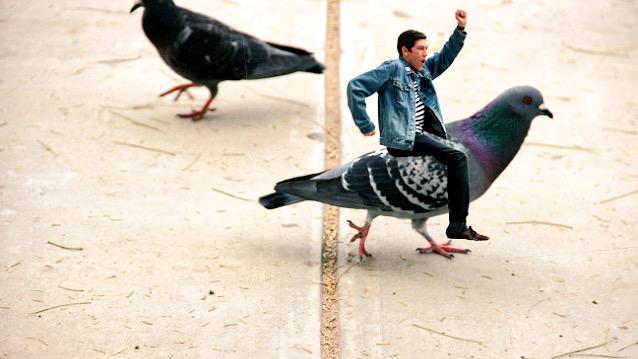
The US want proof of a negative Covid test for passengers – that’s a PCR or antigen test, and it needs to have been taken a maximum 72 hours before travel. This covers all flights. That means private flights, GA flights, chartered balloons, even people who find a way to ride in on giant pigeons…

Unless it is an official carrier pigeon and you are on active duty…

However, ACTIVE crew are exempt.

So for crew travelling to the US – you don’t need to get a Covid test in advance as long as you’re “active crew” – i.e. you’re operating the flight or travelling in an assigned deadhead status (i.e. positioning crew into the US). You also have to follow the health and safety rules set out in the FAA’s SAFO 20009.

We’ve had some reports of issues when positioning crew into the US, with gate staff requiring they show proof of a Covid test. To be clear: deadheading/positioning crew are officially exempt from this requirement, as per the CDC guidance found here.

Try to connect with the carrier being used in support of deadheading crew to verify their processes and documentation requirements. One thing to try: the NBAA has developed a template letter for deadheading/positioning crew to use for these situations. Print it out, fill it in, and send it in advance to the carrier you’re flying in with, and ask for written confirmation back from them to mitigate against any last-minute issues at the gate.

Maintenance personnel and contractors are also exempted if their travel is for the purpose of operating the aircraft, or ensuring the safety of flight ops.

Canadargghhh 

Canada recently changed their entry restrictions for all, and they are only allowing passenger flights to fly into CYUL/Montreal, CYYC/Calgary, CYYZ/Toronto or CYVR/Vancouver.

Despite the clampdown, crew are still exempt provided they are on duty.

Annex G contains the Template Letter for Crew confirming they are on active duty which you should make sure your crew have with them. The exemption covers quarantine and Covid testing.

Real movie

Chi-not the place to go

Aside from locally based Chinese crew being asked to wear nappies, the information for air crew is tough to pin down for China. We think it is this – every airport is different.

The China Airlines Immigration page has the most useful information, and where it refers to C Visa, this is the bit you want to look at because that’s what crew will have.

Generally, you seem to be able to enter and stay overnight in a crew rest hotel without 14 days of quarantine, but your best bet is to confirm with a local airport agent (operations@groundexpress.aero have been really helpful).

The goings on in Hong Kong

From January 23, any air crew who have visited somewhere deemed Extremely High Risk will have to self-isolate in a designated quarantine hotel for 21 days… we think this might just apply to local crew though, because it goes on to say – 

All non-local based crew [who have been to Extremely High Risk areas] must have a negative PCR taken with 48 hours, and must undergo another test on arrival and remain in isolation until a negative result is received. They call this their Test and Hold procedure.

If the crew were not in an extremely high risk place up to 21 days before going to Hong Kong then you still need the PCR test taken 48 hours before, and the arrival test, but you can stay at your airline-organized hotel instead.

The official website is here.

Are U(o)K?

The UK has seen a lot of changes to their entry restrictions over the year. After they discovered a right royal variant of their own, they locked down (and pretty much every other country in the world locked them out). Then the cases of other mutant variants starting popping up all over the world so the UK closed their borders to a whole bunch of countries.

What does this mean for crew though?

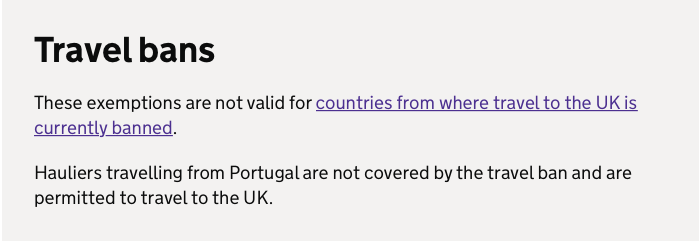
It means that if you are foreign flight crew and have been in (or even transited through) a banned country in the last 10 days then you will not be granted access to the UK. If you are a UK citizen or resident then you can enter, but will have to self-isolate for 10 days. The list of banned countries is here.

This is the bit we are talking about – the Travel Exemptions list, which lists jobs exempt from restrictions. The top message is pretty conclusive we think – even exempted jobs are not exempt if they are coming from/ have recently been to a country currently banned.

This bit right ‘ere

Europtions…

Europe has a lot of countries in it and all of them have their own regulations and restrictions. Here are the “big” ones.

France is getting a bit more restrictive with passengers of late, and borders are closing to a lot of higher risk countries – and to anyone who doesn’t have legitimate and essential reasons to be travelling there. The UK and non-EU countries are pretty much banned at this point.

For the crew, the requirements haven’t changed (as of February 3). You need to fill out a Passenger Locator Form, but are exempt from all the other isolation requirements (isolation and tests).

Swissport in LFMN/Nice keep a great little table regularly updated with all the latest rules in France for pax and crew, depending on where they’re flying in from.

Germany are closing their borders to all places where mutated viruses can be found as well. That means the UK, Ireland, South Africa, Portugal, Brazil, Lesotho and Eswatini so far.

Watch out here – crew need a Covid test in advance if you’ve been in certain countries within the past 10 days (EDWW mega-Notam B0123 carries that announcement).

Germany classifies other countries into four groups: No Risk Areas, Risk Areas, High Incidence Areas, and Areas of Variant Concern (this government page has the latest details on which countries fall into each of these groups). Crew who have been in Areas of Variant Concern within the past 10 days must have a Covid test taken within 48 hours, and pre-register electronically. Crew who have been in High Incidence Areas within the past 10 days are only exempt from these requirements if they’re staying in Germany for less than 72 hours.

Austrailing behind…

Australia remain very restrictive on how many international travellers they let into their country, and there are a lot of restrictions and requirements in place for entry. Luckily, for air crew, you are exempt. You do need to stay in your hotel during the layover though. Here is their official page on this.

Say Dubai-bye to restrictions

Dubai have remained fairly lax on their restrictions and lockdown measures, and as a result people who have been through Dubai are now being classified as high risk when they go to other places.

But for crew heading to Dubai, it is fairly straightforward – no Covid test required on arrival but if you want to move freely around Dubai during your layover then you can either bring a negative test result with you (taken 72 hours before), or get one on arrival (takes about 24 hours) and wait in your hotel until the results are received.

In and out of India

India have a general ban on scheduled international flights, except under special approval or existing bubbles. This ban does not mention charter flights and local agents have confirmed that GA/BA can come in, but just need prior approval.

For crew on these flights, you are going to need a valid visa, but no test is required. However, if you don’t have one, then you are only able to stay in transit hotels in VIDP/Delhi and VABB/Mumbai.

Where else in the World is there?

Lots of places, obvs! And with restrictions changing almost daily, it’s tough to keep up.

Pre-departure Covid tests are fast becoming the new thing, with more and more countries around the world starting to make this a mandatory requirement. For a quick check of each country’s rules for passengers, go here.

Often the crew requirements are not published alongside the passenger ones, so we will keep digging for this information, and the alerts we publish will try to give you the main passenger changes, and the crew requirements where we can.

The Covid Infoknow


Mothballs & Maintenance: The Risks of Long Term Storage

It’s a strange time for aviation right now: closed countries, fewer passengers, and a lot of aircraft being moved into hangars – not to see the sky again for some time. The long-term storage of aircraft is leading to some unforeseen issues…

We reported on some these before, but we thought now might be a good time to give another quick summary because aircraft are starting to fly again – in particular the 737 Max which is back in the skies of Canada, the US, and soon Europe as well.

The Dangers of Long-Term Storage…

There have been a lot of incidents attributed to aircraft coming out of long-term storage. Wizzair fell foul of some bugs in 2020, an Aeroflot had a bit of a mishap after it was only partially ready to go back flying…

Both the US and EASA safety regulators have raised concerns about certain issues for aircraft coming out of long-term storage, so in case your airplane is currently stashed away, read on.

Nesting Nasties

We mentioned this one before, but with Covid dragging on, we figured it might be worth a reminder.

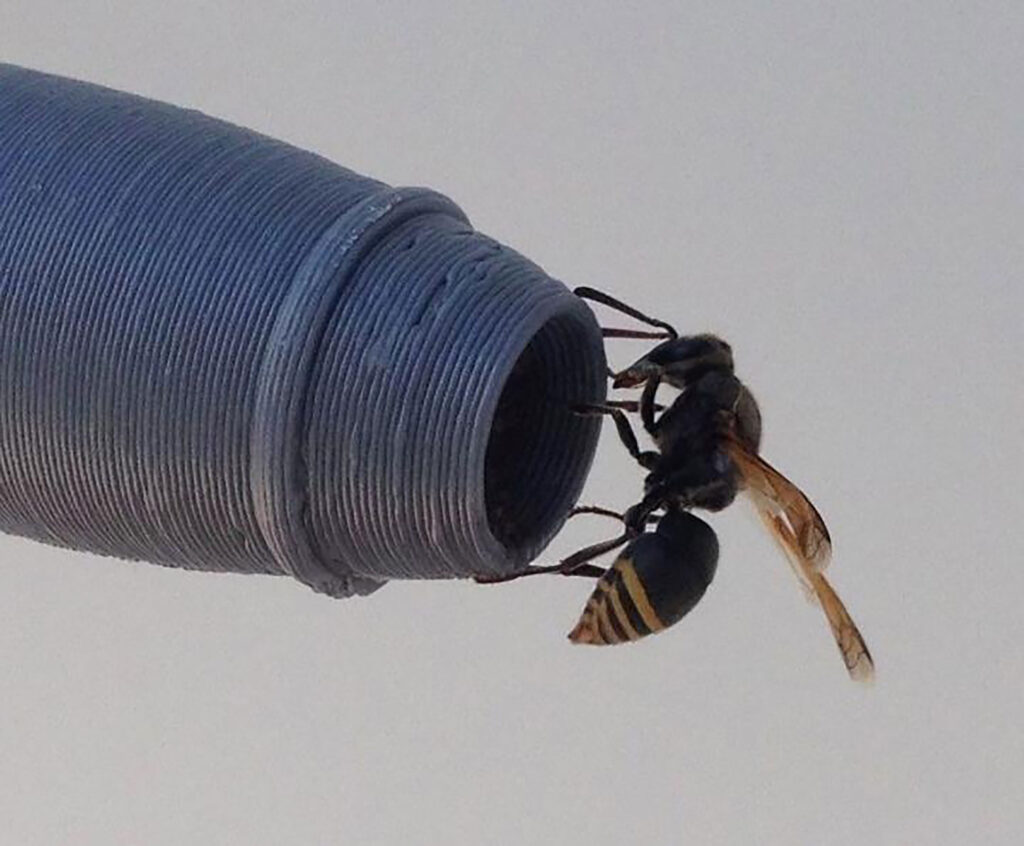
It sounds nightmarish, but insects have been known to build lairs deep inside aircraft probes, where even the most eagle-eyed walk-around check might not spot them. 

And these critters have led to an alarming trend of airspeed problems for aircraft new out of storage.

Check out our earlier article on the risks of this here, and be sure to do an in-depth check of your aircraft’s nook and crannies before taking to the skies again.

Wasps, bugs, beetles… all kinds of nasties in your nooks and crannies

Batteries Not Included

Aircraft with Nickel-Cadmium batteries (which is most of them, unless they have newer lithium ion ones) are suffering from premature power loss.

Embarrassing for the batteries, and dangerous for the pilots.

When disconnected, these batteries can lose their capacity, and when they are plugged back in again, they might not regain it – leading to a lot less time of usefulness that you think you have.

A battery not providing the performance you are expecting on that already bad day when you drop down to emergency power levels, is going to make it a really, really bad day…

What can you do? Well, EASA recommend that aircraft approval holders work with battery manufactures to check out this new found phenomenon, but in the meantime – if you are waking your airplane up from a long term hibernation, make sure its ticker is ticking properly with a full maintenance check, before you head out for a spin.

From the classic 1987 movie ‘Batteries Not Included’

Clean as a Whistle

Disinfecting is big right now, what with this old pandemic thing. But a lot of the cleaning agents that can kill Covid, can also damage your airplane. 

Damage to screens, fogging and misting from liquid pooling in out of sights areas, and some alcohol based substances ‘crazing’ up windows (alcohol crazes most of us up, but on windows it can cause fine cracks, and permanent damage) are all risks of using the wrong cleaning fluids.

There is also a chance long-term use of certain cleaning agents might start to corrode parts and increase the flammability of the interior, and even cause some shorting of the circuitry.

So, the FAA and EASA have issued guidance suggesting you check which disinfectants are suitable for your aircraft type. That seems sensible. Their recommendations on how to clean are here, and you can find links to anti-Covid approved cleaning agents that you can check with your aircraft manufacturer before spritzing your plane.

Check your flappers

Back in July 2020, the FAA issued an airworthiness directive for 737 Classics and NGs because, when stored for just 7 days, they can start to suffer from corrosion on the Bleed Air 5th stage check valve.

What’s the risk here? Only a little case of double engine failure, according to the directive. Thankfully, they also recommend a fairly straight forward check to confirm your valve and its flapper plate are flapping as they should.

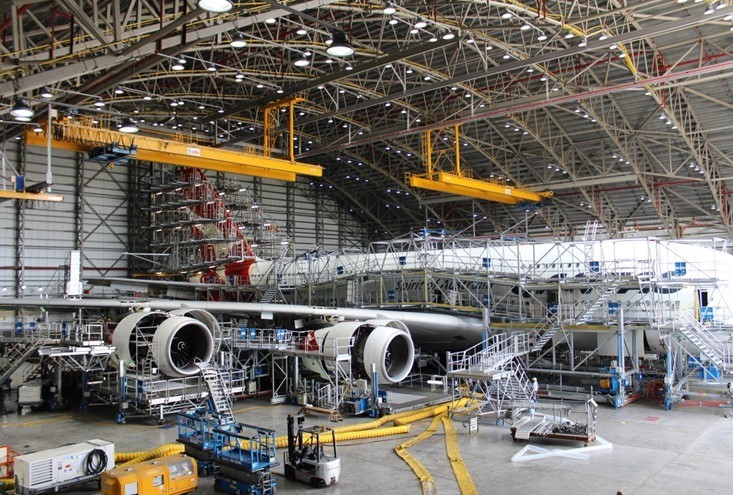
The poor A380 is not hangared so much as retired at this point

What else can you do?

EASA recommend operators carry out extra checks when bringing an aircraft back into service. These include engine runs, flight control manoeuvrability and brake checks. 

To be safe, they suggest you do it on 20% of your fleet, and to be extra safe, they suggest you consider flight checks on the first 10% returning to the skies. Don’t rush these checks. It takes 3-5 days to ready an aircraft for long term storage, so it probably takes the same to bring them out again.

And don’t forget about your pilots! Pilots don’t fare much better in long term storage either. Like their aircraft, they need consistent use, and without it, you’re going to have to spend a bit longer getting them airworthy again. (We would suggest you let them clean themselves though, and it’s probably best not to ask how their flapper valve is functioning 😃)

Some other stuff to read

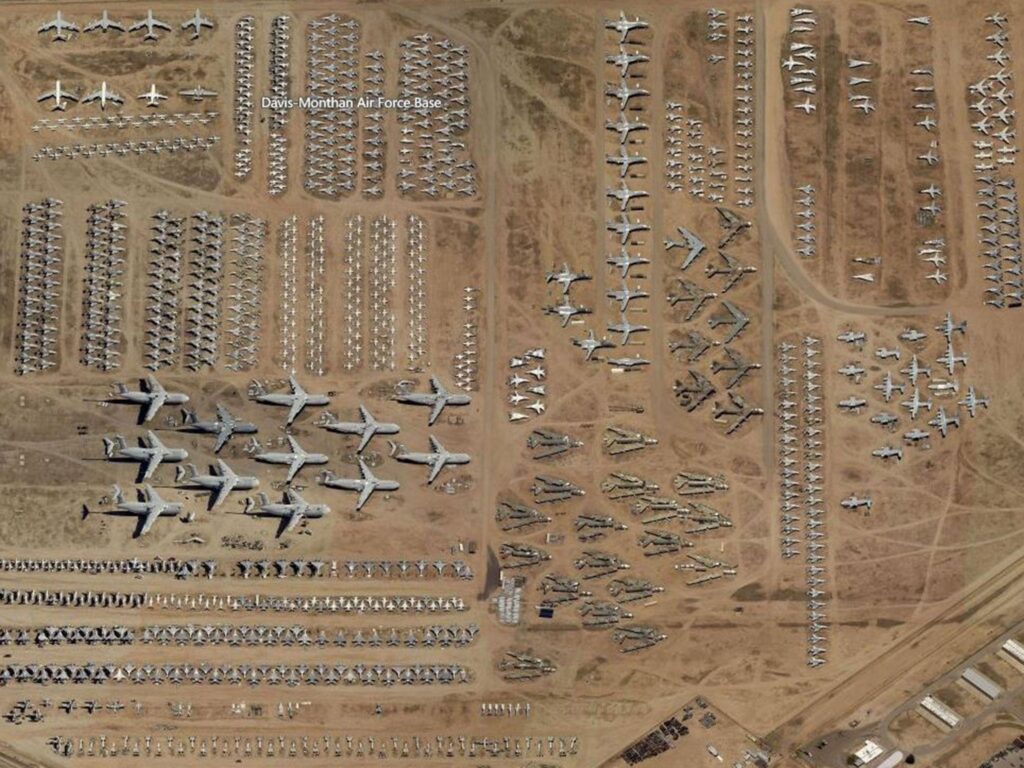
A sad site but the yards are filling up


Contrails, Chemtrails and Climate Change

Putting ‘climate change’ in the title of a post on an aviation page probably isn’t the best way to draw in the readers. But this is not a lecture. Promise.

So, what is it about?

It isn’t about chemtrails. They aren’t a real thing.

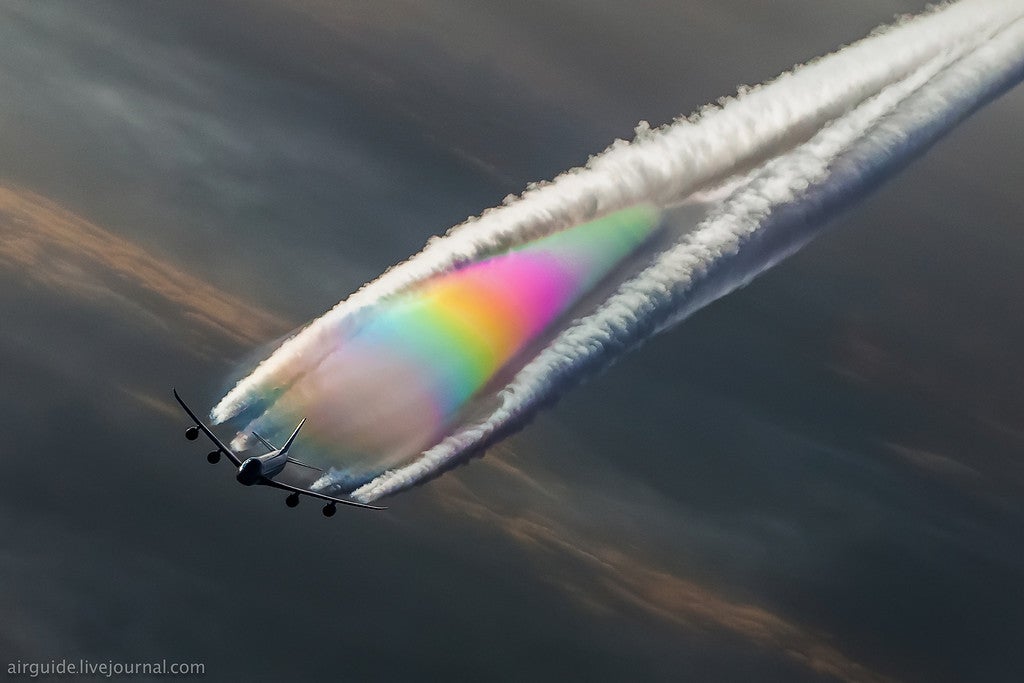
It is about contrails. The wispy bits of whatever that your airplane engines fart out as you fly, or the ‘engine plumes’ if prefer to imagine your airplane resembling something like a peacock.

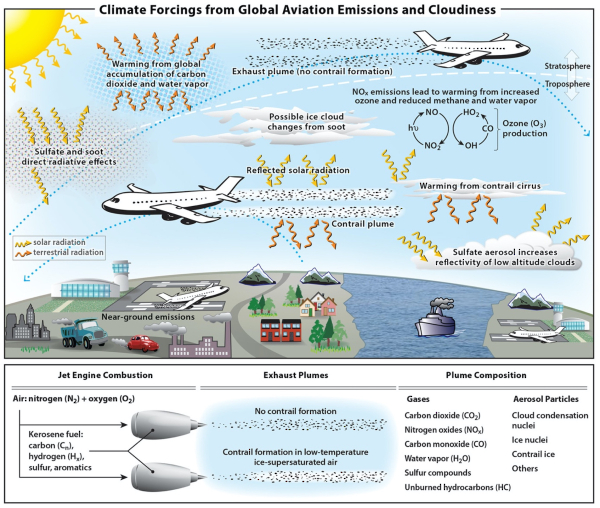
Contrails are basically water vapour. They form when the exhaust gases from the engine starts to cool and mix with the air around them. The humidity rises, the water cools and condensation occurs.

A small, small proportion of what is burped out of the engine is not water though, but impurities from inside the engine.

Things like sulphur particles. It only makes up about 0.05%, but these tiny particles give the water something to freeze onto and they cause tiny ice crystals to form.

The peacock. This might be photoshopped…

So why do we care about this?

They are quite a useful indicator of possible wake turbulence for us, but aside from that (and unless you are one of the pilots who likes to draw amusing pictures in the sky with them) then we don’t really care that much.

But maybe we should care a bit, because some contrails loiter up there for ages – these are known as homomutatus contrails. Frankly, anything which sounds a little like ‘mutant’ should cause concern, and these definitely do, because they are responsible for the word we shall not utter.

Ok, we will, just to be clear – global warming.

Not here to lecture though! Promise!

A little bit of science (still not a lecture)

So, the airplane burps out the water, it turns into contrails which then hang up there in the stratosphere. Aviation causes only about 5% of the water present in the stratosphere, so it isn’t a terrible culprit.

Unfortunately, though, those homomutatus contrails, plus the extra water, plus the ice particles – all that stuff left up there by airplanes – causes terrestrial radiation to backscatter. It also stores up some of the radiation coming in and the result is something they call ‘radiative forcing’.

Basically, extra heating-up happens.

So, airplanes are spitting out C02 and contrails, and the contrails are thought to be responsible for something between 20% to about 40% of all the radiative forcing aviation causes to occur (they don’t really know how much, but they reckon about that amount).

Just for info, not a lecture

So… why are we actually telling you if this isn’t a lecture?

We’re getting there, stay attentive!

Free Route Airspace (a big open area between 2 waypoints where you are routed in a straight-line between them) has already helped reduce fuel burn and C02 emissions. They reckon it saved about 40 tonnes of fuel a day, and reduced the C02 by about 150 tonnes a day.

So, the helping-the-environment plans are already helping you because it means less fuel burn.

ICAO and Eurocontrol, in conjunction with EDYY/Maastricht have now set up a project called the Contrail Prevention Trial.

The Contrail Prevention Trial will initially only take place in Maastricht and the plan is to sometimes re-route aircraft around atmospheric conditions that are most conducive to contrails.

The Contrail Prevention Trial

If you are routing through Maastricht airspace you might find you are given a re-route. It won’t be huge, it might mean a little bit of an increase in fuel burn, but it will hopefully mean a decrease in the contrails your aircraft produces.

You won’t really know, but some clever science person down on the ground hopefully will.

So, a little bit of science, no lecture, and some info on why, if you are routing through Maastricht sometime in 2021, you might be given a tactical diversion. Now you know why 😊

Here is the official announcement on it, found on the Eurocontrol homepage:

CONTRAIL PREVENTION TRIAL – MAASTRICHT UAC (EDYY) AIRSPACE
===========================================================
IN AN EFFORT TO MINIMISE THE IMPACT OF AVIATION ON THE
ENVIROMNENT, MUAC WILL BE RUNNING A CONTRAIL PREVENTION TRIAL FROM
18TH JANUARY 2021 UNTIL 31ST DECEMBER 2021 BETWEEN 1500-0500UTC
WINTER (1400-0400UTC SUMMER).

FLIGHTS MAY BE TACTICALLY REQUESTED TO DEVIATE FROM THE PLANNED/REQUESTED
FLIGHT LEVEL BY THE SECTOR CONTROLLER.

ANY FLIGHT FLYING VIA MAASTRICHT UAC SECTORS BETWEEN THESE TIMES
MAY BE CHOSEN. THE TRIAL WILL GO AHEAD DEPENDENT ON THE WEATHER
CONDITIONS.

MUAC AO HOTLINE +31 43 366 1428

NMOC ON BEHALF OF MAASTRICHT (EDYY) FMP
===========================================================


Greece-ing the Turkey: The Aegean Dispute

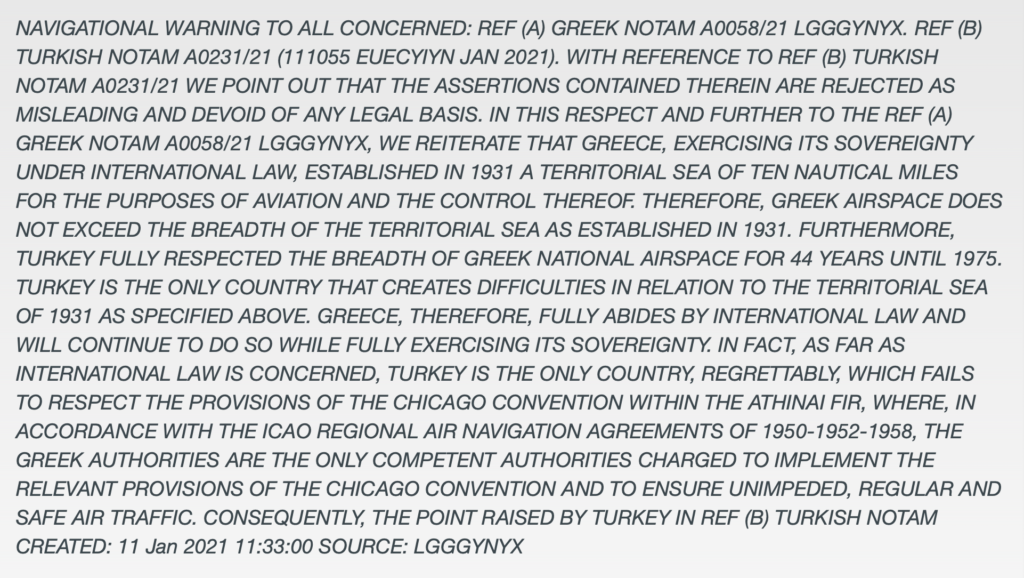
The dispute between Turkey and Greece is one we have mentioned before. Not because it was having a particularly big impact on aviation operations, but because of the vaguely amusing Notam battle they have been waging against each other for the last few years.

But what appears to be a rather silly conflict actually has a more serious side to it, so we thought we would take a little look at what is going on.

What are they arguing over?

This dispute is about what disputes always seem to be about – who owns some bit of land, or in this case, a Continental Shelf (so a bit of land that is submerged under several miles of Eastern Mediterranean Sea). Turkey want it because it is a treasure chest of energy resources, while Greece want it because, well, they reckon it was always theirs.

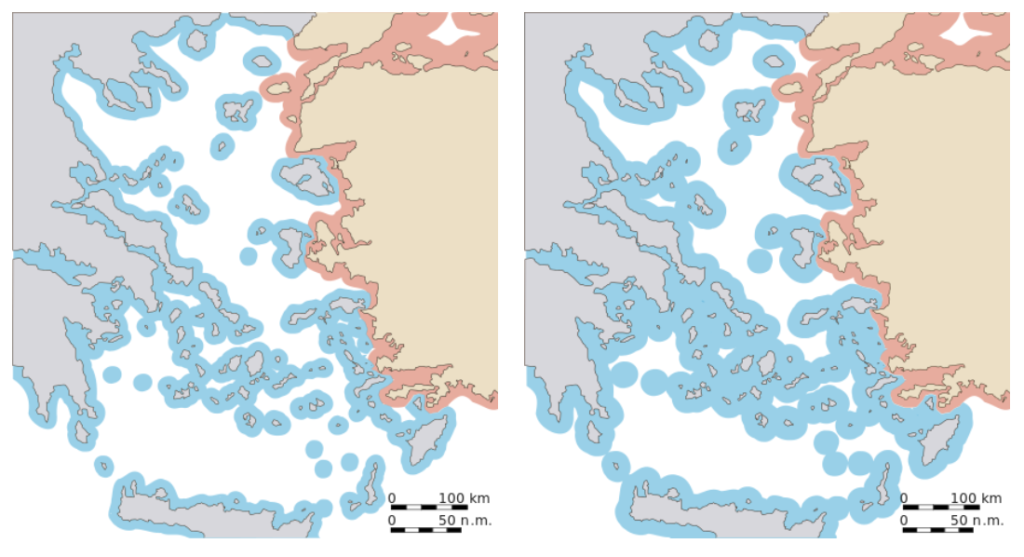
The dispute goes a bit “higher” than the continental shelf though. Like those annoying neighbours who keep pushing their fence backwards into your garden, so Greece have decided that their airspace extends not the usual 6nm (based off territorial waters), but 10nm. Turkey refuse to recognise those extra 4nm as Greek. Nor do ICAO who have a 1948 statute saying airspace must coincide with territorial water boundaries. 

So we would say that’s one:nil to Turkey, except for Greece’s point that they actually laid claim to those extra 4nm way back in 1931 before ICAO came along with their statute. Plus, this isn’t the only area Turkey has had disputes over, so maybe Greece have a bit of a point.

6nm vs 10nm airspace

But do we care, or can we just let them keep bickering?

Well, the permanent Notam battle can be ignored with a simple filter that removes the likes of these from your Notam package:

One example of the endless battle of Notam insults between the two

However, that is not the only repercussion. Actually, all this makes for some messy airspace controlling because it impacts FIRs and with that, who controls military flight activity. This has led to a bunch of provocations from both sides, with them regularly sending military aircraft into the 4nm disputed bit just to annoy the other side. And this is a problem, because it often escalates with retaliations. In 1996, Turkey claimed one of their aircraft had been shot down by a Greek fighter jet, and in 2014 the number of Turkish incursions into Greek airspace rose to nearly 1,500.

Tensions flared up again in 2020 when Turkey finalised their purchase of Russian S-400 mobile surface-to-air missile system. Now, this wasn’t specifically aimed at Greece, but it did go against NATO and US orders, resulting in big sanctions against Turkey.

Greece spent 2020 developing stronger defensive ties with their neighbouring countries, and at the start of this year, placed an order for 18 French Rafale fighter jets to pad out their Air Force. 

A bit of a jam

Deliberate GPS Jamming is also a major issue in the Eastern Mediterranean and across Turkish airspace, adding to the list of threats commercial aircraft have to consider.

So is this a conflict to watch?

2020 was a tense year between the two nations, and 2021 seems unlikely to see much de-escalation. While direct conflict between the two will likely be prevented by neighbouring countries and the EU and NATO, the dispute is still simmering away.

For commercial flight operations, the impact remains primarily in the Notam world, but attention does need to be paid to any temporary prohibited or restricted airspaces which might pop up because of increased military activity in the region.

Additionally, Turkey is a large country and their airspace provides a major overflight route between Asia, the Middle East and Western Europe. Having an awareness of the political tensions between the two countries is important, particularly if routing to or from Greece, or carrying Greek nationals onboard, since this might compound your problems if you have to divert into a Turkish airport.


Sudan Airspace Update: A New Risk

Generally, our SafeAirspace risk assessments focus on risk due to conflict, and the anti-aircraft weaponry that is often a result of said conflicts. But today a new risk alert popped up for South Sudan.

So this is a brief summary on the history of airspace safety concerns for Sudan and South Sudan, and the new risk that has been highlighted specifically for South Sudan.

Where are we talking about?

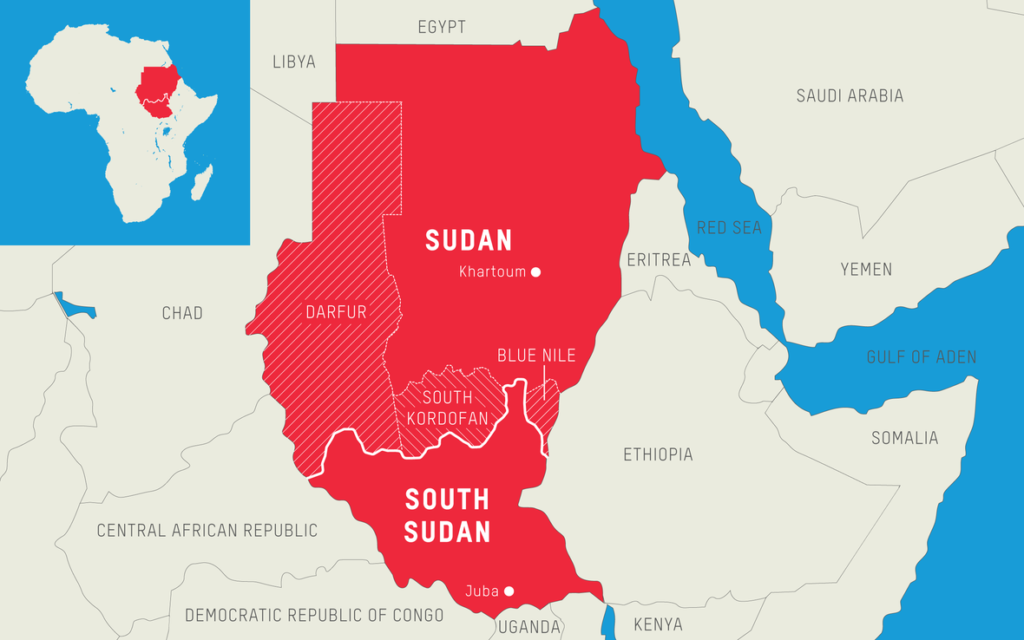
South Sudan is a landlocked country in East-Central Africa, bordered by Sudan, Ethiopia, the DRC, the CAR, Uganda and Kenya. The main airport for South Sudan is HSSJ/Juba.

So it’s South Sudan, not just Sudan?

Yep, there are two Sudan’s – Sudan and South Sudan. South Sudan is officially known as the Republic of South Sudan, whilst Sudan (North Sudan) is ‘just’ Sudan.

Sudan and South Sudan are two separate countries since 2011

Sudan’s primary airport is HSSS/Khartoum

They were the same country until 2011 when they separated following decades of civil war. South Sudan became the world’s newest nation.

Two separate Sudans, three separate issues

Following five years of civil war in South Sudan, a ceasefire has largely held since Sept 2018. Though there has been a significant reduction in violence since then, the political and security situation remains volatile.

Sudan, on the other hand, (which borders South Sudan, the Central African Republic and Chad), has had its own conflict. In 2019 they temporarily closed all their airspace following a military coup which ousted their longtime president Omar al-Bashir from power. This came after months of protests against his rule.

Clashes between the army and former security agents resulted in violence and gunfire in the streets, and the temporary closure of HSSS/Khartoum airport in 2020, but this was brought under control relatively quickly.

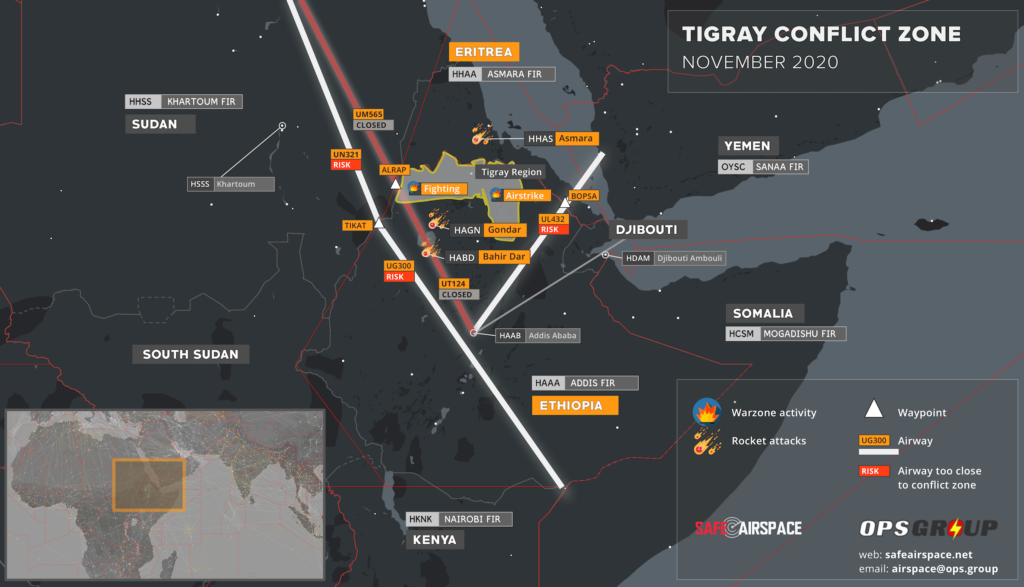
There are also issues in bordering Ethiopia and Eritrea, in the Tigray region, which resulted in the closure of some airspace and airways by the Ethiopian and Sudanese CAA.

What warnings are in place due to conflict?

South Sudan – Although the situation has improved since Sept 2018, several countries (the UK, France and Germany) still advise against overflying South Sudan below FL250/260 due to the risk posed by anti-aircraft weaponry. The US published a similar warning but rescinded it in Aug 2019.

Sudan – Only has one official warning in place, from the French authorities. This recommends against overflights below FL260 in the far Southern and Western regions.

But there is a new warning for South Sudan?

Yes, there is. And it isn’t conflict related.

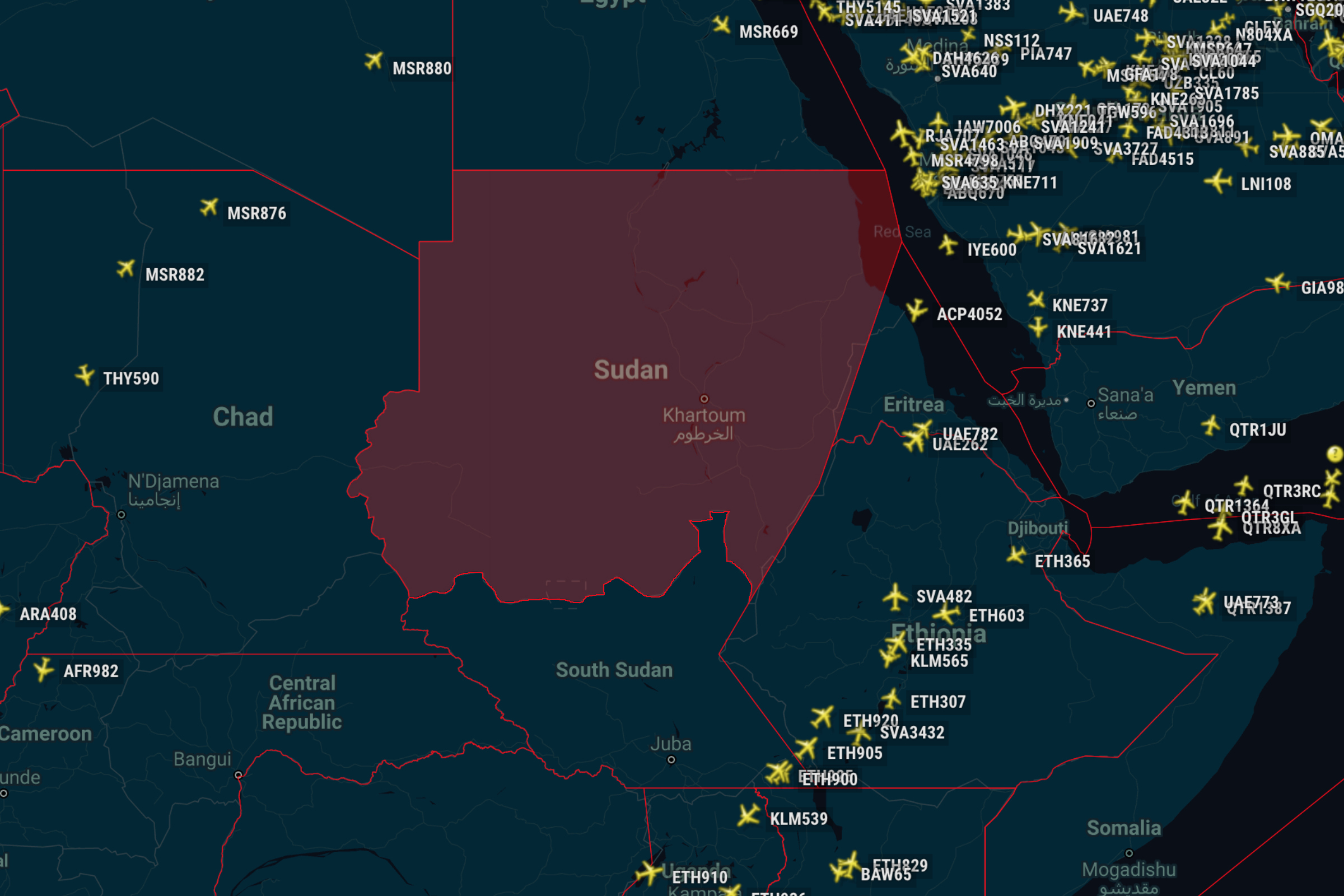
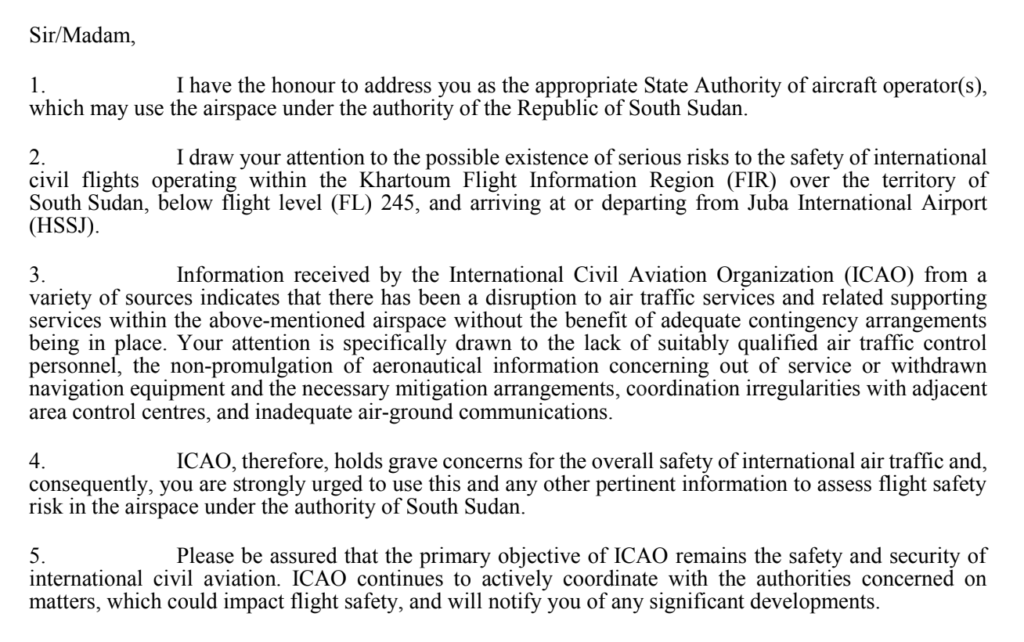
ICAO released a letter on January 20th regarding the safety of Civil aircraft in the Khartoum FIR over South Sudan.

The raised ‘grave concerns’ for the safety of International air traffic operating below FL245, and operating into and out of HSSJ/Juba international airport.

The concerns relate to the disruption of air traffic services and the lack of contingency arraignments in place. They warn about the lack of suitably qualified air traffic control personnel, the lack of information being shared on unserviceable or withdrawn navigation equipment, and inadequate air-ground communications.

ICAO letter concerning South Sudan

A quick search on Notams for Khartoum FIR and Juba airport only brought up info on the opening of airspace following Covid restrictions.

The full warning from ICAO can be read here.

In summary

  • Both Sudan and South Sudan are considered Level 2: Danger Exists regions because of ongoing conflicts.
  • South Sudan now poses a separate risk due lack of aviation infrastructure and lack of information being promulgated (through Notams) on this.
  • Caution recommended if operating below FL245 in South Sudanese airspace, or if you are operating into HSSJ/Juba airport.


Brexit is here: What’s the impact to ops?

The UK officially left the EU on Jan 1st, 2021. Although it’s still a part of Europe (the continent), it’s no longer part of the European Union (the trade and political bit). Whereas before, the UK fell under EASA and all their rules and regulations, the UK CAA is now in charge of all things aviation in the UK…

So, what does that mean?

It means a raft of changes to the rules for operators flying between the UK and EU states. A new agreement has been drafted which applies from Jan 1. Here are the main changes:

  • Essentially UK operators will no longer be considered as EU carriers, and will instead be ‘third country’ carriers, meaning they will lose their special treatment. Flights between the UK and EU will continue, but passenger cabotage flights will no longer be allowed. Or in more human terms, UK operators will not be able to carry fare paying pax between two EU states (and vice versa). Cargo cabotage will still be okay as long as the two countries involved have an agreement.
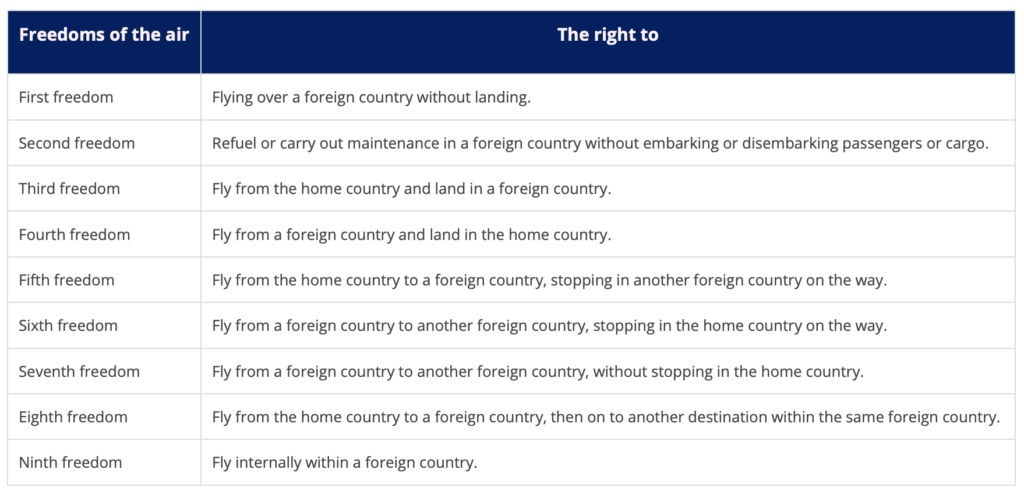
  • Both sides will still have the right to overfly each other’s territory, make technical stops, and to operate third- and fourth-freedom passenger and cargo flights between any point in the UK and any point in the EU. The fifth-freedom rights beyond the EU will continue, but only for a five-month period and with a new capacity cap.
  • UK and EU airlines can also continue codesharing, and UK airlines can continue providing wet-leasing operations.
  • There are other changes coming too, which EBAA cover here.

All the freedoms

But what about laws, licences, rules and regulations?

All existing EASA certs, approvals and licences valid for UK registered aircraft will be good for another two years. For UK operators of EU-registered aircraft things are more complicated. The UK CAA have set up a useful website to help you get your head around what you need to do to stay compliant elsewhere in Europe, and it’s a great place to start. There is also a helpful flow chart to keep things simple.

With Brexit complete, the UK CAA is now in charge of setting the rules, but they’ve basically said that they’ll be sticking to pretty much all of the aviation law, rights and obligations that were in place before. You can read that statement, and a bit more, on the UK CAA’s main regulations site.

The heads-up for passengers

Things may get complicated. UK citizens will likely lose their special EU travel privileges which means it may become harder to move around Europe thanks to everyone’s favourite elephant in the room, Covid.

As a general rule, pax from the UK to Europe will need to make sure their passport has at least six months validity in it if they want to visit any EU country, Iceland, Liechtenstein, Norway or Switzerland. They will also need to check their health cover – the EHICs (European Health Insurance Cards) are still valid if issued before January 1.

If they are entering as a tourist, they can stay for 90 days – and they can do that twice a year. But if they are entering for business purposes, they might need a visa.

All of this is on the UK Gov website if you want to take a look.

The Question of Covid

Not being part of the EU anymore means that flights from the UK to the EU will no longer have the same Covid entry restrictions applied. “Luckily” no-one was really letting UK flights in anyway, what with their virus mutation running rampant, so right now, any change for flights originating in the UK (and passengers for that matter) is not really relevant.

The entry rules for UK nationals in the rest of Europe are changing fast, and every country is different but in most cases it will be harder for UK travellers to avoid Covid related rules for non-essential travel. Don’t know where to start? We don’t blame you. The best place is the UK FCO website which has the most up to date entry requirements for UK nationals for every country around the world.
CO2 much?

One extra little snippet of info to know about Brexit is that the amount of emissions small, non-commercial operators can produce as “improved”. If you already have an EU-ETS (emissions trading scheme) exemption then your allowance has now been doubled.

Instead of 1,000t CO2, you can now produce 2,000t CO2 – half in the EU and half in the UK. 

Don’t think you can get away with puffing about and no-one watching though. The UK are setting up their own scheme, and France will be monitoring the EU bit of it (apparently they won the task because UK operators tend to spend more time there than anywhere else in Europe).

If you are trying to work out what 1,000t of CO2 coming out your aircraft looks like, then there is a handy calculator you can use (but its roughly 103,400 gallons or 391,500 litres of JET A1 burned).

The news for N-reg’ers

Well, to be honest, not a lot at this point. The main thing to know is that the UK no longer falls under EU (EASA) rules and law, so if you have any problems you’ll now be dealing direct with the UK CAA… but currently their laws aren’t actually any different to what they were at the end of December.

If you are carrying passengers from Europe to the UK (or vice versa) then there will be different passport and entry procedures for them now.

That’s about it.

So, the really important bit… can you bring food?

Always one of the big questions for crew who want to stock up on all things delicious. Basically, no meat, milk, or dairy stuff into the EU from the UK. The UK is a bit more chilled, but you do need to declare things, and a suitcase filled with Camembert and wine probably won’t go down very well.

Of course, the real good news is all those juicy duty free goods which travellers between the UK and EU will now be able to buy!


ALL WE HEAR IS: RADIO BA DA, RADIO BODØ, RADIO BA DA

Wave at the ATC tower, and you might find there is no-one in to wave back. But that does not mean air traffic controllers are not watching us anymore, they just might be doing it from somewhere a little more remote.

The rise of the remote controller

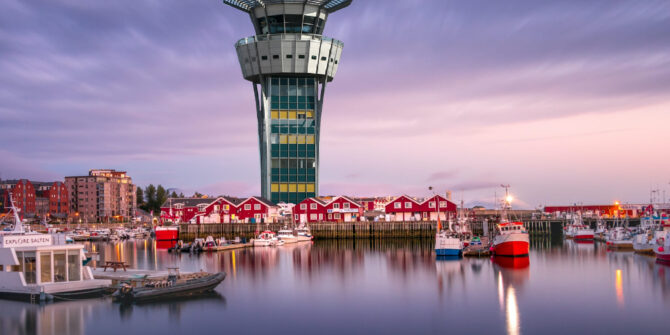
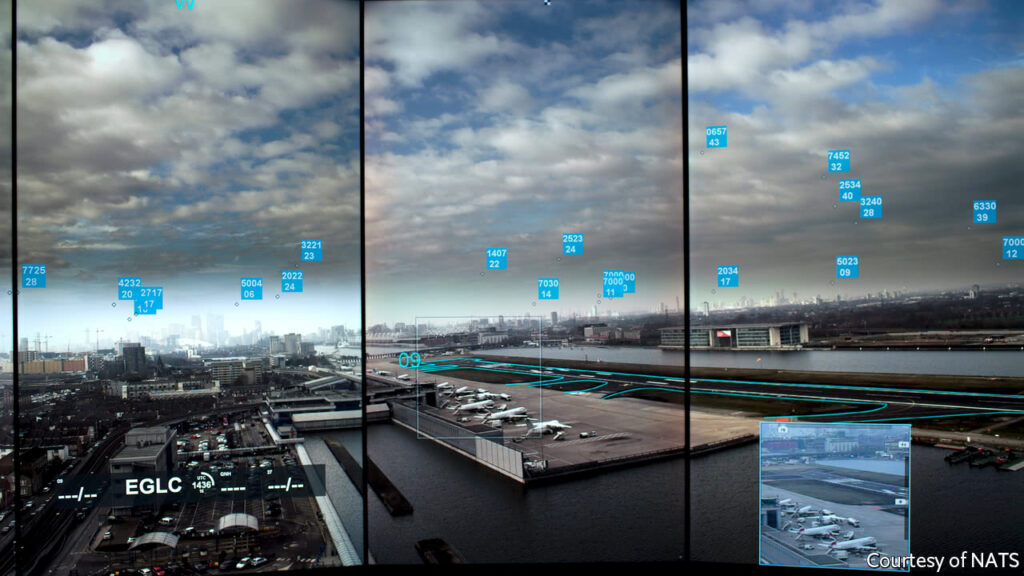
In 2021, LEMH/Menorca airport will no longer have air traffic controllers in their tower. Instead, they will have a network of 360 degree panoramic and pan-tilt zoom cameras which will feed high resolution images to a single, mighty control tower in Bodø, Norway.

Kongsberg (possibly a reference to King Kong who liked climbing up towers, but more likely just named after the town in Norway where it was founded), is working with various airports on a program called Ninox. The plan is to eventually have advanced Remote Tower Systems across 15 different airports.

The plan is to eventually have advanced Remote Tower Systems across 15 different airports. Two systems are already fully operational, and the overall result of the project will be an ATC service that brings “new capabilities to air traffic operations, enabling safe operation at reduced costs.”

They had me at “new capabilities”.

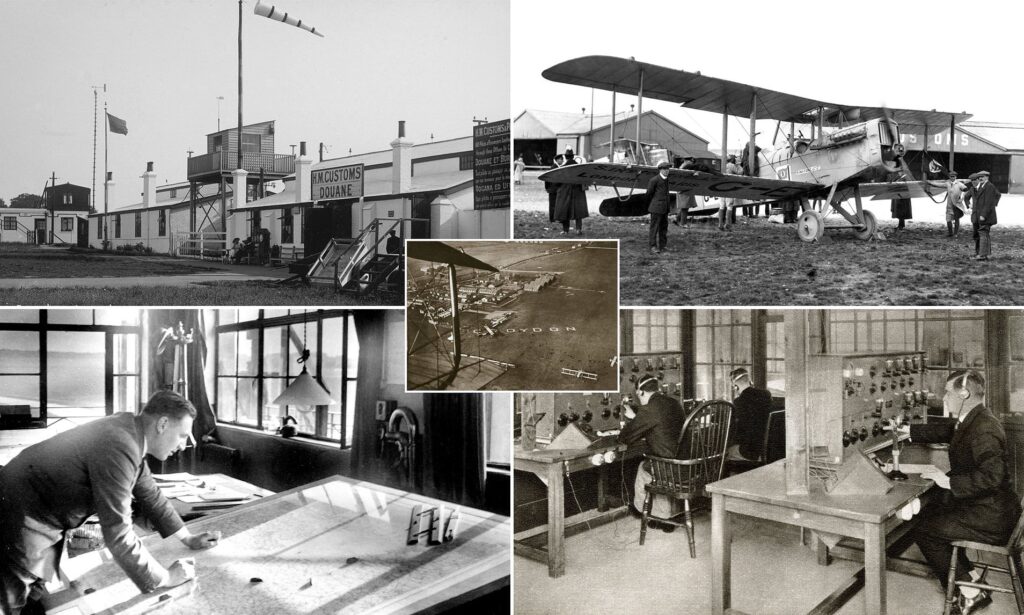
The world’s first air traffic control tower – a wooden hut built in south London 100 years ago.

Is there anybody up there?

Rather than having controllers at the airport, able to look out the window, this system feeds images to a remote control tower. The cameras are incredibly high resolution and can zoom in on the smallest details, detecting movements from birds and drones. They also can have infra-red settings making it possible to see in the dark.

The tools provide greater contingency as well as vision enhancement, and there are options for automated object detection, virtual safety nets, and augmented reality features to be installed.

The real big advantage is that multiple towers can be managed with one all powerful air traffic controller so even the smallest airports providing only AFIS will potentially be able to sign up and have a “controller” over-seeing their traffic – increasing their services without a mega increase in costs.

What if the big ‘what if’ happens

A big “what if?” for this system is “what if the feed fails?” 

This isn’t a problem though – each tower is connected to the Remote Towers Centre via networks with huge amounts of redundancy. If one network fails, another can be used to connect again. It also means if one controller gets stuck in traffic, another controller can control from a different spot on the network.

Rapunzel, Rapunzel, let down your air… craft

So far only Norwegian airports have been set up on the Bodø master network. Røst airport has been operating under remote tower conditions since October 2019, with 3 more coming online through October and November of this year.

But actually…

The concept is already used across Europe, and there are multiple projects around the world.

EDDR/Saarbrücken Airport in Germany has had a remote tower since 2018. With 15,000 flight movements a year it is one of the largest airports to have its operations controlled remotely.

They have projects worldwide including Brazil and New Zealand, and both civilian and military. EGJJ/Jersey Airport in the UK has implemented a contingency system, Iceland is testing the technology for severe weather conditions and LOWW/Vienna is already using their vision enhancement system.

EHAM/Amsterdam Schiphol Airport has also been involved in trials, in conjunction with the Single European Sky ATM Research (SESAR) project and Air Traffic Control the Netherlands (LVNL). The trials tested how controllers would use the cameras, as well as the screens for radar, weather and flight planing which were integrated into their stations, and the results were pretty good.

Grey and cloudy London City Airport looks better from a tower

And then there is AIMEE

AIMEE is an AI developed by the company Searidge, and NATS and NAV Canada are pretty excited about it.

It receives inputs from different sensors, sources and scenarios, and uses an algorithm that learns patterns and so can predict problems, and offer solutions quicker than a human brain can. 

AIMEE is being trialled at EGLL/London Heathrow to see if it can improve capacity by as much as 20%. The system will use ground level cameras to monitor aircraft positions in rubbish weather, and will be able to see when aircraft have exited runways much quicker than people eyeballs through fog can.

AIMEE is also being installed at airports like KORD/Chicago O’Hare and CYYC/Calgary where its AI eyeballs will monitor de-icing bays and provide a spacial marshalling system. In KFLL/Fort Lauderdale the system is used on gates for remote apron management.

So the future is remote

People-less control towers are not a thing of the future, they are happening now. Anytime you fly across London, you are probably being controlled by controllers in Swanwick.

For pilots, there is no change in procedures – they will still talk to personnel on the radio, but the actual people looking after you are squirrelled away in their remote tower in Norway.

Bodø Tower – What ATC see

Are we going to have a Matrix type AI computers taking over situation?

No, don’t worry, it won’t.

All this technology is there to supplement real people brains because it can process stuff faster. But it is unable to make the decisions human ATC currently make, so we are more likely to get pilot-less airplanes before we see entirely people-less control towers.


The November Mega OpsChat – All the Links…

The November 24th “East/West-One-Day-Two-Calls” OpsChat Bonanza was great! Thank you to all who joined us, and those who shared some useful intel with the group.

Boy, did we cover a lot! The good news is if you missed the show, you can re-watch the recording here:

During the chat, we provided a bunch of links for each topic covered. If you weren’t quick enough to catch them at the time (we don’t blame you), here’s a little summary….


November Updates…

Greenland

What? Baffling Notam issued declaring Greenland’s airports were closed.

What else? Panic not, a better one was then reissued, saying that you could still use Greenland’s airports for ETOPS and diversion alternates. We called them and they said that tech-stops and ferry flights are also allowed (although not listed in the Notam). They’ve basically just banned passenger flights, and don’t want people staying overnight.

More Info:
Greenland Closes Its Airports To (Nearly) All Passenger Flights – Opsgroup Blog Post
Official Word from The Danish Civil Aviation 

Israel

What? You can now overfly Israel (as well as Jordan, Saudi Arabia and Bahrain).

What else? You need a local sponsor, should depart from an approved airport (but they do make exceptions) and need a permit.

More Info:
Israel overflights now allowed – Opsgroup Blog Post

Hong Kong

What? Strange ILS behaviour, especially on Runway 07R/25L. Pretty much down to antennas, terrain and Boeing AFDS…

What else? They have also updated their Covid entry restrictions for crew – it’s now slightly harder to get in.

More info:
The Thing About the ILS
Hong Kong Entry Rules for Flight Crew – OpsGroup Blog Post
The Official Word

CENEMAR (Central America)

What? There are some new flight planning requirements you need to know about.

What else? You can flight plan direct above FL200, and must include the new AFTN address MHFPZYZX when filing your flight plan.

More info:
CENEMAR: New Flight Planning Requirements – Opsgroup Blog Post


Other big updates from 2020…

November 5th ICAO changes

When? Er… November 5th!

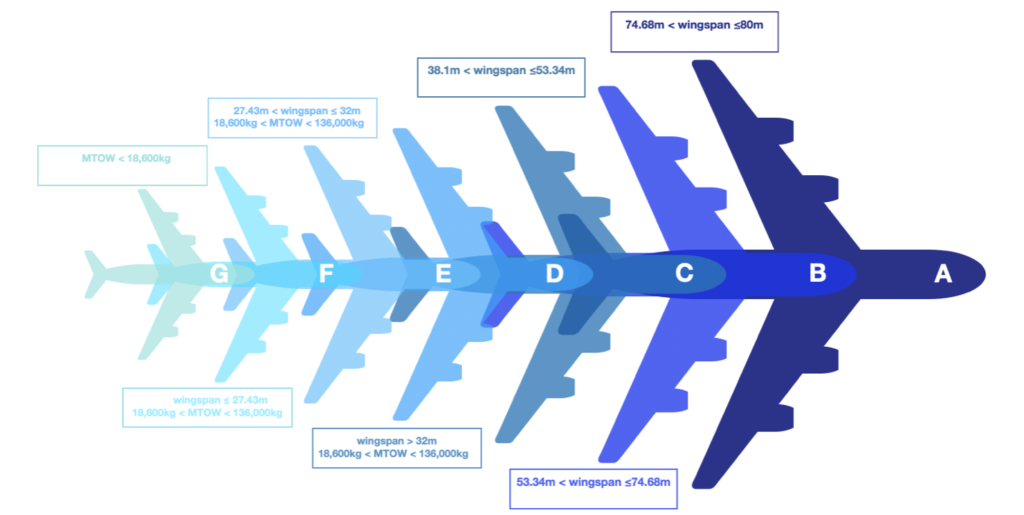
What? We are talking changes to wake turbulence categories, NAT Contingency Procedrues, SLOP and Gross Navigation Errors.

More info:
The 511 on Nov 5th Changes – Opsgroup Blog Post
Hopefully a Link to the New 4444

Wake Turbulence Categories

Other overflights that are now ok

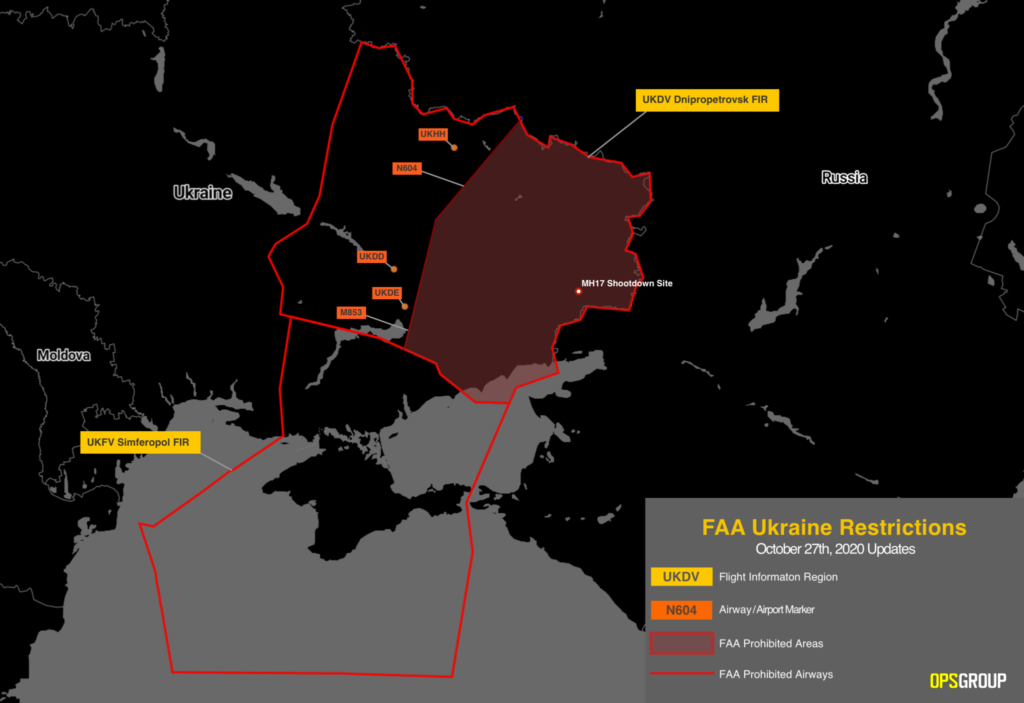
What? FAA SFAR updates – where US operators can’t go!

Where?
– Ukraine: UKFV/Simferopol FIR is ok, UKDV/Dnipro FIR is not ok.
– Iran: Not ok, but the Gulf of Oman and Persian Gulf are – Emirates, Kuwait, Bahrain and Muscat FIRs.

More info:
Safeairspace
Overflying Crimea – Opsgroup Blog Post

Ukraine Airspace and a link to Safeairspace

Russian Me-trics

What? Russia are moving to feet (referenced to QNH) below transition through their airspace, starting with major airports.

When? From December 3rd.

More info:
Russia are still playing me-trics on us – Opsgroup Blog Post
The Russian AIP (don’t worry, it is in english too)

ADS-B

What? When will you get in trouble for not having it.

Where?
– Europe: ADS-B is required from June 2023, but have your retrofit plan in by December 7 (unless your AoC is before 1995).
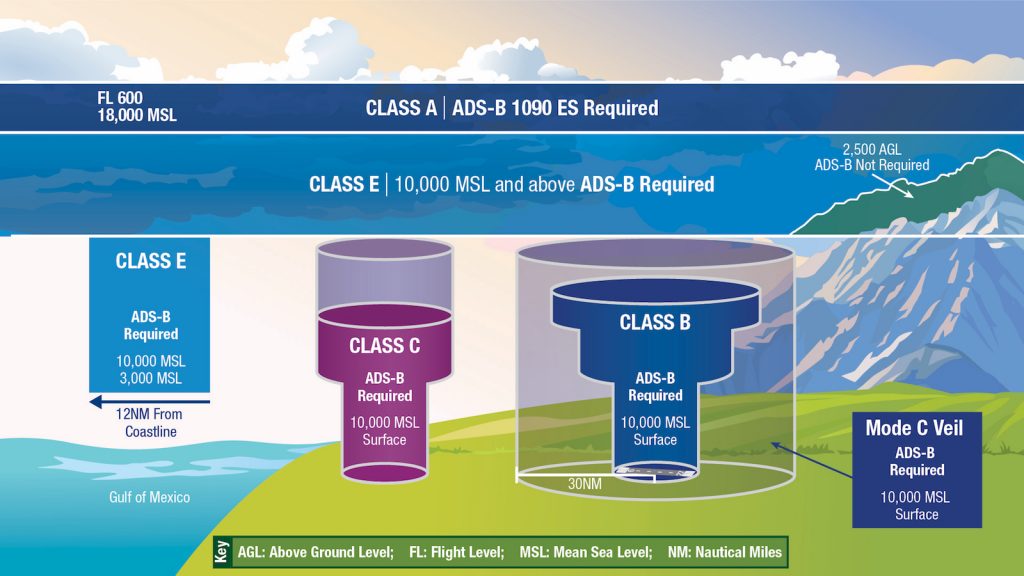
– US: ADS-B is required anywhere Mode C, or in the picture below.
– Rest of World: Above FL290, pretty much.

More info:
European ADS-B Mandate – Opsgroup Blog Post
The FAA FAQs on ADS-B

Where you need ADS-B in the US

North Atlantic Datalink Mandate

What? The North Atlantic Datalink Mandate (NAT DLM) is the thing that came into effect in Jan 2020, which meant that CPDLC was then required between FL290-FL410 throughout the entire NAT region. Simply put, you must be equipped with CPDLC and ADS-C if you want to fly between these flight levels.

And then what happened? Then Covid happened. Because of the resulting reduction in traffic they suspended this mandate, and it looks set to stay this way until the end of Feb 2021. Bottom line, aircraft which do not have CPDLC and ADS-C can continue to operate across the North Atlantic between FL290-410 until then.

More info:
North Atlantic Datalink Mandate – Opsgroup Blog Post


SafeAirspace Update…

Ethiopia

What? Escalating conflict – Danger to overflying aircraft – beware of open airways!!

Where? Ethiopia – the Tigray region bordering Eritrea

More info:
Safeairspace – Ethiopia
Airspace Risk Warning: Eritrea and Ethiopia – Opsgroup Blog Post

Ethiopia Tigray region and a link to our post

Saudi Arabia

What? Drone and ballistic missile strikes continue from Yemen, no end in sight.

Where? Southern Saudi Arabia particularly, but Jeddah and Riyadh have also been attacked.

More info:
Safeairspace

Armenia/Azerbaijan

What? The conflict is ‘officially’ over, but the airspace remains dangerous!

Where? The airspace between Azerbaijan’s UBBA/Baku FIR and Armenia’s UDDD/Yerevan FIR.

More info:
Safeairspace

Western Sahara

What? An emerging conflict zone, with the threat of anti-aircraft weaponry. Little info or warnings, that may well affect aircraft operating into the Canarias.

Where? Northwestern Africa – a area region between Morocco and the Polisario.

More info:
Safeairspace


Stay tuned for our next Ops Chat coming up in January 2021!


November Ops Chat

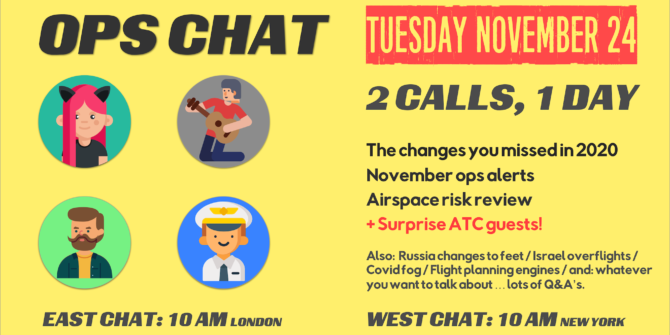
We have decided to run not one, but two Ops Chats on Tuesday November 24th!

Why two calls?

The calls have been getting bigger and bigger. So, we’re runing two so there’s more time to talk, answer questions, and make sure that if you want to get a chance to take part, you can. And also, so that you don’t have to stay up until midnight (or worse) if you’re not in the United States.

Who can join?

This is an open call. If you work in international flight ops, you’re welcome to join us.

So, when should I set my alarm for?

The date is Tuesday, November 24th.

Chat 1, the EAST-CHAT is at 10am London time. (10am London, 11am Berlin, 2pm Dubai, 6pm Singapore, or 1000Z)
Register and save your spot at ops.group/eastchat

We will have some lunch.

Chat 2, the WEST-CHAT is at 10am New York time (9 am Paris (Texas), 7 am Forks of Salmon (California, or 1500Z).
Register at ops.group/westchat

So, pick the time that suits you best and join us for a chat. Or, join us for both chats. Your choice!

What are we chatting about?

  • We are getting to the end of this year, and the plan is to get out from the Covid fog and take a look at what else has been going on in 2020.
  • There have been some big changes, and in case you have missed them, we will give you brief rundown of what they are.
  • We will look over the “highlights” of November’s ops alerts.
  • There will be a 2020 Airspace risk review looking at Conflict Zones and changes this year.

Get your questions ready

You can be nice and send these through early (email us) so we can look clever answering them, or you can put us on the spot. But we love questions so prepare some for us.


Greenland closes its airports to (nearly) all passenger flights

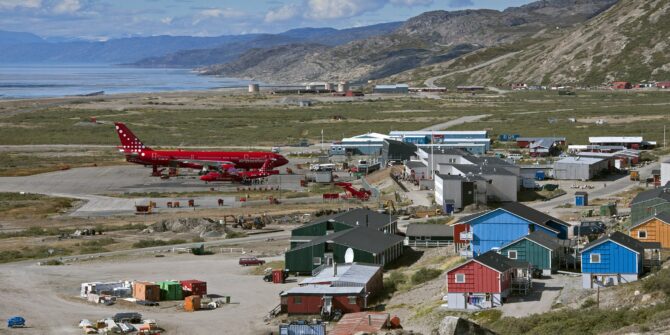
Greenland have closed (nearly) ALL their airports to international passenger flights.

Well, apart from ones that come from Denmark. But don’t go thinking you can make a quick stop off there first, they’ve even specified those are not allowed.

There is a provision for you to get special permission if you are transporting someone particularly important to the Greenland economy, but beyond that, no pax.

Here is the NOTAM:

BGGL SONDRESTROM FIR/FIC
A0621/20 – COVID-19: FLIGHT RESTRICTIONS.
ALL CIVIL FLIGHTS FROM OUTSIDE BGGL FIR, ARE BANNED FROM LANDING AT AERODROMES WITHIN BGGL FIR. FOLLOWING EXEMPTIONS APPLY:

1. FLIGHTS FROM AERODROMES IN DENMARK

1A. FLIGHTS ORIGINATING IN OTHER COUNTRIES THAN DENMARK, WITH INTERMEDIATE STOP IN DENMARK BEFORE CONTINUING TO GREENLAND, ARE NOT EXEMPTED FROM THE BAN.

2. FLIGHTS TO BGTL. SPECIAL PERMISSION MAY BE OBTAINED FROM THE DANISH TRANSPORT-, HOUSING- AND CONSTRUCTION AUTHORITY FOR THE PURPOSE OF TRANSPORT OF PERSONS WITH PARTICULAR IMPORTANCE TO THE ECONOMY OF SOCIETY. FURTHER INFORMATION ABOUT RESTRICTIONS AND PROCEDURE FOR THE APPLICATION FOR SPECIAL PERMISSION CAN BE OBTAINED VIA THE FOLLOWING LINK: HTTPS://TBST.DK/EN/CIVIL-AVIATION. THE FLIGHT RESTRICTIONS DO NOT IMPACT THE USE OF AERODROMES AS ETOPS ALTERNATE OR FOR EMERGENCIES.

Still confused? Fear not, the government have now published a full clarification of the rules here – in plain language (which we like very much).

Can I do a tech stop?

Yes! Ferry flights and tech stops (gas and go) can continue – but you’ll need to remain onboard.

Overnight tech stops are not allowed without special permission.

Can I pick up passengers in Greenland?

Yes! You are allowed to ferry an empty aircraft to collect passengers. You just can’t bring them in.

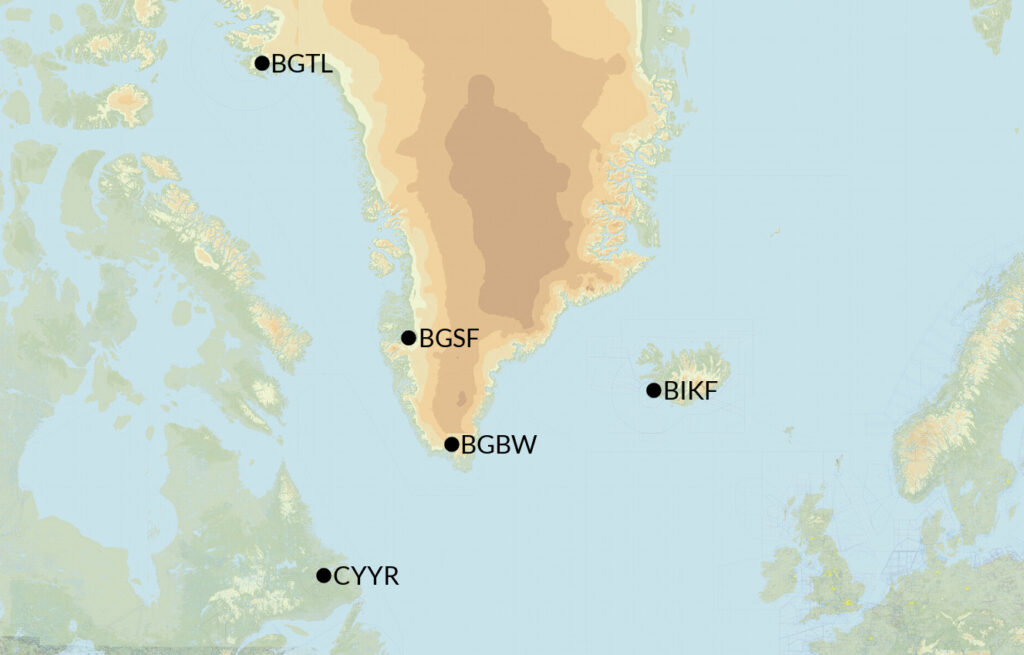
What about ETOPS? Polar Alternates?

Yes! These are still permitted at BGBW/Narsarsuaq and BGSF/Kangerlussuaq. But watch out for extra charges if filing one of these airports on your flight plan as an alternate.

BGTL/Thule is only open to emergency diverts – not as a planning alternate because it’s a military airfield which has no passenger facilities.

Who is this going to impact?

Mainly anyone who wants to bring in passengers for entry to Greenland. If you want to do it, you will need to apply for a special exemption at least 48 hours in advance. And you’ll need a really good excuse.

Greenland serves as an important spot for ETOPS aircraft, and for an en-route alternate for polar operations – to repeat, you can still use BGBW and BGSF as ETOPS alternates.


So far they think the rule will remain in place until the end of January next year. Given the current mutated mink situation Denmark have found themselves in, we don’t expect it to reopen sooner.



Has Russia stopped playing me-trics on us?

Russia have never been in much of a rush to join (most) of the rest of the world in how they measure stuff, but they are slowly getting there…

No longer playing me-trics on us?

Way back in 2011, they decided they would start using Feet instead of Meters above the transition level. So traffic cruising on through did not have to worry about sudden changes to metric levels, but any descending down into Russian airports still needed to whip out the old conversion tables once they went below transition.

Then in 2017, they started a trial at ULLI/St Petersburg to see if the whole Foot thing might work for them.

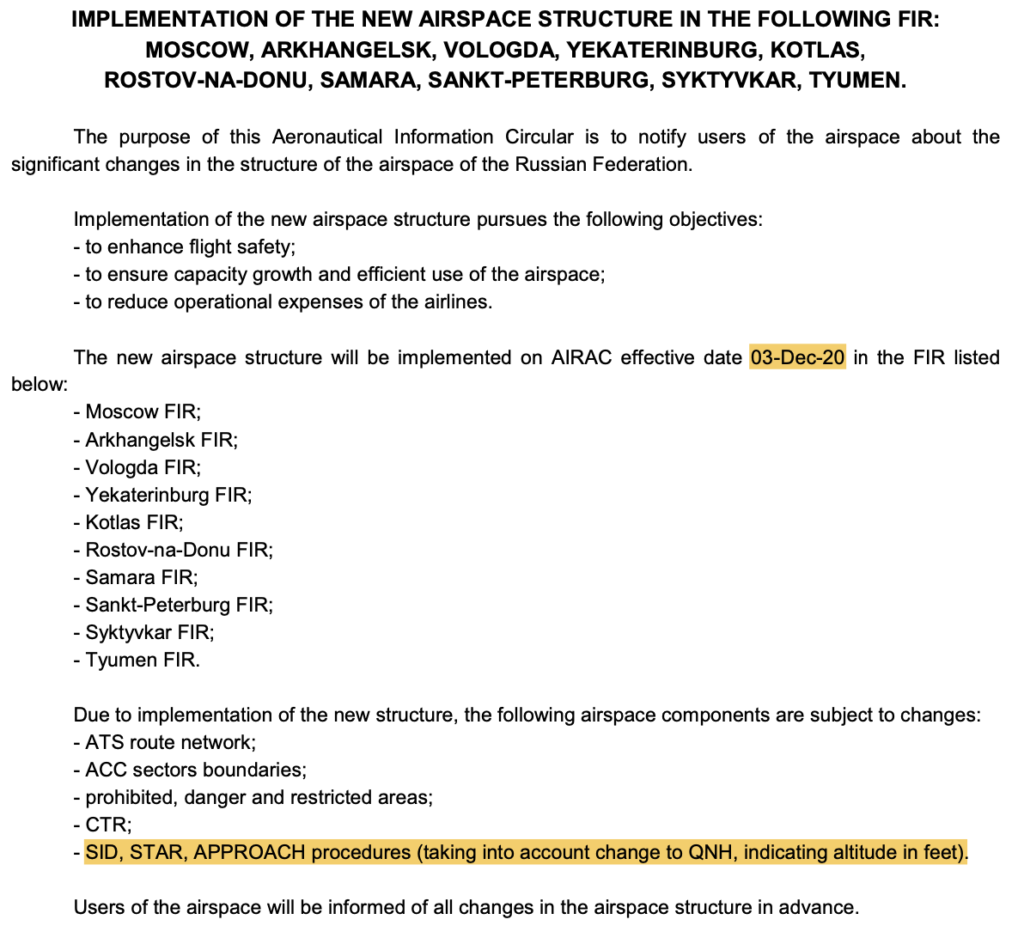
It turns out it went ok, because as of 3rd December 2020 they will be implementing this across Russian airspace – check out AIC 08/19 for the official announcement.

It’s not all smooth sailing yet though…

The AIC seems to suggest that changes will occur in all airspace from Dec 3, but this requires lots of chart updates – in reality it’s more likely that the big international airports will get updated first, and then the rest will follow.

At the end of November, European Regulators issued a caution to operators because some of the chart and database folk are struggling to update everything in time. We are talking en-route charts, SID and STAR charts, updates to prohibited and danger areas, updates to sector boundaries…

In their Safety Information Bulletin, EASA say if you are heading to Russia, check your charts to ensure they are in date, and keep an eye out to see what the changes are and if they have been implemented where you are heading.

What has changed?

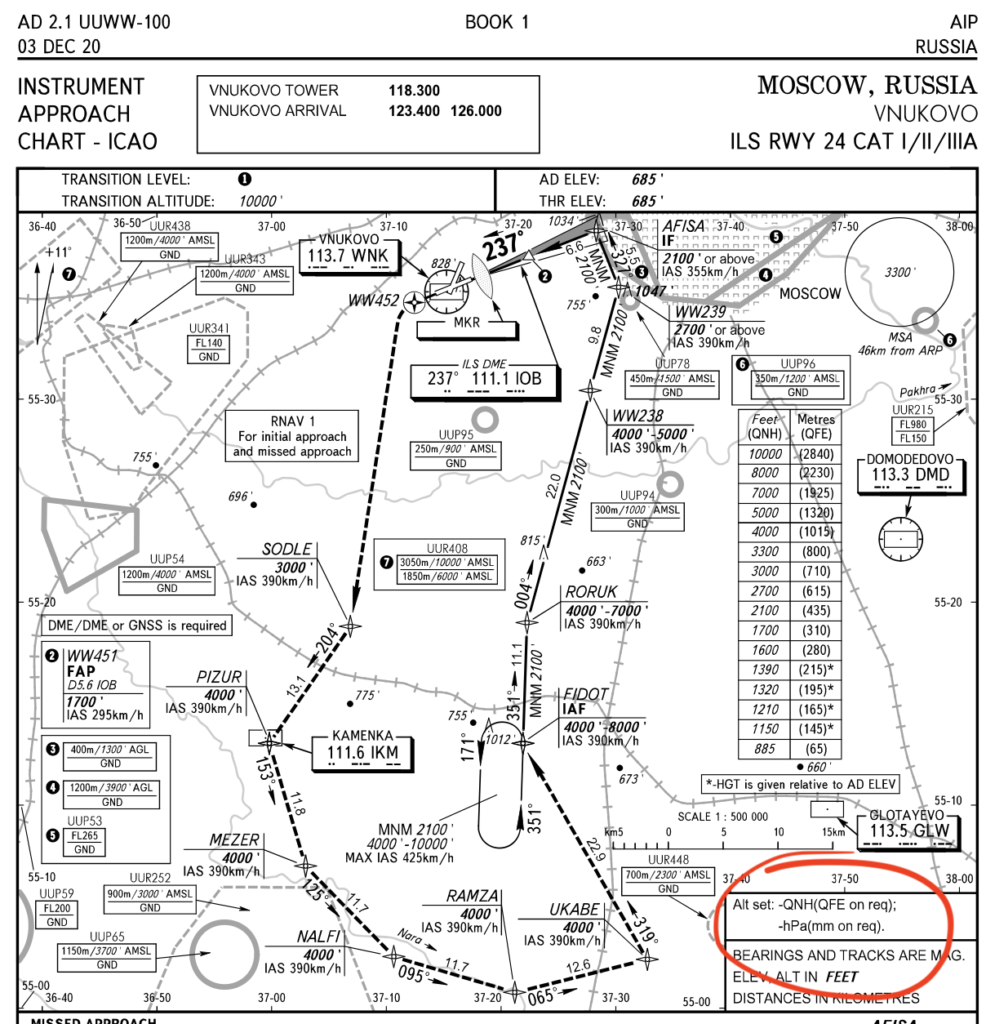
  • En-route stays the same: Flight Levels in feet, and metres if you are in a Russian aircraft.
  • Below transition you will now also receive clearances in Feet (QNH).
  • Pressure will be reported in hPa, unless you are a Russian aircraft then you can request in mmHg.

Last time we checked 188 out of 193 ICAO member states are using feet and QNH, instead of meters and QFE. The only countries still working in Meters are China, Mongolia, North Korea, and Russia and Tajikistan (in lower airspace).

Here is a picture of UUWW airport showing the change:

The bit to look out for

Transition Levels

Initially, we had information that the transition altitude was going to be fixed at 10,000 feet across Russian airspace. Not so, it turns out. Each airport will have their own transition altitude and associated transition levels, so be sure to check the approach plates.

It looks as if Moscow is standardising it across their airspace with a transition altitude of 10,000′, and transition levels based on the pressure

  • FL110 when QNH is 1012hPa or above
  • FL120 when QNH is 977hPa or above
  • FL130 when the QNH is less than 977hPA

And there is more

  • All ATS routes have changed to RNAV5.
  • A lot of TMA structures, and airspace areas around airports have changed which means a lot of arrivals and departures for airfields in the Moscow TMA airfields will also have changed.
  • UUDD/Moscow Domodedovo and UUEE/Moscow Sheremetyevo airports now have independent simultaneous arrivals on their parallel runways.

Click to download PDF

References:

  • You can access the Russian AIP here
  • You can read up on Metric Altitude Reference info here
  • Read our article from 2017 when ULLI/St Petersburg made the switch to feet and QNH

Thanks to Igor Nikolin, Deputy Head of the Air Navigation Support Service UTair Airlines for assistance with this post.


2020: A Record Breaking Hurricane Season

It has been a record breaking season for the Hurricanes. We are not talking the Carolina based NHL team. We are talking actual hurricanes.

2020 has now tied with 2005 as the most active hurricane season in history. No surprise there given what’s gone on in 2020 so far.

Hurricane Zeta became the 11th hurricane of the year. It is also the earliest in a season that 27 storms have needed naming (2005’s Zeta only formed at the end of November).

2005 is still (thankfully) beating 2020 in terms of major hurricanes.

What is the difference?

‘Hurricane’ comes from an old world which means ‘god of the storm’. ‘Typhoon’ comes from the beast Typhon – a Greek monster who fathered the sphinx, Cerberus and the super lion Nemean that Hercules had to kill. The etymology of the world ‘Cyclone’ is less terrifying, but they all boil down to the same thing – 

They are fancy terms for great, big, mess-making, flash-booming, horror storms. Whether it is a Hurricane, a Cyclone, or a Typhoon just comes down to where in the world it is wreaking havoc.

Hurricanes, Cyclones, Typhoons also get individual names if they get big enough. Some of these names get retired if they cause too much damage and destruction – like Katrina in 2005.

A full list of Hurricane names can be found here.

So, what are they?

They are “large-scale, atmospheric wind-and-pressure systems characterised by a low pressure at the centre, and by a circulating wind motion”. They spin counterclockwise in the Northern Hemisphere, and clockwise in the Southern Hemisphere.

Buys-Ballot famously stated if you stand with your back to the wind in the Northern Hemisphere then the low pressure will be to your left. I wouldn’t recommend standing with your back to a Hurricane though.

These storms only get classified as a Storm if the tropical depression they form from gets mean enough – basically, winds exceeding 39 mph. If the storm’s winds exceed 74 mph it gets reclassified as a Hurricane.

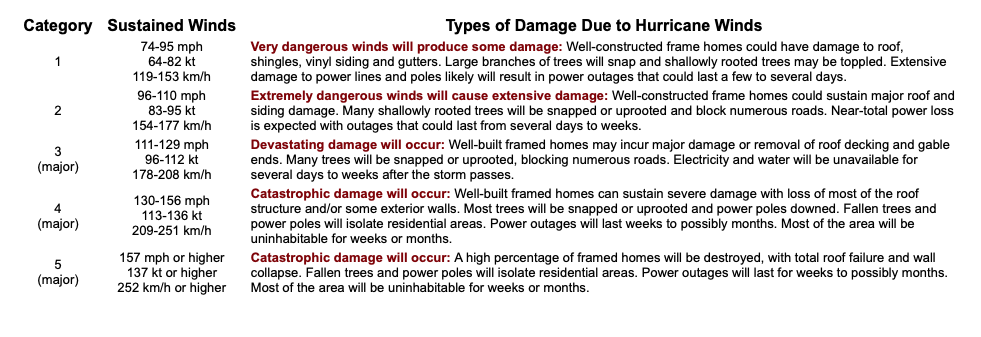
Hurricane’s also get classified from 1-5 based on their capacity for damaging things.

Why does aviation hate them?

Well, mainly because of the weather they bring. The crazy winds, serious rainfall and flooding, and power outages they cause.

How can we avoid them?

Meteorology departments track storms and try to forecast their movement. Some of the movement is based on air currents and sea currents (because hot water feeds them) amongst other things. From this they can create what are called Spaghetti models which help forecast where the storm will travel.

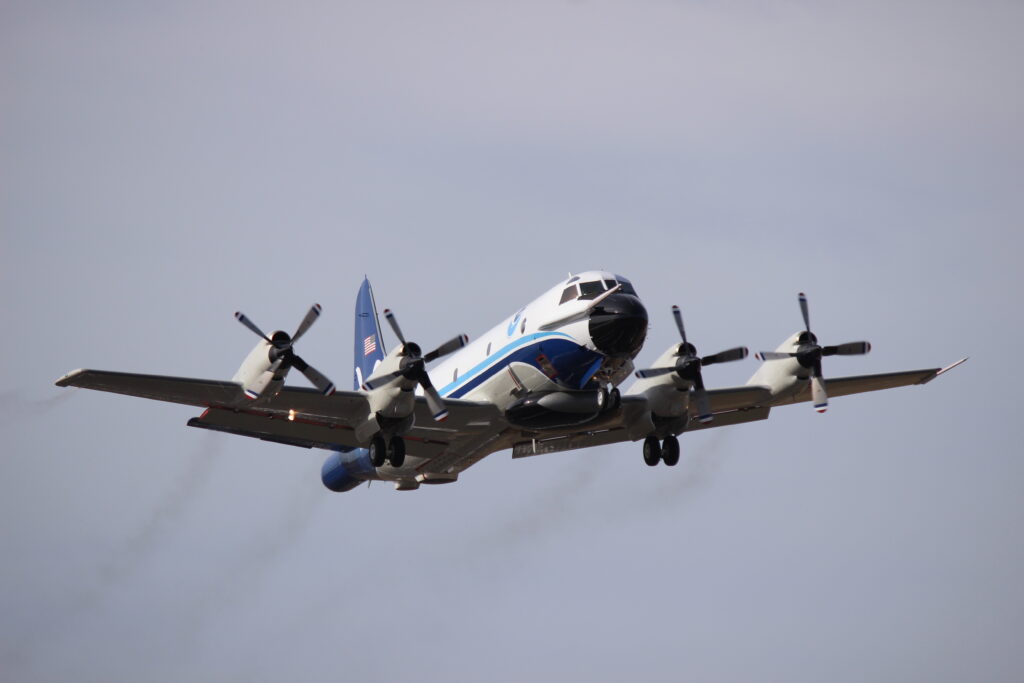
Agencies such as NOAA also (on purpose) fly airplanes into them. These Lockheed WP-3D Orion aircraft have 4 turboprops and are pimped out with probes for measuring every wind and pressure change to help scientists see what is going on inside. 

Little salute to the pilots who do those flights!

These aircraft measure everything! They have radars which can scan the storm vertically and horizontally, and can even drop probes to test the water temperature.

Satellites monitor storms as well, but mainly just send down horrifying photos of how massive they are.
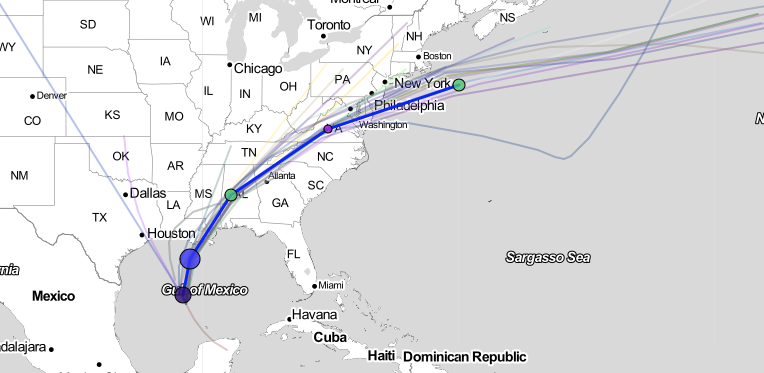
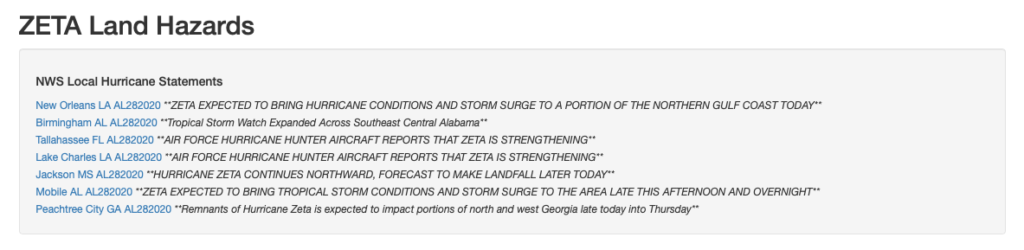

All this information gets fed to sites, some of which we monitor…

What do we tell you?

We check a site called Cyclocane which tells us about active tropical storms, and their forecast paths. We try to give an alert about severe weather forecasts, and alerts on airports that are cancelling operations due to weather.

We also check other weather forecast sites, and NOAA for warnings on serious weather which might affect operations.

Zeta…

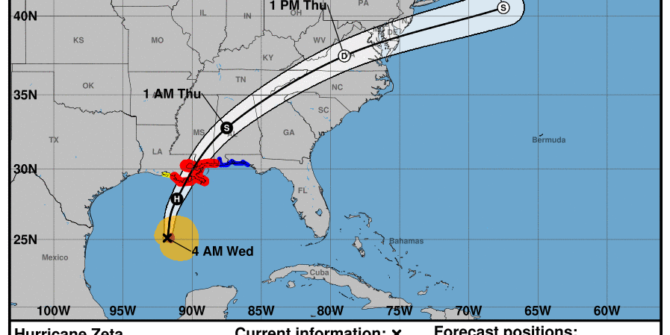
Zeta is a serious storm. Still currently over the water, it is strengthening and is expected to bring storm surges and extreme winds of over 100 mph

There are storm surge, tidal and hurricane warnings in place for Florida and Louisiana.

It is expected to turn North on October 28 or 29, and is expected to make land fall close to New Orleans late in the evening of October 28


Volcanoes – No lavaing matter

One of the rowdy Icelandic volcanoes is at it again. Earlier this month, the Icelandic Met Office changed the aptly named Grímsvötn to a ‘Code Yellow’ after it started showing high levels of activity.. There has also been a fair amount of action in the Pacific Rim, and even Mount Etna has been rumbling…

Why is volcanic ash so dangerous?

For starters, it is not the same thing as smoke.

Volcanoes are on the ground, airplanes are in the air, but unfortunately volcanoes spit out loads of hot, nasty stuff and they tend to spit it rather high. That hot, nasty stuff is a mixture of glass, rock and mineral particles, and it is really fine – the diameter of a particle measuring less than 2mm. It is also very porous meaning it weighs next to nothing and is easily carried along on the wind. 

Once the ash cloud starts to spread it, it can be very hard to spot – even a fairly dense ash cloud is unlikely to show up on your weather radar because the particles are just too small.

If it is ingested into a jet engine, it will erode the compressor blades before forming a substance similar to molten glass inside the combustion chamber, and this then re-solidifies on the turbine blades. The end result can be stalling and engine failure – and you might not be able to get them going again. And if that wasn’t enough, it can also damage the flight deck windows, block pitot static systems, and get into the cabin air and damage ventilation and pressurisation systems.

So volcanic ash is to airplanes, like sand is to picnic on a beach – it gets everywhere, and pretty much ruins it.

Take British Airways Flight 9 for example…

In 1982 a British Airways 747 was en-route from London Heathrow to Auckland (with a few stops along the way). While overflying Indonesia, late into the night, their windshield began to glow an eerie shade of blue. They had unwittingly entered an ash cloud from the recently erupted Mount Galunggung. Within three  minutes, all four engines had stopped. They descended over 25,000’ and were making some pretty close-up eye contact with fish before they finally managed to get the engines running again.

In December 1989, a KLM 747 had a similar incident when en-route from Amsterdam to Tokyo, Narita. This time it was an ash cloud from the Redoubt Volcano that caused all four engines to fail. They also eventually managed to re-start and landed safely into Anchorage with no injuries, but with around 80 million dollars worth of damage to the airplane…

Okay, so what can we do about it?

For starters, understand the alerts you see in your pre-flight briefings.

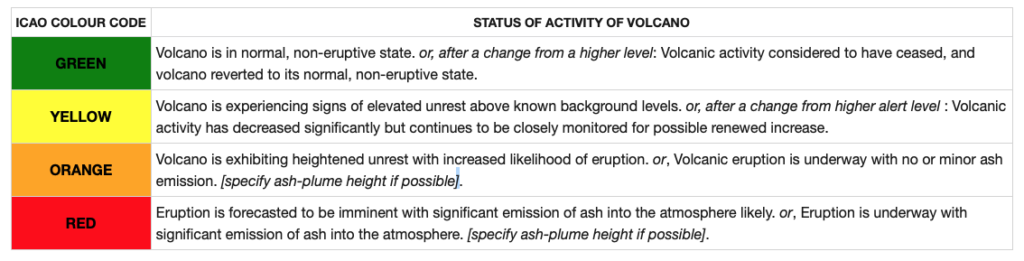
To help operators plan against potential ash encounters, ICAO have helped develop a universal alerting system for aviation that uses a simple but informative colour coding to give a heads up of the activity level of volcanoes.

ICAO also coordinate several Volcanic Ash Advisor Centers (VAACs) around the world that operate under the International Airways Volcano Watch. They use a network of met stations, satellites and even reports from pilots to provide forecasts, SIGMETS and advisories to the aviation community regarding ash clouds and eruptions. In other words, they try to tell you where it is, how bad it is and if it will get worse.

So, you can plan your flights to avoid affected areas both laterally and vertically.

Know the signs… 

Click to download.

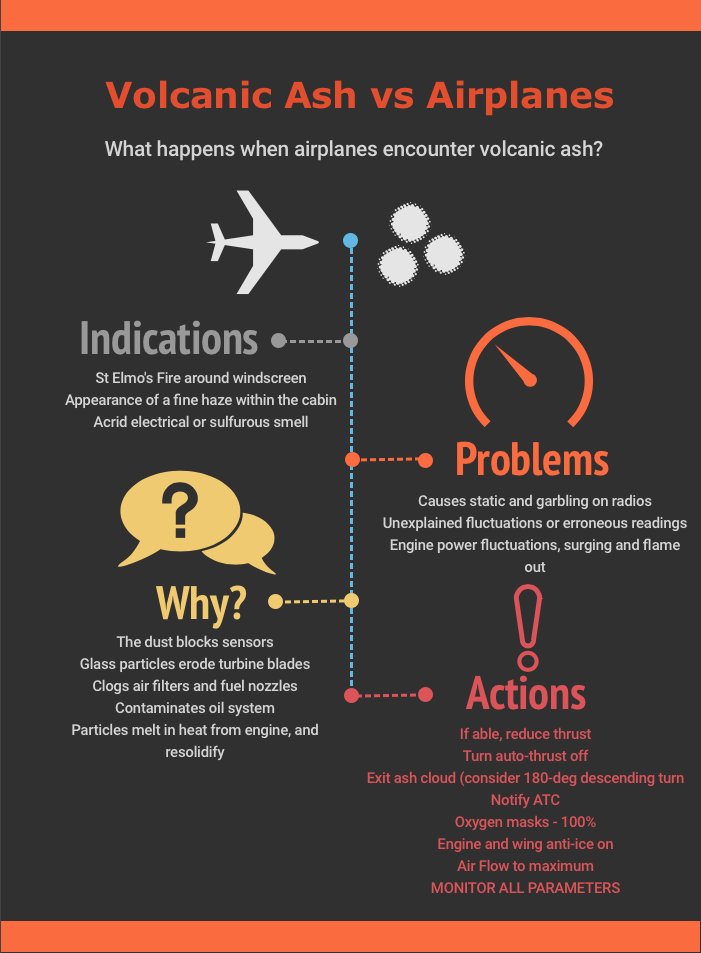
We have made you a handy infographic explaining what happens, and what you should do about it, but the general gist is:

Watch out for the signs that you might be entering an ash cloud – a strange colored cloud (in the vicinity of a known volcano), sulphuric or acrid smells in the cabin that can’t be blamed on the co-pilot, increased static charge around the flightdeck windows, garbled radio, or a picture of it on your sigmet chart (that you missed in the pre-flight briefing) are usually a good giveaway;

If you think you’ve flown into ash, get out fast. A 180 degree turn is usually best. Follow the actions or volcanic ash checklist for your aircraft type, and consider getting yourself on oxygen;

Look after your engines. Monitor your engine closely – you might see surging, stalling or high EGTs. If they are, reduce power and turn the auto throttle off. Do not try to climb out of it;

Watch your speed. If you’re getting erroneous speed indications, go back to basics using pitch and power until you can confirm your speed is safe;

Report it – Chances are if you’ve flown into it, so will another aircraft behind you, so make sure you put a radio call out to warn them, and to let ATC know why you just did a massive wheelie in the sky.

The Bigger Issue for Aviation

In 2010 the unpronouncable Eyjafjallajökull erupted and caused enormous disruption to air travel across Europe. The disruption lasted for over a week, and that was just one volcano!

A previously published report established that over one hundred airports in twenty-six different countries were affected by the eruptions of just forty-six volcanoes within a three period. Unfortunately for aviation, there are about 1500 active volcanoes in the world (not counting the ones that line the ocean floor.) 75% of these fire breathing mountains live in the Ring of Fire, in the Pacific, but there are some seriously cranky calderas on all continents bar Australia.

Which ones should we keep an eye on?
Volcano-watching organizations and aviation authorities have established a ranking system for volcanoes using an overall threat score, and a threat to aviation score which take into account 24 factors.

In the US, Kīlauea in Hawaii ranks numero uno worst with an overall threat score of 263, and an aviation threat score of 48. Mount St. Helens, Washington poses the greatest threat to aviation with a score of 59.

So what other resources are there to help avoid serious aviation disruptions from eruptions?
Unfortunately, volcanic eruptions can be a little hard to forecast, but generally how much they are rumbling, GPS data that monitors seismic activity, and historic eruption data are used to predict if and when they might pop.

Ash clouds are relatively hard to track as well – normally data is plugged into ash cloud modeling programs that consider the density and plume size, and the wind conditions for the day to model how it might disperse. Satellite sensing to detect radiation absorption levels, and thermal infrared wavelength levels also help, but there is no one sensor for observing everything.

Aviation authorities determine ash zones based on the concentration of ash. These are either a No Fly Zone, or an Enhanced Procedure Zone, and are based off tolerance levels agreed with aircraft and engine manufacturers. Generally enhanced procedures require training for the pilots (on identifying effects) and additional maintenance checks for the engines and aircraft.

Too Long; Didn’t Read

  1. Keep an eye on our alerts. Opsgroup will send out alerts on any volcanic eruptions that look like they will significantly impact flight operations;
  2. Familiarise yourself with the signs of ash clouds, and the actions to take in case you ever do end up in one.

Other resources


Berlin’s long-delayed Brandenburg airport is finally opening

When we say “new” that is a little bit of a lüge – the new EDDB is actually sort of consuming the old EDDB (Schönefeld) into its airport infrastructure, like the creature from The Blob. On October 25, Schönefeld Airport will become “Terminal 5” at Brandenburg Airport; and on November 8, neighboring EDDT/Tegel Airport will close and all traffic will switch to Brandenburg. At this point it will be the third busiest airport in Germany, and the fifteenth busiest in Europe.

The new airport does have some new buildings as well though. Terminal 1 will be the main terminal for the airport, with a train station situated in it for direct connections to the city of Berlin. Eventually a Terminal 2 will also be built.

The airport operator is expecting around 5000 passengers to pass through Terminal 1 on Day 1, and a further 8000 through Terminal 5.

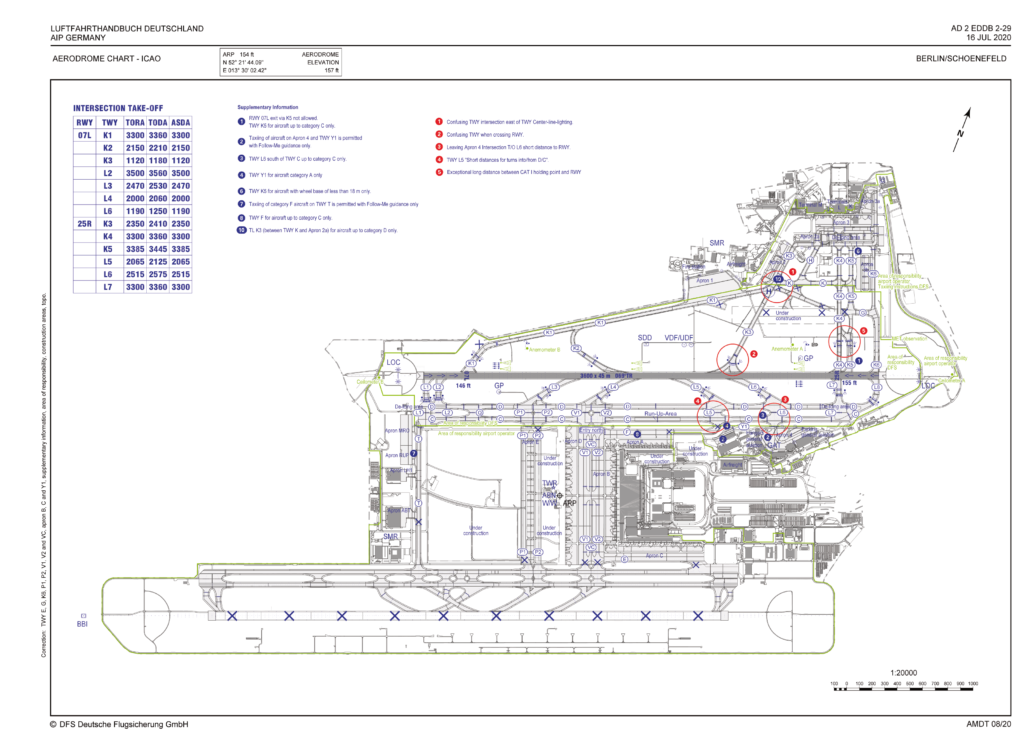
Here’s the chart for Schönefeld Airport (i.e. how it looked before):

Click for hi-res PDF

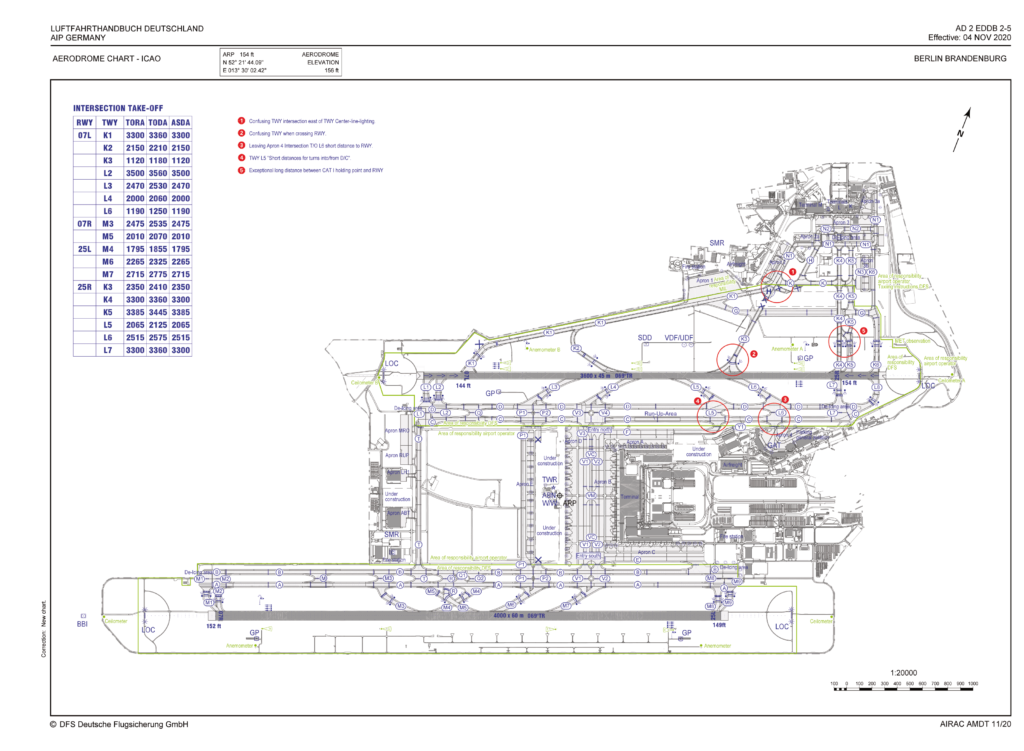
And here’s the chart for Brandenburg Airport (i.e. what it looks like now)

Click for hi-res PDF

You can get your hands on the new airport charts via the European AIS Database. It’s free to register an account, and lists AIP info (including airport charts) for most countries in Europe (plus Kazakhstan and the Philippines too, for some reason).

So, when?

October 31 will see EasyJet and Lufthansa both racing to be the “first” aircraft to operate into the airport. Rather un-excitingly they will land on the “old” runway though.

November 1 will see the first ever departure from Brandenburg International airport, with the Southerly runway expected to open up to traffic from November 4th.

You might have heard about it earlier…

Work on the airport actually started in 2006, and it was supposed to open in 2011, but nearly a decade later (and close to triple the original budget), it has only just been completed.

The airport suffered a range of construction, corruption and calamity riddled development which resulted in the near decade long delay. Everything from lift sizes to fire suppression systems to approach light power outages occurred. 

In 2016 the airport was less than 57% usable…

But jump forward to May 2020 the airport finally received its operational licence, and on October 19th it completed its operational tests. These tests have been running since April (it takes a lot of tests to put a new airport through its paces) and with the rubbish bins made bigger, better signage and more clocks it is now ready to go – for passengers at least.

What about the airplanes?

Well, the important bits for airplanes have actually been up and running for a while now.

The airport will have two parallel runways, spaced 1,900 m (6,200ft) apart allowing for independent flight operations (and high traffic capacity when required).

The old runway, built in the 1960s, has already been renovated – lengthened to a nice 3,600m (12,000ft) and the new runway, commissioned in 2012, is a juicy 4000m (13,000ft).

The airport will be controlled by Deustche Flugsicherung from their impressive 240ft (72m) tower, which has been operational since March 2018.

The general aviation terminal is located to the north of EDDB, and the main FBO for Schönefeld is still there.

What else can we tell you?

  • Noise Abatement regulations mean you can probably expect the standard German airport restrictions of no operations between midnight and 05:00LT.
  • It has an ATIS on 123.78mHz and a Tower frequency 118.8mHz.
  • The elevation is 157ft.
  • It’s official coordinates are 52’22’00’’N 013’30’12’’E.
  • The airport is named after Willy Brandt, who by all accounts was a total ausgezeichneter herr (awesome dude). He was awarded a Nobel Peace Prize for his work both in Deutschland and across Europe. He is also known for the Brandt report which called for the world to do better in supporting development in 3rd world countries, and he is the guy that flew to Iraq and got Saddam Hussein to free loads of hostages. He then flew back with 174 of them to Frankfurt.


Overrun, Forrest, Overrun!

Earlier this week the Accident and Investigation reports came out about two aircraft overruns, on the same runway, that occurred within two hours of each other.

So what was going on in UEEE/Yakutsk back in 2018?

Or rather, what was going off, and why?

A bunch of factors contributed to this double whammy of airplane excursions. First up, the runway at Yakutsk airport had been shortened for works. It was, in fact, 1,150m shorter – which is quite a significant amount.

There were some Notams published about this, (and pretty decent Notams at that)

A5991/20 said –
DAILY 0000-0800: RWY 23L AVBL FOR LDG ONLY. LDA 2248M. TKOF FM RWY 23L CARRIED OUT BY REQ DURING THIS PERIOD. 2. DAILY 0800-2359: RWY 23L AVBL FOR TKOF/LDG. DECLARED DIST: TORA 2248M, TODA 2398M, ASDA 2248M, LDA 2248

And then there was A3621/ 20 which said –
AD TEMPO UNAVAILABLE FOR ACFT OF FLW TYPES: IL-96-300, IL-96-400, IL-86, IL-62, A-310, A-330, TU-154, BOEING777, BOEING747, BOEING-767-400ER, MD-11F AND THEIR MODIFICATIONS.

What about the airplanes, I hear you ask. 

Well, the Sukhoi Superjet 100LR is not included on the list of “can’t land here” airplanes. However, the Notams should have at least given them pause for thought, especially since both of them had technical issues reducing their deceleration performance.

Number 1 “First to Overrun” was found to have significantly worn out tires (which should have been spotted during a walk around), while Number 2 “Also Skidding Through” had a thrust reverser out of action. No big deal, but factors to be considered in the context of the other conditions of the day.

Talking of those conditions – the ATIS was reporting a tailwind of 6kts which is not outside anyone’s limits, and of course 150% of any tailwind is taken into account for landing calculations.

The braking co-efficient, however, was reported as 0.45
Now, ICAO and most national authorities have moved away from reporting measured friction because they decided that, really, it is a pretty useless thing to report. There is not actually any great way to work out how those contaminants on that day will result in whatever friction for whichever aircraft – because there is no way to correlate the measurements a ground measuring device can measure in a meaningful way to what an airplane will actually experience. In other words – it has limited practical use in actually characterizing the runway conditions for an aircraft operation.

To further add to its pointlessness, the 0.45 was not even accurate. The real coefficient measured that day was actually less than 0.3. 

As slippery as an oiled-up eel
Now, these pilots did do a landing performance calculation using what they thought were accurate figures. Even with their selection of only medium auto brake, and the mandatory 15% safety margin added in during in-flight performance calculations, the results looked ok and so they gave it a go.

However, had they known the coefficient was only 0.3 then they would hopefully have come up with landing results similar to those calculated during the subsequent investigation. These showed that a Superjet needs about 1,598m on a dry runway, 1,838m on a wet runway and a whopping 3,650m if the coefficient of friction is 0.3. Their 15% safety margin could not even cover the extra distance because of the poor braking action.

So, with one of the reversers out of action, a tailwind, an incorrectly reported friction co-efficient and only 2,248m available for stopping in, poor old airplane Number 2 never stood a chance of stopping in the space available.

What can we take away from this?

Runway Excursions are still in the top 3 most common bad stuff that happens to airplanes, and considering the vast majority are avoidable with a bit of planning, better procedures or common sense, this is fairly shocking.

So, what can pilots do to prevent overruns?

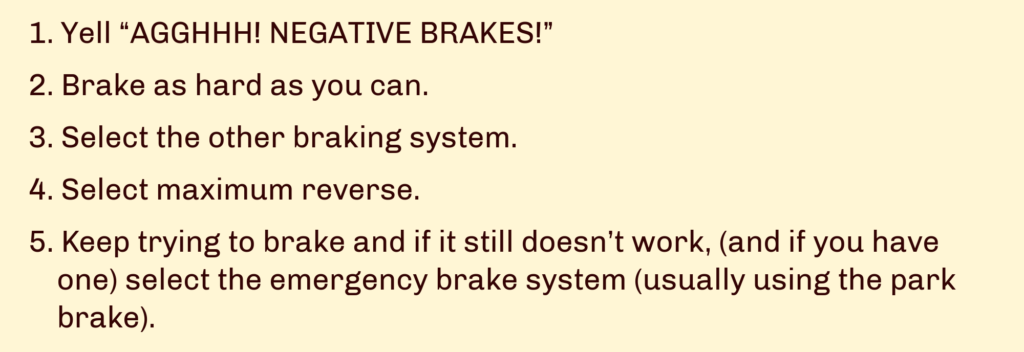
Braking, braking, broken…

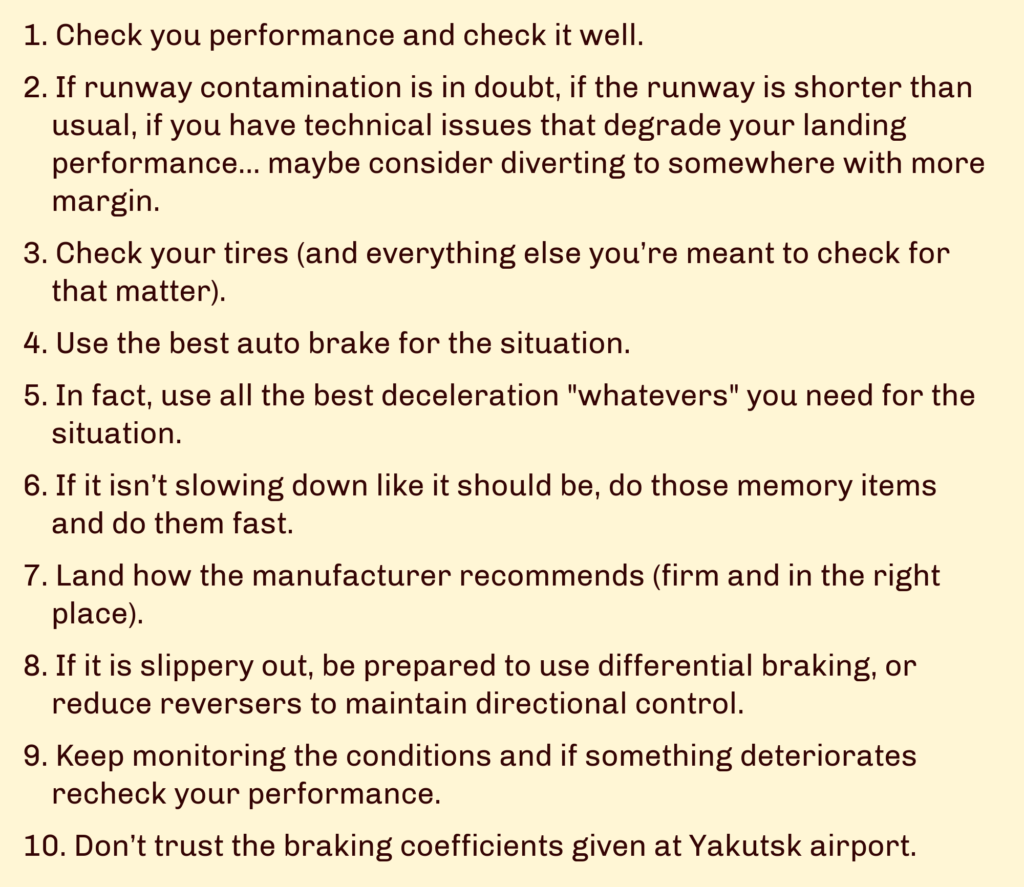
Sometimes brakes do fail, or systems malfunction, and if that happens being ready with your memory items  is the best way to deal with this. They might vary slightly across different types, but the basic actions are probably something along the lines of – 

What are manufacturers doing to help stop overruns?
A lot of airplanes have some clever devices installed in them nowadays. 

Take Airbus for example. They have their ROW/ROP systems. The ROW bit (runway overrun warning) does useful things like monitoring the conditions in real time, and running speedy little calculations based on the known runway length and aircraft weight to make sure the aircraft is still stoppable in the distance available. If it isn’t, it will yell at the pilot.

The ROP bit (the protection that kicks in after landing) does something similar, and can automatically apply full whiplash effect with the brakes if it thinks you need it, as well as reminding you to “Set Max Reverse!”

Other aircraft have similar systems with warnings that trigger if an aircraft is too fast, or if the landing flare is too long, or the remaining amount of runway is too short…

What can authorities do to stop excursions?
Ensuring operators train crew and staff properly, and that information is distributed in the industry is important. 

Airlines and Operators should have in place technical and practical training for their crew to help them have a better awareness of the risks and factors that lead to overruns. Better monitoring of areas like unstabilised approaches which often precede overrun incidents, and contaminated runway and winter operations awareness, is also necessary.

Airports should makes sure Notams about works and changes to runway characteristics are up to date and correct. Giving correct information to pilots about the conditions on the day would also help…

In the US the FAA is advocating the use of  EMAS (engineered materials arresting systems) at airports within insufficient runoff space, and this has apparently prevented the severity of 15 aircraft overruns in the years they’ve been installed.


Further Reading

  • Opsgroup article: 5 Tips for Safter Winter Ops
  • Airbus “Safety First” magazine: new issues published every 6 months, a wealth of info about all things safety-related.
  • Useless fact: If you wanted to ski down a concrete slope using rubber skis, the coefficient of friction for rubber on concrete is 0.9 which means you would need a 42 degree slope to actually get moving.


The Hills Have Ice: Considerations for Himalayan ops

Flying over the Himalayas soon? Read on! From patchy comms to limited alternates to meters that might get your feet in a twist, this briefing will have you covered…

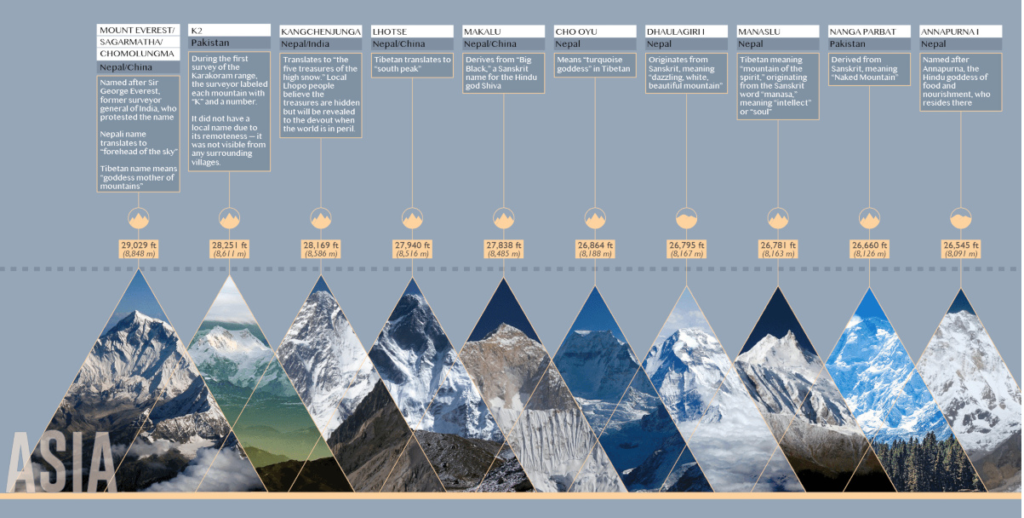
A good place to start might be “Where are the Himalayas?”

The Himalayas border a bunch of countries, but the bits we are generally interested in lie in Pakistan and China – along the primary flight routes between the Middle East and Asia.

Interesting fact – they are the fastest moving mountains in the world, thundering along at a right old pace of 67mm a year (so don’t worry, they will still be in pretty much in the same spot when you route over them).

Are they a big deal?

They are the biggest mountains in the world so “big” – yes. “Big deal”? – well, not so much if you are cruising happily at altitude, but if for some reason you suddenly need to descend then they can become a very big deal very quickly.

With 30 peaks higher than 24,000’, and stretching over 200 miles, they are a pretty significant obstacle.

There are some good-to-know and some need-to-know points about these parts, so read on…
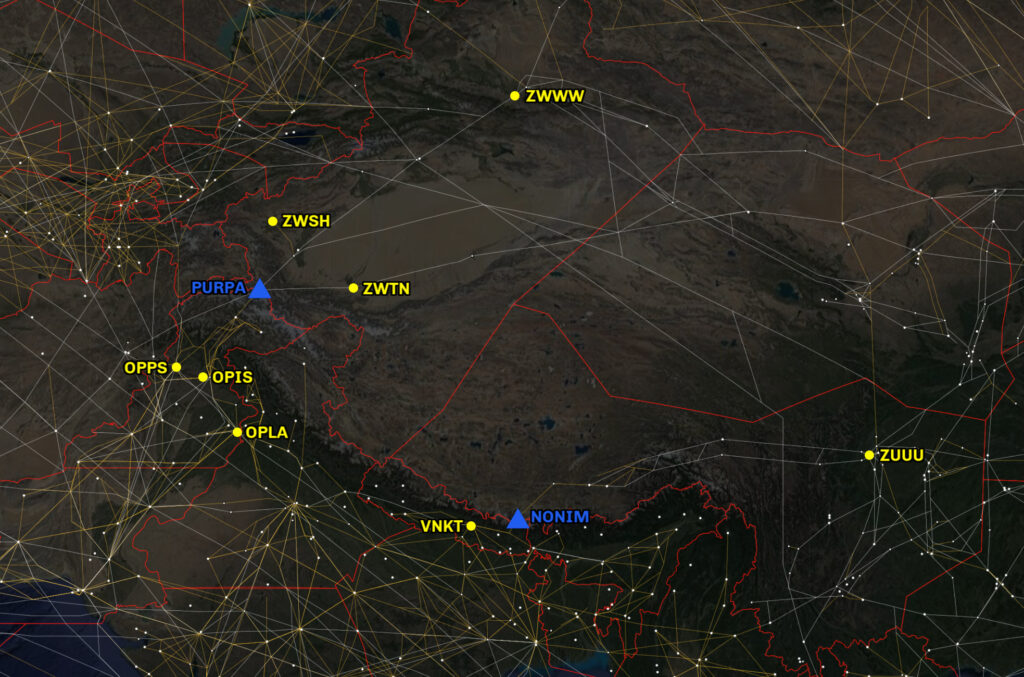
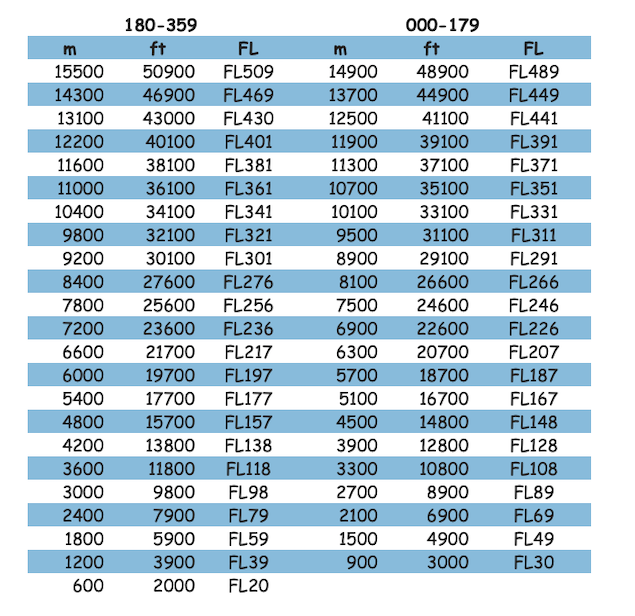
The Basics

Limited Alternates – Not many people live in the Himalayas, (not counting Yetis), so airports are few and far between, and are often fairly remote.

The Region – Pakistan has ongoing conflicts with India over the Kashmir region. Afghanistan is also unstable so operating near the border is not advised, particularly into OPPS/Peshawar and OPQT/Quetta airports.

Weather conditions – ‘Himalaya’ translates as ‘abode of snow’ so that should be something of an indication. The airports are remote and facilities are not always up to standard. Significant mountain waves can be experienced when crossing.

Communications – Big mountains block radio signals and this can be particularly bad around the point where you transfer from Pakistani airspace into Chinese. Which leads us onto the next point…

China – They have their own procedures including different sized airways, different contingency procedures, and of course…

Metres and Feet – China operate in metric. Keep reading for a handy feet to meter conversion table!

Oxygen – Airplanes have oxygen in them, unless they suddenly don’t anymore and then you are going to have to find some pretty rapidly. Unfortunately, oxygen is generally at its most plentiful lower down which can be problematic if routing over high terrain…

The Alternates

There are two published crossing points for the Himalayas – PURPA on the Pakistan/China border to the north, and NONIM on the Nepal/China border to the south. So the alternates you’re going to be interested in very much depends on which route you’re going to take.

ICAO/ IATA

Airport

Open

RWY (m)

ELEV

PCN

OPIS/ISB

Islamabad

H24

3658

1761

110FCXT

OPPS/PEW

Peshawar

H24

2743

1211

068FCXU

OPLA/LHE

Lahore

H24

3360

712

085RBXU

ZWSH/KHG

Kashi

H24

3200

4528

074RAWT

ZWTN/HTN

Hotan

HS

3200

4672

052RBXT

ZWWW/URC

Urumqi

H24

3600

2126

080FBWT

VNKT/KTM

Kathmandu

0045-1845Z

3050

4390

054FAWT

OPIS/Islamabad, Pakistan – There are two parallel runways with RNP and ILS approaches, including a CAT II on 28L. 10R has an offset final track (VOR approach). This is a destination for some major airlines and so likely has good handling and ground services, an is an RFF Category 10.Where you decide to divert to will depend on what your problem is and whether you can stay up over the mountains. Peshawar, Islamabad and Lahore are each accessible from each other and all lie south of the mountainous zone.

OPPS/Peshewar, Pakistan – This airport is situated near a No Fly Zone and is close to the Afghan border. It has CAT I capability, but report of GS fluctuations are common. Ground handling is available, but engineering and other support is likely to be limited.

OPLA/Lahore, Pakistan This is another major airport in the area with multiple runways, and Cat IIIb approaches onto 36R. Terrain is relatively low, but the airport lies close to the border with Indian airspace.

ZWSH/Kashi, China The airport is CAT I. There is serious terrain to the north and west of the airport. Particularly if you are landing onto runway 08, wind off the terrain might be a factor. Runway 08 may require a 180 degree turn at the end with a backtrack due to works. Support here will be fairly limited.

ZWTN/Hotan, China There is no customs at Hotan so offloading passengers might pose a problem. The closest alternate is not really very close, and the weather here can be a challenge. The MSA is 16,000’ and terrain lies predominantly to the south of the airport, but close to the ILS intercept for runway 29. Runway 11 only has a VOR/DME approach. Both runways require a 180 degree turn and backtrack to vacate. Engineering support is available here.

ZWWW/Urumqi, China Urumqi is a better equipped airport, with CAT I and II approaches available, and likely to have better ground support and engineering services. However, there is significant terrain in the vicinity of the airport, and it’s also a long way to have to go in an emergency (around 700nm from Pakistan/China crossing point PURPA).

VNKT/Kathmandu, Nepal – Down south, Kathmandu is really the last decent diversion airport before the endless mountains of the southern Himalayas come into view. If you don’t stop here, it’s a good 3 hours of flying time before you reach ZUUU/Chengdu on the other side. VNKT is not 24 hours (has quite specific hours), no engineering facilities but fairly good ground support as it is quite a “major” tourism spot so a fair few airlines route in there. Does not have precision approach (only VOR and RNP), and they have a lot of diversions due to weather and higher minimus due no precision approaches. Very difficult approach because you route between mountains into a sort of bowl to land.

Communications

The mountains can cause serious interference with radio comms so keep the following SATCOM codes handy in case you need them:

Urumqi 441208
Lanshou 441205
Kunming 441204
Beijing 441201
Lahore 446302

China

China has some pretty specific procedures and requirements which should probably be looked over before you route this way, but here’s a quick summary.

Contingency/ Emergency Procedures if deviation from level required:
– Aircraft must turn RIGHT and track out to 10km/ 5nm from the airway centerline.
– Once parallel with the original route climb or descend as required.
– Switch your lights on, keep talking on 121.5, and keep a good eye out.

Any deviation or reroute requests in China usually needs some serious coordination, and they are strict about any routes that take you off commercial airways or close to military airspace. ATC often send airplanes in random directions, or refuse to clear them to the flight levels they have filed for, without much explanation so be prepared for a lot of extra fuel burn.

Meter to Feet Conversion:

Oxygen

The most critical route is PS-G325-Purpa-B215 where the MTCA is the highest. Confirming your aircraft is equipped with suitable passenger oxygen systems and awareness of the depressurisation strategies and MSAs for each route is extremely important before operating into this area.

Permits

Pakistan requires overflight and landing permits. These must be requested by an agent. They require one day notice to arrange the permit. Operating into Pakistan airspace required an ADC at least 15 mins prior to entering Pakistan Airspace/ADIZ, and flights operating in need to establish communication at least 15 mins prior to entering.

China also require permits. These can be intimidating. They require use of AFTN/SITA, have specific routing, and are only valid for the exact timing given. Commercial landings require a sponsor later written in Mandarin by the receiving party. We recommend applying direct to a Chinese agent, as the authorities aren’t very patient and it can become frustrating at how short they’ll be on the phone. If you want to apply direct, you’ll send your application through AFTN and SITA, in the specific format required. 

China requires aircraft to be ADS-C, CPDLC and SATCOM capable on some of their routes over the Himalayas, and operators need to verify their equipment with them at least 60 days in advance! So they recommend that only regular scheduled flights apply to use these airways. For more on that, check out our dedicated article here


For some great insights into escape route planning, check out this doc from Flightsafety.org

And finally, don’t forget to take your camera because when the air is clear the views can be amazing!