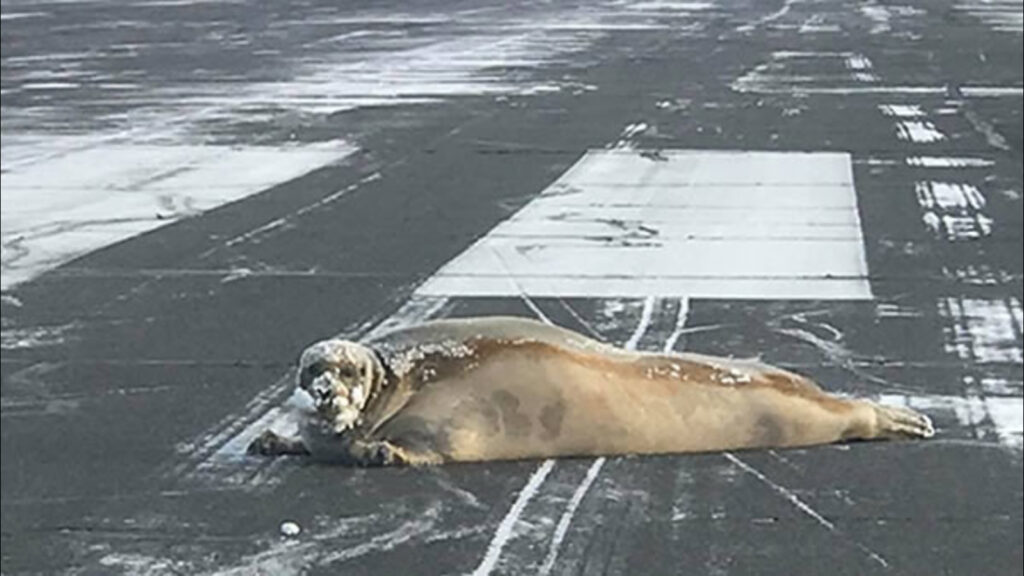
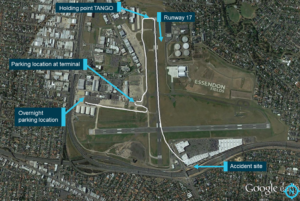
FAA Warns on Runway Length Data and Overrun Risk

On Jan 21, the FAA issued a new Information Note for Operators after identifying cases where incorrect runway length data was being used for performance planning.

The concern is straightforward. Using the wrong numbers can skew takeoff or landing calculations, which is why the FAA says performance planning should be based on declared distances from the Chart Supplement.

What exactly is the issue?

The FAA notes that many crews default to runway lengths taken from airport diagrams, charts, FMS databases or commercial planning tools.

The issue is that these sources may not include declared distances (TORA, TODA, ASDA and LDA) which are the figures used to meet regulatory performance requirements and can differ significantly from the physical runway length.

The FAA’s concern is that crews may misunderstand declared distances, omit them entirely, or rely on FMS or third-party data that has not been updated after changes.

So a quick clarification on how runway lengths are defined helps…

About runways

When we talk about default runway length, we are talking about the physical length of the runway surface. It’s what you see on charts, airport diagrams and other sources of info.

It represents exactly that – pavement from end to end. It may include unusable bits (such as displaced thresholds, closed portions etc) and is often a single number with no context.

It doesn’t tell you how much runway is legally available for takeoff or landing and can significantly overstate what you can actually use (more on that later).

Declared distances, on the other hand, are the official, performance-relevant runway lengths published by the airport authority via the FAA Chart Supplement and other validated sources.

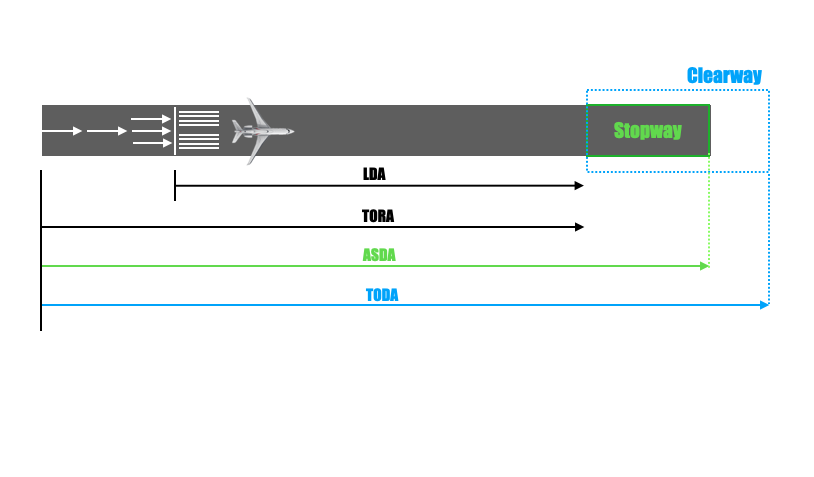
A brief reminder of what these distances include (and critically, don’t):

Takeoff Run Available (TORA). Think of this as how much runway you can accelerate on. It includes useable pavement only, starting at the take-off threshold. It doesn’t include clearways or stopways.

Takeoff Distance Available (TODA). How much distance you have to get airborne (i.e. TORA) plus the distance required to clear obstacles in the initial climb segment (clearways). Crucially, it doesn’t include stopways (usable in a rejected takeoff).

Accelerate-Stop Distance Available (ASDA). Think of this of how much distance you have if you reject the takeoff. It includes TORA and stopways. It doesn’t include clearways.

Landing Distance Available (LDA). How much runway you actually have to stop after touchdown. This includes usable pavement from the landing threshold to the end of the runway. It doesn’t include pavement before a displaced threshold, stopways or clearways.

Here’s what this all looks like:

Under the FAA regs, these distances are the authoritative performance numbers. They override any single runway length shown elsewhere. That’s the key point.

Real world example

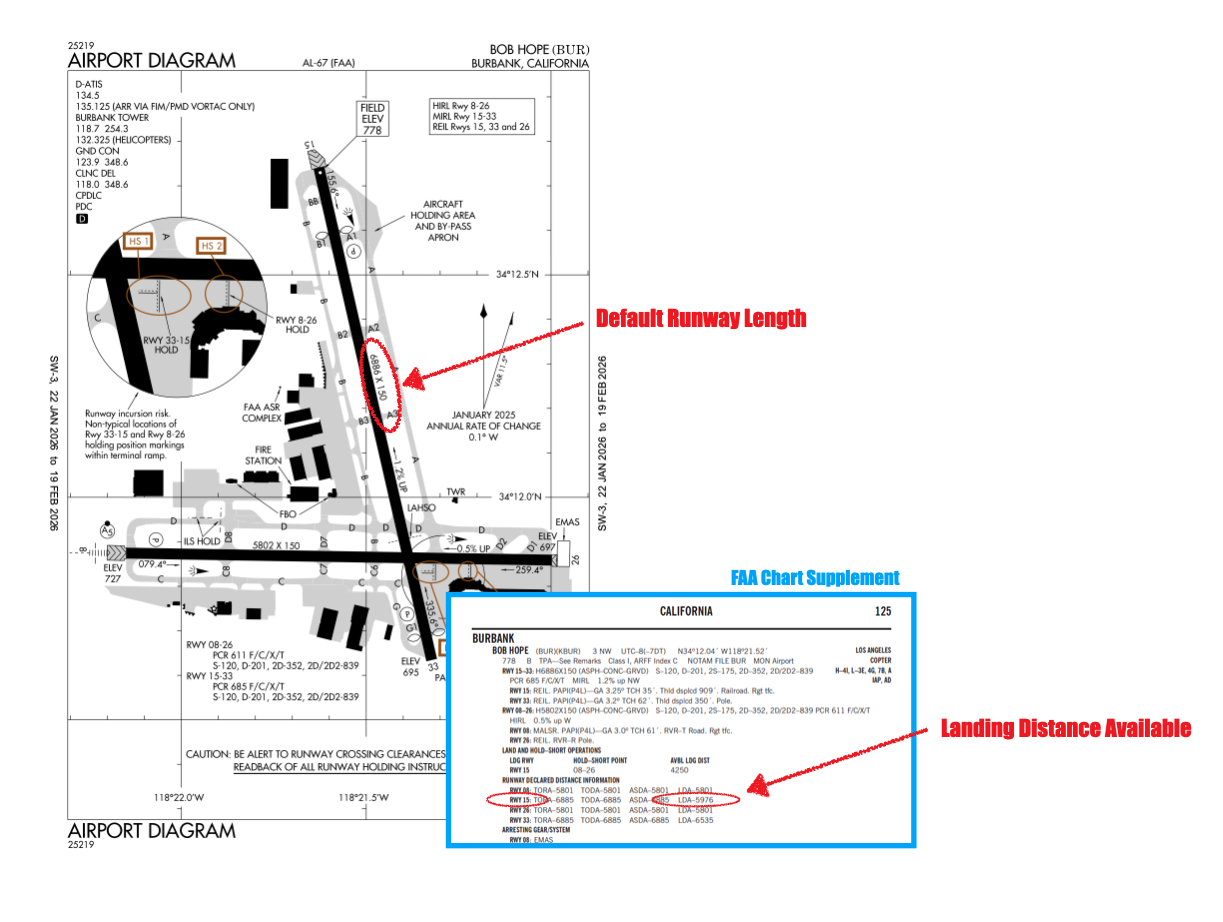
But that’s enough theory. A good real-world example is KBUR/Burbank Runway 15, where the published runway length and the declared landing distance are not the same.

Many charts and planning tools show a runway length of 6,886 ft. But the FAA Chart Supplement lists an LDA of 5,976 ft due to a displaced threshold for obstacle clearance.

If crews plan landing performance using the longer figure, they may be overestimating available runway by about 900 ft. Add tailwind, a wet surface, or a performance-limiting MEL, and that margin can disappear quickly.

That’s exactly the scenario the FAA is trying to prevent.

So what’s the FAA’s advice?

For performance calcs, the FAA says crews should use published declared distances, not the physical runway length. Just because pavement exists doesn’t mean it’s legally usable.

That expectation needs to be reflected in procedures, training and day-to-day practice.

Crews also need to be clear on which runway lengths their performance tools are actually using.

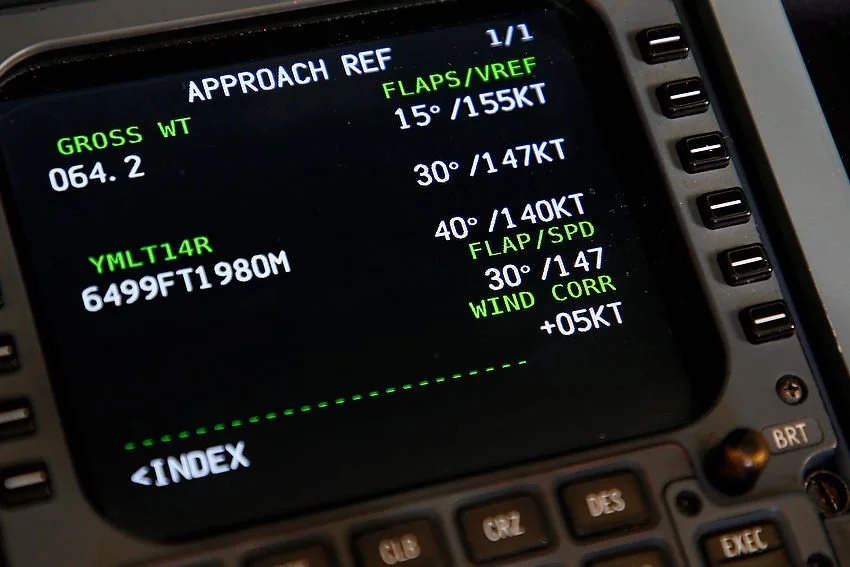
Be aware that the FMS runway length is not LDA, ASDA or TODA.

Operators should also review FMS databases and third-party performance tools, understand their limitations, and check that the data is current.

Have you spotted something risky out there?

Share it (anonymously) with the group! You can reach us via blog@ops.group, Airport Spy or Report-A-Thing.


The Safety Watchlist 2022

The Transportation Safety Board of Canada released its Watchlist for 2022, highlighting what they think the bigs and the bads to look at in the industry are. We figured it would be a lot of specifically Canadian things like grizzly bears on runways, and whether a hockey stick counts as a dangerous weapon when brought on board.

Turns out that it’s all things which are globally big and bad. What’s more, now the Covid stuff has (mostly) gone away (you might remember the whole pulling airplanes out of storage and finding bugs nesting in them fear), these are big, bad things which we’ve been talking about in the industry for quite some time.

So, because it’s November 2022, which is basically December, which means the year is pretty much over, we figured we’d tell you all about it.

The Highlights

Seems an odd choice of word, theirs not ours.

So, the first one on the list was something about commercial fishing safety. We aren’t sure if we have any commercial fisherfolk at Opsgroup, apologies if we do, but we don’t think so, so figured we would not pause too long on this one.

Same for railway signal indications. Not so relevant to aviation. We will say that following signals as a pilot is important though. If you don’t know your interception signals, you can swot up on them here.

Onto the Aviation highlights

There are 5. We reckon they are going to be quite familiar:

  • Runway Excursions
  • Runway Incursions
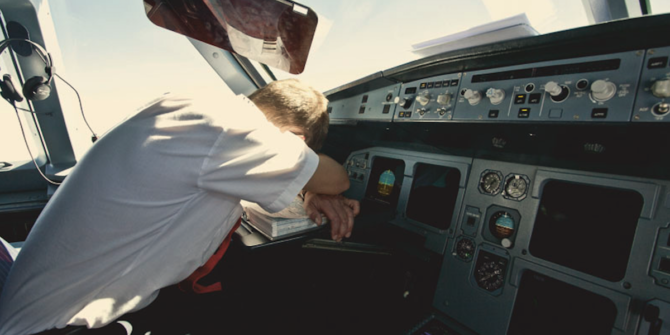
  • Fatigue
  • Safety Management Systems
  • Regulatory oversight

We’re going to ignore the last two, just because we don’t know much about them.

Runway Excursions

The biggest one. The baddest one. Aircraft going off the end of the runway. It happens way too often, and the outcome is often severe.

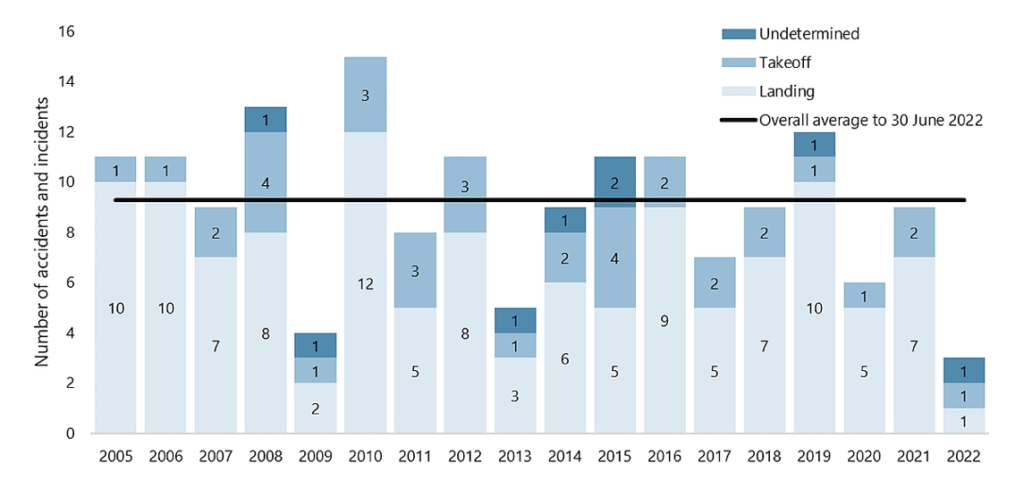
In Canada, between January 2005 and June 2022 there were on average 9.3 runway overrun occurrences per year, most of these during the landing phase.

Here’s the TSB’s graph:

Now, they do in all fairness get some ‘overrun encouraging’ weather in the deep and distant north because it gets so cold and icy up there.

But then again this isn’t limited to Canada.

You find places all over which have strong winds (tailwinds, ballon inducing gusts…), heavy rain (slippery runways), stuff that reduces visibility on short finals (increases chances of getting unstabilised), hot and high spots (increases the ROD required), unusual terrain (increases the chances of becoming unstabilised), short runways (possible performance mishaps), or just places which are totally easy-peasy so you think it will definitely all be fine and get complacent…

Runway excursions are a global problem that don’t seem to be going away. We might have mentioned this before.

So what can we do about it?

  • Know what GRF is and use it. If you haven’t heard of the (new) Global Reporting Format that came in 2021 then you can read about it here
  • Use arresting systems. OK, pilots can’t really do much about whether this is available at an airport, but knowing what it is and where it is, is important because some pilots have actively swerved to avoid it. If you’re heading off a runway then that sucks but if it has EMAS then USE IT, it might save your life.
  • Fly a stabilised approach. Or ask the question why you or your crew aren’t going around.
  • Do performance calculations… properly. Not much else to say on that.
  • Be go-around minded. Air France learned a thing or two about this in 2005 heading into CYYZ/Toronto when the weather deteriorated and they didn’t go-around. It led to a runway excursion. Read about it here if you’re not familiar with this one.
  • Read this. It’s the full TSB rundown on runway overruns.

Runway Incursions

If the risk of heading off the end isn’t enough, then there is also a big risk of heading onto the runway when we shouldn’t be.

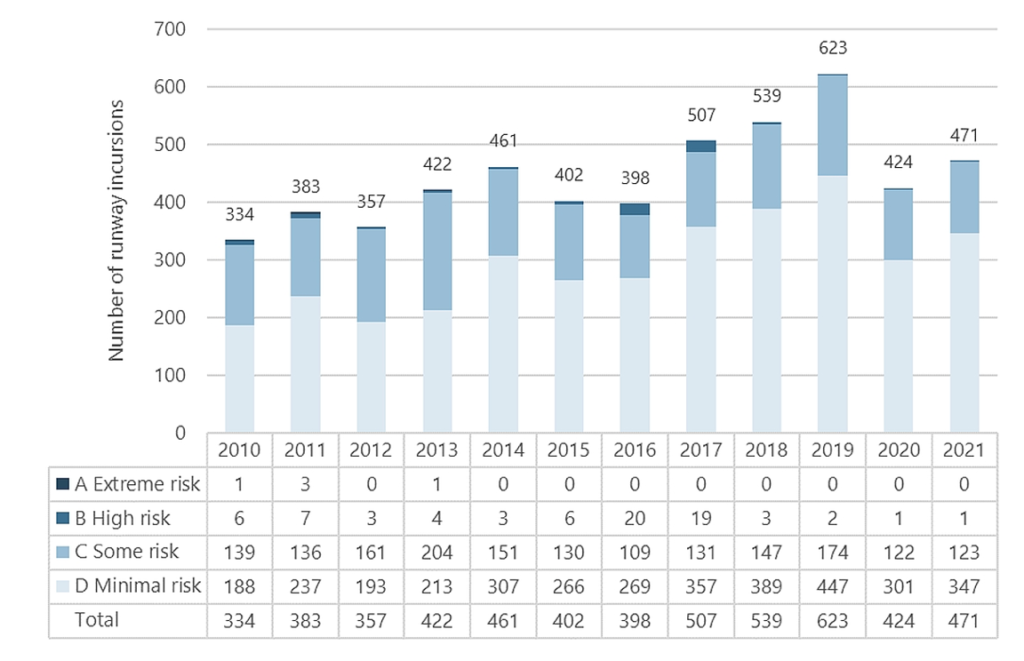
The rate has doubled in 12 years. Thankfully it hasn’t resulted in a collision, but still… not ideal.

Here’s another graph. because we like their graphs:

There are some big numbers on there.

What can we do about it?

  • Know your hotspot symbols. The US have recently changed up their hotspot symbols to help with situational awareness on the taxi.
  • Brief. Talk about the taxi, especially in poor visibility.
  • Stop! If you ain’t sure, stop taxiing. Rolling about willy-nilly never ends well.
  • Think about de-icing/anti-icing. There have been changes to HOTs in the FAA winter manual. Taking off with ice on your wings is going to make the takeoff roll hair-raising. Don’t risk it, de-ice!
  • Read this. The TSB’s stuff on incursions, in full.

Fatigue

Yep. Where to start. This is a big conversation which needs to be had more in the industry. Aside from FTLs and roster patterns (a can we won’t open now), we do think there are some things which aren’t getting mentioned enough which can lead to fatigue:

  • Staffing issues
    “Wait,” I hear you say. “What’s that got to do with fatigue?”
    Well, staffing issues in airports lead to delays, which lead to longer hours for crew, which can lead to tiredness and fatigue.
  • The Russia Ukraine conflict
    Longer routings mean more time in the air which can lead to, you guessed it, more tiredness and fatigue.
  • Strikes
    Strikes = delays and disruption = … same old story.

Now, just identifying random things which might be increasing fatigue levels isn’t really going to fix it. Having some real, human conversations about it might.

  • If you’re a pilot, don’t just think about now, think about 10 hours later.
  • Get some decent controlled rest policies into your operation.
  • Consider ways to improve sleep management, especially if you’re doing hideous time zone crossing flights.
  • Stop using tees like “sleep science” and harping on about circadian rhythm. Start talking about how to recognise fatigue, what that means for your performance, and what to do about it.

The Full Monty

So, that is the (Canadian) Safety Watchlist 2022 and if you want to, you can read the full thing here, (including the bits on fishing).


Is breaking the rules always bad?

“So, Rebecca, tell us about a time when you didn’t follow an SOP?”

I don’t know about everyone else, but this question always seemed to pop up in interviews for me. Maybe I come across as ‘rigidly adherent’ to rules, or perhaps I tick too many of the “like finding alternative solutions” answer on the personality questionnaire and they think I will constantly be bending the SOPs into elaborate balloon animal shapes for the fun of it…

Here’s the question: 

When can we ‘go outside’ the SOPs? How do we justify it? How do we actually do it?

It turned into three questions, sorry.

First up, what is the point of an ‘SOP’?

To prevent wild cowboy pilots from jaunting about willy nilly? Yes, probably that. But at the root of it, I think a fair definition could be “to help with safety”.

By the very vague ‘help with safety’ term, I mean all the stuff – providing guidance to help us stick to rules and regulations, helping us deal with situations, ensuring we all know what to do and how to do it, and what to expect. They create a sort of script, a choreographed dance to lead us.

Basically, making sure we’re all playing by the same rules.

Standard operating procedures are put out there not just to be a “that’s how we do it” rule book, but more a “that’s how we can do it, because it should help with safety” guidance book.

So compliance equals safety?

Now, a quick interlude on the word ‘compliance’ because I don’t like it much. If you search the definition of someone who is compliant it says they are “disposed to agree with others or obey rules, especially to an excessive degree”.

OK, the rules bit is fine, but the excessive degree? Following rules for rules sake, excessively? Nope.

But… 

But compliance is necessary in aviation, and much of my dislike really comes from the fact I think it is generally misunderstood, misused and misapplied. 

Someone wise said that ‘compliance is the foundation and structure which helps build safety’ (I may have not quoted that completely right), but it sounds good to me. 

So being compliant doesn’t automatically equal being safe. Rigid adherence for the sake of saying you adhered does not automatically lead to safety. The two can absolutely go hand in hand, but just ticking boxes and saying “I ticked them all, so I’m compliant, so I’m safe” doesn’t actually work, at least not all the time.

Sometimes it might, but it’s not a guarantee.

The same goes for SOPs. Sort of…

An SOP generally isn’t (shouldn’t be) created for the sake of creating an SOP. Then you just end up in a hideous loop of ‘the SOP says I must follow the SOP that says I must follow the SOP that says…’ you get the picture.

This is pointless.

Any procedure should be put in place because it does ‘something safetyish’, and so following it will help you be ‘safetyish’. 

Which brings me, finally, to the two occasions where I think it is ok to let something non-standard occur.

First up: The ‘letting it slide’ situation.

If I say “checked” instead of “check” on a checklist then I might not be compliant with the checklist terminology, my ‘knowing the correct response on the checklist SOP’ might be subpar, but has that really impacted safety? No, it hasn’t, because the same outcome has been achieved. 

You pulling me up on it might impact safety though because it will make me angry at you!

So ‘non-standard’ stuff, for me, has to have some common sense applied to it. If it hasn’t impacted safety, then the balance between rubbish CRM versus helping correct a bad habit (that could become more of a thing) has to be considered.

That’s letting something slide.

Secondly: The ‘blind obedience’ situation.

Fastidiously following for following’s sake.

There could be times when an SOP might actually decrease safety, and that’s probably when you might want to bend it, break it, or work outside of it. I guess this is what all those interviewers are hoping to get at by asking this question?

Ultimately, safety is the aim of SOPs, and if they don’t achieve it – do what will.

And this can be tough to do, because often we fall into the trap of thinking SOPs are everything, and we become reliant on them to keep everything OK, rather than using them alongside our professional judgement and experience.

What about less black and white situations?

You’re stuck in a box that says ‘no permission, no can do’ and the operation is grinding to a halt? This is when to really think about the “instructions” that go with that box, so to speak. The actual intent or purpose of the procedure, and what you can do to maintain that. Because not being able to tick ‘exactly compliant with procedure’ is less important that ticking the ‘compliant with safety awareness and standards’.

The procedure might turn out different, but the outcome will still be achieved.

If you’re not getting my point on intent, refer back to the earlier paragraph where I used the splendid word ‘safetyish’ – it’s not in the dictionary, but you understood it, and it got the point across (hopefully).

Be Effective!

The final question then, if we’re going with the “same purpose, so all good!” principle is the “Effectiveness Test”. Quick definition – doing something effectively means doing it the best way.

Which is what SOPs are sort of there for. Getting us to the most efficient (safest) outcome, the most effective way.

So I can’t just ignore a load of SOPs and say “but the outcome was the same, what’s the problem!” And if that’s the case, then how much should we be considering the effectiveness (rightness) of our process alongside the outcome?

To try to comply with the Effectiveness Test, we can fall down a rabbit hole of ticking every box, crossing every ‘T’, dotting every ‘I’ so to speak – basically, worrying about the effectiveness versus the outcome too much. Which is exactly what this whole post started out talking about.

But I can’t swing the other way and barrel roll an airplane down an approach disregarding every stabilisation criteria but touchdown on speed not the blocks and say “hey, the outcome was fine.”

So where do we draw this line? Is it even a line?

It comes down to airmanship. This might feel like it’s not really an answer at all, but I think it will be different for each of us at the time, on the day, when we’re faced with something that has us asking it.

And this leads to a last question, that came up as I thought through all of this – “Is there a chance that too stringent SOPs actually stop us from thinking and judging, because we expect there to be an answer to every situation?” Because SOPs help keep everything predictable, but often the situations are anything but.

My motto is this.

Let’s aim for safety, and use the SOPs because they provide us with the most effective way of achieving that. Until they don’t. And that’s when we will do what we need to to maintain safety. But we’ll try and do it with the SOPs, rules, regulations in mind as best we can.


Go-Arounds Aren’t Normal

Go-arounds are often described as routine. And the guiding principle is that we should be ready to execute them safely, accurately, and immediately on every approach, and without hesitation.

It sounds good on paper, but this expectation is among a myriad of niceties we tell ourselves that all competent pilots have covered. And I’m not sure I agree.

For starters go-arounds aren’t routine. They’re just not.

We know this to be true. On average, a long-haul pilot will do one every five to ten years.

Secondly there are the reasons behind them. Weather related go-arounds tend not to be the ones we’re struggling with. Why? Here’s one suggestion –  because when conditions are marginal, we are ready for it – we’ve briefed it, we believe it may happen. Our brains are primed for action.

But what about when we’re not expecting it – when we’re not primed? When the weather is good, the airplane is on rails and sign-off is within arm’s reach. Are we as prepared then?  

Incident histories are littered with go-arounds gone awry, and they often have a major trend in common – the crew weren’t ready for them. Because the reason for the go-around was unexpected, it wasn’t routine.

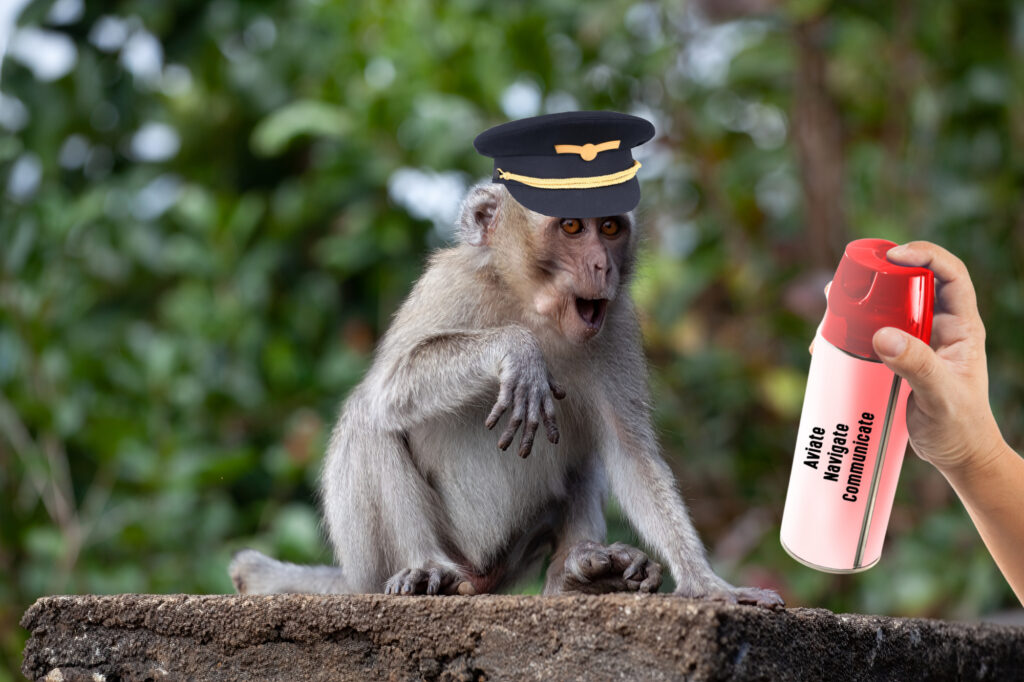
And when we encounter a non-routine event, we become fallible to limitations that all pilots possess in times of surprise or emergencies. Enter our ‘inner ape.’ It’s hard to tame, so when we have an emergency we fall back on one particular mantra. Ape repellent, if you will – ‘aviate, navigate, communicate.’ The idea is to break down an overwhelming situation into manageable chunks.

So why then are we failing to apply the same idea to unexpected go arounds?

A healthy dose of ‘deer in headlights’ might be the answer. It’s no secret that when we are surprised, our brains stop for moment. It is hard wired into us from the days when we were running away from woolly mammoths.

Our instinct is to act now, and think later. And those big ol’ TOGA switches are a huge trigger. Once we push them, it’s on. We are bombarded with rapid fire mode changes, oodles of thrust, noise, configuration changes, high nose attitudes, and typically we’re going up faster than a fart in a bath.

Our brains can switch into overload mode – there is too much information coming at us and too fast to stay ahead of the airplane, or even with it.

Here’s a couple of scenarios to mull over – how would you manage your airplane?

  • You’re instructed to go-around above the published missed approach altitude.
  • ATC instructs you ‘caution traffic 1 o’clock 2 miles. Cancel published missed, maintain 1500′, turn left heading 180 degrees, expect visual circuit.’
  • The pilot flying is about to bust through your missed approach altitude, but isn’t responding to you or ATC.

Had we not briefed the missed approach as routine, along with the runway lighting, expected taxiway turn-off and our parking bay, we might be more prepared. But the evidence is suggesting that we’re not.

Our approach to go-around training, along with other abnormals, needs to focus on the unexpected, the non-routine. The industry has already discovered that we learn less when we know what is coming in the sim, and that the real world is rarely as forgiving.

Danger Club returns!

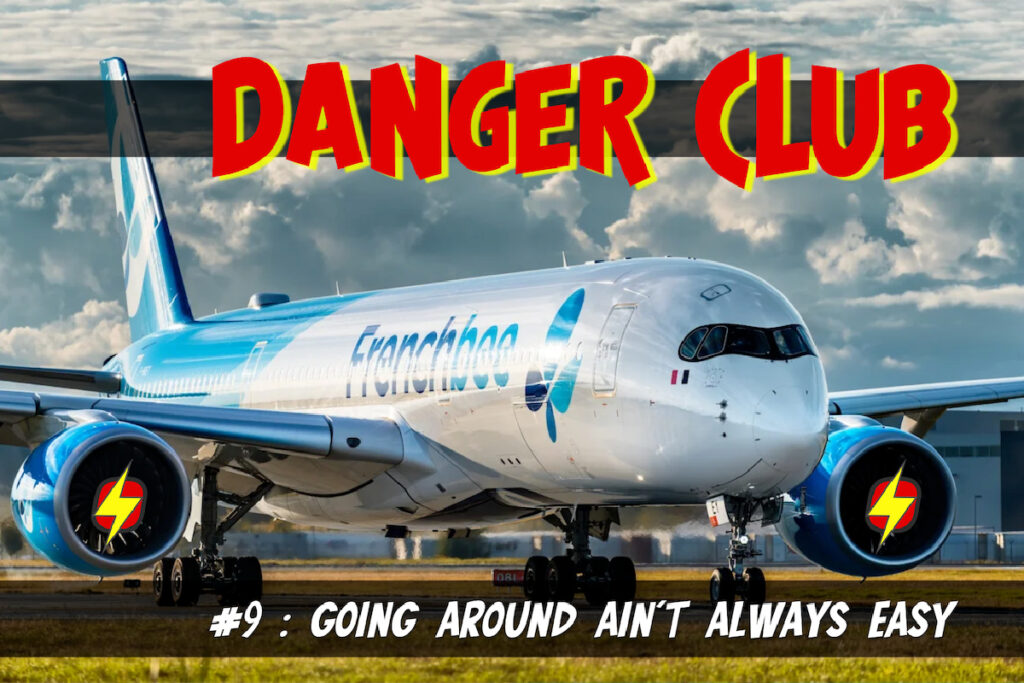
We’re starting the conversation at sunset. Almost dark. A French Bee A350 is landing in Paris Orly, after an 11 hour flight from SFO. Almost home. But 3 miles out, the machine says “WINDSHEAR“, and the flight goes from routine to 🤡 go-around circus 🤡 in about 10 seconds.

The F/O checks out. Startled and frozen. The captain is now single pilot, but doesn’t know it. The airplane doesn’t know it either, so keeps flying- busting the altitude, heading for departing traffic. But nobody’s flying it.

Here’s your challenge: park any judgement on the crew at the door. Step inside DANGER CLUB, and ask, with your curious-raccoon-mind: “How could this happen to me?”

This is where we might start, but we don’t know where we’re going with this one …

> Go-Arounds ain’t always easy (even if they tell us they should be)
> How bad can startle be?
> How do we get ourselves back in the game?
> Was this all the Captains doing? (Even if the report focuses on the FO)
> Do we HAVE to go-around right away?

That’s where we start … this Thursday, July 14, at 1730Z.
Will you join us, curious raccoon?

> The (very readable) accident report is here.
> Also, there is an excellent – as always – video from Mentour Pilot  about the whole incident. Highly recommend!


Safety used to be SEXY

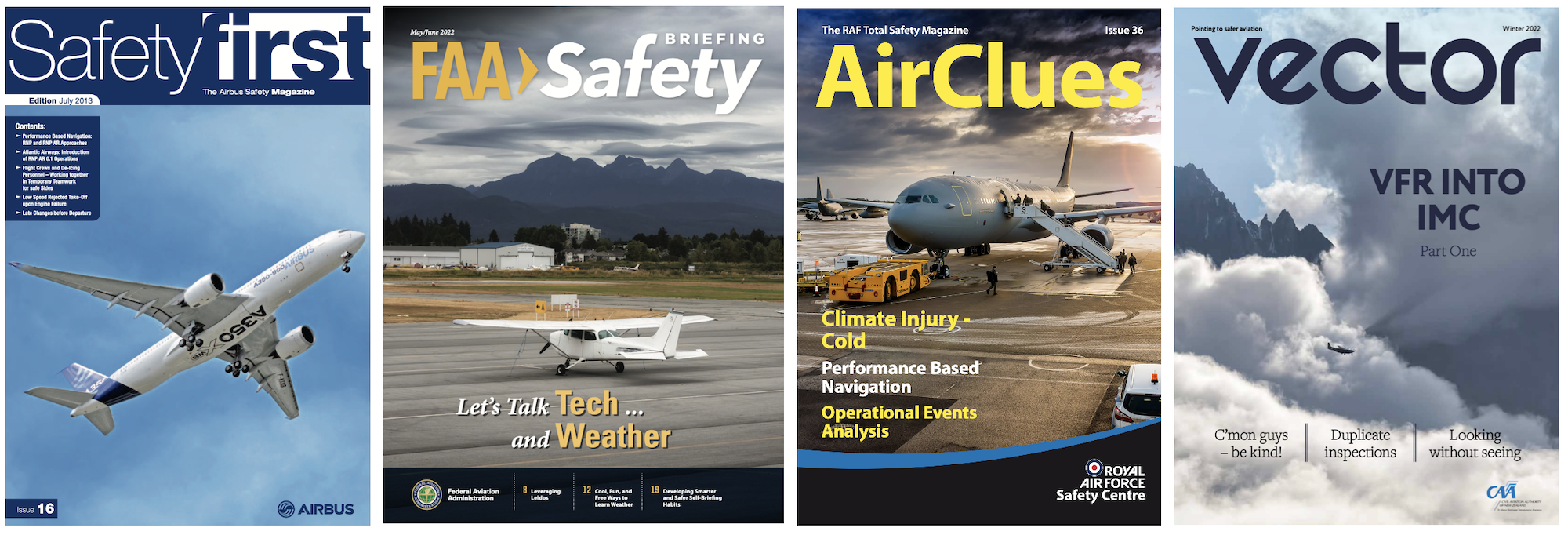
You know those Safety magazines I’m talking about, right?

The ones that sit in the corner of the crew room.

The ones that literally nobody reads, but might be useful to scribble on, kill a fly, or jam a window open.

These ones.

They all look the same, right?

What you probably don’t know, is they are all the same because they are all put together in the same place.

This place.


This is Aviation Safety Publishing Ltd. They are in the south-east corner of the Croydon Business Park (between Wendy’s and Push Pilates). Their Company Number is 2713662 and their VAT No. is GB444553891.

Each month, the creative team gets together in the “Lindbergh” conference room. There’s free (drip) coffee and donuts (the dry supermarket ones). It’s a good time.

Shall we do something different this month?”, asks the intern. After a moment of silence and some side-eye, everyone has a good laugh and gets back to selecting the airplane type for the front covers. The meeting is wrapped up by eleven. Back to the desks.

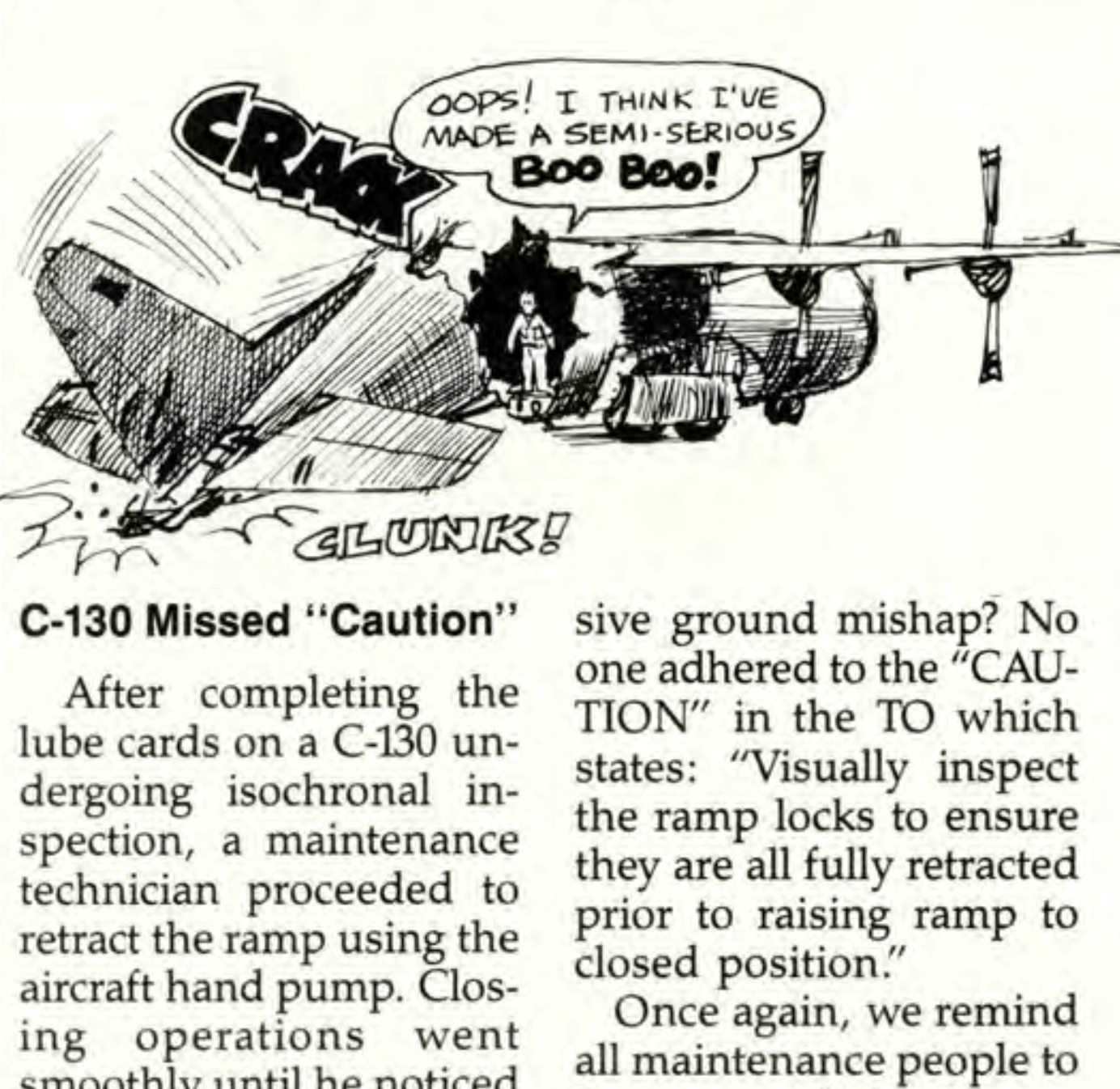
It’s been the same since 1990. That’s when computers came along and ruined everything. Before that, pilots actually read safety magazines. Instead of “What airplane goes on the cover”, the editors asked a different question: “How can we make this engaging and actually get pilots to read this stuff“?

That’s weird, huh: in the old days, the safety people cared whether or not pilots read it!

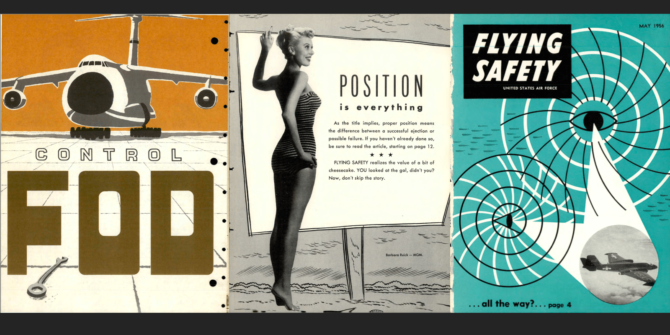
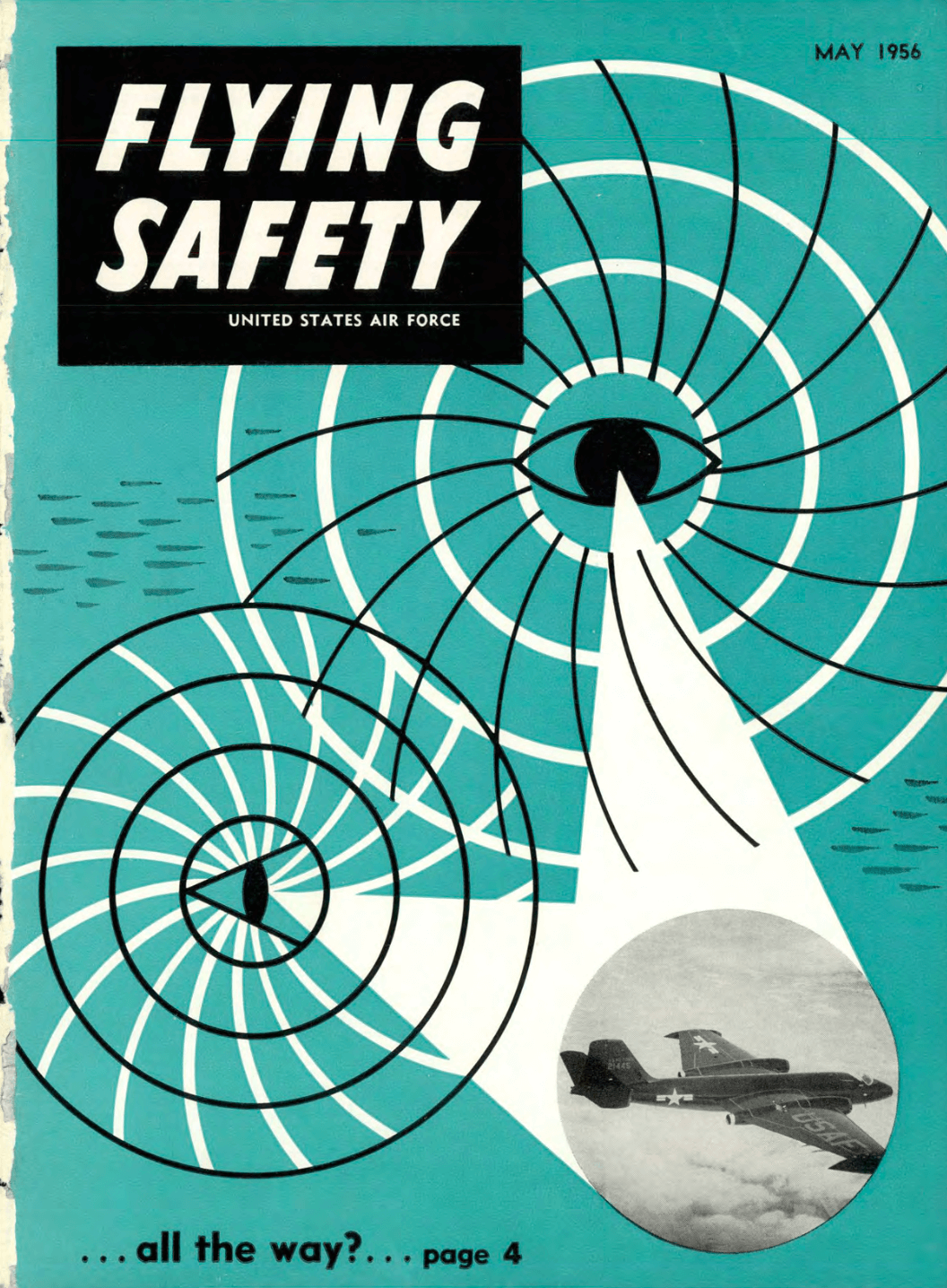
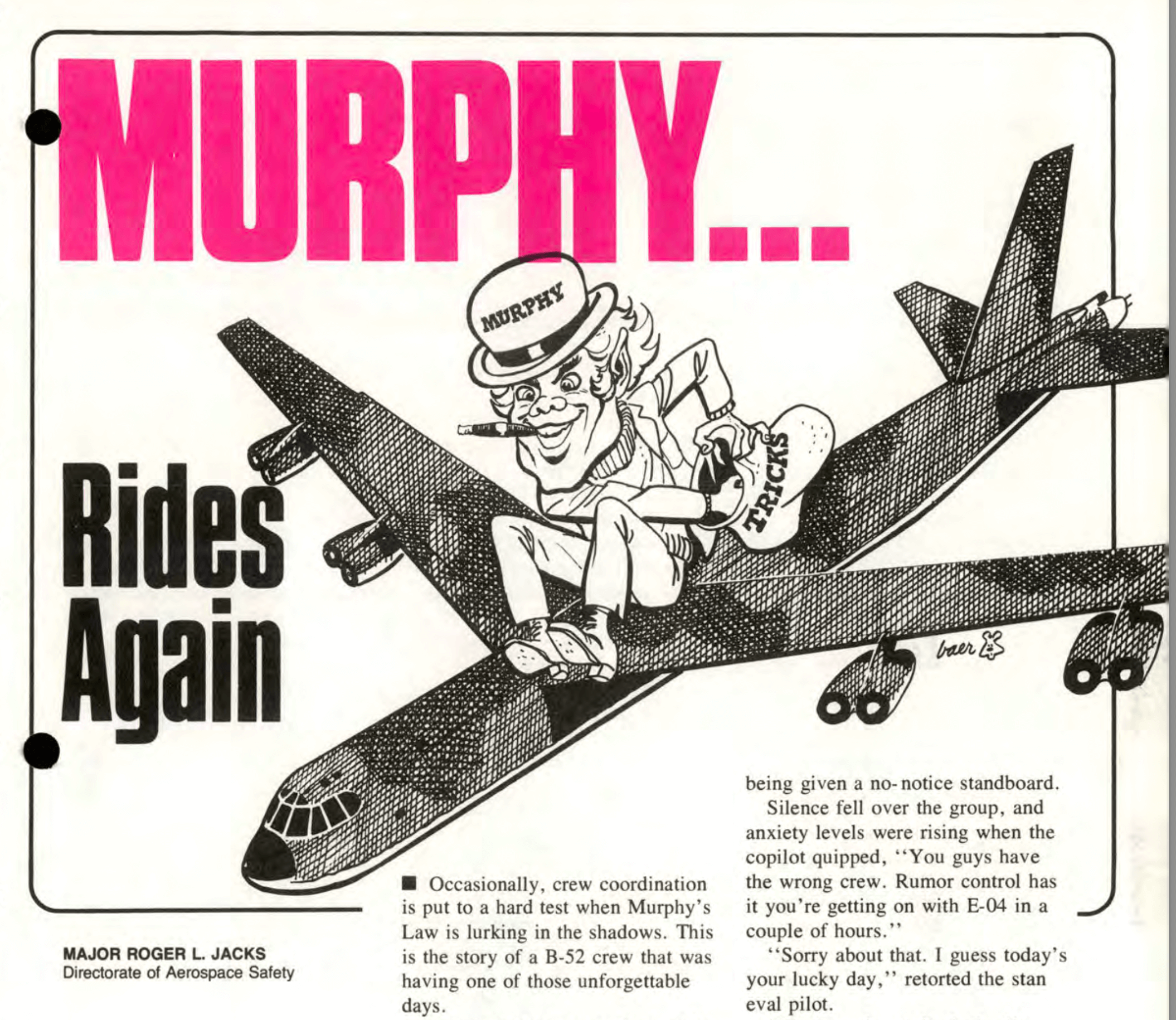
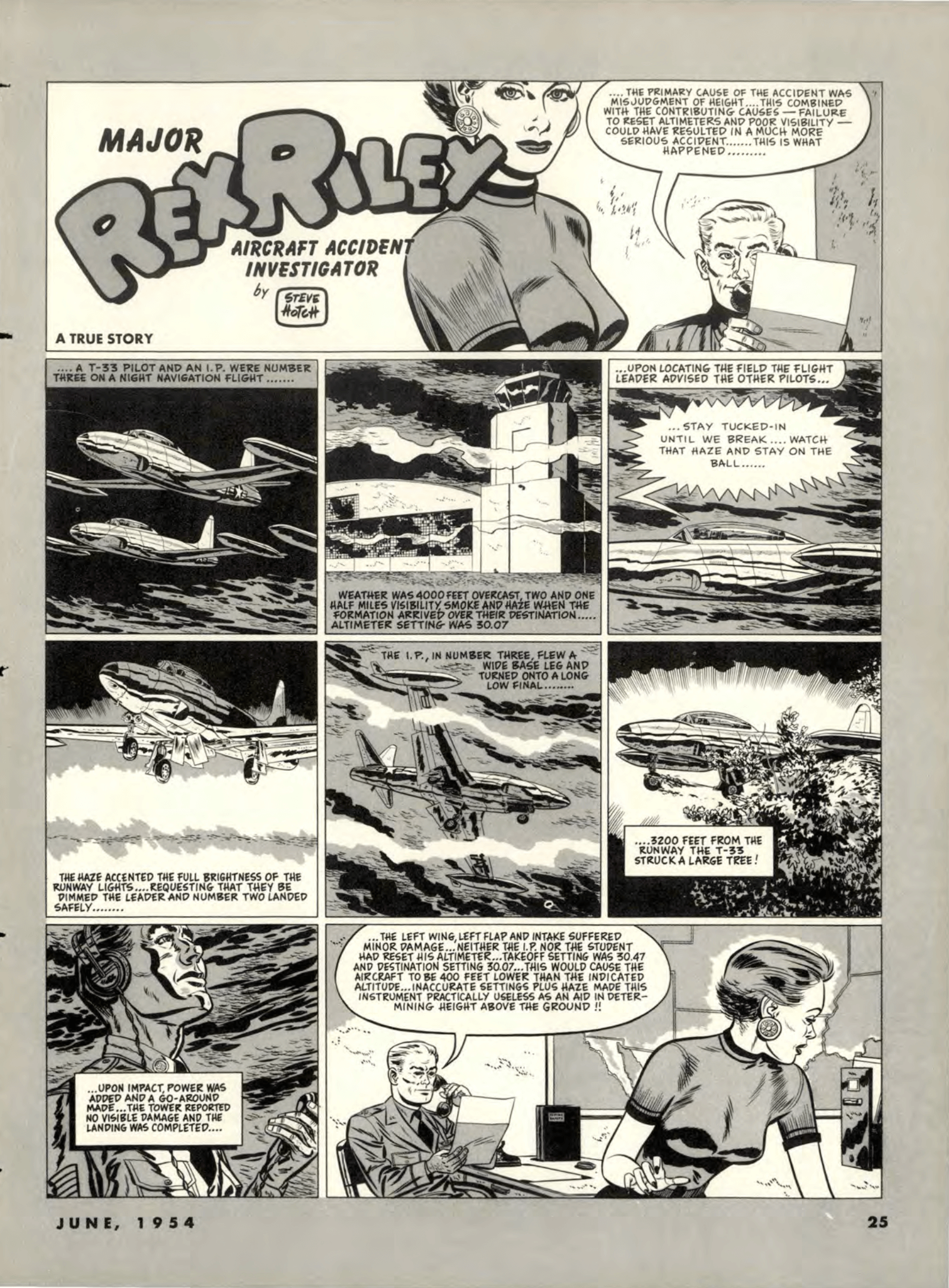
They had (actual) creative meetings. They had artists, and cartoonists, and designers. They pushed boundaries. They weren’t afraid to use humour, swear words, and satire. They weren’t even afraid to make it actually sexy!

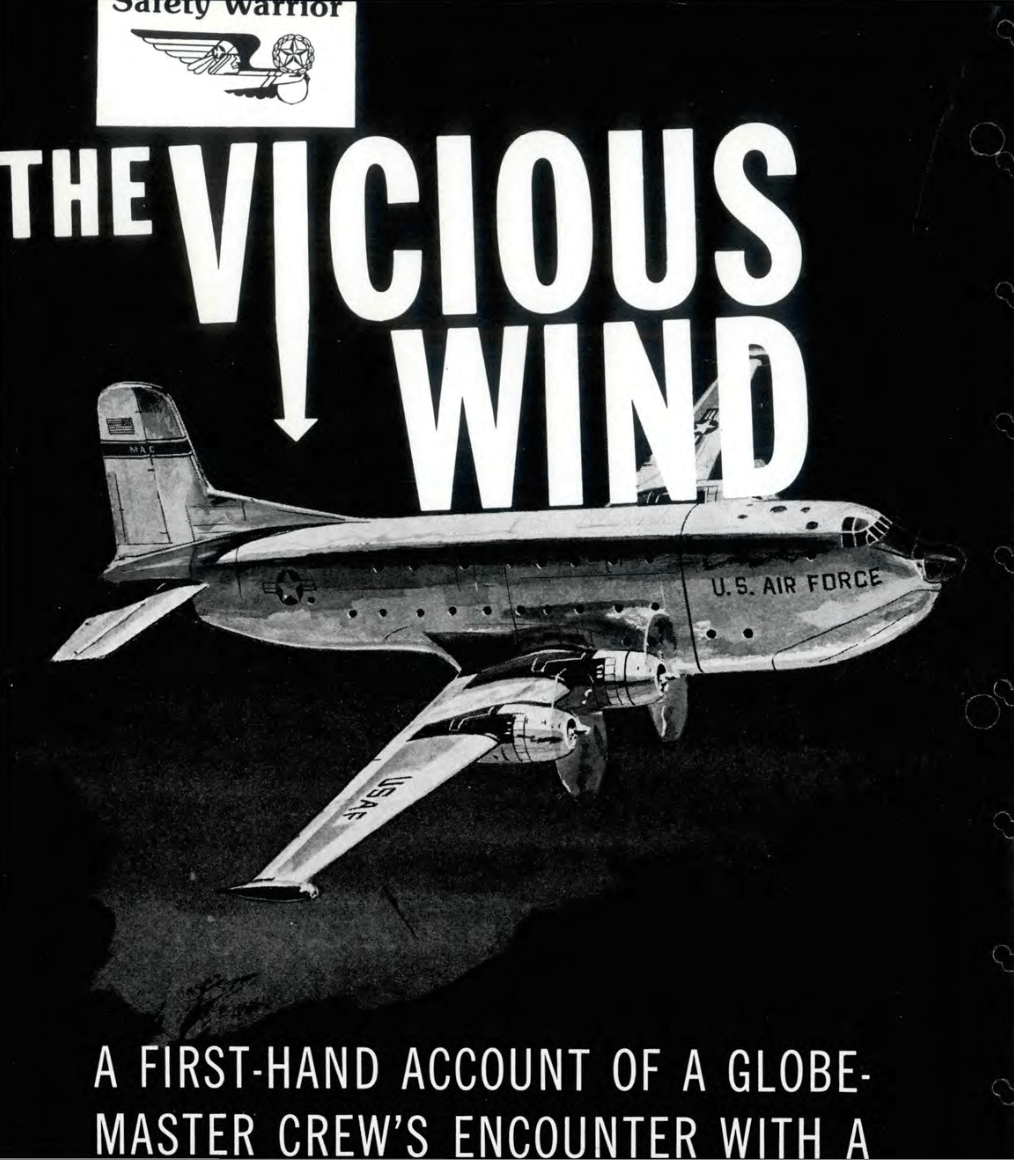
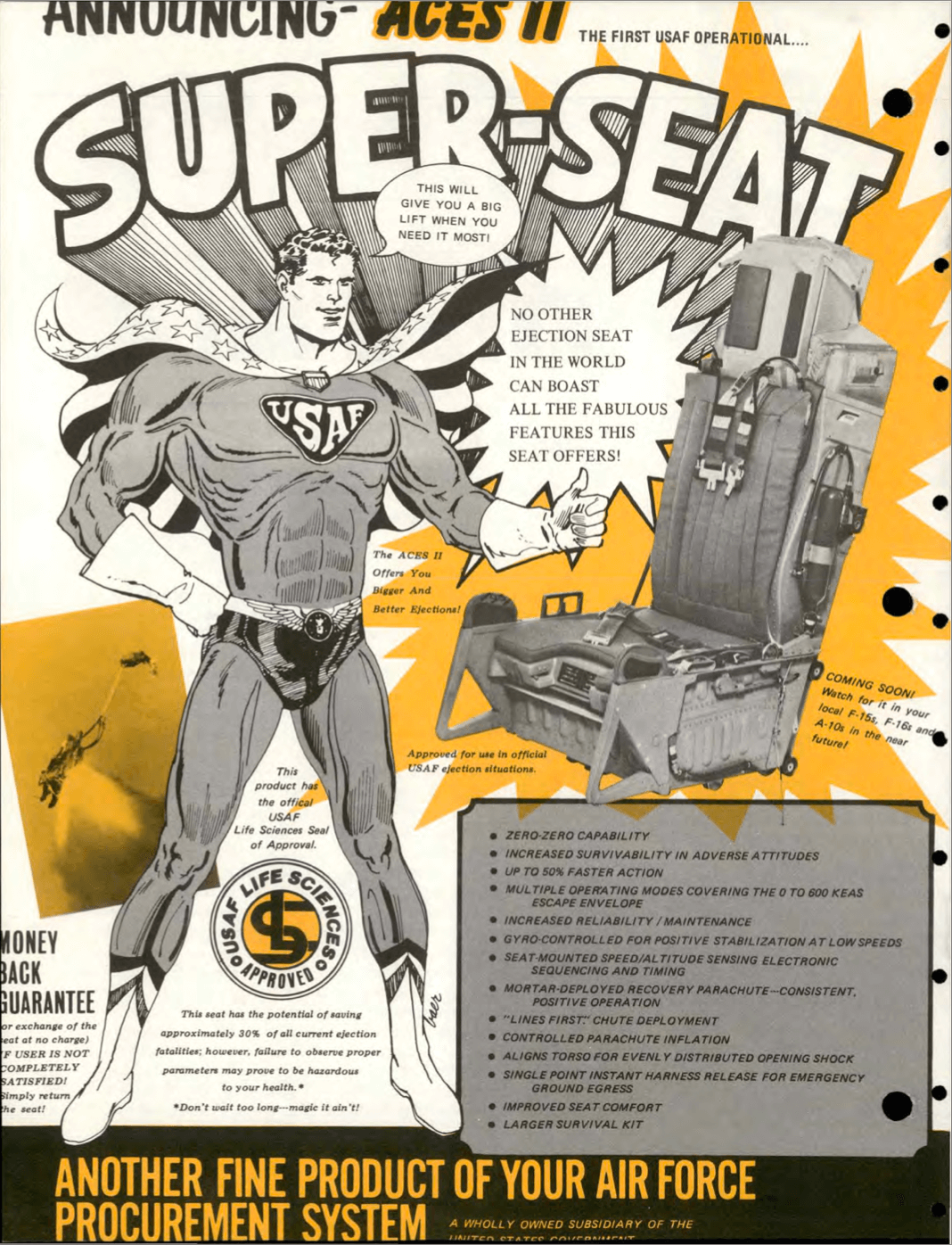
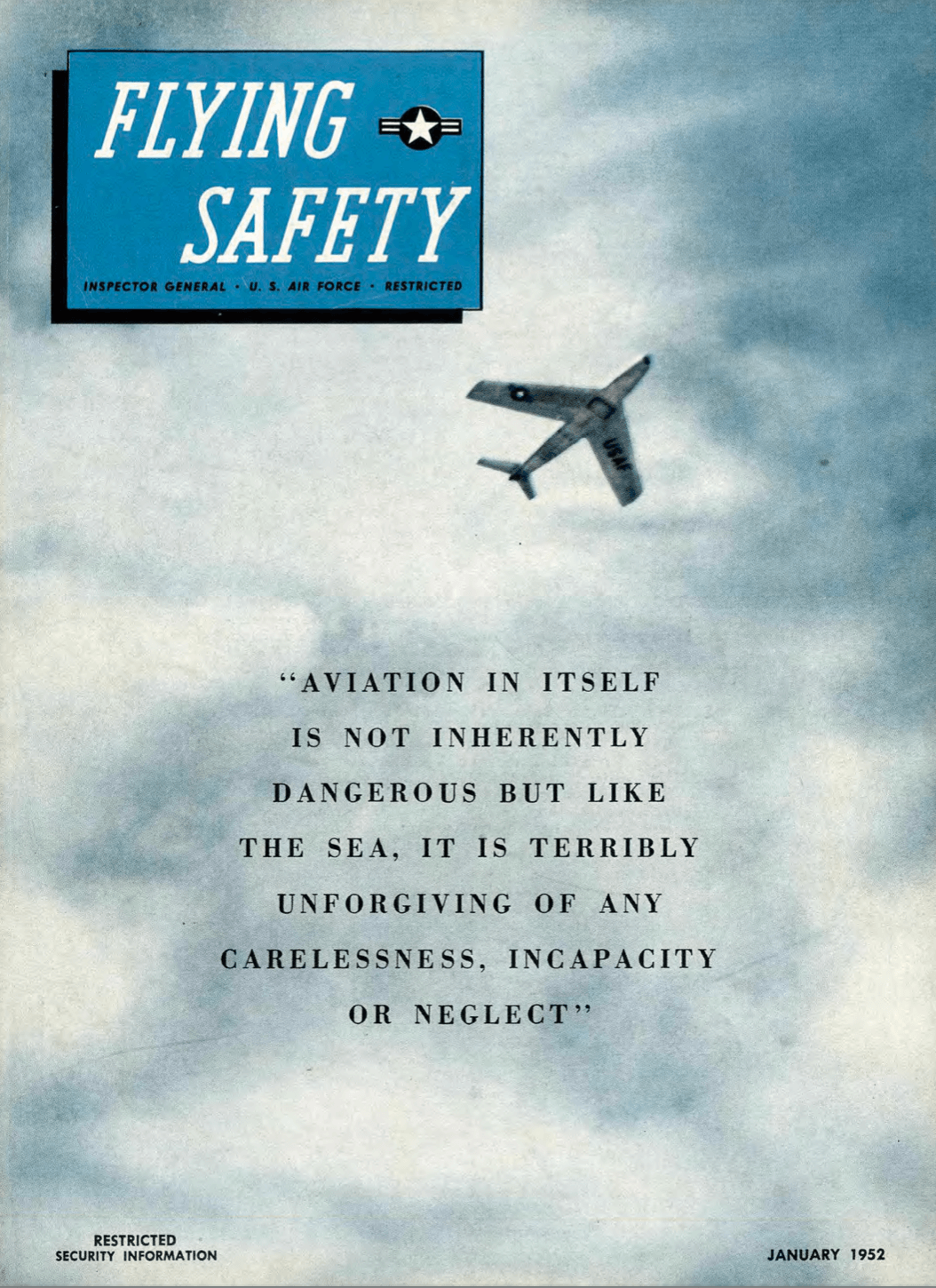
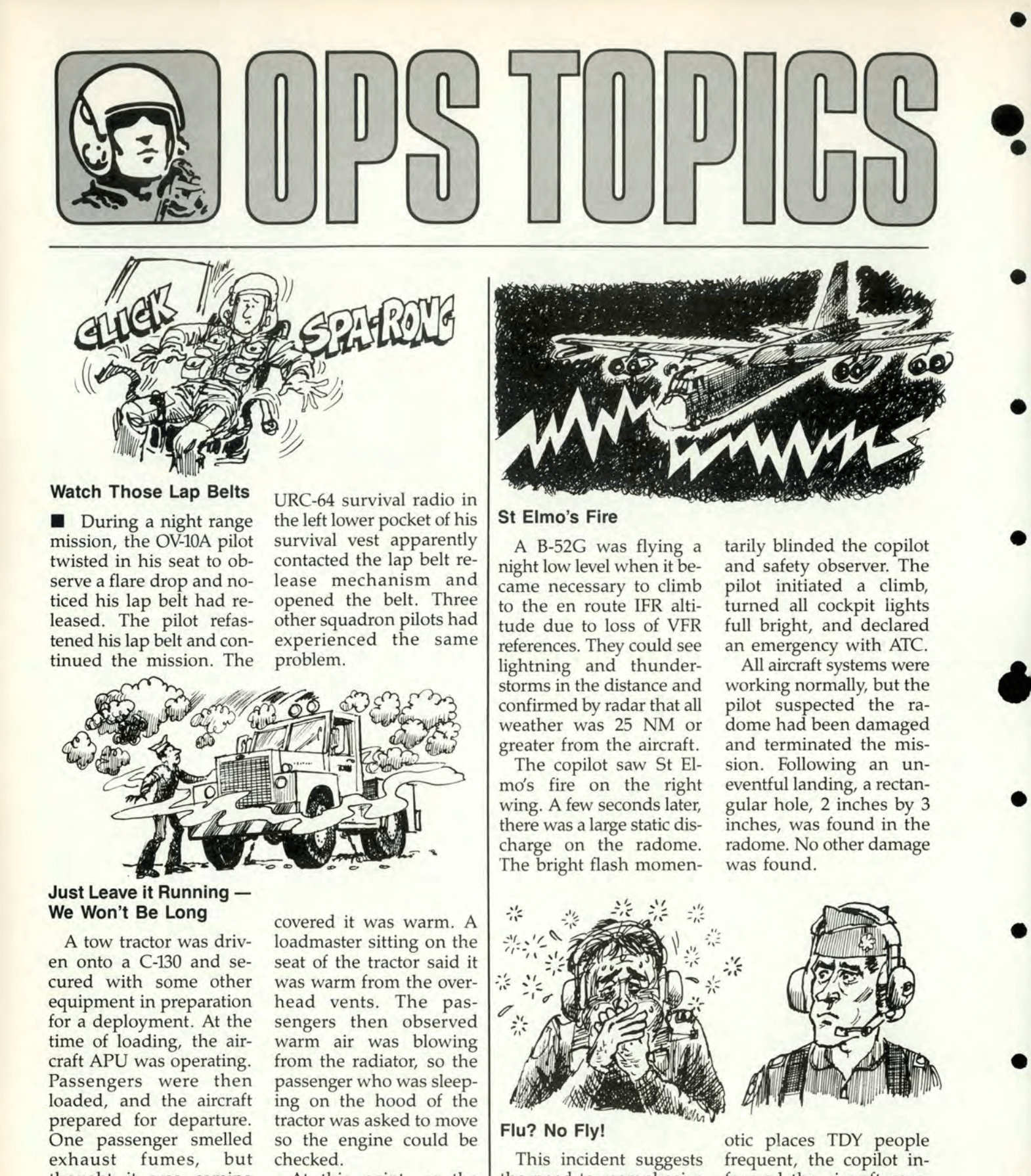
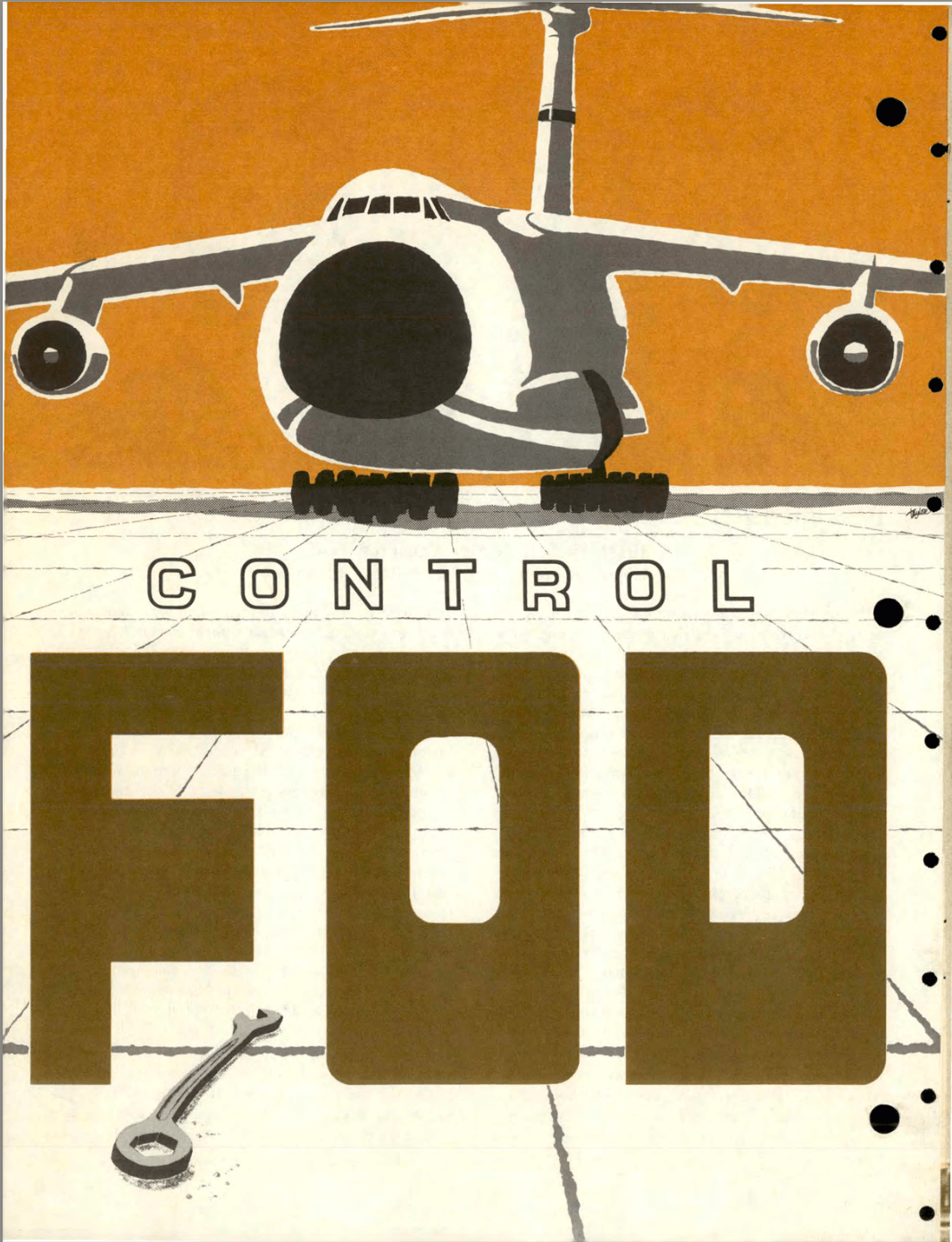
Now, chill. I’m not saying this is a perfect example. Stripes are very 1950’s. But let’s have a look at some of the artwork and artistry from the pre-1990 era of aviation safety!


That feels different, doesn’t it?

Could it be, that if we are brave enough to think differently about safety, that we might get more pilots reading the very important messages that we want them to?

Here’s the thing. If safety is SEXY (my byword for engaging, exciting, attention-grabbing, and attractive), then it cannot feel sterile, corporate, empty, and aloof. And these are the reasons I don’t read the 2022 magazines.

But in the past, the whole vibe was different. It’s light, it’s easy, it’s fun. When I read that “olden days” safety magazine, it makes me want to participate. I want to read the articles, enjoy the art, and get involved. I’ll pass it along to a colleague. I’ll leave it on the flight deck  for the next person.

These days, the only reason I’d leave a safety magazine for the next person, is for that fly I didn’t manage to swat before we landed.


Further reading

  • A treasure trove of old-time safety magazines: Air Force Safety (but make sure to read the pre-1990 ones!)
  • A trove (minus the treasure) of present day ones featured in the image:
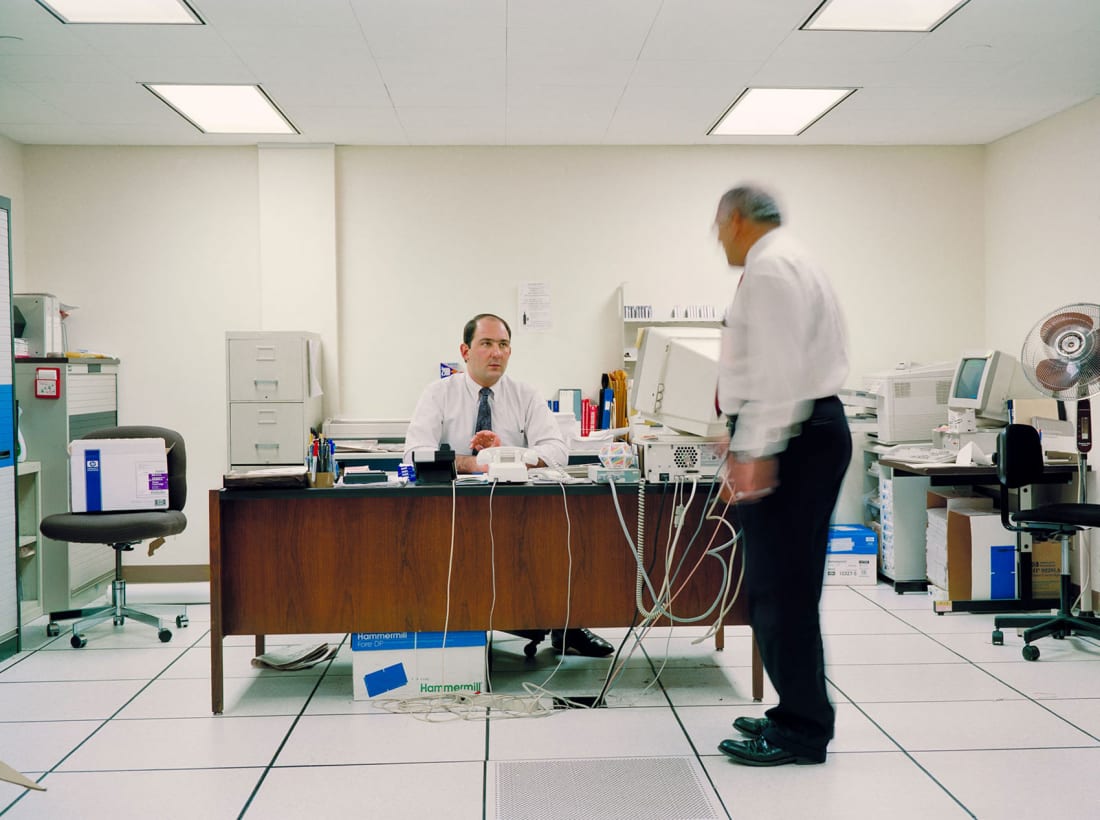
  • Office pictures are in fact from Steve Algren, view the story here.


Danger Club is Back!

At the end of 2021, we ran 6 Danger Club meetings. The idea behind them? To start a new conversation on safety danger.

We wanted to get people talking about the humans in human factors – to bring the discussion back to our own operations, to share insights and experiences, to learn what we can be doing better.

Because we are all just fallible humans figuring out where our faults may lie.

The Story so Far

We don’t want to talk about all the usual cases – The Tenerife disasters, the Kegworths. They were huge learning opportunities, but even after learning from them (at nearly every CRM session), incidents are still happening, and we want to ask why?

So we took a look at less known incidents and accidents, ones where the stuff that happened is stuff that could happen to any of us.

Nothing technical, just human.

An autopilot disconnected too early and an approach not stabilised, a too steep cockpit gradient, or that day flying with your buddy where it is way too casual… Times where one small error became two, and then became three, and suddenly wasn’t so small because the crew just didn’t ‘get their head back in the game’.

Now We’re Bringing it Back.

After a bit of delay due to many goings on at the start of 2022, we are now bringing Danger Club back. Our first meeting of 2022 will take place at 1800 UTC on Thursday March 24th, and wherever you are in the world, come join us!

11am LA, 2pm New York, 6pm UK, 7pm Berlin, 10pm Dubai, 7am (Wednesday) New Zealand…


What are we going to talk about?

We want to stick with the ‘theme’ of looking at non-fatal incidents and accidents, and talking about the ‘What Ifs’ that could potentially happen to us.

The first one is an interesting one because the main question we thought as we read to the end was simply “How?”

“How did it get that far?”

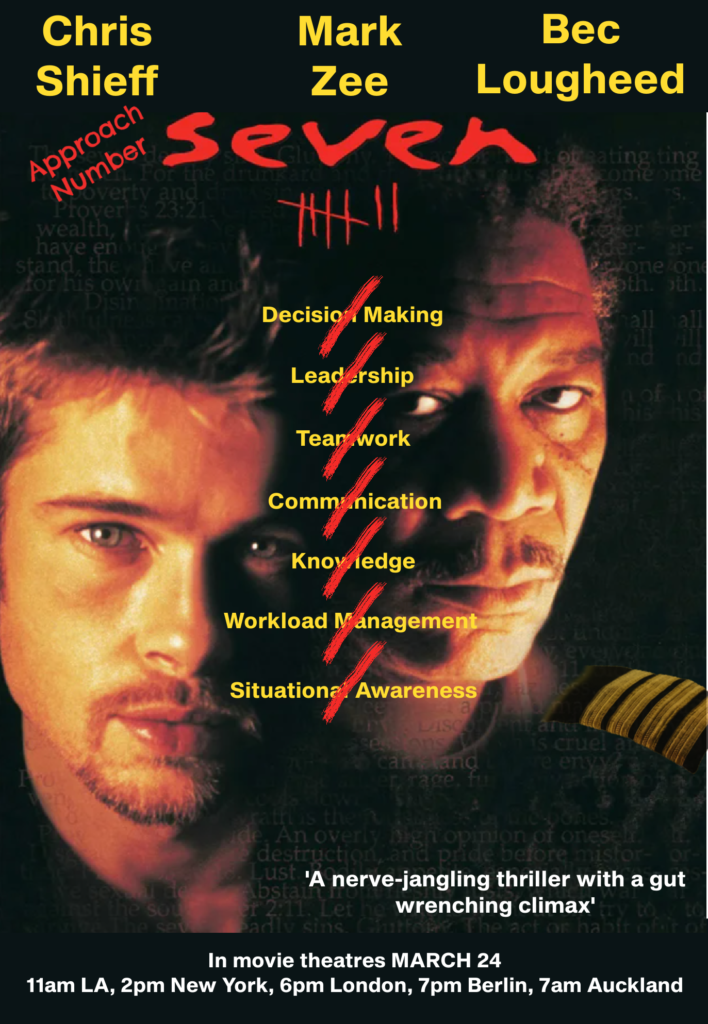
How did a crew of a 737 end up having to carry out 7 approaches before finally managing to land? Was there a point during their decision making process where this could have been avoided? What was running through their heads as this progressed, and more importantly how can we all avoid making the same mistakes?

So put it in your diary!

March 24th, 2022 at 1800 UTC

Danger Club #7: Thursday, Mar 24: 1400 ET / 1800 UTC
11am LA, 2pm New York, 6pm UK, 7pm Berlin, 10pm Dubai, 7am (Wednesday) New Zealand…
Incident: Jet Always B737: Lucky Number Seven


And if you’ve not been to one before?

Just come along and take part. We are all students in this and we all ask is you switch your camera on during the session, but how much you input is entirely up to you.


Red Sky at Night, Aviator’s Fright

Summer in the Northern Hemisphere means a few additional challenges for aviation, particularly in the USA – Hurricanes (which we wrote about here) and Wildfires.

You probably read ‘Hurricanes’ and think yeah, I get that, but fires?

Wildfires do pose a fairly major risk to aviation though, so we thought we’d take a quick look at what those risks might be and what the forecast is for the 2021 Wildfire season.

Too hot to handle.

Wildfires are prevalent across the US during the hotter summer months, typically running from May through October.

Looking back to previous years, California saw 13 fires in 2019, but over 30 major ones in both 2018 and 2017. The 2018 fires led to over 1.8 million acres of land being burned. 2020 saw the first ‘rain free’ February (in San Francisco) since 1864 and the drier months, and warmer spring resulted in some of the worst wildfires in California’s history. 

The outlook for 2021 is not much better. 

There have been extended dry periods with over 90% of the West now in drought conditions. There have also been record high temperatures in the Pacific Northwest, Northern Rockies and northern Great Basin with warmer than normal conditions forecast for the summer. Add to that an increase in lightening activity and you are left with a recipe for significant wildfire risk.

In fact, the figures so far for 2021 are already at a ten year high.

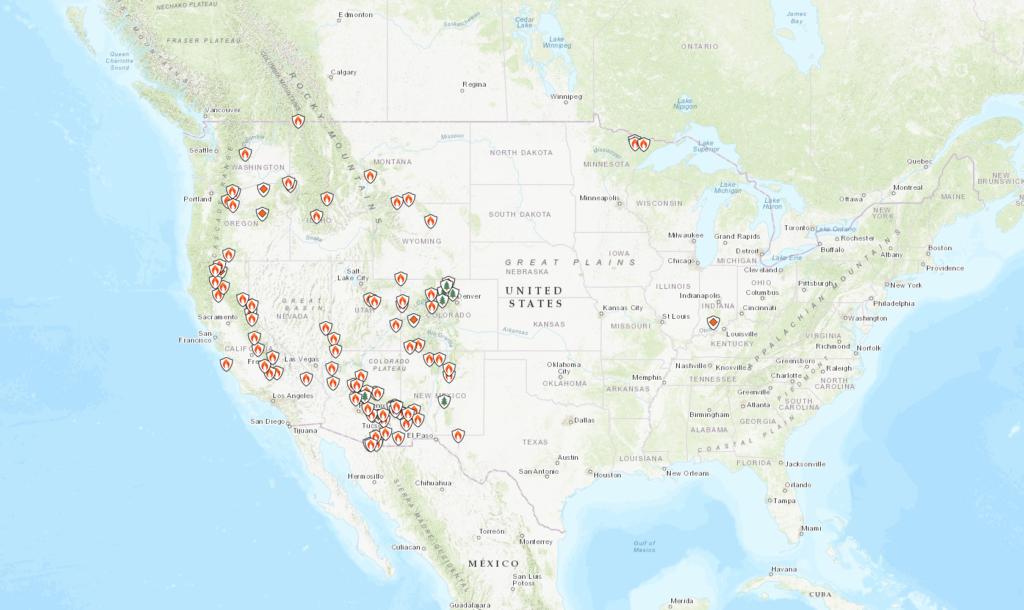
Where can you monitor the fires?

There are multiple sites which track and monitor wildfires. This is a particularly good one and will link to specific info on the major fires.

But the risk to aviation is often not from the fires themselves. The big hazards comes from:

  • Smoke
  • Increased traffic levels, diversions and ATC capacity
  • Changes to localized weather conditions.

Out of the frying pan and into the fire.

Major airports generally have good protection from wildfires, and are a distance away from areas which will readily burn. However, smaller and more remote airports may not and damage to infrastructure, or disruptions to ground transport has a knock on effect. Fires also lead to power outages which impact services at the airports.

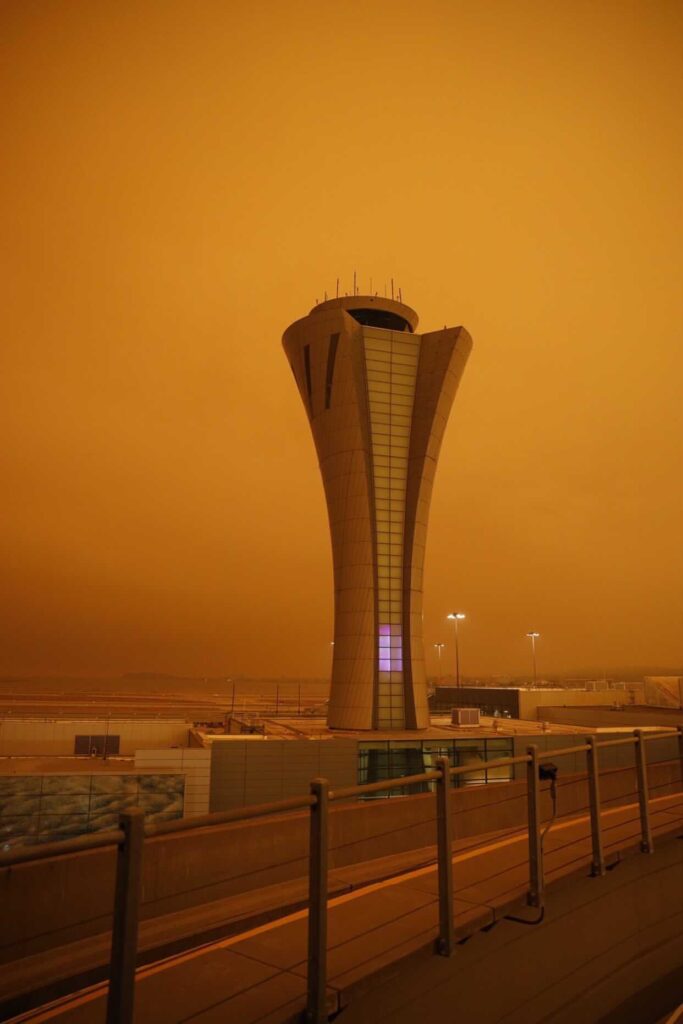
The major hazard comes from smoke though, and this can cause significant disruptions through reduced visibility.

Smoke has been known to reduce visibility to around 200m. In 2005 all four major airports in Honduras closed because of limited visibility from wildfires. In 2010, the visibility at KBOI/Boise Municipal Airport reduced from 10 miles down to 1 3/4 miles in just 9 minutes after a shift in wind direction carried smoke from nearby wildfires into the airport vicinity.

KSFO/San Francisco has also experienced delays and cancellations due to smoke from nearby Butte Country wildfires.

While Sonoma Country airports faced multiple closures in 2019.

Then there is the reduced Air Quality.

The health hazard this poses to ground workers means airports may find themselves understaffed and reduced resources lead to reduced services, which lead to more disruptions for aircraft and operations.

The smoke hazard isn’t just at ground level.

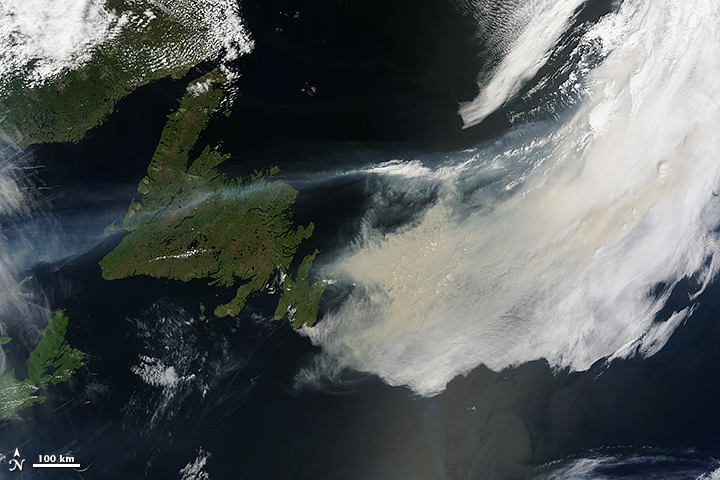
In 2013, a NASA satellite captured images of smoke from Canadian and Colorado wildfires which extended over the North Atlantic, and in 2020 an aircraft diverted into CYYT/St John’s after smelling fumes in the flight deck which were attributed to wildfires (again in Colorado).

What’s cooking.

Disruptions at airports lead to increased traffic levels requiring ATC support for diversions.

Smaller, regional airports have less capability for dealing with the impact of nearby wildfires, and when small regional airports in areas like Oakland, San Jose, Silicon Valley which have a high density of private jet traffic close, this can mean a lot of diversions happening very suddenly, and where they go can becomes an issue.

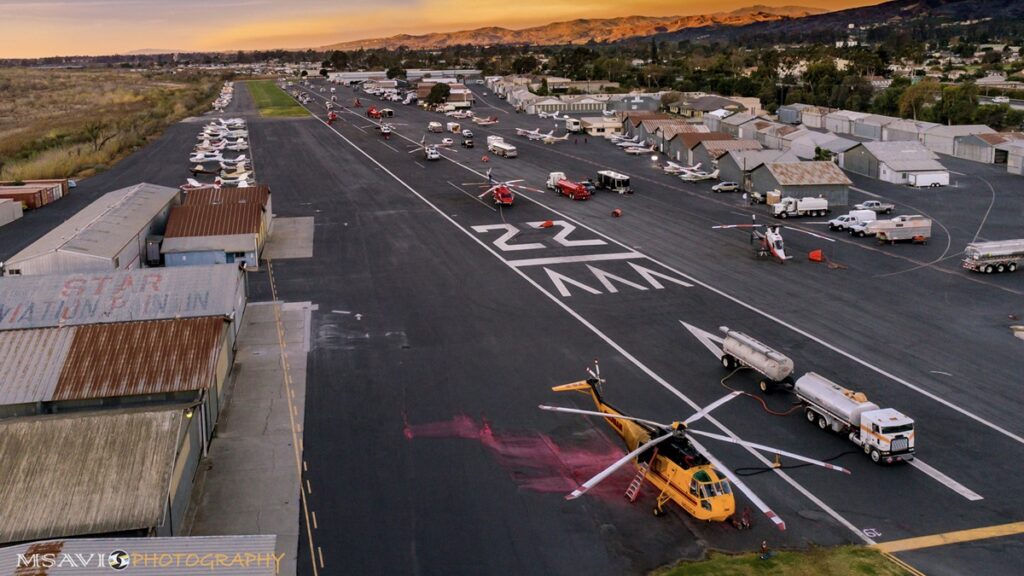
In addition to diverting aircraft, there is the firefighting aircraft to factor in as well. They might operate low-level, but they are not small and they need to operate from somewhere and this is added pressure for ATC.

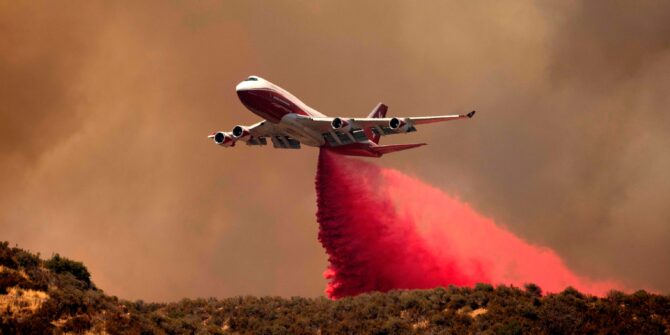
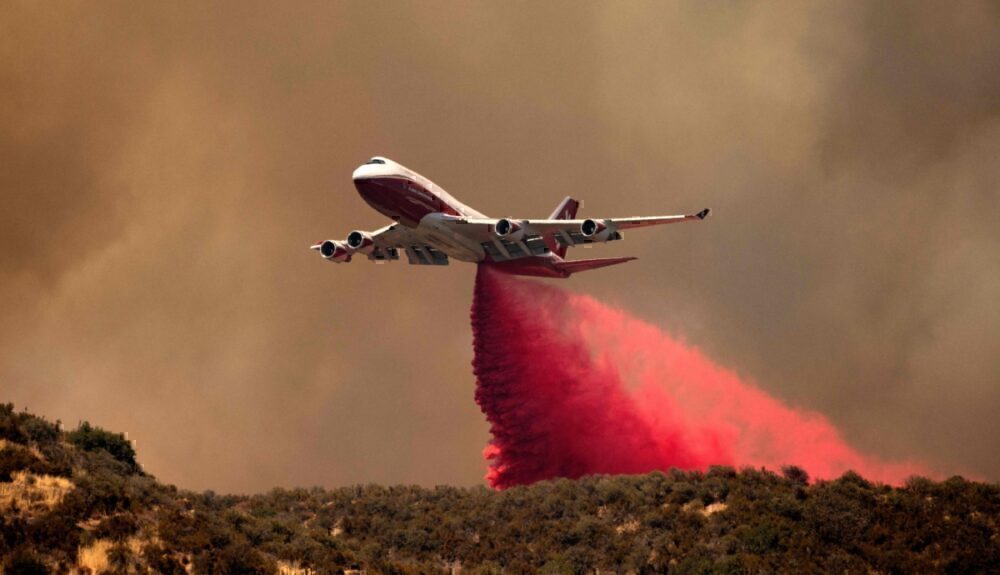
MD-10s and BAE 146s are commonly used. The world’s largest is a B747 Supertanker which can carry up to 19,600 US gallons of fire retardant or water.

TFR zones are set up for major fire zone areas to allow for safe movement of the firefighting aircraft. You can check these here.

Where there are fires, the risks of incidents increases and between 2000 and 2013 there were 298 wildfire firefighter fatalities in the US. 26% of these were caused by ‘aviation associated’ activities which occurred across 41 separate events involving 42 firefighting aircraft. Three of these were midair collisions.

Pyromania.

Wildfires can impact the weather environment as well.

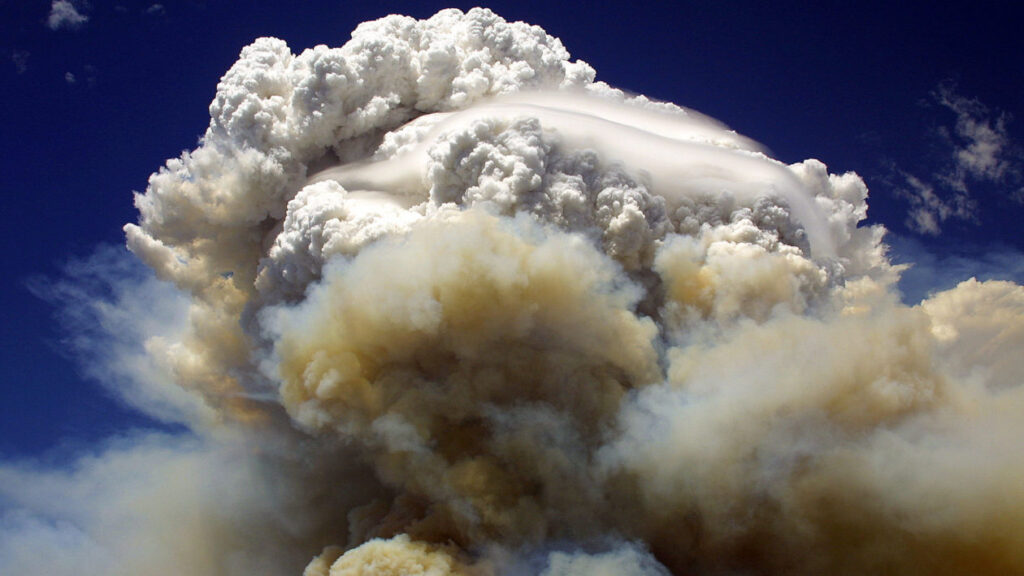
When large enough, Pyrocumulus cloud (also called Flammegenitus clouds) filled with rising ash and aerosols can build. These aerosols often carry a charge that increases the likelihood of lightning and with that an increased chance of fires spreading rapidly.

The “Station Fire’ of 2009, which burned more than 160,000 acres just outside of Los Angeles, also produced a convective column estimated to reach around 23,000 ft. Other majors fires have produced ones reaching as high as 40,000 ft.

These huge clouds are similar to cumulonimbus, only without rain. But they still contain significant up and downdrafts and can result in localized wind shear from gust fronts. The change in ground temperatures can result in significant thermals and large temperature gradients can result in significant localized vertical and horizontal winds.

There are ways to help.

Check those TFRs and check the wildfire maps. If you are operating into an area showing significant activity, consider how much busier ATC might be, and remember to check the capacity at your airport destination.

Report fires when you see them. Early notification of developing fires means the authorities can deal with them quicker, before they grow out of control.

Consider other ways to help. If you have an aircraft available, consider using it to help with evacuation flights. Airlines pulled together in 2016 following some major fires in Canada, and helped evacuate more than 80,000 residents. They also helped them bring their pets out safely. Be warned – you will have a tear in your eye after reading this one so open at your own risk!

The Forecast

There is a full seasonal outlook published here. But for a quicker summary of the 2021 Wildfire Forecast:

  • Alaska has ‘normal’ fire potential through summer and into the fall.
  • The Northwest is expected to experience significant and above average fire potential into September.
  • Northern California and Hawaii also have above normal significant fire potential expected.
  • Southern California will be at high risk through September (although this is ‘normal’ for the region).
  • The Northern Rockies region is expected to be above normal through August and September.
  • The Great Basin is expected to see increasing fire potential through August and possibly into September
  • The Southwest is expected to remain normal.
  • The Eastern Area is expected to be normal.
  • The Southern Area is expected to be below normal.

Wildfires pose a significant risk to aviation operations. They also pose a huge risk to those living there, the infrastructure and the economy. The Fire Fighter pilots are an extraordinary bunch of aviators and we wish them the best for this year.

There is a very interesting podcast available here if anyone wants to hear more about what their ‘Day at Work’ involves.


Wake Turbulence: See You On The Flip(ped over) Side

We last wrote about this back in 2017, after the en-route wake of an A380 flipped a Challenger 604 upside down over the Arabian Sea. But as the skies start to grow busier again it’s worth having a think about how to avoid wake turbulence or deal with it when you come across it.

If you are going to run into wake turbulence, there is a good chance it will happen near the ground. Not the ideal place to suddenly find yourself banking sharply without warning.

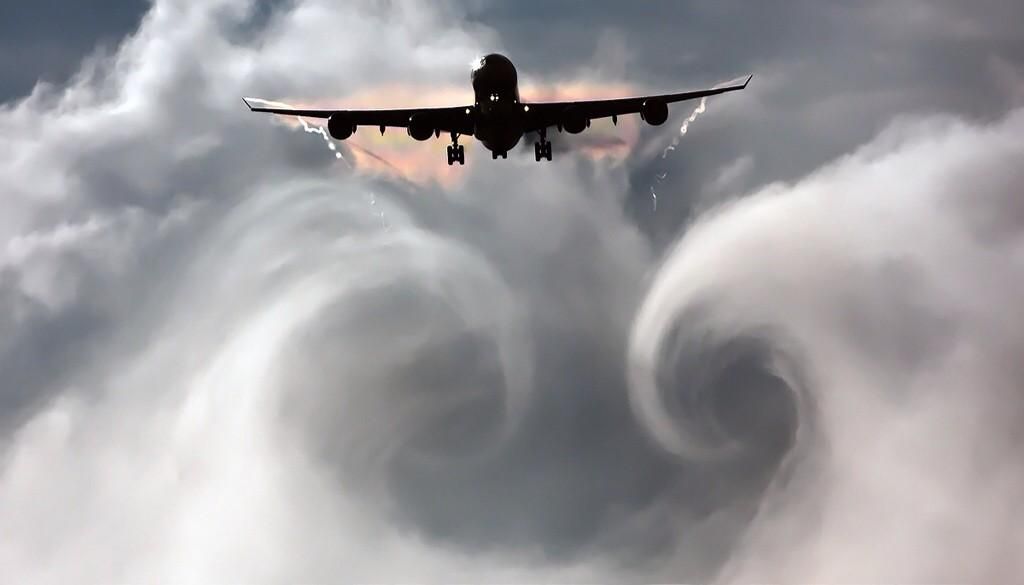
The levels of traffic operating in close proximity (and in configurations specifically designed to produce lots of lift which is what basically leads to wake) can make the approach, departure, takeoff or landing a gauntlet of swirling vortices of doom. Added to that, aircraft are generally operating at low speed with lower controllability margins.

A study in Australia looked at the vortices of an A380 and in 35 knot winds, at 2,400ft, it took 72 seconds for the vortices to cover 1300m. They move, and they take a while to dissipate. This study took place after a Saab 340B temporarily lost control, dropping 300-400ft in altitude and rolling 52 degrees left and 21 degrees right. 

An ILS calibration aircraft crashed in OMDB/Dubai after breaching minimum separation distances from commercial traffic. Hitting wake is not fun and can lead to catastrophic consequences.

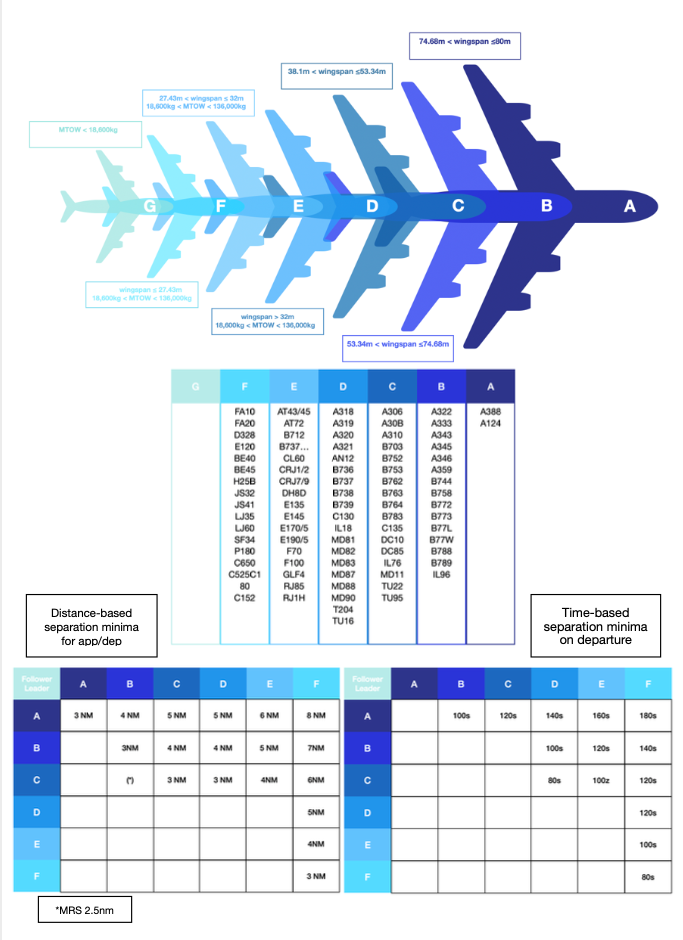
Thankfully, wake turbulence is taken seriously. In fact, in 2016, wake turbulence categories were rethought.

They used to just be based off MTOWs:

  • Super (the A380 held this spot)
  • Heavy (anything with a MTOW more than or equal to 136 tons) 
  • Medium (7 tons to 136 tons)
  • Light (anything under 7 tons)

Nowadays, the categories are a little more complex and consider both weight and wingspan, because wing design is a big contributor to what sort of vortices roll off the tips. Now we have 7 categories: G-A. Ultimately, the important thing to remember is the distance you need from each depending on what you are in.

Get woke about wake.

So, we have our 7 categories, and we have our distance based separation (which ICAO allows to go as low as 2.5NM).

Something to remember – these have been designed to allow maximum runway capacity and operational efficiency. You won’t be ATC’s favorite pilot if you ask for more separation (you might even lose your spot in the sequence) but safety is ultimately up to you.

If you need more space, say something.

There are a few other things you can do to help avoid wake in the airport area:

  • Consider requesting a SLOP on arrival – yes, this is possible. Except where they have super strict NABT routes.
  • Consider asking for an extended holding pattern, or opposite direction hold – just check where that might fly you (if you’re close to the border with another airspace you might run into another sort of trouble).
  • Try and remain above the flightpath of the preceding aircraft, and avoid long level sections by flying a CDA.
  • Watch those speed margins – if you think you might meet some wake, think about taking some flap a little earlier so you have more margin.
  • If you are a ‘heavy’ or a ‘super’ then ATC might not want you to fly a CDA, especially in high density airspace. JFK are one such spot.
  • Look at what the wind is doing – if it’s light or variable then those vortexes are going to sit there, waiting for you to fly into them…

Is there any technology to help?

There is indeed. In fact, there are several interesting projects and technologies being tested to help with wake.

Vortex modelling is playing a major part in the EU’s Single European Sky ATM Research and has led to some rather clever folk in Germany discovering that if you build a “plate line” (basically a wall of large wooden boards) this effectively cancels out most of the wake. This is being tested at EDDF/Frankfurt and EDDM/Munich airport using smoke and lasers.

Turbulence can really CAT-ch you out.

Going back to the 2017 Airbus 380 vs Challenger 604 battle – the Challenger came off a lot worse.

The big takeaway from this: the risk of wake in cruise is a pretty big one as well. So what can you do about it?

  • SLOP – It is one of the things it was designed for.

But use a bit of common sense here – if the wind is from the left (and slopping to the left is not available), then flying to the right of track just means when you get to abeam where the aircraft in front was, their wake has probably been blown right of track as well. Maybe ask them to SLOP!

Of course, severe turbulence isn’t only caused by wake. Weather, mountains, atmospheric stuff are all to blame as well.

There are technologies out there to help with this as well. Lidar is just such a thing. The Japanese Aerospace Exploration Agency and Boeing have discovered that if you stick one of these onto the side of an airplane then it can detect aerosols on the air. These are tiny particles, such smaller than water droplets so a conventional radar won’t detect them. The Lidar system does though, and can provide up to around 70 seconds warning (about 10 miles).

This might not always be enough to avoid, but it’s enough to switch the seatbelt sign on and warn everyone down the back.

So, sometimes there are warning signs, but sometimes there aren’t. We aren’t going to bore you with a science lesson on Clear Air Turbulence or how to check your shear rates. What we do think is worth talking about is what ICAO, EASA, the FAA et al. have say about what to do when you have inadvertently come across something that has really upset your airplane.

UPRT

Upset Prevention and Recovery Training. This is a big (and very good) thing. Since the AF447 accident it has become mandatory for crew to be trained in UPRT.

But what actually is it?

Well, it is one answer which is hoping to solve the issue of LOC-I incidents amongst other things. Loss of Control in flight is the biggest cause of fatal accidents over the last two decades (on commercial jet aircraft), having led to 33% of fatal accidents.

It is designed to solve the “startle” factor by giving a clear, defined method of what to do if you don’t really know what is going on. Basically, when you experience an “unusual attitude” (with the airplane, not with a strange co-pilot).

An unusual attitude is anything outside your aircraft’s normal limits. For a large transport category aircraft we are probably talking nose up more than 25 degrees of pitch, or down more than 10, a bank angle greater than 45 degrees or any flight within these parameters but with airspeeds “inappropriate for the conditions”.

What has changed here from the old-school stall recovery type training?

Well, the big change is what we are really learning during the training. Upsets are not “some aerodynamic phenomenon lurking in the atmosphere to grab pilots following well structured procedures” – they happen when things have gone very, very wrong and procedures have flown out the window.

So, UPRT is about training to deal with the startle and the confusion – giving a method to right the airplane when that startle and confusion is likely preventing you from doing so. It is also about learning how to recognize a potential threat that might lead to an upset, and it is about better monitoring to prevent the startle.

Tell me how to do it.

Probably more for a trained instructor, but the general gist is this:

  • Push
  • Roll
  • Power
  • Stabilise

(Sometimes Roll and Power might want to go in the opposite order.)

Pushing does not mean ramming the stick forward. It means unloading the wings. And once they are unloaded you want to stop the push, but that doesn’t mean yanking the nose back up into a negative-G maneuver. You are going to have to trade some height for speed (and safety) here. When the aircraft is back under control, that means gently returning it to the horizon.

Roll is similar – it is all about giving the wings the best chance of performing, and that means getting them level and not barrel-rolling around the sky. But… if your nose is mega high, and you have power on, then pushing forward is going to be tough to do. So adding some roll can also help us out here, getting the nose to drop, and giving us control of, well, the controls.

UPRT is about monitoring, recognizing and handling.

Fancy some further reading?


I Feel The Need For Reliable Speed

Speed is a big thing when it comes to flying. Lift is, after all, equal to half of something multiplied by something else and, oh yeah, velocity squared…

Now, with so many airplanes being hauled out of storage complete with bugs, beetles and other nasties nesting in places they should not be nesting in, there has been what EASA described as “an alarming trend” in the number of aircraft experiencing unreliable airspeed indications.

So we thought we would take a more practical look at what unreliable airspeed might really mean for you.

What are we talking about?

Airbus reported that in the period from January 2020 to March 2021, they had 55 events of unreliable airspeed. But 55 in a 14 month period (considering how many Airbus are out there flying) doesn’t sound that many.

So why is everyone so worried about it?

Well, we wrote a bunch of stuff about it here. We also talked about startle factor because that really is one of the big danger elements of the unreliable speed problemo. You see, if you get unreliable airspeed, there is a good chance you will do so at a horribly critical moment in flight. Like takeoff when you are near the ground, don’t have much speed, and have even less time to deal with it.

So, we are talking about you (the pilot) or it (the aircraft) not knowing what airspeed is reliable, and everything getting fairly confusing, very quickly.

What happens when it happens?

Airplane systems are clever. They use teamwork. They don’t just rely on one sensor or one probe, instead, they have independent probes talking to independent systems, and then these talk to each other and on a good day everything matches. On a bad day they might not.

But air data computers don’t argue, they get logical. If two are receiving the same information then chances are number three is wrong and then majority rules and the other systems effectively vote it out. Of course, they tell the pilot when this happens so you can judge for yourself, and maybe try to work out why there is a discrepancy.

The situation gets more complex when the computers cannot determine which is reliable and which is not. When we talk about ‘Unreliable Airspeed’ this is the situation we are really referring to because now you are going to have to troubleshoot, pretty quickly, in order to work out what to trust. More critically, you are going to have to decide pretty fast whether or not your airplane is in a safe condition.

So your first action needs to be that ‘Aviate’ bit of those Golden “ANC” rules.

Don’t forget the first line…

The memory items for ‘Unreliable Airspeed’ are going to vary between types, but the general gist is probably the same: decide if the airplane is safe and if it isn’t, make it safe before you do anything else.

Airbus, for example, say “if safe conduct of flight impacted”.

So what they mean is don’t go hurling on thrust and yanking the airplane nose about unless you actually need to (but if you need to, then do!)

If you are in cruise – straight and level, with a sensible pitch attitude and thrust setting – and your autopilot disconnects because it ain’t sure about the speed, then do you actually need to do anything? Other than making sure you have control, probably not. The speed hasn’t suddenly become unsafe just because you cannot say exactly what it is.

The same goes for a nice, stable approach. If you’re configured, heading down the ILS, and your autopilot disconnects, but the airplane is still on the ILS, descending at a normal ROD with a normal thrust and pitch setting, why not continue (or at least see if it is safer too before you throw it into a go-around)?

Destabilizing it is potentially just going to give your a whole load more work, and the airplane a whole load more trouble.

But don’t forget the first line…

There are also instances when you do not have time to think about whether it really is or isn’t reliable.

V1 is determined during your performance calculations. This is the speed by which you need to have made the decision to stop, if you are going to. But it is not “just” the speed that matters. What your performance calculations are actually thinking about is how long (and by how long, really how far) it will take you to accelerate to that speed, and then how much runway you will need to decelerate back down from that speed if you reject.

So we sort of need to think about V1 in terms of the point on the runway we will pass when we reach that speed. If our airspeed indications are unreliable, then we cannot really say if we are at the point, before it or past it, and if we don’t know that and don’t know our actual energy then…

Can we stop?

Common sense and airmanship will probably tell you when rejecting versus taking TOGA and setting a pitch attitude is the best option.

Why does it happen?

Aircraft coming out of storage with stuff stuck in their probes seems to be the most common reason. Of Airbus’ 55, 44 of them were due to things “obstructing” the probes. One fix is to put covers on to stop stuff getting in. Unfortunately, this also led to a few situations where covers were left on stopping the air from getting in and resulting in, well, unreliable airspeed.

Icing if you fly into adverse weather is also a common cause. This can be incipient and hard to spot. Combined with high altitude handling differences, half asleep pilots, and a few other factors and you have a scenario starting to sound similar to the one Air France 447 encountered.

Damage to probes (hail stones, birds and things flying into them at high speed are probably to blame here) and Volcanic Ash are less common but equally possible reasons.

What can we do about it?

Well, EASA, ICAO and other wise folk say to try and avoid it happening in the first place with some decent maintenance checks if pulling your aircraft out of storage. They also recommend good procedures and good monitoring as a good way to not get caught unawares.

The general advice is:

  • Know your pitch and power settings. Old school, back to basics flying, but having an idea about these will a) help you notice when something just doesn’t look right and b) might just save the situation.
  • Don’t ignore your stall warning. This works off Angle of Attack, not airspeed. Think of it like your wife/partner – it is probably yelling at you for a (very valid) reason.
  • Follow your aircraft memory items and checklist. This means getting the airplane into a safe flying condition and then troubleshooting.
  • Make life easy for yourself. Talk to ATC – ask for a block altitude. If you are heading in to land, ask for a long descending final so you can take your time configuring. Remember there are other resources onboard as well – GPS gives approximate altitude and speeds.


GPS U/S in the US

We have written a fair amount on worldwide GPS Jamming issues. Here is what we said about it in ‘GPS Jamming: All the Wrong Signals’. But there is another GPS problem though which is a little closer to home (if your ‘aviation’ home is in the US anyway).

What’s the deal?

Let’s take a step back to 2017, when the NBAA and a bunch of other stakeholders took part in the 2017 RTCA tactical operation committee. That’s the Radio Technical Commission for Aeronautics and they are great – they try and help find compromises amongst the competing interests on critical aviation modernization issues.

One of these very issues is with GPS.

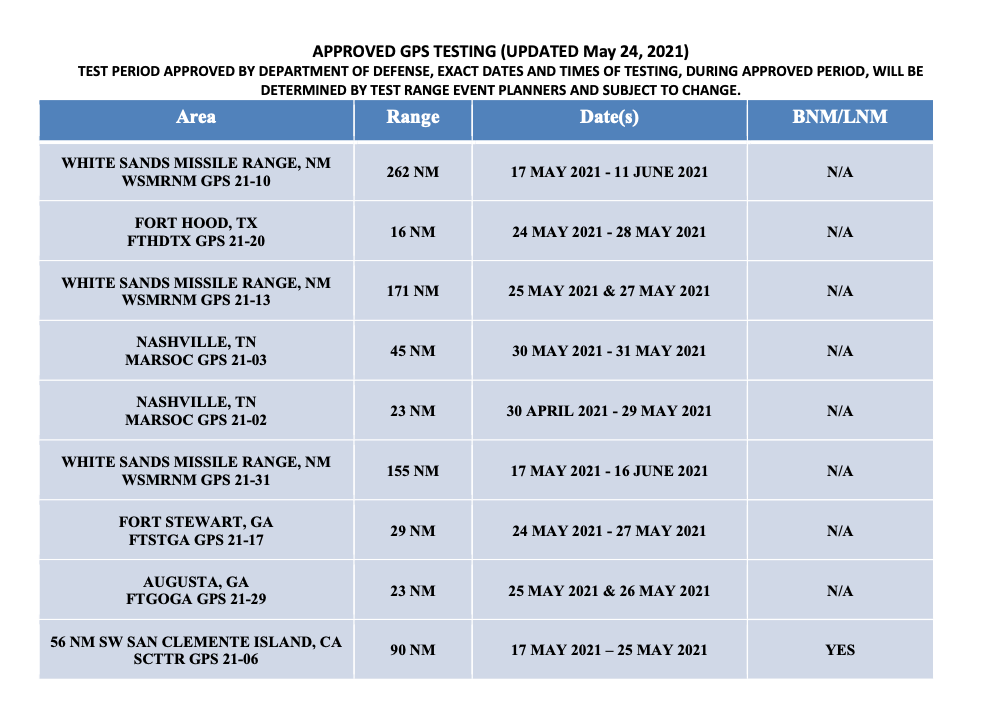
The FAA’s NextGen modernization program is using more and more GPS ‘stuff’. Stuff that is critical for commercial flight operations safety and efficiency. The US Department of Defense on the other hand is sort of doing the opposite – they are running GPS Jamming tests which are critical for National Security and the big problem with this is that the jamming tests often interfere with the GPS signals civil aircraft are using.

What was the 2017 outcome?

After they talked about it in 2017, the compromise was that the DoD will notify the FAA at least 120 hours before any planned tests. This should give the FAA time or put out Notams to warn crew and operators.

Problem solved?

Unfortunately not. The 120 hours notification is given, but the information which filters down to the pilots and operators who need to know about it often not sufficient. One of the difficulties is that the Notams have to provide information on different outage locations and this means loooooooong Notams filled with lots of Lat and Longs and times and dates. And this means critical information can sometimes get buried inside and makes it difficult or confusing for the crew to find it, extrapolate it (or even be aware of it in the first place).

What’s the plan now?

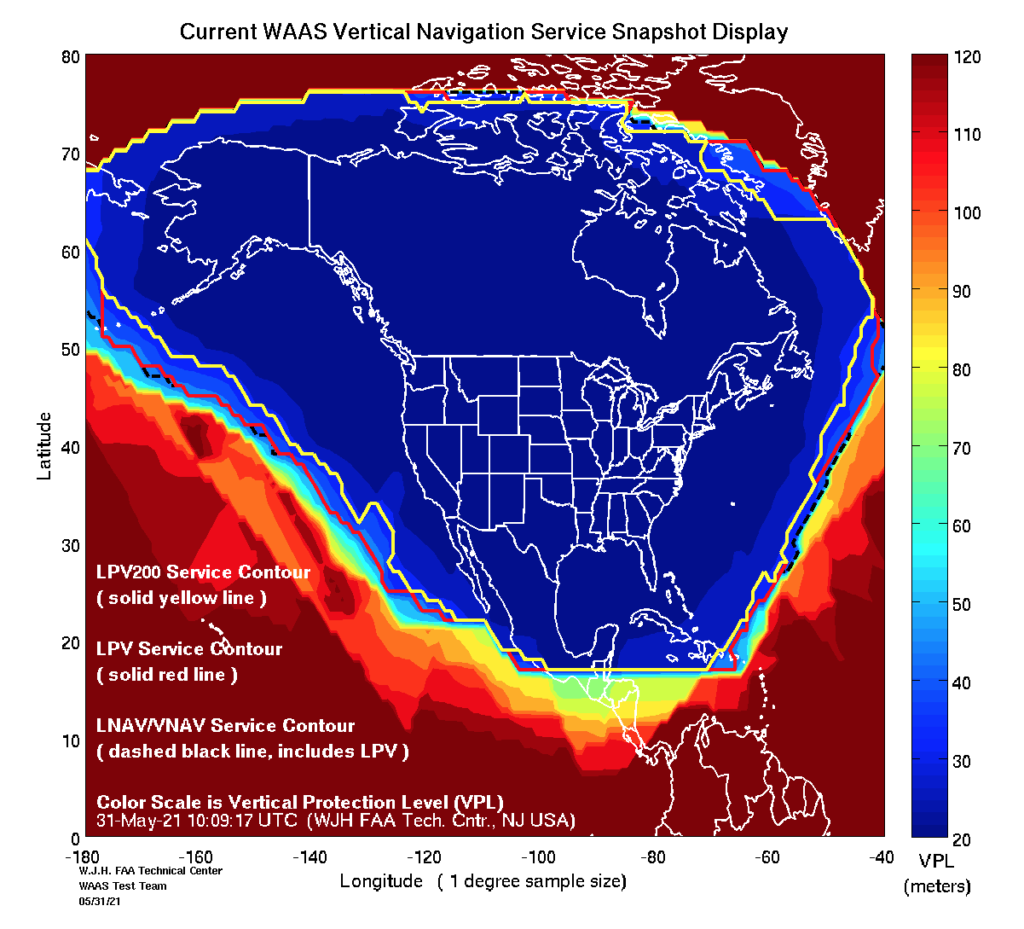
Well, the NBAA have reported on this, and say that the FAA are taking their concerns onboard. They plan to revisit the idea of producing visual representations of the outage areas. These will be much easier to digest than lines of lat and longs, and would hopefully enable crew to use them in conjunction with planning apps in the future.

There has also been a reminder issued to crew asking them to report outages and issues. If you find yourself in a jammy area, let ATC know. Tell them what you have lost so that they can warn other aircraft in the immediate area. The reminder has been sent to ATC as well because in the past, when aircraft have made these reports, the information has not always been shared out to other operators in the near vicinity.

What do you need to look out for?

What an outage means, practically, is interference to the GPS signals which your navigation system is using. The result can be a degradation in accuracy, or a full loss of the system (GPS primary).

If you are enroute, let ATC know your capability has been degraded so you can get the support you need to continue navigating safely.

Some aircraft are particularly sensitive to disruption in the GPS signals, and it can lead to you losing that system until it is reset on the ground. This means RNAV/RNP approaches might not be flyable anymore. Having an awareness of what this means for your aircraft is important. Think about your plan B for approaches in case you do loose GPS navigation capability.

Notams are out there and it might be frustrating picking out the areas which could impact you, but knowing about the outage spots in advance will help.

Where can you look for info?

The 5G Update

We thought we’d throw in a little update in on this as well.

Last year we saw increasing concerns about possible interference from 5G networks because they operate on the same slice of radio spectrum usually reserved for Radio Altimeter signals (the 3.7-3.98 GHz band).

The big concern here is that interference could result in degradation of accuracy from spurious emissions, or outright failures in the radio altimeters. Not sure how much of a risk that means? Well, Turkish Airlines TK1951 crashed in EHAM/Amsterdam Schiphol in 2009 and one of the primary factors was attributed to a malfunctioning radio altimeter which sent an erroneous -8ft reading to the autothrottle system, commanding it to idle.

The NBAA are fronting a campaign here as well. Twenty organizations have joined forces to send the FAA a letter raising their concerns over this, in response to a report issued on March 3 that they don’t feel addresses the threat with enough analysis.

You can read the letter here.

Military aircraft and UAVs are also at risk here. Their radio altimeters use the same C-band frequencies, but they tend to fly a lot nearer the ground a lot more often. A very good summary of the issue can be found here.


Dangerous Goods: The Bad Ones

IATA recently ‘urged action’ over rogue lithium-battery shippers. Folk are apparently sneaking them onboard without proper notification or packaging, and this could turn into one big, hot mess for airlines.

So, here is a closer look at Lithium Ion batteries, what they are, what they can do, and how to better deal with them onboard.

What are they?

In big terms they are things that power a lot of our airplanes. In smaller terms, they are the batteries in our phones and portable electronics.

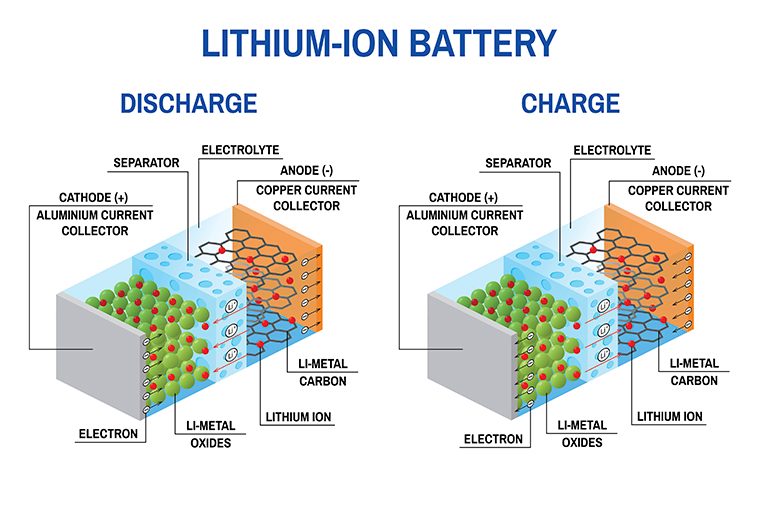
And in super simple terms (and with some creative licence thrown in) they are a cell that contains an electrolyte liquid. Lithium Ions get all charged up, and when they are feeling particularly positive, they dive into the electrolyte and swim through it. The movement of them gets the electrons all excited too, and they go zooming along from the current collector, through the device (your phone, laptop, airplane) which sucks out their charge, and then they get collected up by the negative current collector. 

They are different to regular Lithium (without the ion) batteries because they are rechargeable. They also have no memory effect (they don’t get lazy when repeatedly recharged) and they have good energy-to-weight ratios.

What is the risk?

They sometimes go into thermal runaway, usually when charging, but also if you bash them about (think iPhone stuck under business class seat, getting repeatedly run over by the chair mechanism as the passenger tries to pull it out again).

Thermal runaway, as the name suggests, involves them getting really hot – so hot it reaches the melting point of the metallic lithium and causes a pretty horrid reaction when it just keeps getting hotter and hotter until flame, fire, explosion…

You might think a small phone would not be much of a hazard but there are a lot of very flammable things in your airplane cabin. And there are a lot of things with lithium ion batteries in them that people bring onboard.

Then there are airplane batteries themselves. Boeing had an issue early on with their 787 Lithium Ion batteries leading to an All Nippon Airways 787 having a pretty serious incident with one before the problem was resolved.

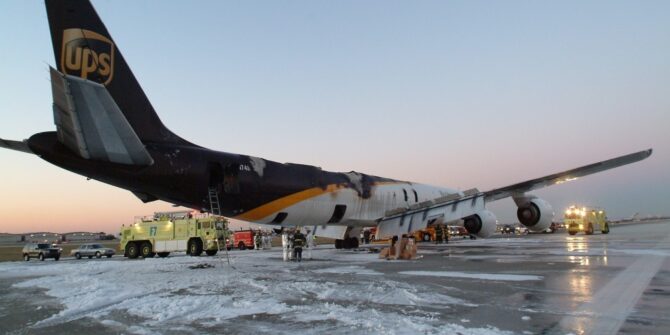
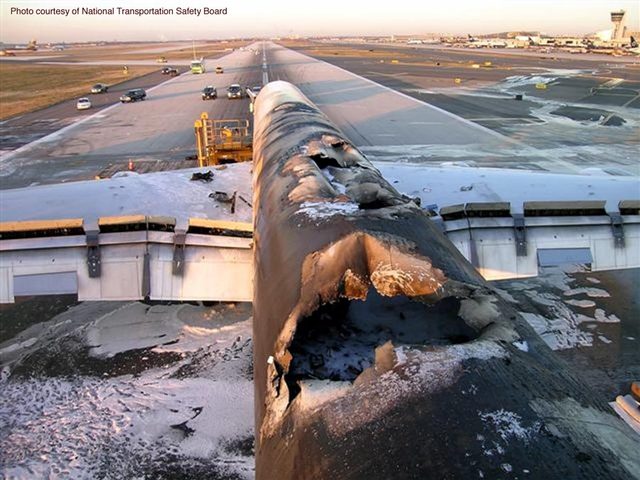
The biggest risk though comes from those in the cargo bay. Particularly the ones that you don’t know are there, should not be there, and which you cannot monitor. A UPS 747 crashed in Dubai after LI batteries in the cargo hold caught fire. The report suggested the heat and smoke from the fire disabled the crew oxygen system and entirely obscured their view within 3 minutes of the initial warning.

What can we do about them?

Most airlines will have a procedure written into their manuals, but it is worth a quick recap because there are some important bits to note.

  • If it has flames, use Halon. If you are using halon (in the cockpit) make sure at least one of you puts a smoke hood on – the stuff is very bad for you.
  • If there are no flames and it is just smoking hot, then cool it down by pouring water or a non-alcoholic liquid on it. If it is a laptop or something fixed in the cockpit then have a little think before you go slugging water on it though, because there are other electrics around which might not like it that much.
  • Don’t try to pick it up (without gloves on). Don’t cover it with ice thinking this will help cool it better, because it actually just insulates it more making it hotter. Don’t put it in fire resistant bags for the same reason.
  • Once it is safe to move, use fire gloves and put it in a receptacle – things like waste bins are good. Fill with water and store it somewhere safe where you can keep monitoring it.

Getting your crew to be vigilant for phones under seats (and passengers not moving said seat until phone is retrieved) is a good plan too.

The Cargo Concern

Lithium Ion batteries in the cargo hold are a different matter. If you have Dangerous Goods approval then you will have manuals and info on this. If you don’t have DG approval then any mention of Lithium Ion batteries on a NOTOC should be concerning you.

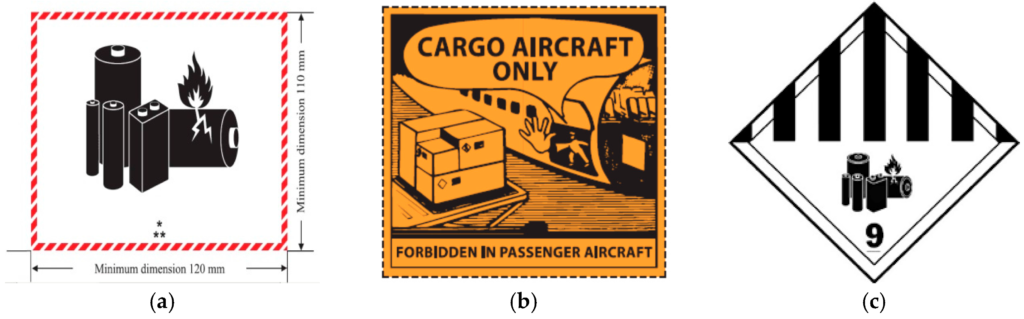
Lithium Ion batteries are a Class 9 Dangerous Good. The ones to look out for are the UN3480 and UN3090 numbers:

  • UN 3090, Lithium metal batteries (shipped by themselves). These are are not rechargeable and are designed to be chucked out after their initial use. They are actually Lithium Metal batteries. These are prohibited for carriage on passenger aircraft.
  • UN 3480, Lithium ion batteries (shipped by themselves). These are the rechargeable ones found in your phones and things.
  • UN 3091, Lithium metal batteries contained in equipment or packed with equipment
  • UN 3481, Lithium ion batteries contained in equipment or packed with equipment

Lithium Ion batters are allowed to be carried on cargo aircraft so long as they have been handled properly. The proper handling, packing, labelling and loading (what they need to be separated from) is all covered by IATA in their massive DG Manual. You can get that here, and find some handy online while you’re at it.

Again, if your operator doesn’t have DG Approval then this is just for info. If you’re wondering whether they do have approval then they don’t – crew have to undergo a yearly Dangerous Goods refresher course and you would remember this (because it is generally quite boring).

So, the simplest thing is to not carry them…

That would be great, but unfortunately it is not that simple. Lithium Ion batteries are in everything nowadays. They come in all shapes and sizes. So the first step is ensuring your passengers know what they are in, and are aware that they shouldn’t be putting these in their checked baggage.

Here is a handy info brochure to give to passengers.

This is a general ‘heads up’ list of some of the things an LI battery might be lurking within:

  • First up, those luggage bags which have them installed in them – if the battery can’t be removed and is more than 0.3g or 2.7Wh it probably shouldn’t be carried. If the battery is under those limits, or if it is removable then it can come onboard but only in the cabin, not in checked baggage.
  • Any lithium ion battery that is under 2g or 100Wh can generally be brought into the cabin. There is often a limit here (20 per person) but this varies with different operators.
  • Mobility aids – electric wheelchairs – often cause problems because folk don’t always know what their battery details are, and it is the airport staff who have to deal with this. The battery on these has to be in an enclosed container to prevent short circuits, and it must be attached as per the manufacturer instructions, or removed if it can be. If it is removed then it must not exceed 300 Wh or 160Wh if there are two of them on the device.
  • Hidden batteries – A lot of devices contain batteries. eBikes. Drones. Things that passengers don’t always think about.

The Captain probably needs to know about the location of these, so if you see stuff being loaded on and haven’t been informed about it, ask.

Finally, rogue shippers. Because of the restrictions, people are sneaking them onboard hidden in incorrect packaging, and without declaring them. They key to stopping this is going to lie with the airlines, operators and ground staff who need to be vigilant. The crew cannot do much more than mitigate the situation if some are onboard, and do cause issues.

Here is the full note from the US Department of Transport and IATA

What to do if you have an incident

If you have a Dangerous Goods Incident, you need to report it, and usually quite quickly. The FAA info page is here to help.

Lithium Ion battery fires are extremely hot and burn incredibly fast. If you think you have LI onboard that might be compromised, get that airplane on the ground as quickly as possible, and get your passengers off.

Want to read some more?


Going Viral: The non-Covid nasties to watch out for

With Covid running rampant across the globe, other risky diseases have been forgotten somewhat, but there are a fair few out there which can pose a threat to crew on layovers.

So here’s a quick round up on the regions where you might need to cover up, dose up, or just be extra cautious during your international flight operations, split into sections based on the active travel health alerts that the CDC and other health authorities have out at the moment.

Red Warning Level 3: Avoid all non-essential travel

Guinea – Ebola

They had a serious outbreak earlier in 2021. Actually, cases have reduced significantly and the US has just removed their travel restriction which required travelers coming from Guinea to enter the US via 6 main airports only. Caution is still very much advised though if traveling in the country.

Venezuela – Infrastructure

Not a specific disease caution here, just a warning that their healthcare infrastructure is breaking down and if you are taken ill here you may not be able to access treatment. One to think about if you ever have crew on a layover here.

Amber Warning Level 2: Extra caution

Fiji – Leptospirosis

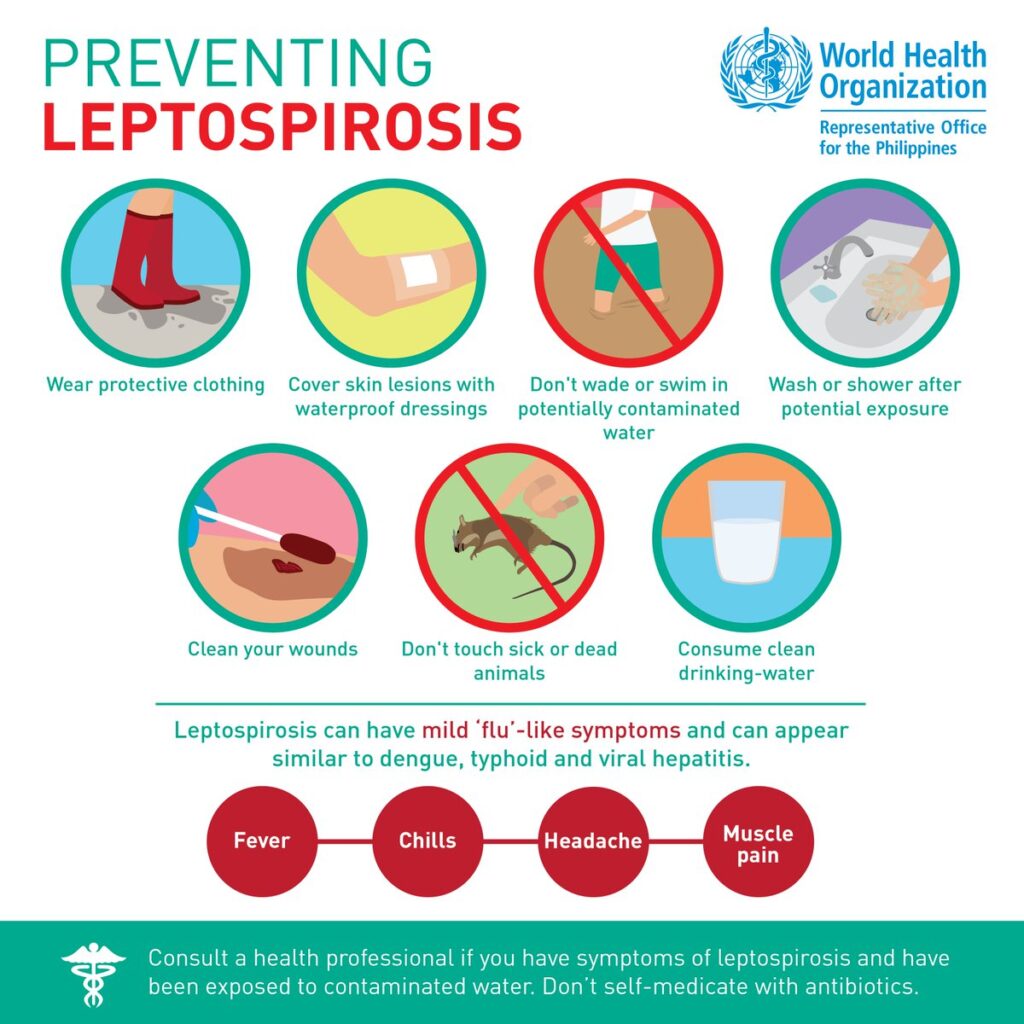
This really prevalent in Fiji at the moment, particularly rural areas. It is caused by a bacteria spread around by animal pee, and can get into water and soil and live there for months. The main guidance is to avoid swimming or wading in water that could have had infected animals in it. Wear protective clothing and footwear and cover any cuts and scratches with waterproof bandages.
Haiti – Rabies

Haiti currently has a big problem with rabid dogs. The bigger issue is that there is an extremely limited supply of treatment drugs in Haiti, so the recommendation is to get vaccinated before you head there.

Avoid dogs, and cats for that matter – even the cute baby ones. You can catch it if you are bitten, scratched or even licked, and treatment is only effective if administered early. Once symptoms present themselves it is often fatal. Plus, getting bitten by anything is never pleasant.

Polio – Africa and Asia

Everyone should be vaccinated against this. If you are not, get vaccinated (or don’t travel) because this is continues to be very prevalent in African countries and there is always a risk.

Nigeria – Yellow Fever

Consider getting vaccinated if you head here regularly, and try to prevent mosquito bites (also, because they carry loads of horrid stuff).

International flight crew generally are required to have had Yellow Fever Vaccinations – if you have not then take care because some countries will not allow crew (anyone) to enter who does not have a vaccination booklet if they have traveled to a Yellow Fever region recently.

What else to watch out for

Malaria

Malaria is a parasite carried around by mosquitos. There are actually four types of it, and it is in a lot of places!

The big risk here is it can take a while for symptoms to show. They reckon you’re most likely to have symptoms between 10 days and 4 weeks from being infected, but it could take as long as a year. The little beasties also like to loiter around in your liver, popping out at random times when you’re run down, and so can cause recurring illness for as long as 4 years after infection.

Where?

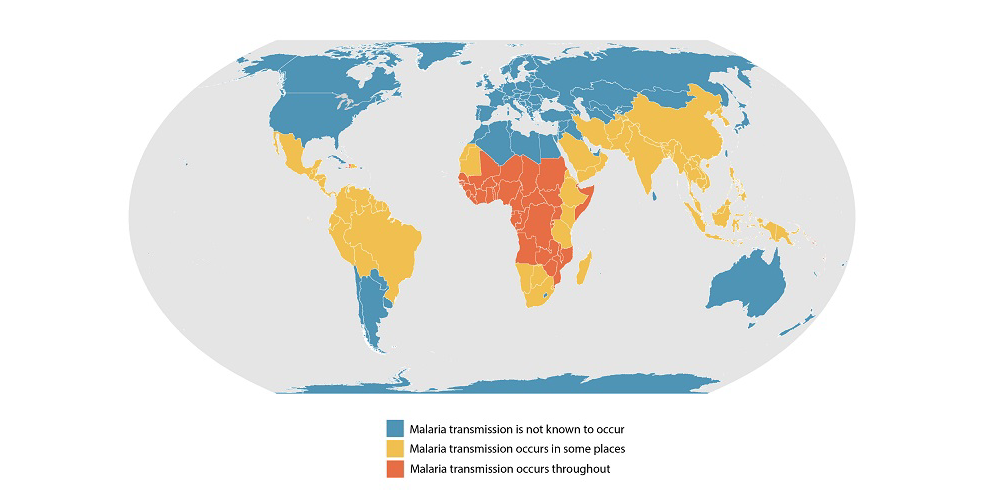
According to the CDC it is found in warmer regions, which doesn’t narrow it down an awful lot – basically anywhere hot and humid where there are places for mosquitoes to breed and grow. Just after rainy season is likely to be the worst, and rural areas will be more risky.

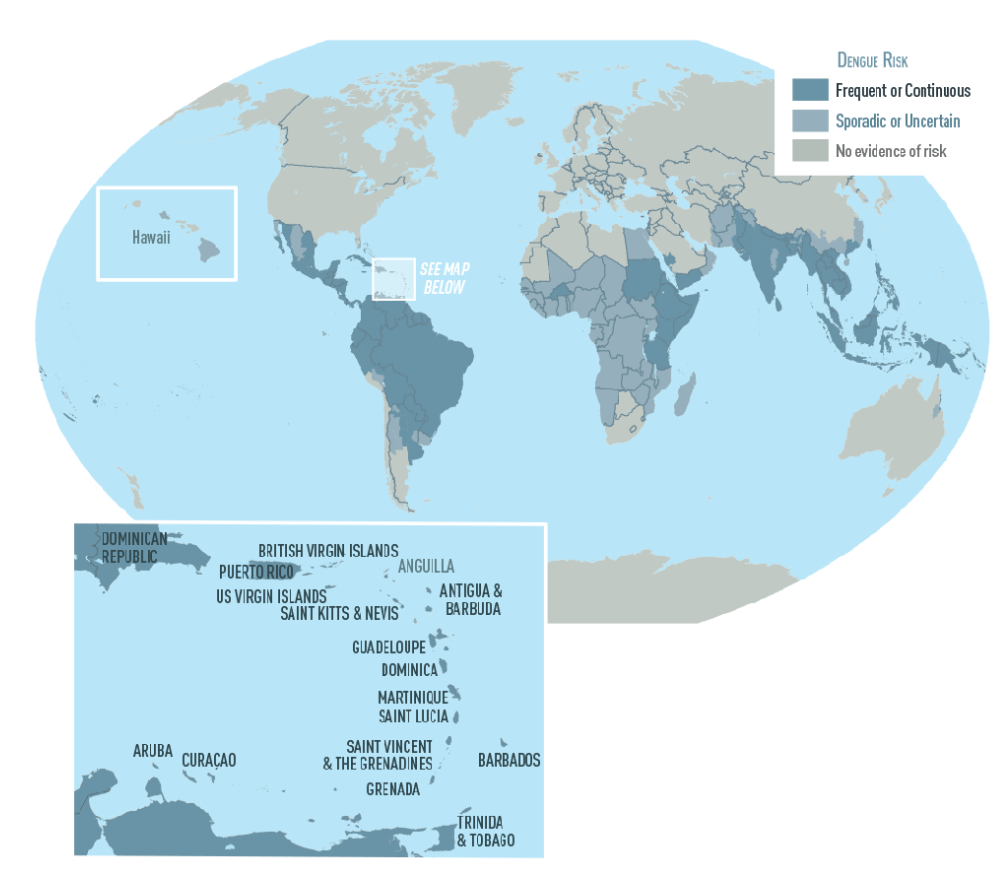
We have borrowed the CDC map because it is easier than trying to list everywhere to watch out.
How to prevent it

If you are going to a Malaria riddled area then you can take preventative medicine, but watch out! Not many are approved for operating pilots because they can have some nasty side effects. Malarone is the most commonly approved (and generally has the least side effects) but we ain’t no doctor so check with an AME from your licensing state before taking.

The other option is to slather yourself in deet and wear long clothing to prevent the little nippers from getting at you in the first place.

The Symptoms

  • Fever, sweats ad chills
  • Muscle ache
  • Nausea and sickness

So, basically generic symptoms of about a thousand other possible diseases.

If you have been to a malaria area and are thinking “I got chills, they’re multiplying”, don’t write them off as a random cold – tell a doctor so you can get tested because it can get very serious!

Dengue Fever

Another one to blame on the pesky mosquito, Dengue is common in over 100 countries, and over 400 million people catch it every year, 100 million getting sick and 22,000 dying. Dengue Fever is Malaria’s bigger, badder brother, and there is no specific treatment.

Like Malaria, there are also different strains of the virus meaning you can get different sorts, multiply times.

Where?

Outbreaks are coming across the Americas (including North America, although the mosquitoes aren’t there, people just head in already infected), Africa, the Middle East and Asia, and the Pacific Islands. It is most prevalent in tropical and sub-tropical areas.

There is currently a growing outbreak in Reunion.

Brazil has the highest rate of Dengue fever in the world.

How to prevent it

Best plan, don’t get bitten. Insect repellent is smelly, sticky stuff but it works. Here’s what the CDC recommends:

  • DEET
  • Picaridin (known as KBR 3023 and icaridin outside the US)
  • IR3535
  • Oil of lemon eucalyptus (OLE)
  • Para-menthane-diol (PMD)
  • 2-undecanone

There is a vaccine but it is only given to people who have been infected before and have a risk of getting severe Dengue, and for kids between 9-16 who live in a Dengue area.

The Symptoms

The early, mild ones tend to get confused with other diseases so again, ff you’ve been somewhere with Dengue, don’t assume it is something else. Go get tested.

Initial symptoms usually appear within 4 to 10 days:

  • Nausea and sickness
  • Rash
  • Aches and pains, especially behind the eyes and in bone joints and muscles

These last around a week, unless you develop serious Dengue fever, which 1 in 20 do:

  • Belly pain
  • Vomiting (a lot)
  • Bleeding from nose and gums
  • Lethargy

Zika

This one made the news a few years ago as it can cause serious birth defects. The symptoms for most tend to be fairly mild though.

It is also transmitted by our old friend the mosquito and there is no particular treatment so your preventative tricks are the best – don’t get bitten!

Chikengunya

Transmitted by mosquitoes, this has very similar symptoms to Dengue Fever and Malaria, and is found in all the same spots.

There is no treatment for it and no vaccine to prevent it, so preventing bites is really important.

There are currently serious outbreaks in Brazil, and in Asia (Vietnam, Philippines)

Ebola

This is a nasty one, often deadly, and causes lasting damage. They don’t really know where it comes from but it possibly started with monkeys and apes and was passed onto us human folk.

It is spread through direct contact with all the gory stuff that comes out of sick people.

Where?

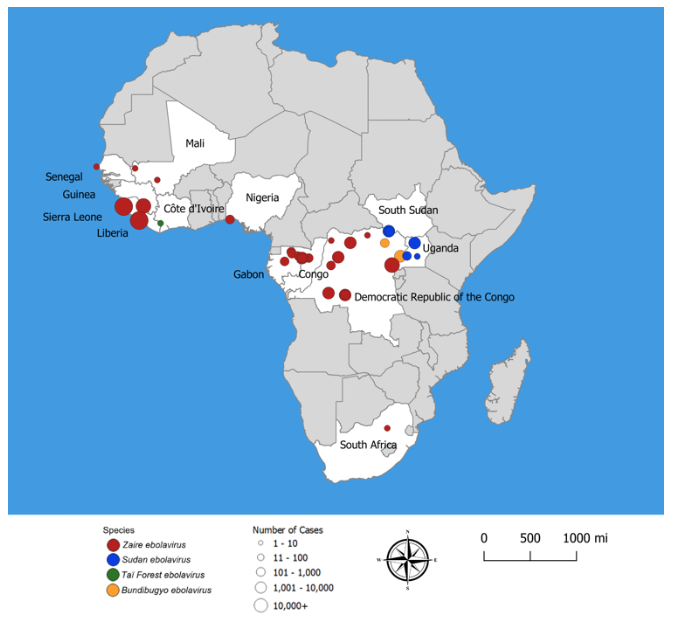
Guinea had a major outbreak in 2021, but cases have fallen again. The US previously restricted travelers from here, and from the DRC, only allowing entry through 6 specific airports.

In 2020, the DRC (formerly Zaire) had a major outbreak.

It is most common in African countries, particularly the central African countries, and along the north west coast.
How to prevent it

It is spread through bodily fluids so avoiding contact with these is important. You also should avoid contact with animals that live in Ebola regions. Bats, primates, forest antelope all carry stains of the virus. So don’t eat them.

There is a vaccine but it is only used in areas where an outbreak is occurring. There is medicine for treating it, and the do help survival rates. You also need medication to support blood pressure, to manage the fever etc, so this really is a serious disease which you do not want to catch

The symptoms

These can appear between 2 and 21 days of infection, usually around the 8 day mark. The main symptoms are:

  • Fever
  • Severe aches and pains
  • Sore throat
  • Loss of appetite
  • Gastrointestinal symptoms
  • Unexplained hemorrhaging, bleeding and bruising

Yellow Fever

This is pretty rare nowadays, but still on to watch out for across Africa and South America. It gets its name from the fact it generally causes jaundice.

Insect repellant works well. It is transmitted by the mosquito (again)

There is also a vaccine. It has been used for 80 years and it pretty well tested, safe and effective, with 1 dose providing life long protection. In fact, many countries require travelers to have had the vaccine if they are entering from a country (or have visited one) where there are high incidences of Yellow Fever.

Meningitis

This is serious – it makes your brain and spinal cord membranes swell up which sounds horrid and painful. It can be bacterial, viral, parisitic, fungal, amebic… so there are a bunch of different sorts all with varying degrees of nastiness.

Good news though, there is treatment for most, and vaccines. You have likely had some already, it is another one that flight crew are often vaccinated for because this can be caught from all over the place. Bacterial in particular can be in food.

General travel recommendations

The CDC has good guidance for flight crew which you can read here.

Many international airlines require their crew to have the following vaccinations, and they are often recommended in general for any traveller:

Cholera – Africa, Asia, Central America and the Caribbean

Diphtheria – Africa, south Asia, former Soviet Union. This protects you against Diptheria, polio and tetanus

Hepatitis A – Africa, Asia, Middle East, Central and South America. This is common in places with poor sanitation and hygiene and can be picked up a lot of ways.

Hepatitis B – Africa, Asia, Middle East, Central and South America. This is spread by bodily contact generally.

Japanese Encephalitus – Common in rural areas of Asia with a tropical climate, after the rain season. It is also found in western Pacific island and near Pakistan, China and Australia. Actually, it is rarely found in Japan because they did a mass immunization program years ago. There is a tick borne version too. Also with a vaccine available.

Typhoid  – the Indian sub continent, south and south east Asia, South and Central America, Middle East

Assessing the Risk: Operations Over Conflict Zones

ICAO Doc 10084, if you have not come across it, is a sixty plus page document looking at ‘Risk Assessment for Civil Aircraft Operation Over or Near Conflict Zones’. Important stuff.

But despite manuals and procedures, regulations and recommendations telling us how to watch out for, assess, mitigate and manage the risk of conflict zones, there remains a much bigger and more significant risk to safety because of conflict zones.

So, what is this risk, and more importantly, what can we do about it in the aviation community?

Information

The huge hindrance to maintaining safety does not lie just with the SAMs themselves. It lies with information – the quality, quantity, reliability and promulgation of it. The result is that risk assessments are fundamentally flawed, understanding is limited and critical information does not reach those who need it.

So, there are four big points that need considering when we look at conflict zones and their impact on airspace safety:

  1. The Bigger Question – A risk assessment is much more than just asking “Is there a weapon down there?”
  2. Rules alone do not change the behavior of states – Information from states is critical, but it is often not shared, or not shared very well.
  3. Are we actively seeking information, or simply waiting for it to come our way? – The safety process does not stop at the state level, it continues (should continue) dynamically with operators and with the pilots, so understanding the situation is important.
  4. How can we do better? – Individuals and the industry have a responsibility to ensure information and strategies are shared.

1. The Bigger Question

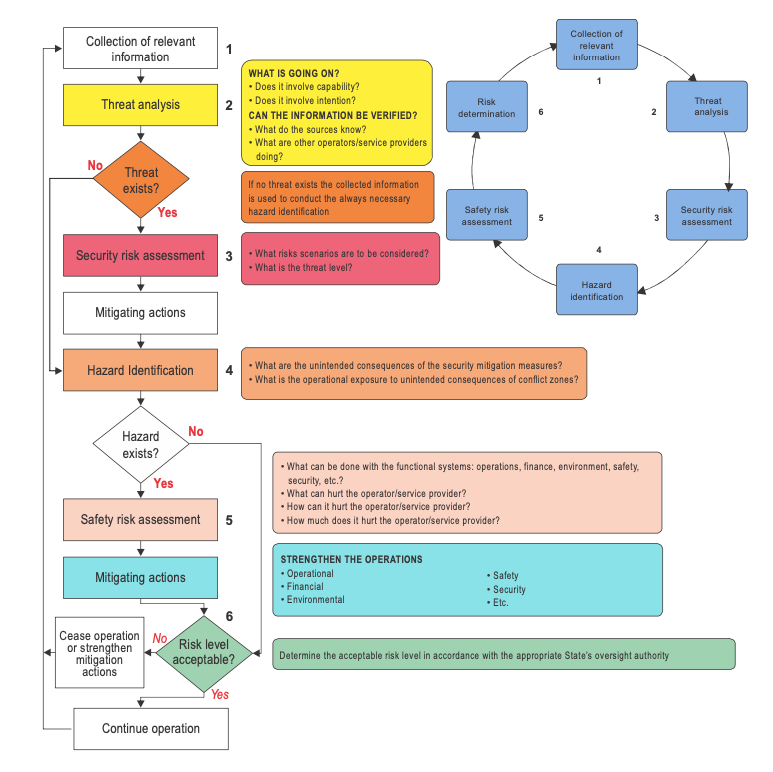
The bigger question is to do with how risk is assessed, and it is a complex process even when information is available.

ICAO Doc 10084 lays out the risk assessment process. It’s an interesting read and worth taking a few minutes to think about because understanding the background to conflicts and what the key factors at play are is the only way for safety strategies and risk assessments to continue, and continue they should – it does not stop when a Notam is released.

The process is dynamic and needs to continue with the operator and the pilots too.

What are the key factors in a risk assessment?

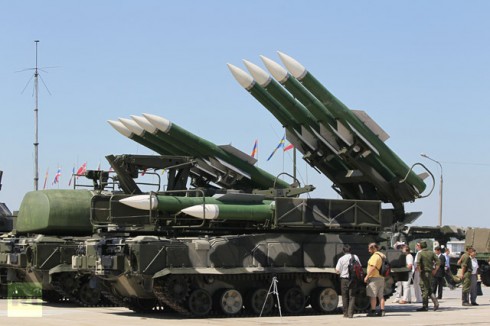
First up, what are we actually talking about here? Long-range Surface-to-air missiles (SAMs) can reach aircraft cruising in excess of 25,000ft (7600m). They are often linked with radar sensor systems to help identify targets, and are mobile and easily and quickly relocated.

So we need an assessment of what danger these pose to airlines and airplanes, and this means we need to know who has them (the capability) and also their intent (who or what do they plan to target).

But it is not that simple. Where there is intent, there is not always capability; and as importantly, where there is capability there is not always intent. The Iranian shoot down is a clear example of this. So we also need to consider the unintentional risks as well.
The questions asked look something like this:

  • Is there use of military aircraft in combat roles or for hostile reconnaissance (including unmanned aircraft)?
  • Are aircraft used to transport troops into the area and do these routes coincide with civil air corridors, or lie close and so pose a risk of misidentification between civil and military aircraft operating in the area?
  • What are the politics relating to the region?
  • What are the training levels of SAM operators and what is the military deployment of SAMs? How reliable and credible is the information shared by the state regarding this?
  • Is there a lack of effective air traffic management over the relevant airspace? Is the state fully in control of their own territory and do they fulfil all their ATC, coordination and promulgation (of information) obligations?
  • Do civil aircraft route pass over or close to locations or assets of high strategic importance or which may be considered vulnerable to aerial attack in a conflict situation?

But, the risk continues beyond this initial assessment because we also have to identify any ongoing consequences of an event. If a major airport is targeted, the impact is not only with the initial damage – if that initial damage is to the ATC systems required to maintain control and separation of aircraft then now we have reduced safety in the airspace and a much larger level of disruption.

So, we must think about the overall severity, and with that the tolerability of an infrastructure or operation. We are asking both ‘What can it hurt?’ and ‘How much it will hurt?’ 

This assessment, according to the ICAO document, is thrown into a matrix and churns out a ‘Risk Level’ which leads to the actions taken. 

Sounds simple, but there is one key point here – 

This info is not easy to come by. It is rarely reliable, and there is a qualitative narrative that makes it very subjective. The information has to be promulgated from states.

Which leads us to Point Number 2.

2. Rules do not change the behavior of a state….

States are responsible for sharing info on hazards, on what mitigation strategies they have in place, and the assessed impact of the strategies they adopt.

This often does not happen, or it does not happen well. Look at Ethiopia/Tigray region situation – misleading Notams and no guidance from the Ethiopian authorities led to Opsgroup issuing our own warning regarding the situation.

Further to that, ICAO only mandated the reporting of hazards in notices to pilots since 2020, and some states are still failing to do so.

3. People are not seeking information, they are waiting for it to come their way

This is why SafeAirspace was created.

Information is not being shared well and risk assessments are fundamentally flawed because the information on key factors is simply not available or reliable most of the time.

What’s more, people are rarely questioning whether the information they received was reliable, accurate or complete. Few proper risk assessments are taking place because those responsible are waiting for the information to come to them, and without a proper risk assessment, mitigation strategies are not sufficient, and are not being passed on to those who need them – the pilots.

What is the Operator’s continued role in the process?

Every operator is responsible for continuing the risk assessment. It is not enough to simply direct crew to a Notam. Ensuring crew have a full briefing on the threat and any mitigation strategies is important.

  • Emergency and abnormal procedures should be considered in advance. Take Mogadishu airspace where only flights on specific airways over the water are allowed. What is the strategy here in case of an engine failure or depressurization? If you operate over this region, you should have access to this information.
  • Operators are also responsible reviewing fuel requirements – ensuring additional fuel is provided for potential diversions around conflict zones.
  • If aircraft will be operating into conflict zones, then a review of MEL items which can be deferred is a good call – can the aircraft get out again without requiring maintenance or fueling?

What is the pilot’s continued responsibility in the process?

The information and strategies we see at the operations end are things like these:

  • Coordination between military authorities, security and ATS units
  • Briefings of personnel
  • Identification of civil aircraft by military units
  • Issuance of warnings and navigation advice
  • Air Traffic Restrictions
  • Closure of Airspace

But this does not mean the full risk has been removed. Understanding this, understanding how the situation got to this point, and understanding the risk assessment and safety management that has taken place is vital because the process now continues with you, the pilot, and this a fundamental step in continuing to manage safety.

  • The Crew, and the Commander of the aircraft are responsible for the safety of the aircraft and the passengers. Of course, we all know that, but if you are given a Notam saying “this airspace ain’t great, maybe avoid it” and then you fly through it, where does the responsibility of your operator end and yours begin?
  • Reading notams, the AIPs, AICs, and being aware of the threats of the airspace you might be asked to operate into is vital. More than that, ensure you are aware of any mitigation strategies required.
  • Pre-prepare for diversions and know where you can safely go. Some diversions might take you through prohibited airspace so if you are operating in the vicinity of some, have a route ready in box two so you can easily avoid airspace when you need to.
  • Be aware of security threats and hazards on the ground, in advance.
  • Consider the serviceability of aircraft equipment before you go – critical equipment would be communication systems, and those required to ensure military units can identify them as civilian;
  • Have an awareness of the potential political implications if diverting into some regions with certain nationalities onboard. If you divert there, what will happen to your passengers and crew, and why?
  • Report things. Keep the information loop going.

4. How can we do better?

Aeronautical info from states and authorities is your first point of call. AICs, AIPs and Notams are going to contain info on advisories, restrictions and recommendations.

If you are an FAA operator, then the FAA put out KICZ notams and this page has all the current ones for airspace.

Networks and organizations such as us here at OPSGROUP try to share relevant and up-to-date information on airspace, conflicts and the risks that are out there.

Open sources like social media and news sites are also good – but be careful, these may come from unconfirmed or unreliable sources. We recommend checking info with other sources too, like handling agents in the area.

Finally, talk to other pilots and operators, and be sure to report information you have from operating in or through airspace.


2020 Vision: A look at Safety

2020 was an interesting year for aviation. It was dominated by Covid, which saw traffic numbers fall to the levels of several decades before – which is why a review of the accident statistics is an interesting one to consider.

What sort of accidents are taking place?

The primary accidents seen in 2020 are unsurprisingly similar to those seen over the last decade:

  • Runway excursions
  • Loss of control in flight
  • CFIT
  • Abnormal runway contact (hard landings and tail strikes)
  • Actually missing the runway (undershoot and overshoots)
  • System malfunction or failure
  • Fire

We wrote a bit about these in a bit more detail not that long ago. We called it the ‘Seven Deadly Things’ and you can read it here.

What are the 2020 stats?

Well, first up, 2020 was roughly the same in terms of capacity as 1998 – a year known for Bill Clinton, the inception of the Euro and the movie ‘Titanic’. Yep, that long ago. So, same traffic levels, but different accident rates – 1998 saw 10 fatal accidents and 24 hull losses compared to “just” 3 and 6 in 2020.

But if we compare the 2020 numbers to 2019 it paints a different picture. Or rather, it is actually a very similar picture. While there there were only roughly 50% the number of flights in 2020 that took place in 2019, there were still 75% the number of fatal accidents. 

OK, this isn’t a very telling statistic since we’re talking 3 instead of 4 and neither is huge, but it does mean the fatality rate and hull loss rate went up per million flights in 2020. It was not a significant increase, but it is enough to suggest that yes, not flying regularly can lead to more accidents and incidents. 

Not really news there then, but something worth considering.

Point number 1 – Lack of flying leads to mistakes

If we take a leap back to 1958 and look at the accident rates through the decades then there has been a steady overall decline, and now we are sitting “comfortably” at under 5 fatal accidents per year, while flights have increased from about 12.5 million (1989 sort of time) to 35.8 million (the peak in 2019).

So, in thirty years the rate per million flights has dropped significantly to around the 0.17 per million flights point, and hull losses to 0.34 per million.

How did it get so low?

Significant leaps have been made in aircraft design over the years and this has had a huge impact on safety levels. Of course, training, CRM, Human Factors awareness and all of that has played a part too, but the major pat on the back goes to the airplane builders. For every silly mistake a pilot has made, they have generally identified it and then helped prevent it by building us better instruments, more robust systems, or things that catch our mistakes for us.

In fact, if you look at the fatal accident rates per million and then break it down into aircraft generation, it has dropped from 3.0 to 0.1 , and 5.4 to 0.2 for the hull losses. So technology is helping us. A lot.

Those big ones – the CFITs and LOC-I accidents – have reduced by 86% and 89% because of technology upgrades from Generation 1 to Generation 4 aircraft. This is down to the introduction of things like glass cockpits, FMW and TAWS systems.

How low can it go?

Can we reduce the occurrences to zero? If not, even with all this handy automation, then why not?

Well, these statistics offer us an answer there as well.

They are taken from across civil aviation, revenue flights on western built commercial jet aircraft that carry over 40 passengers, and also big cargo ones. It doesn’t include non-western built aircraft (possibly because the safety records on them ain’t great), and it doesn’t include Business Aviation.

Why not? Well, because the operational environment is very different, and very different in challenging ways. 

So, we are looking at the accidents which have involved nice, relatively modern commercial aircraft generally piloted by experienced folk going into places they have gone into many times before. And yet they are still managing to get it wrong.

What’s more, we’ve seen how automation is helping – it has brought us down to a very steady level.  So what is going on? We recently published a piece on the ‘Hidden Risks of Automation’, which we think offers some of the answer.

The ‘Problem of the Person’

Unfortunately, the solution to the Problem of the Person is not a simple one.

‘Human Factors’ might give us some reasons – poor decision making, bad workload management, lack of understanding the systems, but none of these really provide the answer to correcting it. The work now comes down to us.

1. Don’t Become Complacent: We have multiple systems put there to provide another layer of safety but we are seeing pilots rely on them as the only level of safety. These systems are a last line of defence though, not the the only defence.

ROW/ROP should supplement good landing performance assessment and stabilized approach management.

TAWS and GPWS systems give us a hard floor that we must not go below, but our own situational awareness should keep us well away from ever having to hear those calls.

Autopilots, flight protections and warnings should be a final alert, but basic airmanship and handling skills should correct our flightpath long before we reach a level that needs those systems to help.

2. Poor Decision Making and Workload Management: None of our clever automation and systems have the ability to think and question for us. So we need to make sure we are doing this, and we need to make sure we are doing it in the right way. Ask the right questions, gather information and use your resources properly.

Ask “What does this mean?” – Diagnose the problem not based on what has happened, but on what the impact and consequence of that failure is.

Ask “What has changed?” –  Review your decisions. Don’t fit new information into the solution you’ve already picked, rather adapt your solution to consider the new information. 

Ask “What do you think?” – Open-ended questions that gather input from someone else might catch things you have missed, or misinterpreted.

3. Just Do better

When we have seen automation and systems reduce the number of occurrences down to this point where the vast majority of accidents are down to human error, there really is no better solution than us Just Doing Better.

But this ‘better’ falls on the whole industry.

Sharing information, experiences, supporting development in others and improving training and pilot resilience. 

There are multiple projects out there:

  • IATA and the Flight Safety Foundation have just released their recommendations for reducing runway excursions (GAPRE).
  • ICAO are implementing new Runway Condition Assessment and Reporting standards from the end of this year.
  • UPRT training is being developed and improved.
  • IATA and ICAO Evidence Based Training development is shifting the training paradigm to train competencies rather than practicing solutions to singular events.

At the end of the day, aviation has grown progressively safer and more efficient over the last few decades, but the trend is flattening out and the same events seem to be occurring, for the same reasons. The ball is now in our court to try and fix the remaining issue – because, as harsh as it sounds, that issue is us.

Fancy reading some more?


Bomb Onboard: Do you know your procedures?

Airport security means the threat of a bomb onboard is greatly reduced. But if you do receive a bomb threat, or find a suspicious package onboard, what procedure does your operator have in place for you to follow?

How much risk is there?

You have probably all heard the Shoe Bomber attempt from 2001. This was thwarted by some brave passengers and crew, and also the fact the bomber had sweaty feet – his swamp foot dampened the trigger preventing it from igniting.

In 2016, an aircraft made an emergency at HCMM/Mogadishu airport after a bomb exploded onboard. The bomb was likely brought on concealed within a laptop. This flight was lucky though – the impact of the bomb was minimal, limited because the bomb exploded while the aircraft was at a lower altitude (11,000ft).

In 2020 a European airline found a ‘bomb note’ onboard. The flight was escorted to a safe landing and passengers disembarked without incident.

So bomb threats, and attempted bombings, do occur, and while security is getting better and better, unfortunately terrorists are getting more creative in finding ways to bring items on board. The attempts are not always aimed at causing destruction either – threats alone cause a huge amount of disruption to operations. So understanding how to assess the risk and credibility of a threat is as important as knowing how to deal with a possible explosive device if one is found onboard.

Is the threat credible?

Threats received regarding an aircraft need to be assessed, and the credibility determined. The threat classification will generally be based around how specific the threat is. Most operators will have a procedure in place for determining this, and probably take into account something along the following lines:

If a threat mentions a specific target, or is made by a known terrorist organization and is deemed credible then this is going to be considered more serious. Often these are referred to as a red threat.

On the other hand, a threat which is vague, general, and doesn’t specify targets might be considered less credible. A hand scribbled note in the toilet for example. This would be categorized as a green threat.

However, regardless of the assessed credibility, a bomb threat has to be taken seriously and treated as a genuine situation.

If you are on the ground

The simplest and safest option if you are on the ground is to disembark and carry out a full search of the aircraft. It might be a hassle and result in some big delays, but the possible alternative is much worse.

A serious threat may require a precautionary disembarkation – which will result in offloading the passengers as quickly and as safely as possible. This creates a risk to safety in itself, and generally the credibility of the threat will be communicated to the crew so that they can judge the risk of waiting (for steps) versus disembarking immediately to clear the aircraft (but have passengers hurling themselves towards the tarmac).

If you are in flight

If a threat is received against your aircraft while in flight, carry out a search checking those places which are often overlooked during security checks on the ground, but where an article might easily be concealed – toilets, galleys, jump seats, stowage areas, closets etc. Try and do it discreetly to avoid unnecessary worry for passengers.

If an article is found, do not move it or touch it. Move passengers away from the immediate area, and remove any flammable items and have fire extinguishers ready in case. A PA asking for anyone onboard with ‘BD or EOD experience’ might help – these are terms which experts will recognize without saying “Hey, passengers, is there a bomb expert onboard?”

Not terrifying your passengers is probably a good call, but ensuring they are following your crew’s orders, and that they are prepared for the situation on the ground, is also necessary. This means providing them with clear information, but without dramatizing the situation.

“Ladies and Gentlemen, we have received a message that a threat has been made against one of our aircraft/an aircraft in this airspace. These threats do happen, however, until we can establish how credible it is, we will take all possible precautions and therefore intend to land at… in…”

If you find a suspicious article

Most manufacturers provide checklists for bomb-on-board situations. Know where this is, and understand what it says. 

There are a few measures you might want to consider:

  • Talk to ATC so they know exactly what is going on and what you need. They all assist with locating an airport with services needed, and coordinating with military if necessary.
  • Try to avoid routes over heavily populated areas.
  • Consider carefully the choice between flying fast to minimize airborne time versus flying slow to minimize air-loads and damage (in the event of fuselage rupture).
  • Request remote parking on the ground if there isn’t a designated bomb location.
  • Brief your crew for a possible emergency landing, and in any event, brief them to ensure passengers are disembarked quickly and moved to at least 200m upwind from the aircraft.
  • Avoid large and rapid changes to pressure altitude – consider using manual cabin altitude controls to minimize rapid pressure changes while still lowering the cabin altitude to reduce the differential pressure.

Aircraft are designed to not ‘explode’ if there is a rupture in the fuselage – that’s why they tend to have a lot of smaller sections attached together. It makes the overall structure more resilient to the effects of an explosive decompression, aiming to keep it “localized”.

Reducing the differential pressure to around 1 PSI will also reduce the damage if an explosion does occur. Maintaining a slight differential will ensure the blast moves outwards, but the lower differential limits the force of air from the cabin outwards. 

1psi is the equivalent of about 2,500 feet difference, but flying at an altitude that allows you to manually reduce the differential will probably mean a much lower level and much higher fuel burn.

Where is your aircraft’s LRBL?

A Least Risk Bomb Location is an area where the least damage will occur should a bomb explode. This should be specified in your aircraft manual. These are often near aft doors or in washroom stowage areas. The area provides the least risk, in the event of an explosion, to flight critical structures and systems.

If the article is deemed unsafe to move, cover it in plastic to prevent any liquids getting in, and then pile blankets and pillows, seat cushions and soft clothing around it. We’re talking as big a pile as you can, and once done, saturate in water to minimize fire risk in case an explosion does occur. Don’t forget the plastic sheets first though –  liquid damage to electrical components is also a big risk.

If you can move it, and only if it is deemed essential to do so, then check that LRBL. Once in place, build up the barricade.

Always minimize movement to any article as much as possible, and don’t put anything directly on top of it. An igloo of saturated cushions around it and the gaps stuffed with blankets etc is good.  This ‘cushioning’ will help minimize the force if an explosion does occur. Never put inside an oven or trolley though as a sealed container will amplify the pressure and explosive force of a bomb.

Where to go

You will likely be accompanied by fighter jets to an airport with a designated bomb area – usually a remote apron away from buildings, fuel supplies and other aircraft.

What next?

Getting your aircraft safely on the ground is Step One. Getting your aircraft to a safe point to disembark/evacuate your passengers and crew is Step Two and coordinating this with ATC and airport services is important. Knowing in advance where you will taxi to will get you there more quickly and safely. Landing, slamming on brakes and bursting tires will get you nowhere fast, so plan ahead and be prepared.

A bomb threat or bomb onboard situation is difficult to plan for because the ‘where you are and what will happen’ is not something we can prepare for, other than being ready to follow our procedures and remaining calm. Chances are this is not a situation many of us will (thankfully) find ourselves in, but understanding the resources you have to assist, and knowing the onboard procedures so you can coordinate passengers and crew will no doubt help if it ever does occur.


The Hidden Risks of Automation

Over the past decades our industry has undergone an automation revolution.

Basic autopilots from eras-past were little more than wing levellers. Today they are sophisticated computers capable of awe-inspiring accuracy.

The industry has welcomed automation with open arms. And it’s no surprise. The vast majority of aviation accidents are caused by us, humans. Mechanical failure on the other hand only accounts for less than a quarter of all accidents.

So for operators and manufacturers alike the benefits of automation are clear – safety and efficiency. We are simply not as predictable or consistent as a computer because we are human. And automation has become a major line of defence.
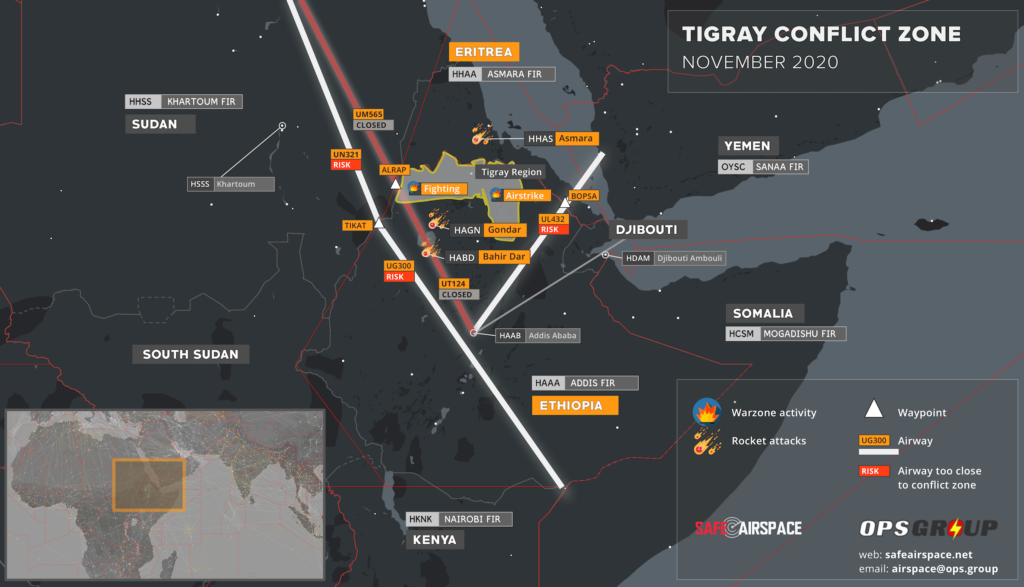
But herein lies the problem…

It’s easy to see that a pilot’s role in the flight deck has changed forever as we interact with higher and higher levels of automation. Some might even argue that we are being progressively designed out of the cockpit completely and to some extent this may be true. Whether we like it or not, full autonomy is coming. Take the Xwing Project for instance – their concept can be retrofitted to conventional aircraft enabling them to fly without a pilot.
But right now the more pressing issue is that our role continues to transition more and more from flying airplanes to managing automation. Put it this way. A recent study found that across a large sample of flights aboard the Airbus A319, pilots were spending on average only 120 seconds manually flying each flight. And that was the middle of the curve.

This creates a unique set of risks that the industry collectively needs to better address.

Good Automation

By no means is this an attempt to detract from the positive impacts that good automation continues to have in our skies. The benefits are no secret. When used as intended it is a huge work-load reducer. It allows us better flight path control and liberates us from repetitive and non-rewarding tasks – something humans are known be no good at. We become less fatigued and have more capacity to deal with other things.

It also works in unison with systems like ECAM and EICAS to better help us manage things when something goes wrong.

Automation has also improved the skies we fly in. Fantastic things like RVSM and PBN have allowed us to fly closer together and make better use of crowded airspace. While around the world minimas grow ever closer to the ground thanks to things like RNP approaches where automation can help us ‘thread the needle’ in some one the world’s most challenging approaches.

Take Queenstown for example. The notorious airport down in New Zealand boasts beautiful scenery but a reputation amongst pilots as being one of the most demanding in the world due to the intimidating terrain that surrounds it. RNP approaches have dropped minimas from over 3000 feet off the deck to less than 300. And now you can land there at night.

Bad Automation. Here is where things start to go wrong.

All positives aside, automation is also having an effect on us pilots. And it is important to remember  just that – we are still pilotsWe must never lose the ability to fly without automation. Back in 1997 the late and well-respected Airline Captain Warren Vanderburgh saw it coming and coined the phrase you are no doubt familiar with – Children Of The Magenta Line.

This remains true to this day. If we become too reliant on automation, avoidable accidents happen. Here’s why.

It Erodes Skills.

Slowly but surely automation is chipping away our manual and cognitive flying skills. You know the ones – your stick and rudder. We are being actively encouraged to keep automation on and control our trajectory through it. Do that for long enough and we begin to forget how to do it the other way – with our hands, eyes and feet.

It Distracts.

Because we are so used to flying our airplanes through automation, when something unexpected happens such as short notice changes from ATC our immediate response is to try and figure out how to make the automation accomplish it. We go heads-down precisely when we should be going heads-up – and the clock is ticking.

It Confuses.

Chances are if you have operated anything with high levels of automation, at least once you’ve uttered the infamous phrase “what’s it doing now?”

And yet still we are reluctant to turn it off. As soon you identify that the aircraft is not going where it should, that’s your cue to intervene. The minute you don’t, you are simply along for the ride. Pilots around the world would agree, this is never good enough.

Mode confusion is another. Modern automation features many different ways of achieving the same outcome, but with subtle and sometimes dangerous differences. We need to understand the limitations of each one because if we don’t, we know that tragedies can happen.

A little known incident in Australia serves as a good example. Snowbird, an Airbus A319, was on approach at YMML/Melbourne airport on a clear calm evening. A tired but highly experienced crew were flying an unremarkable STAR and ILS approach at the highest level of automation. All was going well until the pilot flying reached up to arm the approach in a dimly lit cockpit. He pressed the wrong button. Over the next 39 seconds chaos ensued.

What followed was a series of rapid fire mode changes, confusion and attempts to salvage the approach through the automation. Three EGPWS warnings were triggered and an altitude alert issued by the tower as the airplane reached just over 1,000 feet off the deck at 315 kts before they regained their situational awareness and executed a missed approach.

After the incident neither pilot could recall exactly what happened, what modes they had engaged and neither had heard any of the EGPWS warnings. The automation had performed flawlessly throughout by providing the crew exactly what it was told to do. When it all went wrong, it seems the pilots were reluctant to turn it all off.

It Startles.

Automation is designed to give you back control when something goes wrong. For crew our first indication is usually a loud aural alert and a flashing red light. For systems that seem to operate flawlessly flight after flight, day after day, the affect can be startling.

Pilots are suddenly given full control because we are supposed to be the ultimate fail safe.

We are not even supposed to be there unless we can fly our aircraft manually without hesitation. But the problem is we are not used to flying manually anymore. We are used to flying through automation, so when it’s suddenly not there it’s like going back to school.

There have been a number of instances where pilots have been faced with failing automation and have been unable to keep the aircraft flying safely using manual control.

Air Asia Flight 8501 is a good example. To get rid of a nuisance alert the crew pulled a single circuit breaker to one of the aircraft’s flight control computers. As an unintended consequence the autopilot disconnected and the aircraft transitioned into a degraded mode of flight where the automation was no longer available and flight protections were removed. It had done what it was designed to do – hand back control to the pilots.

Tragically the pilot flying, startled by having to fly manually in a degraded mode, stalled the aircraft from straight and level flight. The crew never managed to regain control.

As an industry our approach to how we interact with automation has to change.

Automation dependency is not a new issue. But as automation becomes more sophisticated and complex we have to continue to manage how we interact with it.

It was never intended to replace our core skills and abilities as aviators, only to better support them. Like the image below our core ability to fly manually is supposed to be a constant.

But there are some ways to help.

SOPs. They must be flexible enough to allow pilots to turn the automation off when it is appropriate. You have to give pilots the freedom and confidence to use their hands and feet. Six months between sim sessions is too long.

Training. Evidence based training is revolutionising our sim sessions. There is opportunity there to encourage manual flight. To turn it all off without warning and give us the much needed confidence back.

Monitoring. We need to encourage active monitoring so that we can intervene quickly if we need too. We should always be mentally flying the plane even if an autopilot is flying. One way to do this is by keeping our hands on the controls during dynamic phases of flights. It is a tactile reminder that we are still in control and can take over at any stage.

Practice. It makes perfect. It’s what we got into this game for. When conditions are right and workload low, take the opportunity to turn it all off. It’s right there waiting for you again if things get busy.

Automation is here to stay.

What matters is how we use it. We cannot allow it replace our abilities to fly an airplane without it because for the foreseeable future we will still be the ultimate failsafe.


ATC VS PILOTS: The Battle for the Skies

The great battle of the skies! Pilots trying to fly wherever and however they like, free like birds, while mean old air traffic controllers tell them off and put a stop to the fun having…

OK, not quite. Our ATC colleagues are a vital part of the safety infrastructure and it is only with their support and services that operations remain safe and efficient. Which is why we should be asking how their pandemic situation is going as well. So, this is a look into the concerns, challenges and events that ATC are dealing with because of Covid, and some feedback on how pilots and ATC can work together to fix ‘em.

So, if you are all sitting comfortably…

What’s been going on inside the towers?

  • Challenge #1 Low workload, low arousal levels

ATC have seen reductions in traffic to as low as 20% pre-covid levels, but workload is not linear to traffic reduction, it is exponentially lower. So this is a challenge for ATC who thrive on dynamic, high workload environments. In one area of the UK, 7 sectors previously controlled by 7 individual controllers is now handled by just one to ensure the workload (and arousal levels) are at a level which can maintain skills and concentration.

  • Challenge #2 Technical & Procedural changes

The risk of Covid has meant bit changes in how procedures are carried out, in an attempt to avoid ATC Zero events due rampantly spreading sickness. But this means ‘situational awareness’ handovers traditionally carried out face-to-face are now not leading to potential communication risk and lack of effectiveness. Safety management procedures have had to adapt, fast.

  • Challenge #3 Different events requiring different mitigations

New events, previously not even thought of events are happening, and like our pilot CRM, ATC use TRM (team resource management) to debrief and learn from them. But unlike pre-Covid days they don’t have oodles of time to disseminate information across the operational audience – the learning and sharing has to happen fast to avoid repeats. So they are dealing with new situations, quickly.

What events have been happening?

  • Event Type #1 Altitude busts

Level deviations aren’t a new thing but apparently numbers have increased in some regions. The UK and parts of Europe have variable transition altitudes and these can be low, which means your level-off on departure could be a fairly low flight level. Add to this some low atmospheric pressures and it can get messy. For example, if you take off with 983hPa set and forget to change to standard, you’ll find yourself 900 feet higher than you should be.

  • Event Type #2 CPDLC

Frequencies across Europe were at saturation level pre-Covid which is why CPDLC was getting popular. It is a great thing, we like it, and controllers are still encouraging the use of it now ready for when those traffic levels pick up and the frequencies get busy again. But they are also reporting a few issues with it.

First up, pilots are reverting to voice when CPDLC doesn’t give them the direct or the level they want. If you get a “negative” on CPDLC then it is going to be the same controller giving you the same “negative’ over the radio, only a little more irritatedly since they’ve already told you once.

Secondly, directs are causing issues (for once, not a pilot’s fault). When you receive a clearance by voice it usually goes something like “Route alpha then bravo”. When you receive it by CPDLC it might be formatted “Route Bravo via Alpha”… and when you receive this on certain systems the message might be truncated leaving the pilots thinking “we are cleared direct Bravo”. So check your CPDLC message carefully if in doubt, then double check.

  • Event Type #3 Airspace Incursions

Empty airspace means more directs are possible, but it also means some GA pilots cutting corners into airspace where big planes are playing. ATC do their best to kick them out again before they get in your way, but keep a good watch out on your TCAS for errant traffic.

Unstable Approaches

This one gets a section of its own.

Let’s step back a few miles from the 300 knots, 6000 feet at 12 miles though, and ask how we got ourselves into that position in the first place? Was it the moment ATC offered us a shortcut? Was it at 15nm when, honestly, it was looking a little tight but they would have said something?

Feedback from ATC is that they are there to help, and they want to offer the most efficient approaches they can, cutting down our track miles wherever possible… and lower traffic levels mean this is much more possible at the moment. Problem is, back in pre-Covid days when traffic levels were higher and most approaches were kept “standard”, ATC knew what to look for. If an aircraft looked a bit high, a bit fast, compared to “normal”, they could give us a cheeky “do you need a few more miles?” prompt.

Fast forward to post-Covid times though and ATC have much less idea of what is “normal”. It might be ok for you, and your aircraft type, to do 300 knots at 12nm, but ATC do not necessarily know. So we cannot depend on ATC to say something when it doesn’t look right – the pilots need to do this. If you are too high, too fast, too close, speak up, you will get those track miles, but don’t rely on ATC to recognize it is all going a bit wrong.

The big point?

The big point is this – we are in it together. ATC and pilots, directly tackling the operational challenges that this pandemic has brought.

So next time you are out flying, have some of these points in mind when working with ATC. Talk to them, work with them, and above all support them because they are what are keeping us safe in the skies.


The Central Florida Metroplex

Behold, Metroplex! The gigantic, towering Autobot warrior! The Walking City, capable of channeling awesome energies!

Wait, what? The Central Florida Metroplex, you say? Oh. Yeah, that’s different. Ok, let’s take a look…

The Central Florida Metroplex an area encompassing various airports including (but not limited to) these big ones –

  • KMIA/Miami
  • KMCO/Orlando
  • KFLL/ Fort Lauderdale
  • KTPA/Tampa

It also includes other sightly less big ones, executive ones and basically any airport in the area. Here is a map of said area:

Phase One

The reason we are hearing about it a lot is because there is a major project underway to improve the safety and efficiency of the airspace here, and Phase One is just about to be implemented.

The start of the project is all about improving climb and descent profiles, so on April 22 a whopping 54 new procedures are going to come into force, many of which will enable more direct routings of flights.

All this means arrivals and departures will be optimized. Fear not though, the new procedures have been developed to follow current flight tracks where possible, so you hopefully won’t see major, confusing changes – just changes to make it all more efficient.

And then…

ATC are going to get their own new procedures as well. 17 of them coming in around August time. The ATC facilities have been enhanced over the last few years and automation advancements will tie in with these procedures.

What are the new procedures?

Well, we will have to wait until April 22 to actually see them in action, but it is mainly going to be changes to routings of SIDs and STARs, as well as some changes to altitudes. There are also a bunch of amendments to SIAPs and associated takeoff minimums as well as obstacle departure procedures based on the commissioning of new navigational facilities, adding of new obstacles, and general air traffic requirement changes.

The FAA published this list so you can take a look and see which are changing and when to check those charts for the correct and up to date version.

There will also be changes to routes – in particular the T routes. V routes will still be available but the plan is to phase these out over time so you are encouraged to file on Tangos.

And theeennnn…

The FAA have proposals in for an overhaul of the airspace across most of Florida, including changes to airspace boundaries around major Florida airports in order to more safely operate VFR and IFR traffic in close proximity.

Currently, the airspace surrounding KMIA/Miami is Class B, which is the most restrictive airspace around the busiest airports in the country. Miami’s Class B airspace extends to 20 nautical miles around the airport up to 7,000 feet in altitude. The FAA want to expand this out to 25 nautical miles east and west of the airport. The top will remain the same, while the bottom of the airspace gradually increases from the surface to 4000 feet as it extends out from the airport.

Then there is the airspace around KFLL/Fort Lauderdale. Another major, busy airport, they are surrounded by Class C airspace, which is less restrictive, but still highly controlled. Fort Lauderdale’s Class C airspace extends to 10 nautical miles up to 4,000 feet in altitude, and the proposal looks to extend this also out to 25 nautical miles to the east, and 20 nautical miles to the west, with its top and bottom following the same design as Miami’s class B.

There are also changes planned for the Northeast Corridor Atlantic Coast Routes (NEC ACR).

7 new Q routes are being added and something called ZDC ultra-high sector 30 will go live in September. By the end of the upgrading there will be something like 40 new Q and Y routes which will replace the north-south high-altitude route structure over the East Coast.

The big plan here is the decrease in reliance in ground based navaids, and some fuel and time efficiency improvement for operators.

What can the pilots expect?

You can expect to see changes to charts and procedures – so keep an eye on them and make sure you are operating with the most up to date. You can also expect to see more efficient and safer airspace as the phases of this are implemented over the next year or two.


Squawk 7800 for Hacked

An airplane is circling over Seattle. Onboard, the Captain, Reece Roberts, is desperately trying to control it, but cannot – she is locked out from the flight control systems because the main computer has been hacked. It is a race against time for the crew to regain control before they run out of fuel. Dom Dom DOOOOMMMMM!!

This might sound like the plot from a terrible movie (it is), but how possible is this, and are there any mechanisms in place to prevent it?

Hack attack

Back in 2015, a cyber security expert, Chris Roberts, was detained by the FBI after making some claims on social media about hacking into an aircraft computer and briefly assuming control of it. According to Roberts he had hacked into several planes over a four year period, using the in-flight entertainment system as his way in.

On this particular occasion, Roberts claims he managed to overwrite some code and issued a “climb” command to the airplane which then caused one of the engines to increase thrust. His actual statement was that he made the airplane “fly sideways” (which possibly discredits the whole story just a little).

This is not the only claim of aircraft hacking though. In 2016, a Boeing 757’s system were also breached, and this one was slightly more disturbing because it actually, definitely happened. It was also less worrying because the aircraft was on the ground and the whole thing was carried out by the US Department of Homeland Security as an exercise to see how possible a hack attack actually would be.

The Aerospace sector is the fifth most targeted sector for cyber-attacks. A high level then, but while some of those attempts are aimed at aircraft flight control computers, and an equally small number at infiltrating airport infrastructure systems, the large majority are of the data gathering nature – attempts to steal sensitive passenger info, credit card data and that sort of thing.

How serious are we talking?

Our aircraft are intelligent. The computer brains that run them are complex beasts made up of multiple data generating sensors, and just as many parts giving out orders to various aircraft systems. Take the FADEC on an engine – this is a self-monitoring, automated system. It controls the engine start, deciding when to open valves up, when to add fuel. It also monitors parameters and can stop a start, run a cooling cycle, and try all this again without pilot intervention. The system also controls inflight restarts.

Rolls-Royce launched an ‘intelligent engine’ concept in 2018 – an engine so connected that it has the basic AI algorithm “intelligence” to assess, analyse and learn from its experiences, as well as those of its “peers” (other engines that all share their data).

All this level of automation is great, but what if it is no longer in control, and is being controlled with the pilot effectively locked out?

Then there is the connectivity

Aircraft are increasingly digitalized and increasingly connected, and these connections might be less secure than we think. One highlighted “weakness” in aircraft onboard systems is the encryption levels within the comms and reporting systems. You might point out that aircraft are fairly visible on Flightradar, but this only gives general whereabouts, and transponder data is no longer shared. Being able to pinpoint exact locations in real time has far greater consequences if the wrong people are able to access this information.

There is growing speculation that Malaysia Airlines Flight 370 may have been electronically hijacked, or at the very least had its position spoofed leading to the initial confusion over its whereabouts, and later the difficulty finding the crash site.

The good news

The good news is there are protections within aircraft systems. First up, there is no way to access a critical system via a non-critical one. Network architecture prevents this and various experts have stated it is impossible to move from, for example, the in-flight communications system to the avionics.

Airbus incorporate a switch in the flight deck – the NSS (Network Server System) gatelink pushbutton is effectively an added ‘disconnect’ which separates all cockpit systems from the ‘open’ world, cutting off any potential link to the aircraft flight management systems should a threat be perceived.

Then there is the risk of “locking” the pilot out – gaining access of a system and sending commands to it is one thing, but pilots have the ability with most systems to disconnect and get back to basics. For a hacker to lock a pilot out – prevent them from disconnecting – this would require a command that is not currently in the system and this level of hacking and re-programming is not, most suggest, all that feasible.

The bad news

There are other ways to disrupt operations.

 GPS jamming is not direct interference, but the impact it has on aircraft systems is a known one – with a jammed GPS, aircraft lose the ability to navigate with accuracy and must rely on dated radio navigation systems. Not such a big issue, but removing the capability for an aircraft to carry out an RNP or RNAV approach means they are reliant on older ILS equipment, or having to fly non-precision approaches.

ILS equipment relies on both ground and aircraft systems, meaning there are much more “parts” which can fail. These systems are also older and require more maintenance on the ground meaning the likelihood of one part malfunctioning is higher, and when it does, the level of safety redundancy for aircraft which have had GPS jamming problems is suddenly really reduced.

The risk of interference to GPS and radio signals also creates a vulnerability in UAV operations.  The controllability of an aircraft might not be in question, but the ability of a hacker to take over and control a UAV – and potentially “control” it into an aircraft – is a growing threat.

A report looking into potential airport weakness identified a large number of “weak spots” where targeted hack attacks might result in disruption. The airside points ranged from spoofed ILS signals to changing airplane signatures on docking system from larger to smaller aircraft, reducing the wingtip clearance margins and safety significantly.

What is being done?

Technologies to prevent UAVs in airports is well underway with systems in place already at many major airports, and the FAA trialling more this year. Solutions to GPS jamming are also a high priority with several conferences and work groups already taking place, identifying both the threat and the root cause of why jamming takes place.

As for the direct cyber security risk to aircraft, this is not a new “idea”. The FAA moved it in the right direction with their Aircraft Systems Information Security Protection (ASISP) initiative in 2015. This initiative asked the questions, and asked manufactures to start thinking up answers, and they are responding. Manufacturers of major avionics, entertainment systems, communication systems, and aircraft are all analyzing the risks, and upping the protections, securities and preventions.

We might not see them in our aircraft, but they are there, and until aircraft become completely secure we still have that last trick up our sleeve – the one where we just turn it off and get back to basics and fly it ourselves.

So ‘Cabin Pressure’ might just be collection of movie cliches surrounding a troubled plane that no-one takes seriously, but the threat of cyber terrorism in aviation is one that everyone else is taking very seriously indeed, and for good reason.


Is it time to upgrade to a newer (Decision Making) model?

In the brave new world of pilot training there is a new paradigm – evidence based training. But evidence of what? Well, of pilot competencies – a set of ‘tools’ for a pilot to quick draw out of their metaphorical tool belt in order to help them solve whatever situation flies their way.

Where does Decision Making fit into this tool belt?

It can be viewed as a sort of Swiss army knife of a competency because it is one which, when wielded well, helps build best outcomes, but when used badly will probably leave you with a few pieces of splintery wood and a nail through you hand.

The (badly metaphored) point trying to be made here is that the Decision Making & Problem Solving ‘competency’ is a big, multi-faceted one, and it turns out that making a decision is often easy, but making a good one is less so…

Double E’s give us the ‘O’ factor

A good decision, or an ‘optimal’ one is going to be the one that leads you to the safest, most efficient and effective outcome.

Efficient because you’ve done the ‘best’ thing. Effective because you got there the ‘best’ way.

Reaching this optimal solution is easier said than done though. You, the pilot, want to be as safe as possible, but then you have authorities wanting you to tick every rule and regulation box, and you have your company wanting you to tick every commercial box, and before you know it you can find yourself heaped under a pile of “What Ifs?” and “Why didn’t you’s?”.

All of which can quickly incapacitate any common sense and airmanship. So what can you do about it?

Have you heard the story of the Nimrod?

Everyone knows the Hudson tale, and a great story it is too – a captain (and crew) showing a level of decision-making that saved the lives of all passengers onboard. Well, the story of the Nimrod is similar.

It took place back in 1995, over the coast of Scotland. XW666 was a BAE Nimrod R.1P operated by the RAF, en-route from EGQK/Forres-Kinloss RAF station. They were approximately 35 minutes into the flight when the crew had a No 4 engine fire warning illuminate. During the drill to deal with this the No 3 engine fire warning also illuminated.

The moment that makes this story worth telling was this – at just 4.5nm from EGQS/ RAF Lossiemouth (and its 9,068 feet of runway) the captain discontinued his attempt to put the aircraft onto a tempting piece of tarmac, and instead ditched into the cold water of the Moray Firth.

So why, with just 4.5nm to go between him and a much easier landing, did the captain do this?

The captain had asked the rear crew member to watch through a window and to inform him if fire became visible through the aircraft structure. When this report was received, the captain ditched. When they dragged what was left of the poor Nimrod out of the water (actually, quite a lot of it was left and all the crew survived), the investigation confirmed that the structural integrity of the wing’s rear spar had deteriorated by over 25% in just 4 minutes.

In the time it would have taken to cover that last 4.5nm the wing would have failed, resulting in an uncontrolled crash.

The big learning point here though is that it wasn’t so much the ‘good decision’ (the “let’s land this thing quick” decision) that was the big save, but actually the captain’s ability to change his decision – to review the situation and say “yup, that ain’t gonna work anymore, let’s do this instead.”

When a good choice turns bad

Doesn’t this satsuma look fresh, fruity and delicious? Most people (who fancy a piece of fruit) would probably happily eat it.

I am hungry, I like fruit, this is a piece of fruit, I shall eat it – Problem diagnosed, options considered, decision made, action assigned… DODARing 101.

But what about now?

Turns out it was made of liver paté.

The (rather odd) point to take away from this is that a decision, based on the information you have, can be great. The best. The optimal. The satsuma of choices. But if the information changes, or if it turns out to be incorrect, then so too might the decision be. So fitting information into what you have already decided does not work. Nor does sticking with a decision and not continuing to gather information.

The golden rule of Decision Making, and the one the Nimrod captain applied so well, is the importance of the review – being able to change a decision when it needs changing.

This can be a tough thing to do. As pilots, we are very goal orientated, but when that goal becomes too focused – the “must land now”, or the “it looked alright 5 minutes ago, I’m sure it still is” attitudes – these can lead to unstabilised approached, overruns, accidents (more on that here).

So, don’t be a Nimrod, be like the captain of one instead!


There’s no “I” in team. But there might be an “AI”…

Back in March 2020, Eurocontrol released something called ‘The FLY AI Report – Demystifying and Accelerating AI in Aviation/ATM’. 

Now, the minute most aviation folk hear ‘Artificial Intelligence’ they generally start imagining either a Matrix type world ruled by super computers, or they are a pilot and get angry at the thought of the most ‘know-it-all’ co-pilot possible sat next to them. 

But AI has actually been used in aviation for a while now, and its integration into the aviation operations environment might be rather disappointingly un sci-fi, but it is very NOT disappointingly impressive when you start to see the clever ways it is improving the safety and efficiency in our industry.

The First Law of Robotics

First, let’s establish what is actually meant by the term ‘AI’.

It is not so much Replicant as it is Roomba – ‘Artificial Intelligence’ is used to categorize systems that have the ability to independently gather information, assess it, and (here comes the AI bit) make a decision based on it.

So your Roomba with its camera sensors and ability to make the decision to turn around rather than smash into the wall in front of it means it is categorized as an AI. A basic AI, but still, an AI.

AI is categorized into 6 levels, starting with your Level 0 – Low Automation stuff which just supports a human operator by gathering info and analyzing it. Beef up its brain a little though, and it becomes a Level 1 – Decision Support which not only gathers and analyses, but can also select certain actions in relation to some basic tasks or functions. Like, don’t run into walls.

As the levels increase, so does the ability of the systems to analyse greater data inputs, and the independence of the system to “decide” and act without any human operator involvement at all. Highly complex system are even able to determine what might happen based on data patterns, and so pre-empt actions, making decisions based not on the direct data, but on forecasts and possible things that could happen.

We aren’t talking vacuuming though, we are talking flying…

Actually, for all you pilots out there, we aren’t really talking flying. Not yet. Some airplane manufacturers are toying with automated takeoffs and that sort of thing, but no AI is currently capable of the level of autonomy which would enable it to totally replace Captain McFleshy. What we are talking is systems that support other areas of aviation operations in parallel to human operators – by providing data acquisition, analysis, action selection and implementation.

That all suddenly sounds quite boring, but the functions of AI in aviation are anything but.

The Cat-AI-logue

Most of the AI currently implemented in aviation is the “detect and avoid” type – systems that focus on precision navigation, or image detection. Sort of giant Roombas for the aviation world. Here are just a few of the current technologies that might be helping your flight without you even knowing it.

Traffic Prediction

Eurocontrol in Maastricht already use what they call a “learning machine” which can predict 4D trajectories – in other words aircraft position, altitude, speed and time. Being able to predict traffic flows means they can optimize the use of ATCOs and put the people brains where they are most needed.

The clever AI algorithms have a “what if?” function which lets them “tentatively probe” (Eurocontrol’s choice of phrase, not mine) the impact of certain airspace restrictions, or regulations, on traffic flow. It can monitor workload, spot probable bunching points, and also predict traffic one or two hours in advance to work out how the handover between different control sectors might affect the flow.

Maintenance Costs and Fuel Optimization

An AI system produced by Honeywell is being used to save airlines up to $200,000 per aircraft per year in fuel costs, and up to $40,000 per aircraft per year in maintenance costs. The system has data gathered from years and years of flight statistics, across a whole bunch of airlines, and it has swilled all this data about in its big brain and can now take specific flight plans and review where fuel has been wasted before.

The system can not only determine better routes, but can help make strategic decisions on things like flight path routings, the best direct path to landing to take, engine out taxi etc. While the pilot brain is thinking “If I turn an engine off now, will I have to use loadsa thrust on the other one to get it up that hill and around the corner? Maybe I should just keep ’em both running…” the AI brain is going “click, whirrr, yeah, turn the engine off now and you’re good!”

GNSS Monitoring

GNSS is great – it lets us operate the approach, landing, departure, ground stuff in low vis conditions. But there is a big issue with it –  propagation delay caused by the ionosphere. The current models for gathering data on this are pretty limited, but a new AI system can monitor and gather so much more data, and assess it so much more quickly because it has the ability to ‘learn’ – it is not just looking at data and spitting out figures. It is constantly updating its analysis.

Image recognition to detect runway vacation

Yep, there is an AI system that is used in conjunction with digital, remote, tower operations. It can speedily determine if the runway is clear, and calculate whether there is time for the next aircraft to land or not – it can do this a lot more efficiently than person eyeballs and brain, meaning airports can be a lot more efficient, and flight delays reduced, without reducing safety.

100 million actual flight hours of experience

A system developed by Thales – PureFlyt – has the ability to draw on aircraft and outside world data like weather information. It works inside the FMS and can predict aircraft trajectory, and can offer optimized flight paths to decrease fuel consumption and improve passenger comfort, as well as maintaining safe separation from other aircraft.

AI technologies have simulated 2 billion test cases. So this system basically will have the brain of a Captain who has flown 100 million flight hours (and all the knowledge that would go with that experience).

What are the risks?

Well, automation and AI taking over and forcing humans into pots of jelly where they sap our energy seems unlikely. But there is the risk of oversight, or rather lack thereof. An AI, no matter how “intelligent”, is a system which people have programmed and inputted data into. Poor data in = poor data out.

So the quality and reliability of systems must always be closely monitored. And there’s a thin line between it supplementing operations versus it becoming the single system that people rely on and no longer control. The trick will lie in the training, and in how people interact with the systems – ensuring they understand them, and that strong contingency procedures remain in place.

AI offers new safety and security indicators that can support the early detection and predictions of new risks. It can improve performance by assisting people areas like data gathering and analysis where an AI brain is far quicker than the human brain. But the purpose is not to remove the human operator from the process, but to combine the best of computational methods and human intelligence to create a collaborative service provision.

The full FLY AI report from Eurocontrol is available here.


2019: Safety Net on the NAT

2019 seems so long a go. A golden age for aviation with airplanes swooshing happily through the skies, and none so happy as those crossing the NAT.

Or were they?

Well, now we can check because the NAT Systems Planning Group 2019 Annual Safety Report has just been released. 2019 might seem a fair old while ago, but the report speaks of a time before Covid when aviation was at normal levels and so offers good guidance on what’s up in the NAT world normally.

What is monitored?

If you were thinking the only things you’re monitored on are your competencies and KSAs in sim assessments, then think again. You are being watched all the time, and especially so in the NAT where 12 Safety Key Performance Indicators are watched like a hawk watches a juicy mouse in long grass.

Targets for reducing the number of errors in these areas are set using three year rolling data.

So, how did we all do?

Well, in 2019, six of the targets were met and there were notable improvements in these three areas:

  • Percentage of long duration height deviations
  • Rate of long duration height deviations where datalink was not in use
  • Number of minutes spent at wrong fight level for aircraft not using datalink

So, pilots have got better at reading their altimeters and not flying at the wrong altitude.

The risk of vertical collision estimate saw an impressive 30% improvement, and they reckon with the use of SLOP this can be reduced another 77% making it… 30/100*77{equation stuff}#100[somethingbysomethingoversomethingelse]… a lot less likely we will fly into each other. Good job all.

What is going less well?

Lateral collision risk estimates reduced, but there were still 80 reported lateral deviations. So we’re flying at the right altitude, but sometimes in the wrong place.

Flight plan versus what ATC actually cleared pilots to do are the top of the list, making up 30% of  the total. 49 of those were prevented by ATC. Not adhering to ATC clearances increased from 10% in 2018, to 13% in 2019, and weather was another biggie making up 17% of all lateral deviations.

ATC coordination errors were also in the top 5 (11%) so don’t congratulate them too much. ATC were also provided with conformance monitoring tools which highlighted cleared versus selected level differences, and route assignment monitoring tools to help them intervene and prevent deviations. With these in place, the performance in the second half of 2019 did improve a lot.

Ok, congratulate them a lot, they’ve made it much safer for us up there.

Overall, what’s the verdict?

No gold star because there were still 266 events reviewed in 2019 by the SPG. These included:

  • 83 large height deviations
  • 118 (actual) lateral deviations including
    • 42 GNEs
    • 44 ATC interventions where ATC prevented pilots making GNEs
  • 73 prevented events where ATCOs stopped aircraft flying an uncoordinated flight profiles or entering the wrong airspace sort of things.

It isn’t always pilots going wrong though. Some of these were down to equipment issues, some down to ATC not responding quick enough. Here is the full breakdown – 

What else is going on up there?

Well, in 2019, when a normal number of aircraft were still flying, they were able to properly monitor the communication and surveillance side of things too, and a whopping 70% of core NAT traffic were using ADS-B. 83% of aircraft were making use of CPDLC over HF radio as well, and the use of these is a big factor in improving the safety and efficiency up there.

The report says this leads to a ‘greater focus on strategic rather than tactical techniques’ which sounds like ‘we are now planning aircraft not to fly near each other’ rather then ‘when aircraft get too close we move them out of each other’s way’.

As a reminder, you have until February 25 to get yourself Datalinkable – the NAT Datalink mandate comes in then.

What next?

2020 data might be a little skewed given a lot less traffic flew, (and many of those who did probably did so after a big gap of not flying), but the overall trend is big improvements. ADS-B is an excellent thing, ATC have a bunch of tools to help them make us safer, and pilot errors are reducing.

There is also a NAT2030 vision plan which is aiming for:

  • more flexibility through ‘dynamic airborne rerouting”
  • improved contingency procedures
  • better comms and surveillance and new technologies
  • a focus on improving the environmental impact
  • and maybe even some new visitors to the region in the shape of unmanned aircraft supersonic aircraft and even balloons

Until then, get out your own balloons and have a little celebration because safety is improving on the NAT. Now put them away. There is still work to be done.

The full report can be checked out here


SNOWTAMS slip into a new style

ICAO will be updating the format of SNOWTAMs later this year – the special issue Notams that deal with surface condition reports and contaminated runways. They have published updated guidance on how SNOWTAMs should be issued when the changes take effect on November 4, 2021.

Here’s a summary of what’s changing, what the new style SNOWTAM will look like, plus a handy chart to help you decode them…

The Friction Task Force

There is such a thing, and we can only assume they wear skintight suits and body surf down runways to measure the friction. Anyway, they make recommendations on global reporting formats and also how to assess runway surface conditions.

It is quite a big thing. A lot of accidents happen because runway friction is not reported correctly. Or rather, pilots don’t understand it/choose to ignore it. Just ask (several) crews flying into UEEE/Yakutsk about it.

But if you check out the RCAM (Runway Condition Assessment Matrix) below, you will notice that offering a braking action is the preferred method nowadays. Friction coefficients are not so useful.

What is a SNOWTAM?

It is a special series Notam that provides a surface condition report to let pilots know what is on the runway, how much of that is on the runway, and what they can expect their airplane to do (braking wise) on said runway.

So, it is something that basically tells the pilot: “Watch out, slippery!” in a rather complicated sort of way.

SNOWTAMS use metric units, and a bunch of codes for deciphering. More about that later on.

What are ICAO changing?

As of 4 November 2021, the maximum validity of a SNOWTAM will be 8 hours. Currently they are 24 hours and a lot can change in that time meaning you have to try and discover what is still valid and relevant and what is not.

With the new ones, if they don’t say anything different after 8 hours then you can assume the runway surface condition is good and normal again. If anything changes, they will release a new one which will automatically replace the old one.

Each SNOWTAM will get its own serial number for identifying it.

What else is in the Guidance?

TTAAiiii CCCC MMYYGGgg (BBB)

Yep, that is written in it. It is an abbreviated heading demonstrating how certain things should be written. For example:

This is an example of how the new style SNOWTAM will look. Not a huge difference to the old ones, but here is a decode for you anyway.

  • GG EAD etc etc is who produced it. Not super relevant for pilots.
  • Snowtam 0154 is the serial number of the Snowtam
  • EADD is where we get interested. That is the airport identifier. Issued on the 17th February at 0535
  • Runway 09L 
  • It then gives the runway condition code for each runway third, as determined by the RCAM (runway condition assessment matrix). 6/6/6/ means dry/dry/dry.
  • Next up is the percentage coverage. NR means less than 10% or dry. Hence the many NRs
  • This SNOWTAM then moves onto 09R because frankly 09L was quite boring and dry.
  • 09R is 5/2/2 (good, medium-poor, medium-poor according to RCAM). 100% covered, 50% covered, 50% covered) and NR/06/06 is the depth – dry/ 6mm/6mm of wet/Slush/Slush
  • Then it moves onto another runway…. blah blah blah

The last bit is another change – this gives you “Situational Awareness” – a free text (i.e. real human language) section reporting other important stuff you might want to know.

A decoding device

We aren’t going to be there to decode for you, so here is a decoding device we made earlier (by copying the ICAO one and adding some nice colours).

You might also want to download something like the SNOWTAM app on your smartphone (just make sure whatever you use is correct against your company manuals).

Why these changes?

Well, in order to make SNOWTAMS better, because they are fairly important. You might get some frosty toes if you step in a puddle of slushy snow, but you’re going to get more than cold feet if you go skidding off the end of a runway.

SNOWTAMs are there to make winter weather safer. They give critical information about the state of the runway, and this should be plugged into whatever performance calculating device your airplane needs you to use so that you can see whether you will stop before, or after, the end of the runway.


Cockpit napping – what are the rules?

As is too often forgotten by regulators, aircraft flown by humans require rules that match human needs.

One of those needs is sleep. Normally, we do this for about 33% of the day. If you manage to get a perfect night’s sleep, have a short ride to the airport, and then operate a long haul flight that departs on schedule, you might get away with not feeling tired during it. Most of the time, these perfect conditions don’t show up on the day.

Especially with the cumulative fatigue we suffer as pilots, a quick nap works wonders.

NASA did extensive research on this in 1994, and the findings showed that “The benefits of the nap were observed through the critical descent and landing phases of flight … The nap did not affect layover sleep or the cumulative sleep debt displayed by the majority of crew members. The nap procedures were implemented with minimal disruption to usual flight operations and there were no reported or identified concerns regarding safety.” This gave us the term, “the NASA Nap“.

So, napping is good. NASA says so. But, around the world, we have very different regulatory approaches to this. To make it sound better, the regulators call it “Controlled Rest”, or CR.

Places where you can:

Australia, Bolivia, Canada, China, Europe, Israel, India, New Zealand, Turkey, and the United Arab Emirates.
[source: Flight Safety, 2018]. Know more? Comment on the article and we’ll update.

Places where you definitely can’t:

The US. Although the Air Force and the Coast Guard allow it, the FAA does not – neither for Part 91, nor Part 121. CR was considered when the latest FAA rules were developed beginning in 2010, but it was excluded from the final regulations. FAA Advisory Circular 120-100 (FAA, 2010, page 11) states:
Although a number of foreign air carriers authorized in-seat cockpit naps during flight, the FAA does not authorize such in-seat cockpit naps.

Just drink coffee!

That seems to be the FAA position. No napping allowed. There are some wonderful resource guides, listed below, that delve deep into the subject, but in terms of napping – it’s still forbidden. Why? That’s a good question. We don’t know.

Guidance Docs:

Discussion

We will discuss the topic in the Ops Chat on December 12th, 2019 at 12pm EST – register here:
https://ops.group/opschat


Check your checklist! Lessons from fatal King Air accident in Melbourne

The pilot at the controls of a Beechcraft B200 Super King Air that crashed shortly after take off had the aircrafts rudder trim in the full left position for take off, the Australian Transport Safety Bureau (ATSB) has found.
The ATSB final report said the aircraft’s track began diverging to the left of the runway centre line before rotation and the divergence increased as the flight progressed.

It then entered a shallow climb followed by a “substantial left sideslip with minimal roll” before beginning to descend. At this point the pilot issued a mayday call seven times in rapid succession.

Approximately 10 seconds after the aircraft became airborne, and two seconds after the transmission was completed, the aircraft collided with the roof of a building.
What Happened?

The investigation found that the pilot did not detect that the aircraft’s rudder trim was in the full nose-left position prior to takeoff.

“Prior to takeoff, there were several opportunities in the pre-flight inspection and before takeoff checklists for the pilot to set and confirm the position of the rudder trim,” the ATSB final report said.

A King Air flight simulator was used to recreate the event as part of the ATSB investigation.

The pilot who performed the flight simulator test commented that:

The yaw on take-off was manageable but at the limit of any normal control input. Should have rejected the take-off. After take-off the aircraft was manageable but challenging up to about 140 knots at which time because of aerodynamic flow around the rudder it became uncontrollable. Your leg will give out and then you will lose control. It would take an exceptional human to fly the aircraft for any length of time in this condition. The exercise was repeated 3 times with the same result each time. Bear in mind I had knowledge of the event before performing the take-offs.

The pilot also stated that it could be possible for a pilot to misinterpret the yaw as being caused by an engine power loss rather than from a mis-set rudder trim.

Safety message

Cockpit checklists are an essential tool for overcoming limitations with pilot memory, and ensuring that action items are completed in sequence and without omission. The improper or non-use of checklists has been cited as a factor in some aircraft accidents. Research has shown that this may occur for varying reasons and that experienced pilots are not immune to checklist errors.

This accident highlights the critical importance of appropriately actioning and completing checklists.

Checklist discipline

In previous correspondence between the accident pilot and the ATSB when discussing checklists, the pilot stated that:

“You don’t get complacent as a pilot but you get into a routine. The same as your pre-take-off checks, you get a routine and you don’t need to use a checklist because you are doing it every day, you are flying it every day… I take-off with one stage of flap because it gets me of the ground quicker. And I never change my routine…”

Wait what!??? It is stating the obvious but it’s a timely reminder that checklists are an essential defense against pilot errors. 

Sadly, it could have been a life-saver in this instance.

The ATSB video to supplement the report.