NAT Doc 007 – New Edition

A new version of NAT Doc 007 has been published today (July 4th, 2024).

NAT Doc 007 is the main go-to guidance doc for ops over the North Atlantic. All the specifics about how to operate your aircraft safely through the complex airspace of the region are here. As of this morning, the latest version is NAT Doc 007 2024 Amendment 4. Download a copy.

Click to download NAT Doc 007 Amd 4 (PDF)


What’s changed?

For this particular update, not a lot. The changes relate to the language around the new RCL process, and what to expect back from ATC once you send your RCL. This is part of the Oceanic Clearance Removal project.

Earlier in the year, the new RCL response included the language “RCL RECEIVED BY [ANSP]. FLY CURRENT FLIGHT PLAN OR AS AMENDED BY ATC

That turns out to have been creating confusion, so the RCL response will now just say:
RCL RECEIVED BY [ANSP]

These changes are in section 6.2.26 onwards.


What’s the latest with the RCL/OCR project?

Santa Maria and Iceland have made the change, so entering that portion of the NAT HLA does not require an Oceanic Clearance. You do still have to send an RCL in the same way as if you were requesting an Oceanic Clearance, but once sent, and you get an ACK – that’s it. For more on the new process, read about Oceanic Clearance Removal.

Gander, Shanwick, and Bodø have postponed their change to December 4th, 2024. This means that for now, nothing has changed – you get an old-school Oceanic Clearance in the same way you always did – with an RCL, or via voice.


So there are two kinds of RCL then?

Yep. For Gander, Shanwick, and Bodø, RCL means Request Clearance. You send this message, then wait to get your Oceanic Clearance back, usually via an OCL message on datalink.

For Iceland and Santa Maria, RCL means RCL Message. This is a “Check-In” of sorts, but the format is the same as the old meaning of RCL.

Confused? You’re not alone. But by Christmas, all will be easier – once everyone is on the same page. Play “Clearance or No Clearance” to help get things straight.


The hole in NAT Doc 007

There’s one problem with NAT Doc 007 – we’re in limbo land until Christmas. All of the guidance relates to how to send an RCL in a post-Clearance world. But for the next 5 months, most of us still need an Oceanic Clearance, and there’s no information on how to actually get one.

In the previous version of NAT Doc 007, Chapters 5 and 7 related to the Oceanic Clearance process, but those have been deleted. So, here’s a copy of the old NAT Doc 007 from 2023, which details that process.


Can we help?

If you have a question about this or need some help, just write us a note and we’ll do our best: team@ops.group.


NAT Changes 2024: No More Oceanic Clearances

Key Points
  • ICAO have published a new NAT Doc 007, effective from March 2024.
  • Big Change #1: There will be no more Oceanic Clearances on the NAT (now a mess).  
  • Big Change #2: NAT Comms Failure Procedures have been simplified.
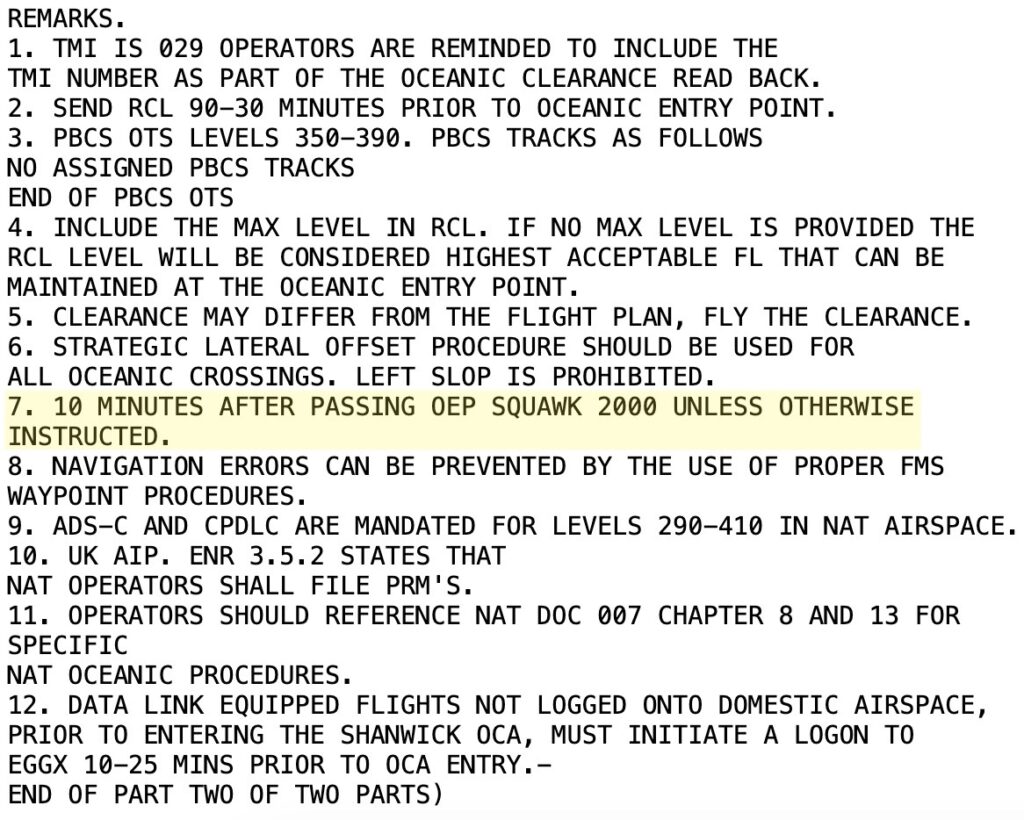
  • Big Change #3: Squawking 2000 ten minutes after OEP will be standard everywhere in the NAT. 

Once (or sometimes twice) every year, ICAO update their NAT Doc 007 – the main guidance doc for ops over the North Atlantic. All the specifics about how to operate your aircraft safely through the complex airspace of the region are here!

The new version for March 2024 has just been released!

Where’s the new Doc?

You can find it on the ICAO page here.

Big Change #1: No More Oceanic Clearances

The idea is that with all the fancy tools ATC now have at their disposal (CPDLC, RSP and RCP compliance, and space-based ADS-B), we have reached a point where the Oceanic Clearance is no longer required.

It sounds drastic, but think of it this way: the NAT will now just be the same as the rest of the world – you fly what is loaded in the FMS or as amended by ATC.

ICAO have also published this Bulletin for flight crews on this specific issue of the removal of Oceanic Clearances. This Bulletin has been updated as of 22nd Jan 2024. There are now different dates when Oceanic Clearances will cease to be issued in the following FIRs:

  • ShanwickApril 9  May  Q4 2024  December 4
  • GanderMarch  May 3  December 4
  • BodøMarch  May 6 June 17  December 4
  • Santa Maria: completed March 21
  • Iceland:  completed March 21

NATS (who manage Shanwick airspace) have published a video about this change, which shows exactly how it will work and what you will need to do.

Big Change #2: Simplified Comms Failure Procedures

As per Chapter 5 of the 007 Doc, from March 2024 here’s what you do:

  • Comms failure before entering the NAT: assuming you don’t divert, you enter the NAT via the Oceanic Entry Point at the level and speed resulting from whatever radio comms failure (RCF) procedures you just had to do in adjacent airspace.
  • Comms failure after entering the NAT: maintain the cleared route/level/speed until reaching the Oceanic Exit Point (ideally don’t change route/level/speed unless you have to), then get back to your flight planned route “in the most direct manner possible” no later than the next significant point.
  • Comms failure if operating to an airport in the NAT: follow the standard PANS-ATM procedures. What are these? – head to an airport aid/fix, hold until the ETA as per the flight plan, do a normal instrument approach, land!

Big Change #3: “Last Assigned Code” Procedures Standardized

A bonus one we spotted! We don’t have to wait til April 2024 for this either – it has already happened. Essentially, squawking 2000 ten minutes after OEP is now standard in the NAT.

Since the dawn of time, everywhere on the NAT, this domestic code had to be retained for 30 minutes after entering NAT airspace. But back in July 2023, the UK changed it to 10 minutes for the entire EGGX/Shanwick FIR, and since then, all the other NAT FIRs have updated their rules to say the same – so this new 10-minute rule has now become the standard across the NAT Region. One exception: if you’re in the Reykjavik CTA, don’t do it (they still have you on radar).

Phew, we survived!


NAT Changes Coming Soon!

It’s been quiet for a while on the North Atlantic, but that’s set to change soon, with the release of a new version of the NAT Doc 007.

Wait, what new version of the NAT Doc 007??

It’s just a draft for now, due for release in March 2024. 

It was published following the meeting of the North Atlantic Systems Planning Group (NAT SPG) back in June – the folks who meet each year to work out what needs changing in this document, amongst other things. So this draft contains the changes they discussed at that meeting.

To read the draft NAT Docclick here.

If you want to read the entire report from that meeting, click here (lots of other stuff in there, but the draft NAT Doc starts on page 58!).

What is changing?

Right, the important bit!

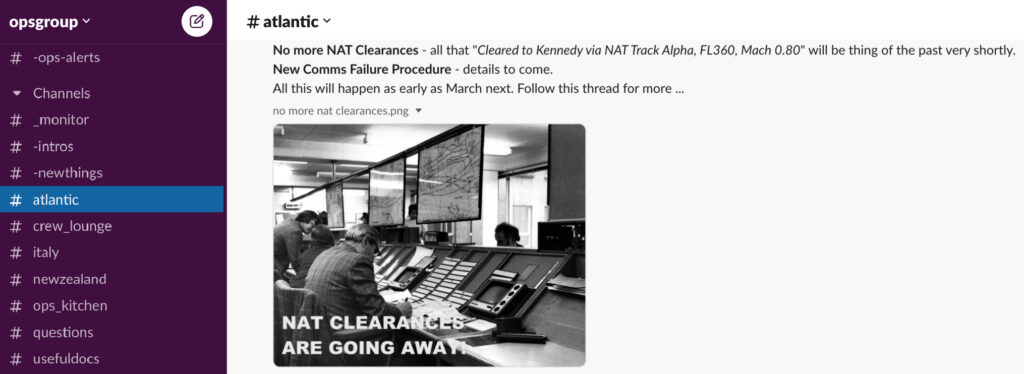
First up, there will be no more Oceanic Clearances – a big change to anyone used to saying “Cleared to Kennedy via Track Alpha, FL360, Mach 0.80“. The new NAT Doc 007 will also have a new Comms Failure procedure… completely rewritten.

These are the biggest changes to NAT procedures in years, and we’re looking for some volunteers to help go through the new NAT Doc – for this, and more, join the new #atlantic channel on Slack – open to all members.

This is one of a bunch of new channels we’re working on at the moment, so keep an eye out for more “LOCAL” channels coming … we already have #newzealand#singapore#italy. These local channels are a new idea – somewhere for people based there to connect, and to help/welcome visiting crews. Opsgroup members can get involved here!

Where can I find the current NAT Doc?

Head over here. This is our article from Jan 2023 – the last time the NAT Doc was updated. It contains the downloadable PDF of the current NAT Doc, as well as a chapter-by-chapter summary of everything that was updated at the time.

And for a timeline of all the big changes on the North Atlantic stretching back to the dawn of time (actually, 2015, but basically the same thing), click here.


Header image from ATC History.


SSR Code Change in the NAT!

The NAT Region is changing the “last assigned code” SSR transponder procedures. Since the dawn of time, everywhere on the NAT, this domestic code had to be retained for 30 minutes after entering NAT airspace. But now the UK has changed it to 10 minutes for the entire EGGX/Shanwick FIR, and we expect all the other NAT FIRs will soon be updating their rules to say the same. This new 10-minute rule will then become the standard across the NAT Region, and will be published in the next version of the NAT Doc 007 due out in October 2023.


For several decades, unless directed otherwise by ATC, pilots flying in the MNPS airspace, now known as the NAT, were required to maintain the transponder in Mode A/C with continuous Code 2000 operation, except for the last assigned code, which had to be retained for a period of 30 minutes after entering the NAT airspace or leaving a radar surveillance service area.

The rationale for changing from the last assigned code to Code 2000 after 30 minutes was based on the recognition of the original domestic code by subsequent national radar services upon exit from the oceanic airspace.

It was crucial to make this change before exiting, in line with the terms of ICAO Doc 4444: “Except for aircraft in a state of emergency, or during communication failure or unlawful interference situations, and unless otherwise agreed by regional air navigation agreement or between a transferring and an accepting ATC unit, the transferring unit shall assign Code A2000 to a controlled flight prior to transfer of communications.”

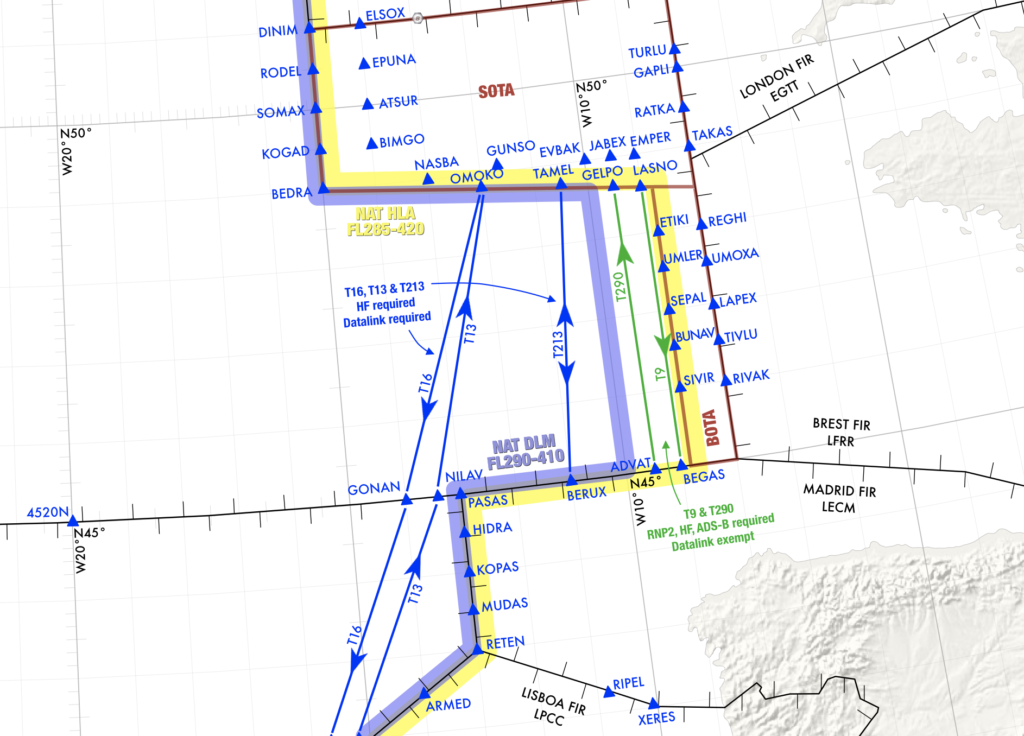
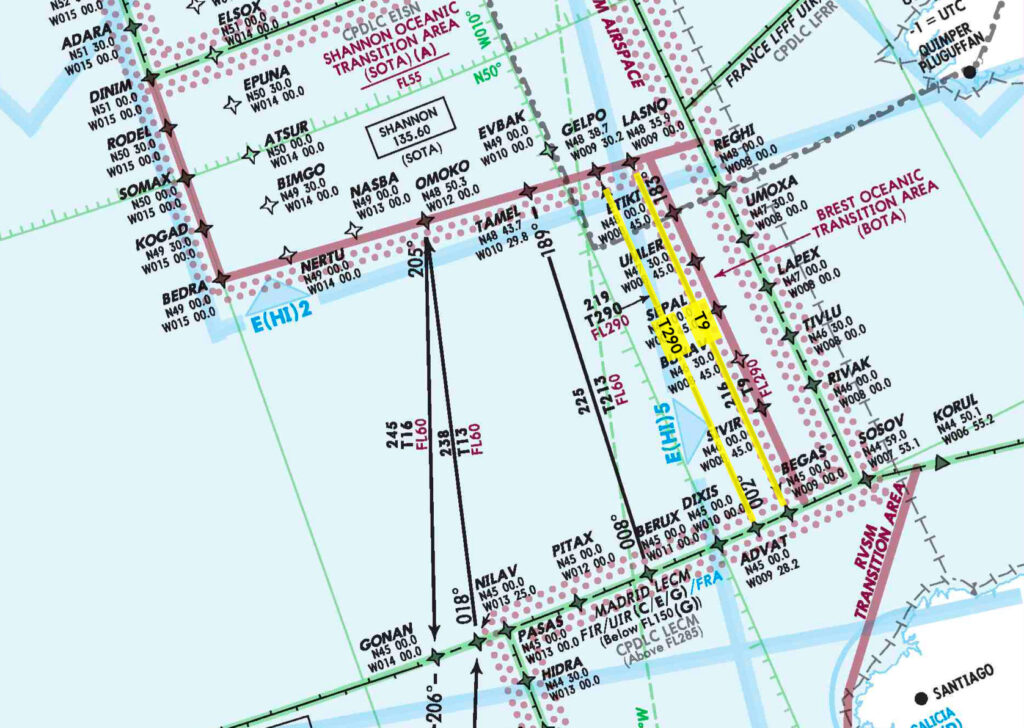
Thus, due to the limited time spent in the NAT HLA, when flying on Tango 9, Tango 290, or Tango 213, the change from the last assigned domestic code to Code 2000 should occur within a maximum of 10 minutes after passing BEGAS, ADVAT, or BERUX when Northbound, and LASNO, GELPO, or TAMEL when Southbound

For the same reason, aircraft with a routing sequence Reykjavik-Shanwick-Scottish (BIRD-EGGX-EGPX) shall change the last assigned code to Mode A 2000 on transfer from Reykjavik and no later than 10 minutes after entering Shanwick airspace.

It should also be noted that Reykjavik ACC provides radar control service in the southeastern part of its area, and therefore, transponder codes issued by Reykjavik ACC must be retained throughout the Reykjavik OCA until advised otherwise by ATC.

Furthermore, although outside the NAT HLA, it is also necessary to retain the last assigned code in New York West ATS airspace. Similarly, aircraft transiting Bermuda RADAR airspace should remain on the last assigned code until clear of that airspace, then squawk 2000.

In all other cases, Code 2000 would be displayed 30 minutes after entry into the NAT airspace.

So what has changed?

In its AIRAC 2023-06-15 edition, the UK AIP ended the 30-minute code retention rule in order to standardize a change to Code 2000 after 10 minutes of entering the NAT airspace.

The UK AIP now states:
“Unless otherwise directed by ATC, aircraft equipped with SSR transponders in the NAT region shall operate transponders continuously on Mode A Code 2000 regardless of the direction of flight, except that the last assigned code shall normally be retained for a maximum period of 10 minutes after entry into NAT airspace.”

This change eliminates the exceptions for Tango routes.

Why didn’t I hear about this?

The change was buried deep within the UK AIP without any publicity or modification of specific NAT documents – notably the famed NAT Doc 007.

The North Atlantic Document 007 is regularly updated through the ongoing efforts of the North Atlantic Special Planning Group (NAT SPG). While it does not establish regulations (which fall under the Regional Supplementary Procedures DOC 7030 and FIR-specific AIPs), it is widely regarded as the primary resource for operational guidance in the North Atlantic. So it was surprising to learn that it had not been updated following the recent change in the Shanwick FIR, despite the ongoing work of the NAT SPG.

One could have expected that a change to a long-established practice (even if understandable for the purpose of standardizing a rule and eliminating exceptions) would have been anticipated and coordinated to avoid introducing a new exception distinguishing one FIR from the others.

But after verifying with NAT specialists at Shanwick, it appears that they have been talking about it with all the other FIRs – and everyone has agreed to change the rule to 10 minutes. This change will be published in the next version of the NAT Doc 007 (expected Oct 2023), and all other FIRs will be updating their AIPs in due course. It’s apparently part of a push to harmonize NAT Region procedures where possible.

The delayed implementation of Oceanic Clearance Removal (OCR) resulted in a delay in the publication of the NAT Doc 007, as it required significant changes to support OCR. While the 10-minute change has been universally accepted by all Air Navigation Service Providers (ANSPs), the lag between documentation and ANSPs is solely due to the delayed updates of Doc 007 being published.

So tell me again, what has changed?

  • In the entire NAT airspace under Shanwick’s jurisdiction, unless instructed otherwise by ATC, the last assigned transponder code must be retained for 10 minutes, followed by displaying Code 2000.
  • When arriving eastbound from BIRD/Reykjavik to EGGX/Shanwick enroute to EGPX/Scottish, Code 2000 should be displayed upon transfer from Reykjavik to Shanwick and no later than 10 minutes after entering Shanwick airspace.
  • In the other NAT FIRs (CZQX/Gander, KZWY/New York, LPPO/Santa Maria, BIRD/Reykjavik, ENOB/Bodo), the 30-minute rule still applies… until it changes!


NAT Doc 007 Changes 2023

We knew it would happen! We predicted it would happen! And now it has happened! The annual late Christmas present from ICAO that always seems to get lost in the post and then turns up in January – an updated version of the NAT Doc 007.

NAT Doc 007 is the main go-to guidance doc for ops over the North Atlantic. All the specifics about how to operate your aircraft safely through the complex airspace of the region are here. The updated version is valid from Jan 2023. You can download it from ICAO at the source here, or click on the image below:

The summary of changes by ICAO

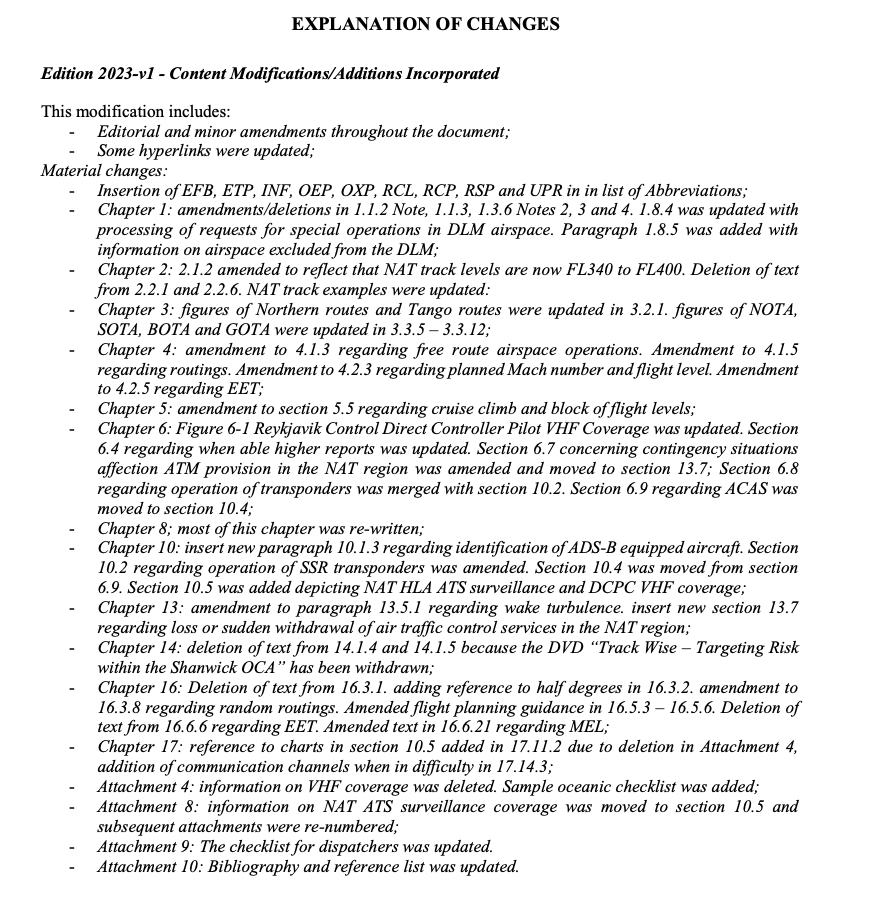
They always post a little summary at the start, so here is a screenshot of it for you.

The summary of changes by us

Hideous indeed. So here is a less hideous (but possibly less informative) summary of the changes we spotted as we scrolled through the 174 pages of Nat Doc 007 V.2023-1. We decided to go chapter by chapter so you can head on in and read the full info direct from the NAT Doc 007 itself if it interests you to.

Chapter 1: Operational Approval & Aircraft System Requirements for Flight in the NAT HLA

Something about Target Levels of Safety

This is probably of interest if you’re a huge fan on the “Where you all went wrong this year” updates from the NAT HLA. They set the ‘maxima’ to 5×10⁻⁹  fatal accidents per flight hour, which I think means one in every 500 millionth or something.

OK, moving on.

Equipment related stuff

This is all stuff you probably know already, but they have updated and edited it so we figured we would recap on the important bits as well.

RVSM: Two handy links have been added in providing you info on RVSM equipment requirements. 

This one from the FAA.

And this one from Skybrary

Along with a reminder that because the NAT HLA is RVSM, you need to be RVSM approved to fly in it.

Clocks: Make sure yours is accurate and synchronised to an ‘acceptable’ UTC time signal before heading off. A lot of aircraft have clocks that can only be updated on the ground so check before you fly.

LRNS: Do you fly an aircraft with only 1 LRNS (and it’s a GPS)? Then its got to be approved in accordance with FAA TSO-C129 or whatever the EASA equivalent is (it is ETSO-C129a).

CPDLC: Don’t have FANS 1/A “or equivalent”? (we still aren’t totally sure what “or equivalent” really means!) Then you can still request to climb or descend through the NAT DLM airspace, and there are some exceptions for specific flights where you might even get let in – 

  • Scientific research type flights (probably not any of you)
  • If your equipment fails on you post take off then you might be ok, talk to ATC
  • If you’re in the NAT DLM and your equipment fails then you might be re-cleared (to move you out of the way of less dysfunctional folk), but they aim is to try and keep you on the plan you were already on

They have also clarified three specific areas where datalink is not required. This one has been bugging us for a long time with previous NAT Doc updates! Datalink exempt areas have always been these three:

  1. Airspace north of 80° North
  2. New York Oceanic East flight information region (FIR);
  3. Airspace where an ATS surveillance service is provided by means of radar, multilateration and/or ADS-B, coupled with VHF voice communications as depicted in State Aeronautical Information Publications (AIP), provided the aircraft is suitably equipped (transponder/ADSB extended squitter transmitter).

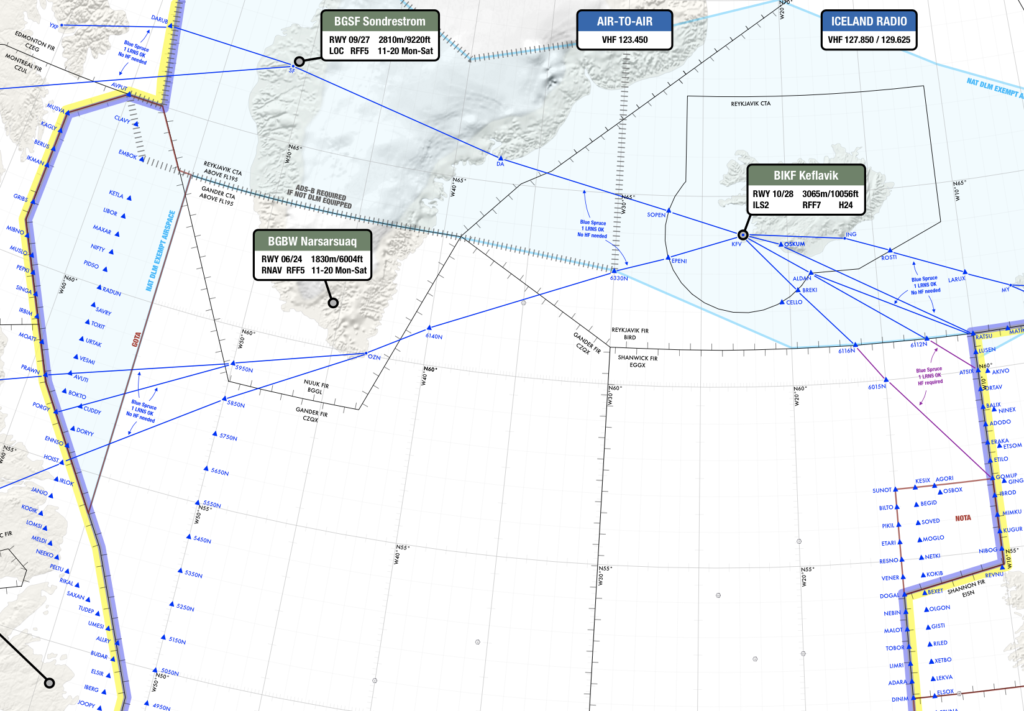
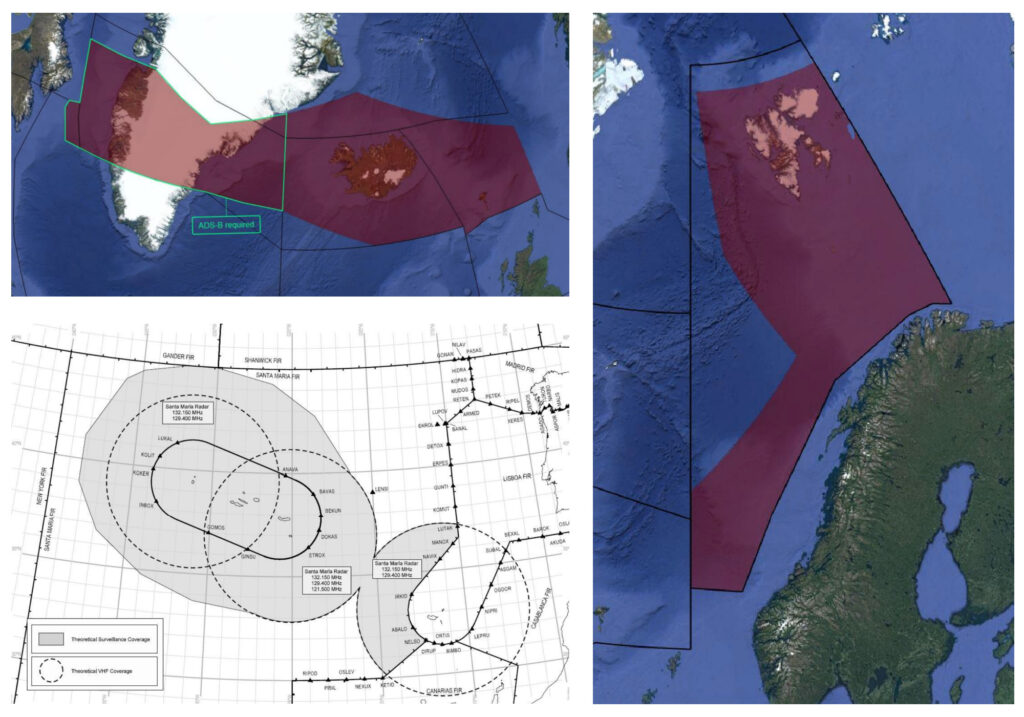
We’ve never understood what number 3 means – until now. The new NAT Doc now specifically lists where these areas are: a chunk of airspace over Iceland/Greenland, one over the Azores, and another in Bodo. They have even provided some maps and coordinates too.

Update 3 APR 2023: There have been some changes to the boundaries of the datalink exempt airspace in the northern bit of the North Atlantic. This used to extend down south to SAVRY, but now only goes as far as EMBOK. So now you need datalink in the NAT oceanic airspace over Greenland controlled by Gander. Check this post for more info.

Chapter 2: The OTS

More reminders on things you know rather than any major new stuff.

  • If you want to fly on the half-spaced PBCS Nat Tracks, you need RNP 4 approval but also RCP240/RSP180 equipment (and a state approval). That’s been the case for a while.
  • You will also get messages saying “SET MAX UPLINK DELAY VALUE TO 300 SEC”. Do it.
  • Nat Tracks are now from FL340 to FL400 inclusive. (Remember, Nat Tracks at FL330 and below were removed back in March 2022).
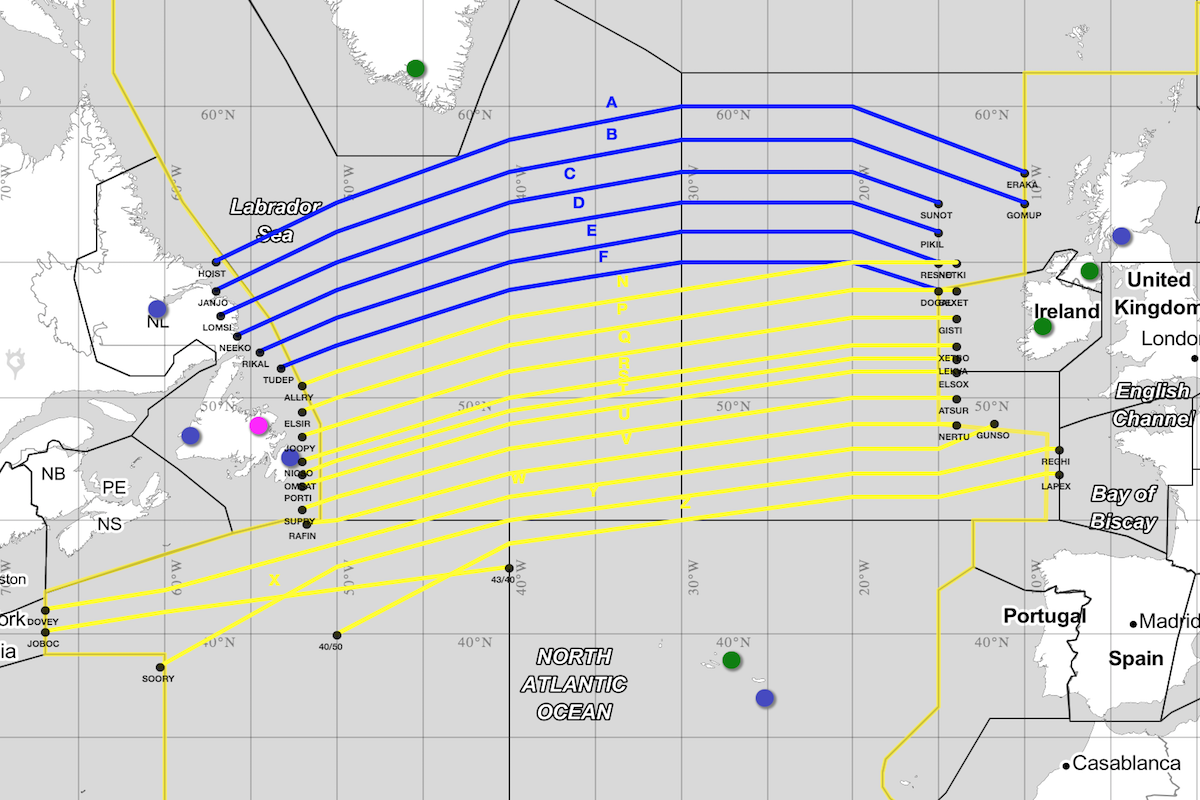
  • If there is a particularly strong westerly jetstream then Shanwick will post a split westbound structure which means you might see two adjacent landfall and exit points at the Eastern NAT boundary for the daytime eastbound flow to use.

Chapter 3: Routes, Route Structure, Transition areas

They have updated the maps and info on the bits adjacent to the NAT HLA (your NOTA, BOTA, SOTA and GOTAs).

Chapter 4: Flight Planning

Doc 7030 is the main reference for flight planning in the NAT (and state AIPs). There are little bitty edits here but nothing new.

Chapter 5: Oceanic Clearances

A cruise climb can be requested if you’re fat and heavy and want to climb little more flexibly as your drop weight (burn fuel). ATC will do their best to accommodate this.

Chapter 6: Comms and Position Reporting Procedures

The “When Able Higher” report is no longer mandatory in the New York OCA. The only place it’s still required is when entering the Santa Maria OCA. 

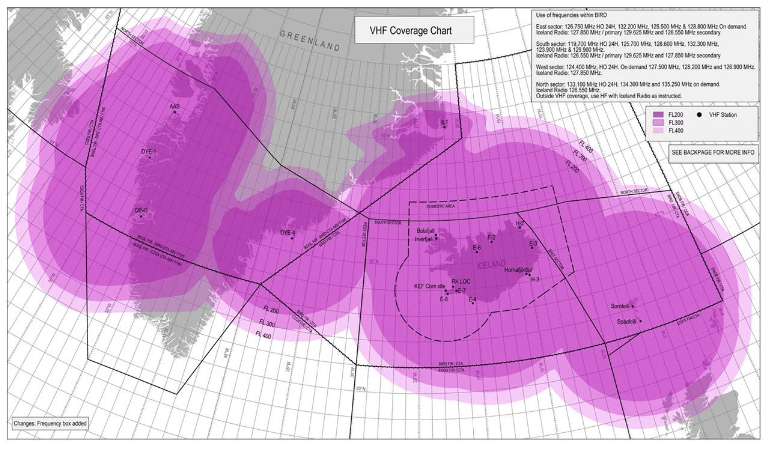
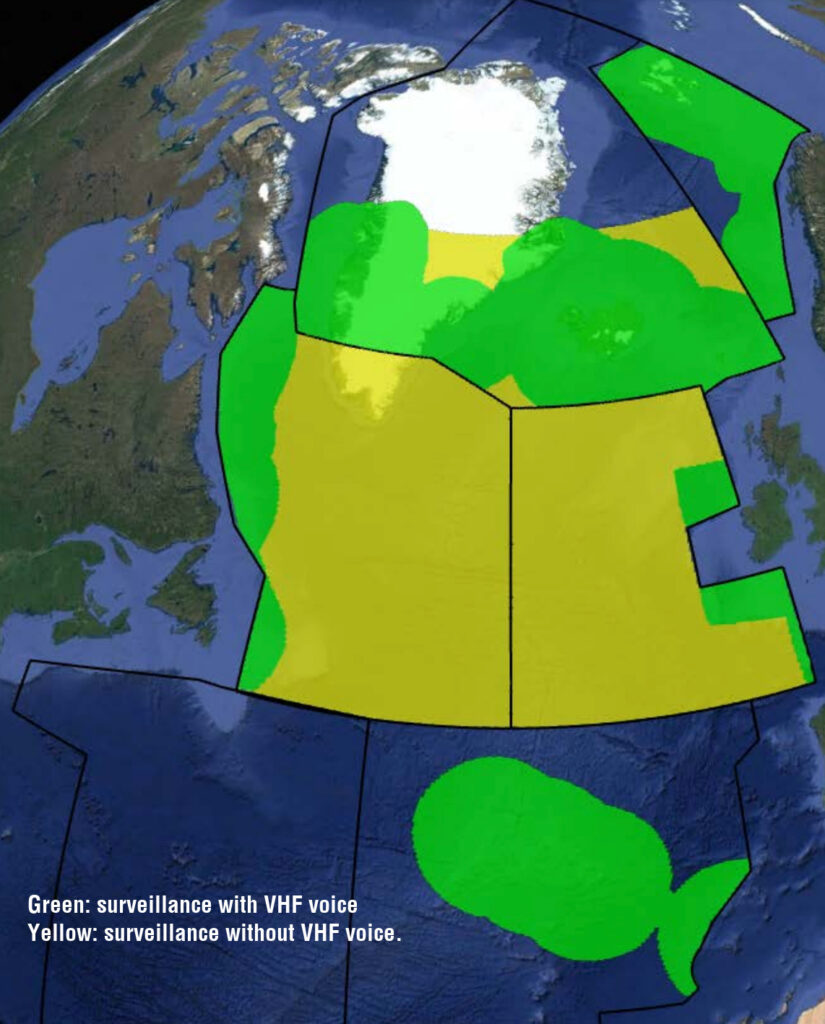
There’s also an update in this section about where the VHF stations are. Remember, when you’re on VHF you might not be talking direct with an ATSU. You can request a direct patch-through on HF or GP/VHF if you need it (and are on Iceland Radio or Shanwick Radio).

They’ve updated the big pink blob map to show where you should be able to get VHF coverage. Here it is.

INTERESTING SIDE-NOTE: Now, DON’T PANIC, they haven’t put this in the updated Doc, but we saw it in the ‘proposed changes that might one day come in’ document… You currently need 2 LRCS and one of them must be HF (generally). This isn’t changing, but if you lose HF then you might (when they make the change) be able to enter so long as you have two other LRCS systems that are appropriate for the route. Exciting…

Chapter 7: Application of Mach Number Technique

Don’t get confused between RNP10 and RNAV 10. Not the same thing, but they can’t be bothered to correct everyone all the time on it so they’ve added a note saying this.

Also, don’t make Gross Navigation Errors. They ain’t good and will be investigated. Here’s the tip: if you’re on a random route, a single digit error in latitude could put you pretty darn near another aircraft so be careful!

Chapter 8: Flight Ops & Navigation Procedures

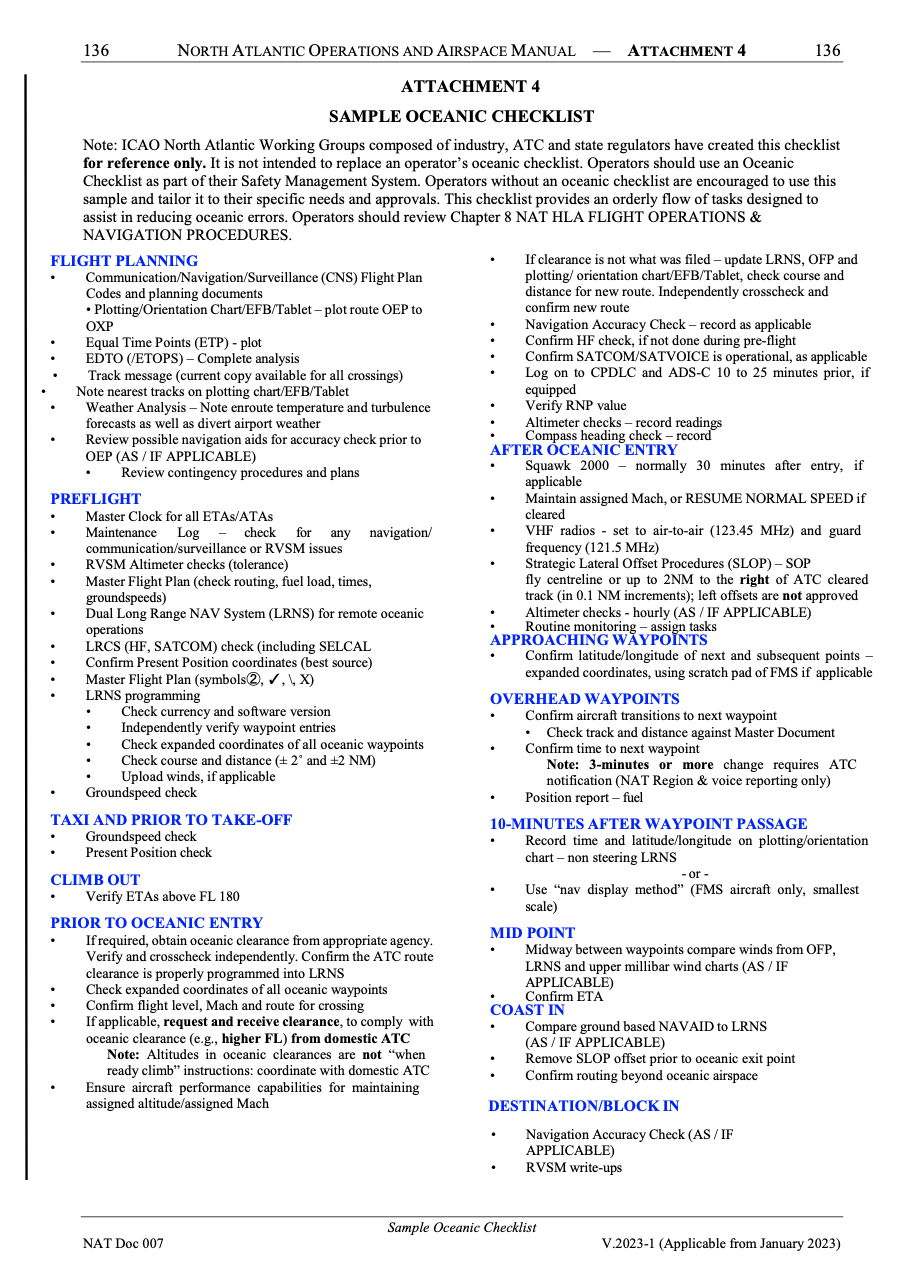
They have provided a very helpful Checklist. This chapter goes into full detail on it, and Attachment 4 has it nicely summarised.

Chapter 9: RVSM

FAA AC 91-85 has all your info on state approvals.

Chapter 10: ATS Surveillance Services

This is the ATS Surveillance Services chapter. They’ve updated the guidance on your squawking.

When you’ve been in the NAT HLA for 30 minutes you should set your squawk to 2000 (the domestic controller on the other side might not want you to use the same one). But there are some exceptions this:

  • While in the Reykjavik ACC stick with your assigned code because you’re in radar control (in the south eastern part) and they don’t want you to change it until you’re told to.
  • All eastbound flights routing Reykjavik – Shanwick – Scottish should squawk 2000 after 10 minutes.
  • Routing on T9 squawk 2000 10 minutes after passing BEGAS (northbound) or LASNO (southbound).
  • Routing on T290 squawk 2000 10 minutes after ADVAT or GELPO

ADS-B is only mandated on T9 and T290.

Chapter 11: Monitoring of Aircraft Systems & Flight Crew Performance

This chapter has a nice list of things to report/things ATC will report:

  • Erosions of longitudinal separation between aircraft, within the NAT HLA, of 3 minutes or more (so if you find yourself getting to close).
  • Anytime you have to do something to prevent a GNE.
  • Lateral deviations from cleared route of less than 25 NM.
  • Discrepancies of 3 minutes or more between an ETA/ATA at a waypoint.
  • Occasions when an operator is suspected of not being in possession of an NAT HLA/RVSM approval.
  • Diversions or turnbacks, noting in particular whether the appropriate published contingency procedure was correctly adopted.
  • ACAS RAs.
  • Wake turbulence reports.
  • Incorrect application of the SLOP (e.g. a left offset).

Chapter 12: Procedures in Event of Navigation System Degradation or Failure

No noteworthy newness (none that we could find, at least).

Chapter 13: Special Procedures for In-flight Contingencies

This covers all your loss or sudden withdrawal of ATC services. So it is basically a mini summary of Doc 006 and also covers the ‘What to do it?’ situations.

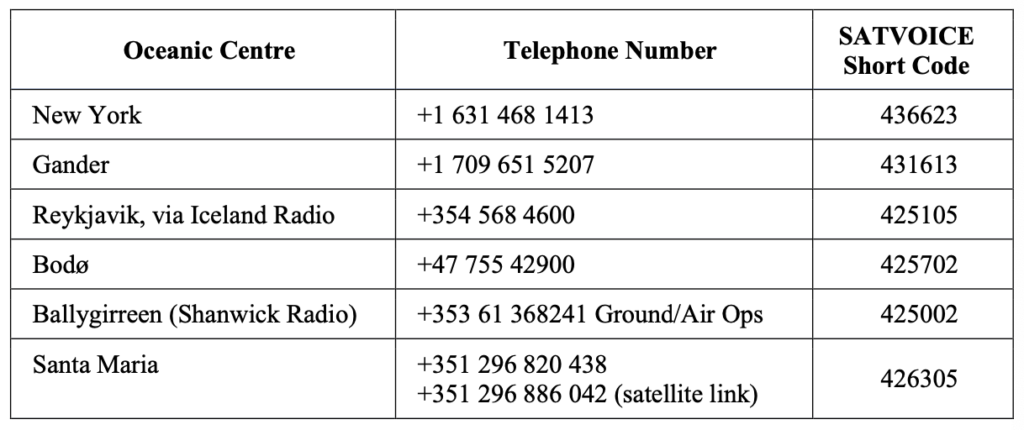
They have also updated the contact info for SATVOICE. So here you go –

Chapter 14: Guarding Against Common Errors

Updated to list recent ones.

Chapter 15: The Prevention of Lateral Deviations from Track

No newbies.

Chapter 16: Guidance for Dispatchers

There is some updated info on planning codes. Take a look.

Chapter 17: Flight Operations below the NAT HLA

So this stuff all applies for flights FL280 and below. Actually an interesting read! There aren’t any massive changes here though. Mainly these one:

  • Reminder the SLOP should be right of track.
  • They re-iterate that they still haven’t managed to get a decent map of VHF coverage of the North Atlantic. If we want one, we should go scratching around in State AIPs (where we still won’t find any – we’ve looked).
  • If you’re in trouble, you don’t just have VHF 121.5 to turn to. Also try 123.450, SATVOICE, or “any other communication device you may have”.

End of the Doc: All the attachments

Mostly forms and stuff, but Attachment 4 is that handy sample checklist we mentioned and Attachment 9 is an equally handy checklist for dispatchers covering equipment and what have you.

Phew, done!

Another year, another NAT Doc. Well, let’s hope so – they do sometimes release a sneaky Version 2 update some time around July/August. But for now, we can relax.

Did you spot any big updates in this new NAT Doc? Haven’t read it yet and don’t want to scroll to the top of the page to find the link again? No worries, just click here. If you do spot anything significant that we missed, please let us know! You can email us at news@ops.group


NAT Doc 007 Changes 2022

It has happened again. They have made amendments to NAT Doc 007. We took a look and the first thing we noticed is a lot of red text!

Thankfully, on reading it, we have determined there are not really any actual changes (i.e. nothing that you probably don’t already know about). It is more a great rewording to incorporate things you already know about in a tidier and more coherent way.

So here is a summary of the changes, and here is a link in case you do want to take a look for yourself. Version 2022-1 is applicable from Jan 2022. 

The Very Simple Summary

MNPS is out

They have removed all historical references to it.

OWAFS is in

Well, it was already but now we have some definitions and a few additional paragraphs on it.

OWAFS (in case you don’t know) means ‘Operations Without an Assigned Fixed Speed’ and it means that the requirement to issue a fixed Mach in the NAT has been removed. If you are told to ‘Resume Normal Speed’ this means you can fly at your chosen cost index speed. Just let ATC know if it is a big change (M.02 or more).

The Chapter by Chapter Review

Chapter 1

MNPS references have been removed, as have the old MNPS performance specs. Now it is all PBN. They have also taken out the old bits about trials and implementation because MNPS evolution to NAT HLA and PBN has happened.

Chapter 2

They have amended the examples of NAT Track Messages. No great difference.

Chapter 3

5.1.12 is the new paragraph on OWAFS and it says this:

“With the implementation of OWAFS, flight crews can expect ATC to issue the clearance RESUME NORMAL SPEED when traffic permits after oceanic entry. This clearance allows the flight crew to select a cost index (ECON) speed instead of a fixed Mach number with the condition that ATC must be advised if the speed changes by plus or minus Mach .02 or more from the last assigned Mach number.”

Chapter 6

There are some subtle word changes here. The one to know is under 6.1.22 (and throughout the chapter). When using HF, SATVOICE or CPDLC flight crew SHALL maintain a continuous air-ground communication.

‘Shall’ not ‘should’. It also used to just say ‘listening’ instead of that continuous air-ground bit.

Chapter 7 

This whole chapter is about ‘Application of Mach Number Technique’. So more OWAFS info. 

In summary – You should receive a ‘RESUME NORMAL SPEED’ clearance after oceanic entry. If it doesn’t come through automatically then request normal speed.

ATC will still occasionally use mach number technique to maintain longitudinal spacing so if they give you an assigned mach number, stick to it. But if you get that “resume normal speed” clearance then you can fly at your cost index (ECON) speed and just let ATC know if it is more than a M0.02 difference.

Chapter 10

Another ‘should’ to ‘shall’ change.

If you are on T9 route then you shall change your squawk to 2000 10 minutes after passing BEGAS or LASNO. If you are on T290 then you shall change it 10 minutes after ADVAT or GELPO

A permanent military area also looks like it has been removed.

That’s all we saw.

If you spot any changes we have missed please share them with us at news@ops.group

Further reading

To see a full version of this new NAT Doc 007, with all the changes incorporated, go here.

The last time they updated it was back in July 2020, which you can read about here.


July 2021 North Atlantic Changes

Just when you thought it was safe to go back in the water…

Yep. Barely five months since the last version of the NAT Doc 007 was published, we now have a new one.

First things first – links…

To see just the new changes, click here.

To see the new NAT Doc 007 in its entirety, click here.

To see the old NAT Doc 007, and painstakingly cross-check all the changes compared to the new version (i.e. what we did so we could write this post), click here.

Here’s the lowdown of what’s changed…

The Datalink Mandate

No changes to the rules here. The old NAT Ops Bulletin 2017_001 which contained all the info about the Datalink Mandate has been discontinued, and the essential info incorporated into the NAT Doc 007.

Key points:

  • Aircraft without datalink can request to climb/descend through datalink mandated airspace, but will only be considered on a tactical basis by ATC.
  • Flights without datalink that file STS/FFR, HOSP, HUM, MEDEVAC SAR, or STATE in Field 18 of the FPL, may be permitted to flight plan and fly through datalink mandated airspace, but may not get their requested flight levels.
  • For datalink failure before departure, you should re-file your FPL to stay clear of NAT DLM airspace. If it fails after departure or whilst in NAT DLM airspace, ATC may let you continue based on “tactical considerations” (i.e. how much other traffic is around).

Which brings us neatly on to…

ATS Surveillance Airspace

This one has had us scratching our heads for a while now…

So, there is an updated chart showing the areas of ATS Surveillance Airspace in the NAT:

We have to say, we really don’t like this chart very much. The green blobs are misleading. Here’s what we mean…

Essentially, the NAT Doc 007 says that these are the datalink-exempt bits within the NAT Region:

1. Everything north of 80°North.
2. New York Oceanic East FIR.
3. Tango Routes T9 and T290.
4. ATS Surveillance Airspace, where surveillance service is provided by means of radar and/or ADS-B, coupled with VHF.

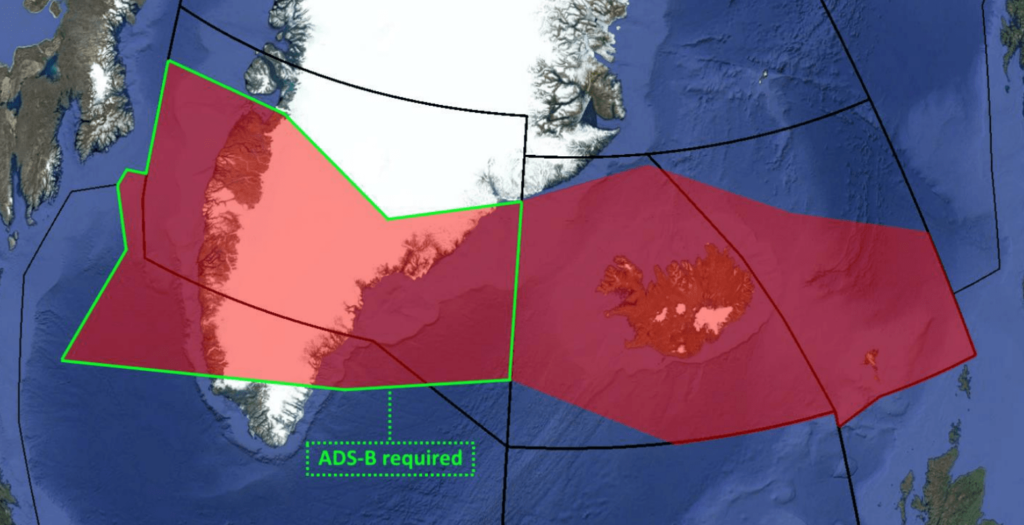
So these green blobs give a rough idea of where ATS surveillance service is provided by radar and/or ADS-B within VHF range. But rough ideas don’t win prizes, and neither do they explicitly tell you what the rules are. Where is this mythical ATS Surveillance airspace in reality? Give me some hard coordinates!

Thing is, they actually do, right there in the NAT Doc 007, they just don’t say it very clearly.

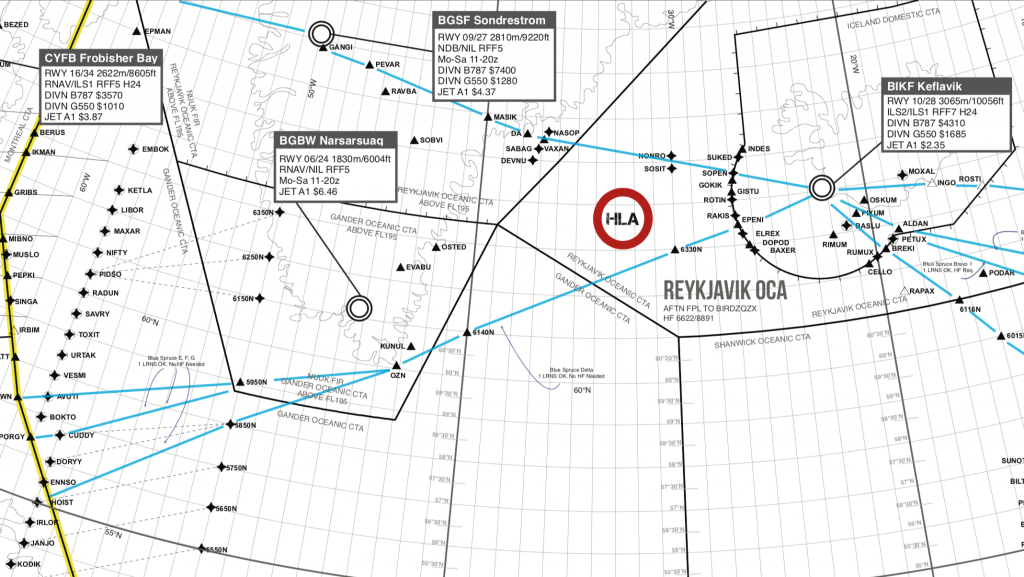
Here’s the answer (we had to get in contact with Gander and Reykjavik ATC to confirm this): ATS Surveillance Airspace is the area over Greenland and Iceland shown in this picture below. This is where you’re allowed to fly above FL290 if you don’t have datalink.

There is no special datalink exemption for the Blue Spruce routes. That’s another key point here.

The southerly Blue Spruce routes are not fully contained in the exempted airspace. So if you’re flying these routes you will have to meet the NAT DLM requirements or fly below FL290 or above FL410.

The northerly Blue Spruce routes are different (i.e the ones going overhead BGSF/Sondrestrom airport). These do fall within the exempted area of airspace – so datalink is not mandatory if you’re flying here.

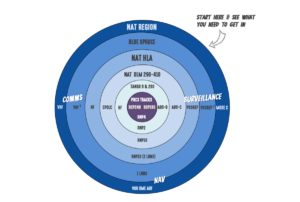
Confused? We don’t blame you. Here’s something that might alleviate some misery though – our NAT Airspace Circle of Entry. OPSGROUP members can download the full hi-res PDF version here. The Circle shows you what equipment you need – like CPDLC, ADS-C, HF – for each different type of airspace in the North Atlantic. With the datalink requirement effective Feb 2021, and the introduction of new requirements for the Tango Routes on the eastern side of the Shanwick OCA (T9 & T290), there are some important changes.

This NAT Airspace Circle of Entry will also appear on the new NAT Plotting/Planning chart that we are finalizing at the moment, and we’ll send you that when it’s ready.

“SET MAX UPLINK DELAY VALUE TO 300 SECONDS”

This thing started back in 2018 – a new procedure designed to prevent pilots from acting on any old CPDLC messages that might have been delayed in the network.

So, we have CPDLC where ATC can basically ‘text’ you some sort of message. Usually a clearance to do something. There is a risk though that the message is latent meaning ‘existing but not yet developed or manifest; hidden or concealed’. Basically lost for a longish time in the digital void and it means there is a risk pilots might get a message to do something way after they were supposed to do it, and it is no longer valid (or safe to) anymore.

The old NAT Ops Bulletin 2018_002 about CPDLC Uplink Message Latency Monitor Function has been discontinued, and the essential info is now incorporated into the NAT Doc 007. But there is some new info to be aware of.

The key change here is that all the NAT ANSPs have agreed on 300 seconds as the period of time all aircraft should set their uplink timers to (any message that takes longer than that to reach you will be deemed ‘latent’). Also, they will be sending this to all CPDLC connected aircraft immediately after they enter each control area – so you might receive the message a bunch of times (a bit annoying) but the procedure is the same regardless of whether you’ve “done it already” or not.

This procedure is covered in section 8.50.20 of the new NAT Doc 007, and it works like this:

  • When you receive the message to set your max uplink delay to 300 seconds, acknowledge it with a Roger [ACCEPT].
  • If you don’t have a message latency monitoring function available then you still have to acknowledge the message but say ‘TIMER NOT AVAILABLE’.
  • Now, if you do have the function available then change the max uplink delay to 300 seconds and you’re done.

If the system gives you an indication that a message has been delayed over 300 seconds then don’t follow what it says but get in touch with ATC (by voice) and let them know so they can confirm whether they still want you to do carry out whatever the clearance told you to do. They will also close the message out of the system.

Bottom line: don’t act on a delayed uplink message until you’ve checked with ATC.

Weather Deviation Procedures

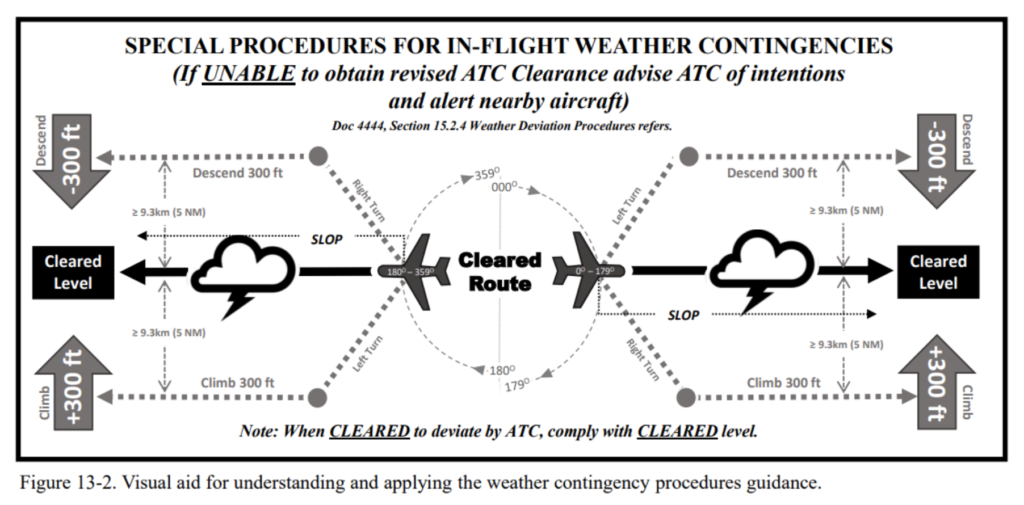
No new rules here, they’ve just made a nice little graphic to help understand the Procedures.

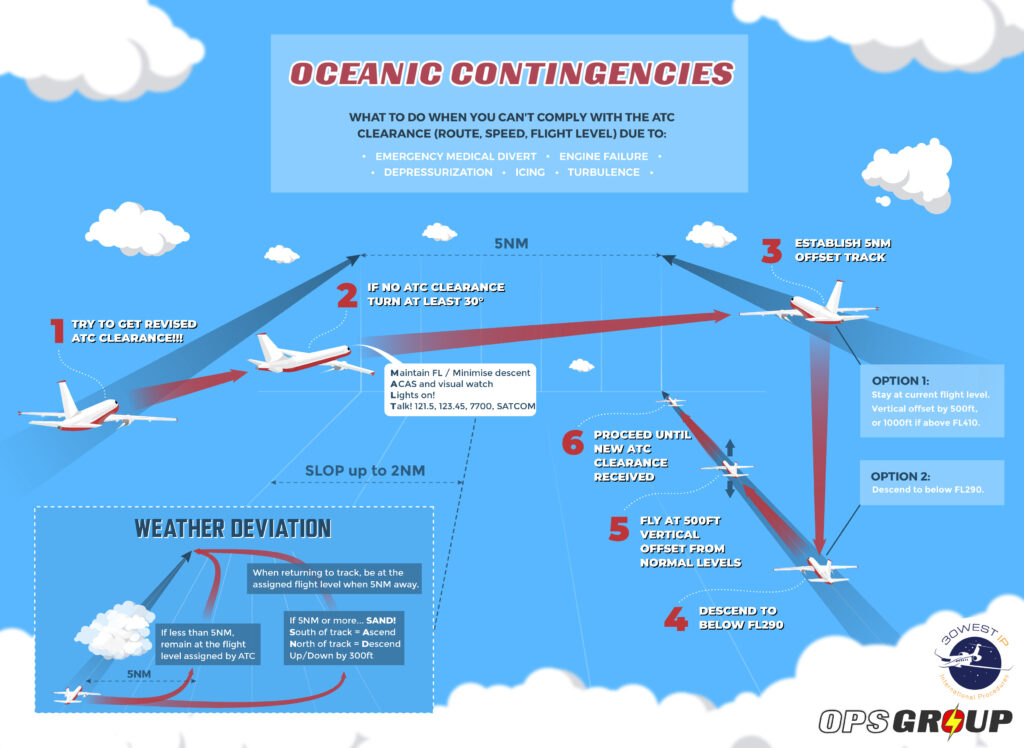
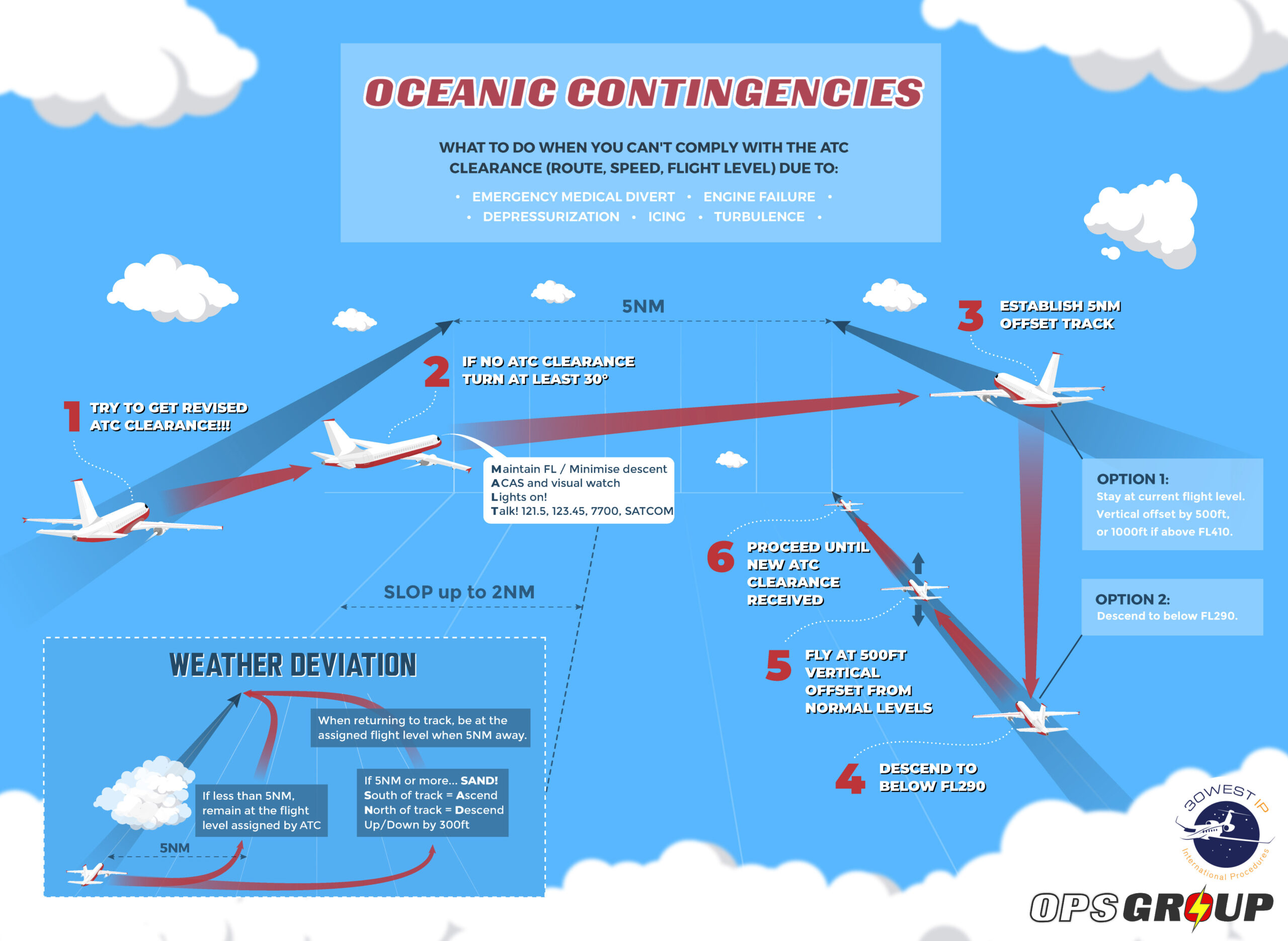
Funky! If you prefer a slightly simpler version, check out this one we made earlier:

Almost finished now. That’s the big stuff done…

Climbs in Gander and Shanwick airspace

Gander and Shanwick have decided that they will advise crew in their OCA when a higher flight level becomes available. Basically, they have a function in their ATM system which lets them interrogate the flight’s vertical profile to determine when a higher level is available. They will then check there is no separation issue and if not, will offer the new level.

What did it used to say?

It used to say that clearances tend to specify a single flight level, but that sometimes there might be ‘scope’ for higher climb. It had some stuff about how, if you got a re-clearance you should climb without delay. It also said that if you aren’t CPDLC equipped you should tell ATC as soon as you’ve left your old level and when you reach the new level.

Actually it still says that in the new document but now it has a new bit about how Shanwick and Gander will be a bit more proactive about letting you know when the levels become available.

PBCS operations

The only changes in this section are wording changes. Separation minima is no longer “as low as” – it is now “as small as”“How small can you go” doesn’t have quite the same ring to it…


And that’s it!! That’s all the changes!! At least, we think so. If you have spotted any biggies not listed here, send us an email at: news@ops.group

And if all this is not enough for you, and you want a comprehensive timeline of all the old significant changes on the North Atlantic stretching back to the dawn of time (actually, just to 2015), then click here.


Flying outside the Procedures

Aviation is full of procedures. We fly by them, sometimes we kind of live by them. But other times there are situations where we need to disregard them. So when is it ok to throw the rule book out the window? 

In an airplane, never.

In the literal sense anyway, given the risk of opening a window mid-flight and getting sucked out. But what about in the less literal sense?

Procedures are not there to stop us just doing whatever we want. They are there to keep us safe, to make sure everyone is operating to the same standards and to provide pilots with a guideline of what they should do in *most situations.

Why the asterix? 

I will come back to that. But for now, that reasoning makes sense. If every airplane did what it wanted, flew how and where it wanted, the sky would be a messy mass of chaos. So, we have procedures and we have them so we know what to do, when to do it and how to do it.

More importantly, everyone else knows as well. Which brings us back to the “most situations” comment. 

We cannot expect there to be a procedure in place for every possible event. They are there to offer guidelines and standards, but they are not designed to cover everything.

And they are definitely not supposed to remove the need to think.

So what should we think?

Well, thinking about situations where we might be without a procedure, or where there is a procedure but it no longer leads to a safe outcome is a good place to start.

Let’s take a look at ICAO Doc 007 – the “bible” for the North Atlantic. It is quite clear on a lot of things – for example, what the contingency procedures are if you experience some sort of emergency while flying in the NAT.

We are talking some busy airspace out there, with a lot of aircraft flying on specific tracks, and so the last thing you want is aircraft barreling across them setting off TCAS warnings as they zoom off on a diversion.

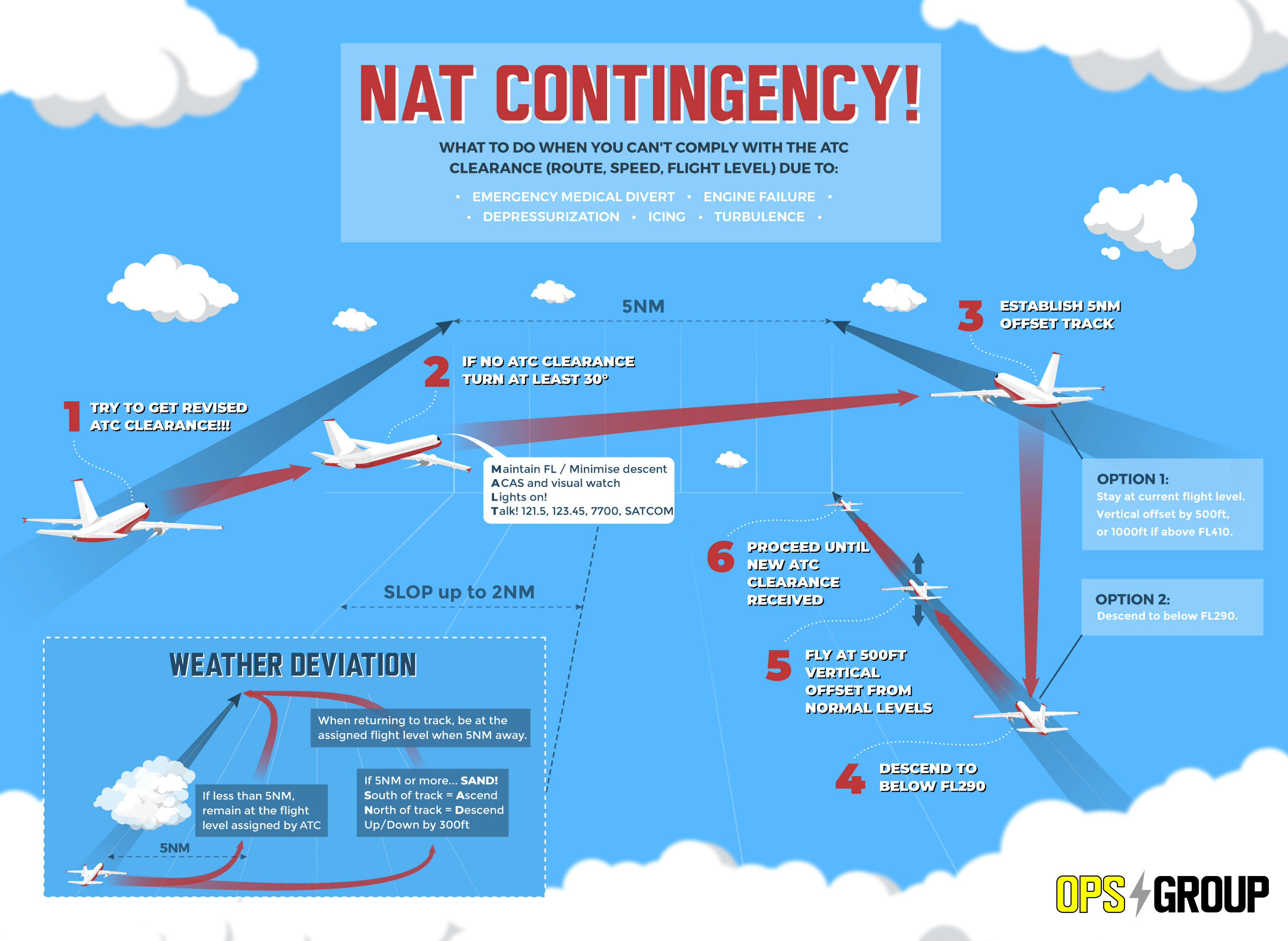
So NAT Doc 007 lays out some procedures to follow. Things like turning 30 degrees off track and offsetting 5nm. And one that says – 

“When below FL290, establish and maintain 500’ vertical offset when able and proceed as required”.

Ok, great, it is pretty clear. Get yourself down to below FL290, establish on your offset, and now go where you need to go.

But…

What if our emergency is a decompression, and we are right out in the middle of the NAT where routing at 10,000ft the whole way to an airport might turn into a fuel problem?

Do we still need to get to FL95 before starting a diversion?

There might not be a black and white, right or wrong answer, but this is the point – there are situations where there isn’t necessarily a procedure telling us what to do, or when to follow another procedure.

So this is something we should probably be thinking about a bit more. The “What If?” things that could happen.

So, what is the rule for breaking procedures?

Is there sort of a checklist for when we can, can’t, ought to or must? Why isn’t there a rule for every time you are allowed to break a rule? 

Well, the reason is no-one can think through every situation, and more importantly they shouldn’t try to! 

The day pilots can only do something if a procedure tells them to is the day you might as well replace them with a computer. We need to retain the skill of weighing up risk and reward, consequence of actions, because there are so many situations out there which are not going to be black and white. 

NAT Doc 007 document actually states quite clearly several times –

The pilot shall take action as necessary to ensure the safety of the aircraft…”

And this goes for any procedure, any rule, anytime you are flying. 

Just because the book says “No, don’t do that!” never means you cannot do it if it is what you need to do to maintain safety.

The tragic Swissair Flight 111 accident is often raised in CRM discussions as an example of when following procedures to the book might not lead to a safe outcome.

But…

Not following procedures because you think there is a quicker, better, easier way to do something is probably not the best idea either.

A Qantas pilot experienced “incapacitating” symptoms after a technical malfunction where they decided to cary out their own troubleshooting, rather than following the checklist.

So, having a good reason to not follow a procedure is important because you are going to have to justify why you broke the rule. If you need to break it for safety then break it, but the key seems to be having a valid, justifiable and safety related reason.

That is airmanship, and that is why the Commander has final authority. It is also a cornerstone of our pilot licence that we “agree” to accept the ultimate responsibility for the safety of the flight.

Why are we even having this discussion?

Possibly because we sometimes forget why we have procedures in the first place.

Unfortunately none of us are immune to this. I can remember several times in my career when procedure-following took over from common sense. The time when we shut down an engine with 10 meters of taxi left, ran out of steam, and had to be towed the last 9… But hey, we still ticked the one engine out taxi box.

So, all of us stepping back and considering why the procedures are there, and then what we might do when we find ourselves potentially having to operate outside of them, is important.

Which brings us back to the debate about FL95 over the NAT. 

Different folk might answer this question differently. It is going to depend on the day, on you and on the situation, and there probably isn’t a definitive answer to be given.

What is clear is that at some point in our flying career we will all probably find ourselves in a situation where there is no procedure, no clear cut answer, no simple solution, and this is where our experience, airmanship and judgement will really be put to the test.

When we end up in that situation we should’t be asking “What is the risk of me getting into trouble if I do?” but rather “What is the risk to my safety if I don’t?” because all the procedures we fall back on were not put there to be blindly followed, and were not written into stone to keep you out of trouble – they are there to be thoughtfully followed when they keep your aircraft out of trouble. 


July 2020 North Atlantic Ops Update

July 2020: There’s a bunch of new things to tell you about the North Atlantic this month! Here’s a summary:
– Two new ICAO NAT Ops Bulletins
– An updated NAT Doc 007 from ICAO (aka the North Atlantic “Ops Bible”)
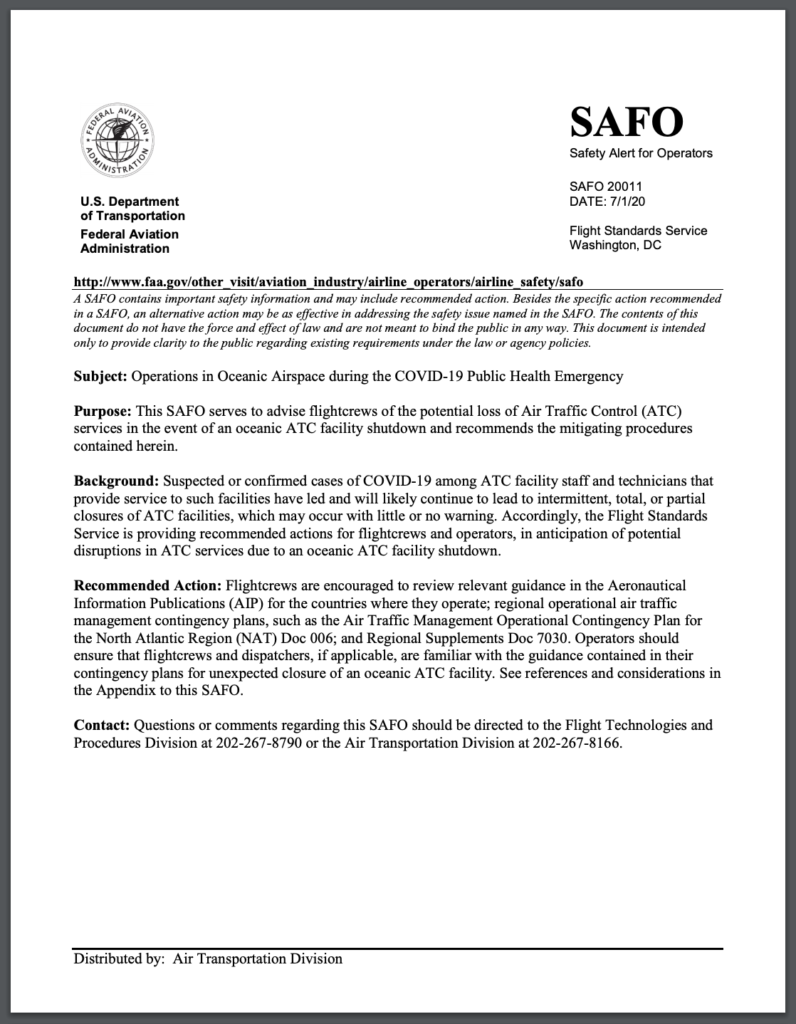
– A guide for pilots from the FAA about what to do if ATC suddenly has to suspend services
– Some juicy Notams from all the NAT FIRs extending the relaxation of the North Atlantic datalink mandate rules until the end of September.

ICAO NAT Ops Bulletins

Two new ICAO NAT Ops Bulletins have been published this week, but it looks like there’s no need to panic.

First up, there’s 2019_003 Rev 2: Data Link Performance Improvement Options, which is just an updated list of common datalink errors and what to do about them.

Second, there’s a new Bulletin called 2020_002: Surveillance Service in the NAT Region / Flight Crew Operating Procedures. This is a strange one. The message seems to be this: back in the old days, you used to get a call from ATC saying “radar service is terminated” or “surveillance service is terminated” when heading out into the NAT, or when crossing from one oceanic control centre to the next. But nowadays, with improved SSR equipment and ADS-B more widely implemented, you might not get this message anymore.

ICAO NAT Doc 007 (2020, Version 2)

ICAO has published an updated version of the NAT Doc 007, applicable from July 2020. There are only some minor changes from the previous version, concerning the Tango Routes:

  • There’s now a specific note saying that state approval is required to operate on these.
  • There’s also a change to the transponder procedures when using T9 or T290: normally you change transponder code to 2000 30mins after NAT entry, but because of the limited time spent in the NAT HLA when flying on T9 and T290 you should instead make this change 10mins after joining either of those routes.

T9 is southbound only, even levels between FL300-400. T290 is northbound only, odd levels from FL290-410. For more info on the Tango Routes, check out our article here.

What to do during “ATC Zero” events

You’re halfway across the Atlantic when ATC declares that they are suspending all services. TIBA procedures are now in effect. Would you know what to do next? As Covid infections impact ATC facilities, short notice closures are currently a constant risk.

The FAA has published a safety alert for international flight crew with contingency procedures in the event of loss of ATC services in Oceanic airspace. It’s a good one to have in your flight bag. Dispatchers and flight crew are reminded to be thoroughly familiar with AIP specific procedures and traffic management contingency plans for the regions they are operating in. You can read the FAA’s alert here.

They have also published another one for ATC Zero events in Terminal airspace, which you can read here. There have been multiple ‘ATC Zero’ events at major air traffic control centres due to Covid prevention and the subsequent cleaning required. The alert contains important information regarding instrument approach selection, TCAS use, alternate minima, aerodrome lighting and other CTAF procedures at unattended airports. There are also important considerations applicable to Part 121 operations discussed.

NAT Datalink Mandate

EGGX/Shanwick, BIRD/Reykjavik, CZQX/Gander, KZWY/New York Oceanic West and LPPO/Santa Maria have all published Notams extending the relaxation of the North Atlantic datalink mandate rules until the end of September. This is due to the fact that there’s still significantly less traffic because of all the Covid restrictions. Non-datalink mandate compliant aircraft may therefore continue to flight plan and operate across the North Atlantic between FL290-410 until Sept 30. For more info on the NAT Datalink Mandate, check out our article here.

In addition, ICAO are saying that due to the decrease in traffic, there is a significantly higher chance of flights being cleared as requested, and are encouraging operators to file and request their optimal profiles at all stages of the flight. Read ICAO’s guidance here.


For a brief history of the most significant North Atlantic-related ops changes, check out our dedicated article here.


2020 Edition: New NAT Doc 007 – North Atlantic Airspace and Operations Manual

July 2020

ICAO have published a new NAT Doc 007 too. Download it here!

The only changes in this edition are to do with the rules and guidance relating to the Datalink Mandate.

Despite the expanded mandate, there are still some places where you won’t need datalink:

  • Everything north of 80° North
  • New York Oceanic East FIR
  • ATS Surveillance airspace These are areas where surveillance is provided either by: Radar, VHF, or ADS-B – which is basically the airspace over Iceland, the southern half of Greenland, and a big fish shape of airspace over the Azores (see image below)
  • Tango Routes T9 and new route T290 that was also introduced today (the other Tango routes T213, T13, and T16, will all require datalink).


To figure out where you are welcome on the NAT, depending on what equipment and training you have, check out our NAT guides and charts here.


Two is Not Enough: New NAT Doc 007 (Version 3) – August 2019

NAT Doc 007 is the Bible of the North Atlantic. It’s full of NAT goodness – all the specifics about how to operate your aircraft safely through the complex airspace of the region is here.

And there’s another new edition!

The NAT changes over the last few years have been coming thicker and faster than the sandwiches at Katz’s Deli on the Lower East Side. And now, there’s more. Effective August 7th, 2019, NAT Doc 007, Version 3, is the latest tome to digest. As aviation documents go, it’s written in pretty digestible language. There’s just a lot in it. But this is the first time we’ve had 3 editions of this in one year.

So, we’re going to start naming them after 007 Movies to keep track of them all. This is the “Two is Not Enough” edition.

NAT Doc 007, Version 3, 2019:
Download the full NAT Doc 007.

So, here are the three things that have changed this time:

1. We got new SLOP rules! This is a biggie. Instead of the three previous choices (0, 1, or 2nm), we now have Twenty One choices! More on this below.

2. 99 problems and Datalink is one. The short version: check that you’ve got the latest software update for your datalink.

3. The next datalink mandate (2C) is capped at FL410. This comes in January 30th next year. And so, the Checklist for Dispatchers is updated.

The new SLOP rules

Now, let’s take a closer look at the big change – SLOP (Strategic Lateral Offset Procedure). To get up to speed, check out our full article on SLOP – the how, and why (and where).

The change here is that instead of just being able to SLOP 1 or 2 nm right of track, (or fly the centreline), you go from these three choices to twenty one – you can use any one of 21 Micro-SLOP offsets. Specifically: 0.0 nm, 0.1 nm, 0.2 nm …. OK, you get it. All the way up to 2.0 nm Right of track.

Simple, right?

Not quite. It’s not yet fully clear which of the OCA’s have given the green light for this, even though NAT Doc 007 now says you should Micro-SLOP if you can.

But, phoning around the Oceanic Houses, we’ve got this to tell you:

1. Gander – you can micro-SLOP right now! An AIP amendment will follow soon.
2. Shanwick – you can micro-SLOP right now! A Notam will be published soon, and the AIP will be updated in Dec 2019.
3. New York – they will allow micro-SLOP from 12th Sept 2019, and will update the AIP in Jan 2020.
4. Santa Maria – you can micro-SLOP right now! Nothing published officially yet, but that’s what the good people from the oceanic control centre have told us.
5. Iceland – just like New York, they will allow micro-SLOP here from 12th Sept 2019 as well. When that happens, you will still not be allowed to SLOP below FL285 within the Reykjavik CTA (that’s the domestic part over Iceland, and the airspace over Greenland above FL195). We asked them to publish a Notam about this – and they actually did!! Check it out!
6. Bodo – Nothing official yet, but ATC say they “have no objections” to operators micro-SLOPing right now. (Currently, SLOP is only allowed here above FL285 within the OCA.)

That’s the current picture as of 1100z on Monday 19th Aug.

We will update this as soon as we get more info. Got something for us? Email us!


New NAT Contingency Procedures for 2019

Starting 28th March 2019, there will be some changes to the contingency and weather deviation procedures on the NAT. ICAO has published a new NAT Ops Bulletin with all the details.

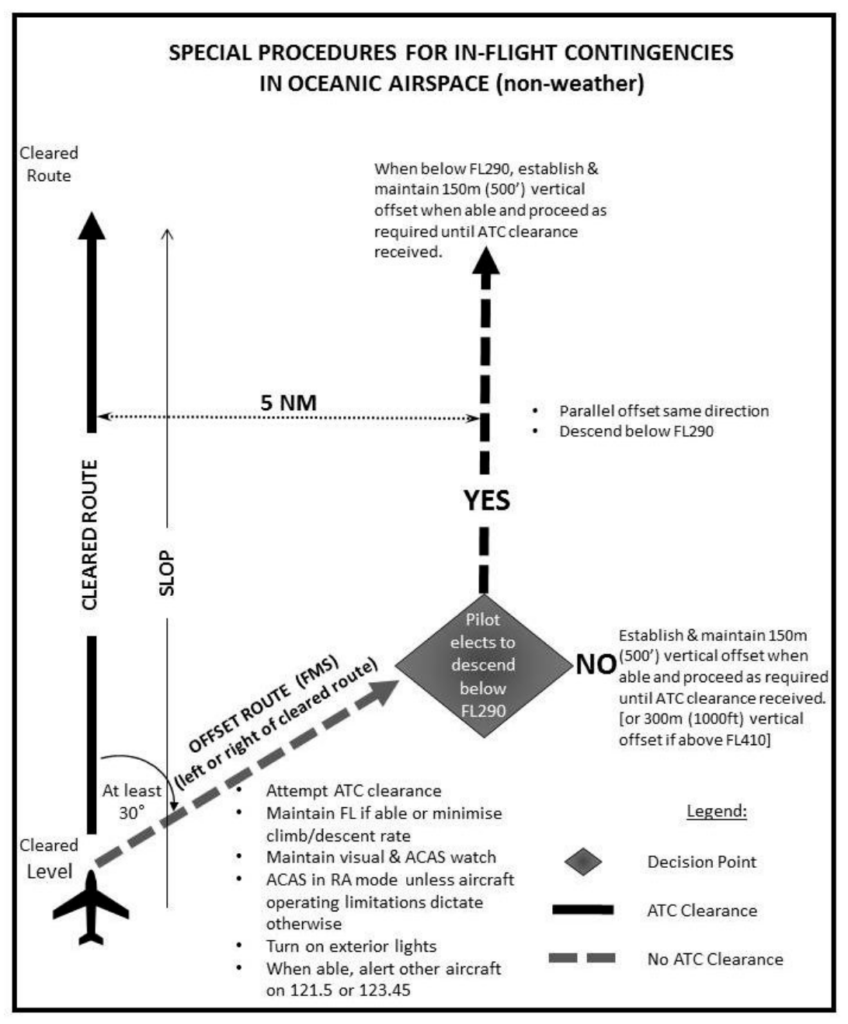
Before, there was a lot of confusion around the wording of these two procedures – but ICAO has now made this much clearer, and they have even included a little graphic to help us understand how it will work.

Thing is, it’s still a little clunky. So we decided to make our own version!

What’s new?

The simple answer is this: contingency offsets that previously were 15 NM with actions at 10 NM are basically now all 5 NM offsets with a turn of at least 30 degrees (not 45 degrees).

Rarely do we see ICAO oceanic contingency procedures undergo a formal revision. The last time a major revision occurred was in 2006 when ICAO standardized a 15 NM offset executed with a turn of at least 45 degrees. Prior to that, the North Atlantic and the Pacific had used different offset distances and a 90 degree turn.

Where and when?

A trial implementation is scheduled to begin in the NAT Region and New York Oceanic West starting 28th March 2019. ICAO is expected to formally publish the Standard in an update to PANS-ATM (ICAO Doc 4444) on 5 November 2020.

Why?

To support reduced separation being implemented in conjunction with Advanced Surveillance Enhanced Separation (ASEPS), Space Based ADS-B surveillance. The details for the ASEP trial can be found in NAT OPS Bulletin 2018-006 Trial Implementation of ASEPS using ADS-B.

Old version vs New version – full wording

Here’s the old version, as per the latest version of the NAT Doc 007, paragraph 13.3. (Note – this will be valid UNTIL 27 March 2019):

The aircraft should leave its assigned route or track by initially turning at least 45° to the right or left whenever this is feasible.

An aircraft that is able to maintain its assigned flight level, after deviating 10 NM from its original cleared track centreline and therefore laterally clear of any potentially conflicting traffic above or below following the same track, should:
a) climb or descend 1000 ft if above FL410
b) climb or descend 500 ft when below FL410
c) climb 1000 ft or descend 500 ft if at FL410

An aircraft that is unable to maintain its assigned flight level (e.g due to power loss, pressurization problems, freezing fuel, etc.) should, whenever possible, initially minimise its rate of descent when leaving its original track centreline and then when expected to be clear of any possible traffic following the same track at lower levels and while subsequently maintaining a same direction 15 NM offset track, descend to an operationally feasible flight level, which differs from those normally used by 500 ft if below (or by 1000 ft if above FL410).

Before commencing any diversion across the flow of adjacent traffic or before initiating any turn-back (180°), aircraft should, while subsequently maintaining a same direction 15 NM offset track, expedite climb above or descent below the vast majority of NAT traffic (i.e. to a level above FL410 or below FL290), and then maintain a flight level which differs from those normally used: by 1000 ft if above FL410, or by 500 ft if below FL410. However, if the flight crew is unable or unwilling to carry out a major climb or descent, then any diversion or turn-back manoeuvre should be carried out at a level 500 ft different from those in use within the NAT HLA, until a new ATC clearance is obtained.

And here’s the new version, as per the NAT OPS Bulletin 2018-005 Special Procedures for In-flight Contingencies in Oceanic Airspace (Note – this will be valid FROM 28 March 2019):

If prior clearance cannot be obtained, the following contingency procedures should be employed until a revised clearance is received:

Leave the cleared route or track by initially turning at least 30 degrees to the right or to the left, in order to intercept and maintain a parallel, direction track or route offset 9.3 km (5.0 NM).

Once established on a parallel, same direction track or route offset by 9.3 km (5.0 NM), either:
a) descend below FL 290, and establish a 150 m (500 ft) vertical offset from those flight levels normally used, and proceed as required by the operational situation or if an ATC clearance has been obtained, proceed in accordance with the clearance; or
b) establish a 150 m (500 ft) vertical offset (or 300 m (1000 ft) vertical offset if above FL 410) from those flight levels normally used, and proceed as required by the operational situation, or if an ATC clearance has been obtained, proceed in accordance with the clearance.

Note. — Descent below FL 290 is considered particularly applicable to operations where there is a predominant traffic flow (e.g. east-west) or parallel track system where the aircraft’s diversion path will likely cross adjacent tracks or routes. A descent below FL 290 can decrease the likelihood of: conflict with other aircraft, ACAS RA events and delays in obtaining a revised ATC clearance.

So to reiterate, the important change is that contingency offsets that previously were 15 NM with actions at 10 NM are basically now all 5 NM offsets with a turn of at least 30 degrees (not 45 degrees).

Weather deviations

If you have to deviate from your assigned track due to anything weather-related, there’s a whole different procedure to follow. Again, the NAT Ops Bulletin has all the details for this, but the bottom line seems to be:

For deviations of less than 5 NM, remain at the flight level assigned by ATC.

For deviations of 5 NM or more, when you are at the 5 NM point initiate a change as follows:

If flying EAST, descend left by 300ft, or climb right by 300ft.

If flying WEST, climb left by 300ft, or descend right by 300ft.

In other words – SAND! (South of track = Ascend, North of track = Descend; Up/Down by 300ft)

But remember, going right is probably better – it gets you out of the way of all the SLOP offset traffic that might be coming at you from the opposite direction!

Turnback procedure

In both the NAT Ops Bulletin and the new NAT Doc 007 which will take effect from 28 Mar 2019, ICAO has left out any specific reference to how to divert across the flow of traffic or turn-back procedure, and instead simplified it to just “proceed as required by the operational situation”. Turning back would assume you either employ the 5NM offset as per the new contingency procedure, or else get a new revised clearance.

Bottom line

If you operate in the NAT HLA, we recommend you read and review the NAT Ops Bulletin in its entirety. It’s relatively short but, beginning 28 March 2019, the procedures are expected to be implemented. You might want to prepare changes for your Ops Manuals and checklists too.

Make sure you stay tuned to OPSGROUP for changes that may occur as we approach 28 March 2019!

Further reading:

  • On Nov 1st we had a call with 140 OPSGROUP members about upcoming changes on the NAT in 2019, and how we can effect change. OPSGROUP members can find the PDF notes of this in your Dashboard.
  • A big thing driving the ASEPS trial is the rollout of Space-based ADS-B, which is scheduled to complete its deployment by 30 Dec 2018, giving us worldwide, pole-to-pole surveillance of aircraft. For more on that, and how it will affect operations on the NAT specifically, read the article by Mitch Launius here.
  • Use our quick guide to figure out where you are welcome on the NAT, depending on what equipment and training you have.


First look at NAT changes for 2019

Starting 28th March 2019, a new trial will be implemented on the NAT called ASEPS (Advanced Surveillance Enhanced Procedural Separation) using ADS-B in the Shanwick, Gander and Santa Maria FIRs.

Compliant aircraft will see a reduction in longitudinal separation to as close as 14 NM. This is not restricted to particular tracks or altitudes, just between properly equipped aircraft – you’ll need RVSM/HLA approval, ADS-B, and to be fully PBCS compliant (that means meeting the specifications of RNP4, RCP240 and RSP180). Read this ICAO Bulletin for all the details.

When the ASEPS trial starts, there will also be some changes to the contingency and weather deviation procedures. Before, there was a lot of confusion around the wording of these two procedures – this has now been made much clearer, and they have even included a nice little graphic to help us understand what to do. Read this ICAO Bulletin for all the details.

ICAO have published all these changes in their updated NAT 007 Doc valid for 28th March 2019.

Further reading:

  • On Nov 1st we had a call with 140 Opsgroup members about upcoming changes on the NAT in 2019, and how we can effect change. Opsgroup members can find the PDF notes of this in your Dashboard.
  • A big thing driving the ASEPS trial is the rollout of Space-based ADS-B, which is scheduled to complete its deployment by 30 Dec 2018, giving us worldwide, pole-to-pole surveillance of aircraft. For more on that, and how it will affect operations on the NAT specifically, read the article by Mitch Launius here.
  • Use our quick guide to figure out where you are welcome on the NAT, depending on what equipment and training you have.
  • All the big changes on the NAT in 2018 are covered on our page here.


2018 Edition: New NAT Doc 007 2018 – North Atlantic Airspace and Operations Manual

For the latest changes and updates on the North Atlantic, including our most recent Guides and Charts, use our NAT reference page at flightservicebureau.org/NAT.

2018 version – NAT Doc 007

The 2018 version of NAT Doc 007, North Atlantic Airspace and Operations Manual, was published in January 2018 by ICAO/NAT SPG.

Download the original document here (PDF, 5mB), and see also:


2018
 is off to a flying start again with NAT changes – these are the latest important changes. These are also published in the latest edition of NAT Doc 007, January 2018.

  • PBCS From March 29th 2018, PBCS is a requirement for the NAT Tracks between FL350-390 – RCP240 and RSP180. Read more about PBCS in our article.
  • RLAT  From January 4th 2018, Shanwick and Gander increase the number of RLAT tracks – most tracks between FL350-390 will now be RLAT – 25nm separation between them.

And there will be more! Keep an eye on the FSB NAT Changes page, we’ll keep it updated.


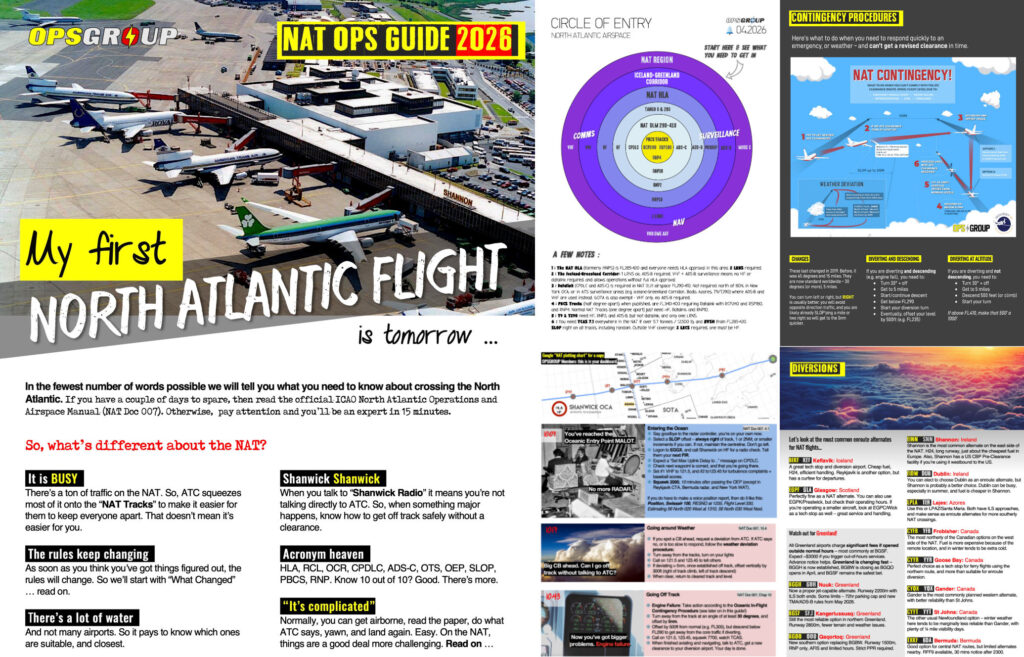
Feb 2nd, 2018: FSB updated the full NAT Crossing Guide “My first North Atlantic Flight is tomorrow“.

– What’s different about the NAT, changes in 2018, 2017, 2016, 2015, NAT Quick Map
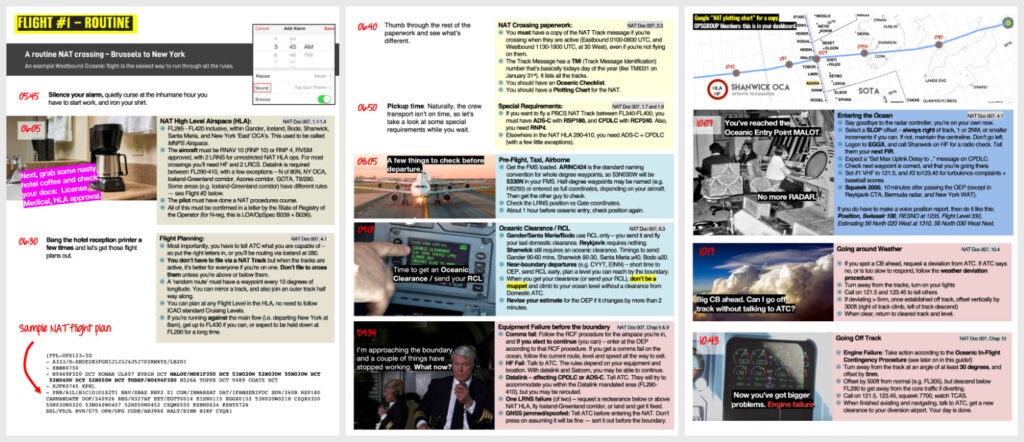
– Routine Flight Example #1 – Brussels to JFK (up at 5.45am)
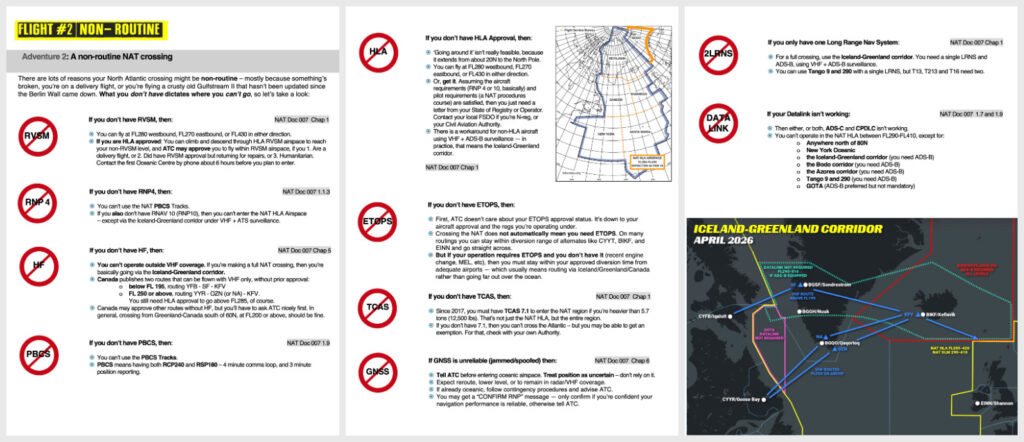
– Non Routine-Flights: No RVSM, No RNP4, No HF, 1 LRNS, No HLA, No ETOPS, No TCAS, No Datalink – what you can do and where you can go
Take a look.


2017 Edition: NAT Doc 007 2017 – North Atlantic Airspace and Operations Manual

The 2017 version of NAT Doc 007, North Atlantic Airspace and Operations Manual, was published in January 2017 by ICAO/NAT SPG.

Download the original document here (PDF, 5mB), and see also:


Feb 15th, 2017 In the first six weeks of 2017 there have been some important changes on the NAT/North Atlantic. These are published in the latest edition of NAT Doc 007, January 2017.

  • TCAS 7.1: From January 1st, 2017, TCAS 7.1 is required throughout the entire NAT region.
  • Cruising Level: Effective 2017, you no longer need to file an ICAO standard cruising level in NAT airspace.
  • Gross Nav Error:  is now defined as greater than 10nm (used to be 25nm)
  • Contingency Procedure: Published January 2017, a new turn-back (180) procedure is introduced – turn back to parallel previous track by 15nm.
  • Datalink Mandate Exemptions: Announced January 2017, new exemptions for Phase 2B of the Datalink mandate, which will start on December 7, 2017 (FL350-390). Exempt: Tango Routes, airspace north of 80N, and New York OCA.

Feb 15th, 2017: FSB published the full NAT Crossing Guide “My first North Atlantic Flight is tomorrow“.

– What’s different about the NAT, changes in 2017, 2016, 2015, NAT Quick Map
– Routine Flight Example #1 – Brussels to JFK (up at 5.45am)
– Non Routine-Flights: No RVSM, No RNP4, No HF, 1 LRNS, No HLA, No ETOPS, No TCAS, No Datalink – what you can do and where you can go
Take a look.