



An OPSGROUP member was recently caught off guard by a day-time noise violation while departing EGGW/Luton in a Falcon 7X.
Despite flying the published departure procedure accurately and easily meeting the AIP’s only climb requirement, they busted the day-time limit of 79 decibels by 0.6. The result was a fine of £1250 GBP ($1700 USD).
While being fined for a six tenth of a decibel sounds harsh (and it is), strict enforcement of noise is common at many airports around the world.
What bothers us here is the lack of clear guidance at Luton as to what to fly, and getting stung nonetheless – there’s no published NADP procedure, and for pilots the rules are murky at best.
Welcome to the Luton noise trap…
How do we hit the number?
Things work a little differently at Luton. Rather than prescribing a vertical climb profile (NADP 1 or 2), the airport relies on Noise Preferential Routes (NPRs) to keep departures away from sensitive areas. Lateral track accuracy is essential, until reaching the prescribed day or night ‘release altitude’ – 3000 ft and 4000 ft respectively.
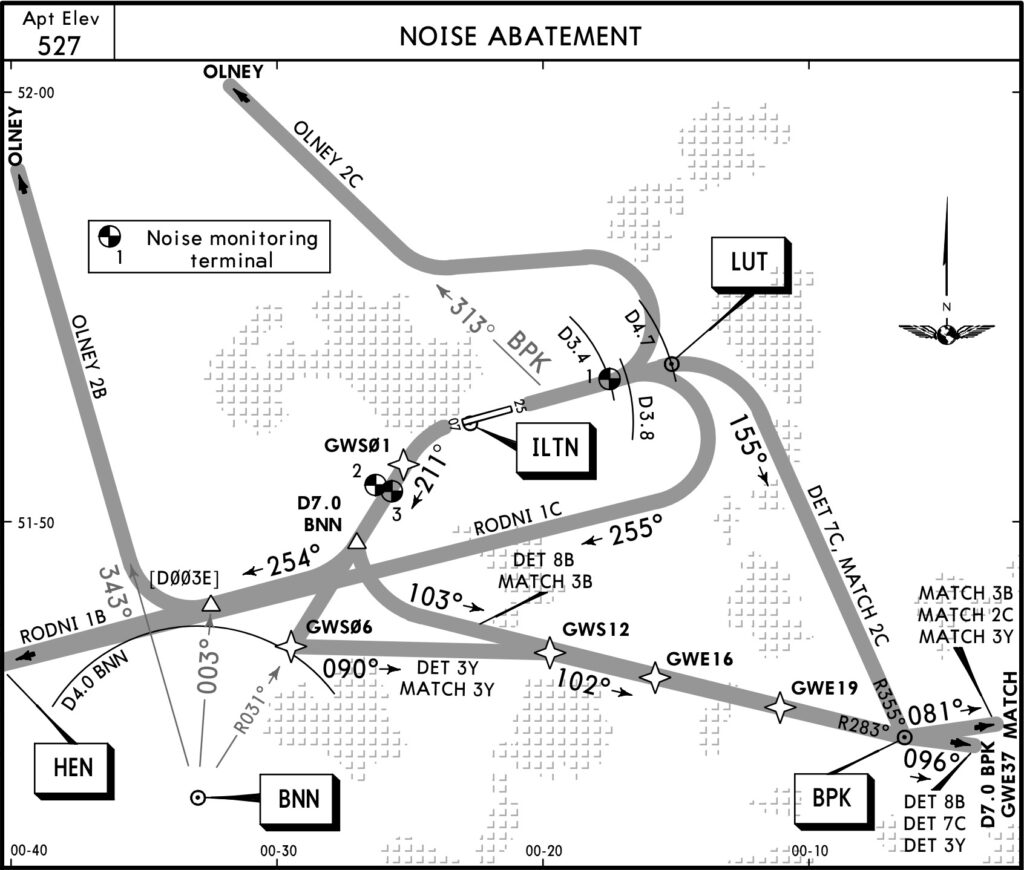
There is no NADP procedure – in fact the airport confirmed it has no plans to mandate one because in their own words ‘individual airlines require different procedures.’
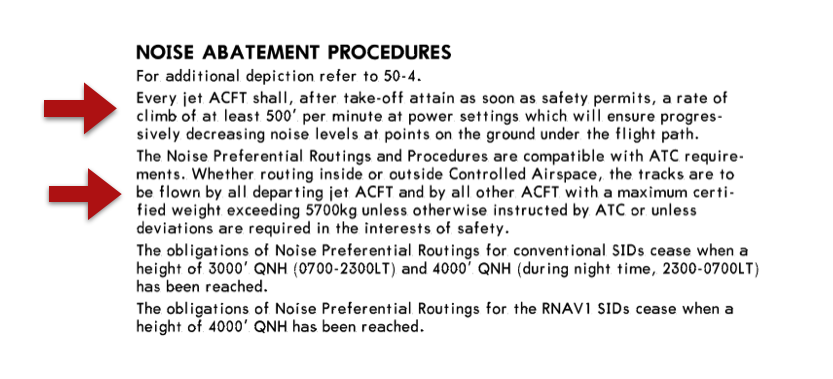
Our member flew the NPR correctly and met the only climb requirement in the AIP – a minimum of 500 fpm, not exactly difficult in a Falcon. And yet they still found themselves in hot water.
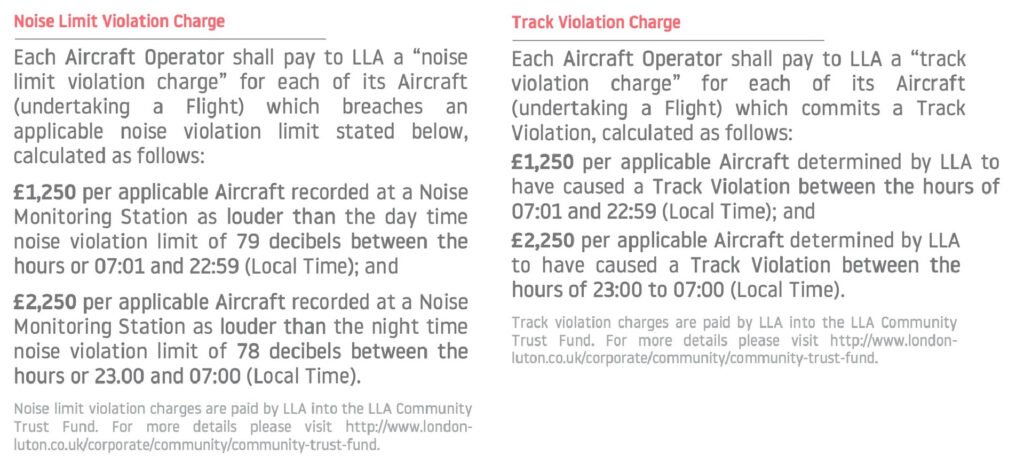
 Here’s why – Luton concurrently runs a noise-monitoring program. You won’t find it in the AIP, it’s buried in the airports’ Charges and Conditions of use.
Since January this year, the daytime limit is 79 dB and 78 dB at night. This is tracked by ‘noise monitoring terminals’ nestled in the surrounding suburbs. Fines of £1250 ($1700 USD) and £2250 GBP ($3050 USD) apply if you bust the limits.
The flight in question (a 7X near max take-off weight on a warm summer’s day) measured 79.6 dB and triggered a fine.
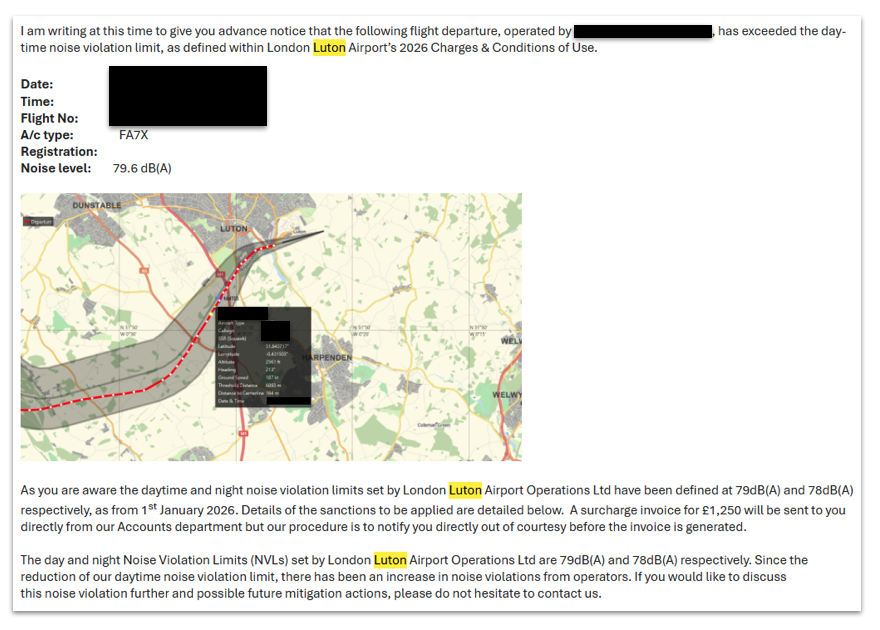 Here’s what we don’t like about this.
Crew are being left with decibel limits with no guidance on a profile that will achieve it – if you happen to know how to operate your aircraft to within 0.1 of a decibel, please let us know.
In fact, the only additional guidance in the AIP is pretty vague. It contains a general instruction to climb at “power settings which will ensure progressively decreasing noise-levels.” Hardly earth-shattering advice.
What the data had to say
The operator here asked the airport authority about the fine in question, who in turn pulled the actual data.
It seems the noise event was recorded at 2900 ft – just 100 feet below the daytime release altitude.
The included graph did indeed show that the incident flight was flying a slightly shallower gradient than most other departures. Despite what the AIP says, it appears many other operators are informally applying their own NADP to steepen their initial climb, most likely to avoid the same trap.
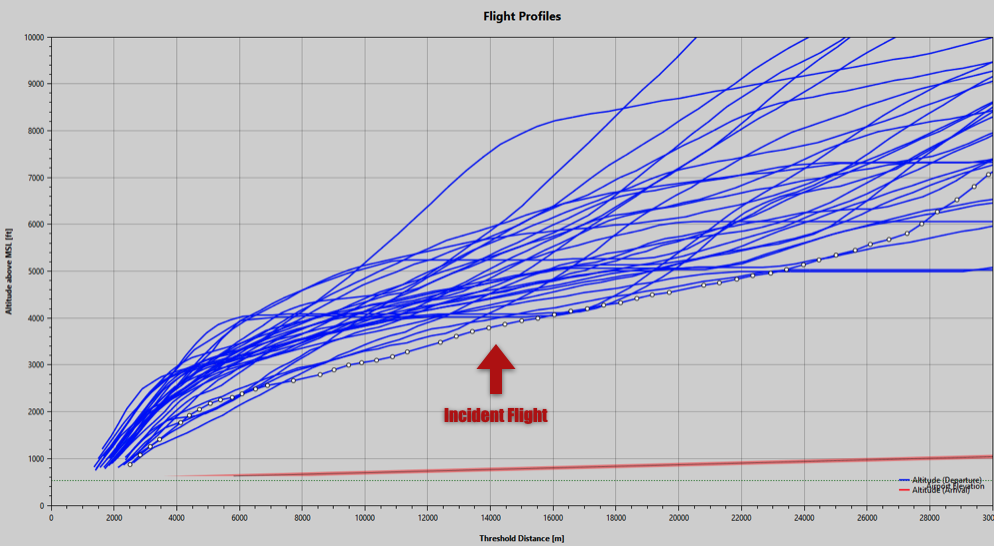 But it’s a workaround, because unlike the payment of the resulting fines, the airport doesn’t mandate it. It’s simply left up to the operators – and for that, we cry foul.
So what’s the answer?
The case above shows that you can’t rely on the AIP alone to protect you from a fine – especially when performance is limited (hot, heavy etc). Your best protection is to apply an NADP anyway. ICAO defines two of these:
NADP 1 (noise near). Maintain V2 + 10 – 20 kts and delay flap retraction until reaching 3,000 ft AGL, while reducing power at or above 800 ft. This keeps your aircraft close-in and configured, which reduces noise nearer the runway. This is what we suggest for Luton.
NADP 2 (noise distant). Early acceleration and flap retraction (usually 800 ft AGL) and then maintain your designated manoeuvring speed until 3000 ft AGL. This means that noise reduction is spread out further from the airport since you’re climbing faster and higher sooner. This trades close-in quiet for less noise down the track.
Here’s a handy summary: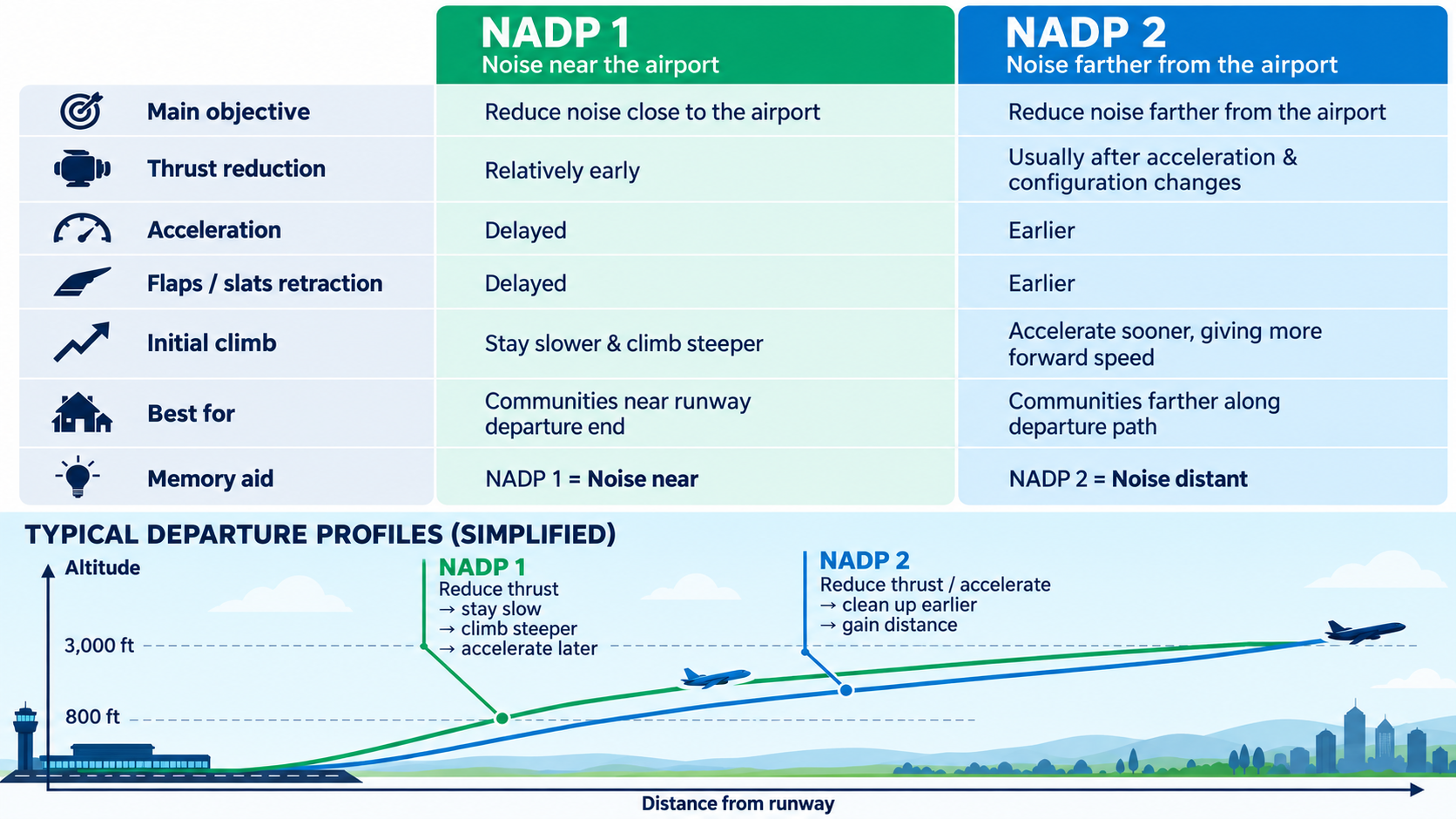
Do you know of other noise traps?
Luton probably isn’t the only airport with these kinds of issues. Do you have one to share? Please reach out to us so we can share it with the group. You can reach us around the clock at blog@ops.group.

More on the topic:
- More: London Night Ops: What’s Changing This Summer
- More: GAR Procedure for UK Flights
- More: London Airports Top Tips
- More: Shush! Keep the Sound Down!
- More: London Luton now available for night flights again
More reading:
- Latest: GPS trouble on the North Pacific routes
- Latest: The Luton Noise Trap
- Latest: India puts a three-aircraft limit on permits
- Safe Airspace: Risk Database
- Weekly Ops Bulletin: Subscribe
- Membership plans: Why join OPSGROUP?






 Get the famous weekly