




Japan’s CAA (JCAB) is clamping down on pilot deviations, and is rolling out a three-strike system for captains at Tokyo’s RJTT/Haneda.
It works like this: a pilot who accumulates three qualifying deviations from ATC instructions will be come a ‘restricted’ captain. Find yourself on that list, and you will lose the ability to serve as PIC there.
Universal confirms these rules apply to international BizAv – the crews most likely to be unfamiliar with Haneda’s tight and high-density airspace.
So here’s everything you need to know before you step up to the plate.
The core policy
Before we start, it’s important to note this new policy is PIC-specific.
When it comes fully into effect, operators will need to declare the PIC’s name, licence number and contact info on the Airport Use Plan – the pre-arrival paperwork that international operators need to file with JCAB before operating into Haneda.
If ATC flags a deviation (e.g. runway/taxiway incursion, clearance bust etc) they will review the circumstances and decide whether to log it against the PIC or not (not all deviations will count). If it’s confirmed, the PIC’s name will go on a naughty-list the JCAB refers to as ‘Watchlist of Captains Requiring Special Attention.’
Once a PIC has accumulated three “strikes” (qualifying deviations), they will become a ‘restricted captain.’ This means they can no longer act as PIC on flights in or out of Haneda. They can still fly there, just not in command.
Things to note
Deviations will be logged against the PIC’s name, but operators won’t totally dodge the ball either. If a restricted captain is listed as PIC, the operator will be asked to swap in a different captain. Refusing that may place the operator’s own access to Haneda at risk.
But here’s some better news. The number of strikes against a PIC’s name will decrease by one after each full year passes with no further deviation, after which they’re free to operate again.
Why the change?
There was a string of ATC deviations by foreign BizAv crews through 2025. JCAB was sufficiently concerned that it issued an advisory in October last year to address this. It included two serious examples of one aircraft entering Runway 04/22 without a clearance, and another entering a closed taxiway, A1.
The advisory asks operators to make sure they check the AIP, SUPs and Notams carefully. If there is any doubt over your clearance, they want you to stop before entering a runway and actively confirm ATC’s instructions.
And of course, underpinning all of this is the tragedy of Jan 2, 2024, when an Airbus A350 collided with a Dash 8 on Runway 34R. Since then there has been a significant push to improve runway safety at Haneda, including changes to several ATC procedures.
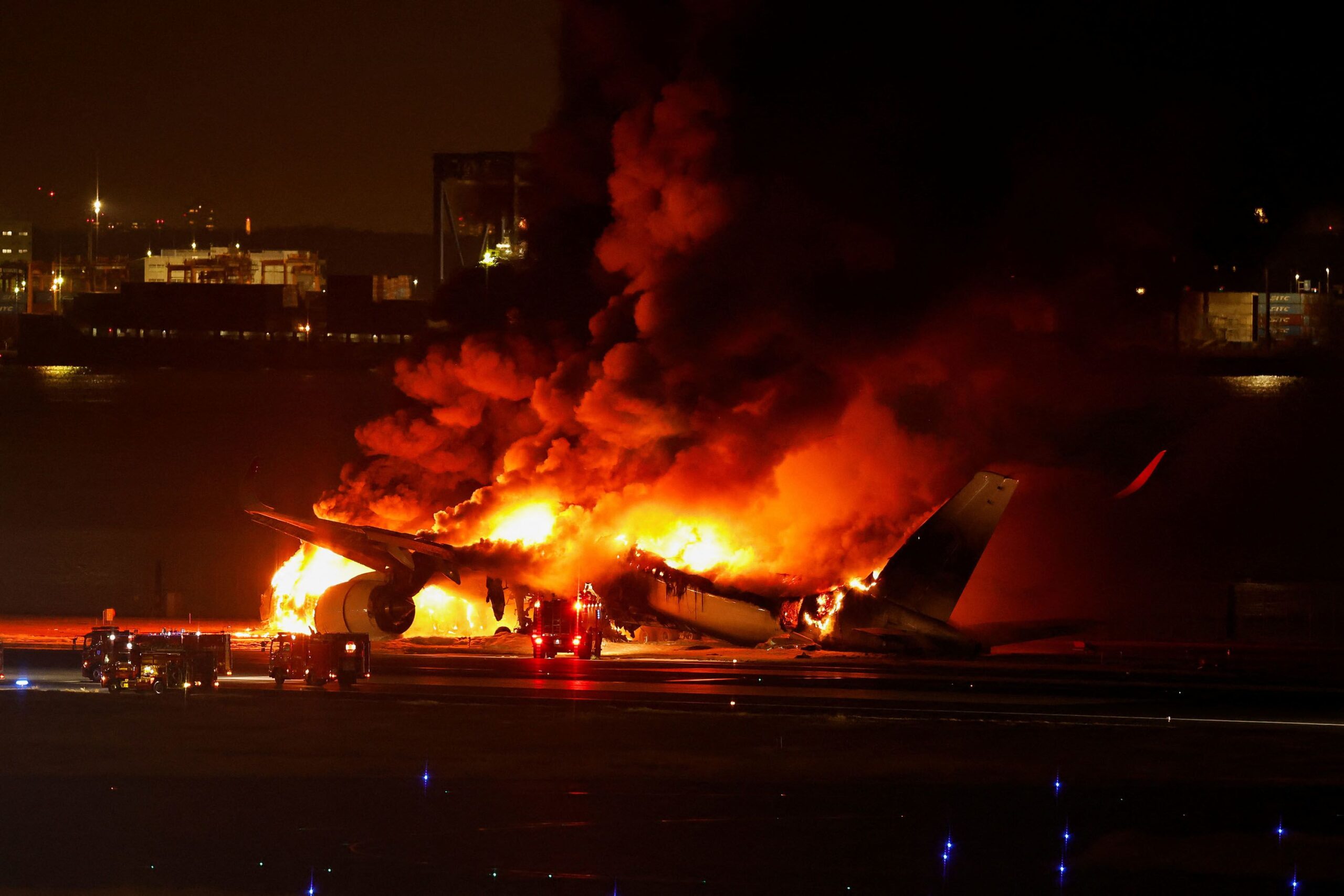
There has been renewed scrutiny on clearance confusion and ATC procedures since a tragic ground-based collision in Jan 2024.
New (ish) Safety Bulletin
In March this year, Haneda’s ATC office, along with Japan’s national government ministry published an extremely useful bulletin that provides a fairly comprehensive list of the kinds of things we’re getting wrong out there. These are covered in detail in the bulletin, but here’s a sneak preview of the main ones.
Taxiway Confusion:
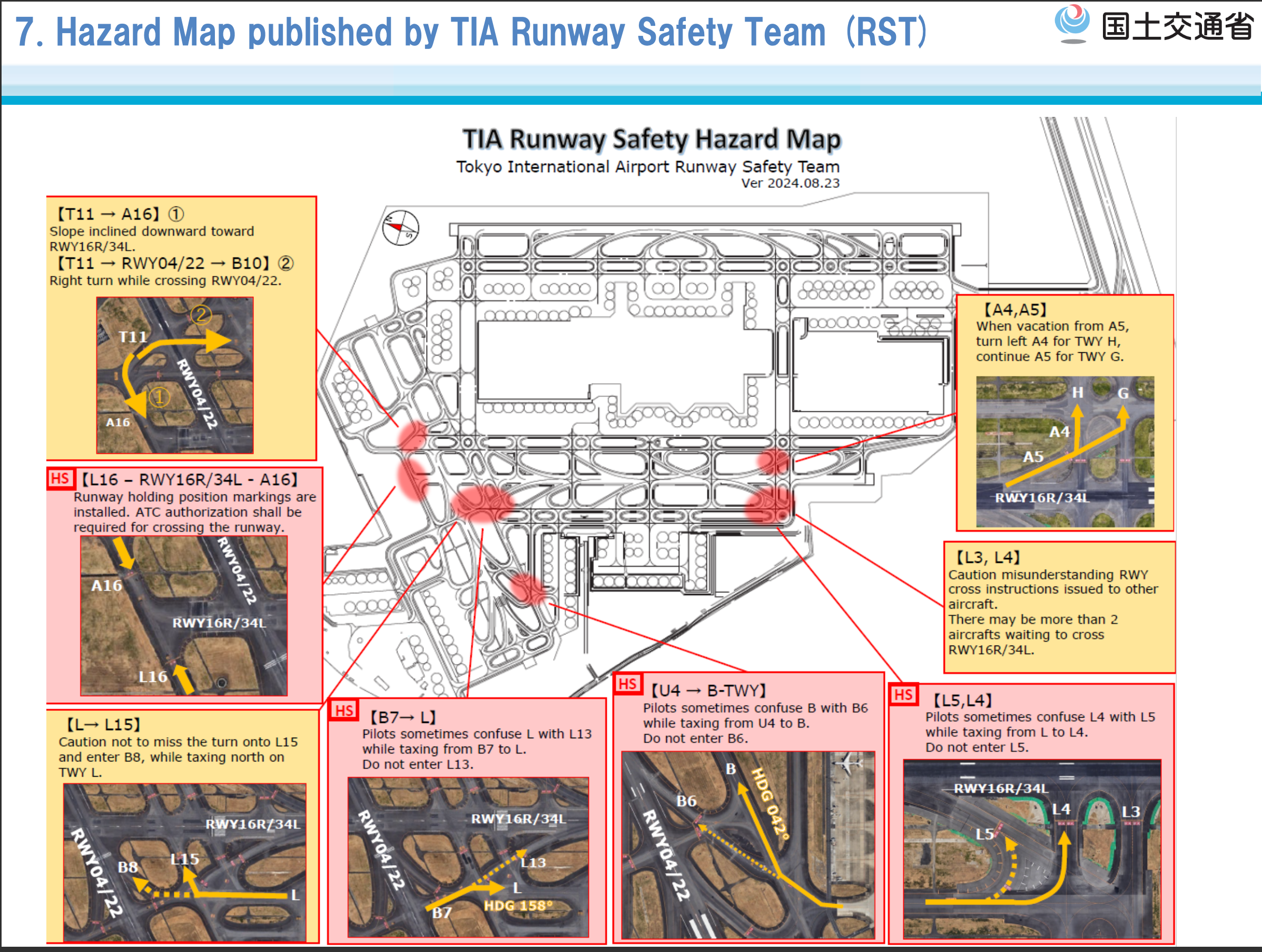
The bulletin places a heavy emphasis on the mis-understanding on taxiway clearances – take one look at the airport chart and you’ll understand why.
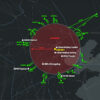
There are several well known hotspots. Rather than blurt out a senseless series of taxiway designators, Tokyo’s Runway Safety team has summarised these into one handy graphic:
Incursion Prevention:
This one’s a reminder from an AIC published in the aftermath of the A350/Dash 8 collision. It may seem like common sense, but a sequencing call from ATC (such as No.1/No.2) is not a clearance to enter the runway. In fact there are only four phrases that let you do that:
- Cleared for take-off.
- Line up and wait.
- Cross runway.
- Taxi via runway.
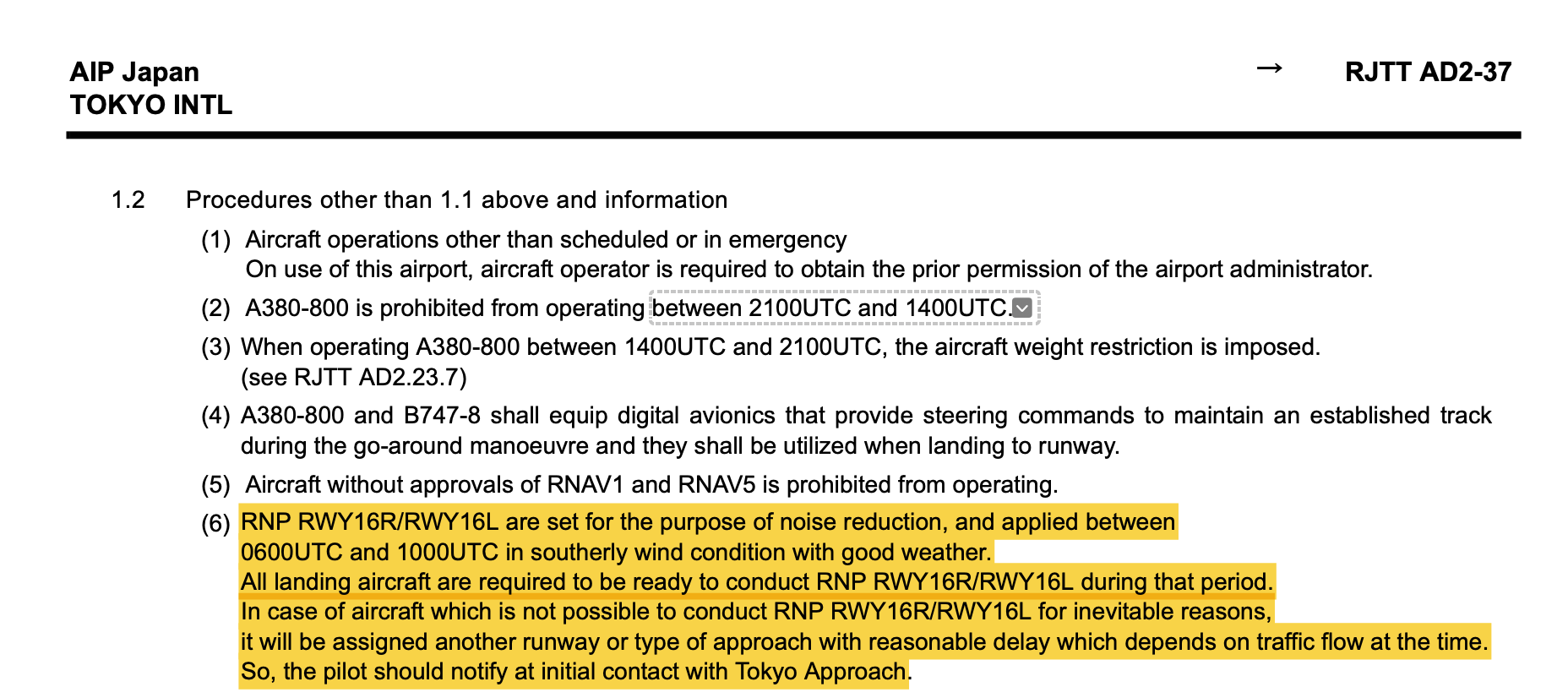
Use of the RNP Runway 16R/16L:
This one is buried in the AIP. The RNPs are used for noise abatement between 15:00 – 19:00 LT in southerly conditions with good weather. The AIP states that all landing aircraft should be ready to shoot these approaches during this window. If your aircraft isn’t equipped, you need to let Tokyo approach know as early as possible. This may lead to a different runway allocation, or delays while a different approach is coordinated.
 SID Suffixes:
In northerly winds, SIDs contain either an A, B, or C suffix. The initial waypoint for each suffix may vary so if you put the wrong one in the box, you may end up flying the wrong departure.
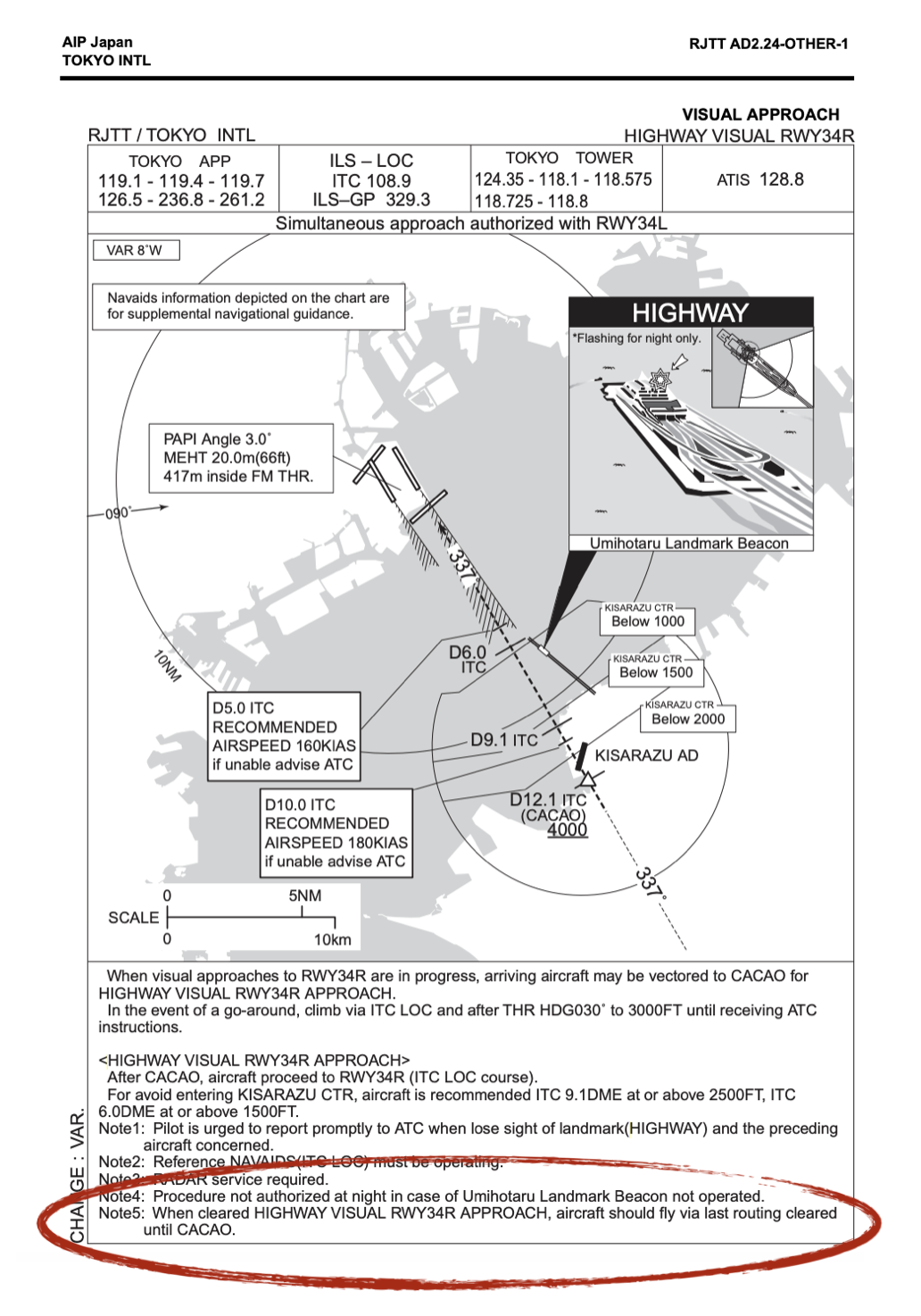
Highway Visual Runway 34R:
After getting an approach clearance, don’t cut straight to CACAO – fly the last assigned routing to CACAO unless ATC specifically tells you otherwise.
 Speedy Turnoffs:
Like most busy airports, they want you off the runway pronto. Charts show the standard exits for each runway configuration and time of day.
So when is this three-strike thing actually happening?
Here’s where things are a little vague. We’ve been advised by reliable sources that informally, it already is. However the Airport Use Plan hasn’t been updated yet to include the PIC’s personal details. Assume it’s time to play ball – if a deviation occurs, JCAB will just ask for this info afterward.
More on the topic:
- More: Japan BizAv Ops: Haneda, Narita, and Nagoya Explained
- More: Japan Boosts ATC Procedures and Lessons from Haneda
- More: Japan Reopens: Crew & Passenger Entry Rules Explained
- More: Japanese Prime Minster Funeral: Tokyo Restrictions
- More: Declassified: New Crew Rules in Japan
More reading:
- Latest: Seletar 2026: New Corridors, New Procedures
- Latest: Middle East Airspace – Current Operational Picture
- Latest: The Lajes Lowdown: Atlantic Stopover and ETOPS Alternate
- Safe Airspace: Risk Database
- Weekly Ops Bulletin: Subscribe
- Membership plans: Why join OPSGROUP?


 Get the famous weekly




“The number of strikes against a PIC’s name will decrease by one after each full year passes with no further deviation, after which they’re free to operate again.”
What deviation could be listed for a pilot who is not allowed to fly as PIC?
Hi Javier, I’m not sure if I have fully understood your question. But from the information we have, only the PIC’s details are recorded for each flight. Any deviations would be registered against whoever is listed as pilot-in-command. A pilot not allowed to fly as PIC would be acting as another crew member (such as SIC), and not subject to this.