


Quick Summary
- A look at some things to consider before, during and after a winter flight.
- From weather and airport conditions to runway performance, cold-temp corrections, de-icing, taxiing, in-flight icing and fuel, and prepping the aircraft for a cold night.
I’m based in Asia, where 25°C can be considered cold. But thanks to the rather impressive range of a Gulfstream, I still spend much of the year chasing winter around the Northern Hemisphere, from freezing fog in Europe to blizzards on the US East Coast.
There’s a lot more to winter ops than getting the de-icing truck out. With winter approaching in the Northern Hemisphere, here are some of the things I check before heading somewhere properly cold.
1. Before departure
Start with the weather, but look beyond the TAF
I always start with the weather, but the METAR and TAF are only the beginning. Looking at longer-range forecasts from the local met service gives you a much better picture. Then comes the bigger question: what is the airport actually doing about the weather, and can it continue operating when conditions deteriorate?
Some airports are great at clearing snow and treating runways. Others might have a single snowplough and a fairly optimistic approach to winter operations. I always get a kick out of Finavia’s annual winter operations video, Snowhow. But I can’t think of a better name for the expertise needed to keep an airport operating through a proper winter.
Have a chat with your handler about the airport’s winter operations plan, particularly whether the ramp where you intend to park is actually cleared of snow.
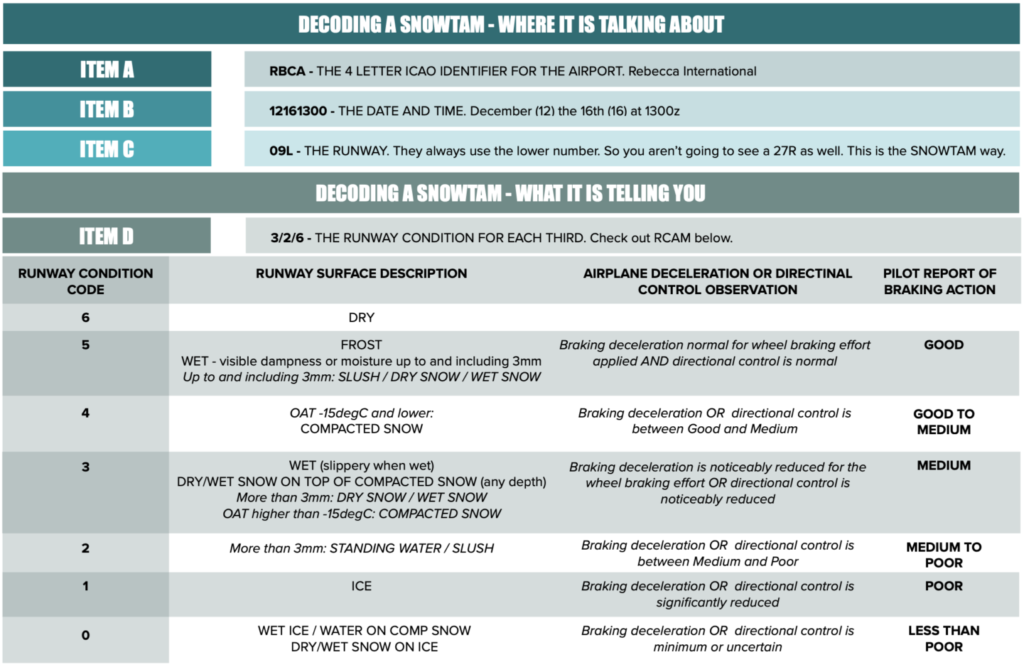
Check the SNOWTAMs and any restrictions affecting runways, taxiways and parking areas. If it’s somewhere you haven’t been before, find out how quickly they can clear the runways, what de-icing facilities are available, and what happens when the snow really starts coming down.
It’s also worth checking whether the airport operates with reduced runway widths during snow-clearing operations. A runway might technically be open, but that doesn’t necessarily mean its full width is available. Remember that heavy snowfall can impact operations for many days, so whilst you might be spared the actual storm, how efficiently the airport clears the snow will have a big impact on your trip.
One thing that can get overlooked is your alternate. If your destination and alternate are both under the same weather system, there’s a fair chance they’ll both go downhill together. I prefer to have an alternate well clear of the worst weather, even if it means carrying a bit more fuel.
Finally, ask around. Check with friends and colleagues who have been to the airport or region before. Book knowledge is important, but local knowledge can be far more valuable. OPSGROUP has plenty of Airport Spy Reports that can give you a better idea of what to expect on the ground.
Get familiar with runway condition codes
If you haven’t spent much time operating on contaminated runways, it’s worth refreshing your knowledge of the ICAO Global Reporting Format (GRF). Runway condition reports use codes from 0 to 6, with 6 representing a dry runway and 0 indicating the poorest reported conditions.
But don’t just look at the code. The type of contamination, its depth, coverage and the actual runway conditions all matter. A runway covered in compacted snow is quite different from one covered in wet ice or slush.
It’s important to remember that runway condition codes aren’t a guarantee of braking performance. They’re an assessment of the runway, and conditions can change quickly. Braking action may be reported on the ATIS or passed by the tower, sometimes based on pilot reports. If the braking you experience is different from what was reported, let ATC know.
Check which way round the runway thirds are being reported. SNOWTAMs present them from the lower runway designator – a report given for the direction of use (e.g. on the ATIS) may read the other way round. It’s an easy detail to miss when you’re busy.
Run the numbers for a worse runway
Whenever we’re dispatching to an area with bad weather, we look at the worst-case scenario. What happens if the weather isn’t what was forecast? How bad can it get before we can no longer land there?
I like to run the landing numbers for the worst conditions I expect before we depart. That way, if the weather starts going downhill en route, we already know where we stand.
If the destination is reporting a runway condition code of 5, what happens if it drops to 3? Can we still land at our planned weight? What about the crosswind, and do we still have enough runway?
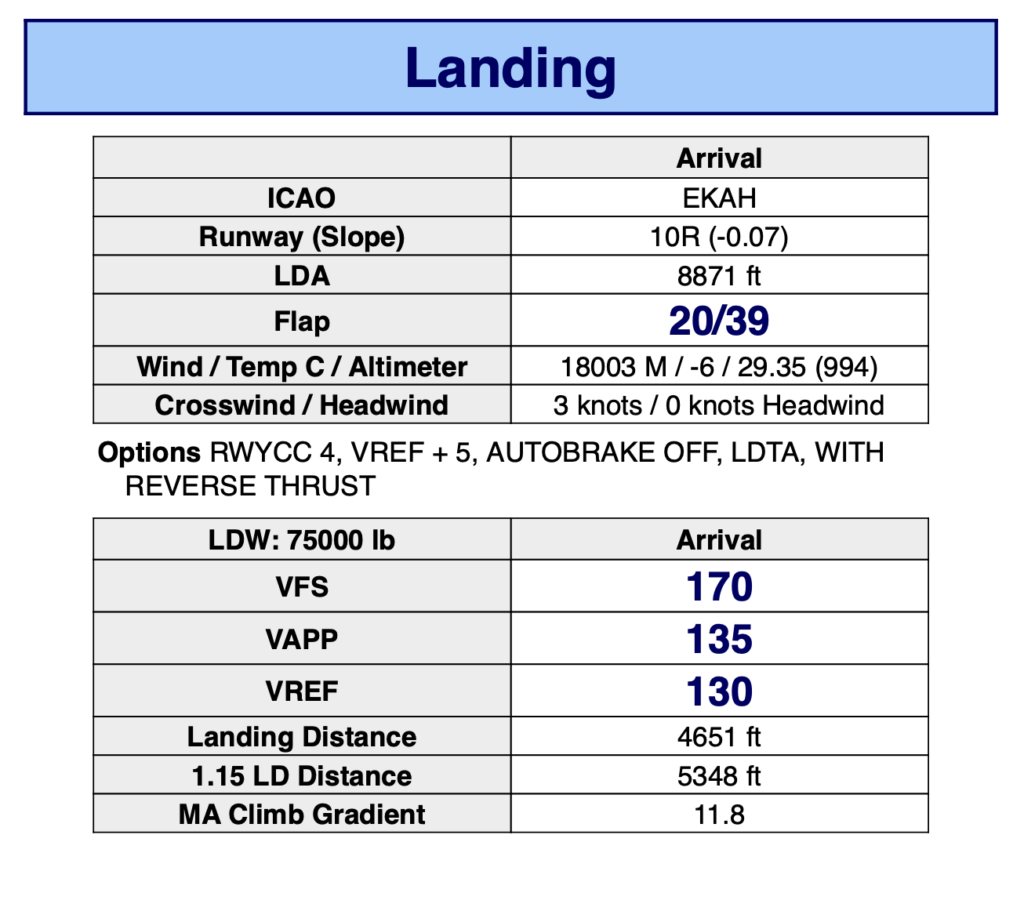
LDTA – EKAH G700
On many jets, reverse thrust isn’t credited in the normal dry-runway landing distance calculations, but it can become an important part of the contaminated-runway performance calculation. This can catch people out when dispatching with an MEL affecting the thrust reversers.
Remember that winter weather can change quickly, and having a few performance scenarios already calculated makes life much easier.
Contaminated runways affect more than just landing distance. Takeoff performance, accelerate-stop distance, crosswind limits and the aircraft’s ability to manoeuvre on the ground may all be affected. Have you briefed what happens if you encounter a slippery taxiway?
On an icy taxiway, even a heavy aircraft can lose traction. Once it starts sliding, the crew may have very little control over where it stops. Think about that before committing to a turn.
One really important thing to remember: check the limitations and performance data for your particular aircraft. Don’t assume the same rules apply to every type. You might see other aircraft getting ready to depart, but that doesn’t necessarily mean it’s OK for you to follow.
Many years ago in Incheon, I was sitting in my Airbus getting de-iced while other cargo aircraft were taking off. I started to wonder if I had made the right decision. Shortly afterwards, a FedEx aircraft taxied into the bay next to me, and I was glad to see him.
Cold-temperature altitude corrections
This is one of those things that’s easy to forget if you spend most of your time operating somewhere warm.
When the temperature drops well below standard, your actual altitude can be lower than the altitude indicated on your altimeter. Back when I first moved from GA onto the Airbus, an older (and wiser) line training captain told me to remember “from hot to cold, look out below.” And that has stuck with me ever since.
The colder it gets, the bigger the error can be, especially on approaches where terrain clearance is already tight.
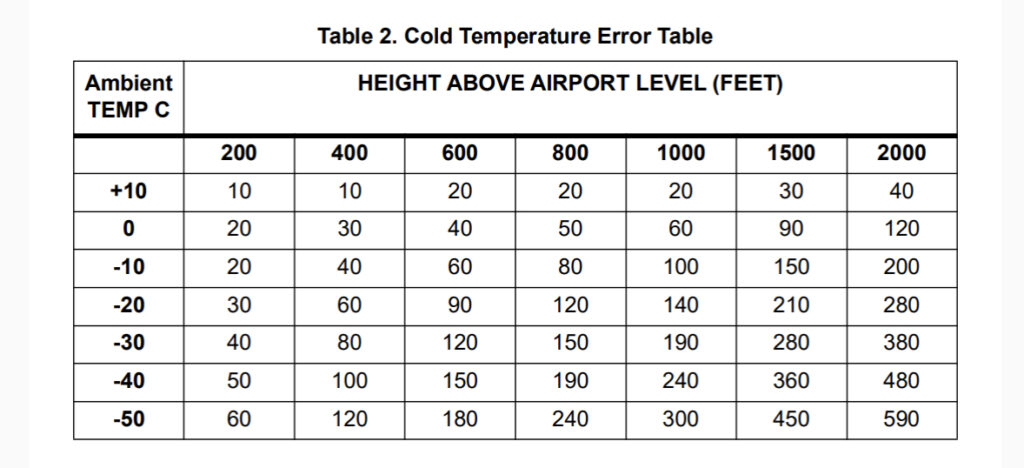
Cold Temperature Error Table.
Some aircraft can make the corrections through the FMS, while others need you to do them manually. Just because your FMS has the capability doesn’t mean you can use it everywhere. Different countries have different rules, and you need to know what ATC expects you to do.
In the US, the FAA publishes specific cold-temperature airport procedures. Other countries have their own requirements, and some approach charts include temperature limitations or correction requirements.
Make sure you know which altitudes need correcting, whether ATC needs to be told, and exactly what your FMS is doing when you select “Cold” mode. Be careful with ATC-assigned altitudes too. Don’t start applying corrections yourself without checking the local procedures and understanding what ATC expects.
This is something we always review as a crew before starting our descent. Leave it until you’re approaching the initial approach fix, and you can end up with a lot of unnecessary confusion in the cockpit.
Time to dig out the cold-weather procedures
Most aircraft have a cold-weather section tucked away in the operating manual, often with a separate de-icing and anti-icing supplement. They’re worth digging out before you head somewhere properly cold. Your next layover at a tropical resort is probably a good time to start.
Before the trip, have a chat with your engineer about cold-soak limits, start-up requirements and how best to protect the aircraft overnight. We’ll come back to this after landing, because that’s when you’ll need to put the plan into action!
De-icing: Know what you’re getting sprayed with
De-icing and anti-icing are two different things. And while it sounds pretty straightforward, it isn’t.
Be well prepared and remember how catastrophic the consequences can be if you get it wrong. This is one part of winter ops that deserves your full attention.
De-icing is about removing the snow, frost and ice already on the aircraft – usually with a heated mix of water and de-icing fluid. Once the aircraft is clean, a second application of anti-icing fluid may be needed to stop ice forming again while you’re waiting to depart.
Depending on the weather and what equipment the airport has available, this can be done in one step or two.
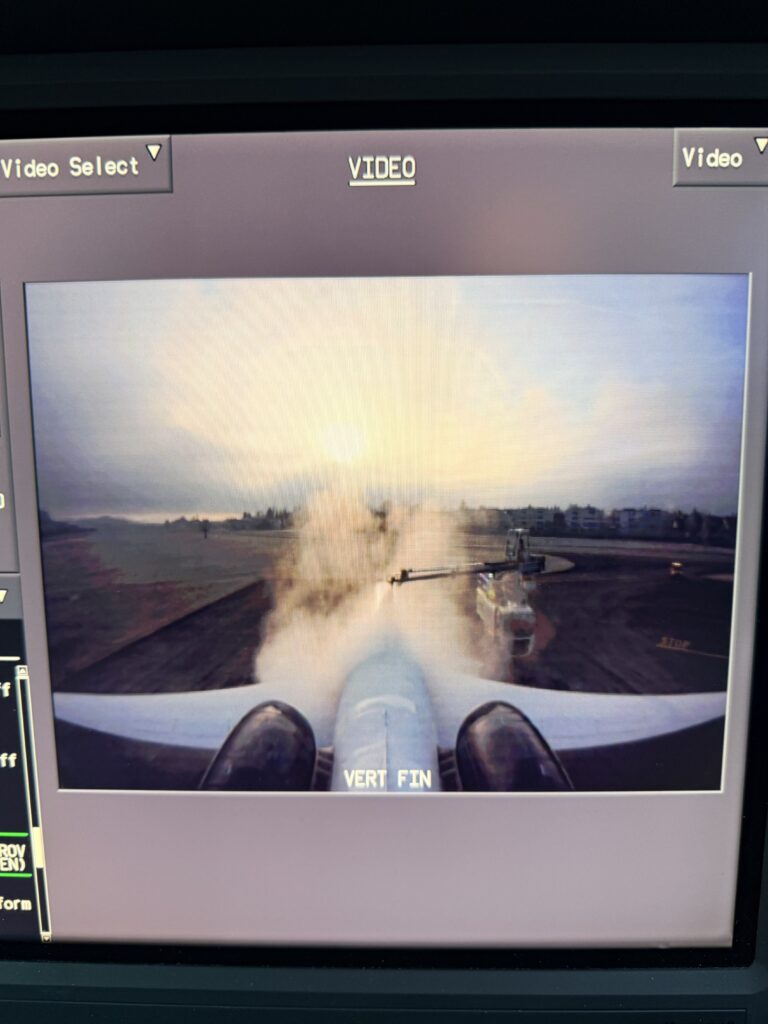
Deicing a G700.
Don’t assume every airport has Type IV fluid. Find out what’s available before you arrive, including the brand and concentrations they offer. Not every fluid or application method is suitable for your aircraft, so get your handler to confirm exactly what they’ll be using.
Then make sure it’s approved for your aircraft and that the ground crew understands any aircraft-specific restrictions. Things like APU inlets and pack air intakes vary between aircraft. Don’t assume the guy in the de-icing truck knows which areas to avoid on yours.
Also don’t assume that because an airport has a de-icing truck, it can properly de-ice your particular aircraft. This is particularly worth checking if you’re flying a large business jet into an airport that normally handles smaller jets.
And remember the clean aircraft concept. Critical surfaces must be free of contamination before takeoff. Crew must also complete the required pre-takeoff contamination checks. Depending on the aircraft and conditions, this may involve inspections that can’t be completed adequately from the cockpit. On ours, we can see the wing clearly from the cabin windows. The tail? That’s another story.
Personally I also think it’s a good idea to brief the passengers about the de-icing process. They have a better view of parts of the wings from the cabin windows than we do from the flight deck, so a short explanation of what’s happening outside can provide some peace of mind.
Holdover times: The clock is ticking
This is the point in the flight where all your preflight prep starts to pay off. Holdover times (HOT) depend on the type and concentration of fluid used, outside air temperature and prevailing weather conditions. There will be times when the forecast makes it pretty clear that de-icing won’t give you a workable departure window. Better to recognise that before you start spraying.
On 25 January 2026, Challenger 650 N10KJ crashed just after becoming airborne from Bangor, Maine, during snowfall. It overturned and caught fire, killing all six people aboard. The aircraft had stopped to refuel on its way to France and received Type I de-icing followed by Type IV anti-icing.
The NTSB’s preliminary report highlights a possible holdover-time issue: about 17 minutes elapsed between the start of anti-icing and takeoff, while the guidance cited in the report gave a maximum of nine minutes for the conditions. It’s an important finding, but we still don’t know what caused the accident. The investigation is ongoing.
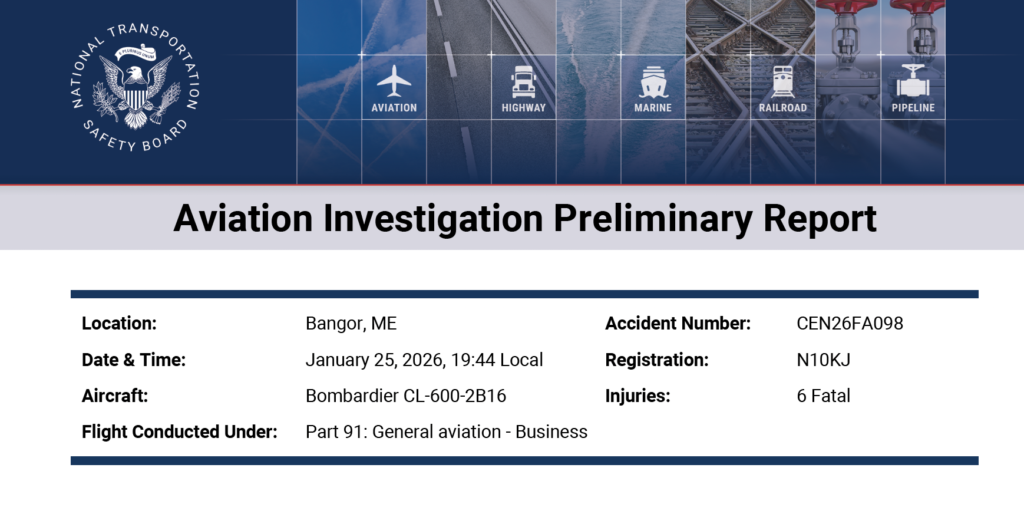
FAA Bangor Investigation Report.
This past winter, I spent nearly USD 10,000 on a two-step de-icing in Switzerland for the G700. It’s not cheap, and once you’ve been sprayed, the clock is ticking.
Just remember, being within your HOT doesn’t guarantee the aircraft is still free of ice. The clock starts when the final fluid application begins, not when the truck finishes or you start taxiing. For a one-step treatment, that’s when they first start spraying. For a two-step treatment, it’s when they start the second application.
And be careful with the type of precipitation. Snow, freezing drizzle, ice pellets and freezing rain all have different implications for your HOT, and some conditions may leave you with no usable holdover time at all.
Some conditions have very limited or no published holdover-time guidance. Make sure you’re using the current tables for the fluid actually applied. Both the FAA and Transport Canada publish extensive holdover-time guidance, updated for each winter season.
One thing that caught me out when I moved from the Airbus to the Gulfstream was how wing anti-ice interacts with de-icing fluid. On some aircraft, heating the leading edges can affect the fluid, so there are limits on how long you can have wing anti-ice running after being sprayed. At the same time, the aircraft may require wing anti-ice to be operating before takeoff.
I remember a winter departure from Beijing in an Airbus when we de-iced twice and ran out of HOT both times during the long taxi. Many airports that deal with serious winters, the ones with plenty of Snowhow, have de-icing pads close to the runway threshold. That way, once you leave the pad, you’re not far from taking off.
A shorter taxi can make a big difference to your HOT. De-icing fluid is also a big part of the bill, so there can be a temptation to use a more diluted mixture. Make sure the fluid and concentration are approved for your aircraft and the conditions. At some airports, an “iceman” coordinates the de-icing operation and can tell you what fluid and mixture they’re using. If you need something different, ask before they start spraying.
HOT is used to determine when additional contamination checks or treatment may be required. It isn’t an absolute deadline that guarantees a clean aircraft until the timer reaches zero, nor does exceeding it automatically mean you must de-ice again.
If your HOT expires, the weather changes or you’re unsure whether the aircraft is still clean, follow your company’s procedures. A qualified person, usually a pilot or engineer, may be able to carry out a pre-takeoff contamination check and allow you to depart, provided your procedures permit it. Otherwise, it’s back for another spray. A glance out of the cockpit window is not enough.
Think about the taxi before you leave the stand
You may have noticed that airports which deal with a lot of snow often have orange markings and elevated edge lights mounted on posts.
There’s a good reason for this. Snow-covered movement areas can be surprisingly difficult to navigate. Normal taxiway markings can disappear under the snow, signs become harder to spot, and what looks like a clear taxiway could be covered in ice.
Braking and steering can be significantly reduced, particularly when turning. So it is worth checking whether there are restrictions on taxi routes, reduced taxiway widths or areas that haven’t been cleared. Also remember that heavily used areas, particularly rapid exit taxiways, can become extremely slippery as aircraft track snow and slush onto cold surfaces, which can then freeze.
Airports may issue Notams or other local warnings when taxiway conditions become particularly challenging, so make sure you check what’s being reported. When operating in snow, give yourself plenty of space, keep taxi speeds sensible, and be careful with engine thrust around loose snow and ice.
You also need to consider whether your aircraft requires engine ice-shedding procedures before departure. Ice can accumulate inside engines during ground operations, particularly in freezing fog or other conditions where moisture is present.
We’ve all read the procedure and probably done it in the sim, but have we actually thought about how we’re going to carry it out when we’re sitting in the queue for the de-icing pad with three aircraft behind us? Depending on the aircraft, ice shedding may require increased engine thrust for a specified period. That’s not something you want to try for the first time on a slippery taxiway with other aircraft close behind.
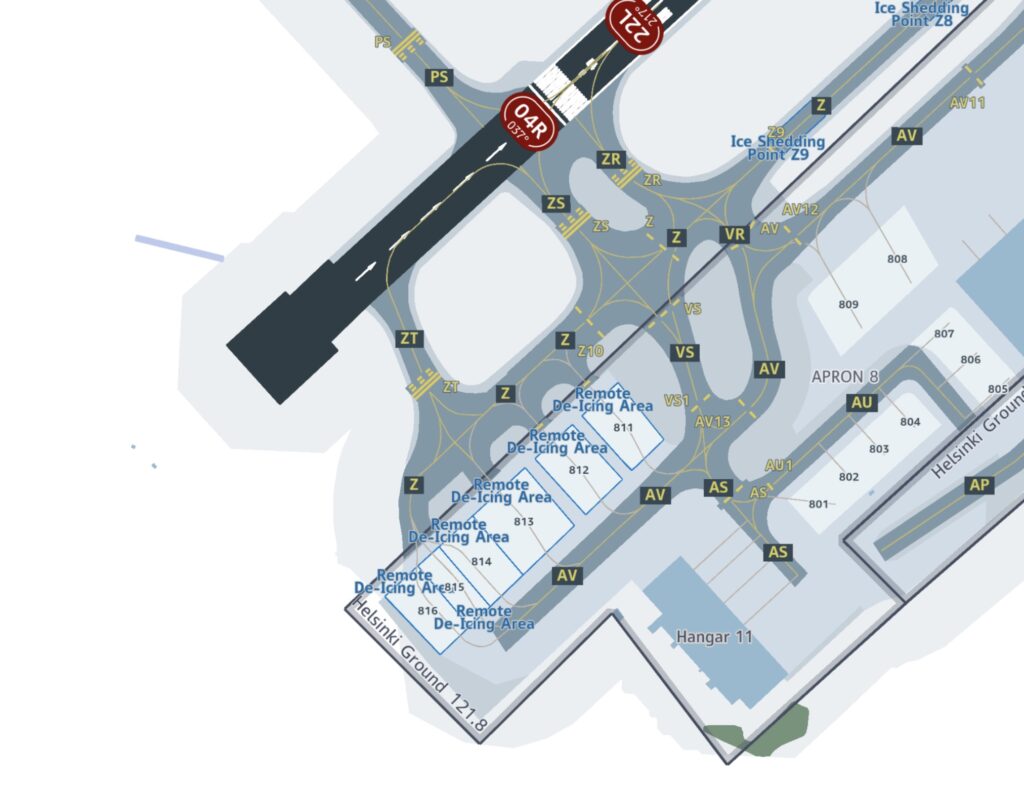
Helsinki Vantaa Deicing Pads – Ice Shedding Points
Work out where you can safely do the ice-shedding procedure, whether ATC needs to be involved, and when you plan to do it. Better to sort this out in the briefing than when you’ve got a queue of aircraft waiting behind you.
2. During flight: Keep reassessing
In-flight icing isn’t always obvious
Most modern business jets have good ice protection systems, but that doesn’t mean icing conditions can be ignored. Make sure you’re familiar with the conditions that require ice protection, along with any limitations on using those systems. Our G700 prohibits wing anti-ice above FL450. I’m not sure I’d expect icing up there, but it’s food for thought.
Ice can build up in places you can’t see from the cockpit. Keep an eye on the TAT/SAT and know when your aircraft requires ice protection to be switched on.
Don’t wait for the ice detector to tell you that you’re in icing conditions. Some engines can also experience vibration as ice builds up and sheds from the fan blades. This may be an expected characteristic or something requiring further action. Some engines perform ice shedding automatically through the FADEC, others require pilot intervention.
But even the most advanced aircraft have limits to what their ice protection systems can handle. If you encounter icing conditions beyond the aircraft’s capabilities, exercise good airmanship and get out of those conditions.
Keep an eye on fuel temps
When flying in cold weather, fuel temperature is another consideration, particularly on long flights in very cold conditions. Different fuel grades have different freezing characteristics, and aircraft have specific minimum fuel-temperature limitations.
Keep this in mind if you’re departing somewhere warm but flying somewhere cold, especially if you’ve uplifted a different fuel grade.
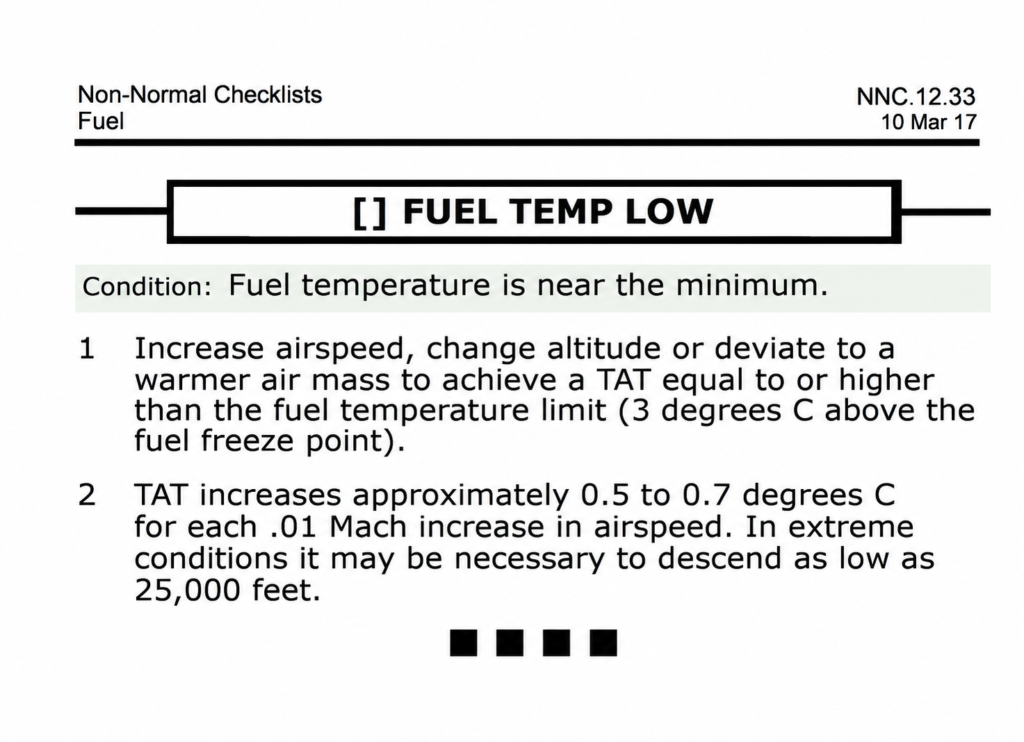
Fuel Temperature Low Checklist.
If fuel temperature is approaching a limitation, act early. Descending into warmer air may help. On some aircraft, flying faster can help warm the fuel through aerodynamic heating, although how much it helps varies. Don’t wait until you’re approaching the fuel temperature limit to figure out what you’re going to do.
Don’t leave the landing performance until final
A lot can change during a long flight. When I fly the G700 from Asia to the USA, we often depart just as the destination TAF is beginning its validity period. During our initial planning, the destination might be reporting good braking conditions, but 14 hours later the runway could be covered in snow.
Make a point of regularly checking the latest weather, runway condition reports and Notams. These days, with all the Wi-Fi connectivity available onboard, it’s become easier to update this information throughout the flight. And if the runway condition code has deteriorated, rerun your landing performance.
We often take the performance of our business jets for granted, but it can catch you out. Get into the habit of completing a landing distance assessment (LDTA), particularly if ATC changes your landing runway.
The wind might have shifted too, leaving you with a tailwind or crosswind you hadn’t planned for. A contaminated runway, strong crosswind and poor visibility aren’t exactly how you want to finish a long day.
If the numbers no longer work, or you’re simply not comfortable with the conditions – divert. I’ve always believed it’s better to explain a diversion to the boss than explain why we pressed on when we shouldn’t have.
The approach can look very different in winter
We fly into RJCC/Chitose in both summer and winter, and it’s amazing how much snow changes the look of an airport. Runway markings become difficult to see, taxiways blend into the surrounding snow, and the usual visual references aren’t always obvious.
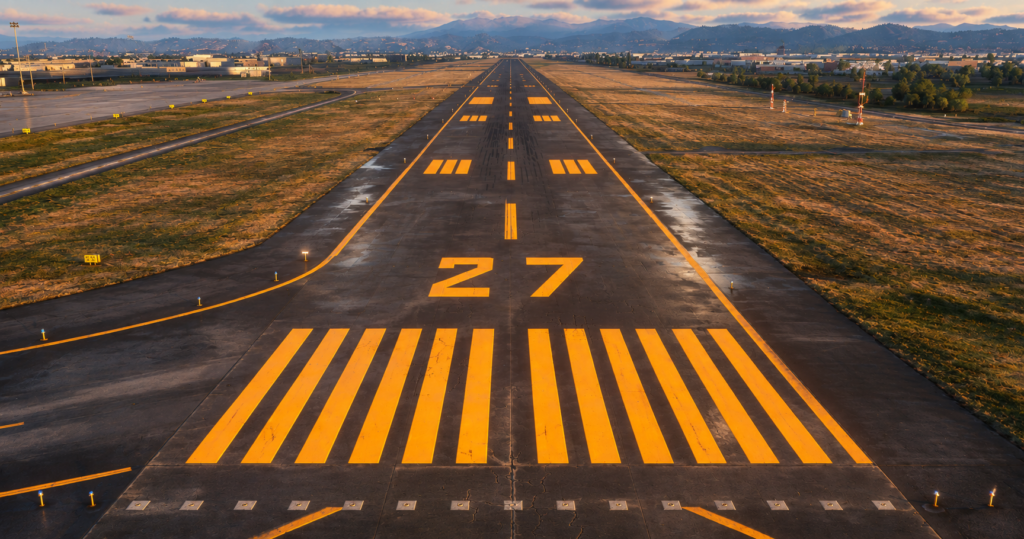
Northern Japan Yellow Runway Markings.
Add poor visibility or blowing snow, and judging your height and distance visually can become quite difficult.
In these conditions, stick with the instrument approach, make any required cold-temp corrections and use the flight director rather than switching to visual references too early.
Be especially careful at unfamiliar airports surrounded by snow-covered terrain. When everything outside is white, it doesn’t take much to lose your visual references altogether.
3. After landing: The job isn’t over yet!
Watch out on the taxi in
Getting the aircraft onto the runway is one thing, but don’t assume the taxiways and parking areas are in the same condition. They can be a lot more slippery than the runway, particularly if they haven’t been cleared or treated as often. Keep in close communication with your handler or FBO to make sure your planned parking area is suitable.
Keep taxi speeds down, allow plenty of room for turns and be particularly careful when approaching the stand. Aircraft tyres can slip even at 5 knots, so take it slowly. Ground staff may also have difficulty moving around on icy surfaces, so give them time and space. The same applies to you when doing the walkaround.
Snow and ice can hide markings, drains, equipment and other obstacles around the parking area. Snow also reflects a lot of light, so sometimes turning on your taxi lights can actually make it harder to see.
We were in Washington last year and ended up having the FBO staff walk us out to the main taxiway because the snow piles were so high. Don’t be afraid to ask for help!
Watch those brakes
Brakes can be another problem after taxiing through snow, slush and freezing conditions. Even with modern carbon brakes, moisture can freeze around the brake components once you’ve parked. Many aircraft have specific procedures for brake temperatures, cooling and parking brake use in cold weather.
On some aircraft, leaving the parking brake set in freezing conditions can cause problems when you come back to depart. Make sure you know your aircraft’s procedures and that the ground crew understands what you need them to do once you’ve parked.
This is especially important when chocking the aircraft on a slippery apron. I won’t release the parking brake until I’m satisfied the aircraft is properly secured. For me, that means being triple-chocked. If the ground crew hasn’t brought enough chocks, I’ll ask them to get more.
Protect the aircraft before you leave
If the aircraft is going to sit outside overnight, there’s quite a bit to think about.
- Do you need engine and APU covers? What about the pitot probes, static ports and other exposed equipment? Make sure you’ve got a plan to protect them if it snows while the aircraft is parked.
- Do batteries or other equipment need special attention in extreme temperatures?
- Will the aircraft need external heating or ground power before the next departure? How will you make sure the engines are free of ice? You may need to arrange ground heating, and at some airports the equipment needs to be booked in advance.
- What happens if there’s heavy snowfall overnight? A prolonged cold soak can affect batteries, tyre pressures, hydraulics, engine oil and fuel temperature. Check your aircraft’s cold-weather limits and whether you’ll need preheating or any special procedures to get things running again. Some equipment may also need to be removed or protected before you leave.
This is where a good local handler and engineer are worth their weight in gold. They’ll know what to expect overnight, what facilities are available and whether there’s somewhere nearby you can reposition to get the aircraft into a hangar.
If hangarage is available, it’s worth considering, especially if you’re expecting heavy snow or several days of extreme cold. Humans generally don’t like extreme cold, and neither do aeroplanes.
Don’t forget the water and lav systems
This is an easy one to overlook. We generally land with water still in the aircraft’s system, and that can become a problem pretty quickly when temperatures drop below freezing.
Depending on the aircraft, you may need to drain or purge the system, or keep it heated above a specified temperature. Have you worked out how you’re going to do that at your destination?
For us, we always purge the system before leaving the aircraft in freezing conditions.
Don’t forget the waste tanks and lavatory system either. Every aircraft has its own requirements, so check the manual and have a chat with your engineer before leaving the aircraft out in the cold.
It’s much easier to deal with these things on arrival than when you’re preparing for a twelve-hour flight the following morning. A frozen water system can leave you with a grounded aircraft and a substantial repair bill. That’ll give the boss a frosty attitude too.
A trap when heating the aircraft
Heating an aircraft on the ground sounds simple enough, but if the doors are closed and the air has nowhere to escape, you can end up with a pressure difference between the cabin and outside.
On 4 January 2018, the captain of a Gulfstream G150 was killed at Kittilä, Finland, when the cabin door opened violently under pressure as he tried to open it from outside.
The APU was supplying bleed air to heat the cabin. The captain had gone outside to help remove snow and closed the door, leaving the cabin attendant inside. With the outflow valve closed, pressure built in the cabin. The attendant felt pressure in her ears and chest and knocked on a cockpit window to attract the pilots’ attention. When the captain tried to open the door, it struck him, causing fatal injuries.
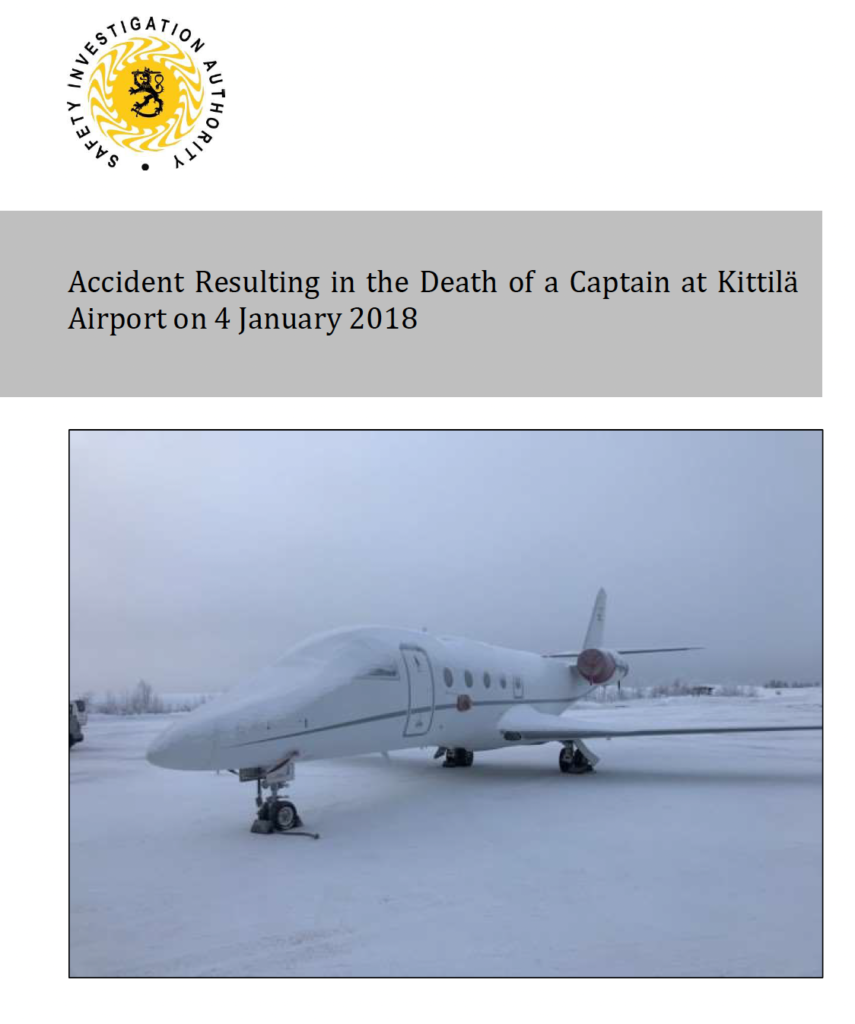
Finnish G150 Ground Heating Accident.
It’s a grim reminder of what can go wrong. Know the procedures for ground heating, checking cabin differential pressure and opening doors. If anyone inside starts feeling pressure in their ears, take it as a warning and remove the bleed air. Before opening the door, make sure the outflow valve is open and the cabin is fully depressurised, following your aircraft’s procedures.
And look after yourself
Finally, don’t forget the crew! Spending half an hour outside doing a preflight in minus 20 isn’t much fun, particularly when there’s wind and blowing snow. Tempting to give that sector to the first officer, but whoever does it needs to be properly dressed.
It’s harder to concentrate and work with your hands when you’re freezing cold, and icy ramps are an easy place to come unstuck. Make sure you’ve packed a proper winter jacket, gloves and shoes with decent grip!

More on the topic:
- More: Winter Ops: Fun Fuel Facts
- More: Winter is Coming: Updated Holdover Time Guidelines
- More: Rolling the dice with de-ice
More reading:
- Latest: Paris Le Bourget: Recent Crew Reports
- Latest: Winter Ops: The Stuff You Don’t Want to Forget
- Latest: 2027: What’s changing on the North Atlantic?
- Safe Airspace: Risk Database
- Weekly Ops Bulletin: Subscribe
- Membership plans: Why join OPSGROUP?




 Get the famous weekly