23FEB: Tel Aviv Airport closes as a precaution against attack, Indonesia mandates ADS-B above FL290

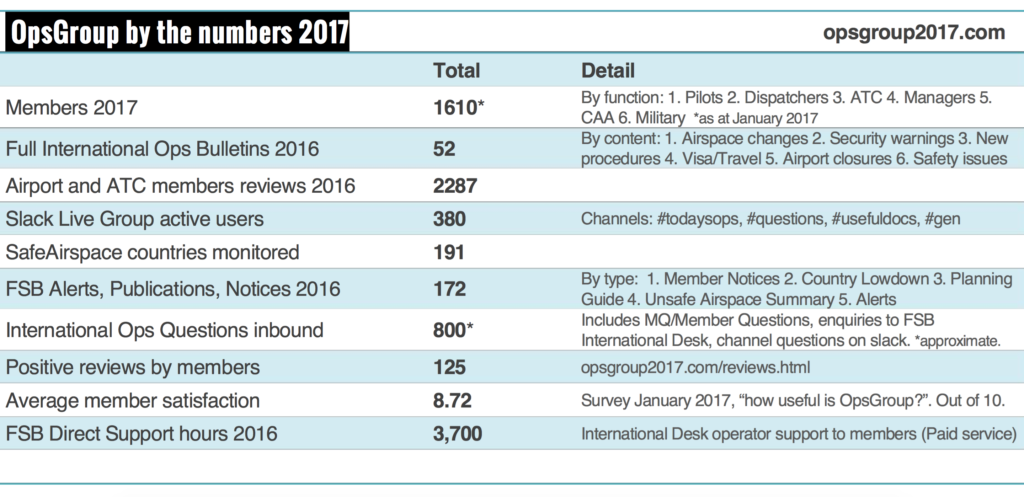
Weekly International Ops Bulletin published by FSB for OPSGROUP covering critical changes to Airports, Airspace, ATC, Weather, Safety, Threats, Procedures, Visas. Subscribe to the short free version here, or join thousands of your Pilot/Dispatcher/ATC/CAA/Flight Ops colleagues in OPSGROUP for the full weekly bulletin, airspace warnings, Ops guides, tools, maps, group discussion, Ask-us-Anything, and a ton more! Curious? See what you get. Rated 5 stars by 125 reviews.

WADD/Denpasar Bali’s airport will be closed for runway repair each night from 18-23z (except Saturdays) until Mar 30.

FSZZ/Seychelles They have pushed back the ADS-B mandate for all airspace within the FSSS/Seychelles FIR from Dec 2017 to Dec 2020.

HLLM/Mitiga Following multiple recent closures due to ongoing clashes between local militia, the airport will now completely close each night between 22-04z until at least May 16. For the latest on Libya, check here.
CZZZ/Canada On May 24, the Canada ADIZ will be expanded to include most of the Arctic Archipelago. For the east and west coasts, the inner boundary will be moved offshore. Full details here.
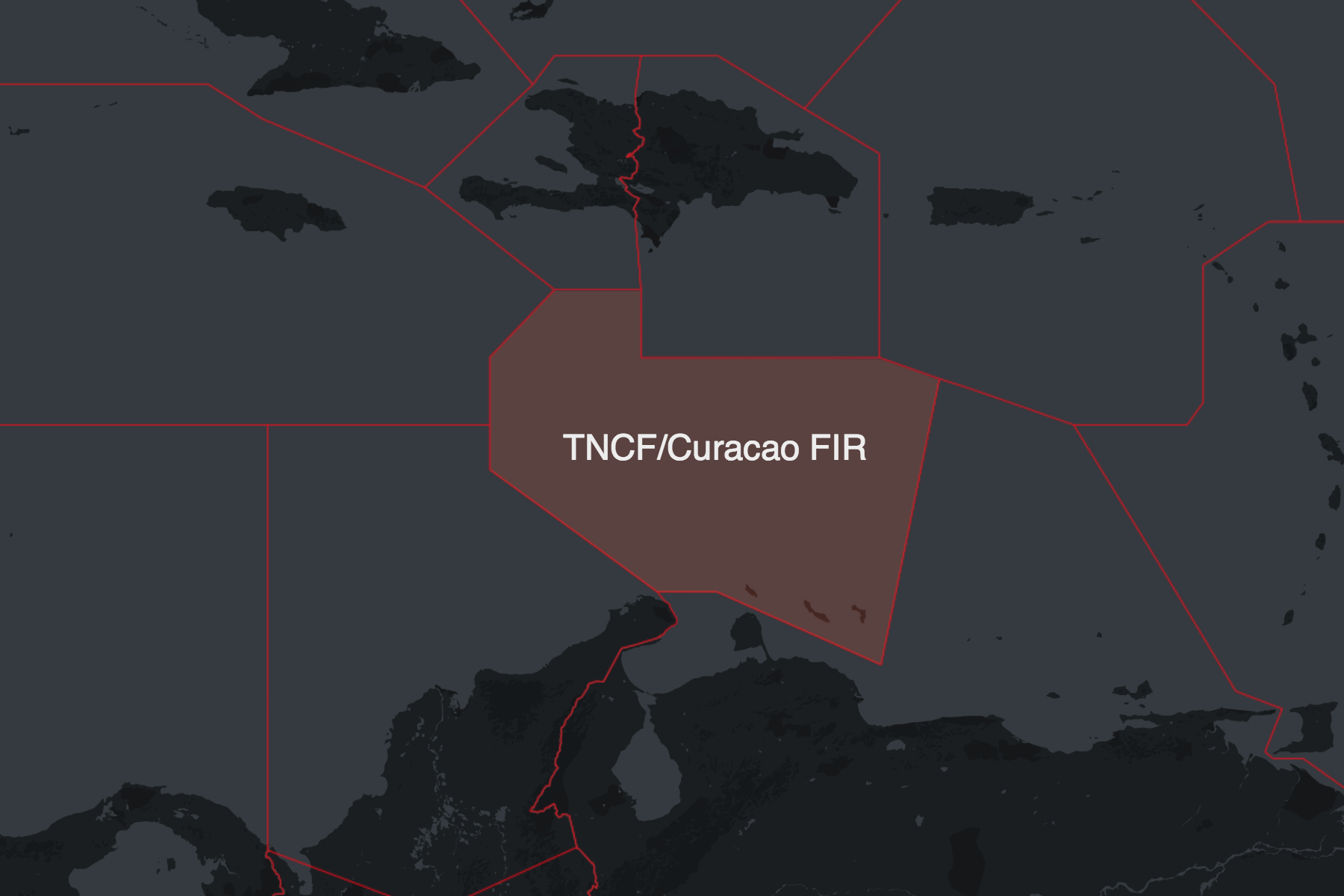
SVZZ/Venezuela There is an ongoing government ban on all flights from Venezuela to the islands of Aruba, Bonaire, and Curacao. Multiple continued travel warnings in place for Venezuela – significant level of violent crime, and unstable political and economic situations. Recommended to avoid planning tech stops here.

VABB/Mumbai The airport will be closed from 0530-1130z (1100-1700 local time) on Apr 9 & 10, for scheduled maintenance ahead of the monsoon season, which spans from May to September.

VIDP/Delhi New rule in effect from Feb 19 – you now need slots for arrival and departure. You can only apply a maximum of 5 days in advance. Maximum ground time is now 3 days (unless you go into a hangar). Full details here.

VAAH/Ahmedabad The airport will be closed for runway repair daily from 0430-1330z between Mar 1 – Apr 15. This will mainly affect operators going to VABB/Mumbai (250 NM), as VAAH is the most commonly used international alternate. All other decent airports (e.g. VOHS/Shamshabad, VIJP/Jaipur) are much further away, so you’ll need to carry extra fuel.

TBZZ/Barbados Multiple sewage leaks across large parts of the island’s popular south coast. Some residents have been forced to move, some businesses have closed, and some visitors to the island have complained about contracting gastroenteritis. Canada, the United States, and the United Kingdom put all issued travel advisories warning their citizens about the risks of travel to Barbados due to the current sewage problem.

HAZZ/Ethiopia Following a week of anti-government protests, a country-wide state of emergency has been declared, which is set to last for 6 months. No new airport or travel restrictions have been imposed (yet), although expect heightened police presence. During the last state of emergency in 2016, the government shut down the internet and mobile signal for several days.

GUZZ/Guinea Sporadic demonstrations continue to occur across the country, following disputed elections held on Feb 4. There have been violent clashes, including some fatalities, in the northern suburbs of Conakry. Demonstrators have also attacked vehicles when drivers attempted to pass through or around the protests.

LHBP/Budapest The U.S. Embassy in Budapest has issued a Security Alert for the airport that reads in part as follows: “Theft of items from passenger luggage at Budapest Airport has increased. Passengers reported that valuable items had been removed from their checked luggage.”

EPZZ/Poland CPDLC services will be available in Polish airspace between FL285-660 from Mar 29 onwards. The data link address will be EPWW.

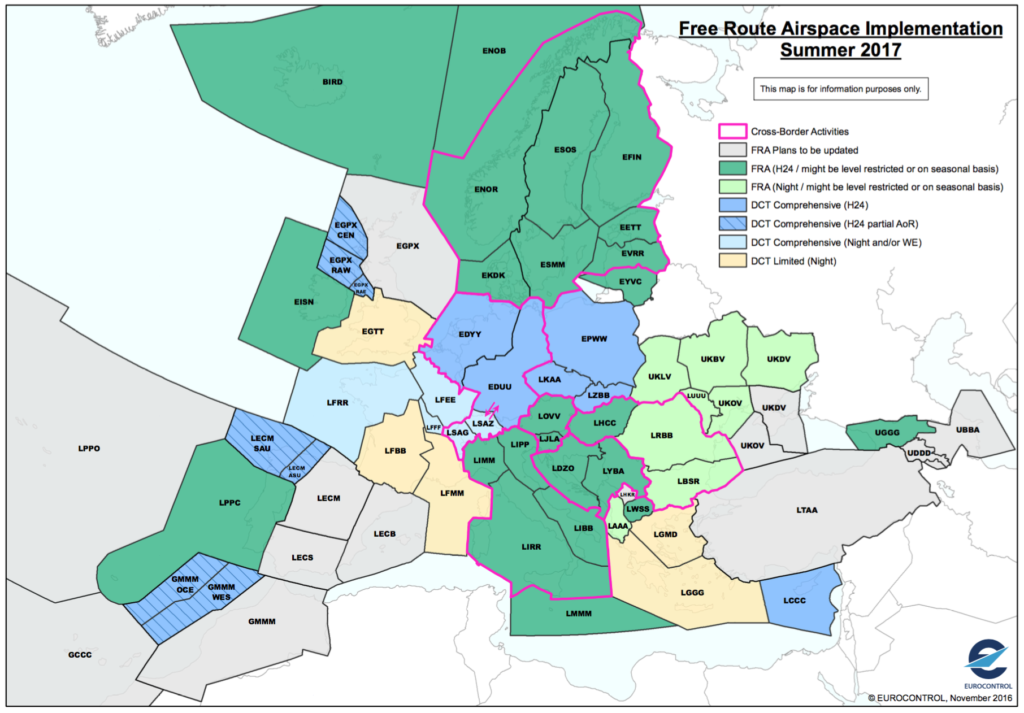
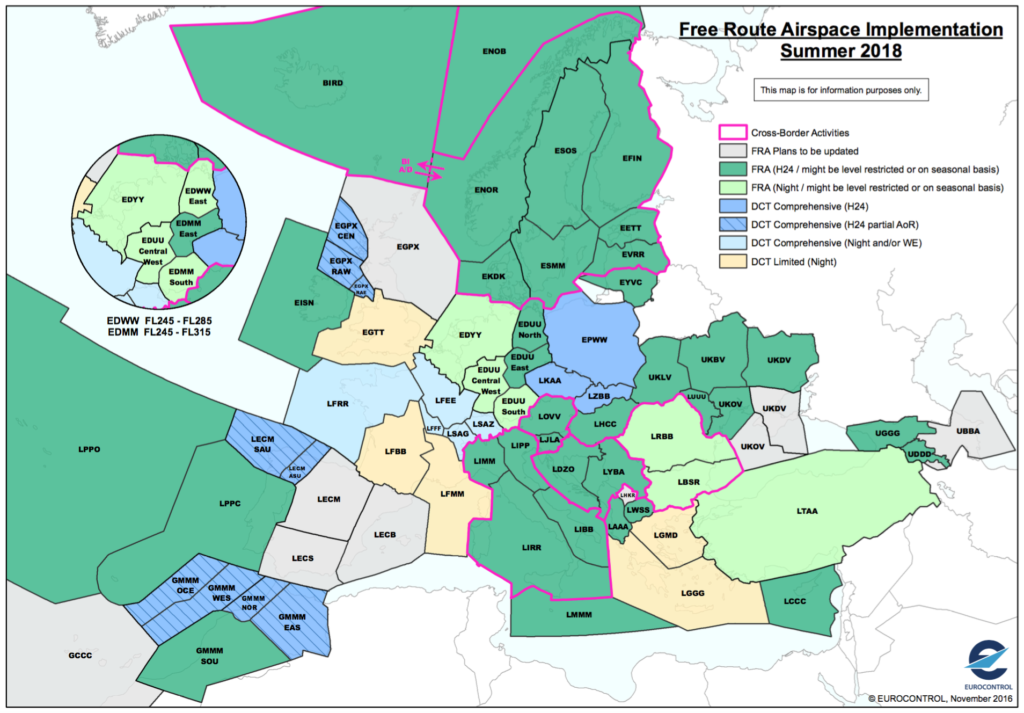
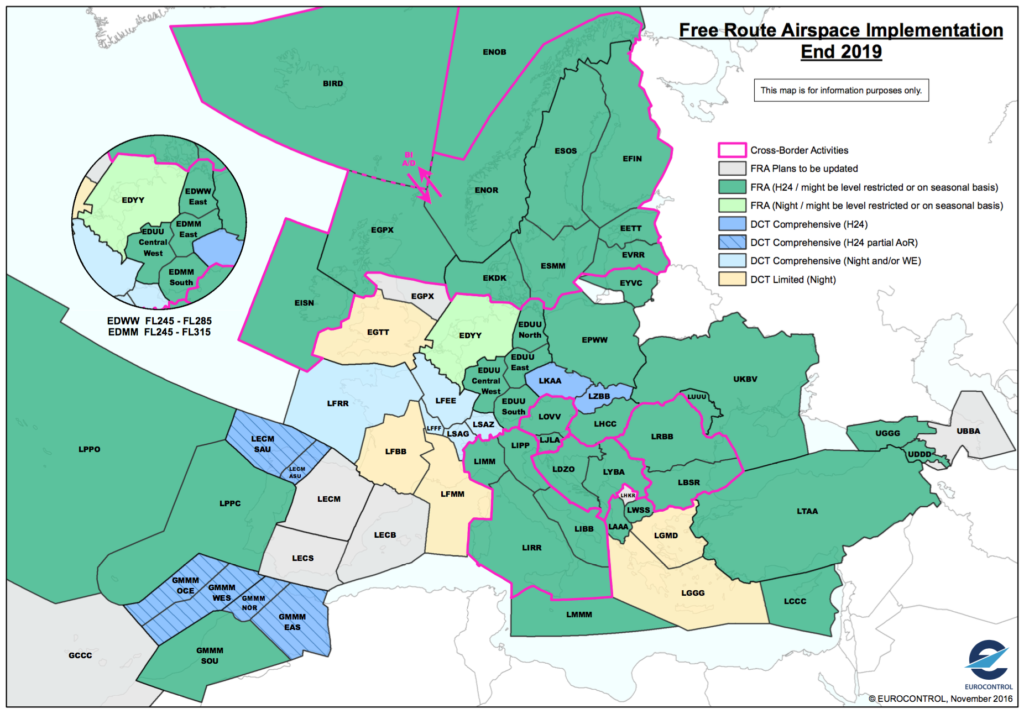
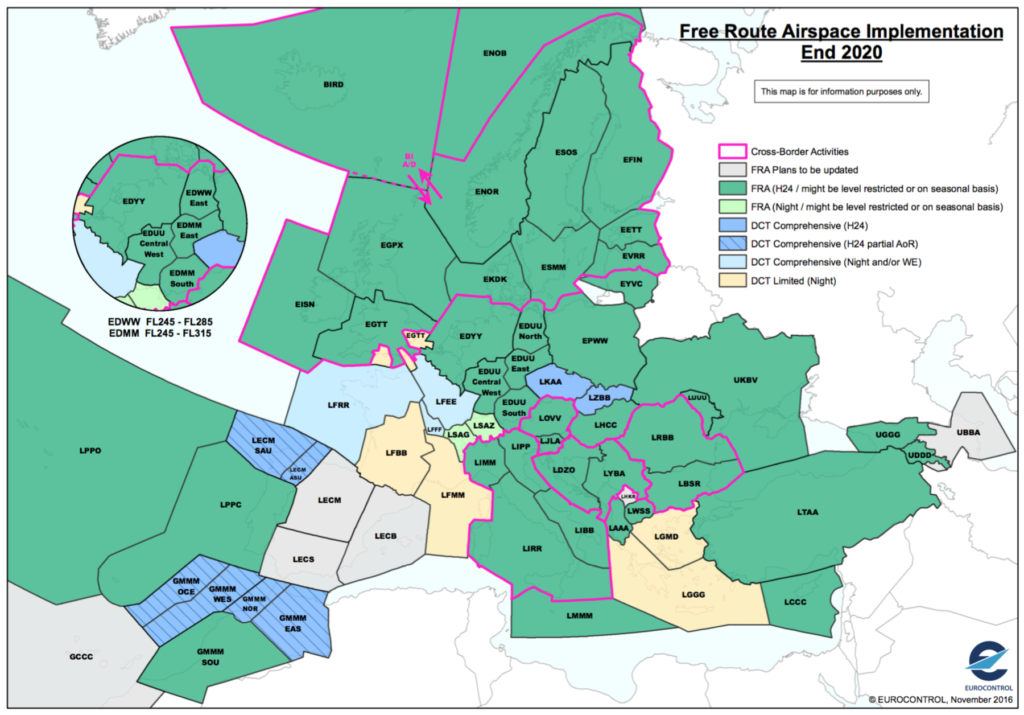
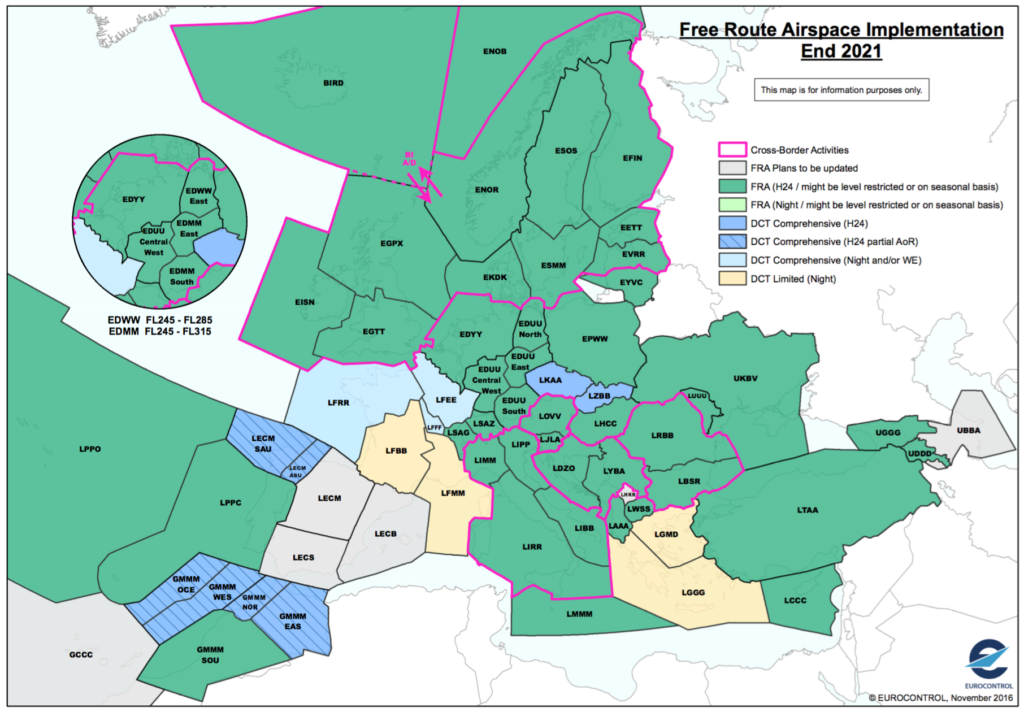
UMZZ/Belarus Free route airspace will be implemented in Belarus airspace from Nov 8. At first it will be night-time only (23-05z), between FL305-660, but expect this to be expanded in line with similar plans for free route airspace implementation in Europe.

VRZZ/Maldives The government have extended the state of emergency to mid-March, in the midst of a political crisis that has seen security forces deployed in the capital Malé. Expect more protests there, although so far there have been no reports that VRMM/Malé International Airport or any of the outlying islands have been affected.

UHPP/Petropavlovsk Opening hours are now 20-08z. Outside of those hours, they might open for you, but only with prior coordination, and you can’t file UHPP as an alternate during those times. The airport is still available H24 for emergency diverts though.

NZZZ/New Zealand Cyclone Gita hit the South Island on Feb 20, where a state of emergency has been declared. The forecast for Feb 20-22 shows heavy rain, risk of flooding, and gusting winds of around 50kts. All the major international airports remain open, although Air New Zealand cancelled all flights in and out of NZWN/Wellington on Feb 20.

Weekly International Ops Bulletin published by FSB for OPSGROUP covering critical changes to Airports, Airspace, ATC, Weather, Safety, Threats, Procedures, Visas. Subscribe to the short free version here, or join thousands of your Pilot/Dispatcher/ATC/CAA/Flight Ops colleagues in OPSGROUP for the full weekly bulletin, airspace warnings, Ops guides, tools, maps, group discussion, Ask-us-Anything, and a ton more! Curious? See what you get. Rated 5 stars by 125 reviews.


Here’s what pilots and controllers REALLY think about Notams

Update: November 1st, 2019: The Notam Team is up and running – we’re fixing Notams. Follow our progress at fixingnotams.org.


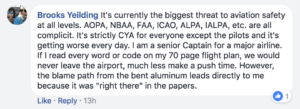
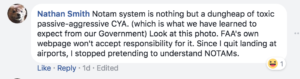
We think Notams suck. No other way to say it. After a few articles we wrote (BS Notams, The Notam Goat Show, and more worryingly, the MH17 Notam problem), we got some feedback in the comments section. And thought we should share, because they really show the problem. So, here they are.

Caution, some strong language!

We’re working on a solution, so you can help and add your thoughts as a comment below. Also, send us the really bad ones and enter the 2018 Notam Goat Show contest.


Personally I think taxiway and apron closure NOTAMs are too readable, I think they should be distributed in RADIAL/DME format, or perhaps raw Lat-Lon. Additionally, time should be specified in seconds since the founding of the FAA.

TAXIWAY CLOSED BETWEEN ORL180/08.5DME ORL181/08.6DME ORL181/08.65DME ORL180/08.65DME FROM 1829088020S to 1829190200S

What could be more clear than that?


I wonder if a buried Notam ever did contribute to bent metal, injury, or death? I agree that the volume of nuisance notams is a real task to read through wether it be a long or short turn. However, nothing will be done till there is blood. That’s how the FAA works. Till then, its on us to be like aviation lawyers before every flight regardless of schedule.


Maybe we can get them in binary?

You have to go to binary first, then convert to Morse.

01010100 01000001 01011000 01001001 01010111 01000001 01011001 00100000 01000011 01001100 01001111 01010011 01000101 01000100 00100000 01000010

—– .—- —– .—- —– .—- —– —– —– .—- —– —– —– —– —– .—- —– .—- —– .—- .—- —– —– —– —– .—- —– —– .—- —– —– .—- —– .—- —– .—- —– .—- .—- .—- —–

For good measure they should be put through an Enigma machine, too. And the output formatted to wingdings


Yes. The NOTAM system is fucked. We have Notams about those solar arrays near Vegas in every flight plan. Yes, I see them. I want to know if the damn runway is closed. Why the weird coding? Is it to make pilots feel multi-lingual?


It’s funny, they seem to have every little f*ing detail about towers that are under 400 agl 20 miles either side of my route with one light bulb missing but I can’t get a god damn reliable source for f*ing TFRs. Even the piece of shit FAA website for TFRs is not a “complete and accurate source” but some guy in a FSS station is?????? Such complete and utter bullshit.


The reason nobody reads NOTAMs is because they are mostly garbage.
Why do I care that a crane that is 200 feet AGL ten miles from any airport is unlit? We can’t fly below 500AGL anyway.
Why do I have to decipher code that can easily be written as: From 20170608 1900Z to 20170610 0000Z CYYZ Taxiway L Closed
The system is broken and nobody cares to fix it.


I f*in’ love doing a flight from Newark to DC and getting notams about the North Atlantic Tracks. Motherf***r, if I end up on the tracks during that leg in a 145, the Notams are the least of my damn problems.


The biggest frustration for me is the NOTAMs don’t match reality. KAUS often NOTAMs a runway closed for several hours a couple days each week. Yet we get there and it’s open.
Or an airport will NOTAM an ILS out of service for the day. Show up at the airport and they’re using that ILS.
My home airport is KDAL. One of the PAPIs was out for three days before they NOTAM’d it out of service. Delta landing in front of me asked about it. Tower said they showed it on and asked me. I said, “Uh… It’s been out for several days. I thought y’all knew?”
Finally, my favorite: Surprise runway closures for routine runway inspections. NOTAM? Nah. BTW there’s a 150′ tower 15 miles away with a light out and there’s birds around the airport. Awesome.


I can honestly say that if it isn’t a runway closure or terminal closure then I don’t really care. The amount of closed taxiways at every airport is absurd. Not to mention many of them are closed year round with no intention of opening them again, just a permanent NOTAM.


Can only agree. It has been raised at the RAPACs, but no progress to date.


If I’m 5nm from the ARP at 150′ AGL, then I have more things to worry about than a crane without a red light…

Ass-covering gone mad. Really… a tree

OBST TREE 58FT AMSL
PSN 386M FM THR RWY 25 AND 183M LEFT OF RWY 25 CL
BRG 047 MAG 0.91NM FM ARP
FROM 01 310536 TO 03 300500 EST


My personal favourite is the “trigger notam” cross-referencing to yet another unfindable / unreadable pile of nonsense.
Just tell us what matters to an “Airman”; today and leave the grand plan, 12 month projection crap out of NOTAMS.


All of this so true, I imagine a world of technology and wonder (ozrunways/avplan/anything but airservices/casa))where we can quickly read a Notam and weather briefing without having to nut it out and do a slow-ass flight plan every time. 2017 and we still cant embrace all the tech.


I totally agree. The last thing any crew is going to be able to do when checking NOTAMs before departure is to magic up a way to access cross-referenced documents in various other publications. Especially when the departure point is not anywhere near base ops, or even any other operations centre.


B.S. NOTAMS….100% concur. Our whole world of aviation is being swamped by similar legal ass-covering paperwork. How can ANY pilot be expected to remember all the additional codicils that do NOTHING to improve safety of flight, but rather give an army of lawyers and providers more chances to fleece an already cash-strapped industry?…..Rant over!


Congratulations, its our industry, the users should be heard.
Start with a blank sheet of paper, what do we want to know in a “NOTAM” and how best to communicate it in a cockpit / in a flight briefing package. If the current format was frozen in 1924, the next system needs to be good for a couple of years.


This information ceased to be “NOTAMs” long ago. Today they are “NOTOLs”, Notice To Litigants. Thanks for making an effort to change this ancient system.


How many pilots out there actually read ever Head Office Notams or even daily Notams in meticulous detail? Few (if any). You sign on an hour before departure, there is simply not enough time to divulge all the ass covering crap that’s generated daily. Airline companies only want one thing, OTP; how a pilot goes about that they couldn’t care less as long as you don’t break any rules! NOTAMS = “None Other Than Aircraft Missing Slots”


You can bet your life, the one you needed to see at 3 in the morning was the one you missed! Any wonder…


Well said. Have you ever read “MEN AND EQUIPMENT NEAR THE RUNWAY: LANDING WITH CAUTION”?
So, If you don’t tell me that, I will land recklessly..


You are a mind reader.
You captured the issue perfectly and the historical context was excellent. While airspace and aircraft have all continued to develop our most basic system of communicating the status of an airport/airspace has not. I could take that further and say communication with ATC is still by AFTN for the most part.So now put yourself in the position of dispatcher/FOO working a series of long haul ETOPS Flight. You might have 20 or more departure /Take off alternate station notams, a whole galaxy of FIR/UIR Notams, not to mention all of the ETOP alternates and if you re-dispatch/re-analysis, you will get to do it inflight once again. Now do that 15-20 times depending on workload. Can you say human data saturation?
This article certainly illustrates the infrastructure issues we face, but it doesn’t come close explaining some of the processes and procedures we have had to put in place to ensure:
1. That we actually get NOTAMS.
2. That we get airport conditions as some countries don’t put them out as Series-S ICAO NOTAM versus Series-A (Yes, theses are the countries that haven’t fully adopted ICAO standards which were adopted in 1944 and ratified in 1947 by the Chicago convention).
Question: What is the current year?


I absolutely agree. My personal bugbear is those lists of co-ordinates …. do they think anyone actually plots them on a map? They might as well not be published at all.


What is clear is the professional approach to the information received: too many inputs, disorderly given, contextually irrelevant, redundant and unusable. A kind of “cry wolf” syndrome, making the pilot complacent about such a bullshit. The very day someone of us is caught in a legal battle for a system-induced mistake leading to a incident, overlooking the NOTAMs will not appear as an excuse. How to make these information valuable?


Yes… and why oh why are we still using the coded TAF language. We don’t have bandwidth issues anymore. We take plain English, code it, then decode it back to plain English. Surely a TAF written in plain English is not too hard a transition.


We train the pilots of tomorrow, they are inundated with everything the industry throws at them and the unintelligible Nonsense contained in some NOTAMS are just another accident waiting to happen. With all the technology at our disposal today, the filtering systems, electronics messages systems, integration tools and smart people to think about it, there is a solution out there. I suppose we just need to make enough noise in the right places to make a change. Oh well best we get started. hmmm, perhaps a NOTAM about change is needed.


And don’t forget about TFR’s that pop up. The one time I didn’t look at TFRs I got trapped having to divert from Chicago to an outlying airport even though we were part135 and even though we got an IFR clearance and the tower gave us takeoff permission. And center control for an hour just kept passing us on.


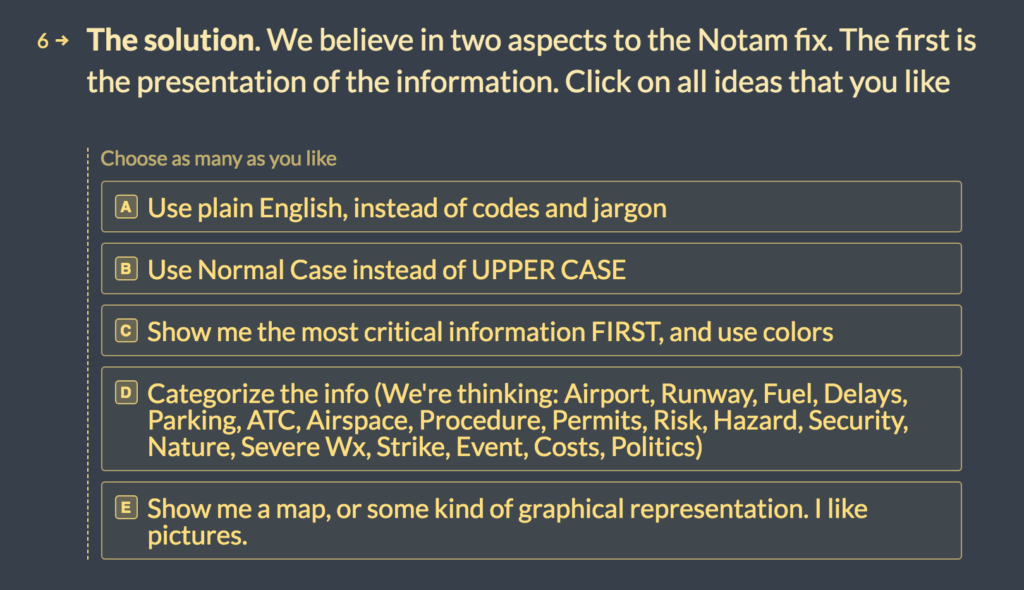
How about a change in the format of NOTAMS too, so we don’t have to wade through the whole lot in order to parse the relevant information. NOTAMS are removed when thy are no longer valid, so why cling to chronological order as an indexing system. How about putting them in order of critical relevance: Firstly, changes to airfield opening hours and services (fire, fuel etc). Secondly, changes to runway lengths/closures/etc. Thirdly, changes to approaches available. All the rest can be thrown into the mix at the end of the NOTAM.


Excellent analysis. My personal favorite is the NOTAM sort order which tells me that the REIL lights don’t work, the glideslope is out, the runway markings are non-standard, the localizer is out… ending with: runway closed. Tell me that first, all the other BS becomes irrelevant.


About two days before I saw this post, I’d sent a long email to my company telling them of the NOTAMs we don’t need to see. Then I saw this. Brilliant! I’ve just sent the link to this piece to the company to reinforce that opinion. I’m hoping our briefing pack will be several pages thinner the next time I go to dispatch.


I have come up with a name for this problem: “NOTAM Spam”. It’s a serious one, alright — ASRS Callback #426 brought it up in the context of the US NAS, and I’m sure it’s only worse for international operations. It sounds like ICAO needs to put out a recommendation or SARP about NOTAM spam control…


95% of Notam’s we read are not applicable, or nothing can be done about them. Oh great, I’ll pull out my chart and plot the 25 co-ordinates to see if this airspace will affect my flight -_- that’s one Notam example from plenty of the same type, in the same Notam briefing. Now add the other irrelevant Notam types as mentioned by others in the comments.


Thanks for the article. I shared it with my fellow dispatchers at AAL. We read pages and pages of BS notams on a daily basis and wondered if anyone else had similar feelings about the whole process.


Post your thoughts below! 


Indonesia mandates ADS-B above FL290

Since the start of Jan 2018, all aircraft flying in Indonesian airspace at or above FL290 need to be equipped with ADS-B (Mode S Transponder and GNSS source position). Below that flight level, it remains optional.

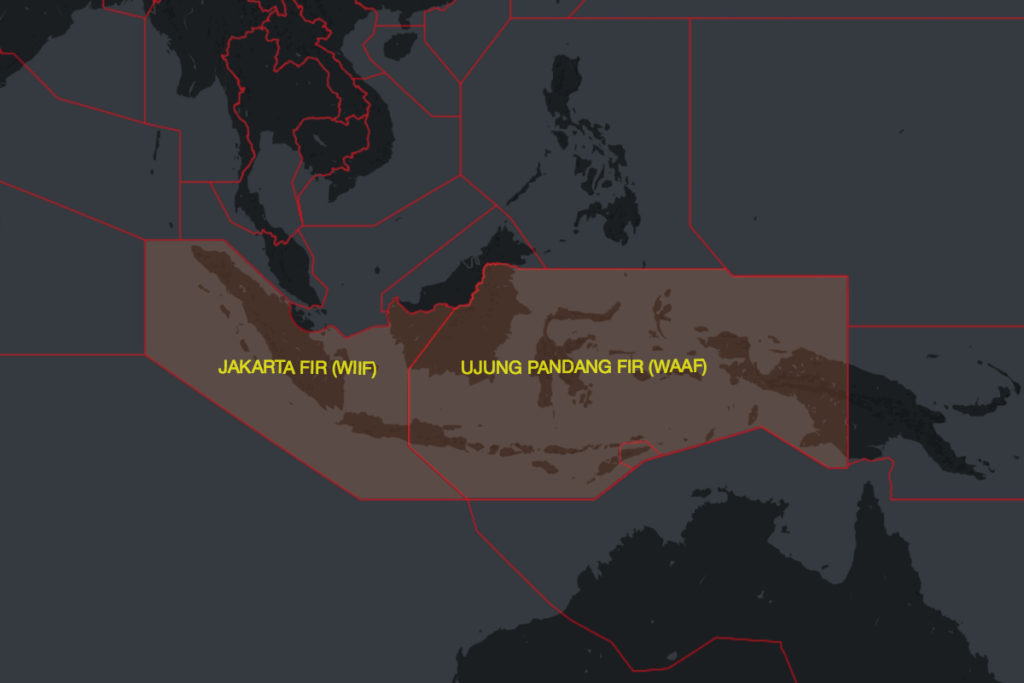
Indonesian airspace is split into two FIR’s – WIIF/Jakarta and WAAF/Ujung Pandang:

To the north, Singapore have required the carriage of ADS-B on certain airways since 2013; and to the south, Australia have mandated ADS-B for all airspace above FL290 since early 2017. So there’s a vast section of connected airspace in the region where ADS-B is now required.

For flight planning, make sure you show the correct ADS-B designators in Item 10 of the FPL:

  • E – Transponder — Mode S, including aircraft identification, pressure – altitude and ADS – B Out capability.
    or…
  • – Transponder—Mode S, including aircraft identification,pressure-altitude,ADS-B Out and enhanced surveillance capability.
    together with…
  • B1  ADS-B “out” capability using 1090MHz extended squitter.
    or…
  • B2  ADS-B “out” and “in” capability using 1090MHz extended squitter.

Further reading:


New slot procedure at VIDP/Delhi

All flights to/from VIDP/Delhi Airport now need to get slots approved, and for international flights, you can only apply for these up to a maximum of 5 days in advance.

They’re calling these slots “Delhi Arrival Clearance Numbers” (DACN) for arrivals, and “Delhi Departure Clearance Numbers” (DDCN) for departures, and you can apply for them by emailing flight.data@gmrgroup.in and copying-in dial.aocc@gmrgroup.in.

Make sure you put your slot number in Item 18 of your FPL. If you miss your slot time by more than 30 minutes, expect to have to re-apply for a completely new slot.

Also, watch out for long stays – the maximum ground time for everything except scheduled flights is now 3 days, unless you go into a hangar.

Full details of these new rules can be found here.


Greenland FIR to change its name

The BGGL/Sondrestrom FIR, that covers all of Greenland’s airspace, is changing its name to the ‘Nuuk’ FIR, effective Mar 1.

This name change has come about following the reallocation, during autumn 2014, of the COM Centre, Rescue Coordination Centre and the Flight Information Centre from BGSF/Kangerlussuaq Airport (commonly referred to as Sondrestrom airport) to Greenland’s capital, Nuuk.

So “Nuuk Information” is the new identification/radio callsign for the aeronautical station serving the Flight Information Centre in Greenland; whereas “Nuuk AFIS” will still get you through to the aerodrome flight information service at BGGH/Nuuk Airport.

You can read the full AIC here.

Further reading:

  • Do you use BGBW/Narsarsuaq as a trans-atlantic alternate? Watch out, you may receive a hefty bill. Full details here.


The NOTAM Goat Show 2018

We’re on the hunt for prize Notams. 

In every definition of a Notam that exists, including the ICAO one, it includes these words: “the timely knowledge of which is essential“. Unfortunately, many Notam-creators’ sense of the essential shows a clear failure to understand the term . This is CNN’s version of fake news at it’s worst.

Now, we recently found one that listed peak goat-grazing times near the airport, so we thought we’d run a NOTAM Goat Show. And there will be prizes. We’re looking for the worst: the most irrelevant, the most useless, the most boring, the most unreadable. All those crappy Notams that are part of the 100 page print out you get in your flight briefing.

Send us your worst! goatams@fsbureau.org

There will be prizes, and as fun as all this is, you actually are helping to solve the problem of Bullshit Notams. We’re working on it.


Feb 2018: Tel Aviv Airport closes as a precaution against attack

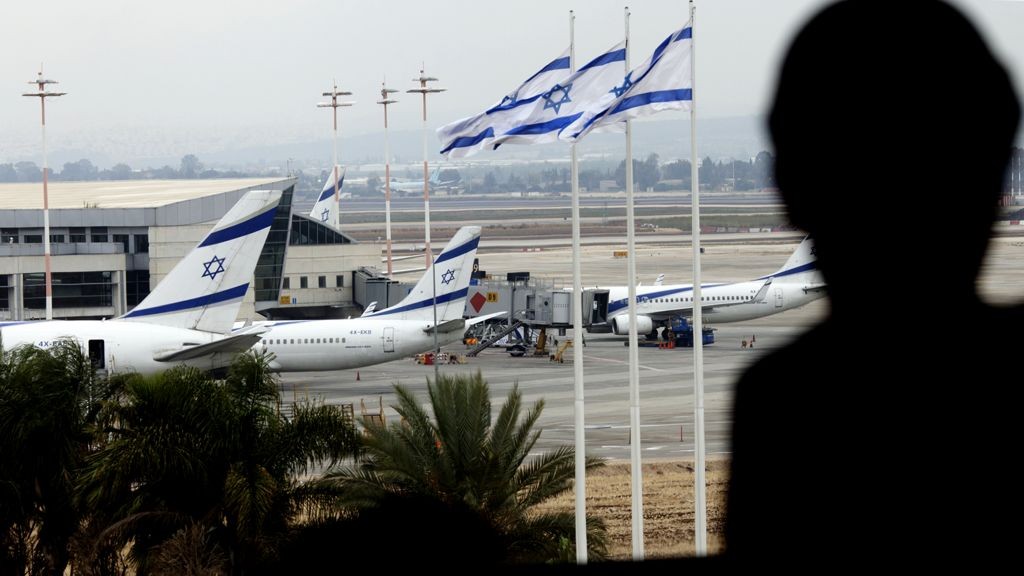
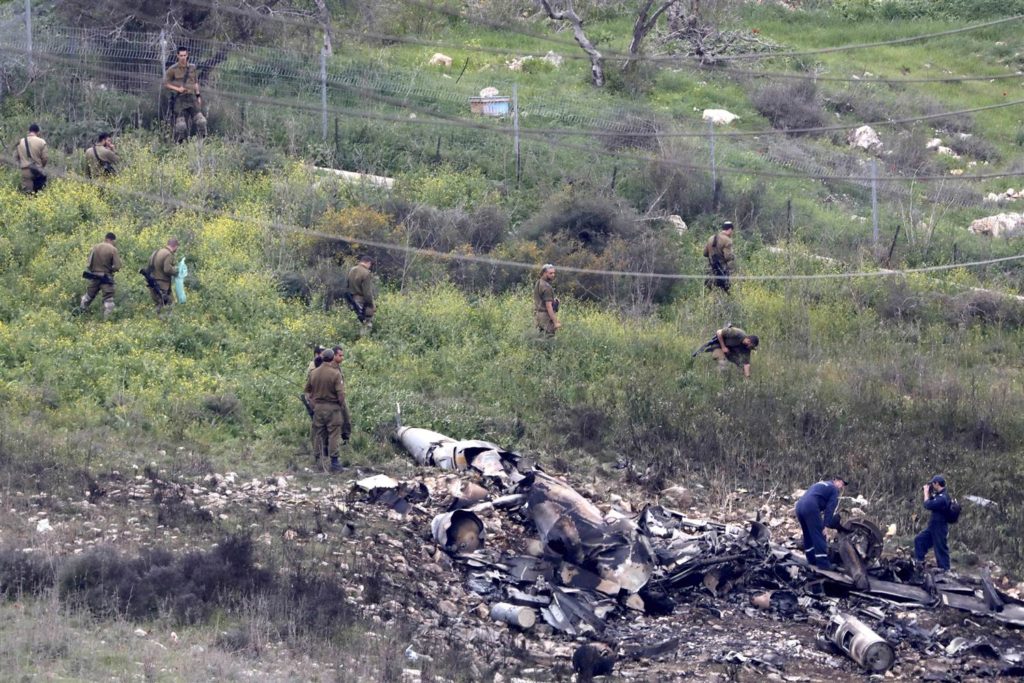
LLBG/Tel-aviv: Israel’s main airport briefly suspended operations on Feb 10, due to military clashes along the northern border with Syria.

Two Israeli pilots were forced to abandon their F-16 jet, which crashed near the border after being hit by a Syrian anti-aircraft missile. The jet was on a mission in which it struck an Iranian facility in Syria that had previously operated a drone which Israel shot down over its territory.

This resulted in all flights from LLBG/Tel-aviv Airport being grounded for around an hour starting at 9am local time, as a precaution against any further attacks. The airport is considered a strategic location that could be targeted during military conflict.

Here’s what Israel’s PM had to say about it:

This incident marks the most significant engagement by Israel in the fighting that has been taking place in neighbouring Syria since 2011. Israel has mostly stayed out of the conflict so far, but has recently become more concerned about the increased Iranian presence along its border.


16FEB: Tonga Cyclone, Australia does RNP2, NAT PBCS change, are you an ATCO?

Weekly International Ops Bulletin published by FSB for OPSGROUP covering critical changes to Airports, Airspace, ATC, Weather, Safety, Threats, Procedures, Visas. Subscribe to the short free version here, or join thousands of your Pilot/Dispatcher/ATC/CAA/Flight Ops colleagues in OPSGROUP for the full weekly bulletin, airspace warnings, Ops guides, tools, maps, group discussion, Ask-us-Anything, and a ton more! Curious? See what you get. Rated 5 stars by 125 reviews.

EGGX/Shanwick When PBCS is implemented in the NAT HLA on Mar 29, we previously thought you would need to be compliant if you wanted to operate on any of the daily tracks between FL350-390. But in fact, there will only be a maximum of three daily PBCS-mandated tracks to start with. These will likely be the same tracks as we currently see being assigned as ‘half-tracks’ each day. Full details here.

VOTV/Trivandrum Shortage of parking bays expected until mid-May. All non-scheduled flights intending to park overnight need to make sure they get permission at least 24hrs in advance from the airport authority.

MRLB/Liberia Overnight stay for General aviation not allowed from Feb 15-17, and again Mar 21-22.

HLLM/Mitiga Yet another closure on Feb 13 related to ongoing clashes between local militia. This time, reports say a mortar shell fell near the airport, and the ATC tower was evacuated, forcing flights to divert to HLMS/Misrata. The airport has since reopened, but our advice remains the same: avoid. More info here.

WIZZ/Indonesia You now need ADS-B in Indonesian airspace (WIIF/Jakarta and WAAF/Udang Pandang FIR’s) if you want to fly above FL290.

MBPV/Providencales The airport will be closed for a full scale emergency exercise on Feb 26 between 01-04z. Only emergency diverts accepted during those times.

VCZZ/Sri Lanka PBCS is also being introduced in Sri Lankan airspace too. So from Mar 29 onwards, reduced longitudinal separation minima of 50NM may be applied for RNP10-approved aircraft on ATS routes which either log on to CPDLC or are within VHF radio range as the primary means of communication. For everyone else, it’ll be 80NM (or 10 minutes).

EGKK/Gatwick It’s been temporarily removed from the Notams, but expect it to re-appear soon… the main runway (08R/26L) will be closed every night from 2230-0600z until the end of Feb. During that time, the northern runway (08L/26R) will be open – the one that normally gets used as a taxiway. There’s no ILS on this runway, so approaches must be DME/RNAV.

BGZZ/Greenland The BGGL/Sondrestrom FIR is changing its name to the ‘Nuuk’ FIR, effective Mar 1. So “Nuuk Information” is the new identification/radio callsign for the aeronautical station serving the Flight Information Centre in Greenland (whereas “Nuuk AFIS” will still get you through to the aerodrome flight information service at BGGH/Nuuk Airport).

VTBS/Bangkok Worsening air pollution in Bangkok and surrounding areas over the past week means levels are now considered ‘unsafe’ – according to criteria set by the World Health Organisation. There’s no significant rainfall forecast until next week, so not much chance of the situation improving until then.

VICG/Chandigarh Airport will be completely closed until Feb 26, to allow for work to be completed extending the runway from 9000ft to 10200ft.

YZZZ/Australia RNP10 is supported in Australia, although RNP4 is preferred. Now they’re introducing RNP2 for en-route and RNP1 for terminal operations. It’s not mandatory for foreign operators, but if you want to benefit from these routes and procedures (and can’t get RNP1/RNP2 approvals from your country of registry), you can notify CASA of your intent to use RNAV1/RNAV2 instead. To do that, email them at international_ops@casa.gov.au and ask for Form 0667.

FKKD/Doula Their fuel hydrant is broken, so priority for refuelling is being given to scheduled ops. It’s not expected to be fixed until May, so expect delays until then.

DGAA/Accra Lots of building work going on at the airport at the moment. Until Mar 12, the stands are now only available for aircraft doing quick turnarounds. For longer stays you can still park-up on remote stands, but maximum ground time is now 3 days without special approval from the airport authorities.

LGKO/Kos Major overhaul of the airport has begun. The runway will have a reduced LDA of 1200m until Mar 3, and will then be closed completely from Mar 3-19.

WAZZ/Indonesia Bali’s Mount Agung erupted again on Feb 13, just one day after authorities lowered the alert status for volcano. Ash cloud reported in the vicinity, but only up to FL150. This latest eruption caused no disruption at either WADD/Bali or WADL/Lombok airports, which have remained open since Dec 1, when volcanic ash emissions from Mount Agung reduced.

KBZN/Yellowstone A correction to the info in weeks Bulletin (as spotted by an Opsgroup member!) – although the main runway (12/30) will be closed for maintenance each day from Apr 30 to May 19 between 1230-2300 local time (1830-0500z), the next longest runway (11/29) will still be open throughout – and at 5050ft that should be long enough for most corporate aircraft.

Weekly International Ops Bulletin published by FSB for OPSGROUP covering critical changes to Airports, Airspace, ATC, Weather, Safety, Threats, Procedures, Visas. Subscribe to the short free version here, or join thousands of your Pilot/Dispatcher/ATC/CAA/Flight Ops colleagues in OPSGROUP for the full weekly bulletin, airspace warnings, Ops guides, tools, maps, group discussion, Ask-us-Anything, and a ton more! Curious? See what you get. Rated 5 stars by 125 reviews.


It’s nice to meet you.

Yep, there is. It’s called OPSGROUP. We’re a big mix: pilots, dispatchers, controllers, managers, tech specialists, aviation authorities – all with one thing in common: International Flight Operations.

Back in 2016,  we figured out that great things happen when we solve problems together. Change is the biggest challenge, so we tell each other when we hear of something new. We keep each other safe by sharing information on risks.

Now we’d like you to get involved as well.

Why join us? Good question. Well, because if you don’t, you’ll miss a change and look like a chump. We don’t want that. You might overfly Libya. You might divert to Cayenne. You’ll only find out about the new rules when your G650 is impounded. You’ll pick the wrong handler because you didn’t get to see that Airport Spy review on Santiago from another member. You won’t know about that exemption. You won’t have anyone to ask whether you should stop at Keflavik or Reykjavik.

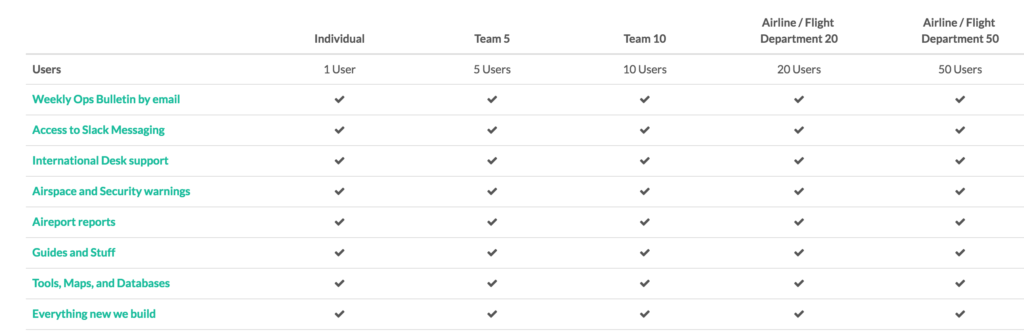
Life managing International Ops is hard enough without trying to do it all on your own. And we want you, because the more smart people like you we have in the group, the stronger it becomes. Pick a plan for yourself, or your team, or your entire flight department. There’s 1650 people waiting to answer your questions. And to pick your brain.

Read the reviews from existing members, and see why everyone from Airbus to the British Antarctic Survey to United Airlines is in the group. (hint: we’re all doing the same thing, and it’s getting easier).


Join OpsGroup


Welcome Pack

On joining, we will send you, and each team member if you are on a team or department plan:
– a Welcome Email, explaining the group, together with your Welcome Pack:
– The full FSB Airports Database (value $375)
– The current full International Ops Bulletin
– Our Polar Ops Planning Guide
– Current NAT Plotting Chart (value $35)

Everything

You (and each team member, if you choose a team plan) will then also get:
– Immediate access to our OpsGroup Dashboard
– The weekly International Ops Bulletin every Wednesday
Slack access to talk to the group
Ask-Us-Anything – we answer your International Ops questions
– Airspace warnings and overflight risk summaries
– Access to Aireport – 2300+ Airport and ATC TripAdvisor style reviews
– Everything we publish – Guides, Lowdowns, Charts, Member Notes
– Tools and Maps
– All previous content since the group started
See examples of all the above

Joining Process

2 straightforward steps:
– Choose an Individual, Team, or Department plan
– We send you everything you need to get started by email

You can cancel anytime you like, before the next billing period.

New members – that’s you – are welcomed several times a year. The current status is notified on this page. To make sure that new members are fully supported, and the existing group retains its high quality, we limit joining to window periods during the year.
If we’re closed, you can join the waitlist to be notified of the next opening window.


Join OpsGroup


Australia updates RNP2 rules for foreign operators

The Australian CAA have said they will now allow foreign operators to use RNAV1/2 in lieu of RNP 1/2.

Over the past few years, Australia has been moving away from ground-based navigation to PBN/GNSS as the primary means of navigation across the country.

Australian operators have all had to be RNP1/2 compliant since May 2016, when they rolled-out RNP2 for en-route and RNP1 for terminal operations.

It’s not yet mandatory for foreign operators to be RNP1/2 compliant – but if you want to benefit from these routes and procedures (and can’t get RNP1/RNP2 approvals from your country of registry), you can notify CASA of your intent to use RNAV1/RNAV2 instead – and they will accept those as equivalent to RNP1/RNP2.

To do that, make sure you fulfil all the criteria in their “Acceptable Means of Compliance” (as contained in CASA EX158/17), fill out Form 0667 and send it to CASA by email, along with a copy of your Ops Spec. Their email address is: international_ops@casa.gov.au

The AMC applies to both commercial and private flights. However, as it’s not a mandatory requirement for foreign aircraft, if you’re operating a private flight you might not want to bother with it; if you can’t meet the equivalent of the RNP1/2 nav spec requirements, you can still operate in Australian airspace – all that will happen is that ATC just might not provide you with the absolute best routes and levels. But even that won’t happen any time soon – at the moment there are still no RNP2 routes in Australia yet, although we will start seeing these being introduced between now and 2020.

For more info, check out the full AIC here.

Flight Planning:

  • If you do have RNP2 – put GRZ in Field 10a and NAV/RNP2 in Field 18.
  • If you don’t, then you must operate according to Australia’s “Acceptable Means of Compliance” and put RMK/CASA RNP AMC in Field 18.


ATC, CAA, Airports, Rulemakers – join our OPSGROUP Slack community

OPSGROUP is an international community of Pilots, Dispatchers, Controllers and Aircraft Operators. We have 4000 members across 90 countries, responsible for managing and operating Airline, Corporate, Private and Military flights. Members share information and work together to make International Flight Operations easier.

Every day in different channels in slack – an app that allows live discussion –  there are discussions on the latest rule changes, airspace rules, airport , big weather, incidents, events – anything that might make your day more interesting, especially if you don’t know about it.

We have multiple channels discussion International Operations across the world.

So, to make our discussions better – and get more input from the official side – we are inviting controllers – Tower, Approach, Enroute, CAA’s, FAA’s, Airport operators – to join and be there to see what operators want to know from you.

We are inviting YOU to join the discussion. If you’d like to connect directly with the pilots and operators using your airspace, airport, or trying their best to follow your new rules, then you will find being part of the Slack discussion useful. And in turn, our members will be most happy to have you on board to ask questions now and again.

How it works

You’ll get a login that matches what you do, so it’s easy for group members to see who you are. If you’re a controller at Shanwick, then we might use @shanwick_atc, or if you’re the Ops manager for Sydney airport, then you’ll become @SYDAirport. If you’re the second person there, then we’ll call you @SYDAirport-Tim, or whatever. If you’re at Eurocontrol, then maybe @eurocontrol_ops. If you’re at the Slovenian CAA, then @SloveniaCAA. And so on.

You can view slack in your browser, download the App for your phone, or one for your Mac or PC. Either way, you’ll get immediate access to our group of 4000+ members, and can interact with them.

Win Win

You get to talk to your airspace users, customers, and rule-followers, and see what’s going on. And they get to talk to you. It’s an informal environment, so we don’t expect any official responses or need to use bureau-speak. Just help folks along their way. There’s no charge to join in this way – we are happy to have your input and knowledge!

OPSGROUP

There is no obligation to join the group as full member, but you are most welcome to – you’ll get a full weekly International Ops Briefing, daily updates, access to Airport Spy, Guides, Lowdowns, Charts – for the full rundown on that click here.

Invitation

Joining our slack discussion group is by invitation from the FSB Team. If you haven’t received an invite, pop your details in here and we’ll let you know.

[ninja_form id=5]


France Conditional Routes

Having fun in France airspace on peak days? France has just published their list of Conditional Routes (CTRs). You’ll be able to use these on busy Fridays and certain holidays:

Fridays:
FRI 20 APR, 27 APR ;
FRI 04 MAY, 11 MAY, 18 MAY, 25 MAY
FRI 01 JUN, 08 JUN, 15 JUN, 22 JUN, 29 JUN
FRI 06 JUL, 13 JUL, 20 JUL, 27 JUL
FRI 03 AUG, 10 AUG, 17 AUG, 24 AUG, 31 AUG
FRI 07 SEP, 14 SEP, 21 SEP, 28 SEP
FRI 05 OCT, 12 OCT, 19 OCT, 26 OCT.

CTRs:
From 1000-1500UTC, the following will have priorty for General Aviation Traffic:

UL722 (ANNET-KORUL above FL275)
UP620 (CAMBO-KORUL above FL275)
UN862 (UVUDO-OSMOB above FL 285)
UT21 (TOU-DIVKO above FL335)
UZ38 (MTL-PPG)
UZ539 (BOLSA-SIJAN)

Holidays:
TUE 01 MAY
TUE 08 MAY
THU 10 MAY
MON 21 MAY
WED 15 AUG.

CTRs:
From 0700-1700UTC:

UM164 POGOL-LUPEN

You can read the full AIP SUP 025/18 here.


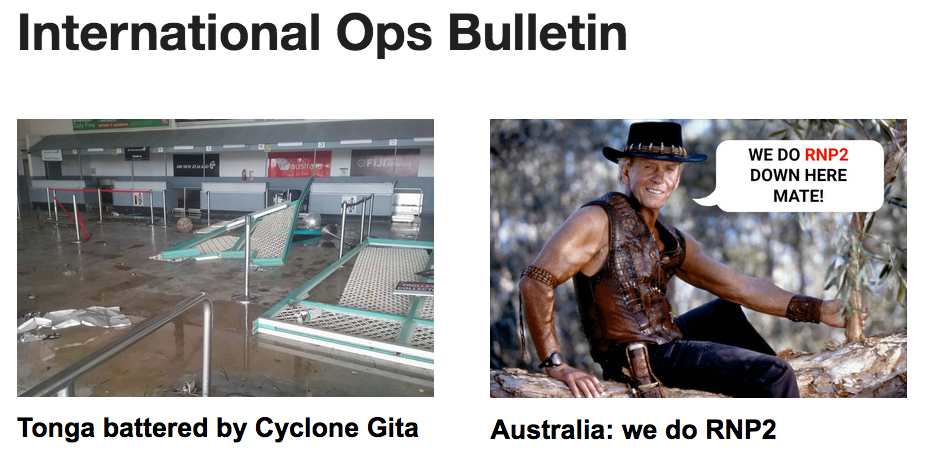
Tonga battered by Cyclone Gita

On Feb 14, operations resumed at Tonga’s main international airport, NFTF/Fuaʻamotu, after it was closed for 2 days for the passage of Tropical Cyclone Gita.

The cyclone caused extensive damage across Tonga, and the government has declared a state of emergency. According to the British Met office, Gita was the most powerful Cyclone to hit Tonga in over 60 years, battering the island nation with winds of over 120kts at its peak.

At least 30 people were reportedly injured during the storm, and around half the buildings suffered damage in Nuku’alofa, the capital of Tonga. Roads across the main island of Tongatapu have been obstructed by storm wreckage and downed power lines, and widespread power outages have also been reported.

At the airport itself, the domestic terminal is still closed due to damage sustained in the storm, and now all domestic flights are using the international terminal instead. Here’s some photos of the damage at the airport:

Gita has since moved westwards into open waters as the equivalent of a Category 4 hurricane, with winds of over 100kts, but it’s now expected to head south-west across the ocean, narrowly avoiding direct hits on Vanuatu and New Caledonia – although heavy rain, strong winds and storm surge will affect these areas.


Happy Valentines Day!

We took the day here at FSB to make you all some sweet Valentines Day cards. We think we did pretty well, and we know you all love aviation puns.

Print them out, fold them out, and you’re done planning your Valentines Day!

I’m Plane Crazy About You!
Our Love will never stall…
You’re the Prist to my Jet-A
It’s Plane to see, you’ve got me in a tailspin

If you’d like all four, you can get them here.


Happy Valentines Day!


08FEB: PBCS is coming to Singapore, Bermuda as a NAT alternate

Weekly International Ops Bulletin published by FSB for OPSGROUP covering critical changes to Airports, Airspace, ATC, Weather, Safety, Threats, Procedures, Visas. Subscribe to the short free version here, or join thousands of your Pilot/Dispatcher/ATC/CAA/Flight Ops colleagues in OPSGROUP for the full weekly bulletin, airspace warnings, Ops guides, tools, maps, group discussion, Ask-us-Anything, and a ton more! Curious? See what you get. Rated 5 stars by 125 reviews.

EGGX/Shanwick ICAO have published their own Bulletin on the upcoming PBCS requirements on the NAT. It confirms what we already knew – after Mar 29, you will need PBCS-style RNP4, CPDLC and ADS-C to fly the tracks between FL350-390. But it does have an interesting little section explaining how non-compliant aircraft might be allowed to ‘infringe’ or climb/descend through the tracks. We’ve updated our PBCS article with this info.

LFZZ/France Expect disruption to rail and air travel in Paris over the coming days due to heavy snowfall. A number of flights to LFPG/Paris Charles de Gaulle, LFPO/Paris Orly and LFPB/Paris Le Bourget international airports have been cancelled while some Eurostar services between London and Paris have also been delayed or cancelled.

RCZZ/Taiwan Two large earthquakes in the space of 24hrs from Feb 6-7 near the city of Hualien on Taiwan’s east coast has resulted in at least 7 deaths. Ops at RCYU/Hualien airport have not been affected, and the runway and airport are reported to still be fully intact.

GCZZ/Canary Islands CPDLC-ATN service is now available in the GCCC/Canarias TMA for ATC clearance.

KBZN/Yellowstone The main runway (12/30) will be closed for maintenance each day from Apr 30 to May 19, between 1230-2300 local time (1830-0500z). The next biggest runway (11/29) is barely over 3000ft long, so during this period pretty much all commercial traffic has been rescheduled to avoid the daily closures.

LIRF/Rome There’s a small localised ATC strike planned at Rome’s Fiumicino airport on Feb 10, from 9-17z. International flights should be unaffected, but expect some delays if operating there that day.

EDDM/Munich The Munich Security Conference will be happening from Feb 14-18. During these dates, you can’t use EDDM as an alternate, and GA flights will need to get special permission to land. For PPR contact +49 89 975 21132 or email specialoperations@munich-airport.de

GAZZ/Mali Algeria have now published a Notam saying aircraft exiting their airspace and entering Mali should do so only at a level between FL320-400. That’s fairly consistent with the advice issued by other countries.

WIII/Jakarta Heavy rains have caused flooding and landslides around the outskirts of the city of Jakarta, and the city itself is now vulnerable to flooding after the authorities were forced to open sluice gates on a major upstream reservoir on Feb 6.

UUZZ/Russia Delays at the Moscow airports continue, after the city was blanketed by its heaviest snowfall in 100 years. Over 40cm of snow fell between Feb 3-6, or 20 per cent more than the average for the whole month. The weather has since improved somewhat, although more snow is forecast for this weekend.

EPZZ/Poland No datalink services available in Polish airspace until Feb 28, as they’re running tests on their systems. All login attempts to EPWW will be automatically rejected.

TIST/St Thomas Between now and Feb 16, the runway will be closed overnight from 02-09z. If you need to land during those times, you’ll need to get PPR at least an hour in advance, by calling +1-340-201-2598.

ANYN/Nauru There’s still no HF radio coverage at Nauru. If you’re operating there, maintain HF contact with Brisbane until you can make VHF contact with Nauru on 118.1MHZ or 126.MHZ. For overflights in the region outside of VHF range, you can contact them on satphone: either +61-147-148478 or +61-147-163879.

VRZZ/Maldives On Feb 5, the Maldives government declared a state of emergency, in the midst of a political crisis that has seen security forces deployed in the capital Malé. However, so far there are no reports that any of the outlying islands, resorts or VRMM/Malé International Airport are affected.

Weekly International Ops Bulletin published by FSB for OPSGROUP covering critical changes to Airports, Airspace, ATC, Weather, Safety, Threats, Procedures, Visas. Subscribe to the short free version here, or join thousands of your Pilot/Dispatcher/ATC/CAA/Flight Ops colleagues in OPSGROUP for the full weekly bulletin, airspace warnings, Ops guides, tools, maps, group discussion, Ask-us-Anything, and a ton more! Curious? See what you get. Rated 5 stars by 125 reviews.


OPSGROUP 2018 is open – new members welcome – 20 reasons to join

Opsgroup2018 is open to new members.

Read OPSGROUP: The Power of the Group – and then see below for more reasons to join us.

01  You will be smarter and saferOPSGROUP makes International Flight Ops easier.
02  Safe Airspace. Learning lessons from MH17, we share risk information, with a big map.
03  Change. It’s not just a constant, it’s accelerating. OPSGROUP tells you the critical stuff.
04  Members. There are 4,000 of us – each a pilot, dispatcher, controller, or ops person.
05  Full Bulletin. Once a week, all the International Ops changes in one simple bulletin.
06  Ask Anything. Every intl ops question you have, answered – by the group, or the team.
07  Bulletstream. Daily news briefing in bullet point format – just the critical ones.
08  Guides. All the FSB regional guides, like our NAT Ops guide, free.
09  Charts. The FSB NAT Plotting Chart, free – and others as we make them.
10  Slack. Talk live with us and other members on #todaysops.
11  George. We built a bot. He’s George, and he answers your Ops questions.
12  Lowdowns. Country guides for the most popular tech stop and ad-hoc airports.
13  Infographics. Making new stuff easier to understand, like the Circle of Change.
14  Dashboard. All the OPSGROUP tools live here – you get your own login.
15  Airport Spy. We sneakily share our reports on ATC, Handling, and Airports worldwide.
16  It’s not all AIC’s and Notams. We do fun stuff too. We promise to keep it interesting.
17  Plain English. We translate the Fedspeak into words we all know.
18  Email Alerts when big things are going down – ATC strikes, severe weather, incidents.
19  Discount in the Flight Service Store – 15% off for members.
20  The Future. We’re just getting started – OPSGROUP is 20 months old. Help us grow!


Choose a plan and join OPSGROUP


PBCS is coming to Singapore

It’s not only the North Atlantic that will be seeing PBCS being implemented on March 29th – on that same date, the weird acronym is coming to Singapore too!

However, the requirements for Singapore airspace are slightly different to that for crossing the NAT.

The short of it – compliant aircraft will be allowed a reduced separation of 50NM (or 10 minutes in trail) on certain airways: L642, M635, M767, M771, M774 and N884. For everyone else, it’ll be 80NM (or 20 minutes in trail). For Singapore, ‘compliant aircraft’ basically means anything with RNP10, CPDLC and ADS-C capable of the RCP240 / RSP180 performance requirement.

You’ll still need to obtain some kind of operator approval from your State of Registry. As we mentioned in our article on PBCS on the NAT – the best way to do that will probably be to submit an AFM Statement of Compliance for PBCS, showing exactly what data link communication systems you aircraft has, along with the selected performance.

For Singapore, if you want to operate on those airways at the reduced separation, here’s what you’ll need to remember to include in your ATC FPL:

In 10a:

In 10b:

In Item 18:
Make sure you include SUR/RSP180 to show you’re capable of the RSP180 performance requirement.

For more info, check out the full AIC published by Singapore here.


Do you use Bermuda (TXKF) as a NAT alternate at night?

The Bermuda AIP says that they have Fire Category 9 from 07–23 local time, but also that “during uncontrolled hours of operations BFRS/ARFF will be called out at CAT 9″.

So does this mean that Fire Category 9 is essentially ALWAYS available? And how long does it really take to call them out in an emergency?

We got an answer to that question the other day, when an American Airlines B777-200 en-route from KJFK/New York to SBGL/Rio de Janeiro had to make an emergency divert to TXKF/Bermuda due to a suspected fire in the cargo hold.

ATC cleared the flight direct to TXKF/Bermuda. They advised the crew that the tower at the airport was not staffed at the time (although the runway has pilot controlled runway lighting), but that emergency services had been alerted and would be on standby for their arrival.

38 minutes later, at 12.18 am, the flight landed, and the emergency services were indeed there as promised.

The whole cargo fire thing turned out to be a false alarm, although we’re very thankful to one of the passengers–the supermodel Joan Smalls–for documenting the ordeal on social media.

We contacted the airport authority to check exactly how long they really need for emergency diverts, and whether they really do provide Fire Cat 9 in these situations. Here is their response:

“ARFF is available 24hrs and yes will be staffed at the appropriate level to be cat 9 at all times. After 2300 Local Time when the local airport is uncontrolled , ARFF requires 20 minutes for call out for such events like diversions.”

So there you have it. You can always rely on Fire Cat 9 at TXKF – just make sure you give them at least 20 minutes notice!


Bangladesh is now one big ADIZ

Bangladesh has decided to establish an ADIZ over the entire country, including a massive chunk of airspace off their south coastline that actually extends over much of the adjoining Indian VECF/Kolkata FIR.

Aircraft intending to fly into, through, or within this new Bangladesh ADIZ must now obtain an ADC (Air Defence Clearance) number beforehand. Just file your flight plan, and they will send this to you by AFTN. Make sure you write it down – as they will ask you for it on HF before you enter their airspace.

If you don’t have AFTN access, you can get the number by calling +880-2890-1081 or emailing adnc@baf.mil.bd

The authorities in Bangladesh have released a scary sounding AIP SUP on all this, which you can read in full here. What they fail to mention there, but did publish by Notam at the time, is that there are actually a bunch of airways over the ocean (P646, N895, M770, L524 and W112) where you won’t have to get this ADC number, unless you deviate towards the landmass of Bangladesh.

Here’s the Notam:

A0032/18 NOTAMN
Q) VGFR/QXXXX/IV/BO/AE/000/999/
A) VGFR B) 1802010001 C) PERM
E) THE FLW AMDT/UPDATES ARE BROUGHT TO THE AIP-SUPP 01/2018:
1. ACFT INTENDING TO OPR INTO, THROUGH OR WI BANGLADESH ADIZ SHALL
OBTAIN ADC NR FM THE FLW CONTACT DETAILS.

TELEPHE: +880 2 8901081
FAX : +880 2 8901081
E- MAIL: ADNC AT THE RATE OF BAF.MIL.BD
AFTN : VGHSZQZX

2. FLT OPR ON ATS RTE P646, N895, M770, L524 AND W112 SHALL NOT
REQUIRED TO OBTAIN ADC NR UNLESS DEVIATED TOWARDS THE LAND
MASS OF BANGLADESH.

3. GUARD FREQ. 121.50 MHZ SHALL NOT BE USED TO CTC THE AIR
DEFENCE UNIT.

4. ARTICLE ‘L’ IN THE PROCEDURES FOR AIR DEFENCE CLEARANCE IN
THE AIP-SUPP SHALL BE TREATED AS CNLD.

5. FOR THE TIME BEING DOMESTIC FLT AND FLT OF STATE ACFT AND
GENERAL AVIATION ACFT OF BANGLADESH SHALL NOT BE REQUIRED
TO OBTAIN ADC NUMBER

So you won’t need an ADC number on those airways, but for everywhere else in that big red ice pick-shaped chunk of airspace, you’ll need to get authorisation. As the Bangladesh AIS office politely warn in their AIC: “Aircraft flying without a valid ADC number or failing to comply with any restriction or deviating from flight plan will be liable to interception by Bangladesh Air Force Interceptor aircraft according to ICAO Standard Interception Procedure.”


02FEB: NAT PBCS, Changes coming, Dangerous airspace in the Icheon FIR, George is back

Weekly International Ops Bulletin published by FSB for OPSGROUP covering critical changes to Airports, Airspace, ATC, Weather, Safety, Threats, Procedures, Visas. Subscribe to the short free version here, or join thousands of your Pilot/Dispatcher/ATC/CAA/Flight Ops colleagues in OPSGROUP for the full weekly bulletin, airspace warnings, Ops guides, tools, maps, group discussion, Ask-us-Anything, and a ton more! Curious? See what you get. Rated 5 stars by 125 reviews.

VGZZ/Bangladesh has decided to establish an ADIZ over the entire country, including a massive chunk of airspace off their south coastline that actually extends over much of the adjoining Indian VECF/Kolkata FIR. Aircraft intending to fly into, through, or within this new Bangladesh ADIZ must now obtain an ADC (Air Defence Clearance) number beforehand – they will send it to you by AFTN, after you file your flight plan. Make sure you write it down, as they will ask you for it on HF before you enter their airspace. If you don’t have AFTN access, you can get the number by calling +880 2 8901081 or emailing adnc@baf.mil.bd. There are a bunch of airways over the ocean (P646, N895, M770, L524 AND W112) where you won’t have to get this ADC number, unless you deviate towards the landmass of Bangladesh. Read the full AIC here: http://www.caab.gov.bd/aip/sup/aipsup01-18.pdf

VABB/Mumbai Ongoing runway maintenance until Feb 17. The main runway will be closed daily from 0430-1130z, except Wednesdays. The second runway will be open during this time, but expect delays due to volume of traffic.

MKZZ/Jamaica The state of emergency that was declared for parts of St James (which includes Montego Bay) has been extended to May 2. A major military operation is now underway, in response to recent violence including shooting incidents. Travellers are no longer being told to completely avoid the area, but just to limit their movements outside of resorts, and take particular care if travelling at night.

BKZZ/Kosovo Following reports revealing multiple breaches of security protocols, NATO peacekeeping troops have taken back control of the Air Traffic Tower of Kosovo’s International Airport, ten years after transferring competencies to local authorities. Last year, the airport officials tested security – an armed man was able to reach a plane, someone else smuggled a suitcase bomb on board, and another individual was able to reach the radar room.

LLBG/Tel Aviv Syrian dictator Bashar Assad has threatened to fire missiles at LLBG airport if Israel carries out any further attacks on Syrian soil. Israel has struck both Syrian government and Hezbollah targets in Syria on numerous occasions recently, in an attempt to prevent the government from obtaining weapons from Iran and then passing them on to Hezbollah.

KZZZ/USA Flights across the south-western U.S. may get delayed over the next few weeks due to the massive annual ‘Red Flag’ military exercise that’s going on out of Nellis Air Force Base in Nevada. Navigation systems may disrupted or jammed completely – at any altitude. The Las Vegas area will see most of the direct impact from the exercises, with some flights potentially being re-routed away from KLAS airport due to increased flight traffic in the area. Expect delays across the region of 30 minutes or more during peak exercise hours, and particularly on Thursday, Friday and Saturday nights. The war games should be finished by Feb 16.

OYZZ/Yemen Heavy fighting has intensified in Aden over recent days, forcing OYAA/Aden Airport to close for three days, as separatist forces seized government buildings in what Yemen’s prime minister called an attempted coup. The airport has since reopened, on Feb 1. The southern city has served as the government’s de facto capital since 2014, when the Houthi rebels seized control of Sanaa in their fight against the state. OYSN/Sanaa airport is still controlled by Houthis, so that will remain closed to all flights for the foreseeable future.

CYZZ/Canada A strong winter storm is affecting flights across eastern Canada. On Jan 31, cancellations continue for a second day in a row at CYHZ/Halifax airport, where over 20cm of snow fell overnight. Schools, roads, businesses and government offices are closed across the region. Expect travel disruption over the next few days.

OJAM/Amman The city’s second airport (OJAI is the main one) will now only be available to aircraft below a MTOW of 25,000 kg. (And remember, it will be closed to everything except emergency and VIP flights each day from 09-15z until Feb 16.)

SKZZ/Columbia A temporary ceasefire between the Colombian Government and the National Liberation Army (ELN) ended on Jan 8. The ELN has since renewed its attacks on the Colombian state. There were a series of bombings over the 27-28 Jan weekend in Barranquilla, which resulted in multiple deaths and injuries. The U.S. government has warned against travel to several departments throughout the country due to crime and terrorism.

OEZZ/Saudi Arabia On Jan 30, Houthi rebels in Yemen claimed they had launched a long-range ballistic missile at OERK/Riyadh Airport. So far there has been no corroborating evidence for this – there were no reported disruptions at the airport or any reports of a missile impact near Riyadh. But at least 3 other missiles are reported to have been intercepted by the Saudi air defence system so far in 2018 – none have resulted in casualties, but operators should consider carefully operations to Saudi Arabia.

RCZZ/Taiwan Some Chinese airlines have been forced to cancel hundreds of flights to Taiwan that were originally scheduled for the upcoming Lunar New Year holiday, after Taiwanese authorities refused to approve the flights. This is the latest in an ongoing airspace row between the two countries, after China opened up an airway close to the FIR boundary earlier this month – without consulting Taiwan.

RKZZ/South Korea The 2018 Winter Olympics will be taking place from Feb 9-25, in a remote area of northeastern South Korea, some distance from airports in the Seoul area. RKNY/Yangyang Airport is right next door to the venue: it’s an AOE, it will be open 24hrs during the event, but GA/BA flights will be limited to a maximum of 2hrs on the ground. Best bet will be to drop-and-go, and reposition to either RKSS/Seoul or RKSI/Incheon for parking – those two airports should both have capacity, although RKSS is probably the better option, as overnight parking is more limited at RKSI with only three spots currently available for GA aircraft.

GOZZ/Senegal For flights to Dakar, from now on you’ll have to use the new international airport they’ve recently opened 50km outside the city, called GOBD/Blaise Diagne International Airport. The old airport (GOOY/Dakar) is now just for military use only.

OIZZ/Iran A snowstorm has blanketed much of western and northern Iran, causing power outages and road closures. OIIE/Tehran airport was closed on Jan 28 as the runways had to be dug out from under 70 centimetres of snow, and OIII/Mehrabad was also temporarily closed. All airports have since re-opened, but expect travel disruption across the region over the next few days.

OTZZ/Qatar UAE military aircraft will now start flying alternative routes over Saudi Arabia in an effort to avoid contact with Qatari fighter jets which intercepted two passenger planes earlier this month. A spokesman from the UAE airforce has said: “We have directives from our leadership not to escalate the situation in response to the Qatari provocation in order to maintain regional peace and stability and ensure the safety of the international air navigation and lives of passengers and air crews.”

OAZZ/Afghanistan There has ben a marked surge of violence in Kabul with four major attacks in just over a week: an ambulance bomb, an attack on a military academy, an aid agency and a hotel. Don’t consider landing or diverting anywhere in Afghanistan – nowhere is safe. Overflight advice averages out at a minimum FL250, though as with other mountainous countries we think FL320 is a better starting point.

SASA/Salta Argentina’s main airport for visitors to the Andes, will be completely closed to everything except helicopter ops from Apr 15 to May 5 for runway repairs. During this time, flights will be diverted to SASJ/Jujuy instead.

RPZZ/Philippines After being temporarily closed due to eruptions from the nearby Mayon Volcano, RPLP/Legazpi airport has now reopened to commercial flights: VMC only, from 2130-1330z. Although there have been fewer reports of ash clouds in the vicinity at the higher flight levels, the volcano is still very much ‘active’, and more explosive eruptions are possible. RPLL/Manilla airport has implemented a five minute restriction for aircraft departing the airport on certain airways, due to the ongoing volcanic activity.

ZBAA/Beijing For charter flights, ZBAA airport authorities have said they will not accept any new requests between now and Mar 31, at the earliest. No official document has been published on this, and the authorities have said it will not be published on the Notams either. For GA flights, the same rules apply as usual: maximum 24hrs parking, no ops allowed from 23-01z, and an aircraft cannot have two peak hour slots between 01-14z during one day. Many operators choose to go to ZBTJ/Tianjin instead, or ferry there for parking.

KJFK/New York The airport authority has confirmed it will set up an emergency ops centre, so that during future severe weather events the 6 privately owned terminals can all assist one another when gates are scarce. There was no such coordination during the winter storm earlier this month, which resulted in total gridlock at the gates and some aircraft being stuck on the ramp for hours.

GBYD/Banjul Gambia’s Tourism and Culture Minister has spoken out about “rampant corruption” at Banjul airport, with customs officers reported to be regularly stealing phones and money from some passengers arriving from abroad. The problem has apparently gotten so bad that many Gambian citizens who are resident abroad now choose to fly to Dakar in Senegal instead, when making trips back home.

UUZZ/Russia Russia’s Federal Tourism Agency has reported that hotels in the 11 host cities for the upcoming 2018 FIFA World Cup are hiking their prices ahead of the tournament. Some hotels, even those with zero stars, have raised prices by more than 5,000 percent during the tournament, which will be taking place from June 14 to July 15. Russian authorities are also warning travellers to watch out for fake ATM’s – only ones connected to banks should be used. Russia is expecting at least 1.5 million travellers to visit the country during the World Cup.

KMSP/Minneapolis There’s a Super Bowl TFR Notam in place from 2130z Feb 4 – 0600z Feb 5. GA/BA that intend to operate into or out of the 10nm circle around the stadium must use either KMSP/Minneapolis or KTSP/St Paul airports, and have to register with the TSA by 0200Z on Feb 02 at the latest. Do that by calling 612-486-5453. Unless you’re going for the game, best avoid the area completely during this period. Parking and services at the airports in the area will be challenging because of the amount of traffic expected. Full details of the TFR are here: http://tfr.faa.gov/save_pages/detail_8_2612.html

Weekly International Ops Bulletin published by FSB for OPSGROUP covering critical changes to Airports, Airspace, ATC, Weather, Safety, Threats, Procedures, Visas. Subscribe to the short free version here, or join thousands of your Pilot/Dispatcher/ATC/CAA/Flight Ops colleagues in OPSGROUP for the full weekly bulletin, airspace warnings, Ops guides, tools, maps, group discussion, Ask-us-Anything, and a ton more! Curious? See what you get. Rated 5 stars by 125 reviews.


2018 Edition: New NAT Doc 007 2018 – North Atlantic Airspace and Operations Manual

For the latest changes and updates on the North Atlantic, including our most recent Guides and Charts, use our NAT reference page at flightservicebureau.org/NAT.

2018 version – NAT Doc 007

The 2018 version of NAT Doc 007, North Atlantic Airspace and Operations Manual, was published in January 2018 by ICAO/NAT SPG.

Download the original document here (PDF, 5mB), and see also:


2018
 is off to a flying start again with NAT changes – these are the latest important changes. These are also published in the latest edition of NAT Doc 007, January 2018.

  • PBCS From March 29th 2018, PBCS is a requirement for the NAT Tracks between FL350-390 – RCP240 and RSP180. Read more about PBCS in our article.
  • RLAT  From January 4th 2018, Shanwick and Gander increase the number of RLAT tracks – most tracks between FL350-390 will now be RLAT – 25nm separation between them.

And there will be more! Keep an eye on the FSB NAT Changes page, we’ll keep it updated.


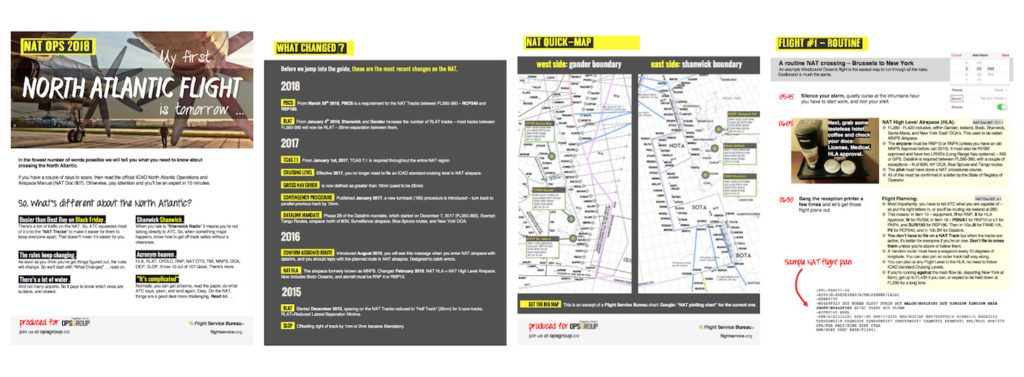
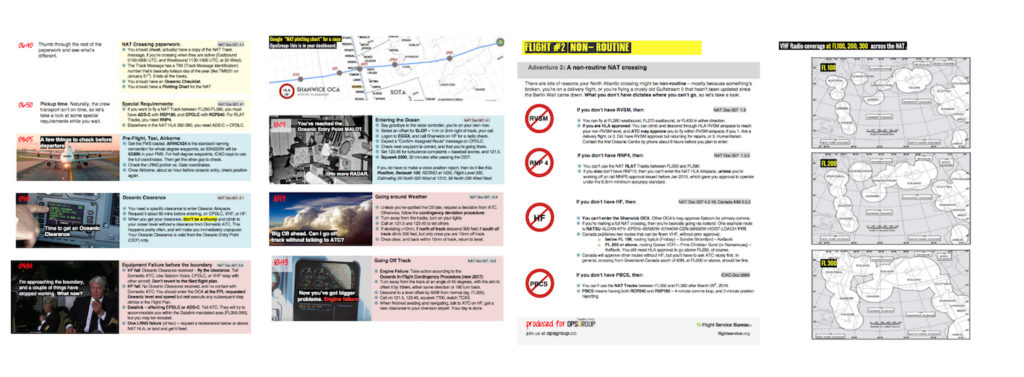
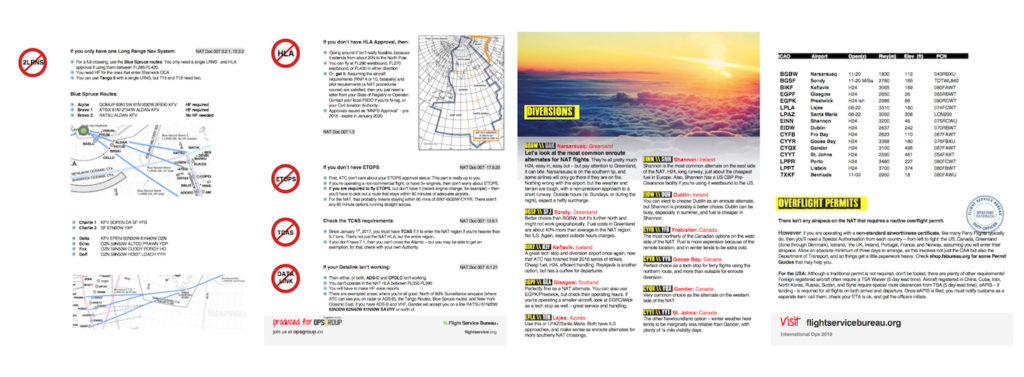
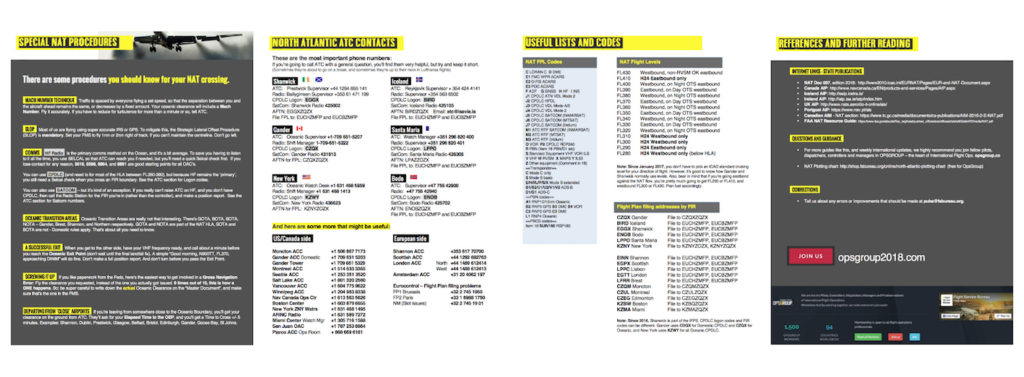
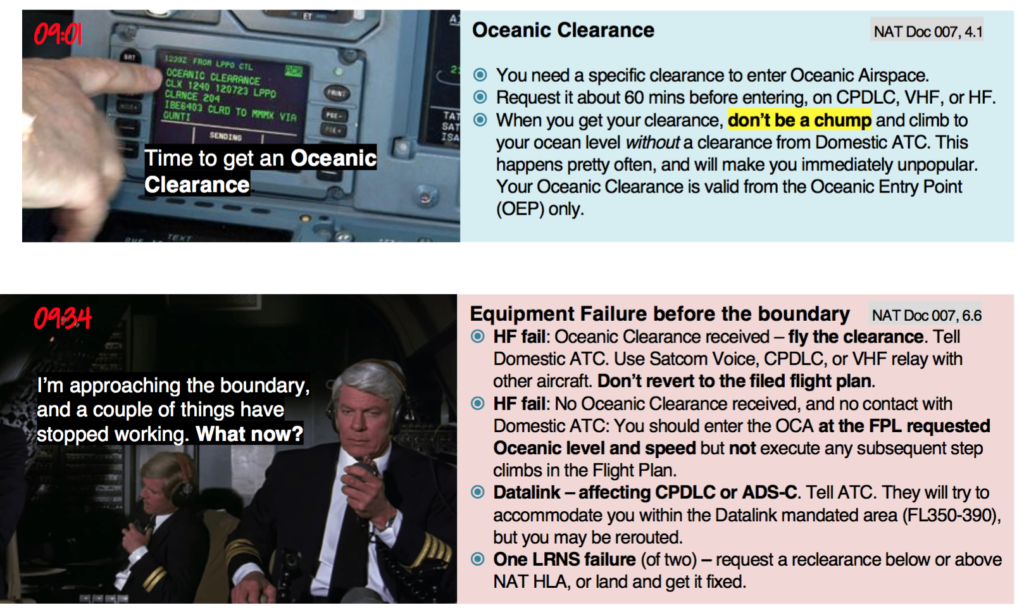
Feb 2nd, 2018: FSB updated the full NAT Crossing Guide “My first North Atlantic Flight is tomorrow“.

– What’s different about the NAT, changes in 2018, 2017, 2016, 2015, NAT Quick Map
– Routine Flight Example #1 – Brussels to JFK (up at 5.45am)
– Non Routine-Flights: No RVSM, No RNP4, No HF, 1 LRNS, No HLA, No ETOPS, No TCAS, No Datalink – what you can do and where you can go
Take a look.


PBCS: New rule on the NAT from March 29, 2018 – RCP240 and RSP180

Update March 16th, 2018: PBCS is turning into a PITA. After OPSGROUP input, we have an update on the latest status including rumours of delays, A056 LOA’s, and Aircraft that have failed to comply with PBCS.

For the latest changes and updates on the North Atlantic, including our most recent Guides and Charts, use our NAT reference page at flightservicebureau.org/NAT.

ICAO is introducing another acronym in the North Atlantic Region. This time, it’s PBCS (Performance Based Communication and Surveillance), and from March 29th 2018 you will need to be compliant if you want to fly on the half-tracks between FL350-390.

Initially, there will only be a maximum of three daily tracks where you will need to be PBCS-compliant between FL350-390. These will likely be the same tracks as we currently see being assigned as ‘half-tracks’ each day.

This requirement will eventually be extended to all the NAT tracks between FL350-390, but we understand that will only happen when the filing of PBCS designators on flight plans reaches the 90% mark, or 28th March 2019 – whichever comes first. Either way, the ‘transition period’ for this PBCS implementation is set to last six months, so the roll-out of the requirement to all the tracks won’t happen until Oct 2018 at the earliest!

But from March 29th 2018, Shanwick and Gander will basically just continue the concept used in the RLatSM trial – whereby daily tracks spaced at less than 60nm from an adjacent track will be specified as a ‘PBCS Track’ and will be notified in the Track Message Remark-3.

So what is PBCS?

PBCS is the thing that will replace two trials in the NAT which are both coming to an end on March 29th:

  • RLATReduced Lateral Separation Minimum: where a reduced lateral separation of 25 nm has been implemented on the tracks between FL350-390 (so now there are extra “half tracks” each day, spaced by one-half degree of latitude)
  • RLong – Reduced Longitudinal Separation Minimum: in the Shanwick Oceanic Control Area (OCA), longitudinal separation has been reduced to 5 minutes between aircraft following the same track.

When these trials end, PBCS standards will be introduced to continue to allow the application of both reduced lateral and longitudinal separation for aircraft that meet the Required Communication Performance (RCP) and Required Surveillance Performance (RSP) specifications.

How do I comply with PBCS standards?

To operate on the PBCS tracks between FL350-390, you will need to be RNP4 compliant, with CPDLC capable of RCP240, and ADS-C capable of RSP180.

But watch out! Some aircraft do have ADS-C and CPDLC but have never demonstrated RCP or RSP, and have no statement of compliance (e.g. most Honeywell Primus aircraft and several early Boeing aircraft). These aircraft may struggle to get approval to operate in PBCS airspace. Which brings us neatly on to…

Do I need PBCS approval from my state of registry?

PBCS approval will differ depending on which country operators are from.

For UK operators, check the requirements here.

US operators will need to update their LOA for Data Link Communications (A056). The FAA have published a new guide, which tells operators exactly what they need to do to get this authorisation, namely:

  1. Submit an AFM Statement of Compliance for PBCS, showing exactly what data link communication systems you aircraft has, along with the selected performance
  2. Since July 2016, various oceanic FIRs have been collecting data on whether certain aircraft meet RSP and RCP criteria. You need to make sure your aircraft isn’t already listed as having failed to meet these criteria, by checking here: https://www.faa.gov/air_traffic/separation_standards/pbcs_monitoring/

What new codes do I need to put down on my flight plan?

  • FANS 1/A CPDLC equipped aircraft planning to operate in the NAT HLA shall insert the appropriate designator (J2, J3, J4, J5 and/or J7) in Item 10a of the flight plan.
  • FANS 1/A CPDLC RCP 240 compliant aircraft intending to operate in the NAT HLA shall insert the designator P2 in Item 10a of the flight plan.
  • FANS 1/A ADS-C compliant aircraft planning to operate in the NAT HLA shall insert the designator D1 in Item 10b of the flight plan.
  • FANS 1/A ADS-C RSP 180 compliant aircraft planning to operate in the NAT HLA shall insert SUR/RSP180 in Item 18 of the flight plan.
  • RNP 4 compliant aircraft planning to operate in the NAT HLA shall insert PBN/L1 in Item 18 of the flight plan.

If I’m not eligible for PBCS, where can I go? 

ATC may allow you to do either of the following, depending on how stressed/busy they are (i.e. decided on a ‘tactical basis’):

  • You can infringe on the daily PBCS tracks between FL350 – FL390 at only one point (including Oceanic Entry/Exit Point) i.e. cross but not join an NAT PBCS track
  • You can climb or descend through levels FL350 – FL390 on a PBCS track provided the climb or descent is continuous.

In their NAT OPS Bulletin 2018_001, ICAO have published a handy little picture to demonstrate this:


Further information:

  • For a great FAQ on all things PBCS, check out the latest FAA document here.
  • For more info on the PBCS implementation, check out the full UK AIC here.
  • To figure out where you are welcome on the NAT, depending on what equipment and training you have, check out our quick reference guide here.
  • Special thanks go to Mitch Launius at 30westip.com for help with this post. For assistance with international procedures training for business aviation crews worldwide, and to watch an excellent webinar about all things PBCS-related, check out the 30westip.


Beijing bans charter flights

ZBAA/Beijing airport authorities have said the airport is now so busy, they will not accept any new requests for charter flights between now and Mar 31, at the earliest.

No official document has been published on this yet, and the authorities have said it will not be published on the Notams either – but the new rule is already in effect.

For GA flights, the same rules apply as usual: maximum 24hrs parking, no ops allowed from 23-01z, and an aircraft cannot have two peak hour slots between 01-14z during one day. Many operators choose to go to ZBTJ/Tianjin instead, or ferry there for parking.

For more information on ops to China, download our Lowdown guide by clicking the image below:


24JAN: PBCS: The new rule on the NAT, A319, A330 hit by gunfire at Tripoli

Weekly International Ops Bulletin published by FSB for OPSGROUP covering critical changes to Airports, Airspace, ATC, Weather, Safety, Threats, Procedures, Visas. Subscribe to the short free version here, or join thousands of your Pilot/Dispatcher/ATC/CAA/Flight Ops colleagues in OPSGROUP for the full weekly bulletin, airspace warnings, Ops guides, tools, maps, group discussion, Ask-us-Anything, and a ton more! Curious? See what you get. Rated 5 stars by 125 reviews.
RCZZ/Taiwan China has opened up the airway M503 to northbound traffic. The airway sits just within the ZSHZ/Shanghei FIR, and has been used for southbound traffic since 2015. Taiwan complained back then, and they’re doing so again now – they say the airway is too close to existing routes that serve airports in outlying groups of Taiwan-controlled islands, and thus poses a risk to safety. China have ignored them. So for now, if you’re flying from the VHHK/Hong Kong FIR in the south to any number of airports in northern China, the Chinese authorities are quite happy for you to route via M503.

LOWI/Innsbruck The airport is getting busy with winter ski flights, so from Wednesdays 18z to Sundays 18z until Apr 15, GA/BA flights will now only be allowed a maximum of 1 hour on ground.

DAZZ/Algeria Air Algerie flights resumed on Jan 23 after a wildcat strike by cabin crew grounded nearly all departures from the capital’s airport DAAG/Algiers the previous day. Their trade union has threatened more strike action in the coming weeks.

KZZZ/USA The US government shutdown only lasted 2 days in the end: Jan 20-22. Now a bill has been signed to restore federal funding up until Feb 8. This is good news for general aviation, as the shutdown had effectively halted all FAA non-critical functions. One such example is the U.S. Aircraft Registry – when that shuts it halts the purchase, sale, maintenance, and in some cases even the movement of aircraft. For all the details on how government shutdowns impact general aviation, NBAA have it covered here.

KDCA/Washington State of the Union Address on Jan 30. No GA ops allowed at KDCA airport that day from 2000-2300 local time, including participants in the ‘DCA Access Standard Security Program’ (DASSP). No such restrictions for other airports in the area, including KBWI/Baltimore and KIAD/Washington Dulles.

DNEN/Enugu Runway repair work that had been ongoing since early Dec has now been completed. The airport is now back to normal ops, and is open from 06-23z.

RJZZ/Japan Expect travel disruption in Tokyo and the surrounding region this week due to a storm on Jan 22 that left the city fully covered with a heavy blanket of snow of over 20 centimetres. The city has come to a standstill with vehicles trapped in bridges and tunnels. Hundreds of cancellations and delays at both RJAA/Narita and RJTT/Haneda on Jan 22 left thousands stranded; both airports will be extremely busy over the next few days as they clear the backlog.

HLLM/Tripoli The only functioning airport in the Libyan capital reopened on Jan 20 after a five-day closure caused by deadly clashes that left passenger jets damaged. However, our advice remains the same: don’t land at any airport in Libya, don’t even overfly the country. Read the latest info here.

ZZZZ/Worldwide A recent rise in the cost of oil means that for the first time in three years, the global benchmark has risen above US$70.00 a barrel. Despite this, four of the major carriers, Delta Air Lines, American Airlines, United Airlines and Dubai-based Emirates, have confirmed they will not be hedging fuel bills.

HEZZ/Egypt Expect heightened security and traffic disruption in the run up to Jan 25 – the seventh anniversary of the 2011 revolution that ousted former president Hosni Mubarak. Several political parties and movements have backed calls for protests on the day.

KZZZ/USA Heavy snow on Jan 22 closed all runways at KMSP/Minneapolis airport for a few hours and forced the cancellation of over 500 flights. Although the weather forecast across the Midwest states is set to improve over the coming days, anticipate residual travel disruption as many roads are still blocked or partially blocked and icy conditions are present across the region.

SOZZ/French Guiana Controllers are on strike again. The Cayenne FIR (SOOO) will not be providing ATC services overnight from 23z-11z on the nights of both Jan 25 and Jan 26 – although expect more closures to be announced for other nights too. Airspace throughout the entire FIR basically becomes uncontrolled, though some routes are available as their contingency plan is active – review the SOOO Notams for details of those. SOCA/Cayenne airfield is also unavailable as an alternate overnight.

EGGX/Shanwick From March 29 you will need to comply with PBCS (Performance Based Communication and Surveillance) if you want to fly on the NAT Tracks between FL350-390. That means you’ll need ADS-C and CPDLC, and be RNP4 compliant. Depending on where you’re registered, you may also need to get PBCS approval. We’ve got all the details here.

OJAM/Amman The city’s second airport (OJAI is the main one) will be closed to everything except emergency and VIP flights each day from 09-15z until Feb 2.

VIDP/Delhi Due to the Republic Day celebrations, from now until Jan 26, GA ops are prohibited daily between 04-08z, and the airport will be completely closed to all ops daily between 0505-0645z.

KZZZ/USA Heading to watch certain sports games in Minnesota next month? There are a bunch of FAA required routes and a no-fly zone to watch out for. Full details here.

RPZZ/Philippines Powerful volcanic eruptions this week at the Mayon volcano, located around 330km south of RPLL/Manila, and 15km north of RPLP/Legazpi – which is now closed until Jan 27. Over 50,000 people have fled the surrounding areas and are now taking shelter in evacuation camps. Ash is drifting north from the volcano, and clouds have been reported up to FL360 over the ocean directly off the east coast from Manilla. More explosive eruptions are likely within the next few days.

EGLL/Heathrow They will be trialling some new 3.2° RNAV approaches on all four runways until Oct 2018. All carriers that are RNAV 0.3 equipped and operate at Heathrow must have the additional RNAV approaches, details of which can be found in the UK AIP SUP 001/2018.

MKZZ/Jamaica A state of emergency has been declared in parts of St James (which includes Montego Bay). A major military operation is now underway, in response to recent violence including shooting incidents. Travellers are being told to avoid the area, and those already there should remain in their resorts as much as possible.

Weekly International Ops Bulletin published by FSB for OPSGROUP covering critical changes to Airports, Airspace, ATC, Weather, Safety, Threats, Procedures, Visas. Subscribe to the short free version here, or join thousands of your Pilot/Dispatcher/ATC/CAA/Flight Ops colleagues in OPSGROUP for the full weekly bulletin, airspace warnings, Ops guides, tools, maps, group discussion, Ask-us-Anything, and a ton more! Curious? See what you get. Rated 5 stars by 125 reviews.


A319, A330 hit by gunfire at Tripoli

Heavy clashes broke out in the Libyan capital Tripoli on Jan 15, leaving at least twenty people dead and forcing HLLM/Mitiga airport to close for five days, re-opening again on Jan 20.

Gunfire at the airport damaged multiple aircraft, including a few A319s and at least one A330.

Here are some photos of some of the damage:


Both airports in Tripoli are focal points for fighting. Given their strategic value, they periodically serve as headquarters for various local militias.

HLLT/Tripoli has been more or less completely closed since mid-2014, when at least 90% of the airport’s facilities were destroyed in fighting between local militias. Since then, international flights to and from Tripoli have been using HLLM/Mitiga instead. Technically, HLLT/Tripoli is now only available for VIP, emergency and ambulance flights; but in reality, it should be avoided at all costs.

HLLM/Mitiga is the old military airfield, which is now being used for civilian traffic, since the closure of HLLT/Tripoli. However, the airport has been plagued by violence over the past few years, and has been forced to close a number of times.

Back in July 2017, we reported on the intense fighting that took place at Mitiga airport where 5 people were killed and 32 injured, and then on 19 Oct 2017, a Libyan Airlines A330 at the airport was hit by gunfire during an exchange of fire between local militia in the district directly south of the airport.

A number of countries already have blanket warnings in place against operating to Libya, and they all say pretty much the same thing: avoid the entire country – don’t land at any airport, don’t even overfly.

So we suggest you ignore whatever gets pumped out on the HLLL FIR Notams about airports being “AVAILABLE H24 FOR INTERNATIONAL FLIGHTS AND EN-ROUTE DIVERSIONS”. (You can read that nonsense in full by clicking here.)

Libya remains categorised as a Level One country (Do Not Fly) at safeairspace.net