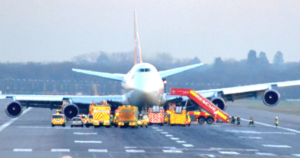
No more slots misery at Toronto

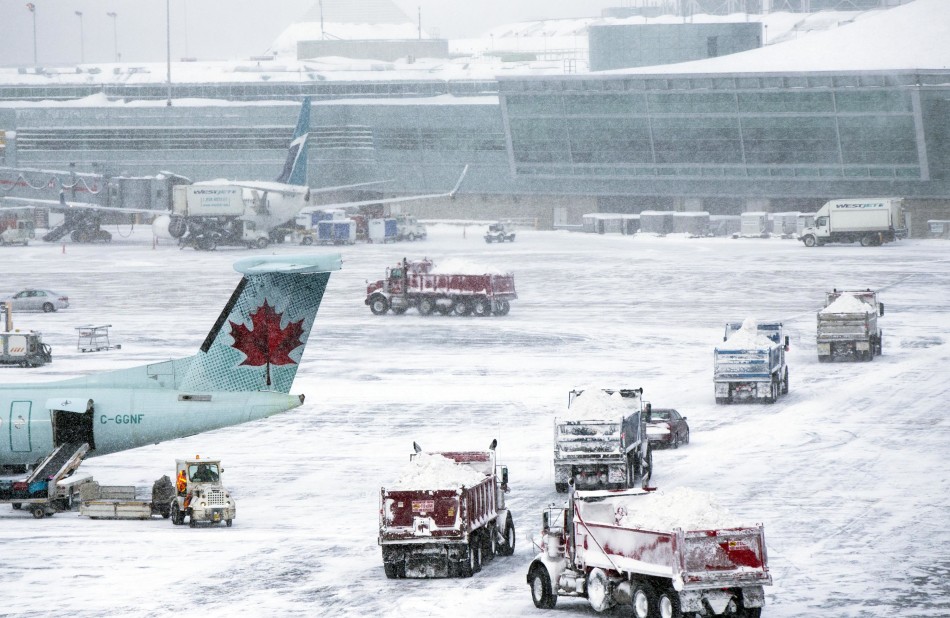
The ongoing slots-related misery at CYYZ/Toronto airport looks like it may be coming to an end. 

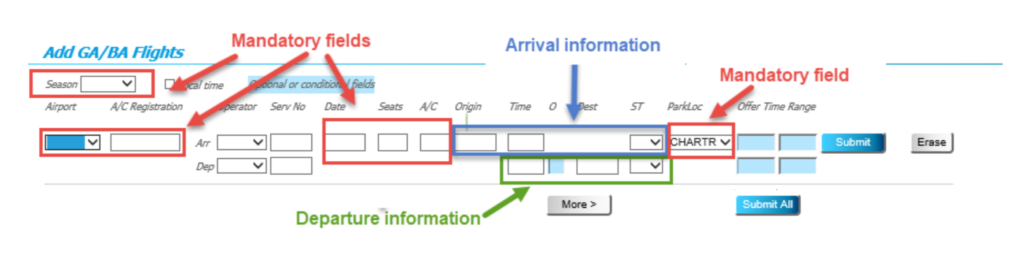
The airport has always required GA/BA flights to obtain slots for flights operating overnight (0030-0630 local time), but in mid-Feb 2019 they made this a requirement for flights H24.

This was a new system, and there were a few teething problems, the main one being that operators had to do everything themselves, as local handlers were not allowed to arrange slots on their behalf. Added to that, unless you were a Toronto-based operator, you could only request slots 3 days in advance!

But the system has now changed, with the airport authority saying that local handlers are now allowed to arrange slots on behalf of all operators. Of those local handlers, Skyservice has decided not to provide this service, but Skycharter & Signature say they can arrange slots for operators up to 30 days in advance

If you do want to arrange slots yourself instead of getting a local handler to do it for you, that’s still an option, but you will only be able to request these 3 days in advance. Various flight planning providers have said they can arrange these slots for operators too, but they all seem to be restricted to 3 days too. Toronto is a busy airport, and this restriction may mean that you won’t be able to get the arrival/departure times that you want.

If you want to try doing it yourself, the official guidance is here. If you want an FBO to do it for you, get in touch with Skycharter or Signature, and spare yourself some misery.

One last thing to note: Toronto still has a curfew between the hours of 0030-0630L. If you need to arrive between those hours, you need to contact the after-hours slot team (+1-416-776-3480), who will consider your request. But watch out! For ops approved during the curfew hours they usually charge you around 20 times the landing fee!

If you have further info to report, please do! Email us at blog@ops.group, or comment below.

Other interesting stuff at CYYZ/Toronto:

  • All the approach charts now make reference to a new procedure, implemented in Feb 2019, called Continuous Descent Operations (Jepp chart 10-2). This is designed to help reduce airport noise levels, and involves aircraft flying a continuous descent in the lowest power and drag configuration possible. ATC may instruct pilots to do this during daytime and evening periods when traffic is relatively light. More info
  • Updated advice has been issued about the runway selection criteria at Pearson. When the north-south runways are in use (RWY 15/33) the airport sees an arrival capacity reduction of around 40%. So crosswind component guidelines have been included in AIC 12/19 for dry, wet and contaminated runways.

Fly it like you stole it – free speed on the NAT

This is a new one, and it’s a good one for pilots! Being introduced slowly is a new flexibility – flying without a fixed Mach speed. In simple terms, you get to decide how fast you fly.

Like all new things on the NAT, we have an acronym. This one is OWAFS. Operations Without an Assigned Fixed Speed. But you’ll also see it as referred to as “Variable Mach”, and “Resume Normal Speed”.

When does this start?

It already has! It’s starting out as a trial (everything on the NAT starts out as a trial), and some members are already reporting getting “RESUME NORMAL SPEED” messages from Shanwick. The official start date is April 8, 2019. Three OACC’s are doing this – Shanwick, Santa Maria, and New York Oceanic (not WATRS).

For no good reason, here’s a picture of the Shanwick Oceanic control room in 1989. Much has changed since!

How does it work?

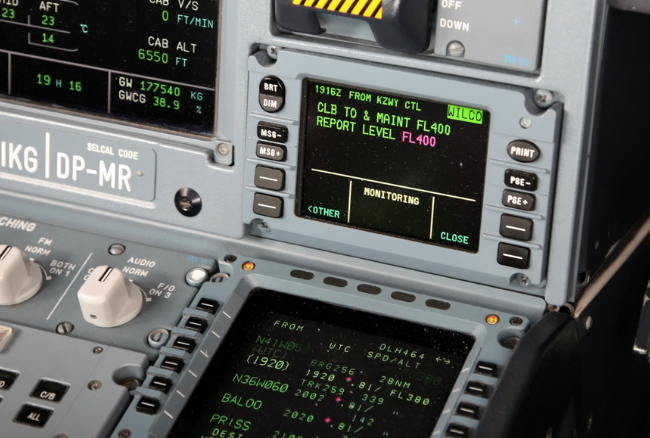
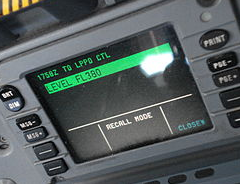
You’ll get a normal oceanic clearance, with a fixed Mach Number, like you always did. Somewhere after the Oceanic Entry Point, if you are selected for the trial, you’ll get a CPDLC message saying RESUME NORMAL SPEED. You should reply with WILCO. What that means is: Fly ECON, or a Cost Index with Variable Mach.

So, once I get that, no restrictions on speed?

Correct! But, ATC will expect you to fly ECON/Cost Index, and normally, that should be pretty close to your cleared Mach (within 0.01 up or down). If you’re doing something different, tell them. If the resulting speed differs from your Oceanic Clearance Mach by 0.02, or more, you must tell ATC.

Rules for Shanwick (Don’t ask for it)

• Flight must be data link connected to EGGX
• Flight must be eastbound and operating solely in Shanwick Oceanic airspace and exiting into UK/Ireland/Continental European airspace
• Flight cannot exit into Santa Maria
• RESUME NORMAL SPEED will be offered on a “manual” tactical basis
Do not request RESUME NORMAL SPEED

Rules for New York and Santa Maria (You can ask)

• Flight must be data link connected to LPPO or KZWY
• Flights must be wholly within Santa Maria and New York East Oceanic airspace and not enter Gander or Shanwick airspace
• Flights can enter New York East Oceanic airspace or Santa Maria airspace from Gander airspace or Shanwick airspace and receive RESUME NORMAL SPEED uplink message
• New York West (WATRS airspace) is excluded
• RESUME NORMAL SPEED can be requested if not offered

Background and History

(Thanks, Jeff Miller @IATA, for this and the condensed info above!)

Both Airbus and Boeing advocate cost index (ECON) as the most efficient way to fly. Operators use cost index (ECON) globally, except for the North Atlantic (NAT) where flights are assigned a fixed Mach by ATC and flight crews are required to fly the assigned Mach. Depending on the distance from the departure airport to the oceanic entry, most operators flight plan the aircraft with cost index to the oceanic entry point and again after oceanic exit. Flight crews use the desired fixed Mach number from the computer flight plan that is generated by the cost index, as the requested Mach number for the crossing. It is possible the flight crew may request a Mach greater than or less than the flight plan Mach to improve scheduled arrival time. IATA led the ICAO NAT, Operations Without an Assigned Fixed Speed (OWAFS) project team to enable the use of a variable Mach in the NAT. The North Atlantic Systems Planning Group (NAT SPG) is expected to fully endorse OWAFS late June 2019 for an official implementation in late 2019 for all NAT OCAs. Full automation for all Air Navigation Service Providers (ANSPs) is expected by Q1 2020.

So I can use this for turbulence speed changes?

Yep, but remember, if you’re slowing down or speeding up significantly (0.02 or more), tell ATC your new speed.

Anything else?

That’s it for now. Remember, it’s a trial – later in the year full implementation is expected. Don’t ask for it if you aren’t offered, unless you’re in New York or Santa Maria airspace. Tell ATC if you’re changing by 0.02 or more from the Oceanic Clearance.

And most importantly, keep us posted on your experiences with this!


Algeria lifts ban on GA/BA flights

Amid ongoing anti-government protests, authorities published a Notam on Apr 2 banning all GA/BA flights from operating at airports across the country. But following the resignation of Algeria’s President Bouteflika, this ban was cancelled on Apr 4, and replaced with the following restriction:

A1058/19 – AIRCRAFT REGISTERED IN ALGERIA AND ABROAD OPERATED FOR PRIVATE PURPOSES ARE SUBJECT TO ISSUANCE OF AN AUTHORIZATION TO OVERFLY AND/OR LANDING THE NATIONAL TERRITORY BY THE ALGERIAN CIVIL AVIATION AUTHORITY. 04 APR 19:10 2019 UNTIL 30 APR 12:00 2019 ESTIMATED. CREATED: 04 APR 19:09 2019

So that effectively means the situation has returned to normal: for landings and overflights, you will need a permit.

Algerian media reported the initial decision to ban GA/BA flights was most likely aimed at “stopping certain prominent individuals from fleeing abroad” – after a businessman affiliated with the President was arrested as he tried to cross the border into neighbouring Tunisia.

Although anti-government protests still continue, there is no longer any significant impact to flight operations.


Fiji ATC operations return to normal

Update Apr 2: ATC operations have returned to normal across Fiji, following last week’s strike by air traffic controllers. On Fri Mar 29, an Arbitration Court ordered they return to work, although some workers remain suspended. Over the weekend, there were Notams in place for NFFN/Nadi and NFNA/Nausori which warned of no ATC services overnight, but these have since been cancelled.

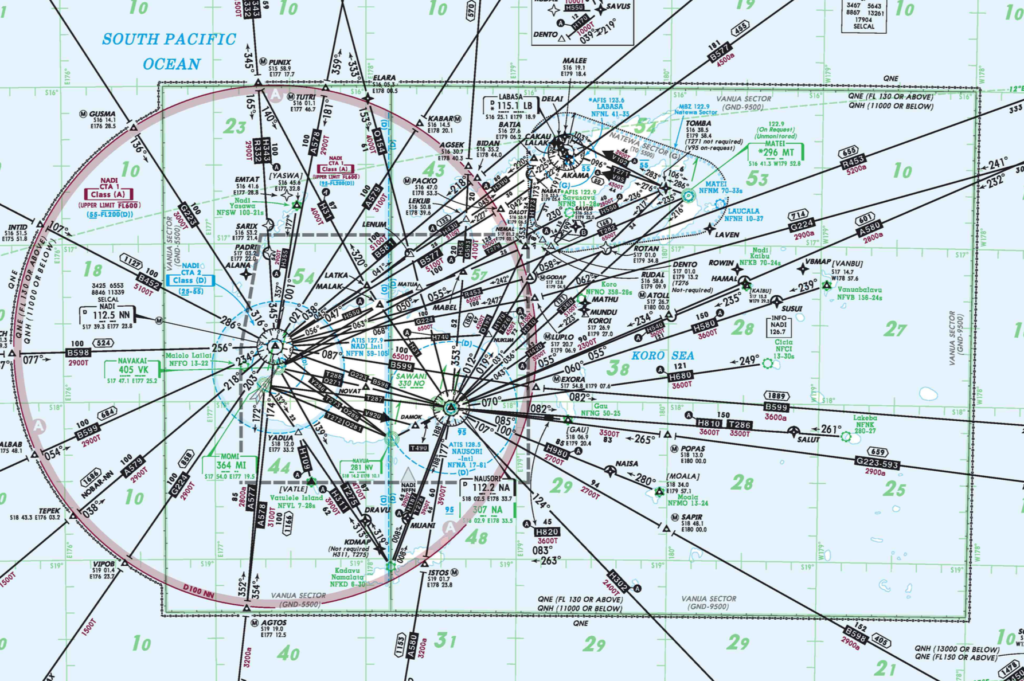
During the ATC workers strike, the response by the authorities was to publish Notams advising that the airspace around the country’s two main airports, NFFN/Nadi and NFNA/Nausori, was “Class G” airspace, with “TIBA” procedures in effect.

Both of these are bad news – they basically mean that the airspace is uncontrolled, and pilots have to separate themselves from each other during arrival and departure phases.

TIBA stands for ‘Traffic Information Broadcasts by Aircraft’. ICAO Annex 11 states that TIBAs “should be made only when necessary and only as a temporary measure”.

TIBA procedures are normally only ever implemented in areas where there are light general aviation movements, in uncontrolled airspace, or during large scale emergencies or natural disasters; it’s very unusual to see them being implemented around big international airports such as Nadi and Nausori.

With less ATC staff available to work due to the strike, it seems the authorities implemented these measures as a way of reducing normal workloads for the controllers who were not on strike and remained on shift.

Further reading


2019 North Atlantic changes

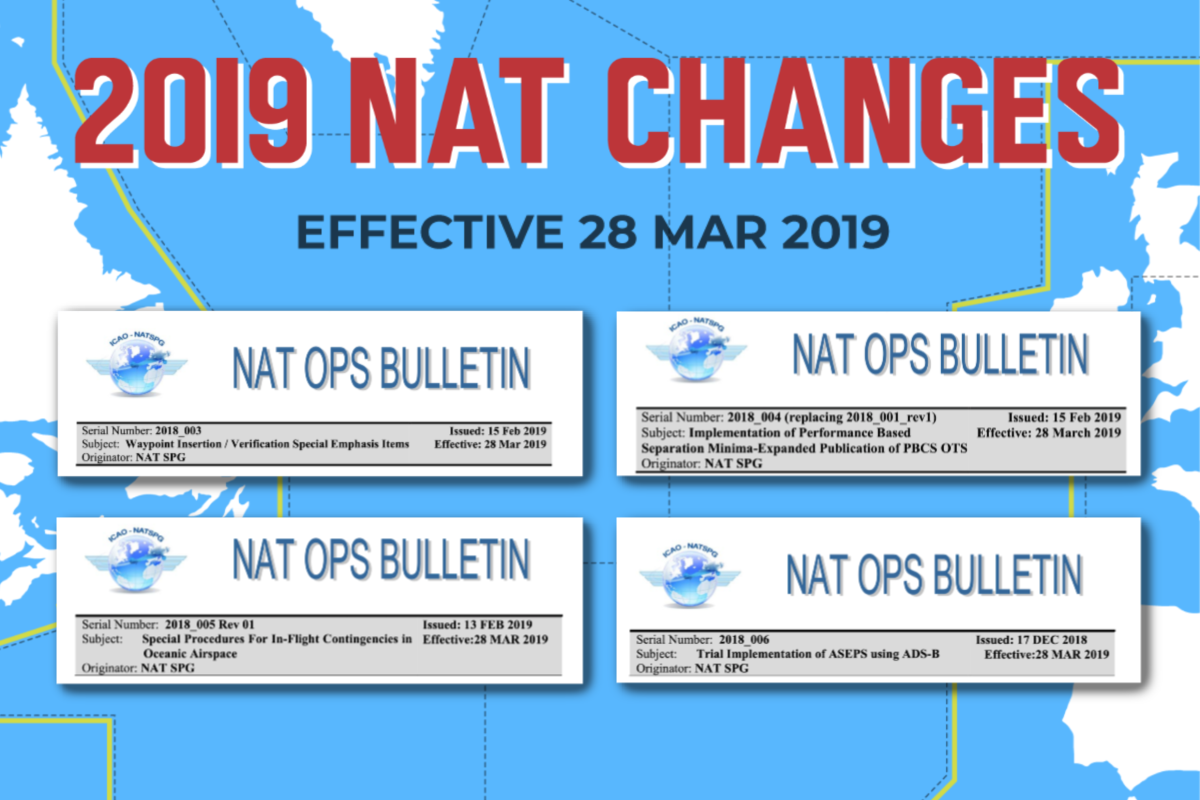
There are four ICAO NAT Ops Bulletins due to go into effect on March 28th, 2019. The PBCS tracks will be expanded, real-time Space-Based ADS-B surveillance and reduced separation standards will be introduced, and the regional contingency and weather deviation procedures will be changed.

You can click on each one, and read them in full:

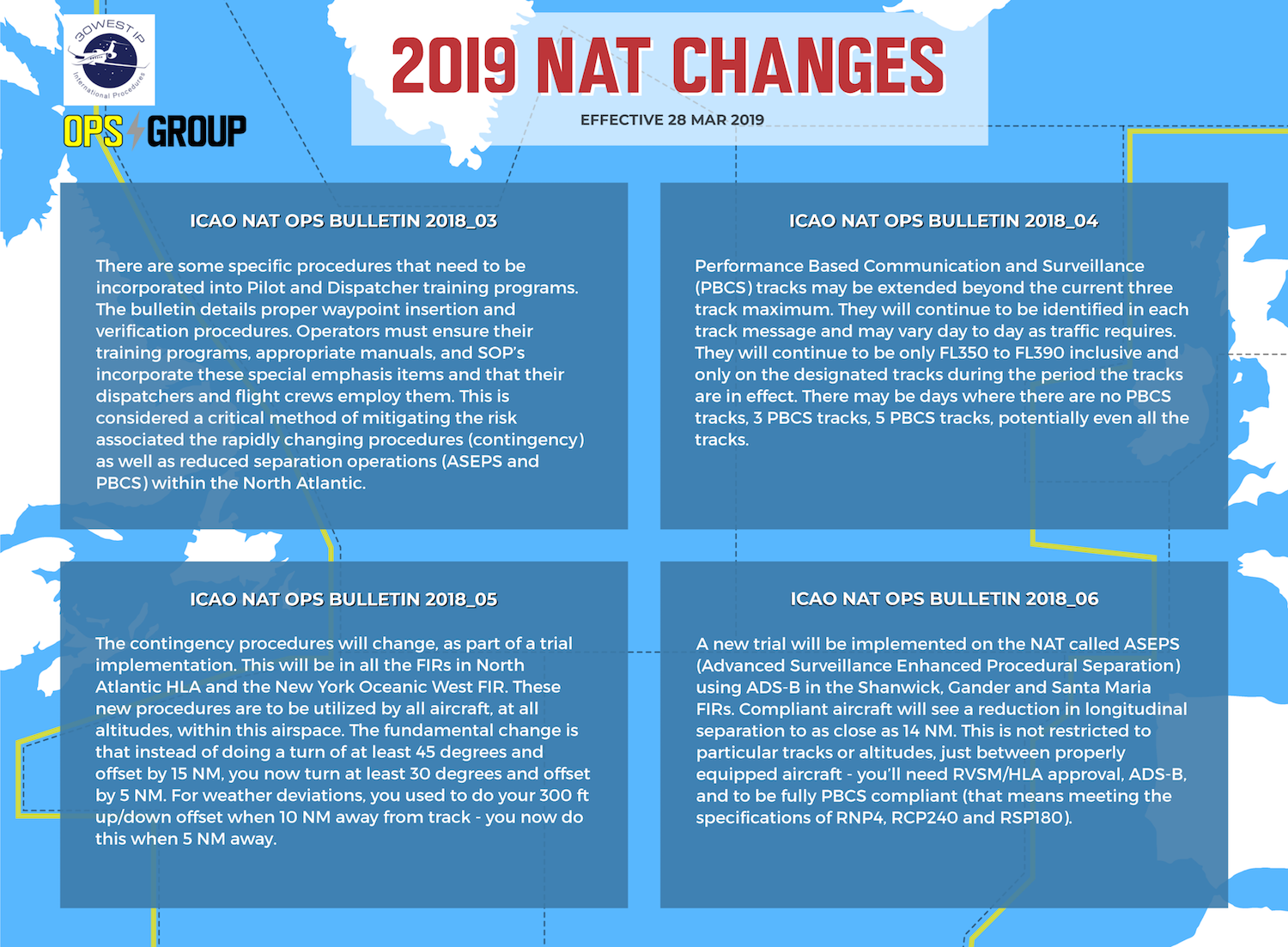
We have had a good look at each of them. Here’s the lowdown:

ICAO NAT Ops Bulletin 2018_03: Waypoint Insertion / Verification Special Emphasis Items
Lowdown: There are some specific procedures that need to be incorporated into Pilot and Dispatcher training programs. The bulletin details proper waypoint insertion and verification procedures. Operators must ensure their training programs, appropriate manuals, and SOP’s incorporate these special emphasis items and that their dispatchers and flight crews employ them. This is considered a critical method of mitigating the risk associated the rapidly changing procedures (contingency) as well as reduced separation operations (ASEPS and PBCS) within the North Atlantic.

ICAO NAT Ops Bulletin 2018_04: Implementation of Performance Based Separation Minima-Expanded Publication of PBCS OTS
Lowdown: Performance Based Communication and Surveillance (PBCS) tracks may be extended beyond the current three track maximum. They will continue to be identified in each track message and may vary day to day as traffic requires. They will continue to be only FL350 to FL390 inclusive and only on the designated tracks during the period the tracks are in effect. There may be days where there are no PBCS tracks, 3 PBCS tracks, 5 PBCS tracks, potentially even all the tracks.

ICAO NAT Ops Bulletin 2018_05: Special Procedures For In-Flight Contingencies in Oceanic Airspace
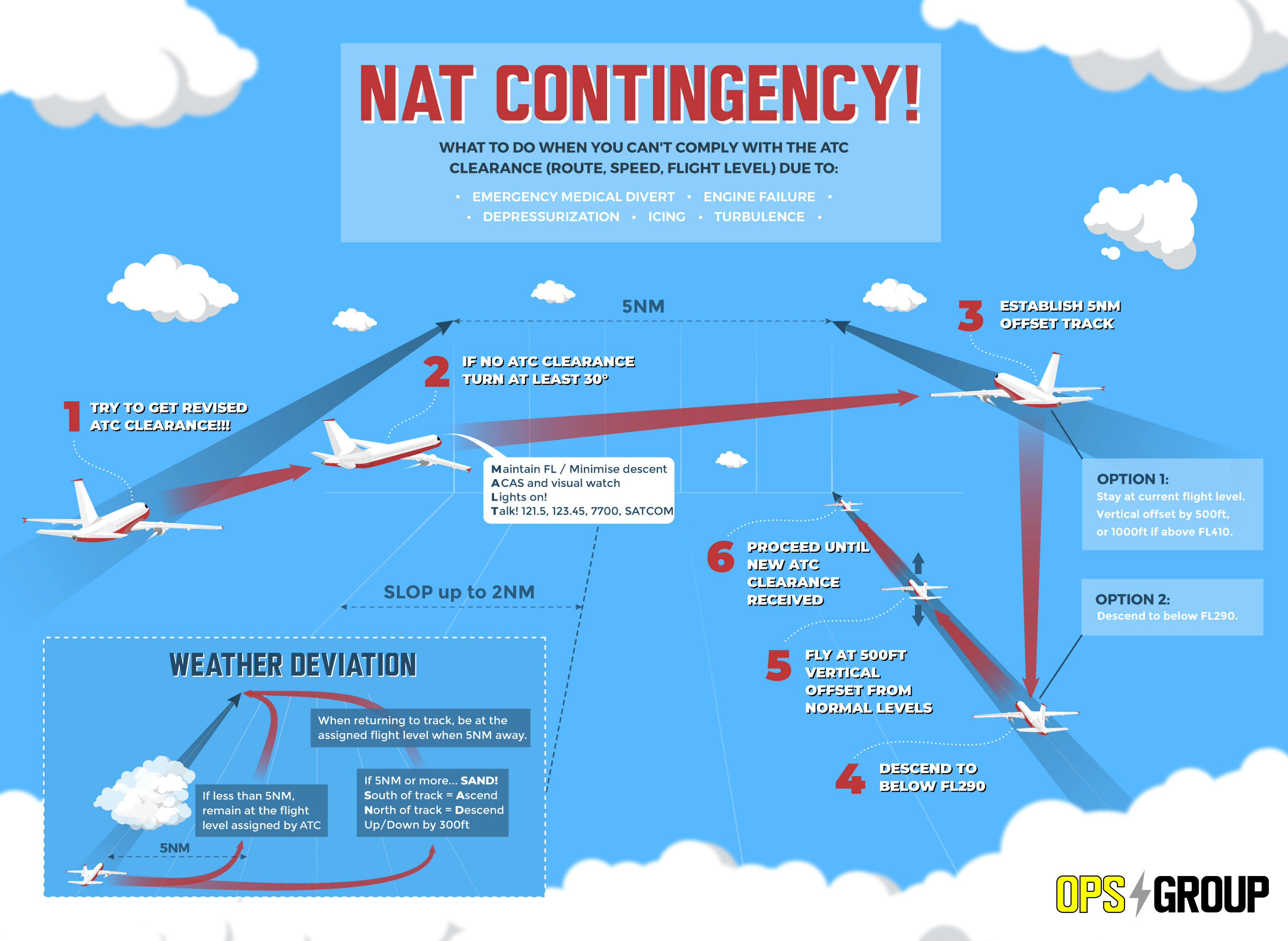
Lowdown: The contingency procedures will change, as part of a trial implementation. This will be in all the FIRs in the NAT Region and the New York Oceanic West FIR. These new procedures are to be utilized by all aircraft, at all altitudes, within this airspace. The fundamental change is that instead of doing a turn of at least 45 degrees and offset by 15 NM, you now turn at least 30 degrees and offset by 5 NM. For weather deviations, you used to do your 300 ft up/down offset when 10 NM away from track – you now do this when 5 NM away. For more info on this, read our article.

ICAO NAT Ops Bulletin 2018_06: Trial Implementation of ASEPS using ADS-B
Lowdown: A new trial will be implemented on the NAT called ASEPS (Advanced Surveillance Enhanced Procedural Separation) using ADS-B in the Shanwick, Gander and Santa Maria FIRs. Compliant aircraft will see a reduction in longitudinal separation to as close as 14 NM. This is not restricted to particular tracks or altitudes, just between properly equipped aircraft – you’ll need RVSM/HLA approval, ADS-B, and to be fully PBCS compliant (that means meeting the specifications of RNP4, RCP240 and RSP180).

So there you have it. We made a couple of handy graphics for all this. Print them out and sellotape them to your cockpit. (If you actually do this, please send us a photo!)

click on the image to open larger version

For a bit more of an in-depth look at the contingency and weather deviation procedures as shown in the image above, read our article.

And if you’re still hungry for more NAT info, we highly recommend you check out the replay of the webinar hosted by Mitch from 30WestIP, titled: ‘A North Atlantic Game Changer, 4 NAT OPS Bulletins all go into effect in one day’. This really breaks down each of the four new Bulletins which take effect from 28th March 2019 – essential viewing if you operate over the North Atlantic! View it here.

Further reading:

  • On 1st Nov 2018 we had a call with 140 OPSGROUP members about upcoming changes on the NAT in 2019, and how we can effect change. OPSGROUP members can find the PDF notes of this in your Dashboard.
  • A big thing driving the ASEPS trial is the rollout of Space-based ADS-B, which is scheduled to complete its deployment by 30 Dec 2018, giving us worldwide, pole-to-pole surveillance of aircraft. For more on that, and how it will affect operations on the NAT specifically, read the article by Mitch Launius here.
  • Use our quick guide to figure out where you are welcome on the NAT, depending on what equipment and training you have.

Don’t alpaca your bags for Lima – tech stops forbidden!

For 10 years SPJC/Lima’s Jorge Chavez airport has been desperately waiting for a promised US$1.5bn expansion.

With the rapid growth in the airline industry in Peru over the past few years, it seems the airport authorities are starting to struggle to provide enough capacity, and they are now trying to make it as difficult as possible for anything other than the commercial airlines to operate there!

In AIC (10/18), which has been in effect since Aug 2018, the airport has said that no more technical stops will be permitted at the airport. It also outlines significant slot/time restrictions for GA/BA operations.

Why they are doing it?

According to the AIC:

“In order to optimize the use of airport resources, ensure the safe provision of air traffic services and ensure the balance between demand and available capacity, the DGAC has been implementing capacity management measures.”

You can find the full information here but we have listed the main operational details below.

  • Tech stops are “forbidden” for “commercial flights and general, national and international aviation” effective 15 August 18.
  • Maximum stay of 2 hours on the civil apron for GA/BA flights. This is counted “from the time of placing chocks.” After two hours, the aircraft must be transferred to another apron, parking area for aircraft or hangar, or must go to a suitable alternate airport. The recommended airport to re-position to is SPSO/Pisco. It has an ILS and a 9900’/3000m runway. It is 115nm away, and open H24.
  • General aviation flights are limited to two operating periods every day. “Flights must perform their take-off and landing” between 0000L-0430L (0500UTC-0930UTC) or 1300L-1859L [1800UTC-2359UTC ]. The 2-hour maximum ground time still applies, and coordination of ground services should be pre-planned in advance to comply.

For non-scheduled flights, they’ve issued a NOTAM restricting all ops to between 1100-2000L (1600-0100Z) or 2300-0800L  (0400-1300Z):

A1822/19 – IN ORDER TO REDUCE TFC CONGESTION, NON-SCHEDULE FLIGHTS ARE NOT ALLOWED TO ARRIVE IN SPJC DURING THIS BLOCK OF TIME. STS EMER,SAR,HUM,HOSP,MEDEVAC AND STATE ARE EXCLUDED. DLY BTN 0100-0400 AND 1300-1600, 04 APR 01:00 2019 UNTIL 31 JUL 16:00 2019 ESTIMATED. CREATED: 03 APR 23:28 2019

The authorities seem intent on enforcing these rules. One local handler has told us – “The Peruvian FAA is being very strict with the AIC. They are rejecting landing permit requests for fuel stops at SPJC.”

If you have any further knowledge or recent experience to share, please let us know!

Extra Reading:


Istanbul Mega-Airport opening soon – but not for everyone

In Short: The switch from LTBA/Istanbul Ataturk to LTFM/Istanbul New Airport has effectively been postponed until sometime in early March 2019 – although no official date has been given yet. LTFM “officially” opened on 29 Oct 2018, but since then it’s only been available to Turkish Airlines – everyone else has to carry on using LTBA.

Istanbul’s new mega-airport, which has been plagued by construction issues and delays, officially launched operations on 29 October 2018, to coincide with Turkish National Day celebrations – even though it wasn’t completely ready in time.

Authorities initially said that all scheduled airline and charter flights would have to switch over from using LTBA/Istanbul Ataturk to LTFM/Istanbul New Airport on 29 October 2018. Then they published AIC 07/18 which pushed that date back to 30 December 2018. And then, in the week before that was due to happen, they published this Notam:

A7542/18
A PHASED TRANSFER FROM ISTANBUL ATATURK AIRPORT (LTBA) TO ISTANBUL AIRPORT (LTFM) WILL TAKE PLACE. ISTANBUL AIRPORT (LTFM) WILL ONLY BE USED FOR PRE-AUTHORIZED TURKISH AIRLINES FLIGHTS, UNTIL FURTHER NOTICE. 24 DEC 13:35 2018 UNTIL PERM. CREATED: 24 DEC 13:37 2018

So for now, only Turkish Airlines are allowed to operate to LTFM. Local reports suggest that it won’t be until March 2019 before all the other airlines and charter operators can start using it too. When that happens, LTBA/Istanbul Atatürk will be closed to all scheduled airline and charter flights, but will remain open for general aviation and business flights.

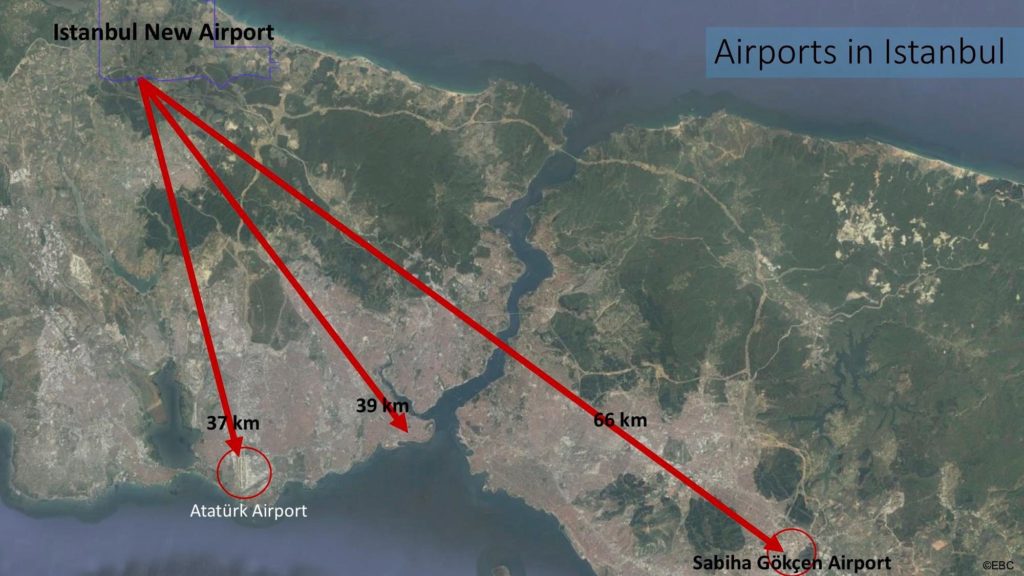
So that’s good news for GA/BA! There’s nothing to say that you can’t use the new airport, but it’s quite a way out of town (39km/24 miles) when compared to the old one.

Into the future there is talk about the old airport becoming a park, but there are still no firm plans for that yet, according to the FBO reps we spoke to on the ground.

Do you know more? Let us know!


Adios! That was our last International Bulletin (for non-members)

Dear Reader!

First, thanks for being part of this amazing group for the last year. We loved sharing our alerts, risks, dangers, and deviousness with you. It’s been a blast.

As we’ve mentioned, we’re now focusing our attention solely on Opsgroup members, so the International Ops Bulletin that you got yesterday was the last one for the year, and tomorrows Daily Brief will also be el final (sp? we’re good at Ops, not Spanish).

OK, so. Here’s the deal. We would like you, our favorite reader ever, to be part of this amazing group – 5000 airlines, pilots, dispatchers, airports, atcos, agencies, amazing-experts, analysts … the people that run international flight ops. Whatever the group is now, it’s going to be even more amazing – as we are adding in new contacts, better information, easier searching, and making it easier for members to connect with each other. We’ll continue the good fight against crappy circulars, mind-numbing mandates, awful AIC’s, nasty notams, and continue to remind the state bureaucrats that the people reading this stuff are Humans, not computers. We’ll continue to sniff out the security risks, and share them with those that need to know. And we’ll continue to basically make cool stuff – maps, charts, apps, guides, and winter ear-warmers – for the Opsgroup community.

We’ll also continue to manage the Clipperton FIR (ADS-B almost in place), keep adding things to Airport Spy, continue working with ICAO on Norm (he’ll be done for Christmas, we’re sure!), get SafeAirspace V2 online (coming December), and of course continue the hourly alerts, daily briefs, and weekly bulletins for members.

Bottom line, our request is that you join us! We need people like you to help this group. Put another way, we don’t want to continue without you.

Whatever your choice is, have a lovely day and rest of year, and let us be the first to wish you a happy Thanksgiving, and if we don’t see you until next year, Happy Christmas!

The Opsgroup Team – Ben, Cynthia, Igor, Dave, Dean, Slobodan, Amelia, Jamie, and Mark.

team@ops.group

PS –

If you prefer, you can also waitlist for 2019. Once we reopen membership, we may have a slightly different approval process, but you can add your name to be notified here.


How OpsGroup works – for questions

I love how the hive-mind works. We have 5000 members, and so it shouldn’t be surprising, but it’s still awesome to see it in action.

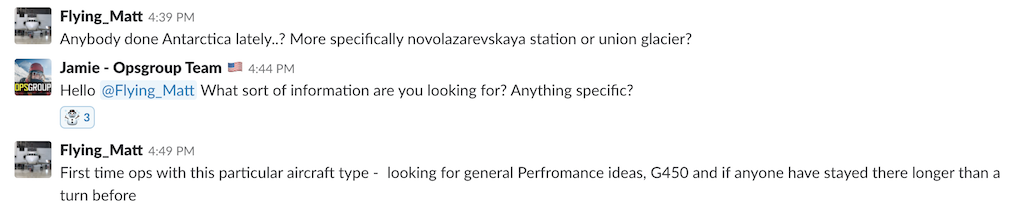
Yesterday, in slack, a member asked:

Now, I’ve never heard of Novolazarevskaya Station, but that’s not important. There are another 4,999 of us, and chances are that someone in the group has.

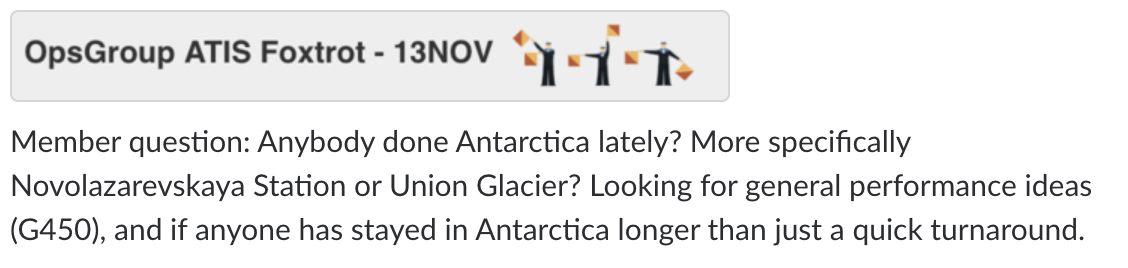
So, we blasted it out on the ATIS this morning:

The ATIS goes out to all group members in the OpsGroup Daily Brief.

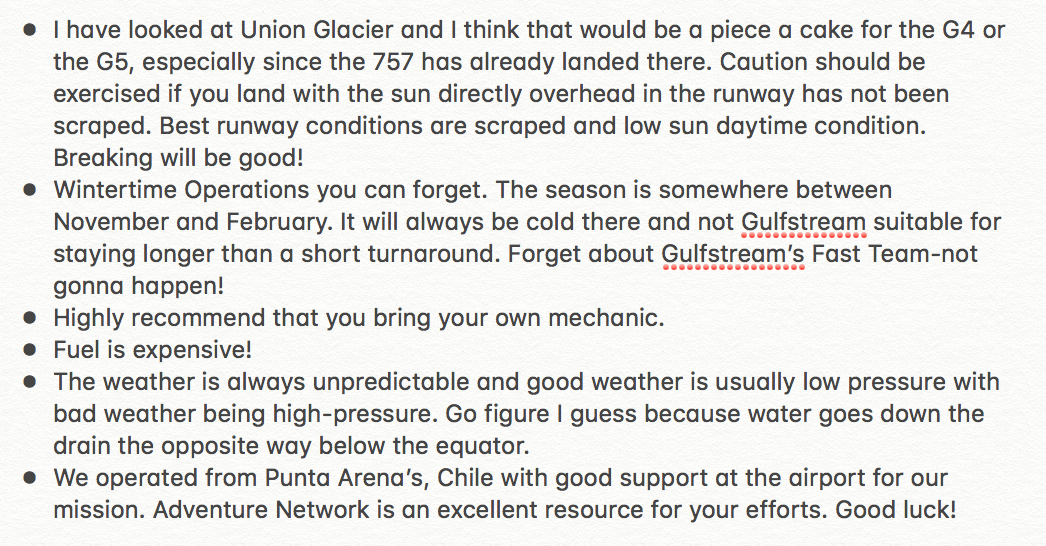
And of course, someone got right to it, answering the question:

This is how OpsGroup works! Simple, and extremely effective. When one person knows, we all know.

Bonus: The first OpsGroup team member to see the question was @Jamie – Opsgroup Team, who has been on the ice on five separate missions for the US Antarctic program, and has spent a combined total of three years down there.


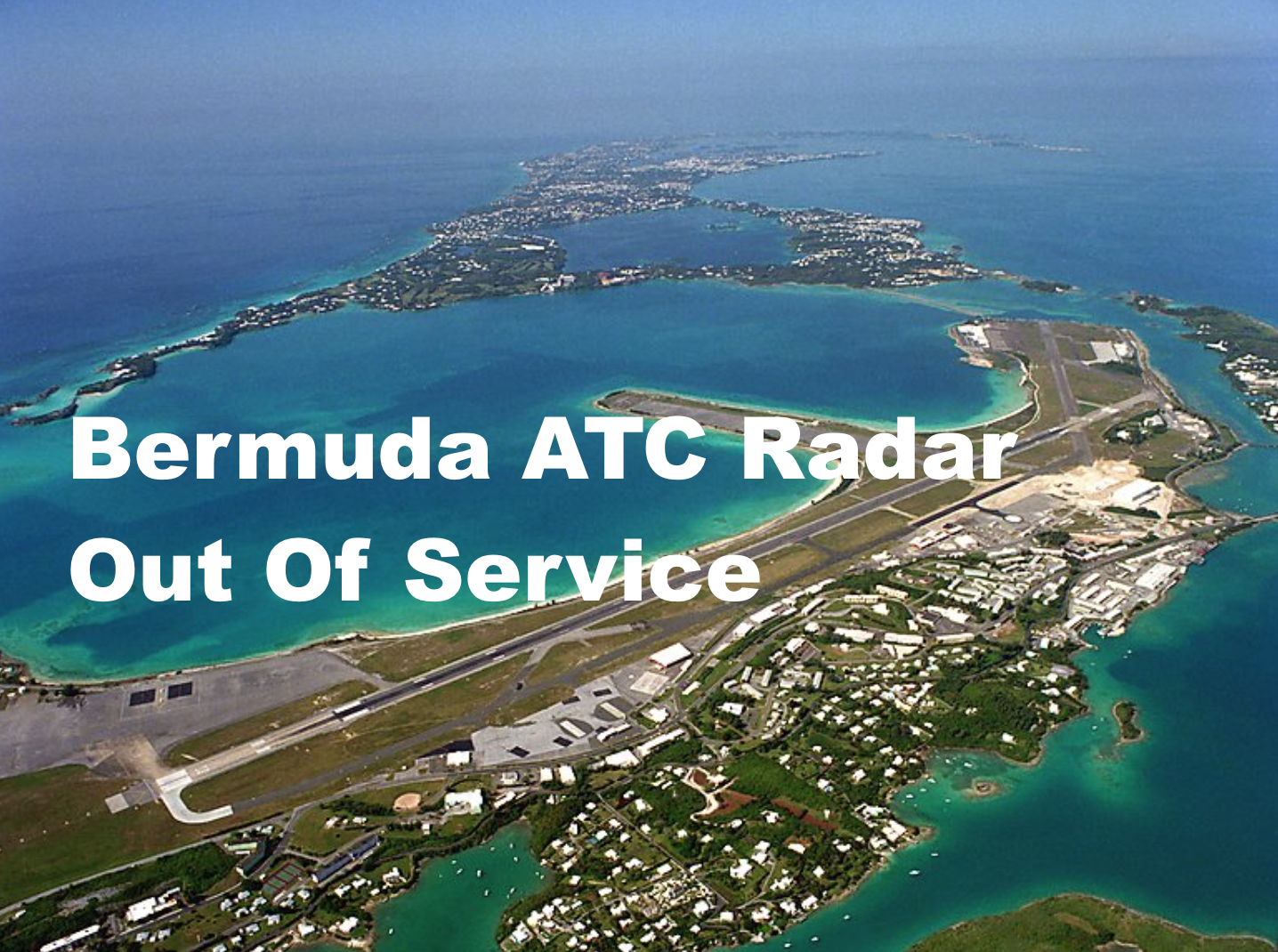
Bermuda ATC Radar Out Of Service all week

It’s going to be mostly sunny and warm (78F, 26C) this week in Bermuda if you’re heading that way – but you should also know they are going to be full non-radar – so plan ahead.

We put together what you need to know.

Firstly, the Bermuda Secondary Surveillance Radar will be out of service for 7 days starting this coming Monday, 29 October, at 1100z (0800L). The NOTAM says it will be back to normal the following Monday, 5 November, at 1700z (1400L).

The following non-radar procedures are in effect (NOTAM – A0404/18 and A0154/18)

  • If you are landing at TXKF/Bermuda you should flight plan and expect FL310 or below at the NY Oceanic CTA/FIR boundary. 
  • Expect possible flow restrictions due to traffic volume and/or during adverse weather.
  • Carry fuel to cover “minimum” of 15 minute arrival/departure delay.
  • All aircraft must file via MOMON 1 or POPOP 1 RNAV STAR however there are restrictions on which transitions can be used:
    • MOMON 1 – Only DASER, ANVER and RNGRS transitions allowed
    • POPOP 1 – Only BALTN and JIMAC transitions allowed
  • Departing aircraft must file via either the BORNN 1 or SOMRR 1 RNAV SIDs.
  • If you are NON-RNAV then you must flight plan to DASER, ANVER, RNGRS, BALTN, or JIMAC (180 nm ARC BDA VOR) then the respective airway to BDA VOR.

In likely far more shocking news, an island in the middle of the ocean is expecting lots of birds, namely lots of Killdeers.
A0152/18 – AERODROME INTERMITTENT PERIODS  OF HIGH BIRD ACT OF KILL DEERS AND PLOVERS DUE TO SEASONAL MIGRATORY
PATTERNS: THE MIGRATORY SEASON BEGINS IN EARLY OCT AND RUNS THRU  EARLY APRIL WITH BIRD ACT AT ITS HIGHEST APRX BTN HR OF 1000 – 2130.  EXERCISE CTN WHEN FLY DRG THESE TIMES.
How these cute little things could kill deers shocks me 🙄 – you have been warned however!
#deathtonotams

Non-refundable Bangladesh permits

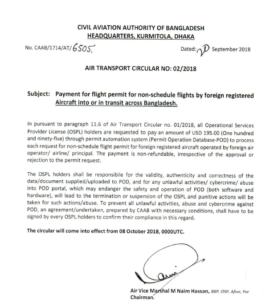
The Civil Aviation Authority of Bangladesh recently published circular 02/2018 which outlines a $195 USD overflight permit fee for non-scheduled foreign aircraft transiting the VGFR/Dhaka FIR . The fee is certainly on the high side but the disappointing part is :

“The payment is non-refundable, irrespective of the approval or rejection to the permit request.”

Say what?

There was a similar type of no-refund situation within the TNCF/Curaco FIR but we now understand after some noise, operators are getting refunds as per normal industry practice.

We say it’s time for the CAA in Bangladesh to stop this non-refundable nonsense.

Have you had a permit denied and not received your money back? Reach out and Let us know!


Indy Center kicks off CPDLC trials – the system is live!

The United States is rolling out En Route FANS CPDLC during 2018-19, for all equipped, trained and permitted operators. The FAA’s Advisory Circular AC 90-117 outlines the requirements for U.S. operators.

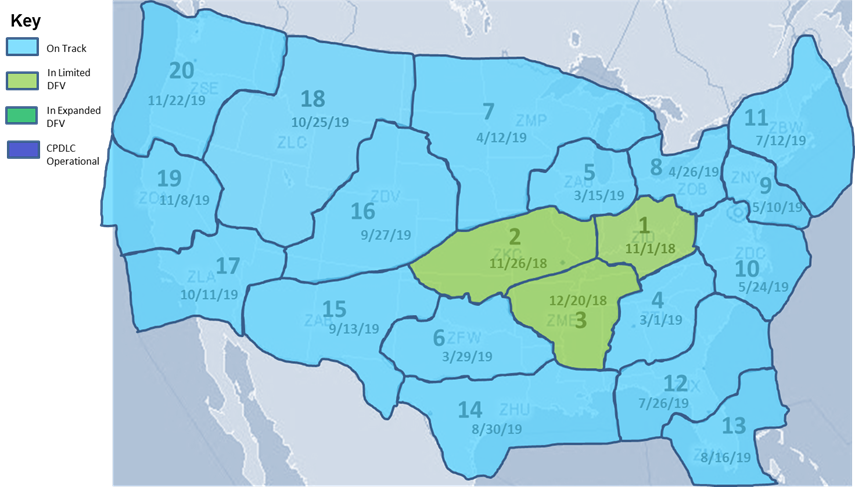
Trials have begun with KZID/Indianapolis going live with 24/7 ops starting last week.

We also understand that KZME/Memphis and KZKC/Kansas City are still in the testing phase with CPDLC and voice read back happening 1-2 nights per week during the midnight shift.

The current deployment schedule as it stands can be found in this graphic. [if you know what DFV means, let us know!]

How to participate:

  • The FANS logon is “KUSA” for the entire country and you may logon at any time. The CPDLC connection will become active after departure, and the crew is notified via a welcome message uplink. If En Route FANS CPDLC enabled airspace is active, you will stay logged on. If the aircraft transitions from En Route FANS CPDLC enabled airspace into non-Data Link airspace with an active CPDLC connection then the connection will terminate approximately seven minutes after exiting.
  • To participate, file “DAT/FANSE” in Field 18 of the ICAO Flight Plan.
  • Equipment required is VDL Mode 2, indicated as “J4” in Field 10a of the ICAO Flight Plan.
  • If an operator wants to use domestic En Route FANS CPDLC and is already using FANS DCL then the the majority of operations will fall into one of these scenarios:
    • (1) The operator uses FANS DCL via the “DAT/1FANS2PDC” preference in Field 18 of the ICAO Flight Plan. In that case, update the preference to “DAT/1FANSE2PDC“.
    • (2) The operator uses FANS DCL via the FAA’s Subscriber Database. In that case, the operator will want to add the entry “DAT/FANSE” in Field 18 of the Flight Plan.

Some things to keep in mind:

  • Domestic En Route FANS CPDLC enabled airspace will be seamlessly integrated with foreign (Canadian) and Oceanic FANS CPDLC enabled airspace.
  • The Oceanic Clearance will not be delivered via FANS CPDLC. You will still need to request the clearance via AFIS/ACARS or obtain it via voice.

Have you had the chance to try it out recently? Let us know!

Extra Reading:


Extra overnight slots for Hong Kong extended until 2019

We reported a few months back that the Airport Authority (AAHK) and the Hong Kong Schedule Coordination Office (HKSCO) have decided to trial an increase in slot availability from 4 to 6 total slots each night. It looks like the trial is being extended until March 2019.

The published details:

Notice on night slot availability (trial from 8 August 2018 until 31 March 2019)

  1. The number of slots available for GA/BA operations between 0000 to 0500 local time (16-21 UTC) will increase from 4 slots daily to 6 slots daily.
  2. The application procedure for these 6 slots will be the same as that for the 4 daily slots currently available.
  3. The above are provided on a trial and temporary basis and are subject to continuous review jointly by AAHK and HKSCO.
  4. Also important to note, as pointed out to us by our friends at the Asian Business Aviation Association (AsBAA) – these 6 slots will be made available to all aircraft types, not just the ones currently exempted from the noise abatement regulations. This means that BBJ’s/ACJ’s/Lineage 1000/Globals/G650ER etc can now operate in and out of Hong Kong at night-time, subject to slot availability.

PBCS – What, Where and How

In Short: The performance-based communication and surveillance (PBCS) framework allows for higher safety standards and more efficient airspace use. If your aircraft already has the equipment and you cross the Atlantic or Pacific Oceans often, it’s worth looking into getting your regulatory approval.

PB… what? It’s a good question. We have so many acronyms in aviation, it’s easy to forget what this one stands for and what it really means. So, let’s try and get to the bottom of it.

What is PBCS?

Official answer:

The ICAO performance-based communication and surveillance (PBCS) framework ensures that emerging technologies for communication and surveillance fully support ATM operations and are implemented and operated safely.

In plain speak:

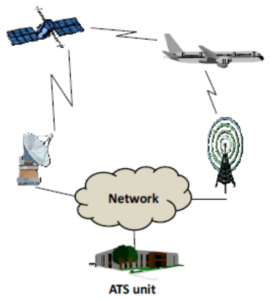
With the technology already available on many aircraft and in the Air Traffic Control facility, aircraft can now fly closer than ever before, especially over non-radar oceanic airspace.

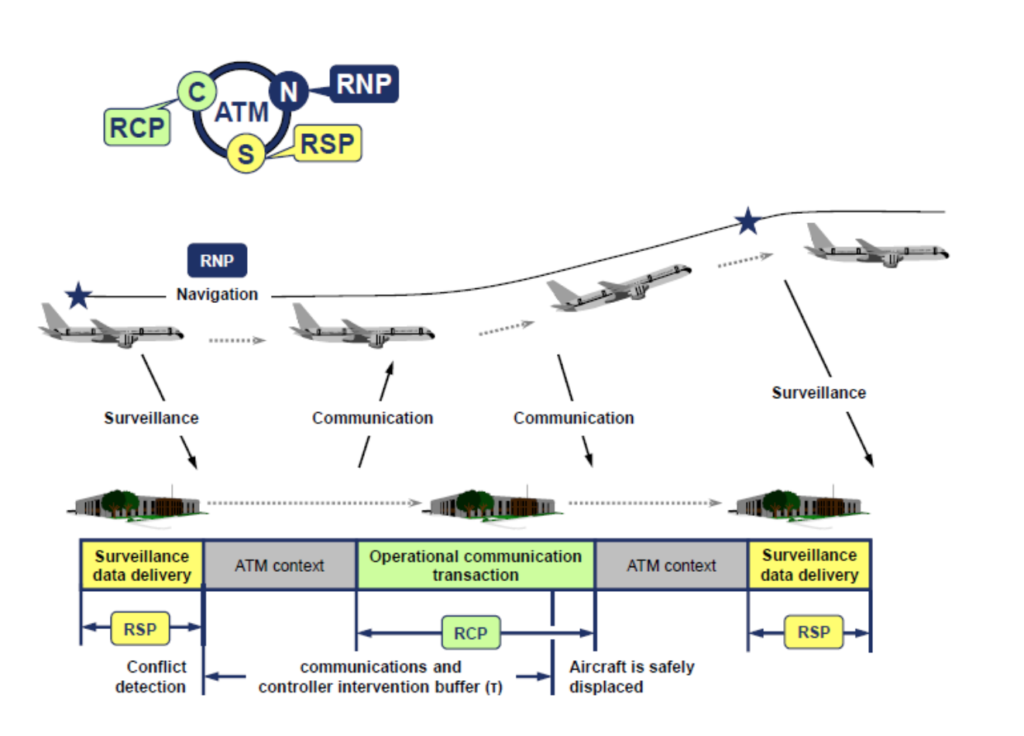
There are two key buzz words, so let’s define them. They are interlinked with RNP – Required Navigation Performance.

  • RSP – Required Surveillance Officially known as “surveillance data delivery”, often stipulated in the Airplane Flight Manual. Basically, how often does the aircraft send its position to ATC/ground station. There are two specifications, RSP180 and RSP400. The numbers indicate the maximum number of seconds (180 or 400) for the transaction to occur.
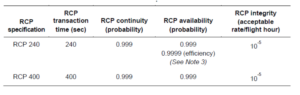
  • RCP – Required Communication ICAO has two specifications, RCP240 and RCP400. Again, the numbers indicate the maximum number of seconds (240 or 400), or “transaction time” taken for the controller to issue an instruction to the crew and for them to receive a response. This could be via CPDLC, HFDL, VDL or SATCOM.

So, we have a loop here, C-N-S. Communication, Navigation and Surveillance. An aircraft sends surveillance information to ATC about where it is; the aircraft stays within confines of RNP navigation requirements and ATC communicates with the aircraft within the required transaction times.  Pretty easy!

But why do we need PBCS?

The take away? If all given aircraft in a certain airspace have a lower RSP value and a lower RCP value, we can start putting these aircraft closer together.

Essentially – performance-based separation minima. This allows aircraft to be separated safely according to technological capability rather than “one-size-fits-all” prescriptive distances.

What are the differences from PBN?

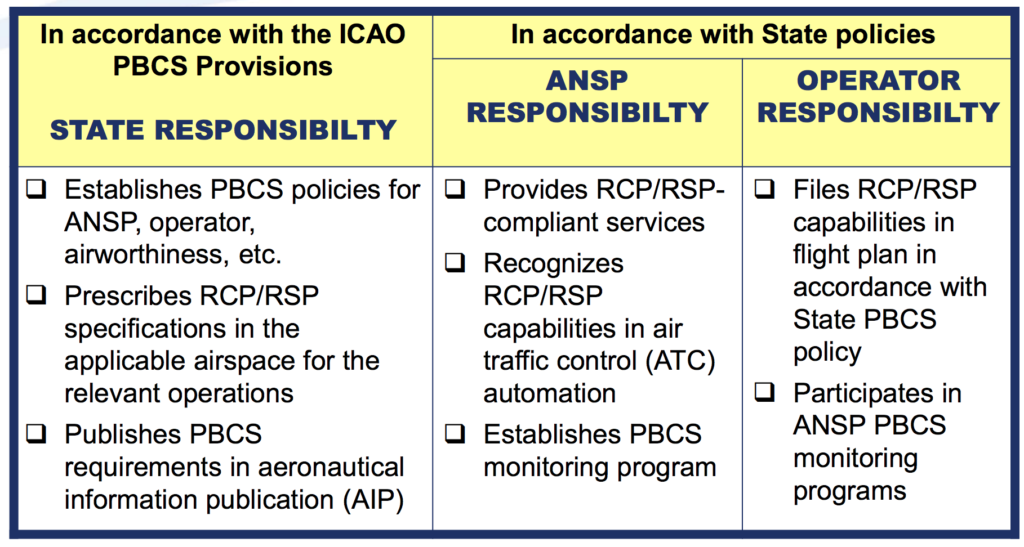
They are similar but there are notable differences. In a simple sense, the PBN (RNP/RNAV) only requires that the operator obtains approval because it focuses on how the equipment works. PBCS (RSP/RCP) however requires the involvement and approval of the air traffic service provider because it’s a two-way communication and surveillance effort. There are dependencies and complexity with the equipment standards on both ends.

In this graphic you can see a high-level summary of who is responsible for what:

Where is it in place?

Currently PBCS is in effect in one form or another in the following FIR’s

  • NZZC/Auckland Oceanic
  • NFFF/Nadi
  • KZAK/Oakland Oceanic
  • PAZN/Anchorage Oceanic
  • WSJC/Singapore
  • VCCF/Sri Lanka
  • NTTT/Tahiti
  • RJJJ/ Fukuoka
  • KZNY/New York Oceanic
  • CZQX/Gander
  • EGGX/Shanwick
  • BIRD/ Reykjavik
  • LPPO/Santa Maria Oceanic

The Air Traffic Service providers of China, Brazil and Indonesia have also shown interest to introduce PBCS in the future.

Specifically, PBCS is being used between FL350 and 390 on certain “half” NAT tracks as we have written about before.

What do I need to do?

Requirements vary from state-to-state on the exact procedure for obtaining approval. It’s important to note that not all aircraft are automatically PBCS ready (refer to your aircraft manufacturer and your airplane flight manual).

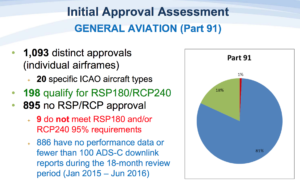
The FAA has outlined its approval process here and has a handy powerpoint document here.

An important element is to prove that you have signed the “PBCS Global Charter” which can be found at the FANS Central Reporting Agency (CRA) website.

When a PBCS authorization is obtained an operator is required to file both P2 (indicating RCP240) in item 10 and SUR/RSP180 in item 18 of the flight plan, in addition to the J codes for CPDLC and D1 or G1 for ADS-C in item 10.

The correct filing of these two codes will indicate to any ATM ground systems applying performance-based separation minima that the aircraft is eligible for these minima and that the crew have received the relevant training in order to safely operate using the reduced separations.

Will you notice that PBCS standards are being applied to your flight?

Ok this is the funny part of this story. The short answer, probably not.

While it may be easier for RCP240/RSP180 approved aircraft to obtain optimal flight profiles, especially during high traffic periods, and particularly for NAT flights using the OTS, the application of these standards is generally tactical in nature for ATC. An aircraft may not have performance-based separation applied at all on an individual flight, or possibly may never have had it applied to any of its flights. Even if a you have RCP240/RSP180 approvals, if the aircraft nearby does not also have the approvals, the separation standards cannot be applied!

What if I don’t have RCP240 and RSP180 approval?

If you do not have RCP240/RSP180 approvals you will always have the larger separations, e.g. 10-min, applied, and not be eligible for the lower standards in cases where it may be beneficial.

The only airspace that has implemented tracks that will require PBCS to file is in the NAT OTS. There are still non-PBCS tracks in the OTS for which PBCS approvals are not required.

All other airspace in which performance-based separation minima are currently applied will allow aircraft with and without RCP240 and RSP180 approvals to enter and use the airspace in a mixed-mode operation.

Will I be penalized if I don’t have it?

Probably not in the short term. In the future as more and more airspace corridors become PBCS only, then it is possible you may be subject to reroutes, delays or the requirement to fly outside of certain flight levels.

So, our conclusion?

PBCS is a great step forward in maximizing efficiency in a busier airspace environment thanks to the advent of better technology. If you fly the NATs often and have an aircraft capable of PBCS certification standards, then yes – do it! The approval process is not overly burdensome, and many modern transatlantic jets already meet most of the technical requirements.

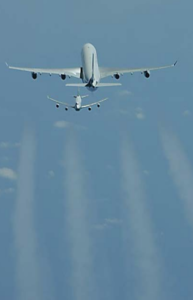
Ultimately, reduced separation standards mean more great air-to-air views. So, pack your camera!

Did we miss something, or does something need more explaining? Let us know!

Extra Reading:


NTSB: Current NOTAM system is “just a bunch of garbage”

You were all very supportive when we wrote the initial article on the BS Notam problem last year, and have followed our journey in fixing the problem since then.

Big news!

The NTSB called the Notam System a bunch of garbage on Tuesday this week, and assigned probable cause of the AC759 incident in SFO to the Notams that were missed.


What this means to OpsGroup is massive fuel to our fire: we are working hard to fix this problem, and having a public facing government organisation like the NTSB come down like a ton of bricks on the Notam System drives us forward in leaps and bounds.

The group members have been decisive in helping us to identify the problem and taking action to fix this. So, we want to acknowledge all of you! Great work!

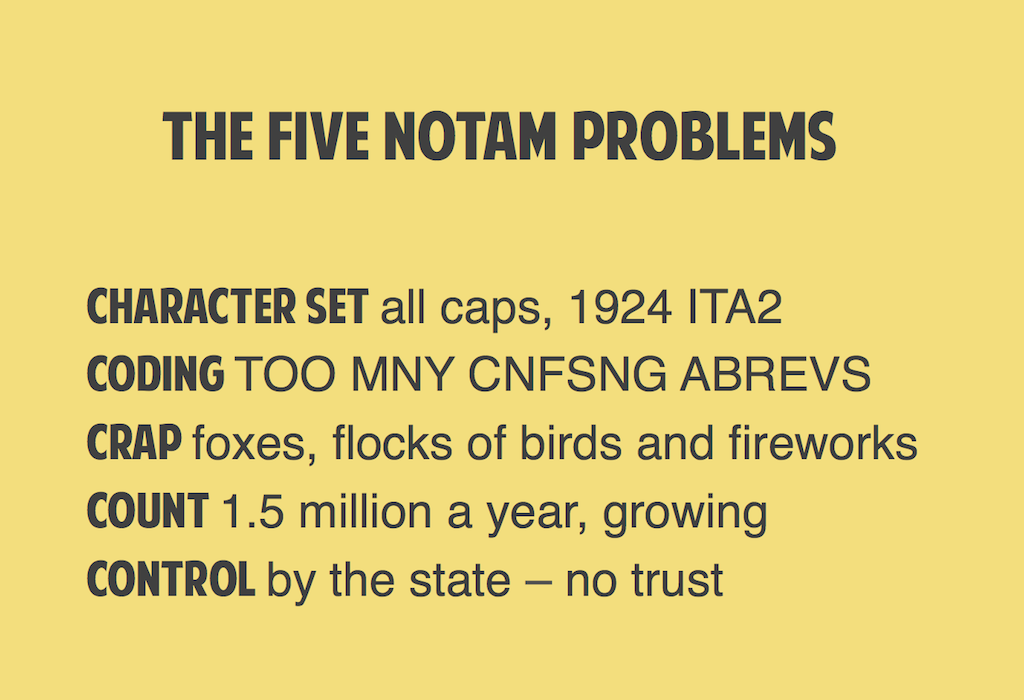
In solving two of the above five problems, we have been working with ICAO for several months now. You all got involved in Normand 17,000 Notams later, we happy to report that version 0.1 of Norm is now live on the ICAO website. Norm is a bot – an AI, that has learned what Notams look like, and thanks to OpsGroup rating these 17,000 Notams, is also learning which ones are critical and which ones are not.

He’s still young. He doesn’t get everything, but if you feed him a Notam you’ll see him assign it a criticality of 1-5.

This will in turn allow us to sort Notams, putting the most important stuff first.


Check your checklist! Lessons from fatal King Air accident in Melbourne

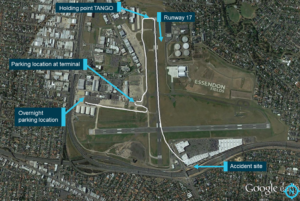
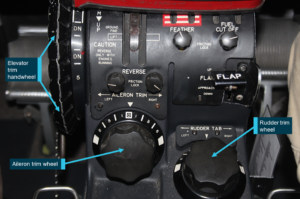
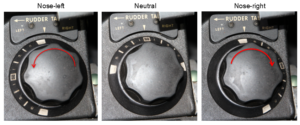
The pilot at the controls of a Beechcraft B200 Super King Air that crashed shortly after take off had the aircrafts rudder trim in the full left position for take off, the Australian Transport Safety Bureau (ATSB) has found.

The ATSB final report said the aircraft’s track began diverging to the left of the runway centre line before rotation and the divergence increased as the flight progressed.

It then entered a shallow climb followed by a “substantial left sideslip with minimal roll” before beginning to descend. At this point the pilot issued a mayday call seven times in rapid succession.

Approximately 10 seconds after the aircraft became airborne, and two seconds after the transmission was completed, the aircraft collided with the roof of a building.

What Happened?

The investigation found that the pilot did not detect that the aircraft’s rudder trim was in the full nose-left position prior to takeoff.

“Prior to takeoff, there were several opportunities in the pre-flight inspection and before takeoff checklists for the pilot to set and confirm the position of the rudder trim,” the ATSB final report said.

A King Air flight simulator was used to recreate the event as part of the ATSB investigation.

The pilot who performed the flight simulator test commented that:

The yaw on take-off was manageable but at the limit of any normal control input. Should have rejected the take-off. After take-off the aircraft was manageable but challenging up to about 140 knots at which time because of aerodynamic flow around the rudder it became uncontrollable. Your leg will give out and then you will lose control. It would take an exceptional human to fly the aircraft for any length of time in this condition. The exercise was repeated 3 times with the same result each time. Bear in mind I had knowledge of the event before performing the take-offs.

The pilot also stated that it could be possible for a pilot to misinterpret the yaw as being caused by an engine power loss rather than from a mis-set rudder trim.

Safety message

Cockpit checklists are an essential tool for overcoming limitations with pilot memory, and ensuring that action items are completed in sequence and without omission. The improper or non-use of checklists has been cited as a factor in some aircraft accidents. Research has shown that this may occur for varying reasons and that experienced pilots are not immune to checklist errors.

This accident highlights the critical importance of appropriately actioning and completing checklists.

Checklist discipline

In previous correspondence between the accident pilot and the ATSB when discussing checklists, the pilot stated that:

“You don’t get complacent as a pilot but you get into a routine. The same as your pre-take-off checks, you get a routine and you don’t need to use a checklist because you are doing it every day, you are flying it every day… I take-off with one stage of flap because it gets me of the ground quicker. And I never change my routine…”

Wait what!??? It is stating the obvious but it’s a timely reminder that checklists are an essential defense against pilot errors. 

Sadly, it could have been a life-saver in this instance.

The ATSB video to supplement the report.


Milan Linate closed next summer

With planned runway and terminal constructions, LIML/Milan Linate will be closing from July 27, 2019 until October 27, 2019.  Work has already begun with Assoclearance (slot coordination) to work out summer schedules.

Today, September 20, a coordination meeting will take place to clarify the slot allocation process for S19. Following this, a September 25th meeting at Linate will be held to discuss the operational impact of the closure.

Milan Linate handled over nine million passengers in 2017, so a large portion of this traffic will now have to operate through LIMC/Milan Malpensa, which already stands as the second busiest airport in Italy, handling over 22 million passengers in 2017.

We’ll have more information after both the slot and operations meetings this coming week.

Do you know more? Feel free to comment or drop us a line!


Hurricane Florence: Latest Airport closures and Operational impact

Latest update: 1900z, Sept 17th.

Most airports have reopened, with the exception of KILM and KOAJ (see below).

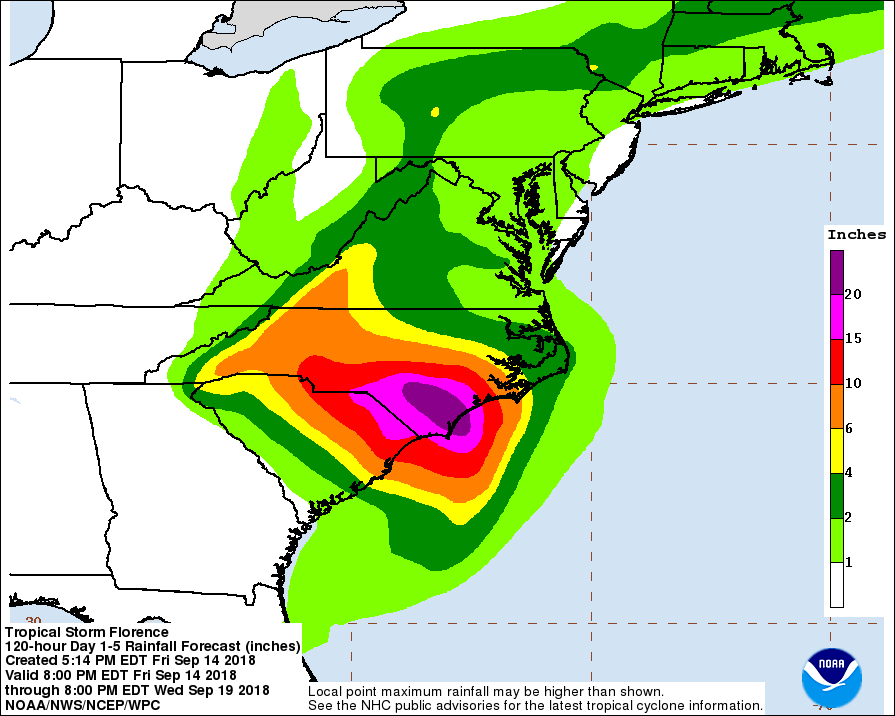
The National Weather Service have warned – “Florence is forecast to bring a large area of rainfall of 20-40 inches to parts of NC/SC. We cannot overstate the threat of catastrophic flooding this storm will bring!”

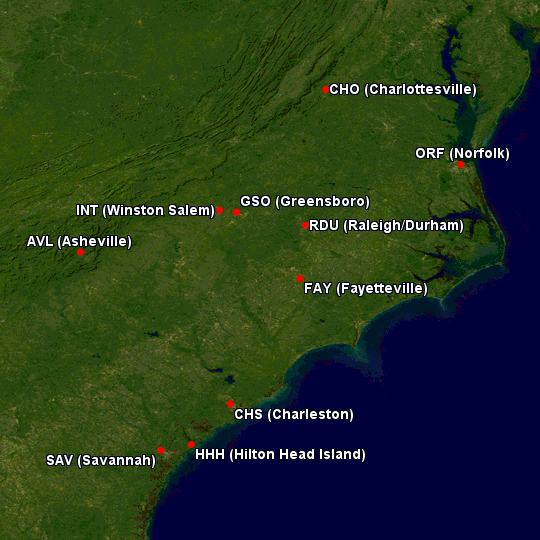
Severe disruption is expected across the entire region spanning from KSAV/Savannah in the south up to KRIC/Richmond in the north, with multiple airport closures planned.

As of 1900z on Sep 17th, the situation is as follows:

  • ASHEVILLE, NORTH CAROLINA (KAVL) @flyavlnow
    Airport is open and operational.
  • CHARLESTON, SOUTH CAROLINA (KCHS) @iflyCHS
    Airport is open and operational.
  • CHARLOTTESVILLE, VIRGINIA (KCHO) @CHOAirport
    Airport is open and operational.
  • WILMINGTON, NORTH CAROLINA (KILM) @ILMAirport
    The airport is open, but it’s not recommended to operate, no power, no ILS, no tower. One runway is open for rotor aircraft.
  • FAYETTEVILLE, NORTH CAROLINA (KFAY) @flyFAYairport
    Airport is open and operational.
  • MYRTLE BEACH, SOUTH CAROLINA (KMYR) @FlyMyrtleBeach
    Airport is open and operational, some equipment outages, keep an eye on Notams.
  • GREENSBORO, NORTH CAROLINA (KGSO) @flyfromPTI
    Airport is open and operational.
  • HILTON HEAD, SOUTH CAROLINA (KHXD)  @hiltonheadSC
    Airport is open and operational.
  • NORFOLK, VIRGINIA (KORF) @NorfolkAirport
    Airport is open and operational.
  • RALEIGH-DURHAM, NORTH CAROLINA (KRDU) @RDUairport
    Airport is open and operational.
  • SAVANNAH, GEORGIA (KSAV) @fly_SAV
    Airport is open and operational.
  • WINSTON-SALEM, NORTH CAROLINA (KINT)
    Airport is open and operational.
  • LYNCHBURG, VIRGINIA (KLYH) @lynchburggov
    Airport is open and operational.
  • RICHMOND, VIRGINIA (KRIC) @flack4RIC
    Airport is open and operational.
  • CHARLOTTE, NORTH CAROLINA (KCLT) @cltairport
    Airport is open and operational.
  • NEW BERN, SOUTH CAROLINA (KFLO)
    Airport is open and operational.
  • FLORENCE, NORTH CAROLINA (KEWN)
    Airport is open and operational.
  • PITT-GREENVILLE, NORTH CAROLINA (KPGV)
    Airport is open and operational.
  • JACKSONVILLE, NORTH CAROLINA (KOAJ)
    The airport is closed – scheduled to reopen Sept 18, accepting military and rescue flights.
  • ROCKY MOUNT, NORTH CAROLINA (KRWI)
    Airport is open and operational.

Do you know more and can add to this list? Let us know!


Extra Reading:

  • Google Crisis Map
  • You can view the latest projections and forecast maps with the NOAA here.
  • You can view the latest information from the FAA here. The latest flight delay information is here

US issues new guidance on Iran overflight risk

The FAA has published new guidance today on overflight risk for Iran, and the Tehran FIR (OIIX). The relationship between the US and Iran has soured in the past twelve months, since the last KICZ Notam and guidance was published. In May, when President Trump announced the withdrawal from the Nuclear deal, the Iranian parliament burned the US flag and shouted “Death to America”.

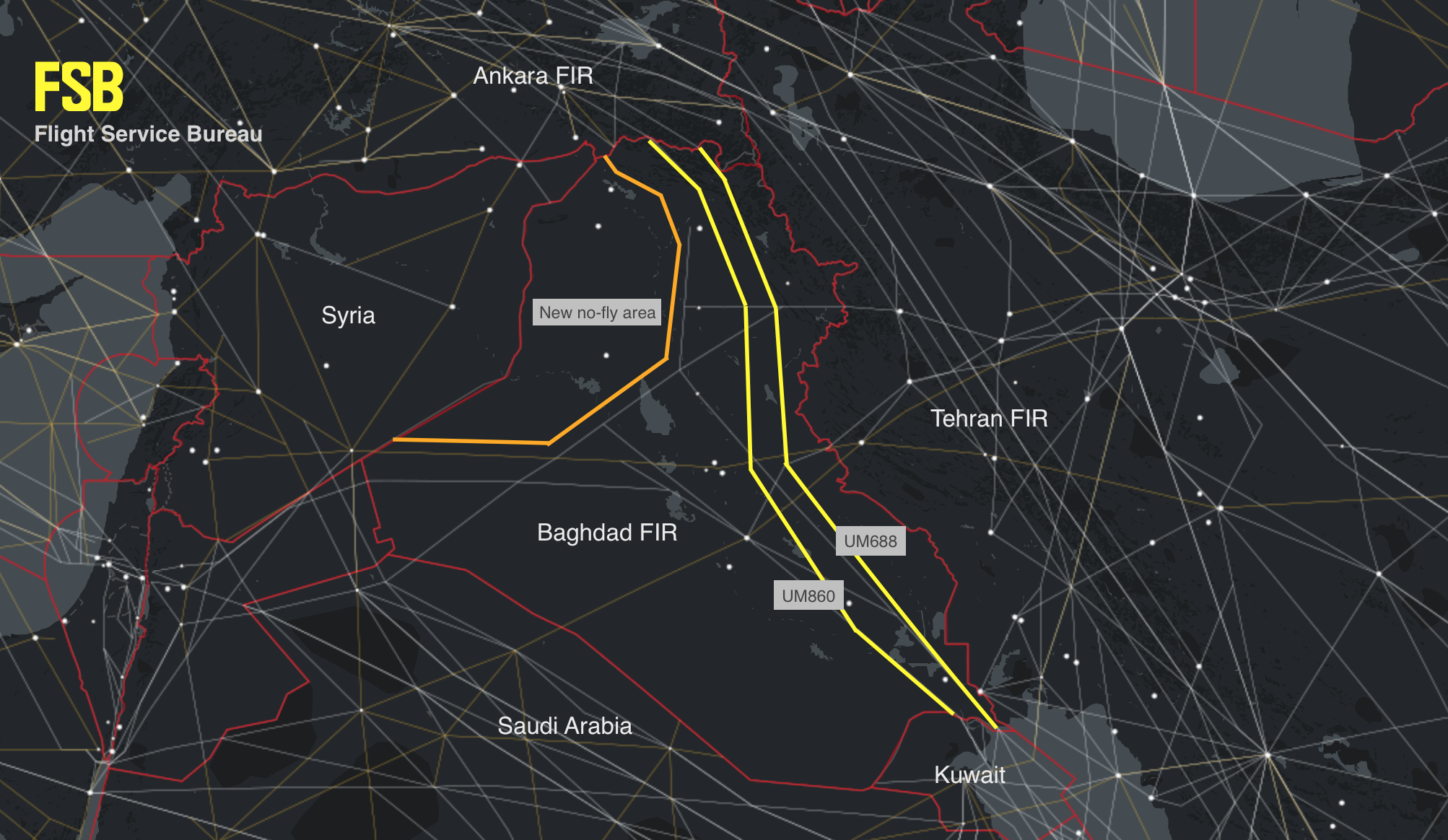
Without seeming alarmist, this relationship must be taken into account when planning flights through the Tehran FIR. Although the reopening of Iraqi airspace in November last year has provided additional routing options, our recent article London – Dubai, which way is best? shows that there is no perfect route in the region, and operators must consider their preference for Iraq vs Iran.

A new Notam for Iran, KICZ 16/2018 was published today, and contains new wording, rather than being an extension of the previous. The key message of the Notam is : “Exercise caution when flying into the Tehran FIR“.

In addition, new background guidance has been published in conjunction with the Notam, and these are the key new items:

  • There is concern for heightened Iranian air defense sensitivity and exercises as a result of regional instability and/or political tensions. Heightened Iranian air defense sensitivity may create an inadvertent risk to U.S. civil aviation operating in the Tehran FIR (OIIX)
  • A U.S. civil operator experienced a fighter intercept in the Tehran FIR (OIIX) in December 2017
  • There is the potential for Iranian surface-to-surface missile fire from western Iran, targeting Islamic State of Iraq and al-Sham (ISIS) positions located in the region (such as occurred in June 2017)
  • There is an inadvertent risk to U.S. civil aviation operations in the Tehran FIR (OIIX) from Iranian-fielded GPS jammers

We would add that if planning an overflight of the Tehran FIR, consider the risk from an unplanned landing – decompression, medical, engine fire – which may force you into Tehran or another airport – it’s a big chunk of airspace. The US State Dept currently advises: Do not travel to Iran due to the risk of arbitrary arrest and detention of U.S. citizens.

As always, we’d like to hear your thoughts and comments on this new information, overflying Iran, and Middle East risk in general. Comment below, or mail our team at comments@ops.group.

References

FAA Notam KICZ 16/2018 published Sep 9, 2018
FAA Background Notice on Tehran FIR published Sep 9, 2018
FAA Prohibitions, Restrictions and Notices (not yet updated)


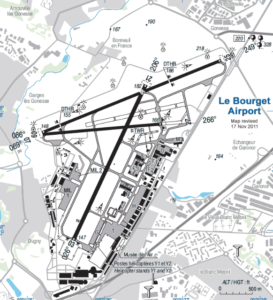
Paris Le Bourget – New Requirement to list parking in Flight Plan

In the recent France AIP August update a new requirement was added for all aircraft inbound to LFPB/Paris Le Bourget to list their parking position and handler on Field 18 of their flight plan.

Mentioned twice in the local traffic regulations (the translation is a little iffy but you get the idea):

Mandatory assistance by approved based companies. The name of the assistant society must be stated in field 18 of the FPL as a remark (RMK).

and

It is required to the crews to indicate in field 18 of the flight plan, the traffic area of destination and the name of the handling provider.

We understand that this came about due to “much confusion” of the parking stand locations after aircraft land.

Remark 18 should include

  1. Handler Name
  2. Your parking stand location (e.g. HANDLER ABC T1 APRON FOXTROT 2)
    • For heavy aircraft (A330/A340/A350/B747/B787/B767/C130) apron Golf, Sierra or Foxtrot 3 will suffice. Your local handler should give you confirmation ahead of your expected flight.
  3. Your handlers phone number.

So it should look something like this:

(FPL-FGTRY-IG

-C525/L-SDFGRWY/S

-LFMD0610

-N0360F340 OKTET UM733 GIPNO UT26 LOGNI UN854 DJL

-LFPB0120 LFPN

-PBN/A1B2D2S1 DOF/180903 IFP/MODESASP ORGN/KBLIHAEX RMK/HANDLER ABC TERMINAL 1 APRON FOXTROT 2 TEL : +3312345678)

Do you know more? Feel free to comment or drop us a line!

Also- here is a video of a Beech Bonanza flying under the Eiffel Tower 


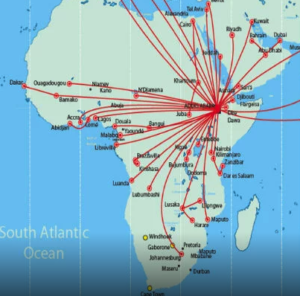
ATC Strike over, but nine Ethiopian Air Traffic Controllers remain in jail

5th September, update:

As of this morning, most controllers have returned to work. Some concessions made by ECAA. Addis ACC and TWR are again staffed with qualified controllers, so the safety situation, for now, is restored. However, 9 remain in jail. Returning controllers were forced to sign an ‘admission’ of illegal strike action in return for amnesty. IATA In Flight Broadcast Procedure requirement for Addis FIR remains in place, meaning you must broadcast on 126.9 as in other areas of concern in Africa. Further as we get it.


4th September:

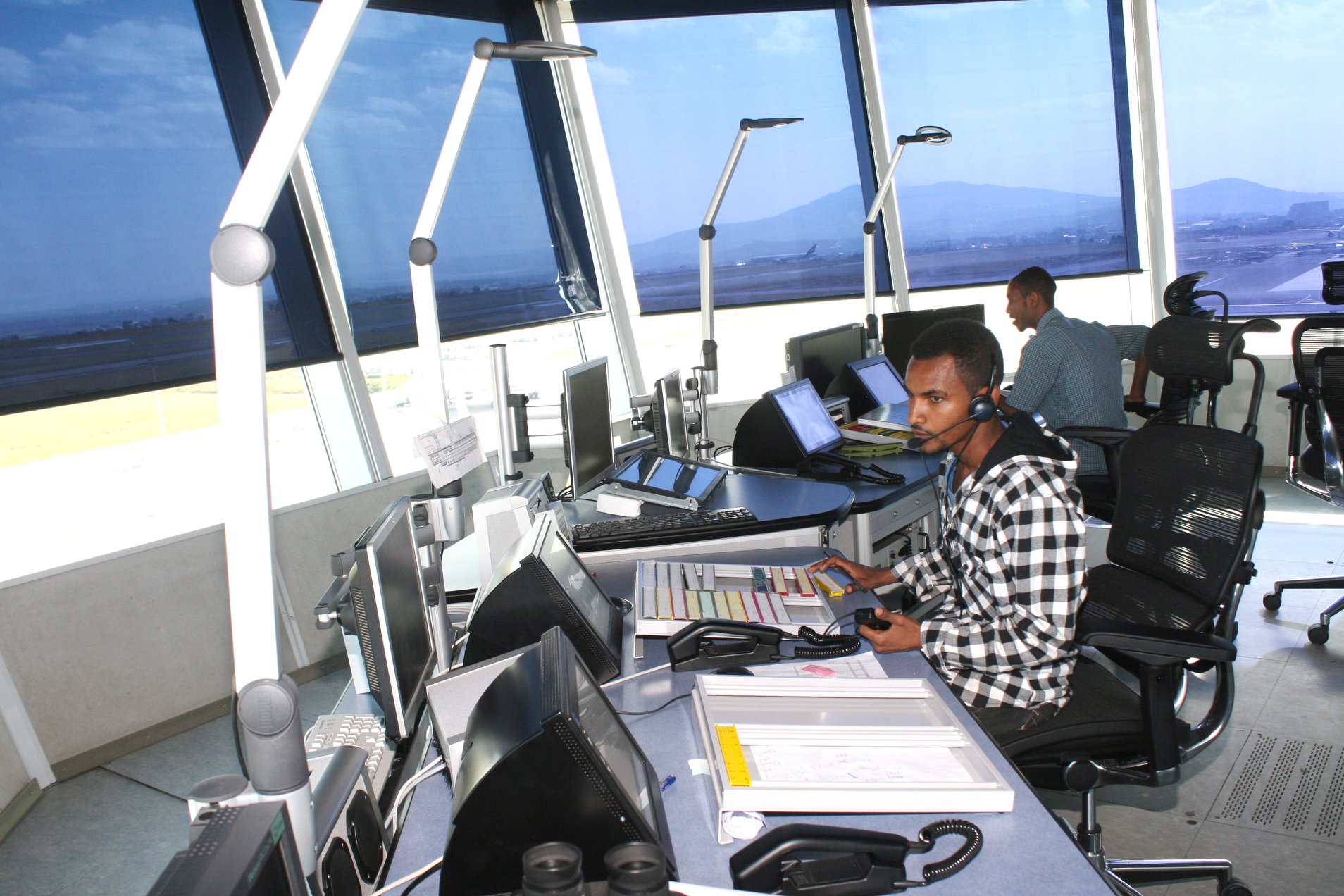
Last week we were one of the first to expose the attempted ATC Strike cover up by the Ethiopian Civil Aviation Authority.

As a reminder, untrained and uncertified foreign controllers, retired and local non-operational ATC personnel are being used to control air traffic over Ethiopia. 

It is a catastrophic misjudgement, creating a safety risk in the Addis FIR and at Ethiopian Airports for pilots and passengers alike.

Here are some more updates since our last article:

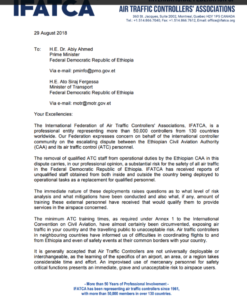
  • On August 29, The International Federation of Air Traffic Controllers Association (IFATCA) penned a letter to the Prime Minister of Ethiopia. You can read it here.
  • The neighbouring controllers in Kenya warned that flights in and out of Addis Ababa are not safe. You can view their letter here – specifically they warned that the ‘possibility of air misses’ is real.
  • The ECAA over the weekend rejected concerns regarding the safety of Ethiopian airspace, specifically calling the claims from Kenya as “outright lies.”  The ECAA has said that ATC are operating “in accordance with ICAO Annex 1 provisions.” They did not deny however that foreign and retired ATC are being used.
  • The ECAA also outlined that the national carrier, Ethiopian Airlines, has “awarded” veteran Air Traffic Controllers,  who are performing their national obligation.
  • However on Monday, the local state affiliated broadcaster, Fana BC, reported that the Federal Police Commission had detained nine individuals on suspicion of attempting to disrupt international flights and coordinating a strike that began last week. This has been quickly condemned on social media, as many locals called on the government to resolve the issues raised by the ATCs rather than resorting to intimidation.

The ECAA claims that “some” of the striking controllers have returned to work.

Major airlines and uninformed passengers continue to fly into and over Ethiopia and this continues to be a major safety risk.

Do you have more to add this story?  Please, let us know!


Beijing Airport Restrictions until September 6

Beijing is hosting the Forum on China-Africa Cooperation (FOCAC) on September 3 and 4, 2018.

As a result ZBAA/Beijing Capital airport will not allow any GA/Corporate Jet operations from Thursday, August 30 until Thursday, September 6 unless you are attending the forum itself. If you are, you will require a a sponsor letter from the organizing committee to obtain landing permission.

Further restrictions:

  • There will be no take-off for all flights between 0700-0855L, strictly landing only.
  • A maximum of two movements are allowed per hour for all flights between 0600-2355L.
  • Governmental flights require an authorization letter from the respective Embassy to arrange handling services.
  • Flights with diplomatic clearance can still operate to ZBAA even if they are not attending the forum.
  • ZBAA cannot be used as an alternate (except in an emergency) until 6 September (Refer NOTAM E1870/18).

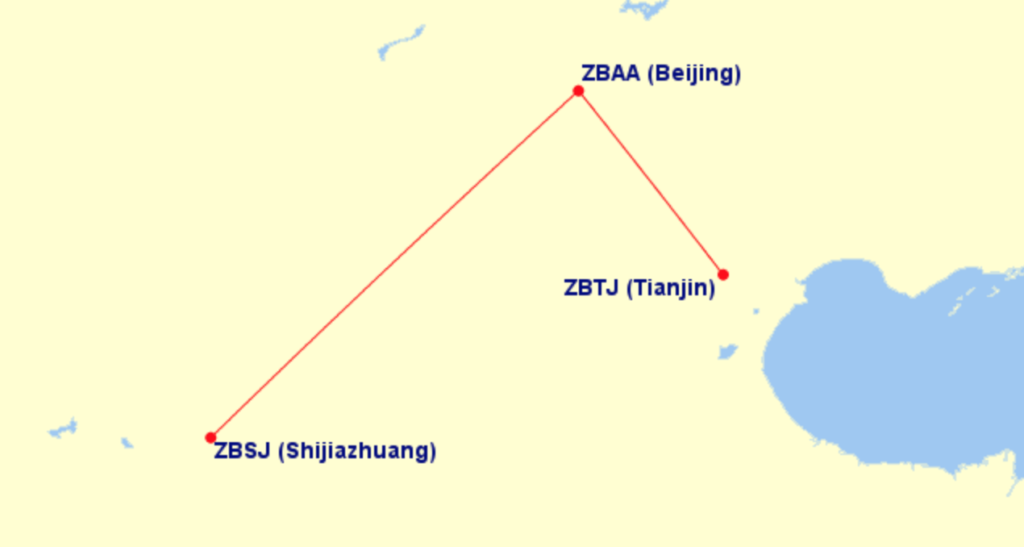
Operators are advised to consider ZBSJ/Shijiazhuang Zhengding airport (139nm away) and ZBTJ/Tianjin Binhai airport (67nm away) as alternative destinations during this time period.

Do you know more? Let us know!


Ethiopia risking flight safety to cover up ATC strike

  • Ethiopian ATC on strike, no Notams, government hush up
  • OPSGROUP alert for the  Addis Ababa FIR
  • Airspace risk – unrated controllers, some foreign and unfamiliar


Air Traffic Controllers are on strike in Ethiopia
, and Ethiopia would prefer that you don’t know this. We, as OpsGroup, would prefer that you do.

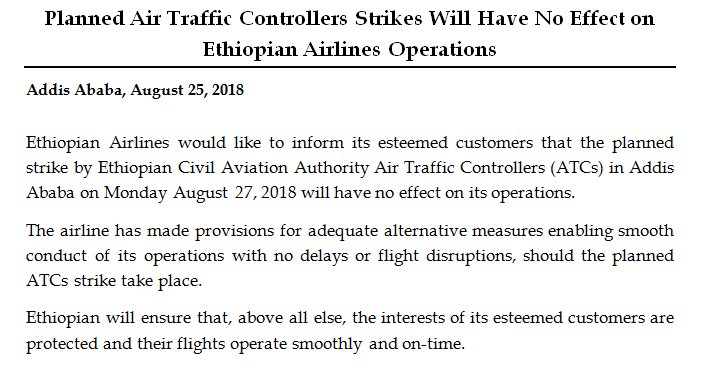
Ethiopia would also prefer that it has no impact on the flight operations of its national carrier, Ethiopian Airlines. Therefore, they have drafted in foreign controllers to replace the strikers, issued no Notams, hushed any publicity, and proactively declared ‘operations normal’ (complete with bizarre, hand drawn airplanes).
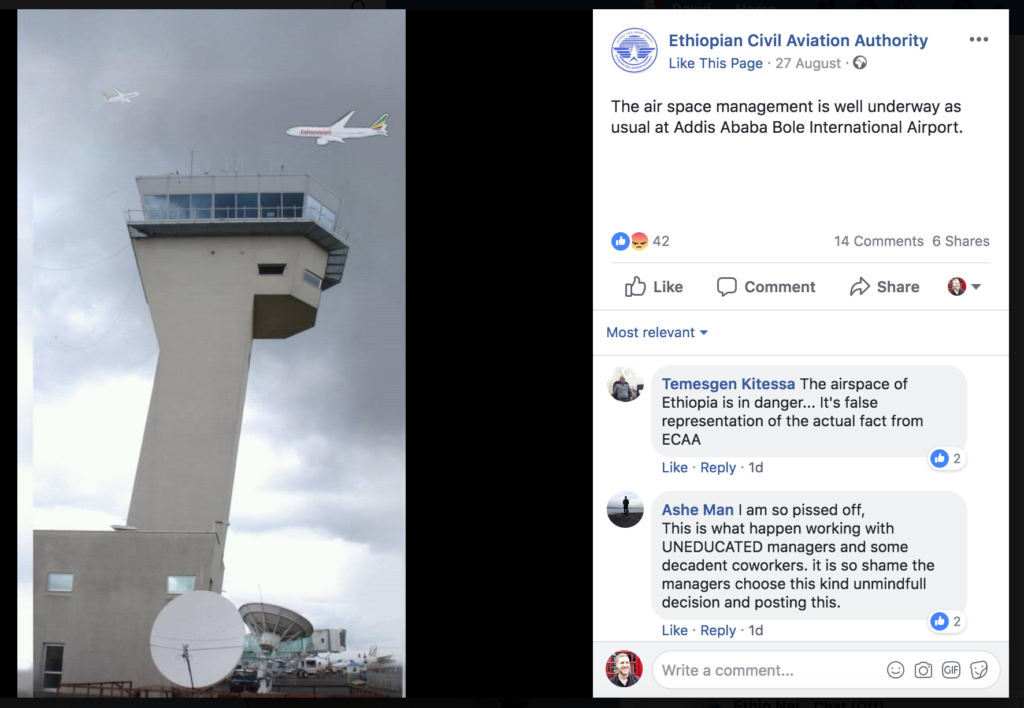
European airlines – and frustrated passengers – will watch with great interest, thanks to their own ATC strike woes: regular stoppages by French, Italian, and Greek controllers have this summer, once again, been the source of massive cancellations, reroutes, and delays. Has Ethiopia found the golden elixir, the magic solution to a long-running problem? Is this how to handle a strike by your nations’ Air Traffic Controllers?

It absolutely is not. It is a catastrophic misjudgement, creating a safety risk in the Addis FIR and at Ethiopian Airports for pilots and passengers alike. Ethiopian airspace, this week, is most definitely not ‘operations normal’ – it is unpredictable and unsafe, staffed by unrated, inexperienced controllers, many from abroad – evidenced already by alarming reports of close calls from adjacent Area Control Centers – read on.

The facts are this: faced with an upcoming strike by ATC, Ethiopian Airlines – now Africa’s largest airline –  formed what in the boardroom might have seemed a workable plan: Recruit a bunch of controllers from other countries, fly them in to Addis, and have them do the work of the striking staff.
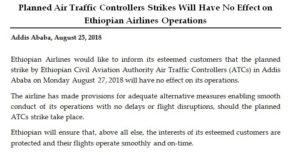
The first batch of foreign controllers came from the Democratic Republic of the Congo, a small group described by the local controllers, unsurprisingly, as mercenaries. When the strike started at 7am this past Monday morning, they were ready to go. Not content with stopping there, the requests from ECAA – the Ethiopian Civil Aviation Authority – for more external controllers went out thick and fast, like an Ambien fuelled shopping spree on Amazon. 30 requested from Sudan, 24 from Kenya. More from Zimbabwe, Malawi. Finding those requests rejected, and resistance from other ATC agencies, the biggest request yet: 120 controllers from ASECNA.

The plan, commercially, is understandable. The wish to keep their airplanes flying is not endemic to Ethiopian Airlines. British Airways, Ryanair and Easyjet, have all made very public their frustrations with ATC strikes. An association, A4E, was formed to fight the problem at European level.

But here’s why the Ethiopian solution doesn’t work.

And as a former Air Traffic Controller, and Airline Pilot, I can tell you why.

Air Traffic Control is complex. That’s not a secret. On average, it takes a controller three months to gain a ‘rating’, or qualification, for a specific piece of airspace; that’s how long it takes to become comfortable with the 4D picture in front of you to provide a flawless ATC service. More complex airspace could take six months.

You have to learn each corner of your bit of sky. Learn the rules of the sector, learn the agreements you have with other centres about how you will receive and present traffic at the boundary. But the most important thing you learn is how the traffic flows.

ATC is not an aerial traffic battle whose landscape changes each day. It is not a web of complex contrails that, seen from the ground, appear to merge and diverge at random. The traffic flow is a largely predictable set of events, where the same airlines are operating on the same routes – providing a basis for us, as controllers, to learn the patterns of the flow, and to learn a trick for every trajectory.

This is key. It’s been 15 years since I worked the North Atlantic flow in Shannon, but I remember the callsigns, the flows, and how to handle them, like an indelible challenge and response game in my mind.

Shamrock 37J, airborne Shannon” : “direct to Strumble, climb him to 270”.
“Belfast departure for Tenerife” : “stop him low, get him under the NAT traffic”.
“Two converging at LIFFY” : “Drop the Speedbird, he’s for Manchester”.

Humans learn patterns. This is how ATC works. We fill a bucket full of “stuff we’ve seen before”, leaving us free to concentrate on the few things we haven’t. This is the flow. If you watch 737’s fly up the Hudson on a hot summer morning, this is the La Guardia flow. Not an inch left or right. Heading into Amsterdam? “Direct to Pampus, down to FL70”.  One after another.

This is why we need three months to learn the airspace. For the flow. And this is why, when I found myself in New Zealand, learning to operate as an Air Traffic Controller far away from Shannon, I was floundering, like one of those dreams where you running but standing still. I am a controller, but I can’t control. I don’t know the airspace, and I don’t know the flow. Slowly, over the months, geography takes shape, traffic patterns show themselves, situations become seen. I start to get a sense of distance and time on my scope – or scopes, because New Zealand is long and thin I have to reorientate my thinking north-south, rather than east-west, as in Shannon. Out of the mist of training, I am a controller again, but it takes time. A lot of time.

Ultimately, I can reach the point where I can do my job – the real job of an Air Traffic Controller – to be familiar enough with the airspace and traffic that I have “the picture”. The full situational awareness, with most climbs, descents, speeds, and vectors being routine and familiar, means I can spot the something that’s off, wrong, going to develop into a conflict, and do so intuitively, like a sixth sense. Air Traffic Control is an art, it’s a dance. You don’t do it by complex calculations in your head, you don’t need a computer. It’s the visual in front of you – radar or tower – coming to life in your brain, you feel it, and the solution becomes instinctive.

And this is why you can’t bus in a set of replacement controllers, shuffle them down the corridor into the radar room, and up the stairs to the tower, and expect a safe, efficient, and orderly flow of traffic.

Controllers know the power of the strike. In most countries, it is used rarely, and fairly. They understand the impact on airlines and passengers. There are many other forms of industrial action a controller can take – like a training ban, an overtime ban – before reaching the point of actually stopping work.

Commerce will always find a way to continue. Safety is different, and delicate. It must be nurtured and protected. When the two collide head on – the commerce of keeping an airline flying, vs. the safety of an established, effective Air Traffic Control system – safety must take precedence. Here, safety means accepting the strike, as is – and working with the controllers, quickly, to find a solution. Let them be heard.

 

We’ll keep this page updated with the latest situation on the Ethiopian ATC strike. Reports that we have received so far are as follows:

  • Controllers in adjacent ACC’s are reporting lack of adherence to Letters of Agreement – seeing aircraft with 4 minutes instead of 10 minutes separation.
  • RA reported by Kenya ATC between two airlines on Wednesday.
  • Kenya and Sudan reported loss of separation and poor coordination and transfer of traffic at their FIR boundaries with Ethiopia.
  • Retired and Management controllers, who appear to have never rated or validated in position, are also being used, though unqualified for Addis.

We were first alerted to this issue by a Fox. Many of you know that we are Fixing Notams. The lack of Notams in this situation, is an exceptionally clear example of point 1 in the “Why” of the Notam Problem. Sometimes, we can’t trust the state to tell the truth. And this is a clear example.

Thankfully, our network of Foxes – undercover ATCO’s, pilots, and dispatchers –  is growing, and reporting on things just like this, so that we can tell you what’s really going on. Keep reporting.

Further reading

  • Tell us anything additional we should know – news@ops.group
  • Monitor #ops-alerts in your member Dashboard, and Slack.
  • Contact the author: Mark Zee.



Malaysia’s KLIA airport shutdown is excessive

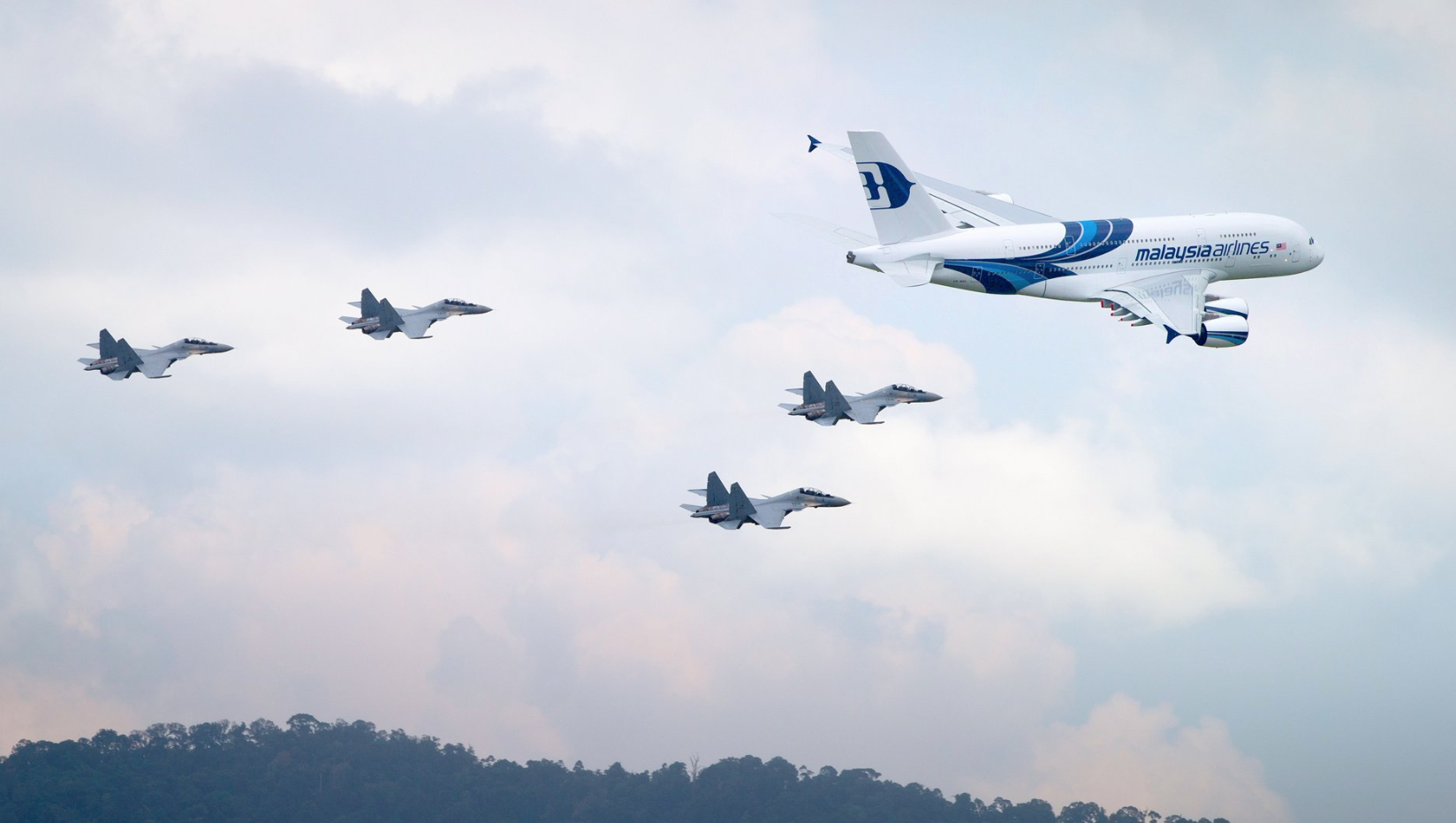
In Short: Operations at WMKK/Kuala Lumpur International Airport have been suspended from 0900L-1030L every day this week (27-31 August). This is to make way for the Royal Malaysian Air Force (RMAF) to conduct rehearsals for an aerial flypast that will be part of Malaysia’s National Day parade.

As we outlined in our daily brief, WMKK/Kuala Lumpur International Airport (KLIA) is being shutdown this week for 90 minutes everyday, between 9am and 10:30am to allow fly-over “rehearsals” for the National Day parade.

We think this is excessive.

The shutdown of a major international gateway airport (the 23rd busiest airport in the world) for 7 and half hours in one week will impact over 498 flight operations and thousands of passengers.

The NOTAM says it all.

A2434/18 - ALL ARR AND DEP SUSPENDED DUE TO NATIONAL DAY 2018 REHEASALS AND 
ACTUAL FLYING DISPLAYS. 0100-0230, 27 AUG 01:00 2018 UNTIL
31 AUG 02:30 2018. CREATED: 13 AUG 07:13 2018

The central planning committee of the National Day event said:

“The air space closure is necessary to ensure the smoothness of the 2018 National day flypast practice sessions, but more importantly, the safety of aircraft flying in and out of KLIA.”

We are all about safety here. But to shutdown such a big chunk of airspace and totally suspended flying operations at 9am at such a big airport for a whole week seems particularly extreme.  This is not a small isolated airport, this is a large 3 runway complex with A380’s coming and going.
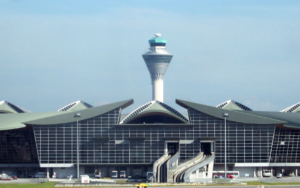
This isn’t the first time such a move has happened here. In September 2016, the airport was closed for several hours a day to conduct an “aerial survey”.

This time, we understand, there was limited to no industry consultation with the onus being on the airlines and operators to notify affected customers.

Malaysia’s Transport Minister simple asked that “I hope all airlines will notify their passengers about this and reschedule their flights.” 

He finished by saying “this was inevitable as we are celebrating our Independence Day”.

We say no– shutting down a major airport for nearly 7 hours to practise some flying displays is not “inevitable“.

What do you think? Do you know more, please let us know!


If you need to get into KL during these times, WMSA/SULTAN ABDUL AZIZ SHAH INTL is a good alternative.

Extra Reading:


The diversion dilemma over London

A few months back an Air Canada A330 suffered a hydraulic failure as it started it’s Atlantic crossing from France to Canada. The crew decided to turn back and wanted to divert to EGLL/London Heathrow – this was denied.

Since then, other reports have been received of other aircraft requesting similar non-emergency diversions over the UK and them being denied. We understand the “non-acceptance of diverts” policy is in place for EGGW/Luton, EGSS/Stansted and even as far away as EGHH/Bournemouth. It is important to note however that if you declare an emergency (PAN/MAYDAY) – then all bets are off and you can divert wherever you like.

This week we saw EGGW/Luton go as far as publishing a NOTAM to that effect.

A2663/18 – DIVERTS SHALL ONLY BE ACCEPTED FOR ACFT THAT HAVE DECLARED AN  EMERGENCY.

So what’s going on?

We understand it’s a mix of things.

  1. With the heavy summer traffic situation all across London (which is being compounded by the various curfew and overnight flight limitations) it seems that the major airports don’t want an aircraft landing and disabling their runway.
  2. We have heard specific concerns stating that there is nowhere to park overflow aircraft. One aircraft might be manageable but multiple during peak disruption maybe not so easy.
  3. Some Opsgroup members have reported that the main driver of this policy at EGGW/Luton and EGSS/Stansted may be down to ‘their fear of adverse publicity on social media’ regarding aircraft sitting there waiting to go somewhere else and passengers tweeting away the problems with the airport and its facilities.
  4. Luton also put forward the argument that they do not want to interrupt the home-based operators by allowing other operators in. However, at the same time they are automatically denying home-based operators a diversion unless you declare an emergency.
  5. Border Control has also bought into the argument, especially at EGSS/Stansted, saying their manning levels can’t cope with an influx of extra passengers at short notice.

There are a whole host of other factors at play which make diversions in the London area a headache, particularly at night time. Opsgroup member Diego Magrini from Jet Concierge Club sums it up nicely:

“Minor airports close early in the evening, for example EGSC/Cambridge, EGTK/Oxford, EGLF/Farnborough, EGWU/Northolt. These would all be very good alternatives, but become unavailable pretty early. Let’s be honest: no business jet want to divert to EGLL/Heathrow or EGKK/Gatwick (costs, slots, friendliness, etc), and most cannot go to EGLC/London City due to training and approval. This is of course on top of Heathrow and Gatwick not accepting diversions most of the time, or not having slots available. Some airports outside London, although open and accepting traffic, do not have an FBO presence during the night, and this cannot be arranged at short notice for a diversion. Combining all of this in the very short timeframe of a diversion can be very tricky!”


There is a cool video that shows just how busy London does get on any given day….

If you have any further knowledge or recent experience to share, please let us know!

Extra Reading