2019 North Atlantic changes

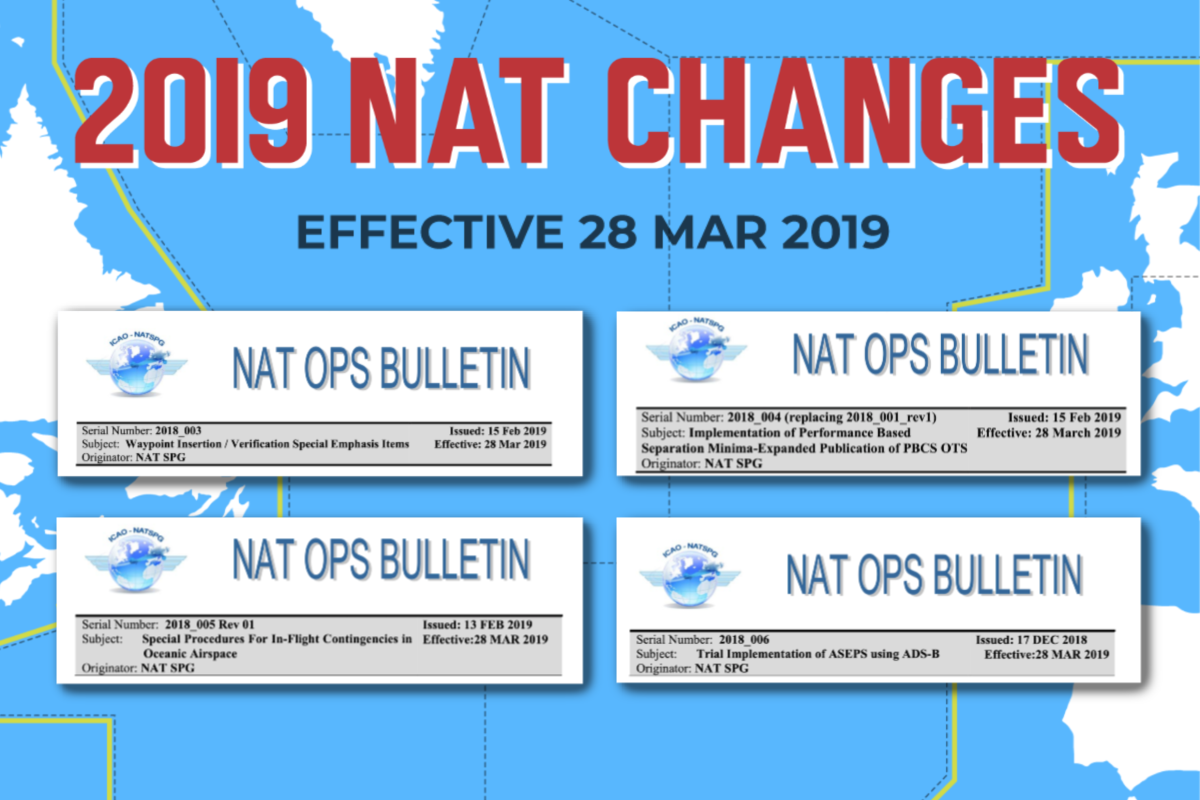
There are four ICAO NAT Ops Bulletins due to go into effect on March 28th, 2019. The PBCS tracks will be expanded, real-time Space-Based ADS-B surveillance and reduced separation standards will be introduced, and the regional contingency and weather deviation procedures will be changed.

You can click on each one, and read them in full:

We have had a good look at each of them. Here’s the lowdown:

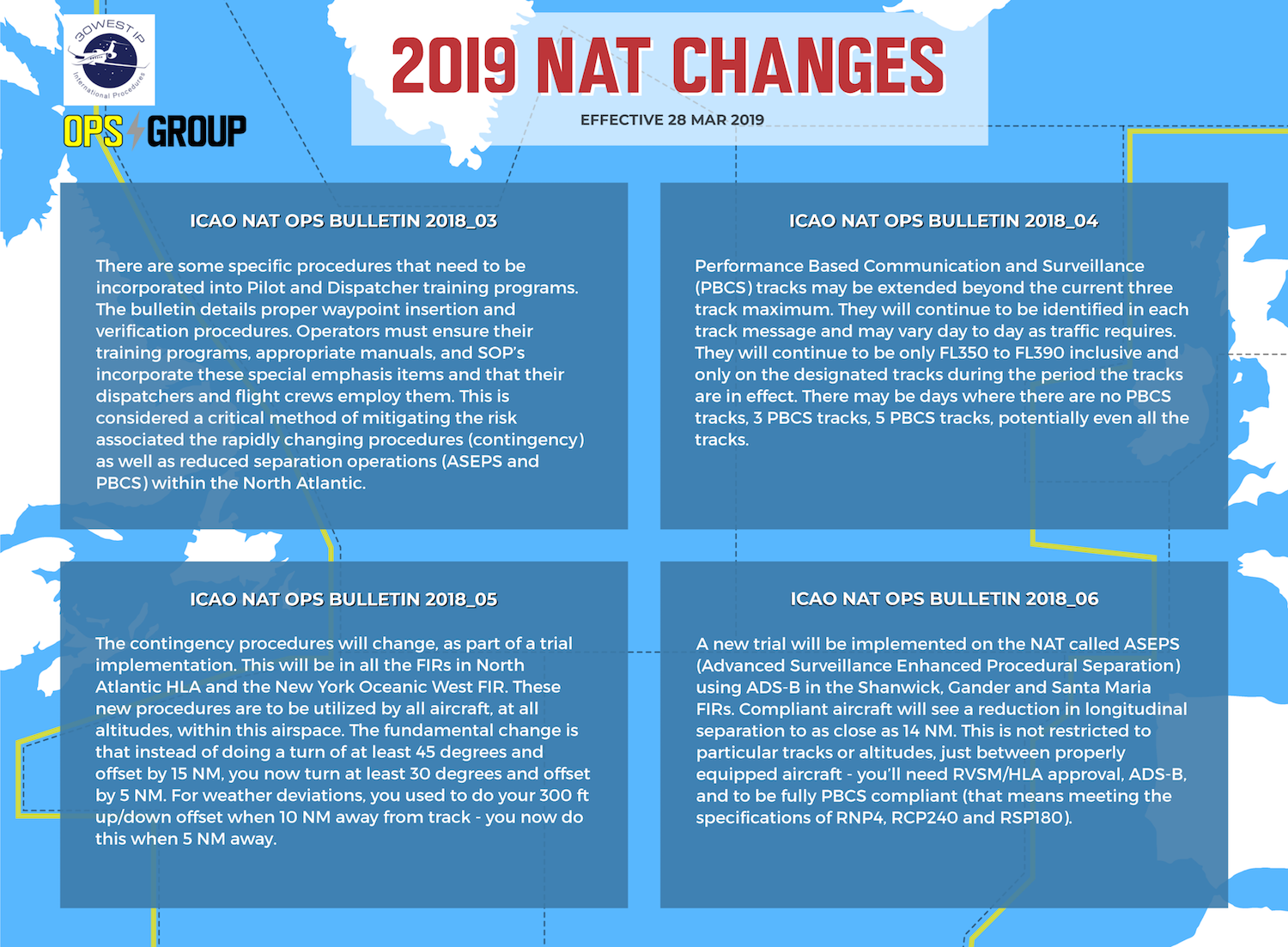
ICAO NAT Ops Bulletin 2018_03: Waypoint Insertion / Verification Special Emphasis Items
Lowdown: There are some specific procedures that need to be incorporated into Pilot and Dispatcher training programs. The bulletin details proper waypoint insertion and verification procedures. Operators must ensure their training programs, appropriate manuals, and SOP’s incorporate these special emphasis items and that their dispatchers and flight crews employ them. This is considered a critical method of mitigating the risk associated the rapidly changing procedures (contingency) as well as reduced separation operations (ASEPS and PBCS) within the North Atlantic.

ICAO NAT Ops Bulletin 2018_04: Implementation of Performance Based Separation Minima-Expanded Publication of PBCS OTS
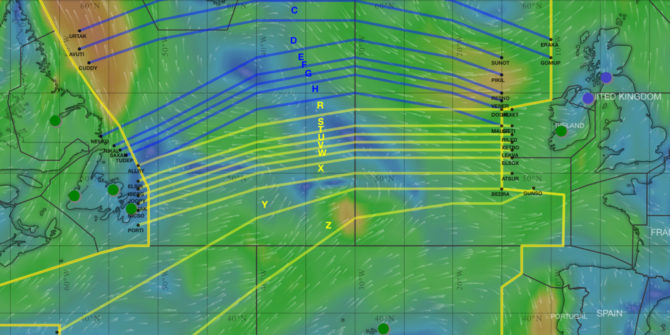
Lowdown: Performance Based Communication and Surveillance (PBCS) tracks may be extended beyond the current three track maximum. They will continue to be identified in each track message and may vary day to day as traffic requires. They will continue to be only FL350 to FL390 inclusive and only on the designated tracks during the period the tracks are in effect. There may be days where there are no PBCS tracks, 3 PBCS tracks, 5 PBCS tracks, potentially even all the tracks.

ICAO NAT Ops Bulletin 2018_05: Special Procedures For In-Flight Contingencies in Oceanic Airspace
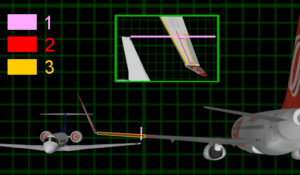
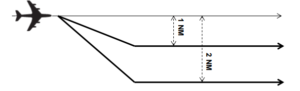
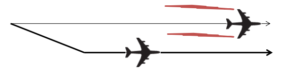
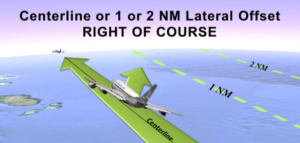
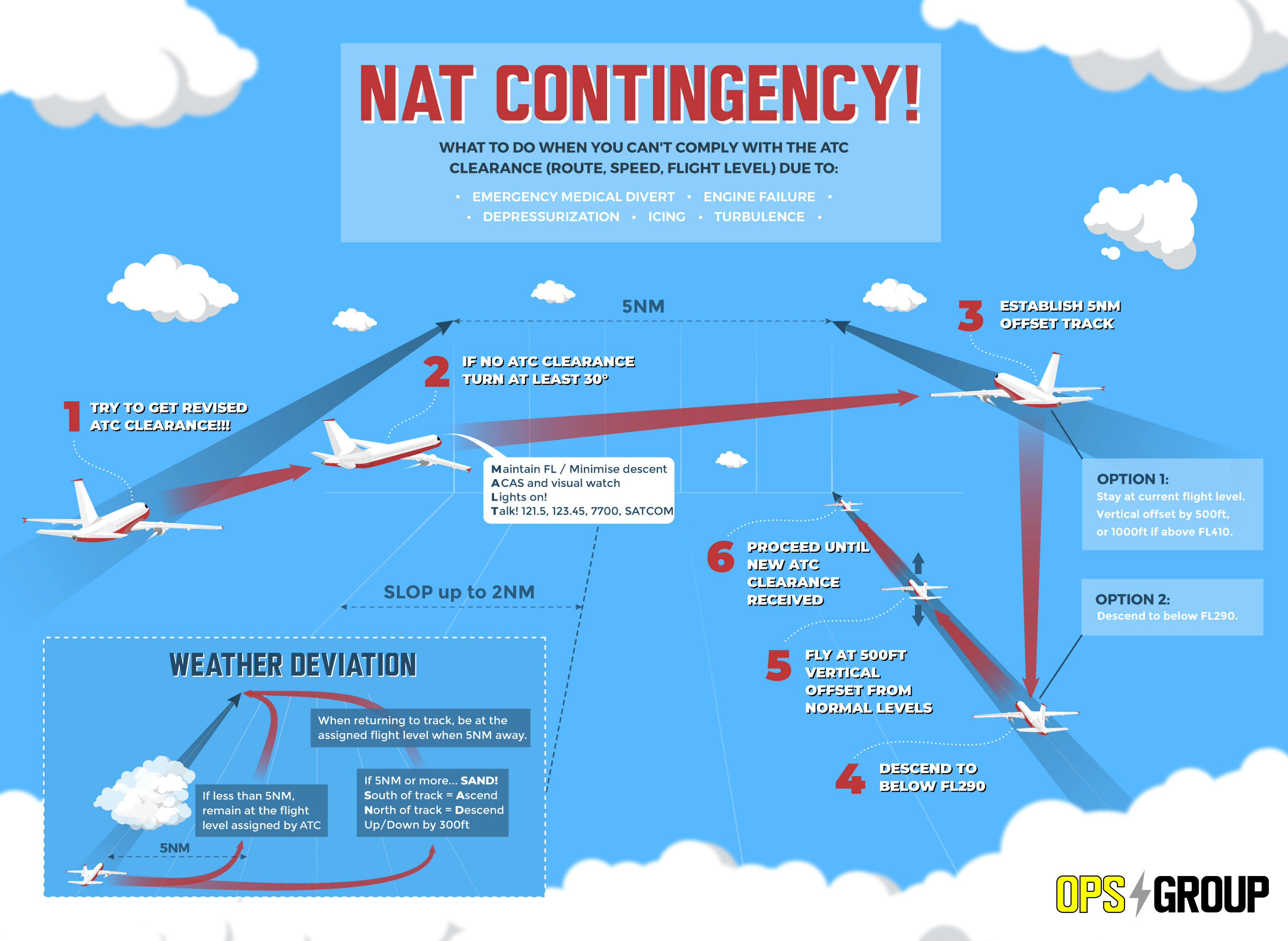
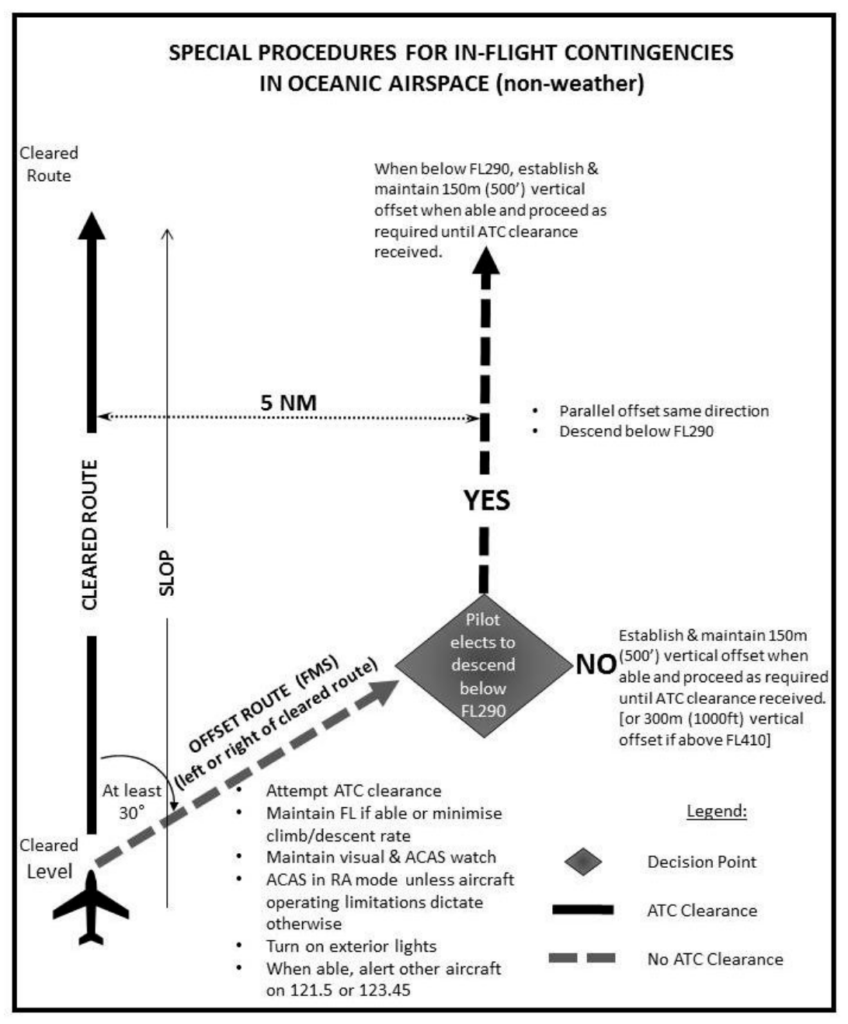
Lowdown: The contingency procedures will change, as part of a trial implementation. This will be in all the FIRs in the NAT Region and the New York Oceanic West FIR. These new procedures are to be utilized by all aircraft, at all altitudes, within this airspace. The fundamental change is that instead of doing a turn of at least 45 degrees and offset by 15 NM, you now turn at least 30 degrees and offset by 5 NM. For weather deviations, you used to do your 300 ft up/down offset when 10 NM away from track – you now do this when 5 NM away. For more info on this, read our article.

ICAO NAT Ops Bulletin 2018_06: Trial Implementation of ASEPS using ADS-B
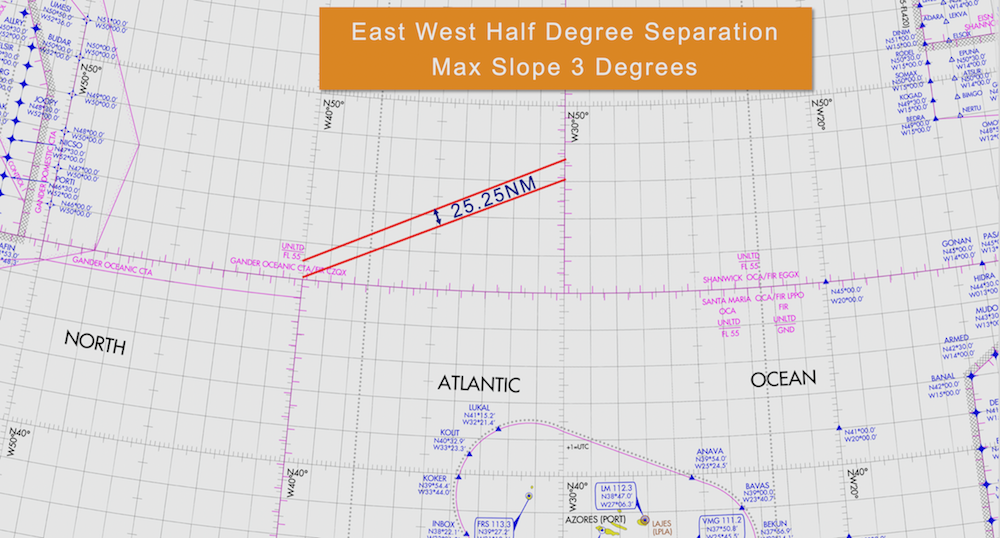
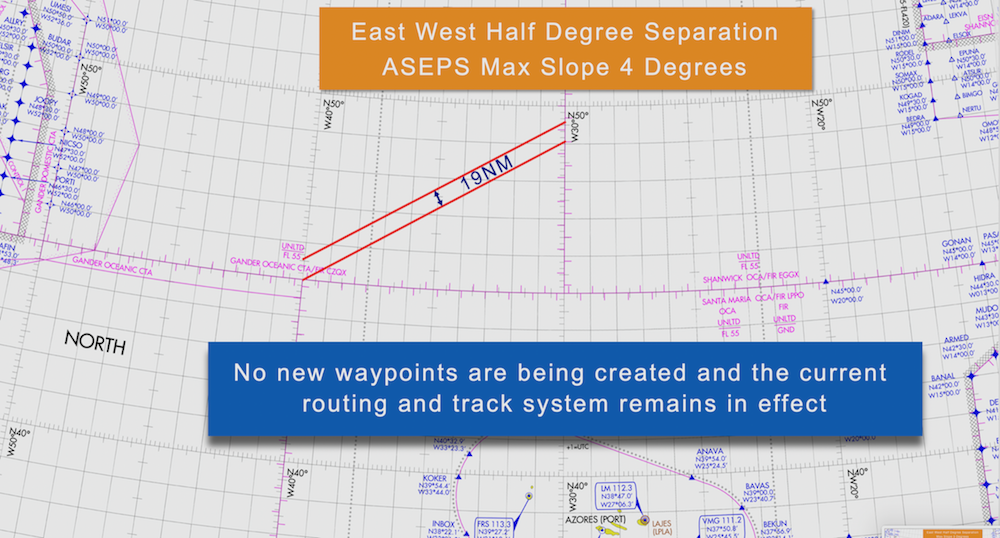
Lowdown: A new trial will be implemented on the NAT called ASEPS (Advanced Surveillance Enhanced Procedural Separation) using ADS-B in the Shanwick, Gander and Santa Maria FIRs. Compliant aircraft will see a reduction in longitudinal separation to as close as 14 NM. This is not restricted to particular tracks or altitudes, just between properly equipped aircraft – you’ll need RVSM/HLA approval, ADS-B, and to be fully PBCS compliant (that means meeting the specifications of RNP4, RCP240 and RSP180).

So there you have it. We made a couple of handy graphics for all this. Print them out and sellotape them to your cockpit. (If you actually do this, please send us a photo!)

click on the image to open larger version

For a bit more of an in-depth look at the contingency and weather deviation procedures as shown in the image above, read our article.

And if you’re still hungry for more NAT info, we highly recommend you check out the replay of the webinar hosted by Mitch from 30WestIP, titled: ‘A North Atlantic Game Changer, 4 NAT OPS Bulletins all go into effect in one day’. This really breaks down each of the four new Bulletins which take effect from 28th March 2019 – essential viewing if you operate over the North Atlantic! View it here.

Further reading:

  • On 1st Nov 2018 we had a call with 140 OPSGROUP members about upcoming changes on the NAT in 2019, and how we can effect change. OPSGROUP members can find the PDF notes of this in your Dashboard.
  • A big thing driving the ASEPS trial is the rollout of Space-based ADS-B, which is scheduled to complete its deployment by 30 Dec 2018, giving us worldwide, pole-to-pole surveillance of aircraft. For more on that, and how it will affect operations on the NAT specifically, read the article by Mitch Launius here.
  • Use our quick guide to figure out where you are welcome on the NAT, depending on what equipment and training you have.

Venezuela: do not travel

Amid an escalating crisis in Venezuela, on Mar 11, U.S. Secretary of State Mike Pompeo announced via Twitter that the U.S. Embassy in Caracas will be withdrawing all of its remaining diplomatic personnel from Venezuela by Mar 16, citing the “deteriorating situation.”

Power outages continue in at least 16 states across the country. The opposition says there has been sporadic looting, and at least 17 people have died as a result of the blackout.

On Mar 9, there was an attempted armed robbery of Air Europa airline crew. Armed assailants on motorbikes chased the vehicle of the crew from the airport to their hotel, where they engaged in a shoot-out with hotel security staff before escaping. None of the crew was injured, but refused to stay at the hotel, and instead were escorted back to the airport by police convoy and returned on the flight back to Madrid. Air Europa has reportedly now decided to add a stopover to its Caracas service and crew will now layover in Punta Cana in the Dominican Republic.

On Feb 21, the barely-still-president Mr Maduro banned all general and private aviation. But reports from Opsgroup members on Feb 28 suggest that this has now been cancelled (although the ban on flights to/from the islands of Aruba, Bonaire and Curacao, as published by Notam, still stands). One member reported: “Our permit to operate in and out of SVMI/Caracas next week was approved. However, I would still NOT recommend any crew remain there overnight.”

Local handling agents we have spoken to in Venezuela have also said that the country’s airspace is open again, although nothing has officially been published to confirm this.

Our advice remains the same: you don’t want to go to Venezuela at the moment. The official advice of both the US and Canada couldn’t be clearer, they both say the same thing: do not travel to Venezuela due to risks posed by the ongoing unstable political and economic situations and the significant levels of violent crime.

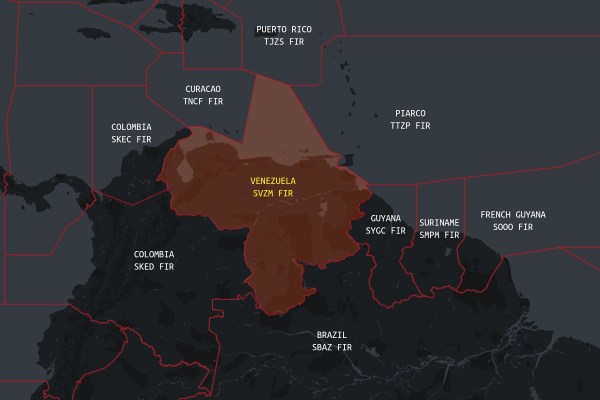
The Maduro government has closed Venezuela’s borders with Colombia and Brazil, and has reportedly positioned one of its air defense missile system near the border with Brazil – within range of Brazil’s SBBV/Boa Vista airport, as well as overflights of most of Guyana’s airspace (SYGC/Georgetown FIR).

The US FAA has also published a new Notam and Background Notice warning operators to exercise caution when operating in the SVZM FIR below FL260 due to potential hazards to aviation associated with ongoing political instability in Venezuela.


Background info on SVMI/Caracas Airport   

The most recent Opsfox reports for SVMI are not encouraging:

    • The airport is located in an extremely high-risk area for armed robbery and kidnappings. Before suspending all flights to Venezuela in Aug 2017, Avianca hired bodyguards after shots were fired during a robbery of a bus carrying its crew. Some other carriers took to flying crew to spend the night in neighbouring countries, rather than risk staying overnight anywhere in Caracas.
    • On Aug 8, 2017, a Venezuelan lawyer was shot dead at a ticket counter at SVMI/Caracas airport. In 2016, an Egyptian visitor was killed walking outside the airport between terminals after arriving on a flight from Germany.
    • In Feb 2018, Ecuadorian state airline Tame joined Avianca in a long list of airlines that no longer operate to the country, including: Aerolineas Airlines, United Airlines, Aeromexico, Lufthansa, Alitalia and Air Canada. Most reports estimate that international traffic in Venezuela has dropped by around 65-75% since its peak in 2013.
    • Colombia’s pilots’ association says its members who have flown to Venezuela have had to deal with contaminated fuel and hours-long delays as the National Guard pulls suitcases off flights to loot them. More info. 

Stuck in Iran for over 2 months

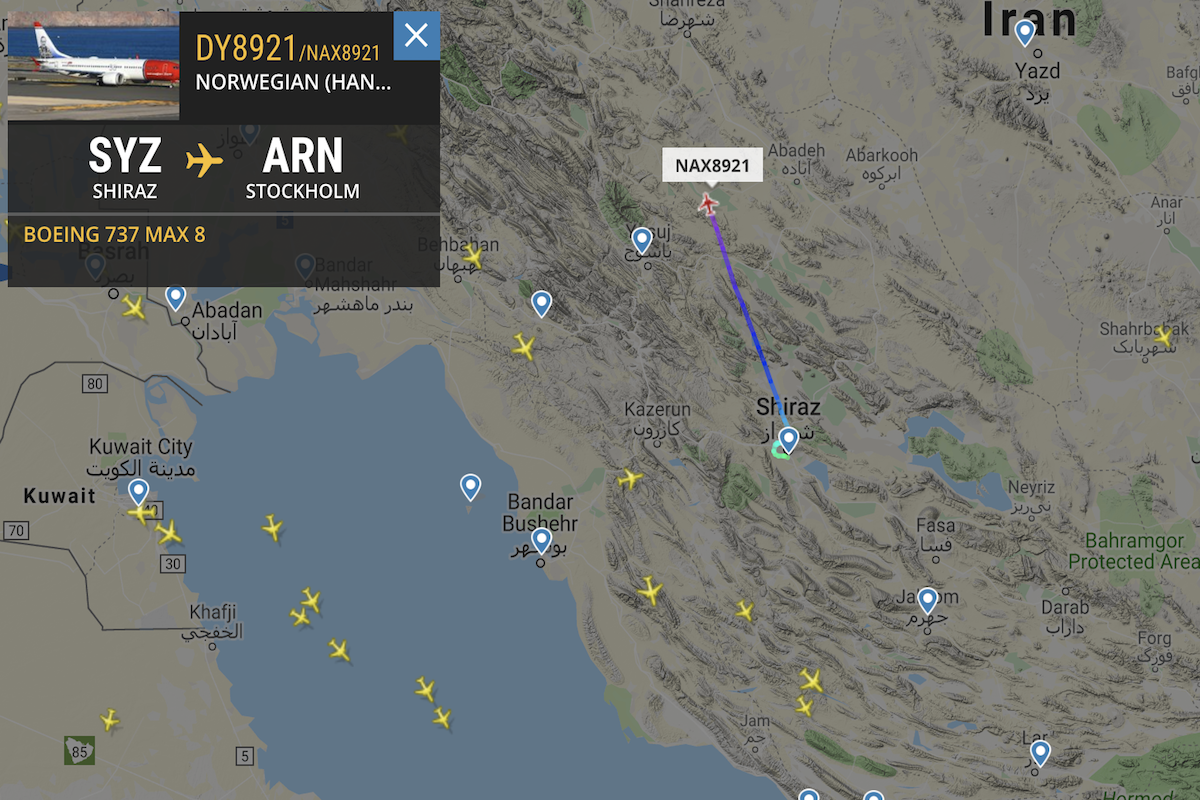
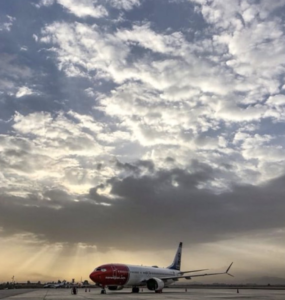
On Feb 23, the Norwegian B737 which had been stuck in Iran for two months after an in-flight diversion finally departed OISS/Shiraz, and landed back at Stockholm’s ESSA/Arlanda airport.

The brand new Norwegian Boeing 737 MAX8 was flying from Dubai to Oslo on Dec 14 when it encountered engine problems that necessitated a diversion to Shiraz.

With the U.S. sanctions currently in place against Iran, it made it very difficult to obtain approval to get the required spare parts over to Iran to fix the aircraft – Norwegian were only able to do so after negotiating a workaround with the U.S. Office of Foreign Asset Control.

The real complication here came from the fact that the aircraft needed a replacement LEAP-1B engine. The engine is a 50/50 ownership split between GE (USA) & Safran (France). The U.S. export restrictions apply to any company that wants to sell or resell goods to Iran that contain more than 10 percent aviation parts or technology from the United States.

In the end, the aircraft was out of service for over two months, no doubt costing the airline a fortune in lost revenue. It’s unclear who will be picking up the bill for “extra” complications of getting the permits with Iran, but that will be a costly exercise also.

The lesson?

Consider your overflight diversion options. If a checklist calls for a diversion to the nearest suitable airport and that airport is in a country with limited diversion support or (in this case) complicated requirements for sourcing replacement parts – is it worth the risk?

Have you operated to anywhere in Iran recently? Let us know how it went!

Further reading


New NAT Contingency Procedures for 2019

Starting 28th March 2019, there will be some changes to the contingency and weather deviation procedures on the NAT. ICAO has published a new NAT Ops Bulletin with all the details.

Before, there was a lot of confusion around the wording of these two procedures – but ICAO has now made this much clearer, and they have even included a little graphic to help us understand how it will work.

Thing is, it’s still a little clunky. So we decided to make our own version!

What’s new?

The simple answer is this: contingency offsets that previously were 15 NM with actions at 10 NM are basically now all 5 NM offsets with a turn of at least 30 degrees (not 45 degrees).

Rarely do we see ICAO oceanic contingency procedures undergo a formal revision. The last time a major revision occurred was in 2006 when ICAO standardized a 15 NM offset executed with a turn of at least 45 degrees. Prior to that, the North Atlantic and the Pacific had used different offset distances and a 90 degree turn.

Where and when?

A trial implementation is scheduled to begin in the NAT Region and New York Oceanic West starting 28th March 2019. ICAO is expected to formally publish the Standard in an update to PANS-ATM (ICAO Doc 4444) on 5 November 2020.

Why?

To support reduced separation being implemented in conjunction with Advanced Surveillance Enhanced Separation (ASEPS), Space Based ADS-B surveillance. The details for the ASEP trial can be found in NAT OPS Bulletin 2018-006 Trial Implementation of ASEPS using ADS-B.

Old version vs New version – full wording

Here’s the old version, as per the latest version of the NAT Doc 007, paragraph 13.3. (Note – this will be valid UNTIL 27 March 2019):

The aircraft should leave its assigned route or track by initially turning at least 45° to the right or left whenever this is feasible.

An aircraft that is able to maintain its assigned flight level, after deviating 10 NM from its original cleared track centreline and therefore laterally clear of any potentially conflicting traffic above or below following the same track, should:
a) climb or descend 1000 ft if above FL410
b) climb or descend 500 ft when below FL410
c) climb 1000 ft or descend 500 ft if at FL410

An aircraft that is unable to maintain its assigned flight level (e.g due to power loss, pressurization problems, freezing fuel, etc.) should, whenever possible, initially minimise its rate of descent when leaving its original track centreline and then when expected to be clear of any possible traffic following the same track at lower levels and while subsequently maintaining a same direction 15 NM offset track, descend to an operationally feasible flight level, which differs from those normally used by 500 ft if below (or by 1000 ft if above FL410).

Before commencing any diversion across the flow of adjacent traffic or before initiating any turn-back (180°), aircraft should, while subsequently maintaining a same direction 15 NM offset track, expedite climb above or descent below the vast majority of NAT traffic (i.e. to a level above FL410 or below FL290), and then maintain a flight level which differs from those normally used: by 1000 ft if above FL410, or by 500 ft if below FL410. However, if the flight crew is unable or unwilling to carry out a major climb or descent, then any diversion or turn-back manoeuvre should be carried out at a level 500 ft different from those in use within the NAT HLA, until a new ATC clearance is obtained.

And here’s the new version, as per the NAT OPS Bulletin 2018-005 Special Procedures for In-flight Contingencies in Oceanic Airspace (Note – this will be valid FROM 28 March 2019):

If prior clearance cannot be obtained, the following contingency procedures should be employed until a revised clearance is received:

Leave the cleared route or track by initially turning at least 30 degrees to the right or to the left, in order to intercept and maintain a parallel, direction track or route offset 9.3 km (5.0 NM).

Once established on a parallel, same direction track or route offset by 9.3 km (5.0 NM), either:
a) descend below FL 290, and establish a 150 m (500 ft) vertical offset from those flight levels normally used, and proceed as required by the operational situation or if an ATC clearance has been obtained, proceed in accordance with the clearance; or
b) establish a 150 m (500 ft) vertical offset (or 300 m (1000 ft) vertical offset if above FL 410) from those flight levels normally used, and proceed as required by the operational situation, or if an ATC clearance has been obtained, proceed in accordance with the clearance.

Note. — Descent below FL 290 is considered particularly applicable to operations where there is a predominant traffic flow (e.g. east-west) or parallel track system where the aircraft’s diversion path will likely cross adjacent tracks or routes. A descent below FL 290 can decrease the likelihood of: conflict with other aircraft, ACAS RA events and delays in obtaining a revised ATC clearance.

So to reiterate, the important change is that contingency offsets that previously were 15 NM with actions at 10 NM are basically now all 5 NM offsets with a turn of at least 30 degrees (not 45 degrees).

Weather deviations

If you have to deviate from your assigned track due to anything weather-related, there’s a whole different procedure to follow. Again, the NAT Ops Bulletin has all the details for this, but the bottom line seems to be:

For deviations of less than 5 NM, remain at the flight level assigned by ATC.

For deviations of 5 NM or more, when you are at the 5 NM point initiate a change as follows:

If flying EAST, descend left by 300ft, or climb right by 300ft.

If flying WEST, climb left by 300ft, or descend right by 300ft.

In other words – SAND! (South of track = Ascend, North of track = Descend; Up/Down by 300ft)

But remember, going right is probably better – it gets you out of the way of all the SLOP offset traffic that might be coming at you from the opposite direction!

Turnback procedure

In both the NAT Ops Bulletin and the new NAT Doc 007 which will take effect from 28 Mar 2019, ICAO has left out any specific reference to how to divert across the flow of traffic or turn-back procedure, and instead simplified it to just “proceed as required by the operational situation”. Turning back would assume you either employ the 5NM offset as per the new contingency procedure, or else get a new revised clearance.

Bottom line

If you operate in the NAT HLA, we recommend you read and review the NAT Ops Bulletin in its entirety. It’s relatively short but, beginning 28 March 2019, the procedures are expected to be implemented. You might want to prepare changes for your Ops Manuals and checklists too.
Make sure you stay tuned to OPSGROUP for changes that may occur as we approach 28 March 2019!

Further reading:

  • On Nov 1st we had a call with 140 OPSGROUP members about upcoming changes on the NAT in 2019, and how we can effect change. OPSGROUP members can find the PDF notes of this in your Dashboard.
  • A big thing driving the ASEPS trial is the rollout of Space-based ADS-B, which is scheduled to complete its deployment by 30 Dec 2018, giving us worldwide, pole-to-pole surveillance of aircraft. For more on that, and how it will affect operations on the NAT specifically, read the article by Mitch Launius here.
  • Use our quick guide to figure out where you are welcome on the NAT, depending on what equipment and training you have.

Don’t alpaca your bags for Lima – tech stops forbidden!

For 10 years SPJC/Lima’s Jorge Chavez airport has been desperately waiting for a promised US$1.5bn expansion.

With the rapid growth in the airline industry in Peru over the past few years, it seems the airport authorities are starting to struggle to provide enough capacity, and they are now trying to make it as difficult as possible for anything other than the commercial airlines to operate there!

In AIC (10/18), which has been in effect since Aug 2018, the airport has said that no more technical stops will be permitted at the airport. It also outlines significant slot/time restrictions for GA/BA operations.

Why they are doing it?

According to the AIC:

“In order to optimize the use of airport resources, ensure the safe provision of air traffic services and ensure the balance between demand and available capacity, the DGAC has been implementing capacity management measures.”

You can find the full information here but we have listed the main operational details below.

  • Tech stops are “forbidden” for “commercial flights and general, national and international aviation” effective 15 August 18.
  • Maximum stay of 2 hours on the civil apron for GA/BA flights. This is counted “from the time of placing chocks.” After two hours, the aircraft must be transferred to another apron, parking area for aircraft or hangar, or must go to a suitable alternate airport. The recommended airport to re-position to is SPSO/Pisco. It has an ILS and a 9900’/3000m runway. It is 115nm away, and open H24.
  • General aviation flights are limited to two operating periods every day. “Flights must perform their take-off and landing” between 0000L-0430L (0500UTC-0930UTC) or 1300L-1859L [1800UTC-2359UTC ]. The 2-hour maximum ground time still applies, and coordination of ground services should be pre-planned in advance to comply.

For non-scheduled flights, they’ve issued a NOTAM restricting all ops to between 1100-2000L (1600-0100Z) or 2300-0800L  (0400-1300Z):

A1822/19 – IN ORDER TO REDUCE TFC CONGESTION, NON-SCHEDULE FLIGHTS ARE NOT ALLOWED TO ARRIVE IN SPJC DURING THIS BLOCK OF TIME. STS EMER,SAR,HUM,HOSP,MEDEVAC AND STATE ARE EXCLUDED. DLY BTN 0100-0400 AND 1300-1600, 04 APR 01:00 2019 UNTIL 31 JUL 16:00 2019 ESTIMATED. CREATED: 03 APR 23:28 2019

The authorities seem intent on enforcing these rules. One local handler has told us – “The Peruvian FAA is being very strict with the AIC. They are rejecting landing permit requests for fuel stops at SPJC.”

If you have any further knowledge or recent experience to share, please let us know!

Extra Reading:


Istanbul Mega-Airport opening soon – but not for everyone

In Short: The switch from LTBA/Istanbul Ataturk to LTFM/Istanbul New Airport has effectively been postponed until sometime in early March 2019 – although no official date has been given yet. LTFM “officially” opened on 29 Oct 2018, but since then it’s only been available to Turkish Airlines – everyone else has to carry on using LTBA.

Istanbul’s new mega-airport, which has been plagued by construction issues and delays, officially launched operations on 29 October 2018, to coincide with Turkish National Day celebrations – even though it wasn’t completely ready in time.

Authorities initially said that all scheduled airline and charter flights would have to switch over from using LTBA/Istanbul Ataturk to LTFM/Istanbul New Airport on 29 October 2018. Then they published AIC 07/18 which pushed that date back to 30 December 2018. And then, in the week before that was due to happen, they published this Notam:

A7542/18
A PHASED TRANSFER FROM ISTANBUL ATATURK AIRPORT (LTBA) TO ISTANBUL AIRPORT (LTFM) WILL TAKE PLACE. ISTANBUL AIRPORT (LTFM) WILL ONLY BE USED FOR PRE-AUTHORIZED TURKISH AIRLINES FLIGHTS, UNTIL FURTHER NOTICE. 24 DEC 13:35 2018 UNTIL PERM. CREATED: 24 DEC 13:37 2018

So for now, only Turkish Airlines are allowed to operate to LTFM. Local reports suggest that it won’t be until March 2019 before all the other airlines and charter operators can start using it too. When that happens, LTBA/Istanbul Atatürk will be closed to all scheduled airline and charter flights, but will remain open for general aviation and business flights.

So that’s good news for GA/BA! There’s nothing to say that you can’t use the new airport, but it’s quite a way out of town (39km/24 miles) when compared to the old one.

Into the future there is talk about the old airport becoming a park, but there are still no firm plans for that yet, according to the FBO reps we spoke to on the ground.

Do you know more? Let us know!


First look at NAT changes for 2019

Starting 28th March 2019, a new trial will be implemented on the NAT called ASEPS (Advanced Surveillance Enhanced Procedural Separation) using ADS-B in the Shanwick, Gander and Santa Maria FIRs.

Compliant aircraft will see a reduction in longitudinal separation to as close as 14 NM. This is not restricted to particular tracks or altitudes, just between properly equipped aircraft – you’ll need RVSM/HLA approval, ADS-B, and to be fully PBCS compliant (that means meeting the specifications of RNP4, RCP240 and RSP180). Read this ICAO Bulletin for all the details.

When the ASEPS trial starts, there will also be some changes to the contingency and weather deviation procedures. Before, there was a lot of confusion around the wording of these two procedures – this has now been made much clearer, and they have even included a nice little graphic to help us understand what to do. Read this ICAO Bulletin for all the details.

ICAO have published all these changes in their updated NAT 007 Doc valid for 28th March 2019.

Further reading:

  • On Nov 1st we had a call with 140 Opsgroup members about upcoming changes on the NAT in 2019, and how we can effect change. Opsgroup members can find the PDF notes of this in your Dashboard.
  • A big thing driving the ASEPS trial is the rollout of Space-based ADS-B, which is scheduled to complete its deployment by 30 Dec 2018, giving us worldwide, pole-to-pole surveillance of aircraft. For more on that, and how it will affect operations on the NAT specifically, read the article by Mitch Launius here.
  • Use our quick guide to figure out where you are welcome on the NAT, depending on what equipment and training you have.
  • All the big changes on the NAT in 2018 are covered on our page here.

The Impact of Space-Based ADS-B on International Operations

I can distinctly remember the build up to and roll out of GPS navigations systems. Like so many of us, I was excited to see this new technology integrated into my cockpit. The idea that I would have the capability to accurately determine my position anywhere in the world was exciting!

It’s hard to overstate the significance of GPS navigation on the international operation of aircraft, particularly when operating in oceanic airspace. Today we are about to reach a similar milestone that could be even more significant – the introduction of a Space-Based Automatic Dependent Surveillance Broadcast (SB ADS-B) monitoring system.

When SB ADS-B completes its deployment (scheduled 30 December 2018), we will achieve worldwide, pole-to-pole surveillance of aircraft. This goes beyond a pilot knowing his or her own location. This opens up the ability for ATC to locate any ADS-B equipped aircraft anywhere in the world. With the US and EU ADS-B requirements approaching in 2020, aircraft that operate internationally will almost certainly be ADS-B equipped.

A brief history of Space-Based ADS-B

SB ADS-B technology has been placed into service by a commercial company, Aireon, and not a governmental entity, which has enabled it to be brought to operational status in a much shorter timeline than most other government implementations.

Although Aireon was initially established in 2012 to provide civilian surveillance services, the disappearance of Malaysia Flight 370 changed the industry. The inability to locate the aircraft forced industry regulators to consider how improved aircraft tracking might have helped to resolve the location of the aircraft in distress and prevent a future disaster. In response to this concern, ICAO created a standard for aircraft tracking designated as the Global Aeronautical Distress Safety System (GADSS). Aireon responded by creating a low-cost tracking solution based on aircraft ADS-B equipage utilizing the SB ADS-B network to meet that tracking requirement faster and cheaper than many of the alternatives.

This implementation takes advantage of the same ADS-B 1090ES systems already installed in most aircraft, not requiring any additional investment or modification from operators who currently comply with ICAO ADS-B approved 1090ES systems. Compare this to the evolving and evasive FANS 1/A+ requirements that have placed many operators in the position of having to upgrade aircraft (at great expense) only to find they are not PBCS and/or U.S. domestic compliant. Quite a contrast.

What are the benefits?

The primary advantage of the introduction of surveillance into oceanic operations will be a reduction in separation. Initially, this will be applied to in-trail spacing (longitudinal separation) and potentially reduce that separation to as close as 14 Nautical Miles (NM). The current longitudinal standard for data link approved aircraft is 5 minutes or approximately 50NM. The introduction would significantly increase the capacity of the most fuel-efficient routes and altitudes. The trial implementation is not expected to be restricted to specified tracks or altitudes, just between properly equipped aircraft.

Another key advantage of SB ADS-B is that the system is based on an active constellation of 66 low earth orbit satellites with geo-synchronous orbits that provide worldwide coverage. The system will also have 9 backup satellites available in orbit as well. The information on worldwide aircraft location will be in the system, it’s just a matter of having it sent to ATC control panels that are properly equipped to display the information. The SB ADS-B system operates independently from the ADS-B ground stations and can provide a direct data feed to air navigation service providers (ANSPs).

The primary targets for Aireon SB ADS-B services are ANSPs such as the FAA, EASA, Africa’s ASECNA, South Africa, New Zealand, Singapore, etc. This brings tremendous value to areas like Africa and Southeast Asia where ANSP’s face unique challenges involving infrastructure. Placing a network of ground-based ADS-B receivers in remote areas can expose them to vandalism or theft. As an example, a recently installed ILS system in Benin, Nigeria was stolen!

What does my aircraft need to be compliant?

In order for SB ADS-B separation reduction to be applied, aircraft will be required to be ADS-B and fully PBCS compliant. The controlling agency will determine eligibility based on the flight plan filing codes for ADS-B and PBCS. Let’s recall that the PBCS requires FANS 1/A+ approval with RCP240, RSP180, and RNP 4 capabilities. Just add ADS-B, NAT HLA, and RVSM equipage and approval and you’re ready! That is a lot of approvals, plus let’s not forget, TCAS Version 7.1 and Enhanced Mode S Transponder equipage is required as well.

Where will it be implemented?

Initial trial use of SB ADS-B for surveillance and separation will begin in Canada’s Edmonton Flight Information Region (FIR) in the first quarter of 2019. This will be followed by a planned trial launch in the North Atlantic (NAT) on 29 March 2019. The NAT oceanic surveillance trial program will be employed in both in Gander and Shanwick’s oceanic FIRs. Santa Maria will also introduce ADS-B separation standards, but that program will initially be limited to ground-based ADS-B operations.

We anticipate a mid-December 2018 release of a North Atlantic Ops Bulletin detailing the trial implementation which will be referred to as “Advanced Surveillance-Enhanced Procedural Separation” (ASEPS). This is to be followed by ICAO publishing the associated standards for ASEPS in a 5 November 2019 update to Procedures for Air Navigation Services – Air Traffic Management (PANS-ATM) Document 4444. This would move the ASEPS program beyond trial use and allow implementation of ASEPS based operations worldwide.

The final specifics involved in the trial program will be detailed in Canadian and United Kingdom Aeronautical Information Publications (AIPs), most likely involving a release of Aeronautical Information Circulars (AICs) to formally initiate the trial programs.

The NAT HLA does not anticipate requiring ADS-B for airspace entry but simply employing it as available. The impending U.S. and EU ADS-B requirements in 2020 will help ensure common equipage.

The introduction of ASEPS reduced separation standards in oceanic and remote regions will also impact contingency procedures for operators in the NAT HLA. To address this concern ICAO has created new contingency procedures for oceanic and remote operations which will also be identified in the November 2019 update to Procedures for Air Navigation Services – Air Traffic Management (PANS-ATM) Document 4444.

We expect the mid-December release of an additional North Atlantic Ops Bulletin detailing the trial implementation of these new contingency procedures in the NAT HLA airspace to be implemented with ASEPS. These new contingency procedures will initially only be used in the NAT HLA but, after the ICAO approval in November 2019, they may be implemented in other oceanic regions as well.

It would be important to note that the ASEPS target date for implementation, 29 March 2019, is also the target date for the expansion of the PBCS tracks in the North Atlantic Organized Track System. Add in the change in contingency procedures and that is a lot of moving parts, all happening at the same time, in the most congested oceanic airspace in the world.

One thing we don’t anticipate changing on March 2019 is strategic lateral offset procedures (SLOP). Changes may follow down the road but it’s not on the calendar now.

Let’s all get ready for a busy spring in the North Atlantic!

Mitch Launius is an International Procedures Instructor Pilot with 30West IP and can be contacted through his website: www.30westip.com


Can you track your aircraft every 15 minutes?

New ICAO requirements on aircraft tracking came into force on Nov 8. Large aircraft (over MTOW 45,500kg and with more than 19 seats) must now track their position every 15 minutes – down from the previously required 60 minutes. The tracking needs to take place in all regions where the local ATS gets position information at greater than 15 minute intervals. If you want to get into it, you can find it in ICAO SARPS, Annex 6,  Part I,  Section 3.5.

This requirement is part of ICAO’s “Global Tracking Initiative”, which came about shortly after the disappearance of Malaysia Airlines flight MH370 in March 2014.

When to track?

If your aircraft is outside range of radar, oceanic waters, remote areas, (anywhere that the ATS doesn’t get a position report in less than 15 minute intervals) you can count on needing to obtain and record your own position reports every 15 minutes (or less).

Where are these areas? ICAO is keeping a database to show where you’re going to need to make your own 15 minute records (it’s not the best tool at the moment):

click to open tool on ICAO site

How to track?

The important part of this: it must all be done automatically. You can’t just set a timer and manually record a position report. ICAO doesn’t have a preferred method for this, just as long as it’s automatic (use your ADS-B, GPS tracker, or a tracking service). It was important that ICAO keep this particular requirement in line with equipment and capabilities currently available.

Who’s watching?

ICAO has told us that although the new requirement is now in place, currently there is no requirement to share the data – unless it’s required for an incident.

Also, it is still yet to be seen if/how specific authorities will add this requirement into AIPs. For example, Canada has stated the below, but have yet to add any requirement into the Canadian Aviation Regulations:

Canadian air operators are reminded that they are subject to the laws and regulations of foreign jurisdictions and their respective civil aviation authorities (CAA) when abroad. Effective November 8, 2018, they may be subject to regulatory action by a CAA if they do not comply with ICAO GADSS SARPs requirements. CASA 09-2018

Will this be part of SAFA ramp checks?

No. We asked SAFA this very question, and here’s what they told us:

“For the time being we do not have any intention to request of ramp inspectors to perform an inspection of this new requirement.”

The future?

In January 2021, there will be a further requirement to tracking, called “Autonomous Distress Tracking”, which will require automatic position reports every minute when in a distress situation. This requirement will likely depend on new equipment, or depend on expansion of Space Based ADS-B.

ICAO is also populating a “Global Operational Directory” to help communication between OCCs and ANSPs. It’s not operational yet, but this will help when ANSPs and OCCs need to communicate. It’s free to participate, as long as OCCs share their information. More information for that is here.


For more reading of all the ICAO updates on Global Tracking Initiatives, head here.


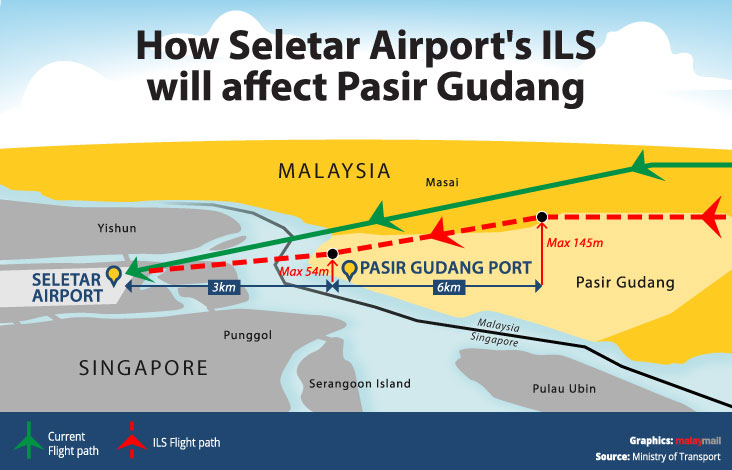
Seletar launches new terminal

As WSSL/Seletar prepares to open its new $80 million terminal on Nov 19, the authorities have announced that WSSL is now a “schedules facilitated” airport.

Don’t panic – at least, not yet. This basically just means that because demand is now getting close to the airport’s capacity, all airline and charter flights must confirm their schedules with the airport in advance  – BA/GA flights don’t need to do this.

It does not mean that the airport has become slot coordinated, although that might happen at some point in the future if congestion continues to be a problem.

As for the new terminal, it looks like it will be a decent improvement on the old one…

The new facility – six times bigger than the old terminal – will be split in two, with one large section for airline flights, and another separate section dedicated for GA/BA.

Here’s a video of what the new terminal looks like!

The idea is to free up capacity at WSSS/Singapore by moving all scheduled turboprop flights to WSSL/Seletar when the new terminal opens. At the moment, the only airline that falls into this category is Malaysia’s Firefly – which currently operates 20 daily flights at WSSS – to and from WMSA/Subang, WMKI/Ipoh and WMKD/Kuantan.

Important to note – all BA/GA traffic must switch to using the new terminal when it opens on Nov 19 at midnight local time. Jet Aviation have provided a handy printout which tells you all you need to know about using the new terminal. Note that the new terminal is on the other side of the runway from the old terminal!


Buenos Aires airports closed to GA/BA during G20 summit

The 2018 G20 Leaders meeting will be held in Buenos Aires on November 30 and December 1, 2018. GA/BA flights will be prohibited from operating to both SAEZ/Ministro Pistarini and SABE/Jorge Newbery – but also all the smaller airport across the city as well.

AIP SUP A28/2018 goes into all of the restrictions in detail, but here are the key takeaways.

The airports…

Between 1500L on Nov 29 to 2200L on Dec 1 (1800Z Nov 29 to 0100Z Dec 2), here are the restrictions:

  • SABE/Jorge Newbery – will be totally closed to all non-G20 aircraft.
  • SAEZ/Ministro Pistarini – will only accept regular airline flights. All GA/BA flights are prohibited. RWY 17/35 will be closed and used as a taxiway and for parking only. Many SID and STARS will be suspended and a full list is in Appendix 2 of the SUP(UPDATE 22NOV: Notam A9669/18 has now been published which brings forward the start time for the ban at this airport to midnight local time on Nov 26).
  • SADP/El Palomar – closed to civil ops, although 8 slots will be made available to airlines from 1800Z-2300Z on Nov 29.
  • SADF/San FernandoSADJ/Mariano Moreno, SADM/Morón – all closed to civil ops.

So with all the Buenos Aires airports out of action for GA/BA over these dates, there aren’t a lot of other options. The closest international airports are: SAAR/Rosario to the north, SAZS/Plata Del Mar to the south, or SUMU/Montevideo – but that’s in a different country!

Bottom line – if you’re GA/BA and you need to get to Buenos Aires at the end of the month, you’ll need to make sure you go there before the G20 restrictions come into force on 1800z on Nov 29.

The airspace…

SAEF/Ezeiza FIR will see the following restrictions in place between those same timings, 1800z Nov 29 – 0100z Dec 2:

  • All users must submit a flight plan a minimum of 6 hours before estimated off blocks time.
  • All aircraft must operate on discreet transponder codes at all times.
  • An ADIZ is in place out to 250NM from EZE VOR from SFC-UNL within the FIR.
  • There will be 3 temporary restricted areas in place, BAIRES, SPY GLASS and ROJO.
  • The BAIRES airspace overlays on top of SAEZ/Ministro Pistarini  out to 55nm.
  • Expect Air Force fast jets to be patrolling and operating with ‘due regard‘ overhead during various times.

Did we miss something? Get in touch!


Canadian Ops Update

Just a short update on a few things happening in Canada that you might have missed…

Nationwide
  • There has been a change in the Maximum Indicated Airspeeds for holding patterns to bring them more in line with the rest of the world. This came into effect on 11OCT18 and will be reflected in the 08NOV18 AIP update. Refer AIC 25/18.

  • It’s been over a year and a half since NavCanada suspended it’s Climb/Descend via SID phraseology, adding a complication for pilots that regularly cross the border from USA to Canada and v.v. It initially trialed then quickly suspended them “out of concern over altitude deviations we were seeing in the system and the unforeseen large increase in workload as a result. We are continuing to communicate with airlines, aircraft operators and our employees as we revert to the phraseology rules that were in place prior to this change.​” We understand this phraseology has now been officially put in the trash and wont be returning.
CYYZ/Toronto Pearson Airport
  • There are new nighttime RNAV approaches starting in CYYZ/Toronto Pearson from 08NOV18. These RNAV (GNSS) X instrument approach procedures are for night-time ops between 0030L-0630L on runways 5/6L/6R/23/24L/24R. The procedures are designed to minimize the noise footprint. The ATIS will advertise these as the primary approach type when they are active. Pilots can expect to be cleared directly to the initial approach waypoint, then subsequently cleared for the approach including the appropriate transition. Refer AIC 28/18.

  • Slots are currently required for all flights between 0030-0630 local time. The airport authority was planning to make slots mandatory for all GA/BA flights H24 from Nov 17 onwards, but this will now be delayed to some time in early 2019. For more info, contact the Airport Reservation Office at aro@gtaa.com

Do you know more? Drop us a line!


No change to Iran airspace warning despite new US sanctions

The US reimposed sanctions against Iran on Nov 5. Despite this, so far there has been no change to the FAA guidance to US operators issued on 9th September 2018: flights to Iran are not prohibited, but operators should “exercise caution” when flying in Iranian airspace.

However, with the reimposed sanctions comes a new problem if you’re a US operator: you’re allowed to overfly Iran, but you’re not allowed to pay for all the things needed to make that happen – things like overflight permits, and nav fees.

The rule is simple: no US person or business can pay for services in countries with sanctions against them (like Iran), unless that person or business has a licence to do so, issued by the Office of Foreign Assets Control (OFAC).

And you’re not allowed to get an agent to do it for you either; it’s illegal to skirt the OFAC laws by using a 3rd party company (unless, of course, they’ve been approved by OFAC).

So the big question we have now is this: if you’re planning to overfly Iran, have you figured out the legalities of paying for services? How are you making that work? Know someone who’s got an OFAC licence for Iran? Let us know!

And one other thing to watch out for – operators with US based insurers should double-check their policies, as you may now no longer be covered for flights to Iran, due to the new sanctions. This is worth checking, even if you’re only planning on overflying the Tehran FIR, as any unplanned landing (decompression, medical, engine fire) may force you into Tehran or another airport – it’s a big chunk of airspace.

Further reading:


AYPY/Port Moresby restrictions during APEC 2018

The 2018 APEC meeting will be held in AYPY/Port Moresby, Papua New Guinea on 15 and 16 November, 2018. If you’re trying to get there, here’s what you need to know…

What’s happening at the airport?

  • Parking – There may not even be enough space for all the official delegations’ aircraft, let alone anyone else, so expect parking congestion also at YBCS/Cairns and YBTL/Townsville airports. YBTL will also be used as a base by Australian military aircraft tasked with assisting the airspace security during the event; if you are heading there, make sure you read and carry the AIP SUP H99/18.
  • Night closures – Closures of the main runway (14L/32R) mean that the airport is effectively closed each night from 2100-0430 local time until 13 November.
  • Customs – if you’re actually going to AYPY during this period, you can view the APEC Customs handbook here.
  • Flight Plans – If you indicate the wrong ADS-B FLT ID (in Section 7 of your FPL) and are inbound or outbound to AYPY/Port Moresby or AYNZ/Lae Nadzab you can expect a 20 minute delay or holding (A1069/18 refers).

What’s happening in the airspace?

AIP SUPP 5/2018 outlines the airspace restrictions for APEC2018. Here are the important bits, all effective from Nov 2-20:

  • Watch out for overflights of AYPY, as there’s a 90 NM ADIZ in place around the airport from SFC-FL600.
  • There is a temporary restricted area (TRA931) 30 NM around AYPY, SFC-FL330. Anyone flying to/from AYPY with a valid flight plan and talking to ATC can enter this area.
  • There is another more restrictive area (TRA930) over the CBD and event venue. Only APEC aircraft can enter this area.
  • Actual activation times will be notified by NOTAM.
  • Expect Royal Australia Air Force FA18 fast jets to be patrolling and operating with ‘due regard‘ overhead during various times

A real life report…

Here’s a report from an Opsgroup member trying to operate to AYPY/Port Moresby for the APEC summit:

- The closest parking spot we could get for a G650 is YPDN/Darwin. We were denied parking in YBCS/Cairns; we were told parking is reserved for head of states only. YBTL/Townsville denied us parking too, on the basis of no space available.

- The handler at AYPY/Port Moresby is not very responsive at the best of times, and has been unreliable also in the past, even when no special event was going on. In the past we once even got handling confirmed for an arrival during a scheduled runway closure!

- Until Nov 30, crew/pax visas cannot be arranged upon arrival, to enhance security during the APEC event. Instead, visa requests must be made through embassies during this time. This is normally not a problem outside of special events. The PNG Embassy in London have been very quick in getting visas approved for our crew, with a maximum turn of 5 working days, and as short as 3 working days.

Some other Supplementary information if you are operating to AYPY/Port Moresby:

  • High terrain in close proximity.

  • Navaids not monitored by ATC. Standby power reported to be available. Jackson and Parer locaters no longer in operational use. Disregard any procedures that use these aids.
  • Navaids may not be accurate or serviceable. Review all available information prior to use and perform appropriate crosschecks to verify navaid integrity.

  • ATC may give inappropriate radar vectors and ALT instructions. During radar outage, ATC will provide procedural control. Maintain situation awareness to ensure safety not

    compromised. Refer to Radar Terrain Clearance Chart to cross-check altitudes.
  • RWY 14L has upslope for 3/4 of its length, then slopes downward to the RWY 32R threshold, giving the illusion that the runway is shorter than actual.
  • In gusty winds, expect windshear on approach RWY 14L.
  • T-VASIS may be unserviceable without prior warning.
  • Engine start clearance not required unless notified on ATIS.
  • POB should be given with pushback request.
  • Airway B220 is a designated two-way airway. Beware potential late-notice opposite direction traffic given close proximity to FIR boundary.
  • Short-notice deterioration of ATC services may occur. If ATC not available, revert to CTAF on tower frequency.

Did we miss something? Let us know!


Pay up or else! Crew held hostage by Customs agents in Ivory Coast

“Beware all pilots traveling to Abidjan, Customs is waiting for you!”

That is the message we received in a disconcerting report this week from one of our long-time members which certainly troubled us here at OpsGroup. We thought it was important to share.

The pilot told us that he and his business jet were recently “held hostage” by airport custom officials in the port city of DIAP/Abidjan, Ivory Coast, West Africa.

The crew had all the appropriate landing and overflight permits as required. GenDec’s, passports and associated documents were also in order. Therefore, all the evidence points to a good old fashioned shakedown and a convoluted scheme setup between local Customs agents and certain ground handlers to extort bribes from foreign crew.

The report we received explains how the crew were ramp checked by Customs officials after landing. The aircraft documents were confiscated and the Captain was “interrogated until 1am” the following morning.

The officials claimed that the pilot both failed to declare their arrival, as well as the “aircraft contents, passengers and baggage.”

The fine was CFA 6,900,000,000 (yes billion!) francs, which equates to USD $12,066,720 (yes, million!)

Ay Caramba!

The offence was purported to be importing a high value item (aircraft) without customs approval. The high fine figure was “based on the insurance value of the aircraft.”

The crew were held hostage in the country for 10 days until senior Customs officials could finally agree on the appropriate “accusation” and that the associated fine was actually “legal”.

After the 10 days, the crew were able to negotiate a deal and depart safely – although not without having to involve the aircraft’s insurance underwriter, who paid a ‘substantial amount’ for the aircraft to be allowed to depart.

On reflection, the crew noted that if Customs does meet your aircraft without you arranging it in advance, “you can be sure you are about to be trapped.” They do not tell you why they are looking for documents, more specifically, your aircraft documents, and will not tell you anything as they walk away to call their seniors, carrying your documents with them.

So in short: do not let go of your documents!

The advice from our member:

  • Contact the handling agent first hand and double check that they are an approved, recognized handler and have approval from the various authorities (immigration, customs, police, anti-drug) to operate airside. Also check that they can arrange for you to get to the Customs and Immigration officers landside. Do not assume because the handler takes all your documents and gives you an invoice and receipts that the authorities have been advised of your arrival and situation.
  • The Abidjan Customs authority does not recognize a GenDec as an approved form of advice about passengers, health and cargo. They will also not sign off on the submitted GenDec. They will not come to your aircraft unless you specifically arrange for them to do so.

It’s important to stress that we are not talking about a small African airstrip in the back lots. This is a large international gateway with many major international airlines serving the city. Over 4 million people live here and it’s the economic capital of the Ivory Coast.  But corruption is endemic, it spills over every sector of the public administration; clearly even into Customs!

As Brookings put it, “for the inspector, the temptation is large because his salary is relatively small compared to the potential bribe.” It still doesn’t make it right and this experience serves a timely warning for all crew operating through the airport.

Have you been subjected to similar behavior when passing through DIAP/Abidjan? Let us know.

Extra Reading


Non-refundable Bangladesh permits

The Civil Aviation Authority of Bangladesh recently published circular 02/2018 which outlines a $195 USD overflight permit fee for non-scheduled foreign aircraft transiting the VGFR/Dhaka FIR . The fee is certainly on the high side but the disappointing part is :

“The payment is non-refundable, irrespective of the approval or rejection to the permit request.”

Say what?

There was a similar type of no-refund situation within the TNCF/Curaco FIR but we now understand after some noise, operators are getting refunds as per normal industry practice.

We say it’s time for the CAA in Bangladesh to stop this non-refundable nonsense.

Have you had a permit denied and not received your money back? Reach out and Let us know!


Your top three PBCS questions answered

PBCS has been an ongoing PITA for some time now. We wrote about it back in March. Here are the top three questions we’ve had on it since then – and now we finally have some answers!

Question 1: What happens if I still haven’t received my updated A056 LOA?

After the PBCS tracks were introduced in March 2018, the FAA published a Notice requiring all N-reg operators to update their A056 LOA authorization – regardless of whether or not they intended to fly these PBCS tracks. For private (Part 91) operators, the deadline to submit the application was 30th September 2018.

There was a barrage of applications, and the FAA still seem to have a bit of a backlog, as even now some operators have still not received their updated approvals.

The FAA’s unofficial policy is that as long as you have applied for a revised LOA, you can continue to use your old authorization after September 30th, while you wait for the new one to be issued.

Bottom line: This means you are allowed to keep flying in the North Atlantic, just not on the PBCS tracks.

Question 2: What about that problem with aircraft with Honeywell systems installed?

Back in March, a latency timer issue with certain Honeywell FMS systems meant that there were bunch of aircraft which weren’t able to get the PBCS approval.

In June, Honeywell issued a service bulletin fix for the issue, available at varying times for different aircraft. Since then, the FAA has been issuing the updated A056 LOA approvals to those aircraft with the Honeywell systems that reflect the new capabilities but the still don’t meet the PBCS requirement of RCP240 due to the latency timer issue.

Bottom line: Now those affected aircraft are able to receive the updated A056 LOA approvals, just with a PBCS restriction – meaning they can continue to operate in the North Atlantic, just not on the PBCS tracks.

Question 3: What the heck is PBCS anyway?

PBCS stands for ‘performance-based communication and surveillance’.

PBCS involves globally coordinated and accepted standards for Required Communication Performance (RCP) and Required Surveillance Performance (RSP), with the goal being to allow the application of reduced lateral and longitudinal separation to aircraft which meet the criteria.

To be PBCS compliant, you basically need CPDLC capable of RCP240 and ADS-C capable of RSP180; this effectively means having a 4 minute comms loop, and 3 minute position reporting.

PBCS has been implemented in various different chunks of airspace around the world, but most notably in the North Atlantic, where the three core daily NAT Tracks are assigned as PBCS tracks between FL350-390. To fly those, you will need to be PBCS compliant (read above) but also have RNP4 (the rest of the NAT only requires RNP10).

Feeling queasy? That’s okay, reading about PBCS makes us feel that way too. If you’re still hungry for more though, check out our recent article on all things PBCS!

More questions? Get in touch!


NAT – Choose your own Adventure

For the latest changes and updates on the North Atlantic, including our most recent Guides and Charts, use our NAT reference page at flightservicebureau.org/NAT.

The NAT used to be simple. Fill your flask, fire up the HF, align the INS and away you went.

Now, it’s a little more complicated. Basic Instruments are not enough. Use this quick and dirty guide from FSB to figure out where you are welcome on the NAT, depending on what equipment and training you have. Valid for October 15, 2018.


Indy Center kicks off CPDLC trials – the system is live!

The United States is rolling out En Route FANS CPDLC during 2018-19, for all equipped, trained and permitted operators. The FAA’s Advisory Circular AC 90-117 outlines the requirements for U.S. operators.

Trials have begun with KZID/Indianapolis going live with 24/7 ops starting last week.

We also understand that KZME/Memphis and KZKC/Kansas City are still in the testing phase with CPDLC and voice read back happening 1-2 nights per week during the midnight shift.

The current deployment schedule as it stands can be found in this graphic. [if you know what DFV means, let us know!]

How to participate:

  • The FANS logon is “KUSA” for the entire country and you may logon at any time. The CPDLC connection will become active after departure, and the crew is notified via a welcome message uplink. If En Route FANS CPDLC enabled airspace is active, you will stay logged on. If the aircraft transitions from En Route FANS CPDLC enabled airspace into non-Data Link airspace with an active CPDLC connection then the connection will terminate approximately seven minutes after exiting.
  • To participate, file “DAT/FANSE” in Field 18 of the ICAO Flight Plan.
  • Equipment required is VDL Mode 2, indicated as “J4” in Field 10a of the ICAO Flight Plan.
  • If an operator wants to use domestic En Route FANS CPDLC and is already using FANS DCL then the the majority of operations will fall into one of these scenarios:
    • (1) The operator uses FANS DCL via the “DAT/1FANS2PDC” preference in Field 18 of the ICAO Flight Plan. In that case, update the preference to “DAT/1FANSE2PDC“.
    • (2) The operator uses FANS DCL via the FAA’s Subscriber Database. In that case, the operator will want to add the entry “DAT/FANSE” in Field 18 of the Flight Plan.

Some things to keep in mind:

  • Domestic En Route FANS CPDLC enabled airspace will be seamlessly integrated with foreign (Canadian) and Oceanic FANS CPDLC enabled airspace.
  • The Oceanic Clearance will not be delivered via FANS CPDLC. You will still need to request the clearance via AFIS/ACARS or obtain it via voice.

Have you had the chance to try it out recently? Let us know!

Extra Reading:


Extra overnight slots for Hong Kong extended until 2019

We reported a few months back that the Airport Authority (AAHK) and the Hong Kong Schedule Coordination Office (HKSCO) have decided to trial an increase in slot availability from 4 to 6 total slots each night. It looks like the trial is being extended until March 2019.

The published details:

Notice on night slot availability (trial from 8 August 2018 until 31 March 2019)

  1. The number of slots available for GA/BA operations between 0000 to 0500 local time (16-21 UTC) will increase from 4 slots daily to 6 slots daily.
  2. The application procedure for these 6 slots will be the same as that for the 4 daily slots currently available.
  3. The above are provided on a trial and temporary basis and are subject to continuous review jointly by AAHK and HKSCO.
  4. Also important to note, as pointed out to us by our friends at the Asian Business Aviation Association (AsBAA) – these 6 slots will be made available to all aircraft types, not just the ones currently exempted from the noise abatement regulations. This means that BBJ’s/ACJ’s/Lineage 1000/Globals/G650ER etc can now operate in and out of Hong Kong at night-time, subject to slot availability.

PBCS – What, Where and How

In Short: The performance-based communication and surveillance (PBCS) framework allows for higher safety standards and more efficient airspace use. If your aircraft already has the equipment and you cross the Atlantic or Pacific Oceans often, it’s worth looking into getting your regulatory approval.

PB… what? It’s a good question. We have so many acronyms in aviation, it’s easy to forget what this one stands for and what it really means. So, let’s try and get to the bottom of it.

What is PBCS?

Official answer:

The ICAO performance-based communication and surveillance (PBCS) framework ensures that emerging technologies for communication and surveillance fully support ATM operations and are implemented and operated safely.

In plain speak:

With the technology already available on many aircraft and in the Air Traffic Control facility, aircraft can now fly closer than ever before, especially over non-radar oceanic airspace.

There are two key buzz words, so let’s define them. They are interlinked with RNP – Required Navigation Performance.

  • RSP – Required Surveillance Officially known as “surveillance data delivery”, often stipulated in the Airplane Flight Manual. Basically, how often does the aircraft send its position to ATC/ground station. There are two specifications, RSP180 and RSP400. The numbers indicate the maximum number of seconds (180 or 400) for the transaction to occur.
  • RCP – Required Communication ICAO has two specifications, RCP240 and RCP400. Again, the numbers indicate the maximum number of seconds (240 or 400), or “transaction time” taken for the controller to issue an instruction to the crew and for them to receive a response. This could be via CPDLC, HFDL, VDL or SATCOM.

So, we have a loop here, C-N-S. Communication, Navigation and Surveillance. An aircraft sends surveillance information to ATC about where it is; the aircraft stays within confines of RNP navigation requirements and ATC communicates with the aircraft within the required transaction times.  Pretty easy!

But why do we need PBCS?

The take away? If all given aircraft in a certain airspace have a lower RSP value and a lower RCP value, we can start putting these aircraft closer together.

Essentially – performance-based separation minima. This allows aircraft to be separated safely according to technological capability rather than “one-size-fits-all” prescriptive distances.

What are the differences from PBN?

They are similar but there are notable differences. In a simple sense, the PBN (RNP/RNAV) only requires that the operator obtains approval because it focuses on how the equipment works. PBCS (RSP/RCP) however requires the involvement and approval of the air traffic service provider because it’s a two-way communication and surveillance effort. There are dependencies and complexity with the equipment standards on both ends.

In this graphic you can see a high-level summary of who is responsible for what:

Where is it in place?

Currently PBCS is in effect in one form or another in the following FIR’s

  • NZZC/Auckland Oceanic
  • NFFF/Nadi
  • KZAK/Oakland Oceanic
  • PAZN/Anchorage Oceanic
  • WSJC/Singapore
  • VCCF/Sri Lanka
  • NTTT/Tahiti
  • RJJJ/ Fukuoka
  • KZNY/New York Oceanic
  • CZQX/Gander
  • EGGX/Shanwick
  • BIRD/ Reykjavik
  • LPPO/Santa Maria Oceanic

The Air Traffic Service providers of China, Brazil and Indonesia have also shown interest to introduce PBCS in the future.

Specifically, PBCS is being used between FL350 and 390 on certain “half” NAT tracks as we have written about before.

What do I need to do?

Requirements vary from state-to-state on the exact procedure for obtaining approval. It’s important to note that not all aircraft are automatically PBCS ready (refer to your aircraft manufacturer and your airplane flight manual).

The FAA has outlined its approval process here and has a handy powerpoint document here.

An important element is to prove that you have signed the “PBCS Global Charter” which can be found at the FANS Central Reporting Agency (CRA) website.

When a PBCS authorization is obtained an operator is required to file both P2 (indicating RCP240) in item 10 and SUR/RSP180 in item 18 of the flight plan, in addition to the J codes for CPDLC and D1 or G1 for ADS-C in item 10.

The correct filing of these two codes will indicate to any ATM ground systems applying performance-based separation minima that the aircraft is eligible for these minima and that the crew have received the relevant training in order to safely operate using the reduced separations.

Will you notice that PBCS standards are being applied to your flight?

Ok this is the funny part of this story. The short answer, probably not.

While it may be easier for RCP240/RSP180 approved aircraft to obtain optimal flight profiles, especially during high traffic periods, and particularly for NAT flights using the OTS, the application of these standards is generally tactical in nature for ATC. An aircraft may not have performance-based separation applied at all on an individual flight, or possibly may never have had it applied to any of its flights. Even if a you have RCP240/RSP180 approvals, if the aircraft nearby does not also have the approvals, the separation standards cannot be applied!

What if I don’t have RCP240 and RSP180 approval?

If you do not have RCP240/RSP180 approvals you will always have the larger separations, e.g. 10-min, applied, and not be eligible for the lower standards in cases where it may be beneficial.

The only airspace that has implemented tracks that will require PBCS to file is in the NAT OTS. There are still non-PBCS tracks in the OTS for which PBCS approvals are not required.

All other airspace in which performance-based separation minima are currently applied will allow aircraft with and without RCP240 and RSP180 approvals to enter and use the airspace in a mixed-mode operation.

Will I be penalized if I don’t have it?

Probably not in the short term. In the future as more and more airspace corridors become PBCS only, then it is possible you may be subject to reroutes, delays or the requirement to fly outside of certain flight levels.

So, our conclusion?

PBCS is a great step forward in maximizing efficiency in a busier airspace environment thanks to the advent of better technology. If you fly the NATs often and have an aircraft capable of PBCS certification standards, then yes – do it! The approval process is not overly burdensome, and many modern transatlantic jets already meet most of the technical requirements.

Ultimately, reduced separation standards mean more great air-to-air views. So, pack your camera!

Did we miss something, or does something need more explaining? Let us know!

Extra Reading:


Santiago, Chile – Temporary Runway Changes

New NOTAMS (pretty poorly written ones – but hey that’s another topic) have been issued for SCEL/Santiago in Chile, outlining some runway configuration changes between 31 October and 20 December, 2018.

Operational Changes

  • RWY 17L/35R will be closed for heavy maintenance between 1200z-2259z (0900L-2000L) daily except during low visibility operations.  (NOTAM A3273/18)
  • New RWY 18/36 established on current Taxiway Alpha and will be used in place of 17L/35R for aircraft up to A321 size. It’s dimensions are 2280M x 36M. See updated ground chart here. (NOTAM A3262/18)
  • New RWY 18 GNSS approach established. See this chart. (NOTAM A3263/18)
  • The STARs currently used for 17L will be applicable for RWY 18. (NOTAM A3265/18)

Opsgroup members have also advised us that;

  • Due to standard late night noise restrictions, departures will be required to use 17L (not 17R).
  • Pay careful attention to the substantially different missed approach procedure for GNSS RWY 18 procedure. This has been designed differently to allow a “tighter” traffic sequence and permit simultaneous operations on 17R. This is not normally possible due to the conflicting departure and missed approach paths.

If you do get to head to Chile, grab the window seat and grab a camera! I took these last year!

It really is such a great approach!


NTSB: Current NOTAM system is “just a bunch of garbage”

You were all very supportive when we wrote the initial article on the BS Notam problem last year, and have followed our journey in fixing the problem since then.

Big news!

The NTSB called the Notam System a bunch of garbage on Tuesday this week, and assigned probable cause of the AC759 incident in SFO to the Notams that were missed.


What this means to OpsGroup is massive fuel to our fire: we are working hard to fix this problem, and having a public facing government organisation like the NTSB come down like a ton of bricks on the Notam System drives us forward in leaps and bounds.

The group members have been decisive in helping us to identify the problem and taking action to fix this. So, we want to acknowledge all of you! Great work!

In solving two of the above five problems, we have been working with ICAO for several months now. You all got involved in Normand 17,000 Notams later, we happy to report that version 0.1 of Norm is now live on the ICAO website. Norm is a bot – an AI, that has learned what Notams look like, and thanks to OpsGroup rating these 17,000 Notams, is also learning which ones are critical and which ones are not.

He’s still young. He doesn’t get everything, but if you feed him a Notam you’ll see him assign it a criticality of 1-5.

This will in turn allow us to sort Notams, putting the most important stuff first.


Check your checklist! Lessons from fatal King Air accident in Melbourne

The pilot at the controls of a Beechcraft B200 Super King Air that crashed shortly after take off had the aircrafts rudder trim in the full left position for take off, the Australian Transport Safety Bureau (ATSB) has found.

The ATSB final report said the aircraft’s track began diverging to the left of the runway centre line before rotation and the divergence increased as the flight progressed.

It then entered a shallow climb followed by a “substantial left sideslip with minimal roll” before beginning to descend. At this point the pilot issued a mayday call seven times in rapid succession.

Approximately 10 seconds after the aircraft became airborne, and two seconds after the transmission was completed, the aircraft collided with the roof of a building.

What Happened?

The investigation found that the pilot did not detect that the aircraft’s rudder trim was in the full nose-left position prior to takeoff.

“Prior to takeoff, there were several opportunities in the pre-flight inspection and before takeoff checklists for the pilot to set and confirm the position of the rudder trim,” the ATSB final report said.

A King Air flight simulator was used to recreate the event as part of the ATSB investigation.

The pilot who performed the flight simulator test commented that:

The yaw on take-off was manageable but at the limit of any normal control input. Should have rejected the take-off. After take-off the aircraft was manageable but challenging up to about 140 knots at which time because of aerodynamic flow around the rudder it became uncontrollable. Your leg will give out and then you will lose control. It would take an exceptional human to fly the aircraft for any length of time in this condition. The exercise was repeated 3 times with the same result each time. Bear in mind I had knowledge of the event before performing the take-offs.

The pilot also stated that it could be possible for a pilot to misinterpret the yaw as being caused by an engine power loss rather than from a mis-set rudder trim.

Safety message

Cockpit checklists are an essential tool for overcoming limitations with pilot memory, and ensuring that action items are completed in sequence and without omission. The improper or non-use of checklists has been cited as a factor in some aircraft accidents. Research has shown that this may occur for varying reasons and that experienced pilots are not immune to checklist errors.

This accident highlights the critical importance of appropriately actioning and completing checklists.

Checklist discipline

In previous correspondence between the accident pilot and the ATSB when discussing checklists, the pilot stated that:

“You don’t get complacent as a pilot but you get into a routine. The same as your pre-take-off checks, you get a routine and you don’t need to use a checklist because you are doing it every day, you are flying it every day… I take-off with one stage of flap because it gets me of the ground quicker. And I never change my routine…”

Wait what!??? It is stating the obvious but it’s a timely reminder that checklists are an essential defense against pilot errors. 

Sadly, it could have been a life-saver in this instance.

The ATSB video to supplement the report.


Why are we still flying airline passengers over war zones?

Here’s the level of inconsistency we’ve reached in international air transport: we take each passenger, scrutinize their booking, check the no-fly-list, watch them on CCTV, pull them apart at TSA, remove anything sharper than a pen, question them, x-ray the bags, run Explosive Trace Detection tests, screen the hold baggage, background check every member of the crew, and then, once they’ve all boarded, fly this ultra-secure airplane straight into a war zone.

Welcome to the Eastern Mediterranean. It’s an active conflict zone. The Russian naval build up there this month is the largest since Moscow’s intervention in Syria began in 2015. Over Syria, 9 aircraft have been shot down this year.

The most recent was on Monday night this week, when Syria came under attack from Israel fighter jets, and started firing indiscriminately at anything off the coast that looked like a threat. They wanted to shoot something down, and they did — except it was a friend, not foe. They took out a Russian Ilyushin IL-20M transport category airplane. Even on the worst radar, that doesn’t look anything like an Israeli F-16.

50 miles away from where the Russian aircraft plunged into the sea on Monday night is the international airway UL620, busy with all the big name airline traffic heading for Beirut and Tel Aviv. If Syria can mistakenly shoot down a Russian ally aircraft, they can also take out your A320 as you cruise past.

And yet, most airlines continue to operate. Are we really so comfortable with operating in conflict zones again?

The lessons of MH17 seem to be fading fast. It’s a little over four years since 298 people lost their lives over Ukraine one summer afternoon, thanks to an errant missile fired during a civil war at an aircraft that they thought was a military threat. “Why were they over a war zone”, everyone cried afterwards.

Well, we all were. Me too. I was a pilot for Austrian Airlines at the time. I recall one morning in Vienna, some months before MH17. Boarding the last of the passengers, my BBC news app flashed up a story about a helicopter being shot down in eastern Ukraine .

As we were headed east, with my colleague in the cockpit, we quickly plotted the position on our enroute chart, and noted that it was really close to our route. Maybe 30 miles north. “We might see something interesting!”, we said, and pushed back. We didn’t, nor did we think much more about it.

Do you see the thought process though? Before MH17, we didn’t consider the risks to our aircraft from war zones. Especially being so high. Helicopters might be getting shot down, but we’re at 35,000 feet. No problem.

This is why all of these airlines — mine, at the time, included — operated on the route.


Image: Der Spiegel

And then it happened, and none of us could quite believe it.

But we learned. “Conflict Zone” became a buzzword. We had task forces and committees, whitepapers and promises, and — myself included — talked at length about how this happened, why, and how to avoid it in the future.

And yet, here we are flying unsuspecting passengers along the Syrian border. If you’re unsuspecting enough, and buy a SkyTeam codeshare ticket — you’ll actually overfly Syria on the Honey Badger airline of the region, Middle East Airlines.

Here we are flying passengers in the Eastern Mediterranean war zone. Why is this happening?

My guess: because we don’t think anything bad is going to happen, because the airspace boundary lines on the charts make that little bit of sea near Cyprus feel different from that little bit of sea near Syria, but mainly because there is no clear guidance from Aviation Authorities.

Let’s start with Cyprus. The Nicosia FIR has a big chunk of unsafe airspace. The Russian aircraft on Monday was shot down on the Nicosia FIR boundary. What do the Notams say? Take a look. There are 97 of them. Mostly about fireworks at local hotels. Critical stuff indeed. Then there are 20 or 30 about “Russian naval exercises”. A clue, perhaps, but where is the black and white “An Aircraft was Shot Down on our Border on Monday?” . Or, since we are still using teletype to communicate Notams to crews, “AN AIRCRAFT WAS SHOT DOWN ON OUR BORDER ON MONDAY”. Wait, we have to abbreviate that, and use codes, for some reason. “ACFT SHOT DOWN ON FIR BDY 17SEP”. That’s better.

What about Turkey? Anything on the Eastern Mediterranean risk? Let’s have a look. Nope, just 132 Bullshit Notams, and something about an AWACS aircraft. See you back here in 30 minutes when you’ve read them all.

Remember, I’m being a pilot, an airline, a dispatcher, trying to find information on the Risk in the Eastern Mediterranean. And this is how hard it is.

EASA (European Aviation Safety Agency), how are you doing? Let’s start here, at the “Information on Conflict Zones”. Paragraph 2 tells us that ICAO have a Central Repository on Conflict Zones, launched in 2015.

No, they don’t. That died — quite a long time ago. This is where it used to live. So, there is no ICAO Central Repository on Conflict Zones. There is a new ICAO document with guidance on managing Conflict Zone risk (and it’s a bloody good one, too) — but where is the picture of current risk?

Let’s plough on through the EASA site. Aha! Seems we have a Conflict Zone alerting system, and Conflict Zone bulletins. Here they all are: https://ad.easa.europa.eu/czib-docs/page-1

The last one on Syria was issued on April 17th. But it seems to be just a list of Notams issued by other states. And these are out of date. The German Notam has expired, the French AIC has been replaced.

And there’s no guidance. No Map. No routes to avoid. Nothing about Cyprus, or Beirut. No mention of the Russian shootdown. No mention of the 9 aircraft shot down this year.

How am I supposed to know, as an operator, or pilot, what the risks are and where to avoid. We’re getting closer to the point here. You’re not supposed to rely on the Aviation Authority. That is their message. You must conduct your own risk assessment. You must research and find out about the risks yourself.

You are on your own.

If you’re a big airline, that’s probably fine. You’ll make your own decisions about where to fly, anyhow. But what about everybody else?

While OpsGroup works hard to get information out to our members — and we spend a lot of time researching risk — I would greatly prefer that we didn’t have to.

Aviation Authorities must issue better guidance for the aircraft entering their areas.

Let me remind you. Airlines are operating 50 miles from a position where an airplane was shot down at night, by a missile type that’s already taken out a passenger airliner by mistake, fired by a beleaguered Syrian defence post, at a friendly aircraft that they did not take time to identify.

And the guidance to operators from Authorities: NIL.


Opsgroup has now published Note 31: Airspace Risk in the Eastern Mediterranean. There is a clear risk to civil aircraft operating on airways UL620, UW74, UR18, and UP62. In simple terms, if you find yourself planned overwater east of Cyprus, reconsider your route.

Further reading: