



Key Points
- Three-Runway System has been fully operational since Nov 2024, improving slot and parking availability.
- HKBAC (the big BizAv terminal) has completed a major expansion, nearly doubling handling capacity.
- APIS is now fully enforced. Submit it at least an hour before departure to avoid fines.
- Expect RNP procedures, mountainous terrain and frequent wind shear.
- Macau is a solid alternative if Hong Kong doesn’t work out.
Hong Kong is one of Asia’s busiest BizAv destinations, and quite a bit has changed over the past couple of years. This is the 2026 Hong Kong survival guide: everything you need to know before your next trip.
Getting in and out of Hong Kong
Hong Kong sits hard against high terrain, and that shapes almost everything about flying in and out. Minimum safe altitudes run up to 4,300 feet close to the field, so every arrival and departure is built around RNP procedures flown precisely on the FMS and autopilot, with speed restrictions to manage the turn radius. Wind shear is the main hazard to plan for, especially on the southern runway (07R/25L) in winds of 15 knots or more, with the surrounding hills amplifying it.
Since the Three-Runway System came online, the airport has generally used the northern runway for arrivals, the southern runway for departures (plus some cargo and BizAv arrivals), and the centre runway for departures. Expect this to change over time as they continue to refine the whole Three-Runway System – check the latest AIP SUPs before you fly.
Hong Kong loves paperwork. Before any flight you need:
- A landing permit through the Civil Aviation Department.
- A confirmed parking slot through the Airport Authority’s BAPS (Business Aviation Parking Management System).
- A confirmed handling setup through HKBAC, the airport’s only BizAv FBO.
- A confirmed slot through the Hong Kong Schedule Coordination Office, booked via the third-party OCS system, which needs an account set up in advance.
- APIS filed correctly before departure.
Get a local trip support company involved. Hong Kong isn’t an airport worth trying to navigate alone. ASA Group has a local presence and years of experience getting this right.
Hong Kong Business Aviation Centre: the renovation and what it means for you and your passengers
HKBAC has been Hong Kong’s only FBO for private jet support for years, and it was starting to show. The facility historically handled close to 7,000 flights a year with around 100 based aircraft at peak, numbers that collapsed during the pandemic and have since come roaring back. The renovation was the response, and the refurbished facility is now fully open.
The physical footprint is up roughly fivefold, the parking apron has grown too, and the first thing you’ll notice is a new 26-metre all-weather sky canopy connecting the terminal to the apron, the first of its kind in Asia. Customs, immigration, and quarantine facilities have been upgraded, and there are new private VVIP suites. Handling capacity is now nearly double what it used to be, which means parking and handling slots are genuinely easier to get.
That doesn’t guarantee you a spot on the HKBAC ramp itself, though. There are remote bays around Taxiway N in the mid-field area, and if you land there, expect a van to ferry your passengers over, about a ten to fifteen-minute journey, depending on the airside traffic. There’s also long-term parking near the MRO hangars. One thing worth knowing: HKBAC often tows aircraft during longer parking stints, and that requires a brake rider, either a crew member or someone from an MRO. TAG Aviation, Metrojet, Hong Kong Jet, and Jet Aviation Hong Kong can all help with that.
The expansion tracks directly back to the third runway’s commissioning, which freed up constraints that had limited BizAv growth at Hong Kong for years. If you haven’t flown into HKBAC in the last year or so, expect a noticeably different building than the one you remember.
APIS: where enforcement has landed
The short version, if you missed our original piece from April 2025: APIS became mandatory for all crew and passengers, including transit, on every flight into Hong Kong, private and commercial alike.
The basics haven’t changed. Passenger data is due 40 minutes before departure, crew data 60 minutes, best bet is to submit both at least an hour out and not bother explaining the 40-minute rule to your passengers. Crew must be submitted twice per inbound flight, once before departure and again as a close-out message afterward, even with no crew changes. A “No Board” response bars that traveller or crew member outright – contesting it means calling the Command Centre directly on +852 2121 0008, or apisoperation@immd.gov.hk. The operator must submit directly or through a trip support provider, HKBAC itself can’t do it for you.
What’s changed is that the grace period is over. Enforcement went live on schedule on 1 September 2025, and penalties for non-submission, inaccurate data, or misleading information now run up to HKD 100,000 (roughly USD 13,000) per violation. That’s noticeably lighter than the EU’s equivalent regime (EUR 3,000 to 5,000 per violation), with license-withdrawal risk for repeat offenders, but it’s real money now, not a soft rollout.
Filing works two ways: register directly through the Immigration Department’s portal, or the easier route for most operators – let your trip support company file on your behalf. APIS isn’t new to BizAv generally, but it is new to Hong Kong within the last two years, so if you haven’t flown there in a while, or even if you’re a regular, it’s worth confirming you’re still doing it right.
The third runway: what it really changes
The physical runway, 07L/25R, opened back in July 2022. What matters for planning purposes is the full Three-Runway System, commissioned in Nov 2024 alongside the wider Terminal 2 and apron expansion, with a stated long-term design target of 120 million passengers and 10 million tonnes of cargo a year.
For BizAv, the direct effect is airside and terminal capacity. The indirect effect, and the one that matters to us, is that slot and parking pressure has eased as ATC works up to full mixed-mode use across all three runways. It’s a gradual change: slots are easier to get, but don’t confuse easier with easy. Keep booking early.
Nearby alternates, and why they’re not a quick fix
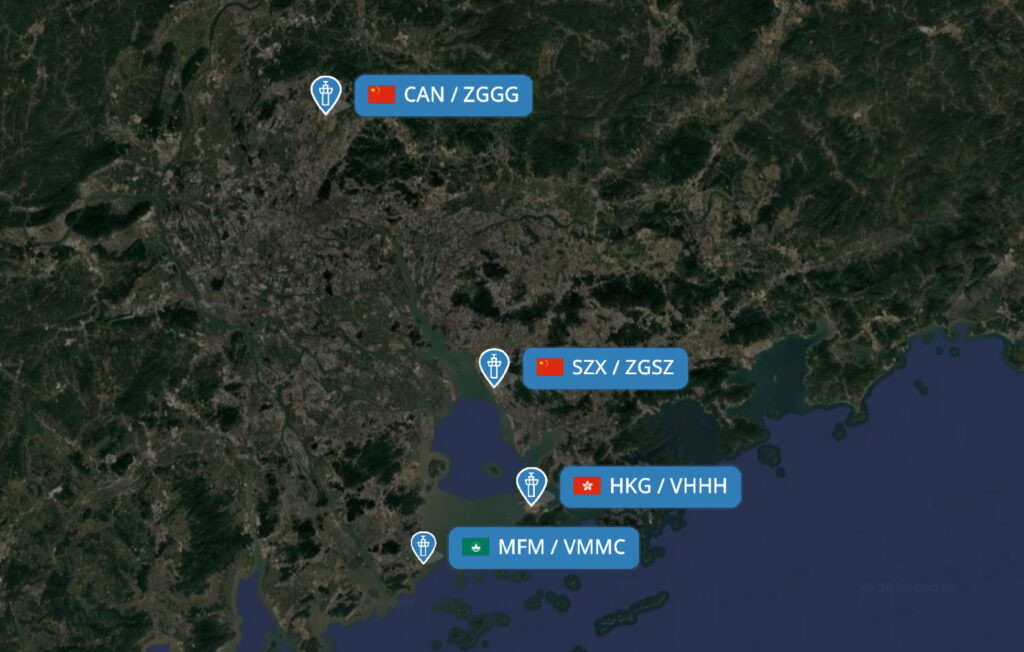
Hong Kong has plenty of nearby alternates, but most aren’t practical at short notice. Since 1 March 2025, aircraft docs for flights into mainland China must be approved before you can apply for a landing permit. Allow 7-10 days overall, or longer around Chinese public holidays.
A local trip support company earns its fee here. Get them involved early, as they can often speed up the process.
Foreign-reg aircraft face extra scrutiny getting recognised by mainland authorities, so get docs in well ahead of any Greater Bay Area trip. And if the mainland leg is part of a longer trip, sequencing matters: get one leg’s authorisation out of order and it can invalidate permits already issued for the next. That includes ad-hoc fuel stops, China permits are airport to airport specific.
And remember, if you divert into China, without any permits or customs approval, the chance of disembarking the passengers is slim. So, you can expect to remain on the ground until you can depart back to Hong Kong once the weather improves. This means that a Mainland alternate is not ideal. My pick is VMMC/Macao, or if the weather in the Greater Bay Area is bad, I use an airport in Taiwan.
| Airport | ICAO | Getting into HK | The catch |
| Shenzhen | ZGSZ | Road or ferry, roughly 1 to 2 hours | Full mainland CAAC permit process, treat it as a separate China trip |
| Guangzhou Baiyun | ZGGG | Road or rail, roughly 2 hours plus | Same CAAC process, busier slots, further from the city |
| Macau | VMMC | Van roughly 40 minutes, helicopter roughly 15 minutes | No mainland CAAC process, but its own permit and a separate immigration crossing |
Macau sits outside the mainland CAAC process entirely, which is exactly why it gets its own section.
Using Macau instead of Hong Kong
When the constraint is Hong Kong slots, HKBAC capacity, or simply cost, landing at VMMC/Macau and transferring passengers into Hong Kong is a real option, not just a workaround, if the timing works.
Macao has its own private jet handling through local FBOs; TAG Aviation Macau runs a dedicated facility there, and it’s my go-to whenever I’m there. From the airport it’s about a 40 to 45-minute van ride to Hong Kong Airport, or roughly 90 minutes into downtown Hong Kong by road. A ferry into downtown takes about 55 minutes, and if the client wants it faster, Sky Shuttle’s helicopter does it in about 15.
Macau also runs at roughly half the cost of Hong Kong for BizAv, fuel, handling, permits, all of it is cheaper. The trade-off is time, so it suits some trips better than others. As far as close-by alternates go, though, it’s the clear winner.
I fly to Hong Kong, here’s what I do…
Hong Kong is my local, but that doesn’t mean it can’t still catch out even seasoned operators. It’s a busy commercial hub, but Hong Kong manages BizAv traffic well. Still, there’s plenty worth being mindful of. Here are a few notes that might make your trip smoother…
Handling
Everything centres on HKBAC. The team is helpful, and there’s always a group ready to meet you for arrival and departure. It’s an expensive place to fly into, but then Hong Kong is expensive generally.
They use a belt loader for all baggage uplift and stage it around an hour before departure, so flag it early if you need it sooner.
HKBAC tags all crew and passenger luggage and handles security and customs checks too. If your crew needs aircraft access before the departure date itself, for pre-flight checks or to help with a tow that apron control has requested, apply for the ramp pass in the morning, it’s only available for collection in the afternoon, and you will need to arrange a security escort through HKBAC as well.
Arrival
The airport sits surrounded by large mountains, so expect real mechanical turbulence and wind shear. Hong Kong has a Windshear Detection Radar, and the advisories come in two flavours, ‘Expect Significant Windshear’ which is a radar generated warning and ‘Significant Windshear Reported’ which comes from pilot reports. Report it to ATC if you hit it.
All arrivals are RNAV. You may get vectored to the final approach fix, and ATC generally keeps your profile from getting too high. On the Runway 25s, don’t descend below 4,300 feet until established on the approach, read the charts carefully. ATC will often ask your final approach speed, and per the HK AIP, you must tell them if your Vapp is under 125 knots.
Take the RNAV 25R over the ILS if you have the choice. The ILS runs a complicated two-part RNAV transition, high workload, and you must not select approach mode (LOC/GS) before TOPAN. Stick to the RNAV Z unless cloud base genuinely forces the ILS, which is rare.
Even with calm winds on the ground, expect the approach itself to be bumpy. ATC assigns runways based on departure traffic; they know BizAv wants 07R/25L and will give it to you if they can, so there’s no need to ask. Land on 07L/25R instead and expect a longer taxi with several frequency changes, it’s a busy routing: cross 07R/25L at K6, then a right turn onto K and into the BAC.
Keep your exit off the runway prompt. Large-cabin bizjets land at similar speeds to medium airliners but slow down faster on the ground, and the high-speed exit can be a fair way down, so help ATC by minimising your runway occupancy time.
Call HKBAC on arrival on 131.1, “BAC Operations,” and they’ll tell you whether to expect the ramp itself or a remote bay. Once the doors open, they’ll offload passengers and cargo, customs screens everything, so know what’s banned, vapes and Zyns especially, they often reposition you to a staging bay quickly while you clean up. First thing once passengers are off: put the pins in. HKBAC won’t tow you without them.
For a short layover, the Sheraton at Tung Chung is a good call; otherwise, it’s about a 45-minute Uber into town.
Departure
The ramp is small, so expect a remote staging area while you prep the aircraft. Running the APU is fine, and around ETD minus 30 they’ll tug you into departure position, give them a heads-up if your passengers are running late. Departures increasingly happen from a remote bay too.
PDC and Digital ATIS are both available. Remember you need a start clearance – this isn’t the US.
Departures run off 07R/25L and 07C/25C depending on your routing and SID. On a ULR flight where fuel matters, you can request the closer runway (07R/25L) from ATC, but only for genuine performance reasons. It’s a short taxi, just don’t hold up cargo traffic taxiing from the same side if your cabin prep runs slow.
ATC is friendly and competent and expects the same efficiency back.
Departure clearance runs to 5,000 feet on your SID. Mind the noise abatement procedures – they expect you to accelerate to SID speed restrictions as soon as practicable, it’s all on the charts, and remember you’re operating in a sea of heavies. Hong Kong Departures only wants your first call to report altitude passing and non-climb, no need to report the SID itself. Expect to level at 9,000 feet until 20 to 30nm out, arrival traffic sits above you. And you can never deviate off SID track below 4,300 feet for weather, terrain doesn’t allow it, so factor that into any weather deviation around HKG.
Weather and other gotchas
Hong Kong is windy and turbulent, a byproduct of where it’s built – brief your passengers well before going in. Winter is the better flying season; summer brings typhoons and squally, fast-moving but intense thunderstorms, give them a wide berth. Local operators relocate aircraft out of Hong Kong ahead of typhoons, worth following their lead. When the wind is strong, 07L/25R is the pick, it’s the least affected by wind shear, but always check the ATIS or ATC for current warnings.
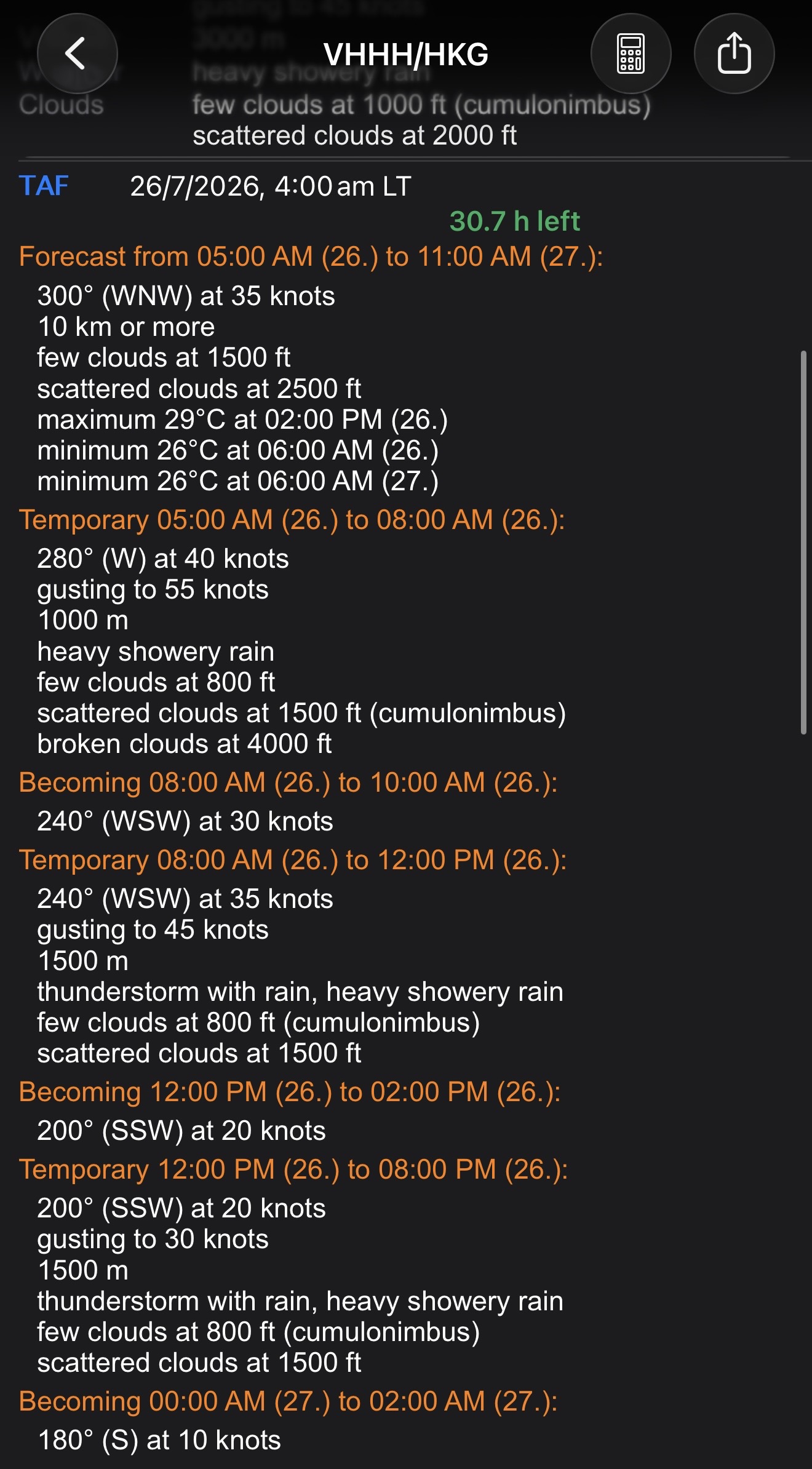
Typical TAF During a Summer Typhoon
One more thing worth knowing: Hong Kong Airport runs its own lightning alerting system, called ATLAS, on top of the general weather radar picture. An Amber warning, amber flashing lights all around the airport apron, means cloud-to-ground lightning predicted within 5km of the airport, and suspends non-essential apron activity. A Red warning, the same amber flashing lights plus a siren, means lightning within 1km of the airport island, and stops baggage handling and shuttle buses outright, even marshalling must stop, with ground staff taking shelter until it clears. If you’re at HKBAC when a red warning comes in, expect your ground handling to pause completely, so build some buffer into your schedule through the summer months. Passengers are only embarked or disembarked once the warning drops back to Amber.
The bigger picture
Hong Kong is a great airport for BizAv operators, but there’s just a bit more planning involved than at most destinations. The good news is that the third runway and HKBAC expansion have made Hong Kong easier to operate into than it was a few years ago. And if Hong Kong doesn’t work out because of slots, parking, cost or anything else, Macau is a solid alternative!

More on the topic:
- More: New APIS system coming to Hong Kong
- More: Seven things about Hong Kong
- More: Hong Kong: New Runway Opening
- More: Hong Kong: King of the Airports
- More: Hong Kong revised entry rules for flight crew
More reading:
- Latest: Can I open the aircraft door on arrival in the US?
- Latest: GPS trouble on the North Pacific routes
- Latest: The Luton Noise Trap
- Safe Airspace: Risk Database
- Weekly Ops Bulletin: Subscribe
- Membership plans: Why join OPSGROUP?




 Get the famous weekly






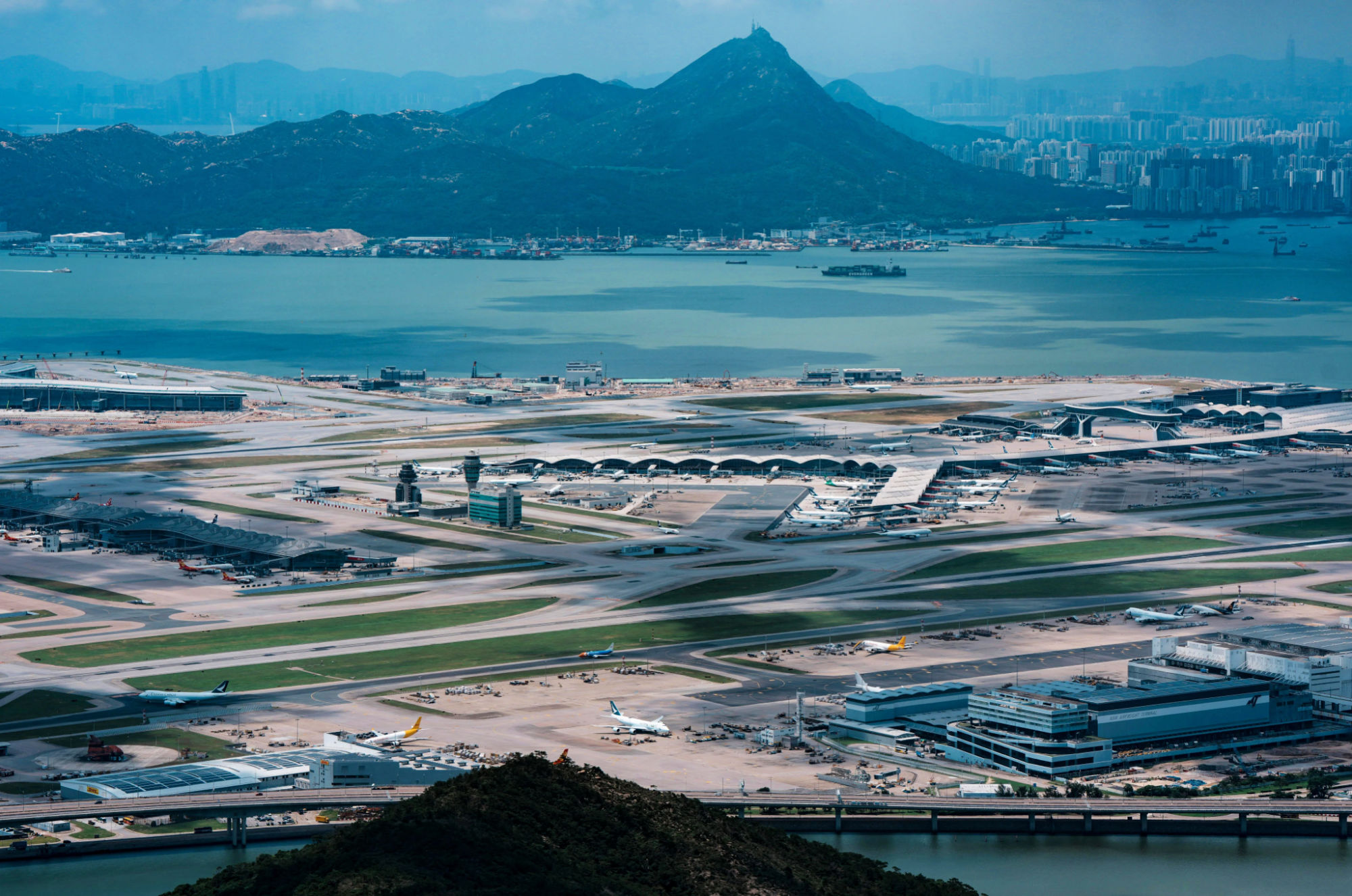
Update Airport picture. Much had changed since that picture was taken, Runway, taxiways, terminals. Just saying….
WS
Thanks Wayne, just changed it now!