Armenia-Azerbaijan Airspace Update

Key Points
  • Renewed conflict between Armenia and Azerbaijan on Sep 19, with military operations and exchange of fire in the Nagorno-Karabakh border region. Ceasefire agreed on Sep 20, coordinated by Russia.
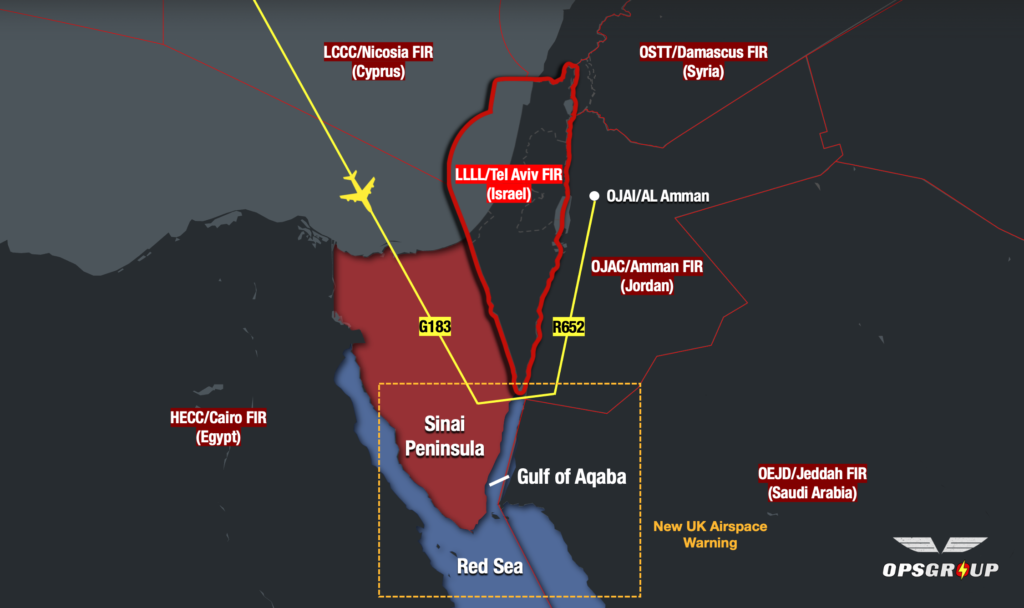
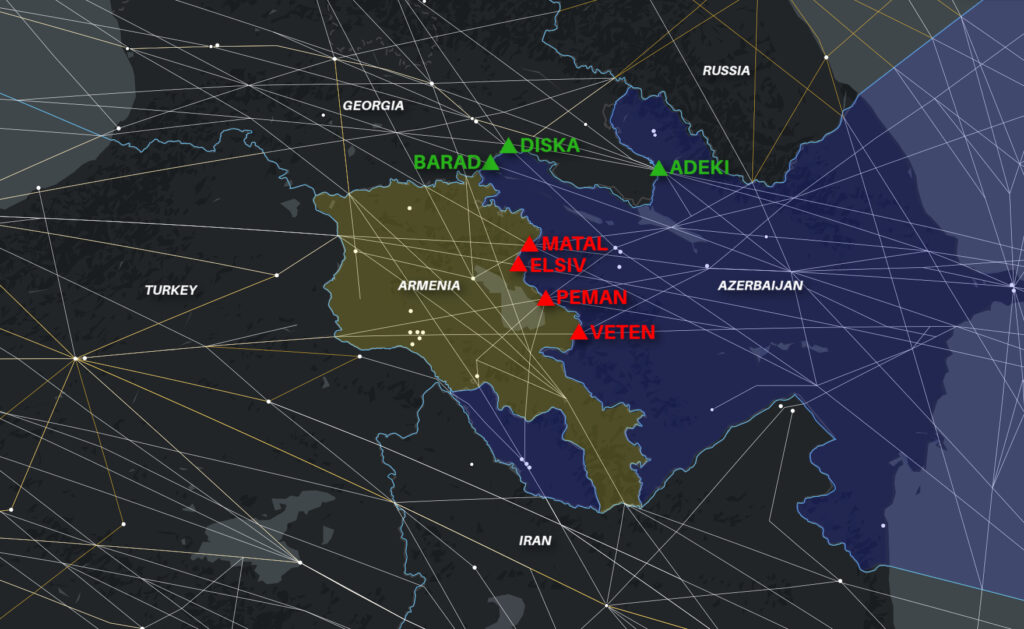
  • Azerbaijan published new Notams saying that cross-border waypoints were closed. These Notams were cancelled on Sep 20, but most operators are still actively avoiding the region, and routing north via Georgian airspace (UGGG/Tbilisi FIR) instead.
  • There have been no changes to state-issued warnings. 

VETEN, PEMAN, ELSIV and MATAL are closed. Flights must route via ADEKI.

Update: 20 Sep 2023

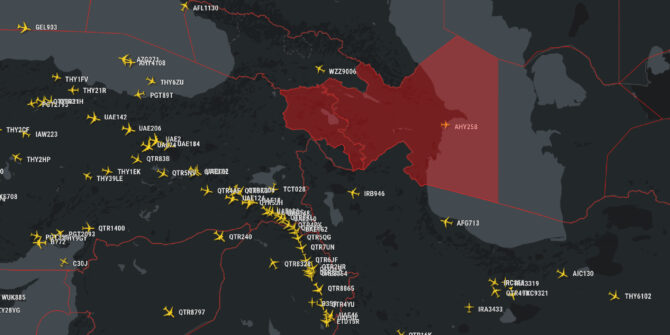
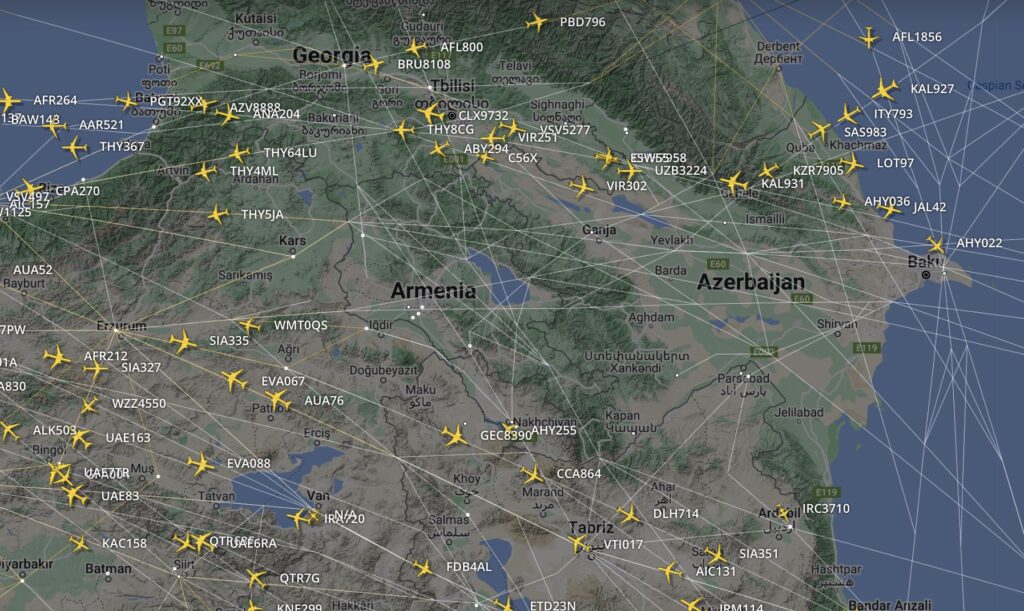
Azerbaijan has cancelled its Notams which closed its airspace on the border with Armenia. But most operators are still actively avoiding the border region, and routing north via Georgian airspace (UGGG/Tbilisi FIR) instead.

Snapshot from 1400z on Sep 20.

A ceasefire has been agreed on Sep 20, coordinated by Russia, with further talks set for Sep 21.

Several sources report that on Sep 19 Azerbaijan targeted Armenian forces using drones, artillery, and surface-to-air-missiles. This followed a statement from the Ministry of Defense of Azerbaijan accusing Armenia of shelling the positions of the Azerbaijani Army in the Nagorno-Karabakh region.

There has been no update yet to EASA’s Conflict Zone Information Bulletin

No new foreign airspace warnings for Armenia or Azerbaijan have been issued yet either. Several of these were withdrawn at the end of the war in 2020. Following brief clashes in Sep 2022, only Canada issued a new airspace warning (for both countries) advising caution due to potential risk from anti-aviation weaponry and military ops.

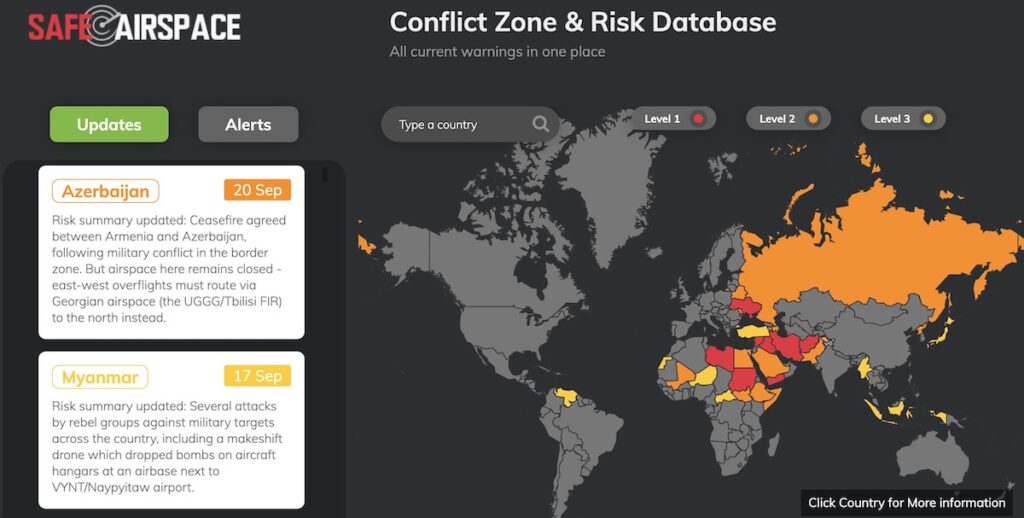
But with the latest escalation in hostilities, we currently assess both Armenia and Azerbaijan on SafeAirspace.net as Risk Level 2: Danger Exists – any further large-scale ceasefire violations involving missiles or anti-aircraft weaponry present a risk to overflights in the border region.

Check Safeairspace.net for a fully summary.

Update: Sep 2022

  • In September 2022 there were renewed border clashes between Azerbaijan and Armenia – the worst flare-up in hostilities since the war ended in 2020.
  • The waypoints along the border between the two countries (VETEN, PEMAN, ELSIV, MATAL) were temporarily closed on Sep 13, but reopened the next day, after Russia brokered a ceasefire to end the fighting.

Update: Oct 2020

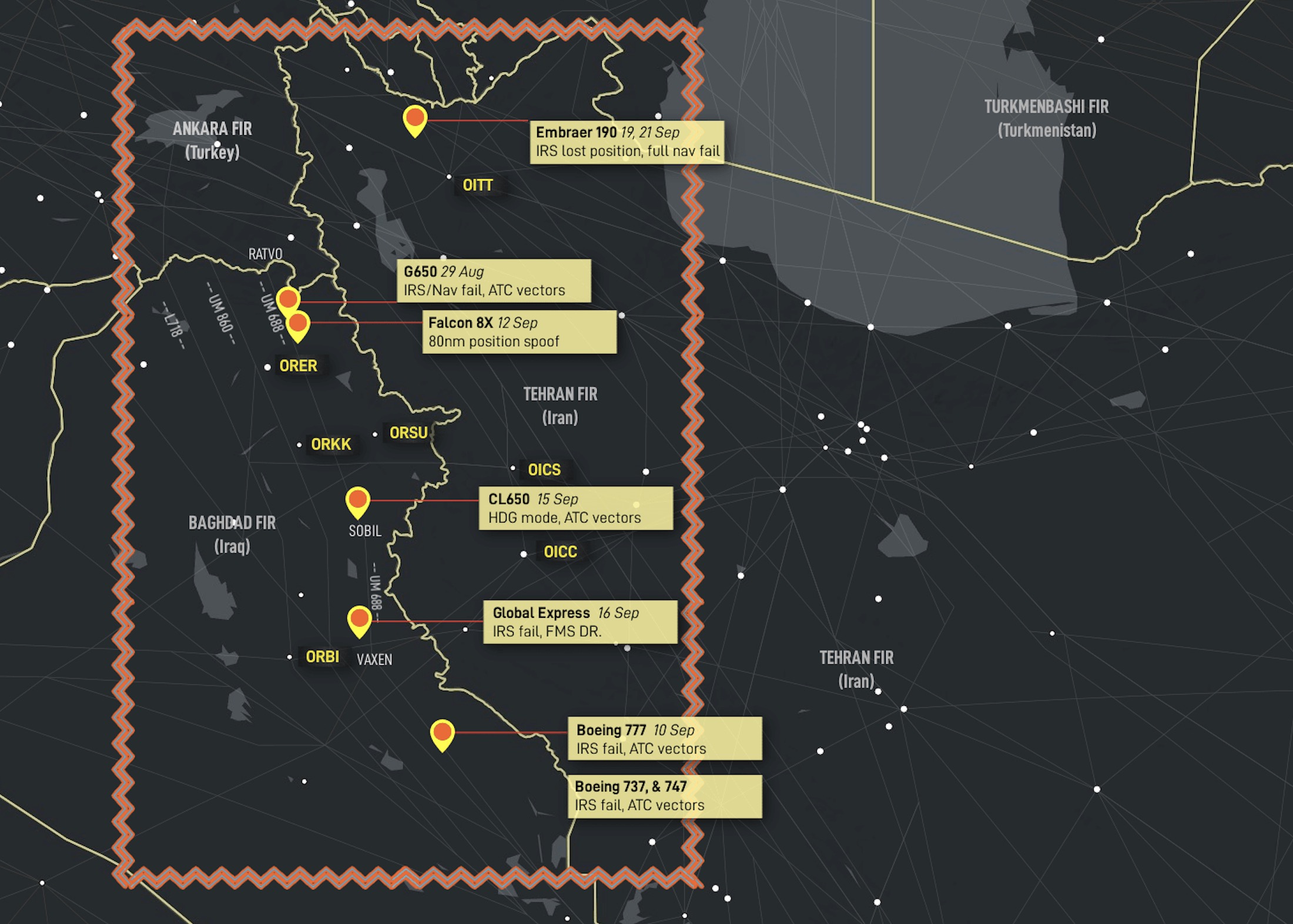
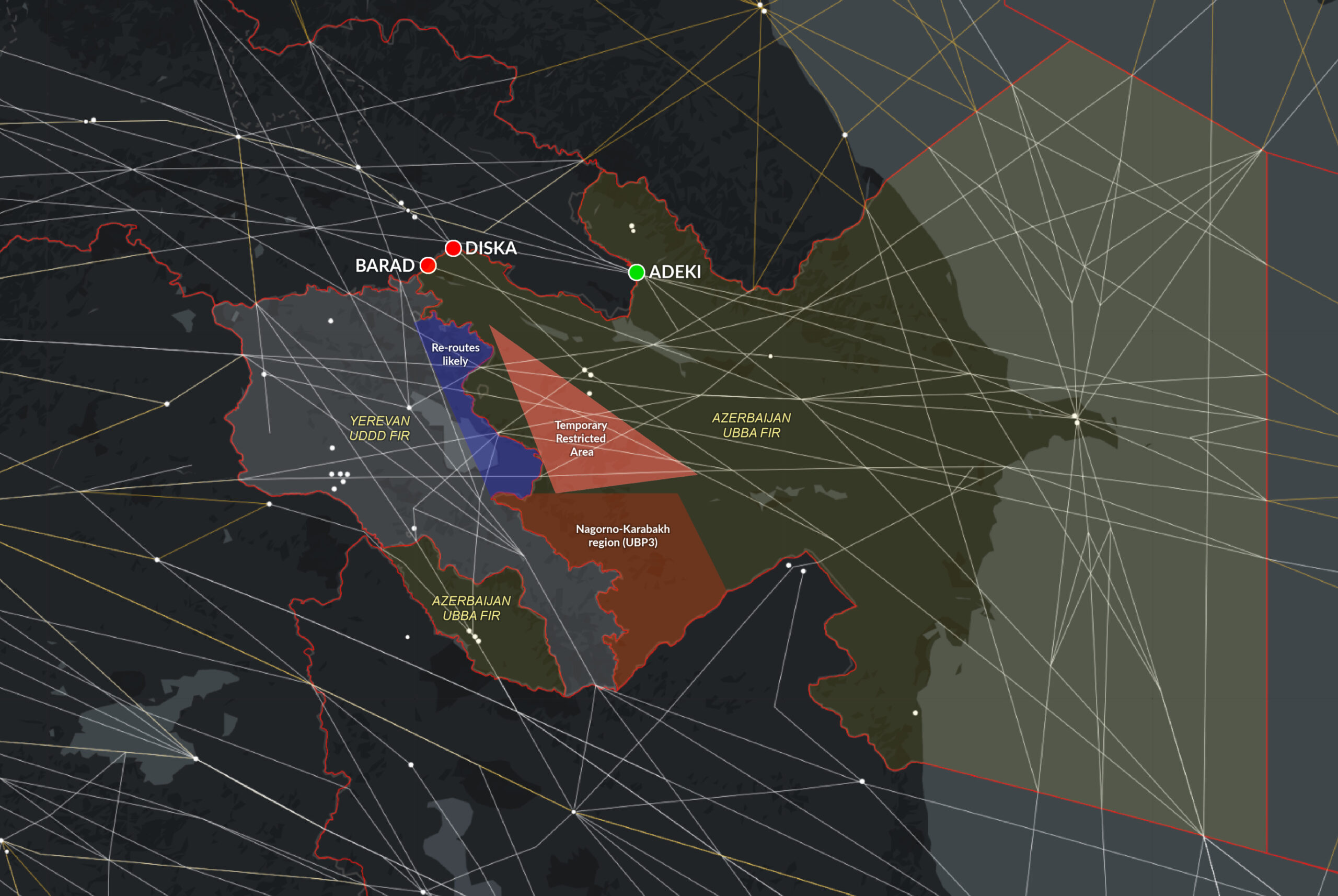
At the peak of the conflict in late October 2020, the airspace picture looked like this:

Here’s what happened at that time:

Azerbaijan

  • Azerbaijan established a Temporary Restricted Area along the border with Armenia, which meant that all East-West airways between the two countries were effectively closed. 
  • They also issued a Notam advising caution across the UBBA/Baku FIR due to the spillover of the conflict, with the specific warning of the threat posed by long-range missiles which they claimed Armenia had been using to target locations throughout Azerbaijan. 

Armenia

  • Armenia never closed any parts of its airspace. Instead, they issued a Notam advising operators to expect tactical rerouting and short notice closures in the airspace along the border, and recommended they carry additional fuel. 

Germany

  • Germany issued airspace warnings for both Armenia and Azerbaijan. It did not advise that overflights be restricted to a certain altitude, but instead warned of a “potential risk to aviation… from military operation including anti aviation weaponry.” 

France

  • The airspace warnings issued by France were a bit different. Essentially, they said that operators should not overfly the border region except on certain airways in the far north of the UBBA/Baku FIR at FL340 or above.

North Atlantic Update: WAT Happened To WATRS?

Key Points
  • The US FAA has officially renamed WATRS airspace in the West Atlantic, to simply WAT.
  • Part 91K, 121, 125 and 135 operators will all be affected by the change. Existing B050 authorizations will be re-issued within 24 months.

If you’re not familiar with WATRS, it is a large chunk of airspace off the US East Coast comprised of fixed routes that provide huge volumes of oceanic traffic to and from the NAT HLA with lateral separation. From 7 Sep 2023, it’s been renamed WAT.

What was wrong with the old name?

The FAA dig into this in their recent notice. Essentially back in 2020, New York ATC asked users to stop using the term ‘WATRS airspace’ because it was causing some confusion.

Apparently, some users were associating it simply with the New York West Oceanic CTA. When, in reality it also spans the San Juan CTA and the Atlantic portion of the Miami Oceanic CTA too.

It is purely an issue of semantics. Now we need to call it WAT instead so that it better aligns with ICAO regions.

Has the physical boundary changed?

Nope. It is a name change only, and the existing set up remains the same.

Then why do we need to know?

If you traverse the NAT a lot, no doubt you are quite familiar with the term WATRS. But you are unlikely to hear it anymore.

It will be progressively replaced with the unfamiliar term WAT in charts, reference material and approvals. And so, a little background helps.

A number of important FAA documents will need to be updated. The most significant is LOA B050 which will be re-issued to all operators over the next 24 months.

LOA B045 (Extended Overwater Operations Using a Single Long-Range Communication System) will also be revised when some extra paper-pushing gets done behind the scenes.

Your company’s internal manuals and guidance will also need to be changed to avoid ‘reverse training’ the older, obsolete name.

WAT about other NAT changes?

While we have you, there’s been another small change to NAT ops to report.

On September 18, ICAO revised the ‘Oceanic Errors’ NAT Ops Bulletin – the doc which has all the advice for operators on how to avoid the most common mistakes when flying the North Atlantic.

These include: Gross Nav Errors, Large Height Deviations, and Longitudinal Separation busts. There’s also some advice on Flight Planning, SLOP, and some CPDLC things to watch out for.

You can download it here.

Looks like there are no significant changes in terms of content for this updated version when compared with the old one – they’ve just tidied it up a bit.

But if you operate over the North Atlantic it’s still worth a read, as there’s lots of top tips on how to avoid the most common “gotchas”!

Contingency and Weather Deviation Procedures were updated back in 19’, and rolled out to all oceanic airspace worldwide in November 2020. We produced this chart at the time:

Do You Have a NAT Conundrum?

Ah, NAT conundrums! We love them so much, we’ve published three entire Volumes already!

Volume I covered the following three conundrums:

1. To SLOP, or not to SLOP?
2. What’s the difference between the NAT Region and the NAT HLA?
3. Can I fly across the North Atlantic without Datalink?

Volume II covered these additional three:

4. Do you need to plot on Blue Spruce Routes?
5. Do we still fly Weather Contingency Procedures on Blue Spruce routes?
6. When can we disregard an ATC clearance and follow the contingency procedure instead?

Volume III was solely dedicated to:

7. GOTA airspace datalink and ADS-B requirements.

We’re always on the lookout for more conundrums, so please get in touch with the team on team@ops.group with any NAT related questions or queries. We’ll do our best to answer them, or put you in touch with someone who can.


Flight Ops at NBAA23

Hi everyone!

The latest QRH and Checklist for Vegas is now here.


EU Temporary Admission of Aircraft – busting myths

Our friends at OPMAS put together this useful Myth-Busting lowdown on the process for “Temporary Admission” of aircraft within the EU. We saw it, we liked it, and so here it is for our OPSGROUP members!

There are still several myths concerning the usage of the Temporary Admission (TA) procedure when flying within the EU. Common to all these myths is the idea that TA limits operators when flying on internal EU trips with great consequences if not followed, but this is often incorrect, outdated or misunderstood.


What’s Temporary Admission?

Temporary Admission (hereafter TA) is meant to allow EU outsiders to be able to roam freely within the EU for a certain period. “Outsiders” means that the aircraft is owned, registered, operated and based outside the EU (all criteria must be fulfilled). Read the short story on Temporary Admission.


Myth #1: Temporary Admission cannot be used when carrying EU passport holders as passengers

This myth is busted because:

  • The EU Commission has – numerous times – stated that these restrictions are not meant to restrict having EU residents onboard as passengers. The restrictions are meant for the pilots who are, in customs terms, seen as the real user of the aircraft, meaning that there are NO RESTRICTIONS for carrying EU passengers. Thus, there is no need to appoint a main passenger or have a so-called authorization letter onboard.
  • The idea of a main passenger, authorization letter, and other strange demands when using TA has no foundation in the Union Customs Code. It is based on a wrong interpretation or outdated information.


Myth #2: Temporary Admission cannot be used for commercial flights, such as Part 135

This myth is busted because:

  • The EU Commission approved Part 135 traffic as correct use of TA in 2014.
  • Internal traffic was also removed as a restriction for TA in 2016 with the introduction of the Union Customs Code (UCC). The paragraph was originally intended to limit commercial traffic but has been removed for many years now.
  • The requirement for Traffic rights (also called charter permits) is often mentioned as another obstacle when using TA, yet traffic rights have absolutely nothing to do with the process of obtaining TA or full importation. It is strictly an aviation regulator issue.
  • US aircraft flying Part 135 may need to obtain traffic rights on some internal EU legs, but this is independent of the TA or full importation status. Any fully EU-imported US Part 135 aircraft will also need to obtain the exact same traffic rights. Having a fully EU-imported aircraft instead of a TA aircraft will not improve the situation. Full importation does not grant an aircraft “better” traffic rights than aircraft flying under TA or EU-registered aircraft.


Myth #3: The owner must be onboard or be present within the EU

The myth is busted because:

  • It has earlier been clarified that the owner is not needed to be present onboard or within the EU in the typical Part 91/135 scenario when flying within the EU. This paragraph in the Union Customs Code is meant to regulate a completely different scenario.
  • This issue can however be a bit tricky as aviation structures are complicated and not always easily or correctly understood by customs on the ramp, so operators should always ask a competent customs agency to approve the structure in advance and outline the correct understanding in the specific case.


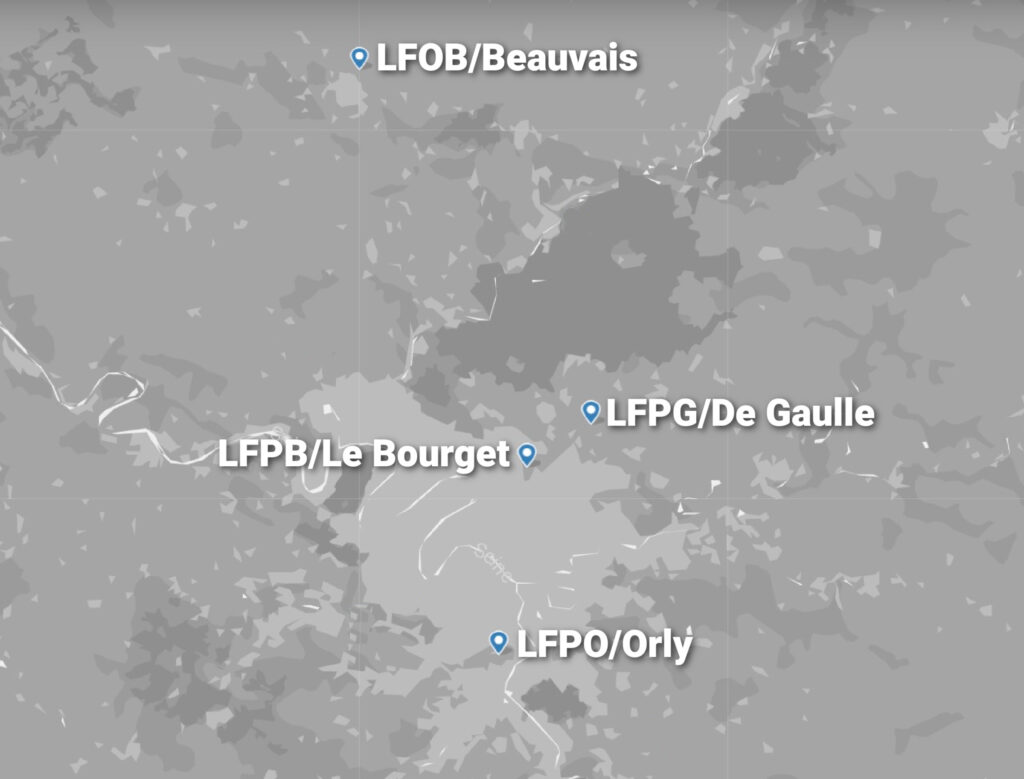
Myth #4: Aircraft flying under Temporary Admission will most likely have problems when flying to Cannes, Nice, or Paris-Le Bourget

The myth is busted because:

  • Numerous aircraft are flying to these airports and other “dangerous” airports every day using TA and are ramp checked without having any problems because the crew onboard are well-prepared and able to explain and document why the aircraft is eligible to use the TA procedure. We have supported many of these operations, so we know how it works and what it takes.
  • Some aircraft encounter problems at these airports, but all known cases are based on operators either not being TA compliant or simply not prepared to prove compliance. These aircraft can remain on the ramp for hours or weeks and sometimes result in a full VAT payment.


There is a lot of noise when TA is discussed

It seems like some presenters have forgotten to read or understand the changes made to the Union Customs Code for the last many years as we see a tendency to, deliberately or not, denigrate the use of TA in favor of full importation using arguments that it is impossible or dangerous. In fact, the opposite is true.
The TA procedure has become a very well-defined customs procedure

Please note that TA can be used to fly privatelycorporately, and commercially within the EU without any problems and with EU-resident persons onboard, if applied correctly. Moreover, since 2014 the TA procedure has become a very well-defined customs procedure, especially for corporate and commercial aviation. This is thanks to the huge effort from, e.g., the EU Commission and NBAA.

More advantageous for many North American operators

The option of using TA is sometimes presented as second to full importation, with the latter presented as the only “safe and possible” option for North American operators. This is clearly NOT supported by the EU Commission. On the contrary, the use of full importation will be an extra burden and place risks on the owner and user of a corporate aircraft, also when flying outside the EU. This can be eliminated by using TA. In fact, the TA procedure is often more advantageous for many North American operators compared to full importation due to the limited scope of liability and the wide scope of use.


Thanks to OPMAS for this article! They provide importation services in relation to the EU; Temporary Admission, full importation for corporate owners and full importation for AOC holders and charter/commercial operators. That’s all they do! They do not charge for an evaluation of the particular set up you have – contact them here.


US expands CPDLC coast-to-coast

Update 4 Sep 2023:
  • The FAA had planned to allow GA/BA aircraft to use enroute CPDLC from Aug 31, but this is being delayed to sometime towards the end of Sep.
  • So until then, the status quo continues – you can only use enroute CPDLC if you’re already registered as part of the trial, as per KFDC Notam A0171/22.
  • When it gets rolled out to everyone in Sep, there will be green/yellow/red lists drawn up for aircraft depending on their avionics – but only “red” category aircraft (those with serious avionics issues) will be unable to use CPDLC.
  • More info available from our friends at NBAA here.
Original story from 28 Mar 2023:

The US has recently implemented en-route CPDLC in more centers across the country. So now, for the first time ever, you can fly coast-to-coast using CPDLC.
And what’s more – KUSA is the one and only code you need.

Who is KUSA?

For those of you who aren’t so familiar with the US, KUSA is the CPDLC logon code.

You might know KUSA from getting your clearances. The US actually gives two types of departure clearance via KUSA – a DCL or a PDC. DCL is the one where you don’t have to read it back. PDC technically requires a voice read back (but in the US they don’t seem to).

If you are flying across the NAT then this clearance usually includes your entry clearance too – so you get this when you get your departure clearance.

KUSA is the one and only logon code you need, all the way across.

So do I need CPDLC now?

US domestic datalink is not mandated. In fact, they are not currently allowing any GA aircraft to use enroute CPDLC unless they are a part of the “US Domestic En Route CPDLC Avionics Trial”. And currently, they are also not allowing any new operators to join this trial!

You can check all that out here on the L3 Harris site. They have a whole load of information on there about DCL stuff too so definitely worth a look.

What if I’m flying into the US internationally?

To make us of US domestic enroute CPDLC, foreign operators must have FAA approval (J4 on their A003). L3Harris also need to have confirmed that your aircraft avionics configurations meet the compatibility requirements per the Recommended and Required Avionics Version List (RAV-E). If in doubt about any of this, contact them at DCIT@L3Harris.com for any eligibility questions.
For eligible aircraft inbound to the US, there are some differences in logon guidance depending on whether a CPDLC connection is already established from the previous data authority, and whether the aircraft is entering via active or non-active US domestic enroute airspace.
Ultimately, all the answers can be found here. This doc lists all the inbound/outbound scenarios, and how CPDLC will work in each situation.


Gabon Military Coup: Airspace Reopens

Update: 4 Sep 2023

Air borders in Gabon have reportedly been reopened following last week’s coup. The UK FCO have posted an update here. From a security standpoint, not much has changed though – the situation is still volatile, and scheduled carriers continue to avoid landing at FOOL/Libreville. Military action by neighbouring countries is still a possibility at short notice.

Original Story: 31 Aug 2023
  • There was a military coup in Gabon on Aug 30. The military group dissolved institutions, cancelled the Aug 26 election results, and closed the country’s borders until further notice.
  • Heavy gunfire was heard in the capital, Libreville, during the coup attempt, but the situation was calm in the capital and across the country as of Aug 31.
  • Notams were vague, but several sources reported that Gabon’s airspace was closed, along with all airports in the country.

Airport and Airspace Info

Notams were published for Gabon under the FCCC/Brazzaville FIR code, advising that the country’s air, sea and land borders are closed:

FCCCYNYX
(A0913/23 NOTAMR A0907/23
Q)FCCC/QXXXX/IV/NBO/E/000/999/0043N01655E 999
A)FCCC B)2023-08-30 16:10:00 C)2023-09-02 23:59:00 EST
E)FOLLOWING THE CURRENT EVENTS IN THE REPUBLIC OF GABON,THE AIR,LAND
AND SEA BORDERS ARE CLOSED FROM THIS DAY ON THROUGHOUT THE NATIONAL
TERRITORY)

These Notams might not show up on conventional Notam search engines (the FAA one, for example, does not show them), so you have to use the ASECNA Notam search instead: https://ais.asecna.aero/fr/ntm/notam.php

It wasn’t 100% clear from the Notam if the airspace was closed for overflights, but several sources including Royal Air Maroc and the Netherlands Government said that the airspace was closed.

Where are we talking about?

Gabon sits in the middle of the FCCC/Brazzaville FIR:

Overflights of the FCCC/Brazzaville FIR outside of Gabon were not affected.

For overflights of Gabon itself, most operators avoided the airspace. In the ASECNA AIP, there is a Contingency Plan for routes through the Libreville UTA, although this didn’t seem to be activated at any stage.

Here’s what that looks like:

  • (UG856) BIPIV/MOVOD FL290, FL390 SOUTH-EAST BOUND
  • (UG856) BIPIV/MOVID FL300, FL400 NORTH-WEST BOUND
  • (UG861) MOVOD / ARASI FL340, FL360 NORTH-WEST BOUND
  • (UG861) MOVOD / ARASI FL330, FL350, FL370 SOUTH-EAST BOUND
  • (UB737) IPOVO / USMOL FL280, FL320 SOUTH-WEST BOUND
  • (UB737) IPOVO / USMOL FL270, FL310 NORTH-EAST BOUND

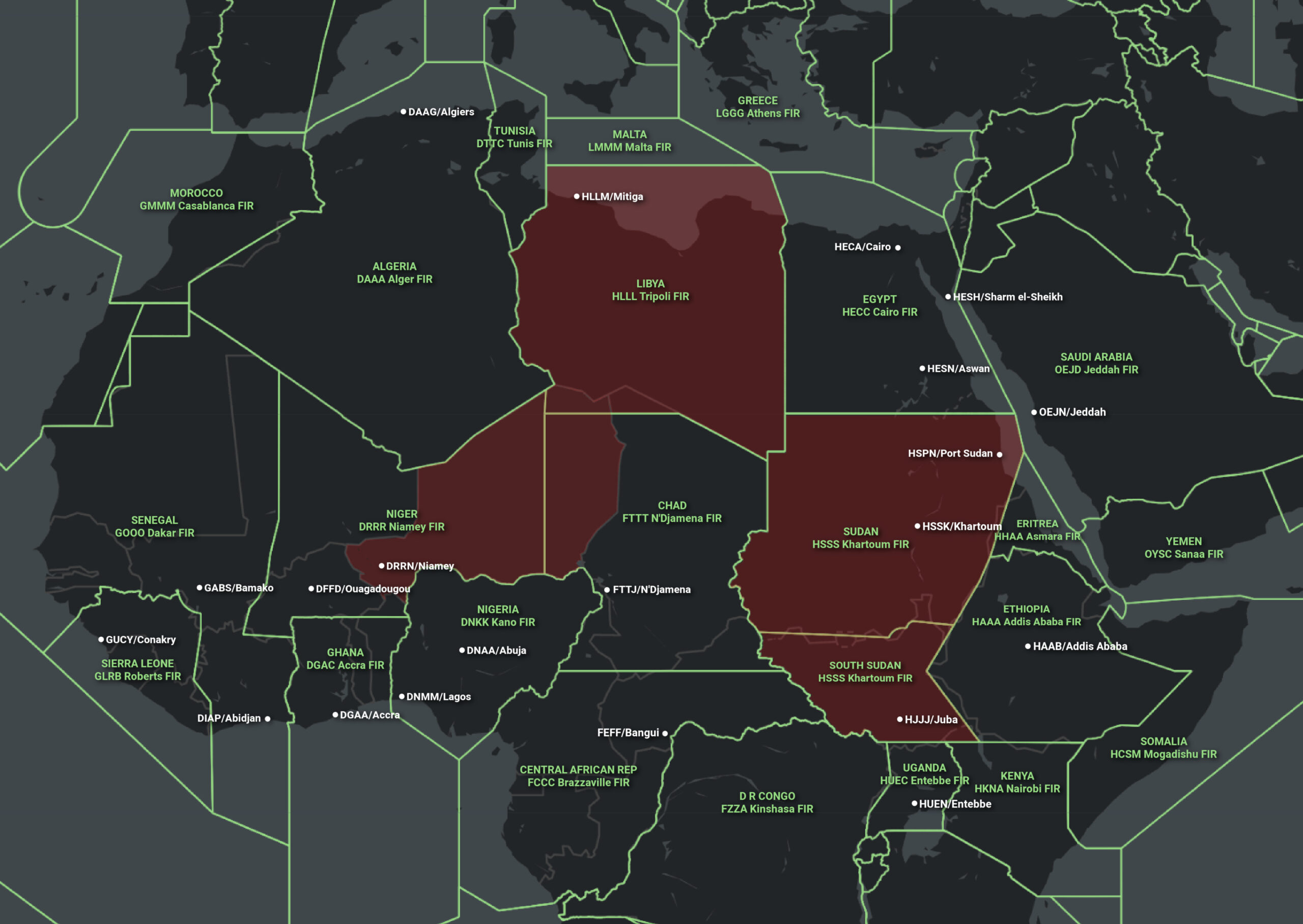
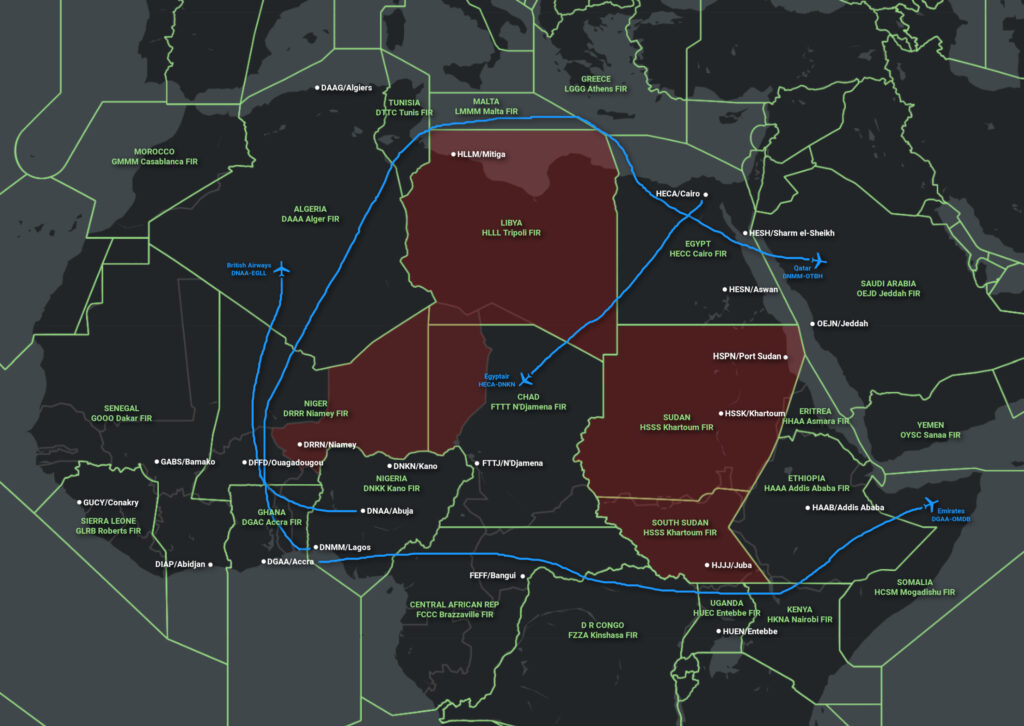
Note that with the ongoing closure of airspace in Niger and Sudan, plus the airspace risk in Libya, this has already created challenges for traffic routing through Central Africa:

  • Niger: Airspace remains closed to all civilian flights following a military coup in Aug 2023. More info.
  • Sudan: Airspace remains closed to all civilian flights following a military coup in April 2023. More info.
  • South Sudan: Air navigation services remain suspended above FL245 following the coup in Sudan. More info.
  • Libya: Flight ban for US and UK operators (several other countries have warnings in place) due to risks associated with the civil war that has been ongoing since 2014. More info.

We’re continuing to monitor the situation closely. If you have any updates to share, please contact us at news@ops.group.


Hurricane Idalia: Florida Airport Closures – 1200z Aug 30

Key Points
  • The forecast for Hurricane Idalia has been upgraded. It is now expected to be a Category 4 hurricane when it makes landfall over Florida’s northern panhandle on Wednesday morning.
  • Several airports are closed: KTPA/Tampa, KPIE/St Pete-Clearwater, KVNC/Venice, KTLH/Tallahassee, and KGNV/Gainesville. Expect closures to be announced at other airports in the region too.
  • Hurricane warnings have been issued for the majority of the state’s Gulf Coast.

National Hurricane Center’s Advisory, issued 1200z Aug 30:

At 800 AM EDT (1200 UTC), the eye of Hurricane Idalia was located by
Tallahassee radar near latitude 29.9 North, longitude 83.5 West.
Idalia is moving toward the north-northeast near 18 mph (30 km/h). A
north-northeastward motion is expected through the morning, with
Idalia's center forecast to move into southern Georgia later today. 
Idalia is forecast to turn toward the northeast and east-northeast, 
moving near or along the coasts of Georgia, South Carolina, and 
North Carolina late today and Thursday.

Maximum sustained winds are estimated near 120 mph (195 km/h) with 
higher gusts. Idalia is a category 3 hurricane on the 
Saffir-Simpson Hurricane Wind Scale. Although Idalia will weaken 
further now that the center is inland, it is likely to still be a 
hurricane while moving across southern Georgia, and near the coast 
of Georgia or southern South Carolina late today. Idalia is forecast 
to be a tropical storm while moving near the coasts of northeastern 
South Carolina and North Carolina tonight and on Thursday.

Hurricane-force winds extend outward up to 25 miles (35 km) from
the center and tropical-storm-force winds extend outward up to 175
miles (280 km).

The minimum central pressure is 950 mb (28.05 inches) based on 
aircraft data.

Water levels along the coast of the Florida Big Bend continue to 
rise rapidly. A NOAA National Ocean Service tide gauge at Cedar 
Key, Florida, recently reported a water level of 6.2 feet above 
mean higher high water, which is an approximation of inundation in 
that area.

Airport Closures

Several airports across the region will close for the passage of the storm. Here are the ones we know about as of 1200z on Aug 30:

And here are the Notams that carry the announcements of the closures:

KTPA/Tampa
08/255 – AD AP CLSD EXC EMERG ACFT AND MIL OPS AND LIFE FLT. 30 AUG 12:10 2023 UNTIL 30 AUG 21:00 2023. CREATED: 30 AUG 12:10 2023

KPIE/St Pete-Clearwater
(A0740/23) – AD AP CLSD. 29 AUG 19:00 2023 UNTIL 30 AUG 19:00 2023. CREATED: 28 AUG 17:27 2023

KVNC/Venice
08/354 – AD AP CLSD. 30 AUG 11:57 2023 UNTIL 30 AUG 18:00 2023. CREATED: 30 AUG 11:57 2023

KGNV/Gainesville
(A0547/23) – AD AP CLSD EXC EMERG ACFT AND LIFE FLT AND MIL OPS AND SKED ACFT 1HR PPR 352-262-6691. 30 AUG 10:45 2023 UNTIL 31 AUG 02:30 2023. CREATED: 29 AUG 21:03 2023

KTLH/Tallahassee
(A0665/23) – AD AP CLSD EXC EMERG ACFT AND SAR AND MIL OPS AND LAW ENFORCEMENT AND CARGO 1HR PPR 850-891-7830. 30 AUG 03:00 2023 UNTIL 31 AUG 08:00 2023. CREATED: 29 AUG 16:24 2023

More info

  • Cyclocane have a tracker page for the hurricane here, which includes tracking map and source info from the National Hurricane Center.
  • The FAA have a page on airport closures here. They have activated telcons for Idalia at 1230Z and 2200z each day – you can find dial in deets on the NASS website.
  • The NBAA have a page on the hurricane here, which includes airport closures, equipment shutdowns, and route info.

If you have any additional info to add, please email us at news@ops.group


CPDLC Gotcha: Clearance Busts

Key Points
  • The FAA has published a new Safety Alert for CPDLC and partial route re-clearances.
  • Make sure you load your full SID manually into the FMS after you receive a partial reroute message (UM79).
  • Also, don’t mistake these partial reroute messages as being cleared to fly directly to the waypoint (a direct clearance would be a UM74 message).

Lessons from Teterboro

In 2022, the FAA recorded 20 aircraft deviations at KTEB/Teterboro Airport due to issues with CPDLC and partial reroute messages.

These incidents resulted from failure to reload SIDs after receiving a partial reroute UM79 message (where you are cleared to a particular waypoint via other waypoints en-route), requiring swift coordination with ATC to avoid traffic.

But the issue isn’t limited just to Teterboro – it could happen at any US airport, to any aircraft type receiving a clearance in this way.

Another thing to watch out for

Due to limitations in the formatting of CPDLC DCLs, they can be easy to misread or misunderstand. Take the following for example, courtesy of an OPSGROUP member.

A change to a clearance was received by a B777 at KJFK/New York during taxi and under considerable pressure to get underway or out of the way:

Unfortunately, in this instance the crew mis-interpreted their clearance as direct to the waypoint YNKEE. This was further compounded by the issue above – when the new route was loaded, their SID was dropped from the flight plan.

When they got airborne, ATC immediately began asking why they weren’t following the assigned SID – the result was a clearance bust. To their surprise, further down the clearance was indeed an assigned SID – the SKORR4. It was an understandable and easy miss.

The question remained though: what then is the intention of the top part of this clearance if not to clear the aircraft direct to YNKEE? We put this to the group, and received some useful feedback.

It maybe comes down to a machine readability issue. The section above the plus signs is required because of the way the clearance is written, and is related to the same issues as above. It will not contain a SID when you insert it.

In fact, some newer CPDLC systems don’t even show that section to the crew – only the information below the plus signs which contains the assigned SID. The full version is a confusing, and seemingly contradictory set up.

What about PDCs?

It’s probably worth a mention that these issues don’t affect PDC clearances. PDCs are different and are sent by a service provider via VHF datalink. No log on is needed, and only one can be issued for a flight number at specific airport over a 24 hour period. They also have to be read back via voice. PDC’s cannot be used to notify pilots of a change to the filed route. So it’s smooth sailing in that regard.

Further reading.

You can read the FAA’s new Safety Alert for CPDLC and partial route re-clearances here.

The FAA also has a handy guide on how to use CPDLC in US airspace. It covers the basics, along with departure clearances (DCLs), en route ops, speed/time restrictions, emergency use and free text.


Eastern Pacific: Navigating NO FIR Airspace

Key Points
  • ‘NO FIR’ is a section of uncontrolled oceanic airspace in the eastern Pacific.
  • Class G rules apply – no services are provided here (Traffic Separation, SAR, Weather Reporting, Notams).
  • There are some ICAO Recommended Procedures: Contact ATC, use TIBA Procedures, turn on all lights, keep squawking, SLOP, and fly standard levels.
  • Download the OPSICLE below for a summary of the procedures.

‘NO FIR’ at the edge of the world

Well off the coast of Peru in the Eastern Pacific sits a large chunk of oceanic airspace known simply as ‘NO FIR.’ As the name suggests – it is completely unassigned. No ATC agency is responsible for it.

You may not have heard of it, because in almost all cases operators simply avoid it. There are just no procedures out there. And when attempting to find some, more questions are raised than answered.

The problem is that avoidance is beginning to cost time and money. With the establishment of ultra-long-haul routes, and aircraft capable of flying them, fuel is becoming increasingly critical. Especially when you consider that in some case ETOPS certification has now reached a whopping 370 minutes – that’s six hours.

And so OPSGROUP is often asked – how exactly can we operate directly across it? We didn’t know either, so we reached out to ICAO for some answers.

Where can I find the procedures?

This may come as a surprise, but there are none. Because no state is responsible for the NO FIR airspace (yet), there is no AIP to reference.

Until ICAO can successfully delegate this laborious task to adjacent countries, the standard ‘rules of the road’ apply – and none of them are specific to this particular piece of the high seas.

There is some provisional guidance out there, but it is just that – provisional. It is based on a 2019 project to subdivide the NO FIR airspace into pieces managed by Peru, Ecuador, Tahiti and the COCESNA states. This has yet to happen, and was stalled by Covid. ICAO advise the project has been revised but will take more time to implement. Until then, no one is home.

Best practice

So, how do we cross the NO FIR airspace without procedures? We need to rely on best practices instead. Here is what ICAO suggested to OPSGROUP, and it begins with a caution:

No one is responsible for it. It is important to understand the impact of this. There will be no traffic separation, SAR services, weather forecasting or even Notams. You will also need to make sure your insurer is happy for you to traverse this kind of airspace.

Having made the decision to enter however, ICAO recommends the following:

  • Use the information available to you. Before you enter the NO FIR airspace, ask controlling ATC the following question (keeping in mind that English may not be their first language)…
    “Is there any known, or observed traffic?”
    It is possible they’re aware of preceding traffic ahead, or are expecting some to exit. Even partial info, is better than none at all.
  • Use TIBA procedures. Yes, they’re technically for ‘contingencies,’ but the principle remains the same – hear and be heard. You can find those procedures in ICAO Annex 11. What frequency? There isn’t one published for the NO FIR airspace and so ICAO suggests using chat (123.45) or guard (121.5).
  • Be Seen. Turn on all anti-collision and navigation lights, just in case.
  • Keep Squawking. Use your transponder and TCAS TA/RA function at all times.
  • SLOP. Follow Strategic Lateral Offset Procedures to further separate you from oncoming traffic. In other words, intentionally deviate up to 2nm right of your airway. You can find those procedures in ICAO PANS ATM, or ICAO Circular 354.
  • Fly Standard Levels. Stick to even levels heading west, and odd levels heading east. Also avoid changing levels inside the uncontrolled airspace unless it is dangerous not to do so.
  • Call Ahead. At least ten minutes before exiting the NO FIR airspace, call ahead and give the next ATC sector a head’s up you’re coming.

What not to do

Rely on adjacent agencies to take care of you anyway.

The most common misconception out there seems to be that the KZAK/Oakland Oceanic FIR will provide some emergency assistance via CPDLC.

When we reached out to them directly they advised this may be the case for some aircraft transiting the adjacent MMFO/Mazatlan FIR, but this is not the case for the NO FIR airspace – as far as they are concerned, there is no log-on available or any other services available.

Operator reports

So that’s what written on the back of the packet, but what about intel from pilots who have recently flown through it? OPSGROUP reached out to members, and received these reports on what to expect:

OPSGROUP Member: …we were advised to contact the next ATC sector via CPDLC at a specific lat/long before entering the NO FIR. We transmitted position reports in the blind on 123.45. Mazatlan was very difficult to raise on HF, however the aircraft SAT phone continued to work well. Alternate planning was critical. We flew through in day visual conditions, and so weather was easy to see and avoid…

OPSGROUP Member: …when we entered, we were simply told ‘frequency change approved,’ with no further instructions. We tried to raise a bunch of frequencies and eventually got in touch with NY Oceanic (randomly). We just informed them of our intentions along with position reports every 30 minutes until we entered the Guayaquil FIR. I’ve never been able to find further instructions on how to operate in this airspace…

There is no magic bullet

The Pacific’s NO FIR airspace is useable but with careful consideration. The challenges of crossing it can be mitigated, but only with solid contingencies in place.

ICAO’s guidance above is a solid starting point, however it is up to individual operators to decide whether the commercial reward outweighs the potential risks.


Mass evacuation of aircraft – Libya

Ops Alert – August 14, 2300Z
  • A mass evacuation of aircraft is taking place at the moment from Tripoli, including a number of A330 and A320 aircraft from both the largest carrier (Afriqiyah) and smaller operators. Inbound flights are also diverting, and the Libyan government aircraft, a King Air 350, is also being taken out of Tripoli. Almost all aircraft are being repositioned to Misrata (HLMS) – with approximately 25 aircraft being moved.
  • The reason for the evacuation is violent clashes involving gunfire taking place at Tripoli Mitiga airport (HLLM), as well as on road leading into Tripoli itself. Earlier on Monday night the head of ‘444 brigade’ that controls much of Tripoli, was detained at Mitiga airport by the Special Deterrence Force. The resulting risk to aircraft operations was deemed sufficiently high to begin the removal of aircraft to a safer location.
  • This situation highlights the instability of the security situation in Libya. With the airspace closure in Niger last week, routes over Africa have become very limited, and Libya/the Tripoli FIR may seem a tempting alternative.
  • Operators considering a Libya overflight should consider routings very carefully. This is the most significant aviation security event in Libya in the last few years, and highlights the ongoing risk to operations.

Refer to safeairspace.net/libya for the background, and ops.group/blog/2023-is-libya-safe-to-overfly-yet for more information.

A timely summary of the risk to civilian operators in the Tripoli FIR, from earlier in 2023, gathered by OPSGROUP from neighboring ATC units:

  • The ATM/CNS situation in the HLLL FIR is very basic and from our experience there are issues with communications and surveillance (or the lack of it).
  • There is a lot of military activity which is not always known to Tripoli and Benghazi ACCs also due to these communication and coverage issues.
  • There are still issues regarding coordination between the Tripoli and Benghazi ACCs. One seems to have certain rules which the other ignores. It is very frequent for example that either one or both reject overflights resulting in significant re-routings which we have to sort out (normally military flights) but not excluding civilian flights – sometimes even Libyan flights.
  • We see a lot of remotely piloted aircraft operating in the airspace which as far as we know are not operating in segregated airspace nor are they being controlled by the ATC units.
  • Only recently Libyan controllers went on a flash strike informing us that they cannot continue to handle the traffic with no radar equipment.
  • The AIS services are not functioning properly and the status of the airports is unknown.

Libya Airspace Update Aug 2023

Update: Mass Evacuation of aircraft from Tripoli, August 14
  • A mass evacuation of aircraft is taking place at the moment from Tripoli, including a number of A330 and A320 aircraft from both the largest carrier (Afriqiyah) and smaller operators. Inbound flights are also diverting, and the Libyan government aircraft, a King Air 350, is also being taken out of Tripoli. Almost all aircraft are being repositioned to Misrata (HLMS) – with approximately 25 aircraft being moved.
  • The reason for the evacuation is violent clashes involving gunfire taking place at Tripoli Mitiga airport (HLLM), as well as on road leading into Tripoli itself. Earlier on Monday night the head of ‘444 brigade’ that controls much of Tripoli, was detained at Mitiga airport by the Special Deterrence Force. The resulting risk to aircraft operations was deemed sufficiently high to begin the removal of aircraft to a safer location.
  • This situation highlights the instability of the security situation in Libya. With the airspace closure in Niger last week, routes over Africa have become very limited, and Libya/the Tripoli FIR may seem a tempting alternative.
  • Operators considering a Libya overflight should consider routings very carefully. This is the most significant aviation security event in Libya in the last few years, and highlights the ongoing risk to operations. Refer to safeairspace.net/libya for the background.

A timely summary of the risk to civilian operators in the Tripoli FIR

From March 2023, gathered by OPSGROUP from neighboring ATC units:

  • The ATM/CNS situation in the HLLL FIR is very basic and from our experience there are issues with communications and surveillance (or the lack of it).
  • There is a lot of military activity which is not always known to Tripoli and Benghazi ACCs also due to these communication and coverage issues.
  • There are still issues regarding coordination between the Tripoli and Benghazi ACCs. One seems to have certain rules which the other ignores. It is very frequent for example that either one or both reject overflights resulting in significant re-routings which we have to sort out (normally military flights) but not excluding civilian flights – sometimes even Libyan flights.
  • We see a lot of remotely piloted aircraft operating in the airspace which as far as we know are not operating in segregated airspace nor are they being controlled by the ATC units.
  • Only recently Libyan controllers went on a flash strike informing us that they cannot continue to handle the traffic with no radar equipment.
  • The AIS services are not functioning properly and the status of the airports is unknown.

Is Libya safe to overfly?

With the vastly reduced number of routing options available to operators as of August 2023 (closures of Niger and Sudanese airspace), this question will come up quickly for operators crossing North Africa. We asked this question back in 2022, and decided that no, it probably wasn’t.

Now, the FAA have added some areas of the HLLL FIR that they determine to be “OK”.

Where are we talking about?

Libya’s airspace is the HLLL/Tripoli FIR:

What’s the deal?

The US FAA says this:

The FAA assesses the risk to U.S. civil aviation operations in the portions of 
the Tripoli FIR (HLLL) outside the territory and airspace of Libya at altitudes 
below FL300 has diminished and the situation has stabilized sufficiently to 
permit U.S. civil aviation operations to resume in that airspace. 
Since the October 2020 ceasefire agreement, foreign actors have significantly 
reduced weapons shipments and military activities off the coast of Libya. 
Previously, these activities included targeting suspected weapons shipments 
destined for the opposing side or their foreign sponsors. As a result, the risk 
of either side or their foreign sponsors misidentifying civil aircraft operations 
in the overwater portion of the Tripoli FIR as carrying weapons shipments destined 
for the other side or their foreign sponsors and mistakenly targeting them has 
diminished. The reduction of widespread conflict has also reduced the risk to U.S. 
civil aviation operations in the small portion of the Tripoli FIR (HLLL) that 
extends into Chad's territorial airspace. Therefore, due to the diminished risks 
to the safety of U.S. civil aviation operations and stabilized situation in those 
portions of the Tripoli FIR (HLLL) outside the territory and airspace of Libya, 
the FAA amends SFAR No. 112, 14 CFR 91.1603, to remove the prohibition on U.S. 
civil aviation operations in those areas.

Which is basically a whole lot of text to really say:

We reckon the bit over the water is ok now (and the bit extending into Chad).

So the map of where the US FAA says you can and can’t fly now looks like this:

Here is our summary of it

Feel free to fly over the water, but you won’t, because there’s no reason to.

What do we mean by that?

Well, most of the airways in this bit of water are North-South, connecting airports on the Libyan coastline to the Malta FIR. You can’t use them, because you can’t fly to Libya.

There are some East-West airways, and some of these might be useful for flights from the likes of Tunisia to Egypt, for example. But none of these airways stay overwater the whole way – they all hit the Libyan landmass at some point. So you can’t use these either.

So in practical terms, we suspect that the FAA lifting the prohibition of flights over the water north of Libya doesn’t mean very much, because no-one’s going to fly there. 

Oh, and the thing about Chad

Yes! There is a little patch of nothing in northern Chad (the tiny bit which is technically underneath Libya’s HLLL/Tripoli FIR) where you’re now allowed to fly too. Yay!

So, what does this really mean for ops?

Well, first up, the rest of Libya is very decidedly still not OK.

There have been a whole bunch of reports of issues in Libya, some fairly recently. From GPS jamming, to reported drone shoot-downs, to known anti aircraft weapons that can reach 49,000’…

Aside from the slight improvement the US has mentioned, there is really no change on what we wrote last year.

So Libya remains a “Do Not Fly” area.

Libya remains volatile. Safety and security on the ground is not good, and there is a significant risk to aircraft overflying due to the conflict and weapons available to militia groups.

Tell me more about the SFAR

SFAR 112 has been extended to March 20, 2025 but they will keep monitoring the situation and updating it as and when the security situation changes.

The SFAR provides a good summary of the situation (the ongoing, messy, risky situation). You can read it via the link at safeairspace.net/libya


Shanghai: ZSSS closed to non-sched traffic

Key Points
  • You won’t find it in the Notams, but ZSSS/Hongqiao (one of Shanghai’s two international airports) will not accept non-scheduled international flights for the next four to six months.
  • This includes both private and commercial operators, and is due to FBO renovations.
  • Operators looking to clear customs will need to use ZSPD/Pudong instead.

FBO Works at Honqiao

On August 1, official notification was published that the Hongqiao FBO would be closed for major renovation – including the customs channel. You can read that here (in Mandarin).

All non-scheduled international flights now need to use the other Shanghai airport, ZSPD/Pudong.

No dates are provided for when things at ZSSS will get back to normal. We reached out and have been advised that it could be up to six months before non-scheduled international flights will be welcome again. You can contact them directly on fbo@fboshanghai.com for updates on that.

What about domestic flights?

The news is a little better. They can still land at ZSSS. Asides from the FBO being shut, there is little impact. Instead, a VIP room is being used as a replacement facility. Obviously, there will be no customs available.

Local agents advise there is no change to existing procedures or parking.

ZSPD/Pudong

For international non-scheduled flights then, ZSPD/Pudong will be the only Shanghai option for the next few months.

This maybe especially unusual for operators who commonly arrive over the city from the west.

A browse of the Airport Spy reports submitted by OPSGROUP members are mostly positive. We’d welcome some new ones though, and so if you have been there lately, we’d love to hear from you. You can submit yours here.

International arrivals at ZSPD can expect to be processed via VIPP-H on the chart below. Crew will need to clear customs through the regular customs channel, aka the passenger terminal.

A big heads-up – Universal advise a general parking restriction of max 48 hours still applies without a special extension. Which means for longer stays, you may be looking at a re-position to ZSSS and back.

You can reach Universal for handling and other enquiries on chinaoperations@universalaviation.aero

We’ll keep you updated.

If international non-scheduled flights resume at ZSSS earlier than expected, we’ll let you know. Also keep an eye out for new (and potentially better) procedures and facilities when the FBO re-opens its doors.


Military Coup: Sudan Airspace Closed

Update

This article has been updated to reflect the current status as of Aug 14, 2023.

Key Points
  • Following a military coup in April 2023, Sudan airspace remains closed to all civilian flights.
  • In South Sudan, air navigation services remain suspended above FL245.
  • HSSK/Khartoum airport is closed, but no Notams are being issued.
  • There is a Contingency Plan available with published routes for ops in and out of HSPN/Port Sudan airport.
  • For overflights, there are some north-south routes available via Egypt and Saudi, and some east-west contingency routes available over South Sudan.
  • If routing via nearby airspace, be aware of other active warnings in close proximity.

The Coup

News first emerged on April 15. Sudan’s paramilitary group ‘Rapid Support Forces’ (RSF) became engaged in active fighting with the state military in Khartoum in an apparent coup attempt. While the details were scarce, they reportedly seized control of several important assets, including HSSK/Khartoum Airport.

This has been brewing for some time. There has been a power struggle between the two rival military forces since an overthrow of the government back in 2019.  A failure for the existing government to successfully transition Sudan to a freely elected one has fanned the flames. Along with this is strong public demand for the RSF to be merged with the regular armed forces. This now looks pretty unlikely.

Closed Airspace

On April 15, the HECC/Cairo FIR advised Eurocontrol that Sudanese airspace had closed, and that local authorities were unable to issue any Notams to that effect.

At the same time, videos began to emerge of large passenger jets on fire on the tarmac at HSSK/Khartoum Airport. This included reports that an A330 was shot at multiple times while preparing to depart. The pax and crew evacuated, and were transported to safety at a local embassy.

As of June 2023, the HSSS/Khartoum FIR is now publishing Notams again, and they have said once again that the airspace over Sudan is closed to all flights except for humanitarian and evacuation flights. And in South Sudan, air navigation services remain suspended above FL245.

For overflights, there are some north-south routes available via Egypt and Saudi, and some east-west contingency routes available over South Sudan. Check the HSSS Notams and the Contingency Plan for details.

Adjacent Airspace Warnings

The HSSS/Khartoum is a big piece of airspace. The scramble now will be how to avoid it. Unfortunately, several adjacent countries have their own airspace warnings in place and so it is important to take these into careful consideration. Here’s a summary:

South Sudan

You may be tempted to fly below FL245 through South Sudanese airspace to ensure air traffic control services. However these have been the focus of recent scrutiny. The primary risk there is poor levels of ATC provision, especially for aircraft operating in and out of HSSJ/Juba. Back in 2021, ICAO issued a letter warning of disruptions, a lack of qualified controllers, communication issues and coordination issues with adjacent airspace. There have also been reports of navaids being withdrawn from service and other changes without proper notification to crew. We’ve received no further reports of these problems since.

Chad

There are no active airspace warnings for the FTTT/N’Djamena FIR, although several states (including the US) advise against travel here. The main issue seems to be the risk of crime, kidnapping and terrorism. The general advice is to avoid landing here. We haven’t heard of any issues for overflying aircraft, but keep safety during diversions in mind.

Ethiopia

Special attention needs to be paid to the Northern Tigray Region, near the border with Eritrea. A long running conflict there has recently come under ceasefire, but there may still be some resistance to this amongst militant groups with access to portable air defence systems. These can pose a risk to low level aircraft (below FL250).

Several states including Germany, the UK, France and Canada still have airspace warnings in place. Although they are due for review, they should still be considered active in the meantime. The US warning has previously been lifted. You can view all active advisories here.

Egypt

To the north of Sudan lies the HECC/Cairo FIR. There is still a reported threat of terrorism in Egypt, particularly in the Sinai Peninsular. Only the UK and Germany still have active airspace warnings here – both countries essentially advise against overflights below FL260 in the northern part of the Sinai region. The US had a similar warning in place until it was rescinded in March 2022.

Central African Republic

The news isn’t great here. The security situation on the ground in the Central African Republic is fairly dire. There have been numerous attacks on civilians and peacekeeping troops in recent years. FEFF/Bangui airport is operating under UN control, and is subject to regular power outages. The US and UK advise against all travel to the entire country due to violent crime, civil unrest, and the presence of armed groups who control large areas of the country. There are no official airspace warnings in place for the CAR, but the general advice is to avoid landings here completely.

What will happen next?

It is a developing situation and Sudan should be avoided until things stabilise. We’ll continue to publish updates as they become available, both to OPSGROUP members, and also via Safeairspace.net – our conflict zone risk database.


Canada Airport Options Up North

Canada, the (often) cold and (parts of it) remote northern neighbour to the US. 

We thought we would take a little look at what is available out there, should you find yourself anywhere north of Highway 16 (above N54°).

Why N54°?

Well, because there is not much north of it. Or rather, there is a whole lot of country but not many options north of it. The main cities (and airports) in Canada are primarily in the southern region, close to the US/Canada border.

Here is a picture, because a picture speaks a thousand words. Or in this case, speaks about 10 airports…

Canada is big. Very big. And the main airports (big international ones) are generally all situated below N54°. There are others out there though. The most northerly airport which receives scheduled passenger airlines services is CYRB/Resolute Bay sitting right up at N74°.

Unless you are actually operating into somewhere in the outer fringes of Canada then it is unlikely you will be routing over this region. Most polar routes bring you down across central eastern Canada and are unlikely to go so far west for the very reason there are very few airports available there if you need them.

CYRB/Resolute Bay

This has a 6504’ runway 17/35 (that’s orientated to True North, FYI). Watch out though – it’s a gravel runway, so only really useful in a dire emergency!

There is an ILS to runway 35, an RNAV (GNSS) for runway 17, and a warning for severe turbulence during strong easterly winds. Probably something to do with the airport sitting on the edge of a craggy outcrop with lumpy, bumpy terrain to its east. Aside from the (cold) weather warnings, this airport also suffers from WAAS outages.

CYFB/Iqaluit

If you are up as high as this, and around the eastern region, you are probably better checking out CYFB/Iqaluit. This is often used as a planning airport for en-route diversions during polar and northerly North Atlantic crossings.

Runway 16/34 is 8605’ with an ILS to 34 and an RNAV to 16. Land on 16 and you have a few nice runway exits. Land on 34 and you’ll be doing a 180. It is an RFF 5.

There are a lot of ‘CAUTION’ notes on the airport chart here. Caution a steady green laser light, radiosonde balloons, terrain near the airport, large animals, wind that swings all over the place, a nearby blasting area, a random 2.5° ILS slope…

When the wind is from the north you can expect ok weather, if it is from the south the weather is less good, and this is particularly the case in Spring and Fall.

The charts suggest limited winter maintenance, but folk who have operated there say the maintenance is good.

So this is a good airport for emergencies, but has challenges of its own.

The main FBO is Frobisher Bay Touchdown Services who you can reach on +1 867 979 6226 / land@cyfb.ca / 123.350

CYVP/Kuujjuaq

Another eastern option. Runway 07/25 is 6000’ with an ILS to 07 and an RNAV to 25, and a VOR backup. There is a second gravel runway 13/31 which is 5001’.

The challenging environment means there are a few gotchas here too. Runway 07/25 has poor drainage and there is a risk of hydroplaning. It also has large animals in the airport perimeter (not sure if this means moose, bears or polar bears. Probably Caribou though), radiosonde balloons and seaplane activity on a nearby lake.

They say winter maintenance is limited, but this is because they do not operate 24/7. A few hours notice and they can clear the runway, and be available if needed though.

Talk to Halutik Enterprises if you are planning on planning this airport +1 819 964 2978 / cgadbois@makivik.org or try the airport direct on +1 819 964 2968 / 122.2

So CYFB/Iqaluit and CYVP/Kuujjuaq are your only paved runway options to the east.

CYRT/Rankin Inlet

The only paved runway in the central region, this offers a 6000’ runway 13/31. Both approaches are RNAV (GNSS) and orientated to True North.

There isn’t much info on Rankin Inlet, but given the remoteness of the region you can probably assume limited ground support and harsh winter conditions but actually the services are very good and those harsh conditions are limited to the winter! Winds are a bit of an issue here at times – expect some strong, gusty crosswinds.

Check out the picture below…

The only FBO is the airport operator who you can reach on +1 867 645 2773 / +1 867 645 8200. yrtmaintainer@gmail.com might work too.

CYEV/Inuvik Mike Zubko

You have three paved options to the west.

First up, Mike Zubko. Mike, in case you’re wondering at the name, was a local aviator of note. Originally from Poland, he emigrated to Canada, became an Engineer with Canadian Pacific Airlines and went on to set up the Aklavik Flying Service, serving the remote region of the northwest corner of the North West Territories.

Anyway, the airport of his name has a 6001’ runway 06/25 with an ILS for 06 and an RNAV for 24. There are ‘limited graded areas’ outside the runway area here which basically means stay in the runway and you’re good.

CYZF/Yellowknife 

You will find two runways here – 10/28 5001’ with  RNAV (RNP) approaches and 16/34 7503’ and offering an ILS to 34, or an RNAV (RNP). It is an RFF6 with 2 vehicles on call.

Yellowknife has limited winter maintenance (because of those operating hours again) and extensive bird activity but is a major hub in the area and will be able to provide ground support for most aircraft.

CYXY/Whitehorse

The biggest of the three, there are three runways here although 14R/32L at 9500’ and 14L/34R at 5317’ are the only two long enough for anything bigger than a short field Canadian Goose landing. 32L has an ILS,  14R has an RNAV. And actually there are no published approaches for 14L/32R let alone 02/20. This is an RFF5.

This airport is right in the middle of some pretty challenging terrain. Loads of it with an MSA rising up to 8500’ in the south. So you can expect some mean winds and a fairly challenging approach, missed approach and departure procedures.

And we’ve been told about some others…

CYYQ/Churchill in the shores of Hudson Bay. The airport is not open 24 hours, but does boast a 9195′ runway with an ILS to 33 and an RNAV to 15.

This airport might look relatively small, but it sees high traffic numbers as the area is famed for ecotourism (great polar bear sightings) and it is also a primary transit hub for people and cargo travelling between Manitoba and the more remote regions. It can accept emergency diversions from up to Boeing 777 and 747 aircraft so a good option.

CYMM/Fort McMurray is a nice central international airport in Alberta used as a destination for narrow body aircraft, but a decent alternate for wide body aircraft with its 7503′ runway and ILS approach.

CYPR/Prince Rupert in BC has a 6000′ runway, and RNAV approach. There is limited taxiway and apron space here so a good emergency or diversion airport, but not much other support available and it has “limited winter maintenance”. The airport is on an island and weather observation is not done at the field so caution using this in poor weather.

CYXJ/Fort St. John also known as North Peace Regional is another BC airport option for emergency diversions. It has an unusual crossed runway layout, with 6909′ and 6698′ lengths. Runway 30 has an ILS, otherwise you’re looking at an RNAV. This airport is also slightly higher elevation, sitting at 2280′.

CYXT/Northwest Terrace Regional has Dash-8 sized aircraft operating in. It offers a 7497′ runway with an ILS and a shorter 5371′ runway with RNAV approaches.There is high terrain here (the airport is in a valley) and it is not recommended to use unless familiar with the airport, and even then only during daylight hours. 

That’s your lot!

Unless someone knows about one we haven’t heard of? If you have, please share. Email us at news@ops.group. Someone, somewhere, someday might be out in the great Canadian wilderness in need of an airport.


Aug 2023: Who wants to overfly Afghanistan?

No one! There’s no ATC service across the entire country, there’s a seemingly endless list of surface-to-air weaponry they might start shooting at you if you fly too low, and if you have to divert then good luck with the Taliban.

US operators can now overfly Afghanistan

The US FAA has just published a new SFAR for Afghanistan which amends its airspace warning for the country. US operators are now permitted to overfly the OAKX/Kabul FIR at FL320 and above.

Previously, flights were only allowed on airways P500/G500 in the east of the country. This made more sense from an airspace-risk point of view, as flights on these routes transit Afghan airspace only very briefly.

But now, if you’re a US operator, you’re no longer limited to those two airways – you can fly where you like across that big red blob as long as it’s at FL320 or above.

The US are not the only ones who have eased their airspace warning in this way. EASA also recommend FL320 or above, and Germany say FL330 or above. All the other countries who regularly issue airspace warnings – France, UK, Italy, and Canada – say that overflights should only be on those P500/G500 airways.

Why the change?

To understand the rationale behind the FAA’s easing of the airspace warning, the place to head is the “Discussion of the Final Rule” section in the SFAR.

Here’s a summary:

  • Essentially, the FAA think the only risk at the higher flight levels is the lack of ATC.
  • After the Taliban takeover of Afghanistan, ICAO made contact with Afghanistan’s CAA. Together with neighbouring ANSPs and IATA, they published a Contingency Plan for the resumption of overflights of the OAKX/Kabul FIR. 
  • With this specific risk diminished, the FAA now allows US operators to overfly Afghanistan at FL320 and above.
  • The FAA still considers altitudes below FL320 hazardous for flights due to ongoing security risks from Taliban and ISIS. They cite the possibility of access to various weapons by terrorist groups, including MANPADS. Cross-border attacks into Pakistan by VEOs pose additional risks below FL320.

How do the Contingency Procedures work?

You can find these on the Afghanistan CAA homepage, or by clicking below:

This Contingency Plan is activated by Notam, and applies when the Kabul FIR is unattended – which has been the case for some time now.

In a nutshell it relies on adjacent FIRs coordinating with one another, and with aircraft to make sure they follow assigned routes and assigned levels while transiting Afghan airspace to reduce collision risk.

They are effectively broken down into two sections – lower airspace (FL160 – FL290) and upper airspace (FL300 – 510).

Lower Airspace

We’re not really interested in this, because we don’t want to fly at these lower levels! But anyway, here’s how it works:

  • OAKB/Kabul, OAMS/Mazar-e-Sharif and OAHR/Herat airports will all provide surveillance services in their terminal areas.
  • When outside them, you must follow a published low-level route. When descending or climbing, remain right of track unless you’re below MSA on an IFR procedure. You’ll also need to make TIBA broadcasts on 125.2.

Upper Airspace

OK, the bit we’re interested in!

The Contingency Plan mentions all the available routes, and the Notams make it clear what levels are available:

OAKX G0306/23 - ALL OVER FLIGHTS SHALL USE THE FOLLOWING 
LATERALLY DE-CONFLICTED HIGH ROUTES (HIGH SECTOR) STARTING 
AT FL360-FL510 EXCEPT ON M875/L509 ROUTES SHALL USE
FL310-FL510 AND P500 SHALL USE FL300-510
TRANSMISSION SHALL TAKE PLACE EVERY 5 MINUTES ON TIBA
FREQ 125.2MHZ FOR THE TEMPORARY PURPOSE ONLY.)
1.FIRUZ-P500-MOTMO(FL300-FL510)
2.AMDAR-M875-TAPIS-L509-LAJAK(FL310-FL510)
3.LEMOD-N644-DOBAT(FL360-FL510)
4.RANAH-L750-BIROS(FL360-FL510)
5.PAMTU-P628-ASLUM(FL360-FL510)
6.SOKAM-UL333-SERKA(FL360-FL510). 
10 JUL 06:50 2023 UNTIL 05 OCT 23:59 2023 ESTIMATED. 
CREATED: 10 JUL 11:34 2023

So here’s what that looks like:

  • These are bi-directional routes, and only available between certain levels (as per the map above!).
  • Try and avoid using FL300. It is sometimes reserved for military traffic as advised by Notam.
  • On entry to the Afghan airspace: adjacent FIRs will apply in-trail spacing of 15 mins on each route at each level. The routes provide at least 50nm lateral spacing. As per usual, westbound traffic should be at an even level, and eastbound at an odd one.
  • While inside the Class G airspace: TIBA procedures will apply at all times on 125.2. Expect to contact the next FIR at least 10 minutes before the boundary on VHF.
  • The good news is that the ‘up-stream’ FIR will also coordinate with the ‘downstream’ FIR to let them know you are coming.

Other Gotchas

  • Despite being Class G, flight plans must still follow the rules found in Afghanistan’s AIP. This includes the requirement for RNAV10 or better, and the submission of your plan to the Kabul FIR via AFTN.
  • Priority will be given to ‘long haul’ international flights in the higher levels. Regional and domestic operators needs to remain in lower airspace.

What are most operators doing?

Avoiding Afghanistan! Just like they did before.

  • Most major international airlines still appear to be avoiding Afghanistan’s airspace for overflights, although some are still using airways P500/G500 in the east of the country like they did before.
  • Most traffic continues to route south via Pakistan/Iran, or even further south via the UAE and Arabian Sea.
  • There are risk warnings to consider for the airspace on this southerly routing too. Several countries have warnings in place for Iran’s airspace (the OIIX/Tehran FIR), including a total flight ban by the US. The southern part of Saudi Arabia’s airspace (the OEJD/Jeddah FIR) carries risk as well, although there have been no reported drone strikes from Yemen in the past year.
  • To the north of Afghanistan: the options for overflights are fairly limited – via Turkmenistan, Uzbekistan and Tajikistan, avoiding Russia – potentially useful if operating from Europe to the Far East (China, Hong Kong, Japan, etc.)

Should I overfly Afghanistan?

Despite there being contingency routes now in place, and despite the easing of the airspace warning by the FAA, there are still several risks here: lack of ATC, and serious safety and security risks at both the lower flight levels and on the ground.

If you have an engine failure or depressurization, will you be able to stay above FL320 all the way across the FIR? If you had to divert to an airport in Afghanistan, how confident would you be that you would be able to get out again in one piece?

For more info, check Safeairspace.net – our Conflict Zone & Risk Database.


NAT Changes Coming Soon!

It’s been quiet for a while on the North Atlantic, but that’s set to change soon, with the release of a new version of the NAT Doc 007.

Wait, what new version of the NAT Doc 007??

It’s just a draft for now, due for release in March 2024. 

It was published following the meeting of the North Atlantic Systems Planning Group (NAT SPG) back in June – the folks who meet each year to work out what needs changing in this document, amongst other things. So this draft contains the changes they discussed at that meeting.

To read the draft NAT Docclick here.

If you want to read the entire report from that meeting, click here (lots of other stuff in there, but the draft NAT Doc starts on page 58!).

What is changing?

Right, the important bit!

First up, there will be no more Oceanic Clearances – a big change to anyone used to saying “Cleared to Kennedy via Track Alpha, FL360, Mach 0.80“. The new NAT Doc 007 will also have a new Comms Failure procedure… completely rewritten.

These are the biggest changes to NAT procedures in years, and we’re looking for some volunteers to help go through the new NAT Doc – for this, and more, join the new #atlantic channel on Slack – open to all members.

This is one of a bunch of new channels we’re working on at the moment, so keep an eye out for more “LOCAL” channels coming … we already have #newzealand#singapore#italy. These local channels are a new idea – somewhere for people based there to connect, and to help/welcome visiting crews. Opsgroup members can get involved here!

Where can I find the current NAT Doc?

Head over here. This is our article from Jan 2023 – the last time the NAT Doc was updated. It contains the downloadable PDF of the current NAT Doc, as well as a chapter-by-chapter summary of everything that was updated at the time.

And for a timeline of all the big changes on the North Atlantic stretching back to the dawn of time (actually, 2015, but basically the same thing), click here.


Header image from ATC History.


Contaminated Jet Fuel In Nigeria

Last week, a fleet of jet aircraft were grounded in Nigeria after significant volumes of water were found in their fuel tanks. One became airborne and suffered malfunctions in flight.

The Nigerian Civil Aviation Authority (NCAA) confirmed the issue was not confined to that one airline, describing the situation as ‘dire.’ Anyone uplifting fuel there right now should be seriously concerned.

The NCAA has issued an urgent All Operators Letter to refuelers and operators to follow the proper procedures – but with sixty days to comply. That’s over two months of potentially contaminated fuel still being used at airports in Lagos, Abuja, and Kano – without mandatory procedures in place to check it.

What do pilots have to do?

The NCAA note requires a thorough inspection of refuelling equipment, and testing of the fuel it carries or pumps. More notably, there will also be a mandatory requirement to take samples from fuel tanks before and after refuelling too. This will apply to anyone operating an aircraft in Nigeria.

The advice is sound though – be hyper vigilant of anything going into your tanks there at the moment. Of course, perhaps the best mitigator right now is not to refuel at all, and to tanker instead. 

Where is the water coming from?

Problems with infrastructure and how it is stored is likely to blame. Aside from particulates and fuel-loving microbes, there are multiple opportunities for water to accumulate. This can include water that gathers in low spots within pipelines, rain-water contamination, changes in temperature during storage or while being pumped and even the moisture content of air when tanks are unsealed to add or remove fuel.

A Little Vs A Lot

If you suspect contamination while airborne you should land immediately.

The impact depends on how much water is actually in your tanks. In small amounts, it can rust and corrode important components of your fuel system including fuel nozzles that can eventually fail. Water can also wear out fuel pumps that rely on fuel to stay slippery and cool.

You may also notice unusual engine operating temperatures, surging, and technical faults with your aircraft’s fuel system.

In larger quantities the issues become critical. Icing can restrict or stop the flow of fuel to your engines leading to flame outs (remember water freezes at just 0 degrees C, while pure Jet A1 can remain liquid in temps as low as -47 degrees C).

Also, water doesn’t burn, so if it reaches your combustion chambers in any significant quantities you can say sayonara to your engines producing thrust – in other words you could have a multiple engine failure on your hands.

Make Sure You Report

If you do detect fuel contamination in Nigeria, it must be reported to the NCAA. Their contact details are found in the above letter.

And make sure you let us know too so we can help spread the word, and keep everyone safe. You can reach us on team@ops.group or by submitting an Airport Spy report.


New Datalink Mandate in France

Effective July 13, if you’re flying in France above FL195 and you have ATN CPDLC – you must use it!

Following the recommendation of the Eurocontrol Operational Focus Group (OFG), France is the first European country to mandate CPDLC logon in their airspace after Karlsruhe UAC (EDUU), Maastricht UAC (EDYY), and Cyprus (LCCC). The OFG recommendation is the result of the review of several incidents by ATCOs from 22 ANSPs.

What do you mean by “France”?

Anywhere in the LFFF, LFEE, LFMM, LFBB, or LFRR FIRs.

Where have they announced this?

In AIC 10/23.

The AIC says the mandate only applies if you’re “capable and eligible”. What does that mean?

You’re capable and eligible if all of the following three things apply:

  • You have ATN CPDLC
  • Your equipment is not broken
  • The crew is trained on how to use datalink

If you don’t tick all three boxes, you can still fly above FL195 in France – they won’t restrict you. They’re just saying that you must logon if you can.

What if I only have FANS datalink?

This new rule in France only applies to aircraft with ATN CPDLC – those with FANS 1/A (or with no datalink at all) will continue to supported by conventional VHF. Dual-stack aircraft should be reconfigured to logon via ATN

Do I have to register my aircraft on the Logon List?

No. You don’t have to sign up to the Logon List to use CPDLC in France. France doesn’t use the Logon List yet. The only places where you need to be on this list is for flights in Switzerland, Germany, and Maastricht-UAC controlled airspace (i.e. the upper airspace above FL245 over Belgium, the Netherlands and Luxembourg). France plans to join from 2026.

Is this new rule in France the same thing as the European Datalink Mandate?

No. The European Datalink mandate is for CPDLC equipage for flights above FL285 throughout Europe. This new French mandate applies not on the carriage but on the logon for flights above FL195.

Another important distinction – none of the European Datalink exemptions apply for aircraft which are equipped with CPDLC, as this new French rule has nothing to do with the Datalink mandate! (i.e. the exemptions we detail here do not apply, such as aircraft with 19 seats or less and a MTOW less than 100,000 lbs).

Where else in Europe do I have to logon to CPDLC?

Provided you’ve got ATN CPDLC, here are the places in Europe where logon is mandatory:

  • Maastricht UAC (EDYY) and Karlsruhe UAC (EDUU) above FL285 (source: Eurocontrol)
  • Cyprus (LCCC FIR) above FL285 (source: AIP GEN 3.4.5)
  • France (LFFF, LFEE, LFMM, LFBB, LFRR FIRs) above FL195 (source: AIC 10/23)

Know of anywhere else that should be in this list? Let us know.

And for everything you need to know about the European Datalink Mandate and how it affects your flight, check our article. 


Microbursts: The clouds are gonna get ya!

Microbursts! These short-lived, intense downdrafts of air will try their best to wreck your takeoffs and landings completely. But how do they work? And how can we avoid them?

What are microbursts exactly?

Microbursts are atmospheric marvels characterised by sudden, powerful air downdrafts that spread horizontally when they reach the ground. They are often associated with severe thunderstorms, convective clouds, or other intense weather systems. These downdrafts can reach up to 130 knots, creating hazardous conditions for aircraft.

Double Danger

Microbursts pose a significant threat to aircraft. Two main reasons:

  1. The powerful downward airflow. This can cause an aircraft to lose altitude or rapidly experience significant changes in airspeed. No matter how much power your engines produce, you won’t out-climb these downdrafts!
  2. The horizontal outflow of air when the microburst reaches the ground. This is known as the “outflow boundary” and can create strong crosswinds that affect the aircraft’s handling and control. When pilots get caught in these crosswinds, they will likely struggle to maintain the desired flight path, increasing the risk of accidents. Remember, the strength of the microburst will probably mean that the aircraft cannot outperform it – even with a max rate of climb, you will be unable to get a positive performance of the plane (Aeromexico Flight 2431 is an example of what can happen if you try to fly through a microburst).

How do we avoid them?

  1. Weather checks! Stay informed about weather conditions. Modern weather forecasting tools, including onboard radar systems (such as PWS – Predictive Windshear System) and real-time weather updates (often relying on the tower or a ground observer), provide valuable insights into severe weather systems that may produce microbursts. Review weather reports and forecasts before each flight, and pay close attention to thunderstorm activity and associated weather patterns.
  2. More training! Pilots should receive solid training on recognising and responding to microbursts during their initial flight training and beyond. This training should include familiarising with microbursts’ visual cues, such as dark and ominous cloud formations, heavy precipitation, and sudden wind shifts. But you should also be trained in specific techniques for mitigating the effects of microbursts, such as proper recovery techniques and decision-making during critical flight phases.
  3. Talk to ATC! Maintaining open lines of communication with AT is vital in avoiding microbursts. ATC can provide pilots with up-to-date weather information and may offer alternate routes or hold patterns to prevent known or suspected microburst activity.
  4. Eyes like a hawk! During the flight, regularly check onboard weather radar systems, which can detect the presence of microbursts. If a potential microburst is seen somewhere, avoid the area: this might involve altering the course, requesting a change in altitude, or holding until the microburst dissipates. Remember that if you see Virga, there is a good chance that a microburst may form.
  5. Just avoid them! Obviously the best mitigation strategy! They will form quickly but dissipate quite quickly as well. Holding and waiting for a clear weather path is critical to a safe approach and landing.

A good rule of thumb to keep you safe when it comes to these beasts = 5nm for 5min. In other words, stay more than 5 miles away and wait at least 5 minutes from the last activity report.


Mexico City Airport Safety Alert

There have been several recent reports of loss of GNSS signal in the terminal area at MMMX/Mexico City Airport. This can lead to navigational errors, and a raft of related system failures all of which have potential to ruin your day.

GNSS interference is hardly new. The issue with MMMX is that the vast majority of procedures became RNAV based back in 2021. Add to that high altitude operations with a healthy dose of terrain and you begin to get the picture.

IFALPA have just published a new safety bulletin for MMMX/Mexico City Airport, which you can read here. But strangely, at the time of writing there has been radio silence on the issue from both Navigation Services for Mexican Airspace (SENEAM), and the Mexican Federal Civil Aviation Agency (AFAC).

Let’s dig a little deeper.

The Specifics

The first problem relates to the terminal area itself. All SIDs and STARs are RNAV 1. This means that to ensure terrain protection your aircraft must not exceed a track error of 1nm.

One look at the Jepps and you can see why. 25nm MSA towers as high as 19,400′ to the east of the field, and 14,800′ to the west. Mount PopocatEpetl – an 18,000’ volcano is just 35nm away from the field. It’s easy to see why GNSS interference could become a major safety issue.

The second problem relates to the approaches. Only one of the two runways has ILS approaches available (05R/23L). The other runway relies entirely on RNP approaches – where the eye of the needle narrows to just 0.3nm in the final approach segment.

What could go wrong?

Aside from the obvious, a loss of GNSS can affect other safety critical systems too. IATA has also written about this, and it turns out losing the signal can open up a whole can of worms.

At the simpler end of the scale, a crew may receive a message that their navigational ability has been downgraded. And at worse, they may lose GNSS navigation completely including functions as simple as direct-to.

Depending on your aircraft type, you may find your aircraft reverting entirely to ground based and inertial navigation. Your nav display may tell you lies too, including nasty things like map shift.

EGPWS can also be affected – the system that has your back around terrain when you can’t simply look out the window. Its predictive functions can be disabled, or spurious warnings triggered. Additionally the position reporting function of ADS-B can become corrupt, which is bound to upset ATC.

If your aircraft has them, runway alerting systems can also stop working properly. Things like runway overrun protection may simply now be redundant.

There’s more to it than meets the eye.

So, I’ve lost signal at Mexico City. What should I do?

Put extra attention towards monitoring the performance of GNSS during operations at MMMX, because it really matters. A sterile cockpit is also important here as distractions can help mask some of the more insidious symptoms of an interrupted signal.

If GNSS signal is lost, be prepared to fly alternative procedures.

What are those you say?

There are no SIDs or STARs which use ground-based aids anymore at MMMX.

There are two options, radar vectors or the MEX VOR. The former is likely the easiest. Otherwise, it is back to raw data – the likely outcome being a descent in a hold or a procedure turn. Either way, you’ll need to let ATC know.

Without GNSS, you are effectively down to one runway (unless of course you are flying the visual). 23R/05L has no ground-based approach option – it is all RNP.

That leaves 23L/05R where the news is better. There is an ILS at each end, and even a VOR approach on 23L in a real pinch.

Whichever option you choose, if you are in cloud you need to be sure of your terrain clearance reference something that’s not RNAV specific – whether it be the controller, or the MSA sectors on your chart.

Do you have info to share?

If you’ve been to Mexico City (or anywhere else, for that matter) and can share some info on how the trip went, please file an Airport Spy report!

OPSGROUP members can see all the Airport Spy reports filed for airports around the world on the members Dashboard here.


Portugal’s new Punishment Tax (NAT Tech Stops beware!)

Effective July 1st, Portugal has introduced a new tax directed at business aviation. If you are operating an aircraft with 19 seats or less, you’ll have to pay the hefty new tax – a G650 operating Lisbon-Newark will get a bill for around €2,000 (US$2,200).

It’s billed as a “Carbon Tax” – ostensibly to mirror the same regulation that has applied since 2021 to airline passengers. However, an airline operating the same route with 250 passengers will only pay €500, despite having a fuel burn three times higher.

As such, it’s better labeled as a Punishment Tax for business aviation.


Tech stops in the Azores are included

If you are planning a tech stop in the Azores (LPLA/Lajes or LPAZ/Santa Maria, for example) – think again. The Azores is “Portuguese Territory” and so covered by the new tax, and the exemption for “technical reasons” doesn’t mean tech stops. So, if you divert in with a fire warning, no tax. If LPAZ or LPLA is your destination, however, you can add about $2,000 USD to your invoice.

You might want to find another NAT tech-stop.


How to calculate your bill

The official regulation is here (Artigo 184.º) – in Portuguese. The basics are:

  1. From July 2023, a carbon tax is introduced for “consumers of air travel on aircraft with a maximum capacity of up to 19 seats” ,
  2. The amount to pay is calculated as: € (TC x CP x L x (D + 1)). TC is the Carbon Tax (€2), CP is a Coefficient of Pollution (10x), L is the number of seats and D is the distance flown in kilometres divided by 1000.
  3. The fee applies to each commercial and non-commercial flight departing from airports in Portuguese territory.
  4. Exemptions: “Fully electric aircraft”, PSO flights, State, Instruction, Medical emergency, SAR, and departures following landings for technical, meteorological or similar contingency reasons.


Examples: G650 Lisbon-Newark, G7500 Azores-Cairo

The formula can be more easily written as:
€20 x Seats x Distance

  • A Gulfstream 650 with 14 seats operating LPPT/Lisbon – KEWR/New York Newark: The distance is 5,447km. The charge is thus €20 x 14 x (5.4+1) will get a bill for 1,792 Euro ($2,000 USD).
  • A Global 7500 with 19 seats calling in to LPAZ/Santa Maria for gas on the way to Cairo: the LPAZ-HECA distance is 5,223 km. The charge here is €20 x 19 x (5.2+1) = 2,356 Euro ($2,600 USD)
  • For comparison, an Airbus 330-200 operating LPPT/Lisbon – KEWR/New York Newark will pay 500 Euro ($550 USD). The charge is simply based on €2 per passenger (250 on board). An A330 will burn about 90,000 lbs of fuel, compared to about 30,000 lbs for a G650. This means that the G650 is being charged about 12 times more in total.


Why is this happening?

Because of the “war” on private jets declared by Greenpeace and other groups. Their aim: tax business jets out of existance.

Although the new tax only came into effect a few days ago, it was signed into law in April 2023. The first few months of this year saw media across Europe pay attention to a Greenpeace “report” on business aviation, claiming massive increases in business jet use using super-flawed data (their baseline was 2020, which wasn’t that busy for some reason). The EBAA countered with some actual facts, but it wasn’t enough to stop the disinformation spread.

In Portugal, the PAN (People, Animals, Nature) political party convinced the government to sign this tax into law as a budget amendment.


So who has to pay, and who doesn’t?

Since this has just come into effect, expect further clarifications and changes, but so far:

👿 Pay the punishment tax:

  • Any flight leaving Portgual using an aircraft with 19 seats or less (aka all business jets)
  • Irrelevant if commerical or private ops – all must pay

🦄 Exempt from the punishment tax:

  • Fully electric aircraft (If you see one flying, let us know)
  • PSO flights (A European thing where governments give you money to operate unpopular routes, so they would be charging themselves)
  • State flights (The government exempting themselves again)
  • Flights wholly operated by reticulated, northern, or southern giraffes (we threw that in, but it makes as much sense as the others)
  • Medevac, training, SAR flights, and diversions for unforeseen events


More on the tax

There’s plenty of uncertainty around the new rules for now, but we’ll update this article as we find out more.

Do you know more about this? Help us out with any new information! Email news@ops.group or post below in the comments – Obrigado!


SSR Code Change in the NAT!

The NAT Region is changing the “last assigned code” SSR transponder procedures. Since the dawn of time, everywhere on the NAT, this domestic code had to be retained for 30 minutes after entering NAT airspace. But now the UK has changed it to 10 minutes for the entire EGGX/Shanwick FIR, and we expect all the other NAT FIRs will soon be updating their rules to say the same. This new 10-minute rule will then become the standard across the NAT Region, and will be published in the next version of the NAT Doc 007 due out in October 2023.


For several decades, unless directed otherwise by ATC, pilots flying in the MNPS airspace, now known as the NAT, were required to maintain the transponder in Mode A/C with continuous Code 2000 operation, except for the last assigned code, which had to be retained for a period of 30 minutes after entering the NAT airspace or leaving a radar surveillance service area.

The rationale for changing from the last assigned code to Code 2000 after 30 minutes was based on the recognition of the original domestic code by subsequent national radar services upon exit from the oceanic airspace.

It was crucial to make this change before exiting, in line with the terms of ICAO Doc 4444: “Except for aircraft in a state of emergency, or during communication failure or unlawful interference situations, and unless otherwise agreed by regional air navigation agreement or between a transferring and an accepting ATC unit, the transferring unit shall assign Code A2000 to a controlled flight prior to transfer of communications.”

Thus, due to the limited time spent in the NAT HLA, when flying on Tango 9, Tango 290, or Tango 213, the change from the last assigned domestic code to Code 2000 should occur within a maximum of 10 minutes after passing BEGAS, ADVAT, or BERUX when Northbound, and LASNO, GELPO, or TAMEL when Southbound

For the same reason, aircraft with a routing sequence Reykjavik-Shanwick-Scottish (BIRD-EGGX-EGPX) shall change the last assigned code to Mode A 2000 on transfer from Reykjavik and no later than 10 minutes after entering Shanwick airspace.

It should also be noted that Reykjavik ACC provides radar control service in the southeastern part of its area, and therefore, transponder codes issued by Reykjavik ACC must be retained throughout the Reykjavik OCA until advised otherwise by ATC.

Furthermore, although outside the NAT HLA, it is also necessary to retain the last assigned code in New York West ATS airspace. Similarly, aircraft transiting Bermuda RADAR airspace should remain on the last assigned code until clear of that airspace, then squawk 2000.

In all other cases, Code 2000 would be displayed 30 minutes after entry into the NAT airspace.

So what has changed?

In its AIRAC 2023-06-15 edition, the UK AIP ended the 30-minute code retention rule in order to standardize a change to Code 2000 after 10 minutes of entering the NAT airspace.

The UK AIP now states:
“Unless otherwise directed by ATC, aircraft equipped with SSR transponders in the NAT region shall operate transponders continuously on Mode A Code 2000 regardless of the direction of flight, except that the last assigned code shall normally be retained for a maximum period of 10 minutes after entry into NAT airspace.”

This change eliminates the exceptions for Tango routes.

Why didn’t I hear about this?

The change was buried deep within the UK AIP without any publicity or modification of specific NAT documents – notably the famed NAT Doc 007.

The North Atlantic Document 007 is regularly updated through the ongoing efforts of the North Atlantic Special Planning Group (NAT SPG). While it does not establish regulations (which fall under the Regional Supplementary Procedures DOC 7030 and FIR-specific AIPs), it is widely regarded as the primary resource for operational guidance in the North Atlantic. So it was surprising to learn that it had not been updated following the recent change in the Shanwick FIR, despite the ongoing work of the NAT SPG.

One could have expected that a change to a long-established practice (even if understandable for the purpose of standardizing a rule and eliminating exceptions) would have been anticipated and coordinated to avoid introducing a new exception distinguishing one FIR from the others.

But after verifying with NAT specialists at Shanwick, it appears that they have been talking about it with all the other FIRs – and everyone has agreed to change the rule to 10 minutes. This change will be published in the next version of the NAT Doc 007 (expected Oct 2023), and all other FIRs will be updating their AIPs in due course. It’s apparently part of a push to harmonize NAT Region procedures where possible.

The delayed implementation of Oceanic Clearance Removal (OCR) resulted in a delay in the publication of the NAT Doc 007, as it required significant changes to support OCR. While the 10-minute change has been universally accepted by all Air Navigation Service Providers (ANSPs), the lag between documentation and ANSPs is solely due to the delayed updates of Doc 007 being published.

So tell me again, what has changed?

  • In the entire NAT airspace under Shanwick’s jurisdiction, unless instructed otherwise by ATC, the last assigned transponder code must be retained for 10 minutes, followed by displaying Code 2000.
  • When arriving eastbound from BIRD/Reykjavik to EGGX/Shanwick enroute to EGPX/Scottish, Code 2000 should be displayed upon transfer from Reykjavik to Shanwick and no later than 10 minutes after entering Shanwick airspace.
  • In the other NAT FIRs (CZQX/Gander, KZWY/New York, LPPO/Santa Maria, BIRD/Reykjavik, ENOB/Bodo), the 30-minute rule still applies… until it changes!

Venezuela: FAA Restriction Lifted

The US FAA has cancelled a long standing Notam which prevented US operators from overflying Venezuelan airspace below FL260.

KICZ Notam A0013/19 expired in June, and hasn’t been renewed. This effectively means that there are no longer any restrictions on the enroute use of the SVZM/Maiquetia FIR.

In fact, there are no active airspace warnings issued by any other states either. Here’s a closer look at the airspace, why there was a restriction in the first place and what you should know now if you want to use it.

The Maiquetia FIR

Venezuela controls its own skies – the SVZM/Maiquetia FIR. It’s a large chunk of Class C airspace that sits squarely on top of South America.

From a geographical perspective it provides a handy gateway between the US, Caribbean and destinations further south down the continent – especially Brazil.

It is also home to the country’s largest airport, SVMI/Caracas. Here’s what that all looks like on a map:

If you’d like to know more about Venezuela’s airspace, here is a link to the online AIP.

Why was there a US restriction in the first place?

Back in 2019, the US FAA issued the above Notam which banned US operators from overflying Venezuelan airspace below FL260, citing political instability.

The (extremely) short story was that after years of steady decline, a political power struggle led to an attempted uprising. Widespread civil unrest followed while people suffered from economic collapse, inflation and shortages of food and medicine. This has continued to the current day. Here is what we had to say at the time.

The FAA had multiple concerns for the traffic above.

There were two major worries. The first was that the military may fracture and begin fighting against each other. Additionally, there was the known presence of mercenaries who had been employed to augment the military and police force.

It was known that the Venezuelan armed forces had large stockpiles of advanced man portable air defence systems (MANPADS) capable of targeting aircraft as high as FL250.

While there was no obvious intent to target civil aircraft, the FAA were worried that extremely high tensions may lead to inadvertent firing which could endanger them indirectly. They were also concerned that some of the MANPADS may find their way into the hands of non-state actors who were less predictable, and had less training.

As such US operators were banned at lower levels out of an abundance of caution while the situation evolved.

If you’d like to know more, here is a copy of the Background Information note the FAA published at the time.

So, have things improved?

It would be a logical assumption given that the flight restriction has been lifted, but the short answer is that we don’t know. And the FAA hasn’t (yet) provided any explanation as to why the Notam has been cancelled.

The situation in Venezuela is at a standstill. It remains in the middle of an unprecedented social and humanitarian collapse. Although there’s news lately of high-level talks to try and improve the situation, right now, it’s just that – talk.

It’s possible that the immediate threat of active fighting and the intentions behind the issue of the original Notam have subsided sufficiently that the risk to civil aircraft from anti-aircraft fire is now considered extremely remote. Although this is purely speculation.

The safest course of action until we know more would be to remain above FL260 – although this is no longer mandated.

Beware the diversion

If you do overfly Venezuelan airspace, the most important consideration is crew and passenger safety in the event of a diversion. The security situation on the ground in Venezuela isn’t great – in fact it is among the twenty most dangerous countries in the world, while Caracas itself has previously been ranked as the most dangerous city of all.

The US Department of State maintains a ‘Do Not Travel’ warning (its highest alert) for Venezuela citing risk of kidnapping, crime, civil unrest, terrorism and unlawful imprisonment. All to be avoided. If you’re looking for the latest information, the US Embassy website is a good place to check – keep an eye out for any new security alerts.

Does this mean I can now fly between Venezuela and the US?

At this stage, no. The FAA restriction was purely to protect traffic transiting Venezuelan airspace below FL260. Another (more political) restriction remains in place, issued by the Department of Transport. It’s a heavy read, but basically the commercial transport of passengers or cargo between airports in Venezuela and the US remains banned.

We’re unsure at this stage whether there is an intention to drop this rule too, and have reached out to both the FAA and the DOT for more feedback. We’ll keep this article updated as more info comes to hand.


The Curious Case of the Bonus French ATC Strike

Update 29 Jun 1130z: The bonus French ATC strike is underway. Remember, this only affects secondary and GA airports – not the big hubs or overflights. Eurocontrol report that worst affected airports today, with high delays, are as follows: LFOB/Beauvais, LFPB/Paris Le Bourget, LFPM/Paris Villaroche, LFOP/Rouen, and LFST/Strasbourg. And poor old LFRB/Brest is essentially closed until tonight. The strike ends June 30 at 04z.


There’s an ATC strike planned in France from the evening of June 28 to the early morning of June 30.

But this is a strange one, because major airports and enroute ACCs are not on strike – so overflights will not be affected.

It’s only secondary and general aviation airports that are striking – around 60 airports in total.

Notable ones that are popular bizav stops include:

  • LFLB/Paris Le Bourget
  • LFLB/Chambery
  • LFOB/Beauvais
  • LFLY/Lyon Bron
  • LFLP/Annecy
  • LFKJ/Ajaccio
  • LFKB/Bastia

You can check LFFF Notam F1038 for a full list of airports affected.

LFOB/Beauvais north of Paris is cutting flights by 50 percent, but there are no similar restrictions at any other airports so far…

What happened to the mass ATC strike in France?

This upcoming strike isn’t the same thing as the endless French ATC strike that’s been happening these past few months. That one affected major airports and the enroute ACCs (i.e. overflights), along with various different French overseas territories.

That mass strike was part of nationwide strike action and protests over pension reforms which have been trundling on since mid-Jan. The last day of mass ATC strike action was on June 6. Unions met on June 13 to discuss what they might do next, but they haven’t made any announcement on the outcome of those talks yet.

If and when they do schedule further action, ATC will probably get involved again and we’ll see more of the mass ATC strikes like before. If that happens, you’ll need to read this for guidance on what to do.

Other strikes in Europe to watch out for

Spain:

ATC strikes are set to continue at sixteen airports through to the end of July. These may lead to delays and other disruption, to coincide with the busy summer season, but the impact of these strikes has only been minor so far. The airports impacted are: LECO, LEAL, LECH, GCHI, GCFV, LEIB, LEJR, GCRR, GCLA, LEDA, LEMI, LELL, LEZL, LEVC, LEVX, LECU.

Italy:

There’s a nationwide 24hr ATC strike planned on July 15 (postponed from June 4). There’s no Notam for this yet, and so details are slim, but we know that overflights won’t be impacted, and there will likely be two time windows when flights to airports in Italy will be guaranteed: 7-10 and 18-21 local time. A few days beforehand, expect to see a Notam get published with more info.

Sweden:

Security staff are planning to strike at several major airports – on July 3 at ESGG/Gothenburg-Landvetter and ESSB/Stockholm Bromma, and on July 5-6 at ESSA/Stockholm Arlanda. There are various other dates potentially planned beyond these initial ones, but they’re hoping to negotiate a deal to avert more strikes.

LSGG/Geneva:

There might be a ground staff strike on June 29. Unless an agreement is reached, workers plan to strike from 12pm that day. If it goes ahead, the union has said that all flights would be grounded – possibly a bit of an ambitious claim, but there would still likely be significant disruption.

EGLL/Heathrow:

Finally, some good news! The upcoming strikes by security staff have been called off! More than 2,000 staff were due to strike for 31 days this summer, affecting Terminals 3 and 5. But they’ve accepted a pay deal now, so the strike has been cancelled.


Come fly around China as much as you like!

Local agents in China have confirmed that authorities have dropped the 6 sector limit on foreign private/bizav flights.

Until now, aircraft were limited to 6 flights in China – international arrival, 4 internal flights, and international departure. But from June 20 all sector limits have been removed, so you can now fly as many domestic sectors in China as you want.

Here’s a beautiful graphic we made to illustrate the change:

True to form, the authorities in China haven’t officially published this change anywhere. We heard about it from an OPSGROUP member (thanks! please tell us more things!), and double-checked it with a few local agents in China who confirmed the change.

Which local agents?

Three of them, all said the same thing. You can contact them here:
Pandaviation: ops@pandaviation.com
Mainland GroundExpress: ops@mgel.aero
Universal: Chinaoperations@universalaviation.aero

Why has this changed happened?

It’s all part of China’s big re-opening post-Covid, and aimed at getting traffic levels back up again. China fully reopened to tourists in March 2023, after three years of border restrictions. For pax, quarantine was dropped in Jan, and PCR tests were replaced with rapid antigen tests at the end of April. For crew, you no longer need a Covid test at all – you just need a C type visa and to fill out the online health dec form to generate a QR code which you show on arrival.

What about cabotage?

Not really an issue here – foreign reg private/bizav flights can pick up and drop off different pax on domestic flights without issue.

China treats private and charter flights as the same thing. The only difference comes when you have more than 29 seats onboard. In this case, the CAAC will treat you as non-scheduled commercial flight, which means things get more tricky – additional permit requirements including providing a charter agreement, AOC and other aircraft docs.

All interesting in theory. But what are ops to China really like?

We don’t know. But we know someone who does – YOU! – fine upstanding members of OPSGROUP!

We’ve had several reports recently from OPSGROUP members who have flown to China. Head over to Airport Spy on your dashboard to read the reports!

We want your reports!

If you’ve been to China (or anywhere else, for that matter) and can share some info on how the trip went, let us know. Or even better, skip the middle man and file an Airport Spy report!

More info on China ops

  • For all your questions on ops to/between/over/avoiding China and Taiwan, check here.
  • For some general top tips on ops to China, check here.
  • Want to know what the deal is with crew visas in China? Check here.
  • Make sure you know about the hidden permit costs of operating to China here.
  • Read about the latest goings on in the South China Sea here.
  • OPSGROUP members can download a Himalayan Routing Guide here.