Alphabet Soup: FAA New Flight Planning Codes

The FAA are changing up some flight planning codes, and they’ve published their plans in a handy little guide entitled ‘Filing for advanced capabilities using the ICAO flight plan (FPL)’.

We thought we’d take a look at what these new things coming into the FAA flight plan filing code world might be. When we say take a look, we mean literally type up the presentation and add some thoughts of your own.

This just applies to FAA flight plans, right?

Yes. No. Maybe…

We think it is a yes because the US is implementing a lot of RNP1 SIDs and STARs (basically stuff that requires advanced Nav capabilities) and for reasons we’ll mention below, they need new codes.

You can expect to see a load of new items which relate to NAV/ and also DAT/, SUR/ and COM/. ICAO has “frozen” Items 10 and 18 for PBN/ unless it is a safety critical thing.

What’s more, in the FAA presentation there is a lot of talk about the STAYY SID into KSNA/Orange County (guessing because it will be the first RNP 1 SID published?). So, from Septemberish to Novemberish, if you’re flying there and are planning on flying this approach then you’ll need to be filing these.

So it’s all about RNP1?

Mostly, yes. RNP 1 SIDs and STARs require Radius to Fix (RF) capability. There is some mention of RNP2, which is used in the UK and Australia. The FAA are working with them to clarify this because there are actually two different RNP2 standards so it is currently a bit ambiguous.

What are these codes?

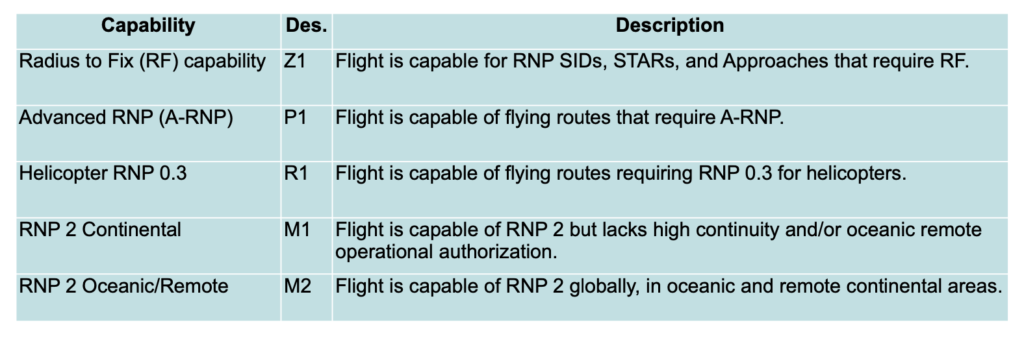
We are seeing a ‘Z’ which will go into Item 10a and a Z1 which will go into NAV/

What else?

Here is a table. Lots of new letters with a 1 after them (or a 2) confirming your various RNP capabilities.

What do we use at the moment?

Let’s take a quick jump back and talk about ‘Relevant Flight Plan Fields’.

If you’ve ever filed a flight plan, you are probably fairly familiar with Item 10 – Equipment and Capability (with 10a for your Nav, Comms and Approach Aids and 10b for your Surveillence). Then there is Item 18 – Other Information, and this is where you enter your PBN, NAV, DAT, SUR and COM stuff.

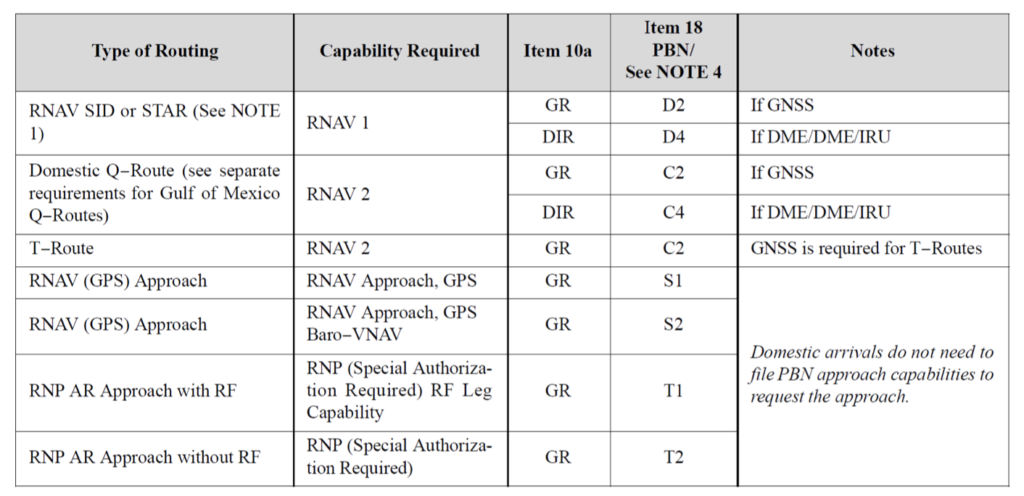
So, depending on the type of routing or what-have-you that you plan on doing, you need to add info in item 10 and item 18 to confirm you’re capable of doing it.

Here is a handy table for you. Basically, if the plan is to fly a ’T-Route’ for example, then your airplane needs to be capable of RNAV 2, which means you’ll want to whack a ‘GR’ into Item 10a and a ‘C2’ into Item 18.

Current AIM instructions

GR of course means GNSS and R means PBN approved. C2 means RNAV 2 GNSS specifications.

If any of this is totally new to you…

Maybe take a read of FAA Appendix A. FAA Form 7233-4 ‘International Flight Plan’ which covers all the boxes and their respective what’s and why’s.

PBN/ is limited.

Something else mentioned in the presentation is the limited number of PBN/ entries that you can make on your flight plan. This limit means the automation which “reads” your plan might make some assumptions. For example, if you enter a D1, D2, D4, O1 or O2 code, it is going to assume you are RNAV 2 capable.

There are also certain PBN/descriptions which don’t align with any OpSpec authorisations.

C3, D3, O3 – DME/DME is not adequate for RNAV 2, RNAV 1, RNP 1 and O4– DME/DME/IRU alone is not adequate for RNP 1.

All of which means changes are needed!

A reminder on using NAV/RNV to suppress a PBN segment

The automation (and this is a direct quote from the presentation) ‘bases route eligibility on PBN information but overrides that with the NAV/ information when provided’.

Right now, putting RNV means RNAV, so if you file NAV/RNV the automation won’t think you’re eligible for an RNP routing. In fact, 50% of flight plans which include RNP1 capability are only seen as RNAV 1 eligible. If this has happened to you, stop putting RNV in the NAV/ string.

The main point here is that the majority of users should be using PBN/ only.

There is more.

There is more, but it might be easier to read it in the FAA presentation itself. 

When all the FAA documents are changed and updated to include the new stuff, then this is what to look out for:

  • New NAV/ descriptors are coming in, including info on how to file them
  • Documentation on the new descriptors they’ve come up with will be there
  • Instructions on how to file RNP routes, including ones which require RF capability will be included
  • Instructions on how to use NAV/RNV to exclude PBN routes on a single segment will be removed (but there will be a web page and FAA contact info if you still need help).


Liquid Lunch

Remember the 100ml rule? The one that’s been there since 2006, causing endless hassles at security. Well, its changing!

Why does that matter for air crew?

Good question. Is this really an operational issue to talk about? We are ‘Opsgroup’ not ‘VaguelyInterestingInfogroup’ after all…

Well, the rule is here for crew too and if you’ve ever operated through a UK airport you will know they can take it very seriously indeed. I once had my healthy hummus lunch taken from me because hummus is slightly more liquid than solid.

So, the change will mean:

  • An easier time going through security for Air Crew as well as passengers
  • Possibly some changes on what you can stock up on during layovers (if you don’t check your crew bags)
  • The option to have better coffee than what you might get onboard
  • General security changes

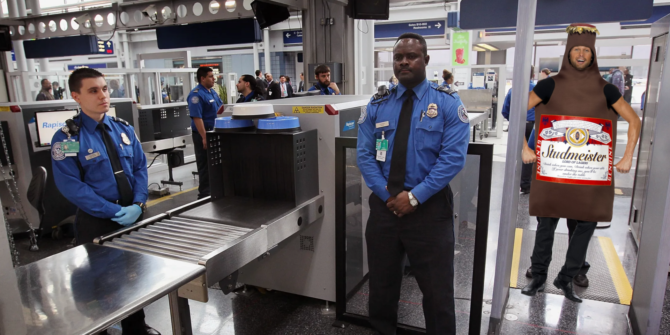
No more of this!

Let’s take a quick look at the security side of things.

Passengers and crew will be able to carry whatever liquids they require, so long as they fit in their hand luggage. Remember though, if you are transiting another airport, their liquid limits will still apply.

There are a few liquidy products worth looking out for as well. The top two we are aware of are peanut butter and Frankfurter sausages in jar available in EDDF/Frankfurt airport duty free.

Why?

Well, the liquid explosive scanning machines work off detecting a range of chemical elements, and also look at density. Fun fact – the molecular makeup of peanut butter is actually very similar to nitroglycerin, while the juicy sausagey water in frankfurter jars is apparently of a density that some scanners struggle with.

Then there are actual banned substances.

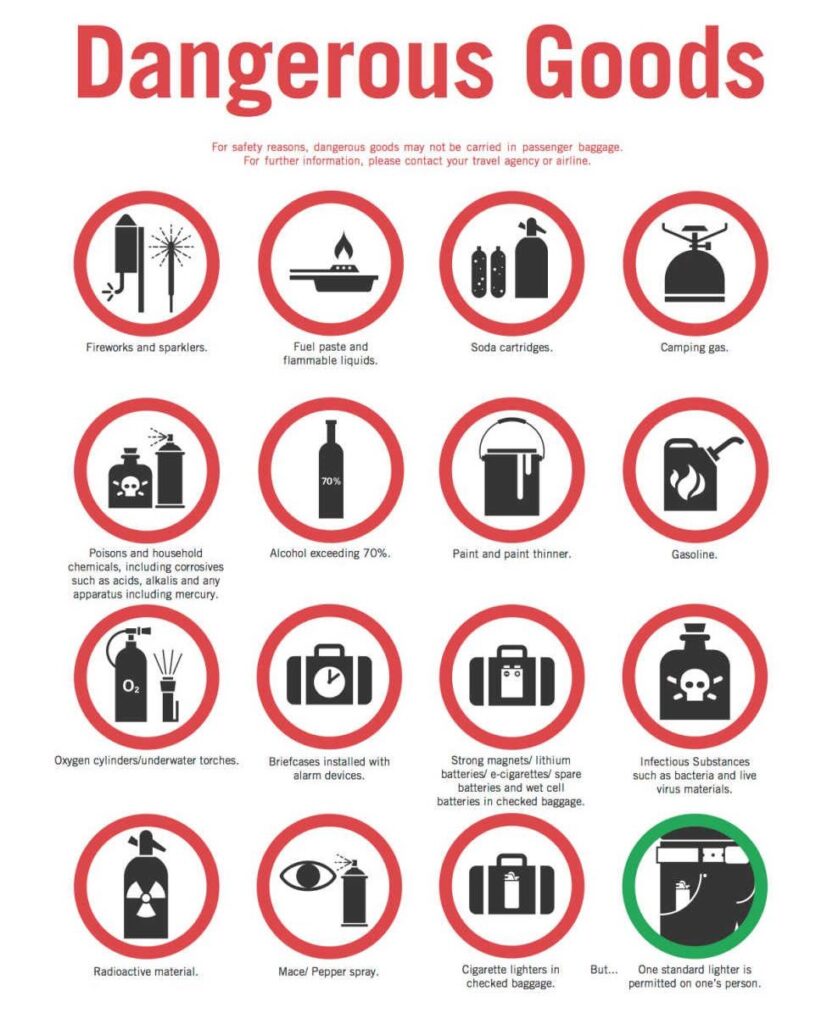
Possibly more important to remember – these are, obviously, still banned. There is no change to the dangerous goods restrictions.

Toxic, flammable, infectious, over 70% alcohol, paint etc is all still not allowed.

Toxic, flammable, infectious stuff… still banned!

Shannon Airport

EINN/Shannon is of course a gateway airport for the USA. The US Pre-clearance status means you can undergo all immigrations, customs and agriculture inspections here.

Which is why we thought this was worth mentioning because it will be a nice change for a lot of folk heading through, but those agriculture restrictions remain in place.

All travelers entering the United States are required to declare anything with meats, fruits, vegetables, plants, seeds, soil, animals, as well as plant and animal products – including soup or soup products.

Check out the USA CBP website for more info. There is quite a handy “what can I bring in for my own personal guzzling purposes” list here, published by them.

Where else are the scanners going to be?

Well, the UK is planning to have them installed in all their international airports by December 2022.

TSA in the USA is also planning on having over 1000 of them active for Summer 2022. So watch this space.


Is the Fuel Pool Drying Up?

From Laos to Lima there is a growing fuel shortage and while the shortages (and fuel price hikes) have mainly been impacting road users, the problem is beginning to be felt in aviation as well.

So we figured we’d take a look at the situation.

What’s causing it?

The Ukraine Russia conflict.

Russia is the third largest supplier of oil behind the USA and Saudi Arabia, supplying around 12% of the world’s needs.

The conflict is seeing oil prices zoom up, recently hitting $139 a barrel (a 14 year high). Spot prices in New York Harbour went over $7.30 a gallon which is double what it normally would be this time of year.

But why is the USA short?

Good question.

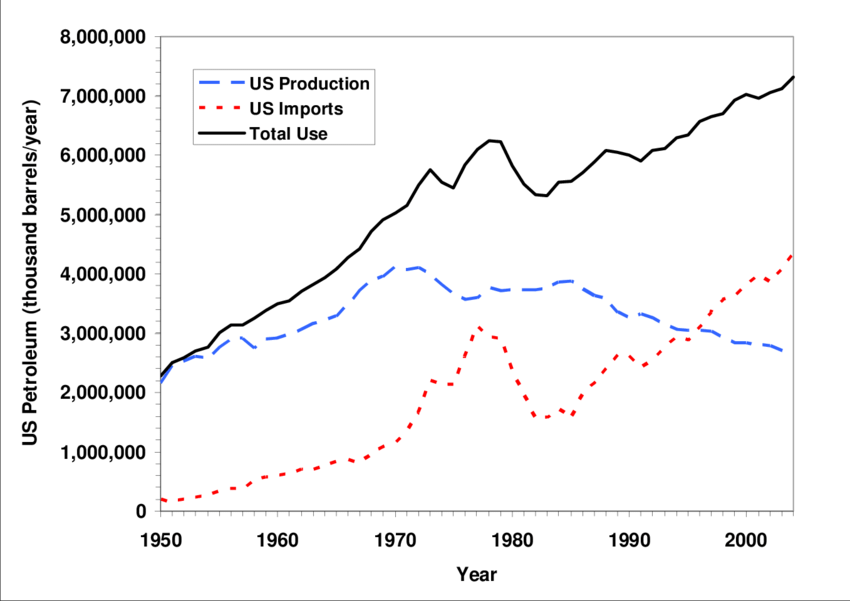
The USA gets its fuel from lots of places, predominantly domestically and from across the border in Canada and Mexico. What you might not realise though is it also sources almost 10% of its supply from Russia. It’s a big number when you consider 329 million people live in the US. Take into account that Europe is also feeling the pinch of this ‘tightening global energy market’, ‘ it’s no wonder prices are on the charge, and supply running thin.

A particularly uninspiring graph

Back in 2021…

Back in 2021 the USA suffered fuel shortages at a bunch of airports. This was actually due to a bunch of reasons:

  • There weren’t enough truckers to drive it around
  • The pipelines had all been shifted during covid and hadn’t been shifted back again
  • There was a cyber attack on one of the main pipelines disrupting the supply
  • Some supplies were diverted away from leisure airports and to airports where wildfire fighting aircraft needed it
  • Leisure routes were getting busier as Covid restrictions loosened

Fast forward to 2022 and while flying levels are around 95% of the peak 2019 levels, fuel production is still only around 80%. So there is, simply, a shortage.

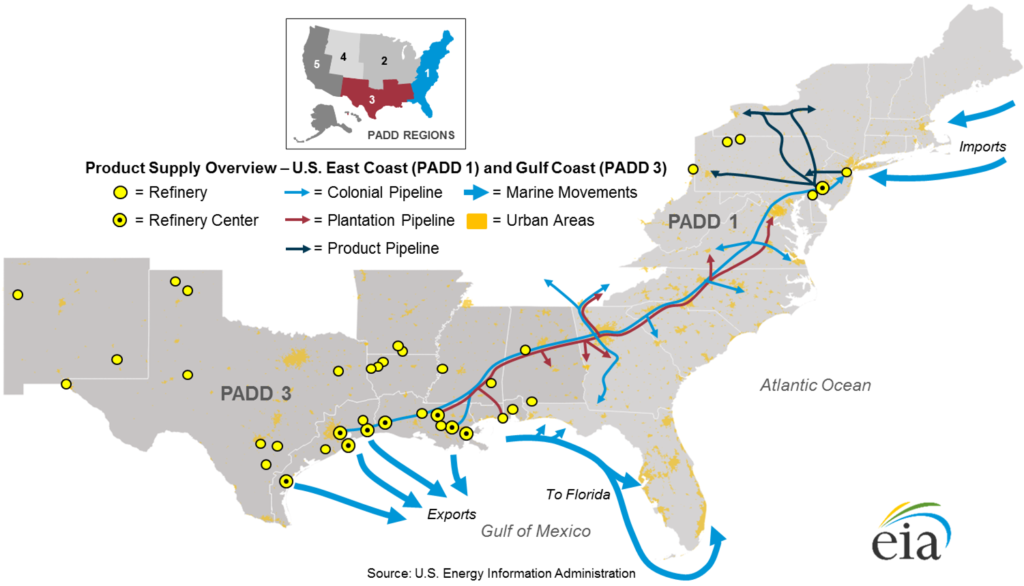
Let’s talk about the East Coast.

The East Coast has been particularly hard hit for two reasons:

  • One, because the California refineries suffered some technology issues earlier in 2022 and couldn’t make as much,
  • Two, because they receive their supply mostly from Texas and also Europe – and Europe ain’t sending much at the mo.
    • Distallite PADD 1 imports (the stuff a quick google search showed me is used for Kerosene – Jet fuel) is down 60%.

Where it comes from

What are we seeing, where?

  • Smaller, regional airports are reporting shortages
  • Leisure routes are being cancelled due rising costs
  • International shortages/rising costs leading to security situations
  • Uncertainty as to ongoing availability
  • And of course, the rising costs globally…

In the USA

We have seen reports for several spots across the USA, and expect to see more particularly for the east coast airports.

  • KEYW/Key West has reported rising costs
  • KAUS/Austin has seen surge in passenger number and operators were asked to tanker where possible for at least the next few weeks.
  • KSDL/Scottsdale had a report from member of fuel shortages. One FBO confirmed their supply was ok, but other FBOs were running low.

If you have visited an airport recently which has fuel supply problems, or where costs are rising significantly, please let us know.

Elsewhere in the world

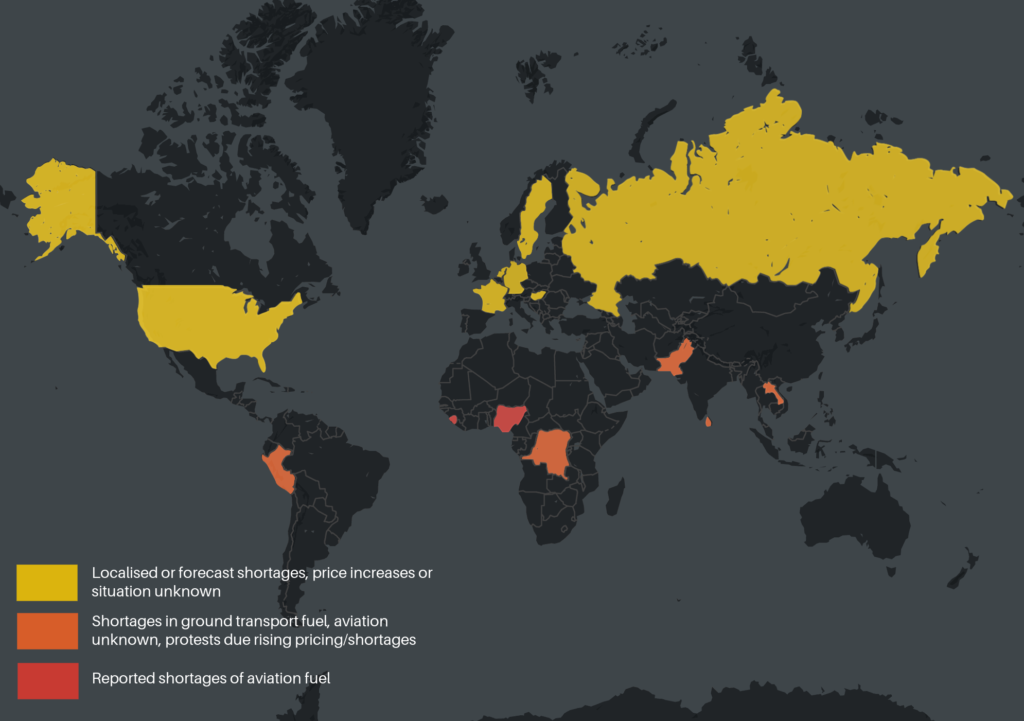
Nigeria and Russia have both had reports of aviation fuel shortages. The other countries on the list are seeing fuel shortages and rising costs leading to protests and security situations, however whether there is an impact on aviation fuel supplies is currently unknown.

  • Russia started to see fuel shortages around the start of March.

Whilst Russia are a major oil producer, much of their supply may be getting redirected for military operations. One major operator cancelled flights to UUDD/Moscow due being unable to uplift. With the current situation and lack of operators heading in, it is hard to get any clear picture of the situation though.

  • Nigeria have a big, ongoing shortage.

Although initially due to a batch of poor quality fuel, the situation has been growing as the costs of buying in more keep rising. This has been impacting domestic and some Interational airlines for over a month now. We wrote about it here.

  • Laos have a nationwide shortage but reports are not clear as to whether this impact aviation fuel as well.
  • Peru have seen protests and strikes in the transportation sector over rising fuel prices. There are no reports of this impacting aviation yet.
  • Sri Lanka has also been seeing an increase in protests over rising economic issues including fuel shortages. An FBO at VCBI/Colombo-Bandaranaike informed us that jet fuel supplies are good.
  • Pakistan are seeing rising demand, but are struggling to buy in fuel from their suppliers as Europe call in additional supply.
  • DRC has a shortage in ground transport fuel. No impact reported on aviation fuel, but significant security issues due protests.
  • Sierra Leone have a notam advising Jet A1 only available for scheduled flights at GFLL/Freetown until at least April 20.

Fuel Shortage Map (12/4/2022)

What to do about it?

  • Keep an eye on notams
  • Confirm availability with agents prior to heading in
  • Consider signing up to services such as AvHopper that can keep updated on fuel costs and availability
  • Tanker where possible to maximise cost efficiency
  • When planning alternates consider fuel availability
  • Think about crew security on the ground if laying over, and crew transport issues
  • Share it if you operate to an airport or region and experience fuel issues.

You can let us know about it on team@ops.group and we will post an alert so others know about it as well.


OPSCHAT Summary 12 April

Hi Members,

It was another busy OPSCHAT call this week – with a fun new addition.

You can watch the full replay on your Member’s Dashboard.

Here’s a quick summary of what we talked about:

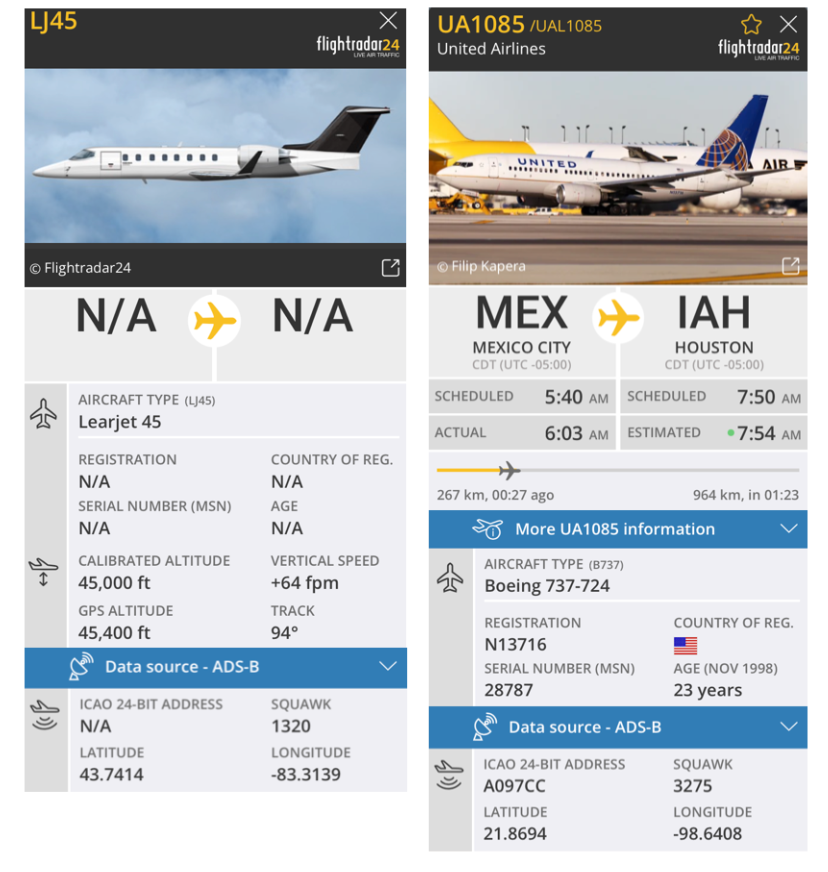
  • Russia – SITA are cancelling their VHF services from April 11. So no more SITA run VHF/VDL or datalink. There was also an air prox event between a civilian airliner and military fighter near the Latvian border – spill over effects from the conflict in Ukraine are still a big issue!
  • Europe –  Strikes and staff shortages. The perfect post-Covid storm. Suddenly the industry isn’t quite ready for Easter, so now it’s one big mess. UK fuel shortages hopefully resolving by end of the week. GPS jamming, yep still an issue, we’ve written a handy Opsicle about it you can find here.
  • Japan – It’s opening to rest of world, but not for tourists yet. Crew entry rules are causing confusion. No clear answer on this yet. If anyone has news, please share it with us.
  • USA – Big closures at KASE/Aspen and KJAC/Jackson Hole. Russian military exercise has been affecting NOPAC routes in the Anchorage FIR. Alphabet Soup – the FAA are changing up their flight planning codes to cover new PBN RNP1 NAV advanced capability stuff. Watch this space for an update on it.
  • And something for fun. Opschats now have a quiz involved! And there are prizes to be won (good prizes, exciting prizes, prizes worth winning. Well, we think so.) All ops related questions of course.

Congratulations to our first ever winner!
As always, the team is here to help with any operational support, info or questions. You can reach us on news@ops.group, or via the slack channels #flightops and #questions.

To watch the replay of the OPSCHAT in full: head over to the dashboard. We hold a new one every week on Tuesdays at 2000z, click here to register and join us live. See you next week!


Testing Times At Teterboro: Closures and Challenges

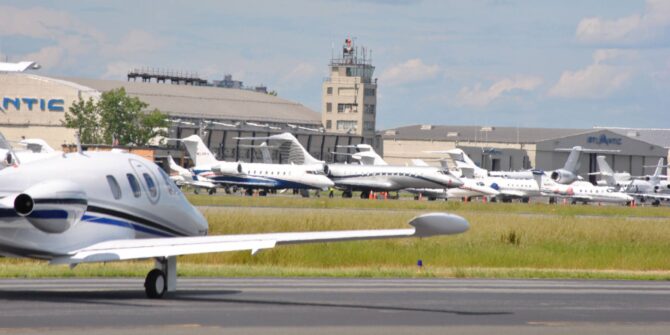
Aside from being the oldest operating airport in the New York City area, KTEB/Teterboro is far from quiet.

In the good ol’ pre-Covid days of 2019 it saw over 124,000 aircraft movements – that’s 340 every single day. And even last year in the height of the pandemic, it was well on the way back to those levels.

It is also unique for a few reasons. The first is that it is weight limited – if your ride is heavier than 100,000 pounds (45,000kg-ish), then you can’t land there without a waiver. Which means there is no airline traffic, making it exclusively the realm of GA and business aviation operators.

It is also nestled among some of the busiest airspace in the world. The field itself is only 6nm from downtown Manhattan. Which means traffic in and out of there has to compete with the seemingly constant flows of nearby big hitters KLGA/LaGuardia, KJFK/New York, and especially KEWR/Newark.

This tricky combination creates unique operational challenges for controllers and pilots alike. And now things are going to get even more complicated. Here’s why…

A runway is off to rehab.

Or perhaps more accurately, Runway 06/24 is being rehabilitated. Which is a fancy way of saying it needs to be repaired.

 Unfortunately, this is also time consuming. So, a bunch of runway closures have been scheduled at KTEB running all the way into next year at night and on weekends.

During these closures Runway 01/19 will be in use for arrivals and departures which can be hugely disruptive to operations – especially in two scenarios:

Runway 01 Arrivals (Northerly Flow)

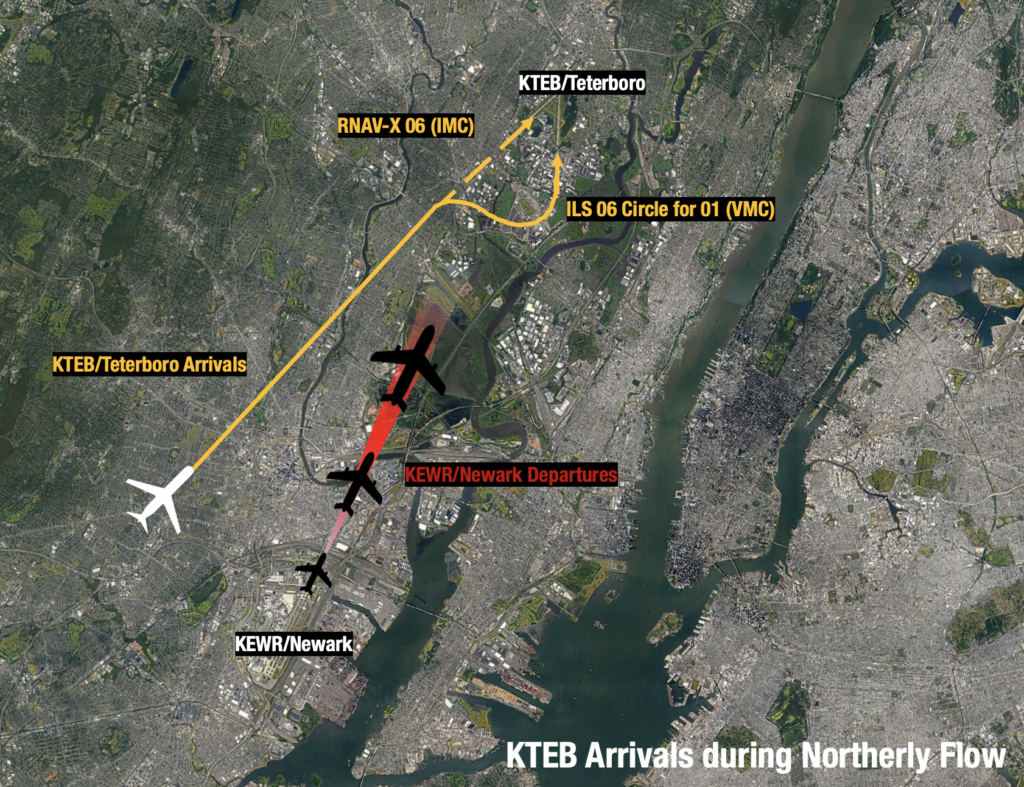
When Runway 06 is closed, arriving traffic can expect one of two approaches.

If the weather is good.

 You can expect the ILS approach runway 06, circle to land 01 to keep you clear of Newark. But beware, it can be a challenging approach for a few reasons. Code 7700 has published a fantastic briefing that is almost a compulsory read if you’re unfamiliar with ops there.

Some other common sense prevails too – make sure the approach is carefully briefed beforehand. It’s tight, and easy to get unstable so crew co-ordination is going to be important to keep the old SA up.

If the weather is not so good.

You can expect an RNAV-X approach onto Runway 06 – runway closures are weather dependent. The Port Authority of New York and New Jersey have confirmed they will open it back up.

When are we going to see an instrument approach for Runway 01?

 Good question, the problem is that Newark gets in the way again. The Teterboro User’s Group are hard at work with the FAA to come up with one, but the process is by nature slow. Within months is the goal, but not quite soon enough to help during these works.

Runway 19 Departures (Southerly Flow)

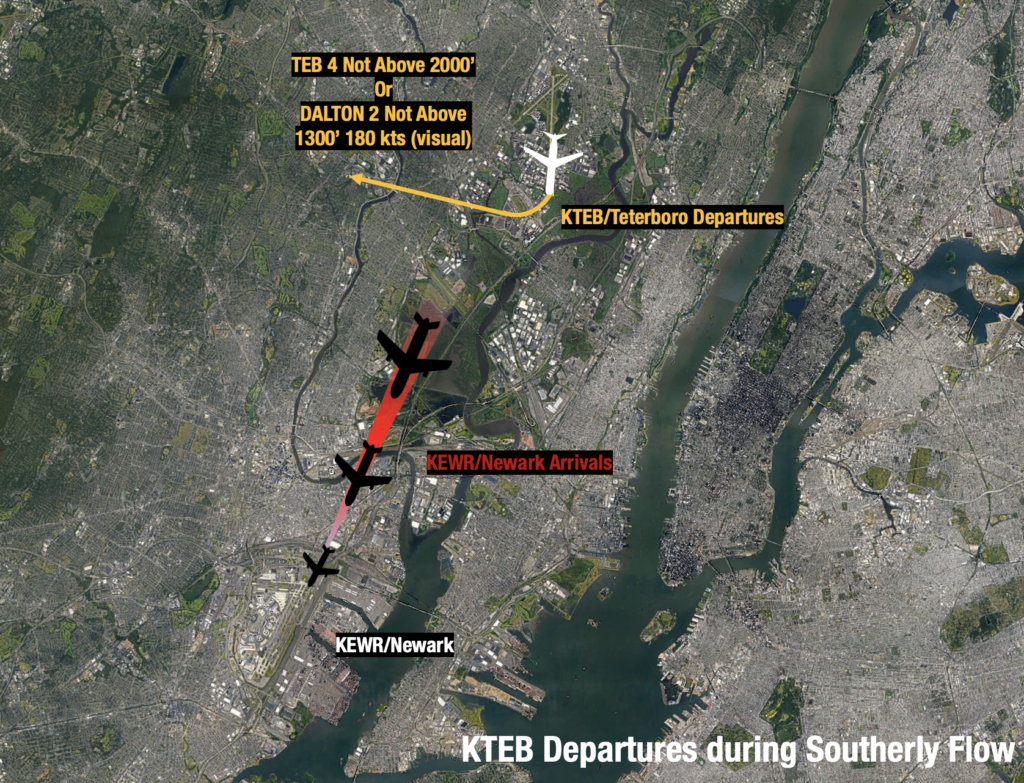
This is when you can expect big delays, as Runway 19 points straight at Newark.

Expect the Teterboro 4 Departure by default. But a head’s up – for every single aircraft that launches out of Teterboro on this SID, NY TRACON needs to find a 10nm gap in arrivals at Newark. And that means a lot of waiting. There may be a better option…

Consider the Dalton.

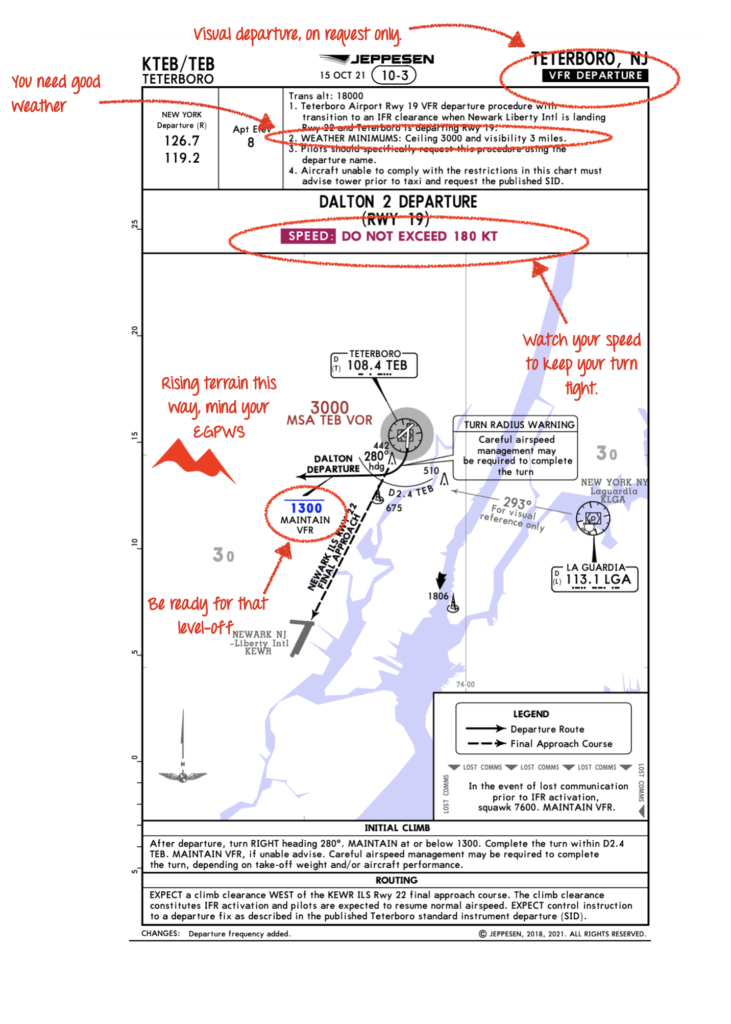
The what? The Dalton Two Departure. It’s unique because it allows aircraft to depart Teterboro visually, before transitioning to your IFR flight plan – and it’s by pilot request only when the weather is better than 3000 – 3.

The Teterboro User’s Group worked with the FAA to get this one off the ground (no pun intended). It is essentially a right-hand turn after departure onto a westerly heading, at or below 1300 feet. You’ll need to keep your speed back too.

The spacing required is effectively halved. Don’t be put off by the phrase expect indefinite delays either. It’s ATC’s way of telling you they don’t know how long it’ll be. But local operators confirm delays are never worse than the standard TEB 4, and more often than not, better.

But before you light the fires, there are a couple of gotchas. It’s going to get busy – the low level-off happens quickly in high performance jets, especially at light weights. So be ready for it. Also, the westerly heading points you (visually) towards rising terrain and there have been reports of EGPWS warnings as a result.

The Dalton 2 can be a valuable time saver, but make sure you brief its threats thoroughly.

Teterboro isn’t the only option.
If you don’t have the appetite for all of this and are looking for more straight forward options, here are a couple to consider:

KHPN/White Plains It’s 25nm from Manhattan – about a 40-minute drive in normal traffic. It has two runways, the longest being 6549’ (1996m) long.

KMMU/Morristown About the same distance away with a slightly longer 50-minute drive. It also has two runways with the lengthiest option of 5,998’ (1,828m).

Local operators in New York have told us that even though the drive is a little longer, the overall travel time is often less when you avoid delays in and out of KTEB.

Look out for full airport closures too.

There are also eight complete airport closures scheduled for KTEB coming up, some lasting up to 38 hours: 

July 1 – August 31: Six closures are planned on weekends, from Friday 10pm until Sunday 12pm (local time).

October 1 – November 3: Two closures are planned from Sunday 12:01am – 12pm (local time).

 The exact dates will be confirmed by Notam.

Need more support?

Reach out to the friendly folk at TUG (the Teterboro User’s Group). They’re experts on ops at KTEB, they post weekly construction bulletins on their website and are more than happy to help operators out with advice. Also a special thank you to David Belastock – the President of TUG. This write up would not have been possible without his experience and generous support of OPSGROUP.

We made an Airport Lowdown for KTEB a while back, which you can see here. We had help (since we’ve never flown in there), but if you spot anything to add or change then let us know.

Or you can talk to the OPSGROUP team directly on team@ops.group. We’d love to hear from you.


Everyone is talking about Zurich

There are a lot of Zurich related posts out there right now because the World Economic Forum is coming around soon, and with it some need to know things about Zurich, which is the main airport closest to where the forum is held.

On top of that, summer is on its way and with it the usual parking restrictions at all the popular tourist spots, which Zurich happens to be one of. So we thought we would take a look at it specifically, and share some info on what options you might have.

If you are operating into the general region during the WEF dates, get book now – some airports are already full!

First up, the Forum.

The World Economic Forum is big. It is the ‘World’ one after all. You can read about it here.

But what you probably want to know is where it is, and when it is.

  • It actually takes place in Davos (but LSZH/Zurich gets busy with important people, and their jets, flying in and out)
  • It takes place between May 22nd and May 26th

So if you want fly in here and park between May 22nd and May 26th then good luck, unless you have  an important person onboard, then just make sure you’ve pre-arranged it. Actually, better make that May 20 to May 29 because some might stay on over the weekend.

I believe it happens in there

Where can you park?

LSZH/Zurich probably isn’t an option anymore so check out some the following. But do it fast. Spots are filling quickly and its pretty much on a first come first served basis at this point.

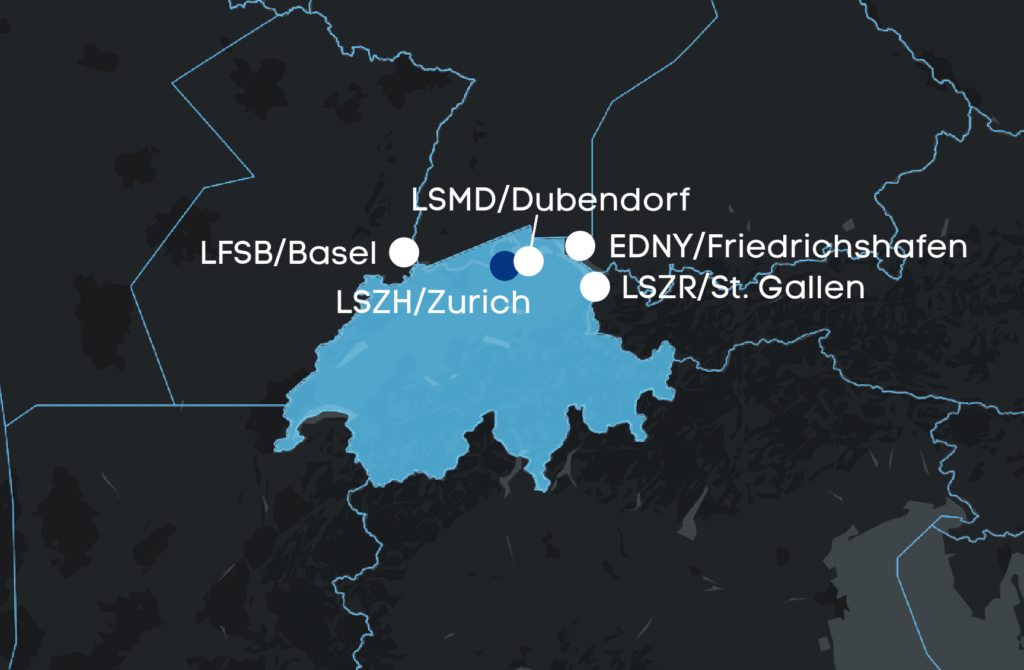
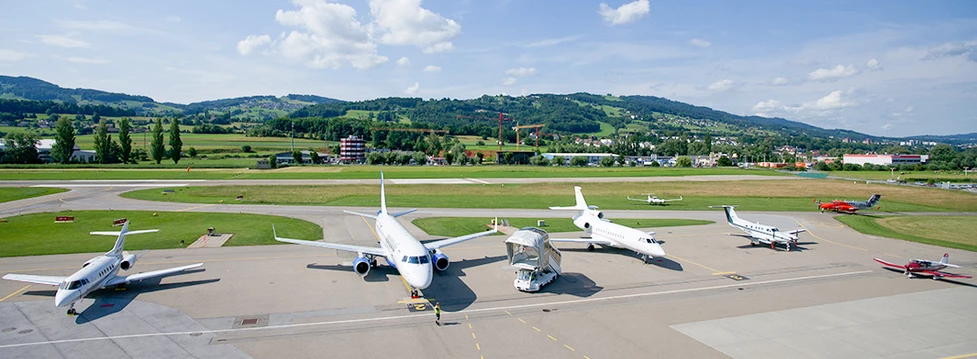
  • LSMD/Dubendorf
  • EDDL/Düsseldorf
  • LOWW/Vienna
  • LFSB/Basel
  • EDNY/Friedrichshafen
  • LSZR/St.Gallen Altenrhein
  • LSZS/Samedan

Some of the nearer options

Here is some info on the ones you might not have info on.

LSMD/Dubendorf

Respositioning to and from LSZH/Zurich is not possible – there are customs available, and aircraft must operate in an out as their destination and origin.

The airport is only available to WEF related flights during the WEF period. There is also a query over whether fuel is available so confirm with the agent.

  • Some contact info

If you want to use Dubendorf during the World Economic Forum you are going to have to speak to TopMotion as they are the main handlers here: +41 44 8420 10 60aircraft.handling@topmotion.ch

We got some info from them already. You can see their 2022 price list here and take a look at their WEF Air Crew Guide here.

  • Some operational info

Dubendorf’s runway 11/29 is 7726’ (2355m) x 40m.

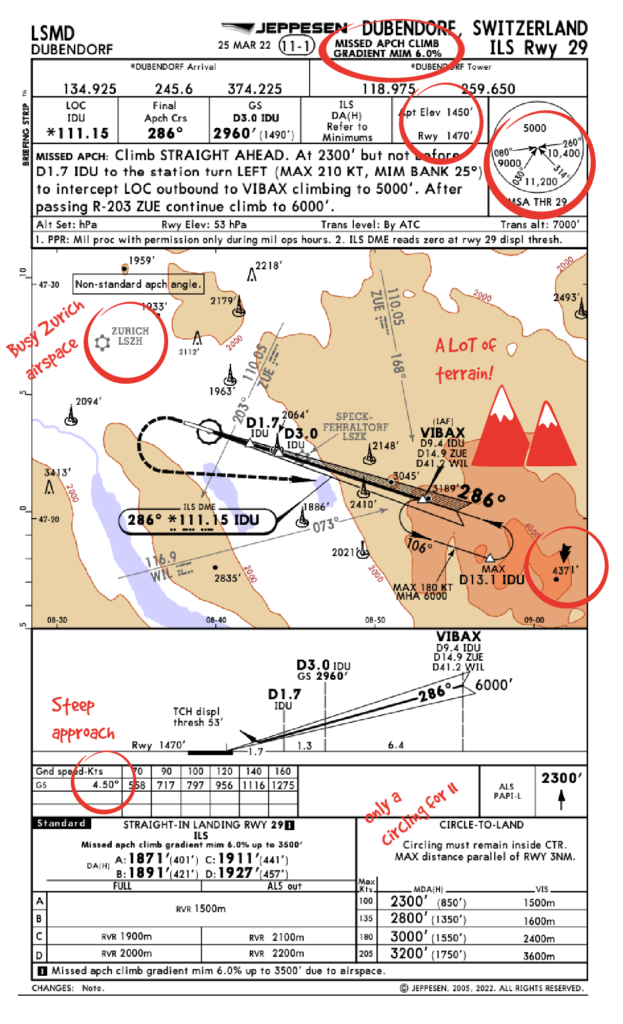
Runway 29 is equipped with CAT I ILS and RNP approaches while runway 11 is, well, not, Something to do with the majorly high terrain they put directly by the runway. (OK, maybe the terrain was there first, but it does sit right where what would be the missed approach for 11 would take you).

The terrain is high with and MSA of 5000’ to the North, and then 9000’, 10400’ and 11200’ in the south. It’s that terrain that gives the ILS its 4.5° approach angle, which means you’re probably going to need a steep approach approved aircraft and some special training for here, before heading in.

The airport elevation is 1450’, and the missed approach (busy because of the terrain as well), has a required gradient of 6%.

This is a challenging airport

LFSB/Basel

A good option… but parking may already be fully booked here.

EDNY/Friedrichshafen

Be aware as this airport is in Germany, fuel will generally be more expensive as the taxes are higher here.

  • Some contact info

Airport Services are you best bet. Try them on +49 7541 284 388 / info@handling-fdh.de

  • Some operational info

You have a 7730′ (2356m) runway with an ILS either end. There is a lot of terrain around here though, and the airport elevation is 1368′ so watch out.

Open 0500-2100z weekdays, and 0800-1900z on weekends, with overtime available on request. PPR will be required for stays of more than 90 minutes.

Parking should be possible, but expect to be repositioned for parking and servicing.

LSZR/St.Gallen Altenrhein

A decent option if you can fit on their shorter than other airports runway.

  • Some contact info

Get in touch with the airport directly for support. You can find them on +41 71 858 5165 / c-office@peoples.ch

  • Some operational info

You’ve only got 4774′ (1455m) to play with here. There is an ILS to 10, but it is 4°, and there is not published approach for 28. All this is because of the terrain in the south with MSAs of 10,200′ and 11,400′ to look out for as well as an elevation on 1306′.

BizAv is their business

Back to Zurich.

Zurich always has certain charges and restrictions in place, even when big events like the WEF aren’t taking place.

Charges

  • Landing charged, based on your weight
  • Noise supplement charge, that varies depending on whether you disturb the peace during the day or the night
  • An Emission charge based on amount of nitrogen oxide you emit
  • Parking charges based on how much you might weigh, and time spent parked there
  • Passengers, security and mobility support charges for passengers
  • Freight charges

All the details of all the charges are contained in their Big Document on Charges Regulation. Which you can read here (although this only runs until 1 April and they don’t seem to updated it yet.)

Anything else?

Yeah, slots. You need ‘em. Best sorting it via your handling agent.

Permits (in general)

Landing permits are not required for private GA/BA flights to Switzerland. You’ll only need a landing permit if you’re operating a charter flight on an aircraft not registered in the EU. For that, email the authorities direct at: trafficrights@bazl.admin.ch

Operational Stuff

Zurich is a relatively challenging Cat B airport. We made a little briefing on it here to help.

Tell us…

If you know of other options, let us know and we will share the info – team@ops.group


OPSCHAT Summary 05 April

Hi members,

It was another busy OPSCHAT call this week.

You can watch the full replay on your Member’s Dashboard.

Here’s a quick summary of what we talked about.

  • Europe – EASA have updated their fuel regs – we dug into what has actually changed. France has begun rolling out new ATC systems, starting with the LFFE/Reims FIR which could lead to big delays. The EASA Environmental Portal deadline has been and gone – if you’re operating a jet into Europe under Part 91 or 135, you probably need to know about it – we briefly covered what operators need to do. Our recent article may also help. A strange new Notam has been issued about unannounced military ops up to FL300 between Italy and Greece, so we talked about what we’ve heard. Potentially disruptive strikes across Europe were cancelled last minute. But don’t get too relieved, more will probably come.
  • USA – Several major airport closures are on the horizon including KJAC/Jackson Hole and KADS/Addison – we took a brief look at the details. We also discussed disruptions at KTEB/Teterboro due to upcoming work on Runway 06/24 with the help of local experts – they gave us some great information to help keep you out of trouble if you’re unfamiliar with ops there (with special thanks to David Belastock over at the Teterboro User’s Group). We looked at spiralling fuel costs and shortages, especially on the East Coast, as well as global shortages. If you experience rapidly rising costs or supply problems, let us know! The US Masters in Augusta GA is happening from April 7 – 10, we talked about special FAA procedures that have been published for nearby airports.
  • The Middle East – There have been more drone and missile attacks in the OEJD/Jeddah FIR, Saudi Arabia. The latest caused flight disruptions at OEJN/Jeddah airport. We chatted again about the practical risk for overflights along with those taking off and landing. Safeairspace.net also has a full briefing available.
  • Asia  – A question was asked about airspace incursions in Taiwan’s Air Defence Identification Zone (ADIZ). We looked at what’s been happening recently, and what operators need to do to stay out of trouble. We’ve also previously made a handy article on this issue.

As always, the team is here to help with any operational support, info or questions. You can reach us on news@ops.group, or via the slack channels #flightops and #questions.

To watch the replay of the OPSCHAT in full: head over to the dashboard. We hold a new one every week on Tuesdays at 2000z, click here to register and join us live.


The New EASA Fuel Policy: Does it affect you?

So EASA have changed their fuel rules and the ‘Decision’ they have published ain’t an easy thing to read. Here is what we think it says, in plainer English, to help you work out what it all means for you.

We are no pros on fuel planning through so this is more of a heads-up that things are a-changing. For the full regulations you will need to dive in yourself and try to fathom it out, but hopefully this gives some info on bits to really look out for.

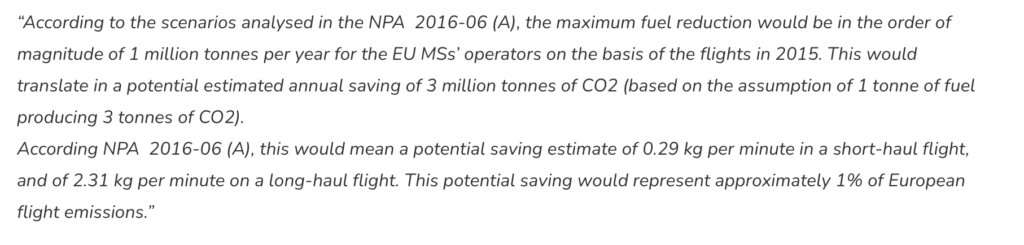
First of all, in EASA’s own words…

…What the change is all about?

Words and more words

They also say:

Give it to me in plain English.

  • It will improve fuel efficiency.
  • It will be nicer for the environment.
  • It will apply from October 30 2022.
  • The big change in fuel policy applies to Commercial Air Transport (CAT) operators (but there are a lot of changes for other folk in there too)

If you want to jump straight in and read it all yourself, then here is the link.

What’s changed then?

Remember the old Fuel Policy that we all know and love?

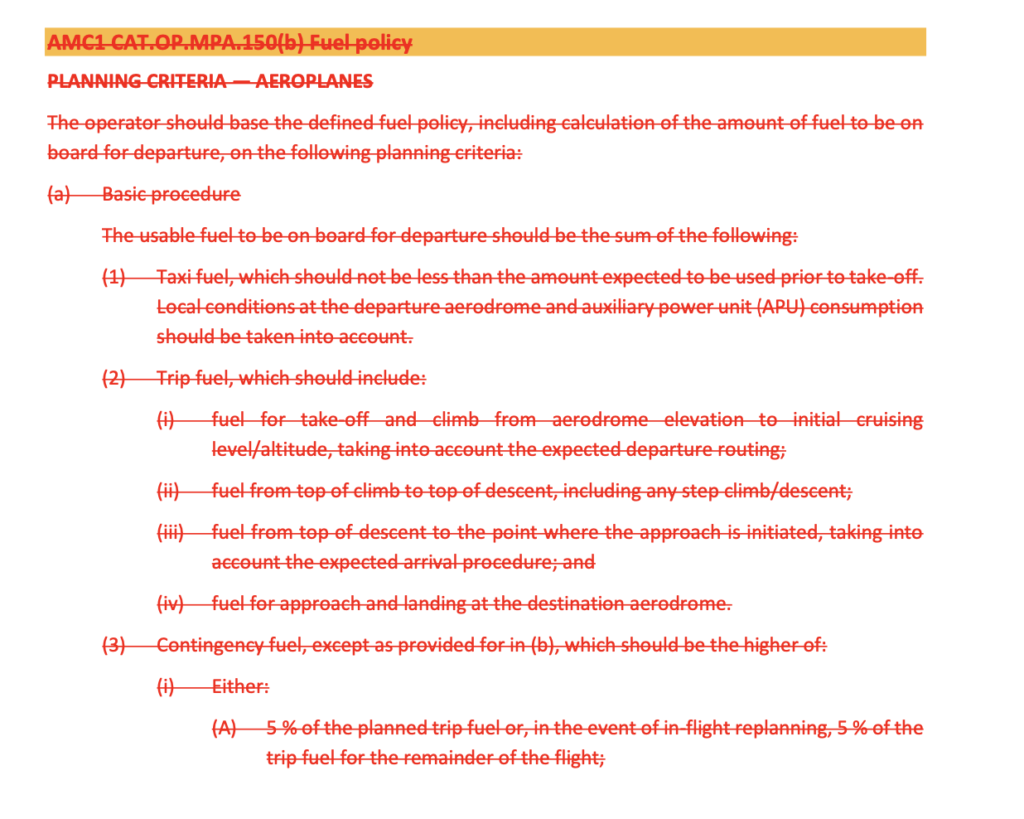
The one where you have to carry taxi fuel, trip fuel, fuel to get to your alternate, contingency fuel (and some additional bits in there about whether that needs to be 5% or 5 mins at 1500′, or 3% or if you can use STATCON…) plus your final reserve and any extra you might want…

Out with the red, in with the blue, the new fuel scheme, is confusing for you?

Well, that is out and in its place are three new fuel schemes –

  • the Individual.
  • the Basic.
  • the Basic, with variations.

So the old fuel policy is chopped and there are three new schemes instead. 

Here’s the deal with them. The first thing to know is that the individual and the basic + variations are both voluntary, meaning you’ll need to meet a bunch of criteria to opt for them. The basic is what you’ll be on if the other two don’t apply.

Oh, and should have said it earlier, but this only applies if you’re an EASA operator.

Any idea which fuel scheme to read up on?

If you’re not a CAT Operator (now that header picture makes sense, right?) then the Individual Fuel Scheme (and all the many, many pages of info referring to that) probably won’t apply to you. That’s not to say it isn’t useful to read and know about anyway.

If you know you don’t have particularly enhanced fuel monitoring capabilities then the basic scheme is the one for you, and this is not really different from the current fuel policy as we know it. There are however a lot of small changes which you will need to know about.

EASA say 

So let’s look at the schemes.
1. The Individual Fuel Scheme.

This applies to big operators with big fuel monitoring systems in place which let them say “I know how much fuel I need all the time because I fly there a lot, monitor it and know about all the possible changes and risks and all that stuff that might affect it!”

So EASA are all “well, if you meet all our criteria then we’re gonna trust that you do know better, and can take just what you need and that’ll be better for you and the environment.”

OK, there might be a bit more to it than that, but in a nutshell if you’re a big operator and think this might apply then dig in and read all the new blue and see if you can opt for this scheme.

If you know this doesn’t apply, then read on.

2. The Basic Scheme.

Ah now this is more familiar. It is basically our old Fuel Policy made simple.  5% for your contingency. Done.

Here’s the actual contingency bit for reference:

For contingency fuel, calculate for unforeseen factors either: whichever is the higher; (1) 5 % of the planned trip fuel or, in the event of in-flight re-planning, 5 % of the trip fuel for the remainder of the flight; or (2) an amount to fly for 5 minutes at holding speed at 1 500 ft (450 m) above the destination aerodrome in standard conditions,

This is not voluntary. The other two are, and if you don’t go for either of them then this is the policy you’ll need to apply.

3. The Basic with variations.

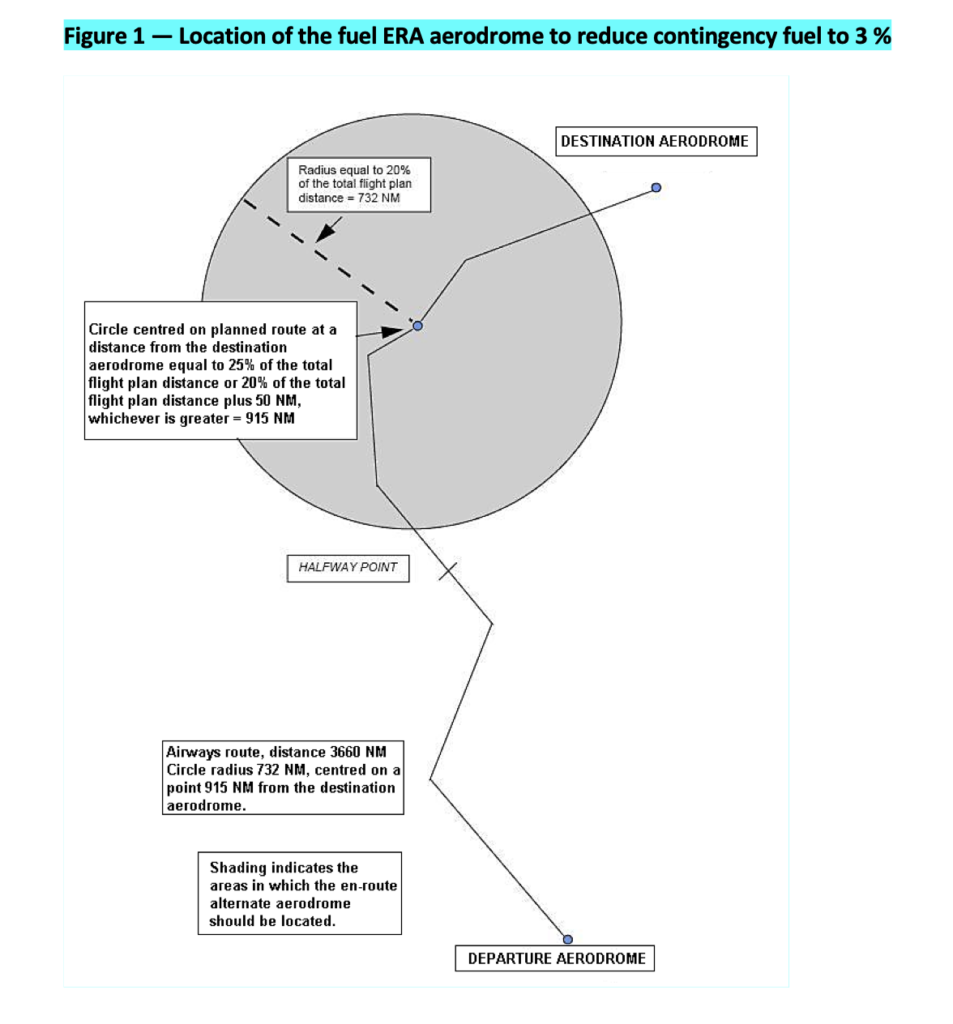
From what we can see, those variations really apply to the contingency and whether you can reduce to 3% or use STATCON, which is based on whether you have some sort of monitoring program in place, amongst other things.

Same, but bluer

Seems like a lot of blue just for that?

There is a lot because the two voluntary schemes have a lot of points attached to them which you need to know about if you’re planning on applying for one of those schemes.

Aside from the big policy changes, there are some changes and clarifications to definitions and what have you which are worth a read.

Do you need to read the Explanatory Note?

Not unless you really want an in-depth explanation as to why they need the new AMC and GM (acceptable means of compliance and guidance material) on fuel/energy planning, and a whole long list of references.

You can read it here if you do want to.

Annex I

This is the changes to the definitions annex. It is fairly short (they’ve removed acronyms) and made a few definition changes.

You can read it here, but you’re better off reading the full definitions annex here if it’s definitions you’re after.

Here’s one we found interesting:

  • Relevant safety information that might affect the safety of the flight: unforeseen hazards

They’ve published a nice list here of stuff to think about (which you were probably were anyway but just incase) it means stuff like unexpected ATC delays, met conditions which weren’t forecast, sudden obstructions on the runway, failure of some bit of the airplane that means you suddenly need a lot more runway. Sudden acts of nature that you didn’t expect…

The other Annexes

We jumped straight in to Annex IV because it is the Commercial Air Operators annex, and they did say at the start that most of the changes apply to this. If you are not a CAT Operator then take a browse through the annex that does apply. 

This contains all the info on the new schemes and the changes, criteria for opting for them etc. so this is what you need to read!

Some other bits worth looking out for.

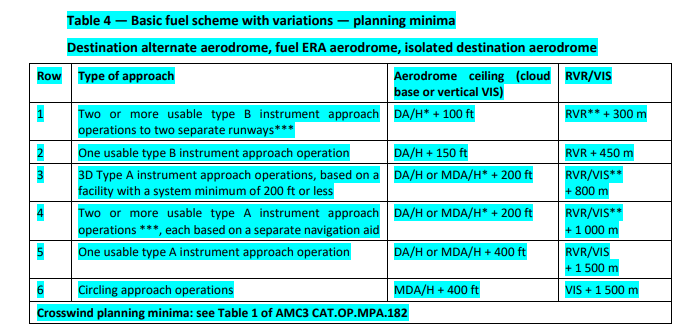
  • Alternate Planning: We aren’t here to get into the nitty-gritty of the changes but someone very helpful and with more knowledge on it that us said that this “basically rewrites everything we learned” about flight planning. One of the big rewrites is on the Alternate Planning.
    • The old ‘step-down’ method of alternate planning doesn’t apply anymore. Instead it must be looked at individually each time.
    • Wind gusts also need to be considered.
    • Take a look at the tables (here’s the one for the basic + variations scheme) to get a better idea.

Alternate planning changes

There are also some nicely updated or reclarified definitions throughout so even if the new optional schemes don’t apply to you, its good opportunity to remind yourself about certain meanings which apply to any fuel policy, even non-EASA ones.

  • Appropriate Meteorological information: There is a whole lot of blue here and they seem to have updated the definition on what this means and where you can get this weather from. Basically you can reproduce information from a reliable “weather man” source so long as you are just changing the layout, not the content.  
    • Reliable means it as some sort of quality assurance in terms of accuracy and integrity.
    • You can also use supplementary weather info – like some nice colourful charts.
  • Verifying weather conditions for adequate aerodromes: You have two choices, and the requirement for RFFS seems to have been removed from the adequate definition:
    • Adequate This means an aerodrome that you can fly to and use because its runway characteristics and anything else relevant meets your performance requirements. You don’t have to consider weather conditions to decide if an aerodrome is adequate.
    • Weather permissible You do need to consider the weather to determine if an adequate aerodrome is weather permissible for your planning purposes.
  • Minimum Fuel: This is worth a read, and because we think it is worth a read, we’ve recreated it here for you so you can just read that without everything else around it, if you so wish.

Is there a good way to read this?

It is a fairly unreadable document. The amount of blue and red makes it quite hard to work out what applies to you and what doesn’t. We suggest finding a way to separate the scheme that applies to you from the rest, and then read through the definitions and sections along side your current fuel policy to identify what has specifically changed.

Still totally confused?

We are too if we’re being totally honest. There are some big changes going on here and working out which fuel scheme applies to you is just step on.

EASA are holding a Webinar on this later in the year (Currently planned for July 7). You can register for it here. 

If you’re not already on it then it might be worth signing up to the EASA community network because they post updates, and folk have discussions on all things EASA on here so you might find more answers here.

There are some bits we were confused on so if you spot any errors or issues in this, please let us know at team@ops.group


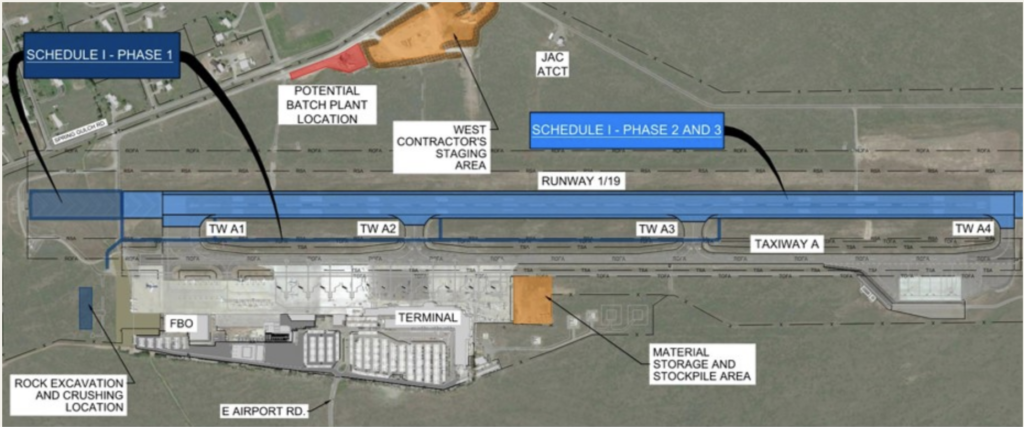
Jackson Hole Closing

KJAC/Jackson Hole will be closed to all traffic from April 11-June 28. Keep an eye out for the new KJAC Notam which has yet to be published.

What’s happening?

The runway is being replaced. Work has been happening in phases, and the first happened last year with minimal impacts. But now it’s time to get the really heavy machinery out  – the entire runway will be dug out, and the sub-base replaced.

If you’re wondering what sub-base is, it’s the granular layer that the hard stuff sits on top of. Of course, once it’s in place, the runway will also be fully re-paved. Unfortunately for traffic this means all operations will be stopped for 78 days.

Once the airport reopens, work will continue to groove the runway and apply markings, but this will happen with closures at night. The entire project will be wrapped up by August.

For more information you can view the official project website.

Phase Two is about to kick off, the big one. Courtesy: Jackson Hole Airport

Is the runway being lengthened though?

Not this time. The existing runway has been in place for nearly half century, and having been re-surfaced several times it is just in need of a full replacement. There will still be 6,300′ (1920 m) of runway available when the project is finished.

Where else can I go?

There are several alternative airports that could be considered during the works. We asked OPSGROUP members what their preferred alternate is, and their answer was KDIJ/Driggs, Idaho.

It’s only 23nm away. The facilities are reportedly great, with a nice big apron that can easily fit your ride. Here is some information on the field:

Runway 04/22 7,300’/ 2,225m.

Instrument approaches: All RNAV. There is a discrete approach for 04, and an Alpha approach which will set you up for circling. Just make sure the weather is appropriate.

FBO: Teton Aviation Center. You can reach them on +1 208 354 3100, or via info@tetonaviation.com. Also it’s going to get busy – reservations are essential. Teton has put out some guidance to pilots here.

Gotchas: As you’d expect, lots of terrain and high elevation – 6231′. It’s also uncontrolled, but there is a UNICOM available on the CTAF frequency, 122.7.

Bonus: Harrison Ford may, or may not, keep a DHC-2 Beaver here. Just word on the street.

Driggs Airport comes highly recommended.

I’d prefer a side of ATC with that thanks.

The nearest controlled airport is KIDA/Idaho Falls. It’s 63 nm away, and doesn’t require any reservation of PPR (unless things start to get really crowded). It would still pay to let your FBO know you’re coming.

Runway 03/21 9002′ (2743m)

Instrument approaches: ILS available (21).

FBO: Aero Mark +1 208 524 1202 or info@aeromark.com

Idaho Falls is the nearest airport to Jackson Hole with ATC.

I’m on international ops, and need customs.

KJAC/Jackson Hole itself is not a port of entry. But if you’re looking for one with CBP nearby, the closest option is KBTM/Butte, 160nm away across the state line in Montana.

Runway 15/33 The longest option at 9000’/2743m.

Instrument approaches: ILS available (15).

FBO: Butte Aviation Inc, +1 406 494 6694 or trevor@butteaviation.com.

If you’re looking for an airport with customs, Butte is the nearest option.

We welcome other suggestions!

Please get in touch with us at team@ops.group with any other recommendations, we love to hear from you!


Space. The Final Frontier.

We’ve mentioned space before because the goings on up there do impact the goings on down here. From space debris falling down, to TFRs around launch zones, to the impact of radiation on flight crew…

This post though is here to help you with Space Weather, or rather, how to monitor it and plan for it in your flight plans.

Space weather and what it does.

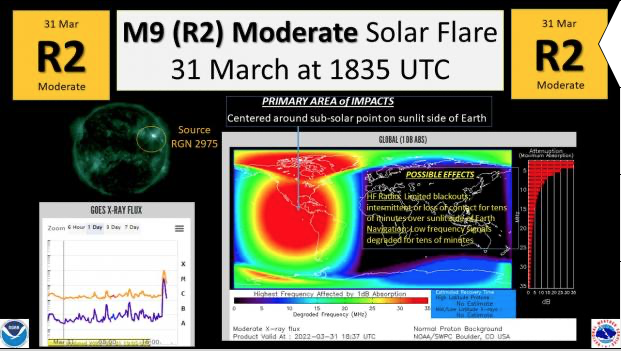
What we are talking about are things like geomagnetic storms and solar flares. The stuff that causes pretty Northern Lights shows, but which also causes less pretty impacts on our HF comms and our satellite navigation systems.

In general, the effects of space weather on earthbound stuff is limited to the higher latitudes and particularly the polar routes. For a whole load of information on this have our read of this post we put out a while back. For more info on radiation risk, check this one out.

A possibly not real photo of a solar flare

Flight planning.

This post is a simple ‘where to look for info’ post so you can include (if you don’t already) some of this info into your planning process, and into the information you provide your pilots.

First up, Alerts.

We check the NOAA site daily (the Space Weather Prediction Center part of the National Oceanic and Atmospheric Administration). When we see little yellow or little orange bits at the top we pop out an alert to let you know the sun might be sending something our way.

Orange more serious, yellow a bit serious, green is all good.

When its something more serious they tend to write up a proper little alert themselves on this.

This is just a forecast though. The R, S and G scales provide a prediction on the level of HF Radio Blackout likelihood (R), Solar radiation probability (S) and Geomagnetic storm impact (G) which would also impact your satellite navigation systems.

Sciencey info on the solar flare

If you see an alert you might want to go check an official aviation source.

Official aviation sources.

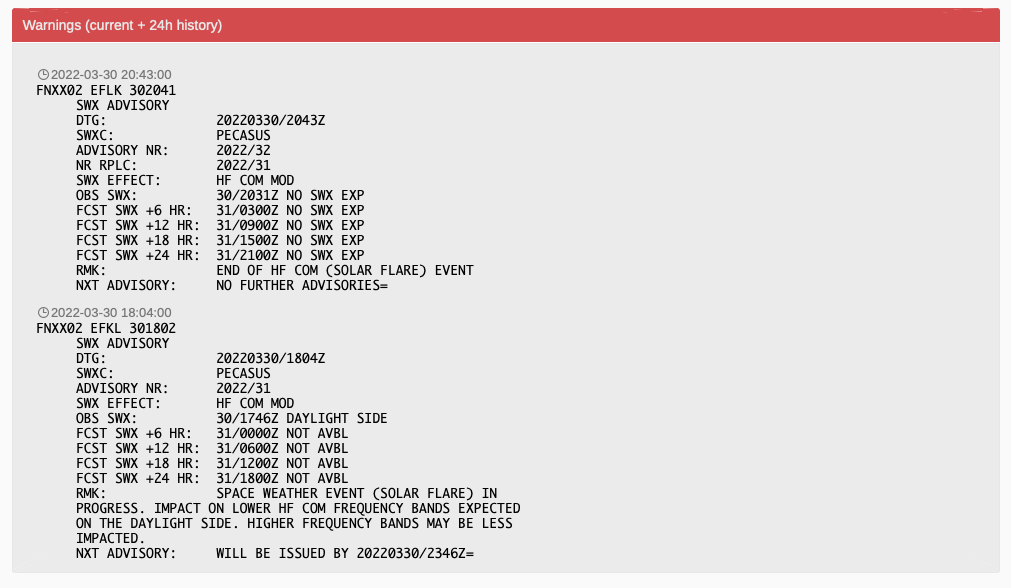
Not that we’re saying NOAA isn’t official, but it does just provide a sort of heads up. For your flight planning you are probably going to want some more specific information to put into your flight plan – an actual advisory (rather than our little alerts).

One place to look is somewhere the Finnish Met Institute who put out aviation advisories on space weather. These advisories look something like this –

A forecast and advisory for space weather

The Australian Bureau of Meteorology publish similar ones and even have a nice little map you can look at to see the regional risk of space weather nastiness.

If you are USA based then your go to centre is the Space Weather Prediction Center (under NOAA) and you can find official advisories on there.

What to do next.

There are various things to think about:

  • If you are regularly fly at high latitudes then you need to be monitoring their cumulative radiation exposure levels
  • If the radiation levels on a particular day are over a certain amount you might want to think about a re-route at a lower latitude (it is rare they are significant)
  • If the HF blackout probability is much more than minor (10 minutes max) or the geomagnetic storm levels are likely to cause significant satellite navigation issues then the same applies – you might want to consider re-routes
  • For any probability, alerting the flight crew to potential HF blackouts and ensuring they know the procedures for loss of HF comms if routing over HF comm dependant areas is probably a good idea
  • Include the forecast in the flights plans just as you would non-space weather forecasts.

We hope that helps, but if you want more…

ICAO put out a fairly handy presentation on this a while ago which you can find here, and they published another on Space Weather Center provisions which you can read here.

The full ICAO SARPS on Space Weather are in the’ ICAO Annex 3 – Meteorological Service for International Air Navigation and ICAO Doc 10100 – Manual on Space Weather Information in Support of International Air Navigation.’

There is also a draft of their original Manual on Space Weather available here (if you want the current published version you’ll have to pay for it).

The ECA (European Cockpit Association) published this which is filled with useful advice.

You might also want to take a read of this and sign up to your local Space Weather center to receive the SWX advisories if you haven’t already.


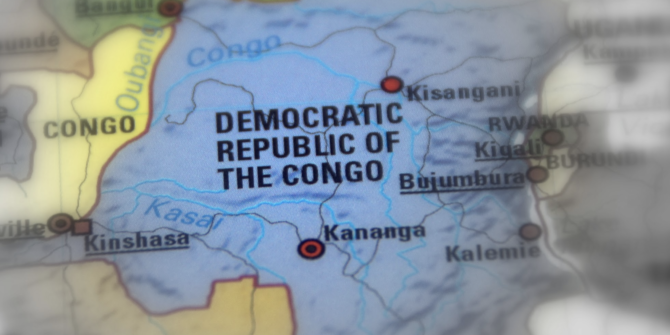
Rebels Resurgent: Increasing Airspace Risk in DRC?

On March 29, a large UN transport helicopter crashed in Eastern Democratic Republic of the Congo while operating a surveillance flight.

The DRC Government has accused (but not proven) a recently resurgent militant group of shooting down the aircraft, after renewed fighting against the government military in recent days.

The country itself has a chequered history of non-state actors actively targeting aviation assets including aircraft and airports, and there may be more to come.

This spells danger for civil aviation, and with an absence of official airspace warnings for the FZZA/Kinshasa FIR, the risks may be on the rise.

Here’s a rundown on the current situation, and what you need to know to stay safe.

What’s been going on there?

A militant group known as M23, or March 23 Movement, has recently become active again in Eastern DRC, in a province called North Kivu. It sits close to the borders of Uganda and Rwanda.

The group were previously engaged in a conflict with the government who expelled them across the border in 2013. Then just days ago, M23 unexpectedly became active again by attacking military positions in North Kivu – which is where the UN helicopter crashed. This was amidst heavy fighting.

There is potential for the skirmish to develop into a larger and longer running war. And that means risk for aviation.

A history of attacks on aviation.

If the UN helicopter was indeed shot down by M23, it wouldn’t be the first time. They, along with other militant groups, have a known history of attacking government owned aviation assets:

  • 1998: a civilian 727 was shot down by a shoulder fired surface-to-air missile after it took off from FZOA/Kindu airport.
  • 2013: Militia attacked FZAA/Kinshasa airport.
  • 2016: FZUA/Kananga airport was attacked by armed rebels on three separate occasions.
  • 2017: An air force helicopter was shot down by anti-aircraft artillery in North Kivu, which was later claimed by M23.

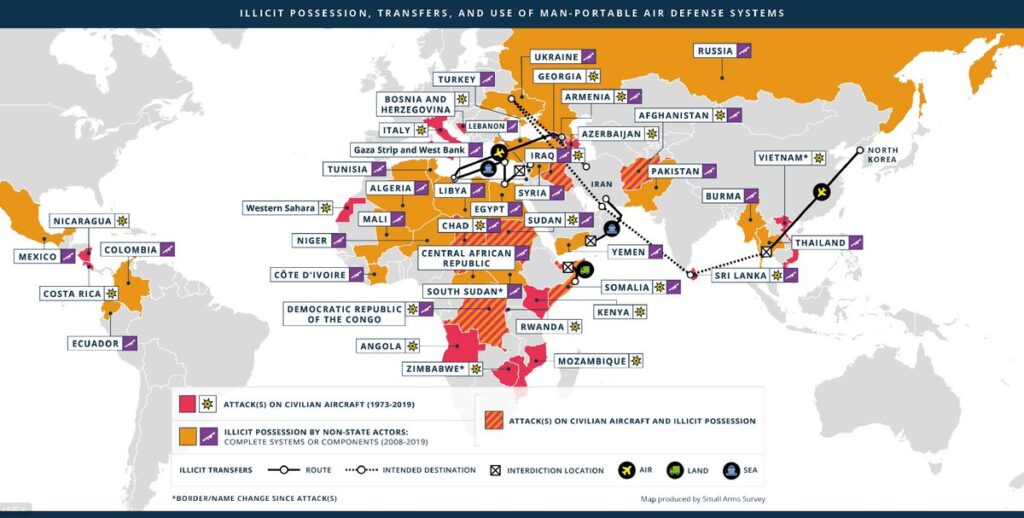
And there are fears that since the ceasefire in 2013, M23 have been retraining and rearming themselves with weapons that could target low flying aircraft. This includes Man Portable Air Defence Systems (MANPADS) and anti-aircraft artillery which are distributed among militant groups throughout many countries of Africa – including the DRC.

Africa is particularly affected by anti-aircraft weaponry in the hands of non-state actors, including DRC. Credit: Small Arms Survey

What’s the actual risk?

Militant groups such as M23 tend to specifically target government and military interests. There has been no indication of desire to endanger civil aviation. But the renewed intent to attack Government owned assets also increases the chance that civil aircraft may be misidentified, or mis-targeted.

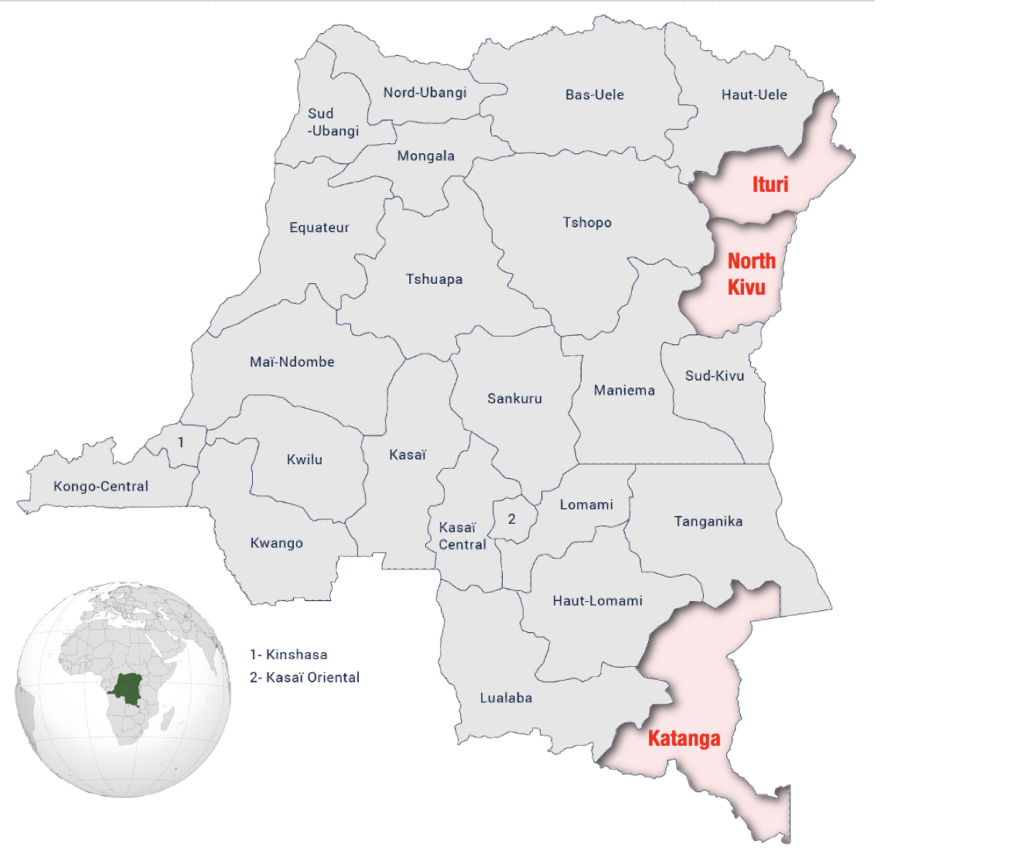
Aircraft are most at risk at low level and low speeds which means they are most vulnerable when taking off, landing or on the ground. The Eastern Provinces of Ituri, North Kivu and Katanga are particularly dangerous.

Three provincial hotspots to look out for where active conflicts are taking place.

There is little risk to overflying aircraft at higher flight levels. The issue for overflights becomes the need to divert. The Democratic Republic of The Congo is a huge country, which covers almost a million square miles of Central Africa – that’s more than Alaska and Texas combined. If you’re overflying it, you’ll need somewhere to land if something goes wrong. This is when militant activity becomes more of a danger.

Diversion Planning

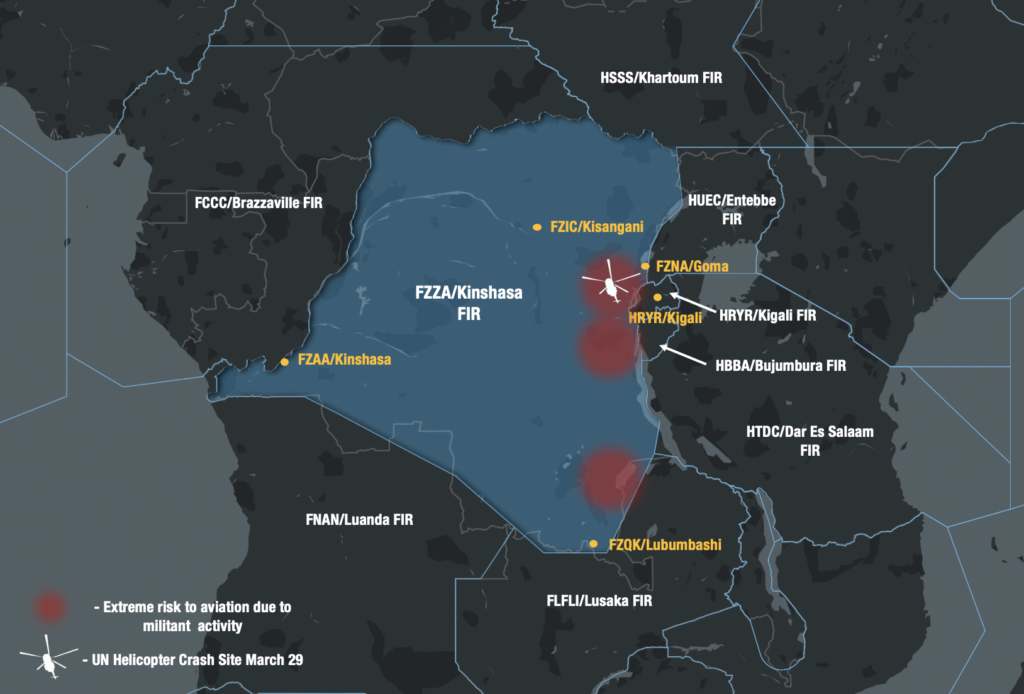
Security risks in Eastern DRC are very high, and special care needs to be taken right now about options for diversions.  Landings at airports in the above three regions are dangerous and should be avoided . For overflights in this region, alternates across the border are safer options – especially HRYR/Kigali in Rwanda.

In Eastern DRC, FZNA/Goma is considered to be a reliable option, along with FZQA/Lubumbashi in the south and FZIC/Kisangani to the north. Further west the best option remains FZAA/Kinshasa. It’s important to remember though that no parts of the country are fully immune to militant activity and risks may be present at varying levels throughout the country.

This means if you’re planning on operating there, it’s important to carry out a risk and security assessment using trusted sources which may include local contacts, and security services offered by companies like Medaire.

Contingencies need to be in place for ensuring crew, passenger and aircraft security in the event of both planned and unplanned landings.

Safe diversion options are highly limited in the DRC.

We’ll keep you updated.

The ongoing situation in Eastern DRC is unpredictable. You can stay up-to-date with any changes or new risk alerts via SafeAirspace.net as they happen – it is our free Conflict Zone and Risk Database that we keep updated around the clock.


Say GooDubai to a runway for 45 days

OMDB/Dubai International airport (the main one in Dubai) is closing a runway again. But that’s not all. Another UAE based airport is also closing. And it is Ramadan.

So what will all this mean for operations into there?

The Dubai Runway Closure

This happens every few years. The last one was in 2019 where they shut the Southerly runway for 45 days to fix it up. Not it is the turn of the Northerly runway again – 12L/30R.

The closure is from May 9 to June 22, and it does mean a pretty big reduction in capacity at what is the busiest airport in the world in terms of international passenger numbers.

But…

The Dubai runways are actually too close together for proper simultaneous ops meaning the closure of one does not mean a halving of capacity. On top of that, the biggest operators into the airport are all planning some reduction in their flights during this period, or are sending a portion of their flights over to OMDW/Dubai Al Maktoum which is just down the road (20 miles or so).

So…

So if you operate in during peak times (the worst is between 7-11pm UTC) then take some extra fuel for holding delays. You also can’t file OMDB as an alternate during peak times (and that’s during normal ops, so definitely don’t try it during the closure period).

Old Dubai chart.

The other airport out in the UAE closure

OMAD/Al Bateen is a small but quite busy executive airport near OMAA/Abu Dhabi, which just caters for private jet ops. This airport will be completely closing from May 11 to July 20.

So what options do you have?

  • OMAA/Abu Dhabi International is the main airport for the UAE. They generally prefer not to be used as an alternate for Dubai bound flights since they are very busy.
  • OMSJ/Sharjah International is the next door neighbour to OMDB/Dubai (around 20km north and you fly past it on some Dubai arrivals). Runway 12/30 is 13,320 ft long with an ILS either end. Watch out if OMDB is getting foggy though because OMSJ won’t be far behind given it is also close to the sea, and it will fill up fast with diversions if it isn’t.
  • OMDW/Dubai World is the slightly smaller international Dubai airport just next door. Mainly used for cargo flights, it offers a good alternate to OMDB. There is limited parking and fuel trucks though so if you divert here on a day a lot are diverting then expect long delays. Runway 12/30 has CAT 3 ILS both ends and is 14,764 ft long
  • OMRK/Ras Al Khaimah is a decent airport to consider as an alternate with an ILS on 34, an RNAV on 16 and 12,336 ft of tarmac between the two ends. Watch out for terrain here though.
  • OMAL/Al Ain has a 13,140 ft runway with ILS/RNAV approaches. Another UAE option for an alternate.
  • OMFJ/Fujairah can be a good alternate (especially when the weather gets foggy as it is on the Eastern side of the peninsular and less susceptible).
  • OOMS/Muscat is slightly further afield in neighbouring Oman, but included here because its often used as an alternate. 08L/26R is currently the only operational runway. It offers an ILS either end and 13,123 ft. Muscat is a decent fuel and tech stop if routing from the Far East.

UAE Airports and closest neighbours.

Some other info on the UAE.

The UAE only became the UAE fairly recently. Before that it was seven separate emirates and a big port in Jebel Ali which the Brits took an interest in. When they got their independence from Britain, the emirates joined up, led by Abu Dhabi. Dubai is the most westernized of the all emirates.

During Ramadan, be cautious about eating and drinking in public, but beyond that there is not huge difference for foreign visitors visiting Dubai and Abu Dhabi, just remain respectful of their culture and customs. Sharjah is much stricter.

Conditions across the UAE (like all the Middle East) can be challenging:

  • Extreme summer temperatures leading to brake temperature issues, hot fuel etc.
  • Dubai can see some nasty lingering fog during the more humid months
  • Cloud seeding is common and often leads to large storms building up. When it rains everywhere (including airport aprons) tend to flood.

Other challenges?

  • Holding for Dubai can bring you close to the Iranian border
  • Departures can enter Iran quickly so ensure you call the ADIZ early if routing that way.
  • Watch out for the Burj Khalifa – World’s  tallest building. It is near the airport.
  • Conflict is common across the whole Middle East region. Monitor Safeairspace for the full lowdown on risk in the region.

For more operational info on Dubai, the UAE, and the Middle East in general – check out our earlier post here.


Traffic Jam in Europe: Airspace Bottlenecks & ATC Disruption

Since the Ukraine conflict began at the end of Feb, options to overfly Europe have become increasingly complicated – especially for aircraft transiting between Western Europe and the Middle East and Asia.

Image: Eurocontrol.

We’ve talked about this a couple of times already. Here’s our article with considerations for operators now looking to route around closed airspace. And here’s a follow-up report on the spillover risks near the conflict zone in Ukraine, including undetected military drone incursions and GPS interference.

But there’s another aspect we haven’t discussed yet – the impact of increased congestion in Europe and the potential for ATC disruption.

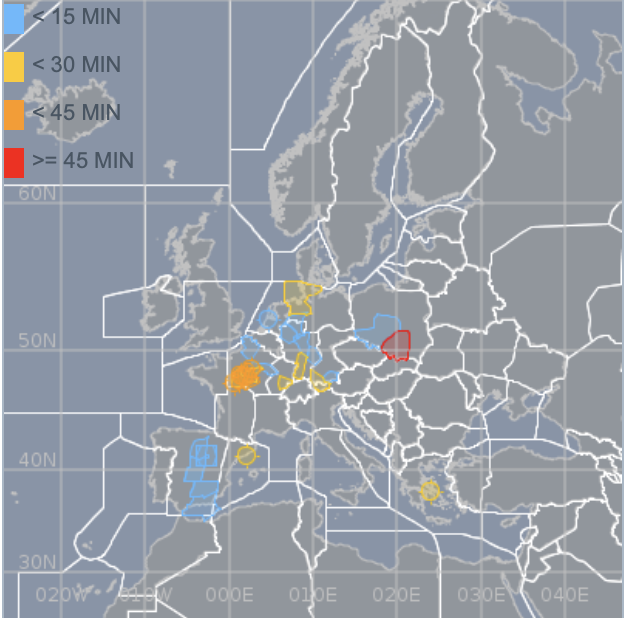
With the winter weather fading, and Covid restrictions easing up, we’re seeing a major upturn in traffic throughout Europe. But the ongoing closure of Ukrainian airspace is shifting traffic flows across the region – especially in those FIRs to the southeast of Ukraine where traffic levels have significantly increased:

Image: Eurocontrol.

On March 25, Eurocontrol hosted a webinar looking at the impact to European aviation following the airspace closures in Ukraine and surrounding regions. This webinar covered a bunch of topics – the spiralling cost of jet fuel, the increase in flight times between Europe and Asia, and the traffic forecast for the upcoming summer season:

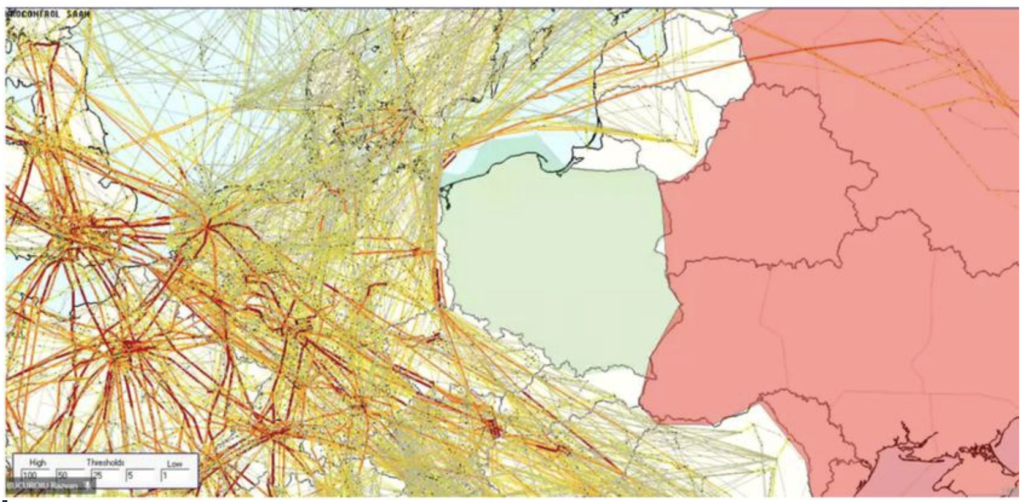
One thing also discussed was the impact of reroutes to Polish airspace – how increased military use is causing more reroutes for civilian traffic, plus increased workload on Polish ATC as a result.

The Poland situation

Polish controllers at Warsaw ACC are currently facing a revised contract (pay cuts and changes to working conditions), which has prompted some resignations already.

The Air Traffic Controllers European Unions Coordination (ATCEUC) have reported that if an agreement is not reached soon, hundreds of flights will have to re-routed out of Polish airspace and into neighbouring states – mostly into Germany, which may not be able to handle all the extra flights.

The Germany situation

With Germany potentially receiving the lion’s share of traffic affected by ATC staff shortages in Poland, the problem simply becomes capacity. It is already extremely busy airspace. German ATC has reportedly announced that it could only handle no more than two hundred extra flights per day – just a portion of aircraft potentially re-routed from Poland.

The France situation

Major changes to ATC systems in the LFEE/Reims FIR are being rolled out on April 5.

For the first two weeks, capacity is likely to reduce by at least 50% leading to significant delays and other disruptions. This will be followed by a steady decrease in capacity reductions which will offer additional capacity at the rate of about 10% every four weeks or so, ending in ‘normal’ capacity resumption hopefully by the end of July.

The LFMM/Marseille FIR follows later this year, and then LFFF/Paris (Winter 2023/24) and LFBB/Bordeaux & LFRR/Brest (2024/25).

On March 31 at 1230z, Eurocontrol is holding a telcon to brief the impacts of this new ATC system. To dial in, call +44 2030 095710 and use the conference ID 5998424. We’ll hopefully get some more clarity during the telcon, but the current prognosis for the overall reduction in capacity and service doesn’t look good.

The perfect storm?

With all of these factors taken into account, we are likely to see unprecedented bottlenecks in the coming weeks in European airspace. All eyes are on Eurocontrol to provide operational updates and guidance via their Network Portal, which you can access here – it’s the best place to stay up to date.


OPSCHAT Summary 29 MAR

Hi members,

It was another very busy OPSCHAT call this week.

You can catch the full replay on your Member’s Dashboard.

Here’s a quick summary of what we talked about.

  • Europe – With the closure of Ukrainian airspace not going away in a hurry, there are concerns about airspace congestion as traffic is squeezed into Western Europe. To make matters worse, ongoing ATC strikes along with system upgrades in France, and potential industrial action in Poland may be brewing the perfect storm for major traffic jams.
  • Russia – Ongoing sanctions against Russia are causing ongoing headaches for aviation. The rules are different in every country, and so operators need to be familiar with the jurisdictions they’re flying over. In more news, the Russian CAA website is currently down due to a cyber-attack – check out our latest article.
  • Dubai – Double trouble. There are two disruptions happening at the same time in May. At OMDB/Dubai one runway is being closed from May 9 – June 11, while over at OMAD/Al Bateen, the airport will be closed from May 11 – July 20. We discuss the potential impacts to traffic, along with suitable alternates during this time.
  • Saudi Arabia – Recent Houthi drone and missile attacks have caused flight disruptions at OEJN/Jeddah airport. They seem to be travelling further, and becoming more accurate. Reports of aircraft being held near the Egyptian border during these attacks, but not new Notams have been issued. We talked about ESCAT procedures, where to find them, and what alternates to use. See Safe Airspace for more info.
  • South-East Asia – Several major border openings have been announced in recent weeks including Singapore, Malaysia, Indonesia and Thailand. We take a brief look at what has been changing.
  • USA – The FBI has released a new warning of cyber-attacks maliciously targeting SATCOM networks. With the help of members on the call, we assess what this actually means for operators.
  • Colombia – We talk about two recent non-fatal attacks on airline pilots resisting robberies in the cities of Bogota and Cali. A major carrier has released security information to its crew. The basic advice is don’t put up a fight, leave valuables in the hotel, and only carry small amounts of cash.
  • Airport Spy – We’ve had a lot of new reports in the last few weeks. Don’t forget to check it out, you can access it here. Feel free to submit your own Spy Reports, any and all feedback is welcome.

As always, the team is here to help with any operational support, info or questions. You can reach us on news@ops.group, or via the slack channels #flightops and #questions.

To watch the replay of the OPS CHAT in full: head over to the dashboard. We hold a new OPSCHAT every week on Tuesdays at 2000z, click here to register and join us live.


Libya Airspace Update March 2022

We haven’t mentioned Libya in a while. Our last in-depth look was back in 2019, which is several years and a whole lot of Covid ago. So, what is the current situation and does it look likely that the country will be safe to overfly anytime soon?

Any alerts to know about?

In the first half of 2021, the Libya situation did change somewhat, with signs that security and stability in the country might be improving.

In June 2021, a ‘fragile’ ceasefire appeared to be holding, despite increased military activity on the western border with Algeria. The ceasefire came after a UN led agreement was put in place and was implemented in April 2021.

Egypt and Libya saw a resumption of passenger flights, along with Malta from April 2021. However, there are very limited international operations, the majority being domestic within the country.

What’s been happening recently?

The security situation has reportedly deteriorated through the start of 2022, with intermittent fighting and armed clashes occurring regularly between rival militia groups. These groups are backed by competing geopolitical parties and the overall situation is very volatile and complicated.

In fact, the UN led elections at the start of 2022 and a new Prime Minister was brought in with the hope of unifying the country, but sadly this does not, so far, seem to have resolved what is described as an “intensifying political crisis”.

The fighting has led to significant damage to infrastructure, particularly to power supplies across the country, and to road systems. Disruption and security concerns on the ground are common. Civil unrest including protests and strikes occur relatively frequently.

Islamic State militants do conduct operations in the country, although these are primarily restricted to the southern regions. Attacks on high profile locations, including international airports, remain likely.

The FAA Prohibition.

The US extended their airspace warning in 2021, updating their SFAR 112 to run until least March 2023.

You can read all about it in depth here, but the general summary is don’t overfly HLLL/Tripoli FIR except for altitudes at or above FL300 “outside of Libyan territorial airspace” (the international bit over the southern Mediterranean sea).

Check out Safeairspace for other state warnings and prohibitions as we update this regularly.

Airport Options.

HLLT/Tripoli airport remains closed following significant damage to many of the airport facilities. 

HLLM/Mitiga is the main international airport. A major attack in May 2020 resulted in damage to parked aircraft, terminal and runway. Jet fuel tanks were also set on fire. The airport was also closed in January 2020 due to a rocket attack. Prior to this, airstrikes in the area made it critically high risk and dangerous.

HLMS/Misrata and HLLB/Benghazi are also operational for international flights.

HLMS/Misrata has a single runway 11,155’ with VOR DME approach only.

HLLB/Benghazi is a much better equipped airport offering minor airframe and engine maintenance facilities, two 11,811’ (3600m) runways with an ILS to 33L, and VOR DME or LCTR approaches to the other runways. However, Al-Qaeda linked militants are reportedly active in this general area.

HLLS/Sabha also has an 11,811’ runway with ILS to 13 and VOR DME to 31.

HLGT/Ghat has an 11,811’ runway but no precision approach and is relatively lacking in maintenance and support facilities.

The Airspace.

Entering the airspace without prior contact may result in aircraft being “engaged by air defense systems”. This message was passed to Malta ATC in April 2020.

Militia stated in 2020 that certain areas around major cities were no-fly zones, and there was a very real risk they could attempt to shoot down any aircraft which attempted to fly to HLLM/Mitiga airport in particular.

The northern airspace borders the Mediterranean sea and Maltese airspace, and caution should be taken if routing over this region to not accidentally detour into Libyan airspace.

Aircraft operating east/west particularly from Tunisia, Algeria and Morocco, or Egypt and further east, can fly through Maltese airspace and this does not pose a significant detour to avoid Libyan airspace. Suitable alternate airports are available along these routes.

What Libya says.

We occasionally get contacted by Libyan ATC to update us on the situation from their perspective, because often what is said (and assessed) via media reports does not match what those in a country experience.

Their most recent feedback (early 2022) was this:

  • International airlines are operating into HLLM/Mitiga and HLMS/Misrata without (apparent) incident
  • There are passenger flights from Tunisia operating 3 times a week, and several cargo flights per week
  • Overflying east/west is considered safe, north/safe requires some more information for a full assessment
  • VHF ATC services over international waters are reliable

What Malta says (because they’re right next door).

  • The situation has improved over the last few months but there is not much transparency as to the real state of affairs in terms of ATM/CNS provision in the HLLL/FIR.
  • Libyan airspace is entirely procedural and there must be huge swathes of airspace where the service provision is either limited or unreliable especially in the domain of air-ground communications. We do not know the status of the international / national aerodromes in Libya as their AIP does not seem to be updated regularly (understating it here).
  • We are also aware of military activity over the high-seas which is either operating as OAT or not in control with Tripoli ACC / Benghazi ACC including RPAs. We are not aware how RPAs are being integrated in the airspace, if at all. GPS jamming could also be an issue.
  • The issue of 5A-registered aircraft which are banned from EU airspace has not been resolved and we still have a lot of restrictions from EU States including Malta banning all flights departing from HL aerodromes from entering EU national airspace due to security issues.
  • So whilst the military / conflict situation might have improved on the ground there is not much evidence to support the claim that all is safe and sound.

This was sent in December 2021, prior to the UN-led elections. The continued instability following these elections is what led us to pop this update out now.

Our risk assessment.

Libya remains volatile. Safety and security on the ground is not good, and there is a significant risk to aircraft overflying due to the conflict and weapons available to militia groups. Despite feedback from local ATC, and reports that some operators do overfly the country, we continue to advise against it.

It remains a Level 1: Do Not Fly region on Safeairspace.

Have you operated in or over?

Share your feedback with us at news@ops.group, or file a report of a recent trip on our Airport Spy page.


Russian CAA website taken offline

On March 29, the entire Russian Civili Aviation Authority website went offline. Hackers are saying they managed it, Russian media is saying it is down to restructuring.

Either way the website currently isn’t available, so if you need to get in touch it will have to be via good old fashioned postal service or AFTN.

What’s offline?

www.favt.ru currently isn’t responding. This is the ‘Rosaviatsia’ Federal Agency for Air Transport site which manages civil aviation across Russia.

www.scaa.ru also doesn’t respond.

AvHerald reported that the site has been hacked, and all backup data also erased.

What does this mean?

With few external operators flying in and out of Russia it might not mean much right now. However, if you are trying to fly in or contact them then this may pose issues for you until they get their site back up and running.

Things like permissions and permits will undoubtedly take longer to get hold of.

Whether there will be any further indirect impact on other aviation related service within Russia is not yet clear.

The Contact Info.

Contact via post of AFTN are your best bets, but you can try calling as well. It isn’t clear if email will be available.

Telephone: +7 499 231 5237

Email: aviapermit.scaa.ru / rusavia@scaa.ru / permit@matfmc.ru

AFTN: UUUKYAYX / UUUKZXTD

SITA: MOWYAYA / MOWICYA

Address: 125993, GSP-47, Moscow, Leningrad Prospekt, 37, building 2

Any local agent contacts?

Aerotrans may be able to assist:  +7 495 755 9422 / handling@CPDU.ru

Alternatively you may do best to contact local agents at your airport of operation directly as it may be easier for them to coordinate for you.


Ukraine Relief Missions

If you are an operator who is looking to offer relief aid services as part of the Ukraine conflict, read on.

We have compiled a list of handy contacts, general ops information, and other bits which we hope might help. If you are looking for other support or info then let us know at team@ops.group

If you need support with trip planning you also might want to get in touch with Universal Weather because their Universal Trip Support department are waiving all fees on trip-feasibility assessments, research, and consultation services, as well as ground-handling setup charges for any humanitarian missions.

Some of the airports being utilised for relief missions.

POLAND

Poland borders the Ukraine, however it also borders Belarus, and caution should be taken if operating into the eastern regions of Polish airspace along the border because of high levels of military traffic operating in this area.

Permits

Permits are not required for private flights but you do need to make a declaration in advance.  Private flight also counts as less than 20 seats. Other flights need to make their landing and overflight permit application 3 days in advance.

The Polish Air Navigation Services Agency can be contacted via email at planning.dept@pansa.pl and at trafficrights@ulc.gov.pl, or by telephone on +48 22 520 7309

EPRZ/Rzeszów

The closest airport to the Ukrainian border, where most relief efforts will be focused, is EPRZ/Rzeszów-Jasionka airport (pronounced “jejov”… kinda).

Here is some data on the airport:

  • 10,499’ / 3200m x 45m Runway 09/27
  • CAT II ILS 27 / RNP or VOR 09
  • Restricted H24 operating hours
  • RFF 8 (RFF 9 on request)
  • PCN 82/R/A/W/T
  • Jet A1 available
  • Customs available without restriction
  • Unknown if any maintenance or other support facilities
  • Closest airports for alternates:
    • EPKK/Kraków Large international airport 2550m/8366’
    • EPKT/Katowice Large international airport 2799m/9183’
    • EPWA/Warsaw Major international airport 3690m/12106’
    • EPLL/Lodz Medium airport 2445m/8022’

Here is some “heads up” operational info:

  • Elevation 693’
  • Highest MSA 3400’ and a few close in obstacles
  • Runway 27 has a significantly displaced threshold
  • A lot of VFR traffic operates in the area (on nice weather days) so be cautious. There are dedicated VFR light aircraft runways at the airport as well
  • Do not mistake the highway or the runway at EPRJ 
  • There is no radar vectoring possible due to the high amount of VFR traffic, so expect to follow procedures including procedure turns, and exercise caution with your tracking
  • There are speed and altitude restrictions on SIDs and STARs to be aware of.

Some contact info for you:

  • There are several Handling and Support agents who operate through Poland and neighbouring countries who might be well placed to assist:

EPLB/Lublin

EPLB is about mid-way between EPRZ and EPLL/EPWA, and is far less busy but also well equipped to handle larger aircraft.

Here is some data on the airport:

  • 8268’ / 2520m x 45m Runway 07/25
  • CAT II ILS 25 / RNP 97
  • Operating hours are only 0400-0100, but extendable with 48 hours notice
  • RFF 7
  • PCN 50F/B/X
  • Jet A1 available
  • Customs available without restriction
  • Unknown if any maintenance or other support facilities
  • Closest airports for alternates:
    • See above

Here is some “heads up” operational info:

  • Elevation 636’
  • No terrain to worry about, but a close in obstacle end of runway 25 – MAPP has early turn to avoid
  • Limited taxiways – backtrack required if landing runway 07
  • Big temporary restricted area nearby may impact arrivals and departures when active
  • No radar

Some contact info for you:

  • There are several Handling and Support agents who operate through Poland and neighbouring countries who might be well placed to assist:

EPWA/Warsaw

We received a great report from an OPSGROUP member who operated a flight with humanitarian aid to EPWA/Warsaw on March 20.

Here is a copy of their report:

We arrived Warsaw in the evening on March 20, 2022. Came in from the Northwest, 
originally assigned the BIMPA 6N arrival, but shortly after joining the arrival, 
we were given direct to WA411 for the ILS Y RWY 11. Exited the runway on N1 to M3. 
Assigned parking spot 41 on Apron 5B. 

Handler was Executive Aviation Service arranged through Universal. Fueling was 
delayed because local handler did not have a copy of the World Fuel release.
Lav service was prompt. 

Crew took the opportunity to bring in some items for Ukrainian refugees. 
Crew sent a message to Universal to ask the local handler for drop off information. 
The following website was provided: 
https://en.um.warszawa.pl/-/what-and-where-can-you-bring-for-refugees 

This is a Municipal organization which has over 18 drop off locations. 
The government locations are looking for mostly food, baby products, hygiene products, 
and first aid products. The crew had mostly brought in clothing items, new socks, 
new underwear, hard candy, hygiene products, and small children’s toys. 

These products were not a good match for the requests at the government donation sites. 
The crew asked the Handler for another donation center contact that would welcome 
the clothing. The following contact was provided: 
https://www.tpu.org.pl/en/chcesz_pomoc.html 
email sekretariat@tpu.org.pl or by telephone: +48 691-41-41-59. 

This donation center is run by professionals who have other careers and are helping 
with relief. The site says they are only open on Tuesdays. We happened to be in Warsaw 
on a Tuesday, so it worked perfectly for us. We took an Uber from the Westin 
(downtown Warsaw) to the donation center. 20 minute drive. $5 US via Uber.

If you have operated to the region recently, please get in touch so we can share the info with everyone else looking to do similar trips. You can email us at news@ops.group, or file a report of a recent trip on our Airport Spy page here.

ROMANIA

Some relief efforts are also being arranged through Romania which borders the Ukraine to the south, as well as Moldova.

International flights may be best operating into LROP/Bucharest, LRCL/Cluj Napoca, LRIA/Iasi, LRTR/Timisoara international airports and then fly internally to LRSV/Suceava which is a domestic airport and not an airport of entry, lying close to the border.

Permits

Permits are not required for private or tech-stop flights, but you still need that advance notification. Commercial flights need at leas 2 days notice for permits, and these are required for landing only, not overflights.

The Romanian CAA can be contacted via email at overflight@caa.ro and at dgav@mt.ro, or by telephone on +40 21 319 6209 / +40 21 208 1500

Here is some data on the LRSV/Suceava:

  • 8071’ / 2460m x 45m Runway 16/34
  • CAT II ILS 34 / VOR 16
  • The airport control tower is H24, but Admin operates limited hours confirm with handling agent
  • RFF 7
  • PCN 110/F/C/W/T
  • Jet A1 available
  • Customs available without restriction
  • Unknown if any maintenance or other support facilities
  • Closest airports for alternates:
    • LRIA/Iasi Medium airport 1780m/5840’
    • LRCL/Cluj-napoca Medium airport 1850m/6070’
    • LRSB/Sibiu Medium airport 2000m//6562’
    • LROP/Bucharest Large international airport 3500m/11483’

Here is some “heads up” operational info:

  • Elevation 1375’
  • Highest MSA 5500’ with terrain in the southwest
  • Runway 34 has displaced threshold
  • Limited taxi and apron space
  • Backtrack on runway required
  • VOR oscillations due terrain are likely
  • Very low platform altitude and short final approach
  • Higher than usual SID climb gradients due close in structures

Some contact info for you:

  • There is a large Handling and Support agent who operates through Romania and neighbouring countries who might be well placed to assist:

How to help

The two agencies we’d encourage people to go check out are Airlink and DirectRelief – these two have already flown in shipments of aid and have more scheduled this month. So those are good places to go find out exactly what’s needed, and how to help.

IFALPA and the European Cockpit Association have also put out a letter for members of the aviation community wanting to help support the pilot community in Ukraine. They suggest you reach out to local organizations to help, or donate to larger ones such as Red Cross who are on the ground there. You can read the letter here. 

If you need assistance with anything to help prepare for humanitarian flights, please get in touch.

What do we need?

  • Feedback on your operation if you have carried out a humanitarian mission recently.
  • Any local contacts you have who can assist others.
  • Any other relevant information and advice which we can share to other members.

You can email us at news@ops.group, or file a report of a recent trip on our Airport Spy page here: ops.group/blog/spyreport


Chinese maritime drills might impact flights

China has been carrying out a lot of military exercises over the South China Sea of late. Most of these are maritime, but that doesn’t mean they won’t have some impact on aviation as well.

So here is a look at what is going on and where to watch out for…

The Exclusion Zones.

When China carry out their military drills they establish exclusion zones. These definitely apply to maritime traffic, but it is a lot less clear whether they apply to civilian aviation traffic as well. Some of them also lie in particularly close proximity to the airspace of International airports.

So best know about them just in case.

The Current Activity (that we know about).

  • Number 1

The latest one is taking place in the northern region of the South China Sea, and will run through to at least 18:00z on April 9. The no-go zone is about 90km or so in size, southwest of Sanya which means traffic in and out of ZJSY/Sanya Phoenix International may be disrupted.

There could also be an increase in helicopter traffic, so keep an eye on that TCAS and remember your contingency procedures for Sanya Oceanic, and China in general.

  • Number 2 & 3

Drills were planned in two areas – one in the Bohai Sea, and one in the Beibu Gulf (northern South China Sea). These were due to run through March 27, but have been extended to April 10.

ZYTL/Dalian Zhoushuizi International airport and ZGBH/Beihai Fucheng airport maybe impacted by the exclusion zones.

  • Number 4

This one was announced quite late, and will take place in the South China Sea, off the coast of Shantou, Guangdong Province, through March 26. As with all the others, it isn’t clear what the impact to flights will be beyond possible disruption if flying into ZGOW/Shantou Waisha Airport, and a likely increase in helicopter traffic.

Some of the known exclusion zone approximate areas.

China in general…

China have a huge number of unmapped military bases. In fact their entire airspace is basically one giant military zone. This means you might often find yourself descended early if heading in, kept very low when heading out, or given big detours which seem to make no sense.

All of this means a much higher fuel burn (which can be very hard to plan for!)

We wrote some stuff on China Ops a while back so take a look her for more info, but this is the bit to really think about:

Good to know.

While the ZJSA/Sanya FIR includes an oceanic portion in the South China Sea (a “marginal sea” that is part of the Western Pacific Ocean (marginal meaning: would just be the ocean only a bunch of islands and archipelagoes sort of divide it off a bit), the don’t apply standard ICAO Oceanic contingencies in it.

Instead, you’ll be expected to turn 90 degrees right or left, offset by 25nm and then climb or descend 500ft. China are pretty strict on deviations and detours. They even use different sized airways in some spots. So check their AIP and China specific Rules and Regs before a flight to make sure you get it right.

ZJSA/Sanya FIR does not apply standard ICAO contingency procedures.


OPSCHAT Summary 22 MAR

Hello members,

We had another busy OPSCHAT call this week!

You can catch the full reply on your Member’s Dashboard.

Here’s a rundown of what we talked about:

  • Airspace Risk in Europe – We looked at EASA and IFALPA’s new safety bulletins. Brief discussion about GPS jamming. Feedback from member operating out of Cyprus who encountered it recently – ATC were advised but seems to be ops normal for them there. We also asked whether there are any other risks or impacts that operators are encountering as a result of the conflict in Ukraine that are not being publicised or reported?
  • Russia latest – The US has still not been officially banned from Russian airspace via the UUUU notams. Although there are reports of people having difficulties obtaining overflight permits anyway. Brief discussion about Bloc permits, and then Chinese permits (taking 4-5 days, expect short notice changes to be refused, carry additional fuel for unexpected routes/levels).
  • Saudi Arabia airspace risk – The US FAA has now issued an advisory on Houthi drone incursions. A few key questions put to group:
    • Why has it taken the FAA so long to issue this?
    • What is the actual risk to overflights?
    Feedback from group is that ESCAT is likely the biggest impact. Ops into Southern Airports are unusual for western operators.
  • Canada – Briefly touched on the end of the pre-travel testing mandate from April 1 – only applies to fully vaccinated pax (no booster required). Non-vaccinated pax must still follow existing rules. No impact to crew who are exempt anyway.
  • USA – Airspace improvement project on East Coast finishing with changes in Nov 3. 55 new Q and Y routes and ultra high sector routes (>FL400). New routes will be published in Sept but unavailable  for use until Nov 3. More info here.
  • North Korea – Several missile launches over the weekend landed in the Yellow Sea. Total of eleven this year – all without airspace warnings. Likely to be more. Brief discussion on the ZKKP/Pyongyang FIR – seems operators are staying well clear. Discussed the FAA SFAR which does a good job of communicating the risks. More info here.
  • Unsolved mystery: Reports in media of bizav aircraft being used for relief missions, particularly to Poland. Looking for updates on conditions at airports, traffic congestion and fuel availability. Let us know at news@ops.group
  • Danger Club: Happening March 24 at 1800z! Read more and register here.

As always, the team is here to help with any operational support, info or questions. You can reach us on news@ops.group, or via the slack channels #flightops and #questions.

To watch the replay of the OPS CHAT in full, head over to the dashboard.


Spillover Effect: New Airspace Risks in Europe

As the war in Ukraine continues, the risk to aircraft in European airspace may be changing.

There have been several incidents in recent weeks that highlight that the spillover effects of the conflict have begun putting aircraft at risk in nearby FIRs. Or in other words – busy, open airspace with no airspace warnings in effect.

These include undetected military drone incursions in NATO member airspace and extensive GPS interference for aircraft operating across different regions of Europe.

And it is a new and emerging issue. So concerned are IFALPA and EASA, that they both published new bulletins last week to both operators and ANSPs regarding these risks.

Here’s a break-down of what you need to know.

Drone Incursions

On March 12, a large weaponised military drone malfunctioned and left the Ukrainian conflict zone. It flew undetected through the airspace of Romania and Hungary, before entering Croatia and crash landing on the outskirts of the capital, Zagreb.

This was followed by an incident on March 14, where widespread reports emerged that a surveillance drone had briefly entered Polish airspace before being shot down by Ukrainian military as it re-entered their own.

Around the same time, yet more news surfaced that a Russian surveillance drone had been discovered crashed in a village of Northern Romania – the exact date of the incursion isn’t known.

US Air Force drones have also been operating over the Black Sea.

IFALPA responded by issuing a Safety Bulletin on March 16. They report that these incursions are highly likely to re-occur as fighting continues. This may pose a threat to aircraft both on the ground or in the air. The risk comes from the drones themselves, as well as from air defence activities that attempt to destroy them.

This is all in addition to the political impact of Russian aircraft entering NATO member airspace without clearance. While there has been no indication that these incursions were intentional, it does increase military surveillance of the skies over these countries, including the remote risk that a civilian aircraft may be misidentified and targeted in error.

Impact sight of a drone that crashed in Zagreb, Croatia on March 12.

GPS Interference

Since February EASA has identified four regions near Ukraine where GPS interference has significantly increased. This includes instances of jamming and spoofing – if you’re unfamiliar with the latter, it means to deliberately introduce errors into the signal so that GPS receivers become inaccurate or erroneous.

The four hotspot regions are:

  • Kaliningrad, the Baltic Sea, and neighbouring states.
  • Eastern Finland
  • The Black Sea (a portion of which is currently part of a major air corridor between the Middle East and Europe).
  • The Eastern Mediterranean near Cyprus, Turkey, Lebanon, Syria, and Israel.

Reports have come from various phases of flights and had led to re-routing and even diversions.

For operating aircraft, the effects can be significant. A complete loss of GPS is immediately noticeable and leads to issues navigating, or carrying out ops that require RNP.

More worrying is spoofing, which can be far more insidious. Erroneous GPS signals can lead to false triggering of hard GPWS warnings, inaccurately displayed information, loss of ADS-B, faults with wind shear and terrain warnings, failure of aircraft systems that rely on GNSS for reference and even airspace busts. All nasty stuff.

On March 17, EASA published a Safety Information Bulletin on the issue. It includes a list of things that both operators and ANSPs can do to help mitigate the risks during this time. Absolutely worth a read if you’re flying in European airspace right now.

Proximity to the Fight

These events indicate that risk is present near the conflict zone, not just within it. And with flight tracking indicating aircraft frequenting open airways near the Ukraine border, but clear of closed airspace, perhaps we need to be collectively paying a bit more attention.

Risk may be increasing in open airspace nearby the conflict – especially those FIRs labelled in white.

Case-in-point. On March 13, Russia carried out an air strike near the city of Lviv, in Western Ukraine where at least thirty missiles were fired towards various targets. This occurred just 15 miles (25km) from the Polish border, along with open airways that run adjacent to the border (particularly T344 and Z367).

There are currently no active airspace warnings in Poland.

Stay Updated

Both IFALPA and EASA have agreed that operators need to carry out their own risk assessments when operating in the region at the moment. That starts with verified, accurate and timely information. Make sure you keep checking safeairspace.net – our conflict zone and risk database.

And please report back to us any new info you come across (be it airspace risk related, or simply sharing your experience of a recent flight) and we can help redistribute that info back out to the group so that all are aware.

You can email us at news@ops.group, or file a report of a recent trip on our Airport Spy page here: ops.group/blog/spyreport


Middle by Middle East

A lot of people lump ‘The Middle East’ together into one singular region of “Middle Eastyness”, but actually each country is very different, particularly during Ramadan. Each has diverse cultures and rich histories, very different political interests, and of course their own unique operational and environmental challenges that pilots should know a bit about before heading in.

So, here is your ‘In the Middle of the Middle’ guide to the ‘Middle East’ (or at least the parts of it you’re likely to need to know about.)

Starting with the ‘Need to Know’

The UAE

The UAE only became the UAE fairly recently. Before that it was seven separate emirates and a big port in Jebel Ali which the Brits took an interest in. When they got their independence from Britain, the emirates joined up, led by Abu Dhabi. Dubai is the most westernized of the all emirates, and each pretty much has its own international airport.

  • OMAA/Abu Dhabi International is the capital airport for the UAE. They generally prefer not to be used as an alternate for Dubai bound flights since they are vert busy.
  • OMDB/Dubai International is the main Dubai airpot, and the busiest airport by passenger numbers in the world. You have two parallel runways 12/30 left and right with CAT III approaches.
  • OMSJ/Sharjah International is the next door neighbour to OMDB/Dubai (around 20km north and you fly past it on some Dubai arrivals). Runway 12/30 is 13,320 ft long with an ILS either end. Watch out if OMDB is getting foggy though because OMSJ won’t be far behind given it is also close to the sea, and it will fill up fast with diversions if it isn’t.
  • OMDW/Dubai World is the slightly smaller international Dubai airport just next door. Mainly used for cargo flights, it offers a good alternate to OMDB. There is limited parking and fuel trucks though so if you divert here on a day a lot are diverting then expect long delays. Runway 12/30 has CAT 3 ILS both ends and is 14,764 ft long
  • OMRK/Ras Al Khaimah is a decent airport to consider as an alternate with an ILS on 34, an RNAV on 16 and 12,336 ft of tarmac between the two ends. Watch out for terrain here though.
  • OMAL/Al Ain has a 13,140 ft runway with ILS/RNAV approaches. Another UAE option for an alternate.
  • OMAD/Al Bateen is a small but quite busy executive airport near OMAA/Abu Dhabi, which just caters for private jet ops. This airport will be completely closing from May 11 to July 20.

We put together a little regional brief on this with some handy contacts for you.

UAE Airports and closest neighbours.

Saudi Arabia

Saudi Arabia is the largest country in the Middle East.

They are a major world economy, the third biggest producer of oil (behind the USA and Russia) and the largest exporter. It is also at the heart of the Islamic religion and you need to bear their customs and laws in mind if heading in there. Women are expected to dress modestly and cover their heads, and alcohol, swearing, gambling etc is forbidden. This will be much more strictly enforced during Ramadan.

  • OEJN/Jeddah – long taxis possible. Keep an eye on those brake temperatures. This airport can accommodate the most number of aircraft in the world so… it’s big! There are no less than three runway 16/34s here. The longest is 13,123 ft and all of them have an ILS approach. Jeddah has recently been targeted by drone attacks and the southern Jeddah FIR (close to Yemen border) should be avoided).
  • OERK/Riyadh – high elevation airport with steeper than normal GS on some approaches. You have two runways to chose from, although they tend to stick to one for takeoff and one for landing. 15R/33L is the longer of the two, offering 13,797 ft (a whole 2 ft more than 15L/33R)
  • OEDF/Damman – Often keep you high or use track shortening. 34L/16 R and 34R/16L are both 13,123 ft long with an ILS approach.

Because of the ongoing conflicts with neighbors, Saudi have a procedure called ESCAT (used to be called SCATANA) which is basically an emergency procedure when the airspace is under threat. If they announce it, be prepared to follow whatever instructions given – probably either to leave the airspace, or to land where they tell you.

  • Consider what your alternative routing options or alternates will be in advance. ESCAT has been activated more frequently of late, and this may mean long holding at the boundary of their airspace.
  • Egypt is available to the west, but Israel may not accept you if you haven’t advised them in advance. The process for landing and overflying Israel is still quite lengthy and dependant on where you come from, are registered, who you carry etc.
  • Jordan is available, but Syria is a no go country, and landing in Iraq is less advisable.
  • Yemen to the south is a no fly area.

Full info on ESCAT is found in their AIP. We wrote a bit about the Yemen conflict threat here.

Yemen/Saudi risk.

Oman

Oman is a funny shaped country with a bit above the UAE and most of it below, bordering Yemen. They generally aren’t too political and get on with everyone.

  • OOMS/Muscat is the main airport. 08L/26R is currently the only operational runway. It offers an ILS either end and 13,123 ft. Muscat is a decent fuel and tech stop if routing from the Far East.

Iran

US operators are not allowed to overfly Iran, and there are overflight warnings associated with the country. If you do overfly and need to divert in the country, be aware that if you are coming from other countries, or have some nationalities onboard, this might cause some problems for you on the ground.

If you operate in with female crew, expect them to be asked to cover their heads leaving the airplane at some airports. There are also potential issues with lack of female security staff and crew have reported female pilots being asked to let their male co-pilot carry out walk-arounds to avoid difficulties with male security staff escorting a female.

The main airport OIIE/Tehran is a pretty decent one to go into though, although it is in the middle of some high terrain.

  • OIMM/Mashad – Another high altitude, high terrain airport with two decent length parallel runways (longest being 12,861 ft). Only 31R has an ILS approach (VOR DME on the rest) and you can likely expect a procedural to the ILS. Watch out on the GA because there is a large Holy Shrine which you are not allowed to fly over below 6000′
  • OISS/Shiraz – Right in the middle of a load of terrain. Not easy approaches to fly. The longest runway here is 14,200 ft and only 29L has an ILS. The GA on this is another one to watch – a lot of turns to keep you away from high ground.
  • OITT/Tabriz – Ok, all airport in Iran have high terrain around them. Tabriz is no exception. A little easier since it is only on three sides. Like the others, it has two decent length runways, but limited taxiways. There is an ILS approach onto 30 L and R but if you want to land onto either runway 12 you will need to circle…
  • Most smaller airports are not always well maintained. A quick Notam search shows up no less than 16 holes in poor runway 30 at OIIP/Payam Interational, and OIII/Tehran International (the other one), OIBB/Bushehr, OIHH/Hamadan, OINZ, OITL, OIMS… also come up

Jet Business Solutions, based in the UAE, can assist with support and handling in Iran – ops@jbs.aero

The topography in Iran is… red. So big and high.

Qatar

  • OTHH/Doha Hamad is the main airport here. Doha is one of the most modern airports in the world and fantastic for passengers. The longest runway is a whopping 15,912 ft and there is a CATIII approach onto all four. The airport and ground operations here tend to be very efficient.

It is nice to operate into because it is built out on its own little bit of land. The city is quite futuristic looking and its a nice view on approach. There is high terrain close by so watch out for GPWS warnings if you mess up your tracking or speeds. The buildings also lead to wind shear and turbulence on approach.

While fairly westernised like Dubai, Qatari customs and laws can be stricter and should be carefully observed during Ramadan.

Kuwait

  • OKBK/Kuwait – pretty restricted airspace close into the airport so be careful if deviating. Get those calls for weather in early. This is another big airport with long but efficient taxis. Kuwait is more prone to big sand storms than some of the other areas. The longest runway is 11,483 ft and there is a CATII approach onto all four. Watch out if you’re operating on the 15s though – the taxi can be long and brake temperatures can heat up fast.

Probably not what you want to see rolling towards the runway.

Bahrain

  • OBBI/Bahrain – This airport gets a lot of thermal activity in the summer to watch out for turbulence on short finals. The runways 30L and R have been known to confuse folk in the past as well. 30R is the long one in case you’re not sure (13,305 ft vs 8,301 ft so the difference should be quite obvious).

Iraq

  • US operators are permitted to overfly the ORBB/Baghdad FIR above FL320, but landing there would be unadvisable due to conflict, security and safety concerns.
  • ORER/Erbil, ORBI/Baghdad, ORMM/Basra, ORNI/Al Najaf international airports are all fairly well equipped.

Safeairspace

Conflict is common across the region. Currently several countries are no fly areas, with cautions applied to others. Visit Safeairspace for full information on the current status.

  • Syria is a no fly country
  • Yemen is a no fly country
  • The southern Jeddah FIR (Saudi Arabia) and OEJN/Jeddah airport have cautions due attacks from Yemen
  • Iraq can be overflown, but with certain restrictions
  • Iran is off limits to US operators
  • Israel has political tensions with neighbouring countries. Overflying and landing is possible but requires pre-planning
  • Lebanon has some risk due to proximity to other conflict nations.

The Middle East region sees the majority of Safeairspace risk warnings.

Why fly to the Middle East?

It is very central and provides a connection between the west and the Far East and Asia. The main airports offer good tech and fuel stop options.

It is also an interesting region. There is great golf in Dubai, World Heritage sites in Saudi and Iran. And then of course there are the Finance and Oil Industries so corporate companies might find themselves flying business folk over. So, if you are ever operating in make the most of the layover, there are some cool sites to see and interesting things to see and do.

And ending with some ‘Good to Know’.

Some history of the region if you want to read some more. And a little mention is necessary because conflicts and Safeairspace aside, actually the political goings-on of the region are fairly important to our airplane goings-on.

For example, until the end of 2020 Israel was out of bounds. You could not fly across it if you were routing from a big old bunch of places. It was BIG news at the end of 2020 when the likes of Saudi Arabia and the UAE rebuilt their relationship with Israel and agreed to flights between the nations. Neighbors followed suit, and Jordan now also allow flights passing over Israel to utilize their airspace. Being able to fly across Israel significantly shorterns the flight time for aircraft routing from the Middle East and Europe.

A second big political/ aviation newsworthy event was the ending of the Qatar blockade by Saudi, the UAE, Egypt and Bahrain. Obviously, this primarily helped Doha bound flights, but for all operators in the region it means easier airspace and radio work, and the opportunity to once again use OTHH/Doha as an alternate. 

The politics of Iran and Iraq mean if you are routing through one airspace, you probably should not divert into the other. Iran is the bigger worry here because they have an ADIZ and need you to check in prior to entering their airspace. One of the main southbound routes through Iraq (UM688) brings you close to the Tehran FIR border, and if you meet a big thunderstorm along the way and deviate in the wrong direction, you might just find yourself accidentally edging over the border. The same goes for routing along the M677 in Kuwait. If you are heading to Dubai, the VUTEB hold sits close to the border and again, weather can push you close to the FIR boundary.

The tensions with Iran and much of the rest of the Middle East are constantly simmering. One big no-no on your routings here is to refer to the Arabian Gulf as the Persian Gulf. At least to the wrong controller.


Ukraine/Russia Update: Airspace closures, Flight bans, Sanctions, Routing considerations

Here’s everything we know right now about the Ukraine/Russia situation with regards to the impact to international flight ops. We’ll edit and add to this post as more information becomes available.

The main topics:

  1. Ukraine, Moldova, Russia and Belarus airspace closures.
  2. Which countries have banned Russian aircraft and operators, and which countries has Russia banned in response?
  3. The differences between the sanctions imposed on Russia by the US, the UK, and the EU, and the nuances of how these sanctions may impact your flight.
  4. Considerations for operators now looking to route around Russian airspace.
  5. Information on Humanitarian relief missions.

Airspace closures

These are pretty well known by most of us at this stage, but just to reiterate:

  • The entire airspace of Ukraine remains closed to all civil flights.
  • The airspace of Moldova is also closed, but they have been accepting flights to LUKK/Chisinau Airport on a case by case basis (we’ve seen several cargo flights go in there in the past week). But you have to apply to the Ministry of Defence and sign a declaration accepting “the risks that may arise as a result of operating in conflict areas”. So that’s a pretty stark warning of the risk of operating in here at the moment.
  • Belarus has closed the southern half of its airspace along the FIR boundary with Ukraine.
  • Russia has closed most airways in the URRV/Rostov FIR and in the southern part of the UUWV/Moscow FIR.

Here’s what all that looks like:

Reciprocal bans on aircraft/operators

Several countries have now banned Russian aircraft and operators from their airspace – The European Union along with some non-EU countries, the US, Canada, the UK, along with some Caribbean states – Anguilla, Aruba, Bermuda, British Virgin Islands, Cayman Islands, Turks and Caicos.

In response, Russia has banned aircraft and operators from most of these countries from Russian airspace, announcing the bans via Notams under the UUUU code. The notable exception, so far, is the US.

However, several local agents in Russia have reported that that they are not able to provide Russian landing and overflight permits to US registered aircraft and operators, and we’ve had similar reports from some locally based OPSGROUP members. With all US airlines avoiding Russian airspace, that is sensible action to follow given the uncertainty.

To keep updated on which countries have issued bans for Russian aircraft/operators, and which countries Russia has banned in response, Makgas are keeping an updated list here.

UK/US/EU sanctions

The EU, the UK and the US have each taken different approaches with their sanctions in terms of how they impact jet travel.

The US – For aircraft not registered in Russia – there’s now a list online, published by the International Trade Administration, and if your aircraft is “owned, chartered, leased, operated or controlled by, for, or for the benefit” of someone on that list, you can’t operate “to, from, within, or through” US territorial airspace. For more info on this, check our dedicated article here.

The UK bans aircraft owned, operated or chartered by anyone connected with Russia or designated individuals or entities – but unlike the US they haven’t published a list of who those individuals or entities might be. You can see the most recent UK announcement on this here.

The EU rules are the least specific – essentially the ban in Europe applies to Russian passport holders, even dual citizens. So Russian citizens can still travel as passengers, but they can’t charter the plane (and EU companies/people can’t charter it on their behalf either). You can read the EU’s official announcement here.

There have been a couple of incidents over the past couple of weeks where certain operators have fallen foul of the rules pertaining to sanctions.

  • Canada: a Falcon 900 registered in the Cayman Islands was detained at CYZF/Yellowknife airport, along with its crew and passengers, after landing from Geneva. The aircraft was released and flew back to Europe later that week, but the Russian charter customer was fined $3,000, as was the jet’s pilot. And the aircraft’s owner was fined $15,000.
  • The UK: a Global 6500 registered in Luxembourg was detained at EGLF/Farnborough airport because the authorities suspected it was linked to a Russian oil tycoon. The aircraft will only be allowed to leave Farnborough if the inquiry they’ve set up shows it is not a Russian-owned or controlled jet.

The bottom line – don’t charter a sanctioned aircraft, and make sure that you don’t charter your aircraft to a banned individual or entity. The potential impact to getting this wrong could range from having your payments frozen, to fines, to potentially having your aircraft impounded somewhere.

Routing around Russian airspace

“Is it safe to overfly?” and “Is it safe to land” are in many ways the same question – because if you’ve elected to fly over a certain bit of airspace, and something goes wrong, the chances are you’re going to be landing there. Most operators are now avoiding Russian airspace, either because they’re banned from it, or because they’ve decided the risks of having to divert to Russia are too high.

Europe focus:

European carriers are generally having to change more routes than the US airlines… but higher fuel costs of having to route around Russia are offset against the fact that they’re now saving thousands on not having to pay Russia overflight nav fees.

Options to overfly Europe have become increasingly complicated – especially for aircraft transiting between Western Europe and the Middle East and Asia. Major carriers in the region now appear to be following two major air corridors – one that extends from the Persian Gulf to Romania, the other from China to the Black Sea. Here’s what that looks like.

These routes take aircraft in close proximity to several danger spots, including Iraq, Iran, and Syria. For more info on this, check out the article we wrote here.

US focus:

A lot of US airline flights won’t be too badly impacted from their current levels – flights to the likes of China, Hong Kong, Japan, South Korea – just because they weren’t doing that many flights here anyway because of Covid restrictions.

From a routing point of view, there’s not a lot of impact to flights from the US to Europe, even the US to the Middle East – heading East is not an issue because there’s really only Russia’s Kaliningrad FIR to watch out for.

But for US flights heading West, avoiding Russian airspace does have an impact – routing via the NOPAC routes, down to Japan and China. There’s a 1700nm stretch of airspace here between PADK/Adak in the Aleutian Islands and RJCC/Sapporo in Japan where your options are extremely limited except for airports in Russia (mainly UHPP/Petropavlovsk, but also UHSS/Sakalin Island just before you get to Japan).

The considerations for general/business aviation are different to the airlines here – it’s more a question of do you have the aircraft range to safely operate this section of airspace over water? And do you have decent divert alternates available in case you need them, to ensure that you don’t find yourself 3 hours away from a non-Russian airport in a 1LE scenario?

Ukraine Relief Missions

Humanitarian flights for Ukraine are taking place into Poland, Romania and other neighbouring countries. We have compiled a list of handy contacts, general ops information, and other bits which we hope might help – you can read the article here.

The two agencies we’d encourage people to go check out are Airlink and DirectRelief – these two have already flown in shipments of aid and have more scheduled this month. So those are good places to go find out exactly what’s needed, and how to help.

IFALPA and the European Cockpit Association have also put out a letter for members of the aviation community wanting to help support the pilot community in Ukraine. They suggest you reach out to local organizations to help, or donate to larger ones such as Red Cross who are on the ground there. You can read the letter here. 

If you need assistance with anything to help prepare for humanitarian flights, please get in touch. Similarly, if you have already operated similar missions, please get in touch to share your contacts, feedback and experience so we can support others in their operations as well.

CofA’s revoked!

A final word on this. We put it right down here at the bottom because although it’s fairly big news and worth knowing about, it probably won’t impact your operation very much.

Aviation authorities in Bermuda and Ireland have now revoked airworthiness certificates for leased aircraft detained in Russia – mainly because they’re no longer able to check these aircraft to see if they are still airworthy. They’ve done this ahead of the March 28th deadline set by the EU to terminate leases and recover planes from Russian airlines.

From most reports, it seems there are around 500 aircraft owned by foreign leasing companies which are rented to Russian operators.

The response from Russia has been to create a new law which basically allows Russian carriers to re-register these aircraft, and continue operating them domestically – despite the termination of the leases. And reports suggest something like 200 of these aircraft have already been re-registered in the past week.

Added to that, all the major manufacturers are now no longer supplying spare parts to Russia. Airlines and operators using these aircraft in Russia will therefore almost immediately have the issue how to keep them functioning and airworthy, but the point worth noting for all the rest of us is this – do you want to risk potentially having to divert somewhere where your aircraft might get stuck on the ground with a tech issue that can’t be fixed?

Ultimately, we’re now approaching a situation in Russia very similar to the Soviet Union days. Russia is essentially now in the same basket as Iran and North Korea in terms of being shut off from the rest of the aviation world, and operators need to plan accordingly.


Danger Club is Back!

At the end of 2021, we ran 6 Danger Club meetings. The idea behind them? To start a new conversation on safety danger.

We wanted to get people talking about the humans in human factors – to bring the discussion back to our own operations, to share insights and experiences, to learn what we can be doing better.

Because we are all just fallible humans figuring out where our faults may lie.

The Story so Far

We don’t want to talk about all the usual cases – The Tenerife disasters, the Kegworths. They were huge learning opportunities, but even after learning from them (at nearly every CRM session), incidents are still happening, and we want to ask why?

So we took a look at less known incidents and accidents, ones where the stuff that happened is stuff that could happen to any of us.

Nothing technical, just human.

An autopilot disconnected too early and an approach not stabilised, a too steep cockpit gradient, or that day flying with your buddy where it is way too casual… Times where one small error became two, and then became three, and suddenly wasn’t so small because the crew just didn’t ‘get their head back in the game’.

Now We’re Bringing it Back.

After a bit of delay due to many goings on at the start of 2022, we are now bringing Danger Club back. Our first meeting of 2022 will take place at 1800 UTC on Thursday March 24th, and wherever you are in the world, come join us!

11am LA, 2pm New York, 6pm UK, 7pm Berlin, 10pm Dubai, 7am (Wednesday) New Zealand…

Danger Club #7 - register


What are we going to talk about?

We want to stick with the ‘theme’ of looking at non-fatal incidents and accidents, and talking about the ‘What Ifs’ that could potentially happen to us.

The first one is an interesting one because the main question we thought as we read to the end was simply “How?”

“How did it get that far?”

How did a crew of a 737 end up having to carry out 7 approaches before finally managing to land? Was there a point during their decision making process where this could have been avoided? What was running through their heads as this progressed, and more importantly how can we all avoid making the same mistakes?

So put it in your diary!

March 24th, 2022 at 1800 UTC

Danger Club #7: Thursday, Mar 24: 1400 ET / 1800 UTC
11am LA, 2pm New York, 6pm UK, 7pm Berlin, 10pm Dubai, 7am (Wednesday) New Zealand…
Incident: Jet Always B737: Lucky Number Seven

Danger Club #7 - register


And if you’ve not been to one before?

Just come along and take part. We are all students in this and we all ask is you switch your camera on during the session, but how much you input is entirely up to you.


OPSCHAT Summary 15 MAR

Hello members,

We had another busy OPSCHAT call this week.

You can catch the full reply on your Member’s Dashboard.

Here’s a rundown of what we talked about.

  • Russia – The FAA has issued a new Notam which clarifies the ban on aircraft operated for Russian interests in US airspace. We also discussed that leased aircraft are being held in Russia, re-registered and operated domestically despite the termination of lease agreements. This raises concerns about future business, along with safety.
  • Iraq – An Iranian missile attack occurred in Northern Iraq on March 13, likely targeting US interests there. This may escalate tensions in the region. We discuss whether overflights are actually safe (especially for US operators), along with emergency considerations if you plan to enter the ORBB/Baghdad FIR.
  • GPS Interference – We took a brief look at military interference testing in the US this month in California, South Carolina and Alaska. There may be no signal within 400nm of each test site for extended periods. The impact for dispatch may be low, but pilots need to continue reporting any cases of jamming or signal loss to ATC and the FAA. If there’s an emergency, they can stop it.
  • Unusual happenings in Europe – Widespread reports this week that a large military drone malfunctioned and flew undetected through the airspace of Hungary and Romania, before crashing in Croatia. It likely came from the conflict zone in Ukraine. We discussed the risk to civil aviation in neighbouring countries as a result of the conflict, and where there are no airspace warnings. We also touched upon the ongoing issue of GPS jamming in Turkey.
  • Danger Club – It’s back! We’re running a special session for the Teterboro Users Group’s meeting at 10am EST on March 16, and all are welcome to join – visit teterborousersgroup.org for details. OPSGROUP specific sessions will resume on March 24, with all new scenarios.

As always, the team is here to help with any operational support, info or questions. You can reach us on team@ops.group, or via the slack channels #flightops and #questions.

To watch the replay of the OPS CHAT in full, head over to the dashboard.


Where has Nigeria’s fuel gone?

There have been growing reports of jet fuel shortages across Nigeria, and since mid-February several domestic airlines have been slowly but surely cancelling flights because of it.

So, what is the situation and what can you expect if you are operating to Nigeria?

From disruptions to cancellations.

Since December, jet fuel prices have almost doubled, and this has seen several of the smaller domestic airlines begin to reduce the frequency of some of their internal flights as they try to manage rising costs.

Lately the situation has grown more serious with some airlines stating they have only 3 days of fuel left, and national flag carrier Air Peace also seeing international flights being cancelled.

The fuel scarcity isn’t just at smaller, domestic airports. It is a nationwide problem, and it seems to be worsening.

Rising costs.

Fuel prices have risen from 190 naira a litre at the end of 2021, to 670 naira ($1.61) a litre in March 2022.

Domestic airlines require around 200 Naira a litre for their operations to remain viable.

So where has all the fuel gone?

Nigeria is Africa’s largest crude oil producer, but they don’t refine it themselves, instead importing almost 90% of motor and jet fuel.

It all began back in February when a batch of 100 million litres of imported gasoline was rejected because it contained unacceptable levels of methanol. This led to a rise in general fuel prices, which led to a spiralling situation of high costs, leading to less available cash, leading to less dollars for buying in more fuel…

The government is not looking like it will extend subsidies to the aviation industry, and so the supply companies just don’t have the cash to bring more fuel in, despite demand.

What about international flights?

The main problem is that no-one is really clear on just how scarce jet fuel is. So if you’re flying in and expecting some for your departure, you might be in for a nasty surprise. Whilst confirming at your destination might be possible, in the event of unplanned diversions it may be more of an issue.

Nigeria isa member of ECOWAS. Several countries in the region are active conflict areas.

But you can check the Notams? Right?

No, of course not. That would be helpful, but so far there don’t seem to be any, at least for the major airports that we checked.

We did ask several handling agents who help arrange fuel at the bigger airports, and they advised that there is indeed a problem and that they cannot currently guarantee fuel. This was confirmed for DNMM/Lagos and DNAA/Abuja.

Can you tanker?

Tankering is an option dependent on your range and uplift capacity. A better option might be a fuel tech stop though.

However, security across this region of Africa is somewhat patchy, so the airports available to you for fuel stops may be limited. Here are some suggestions (direct fuel contacts only):

  • DGAA/Accra, Ghana
    • Vivo Energy are one of the main fuel suppliers in Ghana: +233 30 2664 636
    • AEG Fuel are also a large supplier: +1 305 913 5253 / dispatch@aegfuels.com
  • DIAP/Abidjan, Cote d’Ivoire
    • Corlay are the primary local fuel supplier: +225 2 121 1515
  • GOOY/Dakar, Senegal (west coast)
    • AIBD are the main local FBO here: +221 77 569 35 57
  • DRRN/Niamey, Niger
    • Air Total supply fuel at Niamey: +33 1 47 44 45 46
    • AEG are also a supplier
  • FKKD/Douala, Cameroon
    • Check in with Airport Admin: +237 2 33 42 87 62
    • Corlay Cameroun are one of the local fuel suppliers: +237 33 42 30 28

Map of some of the international airports in the region for possible tankering options.