Getting Your Head Back in the Game

In 2017, an Airbus 380 routing to UUDD/Moscow Domodedovo had a serious incident attributed to “Descent below Cleared Altitude during Approach and FS not reconfigured following a reset doing the Second Approach.

What happened, in plain English (and minus 166 pages of report), was an aircraft carrying 422 passengers descended to 395 feet AGL, had an EGPWS warning, and then attempted a second approach which they went around from before finally landing without incident from the third approach.

Now, it might come as a surprise, but  if we are going to talk about either of those approaches, then we actually should talk about the second one. Here’s why…

(But before that) The Report

A large number of the aforementioned 160 plus pages of this report discusses and analyses Airbus specific (and at times quite technical) factors involved in the second approach. Things to do with FMS sequencing, oscillations from mismatching position signals, FMC resets, multiple waypoints…

But if we sift through this technical stuff and really ask what led an experienced crew, with a full functioning modern aircraft, into this situation then the real root cause is simple.

Stress.

Stress caused by what had happened earlier clouding their ability to do what needed to be done next.
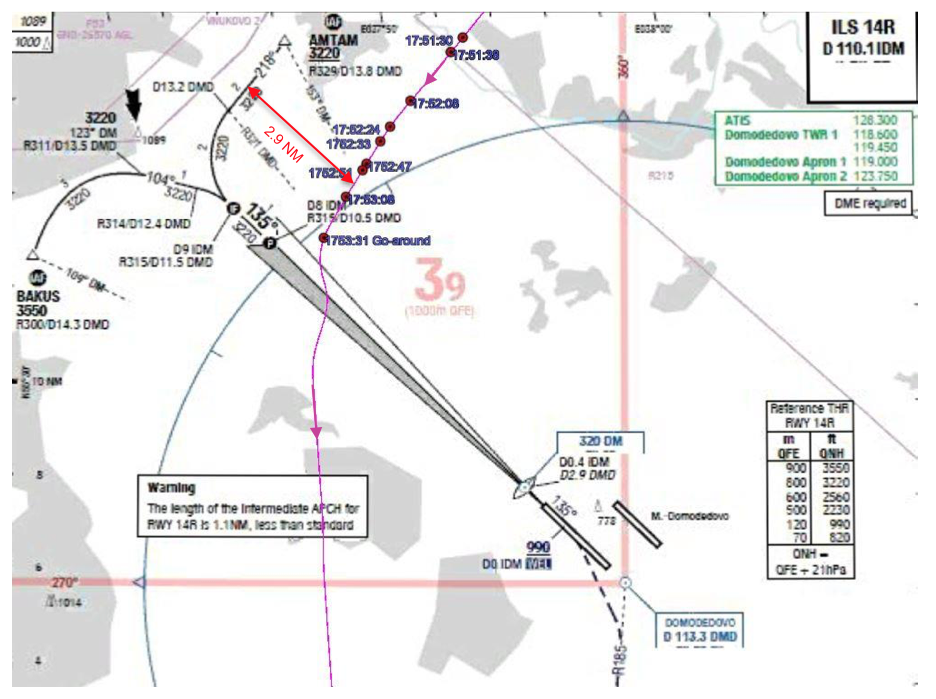
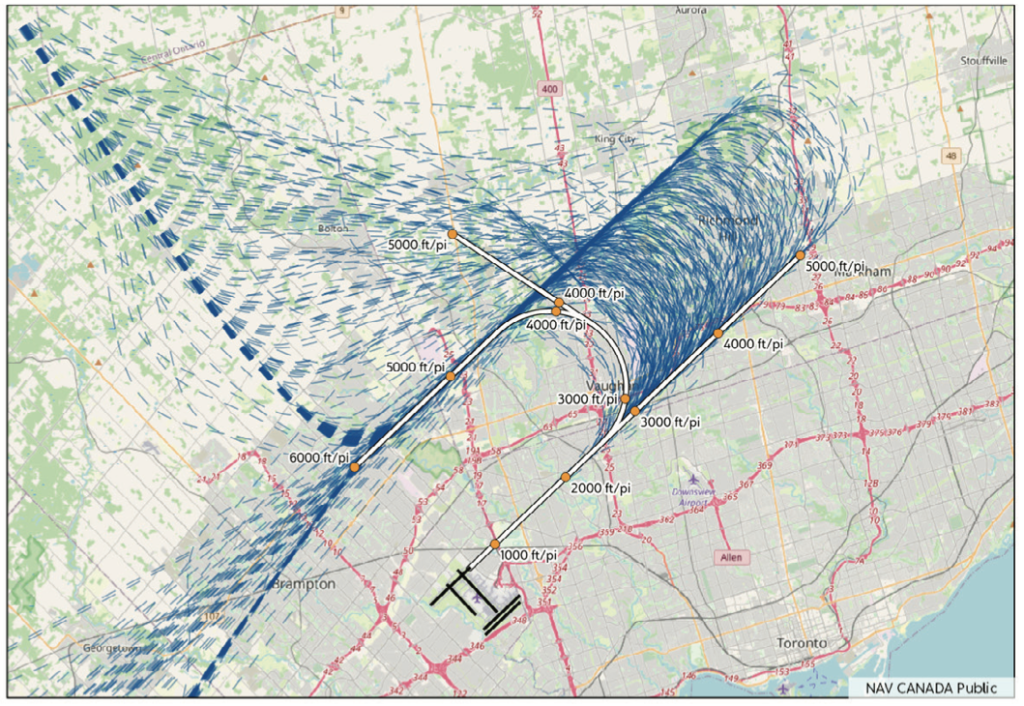
Showing the first approach to go-around path

We’ve all been there.

We have all experienced a time where something has gone wrong and our brain has refused to drop it. Instead of getting to work, it’s sat there reminding us what we just did, how silly it was, even when we’ve tried to move on and get our focus back on the current situation.

You no doubt have your own examples – the first manoeuvre in a sim assessment that is so messy you spend the rest of the session dwelling on it, wondering if it was too messy to pass. The time you did something silly on the line and sat there stewing away with the “why did I do that?!” and the “What an idiot I am!” thoughts.

And out on the line, this dwelling on what happened just now, instead of what is happening now now is particularly critical because, as we know, a flight is a pretty dynamic beast, and it doesn’t stop at the mistake – it keeps moving on. If we don’t get with the program, then where it is going to move us to might very well be another equally or even tighter spot than the one we are still stewing over.

Now, us pilots are tough on ourselves, often our own worst critic. We are also quite detail-oriented which means if we allow our brain the freedom to, it tends to start throwing a few additional ingredients into that stew pot, until there is a nice bubbling hot soup of worry filled with self blame, bruised ego, concerns about repercussions and just a little fixation on hindsight.

But if we let this soup spill into the remainder of the flight, we can get burned very quickly. So, how can we get our head back into the game?
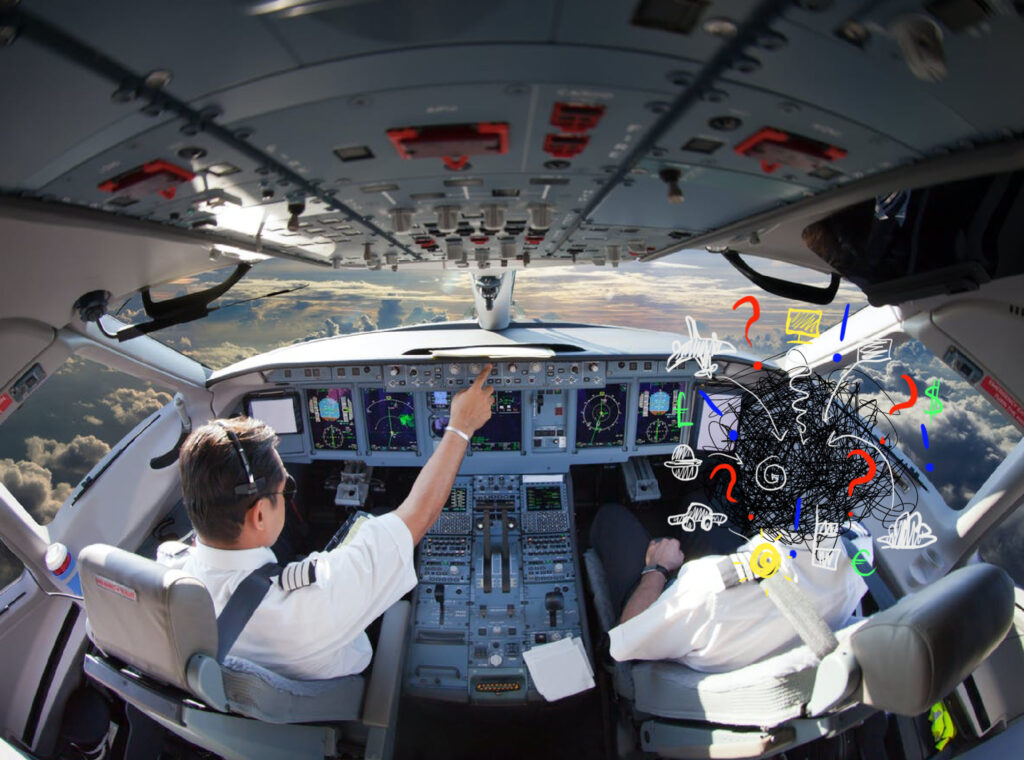
Brain overload.

Time

Yep, time is a wonderful thing. They say it heals all.

Alas, we don’t always have it, and if you don’t, then you’re going to need to do two things.

One: Take just a few moments to throw everything into the stew pot.

Two: Stop stirring it and put it aside until you do have the time to really sit and look at your reflection in the probably quite thick, dark gloop (ok, enough with the stew analogies, I promise).

You are going to have to wait until you can sit and reflect, dissect, digest. This does not mean disregarding it immediately though.

After a stressful or surprising event, it can take between 20-30 minutes for adrenalin levels to really drop down to normal again. In the flight deck SOPs, memory items, all our years of practice are there to help bring those levels back to normal quickly. But you still need time to acknowledge something happened, and to regroup. While you may not have time for the full self-trial, you do need to make time for your brain to get it together again.

If your brain is not in the flight deck, it’s as good as empty.

But how long do you need?

That is very dependant on you and on the situation. A group of pilots were asked to give an estimate of how long they thought they’d need to reset and re-brief for a second approach following a “not their fault” event leading to a go-around. It wasn’t particularly scientific, there was a hypothetical pig involved, but for the most part the group seemed to feel 5-10 minutes was adequate.

This was a situation where they were not to blame though. Throw in the embarrassment and concern about repercussions and the time to put all that aside may be much more.

Admit it, Move on.

A key step in this seems to be simply admitting something went wrong. Acknowledging a mistake, out loud. Saying “That happened, but now we need to do this…” can be trigger to your brain to focus on that “now we need to” element which is so important to safety. It can also be the trigger to bring the other person back into the now as well.

Without this, it is often hard to stop your brain from running through the events again and again, self-preservation kicking in as your brain so thoughtfully tries to find reasons, evidence, excuses as to why it wasn’t really your fault.

We need to Rebuild

In the A380 incident, this seems to have been what happened. Added to that was a likely loss of trust – in themselves or potentially in the aircraft – because there was not time to review and work out what had really happened. And this is the next thing you need to give yourself time to do – rebuild.

Just as we rebuild our automation after a wind shear event, or a TCAS RA, we need to rebuild our own mental model of the situation as well, and using a structured method – sticking to SOPs, ANC, what we know – will help reset your brain back into the ‘now’ far more quickly, and with far more useful context to keep you safe. By going back to basics, starting simple with a good bit of ANC and working up again, you can determine where to place your trust and then go from there.
Getting your brain up to speed is key.

The Process

The process look simple:

  • Give yourself time to take in what happened and to acknowledge it.
  • Mentally put it aside until there is time to think on it again.
  • Rebuild the situation and your own mental model, bring your brain back into the game.

But can we prepare for this even earlier?

Train to Fail

We probably don’t spend anywhere near as much time thinking about failing as we should. I mean, it’s not nice to. Adding some Kobayashi Maru exercises into sim profiles probably isn’t the way to go about it, but in fact building resilience is something that can only really be done through practice.

By resilience, we mean that ability to bounce back. The capacity to recover from difficulties. Mental toughness. Some of this can be prepared with briefings on mitigation strategies, threat and error managements and all that good stuff.

But the resilience to bounce back from a real unexpected, unprepared for event –  that only comes through actual experience of those sort of situations.

How can we train to fail in sims though? And especially in the sort of scripted sims that are all many smaller operator pilots have exposure to?

The Element of Surprise

Sim scenarios which involve an element of surprise are critical. It doesn’t have to be something huge, but it does have to be something that actually tests the pilot’s decision making, situational awareness and resilience skills. They also don’t have to fail, but they do have to experience that “not going to plan, what do you do now?” moment where they need to reset their brain, rebuild their SA, and regroup with the other crew member.

If Resilience is the key, how to build it is the question.

The resilience to bounce back needs to be developed, practiced and thought about. And a process for doing it needs to be identified.

Resilience, or a lack of, is unfortunately what led the crew of the Moscow A380 into having to discontinue a second approach. While the factors leading to the first may seem so much more important to review because that first approach led to a so much more dangerous condition, the really critical Human Factor in this, and in so many experiences on the line, lies in the question of “How can we get our head back in the game following an event?”

Think you have an answer to this? We would love to hear it. You can reach us on team@ops.group.


Danger Club .. the story so far

What happens in Danger Club? Top secret of course, but very simple: we get together as pilots to talk about safety danger. This isn’t the usual safety meeting (hence the strikethrough): we’re just fallible humans figuring out where our faults may lie.

The first six meetings have been met with enthusiasm from all attending, and some really interesting discussions have resulted.

Top topics so far: Taking control from the PF, finding your voice as the F/O, MAYDAY calls and emergencies, over-experienced captains, automation vs hand-flying, the risks of a too shallow cockpit, whether there is such a thing as too much experience, and the question of when do we become too comfortable with risk?

It’s been fun and fascinating. Bec wrote a great article on one of the topics after one of the sessions: Fighting for Control, and Chris wrote another one: Grandchildren of Magenta.

OPSGROUP members – keep an eye on the OPSGROUP forum for details of the next event!

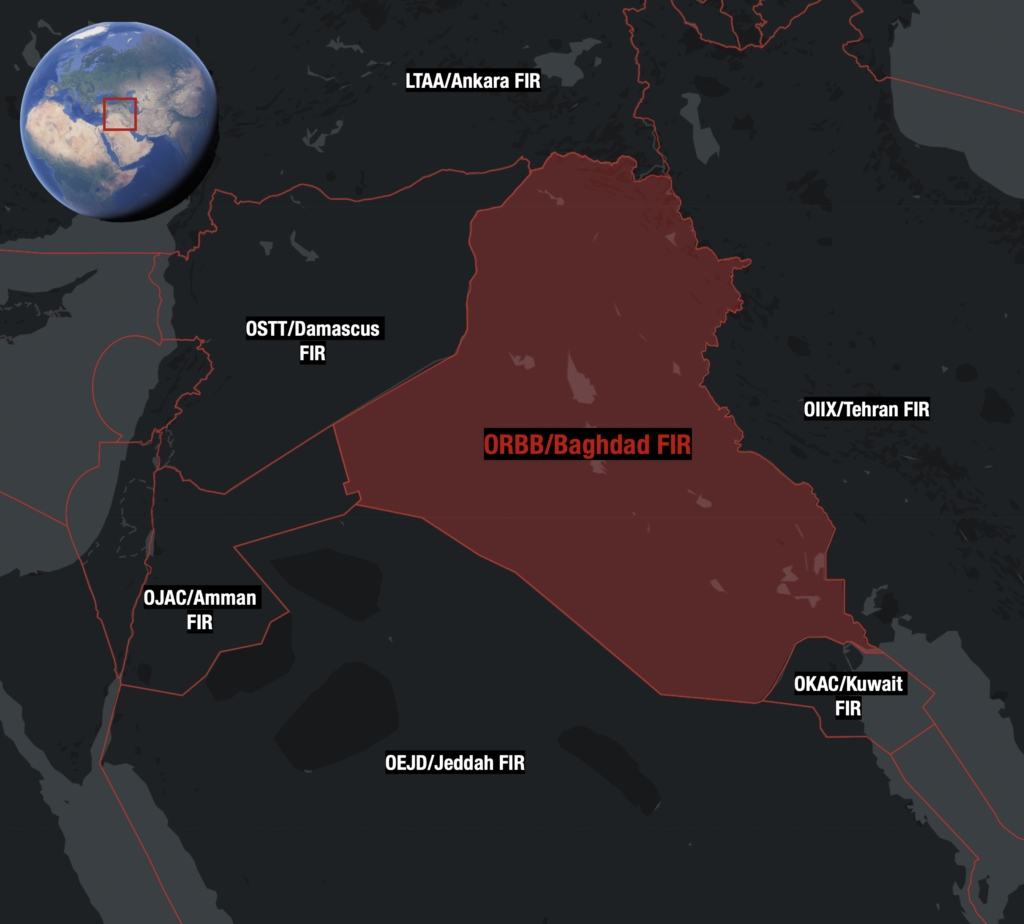
Iraq Overflights: A Recent Report

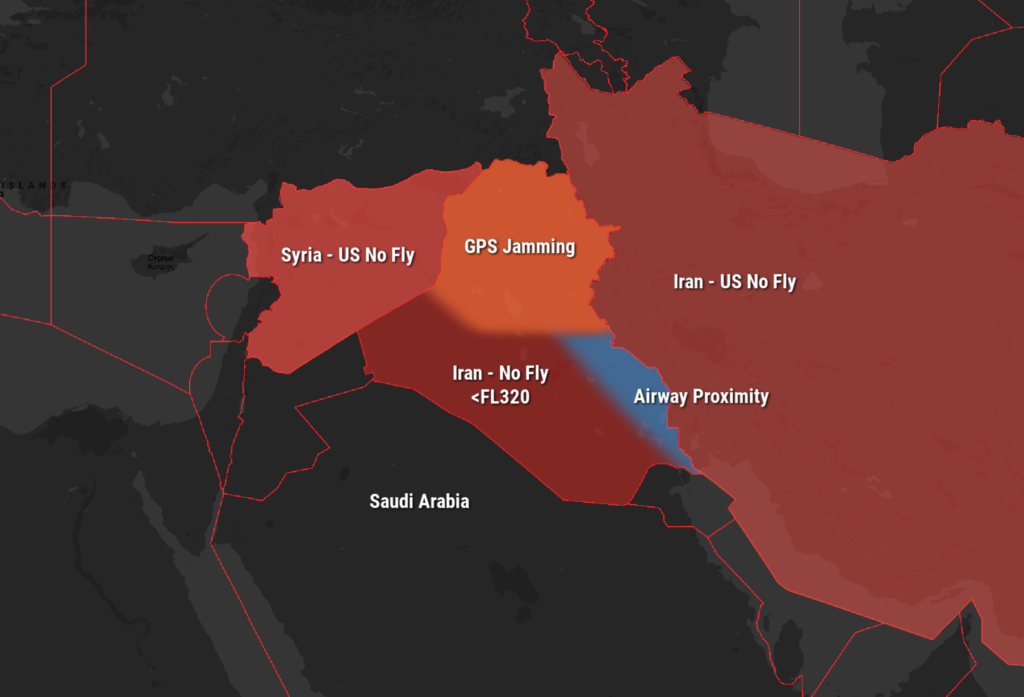
The US FAA recently amended their long standing Notam prohibiting US Operators from entering the ORBB/Baghdad FIR. The KICZ Notam A0036/21 used to bar flights at all levels, but now US operators are allowed to overfly Iraq provided they remain at or above FL320, as per the SFAR.

So, what can you expect if you elect to use this newly available routing, and what risks remain?

You can still expect risk

Iraq remains a political volatile country and the security there is unpredictable. Terrorist groups remains active, and have access to anti-aircraft weaponry.

What should you do?

  • Continue to monitor alerts and sites such as Safeairspace to confirm what the current situation is.
  • Flights should remain above FL320 to avoid risk from MANPADS.
  • Do not use Iraqi airports as diversion options unless it is an absolutely critical emergency situation.

All going well, here’s what expect

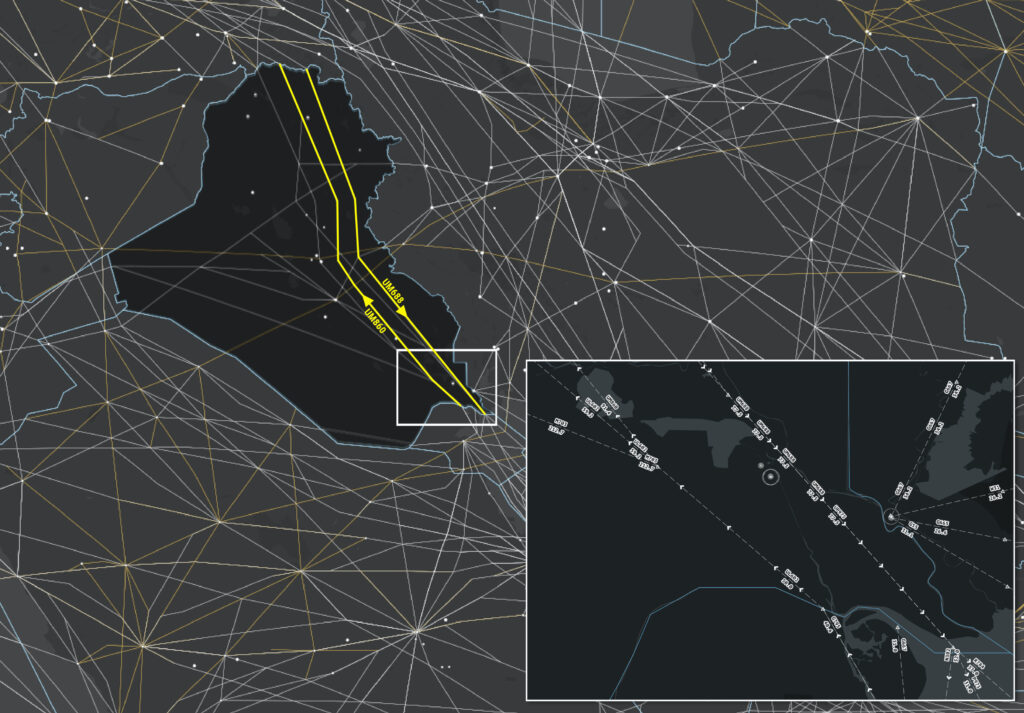
Plan to use the UL602, UM860 and UM688 airways. These are major airways utilised by traffic routing between Europe and the Middle East. Iraq offers the slightly shorter route compared to Iran (and Iran remains out of bounds for US operators).

The routings to plan are as follows:

Northbound:
– TASMI DCT SEPTU DCT ROXOP UM860 NINVA
– TASMI UL602 ALPET L718 DEBNI DCT EMIDO L718 KABAN (all flights need to be at or above FL280 before DEBNI to stay clear of restricted area OR/R 401).

Southbound:
– TASMI RATVO UM699 SIDAD (via airway)
– RATVO DCT SISIN UM688 SIDAD (DCT – subject to availability)

Kuwait are good at handing you over, and Bahrain and the UAE airspace is all well managed.

ATC standards are good, and standard VHF throughout, with radar. It is worth keeping your headsets on though because a good listening watch is required at all times in this region.

Routing south you might find yourself slowed down or shifted levels, or given early descents, as they manage the flow into some of the major hubs in the Middle East. If you fly into the Bahrain FIR (via RABAP or LONOS) be aware there are high levels of congestion here, particularly military traffic.

Any other considerations?

Iraq borders Syria which is an absolute no go area. There is a large prohibited area in the northwest quadrant of Iraqi airspace along the Syrian border. If you are looking to use LCLK/Larnaca as a diversion airport, consider how you will manage routing around Syria.

The main southerly airway lies extremely close to the Iranian border. The border is not a straight line so consider whether you might accidentally cross it if detouring for weather, or if offered a direct routing which cuts the corner.

You do occasionally get some major storms in this region. When they are there, they aim to be impressive!

GPS jamming is a problem, usually in the northern region from around 40nm north of the border and through about one third of the airspace. Of course, if you have INS and/or VOR/DME RNAV etc then you’ll be ok, but if you’re using something like Garmin avionics which rely solely on GPS then not so much. UAE airspace requires at least one GPS too, so update ATC if you need support!
What if I have to land there?

Security and safety on the ground is unknown and likely to be high risk.

The US have pulled their troops out and so there is little protection at the major airports. Leaving the airports will result in possible security issues and is unadvisable. While the airports are generally well maintained and serve some major international airlines, conditions are challenging particularly in the summer when temperatures regularly exceed 40°C. Terrain is also a consideration.

Cultural and religious regulations must be taken into account, and political conflict with certain nationalities should be considered. Alcohol and drugs are banned with severe penalties.

ORBI/Baghdad is a common target for rocket attacks, particularly because of its proximity to an air base. Rebels and terrorists are active in this area. The facilities and runways are decent with two ILS approaches and two runways of 4000m and 3301m. This should only be used in absolute emergencies.

ORMM/Basra is the second largest airport in Iraq and has a good length runway and an ILS. This should only be used in absolute emergencies.

ORER/Erbil offers a very decent length runway and facilities. The main area of issue is over the hills to the north of the airport. This is the only airport which may be recommended for use as a possible en-route diversion.


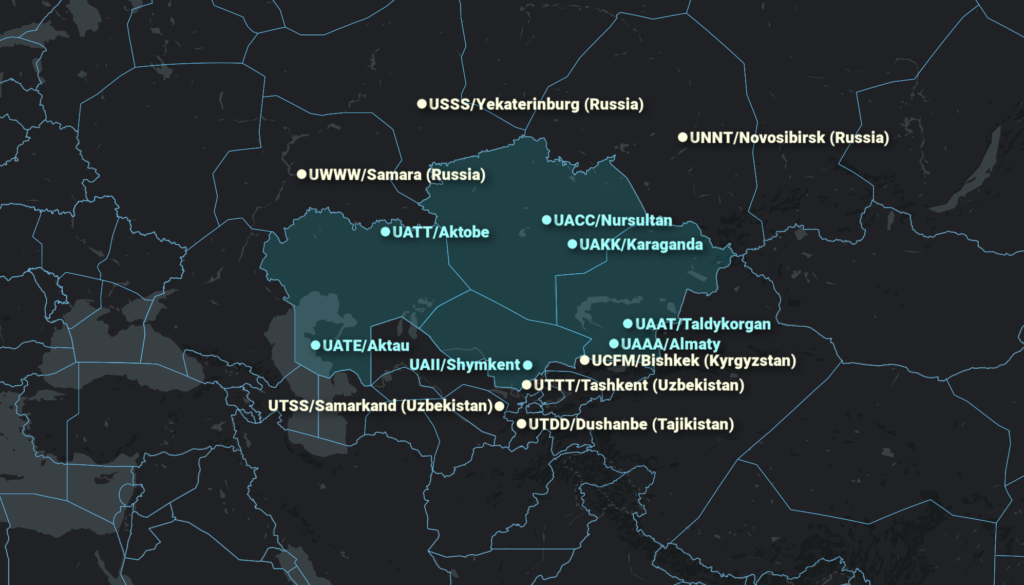
Almaty airport open again following civil unrest

**Update, Jan 14 – 12:00z**

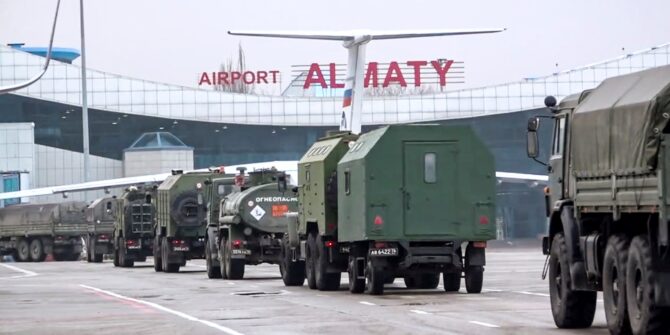
  • UAAA/Almaty airport has reopened following the recent riots. But the a state of emergency will remain in place until at least Jan 19 – carefully consider security if planning crew overnights here. Until Jan 19, the airport is only open between 0800-2100 local (0200-1500z), as per Notam A0032/22.
  • Report from OPSGROUP member on the ground: “We have been in Almaty since Jan 12th. The city is safe with no security issues at his time. Restaurants and hotels are open. Internet and cell service is back to normal as well. Fuel may still be an issue as Kazakhstan was experiencing Jet Fuel shortages before the riots. Check with your handler before landing to confirm uplift.”

**Update, Jan 12 – 12:00z**

  • Police and military report that civil unrest has been brought under control, including in the city Almaty.
  • Troops from Russia and other countries have secured UAAA/Almaty airport. Kazakh government authorities issued a statement on Jan 12 saying that the airport will resume operations on January 13. “Starting January 13, 2022, the international airport of Almaty will resume operation. According to the preliminary information provided by the airport’s management, domestic and international flights will be performed from 8:00 am (5:00 am Moscow time) to 9:00 pm (6:00 pm Moscow time),” the report said.
  • Other Kazakhstan airports remain open and operational. UACC/Nursultan airport is open with several scheduled services operating in. A flight dispatch report suggests the airport is secure but telephone contact may be difficult if contacting from abroad.

UAAA/Almaty airport had been closed since Jan 2, following mass riots in many cities across the country. Thousands of people were injured, and the number of casualties remains unknown. On Jan 5, the President declared a state of emergency until at least Jan 19. There were also curfews put in place across Almaty city, from 8pm to 7am. The US Embassy raised the Travel Advisory for Kazakhstan recently to reflect level 4, “Do Not Travel” due to civil unrest.

Overflights

No Notams have been issued indicating that overflights are affected. Keep a close eye on things if operating in the region. It may also be worth familiarising yourself with TIBA contingency procedures.

One other thing: Fuel

We have previously reported on rumours of fuel issues across Kazakhstanparticularly for GA flights operating to UAAA/Almaty, UACC/Nur-Sultan and UAKK/Karaganda. Initially agents at airports advised this was not the case, but later informed us that fuel was only available to airline flights and locally registered charter operators. Foreign registered non-scheduled flights would be unable to uplift fuel. The official word is that you need prior permission from airport authorities to take any on.


Honduras has a New Airport

Here is the lowdown on the new international airport in Honduras, for anyone who might be thinking of heading there.

Where is it?

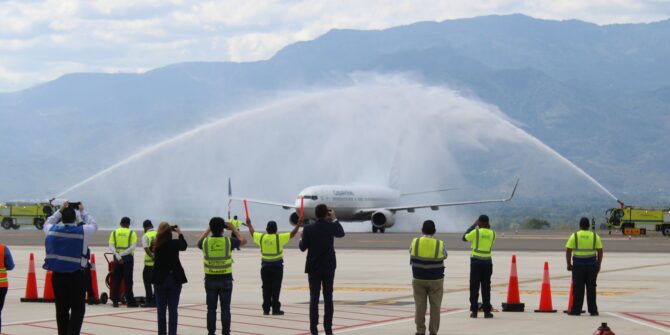
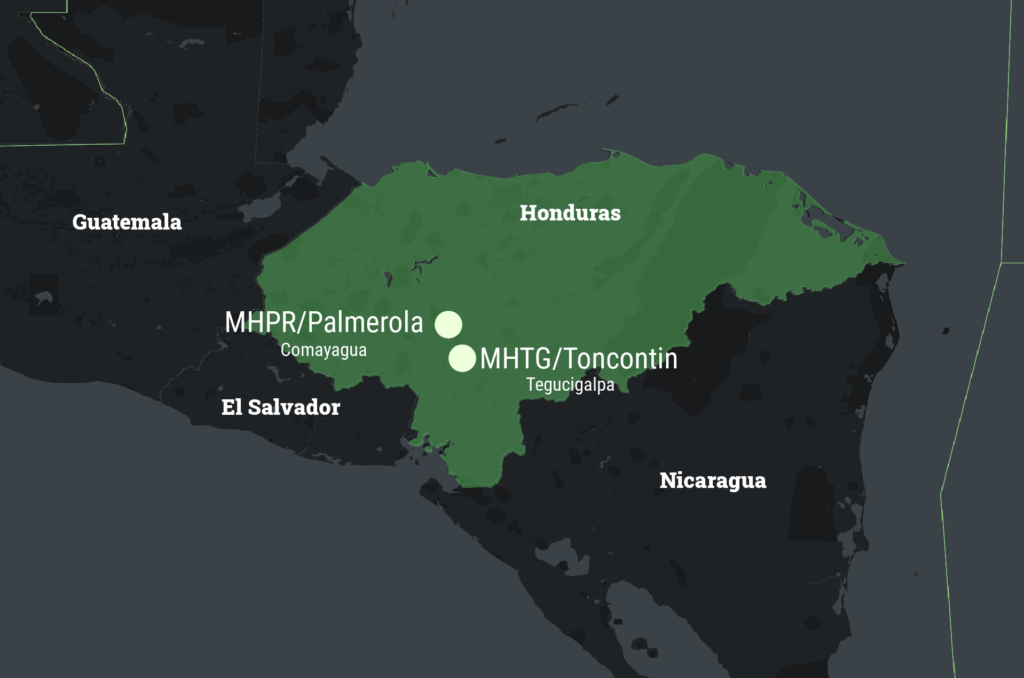
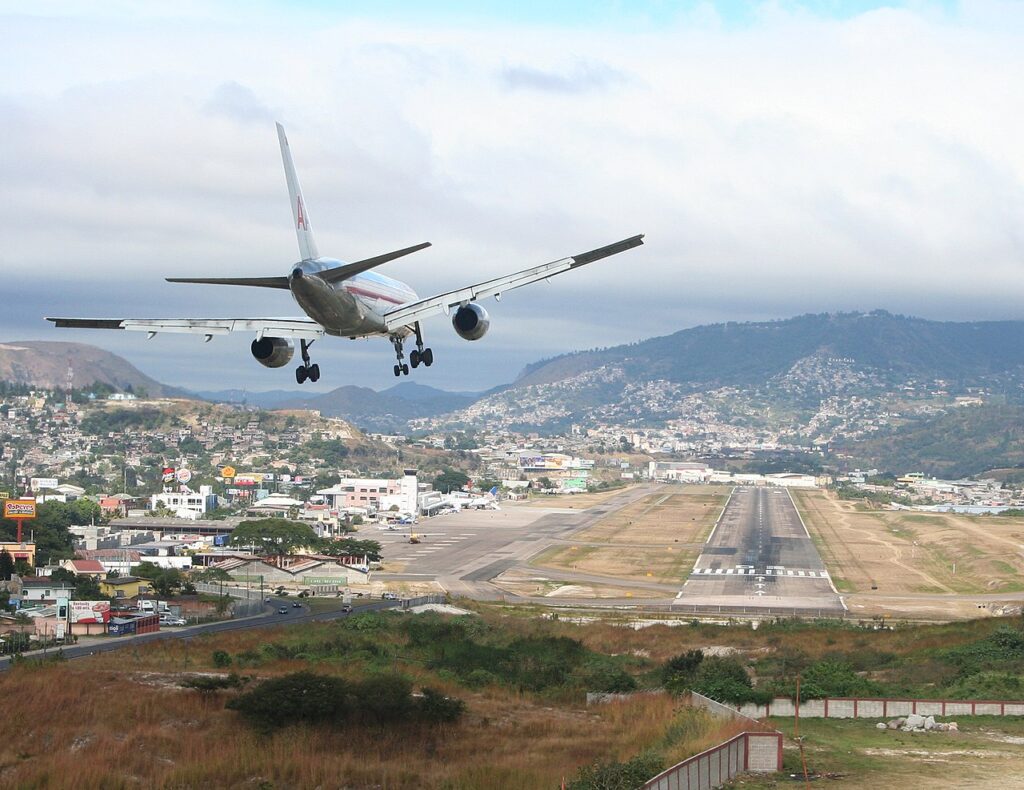
MHPR/Palmerola, also known as Comayagua International, has been built on what was the Soto Cano Air base. Inaugurated in October 2021, it is now the new civil and commercial international airport for Honduras.

What has it got?

The new airport boasts a 2441m / 8009′ runway with an RNP approach to both runway 17 and 35, and backup VOR approaches. There is no ILS and there are currently no approach lighting for night or IMC ops.

It is planned for 24/7 operations, but for now it is only open during daylight hours (06-18L). After hours permission may be available by contacting the airport manager on +504 3140 3317 in advance.

A report from someone who has headed in recently suggested that “All traffic is routed mostly via TGU and in contact with TGU approach as far as I know for traffic landing north.”

The old airport, MHTG/Toncontin, has a 2021m / 6631′ runway with an RNP (AR) approach to runway 20, and a VOR to runway 02.

Here’s a quick look at the new airport:

Things to look out for at MHPR/Palmerola

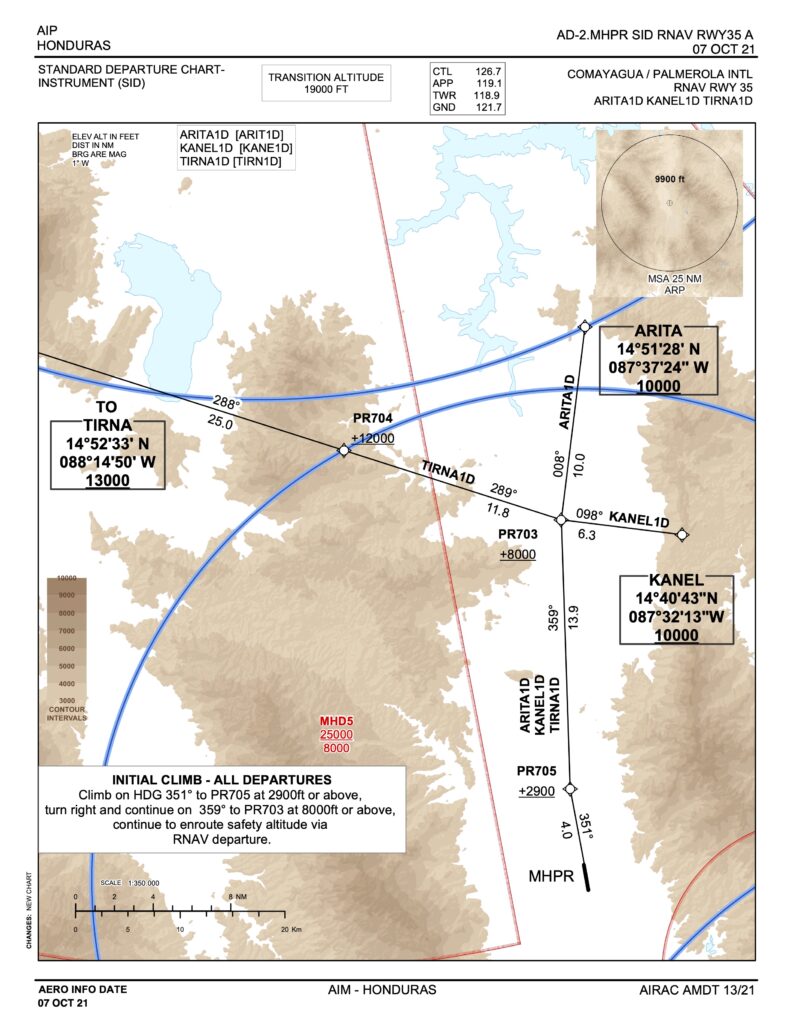
  • The airport elevation is 2064 feet, and there is some tricky terrain all round with the airport sitting in a valley, giving it an MSA of 9900′. The terrain also means departures (unless you’re in a super climb-achieving military jet) are limited to runway 17.
  • RNP Rwy 17 brings you in from point PR702, at 5600′. There is a chunky hill right under it with a mast on top sitting at 3675′, so after you pass here you need to descend to 4300′ by PT701, which is only 4 nm away. The vertical approach path is a nice standard 3 degree, but you’re going to want to look out for the climb gradient for the missed approach because it requires a minimum of 300’/nm.
  • The missed approach is also quite complicated with a bunch of “head here once you’ve reached xxxx altitude” instructions. The approach and missed approach for runway 35 is a little less complicated since (once you’re over the terrain to the south of the airport) it is less challenging.
  • Not that you would be there anyway (because of the terrain) but to the east, south and west lie various Danger or Restricted areas to look out for.
  • The airport lies in a valley. With terrain either side. That means there is a chance of some mean topographic turbulence if the wind is blowing the right way. The old Toncontin airport overview suggests wind shear and downdrafts on short finals. The new airport will probably have similar threats.
  • The old MHTG/Toncontin airport requires a specific ‘Mountainous Terrain’ Airport Qualification. While the new airport does not, the terrain is a challenge so look out!

  • The region sees fairly nice temperatures through the year with highs of 29°C (85°F) and lows of 16°C (60°F). Rainfall peaks in September to November with an average of 119mm (4.7″). Watch out for thunderstorms though which occur throughout the year, particularly between June and August.

What happened to MHTG/Toncontin?

All scheduled international services have been transferred from MHTG/Toncontin to MHPR/Palmerola, but the old airport is still available for international bizav flights.

Any contacts?

If you want to head to either MHPR/Palmerola or MHTG/Toncontin then try talking to one of the following:

Any other info to know?

  • The official website for MHPR/Palmerola Airport is here.
  • To check airport charts and other info, the Honduras AIP can be found online here.


Venezuela Aviation Situation: Anything to Report?

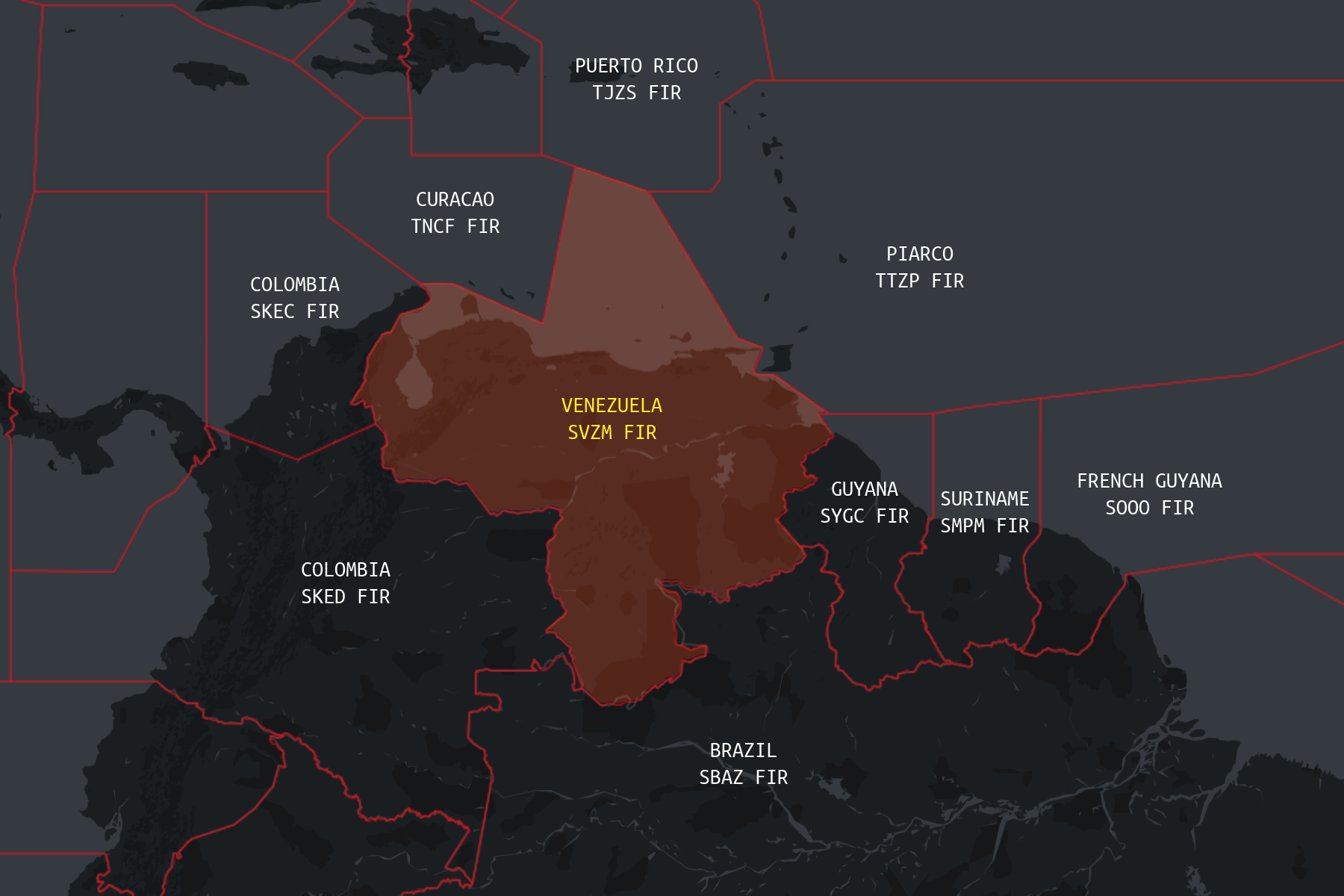
In April 2019 the US FAA issued a Do Not Fly” instruction to US operators, barring all operations into or over Venezuela, unless operating at or above FL260. This came after several years of steady decline in the situation in Venezuela, and an attempted uprising.

This is what we said about the FAA notice back in 2019, but now we thought we would take a look at the current situation in Venezuela and consider what the ongoing impact to international aviation might be.

Give us some background.

The basic story, without getting into the politics of it all, is that there is a political power struggle between the government of President Nicolás Maduro and the opposition party led by Juan Guaidó.

The growing political discontent has led to skyrocketing fuel prices, power cuts and shortages in things like food and medicine. This has all, in turn, led to rising crime levels and security concerns.

Tell us about the general situation for aviation.

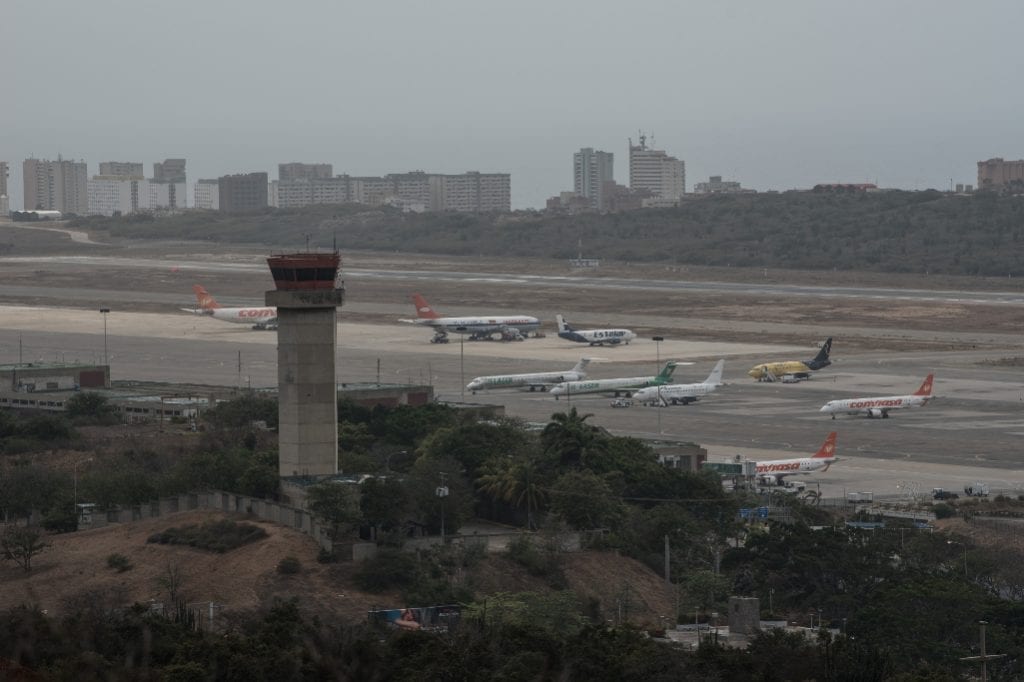
SVMI/Caracas Airport lies in an area of extremely high risk for armed robberies and kidnappings. In fact, Caracas was rated the most dangerous capital city in 2017 and has continued to hold a Top 3 spot since.

A report received in 2019 said the following:

“Foreign maintenance providers were evacuated last week… Runway surface has worsened and now there are big potholes and loose asphalt.”

Other reports suggested ATC controllers were under-qualified with poor English speaking standards. Inappropriate IFR and terrain clearances were being issued and “tremendous caution” should be exercised if operating in.

Pre-pandemic, most major airlines had been ceasing operations for a variety of reasons, the main one being an issue with onward payment of ticket monies which the Venezuelan government put a stop on.

What about neighbouring countries?

The border between Colombia and Venezuela is more volatile with disputes and armed conflict occurring along it. Bombs targeting local airports in Colombia have occurred through the end of 2021/ start of 2022, and a major attack occurred near SKNA/La Macarena airport, 100nm south of Bogota, on Jan 6.

A US travel warning remains in place for Colombia due to terrorism and other security related threats.

And a quick mention of the Covid situation?

Covid led to major restrictions on international flights into Venezuela. In October 2021, only scheduled flights from Bolivia, Mexico, Panama, Dominican Republic, Russia and Turkey were authorised. The government also allowed 13 specific flights to Spain with approved operators.

What has the US’s response been?

The US has had sanctions in place against Venezuela for sometime now. The FAA notice is a Permanent Notam A0013/19 with no expiration date.

“ALL FLIGHT OPERATIONS IN THE TERRITORY AND AIRSPACE OF VENEZUELA AT ALTITUDES 
BELOW FL260 BY THE PERSONS DESCRIBED IN PARAGRAPH A BELOW ARE PROHIBITED UNTIL 
FURTHER ADVISED DUE TO INCREASING POLITICAL INSTABILITY AND TENSIONS IN VENEZUELA 
AND THE ASSOCIATED INADVERTENT RISK TO FLIGHT OPERATIONS.”

The FAA’s Background Info document states there is an “increasing inadvertent risk” to civil operations below FL260 due to increasing political instability and tensions. They also advise that the Venezuelan military has large stockpiles of MANPAD defence systems which has the capability to reach 25,000ft. There have also been reports of temporary GPS outages in the territory and airspace of Venezuela.

At the end of 2019, the US FAA also downgraded the safety status to Category 2 under their IASA program, deciding the Venezuelan CAA was not adequately complying with ICAO safety standards with regards to regulating and supervising their own airlines.

What has the rest of the World said?

Surprisingly little, perhaps because few operators fly there…

EASA have no Conflict Zone Information Bulletin (CZIB) relating to Venezuela at all.

ICAO has not flagged Venezuela under their AUSOPS Safety Audit Program, and in fact rates them fairly well alongside the US with the exception of their aerodrome standards.

We have rated Venezuela as a Risk – Level Three Caution on Safeairspace because of the FAA prohibition, and due to a lack of information on the situation within the country.

However, there are many reports on the number of MANPADS which Venezuela are armed with and it is considered amongst the most highly unstable countries politically. Libya and Syria are the most unstable with the highest number, but Iraq, Pakistan, North Korea, Afghanistan and Venezuela come not too far behind.

A Quick NOTAM Review.

Several years ago, Venezuelan NOTAMs appeared to, well, disappear. They also stopped sending out METARs. Thankfully, the systems seem to be up and running just fine nowadays.

There are currently (as of Jan 2022) a few NOTAMs which may impact navigation, or which have a minor impact to operations, but given few international flights are operating in right now, there is not much to consider.

A0488/21 – SVMG/Margarita Island primary surveillance radar is U/S and not expected back until January 2022.

A0494/21 – SVMG has also been downgraded to RFF 7 (from 9).

A0486/21 – SVPR/Ciudad Guayana Airport radar systems are all U/S.

What is the ‘Risk Rating’?

If you are a US operator it remains a no-go. If you are any other operator… well, that is the question.

The FAA’s notice remains in force, but there has been little update on the situation since. No other authority or state has put out a notice, but the conflict within the company is not easing and reports of fuel shortages and a growing refugee crisis suggest there may be some threat to operations which are not being reported. We asked the question and received just 10 responses, all of which said the situation remains “neither safe nor secure”.

If you have operated into Venezuela in 2021 we would be interested in hearing your report on what the operational situation was like. Send us an email at news@ops.group


Mexico ADS-B Mandate Coming Soon

Mexico’s ADS-B mandate, delayed a year, is coming into effect January 1, 2022.

Why was it delayed?

Apparently it came down to supply of ADS-B equipment issues meaning a lot of Mexican registered aircraft were unable to get it installed in time.

What do you need?

Mexico have mandated the use of 1090-MHz Mode S squitter transponders and as yet have not agreed to extend the mandate to allow 978 MHz Universal access transceivers, which are allowed in the US. The main difference is 978 MHz transponders are not allowed above 18,000′ while 1090MHz ones can be used at any altitude.

The mandate is for ADS-B Out. If you’re unsure on the difference then the FAA have a handy page on it here, but the simplified difference is Outtie’s broadcast an aircraft’s GPS location, altitude, groundspeed etc to ATC ground stations and other aircraft. Innie’s provide the aircraft with weather and traffic info delivered directly to the flight deck.

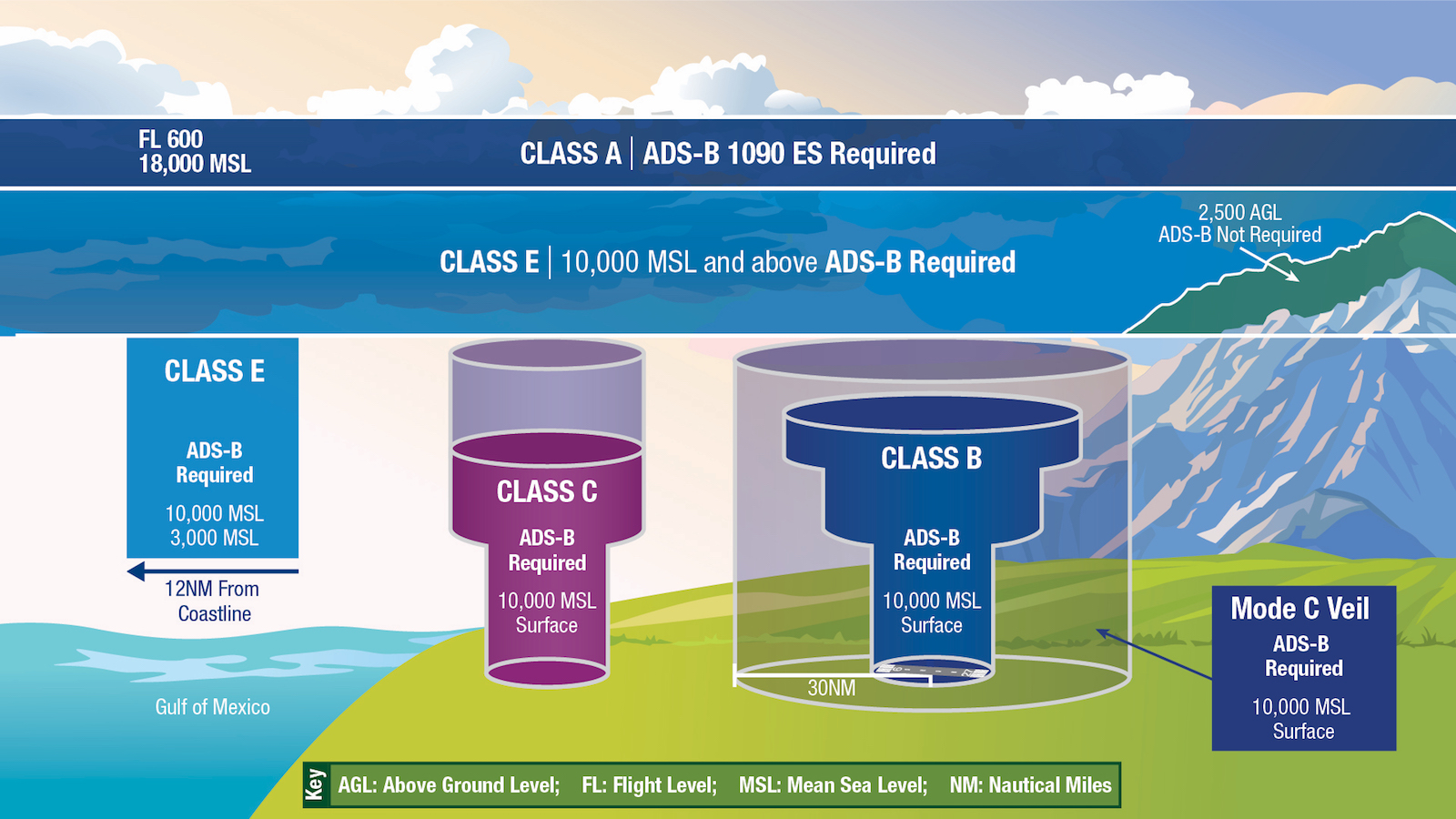
Where will you need it?

The rules look similar to those in the US:

  • Class A
  • Class B
  • Class C
  • Class E above 10,000 feet
  • Class E over the Gulf of Mexico, above 2,500 feet
  • Within 12nm of the Mexican coast, above 3,000 feet
  • Within 30nm of MMMX/Mexico City International Airport, above 10,000 feet

What if mine breaks?

There is a process for operators to request permission, in advance, if their ADS-B is inoperative. You can also request to fly without ADS-B equipment installed if you submit the request at least an hour before departure (probably a good idea to do it a little earlier).

Where is the official info?

All we have discovered so far is this Advisory which unfortunately is in Spanish. Watch this space for info on how to request the no ADS-B permission.

Where else do I need ADS-B?

We have a whole post on ‘ADS-B Mandates Around the World’ which you can read here.


Clearing the way for no more NAT Clearances

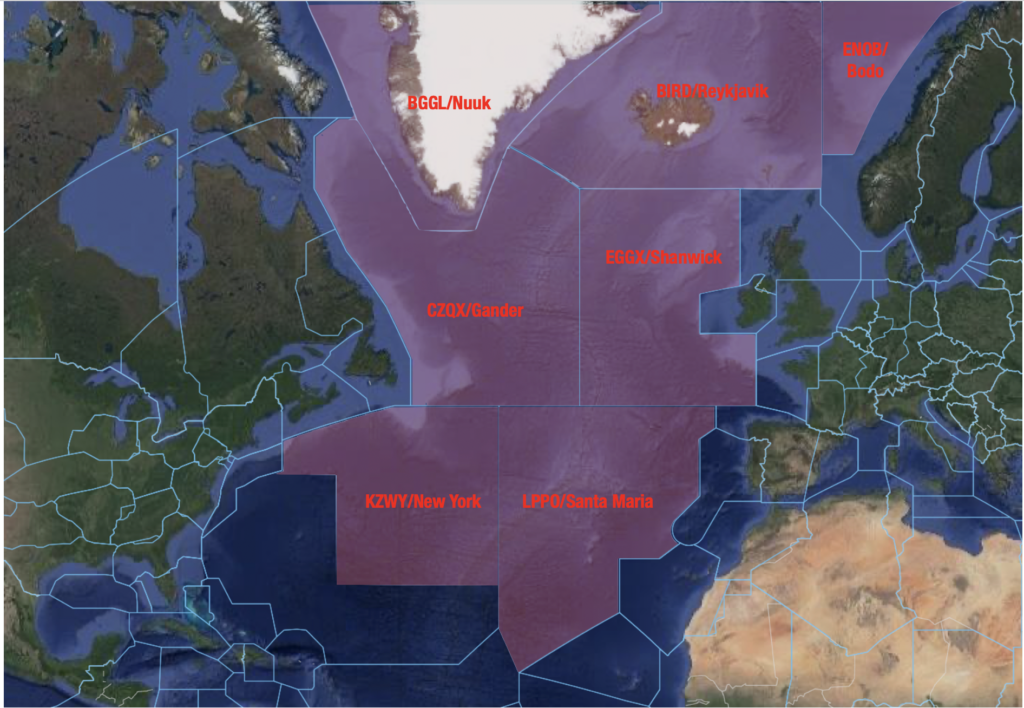
ICAO have released a Concept of Operations paper discussing the plan for the removal of Oceanic Clearances in the North Atlantic Region. Here’s what it says…

The “Executive Summary” bit

There have been big improvements in safety and monitoring capabilities in the NAT region. Things like ADS-C, CPDLC, ADS-B, NATS and NAVCANADA using a common Flight Data Processor Platform (something to do with aligned procedures) etc have really improved everything.

Because of all this, the big wigs in the POG (real acronym – stands for NAT Procedures and Operations Group) have started to think about discontinuing the Oceanic Clearance in NAT airspace.

How does it work at the moment?

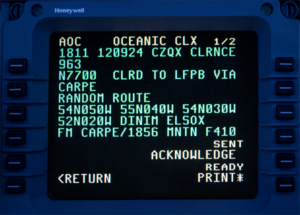
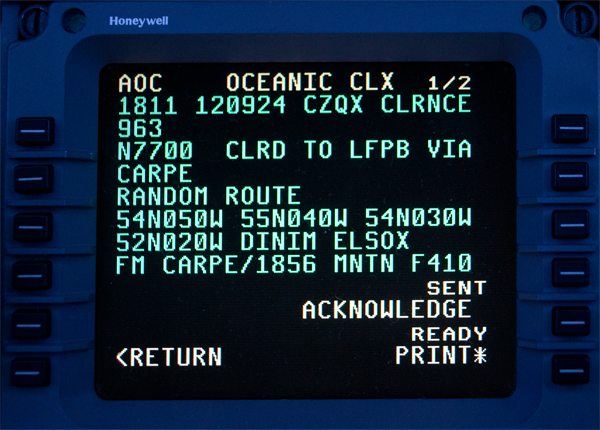
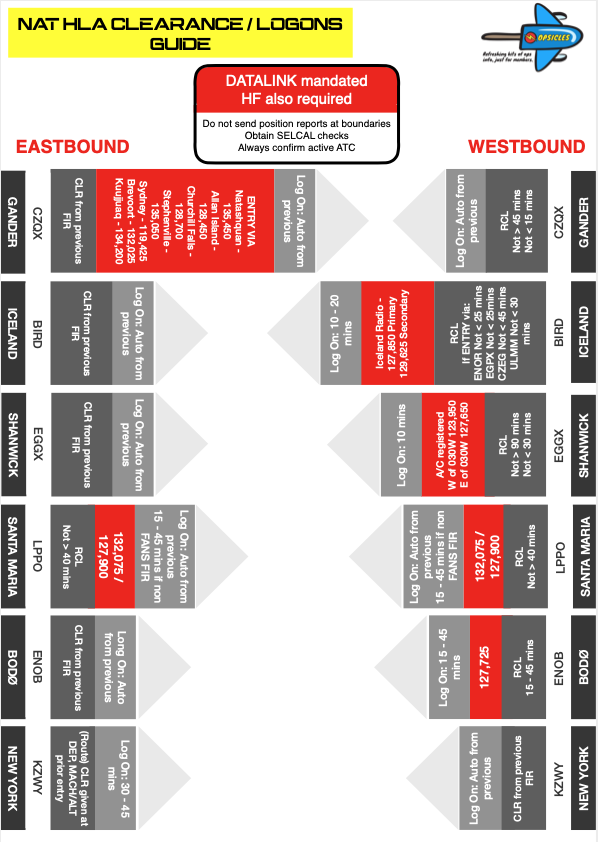
Right now, to enter NAT controlled airspace at or above FL60, you need an oceanic clearance. This clearance contains your Route, Level and Speed.

These three elements are important because they are what enables the management of the lateral, vertical and longitudinal separation.

So, when you are zooming along towards your Oceanic Entry Point, and despite having a flight plan filed, you still need to actually be cleared – meaning ATC have to confirm (and then you sort of reconfirm back at them) what Route, Level and Speed you’ll be flying through the region at.

So you send your RCL (Request for Clearance) to the ATC who manages the first OCA you’ll be entering and they send you the clearance.

Simple, until stuff goes wrong.

Why change it?

Like we said, it’s all straightforward, until it isn’t.

Each OCA has its own published “when to send the RCL” rules. There often isn’t a huge amount of time between receiving a clearance and reaching the OEP, and during this time you have to check the clearance, possibly reprogram bits, and from experience on long haul flights, it always seems to happen around the time the augmenting crew are returning from the bunks. So the risk of errors creeps up.

Then you have things like Radio Comms failures, loss of HF etc. and all the “what to do if” procedures related to what to do if you do have clearance, don’t have clearance, are in the region or aren’t in the region…

The general rule is if you’re already in the NAT HLA then stick with your clearance. If you aren’t in yet but have a clearance then enter and stick with it, and if you don’t have a clearance then follow what is in your flight plan.

But all this does cause confusion. Can I enter? Should I not enter? Where do I send the RCL to? When do I send it? What if I haven’t heard back?

So removing the need to request a clearance prior to entry would align the NAT region with normal global procedures and would mean less training and simplified procedures for crew, and everyone like simple. 

It isn’t actually an entirely new concept either – New York Oceanic removed oceanic clearances some time ago and it was a fairly simply procedural change for ATC and flight crew, so it does work.

So what will change?

Simply put – Oceanic Clearances to operate in oceanic airspace will no longer be issued to flight crew prior to reaching the OEP. Instead, crew would send an RCL and would get back some common message along the lines of:

“RCL RECEIVED. FLY CURRENT FLIGHT PLAN OR AS AMENDED BY ATC”

Any changes will be sent via CPDLC or advised by voice comms.

Will it work?

Well, making stuff more simple usually means less mess-ups. 

In this case crew will have their clearances already – they will know what to fly and potentially have more time to check and crosscheck.

When changes do occur it will be clearer that there is a re-clearance and this could minimise the risk of missing a change to the clearance, or mis-entering it and flying the wrong thing.

Procedures for what to do if you cannot make contact prior to entry will also, hopefully, be simplified, so the stress of “what if I don’t hear from ATC before the OEP” will be reduced.

But when is it going to happen?

Well, that’s the less exciting bit. If they decide that it is something worthy of implementation then it will probably only go ahead by 2030.

Details of planned implementation dates will be published in common NAT Ops Bulletins and in State AICs/AIPs so keep a look out.

Can I read the CONOPS paper?

Yes you can. It is right here.

Not sure about the current clearance process?

We wrote a little brief on it a while back which you can read here.


Flying to the L.A. Super Bowl in Feb 2022

The Super Bowl is coming around again which means traffic procedures, prior reservations, a big TFR and various other things to plan for.

Save the date

The Super Bowl officially takes place on February 13 2022, but restrictions will start to come in from at least February 9th, and probably be in place to around the 15th. You might also want to start planning for this soon because spots fill up fast and reservations are already being taken.

(By soon, we mean now).

Compared to the last two events held in Florida, traffic is expected to be even more limited this time around! Business Aviation flights are being recommended to plan and book ‘drop-n-go’ reservations and not overnight parking.

The main airports in the area will also more than likely be Prior Permission Required (PPR) for the game day weekend so get in touch with those FBOs and start confirming.

Which airports?

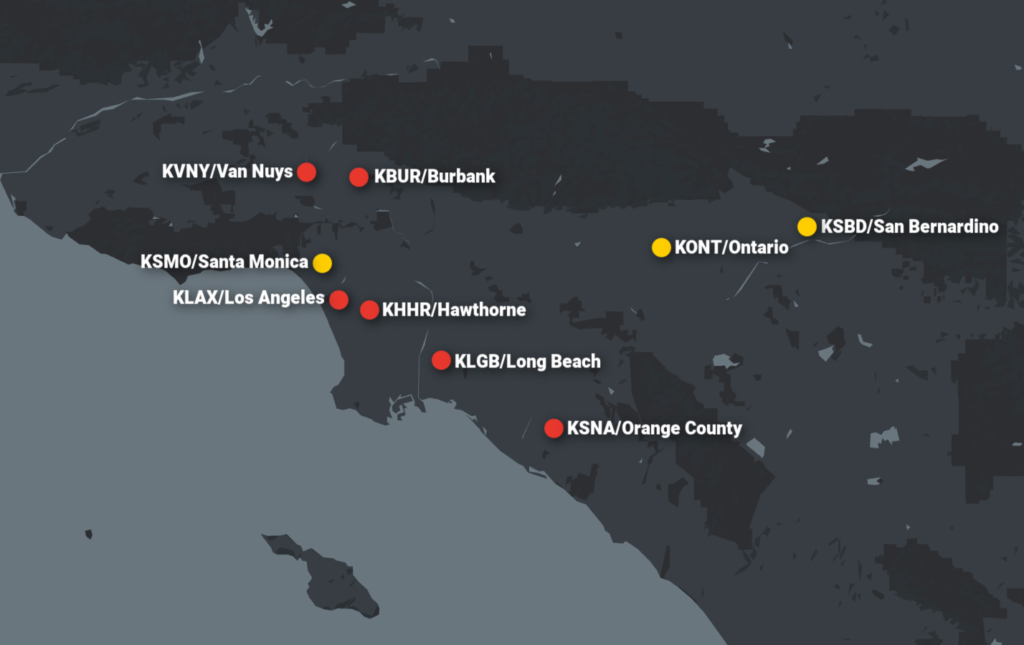
The big ones you definitely need reservations for in the area are these:

  • KLAX/Los Angeles
  • KVNY/Van Nuys
  • KBUR/Burbank
  • KLGB/Long Beach
  • KHHR/Hawthorne Municipal
  • KSNA/Orange Country

On a good note, KVNY/Van Nuys will be extending its operation hours on the Sunday and KLAX/Los Angeles over-ocean overnight ops restrictions will be available later into the night.

It is probably a good idea to get a reservation for any of these too if these if you think you’ll be heading there:

  • KONT/Ontario
  • KSBD/San Bernardino
  • KSMO/Santa Monica

Where else?

A few other places. These aren’t included in the reservation program, but they will be heavily utilised for overflow traffic and for their parking spots because the ones above will be extremely limited on availability. All this means ramp congestion, delays in and out and the possibility that they are included in FAA initiatives to manage the traffic levels if it all gets too busy.

So keep an eye on:

  • KPSP/Palm Springs
  • KSAN/San Diego
  • KLAS/Harry Reid
  • KPHX/Phoenix Sky Harbour
  • KSDL/Scottdale

Who to talk to for your reservation

Talk to your FBO. They are the ones with the slot allocations and will be able to keep you updated on any changes nearer the time.

There will be Special Air Traffic Procedures & FAA Initiatives…

The increase in operations mean delays, and delays mean unhappy airplanes with rapidly emptying fuel tanks. So, in attempt to reduce these and manage the traffic more efficiently there will be special procedures in place for the main, and the surrounding airports. Keep an eye out for info on these nearer the time.

ATC will also be under a lot of pressure, particularly in the LA basin airspace. The peak traffic times are expected to be:

  • Arrivals: Feb 9 -12, 1000 to 1800 local, Feb 13 0900 to 1400 local
  • Departures: Feb 13, 2000 to 0300 local, Feb 14 0700 to 2000 local

If you can avoid flying in the area during those times the do. It will save you (and ATC) a lot of hassle. If you can’t avoid it though then be prepared for the usual initiatives – from Ground Delay Programs to Airspace Flow Programmes, metering, holds and ground stops…

Route Structures will be in force

There are going to be preferred IFR arrival and departure routes to help ATC manage the traffic flows. These can change because it can be a bit of a dynamic situation. Keep an eye out for updates on them.

The TFR

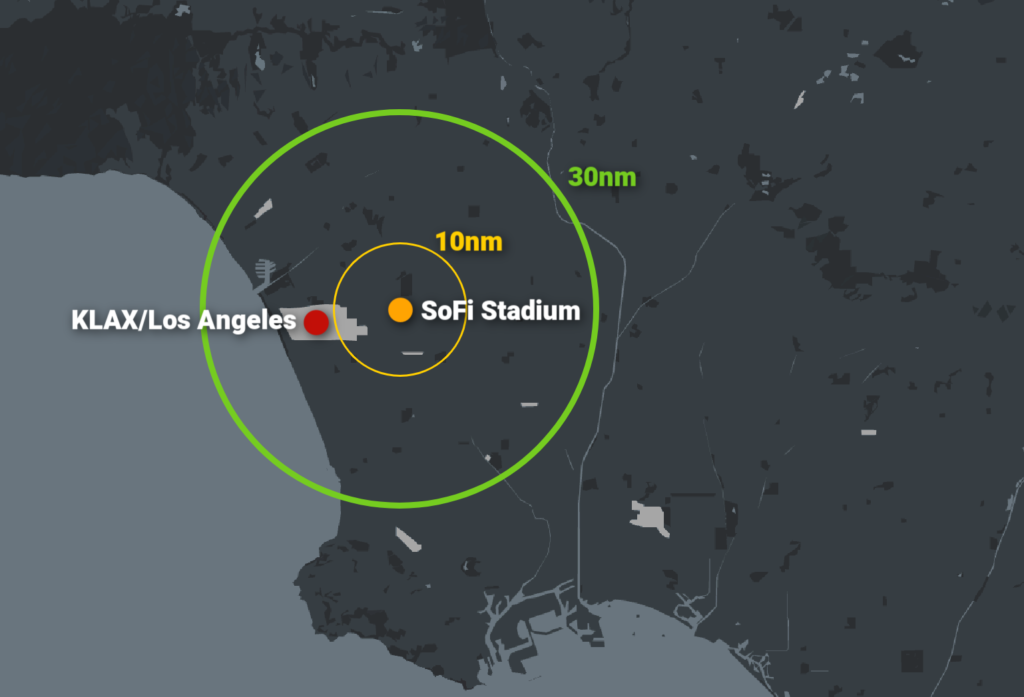
The exact details will be out 10 days before the event in NOTAM form, but you can expect a 10 mile no-go ring around the event for all general aviation traffic and some other restrictions in a 30nm ring. Standard TFR stuff. This is usually active several hours prior to the event to at least an hour after.

KLAX will have TSA screening and gateway procedure in place during this time.

Anything else to think about?

Consider you alternates. Options are going to be limited and restricted because of the high traffic levels. Unless you are in an emergency situation, you’re going to need a plan in advance and know where you can go.

Consider your fuel. There are going to be BIG delays possible even with all the initiatives and reservations in place.

Check your documents. Ensure you have your pilot’s license, company ID (if applicable), applicable aircraft documentation, and access to copies of all reservations/confirmations. Increased security operations may involve ramp checks, security searches, or routing through a gateway airport for TSA screening.

Really plan in advance. We mean from about now to avoid disappointment and disruption. File your flight plan between 22 and 6 hours ahead of departure. Preferably nearer the 22 hours end of that limit to help ATC build their initiatives.

Keep the bigger picture in mind. Airspace and airports will be congested, ATC will be working hard, and there are going to be TFRs to think about as well. Know what is going on and what to expect before you get airborne.

The ball is in your court.

(I couldn’t think of a football related pun).

Check out the FAA’s Super Bowl Safety Plan here.

Get in touch with your FBO to make your reservations and start planning early.

Be prepared! There will be delays, high traffic levels and all the risks and threats that come with these. So… again… be prepared!


Is the 5G rollout a new threat to aircraft safety?

The FAA issued a statement on Dec 7 regarding the expansion of 5G networks across the US, and its impact on aviation. It doesn’t sound good – which is something folk have been saying for a while now…

What’s the background?

5G is being rolled out across the US in the form of massive antennas. No issue so far. The problem comes in when they turn them on because they use frequencies which are part of the ‘slice’ of radio spectrum usually reserved for GPS signals. Which means they will probably interfere with those signals, and disrupt the equipment in the aircraft utilising those frequencies.

That equipment concerned are Radio Altimeters which, as we all know, are fairly critical to certain operations. Some big accidents have been attributed to malfunctioning Rad Alts like Turkish Airlines Flight 1951.

Radio Altimeters transmit on frequencies between 4.2GHz and 4.4GHz, while the 5G network will use a C-Band range of 3.7GHz to 3.98GHz.

Why the concern?

The big problem in all of this is the lack of information on how much interference will actually occur.

It is not clear which airports will be impacted or to what degree equipment might be disrupted because it depends on the location and the strength of signals. While the RTCA (Radio Technical Commission for Aeronautics) has conducted measurements and found that high levels of inaccuracy and outright failure of Radio Altimeters can be expected when operated near base stations – many of which are located near major airports – until they are turned on it is hard to know… 

The FAA also suggested that while issues with RAs are the primary problem, it is unknown what else may be impacted so crew are going to have to be extra vigilant of their instruments, and of passengers potentially connecting to 5G networks while airborne because the impacts are just not known.

What has the FAA done?

The FAA has issued two airworthiness directives, one for aircraft and one for helicopters, in an attempt to enable ‘the expansion of 5G and aviation’ to ‘safely co-exist’.

This is in addition to an earlier Special Airworthiness Information Bulletin issued in November 2021 highlighting the Risk of Potential Adverse Effects on Radio Altimeters.

Let’s take a look at the new directive.

The FAA determined that – “at this time, no information has been presented that shows radio altimeters are not susceptible to interference caused by C-Band emissions” and because they don’t know, they have to mitigate against the possibility that they will be.

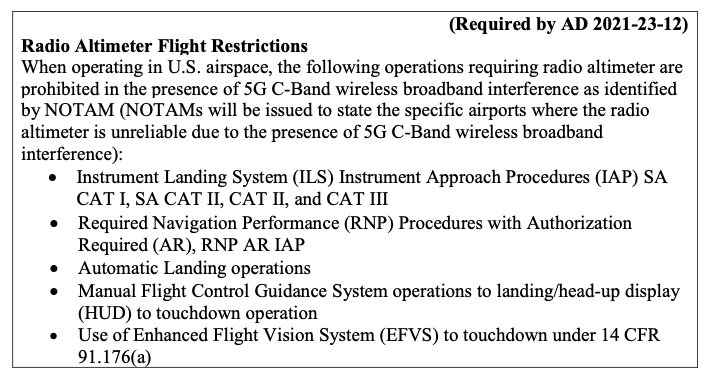
So, AD 2021-23-12 requires the “revising of the limitations section of the exiting airplane/aircraft flight manual (AFM) to incorporate limitations prohibiting certain operations requiring radio altimeter data when in presence of 5G C-Band interference as identified by NOTAMs.”

In other words, you’re going to need to amend your AFM so it takes into account the possible impact of 5G.

The AFM revision will look something like this –

What’s the impact?

In short – possibly a lot, possibly nothing, and the only way to tell is to check NOTAMs. Start checking them now, because operations using the new spectrum started December 5.

The key word in the revision is ‘interference’ because again, that won’t be entirely known until base stations are switched on and reports received. Which puts operators in a tough spot because those approaches that are prohibited (because of interference) are effectively all your precision approaches and means of landing in reduced weather conditions:

  • ILS CAT I, II, III.
  • RNP (AR) procedures.
  • Automatic Landing.
  • Manual flight control guidance system operations to landing/HUD to touchdown operations.
  • Use of EFVS to touchdown.

Where is the impact?

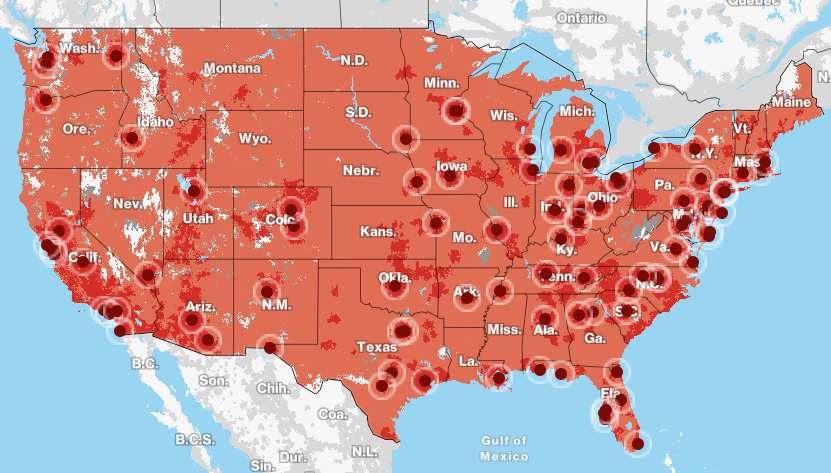
The US currently has around 279 cities, across 46 states, connected to the 5G network. Of course, it is only the base stations in close proximity to airports which will be operating on the C-band at interfering levels that are a problem. The FAA are currently working with telecoms providers to establish which airports will have C-Band base stations near them.

This shows the anticipated coverage across the USA. The magenta is 5G Ultra Wideband, the bright red is 5G Nationwide, and the pinkish/orangey red is the current 4G LTE coverage.

It could be a worldwide problem

The issue is not necessarily restricted to the US. 5G is growing globally, with China equally far ahead in their implementation of it, which raises concerns of where else this might pose a potential threat.

Thankfully some countries, like Canada, have opted to prevent or restrict services near major airports, at least until further data is received.

What you need to do.

  • As an operator, you will need to ensure your aircraft are compliant with the new directive, so read AD 2021-23-12  and ensure you update your AFM when required.
  • Right now, the biggest thing to do is to check NOTAMs.
    • Base stations are still being activated, and the interference levels due variable power levels and locations means it is not clear where or what the impact will be. NOTAMs will therefore be issued for specific airports confirming the restrictions for them, as and when this is known. And this could change daily.
  • Staying updated on the situation at airports you operate into, as well as encouraging crew to review the weather and alternative approaches in case they become required is critical.
  • Review the function of radio altimeters on your aircraft and understand the implications to capability and performance of malfunctions.

What else can you do?

You can write in and express comments, written data, views and arguments on the directive to the FAA. Ensure you title the correspondence with this – “Docket No. FAA-2021-0953 and Project Identifier AD-2021-01169-T” 

You can Email this feedback to operationalsafety@faa.gov. Alternatively, you can send via Fax: 202-493-2251 or Post: U.S. Department of Transportation, Docket Operations, M-30, West Building Ground Floor, Room W12-140, 1200 New Jersey Avenue SE, Washington, DC 20590.

You can also request further information from Mr Brett Portwood, Continued Operational Safety Technical Advisor, COS Program Management Section, Operational Safety Branch, FAA, 3960 Paramount Boulevard, Lakewood, CA 90712-4137.

Any interference should be reported to the FAA to assist them in building up a better picture of the impact and safety concern.

You can also follow AOPA’s work on 5G as they continue to monitor and ask the FAA to address the situation urgently.


De-Ice De-Ice Baby: Cold Weather Opsicles

In the Northern Hemisphere the winter season is well and truly upon us, which means various extra things to think about – like different procedures, low visibility challenges, cold temperature corrections, where you left the other glove, and of course de-icing!

So, to help you out if you aren’t so familiar with all things Winter Ops we have put together a little series of Opsicles – Refreshing bits of ops info, just for members.

Winter Opsicle #1: De-Ice De-Ice Baby

Most operators we’ve met apply a “Keep it clean, keep it safe!” policy meaning don’t risk it; if there is anything on the airplane get it off before you take-off.

There are some caveats to this – less than 3mm of frost on the underside of the wing around the fuel tanks is generally acceptable. If you don’t have a tiny frost ruler to hand then a general rule of thumb is clear paint markings showing through means it’s ok. A light dusting of hoarfrost on the fuselage is also fine (if your manual says so).

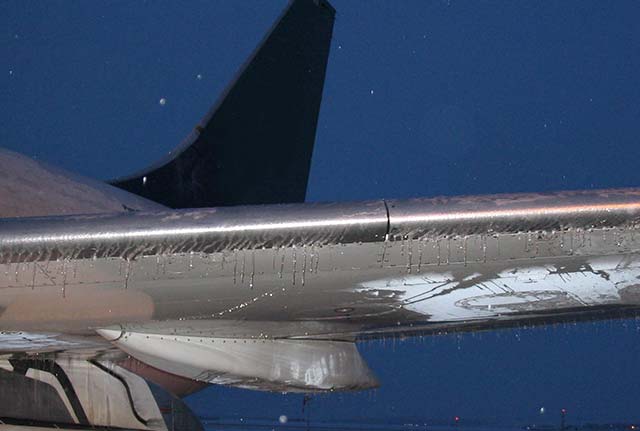
The areas where anything is unacceptable are your critical surfaces – the upper surface of the wings, horizontal stabilisers, leading edge devices… Basically any lift and/or control surface on the aircraft. If you’ve ever done a Winter Ops Refresher you probably know this statistic off-by-heart but “a very small amount of roughness, in thickness as low as 0.40mm (1/64in) can disrupt the airflow and lead to severe lift loss…”

So keeping it clean seems like a good rule. Alas, a rule not all follow…

The trouble is, it can get confusing (no, that crew in the video weren’t confused, just negligent). But when you are out there, under pressure, managing a bigger and more complex workload, it can quickly get complicated especially when you throw in some variable weather conditions to the mix, and some different mixtures into your HOT calculations.

So our Winter Opsicle #1 is a handy guide to help with just that.

What’s in them?

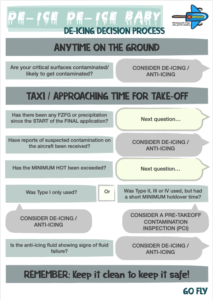
De-Ice De-Ice Baby is looking at de-icing/anti-icing. It comes in three parts, and you can download all, none, just one depending on what you find helpful.

  • A De-Icing Decision Process checklist – to help you determine whether or not to consider de-icing/anti-icing.
  • Caution: Hot Stuff – a sort of FAQ on Holdover Times.
  • Too HOT to Handle – a generic guide on what HOT to expect.

None of these are designed to be used in place of official (and possibly much more accurate) documents and manuals, but we do hope they will provide some refresher info on things to think about during the winter season.

Over the winter season, we’ll try and post more so you can build up your own Winter and Cold Weather Ops Pack.

If you’re an OPSGROUP member you can click on each thumbnail to head to the Opsicle PDF download page.

Further reading

There is a huge amount of info out there (from more official sources) including:


UK Free Route Airspace

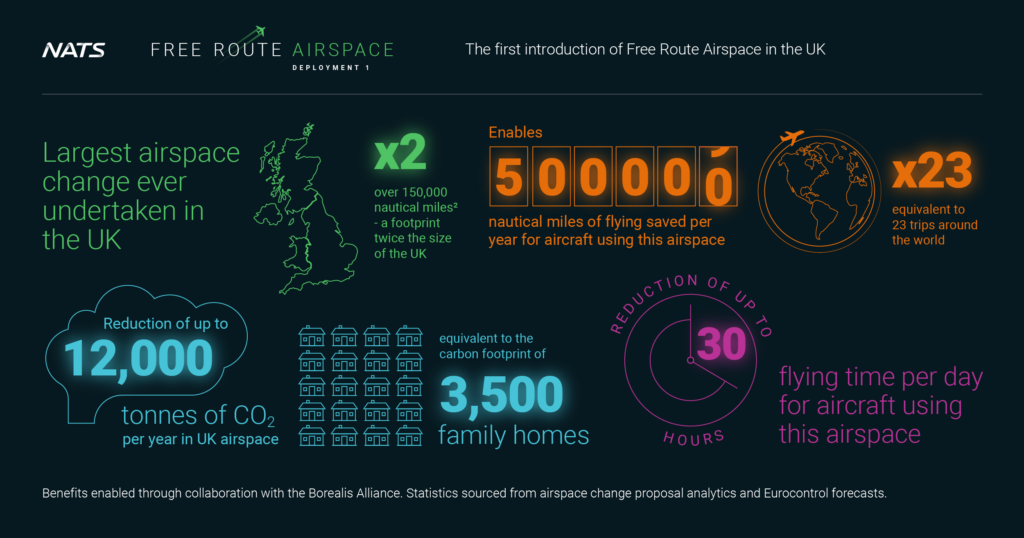
December 2 has been a big day in the UK – it marks the biggest airspace change ever implemented in the United Kingdom.

A big portion of UK airspace is now free route airspace, and here’s what you need to know about it.

What is ‘free route’ airspace?

In ‘not free route airspace’ you are confined to what is effectively a motorway (freeway if you’re American) in the air – a big corridor, defined by points along it, and you follow these until you reach your junction ad turn off. It is rarely the most direct route.

Free route airspace allows you to route from a defined entry to a defined exit point direct. Straight through the fields if you like. It also allows more freedom for operators to fly the most time or fuel efficient route, taking into account weather.

The benefit is big.

That it is. 

The new airspace structure in the UK is expected to save around 500,000 nm a year of flying and that means a big reduction in CO2 – they are estimating around 12,000 tonnes a year.

Here is NATS own article on it.

Where is this airspace?

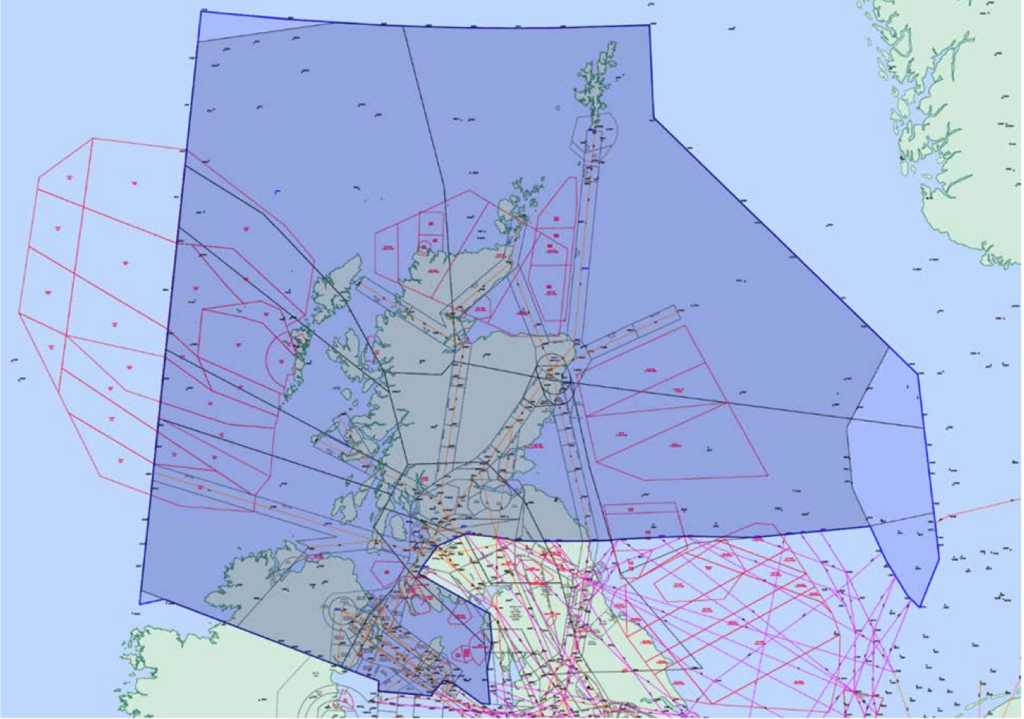
It is in northern UK and consists of 150,000 nm2 of airspace over the North Sea, Scotland, North Atlantic, Northern Ireland and a small portion of northern England – so within the Scottish UIR, London UIR and Shanwick OCA, and affecting the route network over some international waters. There will also be FRA in the London UIR within the region known as the PEMAK Triangle and TAKAS box.

This airspace accommodates up to 2000 flights a day and supports around 80% of transatlantic traffic.

The Free Route Airspace is H24 and between FL255-FL660.

You can find the full info on the relevant airspace here, including dimensions and how it links with other high seas airspace.

Where else is this happening?

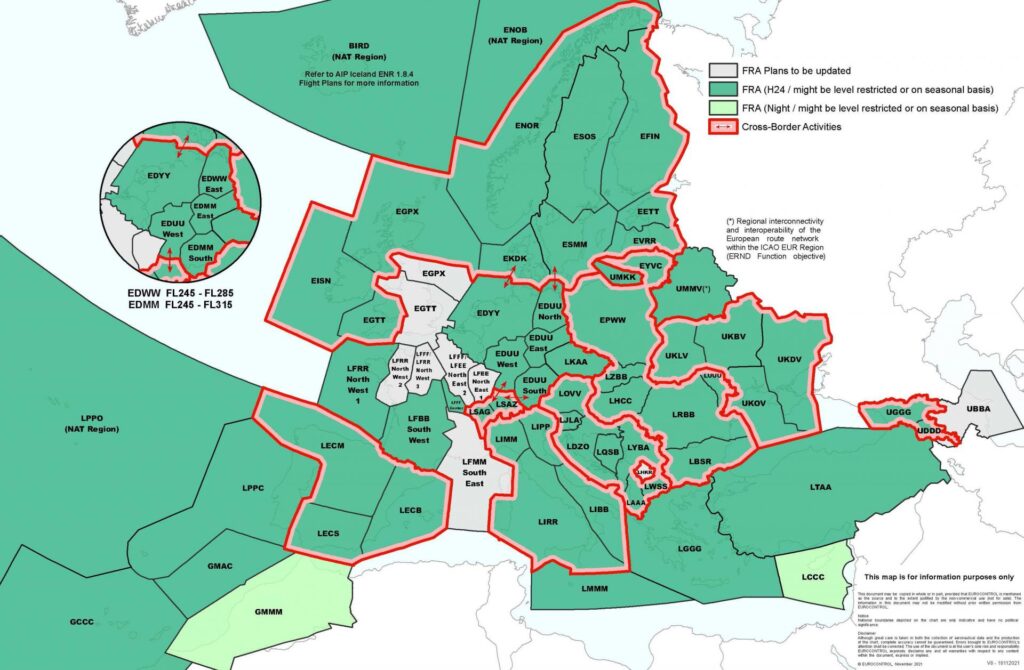
You might want to take a look at the Free Route Airspace implementation taking place across the rest of Europe as well. This has been going on a little longer, and large areas of Europe already have it implemented.

They are also working on cross-border activities which may create even more direct routings in the future.

Norway’s AIC A03/21 published Oct 2021 provides info on the operations between the FRA in the Finland FIR, Copenhagen FIR, Polaris FIR, Riga FIR, Sweden FIR, Tallinn FIR (known as the NEFAB FRA meaning the North European Functional Airspace Block) and, of course, the Scottish FIR. These are known as the “Borealis Alliance”. (Here’s a link to the Borealis Alliance Presentation, if you want to find out more about the background and current stages of the overall project.)

Norway’s AIC tells us that flights routing through these airspaces will be eligible for Free Airspace Routings if they have a planned trajectory within the following vertical limits:

  • DK-SE FAB FRA FL285-FL660
  • NEFAB FRA FL095-FL660 (EETT/EFIN FIR FL095-FL660, EVRR FIR FL095-FL660, ENOR FIR FL135-FL660)
  • EGPX FRA (FL255-FL660)

Additionally, if you are routing to/from the UK FRA to the NEFAB FRA then you are going to have to file some intermediary waypoints because they have a lack of radar cover there. These Entry/Exit points are ATNAK, ALOTI, BEREP, GUNPA, KLONN, NINUN, ORVIK, PEPIN, PENUN, RIGVU.

There is additional information for flight planning in there so we recommend reading it through, and heading to the relevant ANSP for any of those countries if more info is needed.

Anything else to know?

While cross border operations are in place for much of it, the interface between Shanwick OAC and Reykjavik OAC will not change.


FAA NOTAM Change: It’s not all about the Missions

On December 2, the FAA introduced some amendments to NOTAMS. Amongst these revisions, was a change to the meaning of the acronym ‘NOTAM’ to create more inclusive terminology.

The acronym change has been stealing the limelight from the other revisions, so we thought we would take a look at what the other changes are, and what the overall impact might be for you when reading NOTAMS.

ICAO Standards

There have been various revisions to terminology used within NOTAMS, in order to bring the FAA issued ones more in line with that of ICAO.

Braking action will no longer be termed as “good”

Which is good, because ‘good’ doesn’t really mean an awful lot. What’s good for one aircraft might not be for the next. This is part of an update in Change to Field Conditions (FICON) reporting and a second change is that FICONs will not be issued for closed runways.

This is in line with the new Global Reporting Format for runways which ICAO brought into force in November 2021.

“Unserviceable” is being clarified

Where certain systems are not functional, the impact of this on the primary systems which they are a component of will be identified. For example, if the runway alignment lights are u/s a NOTAM stating this doesn’t give us much information on what the reduced condition of the full ALS is. So NOTAMS will clarify this better.

Housekeeping

  • KLAS/Las Vegas’ (formerly known as) McCarran airport has had its name change added into the system. It is now known in NOTAMs as Harry Reid.
  • ASOS and AWOS automated weather systems are now treated the same in NOTAMs. For info, AWOS is an automated weather observing system which provides continuous real time info and report and which can be fully configured while ASOS is an “all in one” Automated Surface Observing System which also provides continuous weather reports.

The Acronym

Because it is getting so much attention, we figured we would add a little perspective here on it.

A NOTAM is still a NOTAM. We’ve not heard anyone ever call it anything except that. But what it stands for has changed – rather than Notices to Airmen, it now stands for Notices to Air Missions.

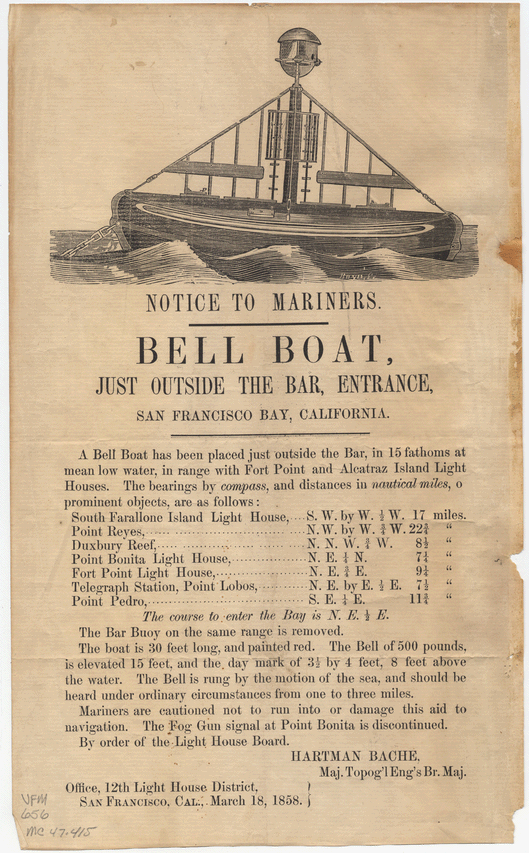
A very quick history lesson on the NOTAM – they first came into being in 1947 after the Convention on International Civil Aviation. There was even a special NOTAM meeting in 1949 which was when AIS really came into being. But NOTAMs themselves actually originated from the older Notice to Mariner system, set up for navigational safety in the seas. Later, SNOWTAMs came into being (1968) and then they branched out into ASHTAMs (1980s). 

What I find interesting with the NOM is just how close this one (written in 1858) is to some of our modern day NOTAMs. All wordy and full of complex and confusing bearing to work out, similar to the Lat/Long ones we see nowadays.

Anyway, why the change in terminology? Well, because ‘Airmen’ is not very inclusive of any other gender. Now, a lot of folk feel this change is unnecessary and we aren’t going to weigh in on either side. All we have to say on the matter is:

  • If you don’t think it is necessary – it doesn’t actually impact anything. Keep calling them NOTAMS like you always did.
  • If you do think it’s necessary – hopefully this is a step towards everyone feeling that aviation is inclusive.

If you are looking for further discussion on the FAA’s move to gender neutral language then you can find a link here to the FAA ‘Medium’ page where the discuss this.

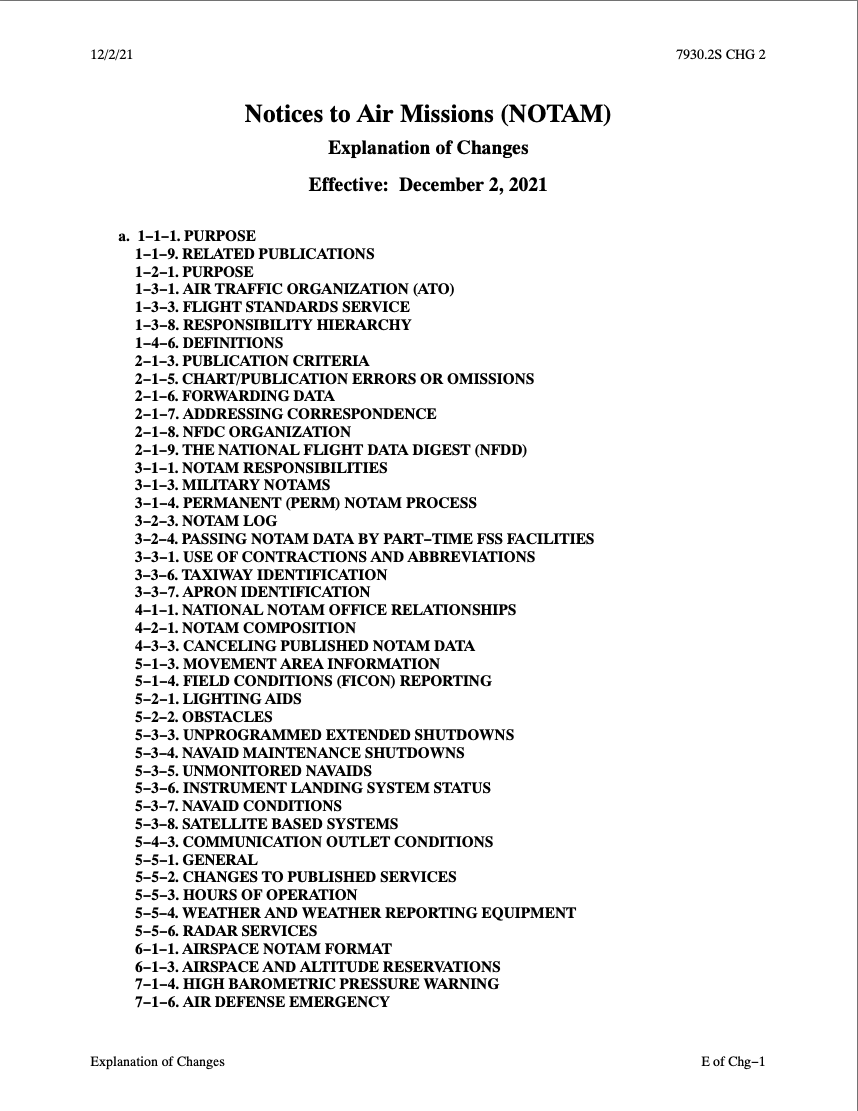
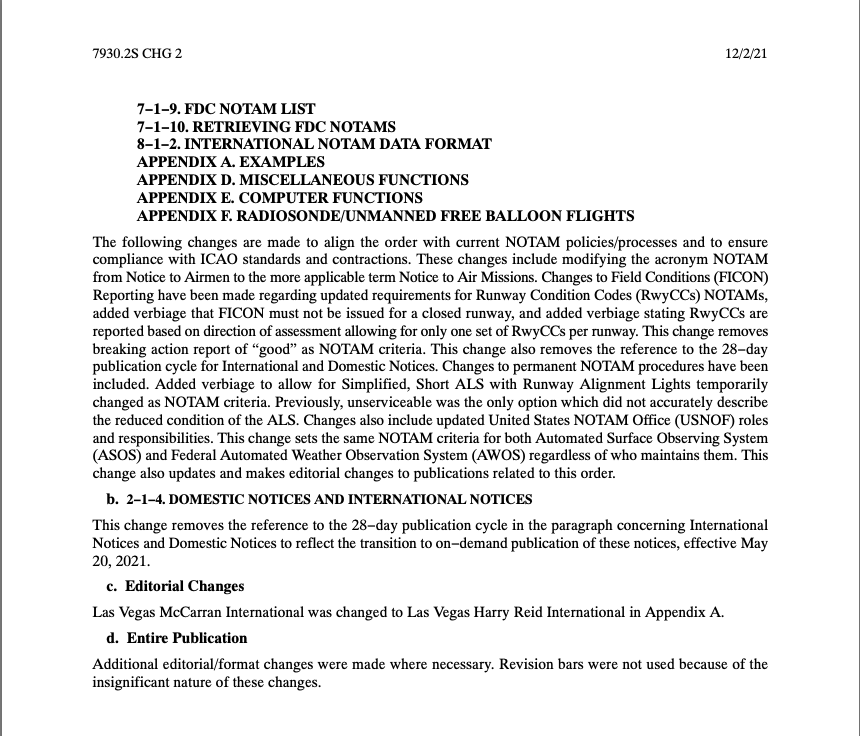
JO 7930.2S CHG 2

Who is Jo? Actually, it is the official FAA notice of change which you can find here.

Here are the full list of changes pages:


The Impact?

Well, not a tremendous amount overall. The acronyms is worth knowing about to avoid confusion should you ever see it written in full, while the move to more ICAO standard terminology will hopefully bring a little more clarity and standardisation to NOTAMs for any international operators.


China Airport Alternate Restrictions

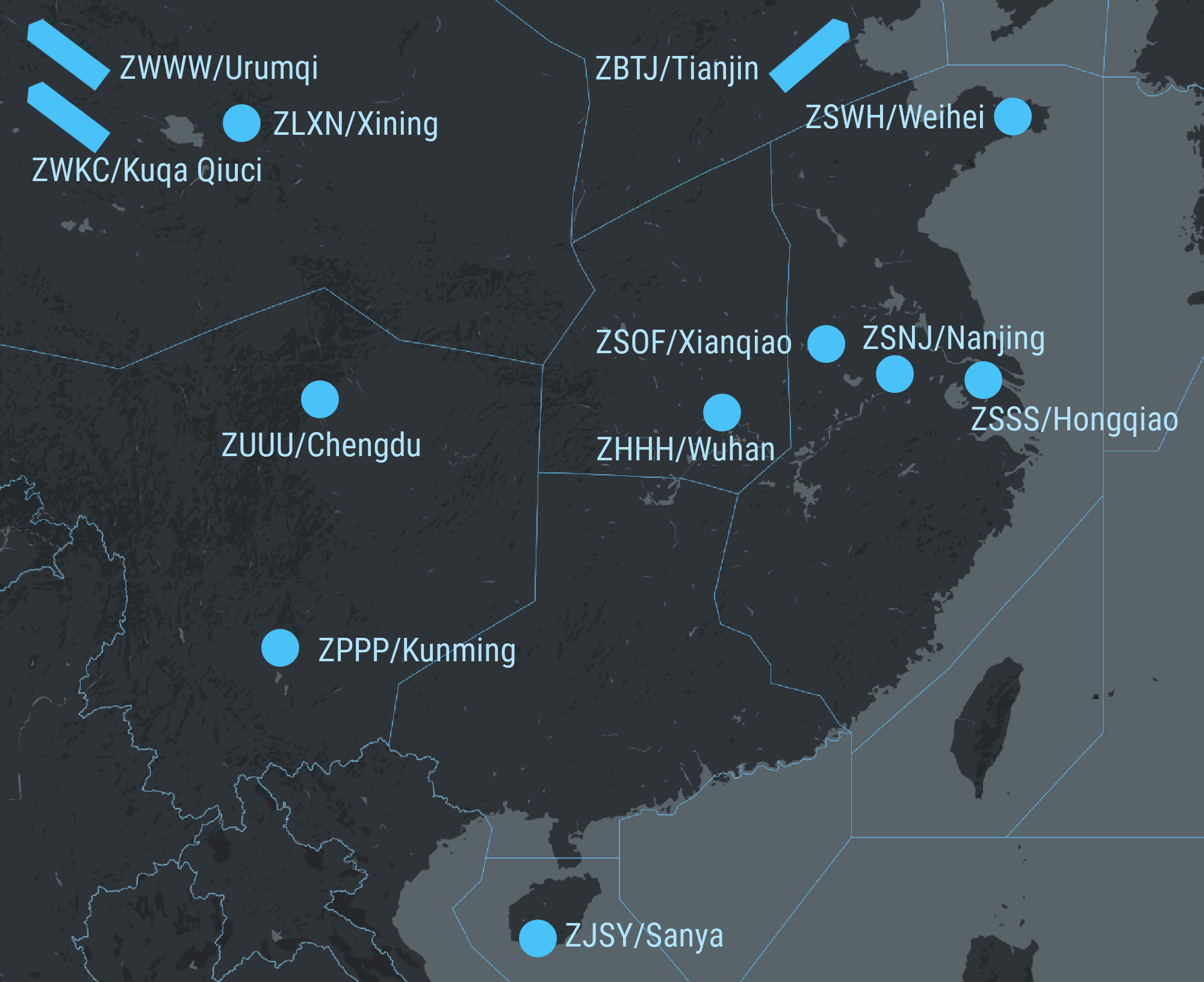
There are a multitude of Notams advising that certain airports in China are not to be used as alternates. Here is a list of those to look out for so you can plan and ensure your flight is not impacted, and a few others we thought worth mentioning.

The Notams

The ‘unavailability’ Notams, give or take slightly different dates, all say this – 

AD NOT AVBL FOR INTERNATIONAL ALTN FLIGHT(INCLUDE HONG KONG, MACAO AND TAIWAN FLIGHTS) EXCEPT EMERGENCY FLIGHT.

So don’t plan to use as an alternate, an en-route fuel or tech diversion, or anything else that wouldn’t be classified as an emergency.

The Airports

ZJSY/Sanya International – 12/31/2021

G2993/21 Sanya Phoenix International serves the Hainan region – the southernmost province of China (on the island).

ZSWH/Weihai – 12/09/2021

F6913/21 This is not a major international airport, Weihei lies on the eastern coast, north of ZSPD/Shanghai  Pudong beside the Yellow Sea and is the closest Chinese airport to South Korea.            

ZSNJ/Nanjing Lukou – 12/31/2021

F6912/21 A secondary international airport, this maybe used as an alternate for ZSPD/Shanghai Pudong. ZSHC/Hangzhou remains available, as does ZSSS/Shanghai Hongqiao (see below).

ZSSS/Shanghai Hongqiao – 12/19/2021

F6888/21 Only runway 18L/36R is unavailable, runway 18R/36L remains open and has both ILS CAT I and RNAV capability, and is 10,827’ (3300m) length.

ZSOF/Hefei Xinqiao – 01/18/2022

F6798/21 This is a secondary international airport service the Hefei region, inland from Shanghai.

ZBTJ/Tianjin Binhai – 02/28/2022

E3619/21 Runway 16R/34L is not available to any large (B747, A380) aircraft except if an emergency special transportation.

ZLIC/Yinchuan Hedong – 12/09/2021

L1155/21 Another minor international airport. It is unlikely you would feel this a an alternate as it has limited international operations. Hedong serves the autonomous Ningxia Hui region to the north east and lies in close proximity to mountainous terrain.

ZWKC/Kuqu Qiuci – 01/31/2022

W0547/21 This is a domestic airport serving the Xinjiang autonomous region and would not be recommended as an alternate.

ZWWW/Urumqi – 12/30/2021

W0500/21 Urumqi is one of the primary enroute and emergency diversion alternates for the Himalayan region flights into China. Taxiways A and B (so both main taxiways) are closed due maintenance, as is runway 07/25.

However, it remains available for emergencies, but it is not clear how much notice would be required.

ZHHH/Wuhan Tianhe – 12/31/2021

G2452/21 Wuhan is closed for all except emergencies due to stand shortages only.

ZUUU/Chengdu Shuangliu – 12/26/2021

U3453/21 Chengdu is a major international airport in central China. The airport remains open, but is not available for BizAv flights wishing to park overnight unless you are based there, or its an emergency.

ZLXN/Xining Caojiabao – 12/02/2021

L0900/21 Although an international airport, this primarily only serves domestic flights into the region. ZLLL/Lanzhou would be the closest major international airport, and this remains available.

ZPPP/Kunming – 01/31/2022

U3133/21 Kunming is also restricted in parking and not available for overnight parking to any BizAv aircraft unless based there or landing due emergency.

Diverting in China

In general, diversions in China can be problematic if you head somewhere unplanned – and by this we mean not on your flight plan.

Much of the airspace is governed by the military which can result in delays for you while ATC coordinates with them. Take extra fuel for dealing with things like not getting the flight level you wanted, en-route weather deviations, random re-routes and delays with re-clearances if you do need to divert.

China also have stringent ATC procedures and hand out fines for errors, and occasionally impose restrictions for repeated errors so know the country rules and regs, including their contingency procedures as these differ to ICAO.

China have been known to impose “do not commit to destination” policies on some operators – this basically means they expect you to have enough fuel to not get into a low fuel situation at your destination airport. If you are going to, they expect you to divert to your alternate instead (which my result in you committing to that so look at that weather well in advance).


Holidelays are Coming!

The NBAA recently did a very helpful podcast episode on preparing for the holiday season traffic.

What they are saying (the short version)

Watch out for increased traffic volumes during the holiday season. This will more than likely mean more traffic flow management initiatives and ground delay programs. Plan ahead.

What they are saying (the slightly longer version)

The weekends before and after major holidays seem to be the busiest, and this year is expected to be no different. Numbers are already looking higher than the pre-pandemic figures (2019) for the same season. So pre-planning and thinking about what might impact you, your flight or the airspace and airports in general is important.

The two main busy spots

  • Any popular ski resort airport
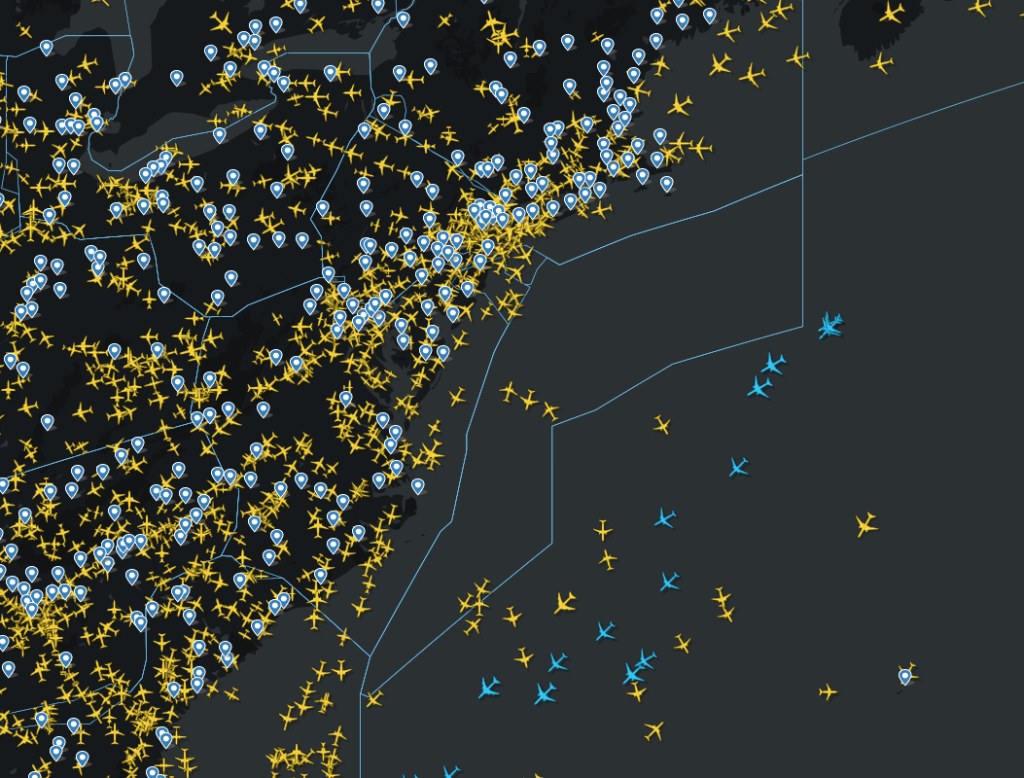
  • Any airspace that is usually busy and which is a route to or from popular holiday destinations – so areas like the NY metros, NE coast and routes to/from Florida and the Caribbean.

What they are saying (in much more detail)

The bits that are always busy

The north east coast and around New York commercial terminals get busy. It is already up to 80-90% normal volumes and the return of international flights means the remaining 10-20% is filling up fast. The same goes for the Florida and Caribbean to the north east routes, partly because all the airports and airspace along that region tends to be busy anyway.

How busy this all gets increases “just a little” during holiday season which means you are probably going to experience more traffic flow management, initiatives and ground delays. These mean you need to pre-plan more, particularly in terms of where you are filing to fly, and the fuel you are counting on needing to use.

There is an added complication in that the Presidential TFR in Wilmington, DE might get activated – and when it does, it has a further knock on effect on this already quite busy area. We wrote about that here if you want a read.

The weather

The weather is a variable that can be hard to predict and the knock-on effect of it can be pretty far reaching. There are three things with the weather to really think about during the busy holiday season:

  • Ski resort airports tend to be tough to operate into anyway. When the weather gets rough this adds to the challenge, and to possible delays – particularly as they often have limited ramp capacity. 
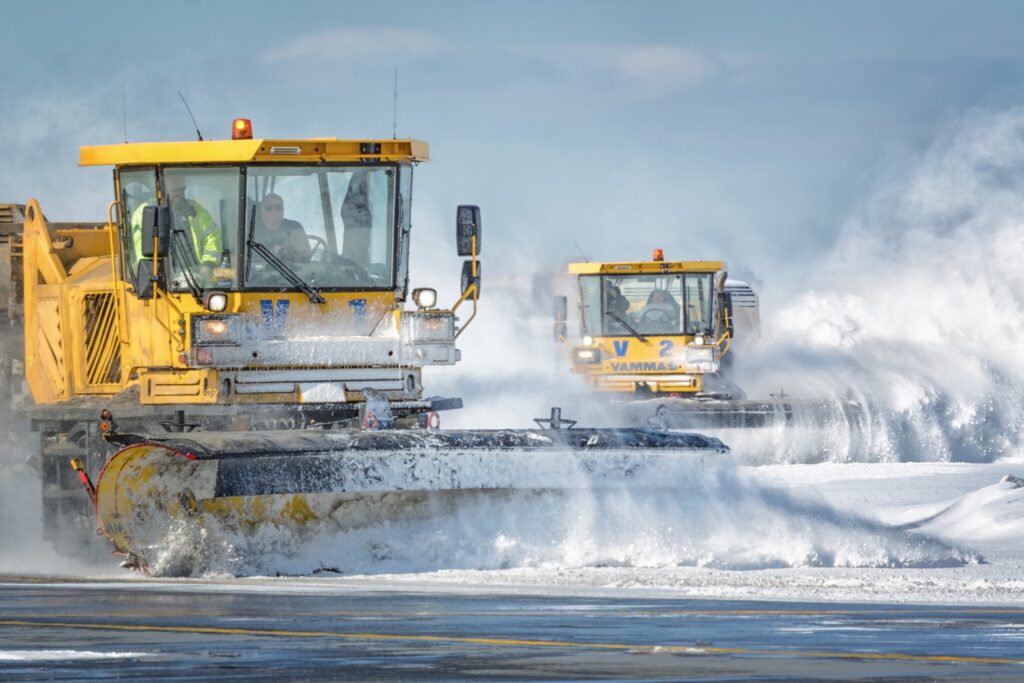
  • Major snow storms and other wintery weather at the large, busy airports can result in a backlog of traffic across the airspace as aircraft hold for the weather to clear or divert. This puts extra pressure on the surrounding Centers. Additionally, aircraft on the ground can see long de-icing queues, and this fills up ramp space with delayed departures which means arrivals might be delayed as well.

The ski spots

Traffic volumes operating into places like Colorado, Wyoming, Utah, Idaho (particularly KASE/Aspen, KEGE/Eagle, KJAC/Jackson Hole, KSUN/Friedman Memorial) will be on the up during ski season and particularly over the holidays. 

Again, the fact these are often difficult anyway, have logistic and operational challenges and limited ramp space, means disruptions can build up pretty quickly. If they fill up then ATC will put on a stop on GA flights routing to them and you might be airborne when that happens so plan your diversions or holding fuel!

Staff shortages

A final thing to think about is staff shortages – you might not care that the big airlines are lacking pilots, but if you use these big airlines to move yourself or your own pilots around then you might start caring a little more. Delays for them also mean disruption to other aircraft needing to use the airport (ramps) so avoid planning flights or crew through the major airports if you can.

What are they saying to help with it all.

When to fly

Think about whether you really need to fly on that Sunday after the holiday. If you can wait until Monday or Tuesday then do. The same actually goes for flying out – if you can avoid the peak times (generally the Thursday or Friday before) then you will avoid a lot of the traffic and a lot of the possible disruption.

Where to fly

Try to avoid the big, busy connection terminals like JFK, Newark, La Guardia where commercial volume is already high – both as a place for you to head to, or a place to send your crew through. Also have a think about your alternates and the traffic volumes at those.

Filing your flight plans

Get your flight plans in early – that way they are ab for the FAA and they will be included in the planning of traffic flow initiatives. File them short notice and on the day you will be an unknown and that can make it harder for ATC to accommodate you.

Know what’s going on

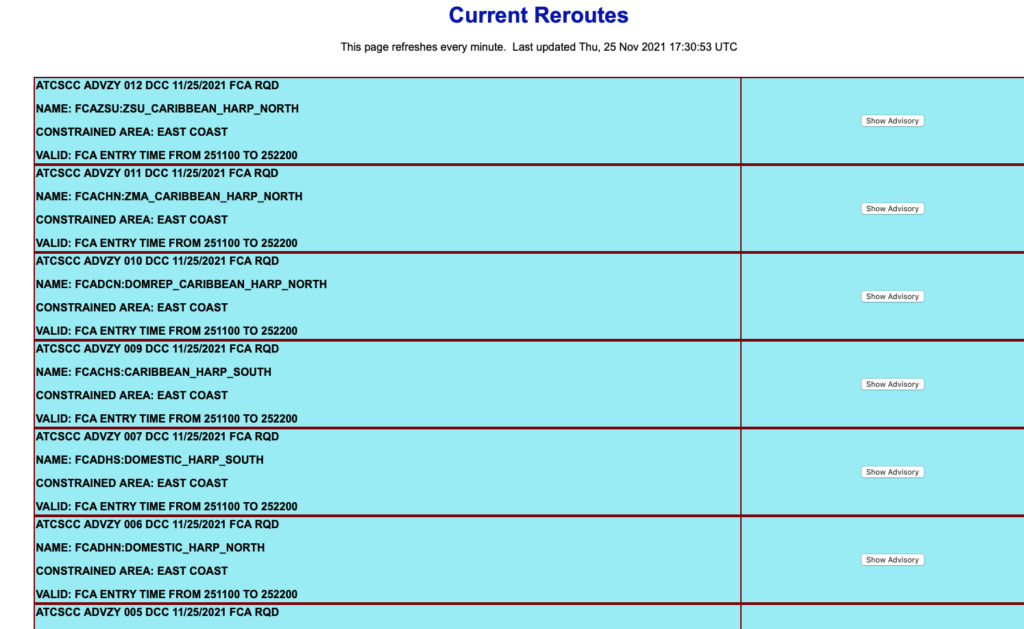
Check the FAA re-routes tab in advance. You’ll find info on current traffic management initiatives here as well. You can also take a look at the overall status of the NAS and make sure you have that big picture view before you fly.

Check the preview for the following day as well – the ops preview is posted after the 9pm planning call. You’ll find it on the advisory database and can use it to make a provisional Plan A and B if you are heading out the next day.

Check the weather

Pay attention to weather ahead of time and have those diversions planned out in advance. Also watch out for weather at larger airports because this can cause a ripple effect through the airspace. If Runway 11/29 at Newark closes then you’re going to see ground and air delays because of it…

But don’t assume no weather means no disruption. Even if its VFR along the east coast, if the volume is high there will be traffic management and airspace flow programs in place which might mean ground delays at Westchester or Teterboro…

Talk to your FBOs

Check with your FBOs in advance to confirm ramp space – even just prior to departure to see what’s happening on the day. Most of the Ski Resorts operate on a first come first served basis with no reservations, which can be great but can also lead to sudden capacity issues. Again, last minute stops for GA traffic might occur while you’re airborne and that could mean holding or diverting so check and plan in advance.

What else is going on out there?

Look out for HARP initiatives

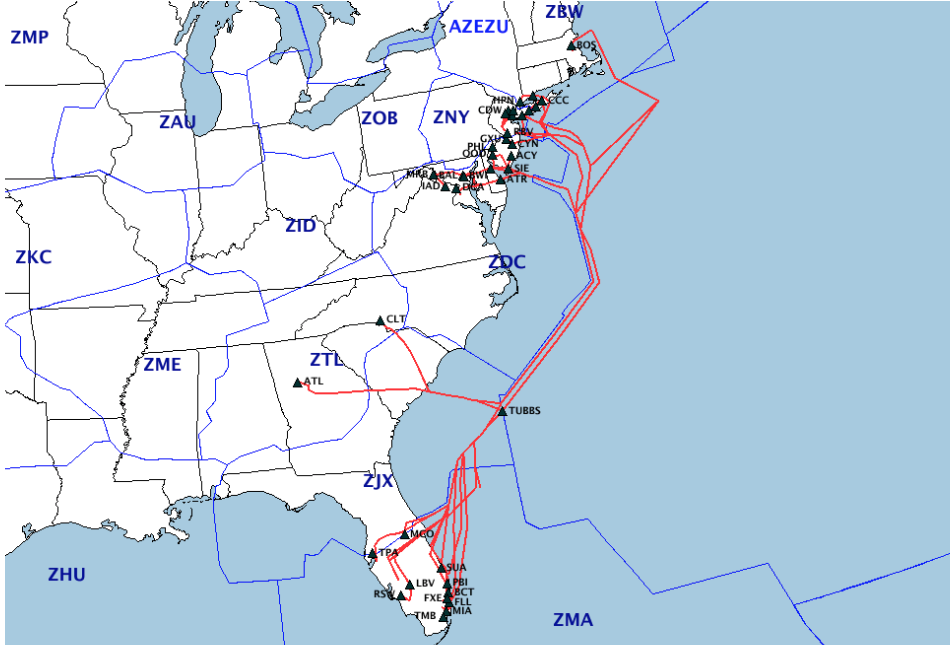
Military airspace is often opened up to help ease congestion, particularly on Caribbean routes. In the past they have allowed access to airspace off the Mid-Atlantic which helps with the East Coast volumes, particularly in Jacksonville, Florida and Washington and DC Centers.

In previous years we’ve seen HARP routes between NY Metros/Philadelphia and Florida, as well as Boston Centers and Florida, and several in the Caribbean. Again, the great folk at the NBAA post some handy info on this so keep an eye out for their 2021/2022 info.

The routes are published in the FAA advisories as well so be sure to check these and file for them.

AZEZU

If operating between the Northeast and Florida then you probably know about the deep-water AZEZU route that keeps you out of the high volumes. Here is the section from the FAA playbook in case you aren’t familiar with it.

This route is changing from December 2nd and will become the WATRS deep-water route. There is actually no change to the routings, just the name, so the Playbook info remains more or less the same.

Our favourite page

We like this page where the NBAA post useful info on issues in regional airspace. It’s another one worth keeping an eye on.

Happy Holidays!


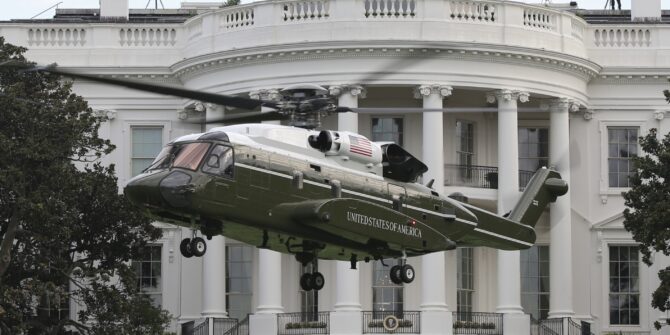
The POTUS TFR is a NO TO US

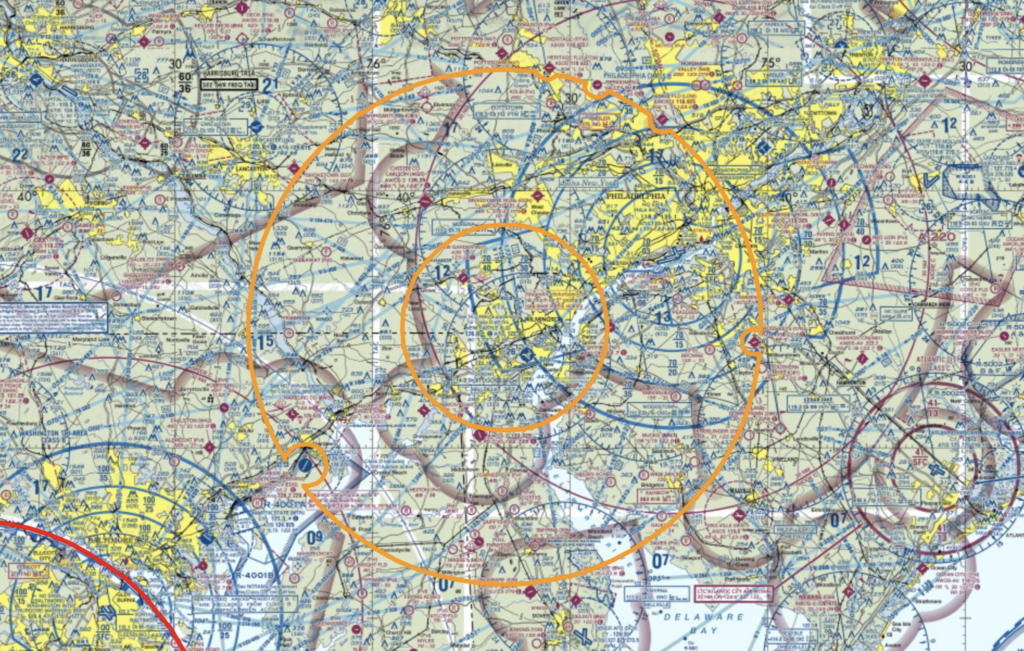
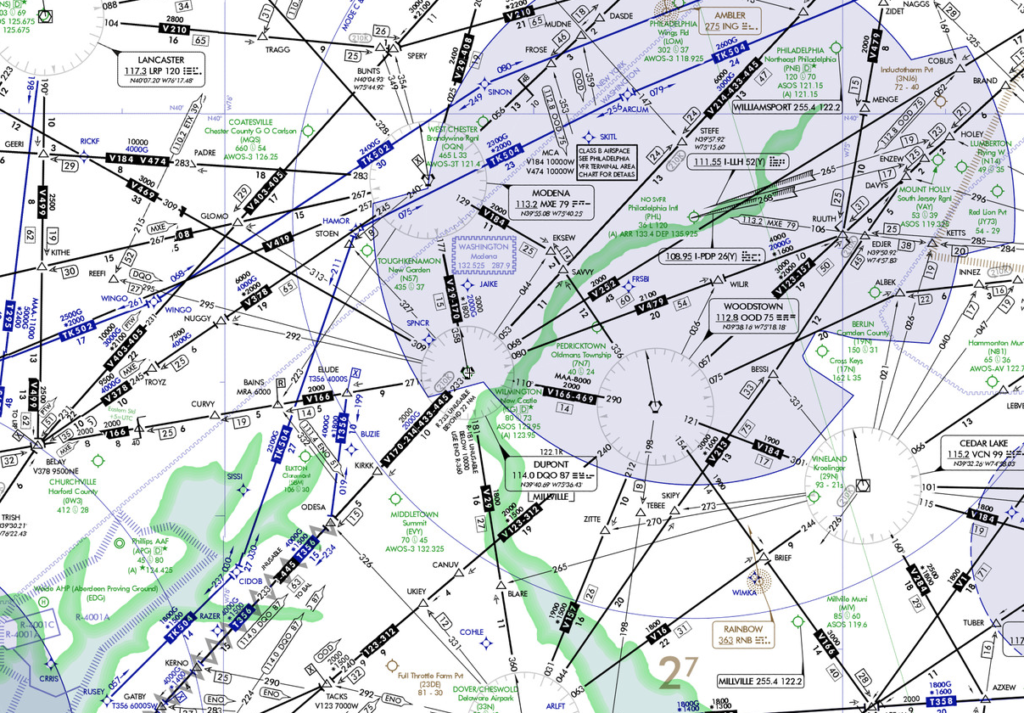
Most US folk are going to be fairly familiar with TFRs, particularly those in place due the President, but we thought we would do a little recap on the one for Wilmington, Delaware because of where it lies and the impact it has on the surrounding airspace – or rather, the traffic flow which you might find yourself in.

What is a Presidential TFR?

For those not familiar, a Temporary Flight Restriction is activated, for security reasons, in airspace that the President of the United States will be flying into. The TFR area is typically made up of two rings with a smaller one of about 10-12 nautical miles and a larger going out to about 30 nautical miles. Generally, General Aviation is restricted to not below 18,000’.

The reason for GA flights bearing the brunt of the ‘no go’ is because of TSA screening, or rather the lack of, and the security implications this may have. 

You can find info on all current and active TFRs on the FAA website site here. They include the type, dimensions, times and any specific info and guidance, as well as handy visuals.

Why are we talking about this one in particular?

The current US President has a private residence in Wilmington, Delaware, which means there are probably going to be a fair few TFRs activated in the area for when he flies in and out. The previous President caused a similar disruption around the Palm Beach area.

This particular one encompasses an airport – KILG/New Castle airport – in its inner ring which is often frequented by General Aviation folk. Thankfully, they have agreed to change up the usual no-go restrictions and continue to allow access to the airport even during times of Presidential presence.

New Castle’s new restrictions

OK, not new, since this TFR has been in place for a while now. But in case you don’t know, and do want to go, here is a refresher on the regulations:

  • If you are GA and want to just transit the inner ring then no can do while it is active.
  • You will be prohibited from operating to KILG/New Castle and N57/New Garden airports while the TFR is active unless you have prearranged TSA screening at a gateway airport (or TSA screening for departures) at least 24 hours in advance
    • KIAD/Washington Dulles and KABE/Lehigh Valley are your current gateway options.
  • Some departures and approaches to KEVY/Summit Airport might be affected during TFR active times.

Here is an AOPA article on the gateway airports for this TFR.

Bigger route restrictions

There are some pretty major routes along the east coast affected while the TFR is active as well though.

  • The standard JAIKE arrival into KTEB/Teterboro
  • South arrivals into KMMU/Morristown and KCDW/Caldwell

If you are operating up from Florida and the Caribbean then you have two re-route options available to you to avoid the restricted bits:

  • Deep Water Atlantic Route – via VIRST Y494 YAALE YETTI Y497 SUBBS CYN GXU RBV V249 METRO
  • Route through Cleveland Center – via ROD KLYNE Q29 JHW LVZ4 and/or SVM J70 JHW LVZ4

The deepwater route is the shorter option if you meet the “flying over deepwater” capability and requirements.

Operating around the DC Metros?

You’ll probably want to file a JERES J220 BIGEO MAGIO J70 LVZ LVZ4 route.

All re-routes for Jacksonville Center, Atlanta Center and Washington Center will be published on the FAA Current Re-routes webpage.

So far, all of this is a copy and paste of the NBAA info page

Which you can read here if you fancy seeing it in a slightly different font.

There is a reason we are bringing this all up now (which was also highlighted by the NBAA) though… Holiday Season Traffic.

Holiday Season Traffic

KTEB/Teterboro, KMMU/Morristown, KCDW/Caldwell, and the JAIKE arrival get busy during holiday season. As does Washington Center (which handles 50% of the Caribbean traffic flow from the South), Jacksonville Center and Atlanta Center. When the Presidential TFR is activated it can result in traffic being re-routed and the impact on general aviation can extend as far west as Cleveland Center airspace.

So checking when the TFR is active, knowing what re-routes to expect, and being aware that volume (and so disruption) is going to increase during the holiday season, might save your bacon, or at least prevent a nasty surprise.

We’ve also put together a post (thanks to the NBAA’s advice) on things to think about now that the Holiday’s are Coming which you can read here.

Need more info on TFRs?

The FAA created this handy guide which includes info on understanding TFRs, interception signals and even some trivia!


Scottish Airport Top Trumps

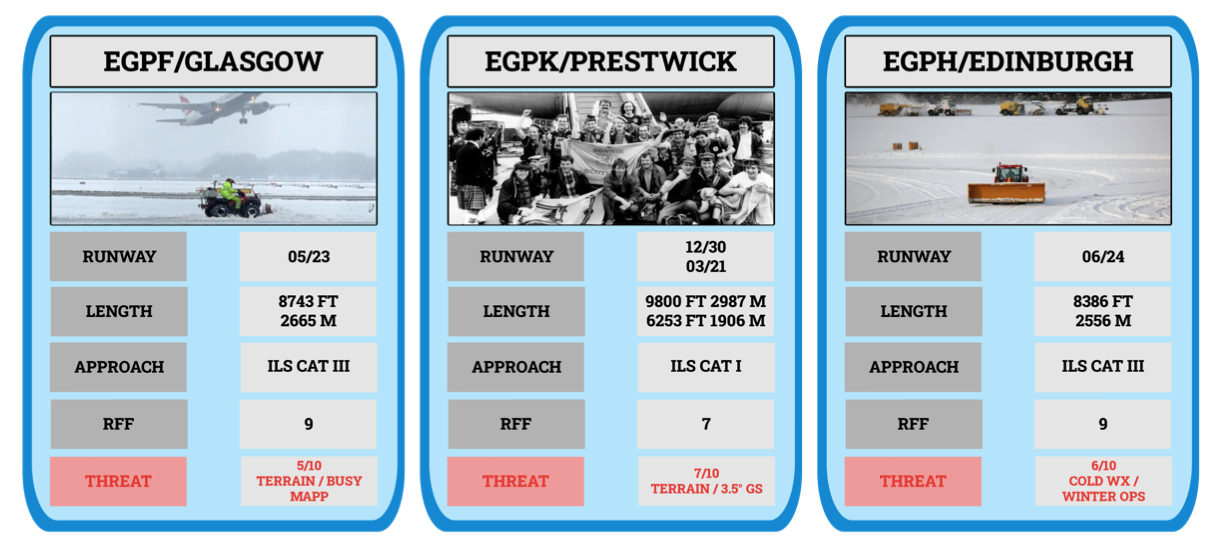
Thinking about heading to Scotland for some whisky, golf or a plate of haggis? Here’s a little ‘Top Trumps’ guide to three of the airports you might be thinking of operating into.

(If you want to visit Trump International golf course in Scotland then that’d be EGPD/Aberdeen you’re after).

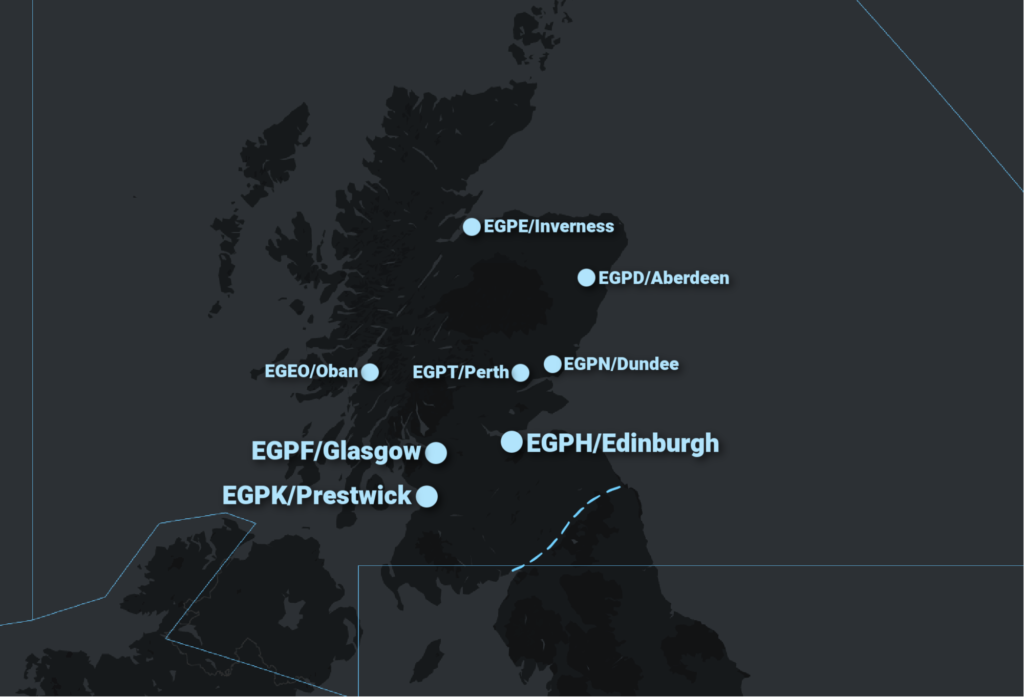
Scotland at a glance.

Scotland offers several international airport options. We already mentioned EGPD/Aberdeen which is northeast. Even further north you have EGPE/Inverness up in the Highlands. The HIAL (Highlands and Islands) Airport Group look after eleven airports up in the north region.

EGPN/Dundee and EGPT/Perth are your central easterly choices, with EGEO/Oban to the west (and a couple out in the islands).

Your top three which lie closer to the border with England however are EGPF/Glasgow, EGPK/Glasgow Prestwick and EGPH/Edinburgh. So we thought we’d take a look at those.

Who controls you?

Scotland is part of the United Kingdom. Like the rest of the UK they use Great British Pounds (GBP), and aviation is controlled by the UK CAA.

NATS provide the ATC services through their Prestwick Centre. You’ll probably find yourself speaking to Manchester Area Control (MACC) if you fly through England, before handing over to Scottish (ScACC) and potentially Oceanic (OACC) who control the eastern half of the NAT from 45 degrees north (Azores) to 61 degrees north (the boundary to Iceland).

You generally don’t need permits to overfly and land, unless you are a commercial flight wanting to land. That said, some airports do have slot requirements and to head into the UK you do need to fill out a General Aviation Report, and ensure customs have a copy at least a day in advance. If you’re a commercial operator, give it two days and if it’s for a series of fights then five will keep you organised.

Head here for info on this, or email foreigncarrierpermits@caa.co.uk for help with permits

What’s the weather looking like?

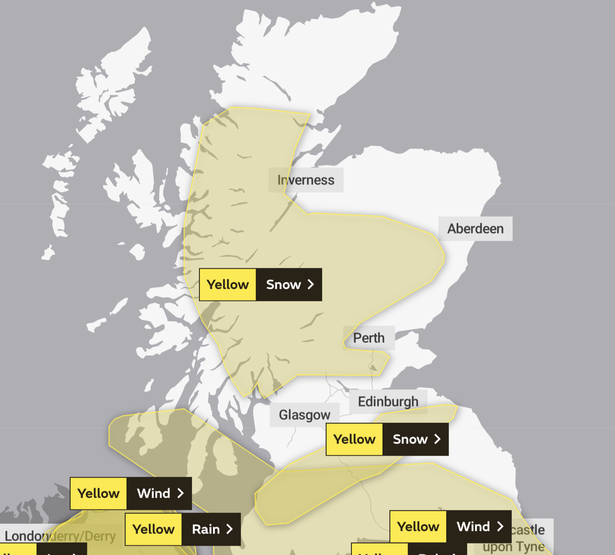
We’ve given this its own section because the weather in Scotland can be challenging. Along the southern region it is milder but you are still going to be faced with some serious snow and winter ops conditions from time to time. 

Back in 2017, major snow storms resulted in the closure of Scottish airports, and many a day of disruption. It happened again in 2018, and in fact does pretty much every year. Fast forward to now (2021) and a town in Aberdeenshire just recorded the coldest temperature seen in the UK in 26 years (minus 23°C, or -9.4°F for our American continent friends).

So Scotland gets cold and snowy. This means you need to think about your cold weather ops, in particular:

  • Cold temperature altitude corrections
  • De-icing/Anti-icing procedures
  • Contaminated runway performance

Thinking of Glasgowing to the capital?

Then you probably want to fly to Edinburgh. Despite being the biggest city, Glasgow is not actually the capital of Scotland. It does however boast a nice airport for you to use.

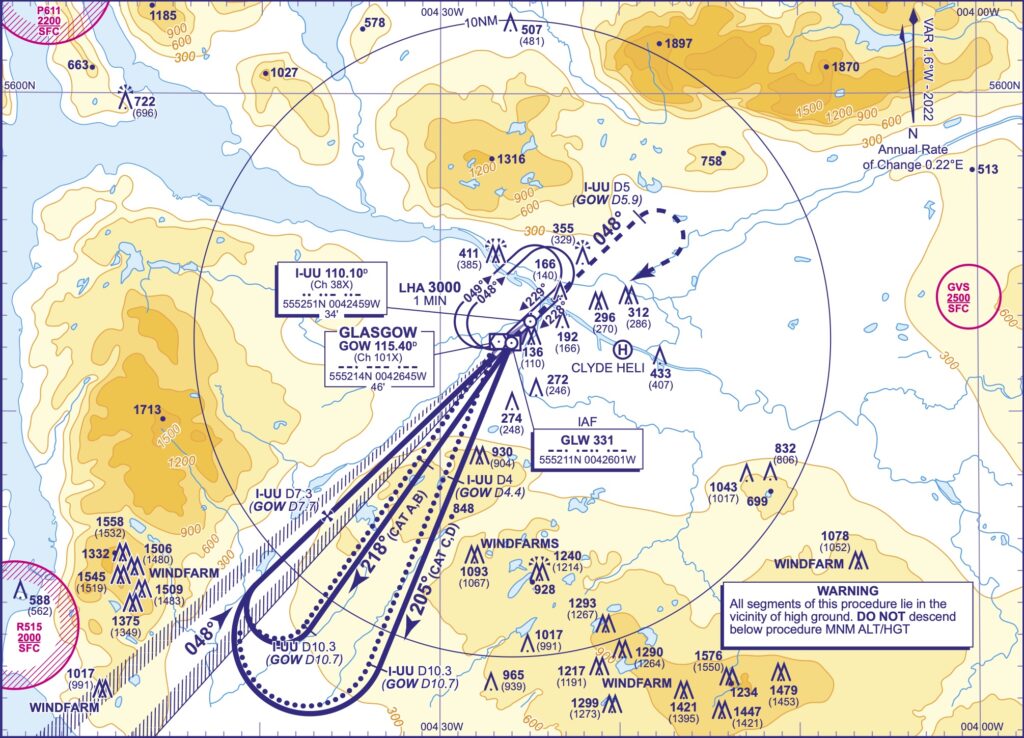
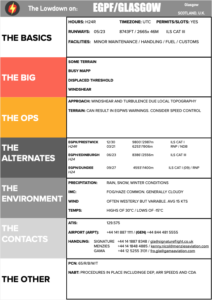
EGPF/Glasgow – the runway 05/23 is relatively short at just 8743 feet (2665 meters) and you have a displaced threshold to think about as well. That said, the Airbus 380 can get in here so it isn’t that small, and both directions offer CAT III capability.

Biggest threat: Some terrain and a busy missed approach because of it.

Edin-brrrrr


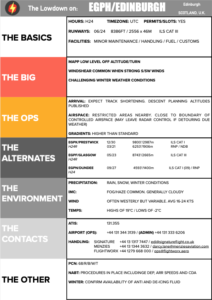
EGPH/Edinburgh also has a single runway 06/24 which is shorter than Glasgow’s at just 8386 feet (2556 meters). It also has CAT III capability in both directions.

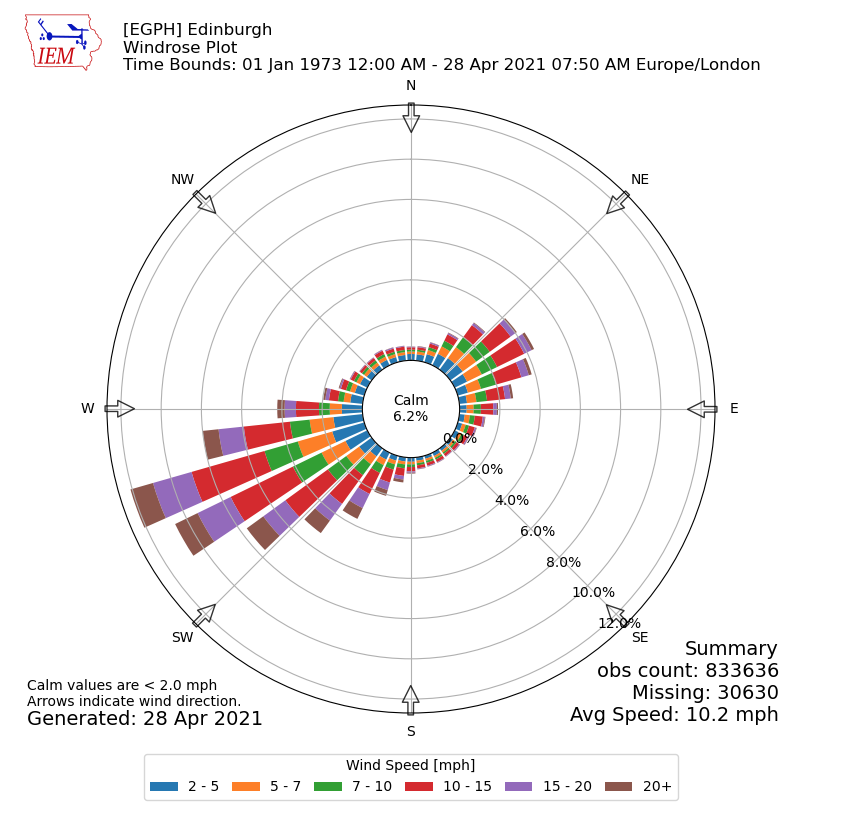
Edinburgh gets windy. When there are strong south to south west winds wind shear is common and can be vicious.

The airport had a new GA ramp open up in 2019 so parking is less of an issue, but this is still a fairly busy airport so plan in advance.

Biggest Threat: The weather in winter and the wind shear from those South/Southwesters.


Prestwick

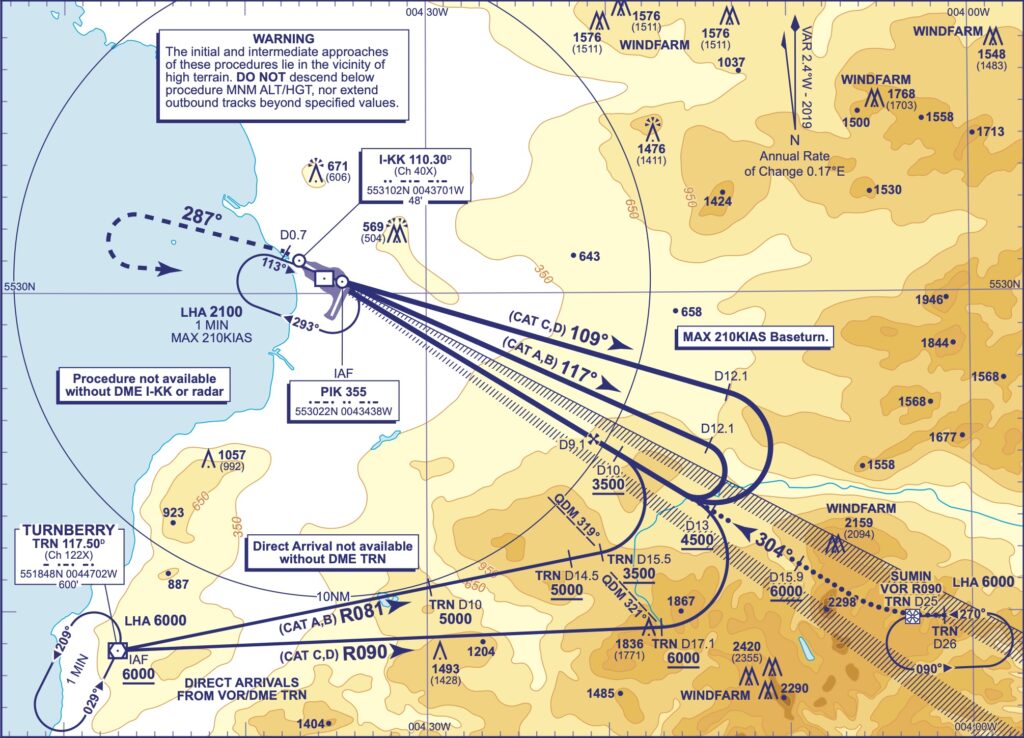
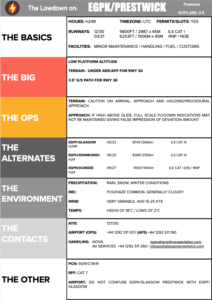
EGPK/Glasgow Prestwick (not to be confused with EGPF/Glasgow) is your third choice in this area. It offers the longest runway option – 12/30 at 9800 feet (2987 meters) but is only ILS CAT I capable.

The topography at Prestwick is the main threat – it can cause some significant wind shear and turbulence.

The airport is a popular tech stop for aircraft routing from the USA.

Biggest Threat: The terrain under the arrival/approach area for runway 30.

A Top Trump summary for you 🃏

Airport Lowdowns 🏴󠁧󠁢󠁳󠁣󠁴󠁿

We’ve made an Airport Lowdown for all three airports. If you are an OPSGROUP member then you can find them by clicking each of these thumbnails.


These Airport Lowdowns are the briefings we’ve started to put together on specific airports – the useful, practical, operational stuff. The threats, risks and gotchas that you discover with experience.

There are a bunch more available for other airports via Airport Spy in your dashboard.

To download the PDF for each airport:
1. Head over to Airport Spy in your dashboard
2. Search for the airport you want
3. Click on the “Docs & Data” tab


Fighting for Control

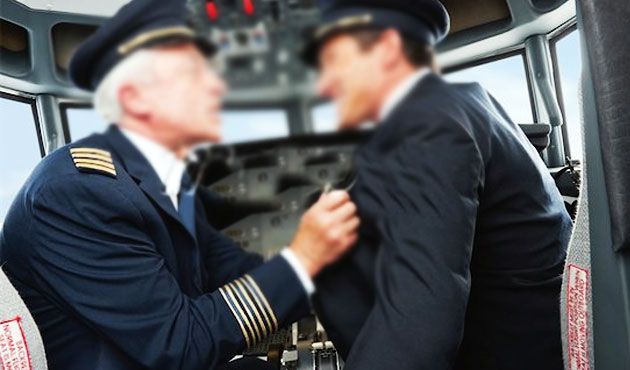
How many pilots can stick their hand up and say they’ve taken control from another pilot?

A more interesting question though might be – how many can recall a time when they didn’t take control but felt they should have? Because this is now getting somewhere – this is what we need to be thinking about. Why, if it was apparent that we should have taken control, didn’t we?

It’s happened before, it will again.

In 2016 a Global 5000 was routing from ZBAA/Beijing to VHHH/Hong Kong. During the approach they lost their ‘mental picture’ of the situation and descended below their cleared altitude leading to a pretty significant loss of terrain clearance.

There are a lot of why’s and how’s and other factors which led to this, but one particularly interesting point that stood out was the First Officer’s comments in a subsequent interview about the incident.

“… he [the captain] has a very aggressive attitude… it causes problems if I don’t do things his way… I had my hands on the controls, but I couldn’t take over…”

How does it get to that point?

Taking over control is something that in many cases pilots say they should have, could have, or someone else probably would have avoided. We are not talking the immediate, time-critical, co-pilot-hasn’t-flared-and-you-have-less-than-3-seconds-to-fix-it type situations, or the rolling-down-the-runway-and-the-other-pilot-has-just-passed-out sort of thing.

We are talking about those times when a Swiss cheese model of insidious, minor or ambiguous events has built up. When there have been clues, hints and opportunities to spot ‘holes lining up’ and where we potentially could have identified that something big might happen if we don’t set ‘safety’ back on track. 

In these situations, reaching a point where we have to take control is too close to the line, it is not somewhere we ever want to reach. So what ways are there to ‘redirect’ safety and prevent it from reaching the “I have control?” stage?

The Intervention Model.

‘ASDT’ is an acronym many airline pilots might be familiar with. Ask, Suggest, Direct, Takeover. The idea is we intervene based on how much, or rather how little time we have left to fix whatever situation is unfolding. If you haven’t heard of that then RAISE right ring a bell – it is a similar model.

So how do we apply it? Well, if we are lazing along in the cruise and ATC ask us to take up a heading, and the pilot flying dials in the wrong one, we probably aren’t going to yell “I have control!” Asking a simple “Can I confirm the heading, that isn’t what I heard?” question is enough. It is appropriate. We have time.

On the other hand, if ATC has told you to turn immediately to avoid a traffic conflict, and the other pilot then turns the wrong way towards the traffic then you might find yourself moving into the suggest or even the direct “Negative! Turn right heading 360 now!” stage. There is less time, but there is still time to correct it without taking control.

ASDT, RAISE (or any others you might know) require an assessment of urgency, or criticality of action versus time. It sounds simple, and generally it is when the situation is clear cut, right or wrong, time or no time. The difficulty for many pilots comes when they are faced with something that isn’t a clear breach in SOPs, or an obvious error, but when it is more of a “feeling” or a comfort level in a grey area of right or wrong, OK or not OK.

When it is a sense that something might not be right, or when that ‘not rightness’ might actually be with the other person or their attitude rather than a clear action or moment, then this can be hard to deal with under an intervention model. If we can’t identify what it is that makes us think there is a potential for things to go wrong, then what should we ask?

Challenging or intervening when we don’t really know what to challenge or where to intervene is not going to result in good CRM.

What’s your safe word?

“I am uncomfortable” is a ‘safe word’, or rather phrase, that one major airline encourages its pilots (particularly the First officers with an emphasised “Captain” at the start of the phrase) to use.

It is an indication to the other pilot that perhaps you don’t understand a situation, that they haven’t “shared their mental model” well with you. It is asking, suggesting and directing the other pilot all at once to consider that there might be something causing the other to question if the situation could become unsafe at some point.

It is phrase I have used, as a less experienced First Officer, when I felt a Captain was not taking a large cloud on the approach as seriously as I thought we should. It caused him to slow down and talk me through his thought process. Turns out his judgement and experience was sound and it was just me and my lack of experience that had made me unsure.

I could have asked him outright “do you think we should avoid the cloud?” but this might have only earned me a “No, I don’t” – and that hasn’t provided me with anything to remove my uncertainty.

“I am uncomfortable” is not the phrase to use when the other pilot is outside of the localiser limits and still isn’t correcting. It is the phrase to use if they have chosen to hand fly in gusty winds and are starting to chase the localiser. It wasn’t the phrase to use during the Global 5000 VHHH incident when the Captain exceeded 44° of bank, but it might have helped the situation if it had been asked earlier when the Captain first said he was going to disconnect the autopilot. 

Reaching the point of no return.

But all this asking, suggesting, directing and saying “I am uncomfortable” might not prevent a situation reaching a point when taking control is necessary, and when that point is reached action has to be taken, and so it is worth thinking about what it really means to do that.

Taking control from the other pilots means you are effectively removing them from that stage of the flight. It is placing you in a single pilot operation and it breaks down the CRM and communication entirely, for that moment. While it might be absolutely required, it also might mean a very challenging few moments for you.

So considering ‘what happens next?’ is critical because you are going to have to manage that workload, the increase in pressure and the responsibility to maintain safety on your own in what will likely be a very dynamic situation. If you are not prepared it might rapidly place you, and the flight, in an even more dangerous situation.

At some point you are also going to have to rebuild the CRM by bringing the other pilot back into the picture and to do this you will need to have the aircraft in a safe position with time on your hands to do so. This isn’t always as easy as it sounds and unfortunately, we rarely train for it.

A pilot intervention with the automation is one thing, but intervening with another person, (and where their pride and ego is involved), can be quite another.

Why don’t we take control?

We ran a mini poll and asked people what they think the main reasons were for pilots not taking control.

The main reason most folk thought was a lack of situational awareness – the other pilot also not knowing what was going on. This seems to be the main factor in the Global 5000 VHHH incident. Loss of situational awareness is a tough one to spot but sticking to SOPs, briefing well, and proactive threat and error management seems to be the best defence.

Second up was the cockpit gradient issue – the First Officer feeling unable to question the Captain due to a too steep gradient. This is where using a safe word or intervention model might help. But at the end of the day, both pilots remain equally responsible for safety, so if something ain’t right, speak up – we should be more afraid of the repercussions of not doing so than of any grumpy reaction we might experience.

The When, the How and the Why.

We might have done pilot incapacitation training where the other pilot has mysteriously frozen at “rotate”, but few will have really trained to a comfortable, competent level where we can easily identify what stage of intervention might be most appropriate. We rarely practice insidious, developing situations which are filled with grey areas. Fewer still will have experienced what the reality of taking control, and then ‘bringing the other pilot safely back into the picture’ really means.

The best way to prepare for this is to think about it, talk about it and consider it in advance. Understand our comfort levels, know when we would react and how we would do it, and talk this through with other people so we can share experience and learn from one another.


Introducing: Danger Club

Aviation changes constantly – new airplanes, new routes, new rules, new risks. Something that isn’t changing, however, is accidents. If the return to service and industry growth being talked about is anything like what’s forecast, we’re going to need even more focus on the “why” of things going wrong.

So, we want to create a safe space to talk about this – as people, not as companies or airlines.

Calling it “Safety Club” would be missing the point (and not sound as much fun). We’re not here to blather on about SMS, FOQA, Safety Culture, or even CRM: we want to get right to the core of it and discuss the dangers – hence, Danger Club.

What happens at Danger Club?

We get together as pilots, we look at one specific incident or accident, and have a conversation about what went wrong, and see what we can learn from digging into it. We’ll host it on Zoom, chat for an hour or so, and decide together what’s useful to talk about and how we can make the next one better.

OPSGROUP members – keep an eye on the Danger Club forum page for details of the next event.


Airspace update: The Russia-Ukraine border conflict

Long-standing airspace warnings are in place for the Russia/Ukraine border region due to the ongoing conflict. But with recent reports of increased military activity along the Russian side, the concern is Russia may be considering renewed military action including incursions into the Ukraine which would further destabilise the region.

The most recent report suggests large escalation in activity near Maslovka in Belgorod Oblast and around URRP/Platov International Airport in Roston-On-Don Oblast.

URRP/Platov International Airport is the main airport serving this region, and is relatively new – only having opened at the latter end of 2017. It is primarily used by short haul operators to connect to Middle East and Eastern European destinations. The airport has a single runway 05/23 which is 11811ft/3600m in length and has CAT II capability.

Reports suggest Russia is using equipment to jam Ukrainian surveillance drones. Such equipment could affect civilian aircraft, although the range would most likely be limited to the region along the border where airspace warnings already apply.

Further implications.

The US and Europe are encouraging de-escalation. If sanctions were taken against Russia, this could lead to potential gas and fuel shortages as Russia is a major contributor to Europe for these.

There are some tensions between Russia and Europe due to sanctions imposed against Belarus back in May, following the interception of an international flight bound for Lithuania and forced to land in Minsk.

What is the background?

There is an active conflict zone in eastern Ukraine along the border with Russia. The main hotspot is the Line of Contact which runs through the UKDV/Dnipro FIR.

The FAA warned of increased tensions in April 2021, but these were thought to be easing with reports of Russia withdrawing much of their forces. In October 2021 the FAA updated their SFAR extending the flight ban on eastern part of the UKDV FIR to Oct 2023.

What are the current warnings?

The FAA bans US operators from overflying the eastern part of the UKDV FIR, and warns operators to exercise extreme caution within 100nm of the entire Russia-Ukraine border. Several other states have also issued airspace warnings for eastern Ukraine.

A full review of the major warnings can be found at safeairspace.net

What is the risk leading to these warnings?

The primary risk is for operations near the Russia-Ukraine border in the UKDV/Dnipro FIR. Should hostilities escalate here, the airspace on both sides could be exposed to potential weapons activity posing a risk to civil aircraft from misidentification or miscalculation.

The secondary risk affects the UKFV/Simferopol FIR which is disputed airspace. (Ukraine:UKFV, Russia:URFV). The risk here stems from aircraft potentially receiving confusing and conflicting air traffic control instructions from both Ukrainian and Russian ATC when operating over the region.


We have Clearance, Clarence

You carefully type it up, have the other pilot check it, then hit send… and wait… your airplane is creeping closer and closer to the Oceanic Entry Point and still no reply, and then DISASTER! Clearance Request Rejected! Or worse still, you just never get a response…

Here are some hints, tips (and actual procedures) related to getting your Oceanic Clearance for the NAT HLA. And what to do if you don’t…

How to get your clearance.

There is a datalink mandate across the vast majority of the NAT HLA which means everything has headed towards “messages” rather than voice. Why? Because it’s easier and there is a lot less risk of mess-ups and mix ups. So, most likely, you are going to be requesting your clearances via “message” as well. The system it goes through is generally the Arinc 623 – the same you use for things like your D-ATS. Contrary to CPDLC, A623 exchanges don’t require previous notification. But enough of that technical schtuff.

If you ttake a look through the North Atlantic section of *whichever manual* you are using and somewhere under COM and ATC Communications you will find a section on ‘Oceanic Clearance Request via Data Link’. Each OCA has its own thing to say in terms of times to send it and reverting to voice, but in general the message you want to send when requesting your clearance is the same for them all.

You need to include Entry Point, ETA for Entry Point, Requested Mach Number, Requested Flight Level and add a remark (RMK/) indicating preferred alternative (another NAT Track) and MAX FL. You only have 80 characters available to you so don’t go adding extra comments in, it will probably just get rejected.

After sending your clearance request you should receive an advisory message which says something like this –

“IF NO CLEARANCE RECEIVED WITHIN 30 MINUTES OF OCEANIC ENTRY PONT REVERT TO VOICE PROCEDURES END OF MESSAGE”

If you don’t receive this within about 5 minutes of sending the question, something has possibly gone wrong. Try sending again if you can still meet the minimum time to boundary for a request, or revert to voice.

The times you want to think about sending your RCL through at vary from OCA to OCA, as do the logon addresses, so here is a rundown of each one…

Shanwick

  • The logon is EGGX.
  • Shanwick want your request sent no later than 30 minutes before the OCA boundary, but no earlier than 90 minutes or they’ll reject it.
  • If you haven’t received your clearance and are within 15 minutes of the OCA boundary then revert to voice. If you are East of 020W then try Shanwick Radio on 127.9 to help reduce chatter on HF. Only give HF a go if you are within 40 minutes of the boundary and having issues getting VHF signal.
  • For Shanwick Oceanic you have two frequencies – 123.950 is for aircraft registered in States West of 030W. 127.650 is for aircraft registered in States East of 030W.

Gander

  • The logon is CZQX
  • The request should be sent just after the aircraft gets within 90 minutes of the OEP. If you don’t receive the advisory message within 5 minutes, or if you haven’t received a clearance and are within 30 minutes of the OEP then revert to voice.
  • Gander is a little tricky with working out which frequency to use. It comes down to where you are routing via:
    • Natashquan 135.460
    • Allan’s Island 128.450
    • Churchill Falls 128.7
    • Stephenville 135.050
    • Sydney 119.425
    • Brevvoort 132.025
    • Kuujjuaq 134.2

Reykjavik

  • The logon is BIRD.
  • How far in advance you need to request your RCL depends on where you are entering from (which CTA). The time is the minimum time from the BIRD CTA Entry Point that they should receive your RCL by and the general rule is 20-25 minutes.
    • Stavanger (ENOR) 25 mins
    • Scottish (EGPX) 25 mins
    • Edmonton (CZEG) 45 mins
    • Murmansk (ULMM) 30 mins
  • If you have Inmarsat datalink then you probably won’t be able to get your clearance while north of 82°N. If you’re on an Iridium or HF datalink system then you’re in luck.
  • If you have to get your clearance via voice then you can try Iceland Radio on VHF Primary 127.850 or Secondary 129.625. They are also on the HF B, C and D families but you’re having a bad day if it’s reaching that level.

Bodø

  • The logon is ENOB.
  • Request your clearance at least 30 minutes before the NAT region boundary. Revert to voice if you’re within the 20 minutes mark on 127.725.

Santa Maria

  • The logon is LPPO.
  • Send your request 40 minutes before the OEP. If you need to request clearance by voice then talk to Santa Maria Radio on 127.9 or 132.075.

New York

  • The logon is KZWY.
  • This works a little differently if you are routing from the US because your clearance is going to be included in your departure clearance (since you’re basically in the area anyway). You can logon 30-45 minutes before.

What to do if you don’t get a clearance?

Shanwick is really the main one to worry about – having a clearance (being in contact with ATC) is pretty darned important there because it is such a big area and extremely busy.

Always give yourself time. If a clearance isn’t received, try by voice. If you can’t get through then try other frequencies and ATCs. If you reach a boundary without a clearance then chances are it’s because you have some sort of comms loss in which case this is now your bigger concern.

In theory, you could enter the NAT HLA (aside from via Shanwick) without a clearance (with loss of comms) and fly as per your flight plan route (Mach and Levels) but it really, really isn’t advisable.

What to do when you do get your clearance.

It goes without saying that first up you need to acknowledge it with ATC. After that you’ll want to check it, and get the other pilot to as well. Printing it out is a good way to do this if you have that option. “Checking it” means checking what you’ve been cleared to do is what you’re asking the aircraft to do via its nav computer.

Finally, make sure you really are flying it by monitoring it and doing your plotting (or equivalent) checks. You can read about that here if you’re not sure how.

A helpful summary.

We created a little Opsicle  – a refreshing bit of ops info, just for members. Which means if you are an OPSGROUP member you can click on the pic to get yours. This one summarises all the logon info we wrote about above!

Where is the official info?

The info is contained in AIPs, and some of it within ICAO NAT Doc 007.

We might have missed some things, or made a mistake so if you spot one let us know!


Something to help with NAT Contingencies

There are standard contingency procedures to follow if you are in the NAT HLA, they have been around for a while. But folk still struggle with them from time to time (so would we at 3am over the North Atlantic if we had to suddenly try to remember what they were while things were breaking or storms were flashing).

We have written about this before. Here’s how it works:

Unfortunately, sometimes folk still do get it wrong.

The most common mistakes seem to be people applying a contingency procedure when they are in contact with ATC (ATC will give you a revised clearance if you need it so check first before diving into a contingency manoeuvre).

Sometimes though, we just don’t quite do it right because there are a few little steps to follow depending on what is going on. For example, if you are deviating around weather, then the first step is to try and get a re-clearance from ATC. If you can’t get one, that’s when you follow the contingency procedure, and then what you do depends on whether your detour is less than or more than 5nm…

So we decided to make something else to help…

Introducing the Opsigami Opsicle

The NAT Contingency Opsigami Opsicle is less exciting than it sounds. It is the two contingencies – for emergencies and for weather – laid out step by step. That’s the Opsicle part.

The Opsigami bit(Origami with an Ops twist) is because if you print it out (and fold it correctly) then it will give you each step in order to help you follow it as you need to.

It looks like this:

And it works like this:

We made this for OPSGROUP members – we hope you find it useful!

Just in case you don’t, here is a great Origami (ok, paper airline) design which you can fold it into instead 🙂


Rocket Debris in Bodø

On November 16 the Arianespace Vega rocket, otherwise known as VV20, will be launched from French Guiana.

The rocket will carry some Ceres satellites for the French military into space.

Will the launch affect aviation?

The Guiana Space Centre, also known as Europe Spaceport is a French (and rest of Europe) launch site.

It is here –

So if you are flying into SOCA/Cayenne or SMJO/Paramaribo airports (or any of the smaller domestic ones around there) on that day you might want to watch out for some prohibited airspace around the Space Center.

You can read more about the space centre, and this upcoming mission, on the Space Center website, and if you are in the area go check it out or even watch the launch.

But in general, the actual going-up-of-the-rocket is not the issue. It is the bits that come down again that are.

Where are the bits going to come down?

The launch has a northbound trajectory and as the third stage detaches, debris from this is expected to fall somewhere in the ENOB/Bodø or the BIRD/Reykjavik Oceanic FIRs – both of which are of course part of the North Atlantic region where a fair amount of of traffic often tends to be.

The latitude is from around 70°50N to 74°10N so is unlikely to impact the NAT HLA organised track system, but may impact some random route or polar flights.

So there will be a restricted bit of airspace, and by restricted we mean traffic totally forbidden. 

Here is a picture of it – 

And to put that into better context, here it is superimposed on a larger area of map.

When will it happen?

The primary launch window is on November 16, which means debris could be expected between the very specific times of 09:32 – 11:49 UTC. If this doesn’t go ahead for whatever reason then the secondary launch window is on November 26, with debris fall hazards between the same times again.

The timings of the airspace restriction will be confirmed in Notam via the Norwegian NOTAM office. For now, ENOB Notam A4648/21 has the info.

A4648/21 - TEMPO DANGER AREA 'ZC/VV20-Z9 FALLING AREA' ACTIVATED WITHIN
LIMITS OF BODOE OCEANIC (ENOB) FIR. FALLING AREA FOR SCIENTIFIC
ROCKET FROM FRENCH GUIANA SPACE CENTER. DANGEROUS ZONE BOUNDARIES 
ARE PSN 713431N 0000000E - 741000N 0265100E - 732700N 0270400E - 
705000N 0000000E - (713431N 0000000E). GND - UNL, DAILY 0932-1149, 16 NOV 09:32
2021 UNTIL 26 NOV 11:49 2021. CREATED: 08 NOV 11:21 2021

What is the overall operational impact likely to be?

It is likely to be low. It is a short window and a narrow area of airspace that is expected to be impacted, but caution should be applied if you are operating in that region during those times.

Fancy reading some more on space stuff?

Here’s an article we wrote before looking at the impact of space travel on ground based aviation.


LOAs: Got Your Number?

LOAs. Letters of Authorisation. We have mentioned before about how to get an LOA approved by the FAA. You can read that here.

This post is less about the process of getting them and more about what you actually need them for.

There are a lot of LOAs…

First up, if you’re a Part 121 operator, or a non-US registered operator then this probably isn’t going to be very useful for you. Go read something more interesting like this story about a guy who definitely didn’t have an LOA for his operation.

For those it does apply to – you need an LOA for any operation which needs a “long term, specific permission”. It lets you do stuff, and what you are approved to do via your LOAs is recorded in your Opspec. Any specific operation probably needs an LOA which is why there are a lot of them, and also why it can get confusing trying to work out what you need – when, where and for what.

Now, we find the folk at AviationManuals really helpful with all this. They have a great (free) guide on how to get LOAs and it includes a handy bunch of tables which show you what you need for where and for what. Like this one for Part 91 ops.

Here is a quick rundown on the main LOAs you might need for your operations. If you still have questions afterwards then you know who to go ask for more info.

So, the ones to know.

Like we said, there are a lot of LOA options. The “big ones” that you are probably going to need are these…

A056

This is your Datalink Communications LOA (for CPDLC / ADS-C). If you have datalink systems installed and plan to use them outside of the US then you need this LOA. If you are Part 91 and only plan on using your datalink domestically then you don’t need an LOA.

This is not constrained by altitudes but rather to where FANS 1/A+ is mandated. If you think you will go through an airspace with a Datalink mandate, then having this LOA is probably a good idea.

B036

Oceanic and Remote Operations (RNP-10 / RNP-4 / RNP-2). This one looks at stuff like the long range navigation systems you have onboard, and your procedures for using it.

If you are planning on flying in oceanic and remote airspace, and in some spots in the Gulf of Mexico then you are going to need this LOA.

B039

Flights in the NAT HLA will want this LOA. It lets you put an ‘X’ in item 10a on your flight plan – confirming that your aircraft meets the new RNP10 PBN specifications (instead of the old MNPS stuff) and again, that procedures and training is in place.

Now, because this is a little more than just what equipment you got, in order to get LOA B039, you are also going to need a B036 which covers the Oceanic stuff and a B046 which covers the RVSM stuff – two other things you need to know about if you are flying across the big, reduced separation, remote oceanic area that is the NAT HLA.

You might have a B054 instead of the B036 (B054 covers Oceanic and Remote airspace using a single LRNS).

B046 

The RVSM LOA.

RVSM airspace is between FL290 and FL410. Even if you plan on flying above this, it is probably necessary to have the LOA for RVSM because there is a good chance you will, at some point, route through it or potentially have to fly in it if you are too heavy, or meet some mean turbulence or something.

Now, for US ops you don’t need RVSM authorisation if you have ADS-B installed.  Since January 2019 you are automatically authorised so long as you have ADS-B Out fitted (which is compliant with 14 CFR 91.227) and a few other things… one of which is that you don’t operate outside the USA.

So if you’re planning on taking a trip beyond the USA into Mexico or Canada, or further, then you are going to need this LOA.

The C0…s

The big Cs to think about getting are 52, 63 and 73. These give you the authorisation to fly things like RNAV (GNSS) approaches, RNAV and RNP Terminal Operations and VNAV instrument approach and approaches which use an MDA as a DA/DH.

ILS approaches are still a fair old way off becoming obsolete (mainly because of the problems with GPS jamming affecting aircraft capability to fly satellite based approaches), but having the authorisation to fly these might get you out of a spot of bother because there are a lot of parts to an ILS and they do breakdown from time to time.

And the future of navigation is satellite based so it is probably time to think about getting these now, if you haven’t already.

D095

This is the one you need if you want to use a Master Minimum Equipment List (MMEL) as a Minimum Equipment List (MEL).

We talked about that a bit here. The best plan is really to just get an MEL sorted though because the FAA are looking to change the rules on this, and the D095 actually expires fairly soon. Plus, if you fly internationally and only have an MMEL it can get very messy, even with the LOA.

Common Questions

We have covered the basics of what these main LOAs cover. Here are some answers to questions we have seen pop up from time to time.

What is an LOA and do I need it?

Go back to the top and read it all again.

How do I get an LOA?

Check out this post.

I am still confused, who can I talk to?

Talk to these people, they know a lot.

What does “getting an LOA” require?

An LOA is an authorisation to carry out a specific sort of operation. That means you are probably going to need
a) the equipment required for that operation,
b) procedures within your company which refer to that operation, and
c) certain training for your crew related to that operation (which might be required yearly).

So if you are considering taking on ‘some sort of operation’, looking into the requirements for the LOA in advance is a good plan – just having the equipment will not tick all the LOA boxes by any stretch, and an LOA can take several months to be approved.

I am flying internationally but plan to route above the NAT HLA say at FL430, what LOAs do I have to have?

The simple answer if we are just talking “have to have” is B036 or B054 which covers you for the Oceanic and Remote operations.

  • However, you might also want the RVSM one because there is a fairly good chance you will, at some point on that flight, be in RVSM airspace. So throw a B046 in as well.
  • There is also a good chance you will find yourself in some Datalink mandated airspace – it is pretty much all over Europe and beyond – so your A056 might be a good idea.
  • If you have those and are able RNP-10 then you really might as well get the B039 as well since you meet the requirements for it and it might save you a whole bunch of fuel (and trouble) if you have it “just in case”.

That’s all we’ve got to say on the LOA.

For now anyway, but if you think of something we haven’t covered then get in touch or drop those helpful folk at AviationManuals an email.

Our final tip – be careful ‘googling’ LOA because there are some pictures you really don’t want to see of the Loa Loa ‘eye worm’.


The Shopping for a Tech Stop Checklist

What should you be looking for in your tech stop selection?

Here are some tips and thoughts on what to look for in a tech stop, and a brief review of the most popular North Atlantic tech stop spots, as recommended by Opsgroup members (because we know a lot of folk route that way).

First up, our easy Four Point Checklist. Something we like to refer to as the “know before you go” list:

  • Where it is.
  • What it has.
  • What the rules are.
  • What the cost is.

1. Where it is 

This is probably the most important thing. St Maarten might be somewhere you’ve always wanted to see, but if you’re flying from Washington to Paris, it probably isn’t the best choice. So when thinking about where it is, you might want to actually think about these things:

  • What is your aircraft range?
  • Do you have ETOPS limitations?
  • Is it fairly central and practical on your route?

Seems obvious, but when you’re thinking about your range and route, throw in some average winds as well. Distance to an airport is not the same as time to an airport. Nor is time from there to wherever you are trying to eventually get. When we say time, we of course mean how much your fuel gives you.

2. What it has

Ok, this has a few more things to think about.

  • A Runway.

Not just any runway either, but one you can actually land on?

Great. But hang on. Can you actually land on it (and stop) if it’s wet (or worse), there’s a bit of a tailwind and you have some sort of performance penalty incurring technical problem? Might be worth checking for some “worst case” (or at least worse than normal case) situations given that you are planning this airport for a tech stop…

A quick review of the general weather you can expect is probably worthwhile as well. Some airports experience significant winter ops, low vis and other nasty conditions from time to time making them unsuitable, or at least more challenging, as a year round tech stop option. 

If you want to get really “doomsday” about it, then check out your Plan B options as well, particularly if it is remote and will be your only option. If it doesn’t have CATIII capability, or it only has RNAV type approaches then what would you do if… if your GPS is kaput? Or the weather is below CAT I? Better thought through in advance than on the day.

Finally, if you have a big, fat airplane, check the stands are suitable, the taxiways are wide enough and check the PCN is strong enough.

Done? Not quite. Most tech stops are actually fuel stops. And even when they aren’t, you’ll still probably need some.

  • Fuel

Does it have what you need? If yes then check if it has it when you need – not all airports offer H24 services. 

Consider the cost as well. Filling up more, earlier or elsewhere might be more cost effective.

  • Engineers

A tech stop is probably going to need an engineer. That engineer needs to be able to fix your aircraft. Bob from Bob’s Hack Shop down the road probably won’t fix it well. Find out who is available and what they can do for you on your aircraft. 

Of course, if something big breaks then even the best engineer might have to wait for parts or a more qualified engineer to come out. A decent tech stop will need decent access, one flight a week is going to see you stuck there for a while.

  • A tug

Such a small thing to think about but potentially important if you want to get out again and the airport only has taxi in stands. If you don’t carry a tug onboard then check whether your aircraft requires a specific one, and if so – confirm if there is one available there.

  • Facilities

The most important is probably good old Customs and Immigration if you don’t want to run into trouble when a tech stop turns into an overnight stop. 

Smaller airports might be limited in terms of the ground transport they can offer to you and your passengers, and smaller airports are often situated next to smaller towns with limited transport and accommodation. So checking facilities at both the airport and beyond is probably a good idea, just in case.

  • Contacts

Know who to talk to and how to get hold of them. Being unable to print a new flight plan can cause delays – if you already know who has the key to the printer this sort of little thing saves time.

3. Know the (Tech Stop) Rules

  • General Rules

Some countries (mainly in the EU) may allow passengers to disembark during a tech stop. This Ain’t the case all over. The US, for example, generally require everyone onboard to have a visa because if the aircraft is on the ground, those passengers basically are as well – even if they never actually step off the aircraft.

If you route to Russia it varies with which airport you head to, while Brazil are going to expect everyone to remain onboard. Knowing the rules is important, and making sure you have the security in place to manage your passengers is probably also a good idea. You don’t want someone scuttling off for a quick leg stretch or cigarette break and suddenly your simple tech stop has become an international incident…

Bear in mind some airports also do not allow tech stops. LTBA/Istanbul for example. Or any Russian or Chinese military airport unless you want to get yourself arrested.

Airports that are happy to be used as tech stops might be less happy if you are a big airplane and decide to sit on the ground there for ages. Generally major international airports prefer you to not do this, and have fairly restrictive stopping times. If you just want fuel, EGLL/Heathrow might accommodate, but the wait might be long – EGSS/Stansted night be a better, and more efficient option.

  • Curfews

Yep, no point heading in somewhere only to find they won’t let you out again.

  • Permits

If you are heading in in an emergency then this is less of a pre-planned thing, but if you’re planning a fuel stop then you’re going to need to have a landing permit organised (if the airport requires).

4. Cost

We recommend checking out these three –

  • Handling
  • Fuel
  • Fees

It might even come down to which agent you use at the airport so get a good deal organised before heading in.

What else?

Prepare and familiarise in advance. Check them charts and notams regularly. *Assume* you will need to go and land, and have stuff set up for it in advance. A tech stop shouldn’t be a rushed diversion – it should be a pre-planned easy event.

So – where to go?

We asked members, in a poll, to share the airport choices they favour for North Atlantic routing tech stops. Actually, the list was more of a “flying from the US to somewhere on the other side” which is why EFHK/Helsinki was in the mix.

We received around 150 votes and these were the finalists (in order of popularity):

  • BIKF/Keflavik
  • EINN/Shannon
  • EFHK/Helsinki
  • LPLA/Lajes

If you’re a member then check out our handy Opsicle (refreshing bits of ops info, just for members). We made one on these four airports to help with your tech stop planning. It’s called ‘4 Tech Stop Options’. It isn’t *finished* – we threw in some of the contacts and info we know, but add your own!

There are also Airport Lowdowns for each of these airports – Mini briefs covering the threats, operational challenges and other useful operational info for the airports. Opsgroup members can download these Airport Lowdowns via the Airport Spy app on your dashboard here.

Wondering “Where Else?”

Check out this earlier article on airports in the remote regions of Canada.


Toronto RNP-AR Plan

What does Toronto Pearson International airport and a Canadian Goose have in common?

They are both very noisy!

Which is why NavCanada are looking to change the airspace at the airport. More specifically, they are planning on implementing RNP-AR approaches in an attempt to make it cleaner, greener, quieter. Just like Canada itself. 😊

Anyway, here’s a quick look at the proposed routes and how they will help with noise and efficiency.

Runway 05/23

They are planning to introduce RNP AR approaches. The big benefit of these is they line you up with the runway sooner which means you fly less and so burn less fuel. They also help with continuous descent ops (see the traffic management bit below for how that works).

Here is a picture of how it will shorten the distances for you. The RWY23 plans can be checked out here, and the ones for RWY05 here.

Traffic Management

In standard simultaneous parallel operations, ATC apply a 1000’ or 3nm lateral separation between aircraft which usually means folk on one runway head in at 4000’ for final approach while those going to the other runway head in at 3000’. Those dropped down to 3000′ often don’t fly a CDA and it is less efficient, but also more noisy for those on the ground with aircraft flying for longer periods at lower levels.

An RNP-AR means aircraft do not have to drop down to a lower altitude because those on the RNP-AR are already ‘established’ on the procedure during the downwind curved bit that bring you onto finals.

One of the current issues with Toronto is the approaches don’t tend to link with the arrivals so there is often a messy, inefficient in-between bit where you are just sort of flying along waiting for a vector.

So why do we care about proposals?

Mainly because it’s good to know what’s changing so you can get ready for it. But also because most of the feedback received during these stages of discussion tends to be from disgruntled folk who live near the flight paths and don’t always want to see changes brought in.

Visit the NavCanada site here for the full info.


EASA withdraws Iran airspace warning. Why?

EASA has withdrawn their Iran CZIB, so what does this actually mean for the safety and security of air operations there?

What is an EASA CZIB?

First up, a CZIB is a Conflict Zone Information Bulletin (if you aren’t familiar with the term.)

These are put together by EASA based on aeronautical publications issued by worldwide states, and an assessment of the overall known risks and threats which EASA do via their Integrated EU Aviation Security Risk Assessment Group. Quite a mouthful. The point is they are sharing info on conflict zones to help operators do their own risk assessment on whether to head in there or not.

OK. So, when we take a look at EASA’s CZIBs they actually are more of a summary of references to other state and authority warnings. EASA CZIBs do not in themselves, appear to make an assessment of risk. They just share what everyone else says and contain a recommendation which more often than not goes something like this –

“Operators should take this information and any other relevant information into account in their own risk assessments, alongside any available guidance or directions from their national authority as appropriate.”

If you want to check out their active ones you can do so here.

EASA updated a large number of them in October 2021. 10 in fact, which included the likes of Iraq, Libya, Mali, Afghanistan, South Sudan… interestingly, they did not update their Iranian CZIB.

Instead, they withdrew it.

Why did they withdraw the Iranian CZIB?

That’s the big question.

Given that the EASA CZIBs do little more than summarise actual risk statements from other states, and considering other major states still have valid warnings for Iran, it does seem rather odd.

EASA have suggested their decision to withdraw this CZIB is based off an agreement from a recent meeting in which they decided that the situation in Iran has positively improved allowing to withdraw the current CZIB and to issue as replacement an Information Note shared within the European commercial aviation community on a ‘Need-to-know’ basis.

So, when EASA withdraws a CZIB, this does not mean individual states have also withdrawn their own warnings. We have not seen the ‘Information Note’.

You can click below to read the (now withdrawn) EASA CZIB.

We think the risk remains.

In 2020, Ukraine International Airlines flight PS752 was shot down in the vicinity of OIIE/Tehran, by the Iranian Air Defense system when it was misidentified. Iran possess significant anti-aircraft weaponry. This weaponry is in place due to ongoing conflict within Iran, and that has not changed.

As with all risk, likelihood is dependant on capability (they have that), and intent.

Intent is an interesting one. The didn’t intend to shoot anyone down with their Air Defense systems, and they don’t usually fire their anti-aircraft weaponry without good reason, which means a risk of misidentification is far higher during times of active attack, when enemy forces are being targeted.

But the situation in Iran remains volatile, and so the risk level remains.

What is the risk?

A fair few airlines do overfly Iran. The ones that don’t generally have political reasons not too – this doesn’t mean the risk isn’t there. The political tensions between some countries and Iran mean the risk of being targeted or experiencing security threats on the ground is far higher.

If the state your aircraft is registered in is on relatively good political terms with Iran then overflying the country above a safe flight level poses less risk if you remain at that level.

Descend below FL260-ish and it is a different situation. And if you overfly anywhere, there is a chance you will need to descend and even divert in for certain emergencies. So your risk assessment when “just overflying” needs to take that into account.

Remember – just because you only want to overfly and don’t plan on going into Iran does not mean the risk does not apply to you. If there is a possibility you might have to divert in then the risk must be taken into account.

This is why operators who do fly into Iran generally have “TOD” checks – a SATCOM call, for example, to their company to confirm the security situation on the ground prior to heading in below that safe altitude. Basically, a check to ask if stuff is kicking off or not.

What do other states say?

The UK CAA Notam EGTT V0012/21 was issued in July 2021. This covers a “general” airspace security warning for a whole bunch of countries, including Iran, and suggests you go check the UK AIP En-route 1.1 section 1.4.5 for more info.

1.4.5 says there is a “potential risk to aviation overflying this area at less than 25,000ft” because of “dedicated anti-aviation weaponry”. France say don’t go below FL320. The US says don’t go at all.

The risk is still there, and that risk was actually summed up pretty well in the now withdrawn CZIB – “due to the hazardous security situation, and poor coordination between civil aviation and military operations, there is a risk of misidentification of civil aircraft.”

If you want a summary of all the current warnings and details, visit our Safeairspace page.

The current situation in Iran.

The situation is volatile. There is significant political conflict between Iran and some of their regional neighbours. There is also internal conflict. The primary risk remains the potential for misidentification from the air defence systems, or surface to surface missiles targeting rebels. There are secondary risks from ballistic missile tests (often tested without Notams) and GPS jamming.

Safeairspace Summary

Our view is that the removal of the EASA CZIB does not signify any change to the threat level in Iran. States have not removed their own warnings and so our Safeairspace warning remains the same until such time as further information is provided on how Iran have positively improved the situation.

Want a full briefing?

Just click here. SafeAirspace  is our conflict zone and risk database run by OPSGROUP. We continually assesses the risk to operators the world over. It presents that information in a way that will always be simple, clear, and free. You can also sign up to our new fortnightly risk briefing that contains only what you need to know, simply by subscribing.