Airport Spy: Real World Reports from Crews

Imagine having a TripAdvisor for pilots. Real-world reports from people who’ve actually been there, flown the approach, dealt with the handler, and figured out the local quirks the hard way.

That’s exactly what Airport Spy is.

Airport Spy is a shared pool of short, practical reports on airports, ATC, and ground handling around the world. It’s built from first-hand experience and written for crews who just want to know what to expect.

And it’s getting busy lately! Thanks to everyone who’s been filing reports and helping make it more useful for the next crew.

Some recent reports!

OPSGROUP members can read all reports in Airport Spy via the members Dashboard here.

Spy Reports by Pilots and Operators

You can help too!

When you’re back from a trip, or stuck in a hotel downroute with time to kill, take a couple of minutes to file an Airport Spy report. What you write might save the next crew a lot of hassle.

These reports are useful when you go back, but they’re even more useful for crews heading somewhere for the first time.

Good reports don’t need to be long. Think about what you’d want to know before turning final or shutting down on stand. For example:

  • How was ATC to work with?
  • Anything unusual about the airspace, terrain, or procedures?
  • Local quirks or gotchas?
  • Handling quality and coordination?
  • Anything better or worse than expected?

If it stood out to you, it’ll probably matter to someone else.

Pilots and Operators can file a report here!

Spy Reports by FBOs and Handlers

Airport Spy isn’t just for crews – FBOs and handlers can file reports too. Before we launch your way, we want to know what’s really going on.

Are you open? Ops normal? Any new rules, restrictions, or changes crews should know about before they arrive?

Just imagine a crew is thinking of heading your way. They’ll have some basic data, but a report with the latest situation is really helpful. Useful topics include:

  • Airport and ATC hours
  • New rules or restrictions
  • Entry or permit issues
  • Any recent changes
  • Local tips, quirks, or common traps for first-timers

Once filed, your report goes straight to the OPSGROUP community of thousands of pilots, dispatchers, and operators.

FBOs and Handlers can file a report here!

Why bother?

Because this is what OPSGROUP has always been about. Sharing real information. Speaking plainly. Helping each other out. Keeping each other safe.

If we share, we keep each other safe. That means that if you come across a new risk, a new danger, a new procedure, something weird, something unusual – tell us, and we’ll tell everyone in the group.


New NAT Doc 007: North Atlantic Changes from March 2026

A new NAT Doc has landed, effective March 2026. As ever, it’s a meaty sucker, and probably not something you’ll want to read cover to cover. So we’ve done that part for you. We’ve gone through it and pulled out the changes that actually matter operationally, plus a few important “this hasn’t changed” reminders. If you’re crossing the North Atlantic, this is the stuff worth knowing.

You can access the new 2026 version of the doc here, and the old 2025 version here, if you want to compare the two.

Shanwick OCR delay

The new NAT Doc now clearly states what operators have known for a while: Shanwick has not implemented Oceanic Clearance Removal. A specific note states that, due to delayed OCR implementation, Shanwick will continue issuing oceanic clearances following submission of an RCL, until further notice.

The document itself does not give a timeline. However, Shanwick has separately confirmed that OCR is not expected to go live before summer 2026. Operationally, nothing changes at Shanwick for now – crews must still request and fly an oceanic clearance. The key point is that, despite much of Chapter 6 reading like an OCR-style environment, Shanwick is explicitly not there yet.

Ref: Chapter 6, Section 6.3.

RCL timing switches from ETA to ETO – new terminology

The new 2026 edition introduces ETO – Estimated Time Over Significant Point for the Oceanic Entry Point in RCLs, replacing the way ETA was used in previous editions.

Doc 007 doesn’t explicitly explain the change, but the logic is pretty clear. ETA can be vague and is often taken as a general arrival estimate. ETO is much more precise – it’s the FMS-predicted time over a specific waypoint. That’s what ATC actually uses for longitudinal separation in procedural airspace.

The shift also lines up with two big themes in the new doc: the move toward OCR-style operations, and growing concern about time accuracy after GNSS jamming and spoofing.

Ref: Chapter 6, Sections 6.3.23-6.3.25

Reykjavik no longer requires an RCL

Reykjavik effectively steps away from the RCL process altogether in the 2026 edition. Doc 007 now says that an RCL is not required for Reykjavik, and that if one is sent anyway, crews will be told it wasn’t needed.

Other NAT OCAs still require RCLs, so this doesn’t simplify things overall. It just means procedures are even more mixed than before. The main risk for operators is assuming the same process applies everywhere across the NAT, when it very much doesn’t!

Ref: Chapter 6, Section 6.3.24

Bigger push on FMS waypoint and route verification

The 2026 doc puts much more weight on careful FMS programming and verification. It highlights known traps with half-degree waypoints, ARINC 424 coding, and CPDLC route amendments that arrive in full LAT/LONG and don’t visually match stored waypoint names.

There’s a strong emphasis on independent PF/PM crosschecks and verifying expanded coordinates, courses, and distances. This isn’t theoretical – it’s a direct response to navigation errors seen since OCR and more frequent CPDLC route changes.

Ref: Chapter 6, Sections 6.3.18-6.3.32

GNSS interference treated as a routine NAT problem

GNSS jamming and spoofing are no longer treated as rare edge cases. In the 2026 doc, they’re framed as a normal operational hazard. The guidance highlights how GNSS interference can quietly degrade aircraft time, with knock-on effects to ADS-C, ADS-B, CPDLC, and longitudinal separation – even after position accuracy appears to have recovered.

The practical takeaway is simple: “it recovered” doesn’t mean “it’s fine”. So operators need to think about downstream impacts before entering the NAT. More detailed guidance is in NAT Ops Bulletin 2025-001, which sets out what to watch for and what to do if you’re entering the NAT with GPS problems. This mainly affects westbound flights coming out of spoofing or jamming areas. Bottom line – tell ATC early in your RCL if there are any issues. Doing so can help avoid off-track reroutes, step-downs, and delays.

Ref: Chapter 1 and Chapter 6 (Plus referenced NAT Ops Bulletin as above)

What didn’t change

Despite all the discussion around NAT procedures lately, the new NAT Doc does not introduce new requirements in several key areas:

  • NAT HLA approval is still required (though there was some chatter about this last year)
  • CPDLC and ADS-C mandates are unchanged
  • No new equipage requirements
  • No new separation standards

So the real changes here are about clarity, procedures, and reducing error, not new boxes to tick.

Ref: Chapters 1, 5, and 6

So what do crews actually do now? (RCLs and oceanic clearances, made simple)

Even when the 2026 version takes effect in March, OCR will still be uneven across the NAT, so procedures depend on which OCA you’re entering. Here’s what crews will need to do at Gander, Shanwick, and Reykjavik:

Eastbound via Gander (no change)

Gander is fully in OCR mode. You still send an RCL 90-60 minutes before the OEP, but it’s for planning only. You are not asking for an oceanic clearance, and none will be issued. Fly your last domestic clearance unless ATC gives you a change before the OEP. Once oceanic, expect any further changes via CPDLC or HF. This is the area that caused most of the early confusion, but the rule is simple: RCL yes, oceanic clearance no.

Westbound via Shanwick (no change… yet)

Shanwick is not on OCR yet. You must send an RCL or make a voice clearance request 90-30 minutes before the OEP, and you will receive an oceanic clearance by ACARS or voice. Fly that clearance. NAT Doc 007 confirms this will continue until further notice. Shanwick has separately said OCR is not expected until sometime after summer 2026.

Departing Iceland (changes from March 2026)

From March 2026, Reykjavik will not require an RCL. If you send one anyway, they’ll tell you it wasn’t needed. You’ll enter oceanic airspace on your existing ATC clearance unless instructed otherwise. This is different from both Gander and Shanwick, and another reason crews can’t assume a single NAT-wide process.

Anything we missed?

Spotted any other big changes in the new NAT Doc that we missed? Please let us know, and we will update this article! Email: news@ops.group


Guided Visuals: What They Are and Why They’re So Useful

I remember the first time I tipped over on a visual approach to Runway 34 at the waypoint SHEED at YMML/Melbourne. The northerly was howling, we were heavy, and in continuous moderate turbulence. Things were busy, but under control.

At the commencement of the visual segment, we were level at 2500’ and partially configured to fly a normal decelerated, 3-degree approach. Local operators know you need closer to 4 to find ‘the groove’ by the stable call at 1000 feet. The trouble was, we weren’t local.

Instantly it became apparent 3 degrees would not be enough. The ‘bouncy ball’ (an Airbus acronym for vertical path indicator) immediately showed we were high.

And just like that, we were chasing.

Jet operators are accustomed to this ol’ chestnut: you can’t slow down and go down. Generally speaking, it’s one or the other. We were now trying to do both.

And then came the turn to final.

We disregarded Melbourne’s secondary airport to our right, with its name emblazoned brightly in white next to the runway so as to avoid any potential confusion (it has happened). As we struggled to configure and complete our landing checklist, workload soared. The final turn came late and required the maximum angle of bank our stabilised approach criteria allowed.

As we turned into 40kts of wind on the nose, our fate was sealed – the auto thrust (by design) applied a fist full of power to compensate for our falling groundspeed, and three whites on the PAPI quickly became four.

We were done. Out of altitude and out of time, we called unstable and commenced the go-around wandering how two competent pilots had let this get the best of us.

Moral of the story – visual approaches (when unfamiliar) aren’t easy. They’re supposed to be, but they’re not.

And business jet operators are the leaders in operating high-performance aircraft to unfamiliar airports.

Enter the guided visual.

Guided visuals make use of the FMS to provide guidance that keeps you on profile and track, reducing pilot workload and allowing you spare capacity to watch for other traffic, configure and all the other pilot-y things we need to do.

But it’s important you’re familiar with their limitations – and what responsibilities still lie with you.

Let’s take a closer look…

Guided Visual 101

It helps to frame what we’re talking about here.

Guided visual approaches are visual approaches flown with lateral and vertical guidance generated by the FMS. Think of it as an assisted visual approach, backed up by RNP-AR style vertical and lateral guidance.

Important point: you’re still flying a visual approach, in VMC, to a runway that’s in sight. But instead of eyeballing things, the box builds you a stabilised path to the threshold.

You can fly it like any other automated approach with full situational awareness. It’s computerised magic, but with some fairly strong caveats (more on that in a bit).

Why they’re so useful

Firstly because they’re so stable. Guided visuals reduce the need for ‘dive and drive’ visuals. You get a proper descent profile early, which enables you to manage energy with far fewer last minute flight path adjustments. They are smart and can take into account the various vertical profiles for different segments of the approach.

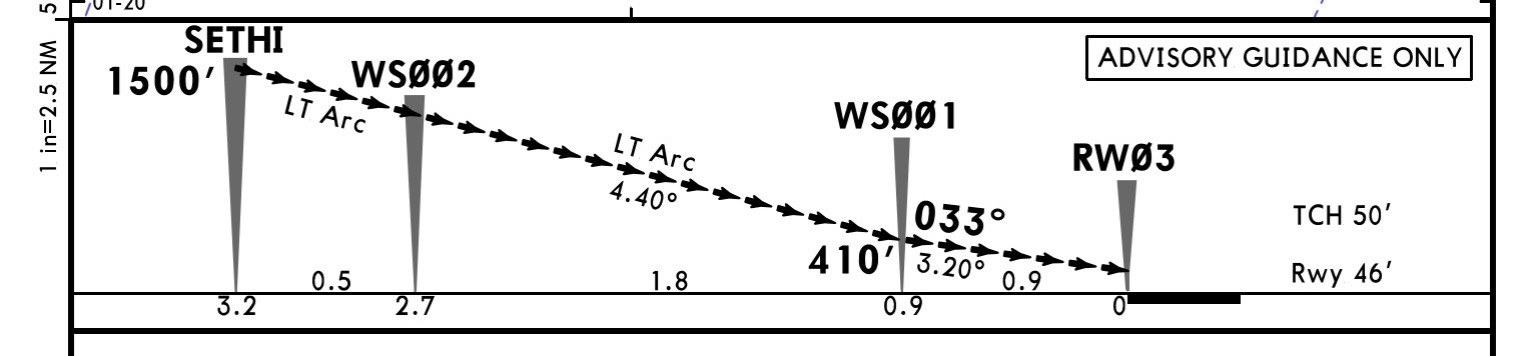
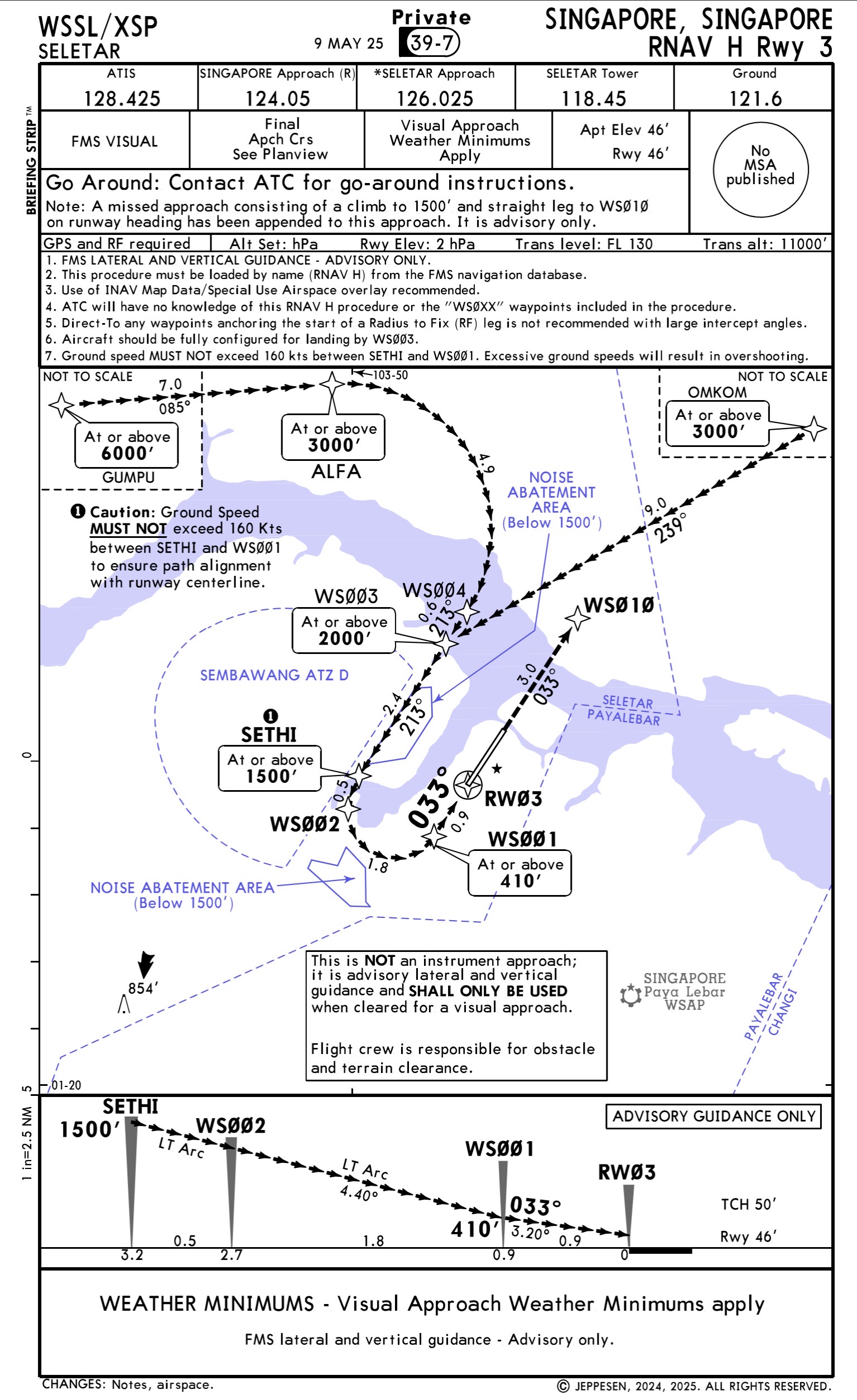
Take WSSL/Seletar Runway 03: the initial descent path from SETHI starts at 4.4 degrees until turning final at 410′ where the descent shallows out to match the PAPI at 3.2 degrees, and since there is a runway point in the FMS, the aircraft can remain coupled until it reaches its autopilot limitation altitude (200′ in a Gulfstream for instance).

Then there’s workload – the FMS empties your capacity bucket by managing your geometric flight path, leaving room to focus on things like spacing, configuration, checklists and monitoring. This is especially pertinent when cleared via a visual approach while still high, fast or under (shall we say) ‘less than optimal’ radar vectors.

Then there are visual illusions caused by flat light, water, sloping terrain or black hole effect. Our eyes are known to play tricks on us.

Finally, the elphant in the room – automation. Modern, complex aircraft are designed to be flown with high levels of automation. Whether or not this is a good thing is a can of worms that falls beyond the scope of this article. But automation is well and truly engrained in how we operate modern, complex aircraft.

It’s hard to argue that when managed well (and not used as a replacement for core piloting skills), autopilot and flight director coupling provides significant safety margins compared to simply flying by the seat our pants.

But, beware…

Rubbish in, rubbish out. The guidance an FMS provides is only as good as the data it uses, and so database accuracy matters. A displaced threshold for instance may not be captured. Always, always cross-check your approach against visual cues such as PAPI.

It’s also important to remember that obstacle clearance is on you. It’s still a visual approach. Your FMS doesn’t know about obstacles, cranes or even the ‘steel structures and silos’ that you must spot on approach to WSSL/Seletar, for instance.

What’s the bottom line? Guided visual approaches do not replace good visual flying. But they do help make it safer, more stable and more consistent. For BizAv operators flying to diverse airports, they can be one of the most useful tools in the box – provided they are understood.

What about legalities?

In the US, a guided visual approach is still a visual approach under FAA rules. The FAA previously issued this Information for Operators (InFO) to that effect, and is an important read before flying any guided visual.

Don’t confuse them with instrument approaches – even if the charts appear similar. “Looks like an approach” doesn’t equal “is an approach.”

In other words, the presence of flight director and autopilot guidance does not change anything.

There is no such thing as an ‘instrument visual approach.’

Visual approaches have no published minima. There is no FAA obstacle clearance protection, no TERPS validation or any other underlying regulatory protections. The same applies in the ICAO world, whilst you might have access to the visual guided approach, it is still legally a visual approach, don’t let the chart fool you into thinking otherwise.

You must:

  • Maintain continuous visual reference with the runway or traffic.
  • Be able to land using normal manoeuvres.
The FAA doesn’t specify whether you need to be head’s up or down – just as long as you remember that these remain your responsibility.

Another important clarification is that most guided visual approaches are proprietary, in other words not published via AIP. Avoid potential confusion by not using using weird naming conventions (such as “RNP-H”) that might not be immediately evident to the controller that has cleared you for a visual approach.

If you are specifically asked by ATC if you will be tracking via a procedure however, it is okay to say so. At several US airports ATC have been actively involved in procedural design. This highlights the benefits of these types of approaches, not just for pilots but for controllers too. They can help remove the “some fly wide, some fly close” factor which is common in a visual approaches.

And finally there is this important caveat. Flying one of these RNAV H or RNAV G procedures does not relieve the pilot of their responsibilities of right-of-rule rules – especially at uncontrolled airports where pattern rules still apply (see CFR § 91.113). The NBAA report that they are receiving increasing reports of turbine aircraft using instrument approaches to complete visual arrivals and (either intentionally or unintentionally) disregarding right-of-way rules with other aircraft. It’s important to understand that using these procedures does not grant any extra priority. 

Where do you find them?

In the US, guided visual approaches are not usually published procedures.

Instead third party vendors produce ARINC-424 coded procedures that can be used in your jet’s FMS. Just like an RNP-AR, you should not modify waypoints on the approach, since this could affect the jets trajectory.

When loaded, they usually appear in your FMS as ‘RNAV-H RWY XX’  or ‘RNAV-G RWY XX’ depending on which avionics package you are flying with.

Honeywell appears to be leading the charge. They have designed a number of them which, at the moment, are only available to aircraft with Honeywell avionics. Although we have been told that the data may soon be licensed to other avionic manufacturers the likes of Collins etc. Watch this space.

Garmin has also recently started to add some Visual Guided procedures to their products as well. While the number of airports served is less than the Honeywell offering, their offering is growing quickly

Have more to add?

Let us know! You can reach the team via blog@ops.group.


Singapore Ops Update: Two New Rules to Know Before You Go

If you’re planning ops to Singapore this year, expect it to be busier than ever. Traffic into Singapore exceeded previous records last year, and slots and parking are already harder to secure than they used to be.

In addition to the capacity challenges, there have also been changes to immigration and operator procedures that can catch you out if they’re not on your radar. They’re not complicated, but they do mean doing things earlier than before. These include the new No-Boarding Directive (NBD) for passengers and updated requirements around the Singapore Foreign Air Operator Certificate (FAOC).

NBD – No-Boarding Directive

Effective 30 Jan 2026, all operators (private or commercial) must check passengers in advance for a clearance (or refusal) to enter Singapore.

You can check the official announcement on this here. The process sounds more complicated than it really is. In the past, passengers who were denied entry would only be identified after arrival, once immigration determined they were ineligible to enter Singapore. This could be due to a lack of visa, being assessed as an undesirable or prohibited traveller, or a red flag arising from their SG Arrival Card submission.

Previously, the system waited until the passenger was already on Singapore soil, which was always somewhat counter-intuitive. From 30 January, however, an operator must receive confirmation that a passenger is cleared to enter (effectively a green light). If you carry a passenger into Singapore without this clearance (even if that passenger ultimately would have been approved) the operator is liable for significant penalties under the Immigration Act.

So what do you need to do?

As the operator, your role is actually very simple. You must submit your general declaration / passenger manifest to your agent or handler ahead of departure. Current guidance is no later than two hours before departure. This allows the handler to submit the passenger details via a dedicated ICA portal.

That portal will return one of two responses: “OK to Board” or “Do Not Board.”

The key takeaway is this: you must receive one of these two responses before departure. In this case, no news does not mean good news.

The upside is that operators do not need access to the portal themselves (and cannot access it anyway). Everything is handled by your agent. Your only responsibility is to ensure the passenger manifest is submitted in good time before departure.

FAOC – Singapore Foreign Air Operators Certificate

In Singapore, any foreign AOC holder (Part 121 or Part 135) is now required to apply for a FAOC (local validation of your AOC). This process is completed online via the Flight SG portal.

You should allow 2-3 weeks to receive your FAOC, which is typically valid for 3-6 months on the first application. Subsequent approvals generally come with a longer validity period. Be aware that CAAS conducts ramp checks on all FAOC holders, and in particular, operators are more likely to be ramped during the renewal period. CAAS follows the standard SAFA inspection methodology.

The FAOC itself is not new. What has changed is the introduction of ANR-129, which is now in force. This replaces the old FOSP (Foreign Operator Surveillance Programme) and the permit rules that went with it.

So what does ANR-129 change?

Quite simply, any aircraft listed on an AOC must now hold both a valid FAOC and a permit to operate into Singapore. CAAS no longer exempts ferry, positioning, or so-called “private” flights if the aircraft is on an AOC.

The only operations exempt from the FAOC requirement are private aircraft (Part 91 / CAT 2) and certain emergency situations. Overflights are also exempt. This means that any aircraft operated commercially overseas must still hold a FAOCif it is coming to Singapore for maintenance, or even if it is operating an owner-only flight.

The FAOC application process is well documented on the CAAS website, so I won’t repeat it here. The key point is to apply well in advance of your planned operation to avoid any last-minute surprises.

CAAS is currently conducting frequent ramp checks to ensure compliance, and ground handlers are now verifying FAOC permits before confirming airport slots.

More info on Singapore ops

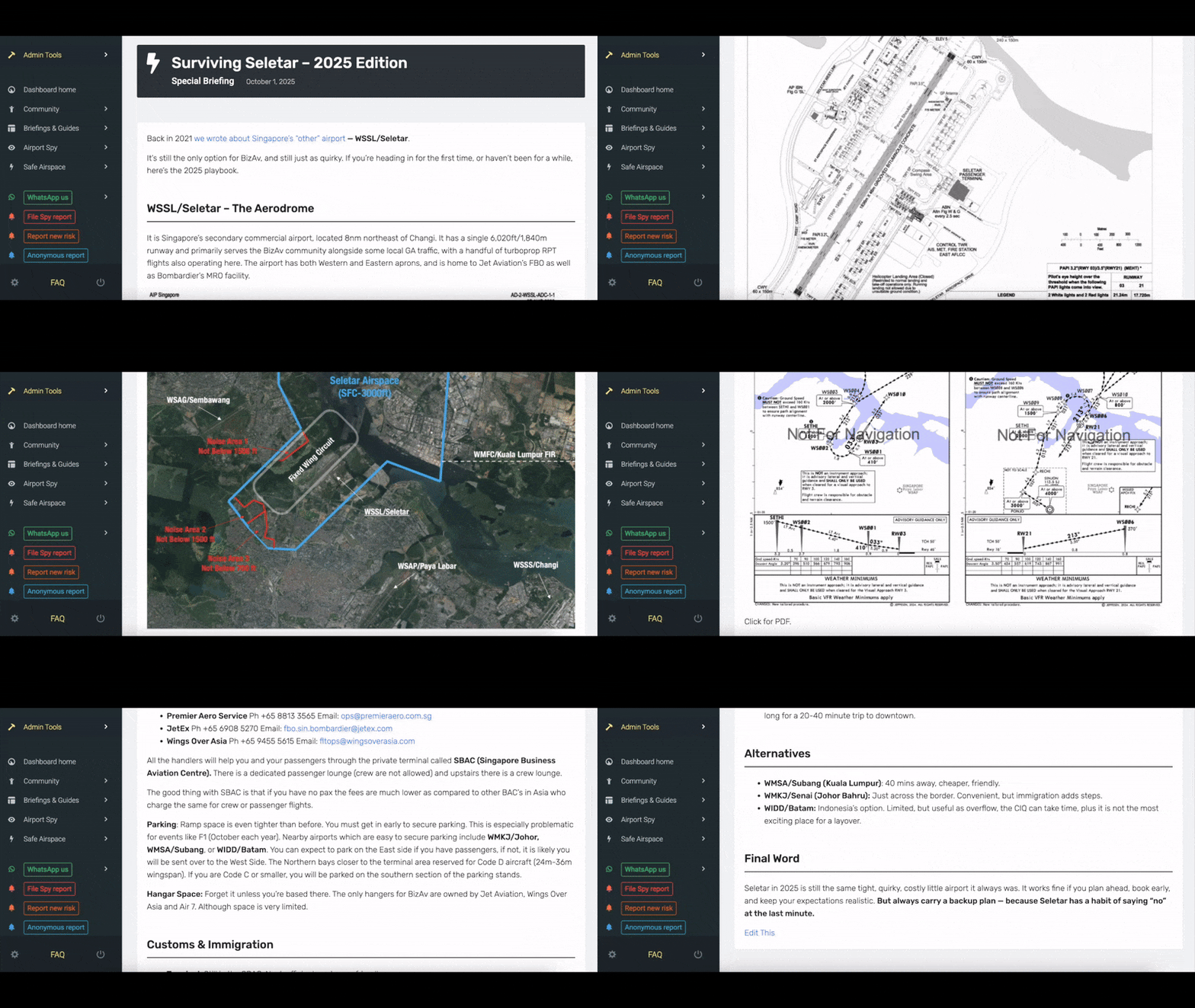
If you’re flying a bizjet into Singapore, WSSL/Seletar is your only option. Our recent guide covers the key survival tips – from managing the visual-only arrivals to dealing with limited parking and other quirks that can catch you out. OPSGROUP members can access the guide via your members dashboard here.


EU-LISA: The BizAv Guide

The EU has officially started switching on its new border-control system, and the rollout is already affecting how flights are handled across Europe. Here’s the quick version as of Jan 2026:

  • EES is live (sort of). Launched in Oct 2025, with a staggered rollout across Europe – some airports are already using it, while others are still coming online.
  • Full switch by April 2026. During the six-month transition, passports will still be stamped alongside digital checks, but once the rollout is complete across all 29 EES countries, manual stamping will end entirely.
  • All travellers included! Everyone crossing an external Schengen border (no matter if they arrive by airline, private jet, yacht, car, or donkey) must comply with EES and ETIAS – but who is responsible for the checks depends on the type of operation. Commercial operators must register with EU-LISA and verify pax electronically before boarding, while border guards handle checks for private arrivals.
  • Private operators opting in. Even though owner-operated private flights are exempt from EES and ETIAS requirements, many are registering with the system anyway so they can confirm pax docs and authorisations in advance – helping avoid surprises for their pax on arrival.

So here’s a more detailed look at what’s changing, when, and what actually matters for BizAv operators.

EES (live from Oct 2025)

Think of EES as the EU’s new digital passport stamp. Operators flying to one of the 29 EES countries need to use the EU-LISA carrier interface to electronically verify whether passengers holding short-stay visas (single or double entry) have already used the number of entries authorised by that visa.

The 29 European countries doing EES:

This check must be done no earlier than 48 hours before the scheduled time of departure.

Remember, this only applies to passengers with short-stay visas for one or two entries. For everyone else (including visa-exempt passengers) border authorities will handle checks during the six-month transition period while EES is phased in across Europe (through 10 April 2026).

So for visa-exempt travellers (like US passengers), operators don’t need to do anything yet under EES – your obligations for them begin later, once ETIAS is live.

Any commercial operators (Part 135 / charter / commercial bizjet operators) must be registered with EU-LISA to access the carrier interface. Operators were expected to complete registration and testing before the Oct 2025 go-live. Latecomers can still apply, but should expect delays before being fully approved to use the system.

If you’re flying an owner-operated private non-commercial flight, you’re off the hook – you’re not considered a “carrier” and don’t need to register or query anyone (but read more on this below!)

ETIAS (coming in late 2026)

If EES is about recording entries and exits, ETIAS is about screening pax before they arrive. It’s the EU’s version of the US ESTA – a quick online authorisation for visa-exempt travellers.

Operators flying to one of the 30 ETIAS countries (the 29 EES states plus Cyprus) will need to verify before boarding that all visa-exempt pax hold a valid ETIAS travel authorisation.

As with EES, the verification query can be made anytime from 48 hours before departure (that “no earlier than 48 hours” rule).

When ETIAS launches (expected in the last quarter of 2026), there’ll be a six-month transition followed by a six-month grace period, so enforcement will ramp up gradually rather than overnight.

The ETIAS fee is €20 (up from €7) and is waived for travellers under 18 or over 70.

ETIAS obligations mostly apply to travellers, but operators must verify that passengers who need an ETIAS actually hold one before boarding.

Again, this rule only applies to commercial operators.

For more info on all the basic stuff of EES and ETIAS, check out the homepage here.

Are private flights definitely exempt?

Since 2024 we have asked EU-LISA this question many times, in different ways. Their position had always been the same. They told us that EES and ETIAS apply to commercial flights, not private flights.

They confirmed that:

  • Private flights with non fee paying passengers are out of scope for EES and ETIAS.
  • This remains the case even if the pilots are paid to operate the aircraft.
  • Operators using privately owned aircraft for private purposes are not considered “carriers” and do not need to connect to the carrier interface.
  • Company owned and operated aircraft flying to the EU for private purposes also fall under the private flight definition.

Based on this, the industry understanding was simple: private flights did not need to do EES or ETIAS.

However!!!

In Jan 2026, EU-LISA has now refined this position, with a new and much narrower distinction. They have told us the following:

Privately operated flights that are not open for public use, with a crew hired directly by the aircraft owner, do not need to comply with EES and ETIAS obligations, therefore, no need to register with eu-LISA and query the travellers in scope of EES and ETIAS.

Flights of private aircrafts managed by a professional operator (crew, maintenance, handling, etc.), or managed by a commercial charter operator, even if the flights are not open for public use, need to comply with EES and ETIAS obligations, therefore, the operator needs to register with eu-LISA and query the carrier interface.

Therefore, if you transport solely the owners of the plane and their guests, you will not need to register with eu-LISA.

In other words:

Owner-operated private flights with owner-hired crew = no EES / ETIAS.
Professionally managed or charter-operated private flights = EES / ETIAS required.

This explains why two aircraft that both look like “single owner private flights” can now fall on opposite sides of the rule, depending on how the aircraft and crew are managed.

Why some private flights are registering anyway

Several OPSGROUP members who do purely owner-oprated private flights have told us that they have registered for the system anyway. The benefit of doing this is that you will be able to confirm prior to the flight that your pax have all the proper documentation they need – potentially avoiding any nasty surprises on arrival.

With the EES system, passports will no longer be stamped, so in the case of a limited visa that only allows a certain number of visits, operators will have no way of confirming that all the allowed visits have not been exhausted unless they check the system.

Also, similar story when ETIAS starts. Though there will be a website to confirm a passenger has an approved ETIAS, EU-LISA says there are a lot of reasons for an ETIAS to be revoked, so checking the system prior to the flight will help make sure the ETIAS is still valid.

More info for operators

For more info, you can check the EU-LISA homepage for operators here.

For answers to pretty much all the questions we can think of, including how to actually use the system as an operator, check this FAQ document provided by EU-LISA.


Crisis in Iran: Elevated Airspace Risk

Key Points:
  • Iran remains highly unstable, with elevated risk to civil aviation.
  • Severe internet disruption has been in place since Jan 8, with broader communications affected.
  • The OIIX/Tehran FIR was closed at short notice for several hours on Jan 14, with no public explanation.
  • EASA recommends avoiding Iranian airspace at all levels due to misidentification risk.

Situation in Iran

Beginning in late December, large-scale political protests spread across major cities due to a worsening economic crisis.

These escalated in recent weeks, with many demanding a change of political leadership. The Government has responded with a violent crack-down. Large numbers of casualties have been reported amid arbitrary arrests and severe internet disruption since Jan 8, with wider communications also affected.

Several countries (including the US) have urged their citizens to leave the country immediately.

Potential for US Military Intervention

In response to humanitarian concerns, the US Government has implied military intervention remains a possibility should violence against protesters continues.

If this were to occur, Iran has repeatedly warned it will retaliate by targeting US military bases and other assets throughout the region.

Some effects of this threat have already been felt, including the partial removal of personnel as a precautionary measure at Al-Udeid Air Base in Qatar – the largest US military base in the Middle East. Although the threat level has reportedly been downgraded in the past few days.

Airspace Risk

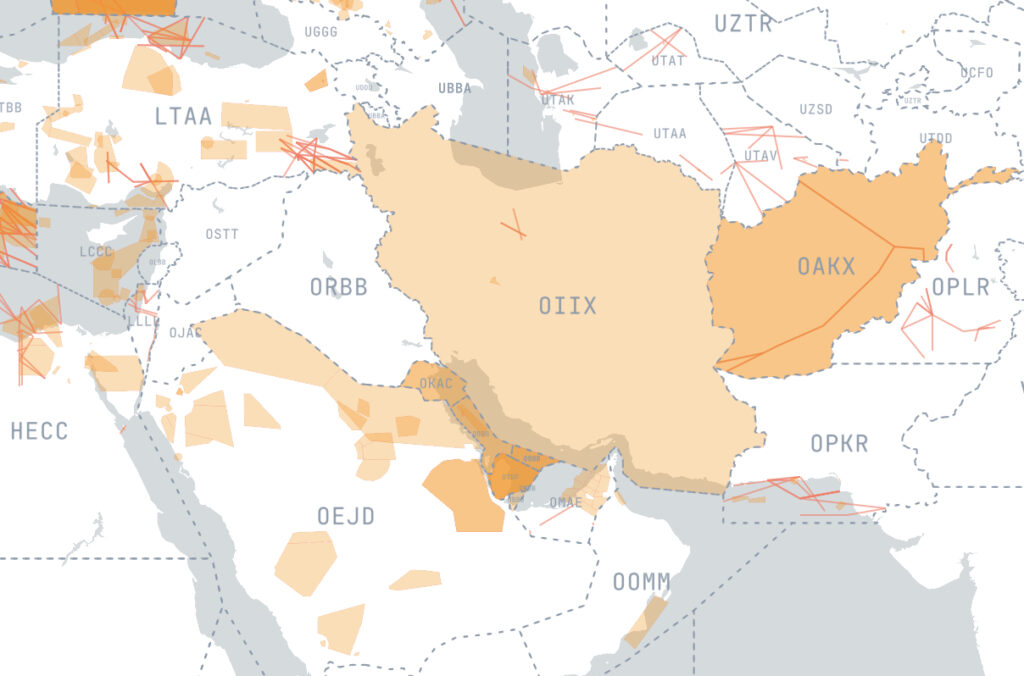
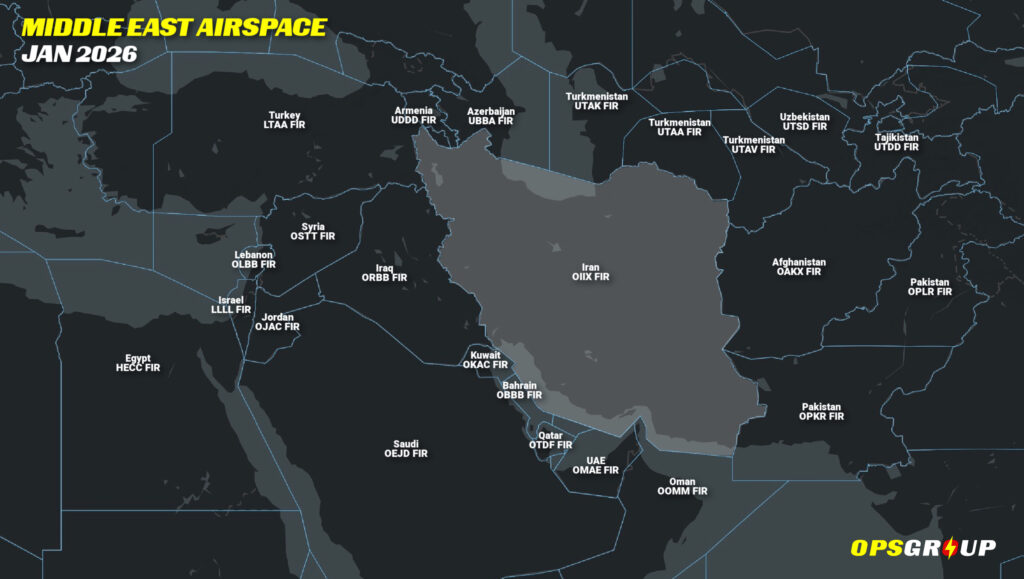
The current crisis has further increased risk to aircraft operating in or near Iranian airspace (the OIIX/Tehran FIR).

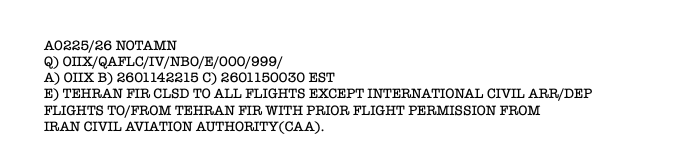
On Jan 14, the following Notam was issued unexpectedly closing the OIIX/Tehran FIR for several hours overnight, with no public explanation from Iranian authorities:

Previous events have shown that these types of closures can occur when security or military activity is taking place including a risk of missile launches or air defence operations.

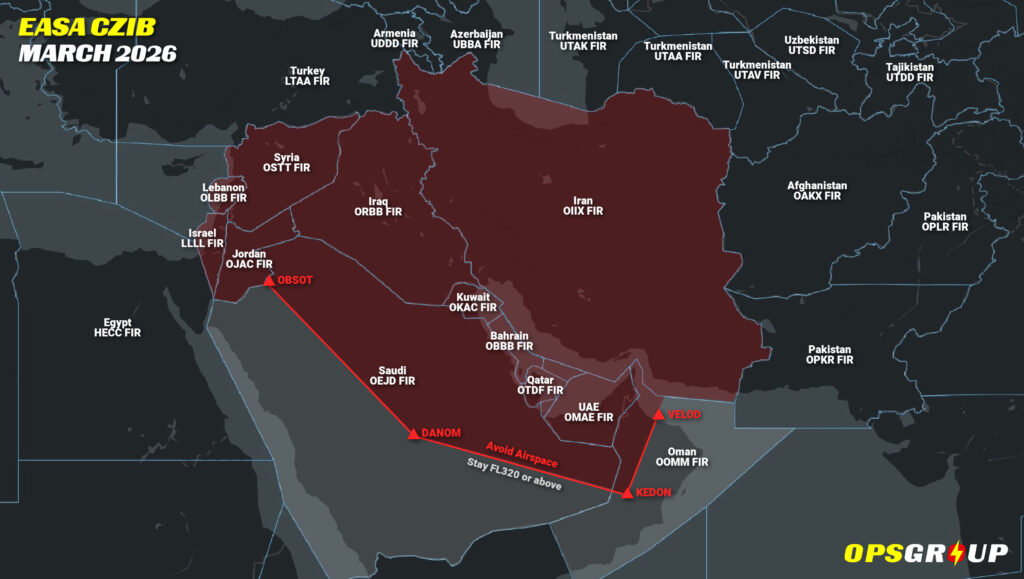
Then on Jan 16, EASA upgraded its warning for Iranian airspace by publishing a new Conflict Zone Information Bulletin (CZIB) for Iran and neighbouring airspace. It suggests that recent events (including the possibility of foreign intervention) have likely placed air defence systems at a heightened sense of alert. Civil aircraft are at increased risk of misidentification.

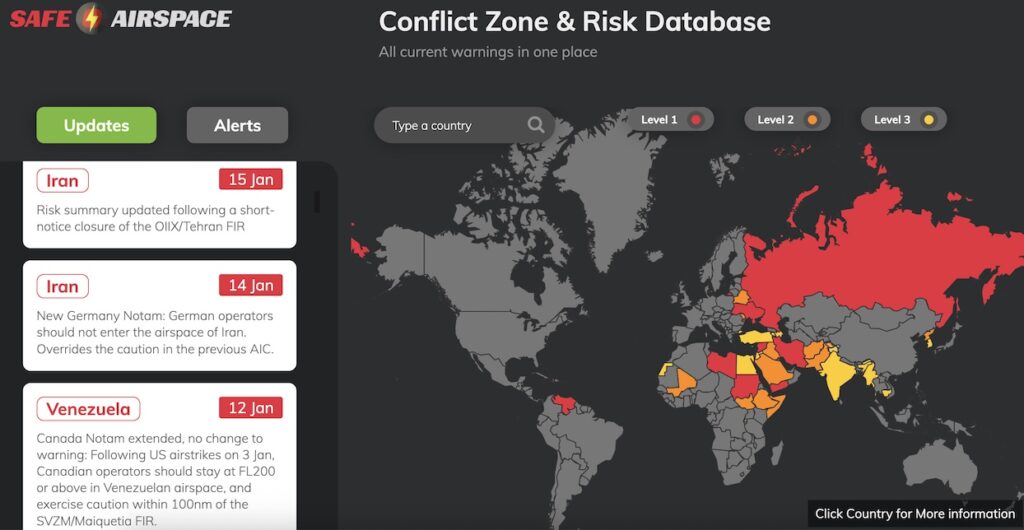
It’s worth noting that most operators already avoid Iranian airspace. Several states (including the US, UK, France, Canada and Germany) either actively prohibit or at least strongly advise against entering. At safeairspace.net, we maintain a ‘Level 1 – Do Not Fly’ warning.

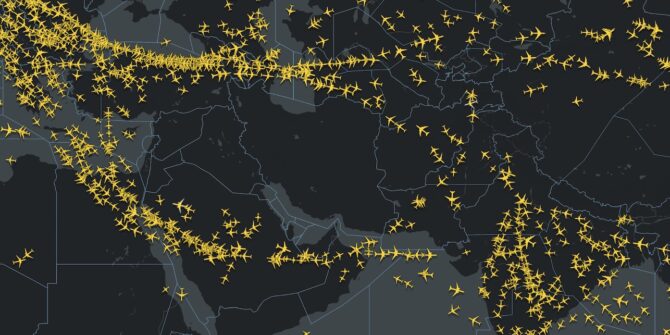
However, when referencing adjacent airspace, things become a little more ambiguous. EASA’s CZIB advises caution when overflying neighbouring countries where US military assets are present. This notably includes Qatar, Bahrain, Kuwait, the UAE, Saudi Arabia, Jordan, Iraq, Syria and Turkey.

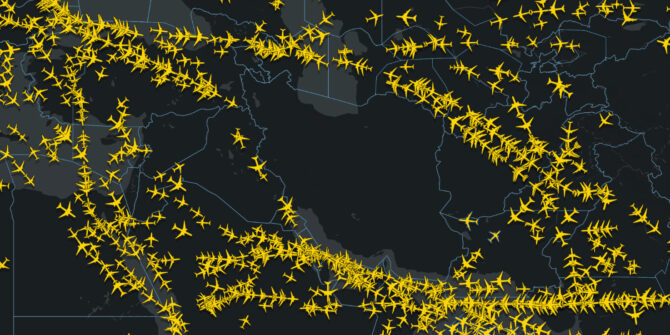
Special care should be used on the major air corridor that skirts the western boundary of Iran via Iraqi airspace (airways UL602, UM860 and UM688) where GPS interference (including the more insidious spoofing) is prevalent.

We know of at least one incident in the past where an aircraft almost inadvertently strayed into Iranian airspace without a clearance while suffering from navigation error.

From a broader perspective, EASA are also alluding to the possibility of regional escalation should the situation deteriorate – especially in the event of retaliatory strikes against military targets.

Continue to monitor the situation

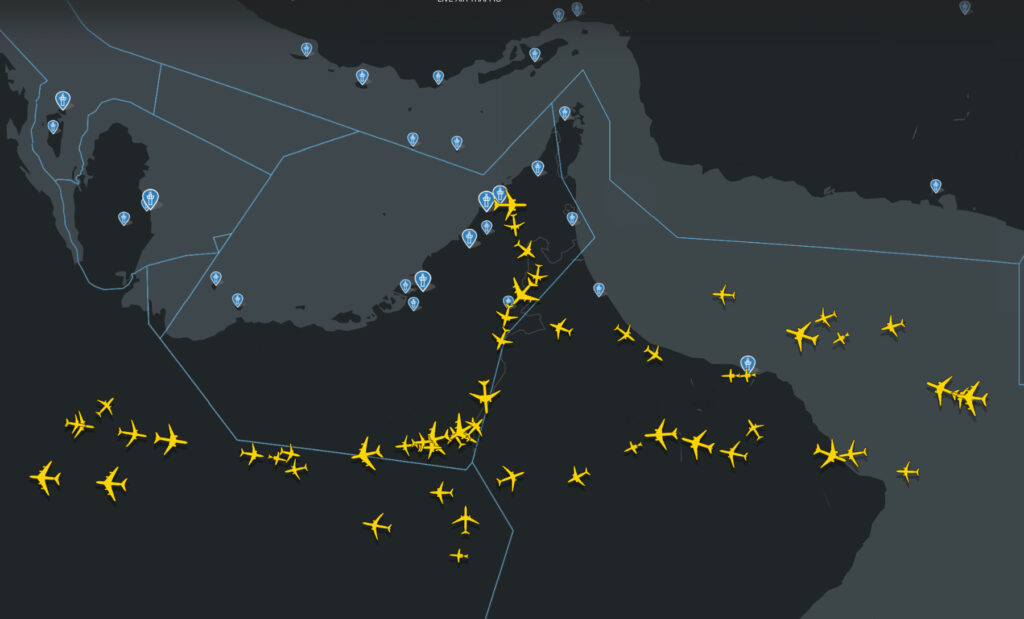
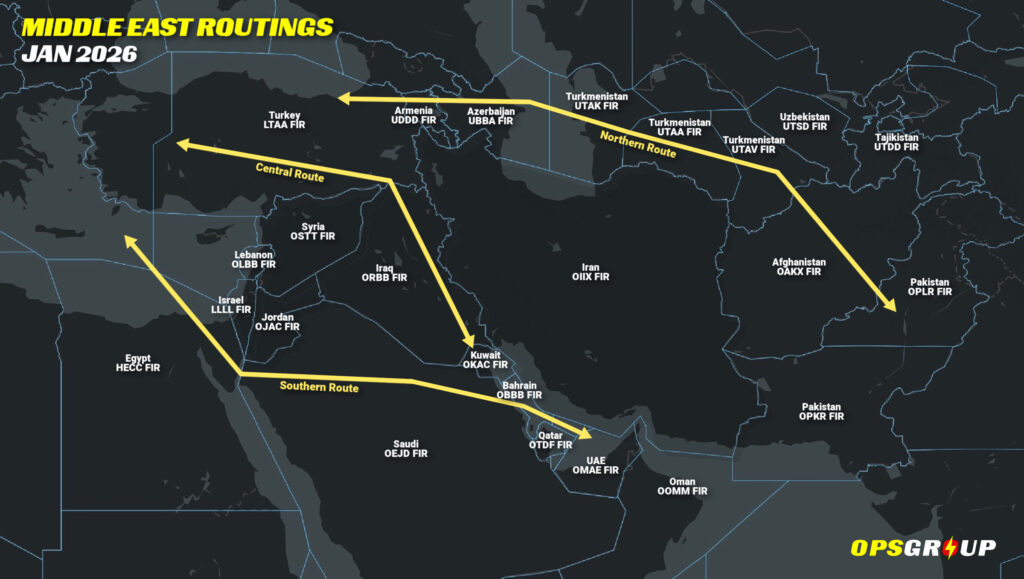
Iran sits alongside the main Europe-Middle East transit corridor via Iraq/Kuwait/Bahrain, and the June 2025 Israel-Iran missile exchange showed how quickly events inside Iran can trigger widespread airspace closures and warnings across the region.

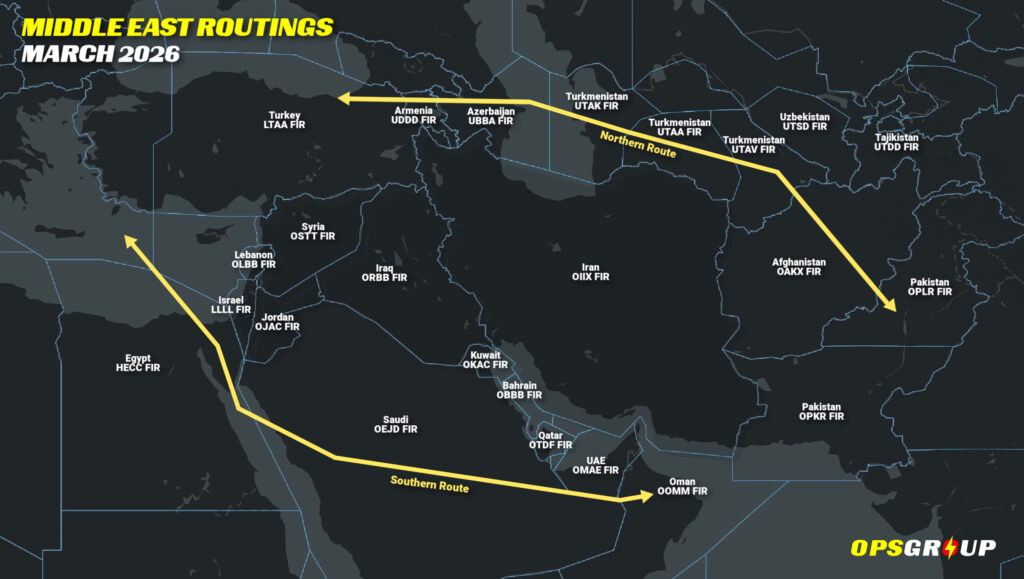
If further military activity involving Iran escalates, expect little warning – for Europe-Middle East flights, the longer routing via Egypt/Saudi has been the more stable option and keeps you further clear of Iranian airspace.

We’ll continue to issue any updates via Opsgroup and Safeairspace.net. You can also reach us at blog@ops.group if you have any info to share.


Greece Winter Runway Closures

Key Points
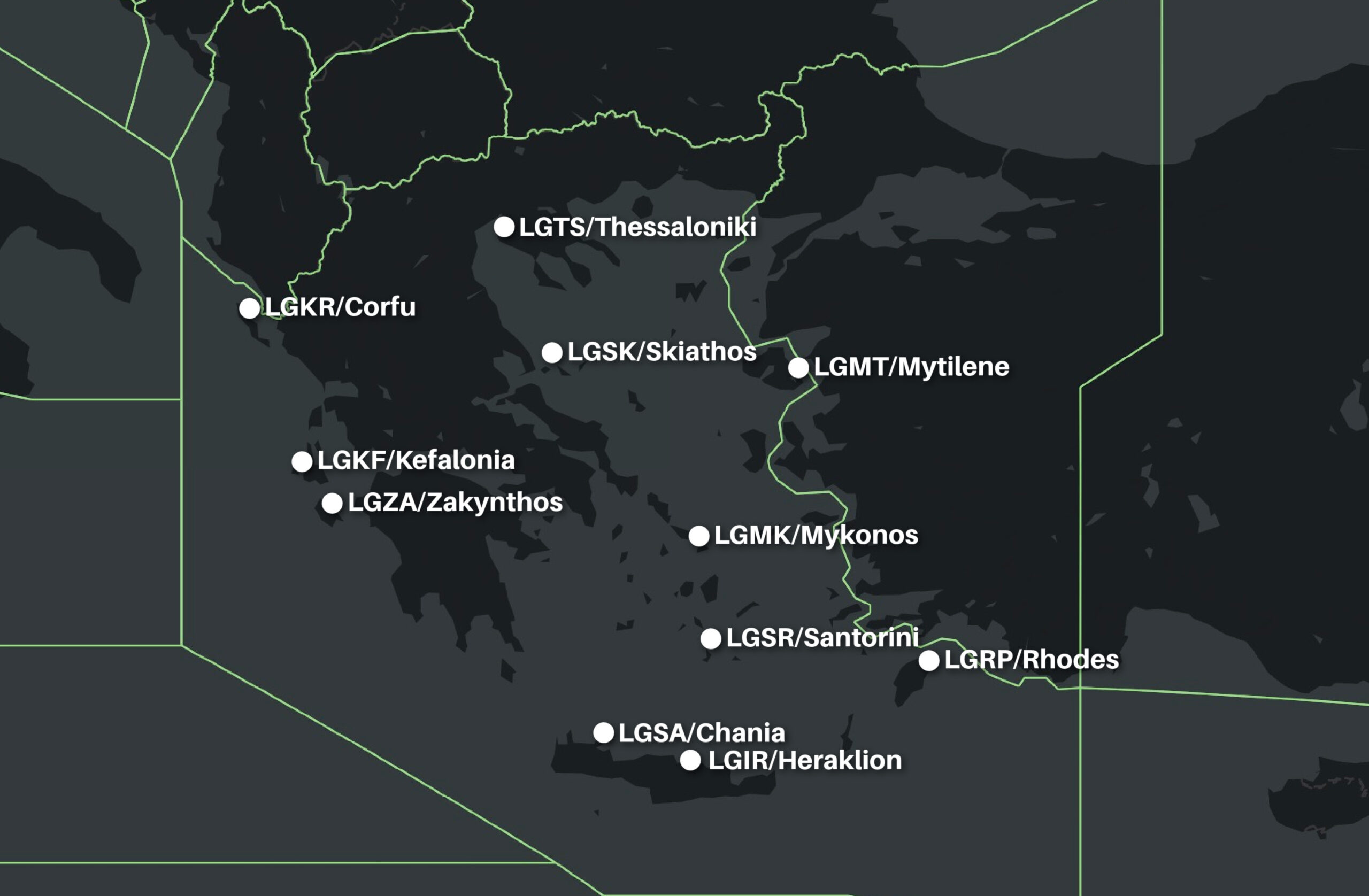
  • Several airports in Greece will be affected by winter runway works through to the end of March.
  • These include: LGZA/Zakynthos, LGKF/Kefalonia, LGKR/Corfu, LGMK/Mykonos, LGSR/Santorini, LGRP/Rhodes, LGSK/Skiathos, LGTS/Thessaloniki, LGSA/Chania, LGIR/Heraklion and LGMT/Mytilene.
  • Expect a mix of recurring weekly closures and day to day restrictions, and in many cases reduced runway distances. At some airports, declared distances are down to around 1400m, which will rule out certain aircraft types altogether.

You can find all the details on the Notams, but here’s a quick rundown of the planned closures and reductions in runway lengths:

LGZA/Zakynthos
Full Runway Closure: RWY 16/34 closed from Feb 2-17.

LGKF/Kefalonia
Full Runway Closure: RWY 14/32 closed at various times on different days until Jan 30. Times vary daily but mostly around midday, up to 4 hrs.

LGKR/Corfu
Full Runway Closure: RWY 16/34 closed from Jan 12-27.

LGMK/Mykonos
Shortened Runway: RWY 16 reduced to 1400m, RWY 34 reduced to 1400m until Mar 25.
Full Runway Closure: RWY 16/34 closed Tuesday through Wednesday nights on a recurring weekly basis until Mar 19.

LGSR/Santorini
Shortened Runway: RWY 15 reduced to 1802m, RWY 33 reduced to 1874m until Feb 25.
Full Runway Closure: RWY 15/33 closed from Jan 12 to Jan 20.

LGMT/Mytilene
Full Runway Closure: RWY 14/32 closed every Tuesday all day until Mar 25.

LGRP/Rhodes
Shortened Runway: RWY 06 reduced to 1900m, RWY 24 reduced to 1900m until Mar 25.
Full Runway Closure: RWY 06/24 closed on a recurring weekly basis, typically from Tuesday evening until late Wednesday evening until Mar 25.

LGSK/Skiathos
Full Runway Closure: RWY 01/19 closed for most of January, with only short morning or afternoon reopening windows on certain days, until Feb 1.

LGTS/Thessaloniki
Full Runway Closure: RWY 16/34 closed from Jan 19 to Mar 6. RWY 10/28 remains in use.

LGSA/Chania
Shortened Runway: RWY 11L/29R reduced to 1900m until Mar 27, with RWY 29R threshold displaced. Straight-in minima are not authorised (circling only). RWY 29R approach lights are out of service.

LGIR/Heraklion
Full Runway Closure: RWY 09/27 closed from Jan 19-26 due to resurfacing works. Operations are on RWY 12/30 for day ops only, limited to Code letter B aircraft (incl. ATR42/72). IFR arrivals are suggested via RNP RWY 27, then visual or circling. If visibility drops below 10 km or ceiling below 2000 ft, arriving aircraft must fly VFR.


Further closures may be announced beyond the end of March – check on Fraport’s homepage for updates.

Have you operated into Greece during the winter recently? How was it on the ground, and did anything catch you by surprise?
If you have tips, experiences, or useful local insight to share, we would love to hear from you. Drop us a note at team@ops.group!


South Africa Permits: Still a Mess

New Member Alert: January 2026

We’ve received yet another member report highlighting ongoing permit issues in South Africa. In the latest case, a private bizjet flying from the UK into FACT/Cape Town had its landing permit denied just one hour before departure, despite all paperwork being submitted more than a month in advance and overflight permits already approved. No clear reason was given, with the issue described as political in nature within the Department of Transport, and the passengers ultimately had to airline in instead. Unfortunately, this is not an isolated case and closely reflects the wider pattern we continue to see, last minute decisions, mixed messages and no real guarantees, even when everything appears to be done by the book.

Original Story: July 2025

We’ve had multiple updates over recent months about the ongoing chaos around landing permits and FOPs Foreign Operator Permits for South Africa. While there were signs of improvement earlier in the year, member reports and on-the-ground feedback continue to show that the process remains inconsistent, unpredictable and often painful.

What’s the issue?

Let’s quickly recap the two main permits you might need when flying into South Africa:

Landing Permit: Issued by the Department of Transport (DOT). This is required for all foreign-registered aircraft, even private ones. It usually takes 3 working days to process.

Foreign Operator Permit (FOP): Issued by the South African CAA. This is meant for commercial operations, typically with more than 8 passengers or cargo over 1000 kg. It takes much longer to obtain (up to a month), and the paperwork can be extensive.

The issue: Even for flights where an FOP shouldn’t be required under the official rules – for example, a private flight with fewer than 8 passengers – sometimes operators are still being asked to submit one. Sometimes this comes from local agents who’ve handled the same flights for years. 

This mismatch is at the heart of the problem. The South African AIP says one thing (like “no permit needed for private flights”), the law technically says another, and what’s being demanded in practice by officials is sometimes something else entirely.

One operator told us they submitted a full FOP package for a charter with just 6 pax, only to be told a week later it wasn’t required.

More recently, operators have also reported that the situation has become even more unpredictable. Any changes to an approved flight schedule, including timing, routing, passenger or crew details, can now trigger a requirement for the original landing permit to be revalidated by the Department of Transport before departure. This has been reported even for crew-only, ferry and maintenance flights.

The revalidation must be handled by a local handler and requires a signed power of attorney from the operator. Processing can take several days and critically, the Department of Transport only operates on weekdays, with no weekend support. As a result, schedule changes late in the week have left aircraft grounded until Monday, often with unexpected parking costs. Some operators have reported being unable to depart without unofficial after-hours assistance.

Why is this happening?

A new Minister of Transport took office, and a new Air Services Licensing Council (ASLC) was appointed. That might sound like progress – but according to folks on the ground, the new team found evidence of corruption, started clearing it out, and in the process created a massive vacuum. Staff were removed, new rules came in, but no one was properly trained. The result: total inconsistency.

One local agent told us: “It’s bureaucracy for the sake of bureaucracy… Officials now interpret the rules however they want, and nobody has been trained properly.”

Permit processing times?

Here’s the reality as it stands:

  • Landing permits: Officially 3 working days, but expect 7-10 days minimum, and if anything is missing or unclear, the clock resets.
  • FOPs: Can take a month or more, especially if your application gets bounced back for clarification (which it often does).
  • All permit applications go through permits@dot.gov.za – but your best bet is to use a local clearance company. Trying to deal with the DOT directly is not recommended.
Corruption?

There were credible reports of permits being deliberately delayed in hopes of bribes. The Department of Transport has acknowledged this and says reforms are underway – but in the meantime, honest operators are left paying the price in delays and uncertainty.

What do you need?

For most private ops under 8 pax, you shouldn’t need a FOP – just a landing permit. But the advice from multiple members is clear: don’t take anything for granted.

Suggested checklist:

  • Private flights (under 8 pax): Landing permit only (in theory).
  • Charter flights or more than 8 pax: Landing permit + FOP.
  • FOP applications require 20+ notarised and certified documents – use a local agent or FBO to manage the process.
  • Include a detailed flight purpose – vague terms like “business” aren’t accepted anymore.

Local agents like ExecuJet, Onyx, and others are actively supporting operators with this, but even they admit it’s a bit of a lottery.

We’ll keep tracking this, but for now: expect delays, get your paperwork in early, and triple-check everything before submitting. And above all – don’t trust the published timelines.


Japan BizAv Ops: Haneda, Narita, and Nagoya Explained

Japan is a great place to pilot a BizJet. It has super efficient ATC, spotlessly choreographed ground handling, and some of the best customer service you’ll find anywhere. But it also comes with a maze of rules, slot systems, strict curfews, and a cultural operating style that does not reward improvisation.

If you have not been to Tokyo recently, or ever, here is the short version. It is brilliant. It is also very easy to get yourself boxed in by paperwork, curfews, and slot rules if you do not understand how the system works.

This guide focuses on what actually matters for BizAv crews operating into Tokyo and nearby alternates – RJTT/Haneda, RJAA/Narita, and RJGG/Nagoya.

What Makes Japan “Different”

Three concepts matter above everything else:

  1. Japan is a PAPERWORK country – everything begins and ends with approvals: Airport slots, runway slots, parking slots, customs/CIQ slots… your trip will succeed or fail based on how early and how accurately your handler books these. This is why it is hugely important to work with one who you can trust and have a good relationship with.
  2. They expect you to follow EXACTLY what you filed: Japan does not like late changes, creative ground routing, early arrivals, or “we’ll see how it works out on the day.” If you change anything (ETA, ETD, passenger count) then you can expect to have to get a new approval. You can expect to loose your departure slot if you are not ready on time, and if you are ready early, most likely you will be waiting on the ramp for your allowed departure time.
  3. ATC is world-class, but extremely procedural: Local slang is not a thing in Japan. Phraseology is pure ICAO. But be ready for long STARs, strict speed control and a lot of traffic. Controllers accents can be strong, but what they say, and what they expect pilots to say comes right out of the ICAO rulebook.
RJTT/Tokyo Haneda: The BizAv Trophy Airport (with a very bad slot hangover for Winter 2025/26)

Haneda is the airport everyone wants, it’s close to the city, has plenty of runways, and easy for pax transfers.  But it’s also the hardest airport in Japan for BizAv access. And right now, it is worse than ever.

The Big New Gotchas at Haneda

  • Slots are at crisis level: Since early 2025, the slots available for BizAv operators have been seen to be drying up, and unfortunately it has only become worse since the Winter 2025/26 schedule began. Day time slots (0800-2300LT) are nearly never available which leaves just some overnight slots open for BizAv operators to pick up. However what you can do with a good handler is secure slots for RJAA/Narita and ask them to keep an eye out every half day for a slot which may have opened up due to a cancellation. I recently had a slot open up in RJTT/Haneda, 30 minutes prior to engine start for our flight into RJAA/Narita, this is how to the wire it can be.
  • Parking remains another challenge: Even if you secure a slot, securing apron/parking is increasingly difficult for BizAv. Remember that you need three slots for operating at RJTT/Haneda. Parking slot, landing slot and a departure slot. 
  • Slot allocation process is rigid: Your handler will take care of this, but the trifecta is a tough one to manage. Your pax need to understand that there must be flexibility in both their arrival and departure time.
  • Competition from the airlines: Haneda prioritises scheduled airline traffic above BizAv. As traffic has recovered since the end of Covid, BizAv has been squeezed out.
  • Parking limitations: There is a hard rule of 4 nights parking, non negotiable. If you need to park for a 5th night or more, than it is time to reposition to RJAA/Narita or RJGG/Nagoya.

Operational Notes

  • Long RNAV STARs: The RNAV STARs into RJTT are long and usually flown in full due to noise over the city. Do not plan on shortcuts, although you may occasionally get a vector or track shorten late.
  • Strict arrival speeds: ATC will assign speeds on arrival and expects full compliance. You will normally be told “resume normal speed” before the approach – that is your cue to slow down, not speed up.
  • Long taxis after landing: Taxi distance depends heavily on the runway in use. Most BizAv parking is on the GA ramp in the N-Area, which can mean a long roll.
  • Turnaround parking exception: If you are doing a quick turn, ATC will often park you on P11 near Terminal 3, which saves time and crew walking.
  • Tokyo Bay fog risk: Sea fog and low cloud are common, especially on winter mornings. Conditions can change quickly.
  • Runway use driven by noise: If weather allows, arrivals favour 34L and 34R. If not, expect 22 or 23 via the LDA approaches. When those are not usable, the airport switches to 16L and 16R. This is all about noise mitigation for the city below.
  • Arrival runway logic: South and westbound arrivals usually get 34L or 22. North and eastbound arrivals usually get 34R or 23.
  • Departure runway logic: North and eastbound departures normally use 34R. South and westbound departures use 05. When the 16s are active, 16L is north or eastbound and 16R is south or westbound.
  • No approaches to 04 or 05: Runways 04 and 05 have no published approaches, so do not expect to land on them.
  • Wind and turbulence warning:When there are strong winds forecast, you can expect a lot of mechanical turbulence and sheer, bug up the speed and stabilise early would be my recommendation. Also watch out for the 1000’ winds, they can often be 50knots or greater and this leads to a very sporty final approach.

Noise Restrictions, Curfews and Operational Hours

  • Noise-driven runway assignment: Haneda uses strict noise abatement and time-based runway patterns. You will be assigned a runway and there is no negotiation. BizAv is typically sent to 34L or 22.
  • Performance-based refusal only: If you genuinely cannot accept the assigned runway, use the phrase “unable due performance”. ATC may accommodate you, but this is not a free pass. The JCAB has been known to meet aircraft on arrival for a ramp check to verify the performance limitation.
  • 24-hour BizAv passenger gate: The business aviation gate at Terminal 3 operates 24 hours, but it is for pax only.
  • Crew screening: All crew clear via the standard crew channel in Terminal 3 alongside airline crew. This can be slow and congested. I would allow at least 45 min from arrival at the terminal to having the APU up and running, an hour would be more comfortable.
  • No APU restrictions: RJTT/Haneda does not enforce any APU restrictions on arrival or departure. This is handy since in the winter it gets very cold (with some snow) and in the summer it is very hot!

Fuel & Handling & Parking

  • Handling: is excellent, extremely polite, and English is solid. But crew must follow the handler’s instructions exactly they’ll tell you when to tow, taxi, reposition.
  • Late changes: Given the slot/parking squeeze, late changes on the day may trigger re-filings with the authority. It is often impossible to shift an arrival or departure time. You have a slot buffer of 30 minutes, be careful not to exceed this, you will be required to report the reason for this to the JCAB.
  • Fuel: Fuel is available in Tankers on the N apron, it is up to 5000USG, so if you need more than that, let them know in advance. For large fuel orders, you can ask for a bay on the P11 apron, they will assign this 1 hour prior to your ETD. But the good thing for this apron is that Fuel is via the underground network so there is not need for a tanker, and it is close to the Passenger BAT.
  • Parking: There are a handful of Power in/out bays (951-954 & 151-155) but the rest are push back (961 – 969) so keep your pins handy. There are some extra bays which could be used, for mid sized aircraft spot 984 & 985 can be opened up.

Crew Logistics

  • Hotels: Haneda is around 15-30 mins to most of the big hotel chains, this is the reason it is so popular for the owners of a Bizjet. Some good options are the AC Hotel Ginza, Tokyo Westin, Prince Sakura Autograph hotel or the Sheraton Miyako. Be prepared to pay though, hotel rates are high, unlike the cost of Jet A1, which is cheap in Japan. especially compared to the US.
  • CIQ: Crew are usually processed as a regular passenger, so they are given a passport sticker, this is good it allows you to roam anywhere in Japan. Watch out if you get given an Orange Shore Pass as this only allows you to roam within 100km of the airport on entry. You will get yourself into trouble if you try and jump on the Shinkansen.
RJAA/Tokyo Narita: The BizAv Workhorse Airport

Narita is the airport that quietly saves every BizAv trip to Japan. The biggest downside is the distance from down town Tokyo. However it could really depend on where the boss’s meetings are, since Tokyo is northeast of Haneda. Generally you should allow 60-90 minutes via limo to CBD Tokyo.

Why BizAv Operators End Up at Narita

  • Parking availability: Far better than Haneda for overnight and multi-day stays. The airport allows up to a months parking and there are some hanger slots available which can be good for the winter time since Tokyo does get below 0c and snows.
  • Slots are still required, but far more achievable: There are 2 runways at RJAA/Narita, but since the majority of domestic flights run from RJTT/Haneda, the airport is not as busy. You generally will get your arrival and departure time of choice. But be wary of the 2300-0600LT curfew. 
  • Customs/Immigration is smoother for BizAv: The dedicated BAT processes both passengers AND crew so this saves you at least 30 minutes compared to RJTT.

Operational Notes

  • Expect long taxi times: Narita is spread out and there is a farmer who lives nearby the threshold of Runway 34R, he refuses to sell his land, so the airport built around him, give them a wave when you are on Kilo or Lima 😁
  • Arrival and departure runways: You will always land on 34R/16L, and departures are mostly 34L/16R. The only way to get assigned the “long” runway for landing is if it is required due to aircraft performance, and the key here is REQUIRED. If this is the case a simple “Require 34L due landing performance” will suffice and approach will do the rest. But remember the JCAB has been known to ramp check aircraft to take a look at the performance requirements.
  • Seasonal winds can be strong: In the winter, NW winds across the runway 34s are a known challenge. You can expect 50knots or more at 1000’ and it gets very bumpy, so bug up the speed and buckle up. 
  • Take a look at the arrival and departure chart: You will notice that when 16L/R are in use, they will keep you high until abeam the airport and then descend you late downwind and base, this is to keep you clear (to the north) of the departing traffic. Remember that you will always be north of the airport, there is no circuit to the south since that interferes with RJTT.

Noise Restrictions, Curfews and Operational Hours

  • Narita has a hard 2300L-0559L curfew: No exceptions. Well, ok, there is a one hour buffer which the airport can enact if there has been heavy snowfall and they are dealing with deicing. But that’s the only time it happens, and no matter how much you ask, they won’t change this.
  • If your schedule pushes late arrival or early departure, plan accordingly: Let the pax know the hard limit, many flights have been grounded over night because of this. It is an airborne time, not off blocks time.

Crew Logistics

  • Hotels: Lots of hotels nearby, not many western brands (Marriott / Hyatt) but the local hotels are clean and do the job. The airport is a big travellers hub, so the hotels in Narita tend to cater for airline layovers. For longer stays head downtown to Tokyo and you will find a lot of options, although be prepared to spend big.
  • CIQ: Just like RJTT/Haneda, crew are usually processed as a regular passenger. The shore pass issue is the same.
RJGG/Nagoya: The Best-Kept Secret

Nagoya is the dark horse of Japanese BizAv ops. If you need Japan but don’t need Tokyo itself, RJGG is often a dream. Located 150nm south of Tokyo, Nagoya is a smaller city with an airport that punches well about its weight. Your passengers probably won’t choose this place to be dropped off, but when parking becomes an issue further north, then Nagoya is your saviour.

Nagoya is my choice of tech stop when heading westbound from the SA. Many people overlook it, but it’s one of the most efficient stopovers for some fuel before you continue.

What Makes Nagoya Great

  • Parking: nearly always available as are some hangers if you need them
  • Slots: easier to secure.
  • Customs: fast and polite.
  • Ops more predictable: way less congestion than Tokyo. And you can get super quick turnarounds with power in / power out bays and hydrant refuelling.

Nagoya is a great option for quick tech stops on long-range Pacific or Europe legs, or simply as the pressure valve when Tokyo is full – an easy place to park, lay over cheaply, and wait things out while the passengers are in the city.

Operational Notes

  • Winter winds: the bay can produce mechanical turbulence and gusts. So you can except some strong crosswinds
  • Approaches: these are straightforward with no major “hidden” quirks (compared to Tokyo). You will get a nice easy STAR and there is little to no track shortening to cause you foul.
  • More flexible: less stressful from an ops planning standpoint. There is hardly any traffic so very little delays, and you can plan for very quick turn arounds.
Permits, Paperwork, & the “Japan Style” of Operations

Permits – Landing & Overflight

Foreign BizAv flights generally need a landing permit. Lead time for part 135 is at least 3 days but be wary of national holidays. For Part 91 Ops there is no lead time and the permits can be applied for up to the day prior to your operation.

Overflight permits are only required if you are using an aircraft which has special airworthiness permits.

The earlier you submit, the better. And remember that any revision of timing will need to have an updated permit – this can be the tricky part.

Passenger Lists & Crew Data

Japan expects accurate final pax/crew counts ahead of time. There is no passenger e-APIS, a GD to the handler will suffice. Last-minute changes (especially add-ons) can trigger re-submissions and delays.

Domestic Cabotage

If you are a Part 135, then it is impossible. Domestic cabotage is prohibited unless it’s an empty repositioning leg. Passengers cannot join for domestic legs only. As a Part 91 flight, there are no cabotage restrictions.

Handlers

The handler is your trip’s linchpin. They deal with all the bureaucracy (airport authority, customs/quarantine, parking, ramp). If your handler says “this is the only slot/stand we’ve got”, you have to believe it!

Like most places there are many handlers to chose from. I have personally always use Aeroworks (fltops@aeroworks.jp), another very reliable one is Universal Japan (japan@universalaviation.aero).

ATC, Airspace & Flight Planning Quirks

STARs/SIDs

The RNAV/STARs are long and structured. Don’t assume direct routing once inside Japanese airspace. There is Datalink Airport ATIS and the STARs always link up nicely to the runway in use. Pay attention to the ILS since they have both Y and Z iterations. 

Speed Control

The JCAB have a 250kts at 10’000’ and below. Even if you get a “cancel speed restriction” this speed limit remains, only the STAR or SID restriction are cancelled. You will be given speeds to fly. On arrival this is monitored closely so do pay attention to the instructions.

Holding

Tokyo is congested and you could well find yourself in a hold during the STAR. The holds are standard ICAO PAN holds, with a slight twist. The speeds are based on the old PANS OPS doc.

Altitude (feet) Speed (knots)
0-6000 210
6001-14000 220
14001-20000 240
20001-34000 240
34000 & Above 240

Comms & Datalink

Japan now is using Datalink for En-Route control, you can log in via RJJJ.

VHF radio coverage is excellent but remember to keep it standard ICAO phraseology to make everyones life easier

ATIS for most airports can be downloaded via Datalink.

Weather – Don’t Underestimate It

Winter (especially Winter 2025/26)

Expect stronger cold air intrusion earlier than usual in the 2025/26 winter. This is thanks to a La Niña-like system. It will bring an early-season arrival of cold air and increased risk of localised heavy snow on the Sea of Japan side, so RJAA and RJTT will be affected.

Snow does fall in Tokyo although it is not that common. However both RJAA and RJTT do have deicing with Type 1 & 4 fluids available. Expect delays when these procedures are in use. Both airports have Cat III LVO approaches.

Summer

Expect typhoons and thunderstorms! Typhoons will have you relocating the jets and a thunderstorm weather band will give you massive delays. Northern Japan gets very very warm, particularly in late July – September.

Shoulder Seasons

Fog, low ceilings, early morning dew/frost. Strong winds bring turbulence and gusty approaches – bug you speed as needed.

Crew Experience & Cultural Nuances

Precision Matters

Japan expects precision: paperwork, timing, process. This means it is a great experience to operate here, because what you expect is what you get. But make sure you read up about the operation, and check out the airport briefing pages (10-).

Time is precise, if they say your slot is 0900, then you should aim for 0900 at the threshold. But one thing to check with your handler is the slot tolerance, it is generally +/- 30 minutes. It’s worth briefing your passengers that the slot isn’t optional – so a late arrival by them could result in a cancelled flight plan.

Don’t Improvise on the Ramp

Ask your handler for instructions. Turn directions and start up procedures are strictly enforced. Unauthorised stepping into restricted zones, opening panels, crew wanderings are flagged and can slow you down. And you should always wear a safety vest.

Fuel spills are a big deal in Japan. If one occurs the refuel operator will call the airport authorities and you can expect a visit from the JCAB and fire truck. You will have to clean up on the spot (prior to you moving) and there are many pages of reports to fill in.

Cultural Nuances

You may need to use Google Translate or similar – but the locals are very friendly and will help however they can

Don’t tip, it is considered to be rude and so it should be avoided. In the bigger cities, the locals are becoming more tip aware and so if you are in a big city and feel like you would like to tip, then you could.

Keep your voice down, don’t use your phone on the train and make sure you queue up properly (there is always a queue!). Public drinking is legal, however don’t make a nuisance out of yourself!

Final Thoughts

Japan is predictable, structured, and extremely polite – as long as you play by the rules. Tokyo works well if you plan early, lock the slots, and stay disciplined, especially at Haneda during Winter 2025/26. When Tokyo fills up, Nagoya usually saves the day without any drama.

Your handler is everything here. Trust them, follow the plan, and things run smoothly. Try to wing it, and Japan will very calmly, very politely, say no.


Volcanoes, Ash and Better Forecasts: Meet QVA

Volcanic ash has always been one of aviation’s most frustrating hazards. It is invisible to most onboard radar systems. It can cause engines to surge or flame out, and it can force huge reroutes with very little notice. Until now, forecast products have mostly shown where ash exists rather than how much of it is actually in the air. That is about to change.

The UK Met Office and Météo France are introducing a new type of volcanic ash forecast called Quantitative Volcanic Ash, or QVA. From 27 November 2025, QVA becomes an official ICAO product, with London and Toulouse the first VAACs to provide it operationally. More VAACs around the world are expected to join over the following year as the service is rolled out globally.

What QVA Is and Why It Matters

QVA gives you real ash concentration values at different flight levels. Instead of large shaded areas that simply show where ash might be, you get a detailed 3D picture of how much ash is expected in each place and at each time. This lets operators compare forecast ash directly with engine exposure limits rather than working with broad warning zones.

QVA also shows how confident the model is. Low uncertainty means you can keep margins tighter around an ash plume. High uncertainty means planning extra room into the route. It is a smarter and more practical way to think about volcanic ash when planning flights.

The forecasts have a much higher resolution than before. VAAC London says that one forecast used to take about an hour to produce. With QVA they can now generate around 150 ash fields in the same time. You get more detail and you get it faster, which is a big advantage in busy regions like the North Atlantic.

If the data is of interest to your organisation, a request can be made to VAAC London for access to their free QVA API. Just email QVA@metoffice.gov.uk with details of your organisational requirements for volcanic ash data across the north-eastern corner of the North Atlantic, including Iceland and the UK.

The API provides ash concentration and probability forecasts up to FL600 in 3-hourly time steps out to 24 hours, with new forecast runs issued at least every six hours while a significant ash cloud is a hazard. For more details you can visit the Met Office page, and you can also find additional QVA info from VAAC Toulouse.

In short, QVA looks like a real upgrade. Instead of staying far away from anything that resembles a volcano, we can finally make smarter and more precise decisions. Low concentration with low uncertainty may keep a flight close to its ideal track. High concentration with high uncertainty is your clear cue to reroute.

Ash will always be ash, but at least now we can be a bit clever about how we deal with it. We are curious to hear what you think, so we would love to hear from you at team@ops.group.

Volcanoes of the World: The Misery Tour

The last few years have given us a colourful mix of eruptions, each creating its own special brand of trouble for aviation. Here are a few highlights from our unofficial misery tour, in order from oldest to newest.

La Soufriere, St Vincent, 2021

A run of explosive eruptions blasted ash up to about 40,000 ft and spread thick clouds across the Caribbean. Airports closed with little warning and alternates quickly filled up as crews diverted around the ash.

Most affected airports: TVSV/St Vincent, TBPB/Barbados, TGPY/Grenada, TAPA/Antigua

Hunga Tonga, Tonga: 2022

This underwater volcano delivered one of the biggest bangs ever recorded. The shockwave circled the planet, ash shot well above cruise levels and satellite links struggled under the pressure. Flights across the South Pacific had to reroute or delay until conditions improved.

Most affected airports: NFTF/Fua’amotu, NFFN/Nadi, NWWW/Noumea, YSSY/Sydney, NZAA/Auckland

Icelandic volcanoes: 2023-2025

Activity around Fagradalsfjall and the Reykjanes Peninsula caused periodic airport disruptions and NAT flow adjustments. Nothing like 2010, but enough to keep everyone alert.

Most affected airports: BIKF/Keflavik, BIRK/Reykjavik, EGLL/Heathrow, EGKK/Gatwick

Etna and Stromboli, Italy: ongoing

Their eruptions are usually smaller but still a regular headache. Etna can reach flight levels and Stromboli occasionally pushes ash into southern Italian airspace.

Most affected airports: LICC/Catania, LICJ/Palermo

Sangay, Ecuador and Popocatepetl, Mexico: ongoing

Both erupt frequently and love throwing ash across busy Central and South American airways. Dispatchers in the region see SIGMETs from these two on a regular basis.

Most affected airports: SECU/Cuenca, SEQM/New Quito, MMMX/Mexico City, MMPN/Uruapan, MMTO/Toluca.

How Dispatchers and Pilots Actually Work With Volcanic Ash

When volcanic ash shows up, dispatchers start with the big picture. The VAAC advisory outlines where the eruption is, how high the ash is being thrown and how the cloud is expected to drift over time.

For actual flight planning though, SIGMETs do most of the heavy lifting. They are the operationally binding piece because they identify where ash is present or expected within the FIRs you are about to cross and at which flight levels. If a SIGMET says ash is sitting between FL200 and FL350 along your route, that plan is getting a makeover. ASHTAMs then step in to describe the major operational impacts such as airport closures or significant service limitations caused by ash.

The routine is simple: check the VAAC to understand the overall structure of the cloud, check the SIGMETs to see what actually matters to your airspace and altitude, and then draw a route that stays sensible without being overly conservative. QVA will slide into this workflow neatly because it finally shows how much ash is out there and how confident the forecast is, which makes the whole decision process a lot more grown-up.

Ash is still ash, but at least now everyone can know exactly how worried to be.

What about you?

When you plan routes in areas affected by volcanic ash, what do you rely on most? Do you start with the VAAC advisories, or do SIGMETs and ASHTAMs carry more weight for you? How do you bring all these pieces together when deciding whether to reroute, change levels or continue as planned?

We would also love to know which tools, charts or sources you find the most useful in real ash events. Let us know at team@ops.group!


2026 Davos World Economic Forum: Airport Restrictions

The World Economic Forum will take place in Davos from 19-23 Jan 2026. Parking at airports in the region will be limited – make sure you reserve your spot asap!

Here’s what to expect at the airports:

LSGG/Geneva

  • BizAv flights will need parking permission from Jan 16-26 due to congestion.
  • Airport operates roughly 0600-2200 local time for BizAv. Arrivals outside these hours need prior approval and are not guaranteed, especially during WEF. If you arrive late without approval, expect a diversion.
  • Repositioning from LSGG to LSMD will not be allowed – aircraft would have to land and depart directly from LSMD.

LSZH/Zurich

  • Maximum 2 hour ground time for BizAv without parking permission (so drop-and-go’s are fine, as long as you stay within that 2 hour window).
  • You will not be able to use LSZH as an alternate from Jan 16-24.
  • Airport operates from 0600-2200 local time daily, and overtime is not available – make sure you land before closing time or you’ll get diverted to another airport.
  • Customs clearance is available at the FBO for up to 24 pax. Any more than that and they will need to clear through the main pax terminal instead.
  • Repositioning from LSZH to LSMD will not be allowed – aircraft would have to land and depart directly from LSMD.
  • For handling, email Jet Aviation FBO at vip.zrh@jetaviation.ch, or CAT Air Service at info@cat-airservice.com

LSMD/Dubendorf

  • Located in downtown Zurich. Normally a military airfield, but opens to civilian traffic each year for the Forum. BizAv flights can only operate here during this period if pax are heading to the WEF.
  • During the event, they are open from 0700-2100 local time weekdays, and 0900-2000 on weekends. No overtime available.
  • Slots not required, but PPR is required.
  • Customs clearance is provided in the military terminal building.
  • For handling, email the airport on: aircraft.handling@topmotion.ch
  • Here is the 2026 pilot guide for operating at LSMD, it has all the information from the Swiss airforce which is applicable for this years event.
  • Operator report: A few years ago, several operators were issued SAFA findings at LSMD, due to the fact that the ILS GS is 4.5°, which qualified for a steep approach in their AFMs, which they did not have approval for. My info shows the ILS is still 4.5° and the RNP is 4.4°. Operators planning on using Dubendorf may want to check this out.

LSZR/St Gallen-Altenrhein

  • Could be a good option – if you’re small enough to cope with their 4774ft runway!
  • Opening hours: 0630-1200 and 1330-2100 local time Mon-Fri, 0730-1200 and 1330-2000 Sat, 1000-1200 and 1330-2000 Sun.
  • The standard fire cover is Cat 2, but they can provide up to Cat 6 for an extra fee.
  • No slots or PPR are required.
  • Parking is available, hangar might be available on request (up to G650/GLEX etc).
  • For handling, contact the FBO at groundservices@peoples.ch
  • For more ops info check out this page.

LSZS/Samedan

  • First things first, this is a VFR airport with some IFR traffic. Pilots heading here need to take this test first. If you haven’t flown in here before, now might not be the best time to give it a try, because…
  • For the WEF, the airspace around Davos (which includes LSZS airport) will be restricted: there are special procedures for arrivals and departures, and all flights need PPR. The airport has published this briefing which includes everything you need to know.
  • Open from 0800 local time until “the end of evening civil twilight” – as they beautifully put it. Customs clearance is available during these times.
  • For handling, contact the airport at handling@engadin-airport.ch

EDNY/Friedrichshafen

  • Open 0600-2200 local time.
  • No slots or PPR required (although in previous years they introduced PPR for stays of more than 90 minutes, so that might happen again).
  • Parking available, but expect to be repositioned for longer parking and servicing.
  • For handling, email the local agent at fdhops@aviation-services.net
Permits

Landing permits are not required for private BizAv flights to Switzerland or Germany. You’ll only need a landing permit if you’re operating a charter flight on an aircraft not registered in the EU.

For Switzerland charter flight permits, read this guidance and email the authorities direct at trafficrights@bazl.admin.ch. And for Germany, read this guidance and email einflug@lba.de.


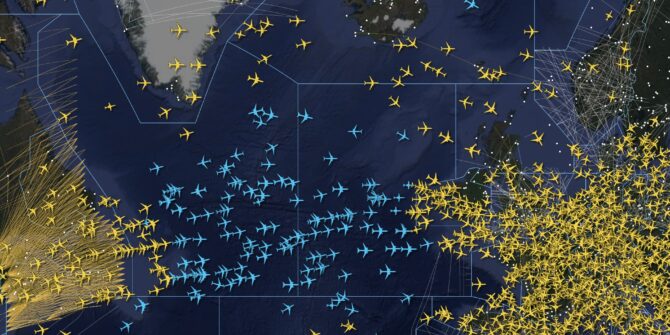
What’s Changing on the North Atlantic?

Update Jan 2026

If you’re crossing the NAT in mid-January, expect a temporary change to how OTS tracks are built.

From Jan 12-25, Gander and Shanwick will include half-degree coordinates in some daily tracks to test whether operators can reliably file and fly them.

Nothing else changes: you still plan the NAT the same way and PBCS tracks stay labelled as normal. The goal is to see if wider use of half-degree points can give more flexibility in OTS design and free up more random-route airspace. Make sure your flight planning system and FMS handle half-degree coordinates properly, and check this doc for more info.

Update Nov 2025

There’s a special ICAO group called the NAT SPG – the North Atlantic Systems Planning Group. They meet once a year to decide what’s next for the North Atlantic, and then publish a big summary of what was agreed. It’s one of the few places you can actually see what changes are being planned before they hit the real world.

Their latest meeting was in Paris in June 2025, and here’s what’s coming that will actually matter to operators crossing the NAT…

RCL messages are on the way out

Iceland and Gander both intend to discontinue the RCL (Request Clearance) message as soon as possible.

The NAT SPG report mentioned possible timelines from late 2025, but when we contacted both ANSPs they said no firm dates have been set yet. Other NAT centres haven’t announced plans to follow, so expect mixed procedures for some time.

This is the next big step in the ongoing Oceanic Clearance Removal rollout, aimed at simplifying procedures and cutting down on confusion.

OCR still needs work

The Oceanic Clearance Removal (OCR) rollout in 2024 caused more trouble than expected. Crews struggled with CPDLC message formats, leading to route errors, incorrect clearances, and heavy ATC workload.

The NAT SPG wants ICAO to remind States to tighten up crew training and operator procedures for OCR. Iceland and Gander are taking the next step by planning to drop the RCL message altogether, which should help simplify things once everyone is ready!

For the absolute latest on where we are right now with the whole OCR/RCL thing, and what crews need to do, check here ⬇️

GNSS interference now a serious NAT issue

Reports of GNSS jamming and spoofing keep rising, and some aircraft still can’t recover once affected.

The NAT SPG wants more crew training and better tools for ATC to spot and manage affected flights. We’ve already had a NAT Ops Bulletin from ICAO on this – if you missed it, we covered what to do if spoofed before the NAT.

Key takeaway: if your aircraft experiences any kind of GPS interference, you must tell the first NAT ANSP in your RCL, even if everything seems to have recovered.

For our full article on what to do if spoofed/jammed before entering the NAT, check here ⬇️

Possible end of HLA approval requirement

Iceland has reviewed the old MNPS/HLA approval system and says it may no longer be needed.

The reason: the navigation performance standards that used to be covered by an HLA approval are now built into other rules (mainly the modern PBN requirements for RNP 10 or RNP 4 operations). In other words, if an aircraft already meets current NAT HLA standards, the separate “HLA approval” adds little value.

Iceland plans to complete a safety assessment on removing the HLA approval requirement and present it to the NAT Safety Oversight Group (SOG) in Dec 2025 (that’s the NAT team that reviews safety cases before any major change goes live). The UK, US, and Spain have said they’d prefer to keep the approval requirement for now, so this is still very much under discussion rather than a confirmed change.

Safety models might be getting an upgrade

A semi-interesting one. So the NAT’s current collision risk figures look worse than reality because they use 1960s-era maths. New modelling is coming that reflects today’s surveillance environment, which should better represent actual safety levels.

It won’t change anything for crews right now, but it sets the stage for the future – once the numbers catch up with reality, we could possibly see tighter spacing or more flexible routing across the ocean.

Commercial space launches are still disrupting routes

Rocket launches are becoming a regular headache, forcing reroutes and last-minute airspace closures.

The NAT SPG is planning a workshop in late 2025 or early 2026 to develop a common approach, since there’s still no global standard on coordination or cost recovery.

Document updates inbound…

Hooray! Everyone loves document updates!

NAT Doc 007 (Operations and Airspace Manual) and NAT Doc 003 (HF Management Guidance) will both be updated soon to reflect current procedures and OCR changes – plus probably a bunch of other stuff, who knows…

In previous years this has normally happened every March, but sometimes we get a cheeky update in Jan or Feb – so stay tuned!

ADS-B now mandatory everywhere in Iceland

Here’s one that’s not actually in the NAT SPG report, but still worth mentioning! As of 1 July 2025, Iceland made ADS-B mandatory for all IFR flights in the BIRD/Reykjavik FIR. 

So now the NAT datalink/ADS-B rules look something like this:

The rule applies to every aircraft flying IFR, at any altitude. Exemptions include flights to maintenance, export deliveries, or aircraft that will retire by 31 Oct 2025. If your ADS-B system fails, you can still operate for up to three days while it’s being repaired. You can check AIC 1-2025 for more info.

Give me ALL the NAT updates in one place!

Sure thing, friendo. For a nice/concise timeline of NAT changes stretching back to the dawn of time, check here ⬇️

And barring any more North Atlantic related changes in the next couple of months, we’ll see all you NAT addicts again in 2026!


GAR Procedure for UK Flights

Update Jan 2026

The UK’s Electronic Travel Authorisation (ETA) scheme enters full enforcement on 25 Feb 2026. From this date, when submitting a General Aviation Report (GAR), all pax must hold valid permission to travel, either a UK/Irish passport, valid visa, or a valid ETA. GAR submissions may now return a “No Record of Valid Permission to Travel” response if this requirement isn’t met. There are some crew exemptions, but these are complicated so review the latest UK Home Office FAQ for details. Ensure all documentation is checked in advance to avoid delays or denied entry, and remember the fine for a GAR screw up is hefty and falls onto the PIC!

Update Sep 2025

Since April 2024, there have been major changes to the UK’s General Aviation Report (GAR) submission for international flights. Here’s a reminder of what you need to know.

  • The GAR form is now required for departures (not just arrivals).
  • You have to submit it via an online portal, or through a third-party app (no longer directly to UK Border Force via email).
  • If you get it wrong, you can now get fined up to £10,000 (there were no fines before). These apply to both the operator AND the captain.

These rules apply to all international flights arriving/departing the UK (including within the Common Travel Area: Ireland, the Isle of Man and the Channel Islands). Details on how the rules work within the CTA are explained below.

You can read the rules in full on the UK Government website, but here’s a summary of the main points:

How to submit the GAR

You need to submit info online about the flight and crew/pax, no earlier than 48 hours and no later than 2 hours prior to the expected time of departure. There are 3 ways to do this:

1. The government’s free-to-use online portal.
Alternatively, you can download this GAR template (Excel doc), complete it electronically and upload it to the portal.

2. Approved third-party applications: Rocket Route, OnlineGAR

3. Direct connections: FB01, Streamlane, Mobile-Edge, PnrGo

More info on the UK government site here.

After you submit the GAR, you should get a response telling you whether that crew/pax is allowed to travel. It will be one of the following (thanks to our friends at FlyingInIreland for this table):

Response Message Action
Valid permission to travel The Home Office can find a valid permission to travel for the person. Pilots, operators and agents are not required to check visas, but Passport or Travel Document checks still apply. They must check that the passport or travel document presented is genuine and valid, and that the person is the rightful holder.

For more information on checking passports and travel documents click here Guidance on examining identity documents (publishing.service.gov.uk)

Authority to carry granted Pilots, operators and agents are required to check visas for Visa Nationals. Passport or Travel Document checks apply for all passengers. They must check that the passport or travel document presented is genuine and valid and that the person is the rightful holder.

For more information on checking passports and travel documents click here Guidance on examining identity documents (publishing.service.gov.uk) Follow this link to check visa requirements Check if you need a UK visa – GOV.UK (www.gov.uk)

Authority to carry refused. DO NOT BOARD. This response message will not be displayed on the screen. Pilots, operators and agents will be instructed not to board an individual (NO BOARD) via a call and email when Authority to Carry (ATC) has been refused.

Because fines apply if the GAR is submitted incorrectly, many handling agents may no longer be willing to do it on your behalf.

If you’re not already using a third-party application, the safest option is to set up an online account and handle the submission yourself.

Common Travel Area flights (Ireland, Channel Islands, Isle of Man, Northern Ireland)

Flying within the CTA is where GAR rules can catch people out. On top of the standard UK GAR, there are two extra layers to watch.

First, some destinations have their own local GAR forms. The Channel Islands (EGJJ/Jersey, EGJBGuernsey) require local GARs inbound and outbound, and the Isle of Man/EGNS has its own form too. Requirements can vary, so best practice is to confirm with your local handler. Opsgroup member report: At EGJJ/Jersey, Border Force has at times required full residential addresses for crew and pax, and commercial operators also need local permits separate from UK CAA permits.

Second, the 12-hour police rule. If you are flying to or from the CTA and using a UK aerodrome that is not police-designated, extra steps apply. For private flights, you need to notify the local police at least 12 hours in advance. For commercial flights, it’s stricter: you must obtain prior police approval before operating from a non-designated aerodrome. Opsgroup member report: A flight originally planned from EGKB/Biggin Hill to EGJJ/Jersey made a last-minute stop in EGTK/Oxford. Because Oxford is not police-designated, the 12-hour rule kicked in. The crew had filed a GAR only a few hours before departure, so Border Police enforced the rule and the jet was stuck in Oxford overnight.

For Northern Ireland, the designated ports are EGAC/Belfast City, EGAA/Belfast Intl, and EGAE/City of Derry. If you use any other airport, you must notify the local police at least 12 hrs in advance (GAR@psni.pnn.police.uk).

You can find the full list of police-designated aerodromes in Annex A of the official UK GAR guidance.

Getting it wrong

Again, check the official guidance on this, but here’s what “getting it wrong” basically means:

  • Failing to provide correct info about the flight and people on board.
  • Not submitting it within the required timeframe (no earlier than 48 hours and no later than 2 hours prior to the expected time of departure).
  • Not doing it in the fight format (i.e. through the web portal or via an approved third party).

The big things to know / watch out for:

  • Fines: Getting it wrong could mean a fine for the “owner or agent and captain”. So that means the operator AND captain are subject to enforcement action and fines. These start at £5,000 for first-time offenders (ouch!), subsequent breaches start at £7500, followed by the maximum of £10,000.
  • Errors on the GAR submission: Watch out for incorrect spelling of names, omitting middle names, not using the full names exactly as shown on passports, and incorrect crew assignment (which pilot is the PIC). Anything like this is likely to get you a “warning” from UK Customs on arrival, and potentially a fine if it happens again. Opsgroup member report: At EGPH/Edinburgh, Border Force issued a non-compliance report because a crew member’s middle name was missing from the GAR, even though it appeared on the GenDec. All given names (including middle names) must be included in GAR submissions. When using the GAR portal, enter the middle name(s) in the “Given name(s)” field along with the first name. 
  • Last minute changes: Bad news. If you get an extra passenger last minute, or someone shows up with a different passport than the one you sent on the GAR submission, you have to file a new GAR and then wait 2 hours until you depart. Same applies if you change your arrival airport in the UK. One exception here: if a passenger was provided on the GAR and they do not travel, a new GAR is not required to be submitted.
  • Diverts: If you have to divert due to weather, that’s fine. If this happens, UK Border Force want you to call them if you can, on +44 300 123 2012. Make sure you’re diverting to the alternate listed on your flight plan (should also be an international airport with Customs). If you’re diverting somewhere other than what’s listed on your flight plan (i.e. it’s an emergency), call UK Border Force after you land to explain.
  • Late departures: If the flight will operate on the same day, albeit later, no new GAR submission is required. If a flight is delayed to the next calendar day, a new GAR must be submitted.
  • Early departures: If you depart early headed to the UK, don’t update the GAR! Opsgroup member report: We had a flight to UK that departed 45 mins early, so we thought it wise to update the GAR to correct ETA. This resulted in a UK Customs warning for ‘submitting’ a GAR once flight airborne (8hr leg). We’ve been told that we should not have updated the ETA and it is UK Customs’ responsibility to keep up to date with the ETA.
More info

Check out this page from PnrGo. It has a bunch more info for pilots and operators, including a recent webinar recording plus an extensive Q&A on this topic.


Venezuela & Caribbean Airspace Update

It’s been a busy few days across Venezuelan and Caribbean airspace.

On Jan 3, the US FAA issued a temporary flight ban for US operators in Venezuela’s SVZM/Maiquetia FIR, the TJZS/San Juan and TNCF/Curacao FIRs, plus the TTZP/Piarco FIR west of 57W – which in practice covers the entire eastern Caribbean island chain.

The move followed US airstrikes in Venezuela and was driven by safety-of-flight concerns linked to military activity and misidentification risk.

That prohibition was short-lived. Within hours, the FAA lifted the ban and reverted to advisory Notams, returning to earlier guidance for US operators to exercise caution at all altitudes in the affected FIRs.

While the temporary FAA ban has ended, airspace warnings still remain in place. The US, Canada, EASA and several European states continue to advise avoiding Venezuelan airspace and to exercise caution across the surrounding region.

These sit on top of earlier warnings from late 2025 flagging GPS interference, reduced ATC visibility, and unpredictable traffic. Operators have been reporting these issues for months, with no clear indication they’ve fully gone away.

For several days after Jan 3, departures from parts of the eastern Caribbean were heavily delayed, with aircraft held on the ground due to parking constraints and ATC flow controls. Most of that disruption has now cleared. FAA flow programs are no longer active and the situation at the airports has largely returned to normal. The main exception is TNCM/St Maarten, where ramp congestion continues to limit GA flights through Jan 12 as per the current Notam.

If you’re operating in the area and have updates to share with OPSGROUP members, please email news@ops.group and we’ll update this article as things change.


ReFuelEU: Europe’s new anti-tankering rules explained

Jan 2026 update:

ReFuelEU Aviation now also applies at LSZH/Zurich and LSGG/Geneva. Switzerland isn’t in the EU, but it has chosen to adopt the rules, which means both airports are treated just like Union airports. The official list is attached if you want to double-check. It does look like the Swiss ICAO codes are wrong, but it’s just a typo. Zurich and Geneva are clearly intended and this should be fixed in a future update.

Jan 2025 update:
  • New anti-tankering rules came into force on Jan 1 2025, heavily restricting large commercial operators from tankering fuel into or within Europe.
  • The first annual reporting deadline fell in March 2025, marking the first real compliance test for operators.

There’s a still relatively new framework in Europe called ReFuelEU, and it looks like it’s going to be a real headache for operators.

Since January 2025, the rules have applied to all large commercial operators (those doing 500+ flights from EU airports each year). Over the course of a calendar year, operators must ensure that, on average, 90% of the fuel required for flights departing from a specific EU airport is uplifted at that airport. The reporting is done annually, so it’s about maintaining compliance as a yearly average rather than for each individual flight.

These rules applies to all commercial operators – both EU-based and non-EU-based. Private flights and all non-commercial operations are exempt.

This whole ReFuelEU thing is being run by the EU. They claim it’s part of the general push to “make things more green”. Maybe. Or maybe these anti-tankering rules are actually more to do with the EU getting fed up with big airlines blazing into Europe with their tanks still half-full of the cheap fuel they brought from “home”. European airports, unable to sell as much of their expensive fuel, have been missing out.

But remember – the rules apply to intra-EU flights as well! So it’s not just all those Middle East to Europe flights that are affected. For example, a flight from Bulgaria (cheap fuel) to Germany (expensive fuel) will not be allowed to tanker either.

Politics aside, these new rules are going to be disproportionately tough on bizjet operators with unscheduled, last-minute flights. Whilst one could claim this whole thing might make some sense for airlines, it will make planning extremely tricky for other large non-scheduled commercial operators who don’t necessarily know what they’ll be doing next week, let alone across the entire year! Also, there’s really not so much value on the “make things more green” front either. 777s, A380s and A380s often tanker tonnes of fuel; Citations, Falcons and Gulfstreams – not so much. Then there’s the added complexities with reporting, reduced fuel flexibility, and even potential safety risks if operators start running tighter fuel margins.

Reporting rules for operators

Welcome to hell. We’re not going to dive deep down into this basket of snakes here, but just to give a rough outline of what operators have to do…

1. Prepare an annual report. 

This should include:

  • The yearly aviation fuel required (trip and taxi fuel for all flights departing from a given EU airport).
  • The yearly aviation fuel uplifted at that airport.
  • Any fuel shortfalls below the 90% requirement, with justifications (e.g., safety or other exemptions).

2. Pay to get the report verified.

The verifier will ensure the report is accurate, complete, and compliant with the rules. They will review the operator’s data, including:

  • Fuel uplift records.
  • Supporting docs (e.g. flight logs, fuel invoices, operational flight plans) to justify fuel usage, especially for exemptions.
  • Justifications for exemptions (if applicable). If operators want an exemption, they have to justify it with detailed reasons (e.g. safety concerns, operational difficulties) and provide evidence to the authorities.

Any discrepancies or missing data must be resolved before the report is finalized.

3. Submit the report.

  • After verification, the report has to be submitted to the competent authority of the Member State responsible for the operator, as well as the European Union Aviation Safety Agency (EASA).
  • The report must follow a specific format (specified in Annex II). This includes tables and fields for annual aviation fuel required, fuel uplifted, and justifications for exemptions.

Key dates for reporting.

The reporting period is the calendar year, from January 1 to December 31. So the key dates for this are as follows:

  • January 1 – December 31: Reporting period.
  • (following year) January – March: Verification by an independent verifier, with March 31 submission deadline to competent authorities and EASA.

The first annual report was due by March 31 2025, covering the reporting period from Jan 1 to Dec 31 2024.

What airports in the EU are impacted?

Not all of them!

The rules apply to “Union Airports” that meet certain thresholds – mainly those where pax traffic exceeds 800,000 passengers annually. Smaller airports that do not meet these thresholds are excluded to avoid placing “undue operational and financial burdens” on them.

Also, airports in “Outermost Regions” (e.g. the Azores, Madeira, Canary Islands, and French overseas territories) are generally excluded too, due to their geographic and logistical challenges. These airports can opt-in to the rules if they like though.

The EU publishes and updates an annual list of airports that fall under the scope of these rules. You can access it here.

Other concerns for Business Aviation

The European Business Aviation Association (EBAA) are currently working on presenting some of the issues to the EU. But ultimately, they highlight three big issues:

  1. Lack of flexibility. Business aviation’s dynamic and diverse operations require more flexibility than what the anti-tankering rule allows.
  2. Administrative Burden. Reporting requirements, including detailed fuel data, create significant workload and could divert resources away from safety-critical tasks.
  3. Safety Risks. Increased risks include in-flight fuel emergencies, crew fatigue, missed ATC slots, fueling-related hazards, and more. There are also concerns about compromised fuel quality and strained infrastructure due to increased refueling requirements.

For more info on all this, check the ReFuelEU website. It includes the list of airports affected, plus the official rules in full (Article 5) – check the docs at the bottom of the webpage.


US CBP biometrics: BizAv rollout still unclear

Update Jan 2026

Universal is reporting a clarification from US CBP that the widely cited 26 Dec 2025 date is not an implementation deadline for BizAv operations. (Note: CBP uses the broader term General Aviation, but for the purposes of this article we’re sticking with BizAv!)

Although CBP now has legal authority to collect biometric entry and exit data from non-US citizens, it has not yet defined how this will work for BizAv, and no operational rollout has been announced. Until CBP publishes specific guidance in the Federal Register, BizAv flights will carry on as they did before. Much of the confusion comes from treating the rule’s effective date as if it were an enforcement date – which CBP is now saying it isn’t.

What’s changing

From 26 Dec 2025, a rule took effect that gives CBP legal authority to collect facial biometrics from all non-US passengers and crew entering or exiting the US, across all modes of travel, including BizAv. This is a legal change, not an operational one. The rule removes previous limitations on who CBP may collect biometrics from, including exemptions that applied to certain nationalities and categories such as many Canadian nationals and diplomats.

What’s actually new

CBP has collected biometric data on entry for years, and biometric exit already exists for airline flights at many airports. What’s new is the legal scope, not the process. The rule makes biometric entry and exit a nationwide requirement in law for all non-US nationals, regardless of how they travel. For BizAv, the unresolved issue is how this will be applied in practice, particularly on departure, where biometric exit has not previously been routine.

Airport reality and BizAv impact

OPSGROUP members report that there’s no single way biometrics are handled today. Sometimes CBP clears passengers onboard using a mobile device, sometimes everyone goes into the CBP office, and sometimes it depends entirely on the officer. With no BizAv guidance published yet, that variability isn’t likely to go away any time soon.

What operators should do now

For now, don’t treat 26 Dec 2025 as an enforcement deadline for BizAv. No immediate operational changes are required. Continue normal CBP arrival and departure procedures as before!

Separate proposal: ESTA changes under review

CBP has published a separate proposal to significantly change how the ESTA works for non US travellers. These changes are not final and are open for public comment until 9 Feb 2026. You can check the official proposal here, and send an email to CBP_PRA@cbp.dhs.gov if you want to submit any comments.

If adopted, ESTA would become far more app based and data heavy. Proposals include a mobile app only ESTA, mandatory live selfies, and a big expansion in the personal info travellers must provide. That includes several years of social media history, along with phone numbers, emails, and family and business contacts. Yes, they really want the socials!

There is also a proposal to let travellers confirm their departure via a CBP app using a selfie and location data. That would help CBP close long standing exit gaps, but it sounds like it wouldn’t remove any existing operator admin.

Bottom line, these are proposals, not requirements. If adopted, ESTA would push more work onto pax and add more ways for trips to get stuck before departure! Expect more chasing pax for app downloads, selfies, and old social accounts. Yay! 😁


Milan targets business jets with 650% rate increase

Jan 2026 update:

Effective 1 Jan 2026, Milan parking fees have been cut back after the sharp increases introduced in July 2025. But rates are still well above 2024 levels, especially for longer BizAv stays at both LIML/Linate and LIMC/Malpensa.

The first two hours remain free, but after that costs add up quickly. Under the new Jan 2026 rates, parking a 50-ton aircraft for more than 72 hours now runs at around €1,000 per day at Linate and roughly €600 per day at Malpensa. That’s down from the 2025 peak, but still several times higher than pre-2025 pricing – don’t be fooled, Milan parking is not “cheap” again!

You can check out the new rates here.

July 2025 update:
  • Milan’s LIML/Linate and LIMC/Malpensa airports have hiked Business Aviation parking rates by up to 650%, effective 1 July 2025.
  • The changes apply to both private and commercial flights, and were published without prior notice.
  • A large business jet crew reports pays nearly €29,000 for three weeks on the ground – previously around €6,800.

Without warning, Milan’s airport authorities have slapped a massive increase on General Aviation parking fees at LIML/Linate and LIMC/Malpensa – a change that’s already catching operators off guard and racking up huge costs.

One OPSGROUP member told us their aircraft, parked at Linate for a three-week stay, saw the bill shoot up from a previously quoted €6,800 to nearly €29,000, following the new rate introduction on July 1.

Local handlers confirm the price hike. One local FBO outlined the new pricing structure, which now uses a tiered pricing model based on duration, with rates charged per ton per hour:

Linate (LIML):

  • 0–24h: €0.57 / ton / hr
  • 24–72h: €0.80 / ton / hr
  • Over 72h: €1.09 / ton / hr
    (Old rate: €0.15)

Malpensa (LIMC):

  • 0–24h: €0.44 / ton / hr
  • 24–72h: €0.52 / ton / hr
  • Over 72h: €0.77 / ton / hr
    (Old rate: €0.13)

The first two hours are still free, but that’s about the only mercy left in this new setup.

This means parking a 50-ton aircraft at Linate for more than 72 hours now costs €1300 per day – a whopping 650% increase from the old rate. At Malpensa, the impact is slightly less brutal but still substantial, with costs up nearly 500% in some cases.

The airport authority has offered absolutely nothing in the way of explanation, but handlers suspect the move is part of a strategy to discourage long-term “empty leg” parking and reserve space for active operations. No consultation, no warning – just a new tariff sheet published in July and backdated to take effect immediately. (You can see the old tariffs from 2024 here).

Some large operators are already lodging complaints. Whether those efforts will gain traction remains to be seen. In the meantime, if you’re flying into Milan for anything longer than a fuel stop, you might want to seriously reconsider!

Also watch out for landing fees

Both LIML/Linate and LIMC/Malpensa charge higher landing fees for non-AOC flights.

Commercial flights (Part 135) get the standard rate, while private flights (Part 91) pay about 1.5–2× more for the same landing and take-off. The gap grows with aircraft size – large jets can see several thousand euros extra per stop.

Be clear about your flight type when booking handling and have your AOC ready if you have one!

Other airports to consider in the region

LIMP/Parma

Parma is a bizjet-friendly airport with a 2,100m (6,900ft) runway, a dedicated GA apron, no slot restrictions, and full handling support – so this can be a pretty decent alternative to Milan’s airports if they have the space.

You can check the parking costs at Parma here. Parking is charged at €0.60 per hour per ton of MTOW, starting from the third hour, with the first two hours free. So a 50-ton aircraft parked for 24 hours would pay €660, which is similar to the cost at Linate, but the key difference here is that the rate stays flat for longer stays!

LIPO/Brescia

Brescia is another decent option, with a 2,990m (9,800ft) runway, dedicated GA facilities, and no slot restrictions.

Charges are published here. Parking is charged at €0.07 per hour per ton of MTOW, starting from the third hour, with the first two hours free. If our calculations are correct, that means a 50-ton aircraft parked for 24 hours would pay just €77 – making it one of the most affordable options in the region.

LIME/Bergamo

Bergamo has a 2,990m (9,800ft) runway, full GA handling, no slot restrictions, and is the closest of the three alternatives to Milan—just about an hour’s drive from the city centre—so you might even be able to drop your passengers here directly, rather than using LIML/LIMC and repositioning elsewhere for parking.

Charges are published here. Parking is charged at €0.17 per hour per ton of MTOW, with the first two hours free. So that means a 50-ton aircraft parked for 24 hours would pay €187 – still significantly cheaper than Milan’s new rates.


2025 Flight Ops Changes: The Big Ones

Another year, another wave of changes across international flight operations. Here are some of the key ones from 2025…

January

  • Cuba overflights still aren’t free: Some Cuban overwater routes don’t need a permit, but NAV fees still apply. Miss them and you may get blocked later. Read
  • Palm Beach TFRs are back: With Trump back in office, TFRs around KPBI/Palm Beach will be frequent again. Expect TSA screening and gateway airport rules. Read
  • New NAT GPS guidance published: A new NAT Ops Bulletin explains what to do after GPS jamming or spoofing. Tell ATC early in your RCL. Read
  • NAT fire diversion planning needs care: Not all alternates have strong fire cover or night ops. Some even need advance payment. Read
  • Mexico paperwork rules tighten again: Some airports now demand original AIU documents from your first Mexico entry. Copies may not be accepted. Read
  • Antigua nav fees move online: Low-level flights below FL245 now use a new site to pay nav fees. Mainly affects TKPK/St Kitts ops. Read
  • UK ETA expands further: From Jan 8, most non-European visa-exempt passengers need a UK ETA. Crew are exempt. Read
  • EASA warns against western Russia: After a shootdown near URMG/Grozny, EASA flagged high misidentification risk from air defence systems. Read
  • EU anti-tankering rules arrive: New ReFuelEU rules restrict tankering for large commercial operators and add heavy reporting duties. Read
  • Iceland joins Eurocontrol: All flights into Icelandic airspace now need Eurocontrol IFPS validation. Watch for rejects. Read
  • Israel updates entry rules: ETA is now mandatory for visa-exempt passengers, plus a new approved airport list for the LLLL/Tel Aviv FIR. Read

February

  • EASA flags bad SAF risk: EASA warned about out-of-spec sustainable fuel entering the market. Double-check suppliers and be cautious with new ones. Read
  • UK warns naughty charter operators: Flying charter to the UK without a Foreign Carrier Permit can lead to bans and big penalties. Calling it “private” won’t help. Read
  • Myanmar airspace warning updated: New guidance for the VYYF/Yangon FIR advises staying at or above FL260, with limited alternates due to ongoing conflict. Read
  • Qatar moves permits online: From Feb 20, all Qatar landing and overflight permits must go through the new CAA portal. Email is out. Read
  • Saudi crew visas get easier: Some BizAv crew are now being issued six-month multiple-entry visas instead of the old 72-hour limit. Read
  • New FAA LOA guide available: A fresh, practical guide explains how to get FAA LOAs approved. Free for OPSGROUP members. Read

March

  • Blue Spruce Routes officially disappear: A new ICAO NAT Doc 007 took effect on Mar 20, removing the Blue Spruce Routes. You can still cross the North Atlantic, but what you can file now depends on your aircraft equipage. Read
  • False TCAS alerts raise eyebrows: False alerts near KDCA/Washington sparked fresh debate about TCAS and cyber resilience. Read
  • Mexico shuts 1,500 smaller airports: Over 1,500 private use airports are now restricted to owners only. Major AIP airports are unaffected. Read
  • ADC numbers are a must in South Asia: Flying through ADIZ airspace in India, Pakistan, Bangladesh, Myanmar, or Nepal? No ADC number can mean delays or denied entry. Read
  • Europe approves ACAS Xa: Europe now allows ACAS Xa alongside ACAS II for larger aircraft. Another step toward next-gen collision avoidance. Read
  • EASA brings in ground handling safety rules: EASA has rolled out its first ground handling safety rules. Handlers have three years to comply, with new training and safety systems coming in. Aircraft safety still stays with the operator. Read
  • France’s higher passenger tax goes live: The new tax started Mar 1. Private flights are exempt, but commercial operators need to plan for it, including overseas territories. Read
  • France tightens CPDLC access: Most French airspace now requires Logon List registration to get CPDLC. Read
  • China opens an English AIP portal: China quietly launched a useful English AIP portal with routes and Notams. Read
  • Singapore eyes stricter rules for foreign AOCs: Singapore plans to expand permit rules to include ferry flights and add higher penalties. Foreign AOC holders should get ahead of it. Read

April

  • Mali and Algeria impose airspace bans: Reciprocal bans between Mali and Algeria are forcing longer routings across parts of Africa. Read
  • FAA tackles mixed traffic collision risk: The FAA is tightening rules where helicopters and airplanes share busy airspace, including Washington, Las Vegas, LA, and the Gulf Coast. More changes are coming. Read
  • US special event fees are here to stay: Temporary FBO surcharges around major US events are no longer rare surprises. With fees popping up more often and further ahead of time, they have become a real planning cost for many US destinations. Read
  • US visa and ESTA rules reinforced: Only Visa Waiver Program signatory operators can carry ESTA passengers into the US. If not, visas are required. Read
  • Brazil brings back visas for some visitors: US, Canadian, and Australian citizens now need a visa to enter Brazil. Crew exemptions exist. Read
  • Mexico customs rules get trickier: New checks on pills, vapes, and electronics are catching crews out at Mexican customs. Read
  • UK ETA expands to Europe: From Apr 2, most European visitors will need a UK ETA. Crew are exempt, but passengers must have approval before flying. Read
  • Hong Kong adds mandatory BizAv APIS: From Apr 29, all BizAv flights to VHHH/Hong Kong must file APIS for crew and pax, including transit passengers. Operators must file themselves. Read
  • Thailand goes digital for arrivals: From May 1, non-Thai arrivals must submit the Thailand Digital Arrival Card online. Crew likely included. Read

May

  • US tightens dog import rules: New US requirements now apply for importing dogs, including vet certificates and air waybills. Missing paperwork can stop entry. Read
  • Visual approaches get a safety warning: A new FAA alert reminds crews that visual approaches can reduce safety margins in busy airspace. Saying “unable” earlier is sometimes the safer call. Read
  • India and Pakistan extend airspace bans: Both countries prolonged their reciprocal bans. Border areas remain sensitive, with advice to avoid parts of the region below FL260. Read
  • Saudi Arabia allows domestic charter flights: Saudi Arabia lifted cabotage restrictions, opening the door to approved domestic charter legs. Read
  • Fuel limits affect flights to Israel: Turkish airports are no longer fuelling aircraft heading to Israel, adding routing and fuel planning constraints. Read
  • Europe updates lost comms procedures: New SERA rules for lost comms, emergency descents, and transponder codes apply across Europe from May 1. Read
  • Le Bourget enforces APU limits: Strict APU time limits at LFPB/Le Bourget are now actively enforced, with fines possible. Read

June

  • FAA requires a US address for foreign licence holders: Foreign FAA certificate holders must now list a US physical address. Read
  • Lithium battery fire risk keeps climbing: Incidents involving vapes, power banks and laptops continue to rise. New FAA and EASA alerts confirm this is now a standing cabin safety issue for BizAv. Read
  • Congo DRC airspace risk remains localized but serious: Canada narrowed its warning for the FZZA/Kinshasa FIR to eastern regions, advising flight at or above FL260 due to anti-aircraft fire risk. Read
  • South Africa mandates ADS-B: From Jun 12, ADS-B is required in RVSM and Class A airspace. No exemptions published. Read
  • Sydney BizAv fees rise: Sydney rolled out higher BizAv charges across parking, runway and ground services. Some free parking time remains, but costs climb fast. Read

July

  • Blue Spruce Routes are gone, but crossings are still possible: The Blue Spruce Routes were removed in March, but operators without full equipage still have ways to cross the North Atlantic. What you can file depends on what is on board. Read
  • FAA updates its oceanic guides: The FAA refreshed its guidance for the North Atlantic, Pacific, and WAT airspace, reflecting how oceanic ops are now being flown. Read
  • US eAPIS now supports border overflight exemptions: Operators can now apply for and renew US border overflight exemptions via eAPIS, with faster and more predictable processing. Read
  • More bizjets qualify for US domestic CPDLC: The FAA expanded its CPDLC list, bringing more business jet types into domestic datacom and PDC availability. Read
  • FAA cleans up charts and foreign procedure approvals: The FAA is removing clutter from approach charts and stepping back from approving foreign instrument procedures. Operators need to rely more on local state data. Read
  • Afghanistan overflight rules extended: The FAA extended Afghanistan overflight rules to Jul 2028, allowing US operators to overfly at high levels while highlighting ongoing risk. Read
  • China tightens power bank rules: China banned uncertified power banks on domestic flights, with possible knock on effects for departures. Read
  • Ceasefire eases tensions on the Cambodia-Thailand border: A ceasefire began on Jul 28 after days of fighting. Read
  • West Africa routing options keep shrinking: Closures, bans, and conflict zones are making routings into West Africa longer and more complex. Read
  • South Africa permits remain a moving target: Any change to a South Africa permit now requires full revalidation, often taking days. Confusion over rules continues to delay flights. Read
  • Cape Verde permits required despite AIP wording: Cape Verde requires permits for all overflights and landings, even though the AIP suggests otherwise. Read
  • Germany sneaky bizjet checks continue: Unannounced security checks on bizjets are still happening in Germany. Read
  • Heat and APU limits raise risk at Nice: Reports from LFMN/Nice link summer heat, strict APU limits, and weak GPUs to aircraft damage and electrical issues. Read
  • Milan ramps up fees for business jets: Private flights at LIML/Linate and LIMC/Malpensa are seeing steep increases in landing and parking fees, in some cases by hundreds of percent. Read

August

  • Cuba remains off limits for most private jets: Most private flights still cannot operate to Cuba. Any US registered aircraft needs a license that is rarely granted, and commercial ops face strict OFAC exposure tied to US people and payments. Read
  • US CBP updates add cost and admin friction: CBP rolled out new rules for Border Overflight Exemptions and small fee increases from Oct 1. Nothing dramatic, but it all adds up. Read
  • EU commercial ops still need a TCO: Commercial flights into the EU require a Third Country Operator approval. It is free and straightforward, but needs to be sorted early. Read
  • LFPM offers a calmer way into Paris: LFPM/Villaroche offers 24/7 ops with fewer restrictions than Le Bourget. It is Schengen only, but can be a smooth option for the right trip. Read
  • Phnom Penh switches to a new airport: VDTI/Techo opens on Sep 9, replacing VDPP/Phnom Penh for civil traffic. A permanent change for Cambodia operations. Read
  • Thailand adds another compliance trap for charters: Commercial charter operators flying regularly or staying over a month in Thailand now need a Foreign Aircraft Operator Security Programme. Miss it and permits can stall. Read
  • South Korea launches overnight CPDLC: From Sep 3, optional CPDLC is available above FL160 during overnight hours for non urgent messages. Correct equipage and flight plan coding are required. Read
  • Cybersecurity is now a real flight ops risk: BizAv is no longer flying under the radar. From hacked EFBs to leaked data, Part 91 and 135 operators are real targets and should treat cyber risk as an ops issue. Read
  • BizAv safety lessons go practical: The 2025 Nimbl safety report turns real BizAv reports into practical lessons on handling, approaches, fatigue, and GPS interference. Read

September

  • Russia sanctions remain a hard operational barrier: Overflights remain off limits for most operators, with rules differing between the EU, UK, and US. Expect ongoing paperwork and no quick easing. Read
  • Eastern Europe spillover risk continues to grow: Russian drones and aircraft have violated airspace over Poland, Romania, and Estonia, triggering NATO intercepts. Read
  • US aircraft trash rules keep catching operators out: Some US CBP ports still treat arrivals from Canada as regulated trash flights, even though Canada is exempt. Local interpretation varies, so check port requirements in advance to avoid fines. Read
  • Mexico introduces double APIS submission: From Sep 17, flights to Mexico must submit APIS twice, before departure and again after doors close. Easy to miss and still catching crews out. Read
  • UK GAR rules clarified: No GAR is needed for domestic UK flights, but trips to the Channel Islands or the Isle of Man still need both a UK GAR and a local one. Read
  • Qatar simplifies northern FIR overflights: The northern Doha FIR now requires a flight notification instead of a permit, while the southern FIR still needs a permit. A lasting change for routine routings. Read
  • Balloon and kite hazards return at Sao Paulo: Crews reported balloon and kite strings on landing gear at SBGR/Sao Paulo, with objects seen as high as FL150. A real hazard despite no Notams or ATIS warnings. Read

October

  • Europe’s datalink rules become a hard filing requirement: From Nov 4 2025, IFPS will reject flight plans above FL285 if CPDLC is not filed correctly. Read
  • Europe’s EU-LISA Entry Exit System starts going live: The EU Entry Exit System is rolling out now, with full expansion through Apr 2026. New checks and registrations are coming for commercial flights, with ETIAS next. Read
  • EASA keeps Middle East airspace risk guidance locked away: EASA has extended its Israel and Iran airspace Information Notes to end Jan 2026, with no change in content. The guidance remains non-public, covering the LLLL/Tel Aviv FIR and nearby airspace, and the entire OIIX/Tehran FIR. For non EU operators, official risk guidance stays hard to access, while N-reg aircraft remain banned from Iranian airspace. Read
  • EASA warns crews about QNH errors: After a near miss linked to incorrect QNH, EASA reminded crews how easy it is to end up low on final. Simple altimeter cross checks still matter. Read
  • Haiti airspace warning extended into 2026: The FAA extended its Haiti warning through Mar 2026. Restrictions remain below 10,000 ft near MTPP/Port au Prince due to ongoing security risks. This remains a planning constraint. Read
  • North Atlantic crews face extra checks after GPS interference: GPS spoofing and jamming continue to affect NAT flights. If you have GNSS issues before entry, Shanwick wants to know early. Include it in your RCL to avoid delays or reroutes. Read
  • US tightens rules on where crew visas are issued: Crew must now apply for US visas in their home country or country of residence, not third countries. This may affect renewal timelines. Read
  • Toronto tightens BizAv slot tolerance: From Oct 21, CYYZ/Toronto requires slots via the Global OCS Portal and cuts tolerance to plus or minus 30 minutes. Register early if you are not set up. Read
  • Saudi Arabia introduces optional CPDLC: From Oct 2, optional CPDLC is available above FL290 in the OEJD/Jeddah FIR for FANS 1/A aircraft. Voice remains required for urgent traffic. Read
  • Uzbekistan updates ICAO codes and transition levels: Uzbekistan has switched from UT to UZ ICAO codes and raised the transition altitude to 13,000 ft or FL150. The change simplifies cross border ops and better aligns with neighbours. Read
  • Pilot age limits clarified: A new guide confirms the basics. Commercial international flying stops at 65, private flying does not. Country specific rules still matter and can catch crews out. Read

November

  • Sudan risk remains: After an aircraft was reportedly shot down, Sudan’s airspace remains closed and nearby routings rely on narrow contingencies. Extra caution is needed when flying near Northeast Africa. Read
  • Somalia permit confusion continues in the north: Conflicting instructions between Somalia and Somaliland continue near HCSM/Mogadishu FIR. Read
  • GPS interference near Delhi triggers new reporting steps: After spoofing events near VIDP/Delhi, authorities introduced a new pilot reporting procedure. Crews should expect continued GNSS issues and follow the updated process. Read
  • North Atlantic procedures keep evolving: Iceland and Gander plan to drop RCL messages, GNSS interference reports are increasing, and the old HLA approval concept may be phased out. NAT planning continues to move away from legacy processes. Read
  • FAA restores BizAv access after US shutdown: On Nov 17, the FAA lifted flight reduction limits and cancelled Notams that had blocked bizjets at 12 major US airports. BizAv access is open again. Read
  • Paper Jepp charts head for retirement: Jeppesen confirmed that paper charts will be retired by Oct next year. Operators still using paper will need to complete the shift to digital and make sure compliance and crew readiness are covered. Read
  • UK GAR moves to One Login: The UK GAR site now uses One Login and old accounts no longer work. Operators need to set up new access and recheck their data before filing. Read
  • New runway opens at OKKK/Kuwait: Runway 16/34 is now open, with SID changes and a new Ground West frequency. Crews report runway confusion at night, so confirm assignments carefully. Read
  • Tahiti BizAv access is more restricted than it looks: Peak hour limits and alternate constraints mean Tahiti requires careful timing and backup planning. It is not a simple H24 stop. Read

December (and beyond!)

  • Airport incursions become a real European disruption risk: Drones and balloons have already forced airport closures and diversions across Europe Read
  • Venezuela best avoided: The FAA advisory still stands and the SVZM/Maiquetia FIR remains unstable and best avoided. Read
  • UK ETA checks move toward full enforcement: From Feb 25 2026, UK GAR submissions will actively check passenger permission to travel. Missing ETA or visas can trigger a “No Record” response. Read
  • UK confirms higher Air Passenger Duty for BizAv: From Apr 2027, higher APD will apply to business jets from 5.7 tonnes. On long haul flights, the cost per passenger will be significant. This is a future cost to plan for now. Read
  • Biometric border controls become mandatory for all non-US citizens: From Dec 26, facial biometric scanning is required for all non US citizens entering or leaving the US, including private aircraft. Most exemptions are being removed and refusal may mean denied boarding or entry. This is now standard US ops compliance. Read
  • US Special Event Fees stretch into 2026: The updated Special Event Fees Tracker shows FBO surcharges already published well into 2025 and 2026. These fees are now a regular planning cost, not a surprise. Read
  • Greenland keeps changing the NAT alternate picture: BGSF/Sondrestrom remains fully controlled, BGGH/Nuuk is upgraded but still restricted for BizAv, and BGBW/Narsarsuaq is heading toward closure. Greenland alternates remain a moving target. Read
  • NAT trials half degree coordinates on daily tracks: In mid January, some OTS tracks will use half degree coordinates. Planning stays the same, but it is another step toward more flexible NAT routing. Make sure your systems handle half degree points correctly. Read
  • Seletar reinforces VFR arrival discipline: After a runway misalignment incident, new guidance reinforces strict VFR arrivals at WSSL/Seletar. Visual GPS aids and strong situational awareness are now essential. Read
  • Uzbekistan opens a new BizAv tech stop: UZTP/Vostochny is now operational near UZTT/Tashkent with a long runway and full services. It is expected to take over most BizAv traffic and becomes a solid new Europe Asia tech stop. Read
  • South Pacific crossings demand serious prep: Flights between Australia and South America mean long legs, limited alternates and thin island support. Crews report this is a route where preparation really matters. Read

As the year wraps up, a huge thank you to everyone in OPSGROUP for being part of it, for sharing insights, experiences, and real-world stories, and for helping keep the whole community informed and safer throughout the year.

We’ll be taking a short break from the Daily Brief and Weekly Bulletin emails over the holidays. Our last day in the office will be Monday 22nd Dec, and we’ll be back on Friday 2nd Jan. Until then, happy holidays to all, enjoy the break, and see you in 2026! ❤️⚡✈️🧑‍✈️


Greenland NAT Alternates: Dec 2025 Update

It has been a busy year of change for Greenland’s airports! Here is the current operational picture for the main NAT alternates as of December 2025.

BGSF/Sondrestrom

Plans to downgrade Sondrestrom from ATC to AFIS have been cancelled. In one of the shortest AICs we’ve ever seen, Naviair (Denmark’s ANSP) confirmed that BGSF would remain fully controlled until further notice.

Word from behind the scenes is that it was recently evaluated that ongoing demand for BGSF was solid enough to warrant full ATC.

However, radar service remains unavailable due to equipment issues, with procedural separation expected for the foreseeable future:

A1821/25 NOTAMR A1709/25
Q) BGGL/QCMAS/IV/M /A /000/999/6701N05041W005
A) BGSF B) 2510271014 C) 2601301700 EST
E) BGSF MSSR U/S. RADAR SERVICE UNAVAILABLE.

Other than that, BGSF continues to be a reliable NAT alternate thanks to its long 2800m runway and generally more stable weather conditions.

BGGH/Nuuk

Nuuk has been extensively upgraded with a 2200m runway and precision approaches at both ends. It has been receiving heavy jet traffic for some time and is now well-equipped to serve as a NAT alternate.

However, the BGGH Notams put a lump of coal in your stocking. They say that no PPR or slots will be granted to GA (which GL airports have confirmed includes BizAv) until at least the end of Jan 2026. If you want to list BGGH as an alternate, they say you need to apply for PPR. Sounds like NAT flights needing a Greenland stopover should probably use BGSF/Sondrestrom or BGBW/Narsarsuaq instead.

We asked why, and apparently it was a decision made by the Danish CAA due to concerns over traffic. It’s not the first time Nuuk has struggled a little with its new-found size! Here’s a list of complaints we’ve received from members about BGGH over the past few months:

  • Slot confusion: Slots for BGGH must be requested via GCR to scr@airportcoordination.com, but the system is difficult to navigate – one member misread a rejection, flew anyway, and still found only light traffic despite the airport being considered “full.”
  • Last minute closures: Watch out for Notams which are popping up some days closing the airport for 30-min periods to accommodate specific one-off airline flights.
  • August security screening chaos: International flights were suspended on Aug 27 after Danish authorities halted security screening, citing non-compliant training of local staff. A United flight from Newark turned back mid-route and SAS cancelled services. Screening resumed the following day with certified staff flown in from Denmark.
  • Several other reliability issues: with members reporting unexpected holding, slow fuelling, and ground handling delays despite recent expansion.

BGBW/Narsarsuaq

Narsarsuaq is still scheduled to close in Spring 2026 and will be downgraded to a heliport. Word on the street is May 1, but this may change.

Operationally, Narsarsuaq remains challenging due to non-precision approaches, frequent poor weather, and a short 1800m runway.

New runways at BGQO/Qaqortoq and BGJN/Ilulissat

Both strips are finished, but work continues on lighting and approach systems.

The new BGQO/Qaqortoq airport is on track to open in Spring 2026 with a 1500m runway. This will replace BGBW/Narsarsuaq as the southern airport option, though only for small to medium jets initially.

The new 2200m runway in BGJN/Ilulissat is due to open in Fall 2026.

A reminder about after-hours fees

Look out for surprise fees if you use BGBW/Narsarsuaq or BGSF/Sondrestrom as alternates after hours (overnight 20-11z or anytime on Sundays). You will be charged the better part of $3000 USD to keep standby equipment on watch, and runways clear of snow.

Some insider advice – advance notice reduces the cost. If you need one of these cheaper outside of normal operating hours, provide at least 24 hours’ notice.

A special thanks to our agent in the field

Spare a thought for the unsung hero of this article. The average low in Greenland at this time of year is 12 deg F (- 11 deg C). With wind chill, this can feel like -22 deg F (-30 deg C) or lower.

Apparently, high quality jackets are no joke – as evidenced below. Thank you for your help assembling this article!


Mexico Customs Surprises: Pills, Vapes, and Laptop Rules

Key Points
  • Crew warning: AFAC officials at MMSD asked a crew member to carry unknown pills back to the U.S. – possible setup. Decline, document, and don’t touch.
  • Vapes banned: Mexico officially outlawed vapes in January 2025. A new federal law now criminalises almost any activity involving them, including production, storage or transport for commercial purposes. Penalties can exceed USD 14,000 or result in prison sentences of up to eight years. Since the law does not define what counts as commercial activity, authorities may treat multiple devices as intent to distribute.
  • Device limits: Customs is enforcing a one-laptop/tablet rule per person. Extra devices may be taxed at 19% – no crew exemptions.

Flying to Mexico has always come with a few quirks, but there have been a few notable developments recently that crews should be aware of. Here’s a quick look at some of the latest updates – from strange inspections to unexpected customs issues. Might be worth a heads-up to your team before your next trip south.

The “would you mind taking this bag?” situation

A recent report out of MMSD/San José del Cabo raised eyebrows. After clearing customs and immigration without issue, a crew member was asked to step into the AFAC office. There, officials presented them with a ziplock bag full of prescription pill bottles and asked if they could take it back to the U.S. The crew member wisely declined.

Was it a test? A setup? It’s unclear – but it looked staged, and could easily have ended badly. If something like this happens to you, the advice is simple: stay calm, politely say no, ask for everything in writing, and don’t touch anything you haven’t personally verified. Accepting unknown items could lead to serious legal trouble or even aircraft seizure.

Vapes are banned. Like, officially.

Mexico has not only banned the import and use of vapes. A new federal law now makes almost anything involving them a criminal offence. It covers acquiring them, storing them, transporting them and selling them, and it uses the term “for commercial purposes” without explaining what that actually means. Because the wording is so vague, authorities can interpret it as they see fit. Penalties can reach fines of around USD 14,000 and prison sentences of up to eight years.

This vagueness is the real issue. You may think that bringing a few vapes clearly counts as personal use, but an inspecting officer may reach a different conclusion. There is no defined threshold, so the final judgement is entirely in the hands of the person checking your bags.

The message for passengers and crew is simple: do not bring any vapes to Mexico. Even someone who believes they are carrying only harmless extras can suddenly find themselves facing a much more serious problem.

It is much easier to avoid the situation completely and leave them at home.

That laptop in your flight bag might cost you

Mexico has a long-standing rule that only one laptop or tablet is allowed per person when entering the country. We’ve heard from members that customs officers are starting to enforce this again. One crew reported being stopped at MMSP/La Paz because they had more than one device and were told they’d be charged 19% of the declared value.

And no – aircraft iPads, iPhones or EFBs don’t get special treatment. The rule applies per person, regardless of what the devices are used for. Declaring them as commercial equipment can actually make things worse. So best to split up the gear among the crew and passengers or avoid overpacking the electronics.


If you have been to Mexico recently and have a story to share – please do! Reports like these are super useful for everyone in the group. File an Airport Spy report anonymously here.


Crossing the Quiet South: From Australia to Argentina

Every so often, a question drops into our inbox that reminds us just how big and how quiet parts of the world still are.

Not long ago, someone asked about flying from Australia to the southern tip of Argentina. It’s a trip across one of the most isolated parts of the planet: long stretches of ocean, few places to land, and very little room for error if something changes. There isn’t much written about it, and only a small number of crews have done it.

We checked with the OPSGROUP community and heard back from several operators and trip support teams who have made the crossing. They shared where they routed, where they stopped, and what they learned along the way.

This short guide brings together what we know so far, and we’ll keep adding to it as more of you share your experiences. If you’ve flown anywhere in this region, we’d love to hear from you at team@ops.group.

Few Places to Land

Once you leave Australia and head east across the South Pacific, things get quiet very quickly. It is a huge region with many small nations and islands, but only a few airports have long enough runways and operate around the clock. Many smaller fields have little or no parking, and fuel is not always guaranteed. Communication can also be slow, as email exchanges with local FBOs or authorities often take time, so it helps to plan well ahead.

Finding suitable alternates is another key challenge. Distances between usable airports are long, and ETOPS planning can be complex. Some crews recommend keeping about five degrees of spacing between waypoints to make navigation and decision-making easier. There are also a few US military airfields in the region, such as PGUA/Guam and PKWA/Kwajalein, but these are not open to civilian traffic.

SCIP/Easter Island is the only true mid-ocean option. To the west lies NZAA/Auckland, and to the east SCCI/Punta Arenas marks the entry into South America. Antarctica may look close on a map, but it is not a realistic option because there is no fuel or services, and diversions there are reserved for real emergencies.

Most operators who have crossed the Pacific follow a similar island-hopping route:

YSSY/Sydney → NTAA/Tahiti → SCIP/Easter Island → South America (SADF, SCCI, SUMU)

Trans-polar routing is not practical for most bizjets, so this Polynesian path remains the preferred choice.

Many of the islands that can handle larger bizjets are not open 24 hours and often require slots or PPR. Last-minute diversions are rarely possible, especially in Polynesia. Even the main stops such as NTAA/Tahiti and SCIP/Easter Island can face full airport or runway closures at times. On Easter Island, handling is provided by a single agent with limited services, and cash may be preferred. Other alternates, including NCRG/Rarotonga, have similarly tight hours, so it’s best to check schedules and requirements well in advance.

Fuel shortages are uncommon (except for NCRG/Rarotonga, which has one now and then when the fuel tanker is late to arrive at the island), but arranging fuel releases in advance is always sensible. Permits and visas can also take extra time depending on the country, so it helps to build that into your schedule.

Comms and datalink are generally reliable, although one crew reported a four-hour satellite internet dropout west of Easter Island. Light turbulence can occur in the low 40s, especially during the Southern Hemisphere winter.

Once you reach the mainland, things become much easier. Handling in Chile and Argentina is efficient, fuel is reliable, and services are good. On the islands, operations are simpler but still manageable with good coordination.

How different aircraft made the trip

Several long-range bizjets have flown this route. Here are examples of routings that worked in practice.

Challenger 350

SADF/San Fernando → SCIP/Easter Island → NTAA/Tahiti
NTAA/Tahiti → SCIP/Easter Island → SADF/San Fernando
Possible with careful planning around alternates and timing.

Falcon 7X

SABE/Buenos Aires → SCIP/Easter Island → NZAA/Auckland 
YSSY/Sydney → NTAA/Tahiti → SABE/Buenos Aires
SADF/San Fernando → SCIP/Easter Island → NFFN/Nadi
NFFN/Nadi → SCIP/Easter Island → SADF/San Fernando
A flexible option with enough range to connect Polynesia with South America comfortably.

Global Express

SAVT/Trelew → NFFN/Nadi
Has no trouble with the longer Pacific legs, and Fiji works well as a fuel stop.

Gulfstream G550/G650

YSSY/Sydney → NTAA/Tahiti → SADF/San Fernando, SCCI/Punta Arenas
A straightforward option via Tahiti that keeps legs comfortable.

Airports along the way

A quick look at the key tech-stops, listed east to west, from Australia/New Zealand toward South America.

🇦🇺 YSSY/Sydney – Australia

The airport runs H24, though there is a strict 2300-0600 LT curfew. Handlers can request exceptions, but these are not guaranteed. FBOs can usually arrange CIQ directly on site. Fuel is tanker only, so plan large uplifts in advance. Slots are required. Expect standard Australian disinsection rules and have the empty spray can ready on arrival.

Jet Aviation closed its doors permanently on Nov 30, so ExecuJet is now the only FBO at the field moving forward.

FBO contact: fbo.yssy@execujet.com

🇳🇿 NZAA/Auckland – New Zealand

Another solid H24 tech stop just across the Tasman. The airport stays open all day, with short runway maintenance early on Monday and Saturday from 0130-0430 LT, which sometimes does not appear in Notams. Private flights under Part 91 do not need permits, while charter flights under Part 135 require CAA approval. CIQ operates around the clock, and fuel is available with notice, although last-minute uplifts can be slow during busy hours. New Zealand enforces strict biosecurity, and cabin disinsection is mandatory, but quarantine staff can handle it on arrival if needed.

FBO contact: fbo.nzaa@execujet.com, anz_info.s.e.a@swissport.com

🇫🇯 NFFN/Nadi – Fiji

A smooth 24-hour tech stop and refuel point midway between Polynesia and South America. The airport and customs run H24, fuel and handling are reliable, and turnarounds are quick. Wildlife can be active at dawn and dusk, but otherwise ops are straightforward.

FBO contact: info@fijiairports.com.fj, fbo@ats.com.fj

🇵🇫 NTAA/Tahiti – French Polynesia

The only international airport in French Polynesia and the main South Pacific stop. NTAA runs H24, though through early February non-based BizAv (private and charter flights) face limited operating windows matching airline peaks. Movements in those periods need airport manager approval, and use as a diversion is restricted to locally based or pre-scheduled aircraft.

For example, TASC FBO confirmed full 24/7 support on the north side, including CIQ pre-clearance on arrival. They handle disinsection if needed and provide fuel exclusively under the Petropol ExxonMobil brand. Occasionally, filing flight plans through the ARO can be difficult, so it’s recommended to send the FPL by email to seac-pf-bria-bf@aviation-civile.gouv.fr and wait for confirmation.

Landing permits must be requested by operators via the French Polynesia CAA portal (72 hours for private flights, 14 days for charter). Nearby NTTB/Bora Bora  and NTTR/Raiatea are domestic with limited hours and fuel, making NTAA the only reliable international option in the region.

For details on current NTAA restrictions and seasonal procedures, see our dedicated article here.

FBO contact: nuutea@tascfbo.com, ops.ei@airtahiti.pf, ulric.allard@airtahiti.pf

🇨🇰 NCRG/Rarotonga – Cook Islands

A small but reliable entry point between French Polynesia and South America. ATC hours rotate and are published by Notam, with controllers available on request for diversions at +682 25890 or +682 71439. A landing permit is required about 14 days in advance via the CAA, and CIQ is available anytime by prior arrangement. Most nationalities receive a 30-day visa on arrival. Fuel is supplied by Pacific Energy and currently limited for non-scheduled flights. There are two international stands, and overnight parking requires a towbar.

FBO contact: ross.warwick@airraro.com, savage@airportauthority.gov.ck, nikautangaroa@airportauthority.gov.ck

🇨🇱 SCIP/Easter Island – Chile

A key mid-Pacific stop that works well for fuel and rest but needs careful planning. The airport operates roughly 0900-1700 LT on weekdays with shorter weekend hours. A landing permit is required, and once approved, it also serves as parking authorization. Fuel from WFS must be requested 24 hours in advance, and all arrivals must complete cabin disinsection and show the empty spray can as proof. Instrument approaches are often unavailable by Notam, so be ready for visual arrivals and plan alternates carefully. Parking is very limited, usually one stand overnight, and the single handler provides basic services, often accepting only cash.

FBO contact: punavai949@gmail.com, edmundserviceseirl@gmail.com

🇨🇱 SCCI/Punta Arenas – Chile

A reliable southern mainland stop. The airport operates H24 with full CIQ coverage. Three runways provide flexibility, the main one being RWY 07/25 (2790 m / 9154 ft). Fuel is available, and parking can be arranged but must be requested in advance due to limited capacity. No slot requirement.

FBO contact: fbo@aviasur.com, ygonzalez@aviasur.com

🇨🇱 SCEL/Santiago – Chile

Another entry point into South America with reliable services and straightforward procedures. The airport operates H24 with CIQ available around the clock. Parking for BizAv is generally available, fuel is offered H24, and there are no slot or PPR requirements.

FBO contact: fbo@aviasur.com, psaavedra@aviasur.com

🇦🇷 SABE/Buenos Aires – Argentina

Busy city entry point operating H24 with full CIQ coverage. According to the FBO, ramp parking is limited to about two hours, so hangar space should be arranged in advance. Fuel is available.

FBO contact: comercial@royalclass.global, info@royalclass.com.ar

🇦🇷 SADF/San Fernando – Argentina

The other BizAv option for Buenos Aires. H24 with no slots, customs available, easy parking, and fuel on site. The single runway 05/23 is shorter at 1690 m (5545 ft), but ops are smooth, making it a popular alternative to SABE.

FBO contact: fbo@flyzar.com

🇦🇷 SAVT/Trelew – Argentina

A useful southern stop when routing toward Patagonia or Chile. The airport is open H24 with fuel available, and customs work on request with a 48-hour PPR, so it’s best to plan ahead to make sure everything is ready on arrival.

FBO contact: ops@aerowise.aero

🇺🇾 SUMU/Montevideo – Uruguay

A solid H24 option for tech stops or entry into Uruguay. The airport offers full customs, long runways, and reliable support, though most parking stands have specific wingspan and pushback limits, so it’s best to confirm space in advance. Fuel is available. Note local noise restrictions prohibiting departures over Montevideo between 2100-0700 LT, except for emergencies or weather-related operations.

FBO contact: fbo@fbo.com.uy, ops@aerowise.aero

Flying between Australia and Argentina is very doable, just not the kind of trip you improvise! The distances are huge, the alternates are few, and every good piece of info makes a real difference.

If you’ve been through any of these airports recently, we’d love to hear your story. You can share it with the community by submitting an Airport Spy Report. It’s basically a little postcard about what happened on the ground so the next crew knows what to expect. Your notes help everyone who sets out across the quiet South.


Major runway shutdowns ahead at KVNY/Van Nuys

KVNY/Van Nuys will shut 16R/34L for multiple 80-hour blocks plus recurring night closures through February 2026, so expect serious disruption to operations.

Here’s what’s currently planned:

Those big 80-hour closure blocks are the ones to really watch out for. They start Sundays at 2230 and end Thursdays at 0600 local time, so the runway is effectively unavailable all day Mon/Tue/Wed during those periods. You can check the airport advisories for any changes to these planned times (due to weather), but the easiest place to view them is the calendar on the airport website here.

Based on the Notams available right now, the short runway 16L/34R has no closures planned. But watch out here – it’s only 4000ft long, is limited to a single wheel configuration with a max weight of about 14000 lbs, so it will not be an option for most BizAv aircraft during the closures.

In terms of where else to consider, KBUR/Burbank and KLAX/Los Angeles are likely to be the main two contenders. We checked with the local handlers at both – no closure or restrictions are planned, so these should hopefully stay fully usable during the KVNY closures. Contact deets for both:

KBUR/Burbank
Hollywood Burbank Jet Center: csr@hbjetcenter.com
Atlantic Aviation: burfrontdesk@atlanticaviation.com

KLAX/Los Angeles
Signature Aviation: LAXFBO@signatureaviation.com
Atlantic Aviation: laxfrontdesk@atlanticaviation.com


New FAA Airspace Warnings for Venezuela and Puerto Rico

Key Points
  • The FAA has issued new airspace warnings for both the TJZS/San Juan and SVZM/Maiquetia FIRs, following a sharp rise in state aircraft activity across the southern Caribbean.
  • SVZM is the main concern: the FAA cites a worsening security picture, GPS interference, and increased Venezuelan military mobilisation, including air-defence capability that raises the overflight risk.
  • Airlines have already suspended flights to Venezuela and are routing around the SVZM FIR via Colombia and neighbouring FIRs.
  • Avoid SVZM unless absolutely necessary. The risk level for overflights is higher than usual.
  • TJZS remains open, but expect more state traffic, occasional non-standard ATC coordination, and busier airspace as military activity increases near Puerto Rico.

Puerto Rico: New FAA warning for the TJZS/San Juan FIR

On 18 November, the FAA issued KICZ A0010/25, advising extreme caution at all levels in the TJZS FIR because of an increase in state aircraft operations. They don’t say who these aircraft are, but the language almost always means military traffic that may not be working standard civil ATC.

That matches what’s happening: more US reconnaissance, tanker and transport flights, plus a larger naval presence in nearby waters. The US has also carried out strikes on suspected drug-smuggling boats. Venezuela has publicly objected to the buildup, raising tension across the wider region.

For crews, the key point is that TJZS may now see unpredictable state movements and non-standard ATC interactions.

Venezuela: A much stronger FAA warning

On 21 November, the FAA issued the more serious KICZ A0012/25 for the entire SVZM FIR. It cites a worsening security situation and increased military activity, and requires 72 hours’ advance notice from US operators planning to enter the FIR.

The FAA’s Background Note backs this up: crews have reported GPS interference in the SVZM FIR with effects that can extend 250 nm from the source, and Venezuela has stepped up its military posture with mass mobilisation and air-defence systems that can reach civil levels. There’s also a low-altitude risk from MANPADS. Venezuela isn’t threatening civil aviation, but the overall environment means the risk level for overflights is higher than usual.

Spain and Portugal have also issued their own near-identical warnings for Venezuelan airspace. Both tell crews to avoid the SVZM/Maiquetia FIR until early December. They cite increased military activity, air-defence systems active at all levels, and poor coordination between parties in the area. This matches the FAA’s view and adds two more state recommendations to stay clear of Venezuelan airspace.

Airlines are already pulling back

In the past few days, several airlines have suspended services to Venezuela (the ones we know about so far: Iberia, Air Europa, Plus Ultra, TAP, LATAM, Avianca, GOL, Caribbean Airlines and Turkish Airlines).

It looks like most overflights are now adopting the same strategy: avoid SVZM completely and route via Colombia or neighbouring FIRs, rather than cut across Venezuelan airspace.

Venezuela’s civil aviation authority INAC has announced that it revoked operating permits for six foreign airlines on 26 Nov 2025: Iberia, TAP Air Portugal, Avianca, LATAM Airlines Colombia, Turkish Airlines and GOL. INAC said the decision followed the airlines’ move to suspend their services to and from Venezuela after recent air safety alerts issued by the US and Spain. IATA has urged the Venezuelan authorities to reconsider the move.

Why all this is happening

The FAA hasn’t given a detailed explanation, but recent US military activity in the region gives plenty of context. Public reporting shows:

  • The USS Gerald R. Ford carrier group and several destroyers off northern South America.
  • USAF heavy bomber flights along the Venezuelan coast.
  • Multiple recent strikes on suspected drug-smuggling boats.
  • Venezuela condemning the buildup and calling the US presence a direct threat.

All of this is happening in airspace corridors used by civil traffic, which explains the new warnings.

What crews need to watch for

Three main things:

  1. GPS interference is active. Crews have reported GNSS issues in SVZM with lingering effects after exit.
  2. Military traffic is up and less predictable. State aircraft may not be on civil ATC, may appear without ADS-B, and may manoeuvre unexpectedly – particularly in TJZS and on the northern edge of SVZM.
  3. Avoid SVZM unless absolutely necessary. Airlines are already doing this, and the FAA warning together with Venezuela’s current military activity makes overflight risk higher than usual.

For more info on these airspace warnings, check safeairspace.net – our conflict zone and risk database. And if you have any info you’d like to share with us, please get in touch via news@ops.group.


Belgium airports impacted by another nationwide strike

Another nationwide strike is taking place in Belgium on Wednesday, 26 November, and it is going to cause significant disruption at the country’s main airports EBBR/Brussels and EBCI/Charleroi.

The last major strike on 25 June did not involve ATC, but airport operations were still severely disrupted. Airlines had to cancel all departures and in some cases arrivals at both EBBR and EBCI. BizAv at Brussels saw only minor delays to services, while at Charleroi availability was still being evaluated on the day.

For the upcoming strike on 26 November, the situation is similar in terms of airport staffing. However, ATC has now been confirmed as fully operational, so BizAv services should remain largely unaffected despite the wider airport disruptions.

In addition to flight disruptions, significant delays to public ground transport are expected across Belgium, affecting trains and local services. Plan for potential delays getting to the airport.

Here’s what we currently know about the impact of the strike at the main airports:

EBBR/Brussels

Notam issued requiring airlines to cancel all departures that require passenger security screening:

A4394/25 - AD LTD DUE TO A NATIONAL INDUSTRIAL ACTION - FORCE MAJEURE.
STAFFING LEVELS FOR MANY OPERATIONAL PARTNERS AT EBBR WILL BE
SEVERELY IMPACTED. NO FLIGHTS ARE TO BE OPERATED WITH LOCAL
DEPARTING PAX. TO AVOID MAJOR DISRUPTIONS, ALL AIRLINES ARE URGED TO
REDUCE THEIR FLIGHT PROGRAM ACCORDINGLY. NO IMPACT ON GENERAL
AVIATION

The airport has announced that no departing flights requiring passenger screening will be possible, as security staff will be fully involved in the strike. Only cargo flights, ferry flights without crew requiring screening, and transfer-only departures where passengers remain airside are expected to operate. Arrivals may still be possible, but airlines are advised to avoid overnight transits or pax needing re-screening.

For BizAv, the outlook is better. Local handlers report no expected disruption, as ATC will be operating normally throughout the strike.

Contact: hostess.belgium@execujet.com.

EBCI/Charleroi

The airport has confirmed a full cancellation of both arrivals and departures on November 26 for airlines due to strike-related staffing shortages:

A4385/25 - AD LTD DUE TO A NATIONAL INDUSTRIAL ACTION - FORCE MAJEURE,
STAFFING LEVEL OF MANY OPR PARTNERS WILL BE SEVERELY IMPACTED. 100 PERCENT
REDUCTION FOR ARRIVING AND DEPARTING FLIGHTS IS REQUIRED. AIRLINES
ARE REQUIRED TO CANCEL THEIR ARRIVING AND DEPARTING FLIGHTS IN THIS
TIMEFRAME

All commercial flights will be cancelled for the day, but BizAv should still be able to operate as ATC will be fully staffed. Local handlers expect international BizAv movements to continue through the executive terminal.

Contact: general.aviation@charleroi-airport.com


Tahiti BizAv Restrictions: Peak-Time Bans and Alternate Rules

If you are planning a long hop across the South Pacific, NTAA/Tahiti is the obvious dot in the middle of the map. It is the only international airport in French Polynesia, the main South Pacific stop.

Right now though, it is not quite the simple H24 option it appears to be on paper. Airport and ATC capacity are stretched, airlines get priority, and BizAv has to fit around some fairly tight restrictions.

This is a quick guide to what is going on, and how to make NTAA/Tahiti work for you without nasty surprises.

The Not-So-Simple BizAv Reality at NTAA

For non-based BizAv, Tahiti has some quiet “avoid these hours” rules. Several daily blackout windows line up with the airline rush. During those peak periods, visiting non-scheduled flights cannot arrive or depart unless the airport manager approves it. These limits are not seasonal and seem driven by local capacity pressure during the busiest airline banks. Handlers say the squeeze has been noticeable since mid-2025.

The restrictions currently run into early June 2026. The exact hours vary by day and are published in rolling Notams, so you need to check the current version before planning.

Tahiti also has limits as a diversion alternate. During busy periods, aircraft not based locally or already scheduled at NTAA generally need approval to file it as an alternate. Medevac flights are the standing exception. These diversion limits currently run into early April 2026.

For South Pacific crossings, this turns NTAA into an airport with practical operating hours. If it’s in your plan as a destination or alternate, check the Notams carefully, in local time and UTC.

Another thing to watch out for: the ATS reporting office is not operating normally. Non-scheduled flight plans must be sent by email to SEAC-PF-BRIA-BF@aviation-civile.gouv.fr, and you should wait for acknowledgement before assuming you are filed.

What Local Handlers Say

Local handlers in Tahiti gave us a very helpful look at how things work in practice, and their insight fills in a lot of the gaps that the Notams leave out.

NTAA is H24 and fully equipped for any bizjet, but its daily rhythm follows the airline peaks. Outside the restricted hours you still get full international services, including fuel, CIQ and parking support.

Nearby NTTB/Bora Bora and NTTR/Raiatea are domestic only, with shorter hours, no CIQ and limited fuel at NTTB. They are not suitable as international alternates and cannot replace NTAA if you need a reliable option in the middle of the Pacific.

CIQ pre-clearance: TASC FBO told us they can arrange full CIQ pre-clearance before arrival. The process is simple. You send inbound and outbound GENDECs together with passport scans for all crew and passengers, and everyone fills out an immigration card in advance. Immigration then pre-clears the names and meets the aircraft on arrival for a quick visual check and passport stamp. When the paperwork is sent early enough, the entire process can be as fast as loading the bags into the car. For tight turnarounds this is a major time-saver.

Biosecurity rules: French Polynesia is strict on biosecurity, similar to Australia or New Zealand. Cabin disinsection with an approved spray is mandatory at top of descent. Plant and animal products and any live animals need prior approval. Weapons and ammunition require separate permission. Cash over 10,000 EUR equivalent must be declared. In short, paperwork matters here.

Fuel: NTAA has unlimited Jet A1 for normal bizjet demand. Fuel is supplied through different arrangements depending on the handler. For example, TASC FBO provides fueling exclusively under the Petropol (ExxonMobil) brand, which means the fuel release must be issued under Petropol for them to accept it. Releases from other suppliers cannot be used with this setup. If you arrive without a release, major credit cards such as Amex, Visa or MasterCard are accepted. Because Tahiti is such an important mid-Pacific fuel stop, sending the correct fuel release ahead of time is very helpful.

Permits: Landing permits must be requested directly by the operator through the French Polynesia CAA portal. Private flights should apply at least 72 hours ahead. Commercial and charter flights need at least 14 days. Handlers cannot apply on your behalf, but they can guide you through the process. In the portal you can nominate your preferred handling agent so everyone sees the same set of documents.

If the portal is unavailable for any reason, requests can also be submitted by email. Include:

  • Full schedule
  • Tail number
  • Aircraft type
  • MTOW
  • Company name and address
  • GENDEC
  • Name of your handling agent

Send email requests to seac-pf-sna-preflight-ld@aviation-civile.gouv.fr, ideally copying your handler so they can follow and support the request.

FBO contacts: 

Tahiti is still the key South Pacific stop for long-range BizAv, but it is a “plan it properly or it will not work” kind of place. If you plan around the peak-time restrictions and sort permits and fuel early, NTAA works smoothly. Treat it like a simple H24 diversion and it may catch you out.

If you have recent experience here, please send us an Airport Spy Report. A short postcard-style note is enough and it helps everyone flying the same route.