


Update – Sep 10:
Not directly related to this article, but thought we’d mention it here for the next few days just FYI!
Ops Alert – Sep 10: So far the Israeli airstrike in Qatar on Sep 9 has not triggered major disruptions in adjacent FIRs. There are no new airspace restrictions to report, and OTHH/Doha is operating normally. Flight tracking indicates that major airlines are still overflying Qatari airspace. Despite this, continue to monitor the situation closely. The diplomatic response to this event is still unfolding – sudden airspace closures are possible if the situation escalates.
Original story – Sep 9:
The Doha FIR might be small geographically, but it’s strategically important. A huge chunk of regional traffic passes through here, especially flights heading between the UAE and Europe that want to avoid Iranian airspace.
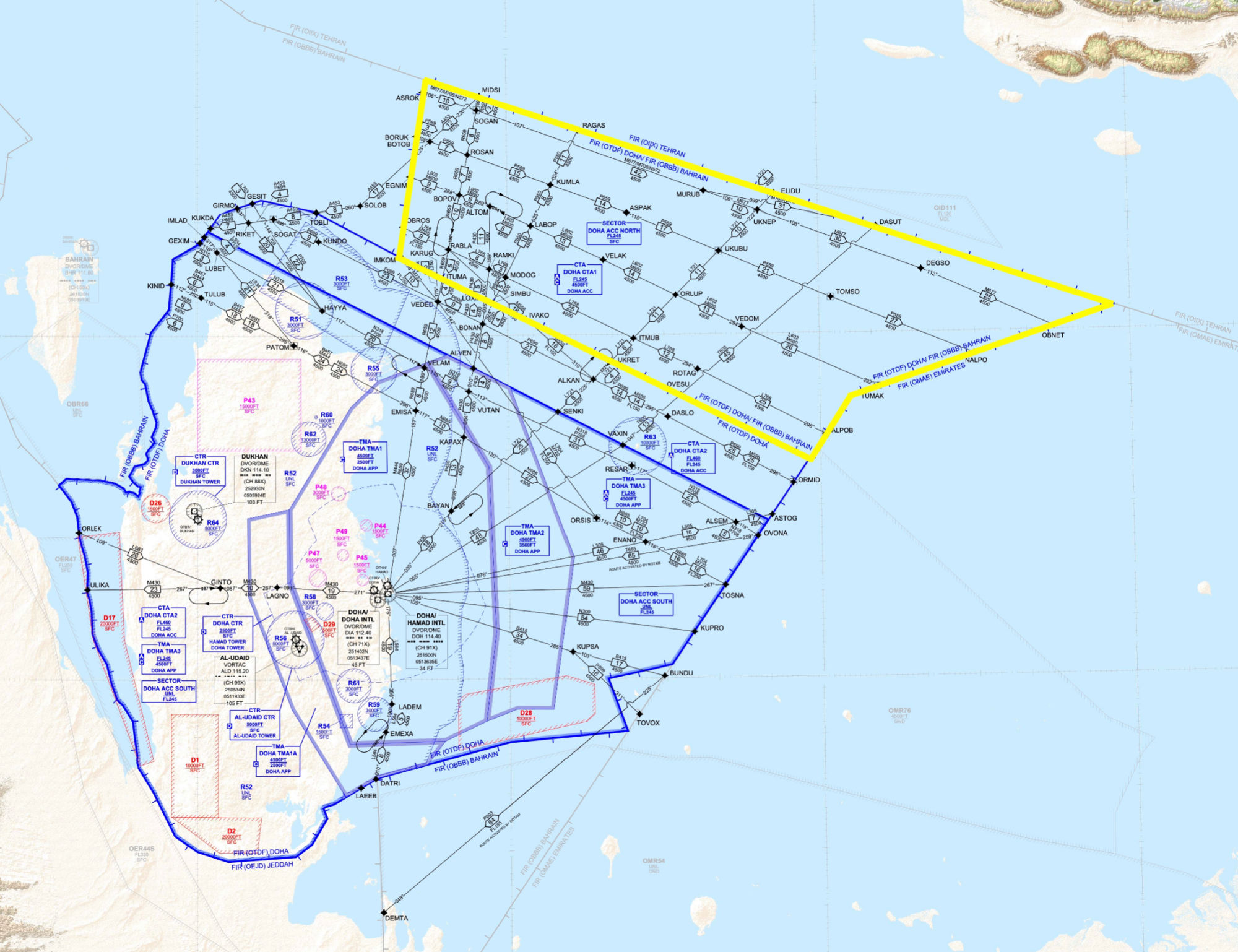
And now there’s a new rule: if you’re flying in the northern portion of the OTDF/Doha FIR, you need to submit a flight notification if you plan to use certain offshore routes.
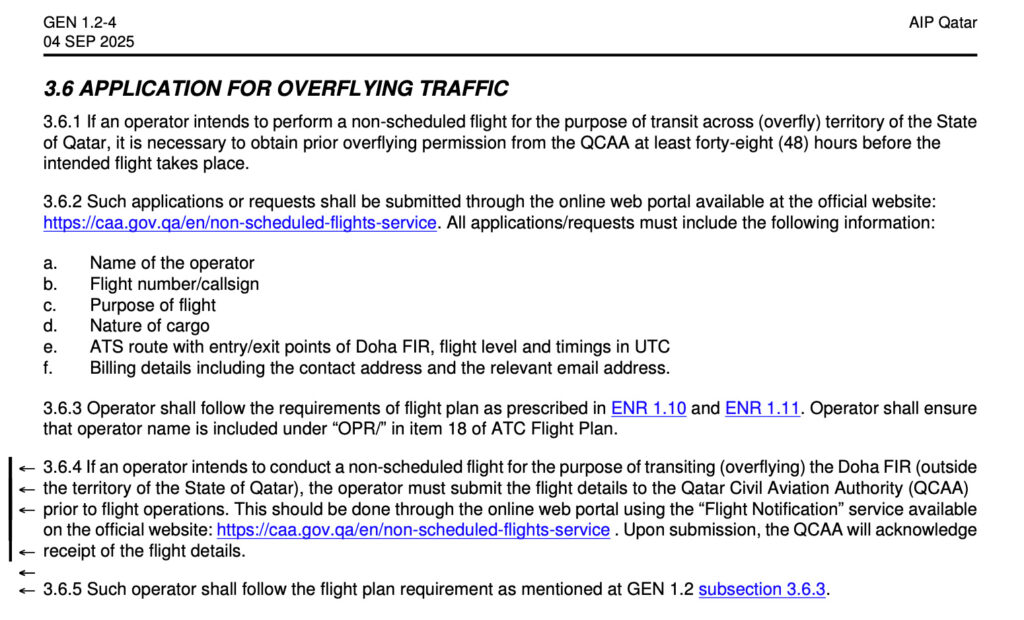
These routes don’t require permission to fly – that hasn’t changed – but you do now need to tell Qatar CAA in advance that you’re going to be there. The notification is submitted through the QCAA’s online portal, the same place you’d normally go for overflight permits.
The new rule came in on 4 Sep 2025, and applies to all “non-scheduled” operators (includes charter flights, private operators, ad-hoc flights – basically everything other than airline flights).
The affected routes
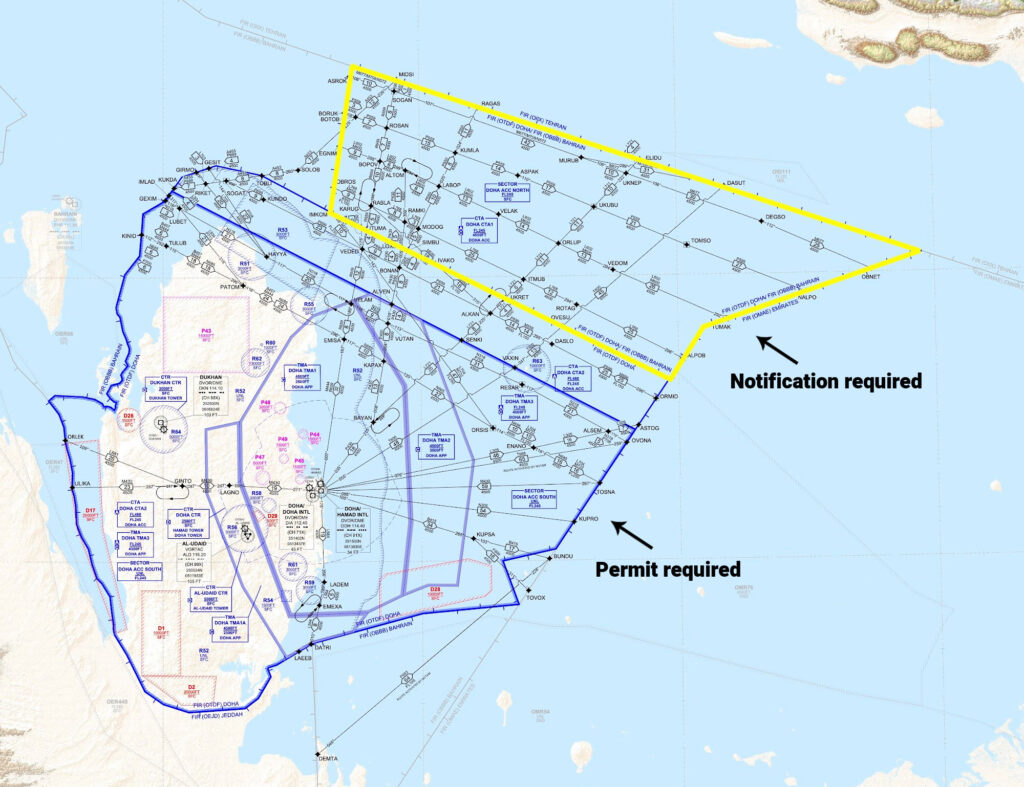
The rule applies specifically to these routes:
- M677/M708 (ASROK/OBNET)
- P559/L704 (BORUK/NALPO)
- L602/T557/M600 (TUMAK/EGNIM)
- L768/M556 (ALPOB/OBROS)
These are the offshore routes running north of Qatar, in international waters.
Why the new rule?
First, a quick refresher on who controls what inside the Doha FIR:
- The southern part of the OTDF/Doha FIR: Qatar controls everything, from SFC-UNL.
- The northern part of the OTDF/Doha FIR: This part covers international waters, not Qatari territory. Operationally, ATC responsibility here still switches at FL245 — Qatar handles traffic below this level, and Bahrain handles traffic above it.
The rule is simple
- Flying in the southern part of the OTDF/Doha FIR: Standard overflight permit required — no changes.
- Flying in the northern part of the OTDF/Doha FIR: Submit a flight notification via the QCAA portal.
This flight notification isn’t a permit and doesn’t need approval, it simply lets Qatar know who’s flying there in case you dip into their controlled airspace unexpectedly.
Notifications are submitted through the same QCAA portal used for permits. Bahrain continues to provide ATC in the northern area, and you don’t need a Bahrain permit unless you’re a weird non-ICAO, military, or state flight.

More on the topic:
- More: Ops Planning for the World Cup 2022
- More: The Doha FIR: Qatar is finally getting its own airspace
- More: New Airspace On The Way In the Middle East: The Doha FIR
- More: Gulf routings set to ease up as Qatar blockade comes to an end
- More: Who is still flying over Syria?
More reading:
- Latest: NAT Pack 2026: All the North Atlantic goodies
- Latest: New 2026 NAT Oceanic Checklist
- Latest: The Bahamas wants your cash
- Safe Airspace: Risk Database
- Weekly Ops Bulletin: Subscribe
- Membership plans: Why join OPSGROUP?





 Get the famous weekly