



Back in May we reported on an ICAO bulletin that had triggered a wave of NOTAMs across Europe, with some states suspending LPV approaches outright and others raising minima while they reviewed their procedures. At the time, the picture was changing almost daily, and it wasn’t clear whether this would become a short-term admin exercise or something with wider operational consequences.
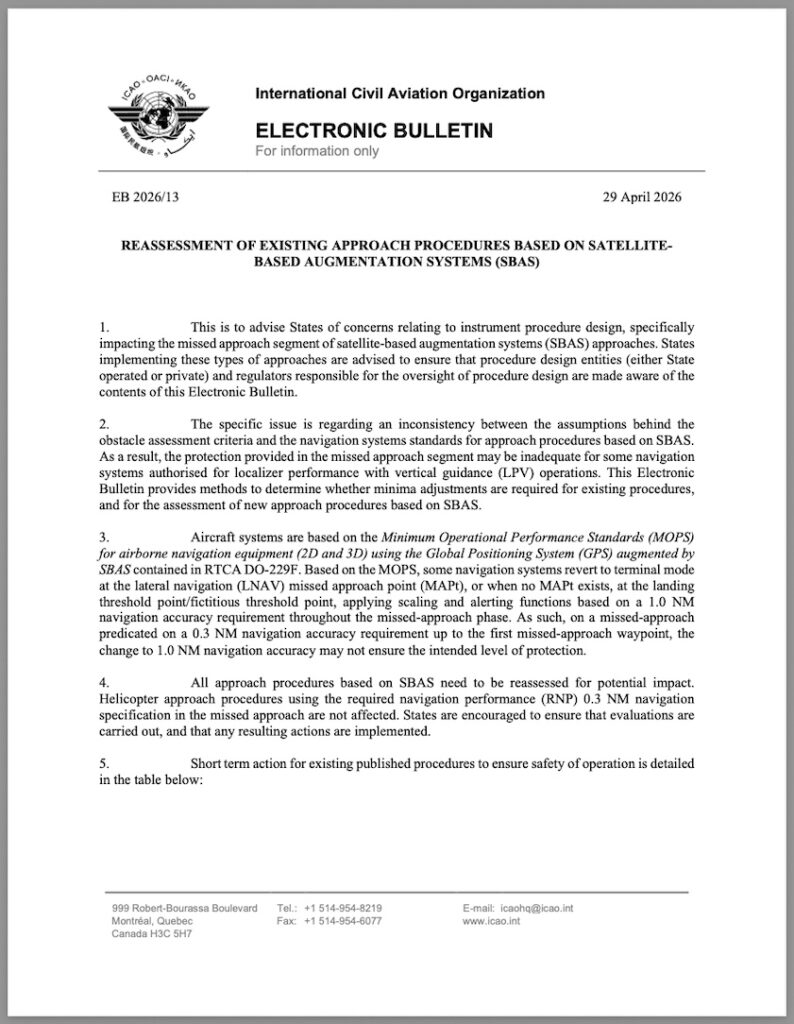
Click for PDF.
Two months on, the dust has settled enough to see what’s really going on. Most affected states have now settled on their preferred mitigation, we’ve spoken directly with the FAA about why US LPV procedures aren’t affected, and it’s become clearer that this isn’t really an avionics problem at all – it’s a difference in how missed approaches were designed under PANS-OPS compared with TERPS.
Here’s what happened, why Europe has been affected while the US hasn’t, and what operators need to watch for as reviews continue…
What was ICAO actually worried about?
The issue is to do with the missed approach segment of SBAS-based LPV procedures. ICAO says there may be “an inconsistency between the assumptions behind the obstacle assessment criteria and the navigation systems standards” used for LPV operations.
ICAO didn’t conclude that every LPV procedure was affected, and it didn’t tell states to suspend LPV across the board. Instead it asked them to review their procedures and apply mitigations where necessary while the underlying designs were reassessed.
The issue
Procedure-designers built LPV missed approaches assuming the aircraft keeps flying at LPV-level accuracy, roughly 0.3NM, through the initial part of the go-around. But the design of the underlying avionics standard (DO-229F) means that some SBAS navigation systems actually revert to a wider “terminal mode” at the missed approach point, applying a 1.0NM accuracy assumption instead.
That’s a real gap, a missed approach protection area sized for 0.3NM accuracy may not actually cover an aircraft that’s just quietly widened out to 1.0NM. Obstacle clearance margins that were assumed to exist may not be there for some aircraft types.
ICAO’s bulletin lays out three options for states to apply a temporary fix to affected procedures
- raise the LPV minima
- suspend LPV minima on specific procedures or runways
- suspend the LPV line of minima altogether until it can be reassessed against the full PANS-OPS criteria.
How states have actually responded
Unsurprisingly, everyone’s taking a slightly different path.
Germany came out swinging and nearly every airport we checked had a NOTAM suspending LPV approaches entirely while reviews were carried out, worded along the lines of “ALL LPV APCH SUSPENDED DUE TO POSS INADEQUATE PROTECTION PROVIDED IN THE MISSED APPROACH SEGMENT…” That lasted about a day. Germany then softened its position, opting instead to reinstate LPV procedures but raise the minima to LNAV or LNAV/VNAV levels. New NOTAMS have been rolling out airport by airport since.
Elsewhere, some states have kept LPV available but simply raised minima on the affected runways. That list so far includes EHAM/Amsterdam, EHGG/Groningen, EGJJ/Jersey, EGJB/Guernsey, EGJA/Alderney, several airports in Belgium, Austria and Croatia, and a number airports in Germany that have since been reinstated at the higher minima rather than left suspended.
Others have gone the restriction route on specific procedures or runways rather than a blanket suspension, including EIDW/Dublin, LIBP/Pescara, LOWS/Salzburg, LOWI/Innsbruck, several airports in Spain, and some in Croatia and Romania.
This list is nowhere near exhaustive. States are still working through their reviews, and the NOTAM picture is changing week to week, so if LPV is part of your planning at any European airport, check current NOTAMS before you file, not just at the destination but at any alternate too.
Why isn’t this hitting the US?
If you operate on both sides of the Atlantic, the obvious question is whether this touches FAA published LPV approaches too. We put that directly to the FAA. Short answer, no, and the reason comes down to how TERPS and PANS-OPS build the missed approach differently.
Both criteria sets can produce the same published minima, but they get there on different assumptions. As explained by the FAA, TERPS and PANS-OPS use different obstacle assessment surfaces for the SBAS/LPV final and initial missed approach segments.
In TERPS these are called obstacle clearance surfaces (OCS). Critically, the FAA says the TERPS LPV initial missed approach OCS is already predicated on a transition to a 1.0NM RNP missed approach segment, and “adequately assesses obstacle protection in the transition from LPV final to missed approach.” In other words, TERPS assumed the widening to 1.0NM from the outset. This avionics behaviour that’s exposing a gap under PANS-OPS was already baked into the US design.
Asked directly whether the FAA’s concern is with avionics behaviour after the MAP or with how procedures are constructed, the FAA pointed back to that same answer – it’s a procedure-construction issue, not an avionics one.
And asked whether crews flying LPV approaches in FAA airspace need to change anything in the meantime, the FAA’s answer was equally direct – “No new or additional considerations are necessary to safely conduct LPV approach procedures developed with TERPS.”
So this is very much a PANS-OPS states issue for now and the ICAO bulletin combined with the resulting NOTAM scramble apply to procedures built under PANS-OPS criteria, not TERPS ones. Worth knowing if your operations span both environments, since “LPV is suspended in Europe” absolutely does not mean “LPV is suspended,” full stop.
At this point it is worth zooming out further, since it’s not just a US/Europe story. LPV only exists where there’s an operational SBAS overhead, and that list is shorter than people assume. WAAS covers the US, Canada and Mexico. EGNOS covers Europe and is the system at the centre of this particular mess.
Outside of these two regions, we have Japan (MSAS) and India (GAGAN) both with their own operational SBAS with LPV. Over in South Korea KASS has just been certified and is entering service, so LPV is starting to roll out there too.
Everyone else is still waiting. China (BDSBAS) and Russia (SDCM) are in testing/development with their systems, Australia and New Zealand’s SouthPAN isn’t expected to support aviation-grade LPV until around 2028, and there’s no operational SBAS yet across Africa or Latin America. It’s a reasonable bet that the same missed-approach question gets asked again as those other systems come online.
What this means for ops
This is exactly the kind of change that looks small on an individual flight plan and turns into a real problem if it’s missed. A few practical points worth building into your process while this shakes out.
- Check NOTAMS for LPV restrictions at destination and alternates every time, not just once when planning a recurring route. The situation is changing all the time, and an airport that had LPV available last week may not this week, or may now require higher minima than your performance planning assumed.
- Don’t assume “LPV suspended” means “approach unusable.” In most cases there’s still an LNAV or LNAV/VNAV line of minima available on the same approach. It’s just higher, and your fuel and alternate planning needs to reflect that, not the LPV minima you might be used to.
- Brief crews specifically on this. A pilot expecting LPV minima who hasn’t seen the latest NOTAM or is unaware of the reason behind the change, is likely to get caught out.
If an alternate’s usability depends on LPV minima that have since been suspended or raised, you are likely to need a new plan B. What worked as a valid alternate under the old minima may no longer meet the numbers.
What to watch next
ICAO says the underlying PANS-OPS criteria are being re-evaluated, with a permanent fix to follow once confirmed.
But in the meantime, EB 2026/13 is the operative guidance and states are expected to act on it. We’ll keep tracking how the NOTAM picture develops across Europe, and the rest of the LPV world and update this as more states publish their reviews.
If you’ve hit an LPV restriction we haven’t listed, or seen a NOTAM change at an airport you operate into, let us know, blog@ops.group.

More on the topic:
More reading:
- Latest: Beijing’s New 600km Restricted Area
- Latest: FAA Proposes to Loosen Oxy Rules for Part 91 and 135
- Latest: Australia TSP Lite Explained
- Safe Airspace: Risk Database
- Weekly Ops Bulletin: Subscribe
- Membership plans: Why join OPSGROUP?






 Get the famous weekly