Sudan Risk Update: Aircraft Shot Down
Key Points
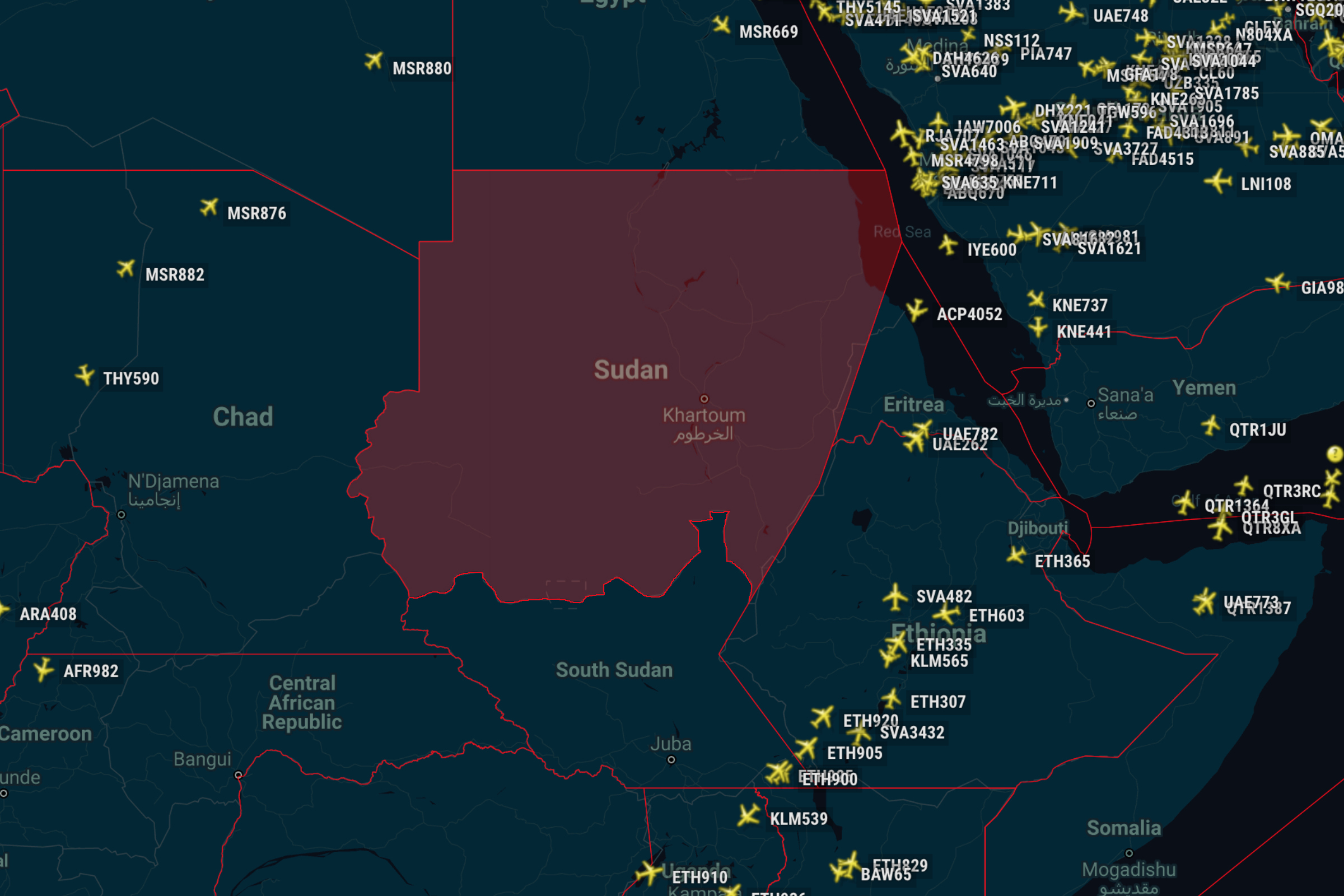
  • Following a military coup in April 2023, Sudan airspace remains closed to all civilian flights.
  • An Il-76 was reportedly shot down by a surface-to-air missile near Babanusa on Nov 4.
  • Multiple conflict-zone warnings exist due to the risk of anti-aircraft fire. The country should be considered dangerous at all levels.
  • A Contingency Plan provides limited overflight options via HSPN/Port Sudan, Egypt, Saudi Arabia and South Sudan (where ATC remains suspended above FL245).

Sudan’s airspace (the HSSS/Khartoum FIR) has been largely shut since 2023 and the risk profile has only worsened. Fighting around Khartoum continues, and the reported shootdown near Babanusa shows that overflights remain exposed. A US-backed truce has not reduced the threat environment.

Most operators are now avoiding Sudan entirely, routing through the published contingency corridors or staying in neighbouring FIRs. The lack of ATC above FL245 in South Sudan adds another layer of complexity for anyone trying to cross the region.

Here’s the updated risk briefing…

Context

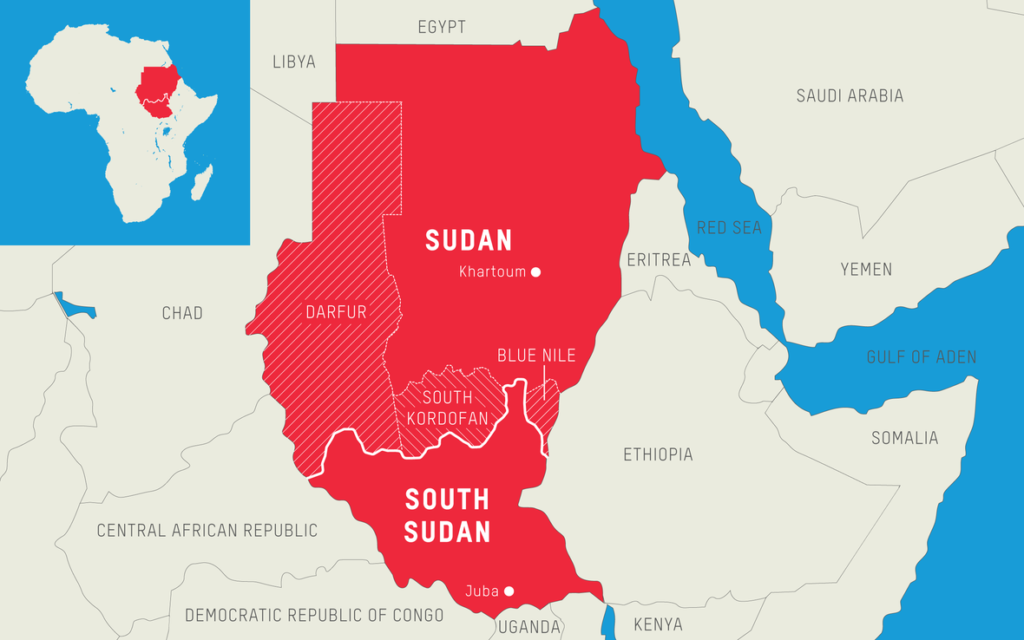
Sudan remains in a state of civil war between two major powers that used to rule together – the Sudanese Armed Forces (SAF) who control Port Sudan, and a paramilitary group called the Rapid Support Forces (RSF) who control most of Khartoum. You can read more about the background here.
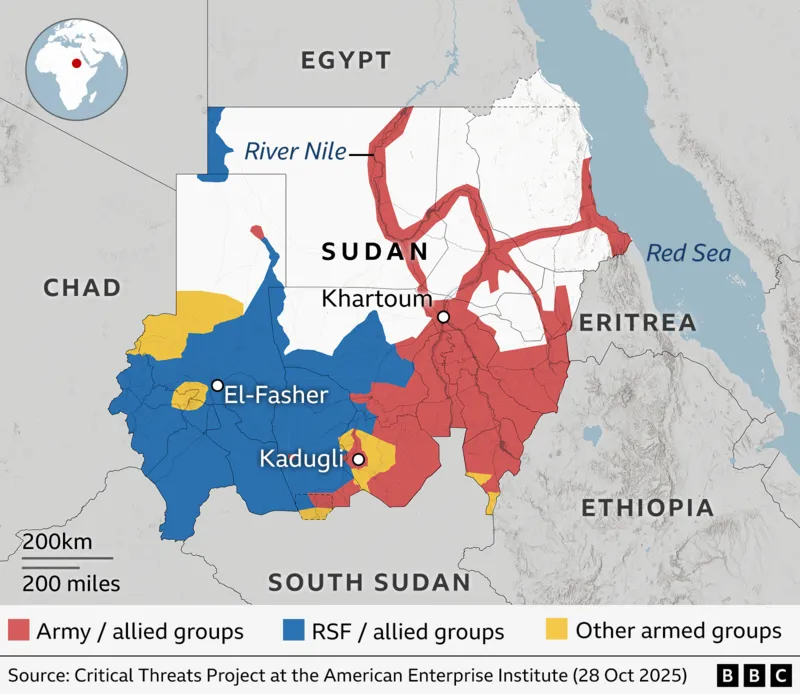
Sudan, a country divided. Image courtesy of the BBC. 

The US Government (along with Saudi Arabia, UAE and several other states ) has been actively pursuing a truce that aims to stop the fighting, open humanitarian corridors and rebuild political stability.

Both SAF and RSF have said yes in principle, but not it seems in practice.

And that means risk to civil aviation will persist. There are several sticking points – SAF wants RSF withdrawn from major cities before anything starts. RSF wants overflight guarantees without any kind of intereference. Any neither is willing to budge yet.

Aircraft Shot Down

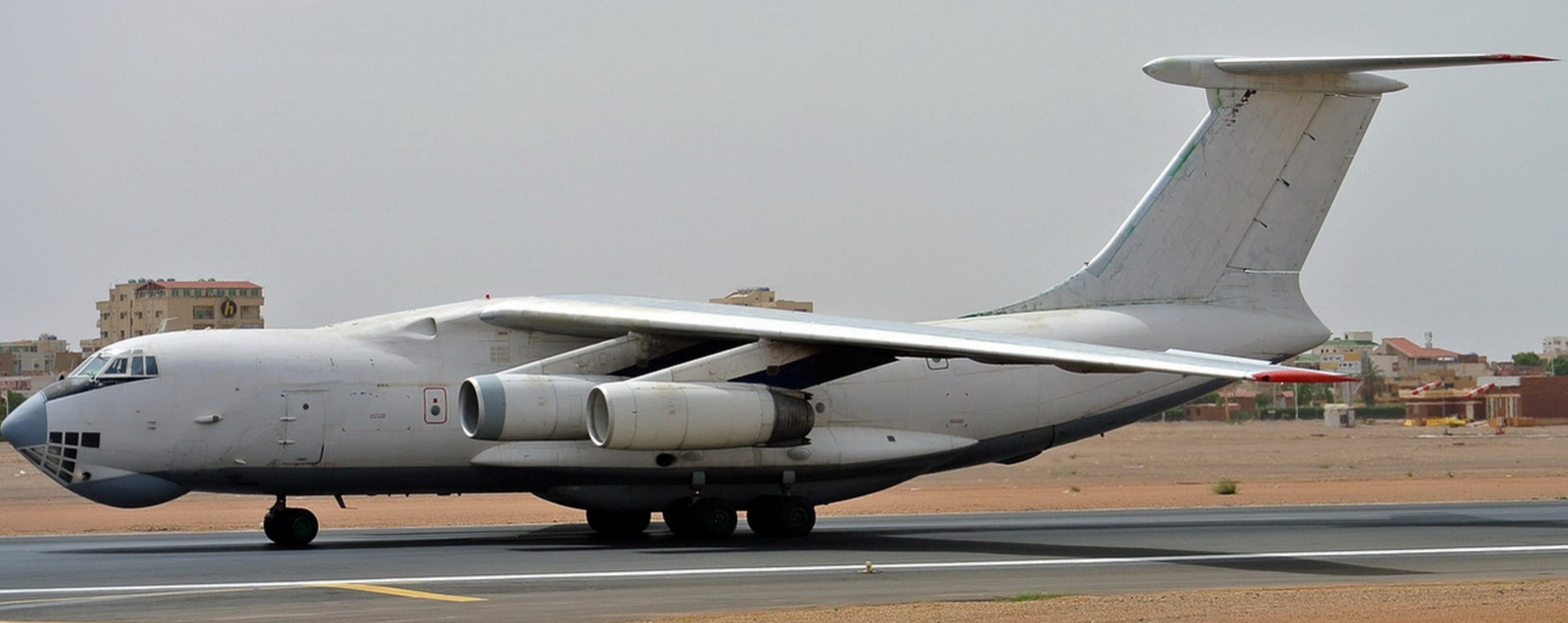
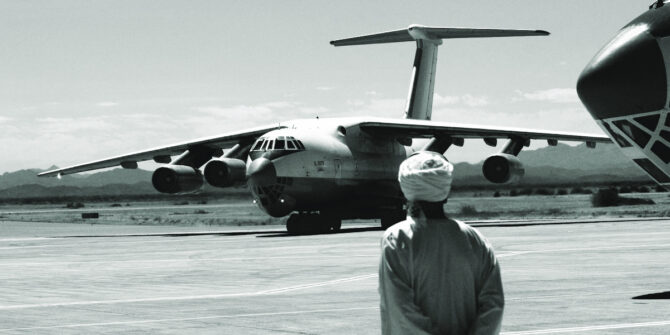
On Nov 4, 2025 an Il-76 transport plane of the Sudanese Armed Forces was reportedly shot down in West Kordofan state, southern Sudan by the RSF.

While the armed forces have indicated a structural failure of the aircraft’s wing was to blame, video footage appears to support the RSF’s claim that it was shot down using a short range air defence system of foreign origin.

If proven true, the incident underpins the presence of anti-aircraft weaponry in Sudanese contested airspace, and that even large transport aircraft are not immune to the risks of mistaken identity. Some intelligence suggests that this includes missile systems capable of reaching aircraft as high as FL500.

Conflicting claims about the incident show how unclear the situation is. Based on what we know, the highest risk is during daylight and in areas close to active fighting.

Recent Drone Strikes

On Nov 7, 2025 the RSF launched coordinated drone attacks against at least four cities: Atbara (River Nile State), El-Obeid, Al-Dailang and Omdurman (west Khartoum). Anti-aircraft fire was also reported.

This indicates that flight operations, especially arrivals and departures near the Khartoum region, face an elevated risk of indirect fire and missile activity. Secondary effects such as air-defence responses and unexpected diversions are also possible, particularly at low levels.

Bottom line: treat Khartoum/Omdurman and nearby airports as high-threat airspace. Even if an airport is “open” for domestic traffic, risk in the surrounding airspace remains dynamic.

Contingency Routes

Following the military coup in April 2023, Sudan remains almost entirely closed to all civilian flights.

Sudan has declared its entire sovereign airspace a single restricted area called “HSR5”, and published contingency procedures for civil traffic. It contains three main options for overflights:

  1. One north-south overflight route in the far east of the country down over HSPN/Port Sudan airport.
  2. Some north-south diversionary corridors available via Egypt and Saudi over the Red Sea.
  3. Some east-west routes over South Sudan.
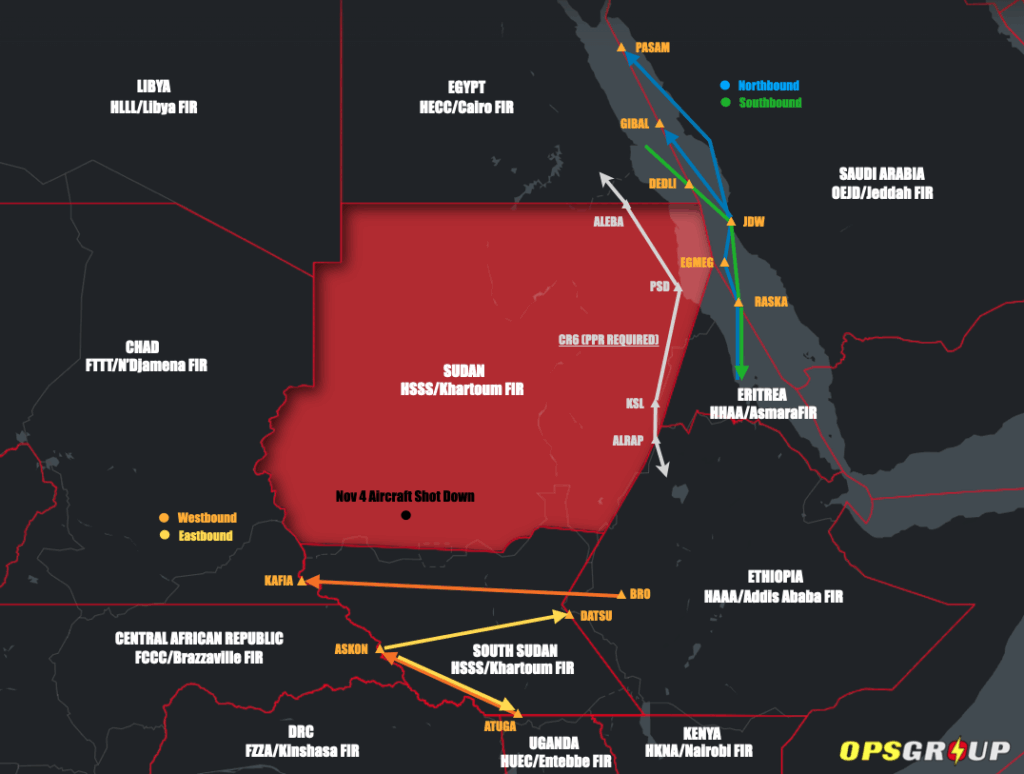
#1: North-South overflight route over HSPN/Port Sudan airport

They call this route ‘CR6’ – and it’s the only published track through Sudan’s restricted area HSR5.

It links the Addis and Cairo FIRs via ALRAP-KSL-PSD-P751-ALEBA. Levels are fixed for safety, FL320 northbound and FL330 southbound. There is no ATC separation, and prior permission is required.

Think of this as a narrow humanitarian corridor – it’s available but not intended to carry normal traffic.

The contingency plan points you to the Sudan AIP (GEN 1.2) for how to get permission, but the short version is this: operators must secure diplomatic clearance before the flight, and you can’t ask airborne. If you are allowed in, make sure you stick to CR6 like glue.

While technically possible, we advise extreme caution. What we don’t know are the safety margins applied to the contingency route or what may be unfolding beneath it.

#2 Red Sea Diversionary Corridors

These allow north-south traffic to move between the HECC/Cairo and OEJD/Jeddah FIRs without touching Sudan at all. They are the safest and cleanest option right now because you stay entirely within Egyptian and Saudi Arabian airspace, skirting the Sudanese coastline.

#3 South Sudan (KFOSS Routes)

KFOSS stands for ‘Khartoum FIR Over South Sudan’ and apply above FL245.

These routes allow for a safe(-ish) east-west crossing of South Sudan without entering Sudan itself. They’re RNAV 5, and mostly bi-directional. You report regularly, keep ADS-B and your transponder on and maintain 15-minute spacing.

One big caveat though – KFOSS routes are uncontrolled. Juba provides traffic advisories only.

Airspace Warnings

Several states (including the UK, France, Canada and Germany) maintain active airspace warnings that advise against entering the HSSS/Khartoum FIR at all levels due to risk of anti-aircraft fire and military activity.

For some reason, US operators technically have no legal restrictions as at the time of writing the FAA has issued no airspace advisories (Notams or SFARs) for Sudanese airspace.

Stay Updated

We will continue to report on any changes to the situation in Sudan as it develops. This includes our Safe Airspace website where you can view all active airspace warnings, along with those that exist in adjacent airspace. Our team keeps this updated around-the-clock.
SafeAirspace: 2021 Update

2020 was a heck of a ride. But therein lies the risk – what else might you have missed amongst all the Covid-related noise? Sadly, conflicts and their risks to civil aviation have not taken a break during the pandemic.

As it’s a new year, we thought a summary of Airspace Risk was called for. Here’s what’s making headlines at the moment:

Saudi Arabia & Yemen

Houthi rebels in Yemen are regularly firing explosive drones and rockets across the border into Saudi Arabia, and these usually target airports in the south such as OEAH/Abha and OEGN/Jizan. Their latest attack was on OYAA/Aden airport in late December which resulted in mass casualties.

Saudi Arabia continues to retaliate with airstrikes. The latest was in the capital Sanaa just weeks ago, where multiple munitions landed near the airport.

The risk to aviation is that overflying aircraft may get caught in the crossfire or might be misidentified by Saudi air defences. Active terrorist groups in Yemen may also use anti-aircraft weaponry to target foreign interests.

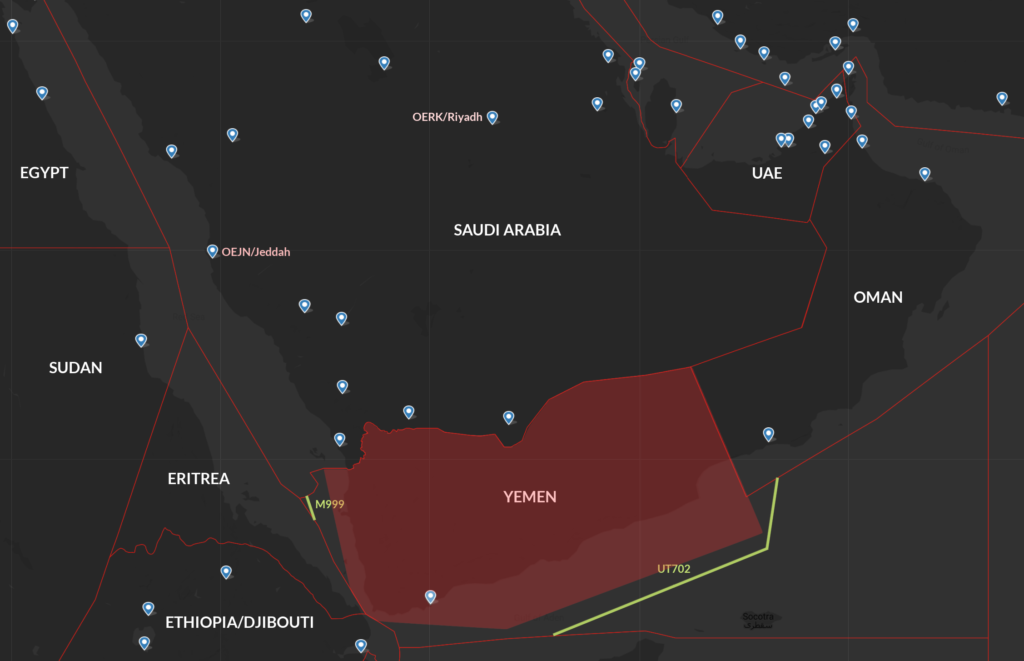
The FAA prohibit all US operators from entering most of the OYSC/Sanaa FIR at any level. Only two airways are allowed, and they are well off the coast – UT702 and M999.

There are no restrictions on Saudi Arabia but use caution in the southern regions. France and Germany have issued their own warnings.

SafeAirspace Yemen page – click here.
SafeAirspace Saudi Arabia page – click here.

Iraq

Rocket attacks on military interests at airports have become a common occurrence. They are generally fired by local militia without warning. ORBI/Baghdad is frequently targeted, along with other airports including ORER/Erbil. There is a clear risk to aircraft at low levels.

US relations were further strained through 2020 with multiple attacks on the US embassy in Baghdad. The tensions escalated to a point where the US considering closing it.

Foreign aircraft continue to be at risk from armed militia who have access to portable anti-aircraft weaponry, while misidentification by the air defence systems of multiple foreign forces in the country is also possible.

The FAA has extended its ban on US operators entering the Baghdad FIR at any level. Even though the SFAR says you can enter above FL320, the long-running Notam KICZ A0036/30 says otherwise.

SafeAirspace Iraq page – click here.

Syria

There have been several recent Israeli airstrikes on targets throughout Syria. In late December there are reports that Israeli fighters transited Lebanese airspace at low level causing alarm in Beirut before attacking targets in Western Syria. Just weeks ago, several sites around Damascus were targeted by Israeli missiles.

The primary risk is that aircraft may be misidentified by Syrian air defence systems which are regularly activated. Civil operators may get caught in the crossfire as missiles may erroneously lock on to the wrong aircraft.

The FAA are taking no chances – the ban on US operators entering the OSTT/Damascus FIR at any level has been extended a full three years to 2023.

SafeAirspace Syria page – click here.

South Sudan

Just this week ICAO issued a concerning warning about the risk to aircraft operating below FL245 in the HSSX/Khartoum FIR over South Sudan, or flying in and out of HSSJ/Juba. They are ‘gravely’ concerned about ATC disruptions, a lack of contingencies, inadequate training of controllers, limited info about equipment outages and a lack of co-ordination with other ATS units.

SafeAirspace South Sudan page – click here.

Emerging Conflict Zones

2020 saw three new conflict zones emerge, here is what is happening with them now.

Ethiopia

A civil conflict erupted in October last year in the Tigray region of Northern Ethiopia. The government went to war with the TPLF – a regional force seeking independence.

The region’s airports were closed and TPLF showed an intent to internationalise the conflict by attacking aviation interests. They fired rockets into Eritrea targeting HHAS/Asmara, and also attacked multiple airports to the South of the Tigray region.

Two airways were closed (T124, and M308) with no explanation of the risk.  Other airways remained open but uncomfortably close to the fight – especially UG300, UN321 and UL432. No airspace warnings were issued despite the dangers.

What’s the latest?

In late November Ethiopian forces captured the region’s capital Mekelle and regained control. Remaining TPLF forces have retreated leaving behind a humanitarian disaster and a vow to continue the fight. Since then, the airway closures have been removed and things have gone quiet, but an airspace risk remains – armed militia continue to be active in Northern regions and may be looking to make a statement. Be wary of operating in the area.

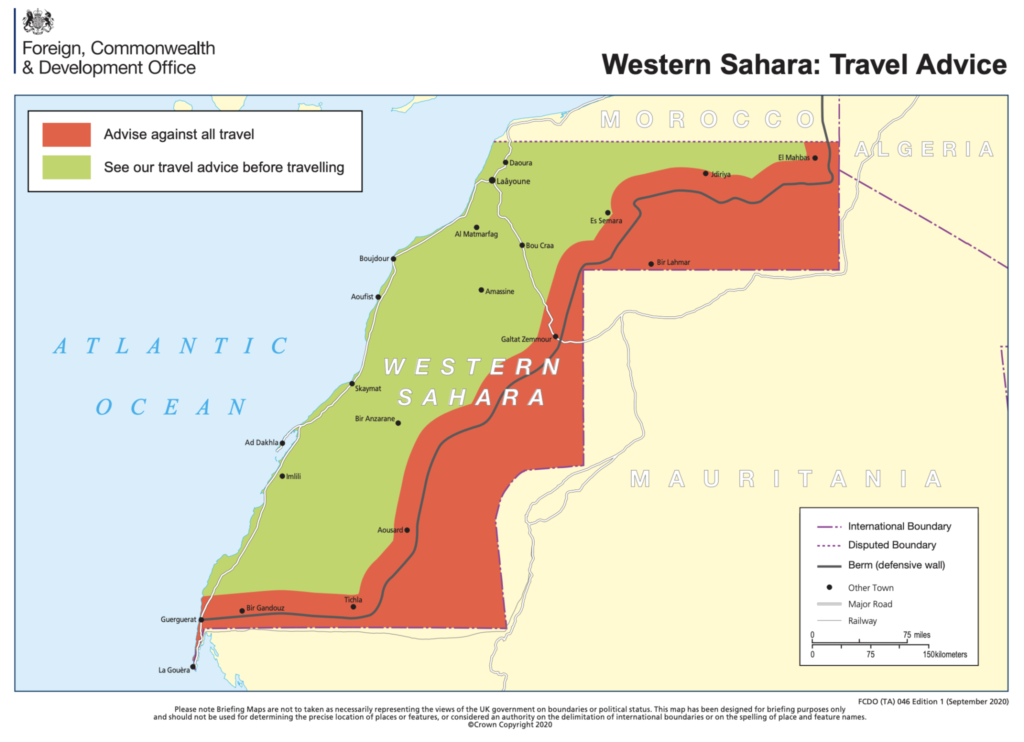
Western Sahara

Late last year the region’s independence movement (the Polisario) declared war on Morocco for breaching a ceasefire agreement. The FAA published a warning that the Polisario might have access to anti-aircraft weaponry left over from previous conflicts.

What’s the latest?

It is still an active conflict zone.  The fight has reached the international stage after the US declared their support for Morocco. The Polisario have indicated they are willing to at least talk, but so far have not put down their weapons. So, it is a wait-and-see type deal.

The risk to overflying aircraft remains. The GCCC/Canarias FIR keep extending a Notam advising operators to not fly below FL200 on the following airways: UY601, UN728 and UT975.  However, the reason is still missing: because of the risk of anti-aircraft fire. The GOOO/Dakar FIR haven’t issued any warnings despite the threat. Take care if operating in the area.

Armenia-Azerbaijan

In September last year, an ethnic conflict erupted over a disputed territory in Western Azerbaijan – Nagorno-Karabakh. The fight was between Azerbaijan and Armenia.

As a major air corridor for en-route traffic, there were significant flight disruptions. Azerbaijan swiftly closed all but one west/eastbound airway and routed traffic via Georgia. Armenia asked aircraft to take extra fuel and expect re-routes. The conflict was short but intense, with heavy artillery fire from both sides. The conflict eventually spread beyond the contested regions with longer range weapons. The entire border region posed a risk for civil aircraft.

What’s the latest?

For once the news is good. In November a ceasefire agreement was signed with the help of Russia. Armenia effectively lost and withdrew from the region and the conflict was officially over. Armenia removed its airspace warning, while Azerbaijan re-opened the affected airways and a large section of airspace near the border.

With the conflict now over, and no new reports of significant fighting since the peace agreement in November, direct crossing traffic between the two countries is now technically possible again.  However, most East-West flights are currently still electing to go further north instead, connecting between Azerbaijan and Georgia’s airspace, avoiding Armenia.

What about Safeairspace.net?

Our conflict zone and risk database is updated constantly. We assess risk with official sources and build a simple picture for you of those need-to know-places.

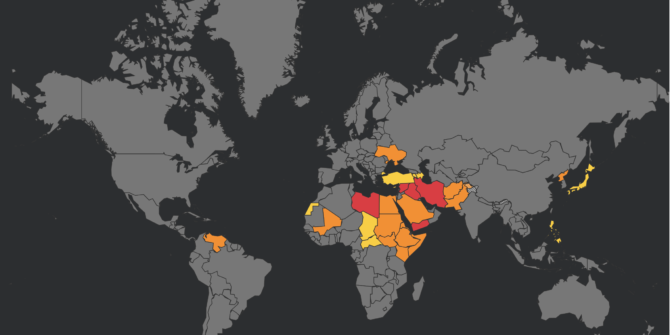
There are currently 5 regions which are assessed as a Level 1 Risk – No Fly. These are: Iraq, Iran, Yemen, Libya, and Syria.

Head over to SafeAirspace.net and take a look. With a single click you can download a risk briefing of the entire world in just a few pages of nice simple English.

The mission of SafeAirspace is this: to provide a single, independent, and eternally free resource for all airspace risk warnings, so that airlines and aircraft operators can easily see the current risk picture for unfamiliar airspace. If you know of a risk not listed on the site, or you have anything else to add, please get in touch with us at news@ops.group


Sudan Airspace Update: A New Risk

Generally, our SafeAirspace risk assessments focus on risk due to conflict, and the anti-aircraft weaponry that is often a result of said conflicts. But today a new risk alert popped up for South Sudan.

So this is a brief summary on the history of airspace safety concerns for Sudan and South Sudan, and the new risk that has been highlighted specifically for South Sudan.

Where are we talking about?

South Sudan is a landlocked country in East-Central Africa, bordered by Sudan, Ethiopia, the DRC, the CAR, Uganda and Kenya. The main airport for South Sudan is HSSJ/Juba.

So it’s South Sudan, not just Sudan?

Yep, there are two Sudan’s – Sudan and South Sudan. South Sudan is officially known as the Republic of South Sudan, whilst Sudan (North Sudan) is ‘just’ Sudan.

Sudan’s primary airport is HSSS/Khartoum

They were the same country until 2011 when they separated following decades of civil war. South Sudan became the world’s newest nation.

Two separate Sudans, three separate issues

Following five years of civil war in South Sudan, a ceasefire has largely held since Sept 2018. Though there has been a significant reduction in violence since then, the political and security situation remains volatile.

Sudan, on the other hand, (which borders South Sudan, the Central African Republic and Chad), has had its own conflict. In 2019 they temporarily closed all their airspace following a military coup which ousted their longtime president Omar al-Bashir from power. This came after months of protests against his rule.

Clashes between the army and former security agents resulted in violence and gunfire in the streets, and the temporary closure of HSSS/Khartoum airport in 2020, but this was brought under control relatively quickly.

There are also issues in bordering Ethiopia and Eritrea, in the Tigray region, which resulted in the closure of some airspace and airways by the Ethiopian and Sudanese CAA.

What warnings are in place due to conflict?

South Sudan – Although the situation has improved since Sept 2018, several countries (the UK, France and Germany) still advise against overflying South Sudan below FL250/260 due to the risk posed by anti-aircraft weaponry. The US published a similar warning but rescinded it in Aug 2019.

Sudan – Only has one official warning in place, from the French authorities. This recommends against overflights below FL260 in the far Southern and Western regions.

But there is a new warning for South Sudan?

Yes, there is. And it isn’t conflict related.

ICAO released a letter on January 20th regarding the safety of Civil aircraft in the Khartoum FIR over South Sudan.

The raised ‘grave concerns’ for the safety of International air traffic operating below FL245, and operating into and out of HSSJ/Juba international airport.

The concerns relate to the disruption of air traffic services and the lack of contingency arraignments in place. They warn about the lack of suitably qualified air traffic control personnel, the lack of information being shared on unserviceable or withdrawn navigation equipment, and inadequate air-ground communications.

A quick search on Notams for Khartoum FIR and Juba airport only brought up info on the opening of airspace following Covid restrictions.

The full warning from ICAO can be read here.

In summary

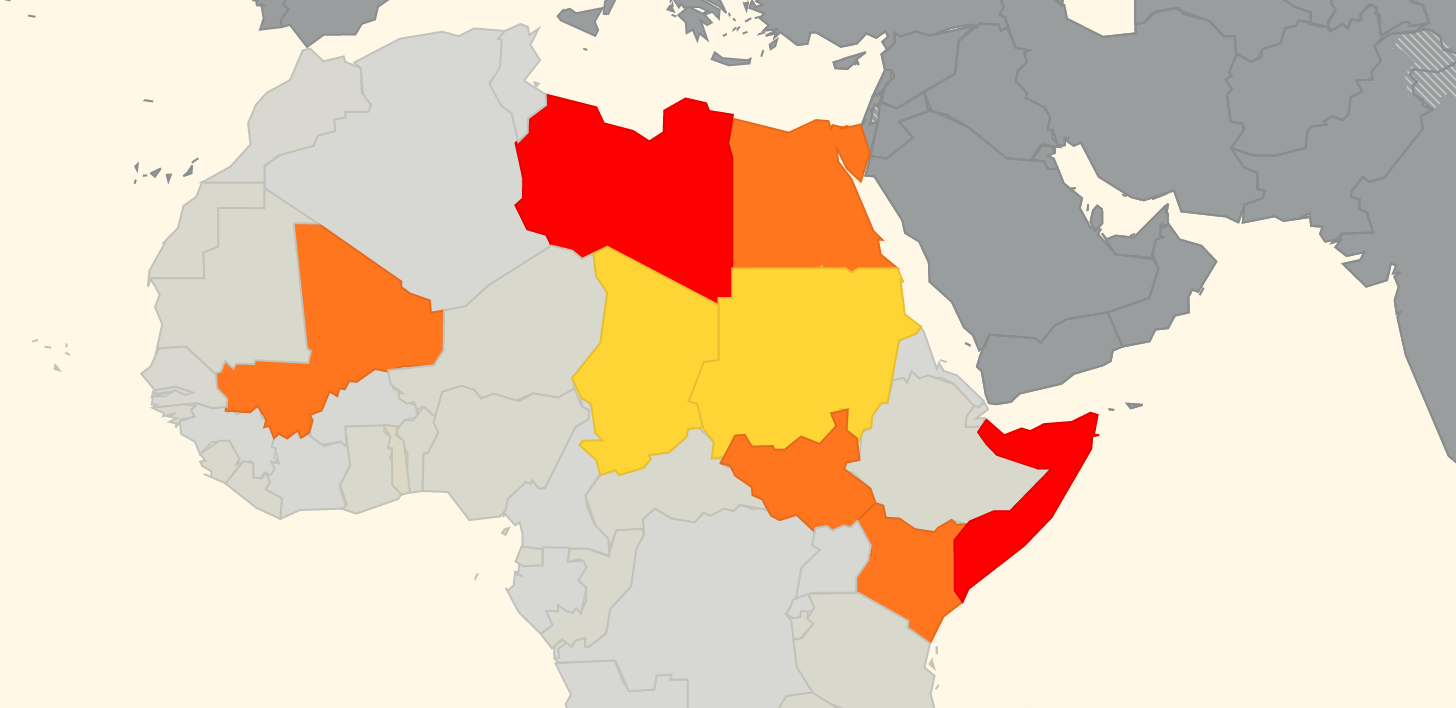
  • Both Sudan and South Sudan are considered Level 2: Danger Exists regions because of ongoing conflicts.
  • South Sudan now poses a separate risk due lack of aviation infrastructure and lack of information being promulgated (through Notams) on this.
  • Caution recommended if operating below FL245 in South Sudanese airspace, or if you are operating into HSSJ/Juba airport.


Germany issue new warnings, Manila may not ban GA after all

Germany issues new warnings 25JAN Germany has issued fresh warnings on the airspace of EgyptSouth Sudan, and North Korea, in three separate Notams issued in the last week. We have updated the SafeAirspace.net country information pages with the specifics. Read the article


Manila may not ban GA after all 25JAN RPLL/Manila is not moving as quickly towards a complete ban of non-scheduled and General Aviation traffic as feared. This is good news for International Operators. Read the article.


HEZZ/Egypt, HSZZ/South Sudan, ZKZZ/North Korea Germany has issued fresh warnings on the airspace of EgyptSouth Sudan, and North Korea, in three separate Notams issued in the last week. We have updated the SafeAirspace.net country information pages with the specifics.

RPLL/Manila is not moving as quickly towards a complete ban of non-scheduled and General Aviation traffic as feared. This is good news for International Operators. Read the article.

NTAA/Tahiti The airport is open again as of Monday morning local time, after closing due to flooding after torrential rains, but many taxiways remain flooded. Expect delays in handling and tech stops.

KZZZ/USA Announced yesterday and expected to come into force this week, is an immediate ban on US visas (and therefore US travel) for citizens from 7 countries: Iraq, Iran, Syria, Yemen, Sudan, Somalia and Libya. This is distinct from the Visa Waiver Program ban in effect since January 2016.

GBZZ/Gambia FSB Risk Level changed from Level Three to “No Warnings” on Jan 24. New president has taken power. Parliament revoked State of Emergency. Situation calm.

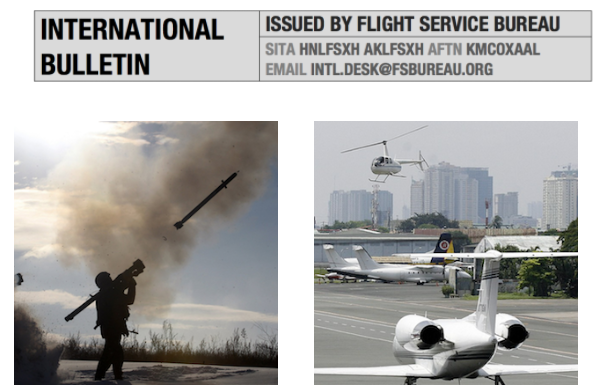
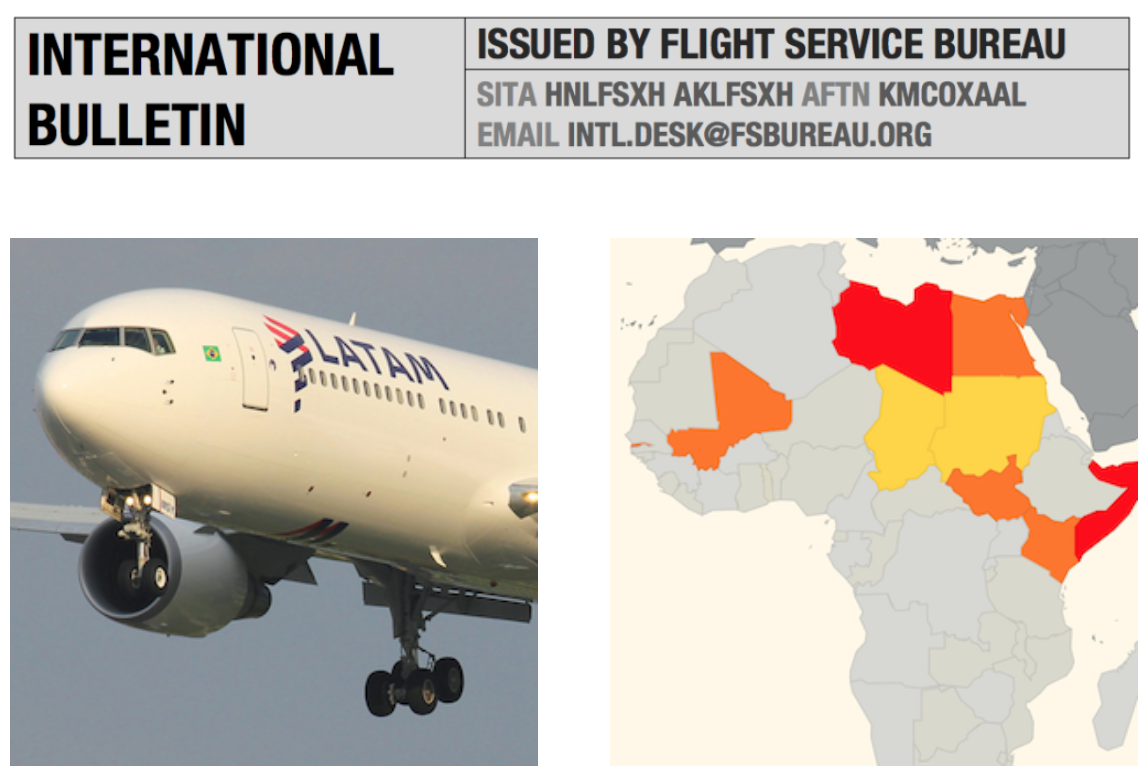
SBZZ/Brazil In the last bulletin we had a headline about a Boeing 767 shot on approach in Brazil. A bullet was found lodged in the wing. Some updates to that story are here, and safeairspace.net’s Brazilpage is updated.

VZZZ/Southeast Asia Don’t forget it’s New Year in Asia this weekend. Travel-related delays and government office and business interruptions will peak 27 Jan to 01 Feb, and could last longer in Taiwan, Vietnam and China, where the holiday will be celebrated through 02 Feb.

EDDB/Berlin Brandenburg will now not open until 2018, as they found more problems with the fire system this week. This is a recurring story, which dates back to 2012. So, for the foreseeable, you’re stuck with Tegel and Schoenefeld.

LTFJ/Sabiha Gökçen (Istanbul) Due to insufficient capacity at LTFJ, applications for individual non-scheduled flights will be refused, and private/charter flights can only be operated at “non-busy hours”.

KBPI/Palm Beach is going to see some new TFR restrictions due to the proximity of Donald Trumps Mar-a-Lago estate. If operating when he’s down here, you’ll have to depart from a gateway airport to PBI – those are TEB, HPN, IAD, MCO and FLL. NBAA has the details.

LSGG/Geneva EBACE is on from Monday, 22 May through Wednesday, 24 May 2017. Now would be a good time to get those slots booked if you’re planning to head over.

LFMN/Nice has a new procedure where ATC will alert crews to windshear.

MSLP/San Salvador‘s only runway 07/25 will be closed from 1600-1700 each day until Feb 3rd.

VGHS/Dhaka The UK Department for Transport (DfT) announced today that it recently carried out assessments of security at Dhaka International Airport. Following this, the DfT has assessed that security at Dhaka airport does not meet some international security requirements (they haven’t said which).

OMAD/Abu Dhabi (Al Bateen) is hosting the International Defence Exhibition in February, so will not be available to IFR traffic daily between 0600-0800Z until Feb 23rd. There are also restrictions on using it as an alternate.

DNAA/Abuja The latest on the Abuja closure is that it will be completely closed to all traffic from March 8th – April 19th.

SKCG/Cartagena‘s only runway 01/19 is closed daily 0530-1100Z until Feb 6th.

NVZZ/Vanuatu Health authorities have declared a dengue outbreak following a large increase in suspected cases in December 2016 and January 2017. Protect yourself against mosquito bites

WSZZ/Singapore is implementing the new ICAO SID/STAR phraseologies from March 2nd. Read AIP SUP 29/17.

LIRF/Rome Fiumicino is working on 16R until March, so 25 will be used for deps and 16L for arrivals. This means delays, especially if you want 16L/34R for departure – they say up to a 60 minute taxi time.

UKZZ/Ukraine amended the military boundaries of its airspace on Monday Jan 23rd, identifying the Donbas conflict zone region as a separate area. More details here.


View the full International bulletin 25JAN2017


Updated airspace warnings for Egypt, South Sudan, North Korea

Germany has issued fresh warnings on the airspace of Egypt, South Sudan, and North Korea, in three separate Notams issued in the last week. Germany is one of four states that provides Aircraft Operators with conflict zone and risk advice. We have updated the SafeAirspace.net country information pages with the specifics.

The current Flight Service Bureau summary of each country follows:

Egypt Since the Arab Spring, Egypt’s stability and security situation as a state has declined. In October 2015 a Russian A321 was brought down over the Sinai peninsula by a bomb loaded at HESH/Sharm El Sheikh. In the aftermath, it was initially feared that a missile had caused the crash. Multiple warnings still in place from that fear. 19 May 2016 EgyptAir Flight MS804 from Paris to Cairo disappeared over the Mediterranean, cause unknown. GPS jamming reported at HECA/Cairo several times in 2016. High threat from terrorism in Egypt. Further attacks are likely. Not recommended as a tech stop. [Read full country information]

South Sudan Conflict Zone. South Sudanese Civil War since 2013. The security situation in Juba has been relatively calm since the July 2016 crisis. Daily reports of fighting throughout the rest of the country. The security situation is especially unstable in the Equatorias in the south. MANPADS risk to overflights. In addition, the South Sudanese army has declared intention to shoot down Aircraft without permits. Most Authority guidance recommends min FL260. We think FL300 is a better minimum for overflights. [Read full country information]

North Korea The level of tension on the Korean peninsula can change with little notice. Multiple missile launches in 2016, increasingly without prior notice to ICAO. The range of these has increased – previously safe airways B467 and G711 are now at risk. Over 1000 reports of GPS jamming issues reported by operators in the vicinity of the North/South Korean border. SFAR79 prevents US operators from operating west of 132E, other Authorities restrict operations east of that line. [Read full country information]


References:


International Bulletin: B767 shot on approach to Rio, Updated SafeAirspace Map

B767 Shot on approach to Rio 

18JAN A B767-300 was fired on last night during approach to Runway 15 SBGL/Rio de Janeiro. One 7.62mm bullet lodged in the left wing. Read the article.

Updated SafeAirspace Risk Map 

18JAN We have updated SafeAirspacewith information for Aircraft Operators on The GambiaNorth KoreaBrazilUkraine, and Turkey.


GBZZ/The Gambia State of emergency declared on 17th January. Foreign citizens being evacuated. Banjul International Airport (GBYD/BJL) and land borders remain open, for now. More at safeairspace.net/information/the-gambia.

UKZZ/Ukraine Flight Service Bureau has issued an updated summary for Ukraine’s airspace. There are two risk issues in Ukraine. First: arms fire. Including MH17, multiple aircraft (the others all military) have been shot down since the beginning of the Donbass region war in 2014. The 10th ceasefire was declared in December 2016, but not holding. This risk is contained within the Dnipropetrovsk FIR – UKDV. The second issue affects the Simferopol FIR which is Disputed Airspace. (Ukraine:UKFV, Russia:URFV). In March 2014, Russia annexed Crimea. The ATC Center is in Simferopol, Crimea, and is now run by Krymaeronavigatsiya. Russia claims the airspace. Ukraine refuses to recognise the change, and asks crews to talk to Ukrainian controllers in Dnipro/Odesa ACC instead of Simferopol ACC. Four routes are approved by EASA through the high seas portion of the airspace.

KIAD/Washington and area airports – guaranteed busy during the Presidential Inauguration this Friday, Jan 20. Updated restrictions here. Departure slots required for aircraft departing IAD between Friday, Jan. 20 and Sunday, Jan. 22. Departure slots can be obtained through an IAD FBO of choice (Ross Aviation or Signature Flight Support). Slots will be divided equally between the two FBOs at IAD.

VZZZ/Southeast Asia Lunar New Year holiday season, which falls on 28th Jan. Travel-related delays and government office and business interruptions will peak 27 Jan to 01 Feb, and could last longer in Taiwan, Vietnam and China, where the holiday will be celebrated through 02FEB.

BGBW/Narsarsuaq A seasonal reminder that if you’re planning to use Narsarsuaq as a destination, alternate, or enroute alternate outside of the operating hours (MON-SAT 1000-1900z daily until 03APR), you must contact the airport in advance to apply for them to stay open for you:
Email: bgbw@mit.gl. Also make sure you file your ATC FPL including the AFTN address: BGBWZTZX.

EKCH/Copenhagen A copy of the AOC must accompany fuel release or expect an MOT charge of approximately $1.70 USD to be charged. Next destination must be shown on the fuel release or expect delays.

EGPH/Edinburgh, Scotland Until Apr 1st, you will need PPR to operate to Edinburgh, due to reduced parking capacity.

RPLB/Subic Bay will be closed for maintenance bewtween 0100-0800z until January 20th.

SKZZ/Colombia New Tower and ACC for Bogota. From 16th Jan – 15th Feb moving of Bogota’s ACC will take place. ATS/AIS/COM/MET/ATFM services transition process should not affect operations, however, due to the large change extent foreseen, some failures might occur in the process.  AIC 1/17 outlines contingency procedures in place

SVZZ/Venezuela has closed its land borders with Colombia and Brazil periodically in the last 12 months. Border closures occur frequently, often with short notice. The Venezuelan government will withdraw the 100 bolivar note (VEF 100) from circulation as of 20 January 2017.

LYBA/Beograd If you have any outstanding navigation fees in Serbia, better get them paid, or they’ll add a 9.88% interest charge.

HSSS/South Sudan Flight Service Bureau has issued an updated summary for South Sudan’s airspace: Conflict Zone. South Sudanese Civil War since 2013. The security situation in Juba has been relatively calm since the July 2016 crisis. Daily reports of fighting throughout the rest of the country. The security situation is especially unstable in the Equatorias in the south. MANPADS risk to overflights. In addition, the South Sudanese army has declared intention to shoot down Aircraft without permits. Most Authority guidance recommends min FL260. We think FL300 is a better minimum for overflights.

ZKKP/North Korea Flight Service Bureau has issued an updated summary for DPRK North Korea’s airspace: The level of tension on the Korean peninsula can change with little notice. Multiple missile launches in 2016, increasingly without prior notice to ICAO. The range of these has increased – previously safe airways B467 and G711 are now at risk. Over 1000 reports of GPS jamming issues reported by operators in the vicinity of the North/South Korean border. SFAR79 prevents US operators from operating west of 132E, other Authorities restrict operationseast of that line.

ZZZZ/Worldwide How have you been getting on with the new ICAO SID/STAR phraseolgies? In short, some countries are implementing, and others aren’t. What is your country doing? Tell us at bulletin@fsbureau.org.


View the full International Bulletin 18JAN2017


Midweek Briefing 13JUL: South Sudan off limits, New Zealand airport strike off

South Sudan off limits 13JUL The security situation in Juba, and South Sudan, has deteriorated in the last week, with HSSJ/JUB becoming off limits due to fighting. Read the article.

New Zealand airport strike off 13JUL A planned strike by Aviation Security across airports in New Zealand, which would have led to wide scale disruption, has been called off at the last minute. Read the article.


BGBW/Narsarsuaq Current hours are Monday to Saturday 1000-1900Z. If you want to plan a visit outside these hours, or even use BGBW as an alternate, get permission from bgbw@mit.gl in advance. There will be additional costs, especially heavy on a Sunday.

SBZZ/Brazil is the latest country to wield the threat of shooting down aircraft. Last month we reported on the same language from Sudan, in reference to overflight permits. Brazil’s firm stance is in relation to the Olympic Games, and says that unidentified aircraft that violate the protected airspace around facilities of the Olympic Games in Rio de Janeiro. “We are not playing,” said Defence Minister Raul Jungmann. This is more of concern to a lost C172 than commercial flights (unlike Sudan, which is the reverse), but worth being aware of.

EGPZ/Poland has effectively dispensed with the Schengen agreement for now, expect full border controls at all international airports (ie. Passport check, Gendec).

EGPZ/Scottish FIR The military are carrying out some GPS jamming trials over the ocean from 12-29JUL. If you’re operating in the region of Benbecula VOR, especially west of it, be aware that your GPS might stop working.

OAKX/Kabul Aircraft in the eastern sections of the Kabul FIR can expect some radio issues, as a comm unit (VSAT at Ghanzi) is out of action. The advice from ATC in Afghanistan is to keep trying the assigned frequency until within range of a different transmitter; in the meantime, a bit of SLOP, IFBP and TCAS should keep you out of trouble. See full article.

MKZZ/Jamaica Significant increase in the number of confirmed cases of Dengue fever in Jamaica during the first half of 2016. Dengue fever is endemic to Latin America and the Caribbean and can occur throughout the year.

ENZZ/Norway FIR Plans are afoot to raise the transition altitude to 18,000ft. It’s an age old question, why does Europe have different TA’s, and the US has just one? Together with surrounding countries, and the Irish FAB, this looks to be changing – but it may take a little while. See Norway AIC 7/16.

YBBB/Brisbane FIR (and Melbourne) will be updating their software on the night of 20JUL, with a hefty 6 hour outage of CPDLC and all the other good stuff.

OAMS/Mazar-E-Sharif Fuel payment is now only accepted in cash.

NZZZ/New Zealand A planned strike by two airport workers’ unions and New Zealand’s Aviation Security Service (Avsec) will now not go ahead. The unions sought increases in compensation, and negotiations on their demands will take place in the coming weeks. Read the article

EYPH/Paluknys is a new location indicator for the airport in Lithuania.

ZBDS/Edros – Ejin Horo, China will open to foreign flights this month. We did battle with AIP China for 30 mins to get further info but lost the fight. If you know more, tell us and we’ll share.

HSZZ/South Sudan The ceasefire announced on 11 July is holding. Juba International Airport (HSSJ/JUB) is open to charter operations; however, commercial flights have yet to resume. U.S. government aircraft evacuated personnel on 12 July; however, a security message issued by the embassy later in the day advised U.S. citizens to continue to shelter in place and not attempt to travel to the airport. Meanwhile, other countries, such as Japan, Uganda, and Germany plan to send military aircraft to evacuate their nationals.

SEZZ/Ecuador A large earthquake (6.4) struck on 10JUL just east of Muisne, on the northwest coast of Ecuador. The quake had a shallow depth and followed 10 minutes after another earthquake that had a magnitude of 5.9. Although strong tremors were reported in Esmeralda and Quito, there were no immediate reports of damage. The Pacific Tsunami Warning Center did not issue a tsunami warning following the quake.

UZZZ/Mt. Klyuchevskoy, Russia continues to produce ash that extends up to 25,000 feet. Movement is towards the east at 10 knots.

PZZZ/Pacific Two hurricanes to monitor: The National Hurricane Center is issuing advisories on Hurricane Celia, located more than 1000 miles west-southwest of the southern tip of the Baja California peninsula, and on Tropical Storm Darby, located several hundred miles west-southwest of Manzanillo, Mexico. Tropical Storm 05E (Darby) is on a strengthening trend…and may reach category 1 hurricane stage over the open ocean in a couple of days. For now both are expected to remain offshore.

DGZZ/Ghana African Union nationals whose countries do not have a visa-free agreement with Ghana are now eligible for a 30-day visa-on-arrival for business and tourism. The visa-on-arrival program will be piloted for three months starting at Kotoka Airport and will be extended to other ports of entry in the future. Travellers can extend their visa upon expiry in Ghana, and business travellers can apply for a longer-term visa at a Ghanaian consular post.

BIZZ/Iceland ATC Strike continues, primarily affecting BIKF/Keflavik, BIRK/Reykjavik, and BIRD/Reykjavik Oceanic for International Operators. Restrictions on landing, eastbound, and westbound overflying traffic. Read the article

LTBB/Istanbul FIR If you’ve got some time on your hands, have a look at the Greece-Turkey great NOTAM argument of 2016. This is an almost annual performance, the equivalent of a street argument between two kids.. If you’re busy, just skip all of it when they appear on your Pre Flight Briefing for Turkey or Greece (which they will).

View the full International Bulletin 13JUL2016


Sudan “will shoot down” aircraft

In May 2016, Sudanese radar detected several unauthorised flights by Aid Agencies using chartered IL76 aircraft. The response from the government, on this occasion the Sudanese Army, was extremely strong.

We are concerned at the language being used in Khartoum and Juba. The most recent statement from the Sudanese Army, on 2nd June 2016, says “This action is considered a serious violation of the aviation regulations and the international laws, so we consider it as a direct affront to the Sudanese sovereignty … [we] will deal decisively with any plane failing to observe the proper procedures and entering the Sudanese airspace without prior permission”.

At the start of this year, the South Sudan government declared: “The South Sudanese government has ordered its army to shoot down any aircraft flying across its airspace without permission, citing the increase of unauthorised incursions into the national airspace”.

It’s tempting to dismiss this as not related to regular airline or non-scheduled flying – including long haul overflights – but we’ve learned lessons in the last few years that the unexpected isn’t as distant a threat as it used to be.


Earthquakes: Japan & Ecuador, South America – New Timezone: Midweek Briefing 20APR

Earthquakes: Japan, Ecuador 20APR Two large earthquakes struck Japan and Ecuador in the past week, with a longer term impact on International Flight Ops. RJFT/Kumamoto and SEMT/Manta are both closed UFN. Read full article.

South America – New Timezone 20APR In an unusual move, a new time zone will take effect in South America from the 1st of May. As part of a measure to battle an energy crisis in Venezuela, the entire country will change timezone from UTC -4h30 to UTC-5, to ensure more daylight in the evening when energy consumption peaks. Read full article.


EGLL/London Heathrow An A320 was struck by a drone on approach to LHR on 17APR. This is the first incident of its kind, though there have been many close calls to date.

FMZZ/Madagascar Cyclone Fanatala is currently north of Madagascar, the equivalent of a Category 5 Hurricane. It is expected to miss the island nation and the main airport of FMMI but the close proximity of the cyclone to the island may cause flight disruptions.

BIKF/Keflavik beginning 01MAY, BIKF will be imposing a new Terminal Navigation Charge. This charge is to be applied to all flights arriving at BIKF. The airport authority has issued an Air Navigation Chargedocument to assist in determining the impact of the new fee.

LTZZ/Turkey. We’ve been alerted to a change in Overflight Requirements – aircraft with M- and VP- registrations, and any other countries without a bilateral agreement, require an Overflight Permit. See the new Turkey Lowdown for full information.

TIZZ/U.S. Virgin Islands authorities, assisted by the FBI, began investigating reports of a plot to attack airports on the Virgin Islands, notably the Terrance B. Lettsome International Airport (Beef Island Airport). The U.S. Coast Guard first received information of a terrorist attack plot circulating on social media. The threat focused on Terrance B. Lettsome International Airport but also mentioned airports on St. Croix, St. Thomas and St. John as possible targets. No information is available on what level of credibility authorities attach to these threats.

EBBR/Brussels A recent report from the Brussels Airport CEO has stated that EBBR will be 100% operational by the beginning of June.

EDNY/Friedrichshafen will be hosting the AERO 2016 exhibition from 20APR to 23APR. There is an expected increase in IFR traffic to the airport during the event. Please refer to NOTAM C0933/16 for further details.

LCCC/Nicosia FIR due to a Russian Navy Exercise and rocket test firings in the Mediterranean Sea, there are NOTAM’d route closures for W/UW17 from BALMA-NIKAS, R/UR78 and M/UM978 daily from 0500-1500Z on 21APR and 22APR. The NOTAMS covering the closure are A0308/16 and A0310/16.

SBZZ/Brazil The Canadian government has issued a helpful health notice for crew/passengers planning to travel to Brazil for the upcoming Olympic Games, which has advice on how to contend with the Zika virus.

MGZZ/Guatemala Volcano Santa Maria has had some recent high level ash dispersed into the atmosphere up to FL250. The Washington VAAC provides advisories and forecasts.

ZBAA/Beijing is not available for Non-Emergency diversions or planned as an alternate due to gate/stand shortage daily from 13-23Z daily until 28OCT16.

VIZZ/India The Government of India has introduced the e-TOURIST VISA (eTV) scheme for UK nationals travelling to India. All guests travelling under this scheme must carry a printed copy of the approved eTV for verification at the check-in counter prior to boarding.

WSZZ/Singapore the CAAS has issued 2 AIP supplements outlining the upcoming military exercise Bersama Shield 16. AIP SUP 40-16 covers Kuala Lumpur and Singapore FIR airspace restrictions and AIP SUP 41-16 covers additional Singapore FIR airspace restrictions. The exercise will be running from 21APR to 28APR.

HSZZ/South Sudan The UK FCO has issued a travel warning against travel to South Sudan and in particular to Juba due to the return of the First Vice President as “tensions and disturbances” may increase across the country in the coming weeks.

FNZZ/Angola The CDC has upgraded the yellow fever in Luanda Province to an Alert Level 2. The government of Angola requires all travellers older than 9 months to show proof of yellow fever vaccination on arrival. In addition, CDC recommends that all travellers aged 9 months or older be vaccinated against yellow fever.

DNMM/Lagos a new protocol issued by customs and immigration officials is causing congestion in the arrival hall. There are 2 forms being given to passengers only once they enter the arrival processing area. Please ask your handler if these forms can be provided ahead of time.

View the full International Bulletin for 20APR2016