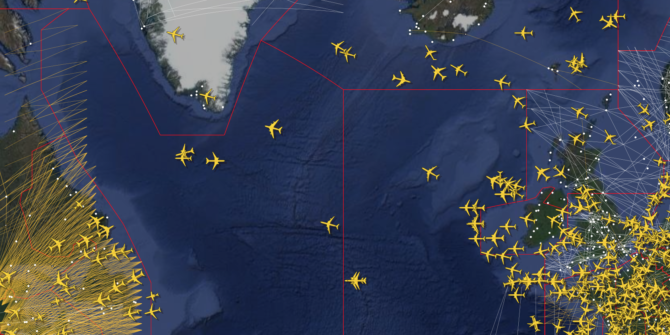
Shanwick Delays OCR Until Post-Summer 2026

Big update on Shanwick’s plans: they’ve now confirmed that the move to the new Oceanic Clearance Removal (OCR) system won’t happen until sometime after summer 2026. That’s a fairly significant shift, as earlier expectations were that it might roll out by the end of summer 2025.

Why the delay?

Over in Gander, when OCR went live last December, things got messy. Controller workload spiked as crews struggled with the new procedures — there were lots of extra radio calls, some confusion over routing, and even a few close calls that controllers had to step in and prevent. More on that here.

Shanwick has pointed to a mix of factors behind the delay — including their own operational complexities and the issues Gander has been dealing with since their rollout. Taking more time now gives them a chance to refine the process and avoid similar issues when they do eventually make the switch.

So, let’s have a nice clear set of steps to follow — depending on whether your headed east or west over the NAT…

Going eastbound via Gander

  1. Send your RCL 60–90 mins before the OEP via ACARS (it’s for ATC planning only, no clearance will be issued!)
  2. May 5 – Dec 31, 2025: Note that any route changes before oceanic entry will be given by VHF voice when in Gander airspace. Moncton and Montreal will continue to issue CPDLC UM79 route amendments.
  3. Don’t request an Oceanic Clearance – there isn’t one here anymore.
  4. Maintain your domestic cleared level unless ATC assigns a different one.
  5. Once in Oceanic airspace, expect further changes via CPDLC or HF.

If Gander isn’t issuing Oceanic Clearances anymore, why send an RCL? This may very well be the crux of the mass pilot confusion experienced so far. The answer: the RCL is now just a planning tool — you’re not asking for permission, only notifying them, because they still need your exact routing and timing to safely manage traffic. You continue to fly your last assigned domestic route and level unless ATC gives you a change. The confusion comes from the wording: no Oceanic Clearance is issued, but notification is still required.

Going westbound via Shanwick

  1. Send your RCL or make a voice clearance request 90–30 mins before the OEP.
  2. You’ll receive your Oceanic Clearance by ACARS or voice.
  3. Fly the Oceanic Clearance.

Also note that if entering Shanwick from another Oceanic area, no clearance is needed from Shanwick.

We think we got all that right. If not, let us know please! news@ops.group.

And if you’re still confused about OCR, check this post.

NAT Forecast: No more RCLs?

There’s also an interesting twist that could change how flights work across the NAT in the longer term. We’re hearing talk that some North Atlantic ANSPs are looking at removing the RCL process completely at some point in the future.

That would be a huge change, bringing oceanic ops much closer to domestic ones. No more sending RCL messages ahead of the Oceanic Entry Point, no more extra steps — you’d just fly your filed plan unless ATC issues a change.

But this is still very much in the idea stage. It would need to go through ICAO groups and international working groups to figure out all the technical and procedural details, and there are plenty of hurdles to clear before it could actually happen.

For now, it’s just something to keep an eye on, as Shanwick and other ANSPs continue to refine how oceanic traffic is managed.


ACARS Oceanic Clearances on the NAT

There is a revised NAT OPS Bulletin that was issued June 14. Bulletin 2020_001 is all about ACARS Data Link Oceanic Clearances.

It puts all the procedures for CZQX/Gander, BIRD/Reykjavik, ENOB/Bodø, EGGX/Shanwick and LPPO/Santa Maria into one spot, instead of having them spread between all the different individual ANSP NAT OPS Bulletins.

When we compared the old version of the Bulletin with this new one there aren’t really any big differences at all. Essentially none, in fact. But since we recently confused ourselves a lot over all things ACARS related, here is a refresher summary of what it says…

Have a read of the intro first

Point 2.2 of the introduction says this:

“The ACARS Data link oceanic clearance service is provided by means of VHF and satellite to ACARS equipped aircraft via communications service providers ARINC and SITA. It should not be confused with FANS 1/A CPDLC.”

(I totally confused these earlier, despite having used both.)

“Operators intending to participate in the ACARS data link process are required to contact their communications service provider and indicate they would like to receive the service.”

So that means the likes of ARINC and SITA.

The Procedures (in short)

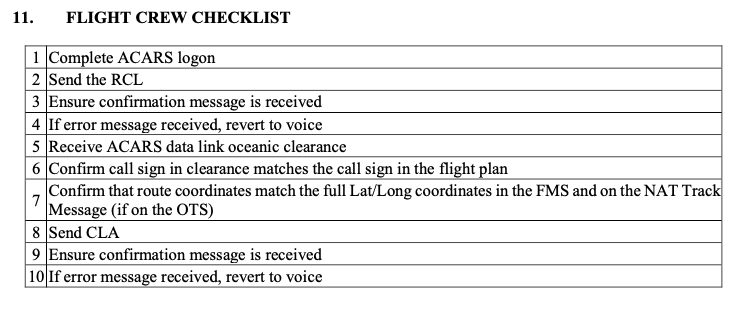
1. Put the ACARS logon in, along with your flight number and the OCA facility.

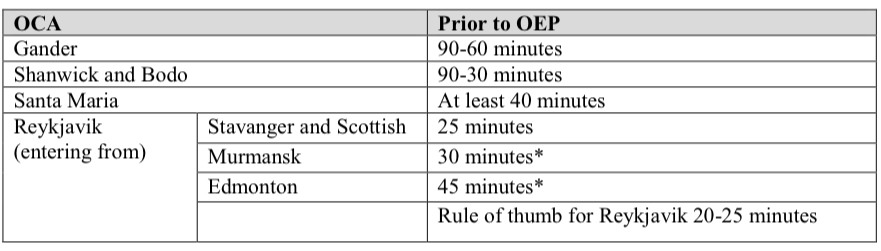
2. Make sure you request your clearance at the right time (not too early, not too late). Here is the current table of timings:

(This is the only change we spotted from the old one – Gander used to say 90-30 minutes, now it says 90-60 minutes.)

3. Make sure your RCL has all the right stuff in it:

  • The OEP (this means Oceanic Entry Point, not to be confused with OAPs which mean old person)
  • Your ETA for the OEP
  • The requested flight level
  • The highest acceptable flight level you could reach by the OEP. This goes in the free text section by putting MAX F123

4. If you don’t get some sort of “RCL Received” message within 5 minutes of sending it then you’re going to have to use voice instead.

5. Once you get your clearance, check it well. That means checking the LATs and LONGs in your FMC. If the clearance doesn’t match your flight plan, then both pilots should independently confirm the coordinates and points. If you don’t like your clearance then negotiate by voice, otherwise send your CLA (clearance acknowledgement). If you don’t have that function, do it with your mouth.

Some peculiarities with each of the OCAs

Gander

  • If you’re departing somewhere less than 45 minutes from your Gander OEP, then get your clearance 10 minutes before you depart.
  • Sometimes you might get an ACARS oceanic clearance before you’ve even sent the RCL.
  • If you fly an aircraft that is not able to send an RCL, then you can set yourself up for Gander’s special service but need to do it in advance:
    • Get in touch with your comms service provider and NavCanada
    • Put AGCS in item 18 of your flight plan
    • Expect to receive your clearance automatically once you logon

Shanwick

  • You must not enter Shanwick without a clearance.
  • If you’re flying between and Irish and a Scottish airport, its not very far, so might want to get your clearance before departure.
  • You get 2 chances with Shanwick. If at first you don’t succeed (you don’t get the RCL received confirmation) then try again.
  • If you’ve left it too late and are within 15 minutes of your OEP, you ain’t going to get your clearance via ACARS.

Reykjavik

  • They don’t give clearances via ACARS if you’re departing from an airport in Iceland, Greenland or the Faroe Islands. Get it from whoever you’re talking to on the ground before you go.

Santa Maria

  • You don’t need an RCL if you’re departing from the Azores, you’ll get it through the (VHF) radio or possibly get a CPDLC route confirmation before you head out into the great blue yonder.

Other helpful stuff in the bulletin

Inmarsat datalink probably won’t work above N82°. Iridium and HF datalink should.
The flight level in the clearance is not a clearance to climb. ATC need to clear you, and need to make sure you reach it before the OEP. But… if you lose comms then this is the cleared oceanic flight level.
Contacts:

Gander: Robert Fleming robert.fleming@navcanada.ca
Reykjavik: Bjarni K. Stefansson bjarni.stefansson@isavia.is
Bodo: Kenneth Berg Kenneth.volden.berg@avinor.no
Shanwick: Iain Brown iain.brown@nats.co.uk
Santa Maria: Jose Cabral jose.cabral@nav.pt


2021 New North Atlantic Plotting & Planning Chart

Hi members!

First, thanks to all the group members who were part of making this. We sat down from scratch and wanted to build the best possible NAT chart we could. A lot of work went into this, and we’re grateful to you all! With this format and structure, we’re also looking at making useful plotting charts for other areas like the Pacific, Africa, etc. – but for now, enjoy this completely updated NAT map for 2021.

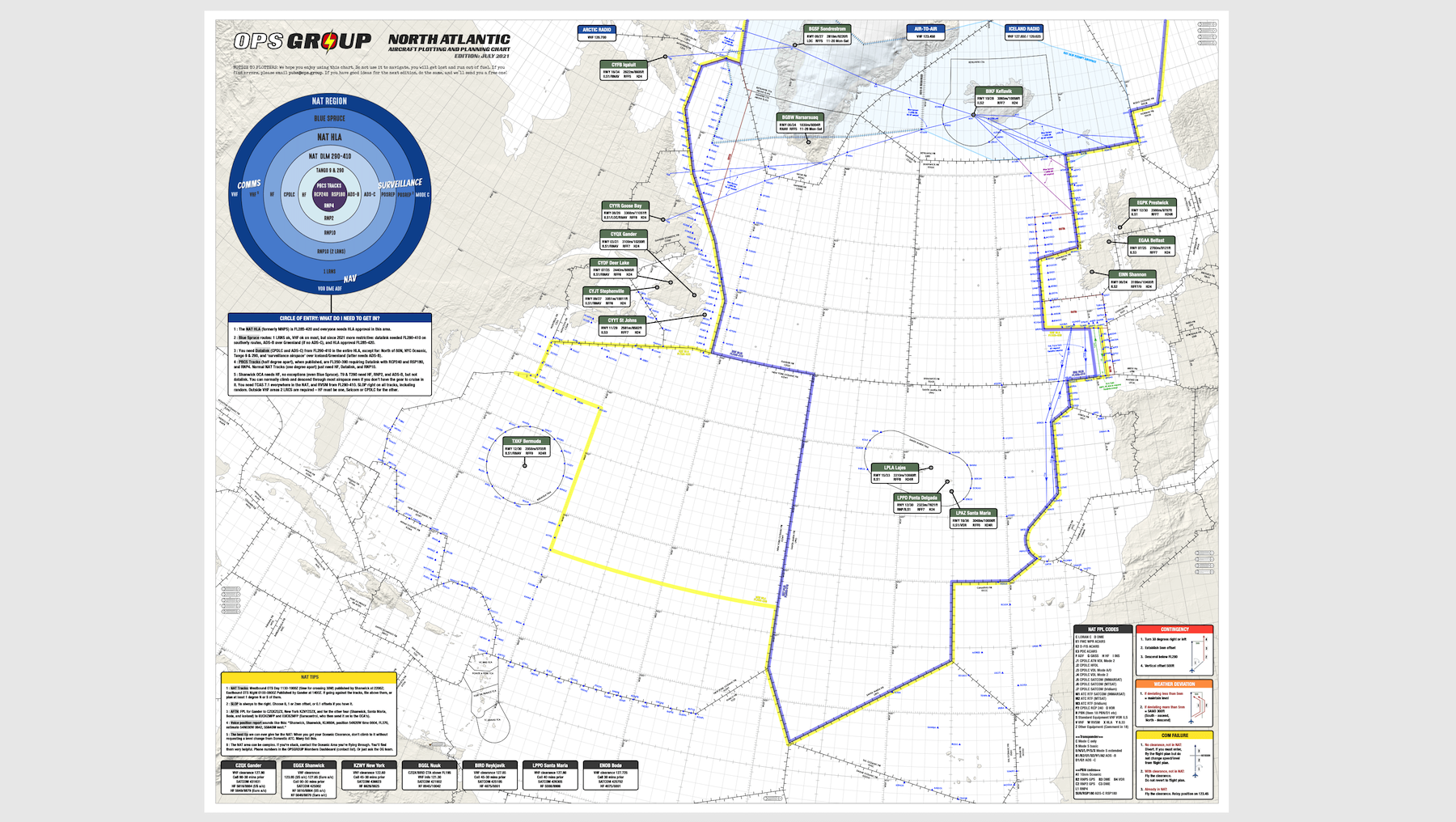
So .. It’s ready! You can grab it in Slack, or in your Dashboard. View it on your iPad or Laptop etc. as a PDF, or print it out as a giant wall map! It prints really well up to 15 feet wide – but you can also just put it onto A3 or A2 size paper.

If you’re not a member, read on for how to get a copy.


About the 2021 NAT Chart

This chart is completely new – we started from scratch, expanded the coverage area, and then worked as a group to add all the useful things we could think of that a pilot or dispatcher crossing the North Atlantic might need.

New on this chart – effective July 2021:

  • FULLY UDPATED for 2021 post-COVID flying!
  • EXPANDED coverage area – much further down into the Atlantic, and further west.
  • NEW! NAT Tips – using NAT Tracks, SLOP, filing an Oceanic Flight Plan, and helpful tips
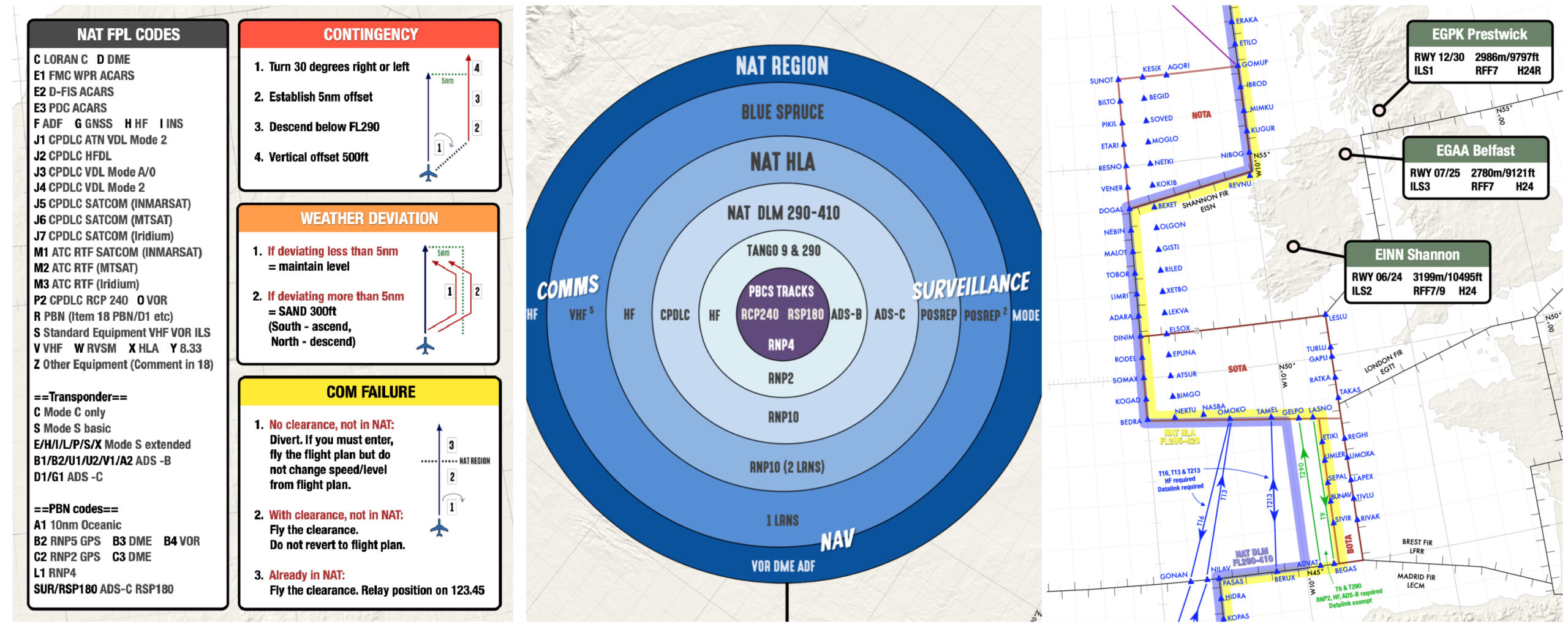
  • NEW! Quick reference for contingency, weather, and comms failure with easy graphics.
  • Updated: NAT Airspace Circle of Entry 2021 – easily check what you need for Nav, Comms and ATC Surveillance depending on which bit of the NAT you will be flying through.
  • Additional diversion airports, now 16 total primary NAT alternates with runway, approach, length, RFF, and hours
  • Easy view of boundaries for HLA and DLM/Datalink mandated airspace
  • Updated NAT FPL codes, clearance frequencies, Satcom, and HF
  • Fully updated “South East Corner” with new Tango routes
  • and … Treasure Boxes!

Other chart features:

:: Requirements for NAT tracks, PBCS tracks, datalink mandate.
:: Common NAT Diversion Airports.
:: Runway Orientation, Length, best IFR Approach.
:: RFF Category and Opening hours.
:: NAT FPL Codes and sample FPL.
:: Blue Spruce routes and equipment requirements.
:: All NAT Entry/Exit points with associated required landfall fixes.


How to get the new chart, if you’re not a member?

OPSGROUP members get this and other publications free of charge, all available through your member dashboard.

There have been many changes on the North Atlantic since we published our previous chart in 2019.  Here’s a few things to read up on:

We hope you find it super useful, but also have fun using it!


July 2021 North Atlantic Changes

Just when you thought it was safe to go back in the water…

Yep. Barely five months since the last version of the NAT Doc 007 was published, we now have a new one.

First things first – links…

To see just the new changes, click here.

To see the new NAT Doc 007 in its entirety, click here.

To see the old NAT Doc 007, and painstakingly cross-check all the changes compared to the new version (i.e. what we did so we could write this post), click here.

Here’s the lowdown of what’s changed…

The Datalink Mandate

No changes to the rules here. The old NAT Ops Bulletin 2017_001 which contained all the info about the Datalink Mandate has been discontinued, and the essential info incorporated into the NAT Doc 007.

Key points:

  • Aircraft without datalink can request to climb/descend through datalink mandated airspace, but will only be considered on a tactical basis by ATC.
  • Flights without datalink that file STS/FFR, HOSP, HUM, MEDEVAC SAR, or STATE in Field 18 of the FPL, may be permitted to flight plan and fly through datalink mandated airspace, but may not get their requested flight levels.
  • For datalink failure before departure, you should re-file your FPL to stay clear of NAT DLM airspace. If it fails after departure or whilst in NAT DLM airspace, ATC may let you continue based on “tactical considerations” (i.e. how much other traffic is around).

Which brings us neatly on to…

ATS Surveillance Airspace

This one has had us scratching our heads for a while now…

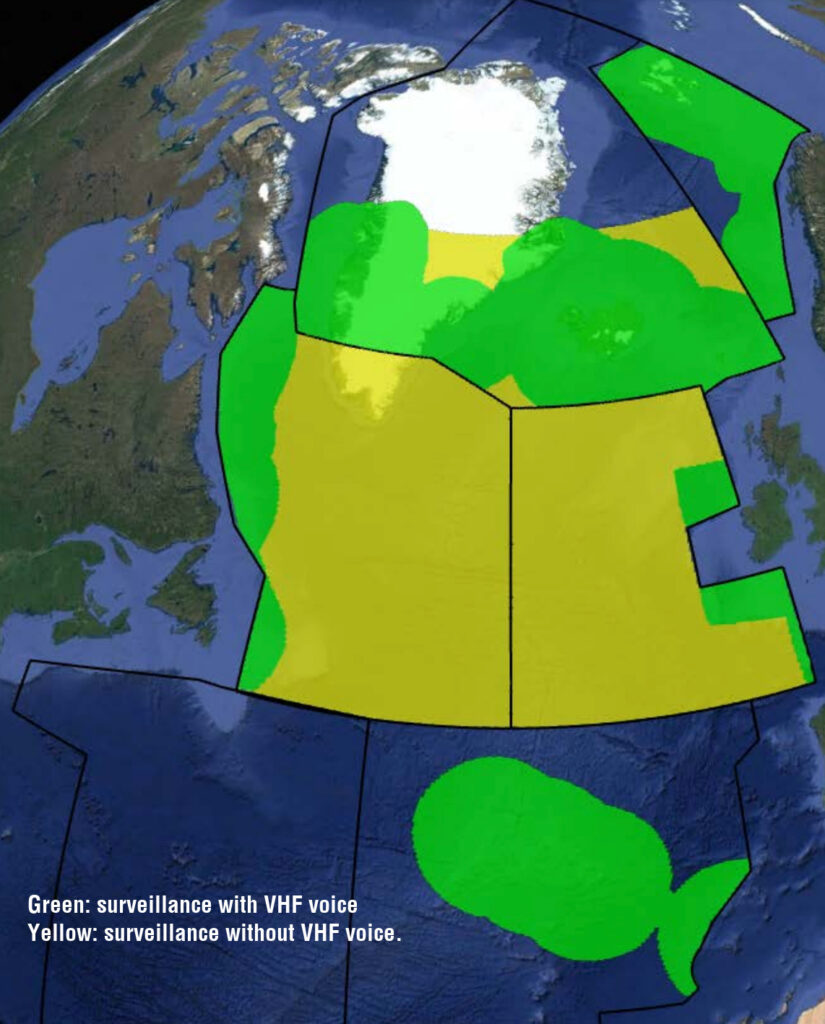
So, there is an updated chart showing the areas of ATS Surveillance Airspace in the NAT:

We have to say, we really don’t like this chart very much. The green blobs are misleading. Here’s what we mean…

Essentially, the NAT Doc 007 says that these are the datalink-exempt bits within the NAT Region:

1. Everything north of 80°North.
2. New York Oceanic East FIR.
3. Tango Routes T9 and T290.
4. ATS Surveillance Airspace, where surveillance service is provided by means of radar and/or ADS-B, coupled with VHF.

So these green blobs give a rough idea of where ATS surveillance service is provided by radar and/or ADS-B within VHF range. But rough ideas don’t win prizes, and neither do they explicitly tell you what the rules are. Where is this mythical ATS Surveillance airspace in reality? Give me some hard coordinates!

Thing is, they actually do, right there in the NAT Doc 007, they just don’t say it very clearly.

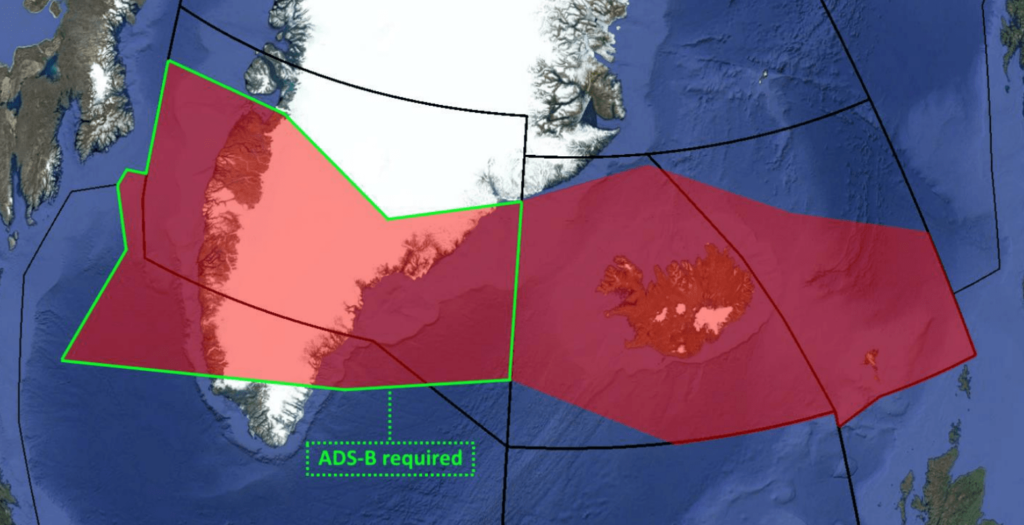
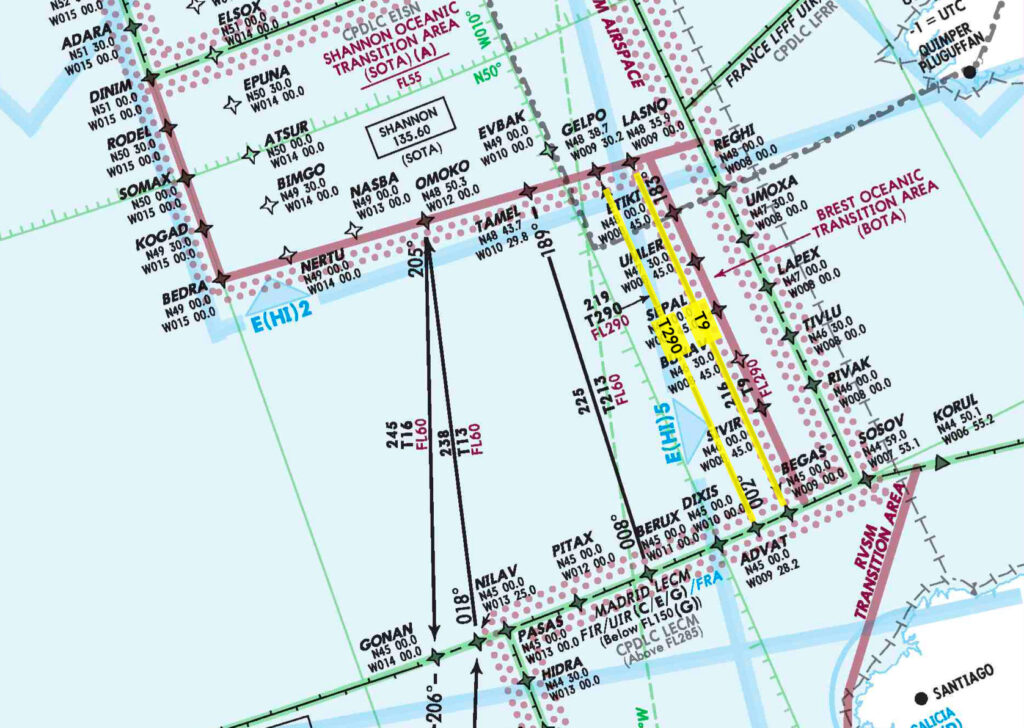
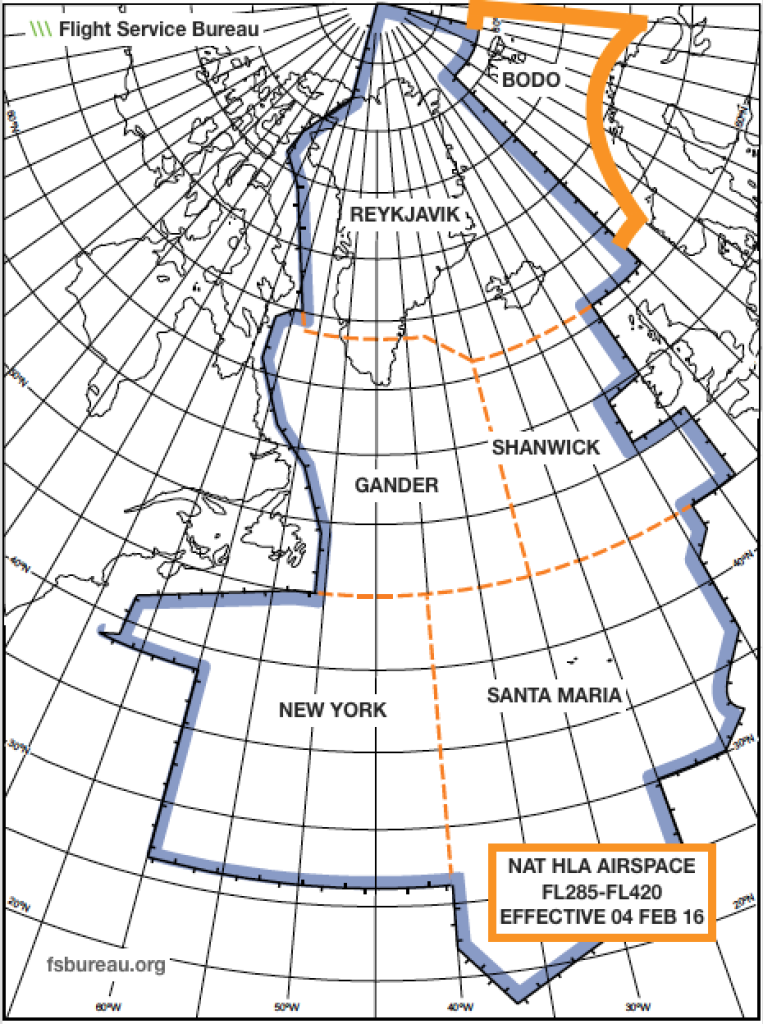
Here’s the answer (we had to get in contact with Gander and Reykjavik ATC to confirm this): ATS Surveillance Airspace is the area over Greenland and Iceland shown in this picture below. This is where you’re allowed to fly above FL290 if you don’t have datalink.

There is no special datalink exemption for the Blue Spruce routes. That’s another key point here.

The southerly Blue Spruce routes are not fully contained in the exempted airspace. So if you’re flying these routes you will have to meet the NAT DLM requirements or fly below FL290 or above FL410.

The northerly Blue Spruce routes are different (i.e the ones going overhead BGSF/Sondrestrom airport). These do fall within the exempted area of airspace – so datalink is not mandatory if you’re flying here.

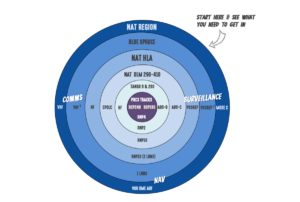
Confused? We don’t blame you. Here’s something that might alleviate some misery though – our NAT Airspace Circle of Entry. OPSGROUP members can download the full hi-res PDF version here. The Circle shows you what equipment you need – like CPDLC, ADS-C, HF – for each different type of airspace in the North Atlantic. With the datalink requirement effective Feb 2021, and the introduction of new requirements for the Tango Routes on the eastern side of the Shanwick OCA (T9 & T290), there are some important changes.

This NAT Airspace Circle of Entry will also appear on the new NAT Plotting/Planning chart that we are finalizing at the moment, and we’ll send you that when it’s ready.

“SET MAX UPLINK DELAY VALUE TO 300 SECONDS”

This thing started back in 2018 – a new procedure designed to prevent pilots from acting on any old CPDLC messages that might have been delayed in the network.

So, we have CPDLC where ATC can basically ‘text’ you some sort of message. Usually a clearance to do something. There is a risk though that the message is latent meaning ‘existing but not yet developed or manifest; hidden or concealed’. Basically lost for a longish time in the digital void and it means there is a risk pilots might get a message to do something way after they were supposed to do it, and it is no longer valid (or safe to) anymore.

The old NAT Ops Bulletin 2018_002 about CPDLC Uplink Message Latency Monitor Function has been discontinued, and the essential info is now incorporated into the NAT Doc 007. But there is some new info to be aware of.

The key change here is that all the NAT ANSPs have agreed on 300 seconds as the period of time all aircraft should set their uplink timers to (any message that takes longer than that to reach you will be deemed ‘latent’). Also, they will be sending this to all CPDLC connected aircraft immediately after they enter each control area – so you might receive the message a bunch of times (a bit annoying) but the procedure is the same regardless of whether you’ve “done it already” or not.

This procedure is covered in section 8.50.20 of the new NAT Doc 007, and it works like this:

  • When you receive the message to set your max uplink delay to 300 seconds, acknowledge it with a Roger [ACCEPT].
  • If you don’t have a message latency monitoring function available then you still have to acknowledge the message but say ‘TIMER NOT AVAILABLE’.
  • Now, if you do have the function available then change the max uplink delay to 300 seconds and you’re done.

If the system gives you an indication that a message has been delayed over 300 seconds then don’t follow what it says but get in touch with ATC (by voice) and let them know so they can confirm whether they still want you to do carry out whatever the clearance told you to do. They will also close the message out of the system.

Bottom line: don’t act on a delayed uplink message until you’ve checked with ATC.

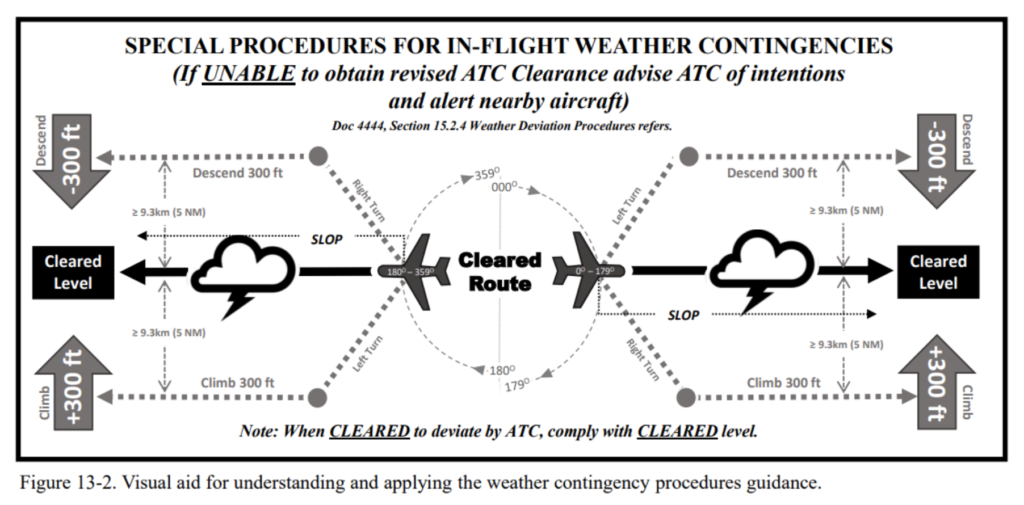
Weather Deviation Procedures

No new rules here, they’ve just made a nice little graphic to help understand the Procedures.

Funky! If you prefer a slightly simpler version, check out this one we made earlier:

Almost finished now. That’s the big stuff done…

Climbs in Gander and Shanwick airspace

Gander and Shanwick have decided that they will advise crew in their OCA when a higher flight level becomes available. Basically, they have a function in their ATM system which lets them interrogate the flight’s vertical profile to determine when a higher level is available. They will then check there is no separation issue and if not, will offer the new level.

What did it used to say?

It used to say that clearances tend to specify a single flight level, but that sometimes there might be ‘scope’ for higher climb. It had some stuff about how, if you got a re-clearance you should climb without delay. It also said that if you aren’t CPDLC equipped you should tell ATC as soon as you’ve left your old level and when you reach the new level.

Actually it still says that in the new document but now it has a new bit about how Shanwick and Gander will be a bit more proactive about letting you know when the levels become available.

PBCS operations

The only changes in this section are wording changes. Separation minima is no longer “as low as” – it is now “as small as”“How small can you go” doesn’t have quite the same ring to it…


And that’s it!! That’s all the changes!! At least, we think so. If you have spotted any biggies not listed here, send us an email at: news@ops.group

And if all this is not enough for you, and you want a comprehensive timeline of all the old significant changes on the North Atlantic stretching back to the dawn of time (actually, just to 2015), then click here.


NAT Tracks NIL – an experiment

The long-awaited and much discussed scenario on the North Atlantic finally happened this week: No published NAT Tracks, with all aircraft on Random Routes. The concept of free-routing on the NAT is one that airlines in particular have been keen to see for a long time: the ability to decide their own routes, unconstrained by an overlay of tracks that may be tangential to their flight-planning whims.

This is an experiment being led by NATS and Nav Canada (or Shanwick and Gander, if you prefer), and on the face of it, it appears straightforward. Traffic levels are lower at present – about 40% of normal. In January 2021, Shanwick managed 15,241 flights (averaging 491 flights per day), 41% of the January 2020 figure of 36,782 (averaging 1,189 flights per day). A reduction in volume goes hand in hand with a reduction in complexity from an ATC perspective. Without published tracks to assist in separation, the burden on the controller is increased – but the lower traffic levels mean it can be safely managed. Ideal time to try it out.

The concept has garnered much media interest, not least because of the timing of a scientific research paper from Reading University that suggests efficiencies of up to 16.4% can be achieved with this “new idea”. As a result, in the past 10 days the NAT Tracks have featured on CNN (“Airlines can now pick their own routes across the Atlantic. Huge fuel savings could follow”) and the Independent (“‘Surfing the wind’ could allow aircraft to cut carbon emissions and reduce flight times”). Headline: New York-London journeys could be cut by 21 minutes.

The media, and even our own industry news coverage, would have us believe that somehow we’ve just stumbled onto some preternatural scheme of harnessing the power of the wind, to spirit our hulking lumps of metal across the pond. Jet streams, you say? Pray tell.

Let’s clarify something first. Aviation contributes around 2% of global CO2 emissions. Global warming is a danger to our entire existence. We are an industry founded on innovation and ingenuity, and we should be looking for every opportunity to do something more than just shave a few dollars off a route cost. We need to open our minds, stop being quite so defensive about aviation, collaborate with science and research, and above all recognise the impact that aircraft are having on the environment. We need dramatic change.

In the cold light of operational reality, however, all is not as the public coverage seems. The Shanwick/Gander No-Tracks experiment itself is founded on solid ground – the results will provide useful insight, and the reasoning for it is sound. The research paper, however, and associated media fanfare, has shakier foundations. In fact, there are fundamental flaws in the assumptions made to reach the headline proclamations of 16.4% and 230km (125 nautical mile) savings on route distance.

We’ll look at three things in this article …

One: How an aircraft operator actually chooses a route across the NAT
Two: The ATC perspective; why No NAT Tracks is not as easy as it might sound.
Three: A review of the research report from Reading University.

Part One: How does a NAT route get chosen?

The hardest thing in life is knowing what you want. It’s no different on the NAT. The process for selecting a route across the ocean is more complex than it might seem. At first glance, it might appear that the most logical route is the best wind route, in other words, the track across the ocean where we can take maxium advantage of the jet stream. In the Reading University report, this is called the “OFW: Optimized for Wind Route“. Let’s see why this is not the case.

There are four track calculation options available to most aircraft dispatchers and flight planing systems:

A. MDT: Minimum Distance Track. Departure to destination with shortest distance (ie. Great Circle track). Only sensible if there is no wind, which never happens.
B. MFT: Minimum Fuel Track. Departure to destination with lowest possible fuel burn. Equivalent to the OFW/Optimized for Wind Route.
C. MTT: Minimum Time Track. Departure to destination in shortest possible time. Often very similar to the MFT.
D. MCT: Minimum Cost Track. Departure to destination with lowest cost – considering not just fuel, but navigation fees, and the cost of time (eg. knock on schedule effects, missing curfews etc.)

Which is the most commonly used? Minimum Cost Track, by far. Minimum Fuel is good. But for aircraft operators, we have to consider whether saving 100 kgs in fuel results in being 10 mins late to stand, or makes us overfly a much more expensive country, or miss a curfew time at the airport.

A North American OPSGROUP airline dispatcher told me: “To give you an idea of cost, a Minimum Time Track (MTT) or Minimum Fuel Track (MFT) for our Boeing 777 from the west coast of North America to east Asia can cost anywhere from $10,000 to $15,000 more than taking an MCT. The difference? The MTT and MFT will go through Russia [where navigation fees are much higher]. The MCT stays on the North Pacific in Oakland and Fukuoka airspace. But that cheaper route can be 30+ minutes longer.

And even then, that’s not the track the operator might want to fly. One big consideration: Turbulence.

In the winter months in particular, the eastbound jet stream can be nasty. The place where the most efficient route lies is efficient because that’s where the winds are strongest. This is often also where the core ‘efficient’ NAT Track Xray or Zulu lies these days. A 200 knot tailwind is great, but it comes with a sting in the tail: severe turbulence. The same dispatcher told me: “In the last week, we’ve not flown the NAT Tracks because of multiple patches of severe turbulence, both forecast and reported by other airlines”.


Planning a real-life NAT route from start to finish: eight steps

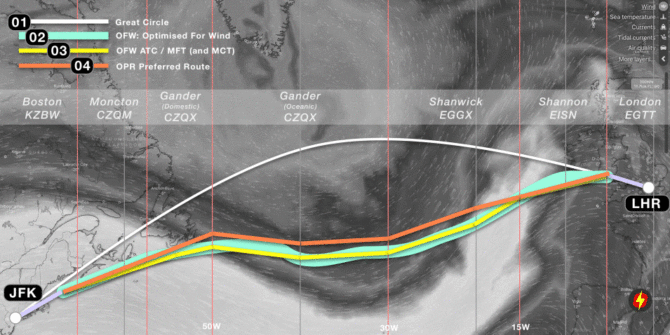
We’ll look at an eastbound flight from New York Kennedy (JFK/KJFK) to London Heathrow (LHR/EGLL). Given that the research paper mentioned above identifies maxium fuel savings eastbound of 16.4%, this is a good example to choose. On the maps that follow, you will see the there are eight steps, starting with the great circle track, and working through what happens in practice until we reach the actual route flown. The aircraft in this example is a Boeing 787, which has an optimum altitude of FL390 (presure level of 200 hPa) at operational weight (~85% of MTOW). Therefore, the winds shown are those at FL390. For track planning, we will consider only the track from Top of Climb (first point of cruising altitude) to Top of Descent (beginning of descent into LHR). The map also shows the ATC areas that will control the flight in the enroute phase. The jet stream is shown as background: the whiter, the faster.
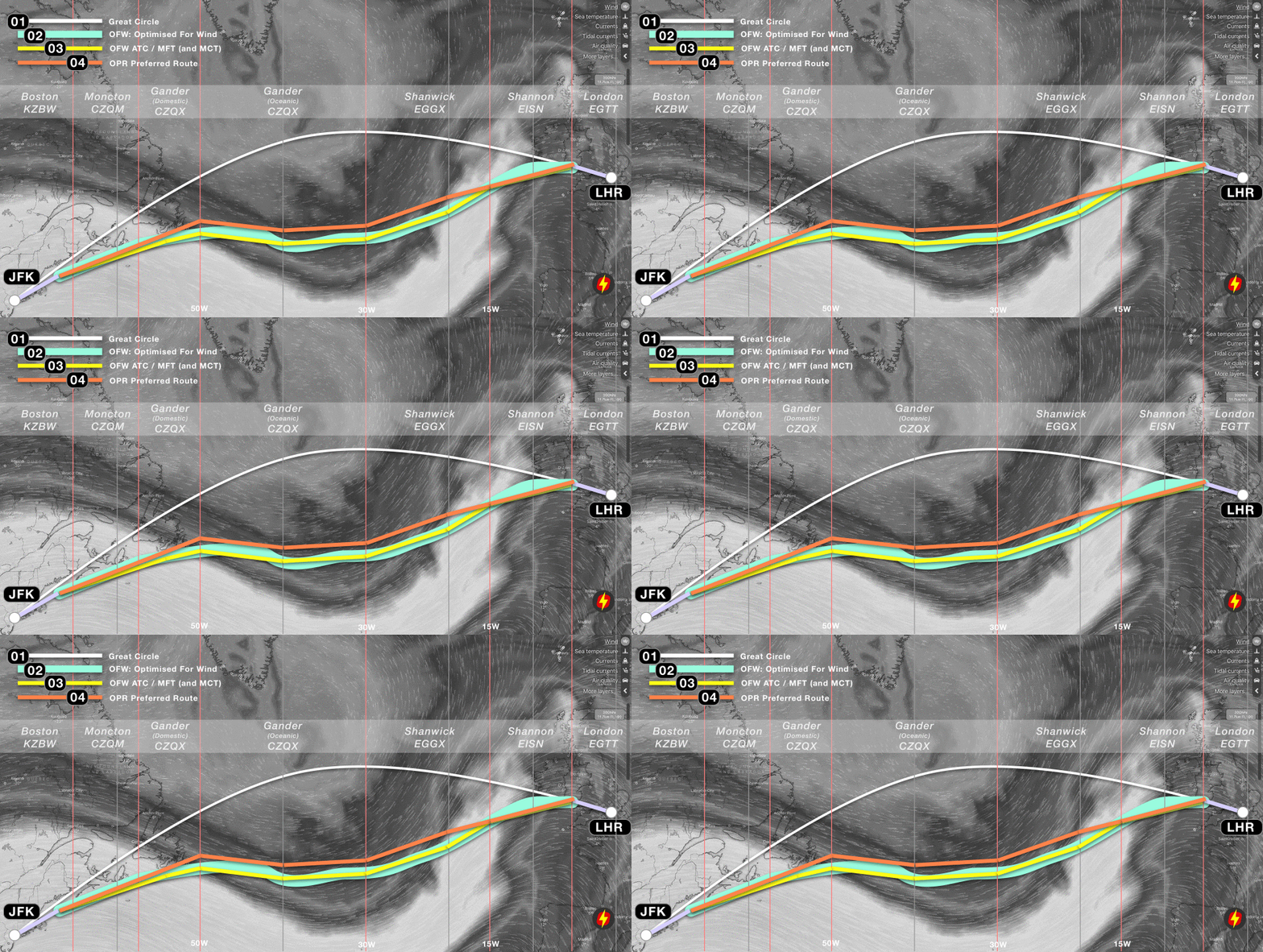
01: GC: Great Circle Route. The shortest distance between JFK and LHR. This does not take winds into account, so to find the best wind route, we must add wind from the forecast for FL390 for our time of flight.

02: OFW: Optimised For Wind route. The track taking maximum advantage of the winds at FL390 (39,000 feet, or the 200 hPa pressure level in ISA).

03: OFW ATC route. The OFW route as adjusted for oceanic ATC flight planning limitations – which are: 1. You must use fixed 1/2 degree latitude points at every 10 degrees of longitude from Oceanic Entry Point to Oceanic Exit Point. 2. You must fly a straight line from that point to the next 10 degree longitude line. This route equates to the MFT (Minimum Fuel Track) in flight planning systems, and in our case here, also the MTT (Minimum Time Track). For some NAT routes, overflight fees will be a consideration (for example, avoiding higher charges in UK and Swiss airspace on routes that go further into Europe) – but here, they are not, so MCT (Minimum Cost Track) is also the same. In other words, OFW ATC = MFT = MTT = MCT.

04: Operator Preferred Route. The next big consideration is turbulence. In this example flight, there are moderate-severe turbulence warning patches at several points on the ATC OFW/MCT route above, so the dispatcher elects to move it a little further north – still gaining from the eastbound jetstream, but outside the core jetstream which has the highest turbulence.

We can now move on to the next stage of planning in a real-world scenario: accounting for a high volume of other traffic, ie. matching the Operator Preferred Route to the closest NAT Track of those published for the day of flight.
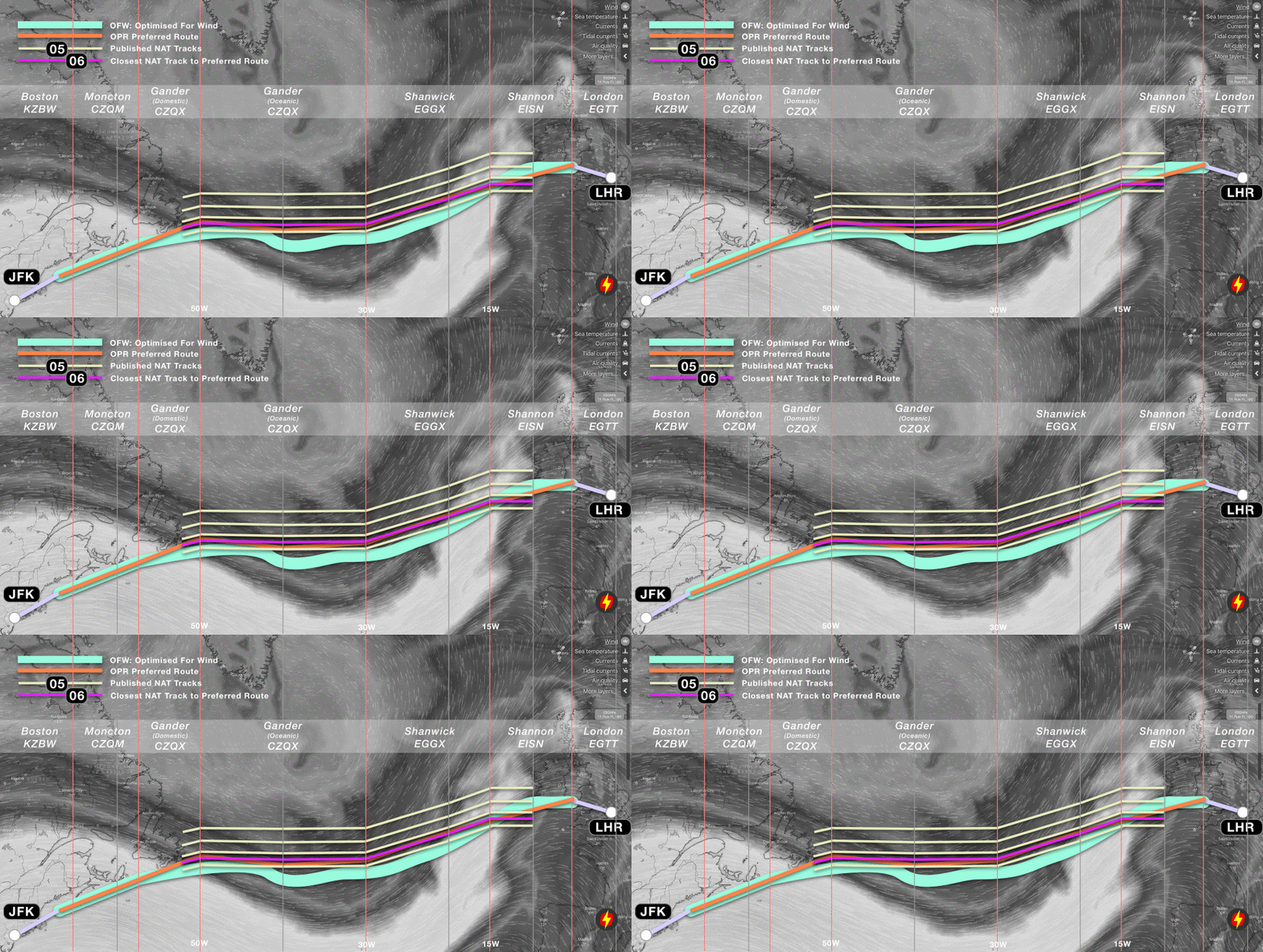
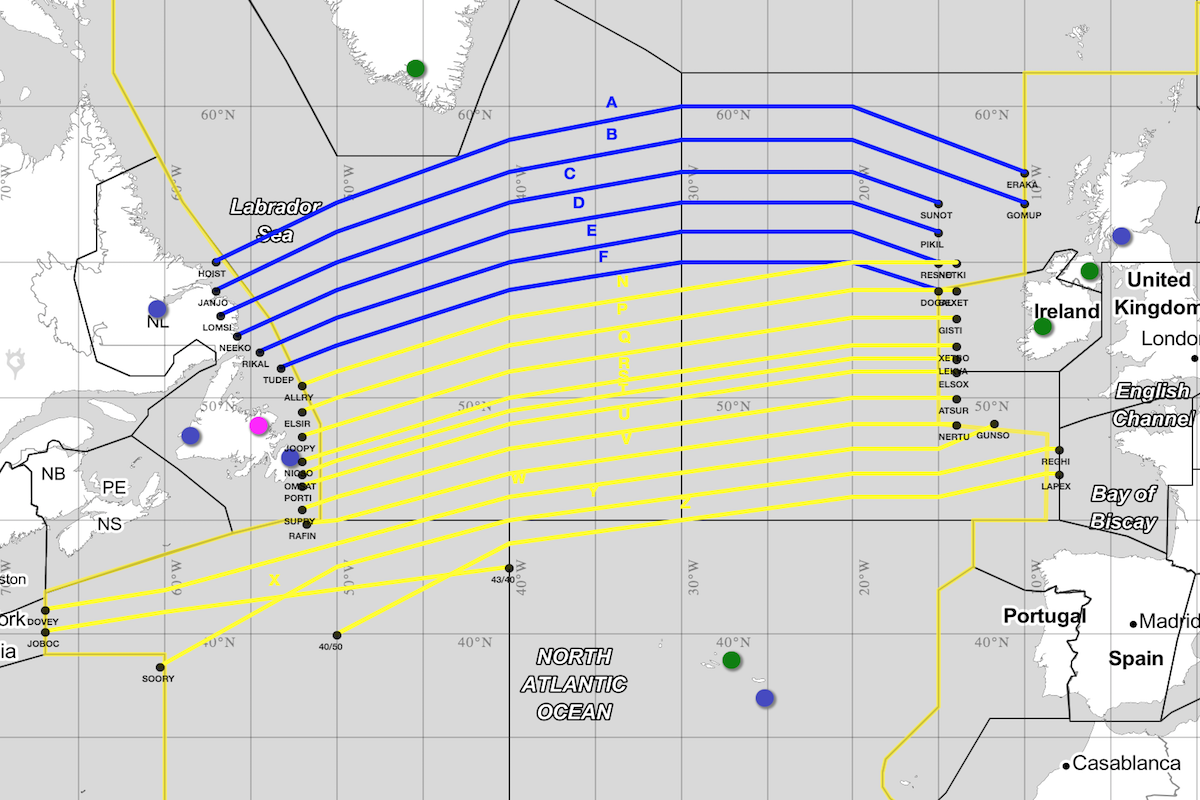
05: Published NAT Tracks. Once a day, Gander issues the NAT Track Message for Eastbound Tracks, which allows Air Traffic Control to safely separate the peak flow of flights from the US to Europe. In this case, there are five tracks.

06: Closest NAT Track to Preferred Route. This is a simple calculation – which NAT Track most closely matches the Operator Preferred Route across the ocean. In this case, it is highlighted in purple, and is a relatively close match.

Finally, we can account for what will happen at the time of flight …
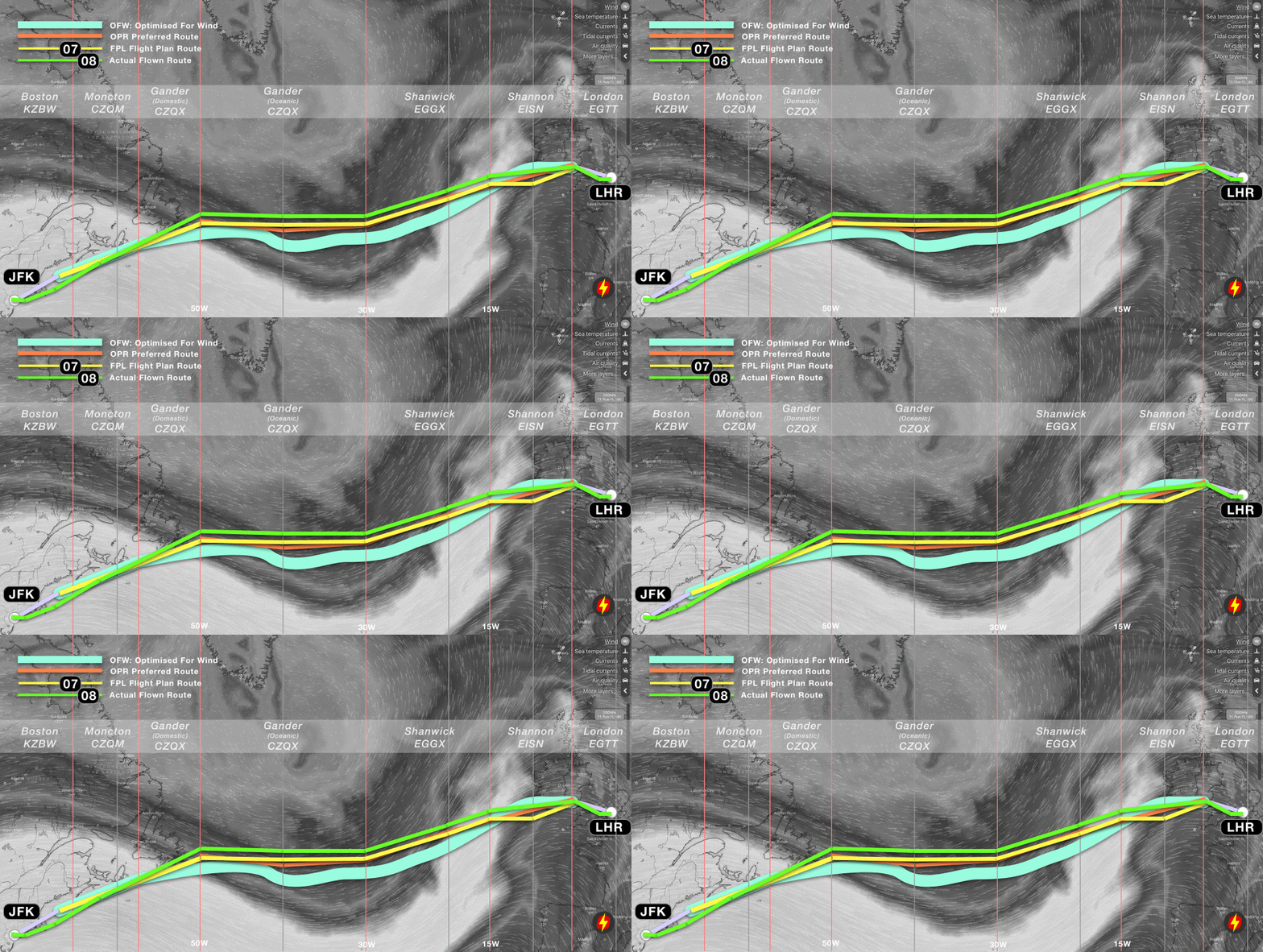
07: Flight Plan Route (FPL). With the choice of track made, the operator will then file the Flight Plan with their requested route, several hours in advance of the flights’ departure from JFK. The purple track above at Step 6 (closest NAT Track) becomes the yellow track in this step, to which the domestic ATC routings are added. Once airborne and enroute, about an hour from the Oceanic Entry Point at 50W, the crew will request their Oceanic Clearance from Gander, as per this flight plan route.

08: Actual Flown Route.  For this flight, the requested track was not available at FL390 (because of other traffic ahead). The crew were given a choice of either a more notherly NAT track at their preferred level (FL390), or their requested NAT track at FL370. The altitude difference would have made for a greater fuel burn than a slightly longer distance, so the crew elected to take the more northerly track (30 nautical miles further north laterally, but in terms of distance flown adding about 20 nautical miles). At 15W, the flight is under radar coverage from Shannon, and was cleared direct to the Strumble (STU) beacon in Wales (which was the original planned Top of Descent). The green track therefore depicts the actual route flown.


Where did we lose most efficiency?

Since the background to this article is considering the benefits of not having to follow prescribed NAT Tracks, the key question is – where has most efficiency been lost on this flight?

  1. Loss 1: The difference between the Minimum Fuel Track (MFT) (or “ATC OFW”) and the Optimized for Wind Route (OFW). Some efficiency is lost because the OFW is constrained by flight planning requirements – specifically having to flight straight lines between each 10 degrees of longitude, and having to cross each 10 degrees of longitude at 1/2 degrees of latitude. The “route of straight lines” is, of course, longer.
  2. Loss 2: The difference between the MFT and the Operator Preferred Route. In this case, the operator chose to move the track further north to avoid turbulence. This decision creates an efficiency loss in terms of fuel burn, because the minimum fuel track is no longer being followed.
  3. Loss 3: The difference between the Operator Preferred Route and the closest matching NAT Track. This is the key efficiency difference when considering gains from the “No NAT Track’s” experiment.
  4. Loss 4: The difference between the NAT Track requested (Flight Plan Route) and the Actual Route flown. There is a mixed bag here. On the one hand, if the operator has to fly anthing other than the requested route, they lose efficiency to some degree. In this case, ATC could only offer a lower level, or a more northerly route. On the other, domestic ATC (using radar) often provide shortcuts which lessen the track miles flown.

A scientific analysis of a series of actual flights would reveal the numbers involved in the four different areas of efficiency loss – and this is roughly the aim of the OTS NIL experiment that Shanwick and Gander are conducting,


Part Two: Why we might still need NAT Tracks

The narrative in the majority of recent reports about the North Atlantic tell us that because we now have ADS-B satellites, and thereby excellent surveillance, this changes the entire landscape, and allows for the disbanding of NAT Tracks. But this overlooks a key point: it’s not a surveillance problem, it’s a comms problem.

We’ve got surveillance nailed – it’s basically the same as radar, now that the full complement of Aireon ADS-B satellites are up and running, complementing the ADS-C coverage already in place. So, controllers can see the aircraft in much the same way as a domestic radar controller. That’s exciting.

However, it’s a bridge too far to assume that just because surveillance is good, we can start treating the Air Traffic Control of NAT aircraft as if it were somewhere in the centre of Europe.

And the reason: instant communication. In a domestic ATC environment, the approximate sequence of events goes like this (callsigns dropped from some calls for clarity):

Controller (thought):Hmmm, Delta and Speedbird are getting a little close. I’ll climb the Delta.
Controller: Delta 63, climb FL360.
Delta 63: Sorry, unable 360, we’re still too heavy.
Controller: Delta 63, roger, turn right 10 degrees due traffic.
Delta 63: Roger, right turn heading 280.

And Delta turns. Conflict solved. That entire sequence of events takes about 10 seconds. Now consider the Oceanic environment. CPDLC is a hell of a lot better than HF, but the target time for the same sequence of events is 240 seconds, or 4 minutes. That’s the basis of RCP240.

See the ATC problem? We can see the traffic now, but we can’t be sure that we can move it around in the same way as a real radar environment, because we don’t have VHF.

This is why the new satellite coverage does not go all the way to allowing a full reduction in separation to the standard enroute value of 5 nautical miles. Oceanic ATC, even with this additional surveillance, remains more of a procedural environment – and separation standards cannot yet drop. In the same vein, we’re not yet at the point where we can solve enroute conflicts with a few vectors and “on your way”.

And therefore, removing the NAT Organized Track Structure for high volumes of traffic is a big challenge.

Part Three: The Reading University Report

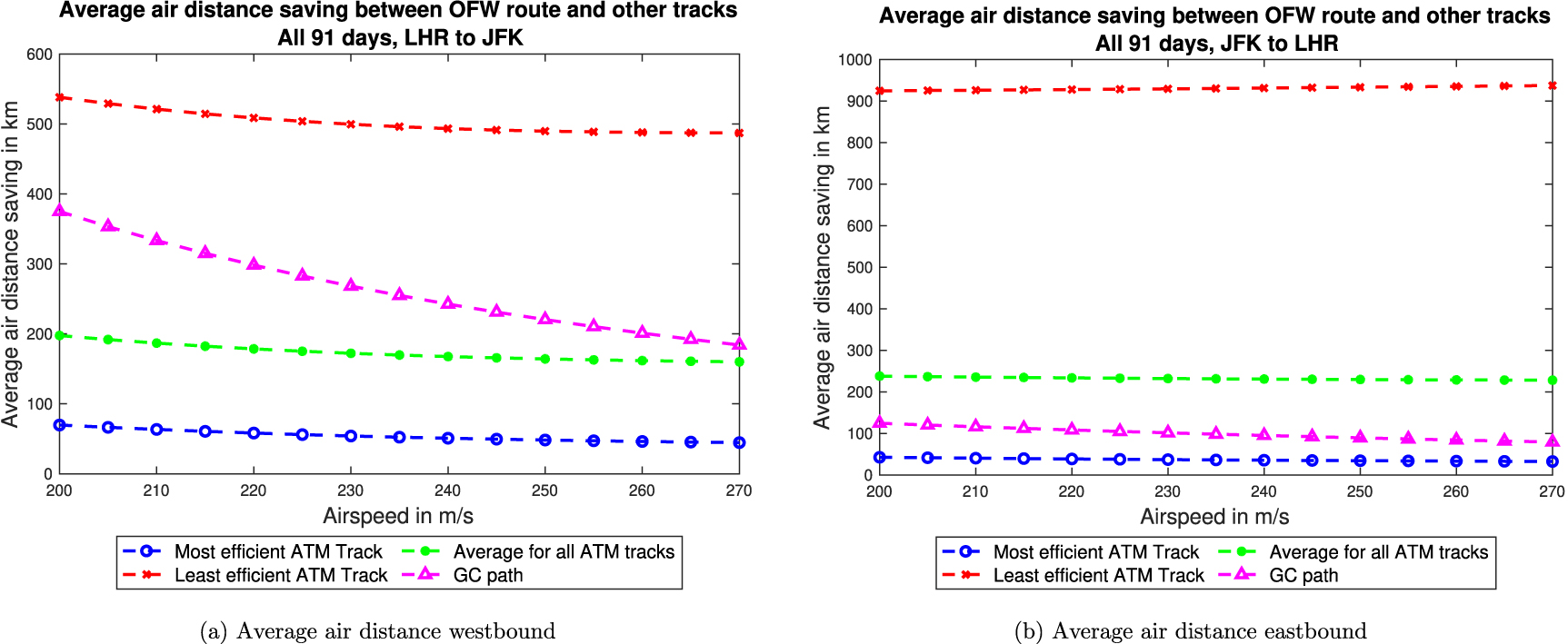
Published in January 2021, a paper from Reading University titled “Reducing transatlantic flight emissions by fuel-optimised routing” suggested that “current flight tracks [on the North Atlantic] have air distances that are typically several hundred kilometres longer than the fuel-optimised routes”, that by using the optimal wind route eastbound flights would save on average 232 km, and that an efficiency gain of up to 16.4% would be possible. These headline figures are the ones taken by the media in the last few weeks resulting in articles suggesting that the average New York-London flight could arrive 21 minutes earlier [Independent >].

The paper shows these graphs, with the eastbound plot on the right:
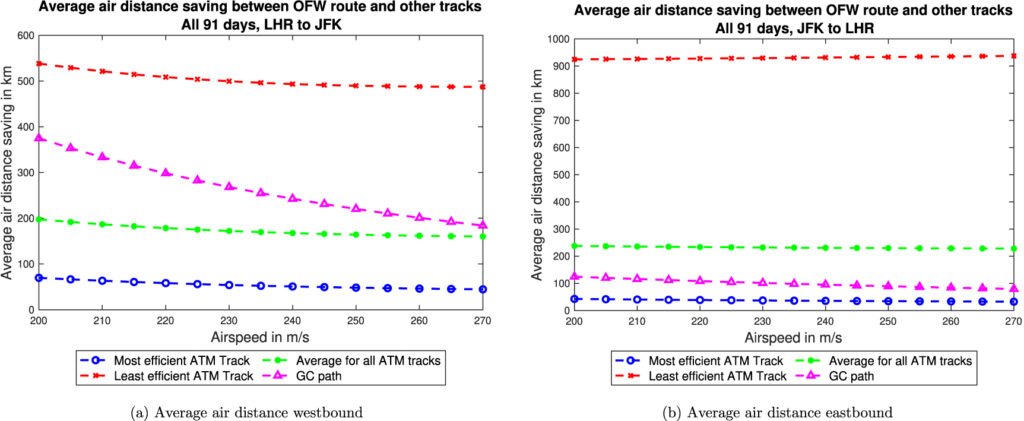
 

From an operational perspective, however, the promise of 232km (125nm) average route savings, and 16.4% increases in efficiency do not ring true. If you are a dispatcher, or pilot, you will share my instinct that this number feels extremely high.  The term “potential increase in efficiency” really means “current inefficiency” – and my gut feeling says it’s not always ideal, but far from that bad. Many plans are indeed sub-optimal, and crossing the NAT certainly has the potential to result in a track a half-degree north or south of the one requested or a level below the optimum – but is the inefficiency really that high?

Closer analysis shows that at least some of the assumptions in the report to be fundamentally flawed.

The report itself makes the flaw clear here: “Taking the results for an airspeed of 240 m s−1 and averaging savings in air distance between the most efficient ATM track and the OFW route across all 91 days of winter 2019–2020 for flights from JFK to LHR, gives an air distance saving of 37 km, but the saving for the least efficient ATM track is over 931 km. The average saving for all ATM tracks is 232 km”

The problem is that to reach these high numbers, the paper is assuming that “airlines use all provided tracks equally“. This is not what happens in reality, by any stretch. There are normally 8-10 NAT Tracks eastbound. An airline, or aircraft operator will request their Preferred Track, as we have seen in the example above. Almost all of the time, the requested track is granted, albeit with potentially a lower level (or higher) than requested. Very ocasionally, a track one north or one south is given by ATC.

The efficiency figure of 16.4% is created by dividing the air distance between LHR-JFK by additional distance flown on the least efficient eastbound NAT Track (2,997nm/503nm ~ 16.4%). That least efficient NAT Track (which will usually be Track Zulu in non-Covid ops for an eastbound flight) is normally a southerly Caribbean area route intended for traffic departing places like Miami, the Bahamas, or even Trinidad and Tobago. It will never be flown by a New York-London flight.

Therefore, we have to disregard these higher numbers entirely.

The report does identify, when looking at actual flights, that efficiency savings of “2.5% for eastbound flights and 1.7% for those flying west” would be obtained by flying the optimum wind route (OFW). Those numbers look far closer to what we might expect as total efficiency losses identified at the end of Part One, above.

However, consider further that we looked at four different types of efficiency loss: flight planning constraints, avoiding turbulence, the NAT Tracks requirement, and tactical routing by ATC. It is clear, then, that the presence of the NAT Tracks accounts only for a portion of those inefficiencies. Again, real world analysis of actual flights with the full compendium of information as to what caused the ineffciencies would give the most insight, and this is what we will hopefully see from NATS and Nav Canada as a result of the “OTS NIL” experiment.

A further paper as an iteration of the first, applying a collaborative approach with the operational world (ATC, Airlines, Aircraft Operators, Flight Crew), would be beneficial.

Over the past 25 years, there has been continual improvement in ATC efficiency. The NAT region was the first to implement reduced vertical separation (RVSM), in March 1997, and subsequent improvements in surveillance (ADS-B, ADS-C), and communications (CPDLC), have led to lateral separation improvement from 60nm to 19nm, and longitudinal from 80nm (or 10 minutes) to as low as 14nm – in addition to the altitude separation reduction from 2,000 to 1,000 feet. In simple terms, the number of aircraft that can fly closer to the optimum route for a city pair has dramatically increased.

Despite the inaccuracies in the numbers, we should look at the bigger picture: The paper does identify a key point that we should digest in this industry: “Airlines currently choose routes that minimise the total cost of operating a flight (by specifying a Cost Index, which is the ratio of time-related costs to fuel costs), not the fuel consumption or emissions.”

This, I think, is important to consider. We are not currently flight planning to minimise emissions – we flight plan to minimse cost. With the reality of our warming planet, and the thankfully growing recognition that a corporation’s profit should not come ahead of the greater good of humankind, focus should be placed on how we can operate flights more efficiently – where ‘efficient’ does not mean reduced costs, but reduced emissions.


2019: Safety Net on the NAT

2019 seems so long a go. A golden age for aviation with airplanes swooshing happily through the skies, and none so happy as those crossing the NAT.

Or were they?

Well, now we can check because the NAT Systems Planning Group 2019 Annual Safety Report has just been released. 2019 might seem a fair old while ago, but the report speaks of a time before Covid when aviation was at normal levels and so offers good guidance on what’s up in the NAT world normally.

What is monitored?

If you were thinking the only things you’re monitored on are your competencies and KSAs in sim assessments, then think again. You are being watched all the time, and especially so in the NAT where 12 Safety Key Performance Indicators are watched like a hawk watches a juicy mouse in long grass.

Targets for reducing the number of errors in these areas are set using three year rolling data.

So, how did we all do?

Well, in 2019, six of the targets were met and there were notable improvements in these three areas:

  • Percentage of long duration height deviations
  • Rate of long duration height deviations where datalink was not in use
  • Number of minutes spent at wrong fight level for aircraft not using datalink

So, pilots have got better at reading their altimeters and not flying at the wrong altitude.

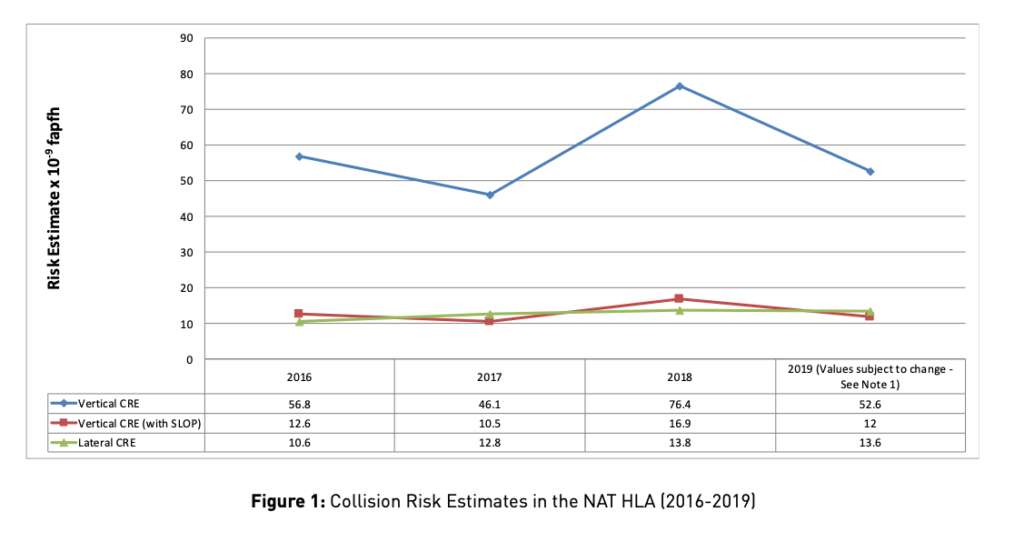
The risk of vertical collision estimate saw an impressive 30% improvement, and they reckon with the use of SLOP this can be reduced another 77% making it… 30/100*77{equation stuff}#100[somethingbysomethingoversomethingelse]… a lot less likely we will fly into each other. Good job all.

What is going less well?

Lateral collision risk estimates reduced, but there were still 80 reported lateral deviations. So we’re flying at the right altitude, but sometimes in the wrong place.

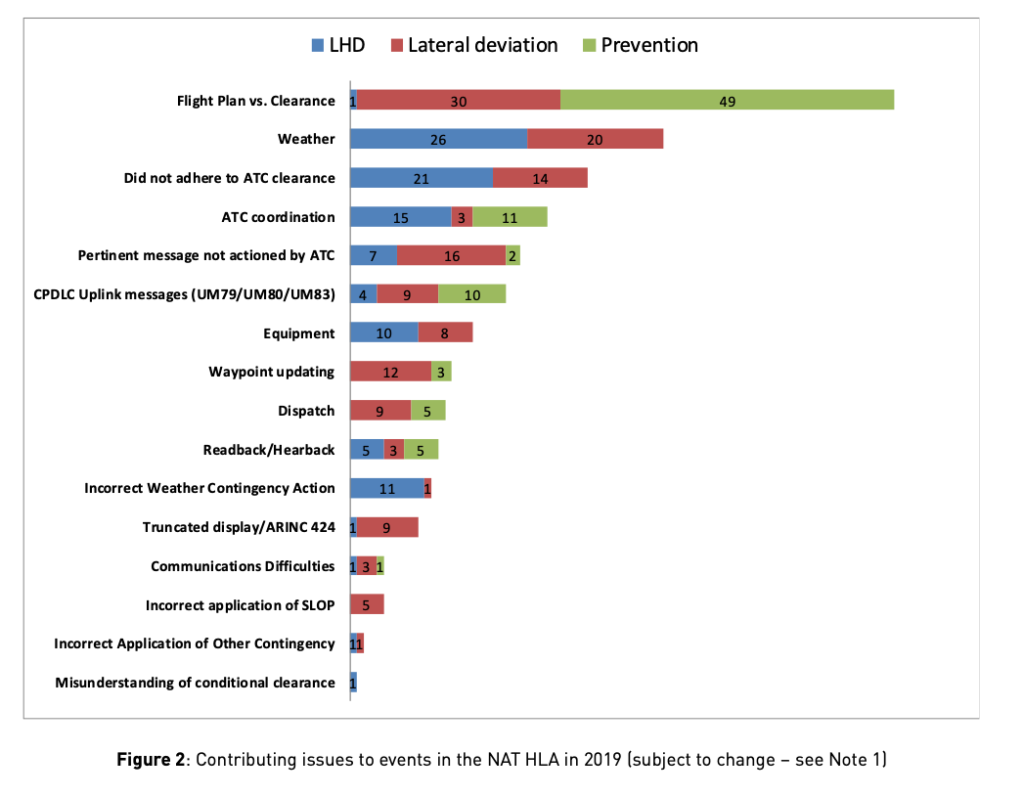
Flight plan versus what ATC actually cleared pilots to do are the top of the list, making up 30% of  the total. 49 of those were prevented by ATC. Not adhering to ATC clearances increased from 10% in 2018, to 13% in 2019, and weather was another biggie making up 17% of all lateral deviations.

ATC coordination errors were also in the top 5 (11%) so don’t congratulate them too much. ATC were also provided with conformance monitoring tools which highlighted cleared versus selected level differences, and route assignment monitoring tools to help them intervene and prevent deviations. With these in place, the performance in the second half of 2019 did improve a lot.

Ok, congratulate them a lot, they’ve made it much safer for us up there.

Overall, what’s the verdict?

No gold star because there were still 266 events reviewed in 2019 by the SPG. These included:

  • 83 large height deviations
  • 118 (actual) lateral deviations including
    • 42 GNEs
    • 44 ATC interventions where ATC prevented pilots making GNEs
  • 73 prevented events where ATCOs stopped aircraft flying an uncoordinated flight profiles or entering the wrong airspace sort of things.

It isn’t always pilots going wrong though. Some of these were down to equipment issues, some down to ATC not responding quick enough. Here is the full breakdown – 

What else is going on up there?

Well, in 2019, when a normal number of aircraft were still flying, they were able to properly monitor the communication and surveillance side of things too, and a whopping 70% of core NAT traffic were using ADS-B. 83% of aircraft were making use of CPDLC over HF radio as well, and the use of these is a big factor in improving the safety and efficiency up there.

The report says this leads to a ‘greater focus on strategic rather than tactical techniques’ which sounds like ‘we are now planning aircraft not to fly near each other’ rather then ‘when aircraft get too close we move them out of each other’s way’.

As a reminder, you have until February 25 to get yourself Datalinkable – the NAT Datalink mandate comes in then.

What next?

2020 data might be a little skewed given a lot less traffic flew, (and many of those who did probably did so after a big gap of not flying), but the overall trend is big improvements. ADS-B is an excellent thing, ATC have a bunch of tools to help them make us safer, and pilot errors are reducing.

There is also a NAT2030 vision plan which is aiming for:

  • more flexibility through ‘dynamic airborne rerouting”
  • improved contingency procedures
  • better comms and surveillance and new technologies
  • a focus on improving the environmental impact
  • and maybe even some new visitors to the region in the shape of unmanned aircraft supersonic aircraft and even balloons

Until then, get out your own balloons and have a little celebration because safety is improving on the NAT. Now put them away. There is still work to be done.

The full report can be checked out here


July 2020 North Atlantic Ops Update

July 2020: There’s a bunch of new things to tell you about the North Atlantic this month! Here’s a summary:
– Two new ICAO NAT Ops Bulletins
– An updated NAT Doc 007 from ICAO (aka the North Atlantic “Ops Bible”)
– A guide for pilots from the FAA about what to do if ATC suddenly has to suspend services
– Some juicy Notams from all the NAT FIRs extending the relaxation of the North Atlantic datalink mandate rules until the end of September.

ICAO NAT Ops Bulletins

Two new ICAO NAT Ops Bulletins have been published this week, but it looks like there’s no need to panic.

First up, there’s 2019_003 Rev 2: Data Link Performance Improvement Options, which is just an updated list of common datalink errors and what to do about them.

Second, there’s a new Bulletin called 2020_002: Surveillance Service in the NAT Region / Flight Crew Operating Procedures. This is a strange one. The message seems to be this: back in the old days, you used to get a call from ATC saying “radar service is terminated” or “surveillance service is terminated” when heading out into the NAT, or when crossing from one oceanic control centre to the next. But nowadays, with improved SSR equipment and ADS-B more widely implemented, you might not get this message anymore.

ICAO NAT Doc 007 (2020, Version 2)

ICAO has published an updated version of the NAT Doc 007, applicable from July 2020. There are only some minor changes from the previous version, concerning the Tango Routes:
  • There’s now a specific note saying that state approval is required to operate on these.
  • There’s also a change to the transponder procedures when using T9 or T290: normally you change transponder code to 2000 30mins after NAT entry, but because of the limited time spent in the NAT HLA when flying on T9 and T290 you should instead make this change 10mins after joining either of those routes.

T9 is southbound only, even levels between FL300-400. T290 is northbound only, odd levels from FL290-410. For more info on the Tango Routes, check out our article here.

What to do during “ATC Zero” events

You’re halfway across the Atlantic when ATC declares that they are suspending all services. TIBA procedures are now in effect. Would you know what to do next? As Covid infections impact ATC facilities, short notice closures are currently a constant risk.

The FAA has published a safety alert for international flight crew with contingency procedures in the event of loss of ATC services in Oceanic airspace. It’s a good one to have in your flight bag. Dispatchers and flight crew are reminded to be thoroughly familiar with AIP specific procedures and traffic management contingency plans for the regions they are operating in. You can read the FAA’s alert here.

They have also published another one for ATC Zero events in Terminal airspace, which you can read here. There have been multiple ‘ATC Zero’ events at major air traffic control centres due to Covid prevention and the subsequent cleaning required. The alert contains important information regarding instrument approach selection, TCAS use, alternate minima, aerodrome lighting and other CTAF procedures at unattended airports. There are also important considerations applicable to Part 121 operations discussed.

NAT Datalink Mandate

EGGX/Shanwick, BIRD/Reykjavik, CZQX/Gander, KZWY/New York Oceanic West and LPPO/Santa Maria have all published Notams extending the relaxation of the North Atlantic datalink mandate rules until the end of September. This is due to the fact that there’s still significantly less traffic because of all the Covid restrictions. Non-datalink mandate compliant aircraft may therefore continue to flight plan and operate across the North Atlantic between FL290-410 until Sept 30. For more info on the NAT Datalink Mandate, check out our article here.

In addition, ICAO are saying that due to the decrease in traffic, there is a significantly higher chance of flights being cleared as requested, and are encouraging operators to file and request their optimal profiles at all stages of the flight. Read ICAO’s guidance here.


For a brief history of the most significant North Atlantic-related ops changes, check out our dedicated article here.


Additional ATS Surveillance Charges in Shanwick

As ATS services are now mandated through most of the North Atlantic Oceanic airspace, NATS has introduced increased and additional charges for ATS surveillance. These charges are to recover the costs of ADS-B usage in the Shanwick Oceanic ATC coverage area.

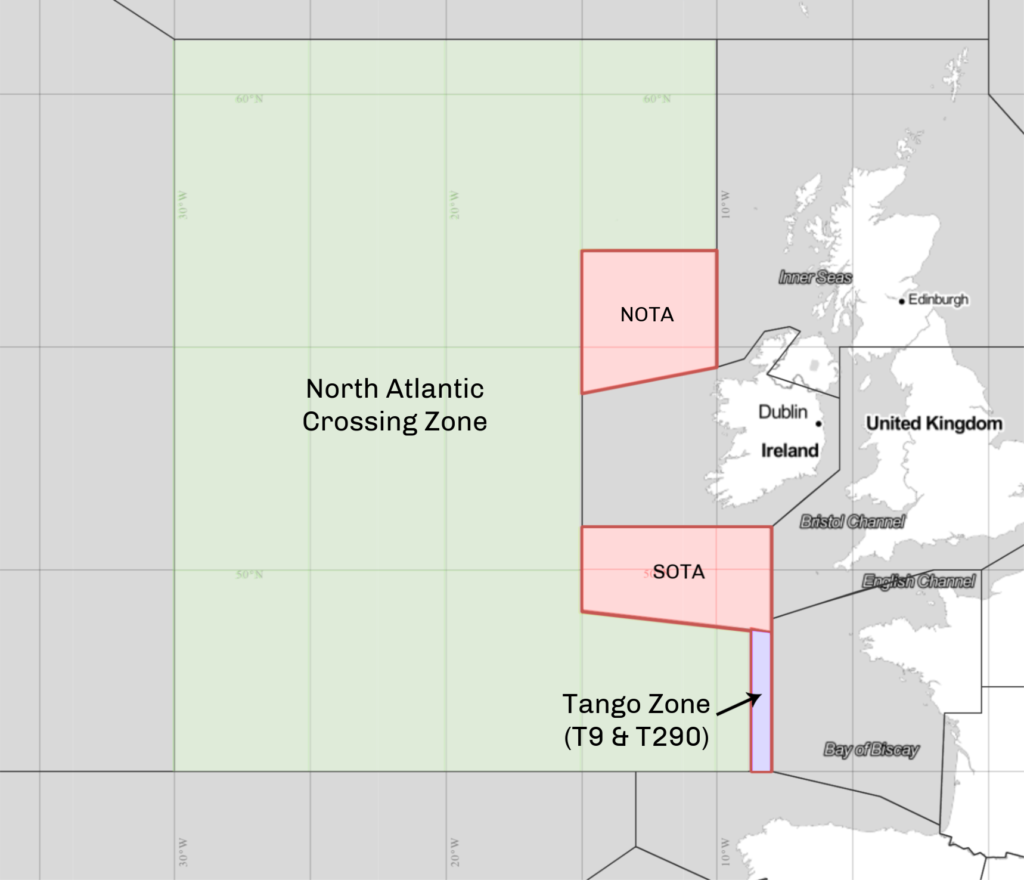
There are 2 different charging zones:

  1. North Atlantic Crossing Zone: comprises the Shanwick FIR/OCA. Any traffic that touches its boundaries or operates to/from or through it are to be charged a NAC zone fee UNLESS it is operating solely within separate airspace jurisdictions (i.e. BOTA, NOTA, SOTA, etc.) or operating within the newly designated “Tango Zone” area, which is the second charging zone.
  2. Tango Zone: a smaller, defined area of airspace within the Southeast corner of the oceanic airspace surrounding ATS routes T9 and T290 (does not include the more westerly Tango Routes T16, T13, and T213 – these fall within the North Atlantic Crossing Zone!)

There are 2 different charges:

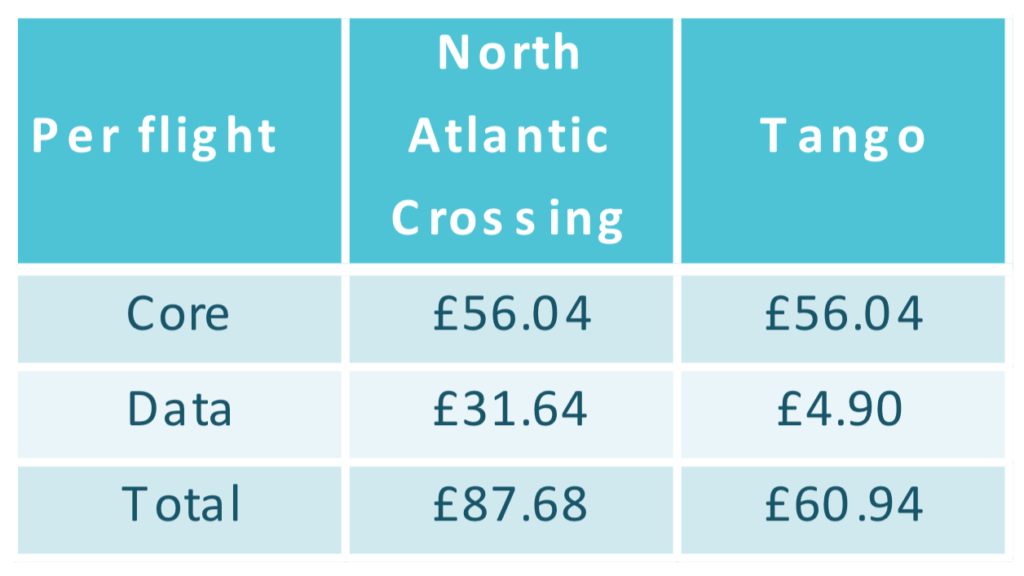
  1. Core” charge: one standard charge that remains the same in each zone.
  2. Data” charge: covers ATS surveillance data usage and changes within each zone reflecting the differing costs of satellite data.

If operating through BOTH the Tango and NAC areas, flights will only be charged the NAC area fee.

Charges will NOT vary by time, weight or distance flown.

You can check out the full briefing to airlines issued by NATS here.


Read about the changes coming up for the Tango Routes on Jan 30, 2020 – the same date that the expanded NAT Datalink Mandate goes into effect.


No Room for Error – GNE’s and the North Atlantic

Advances in technology mean that aircraft in the North Atlantic High Level Airspace (NAT HLA) are flying laterally, longitudinally, and vertically closer than ever before. But North Atlantic gross navigational errors (GNE’s), which are lateral off-track deviations of 10nm or more, still occur regularly, and jeopardise the safety of you and the traffic around you. So don’t leave it up to Air Traffic Control (ATC) to discover your GNE! In this article, let’s look at some common human slip up’s that lead to GNE’s, and what we can do to prevent them.

[heading]Pre-Flight[/heading]Operating to the highest standards of navigational performance demands the tedious and careful monitoring of aircraft systems. Unfortunately, humans are by nature not the best monitors. During the long quiet of an oceanic crossing, we can fall victim to cognitive traps such as change blindness, expectation bias, and complacency.

But the potential for error on Atlantic crossings begins well before the first coast-out waypoint. In fact, it begins before take off. The following four areas are where strategies in mitigating a GNE begin.

1) Data Entry

Via ACARS:

Many pilots now use ACARS to automatically downlink the entire flight plan and winds aloft directly to the FMS. But an over-reliance on automation can lead to complacency, and so the more reliable the system, the more complacent we become as monitors. In one incident, a Boeing 747 suffered a GNE of 120nm. The flight plan downlink from ACARS unfortunately contained one bad coordinate that went unnoticed. Once lured into complacency by such reliable technologies, there can be a temptation to omit cross-checking.

What can we learn from this? Always verify the full coordinates in an ACARS downlinked flight plan. Similarly, if several different flight plans were run, ensure that you request your downlink using the most current and filed flight plan number.

Manually:

A manual entry means a pilot inserts the flight plan’s waypoints directly into the aircraft’s flight management system (FMS). But no matter how meticulously one may be, manual data entry can still produce errors. Then how do we guard ourselves against these errors?

Firstly, avoid using ARINC 424 shorthand for programming oceanic points. This has been a factor in many GNE’s, given how easy it is to misplace the letter as a prefix or suffix. For instance, consider how simply misplacing the “N” could cause a drastic lateral deviation:

  • 50N60 = 50N 160W
  • 5060N = 50N 060W

If you have the capability on your aircraft, use the full coordinates, including minutes.

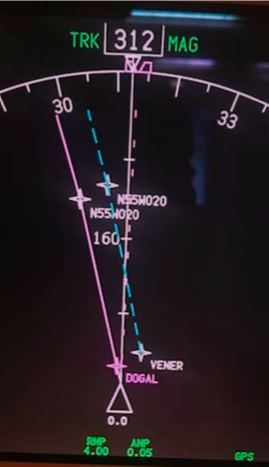
For the last few years, use of half degrees of separation has been on the rise in an attempt to enhance airspace efficiency. But on flight displays units that only show 7 digits, these half degree coordinates are misleadingly displayed as full coordinates. For instance, the half coordinate N55°30’ W020° will display as N55°W020° (see image below, which shows identical waypoint labels for points separated by half a degree!). In this case, it is imperative to view the expanded version of coordinates (degrees and minutes).
Another frequent error leading to GNE’s is transposing numbers during data entry. This commonly occurs when you complete almost the entire crossing along one degree of latitude, then fly the last waypoint at a different latitude. For example, with a cleared route of 57°N 050°W, 57°N 040°W, 57°N 030°W, 56°N 020°W, one can accidentally enter 57°N 020°W. This will put you 60nm off course.

But there is good news! These errors are easy to recognize and avoid by having a specific method of waypoint verification.

2) Waypoint Verification

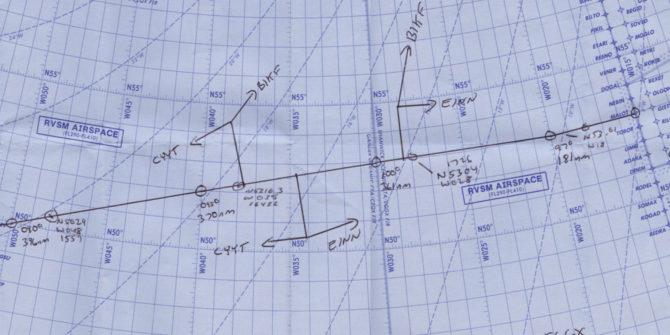
Whether entered via ACARS or manually, both crew members must come together to perform a thorough cross-check. The following method recommended by ICAO in Doc007 seems to work the best:

  • One pilot reads the waypoint/coordinates, bearing and track from the FMS.
  • On the master document, the other pilot will circle the waypoint to signify the insertion of the correct FULL coordinates in the navigation computers
  • The circled waypoint number is ticked, to signify the relevant track and distance information matches
  • (In flight) The circled waypoint number is crossed out, to signify that the aircraft has overflown the waypoint.

[fancy_box box_style=”default” icon_family=”none” color=”Accent-Color” border_radius=”default” image_loading=”default”]

Cognitive Traps:

Expectation Bias is when your perception is influenced by your preconceptions. It is vital that the second crew member crosschecks from the FMS/CDU to the master document – and not vice versa – thereby increasing the chance of spotting an error.


Pop-up trip hustle – It’s one thing reading about waypoint verification, but it’s another thing actually sitting down and taking the time to do it. Do not be tempted to crosscheck your own work because you’re in a time crunch – it requires at least two separate sets of eyes.[/fancy_box]

3) Initialisation of navigation systems

The navigational integrity of your entire flight is predicated on an accurate starting position. Even a small error with on the ground can translate into a gross error later down the line in flight.

The FMS GPS position and your current parking coordinates (found on the 10-9 pages) must match. Avoid using “last position” function in the FMS – if you were towed overnight, the “last position” will be your previous location, not your current one! Sounds obvious, but mistakes happen.

Inertial systems, once aligned, must also complement the GPS coordinates. Initialisation of inertial navigation systems can take between 6-15 minutes, and errs on the longer side at more northerly latitudes – so be patient! Moving the aircraft during alignment will cause an alignment error. Bottom line: avoid repositioning/towing the aircraft during alignment, even it is to a nearby spot on the same ramp area. Position errors like this cannot be corrected once in flight.

4) Your Master Clock – (iPhones not authorised!)

Since our ETAs for oceanic waypoints must be accurate within +/- 2 minutes, it is vitally important that, prior to entry into the NAT HLA, your master clock is accurately synchronised to UTC. ICAO Doc007 has a list of approved sources from which you can set your aircraft master clock (and your iPhone isn’t one of them!). You are approved to use the GPS time which can be found in the FMS.[fancy_box box_style=”default” icon_family=”none” color=”Accent-Color” border_radius=”default” image_loading=”default”]

Cognitive Trap:

Close to the E/W Greenwich line or close to the equator, you’ll just be on the fringes of the opposing segment. So, take a close look at the E/W or N/S letter coordinates, especially if you are usually accustomed to flying from one particular geographic area.[/fancy_box][heading]Clearances & Communication[/heading]With a move away from spoken communications and towards datalink procedures, requesting, copying and verifying a clearance becomes a much simpler task! But it is still important to know your own limitations in the rare instance that you need to copy a clearance via voice.

Casual radiotelephony should be avoided

Casual radiotelephony can be the source of misunderstanding coordinates or clearances, and so all waypoint coordinates must be read back in detail, adhering strictly to standard ICAO phraseology. An example of standard ICAO phraseology requires enunciation of every individual digit. 52 North, 030 West would be read back as “Fife two north, zero tree zero west” as opposed to “fifty-two north thirty west”. Have no doubt about it, Shanwick can be the most strict in this regard.


Distractions and workload

If your departure airport is close to the oceanic boundary, e.g. Shannon or Miami, the benefit is that you will copy your oceanic clearance on the ground. Unencumbered by distractions typically associated with being in flight, you can focus almost fully on the task at hand. However, most flights pick up an airborne clearance, and it is important to prioritise this for a period of low workload.

Take the example of a Bombardier Global Express crew that narrowly avoided a GNE after copying a clearance. While they were in the midst of crosschecking the clearance with the FMS and climbing to their initial altitude, the flight attendant approached them with an issue. Instead of waiting, one of the pilots attended to the problem. A new waypoint wasn’t entered, and it was later caught by ATC in a position report. Try to avoid non-vital tasks until ALL the steps regarding copying, verifying and inputting a clearance are complete.

Following these simple standard operating procedures (SOPs) step-by-step will guard against clearance errors. If the steps are interrupted for any reason, start again from the beginning.

  • Two pilots monitor and record the clearance. The Pilot Monitoring (PM) will contact clearance delivery, while Pilot Flying (PF) monitors both the primary ATC frequency and the clearance delivery frequency.
  • The PM then records the clearance on the master document. The PF also copies down the clearance separately.
  • Clearance is read back to ATC. Any disparities between both pilots’ interpretations of the clearance must be clarified with ATC.
  • A deliberate cross check of the clearance to the filed flight plan and the FMS is made.

Re-Clearance

According to ICAO Doc007, “In the event that a re-clearance is received when only one flight crew member is on the flight deck…changes should not be executed…until the second flight crew member has returned to the Flight Deck and a proper cross-checking and verification process can be undertaken.” Sorry, they just don’t trust you to do this by yourself, and neither should you!

Errors associated with re-clearances, re-routings and/or new waypoints continue to be the most frequent cause of GNE’s. Therefore, a re-clearance or amended clearance should be treated virtually as the start of a new flight and the procedures employed should all be identical to those procedures employed at the beginning of a flight.

  • Both crews note the re-clearance
  • Reply to ATC via ACARS or voice
  • Amend the Master Document
  • Load the new waypoints into the FMS from the updated Master Document
  • One pilot verifies the input of the new waypoints reading from the FMS
  • Verify the new tracks and distances, if possible
  • Prepare a new plotting chart/re-plot in Jeppesen EFB

With datalink, you might have the capability to load the new route directly from the ATC message into your FMS flight plan. This will eliminate a transcription error on your part, but you cannot always count on the FMS to load this seamlessly. Oftentimes, if a revised coast-in waypoint doesn’t connect with your originally planned domestic airspace airway, it might cause a discontinuity. Worse, some crew have experienced their entire domestic flight plan drop out, left with only the oceanic portion.

Conditional Clearances – There’s always a catch!

A conditional clearance is an ATC clearance given to an aircraft with certain conditions or restrictions, such as changing a flight level based on a time or place. Conditional clearances add to the operational efficiency of the airspace, but are commonly misinterpreted by flight crews.

Shannon has been known upon first VHF contact to provide lateral conditional clearances on coast-in. For example: “N135AC, after DINIM, direct ELSOX”. Often, crew have been known to read back the correct transmission, but then execute the wrong procedure by proceeding directly to ELSOX.

Why is this happening? In studies of linguistics, verbs (such as ‘direct’) have been noted as having a perceptual priming effect, that more easily grabs our attention at the expense of weaker prepositions (such as ‘from’ or ‘after’). Listen carefully for prepositions. Similarly, in aviation vernacular, the word ‘direct’ means to proceed now to the specified waypoint. As pilots, we can distinguish this meaning with very little effort, and most of the time can expect to proceed present position direct. Thus, we are primed to go direct.

While this isn’t a complex sentence, research indicates that transmissions involving serial recalls (such as “proceed here then here…”) are susceptible to distortion, with the last word or item more commonly interfering with recall of the previous item.

A really simple way to prevent this is to write down clearances as they are being read to you, then read-back the transmission. You can also call attention to a conditional clearance by prefixing their read-back with the word “Verify” or “Confirm” over the radio. Via datalink, sufficient care always must be taken when factoring in all the contents of a clearance before acknowledging the message. The initial phrase “MAINTAIN FLIGHT LEVEL 300” is included to stress that the clearance is conditional. If the message is about to time out, and you need more time to process its contents, reply using “Standby”. Respond at your own pace![fancy_box box_style=”default” icon_family=”none” color=”Accent-Color” border_radius=”default” image_loading=”default”]

Cognitive Trap:

On the longer route segments between New York and Santa Maria, “when able higher” (WAH) reports might be solicited. ATC acknowledgement of a WAH report must not be misconstrued as a conditional clearance to climb. Any climb clearances will be issued separately from a WAH acknowledgement.[/fancy_box][heading]Miscellaneous[/heading]

10-minute Check – put the (Bad) Elf on the shelf for this

One of the best ways to capture a potential GNE and refresh your situational awareness is with the sublimely simple 10-minute check. Ten minutes after waypoint passage, you’ll use your current coordinates to plot your position on your plotting chart. If the coordinates don’t land on the plotted track line, an investigation into the source of the error must begin immediately. It doesn’t hurt to even make additional plots between waypoints too, but ICAO only requires the one 10-minute check.

Today, more pilots are carrying independent GPS units in their flight bags, providing crew with own-ship on their oceanic route map. Tempting though it may be to use this for present position information, it is currently not an approved source of navigation, and should NOT be used in lieu of a 10-minute check.[fancy_box box_style=”default” icon_family=”none” color=”Accent-Color” border_radius=”default” image_loading=”default”]

Cognitive Trap

It is easy to forget about the 10-minute check. Setting a timer once your waypoint passage tasks have been completed will help remind you to do so.[/fancy_box]

Autopilot mode – “Wait, are we supposed to be in heading?”

Incorrect autopilot mode selection has been known to be a factor in GNE’s. On an oceanic crossing, you can bank on being in NAV or LNAV most of the way across the Atlantic. But perhaps you used heading mode to deviate for weather or to intercept a SLOP. It is not uncommon among pilots to spare your passengers two steep banking turns (thanks LNAV!) by manually flying a SLOP intercept in heading mode. But if you forget to re-engage LNAV, you will continue drifting on your merry way, further and further off course.

Distraction, fatigue or complacency are common reasons for losing mode awareness, so the following simple tricks will help mitigate autopilot induced GNE’s.

  • It helps to verbally announce when you are transitioning temporarily into heading mode, to bring both pilots in the loop.
  • Employing sterile cockpit until you’re back in LNAV will help mitigate distractions.
  • In an abundance of caution, you can keep a finger on the heading button or heading dial until you are back in LNAV will serve as a reminder.

[fancy_box box_style=”default” icon_family=”none” color=”Accent-Color” border_radius=”default” image_loading=”default”]

Cognitive Trap:

The flight mode annunciators (FMA’s)  are the most reliable indicators of automation selection – more so than the flight guidance panel! Yet, a study found that pilots pay superficial attention to the FMA’s during critical mode changes. Don’t waste a valuable resource, and do consciously bring the FMA’s into your scan.[/fancy_box]Deliberate cross-checking and monitoring are a critical last line of defense for which we, as pilots, don’t get explicit training, but are nevertheless expected to perform effortlessly. But over the North Atlantic, there is little room for error. So, let’s recap what can be done!

  1. Allow sufficient time on the ground to set up
  2. Closely scrutinise data entry – whether the source is human or ACARS!
  3. Work together on waypoint verification
  4. Don’t work single pilot – always keep all crew in the loop
  5. Deal with clearances and re-clearances methodically

Understanding our vulnerabilities is key to the process of mitigating errors. Armed with an understanding of our own limitations, and an appreciation for the practices and habits mentioned above, a ‘would-be’ GNE can be averted.

Links

ICAO Doc 007 

Global Operational Datalink Document (GOLD)


Two is Not Enough: New NAT Doc 007 (Version 3) – August 2019
NAT Doc 007 is the Bible of the North Atlantic. It’s full of NAT goodness – all the specifics about how to operate your aircraft safely through the complex airspace of the region is here.

And there’s another new edition!

The NAT changes over the last few years have been coming thicker and faster than the sandwiches at Katz’s Deli on the Lower East Side. And now, there’s more. Effective August 7th, 2019, NAT Doc 007, Version 3, is the latest tome to digest. As aviation documents go, it’s written in pretty digestible language. There’s just a lot in it. But this is the first time we’ve had 3 editions of this in one year.

So, we’re going to start naming them after 007 Movies to keep track of them all. This is the “Two is Not Enough” edition.

NAT Doc 007, Version 3, 2019:
Download the full NAT Doc 007.

So, here are the three things that have changed this time:

1. We got new SLOP rules! This is a biggie. Instead of the three previous choices (0, 1, or 2nm), we now have Twenty One choices! More on this below.

2. 99 problems and Datalink is one. The short version: check that you’ve got the latest software update for your datalink.

3. The next datalink mandate (2C) is capped at FL410. This comes in January 30th next year. And so, the Checklist for Dispatchers is updated.

The new SLOP rules

Now, let’s take a closer look at the big change – SLOP (Strategic Lateral Offset Procedure). To get up to speed, check out our full article on SLOP – the how, and why (and where).

The change here is that instead of just being able to SLOP 1 or 2 nm right of track, (or fly the centreline), you go from these three choices to twenty one – you can use any one of 21 Micro-SLOP offsets. Specifically: 0.0 nm, 0.1 nm, 0.2 nm …. OK, you get it. All the way up to 2.0 nm Right of track.

Simple, right?

Not quite. It’s not yet fully clear which of the OCA’s have given the green light for this, even though NAT Doc 007 now says you should Micro-SLOP if you can.

But, phoning around the Oceanic Houses, we’ve got this to tell you:

1. Gander – you can micro-SLOP right now! An AIP amendment will follow soon.
2. Shanwick – you can micro-SLOP right now! A Notam will be published soon, and the AIP will be updated in Dec 2019.
3. New York – they will allow micro-SLOP from 12th Sept 2019, and will update the AIP in Jan 2020.
4. Santa Maria – you can micro-SLOP right now! Nothing published officially yet, but that’s what the good people from the oceanic control centre have told us.
5. Iceland – just like New York, they will allow micro-SLOP here from 12th Sept 2019 as well. When that happens, you will still not be allowed to SLOP below FL285 within the Reykjavik CTA (that’s the domestic part over Iceland, and the airspace over Greenland above FL195). We asked them to publish a Notam about this – and they actually did!! Check it out!
6. Bodo – Nothing official yet, but ATC say they “have no objections” to operators micro-SLOPing right now. (Currently, SLOP is only allowed here above FL285 within the OCA.)

That’s the current picture as of 1100z on Monday 19th Aug.

We will update this as soon as we get more info. Got something for us? Email us!


Fly it like you stole it – free speed on the NAT

This is a new one, and it’s a good one for pilots! Being introduced slowly is a new flexibility – flying without a fixed Mach speed. In simple terms, you get to decide how fast you fly.

Like all new things on the NAT, we have an acronym. This one is OWAFS. Operations Without an Assigned Fixed Speed. But you’ll also see it as referred to as “Variable Mach”, and “Resume Normal Speed”.

When does this start?

It already has! It’s starting out as a trial (everything on the NAT starts out as a trial), and some members are already reporting getting “RESUME NORMAL SPEED” messages from Shanwick. The official start date is April 8, 2019. Three OACC’s are doing this – Shanwick, Santa Maria, and New York Oceanic (not WATRS).

For no good reason, here’s a picture of the Shanwick Oceanic control room in 1989. Much has changed since!

How does it work?

You’ll get a normal oceanic clearance, with a fixed Mach Number, like you always did. Somewhere after the Oceanic Entry Point, if you are selected for the trial, you’ll get a CPDLC message saying RESUME NORMAL SPEED. You should reply with WILCO. What that means is: Fly ECON, or a Cost Index with Variable Mach.

So, once I get that, no restrictions on speed?

Correct! But, ATC will expect you to fly ECON/Cost Index, and normally, that should be pretty close to your cleared Mach (within 0.01 up or down). If you’re doing something different, tell them. If the resulting speed differs from your Oceanic Clearance Mach by 0.02, or more, you must tell ATC.

Rules for Shanwick (Don’t ask for it)

• Flight must be data link connected to EGGX
• Flight must be eastbound and operating solely in Shanwick Oceanic airspace and exiting into UK/Ireland/Continental European airspace
• Flight cannot exit into Santa Maria
• RESUME NORMAL SPEED will be offered on a “manual” tactical basis
Do not request RESUME NORMAL SPEED

Rules for New York and Santa Maria (You can ask)

• Flight must be data link connected to LPPO or KZWY
• Flights must be wholly within Santa Maria and New York East Oceanic airspace and not enter Gander or Shanwick airspace
• Flights can enter New York East Oceanic airspace or Santa Maria airspace from Gander airspace or Shanwick airspace and receive RESUME NORMAL SPEED uplink message
• New York West (WATRS airspace) is excluded
• RESUME NORMAL SPEED can be requested if not offered

Background and History

(Thanks, Jeff Miller @IATA, for this and the condensed info above!)

Both Airbus and Boeing advocate cost index (ECON) as the most efficient way to fly. Operators use cost index (ECON) globally, except for the North Atlantic (NAT) where flights are assigned a fixed Mach by ATC and flight crews are required to fly the assigned Mach. Depending on the distance from the departure airport to the oceanic entry, most operators flight plan the aircraft with cost index to the oceanic entry point and again after oceanic exit. Flight crews use the desired fixed Mach number from the computer flight plan that is generated by the cost index, as the requested Mach number for the crossing. It is possible the flight crew may request a Mach greater than or less than the flight plan Mach to improve scheduled arrival time. IATA led the ICAO NAT, Operations Without an Assigned Fixed Speed (OWAFS) project team to enable the use of a variable Mach in the NAT. The North Atlantic Systems Planning Group (NAT SPG) is expected to fully endorse OWAFS late June 2019 for an official implementation in late 2019 for all NAT OCAs. Full automation for all Air Navigation Service Providers (ANSPs) is expected by Q1 2020.
So I can use this for turbulence speed changes?

Yep, but remember, if you’re slowing down or speeding up significantly (0.02 or more), tell ATC your new speed.

Anything else?

That’s it for now. Remember, it’s a trial – later in the year full implementation is expected. Don’t ask for it if you aren’t offered, unless you’re in New York or Santa Maria airspace. Tell ATC if you’re changing by 0.02 or more from the Oceanic Clearance.

And most importantly, keep us posted on your experiences with this!


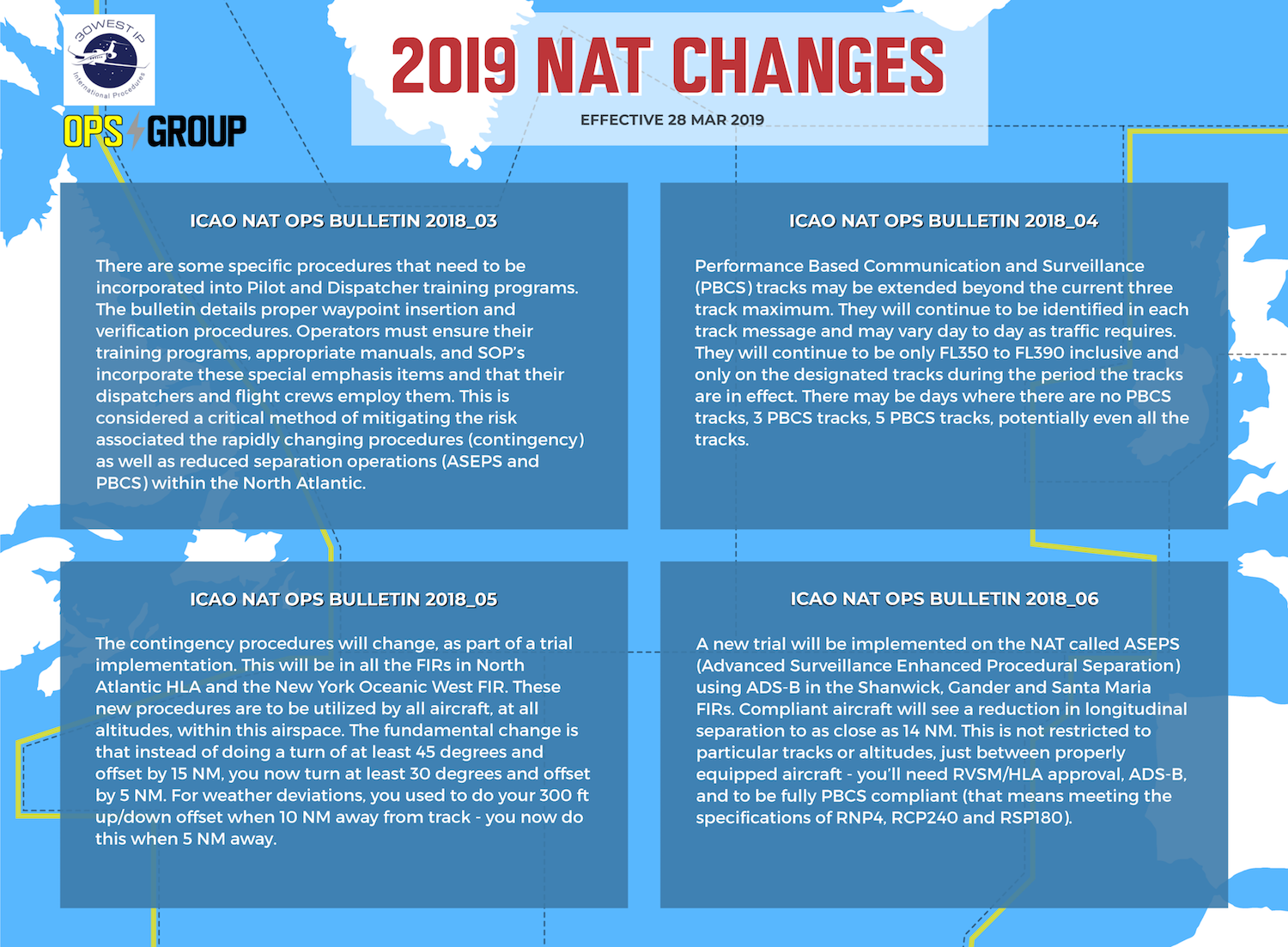
2019 North Atlantic changes

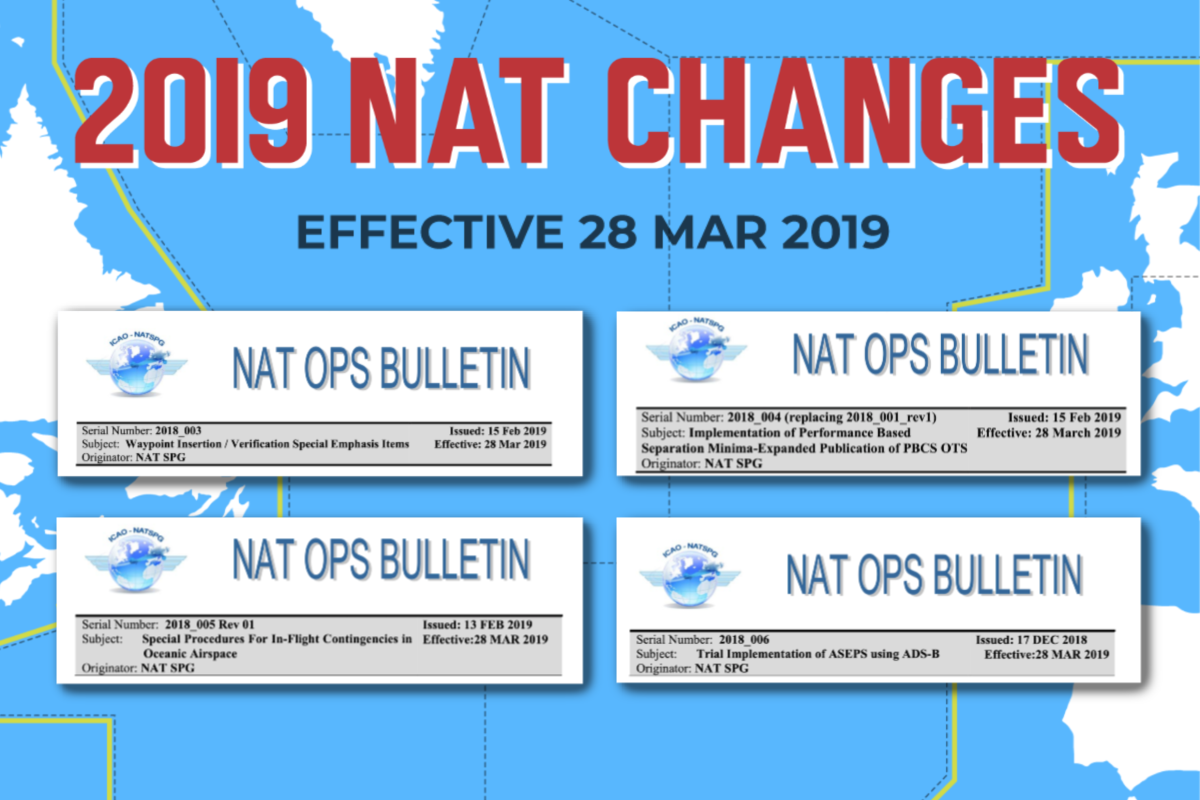
There are four ICAO NAT Ops Bulletins due to go into effect on March 28th, 2019. The PBCS tracks will be expanded, real-time Space-Based ADS-B surveillance and reduced separation standards will be introduced, and the regional contingency and weather deviation procedures will be changed.

You can click on each one, and read them in full:

We have had a good look at each of them. Here’s the lowdown:

ICAO NAT Ops Bulletin 2018_03: Waypoint Insertion / Verification Special Emphasis Items
Lowdown: There are some specific procedures that need to be incorporated into Pilot and Dispatcher training programs. The bulletin details proper waypoint insertion and verification procedures. Operators must ensure their training programs, appropriate manuals, and SOP’s incorporate these special emphasis items and that their dispatchers and flight crews employ them. This is considered a critical method of mitigating the risk associated the rapidly changing procedures (contingency) as well as reduced separation operations (ASEPS and PBCS) within the North Atlantic.

ICAO NAT Ops Bulletin 2018_04: Implementation of Performance Based Separation Minima-Expanded Publication of PBCS OTS
Lowdown: Performance Based Communication and Surveillance (PBCS) tracks may be extended beyond the current three track maximum. They will continue to be identified in each track message and may vary day to day as traffic requires. They will continue to be only FL350 to FL390 inclusive and only on the designated tracks during the period the tracks are in effect. There may be days where there are no PBCS tracks, 3 PBCS tracks, 5 PBCS tracks, potentially even all the tracks.

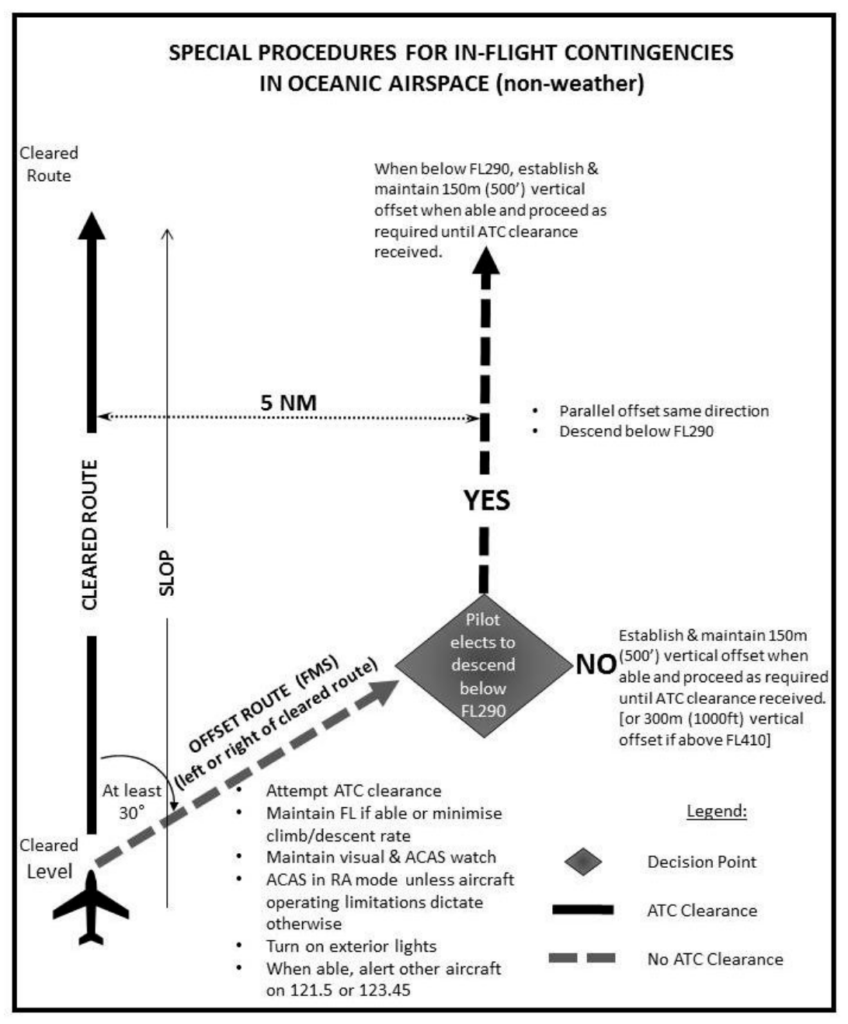
ICAO NAT Ops Bulletin 2018_05: Special Procedures For In-Flight Contingencies in Oceanic Airspace
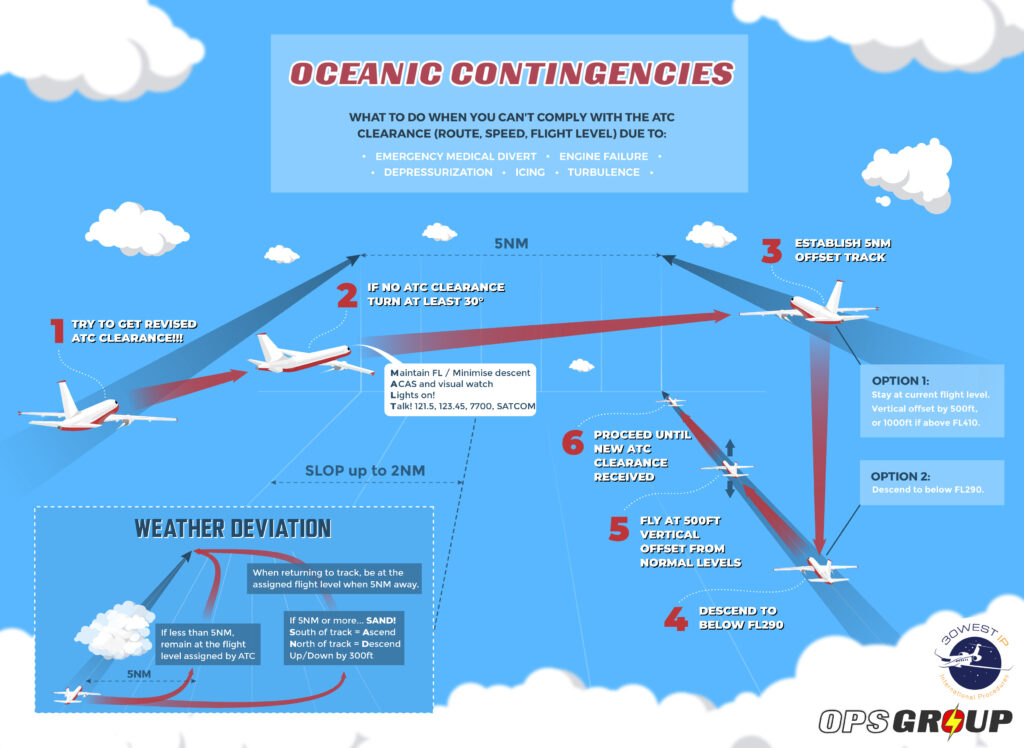
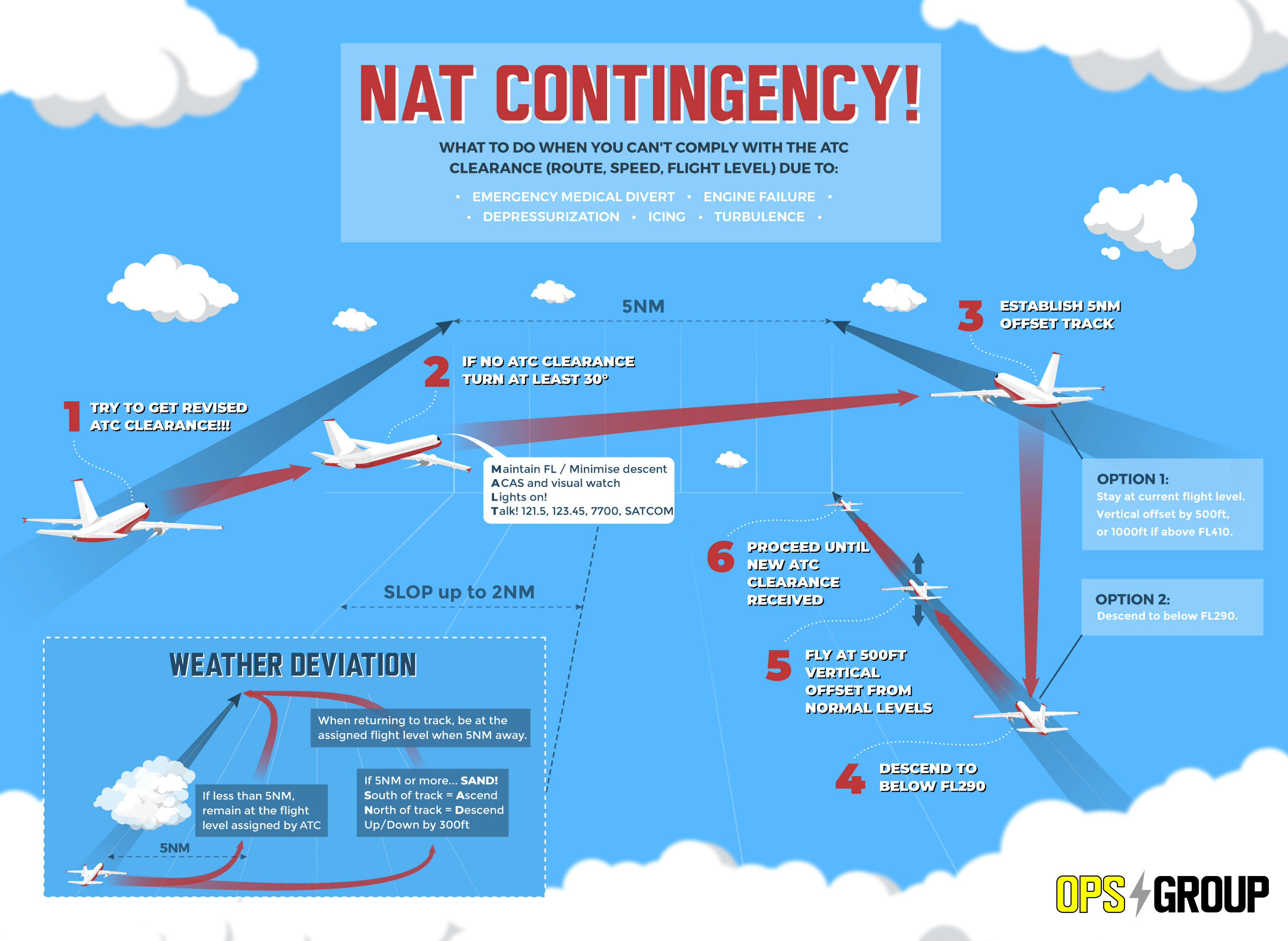
Lowdown: The contingency procedures will change, as part of a trial implementation. This will be in all the FIRs in the NAT Region and the New York Oceanic West FIR. These new procedures are to be utilized by all aircraft, at all altitudes, within this airspace. The fundamental change is that instead of doing a turn of at least 45 degrees and offset by 15 NM, you now turn at least 30 degrees and offset by 5 NM. For weather deviations, you used to do your 300 ft up/down offset when 10 NM away from track – you now do this when 5 NM away. For more info on this, read our article.

ICAO NAT Ops Bulletin 2018_06: Trial Implementation of ASEPS using ADS-B
Lowdown: A new trial will be implemented on the NAT called ASEPS (Advanced Surveillance Enhanced Procedural Separation) using ADS-B in the Shanwick, Gander and Santa Maria FIRs. Compliant aircraft will see a reduction in longitudinal separation to as close as 14 NM. This is not restricted to particular tracks or altitudes, just between properly equipped aircraft – you’ll need RVSM/HLA approval, ADS-B, and to be fully PBCS compliant (that means meeting the specifications of RNP4, RCP240 and RSP180).

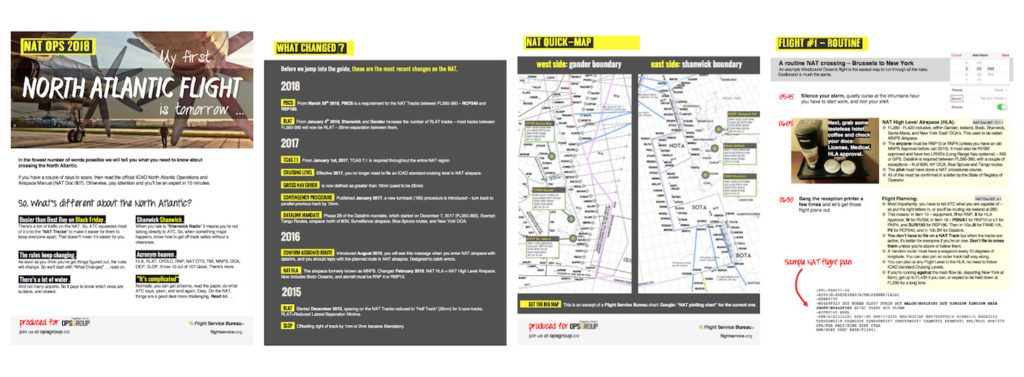
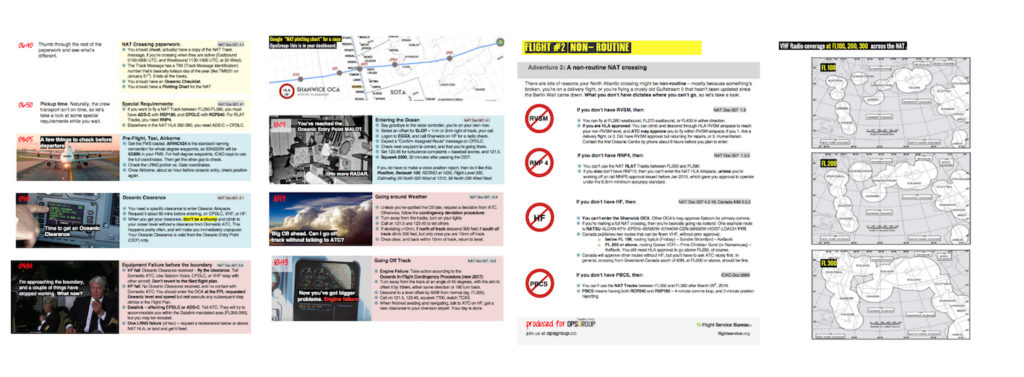
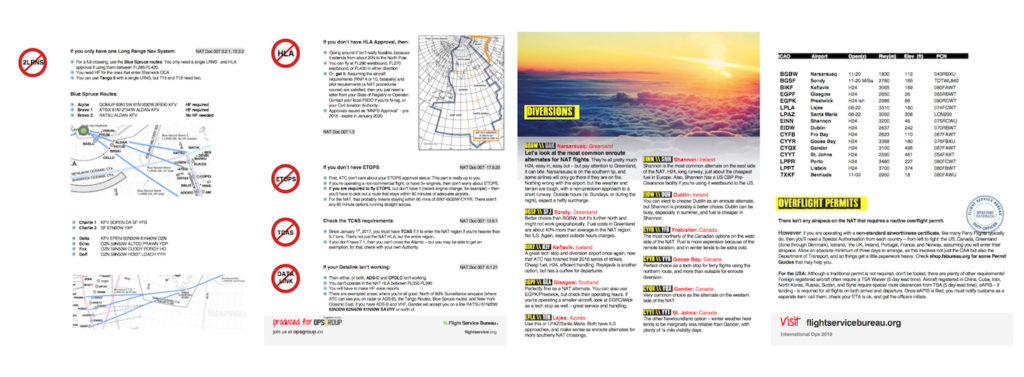
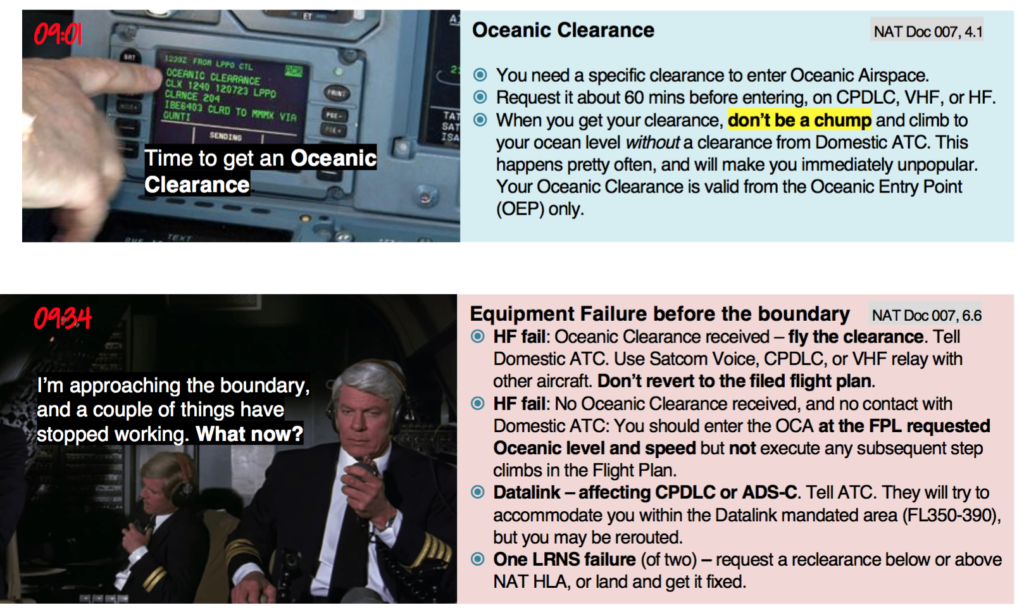
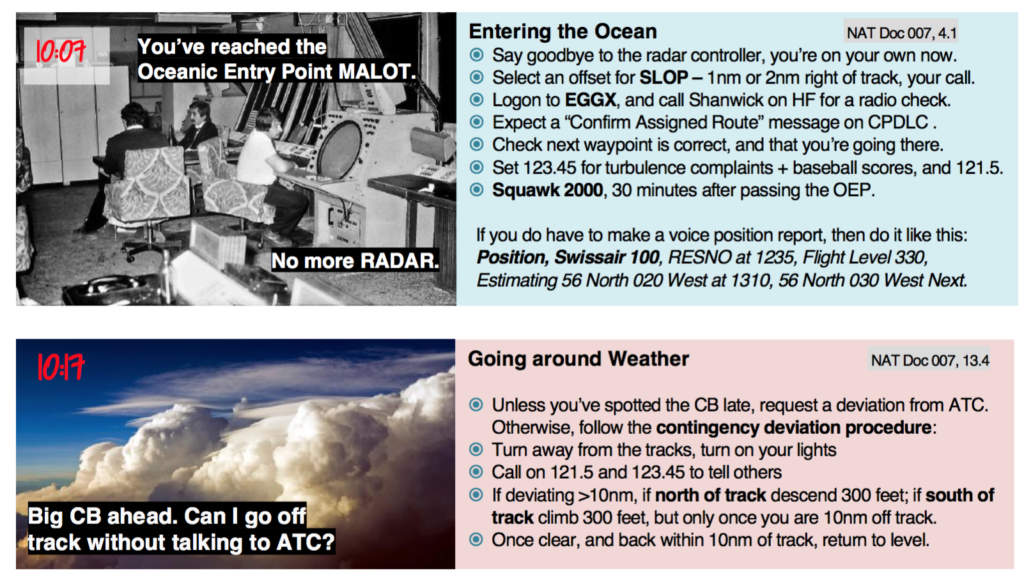
So there you have it. We made a couple of handy graphics for all this. Print them out and sellotape them to your cockpit. (If you actually do this, please send us a photo!)

click on the image to open larger version

For a bit more of an in-depth look at the contingency and weather deviation procedures as shown in the image above, read our article.

And if you’re still hungry for more NAT info, we highly recommend you check out the replay of the webinar hosted by Mitch from 30WestIP, titled: ‘A North Atlantic Game Changer, 4 NAT OPS Bulletins all go into effect in one day’. This really breaks down each of the four new Bulletins which take effect from 28th March 2019 – essential viewing if you operate over the North Atlantic! View it here.

Further reading:

  • On 1st Nov 2018 we had a call with 140 OPSGROUP members about upcoming changes on the NAT in 2019, and how we can effect change. OPSGROUP members can find the PDF notes of this in your Dashboard.
  • A big thing driving the ASEPS trial is the rollout of Space-based ADS-B, which is scheduled to complete its deployment by 30 Dec 2018, giving us worldwide, pole-to-pole surveillance of aircraft. For more on that, and how it will affect operations on the NAT specifically, read the article by Mitch Launius here.
  • Use our quick guide to figure out where you are welcome on the NAT, depending on what equipment and training you have.

New NAT Contingency Procedures for 2019

Starting 28th March 2019, there will be some changes to the contingency and weather deviation procedures on the NAT. ICAO has published a new NAT Ops Bulletin with all the details.

Before, there was a lot of confusion around the wording of these two procedures – but ICAO has now made this much clearer, and they have even included a little graphic to help us understand how it will work.

Thing is, it’s still a little clunky. So we decided to make our own version!

What’s new?

The simple answer is this: contingency offsets that previously were 15 NM with actions at 10 NM are basically now all 5 NM offsets with a turn of at least 30 degrees (not 45 degrees).

Rarely do we see ICAO oceanic contingency procedures undergo a formal revision. The last time a major revision occurred was in 2006 when ICAO standardized a 15 NM offset executed with a turn of at least 45 degrees. Prior to that, the North Atlantic and the Pacific had used different offset distances and a 90 degree turn.

Where and when?

A trial implementation is scheduled to begin in the NAT Region and New York Oceanic West starting 28th March 2019. ICAO is expected to formally publish the Standard in an update to PANS-ATM (ICAO Doc 4444) on 5 November 2020.

Why?

To support reduced separation being implemented in conjunction with Advanced Surveillance Enhanced Separation (ASEPS), Space Based ADS-B surveillance. The details for the ASEP trial can be found in NAT OPS Bulletin 2018-006 Trial Implementation of ASEPS using ADS-B.

Old version vs New version – full wording

Here’s the old version, as per the latest version of the NAT Doc 007, paragraph 13.3. (Note – this will be valid UNTIL 27 March 2019):

The aircraft should leave its assigned route or track by initially turning at least 45° to the right or left whenever this is feasible.

An aircraft that is able to maintain its assigned flight level, after deviating 10 NM from its original cleared track centreline and therefore laterally clear of any potentially conflicting traffic above or below following the same track, should:
a) climb or descend 1000 ft if above FL410
b) climb or descend 500 ft when below FL410
c) climb 1000 ft or descend 500 ft if at FL410

An aircraft that is unable to maintain its assigned flight level (e.g due to power loss, pressurization problems, freezing fuel, etc.) should, whenever possible, initially minimise its rate of descent when leaving its original track centreline and then when expected to be clear of any possible traffic following the same track at lower levels and while subsequently maintaining a same direction 15 NM offset track, descend to an operationally feasible flight level, which differs from those normally used by 500 ft if below (or by 1000 ft if above FL410).

Before commencing any diversion across the flow of adjacent traffic or before initiating any turn-back (180°), aircraft should, while subsequently maintaining a same direction 15 NM offset track, expedite climb above or descent below the vast majority of NAT traffic (i.e. to a level above FL410 or below FL290), and then maintain a flight level which differs from those normally used: by 1000 ft if above FL410, or by 500 ft if below FL410. However, if the flight crew is unable or unwilling to carry out a major climb or descent, then any diversion or turn-back manoeuvre should be carried out at a level 500 ft different from those in use within the NAT HLA, until a new ATC clearance is obtained.

And here’s the new version, as per the NAT OPS Bulletin 2018-005 Special Procedures for In-flight Contingencies in Oceanic Airspace (Note – this will be valid FROM 28 March 2019):

If prior clearance cannot be obtained, the following contingency procedures should be employed until a revised clearance is received:

Leave the cleared route or track by initially turning at least 30 degrees to the right or to the left, in order to intercept and maintain a parallel, direction track or route offset 9.3 km (5.0 NM).

Once established on a parallel, same direction track or route offset by 9.3 km (5.0 NM), either:
a) descend below FL 290, and establish a 150 m (500 ft) vertical offset from those flight levels normally used, and proceed as required by the operational situation or if an ATC clearance has been obtained, proceed in accordance with the clearance; or
b) establish a 150 m (500 ft) vertical offset (or 300 m (1000 ft) vertical offset if above FL 410) from those flight levels normally used, and proceed as required by the operational situation, or if an ATC clearance has been obtained, proceed in accordance with the clearance.

Note. — Descent below FL 290 is considered particularly applicable to operations where there is a predominant traffic flow (e.g. east-west) or parallel track system where the aircraft’s diversion path will likely cross adjacent tracks or routes. A descent below FL 290 can decrease the likelihood of: conflict with other aircraft, ACAS RA events and delays in obtaining a revised ATC clearance.

So to reiterate, the important change is that contingency offsets that previously were 15 NM with actions at 10 NM are basically now all 5 NM offsets with a turn of at least 30 degrees (not 45 degrees).

Weather deviations

If you have to deviate from your assigned track due to anything weather-related, there’s a whole different procedure to follow. Again, the NAT Ops Bulletin has all the details for this, but the bottom line seems to be:

For deviations of less than 5 NM, remain at the flight level assigned by ATC.

For deviations of 5 NM or more, when you are at the 5 NM point initiate a change as follows:

If flying EAST, descend left by 300ft, or climb right by 300ft.

If flying WEST, climb left by 300ft, or descend right by 300ft.

In other words – SAND! (South of track = Ascend, North of track = Descend; Up/Down by 300ft)

But remember, going right is probably better – it gets you out of the way of all the SLOP offset traffic that might be coming at you from the opposite direction!

Turnback procedure

In both the NAT Ops Bulletin and the new NAT Doc 007 which will take effect from 28 Mar 2019, ICAO has left out any specific reference to how to divert across the flow of traffic or turn-back procedure, and instead simplified it to just “proceed as required by the operational situation”. Turning back would assume you either employ the 5NM offset as per the new contingency procedure, or else get a new revised clearance.

Bottom line

If you operate in the NAT HLA, we recommend you read and review the NAT Ops Bulletin in its entirety. It’s relatively short but, beginning 28 March 2019, the procedures are expected to be implemented. You might want to prepare changes for your Ops Manuals and checklists too.

Make sure you stay tuned to OPSGROUP for changes that may occur as we approach 28 March 2019!

Further reading:

  • On Nov 1st we had a call with 140 OPSGROUP members about upcoming changes on the NAT in 2019, and how we can effect change. OPSGROUP members can find the PDF notes of this in your Dashboard.
  • A big thing driving the ASEPS trial is the rollout of Space-based ADS-B, which is scheduled to complete its deployment by 30 Dec 2018, giving us worldwide, pole-to-pole surveillance of aircraft. For more on that, and how it will affect operations on the NAT specifically, read the article by Mitch Launius here.
  • Use our quick guide to figure out where you are welcome on the NAT, depending on what equipment and training you have.

First look at NAT changes for 2019

Starting 28th March 2019, a new trial will be implemented on the NAT called ASEPS (Advanced Surveillance Enhanced Procedural Separation) using ADS-B in the Shanwick, Gander and Santa Maria FIRs.

Compliant aircraft will see a reduction in longitudinal separation to as close as 14 NM. This is not restricted to particular tracks or altitudes, just between properly equipped aircraft – you’ll need RVSM/HLA approval, ADS-B, and to be fully PBCS compliant (that means meeting the specifications of RNP4, RCP240 and RSP180). Read this ICAO Bulletin for all the details.

When the ASEPS trial starts, there will also be some changes to the contingency and weather deviation procedures. Before, there was a lot of confusion around the wording of these two procedures – this has now been made much clearer, and they have even included a nice little graphic to help us understand what to do. Read this ICAO Bulletin for all the details.

ICAO have published all these changes in their updated NAT 007 Doc valid for 28th March 2019.

Further reading:

  • On Nov 1st we had a call with 140 Opsgroup members about upcoming changes on the NAT in 2019, and how we can effect change. Opsgroup members can find the PDF notes of this in your Dashboard.
  • A big thing driving the ASEPS trial is the rollout of Space-based ADS-B, which is scheduled to complete its deployment by 30 Dec 2018, giving us worldwide, pole-to-pole surveillance of aircraft. For more on that, and how it will affect operations on the NAT specifically, read the article by Mitch Launius here.
  • Use our quick guide to figure out where you are welcome on the NAT, depending on what equipment and training you have.
  • All the big changes on the NAT in 2018 are covered on our page here.

My first North Atlantic Flight is tomorrow – NAT Ops Guide (Updated 2018)

For the latest changes and updates on the North Atlantic, including our most recent Guides and Charts, use our NAT reference page at flightservicebureau.org/NAT.

Of all the hundreds of questions we see in OPSGROUP, one region stands out as the most asked about – the NAT/North Atlantic. So, we made one of our legendary guides, to get everything into one PDF.  It’s called “My first North Atlantic Flight is tomorrow” – and now we’ve updated it for 2018!

Contents:

  • 1. What’s different about the NAT?
  • 2. Changes in 2018, 2017, 2016, 2015
  • 3. NAT Quick Map – Gander boundary, Shanwick boundary
  • 4. Routine Flight Example #1 – Brussels to JFK (up at 5.45am)

  • 5. Non Routine-Flights: No RVSM, No RNP4, No HF, 1 LRNS, No HLA, No ETOPS, No TCAS, No Datalink – what you can do and where you can go
  • 6. Diversion Airports guide: Narsarsuaq, Sondy, Kef, Glasgow, Dublin, Shannon, Lajes, Fro Bay, Goose Bay, Gander, St. Johns
  • 7. Airport data
  • 8. Overflight permits – routine and special

  • 9. Special NAT procedures: Mach number technique, SLOP, Comms, Oceanic Transition Areas, A successful exit, Screwing it up, Departing from Close Airports
  • 10. North Atlantic ATC contacts for Shanwick, Gander, Iceland, Bodo, Santa Maria, New York – ATC Phone, Radio Station Phone, AFTN, Satcom, CPDLC Logon codes; and adjoining Domestic ATC units – US, Canada, Europe.
  • 11. NAT FPL Codes
  • 12. NAT Flight Levels
  • 13. Flight Plan Filing Addresses by FIR
  • 14. Links, Questions, Guidance

Excerpt from the Routine Flight #1:


Buy a copy ($20)   Get it free – join OPSGROUP

To get your copy – there are three options:

  1. OPSGROUP Members, login to the Dashboard and find it under “Publications > Guides”. All FSB content like this is included in your membership, or
  2. Join OPSGROUP with an individual, team, or department/airline plan, and get it free on joining (along with a whole bunch of other stuff), or
  3. Purchase a copy in the Flight Service Store!

More NAT half-tracks are coming

Update Jan 23: The current phase of the trial for RLatSM Tracks will come to an end on March 29, when PBCS standards will be introduced for the NAT tracks. More info on that here.

Since Dec 2015, there have been three daily NAT tracks spaced by one-half degree between FL350-390. These are officially called ‘RLatSM Tracks’ (Reduced lateral separation minima), but we all just prefer to call them ‘Half-Tracks’.

Separating flights by one-half degree of latitude rather than the standard one degree means that aircraft can be separated laterally by 25nm, which helps improve the efficiency of North Atlantic operations.

In Jan 2018 the Half-Tracks will be expanded from the three that now run each day, first by one additional track and then (maybe) to all NAT Tracks between FL350-390 inclusive. Jan 4 is the earliest day that this might happen, but because they will be decided tactically, it will most likely be the first busy day after Jan 4.

If you want to operate on the RLatSM tracks, you’re going to need CPDLC, ADS-C, and RNP4; along with the other standard pre-requisites for operating in the NAT HLA between FL350-390: an HLA approval, TCAS 7.1, RVSM approval, two LRNS, and a working HF radio. To figure out where you are welcome on the NAT, depending on what equipment and training you have, check out our quick and dirty guide here.

One thing to be cautious of when using the half-degree tracks – most aircraft FMC’s truncate lat/long waypoints to a maximum of 7 characters, so it will often show up as the same waypoint whether you’re operating along whole or half degree waypoints. So when operating on the half-tracks, just remember to double-check the full 13-character representations of the lat/long waypoints when you enter them into the FMC.

For more details about the new RLatSM procedures, have a read of the UK AIC 087/2017 here.


NAT Airspace Closures

Update 18th Oct: No more events are planned at this time. However, we will keep this page updated with the latest news as we get it.


Sections of NAT airspace are set to close on various different dates in October. This is all due to U.S. and NATO joint military exercise that’s going on, called Formidable Shield, which will mean huge chucks of airspace will be closed to civil ops for many hours.

The basics for each event are the same:

  • Airspace closed, SFC-UNL.
  • Aircraft capable of flying in MNPS airspace will have to keep at least 30nm away from the area, other aircraft will need to keep 60nm away.


Event 1 Happened on 25th Sep. 


Event 2 Happened on 7th Oct.


Event 4Happened on 15th Oct. (Yes, Event 4 happened before Event 3 – just to confuse us!)


Event 3 Happened on 17th Oct.


Shanwick Bogus Messages

Just around New Years, a story started growing legs about Bogus CPDLC messages from Shanwick and Gander. In the most worrying version of events, the G550 crew received a “Descend at Max Rate” type message on CPDLC, and when they checked on voice with ATC it hadn’t come from them.

We had lots of replies on this – both by email and in slack, thanks everyone! So here is the event summary as pieced together by the community:

– This was a single event that happened in December, at 0500Z one morning, to a G550
– It was caused by an avionics bug in the FMS – a valid error message was parsed incorrectly and assigned a value of “Descend at max rate” by the FMS, which appeared on the screen.
– Fears of it being some kind of spoofing or hack are unfounded. The initial story spread like wildfire! But ultimately, a non-event.

Confirm Assigned Route

This was the second part of the concerns about CPDLC messages from Shanwick. Lots of crews have been getting an FMS message after passing the Oceanic Entry Point saying “Confirm Assigned Route”. We’ve probably gotten 50 distinct messages/emails/queries on this. Many crews don’t know quite what this is or what to do with it, and many wondered if it was also a “bogus message”.

This is normal. It’s a new procedure, and this message is now automatically sent by Gander, Shanwick, and Iceland. The reason for the message, is to act as a cross check, now that we’re all cruising with 30 miles between us instead of the old school 60. When you do “Confirm Assigned Route”, then ATC knows that you’re both on the same page.

We first mentioned it here in November, have a read. The only recent update is that Gander and Iceland have automated the CPDLC message, so everyone that logs on will get the “Confirm Assigned Route” message.


Midweek Briefing: Oceanic and Remote Procedures Update, Rome Airport Closed Friday

Oceanic and remote procedures updated: 12OCT The FAA this week issued a significantly updated version of their “Oceanic and Remote Airspace” procedures document. There’s a lot of good stuff here, even if you’re not operating an N-reg. Take a look at the PDF.

Rome Airport to close Friday 12OCT A reminder that LIRA/Rome Ciampino will close fully from Friday, for two weeks, as a result of urgently required runway maintenance. You can use LIRF/Fiumicino instead, but with significant restrictions.


LLBG/Tel Aviv starts winter runway maintenance work on 01Nov until 17Nov – Runway 21 will become primary landing runway, associated restrictions, not available as alternate during this time – check AIC 3/16.

LOWI/Innsbruck starting December 14th, the airport will introduce parking restrictions for private flights every week from 1800Z Weds until 1800Z Sunday.

TXKF/Bermuda Tropical Storm Nicole is approaching, expect some disruption and check before using as an alternate over the next few days.

HAZZ/Ethiopia The Ethiopian government has declared a six month State of Emergency from 9 October 2016. While details of emergency arrangements are not formalised, measures to restrict communication, movement and political expression are expected. Carry identification, avoid all large gatherings and protests, monitor the media for details on the application of the State of Emergency and follow all instructions issued by local authorities.

SPIM/Lima radar will be off the air on Friday from 19-21Z for repairs, procedural control, expect enroute delays.

EGGX/Shanwick. An exercise to test to the Volcano eruption response is underway, you may see multiple references to an eruption in Iceland – it hasn’t happened, it’s just a test. Stand down. Katla is also back to code Green.

UZZZ/Russia Karymsky volcano in the Kamchatka peninsula is active with colour code Orange, check before operating.

OKAX/Kabul FIR continues to have comms issues in the north east portion of Afghanistan airspace, VHF comms are not working on 118.3 or 128.5. There are some “Nordo” procedures, refer to AIP ENR 1.6-1.

MUFH/Havana has a couple of new entry points to the FIR – FUNDI and IKBIX – but they’re not for use yet, so don’t.

OPRN/Islamabad If operating to OPRN, be aware that on Saturdays and Mondays ATC will be practising non-radar procedural approach from 0500-0900Z until the end of the year.

SPJC/Lima has overnight parking restrictions from 14-21NOV, check with Airport company or handler prior to operating.

FZZZ/Democratic Republic of the Congo: the security picture is uncertain following recent political protests and there have been calls for further protests in Kinshasa, including on 19 October; you should follow travel advice and monitor local media for updates

SPZO/Cusco will not allow overnight parking from 10-20OCT.

FOZZ/Gabon Following the results of recent elections in Gabon, further strikes or demonstrations could occur in the capital Libreville and in Port Gentil. Avoid demonstrations, large crowds and rallies as they may turn violent.

UAZZ/Kyrgyz Republic Multiple embassies located in Bishkek have issued warnings to their citizens of an increased threat of a terrorist attack in the Kyrgyz Republic, possibly involving kidnapping and hostage taking, against Kyrgyz authorities and foreign diplomats during October 2016.

TQPF/Anguilla has introduced a ban on visitors from Guinea, Liberia and Sierra Leone, with a view to mitigating Ebola risk. Anyone who has been to those three countries in the last 21 days will not be allowed to enter.

VTSP/Phuket is suffering from ramp congestion, and will not allow non-scheduled flights to stay overnight until the end of the year.

WSSS/Singapore Changi has a couple of closures on 18 and 19 OCT due to a military exercise, check local Notams.

ZUUU/Chengdu has a new speed restriction inbound – fly 183 knots from IAF to IF, then 160 knots to 4nm. Notam U2748/16.

View full International Bulletin 12OCT2016


Midweek Briefing 22JUN: Iceland ATC strike – end in sight, Israel FPL changes

Iceland ATC strike – end in sight 22JUN Operators on both sides of the Atlantic have been frustrated over the last 6 weeks with continual sporadic ATC Industrial action. And end may be in sight, but in the meantime keep a close eye on BIRK, BIKF and BIRD Notams. Read the article.

FPL changes: Israel 22JUN Current Flight Planning procedures for flights across Europe from Israel will change in light of a new agreement signed between Israel and Eurocontrol. Read the article.


LFZZ/France ATC Strike Number 9 gets underway today until 24JUN at 0400Z, usual disruption and restrictions apply. Avoid France where possible. NOTAM F1171/16 refers.

EGGX/Shanwick is having an 80’s party on the 28th of June at 1600Z. For engineering work, all the new technology is being taken offline for three hours, so no CPDLC, ADS-C or OCL. Instead we have Voice Reports, HF, Manual Clearance Requests (123.95 or 127.65), and so on; just like the good old days. When you hit 30W log on to Gander manually.

UMZZ/Belarus The Minsk FIR has updated its table of cruising levels and altitudes below Transition; view the AIC.

Gambia The UK FCO issued updated travel advice for The Gambia : “Demonstrations took place in April and May 2016 in Banjul. Demonstrations could occur at any time in any part of the country prior to presidential elections planned for 01DEC. You should be vigilant, avoid all demonstrations”

LPZZ/Portugal is joining the International ATC Strike Club and will begin with industrial action, for two hours daily on: June 30th, and July 8th,15th, 22nd and 29th.

KCXO/Houston Regional will be opening a new customs facility mid July. KCXO serves the Metro-Houston area and is 46 miles outside of town. The new CBP facility adds more choice to international operators over the already saturated Houston area airports.

KZZZ/United States The U.S. Navy has scrubbed the planned military GPS interference testing across the U.S. Southwest that was supposed to happen this month.

LWSS/Skopje is implementing Free Route Airspace in the Skopje ACC above FL245, effective 23JUN. FRA is available H24 with DCT limit unlimited. The ATS network above FL245 is withdrawn. Additional info is available in the Republic of Macedonia AIP AMD 58/16. New RAD measures can be found in the increment file and will become part of Annex 4 on AIRAC 1608.

LWZZ/Macedonia Late on 20JUN, tens of thousands of anti-government protesters gathered in central Skopje, Macedonia’s capital, to conduct another demonstration. The protesters gathered outside the Special Prosecution building before then marching to the Ministry of Justice building, where they broke some of its windows and threw red paint at its exterior.

EZZZ/Scandinavia Another Free Route Airspace update is happening in the two Functional Airspace Blocks NEFAB and DK/SE FAB. NEFRA Phase 1 will be implemented as of AIRAC 1607 on 23JUN, to implement H24 cross border Free Route Airspace between DK-SE FAB and NEFAB, except Norway, above FL285. ATS routes will be kept. Norway plans to implement cross-border Free Route Airspace spring 2017.

CYZZ/Canada has introduced “No Drone Zones” around airports that includes fines for offenders caught operating drones in the restricted areas. They are also drafting new legislation to strengthen rules regarding drone operations.

LEMD/Madrid may have industrial action on 28JUN, the Apron controllers are making noises about a strike. Not confirmed.

WAZZ/Indonesia FIR Ujung Pandang FIR has a couple of radar outages from 19-27JUN. Reroutes or delays are not likely, but strong potential for lower than optimum Flight Levels.

HECC/Cairo FIR If for some reason you are operating flights to or from Libya, then A: You’re probably not reading this bulletin carefully enough, and B: Be aware that you are required to obtain PPR from  Egypt via AFTN to HECAYNYX, at least 48 hours before the flight, in order to overfly Cairo FIR.

EGAA/Belfast ILS 25 out of service along with other ongoing runway and taxiway closures until 11AUG16. Please check EGAA NOTAM’s for specific closures.

EGLF/Farnborough Temporary restricted airspace will be in effect for the annual Farnborough Airshow 16-17JUL. AIC M 033/2016.

France The French authorities have extended the document checks at their borders, these measures will apply to all airports in France and also to Basel airport. Especially during the period of the European Football Championships, passengers travelling to/ from French airports are asked to ensure they have a valid identity document (passport or identity card) with them whilst travelling. A drivers license is not an acceptable document.

VTBB/Bangkok FIR Monsoon season runs July-September. Big potential for holding and airport closures in the region, taking extra fuel is recommended.

OEZZ/Saudi Arabia FIR is introducing new Navigation Charges on 01JUL. All the maths is here.

LSZA/Lugano will close 10-19OCT due to heavy maintenance work on the main runway. No traffic will be able to operate. The airport operator has said 20OCT should be the reopening day but risk that this may be extended.

WMZZ/Malaysia Following a directive by the Malaysian Immigration Department, all foreign nationals travelling on all domestic flights will be required to produce passports upon passing through Immigration control, effective immediately.

Azerbaijan An online e-visa issuing system, called ASAN Visa, will be established that should streamline the visa application process. Eligible foreign nationals will be able to obtain supporting documents, submit their visa applications and receive an e-visa within three days of submission through the portal. The list of eligible nationals is expected to be available soon on the Foreign Ministry website.

EGPK/Prestwick has ongoing overnight closures due to ATC staffing problems, keep an eye on NOTAMs.

EIDW/Dublin will closed for 15 minutes at 1500Z on 23JUN due to a VIP departure.

NWWW/New Caledonia The South Pacific is not exempt from ATC strikes either; overnight closure of the NWWW airspace means no enroute traffic accepted in the FIR tonight – and sporadically ongoing. Note that the Fire Service also has reduced RFF category at specific times. Check Notams.

SKED/Bogota FIR NOTAM of the month award: Colombia Notam A1947 issued on 17JUN. Be aware of the potential for your Cabin Crew to request a change to the SID from ATC, unbeknownst to you. In full: “CHANGES TO STANDAR (sic) INSTRUMENT DEPARTURE (SID) COULD BE DONE BY RADIOTELEPHONY BETWEEN CABIN CREW AND THE CORRESPONDING ATS DEPARTMENT WHILE COMMUNICATION INTERCHANGE, IN ACCORDANCE WITH AERODROME OPERATIONS REF. AIP ENR 1.10”.

We actually have no idea what they mean. Let us know, and keep an eye out for those sneaky flight attendants.

LEPA/Palma has a bunch of outages, and runway and taxiway closures at present that will create restrictions and delays. Take a close look at your arrival and dep times before operating.

Suriname Immunisation checks for Yellow Fever are being carried out throughout June at all border check points, ports and international airports in Suriname; make sure you have a valid yellow fever certificate if required.

RJZZ/Japan On 22JUN heavy rains caused building damage and fatalities in southwestern Japan. At least six people died, as a result of the rain and mudslides across the island of Kyushu. Emergency personnel evacuated several hundred people due to the threat of further mudslides.

Uzbekistan has increased security due to a major summit, from 23-34JUN which may result in changes to flight departures and lengthy check in and security clearance at airports across the county.

View the full International Bulletin 22JUN2016


Oceanic Errors

Unfortunately, we don’t fly with three in the cockpit anymore – or even four. The navigators job falls squarely onto the front two seats. Over one weekend in April there was one Gross Navigation Error, and two close calls reported on the North Atlantic.

April 22nd (Friday)
Democratic Republic of the Congo Boeing 727 100 (9QCDC/DRC001) from Santa Maria Island, Azores (LPAZ) to St. John’s NL (CYYT)
At 1235Z, Observed on radar to be over position 4720N 4745W, which was approximately 60 miles north of the cleared route 45N 45W – 47N 50W. The crew reported correctly while in oceanic airspace. The flight was cleared direct to YYT and landed without incident at CYYT. There was no traffic, and no other impact to operations.

April 24th (Sunday)
Neos Airline Boeing 767-300 (INDDL/NOS730) from Ferno, Italy (LIMC) to Havana, Cuba (MUHA)
Cleared via 49N030W 48N040W 45N050W. At 30W, the flight reported 48N040W 44N050W. The aircraft recleared to 45N050W prior to proceeding off course.

Apr 25th (Monday)
Transportes Aereos Portugueses Airbus A330-202 (CSTOO/TAP203) from Lisbon, Portugal (LPPT) to Newark, NJ (KEWR)
Cleared 46N030W 46N040W 45N050W. The aircraft reported proceeding via 46N030W 46N040W 44N050W, as per the original flight plan. The aircraft was recleared via 45N050W prior to proceeding off course.

Did you notice how hard it was to find the error in the above two examples?


Gross Navigation Errors are a really interesting topic, and relevant not just on the North Atlantic but in any Oceanic or Remote airspace where ATC cannot monitor the aircraft tracking.

What defines a GNE? Normally, 25nm: That is, when on “own navigation” the aircraft departs the cleared route by more than 25nm. The NAT Central Monitoring Agency (CMA) now defines a Gross Navigation Error as 10nm instead of 25nm.

Annually, the biggest offenders in order of “market share” are: 1. Corporate/Private, 2. Military/State 3. Civil airlines.

How to Avoid a GNE?
(aka How to avoid a Nastygram from the Authorities):

In general, when operating outside of ATC Radar coverage in any airspace:

  • Crews: Don’t have more than one paper copy of the Flight Plan in the cockpit. Mark the active one “Master Document”. Hide any other copies where you won’t find them.
  • Ops: If you send a new Flight Plan to the crew, tell them what the changes are – especially if you’ve filed a different route in Oceanic or Remote Airspace.
  • Fly the Clearance, not the Filed Plan. This is the biggest gotcha. As soon as you reach the Oceanic Entry Point, or leave radar airspace – refer only to the most recent Clearance from ATC. The filed plan is a request only – sounds obvious, but most GNE’s occur because the crew fly the filed plan although there was a reroute.
  • Be aware of the ‘ARINC424 problem’: In the aircraft FMS, and map display, the current common waypoint format is 5230N for position 52N030W (as prescribed by ARINC 424). To show position 5230N030W – ARINC 424 offers a format N5230. The potential for confusion is clear. ICAO, in NAT Ops Bulletin 3/15, have recommended that operators use the format H5230, if a five-letter FMS format waypoint is required. In addition pilots are recommended to cross check any waypoints that don’t have a ‘name’.
  • Use a plotting chart – it’s mandatory. You don’t have to use ours, but use one.
  • Use an Oceanic/Remote Area Checklist (sample link below).

And specifically on the Atlantic:

  • Read the advice on the Daily Track Message – waypoint cross check, Fly the Clearance (and be sure it is the clearance!)
  • Know the weather deviation procedures: Even with the new “Half Tracks”, there are no changes to the in flight contingency procedures and weather deviation procedures as detailed in PANS ATM Doc444 Para15.2 & 15.2.3.

Here’s some links and resources that we think are really useful:


For regular notices and content like the above, consider joining OPSGROUP.


Midweek Briefing 04MAY: New US CBP Airport, Iceland ATC Strike continues

New US CBP Airport 04MAY A new US Customs facility opened in KMTH/Marathon on 20APR, to facilitate increased traffic to Cuba. Read the article.

Iceland ATC Strike continues 04MAY Icelandic controllers are in a pay dispute with Isavia, leading to multiple strike actions at BIKF/Keflavik and BIRK/Reykjavik. Last week BIKF was closed overnight at short notice. Read the article.


EHAM/Amsterdam and other Dutch airports will observe a two minute silence on ATC frequencies today, 04MAY, from 1800-1803Z. ATC will arrange traffic flow so that no aircraft will land or taxi during this period, meaning likely delays, albeit for a short period.

SECU/Cuenca, Ecuador remains closed after an E190 slid off the main runway on 29APR, latest estimate is no reopening before 06MAY.

CZZZ/Canada Visa-exempt foreign nationals can enter and exit Canada by air without an Electronic Travel Authorization until 29SEP2016. After that date, these travelers will need to obtain online authorization to visit.

BIZZ/Iceland Multiple ATC Strike actions for BIRK and BIKF are ongoing, check NOTAMS and with handler for latest. Read article.

TFFR/Guadeloupe has ongoing main runway closures due to WIP, current shown are 04MAY 0200-1015Z, 17MAY 1000Z- 18MAY 1600Z. Only helicopters will be allowed to operate during these periods.

UIBB/Bratsk has a fuel shortage until 31MAY, non-scheduled movements are by PPR only.

NWWW/Tontouta has an ATC staff shortage and requires slots for arrival until 31MAY, Tel +687 352437. Work on 11/29 is also ongoing, check NOTAMS for any current outages, which will close the airport.

EGGX/Shanwick is trialling transferring westbound flights direct to a HF frequency rather than via an initial VHF frequency, using CPDLC. The default frequencies will be HF 5649 H24, 2872 0000-0900 and 1800-2400, and 8879 0900-2100.

PAZA/Anchorage has published new procedures Eff 28APR for User Preferred Routes within the PAZA FIR, refer A0075/16.

SVZZ/Venezuela changed timezones on 01MAY to UTC-4. In addition, all public offices, including public ministries, will only operate on Mondays and Tuesdays until further notice.

TTZP/Piarco FIR is trialing ADS-C and CPDLC with ident TTZP until 31MAY. Flights entering the FIR east of 57W should log on 15 minutes prior to the boundary with TTZP.

UHSS/Yuzhno has advised that B777 aircraft are limited to 310T during the summer period.

UIAA/Chita is only available as alternate for one specific airline (Aurora) between 0930-2100Z. Outside these times ops normal.

WSZZ/Singapore has introduced a fingerprint clearance system to verify the thumbprints of arriving and departing travelers ages six and above at select immigration checkpoints. The system will be progressively implemented starting at the manned immigration counters of sea and land checkpoints, followed by air checkpoints until full implementation is completed in the months ahead. Travelers should be prepared for slightly longer immigration clearance times at manned checkpoints, especially during the initial implementation stage of the project.

YZZZ/Australia Border Force employees have been banned from taking industrial action at airports for three months; the threat of ongoing strike action caused much concern for operations in March.

RJTT/Haneda the airport authority has changed the number of slots available for general aviation aircraft. Effective 25APR, slots for GA during the daytime (0600-2259 local) will be increased to 16 total for arrival and departure (from eight in the past). Note that there are no slots restrictions for night time operations (2300-0559 local).

CYVR/Vancouver will have one of its main runways 08R/26L closed nightly between the hours of 05-13Z 08MAY-02SEPT for construction. During the day (13-05Z) the runway will have the ILS on 08R/26L out of service, along with no approach lighting on runway 26L.

SLZZ/Bolivia Certain medications prescribed for personal use are treated as narcotics in Bolivia, with severe penalties for import or export without a valid prescription from a doctor; make sure you carry a letter from a doctor describing the medical condition and any prescribed drugs and that they are in their original containers and clearly labelled.

EBBR/Brussels has partially reopened the departure hall, which has remained closed since 22MAR. 110 Check-in counters will be open in the airport departure hall along with an additional 36 counters that are housed in temporary buildings. The EBBR airport authority expects this will bring the airport up to 80% of capacity.

EZZZ/Europe Bulgaria, Turkey and Romania will begin a project to interface their ATC systems so they can handle a significant build-up of airspace traffic in the Black Sea area. New routes are expected by mid 2016.

LEZZ/Spain The Spanish F1 Grand Prix is being held from 13MAY-15MAY and will bring heavier than normal traffic to LEBL/Barcelona and LEGE/Girona.

HEZZ/Egypt Individual travellers will in the future require a visa before entering Egypt. The exact date of the implementation of this rule is not yet determined. The visa must be applied for from the Egyptian embassy and the consulate generals before departure.

GVZZ/Cape Verde Aviation officials issued a statement announcing that national airports are open and operational. The statement was released following reports that flight operations had been suspended at the country’s airports.

ORZZ/Iraq Iran canceled all flights to Baghdad following a breach of the International Area by protesters on 30APR. The demonstrations have caused problems for pilgrimage flights to Baghdad, and those flights will operate instead to ORNI/Najaf.

VIDP/Delhi has opened a new ATC tower (which is the country’s tallest at 60 metres). VIDP will also be starting construction on a 4th runway this year and is expected to be completed by 2018 which will increase the airport arrival rate to 105 landings an hour, and will mitigate the common airborne holding.

View the full International Bulletin for 04MAY 2016


US, Canada may lose EU visa rights, More Free Route Airspace for Northern Europe

US and Canada may lose EU visa rights 13APR The European Commission published warning on 12APR that visa-free travel by US and Canadian citizens to Europe is at risk, due to the lack of a full reciprocal arrangement for EU citizens. Read the full article.

More Free Route Airspace for Northern Europe 13APR Sweden, Finland, Denmark, Estonia and Latvia will be increasing free route airspace from 23JUN16. This allows operators to utilize User Preferred Routes above FL285. Details of the implementation can be found through the AIC A3/2016 from Sweden.


RKSS/Gimpo is set to open South Korea’s first purpose-built FBO next month. It includes a passenger terminal with customs and a large hangar that can accommodate up to eight large jets. The FBO is a partnership between Korea Airport Crop and Avjet Asia.

EBBR/Brussels Controversial ATC Strike occurred without notice yesterday 12APR, restricting traffic at EBBR and in Belgian Airspace. Eurocontrol advises 4 of 6 sectors operational Wednesday 13APR, at this stage no significant further effect likely.

KZZZ/USA New security measures in the U.S. are being enacted in response to the Brussels Airport Bombings. The Senate voted to increase the vetting of airport workers, expand the number of TSA viper teams that sweep through airports unannounced to stop and search suspicious people, and double the number of TSA’s bomb-sniffing dogs. Also, local law enforcement may also conduct random checks of cars and taxis heading towards the airport.

KZZZ/USA the FAA has provided its NextGEN update for 2016. It highlights all the completed items along with the expected achievements for the year. You can find all the info through the NextGEN website.

EZZZ/Europe as of 05APR Eurocontrol as been publishing Target Time information together with Calculated Take-off time (CTOT) in the Slot Allocation and Slot Revisions Messages (SAM and SRM). The purpose of the initiative is to provide flight crew with operational awareness of their flight’s planned time at the congestion point in the air, rather than solely providing the corresponding delayed departure time (CTOT) to implement ATFM measures.

EGZZ/United Kingdom A large scale military exercise named ‘Joint Warrior 16-1’ has been taking place since 09APR16 and will last until 22APR06. EGPX and EGTT FIR/UIRs are affected. However, low to medium impact on airline operations is expected.

LFZZ/France beginning 03MAY16 France will be implementing CPDLC services within LFFF, LFEE, LFRR, LFMM and LFBB FIR’s. The full details of the IOC can be found in AIC 10/16.

EGGX/Shanwick OCA implemented a trail of 5 minute separation minimum between aircraft which are following the same track, irrespective of whether they are East or Westbound. Full details can be found through AIC Y 022/2016.

LOWW/Vienna every weekend until 24MAY16 LOWW will be operating under single runway ops beginning 2100 on the Friday until 1600 on the Sunday. The closures are weather dependent and the closure will be recalled if the forecast calls for the use of runway 11/29. In any single runway scenario use at Vienna delays are a guarantee.

OEZZ/Saudi Arabia The U.S. State department updated a travel warning to Saudi Arabia on 11APR16. It outlines the risk to travellers due to an increased risk with the threat of terrorism.

SKZZ/Colombia The U.S. State department has updated the travel warning to Colombia. They have actually improved the travel warning as the security in the country has improved significantly in recent years. Foreigners should still exercise caution though.

LTCC/Diyarbakir is now able to handle international flights due to a new terminal building that has opened.

OLBA/Beirut two airport employees were detained on suspicion of terrorist activity involvement on 08APR16. Traces of explosives and a handgun were found on the two individuals.

DIAP/Cote D’Ivoire has reduced the passenger departure tax by 50% and have also removed the solidarity contribution tax levied on airline tickets.

GABS/Mali began renovations last month (MAR16) to increase the airports capacity to handle 1.5 million passengers which is up from the 800,000 annual passenger traffic. The project is expected to be completed by the end of the year.

View the full International Bulletin for 13APR2016


Did you know MNPS is over? Meet HLA, the new North Atlantic Airspace.

From Feb 4th, 2016, MNPS (Minimum Navigation Performance Specifications) Airspace is being dumped as a term (no loss, really), and replaced by the much more user friendly NAT High Level Airspace or NAT HLA. MNPS first came into being in 1977, and this change is significant in that the requirements for approval to enter the new NAT HLA are updated – you must now have RNP4, or RNP10. Also, the rest of the Atlantic welcomes Bodø Oceanic to the fray – it joins Shanwick, Gander, Reykjavik, New York, and Santa Maria to make up the new NAT HLA, which keep the original vertical profile of FL285-FL420.

In short, that’s all you need to know. You should read our International Ops Notice 01/16 for the full story.


Monday Briefing: Cuba Travel opens up, Chile Airport strike ends

Cuba Travel opening up 21DEC Negotiations between the USA and Cuba on scheduled air services between the two countries are progressing at pace; meaning that we expect to see sanctions on private US Tourism Travel lifted as early as next March. See more below.

Chile Airport Strike ends 21DEC A four day strike was ended yesterday 20DEC in Chile by the Trade Union, as 3000 Airport workers across the country responded to the governments rejection of a pension plan. Several hundred flights were cancelled. Non-scheduled operations were largely unaffected, but the risk of further action remains.


HUEC/Entebbe ACC, Uganda. ATC in Uganda is reporting a significant increase in the number of flights entering their airspace without prior coordination from Sudan and Congo (Khartoum and Kinshasa FIRs). Regional ATC in Africa is known to be challenging, but this warning deserves attention. Crews should make all efforts to contact each FIR 10 mins in advance – HF 11300, or relay on 126.9 if unable.

KZMA/Miami FIR SpaceX announced Sunday it has pushed back its planned launch of a Falcon 9 rocket with 11 communications satellites to 2033 ET Monday. KZMA has issued NOTAM A1357/15 for launch. It will also affect the KZJX Jacksonville FIR and TJZS San Juan FIR. The FAA will also issue tactical advisories regarding the launch and will most likely restrict operation on AR6 and AR15.

EGGX/Shanwick have issued a reminder to flights operating on the “Tango Routes” (T9, T16, T213) that HF in all cases is required to operate here, and crews should be trained in the procedures. Request OCA Clearance 50 mins in advance. Primary/Secondary HF freqs: Southbound 6547/8879, Northbound 8879/6547.

LIPH/Treviso Fuel spillage on the runway has closed the airport until 1700Z today 21DEC.

Cuba and USA Reports in the international media last week indicated that an agreement between Cuba and the US is likely to be signed early next year, allowing up to 110 scheduled flights: 20 to Havana, 10 to each of the other 9 international airports in Cuba. At present, US visitors must still fall in to one of the 12 official categories for authorised travel; however, once scheduled services are in place, we anticipate this to be the leverage to remove the final hurdle for US citizens – visiting Cuba for tourism. The first flights will likely operate in early March.

It should be noted that there are no restrictions on the Cuban side. US Aircraft can land in Havana with a routine Landing Permit issued by IACC, and US Aircraft can overfly with a routine Overflight permit. We anticipate that the requirement for a permit will stay in place as this is routine in most Latin American countries, primarily to check Navigation Fee debts and Operator Profile.

Georgia and Ukraine On 18DEC2015, the EC announced that both Georgia and Ukraine meet requirements for being granted visa-free travel to the European Union’s Schengen zone. However, the European Parliament and the EU member states must vote in favor of granting Georgia and Ukraine visa-free travel before they are able to do so. Reports indicated that the decision could be put to a vote as early as 2016.

Haiti On 19DEC, election-related demonstrations across Haiti turned violent amid accusations of electoral fraud. Violent clashes led to the burning of several government buildings. Haitian police officers stated that they were trying to restore security to the country.

Space Weather/Polar Ops moderate an ongoing G1 geomagnetic storm expected for Mon, Dec 21. Please check the NOAA Space weather aviation dashboard for the latest actuals and predictions HERE.

PAZA/Anchorage ARTCC has a number of new procedures and systems in place effective 17DEC, including 30/30 RNP4 separation, an update to the Track Advisory program for westbound Russian Tracks, and standard routings. Check the current PAZA NOTAMs for complete information.

ZBAA/Beijing authorities have issued a red alert for high levels of air pollution and reduced visibility. The alert will be effective until 22DEC. According to China’s National Meteorological Center, air pollution levels are forecast to be slightly higher than those recorded from 06-09DEC.

EGLL/EGKK London Heathrow/Gatwick Airport train links will be disrupted over Christmas. The Gatwick Express trains will stop running for 10 days due to engineering works, with the last service of 2015 leaving Victoria station at 9.15pm on Christmas Eve and the first services of 2016 scheduled for 4 January. At Heathrow, the usual one-day closure on Christmas Day will be extended by three days. Neither Heathrow Express nor Heathrow Connect trains will run from London Paddington station during the period.

UBxx/Azerbaijan will become part of the IFPS (Integrated Flight Plan System) zone as of AIRAC 1601 on 07JAN2016. Azerbaijan will delegate responsibility for the provision of flight planning services for IFR/GAT flights within the Baku FIR to the Network Manager’s Integrated Initial Flight Plan Processing System. For more info see Azerbaijan AIC 01/2016 Series A, AIP ENR 1.10, AIP ENR 1.11 and NOTAM A0126/15.

UHPP/Petropavlovsk FIR Volcano Karmsky has recently been active with ash reported up to 15,000 ft and possibly affecting ops on R220. Please check for the latest Tokyo VAAC advisories.

The ICAO Council adopted a new tracking standard for certain international flights that requires crews to report their aircraft’s positions at least every 15 minutes. It will become effective in March 2016 and applicable 08NOV2018. The new requirement also will be formalized as Amendment 39 to Annex 6—Operation of Aircraft, Part I. Only aircraft with a maximum takeoff weight of more than 59,000 pounds and a passenger seating capacity of more than 19 are affected by the rule. Also, the requirement applies to over oceanic and other remote areas, and where air traffic service is obtaining position information greater than 15-minute intervals.

Christmas and New Years closures. Check opening times carefully during the next 2 weeks, as many major airports and FBO’s have closures, especially on 24, 25, 26DEC and 31DEC/01JAN.