Timeline of North Atlantic Changes

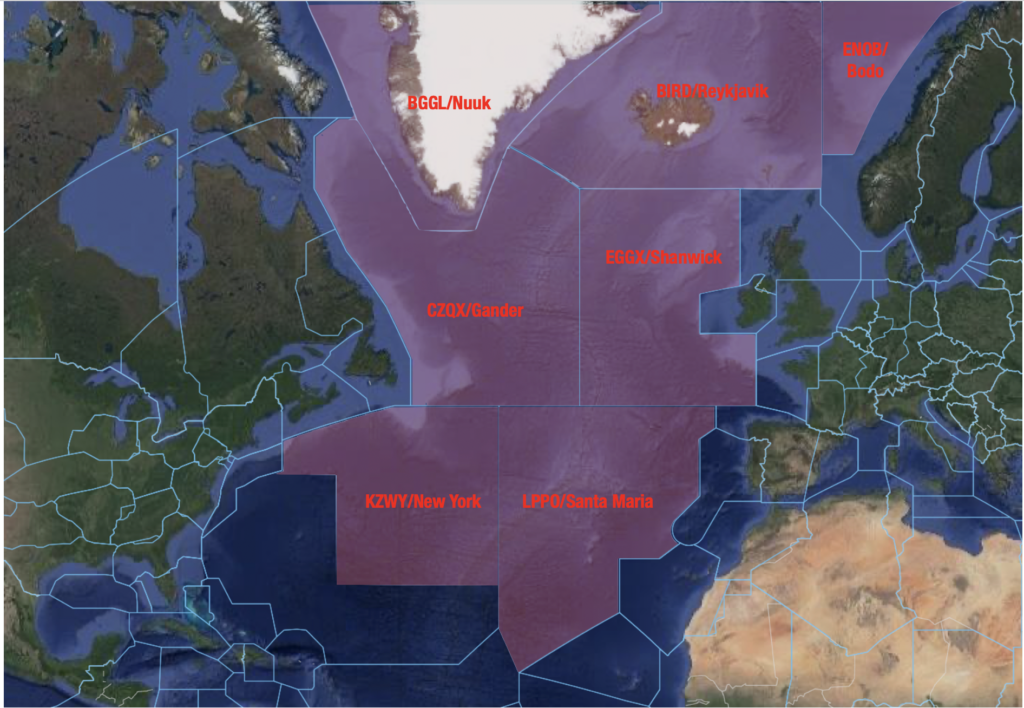
This page has a timeline of big NAT changes, for the six Oceanic Area Control Centres (OACC’s): EGGX/Shanwick, CZQX/Gander, BIRD/Iceland, ENOB/Bodø, LPPO/Santa Maria, and KZWY/New York Oceanic.

2026

  • OCR still not fully implemented. Most NAT FIRs now operate “No Oceanic Clearance Required”, but Shanwick still requires a clearance and is not expected to implement OCR until after summer 2026. More info.
  • No RCL for Reykjavik. Reykjavik no longer requires an RCL. If you send one, they’ll tell you it’s not needed. Flights exiting Reykjavik into Gander or Shanwick are coordinated automatically – no extra RCL required. More info.
  • ETO replaces ETA. RCL timing now uses ETO (Estimated Time Over the OEP) instead of ETA – more precise and aligned with how ATC separates traffic. More info.
  • FLAS removed. There is no longer a published Flight Level Allocation Scheme. You can plan any level, but expect less predictability and more tactical level changes. More info.
  • GNSS interference now a normal NAT risk. Jamming and spoofing are treated as routine. Even if position recovers, timing and surveillance may not – tell ATC early (usually in the RCL). More info.

2025

  • Shanwick OCR delayed. Transition to Oceanic Clearance Removal pushed to after summer 2026 following issues seen during Gander’s rollout. More info.
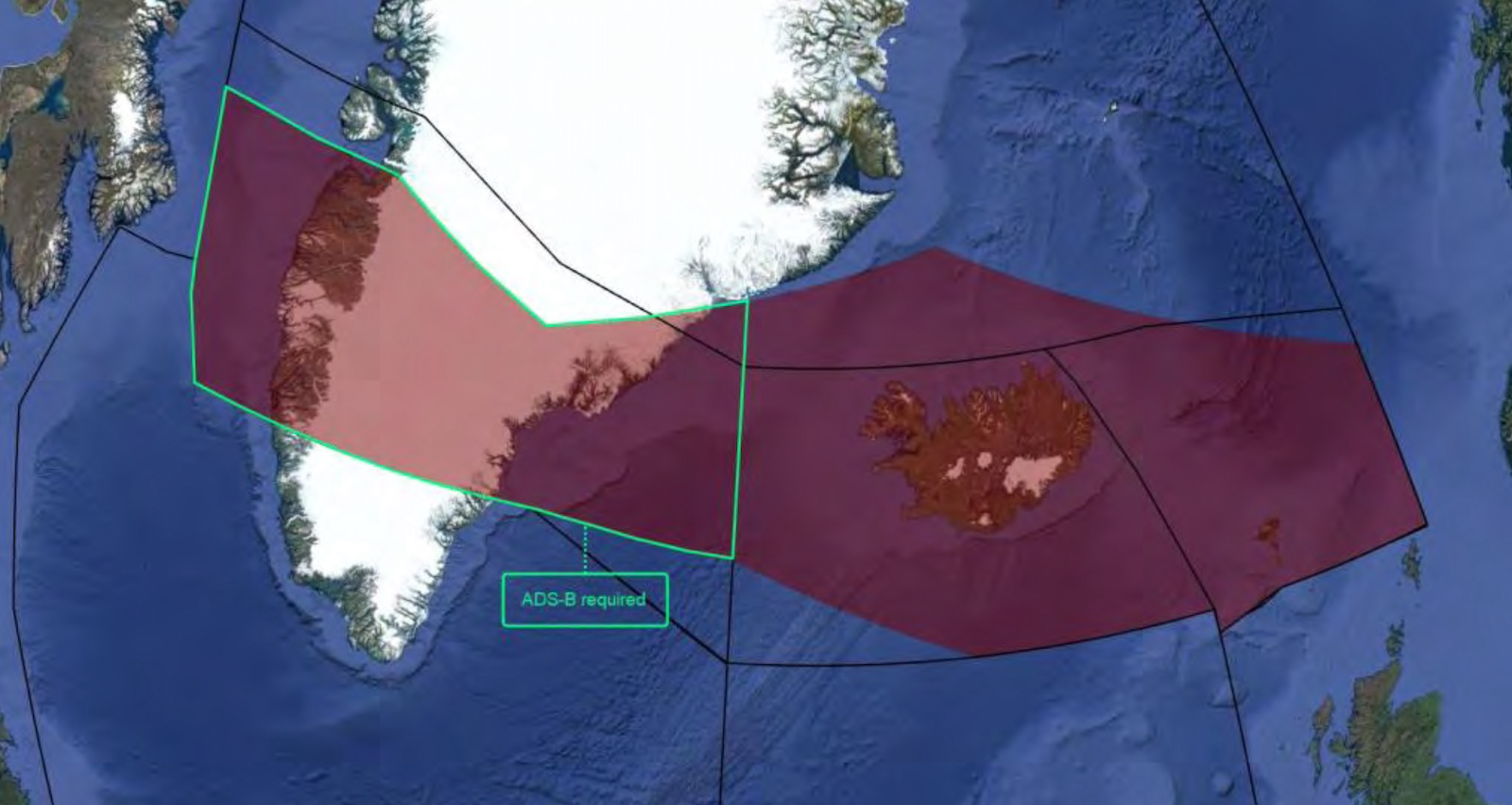
  • ADS-B required in Reykjavik FIR. ADS-B is now mandatory across the entire BIRD FIR for IFR flights. More info.
  • Greenland alternates changing. BGGH/Nuuk is now open to regular jet traffic. BGBW/Narsarsuaq is expected to close in 2026. More info.
  • Gander back to voice for pre-oceanic changes. CPDLC removed for pre-entry route changes – expect VHF voice instead. More info.
  • Blue Spruce concept removed. The formal Blue Spruce Routes were removed from NAT Doc 007, although VHF routings still exist in practice. More info.
  • GNSS interference procedures introduced. NAT Ops Bulletin 01/2025 sets out what to do if affected by spoofing or jamming – advise ATC early to avoid reroutes or level restrictions. More info.

2024

  • OCR rollout began. Transition to “No Oceanic Clearance Required” started across the NAT – but not all FIRs implemented it fully. More info.
  • Shanwick OCR postponed. Shanwick delayed implementation and remains the main FIR still issuing oceanic clearances. More info.
  • Comms failure simplified. Updated procedures made RCF handling more straightforward. More info.
  • Squawk 2000 standardised. Squawk 2000 ten minutes after the OEP across the NAT. Exceptions: Reykjavik CTA and Bermuda radar – retain assigned code while under surveillance. More info.

2023

  • WATRS renamed WAT. FAA updated terminology for North Atlantic airspace. More info.
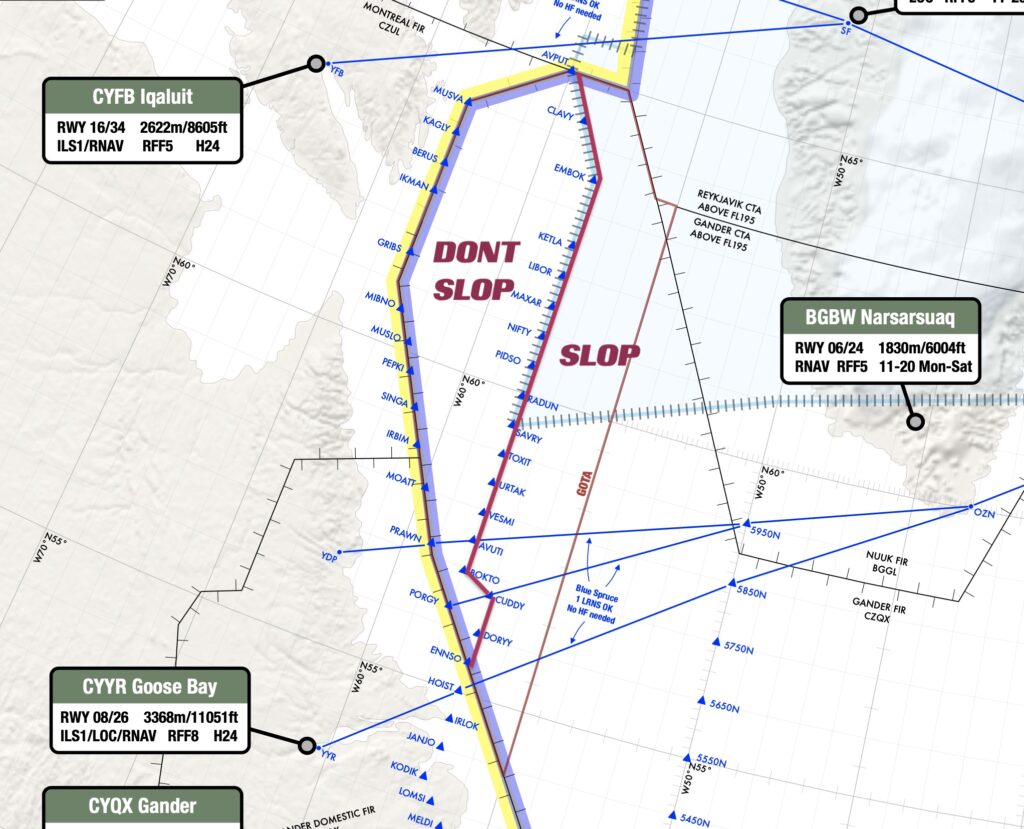
  • Datalink exempt area reduced. The northern exemption no longer extends as far south – previously down to SAVRY, now only to EMBOK. This means more of the Greenland sector controlled by Gander requires datalink. More info.

2022

  • Tracks start at FL340. NAT Tracks are no longer published at FL330 and below, giving more flexibility for random routing at lower levels. More info.
  • HF datalink no longer counts as Satcom. You must use Inmarsat or Iridium for NAT DLM compliance – HF ACARS alone is not sufficient. More info.

2021

  • Max uplink delay standardised. Expect “SET MAX UPLINK DELAY VALUE TO 300 SECONDS” on each CPDLC logon to a new OACC. More info.

2020

  • Datalink mandate introduced. CPDLC and ADS-C are required between FL290-410 across most of the NAT, with exemptions including north of 80N, surveillance airspace, and New York Oceanic East. More info.

2019

  • Micro-SLOP introduced. Aircraft can now offset up to 2.0NM right of track in 0.1NM increments. More info.
  • ASEPS separation reduced. Lateral separation reduced to 19NM for fully PBCS-compliant aircraft with ADS-B, RNP4, RCP240, and RSP180. Read the ICAO Bulletin.
  • Free speed (OWAFS). “Resume Normal Speed” allows variable Mach within limits – advise ATC if it changes by 0.02 or more. Read the ICAO Bulletin and check out our article.
  • PBCS tracks expanded. More daily PBCS tracks were introduced. Initially these were FL350-390, though current procedures now allow tactical expansion higher or lower. More info.
  • Contingency procedures updated. New contingency and weather deviation procedures introduced. For contingencies, you now turn at least 30 degrees and offset by 5 NM. For weather deviations, you now do your 300ft up/down offset when 5 NM away from track. More info.

2018

  • PBCS introduced. From March 2018, PBCS became a requirement for the daily mandated PBCS NAT Tracks. For the NAT, this means having both RCP240 and RSP180, along with RNP4. More info.
  • RLAT expanded. From Jan 2018, Shanwick and Gander expanded half-degree spacing on more tracks before RLAT was replaced by PBCS terminology. More info.

2017

  • SLOP mandatory. Offsetting right of track became standard NAT practice. Why it matters.
  • TCAS 7.1 required. From Jan 2017, TCAS 7.1 became mandatory throughout the entire NAT region.
  • No fixed cruising levels required. ICAO hemispheric cruising levels no longer need to be followed in NAT airspace.
  • Gross Nav Error tightened. This is now defined as greater than 10NM, instead of 25NM elsewhere.
  • Initial datalink mandate. Since Dec 2017, datalink became mandatory at FL350-390, with exemptions including Tango Routes, airspace north of 80N, surveillance airspace, Blue Spruce routes, and New York Oceanic.

2016

  • Confirm Assigned Route message introduced. Introduced in Aug 2016, this CPDLC message requires crews to confirm the planned NAT route and helps catch routing errors early.
  • NAT HLA introduced. MNPS was renamed NAT HLA in Feb 2016. Aircraft must be RNP4 or RNP10, and previous MNPS approvals remained valid through 2020.

2015

  • RLAT introduced. Starting in Dec 2015, spacing on core NAT Tracks was reduced to half-track spacing (30NM). More info.
  • SLOP becomes mandatory. Routine right offsets of 1NM or 2NM were introduced to reduce collision risk.


NAT CPDLC Route Uplinks: Crew Confusion and Errors

On Jan 27, the FAA published an Information Note for Operators (InFO) warning that crews have been responding to CPDLC route uplinks late or incorrectly when entering or while inside Gander’s oceanic airspace.

Aside from confusion, this has led to increased frequency congestion, controller workload, and interventions to prevent route deviations.

The InFO isn’t regulatory, but it highlights a persistent NAT issue that the FAA wants operators and training departments to address.

Here’s what’s going on.

The Backstory

It’s no surprise there’s confusion. Over the past few years, NAT oceanic procedures have changed significantly.

In 2023, the NAT began transitioning toward Oceanic Clearance Removal (OCR). Gander implemented this change, meaning crews submit a Request for Clearance (RCL) prior to the Oceanic Entry Point. If no change is required, they are considered cleared as filed. If a change is required, ATC issues a specific amended route or level.

In December 2024, Gander began issuing amended oceanic routes and levels via CPDLC following the RCL process. The goal was to standardise amendments via datalink rather than voice, and reduce readback/hearback error opportunities.

It didn’t go smoothly. Reports of confusion followed – especially around how amended routes were being issued and how they were being integrated into the FMS.

In May 2025, NAV CANADA temporarily reverted to issuing pre-oceanic entry amendments by VHF instead. However, Gander has indicated it intends to resume CPDLC route uplinks, potentially before summer 2026.

So this issue isn’t historical. It’s current – and likely to become more relevant again soon.

Crew Error

Gander has reported a significant number of uplinks that are not promptly or correctly actioned.

The typical sequence looks like this:

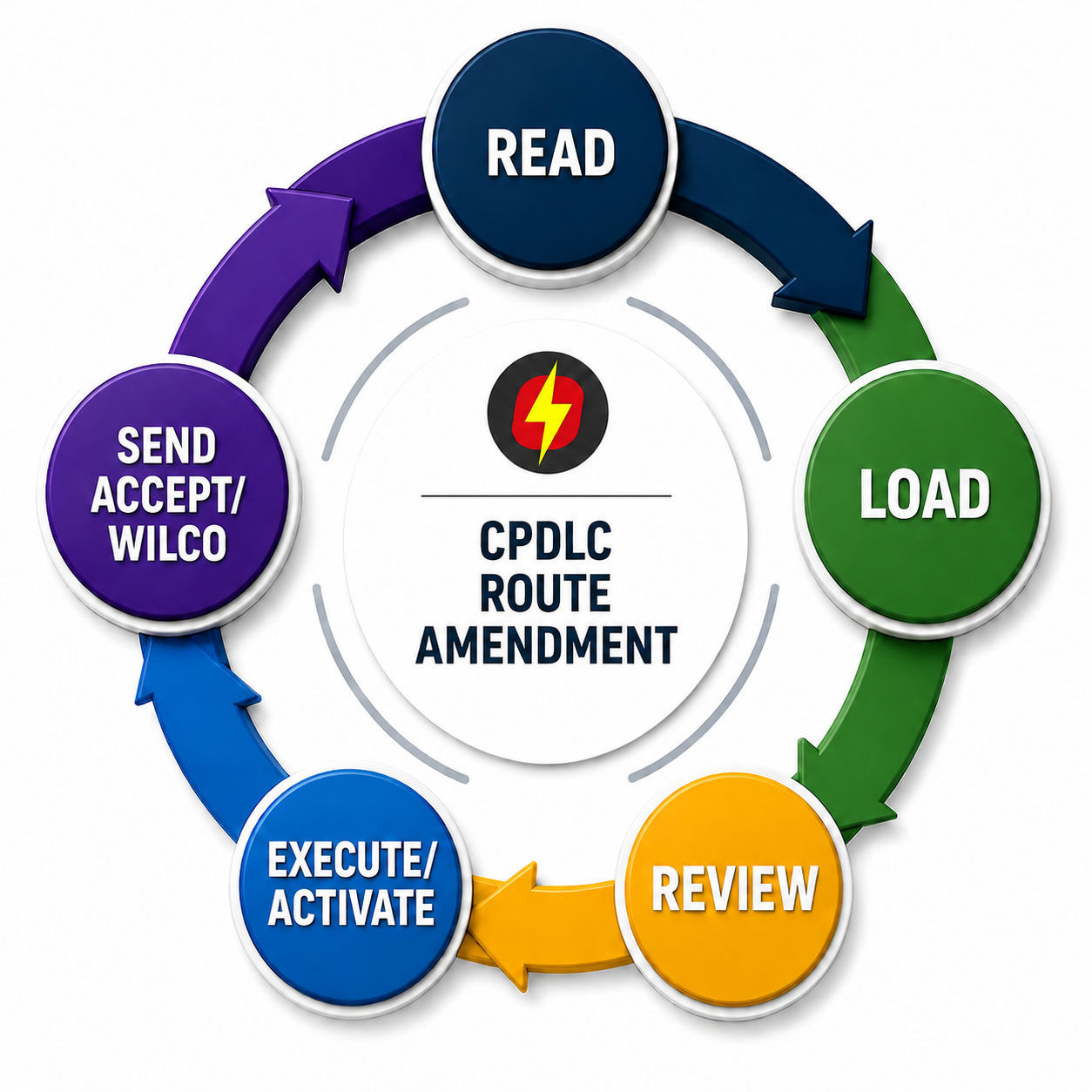
CPDLC route uplink sent → crew responds “WILCO” → about 5 minutes later ATC sends “CONFIRM ASSIGNED ROUTE” → crew replies with the route string (e.g. N47A RESNO 47N050W 48N040W 49N030W 49N020W MALOT GISTI).

ATC is verifying three things:

  • You received the correct clearance.
  • You loaded the correct route.
  • Your FMS matches what they issued.

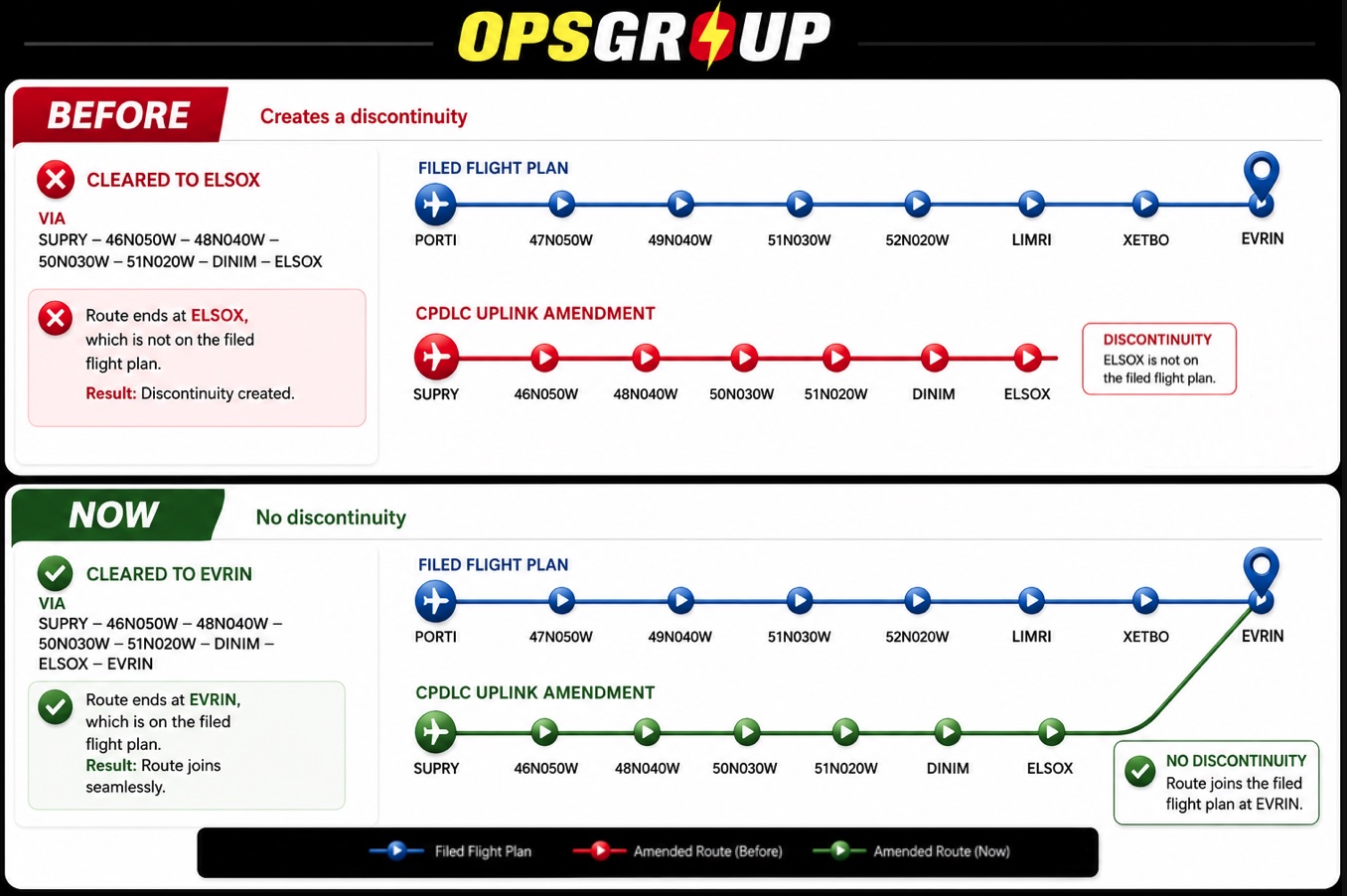
The problem arises when crews respond to “CONFIRM ASSIGNED ROUTE” before the new route has actually been loaded and verified in the FMS.

In that case, the system transmits the currently active route – not the newly assigned one. That mismatch generates an alert on the controller’s side.

There’s a second issue as well: misinterpreting certain CPDLC uplinks.

UM79 “CLEARED TO [point] VIA ROUTE CLEARANCE” is not a direct-to clearance. It is a new route to that point.

UM80 “CLEARED ROUTE CLEARANCE” is not “cleared as filed.” It is a new route that must be loaded and executed.

In either case, these errors trigger something called an ‘out-of-conformance alert’ to controllers. This is when small CPDLC errors turn into big ATC workload.

The scale of the issue is not trivial. The North Atlantic Central Monitoring Agency reported 475 lateral errors in 2025 – a 71% increase over the previous year. Total errors across all categories rose 29%, to 600.

Out-Of-Conformance Alerts

Behind the scenes, Gander’s system compares what you are expected to fly with what you are actually flying.

When ATC issues an amended oceanic route or level, this info is entered into their system as a ‘reference trajectory’. Your aircraft reports its actual position and intent via ADS-C, and the system continuously compares the two.

If there is a mismatch – whether because the wrong route was loaded or the wrong route was confirmed – an out-of-conformance alert is generated.

These take time for controllers to clear, cause distraction and add to frequency congestion. These aren’t necessarily a loss of sep, but they are a big deal in busy NAT airspace to prevent potential for traffic situations.

In other words, if you reply to “CONFIRM ASSIGNED ROUTE” before loading it, you’re sending ATC your old one.

So, what does the FAA suggest?

The key takeaway is simple: load the new route, verify it matches the clearance, then confirm it.

The info note lists a bunch of useful resources to help with this, that we have re-produced below:

  • NAT Oceanic Clearance Removal Bulletin, 2023_001.
  • NAT Oceanic Errors Safety Bulletin (OESB), 2017_002, CPDLC section.
  • Advisory Circular (AC) 91-70D, Oceanic and Remote Continental Airspace Operations, paragraph 4.4.3 and Figure 4-1.
  • AIP Canada, ENR 7 North Atlantic (NAT) Operations.
  • ICAO Global Operational Data Link Document (GOLD) Reroute Procedures.

More Questions?

We’ll try and answer them. If we can’t, we’ll put you in touch with who can. You can reach us on blog@ops.group.


New NAT Doc 007: North Atlantic Changes from March 2026

A new NAT Doc has landed, effective 19 March 2026. As ever, it’s a meaty sucker, and probably not something you’ll want to read cover to cover. So we’ve done that part for you. We’ve gone through it and pulled out the changes that actually matter operationally, plus a few important “this hasn’t changed” reminders. If you’re crossing the North Atlantic, this is the stuff worth knowing.

You can access the new 2026 version of the doc here, and the old 2025 version here, if you want to compare the two.

Shanwick OCR delay

The new NAT Doc now clearly states what operators have known for a while: Shanwick has not implemented Oceanic Clearance Removal. A specific note states that, due to delayed OCR implementation, Shanwick will continue issuing oceanic clearances following submission of an RCL, until further notice.

The document itself does not give a timeline. However, Shanwick has separately confirmed that OCR is not expected to go live before summer 2026. Operationally, nothing changes at Shanwick for now – crews must still request and fly an oceanic clearance. The key point is that, despite much of Chapter 6 reading like an OCR-style environment, Shanwick is explicitly not there yet.

Ref: Chapter 6, Section 6.3.

RCL timing switches from ETA to ETO – new terminology

The new 2026 edition introduces ETO – Estimated Time Over Significant Point for the Oceanic Entry Point in RCLs, replacing the way ETA was used in previous editions.

Doc 007 doesn’t explicitly explain the change, but the logic is pretty clear. ETA can be vague and is often taken as a general arrival estimate. ETO is much more precise – it’s the FMS-predicted time over a specific waypoint. That’s what ATC actually uses for longitudinal separation in procedural airspace.

The shift also lines up with two big themes in the new doc: the move toward OCR-style operations, and growing concern about time accuracy after GNSS jamming and spoofing.

Ref: Chapter 6, Sections 6.3.23-6.3.25

Reykjavik no longer requires an RCL

Reykjavik effectively steps away from the RCL process altogether in the 2026 edition. Doc 007 now says that an RCL is not required for Reykjavik, and that if one is sent anyway, crews will be told it wasn’t needed.

The main issue with RCL was confusion with some crews about what it actually meant. In some cases, crews assumed that once they’d sent it, they could climb or descend to the level in the message without first receiving an ATC clearance. So Reykjavik have decided to discontinue RCL altogether for safety reasons.

Other NAT OCAs still require RCLs, so this doesn’t simplify things overall. It just means procedures are even more mixed than before. The main risk for operators is assuming the same process applies everywhere across the NAT, when it very much doesn’t!

Ref: Chapter 6, Section 6.3.24

Bigger push on FMS waypoint and route verification

The 2026 doc puts much more weight on careful FMS programming and verification. It highlights known traps with half-degree waypoints, ARINC 424 coding, and CPDLC route amendments that arrive in full LAT/LONG and don’t visually match stored waypoint names.

There’s a strong emphasis on independent PF/PM crosschecks and verifying expanded coordinates, courses, and distances. This isn’t theoretical – it’s a direct response to navigation errors seen since OCR and more frequent CPDLC route changes.

Ref: Chapter 6, Sections 6.3.18-6.3.32

GNSS interference treated as a routine NAT problem

GNSS jamming and spoofing are no longer treated as rare edge cases. In the 2026 doc, they’re framed as a normal operational hazard. The guidance highlights how GNSS interference can quietly degrade aircraft time, with knock-on effects to ADS-C, ADS-B, CPDLC, and longitudinal separation – even after position accuracy appears to have recovered.

The practical takeaway is simple: “it recovered” doesn’t mean “it’s fine”. So operators need to think about downstream impacts before entering the NAT. More detailed guidance is in NAT Ops Bulletin 2025-001, which sets out what to watch for and what to do if you’re entering the NAT with GPS problems. This mainly affects westbound flights coming out of spoofing or jamming areas. Bottom line – tell ATC early in your RCL if there are any issues. Doing so can help avoid off-track reroutes, step-downs, and delays.

Ref: Chapter 1 and Chapter 6 (Plus referenced NAT Ops Bulletin as above)

Flight Level Allocation Scheme (FLAS) – now gone

Until now, NAT Doc 007 included a Flight Level Allocation Scheme (FLAS). It was a simple table that gave crews and dispatchers a sensible planning starting point for random routes outside the OTS, mainly by biasing eastbound and westbound traffic onto different flight levels. It wasn’t mandatory, but if you planned within FLAS, you were usually aligned with what ATC expected.

In the March 2026 edition, FLAS has quietly disappeared. The attachment has been removed and there’s no replacement scheme. Instead, the new wording says that random-route flights can plan any flight level, as long as it works with traffic flows and ATC can make it fit. 🤔

So there’s nothing in the new Doc to say that the old FLAS separation logic has disappeared – it’s just no longer explicitly written down! We’re guessing the practical impact will be less predictability up front and more tactical level changes, especially if you’re flying counter-flow or close to track changeover times.

What didn’t change

Despite all the discussion around NAT procedures lately, the new NAT Doc does not introduce new requirements in several key areas:

  • NAT HLA approval is still required (though there was some chatter about this last year)
  • CPDLC and ADS-C mandates are unchanged
  • No new equipage requirements
  • No new separation standards

So the real changes here are about clarity, procedures, and reducing error, not new boxes to tick.

Ref: Chapters 1, 5, and 6

So what do crews actually do now? (RCLs and oceanic clearances, made simple)

Even when the 2026 version takes effect in March, OCR will still be uneven across the NAT, so procedures depend on which OCA you’re entering. Here’s what crews will need to do at Gander, Shanwick, and Reykjavik:

Eastbound via Gander (no change)

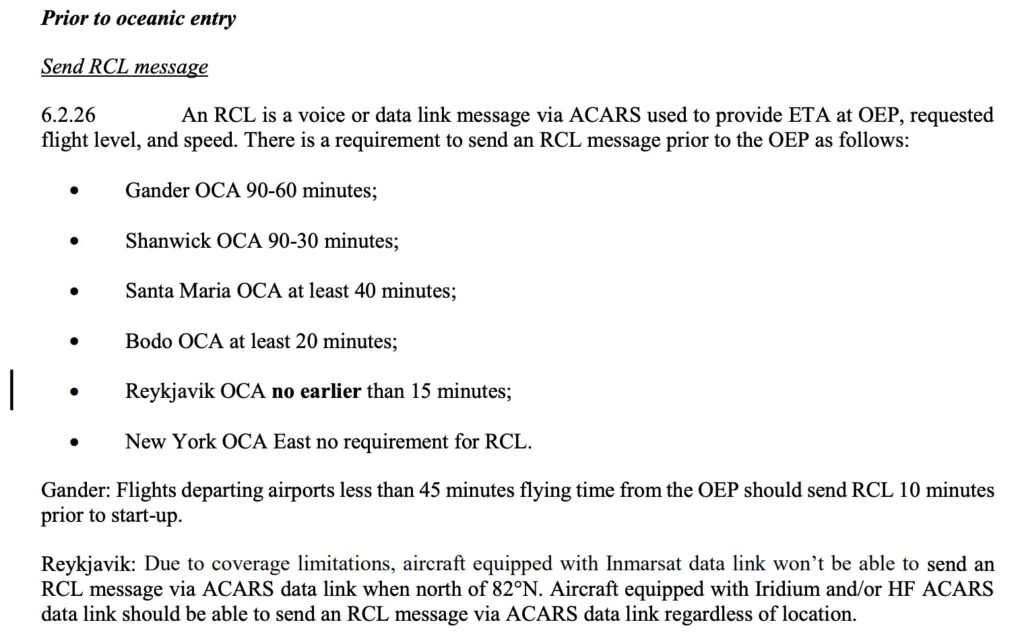
Gander is fully in OCR mode. You still send an RCL 90-60 minutes before the OEP, but it’s for planning only. You are not asking for an oceanic clearance, and none will be issued. Fly your last domestic clearance unless ATC gives you a change before the OEP. Once oceanic, expect any further changes via CPDLC or HF. This is the area that caused most of the early confusion, but the rule is simple: RCL yes, oceanic clearance no.

Westbound via Shanwick (no change… yet)

Shanwick is not on OCR yet. You must send an RCL or make a voice clearance request 90-30 minutes before the OEP, and you will receive an oceanic clearance by ACARS or voice. Fly that clearance. NAT Doc 007 confirms this will continue until further notice. Shanwick has separately said OCR is not expected until sometime after summer 2026.

Departing Iceland (changes from March 2026)

From 19 March 2026, Reykjavik will not require an RCL. If you send one anyway, they’ll tell you it wasn’t needed. Departing from BIKF/BIRK, you’ll enter the Reykjavik OCA on your existing ATC clearance unless instructed otherwise.

What the NAT Doc does not spell out is what happens next for flights leaving Reykjavik and entering either Gander or Shanwick!

We’ve asked Gander and Shanwick directly to confirm what the deal will be, and here’s what they’ve said:

  • Eastbound flights entering Shanwick: No additional RCL or oceanic clearance is required. Iceland will coordinate electronically with Shanwick, so crews should not expect to request a clearance or submit an RCL when exiting Reykjavik into Shanwick. This is similar to how flights entering Gander from New York FIR are handled today.
  • Westbound flights entering Gander: The same applies. Flights transitioning from Reykjavik into Gander will do so via electronic coordination between Iceland and Gander. An RCL is not required in this case. Gander RCLs are only required for flights transitioning directly from a Canadian domestic agency into Gander Oceanic.

In short: if you’re coming out of Reykjavik, don’t add an extra step. The handoff to both Shanwick and Gander will be coordinated automatically.

Other NAT Doc changes spotted by OPSGROUP members!

Thanks to everyone who wrote in with extra details they’d spotted in the new NAT Doc! A few of these aren’t brand-new changes, but they’re easy to miss and worth flagging. Here’s a round-up of the most useful bits members sent in.

  • WATRS terminology unchanged: The NAT Doc still uses the term WATRS and continues to defer the details to the US AIP. This hasn’t been updated, despite the FAA having moved to “WAT” terminology in its own AIP.
  • Squawk 2000 timing (10 minutes after OEP): This wasn’t new in the 2026 NAT Doc, but we missed it in our write-up back in 2025 so it’s worth flagging here! The NAT Doc says aircraft should retain the last assigned SSR code and squawk 2000 10 minutes after passing the oceanic entry point, everywhere in the NAT except when operating in the Reykjavik CTA or when transitioning Bermuda radar, where assigned codes are retained due to radar coverage. (Some older guidance and legacy SOPs often referred to squawking 2000 after 30 minutes, particularly in New York OCA.)
  • WAH reports no longer treated as mandatory: The updated Doc removes earlier ambiguity around “When Able Higher” reports. WAH is now clearly optional unless ATC specifically requests it, aligning with how several FIRs have already been operating.
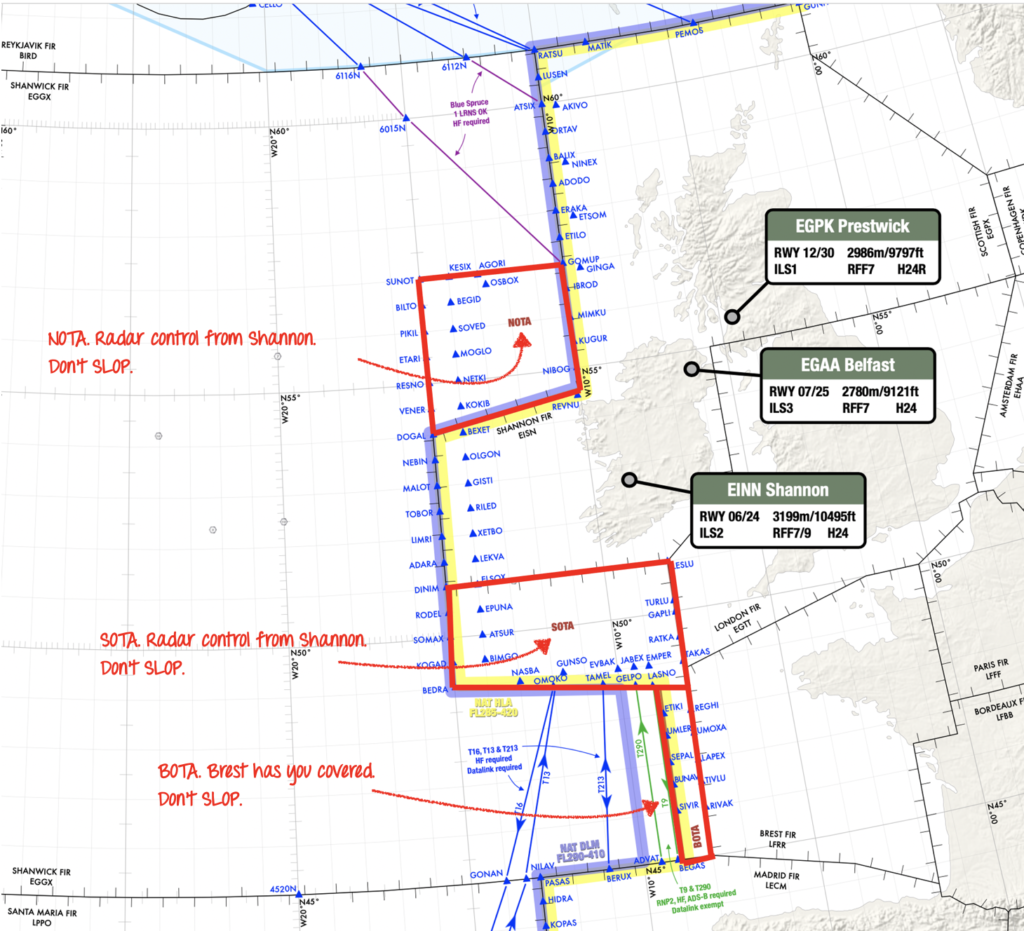
  • SLOP still treated as a blanket NAT procedure: The NAT Doc continues to describe SLOP as standard NAT practice and does not list route-specific or FIR-specific limitations. In practice, some published ATS routes and oceanic areas have local procedures that restrict the routine use of automatic offsets. Examples include T9 and T290, which are treated as RNP 2 continental offshore routes in the UK AIP, and parts of the WAT structure in New York OCA, where procedures expect aircraft to remain on the cleared route unless otherwise instructed. These nuances come from State AIPs rather than the NAT Doc, so crews still need to check local rules before applying SLOP.
  • Magnetic variation tolerance still inconsistent: A new note highlights that magnetic variation tables and track reference points can shift displayed tracks by up to ±3 degrees. However, nearby guidance still refers to ±2 degree tolerances, and earlier numeric tolerances have been removed from the sample checklist, leaving some internal inconsistency.
  • Oceanic checklist partly modernised: The sample oceanic checklist removes the old taxi groundspeed check, which no longer makes sense for modern navigation systems. However, the present-position check remains, even though its operational value is limited on newer aircraft.
  • RCL maximum level wording updated: The recommended RCL format for requesting a maximum flight level is now “MAX FL380”, replacing the older “MAX F380” wording. Some State AIPs still show legacy formats, so crews may see differences.
  • Azores departures – no RCL to Santa Maria: If you’re departing from the Azores, you don’t need to send an RCL to Santa Maria. This exemption has been in place since 201, but it isn’t clearly reflected in NAT Doc 007. It’s published in Portugal AIP ENR 1.1.15.1.
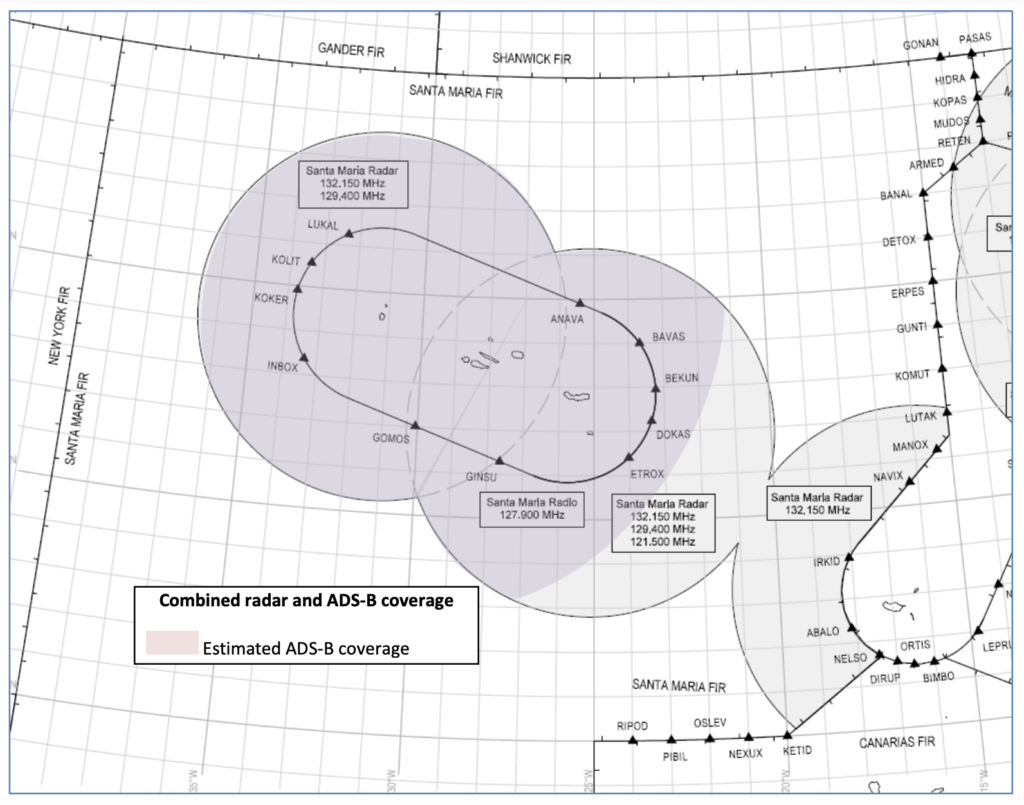
  • Some Santa Maria local procedures still sit outside the NAT Doc: The NAT Doc applies a generic NAT baseline to Santa Maria, but several Santa Maria-specific procedures only live in the Portugal AIP. These include squawk handling in the surveillance area, limits on routine offsets in some sectors, exemptions from voice position reports when space-based surveillance is in use, and CPDLC-related SELCAL and RCL differences. None of this is new, but it still isn’t captured in Doc 007. Bottom line – don’t rely on the NAT Doc alone for Santa Maria.
Anything we missed?

Spotted any other big changes in the new NAT Doc that we missed? Please let us know, and we will update this article! Email: news@ops.group


What’s Changing on the North Atlantic?

Update Jan 2026

If you’re crossing the NAT in mid-January, expect a temporary change to how OTS tracks are built.

From Jan 12-25, Gander and Shanwick will include half-degree coordinates in some daily tracks to test whether operators can reliably file and fly them.

Nothing else changes: you still plan the NAT the same way and PBCS tracks stay labelled as normal. The goal is to see if wider use of half-degree points can give more flexibility in OTS design and free up more random-route airspace. Make sure your flight planning system and FMS handle half-degree coordinates properly, and check this doc for more info.

Update Nov 2025

There’s a special ICAO group called the NAT SPG – the North Atlantic Systems Planning Group. They meet once a year to decide what’s next for the North Atlantic, and then publish a big summary of what was agreed. It’s one of the few places you can actually see what changes are being planned before they hit the real world.

Download PDF.

Their latest meeting was in Paris in June 2025, and here’s what’s coming that will actually matter to operators crossing the NAT…

RCL messages are on the way out

Iceland and Gander both intend to discontinue the RCL (Request Clearance) message as soon as possible.

The NAT SPG report mentioned possible timelines from late 2025, but when we contacted both ANSPs they said no firm dates have been set yet. Other NAT centres haven’t announced plans to follow, so expect mixed procedures for some time.

This is the next big step in the ongoing Oceanic Clearance Removal rollout, aimed at simplifying procedures and cutting down on confusion.

OCR still needs work

The Oceanic Clearance Removal (OCR) rollout in 2024 caused more trouble than expected. Crews struggled with CPDLC message formats, leading to route errors, incorrect clearances, and heavy ATC workload.

The NAT SPG wants ICAO to remind States to tighten up crew training and operator procedures for OCR. Iceland and Gander are taking the next step by planning to drop the RCL message altogether, which should help simplify things once everyone is ready!

For the absolute latest on where we are right now with the whole OCR/RCL thing, and what crews need to do, check here ⬇️

GNSS interference now a serious NAT issue

Reports of GNSS jamming and spoofing keep rising, and some aircraft still can’t recover once affected.

The NAT SPG wants more crew training and better tools for ATC to spot and manage affected flights. We’ve already had a NAT Ops Bulletin from ICAO on this – if you missed it, we covered what to do if spoofed before the NAT.

Key takeaway: if your aircraft experiences any kind of GPS interference, you must tell the first NAT ANSP in your RCL, even if everything seems to have recovered.

For our full article on what to do if spoofed/jammed before entering the NAT, check here ⬇️

Possible end of HLA approval requirement

Iceland has reviewed the old MNPS/HLA approval system and says it may no longer be needed.

The reason: the navigation performance standards that used to be covered by an HLA approval are now built into other rules (mainly the modern PBN requirements for RNP 10 or RNP 4 operations). In other words, if an aircraft already meets current NAT HLA standards, the separate “HLA approval” adds little value.

Iceland plans to complete a safety assessment on removing the HLA approval requirement and present it to the NAT Safety Oversight Group (SOG) in Dec 2025 (that’s the NAT team that reviews safety cases before any major change goes live). The UK, US, and Spain have said they’d prefer to keep the approval requirement for now, so this is still very much under discussion rather than a confirmed change.

Safety models might be getting an upgrade

A semi-interesting one. So the NAT’s current collision risk figures look worse than reality because they use 1960s-era maths. New modelling is coming that reflects today’s surveillance environment, which should better represent actual safety levels.

It won’t change anything for crews right now, but it sets the stage for the future – once the numbers catch up with reality, we could possibly see tighter spacing or more flexible routing across the ocean.

Commercial space launches are still disrupting routes

Rocket launches are becoming a regular headache, forcing reroutes and last-minute airspace closures.

The NAT SPG is planning a workshop in late 2025 or early 2026 to develop a common approach, since there’s still no global standard on coordination or cost recovery.

Document updates inbound…

Hooray! Everyone loves document updates!

NAT Doc 007 (Operations and Airspace Manual) and NAT Doc 003 (HF Management Guidance) will both be updated soon to reflect current procedures and OCR changes – plus probably a bunch of other stuff, who knows…

In previous years this has normally happened every March, but sometimes we get a cheeky update in Jan or Feb – so stay tuned!

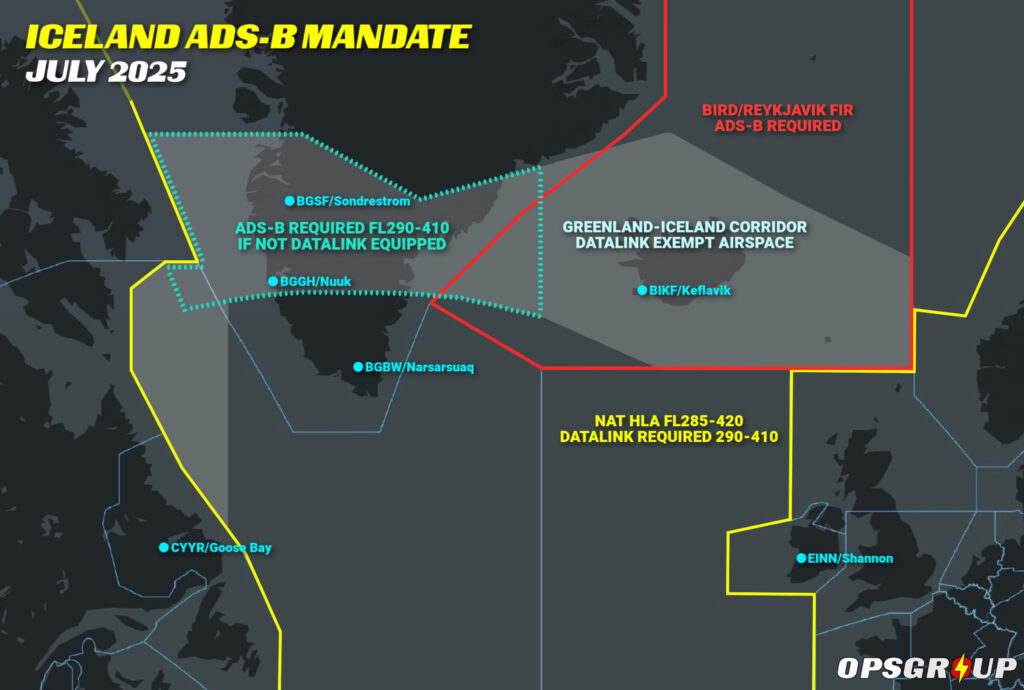
ADS-B now mandatory everywhere in Iceland

Here’s one that’s not actually in the NAT SPG report, but still worth mentioning! As of 1 July 2025, Iceland made ADS-B mandatory for all IFR flights in the BIRD/Reykjavik FIR. 

So now the NAT datalink/ADS-B rules look something like this:

The rule applies to every aircraft flying IFR, at any altitude. Exemptions include flights to maintenance, export deliveries, or aircraft that will retire by 31 Oct 2025. If your ADS-B system fails, you can still operate for up to three days while it’s being repaired. You can check AIC 1-2025 for more info.

Give me ALL the NAT updates in one place!

Sure thing, friendo. For a nice/concise timeline of NAT changes stretching back to the dawn of time, check here ⬇️

And barring any more North Atlantic related changes in the next couple of months, we’ll see all you NAT addicts again in 2026!


Spoofed Before the NAT? Here’s What to Do

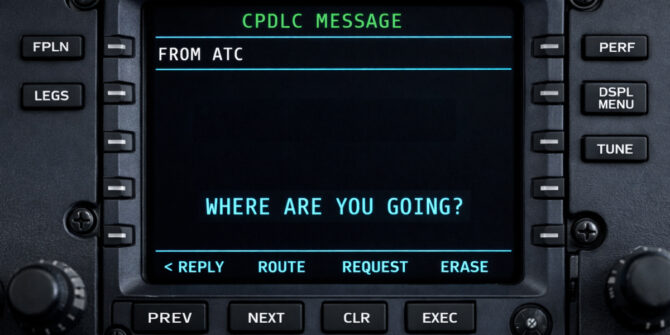
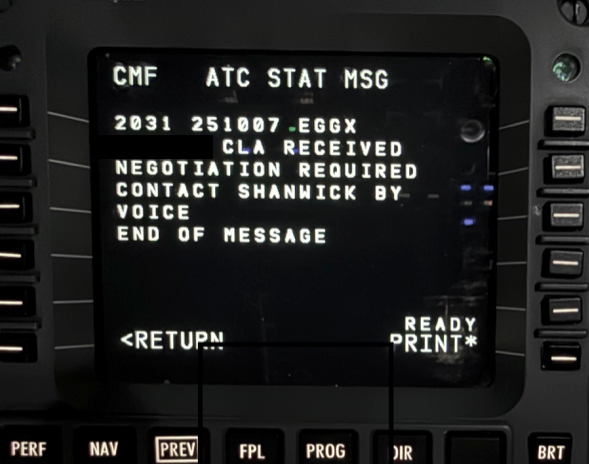
An OPSGROUP member on a recent westbound NAT flight from the Middle East received the following message via CPDLC:

The crew contacted Shanwick via HF, who requested their RNP capability and operational status.

The controller explained that due to their point of departure (OMAA/Abu Dhabi) they wanted to be certain the aircraft had not been contaminated by GPS jamming or spoofing before it entered oceanic airspace.

It’s been a while since we wrote about this procedure, and since then we’ve had this NAT Ops Bulletin published by ICAO telling operators what to do on the NAT if they’ve experienced jamming/spoofing, so we reached out to NATS directly for an update. Here’s what they had to say…

Defensive Measures

NATS reported they continue to receive a large number of flights every day that have been impacted by GPS interference prior to oceanic boundaries.

The issue is that once an aircraft’s navigation system has been ‘contaminated’ by bad GPS data, it may not be possible to recover full RNP capability in flight, even if the normal GPS signal is restored.

These aircraft may no longer meet RNP 4/10 accuracy required in the NAT HLA, even long after the trigger event occurred.

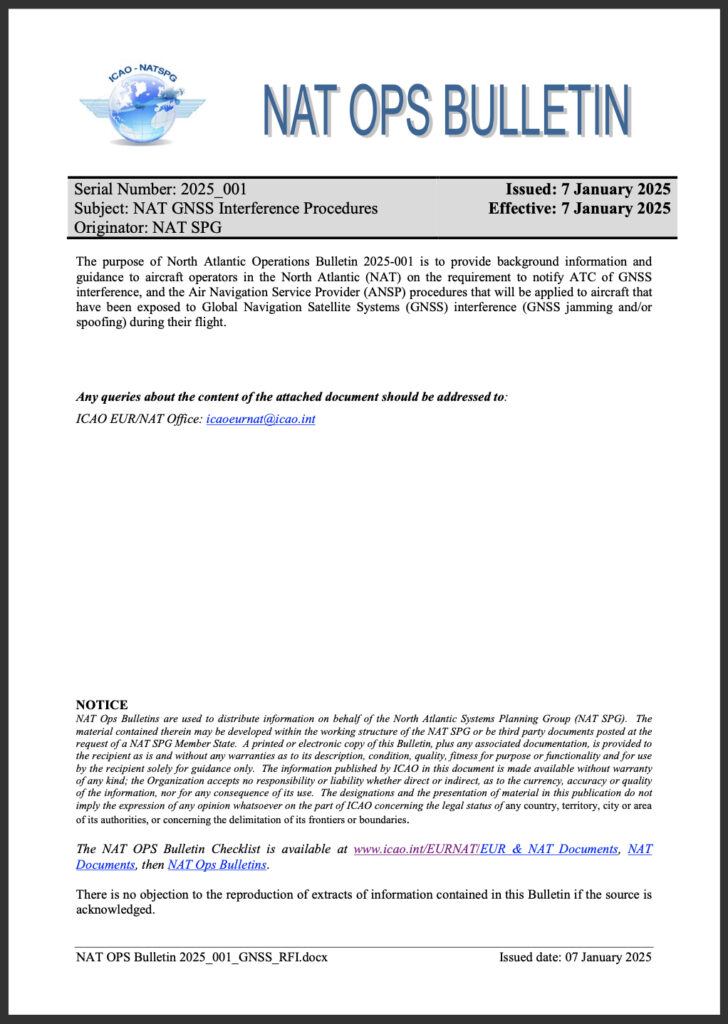
The NAT Ops Bulletin which was published back in Jan 2025 requires crew of NAT-bound aircraft that have encountered GPS interference to notify their first NAT ANSP via RCL. Even if your aircraft shows no lingering effects, ATC still want to know.

NATS advise that late notification by pilots of a RNP degradation (such as approaching an oceanic entry point) greatly increases controller workload. They often need to move other aircraft out of the way to provide increased separation (in some cases from 14nm to 10 minutes), it’s a big deal.

As a result, they are employing defensive controlling measures. Based on previously spoofed/jammed flights and regions of known risks, they may proactively contact flights assessed as higher risk to confirm status before entry – although the exact selection criteria isn’t public. Increased separation will be applied until normal navigation performance is confirmed by the pilots.

In a nutshell, this is why the OPSGROUP member received the message above.

A special thank you to NATS for their help in answering this question.

Jammed or spoofed? You need to let your NAT ANSP know

The NAT Ops Bulletin we keep mentioning – this provides the guidance for NAT traffic on how to manage GNSS interference. Here it is again, so you can’t miss it! ⬇️

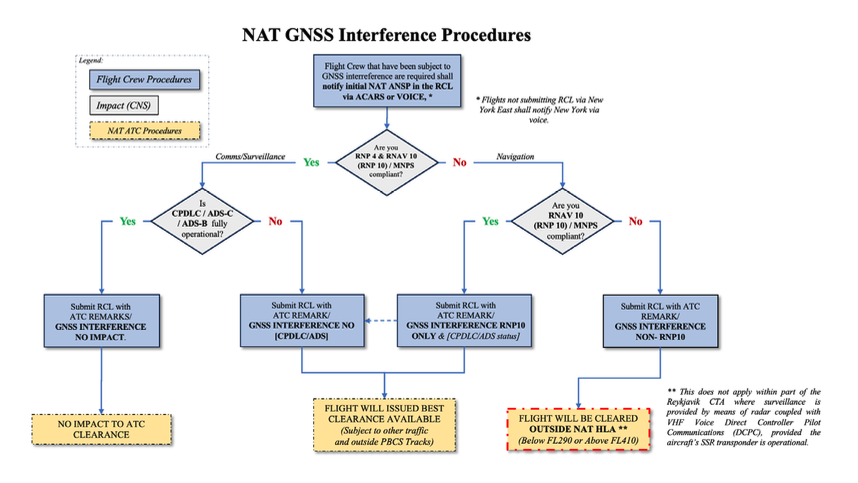
Key takeaway from this: If you suspect or know that your aircraft has encountered any kind of GPS interference (both jamming or spoofing), NAT-bound traffic must let their first NAT ANSP know in the RCL – even if the aircraft appears to have recovered.

This is prefixed by ‘ATC REMARKS/GNSS INTERFERENCE’ and must include details of any system degradations.

A few messages to keep handy are:

‘ATC REMARKS/GNSS INTERFERENCE NO IMPACT.’

‘ATC REMARKS/GNSS INTERFERENCE NO CPDLC/ADS’

‘ATC REMARKS/GNSS INTERFERENCE RNP 10 ONLY’

‘ATC REMARKS/GNSS INTERFERENCE NON-RNP10

By including your status in the RCL, you are giving ATC a head’s up before you arrive.

In most cases, you will still be allowed in the NAT HLA. A loss of RNP 4 isn’t a deal breaker, as you can still enter under RNP 10. But your clearance may be less optimal (likely level changes) due to the increased separation from other traffic.

The big one to look for is a loss of RNP 10. You will not be cleared into the NAT HLA, and instead will need to remain below FL290 or above FL410. With an obvious fuel impact, this may lead to an unplanned diversion.

The Bulletin includes a handy flow chart that’s worth printing and keeping in your flight bag.

Click for PDF.

Latest ICAO Feedback

The latest three-yearly ICAO Assembly was held in Montreal from Sep 23 – Oct 3.

During the event, ICAO issued its strongest condemnation yet of both Russia and North Korea, directly blaming them for deliberate GNSS interference in violation of the Chicago Convention. Russia, in particular, has been blamed by ICAO for destabilising navigation across European airspace.

We continue to receive regular reports from OPSGROUP members of both jamming and spoofing. Interference is now a regular occurrence in the Baltic region, particularly around Kaliningrad, Eastern Finland, the Baltic Sea, and nearby airspace. Other reports have been received from Germany, Poland and Norway.

Recent airspace incursions, airstrikes and drone activity associated with the ongoing conflict in Ukraine have almost certainly escalated the use of GPS interference as a defensive measure. Civil aviation will continue to operationally grapple with this hazard. With no obvious solution in site, our best defence remains procedures like the one detailed above.


Shanwick Delays OCR Until Post-Summer 2026

Big update on Shanwick’s plans: they’ve now confirmed that the move to the new Oceanic Clearance Removal (OCR) system won’t happen until sometime after summer 2026. That’s a fairly significant shift, as earlier expectations were that it might roll out by the end of summer 2025.

Why the delay?

Over in Gander, when OCR went live last December, things got messy. Controller workload spiked as crews struggled with the new procedures — there were lots of extra radio calls, some confusion over routing, and even a few close calls that controllers had to step in and prevent. More on that here.

Shanwick has pointed to a mix of factors behind the delay — including their own operational complexities and the issues Gander has been dealing with since their rollout. Taking more time now gives them a chance to refine the process and avoid similar issues when they do eventually make the switch.

So, let’s have a nice clear set of steps to follow — depending on whether your headed east or west over the NAT…

Going eastbound via Gander

  1. Send your RCL 60–90 mins before the OEP via ACARS (it’s for ATC planning only, no clearance will be issued!)
  2. May 5 – Dec 31, 2025: Note that any route changes before oceanic entry will be given by VHF voice when in Gander airspace. Moncton and Montreal will continue to issue CPDLC UM79 route amendments.
  3. Don’t request an Oceanic Clearance – there isn’t one here anymore.
  4. Maintain your domestic cleared level unless ATC assigns a different one.
  5. Once in Oceanic airspace, expect further changes via CPDLC or HF.

If Gander isn’t issuing Oceanic Clearances anymore, why send an RCL? This may very well be the crux of the mass pilot confusion experienced so far. The answer: the RCL is now just a planning tool — you’re not asking for permission, only notifying them, because they still need your exact routing and timing to safely manage traffic. You continue to fly your last assigned domestic route and level unless ATC gives you a change. The confusion comes from the wording: no Oceanic Clearance is issued, but notification is still required.

Going westbound via Shanwick

  1. Send your RCL or make a voice clearance request 90–30 mins before the OEP.
  2. You’ll receive your Oceanic Clearance by ACARS or voice.
  3. Fly the Oceanic Clearance.

Also note that if entering Shanwick from another Oceanic area, no clearance is needed from Shanwick.

We think we got all that right. If not, let us know please! news@ops.group.

And if you’re still confused about OCR, check this post.

NAT Forecast: No more RCLs?

There’s also an interesting twist that could change how flights work across the NAT in the longer term. We’re hearing talk that some North Atlantic ANSPs are looking at removing the RCL process completely at some point in the future.

That would be a huge change, bringing oceanic ops much closer to domestic ones. No more sending RCL messages ahead of the Oceanic Entry Point, no more extra steps — you’d just fly your filed plan unless ATC issues a change.

But this is still very much in the idea stage. It would need to go through ICAO groups and international working groups to figure out all the technical and procedural details, and there are plenty of hurdles to clear before it could actually happen.

For now, it’s just something to keep an eye on, as Shanwick and other ANSPs continue to refine how oceanic traffic is managed.


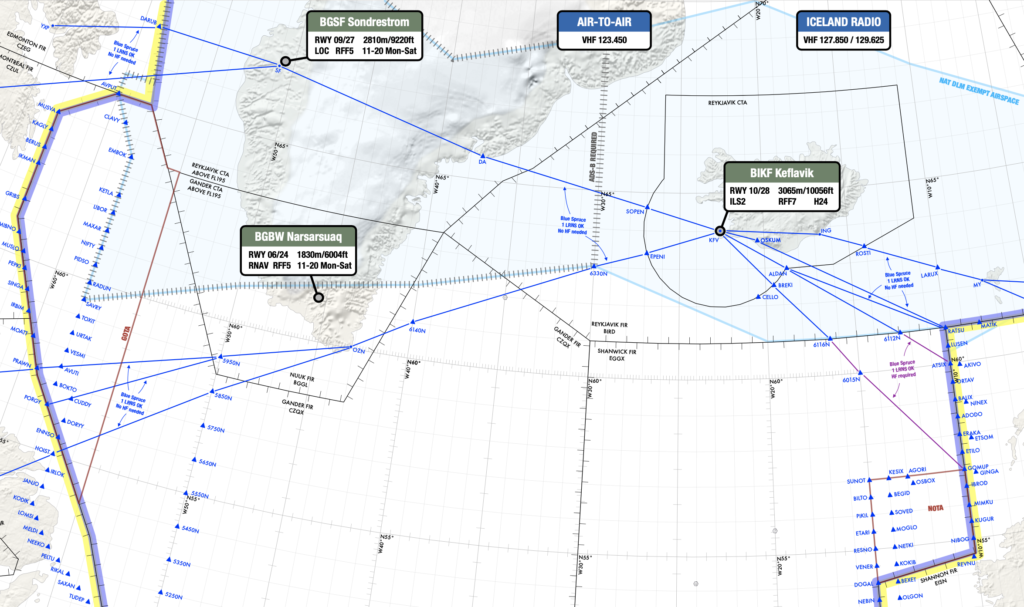
Blue Spruce Routes Are Gone (But You Can Still Fly Them)

The Short Story

The Blue Spruce Routes are gone — but if you don’t have all the equipment, there are still ways to get across the Atlantic. What you can do depends on what’s on board:

Fully equipped? (2 LRNS, CPDLC RCP240, ADS-C RSP180, HF, LOAs)
➤ You can go anywhere in the NAT HLA.

No datalink?
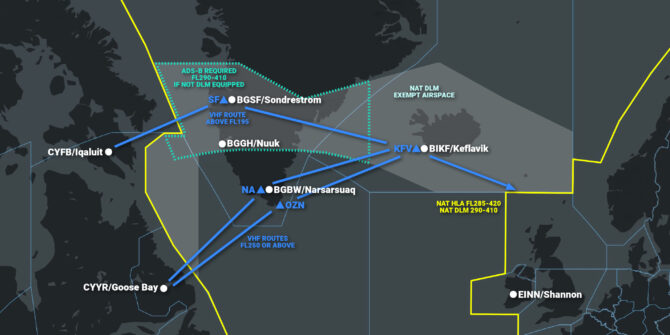
➤ Avoid FL290–410 unless you’re in the DLM Exemption Area (e.g. Iceland–Greenland Corridor) and have ADS-B.

No HF radios?
➤ You can only cross via specific VHF-only routes:
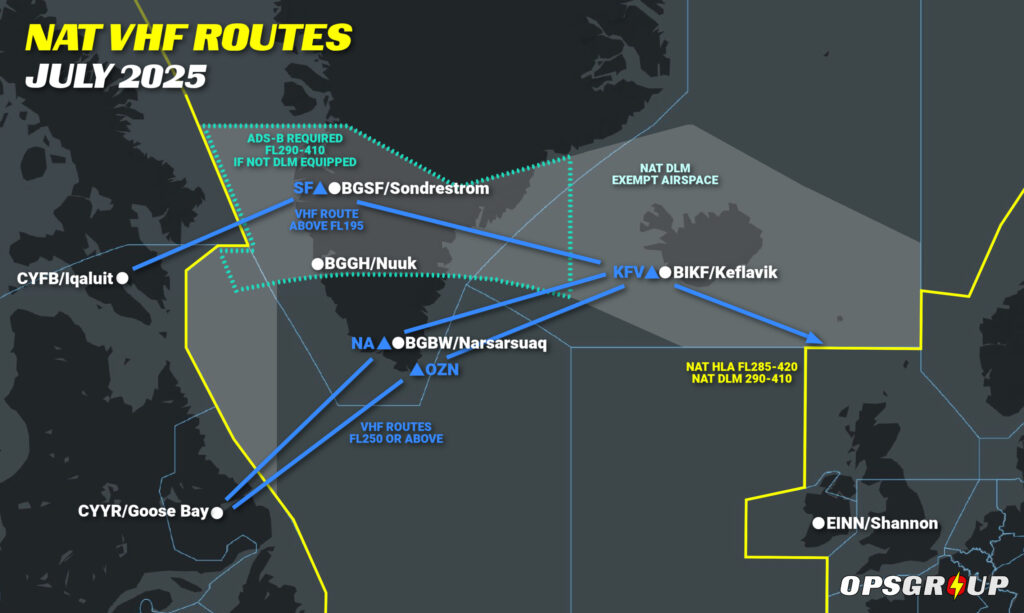
– Above FL195: YFB–SF–KFV
– FL250 and above: YYR–OZN–KFV

Only one LRNS?
➤ Stay below FL285 to avoid HLA nav and datalink rules – but unless you’re on a Gander-approved VHF route (e.g. via OZN or SF), you’ll still need two long-range comms systems.
➤ Want to climb into HLA airspace? You’ll need VHF coverage, ATS surveillance, State approval, and a compliant routing like the Iceland-Greenland corridor.
 

The Longer Story

As of March 20, 2025, the Blue Spruce Routes have been officially removed from the North Atlantic. These routes—once the lifeline for aircraft with limited navigation or communication capability—are now a thing of the past. The change is part of the latest update to NAT Doc 007, which you can read more about here.

Technically established in 1976, the Blue Spruce Routes allowed aircraft with only one Long Range Navigation System (LRNS) to transit the NAT High Level Airspace (HLA) under special routing and coverage provisions. Over time, however, the need for them faded. The reasons:

  • Almost no aircraft that have the mandated CPDLC equipment have only one LRNS. Or put another way, if you have CPDLC, you have dual LRNSs unless broken. With the addition of CPDLC requirement, relief for a single LRNS became outdated.
  • Ground-based nav aids along the routes have largely disappeared.
  • Datalink Mandated Airspace now covers most of NAT HLA.
  • The Iceland–Greenland Corridor, with reliable VHF and ATS surveillance, provides a more flexible and better-supported fallback option.

While the Blue Spruce name may still pop up informally (especially among ferry operators), it no longer refers to any officially recognized ICAO routes. But crucially, some of the old routings remain usable—just under new conditions.

For example, Canada now allows aircraft operating with only VHF to cross via specific routes:

  • Above FL195 via YFB–SF–KFV (this one currently says “below” FL195 in the Canada AIP, but that’s been confirmed as a typo, and will be getting updated shortly!)
  • FL250 or above via YYR–OZN (or NA)–KFV

These are the only routes where VHF coverage is considered sufficient for oceanic ops without HF radios. Everywhere else, HF is still required outside VHF range.

So while the Blue Spruce Routes are gone in name and publication, practical exemptions remain—especially for aircraft with partial equipage. What’s changed is how you plan and justify the crossing.

Let’s walk through what you can still do today, based on what your aircraft has (or doesn’t).

Standard Ops

Most traffic crossing the North Atlantic Airspace (NAT) occurs from FL290-410 through the North Atlantic High Level Airspace (NAT HLA). Over the years, advances in navigation, communication, and surveillance equipment have led to additional requirements for operators so ATC can safely reduce aircraft spacing and pack more aircraft through the airspace.

For unrestricted access to the NAT HLA, operators need:

  • 2 Long Range Navigation Systems (LRNSs)
  • Outside VHF areas 2 LRCS are required – either 2x HF, or HF & Satcom/or CPDLC, for the other.
  • FANS 1/A equipment for the NAT Datalink Mandated airspace
  • Super-duper datalink for the coveted PBCS Tracks (i.e. CPDLC capable of RCP240 + ADS-C capable of RSP180)

And for US operators, that equipment list is a prerequisite for several required LOAs:

  • A056 CPDLC Enroute, and Oceanic and Remote (PBCS)
  • B036 Oceanic and Remote Continental Navigation Using Multiple Long-Range Navigation Systems (M-LRNS), Aka. RNP 4 (and RNP 10)
  • B039 NAT HLA
  • B046 RVSM
  • D195 MEL (not technically required for a crossing, but might as well throw this one in)

The above is the ideal setup. But what if I fly old stuff, or new stuff, or broken stuff, or little stuff?

Old Stuff

To the formerly early adopters without the benefit of factory standard state-of-the-art equipment: let’s say your aircraft has LRNSs that are only capable of RNP 10, or your FANS equipment is RCP400 and RSP400. All else being equal, the only limitation would be no PBCS tracks. And no T9/T290 either. All other tracks or random routes through the HLA are approved.

Is your equipment so old it doesn’t even have the above equipment? Consider yourself the same as broken, and keep reading…

New Stuff

You just closed on a shiny, new, well-equipped jet and have to ferry it across the pond, but you have no LOAs. In this case, you are altitude and route are limited. No RVSM or NAT HLA LOAs means the airspace from FL290-410 is off limits for you. If traffic permits, ATC may let you climb through the HLA above FL410, but you might want to plan fuel and route at FL280. Route-wise, without B036, you’re flying the Iceland-Greenland Corridor.

If you only have some of the above-listed LOAs, also consider yourself broken.

Now, it gets a little more nuanced…

Broken Stuff

You’ve been spoofed, but only one GPS came back? When down to one LRNS (or you don’t have B036), fly the Iceland-Greenland Corridor. With only one LRNS, you could fly through the NAT HLA along the corridor with approval if you stay within surveillance and VHF coverage and have the equipment to fly the assigned route. Otherwise, fly above or below the NAT HLA.

You’re down to one HF or lost both? You can still cross via the Iceland–Greenland Corridor or the old southern Blue Spruce routing via OZN – but only between FL250-280, where VHF coverage is sufficient and you’re still below DLM airspace. Just make sure to stay clear of Shanwick OCA, which still requires HF.

HFs are back, but your Datalink konks out (CPDLC or ADS-C), or you don’t have A056. There are two options: stay within the Data Link Mandate (DLM) exemption area (the corridor) and fly any altitude. The DLM exemption area exists because you don’t need CPDLC in that area if you have ADS-B. Radio reception is pretty good throughout there! The second option is to fly above or below the NAT HLA.
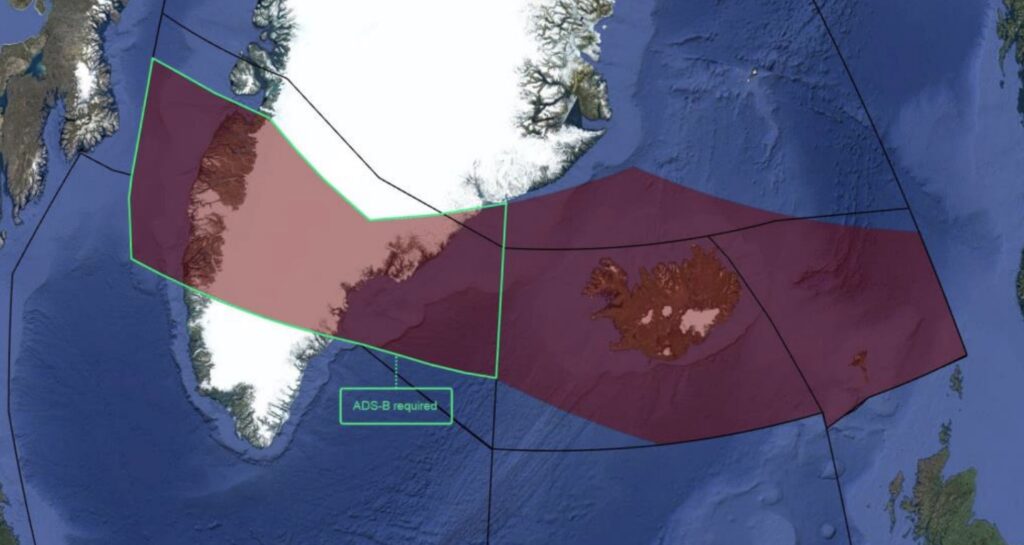
DLM Exemption Area (ie. Iceland-Greenland Corridor)

Little Stuff

And if you get a wild hair to cross the Atlantic in an aircraft with only one LRNS, no HF radios, no Datalink, no LOAs, without the range to fly non-stop (like me), you still have options. You’ll need to stick to the Iceland–Greenland Corridor, or the specific VHF-approved routes via OZN or SF.

What’s a Blue Spruce?

It’s a Christmas tree native to the Rocky Mountains that you won’t see across the Atlantic on any of your stops. However, the Blue Spruce Routes are routes in and around the Atlantic connecting Canada, Greenland, Iceland, and the UK.

Why were they called the Blue Spruce Routes? Back when military aircraft had wooden propellers (sometimes made of spruce), they painted the tips blue. These aircraft had to make the trans-Atlantic journey along the now-known Blue Spruce Routes.
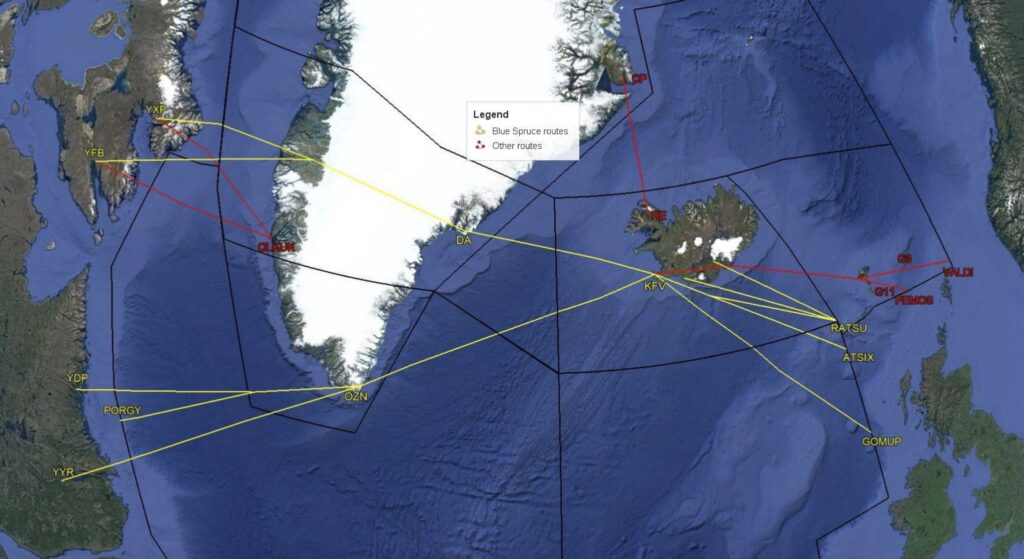
Nostalgia Map.

Gray Areas

The Iceland-Greenland Corridor provides exemptions from equipment and operational requirements because land-based radio transmitters along the route provide decent coverage, and route legs are short enough to complete a crossing without necessitating equipment redundancy.

Now, there are exemptions from the rules, and then there are gray areas. Despite all the relief these routes provide, one regulation remains: you must maintain two-way radio communication with ATC.

So far, much of the discussion is how high you can go, but what about how low?

VHF communications have improved significantly in the Atlantic in the last ten years. Both the northern and southern routes have VHF reception at appropriate altitudes. The longest stretch of water is between Canada and Greenland. On the southern route over this stretch of water, I have experienced adequate communication at FL250 and up. The northern route is good down to FL200. Iceland is fantastic – it’s almost like you’re in domestic airspace.
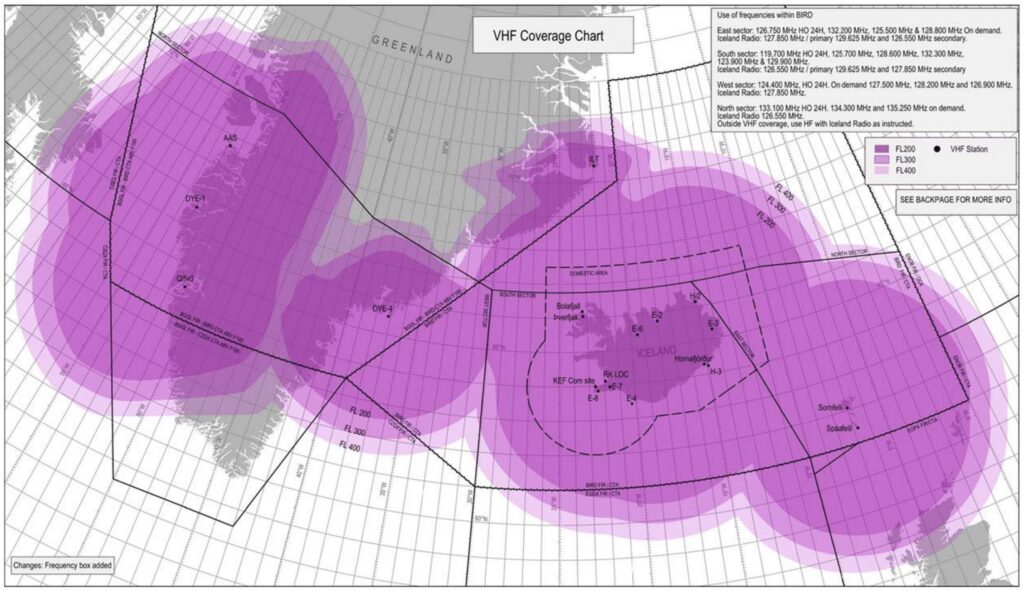
The gray area is when you plan to operate below these altitudes and are counting on using another aircraft to relay position reports. By the letter, this is a no-no. The up-and-up solutions would be to rent a portable HF unit or containerize and ship the aircraft to Europe, both of which can be about $20k.

You can see the incentive to count on relays.

Are ferry pilots bending the rules? Let us descend, inception-style, one further layer down the list of the exceptions: ATC can waive the HF requirement for ferry, delivery, and special event flights. Ferry pilots have all the fun. 😊

What About Aircraft with Only One LRNS?

Back in the day, the Blue Spruce Routes were the go-to option for aircraft with only one Long Range Navigation System (LRNS) crossing the Atlantic. Now that those routes are gone, what are your options?

If you’re staying below the NAT HLA (below FL285), you’re in the clear:

  • You don’t need two LRNSs to operate below FL285.
  • You’re also free from NAT HLA requirements like RNP 10 and Datalink etc.
  • Just make sure your one LRNS (typically GPS-based) is suitable for the route you’re flying.
  • You still need two long-range communication systems (HF + HF or HF + Satcom), unless you’re on one of the VHF-only routes approved by Gander that we talked about above (ie. via OZN or SF)

If you want to enter the NAT HLA (FL285–420), it gets more tricky:

You’ll need to qualify under the NAT Doc 007 1.4.1 exception, which says aircraft can operate in the NAT HLA with fewer than the standard requirements only if:

  • You stay within ATS surveillance,
  • You remain within VHF communication coverage,
  • Your navigation system is suitable for the planned route,
  • And you have specific State approval to operate with reduced navigation capability.

In practical terms, this means you might be able to fly the Iceland–Greenland Corridor at HLA altitudes, but only if your authority signs off – and probably not straight across via the likes of OZN.

Summing up

You can operate with one LRNS, no HF radios, no CPDLC, and no LOAs using the Iceland–Greenland Corridor or the designated VHF routes published by Canada. 

Outside of these specific altitudes and routings, aircraft operating in the NAT Region must normally carry two long-range communication systems, one of which must be HF, when operating beyond VHF coverage – unless a specific exemption has been granted by the State of the Operator or Registry (eg. for ferry or delivery flights).

If you want to learn more, check out myaircraftmanagement.com for a 101-level walkthrough of a Blue Spruce operation.

Happy Crossings! ✈️ 🌊 🧑‍✈️


Greenland NAT Alternates: July 2025 Update

⚡ July 2025 Update

Radar services at BGSF/Sondrestrom will be ending around Nov 1, 2025. From that point, only procedural (non-radar) separation will be available. Iceland’s ADS-B offers some situational awareness over Greenland but can’t be used for control.

This follows the planned downgrade from tower to AFIS at the airport between Aug-Oct, driven by reduced traffic as BGGH/Nuuk expands. All controlled airspace will become Class G, with a radio mandatory zone within 20 NM below 7000ft, and FISCOM available via Nuuk FIC after hours.

RWY 27 is typically used for departures and RWY 09 for arrivals – be especially careful of opposite direction traffic. AIC 01/25 has more info.

⚡ June 2025 Update

The extensively expanded BGGH/Nuuk is now open, and receiving regular jet traffic.

With an operating length of 7218′ (2200m) and ILS approaches available for both runway ends, it is now a solid choice for NAT enroute alternates (and ETOPS/EDTO if that’s your thing). The Greenland AIP has been updated, and you can find the current airport chart here. Both runway and apron PCNs are 67/F/A/W/T .

The revitalised Nuuk is a whole new ball game for NAT crossings.

The airport has an AFIS on watch Monday to Saturday, 09:00 – 18:00 LT (11:00 – 20:00z) with RFF Category 5.

For handling, contact Greenland Airports: nuuk@mit.gl

Original Article

Each day thousands of aircraft routinely cross the NAT and use airports in Greenland as enroute/ETOPS alternates – mainly BGSF/Sondrestrom and BGBW/Narsarsuaq.

It’s big business for Greenland’s major airports, but over the next few years major changes are coming that will directly impact on the operational use of these airports as NAT alternates.

Here’s the lowdown on what’s changing:

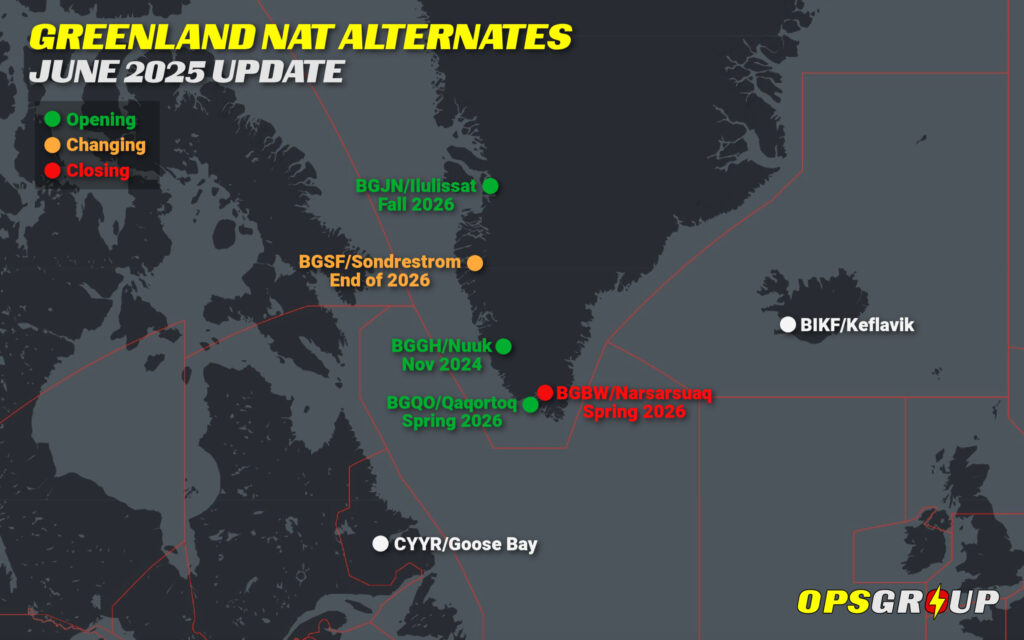
  • Opening: BGGH/Nuuk (Nov 2024), BGQO/Qaqortoq (Spring 2026), BGJN/Ilulissat (Fall 2026).
  • Changing: BGSF/Sondrestrom downgrading ATC to AFIS (Aug – Oct 2025).
  • Closing: BGBW/Narsarsuaq (likely Spring 2026).

ETOPS Airports…

Before we get stuck into the finer points of what’s changing at each airport, a big question many will have is: “What airports can I use as enroute/ETOPS alternates?”

Answering that is tricky, because it will depend on a number of factors that will be different for each operator – if the airport has a long enough runway for your particular aircraft / the necessary facilities and services / the minimum approach procedure / fire cover / weather minima etc.

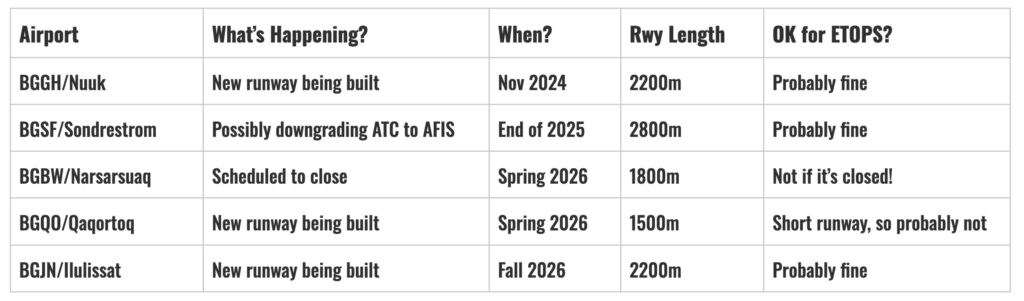
But here’s a quick reference table showing what’s changing, and when, which might be helpful:

BGGH/Nuuk

Nuuk’s found on the western edge of Southern Greenland, close to the NAT HLA. It’s Greenland’s capital city but until now, the airport has not been ‘capital-sized’.

Hence why larger aircraft have not considered BGGH/Nuuk as a viable alternate due to its short runway length (3,050’/930m) in addition to poor weather and the mountainous terrain that surrounds it.

But things will soon get easier. A major expansion has been underway since 2019 to replace its aging runway and improve the airport infrastructure to accommodate the wide body airliners of the territory’s flagship carrier who are relocating their hub there.

28 Nov 2024 has been earmarked as its full re-opening – just weeks away. A new runway will now measure 7,200’/2200m. Better yet, ILS approaches will be operating at both ends with much lower minimas. A new terminal building, tower and apron are already in use.

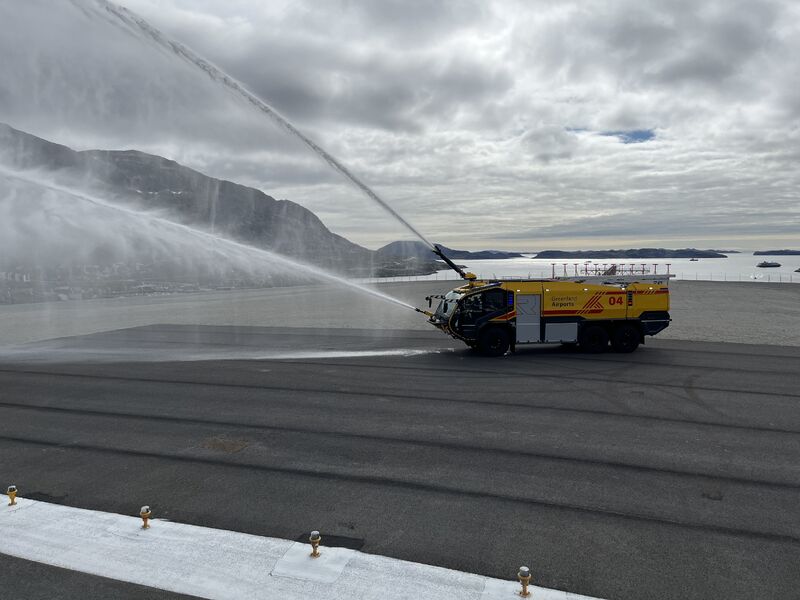
The brand new runway at Nuuk will become operational on Nov 28.

If you have any doubts as to Nuuk’s viability as a well-equipped NAT alternate, it may be reassuring  to hear that at least one US legacy carrier will also commence scheduled services to the improved airport from Newark twice a week from mid-next year.

Keep an eye out for an upcoming OPSGROUP briefing on the new and improved Nuuk soon.

BGQO/Qaqortoq

A new airport will be opening in Spring 2026, 35nm away from Narsarsuaq on Greenland’s southern tip.

Right now Qaqortoq is a heliport (operating under a different ICAO code), but will re-open with a 4,921’/1500m runway due to a decision by Greenland’s government a few years back to convert it for fixed wing traffic.

At that length Qaqortoq will likely only be an option for small to medium sized jets, but there is also room for future expansion to 5,905’/1800m – so watch this space in years to come. Word on the street is that it will also be equipped with both LOC and RNP approaches.

A new international airport in Qaqortoq will replace Narsarsuaq in 2026.

BGJN/Ilulissat

A new international airport is under construction which will be equipped with a 7,217’/2200m runway. It’s scheduled to open in Fall 2026 and will replace the existing domestic airport. By in large, it will be equipped with the same equipment as the upgraded airport in Nuuk.

A new international airport is coming in Ilulissat

Next up, a look at what’s happening at the existing airports BGSF/Sondrestrom and BGBW/Narsarsuaq…

BGSF/Sondrestrom

The much-improved airport in Nuuk will undoubtedly take a heavy toll on traffic levels at Sondrestrom – in the vicinity of a 90% reduction.

But all is not lost for BGSF as a solid NAT alternate – it will continue to operate, with almost full services available with one notable exception – ATS will be downgraded to an AFIS sometime between Aug – Oct 2025.

The runway (9,186’/2800m) is longer than Nuuk, and the weather much more predictable – it should remain a solid option to consider. 

BGBW/Narsarsuaq

The airport is scheduled to close in 2026! 😱

Despite its geographical convenience to NAT traffic, it remains a difficult option. For some, it is considered only in the case of extreme circumstances (such as fire).

The reason for this is predominantly weather, and the non-precision approaches that serve the airport. The runway itself is also short at only 5,905’/1800m.

Narsarsuaq will remain a challenging option until its closure in 2026.

Reminder – Look out for Surprise Fees

We’ve written about this before, but worth a reminder.

Be careful – if you file BGBW or BGSF as an alternate after hours (overnight 20-11z or anytime on Sundays) you will be charged the better part of $3000 USD for the privilege of keeping standby equipment on watch, and runways clear of snow. Even if you don’t actually divert there.

A little insider advice – advance notice will reduce the cost as it allows for cheaper planning. If you need one outside of normal operating hours, provide at least 24 hours’ notice.

For regular use, operators can also apply directly for a reduction in these rates.

Keeping emergency services on standby outside of normal hours is an expensive business.

Know more about changes to Greenland Ops?

We’d love to hear from you. You can reach us via news@ops.group


NAT Airspace Closures: Formidable Shield 2025

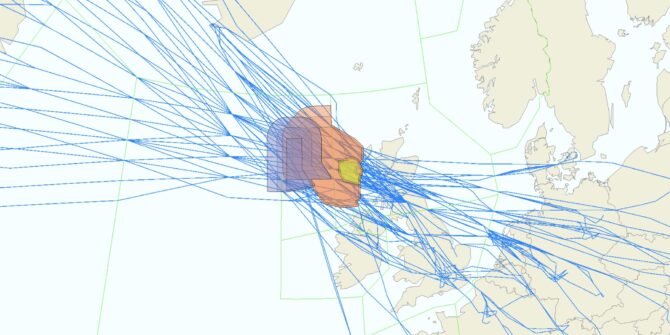
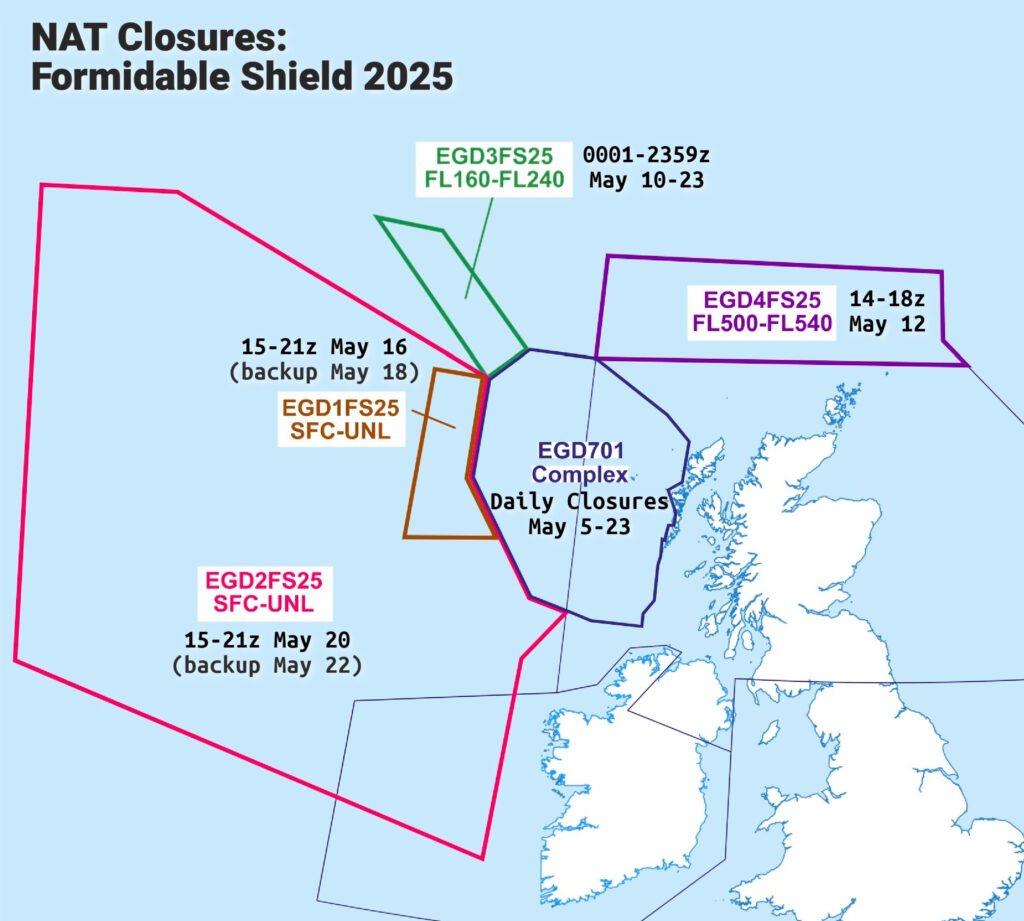
Remember that big NAT military exercise a couple of years ago? Formidable Shield is happening again now, which will mean parts of North Atlantic airspace will be closed to flights for several hours at a time.

There are daily closures in the EGD701 area off the coast of Scotland until May 23, but the big one to watch out for is a large closure of airspace across the northern half of the EGGX/Shanwick FIR on May 20 between 15-21z (with May 22 as the backup day).

The map below shows everything we know about this so far, taken from this UK SUP.

For the big closure on May 20, ATC might start rerouting flights before the airspace closure starts (15z) with the use of Flight Plan Buffer Zones extending 30 NM or 60 NM beyond the closed airspace.

There’s no timings yet for when these might be activated, and ATC have said they won’t make any decision on this until nearer the time when they know where the jet stream is going to be and what the tracks might look like, but best advice would be plan a flight that clears the area at least 1 hour before the airspace closure (so 14z).

Keep an eye on the EGGX/Shanwick Notams – they will publish one for the big closure at least 24 hours prior, which will look a bit like this (except it will say EGD2FS25 instead of EGD1FS25).

And for any questions on Formidable Shield, you can contact the UK Airspace Management Cell at SWK-MAMC-ManagedAirspace@mod.gov.uk.


NAT Changes 2025: No More Blue Spruce Routes

Key Points: Updated 19 March 2025
  • A new NAT Doc 007 takes effect from 20 March 2025.
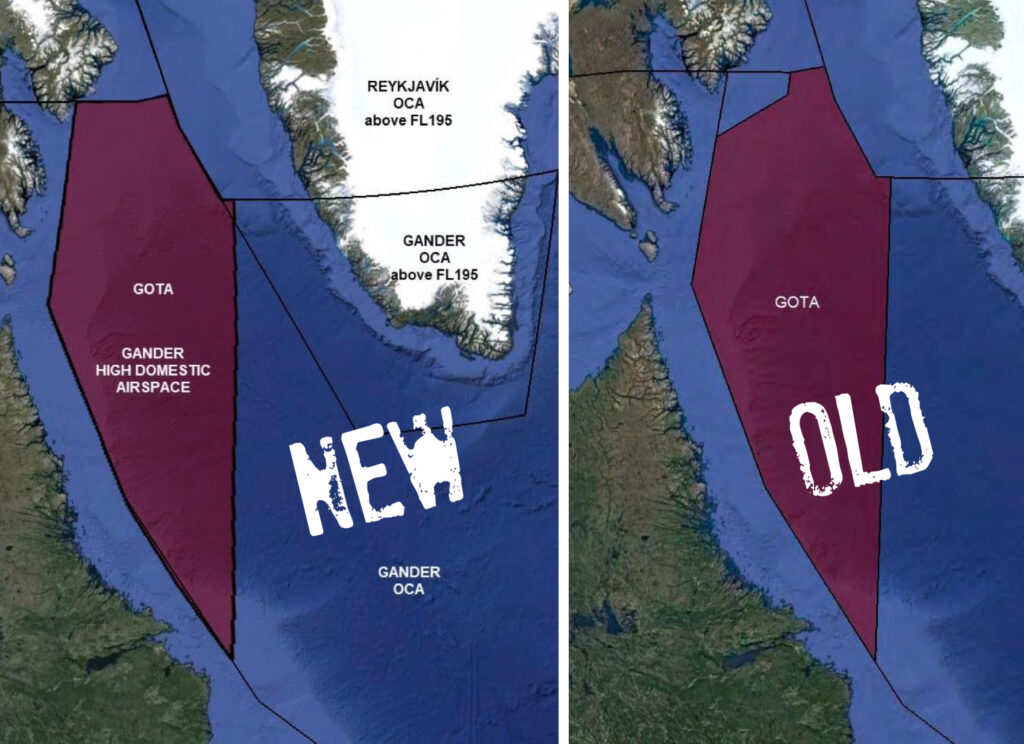
  • Blue Spruce Routes are being removed. Aircraft with only 1 x LRNS will have to go via GOTA and the Iceland-Greenland corridor instead.
  • There are new super fun chapters on Space Weather Contingencies and GNSS Interference Events.
  • Other NAT news: Shanwick does not expect to implement the removal of Oceanic Clearances before summer 2025.
  • Other NAT news: There’s a big military exercise coming in May which will close large parts of the Shanwick FIR.
  • Other NAT news: Greenland airport BGGH/Nuuk now more viable NAT alternate with a brand new runway (7200’/2200m) opened in Nov 2024.

Once (or sometimes twice) every year, ICAO update their NAT Doc 007 – the main guidance doc for ops over the North Atlantic. All the specifics about how to operate your aircraft safely through the complex airspace of the region are here.

There’s a new one that takes effect from 20 March 2025, which contains a few important changes to know about if you’re planning a flight across the NAT.

You can download the new NAT Doc 007 in full, but here’s a summary of the main changes…

Deletion of Blue Spruce Routes

If you’re new to the NAT, the Blue Spruce Routes have been around since forever. These are special routes that go via Greenland and Iceland, designed to help aircraft with limited navigation capabilities.

The Blue Spruce Routes will be officially deleted in March 2025. The team behind this (the Blue Spruce Routes Project Team) has decided the following:

  • There aren’t enough ground-based navigation aids anymore to reliably support these routes.
  • Hardly anyone uses them, as very few aircraft with single LRNS rely on them.
  • The Iceland-Greenland surveillance corridor is a good enough alternative for aircraft with navigation issues.
  • The difference in flight distance between Blue Spruce Routes and alternative corridors is so small it’s not worth keeping them.

Wave goodbye to all the little blue lines! ⬆️

So from March 20, the Iceland-Greenland corridor will replace Blue Spruce Routes as the backup option. A review is also underway to decide whether to keep or remove remaining ground-based navigation aids.

Updated NAT Doc 007

Here’s some of the other stuff in the newly updated version of this, effective 20 March 2025:

Deleted sections, New sections, and Chapter Switcheroos

Deleted sections:

  • Chapter 12 on Guarding Against Common Errors
  • Chapter 13 on The Prevention Of Lateral Deviations From Track

New sections:

  • Chapter 10 on Special Procedures For In-Flight Contingencies now includes a section to help crews handle space weather contingencies (explains how to manage impacts on communications, navigation, and surveillance systems caused by solar activity) and GNSS interference events (guidance on what to do in case of GPS jamming or spoofing, based on lessons from recent incidents).

Chapter Switcheroos:

Not that interesting. Same content just in different places now. Over to ChatGPT for a summary of this one:

  • Monitoring of Aircraft Systems & Flight Crew Performance moved to the end of the document and renumbered as Chapter 13.
  • Navigation System Failure Procedures is now Chapter 9 (was Chapter 10).
  • In-Flight Contingencies Procedures is now Chapter 10 (was Chapter 11) and includes the new space weather and GNSS interference guidance.
  • Dispatchers’ Guidance is now Chapter 11 (was Chapter 14).
  • Flight Operations Below NAT HLA is now Chapter 12 (was Chapter 15).

GOTA

The picture of the airspace boundaries for GOTA has been corrected slightly from the previous NAT Doc. (The GOTA boundaries haven’t changed, they just had the wrong pic in before!)

RCL timings & Squawking 2000

A couple of minor updates here:

  • In the Reykjavik OCA, you must now send your RCL no earlier than 15 minutes prior to the OEP (it used to be 20 minutes).
  • They’ve also updated the bit about squawking 2000 10 minutes after passing the OEP – you should do this everywhere except the Reykjavik CTA and when transitioning through Bermuda radar (it didn’t mention Bermuda before). Squawking 2000 is not required in these areas as they have you on radar!

Continued confusion about the Removal of Oceanic Clearances

The new version of the NAT Doc 007 tries to consolidate all the changes made after the March 2024 roll-out of OCR procedures. The only problem is that it now says that “No oceanic clearance is required” without pointing out that this doesn’t yet apply to Shanwick! 

Everything about the Removal of Oceanic Clearances so far has been quite confusing for crews. What is happening, when it’s happening, what is changing, the constant implementation date changes, plus the fact that there has been a bunch of confusing documentation out there with incorrect dates and procedures that are not yet in place.

So here’s the lowdown!

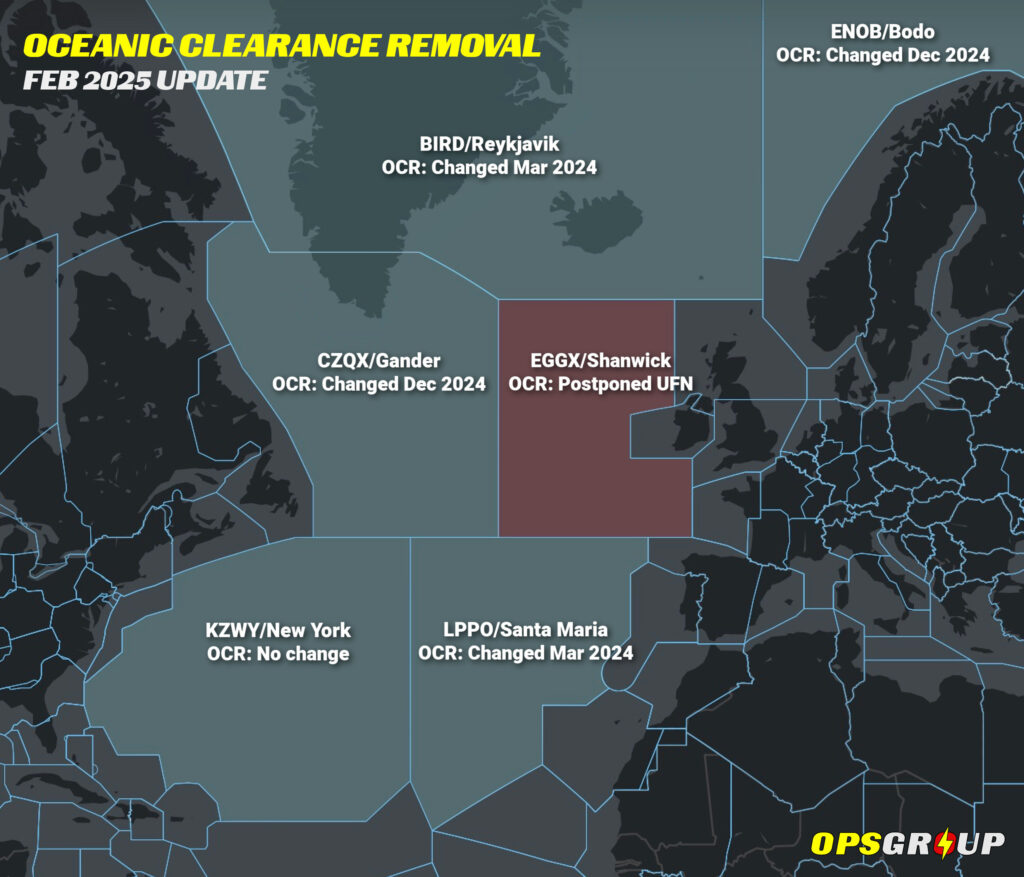
  • Reykjavik and Santa Maria = removed Oceanic Clearances in March 2024
  • Gander and Bodo = removed Oceanic Clearances in Dec 2024.
  • Shanwick = still has Oceanic Clearances!

So, Shanwick is the only NAT ANSP still to make the change – and the main news at the moment is that Shanwick does not expect to implement the removal of Oceanic Clearances before summer 2025.

Until then, westbound flights entering Shanwick from domestic airspace will continue to be the only flights on the NAT that will still require an Oceanic Clearance. For more info on all this, OPSGROUP members should check this post in their Dashboard.

Other important NAT stuff to look forward to

Formidable Shield military exercise expected in May 2025

Remember that big NAT military exercise a couple of years ago? Formidable Shield is happening again soon, and this year will be a fairly bad vintage. 

There will be daily closures in the D701 area off the coast of Scotland from May 5-23, but the big one to watch out for is a large closure of airspace across the northern half of the EGGX/Shanwick FIR on May 20 between 15-21z (with May 22 as the backup day).

The map below shows everything we know about this. For more info, check this UK SUP.

Changes to Greenland NAT alternates

BGGH/Nuuk airport’s brand new runway (7200’/2200m) opened in Nov 2024, with ILS at both ends, which on the face of it makes Nuuk a more viable diversion option for NAT traffic.

But since it opened, we’ve had reports of a few things to watch out for at BGGH/Nuuk:

  • ATC may delay your arrival and put you into a hold as only one ILS approach can be handled at a time, and 15 min separation is being applied between international arrivals. So carry up to half an hour of extra fuel if possible.
  • In practical terms the airport is effectively closed overnight. Because it’s a brand new airport, night opening is unrealistic at the moment – especially in winter. In the summer months, when there’s no snow and it’s daylight almost all day every day, there won’t be the same need for runway sweeping and using the airport as a diversion alternate might be more possible.
  • Aircraft larger than A330 should consider continuing using BGSF/Sondrestrom as an alternate instead – it may make more sense to divert here with the longer runway and less traffic compared to the marginal runway in BGGH/Nuuk.

Also watch out for changes potentially coming at BGSF/Sondrestrom, where they’re considering downgrading ATC to AFIS at the end of 2025. More info here.

Did we miss anything?

If you spotted anything important in the new NAT Doc 007 which we missed in this summary, please let us know! Email us at news@ops.group

More help with North Atlantic ops


FIRE on the NAT! Where to go in an emergency?

In OPSGROUP, we talk a lot about the North Atlantic. Whether it’s a Plotting Chart you need, or an explanation of the Datalink Mandate, or a summary of big changes stretching back to the dawn of time – we’ve got you covered. We love the NAT so much we even enjoy asking ourselves annoying questions about it over and over again to see if we can answer them (we can).

But here’s something we haven’t fully looked into before – if you’re in big trouble on the NAT (like an engine on fire, for example), where can you go? 

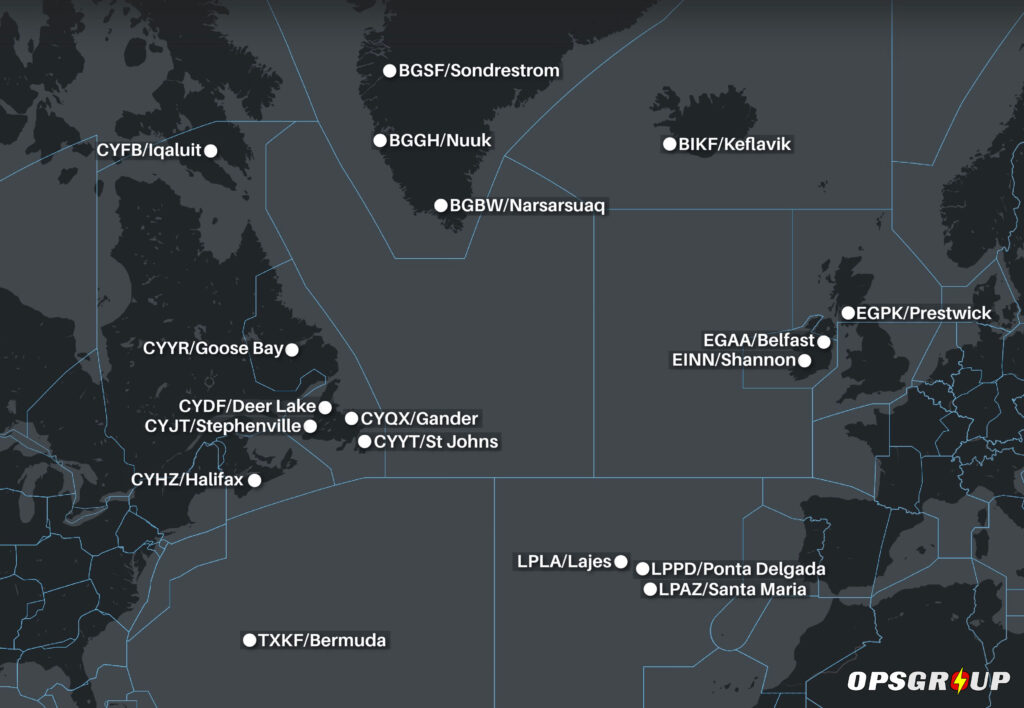
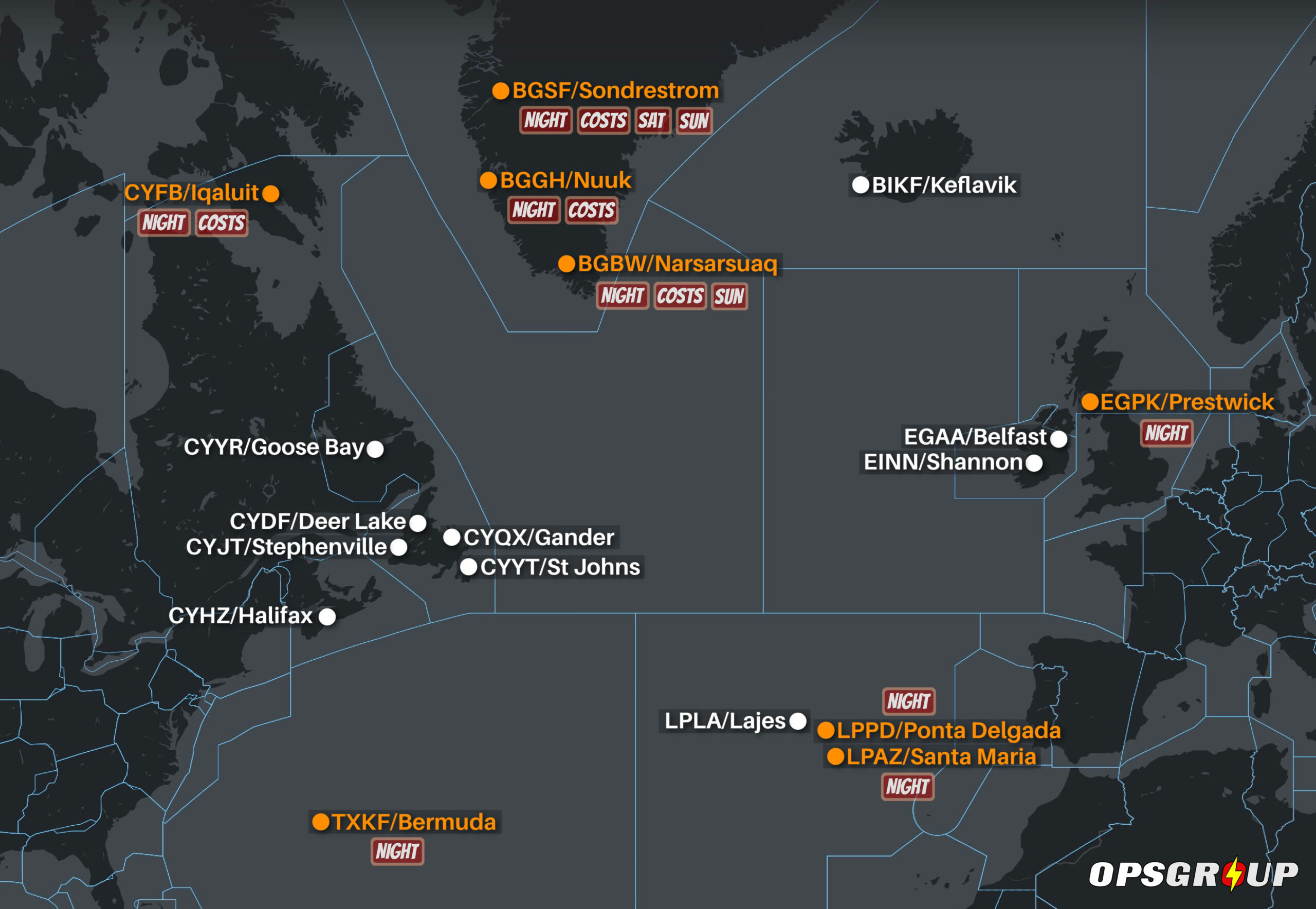
Turns out there’s quite a bit of complexity to this. Some airports don’t have amazing levels of fire cover, some are closed at night, and some have weird setups where you have to pay them in advance to make sure they stay open in case you need them.

We’ll start with these odd ones. And we’re going to do everything in local time to keep things easy. Also, for the uninitiated, RFFS means Rescue and Fire Fighting Services (i.e. what level of fire cover an airport has), and if you’re confused about what number means what, you can read all about it here.

Odd Ones

CYFB/Iqaluit

  • Airport open: Mon-Fri 08-17, other times 12hrs notice required
  • RFFS: 5
  • Why odd? So it’s basically closed at night unless you make a special request for them to stay open in case you need them. If extended hours are needed, additional costs will apply to keep staff on standby. Requests to extend operating hours at the airport must be submitted using a specific document for either RFF5 or RFF7. CYFB provides extra RFF coverage at night on average 40 to 50 times a month. The cost for them to stay open with RFF5 is $1714 which gives you a 4 hour block of time. For RFF7 it’s $3427.

BGGH/Nuuk

  • Airport open: 06-21 every day
  • RFFS: 5 (or RFFS 8 with 4 hours notice)
  • Why odd? Technically it’s open at night, but as it’s a brand new airport, night opening is unrealistic at the moment – especially in winter. In the summer months, when there’s no snow and it’s daylight almost all day every day, there won’t be the same need for runway sweeping and using the airport as a diversion alternate might be more possible because they will only require standby personnel on short notice.

BGBW/Narsarsuaq

  • Airport open: Mon-Sat 08-17 (yep, closed on Sundays!)
  • RFFS: 7
  • Why odd? Can be requested to stay open at night most of the time. But watch out! As we reported before, Greenland airports will charge you the better part of $3k if you list either of them on your flight plan as diversion alternates when they’re closed.

BGSF/Sondrestrom

  • Airport open: Mon-Fri 08-16 (yep, recent change here is that they’re closed on weekends!)
  • RFFS: 5 (or RFFS 8 with 4 hours notice)
  • Why odd? Same as BGBW, can be requested to stay open at nights or on weekends, but same costs will apply.

EGPK/Prestwick

  • Airport open: H24
  • RFFS: 7
  • Why odd? Often at night they close the terminals building (they always Notam it) so there are no facilities for diversions at these times.

LPPD/Ponta Delgada

  • Airport open: 0615-0000
  • RFFS: 7 (can be increased to RFFS 9 with 24hrs notice at a cost of 70 Euros per hour, although they say this can usually be increased for emergencies too).
  • Why odd? At night (0000-0615), the airport has told us that they are closed and will only guarantee reopening for urgent medical evacuation flights, or humanitarian flights at the request of the Portuguese Air Force. LPLA/Lajes is the only airport in the Azores that is open all night for diverts.

LPAZ/Santa Maria

  • Airport open: It’s complicated.
  • RFFS: It’s complicated.
  • Why odd? Ok, here we go. So from 0635-2130 they are fully open with RFFS 6 (RFFS 8 available for a surcharge if you arrange in advance). Then from 2130-0000 the airport is closed but you can request they stay open for around 900 Euros (plus a fee to the handling agent). Then from 0000-0645 the airport is completely closed and cannot accept emergency diverts at all. Bottom line, just go to LPLA/Lajes instead.

TXKF/Bermuda

  • Airport open: 06-23 every day
  • RFFS: 9 daytime 07-23
  • Why odd? To get them to open at night (ATC and RFFS) for emergencies, you need to give them 30 mins notice – so not ideal if your needs are super urgent. Also, they do sometimes publish Notams saying that ATC will not be available for certain periods at night, even for emergencies.
Not Odd Ones

Ok great! Here are all the straightforward airports that are open H24 with decent fire cover:

CYYR/Goose Bay
Open H24
RFF 8

CYQX/Gander
Open H24
RFF 5 (RFF 6/7 with 30 mins notice, RFF 8 with 1hr notice)

CYDF/Deer Lake
Open H24
RFF 6 (RFF 7 with 30 mins notice)

CYJT/Stephenville
Open H24
RFF 5 (RFF 6 with 30 mins notice)
In winter months, they often have a Notam saying that they might need 2hrs notice at night to clear the runway of snow.

CYYT/St Johns
Open H24
RFF 7

CYHZ/Halifax
Open H24
RFF 8

BIKF/Keflavik
Open H24
RFF 8 daytime 05-19 (RFF 7 overnight 19-05)

EGAA/Belfast
Open H24
RFF 7 (RFF 8/9 with 24hrs notice)

EINN/Shannon
Open H24
RFF 9 (RFF 7 overnight 23-07)

LPLA/Lajes
Airport open 07-21 (but H24 for emergencies)
RFF 8 at all times

So let’s give that map another try, this time with a tasteful splash of orange colour…

So there you have it, friend! While we’re on the subject of Emergency Diverts, you might also be interested to read about NAT Contingency Procedures (what to do when you need to deviate from your ATC clearance due to an emergency). For more info about recent changes to Greenland Airports, click here. And to download the latest OPSGROUP NAT/North Atlantic Plotting and Planning Chart 2026, head over here.

As usual, any questions, let us know at team@ops.group.


2025 North Atlantic Plotting & Planning Chart

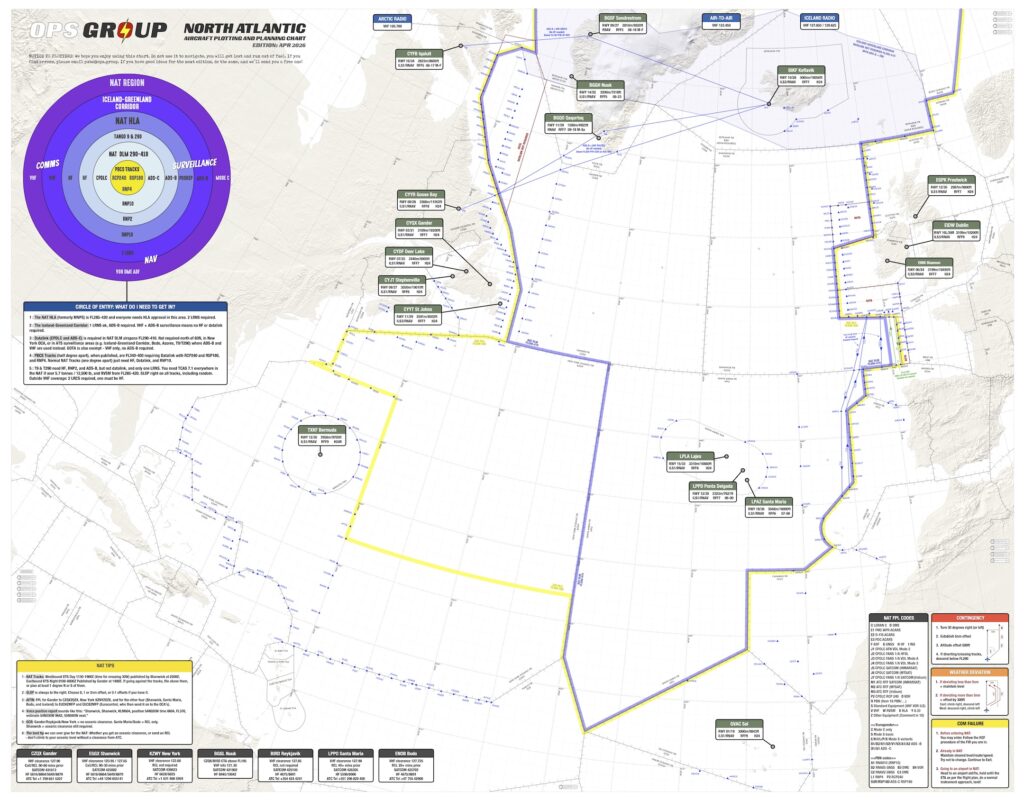
The new OPSGROUP NAT/North Atlantic Plotting and Planning Chart 2025 is released today! This is our chart showing North Atlantic Oceanic Airspace and adjoining domestic airspace, with easy to read NAT Tips, Airspace Requirements, Emergency Procedures, and much more!

OPSGROUP members – you can grab a copy in your Dashboard. View it on your iPad or Laptop etc. as a PDF, or print it out! If you’re not a member, read on for how to get a copy…

Changes in this NEW edition (Oct 2024):

  • FULLY UDPATED for 2025!
  • UPDATED! NAT Tips – using NAT Tracks, SLOP, filing an Oceanic Flight Plan, and helpful tips.
  • UPDATED! Quick reference for contingency, weather, and comms failure with easy graphics.
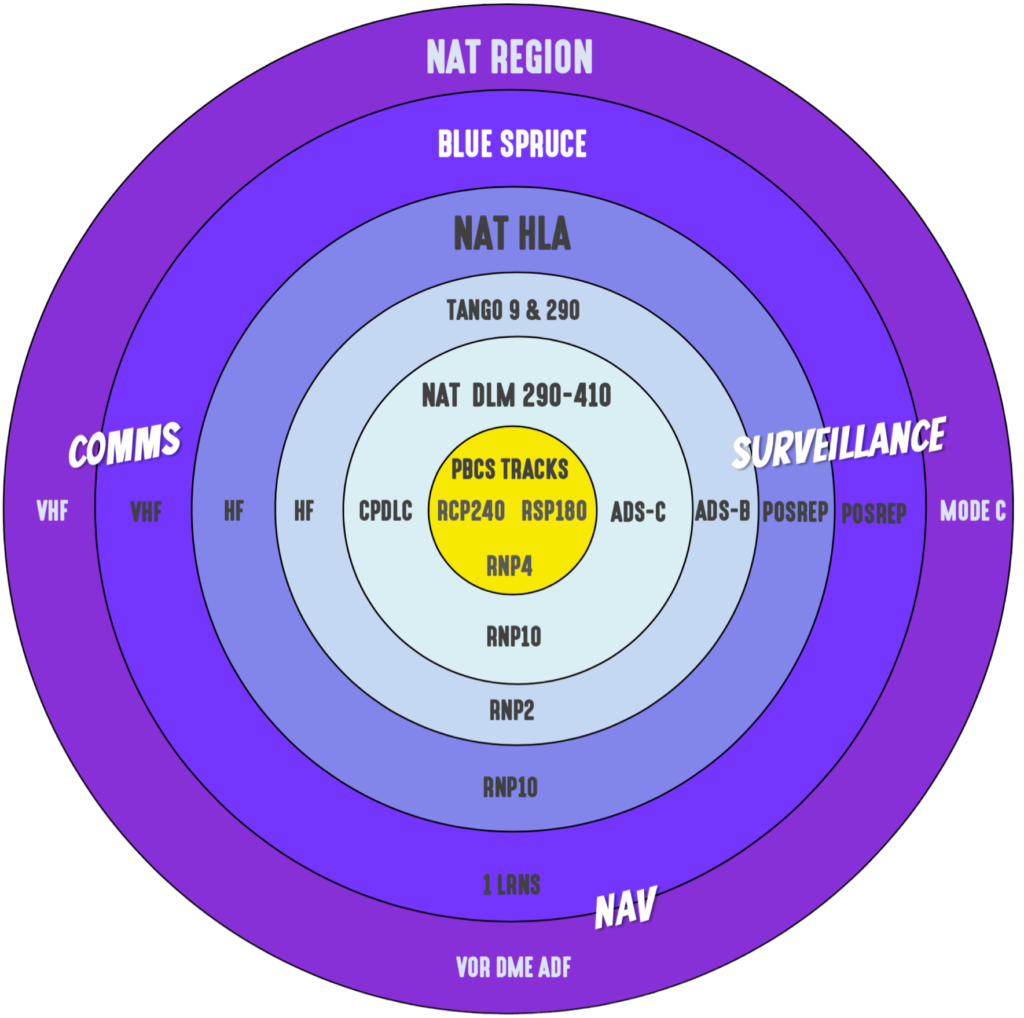
  • UPDATED!: NAT Airspace Circle of Entry 2025 – easily check what you need for Nav, Comms and ATC Surveillance depending on which bit of the NAT you will be flying through.
  • Additional diversion airports, now 16 total primary NAT alternates with runway, approach, length, RFF, and hours.
  • Easy view of boundaries for HLA and DLM/Datalink mandated airspace.
  • Updated NAT FPL codes, clearance frequencies, Satcom, and HF.
  • Fully updated “South East Corner” with new Tango routes.
  • and … Treasure Boxes!

Other chart features:

  • Requirements for NAT tracks, PBCS tracks, datalink mandate.
  • Common NAT Diversion Airports.
  • Runway Orientation, Length, best IFR Approach.
  • RFF Category and Opening hours.
  • NAT FPL Codes and sample FPL.
  • Blue Spruce routes and equipment requirements.
  • All NAT Entry/Exit points with associated required landfall fixes.

There are two options to download a copy of the NAT Chart:

OPSGROUP Members

You can get it in your Dashboard, under Briefings and Guides.

Get it from the OPSGROUP Store

Not a member? Get a copy from the OPSGROUP Store.


NAT Guide 2025 – My First NAT Flight is Tomorrow

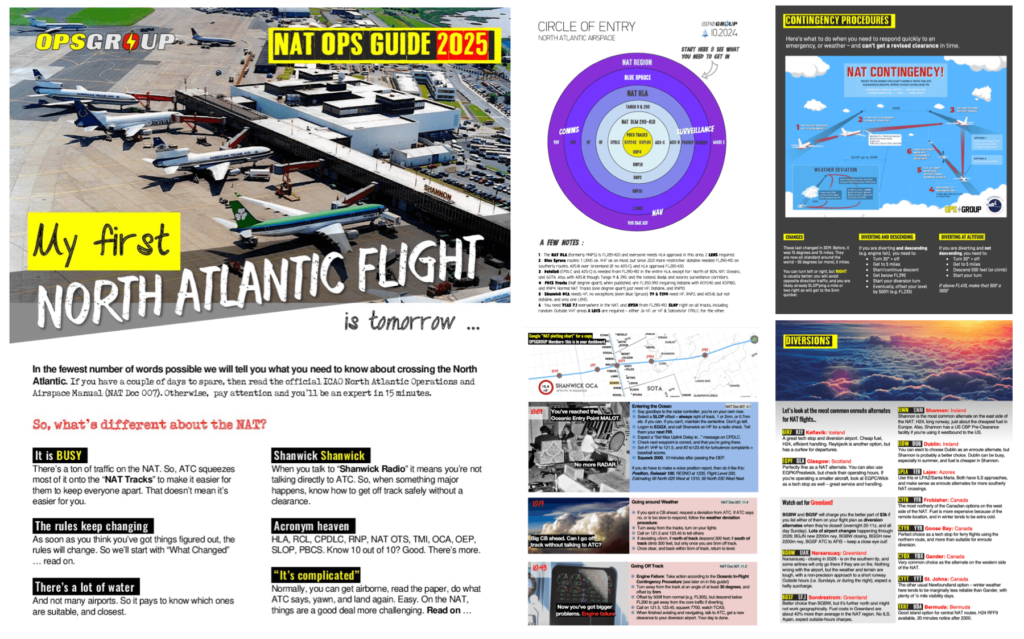
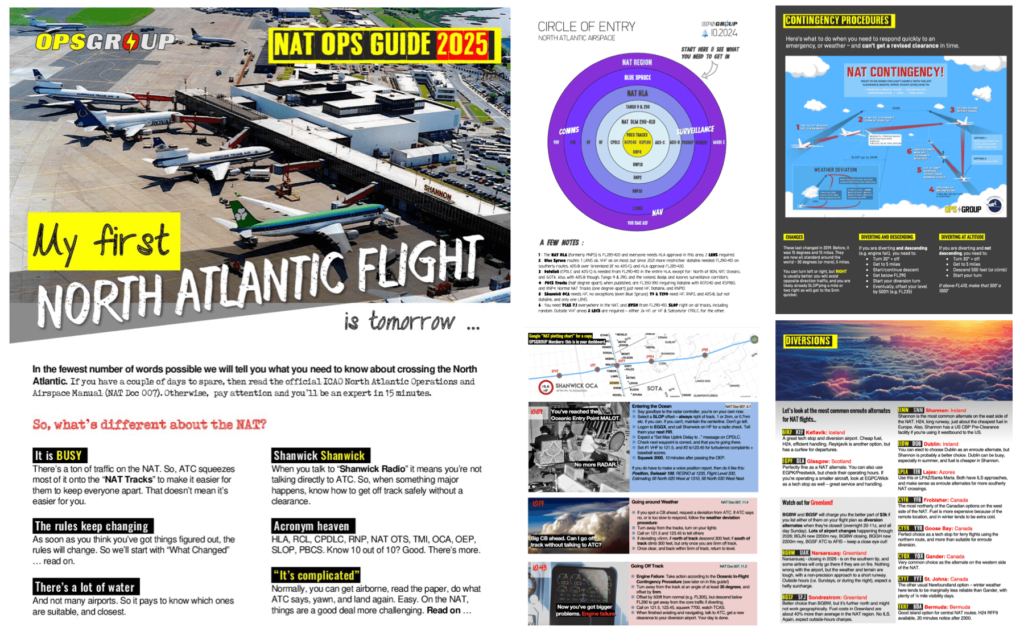
The latest edition (2025) of the NAT Guide (“My First North Atlantic Flight is Tomorrow”) has now been published. This 24-page guide is for pilots and dispatchers, to help you understand the basics of North Atlantic flying.

Contents:

  • 1. What’s different about the NAT?

  • 2. Changes in 2024, 2023, all the way back to 2016.

  • 3. (Updated 2024) Circle of Entry – a visual depiction of what equipment is needed to enter the different parts of the NAT region airspace.

  • 4. NAT Quick Map – Gander boundary, Shanwick boundary

  • 5. Routine Flight Example #1 – Brussels to JFK (up at 5.45am) – NAT HLA certification, Oceanic Paperwork, Special requirements, getting an Oceanic Clearance, Equipment failure, Weather deviation, and going off track.

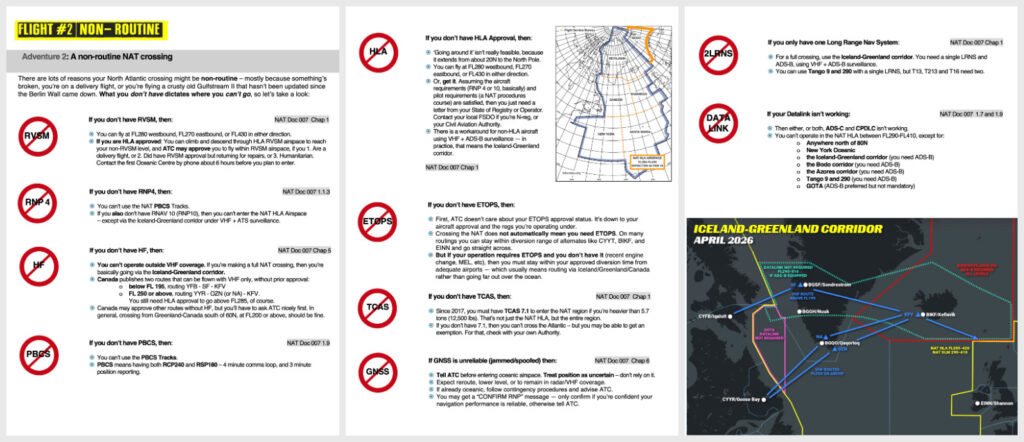
  • 6. Non Routine-Flights: No PBCS, No RVSM, No RNP4, No HF, 1 LRNS, No HLA, No ETOPS, No TCAS, No Datalink – what you can do and where you can go.

  • 7. Diversion Airports guide: A couple of notes on each of the most popular diversion airports from Shannon to Goose Bay: What to expect.

  • 8. Airport data: BGBW Narsarsuaq, BGSF Sondy, BIKF Keflavik, EGPF Glasgow, EGPK Prestwick, LPLA Lajes, LPAZ Santa Maria, EINN Shannon, EIDW Dublin, CYFB Fro Bay, CYYR Goose Bay, CYQX Gander, CYYT St. Johns, LPPR Porto, LPPT Lisbon, TXKF Bermuda.

  • 9. Overflight permits – routine and special, non-standard airworthiness, how to get one.

  • 10. Special NAT procedures: Mach number technique, SLOP, Comms, Oceanic Transition Areas, A successful exit, Screwing it up, Departing from Close Airports

  • 11. North Atlantic ATC contacts – Shanwick, Gander, Iceland, Bodo, Santa Maria, New York – ATC Phone, Radio Station Phone, AFTN, Satcom, CPDLC Logon codes; and adjoining Domestic ATC units – US, Canada, Europe.

  • 12. NAT FPL Codes and Flight Levels

  • 13. The Contingency procedure – weather and diversions

  • 14. Flight Plan Filing Addresses by FIR

  • 15. NAT Clearance or no Clearance, guide to the new RCL process.
  • 16. Common Gotchas: ATC and OPSGROUP Member favorites.

  • 17. Links, Questions, Guidance


There are two options to download a copy of the NAT Guide 2025 (24 pages, 6Mb)


OPSGROUP Members

You can get it in your Dashboard, under Briefings and Guides.


Get it from the OPSGROUP Store

Not a member? Get a copy from the OPSGROUP Store.


NAT Circle of Entry (2025)

For the latest changes and updates on the North Atlantic, including our most recent Guides and Charts, use our NAT reference page at ops.group/blog/nat/

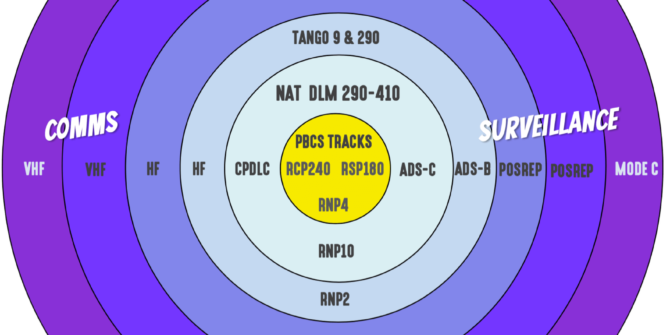
We’ve updated the NAT Circle of Entry for 2025. As always, changes on the NAT continue without pause for breath – this version is the latest information as at October 2024. The Circle of Entry tells you what you need to get into each different sliver of North Atlantic airspace.

Click on the circle to download the more detailed PDF.


We’ve also published a new version of the NAT Guide (“My First North Atlantic Flight is Tomorrow”)

Get a copy here.


NAT FAQ: No Datalink – Where can we go?

No Datalink – Where can we go?
  • You can make a crossing at FL280 or below, or FL430 or above
  • You can cross via the Iceland-Greenland corridor if you have ADS-B
  • You can enter NY Oceanic, the Bodo and Azores corridors, GOTA, and fly down T9/290.

Datalink is defined as CPDLC and ADS-C. If you’re missing either CPDLC or ADS-C, then you’re not datalink equipped. Since 2021, datalink is mandated (DLM) for the entire NAT region between FL290-410 [NAT Doc 007, Ch 1.8]. The only exception is flights STS/FFR, HOSP, HUM, MEDEVAC, SAR, or STATE.

Without datalink, you can only enter these areas on the North Atlantic FL290-410 [NAT Doc 007, 1.8.2]:

  • Anywhere north of 80N
  • New York Oceanic East
  • The Iceland-Greenland Surveillance corridor (ADS-B required west of 30W)
  • The Bodo corridor (ADS-B required)
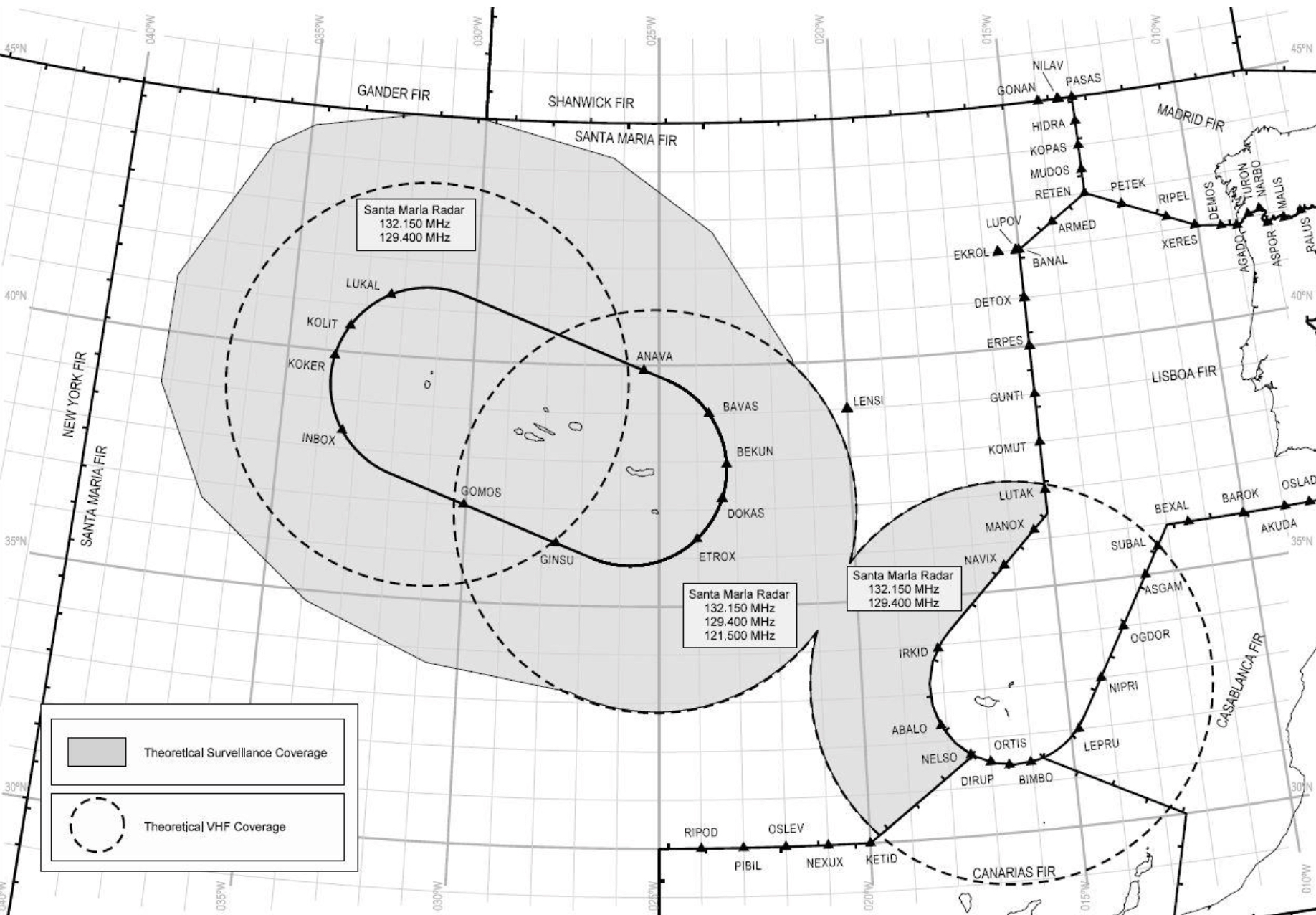
  • The Azores corridor (ADS-B required)
  • Tango 9 and 290 (ADS-B required) (per UK AIP)
  • GOTA  (ASD-B not required but please do if you can, says ATC)

The only complete crossing available is therefore via the Iceland-Greenland corridor. For this, you need ADS-B west of 30W.

So, if you have ADS-B, and the remaining NAT HLA requirements, you can make a crossing at normal altitudes (eg. FL380) through this airspace.

For planning purposes, this area is bounded by the following:
Northern boundary: 65N000W – 67N010W – 69N020W – 68N030W – 67N040W – 69N050W – 69N060W – BOPUT.
Southern boundary: GUNPA (61N000W) – 61N007W – 6040N010W – RATSU (61N010W) – 61N020W – 63N030W – 6330N040W – 6330N050W – EMBOK. [NAT Doc 007, 1.8.5]

If you don’t have ADS-B, then this crossing is not available between FL290-FL410.

In this case, you should plan to cross the ocean at FL280 or below, or FL430 or above. This in turn places you outside the NAT HLA, as the HLA levels are FL285-FL420. A crossing at FL280 may mean a fuel stop, in Iceland for example (BIKF or BIRK are commonly used).

You can request a climb or descent through Datalink Mandated airspace from ATC, and this is commonly granted, but you do need HLA approval.

Santa Maria Corridor


The Santa Maria Corridor will allow you to fly out to the Azores and back, but won’t help with a full NAT crossing due to the gap between Santa Maria surveillance and the New York oceanic boundary. To use this corridor, you need a Mode S transponder with extended squitter for ADS-B. [NAT Doc 007, 1.8.5 b]


This didn’t answer your question?

Comment below. Sadly (for us), we enjoy digging into this stuff. So, post your question below and we’ll update this page with the answer (probably quite quickly!)


Useful links for more on this … 


NAT Conundrums: Volume I

Originally published 2021, Updated 2024

It’s no surprise to most that the North Atlantic is the busiest oceanic airspace in the world. To keep things running smoothly there are a bunch of procedures to follow. We write about them a lot, especially when they change. From time to time questions continue to pop up that make us scratch our heads. And so we thought this might be a good chance to share a few of those with you – naughty NAT conundrums if you will.

To SLOP or not to SLOP?

Chances are if you fly in oceanic airspace you already heard of Strategic Lateral Offset Procedures (SLOP). They’re pretty straightforward – you’re supposed to offset up to 2nm right of track without needing a clearance.

We do this because humans are fallible and mistakes can be made. Ironically the extreme accuracy of modern navigation systems mean that in the case of gross navigational errors, level busts or incorrect clearances, these systems actually increase the chance of a collision. So we pull over to the side of the road a little more, just in case.

Do we have to SLOP?

If you’re in the NAT HLA and your aircraft is capable then yes, it’s ‘required’ (as per ICAO NAT Doc 007). The only time you shouldn’t is if your aircraft’s FMS cannot automatically maintain an offset i.e. it doesn’t have that function. In that case you ‘must’ stay straight up the middle.

Remember, your SLOP can be in increments of 0.1nm and “0 nm” SLOP is also a thing!

You SLOP from the ENTRY point only, and need to have stopped the SLOP by the EXIT point.

  • Don’t go ‘direct to’ the EXIT, this will put you on a different track. Cancel the SLOP to return to ‘centreline’
  • Only SLOP from the ENTRY to the EXIT
  • If you are routing from a NAR into the NAT, the last point is your entry into the NAT and you can SLOP from here

Can we SLOP in the Oceanic Transition Areas?

Or in other words in NOTA, SOTA, BOTA or GOTA? Good question.

NOTA and SOTA: The short answer is no. The slightly longer one is that the both NOTA and SOTA are under radar control with domestic separation from Shannon Radar. You should only apply SLOP between your oceanic entry and exit points.

BOTA: It’s a similar story. BOTA radar control services are provided by Brest Control in France – essentially domestic rules still apply. So no SLOP-age.

NOTA, SOTA and BOTA on the European side.

GOTA: This is the odd one out. GOTA (the Gander Oceanic Transition Area) is off the coast of North-eastern Canada. You should SLOP only once you have passed the Oceanic Entry Point (OEP) eastbound and within Oceanic Airspace “proper”, and vice versa westbound – sto SLOP at the Oceanic Exit Point (for example NIFTY on the chart below).

Are there any other ‘gotchas’?

Yes – three main ones:

  1. The ENOB/Bodo and BIRD/Reykjavik FIRs. Look out for these. Buried in the NAT Doc 007 it says that you are only allowed to SLOP above FL285. So don’t get caught out in the lower levels.
  2. Tango Routes T9 and T290. These lie just outside of BOTA airspace. According to the UK AIP ENR 3.5, SLOP does not apply here.
  3. And whatever you do – never SLOP left!

What’s the difference between the NAT Region and the NAT HLA?

The NAT Region is virtually all of the non-domestic airspace over the Atlantic – from around 20 degrees north all the way up to the pole (excluding New York Oceanic West). It contains seven Oceanic Control Areas – BGGL/Nuuk, BIRD/Reykjavik, ENOB/Bodo Oceanic, CZQX/Gander, EGGX/Shanwick, KZWY/New York Oceanic East and LPPO/Santa Maria.

Within the NAT region (and occupying a large amount of it) is the NAT HLA, which stands for High Level Airspace. It only exists from FL285 to FL420.

Because the NAT HLA is some of the busiest airspace in the world, there are a number of stringent navigation and communication requirements that you must meet to enter it. This includes being either RNP 4 or RNP 10 capable, having two independent long range navigation systems and in most cases, datalink. Operators also need state approval.

If you don’t meant those requirements you can still fly through the NAT Region, but you’ll have to fly below or above the NAT HLA. Blue Spruce routes are the exception, which allow aircraft with only one long range navigation system or limited comms equipment to enter.

Nat HLA Airspace (Flight Level 285 – 420)

Can I fly across the North Atlantic without Datalink?

Yes, but it’s gonna be tricky.

The North Atlantic Datalink Mandate (NAT DLM) means aircraft need to have CPDLC and ADS-C to operate between FL290-FL410 throughout the NAT Region.

There are a few exceptions where the NAT DLM does not apply:
– Everything north of 80°North.
– New York Oceanic East FIR.
– Tango Routes T9 and T290. The other Tango Routes (T213, T13, T16) all require datalink.
– ATS Surveillance airspace, where surveillance service is provided by means of radar and/or ADS-B, coupled with VHF.

That last one about “ATS Surveillance airspace” is essentially just a section of airspace over Greenland and Iceland, which looks like this:

The blue shaded area shows the datalink exempt “ATS surveillance” airspace.

So if you’re on a NAT crossing and you don’t have datalink, you technically have to stay below FL290 until you hit the blue shaded area. It’s worth noting that aircraft without datalink can request to climb/descend through datalink mandated airspace, but will only be considered on a “tactical basis” by ATC.

Further south, there is another section of “ATS Surveillance Airspace” in the area connecting the LPPC/Lisboa FIR (i.e. mainland Portugal) to Madeira and the Azores, which is also exempt from the NAT DLM:

So in theory, an Atlantic crossing without datalink would also be possible here – within the LPPO/Santa Maria FIR you would just have to ensure that you stay below FL290 or above FL410 outside of the bubbles until you reach the KZWY/New York FIR (where the NAT DLM does not apply).

Even further south, in the TTZP/Piarco and GVSC/Sal FIRs, CPDLC is the primary means of communication, but it’s still not mandatory.

So down south, the bottom line is that as long as you stay out of the LPPO/Santa Maria FIR between FL290-410 where the NAT DLM applies… except for the ATS Surveillance Airspace bubbles where it doesn’t apply… then you’ll be ok with just HF. Got it? 😊

For more info on the NAT Datalink Mandate, check out our previous article.

So, what’s your conundrum?

We’d love to hear it. Chances are if you don’t know the answer, many other people won’t either, so it’s always great to share.

Get in touch with us at team@ops.group with your question, and we’ll include it in the next article on Naughty Nat Conundrums.

And if you want to download a PDF of our North Atlantic Plotting Chart, check how to get a copy here.


NAT Crossing after GPS spoofing: a guide

An increasing issue for the NAT Oceanic FIR’s is how to handle aircraft with an in-flight degradation of GPS. This normally follows a GPS Spoofing encounter somewhere prior to Oceanic Entry, leading to a degraded RNP capability.

If you run into GPS issues before entering the Ocean, you will likely end up with RNP10 as the best you can manage for navigational accuracy. This presents some issues for the Oceanic controllers, as RNP4 is commonly used to ensure separation. We’ll take a look at some scenarios and how to best handle these.


Normal RNP requirements on the NAT

NAT Doc 007 specificies two RNP options for entry into the NAT HLA.

The first is RNP10 (accuracy of 10 nm, 95% of the time). An important consideration here is that RNP10 is really RNAV10, but they call it RNP10 to keep things simple [See NAT Doc 007, 1.3.4]. The critical difference is that for RNAV10, on-board monitoring is not required. Since this can only be done by GPS, that’s an important relief when it comes to spoofed flights.

The other is RNP4 (accuracy of 4nm, 95% of the time). RNP4 is only an absolute requirement for PBCS Tracks (“Half-Tracks”). In practice, ATC commonly uses RNP4 for separation purposes on the NAT (Since the introduction of ASEPS). GPS is required for the monitoring part of RNP4; without GPS, RNP4 is not possible.


Loss of GPS Prior to the NAT

Since GPS Spoofing became prevalent in September of 2023, increasing numbers of aircraft are arriving at the Oceanic Boundary with one or both GPS sensors inoperative. A textbook GPS Spoofing encounter will initially see the GPS sensors rapidly change from the real coordinates to fake coordinates. If all GPS sensors agree on the fake coordinates, the FMS becomes confused. IRU values will increase, and in some cases, the IRS may also become “infected”.

The primary spoofing locations have not changed much since the onset of the issue: you will encounter spoofing at the Iraq/Iran border, the Sinai peninsula area (showing Tel Aviv as the spoofed location), Israel and Cyprus (showing Beirut as the spoofed location), and the Black Sea (showing Sevastopol as the spoofed location).

We have no reports in OPSGROUP that the other type of GPS interference – GPS Jamming – leads to lasting effects. Once the jamming has stopped, aircraft systems are normal.

However, we do have reports that if GPS inputs are turned off before departure, and later turned back on in flight, that issues may occur. This is mostly reported for departures from Tel Aviv (LLBG).


GPS failure, Ocean approaching

Since RNP4 requires a functioning GPS, if you encounter spoofing and lose your GPS, you can’t fly RNP4. Assuming that you have an RNP10 approval (one of the only two options for the NAT HLA), you will become RNP10.

The problem occurs when Shanwick, or the OACC at the entry point, get late notice of this fact, and you are close to other aircraft. That leaves the Planning Controller with little time to figure out how to separate you (an RNP10 aircraft) from the others (RNP4 aircraft).

In some cases, “spoofed” aircraft have had to descend  to FL280 to exit the NAT HLA, and this has caused diversions.


How to best handle a NAT crossing with a failed GPS

The key is to advise Shanwick, or the first OACC, early. Shanwick’s preference is that you use the RCL request to do this, and add a note to the end of the RCL along the lines of ATC REMARK/GPS DEGRADED RNP10 ONLY. If using voice to get your clearance, that’s what to say as well. Shanwick NOTAM EGGX G0106/24, and a note on the OTS Track message, has this information.

The RCL for Shanwick should ideally be sent 90 minutes before the Oceanic Entry in this case. Normal RCL timeframes are -30 to -90. An RCL sent any earlier will be rejected, but if you have something more unusual to discuss, you could use SATCOM to contact the supervisor and ensure a smooth crossing.


RNP10 time limit

With the change to RNP10 for your crossing, double check the time limit for RNP10. ICAO Doc 9613 (Volume II, Part B, Chapter 1) specifies that RNP is limited to 6.2 hours of flying. The timing starts from when “the systems are placed in navigation mode” or at the last point at which the “systems are updated”. The logic here is that the IRS will drift without updates enroute, and after 6.2 hours of flying, will no longer be capable of maintaining the RNP10 accuracy.

For an aircraft spoofed in the Mediterranean, or Black Sea area, it will take 4 hours before Oceanic entry, so this time limit becomes relevant. If the impact of the spoofing is severe enough, there is potential for inputs – including DME/DME or VOR/DME –  to the IRS to stop working. This is one of the potential unknowns at present.


Shanwick comments

Shanwick are encountering several GPS jammed aircraft per day, and it is sometimes difficult (or impossible) to find optimum profiles for aircraft without moving several other aircraft to accommodate. The only instance where they have to insist on FL280 and below, is when an aircraft does not meet the requirements for MNPS (such as single LRNS), and needs to be cleared outside HLA.

If a pilot advises that they have lost RNP4, but are still capable of RNP10, Shanwick controllers will look to find a solution where the aircraft can be cleared with at least 10 minutes longitudinal and 60nm lateral separation. These aircraft also need coordinating with the next Oceanic Center before clearance, and sometimes there are limited options available.

In general, the earlier they informed about the degradation, the easier it is for the Shanwick controllers to find satisfactory solutions.


Member input

This is a developing issue and we gratefully welcome any input from members on this. Email us at team@ops.group.


NAT Doc 007 – New Edition

A new version of NAT Doc 007 has been published today (July 4th, 2024).

NAT Doc 007 is the main go-to guidance doc for ops over the North Atlantic. All the specifics about how to operate your aircraft safely through the complex airspace of the region are here. As of this morning, the latest version is NAT Doc 007 2024 Amendment 4. Download a copy.

Click to download NAT Doc 007 Amd 4 (PDF)


What’s changed?

For this particular update, not a lot. The changes relate to the language around the new RCL process, and what to expect back from ATC once you send your RCL. This is part of the Oceanic Clearance Removal project.

Earlier in the year, the new RCL response included the language “RCL RECEIVED BY [ANSP]. FLY CURRENT FLIGHT PLAN OR AS AMENDED BY ATC

That turns out to have been creating confusion, so the RCL response will now just say:
RCL RECEIVED BY [ANSP]

These changes are in section 6.2.26 onwards.


What’s the latest with the RCL/OCR project?

Santa Maria and Iceland have made the change, so entering that portion of the NAT HLA does not require an Oceanic Clearance. You do still have to send an RCL in the same way as if you were requesting an Oceanic Clearance, but once sent, and you get an ACK – that’s it. For more on the new process, read about Oceanic Clearance Removal.

Gander, Shanwick, and Bodø have postponed their change to December 4th, 2024. This means that for now, nothing has changed – you get an old-school Oceanic Clearance in the same way you always did – with an RCL, or via voice.


So there are two kinds of RCL then?

Yep. For Gander, Shanwick, and Bodø, RCL means Request Clearance. You send this message, then wait to get your Oceanic Clearance back, usually via an OCL message on datalink.

For Iceland and Santa Maria, RCL means RCL Message. This is a “Check-In” of sorts, but the format is the same as the old meaning of RCL.

Confused? You’re not alone. But by Christmas, all will be easier – once everyone is on the same page. Play “Clearance or No Clearance” to help get things straight.


The hole in NAT Doc 007

There’s one problem with NAT Doc 007 – we’re in limbo land until Christmas. All of the guidance relates to how to send an RCL in a post-Clearance world. But for the next 5 months, most of us still need an Oceanic Clearance, and there’s no information on how to actually get one.

In the previous version of NAT Doc 007, Chapters 5 and 7 related to the Oceanic Clearance process, but those have been deleted. So, here’s a copy of the old NAT Doc 007 from 2023, which details that process.


Can we help?

If you have a question about this or need some help, just write us a note and we’ll do our best: team@ops.group.


Don’t Climb! A Big NAT No-No

Last week, Gander Oceanic asked us to get the word out on this growing problem. More and more crews are getting this wrong, especially since OCR/RCL is starting to happen elsewhere on the ocean. The same issue is common on the other side of the pond, most frequently in the Shannon FIR.

What’s the problem?

Pilots climbing without a clearance.

Why would we do that?

Because we think we have a clearance.

OK, tell me more

When you get your Oceanic Clearance – or send your RCL, it contains an Oceanic Entry Point, Flight Level, and Speed. From that point, that’s what you should fly. But if you are currently at a different level to the Oceanic Cleared Flight Level, you have to ASK for the level change. That’s really all there is to it.

Oceanic Clearance is not a Domestic Clearance

Your Oceanic Clearance is valid only from the Oceanic Entry Point (OEP). Take this example.

ACA123 CLRD TO LFPG VIA NEEKO 54NO50W 56N040W 57N030W 57N020W PIKIL SOVED
FM NEEKO/1348 MNTN F330 M082

Your Oceanic Clearance commences at NEEKO. You must be at FL330 by the time you reach NEEKO, and then track to 54N50W.

But, if you’re still somewhere over Newfoundland at say FL320, you have to request higher from Gander Domestic ATC, before you climb to your Oceanic Level.

If you just decide to climb without asking, that’s where your day will start to go wrong.


Recent procedural changes to the NAT may also be compounding the problem, so let’s take a closer look.

Wait, I thought Oceanic Clearances on the NAT were a thing of the past?

Soon soon, but not yet. While Reykjavik and Santa Maria have removed oceanic clearances, Bodø, Gander and Shanwick are still targeting December 4 for the big switch. Until then, expect to receive a conventional oceanic clearance when approaching their airspace.

Oceanic Clearances

 You can read all about them in NAT OPS Bulletin 2020_001 Rev 1, but the crux of the issue is found in Section 5.3 (Clearance Delivery):

… The flight level contained in the ACARS data link oceanic clearance is the “cleared oceanic flight level” for the purposes of complying with the lost communication procedures detailed in State AIPs, ICAO Doc 7030 (North Atlantic Regional Supplementary Procedures) and NAT Doc 007. ATC is responsible for providing a clearance to enable the flight to reach this flight level before reaching the OEP. If there is a concern, flight crews should contact ATC…

They made this handy picture too:

 In other words, the flight level contained in the ACARS datalink oceanic clearance is NOT a clearance to climb (or descend). You need to request this with your active ATC.

Why is this becoming a problem again?

We can only speculate – Gander aren’t sure either. But we suspect the use of datalink, in addition to recent RCL changes may be the culprit. For instance, back in May, the automated response to an RCL message was changed (ironically to reduce any ambiguity). It now only reads “RCL Received by (ANSP).” In other words, the “fly current flight plan or as amended by ATC” bit was removed. A full oceanic clearance therefore contains more information, and the use of ambiguous phrasing such as ‘cleared level’ may be creating more confusion on the NAT than ever before.

Questions?

Comment below, or email the OPSGROUP Team for help!


Oceanic Clearance Removal mess – Version 4!

Update: 19th June 2024

Our excitement at seeing another OACC cross the “Oceanic Clearance Removal” finish line has been short lived. Bodø implemented the change on June 17, but it did not go well. As a result, they’ve rolled back the software, and have now decided to try again on December 4, when Shanwick and Gander are doing theirs. So, as things stand – Iceland and Santa Maria have removed the clearance requirement, and Bodø, Shanwick, and Gander will now all transition on the same day in December.


Original Story

Last August, the headlines pointed to a promising development for all of us: No More Oceanic Clearances Required on the North Atlantic. The reason? Rapid improvements in comms and surveillance coverage (through satellite-based CPDLC and ADS-C) have created an environment far more like a regular radar sector. The idea of getting a separate Oceanic Clearance was becoming dated.

The reality from the pointy end is – you guessed it – not quite as exciting. After the Oceanic Centre changes to OCR (Oceanic Clearance Removal), you don’t have to request an Oceanic Clearance. This is true. But you do have to send a new-style “RCL message”, which is precisely the same message as if you were getting an Oceanic Clearance. In fact, that Oceanic Clearance does still exist, behind the scenes. You just don’t get a copy of it any more. More on that below.

The bigger issue for operators and pilots is trying to align cockpit procedures and crew expectations with the ever-shifting dates of when this is happening. Originally, all 5 Oceanic Centres (Shanwick, Gander, Iceland, Bodø, Santa Maria) were going to do this in March of this year. The current dates are now:

    • Shanwick: April 9  May  Q4 2024  December 4
    • Gander: March  May 3  December 4
    • BodøMarch  May 6 June 17  December 4
    • Santa Maria: completed March 21
    • Iceland:  completed March 21

Shanwick, Gander and Bodø have now delayed OCR implementation until December 4. This creates a 2024 year-long limbo for NAT crews, and raises some questions about the way in which changes to this complex airspace are made.

OCR Delayed – So, what now?

  • If you are crossing the NAT solely via Shanwick and Gander‘s airspace, don’t worry about OCR/RCL changes until December 4. Do everything as you normally do. You will request, and get, a clearance as normal. But keep in mind that a lot of confusing documentation will now be out there with incorrect dates and procedures that are not yet in place.
  • If you are entering via Iceland or Santa Maria, the Oceanic Clearance Removal has been completed. You don’t need a clearance, but you do need to send an RCL message. The same will apply in Bodø from December 4. If you are transiting into Shanwick or Gander, you don’t need a separate clearance. Iceland/Santa Maria will take care of that for you.
  • If you are entering via New York, nothing has changed, and won’t. New York already operate without Oceanic Clearances, and your flight is coordinated tactically with the next Oceanic Unit.
  • ICAO NAT Bulletin 001/23 (Rev 4) was issued on June 20, and all the dates are now finally correct!

Gotcha’s to watch out for

  • NAT Doc 007 is unreliable. The Chapter on Oceanic Clearances (Chapter 5) was removed for the current edition, and crossings now refer to an RCL process that the majority of traffic will not use.
  • Your EFB/Ops manuals are likely to have incorrect dates and procedures regarding Oceanic Clearances.
  • AIP, AIP SUP, and AIRAC updates relating to Oceanic Clearances are likely to be confusing, as a lot of AIP changes have already been made for the planned March/May dates – which are now not happening.

Complexities and Confusion

The North Atlantic is probably the most complex piece of airspace in the world for crews to get to grips with. NAT Doc 007, the bible for NAT Ops, runs to about 170 pages. This complexity is the primary reason for the NAT “HLA” airspace itself, and needing specific approval to be able to operate within it. Crews need to know a lot.

Every change on the North Atlantic imputes responsibility on the flight crew to understand and execute it. Being able to do that requires clear and simple wording, and above all, for the information to align between the various centre’s and domestic units involved. Potential confusion for flight crew should be minimised, and not underestimate just how hard it is for pilots to keep up with the litany of changes around the world every month.

The Oceanic Clearance Removal change has now created quite significant doubt in the minds of crews as to what is happening, and when. In the first place, the headline story “No More Clearances” is misleading. There is still an Oceanic Clearance, we’re just not getting a copy of it (An Oceanic Clearance Message (OCM), is still sent to domestic ATC units, so they can see your clearance!). This mismatch between what the pilot thinks is happening (no Oceanic Clearance), and what is actually happening (there is still an Oceanic Clearance) gives rise to understandable confusion, and potential for errors. This explains why an RCL is still required … and also explains why trying to think of the RCL as something other than “Request for Clearance” is difficult.

The continual shuffling of dates further creates a big workload for operators and pilots, and points to the need for a more integrated approach to making changes on the North Atlantic. One single date for a change of this magnitude would have been ideal, but as mentioned, it’s complex airspace. Nonetheless, the way this has played out has been frustrating for everyone involved.

Clearance game update

We’ve updated the “Clearance or No Clearance” game with the new dates, and some FAQ.

Download the current version (PDF, 0.5 Mb).


NAT Clearance changes – a game! (V4)

  • We’ve made a little game to help with Oceanic Clearances changes on the NAT.
  • You can download it here.
  • Updated June 19, 2024 – Edition 4!

Click for PDF.

Why the game?

By Christmas of 2024, all OACC’s on the NAT will stop transmitting an Oceanic Clearance to you. They still want you to send an “RCL” message, which used to mean “Request Clearance”, but now it just means “Tell us your latest preferences”. Think of it as Checking In.

There are different dates when Oceanic Clearances will cease to be issued in the following FIRs:

  • Shanwick: April 9  May  Q4 2024  December 4
  • Gander: March  May 3  December 4
  • BodøMarch  May 6 June 17  December 4
  • Santa Maria: completed March 21
  • Iceland:  completed March 21

But let there be no further blather about it here! We’ve done enough of that already – check here for our full post on the topic. Just play the game – it’s fun, and will tell you everything you need to know in 3 pages! Print it out, share it, pin it on a wall somewhere if you so desire. We do so desire.

And if you have a question not covered in the game, send it to us at team@ops.group, and we’ll help you out – and add it into the next version.


NAT FAQ: No HLA approval – Where can we go?

No HLA Approval – Where can we go?
  • You can make a crossing at FL280 or below, or FL430 or above
  • You can enter the NAT region outside HLA airspace
  • You might get special ATC approval to enter, or to climb/descend through it

The North Atlantic (NAT) High Level Airpsace (HLA) is the busiest Oceanic airspace in the world. Special approval is needed to fly in it. The NAT HLA extends from FL285-FL420, and takes in 6 different Oceanic Control Areas’s (OCA’s): Reykjavik, Shanwick (excluding SOTA & BOTA), Gander, Santa Maria, Bodo, and NY Oceanic East north of 27N.

HLA approval is issued by your country of registry, or the country of your operator.

Without NAT HLA approval, you can make a crossing at these altitudes:

  • FL280 or below
  • FL430 or above – but you should be familiar with NAT HLA procedures in case of drift-down, especially if above the NAT Tracks

ATC may approve you to (briefly) enter the HLA in some cases: if you are under radar control (or other surveillance), have VHF contact, and can navigate appropriately [NAT Doc 007, 1.5.1]

You can also get ATC approval to climb/descend through HLA airspace [1.5.2].


This didn’t answer your question?

Comment below. Sadly (for us), we enjoy digging into this stuff. So, post your question below and we’ll update this page with the answer (probably quite quickly!)


Useful links for more on this … 


NAT FAQ: No RVSM – Where can we go?

No RVSM – Where can we go?
  • You can make a crossing at FL280 or below, or FL430 or above
  • You can briefly enter RVSM airspace to climb/descend to your cruise level
  • You might get approval if on delivery flight, or ferry flight to repair.

Reduced Vertical Separation Minima (RVSM) is required throughout the NAT region. RVSM applies between FL290 and FL410, which matches the dimensions of the NAT HLA (FL285-FL420).

Without RVSM, you can only cruise at a level outside the FL290-FL410 band. However, ATC will generally approve a climb/descent through RVSM airspace to reach your cruising level. This is different to Europe, where you can’t do this.

ATC may approve you to fly within RVSM airspace [NAT Doc 007, 1.6], if you:

1. Are a delivery flight, or
2. Did have RVSM approval but returning for repairs, or
3. Humanitarian.

Contact the first Oceanic Centre by phone 4-12 hours before you plan to enter. If you get approval, note it in Field 18 on the Flight Plan. (eg. RMK/NON-RVSM APPROVED BY GANDER 23MAR2024). HLA approval is required in all cases. Use the call “Negative RVSM” on initial contact with ATC.


This didn’t answer your question?

Comment below. Sadly (for us), we enjoy digging into this stuff. So, post your question below and we’ll update this page with the answer (probably quite quickly!)


Useful links for more on this … 


NAT Changes 2024: No More Oceanic Clearances

Key Points
  • ICAO have published a new NAT Doc 007, effective from March 2024.
  • Big Change #1: There will be no more Oceanic Clearances on the NAT (now a mess).  
  • Big Change #2: NAT Comms Failure Procedures have been simplified.
  • Big Change #3: Squawking 2000 ten minutes after OEP will be standard everywhere in the NAT. 

Once (or sometimes twice) every year, ICAO update their NAT Doc 007 – the main guidance doc for ops over the North Atlantic. All the specifics about how to operate your aircraft safely through the complex airspace of the region are here!

Waiting for the new NAT Doc 007 can sometimes feel like this…

The new version for March 2024 has just been released!

Where’s the new Doc?

You can find it on the ICAO page here.

Download PDF.

Big Change #1: No More Oceanic Clearances

The idea is that with all the fancy tools ATC now have at their disposal (CPDLC, RSP and RCP compliance, and space-based ADS-B), we have reached a point where the Oceanic Clearance is no longer required.

It sounds drastic, but think of it this way: the NAT will now just be the same as the rest of the world – you fly what is loaded in the FMS or as amended by ATC.

ICAO have also published this Bulletin for flight crews on this specific issue of the removal of Oceanic Clearances. This Bulletin has been updated as of 22nd Jan 2024. There are now different dates when Oceanic Clearances will cease to be issued in the following FIRs:

  • ShanwickApril 9  May  Q4 2024  December 4
  • GanderMarch  May 3  December 4
  • BodøMarch  May 6 June 17  December 4
  • Santa Maria: completed March 21
  • Iceland:  completed March 21

NATS (who manage Shanwick airspace) have published a video about this change, which shows exactly how it will work and what you will need to do.

Big Change #2: Simplified Comms Failure Procedures

As per Chapter 5 of the 007 Doc, from March 2024 here’s what you do:

  • Comms failure before entering the NAT: assuming you don’t divert, you enter the NAT via the Oceanic Entry Point at the level and speed resulting from whatever radio comms failure (RCF) procedures you just had to do in adjacent airspace.
  • Comms failure after entering the NAT: maintain the cleared route/level/speed until reaching the Oceanic Exit Point (ideally don’t change route/level/speed unless you have to), then get back to your flight planned route “in the most direct manner possible” no later than the next significant point.
  • Comms failure if operating to an airport in the NAT: follow the standard PANS-ATM procedures. What are these? – head to an airport aid/fix, hold until the ETA as per the flight plan, do a normal instrument approach, land!

Big Change #3: “Last Assigned Code” Procedures Standardized

A bonus one we spotted! We don’t have to wait til April 2024 for this either – it has already happened. Essentially, squawking 2000 ten minutes after OEP is now standard in the NAT.

From the daily NAT Tracks Message.

Since the dawn of time, everywhere on the NAT, this domestic code had to be retained for 30 minutes after entering NAT airspace. But back in July 2023, the UK changed it to 10 minutes for the entire EGGX/Shanwick FIR, and since then, all the other NAT FIRs have updated their rules to say the same – so this new 10-minute rule has now become the standard across the NAT Region. One exception: if you’re in the Reykjavik CTA, don’t do it (they still have you on radar).

There’s no escape…

Phew, we survived!


The North Atlantic Datalink Mandate – 2024 update

A period of temporary relief of the North Atlantic Datalink Mandate (NAT DLM) rules ended in Feb 2021. So since then, aircraft need to be CPDLC and ADS-C equipped to operate between FL290-410 throughout the NAT region.

Exceptions – areas where you DON’T need datalink

– Everything north of 80°North.

– New York Oceanic East FIR.

Tango Routes T9 and T290. The other Tango routes (T213, T13, T16) all require datalink.

– GOTA airspace. We discovered this in Aug 2022, after some lengthy discussions with the authorities.

– ATS Surveillance airspace, where surveillance service is provided by means of radar and/or ADS-B, coupled with VHF. This includes the Azores, Bodo, and Iceland-Greenland corridor.

Tell me more about this “ATS Surveillance airspace”

This is a tricksy one.

NAT Doc 007 sets out the exempted ATS Surveillance airspace over Greenland and Iceland where you can still fly if you don’t have datalink (though if you don’t have it, you must have ADS-B!)

This area is bounded by the following:

Northern boundary: 65N000W – 67N010W – 69N020W – 68N030W – 67N040W – 69N050W – 69N060W – BOPUT.
Southern boundary: GUNPA (61N000W) – 61N007W – 6040N010W – RATSU (61N010W) – 61N020W – 63N030W – 6330N040W – 6330N050W – EMBOK.

Here’s how that looks:

The southerly Blue Spruce routes

These go over Greenland linking Canada with Iceland via waypoint OZN, and are not fully contained in the exempted airspace. So if you’re flying these southerly Blue Spruce routes you will have to meet the NAT DLM requirements or fly outside of the vertical parameters of DLM airspace (i.e. below FL290 or above FL410). In other words: you need CPDLC and ADS-C to fly on the southerly Blue Spruce routes between FL290-410.

The northerly Blue Spruce routes

These are the ones going overhead BGSF/Sondrestrom airport. These do fall within the exempted area of airspaceso datalink is not mandatory if you’re flying here.

Only the northerly Blue Spruce routes are fully exempt from the NAT DLM.

Aircraft without datalink can request to climb/descend through datalink mandated airspace, but will only be considered on a “tactical basis” by ATC (i.e. you have to ask them on the day, and they’ll let you know, depending on how busy it is).

Flights that file STS/FFR, HOSP, HUM, MEDEVAC, SAR, or STATE in Field 18 of the FPL, are permitted to flight plan and fly through datalink mandated airspace, but may not get their requested flight levels.

For more details about the datalink mandate, check out the NAT Doc 007 in full here.

So, to recap…

  • Datalink Airspace: Remember, NAT DLM airspace only applies from FL290-410. Below or above that, you don’t need datalink in the North Atlantic.
  • If you have full datalink (CPDLC and ADS-C): You can go where you like. But watch out here – “full datalink” means you have Inmarsat or Iridium. HF datalink alone (ACARS) does not meet the satcom part of the NAT DLM requirement. So if you want to fly in NAT DLM airspace (FL290-410 in the NAT region) “J2” in field 10a of your FPL isn’t enough – you need “J5” for Inmarsat or “J7” for Iridium.
  • For GOTA airspace: You need a transponder, automatic pressure-altitude reporting equipment and VHF. If you have ADS-B, that’s helpful for ATC.
  • For the Blue Spruce Routes: You need datalink for the southerly ones, but not the northerly ones. (If you’re flying on these then you’re probably doing so below FL290 anyway, in which case you’re below NAT DLM airspace and don’t need datalink).

NAT FAQ: No Datalink, Where can we go?

If you don’t have datalink, this is how to make a crossing.

Save