NAT Crossing after GPS spoofing: a guide
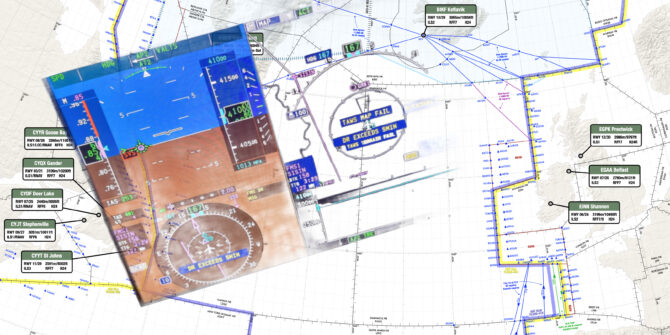
An increasing issue for the NAT Oceanic FIR’s is how to handle aircraft with an in-flight degradation of GPS. This normally follows a GPS Spoofing encounter somewhere prior to Oceanic Entry, leading to a degraded RNP capability.

If you run into GPS issues before entering the Ocean, you will likely end up with RNP10 as the best you can manage for navigational accuracy. This presents some issues for the Oceanic controllers, as RNP4 is commonly used to ensure separation. We’ll take a look at some scenarios and how to best handle these.


Normal RNP requirements on the NAT

NAT Doc 007 specificies two RNP options for entry into the NAT HLA.

The first is RNP10 (accuracy of 10 nm, 95% of the time). An important consideration here is that RNP10 is really RNAV10, but they call it RNP10 to keep things simple [See NAT Doc 007, 1.3.4]. The critical difference is that for RNAV10, on-board monitoring is not required. Since this can only be done by GPS, that’s an important relief when it comes to spoofed flights.

The other is RNP4 (accuracy of 4nm, 95% of the time). RNP4 is only an absolute requirement for PBCS Tracks (“Half-Tracks”). In practice, ATC commonly uses RNP4 for separation purposes on the NAT (Since the introduction of ASEPS). GPS is required for the monitoring part of RNP4; without GPS, RNP4 is not possible.


Loss of GPS Prior to the NAT

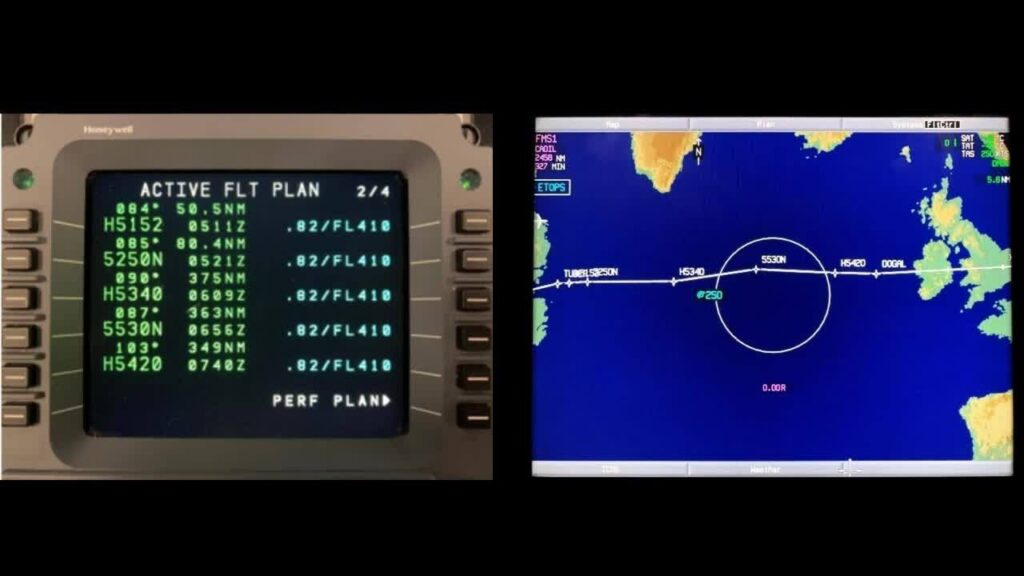
Since GPS Spoofing became prevalent in September of 2023, increasing numbers of aircraft are arriving at the Oceanic Boundary with one or both GPS sensors inoperative. A textbook GPS Spoofing encounter will initially see the GPS sensors rapidly change from the real coordinates to fake coordinates. If all GPS sensors agree on the fake coordinates, the FMS becomes confused. IRU values will increase, and in some cases, the IRS may also become “infected”.

The primary spoofing locations have not changed much since the onset of the issue: you will encounter spoofing at the Iraq/Iran border, the Sinai peninsula area (showing Tel Aviv as the spoofed location), Israel and Cyprus (showing Beirut as the spoofed location), and the Black Sea (showing Sevastopol as the spoofed location).

We have no reports in OPSGROUP that the other type of GPS interference – GPS Jamming – leads to lasting effects. Once the jamming has stopped, aircraft systems are normal.

However, we do have reports that if GPS inputs are turned off before departure, and later turned back on in flight, that issues may occur. This is mostly reported for departures from Tel Aviv (LLBG).


GPS failure, Ocean approaching

Since RNP4 requires a functioning GPS, if you encounter spoofing and lose your GPS, you can’t fly RNP4. Assuming that you have an RNP10 approval (one of the only two options for the NAT HLA), you will become RNP10.

The problem occurs when Shanwick, or the OACC at the entry point, get late notice of this fact, and you are close to other aircraft. That leaves the Planning Controller with little time to figure out how to separate you (an RNP10 aircraft) from the others (RNP4 aircraft).

In some cases, “spoofed” aircraft have had to descend  to FL280 to exit the NAT HLA, and this has caused diversions.


How to best handle a NAT crossing with a failed GPS

The key is to advise Shanwick, or the first OACC, early. Shanwick’s preference is that you use the RCL request to do this, and add a note to the end of the RCL along the lines of ATC REMARK/GPS DEGRADED RNP10 ONLY. If using voice to get your clearance, that’s what to say as well. Shanwick NOTAM EGGX G0106/24, and a note on the OTS Track message, has this information.

The RCL for Shanwick should ideally be sent 90 minutes before the Oceanic Entry in this case. Normal RCL timeframes are -30 to -90. An RCL sent any earlier will be rejected, but if you have something more unusual to discuss, you could use SATCOM to contact the supervisor and ensure a smooth crossing.


RNP10 time limit

With the change to RNP10 for your crossing, double check the time limit for RNP10. ICAO Doc 9613 (Volume II, Part B, Chapter 1) specifies that RNP is limited to 6.2 hours of flying. The timing starts from when “the systems are placed in navigation mode” or at the last point at which the “systems are updated”. The logic here is that the IRS will drift without updates enroute, and after 6.2 hours of flying, will no longer be capable of maintaining the RNP10 accuracy.

For an aircraft spoofed in the Mediterranean, or Black Sea area, it will take 4 hours before Oceanic entry, so this time limit becomes relevant. If the impact of the spoofing is severe enough, there is potential for inputs – including DME/DME or VOR/DME –  to the IRS to stop working. This is one of the potential unknowns at present.


Shanwick comments

Shanwick are encountering several GPS jammed aircraft per day, and it is sometimes difficult (or impossible) to find optimum profiles for aircraft without moving several other aircraft to accommodate. The only instance where they have to insist on FL280 and below, is when an aircraft does not meet the requirements for MNPS (such as single LRNS), and needs to be cleared outside HLA.

If a pilot advises that they have lost RNP4, but are still capable of RNP10, Shanwick controllers will look to find a solution where the aircraft can be cleared with at least 10 minutes longitudinal and 60nm lateral separation. These aircraft also need coordinating with the next Oceanic Center before clearance, and sometimes there are limited options available.

In general, the earlier they informed about the degradation, the easier it is for the Shanwick controllers to find satisfactory solutions.


Member input

This is a developing issue and we gratefully welcome any input from members on this. Email us at team@ops.group.



NAT Ops: Atlantic Thunder 22

Remember that big NAT military exercise a couple of years ago? And then the one that happened last year (Formidable Shield) around May time?

Well, now Atlantic Thunder is happening, which means once again large parts of North Atlantic airspace will be closed to all flights for several hours at a time.

Not quite as big as Formidable Shield though, but still big enough to have a conference about it.

The Conference.

They are holding one so you can find out exactly what the deal is.

Join it by visiting the Eurocontrol NOP page and find the link there under ‘latest news’. They have one before each of the days where the most impact is expected, so the first takes place on September 6th at 14:30 UTC (and then on the 8th and the 10th).

The Event itself.

Atlantic Thunder will take place from September 1-12, but the main exercise takes place on the Sep 7 (or Sep 9 or 11 if it doesn’t go ahead on Sep 7).

The official PDF issued by Shanwick is available here, and has lots of lists of everything closed and when…

We prefer pictures though.

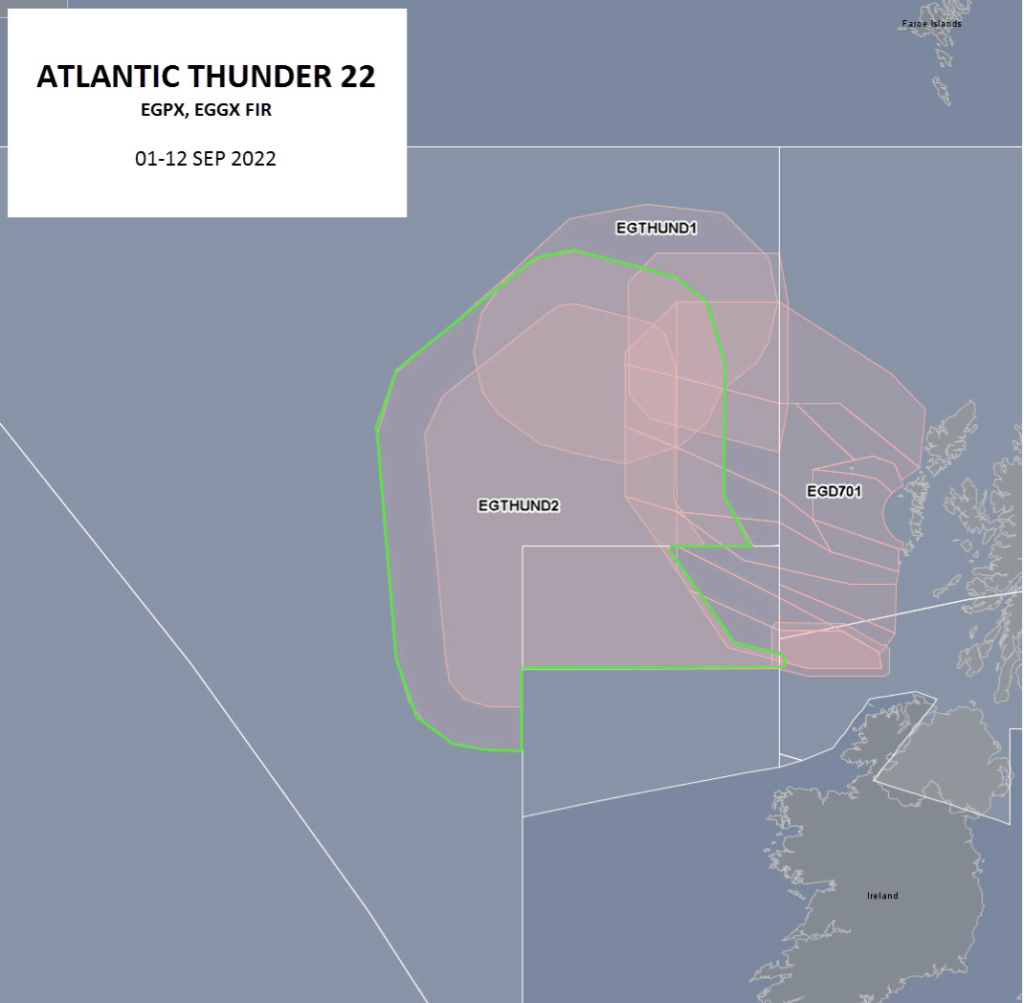
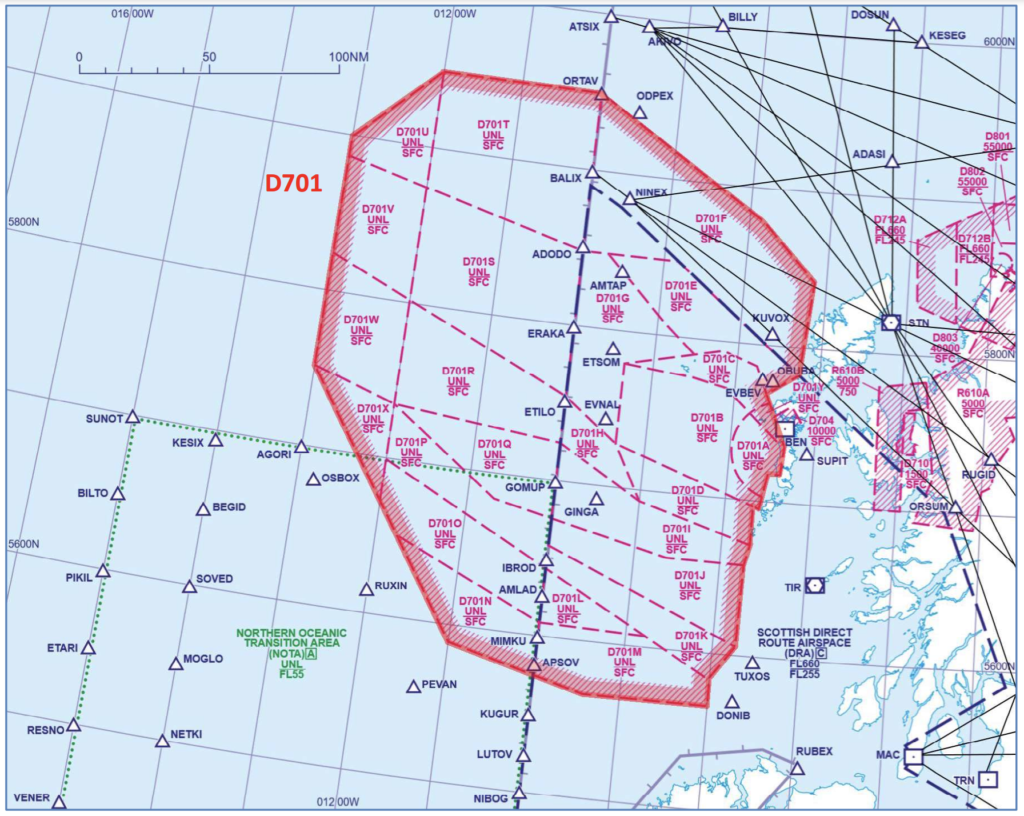
So first up, danger area EGD701 

This area is tricksy because as you can see, it is made up of loads of smaller bits that can be activated at different times (and to different levels). They affect a bunch of the routes out of the NAT HLA, and potentially both the EGGX/Shanwick and EGPX/Scottish FIRs.

Initially it will be closed 1-6, and then on the 12th as well. The timings are annoying. Sometimes it is FL200, sometimes it is FL270, but then bits of it, between 1400-2359, are shut to FL UNL.

Like we said, tricksy.

But then…

But then there is Configuration 2 which involves the closure of EDG701 and also EGTHUN1 and EGTHUN2, which is a bigger area looking like this –

Of course, they only publish the exact timings and configurations 24 hours in advance so you’re going to have to keep your eyes out for Notams and info on those.

Routing around the closed airspace.

Aeronautical Information Messages (AIM) will be issued prior to the start of each exercise, which will include suggested routings for flight planning around the closed areas.

Traffic overflying around these closed areas can expect to get 30NM separation if in NAT HLA airspace (FL285-420), or 60NM separation if flying at lower levels.


NAT Basics: An Unofficial Checklist For Pilots

We have a handy ‘My First North Atlantic Flight is tomorrow’ briefing guide which is for everyone – the planners, the operators, the pilots. Everyone involved in getting airplanes across the NAT. If you want it, head to the shop (or member’s dashboard) and grab it.

This post is just a mini slice of that – just for the pilots. Not because you don’t already know how to ‘do the NAT’, and not because your operator doesn’t already have a procedure in place, but just because we thought it might be a handy little guide on the basic stuff to do if you’re a pilot heading into the NAT HLA…

On the Ground

We’ll start when you’re sat in the plane getting ready to go. There are three things you probably want to do at this point:

1. Check the Techlog.

Make sure you have the equipment you need. That means none of it is broken. The vast proportion of the NAT HLA requires Datalink now, so make sure you’re CPDLC and ADS-C are functioning (because you need both of them to be able to do the Datalink). Also check bits like HF, altimeters and all the usual stuff you’d need for general RVSM-ing while you’re at it as well.

2. Check what you’re loading in the FMS.

If all your waypoints are five letter named ones then this is less annoying to do, but getting the other pilot to independently check there are no discontinuities or rogue vowels that might send you off in the wrong direction is still a good idea.

If you have the dreaded LAT/LONG points on your flight plan then you are going want to check more thoroughly.

  • First up, make sure there are no funky ones stored in your box by a different pilot from an earlier flight.
  • Load yours in using the correct format, and get the other pilot to independently confirm you haven’t messed up the numbers with half degrees (or no half degrees if they are supposed to be there).
  • Check the track and distances between all your points (from Entry to Exit) and make sure what is in the box matches the flight plan. It’s a whole lot easier to fix it on the ground if it doesn’t.

3. Have a little look over the weather and Notams for the en-route alternates in the NAT region.

Places can get nasty in winter, and there aren’t many, so if one of them is under 10 feet of snow or has some hideous Notam then you’re better off knowing before you go so you can make a different plan.

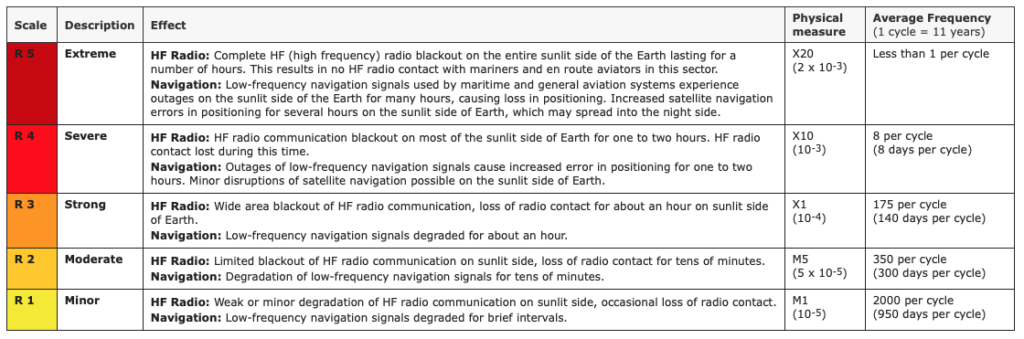
Check the old space weather stuff too because if there are some storms raging up there you might experience some HF blackouts or satellite navigation issues and again, good to know what to expect (and what to do about it) before you’re in it.

In the air (approaching the NAT HLA)

  • Make sure you know who you need to Logon to for the clearance, and when to do it.
  • Check everything is still working.
  • Once you get your clearance make sure both of you check it. That means checking what you’ve been cleared is what you have in the box. If it has changed then you’ll need to do those track and distance checks again. Select North Ref to TRUE for this but don’t forget to set it back to MAG once the checks are done.
  • Make sure you have the right Mach set (if it’s a constant mach segment).
  • Check the RNP and Nav Accuracy is High.
  • Check your altimeters are all within 200’ of each other.
  • Brief your contingencies again and think about whacking something in the secondary to help if you want to.

Entering the NAT HLA

In you go…

Put that SLOP in (0/1/2nm RIGHT of track, or 0.1 increments if your airplane is that clever) and select 123.45MHz on VHF1 (unless you still have an active ATC VHF). Keep a good listen on 121.5MHz on VHF2. If you’re heading into HF land then check in and do your SELCAL check.

When you’re 30 minutes in, set your squawk to 2000.

Now, some do this, some don’t, and a lot do it different – it depends whether you’re old school and using a plotting chart, or new school and EFB-ing. But even if you are in a high tech aircraft this is still one good method for checking you don’t get any GNEs:

  • As you cross over a waypoint, set your timer.
  • After 10 minutes, check your GPS position in your FMS, and plot it on your chart/compare it to where your airplane is showing on your (electronic) map. If it doesn’t match then you’ve got yourself a problem.

Keep an eye on those alternates and their weather. Plan stuff in advance so if anything happens you’re not flailing about in the sky like a headless chicken.

UH OH! I’ve got issues…

Use the contingencies, but not before trying to talk to ATC. 

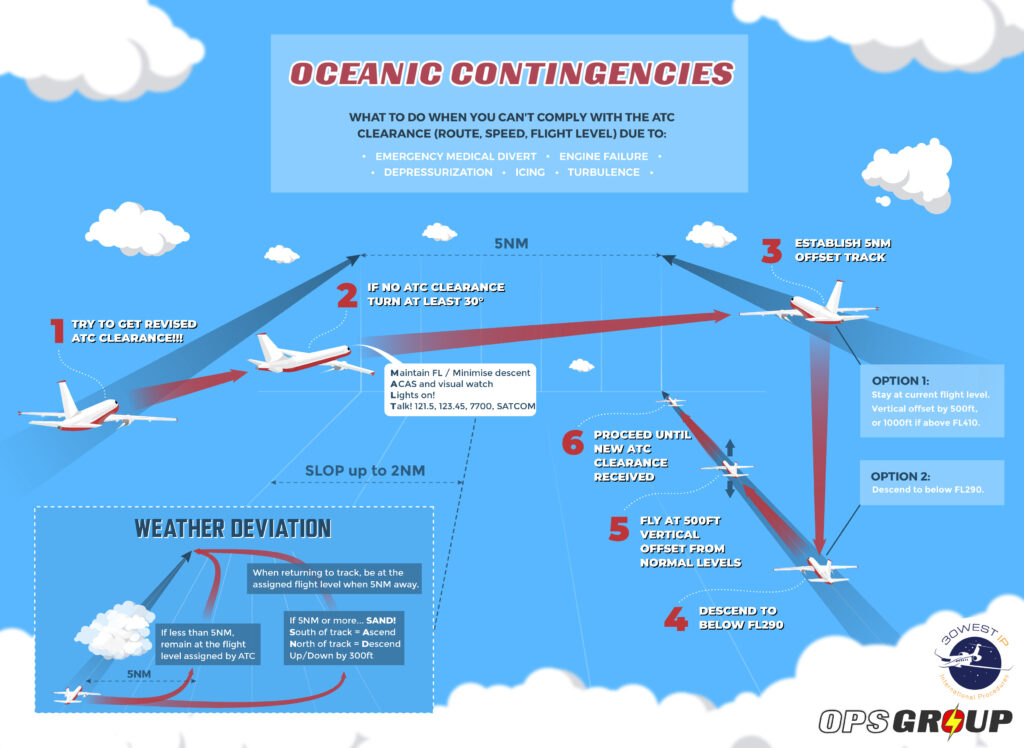
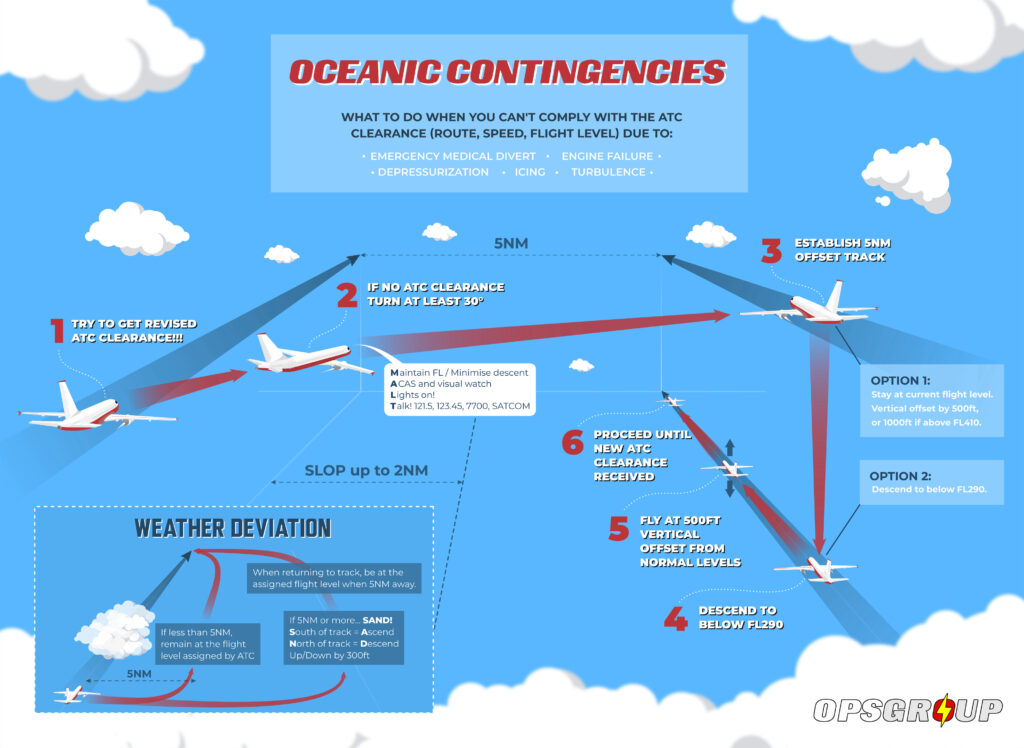
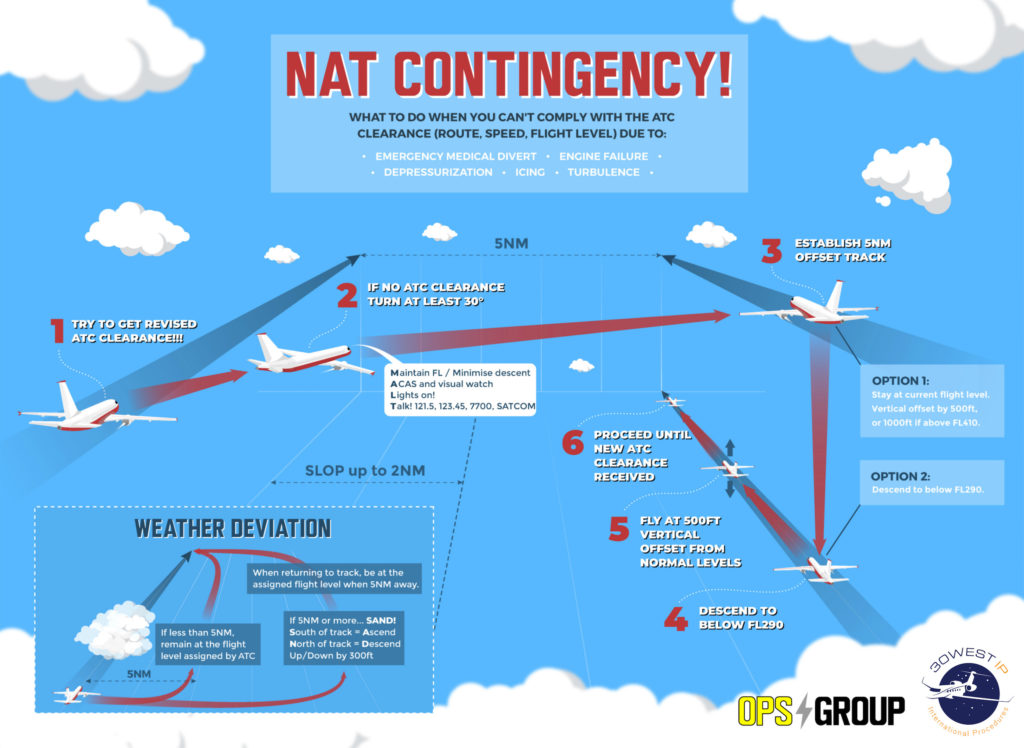
  • If it’s a weather thing and you only need up to 5nm to detour around it then maintain your assigned level. If you’re going to need more than 5nm then use SAND – if your turn moves you South then ascend (climb) 300’. If your detour moves you North than descend 300’.

Always check the tracks and traffic proximity first. Turning the direction which will mean a longer detour might keep you more clear of traffic.

  • If it’s a serious technical problem then turn 30° and offset laterally by 5nm. Once established, climb or descend 500’ (1000’ if above FL410) or descend all the way down below FL290.
  • If it’s a communication issue then stick with your assigned clearance and do what you can to get in touch with someone.
  • If it’s an ATC issue (ie they’ve evacuated and aren’t there anymore) then follow the published contingency procedures.
  • If it’s some sort of navigation problem then get in touch with ATC and go from there.

I made it!

Congrats. Delete the SLOP, set the speed to what you need and out you go, smug in the knowledge you traversed the NAT HLA without mistakes.

A checklist for you 🙂

We turned all this info into an Opsicle. It has London pigeons in it because they are clearly the masters of crossing the North Atlantic. Grab it here.


No more NAT tracks at FL330 and below

Big news from the NAT. From March 1, 2022, FL330 and below will no longer be part of the NAT Organised Track Structure (OTS).

What does this mean?

It means operators will have the flexibility to file random routes at FL330 and below when flying between Europe and North America.

Particularly for operators unable to file routes across OTS tracks with active flight levels, this means much greater flexibility in choosing their own trajectory.

Why is this helpful?

NATS quoted a study which suggested every extra minute over the ocean equates to about £51, or $70. It might not be the most radical change, but it is a step towards further improving the efficiency for operators, and ultimately to reducing fuel burn.

Why now?

It comes down to the introduction of ADS-B. This allows controllers to receive updates every 7-8 seconds instead of every 840 seconds (14 minutes).

What about the rest of the tracks?

This change forms part of NATS 2030 NAT vision, and more improvements can be expected. Unfortunately, it isn’t a direct result of their NAT tracks NIL experiment and abolishment of all the OTS isn’t on the cards anytime soon.

However, studies from the ‘OTS Nil’ trial are being reviewed and there are plans to simulate further OTS Nil on busier traffic days to see if viable, useful, doable…

What do you need?

If you want to fly at FL330 or below (down to FL285) then remember you are still in the NAT HLA, just not on the OTS, so the same HF, long range nav and comms requirements apply, as do datalink mandates.

Anything else?

Unfortunately no, that’s the news for now. Any questions on this feel free to direct them to us at team@ops.group

If you want to read the “official” NATS notice then you can do so here. We don’t yet have a reference for the official NAT Docs.


NAT Doc 007 Changes 2022

It has happened again. They have made amendments to NAT Doc 007. We took a look and the first thing we noticed is a lot of red text!

Thankfully, on reading it, we have determined there are not really any actual changes (i.e. nothing that you probably don’t already know about). It is more a great rewording to incorporate things you already know about in a tidier and more coherent way.

So here is a summary of the changes, and here is a link in case you do want to take a look for yourself. Version 2022-1 is applicable from Jan 2022. 

The Very Simple Summary

MNPS is out

They have removed all historical references to it.

OWAFS is in

Well, it was already but now we have some definitions and a few additional paragraphs on it.

OWAFS (in case you don’t know) means ‘Operations Without an Assigned Fixed Speed’ and it means that the requirement to issue a fixed Mach in the NAT has been removed. If you are told to ‘Resume Normal Speed’ this means you can fly at your chosen cost index speed. Just let ATC know if it is a big change (M.02 or more).

The Chapter by Chapter Review

Chapter 1

MNPS references have been removed, as have the old MNPS performance specs. Now it is all PBN. They have also taken out the old bits about trials and implementation because MNPS evolution to NAT HLA and PBN has happened.

Chapter 2

They have amended the examples of NAT Track Messages. No great difference.

Chapter 3

5.1.12 is the new paragraph on OWAFS and it says this:

“With the implementation of OWAFS, flight crews can expect ATC to issue the clearance RESUME NORMAL SPEED when traffic permits after oceanic entry. This clearance allows the flight crew to select a cost index (ECON) speed instead of a fixed Mach number with the condition that ATC must be advised if the speed changes by plus or minus Mach .02 or more from the last assigned Mach number.”

Chapter 6

There are some subtle word changes here. The one to know is under 6.1.22 (and throughout the chapter). When using HF, SATVOICE or CPDLC flight crew SHALL maintain a continuous air-ground communication.

‘Shall’ not ‘should’. It also used to just say ‘listening’ instead of that continuous air-ground bit.

Chapter 7 

This whole chapter is about ‘Application of Mach Number Technique’. So more OWAFS info. 

In summary – You should receive a ‘RESUME NORMAL SPEED’ clearance after oceanic entry. If it doesn’t come through automatically then request normal speed.

ATC will still occasionally use mach number technique to maintain longitudinal spacing so if they give you an assigned mach number, stick to it. But if you get that “resume normal speed” clearance then you can fly at your cost index (ECON) speed and just let ATC know if it is more than a M0.02 difference.

Chapter 10

Another ‘should’ to ‘shall’ change.

If you are on T9 route then you shall change your squawk to 2000 10 minutes after passing BEGAS or LASNO. If you are on T290 then you shall change it 10 minutes after ADVAT or GELPO

A permanent military area also looks like it has been removed.

That’s all we saw.

If you spot any changes we have missed please share them with us at news@ops.group

Further reading

To see a full version of this new NAT Doc 007, with all the changes incorporated, go here.

The last time they updated it was back in July 2020, which you can read about here.


Clearing the way for no more NAT Clearances

ICAO have released a Concept of Operations paper discussing the plan for the removal of Oceanic Clearances in the North Atlantic Region. Here’s what it says…

The “Executive Summary” bit

There have been big improvements in safety and monitoring capabilities in the NAT region. Things like ADS-C, CPDLC, ADS-B, NATS and NAVCANADA using a common Flight Data Processor Platform (something to do with aligned procedures) etc have really improved everything.

Because of all this, the big wigs in the POG (real acronym – stands for NAT Procedures and Operations Group) have started to think about discontinuing the Oceanic Clearance in NAT airspace.

How does it work at the moment?

Right now, to enter NAT controlled airspace at or above FL60, you need an oceanic clearance. This clearance contains your Route, Level and Speed.

These three elements are important because they are what enables the management of the lateral, vertical and longitudinal separation.

So, when you are zooming along towards your Oceanic Entry Point, and despite having a flight plan filed, you still need to actually be cleared – meaning ATC have to confirm (and then you sort of reconfirm back at them) what Route, Level and Speed you’ll be flying through the region at.

So you send your RCL (Request for Clearance) to the ATC who manages the first OCA you’ll be entering and they send you the clearance.

Simple, until stuff goes wrong.

Why change it?

Like we said, it’s all straightforward, until it isn’t.

Each OCA has its own published “when to send the RCL” rules. There often isn’t a huge amount of time between receiving a clearance and reaching the OEP, and during this time you have to check the clearance, possibly reprogram bits, and from experience on long haul flights, it always seems to happen around the time the augmenting crew are returning from the bunks. So the risk of errors creeps up.

Then you have things like Radio Comms failures, loss of HF etc. and all the “what to do if” procedures related to what to do if you do have clearance, don’t have clearance, are in the region or aren’t in the region…

The general rule is if you’re already in the NAT HLA then stick with your clearance. If you aren’t in yet but have a clearance then enter and stick with it, and if you don’t have a clearance then follow what is in your flight plan.

But all this does cause confusion. Can I enter? Should I not enter? Where do I send the RCL to? When do I send it? What if I haven’t heard back?

So removing the need to request a clearance prior to entry would align the NAT region with normal global procedures and would mean less training and simplified procedures for crew, and everyone like simple. 

It isn’t actually an entirely new concept either – New York Oceanic removed oceanic clearances some time ago and it was a fairly simply procedural change for ATC and flight crew, so it does work.

So what will change?

Simply put – Oceanic Clearances to operate in oceanic airspace will no longer be issued to flight crew prior to reaching the OEP. Instead, crew would send an RCL and would get back some common message along the lines of:

“RCL RECEIVED. FLY CURRENT FLIGHT PLAN OR AS AMENDED BY ATC”

Any changes will be sent via CPDLC or advised by voice comms.

Will it work?

Well, making stuff more simple usually means less mess-ups. 

In this case crew will have their clearances already – they will know what to fly and potentially have more time to check and crosscheck.

When changes do occur it will be clearer that there is a re-clearance and this could minimise the risk of missing a change to the clearance, or mis-entering it and flying the wrong thing.

Procedures for what to do if you cannot make contact prior to entry will also, hopefully, be simplified, so the stress of “what if I don’t hear from ATC before the OEP” will be reduced.

But when is it going to happen?

Well, that’s the less exciting bit. If they decide that it is something worthy of implementation then it will probably only go ahead by 2030.

Details of planned implementation dates will be published in common NAT Ops Bulletins and in State AICs/AIPs so keep a look out.

Can I read the CONOPS paper?

Yes you can. It is right here.

Not sure about the current clearance process?

We wrote a little brief on it a while back which you can read here.


We have Clearance, Clarence

You carefully type it up, have the other pilot check it, then hit send… and wait… your airplane is creeping closer and closer to the Oceanic Entry Point and still no reply, and then DISASTER! Clearance Request Rejected! Or worse still, you just never get a response…

Here are some hints, tips (and actual procedures) related to getting your Oceanic Clearance for the NAT HLA. And what to do if you don’t…

How to get your clearance.

There is a datalink mandate across the vast majority of the NAT HLA which means everything has headed towards “messages” rather than voice. Why? Because it’s easier and there is a lot less risk of mess-ups and mix ups. So, most likely, you are going to be requesting your clearances via “message” as well. The system it goes through is generally the Arinc 623 – the same you use for things like your D-ATS. Contrary to CPDLC, A623 exchanges don’t require previous notification. But enough of that technical schtuff.

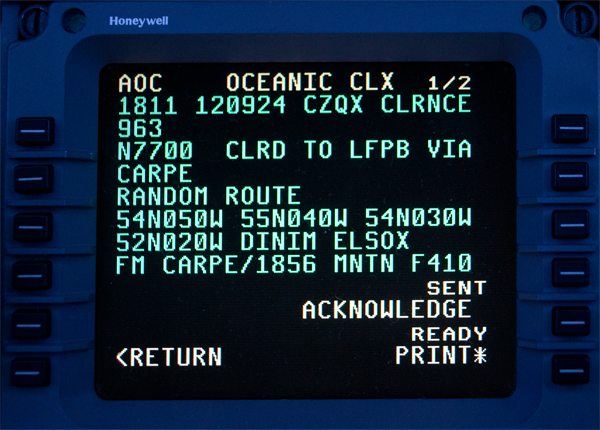
If you ttake a look through the North Atlantic section of *whichever manual* you are using and somewhere under COM and ATC Communications you will find a section on ‘Oceanic Clearance Request via Data Link’. Each OCA has its own thing to say in terms of times to send it and reverting to voice, but in general the message you want to send when requesting your clearance is the same for them all.

You need to include Entry Point, ETA for Entry Point, Requested Mach Number, Requested Flight Level and add a remark (RMK/) indicating preferred alternative (another NAT Track) and MAX FL. You only have 80 characters available to you so don’t go adding extra comments in, it will probably just get rejected.

After sending your clearance request you should receive an advisory message which says something like this –

“IF NO CLEARANCE RECEIVED WITHIN 30 MINUTES OF OCEANIC ENTRY PONT REVERT TO VOICE PROCEDURES END OF MESSAGE”

If you don’t receive this within about 5 minutes of sending the question, something has possibly gone wrong. Try sending again if you can still meet the minimum time to boundary for a request, or revert to voice.

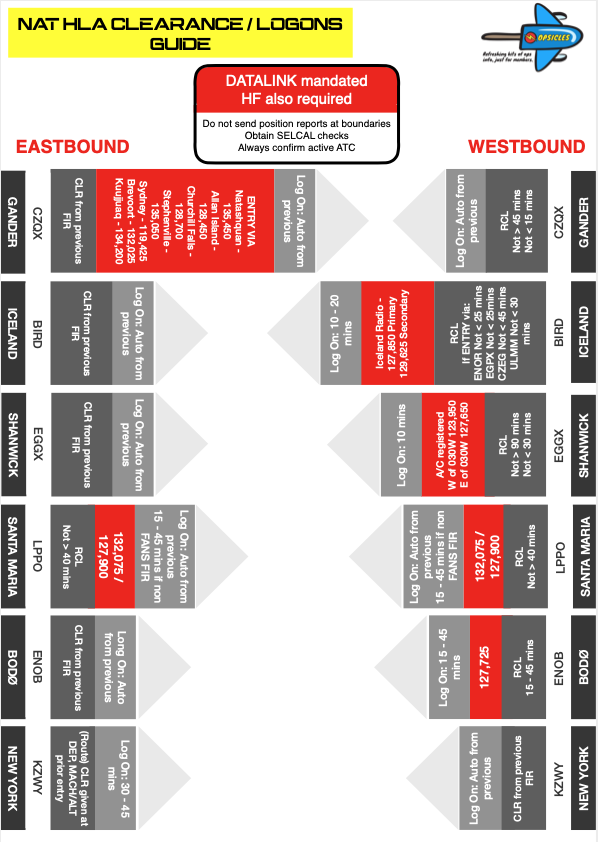
The times you want to think about sending your RCL through at vary from OCA to OCA, as do the logon addresses, so here is a rundown of each one…

Shanwick

  • The logon is EGGX.
  • Shanwick want your request sent no later than 30 minutes before the OCA boundary, but no earlier than 90 minutes or they’ll reject it.
  • If you haven’t received your clearance and are within 15 minutes of the OCA boundary then revert to voice. If you are East of 020W then try Shanwick Radio on 127.9 to help reduce chatter on HF. Only give HF a go if you are within 40 minutes of the boundary and having issues getting VHF signal.
  • For Shanwick Oceanic you have two frequencies – 123.950 is for aircraft registered in States West of 030W. 127.650 is for aircraft registered in States East of 030W.

Gander

  • The logon is CZQX
  • The request should be sent just after the aircraft gets within 90 minutes of the OEP. If you don’t receive the advisory message within 5 minutes, or if you haven’t received a clearance and are within 30 minutes of the OEP then revert to voice.
  • Gander is a little tricky with working out which frequency to use. It comes down to where you are routing via:
    • Natashquan 135.460
    • Allan’s Island 128.450
    • Churchill Falls 128.7
    • Stephenville 135.050
    • Sydney 119.425
    • Brevvoort 132.025
    • Kuujjuaq 134.2

Reykjavik

  • The logon is BIRD.
  • How far in advance you need to request your RCL depends on where you are entering from (which CTA). The time is the minimum time from the BIRD CTA Entry Point that they should receive your RCL by and the general rule is 20-25 minutes.
    • Stavanger (ENOR) 25 mins
    • Scottish (EGPX) 25 mins
    • Edmonton (CZEG) 45 mins
    • Murmansk (ULMM) 30 mins
  • If you have Inmarsat datalink then you probably won’t be able to get your clearance while north of 82°N. If you’re on an Iridium or HF datalink system then you’re in luck.
  • If you have to get your clearance via voice then you can try Iceland Radio on VHF Primary 127.850 or Secondary 129.625. They are also on the HF B, C and D families but you’re having a bad day if it’s reaching that level.

Bodø

  • The logon is ENOB.
  • Request your clearance at least 30 minutes before the NAT region boundary. Revert to voice if you’re within the 20 minutes mark on 127.725.

Santa Maria

  • The logon is LPPO.
  • Send your request 40 minutes before the OEP. If you need to request clearance by voice then talk to Santa Maria Radio on 127.9 or 132.075.

New York

  • The logon is KZWY.
  • This works a little differently if you are routing from the US because your clearance is going to be included in your departure clearance (since you’re basically in the area anyway). You can logon 30-45 minutes before.

What to do if you don’t get a clearance?

Shanwick is really the main one to worry about – having a clearance (being in contact with ATC) is pretty darned important there because it is such a big area and extremely busy.

Always give yourself time. If a clearance isn’t received, try by voice. If you can’t get through then try other frequencies and ATCs. If you reach a boundary without a clearance then chances are it’s because you have some sort of comms loss in which case this is now your bigger concern.

In theory, you could enter the NAT HLA (aside from via Shanwick) without a clearance (with loss of comms) and fly as per your flight plan route (Mach and Levels) but it really, really isn’t advisable.

What to do when you do get your clearance.

It goes without saying that first up you need to acknowledge it with ATC. After that you’ll want to check it, and get the other pilot to as well. Printing it out is a good way to do this if you have that option. “Checking it” means checking what you’ve been cleared to do is what you’re asking the aircraft to do via its nav computer.

Finally, make sure you really are flying it by monitoring it and doing your plotting (or equivalent) checks. You can read about that here if you’re not sure how.

A helpful summary.

We created a little Opsicle  – a refreshing bit of ops info, just for members. Which means if you are an OPSGROUP member you can click on the pic to get yours. This one summarises all the logon info we wrote about above!

Where is the official info?

The info is contained in AIPs, and some of it within ICAO NAT Doc 007.

We might have missed some things, or made a mistake so if you spot one let us know!


Something to help with NAT Contingencies

There are standard contingency procedures to follow if you are in the NAT HLA, they have been around for a while. But folk still struggle with them from time to time (so would we at 3am over the North Atlantic if we had to suddenly try to remember what they were while things were breaking or storms were flashing).

We have written about this before. Here’s how it works:

Unfortunately, sometimes folk still do get it wrong.
The most common mistakes seem to be people applying a contingency procedure when they are in contact with ATC (ATC will give you a revised clearance if you need it so check first before diving into a contingency manoeuvre).

Sometimes though, we just don’t quite do it right because there are a few little steps to follow depending on what is going on. For example, if you are deviating around weather, then the first step is to try and get a re-clearance from ATC. If you can’t get one, that’s when you follow the contingency procedure, and then what you do depends on whether your detour is less than or more than 5nm…

So we decided to make something else to help…

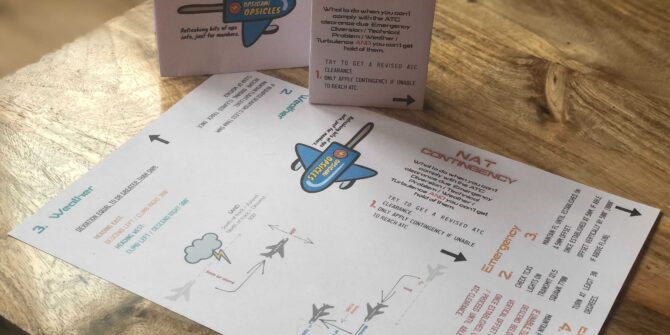
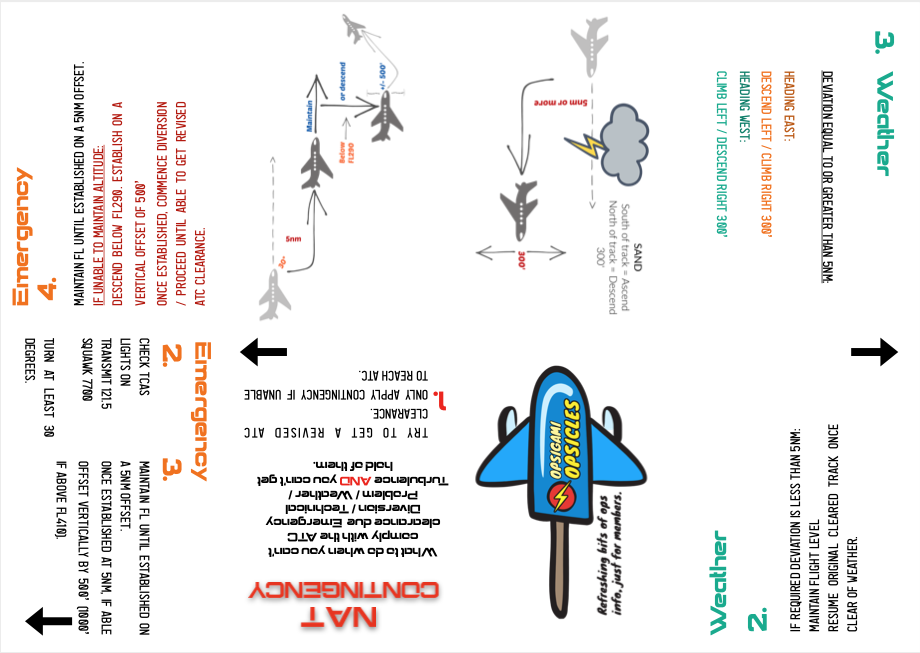
Introducing the Opsigami Opsicle

The NAT Contingency Opsigami Opsicle is less exciting than it sounds. It is the two contingencies – for emergencies and for weather – laid out step by step. That’s the Opsicle part.

The Opsigami bit(Origami with an Ops twist) is because if you print it out (and fold it correctly) then it will give you each step in order to help you follow it as you need to.

It looks like this:

And it works like this:

We made this for OPSGROUP members – we hope you find it useful!

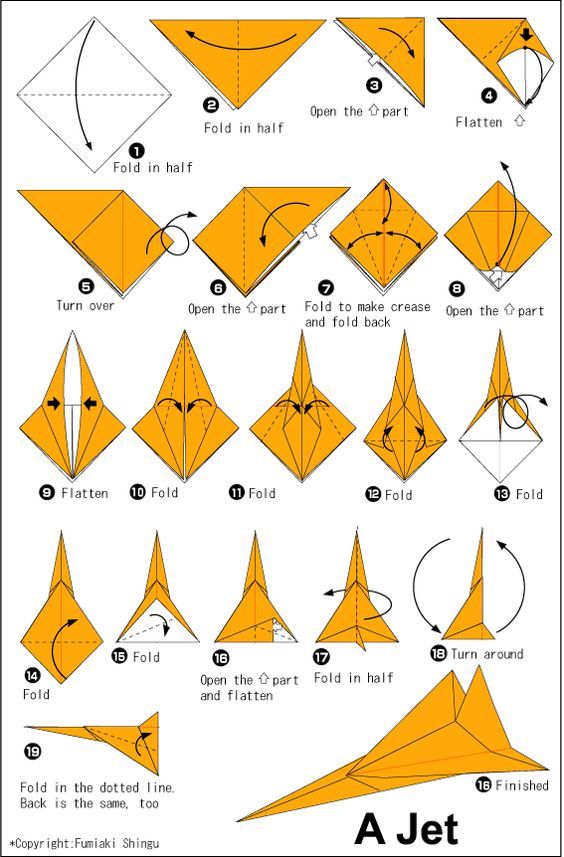
Just in case you don’t, here is a great Origami (ok, paper airline) design which you can fold it into instead 🙂


Communication Breakdown on the NAT

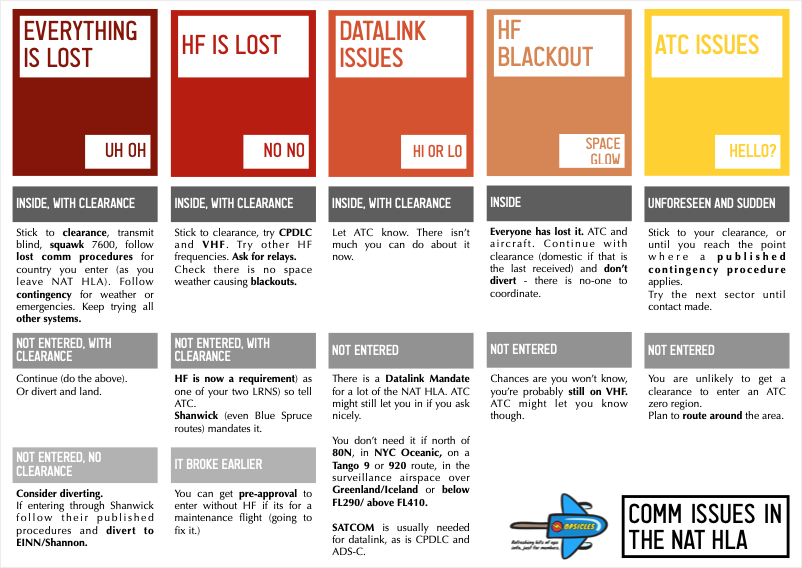
Lost comm procedures in the NAT HLA (or when you’re trying to get into the NAT HLA) are a complex and confusing thing, so here is our “Natter on the NAT” – a recap on what to do when nobody wants to talk to you.

You aircraft has lost everything it uses to communicate.

The likelihood of every communication system you have breaking all at once is fairly minimal, and given the equipment requirements to enter the NAT HLA, you are going to have more than just VHF onboard. You will also have HF, datalink, probably SATCOM…

But if it does happen (maybe a freak bolt of mega lightning or something) then the first thing to do is still try each system, including back up boxes, and your headset for that matter.

Still no luck? Don’t panic. While you can’t hear anyone, or talk to anyone, they can all still hear and talk to each other. So you are the only uncoordinated thing out there right now. First up, let ATC know by squawking 7600.

The next thing to do depends on where in the NAT you are.

Already in it? Great, simple. You already have a clearance and you already know where you are going, so carry on as you are, transmit blind, and once you exit follow the lost comm procedures for the place you are entering.

Not in it, but have a clearance? This is up to you really. You have your clearance (and have confirmed it) so ATC know that you know that they know that you know what you are cleared to do. So if you want to stick to in and head on in you can, but you are going to have to maintain your speed, level etc all the way through. And if you have a weather issue or an emergency you are also going to be on your own.

No clearance yet? This one is a bit tougher. It probably isn’t the best plan to head in (following your flight planned route), especially if you are heading into Shanwick. Shanwick have diversion procedures in place to take you to Shannon and the best idea might be to head there and get yourself fixed.

The exact wording is “it is strongly recommended that a pilot experiencing communications failure whilst still in SHANNON FIR/UIR/SOTA/NOTA does not enter SHANWICK Oceanic Control Area”.

The Irish AIP have the procedures for comms failure if planning on entering and they are worth a read. They have a pretty handy summary of what to do for Shanwick in there.

You have lost HF

If you’re already in, there isn’t much you can do. Stick to your clearance and keep in contact on CPDLC. Remember, HF frequencies are pretty rubbish at the best of times so if you discovered the failure while trying to make an HF call, then try a different frequency.

Lower ones work better at night, higher ones by day, and always try the middle ones for good measure. Have a quick glance at space weather too because if there are geomagnetic storms forecast it could be there is a general HF blackout going on that is affecting everyone.

Collins Aerospace publish a daily list of HF frequency assignments for their side (the US side) of the North Atlantic and you can find them here.  Worth a look before you fly, if you’re going to be in the US North Atlantic area.

The Comms requirements changed a bit in February 2021, and basically, what they say, is that you need two long-range comms systems if routing anywhere outride VHF coverage. One of these has to be HF.

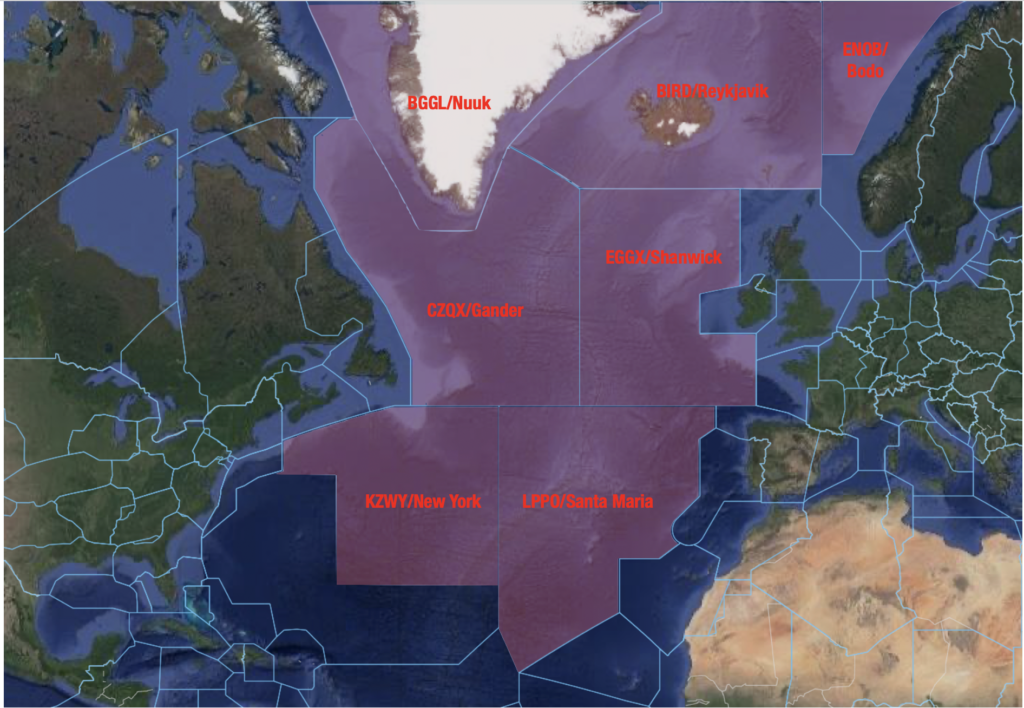
Here is a particularly horrible picture of where VHF has got you covered.

You can route through if your HF was already broken and you told ATC in advance (Item 18 on the flight plan) and they gave you the thumbs up, but if you are heading there and it goes suddenly before entry then you are going to need to talk to ATC.

Shanwick OCA needs HF, no exceptions (not even the Blue Spruce routes that fall within the Shackwick OCA) so don’t go diverting immediately but do get talking (on whatever else you have available) to sort it out before you enter.

We might as well cover HF blackouts while we’re here.

These happen when space weather happens. They aren’t super common and they are usually minor (lasting 10 minutes or less). But when they do happen, everyone can lose HF, including ATC.

You probably should make position reports on 123.45 to be on the safe side because there might be no coordination between traffic and ATC for the period of the blackout. Keep trying different methods to get hold of ATC as well (but don’t get all crazy at them though – they will be busy and will contact you when able).

Now, because coordination between ATC and everyone else is an issue, they actually don’t want everyone diverting all over the place, so stick with your clearances. The big point here is – if you don’t have a NAT clearance yet, you need to stick to your DOMESTIC clearance. That means you have to stick with what you were most recently told to do, not what you filed for on your flight plan.

Datalink problems.

So your texting system is on the blink? Unfortunately, the Datalink Mandate is in force now so you need this to enter. If you ask ATC nicely (and have everything else working) they might still let you in.  

You don’t need it if you are north of 80N, in NYC Oceanic, on Tango 9 or 290 route, or in the ‘surveillance airspace’ over Iceland/Greenland. So if you can re-route via any of this, that might be a good plan. Otherwise you do also have the option of flying above or below the NAT HLA (so below FL290 or above FL410) if your aircraft (and your fuel) can do that.

Remember, datalink uses CPDLC and ADS-C so if either of them is broken, your datalink probably is as well.

SATCOM

Most datalink systems also require SATCOM – so while you don’t need it to use it, if your aircraft needs it for the Datalink to work, then what we said above applies.

Let’s talk ATC – Strikes.

An ATC strike is *usually notified in advance. The chances of them walking out without warning is fairly remote. So if you know about it beforehand, plan accordingly. If it happens while you’re there, treat it as an ATC Zero event.

ATC Zero.

There is no-one out there. Maybe they had to evacuate? There was some sort of emergency or major technical issue that’s has taken down an entire ATC provider? Occasionally it is Notam-ed, but in that case you won’t have been given clearance to head through, so we are talking those unforeseen sudden zero events.

Each region has its own contingency procedures which you can find in their AIP, or better still in NAT Doc 006, which was also updated in Feb 2021.

These routes are really for when big stuff happens – the entire ATC for a sector is evacuated for example. In most cases, other units will try and manage control as best they are able, but it will be fairly limited.

So, if you’re already inside, continue and start trying to make contact with the next sector (as they will hopefully be managing control as much as they can). If it is a big ATC zero event you are probably going to have to follow the contingency routes to exit the NAT HLA (rather than your clearance) but this will be ‘activated’ by whichever ATC is taking over control.

If you already have your clearance to enter you can, and you can transmit position reports on 123.45, but it is not really advisable. The best plan is to organise a re-routing.

If you don’t already have a clearance then you aren’t going to be able to enter the ATC zero bit and you will need to plan a re-route around the affected sector.

Feeling the need to read more?

Here are some handy links to things on the subject.

Changes to NAT Doc 006 – our blog post summarising what these were.

The Irish AIP (again) in case you missed the link earlier.

The GOLD Manual (2017 edition) – for all your Datalink info.

Opsgroup Member?

Then click here to download our handy little Comms Issues on the NAT “Opsicle” – a refreshing bit of ops info, just for members.

If you’re not an OPSGROUP member, but you’d like to be, you can join here.


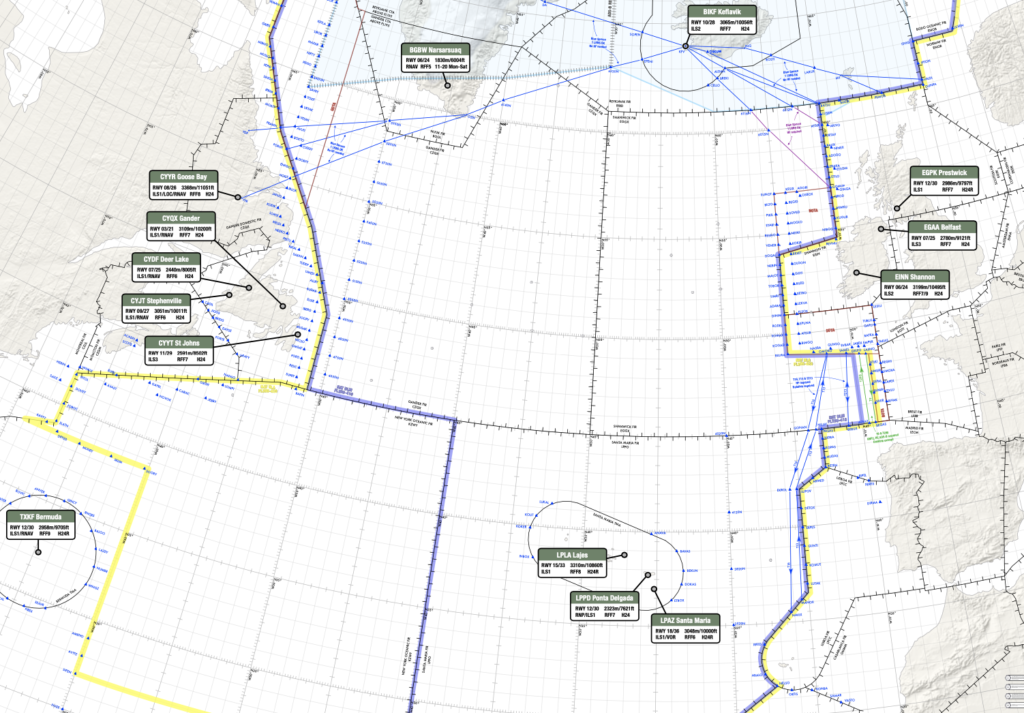
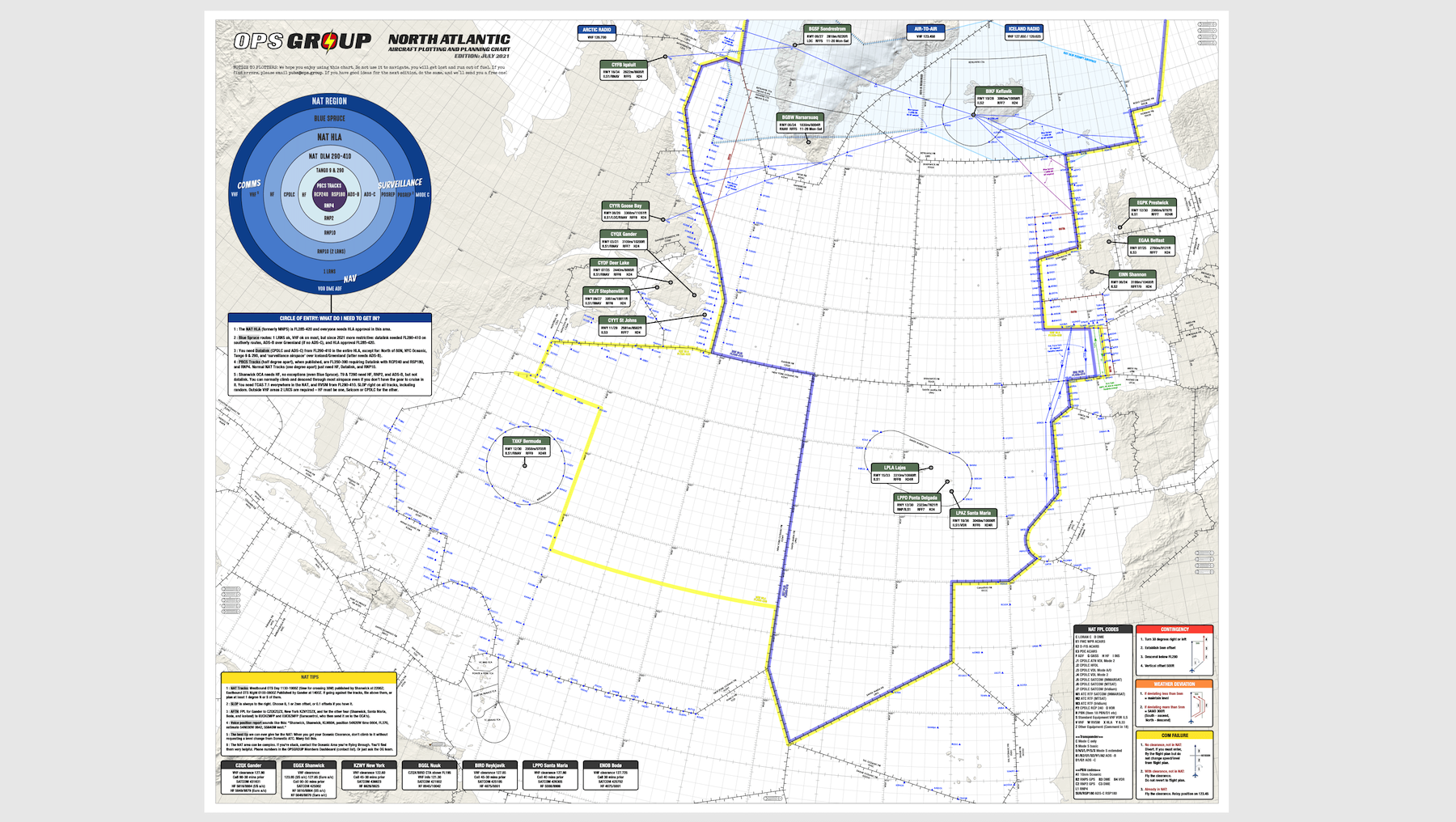
2021 New North Atlantic Plotting & Planning Chart

Hi members!

First, thanks to all the group members who were part of making this. We sat down from scratch and wanted to build the best possible NAT chart we could. A lot of work went into this, and we’re grateful to you all! With this format and structure, we’re also looking at making useful plotting charts for other areas like the Pacific, Africa, etc. – but for now, enjoy this completely updated NAT map for 2021.

So .. It’s ready! You can grab it in Slack, or in your Dashboard. View it on your iPad or Laptop etc. as a PDF, or print it out as a giant wall map! It prints really well up to 15 feet wide – but you can also just put it onto A3 or A2 size paper.

If you’re not a member, read on for how to get a copy.


About the 2021 NAT Chart

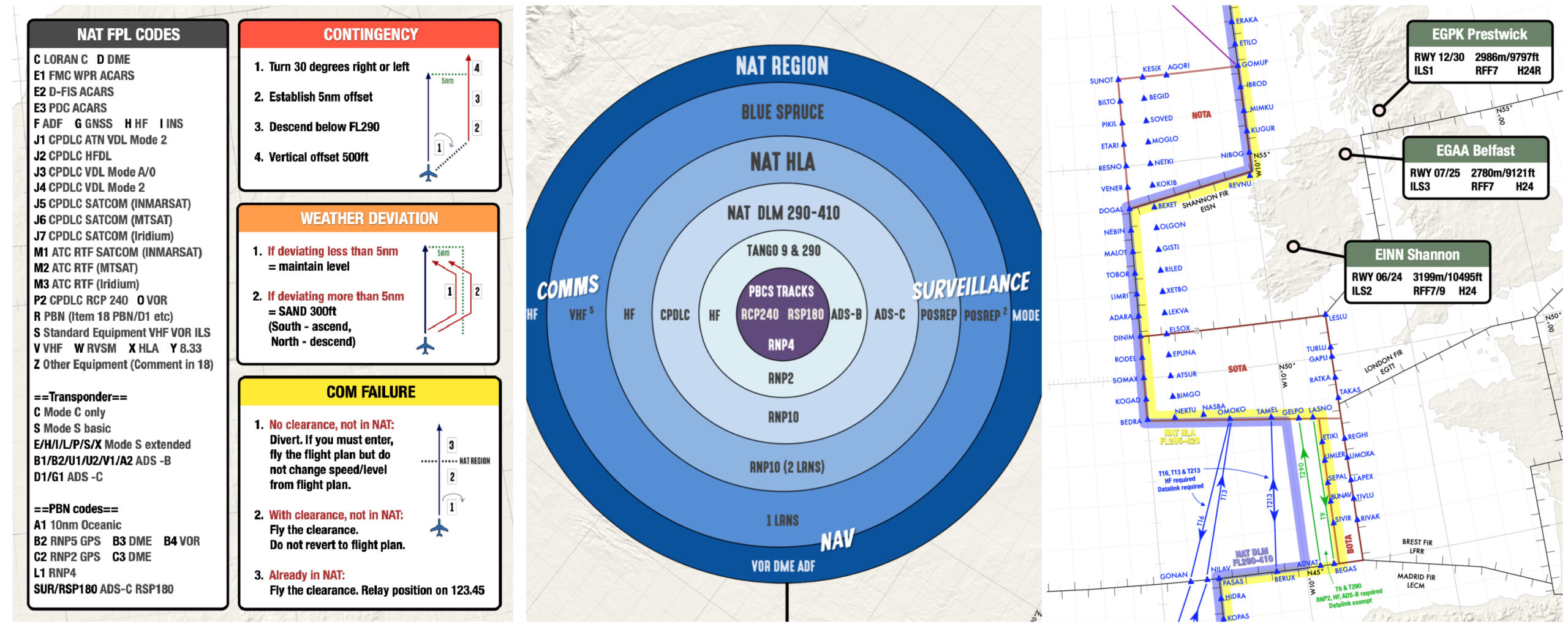
This chart is completely new – we started from scratch, expanded the coverage area, and then worked as a group to add all the useful things we could think of that a pilot or dispatcher crossing the North Atlantic might need.

New on this chart – effective July 2021:

  • FULLY UDPATED for 2021 post-COVID flying!
  • EXPANDED coverage area – much further down into the Atlantic, and further west.
  • NEW! NAT Tips – using NAT Tracks, SLOP, filing an Oceanic Flight Plan, and helpful tips
  • NEW! Quick reference for contingency, weather, and comms failure with easy graphics.
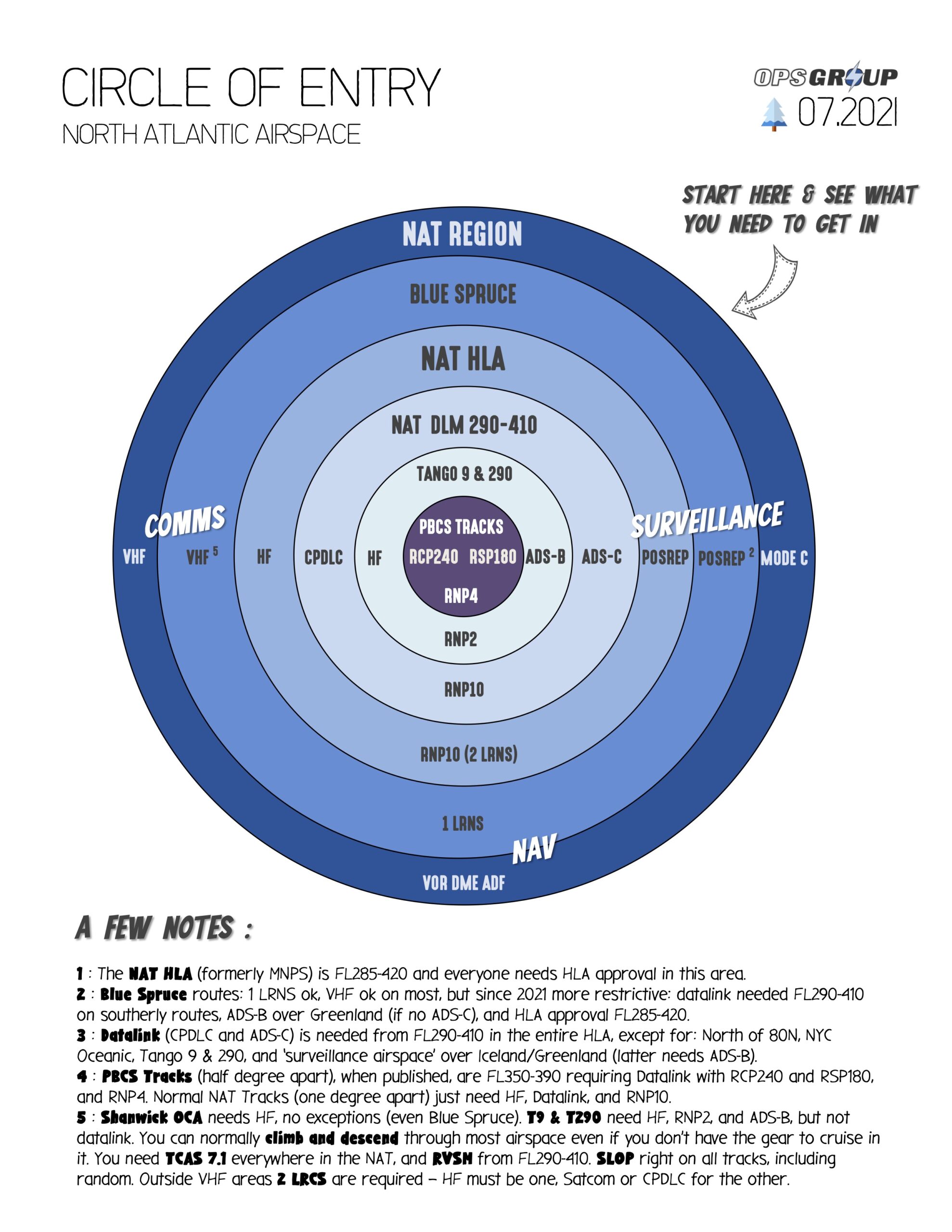
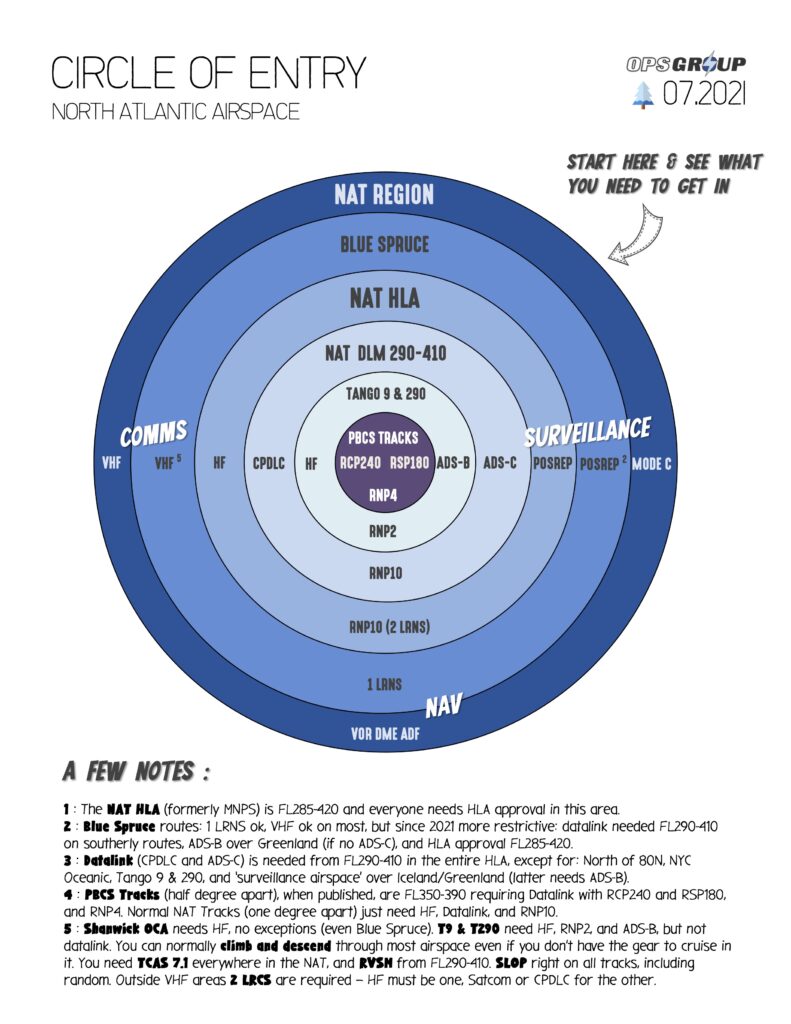
  • Updated: NAT Airspace Circle of Entry 2021 – easily check what you need for Nav, Comms and ATC Surveillance depending on which bit of the NAT you will be flying through.
  • Additional diversion airports, now 16 total primary NAT alternates with runway, approach, length, RFF, and hours
  • Easy view of boundaries for HLA and DLM/Datalink mandated airspace
  • Updated NAT FPL codes, clearance frequencies, Satcom, and HF
  • Fully updated “South East Corner” with new Tango routes
  • and … Treasure Boxes!

Other chart features:

:: Requirements for NAT tracks, PBCS tracks, datalink mandate.
:: Common NAT Diversion Airports.
:: Runway Orientation, Length, best IFR Approach.
:: RFF Category and Opening hours.
:: NAT FPL Codes and sample FPL.
:: Blue Spruce routes and equipment requirements.
:: All NAT Entry/Exit points with associated required landfall fixes.


How to get the new chart, if you’re not a member?

OPSGROUP members get this and other publications free of charge, all available through your member dashboard.

There have been many changes on the North Atlantic since we published our previous chart in 2019.  Here’s a few things to read up on:

We hope you find it super useful, but also have fun using it!


Safety on the NAT: B+ with room for improvement

The eighth Annual Safety Report for the North Atlantic Region is out, and it looks good. A solid B+ for pilots and ATC alike.

But there is still room for performance improvement, so here are the highlights from the report to focus on.

Did anyone fly in 2020?

The number of flight hours in the NAT HLA through 2020 was 892,137 which was unsurprisingly a decrease on the 2019 hours (2,063,908 in case you’re wondering).

The peak week was July 15-21 when it saw 5,621 flights crossing, compared to 13,733 for the peak week of 2019.

If you want to check and compare all the stats to 2019 then here is our post on that.

What have they been monitoring?

Safety Performance in the NAT HLA is monitored and measured in 12 areas. The targets for 6 of these were achieved in 2019, while 2020 achieved an impressive 8.

The biggest improvements seem to be:

  • Less Large Height Deviations where Datalink was not in use
  • A reduction in the amount of time aircraft with datalink spent at the wrong flight level
  • A reduction in the number of GNE events involving aircraft with datalink

How likely are you to fly into someone else?

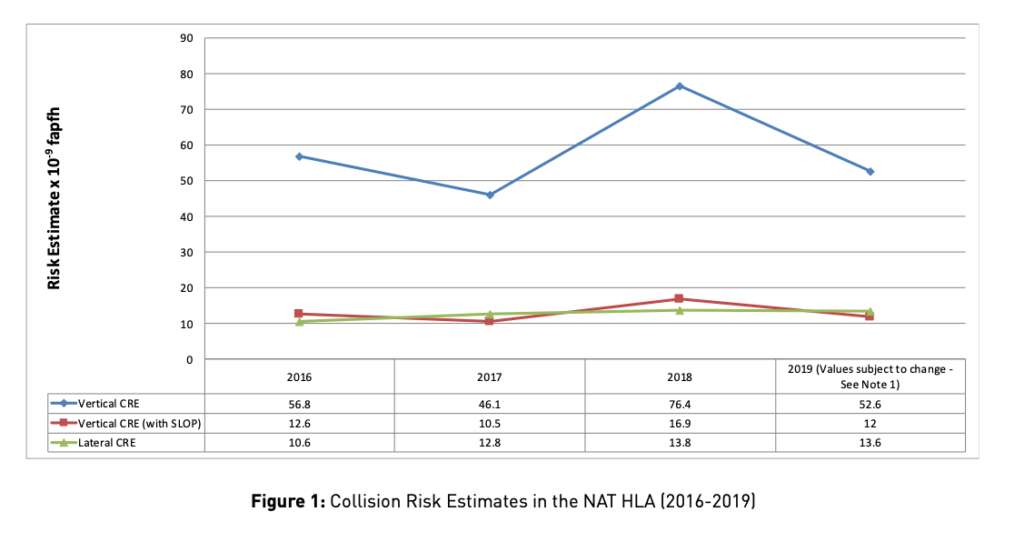
Much of the safety focus in the NAT really boils down to this – it is an area of reduced separation and high density traffic. So, they also worked out the risk of collision and in 2020 it reduced by 74%, which is probably down to less aircraft but also to less mess-ups. 

SLOP is one of the main factors in reducing this number. And it doesn’t just reduce the risk of collision, it reduces your risk of running into wake turbulence as well. So keep up that slopping, up to 2nm right (and 0.1nm increments).

Who’s to blame for the times it did go wrong?

Ok, ok, the purpose of the report is not to point fingers, but to understand where improvements can be made.

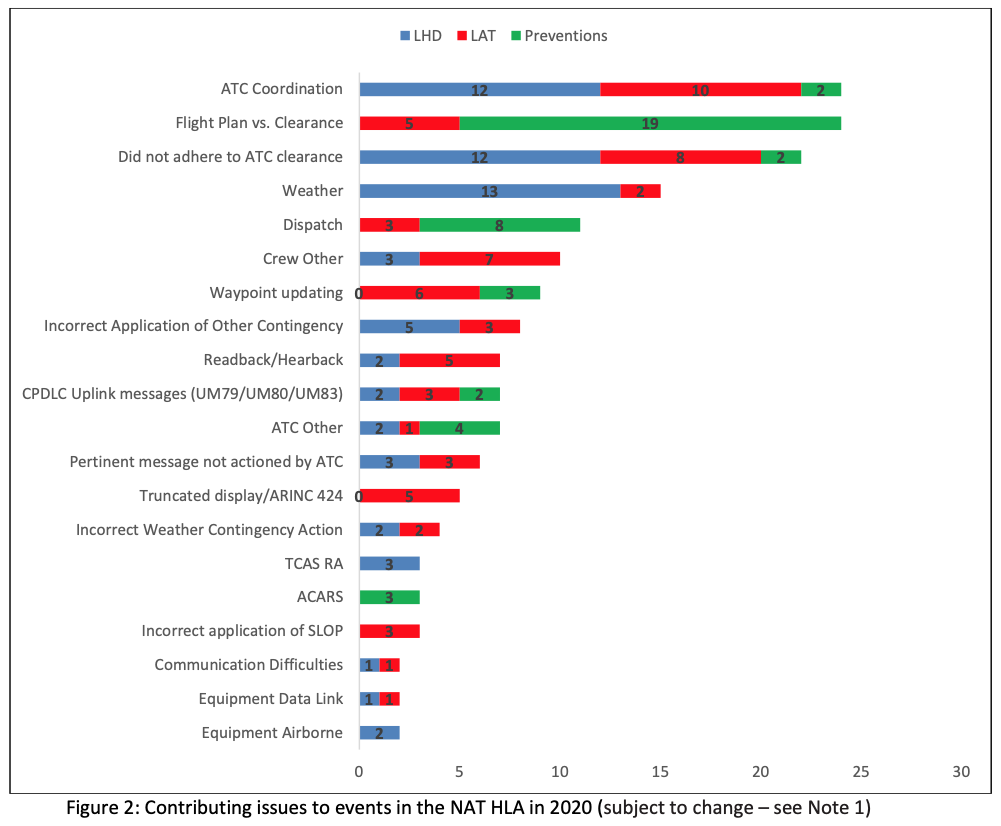
The Top 10 factors in errors haven’t really changed – ATC coordination errors are top, closely followed by “crew other” (which pretty much means crew not doing what they’re told, messing up etc) and then interestingly application of contingency (other than weather).

So here is a quick recap on those Contingency Procedures to follow

Some facts and figures

Since 2019, 70% of core NAT traffic has been using ADS-B.

There have been no accidents in the NAT since at least 2017. 2020 also saw no losses of lateral separation for the first time since 2017.

They did see 47 LHDs, 57 Lateral Deviations (15 were GNEs, the other 13 were caught and corrected by ATC), 26 coordination events, 1 longitudinal loss of separation and 30 events they prevented where someone was basically just flying the wrong flight profile.

18% of events were down to ATC coordination between different ATC sectors.

18% also came down to fight plan versus clearance issues.

11% were weather related. 

Issues with dispatch contributed another 8% and everything else was down to, well, lots of other things.

How can we improve?

Follow the Golden Rules of operating in the NAT HLA:

  • Have the Right Equipment: If you ain’t sure then check out our Circle of Entry.
  • Have a Clearance: If you can’t get it on CPDLC then have those HF or VHF frequencies ready for a voice clearance, and make sure you read it back and confirm it correctly.
  • Check your Route: This means flying what you’ve actually been told to fly which means checking what is in the airplane box matches what is in the clearance. It probably should say ‘flight profile’ because it means route, altitude and speed.
  • Know your Contingencies: We added the picture above to help. Read more about this here.

And don’t forget to SLOP.

Keep up to date on NAT info

Photo @Algkalv from Wikimedia Commons


2019: Safety Net on the NAT

2019 seems so long a go. A golden age for aviation with airplanes swooshing happily through the skies, and none so happy as those crossing the NAT.

Or were they?

Well, now we can check because the NAT Systems Planning Group 2019 Annual Safety Report has just been released. 2019 might seem a fair old while ago, but the report speaks of a time before Covid when aviation was at normal levels and so offers good guidance on what’s up in the NAT world normally.

What is monitored?

If you were thinking the only things you’re monitored on are your competencies and KSAs in sim assessments, then think again. You are being watched all the time, and especially so in the NAT where 12 Safety Key Performance Indicators are watched like a hawk watches a juicy mouse in long grass.

Targets for reducing the number of errors in these areas are set using three year rolling data.

So, how did we all do?

Well, in 2019, six of the targets were met and there were notable improvements in these three areas:

  • Percentage of long duration height deviations
  • Rate of long duration height deviations where datalink was not in use
  • Number of minutes spent at wrong fight level for aircraft not using datalink

So, pilots have got better at reading their altimeters and not flying at the wrong altitude.

The risk of vertical collision estimate saw an impressive 30% improvement, and they reckon with the use of SLOP this can be reduced another 77% making it… 30/100*77{equation stuff}#100[somethingbysomethingoversomethingelse]… a lot less likely we will fly into each other. Good job all.

What is going less well?

Lateral collision risk estimates reduced, but there were still 80 reported lateral deviations. So we’re flying at the right altitude, but sometimes in the wrong place.

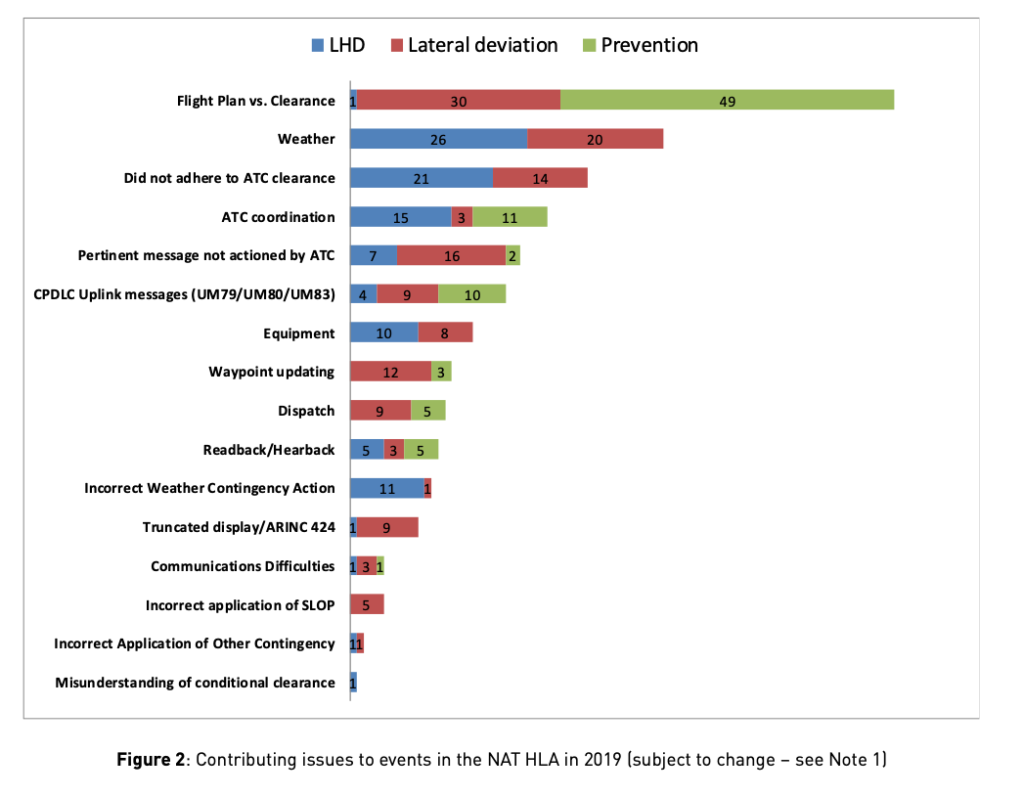
Flight plan versus what ATC actually cleared pilots to do are the top of the list, making up 30% of  the total. 49 of those were prevented by ATC. Not adhering to ATC clearances increased from 10% in 2018, to 13% in 2019, and weather was another biggie making up 17% of all lateral deviations.

ATC coordination errors were also in the top 5 (11%) so don’t congratulate them too much. ATC were also provided with conformance monitoring tools which highlighted cleared versus selected level differences, and route assignment monitoring tools to help them intervene and prevent deviations. With these in place, the performance in the second half of 2019 did improve a lot.

Ok, congratulate them a lot, they’ve made it much safer for us up there.

Overall, what’s the verdict?

No gold star because there were still 266 events reviewed in 2019 by the SPG. These included:

  • 83 large height deviations
  • 118 (actual) lateral deviations including
    • 42 GNEs
    • 44 ATC interventions where ATC prevented pilots making GNEs
  • 73 prevented events where ATCOs stopped aircraft flying an uncoordinated flight profiles or entering the wrong airspace sort of things.

It isn’t always pilots going wrong though. Some of these were down to equipment issues, some down to ATC not responding quick enough. Here is the full breakdown – 

What else is going on up there?

Well, in 2019, when a normal number of aircraft were still flying, they were able to properly monitor the communication and surveillance side of things too, and a whopping 70% of core NAT traffic were using ADS-B. 83% of aircraft were making use of CPDLC over HF radio as well, and the use of these is a big factor in improving the safety and efficiency up there.

The report says this leads to a ‘greater focus on strategic rather than tactical techniques’ which sounds like ‘we are now planning aircraft not to fly near each other’ rather then ‘when aircraft get too close we move them out of each other’s way’.

As a reminder, you have until February 25 to get yourself Datalinkable – the NAT Datalink mandate comes in then.

What next?

2020 data might be a little skewed given a lot less traffic flew, (and many of those who did probably did so after a big gap of not flying), but the overall trend is big improvements. ADS-B is an excellent thing, ATC have a bunch of tools to help them make us safer, and pilot errors are reducing.

There is also a NAT2030 vision plan which is aiming for:

  • more flexibility through ‘dynamic airborne rerouting”
  • improved contingency procedures
  • better comms and surveillance and new technologies
  • a focus on improving the environmental impact
  • and maybe even some new visitors to the region in the shape of unmanned aircraft supersonic aircraft and even balloons

Until then, get out your own balloons and have a little celebration because safety is improving on the NAT. Now put them away. There is still work to be done.

The full report can be checked out here


Canadian Operators need Special Authorization to keep flying in the NAT

Transport Canada has said that all old NAT MNPS authorizations are no longer valid for flights operating across the North Atlantic as of 31st Jan 2020 in NAT HLA airspace between FL290-410. In its place, a new special authorization called NAT HLA MNPS will have to be added to the operator’s PORD or AOC in order to fly in this airspace, which includes the NAT Tracks and Blue Spruce Routes. Airspace above FL410 or below FL290 is not affected by this.

Transport Canada did issue a Civil Aviation Safety Alert (CASA) about this back on 10th Jan 2020, but later admitted it was too vague and difficult to understand – therefore they will reissue the CASA. But in the meantime, the requirement to get this new special authorization still stands. Here’s how it works:

How do you apply for this new SA?

It appears to be fairly simple. The operator emails TC applying for the NAT HLA MNPS special authorization. TC will reply by email including a compliance guide to verify equipment and training requirements.

If you wish to operate in the Organized Track System, there are 4 Special Authorizations that Canadian operators must hold:

  1. NAT HLA MNPS;
  2. RVSM;
  3. RNP 4 or RNP 10; and
  4. PBCS (ADS-C with proof of contract)

What if you don’t have PBCS? Where can you operate?

If you hold the first 3 SAs listed above and the ADS-B SA you may operate on the Blue Spruce Routes only. That’s ADS-B for Broadcast.

So to summarize…

Scenario one is that you already possess RVSM, RNP 4 & 10, and PBCS (ADS-C with proof of contract). Your process is to to e-mail TC for the application for the NAT HLA MNPS special authorization. A compliance guide will be sent out to verify equipment and training requirements. Once it has been returned and reviewed, a new PORD or AOC will be issued which will contain the new NAT HLA MNPS special authorization.

Scenario two is you do not possess PBCS with ADS-C, but you are either ADS-B capable or already hold a special authorization for ADS-B. In this case the process will be to apply for the NAT HLA MNPS vis email and a similar compliance guide will be sent out to verify equipment and training requirements. The difference is that your special authorization will be restricted to the Blue Spruce Routes only. You can request the ADS-B special authorization in the email if you don’t have it already. Simply note that in your e-mail request.

Further reading

CBAA new forum information, with login credentials: https://www.cbaa-acaa.ca

CASA links can found here: https://www.tc.gc.ca/en/services/aviation/reference-centre/safety-alerts.html

Original CASA 2019-10 Issue 01 that will be replaced: https://www.tc.gc.ca/en/services/aviation/documents/CASA-2019-10.pdf


Thanks to the Canadian Business Aviation Association who helped provide the information in this post.


Regulatory deadlines on the horizon

Regulatory compliance – nothing quite warms the heart like reading those two words, side by side. This year has seen quite a few changes in this department already (thank you, NAT HLA!), but here is a list of some other regulatory deadlines on the horizon…

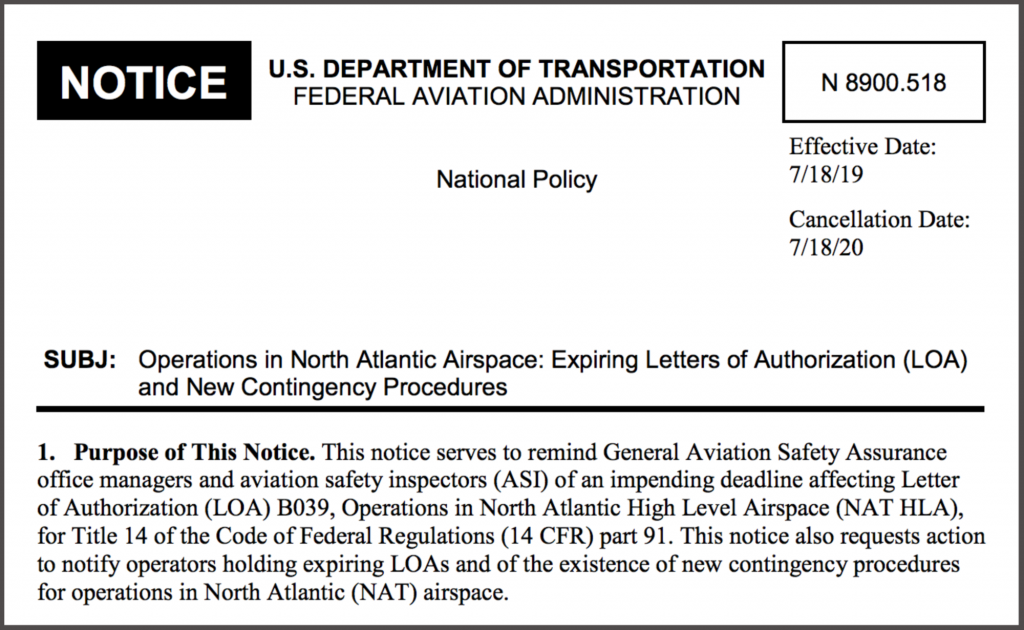
Dec 31, 2019 – Operations in North Atlantic

  • U.S. operators must have the revised LOA BO39: “Operations in North Atlantic High Level Airspace (NAT HLA)”. Operators holding the old MNPS LOA BO39 will not be permitted to fly in the NAT HLA beyond this date. Requirements include: RNP10, crew training and new contingency procedures incorporated in company operating handbooks. Read our article here.

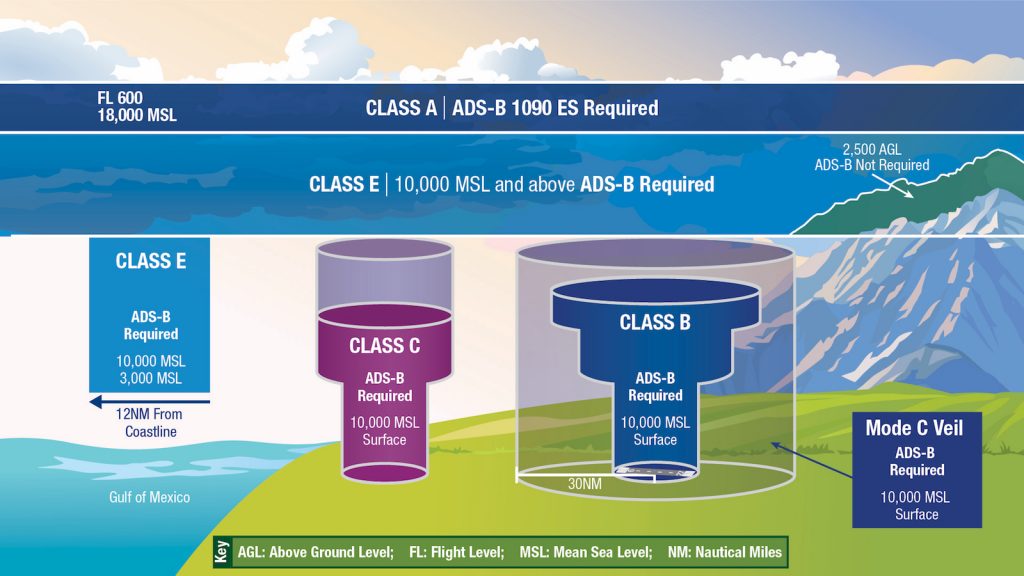
Jan 1, 2020 – US ADS-B Out Mandate

  • ADS-B Out will be required where Mode C is required AND:
  • Class A, B and C airspace, Class E at or above 10,000’ MSL (but not below 2,500’ AGL).
  • Within 30nm of Class B (Mode C veil).
  • Above the ceiling and within lateral boundaries of Class B and C up to 10,000’.
  • Class E over Gulf of Mexico, at and above 3000’ MSL within 12 nm of US coast.

Jan 30, 2020 – Expansion of Datalink Mandate in the North Atlantic

  • Phase 2C of North Atlantic Datalink Mandate. FANS 1/A CPDLC and ADS-C will be required between FL290-FL410 throughout the entire NAT region (previously FL350-390). Read our article here.

Feb 5, 2020 – European Datalink Mandate

  • Initially legacy aircraft flying above FL290 in European airspace were to be equipped with CPDLC capability by Feb 2015. But due to equipage requirements and technical issues the mandate was delayed to Feb 2020, AND, even better, most GA/BA aircraft will be exempt from this. Read our article here.

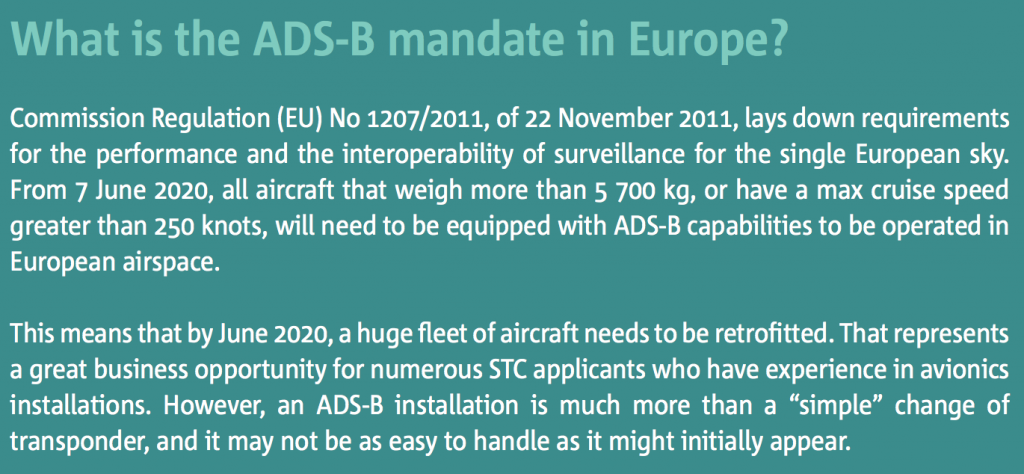
June 7, 2020 – European ADS-B Out Mandate

  • Aircraft flying IFR in Europe with max certified takeoff weight of more than 5700kg (12,566lbs) OR max cruising TAS of more than 250kts must be equipped with ADS-B. GPS sensor with at least WAAS accuracy coupled to a 1090 Extended Squitter transponder required.


DELAYED:

Canada: ADS-B Out Mandate

  • This was planned to be implemented in Class A airspace from Feb 2021, and Class B airspace from Jan 2022. But Nav Canada has now postponed this mandate. They still plan on using ADS-B for surveillance, and this will be used on a priority basis for suitably equipped aircraft starting in 2021, but they say – “non ADS-B Out equipped aircraft will be accommodated within the airspace until a performance requirements mandate can be implemented.”

ALSO ON THE HORIZON:

August 14, 2020 – EU: SAFA Ramp Checks & Pilot Mental Health

  • EASA regulations requiring alcohol testing during ramp checks will take effect across all SAFA participating countries (although some countries have already started doing this: Austria, Belgium, Czech Republic, France, Germany, Greece, Iceland, Ireland, Italy, Netherlands, Portugal, Spain, Switzerland, UK, and Singapore). Tests may also be carried out by local police at any time.
  • All pilots working for European airlines will have access to mental health support programs.
  • European airlines will perform a psychological assessment of their pilots before the start of employment.

Any other biggies that we missed? Let us know!


Your MNPS approval is about to expire (so don’t get banned from the NAT)

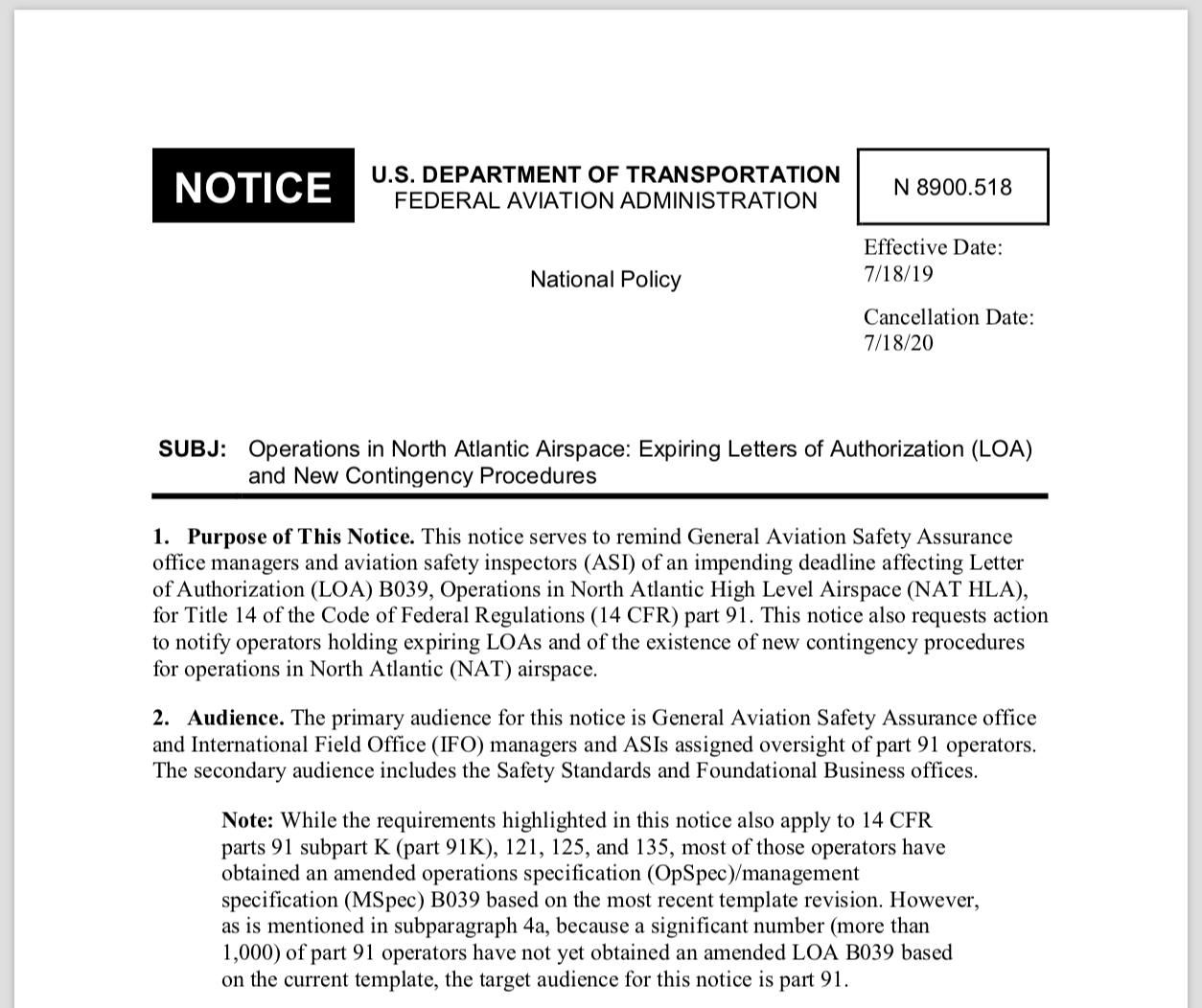
U.S. operators with the old MNPS approvals issued before 2016 have until 31 Dec 2019 to get these updated if they want to keep flying on the North Atlantic!

The FAA issued new guidance on this on 18 July 2019:

They say that there could be more than 1,000 GA operators who still have old NAT MNPS approvals, and all these operators will need to get new B039 LOAs to be able to continue flying on the North Atlantic beyond 31 Dec 2019.

The new B039 LOA is for “Operations in the North Atlantic High Level Airspace”. To get it, operators need to provide evidence of compliance with the NAT HLA requirements particularly in regard to RNP 10 equipage, flight crew training (including the new contingency procedures), and have operating procedures in place.

Operators will also need to make sure they have an B036 LOA for “Oceanic and Remote Continental Navigation Using Multiple Long-Range Navigation Systems”.

Here’s the lowdown: If you have an old MNPS approval, you need to apply for the B039 LOA very, very soon! The closer we get to the Dec 31 deadline, the stronger the chance that it will take longer for the FAA to process yours, and this means that 2020 will not get off to a good start when you have to explain why you’ve been banned from the NAT! Help yourself, and the FAA, get through this by applying for it as soon as possible.

Mitch Launius is an International Procedures Instructor Pilot with 30West IP and can be contacted through his website: www.30westip.com


2019 North Atlantic changes

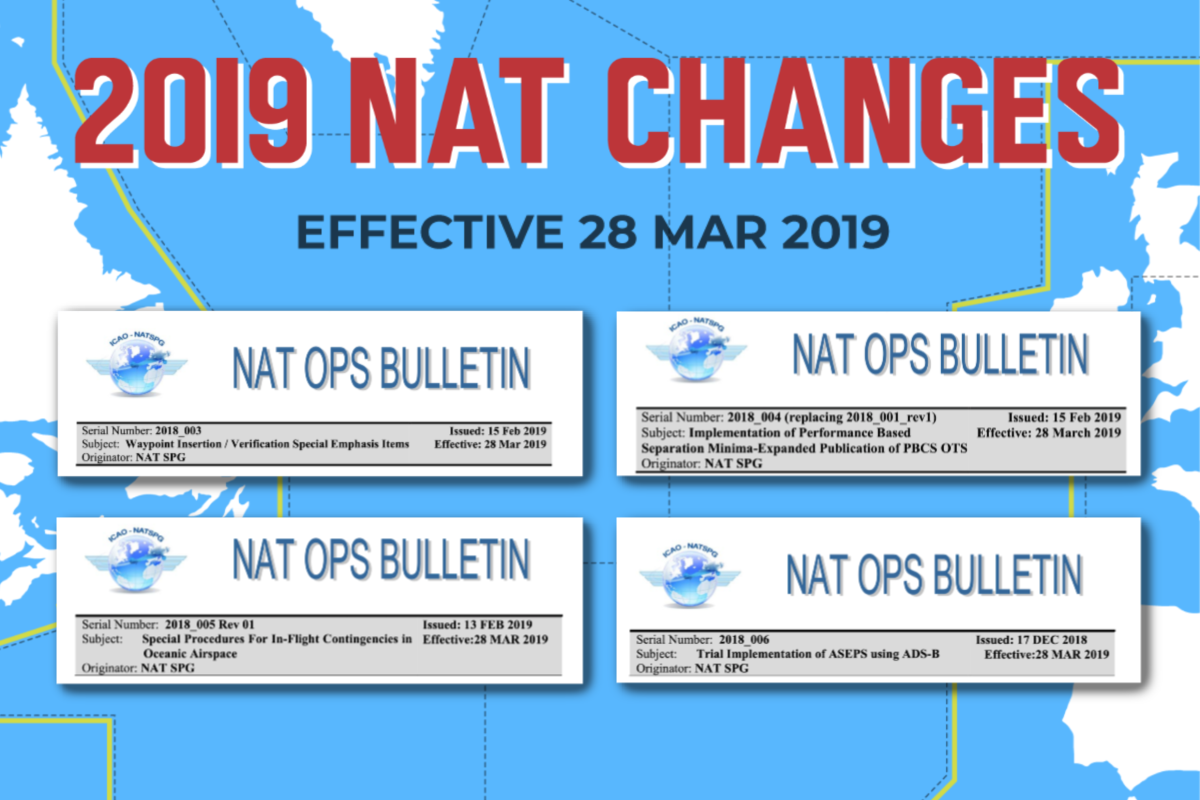
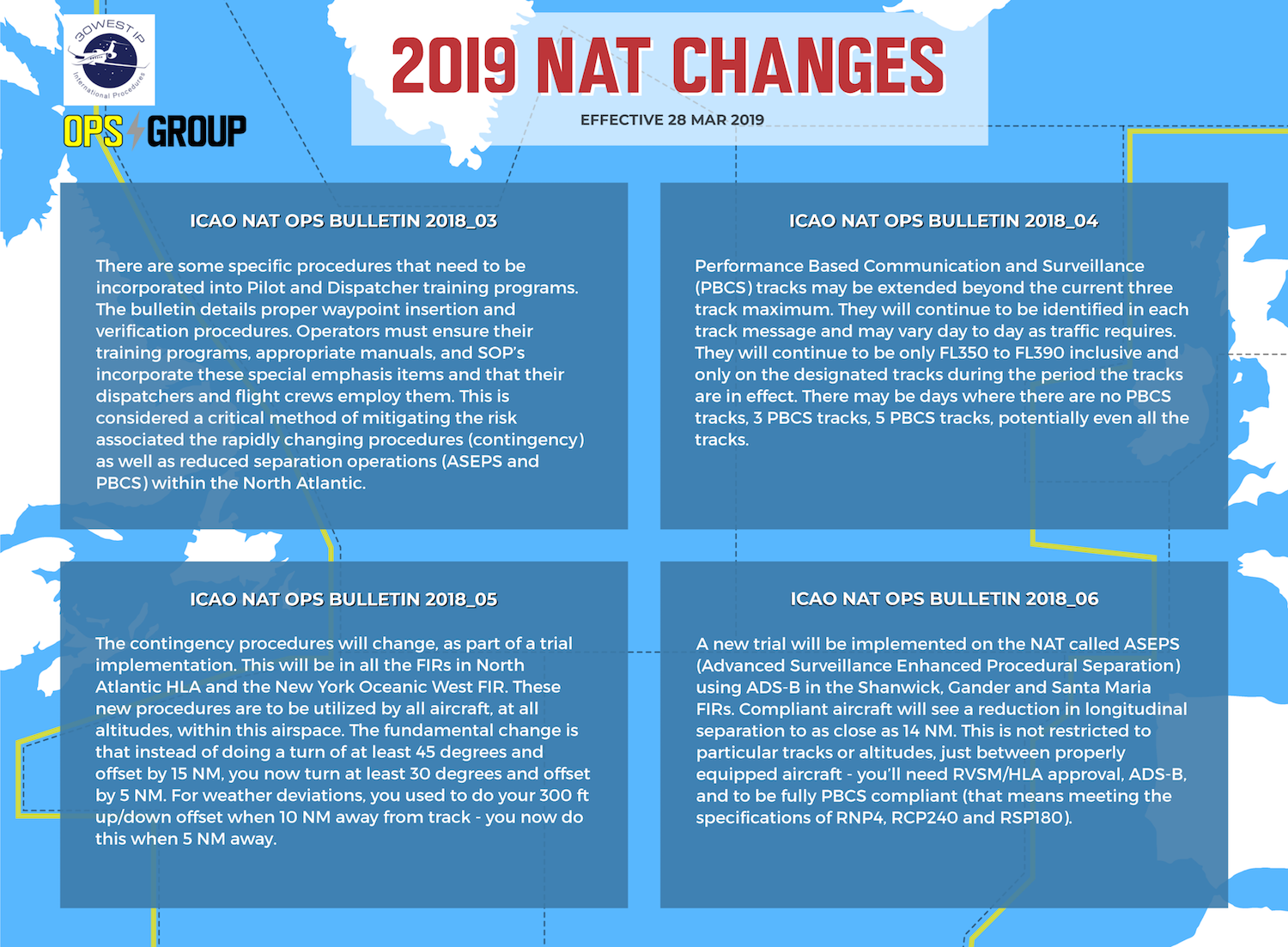
There are four ICAO NAT Ops Bulletins due to go into effect on March 28th, 2019. The PBCS tracks will be expanded, real-time Space-Based ADS-B surveillance and reduced separation standards will be introduced, and the regional contingency and weather deviation procedures will be changed.

You can click on each one, and read them in full:

We have had a good look at each of them. Here’s the lowdown:

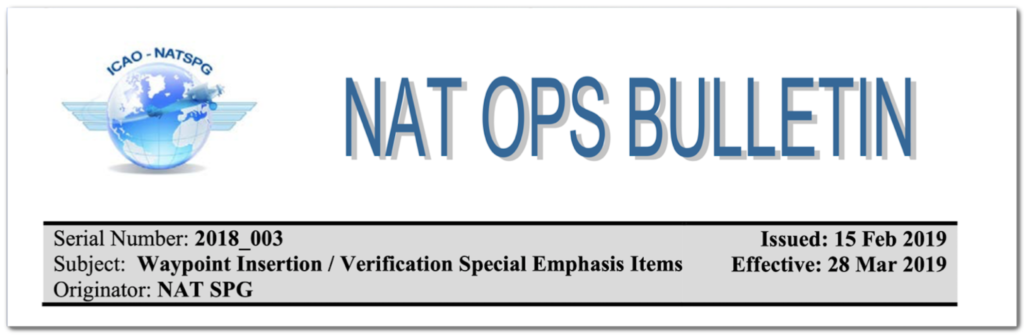
ICAO NAT Ops Bulletin 2018_03: Waypoint Insertion / Verification Special Emphasis Items
Lowdown: There are some specific procedures that need to be incorporated into Pilot and Dispatcher training programs. The bulletin details proper waypoint insertion and verification procedures. Operators must ensure their training programs, appropriate manuals, and SOP’s incorporate these special emphasis items and that their dispatchers and flight crews employ them. This is considered a critical method of mitigating the risk associated the rapidly changing procedures (contingency) as well as reduced separation operations (ASEPS and PBCS) within the North Atlantic.

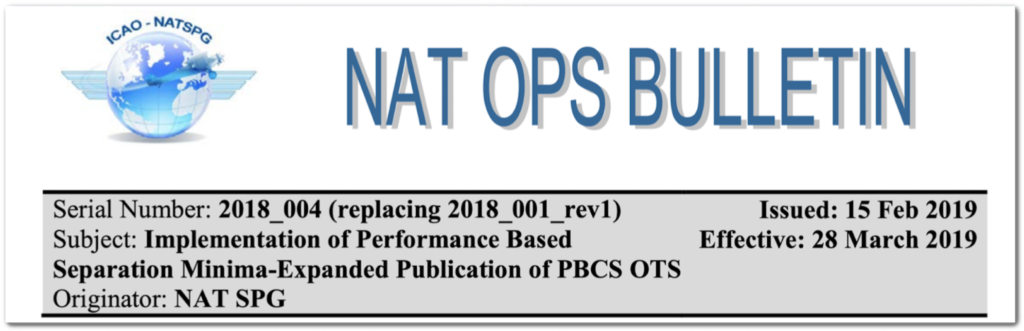
ICAO NAT Ops Bulletin 2018_04: Implementation of Performance Based Separation Minima-Expanded Publication of PBCS OTS
Lowdown: Performance Based Communication and Surveillance (PBCS) tracks may be extended beyond the current three track maximum. They will continue to be identified in each track message and may vary day to day as traffic requires. They will continue to be only FL350 to FL390 inclusive and only on the designated tracks during the period the tracks are in effect. There may be days where there are no PBCS tracks, 3 PBCS tracks, 5 PBCS tracks, potentially even all the tracks.

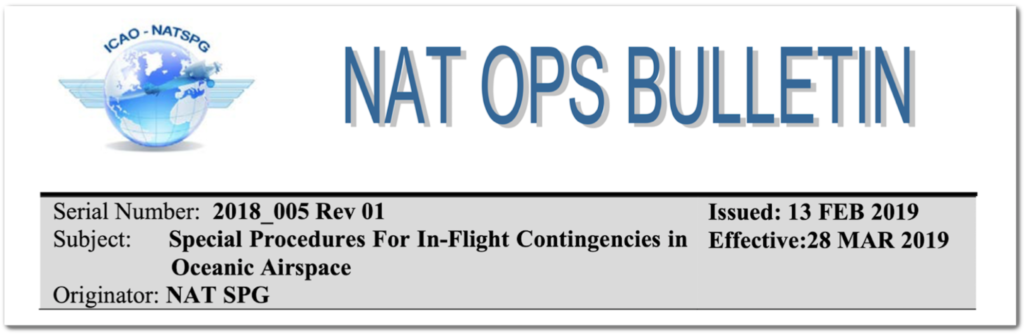
ICAO NAT Ops Bulletin 2018_05: Special Procedures For In-Flight Contingencies in Oceanic Airspace
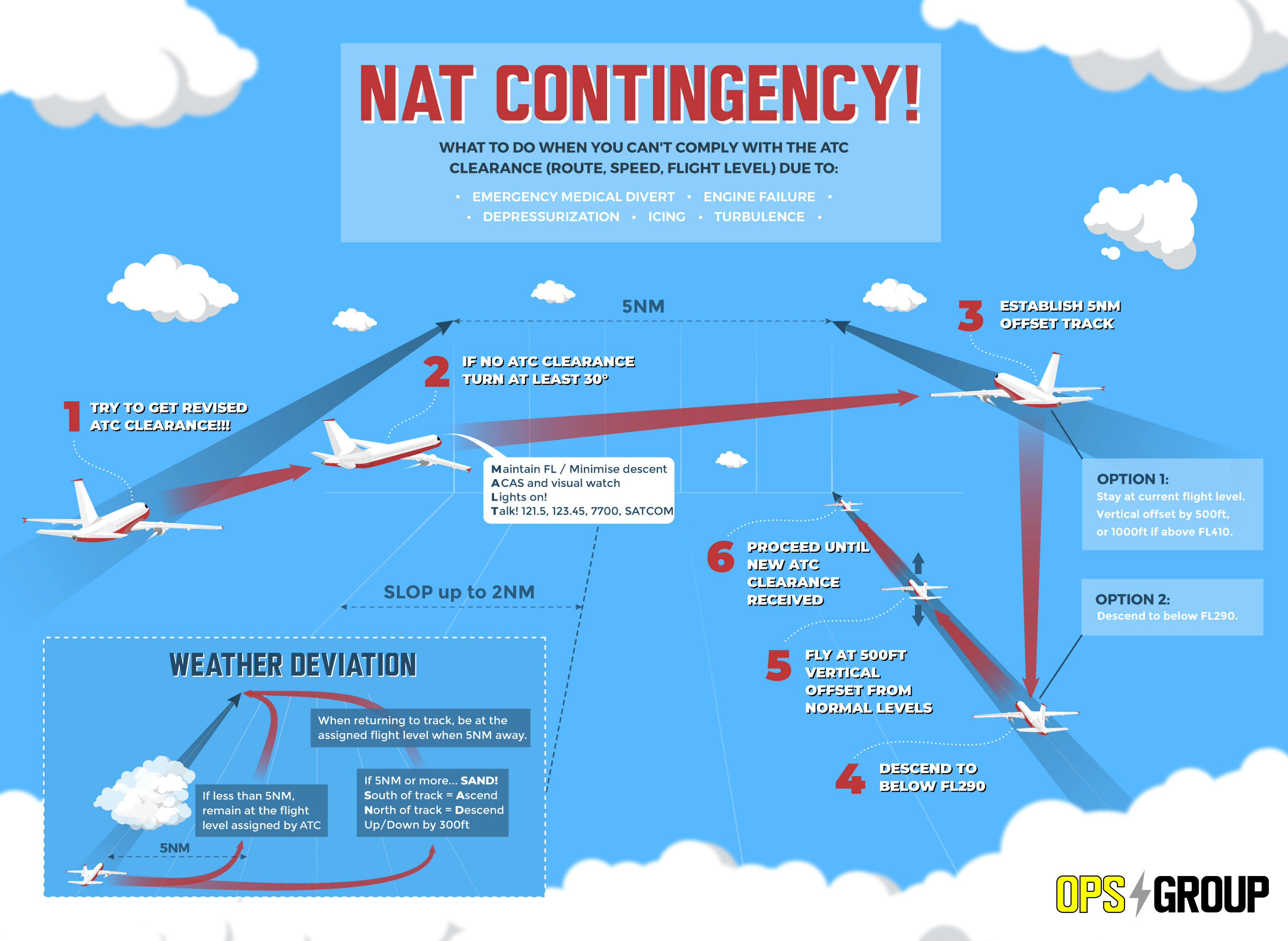
Lowdown: The contingency procedures will change, as part of a trial implementation. This will be in all the FIRs in the NAT Region and the New York Oceanic West FIR. These new procedures are to be utilized by all aircraft, at all altitudes, within this airspace. The fundamental change is that instead of doing a turn of at least 45 degrees and offset by 15 NM, you now turn at least 30 degrees and offset by 5 NM. For weather deviations, you used to do your 300 ft up/down offset when 10 NM away from track – you now do this when 5 NM away. For more info on this, read our article.

ICAO NAT Ops Bulletin 2018_06: Trial Implementation of ASEPS using ADS-B
Lowdown: A new trial will be implemented on the NAT called ASEPS (Advanced Surveillance Enhanced Procedural Separation) using ADS-B in the Shanwick, Gander and Santa Maria FIRs. Compliant aircraft will see a reduction in longitudinal separation to as close as 14 NM. This is not restricted to particular tracks or altitudes, just between properly equipped aircraft – you’ll need RVSM/HLA approval, ADS-B, and to be fully PBCS compliant (that means meeting the specifications of RNP4, RCP240 and RSP180).

So there you have it. We made a couple of handy graphics for all this. Print them out and sellotape them to your cockpit. (If you actually do this, please send us a photo!)

click on the image to open larger version

For a bit more of an in-depth look at the contingency and weather deviation procedures as shown in the image above, read our article.

And if you’re still hungry for more NAT info, we highly recommend you check out the replay of the webinar hosted by Mitch from 30WestIP, titled: ‘A North Atlantic Game Changer, 4 NAT OPS Bulletins all go into effect in one day’. This really breaks down each of the four new Bulletins which take effect from 28th March 2019 – essential viewing if you operate over the North Atlantic! View it here.

Further reading:

  • On 1st Nov 2018 we had a call with 140 OPSGROUP members about upcoming changes on the NAT in 2019, and how we can effect change. OPSGROUP members can find the PDF notes of this in your Dashboard.
  • A big thing driving the ASEPS trial is the rollout of Space-based ADS-B, which is scheduled to complete its deployment by 30 Dec 2018, giving us worldwide, pole-to-pole surveillance of aircraft. For more on that, and how it will affect operations on the NAT specifically, read the article by Mitch Launius here.
  • Use our quick guide to figure out where you are welcome on the NAT, depending on what equipment and training you have.

The Impact of Space-Based ADS-B on International Operations

I can distinctly remember the build up to and roll out of GPS navigations systems. Like so many of us, I was excited to see this new technology integrated into my cockpit. The idea that I would have the capability to accurately determine my position anywhere in the world was exciting!

It’s hard to overstate the significance of GPS navigation on the international operation of aircraft, particularly when operating in oceanic airspace. Today we are about to reach a similar milestone that could be even more significant – the introduction of a Space-Based Automatic Dependent Surveillance Broadcast (SB ADS-B) monitoring system.

When SB ADS-B completes its deployment (scheduled 30 December 2018), we will achieve worldwide, pole-to-pole surveillance of aircraft. This goes beyond a pilot knowing his or her own location. This opens up the ability for ATC to locate any ADS-B equipped aircraft anywhere in the world. With the US and EU ADS-B requirements approaching in 2020, aircraft that operate internationally will almost certainly be ADS-B equipped.

A brief history of Space-Based ADS-B

SB ADS-B technology has been placed into service by a commercial company, Aireon, and not a governmental entity, which has enabled it to be brought to operational status in a much shorter timeline than most other government implementations.

Although Aireon was initially established in 2012 to provide civilian surveillance services, the disappearance of Malaysia Flight 370 changed the industry. The inability to locate the aircraft forced industry regulators to consider how improved aircraft tracking might have helped to resolve the location of the aircraft in distress and prevent a future disaster. In response to this concern, ICAO created a standard for aircraft tracking designated as the Global Aeronautical Distress Safety System (GADSS). Aireon responded by creating a low-cost tracking solution based on aircraft ADS-B equipage utilizing the SB ADS-B network to meet that tracking requirement faster and cheaper than many of the alternatives.

This implementation takes advantage of the same ADS-B 1090ES systems already installed in most aircraft, not requiring any additional investment or modification from operators who currently comply with ICAO ADS-B approved 1090ES systems. Compare this to the evolving and evasive FANS 1/A+ requirements that have placed many operators in the position of having to upgrade aircraft (at great expense) only to find they are not PBCS and/or U.S. domestic compliant. Quite a contrast.

What are the benefits?

The primary advantage of the introduction of surveillance into oceanic operations will be a reduction in separation. Initially, this will be applied to in-trail spacing (longitudinal separation) and potentially reduce that separation to as close as 14 Nautical Miles (NM). The current longitudinal standard for data link approved aircraft is 5 minutes or approximately 50NM. The introduction would significantly increase the capacity of the most fuel-efficient routes and altitudes. The trial implementation is not expected to be restricted to specified tracks or altitudes, just between properly equipped aircraft.

Another key advantage of SB ADS-B is that the system is based on an active constellation of 66 low earth orbit satellites with geo-synchronous orbits that provide worldwide coverage. The system will also have 9 backup satellites available in orbit as well. The information on worldwide aircraft location will be in the system, it’s just a matter of having it sent to ATC control panels that are properly equipped to display the information. The SB ADS-B system operates independently from the ADS-B ground stations and can provide a direct data feed to air navigation service providers (ANSPs).

The primary targets for Aireon SB ADS-B services are ANSPs such as the FAA, EASA, Africa’s ASECNA, South Africa, New Zealand, Singapore, etc. This brings tremendous value to areas like Africa and Southeast Asia where ANSP’s face unique challenges involving infrastructure. Placing a network of ground-based ADS-B receivers in remote areas can expose them to vandalism or theft. As an example, a recently installed ILS system in Benin, Nigeria was stolen!

What does my aircraft need to be compliant?

In order for SB ADS-B separation reduction to be applied, aircraft will be required to be ADS-B and fully PBCS compliant. The controlling agency will determine eligibility based on the flight plan filing codes for ADS-B and PBCS. Let’s recall that the PBCS requires FANS 1/A+ approval with RCP240, RSP180, and RNP 4 capabilities. Just add ADS-B, NAT HLA, and RVSM equipage and approval and you’re ready! That is a lot of approvals, plus let’s not forget, TCAS Version 7.1 and Enhanced Mode S Transponder equipage is required as well.

Where will it be implemented?

Initial trial use of SB ADS-B for surveillance and separation will begin in Canada’s Edmonton Flight Information Region (FIR) in the first quarter of 2019. This will be followed by a planned trial launch in the North Atlantic (NAT) on 29 March 2019. The NAT oceanic surveillance trial program will be employed in both in Gander and Shanwick’s oceanic FIRs. Santa Maria will also introduce ADS-B separation standards, but that program will initially be limited to ground-based ADS-B operations.

We anticipate a mid-December 2018 release of a North Atlantic Ops Bulletin detailing the trial implementation which will be referred to as “Advanced Surveillance-Enhanced Procedural Separation” (ASEPS). This is to be followed by ICAO publishing the associated standards for ASEPS in a 5 November 2019 update to Procedures for Air Navigation Services – Air Traffic Management (PANS-ATM) Document 4444. This would move the ASEPS program beyond trial use and allow implementation of ASEPS based operations worldwide.

The final specifics involved in the trial program will be detailed in Canadian and United Kingdom Aeronautical Information Publications (AIPs), most likely involving a release of Aeronautical Information Circulars (AICs) to formally initiate the trial programs.

The NAT HLA does not anticipate requiring ADS-B for airspace entry but simply employing it as available. The impending U.S. and EU ADS-B requirements in 2020 will help ensure common equipage.

The introduction of ASEPS reduced separation standards in oceanic and remote regions will also impact contingency procedures for operators in the NAT HLA. To address this concern ICAO has created new contingency procedures for oceanic and remote operations which will also be identified in the November 2019 update to Procedures for Air Navigation Services – Air Traffic Management (PANS-ATM) Document 4444.

We expect the mid-December release of an additional North Atlantic Ops Bulletin detailing the trial implementation of these new contingency procedures in the NAT HLA airspace to be implemented with ASEPS. These new contingency procedures will initially only be used in the NAT HLA but, after the ICAO approval in November 2019, they may be implemented in other oceanic regions as well.

It would be important to note that the ASEPS target date for implementation, 29 March 2019, is also the target date for the expansion of the PBCS tracks in the North Atlantic Organized Track System. Add in the change in contingency procedures and that is a lot of moving parts, all happening at the same time, in the most congested oceanic airspace in the world.

One thing we don’t anticipate changing on March 2019 is strategic lateral offset procedures (SLOP). Changes may follow down the road but it’s not on the calendar now.

Let’s all get ready for a busy spring in the North Atlantic!

Mitch Launius is an International Procedures Instructor Pilot with 30West IP and can be contacted through his website: www.30westip.com


Did you know MNPS is over? Meet HLA, the new North Atlantic Airspace.

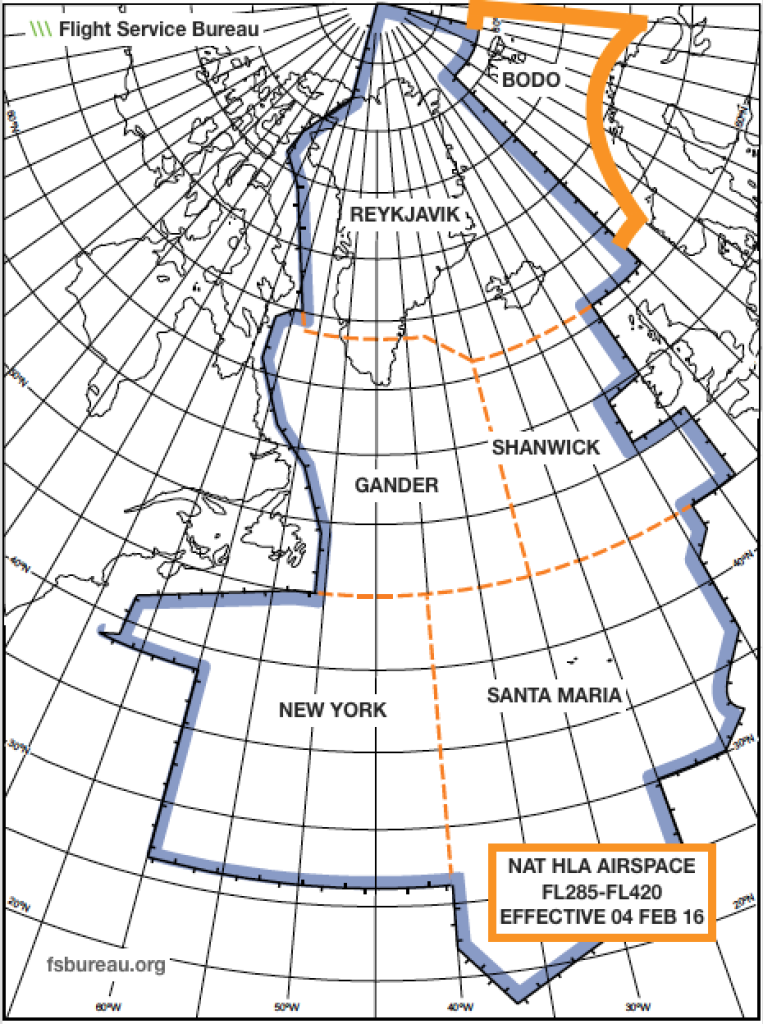
From Feb 4th, 2016, MNPS (Minimum Navigation Performance Specifications) Airspace is being dumped as a term (no loss, really), and replaced by the much more user friendly NAT High Level Airspace or NAT HLA. MNPS first came into being in 1977, and this change is significant in that the requirements for approval to enter the new NAT HLA are updated – you must now have RNP4, or RNP10. Also, the rest of the Atlantic welcomes Bodø Oceanic to the fray – it joins Shanwick, Gander, Reykjavik, New York, and Santa Maria to make up the new NAT HLA, which keep the original vertical profile of FL285-FL420.

In short, that’s all you need to know. You should read our International Ops Notice 01/16 for the full story.