March 2024 Singapore Airspace Changes

Singapore and Indonesia will realign their FIRs from 21 Mar 2024.

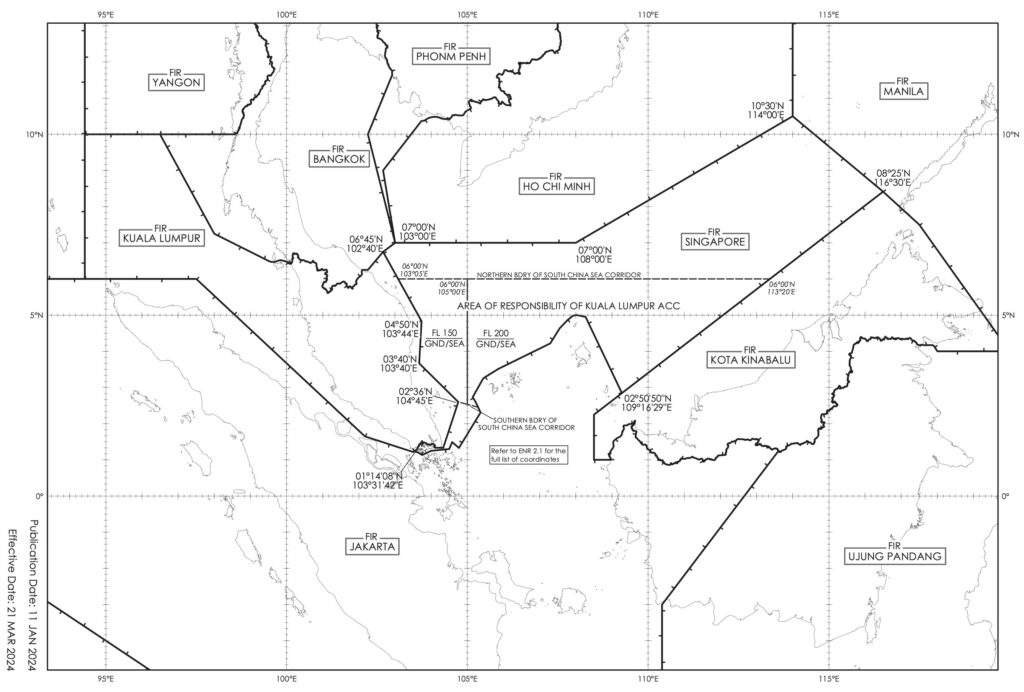
They agreed to do this so that the new FIR boundary (between the WSJC/Singapore and WIIF/Jakarta FIRs) will be generally more aligned with Indonesia’s territorial boundaries.

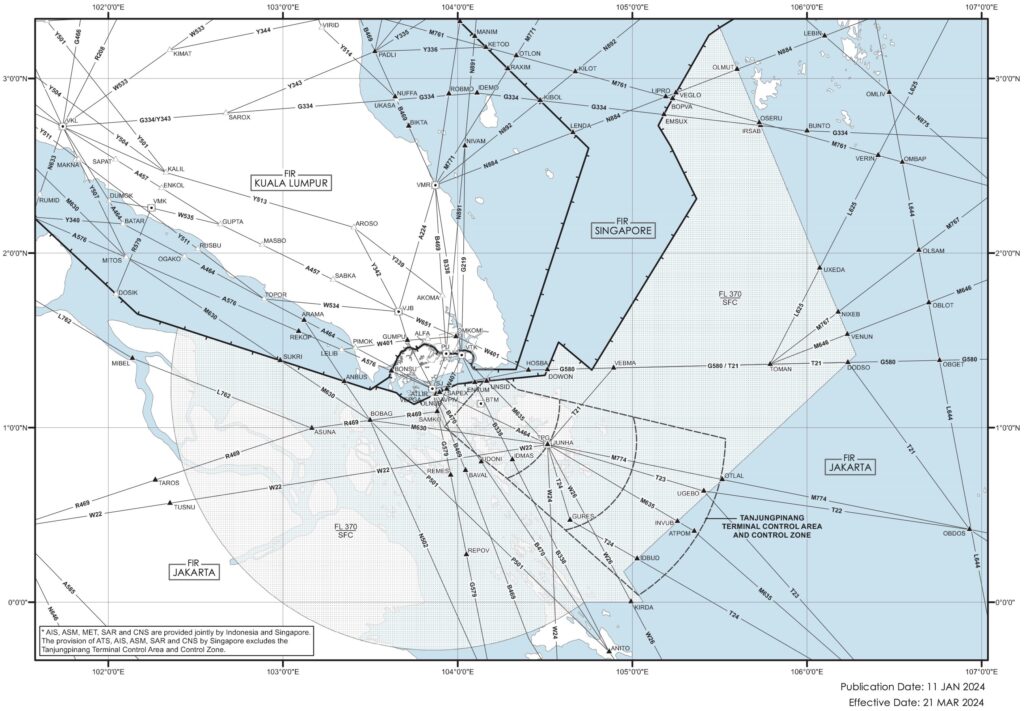
It looks like not much will change in terms of flight ops, as Singapore will continue to control the airspace. For full details of the upcoming change, check SUP 18/2024.

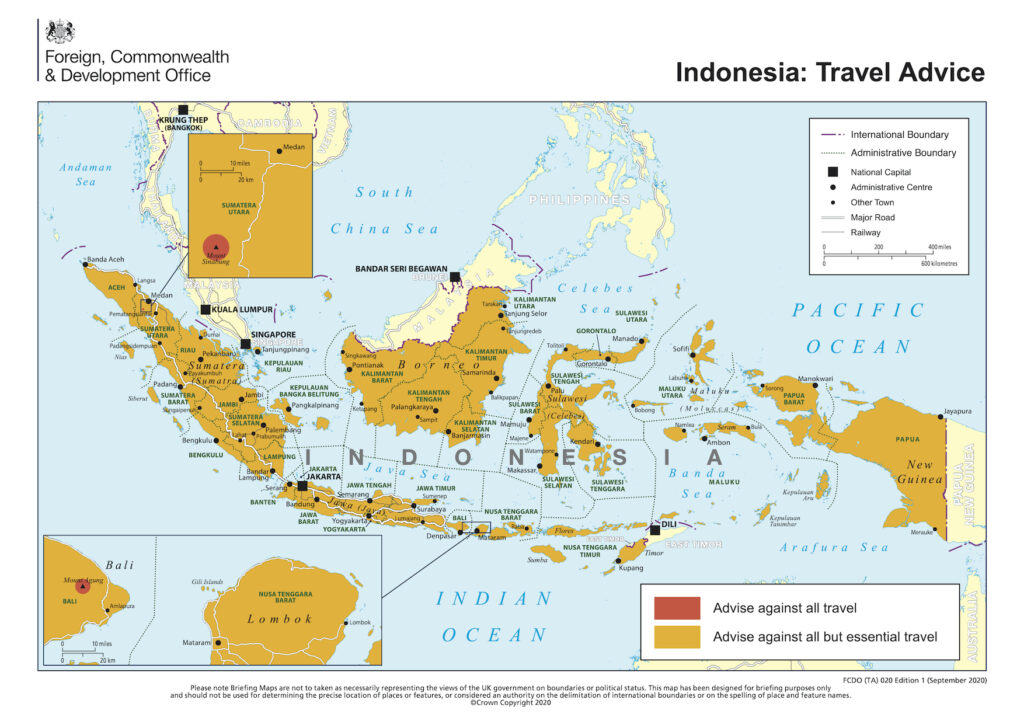
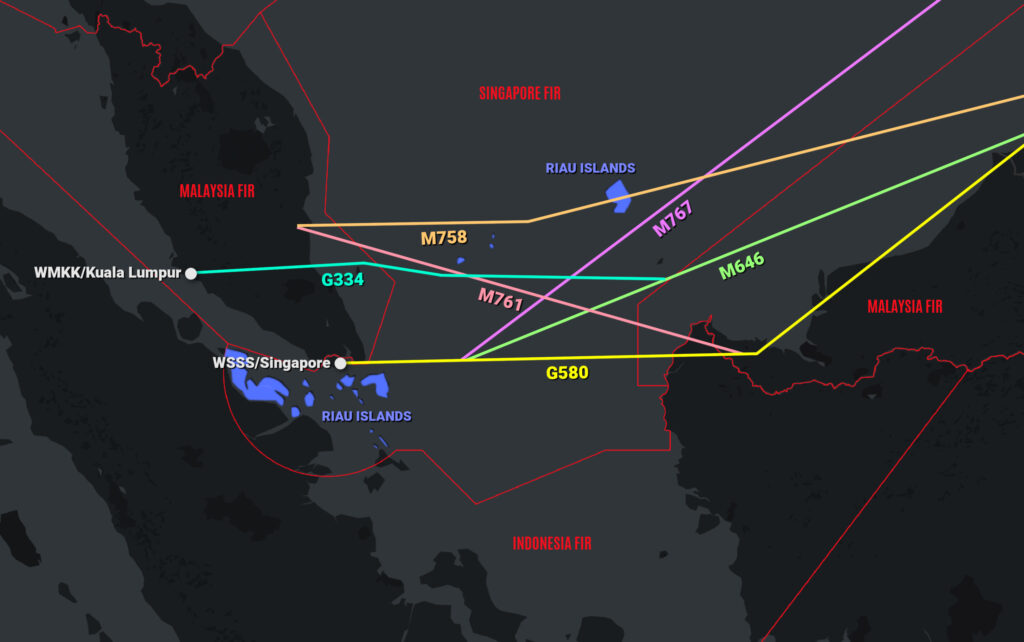
But there is one important issue this FIR realignment will hopefully fix for good – it will now be more clear that overflights of Indonesia’s Riau Islands require an Indonesia overflight permit!

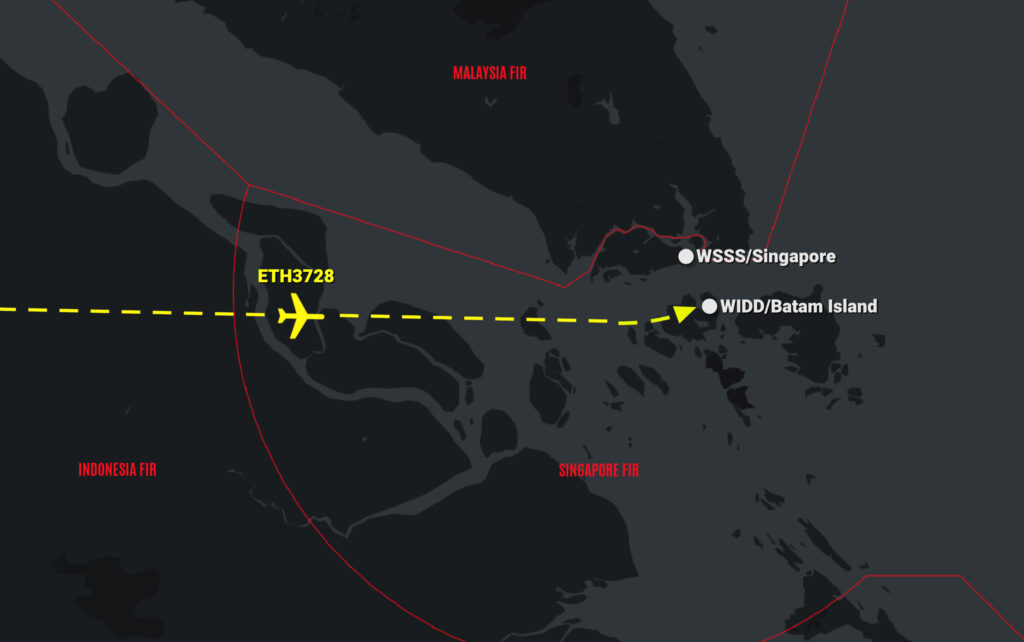
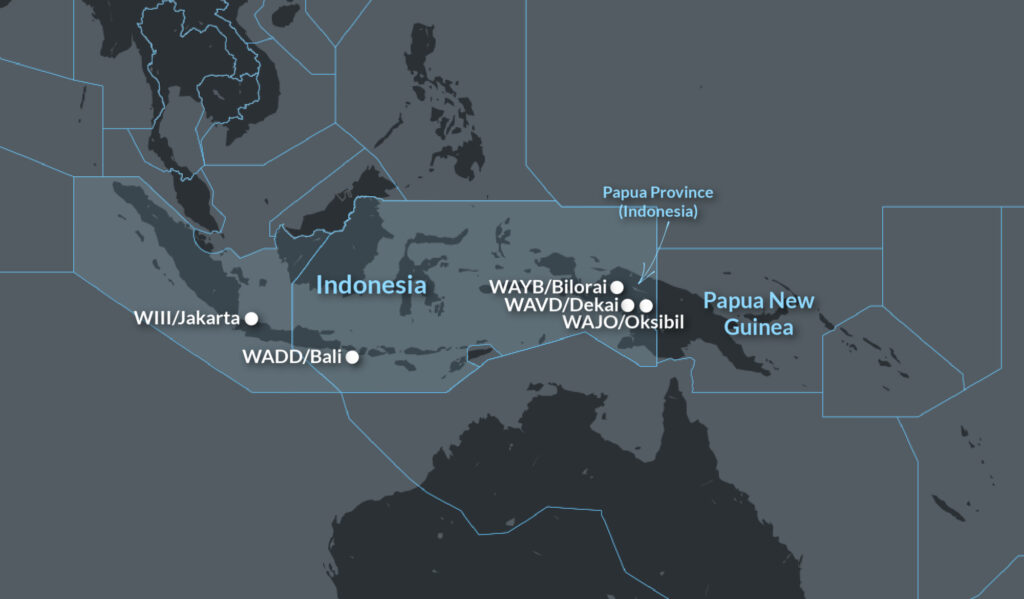
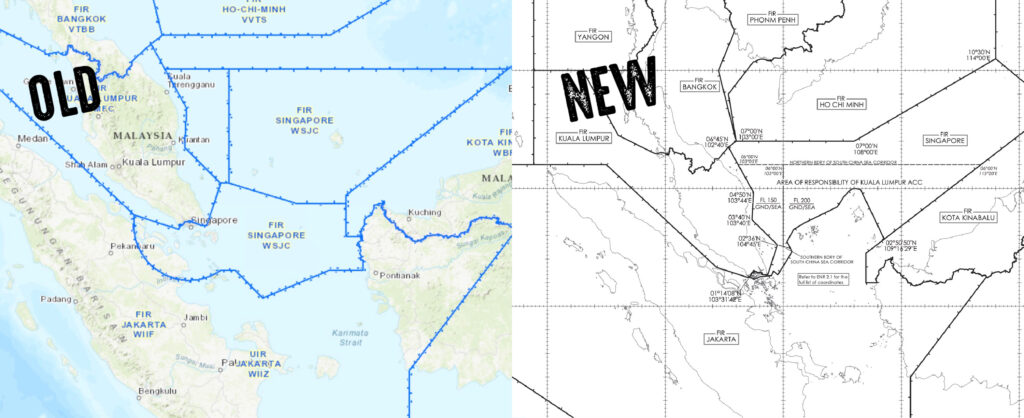
How the airspace currently looks, with Indonesia’s Riau Islands inside Singapore airspace.

This has been an issue in the past, with some flights not realizing they needed an Indonesia overflight permit to overfly these islands – as they sat under the WSJC/Singapore FIR. 

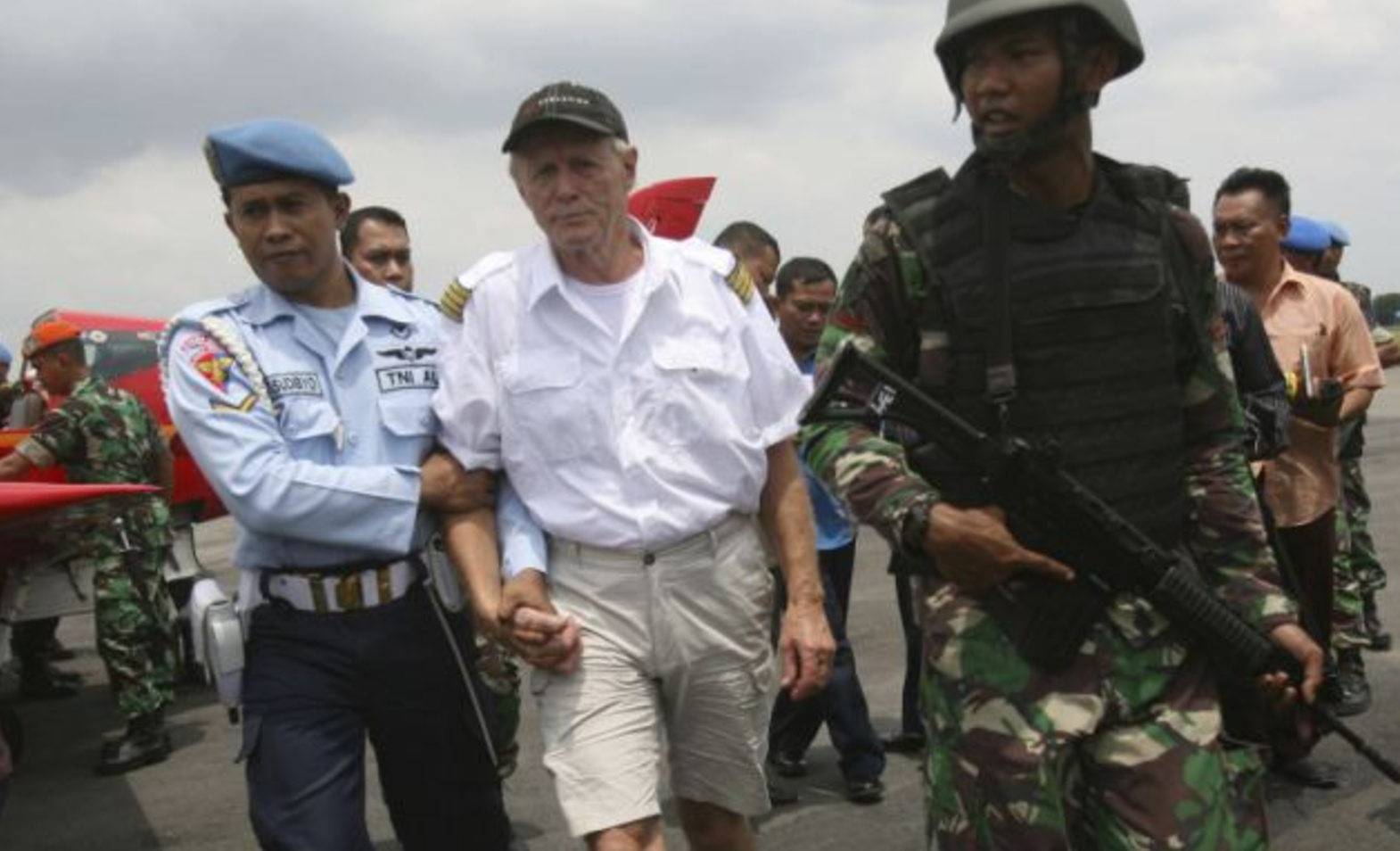
In 2019, two Indonesian F-16s intercepted an Ethiopian Airlines cargo flight for flying across Indonesian airspace without permission. The aircraft was initially supposed to operate from HAAB/Addis Ababa to VHHH/Hong Kong, but was modified at the last minute to route via WSSS/Singapore instead. The aircraft was intercepted forced to land at WIDD/Batam Island.

There have been several other incidents both before and since then, including some where Indonesia blamed US and Indian military planes of violating their airspace without permission.

But when the FIRs realign on 21 Mar 2024, there should hopefully be no more confusion about permit requirements for this chunk of airspace! You can find all the details in SUP 18/2024, but here’s how it’s going to look:

And this one is maybe useful too – this shows the airspace which will continue to be controlled by Singapore ATC:


Ops in Indonesia: Is it safe?

We last took a closer look at Indonesia back in 2021 and said “It’s fine at the big airports, but watch out on the ground at the smaller ones.”

Nearly two years on and we thought it might be a good time to take another look and see if the situation has changed…

What’s happened in two years?

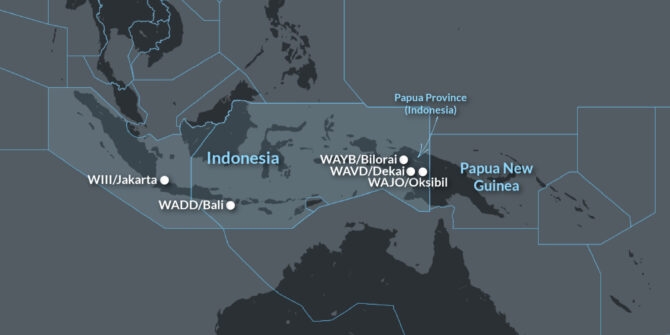
The security situation in the Papua region of Indonesia has worsened, with numerous reports of ground incidents at smaller, rural airports in the area.

  • 11 March 2023: An armed group targeted a passenger airport operating at WAVD/Dekai airport, wounding one passenger as it took off. Several operators have suspended operations to this airport since then.
  • 8 March 2023: An armed group opened fired at WAYB/Bilorai airport. One plane on the ground was hit and another diverted.
  • March 2023: A landing aircraft at WAJO/Oksibil was shot at, a cargo aircraft was set alight on the ground in a separate incident.
  • February 2023: A foreign pilot flying for Susi Air was kidnapped.
  • June 2022: An armed group shot at an aircraft as it landed into Kenyam Airport.

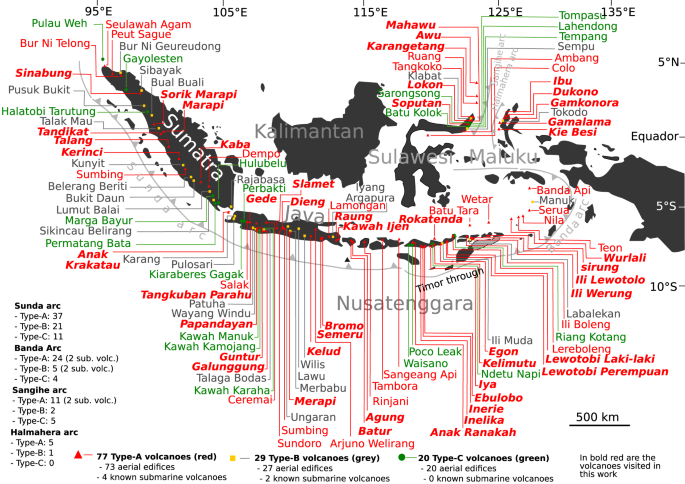
On top of these security incidents we have heard of protests over fuel shortages and many, many volcano issues.

What are the official warnings?

IFALPA issued a security alert for commercial operations in the Papua region in March 2023. The alert advises that the Papua region is considered a ‘high security risk area’, and that operations over mountainous and rural regions are strongly cautioned against.

The Indonesian Government has declared the entire region high risk, and armed groups have shown continued interest in targeting aviation interests. The official advice is a security assessment for each flight, along with limiting time spent on the ground.

A full briefing on the political and security situation on the ground in Indonesia, particularly with regards the Papua region conflict, can be found here. The majority of Indonesia is considered low risk – increased volatility is primarily in the Papua region only.

What is our warning level?

While there are security concerns on the ground, there are no active airspace warnings or cautions.

From an overflight and operational perspective, the major airports remain safe with good security. Crew security on the ground, if travelling beyond the airpots and cities, should be reviewed.

See Safeairspace.net for further information.

Checking for Ashtams and Volcano warnings is important because these do kick off fairy regularly, potentially impacting overflight and airport operations.

The ones to really look out for are:

  • Karangetang – WAMO/Siau
  • Mount Merapi – WAHS/Semarang and WAHH/Yogyakarta
  • Mount Semeru – WARR/Surabaya, WADD/Denpasar and WARA/Malang.

Tell me more about Indonesia!


Bali bound and no place to go…

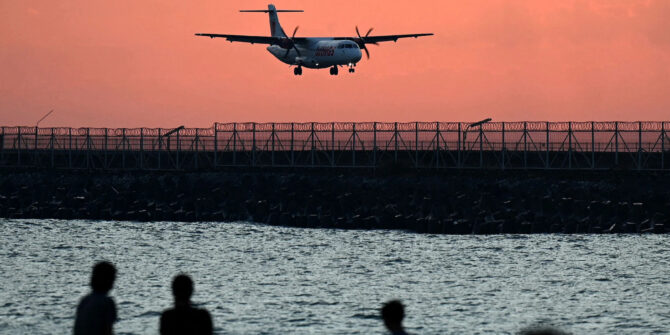
If you’re bound for Bali there are a few things you need to know, especially if it is your first time there. Ops there often seem to get disrupted, and you’ll need the option of having someplace else to go. Figuring out where – especially at night – may be harder than you think.

Let’s take a closer look.

At face value, ops at Bali seem straight forward. The runway is long, there is an instrument approach at both ends, SIDs and STARs link everything up and the place is towered 24/7.

But after years of flying in there with a scheduled operator, the number one biggest threat remained fuel in the tanks when it all went pear-shaped – which it sometimes did.

The airport just seems to have a habit of eroding your fuel margins. You may be carrying a healthy alternate enroute, but beware of giving it all away while holding once you arrive.

Delays and short notice closures.

The airport is especially vulnerable to them, and they can be unpredictable. Here’s why.

 1. Weather 

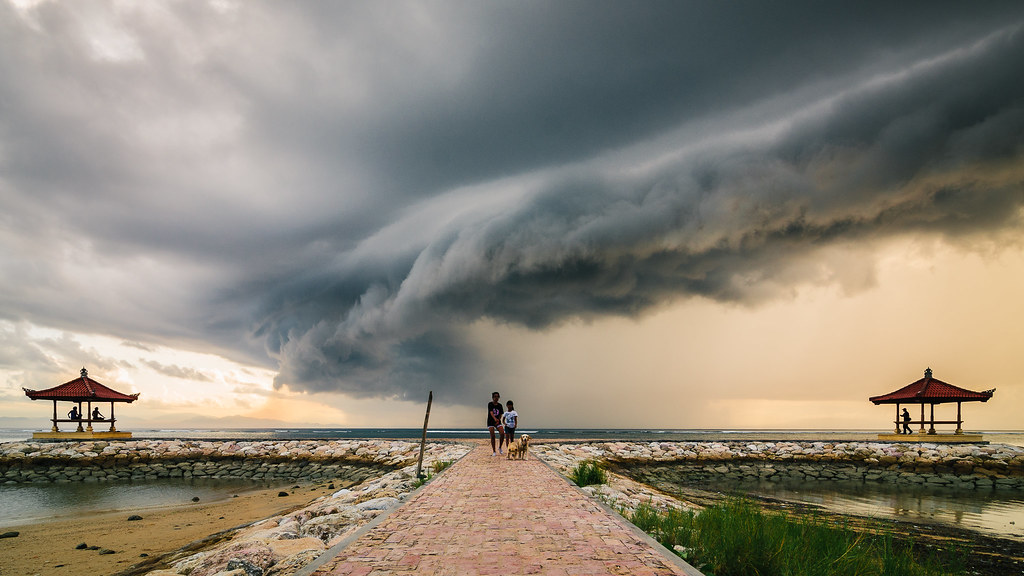
If you’re flying into Bali during rainy season (November – March), weather is likely to be a major factor. Like clockwork, towering cumulus clouds strengthen throughout the day into powerful thunderstorms in the afternoon and evening.

While the TAF may look identical day in and out, it is luck of the draw whether the airport itself will be affected. And when it is, traffic backs up quickly.

 2. Volcanic Ash 

Indonesia rests on the western portion of the Ring of Fire which renders it the third most volcanically active region on earth. There are no less than one hundred and forty-seven volcanoes there, seventy-six of which are currently active.

Eruptions are frequent and occur with little warning causing major disruptions to airports throughout the country – and extensive ash plumes. They can close airports like Bali for days on end, like one did in 2017. And the situation can develop when you’re already airborne.

The closest volcano to WADD/Bali airport is less than 40nm away.

Mount Agung erupted in 2017, closing Bali for several days. Courtesy: IBTimes UK

 3. VIP Movements 

Yep, someone important is inbound. And guess who has to make way? The airport often gets closed for short periods for VIP movements. You’ll find them in the Notams from time-to-time. Take it from me – apply a healthy buffer to either side as ATC will not necessarily be able to provide you with an accurate time the airport will re-open while you’re racing around that holding pattern.

4. Traffic Jams 

WADD/Denpasar is Indonesia’s second busiest airport second only to Jakarta. Which means it sees a lot of traffic. It also occupies a busy air corridor linking Europe to Oceania. Controllers manage a steady flow of both regional and international traffic from both directions.

It can be difficult to predict the effect of this ahead of time, but it is not unusual to hold inbound on your STAR. And you likely won’t have a head’s up beforehand that it is coming. Extra fuel for traffic holding is absolutely necessary.

 5. Congested Frequencies 

If you’re getting low on fuel, make a decision early. Don’t wait.

ATC has to manage large pieces of airspace here. On Ujung especially it can be challenging getting heard. Controllers are often managing multiple frequencies – it may seem like you’re being ignored, but you may not be able to hear everyone else talking to controllers over the top of you.

The language barrier can also be an issue – English will likely not be your controller’s first language, and their accents can make them hard to understand. The moral of the story is to be assertive on the radio, and speak slowly and clearly. Try and stick to standard phraseology such as ‘minimum fuel.’ And don’t take a back seat when trying to get an urgent request granted.

But where to go?

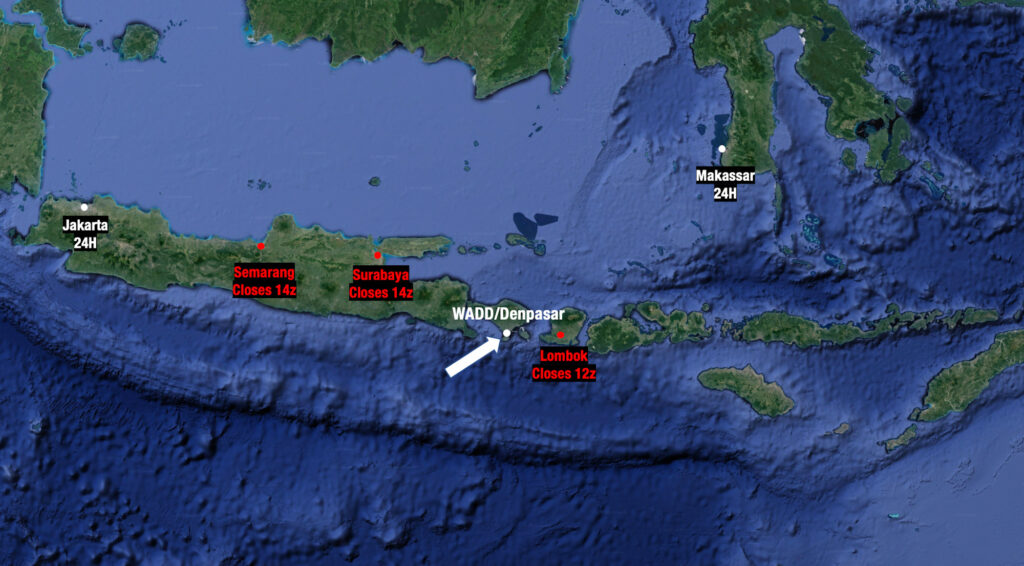
If you’re heading into Bali late, you’ll need to pay special attention to alternate planning. All the airports in the region still have special operating hours in place to “avoid the spread of Covid”, as per their notams. At present, WADD/Bali itself is open until 18z (02:00am local) but its closest alternatives are not.

Lombok (WADL/Praya), 85nm. Closed each night from 12z (20:00 local). [Notam B2226/22, valid until Feb 19].

Surabaya (WARR/Juanda) , 160nm. Closed each night from 14z (22:00 local). [Notam A2938/22, valid until Feb 18, actually due to runway closure for works].

Semarang (WAHS/Semarang), 295nm. Closed each night from 12z (20:00 local). [Notam B2231/22, valid until Feb 18].

If it’s late, you’ll need to carry more fuel than usual to reach WAAA/Makassar 320nm away, or WIII/Jakarta 512nm away.

And finally – watch out for terrain!

There are some big hills out there. If you’re flying into Bali, there’s a good chance you may yourself under radar vectors at night or in IMC nearby. Protect your aircraft – keep a close eye on where you are relative to that terrain at all times. Especially when it’s busy!

Aircraft arriving from or departing to the northwest need to be particularly wary. Sector MSA just north of the airport rises steeply to 9700’. Further west you’ll find Central and East Java with grid MORAs as high as 14,000’. Also be aware of escape routes if your cabin springs a leak.


South East Asia: Open for Business

The world is steadily emerging from the pandemic, and the Northern Hemisphere has arguably been leading the charge.

South-East Asia on the other hand has been lagging behind. The region’s countries have resisted joining the world’s ‘new normal’, instead relying on strict ‘zero-covid’ strategies that kept foreigners out, citizens in hotel quarantine, and crews cooped up in hotels. Until now.

In recent weeks and months, we have seen several major announcements from these countries that at last, they are willing to re-join the rest of the world – and that’s good news for the industry.

Here’s a rundown of the biggest changes happening right now.

Singapore

The News

From April 1, fully vaccinated foreigners (from anywhere) are once again be able enter the city-state without quarantine.

The existing ‘Vaccinated Travel Lane (VTL)’ scheme has been scrapped. For operators this means that passenger flights flying into the Lion City will no longer need approval to operate under strict VTL protocols.

Passenger Rules

For fully vaccinated passengers, click here.

For non-vaccinated passengers, click here. *Special approval is required, and in most cases non-vaccinated foreigners will not be allowed. Seven days of self-quarantine also applies.

Crew Rules

There are new rules for crew – one set for vaccinated crew (no restrictions on movement), and another set for unvaccinated crew (you have to stay in one of three approved hotels, and you’re confined to your room!).

But watch out for one important stipulation: if any crew are unvaccinated, ALL of you have to follow the unvaccinated set of rules.

Check new CAAS Circular 18/2022 Rev 2 for full details.

Malaysia

The News

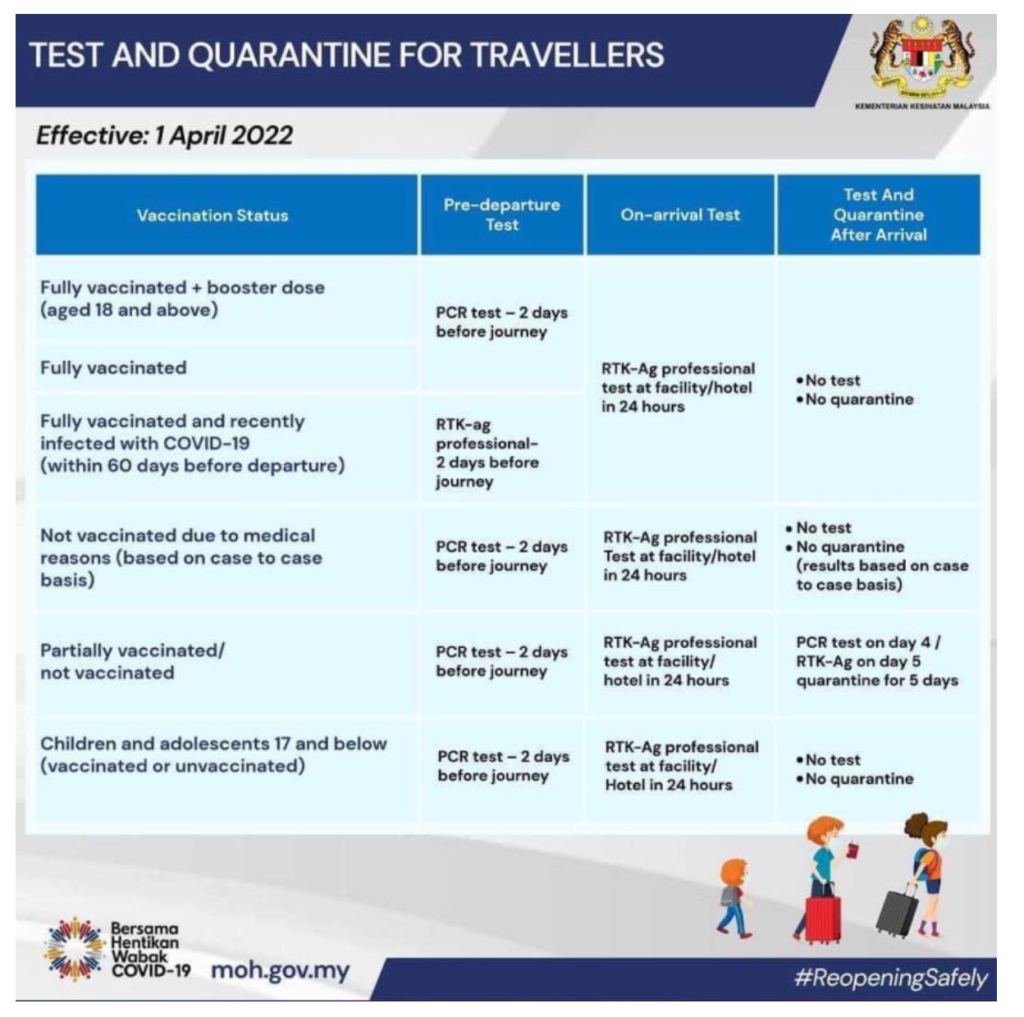
It’s also good. From April 1, the country completely reopened to fully vaccinated passengers with no quarantine. Foreigners also no longer need to seek approval before travelling.

Passenger Rules

They’re complicated. And depend on vaccination status (they also take into account whether you have received a booster dose).

You can find that information here, but here’s a picture, because pictures are always better:
Crew Rules

Crew can only enter Malaysia through WMSA/Subang, WMKK/Kuala Lumpur or WMKL/Langkawi airports.

In all cases they require a PCR test that is less than 72 hours old at time of arrival. Subang seems to be the best option, with no quarantine or maximum stay. In Kuala Lumpur crew can only stay for 24 hours and must isolate in the hotel, while in Langkawi crew can stay for 72 hours and don’t have to isolate if they follow the same rules as tourists.

Indonesia

What’s the news?

They’ve dropped quarantine for both passengers and crew throughout the entire country. This follows a successful trial on the holiday island of Bali.

Passenger Rules

They’ll need a PCR test taken within 48 hours before departure for Indonesia. Keep in mind this can be a tight turn around for busy labs – the global standard seems to be 72 hours.

Crew Rules

You’ll need a certificate or card proving you are fully vaccinated, along with a PCR test. The rules are a little easier for crew – you have 72 hours to get that done before you leave for Indonesia. There will also be a travel declaration to fill out, but you’ll be free to leave the hotel and enjoy your layover.

Vietnam

What’s the news?

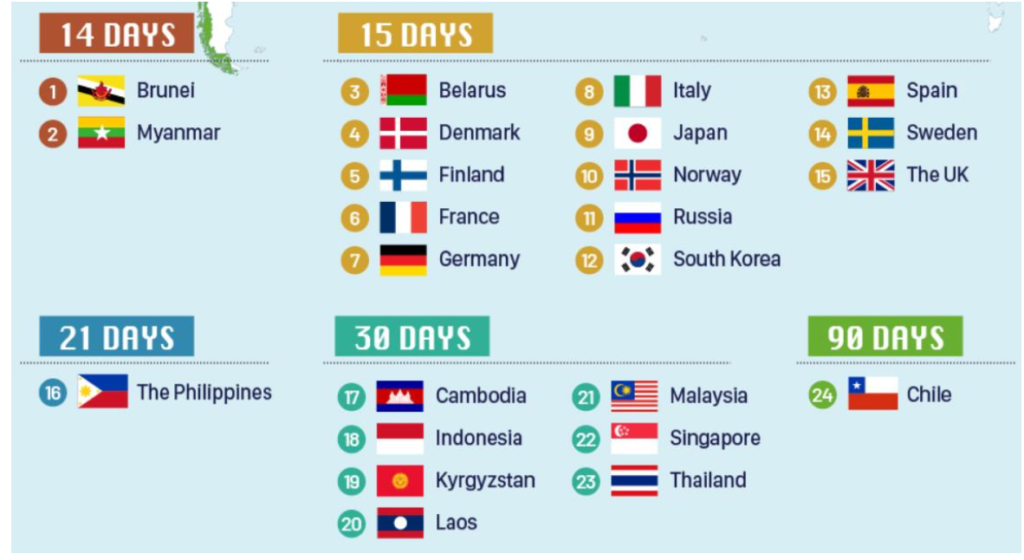
Borders are now open to all foreigners, with no quarantine, as long as they hold a valid visa. Watch out for this gotcha though: the only visas available on arrival are currently for business travellers (not tourists). Everyone else will need to apply beforehand online. There’s a long list of countries that this applies to (including the US, Canada and UK) which you can access here. There are also visa exemptions available for select countries, see the image below.
Passenger Rules

They’ll need to get tested first, and there’s two options. A PCR test that is less than 72 hours old, or a rapid antigen test that is less than 24 hours old – both at time of departure for Vietnam. There’s an opt clause too, if they can’t provide proof of a test they can still travel but will need to get tested within 24 hours of touching down.

Crew Rules

Local agents advise that all the same requirements apply to crew as for passengers (including a valid visa or exemption) – that is if you want to enter the country.

Japan

What’s the news?

Ok, so not really South-East-Asia but we thought we’d include it anyway – given that Japan lifted its entry ban on foreigners from over a hundred countries on April 8 (including the US and UK). One big gotcha though – tourists will still have to wait. Pax will need to be entering for business, study or some other essential reason.

Passenger Rules

Depending on their vaccination status, where they are travelling from, and whether they are identified as a close contact of a positive case, they may be subject to up to 7 full days of quarantine and/or self-isolation on arrival.

For Japan’s horribly complex entry rules in their official format, click here.

Crew Rules

The crew rules remain a bit of a mystery. We’ve had some reports from crew saying they were unable to apply for any of the visas available to passengers (business, study, etc).

We haven’t seen any published rule changes here from how it worked before – crew can enter on a ‘shore pass’ arranged through their handler, but must self-isolate in the hotel for 7 days or until departure.

Opsgroup members have reported the following: “The guidance we received from our company is that crew members must stay in their rooms but can leave the hotel for exercise and to obtain food to bring back to eat in the room. No dining out, no shopping for anything other than food to eat in your room. We enter on a shore pass. For quarantine, we fill out two forms that ask about where we have been in the world and if we are feeling healthy, where we are staying, and if we have transportation (another quarantine requirement is that we don’t use public transportation). We also sign a pledge that we are going to follow the rules. They then give us a quarantine card to go with our shore pass. When we arrive for our return trip, we initial a paper saying that we followed the rules.”

If you’re considering a trip to Japan, try contacting a local handler (iajops@interavia.co.jp and fltops@aeroworks.jp are decent options) and check if there’s any update to these rules – especially those for crew (and please let us know what you find out!)

A note on Thailand.

Borders have been open to foreigners for a while now via three main entry schemes:

  • Test and Go (a quarantine free option)
  • Sandbox (restricted movement)
  • Alternative Quarantine Scheme (quarantine reduced to five days from April 1).

The main news is that in all cases the requirement for passengers to get tested before arriving has been scrapped from April 1. Crew can make use of the same schemes and enter under the same conditions as pax.

For more info on passenger entry rules, check out the official page here, as well as the handy checklist document put together by local handling agent Asia Flight Services (eff Apr 6).

Still closed for business.

Not all of South East Asia is open to foreigners yet, watch out for these ones:

Myanmar – International passenger flights are still not allowed to land. Visas are not currently being issued for foreigners.

Brunei – Entry is still severely restricted. Any foreigner needs approval first and non-essential travel is off limits.

Laos – Special permission is still required for foreigners, and tourism is a no-go.

Unsure? Ask the team.

Entry rules change quickly and can be frustratingly confusing to get your head around. If there is a specific country you are looking for info on, try the #questions channel in Slack, or reach out to us at team@ops.group and we’ll do our best to help you find the answers you’re looking for.

Aviation in Indonesia: How safe is it?

If you haven’t watched Worst Place To Be A Pilot then take a look. The series follows Susi Air pilots who fly into some of the most remote and dangerous airports around Indonesia, taking supplies to local tribes.

This post, however, is looking at some of the threats that might be present for larger commercial operations. Indonesia poses security, environmental, and operational risks to flights, and recently these risks have been increasing in severity.

What is the security situation?

Indonesia does not rate as a risk on our SafeAirspace site because the risks are ground based. However, there are threats to security risk of flight disruption which are worth considering.

Islamic State affiliated militants are active in the Surabaya region to the west of Bali, and attacks have been increasing since 2018. However, these are generally ‘low capability’ attacks with no immediate threat to flight operations. Security at the major international airports is good, and these groups are unlikely to present a serious threat.

However, there has also been an increase in insurgency movements, particularly in the Papua Province to the east, with groups targeting security forces with the intention of disrupting flight operations. In April, a militant group attacked Aminggaru Airport in the Ilaga District and torched a private helicopter. Similar attempts have been occurring since January 2021 with increasing frequency.

Particularly in more rural regions, businesses rely on air transport to bring goods in, and by disrupting these through direct attacks on the airports, aircraft, or by targeting security groups, the insurgents intend to damage both the foreign businesses, and social stability.

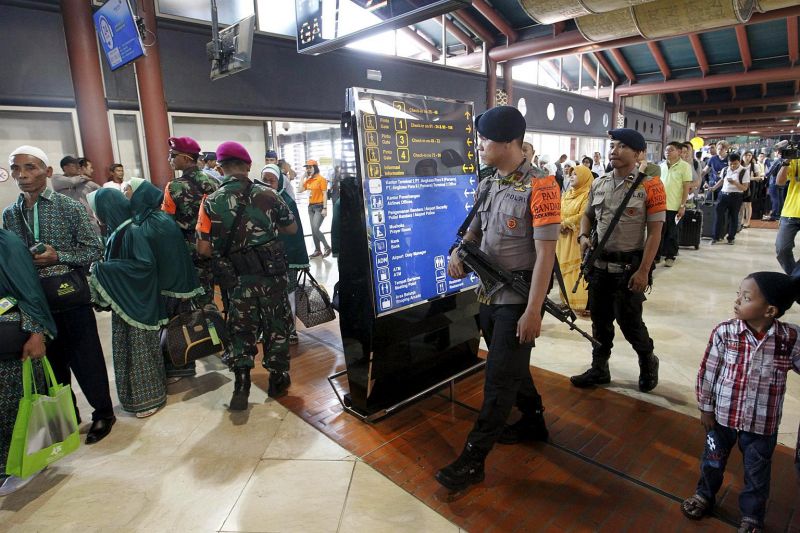
If you are operating in you can expect heightened security measures and increased military and security personnel. Possible disruption is also likely so contact handling agents in advance to confirm any security or risk.

What is their Infrastructure like?

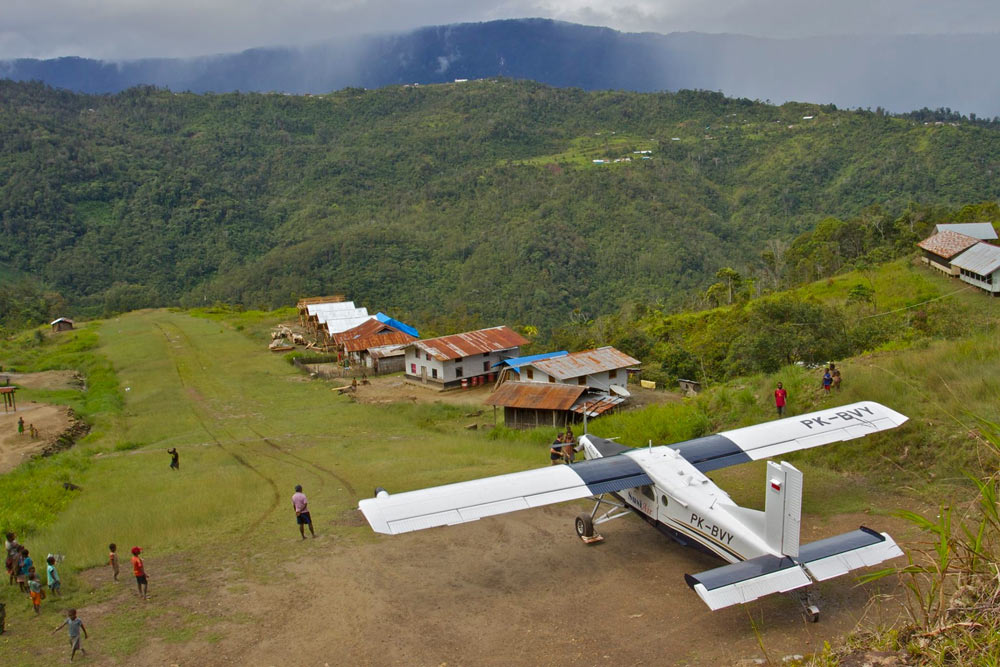
Transport infrastructure is poor in Indonesia, especially in rural regions. Which brings us back to The Worst Places to be a Pilot – many rural villages, especially in mountainous areas, are extremely cut off. So they build runways, and Susi Air fly in food and supplies. Probably not the places you are planning to fly though.

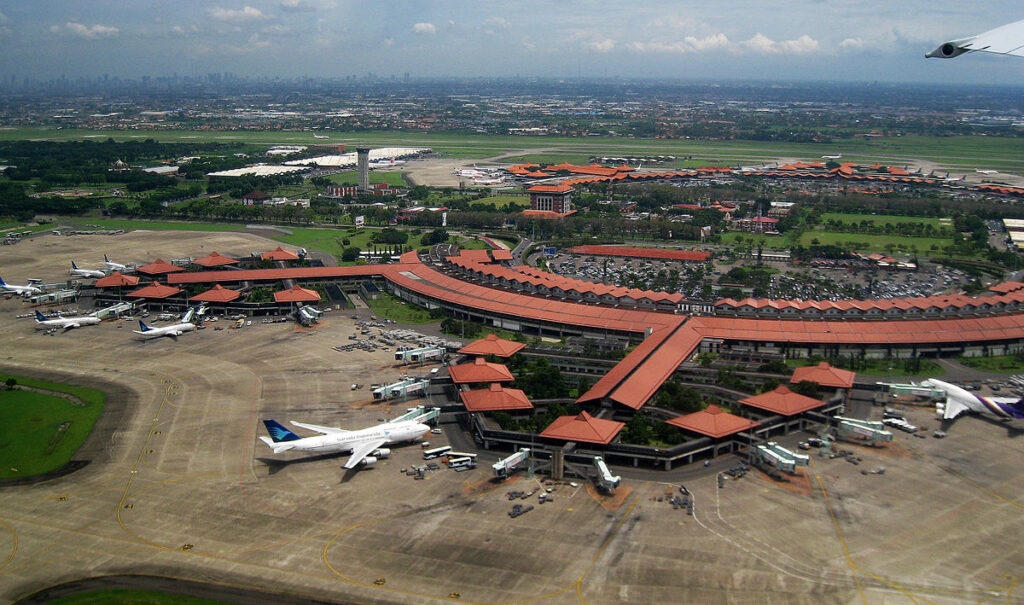
Indonesia does have some major airports and the standard between these, and small domestic airports is marked. WIII/Soekarno-Hatta (formerly Jakarta) is a major international airport with three runway options, the longest being 07R/25L at 12,008’/3660m. However, they are only equipped to CAT I capability and during the monsoon rains, visibility can be seriously degraded.

The airspace here is also very congested, and reports suggest ground operations can be challenging with poor taxiway lighting and markings, and ATC often giving non-standard taxi routings.

Aside from Jakarta, you also have WIMM/Medan airport serving the Sumatra region in the north, WADD/Denpasar serving the Bali region and WARR/Juanda serving the Surabaya area.

Keep an eye on weather forecasts and take additional fuel during monsoon season. Pre-briefing the taxi routes and maintaining a high level of situational and traffic awareness on the ground is important.

Do I need to worry about poor Safety Standards?

Indonesia has had a very high number of serious air accidents. Since 2001, there were at least 40 accidents resulting in fatalities in Indonesian airspace, giving Indonesia one of the worst safety records in the region. In January 2021, a Swirijaya Air 737 crashed into the Java Sea – preliminary reports suggests poor maintenance and weather were primary factors.

Past accidents have been attributed to poor pilot training, mechanical failures, air traffic control issues and poor aircraft maintenance leading to 59 Indonesian airlines which are currently banned from flying in EU airspace.

IATA forecast it will become the sixth largest market for air travel over the next decade or two. Much of the issue with safety has been down to the rapid expansion of the industry with little oversight or quality control during the initial expansion. However, this has been improving recently with a focus now on licensing for operators, pilots and ATC within the country, along with better maintenance standards and technical skills.

So, if you are operating into the larger international airports, ATC, facilities and general standards at these is ok. However, if you are flying to smaller regional airports, watch out for below standard ATC and maintenance, and caution procedures of other aircraft in the area.

The FAA currently rates Indonesia as Category 2 in its International Aviation Safety Assessment program which includes areas such as inspection procedures and technical expertise. If you are operating in, it is still a good idea to use a handling agent and maintenance company who work with major airlines and have a proven work standard and reliability.

Are there any Airspace Issues?

Back in 2019 we wrote this about Indonesian airspace. They are strict about overflight permits and if you are operating in the Singapore FIR and accidentally stray into Indonesian airspace they don’t like it. At best, they issue a fine, at worst you will be intercepted by Indonesian Air jets and forced to land to be detained in Indonesia. During the monsoon and storm season, early planning for weather avoidance is important to avoid this.

Indonesia has mandated ADS-B throughout its airspace. Overflight control is generally of a decent standard.

Keep an eye on volcanoes

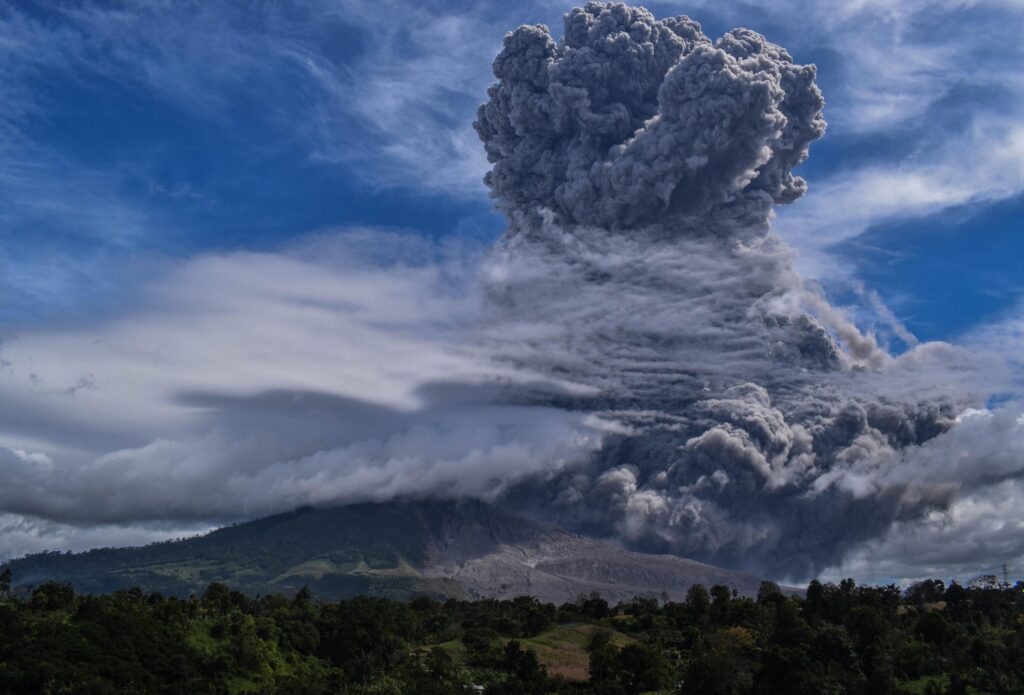
Mount Sinabung (sounds sort of like Cinnabun) is one of the most active volcanoes in the ‘Ring of Fire’ region. It is currently on alert level 4, which means ‘highly dangerous’. There is a 7km exclusion zone around the volcano.

The volcano erupted in February 2021, sending ash up to FL400. The ash was blown over water so operations into nearby WIMM/Medan airport were not impacted.

Keep two eyes on the Weather

Indonesia has a big monsoon season and is prone to abundant rain, which often leads to abundant flooding. Delays are likely and extra fuel should be carried. ATC are generally ok, but with congested airspace they may not be the most efficient or responsive in high workload, bad weather situations.

Summary

Improvements to Indonesia’s infrastructure continue, and they are paying attention to international concerns regarding their standards and safety.

If you are operating into a major airport, the biggest threats you will face are likely to be weather related. If you are operating into smaller airports, particularly in the Papua Province, then paying attention to local security situations is important, along with a caution with the general standards of operation and facilities.


Indonesia is intercepting aircraft – outside their airspace

If you are operating in the Singapore FIR, consider this carefully: you may be overflying Indonesia without knowing it. Indonesia will know though, and they want you to have an overflight permit.

You will find out in one of three ways:

  1. You’ll be intercepted by two Indonesian Air Force fighter jets and brought to Indonesia
  2. You’ll receive a nastygram via your National Authority
  3. You’ll get a fine

2. and 3. are not cool, but 1. is something to avoid at all costs. The inside of military/police cells at outlying Indonesian Airports is not pretty.

Watch out for the following airways – M758, M646, M767, G334, M761, G580. These all pass over Indonesian territory, even though the area is actually part of the Singapore and Malaysia FIRs.

Indonesia has a reputation for excessively strict enforcement of permit rules.

On 14 Jan 2019, two Indonesian F-16s intercepted an Ethiopian Airlines cargo flight ETH3728 for flying across Indonesian airspace without permission. The aircraft was initially supposed to operate from HAAB/Addis Ababa to VHHH/Hong Kong, but was modified at the last minute to route via WSSS/Singapore instead, to make a delivery of Rolls-Royce Trent 1000 engines.

The Ethiopian Airlines aircraft was intercepted forced to land at WIDD/Batam Island – which lies right in the middle of the chunk of airspace controlled by Singapore.

Another incident happened back in 2014, where a King Air plane en-route from WBGG/Kuching to WSSS/Singapore was intercepted by Indonesian fighter jets in the same airspace managed by Singapore, and forced to land at WIOO/Pontianak Airport in Indonesia.

The reason? Because they were overflying some Indonesian islands out in the ocean, the Indonesian Air Force claimed they were overflying Indonesia’s sovereign skies – without a permit.

Indonesia still hasn’t updated its AIP, but the rules they enforce are clear: if you’re overflying any Indonesian territory, you must get an overflight permit, regardless of the flight level.

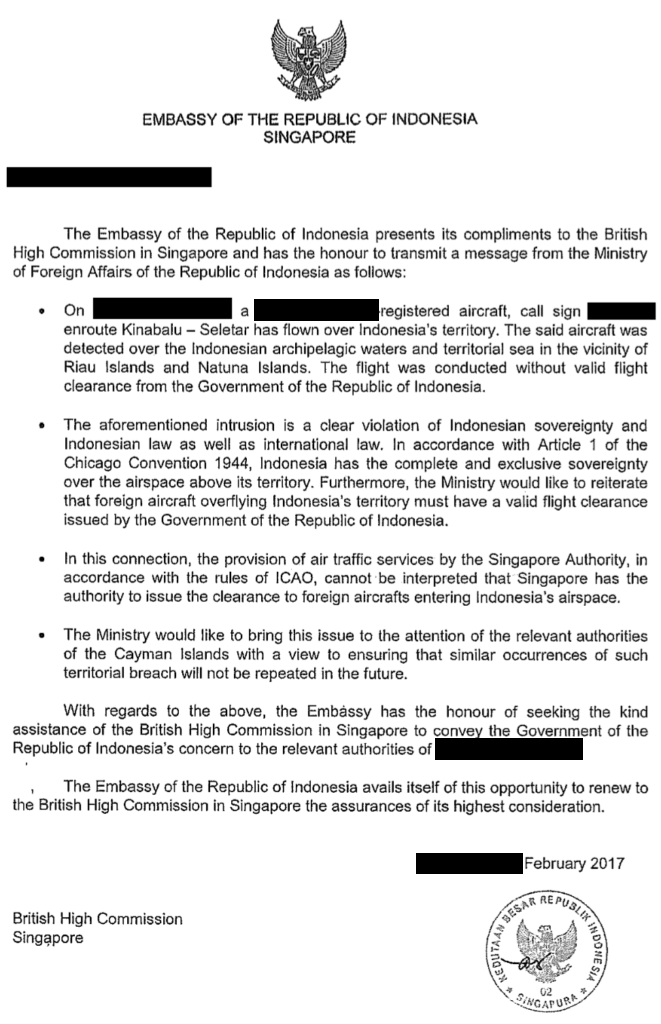
Here’s a nastygram to an OPSGROUP member, received in February 2017:


Bottom line: check your airways carefully, and make sure there are no Indonesian Island underneath. If there are, get a permit.


Bali – Airport Status

Volcanic eruptions from Bali’s Mount Agung earlier last week forced the closure of WADD/Denpasar and WADL/Lombok airports, as volcanic ash spread across both islands.

Here’s the current situation at the airports on Dec 4:

  • WADD/Bali: Re-opened on Nov 29. (Although the airport will be closed for runway repair from 18-23z daily [except Saturdays] until Dec 31).
  • WADL/Lombok: Re-opened on Nov 30. 
  • WARR/Juanda: Open and operating. So far has not been affected at all by the volcanic ash. (Although the airport will be closed for runway repair from 16-22z daily until Jan 06).

Although Mount Agung has now stopped emitting ash, another large eruption is still likely. The local monitoring agency are registering powerful and continuous tremors, and authorities have ordered locals and journalists within 10km of the volcano to evacuate. Further intermittent airport closures are possible, depending on wind direction.

We will keep this page updated with the latest news as we get it.


Midweek Briefing: Where is Zika, Elevated North Korea Risk

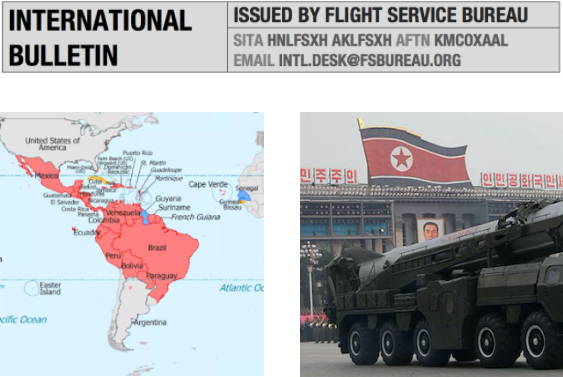
Where is Zika? 24AUG With the again-increasing levels of Zika infection worldwide, this updated map will be useful to operators. Check Zika Map.

North Korean Risk Elevated 24AUG We’ve published an updated Unsafe Airspace Summary today, which elevates North Korea to Level 2 in our warning list. In 2016, there have been increased instances of medium-range ballistic missile (MRBM) launches without prior warning. Read the article


DIAP/Ivory Coast issued a Notam last Friday advising of ‘serious risks to safety’ when operating through the Tripoli FIR. Not many operators are entering this airspace, but it’s unusual for a non-adjoining country to issue advice like this, so we’ll mention it.

SPZO/Cuzco, Peru is busy at the moment; non-scheduled and GA flights cannot park overnight, and there are Traffic Management procedures inbound. Don’t forget if operating to Cuzco that special crew training is required.

WADD/Bali Authorities have stepped up security measures at all the entry points on the island, following recent reports of an alleged plot to carry out attacks.

HKNW/Nairobi WIlson is operating normally again after a Police helicopter crashed on take off on Monday, near the control tower.

LLZZ/Israel Israeli aircraft attacked mortar positions in southwestern Syria near the border with the Golan Heights on 22AUG. The airstrikes were apparently in response to mortar fire from the Syrian side of the border.

RJAA/Tokyo Narita is open again after the passage of Typhoon Mindulle. The control tower at Narita was evacuated due to strong winds, the first time this has happened since the 9.0 earthquake in March 2011.

WIZZ/Indonesia has warned its neighbours that haze from forest fires is beginning to cross the Malacca Strait. In 2015 the smog affected Malaysia, Singapore, and Thailand, causing disruptions throughout the region, closing airports and delaying flights.

EDDT/Berlin Tegel Aircraft larger than ICAO Code D, and parking longer than 3 hours, approval of Traffic Management is required. Contact verkehrsplanung-txl@berlin-airport.de, in place until 30Sep.

VEZZ/India Couple of new ICAO codes here, VASD is Shirdi Airport, and VEPY is Pakyong Airport. AFTN connections not yet set up.

LBPD/Plovdiv Reports of lasers directed at departing aircraft. Notify ATC with any details if experienced.

FOZZ/Gabon If you’re arriving into Libreville International Airport you can submit an online visa application at least 72 hours before the date of travel and collect your visa on arrival

BGTL/Thule Updated hours for Radar service – 1100-1900Z Mon-Fri only.

NTAA/Tahiti has a bunch of night-time closures until 03SEP; this is an isolated aerodrome so check carefully in advance of ops.

NWWW/Noumea has ongoing staff shortages in ATC, and therefore interruptions in opening hours for the airport. Check before operating.

VDZZ/Cambodia has introduced a new tourism and business multiple-entry visa, which will allow foreigners to stay in the country for up to three years. The visa will become available on 1 September. The current visa grants visitors a 14-to-31-day stay.

LCLK/Larnaca New ATC Controllers being trained (under supervision)—be nice to them!

FMMM/Antananarivo has a new disinsection procedure for flights arriving from Mauritius; also, all flights from Mauritius must operate to FMMM first before other airports in Madagascar.

HCSM/Mogadishu Due to HF Difficulties, all aircraft in Mogadishu FIR with Satcom are requested to contact Mogadishu FIC on Satcom.  Inmarsat 46601, phones +251-20-762274 or +254-20-2365679.

View the full International Bulletin 24AUG2016


Midweek Briefing 10AUG: EASA Cockpit Rules, Ukraine extends Russia Ban

EASA: New Cockpit Rules 10AUG EASA has published a new SIB with guidance for operators on, well, how best to arrange the swap of pilot-taking-a-pee and flight-attendant-now-up-front … Read the article

Ukraine extends Russia ban 10AUG Ukraine has extended the ban on Russian registered operators overflying or landing, until November 10th, 2016. In an operational notice.. Read the article


UUZZ/The Moscow Area will get busy between 26AUG and 04SEP (we’re not entirely sure why), but … The Main Air Traffic Management Centre (MATMC) has issued notice that there will be increased regulation for flights to UUWW, UUDD, and UUEE. Permission to depart will expire 30 mins after planned off blocks time, after which the Operator (that’s you) must call MATMC for a completely new permit.

MWCR/Cayman recorded its first local transmission of the Zika virus on 08AUG. Several other people on the Cayman Islands have reported symptoms of the virus; however, authorities stated that in these cases the patients contracted Zika during travel abroad.

MKJK/Kingston, Jamaica is carrying out work on its Comms lines until the end of the week, and is expecting to lose some Flight Plans. The outage is 0415-1100Z daily. If you are operating to Jamaica, or through the FIR, it’s worth sending your FPL early, and not during that time. Maybe send it a few times to be sure, should minimise delays due to missing FPL’s.

VIZZ/India Independence Day on 15AUG. Multiple restrictions. No overflights within 150nm of Delhi. VIDP/Delhi will not allow non-scheduled flights 0030-0430Z, and 1030-1330Z. Check with your handler for specific restrictions on 15AUG.

LIRA/Rome Ciampino will be completely closed from 14-29OCT for runway maintenance and upgrades. According to CIA, maintenance work will be carried out on a 24/7 basis on parts of runway 15/33, at various junctions and taxiways.

EVVA/Ventspils is closed for the week from today, due to repairs to the main runway. One of the three main airports in Latvia, it reopens on 15AUG.

GUCY/Gbessia, Guinea Opposition leaders have announced the postponement of opposition demonstrations planned for 10-16AUG. Marchers will reportedly demonstrate on the Autoroute Fidèle Castro, between Aéroport International de Gbéssia (GUCY/CKY) and the Palais du Peuple. The demonstration was originally slated to occur on 4 August but was later postponed until 10 August.

WIZZ/Indonesia Travel advice updated: Political tensions have given rise to occasional mass demonstrations in cities in Papua; take extra care and seek local advice on your travel plans.

SOCA/Cayenne FIR has broken it’s SITA system and has no CPDLC or ADS-C until, they think, at least 14AUG. Revert to HF and use 8855/5526; failing that try 3023.

RJZZ/Japan On 08AUG, Japanese military officials placed the country’s armed forces on alert for the potential of a North Korean missile launch. According to an official statement, the Japanese military will be ready to strike any North Korean missile that threatens Japan. Because some North Korean missile tests are difficult to detect, the current state of alert will last for three months. Previously, Japanese defense officials issued a series of temporary orders in response to imminent North Korean missile launches.

LWKS/Skopje Flooding on 6-7AUG2016 in Skopje and neighbouring areas has resulted in over 20 deaths. Some roads, including part of the Skopje ring-road, are closed. Alternative routes are available, but traffic may be slow moving. You should travel with extreme care.

LTZZ/Turkey Per new dictat from the DGAC in Turkey, all Ambulance flights entering Turkish airspace are to report “ACTIVE AMBULANCE FLIGHT” on first contact with Turkish ATC.

DIZZ/Cote D’Ivoire Effective 15SEP2016 Ivory Coast will withdraw the following HF frequencies: BOUAKE 5710KHz, 1578KHz; DALOA 5701KHz, KHOROGO 6673KHz; Man 5710.5 KHz; ODIENNE 6673 KHz; SAN PEDRO 6012KHz

EDDV/Hannover has special runway configurations on 14AUG due to (yet another) bomb from WW2 being removed. Between 1100-1400Z all approaches to 27L/09R are suspended.

VVZZ/Hanoi ACC reports that a lot of flights operating through the Hanoi ACC area of responsibility have not been submitting flight plan messages to VVHNZRZX or VVHNZQZX. In order to avoid missing / delay of FPL messages, copy these AFTN addresses when submitting your FPL’s.

EGZZ/United Kingdom 8AUG Rail staff in southern England, including London, began a five-day strike, which will reduce rail services by 40 percent. Travellers should expect major delays and large-scale traffic disruptions

BGSF/Kangerlussuaq Daily Closures between 09AUG and 30AUG for runway work. Double check NOTAMR A0295/16 for complete list of timings. Only Medivac, Search and Rescue and PPR confirmed operations allowed.

KTEB/Teterboro Landing Fees here are to increase by about 25% on September 1st. Comments regarding the fee changes can be submitted to The Port Authority of New York and New Jersey, and must be received by 10AUG2016.

Measles Myanmar/Taiwan On August 6th health officials confirmed a measles outbreak in the Sagaing region, a mountainous area located in northern Myanmar, bordering eastern India. We have also received report from Taiwanese health officials confirming a link between two cases of measles and Taipei’s Songshan International Airport (RCSS/TSA). The two cases, which were first detected on 15JUL, involved an airline ground crew worker and a passenger who traveled to the airport.

SECU/Cuenca, Ecuador Operations at Cuenca airport will be suspended from mid-August 2016 for 3 weeks to 1 month due to the need for additional runway works.

OMDB/United Arab Emirates On 04AUG both runways at Dubai International Airport (OMDB/DXB) resumed full operations following the 03AUG 777 accident. Expect delays and some cancellations as the airport is still struggling to catch up.

UTZZ/Turkmenistan and UAZZ/Kazakhstan On 04AUG Turkmenistan temporarily closed its border with Kazakhstan, citing security concerns. Officials stated that the closure will last for five days. Turkmenistan instituted a similar border closing on 20JUL. Authorities did not release details on the purported security concerns that prompted 04AUG closure.

UZZZ/Russia 03AUG Polish officials stated that they did not have a specific date to reopen visa-free border traffic between Poland and the Russian enclave of Kaliningrad. Security concerns associated with the NATO Summit and Roman Catholic Church’s World Youth Day led officials to temporarily restart border checks at Poland’s borders. Residents of border areas, however, will be able to travel across the border for cultural, social or family reasons.

UNKL/Yemelyanovo Runway11/29 is closed for all types of aircraft THU 0600-0700, WED FRI 0610-0710, MON TUE SAT SUN 0500-0700, 01SEP until 29OCT

View the full International Bulletin 10AUG2016


Midweek Briefing 11MAY: Reykjavik Oceanic Closure, Australia to turn off Navaids

Reykjavik Oceanic Closure 11MAY Operators planning eastbound flights across the NAT should be aware of a NOTAM issued earlier by Reykjavik Oceanic/Iceland ATC, that essentially asks traffic to avoid the airspace wherever possible, due to further ATC Industrial Action. Read the article.

Australia to turn off Navaids 11MAY On 26MAY, Australia will switch off around 180 different VOR’s, NDB’s, and other ground-based Navaids. All international operators will be required to have GNSS/GPS as primary navigation. Read the article.


CYMM/Fort McMurray, Canada is closed due to Forest Fires; only emergency and evacuation flights are allowed.

EGPX/Scottish Expect delays from 17MAY when controllers change to a new ATC system. ATC advises a fundamental level of change in the method of operation within Scottish Upper Airspace will result. There is no change to the Oceanic Operation, and Domestic CPDLC will be available at all times from 17MAY.

KATL/Atlanta closed one of its three security checkpoints in the domestic terminal for three weeks and will reopen 25MAY. They have added additional security lines to the other 2 checkpoints in hopes of reducing the impact. Plan for extra time if you are heading through ATL in the next few weeks.

LGZZ/Greece An update on 09MAY was issued for the slot allocation Rules and Guidelines for all Greek Coordinated Airports. The updated document can be found at GABA report.

YZZZ/Australia CASA has issued clarification as to who is responsible for Terrain Clearance when ATC instructs an aircraft to “resume own navigation”. Consistent with ICAO standard, while under radar vectors below the MSA, ATC assumes responsibility for Terrain Clearance. The AIC is worthwhile refresher reading as this applies to most International Ops.

OYRN/Mukalla has reopened after it was recently re-captured by government and Emirati soldiers. It is currently only accepting humanitarian and aid flights.

HKIS/Isiolo is a new airport in Kenya that will be operational in early JUN. The new facility will cater to domestic and international flights and will have annual passenger capacity of 125,000 and a 1400m runway. Isiolo is located near many national reserves, approximately 125 mi/200 km northeast of Nairobi.

BIRD/Reykjavik Oceanic Operators planning eastbound flights across the NAT should be aware of a NOTAM issued earlier by Reykjavik Oceanic/Iceland ATC, that essentially asks traffic to avoid the airspace wherever possible, due to further ATC Industrial Action. Eastbound flights in particular will not be accepted into the airspace unless … Read Full Article.

LIZZ/Italy Another ATC Industrial Action in Eurore has been announced for 14MAY, this time in Italy and affecting only part of operational personnel. Only some air navigation services may be affected. The following NOTAM has been issued.

EGLL/London Heathrow has been identified as the airport most affected in the UK by laser strike incidents with 121 in 2015, followed by EGBB/Birmingham with 94, EGCC/Manchester recording 93 and EGNM/Leeds Bradford with 77.

SKBO/Bogota has introduced a significant enhancement to the current ATC infrastructure by adding Secondary Surveillance Radar or SSR. The Columbian CAA issued AIC A07/16 to cover the upgrade. This will help increase the level of safety for operations in SKBO, especially given the terrain in the vicinity.

WZZZ/Indonesia The Visa-Free Program has expanded to Nationals from a total of 169 countries and are now eligible to enter Indonesia without a visa.  Although the regulation is silent on the allowable activities under this status, the previous version of the law restricted its use to tourism.

LFPG/Paris The first IFR LPV approach was implemented at LFPG for Runway 26L on 03MAY The new approach mirrors Cat I ILS approach minimums, including a 200-foot decision height, and it is supported by the European Geostationary Navigation Overlay Service (EGNOS).

WSZZ/Singapore has introduced a system called ATLAS (Air Transportation License and Administration System), for obtaining the application, renewal and administration of licences and permits for scheduled and non-scheduled air services.

View the full International Bulletin for 11MAY2016


Midweek Briefing:EU Border Controls Expanded, New NAT Plotting Chart published

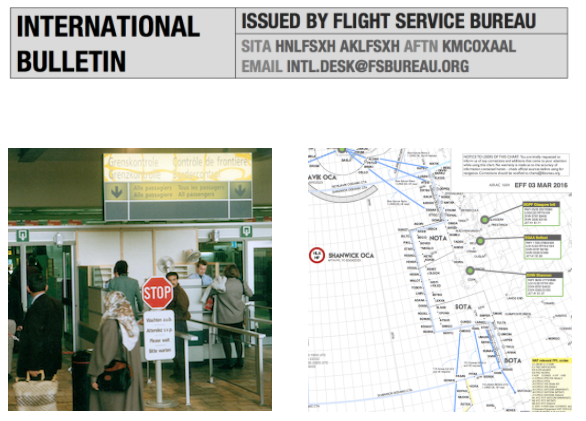
EU Border Controls expanded 02MAR Travellers and crews operating to Denmark, Belgium and other EU countries will need to present travel documents to enter from another Schengen country. The security checks will likely cause travel delays for EU and non-EU travellers into the Schengen area.

New NAT Plotting Chart published 02MAR With the multitude of changes on the North Atlantic in the last few months, including new Tracks, end of MNPS, new HLA, RNP4 – we have published an updated and revised Plotting Chart for the NAT region, showing all new requirements and with updated Airport and Fuel pricing. It’s effective 03MAR.


VOXX/India has expanded its e-Tourist Visa (eTV) program to applicants from 37 additional countries. Eligible visitors under the eTV include business visitors and those traveling to sightsee, visit friends or relatives or to make short medical visits. Nationals from a total of 150 countries are now eligible for the program.

EXXX/Europe Due to the introduction and continuation of border controls in the European Union, travellers to Denmark, Belgium and other EU countries will need to present travel documents to enter from another Schengen country. The security checks will likely cause travel delays for EU and non-EU travellers into the Schengen area. Belgium has instituted border controls at its borders with France. The security checks will remain in place until at least 23MAR.

KTEB/Teterboro will close 0500-1700Z (12 hour closure) this weekend – from midnight Saturday until noon Sunday. This closure is necessary to install new, mandatory hold short signs on Runway 19, which will close the runway intersection. Helicopter operations will be permitted during the closure.

HKXX/Kenya A visa on arrival is now available again at Nairobi, reversing the previous procedure established last year forcing all visitors to obtain one prior to flying. Online visas are still available. http://evisa.go.ke/evisa.html

NFXX/Fiji As of 25FEB, there are 42 confirmed deaths in Fiji due to the damage caused by Cyclone Winston, which made landfall over the 20-21 February weekend. Approximately 35,000 people are sheltering in evacuation centers. There has been little to no contact with remote islands; therefore, the number of casualties and people displaced is likely much higher. Concern about the outbreak of mosquito-borne viruses, such as Zika and dengue fever.

WAXX/Indonesia Australian DFAT updated its travel advice for Indonesia, which reads: “We advise you to exercise a high degree of caution in Indonesia, including Jakarta, Bali and Lombok, due to the high threat of terrorist attack. We continue to receive information that indicates that terrorists may be planning attacks in Indonesia”

SKXX/Colombia is introducing ADS-B, with associated new phraseologies that crew should be aware of. ATC may ask “Notify capacity ADS-B”; response “ADS-B transmitter”, “ADS-B Receiver”, or “Negative ADS-B”. Full AIC.

LOWW/Vienna has a couple of new RNP AR (Authorisation Required) approaches to RWY 16 and 34 on test.

LIXX/Italy is joining the Free Route Airspace (FRA) bandwagon, airspace trial this coming weekend 05-07MAR at FL370 and above in Roma, Milano, Padova and Brindisi ACC, and Malta ACC.

UKXX/Ukraine Did you know that there was reduced horizontal separation in Ukraine airspace (RHSM)? Neither did we. Check out AIC 02/16.

UIBB/Bratsk has fuel supply issues again, current shortage until 31MAR.

View the full International Bulletin 02MAR2016


Midweek Briefing: Mexico Volcano Eruption, Atlantic MNPS is over… Introducing HLA

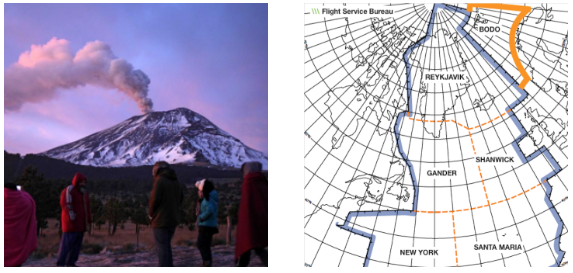
Mexico Volcano Eruption 29JAN Popocatepetl Volcano, which is 55 kilometres southeast of Mexico City, had its last major eruption in 2000; it erupted on Tuesday this week affecting flight operations at MMPB/Puebla, and with the risk of further eruptions affecting operations in Mexico City itself.

Atlantic MNPS is over… introducing HLA 29JAN Effective next week, 04FEB, there are another round of changes on the North Atlantic – HLA/High Level Airspace is the replacement for MNPS, and the airspace is extended with Bodø joining Shanwick, Gander, Reykjavik, New York, and Santa Maria. Read our International Ops Notice 01/2016.


North Atlantic Effective 04FEB MNPS Airspace is replaced by HLA/High Level Airspace on the North Atlantic – extended with Bodø joining Shanwick, Gander, Reykjavik, New York, and Santa Maria. RNP4 or RNP10 now required. Read our International Ops Notice 01/2016 
or our blog post: Did you know MNPS is over?

TTxx/Trinidad and Tobago The annual Carnival in Port of Spain will take place on February 8 and 9, 2016. Travel and tourism activities are expected to continue for up to two weeks after the celebration and will be busiest during weekends. February 10, 2016 (Ash Wednesday) is expected to be the busiest day of the year at the Port of Spain airport. February 8 to 9, 2016 is also expected to be a congested time for departures.

KSFO/Super Bowl 50 The FAA will not be imposing a slot-based special traffic management program for the game on 08FEB, but ramp reservations, made through specific FBOs, will be required for all arrivals and departures from 04-08FEB. The rule will apply to all airports in the region, including San Francisco International, Oakland International, Hayward Executive, Norman Y. Mineta San Jose International, Livermore Municipal, Buchanan Field, Napa County, Charles M. Schulz-Sonoma County, Monterey Regional, Watsonville Municipal and Salinas Municipal. NBAA has set up a Super Bowl 50 information page that includes links to the FAA arrival/departure routes.

Uxxx/Tajikistan The U.K.’s Foreign and Commonwealth Office (FCO) issued updated travel advice for Tajikistan that reads as follows: “In early September 2015, armed clashes involving security forces resulted in a number of deaths close to Dushanbe International Airport and in the Romit Valley not far from Dushanbe. While tensions have eased, security remains heightened. You should continue to take extra care, monitor the local media and check this advice regularly.”

KFZZ/Falcon Field, Arizona In January and February, Runways 4R/22L and 4L/22R at Falcon Field Airport (FFZ) in Mesa, AZ will be closed non-concurrently for the taxiway ALPHA realignment construction project. These are hard closures with no potential for runway recall. Runway 4L/22R had closed Jan. 12, at 6 a.m. (1300Z) and will remain closed until Saturday, Jan. 30, 2016. Runway 4R/22L is expected to close Monday, Feb. 1, at 6 a.m. (1300Z) and remain closed until Sunday, Feb. 15.

Kxxx/United States A few weeks ago we reported on new FAA FDC NOTAMs that eliminate the need to obtain a TSA Waiver for domestic flights in the US. on 17JAN The FAA has corrected an error in these (in simple terms, they forgot to include some previously issued exceptions), and so there are 3 brand new NOTAMS effective – these are 6/4255, 6/4256 and 6/4260. Got some time?Read the original NOTAMs in full.

Mxxx/Mexico The U.S. Department of State warns U.S. citizens about the risk of traveling to certain places in Mexico due to threats to safety and security posed by organized criminal groups in the country. U.S. citizens have been the victims of violent crimes, such as homicide, kidnapping, carjacking, and robbery by organized criminal groups in various Mexican states. This Travel Warning replaces the Travel Warning for Mexico, issued May 5, 2015

EISN/Shannon FIR Due to a number of flights deviating from clearances prior to exiting Shanwick OCA, flight crews are reminded that Eastbound route clearances issued by Shannon Control for aircraft exiting Oceanic Airspace apply from AGORI, SUNOT, BILTO, PIKIL, ETARI, RESNO, VENER, DOGAL, NEBIN, MALOT, TOBOR, LIMRI, ADARA, DINIM, RODEL, SOMAX, KOGAD, BEDRA, OMOKO, TAMEL AND LASNO. Flights shall not turn before these points.

Uxxx/Russia The Russian Institute of Volcanology has issued a code orange alert after Russia’s Zhupanovsky volcano began erupting earlier this week, sending clouds of ash and gas to 27,000 ft. A code orange advises pilots to avoid flying near the ash cloud, reportedly moving over the North Pacific Ocean driven by prevailing easterly winds.

UIII/Irkutsk has issued NOTAM A0134/16 closing RWY 12/30 weekly on Tuesdays from 1210-1450Z beginning Feb 02 and ending March 22. UIII is not available as an alternate during those times.

UHSS/Yuzhno is closed daily between 0330-0500Z due to preventative maintenance. No end date has been issued.

RPHI/Manila FIR has begun Phase 1-b of an ADS/CPDLC trail. The specific details of the plan can be found here.

Wxxx/Indonesia  As of 19JAN, Mount Egon has been erupting on Flores Island, which is located east of Bali Island. Egon emitted large amounts of ash and noxious gas. As of yet, the eruption has not caused any flight delays or cancellations; however, previous volcanic eruptions in the lesser Sunda Islands have caused extended delays in Denpasar and Mataram.

Zxxx/China Talks with the Zhuhai municipal government, Chinese government, Zhuhai Airport Authority and the Civil Aviation Authority China (CAAC) resulted in temporary International China Inspection and Quarantine (CIQ) services at Zhuhai Airport for non-scheduled business aviation movements. Following the approval late last month, China’s National Port Administration Office opened a temporary customs port on January 1. The approval is renewable on a six-month basis. During the “approval period” from January 1 to June 30, crewmembers of foreign business aviation flights can enter and exit China via the temporary business aviation port at Zhuhai Airport.
View the full International Bulletin 27JAN2016


Monday Briefing: North Atlantic OTS Changes, Indonesia Volcano Eruption

North Atlantic OTS Changes this week 09NOV This Wednesday (12NOV) sees the implementation of the new NAT Track OTS, marking the first change to the lateral structure since the tracks were introduced in 1965. New requirements include RNP4, and 24 new Oceanic Entry Points come into effect. See below for further.

Indonesia Volcano Eruption 09NOV Operations into WADD/ Denpasar, Bali continue to be disrupted due to ongoing eruption of Mt. Rinjani on Lombok Island. Also affected are nearby WARB/Blimbingsari and WADL/Lombok.


EINN/Shannon FIR CPDLC service is withdrawn on the evening prior to implementation of the new NAT Track system, voice service only from 1715Z onwards on 11NOV.

LGGG/Athens FIR Strike of Greek Radio Operators (thereby including AFTN messaging, and AFIS) announced this morning for 12NOV. Overflights will not be affected. Full details here.

HESH/Sharm el-Sheikh remains open but subject to multiple advice notices from international Authorities. Many airlines have cancelled operations into the airport after increasing suspicions that a bomb was loaded here onto the A320 which crashed into the Sinai Desert.

HLLL/Tripoli FIR Libya has issued updated advice regarding airport availability – HLLQ, HLTQ and HLZW are only available for international arrivals, daylight hours only. PPR and Permit is required prior operations.

SCFZ/Antofagasta ACC, Chile. Crews on Airways UL780 and UL302 are requested to inform ATC of any speed changes greater than .02 Mach; if unable on VHF, use HF 10024. The procedure is to ensure separation between succeeding aircraft operating on CI speeds.

SBXX/Brazil The Brazilian Grand Prix takes place 13-15NOV making Sao Paulo operations at SBSP/Congonhas, SBGR/Guarulhos, and SBKP/Campinas busier than usual.

RPLL/Manila, Philippines APEC 2015 Summit being held 17-20NOV. Check restrictions, many commercial flights have been suspended during this period. Parking at a premium. Consider quieter alternates such as RPLC/Clark.

YXXX/Australia Australian Border Force strike commencing midnight 09NOV across Australian airports. As a result, departure and arrival processing at Australian airports may take longer then usual.

WADD/Denpasar, Indonesia Operations here continue to be disrupted due to ongoing eruption of Mt. Rinjani. Also affected are nearby WARB/Blimbingsari and WADL/Lombok. For updates monitor http://www.bom.gov.au/products/Volc_ash_recent.shtml

LIXX/Italy Possible ATC strike on 14NOV 1200-1600Z announced.

KXXX/US Airport Runway closures: BWI-RWY 10/28 CLOSED SEA-RWY 16C/34C CLOSED LAS-RWY 7L/25R CLOSED

KLAS/Las Vegas NBAA 2015 will take place 17-19NOV limiting airport capacity.

HECC/Cairo FIR, Egypt Point PASOS (LCCC FIR) is again available in both directions for flight planning. Please be aware flights departing OLBA via LCCC must file via VELOX-PASOS. Also see HECC NOTAM 1A277/15 and 1A278/15 for flight planning guidance.

VHHH/Hong Kong Arrival and Departure delays up to 30 minutes can be expected due to a flight check and maintenance on RWY 07L/25R on 09NOV 0530-0100 and 10NOV 2300-0100.

Caribbean Tropical Weather Advisory Shower and thunderstorm activity is showing signs of organization in association with a low pressure system located just north of the Turks and Caicos and the southeastern Bahamas. A tropical depression or a tropical storm is likely to form on Monday while the low moves west-northwestward to northwestward near or over the central and northwestern Bahamas. For further details see National Hurricane Center

KLAX/Los Angeles Due to military operations of the coast of LAX there is a risk of arrival delays and reroutes during the overnight periods until Nov 12th.

MWCR/Grand Cayman may be forced to shorten the runway at Owen Roberts International Airport (MCWR/GCM). The runway, which was extended to accommodate long-haul flights, may have to be shortened in order to accommodate a 400 ft/124 m safety area. An extension of the runway cannot be further extended, and the airport authority is examining all options.

CYYQ/Churchill has amended opening hours 1200-2200Z M-F.

PKWA/Bucholz has revised ATC hours from 01NOV, 0800-1230 and 1330-1600LT.

NWWW/Tontouta has a main runway closure 09-12NOV at various times, some daytime. Check NOTAM 1543/15.

EGPF/Glasgow is closed overnight 22NOV-11DEC for runway and taxiway repairs.

DRRR/Niamey Ouagadougou ACC is now operational H24 again; the previously implemented contingency plan for traffic operating outside ATC service hours is withdrawn.

View the full International Operations Bulletin for 09NOV2015.