FAA Warns on Runway Length Data and Overrun Risk

On Jan 21, the FAA issued a new Information Note for Operators after identifying cases where incorrect runway length data was being used for performance planning.

The concern is straightforward. Using the wrong numbers can skew takeoff or landing calculations, which is why the FAA says performance planning should be based on declared distances from the Chart Supplement.

What exactly is the issue?

The FAA notes that many crews default to runway lengths taken from airport diagrams, charts, FMS databases or commercial planning tools.

The issue is that these sources may not include declared distances (TORA, TODA, ASDA and LDA) which are the figures used to meet regulatory performance requirements and can differ significantly from the physical runway length.

The FAA’s concern is that crews may misunderstand declared distances, omit them entirely, or rely on FMS or third-party data that has not been updated after changes.

So a quick clarification on how runway lengths are defined helps…

About runways

When we talk about default runway length, we are talking about the physical length of the runway surface. It’s what you see on charts, airport diagrams and other sources of info.

It represents exactly that – pavement from end to end. It may include unusable bits (such as displaced thresholds, closed portions etc) and is often a single number with no context.

It doesn’t tell you how much runway is legally available for takeoff or landing and can significantly overstate what you can actually use (more on that later).

Declared distances, on the other hand, are the official, performance-relevant runway lengths published by the airport authority via the FAA Chart Supplement and other validated sources.

A brief reminder of what these distances include (and critically, don’t):

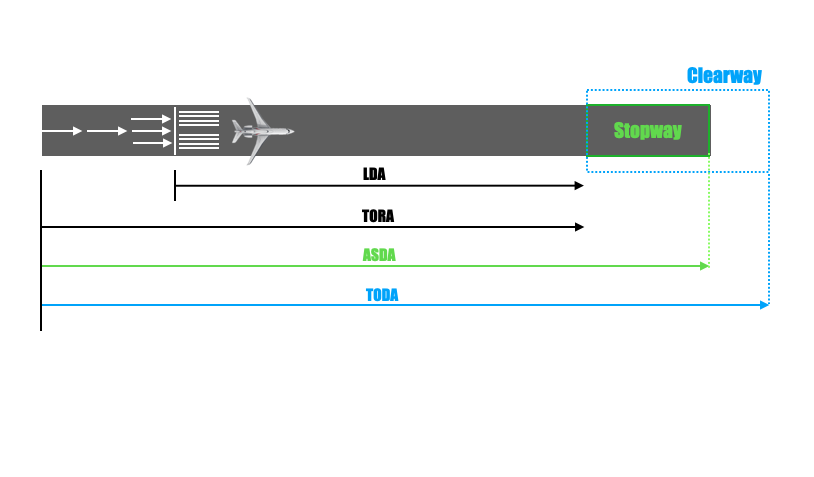
Takeoff Run Available (TORA). Think of this as how much runway you can accelerate on. It includes useable pavement only, starting at the take-off threshold. It doesn’t include clearways or stopways.

Takeoff Distance Available (TODA). How much distance you have to get airborne (i.e. TORA) plus the distance required to clear obstacles in the initial climb segment (clearways). Crucially, it doesn’t include stopways (usable in a rejected takeoff).

Accelerate-Stop Distance Available (ASDA). Think of this of how much distance you have if you reject the takeoff. It includes TORA and stopways. It doesn’t include clearways.

Landing Distance Available (LDA). How much runway you actually have to stop after touchdown. This includes usable pavement from the landing threshold to the end of the runway. It doesn’t include pavement before a displaced threshold, stopways or clearways.

Here’s what this all looks like:

Under the FAA regs, these distances are the authoritative performance numbers. They override any single runway length shown elsewhere. That’s the key point.
Real world example

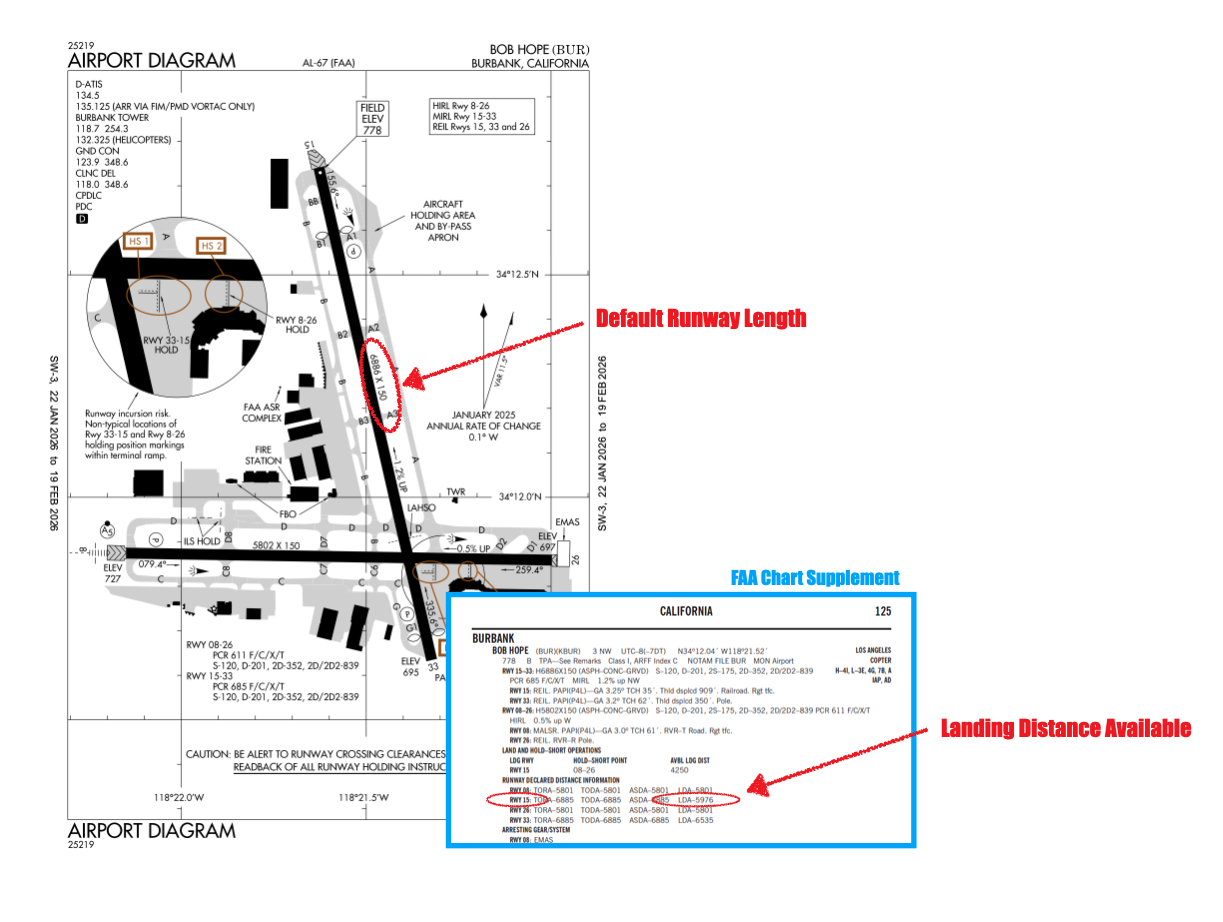
But that’s enough theory. A good real-world example is KBUR/Burbank Runway 15, where the published runway length and the declared landing distance are not the same.

Many charts and planning tools show a runway length of 6,886 ft. But the FAA Chart Supplement lists an LDA of 5,976 ft due to a displaced threshold for obstacle clearance.

If crews plan landing performance using the longer figure, they may be overestimating available runway by about 900 ft. Add tailwind, a wet surface, or a performance-limiting MEL, and that margin can disappear quickly.

That’s exactly the scenario the FAA is trying to prevent.

So what’s the FAA’s advice?

For performance calcs, the FAA says crews should use published declared distances, not the physical runway length. Just because pavement exists doesn’t mean it’s legally usable.

That expectation needs to be reflected in procedures, training and day-to-day practice.

Crews also need to be clear on which runway lengths their performance tools are actually using.

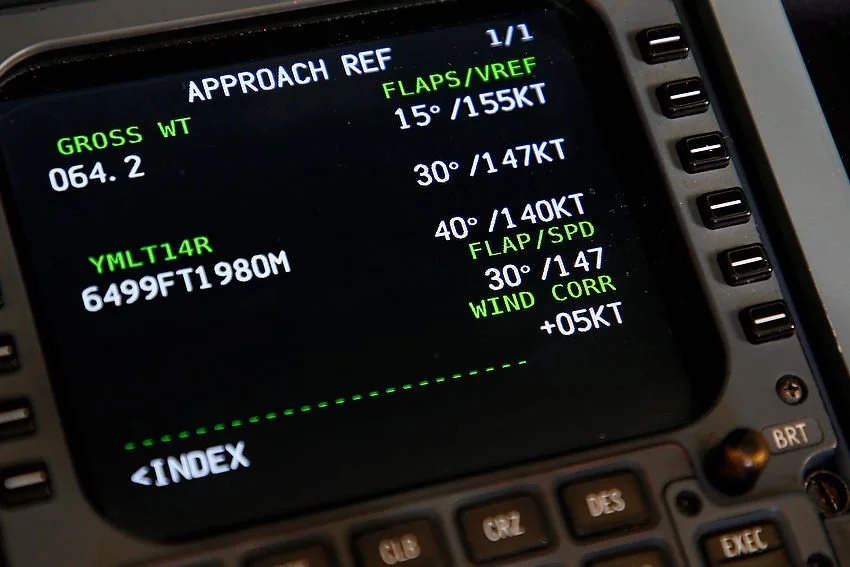
Be aware that the FMS runway length is not LDA, ASDA or TODA.

Operators should also review FMS databases and third-party performance tools, understand their limitations, and check that the data is current.

Have you spotted something risky out there?

Share it (anonymously) with the group! You can reach us via blog@ops.group, Airport Spy or Report-A-Thing.


US Shutdown Ends and FAA Lifts Flight Restrictions

Update Nov 17:
  • The US shutdown is over and the FAA says it will end the emergency order at 0600 EST on Nov 17, which means the nationwide flight-reduction limits on the US NAS are being cancelled.
  • That opens the door for airlines to get back to normal schedules. In fact, most of them had already started running full programs over the weekend because they expected the cuts to be cancelled. The system coped, but it will still need a bit of time to fully settle after weeks of strain.
  • And the big news for BizAv: the Notams that shut out GA at the 12 major airports have now been cancelled, so access is open again.
Original story from Nov 11:
  • Congress passed a funding bill late on Nov 10 that’s expected to end the shutdown once signed into law.
  • The FAA hasn’t lifted any of its traffic limits or BizAv bans yet, so everything below still applies until official guidance changes.
  • ATC recovery won’t be instant. Weeks of six-day schedules, long shifts, and financial strain have left facilities short-staffed. Even after the shutdown ends, it will take time for the FAA to rebuild staffing, lift flight-reduction orders, and restore normal capacity. Expect ongoing delays and flow programs in the meantime.

ATC staffing shortages caused by the shutdown have already changed how the country’s busiest airports are operating. Delays have surged, major metro areas are tightening up, and the FAA has put formal limits in place to keep traffic manageable. With the funding deal now in place, these measures should begin to unwind once staffing stabilises – but for now, they remain fully in force.

These limits arrived in two steps:

Nov 7: An Emergency Order issued on Nov 7 reduces airline traffic at 40 major airports and gives the FAA the option to restrict BizAv flights when staffing becomes too thin.

Nov 10: A series of Notams went further, temporarily banning most domestic BizAv flights at 12 of those same airports. These Notams effectively strengthened the restriction powers created under the Emergency Order.

Confusing! Yes indeed. Finer details as follows…

The Nov 7 Emergency Order reducing airline flights at 40 airports

You can view this here.

This applies only to Part 121 airlines and to commuter or scheduled Part 135 carriers, (and for simplicity, let’s just call these guys airlines for the rest of this article).

So, airlines must now reduce their scheduled domestic flights at 40 “High Impact Airports” during the daytime hours of 0600-2200 local. The reduction rises from 4% on Nov 7, to 10% by Nov 14.

On-demand Part 135 flights and private Part 91 flights are not part of the mandatory cuts (and again for simplicity, let’s just call these guys BizAv for the rest of this article!)

The Order also gave the FAA the option to reduce BizAv activity at these airports if staffing levels drop further – which is what then happened with the Notam splurge on Nov 10! (see below for info on that)

The forty airports listed in the Emergency Order are:

  • KANC/Anchorage
  • KATL/Atlanta
  • KBOS/Boston
  • KBWI/Baltimore
  • KCLT/Charlotte
  • KCVG/Cincinnati
  • KDAL/Dallas Love
  • KDCA/Washington National
  • KDEN/Denver
  • KDFW/Dallas Fort Worth
  • KDTW/Detroit
  • KEWR/Newark
  • KFLL/Fort Lauderdale
  • KHNL/Honolulu
  • KHOU/Houston Hobby
  • KIAD/Washington Dulles
  • KIAH/Houston Intercontinental
  • KIND/Indianapolis
  • KJFK/New York JFK
  • KLAS/Las Vegas
  • KLAX/Los Angeles
  • KLGA/New York LaGuardia
  • KMCO/Orlando
  • KMDW/Chicago Midway
  • KMEM/Memphis
  • KMIA/Miami
  • KMSP/Minneapolis St Paul
  • KOAK/Oakland
  • KONT/Ontario
  • KORD/Chicago O’Hare
  • KPDX/Portland
  • KPHL/Philadelphia
  • KPHX/Phoenix
  • KSAN/San Diego
  • KSDF/Louisville
  • KSEA/Seattle Tacoma
  • KSFO/San Francisco
  • KSLC/Salt Lake City
  • KTEB/Teterboro
  • KTPA/Tampa

The Nov 10 BizAv restrictions at 12 major hubs

Three days later, the FAA issued a much stronger measure: Notams at 12 major hubs that temporarily prohibit most BizAv flights (ie. private Part 91 and on-demand Part 135). You can view the list of Notams here.

These Notams apply only to airports already in the Emergency Order list, which shows they are a targeted escalation rather than a separate policy. Only based aircraft, emergency or public-service flights, or operations authorised by the ATCSCC may use these airports.

The twelve airports with these BizAv restrictions are:

  • KORD/Chicago O’Hare
  • KDFW/Dallas Fort Worth
  • KDEN/Denver
  • KBOS/Boston
  • KIAH/Houston Intercontinental
  • KATL/Atlanta
  • KJFK/New York JFK
  • KLAX/Los Angeles
  • KEWR/Newark
  • KPHX/Phoenix
  • KDCA/Washington National
  • KSEA/Seattle Tacoma

This means the FAA has used the BizAv-reduction authority provided in the Emergency Order and applied the most restrictive version of it at these 12 hubs. Instead of trimming activity, BizAv access has been mostly removed – for now.

The National Air Transportation Association (NATA) has since reported that the FAA told them these restrictions only apply to domestic non-scheduled flights. According to NATA, international Part 135 operations may still be approved with prior coordination through the FAA Command Center. This hasn’t been formally confirmed, so treat it cautiously until the FAA issues official guidance.

Operational impact for BizAv

40 High Impact Airports: Although most BizAv flights are not part of the mandatory Airline reductions, they are still affected by the resulting compression. Expect more flow programs and occasional reroutes at the 40 High Impact Airports.

12 specific BizAv-restricted airports: Access is effectively unavailable for domestic flights unless you meet an exemption. NATA says international Part 135 operations may still be possible with prior coordination through the FAA Command Center, but this has not been formally confirmed. Surrounding satellite airports will likely absorb the displaced traffic, so expect parking shortages there too.

What happens next?

Now that funding’s been approved, the shutdown should finally end – but things won’t bounce back right away. The FAA still has to rebuild staffing, unwind the flight-reduction orders, and reopen the restricted airports.

It’s a familiar story. During the 2018-19 shutdown, a single LaGuardia ground stop sparked nationwide delays and helped force a deal in Washington. This time, the same pattern has played out: rising ATC strain, mounting cancellations, and political pressure finally pushed Congress to act.

Expect a slow return to normal. Delays, flow programs, and limited capacity will likely continue for weeks as the system stabilises. We’ll keep tracking Notams and any FAA updates to the Emergency Order as the situation evolves.


Updated FAA Oceanic Guides

The FAA has updated its resource guides for the three big oceanic areas of interest: the North Atlantic, the Pacific, and WAT airspace (West Atlantic / Gulf Of Mexico / Caribbean). All three have been updated effective July 2025.

These guides are a good starting point for understanding all the essentials of operating in these regions, and include links to all kinds of useful supplemental information around the main topics for each one.

Click on the pics to check them out.

North Atlantic

Pacific

WAT


To see a timeline of the big changes on the NAT stretching back to 2015 click here.

Opsgroup members can download several NAT guides and a NAT Plotting & Planning Chart via the Members Dashboard here.


FAA Housekeeping: Foreign Instrument Procedures, Approach Chart Clutter

Recently, the FAA has been doing some spring cleaning. You might have missed them, but recent changes to the FAA’s advisory circulars and charting notices are quite important.

This article covers two of them:

  • Effective June 2025, the FAA officially shifted the responsibility for evaluating and approving foreign instrument procedures to aircraft operators themselves.
  • From October 2, instrument approach charts will be decluttered by removing unnecessary comms data.

Let’s take a look at each of these in more detail.

Removing approvals for specific foreign procedures

Recently, the FAA advised those operating under Part 91(K), 121, 125 and 135 of changes to foreign instrument procedure authorizations.

It has removed outdated references to specific foreign instrument procedures by title from operator authorizations (OpSpec C058, C358 and H107).

Others were simplified (C059, C060, and C384) to remove references to specific foreign airports and procedures.

The end result? Operators are no longer required to obtain FAA approval for specific foreign instrument procedures listed by name — but they must still hold the required FAA authorization (OpSpec, MSpec, or LOA) to conduct the type of procedure (e.g., RNP AR, CAT II/III), regardless of where it’s flown.

So, does this mean I can now fly any foreign procedure without FAA involvement?

Not quite. While you no longer need FAA approval for each individual foreign procedure, you still need FAA authorization for the procedure type and must comply with host country requirements.

For instance, if Germany requires local authorisation for an RNP (AR) approach into EDDM/Munich, you must obtain it without FAA involvement.

ICAO (Annex 6) says operators are still required to obtain approvals when the host state mandates it, and crews must comply with any local procedures or limitations.

Why the change?

Without delving too much into the specifics, there are a few reasons:

  • Less paperwork – foreign procedural reviews are cumbersome and labor intensive, and lead to delays in approval.
  • Less workload – inspectors no longer have to approve each foreign procedure individually.
  • Improved design – there has been significant improvement in procedural design around the world thanks to the proliferation of ICAO PANS OPS.
  • Empowerment – operators can perform their own risk assessments and use globally standardised instrument procedures without the extra weight of FAA approvals.

So the onus is now on the operator – what next?

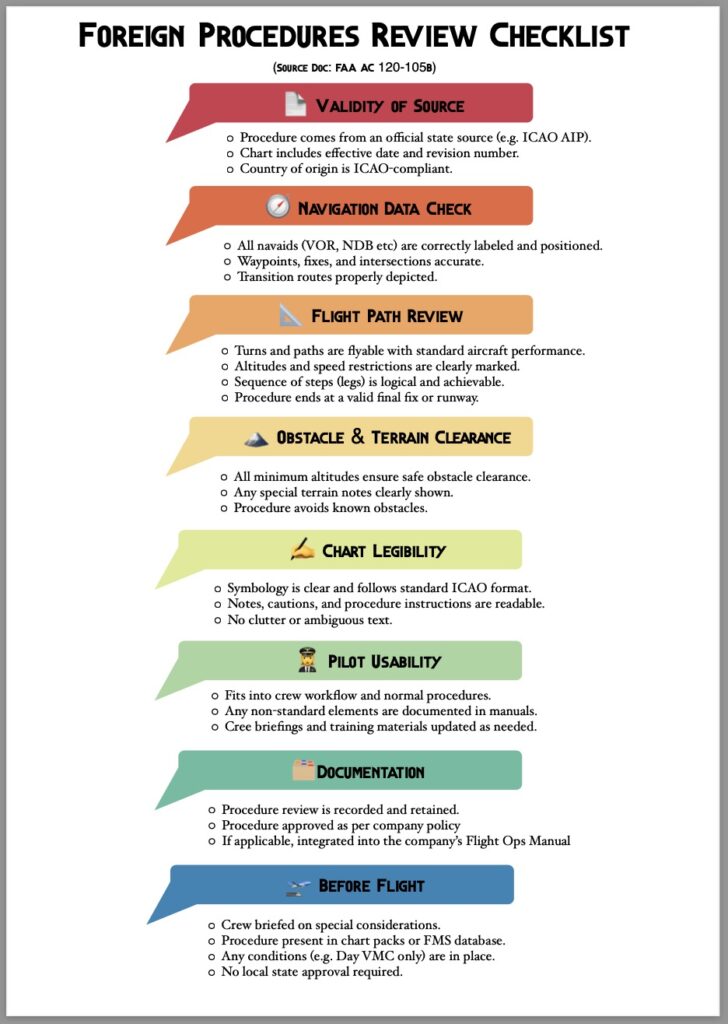
That’s where AC 120-105B comes into play. It provides guidance for US operators on reviewing and accepting foreign instrument procedures outside the US.

This includes a list of your areas of responsibility, recommended tools and checklists to help with your review, and advice on incorporating a review process into your company’s manuals, SOPs and pilot training.

If you operate abroad, it’s important you’re familiar with this revised AC. We’ve also put together the following checklist based on its advice to help get you started:

De-cluttering Approach Charts

On July 3, the FAA issued a new charting notice (advance notification of significant changes to charts and publications).

The news is that from October 2, the FAA will begin removing redundant comms data from instrument approach charts. This includes departure ATIS, CLNC DEL and the availability of CPDLC if all of this is shown on the corresponding airport diagram.

Listing it again on instrument approach charts is unnecessary and can reduce readability during critical phases of flight while critical frequencies remain prominent (don’t worry, tower and ground ain’t going anywhere).

While we have you, a couple more FAA-related tidbits to brush off the table.

  • Notams. Big changes are coming to the US system. By September, it will be completely overhauled. The new system will be a fast, cloud-based, and (hopefully) rock-solid stable. A renewed focus on improved safety throughout the US NAS has escalated the project, and the targets are ambitious – user testing is expected to start later this month.
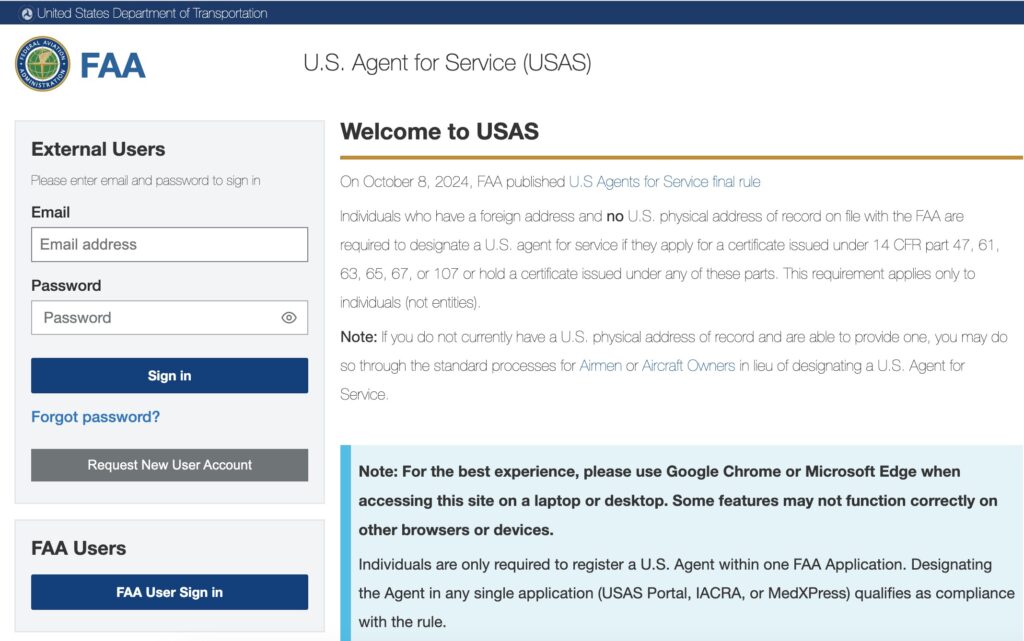
  • FAA-license holders abroad. This is our last reminder! July 7 has come and gone, which means anyone holding US licences/ratings and living outside of the US must have provided a US based address for service to the FAA via the USAS portal. If you haven’t yet, your license is effectively now invalid until you do – whatever you do, don’t operate an aircraft while un-licensed.

Have we missed a spot?

Please get in touch with us around the clock via blog@ops.group


FAA License Holders Abroad – You’ll Need A US Address Soon

June 10 update – look out for imminent medical renewals!

If you’re due for a medical soon, you might already need a US address in the USAS portal. Although the official FAA deadline to add a US agent for service is July 7, an OPSGROUP member recently discovered that MedXpress would not let him complete the pre-exam form without it. Since MedXpress and the USAS portal now talk to each other, the system checks for that US address before allowing you to proceed. Without it, you will not get the confirmation number needed for your medical.

Key Points
  • The FAA has published a new rule that will require certificate holders abroad to nominate a physical US address for service.
  • This is required from April 2 for any new applications; and July 7 for anyone who already holds FAA certificates, ratings or authorizations.
  • Anyone who ignores the new rule will be unable to exercise the privileges of their documents.

What’s Changing?

115,000 (give or take) FAA certificate holders currently live outside of the US.

Back in Oct 2024, the FAA issued a new rule requiring anyone with no US physical address on file to nominate a US Agent For Service.

This agent will be responsible for receiving all documents from the FAA on the certificate holder’s behalf – including legal and safety-critical stuff.

It’s already been postponed once, but there are now two deadlines for individuals with a foreign address and no physical US one on file:

  • April 2 for new applications.
  • July 7 for existing certificate holders.

The FAA is having problems serving documents to the large number of FAA certificate holders living abroad.

By using US-based agents, this process will be a lot faster and easier. Especially in the case of larger overseas-based flight departments.

Who will this apply too?

Anyone with a foreign address (and no US address on file) who holds or applies for FAA certificates, ratings or authorizations under the following parts of 14 CFR  – 47, 61, 63, 65, 67, 107.

Who can be a ‘US Agent For Service’?

It’s not as complicated as it sounds.

The new rule (CFR 14 3.302) says this can be any entity or adult (18yo+) with a US-based postal address.

One big gotcha though: this must be a physical address – PO boxes and mail drops are no-good.

It’s important you nominate someone you trust. They will be responsible for promptly forwarding you any FAA documents and must fully understand the importance of this task.

You’ll also need to provide the FAA with their full name, phone number and a working email address.

If there isn’t already someone in the US you know and trust, it may be worth engaging a professional service to be your agent instead.

What if I just ignore this rule?

Don’t! If a certificate holder fails to designate a US postal address or Agent of Service by the above dates, you will no longer be able to exercise the privileges of that document. You will effectively become unlicensed.

Another big scary rule – the FAA Enforcement and Compliance Order 2150.3 – says other enforcement actions can be taken including fines and jail time.

How will I designate my agent of service?

Via a new portal called the US Agent for Service System (USAS).

This will allow you to nominate your agent and provide all required contact details via the online prompts.

Don’t forget you will also need to keep the system updated with any changes.

I live in the US, does this affect me?

Long story short, no. As long as the FAA has your physical address on file you’re good to go!


Visual Approaches: When To Say No

There is a recent history in the US of serious incidents that have occurred during visual approaches – you don’t have to hunt long to find them. The reality is this: when we accept a visual approach, we accept more risk.

That isn’t to say that this risk cannot be effectively and safely managed. Visual approaches are still an important way to increase the efficiency of congested airspace. But we do have to give ourselves the room, the capacity, and the mitigations to fly them safely. And in my opinion, that’s where the true risk lies.

The FAA seems to agree. On April 2, it issued an eye-opening Safety Alert for Operators (SAFO) regarding visual approaches. The lowdown is this: visual approaches can be riskier than they seem, especially in today’s busy airspace. Let’s take a closer look.

FAA SAFO on  Visual Approaches

The FAA’s SAFO is resolute in its message – the pilot-in-command has the ultimate responsibility (by law) to say no to clearances that excessively increase workload or erode safety margins. In other words, they don’t want us to hesitate to say ‘UNABLE’. Ultimately, it’s our decision as pilots, and no one else’s.

FAA Reg 14 CFR § 91.3 specifically says:

“…The pilot in command of an aircraft is directly responsible for, and is the final authority as to, the operation of that aircraft.”

This includes the full authority to refuse or decline any clearance or instruction that they deem unsafe or beyond the operational limits of the aircraft or crew. The SAFO then continues with another important message – ATC will support a PIC’s authority to declare ‘unable’ when a clearance may reduce safety margins.

This is where the SAFO falls short a little, at least on a real-world basis. What needs to be included is ‘with impunity.’

Recent Events

In a US NAS burdened by traffic volume, aging infrastructure and controller shortages we continue to hear reports of excessive delays and even confrontation when a clearance is declined.

Check out the recent diversion of a Lufthansa A350 at KSFO/San Francisco due to non-acceptance of visual separation at night.

Courtesy of VASAviation.

There appears to be a growing disconnect here between what the FAA wants in its SAFO, and what’s actually happening in the real world.

It’s seems clear that more needs to change amongst all stakeholders before we can begin to consistently practice ‘safety over sequence’ while accommodating all traffic.

FAA Mitigations

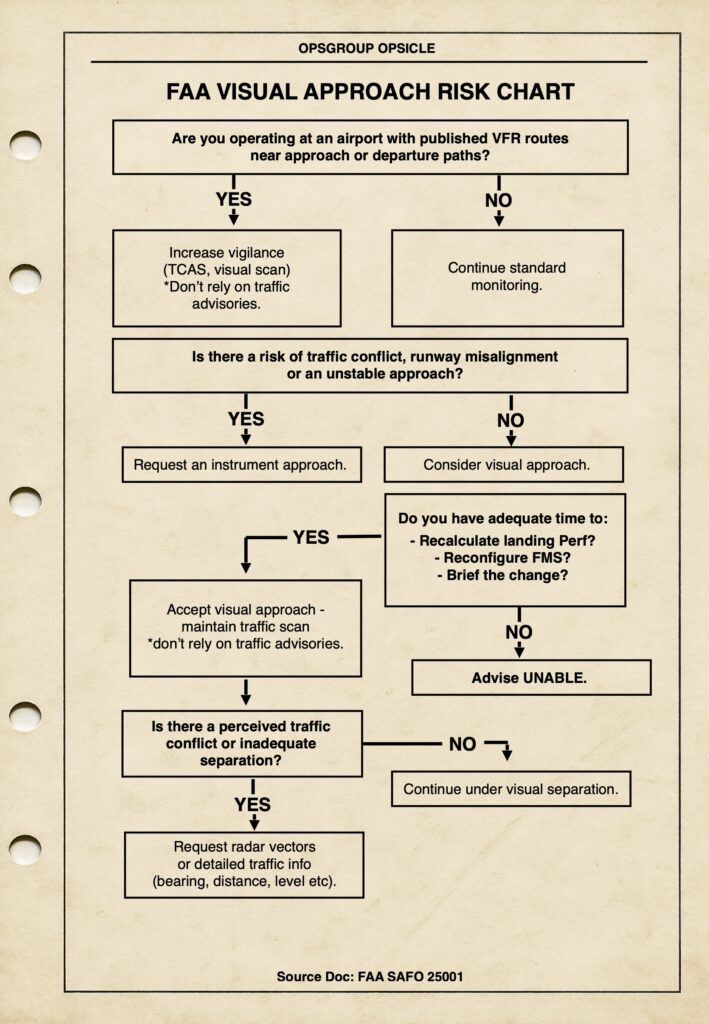
The FAA’s recent SAFO also provides some guidance for pilots on how to mitigate some of the risks of accepting visual approaches. We’ve summarized those in the following little Opsicle.

A note about Business Aviation

In researching this article, several suggestions were also raised about the human factors involved with why pilots find it so hard to say no to challenging clearances. Attend any Human Factors course and you’ll be familiar with the common culprits – saying ‘unable’ can feel like a form of noncompliance, the need to be perceived as competent, an innate desire to ‘make it work’, or the struggle of time compression.

What’s more interesting to us on this occasion is the vulnerability (when compared to airline ops) of business aviation crew to accept challenging clearances despite the increased risk. In other words, are there unique factors? BizAv pilots are faced with a unique combination of industry culture, operational demands and perception of role.

Under Pressure:

BizAv pilots usually find no solace in the anonymity of a flight deck door, a staff number, or a large airline. They have direct contact with those who employ them (sometimes even in the cockpit). Whether we like it or not, this can have an insidious effect on our tolerance for risk. Saying ‘unable’ can feel like failing to deliver.

Professional Flexibility:

Travel by private jet can typically cost anywhere between ten to forty times more than flying commercial. Those who pay may have a certain expectation that we can land anywhere, anytime and circumvent the constraints of conventional airline travel.

No One’s Watching:

Unlike the airlines, there is no requirement for business jets operated under Part 91 to be equipped with Flight Data Recorders or even CVRs, or even under Part 135 (with less than ten seats). And it is hard to deny (even with the best intentions) that this doesn’t have some kind of impact in moments of unexpectedly high workload. Strict adherence to stabilized approach criteria for instance can become more flexible without fear of reprisal.

Safety Management Under Part 91:

The FAA SAFO also specifically mentions the use of safety management systems (SMS) to better mitigate the risks of conducting visual approaches. However a looming mandate will only apply to Part 135 operations – not Part 91, where they will remain voluntary. It’s therefore possible that some BizAv pilots will not be exposed sufficiently to the FAA’s advice.

Want to join the discussion?

We’d love to hear from you. You can reach us at: news@ops.group.


US Ops Update: Privacy, IDs & Safety

Key Points
  • FAA Enhances Aircraft Privacy: The FAA now allows private aircraft owners to request the removal of personal details from public FAA websites, enhancing privacy.
  • US Address Required Abroad: FAA certificate holders abroad must nominate a physical US address by April 2 (for new applicants) or July 7 (for existing holders) to retain their privileges, with professional services available for those without a US address.
  • REAL ID Deadline Looms: From May 7, all adult passengers on US commercial flights (including Part 135 charters) must present a REAL ID-compliant ID or other accepted identification, with private Part 91 flights exempt.
  • Notam System Fails Again: The US Notam system suffered another outage on March 22, raising concerns about its reliability.
  • FAA Tightens KDCA Helicopter Rules: After the Jan 29 mid-air collision, the FAA has closed a KDCA helicopter route, restricted non-essential ops, mandated ADS-B Out, and launched a broader safety review.
  • KDCA Drone Tests Trigger Alerts: On March 1, military counter-drone testing near KDCA triggered erroneous TCAS alerts, raising concerns over improper testing and its impact on civil aviation.

In Cognito

On March 28, the FAA began accepting requests from private aircraft owners to withhold personal details (such as name and address) from public access across all FAA websites.

It’s good news for business aviation, as it potentially makes it more difficult for members of the public to track the movement of privately owned aircraft for nefarious purposes.

Aircraft owners can now submit their request via the Civil Aviation Registry (CARES) here.

Address for Service

Attention all FAA License holders abroad – this one’s for you!

The FAA has written a new rule that will require certificate holders abroad to nominate a physical US address for service. We’ve written about it in detail here, but there are essentially two looming deadlines to be aware of:

April 2 for new applications, and July 7 for anyone who already holds FAA certificates, ratings or authorizations. You’ll need to submit this via the USAS website that is about to go live.

Whatever you do – don’t ignore this. If you don’t nominate a US based address by the applicable date, you won’t be able to exercise the privileges of your document. i.e. say sayonara to your license until you submit the right info.

If you don’t have an address to nominate in the US, don’t despair. You can use a professional service like FAA Mail Agent. These guys can take care of all it for less than 50 bucks a year. Use the code ‘Opsgroup’ and get a discount.

Passenger ID Requirements

From May 7, all adult passengers (18+) using commercial air transport within the US (including Part 135 charters) must show an ID that complies with the new Real ID Act.

The big change is that anyone who wants to use a state-issued ID or drivers licence to meet this requirement must make sure that it is REAL ID compliant –  look for one of the following symbols:

There is also a list of other IDs (such as US and Foreign Passports) that continue to be acceptable.

Operators need to take note because if they allow a passenger to board an aircraft without the appropriate ID they are effectively breaching TSA requirements and become liable for hefty penalties

Important note – private flights operated under Part 91 are exempt.

The Notam system went kaput (again).

The US Notam system was down (again) for several hours on March 22 due to a hardware failure. It was the second time since early February.

Once again we collectively flinched – a system crash in January 2023 lead to the first US ground stop since 2001, disrupting over 10,000 flights.

Questions are being asked about the reliability of the system, and its lack of redundancy.

The FAA previously announced plans to discontinue the legacy US Notam system by mid-2025, with further changes slated for the next five years.

There appears now renewed public and political concern for a faster resolution.

Mixed Traffic and The Potomac Tragedy

The FAA has responded to several recommendations made by the NTSB in its preliminary report from the mid-air collision over the Potomac River on January 29.

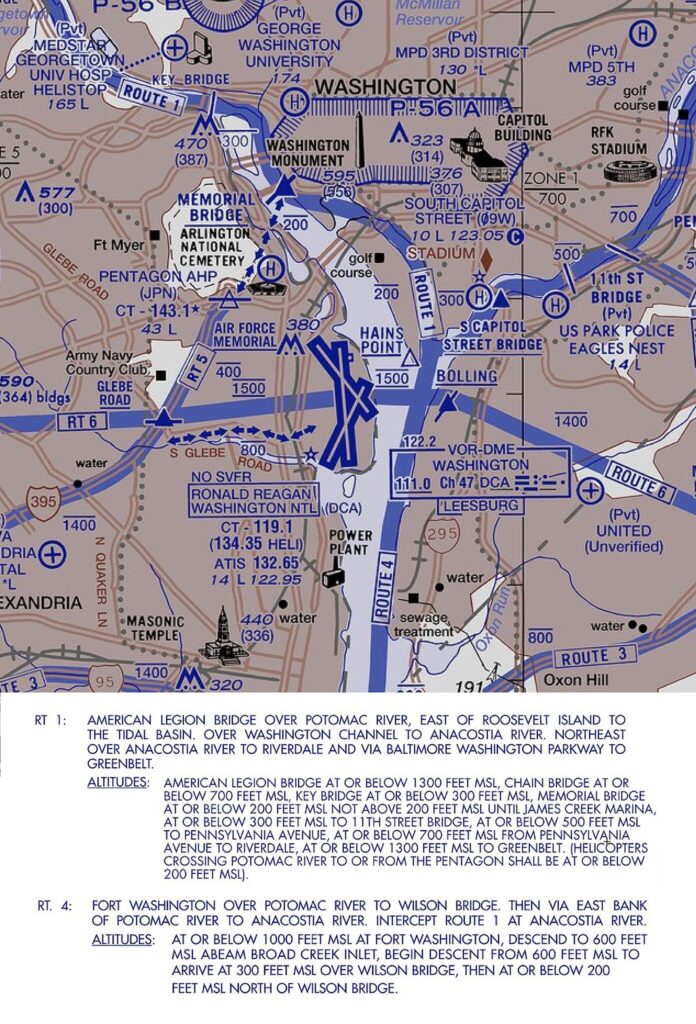
The immediate changes will be felt at KDCA/Washington itself. The FAA has permanently closed the low level helicopter route involved in the accident. Non-essential helicopter ops will also be banned, with increased ATC separation applied to those on ‘urgent missions.’

ADS-B out is now mandated for all helicopters, with only very limited exemptions for presidential missions.

Further afield, the FAA is also looking closely into ops at airports in other major cities with high volumes of mixed traffic (including NY, Boston, Chicago, Dallas, Houston and LA) with corrective actions looming for any risks identified.

TCAS wasn’t spoofed in Washington.

On March 1, several aircraft on approach to KDCA/Washington responded to erroneous TCAS alerts, including RAs. While recent research has indicated malicious interference of TCAS is a credible security concern, a Senate hearing last week revealed this was not the case.

The culprit was counter-drone testing by the military nearby which was operating on a similar spectrum to TCAS – a separate concern previously raised by the FAA.

Nevertheless, there are concerns that these tests were conducted improperly and caused unnecessary alarm to civil aircraft nearby. At the very least it was an unfortunate coincidence given recent events at the airport.

Other things you might have missed.

  •  TFR Busts –  The FAA has reported several instances of civil aircraft busting TFRs in recent weeks. The hot spot appears to be Palm Beach, FL where the President has a residence at Mar-a-Lago nearby. A reminder that special procedures apply, including TSA Gateway screening when active for anyone headed in or out of KPBI/Palm Beach. More on that in our recent article, here.
  • Laser Strikes – New guidance was published by the FAA on March 26. Turns out the number of laser strikes on aircraft continue to be dangerously high. There’s an online tool to see where the worst spots are here. Remember to report em!
  • Drones – DJI, the main recreational drone producer in the US, has removed its built-in geo-fencing feature that physically protects airports from incursions. Instead, an FAA database will simply warn the user when close to a no-fly zone. The issue is that this can now be maliciously ignored. DJI has said that its geo-fencing is about education, not enforcement. We’re not convinced – continue to report any illegal sightings to the FAA.

Anything we missed?

Let us know via news@ops.group, and we’ll add it to this article. As always the team is also available to help answer any questions, or put you in touch with the person who can.


US FAA Improves Flight Tracking Privacy

Dec 2024 Update:
  • The FAA’s Privacy ICAO Address Program (PIA) has been updated. CPDLC services are now available for flights using a PIA. To receive it, pilots must file the PIA ICAO 24-bit address and N-reg in the flight plan.
  • Two other important changes – aircraft info held by the FAA and associated with a PIA are exempt from the Freedom of Information Act, and pilots can now request a new PIA every twenty days if they want. You view the updated FAA Privacy page here.
Feb 2024 Update:
  • The FAA’s Privacy ICAO Address program has been expanded to include some new oceanic and Gulf of Mexico routes.
  • Check below for exactly which routes this program now applies to, and our Opsicle with steps on how to register.

If you’re not familiar with this program, it prevents users’ aircraft registration from being tracked by third parties using ADS-B output during US domestic flights. We wrote about it before here. But to explain what this program is and how it works in two sentences:

All Mode S equipped aircraft are assigned a unique ICAO 24-bit address – this is uniquely identifiable to your aircraft’s registration. The FAA’s PIA program assigns you another one to use that renders you secret-squirrel.

To participate, you must tick all three of these boxes:

  1. Operating an US-registered aircraft which is ADS-B equipped
  2. Using a third-party call sign
  3. Flying in US territorial airspace (the mainland, Alaska, Hawaii, and other US territories). Additionally, the PIA has been expanded to include US oceanic FIRs too – those more than 12nm from shore.

After news broke the program had been improved, we struggled to find a summary of the changes and got in touch with the FAA directly.

They advised while there is no ‘master list’ of the newly included routes, they have updated their website to include some valid examples including:

  • NYC to LA
  • Miami to Houston (via the Gulf of Mexico)
  • LA to Hawaii
  • Boston to Miami (with offshore routes more than 12nm from shore).

If you have an enquiry about a specific route, you can reach them on adsbprivacyicao@faa.gov. Chances are, as long as you stay within US jurisdiction, your route will be valid.

How to apply?

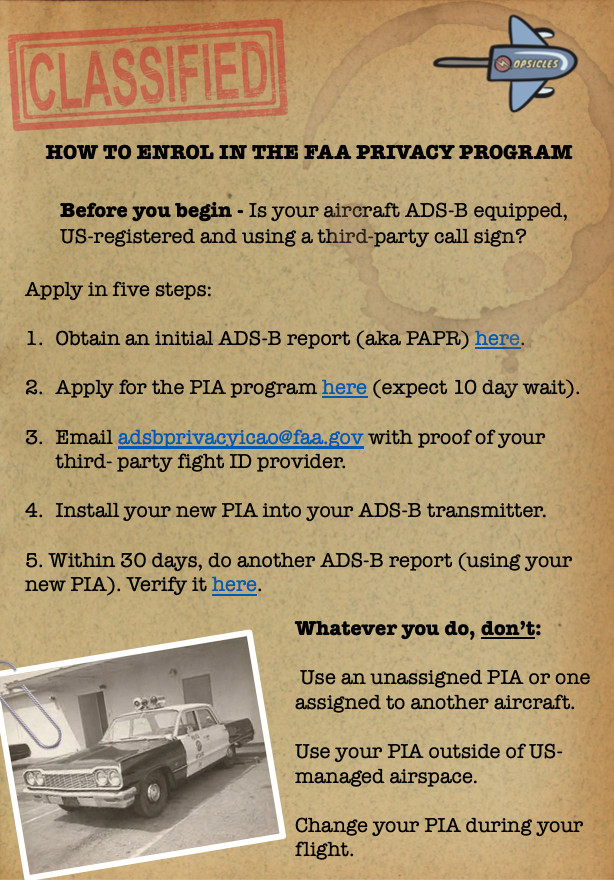
So, you want in? We’ve put together this little Opsicle with steps on how to register.

More questions?

The FAA has quite a good FAQ section on the PIA which you can access here.


US FAA: Who wants to land on the runway?

  1. Flying to an airport in the US?
  2. Want to land on the actual runway, rather than some taxiway or dirt road which looks a bit like the runway?
  3. Not afraid of some basic pics showing you how NOT to mess it up?

Well then today’s your lucky day, friend!

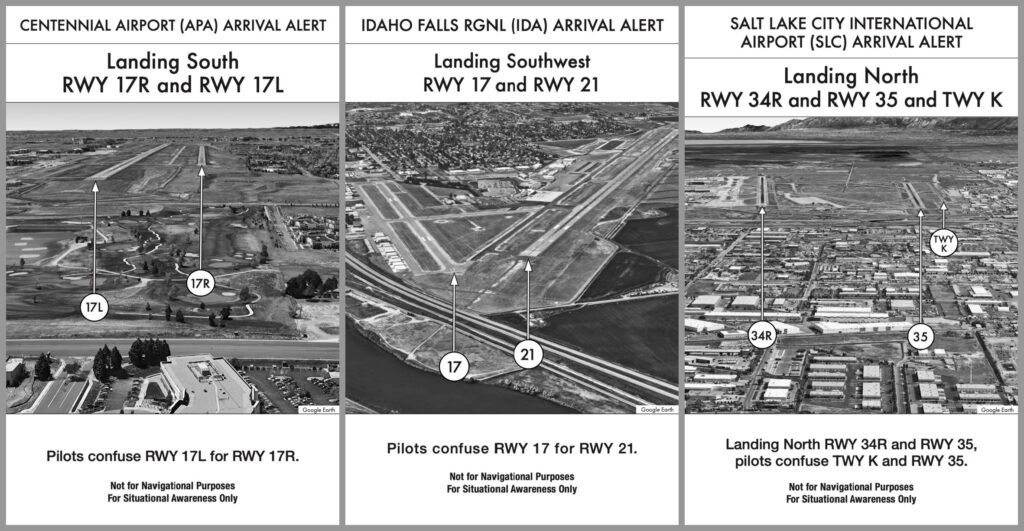
Arrival Alert Notices

The US FAA has published things called Arrival Alert Notices at several airports with a history of “misalignment risk” – i.e. where aircraft line up to or land on the wrong runway, taxiway, or even sometimes the wrong airport.

The best thing about these Notices is that they are dead simple. No superfluous symbology, no weird language, just a nice big picture of the runway with a clear instruction on what to do. 

The FAA published the first batch of these in May 2022, and then a whole bunch more in Jan 2024. So they now have them for 41 airports in total, all of which have a history of misalignment risk or “wrong surface events” – i.e. times where folks landed on something other than the actual runway.

They say that many of these wrong surface events occur “during the daytime and in visual meteorological conditions, and the majority of the time, the pilot has read back the correct landing clearance.” In other words, folks have got it wrong even at the best of times, so it’s probably worth a quick glance at these docs.

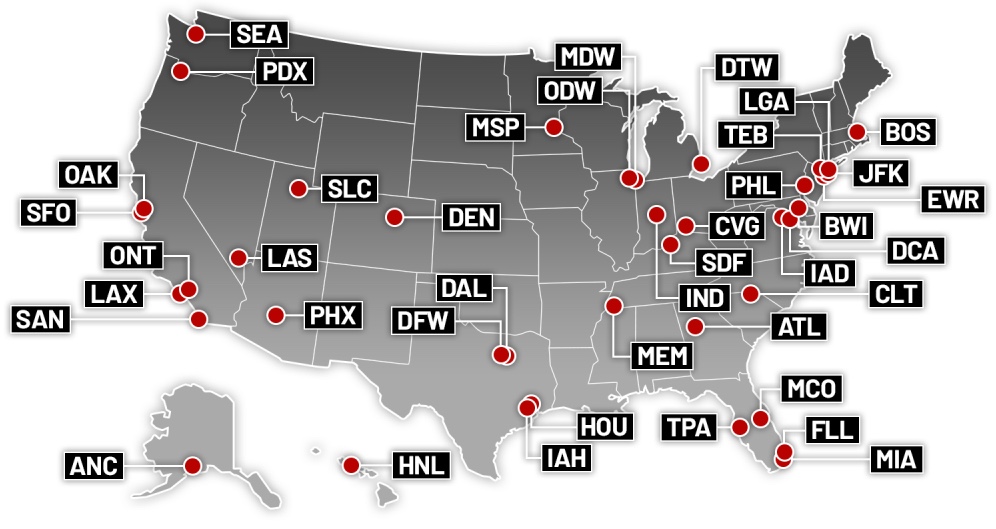
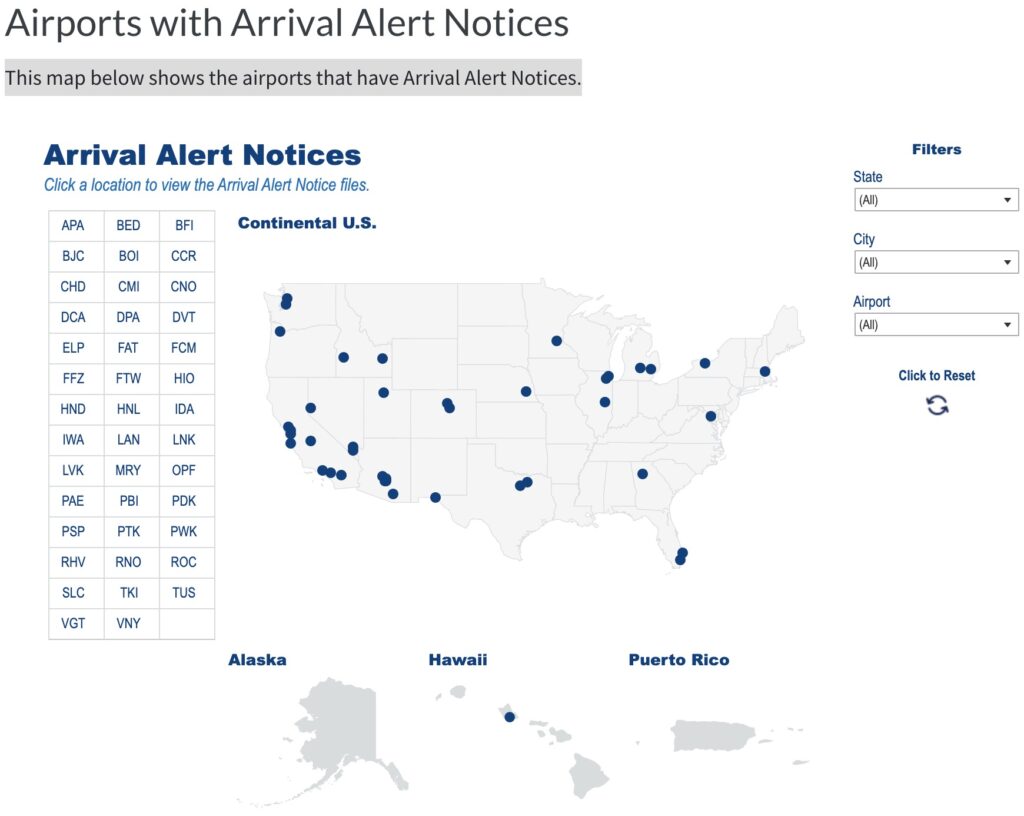
Which Airports?

This map on the FAA AAN site shows the airports that have Arrival Alert Notices.

What else is the FAA doing to improve safety?

A whole bunch of things. You can read all about it on their Runway Safety site, but here’s a summary. And as a cheap marketing trick by way of parting, I will say that the last one on this list is probably the best – so make sure you read to the end!

  1. Runway Status Lights (RWSL): In operation at 20 airports, signals potential hazards through illuminated red lights on runways and taxiway/runway crossings. More info.
  2. Airport Surface Detection Equipment, Model X (ASDE-X): In operation at 35 airports, integrates various data sources to provide ATC with better aircraft positions, and pings up alerts for potential traffic conflicts. More info.
  3. Airport Surface Surveillance Capability (ASSC): Similar to ASDE-X, ASSC operates at 9 airports, works in all kinds of weather, and lets ATC see aircraft on approach and departure within a few miles of the airport. More info.
  4. ASDE-X and ASSC Taxiway Arrival Prediction (ATAP): ATAP is an enhancement to the previous two, and alerts ATC when an aircraft is aligned with a taxiway instead of the runway. In operation at these airports.
  5. Engineered Material Arresting System (EMAS): We like these things so much, we wrote an article on them. Installed at 70 airports, EMAS are those crushable bits of tarmac at the ends of runways which you can plough into to stop overruns. Very cool. More info.
  6. Electronic Flight Bag (EFB) with Moving Map Displays: Everyone loves their EFBs and moving maps. So do the FAA – they encourage pilots to use them!
  7. Runway Safety Areas (RSA): Because many runways were built before the 1000-foot RSA standard was adopted, the FAA implemented the Runway Safety Area Program which made improvements to over 1000 runways at 500 airports.
  8. Runway Incursion Mitigation (RIM): A national initiative identifying and mitigating specific risks at 80 airports that might lead to a runway incursion. Things like: unclear taxiway markings, airport signage, runway or taxiway layout.
  9. Hot Spot Standardization: The FAA now has standardized hot spot symbology on their airport charts. We wrote about this here.
  10. Arrival Alert Notices: i.e. this article!
  11. Automated Closure Notice Diagrams: They now have a site where you can get a big airport chart showing all the runway or taxiway closures on it. It looks like AI might be involved behind the scenes on this one, so it’s a bit clunky for some airports, but it’s still pretty cool. Check it out here.
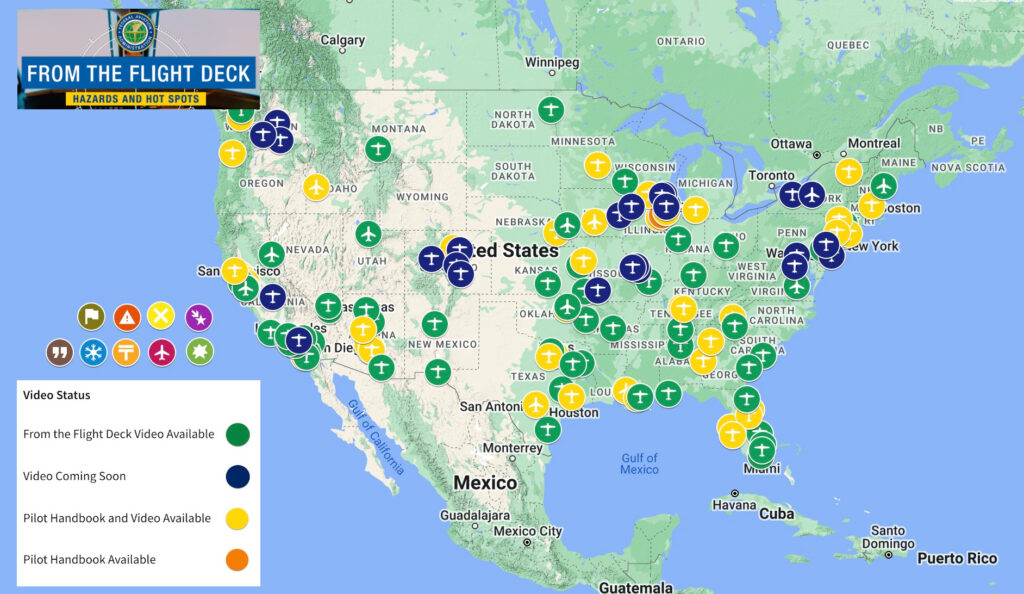
  12. “From the Flight Deck”: This might just be the best of the bunch! This FAA website basically has videos showing how to land at specific airports (real footage), plus a bunch of other useful info: hotspots, things local ATC want pilots to know, airport comms, airspace details and other preflight planning resources. Take a look here!


US Federal Govt Shutdown Risk – Why it Matters to Aviation

It’s been a big week for US politics. On September 30, a Federal Government shutdown was narrowly avoided by a last-minute funding stopgap that has delayed the problem until November 17.

The situation was front page news across several aviation websites – but you might still be wondering, why?

As is often the case, politics and aviation don’t mix. Until they do. And then we’re forced to take notice – this one of those times. There was widespread concern for what a shutdown might mean for the US aviation sector, and some of those problems could cause a real hangover.

With the problem delayed, but not gone, we may find ourselves in the exact same position again come November. Here’s a look at what is giving the issues wings (pun only slightly intended).

How can the Federal government just ‘shut down?’

A shutdown happens when Congress doesn’t approve funding for the Federal Government by the time the new fiscal year kicks off on October 1.

The crisis can temporarily be averted by a short-term funding bill which is what has just happened. But it only buys more time.

If a shut-down goes ahead, various government operations grind to a screeching halt. The world won’t end (essential services continue) but federal agencies (including the FAA) are left scrambling without funding. They need to rely on contingency procedures including furloughing staff or relying on them to work for a period of time with no pay.

Staffing

The impact on of a shut-down would primarily impact two large groups of aviation professionals – TSA staff and Air Traffic Controllers. Then of course, there’s the FAA itself…

TSA

TSA workers are federal employees, and work for the Department of Homeland Security. There’s 47,000 of them and they’re responsible for screening passengers and baggage at 450 of the nation’s airports along with other essential functions such as air marshals.

During a shutdown, they won’t get paid. There is fear of what the impact will be on the US NAS, if they (understandably) don’t want to work.

The TSA itself has allayed some fears with a recent statement. Essentially a commitment that their staff will continue working. While admirable, they are human – one shutdown once lasted well over a month . If similar occurred, how long we can rely on this promise isn’t known as the strain grows.

ATC

The majority of 14,000 controllers in the US work for the FAA, and so are also federal employees.

The impact of an extended period without pay could be significant – not to mention contributing greatly to a system known to be heavily burdened by staff shortages already.

Planes aren’t about to start flying into each other. But a major consequence of a shutdown is that the FAA would send home 1,000 controllers currently in training.

And we need them. Right now, the US is about 3000 controllers short of the mark. And the goal of recruiting an extra 1800 in the next year and half could become extremely optimistic. This shortage has been well publicized, and a shutdown would like exacerbate the problem.

Don’t forget about the FAA, either.

It never rains, but it pours.

The FAA has been dealing with a double whammy. Asides from the uncertainty of a Federal Government hiatus, it’s five-year funding bill has also expired.

A temporary re-authorization has scared the wolf away from the door, but it cannot operate properly without cashflow. And various disputes over pilot retirement age and minimum experience requirements has tapped the brakes on the entire process.

It’s a very complex agency and a suspension of its functions will take a long time to recover from for all of us.

Lessons Learnt

Federal Government Shutdowns have happened before – the most recent was in 2018 and lasted for 35 days.

There were several impacts on aviation that the NBAA usefully summarized in their article here. It likely serves as a preview of what we can expect again should a funding agreement not be reached in the new deadline in November.


The FAA Northeast Corridor Atlantic Coast Routes Project

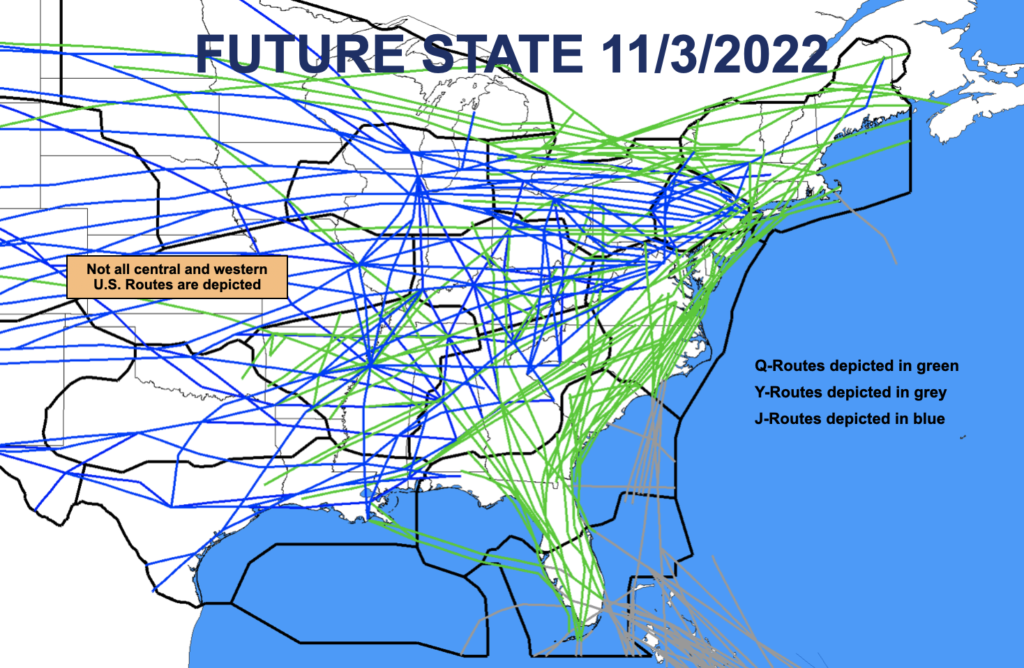
Update 18 July 2022: The FAA has postponed the final phase of its ‘Northeast Corridor Atlantic Coast Routes Project.’ A whole bunch of new and modified routes along the East Coast were meant to become active from Nov 3. This has been pushed back until 20 April 2023 to avoid the busy summer and winter peaks. The new procedures will still be published in September, but will not be authorized for use until then.

Where are we talking about?

The Airspace: All along the Atlantic East coast of the US.

The Airports:

  • KBWI/Baltimore Washington
  • KIAD/Dulles
  • KDCA/Ronald Reagan
  • KHEF/Manassas
  • KADW/Joint Base Andrews
  • KPHL/Philadelphia
  • KEWR/Newark
  • KTEB/Teterboro
  • KLGA/La Guardia
  • KDOV/Dover Air Force Base
  • KWRI/McGuire Air Force Base
  • KCHS/Charleston
  • KJZI/Charleston Executive
  • KATL/Hartsfield-Jackson
  • KRDU/Raleigh-Durham

What’s changing?

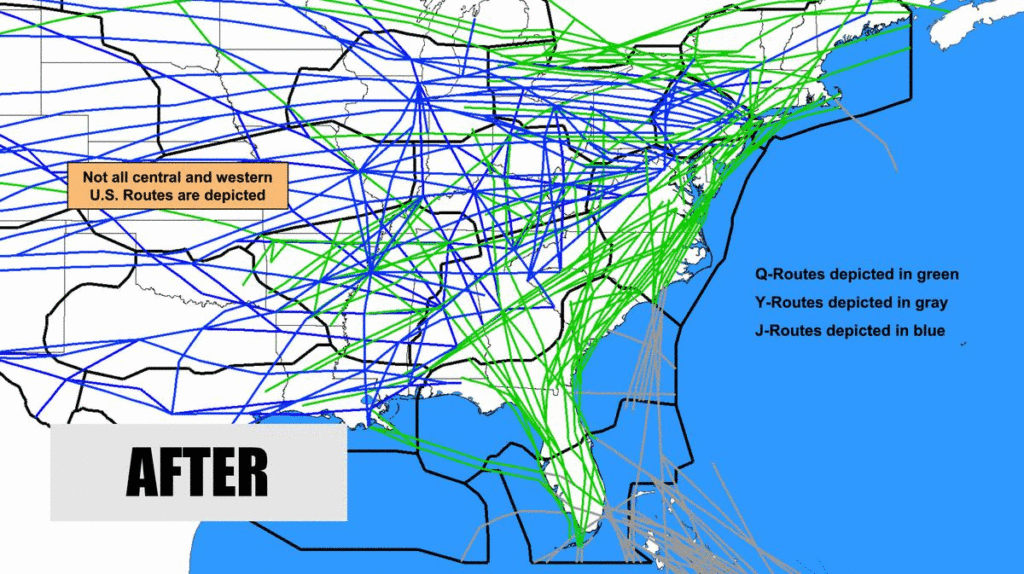
Q, Y and J Routes are changing – some have been amended, some have been deleted and some are brand new. There are also someone SIDs and STARs. Basically, the whole airspace is getting PBN-ed up!

The main change is a large number of new or modified routes (more than 150 in fact) which will replace the existing high-altitude route structure up and down the East Coast. Basically, J Routes are out, new or amended Q and Y Routes are in.

Why? Because PBN (less ground-based Navaids).

This will include super high sector routes (that’s FL400 and above). The full details of the Sector 30 super high sector routes are not yet known but we are expecting:

  • 09 DIW Ultra High from FL360-390.
  • 50 YKT Ultra High between FL360-390.
  • 30 MSN Super High FL400 and above.

Tell me the specifics.

22 Q-Routes (including 9 new ones) and 4 Y-Routes are getting amended.

If you want the full list, go check out the official FAA presentation which you can download via the NBAA site.

What does it all mean for folk flying there?

It means much more efficient ATC as it will help reduce their workload, and also the messiness of the current route structure. This means time and fuel savings for the operators operating in this region, as well as increased safety!

What has happened so far?

You’re going to have been seeing a lot of this already, it’s been going on since 2019 with 106 route changes implemented so far.

  • In May 2021 two Q-Routes (Q75 and Q475) were amended.
  • Through the rest of 2020 a large number of J-Rouete were deleted, and modified Q-Route were brought in. 
  • AR7 and AR25 were removed.
  • There was also the whole Florida Metroplex stuff, which we mentioned before here.
  • And a bunch of new, amended, deleted SIDs and STARs at the major airports along this region

So what do you really need to know?

The route changes will be published September 8. They will go active 20 April 2023. If you do absolutely nothing else, just be aware that if you file a flight plan from that date you’re going to be filing the new Q-Routes, and you’re also going to be PBN-ing a lot more.

Where can you go for more info?

The official FAA presentation is probably the best spot to find the answers to your questions. Here the link (to the link) is again.

And here is some other stuff on NAS changes like the Northwest Corridor.

You can also ask folk directly, depending on where you are/which area you want to know about, or contact the lead FAA people on the project: paul.m.withers@faa.gov /joseph.b.tinsley@faa.gov


The Hot Topic of Hot Spots

We aren’t talking about a bad rash, or the trendiest new club in town… We’re talking about those spots at airports where you’re most likely to mess up and get in the way of another aircraft.

Why is this a hot topic?

The FAA are standardising their symbology so we thought it would be worth sharing with any folk based in the US who haven’t spotted it yet, and for anyone who flies into the US for that matter, just to make sure no-one misses a Hot Spot warning.

What is a Hot Spot?

It is a location on an ‘airport movement area’ which has a history of incursions, collisions and confusion. Or which has the potential for all the aforementioned mess. Basically, anywhere there is a risk of an aircraft going the wrong way or get in another aircraft’s way.

What do these spots currently look like?

They look like a really confusing bit of taxiway, often near a runway…

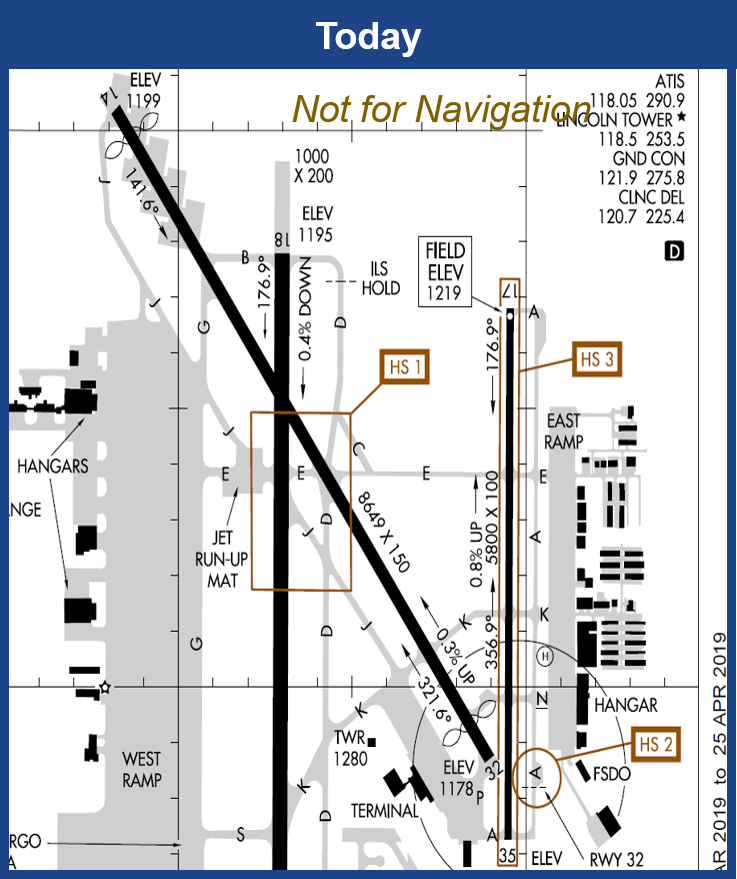
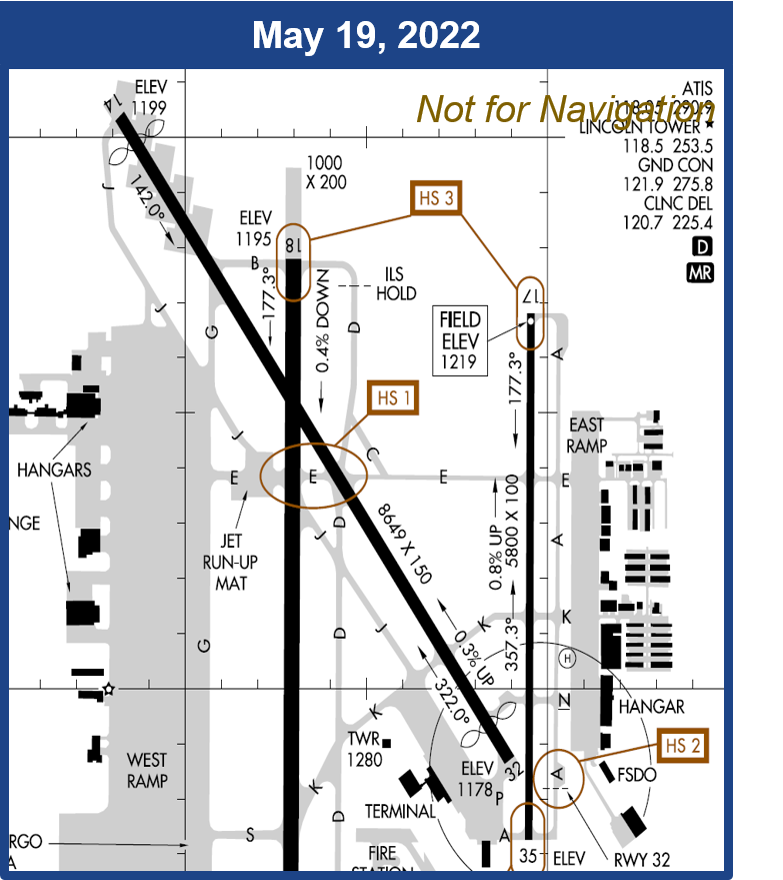
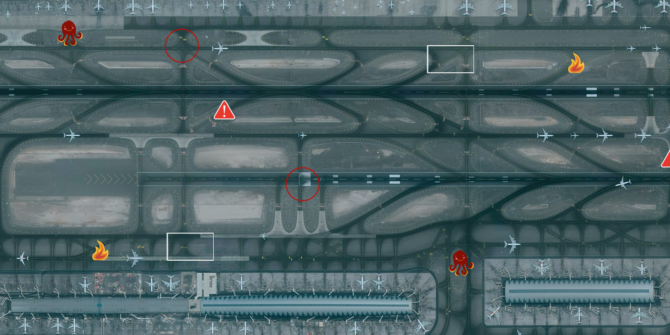
On the charts this might be shown with a circle, a square, an ellipse, a rectangle, an octagon, even an octopus if the chart maker so fancied. There is no standard shape for marking these which means if you aren’t familiar with an airport (or its chart) then you might not notice the spot to watch out for.

What will they look like going forward?

From May 19 2022 they will become only a circle or an ellipse, with the details in a little rectangle linked to it.

Here is a picture of the before and after:

These are in line with the symbology that the likes of LIDO and Jeppesen already use.

But also…

The FAA will be issuing Arrival Alert Notices (AAN) at airports which have a particularly bad history of misalignment risk. 

This is all to do with the runways and the risk of aligning the wrong one (or not one for that matter). The new symbology will show ‘wrong surface’ hotspots in ellipses.

Which airports have this problem?

Here’s a list of the known baddies:

  • KIDA/Idaho Falls
  • KRNO/Reno
  • KRHV/Reid-Hillview
  • KPSP/Palm Springs
  • KTUS/Tucson
  • KHNL/.Honolulu
  • KFCM/Flying Cloud
  • KTKI/Dallas McKinney
  • KPDK/Peach Tree DeKalb
  • KROC/Rochester

Why isn’t KSFO/San Francisco on this list? Who knows. Actually, we do – it is because these occurs most often with GA aircraft, so just because there isn’t an AAN, don’t assume there isn’t still some risk if there are parallel runways, taxiways, or even nearby airports with similar orientation. These are generally noted on the charts in text format anyway.

Read about it direct from the FAA

You can find the link to their page on it here.

There are also links to PDF documents containing lists and details on all the hotspots at the major airports. Like these for the Northeast US states.


Alphabet Soup: FAA New Flight Planning Codes

The FAA are changing up some flight planning codes, and they’ve published their plans in a handy little guide entitled ‘Filing for advanced capabilities using the ICAO flight plan (FPL)’.

We thought we’d take a look at what these new things coming into the FAA flight plan filing code world might be. When we say take a look, we mean literally type up the presentation and add some thoughts of your own.

This just applies to FAA flight plans, right?

Yes. No. Maybe…

We think it is a yes because the US is implementing a lot of RNP1 SIDs and STARs (basically stuff that requires advanced Nav capabilities) and for reasons we’ll mention below, they need new codes.

You can expect to see a load of new items which relate to NAV/ and also DAT/, SUR/ and COM/. ICAO has “frozen” Items 10 and 18 for PBN/ unless it is a safety critical thing.

What’s more, in the FAA presentation there is a lot of talk about the STAYY SID into KSNA/Orange County (guessing because it will be the first RNP 1 SID published?). So, from Septemberish to Novemberish, if you’re flying there and are planning on flying this approach then you’ll need to be filing these.

So it’s all about RNP1?

Mostly, yes. RNP 1 SIDs and STARs require Radius to Fix (RF) capability. There is some mention of RNP2, which is used in the UK and Australia. The FAA are working with them to clarify this because there are actually two different RNP2 standards so it is currently a bit ambiguous.

What are these codes?

We are seeing a ‘Z’ which will go into Item 10a and a Z1 which will go into NAV/

What else?

Here is a table. Lots of new letters with a 1 after them (or a 2) confirming your various RNP capabilities.

What do we use at the moment?

Let’s take a quick jump back and talk about ‘Relevant Flight Plan Fields’.

If you’ve ever filed a flight plan, you are probably fairly familiar with Item 10 – Equipment and Capability (with 10a for your Nav, Comms and Approach Aids and 10b for your Surveillence). Then there is Item 18 – Other Information, and this is where you enter your PBN, NAV, DAT, SUR and COM stuff.

So, depending on the type of routing or what-have-you that you plan on doing, you need to add info in item 10 and item 18 to confirm you’re capable of doing it.

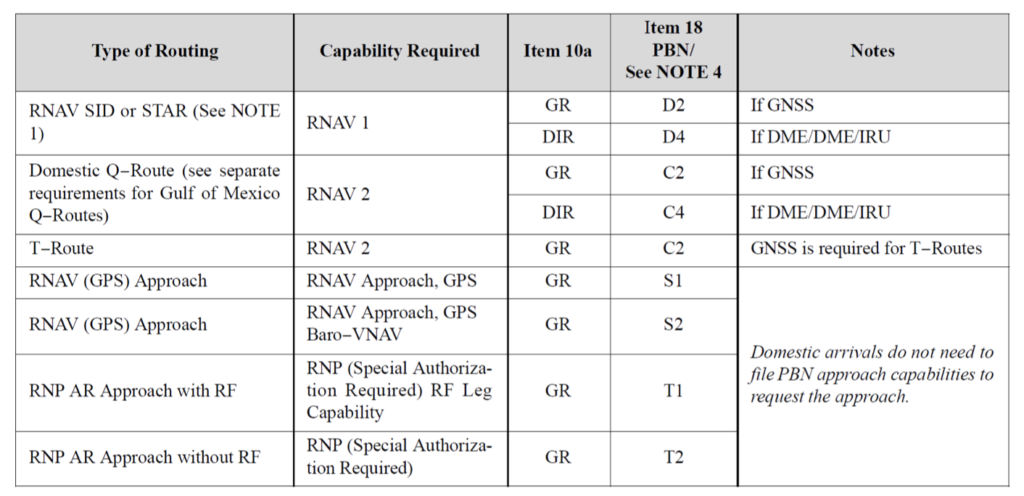
Here is a handy table for you. Basically, if the plan is to fly a ’T-Route’ for example, then your airplane needs to be capable of RNAV 2, which means you’ll want to whack a ‘GR’ into Item 10a and a ‘C2’ into Item 18.

GR of course means GNSS and R means PBN approved. C2 means RNAV 2 GNSS specifications.

If any of this is totally new to you…

Maybe take a read of FAA Appendix A. FAA Form 7233-4 ‘International Flight Plan’ which covers all the boxes and their respective what’s and why’s.

PBN/ is limited.

Something else mentioned in the presentation is the limited number of PBN/ entries that you can make on your flight plan. This limit means the automation which “reads” your plan might make some assumptions. For example, if you enter a D1, D2, D4, O1 or O2 code, it is going to assume you are RNAV 2 capable.

There are also certain PBN/descriptions which don’t align with any OpSpec authorisations.

C3, D3, O3 – DME/DME is not adequate for RNAV 2, RNAV 1, RNP 1 and O4– DME/DME/IRU alone is not adequate for RNP 1.

All of which means changes are needed!

A reminder on using NAV/RNV to suppress a PBN segment

The automation (and this is a direct quote from the presentation) ‘bases route eligibility on PBN information but overrides that with the NAV/ information when provided’.

Right now, putting RNV means RNAV, so if you file NAV/RNV the automation won’t think you’re eligible for an RNP routing. In fact, 50% of flight plans which include RNP1 capability are only seen as RNAV 1 eligible. If this has happened to you, stop putting RNV in the NAV/ string.

The main point here is that the majority of users should be using PBN/ only.

There is more.

There is more, but it might be easier to read it in the FAA presentation itself. 

When all the FAA documents are changed and updated to include the new stuff, then this is what to look out for:

  • New NAV/ descriptors are coming in, including info on how to file them
  • Documentation on the new descriptors they’ve come up with will be there
  • Instructions on how to file RNP routes, including ones which require RF capability will be included
  • Instructions on how to use NAV/RNV to exclude PBN routes on a single segment will be removed (but there will be a web page and FAA contact info if you still need help).


Get your FAA Airspace KICZ here

Our SafeAirspace website contains all the current airspace warnings from major authorities for various airspace regions around the world.

If you are a US registered operator, then you can find info on the FAA warnings here too.

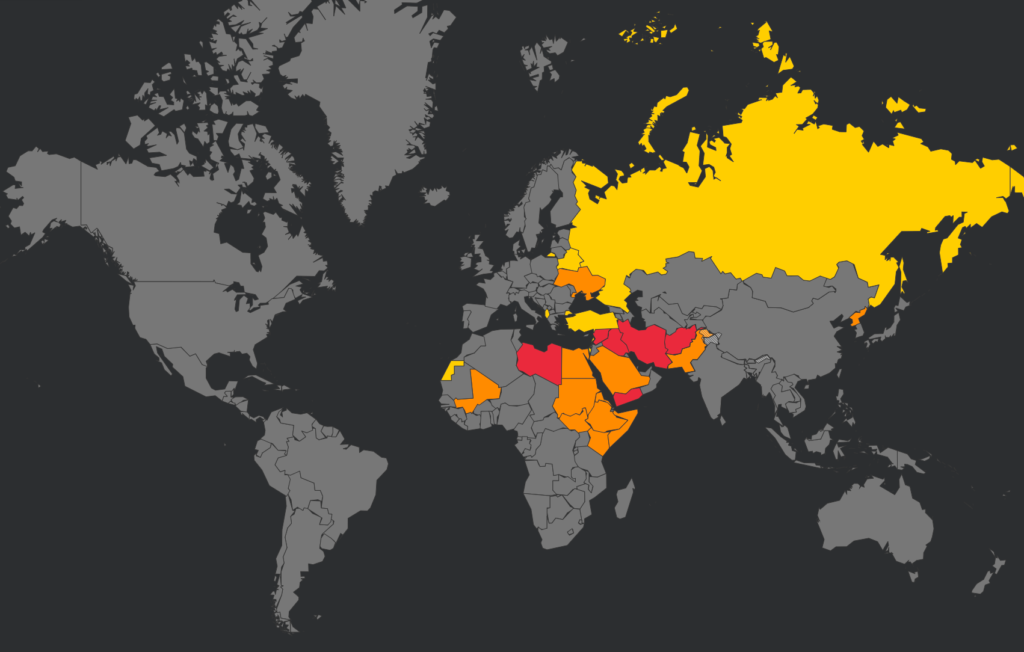
But we thought we would make a brief summary for you here, just as a refresher on what the current KICZ status is for each country.

Where can I find them?

SafeAirspace pulls all the latest info from the US FAA’s dedicated webpage which contains all their ‘Prohibitions, Restrictions and Notices’. This is where you can find their International Security NOTAMs (KICZ) and Special Federal Aviation Regulations (SFAR), plus information relating to the background of the situations and the prohibitions/restrictions.

A summary

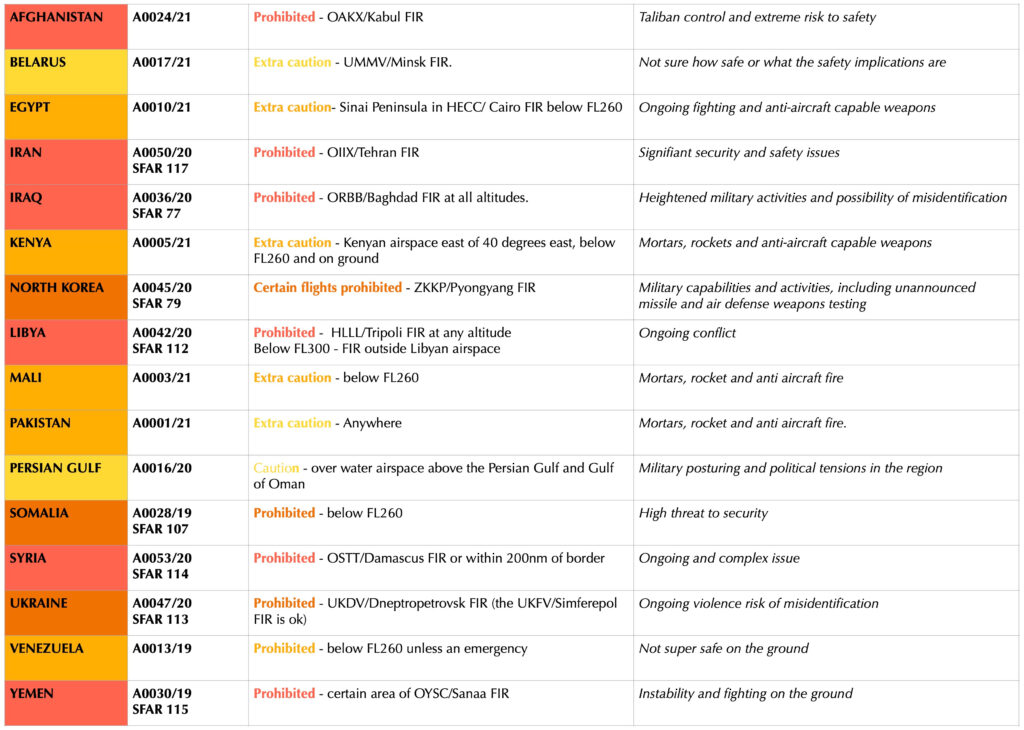
Here is a summary of the countries with a US FAA airspace prohibition/restriction in force, and what it (very briefly) says for each one.

Afghanistan

US Operators are prohibited from operating in the OAKX/Kabul FIR. Overflights are still allowed on airways P500 and G500 which run alongside the eastern boundary of the Kabul FIR.

Why? There is a risk of direct and indirect fire targeting airports and from surface-to-air fire targeting aircraft operating at low altitudes. Additionally, the recent Taliban takeover has led to zero ATC control across the entire airspace and an extreme threat to aircraft and crew safety and security on the ground. Air defense forces in all neighboring states are likely at high alert status within respective border regions – target misidentification by military air defense operators remains a credible scenario.

Belarus

US operators are to exercise extra caution when operating over, within, in or out of the UMMV/Minsk FIR.

Why? Well, they recently “caused” a commercial aircraft to land and it is not entirely clear how secure the region is and if there are any safety implications for US operators at this time.

Egypt

US operators are to exercise extra caution when operating over, within, in or out of the Sinai Peninsula within the HECC/ Cairo FIR below FL260.

Why? There is ongoing fighting between military and extremist forces and they have anti-aircraft capable weapons.

Iran

US operators are prohibited from operating in the OIIX/Tehran FIR.

Why? There are signifiant security and safety issues in the region and the US and Iran are not on the best of terms. There was also an aircraft shoot-down due to mis-identification of their anti aircraft defence systems.

Iraq

US operators are prohibited from operating in the ORBB/Baghdad FIR.

Why? Similar to Iran, there are heightened military activities and increased tensions which present and inadvertent risk to US civil aircraft due potential for mis-identification.

Kenya

US operators are to exercise extra caution when operating over, within, in or out of Kenyan airspace east of 40 degrees East longitude (the border region with Somalia), at altitudes below FL260. The caution applies to the ground as well.

Why? Because there’s possible militant activity and with it a threat of damage to aircraft from mortars, rockets and anti-aircraft capable weapons.

North Korea

US operators are prohibited from operating in the ZKKP/Pyongyang FIR, including the oceanic part of the ZKKP/Pyongyang FIR over the Sea of Japan.

Why? Because there are hazards and risk to civil aircraft safety from North Korea due their military capabilities and activities, including unannounced missile and air defense weapons testing.

Libya

US operators are prohibited from overflying the HLLL/Tripoli FIR except for altitudes at or above FL300 “outside of Libyan territorial airspace” – which is basically the international airspace over the southern Mediterranean Sea that is managed by Libya.

Why? Because of ongoing conflict between the government and the Libyan National Army over territory, government control and resources – and all this means fighting, often with weapons which could damage aircraft.

Mali

US operators are to exercise extra caution when operating over, within, in or out of Mali below FL260.

Why? There is a risk of militant and extremist activity and mortars, rocket and anti aircraft fire.

Pakistan

US operators are to exercise extra caution when operating over, within, in or out of Pakistan.

Why? There is a risk of militant and extremist activity and mortars, rocket and anti aircraft fire.

Persian Gulf

Exercise caution operating in overwater airspace above the Persian Gulf and Gulf of Oman in the OKAC/Kuwait, OEJD/Jeddah, OBBB/Bahrain, OOMM/Muscat and OMAE/Emirates FIRs.

Why? There is a lot of military posturing and political tensions in the region and this bit is particularly close to the OIIX/Tehran FIR which is prohibited for US operators.

Somalia

US operators are prohibited operating below FL260 in the airspace of Somalia.

Why? There are active extremists in the region which pose a threat.

Syria

US operators are prohibited from entering the OSTT/Damascus FIR, and should exercise caution if within 200nm of Syrian airspace.

Why? It is a complex and ongoing conflict there, and it poses a risk to US operators.

Ukraine

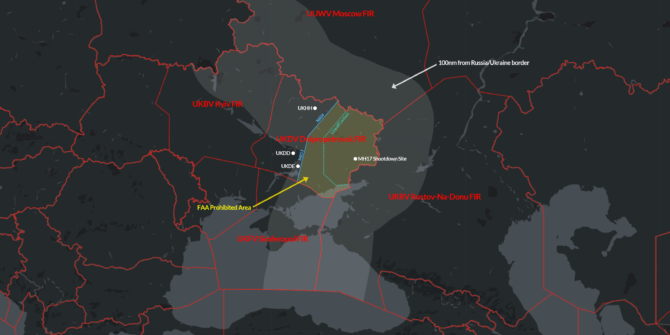
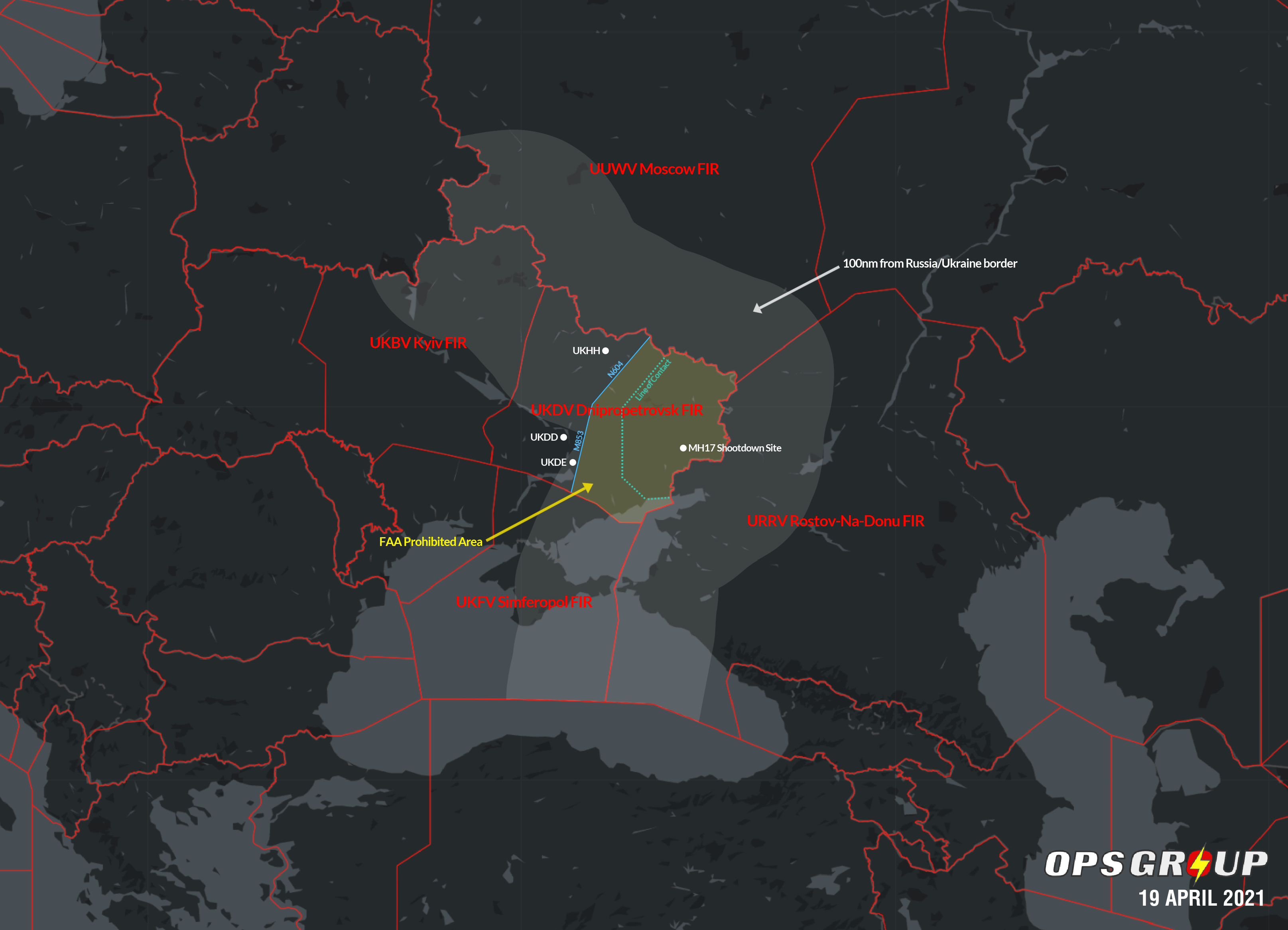
US operators are prohibited from entering the UKDV/Dneptropetrovsk FIR (the UKFV/Simferepol FIR is ok).

Why? There is ongoing military action and the potential for aircraft misidentification there.

Venezuela

All operations below FL260 are prohibited unless specifically approved or they need to for an emergency.

Why? Mainly poor infrastructure, and political conflict between the two countries.

Yemen

US operators are basically prohibited from overflying the landmass of Yemen, but certain offshore routes within the OYSC/Sanaa FIR are allowed.

Why? Because of ongoing fighting, instability and possible terrorist activity.

An even briefer summary

For further information on the situation in each country and to see the prohibitions and restrictions recommended by other authorities, visit the SafeAirspace site.

The concept of SafeAirspace is this: to have a single source for all risk warnings issued about an individual country, independent of any political or commercial motivation, so that a pilot, flight dispatcher, security department, or anyone responsible for flight safety can quickly and easily see the current risk picture.

Travel Advisories

Travel Advisories and Airspace Warnings are different things. But for US operators flying internationally, it’s worth checking out the latest country-specific Travel Advisories issued by the US Dept of State. Each country’s Travel Advisory also has a link to the local US Embassy website in that country – these will show announcements on all the latest security-related news and incidents there.

Further reading

  • US and allied forces have now pulled out of Afghanistan, and the Taliban have taken control of the country. Afghanistan’s airspace is now effectively closed to overflights – the OAKX/Kabul FIR is uncontrolled, and overflying traffic should route around the country. Here is our latest update on what is happening.
  • The US reissued their Ukraine warnings in 2021. However, certain regions are Ukrainian airspace are now deemed safe for overflight.
  • Information on the aircraft shootdown in Iran, and ongoing concerns with their airspace safety.
  • Assessing the risk to routing over or into conflict zones is much more than just an “is there a weapon down there?” question. Gathering and sharing information on airspace risk is still one of the biggest barriers to safety. Are we actively seeking this information, or simply waiting for it to come our way? Read our article.


The Mexican Downgrade: What’s the impact to ops?

Mexico have recently found themselves downgraded by the FAA under their IASA program.

So, what does this mean for Mexico, and what does everyone else need to know about this?

First up, what is the IASA program?

It might sound confusingly like a combination of EASA and IATA, but ‘IASA’ is actually the International Aviation Safety Assessment Program run by the FAA, and used to determine the safety standards in foreign countries.

It was set up in 1992 to monitor air carriers operating in and out of the US – not to monitor the operators specifically, but to check the authority in the country is up to scratch with ensuring their operators are up to scratch. If not, the US don’t want to let them into their airspace.

What do they look at?

They are focusing on the country (not the operators in the country), to see how well they adhere to international aviation safety standards and recommended practices, as suggested by ICAO in Doc 9734.

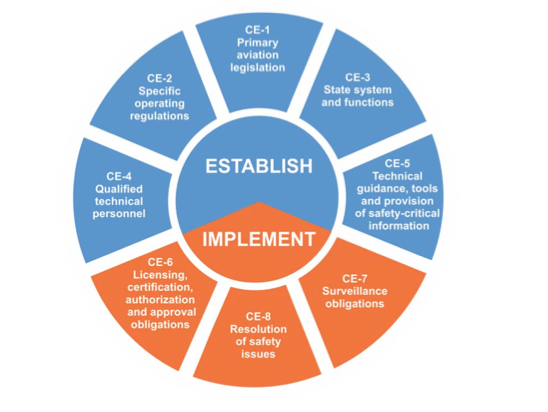
There are 8 elements that the FAA/ICAO reckon a decent aviation safety oversight authority should be doing well:

  • Legislation
  • Operating Regulations
  • The State civil aviation system and safety oversight functions
  • Technical personnel qualifications and training
  • Technical guidance, tools and provision of safety critical information
  • Licensing, certification, authorization and approval obligations
  • Surveillance obligations
  • Resolution of safety concerns

I feel like they combined a few there, and its actually more than 8. But there’s the list.

How do they do the assessment?

If you visit the IASA site, on the FAA main site, then you’ll find each of those areas has its own checklist. These are thorough, lengthy things. The Operating Regulations alone is 19 pages with a whole bunch of points to check off per page. Oddly, all that checking leads to only two possible outcomes.

A country either meets the standard or it doesn’t. There is Category 1, or there is Category 2, no in-between.

  • Category 1, Does Comply with ICAO Standards
  • Category 2, Does Not Comply with ICAO Standards

Basically, if one or more deficiencies are identified, it’s a Category 2 ranking, and Santa won’t be bringing you a present that year.

What does it mean to be on the naughty list?

Well, if you already have air carriers flying to the US then you can continue but they are going to monitor them pretty closely. If you don’t already have air carriers operating in and want to, then you’re going to have to improve before they give you permission.

But why should we all care?

After all, the oversight is to do with their air carriers and nothing more? Surely it just means their aircraft might be a risk coming into US airspace, or their pilots might not follow procedures properly?

Well, actually no. The problem is these air carriers share airspace with you. If their pilots are not licensed or trained correctly (think Pakistan’s recent problem) then this can degrade the safety for all aircraft operating in their vicinity.

If a state is failing to ensure minimum safety standards in areas such as the promulgation of safety critical information (notams), technical personnel qualifications (the maintenance folk who might be fixing your aircraft, or the CAA inspectors checking compliance) then this is something any international operators might want to be aware of as well because there are potential knock-on safety impacts for those heading into the country in question.

So does it tell me if another country is safe to fly to?

No. The FAA is not saying every country ranked 1 is safe, no issue, no problem.

It also isn’t telling you a country is unsafe to operate to if they don’t meet compliance standards. Remember, it is purely looking at the regulatory and safety oversight and asking if they ensure minimum ICAO standards. There are countries out there that pose significant threats (just not because of any deficiencies in the authority’s oversight).

It might also mean that the FAA have not ranked that country, because no-one from that country is flying or planning on flying to the US.

Remember, these rankings are looking at how a state ensures its air carriers are safe and compliant. It does not consider whether services or infrastructure within the state itself are safe or compliant.

How should operators and pilots use this list?

For operators and pilots, if a country is ranked Category 2, it means you might want to be doing your own risk assessment before heading in. No-one is saying that country isn’t going to be safe, but they are saying there are deficiencies with the authority, and since that authority looks after a lot, it is worth asking whether there might be other deficiencies as well.

You should be looking at the following:

  • What are the standards of the handling agents and maintenance services you are going to require there?
  • How reliable are Notams, and are they providing the information required?
  • What level of service and safety will ATC provide?
  • Will procedures and regulations be correctly adhered to there, and if not, what will this mean operationally for your flight safety?

You can get this info from sites like Safeairspace, Airport Spy, and through talking with colleagues who have operated into there before.

Who is on the Category 2 list?

So the big news this week is that Mexico were downgraded. Again, actually.

Along with Mexico the FAA also have the following countries ranked at Category 2:

  • Bangladesh
  • Curacao
  • Ghana
  • Malaysia
  • Eastern Caribbean States
  • Pakistan
  • Thailand
  • Venezuela

It changes though.

In 2014, the FAA downgraded India, citing inadequate oversight by local regulators, and in 2001 South Korea found themselves downgraded due to unskilled technical staff, pilot screening problems, issues with flight operations rules and a lack of objectivity in air crash investigations.

Both made it back on again relatively quickly.

Let’s take a closer look at Mexico…

The FAA have not yet given the reasons for their downgrade. However, Mexico was downgraded previously – back in 2010 – due to shortcomings in technical expertise, trained personnel, record-keeping and inspection procedures.

Actually, Mexico has a pretty decent infrastructure in terms of airports, although these do pose some operational challenges of their own (things like high terrain, high elevation). The CAA was actually “revamped” back in 2019. We put out this post about ramp checks.

Mexico’s political problems seem to be at the root of most issues here for the aviation industry. A project to build a new airport was recently cancelled (Texcoco airport was partially constructed already.) Now the government are instead looking to improve MMTO/Toluca and build new runways at an Air Force base near Mexico City. Plans are also under way for a third terminal at Mexico City Juarez, but given it is already congested and operating over its designed capacity, this might not be any solution.

Combined with Covid Pandemic problems, the latest downgrade will mean a big financial impact for various Mexican airlines now unable to access the major Mexico-USA market, and the knock on effect from this might be further felt in the aviation industry there as a whole.

The Big Taco-way?

If you are operating into an FAA IASA Category 2 ranked country, doing your own risk assessment on the standards and compliance you can expect to experience there might be worthwhile.


The Gateway to the Skies

If you have not heard of the IFP Information Gateway then here is a little summary for you. It is the Instrument Flight Procedures Information Gateway which is, according to the FAA who run it, your centralized instrument flight procedure data portal.

It’s a handy site because it provides you with a single-source, one-stop-shop, first place to visit if you need info on any of the following:

  • Charts
  • The IFP Procedures plan
  • IFP Coordination (forms and things)
  • IFP Documents
  • IFP Request form – this is where you can submit a request or query on an IFP. SO if you fly somewhere and think an IFP needs creating, amending or cancelling, you can do it here!

And this isn’t just for US pilots – it is pretty handy for anyone flying into the US who flies IFR procedures.

The Optimisation Project

This is a major project that the FAA are undertaking. They are reviewing their entire inventory of equipment and procedures as part of a plan to modernize the National Airspace infrastructure – to improve airspace and airport efficiency and safety.

The NAS covers an area of something like 30 million square miles, so it is a big project.

What is the plan?

The introduction of PBN (performance based navigation) is a big part of the modernization. If you fly into the US then you need to know about this, because it is going to mean changes to routes and procedures, airspace and equipment required.

Charts are being updated to remove unnecessary clutter. In 2020 they cancelled 1,000 procedures and took out things like circling minima on charts that no longer needed it. You need to know about this because it will impact chart validity, and things like minimus are airports you might use.

As for the inventory check – they are reviewing all the procedures at airports and deciding which to keep, which to cease, and which just plain old need updating. This will start with the decommissioning of any ancient VORs and NDBs which no longer support the operations network. You need to know about this because there will be ongoing changes to the approaches available at airport.

Give us some more details on the inventory checks

The FAA are going to review all procedures.

Why?

Well, because having looked over some data they reckon at least 20% of current IFPs have pretty limited benefits to the NAS. If procedures are not being used then retiring them means lower admin, maintenance and training costs. It also means more efficient and effective airspace management, which means improved safety and access.

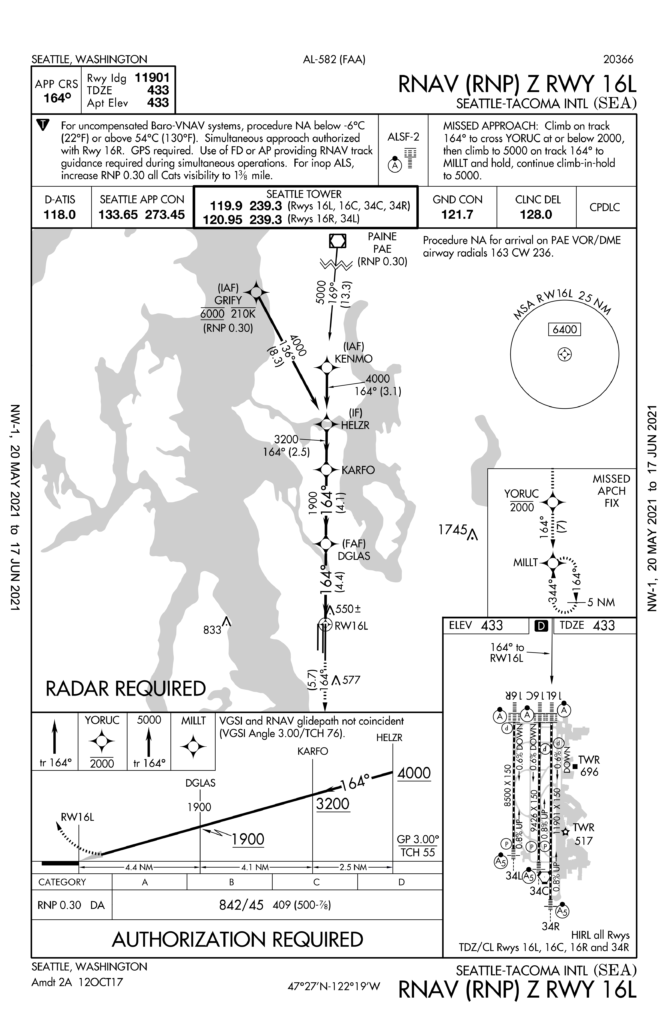
Take KSEA/Seattle for example. They have an RNAV RNP approach and a GPS approach for runway 16L. The RNAV RNP was only flown 17 out of a whopping 191,448 IFR arrivals.

It has higher minimum and an identical flight path to the GPS approach so there is really no reason for this approach to exist.

KPAE/Paine Field is another one worth looking at. It has a VOR-A approach which was only flown 95 times out of 10,348 IFR arrivals. It is under-utilized, costs a bunch to maintain and there are plenty other options. So it is a good one to chop.

What about KSBA/Santa Barbara airport and their VOR or GPS approach runway 25? This was also significantly under-utilized, being flown just 1,732 out of 17,174 arrivals. However, it is the most commonly used approach for GA traffic, and is the only one available when the wind is favoring that runway. Not such a good one to delete.

The IFP plan won’t just review data and statistics, it also engages with the folk using the IFPs to make sure changes are benefiting those it needs to benefit. Santa Barbara won’t lose the procedure just yet, although they might get itself a nice new space-based one out of this at some point.
Comments and feedback

If you fly into airports and have comments or feedback on IFPs then get in touch, either by filing in the form, or emailing at 9-AMC-Aerochart@faa.gov. This project is a long, ongoing one, but one that will benefit any operator who flies in or out of the US, and there are opportunities there to provide input.

Check out the info


ATC Zero in Class A Airspace: Is It Dangerous?

IFALPA has issued a new safety bulletin this week expressing concerns that existing US FAA contingency procedures that allow aircraft to continue using Class A airspace during ‘ATC Zero’ events are inadequate. They argue that the procedures expose aircraft to unacceptable risk and that more needs to be done to ensure their safety.

ATC Zero Events have become more common

Before Covid, ATC Zero events were quite rare. They’d usually only occur if controllers were forced to evacuate a facility. Fire, a force of nature, bomb threat – those sorts of things.

But then Covid came along and as we all know, it is super contagious. Amidst border closures and quarantine and testing rules, a new threat began to emerge in our skies.

ATC facilities began to be impacted by Covid infections, and short notice closures for cleaning have become a constant risk.

Last year we published an article on how to manage ATC Zero events in Oceanic Airspace after the New York ARTCC shut down affecting traffic crossing the NAT. The US FAA were sufficiently concerned that they published their own SAFO.

However since then the US has continued to be affected by ATC Zero events over land which affect large portions of Class A airspace, often for hours at a time.

What the FAA have to say about it

The FAA are satisfied that it is safe for aircraft to continue using Class A airspace when no ATC services are available, as long as you follow contingency procedures.

What contingency procedures?

Well, they can be broken down into two parts.

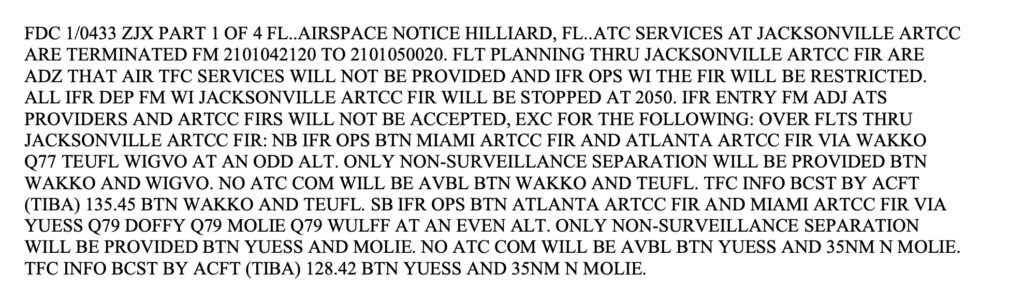
  1. When an ATC Zero event is scheduled, a NOTAM will be published. It will restrict traffic to specific routes through the affected airspace which contain compulsory reporting points. If you don’t intend to the fly the prescribed routes, you’re not allowed in.
  2. TIBA – Traffic Information Broadcasts by Aircraft. The FAA expects you to use them. Recent feedback from members who have operated under these conditions indicate that many aircraft either don’t know, or are choosing not to use them while operating in ATC Zero airspace. That in itself is concerning.

So what exactly are the TIBA procedures?

You can find them in ICAO Annex 11, or buried in lengthy NOTAMs if you prefer your procedures capitalised, abbreviated and barely punctuated.

Here’s a quick unofficial rundown:

1. Dial up your TIBA frequency. If you have two VHF comms, leave one on the normal ATS frequency to listen out for a controller.

2. Maintain a listening watch on the TIBA frequency.

3. In most cases you’ll need to remember ’10 minutes’. A radio call is required 10 minutes before entering the affected airspace, or if you have just taken off from an airport within the airspace as soon as you can.

4. Enroute, you’ll need to make routine position reports:

  • 10 minutes before crossing a reporting point
  • 10 minutes before you cross or join an airway.
  • And if your waypoints are really far apart, make a call every 20 minutes.

5. If you’re changing levels you need to make a radio call 2-5 minutes beforehand.

So what do you actually need to say?

The short answer: Who you are, what level you’re at, where you are and where you’re going next.

The slightly longer answer:

- ALL STATIONS
-  Call Sign
- FLIGHT LEVEL
- AIRWAY (or direct to/from)
- POSITION AT TIME
- ESTIMATING (next reporting point or crossing/joining airway) 
  AT TIME AND FLIGHT LEVEL

Don’t forget to listen

It’s important to remember: When you enter Class A airspace during an ATC Zero event, you are responsible for your own separation. You’re on your own. Which means you need to hear and be heard.

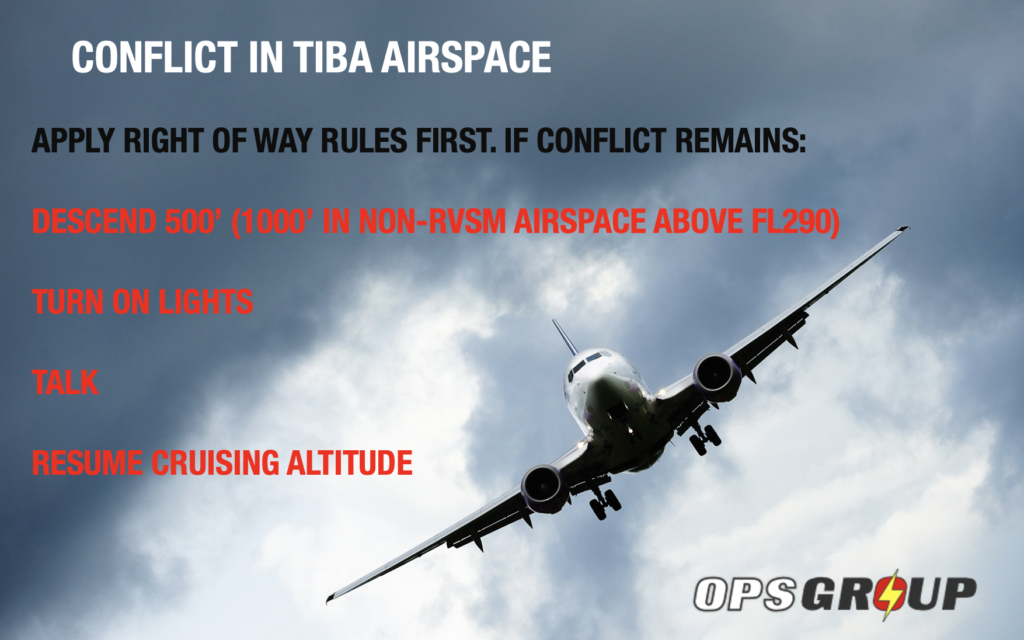
What if a conflict is likely?

There’s a procedure for that too. If you can’t solve the problem with right of way rules, here’s what you need to do:

So why are IFALPA worried?

For starters, there may be aircraft operating in Class A airspace without TCAS which greatly increases the risk of a collision. Secondly there is a lack of training standards about how to apply the contingency procedures. Lastly given that no one is watching, you may be exposed to other aircraft breaching the regs.

Until things change, they recommend you avoid the affected airspace by flight planning around it. If that’s not practical here are their suggestions:

  • Minimise the risk by taking the shortest possible path through it.
  • Make sure you review the contingency procedures beforehand.
  • Make sure there are no procedures in your in your manuals that will be affected by a lack of ATC.
  • Submit a safety report afterwards.

The threat remains

ATC Zero events are likely to continue in the near term, along with the risks they pose. It is important that pilots take those properly into account before they enter affected airspace.

Love them or hate them, sticking to the contingency procedures like glue is everyone’s biggest risk mitigator until new or better ones eventually come along.


The Central Florida Metroplex

Behold, Metroplex! The gigantic, towering Autobot warrior! The Walking City, capable of channeling awesome energies!

Wait, what? The Central Florida Metroplex, you say? Oh. Yeah, that’s different. Ok, let’s take a look…

The Central Florida Metroplex an area encompassing various airports including (but not limited to) these big ones –

  • KMIA/Miami
  • KMCO/Orlando
  • KFLL/ Fort Lauderdale
  • KTPA/Tampa

It also includes other sightly less big ones, executive ones and basically any airport in the area. Here is a map of said area:

Phase One

The reason we are hearing about it a lot is because there is a major project underway to improve the safety and efficiency of the airspace here, and Phase One is just about to be implemented.

The start of the project is all about improving climb and descent profiles, so on April 22 a whopping 54 new procedures are going to come into force, many of which will enable more direct routings of flights.

All this means arrivals and departures will be optimized. Fear not though, the new procedures have been developed to follow current flight tracks where possible, so you hopefully won’t see major, confusing changes – just changes to make it all more efficient.
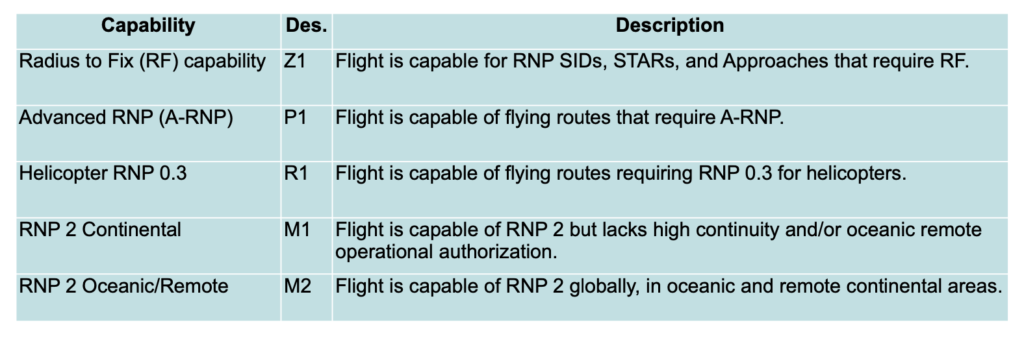
And then…

ATC are going to get their own new procedures as well. 17 of them coming in around August time. The ATC facilities have been enhanced over the last few years and automation advancements will tie in with these procedures.

What are the new procedures?

Well, we will have to wait until April 22 to actually see them in action, but it is mainly going to be changes to routings of SIDs and STARs, as well as some changes to altitudes. There are also a bunch of amendments to SIAPs and associated takeoff minimums as well as obstacle departure procedures based on the commissioning of new navigational facilities, adding of new obstacles, and general air traffic requirement changes.

The FAA published this list so you can take a look and see which are changing and when to check those charts for the correct and up to date version.

There will also be changes to routes – in particular the T routes. V routes will still be available but the plan is to phase these out over time so you are encouraged to file on Tangos.

And theeennnn…

The FAA have proposals in for an overhaul of the airspace across most of Florida, including changes to airspace boundaries around major Florida airports in order to more safely operate VFR and IFR traffic in close proximity.

Currently, the airspace surrounding KMIA/Miami is Class B, which is the most restrictive airspace around the busiest airports in the country. Miami’s Class B airspace extends to 20 nautical miles around the airport up to 7,000 feet in altitude. The FAA want to expand this out to 25 nautical miles east and west of the airport. The top will remain the same, while the bottom of the airspace gradually increases from the surface to 4000 feet as it extends out from the airport.

Then there is the airspace around KFLL/Fort Lauderdale. Another major, busy airport, they are surrounded by Class C airspace, which is less restrictive, but still highly controlled. Fort Lauderdale’s Class C airspace extends to 10 nautical miles up to 4,000 feet in altitude, and the proposal looks to extend this also out to 25 nautical miles to the east, and 20 nautical miles to the west, with its top and bottom following the same design as Miami’s class B.

There are also changes planned for the Northeast Corridor Atlantic Coast Routes (NEC ACR).

7 new Q routes are being added and something called ZDC ultra-high sector 30 will go live in September. By the end of the upgrading there will be something like 40 new Q and Y routes which will replace the north-south high-altitude route structure over the East Coast.

The big plan here is the decrease in reliance in ground based navaids, and some fuel and time efficiency improvement for operators.

What can the pilots expect?

You can expect to see changes to charts and procedures – so keep an eye on them and make sure you are operating with the most up to date. You can also expect to see more efficient and safer airspace as the phases of this are implemented over the next year or two.


US FAA issues new airspace warning for Russia and Ukraine

On April 17, the US FAA published new Notams warning operators to exercise extreme caution within 100nm of the entire Russia-Ukraine border, due to risks associated with recent increased tensions between the two countries. Should hostilities escalate here, the airspace on both sides could be exposed to potential weapons activity posing a risk to civil aircraft from misidentification or miscalculation.

The eastern part of Ukraine along the border with Russia is still an active conflict zone. The main hotspot is the Line of Contact which runs north-south through the UKDV/Dnipropetrovsk FIR. Throughout April 2021 there has been a large military build-up and an increase in ceasefire violations in this area, plus reports of GPS jamming and surveillance of civil flights by military systems – similar conditions to those prior to the shoot-down of MH17 in 2014.

This new airspace warning from the FAA follows the Information Note they published on April 13, which provides more background on the situation.

The FAA’s previous warning for Ukraine, as per SFAR 113, remains in place – US operators are banned from overflying the eastern part of the UKDV/Dnipropetrovsk FIR due to a continued threat of arms fire in the region. Essentially, everything east of ABDAR–M853–NIKAD–N604–GOBUN is prohibited. Airways M853 and N604 are off-limits as well. Flights to UKHH/Kharkiv, UKDD/Dnipropetrovsk and UKDE/Zaporizhzhia airports are permitted.

Put that all together – the old warning and the new one – and here’s how it looks:

Several other countries have airspace warnings in place for eastern Ukraine, including Canada who recently published a Notam advising operators to avoid the UKFV/Simferopol and UKDV/Dnipropetrovsk FIRs due to the risk from heightened military activity and anti-aviation weaponry. Check SafeAirspace.net for more info.

What about the UKFV/Simferopol FIR?

For the past few years, the risk here has been quite separate to that affecting the UKDV/Dnipropetrovsk FIR. It stems from the fact that the UKFV/Simferopol is disputed airspace, with aircraft potentially receiving confusing and conflicting air traffic control instructions from both Ukrainian and Russian ATC. 

In March 2014, Russia annexed Crimea, and Ukraine disputed this. The ATC Center is in Simferopol, Crimea, and is now run by Russia. Russia claims the airspace, and now refer to it as the URFV FIR. Ukraine refuses to recognise the change, and still calls it the UKFV FIR – and asks crews to talk to Ukrainian controllers in Dnipro/Odesa ACC instead of Simferopol ACC.

In October 2020, the US entirely removed their restrictions on overflights of the UKFV/Simferopol FIR, as they said the security situation had sufficiently improved here. While Russia continued to assert territorial claims over this region, Ukraine had established appropriate risk management measures to ensure safe operations for aircraft along the Black Sea routes.

In simple terms – since 27th October 2020, US operators have been able to overfly the Simferopol FIR.

However, tensions have been on the rise in this region throughout 2021. Russia seem to be going on a renewed military offensive here, focusing their efforts on the area of disputed airspace over Crimea, and establishing several large danger areas over the water surrounding the Crimea Peninsula at all flight levels. These danger areas are most likely due to military activity which may include live firing exercises –  so use extreme care in the UKFV/Simferopol FIR at this time as the situation is unpredictable.

For more info on these latest developments in the UKFV/Simferopol FIR, see our dedicated article here.

What are other countries saying about Ukraine?

Aside from the US, several other countries consistently publish airspace warnings: the UK, Germany, France, and Canada

UK and France: both have warnings in place advising against all ops over both of these Ukrainian FIRs, with the exception of airways Black Sea routes in the UKFV/Simferopol FIR.

Germany: does not have any published warnings in place at all.

Canada: avoid the UKFV/Simferopol and UKDV/Dnipropetrovsk FIRs due to risk from heightened military activity and anti-aviation weaponry. Exercise caution across the rest of Ukraine’s airspace.

For more details on Ukraine and other airspace warnings, head to SafeAirspace.net


US pilots and air traffic controllers can now take the Pfizer vaccine

US pilots and air traffic controllers are now allowed to take the new Pfizer Covid vaccine. On Dec 12, the US FAA issued a statement authorizing this, which means aviation professionals can take the vaccine without risking losing their medical certificates. You can read the FAA’s official statement here.

The vaccine needs two doses, three weeks apart. The FAA say you will need to wait 48 hours after each dose before you can operate.

All future vaccines will need a separate approval – the Pfizer one is the only one you can take at this stage.


Now that the Pfizer vaccine has been approved by the FDA, a huge supply chain effort is underway to get the vaccine ready for use as soon as possible. With crew likely to be carrying shipments of the vaccine, the FAA has issued a new safety alert for the carriage of dry ice. In big quantities this can be hazardous to crew and cause carbon dioxide poisoning if things aren’t handled properly. It is also important to be aware of manufacturer limits on how much you can carry. The new SAFO provides guidance on the risks, and how operators can better protect themselves.


The 511 on the Nov 5th ICAO changes

A whole bunch of procedural stuff will be changing from 5 Nov 2020, with the release of a new amendment to ICAO’s Procedures for Air Navigation Services document. There will be changes to Oceanic Contingency and Weather Deviation Procedures, Wake Turbulence Separation, SLOP Procedures, and how the FAA defines Gross Navigation Errors.

What is the PANS-ATM (ICAO Doc 4444)?

Procedures for Navigation Services – Air Traffic Management. In other words, the ‘go to’ manual for aircrews who operate internationally. It explains in detail the standard procedures you can expect to be applied by air traffic services around the world, and what they expect in return.

Here is a summary of the most important changes coming on 5 Nov 2020. Thanks to Guy Gribble at International Flight Resources for this update.

Oceanic Contingency Procedures

Basically, what you should do if you need deviate from your flight path without a clearance. Weather avoidance, turbulence, depressurisation, engine failure – you get the picture. Published procedures are changing: there will be one standard set of Contingency and Weather Deviation Procedures for all oceanic airspace worldwide.

If you’ve been flying in the North Atlantic Region over the past year and a half, you’ll be familiar with how it works – the new procedures were introduced there back in March 2019, and now they’re being rolled out everywhere.

The main change here is that Contingency offsets which previously were 15 NM are basically now all 5 NM offsets with a turn of at least 30 degrees (not 45 degrees).

For more on this, check out our article.

Wake Turbulence

Flight Plan Category
There will be a new wake turbulence category for flight plans:

No longer will ‘Heavy’ rule the skies. ‘Super’ is about to be added, which will cover the largest aircraft including the A380-800, and Antonov 225. You will even get to say it after your callsign on initial contact with ATC.

ICAO Doc 8643 will shortly include all aircraft which qualify for the category.

You’ll need to tell them your category in Flight Plan Item #9 too. For Super, the letter ‘J’ is what you’ll need to include.

Here’s the new line up:

J – SUPER (Check Doc 8643 to see if you qualify)
H – HEAVY (Max take-off weight greater than 136,000kg/300,000Lbs)
M – MEDIUM (Max take-off weight greater than 7,000kg/15,500Lbs)
L – LIGHT (Max take-off weight less than or equal to 7,000kg/15,500Lbs)

Wake Turbulence Separation Categories
Countries may choose to use the ICAO wake turbulence codes above to determine how much room to give you from preceding traffic, or they can elect to use a grouping.

Currently, ICAO groupings are based simply on weight and there’s only three of them. The problem with that approach is that sometimes the separation provided is excessive which slows down the flow of traffic and creates unnecessary delays.

The US and Europe were on to it when several years ago the FAA and Eurocontrol joined forces to look at the wake characteristics of aircraft in more detail. They came up with a better system – it was a process known as Aircraft Wake Turbulence Re-Categorization or simply, RECAT.

Turns out that when you take into account factors such as approach speeds, wing characteristics and handling abilities of various aircraft it is possible to safely reduce separation.

As a result, six new categories were created. You can read about those in FAA SAFO #12007 and EU-RECAT 1.5 if you would like to know more.

The point is, ICAO is now adopting those categories.

So why does it matter?
Because the separation applied when following smaller aircraft may be reduced to as low as 2.5nm on approach. Closer than you may be accustomed to.

Out with the old, in with the new. Here’s what you can expect to see in November:

Old:
HEAVY (H) – aircraft of 136,000kg or more
MEDIUM (M) – aircraft less than 136,000kg but more than 7,000kg
LIGHT (L) – aircraft of 7,000kg or less

New:
GROUP A – ≥136,000kg and a wingspan ≤80m but >74.68m
GROUP B – ≥136,000kg and a wingspan ≤74.68m but >53.34m
GROUP C – ≥136,000kg and a wingspan ≤53.34 m but >38.1m
GROUP D – <136,000kg but >18,600kg and a wingspan >32m
GROUP E – <136,000kg but >18,600kg and a wingspan ≤32m but >27.43m
GROUP F – <136,000kg but >18,600kg and a wingspan ≤27.43m
GROUP G – <18,600 kg or less (no wingspan criterion)

Separation standards will soon be published accordingly.

Strategic Lateral Offset Procedures (SLOP)

Wait, what?
As a result of extremely high levels of accuracy in modern navigation systems, if an error in height occurs there is a much higher chance of collision. It is also greatly increases the chance of an encounter with wake turbulence.

In some airspace, when the lateral separation applied or the distance between adjacent parallel routes is greater than 6nm, aircraft can deviate up to 2nm right of track without a clearance. This is what is known as SLOP.

The way in which it is applied is changing
Where the lateral separation minima or spacing between route centerlines is 15NM or more; offsets to the right of the centerline will allowed up to 2nm.

When the lateral separation minima or space between route centrelines is less than 15nm (but more than 6nm), you will be able offset up to 0.5nm right of track.

So, it is important you are familiar with what kind of lateral separation is being applied in the airspace you are operating.

The FAA will change their definition of GNE’s

On 5 Nov 2020, the US FAA will change their definition of Gross Navigation Errors to mean anything more than 10nm (down from 25nm), to align with ICAO’s 10nm definition that currently exists on the NAT HLA. So after this date, the FAA will require you report all lateral errors, 10nm or greater worldwide.

More on this from Guy Gribble at International Flight Resources:

“Keep in mind that ATC does not always advise a crew that it files a report; therefore, the FAA inspector will try and contact the crew as soon as possible so the crew will remember details of the event. ATC keeps voice and communications records for between 30-45 days. New York Radio and San Francisco Radio keep voice communications for 30 days. The FAA directs that oceanic error investigations should be complete within 45 days of the incident.”


FAA extensions to pilot regulatory relief

The FAA has agreed to extend the regulatory relief packages for both Part 91 and Part 135 operators beyond the original end date of June 30. Here’s the lowdown:

Part 135

  • Back in March, the FAA announced a 3-month extension to the grace period for recurrent training requirements for Part 135 operators. They’re now saying that operators who have training due in July will have until the end of October to get this done. Read the FAA letter here.
  • In addition, the FAA has provided two additional months of flexibility on the protective breathing equipment requirements, extending that exemption until the end of July.
  • Note that you still have to tell the FAA if you’re planning on using these exemptions.

Part 91

  • Pilot medical certificates which expired in March do not have any extra time beyond June 30; but for those expiring between April 30 and Sept 30, these will all get three months extensions to their validity.
  • Validity of flight reviews, instrument currency, and knowledge tests have also been extended to September.
  • Read the updated SFAR in full here.

For US pilots keen to know if the SFAR on Part 91 regulatory relief applies to your individual situation, check out these easy-to-follow flowcharts to help you work it out! (No need to squint – just click on the image and get whisked away to a magical place where these flowcharts will all make perfect sense 😊)


“Operation: Paperwork Misery” – new US rules on pilot data reporting are coming soon

The FAA has launched “Operation: Paperwork Misery” – a Notice of Proposed Rulemaking which will require operators to submit a whole bunch of additional pilot data to the agency via a new Pilot Records Database.

Here’s the plan, according to the FAA:

The FAA is proposing to require the use of an electronic Pilot Records Database (PRD) and implement statutory requirements. The PRD would be used to facilitate the sharing of pilot records among air carriers and other operators in an electronic data system managed by the FAA. Air carriers, specific operators holding out to the public, entities conducting public aircraft operations, air tour operators, fractional ownerships, and corporate flight departments would be required to enter relevant data on individuals employed as pilots into the PRD, and this would be available electronically to those entities. In addition, this proposal identifies all air carriers, fractional ownerships, and some other operators or entities that would be required to access the PRD and evaluate the available data for each pilot candidate prior to making a hiring decision.

Here’s a translation of how that may work in real life, from the NBAA:

The FAA’s PRD proposal would subject many business aviation operators to a substantial pilot-data reporting burden not previously applied to non-commercial operations. This proposed rule also amounts to a complete overhaul in the way commercial operators access information about a pilot before hiring and the way certificate holders will provide FAA historical and future records. It expands the types of operations required to give the FAA records documenting an individual’s compliance with FAA or employer required training, checking, testing, currency, proficiency, or other events related to pilot performance, including check pilot comments. Due to the extensive nature of the reporting requirements, the proposed rule has the potential to impose significant new burdens on Part 91 operators of all sizes.

“This is really regulatory overreach at its worst,” said Doug Carr, NBAA’s vice president for regulatory and international affairs. “We have a situation where our community will see no safety benefits as a result of compliance with this program, and the creation of a definition solely for the purpose of satisfying paperwork is not in the best interest of our community.”

Although the FAA’s new rule was issued on March 30, they have so far resisted calls from the industry to extend the comment period beyond June 29 – meaning many operators now don’t have enough time to trawl through the 200-page NPRM document to work out just how brutal the onerous new requirements are going to be, nor get much of a chance to provide any objections to the plan.

“It is exasperating that the FAA has given industry just 90 days to unpack a complicated plan amassed over nine years, and released as the aviation community fights for its survival during COVID-19,” said Koester. “It would not seem unreasonable to allow another 30 days for discussion, so we are pursuing other means to encourage the FAA to provide for this minimal, reasonable accommodation.

The NBAA are now encouraging affected operators to review the NPRM and submit comments providing as much detail as possible about the impact of these proposed changes to their operations. To do that, click here:


Alternatively, you can submit your comments via the tool NBAA has launched to assist with this. Click here for that.

For more info on the specific impact of this proposed NPRM, here is what the NBAA have compiled, which we’re sharing here with their permission:

Concerns for all operators

Check pilot comments
The NPRM would require operators to include check pilot comments from training events in the pilot record database. As unflattering comments may cost pilots future job opportunities, this may leave check pilots or their employers open to liability and diminish the opportunity to improve safety by focusing additional training on check pilot comments.

Overly burdensome and inconsistent reporting requirements
Both the draft advisory circular and the NPRM contain language requiring operators to report a pilot’s aeronautical experience, flight time, and flight maneuvers performed to maintain privileges of their certificate. These burdensome reporting requirements could reasonably result in a need for certificate holders to log every flight hour, instrument approach, and landing in the pilot record database.

Language within the NPRM also contains many contradictory statements leaving operators unclear on the intent of the proposal and the actions required by the rule. Most notably, 111.220(b)(3) states no person may report records documenting aeronautical experience, yet 111.220(a)(2) requires air carriers to report records related to currency and proficiency.

Concerns for Part 91 operators

Definition of Corporate Flight Department
For the first time, this NPRM would codify a definition of a “corporate flight department”. The definition crafted solely for compliance with record keeping requirements does nothing to enhance other elements of our industry and excludes a substantial portion of business aviation that considers itself part of the community.

New recordkeeping and reporting requirements
This NPRM results from Public Law 111-216 (Airline Safety and Federal Aviation Administration Extension Act of 2010), which indicates operators must report training and employment records already maintained by operators. The proposed rule would require Part 91 operators to undertake new record keeping and reporting burdens. Some operators already use sophisticated software systems for managing and tracking pilot training, checking, testing, currency, and proficiency. However, many operators use simple tracking systems that will require manually reporting these records to the FAA.

Concerns for Part 125 and Part 135 operators

The FAA will charge operators a $110 fee any time they pull records for a pilot candidate.

Part 125
The NPRM requires Part 125 operators to report historical records dating back to August 1, 2010. Operators will be required to upload employment, training, checking, testing, currency, proficiency, and disciplinary records for every pilot under their employment over the last ten years. Operators will be able to upload records in XML or manually.

Part 135
The NPRM requires Part 135 and 121 operators to report historical records dating back to August 1, 2005. Operators will be required to upload employment, training, checking, testing, currency, proficiency, and disciplinary records for every pilot under their employment over the last 15 years. Operators will be able to upload records in XML or manually.

NBAA’s Perspectives

While the NPRM contains some potential efficiency improvements for the Part 125 and Part 135 communities, we believe that a substantial number of these proposals would burden the part 91 community far beyond the intent of Congress. For certificated operators currently required to comply with the Pilot Records Improvement Act (PRIA), the NPRM may streamline record reporting and requesting processes, expedite response times, and allow for more informed hiring decisions.

The NPRM would also require reporting more information than under PRIA by more segments of the aviation community, including corporate flight departments and 91.147 air tour operators. The proposal would require these constituencies to report not just training and checking events, but also any event that leads to proficiency or maintains currency, such as day or night landings, flight hours, and instrument approaches. This process will be burdensome and provide little information that enhances hiring decision making abilities.

NBAA encourages affected members to review the NPRM and submit comments to the public docket providing as much detail as possible about the impact of these proposed changes to their operations.

Read the NPRM on the regulations.gov website.

Download the NPRM (PDF)

Comments should be submitted no later than 11:59 p.m. EDT on June 29, 2020.

Submit comments


Pilot Relief: FAA Covid rules in simple english

Let’s start here:

Notwithstanding the 6 calendar month period specified in paragraph 2 of SFAR No. 100-2 of this chapter, a person may exercise the relief specified in paragraph 1 of SFAR No. 100-2 of this chapter for a duration of 9 calendar months after returning to the United States, provided the person is eligible in accordance with paragraph 2 of SFAR No. 100-2 of this chapter, complies with the documentation requirements specified in paragraph 3 of SFAR No. 100-2 of this chapter; and … 

Ugh. Ok, how about this:

Notwithstanding the period specified in § 61.55(c), a person who is required to complete the second-in-command familiarization and currency requirements under § 61.55(b)(1) and (2) between March 1, 2020 and June 30, 2020 for purposes of maintaining second-in-command privileges may complete the requirements of § 61.55(b)(1) and (2) in the month before or three months after the month in which they are required, provided the pilot meets the requirements of paragraph 2.(b)(1)(ii) of this SFAR. A pilot who meets the requirements of § 61.55(b)(1) and (2) within the period prescribed by this paragraph 2.(b)(1)(i) will be considered

If you find all of this perfectly readable, then continue your adventures here with the official document, and you’re done.

For the rest of us humans, the FAA relief rules, although welcome, are classic federal robot-speak.

On 5th May 2020, the FAA issued a Special Federal Aviation Regulation which provides regulatory relief to Part 91 operators who have been unable to comply with certain training and testing requirements due to the coronavirus outbreak. Essentially, they extended the validity of medical certificates, flight reviews, knowledge tests, and recency of experience requirements – in most cases until June 30.

The FAA had already issued a series of extensions for certain Part 135 training requirements back in March – essentially adding a grace period for recurrent training by an additional two months to May 31. More on that here.

But for pilots keen to know if the SFAR on Part 91 regulatory relief applies to their individual situation, thankfully AOPA has created easy-to-follow flowcharts to help you determine if the provisions in the SFAR apply to you …

Let’s try again, in plain English …


Has your medical certificate, flight review, or instrument currency expired? If so, read this to determine whether you can fly.
Thanks to Dan Namowitz, Associate Web Editor at AOPA!

The FAA’s 94-page special federal aviation regulation on flying during the coronavirus pandemic is complicated, and pilots need to read it carefully to determine what does and does not apply to their individual situations.

The flowcharts and decision guide below are offered to help you avoid getting crosswise with the rules—or safety—and to steer you clear of bad advice you might get by word of mouth or from other informal sources. Some of the provisions, especially those related to flight reviews and instrument proficiency, apply only to those who plan to fly five types of specific operations for which the FAA has determined relief is appropriate under the SFAR. However, medical certificate extensions have a different set of qualifications that depend on dates, not the type of flight operation. Confusing, isn’t it.

Your first step is to figure out whether the SFAR’s provisions concerning flight review or instrument currency apply to your case. If they do, proceed to page two of the flow chart and follow the “yes” column. If you end up in the “no” column, it means the SFAR doesn’t apply to you and you must comply with the same flight-review and instrument currency rules that you have followed before.

Has your flight review expired, and does the SFAR’s provisions apply to your case?

The first question to ask yourself is, “Were you current to act as pilot in command in March 2020?” If the answer is yes, the next step is to check your flight review expiration date. If the expiration date falls between March 2020 and June 2020, next determine whether you have flown 10 hours as PIC in an aircraft for which you are rated in the 12 calendar months prior to the month when your flight review was due. (Again, a “no” answer means you would continue with your usual flight review schedule.)
If the answer is yes, here’s your next question: Have you completed at least three credits under the FAA’s Wings Pilot Proficiency Program?

Don’t despair if the answer is no. In this case, you can still acquire the credits, which would put you back in the “yes” group. In that case, the SFAR allows you to act as PIC for three additional months after the month in which your flight review is due.

Reminder: This regulatory relief “applies only to persons conducting specific operations for which the FAA has determined relief is appropriate” in the SFAR. (Before flying in that fourth month after the month when your flight review was due, you must have a new flight review.) So, a private pilot with a flight review that expires in April who meets the qualifying criteria can use this SFAR to fly one of the five permitted types of flight operations, but not for other types of flight operations not listed in the SFAR.

Has your instrument currency expired?

Instrument pilots who plan to exercise their privileges to conduct “specific operations for which the FAA has determined relief is appropriate” under the SFAR must also verify their recency of experience. Again, the steps can be tracked on the flow chart, and if at any time you find yourself in the “no” column, it means you must get an instrument proficiency check as would usually be the case at this point in your recency-of-experience cycle.
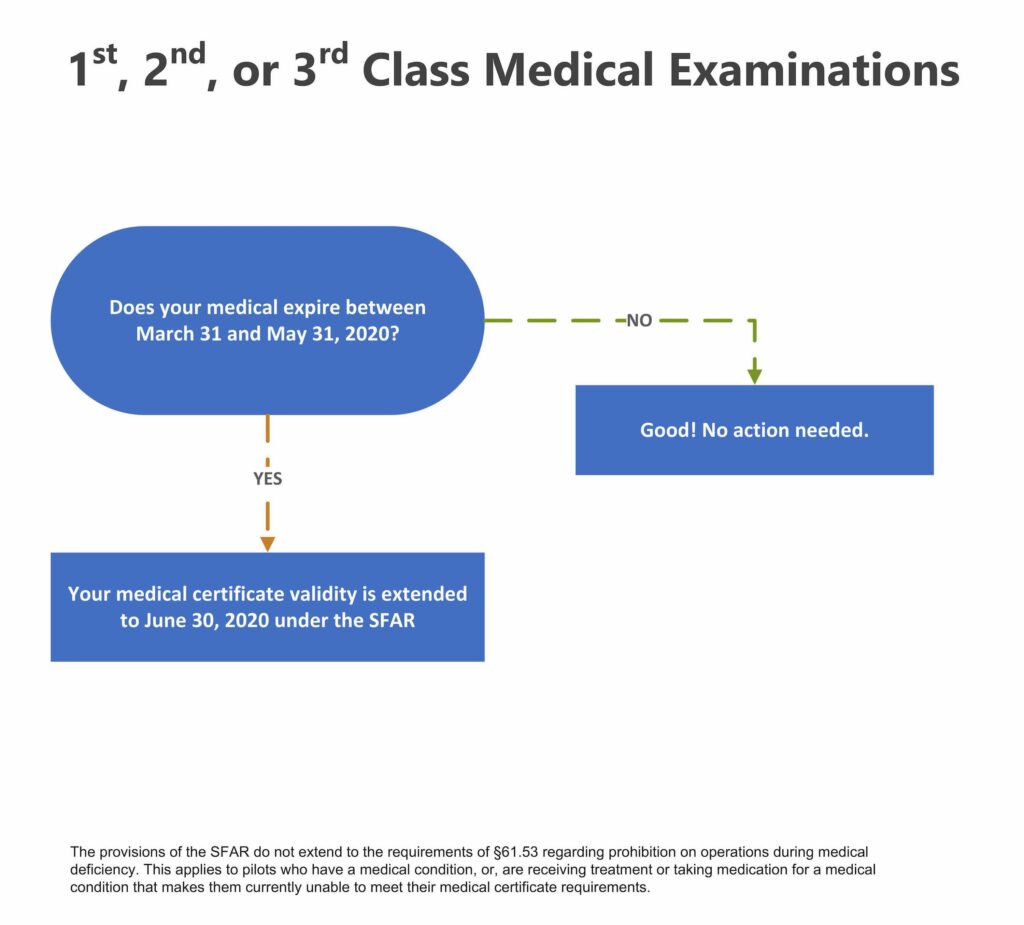
However, if you are among instrument pilots who have logged at least three instrument approaches (actual or simulated) within the six calendar months preceding the month of the (planned) flight, read on: Next you would check whether you have performed and logged all tasks required by FAR 61.57(c)(1) within the nine calendar months preceding the month of the flight.

No? Thank you for playing.

Yes? Then the SFAR applies and you may continue to act as PIC of an aircraft under IFR or in weather conditions less than the minimums prescribed for VFR until June 30, 2020—for those five types of operations outlined in the SFAR. After June 30, you must meet all requirements of FAR 61.57(c). Note that this “grace period,” as the FAA calls it, does not extend the additional six-month timeframe to regain your currency.

Has your first, second, or third class medical certificate expired?

If you have navigated one or more of the scenarios posed above, this one will be a cinch.

If your first, second, or third class medical expired or expires between March 31 and May 31, its validity is extended to June 30—no matter what type of flying you do.

If your medical’s expiration date as issued is outside the March 31 to May 31 date range, your usual renewal timetable applies and no action is needed.

BasicMed? It will be 2021 before the first pilots to have begun flying under BasicMed will need to see their issuing doctor again, so the SFAR does not address BasicMed. BasicMed pilots who need to complete the online course that is required every 24 months can do so on AOPA’s website.

Now that you have followed these steps and have kept yourself on the good side of the SFAR, two tasks remain: One is to contact your insurance representative and get written confirmation that your coverage remains in force if you fly under the SFAR.

For those pilots who live in states or municipalities that have stay-at-home orders in effect for health reasons, the final step is to check the status of those orders so you don’t get a ticket for being on the road for the wrong reason as you drive to the airport.

Thanks to AOPA for sharing this article, which first appeared on their website here.


Many US Bizav Airport Towers To See Hours Cut

The FAA has published a list of 93 airports which will be getting their tower operating hours cut due to the reduction in traffic caused by the coronavirus pandemic.

Here’s the list of airports, with the new planned tower operating times:

The NBAA say these extended night closures will start to be implemented next week, beginning May 4.

In announcing its plans, the FAA said the following – “These facilities have seen a significant reduction in flights, especially during the evening and nighttime hours, since the pandemic began. Adjusting the operating hours will further protect our employees and reduce the possibility of temporary tower closures from COVID-19 exposures by ensuring enough controllers are available to staff the facilities during peak hours. It also will enable us to allocate difficult-to-source supplies where they are most needed.”

When the towers at these airports are closed overnight, the radar facility with oversight controls the airspace – the FAA plans to begin adjusting the operating hours of some of these facilities later this month. More info is available on the FAA page here.