South Atlantic Bulletin: CPDLC Warning

There’s been a lot of noise lately from the NAT, especially as we all come to grips with the removal of oceanic clearances.

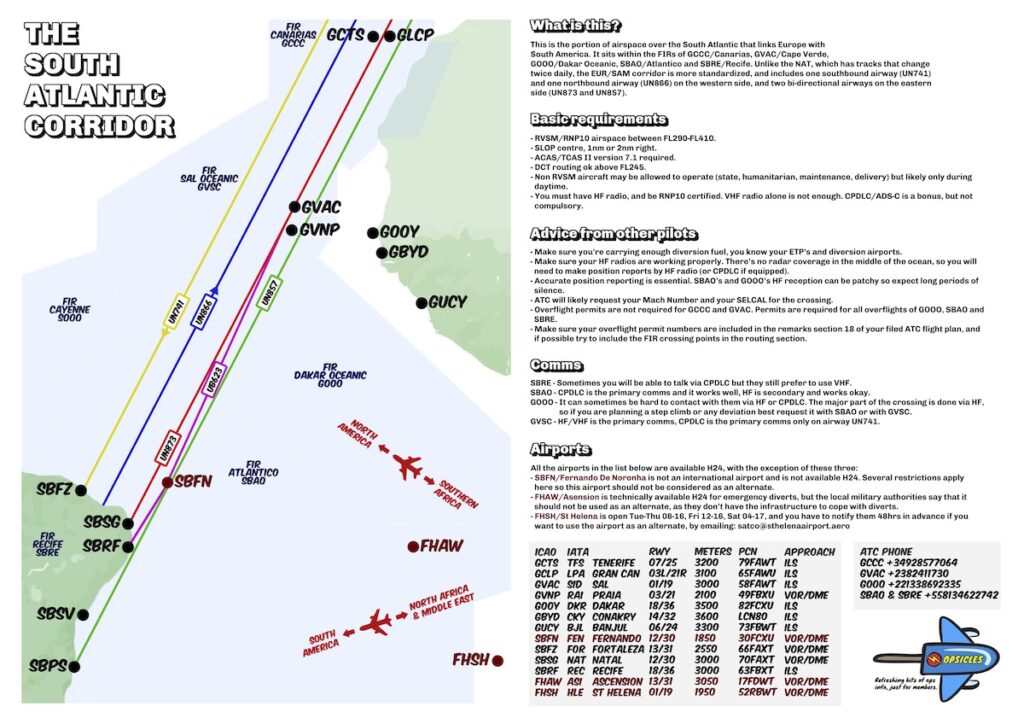
But it’s important not to forget about the SAT – or South Atlantic. And it seems a CPDLC issue has been regularly occurring in the Abidjan Area Control Center – a large chunk of airspace found south of Africa’s Ivory Coast.

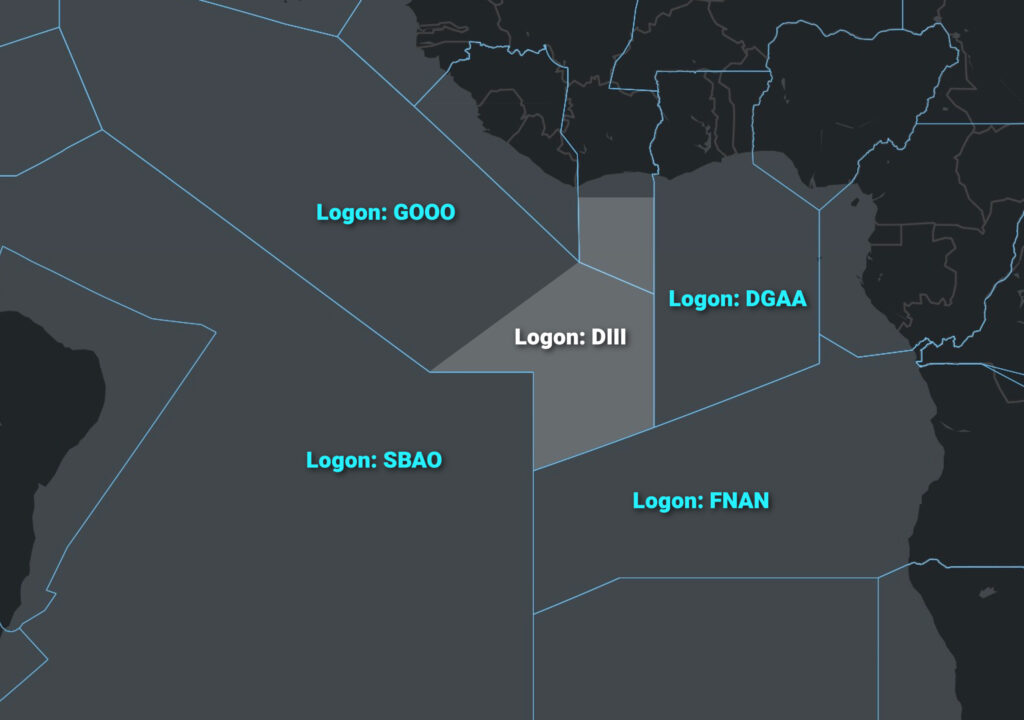
The issue arises from the fact that while the Abidjan ACC is geographically constrained by the much larger Dakar FIR, it is responsible for its own control.

It seems that pilots have been incorrectly logging onto GOOO/Dakar rather than DIII/Abidjan when transiting this airspace. ATC are concerned, and so a new SAT Ops Bulletin has been published. Here’s a closer look at what it contains, and how to mitigate this error on your next crossing.

The Airspace Picture

Part of the problem may be that pilots crossing the SAT are far less familiar with the airspace picture than they are of its big brother, the NAT. So, he’s a quick crash course.

Over the South Atlantic lies the ‘Atlantic Ocean Random Routing Area’, or AORRA.

This is essentially a volume of airspace between FL290 – FL410 within the Atlantico, Accra, Comodoro Rivadavia, Dakar, Dakar Oceanic, Ezeiza, Johannesburg Oceanic, Luanda and Montevideo FIRs.

This article is concerned with the Eastern Side of the AORRA – specifically the DIII/Abidjan ACC (Ivory Coast) which is contained within the much larger GOOO/Dakar FIR and where the confusion is occurring. Aircraft on routes that transit between South America and Sub-Saharan Africa will likely overfly this airspace.

The folk at the South Atlantic Steering Group (SAT SG for short) have reported more and more instances of transiting aircraft incorrectly logging onto GOOO when they should be logging onto DIII while in Abidjan’s airspace.

This then creates communication issues for ATC.

Panic Slowly

While this is cause for concern, SAT SG are quick to explain that in most cases this can be managed safely but vastly increases workload for controllers who must manually resolve the mis-connection.

But occasionally the loss of comms has led to the activation of something called INCERFA – a top-secret ICAO catchphrase for where uncertainty exists as to the safety of an aircraft or its occupants. This alert phase carries its own protocols for ATC.

And so, the key message from the bulletin is this:

‘While Abdijan Airspace is geographically included within the Dakar FIR, it is essential that it is treated as a separate sector for CPDLC logon purposes…’

Simple!

What to do

None of us like unexpected paperwork. So, the SAT SG has also provided us with flight crew procedures to prevent communication problems when overflying Abidjan airspace. Check the SAT Ops Bulletin for these in full, but here’s the lowdown:

Before Entering: Check logged onto Abidjan ACC using correct code (DIII). Confirm logon active by checking uplink message response. Don’t log onto Dakar (GOOO) by mistake.

Failed Logon: Manually log on to DIII if auto fails. Notify Abidjan by voice ASAP if unable to establish CPDLC connection. If practical, trouble shoot before entering.

Transition between Dakar and Abidjan: Monitor handoff carefully. Ensure CPDLC switches before crossing the boundary. Verify correct CPDLC connection is active, especially entering Abidjan airspace.

Have more questions about the SAT?

You can reach the ICAO EUR/NAT office directly via icaoeurnat@icao.int.

For ops in the region, you might also be interested in this little guide on the South Atlantic Corridor we wrote before. OPSGROUP members cash download it from the Dashboard here.

Click to download hi-res PDF.


Winter Ops: Fun Fuel Facts

Fuel is to airplanes what coffee is to pilots – something you just cannot fly without. But just as there are different types of coffee, you’re going to come across different types of fuel as well…

The Menu

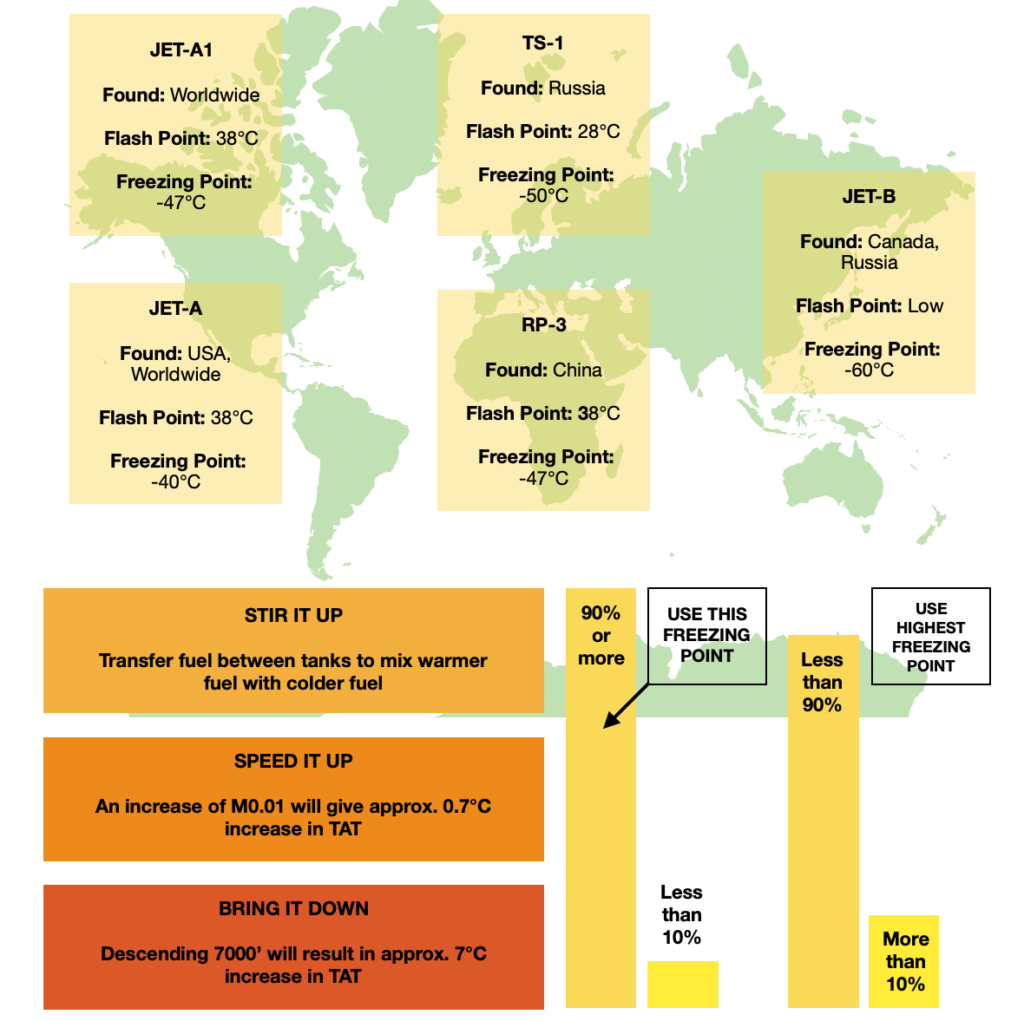
Jet-A1 – The most traditional drink, it is straw coloured with a flash point of 38°C (100°F), and a freezing point of -47°C.

Jet A – Another tasty kerosine grade fuel which will work just fine. The flash point is the same but this turns into an icy slushie at only -40°C.

Jet B – A delicacy from the Northern Regions. This is a cocktail of kerosine and naphtha – the stuff dragons produce out their nostrils (ok, that is not true, but it might as well be because this stuff is hard to handle with its higher flammability). Wide cut, and only really used in colder climates, with its freezing point of -50°C.

TS-1 – A Russian cocktail, more flashy than most at 28°C, but with a freezing point of -50 °C. It is also sometimes called RT (which looks like PT when it is written in Russian). RT is a superior grade TS-1, but not widely available.

RP – Brewed in China, the RPs come in a variety of styles. RP-1 has a freezing point of -60°C, RP-2 -50°C, but it is RP-3 we really recommend because it is basically Western Jet-A1 produced at export grade.

Chip fat oil – Not literally, but if you fly into a remote airport in some regions you might find fuel is not of the standard required. Look out for anything that isn’t straw coloured, doesn’t smell right, or has things floating in it.

Cutting it wide

Wide cut fuel is a mixture of kerosene and gasoline (Jet A1 in comparison is highly refined Kerosene). Wide cuts are not often recommended by airplane manufacturers because the quality and performance specifications are generally not as good.

If you are going to use it, there are likely going to be some pretty specific operational procedures involved because these fuels are much more volatile. Things like over-wing fuelling is generally a no-no, and the filtration system is going to appreciate a slow flow so it can keep up.

All those numbers

Fuel doesn’t freeze like water. It is not liquid one minute and ice the next. Instead it turns into a strange, slushy porridge consistency. 

What’s more, if you have a mixture of freezing points, the freezing point won’t be a nice in the middle -44.5°C so the only reliable way to work this out when you’ve mixed a load together is to take a measurement – assuming you’re carrying your own Fuel Freezing Point Measuring Gadget…

If not, the next best method to use is this –  

  • 90% or more of your fuel is one type? Use that freezing point.
  • 89% or less of your fuel is one type? Use the highest (worst case) freezing point.
  • You have 900 gallons of Jet A1 freezing at -47°C and 100 gallons of Jet A freezing at -40°C? Then call it -47°C and be off on your merry way.
  • You have 899 gallons of Jet A1, and 101 gallons of Jet A? Then take the highest freezing point which in this case would be Jet A at -40°C

Do we really care about freezing points of fuel?

Yes, very much so, especially if you are flying some long haul treks over the North Pole at high altitude in the winter.

With outside air temperatures lower than -60 degrees, freezing fuel can get you into some very hot water, (or cold fuel to be more accurate.)

In Jan 2008, British Airways Flight 38 crashed just short of the runway at EGLL/Heathrow after flying from Beijing, China. They had been cruising between FL350 and FL400, with OATs reported to be between -65 to -74°C. While the fuel itself never froze, it did become cold enough for ice crystals to form in the fuel system.

These pesky little ice particles blocked stuff up and reduced the fuel flow, starving the engines, and causing a big loss in thrust right when the pilots needed it.

What can we do about it?

Ultimately, you need to turn up the temperature! There are only a few ways to heat your fuel up if it starts getting too chilly:

Stir it Up – Unlike Bond who preferred his drinks shaken and not stirred, mixing cold fuel with warmer fuel makes it better. Some larger aircraft with complex fuel systems do this automatically, but if you are able to do so manually there will probably be a checklist and following it to avoid turning off the wrong pumps might be wise.

Speed it Up – Flying faster means more drag which means more energy converted into hotness. Not much though… an increase in Mach 0.01 will increase the TAT by around 0.7°C, and increasing your speed also increases your fuel burn.

Bring it Down – Warmer air will help, and by descending 7000’ you can increase the TAT by around 7°C. In seriously cold air masses, descent to at least FL250 might be required, but this all means a much higher fuel burn.

Tanker? No thank ya…

Tankering fuel if you are operating into somewhere chilly might cause you some problems. The fuel is likely to get cold in flight, and up the likelihood of some frosty wings on the ground. So check the de-icing situation at your destination if you are tankering and it’s cold out.

Some other useful info

  • 1 imperial gallon = 1.2 US gallons.
  • You can monitor the price of jet fuel here.


Swerving off the road: Why are pilots avoiding EMAS?

Update November 2024:

Over two years have passed since we first published this article on EMAS.

A recent report identified that runway excursions are still one the leading causes of business aviation accidents in the US – which has put this valuable technology back on our radar.

It’s pleasing to see that the adoption of these life-saving blocks of crushable energy absorption has steadily continued to increase across the world including recent news that it is coming to Australasia for the first time.

The FAA now reports that EMAS is installed at 121 runway ends at seventy-one US airports and growing.

To date it has safely stopped twenty-two overrunning aircraft carrying 432 pax and crew – the latest, a Hawker 900XP at KTEX/Telluride back in July.

Outside of the US, a number of aviation authorities have introduced or are planning to install EMAS beds to current US FAA standards at airports in countries including the UK, Canada, France, Spain, China and Taiwan.

A first for Australasia

Two promising pieces of news recently emerged from down under in recent months.

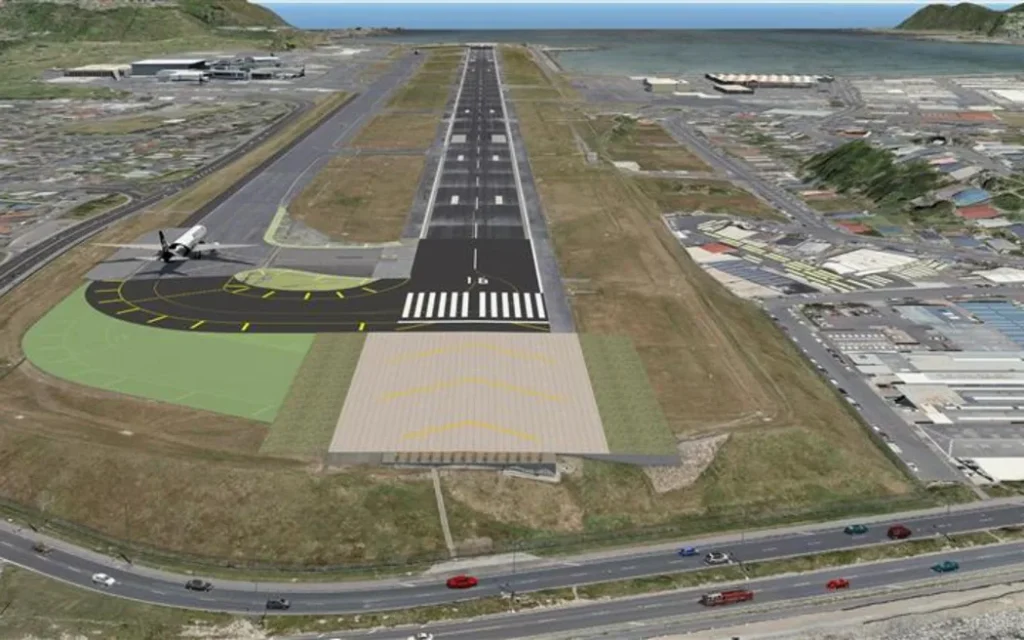
New Zealand is installing EMAS at two of its most challenging airports characterized by windshear, short runways and RESAs geographically constrained to the minimum 90 meters (295’). Both receive high volumes of jet traffic.

NZQN/Queenstown is currently in the process of installing EMAS at both runway ends. Work is happening at night and is expected to be completed soon.

Just last week, NZWN/Wellington announced it would follow suit, with major runway safety upgrades. It hopes to have EMAS in action by the end of March.

A familiar problem remains

If there is any doubt as to the effectiveness of EMAS, consider this. A typical EMAS installation in a 90m (295’) RESA effectively increases its stopping power to the equivalent of 240m (787’) – that’s nearly three-fold.

And yet pilot awareness remains limited. There are no ICAO SARPs for EMAS. And the FAA’s guidance is limited – the only advice for an imminent EMAS encounter is to maintain the extended runway centreline. And once stopped, don’t try and taxi the aircraft.

The reality is that 90m from 70kts looks darn short – and vacant space on either side of the runway makes for an attractive option in the heat of the moment.

Pilots may simply not know it’s there (how often do we brief EMAS?) or act out of instinct. Which means incidents are still occurring where we’re swerving to avoid it.

More on that in our original article below.

Original Article:

Across the US alone, over one hundred runways at 71 airports have a safety critical system fitted to help prevent a major cause of aviation accidents – runway overruns.

It’s called EMAS, or ‘Engineered Materials Arresting System’, which is a technical of way of using drag to safely stop an airplane when all else fails. And better yet, it has your back in all runway conditions – water, snow, ice, you name it. It’s a proven life saver.

But the problem is there are still accidents happening where pilots have actively avoided it, instead choosing to veer off the runway.

Why?

IFALPA recently put out a new position paper which may provide some solid clues. And along with work that others have done, the reasons seem to fit into one of two camps:

  • Knowledge about what EMAS is and does.
  • In the heat of the moment, pilots just didn’t know it was there.

For such an effective safety system that protects crew, passengers and even those on the ground, is it possible that we’re just not giving it the attention it deserves?

Let’s tackle both camps.

EMAS 101

Dip into the regs and you’ll see that the US FAA requires all airports to have runway safety areas. They are typically 500 feet wide and extend 1000’ past the runway end, and are clear of obstacles in case an aircraft either overruns, or undershoots. Sounds safe, right?

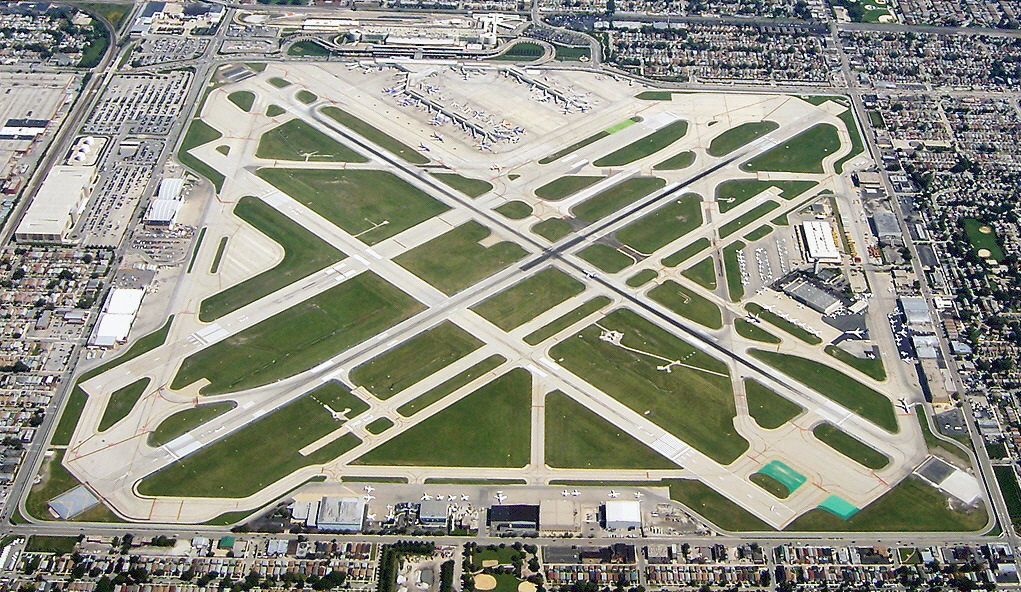
But what if there isn’t enough space? Take KMDV/Chicago Midway for example. It’s not always practical. That’s where EMAS comes into it. It achieves a similar level of safety, only using a lot less room.

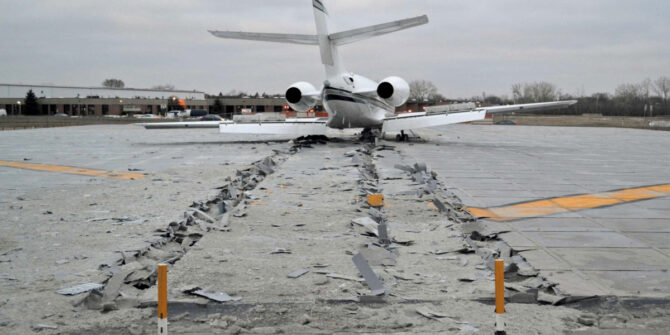
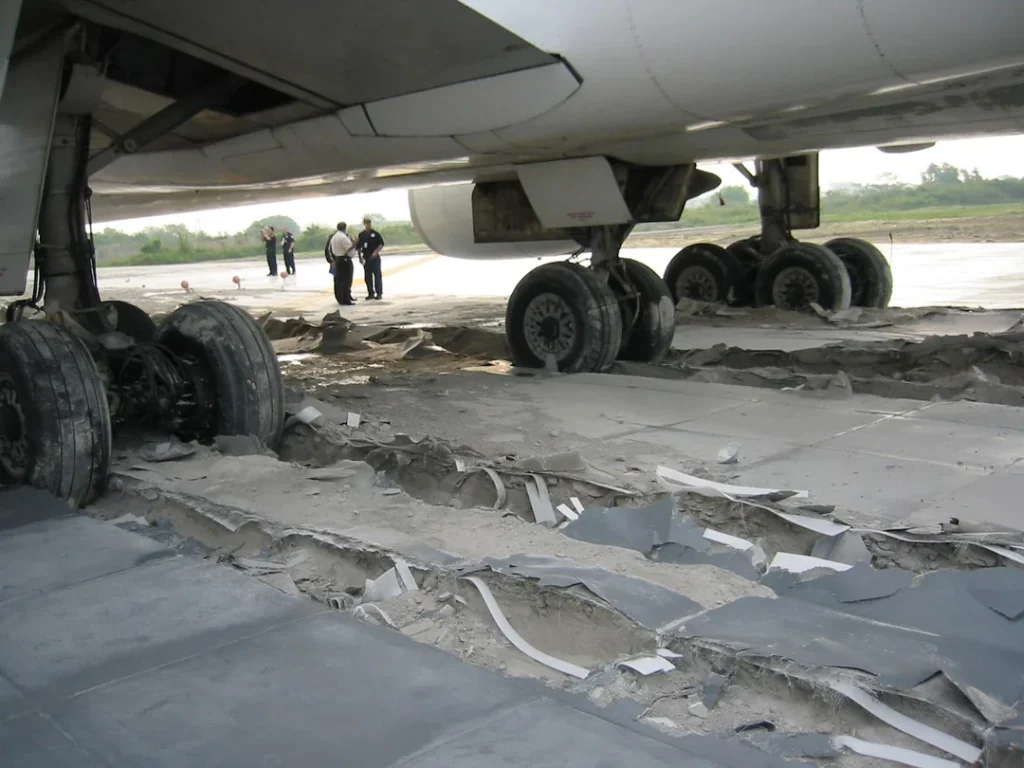
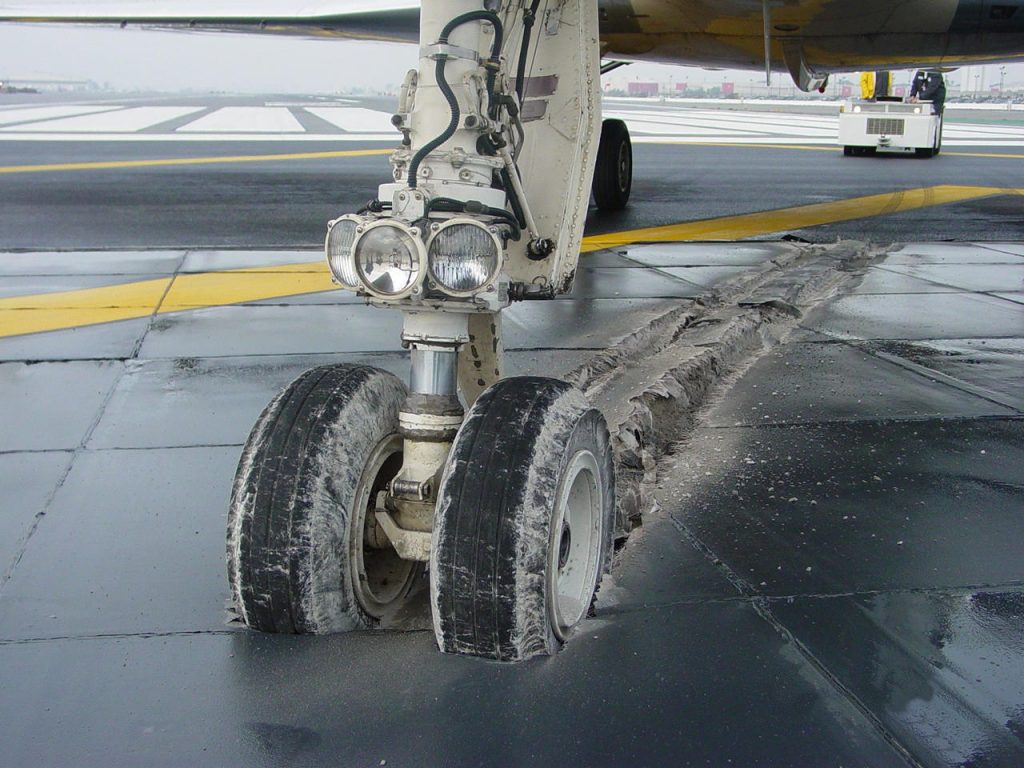
It is essentially a concrete bed (or ‘arrestor pad’) of increasing depth which contains thousands of blocks of crushable material that are designed to quickly slow down an aircraft with little or no damage – likely your nose wheel, and that’s about it.

And it works really well too. In fact, it’s so effective it can stop an aircraft travelling as fast as 70kts – which is a good thing as 90% of all overruns happen below this speed.

It’s not even a big deal to replace it – it’s modular. Only the blocks that have been damaged need to be changed out.

Grass and dirt

Some EMAS pads are only 150’ long. When faced with obstacles like trees, buildings, and roads it’s no wonder that the instinct is to avoid ploughing straight ahead.

Instead, the grass and dirt off the side of the runway begins to look like a very appealing option to slow an airplane down. And as the FAA itself once phrased it, ‘there’s a myth that if you take the dirt, you won’t be on the news…’

But the reality is that EMAS will do a far better job and with a safer outcome and less damage.

What about approach lights?

Lights on an EMAS arrestor pad are designed to break away and do very little damage to your ride.

You may not know it’s even there

This is where IFALPA get really stuck in. Some crew actively steered away from EMAS simply because they didn’t know, or forgot, that it was there.

Knowledge is one thing, but you can’t brief what you can’t see.

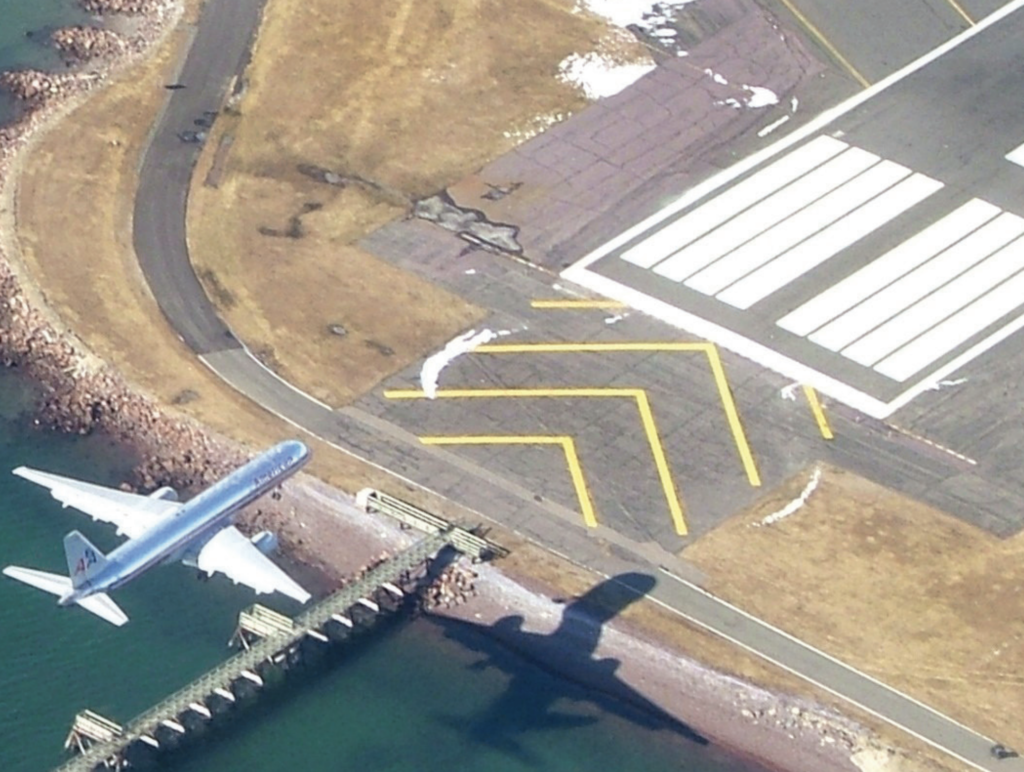
Yellow chevrons indicate an EMAS arrestor pad, but there is no standardised signage in place for it. Take a look a look again at the list of US airports with it installed – if you operate in and out of any of them, how often are you thinking about EMAS?

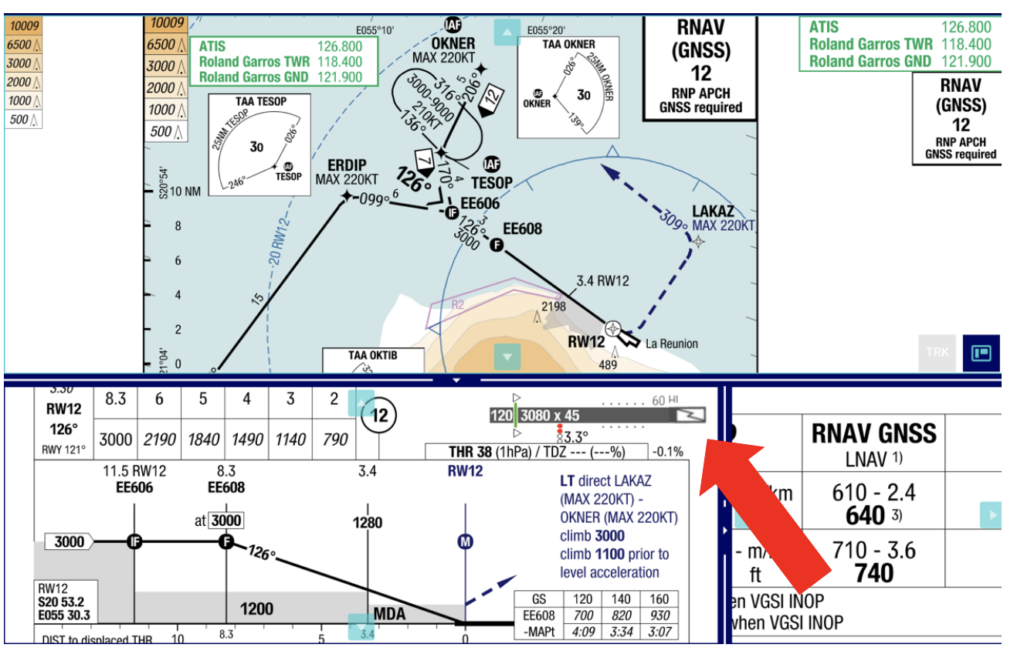
And the story doesn’t end with signage either. What about approach and airport charts? Leading chart manufacturers indicate where EMAS is present on ground charts only. But not on approach charts – the argument is that it won’t fit.

It seems as though the work hasn’t been finished just yet. EMAS is really effective, but as an aircraft departs the runway, there just isn’t enough time to figure out it’s there or not. And that all starts with crew awareness with the tools available when ops are normal.

Regulators in the US and abroad need to be doing more to illuminate this valuable piece of safety tech. At least five hundred lives have already likely been saved because of it.

Knowledge is power

Which is certainly the case with EMAS. Combine both camps, and pilots (myself included) can understand how valuable an obscure sign that says ‘EMAS’ may be, and also know when it is available before you need it the most.

Only then will it live up to its full potential.


CENAMER Flight Planning Requirements

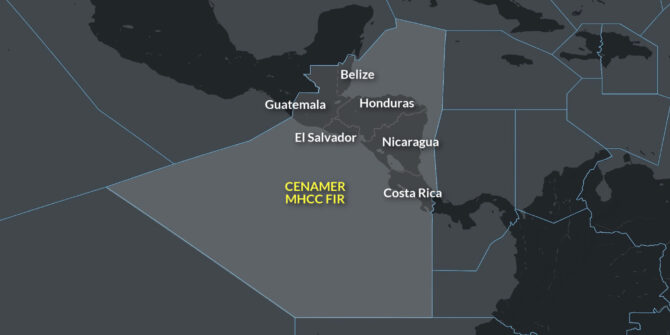
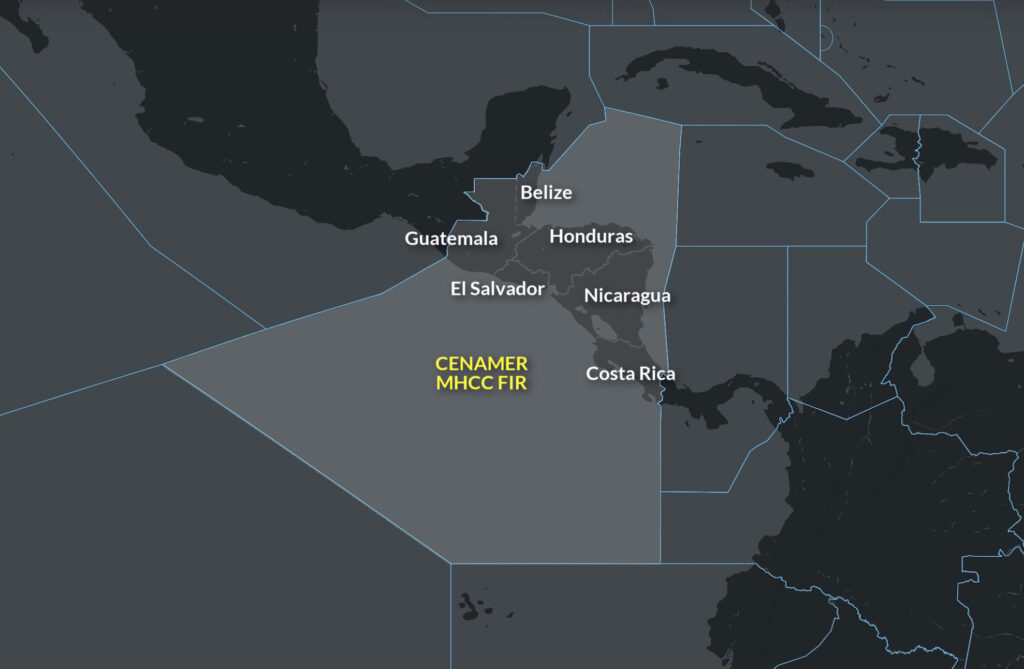
CENAMER is a combination of CENtral AMERican countries that work together as one for ATC Service. The controlling Authority is COCESNA. It’s real name is the MHCC/Central American FIR – but most people just call it Cenamer. The actual controllers are in Tegucigalpa, Honduras, but control the airspace of Belize, Costa Rica, El Salvador, Guatemala, Honduras and Nicaragua.

Recent Updates

  • Dec 2024: ADS-B Mandates. Two of the six countries in the MHCC/Cenamer FIR are mandating ADS-B at the end of 2024. Guatemala will require it from Dec 31 (AIC 44/24), and El Salvador from Jan 1 (AIC 46/24). None of the other countries (Belize, Costa Rica, Honduras, Nicaragua) have published any ADS-B mandates yet. You can download the AICs here. Note that the airspace above FL195 for all these countries is controlled by MHCC/Cenamer ATC based in Honduras.
  • Dec 2021: New Honduras airport. All scheduled international flights were transferred from MHTG/Toncontin to MHPR/Palmerola – the new international airport in Honduras which commenced commercial operations in Dec 2021. MHTG/Toncontin will now be used for domestic flights, but is still available for international bizav flights. Check our article for more info.
  • Oct 2020: New AFTN code when filing flight plans. For flights through the MHCC/Cenamer FIR above FL195  you must include the AFTN address MHFPZYZX. This is the address of a new automated system they’ve got, which will check if you’ve written your flight plan properly (i.e. according to ICAO standards). If you have, you’ll get an ACKNOWLEDGE (ACK) or ACCEPTANCE message, and the system will then fire it off to all of the individual countries within the MHCC/Cenamer FIR that you’ll be overflying/flying to. If you’ve got it wrong, you’ll get a REJECTED (REJ) or ERROR message, with the reason why, and you’ll have to file it again.

The fabled “Cenamer Notification”

For flights intending to operate within the MHCC/Cenamer FIR require notification. Every FIR worldwide requires the same thing, but because of the grouping of countries, the process is a little different here. A pre-formatted AFTN message must be sent containing the flight details and planned schedule, to both the AIS office, and to the various billing departments.

The latter is most important, because it give them the opportunity to warn in advance if airspace entry will be denied because of unpaid Navigation Fees. The Cenamer Notification confirmation is normally in the format MPTOXXXX192330, being the originating AFTN address and a date/time stamp.

Notification Requirements

Notification: All flights entering the MHCC/Cenamer FIR must send notification 48 hours prior to entry.

Documents Required: None.

Lead Time: Official requirement is 48 hours before flight. Notification can be made up to 1 hour prior to airspace entry, but there is a risk that not all departments will have had time to process the message. Assuming there are no billing issues, denial of entry into the airspace is unlikely.

Validity: Once notification is made, there is no need to revise it for a new schedule. The Notification can be considered valid for 72 hours.

Permit Format: Confirmation is normally in the format MPTOXXXX192330, being the originating AFTN address and a datetime stamp. FPL Field 18 entry is not mandatory, but you can include it as PERMIT/CENAMER NOTIFICATION MPTOXXXX192330.

Do I need AFTN access to make this happen?

They do have this website where you can check whether an aircraft reg has any outstanding payments: https://apps.cocesna.org/fycbilling/pages/fyc/fycbilling.jsp

It also allows you to calculate the approximate cost of a flight depending on the point of entry and exit into the airspace. Then you can calculate the total cost (any outstanding fees + the fees for your upcoming flight) and pay online.

You can also contact COCESNA direct (facturacionycobros@cocesna.org, invoices@cocesna.org), in good time prior to the flight, requesting details of any outstanding navigation charges and a copy of the invoice. But their office is only open from 8am to 4pm, Monday to Friday, so you might not receive a reply right away to say that everything is paid. In this case, you’ll need AFTN to file the Notification and to follow-up with any countries which reply to say you owe them nav fees.

Also – if you don’t receive an email reply and there are outstanding charges, you’ll only know about it when you come to file your flight plan, at which point you’ll receive a reply on AFTN from the specific country (or countries!) you owe money to. At this point, you’re at their mercy as to whether they accept or reject your flight plan – and you may not have time to pay for any outstanding charges. These individual countries won’t email you, they’ll send you a message via AFTN (to the same address you use to file the Notification).

Bottom line, whoever files your Notification (and then, later, your actual flight plan) will need access to the AFTN system so that they are able to reply to these messages as they come through – and to check to make sure that your flight plan is accepted! This is where using a third party agent for overflights in this region can come in handy, as they should manage this whole process for you and communicate with all the relevant countries via AFTN.

Which AFTN addresses do I send messages to, and what should I say?

Your message should read something like this:

CENAMER NOTIFICATION OF FLIGHT REF XXXX
PLEASE ADVISE IF ANY OBJECTION TO OPERATE

AIRCRAFT: XXXXX
CALLSIGN: XXXXX
TYPE: XXXXX 
OPERATOR NAME: XXXXX
DATE OF FLIGHT: 20DEC2020

PLEASE CONFIRM RECEIPT OF THIS NOTIFICATION
PLEASE CONFIRM OK TO OPERATE BY AFTN TO (INSERT YOUR AFTN HERE)

SCHEDULE:
20DEC ETD KDEN1300 ETA SBGR2230

NAVIGATION FEES SETTLED BY: XXXXX
OPERATOR: XXXXX
EMAIL: XXXXX

COPY TO ALL CONCERNED:

MHCCYSYX/CENAMER CONTROL 
MHCCZQZX/CENAMER CONTROL FPL 
MHTGYAYX/HONDURAS CAA 
MHTGYOYX/HONDURAS AIS 
MHLMYGYX/HONURAS RCO 
MROCYAYX/COSTA RICA CAA 
MROCYOYX/COSTA RICA AIS 
MROCYGYX/COSTA RICA RCO 
MNMGYAYX/NICARAGUA CAA 
MNMGYOYX/NICARAGUA AIS 
MNMGYGYX/NICARAGUA RCO
MSLPYGYX/EL SALVADOR RCO 
MSSSYAYX/EL SALVADOR CAA 
MSSSYOYX/EL SALVADOR AIS 
MGGTYAYX/GUATEMALA CAA 
MGGTYOYX/GUATEMALA AIS 
MGGTYGYX/GUATEMALA RCO 
MZBZYAYX/BELIZE CAA 
MZBZYGYX/BELIZE RCO

And here’s the list of AFTN addresses to send it to:

MHCCYSYX 
MHCCZQZX 
MHTGYAYX 
MHTGYOYX 
MHLMYGYX 
MROCYAYX 
MROCYOYX 
MROCYGYX 
MNMGYAYX 
MNMGYOYX 
MNMGYGYX 
MSLPYGYX 
MSSSYAYX 
MSSSYOYX 
MGGTYAYX 
MGGTYOYX 
MGGTYGYX 
MZBZYAYX 
MZBZYGYX

Is the Cenamer Notification the same as an Overflight Permit?

No. It’s important to note that this is not a permit, this is just to ensure the Cenamer countries receive notification of your planned flight, and can check for any unpaid Navigation Fees. Each individual country in this region requires an overflight permit as well (except for El Salvador and Costa Rica, if you’re operating a private flight).

For more information on permit requirements, OPSGROUP members can use the dedicated Permits App in your Dashboard. If you’re not a member, you can get a copy of the same information in our Permit Book, or alternatively, join OPSGROUP here!


Dodging Danger: The Three Routes Through the Middle East

Navigating the airspace of the Middle East has become a major headache for international operators.

In recent times, risk to civil aviation in the region has changed at a pace we have never seen before.

Transits are now faced with a common conundrum: it no longer seems to be a simple question of ‘is this route safe?’ but instead, of one’s own appetite for known risks.

There simply is no ‘risk-zero’ route available.

Therefore, a common question that bizav operators are asking OPSGROUP is ‘what are the major airlines doing?’ A snapshot of flight tracking right now shows that Middle Eastern transits are managing risk through the use of three distinct routes:

  • South via Saudi Arabia and Egypt
  • Central via Eastern Iraq and Turkey.
  • North via the Stans and the Caspian Sea.
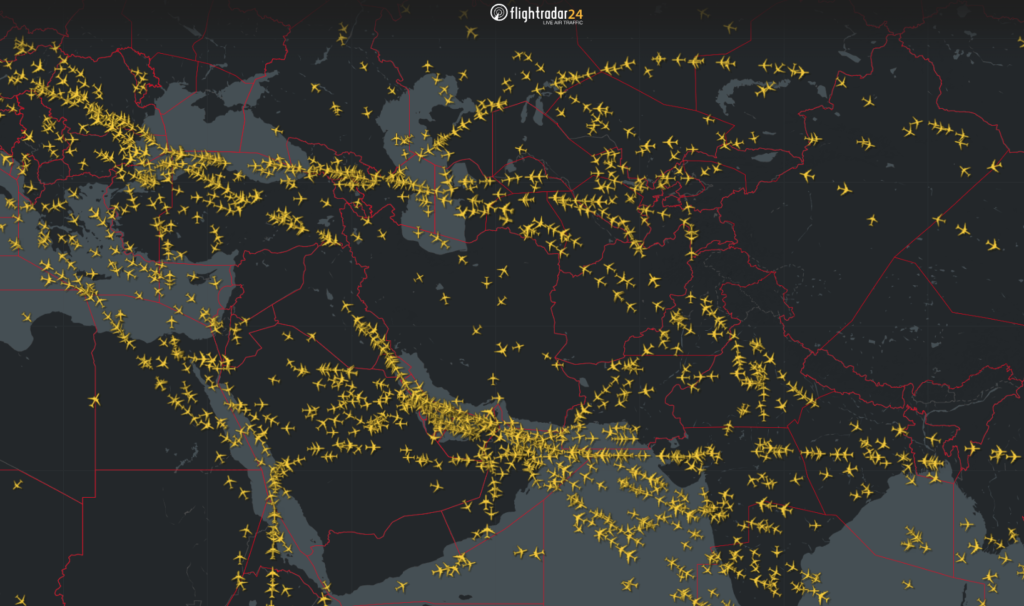
This article provides a brief risk profile for each of these routes to help operators carry out their own risk assessments when choosing a route to fly.

A Note About Risk

OPSGROUP also runs safeairspace.net – a database of all state-issued airspace warnings, along with risk briefings for each country in plain simple English.

We take into account both official advisories, recent and past events, advice from other specialists and potential for emerging risk when making a risk assessment.

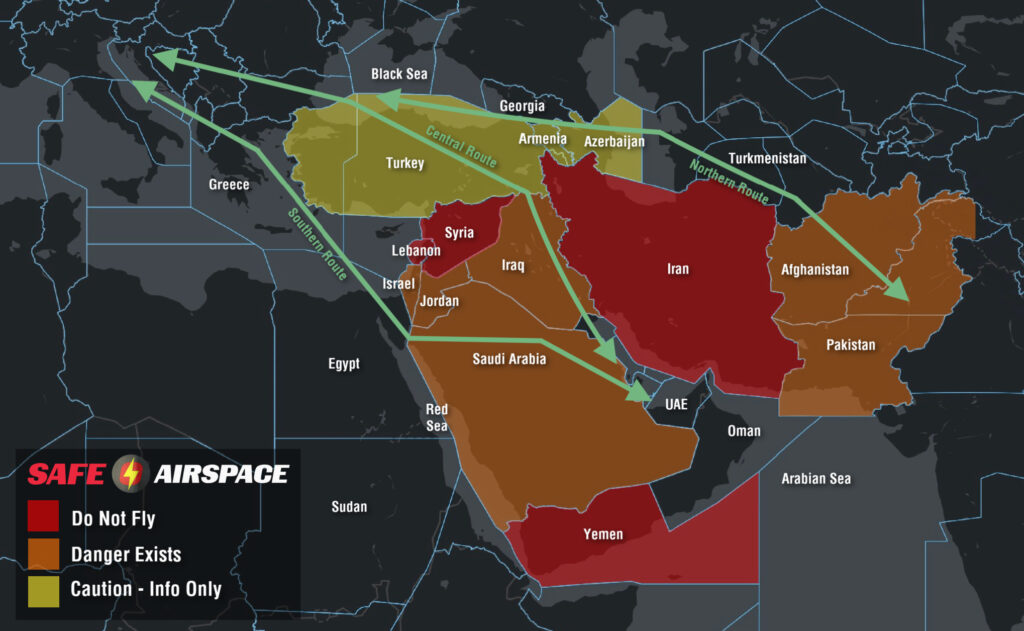
To keep things simple we have three levels:

  • Level 1 Do Not Fly (Red)
  • Level 2 Danger Exists (Orange)
  • Level 3 Caution (Yellow).

None of the three routes above enter any country’s airspace we have classified as ‘Do Not Fly.’

For the rest, you’ll see the map below is color coded according to the same risk profile.
The Southern Route

This route begins with a lengthy crossing of Saudi Arabia, steering clear of Israeli and Lebanese airspace to the north before crossing the Red Sea into Egypt.

It’s considered advantageous because it keeps tracks miles down (compared to the Northern Route) and avoids the potential for a sudden escalation of hostilities between Israel and Iran.

From a contingency perspective, it also provides safer diversion options than a transit of Iraq.

But now for the more-risky stuff.

The Houthi Campaign:

There is currently heightened risks to civil aviation in this area.

Houthi Rebels in Yemen are currently engaged in a long-term campaign to use missiles and drones to target Israel (therefore infringing the Jeddah FIR) along with shipping channels in the Red Sea.

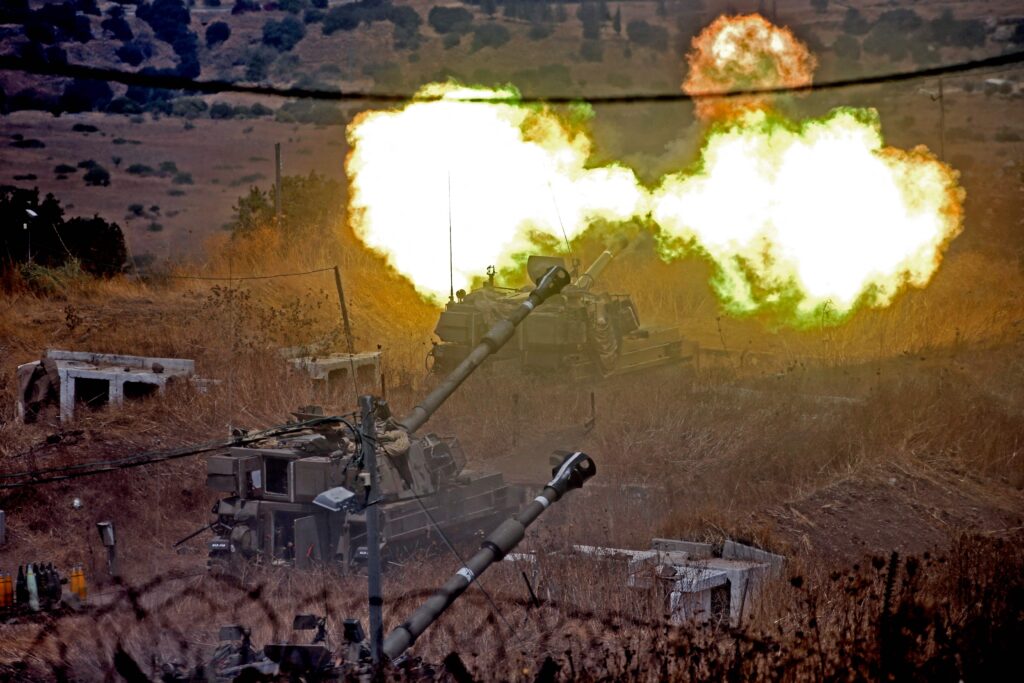
The military response to these activities is the use of air defence systems to destroy them.

The latest incident occurred on Nov 3, where a crew witnessed the interception of a missile at a similar level in open airspace near Jeddah. OPSGROUP members can access a special briefing on this latest event here.
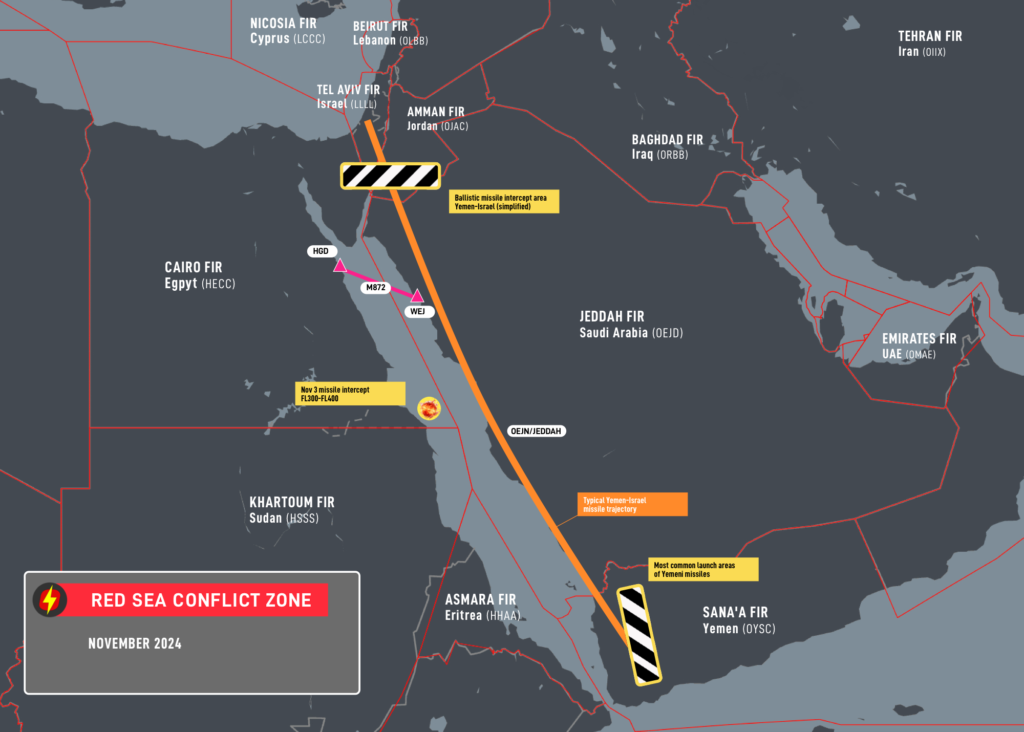
Of particular concern to aircraft at altitude is the use of ballistic missiles which originate from Western Yemen and are destroyed by defensive intercepts while on descent toward their target – which puts the airspace of Northern Saudi Arabia at heightened risk given its proximity to Israel and Gaza.

This essentially creates three risks to overflying aircraft – a direct hit by a missile (extremely unlikely), debris fields from inflight break ups or successful interceptions, and misidentification.

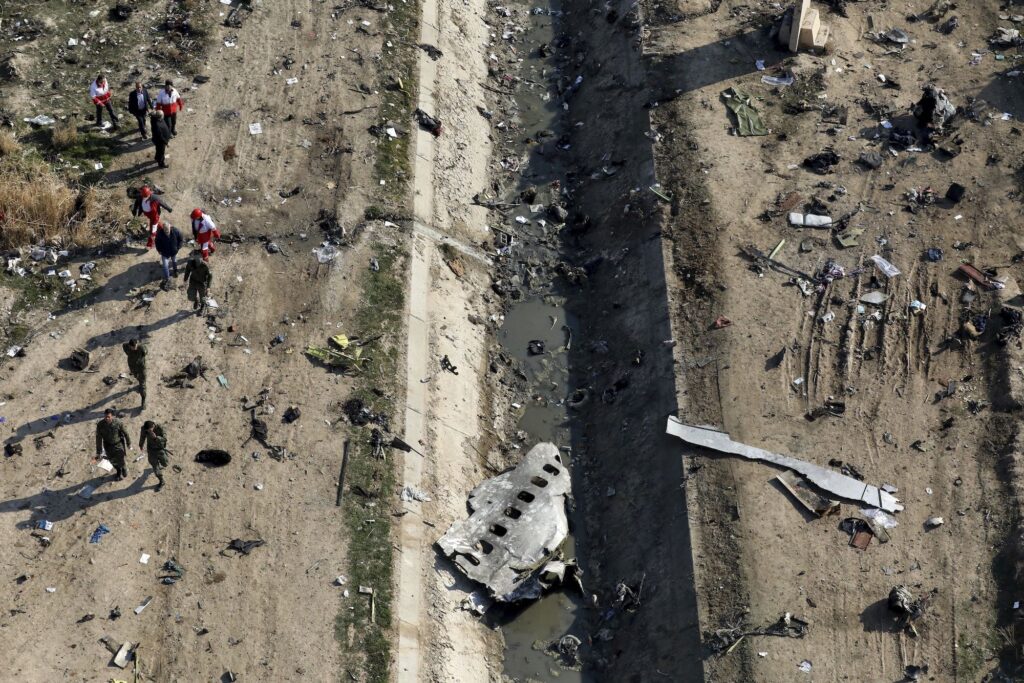
For the latter, many well-known incidents affecting civil aviation have come from mistaken identity. Malaysia 17, Ukraine 752 and Iran Air 652 were all due to misidentification.

Egypt ATC Congestion:

 OPSGROUP has received several recent member reports of severe frequency congestion in the Cairo FIR apparently due to ATC overload.

One crew even reported that during an entire portion between the North Coast of Egypt to the Red Sea (MMA – M872 – SILKA) that they were unable to talk to ATC.
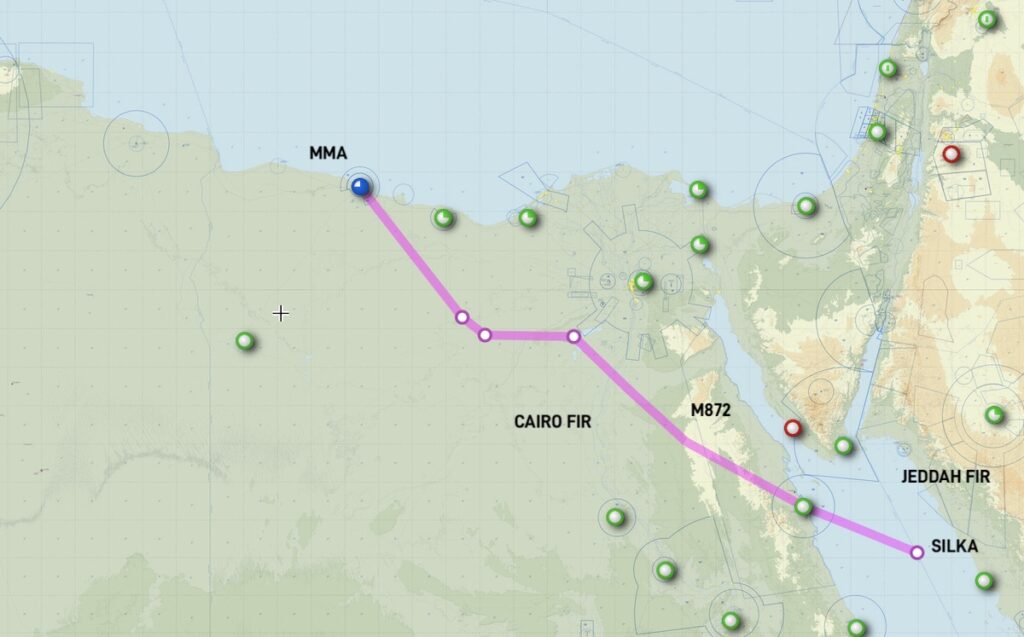
The corridor is much busier than usual which may present latent threats. Good airmanship at this time would be to keep a close eye on TCAS, ensure all anti-collision lights are on and consider the use of a PAN call if a deviation becomes necessary without a clearance.

We have approached both the Egyptian CAA and ANSP for feedback and have yet to receive a response.  If you have experienced this yourself in the HECC/Cairo FIR, please get in touch with us at team@ops.group.

The Central Route

This more conventional route tracks northwards along the Persian Gulf before an extended transit of Eastern Iraq using the UM860 and UM688 airways which run parallel to Iranian airspace before crossing Turkey and a southern portion of the Black Sea.

The overriding question from this route is “is it safe to overfly Iraq?”

In our opinion, yes but with some disclaimers.

UM860/UM688 Airways:

The UM860/UM688 have been considered safe for a long time. And prior to 2021, remained the only option available for US operators to enter the Baghdad FIR at all.

They continue to see heavy traffic by major carriers and can be considered a viable option.

When using them, an important consideration is their proximity to Iranian airspace. Due to the recent escalation in hostilities between Israel and Iran, many states prohibit operators from entering the Tehran FIR due the risk of anti-aircraft fire at all levels.

Extensive GPS interference (including spoofing) can be expected in Northern Iraq and on at least one occasion has led an aircraft to almost inadvertently enter Iranian airspace without a clearance.
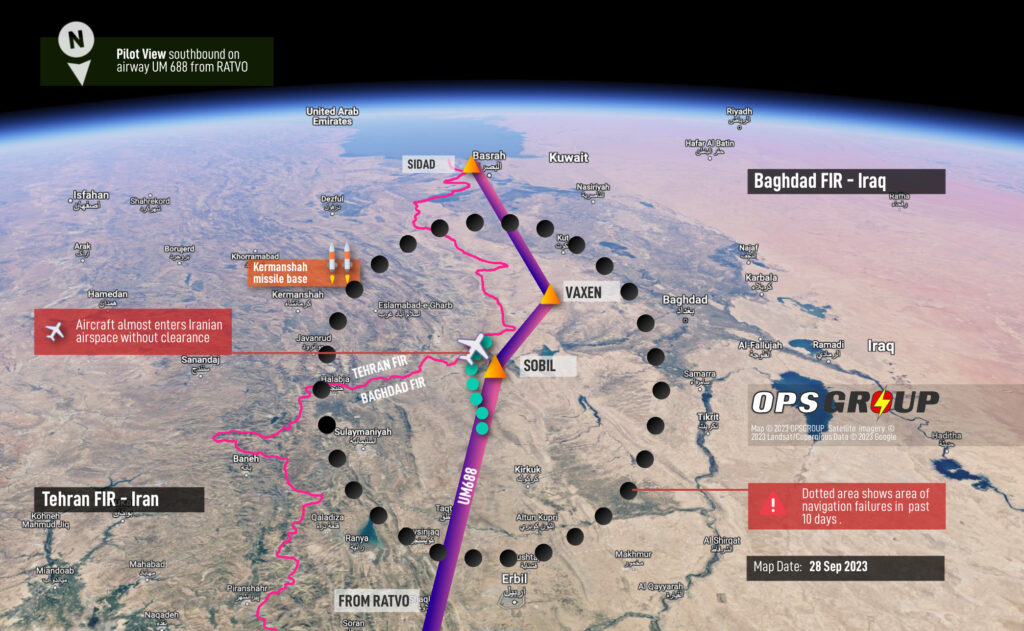
Extra vigilance for the early signs of GPS interference is essential for the safety of this route, along with early notification to air traffic control if it is suspected. Radar vectors remain your best fail safe.

Also beware of the potential for sudden closures of the ORBB/Baghdad FIR should further fighting occur between Israel and Iran. It closed completely during recent Israeli airstrikes and remains geographically sandwiched between the two, along with Jordan and Syria.

Free Routing:

In 2021, the FAA changed the rules. A new SFAR was issued that allowed N-reg overflights anywhere in Iraqi airspace, provided they’re conducted at or above FL320, which has opened-up new options for free routing.

Great for fuel, but arguably not safety. We continue to advise against flights away from the above airways due to well publicized risks of militant and terrorist activity which may target civil aircraft with anti-aircraft weaponry.

They may also be misidentified by air defense systems targeting drones which are frequently used to conduct attacks in Northern Iraq that originate from Turkey and Iran.

Crew and passenger safety is also an important concern should an emergency landing be required.

Turkey (beware of GPS interference):

We maintain a low-risk rating of caution for Turkey. As two of the three routes in this article include a lengthy overflight of the country, it is worth touching upon why any risk rating has been applied at all.

There is minor risk to overflights from misidentification by local militia who infrequently target Turkish military aircraft with anti-aircraft weaponry. This risk is predominantly near the border with Syria and Iraq where a higher level of airborne military traffic and UAS is present.

Far more prevalent is GPS interference – there have been frequent reports of both jamming and spoofing by aircraft well inside Turkish airspace. It appears to be common throughout the LTAA/Ankara FIR, especially anywhere near the border with Iran or Iraq. PIREPs also extend to Turkish airspace over the Black Sea. Reports share very similar symptoms: Un-commanded turns, position errors, and multiple GPWS warnings. The spoofed locations tend to center on Sevastopol on the Crimean Peninsula – a difference of between 120-250nm from the actual aircraft position. OPSGROUP members can access a special briefing on this hazard here.

The Northern Route

This is the route being favored between destinations in Europe and India/South East Asia.

It begins with a transit of Pakistan, before an uncontrolled crossing of Afghanistan and into Turkmenistan. A westerly turn is then made cross the Caspian Sea, Azerbaijan, Armenia and Turkey before rejoining the central route over the Black Sea.

While a fairly conservative option, it is the longest in terms of track miles.

Afghanistan:

For all intents and purposes, airspace safety in the Kabul FIR has not changed since the Taliban re-assumed control of the country in late September 2021.

The entire FIR remains uncontrolled and there is no guarantee of crew or passenger safety if you need to land. In that sense it remains the most important consideration in the selection of this route.

With that said, adjacent FIRs are managing the entry and exit of traffic and separating them with miles-in-trail and level restrictions.

Once inside, fairly robust contingency procedures (including the use of TIBA) appear to be working, with major carriers the likes of Lufthansa and KLM making safe crossings every day.
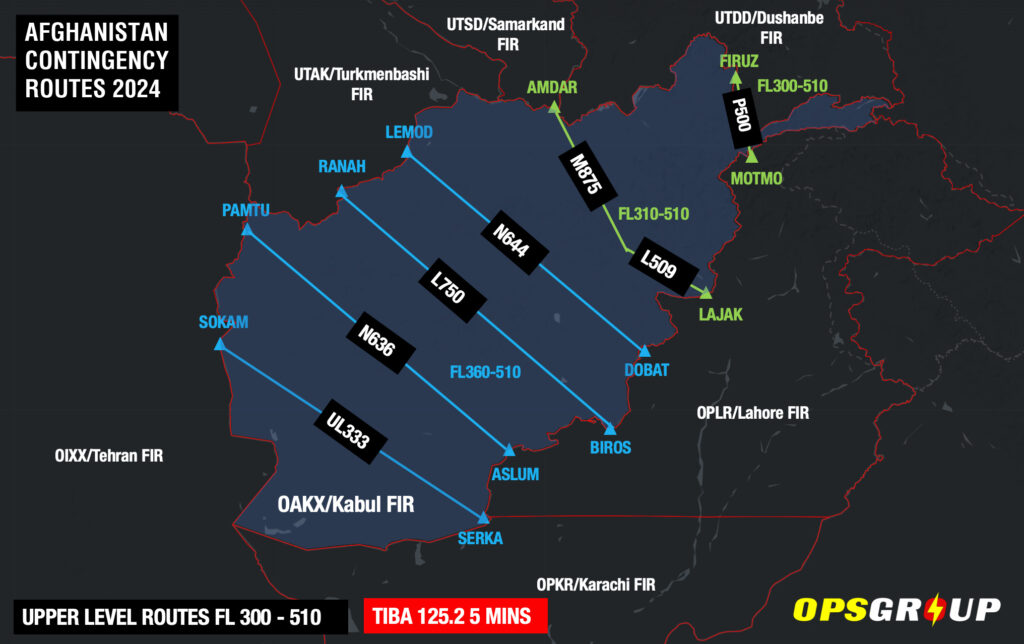
Aside from potential insurance complications of extended flight in uncontrolled airspace, it seems the predominant risk for overflights is what happens if you have an emergency and need to divert.

The overriding consensus (along with common sense) is don’t land in Afghanistan. In our recent article we explained it would be wise to consider it akin to ditching i.e. a last resort. Careful consideration of critical fuel scenarios to clear the Kabul FIR in event of de-pressurization, engine failure or both is essential to moderate this risk.

Azerbaijan and Armenia:

We maintain a level of caution for overflights of these countries given their history of conflict, but for now the risk to overflights remains low.

A ceasefire agreement is in place, and most states have lifted their airspace warnings for the YDDD/Yerevan and UBBA/Baku FIRs.

When sporadic fighting has occurred, it has been confined to border regions. A contingency to keep to mind is the use of northerly waypoints BARAD, DISKA and ADEKI to avoid the area and transit from Azerbaijan through Georgia instead.

Stay Informed

The situation in the Middle East has recently proven that airspace risk can change quickly and without warning.

Overflights need to stay informed and have good contingencies in place to manage unexpected re-routes and airspace closures, along with suitable diversion airports.

OPSGROUP issues Ops Alerts for members on a daily basis, but our risk and security alerts are also available for free on safeairspace.net which our team keeps updated around the clock.

If you have more questions, you can get in touch with us on team@ops.group. We’d love to hear from you.

US Pre-Clearance: How does it work?

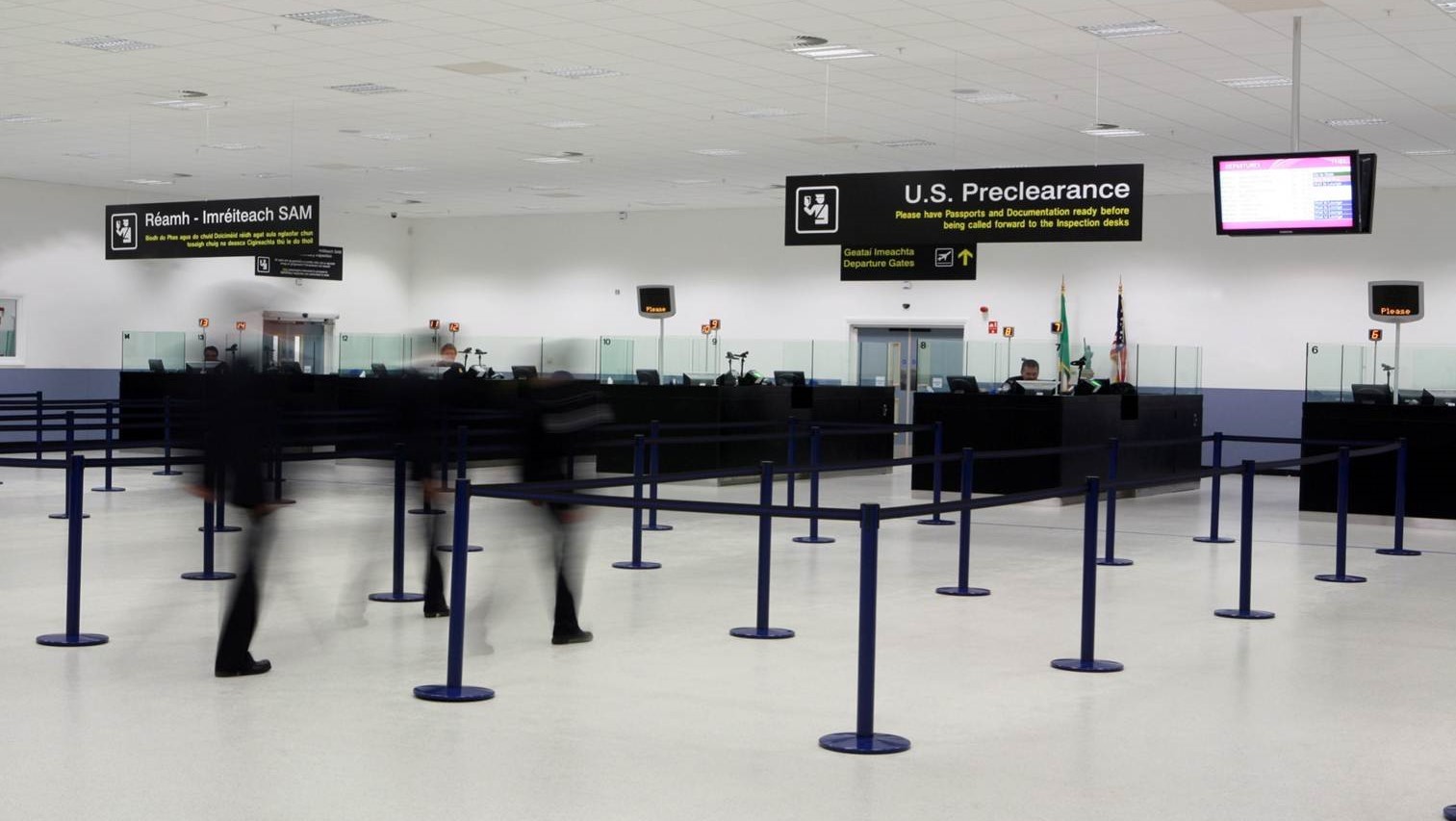
What is US Customs and Border Protection Pre-Clearance?

This service basically allows aircraft flying from certain approved airports direct to the US to complete their entry procedures at their departure airport – instead of on arrival in the US.

Where can I do it?

If you’re a bizav flight (i.e. private or charter), you can only do it at EINN/Shannon and TNCA/Aruba.

Scheduled airline flights can do it at these airports too:

  • The United Arab Emirates – OMAA/Abu Dhabi
  • The Bahamas – MYGF/Freeport or MYNN/Nassau
  • Bermuda – TXKF/Bermuda
  • Canada – CYYC/Calgary, CYEG/Edmonton, CYHZ/Halifax, CYUL/Montreal, CYOW/Ottawa, CYYZ/Toronto, CYVR/Vancouver, or CYWG/Winnipeg
  • Ireland – EIDW/Dublin

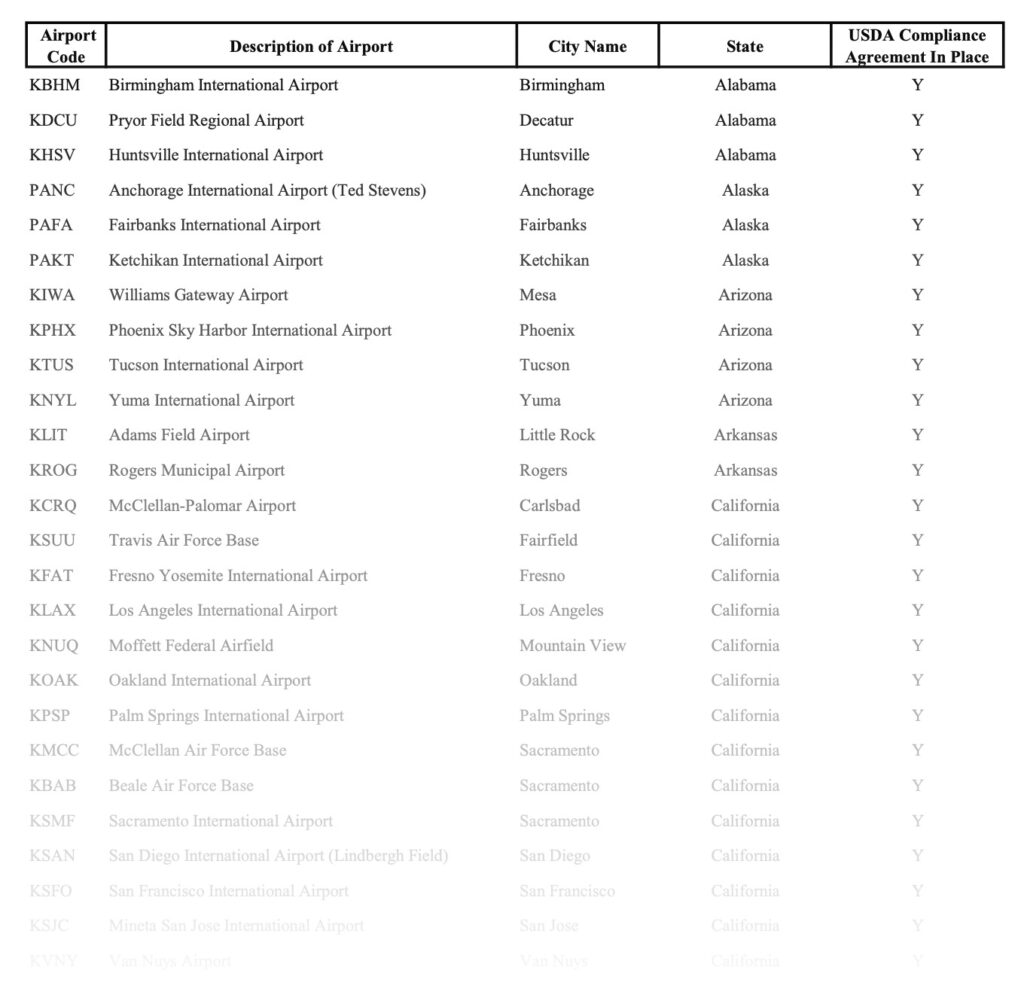
Where can I fly to in the US once I’ve Pre-Cleared?

Turns out it’s not that easy to find a list of US airports approved for the arrival of Pre-Cleared aircraft. But thanks to Signature FBO at EINN/Shannon, here is a copy:

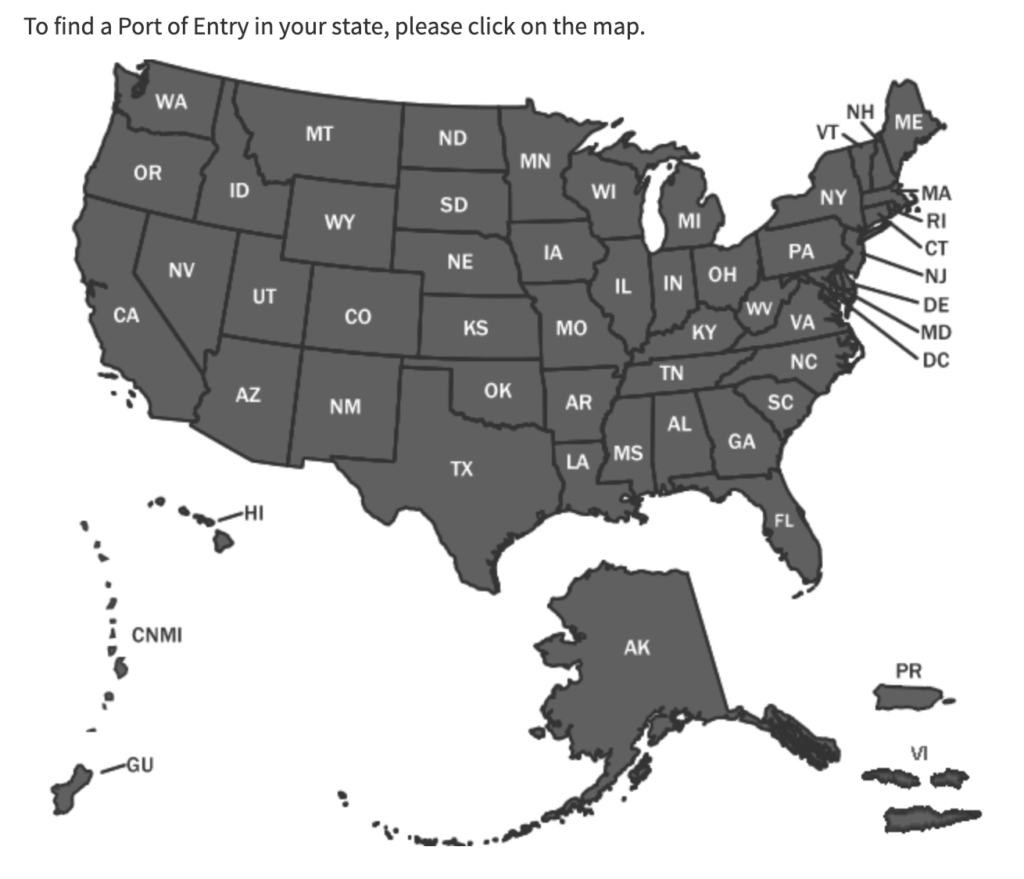
Finding a list of US International Airports of Entry is pretty easy, just go to the CBP website and use their interactive map. But it’s worth noting that not all US International Airports of Entry are on the list of those approved to accept Pre-Cleared flights, due to lack of agriculture agreements, and/or local CBP agreements there.

How does Pre-Clearance work in reality?

US CBP has published this guide on exactly how the Pre-Clearance service works, but here’s the lowdown:

  1. Request the service with CBP – Get in touch with CBP telling them that you want to do it! Pass them a bunch of information – details about the flight, passengers and crew. You can do this step through your ground handler (recommended).
  2. Submit APIS – Slightly tricky here, because for Pre-Clearance you have to submit this no less than one hour before the scheduled Pre-Clearance processing time itself, rather than the departure time from the Pre-Clearance airport. For example, you want to fly from EINN-KALB at 2pm, and you’ve got your Pre-Clearance set up for 1pm, so that means you need to file your APIS no later than 12pm!
  3. Pre-Clearance approval – US CBP will email notice of approval, including the appointment confirmation number.
  4. The Pre-Clearance procedure – When you arrive at the Pre-Clearance airport, CBP will conduct the same procedures as if you were at an airport in the US. Travelers and luggage are screened and the aircraft is inspected.
  5. Departure – Crew, passengers and luggage board the aircraft, and off you go. (And remember – no opening of any aircraft doors from this point before departure!) The kindly CBP chaps you’ve just dealt with will zap your info across to their counterparts at whichever US airport you’re flying to, so everything should be nice and smooth on arrival.
  6. Arrival – Upon arrival in the US, bag up your garbage for CBP to collect. Note that if you have to land somewhere other than where you said you’d be landing in your APIS, Pre-Clearance approval will be voided and you’ll have to go through the normal entry process.

Remember, if you’re a bizav flight, you can only do Pre-Clearance at EINN/Shannon Airport or TNCA/Aruba. So here’s some info specific to both of these airports…

Pre-Clearance at EINN/Shannon

One of the FBOs there is Signature Aviation, and they have provided a summary of what you can expect when you Pre-Clear, with a few more details than the basic summary above. You can download the PDF here, but key points are: you must give 24hrs notice, and the CBP office opening hours are 0900-1700 local each day with out of hours available between 0700-0900 and 1700-2100 local. You can contact them at snn@signatureflight.ie.

Pre-Clearance at TNCA/Aruba

Jet TNCA is the only FBO at Aruba, and they can provide Pre-Clearance to bizav flights. They need 24hrs notice, it costs $315, and CBP there are open from 0930-1100 and 1530-1700 local time each day (not available on afternoons at weekends). You can find more info here, and contact them at ops@jet-tnca.com.

A note on the US Virgin Islands

Technically, airports in the Virgin Islands “offer” this service too, but it’s not really Pre-Clearance in the same sense as at EINN and TNCA – here it’s actually more of a requirement than an optional extra. The US CBP say the following:

For flights leaving the USVI enroute to other United States locations, GA aircraft operators are required to contact CBP in the USVI prior to departure. Aircraft cannot be moved from the U.S. Virgin Islands to other U.S. locations until CBP Agriculture Specialists (CBPAS) have:

  • had the opportunity to inspect the aircraft;
  • crew, and passengers; and
  • the CBPAS has provided clearance for departure from the USVI.

Standard Aviation FBO at TIST/St Thomas say that Customs requires a minimum notice of 2hrs in advance of the appointment time. Appointments are available 7 days a week from 0800-1630 local, and it costs $250. Contact them at ops@sa-stt.com.


2025 North Atlantic Plotting & Planning Chart

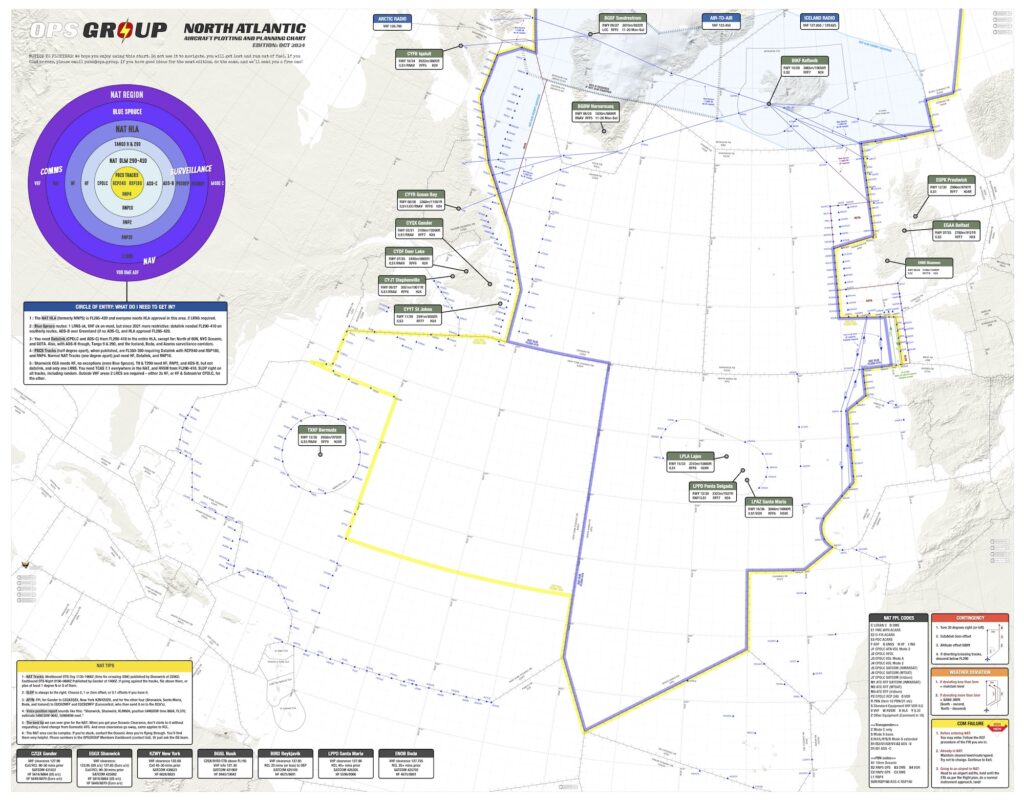
The new OPSGROUP NAT/North Atlantic Plotting and Planning Chart 2025 is released today! This is our chart showing North Atlantic Oceanic Airspace and adjoining domestic airspace, with easy to read NAT Tips, Airspace Requirements, Emergency Procedures, and much more!

OPSGROUP members – you can grab a copy in your Dashboard. View it on your iPad or Laptop etc. as a PDF, or print it out! If you’re not a member, read on for how to get a copy…

Changes in this NEW edition (Oct 2024):

  • FULLY UDPATED for 2025!
  • UPDATED! NAT Tips – using NAT Tracks, SLOP, filing an Oceanic Flight Plan, and helpful tips.
  • UPDATED! Quick reference for contingency, weather, and comms failure with easy graphics.
  • UPDATED!: NAT Airspace Circle of Entry 2025 – easily check what you need for Nav, Comms and ATC Surveillance depending on which bit of the NAT you will be flying through.
  • Additional diversion airports, now 16 total primary NAT alternates with runway, approach, length, RFF, and hours.
  • Easy view of boundaries for HLA and DLM/Datalink mandated airspace.
  • Updated NAT FPL codes, clearance frequencies, Satcom, and HF.
  • Fully updated “South East Corner” with new Tango routes.
  • and … Treasure Boxes!

Other chart features:

  • Requirements for NAT tracks, PBCS tracks, datalink mandate.
  • Common NAT Diversion Airports.
  • Runway Orientation, Length, best IFR Approach.
  • RFF Category and Opening hours.
  • NAT FPL Codes and sample FPL.
  • Blue Spruce routes and equipment requirements.
  • All NAT Entry/Exit points with associated required landfall fixes.

There are two options to download a copy of the NAT Chart:

OPSGROUP Members

You can get it in your Dashboard, under Briefings and Guides.

Get it from the OPSGROUP Store

Not a member? Get a copy from the OPSGROUP Store.


Member Meetup – NAT Special: Nov 6, 1500 UTC

Member Meetup November 2024
  • November 6, 1500 UTC
  • North Atlantic Special
  • Release of 2025 NAT Guide and NAT Plotting/Planning Chart
  • Non-members welcome to attend this one (see below)

Member Meetup November 2024

Hi everyone! This months OPSGROUP Member Meetup has a special focus: the North Atlantic (NAT), and upcoming changes. This will be the final monthly meetup for 2024. (🎅🎅🎅)

Here is the running order of topics – yes, a long list!

  • Blue Spruce Routes removal.
  • Oceanic Clearance Removal (Shanwick/Gander) coming up on Dec 4th.
  • PBCS Half-Track usage.
  • Use of RNP4 on the NAT, more than advertised.
  • Current “Hot Errors” to avoid.
  • FL280 operations.
  • New NAT Doc 007 scheduled for March 2025.
  • New OPSGROUP NAT Chart 2025 released today! (download your copy here)

We’ll also look at:

  • New ICAO Doc 4444 coming later this month.
  • FF-ICE.
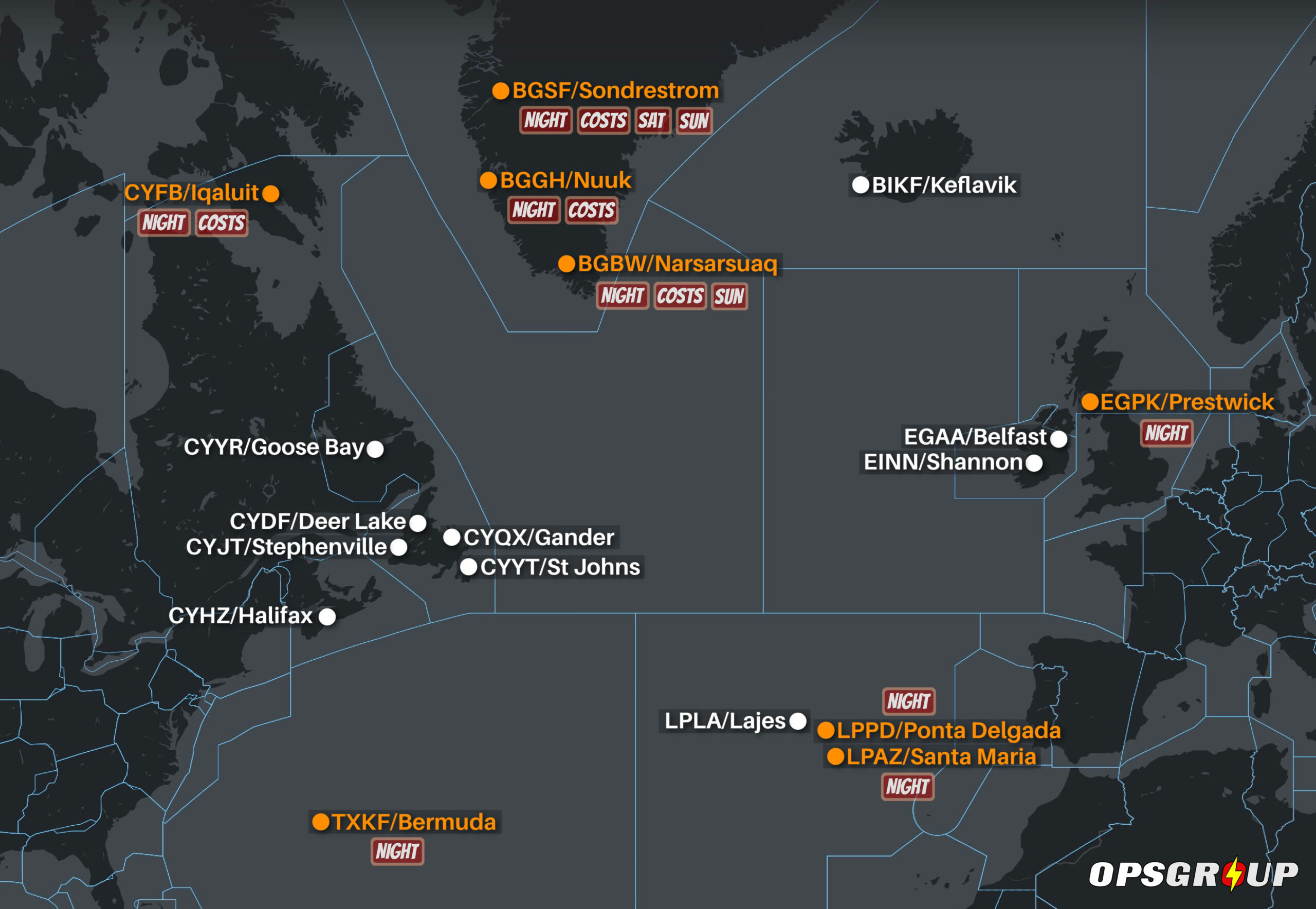
  • Greeland big changes for ETOPS/Alternate availability.
  • OPSGROUP NAT Guide 2025 walk-through.

Join fellow members to say hello, meet some new people, discuss the latest in international ops, and get the latest from the OPSGROUP Team.


OPSGROUP Members

Save your spot: Register here!

OPSGROUP Member Meetup: November 6th 1500 UTC (on Zoom)
In local times: 10am, New York / 3pm, London / 4pm, Amsterdam / 7pm, Dubai


Non-Members

For this particular NAT Special, we are inviting non-members to participate. The North Atlantic update portion is open to everyone.

OPSGROUP NAT Special: November 6th 1500 UTC (on Zoom)
In local times: 10am, New York / 3pm, London / 4pm, Amsterdam / 7pm, Dubai

Use this link to register for the call.


Canada ADS-B Mandate

Key Points
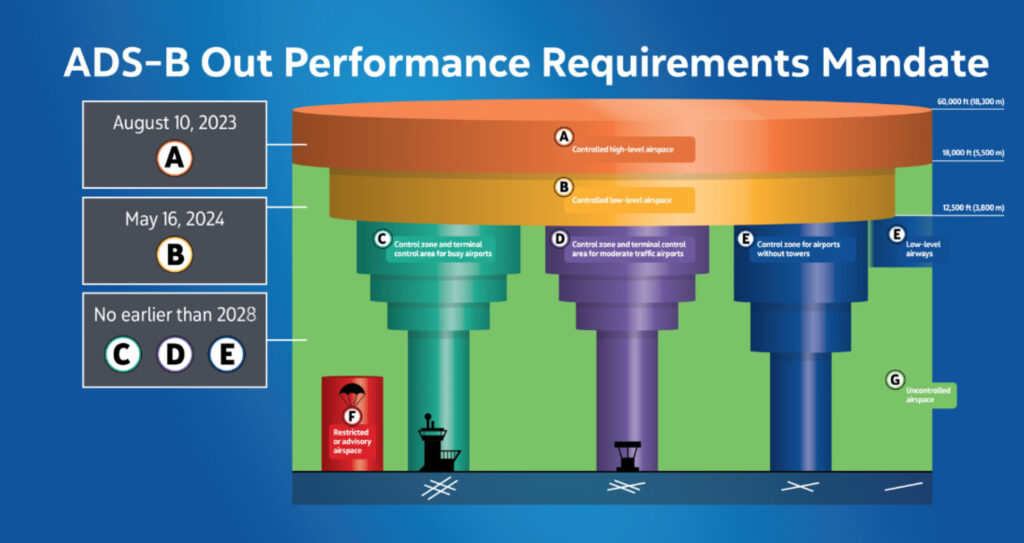
  • ADS-B became mandatory in Canadian Class A airspace in Aug 2023 (above FL180). It then became mandatory in Class B airspace (above FL125) in May 2024. Mandates in any Class C, D and E airspace will be determined no sooner than 2028.
  • You need an antenna able to broadcast to ADS-B receivers both on the ground and in space, and you need to include some extra stuff on your flight plan.
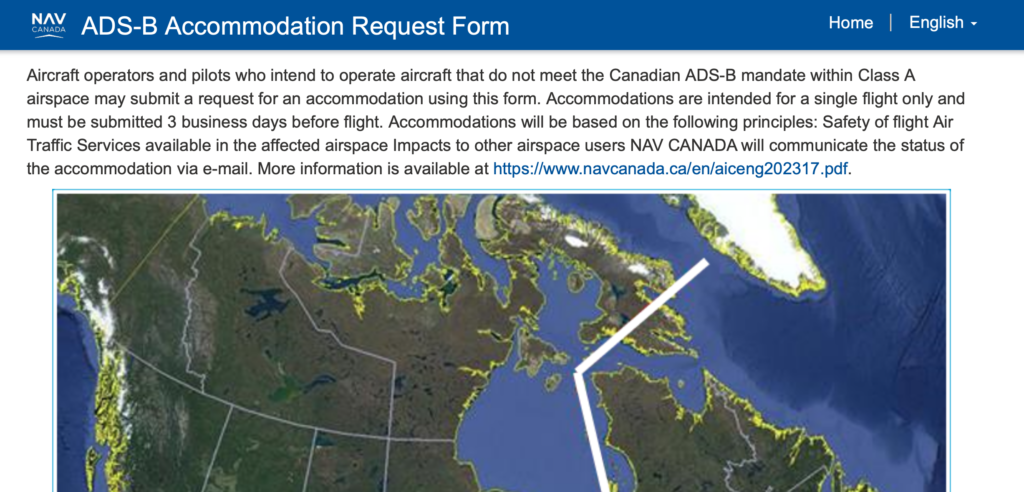
  • If you don’t have ADS-B, you have to apply for an exemption online from NavCanada.

What equipment do I need?

  • A transponder with ADS-B out capability that meet the minimum performance standards (or better) found in this fancy document. This needs to be attached to an antenna that can broadcast to ADS-B receivers both on the ground, and in space.
  • You can also find more on this in section 551.103 of the Canadian Aviation Regulations.

Extra Flight Planning Requirements

  • If you plan on entering airspace where the ADS-B mandate applies, there is some extra stuff you need to include in item 10b of your ICAO flight plan (assuming you have all the right gear on board).
  • Use the code B1 if you have ADS-B Out only, or B2 if you have ADS-B In and Out.
  • You’ll also need to include SUR/CANMANDATE in item 18.
  • One other gotcha – make sure the flight identification (flight number or aircraft reg) broadcast by your ADS-B equipment exactly matches the one used in item 7 of your flight plan. Lest there be trouble down the track!

My ride doesn’t have this fanciness. What are my options?

  • NavCanada will do their best to accommodate aircraft who don’t have the right gear on board, in the same way they’ll work to fit non-transponder equipped aircraft into transponder mandatory airspace.
  • They’ll assess each application on a first-come, first-served basis. It takes time to figure out behind the scenes, and so you’ll need to ask at least three business days before your flight.
  • There may also be suggested re-routes to make your request possible, along with special comments to include in Item 18 of your flight plan.
  • You can apply for an exemption online, here. If you have a number of flights to operate, you can also submit a blanket request via service@navcanada.ca.

More Info

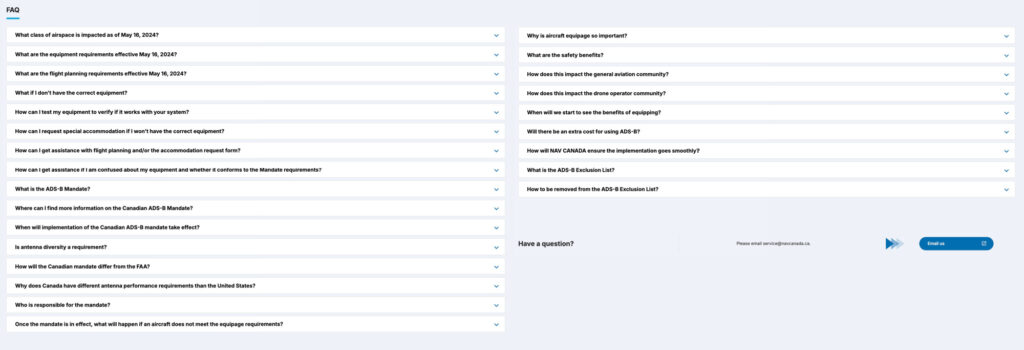
You can find that in the Canadian AIP (ENR 1.6.3), or even better – this page from NavCanada dedicated to the ADS-B Mandate. This includes a fairly extensive FAQ section at the bottom.


Bizav Roadblock: Turkey and Armenia

UPDATE 30 Oct 2024:
  • Turkey has reportedly started allowing bizav overflights heading to/from Armenia.
  • This issue stretches back to May 2023, but Turkey dropped the restriction in Sep 2024.
  • So if you’re heading to Armenia (UDYZ/Yerevan, for example), you can now overfly Turkey – you no longer have to route around the country or make a stop somewhere like UGTB/Tbilisi in Georgia.

Turkish Ban

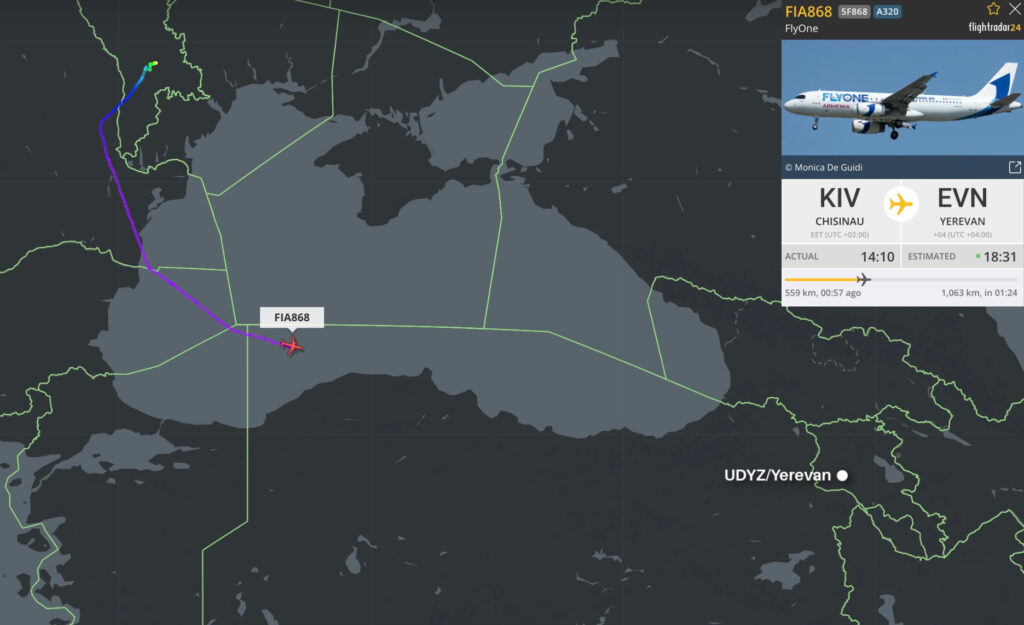
Back in May 2023, Armenian airline FlyOne operating a Paris-Yerevan flight had to make an emergency landing in Chisinau after being denied entry to Turkish airspace.

Turkey reportedly applied this last-minute ban in response to a monument erected in Yerevan the previous week, which they were unhappy about.

Pretty soon after, FlyOne evidently managed to resume Turkey overflights, but it seems that this restriction was still informally applied to bizav overflight requests.

OPSGROUP Member Reports

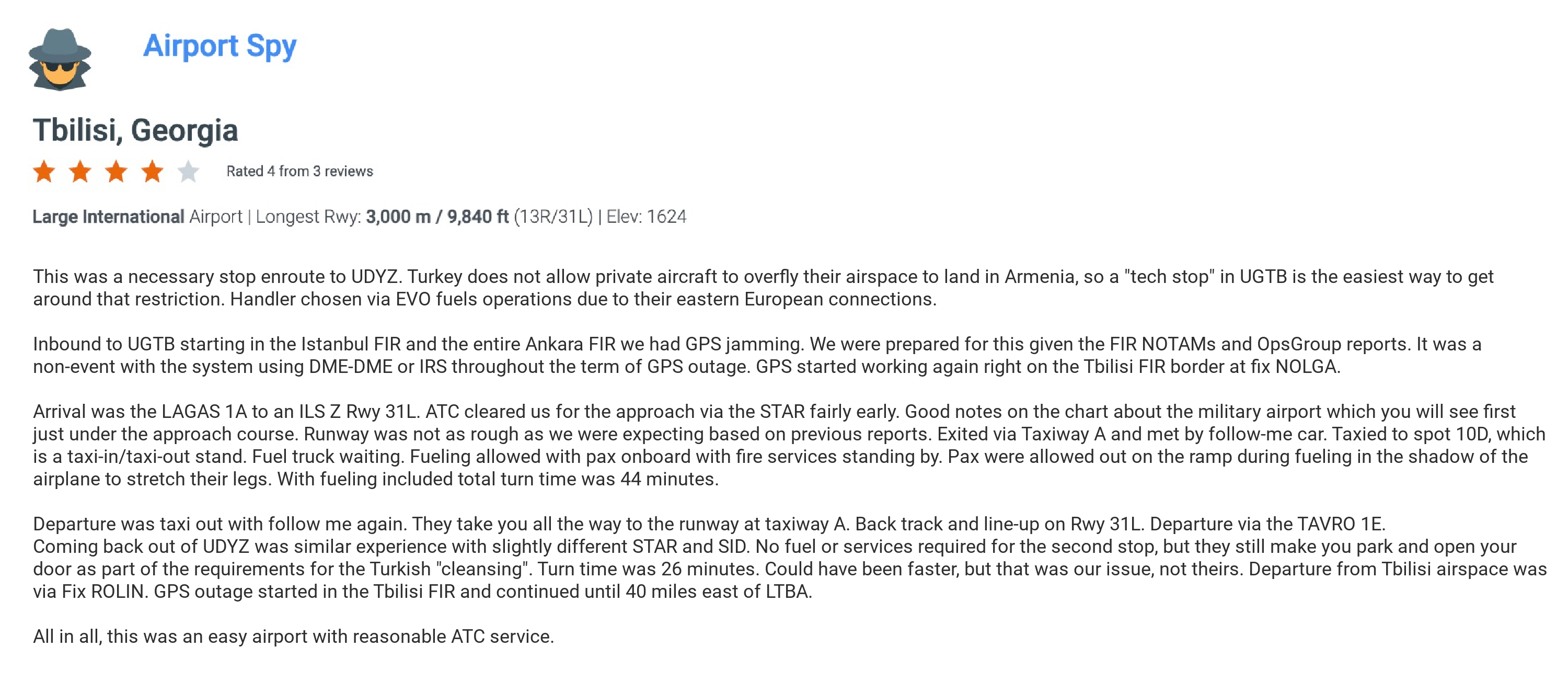
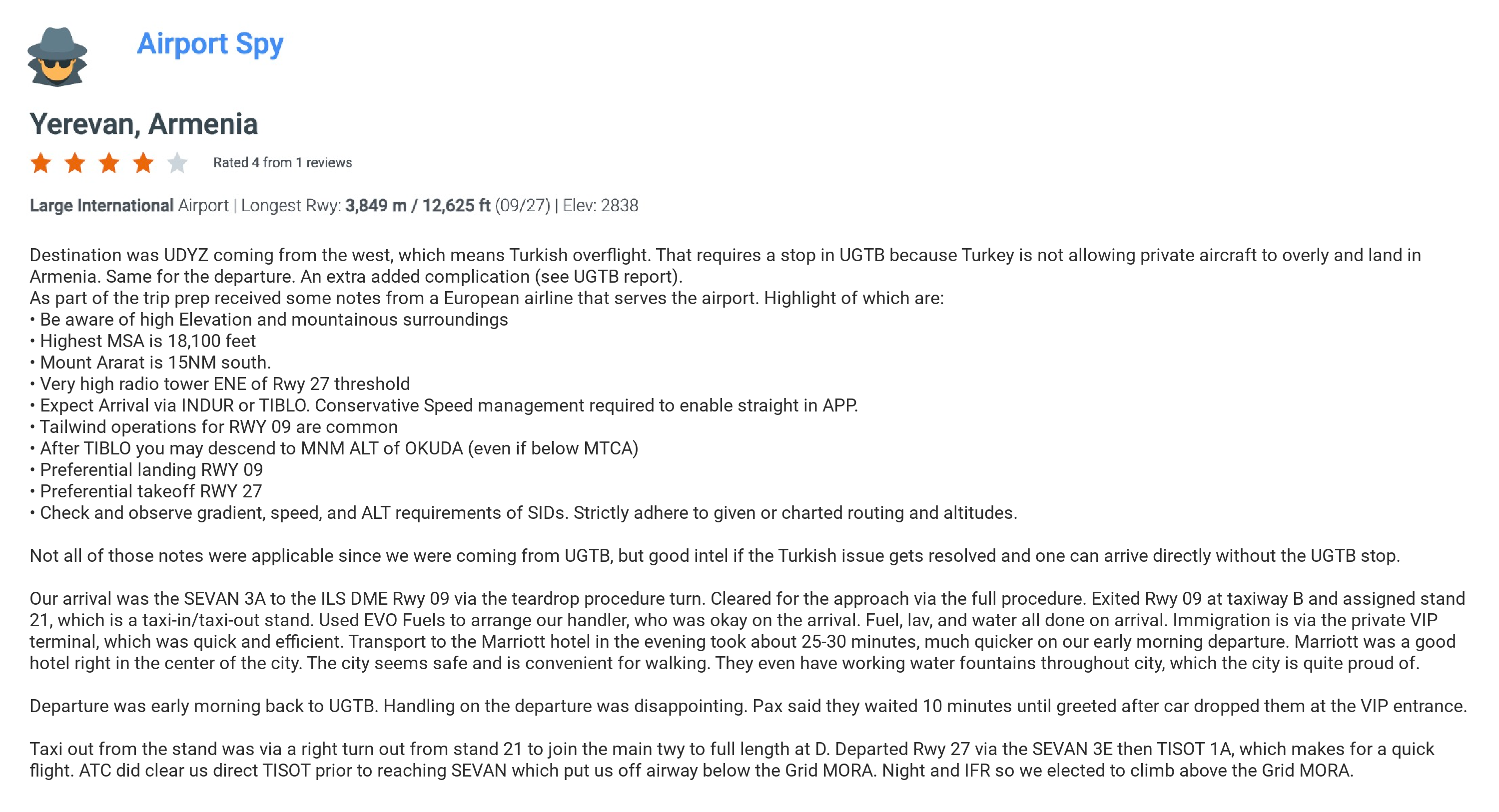
There was no Notam published on this issue, nor anything mentioned in the Turkish AIP. But some operators made tech-stops in Georgia to fix the problem. In Oct 2023, two Airport Spy reports were received from OPSGROUP members, where they required a tech-stop at UGTB/Tibilisi (Georgia) before continuing on to UDYZ/Yerevan (Armenia) in order to overfly Turkish airspace:

Spy Reports

If you have managed to get a Turkey overflight permit for a flight heading to/from Armenia, please let us know! You can also reach us directly on news@ops.group, or file an Airport Spy report.

OPSGROUP members can access the full Airport Spy database via the members dashboard here.

Turkey or Türkiye?

Just a final note on this… In June 2022, the United Nations agreed to a formal request to recognise Turkey as “Türkiye”, as part of a rebranding campaign launched by the Turkish president.

However, no major media outlets have changed their spelling so far. So for now at least, Turkey remains Turkey.


LOA Guide for US Operators

Applying for Letters of Authorization (LOA) from the FAA can be a tricky old process. Because there are so many different things you need permission for, you might need various LOAs.

An LOA is a formal “you’re allowed to do that” certificate given to an operator, permitting them to conduct a specific flight operation, fly in certain airspace, or use a particular bit of equipment, or document.

The folks at Nimbl (the new name for AviationManuals) have issued an updated guide which tells you what LOAs are, when you need them, and how straightforward the application process can be.

You can download a copy of the guide here.

The guide includes:

  • Who needs what and where, for Part 91 and Part 135 operators.
  • List of key terms, and explanations of the most common LOAs and why you would need them.
  • Separate elements of an LOA application – some discussion on the process.
  • Turnaround timeframes for different LOAs.

Who issues me my LOA?

The FAA, but more specifically, your local FAA Flight Standards District Office (FSDO). You can find a location of those here.

So, a Principle Operations Inspector, known as a POI is the person at the FAA FSDO who will issue your LOA. Don’t you just love aviation acronyms 😃

How to apply

  1. First things first, check the guide, and work out what LOAs you need.
  2. Then decide who the actual operator is. The FAA say this is “the person or entity who has operational control of the aircraft.” But they don’t mean the pilot flying it – they mean the person who has legal control, not operational control.
  3. Decide who is the responsible person, what your primary address is, and then work out which FSDO is going to be the closest. Sometimes operators get confused about this point and think they are able to choose which FSDO they can submit to, not realizing that the address on the documents matters a lot to where they can submit.
  4. Contact your local FSDO, work out what they need you to send them, and send it.
  5. Now the FAA will review your application. Turnaround times vary according to which LOA you’ve applied for – it can take anywhere from three weeks to six months, so you’ll want to get it right the first time! If it gets rejected, they will send you a detailed list of why to help you when you re-apply.

Anything else?

If you have any questions about the process, or if you need help with any of the above, visit www.gonimbl.com or send them an email at info@gonimbl.com. They have a dedicated team of LOA experts who provide support to operators in preparing all the paperwork, plus ongoing support as you go through the FAA submission process. (Also, we’ve known them for a long time, and can confirm they’re nice people!)


NAT Guide 2025 – My First NAT Flight is Tomorrow

The latest edition (2025) of the NAT Guide (“My First North Atlantic Flight is Tomorrow”) has now been published. This 24-page guide is for pilots and dispatchers, to help you understand the basics of North Atlantic flying.

Contents:

  • 1. What’s different about the NAT?

  • 2. Changes in 2024, 2023, all the way back to 2016.

  • 3. (Updated 2024) Circle of Entry – a visual depiction of what equipment is needed to enter the different parts of the NAT region airspace.

  • 4. NAT Quick Map – Gander boundary, Shanwick boundary

  • 5. Routine Flight Example #1 – Brussels to JFK (up at 5.45am) – NAT HLA certification, Oceanic Paperwork, Special requirements, getting an Oceanic Clearance, Equipment failure, Weather deviation, and going off track.

  • 6. Non Routine-Flights: No PBCS, No RVSM, No RNP4, No HF, 1 LRNS, No HLA, No ETOPS, No TCAS, No Datalink – what you can do and where you can go.

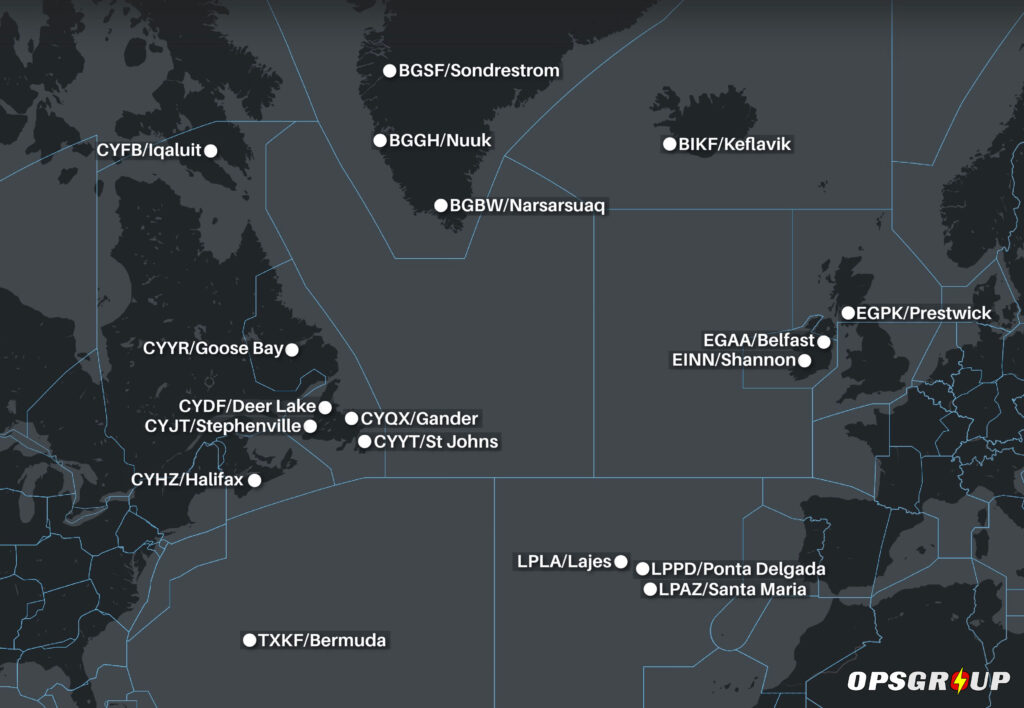
  • 7. Diversion Airports guide: A couple of notes on each of the most popular diversion airports from Shannon to Goose Bay: What to expect.

  • 8. Airport data: BGBW Narsarsuaq, BGSF Sondy, BIKF Keflavik, EGPF Glasgow, EGPK Prestwick, LPLA Lajes, LPAZ Santa Maria, EINN Shannon, EIDW Dublin, CYFB Fro Bay, CYYR Goose Bay, CYQX Gander, CYYT St. Johns, LPPR Porto, LPPT Lisbon, TXKF Bermuda.

  • 9. Overflight permits – routine and special, non-standard airworthiness, how to get one.

  • 10. Special NAT procedures: Mach number technique, SLOP, Comms, Oceanic Transition Areas, A successful exit, Screwing it up, Departing from Close Airports

  • 11. North Atlantic ATC contacts – Shanwick, Gander, Iceland, Bodo, Santa Maria, New York – ATC Phone, Radio Station Phone, AFTN, Satcom, CPDLC Logon codes; and adjoining Domestic ATC units – US, Canada, Europe.

  • 12. NAT FPL Codes and Flight Levels

  • 13. The Contingency procedure – weather and diversions

  • 14. Flight Plan Filing Addresses by FIR

  • 15. NAT Clearance or no Clearance, guide to the new RCL process.
  • 16. Common Gotchas: ATC and OPSGROUP Member favorites.

  • 17. Links, Questions, Guidance


There are two options to download a copy of the NAT Guide 2025 (24 pages, 6Mb)


OPSGROUP Members

You can get it in your Dashboard, under Briefings and Guides.


Get it from the OPSGROUP Store

Not a member? Get a copy from the OPSGROUP Store.


NAT Circle of Entry (2025)

For the latest changes and updates on the North Atlantic, including our most recent Guides and Charts, use our NAT reference page at ops.group/blog/nat/

We’ve updated the NAT Circle of Entry for 2025. As always, changes on the NAT continue without pause for breath – this version is the latest information as at October 2024. The Circle of Entry tells you what you need to get into each different sliver of North Atlantic airspace.

Click on the circle to download the more detailed PDF.


We’ve also published a new version of the NAT Guide (“My First North Atlantic Flight is Tomorrow”)

Get a copy here.


NAT FAQ: No Datalink – Where can we go?

No Datalink – Where can we go?
  • You can make a crossing at FL280 or below, or FL430 or above
  • You can cross via the Iceland-Greenland corridor if you have ADS-B
  • You can enter NY Oceanic, the Bodo and Azores corridors, GOTA, and fly down T9/290.

Datalink is defined as CPDLC and ADS-C. If you’re missing either CPDLC or ADS-C, then you’re not datalink equipped. Since 2021, datalink is mandated (DLM) for the entire NAT region between FL290-410 [NAT Doc 007, Ch 1.8]. The only exception is flights STS/FFR, HOSP, HUM, MEDEVAC, SAR, or STATE.

Without datalink, you can only enter these areas on the North Atlantic FL290-410 [NAT Doc 007, 1.8.2]:

  • Anywhere north of 80N
  • New York Oceanic East
  • The Iceland-Greenland Surveillance corridor (ADS-B required west of 30W)
  • The Bodo corridor (ADS-B required)
  • The Azores corridor (ADS-B required)
  • Tango 9 and 290 (ADS-B required) (per UK AIP)
  • GOTA  (ASD-B not required but please do if you can, says ATC)

The only complete crossing available is therefore via the Iceland-Greenland corridor. For this, you need ADS-B west of 30W.

So, if you have ADS-B, and the remaining NAT HLA requirements, you can make a crossing at normal altitudes (eg. FL380) through this airspace.

For planning purposes, this area is bounded by the following:
Northern boundary: 65N000W – 67N010W – 69N020W – 68N030W – 67N040W – 69N050W – 69N060W – BOPUT.
Southern boundary: GUNPA (61N000W) – 61N007W – 6040N010W – RATSU (61N010W) – 61N020W – 63N030W – 6330N040W – 6330N050W – EMBOK. [NAT Doc 007, 1.8.5]

If you don’t have ADS-B, then this crossing is not available between FL290-FL410.

In this case, you should plan to cross the ocean at FL280 or below, or FL430 or above. This in turn places you outside the NAT HLA, as the HLA levels are FL285-FL420. A crossing at FL280 may mean a fuel stop, in Iceland for example (BIKF or BIRK are commonly used).

You can request a climb or descent through Datalink Mandated airspace from ATC, and this is commonly granted, but you do need HLA approval.

Santa Maria Corridor


The Santa Maria Corridor will allow you to fly out to the Azores and back, but won’t help with a full NAT crossing due to the gap between Santa Maria surveillance and the New York oceanic boundary. To use this corridor, you need a Mode S transponder with extended squitter for ADS-B. [NAT Doc 007, 1.8.5 b]


This didn’t answer your question?

Comment below. Sadly (for us), we enjoy digging into this stuff. So, post your question below and we’ll update this page with the answer (probably quite quickly!)


Useful links for more on this … 


Hurricane Milton – Florida Under Warning

** Final Update Oct 11, 0500z.

Hurricane Milton has now weakened into a tropical storm and is headed away from Florida into the Atlantic. It will pass south of Bermuda on Oct 12 but with little to no impact expected at TXKF/Bermuda. Damage assessments at airports are still underway.

Here is a summary of the current situation as at 0500z Oct 11 – unless things change, this will be our last update on Milton.

Mexico

The Northern Yucatan Peninsula is no longer under any active storm warning or advisory.

The only aviation impact was to MMMD/Mérida which re-opened on Oct 8 – no significant damage was reported.

Gulf Routes

Gulf route closures as a direct result of Hurricane Milton have now finished.

Florida

The worst is now over for Florida – Milton is tracking eastwards away from land and into the Atlantic. Most airports are planning to reopen today (Oct 11), however damage assessments are still ongoing so Notam timings may change or be extended.

Airport Closures

KTPA/Tampa                                          Re-opening Oct 11, 1200z (est.)

 KPIE/St.Pete-Clearwater               Re-opening  Oct 11, 2000z (est.)

KSPG/St.Petersburg                          Re-opening Oct 12 1600z (est).

 KSRQ/Bradenton                                Re-opening Oct 12 1000z (est.)

 KMCO/Orlando                                     Open *Fuel limited, check availability.

 KMLB/Melbourne Orlando              Re-opening Oct 11 1300z (est.)

The FAA has now finished its telcon briefings for Milton.

Stay Informed

For live operational updates, keep an eye on the FAA NASS website which will be updated constantly as Milton passes.

The National Hurricane Center will provide accurate forecasts and tracking info here.

Have we missed something? If you have an update to share regarding airport or airspace status, please reach out to us via news@ops.group.


NAT Conundrums: Volume I

Originally published 2021, Updated 2024

It’s no surprise to most that the North Atlantic is the busiest oceanic airspace in the world. To keep things running smoothly there are a bunch of procedures to follow. We write about them a lot, especially when they change. From time to time questions continue to pop up that make us scratch our heads. And so we thought this might be a good chance to share a few of those with you – naughty NAT conundrums if you will.

To SLOP or not to SLOP?

Chances are if you fly in oceanic airspace you already heard of Strategic Lateral Offset Procedures (SLOP). They’re pretty straightforward – you’re supposed to offset up to 2nm right of track without needing a clearance.

We do this because humans are fallible and mistakes can be made. Ironically the extreme accuracy of modern navigation systems mean that in the case of gross navigational errors, level busts or incorrect clearances, these systems actually increase the chance of a collision. So we pull over to the side of the road a little more, just in case.

Do we have to SLOP?

If you’re in the NAT HLA and your aircraft is capable then yes, it’s ‘required’ (as per ICAO NAT Doc 007). The only time you shouldn’t is if your aircraft’s FMS cannot automatically maintain an offset i.e. it doesn’t have that function. In that case you ‘must’ stay straight up the middle.

Remember, your SLOP can be in increments of 0.1nm and “0 nm” SLOP is also a thing!

You SLOP from the ENTRY point only, and need to have stopped the SLOP by the EXIT point.

  • Don’t go ‘direct to’ the EXIT, this will put you on a different track. Cancel the SLOP to return to ‘centreline’
  • Only SLOP from the ENTRY to the EXIT
  • If you are routing from a NAR into the NAT, the last point is your entry into the NAT and you can SLOP from here

Can we SLOP in the Oceanic Transition Areas?

Or in other words in NOTA, SOTA, BOTA or GOTA? Good question.

NOTA and SOTA: The short answer is no. The slightly longer one is that the both NOTA and SOTA are under radar control with domestic separation from Shannon Radar. You should only apply SLOP between your oceanic entry and exit points.

BOTA: It’s a similar story. BOTA radar control services are provided by Brest Control in France – essentially domestic rules still apply. So no SLOP-age.

GOTA: This is the odd one out. GOTA (the Gander Oceanic Transition Area) is off the coast of North-eastern Canada. You should SLOP only once you have passed the Oceanic Entry Point (OEP) eastbound and within Oceanic Airspace “proper”, and vice versa westbound – sto SLOP at the Oceanic Exit Point (for example NIFTY on the chart below).

Are there any other ‘gotchas’?

Yes – three main ones:

  1. The ENOB/Bodo and BIRD/Reykjavik FIRs. Look out for these. Buried in the NAT Doc 007 it says that you are only allowed to SLOP above FL285. So don’t get caught out in the lower levels.
  2. Tango Routes T9 and T290. These lie just outside of BOTA airspace. According to the UK AIP ENR 3.5, SLOP does not apply here.
  3. And whatever you do – never SLOP left!

What’s the difference between the NAT Region and the NAT HLA?

The NAT Region is virtually all of the non-domestic airspace over the Atlantic – from around 20 degrees north all the way up to the pole (excluding New York Oceanic West). It contains seven Oceanic Control Areas – BGGL/Nuuk, BIRD/Reykjavik, ENOB/Bodo Oceanic, CZQX/Gander, EGGX/Shanwick, KZWY/New York Oceanic East and LPPO/Santa Maria.

Within the NAT region (and occupying a large amount of it) is the NAT HLA, which stands for High Level Airspace. It only exists from FL285 to FL420.

Because the NAT HLA is some of the busiest airspace in the world, there are a number of stringent navigation and communication requirements that you must meet to enter it. This includes being either RNP 4 or RNP 10 capable, having two independent long range navigation systems and in most cases, datalink. Operators also need state approval.

If you don’t meant those requirements you can still fly through the NAT Region, but you’ll have to fly below or above the NAT HLA. Blue Spruce routes are the exception, which allow aircraft with only one long range navigation system or limited comms equipment to enter.

Can I fly across the North Atlantic without Datalink?

Yes, but it’s gonna be tricky.

The North Atlantic Datalink Mandate (NAT DLM) means aircraft need to have CPDLC and ADS-C to operate between FL290-FL410 throughout the NAT Region.

There are a few exceptions where the NAT DLM does not apply:
– Everything north of 80°North.
– New York Oceanic East FIR.
– Tango Routes T9 and T290. The other Tango Routes (T213, T13, T16) all require datalink.
– ATS Surveillance airspace, where surveillance service is provided by means of radar and/or ADS-B, coupled with VHF.

That last one about “ATS Surveillance airspace” is essentially just a section of airspace over Greenland and Iceland, which looks like this:

So if you’re on a NAT crossing and you don’t have datalink, you technically have to stay below FL290 until you hit the blue shaded area. It’s worth noting that aircraft without datalink can request to climb/descend through datalink mandated airspace, but will only be considered on a “tactical basis” by ATC.

Further south, there is another section of “ATS Surveillance Airspace” in the area connecting the LPPC/Lisboa FIR (i.e. mainland Portugal) to Madeira and the Azores, which is also exempt from the NAT DLM:

So in theory, an Atlantic crossing without datalink would also be possible here – within the LPPO/Santa Maria FIR you would just have to ensure that you stay below FL290 or above FL410 outside of the bubbles until you reach the KZWY/New York FIR (where the NAT DLM does not apply).

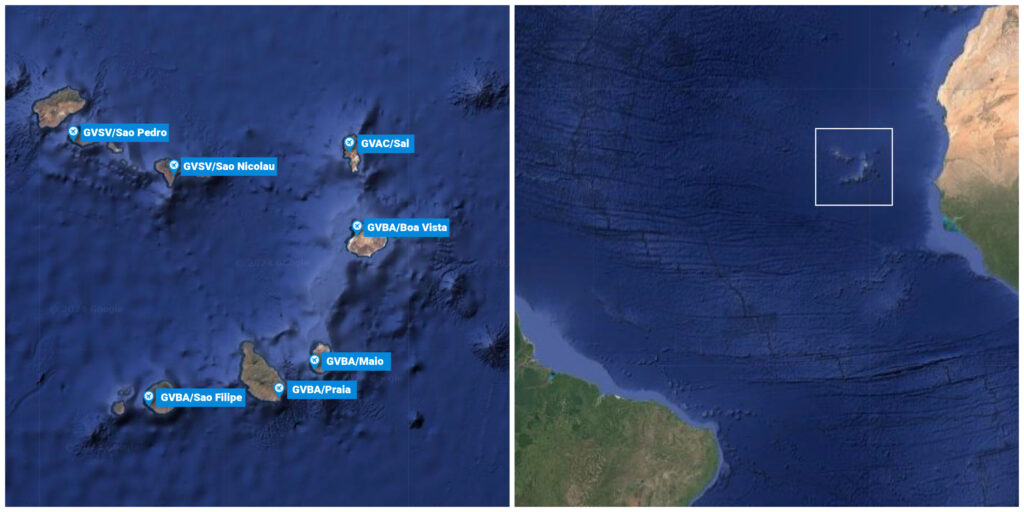
Even further south, in the TTZP/Piarco and GVSC/Sal FIRs, CPDLC is the primary means of communication, but it’s still not mandatory.

So down south, the bottom line is that as long as you stay out of the LPPO/Santa Maria FIR between FL290-410 where the NAT DLM applies… except for the ATS Surveillance Airspace bubbles where it doesn’t apply… then you’ll be ok with just HF. Got it? 😊

For more info on the NAT Datalink Mandate, check out our previous article.

So, what’s your conundrum?

We’d love to hear it. Chances are if you don’t know the answer, many other people won’t either, so it’s always great to share.

Get in touch with us at team@ops.group with your question, and we’ll include it in the next article on Naughty Nat Conundrums.

And if you want to download a PDF of our North Atlantic Plotting Chart, check how to get a copy here.


Do I need a TSA Waiver for a flight to the US?

If you’re heading to the US and are trying to work out whether you need a TSA Waiver for your flight, we have an Opsicle to help with that.

OPSGROUP members can download a copy for free here.

If you’re not an OPSGROUP member, but you’d like to be, you can join here.

Let’s start with the basics

Here is the TSA Waiver site. This is where you submit your requests.

And here is the TSA site on waivers. This is where you can find info on Waivers.

Which Waiver is Right for You?

There are a few types. You have your Disney Theme Park, Washington DC Special Flight Rules Area/Flight Restricted Zone, Major Sporting Events and Special Events Waivers.

And then you have your International Waivers which include International Air Ambulance, No Transponder and International Single Trip Waivers – this last one is what we’re interested in.

The Guidance

International Waivers are required for ‘various aircraft to fly within US airspace, which includes the airspace above the United States and its territories’.

Whether you need one depends on your aircraft size, where it is registered and where you’re coming from.

Flying to and from the US

International TSA Waivers are not required for any aircraft arriving to or departing from the US or its territories. So this applies if you only make one stop in the US (i.e. you fly in and straight back out again).

Flying within US airspace

Planning to make more than one stop in the US? You’ll need an International Waiver if you do this in a foreign registered aircraft which is heavier than 100,309 pounds MTOW (45,500 kg).

But, since most private aircraft generally fit under this weight limit, you probably don’t need one.

Overflying the US

OK, here we go, the bit to know – this is for when you take off and land somewhere not in the US or its territories, and overfly the US in between.

If your aircraft weighs 100,309 lbs MTOW or more: you need a Waiver, even if your aircraft is US registered.

If your aircraft weighs less than 100,309 lbs MTOW: US registered aircraft do not need one. If you are foreign registered and overflying, you do need one – unless your aircraft is registered in a “Portal Country”, and is flying directly from any one of these (prior to entering US airspace).

The Portal Countries:

  • Canada
  • Mexico
  • Bahamas
  • Bermuda
  • Cayman Islands
  • British Virgin Islands

Special Interest Countries

The black sheep of the World of Waivers. Probably the easiest category to work out the rules for. You’ll need an International Waiver for everything – ops to, from, within and over the US, if your aircraft is registered in one of these countries. The list currently includes: Cuba, Iran, North Korea, China, Russia, Sudan, and Syria.

To recap…

Landings: Foreign registered aircraft over 100K lbs making 2 or more stops in the US need a Waiver.

Overflights: All overflights over 100K lbs need one – and that includes N-reg. If you are foreign registered and overflying, you need one regardless of size. There’s one single exception: If overflying with an aircraft under 100K lbs registered in a Portal Country, and the flight is from any of those countries, then you’re good.

Special Interest Countries: Aircraft registered in these need a Waiver for everything – ops to, from, within and over the US.

Where is this officially written?

There were some official, permanent Notams published back in 2016. FDC 6/4255 and FDC 6/4256 (KFDC A0006/15 and A0006/16). These have vanished though and we can’t find any replacements.

The best spot to read it (officially) seems to be in the AIM Chapter 5 (Air Traffic Procedures), Section 6 (National Security and Interception Procedures), and take a look at 5-6-7 for the stuff on transiting US airspace.

How to get it and what to do with it.

You need to submit your request to the Authorization Office here. It is recommended that you submit your request at least 7 days before your planned flight to the US.

When you apply, don’t forget to include all those who may be onboard in your request.

Once you have it, it is only valid for 90 days. You need to carry the hard copy onboard with you.

Any other things to know?

If you do operate over US airspace then you need to stick to their rules which also require that you:

  • Use an active VFR or IFR flight plan
  • Be equipped with a Mode C or S transponder and use an ATC-assigned transponder code
  • Communicate clearly with ATC

Any other gotchas?

A couple, as reported by an OPSGROUP member:

Watch your weight: One in particular issue I have seen a few times is that of Private Global 7500s. Most owners of this aircraft are usually stepping up from a previous version like the Global 6000 series. Many fail to recognize that this step up has a significant impact on their US TSA requirements. I think most miss the weight class change and simply think of the aircraft as a Global XRS with better range.  The implications of not having a valid waiver can be significant.

Validity period: A waiver can be valid for “up to 90 days” with the required dates being set during the initial application. A waiver may be modified up to three times with the end date being fixed (i.e. the end date on the original application must remain the same for each subsequent modification). There is a caveat I should mention regarding the number of allowed modifications, being that this is only valid within a calendar year.

Anything we missed?

Let us know, at team@ops.group


Vegas F1: Brace Yourself for Special Event Fees

Brace yourself – the Formula One Grand Prix in Las Vegas is just around the corner, and metropolitan area airports are about to get really, really expensive. Here is an early rundown on what to expect so you can start planning your trip early.

The Grand Prix

The FAA has published the procedures for this year’s event yet here.

While race day is Nov 24, special procedures will apply at KLAS/Las Vegas, KHND/Henderson, KVGT/North Las Vegas and KBVU/Boulder airports from Nov 19–26.

All arrivals and departures will need a PPR number issued by an FBO, including drop-and-goes. You’ll need to include this in Item 11 of your flight plan.

Don’t be tempted to try and land without one. Airport authorities will not allow you to de-plane your pax and you’ll need to gas up and leave again without delay.

If you’re looking to park overnight, book now. Last year it got so busy that the only option for many was to purchase a drop-and-go slot allowing thirty minutes on the ramp to offload, and another thirty to pick up.

Note that Signature FBO still cannot accommodate aircraft with wingspan more than 80ft, due to ramp construction works. Atlantic Aviation (the only other FBO at the airport) don’t have any similar restrictions.

Even airports further afield, such as KBVU/Boulder City are already reporting they’re booking up. If you’re really stuck, it might be worth considering the likes of KIFP/Bullhead City (Signature) or KSGU/St George (Million Air) – although these would mean a long drive to downtown Las Vegas.

Traffic Jams

Inevitably, arrival rates will exceed airport capacity. ATC will use terminal initiatives to put the brakes on. It may go without saying, but it’s important to carry extra fuel for airborne holding and reroutes.

Domestic IFR aircraft can also expect Departure Clearance Times for all inbound flights to the three major airports.

Within 200nm of the Vegas terminal area, ATC will not process airborne reroutes or changes of destination unless there is an emergency.

Special Event Fees

The biggest gotcha for anyone operating an aircraft to Las Vegas during the Formula One event is special event fees charged by FBOs.

At last year’s event, we reported these exceeding $8,000 USD. This year we’ve already seen quotes as high as $25,000 USD from OPSGROUP members. So this year, we are effectively witnessing this fee more than triple. And that’s just for the special event fee. On top of this there would be all the other standard fees (Facility, Parking, Hangar, etc).

AOPA has been crying foul on this very issue for some time now. As they explain, there is currently no FAA policy regarding special event fees. However, existing regs do require charges for the aeronautical use of a public airport to be ‘reasonable’, or sufficient to sustainably cover costs.

In this sense, the charge of tens of thousands of dollars to park an aircraft does seem exploitative – especially to those operating under Part 91 who may not even be using the airports for the special event they’re being forced to pay for.

One last thing – Pacer.

If you’re in Vegas for the F1, it would be a good idea to register and use Pacer before you take off again.

If you haven’t heard of it, it’s basically an online information exchange to help operators avoid leaving at peak periods by uploading their intended departure time.

Don’t worry – your personal information won’t be visible to anyone else, but you will be able to predict when ground delays will be at their worst. It was used at last year’s event with good success and becomes more effective as more people use it. So, it’s worth a shot.

Heard anything else?

Let us know, we’d love to hear from you. You can reach the OPSGROUP team on team@ops.group.


ADS-B Controversy? Landing Fee Fuss in Florida

Several airports in Florida are proposing new landing fees using ADS-B to automatically invoice operators as early as next month.

AOPA, along with other industry collectives, are crying foul. Not necessarily at the prospect of more bills, but because of the use of ADS-B data to collect fees.

Simply put, in both design and mandate, ADS-B was never intended for this purpose. It exists due to its ability to improve the safety and efficiency of air traffic – not to clip the proverbial ticket.

What’s Being Proposed

Long story short, Florida has contracted a partnership of third-party companies that collect real-time airport operational data using ADS-B and use it to produce landing fee invoices.

The proposed billing structure will be based on weight, and the heavier you are, the more you will pay. The figure being widely thrown around is $3USD per 1000 lbs.

These fees may be introduced as early as 1 October 2024. Nearly a dozen Florida airports have already shown an active interest in implementing the new scheme.

For business jet operators, it’s hardly earth-shattering news. $225 USD in fees to land a Gulfstream 550 for instance is well within the realm of normalcy – given publicly available fees.

So why should we be taking note? Because of the precedent being set and the implications that this may have for the future use of ADS-B data.

Push Back

AOPA have written to the FAA asking them to block the use of ADS-B to collect fees. They’re also seeking legislative action to try and make sure this doesn’t happen.

They make the following points:

  • The fees will be collected by not-for-profit, public-use airports already operating in surplus thanks in part to Federal grants.
  • The domino effect. Airports have expressed concerns that if other airports introduce the new fees, they will have to do the same to protect themselves from the resulting influx of traffic.
  • This is not what ADS-B was intended for.

ADS-Being Watched

This is not the first time ADS-B has come under the spotlight for being used in ways that were never intended.

Case-in-point was the recent controversy of its data being used to track and publicize the whereabouts of prominent VIPs – one celeb famously described these as his ‘assassination co-ordinates.’ You can read about that more here.

In a similar vein, one can argue ADS-B data should not be used to collect billing information either.

It was never intended for this purpose. The technology was invented, and in many cases mandated for the better-than-radar effect it has on separation and airspace safety. Just take the fairly recent transition of the NAT HLA to space-based ADS-B for instance.

Where the lines become blurry is that ADS-B data isn’t protected – with the obvious exception of things like the FAA’s LADD and PIA Programs, which are limited in scope for international operators, and will be for some time yet.

The reality is that virtually anyone with around a hundred bucks worth of ADS-B receiver can track most 1090 MHz ADS-B equipped aircraft.

Unfortunately, the use of this data opens the door to commercial interests – the precedent arguably being set in Florida.

It is our data, and belongs in the aerospace system. Florida’s proposed landing fees may be of more concern to flight training and lighter aircraft right now, but we have a collective interest in supporting ADS-B only in its use for safety, and nothing more.

Staying Switched On

What we don’t want to see happen is more pilots and operators switching off ADS-B because they are skeptical of the system. Having your ADS-B switched on, even in areas where it’s not required, provides a massive advantage to aviation safety of being able to see other planes around you.

The risk with schemes like this new one in Florida is that it will drive more pilots to avoid the system, which could ultimately lead to more incidents and accidents.

Have more info?

We’d love to hear from you. You can reach us on team@ops.group around the clock.

Italy: New Disinsection Procedures

In March 2024, an OPSGROUP member reported a fuss on arrival at LIRA/Rome from the US over disinsection procedures. Turns out their aircraft needed to be sprayed – a process that local agents appeared thoroughly confused about.

This was completed by the crew, but the Italian Health Department later said not good enough and they were required to arrange a cleaning company to do this for them at considerable delay and cost the next day.

We did some digging, and it turns out there are indeed some new (and pretty specific) procedures that now apply to US operators – along with a healthy dose of the rest of the world – due to concerns about mosquito borne illnesses. You’ll save yourself a headache (no pun intended) if you can get it right the first time.

Here’s what we know.

New Procedures

Health authorities now require one of two things on arrival, depending on where your aircraft has been in the past 28 days:

  • Aircraft been in an affected country = a disinsection certificate (aircraft sprayed)
  • Aircraft NOT been in an affected country = an aircraft declaration

Check this list to see what applies to your aircraft. This is the list of countries, according to WHO, with current or previous Zika virus transmission. This seems to be the source that the Italian authorities are referencing when they talk about “affected countries” – it seems a bit odd that they’re doing this, because this list was last updated by WHO all the way back in Feb 2023, but 🤷.

Been in an affected country?

Option 1

If your aircraft has been in an affected country in the past 28 days (which includes the US), you’ll need to show a Residual Disinsection Certificate.

This should be in line with ICAO Annex 9, Appendix 4 – you basically get the cabin sprayed with insecticide, and get a certificate which is valid for 8 weeks (i.e. the slime sticks around and kills any mozzies for this period of time).

⬆️ This is what Italy wants you to do. Spray the cabin in the US (or wherever else) with the heavy duty stuff, get your certificate, and show it to them on arrival. And in theory, it sounds like a nice easy option. The only problem is that you can’t do this in the US – according to the US Environmental Protection Agency who say so here.

Option 2

So if you can’t get this whole thing done in advance, option 2 is this: when you land in Italy they will do a mandatory spray of your aircraft – but this might take time to arrange through your handler and could cause delays.

Option 3

As of Sep 2024, authorities said that if you can’t do the residual disinsection (the preferred option) then they will allow you to spray the aircraft before departing to Italy. It’s valid for one flight only, and has to be before the pax board, in accordance with the “pre-embarkation” rules in this WHO document. We checked with several FBOs at airports in Italy, and only half of them had heard about this latest update, so don’t count on everyone being up to speed with this change!

Not been in an affected country?

If your aircraft has not been in an affected country, you will need to submit a declaration instead.

The requirements are quite specific. You don’t need to spray, but you’ll need to list every country your aircraft has been in the last 28 days (including any transit stops).

This must be emailed to the Italian Health Authority office at your point of entry at least twelve hours before you land.

This should be on your company’s letterhead, and signed by a manager. If possible, include a version in both English and Italian.

Here is the example template Universal Italy put together.

Show me the official guidance

Welcome to Operation Confusion. Of the four local handling agents we reached out to, not one could actually direct us to the ‘official’ announcement from the Italian authorities they were referring to. Officially for us, this was highly frustrating.

But an intrepid OPSGROUP member found this link from the Italian Ministry of Health – it certainly looks like the one that talks about all these new rules.

So the advice above is our best attempt to streamline the process, based on the recent experience of OPSGROUP members and all available information.

Crew Reports

We have received several of these since first posting this article, from various different airports across Italy:

LIML/Milan Linate (March 2024): We had to proceed with disinsection (organized by the FBO). The process lasted 30 mins with a requirement of having all aircraft doors closed for one hour. They accepted to postpone until the crew was ready to leave. Expect a light greasy deposit on the furnitures. No odour.

LIPE/Bologna (March 2024): We did two trips into LIPE this week, hardly a mention of any spraying. I gave them a letter saying I treated with AeroSafe, presented 3 empty canisters and requested our ship not be sprayed. Our aircraft was not sprayed on either trip into LIPE.

LIMC/Milan Malpensa (April 2024): We set up disinsection through Universal and it took 5 mins. I told their crew I didn’t want any of the seats sprayed and just the carpet. APU was running and crew was outside for the 5 mins. After they finished we continued to clean up the airplane. They gave a cert in Italian to the handler and one to me in English. Cost was around 400 Euros. The stuff they used was EMULDRY 50 Plus Residual Insecticide.

LIRP/Pisa (April 2024): Plane was shut down, when they said oh by the way we have to do this. So back out to the plane, open it up, fire up the APU for air circulation, set the bug bomb in the plane, and set it off. It was all done by some company contracted by the airport – they didn’t let us have anything to do with it. Close all the doors with no one on board, APU running, for 20 minutes. Then open cargo door and main entry door for 20 minutes for venting, APU still running. Process is done at this point. Plane needs to be secured and back in to clear customs, etc. This took an extra hour or more of time. Plane is now good for 8 weeks they say, make sure you get the certificate they give you. The spray didn’t smell much. It was a massive time suck, and I haven’t seen such nonsense since Covid.

LIRA/Rome (April 2024): We arranged to have the airplane treated upon arrival. After the airplane was cleaned and crew ready to depart for the hotel, a contracted individual boarded the airplane with a Ryobi electrostatic sprayer loaded with chemical. After treatment, we closed the doors and left for the hotel. 4 days later, there wasn’t any trace of the chemical. The service costs around €450. We are headed back to LIRA in a few days with the same airplane. They have accepted the disinsection certificate since we are still within the 8 week active period of the chemical.

LIRA/Rome (May 2024): They made up the process on the spot. Charged €500 and the actual process took about 5mins. They would not do the disinsection or any other services at the long term parking stand, or at the short term parking stand with the APU running. So we had to shut down the APU, get the fuel/lav done, start the APU back up to have the beacon on for towing to the long term stand, wait for a follow-me car and clearance to tow about 150’ then open all the doors, sign 5 pieces of paper, remove all blankets and pillows and let them do the spray and close the doors. After we closed the doors (this is now 2hrs after arrival) one ministry official said we had to leave it for 2hrs and the other one told us we’d have to leave it for 40 mins then come back and open it for 20. They instructed us to leave the APU on during this time and leave the area. I told them this was not happening and that we were already over our duty day. That I would have to shut down the APU and re-close the doors and leave. I further told them I would be back a few days later and would open the doors for 20mins before we entered the airplane. After a 5 min conference, they allowed this but wanted me to take all the pillows and blankets with us. This was simply not practical so I said no and put them in the coat closet before I left. They said OK to that also. They didn’t seem to know what was to be done other than signing the papers. Everything else they made up as they went along and capitulated to any pushback.

LIML/Milan Linate (Aug 2024): On arrival, we told them that we really didn’t want to get the aircraft sprayed. The FBO advised us that we needed to pay the charge anyway. We said no problem, so we paid the charge, but we didn’t get sprayed! I was surprised, but they were very easy about accommodating our request not to be sprayed. Overall, couldn’t have been better service, 5 lineman greeted us upon arrival.

LIRI/Salerno and LIEO/Olbia (Aug 2024): Last week we flew into both of these airports from the US and we were not asked a single question about dissection, seems that they did not care at all.

Keep an eye out for new requirements elsewhere too

Dengue, in particular, seems to be in the outbreak stage of its cycle. Zika virus is also showing signs that things may soon get worse again.

Both the Centers for Disease Control and Prevention (CDC) and World Health Organization (WHO) provide the most up-to-date information on active outbreaks of these kinds of illnesses. If you have layovers in affected countries, it is highly recommended you keep an eye on things – both for your own health, and for potential impact to your operation.

If you do experience new procedures, please let us know so we can pass that info to the rest of the group: team@ops.group


GPS Spoofing: Final Report published by WorkGroup

Key Points
  • Final Report of the GPS Spoofing Workgroup published today
  • 950 participants across full spectrum of aviation industry
  • Significant concern regarding safety impact of GPS Spoofing
  • Report download below


Final Report Published

The Final Report of the GPS Spoofing WorkGroup has been published today, September 6th, 2024.

Over a six-week period between July 17-August 31, the WorkGroup tackled the complex issue of GPS Spoofing affecting civil aviation.

950 people participated in the project, representing the full spectrum of the aviation industry. Led by OPSGROUP, the WorkGroup comprised hundreds of commercial pilots, safety managers, and representatives from airlines, aircraft operators, and air traffic control. Additionally, a diverse group of aviation authorities, avionics manufacturers, aircraft manufacturers, and experts in GPS and GNSS systems participated. Industry organizations including EBAA, IFATSEA, IBAC, ALPA, IFALPA, the Dutch VNV, and BALPA contributed significantly. Support and expertise were also provided by various organizations and agencies, including the Royal Institute of Navigation, Eurocontrol, the Israel National Cyber Directorate, the UK Ministry of Defence, the UK Royal Air Force (RAF), NASA (Langley), U.S. Space Command, the German Aerospace Center (DLR), Zurich University of Applied Sciences, and the University of Texas.

The result is a comprehensive study of the GPS Spoofing problem, including detailed analysis of the technical background, impacts to aircraft handling and operation, best practices for flight crew, and a series of safety concerns and recommendations for industry attention.

Overall, the Workgroup assessed that the impact of GPS Spoofing on flight safety, aircraft operation and handling, and ATC operations, is extremely significant. The WorkGroup is very concerned about the overall impact of GPS Spoofing on flight safety. A total of 8 overall safety concerns, and a further 33 specific concerns were raised.

This year, a 500% increase in spoofing has been observed. On average 1500 flights per day are now spoofed, versus 300 in Q1/Q2 of 2024. This is coincident with the summer months in spoofing affected areas. With winter approaching, the operating environment changes from predominantly good weather and VMC conditions, to poor weather, icing, and IMC conditions. This change will increase the risk factors significantly.

A survey of flight crew was carried out as part of the Workgroup. The response was excellent – almost 2,000 completed surveys were returned to the Workgroup. The results show that a full 1,400 crew members (~70%) rated their concern relating to GPS Spoofing impact on flight safety as very high or extreme. 91% of all crew members rated their concern as moderate or higher.

The future of GPS use in aviation is unclear. The Workgroup assessed that the vulnerabilities in public-use GPS that are now becoming evident (although known to experts for a decade or more), mean that the high involvement of GPS in aircraft systems is a major issue. Further, the over-reliance on GPS for primary navigation places great importance on preserving a sufficient network of conventional ground-based navaids. This aspect of the issue requires deeper study and conversation.


Download Final Report

Download the Final Report of the GPS Spoofing WorkGroup
PDF, 10 Mb, 128 pages.


Thank you!

Everything you see in this report is the result of community effort. If you know OPSGROUP, you know that this is our approach to solving problems in international flight operations. We have a strong, safety-focused industry, but sometimes things come up that affect us all, yet can’t be solved by an individual aviation authority or group. GPS Spoofing is one such “thing”.

This WorkGroup was truly something special. The participation of 950 individual people, across the entire industry – pilots, ATC, authorities, manufacturers, GPS experts, industry groups – is a marker of how much concern there is about the GPS Spoofing problem. But participation is just the first step. What stands out in this WorkGroup is the above-and-beyond efforts from so many participants.

Seemingly confounding technical questions were answered quickly, data was offered, contacts were sourced, ideas and solutions were hammered out into the small hours. For six weeks, we worked weekends and late nights, and no stone remained unturned. The energy, drive, and commitment of so many to solve this many-headed Hydra never faded.

There is so much knowledge, experience, and expertise in the international ops community, along with the key ingredient: a desire to share our skills, to tell each other what may harm us, to lead groups and to push for change. It’s amazing to see.

Thank you to everyone who took part. From here, we hope that our efforts lead to better-informed flight crews, attention on the safety risks we have listed, and consideration of the recommendations presented at the end of this report.


GPS Spoofing Guides

Some sections of the report were made available as reference guides, prior to the full release. These are available below.


Crew Guidance: GPS Spoofing

If you are operating a flight into a spoofing area tomorrow, this guidance will help to mitigate the impact of GPS Spoofing. This is based on best practices collected from the flight crew participating in the GPS Spoofing Workgroup, as well as OEM and other expert input.

  • Best practices for spoofing regions
  • Actions before, during and after spoofing
  • Typical spoofing flight profile
  • One-page Checklist style summary
  • Diagrams: GPS Spoofing Flight Profile, GPS Reception during Jamming & Spoofing


Download the Crew Guidance for GPS Spoofing, PDF, 2.7MB, 17 pages.


Technical Guide: the Where, Why and How of GPS Spoofing

This extract from the report of the GPS Spoofing Workgroup 2024 covers the technical details of GPS Spoofing:

  • Why, Where and How GPS Spoofing is happening – full technical details
  • Location Maps: Worldwide, Mediterranean, Black Sea, Russia & Baltics, India/Pakistan
  • Spoofing statistics and details by FIR
  • Aircraft types affected
  • Spoofing Patterns
  • Changes and current trends


Download the Technical Guide to GPS Spoofing, PDF, 5.3MB, 29 pages.
[This links to the Guide, available in your Members Dashboard]


Ongoing GPS Spoofing Guidance

You can find a “rolling” Special Briefing in the Members Dashboard. This Special Briefing will be a “sticky” with updates about GPS Spoofing. As of August 2024, the last few months have shown an increase in frequency and intensity of GPS Spoofing. This has deepened the flight deck impacts of a Spoofing encounter.


Special Briefing: GPS Spoofing – Recent updates:


Crew Guidance published by GPS Spoofing Workgroup

In August 2024, OPSGROUP co-ordinated a GPS Spoofing WorkGroup, to investigate the GPS Spoofing problem. The aim of the WorkGroup was to assess the impact, analyze safety risks, gather best practices and guidance for Flight Crew, and provide recommendations to industry. 950 people took part, from airlines and aircraft operators, ATC, aviation authorities, OEM’s, GPS experts, and a variety of aviation organizations and other industry bodies.

Thank you to all who took part 😊😊😊.  The Workgroup is now complete, and was a great success!

The complete report is available on this page. (after September 6th, 2024)

Report section extracts specifically for flight crew are below:

  • Crew Guidance
  • Technical Guide: the Where, Why and How of GPS Spoofing


Crew Guidance: GPS Spoofing

If you are operating a flight into a spoofing area tomorrow, this guidance will help to mitigate the impact of GPS Spoofing. This is based on best practices collected from the flight crew participating in the GPS Spoofing Workgroup, as well as OEM and other expert input.

  • Best practices for spoofing regions
  • Actions before, during and after spoofing
  • Typical spoofing flight profile
  • One-page Checklist style summary
  • Diagrams: GPS Spoofing Flight Profile, GPS Reception during Jamming & Spoofing


Download the Crew Guidance for GPS Spoofing, PDF, 2.7MB, 17 pages.


Technical Guide: the Where, Why and How of GPS Spoofing

This extract from the report of the GPS Spoofing Workgroup 2024 covers the technical details of GPS Spoofing:

  • Why, Where and How GPS Spoofing is happening – full technical details
  • Location Maps: Worldwide, Mediterranean, Black Sea, Russia & Baltics, India/Pakistan
  • Spoofing statistics and details by FIR
  • Aircraft types affected
  • Spoofing Patterns
  • Changes and current trends


Download the Technical Guide to GPS Spoofing, PDF, 5.3MB, 29 pages.
[This links to the Guide, available in your Members Dashboard]


Final Report

Link to the Final Report of the GPS Spoofing WorkGroup.
PDF, 10 Mb, 128 pages.


Mpox: What We Know Right Now

Key Points

  • There is an active outbreak of the Mpox virus in the Democratic Republic of the Congo.
  • Sporadic cases are reported elsewhere.
  • It does not spread easily between people.
  • ICAO has released limited guidance to operators.
  • Screening, vaccination requirements and travel restrictions are not recommended.

What’s going on?

Earlier this month, the World Health Organisation (WHO) declared the current outbreak of the Mpox virus a ‘public health emergency of international concern.’

A more virulent version of the virus emerged in the Democratic Republic of the Congo and has since been detected in several other African countries.

ICAO has now published limited guidance to airports and operators which effectively repeats what is publicly available advice from the WHO.

While the information is not alarming, we are of course monitoring things closely.

Here is a brief and no-nonsense rundown of what we know about Mpox and how it is affecting our industry right now.

A little context

It was previously called Monkeypox. Mpox is an infectious virus. Its symptoms have been well publicized. If you’d like to know more about those, click here.

The Mpox outbreak is not new. It has been spreading between people in a sustained outbreak since 2022. What’s changed recently is that a new strain (or ‘clade’) has emerged in Africa which is linked to more severe symptoms. Cases have sporadically appeared elsewhere.

But what does ‘Public Health Emergency of International Concern’ actually mean? That comes directly from the WHO’s own regs:

An ‘event which is determined to constitute a public health risk to other states through the international spread of disease, and potentially require a coordinated international response…’

 It sounds alarming, but really suggests methods may need to be introduced to prevent another upswing in cases with perhaps more severe consequences than 2022. In their own words, WHO doesn’t want history to repeat itself.

These methods may be as simple as better health screening of passengers to prevent them from travelling while contagious.

Give it to me straight – how bad is this going to be?

According to WHO, Mpox is spread between humans primarily through extended direct skin-to-skin contact. It is not a respiratory virus.

Contaminated bedding, clothes, utensils and surfaces have also proved contagious.

Inevitably, aviation will have some part to play. But what’s important to note is that despite being a public health emergency, Mpox is not the new Covid.

When Covid emerged in 2019, it was novel – i.e. it hadn’t been seen before. There were no vaccines or natural immunity.

Mpox is not new (it was first identified in the 1950s). It is also far less efficient at spreading between humans. WHO themselves have said they know how to control it (through public health measures) and a pre-existing vaccine that is already available. They key is getting that vaccine to those who need it.

The risk of it spreading widely remains low.

Aviation Guidance

Thus far, it’s limited.

ICAO are saying this about international travel:

  • Travellers should be given relevant information to protect themselves where Mpox may be a higher risk.
  • Advise anyone who may have Mpox, or has been close to someone else with it, not to travel.

Notably they are not advising states to implement any entry/exit screening, travel restrictions or requirements for testing or vaccination.

Despite this, we have seen reports of temperature screening at airports in South Africa, Bangladesh and Pakistan – this isn’t cause for alarm.

Pilots and crew may need to travel to countries experiencing active outbreaks. In that case it is important you are familiar with signs and symptoms, along with ways to protect yourselves.

Keep in mind when you return, symptoms usually take up to three weeks to appear. You can chose to get vaccinated but it would be worth seeking medical advice from your aviation doctor prior to receiving it. We haven’t seen any guidance to suggest more an impact on fitness to fly than any other pre-existing vaccine.

We’re watching it closely

Keep an eye on our ops alerts and briefings.

We will report any significant operational changes from Mpox as we see them, but for now impact appears to be minimal. You won’t hear from us on any health or non-aviation related impacts, so we suggest the WHO’s website if you’re looking for that.

Of course, you can always contact us via team@ops.group with any updates.


Climb for Contrail Prevention – What’s Happening in the Maastricht UAC?

A few weeks back, the following Notam was issued for the Maastricht UAC (i.e. the busy airspace above FL 245 over Belgium, the Netherlands and Luxembourg):

Essentially if you are flying through that airspace between now and September 19 you may be instructed to climb or descend using the phrase ‘for contrail prevention.’

Maastricht have teamed up with DLR (the German Aerospace Center) in a bid to lower aviation’s ‘non-CO2’ climate impact. In other words, the effect aviation is having on the environment beyond fossil fuel emissions.

In that sense, this trial is one-of-a-kind and has been running on-and-off since 2021.

If you’re wondering why you’re being asked to deviate from your desired level, and what that has to do with contrails, read on.

What does any of this have to do with contrails?

The concept of non-CO2 impacts may be less familiar to operators. Non-CO2 effects have to do with complex interactions between aircraft emissions and their effect on the surrounding atmosphere.

This includes soot particles – a byproduct of combustion. It may come as a surprise that contrails are not (as is often misrepresented) just water vapor. When water vapor exits the exhaust nozzle of a jet engine, it condenses and freezes to these soot particles creating tiny ice crystals.

These crystals form contrails. They are in fact a type of cirrus cloud with a fancy name that sounds like a bad cold – homogenitus. And if conditions are right, they can persist for hours – long after the aircraft that created them has disappeared over the horizon.

At night in busy airspace (such as the Maastricht UAC) these contrails can have a warming effect by trapping heat in the atmosphere, just like naturally occurring clouds.

This process occurs across quite a shallow band – around FL300 in Winter and FL360 in Summer.

So, contrails are important. Why do I need to change levels?

The strength and persistence of contrails has a lot to do with the state of the atmosphere around them. Part of the industry’s approach is predicting when the atmosphere is favourable to form contrails and making small flight path adjustments to avoid the worst of those conditions.

Enter the Maastricht UAC Contrail Prevention Project.

Covering your tracks

The airspace of Maastricht often experiences conditions favorable for the formation of contrails. Therefore, it is the ideal testbed for the trial.

The project focuses on identifying those conditions and preventing prolonged level flight through them. In a nutshell, the German Aerospace Center identify when conditions in the Maastricht UAC are favorable for the formation of contrails by looking at satellite data.

Taking predicted traffic levels into account, the duty supervisor then gives the thumbs up for controllers to conduct ‘contrail prevention activity.’

If it goes ahead, it will begin after 4pm local and run through the night until 6am local.

Affected aircraft will be directed by air traffic control to change flight level using the phrase ‘for contrail prevention.’

What about fuel burn?

EUROCONTROL advise that ATC will only request the minimum level change required – i.e. will keep you as close as possible to you chosen level as conditions permit.

Anyone operating in Maastricht airspace may be selected to participate in this trial. It is important to inform the controller if the level change will affect flight safety for which all levels will remain available.


US Rule Change for Carrying Dogs

Key Points
  • New rules apply to carrying a dog into the US, effective August 1.
  • These rules depend on where the dog has been in the past six months. 
  • If the dog has not been a high-risk country, there is only one form to fill out. 
  • If the dog has been in a high-risk country, it will only be allowed to enter if vaccinated. 
  • Dogs vaccinated outside of the US will also need a rabies test beforehand.

How do the new rules work?

On August 1 the rules for bringing a dog into the US from overseas changed.

Essentially the new requirements depend on where the dog has been in the preceding six months, and whether it has been vaccinated against nasties like rabies.

These may now come as a surprise to some owners who have been travelling with their pets regularly.

As the penalty for not doing having the right paperwork is as high as $250,000 USD and a year in prison per dog, it’s important operators check everything is in place before wheels up – and not on arrival.

Introducing Peggy – OPSGROUP’s unofficial mascot for this article. Peggy was recently in a major Hollywood motion picture. Here’s what her owners would face if they wanted her to re-enter the country by air.

Scenario #1 – Peggy has only been in a rabies-free, or low-risk country:

Check this list. If the dog hasn’t been in one of these countries in the past six months, the owner only needs to fill out a CDC Dog Import Form.

This can be completed as late as the day of travel, but CDC recommends doing it at least a few days in advance.

Once you receive a receipt, it will be valid for six months and can be used as many times as you like provided that the dog hasn’t been to a high-risk country since it was issued.

It’s free, but one must be completed per pooch. No group concessions here! The owner must then show the receipt on paper or via their phone to US customs and air carrier.

A few other things the dog will need:

  • It must be healthy on arrival.
  • At least six months old (no puppers).
  • It must be microchipped.

Scenario #2 – Peggy has been in in a high-risk country but is vaccinated:

Note that the list includes several countries from the Middle East, South America, Asia and Africa.

In addition to the Dog Import Form and microchip above, the owner will also need something called A Certification of US-issued Rabies Vaccination form. These need to be filled out by a veterinarian accredited by the US Dept. Of Agriculture and endorsed by the USDA.

If Peggy was vaccinated outside of the US, things start to get more complicated. In addition to the Dog Import Form, it will also need:

  • A Certification of Foreign Rabies Vaccination and Microchip.  This must be filled out by the owner’s vet and endorsed by an official government veterinarian.
  • A valid rabies test from a CDC-approved lab.
  • A reservation for Peggy at a CDC-registered kennel for up to 28 days.

Scenario 3 – Peggy has been in a high-risk country and isn’t vaccinated:

Peggy will not be allowed to enter the US! Nor will any other dog that falls under this category.

Rules for Air Operators

In addition to the above requirements, there are new procedures for air operators too.

From August 1, operators need to create something called an air waybill (AWB) for each dog they transport to the US. This is a document that accompanies goods shipped internationally by air. It is essentially a receipt of goods for the operator, and a contract of carriage between you and the dog’s owner.

The good news is that you can request a waiver to this requirement by emailing cdcanimalimports@cdc.gov and asking for one.

They’ll get back to you within one working day with a waiver valid for 90 days. You can only do this once though, and beyond that you will need a full AWB to carry the animal on future flights.

Beware the saga of Pistol and Boo

Whether it be in the US or abroad, customs officials take non-declarations of animals extremely seriously and the penalties can extend to the air operators carrying them.

While our clientele may like to take their family pet with them on business or vacation aboard private aircraft, they need to be aware of their obligations and meet them – as is often the case for pets carried between Europe and the US.

In other words, don’t be like Johnny.

Back in 2015 a high-profile celebrity, Johnny, carried his Yorkshire terriers, Pistol and Boo, illegally into Australia on his private jet. He did so knowingly but (in his words) under the belief that his staff had completed the necessary paperwork – they hadn’t.

He and his partner potentially faced several charges including perjury. Pistol and Boo also faced being put down. The case became went infamously public, and even involved the Australian Prime Minister before most charges were dropped.

The moral of the story is what may seem like an oversight to some, are taken extremely seriously by authorities – the US included. The passengers we carry may not always realize that to the extent that they perhaps should.

More Questions?

Check the new requirements on the CDC website here, and if you have any really specific questions your best bet is to get in touch with the CDC directly on (800) 232-4636.