Hurricane in the fast Lane for Hawaii

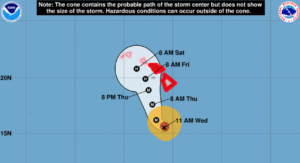
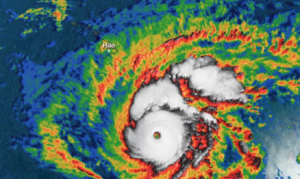
Overnight, the brewing tropical cyclone in the Pacific was upgraded to a Category 4 hurricane, and is anticipated to be a Category 5 when it reaches Hawaii.

Hurricane “Lane” is only the sixth recorded Category 5 hurricane in this part of the Pacific Ocean, and the National Weather Service is predicting that this storm is only going to intensify. This is also the nearest to Hawaii that a storm of this size has occurred, so the state has issued numerous emergency proclamations to better prepare for the potential life-threatening flash floods and storm surges that accompany a storm of this size.

This storm, if it proceeds as forecast, will impact operations into all Hawaiian airports, including PHNL/Honolulu  and PHOG/Kahului. Beyond the daily flight traffic to these two airports, they also act as major ETOPS/EDTO alternates for flights across the Central and Southern Pacific. So expect an impact in routing.

Also, post storm, there may be infrastructure damage that may limit operations for a period of time.

You can find the latest from the NOAA here.

We will update you with the latest flight operations developments as they happen.


Attention Shanghai: Typhoon inbound, jets must move out

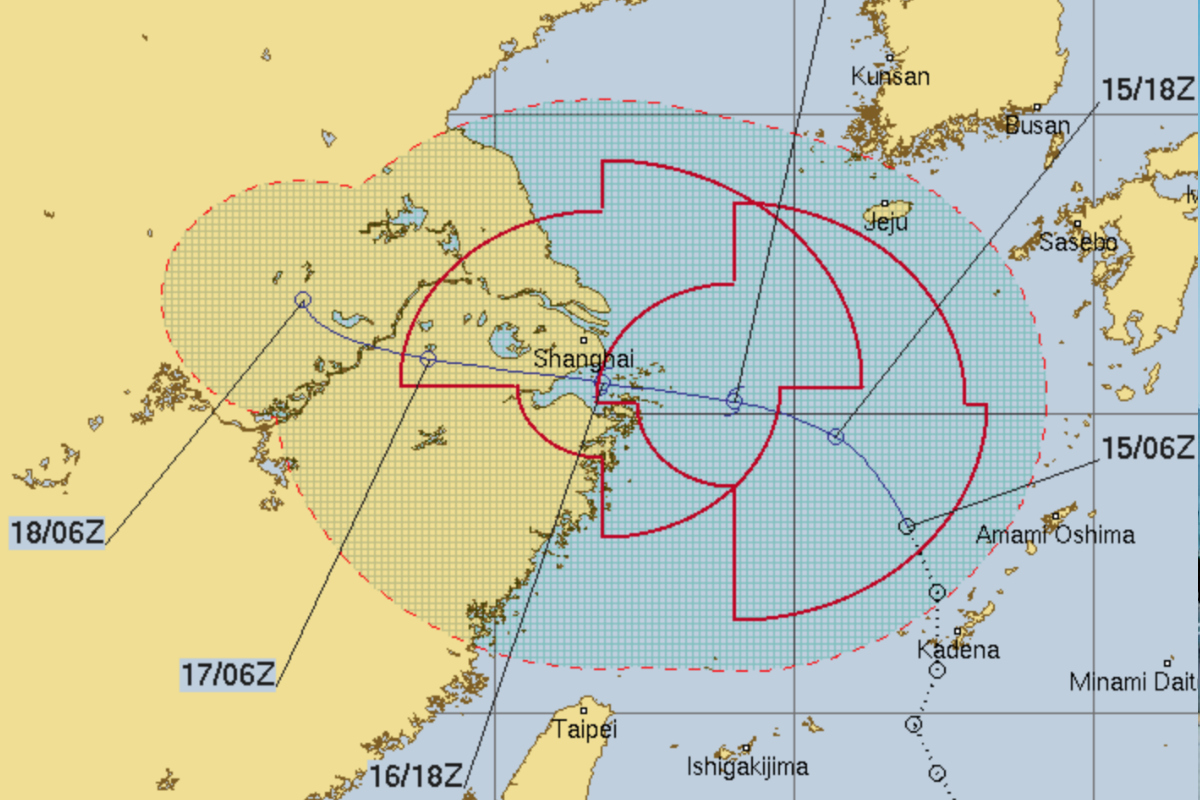
Typhoon Rumbia is expected to make landfall just south of Shanghai early on Aug 17, with gusting winds of up to 55kts.

Just as before with Typhoons Ampil and Jongdari which hit Shanghai earlier this month, both Shanghai airports ZSPD/Pudong and ZSSS/Hongqiao now have restrictions in place for GA/BA flights. They are advising the following:

  1. All GA/BA aircraft currently parked at the airports must either go in the hangar or leave before 1000 local time on Aug 16.
  2. All landing and parking requests of GA/BA aircraft are unlikely to be accepted until 1200 local time on Aug 18, by which time the storm is expected to have passed.
  3. Operators should report outbound schedules of GA/BA aircraft currently parked at the airports as soon as possible.

Best to get in touch with your handler if you haven’t already.

And if you are in the region and have more information to share, let us know!

Extra Information and latest warning texts and graphics:


More overnight slots for Hong Kong

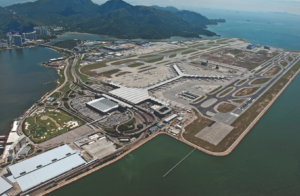
Without stating the obvious, Hong Kong is a busy airport and it’s a difficult one to get slots and parking at, if you are a GA/BA operator.

Ok- it’s true, we went as far as calling operations to Hong Kong a PITA in the past.

Well, the latest intel is that the Airport Authority (AAHK) and the Hong Kong Schedule Coordination Office (HKSCO) have decided to trial an increase in slot availability from 4 to 6 total slots each night.

This is the info we have:

Notice on night slot availability (trial from 8 August 2018 until 8 October 2018)

  1. The number of slots available for GA/BA operations between 0000 to 0500 local time (16-21 UTC) will increase from 4 slots daily to 6 slots daily.
  2. The application procedure for these 6 slots will be the same as that for the 4 daily slots currently available.
  3. The above are provided on a trial and temporary basis and are subject to continuous review jointly by AAHK and HKSCO. The procedures will be effective from 0000 UTC on 8 August 2018 until 2359 UTC on 7 October 2018.

Also important to note, as pointed out to us by our friends at the Asian Business Aviation Association (AsBAA) – these 6 slots will be made available to all aircraft types, not just the ones currently exempted from the noise abatement regulations. This means that BBJ’s/ACJ’s/Lineage 1000/Globals/G650ER etc can now operate in and out of Hong Kong at night-time, subject to slot availability.

Some days I miss the old Kai Tak airport. My Dad reminded me that the 20th anniversary of its closure just went by last month. I feel old.

If you do too, watch a Kai Tak video to cheer you up 🙂

Extra Reading:


New things in OpsGroup – gocrow, new alerts, Daily Brief, George 2, Foxes

Hello!

Summer – for those of us in northern parts, at least – is progressing, and so are we. I’m excited to tell you about a whole bunch of new things we’ve built for OpsGroup, to make your life easier (which is why you’re in the group in the first place, yes?)

Here’s the game changer: We’re starting to reach a point where you and your fellow members are reporting things to the Team every day, at a level that means we’re really covering most of the important operational news out there. Now, we are working on better ways for you to find it … read on.

Not a member yet? We LOVE welcoming new members to the group

Choose a plan – JOIN OPSGROUP

GoCrow

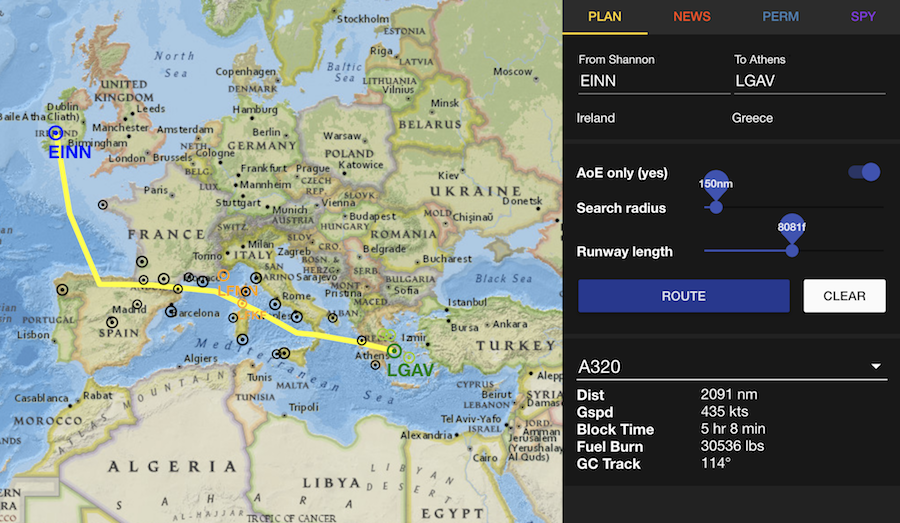
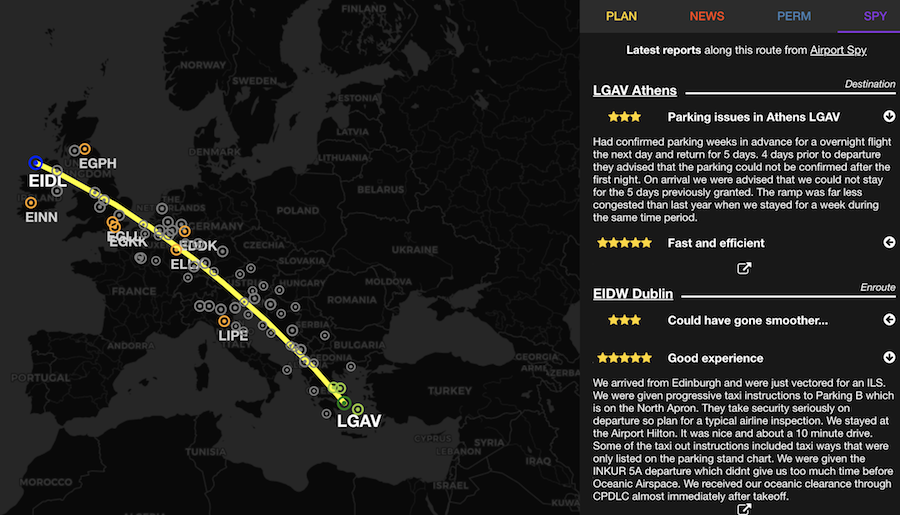
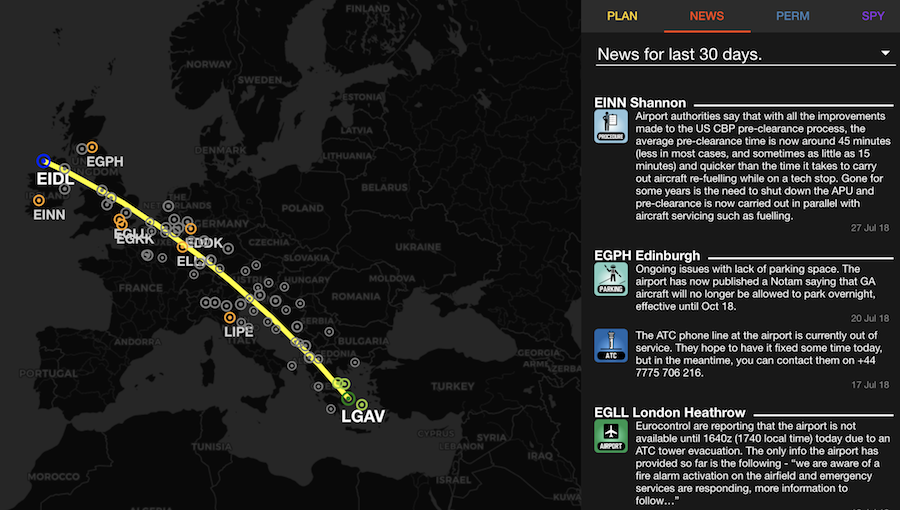
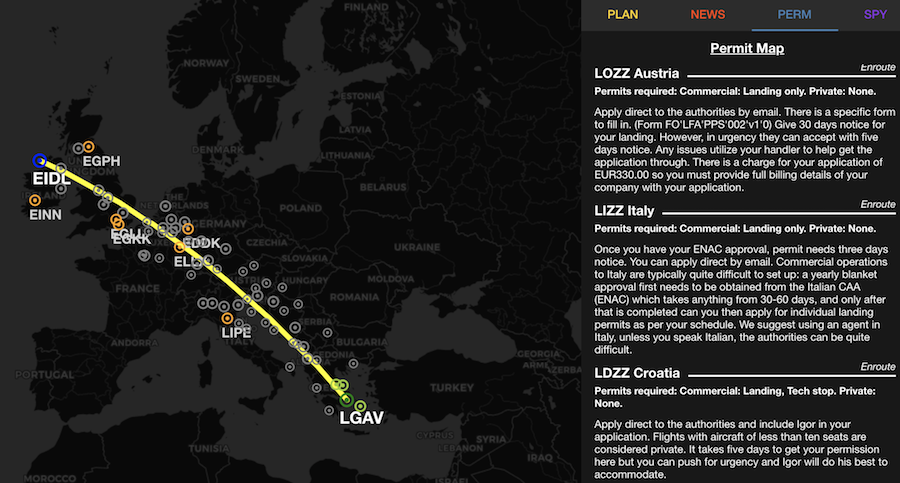
As the crow flies – pop in your departure and destination, and get all the information that we have for your route – Planning data – distances, times, fuel, Ops News and Alerts, Permit requirements, Airport Spy reports.

What’s new?

  • New tabs for NEWS, PERMITS, AIRPORT SPY
  • Sort News by last 7 days, 30 days, 3 months, year
  • Permit information for each country you overfly or pass near
  • Drag and change route – just click the yellow line, all info is recalculated
  • OPSGROUP Airport Spy reports along your route
  • Change underlays
  • now works on iPad
New underlay options, show different maps under your route (more coming).
Airport Spy reports are automatically pulled for your route.
Customized news report for your route.
Get country by country permit information.

New Dashboard

What’s new?

  • Re-designed and improved look
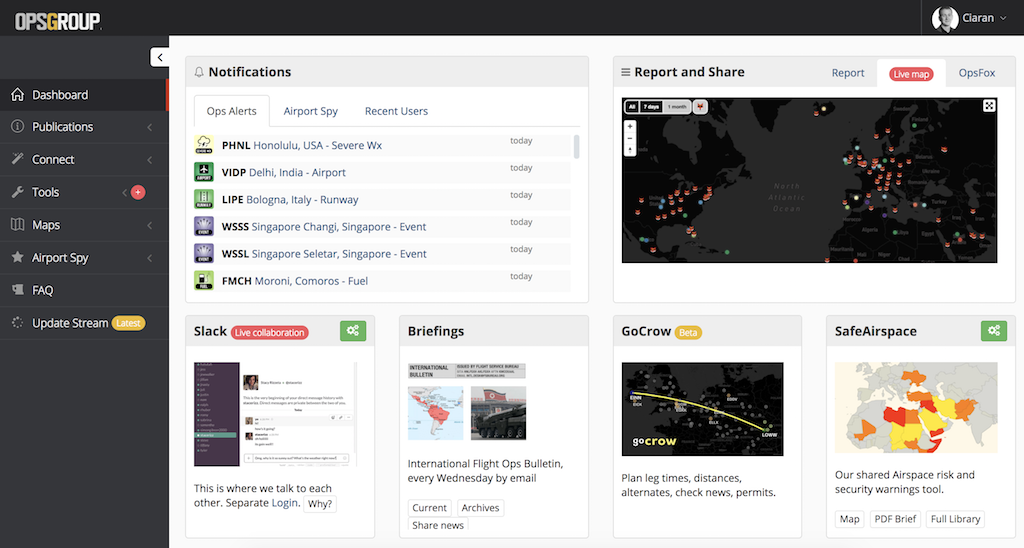
  • A notifications tab for Ops Alerts and new Airport Spy reports.
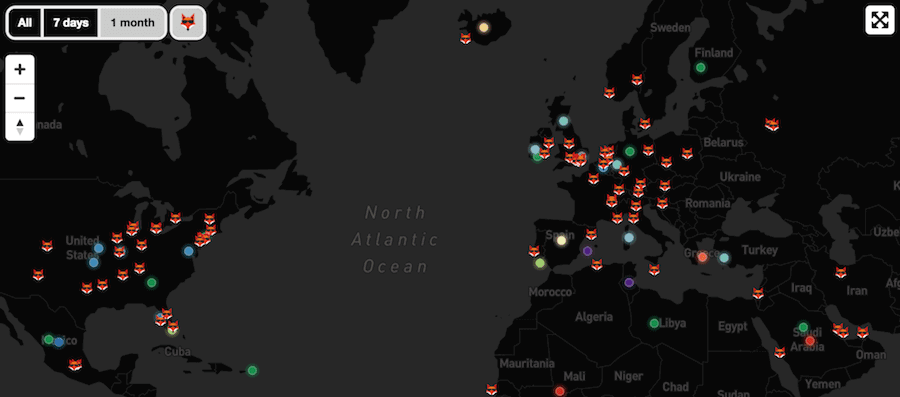
  • A live map of alerts, toggle 7 days/ 1 month / All, searchable news feed
  • Daily Brief archives in publications
  • FSB Blog posts now appear here also
  • Report it tool

New Alerts Window

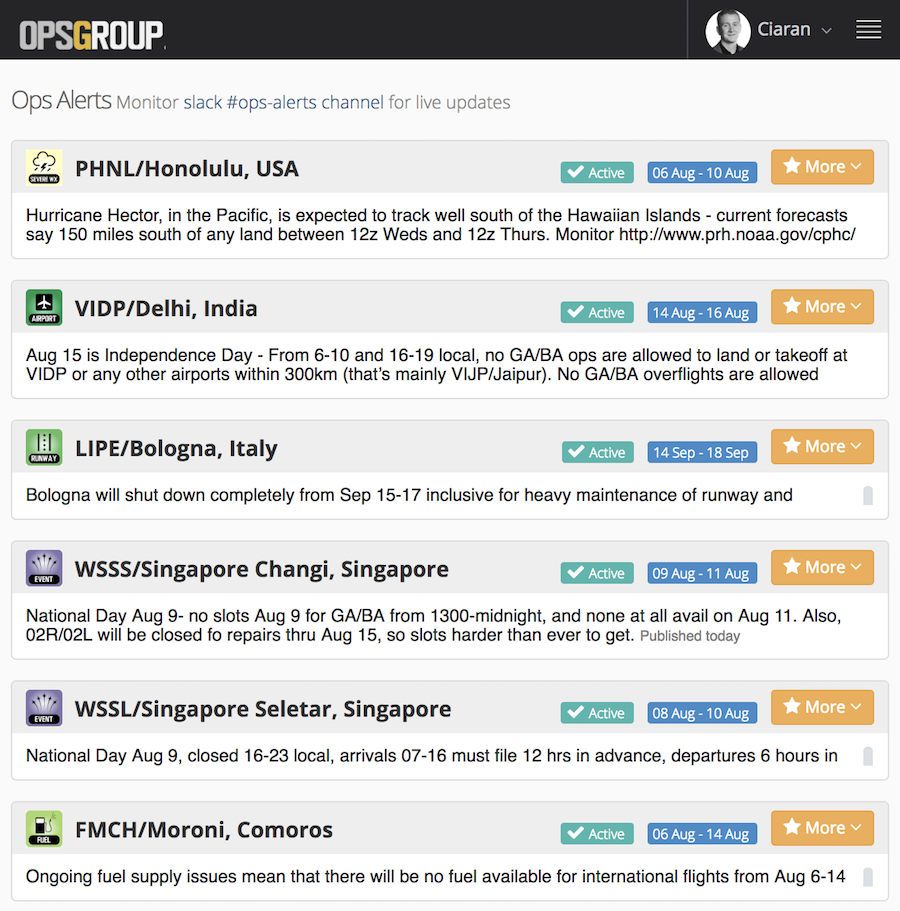
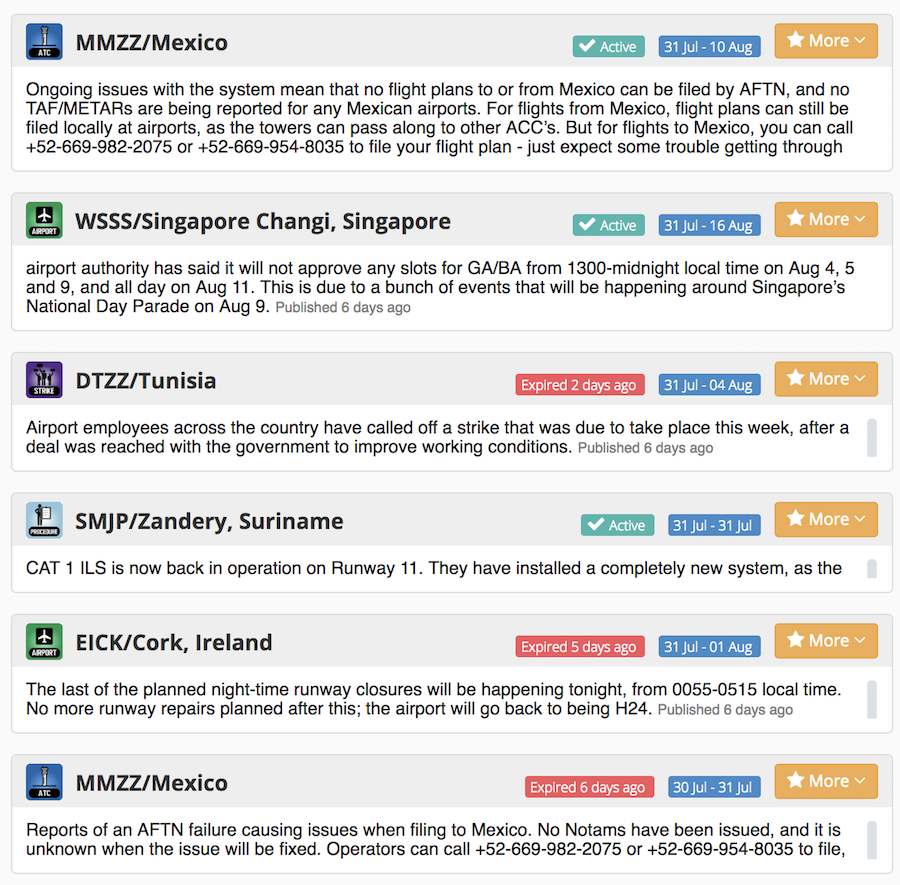
All ops-alerts issued by FSB for the group now have their own home at https://ops.group/ops-alerts. You can also find them in slack in the #ops-alerts channel, which will push notifications to your phone.

Each alert now has a category, validity dates, active marker, and link to more information:

George

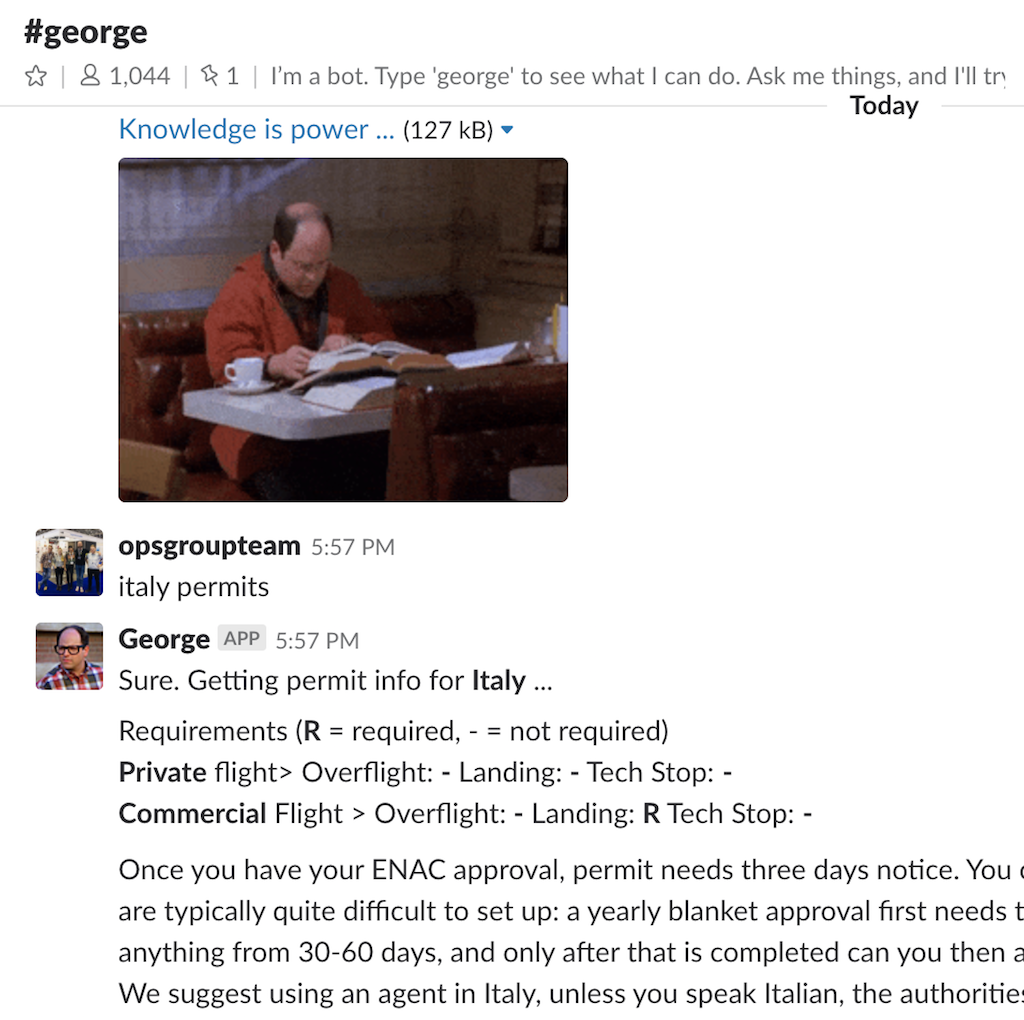
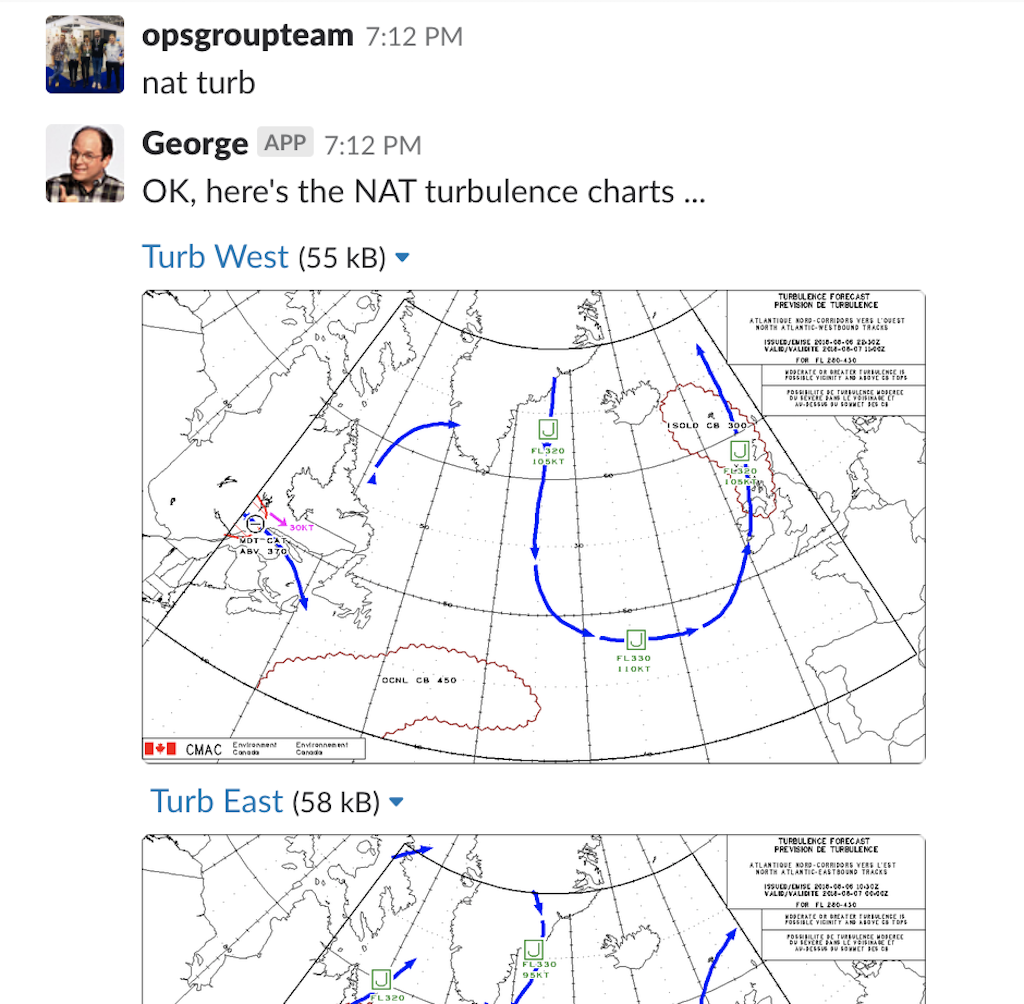
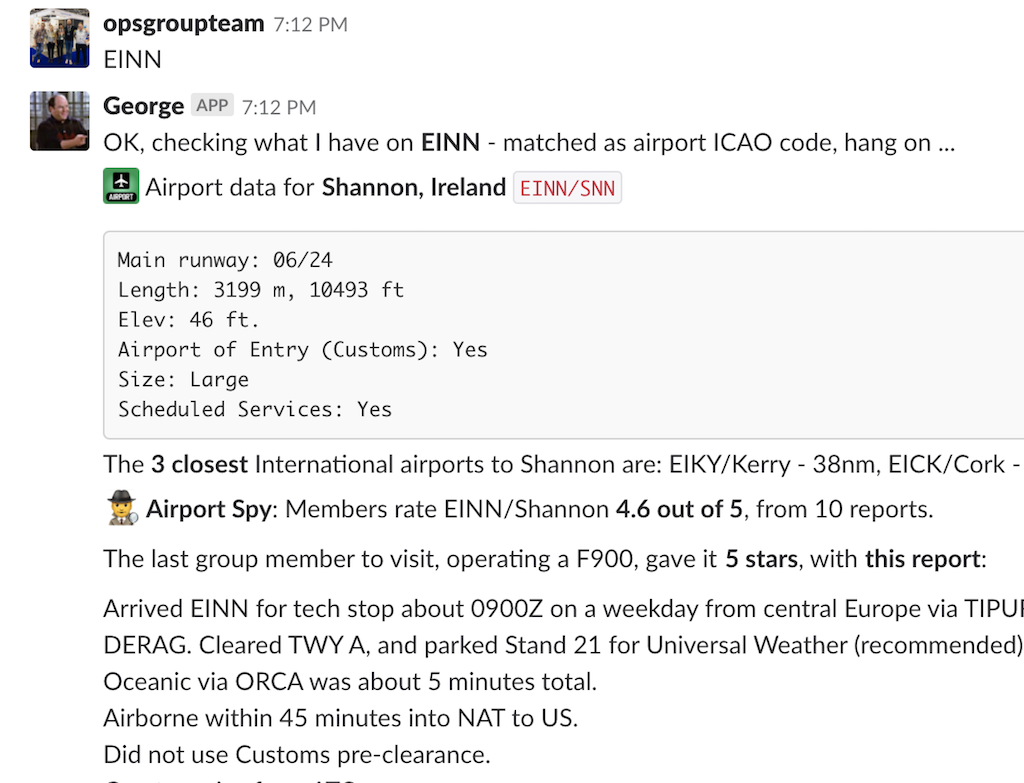
You know George from before, but we sent him for remedial training in North Korea and now he’s back, smarter, sharper, and better. George is a bot. We can’t call him AI, because he’s not that intelligent, but he understands a whole load of new commands: permitsweather, ICAO codes, airport names, countries, keyword searches. Go to the #george channel in slack to test him out.

OpsFox

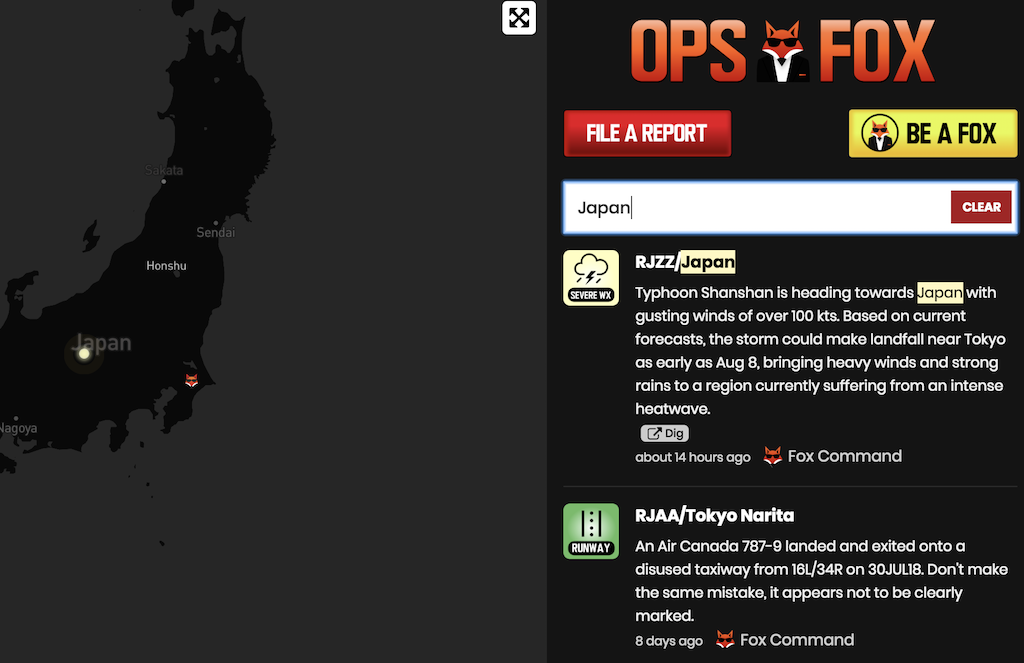
OpsGroup has set up a trusted network of spies: Pilots, Air Traffic Controllers, Dispatchers, and Ops Specialists – that can report directly into our system, adding categorized reports, based on what they see and know at their home base, or visited airport. We call this network OpsFox.

You can view the live map, or search for a specific country, or location:

Daily Brief

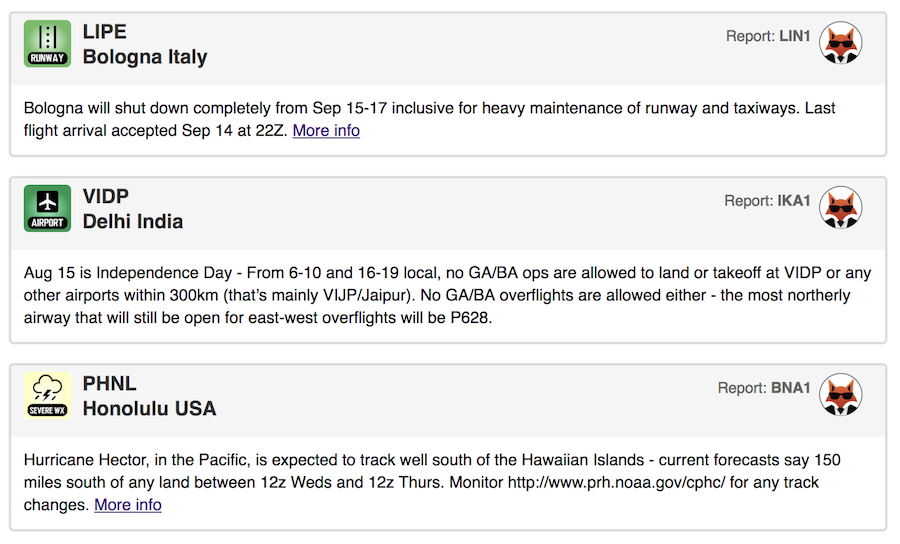
We love that you all love the Daily Brief! It’s been the most popular feature of the year – and we are happy to bring you daily updates every morning.


See those little fox badges? When we get a report from a Fox, we’ll mark it like that on the Daily Brief. If you’re a ground handler, and want to have your name listed as a reporter, then tell us and we’ll credit you for any reports you file – so that our members can contact you directly for more.

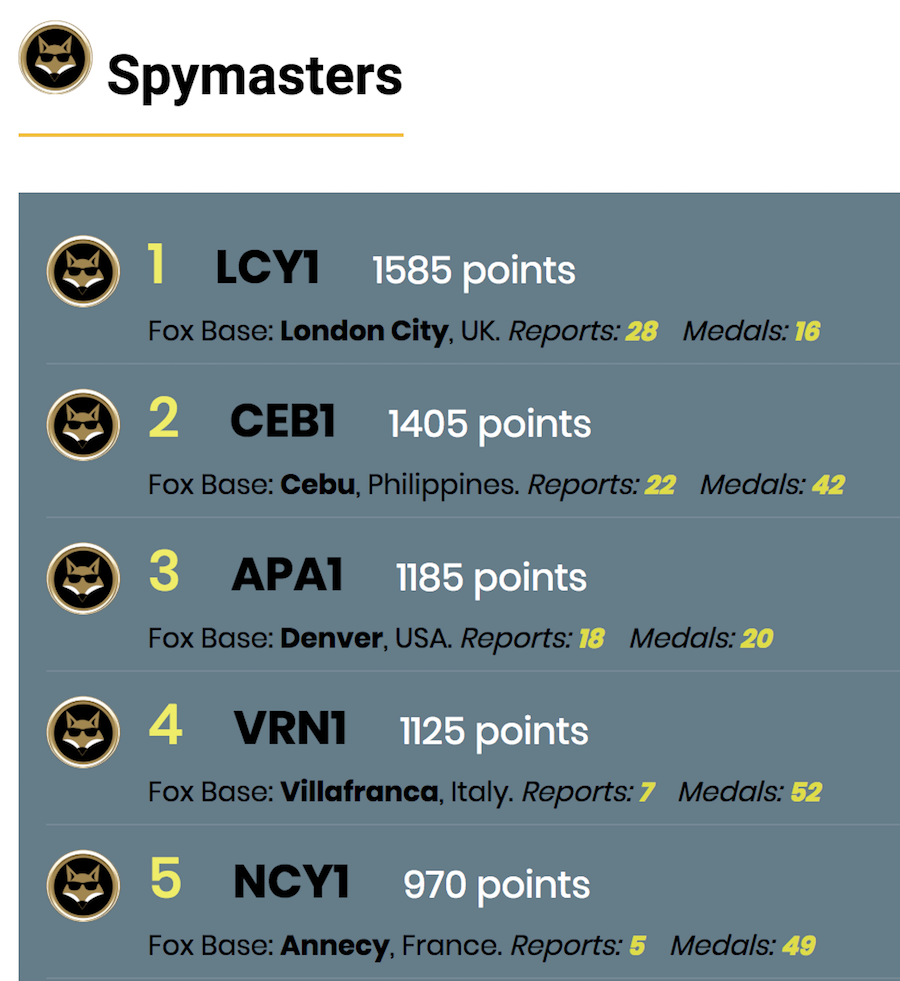
Also, as a fox, you earn points. Here’s the current Top 5!

We really hope you enjoy the new features! We listen to what the members want, and we build it – so keep your ideas coming to us. And of course, when you hear about something new:

Please! whether you’ve just checked in to the Holiday Inn at Teterboro, or are enroute with some fancy satcom wi-fi, let the other members know when you hear something important:

We hope you have a wonderful week! As always, keep us posted on anything the group should know about.

Oh – and if you REALLY liked something we added, hit reply and let us know! We’d love to hear.

Kind regards,
The Team.

 
Quick links – OPSGROUP members:


Choose a plan – JOIN OPSGROUP


Runway? Who needs one when you have a taxiway!

It’s happened again.

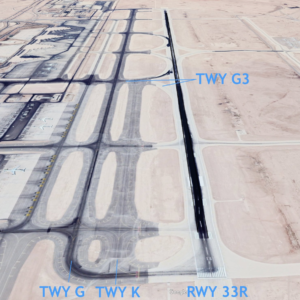
Around midnight on a perfectly clear night last week in Riyadh, a Jet Airways 737 tried to take off on a taxiway. The crew mistaking a new taxiway for a runway!

The crew, with thousands of hours experience, took off on a surface that didn’t have runway markings or runway lights. Thankfully no one was seriously hurt.  It’s too early to exactly say why this happened, but it’s clear that some sort of “expectation bias” was a factor. Expecting to make the first left turn onto the runway. One has to ask – was ATC monitoring the take off?

After the tragic Singapore 747 accident in Taipei, technology was developed to audibly notify crew if they were about to depart “ON TAXIWAY”. This is known as the Runway Awareness and Advisory System (RAAS).

Sadly the Riyadh incident is not isolated. There have been a plethora of near misses in the past few years (more details in Extra Reading below).

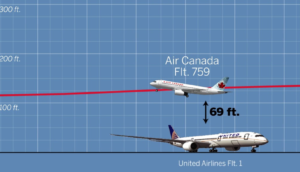
There have also been more than a few “incidents” of aircraft from C17’s to 747s landing at the wrong airports! The most notable near miss recently was that of an Air Canada A320 nearly landing on a taxiway full of aircraft at KSFO/San Francisco. But it’s happened to Delta and Alaskan Air recently too.

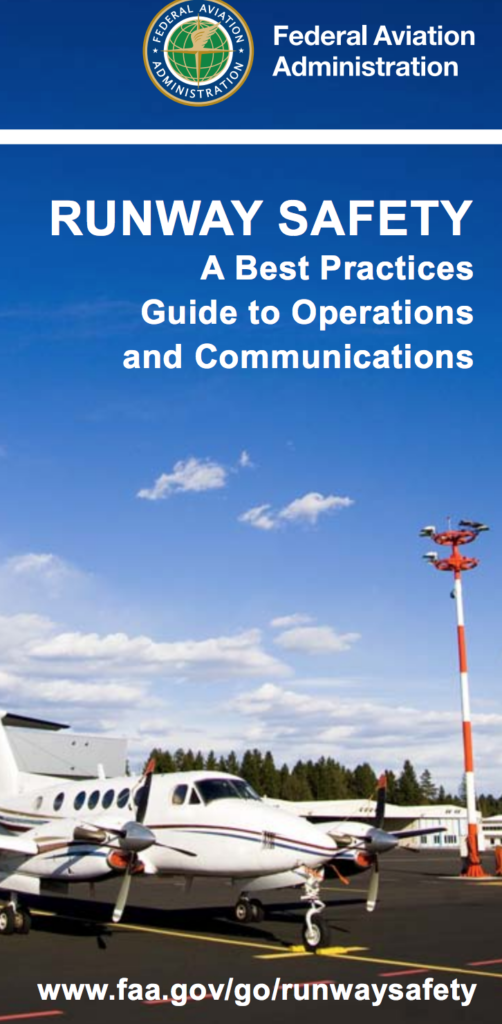
It is an even bigger issue at a General Aviation level (and not just because Harrison Ford did it!). The FAA safety team recently noted;

The FAA Air Traffic Organization (ATO) has advised of an increase in, “Wrong Surface Landing Incidents” in the National Airspace System (NAS).

Incidents include:

  • Landing on a runway other than the one specified in the ATC clearance (frequently after the pilot provides a correct read back)
  • Landing on a Taxiway
  • Lining up with the wrong runway or with a taxiway during approach
  • Landing at the wrong airport

The FAA published some shocking statistics:

  • 557wrong surface landing/approach events” between 2016-2018. That’s one every other day!
  • 89% occurred during daylight hours
  • 91% occurred with a visibility of 3 statue miles or greater


So what to do?

There are numerous ‘best operating practices’ pilots can use to help avoid such incidents.

  • Be prepared! Preflight planning should include familiarization with destination and alternate airports to include airport location, runway layout, NOTAMs, weather conditions (to include anticipated landing runway)
  • Reduce cockpit distractions during approach and landing phase of flight.
  • Use visual cues such as verifying right versus left runways; runway magnetic orientation; known landmarks versus the location of the airport or runway
  • Be on the lookout for “Expectation Bias” If approaching a familiar airport, ATC might clear you for a different approach or landing runway.  Be careful not to fall back on your past experiences.  Verify!
  • Always include the assigned landing runway and your call sign in the read back to a landing clearance
  • Utilize navigation equipment such as Localizer/GPS (if available) to verify proper runway alignment

It’s worth spending a few minutes watching this.

Extra Reading


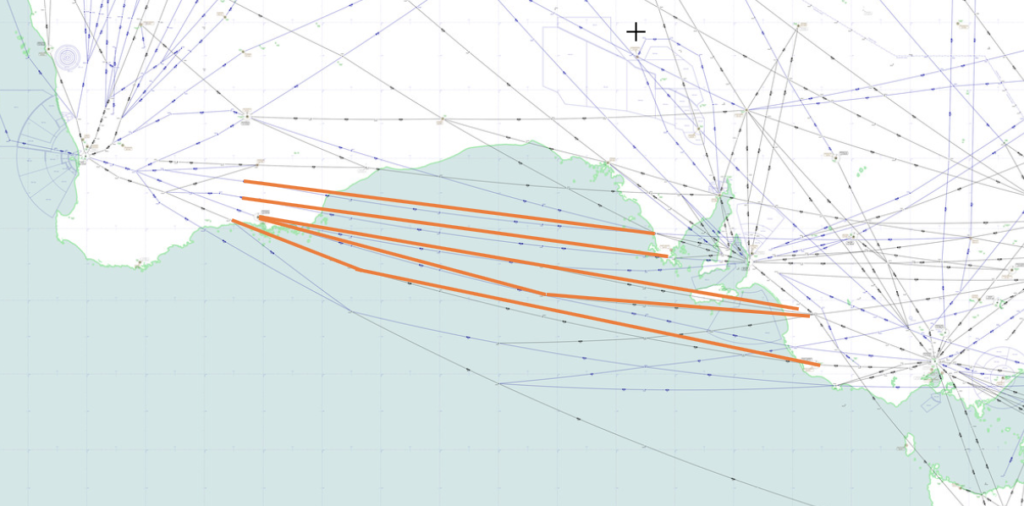
Great Australian Bight – RNAV/RNP only airways

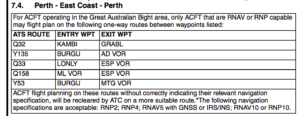
Australian AIP flight plan requirements (GEN – FPR – 18 – section 7.4) have been updated to remind operators to file the right navigation specifications on their ATC flight plan or risk a re-route for flights over the Great Australian Bight (in the YMMM/Melbourne FIR).

Specifically, for flights operating on the following airways: Q32, Y135, Q33, Q158, Y53.

Aircraft flight planning on these routes should meet the following navigation specifications.

  • RNP2; RNP4; RNAV5 with GNSS or IRS/INS RNAV10 or RNP10.

Aircraft flight planning on these routes without correctly indicating their relevant navigation specification will be re-cleared by ATC on a “more suitable route”.

One to check next time you’re flying through the area, especially for a flight to/from YPPH/Perth.

Further reading:


European ATC delays are up 133%

In Short: European ATC delays are on the increase, caused by staffing and capacity shortages. Monitor the Network Operations Portal and be flexible in your routing options if bad weather or capacity constraints are expected.

It’s been a great few days on a sun-soaked Mediterranean island. Your passengers are onboard, you are about to close the door, and then you get told your Calculated Take Off Time (CTOT) is an hour from now! Sound familiar? You’re not alone! ?

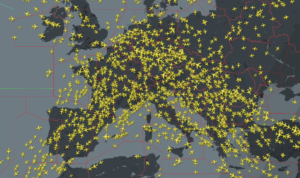
European air travel this summer is surging and about to hit maximum intensity. Problem is, the ATC system doesn’t seem to be coping, and the misery of long flight delays keeps getting worse.

Delays are up

IATA has recently reported the following:

“Data from Eurocontrol shows that in the first half of 2018, Air Traffic Management (ATM) delays more than doubled to 47,000 minutes per day, 133% more than in the same period last year. Most of these delays are caused by staffing and capacity shortages as well as other causes such as weather delays and disruptive events such as strikes. The average delay for flights delayed by air traffic control limitations reached 20 minutes in July, with the longest delay reaching 337 minutes.”

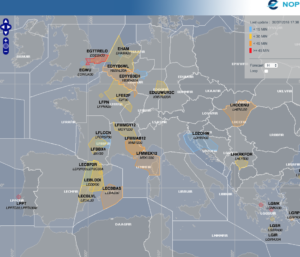
As an operator, you may be used to seeing alerts like these daily:

EDYY (Maastricht)

Several sectors regulated due to Airspace Management and ATC Staffing/Capacity.

Moderate to high delays.

LFMM (Marseille)

Several sectors regulated due to ATC Capacity/Staffing.

Moderate to high delays.

So is it a story of too many planes and not enough airspace (capacity) or just not enough controllers (staffing)?

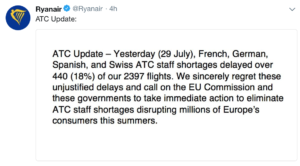
Local airlines are not impressed. Ryanair took to twitter this week calling the delays “unjustified”.

In a unusually aggressive statement IATA commented that “key ANSPs in Europe have not made needed investments in their businesses, preferring instead to make super-normal profits.”


Some of the things we recommend to keep on top of expected delays

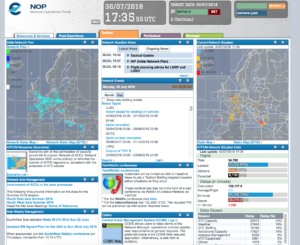
  • Review the Network Operations Portal regularly – This will assist in making operational planning decisions based on the current delays and capacity restrictions. Also keep an eye on the NOC tactical briefing for the following day which may also assist.
  • Avoid the early morning rush of departures if you can (0900z).
  • Be flexible in your routing options if bad weather or capacity constraints are expected.
  • Discuss with the local FBO for latest on-ground situation to better plan arrival and departure.
  • Monitor Opsgroup – members are always posting the latest information on recent airport and overflight experiences. Not yet a member? Go here!
  • Subscribe to our Daily Brief to get all the latest info on ATC strikes, Airport  closures, and everything else causing delays.

Got any tips or tricks on how to avoid or minimise most of these delays? Is there certain bit of airspace, airports or a time of day you’ve found that works best? Let us know!

Extra Reading:


The risks posed to civil aircraft by surface-to-air missiles

In Short: Worldwide the SAM threat is deemed to be “low” by ICAO with the caveat that this can change quickly when flying over or near conflict zones. The best risk mitigation is centred around which airspace you are operating over and what information you have access to. As we have explained before: There is no safe altitude from a large SAM.
What are surface-to-air missiles, and who has them?

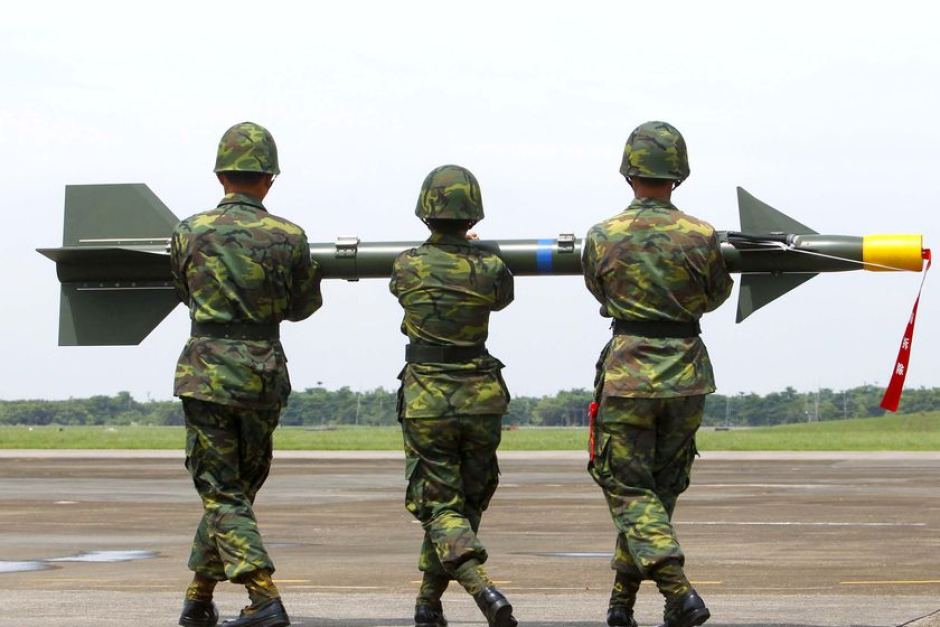
Surface-to-air missiles (SAMs) are large, complex units, with the capability of reaching aircraft at cruising levels well above 25,000 ft, and they are designed to be operated by trained military personnel.

They are distinct from Man Portable Air Defence Systems (MANPADS), which are the smaller, shoulder-launched systems, the most dangerous of which being the FIM-92 Stinger which has an operational ceiling of 26,000 ft.

SAM systems vary but they are all designed to track and destroy military targets in flight. Due to the size and predictable flight paths, civil aircraft represent easy and highly vulnerable targets.

Many SAMs are mobile and can be moved quickly between locations. Many are located on warships. It is estimated that more than 70 States around the world have acquired SAMs as part of their military capability. A small number of non-State actors (i.e. militant groups) have also reportedly acquired SAMs, but as they require a radar system as part of the mechanism, they may not have the technical capability to use them. To date, SAMs have never been used by terrorists.

What has happened in the past?

There have been three documented occurrences where aircraft destruction has occurred due to SAM attacks.

The risk of intentional attack

To date, no documented case of intentional SAM attack on a civilian aircraft has been identified. In the case of MH17 and Iran Air, both occurred during periods of military conflict or high tension, whilst Siberia flight 1812 was shot down during a military training exercise.

ICAO say that “with regard to the States and non-State actors that currently do have access to SAMs, there is no reason to believe that the intent currently exists to target civil aviation deliberately.” And with regards to terrorist groups (as opposed to militarized forces), they say that “even where intent may exist there is currently no evidence of capability (in terms of hardware and trained personnel).”

Overall, the current risk to aviation from intentional SAM attack is therefore currently assessed to be low, the key caveat being to avoid overflying airspace over territory where terrorist groups tend to operate – normally areas of conflict where there is a breakdown of State control.

The risk of unintentional attack

Past events show us that the higher risk to civil aviation is from unintended and unintentional attacks when flying over or near conflict zones – missiles fired at military aircraft which miss their target, missiles fired at civil aircraft which have been misidentified as military aircraft, and missiles fired by State defence systems intended to shoot down other missiles.

Areas where there are armed conflicts going on clearly present an increased risk of an unintentional attack. But when assessing the risk of overflying a particular conflict zone, here are some more specific questions to consider:

Are there increased levels of military aircraft flying around in the region?

This could be anything from fighter jets being operated in a combat role, or for hostile reconnaissance; remotely piloted aircraft; or military aircraft used to transport troops or equipment. If military aircraft are one of the most likely targets for intentional attacks, then the chances of civil aircraft being mistakenly targeted increases in those areas where there are lots of military aircraft zipping around.

Are there likely to be a bunch of poorly trained or inexperienced personnel operating SAMs in the region?

This may be difficult to evaluate, but the risk is likely to be highest where SAMs may have been acquired by non-State actors. The risk is also likely to be higher in places where there is less of a robust command and control procedure for launching missiles, thus increasing the risk of misidentification of civil aircraft.

Is the territory below the airspace fully controlled by the State?

If not, and there are some areas controlled by militant or terrorist groups, the information on the presence and type of weaponry in such areas, as well as the information on who controls them, may not be readily available. In such regions, the information promulgated by the State about the risks to airspace safety may therefore not be 100% reliable.

Does the route pass over or near anywhere of particular importance in the context of the conflict?

These could be areas or locations that may be of strategic importance or sensitivity in the conflict, such as key infrastructure or military sites, which might be considered potential targets for air attack and would therefore be more likely to be guarded by SAMs.


Ultimately, risk mitigation is centred around which airspace you are operating over and what information you have access to. But as has been reported in the past, history has shown us that badly-written information published by the State often does little to highlight the real dangers posed by overflying conflict zones.
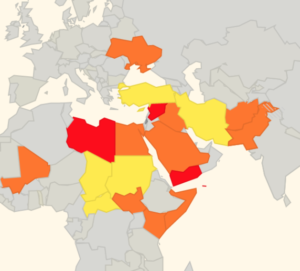
There is some evidence to suggest that more States are starting to provide better guidance and information to assist operators in making appropriate routing decisions, but we think this still has some way to go.

That is why we have been running our safe airspace map to provide guidance to assist operators in determining whether to avoid specific airspaces around the world.


Extra Reading:


Dubai to London – which way is best?

In Short: Two main options, via Saudi and Egypt (safer, cheaper but longer) or via Iran and Turkey (shorter, busier and geo-politically more unstable). It’s a complicated planning climate at present. Review regularly based on latest risk factors.   

There are more business aviation operators flying between the Middle East and Europe than ever before. So we took the time to look over the route options between the two regions. For our example we will be using a flight from Dubai to London, but similar operational considerations are valid for the plethora of route combinations through this whole region.
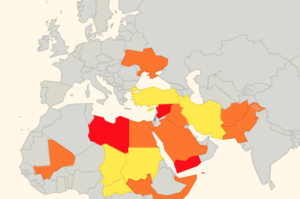
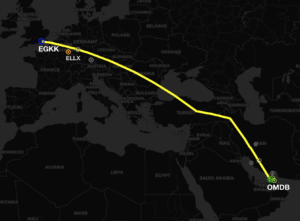
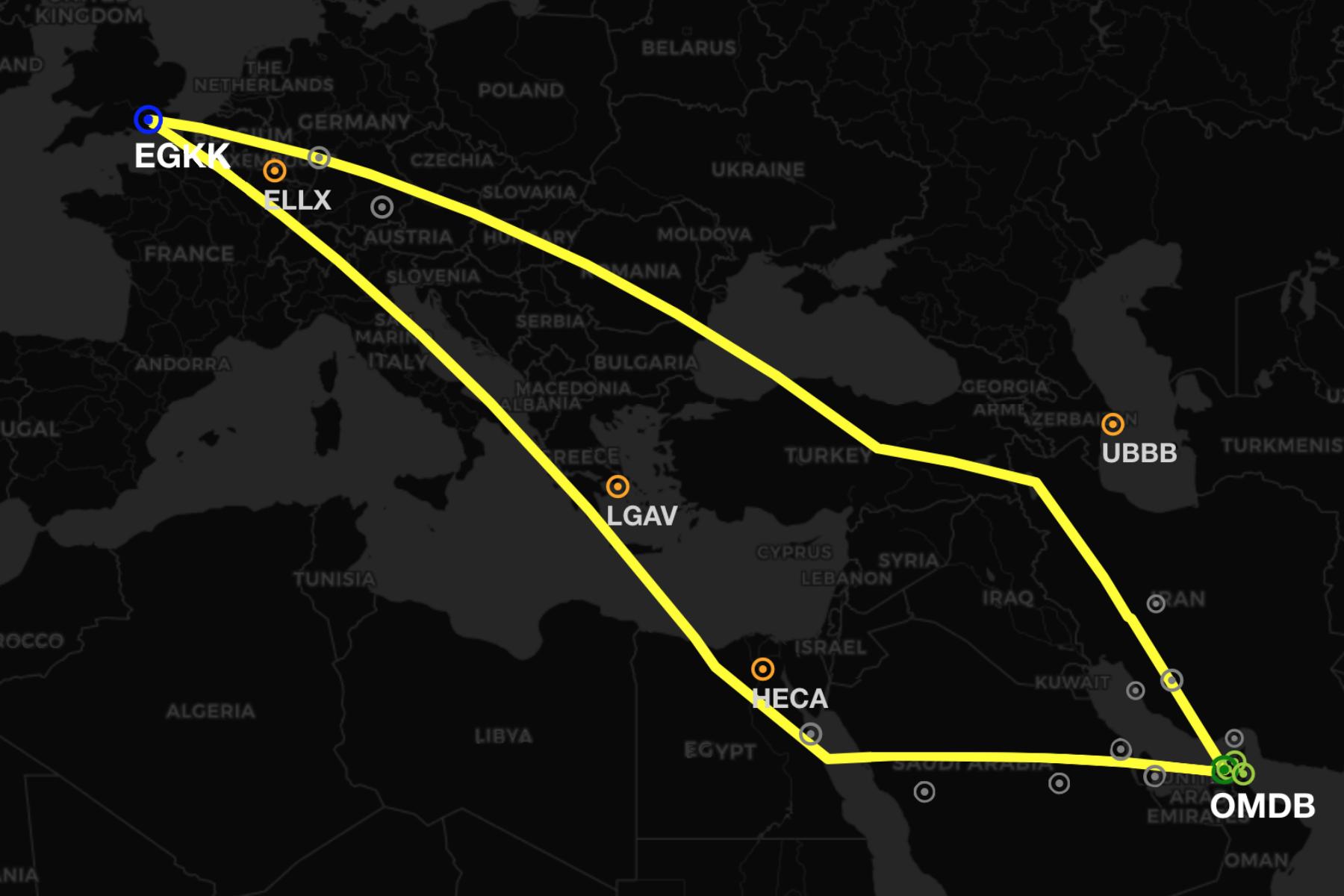
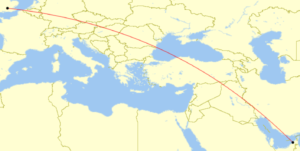
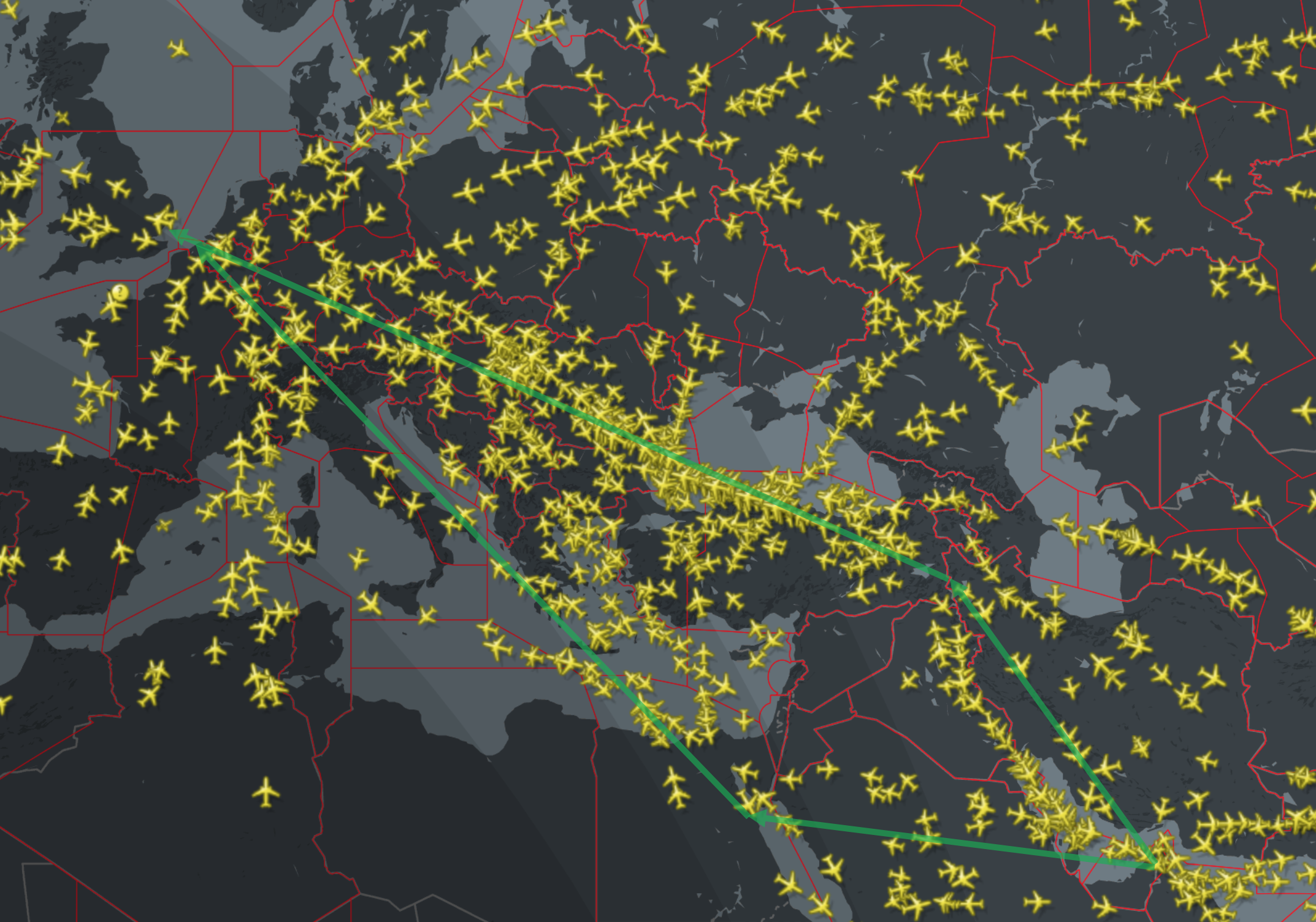
Firstly, we are sure you are a frequent visitor to our safe airspace website. Updated all the time with the latest notes and risk recommendations based on the latest intel. So, first things first, we want to avoid Syria, Libya and the Sinai Peninsula. As you can see however, this is a complicated geo-political region for flight planning. The direct great circle route would take us through Syria and would be around 3125nm. But that isn’t going to work. So, what else we got?

We will look at the two ways to head over the region. One is via Iran, Turkey and onwards to Europe. The other over Saudi Arabia and Egypt towards Europe.

Option 1: Iran/Turkey

Safety: Both Iran and Turkey are FSB Risk Level: Three – Caution. Iran is involved in the ongoing conflict with Syria and several Russian missiles crossed the Tehran FIR and several busy international routes. There are also increased tensions between the USA and Iran at present – if you had to divert in an N-reg aircraft, Iran would not be the friendliest of places to do so. Turkey borders with Syria and we have received multiple reports of GPS interference in the area.

Distance: an extra 100nm.

Time: About 15 minutes longer than great circle route.

Ease and Cost: Iran has higher overflight costs and for US based operators a reminder of the sanctions for dealing directly with Iran, or agencies in Iran. You’ll want to use an approved agent if you’re from the US (i.e.–not an Iranian company). Iran doesn’t work on Fridays, so be aware there. Turkish overflight costs are reasonable and remember that Turkish authorities require the use of an agent to apply for permits.

Traffic: The biggest issue with this route is that everyone is using it! It’s congested with a lot of airline traffic. It’s a major corridor for Asia-Europe flights also. So, getting the levels you want, and off route deviations are more complicated. Things get busy, as you can see!

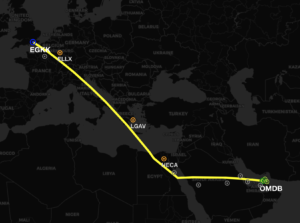
Option 2: Saudi/Egypt

Safety: In terms of airspace warnings and risk, this route is slightly better. We have rated Saudi and Egypt airspace as FSB Risk Level: Two – Assessed Risk. Beyond the Sinai Peninsula and the Saudi/Yemen border, generally there is less of a chance of airspace security risks at present.

Distance: An extra 300nm from the great circle.

Time: Around 45 minutes longer.

Ease and Cost: Saudi and Egyptian airspace are generally a cheaper option ($1,000USD+). In Egypt, by law you have to get your permit through an Egyptian agent, but it’s a straight forward process. In Saudi, again, using an agent is best; they normally have three-day lead time – so keep that in mind. Also remember that the CAA only work Sun-Wed during office hours.

Traffic: For most of the day, much less of a traffic bottle neck.


Bottom line

Of the two options, routing via Saudi/Egypt is cheaper, and safer (as long as you steer clear of Egypt’s Sinai Peninsular and Saudi’s border with Yemen), but it’s going to take slightly longer.

What about Iraq?

We don’t think it’s a good idea. There’s a lot of information out there saying certain airways are ok but only at higher levels. But if you needed to get down fast, or even make an unexpected landing, Iraq isn’t the place you would want to go at present. Treat with caution.

Which one is your favourite choice? Let us know!

Further reading:


Unsafe aircraft not welcome in Europe

Eurocontrol and the European Aviation Safety Agency (EASA) have brought live an automated system which alerts air traffic controllers when unsafe aircraft enter European airspace.

How does it work?

Network Management Director at Eurocontrol Joe Sultana, explained that “We have added another parameter to our system, and this is now checking if an aircraft coming from outside of Europe is coming from a state where the regulatory environment is accepted by the European Aviation Safety Agency”.

So in short: The system will now take an automatic look at the Third Country Operator Authorisation and alert ATC if there is a flight being operated from a aircraft on the banned list.

The regulation that a plane coming from a non EU country must have a Third Country Operator Authorisation has been in place since 2014, but controllers have had no way to implement it across the 30,000 flights it receives into Europe each day, until this new component was entered into their systems.
As a reminder, Eurocontrol receives the flight plans of all aircraft entering into European air space, while the EASA holds the Third Country Operator Authorisations information which confirms that planes are from countries with recognised safe regulatory practices.


Islands of the South Atlantic – enroute ETOPS and diversion options

Operating a flight across the South Atlantic is complicated by very limited en-route diversion options.

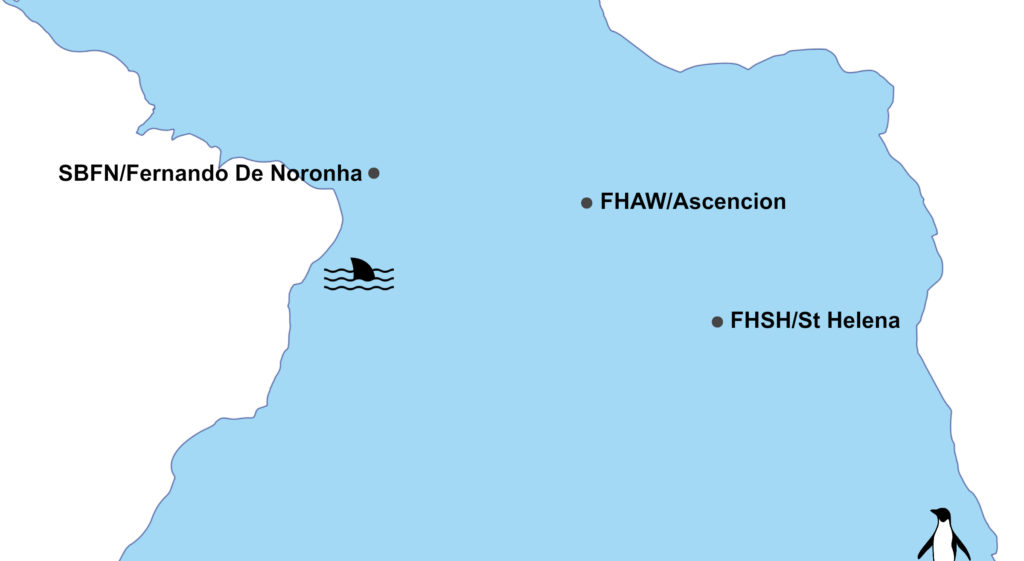
There are only really three airports worth considering between Brazil and Africa, south of the equator. All have their own complexities.

Your three best bets:

Operational Considerations:

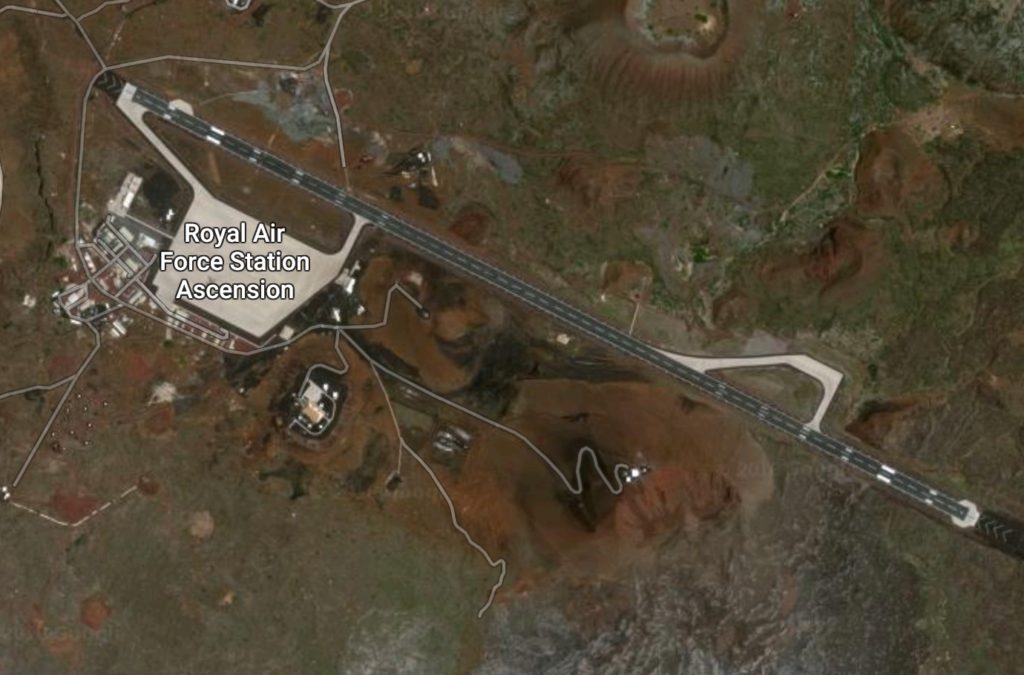
FHAW/RAF Ascension Island

Wideawake Airfield (FHAW) is a military facility operated jointly by the USAF and the RAF. Under the terms of the joint agreement, only state aircraft are authorized to land at Ascension. A monthly RAF flight arrives from the UK and weekly USAF C17 movement occurs.
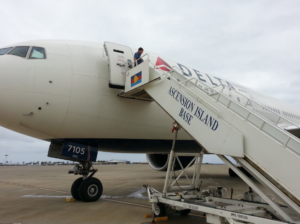
We have also been advised by local authorities that “the runway is beyond its life cycle and we have imposed aircraft maximum weight limitations on its use to extend its operation”.

Because of these restrictions, passenger links to/from UK were stopped.

To file as an ETOPS/EDTO alternate or not?

The official line is here.

“The US Air Force has agreed its airfields may be identified as ETOPS emergency landing sites for flight planning purposes. This is consistent with the policy that an aircraft can land at any US Air Force airfield if the pilot determines there is an inflight emergency that would make continued flight unsafe. However, we also understand there are published criteria for ETOPS airfields and our policy concerning emergency use is not agreement or certification that Air Force airfields meet those criteria.

Ascension Island is a remote location with resources (accommodations, medical, hangars, crash/fire/rescue, etc) limited to levels essential for support of assigned personnel and the military mission. The airfield is available “as is” for emergency use only as indicated above. Whilst FHAW may be declared as an alternate for ETOPS flight planning purposes, it cannot be used as a weather alternate, except for flights departing from or destined for St Helena.”

However! After we enquired with local authorities, we received the following response:

“As this is a USAF military only field, it is not allowable to nominate as an ETOPS alternate. There are no lodging facilities here on the island, and there is only very limited medical capability.

We will always accept an emergency divert and have done so in the recent past. Nomination as an alternate drives a set of requirements that we do not meet – hotel, medical, 24 hour operations, etc. Since we cannot meet those requirements, nomination is not allowed. If an aircraft were to experience and emergency and need to land, we would make do with what we have.”

As we have reported in the past, it can be costly to nominate enroute alternates sometimes.
Famously, a Delta 777 diverted to Ascension back in 2013 after experiencing engine troubles.

Either way- it’s another ‘interesting’ approach.


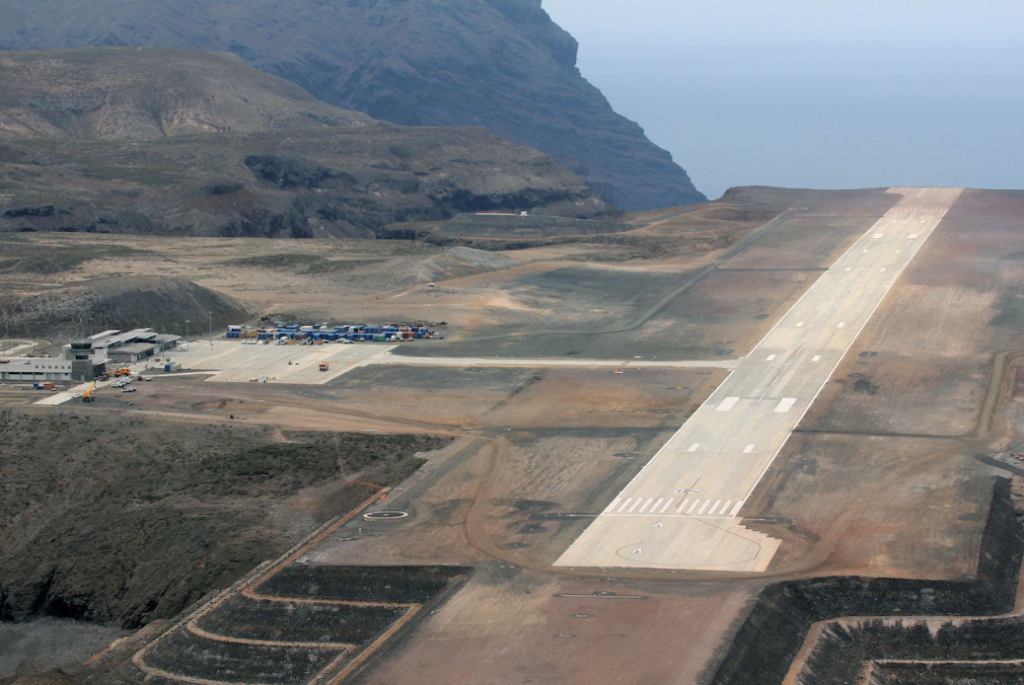
FHSH/St Helena

This is a new airport.

It’s windy! It is subject to “severe” windshear and the runway is on top of a mountain and it’s short! There is only limited flights to/from Namibia with an E190 and a monthly flight connects onwards to RAF Ascension.

Even the first commercial flight there need to ‘go-around’ due to the wind.

It was closed shortly after it opened due to these safety concerns, but it’s back up and running now.


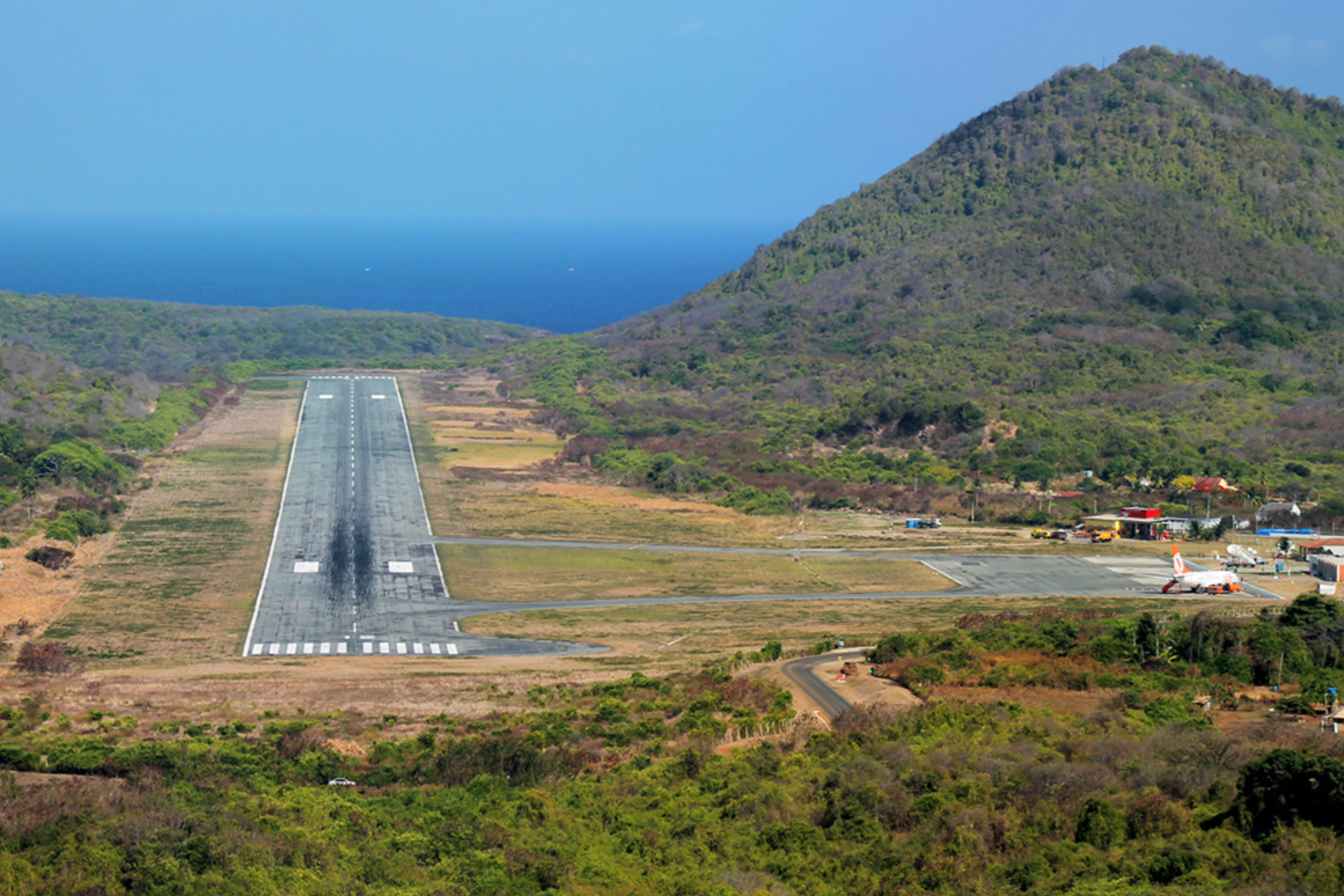
SBFN/Fernando De Noronha

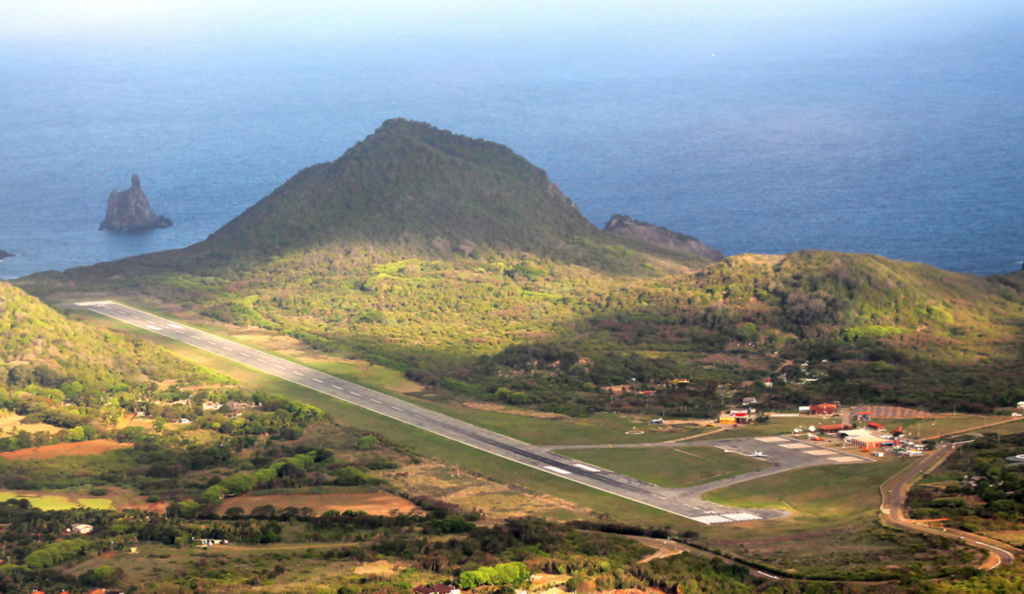
Small island airport. Very scenic on approach and great beaches! Limited ground handling and parking options. Close to the ITCZ – susceptible to unstable weather at times. Regular commercial flights from the island and popular tourist destination with appropriate passenger facilities. Fire fighting only CAT 5. PPR – expect to pay for parking by the hour. Not an airport of entry and no fuel available to non-Brazilian military aircraft. Handling all done by island island administration and special permit landing permit required. Also important to note that the runway will be closed for maintenance between 2001 and 1131 UTC, between May 24th until Dec 31st, 2018 and that all runway lights are unavailable also.

Extra Reading:


No fuel at LFMN/Nice

Update July 9th: Following last week’s issues with a break in the fuel pipeline coming into the airport, local handlers are now saying there are no more issues with fuel supply and availability. However, some third-party fuel providers are warning they still cannot arrange fuel for BA/GA operators, and are advising them to tanker inbound. Do you know different? Let us know!

July 5th: Due a break in the pipeline into the airport, for most operators there is no fuel available at LFMN/Nice.

Check with your handler before operating if your uplift at Nice is essential, as many are now advising all ad-hoc operators to tanker-in.

Information is still coming in, but it appears this may affect operations for a few days. No word of other airports affected, and nothing has been published in the Notams yet.


Customs now closed overnight at KBGR/Bangor

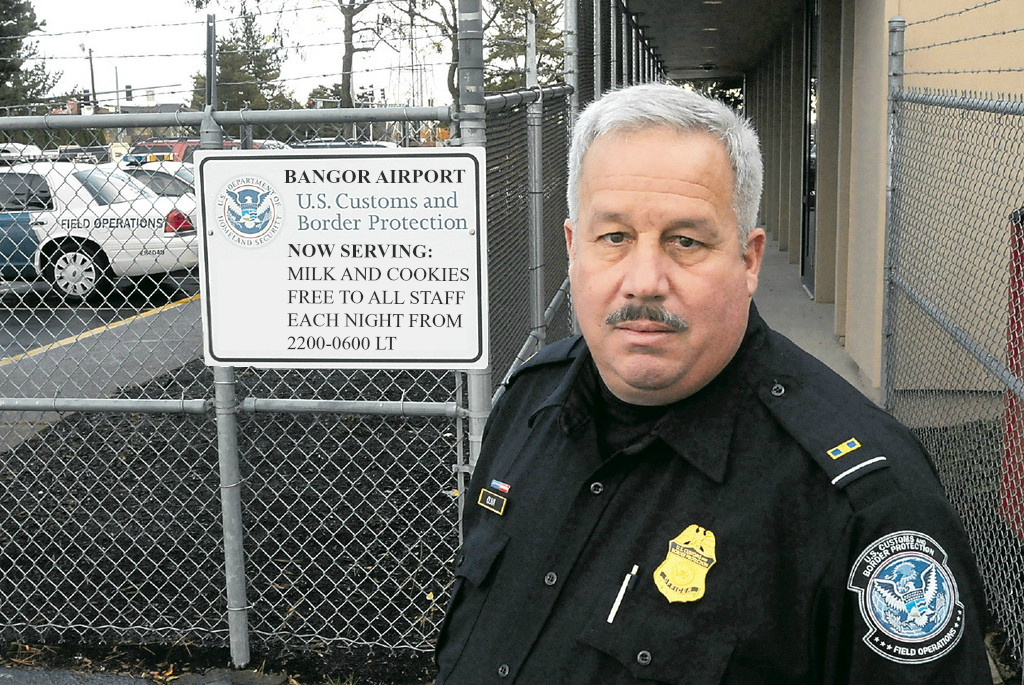
Bad news for trans-Atlantic operators! The Customs office at KBGR/Bangor Airport will now be closing each night from 22-06 local time (02-10z).

They used to be open H24, which made Bangor a great option for trans-Atlantic operators wanting to clear U.S. Customs somewhere nice and straightforward overnight. Now with the new changes, you can still request overtime, but Customs needs 24hrs notice to arrange and will only assess on a case-by-case basis.

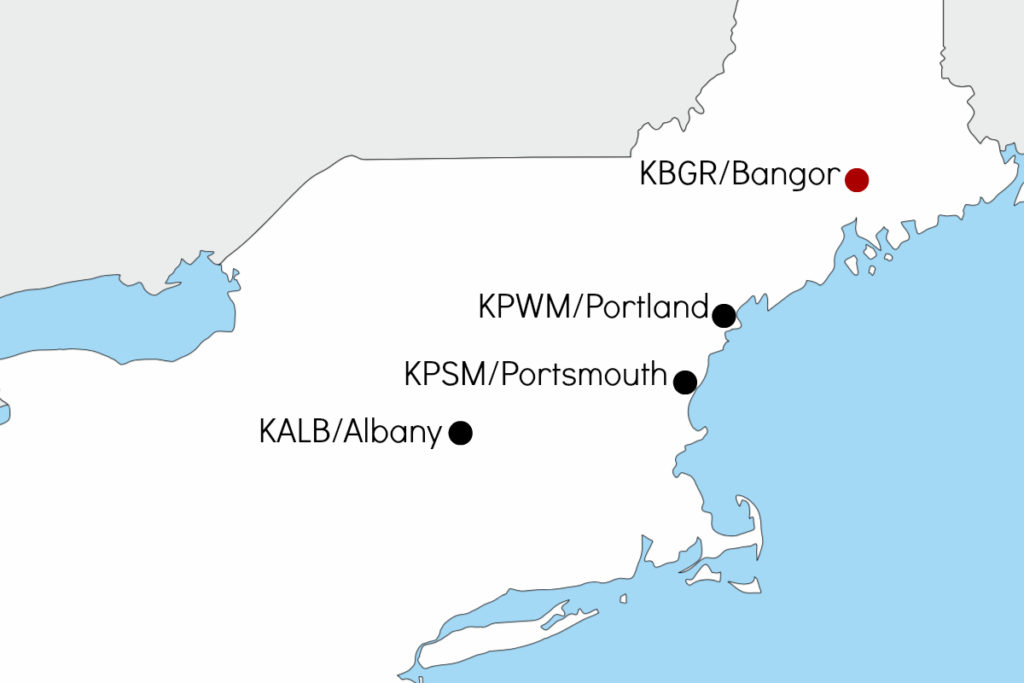
Now it seems that the nearest airport in the region still with Customs available H24 is KBOS/Boston International Airport, and given it’s size, it’s not the most BA/GA friendly at the best of times.

Where else to go? Here are some options:

KALB/Albany
Open 08-22 local time, 7 days a week
Available out-of-hours but minimum 2hrs notice required.

KPSM/Portsmouth
Open 08-17 weekdays only
Available out-of-hours but minimum 24hrs notice required.

KPWM/Portland
Open 07-21 local time, 7 days a week
Available out-of-hours but minimum 24hrs notice required.

Know of anywhere else in the region which provides Customs H24? If we missed somewhere obvious, let us know!


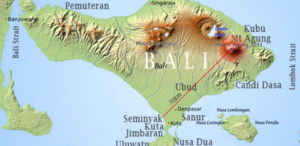
Ongoing Bali volcanic threat – update

Update June 29, 2018:

Following the volcanic eruption on Jun 28 at Bali’s Mount Agung, the airport has been closed all morning today, Jun 29, and only just reopened at 1430 local time (0630z). Over 500 flights have already been cancelled as a result. Big delays expected all day and into the weekend. Further closures due to volcanic ash are still possible.

Per latest report from Darwin VAAC, there is a volcanic ash cloud observed up to FL160 in the area, but they predict winds will carry the ash southwest toward Java, Indonesia’s most densely populated island.


In Short: Continued vigilance required for operations to Bali; The alert level for Mt Agung eruption remains at 3 (on a scale of 1-4). Last ash plume on 26 March rose to at least an altitude of 11,650 ft.

When Mount Agung erupted in November 2017, airlines faced travel chaos as flights were cancelled due to the lingering ash cloud. Since then, visitor arrivals have dropped by more than 70 percent. Facing $1bn in lost tourist revenue, the Indonesian government is trying to lure tourists back to the holiday island.

The 3,000metre high volcano sits roughly 70 kilometres away from the tropical paradise’s main airport and popular tourist areas.

In a Volcano Observatory Notice for Aviation (VONA), Volcanological Survey of Indonesia (PVMBG) reported that at 1009 on 26 March an event at Agung generated an ash plume that rose at least to an altitude of 3.6 km (11,650 ft) a.s.l. and drifted NW. The Alert Level remained at 3 (on a scale of 1-4) and the exclusion zone continued at a 4-km radius.

Best up-to-date information:

The current one to watch:

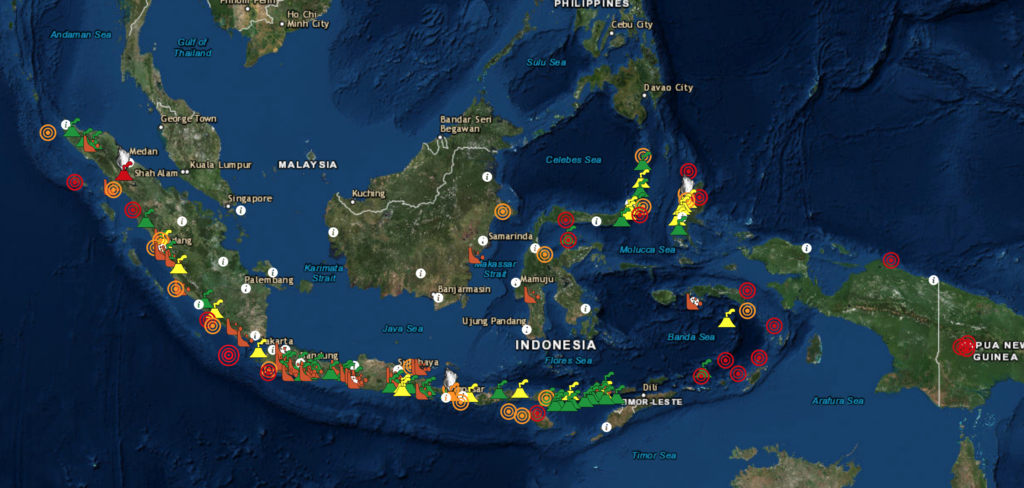
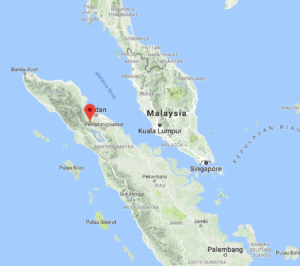
Mount Sinabung – located in Medan, Indonesia is also very active at the moment (last spewing ash on Friday April 6) and may disrupt air operations to Malaysia and Singapore.

Current Aviation Color Code: RED, Eruption with volcanic ash cloud at 09:07 UTC (16:07 local). Eruption and ash emission is continuing. Ash-cloud moving to west – south. Best estimate of ash-cloud top is around 23872 FT (7460 M) above sea level, may be higher than what can be observed clearly. Source of height data: ground observer.”

We will keep an eye on this one.

Mount Sinabung roared back to life in 2010 for the first time in 400 years. After another period of inactivity it erupted once more in 2013, and has remained highly active since.

If you have travelled through the region lately and can provide members with more of an update, please get in touch. 


What do you Sphinx about this new airport?

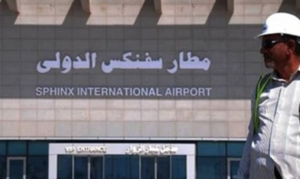
We love new airports … and we have a cool one tell you about in Giza, Egypt – known as Sphinx International Airport (SPX, HESX)!

It looks like it’s undergoing a “soft” opening of sorts. Word from handlers we have spoken to on the ground confirm it’s open for business (for the most part).

Here is the info we have so far:

  • ICAO code: HESX
  • IATA code: SPX
  • PCN: 87
  • Runway dimensions: 3650M x 60M
  • The airport is open from Sunrise to Sunset. No night lighting installed as yet.
  • There is no CIQ yet. But it’s coming soon – so it’s not an airport of entry presently.
  • Airport features a general and business aviation terminal, with its own dedicated CIQ unit. The VIP terminal and Royal Lounge are open. A complete fleet of GSE is in place.
  • Jet A1 Fuel is available via Misr Petroleum Company tankers. No Hydrant System yet.
  • Airport features 8 parking stands currently.
  • Most likely the airport will be slot coordinated preserving control on capacity until the new terminals launch.
  • Night stop parking is accepted with a requirement to re-position aircraft to parking bays after passengers disembark.

Some extra info from the local agent:

“The airport has already launched, but not in it’s full capacity as the contracted constructor is still finishing up the exteriors. In addition the check-in software has not been installed, meaning commercial schedule flights haven’t started yet. However the airport is accepting business and general aviation flights during opening hours and with pre-notification of 48 hours.”

Parking spots are well equipped and overnight parking is possible. The airport is only seeing a handful of movements at present and is not busy.
The airport is best suited for those wishing to visit Cairo West or Giza City with the expected launch of commercial flights on 30 June.

Have you landed there yet? Let us know if you have any updates.

p.s. Fun fact- The Great Sphinx of Giza when translated from Arabic to English means: The Terrifying One; literally: Father of Dread. So……Safe landings 😉

Extra Reading:

  • AD 2.HESX-v2 – AIP Information on HESX – Sphinx International Airport.


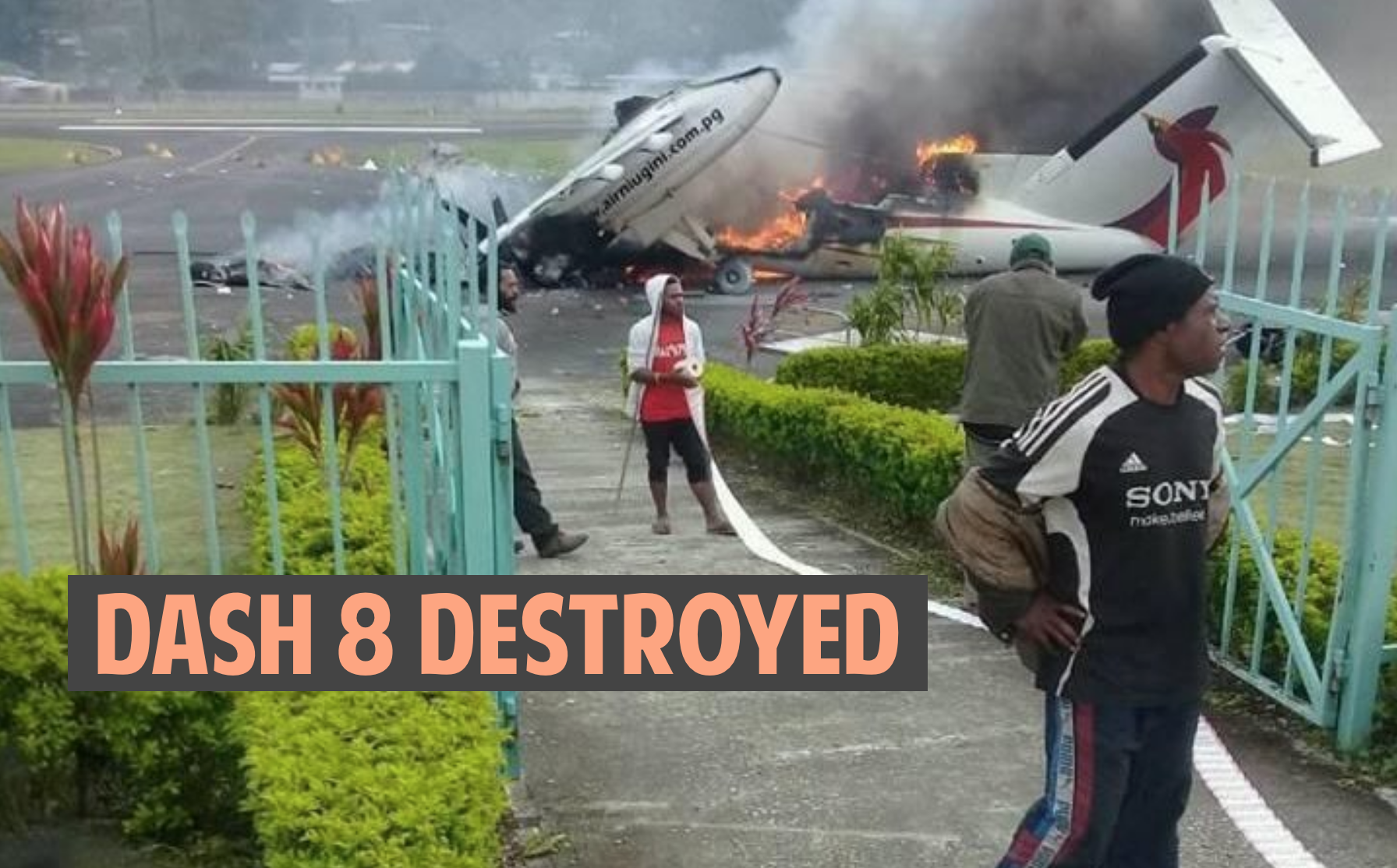
Dash 8 set on fire in Papua New Guinea, airport closed indefinitely

AYMN/Mendi has been closed indefinitely after protesters set fire to and destroyed an Air Niugini Dash 8 aircraft, which had just arrived from Port Moresby. The protest was in response to a court ruling confirming the election of the Southern Highlands governor William Powi.

Radio New Zealand reported:

“(Initially) the local police station commander Gideon Kauke had said police were guarding the aircraft to ensure there was no further damage, after its tyres had been flattened.

But he said his team of about ten police couldn’t contain a mob of uncountable numbers, particularly after missiles were thrown, forcing them to retreat; “we were guarding the plane but compared to them we were outnumbered and they came in all directions, all corners. Missiles were thrown, bush knives were thrown.”

Mr Kauke said some of the protestors, who continue to behave menacingly in Mendi as their numbers build up, were carrying guns. He said the protest was in response to a court ruling in Waigani confirming the election of the Southern Highlands governor William Powi.”

The Australian Department of Foreign Affairs is cautioning all to “reconsider your need to travel” to the regions affected by the unrest and to also “exercise a general degree of caution” for the whole of PNG.

The local NOTAM says it all.

A0773/18 – AD CLSD TO ALL ACFT OPS DUE CIVIL UNREST. 14 JUN 05:35 2018 UNTIL 13 JUL 06:00 2018 ESTIMATED. CREATED: 14 JUN 05:52 2018

Additional reporting indicates that the aircraft was shot at on landing, deflating the tyres.

Are you currently in PNG and can fill us in on more? Please comment below, or email us.


Escape from Teterboro .. FL400 or above

Skip the line up at Teterboro! The FAA has launched an initiative to allow some high-performance business aviation aircraft an escape route during SWAP events to mitigate delays at KTEB and KHPN. The goal is to offer flights that are filed to cruise at FL400 and above an exclusive route that would get them above the airline traffic. This route may add a few extra miles but will minimize ground delays.

As the FAA is required to test the route for ATC automation and familiarity, they are seeking pilots willing to participate in this test as early as this weekend, preferably in the morning, before traffic demand peaks. Aircraft participating in the test would be routed over GREKI and then on to westerly or southwesterly destinations.

If you’re willing to participate in the test this weekend, please at your earliest opportunity contact FAA Deputy Director System Operations, East-North Warren Strickland: warren.strickland@faa.gov

If you’re unable to participate in this weekend’s test, please advise Warren of other dates that may work for you.


Updated communication procedures for Hong Kong FIR

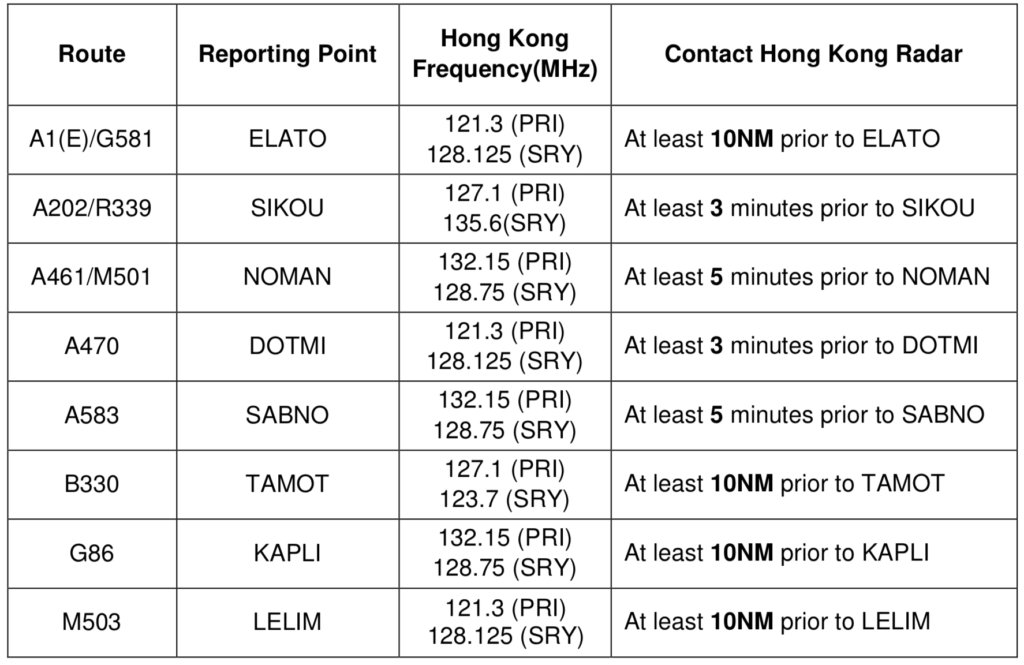
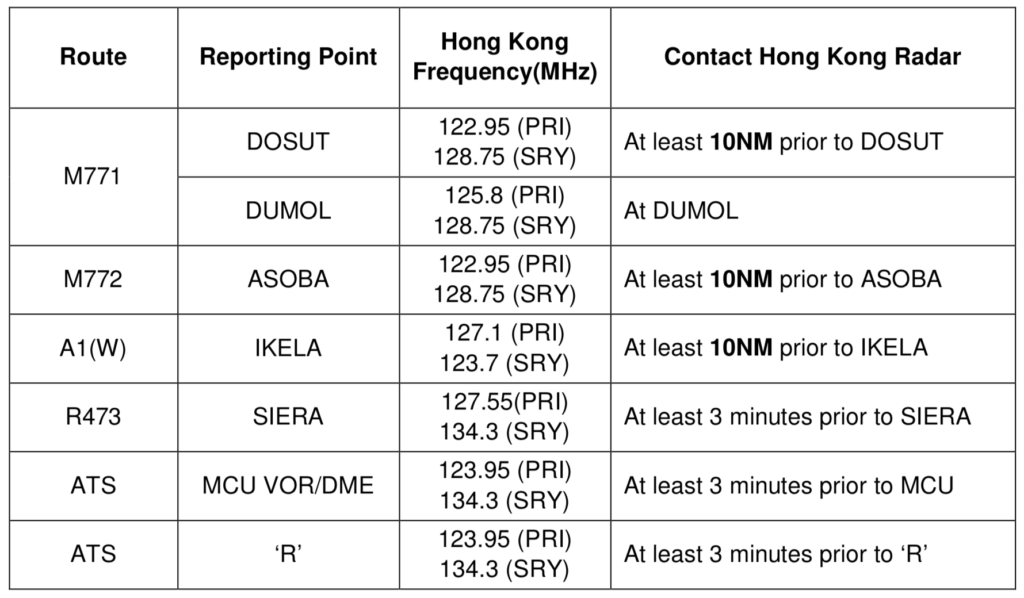
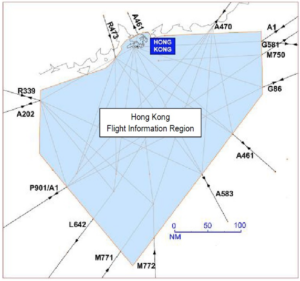
AIP SUP A09/18 details new communication procedures for air traffic entering the VHHK/Hong Kong FIR.

The key points:

  • Aircraft shall comply with the following communication requirements to obtain an air traffic control (ATC) clearance:
  • Pilot shall report the aircraft callsign, position (with reference to reporting point), level (including passing and cleared levels if not maintaining the cleared level), transponder code, and other pertinent information (e.g. speed assigned by last ATC, tracking if it differs from the flight plan route) in the initial call before entering Hong Kong FIR.
Also a small change: the requirement for pilots to report the estimate time exiting Hong Kong FIR on first contact with Hong Kong Radar as stipulated in AIP Hong Kong ENR 1.1 paragraph 2.2.4 will no longer be applicable and is hereby cancelled.


Don’t forget to file MACH number in NY Oceanic Airspace

KZWY/New York Oceanic FIR last month published a NOTAM requiring Flight Plans to be submitted with MACH crusing number, rather than TAS in Field 15A for the flight plan. So far, most operators are not doing this. But you should!

This includes flight departing TXKF/Bermuda.

A0178/18 – ALL ACFT ENTERING THE NEW YORK OCEANIC FIR (KZWY), INCLUDING THOSE DEPARTING BERMUDA (TXKF) , MUST FILE A MACH NUMBER INSTEAD OF A SPEED OF KNOTS IN THE EXPECTED CRUISE SPEED FIELD (FIELD 15A) OF THEIR FPL. 03 MAY 17:08 2018 UNTIL 31 MAR 23:59 2019. CREATED: 03 MAY 17:09 2018

Reports are that compliance so far has been low.

So why do it?

NY ARTCC tell us:

This minor adjustment enables the ATC computer system to effectively probe flight plans and proactively offer more favorable routes and/or reroutes.

Help ATC out! Thank you.


New 19-state Upper FIR planned for Africa

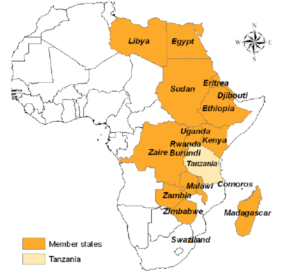
Africa has inched closer to achieving a broad Upper Area FIR  following the move by 19 regional states to adopt an airspace agreement at the end of May.

Ministers of Justice and the Attorney Generals from Common Market for Eastern and Southern Africa (Comesa) adopted the legal instrument on common airspace in Lusaka.

The regional airspace agreement aims at achieving a seamless upper airspace for the region which will lead to enhanced competition in air travel and efficiency.

Zambia Minister of Justice, Hon. Given Lubinda, who opened the May meeting said the COMESA seamless airspace programme will contribute to bringing down high costs.

“The draft legal instruments aimed at the implementation of the COMESA Seamless Airspace programme speak to this.”


Extra Reading:


Just about nowhere to land in London at night this summer

Jet noise! It seems that Londoners are sick of it. Corporate operators watch out; London basin airports of EGGW/Luton, EGSS/Stansted, EGKK/Gatwick, EGLL/Heathrow, EGKB/Biggin Hill, EGWU/Northolt, EGLF/Farnborough and EGTK/Oxford airports are now effectively closed or restricted for overnight flights.

EGGW/Luton is the biggest hit with a curfew this summer: from 1 June to 30 September, arrivals/departures will be prohibited between 23-7 local time each night.

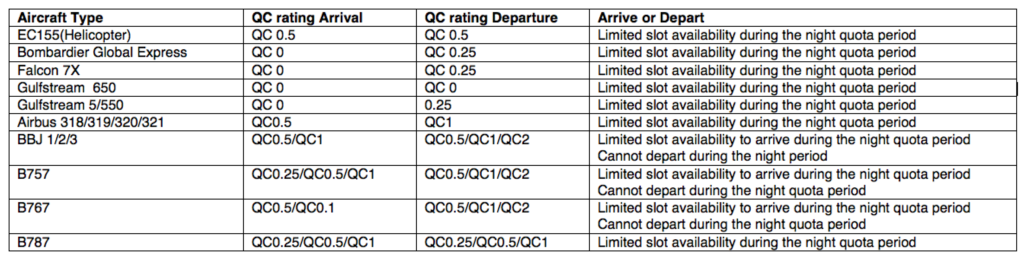
Over at EGSS/Stansted, where local authorities have already reduced the number of night-time slots for GA/BA to just 10 per week, new noise restrictions have also been introduced which mean that aircraft rated above QC1 are unlikely to receive slot approval at all during the night period:

Who’s to blame?

Local airlines, mainly the low-cost ones. Late arrivals have used up much of the cumulative noise footprint at both airports.

So, what’s left?
  • EGMC/Southend (40 miles away) & EGBB/Birmingham (115 miles away) are the only airports with no restrictions (thus far).
  • EGLL/Heathrow & EGGK/Gatwick: Pretty much a no-go zone for business aviation these days
  • EGLC/London City: closed from 1030pm to 0630am
  • EGWU/Northolt: closed from 8pm to 8am on weekdays
  • EGLF/Farnborough: closed from 10pm to 7am on weekdays
  • EGKB/Biggin Hill: closed from 11pm to 6.30am on weekdays, and 10pm to 8am on weekends
Who’s most affected?

Transatlantic crossings that plan to arrive in London late at night (after a morning departure from the US) or late-night London departures. Plan ahead and speak with your FBO so you don’t get stuck in a noisy bind.

Extra Reading:


Guatemala’s Fuego volcano disrupts ops

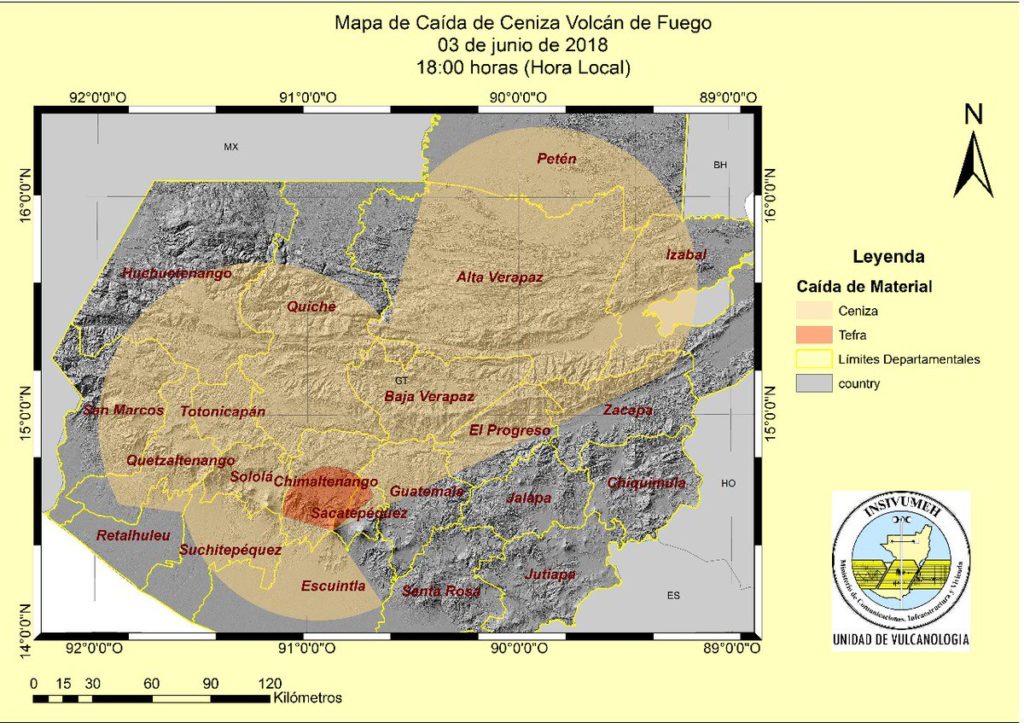
An eruption at Guatemala’s Fuego volcano on 3rd June resulted in the deaths of 25 people, and forced the temporary closure of MGGT/Guatemala City Airport. After the military cleared ash from the runway, the airport re-opened on 4th June, with the warning of delays due to ongoing runway inspections.

On June 3, Guatemala’s Institute for Vulcanology (INSIVUMEH) published a map showing the volcanic ash distribution (shown on the map as the area in orange, labelled ‘Ceniza’):

Further reading:


Have you met Norm? He’s learning what a Notam is.

Actually, he already knows.  He’s seen more than 2 billion of them, read through them, grouped the words, and in the same way that you or I would, learned what different Notams look like, mean, and what they are about.

What Norm has no idea about though, is how important any particular Notam is. Until he learns from the people that know, he won’t know the difference between grass-cutting times, and airport closure times, in terms of criticality to crews.

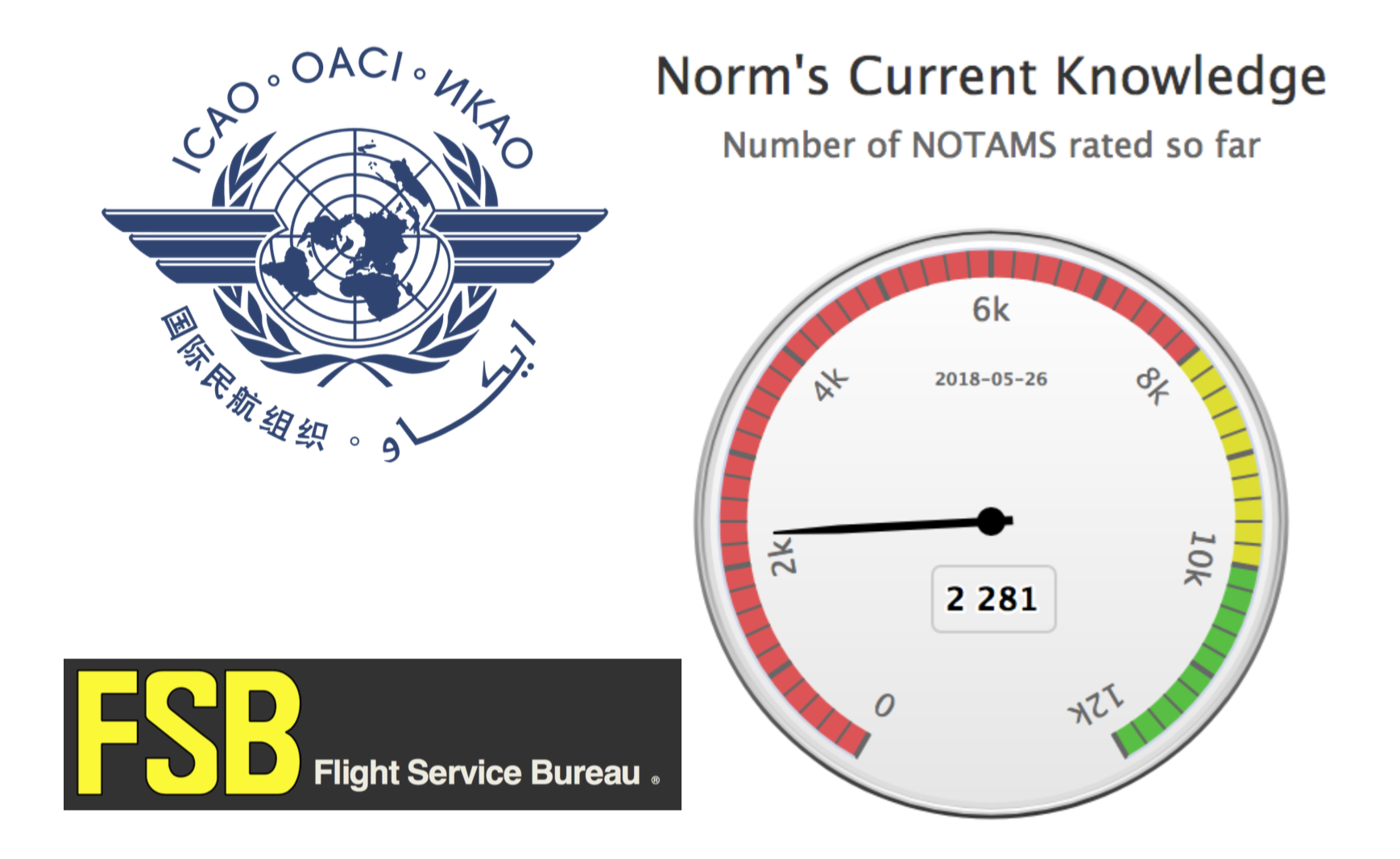
Norm (full name Norman the Notam Organizational and Recognition Model) is an Artificial Intelligence ‘bot’ being built by ICAO and FSB. Calling him a bot does him a disservice; he’s already much smarter than a bot, but needs more training.

Norm  has one job: identify critical NOTAMS and highlight them, so that crews and dispatchers don’t miss the important stuff.

For this, FSB needs human pilots and dispatchers to teach him what is critical and what is not. When presented with a new NOTAM, Norm can then give it a criticality rating. He needs a sample of at least 10,000 NOTAMS to become usable, and 20,000 to become smart.

FSB is using the power of OpsGroup to train him – a collective of 4,000 airlines, operators, pilots, and dispatchers that work together and share information on changes, operational challenges, security, risk, and …. fixing Notams.

There are over 30,000 NOTAMS out there at any moment in time. Some are critical, most are not. Norm will ensure that crews have the option of seeing only the critical ones first.


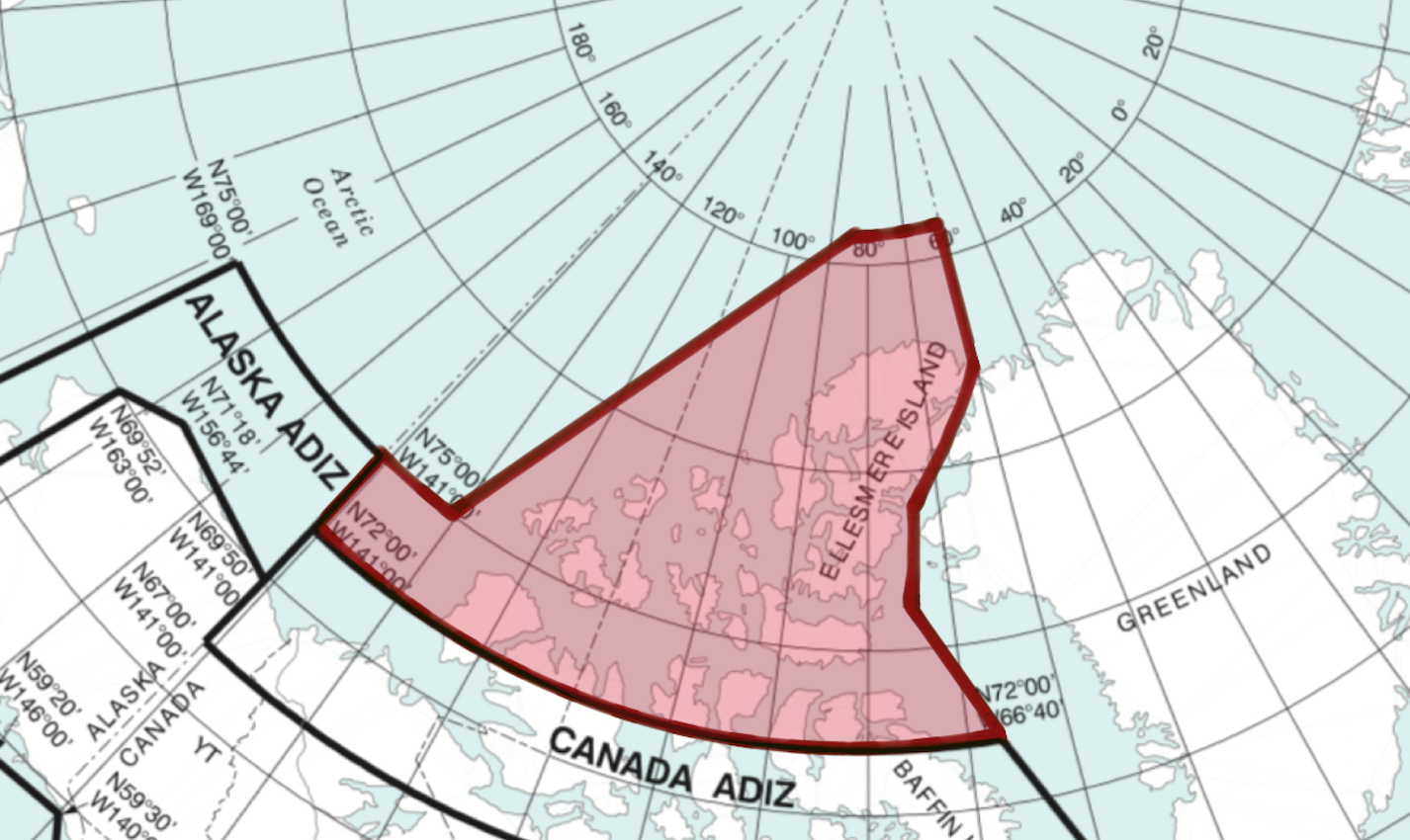
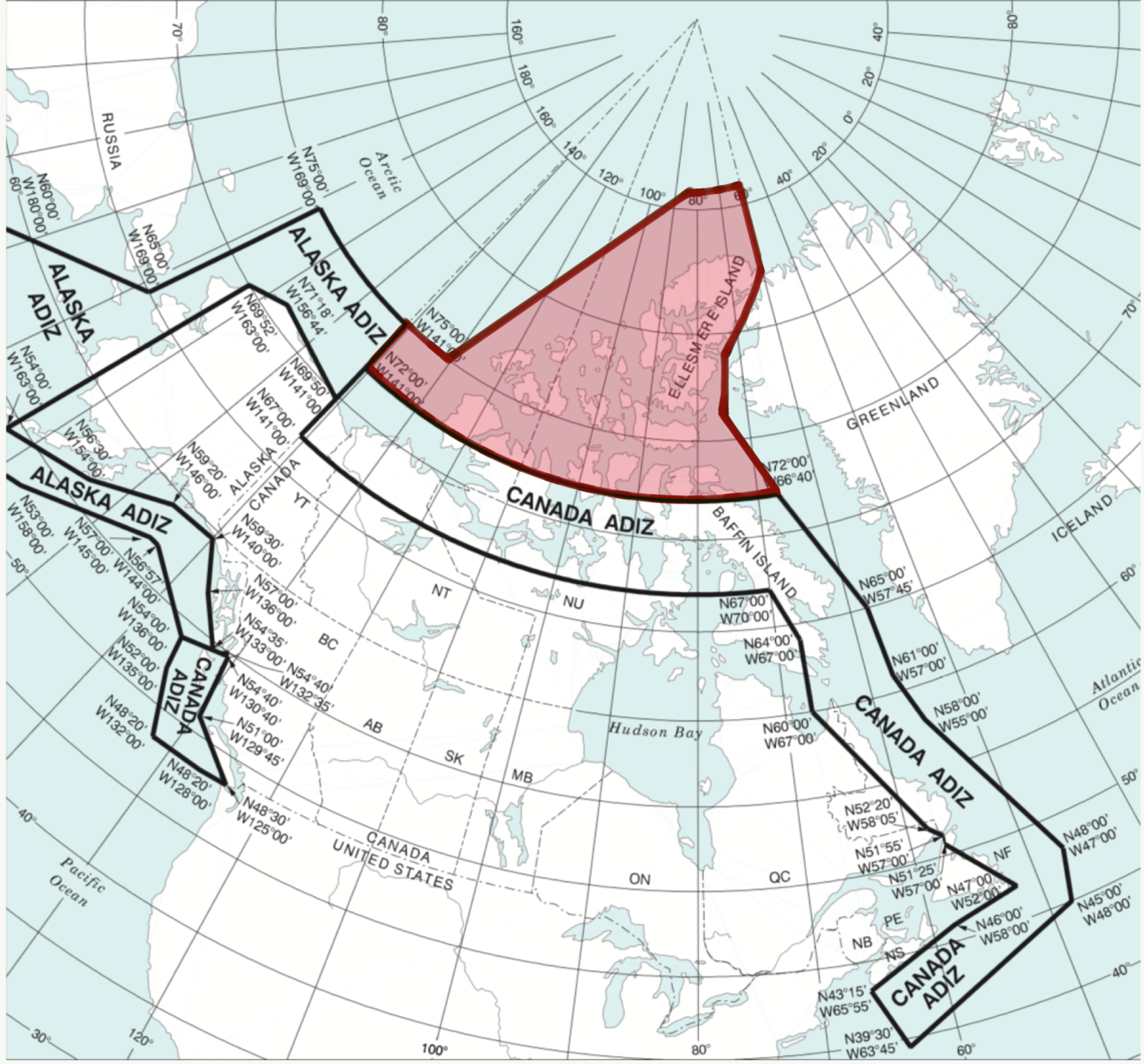
Expanded Canadian ADIZ

As of May 24, Canada has expanded its ADIZ to include all its national territory in the Arctic Archipelago.


Requirements for operations in the ADIZ remain the same. You’ll need a transponder with altitude reporting and a working two-way radio. Remember, you’ll need to include the time and location of ADIZ border crossing in your flight plans RMK section.

Full AIC 2/18 for the detailed lat/long of the expanded area here.


New CPDLC procedure on the NAT

There’ll soon be a new CPDLC procedure on the NAT, designed to prevent pilots from acting on any old CPDLC messages that might have been delayed in the network.

ICAO have published a new Bulletin for all the NAT Air Navigation Service Providers (ANSP’s) to use as a basis for implementing this new procedure. They recommend that all aircraft should receive a message immediately after they enter each control area telling them to “SET MAX UPLINK DELAY VALUE” to a certain number of seconds. The idea is that this will prompt the pilot to enter the specified latency value into the aircraft avionics, so that it will ignore/reject any old CPDLC messages.

So far, only Iceland’s BIRD/Reykjavik FIR have implemented this procedure, effective May 24. All other sectors of NAT airspace (Gander, Shanwick, Bodo, Santa Maria, New York Oceanic) are busy writing their own AIC’s and will implement later in the year. 

So when entering the BIRD/Reykjavik FIR, expect to receive a CPDLC message from ATC instructing you to “SET MAX UPLINK DELAY VALUE TO 300 SECONDS”. A copy of their AIC with more guidance can be found here.

The latency monitor function varies from one aircraft type to another: some just automatically reject old CPDLC messages, some will display a warning to the pilot that the message has been delayed, some have deficient equipment, and some do not have the message latency monitor function implemented at all.

Because of this, ICAO note that “it is impossible for ATC to tailor the uplink of the message… to different aircraft types. It has therefore been decided among the NAT Air Navigation Service Providers (ANSPs) to uplink this message to all CPDLC connected aircraft immediately after they enter each control area. An aircraft may therefore receive this message multiple times during a flight.”

So here’s the lowdown on what you need to do:

1. Work out in advance what kind of message latency monitor function your aircraft has, and what it is designed to do when it receives the CPDLC message “SET MAX UPLINK TIMER VALUE TO XXX SECONDS”.

2. When you receive this message, respond with the voice message “ACCEPT” or “ROGER”. If your aircraft has a functioning message latency monitor, punch in the specified number of seconds. If you don’t have functioning equipment, respond with the free text message “TIMER NOT AVAILABLE”.

3. If anything goes wrong, revert to voice comms.

Back in November 2017, we reported on an equipment issue with Iridium satcom that prompted a ban by a number of Oceanic ATC agencies. Some aircraft were receiving massively delayed clearances sent by ATC via CPDLC – and one took the instruction and climbed 1000 feet, even though the message was meant for the flight the aircraft operated previously.

Although the bans were dropped after Iridium fixed the problem at ground level (by ensuring the system no longer queued CPDLC uplinks for more than five minutes), this new CPDLC procedure on the NAT should ensure this kind of situation doesn’t happen again. It’s officially being brought in as one of the safety requirements for the roll-out of reduced lateral and longitudinal separation minima across the NAT, which is predicated on Performance Based Communication and Surveillance (PBCS) specifications – that means having CPDLC capable of RCP240 (4 minute comms loop), and ADS-C capable of RSP180 (3 minute position reporting).

Further reading:
ICAO NAT Bulletin 2018_002: CPDLC Uplink Message Latency Monitor
Iceland’s AIC on the new CPDLC procedure for the BIRD/Reykjavik FIR
– The latest PBCS rumours and facts
The latest NAT changes, including EGGX/Shanwick, CZQX/Gander, BIRD/Iceland, ENOB/Bodo, LPPO/Santa Maria, and KZWY/New York Oceanic East.
IRIDIUM satcom fault fixed