Additional ATS Surveillance Charges in Shanwick

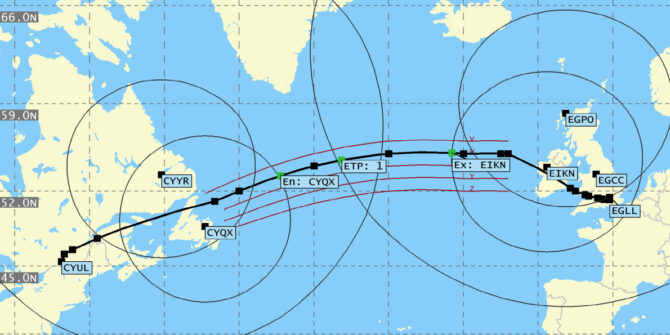
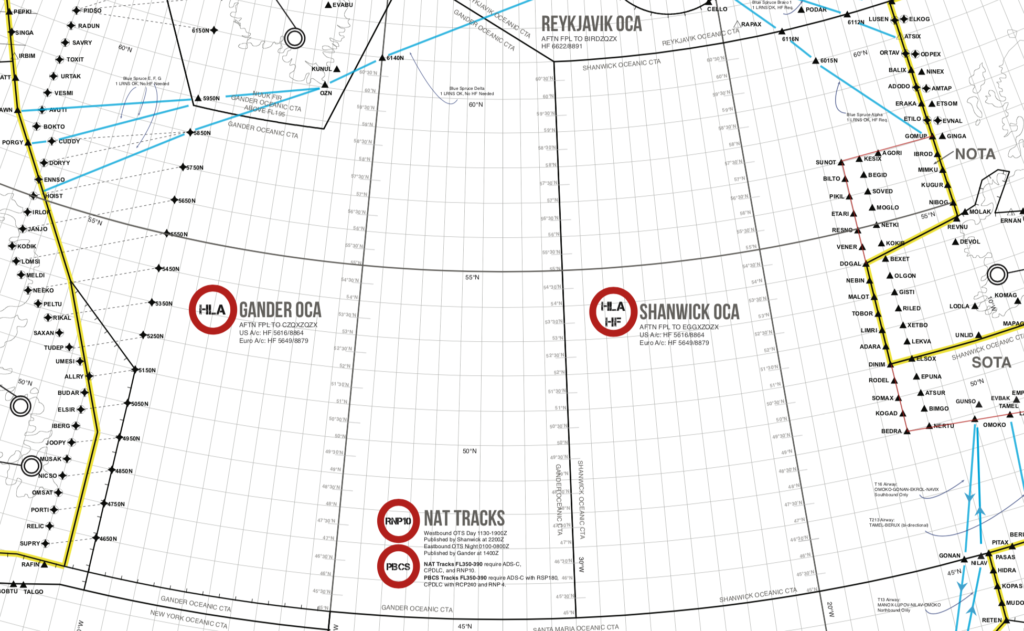
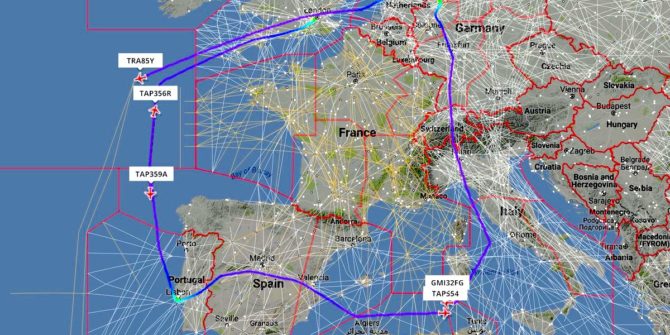
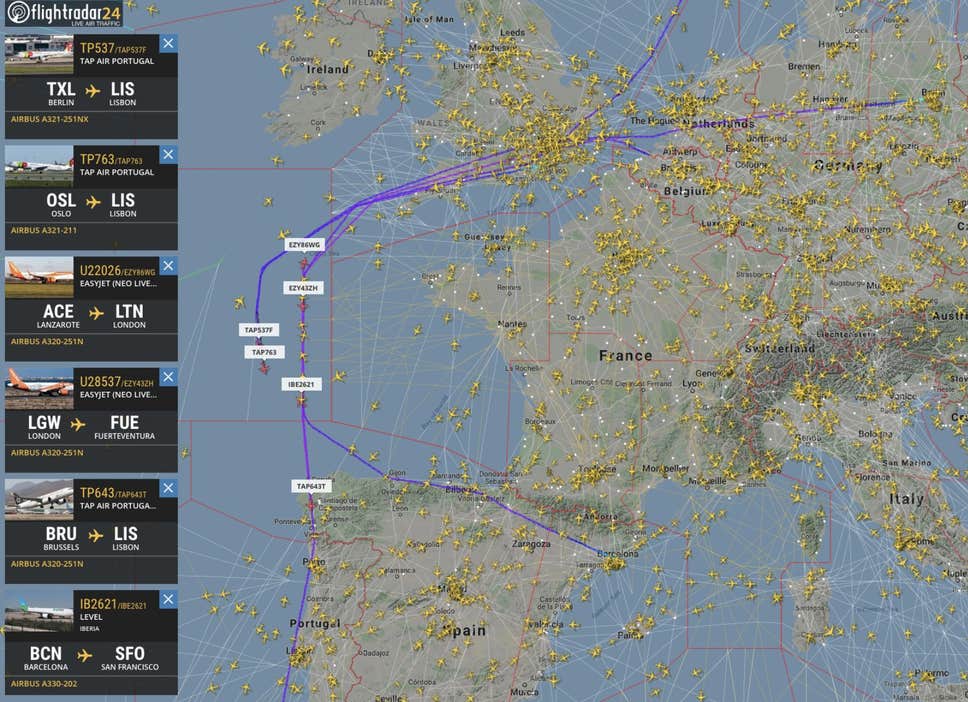
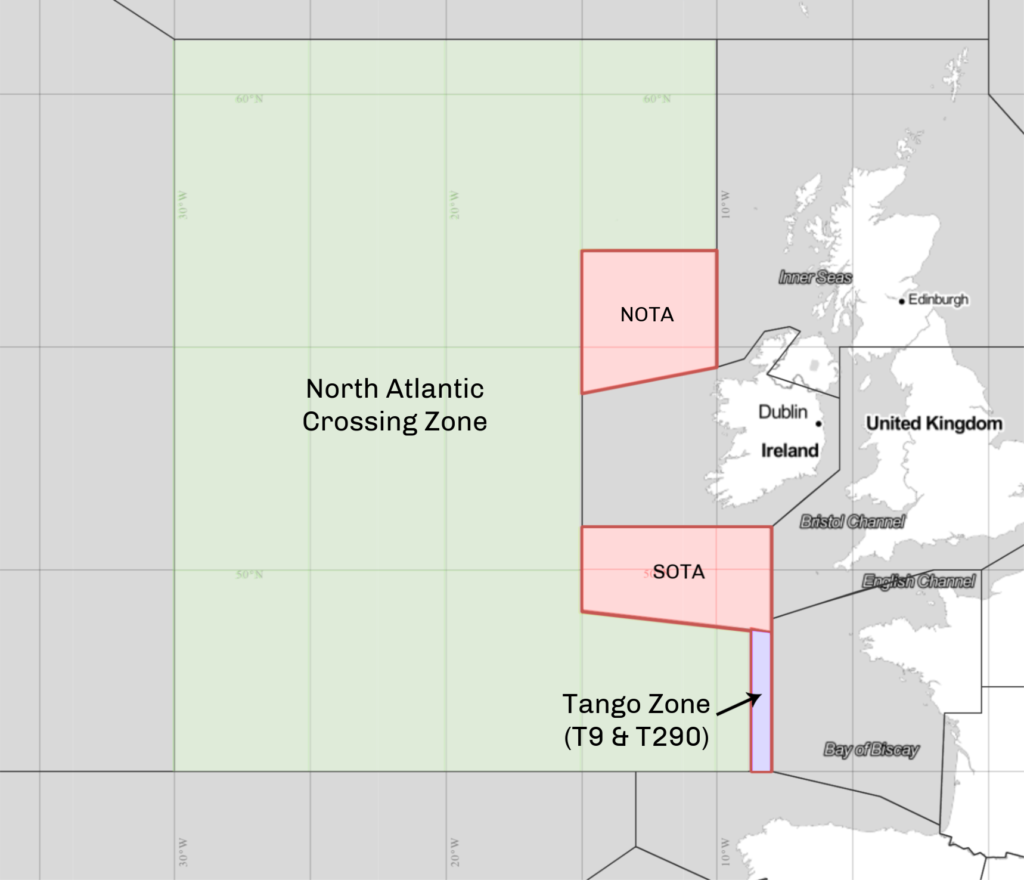
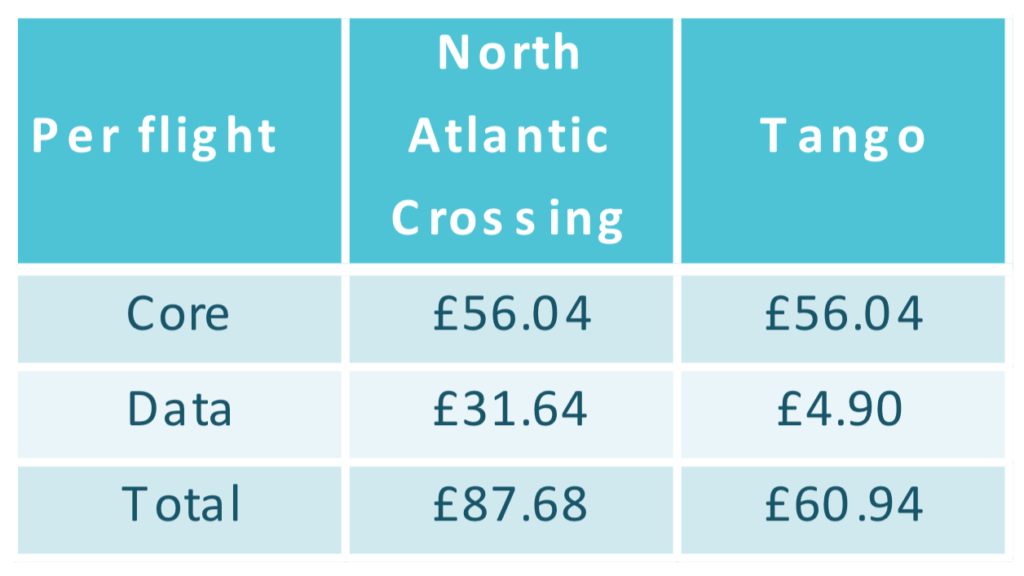
As ATS services are now mandated through most of the North Atlantic Oceanic airspace, NATS has introduced increased and additional charges for ATS surveillance. These charges are to recover the costs of ADS-B usage in the Shanwick Oceanic ATC coverage area.

There are 2 different charging zones:

  1. North Atlantic Crossing Zone: comprises the Shanwick FIR/OCA. Any traffic that touches its boundaries or operates to/from or through it are to be charged a NAC zone fee UNLESS it is operating solely within separate airspace jurisdictions (i.e. BOTA, NOTA, SOTA, etc.) or operating within the newly designated “Tango Zone” area, which is the second charging zone.
  2. Tango Zone: a smaller, defined area of airspace within the Southeast corner of the oceanic airspace surrounding ATS routes T9 and T290 (does not include the more westerly Tango Routes T16, T13, and T213 – these fall within the North Atlantic Crossing Zone!)

There are 2 different charges:

  1. Core” charge: one standard charge that remains the same in each zone.
  2. Data” charge: covers ATS surveillance data usage and changes within each zone reflecting the differing costs of satellite data.

If operating through BOTH the Tango and NAC areas, flights will only be charged the NAC area fee.

Charges will NOT vary by time, weight or distance flown.

You can check out the full briefing to airlines issued by NATS here.


Read about the changes coming up for the Tango Routes on Jan 30, 2020 – the same date that the expanded NAT Datalink Mandate goes into effect.


Risk assessing Iran ops – the UIA 737 may have been shot down

Special Update Thursday 09JAN: Members, please see either your email or this post in the Members forum, for a special briefing and update.

08JAN: Iran/Iraq Information page activated with latest information.

The cause of the crash of Ukraine International Airlines (UIA) AUI/PS752 on departure from Tehran is not yet determined, and given political circumstances, may not be clarified beyond reasonable doubt anytime soon.

Purely from the perspective of making a risk assessment for operations to Tehran, and Iran in general, however, we would recommend the starting assumption to be that this was a shootdown event, similar to MH17 – until there is clear evidence to the contrary.

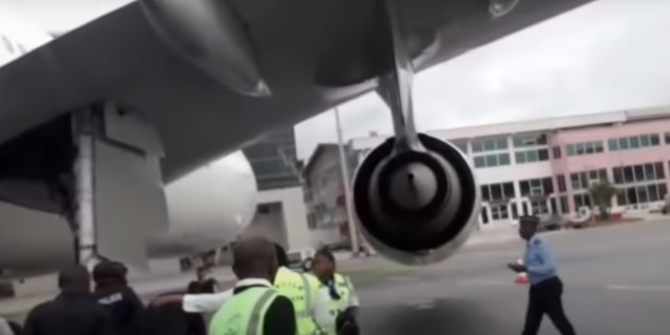
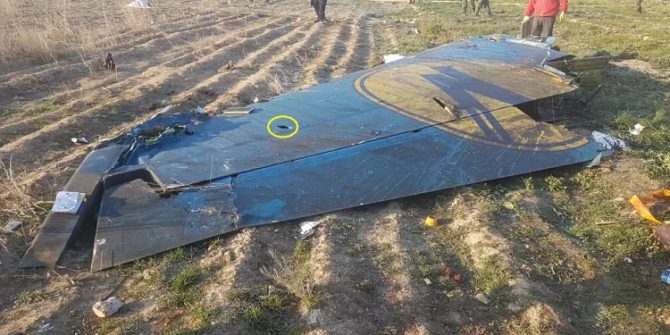
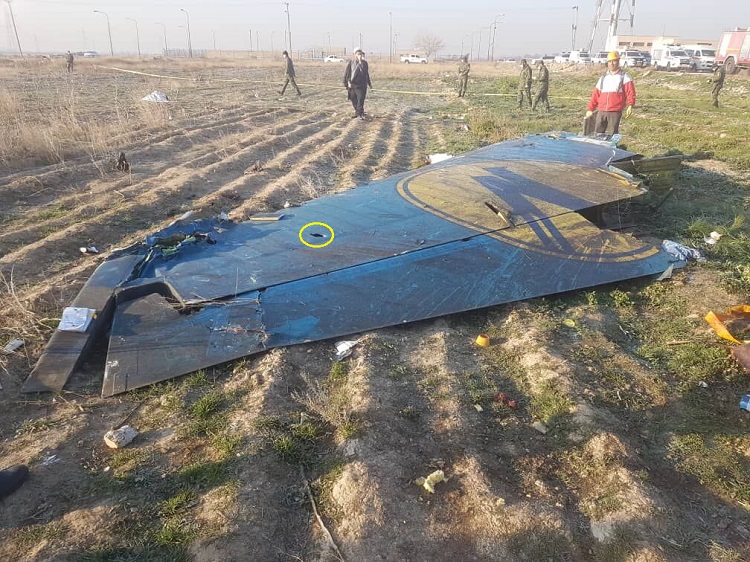
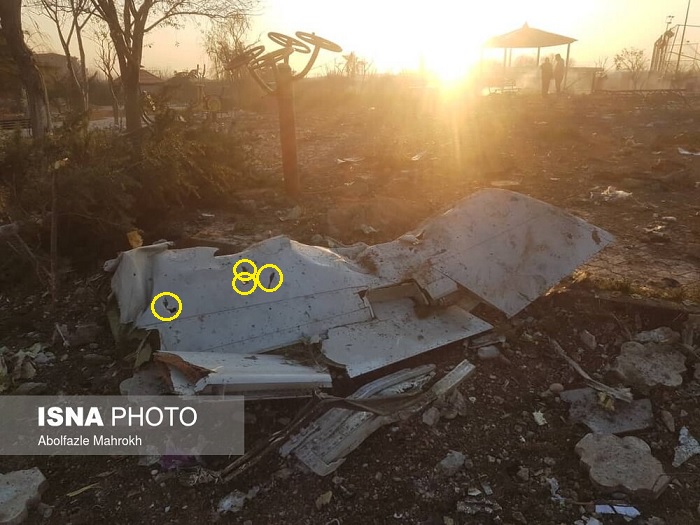
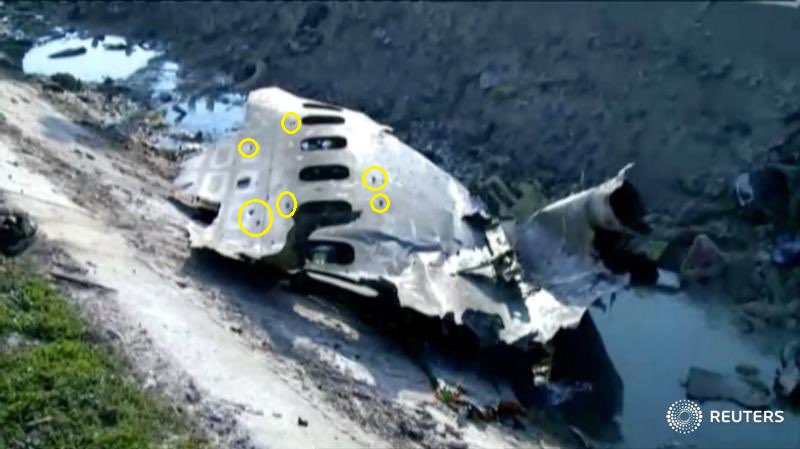
Images seen by OPSGROUP, shown below, show obvious projectile holes in the fuselage and a wing section. Whether that projectile was an engine part, or a missile fragment is still conjecture, but in making a decision as to whether to operate to Iran, erring on the side of caution would dictate that you do not, until there is clear information as to the cause.

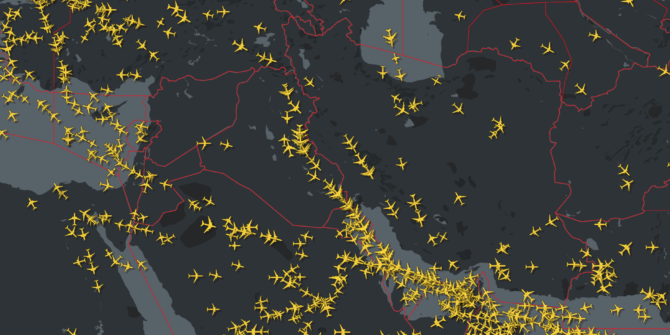
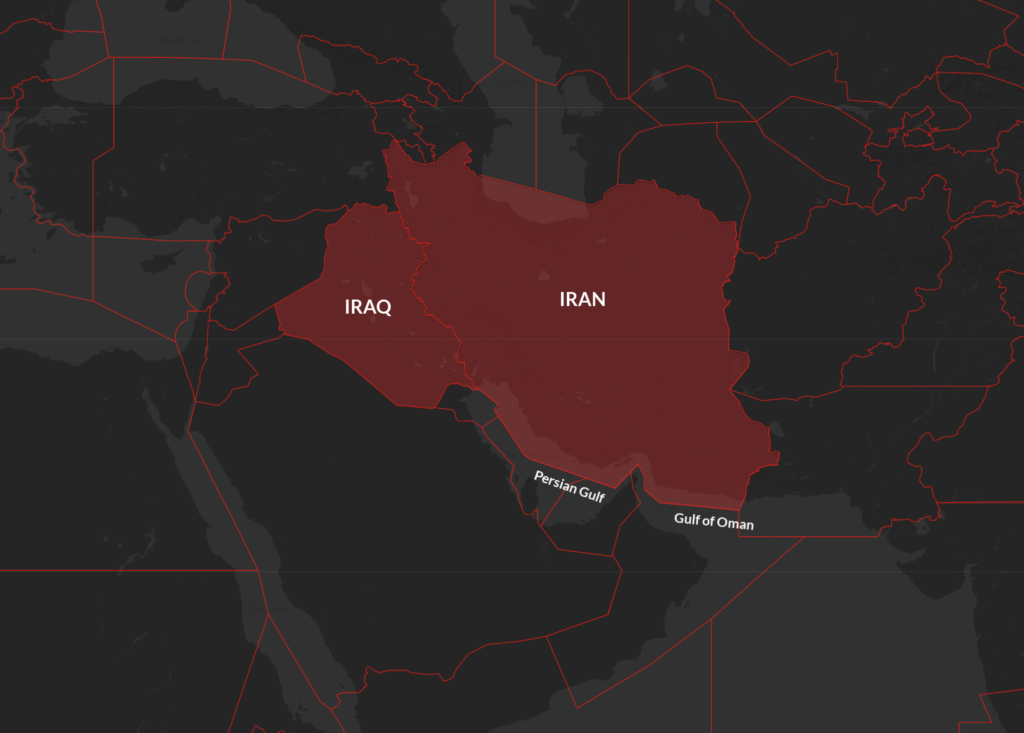
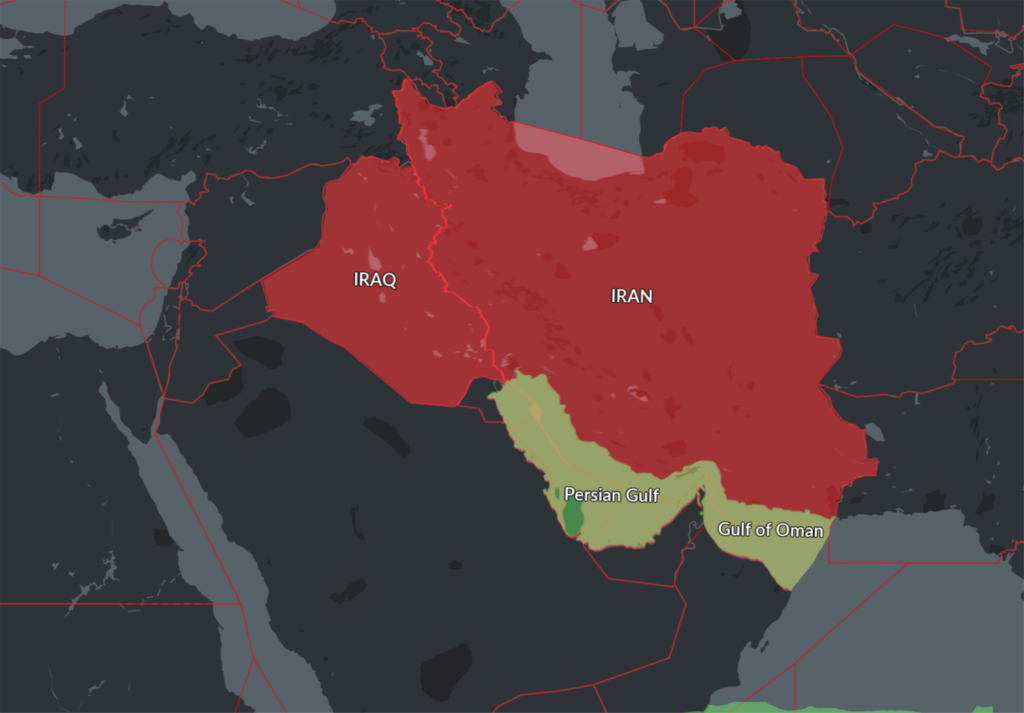
Obviously, there is also the wider regional risk as indicated through the US FAA Notams issued late Tuesday night. US operators are covered by these clear and specific Notams – do not operate to Iran, or Iraq, or operate in the Persian/Oman Gulf area.

Other operators are free to make their own judgement, but should note that a majority of non-US international carriers have elected to avoid both countries for the time being.

See also:

  • OPSGROUP Article: FAA Bans Flights Over Iraq And Iran Following Missile Strike On US Base
  • OPSGROUP Article: Germany publishes new concerns for Iraq overflights


Images from ISNA, Reuters; marking of projectile areas from JACDEC.


ADS-B Mandates Around The World!

ADS-B has come to the US and many parts of the world. What do you need to know?

Firstly, what is ADS-B? Automatic Dependent Surveillance-Broadcast uses the aircraft’s GPS position information and provides it to the mode S transponder allowing ATC to track the aircraft more accurately than radar does.

As of January 1, 2020, all aircraft operating within most US airspace are required to transmit certain information using ADS−B OUT avionics.

Briefly, ADS-B OUT transmits information from the aircraft to ground stations or satellites whereas as ADS-B IN avionics receives information from ground stations or satellite based systems.

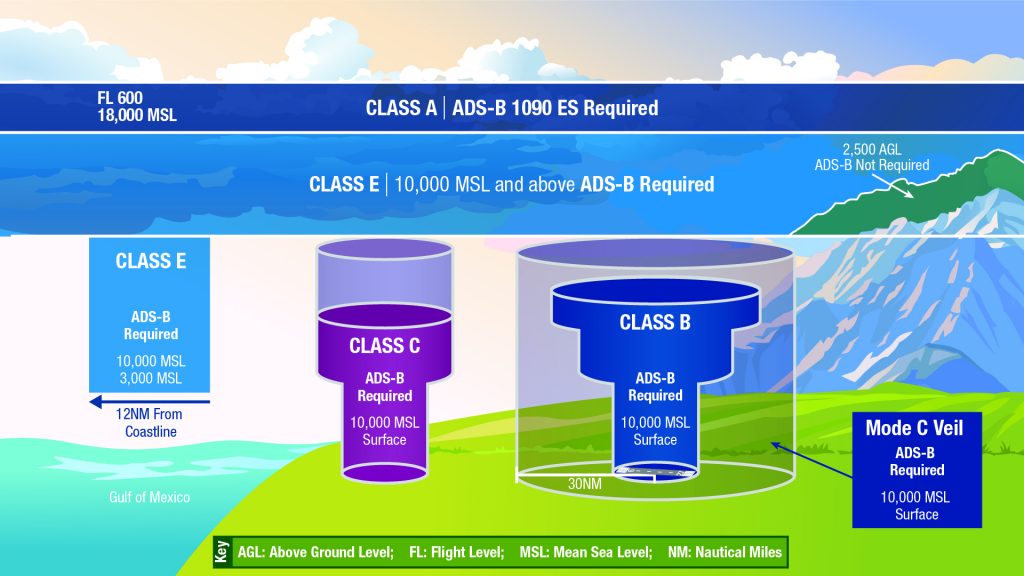
The ADS-B required airspace in the US includes everywhere Mode C is required AND:

  • Class A, B and C airspace, Class E at or above 10,000’ MSL (but not below 2,500’ AGL).
  • Within 30nm of Class B (Mode C veil).
  • Above the ceiling and within lateral boundaries of Class B and C up to 10,000’.
  • Class E over Gulf of Mexico, at and above 3000’ MSL within 12 nm of US coast. The non-contiguous US is also included: Hawaii, Guam, Puerto Rico and Alaska.

Also, according to the US AIM, operators flying at 18,000 feet and above will require equipment which uses 1090 ES (extended squitter). Those that do not fly above 18,000 may use either UAT (Universal Access Transceiver) or 1090ES equipment. For international operations 1090ES is by far the most accepted system.

Here’s the operational stuff…

For the most part you may notice very little change from radar controlled airspace and there may be no ADS-B specific controls in your cockpit.

During flight you may encounter ADS-B specific phraseology. Instead of the word ‘radar’ you may hear ‘surveillance’ as in ‘Surveillance service is terminated’. Another example would be ‘Pressure altitude is invalid’ instead of the previous ‘Mode Charlie is invalid’.

Failures may be dealt with differently depending upon avionics installations so check your manuals for any specific procedures. One example is if your left side GPS fails and you are using your number 1 transponder then ADS-B may loose data input therefore select transponder number 2 to continue ADS-B data transmission. There may be no indication of the ADS-B failure in the cockpit.

In the US, the operator is required to fly a route that has ADS-B service availability so the FAA has provided an ADS-B Service Availability Prediction Tool (SAPT) which should be used not more than 24 hours prior to the planned departure to ensure the planned route has ADS-B coverage. If there is an ADS-B outage along your planned route you must plan another route. Make sure your flight planning provider is doing this!

Flight planning codes are important as this is the only way that ATC knows you are properly equipped and authorized. The FAA’s InFO 15015 has good information on filing correctly. There are numerous codes for ADS-B equipment based on your specific installation of 1090MHz ES, UAT and/or VDL mode 4.

The FAA encourages the reporting of ADS-B surveillance malfunctions (AIM 4-5-7 f.). You can do this by phone or radio to the nearest Flight Service Station.

What if I don’t have ADS-B installed right now?

If you still don’t have ADS-B, your options aren’t great. The FAA spells it out in the Federal Register, but simply put, you must receive authorization from ATC to fly before every flight that is planned in ADS-B required airspace.

To do that, you have to use the new ADS-B Deviation Authorization Preflight Tool (ADAPT) that the FAA has developed – which allows you to request authorisation to fly from ATC. Do this online, at least one hour but not more than 24 hours before your flight. AOPA give this advice: “Don’t call the ATC facility to ask, and don’t request access from a controller over the radio – the answer will be no. Only if your ADS-B Out hardware fails in flight will controllers be able to issue an airspace authorization to an airborne aircraft.”

The word from the NBAA is that there is no planned relaxation of the ADS-B rules, so operators who have not equipped will be at the mercy of ATC for every single flight planned through ADS-B airspace. ATC might not be able to grant authorizations for a variety of reasons, including workload, runway configurations, air traffic flows, and weather conditions.

What are the ADS-B rules in the rest of the world?

ADS-B usage is expanding in many countries at different rates. We have compiled a list below of countries and requirements.

Mandates now in effect…

Australia: Requires ADS-B for operations at or above Flight Level 290. Foreign aircraft can operate without ADS-B below FL290 until June 2020. Check AC 21-45 for more info.

Hong Kong: The AIP GEN 1.5.3 states: All aircraft flying within Hong Kong FIR at or above F290 shall be installed with ADS-B. This requirement has been in place since December 2014!

Taiwan: In Jan 2020, ADS-B became mandatory for all aircraft operating within the Taipei FIR, at or above FL 290. Check our article for more info.

Vietnam: Since July 2018, Vietnam has required aircraft over MTOW 15,000kg to have ADS-B. But from 1st Jan 2020, this limit was brought down to apply to all aircraft over 5,700kg. Aircraft without ADS-B can still operate through Vietnam’s airspace, but are restricted to the lower levels. AIC 08/16 has all the details.

India: The ADS-B mandate across Indian airspace outlined in AIP SUP 148/2018 was due to take effect on 1st Jan 2019, has got delayed to 1st Jan 2020 (as advised by Notam). This AIP supplement states that all aircraft flying on PBN Routes pretty much everywhere in Indian continental airspace at or above FL290 must carry serviceable 1090 MHz ES ADS-B transmitting equipment that has been certified as meeting the requirements.

United Arab Emirates: AIC 13/2019 published in Nov 2019 says “Operators are made aware that ADS-B OUT will be mandated from 01 January 2020 within UAE airspace.” That means you need ADS-B everywhere, at all flight levels!

Malaysia: As per AIC 03/2017, from 31 December 2019 you need ADS-B to be able to operate on airways N571, P628, L510, P627, L645 and P574 between FL 290 to FL 410.

Singapore: Since May 2018, ADS-B has been required for ops at or above FL290 on airways L642, L644, M753, M771, M904, N891, N892, Q801, Q802, Q803 and T611. Check the AIP ENR 1.8 Section 7 for details.

Indonesia: Since the start of Jan 2018, all aircraft flying in Indonesian airspace at or above FL290 needed to be equipped with ADS-B. Check our article for more info.

French Polynesia/Tahiti: The AIC PAC-P A 06/19 says that from 1 January 2019, aircraft flying above flight level 195 need ADS-B. Then from 1 January 2022, this will be required for all flight levels!

Upcoming mandates…

Europe: ADS-B will be required after 7 June 2020 for aircraft over 5700kg and flying faster than 250 knots and on an IFR flight plan. There will be some exemptions for older aircraft in Europe. Check this EASA doc for more info.

Seychelles: From 7 June 2020, you’ll need ADS-B to fly through the FSSS/Seychelles FIR. AIC 1/2019 applies.

New Zealand: The CAA proposed rule change would make ADS-B mandatory for all aircraft in controlled airspace below Flight Level 245 from 31 Dec 2021.

Saudi Arabia: ADS-B will be required in Class A and B airspace starting 1 Jan 2021. The way they’ve published this is confusing: the requirements are laid out in this GACAR Part 91 document, backed up by this Notam issued for the OEJD/Jeddah FIR:
A1871/19 – ADS-B OUT REQUIREMENT ENFORCEMENT DATE IN CLASS A AND B AIRSPACE AS PER GACAR PART 91.303 IN KINGDOM OF SAUDI ARABIA HAD BEEN CHANGED TO 1 JANUARY 2021 INSTEAD OF 1 JANUARY 2020. 31 DEC 19:15 2019 UNTIL PERM. CREATED: 31 DEC 19:30 2019

Mongolia: This one straight from the AIP SUP: From 17 June 2021 at 0000 UTC, all aircraft flying within the airspace of Mongolia above flight level 6150m must carry serviceable ADS-B transmitting equipment (Mode S Transponder and GNSS source position)… Whilst aircraft flying below flight level 6150m, the carriage of ADS-B equipment remain optional.

Mexico: A Circular issued by the Mexican CAA in Dec 2019 advises that the ADS-B requirement over airspace of Mexico has been delayed until 1 Jan 2022.

South Africa: The plan was to mandate ADS-B at or above FL290 from April 2020, but they have recently issued a draft AIC that says this will be delayed to 15 June 2023.

Canada: In Nov 2019, Nav Canada announced it was delaying its 2021 ADS-B mandate. No new date has been set yet. So although ADS-B will be used for surveillance in Class A airspace (i.e. above FL180) from 25 Feb 2021 onwards, it won’t be mandatory for aircraft to be equipped.

Sri Lanka: Not mandated yet, but something’s in the pipeline. The CAA states on their website: “This is to inform all aircraft operators operating in Sri Lanka airspace (Colombo FIR) that ADS-B trial operations have been commenced and in the near future it will be fully operational covering the entire Sri Lanka sovereign airspace and extending the surveillance coverage of Colombo FIR further.”

Any countries we missed? Let us know!


New route requirements for Iceland

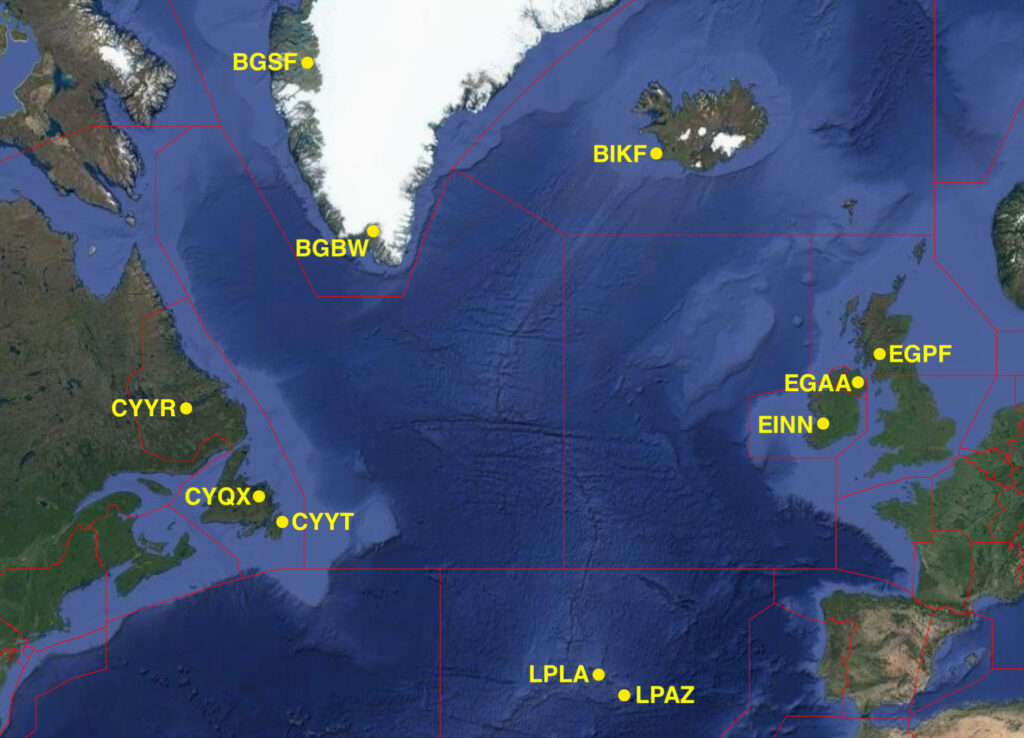
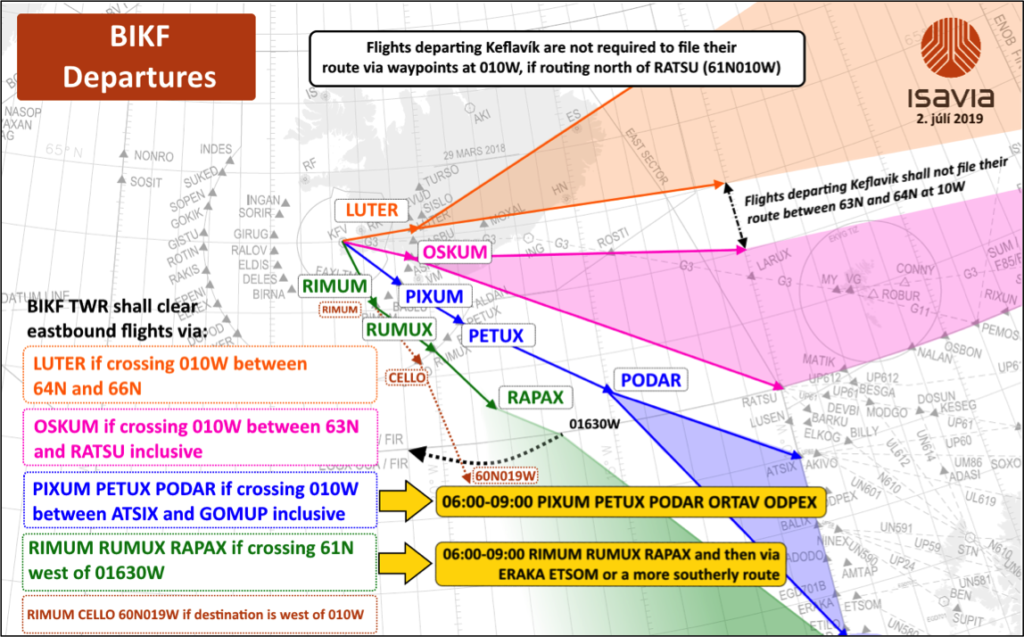
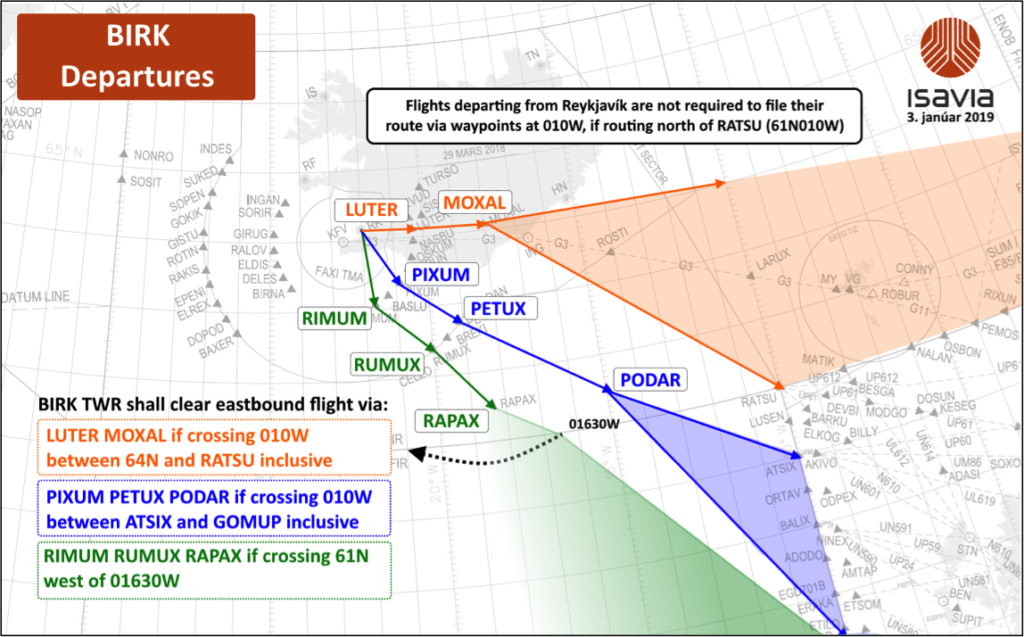
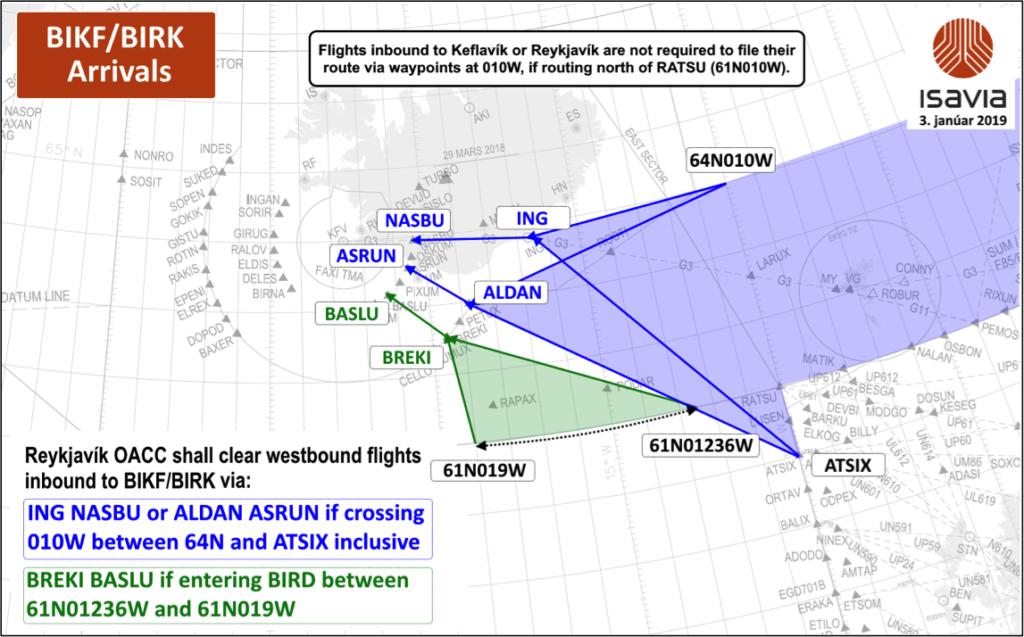
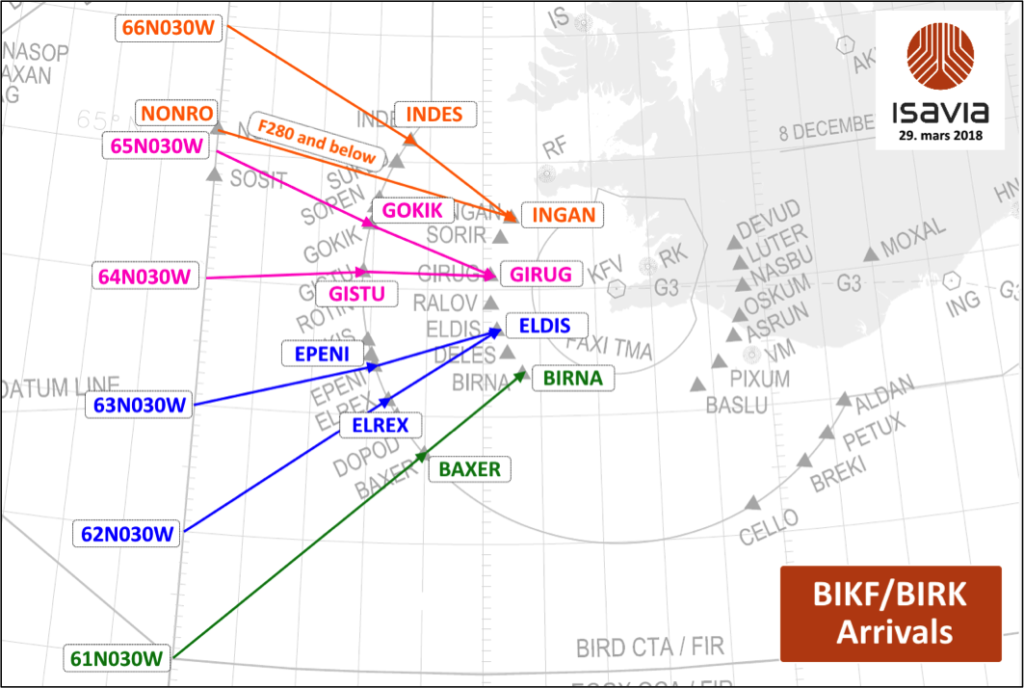
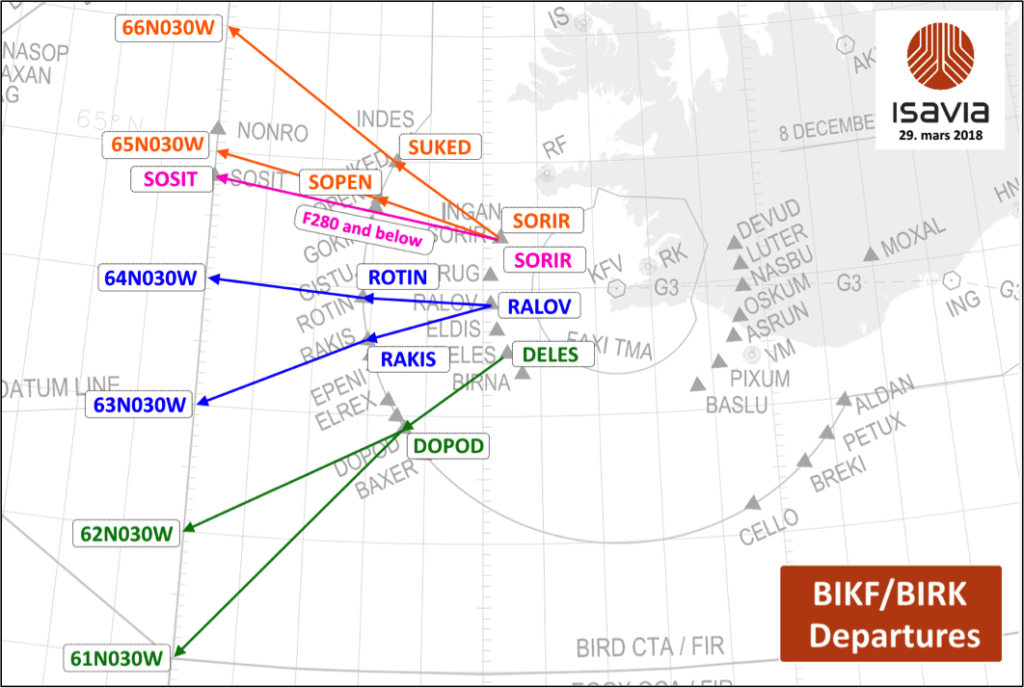
There are some new route requirements for flights to BIKF/Keflavik and BIRK/Reykjavik. 

These can be found in the updated version of AIP ENR 1.8.4.1.3.7 which explains exactly how you should file your flight plans to/from both BIKF and BIRK. But to make all this blurb easier to understand, the good folks at Isavia have published some handy graphic presentations of the requirements:

If you follow the guidance and flight plan accordingly, you should avoid any nasty last-minute “FPL REJ” messages!

Further reading:

  • You can check the full Iceland AIP online here.
  • For a summary of all the NAT changes, including EGGX/Shanwick, CZQX/Gander, BIRD/Iceland, ENOB/Bodo, LPPO/Santa Maria, and KZWY/New York Oceanic East, click here.


A review of aviation in Hurricane Dorian relief efforts

The response to Hurricane Dorian was overwhelming – likely the single greatest aviation response to a natural disaster in history. Without these flights, supplies and relief would not have reached so many, so quickly.

And yet, there are many lessons to learn. We saw a lot of things that went right, and a lot of things that went wrong. And we’d like to ensure that we have a full picture of events so that we can learn those lessons. We’ll share the review with you, just tick the box on the survey.

Hence, this little survey. It’s anonymous. Just say what you saw. About 10 questions – 5 minutes of your time. To jog your memory of what happened, have a look at our Operational Summary from those first days of the relief efforts.

We would especially like input from:

  • NGO’s and relief organizations involved in Dorian (whether aviation focused or not)
  • Pilots that flew during Dorian
  • Flight ops people – ATC, Dispatch, Coordinator, Scheduler
  • Aircraft operators (Civil/Mil/Govt)
  • Anyone that was part of the aviation response

Thank you for your help! With a better process, we can save lives and get relief flowing more quickly in future disasters.

Answer the survey below, or open in a new window. When you’re done, please share the link to this page!


New rules for charter flights to Malaysia

Foreign operators doing charter flights to Malaysia now need to obtain a “Foreign Air Operator Certificate” (FAOC) to be able to get a landing permit, and this needs to be requested 90 days in advance!

This new requirement was introduced earlier this year with AIC 3/2019, but authorities have only recently started implementing it.

Private flights are not affected. The process for these remains the same as before – apply a week in advance, either direct to the authorities at airtransport@dca.gov.my, or through a third party agent (recommended!). Local agents have said that Air Ambulance / Medevac flights do not need to obtain an FAOC either.

But for charter flights, the new requirement looks like a real pain. Here’s how it works… (thank you Julie at ASA Group for helping with this info!)

1. Application needs to be sent 90 DAYS prior to the intended first trip into/out of Malaysia. The following documents need to be submitted:
– Completed FAOC Matrix form (see links below).
– Carriers liability insurance.
– If aircraft is leased, approval of civil aviation authorities of the State of the Operator of the lessee, with identification of the operator that exercises operational control on the aircraft.
– Document authorizing the specific traffic rights, issued by appropriate department or resulting from a bilateral air transport agreement (and any other document the CAAM considers necessary to ensure that the intended operations will be conducted safely).
– Letter of appointment on behalf of the operator to say that their chosen handling agent in Malaysia (i.e. ASA Group) can apply on the operator’s behalf.

The FAOC will be valid for one year.

2. Once the FAOC is issued, then you have to get your handling agent to apply for each landing/overflight permit for you via the Aerofile system. Here’s what they’ll need from you to make that happen:
– Airline/Operator Code in IATA (2 characters) & ICAO (3-4 characters) format.
– Home county of registration.
– Copy of FAOC.
– Copy of your own AOC issued in your country of registry.
– Main office address and contact for the operator.
– Copy of insurance coverage.
– Appointment letter from operator stating that the handling agent can apply on their behalf

All subsequent individual applications for landing permit requests after successful application in the AeroFile system will require a copy of the Gendec (and for bigger aircraft with 20 seats or more, you’ll also need to provide a copy of the Charter Agreement).

For these landing permit requests through the Aerofile system, your handler will need a minimum of three days notice. They should request slots at the same time as requesting the landing permit.

To clarify – an FAOC is only required for landing permits for charter flights. Overflight permits will need to be applied for via the Aerofile system, but do not need an FAOC.

Handy links:

Aerofile system – https://www.mavcom.my/en/industry/aerofile-registration/ 

FAOC forms – http://www.dca.gov.my/sectors-divisions/flight-operations/forms/foreign-air-operator-certificate-faoc/

AIC 3/2019 – https://ops.group/dashboard/wp-content/uploads/2019/12/WM-eAIC-2019-03-en-MS.pdf


5 tips for Safer Winter Ops

On November 11th this year, a regional jet slid off a snow-covered runway in Chicago.

What made this event unique was that the entire incident was caught on video from a passenger onboard the aircraft. Although no probable cause has been published yet, it does serve as a stark reminder of the challenges of operating in the winter season. While every operator and aircraft will have their own specific procedures, here are 5 golden rules that could help you stay out of trouble during these colder months.


#1 – Anticipation

Winter ops can be expensive, especially because de-ice and anti-ice fluid is a costly commodity. If the weather outlook indicates snow or frost, a good idea is to book hangar space ahead of time to keep the aircraft out of the inclement weather. This will be vastly cheaper than a steep de-ice bill. If you didn’t manage to spot the weather ahead of time, just pushing the airplane into a hangar before flight can melt a lot of ice and snow adhering to the aircraft.

Story time: Once upon a time in Teterboro Airport (KTEB) a Gulfstream crew was set to begin their trip on a non-passenger reposition flight down to Florida. It was a beautiful, crisp winter evening, with clear skies ahead. Unfortunately, the airplane that they were assigned to had been sitting outside on the ramp for nearly a week and was covered in several inches of ice and snow. There had been several days of continuous of heavy freezing rain and snowfall during the week it was left outside by the previous crew. Initially, the inclination was to de-ice the airplane so they could depart as soon as possible. However, after an inquiry with the FBO, the amount of de-ice fluid required to clear the airplane was estimated at $40,000. Instead, the crew devised another plan to help save the company’s resources. They inquired, and subsequently received, heated hangar space for a mere $700. After a few hours of defrosting, the airplane was completely clean and dry of contaminants. What’s more is that ultimately the FBO waved the $700 hangar fee, saving the company a whopping $40,000. A win for everyone all around.


#2 – Limitations you didn’t worry about in summer

ENGINE OIL
Oil takes much longer to reach its minimum temperature in the frigid winter months than usual. When it’s cold and highly viscous it may not be able to properly circulate throughout the engine, hence why engine manufactures like to see a minimum temperature on the oil before high thrust settings are used. For this reason, it doesn’t hurt to carry extra taxi fuel to bake in extra time to allow the oil to reach its minimum temperature before takeoff.

LANDING GEAR

Landing gear struts may compress and sit lower due to the colder temperatures. When walking out to the aircraft, check the strut height before opening the door. In normal conditions there may only be a few inches of clearance between the door and the ground. However, with a very low nose strut, it may result in the aircraft door coming into contact with the ground when it opens. Similarly, as the aircraft gets heavier during the boarding process, the struts will compress and the fuselage may sink closer to the ground. For aircraft that require mobile air stairs, ask the rampers to lower the mobile air stairs an extra inch or so to allow for this compression.

However, these issues can largely be mitigated on post-flight inspections. If the struts look low, call Maintenance to charge it up before your next flight. The process of recharging gear struts can take up to an hour in ideal conditions, so the sooner it is caught, the less disruption it will cause.

WATER LINES
Unless you fly for an airline, it falls upon the flight crew to remember to drain all the water tanks and purge the lines if the aircraft is being left to sit in freezing temperatures. When water freezes, it expands, which can cause the plumbing systems in aircraft to burst. This can result in significant and costly repair jobs. A good rule of thumb is to purge the water system anytime the temperature will be less than 3C at any point during the layover. Ensure all crew are in the loop, including the Flight Attendant, by instigating a cold weather brief before departure, and again when you’ve copied the destination’s ATIS. “It looks like the temperature is -2 Celsius at our destination, so we will plan on draining the tanks and lines. Can you complete that while I conduct the external walkaround and offload bags?” Even if the temperature is above 3C when you land, check the outlook overnight.

Don’t forget to empty water from the Nespresso/coffee machines and remove carbonated beverages!


#3 – Go or No Go – You decide

Once you’ve been de-iced, there’s that warm fuzzy feeling that you’re finally on your way. But you’re not quite out of the woods yet–is your de-ice fluid holding up? The clean aircraft concept requires that your aircraft be free of all frozen contaminants before take-off. When there’s even a sliver of frost or if precipitation is re-accumulating after anti-icing, you’re already in unknown territory, aerodynamically speaking. Your final determination on whether the aircraft is clean will be through a Pre-takeoff check or Pre-takeoff contamination check. Which are you approved for? (AC 120-60B).

PRE-TAKEOFF CHECK
Pre-takeoff check (typically used in Part 121 operations) is to be completed by the pilots within 5 minutes of crossing the hold short line. Pilots will visually check the representative surfaces to ascertain whether the aircraft is still free of contaminants (for the Embraer Legacy/145 these are the windshield wiper arm and blade and the visible portion of the leading edge of the wing). If necessary, hop into the back and check the wings from the cabin windows.

This check is only done from the comfort of the aircraft and does not allow you to exceed a holdover time! You’re simply checking the integrity of the fluid and looking for contamination before you try and fly that wing. If the aircraft does not appear totally clean then, regardless of whether you’re within the holdover time, its back to the de-ice pad.

PRE-TAKEOFF CONTAMINATION CHECK
Predominantly, Part 135 operators who don’t employ 121 procedures for ground de-icing will use the pre-takeoff contamination check. Here, holdover tables are “advisory only,” so in lieu of a hard cut-off time the crew conducts their own assessment of whether the wings and control surfaces are free of frost, ice, or snow. This, too, must be completed within 5 minutes prior to crossing the hold short line, and may be tactile or visual, as long as the crew can ensure the absence of contamination.

As a reminder, if anti-ice fluid fails, you cannot re-apply another coating of Type IV. You must first use de-ice (Type I) to clear off the failed anti-ice fluid from the airplane before re-applying Type IV.

KNOW YOUR LIMITS
For the following conditions, no holdover times exist:

  • Heavy snow
  • Moderate and heavy freezing rain
  • Hail.

In these cases the anti-fluid does not have the capacity to eliminate the precipitation for very long, if at all. Take FZRA, for instance. When rain from a layer of warmer air above falls through a layer of colder air below, it becomes supercooled. Upon impact with cold surfaces the water will freeze, becoming clear ice. In active freezing rain conditions, this ice is notoriously difficult to keep from forming on the skin of the aircraft. Perhaps more insidious is that clear ice is hard to detect visually, especially in the dark, and usually warrants a tactile check.

It goes without saying, but we will say it anyway – if you cannot ascertain that the aircraft is clean, do not takeoff. And if your fluid looks like this, do not takeoff!

If you feel like indulging in some reading, have a look at NASA ASRS Directline issue 5 on de/anti-icing mishaps. Although it’s from the 1990’s, it helps give crew some awareness of the difficulties that can be faced in winter. Events include, but are not limited to, crew that were inadequately sprayed by the de-ice crew, only half the aircraft being sprayed, encountering fluid failure and engine failure caused by snow ingestion on takeoff.


#4 – Expect to be faster in descent

If you are descending through icing conditions, plan ahead. With anti-ice on, the engines spool up, in order to produce sufficient bleed air for the anti-icing systems. This makes descent and deceleration much harder. If you have altitude or airspeed crossing restrictions it pays to start down a little earlier than usual. Don’t be reluctant to tell ATC if you’re unable to make a speed and/or altitude restriction.


#5 – Be careful with reverse thrust

A common construction typical of business jets is that they are designed with aft mounted engines and a T-tail design. Because of this design, reverse thrust in excessive amounts can deflect air forwards of the engines, disrupting the airflow upstream from the rudder, and thus reducing rudder effectiveness. This is sometimes referred to as “rudder blanking.” This is the last thing anyone needs in a crosswind on a contaminated runway where steering effectiveness is already compromised. Several accidents have occurred as a result of pilots using too much reverse thrust on contaminated runways, perhaps the most notable of which was an MD88 in LaGuardia, NY (KLGA).

If the aircraft begins to skid, use caution when using asymmetric thrust reversers to get back on centerline. Although once a common technique taught in corporate flight departments, using asymmetric reverse thrust has not proven to be an effective technique. Research has shown that a good technique when loss of directional control is to bring reverse thrust to idle reverse (or completely out of reverse if necessary) and use rudder to keep the aircraft coordinated. Only once directional control is regained then re-apply symmetric reverse thrust to keep slowing the aircraft down.


In a nutshell, flying in winter requires careful planning, good judgement and good execution. But don’t feel daunted! There are plenty of resources online, and remember: always plan ahead, expect things to take longer – much, much longer – than usual and don’t blindly trust the anti-ice fluid.

Merry Christmas and safe flying! If there is anything to take away from this article, it is: don’t de-ice like this…


Samoa state of emergency due to measles outbreak

Samoa is in the grip of a serious measles outbreak right now. Over the past six weeks, the outbreak has infected nearly 4,000 people out of a population of 200,000, killing 60, mostly children under four. A nationwide state of emergency has been declared, which will remain in place until Dec 29.

Medical teams from around the world are now working with UNICEF to bring in vaccines to support the Samoan government’s vaccination programme.

Tonga and Fiji have also reported cases of measles, although the situation seems to be more under control here – largely due to the higher rates of vaccination amongst its populations. In Samoa, the World Health Organisation estimates that only around 30% of the population had been vaccinated prior to the recent outbreak.

The Samoan government effectively shut down the island on Dec 5 and 6, whilst they carried out a door-to-door mass vaccination campaign across the country.

As of Dec 16, the government says that 93% of population had been vaccinated, and announced that the state of emergency would be extended to Dec 29 to allow the authorities to reach the remainder of the population that is yet to be vaccinated.

So far, flights have been operating as usual, and no restrictions have been announced at the country’s international airport, NSFA/Faleolo.

Neighbouring American Samoa has reported two cases of measles in the past few weeks. Concerned about the spread of the virus, authorities at NSTU/Pago Pago airport on American Samoa have been denying landing to anyone flying in from Samoa (i.e. NSFA/Faleolo) or Tonga (i.e. NFTF/Fuaʻamotu) if they don’t have a measles vaccination certificate. We’ve had reports in AiportSpy that the same has been happening at PLCH/Christmas Island as well. In addition, authorities in the Marshall Islands and the Solomon Islands have announced that travellers will need proof of measles vaccination to be able to enter the country.

For operations to all airports in the region, ensure your vaccinations are all up to date, and that you carry certificates on board with you to present to the local authorities.


Cockpit napping – what are the rules?

As is too often forgotten by regulators, aircraft flown by humans require rules that match human needs.

One of those needs is sleep. Normally, we do this for about 33% of the day. If you manage to get a perfect night’s sleep, have a short ride to the airport, and then operate a long haul flight that departs on schedule, you might get away with not feeling tired during it. Most of the time, these perfect conditions don’t show up on the day.

Especially with the cumulative fatigue we suffer as pilots, a quick nap works wonders.

NASA did extensive research on this in 1994, and the findings showed that “The benefits of the nap were observed through the critical descent and landing phases of flight … The nap did not affect layover sleep or the cumulative sleep debt displayed by the majority of crew members. The nap procedures were implemented with minimal disruption to usual flight operations and there were no reported or identified concerns regarding safety.” This gave us the term, “the NASA Nap“.

So, napping is good. NASA says so. But, around the world, we have very different regulatory approaches to this. To make it sound better, the regulators call it “Controlled Rest”, or CR.

Places where you can:

Australia, Bolivia, Canada, China, Europe, Israel, India, New Zealand, Turkey, and the United Arab Emirates.
[source: Flight Safety, 2018]. Know more? Comment on the article and we’ll update.

Places where you definitely can’t:

The US. Although the Air Force and the Coast Guard allow it, the FAA does not – neither for Part 91, nor Part 121. CR was considered when the latest FAA rules were developed beginning in 2010, but it was excluded from the final regulations. FAA Advisory Circular 120-100 (FAA, 2010, page 11) states:
Although a number of foreign air carriers authorized in-seat cockpit naps during flight, the FAA does not authorize such in-seat cockpit naps.

Just drink coffee!

That seems to be the FAA position. No napping allowed. There are some wonderful resource guides, listed below, that delve deep into the subject, but in terms of napping – it’s still forbidden. Why? That’s a good question. We don’t know.

Guidance Docs:

Discussion

We will discuss the topic in the Ops Chat on December 12th, 2019 at 12pm EST – register here:
https://ops.group/opschat


No Room for Error – GNE’s and the North Atlantic

Advances in technology mean that aircraft in the North Atlantic High Level Airspace (NAT HLA) are flying laterally, longitudinally, and vertically closer than ever before. But North Atlantic gross navigational errors (GNE’s), which are lateral off-track deviations of 10nm or more, still occur regularly, and jeopardise the safety of you and the traffic around you. So don’t leave it up to Air Traffic Control (ATC) to discover your GNE! In this article, let’s look at some common human slip up’s that lead to GNE’s, and what we can do to prevent them.

[heading]Pre-Flight[/heading]Operating to the highest standards of navigational performance demands the tedious and careful monitoring of aircraft systems. Unfortunately, humans are by nature not the best monitors. During the long quiet of an oceanic crossing, we can fall victim to cognitive traps such as change blindness, expectation bias, and complacency.

But the potential for error on Atlantic crossings begins well before the first coast-out waypoint. In fact, it begins before take off. The following four areas are where strategies in mitigating a GNE begin.

1) Data Entry

Via ACARS:

Many pilots now use ACARS to automatically downlink the entire flight plan and winds aloft directly to the FMS. But an over-reliance on automation can lead to complacency, and so the more reliable the system, the more complacent we become as monitors. In one incident, a Boeing 747 suffered a GNE of 120nm. The flight plan downlink from ACARS unfortunately contained one bad coordinate that went unnoticed. Once lured into complacency by such reliable technologies, there can be a temptation to omit cross-checking.

What can we learn from this? Always verify the full coordinates in an ACARS downlinked flight plan. Similarly, if several different flight plans were run, ensure that you request your downlink using the most current and filed flight plan number.

Manually:

A manual entry means a pilot inserts the flight plan’s waypoints directly into the aircraft’s flight management system (FMS). But no matter how meticulously one may be, manual data entry can still produce errors. Then how do we guard ourselves against these errors?

Firstly, avoid using ARINC 424 shorthand for programming oceanic points. This has been a factor in many GNE’s, given how easy it is to misplace the letter as a prefix or suffix. For instance, consider how simply misplacing the “N” could cause a drastic lateral deviation:

  • 50N60 = 50N 160W
  • 5060N = 50N 060W

If you have the capability on your aircraft, use the full coordinates, including minutes.

For the last few years, use of half degrees of separation has been on the rise in an attempt to enhance airspace efficiency. But on flight displays units that only show 7 digits, these half degree coordinates are misleadingly displayed as full coordinates. For instance, the half coordinate N55°30’ W020° will display as N55°W020° (see image below, which shows identical waypoint labels for points separated by half a degree!). In this case, it is imperative to view the expanded version of coordinates (degrees and minutes).

Another frequent error leading to GNE’s is transposing numbers during data entry. This commonly occurs when you complete almost the entire crossing along one degree of latitude, then fly the last waypoint at a different latitude. For example, with a cleared route of 57°N 050°W, 57°N 040°W, 57°N 030°W, 56°N 020°W, one can accidentally enter 57°N 020°W. This will put you 60nm off course.

But there is good news! These errors are easy to recognize and avoid by having a specific method of waypoint verification.

2) Waypoint Verification

Whether entered via ACARS or manually, both crew members must come together to perform a thorough cross-check. The following method recommended by ICAO in Doc007 seems to work the best:

  • One pilot reads the waypoint/coordinates, bearing and track from the FMS.
  • On the master document, the other pilot will circle the waypoint to signify the insertion of the correct FULL coordinates in the navigation computers
  • The circled waypoint number is ticked, to signify the relevant track and distance information matches
  • (In flight) The circled waypoint number is crossed out, to signify that the aircraft has overflown the waypoint.

[fancy_box box_style=”default” icon_family=”none” color=”Accent-Color” border_radius=”default” image_loading=”default”]

Cognitive Traps:

Expectation Bias is when your perception is influenced by your preconceptions. It is vital that the second crew member crosschecks from the FMS/CDU to the master document – and not vice versa – thereby increasing the chance of spotting an error.


Pop-up trip hustle – It’s one thing reading about waypoint verification, but it’s another thing actually sitting down and taking the time to do it. Do not be tempted to crosscheck your own work because you’re in a time crunch – it requires at least two separate sets of eyes.[/fancy_box]

3) Initialisation of navigation systems

The navigational integrity of your entire flight is predicated on an accurate starting position. Even a small error with on the ground can translate into a gross error later down the line in flight.

The FMS GPS position and your current parking coordinates (found on the 10-9 pages) must match. Avoid using “last position” function in the FMS – if you were towed overnight, the “last position” will be your previous location, not your current one! Sounds obvious, but mistakes happen.

Inertial systems, once aligned, must also complement the GPS coordinates. Initialisation of inertial navigation systems can take between 6-15 minutes, and errs on the longer side at more northerly latitudes – so be patient! Moving the aircraft during alignment will cause an alignment error. Bottom line: avoid repositioning/towing the aircraft during alignment, even it is to a nearby spot on the same ramp area. Position errors like this cannot be corrected once in flight.

4) Your Master Clock – (iPhones not authorised!)

Since our ETAs for oceanic waypoints must be accurate within +/- 2 minutes, it is vitally important that, prior to entry into the NAT HLA, your master clock is accurately synchronised to UTC. ICAO Doc007 has a list of approved sources from which you can set your aircraft master clock (and your iPhone isn’t one of them!). You are approved to use the GPS time which can be found in the FMS.[fancy_box box_style=”default” icon_family=”none” color=”Accent-Color” border_radius=”default” image_loading=”default”]

Cognitive Trap:

Close to the E/W Greenwich line or close to the equator, you’ll just be on the fringes of the opposing segment. So, take a close look at the E/W or N/S letter coordinates, especially if you are usually accustomed to flying from one particular geographic area.[/fancy_box][heading]Clearances & Communication[/heading]With a move away from spoken communications and towards datalink procedures, requesting, copying and verifying a clearance becomes a much simpler task! But it is still important to know your own limitations in the rare instance that you need to copy a clearance via voice.

Casual radiotelephony should be avoided

Casual radiotelephony can be the source of misunderstanding coordinates or clearances, and so all waypoint coordinates must be read back in detail, adhering strictly to standard ICAO phraseology. An example of standard ICAO phraseology requires enunciation of every individual digit. 52 North, 030 West would be read back as “Fife two north, zero tree zero west” as opposed to “fifty-two north thirty west”. Have no doubt about it, Shanwick can be the most strict in this regard.


Distractions and workload

If your departure airport is close to the oceanic boundary, e.g. Shannon or Miami, the benefit is that you will copy your oceanic clearance on the ground. Unencumbered by distractions typically associated with being in flight, you can focus almost fully on the task at hand. However, most flights pick up an airborne clearance, and it is important to prioritise this for a period of low workload.

Take the example of a Bombardier Global Express crew that narrowly avoided a GNE after copying a clearance. While they were in the midst of crosschecking the clearance with the FMS and climbing to their initial altitude, the flight attendant approached them with an issue. Instead of waiting, one of the pilots attended to the problem. A new waypoint wasn’t entered, and it was later caught by ATC in a position report. Try to avoid non-vital tasks until ALL the steps regarding copying, verifying and inputting a clearance are complete.

Following these simple standard operating procedures (SOPs) step-by-step will guard against clearance errors. If the steps are interrupted for any reason, start again from the beginning.

  • Two pilots monitor and record the clearance. The Pilot Monitoring (PM) will contact clearance delivery, while Pilot Flying (PF) monitors both the primary ATC frequency and the clearance delivery frequency.
  • The PM then records the clearance on the master document. The PF also copies down the clearance separately.
  • Clearance is read back to ATC. Any disparities between both pilots’ interpretations of the clearance must be clarified with ATC.
  • A deliberate cross check of the clearance to the filed flight plan and the FMS is made.

Re-Clearance

According to ICAO Doc007, “In the event that a re-clearance is received when only one flight crew member is on the flight deck…changes should not be executed…until the second flight crew member has returned to the Flight Deck and a proper cross-checking and verification process can be undertaken.” Sorry, they just don’t trust you to do this by yourself, and neither should you!

Errors associated with re-clearances, re-routings and/or new waypoints continue to be the most frequent cause of GNE’s. Therefore, a re-clearance or amended clearance should be treated virtually as the start of a new flight and the procedures employed should all be identical to those procedures employed at the beginning of a flight.

  • Both crews note the re-clearance
  • Reply to ATC via ACARS or voice
  • Amend the Master Document
  • Load the new waypoints into the FMS from the updated Master Document
  • One pilot verifies the input of the new waypoints reading from the FMS
  • Verify the new tracks and distances, if possible
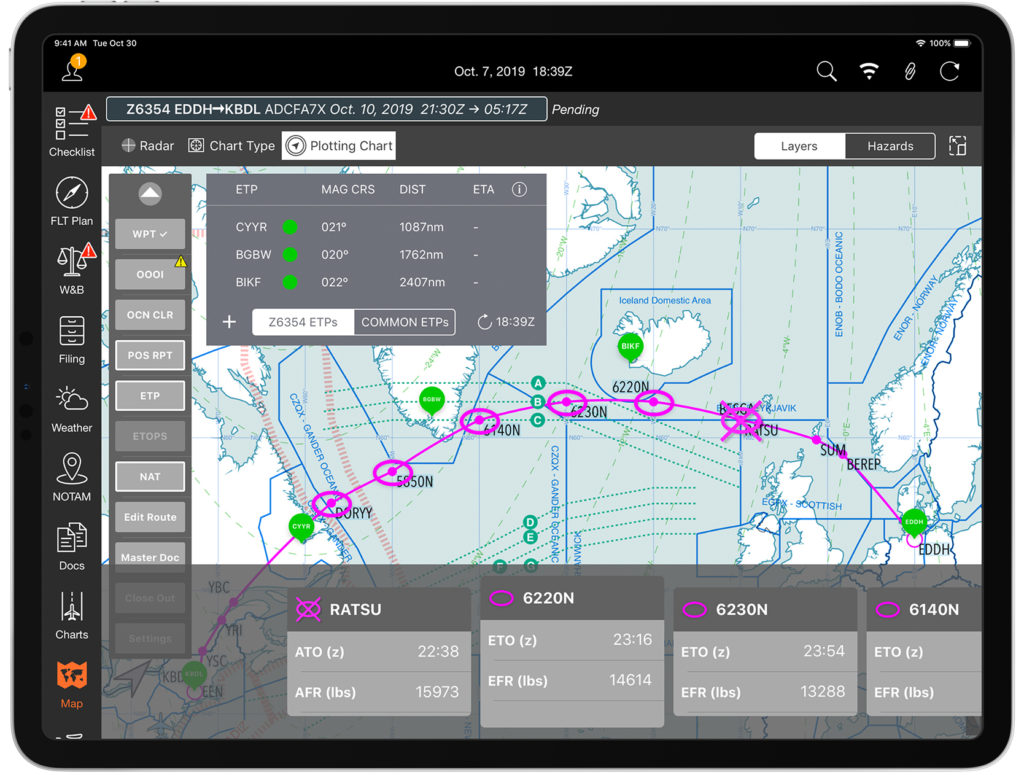
  • Prepare a new plotting chart/re-plot in Jeppesen EFB

With datalink, you might have the capability to load the new route directly from the ATC message into your FMS flight plan. This will eliminate a transcription error on your part, but you cannot always count on the FMS to load this seamlessly. Oftentimes, if a revised coast-in waypoint doesn’t connect with your originally planned domestic airspace airway, it might cause a discontinuity. Worse, some crew have experienced their entire domestic flight plan drop out, left with only the oceanic portion.

Conditional Clearances – There’s always a catch!

A conditional clearance is an ATC clearance given to an aircraft with certain conditions or restrictions, such as changing a flight level based on a time or place. Conditional clearances add to the operational efficiency of the airspace, but are commonly misinterpreted by flight crews.

Shannon has been known upon first VHF contact to provide lateral conditional clearances on coast-in. For example: “N135AC, after DINIM, direct ELSOX”. Often, crew have been known to read back the correct transmission, but then execute the wrong procedure by proceeding directly to ELSOX.

Why is this happening? In studies of linguistics, verbs (such as ‘direct’) have been noted as having a perceptual priming effect, that more easily grabs our attention at the expense of weaker prepositions (such as ‘from’ or ‘after’). Listen carefully for prepositions. Similarly, in aviation vernacular, the word ‘direct’ means to proceed now to the specified waypoint. As pilots, we can distinguish this meaning with very little effort, and most of the time can expect to proceed present position direct. Thus, we are primed to go direct.

While this isn’t a complex sentence, research indicates that transmissions involving serial recalls (such as “proceed here then here…”) are susceptible to distortion, with the last word or item more commonly interfering with recall of the previous item.

A really simple way to prevent this is to write down clearances as they are being read to you, then read-back the transmission. You can also call attention to a conditional clearance by prefixing their read-back with the word “Verify” or “Confirm” over the radio. Via datalink, sufficient care always must be taken when factoring in all the contents of a clearance before acknowledging the message. The initial phrase “MAINTAIN FLIGHT LEVEL 300” is included to stress that the clearance is conditional. If the message is about to time out, and you need more time to process its contents, reply using “Standby”. Respond at your own pace![fancy_box box_style=”default” icon_family=”none” color=”Accent-Color” border_radius=”default” image_loading=”default”]

Cognitive Trap:

On the longer route segments between New York and Santa Maria, “when able higher” (WAH) reports might be solicited. ATC acknowledgement of a WAH report must not be misconstrued as a conditional clearance to climb. Any climb clearances will be issued separately from a WAH acknowledgement.[/fancy_box][heading]Miscellaneous[/heading]

10-minute Check – put the (Bad) Elf on the shelf for this

One of the best ways to capture a potential GNE and refresh your situational awareness is with the sublimely simple 10-minute check. Ten minutes after waypoint passage, you’ll use your current coordinates to plot your position on your plotting chart. If the coordinates don’t land on the plotted track line, an investigation into the source of the error must begin immediately. It doesn’t hurt to even make additional plots between waypoints too, but ICAO only requires the one 10-minute check.

Today, more pilots are carrying independent GPS units in their flight bags, providing crew with own-ship on their oceanic route map. Tempting though it may be to use this for present position information, it is currently not an approved source of navigation, and should NOT be used in lieu of a 10-minute check.[fancy_box box_style=”default” icon_family=”none” color=”Accent-Color” border_radius=”default” image_loading=”default”]

Cognitive Trap

It is easy to forget about the 10-minute check. Setting a timer once your waypoint passage tasks have been completed will help remind you to do so.[/fancy_box]

Autopilot mode – “Wait, are we supposed to be in heading?”

Incorrect autopilot mode selection has been known to be a factor in GNE’s. On an oceanic crossing, you can bank on being in NAV or LNAV most of the way across the Atlantic. But perhaps you used heading mode to deviate for weather or to intercept a SLOP. It is not uncommon among pilots to spare your passengers two steep banking turns (thanks LNAV!) by manually flying a SLOP intercept in heading mode. But if you forget to re-engage LNAV, you will continue drifting on your merry way, further and further off course.

Distraction, fatigue or complacency are common reasons for losing mode awareness, so the following simple tricks will help mitigate autopilot induced GNE’s.

  • It helps to verbally announce when you are transitioning temporarily into heading mode, to bring both pilots in the loop.
  • Employing sterile cockpit until you’re back in LNAV will help mitigate distractions.
  • In an abundance of caution, you can keep a finger on the heading button or heading dial until you are back in LNAV will serve as a reminder.

[fancy_box box_style=”default” icon_family=”none” color=”Accent-Color” border_radius=”default” image_loading=”default”]

Cognitive Trap:

The flight mode annunciators (FMA’s)  are the most reliable indicators of automation selection – more so than the flight guidance panel! Yet, a study found that pilots pay superficial attention to the FMA’s during critical mode changes. Don’t waste a valuable resource, and do consciously bring the FMA’s into your scan.[/fancy_box]Deliberate cross-checking and monitoring are a critical last line of defense for which we, as pilots, don’t get explicit training, but are nevertheless expected to perform effortlessly. But over the North Atlantic, there is little room for error. So, let’s recap what can be done!

  1. Allow sufficient time on the ground to set up
  2. Closely scrutinise data entry – whether the source is human or ACARS!
  3. Work together on waypoint verification
  4. Don’t work single pilot – always keep all crew in the loop
  5. Deal with clearances and re-clearances methodically

Understanding our vulnerabilities is key to the process of mitigating errors. Armed with an understanding of our own limitations, and an appreciation for the practices and habits mentioned above, a ‘would-be’ GNE can be averted.

Links

ICAO Doc 007 

Global Operational Datalink Document (GOLD)


Three-day French ATC strike this week

French ATC strike alert! And this one’s going to be a MONSTER!! Notams have now been published confirming this week’s strike will last for three whole days, from 1800z on Wednesday Dec 4 until 0500z on Sunday Dec 8. 

It’s part of a nationwide strike which will also impact ground handling services at airports nationwide. Initially called by public transport unions opposed to the government’s pension reforms, various other unions have since pledged to join the strike, including public sector workers, teachers, postal workers, hospital staff, firefighters and lorry drivers. Many unions have warned that strikes might run until Christmas, but for now, air traffic controllers have only planned strike action for three days this week.

In the Eurocontrol teleconference on Monday Dec 3, managers said they expect en-route regulations will be applied across all sectors – which means big delays pretty much everywhere. If you can avoid France during this period, do so.

The situation at the airports is slightly more complex. The worst staff shortages are expected to happen at the ACC level, rather than at the local airport level. However, there are some airports which are expected to have some issues:

LFPG/Paris Charles De Gaulle: On the morning of Thursday 5th Dec, there will be an airport firefighter strike between 07-12 local time (06-11z). As a result, only one runway will be available for this period, so significant delays are expected all morning, particularly if weather conditions aren’t so great.

LFBO/Toulouse & LFBD/Bordeaux: High delays expected all three days

LFBP/Pau, LFBT/Tarbes, LFBZ/Biarritz, LFMD/Cannes, LFOP/Rouen, LFQQ/Lille: Smaller airports mean possible closures, particularly at night. For these and other smaller airports, ATS services may not be provided at all at certain times – and you’ll probably need to check the airport’s own Notams for any signs of that.

Additionally, the government has stepped in and decided to request the airlines to reduce their schedules by 20% between 05-23z on December 5th at these airports: LFOB/Beauvais, LFPG/Paris Charles De Gaulle, LFLL/Lyon, LFML/Marseille, LFBO/Toulouse, LFBD/Bordeaux. The Notam confirming that can be found here.

As usual with these French strikes, Algeria and Tunisia have both said their airspace can be used by flights trying to route around French airspace, without having to obtain overflight permits. But operators need to make sure they add their AFTN codes on flight plans! That means don’t just file your FPL to the normal Eurocontrol addresses, but include those for Algeria (DAAAZQZX and DTTCZQZX) and Tunisia (DTTCZQZX and DTTCZRZX) – and make sure these are included for any subsequent DLA messages as well.

For real-time updates of any airspace issues once the strike has started, keep an eye on this handy French ATC webpage: http://dsnado.canalblog.com/

And check out our article for everything else you need to know about how to survive French ATC strikes!


Deteriorating post-election chaos in Bolivia

A single Notam for the country’s largest international airport indicates there’s no fuel available for a number of days. That’s always a surefire sign that something pretty serious is going on. 

The contested presidential elections last month in Bolivia has quickly led to civil unrest across the country in the past few weeks. Demonstrations, strikes, and roadblocks have resulted in armed conflict between opposing protesters as well as armed forces in which 32 people have died so far in what some are calling an uprising and others a coup. We’re going to take a look at the cause of the unrest and how international operators may be affected, especially when the trucks carrying your jet-fuel to the airport are attacked.

The Escalation

Evo Morales, the long-term Bolivian President won a contested election in October, but evidence quickly surfaced that the results were manipulated. Protests from Morales opposers erupted when Morales refused to stand down until eventually resigning when the military “requested” he do so in the interest of stability, but not before the current unrest unfolded. He is now seeking asylum in Mexico. Three other officials who were in line to be the constitutionally defaulted interim presidents all resigned and/or fled the country. The role eventually fell upon the deputy leader of the Senate and opposing party member, Jeanine Anez, who promised to hold new elections soon. Some countries are recognizing Anez as the President, while others are refusing to do so.

Morales supporters began countrywide protests as he would not be included in the new elections, a move they claim to be a part of a larger military coup. Protests between the two groups and with the armed forces have led to volatility in the past month. Bolivia’s constitution calls for the new elections to be held within 90 days.

Security

The US State Department has issued a Level 4: Do Not Travel Advisory for the entire country. State department non-emergency employees and their families have been ordered to evacuate. A Notam for SLLP/La Paz airport has been issued stating there is no fuel available. Protesters attacked a military escorted fuel convoy headed to the airport from a large nearby fuel plant, and further protests have been planned to occur near the airport. The Notam for La Paz has been pushed back three times so far and there’s no estimate of when fuel will again be available.

“We have not had anyone going into Bolivia for well over a month,” said Brian Leek, owner and CEO of FAM International Security, a global corporate security solutions firm. “If you don’t HAVE to go, don’t. Simple answer. Things have been brewing there for months and it finally burst last month.”

The demonstrations and barricades have closed roads in La Paz as well countrywide highways and access to airports. Security cannot be guaranteed. The intervention by the armed forces has escalated quickly, with tear gas and live ammunition being fired to disperse protests resulting in deaths across many of the larger cities like La Paz and Santa Cruz.

Is It Safe To Travel Throughout Bolivia?

Due to the instability, the simple answer is: Not right now. Leek is advising all operators to defer travel, at least until the beginning of December or whenever the new elections are announced. With the news that elections will be held soon, there is optimism that the violent protests will decrease as Morales opposition leaders are calling for peace. However, many Morales supporters state they will continue protests in demand that the former president be given an opportunity to return. One international medical and travel services company received reports of clients’ cars being attacked by protesters and one car being hit by an armed forces vehicle responding to a demonstration.

If you do operate into Bolivia, local ground handler, Pike Aviation, is recommending SLVR/Santa Cruz where fuel and full services are available and the protests in the city are minimal. SLCB/Cochabamba is also operating normally, but conflicts continue in the city. They also do not recommend operating into SLLP/La Paz. Leek couldn’t agree more. “If you have to go, Santa Cruz is an acceptable substitute. Just know that security around the airport is weak. So have plans in place to protect the aircraft.”


Italy nationwide ATC strike on Nov 25

Update Nov 22: The Italian ATC strike on Monday 25th Nov isn’t going to be as bad as expected. The 24 hour strike has been downgraded to a 4 hour strike, from 12-16Z, 1-5pm local. Overflights and intercontinental arrivals exempt; other traffic may see a delay but it will vary from place to place. Primarily, it is the en-route center controllers that are striking.


ATC staff from all four ACC’s across the country (LIRR/Roma, LIBB/Brindisi, LIMM/Milano and LIPP/Padova) will be on strike, plus local ATC at the following airports: LIRA/Rome, LIBR/Brindisi, LIBD/Bari, LIBP/Pescara.

Watch out if you’re headed to either LIPY/Ancona or LIRZ/Perugia though – ATC at these airports will still be going on strike for the full 24hrs as originally planned, so big delays expected here.

For updates, keep an eye on the Eurocontrol NOP page on the day of the strike.


Regulatory deadlines on the horizon

Regulatory compliance – nothing quite warms the heart like reading those two words, side by side. This year has seen quite a few changes in this department already (thank you, NAT HLA!), but here is a list of some other regulatory deadlines on the horizon…

Dec 31, 2019 – Operations in North Atlantic

  • U.S. operators must have the revised LOA BO39: “Operations in North Atlantic High Level Airspace (NAT HLA)”. Operators holding the old MNPS LOA BO39 will not be permitted to fly in the NAT HLA beyond this date. Requirements include: RNP10, crew training and new contingency procedures incorporated in company operating handbooks. Read our article here.

Jan 1, 2020 – US ADS-B Out Mandate

  • ADS-B Out will be required where Mode C is required AND:
  • Class A, B and C airspace, Class E at or above 10,000’ MSL (but not below 2,500’ AGL).
  • Within 30nm of Class B (Mode C veil).
  • Above the ceiling and within lateral boundaries of Class B and C up to 10,000’.
  • Class E over Gulf of Mexico, at and above 3000’ MSL within 12 nm of US coast.

Jan 30, 2020 – Expansion of Datalink Mandate in the North Atlantic

  • Phase 2C of North Atlantic Datalink Mandate. FANS 1/A CPDLC and ADS-C will be required between FL290-FL410 throughout the entire NAT region (previously FL350-390). Read our article here.

Feb 5, 2020 – European Datalink Mandate

  • Initially legacy aircraft flying above FL290 in European airspace were to be equipped with CPDLC capability by Feb 2015. But due to equipage requirements and technical issues the mandate was delayed to Feb 2020, AND, even better, most GA/BA aircraft will be exempt from this. Read our article here.

June 7, 2020 – European ADS-B Out Mandate

  • Aircraft flying IFR in Europe with max certified takeoff weight of more than 5700kg (12,566lbs) OR max cruising TAS of more than 250kts must be equipped with ADS-B. GPS sensor with at least WAAS accuracy coupled to a 1090 Extended Squitter transponder required.


DELAYED:

Canada: ADS-B Out Mandate

  • This was planned to be implemented in Class A airspace from Feb 2021, and Class B airspace from Jan 2022. But Nav Canada has now postponed this mandate. They still plan on using ADS-B for surveillance, and this will be used on a priority basis for suitably equipped aircraft starting in 2021, but they say – “non ADS-B Out equipped aircraft will be accommodated within the airspace until a performance requirements mandate can be implemented.”

ALSO ON THE HORIZON:

August 14, 2020 – EU: SAFA Ramp Checks & Pilot Mental Health

  • EASA regulations requiring alcohol testing during ramp checks will take effect across all SAFA participating countries (although some countries have already started doing this: Austria, Belgium, Czech Republic, France, Germany, Greece, Iceland, Ireland, Italy, Netherlands, Portugal, Spain, Switzerland, UK, and Singapore). Tests may also be carried out by local police at any time.
  • All pilots working for European airlines will have access to mental health support programs.
  • European airlines will perform a psychological assessment of their pilots before the start of employment.

Any other biggies that we missed? Let us know!


Venezuela issues another surprise ban on GA/BA Flights

On Nov 15, authorities in Venezuela issued a Notam immediately suspending all GA/BA flights from operating to airports in the country. The ban was due to remain in place until 2359z on Nov 20, but got cancelled on Nov 18.

Here was the Notam, issued by the SVZM/Maiquetia FIR:

A0842/19 – GENERAL AND PRIVATE AVIATION OPS INCLUDING REMOTELY PILOTED AIRCRAFT SYSTEM (RPAS) ARE SUSPENDED. OVERFLIGHTS CROSSING SVZM / FIR ARE ALLOWED. 15 NOV 10:00 2019 UNTIL 20 NOV 23:59 2019. CREATED: 15 NOV 04:01 2019

The last time the Venezuelan government issued a ban like this was back in Feb 2019, which seemed to be related to wider attempts by the government to limit the travel of opposition politicians. This latest ban probably had similar motivations – with Venezuela’s President Maduro calling for government supporters to march and rally across the country on Nov 16 to counter protests called for by oppposition leader Juan Guaidó in Caracas on the same date.

U.S. operators have been prohibited from operating to Venezuelan airports — and from overflying the country below FL260 — ever since 1st May 2019 when the US FAA issued a “Do Not Fly” instruction. Two weeks after that, the U.S. ordered the suspension of all commercial passenger and cargo flights between the U.S. and Venezuela, and this applies to both U.S. and foreign registered carriers.

Our advice remains the same: you don’t want to go to Venezuela at the moment. The official advice of both the US and Canada couldn’t be clearer, they both say the same thing: do not travel to Venezuela due to risks posed by the ongoing unstable political and economic situations and the significant levels of violent crime.

For overflights, here’s what we suggest…

To the WEST
– via Colombia (SKED/Bogota FIR) – permit required for all overflights.
Note: watch out if planning a flight through the TNCF/Curacao FIR – although a permit to overfly is not required here, you will need to prepay for navigation fees in advance. More on that here.

To the EAST
– via Guyana (SYGC/Georgetown FIR) – permit not required
– via Suriname (SMPM/Paramaribio FIR) – permit required
– via French Guyana (SOOO/Rochambeau FIR) – permit required unless operating a GA aircraft under 12.5k lbs.

If you need a tech stop and previously used/considered SVMI, then look at alternatives like TNCC, TTPP, SBEG, SMJP. Use OpsGroup’s GoCrow planning map to figure your best alternate options:


New Procedures at Nice: Beware the Big CDM Computer

Nice Airport will launch Airport Collaborative Decision Making (A-CDM) on Nov 25. The main impact to operators will basically be that strict timings will have to be adhered-to for the entire start-up process: flight clearance, engines start-up approval and parking off-block will all have to be done within strict timeframes, otherwise your flight will drop out of the CDM system and you’ll likely get hit with a significant delay.

Top tips from local handler Swissport are as follows (we’ve paraphrased slightly):

Flight dispatch:

  • It is now compulsory to file the flight plan so that it exactly matches the Airport Slot booked by your ground handler. If the flight plan and the Airport Slot timings are not exactly the same, the Big CDM Computer at the airport will get terribly confused, your flight plan will get rejected, and you won’t be flying anywhere.
  • As a consequence, any time you want to change your schedule you must let your handler know first! They get a new Airport Slot for you first, then enter your flight into the CDM system, and then you can change your flight plan.

Flight deck crew:

  • Strict timings will have to be respected for the start-up process : flight clearance, engines start-up approval and parking off-block will have to be performed in due time, otherwise the flight will be SEQUENCE OUT and the CDM process will have to be reset, resulting in significant delays.
  • The TSAT (Target Start-up Approval Time) is the key timing since all the departure process is based on it. Your ground handler can provide you with your TSAT, and it can also be monitored directly by the crew on the CDM website (see the attachments below on how to do that).
  • The transponder is part of the process for the validation of some CDM milestones. The transponder should be switched on before taxiing and switched off once on-block. Switching the transponder on/off during taxiing generates wrong timings in the whole process management, and the Big CDM Computer doesn’t like that.

Bottom line, just make sure you keep talking with your ground handler throughout the whole departure process, so they can manage all these times for you in the system.

Swissport has provided a handy guide for operators on what to expect (click the image below to open the full version!):

Other things worth knowing at LFMN/Nice:

  • With the change to RNP approaches only (i.e. what would be known in the U.S. as RNAV GPS approaches), the airport is filing violation reports even if you request and get cleared for any other type of approach. The tip is to double check your FMS database before you fly to confirm all approaches are loaded, especially the RWY 04 RNAV-A and RWY 22 RNAV-D. See Airport Spy reports on LFMN for full reports.
  • From March 2019, any schedule change (ETA, ETD, flight number, provenance or destination airport) will generate a new PPR number – now called “Slot ID” – that will have to be updated in the FPL, still in field 18. Bear in mind that this process will take at least 10-15 minutes to have the new schedule validated by the airport and get the new Slot ID.
  • France has started a thing called CASH – Collaborative Aerodrome Safety Highlights. It’s basically a selection of briefing packages for certain airports, drawn from information supplied by airlines, operators, and ATC. So far, they’ve published ones for LFBK/Bastia, LFOB/Beauvais, LFKC/Calvi, LFPB/Paris Le Bourget, LFPG/Paris Charles De Gaulle, LFMN/Nice, and LFBO/Toulouse. More info


U.S. cracks down on scheduled flights to Cuba

The U.S. has announced it will suspend scheduled flights to all airports in Cuba except for MUHA/Havana, in another attempt to limit cash flows going to the Cuban government. The affected airlines, including American, Delta and JetBlue, now have 45 days to wrap up their operations to those other destinations in Cuba, before the ban goes into effect on Dec 10.

This does not apply to Part 135 non-scheduled charter flights – these are still allowed to operate from the U.S. to any international airport in Cuba. However, it’s still a tricky business to operate these flights and stay within the rules. Policies introduced by the Office of Foreign Asset Control (OFAC) in 2017 mean that there are only a handful of categories of permitted travel between the US and Cuba.

As for Part 91 private flights from the U.S. to Cuba, these have been completely banned since June 2019. This was a policy introduced by the US Bureau of Industry and Security (BIS), which meant that U.S. operators could no longer operate an N-reg aircraft privately to Cuba for any reason – it doesn’t matter if your passengers meet OFAC’s “permitted categories of travel” or not, it’s a no-go.

For non-U.S. operators traveling to Cuba from anywhere other than U.S. territory, it should be a doddle. Get a landing permit, arrange your ground handling, file your flight plan, and off you go. Check out our article for more info.

If you’re headed to Cuba — even to MUHA/Havana — you should double-check with your insurance provider about your coverage. We received the following report, which suggests that with the new U.S. sanctions, many U.S. operators may no longer be covered:

“Being the insurance director of an Airline, I’m having the dilemma whether the insurance would cover any damages/losses/injuries may have occurred during Cuba flights. Because, when I raised the question, insurers simply replied with an aviation clause called AVN111/AVN111(R) which says insurers would verify each individual case with relevant sanction authority (in this case, OFAC) and do their best to grant permission to reimburse the losses. It can easily take years to get resolved which essentially means there is no actual protection against losses”…

In principle, U.S. operators with an insurance policy from a non-U.S. based insurer can get insurance cover for Cuban ops. However, in practice it may not be possible to even purchase this, as lots of these policies are underwritten by U.S. based insurers – especially for higher policy limits.


Escape From New York: How To Get In & Out of Teterboro (2019)

There’s nothing that will drain a smartphone battery quicker than a ground delay in Teterboro. Preflight complete, flight plan loaded, passengers onboard (they were actually on time for a change), engines started and – wait for it – you are instructed to contact “ground metering.” The word itself can make the stomach drop.

Yes, a line of thunderstorms is moving in, but it’s not quite solid. Most of my route does not look affected, but far better minds than mine have determined that diverting traffic require them to close my entry gate, as well as most of the surrounding ones. I receive an Expect Departure Clearance Time (EDCT) of over three and a half hours away!

Normally I make it as far as taxiing just short of TEB’s RWY 24 before the controllers present me with such a lovely ground delay and instruct me to park in the “penalty box.” This time I hadn’t even left the chocks (I wasn’t even actually supposed to start the engines before contacting “metering”, but of course I didn’t admit that mistake to the controller).

Ground delays due to weather or traffic saturation are not uncommon in Teterboro. We have to hand it to the Teterboro ATC staff for efficiently controlling one of the busiest GA airports in the world (about 174,000 arrivals a year). They not only deal with all the complications that come with being located under some of the most congested airspace in the world, they patiently work everyday with a bunch of A-list pilot personalities that think their schedules are more important than any delays. Well done, you ninjas of New Jersey!

Weather, traffic and pilots aren’t the only issues they’ve been dealing with lately. Improvement projects have been steadily grinding along for the past year and a half. And guess what? There’s even more to come!

So, after I inform my passengers of this delay, allow me to hop back up in the cockpit and let’s discuss some Teterboro info with the help from our good friend Dave Belastock, President of the Teterboro User Group. Perhaps you heard him speak on the latest OpsChat, but, if not, we’re going to dive in a little deeper.Oh, by the way, don’t be offended while I analyze my fantasy football scores on my phone; I’m a multi-tasker, and we’ve got three and half hours – well three now – to go and I’ve got 85% battery life on my phone left.


EDCT: T minus 3:00, battery 85%

The Entry

Getting into Teterboro can often be a frustrating game. When calling for a clearance at your departure airport, wagers can be made that an EDCT will be issued. Gone are the days in which operators would file a nearby airport (KMMU/Morristown, KHPN/White Plains, etc.) and change the destination to TEB enroute to avoid such ground delays. I’ve never tried it, but I did witness a former chief pilot broach the subject with clearance delivery at a Midwestern airport about attempting this. “If you to try that stunt, I’ll route you through Florida,” was the controller’s response.

But getting the heads-up on delays may depend upon early filing. The FAA’s Traffic Management Unit coordinates the flow programs into airports experiencing delays. According to one TMU official, “Get your flight plan filed prior to program implementation (at least a day in advance) and try not to change that proposal time. The command center ‘optimizer’ computer will issue releases/slots based on those times. And your flight plan won’t drop out of the system until 2 hours after your EDCT.”

I’ve had service providers tell me that the earlier you file, the higher up you are on the departure list. I never knew if this was true or not, but it may look like it certainly has a partial effect.


EDCT: T minus 2 hrs 30 mins, battery 67%.

Upon arrival into Teterboro, you will watch your TCAS light up like a Galactica arcade game, especially on a clear day. Glider activity near the MUGZY waypoint on the LVZ STAR to the northwest and GA traffic from multiple small airports flock below you. And the question usually comes up once you are beneath Newark’s Class B airspace: “What speed should we be going?”

The answer is of course 200 knots. But more than once I have been angrily asked by a controller what my speed was and, after answering 200 knots, speed reductions were quickly mandated to traffic following behind me. Thus, there was a perception that NY Tracon needed you to keep your speed up into TEB. But no controller may authorize an aircraft to exceed 200kts under Class B. If it makes you feel better to report your speed reduction, be my guest. But the answer is 200kts.

Those familiar with TEB approaches understand that you must certainly be on your game and brief your approach. The ILS RWY 6, including the circle to land RWY 1, has a mandatory altitude of 1500 feet at DANDY that pilots are still not making before intercepting the glide slope. The circle procedure can be tricky, especially with a tall antennae to the south of the airport. And if winds are gusty from the northwest expect turbulence from the distant hills. In 2017, a Learjet became unstable during this approach, stalled and crashed as the crew were unprepared for the approach. Early briefing and proficient monitoring will ensure a safe and simple approach.


EDCT: T minus 2 hrs, battery 50%.

Belastock mentions that a new RNAV GPS RWY 19 with LPV mins is expected to be published in December. Some aircraft flying a coupled ILS RWY 19 with the localizer captured at 2000 feet have experienced an uncommanded climb due to a false glide slide capture. This glide slope perturbation is triggered by aircraft moving on taxiway Q across RWY 19 and passing in front of the glide slope antennae, which briefly deflects the signal downward enough to satisfy capture parameters. Once the taxiing aircraft has cleared the glide slope critical area, the beam returns to its proper angle. If you have Approach mode armed, the autopilot may grab the temporarily deflected glide slope and then pitch up when the signal returns to normal. Close monitoring and quick action are required to prevent an altitude deviation. The GPS approach would circumnavigate this potential issue.

And speaking of that turn between UNVIL and TUGGZ to intercept the final approach course, you could very well see VFR aircraft just below you. You are outside Class D airspace at that point so separation requirements aren’t necessary. While other NY area airports have communication requirements for VFR traffic transitioning near congested airspace, TEB has none. TUG is currently working with the FAA to create a Class D transition area to the north to require communication. Fingers crossed.


EDCT: T minus 1hr 30 mins, battery 42%.

The Escape

RWY 6-24 is going to see substantial improvement in 2020. Currently, the plan is to close the runway several evenings through the summer, starting the day after Memorial Day through Labor Day. “Port Authority of NY and NJ staff have worked diligently to create a schedule that would least affect operators,” explained Belastock. “We are anticipating RWY 6-24 to close from 10pm Saturday nights until noon on Sundays. And then there will be two 24-hour closures beginning at 10pm Friday through Saturday night at dates to be determined.”

This will inevitably switch up the normal departure procedures. Whereas the RUUDY RNAV departure (we’ll discuss good ol’ RUUDY in a second) is the traditional departure, the alternative will be the DALTON 2 departure.

“Do you ever wonder why you have to hold short of RWY 24 for an extended period of time waiting for an IFR release?” asks Belastock. “That’s because NY Tracon requires a 10nm separation between you and the overflying Newark traffic.” The Dalton departure, however, is a VFR-IFR departure.

VFR? Really?

Yep, just as the instrument departure plate reads, aircraft depart VFR – 3 sm visibility and 3000’ ceilings are required – and when handed over to the departure controller, the IFR flight plan is activated. Theoretically there is no gap required between the VFR Teterboro departures and IFR Newark arrivals. But consideration was taken between all stakeholders, and a 5nm gap between TEB and EWR traffic was agreed upon. “TEB clearance can’t solicit the departure. You must request it and have a published departure plate available in the cockpit,” said Belastock.

Though this could mean a reduction in release time, if there is a delay in progress controllers can only offer an “indefinite delay” for traffic or weather issues, whereas they can give you a set time if using the other IFR departures. “Actually, NY Tracon is encouraging it. They want pilots and controllers comfortable with it,” said Belastock.

As for the RUUDY RNAV departure, good news! Pilot deviations are decreasing. Belastock and TUG worked closely with training facilities as well as OPSGROUP to get the word out. I even noticed the RUDDY departure was included in my latest recurrent simulator training. With the altitude restriction and noise abatement restrictions pilots need to be extremely situationally aware. “We don’t want to tell pilots how to fly their aircraft,” said Belastock. “But we need them to be fully aware of how the departure operates.”


EDCT: T minus 1:15, battery 37%.

The Window of Opportunity

My eyes are burning a bit from so much screen time on my phone. I query Gate Hold again – just like the other 73 pilots that are trying to chime in. Yep, that’s me you’re rolling your eyes at.  My EDCT time is actually extended further even though the weather is past my entry gate. “Is there anything we can do to get out of here,” I reply with a frustration.

“Can you fly a final altitude of 14,000 feet?”

Confusion mixes with a sense of impending opportunity. “Standby,” I answer. I always take extra fuel out of TEB, but I’m sure there cannot be enough to fly that low. I run the numbers…and, I’ll be damned, we can make the destination with a safe fuel reserve.

“Actually, yes we can,” I reply excitedly. “Start your engines and contact ground control,” comes the reply. As I taxi past all the other waiting aircraft, I couldn’t help but feel a sense of guilt…and some pleasure as well.

We departed on the RUUDY departure, flew west while climbing to 14,000 feet talking to NY Center and several approach controllers. When we were handed off to Cleveland Center, we requested a more appropriate cruising altitude and given it without question.

I later called TEB tower to see how this “gift” actually occurred. “It doesn’t happen often. But since your entry gate and route were getting so saturated with diverting traffic, you couldn’t fly it at your filed altitude. But this wasn’t the case for the lower altitudes,” explained the controller. “I can’t offer it unless you specifically ask. But even then it probably won’t be granted.”

I’ve been flying in and out of TEB for 15 years, and I’m still often learning new details about its operation. Perhaps I’ll keep this tool in my back pocket for the next great escape.


Mexico’s revamped CAA to make permit applications even tougher

If you thought that applying for Mexican landing permits couldn’t possibly get any more complicated, then think again!

On 16th Oct 2019, the Civil Aviation Authority in Mexico (DGAC) became the Civil Aviation Federal Agency (AFAC), and it sounds like they mean business. Local handlers are saying that policies and procedures that were typically overlooked or handled with lax criteria in the past are now expected to be more strictly enforced.

The following changes apply to Part 135 commercial operators looking to obtain Mexico landing permits. (For Part 91 private operators, no changes to the current rules and requirements are expected at present).

Insurance Policies

It’s long been the case that you need two insurance policies for ops to Mexico: your standard worldwide one, and a specific Mexican one issued by a Mexican company.

Authorities are now saying that for both of these policies, the original copies must be submitted in full; with coverage details, proof of payment, and aircraft details clearly shown. Digital copies are not good enough, and there have been some cases reported where applications have been rejected due to seemingly trivial things such as the signatures being too blurry, or even the “courtesy translation” stamp being on top of a signature.

Power of Attorney

To get a landing permit for Mexico, you need to nominate a local handling agent, sign a Power of Attorney saying that they are your legal rep there, and then the CAA will release the permit to them.

Previously, authorities were happy enough with a scanned copy of this Power of Attorney, but they are now saying this must be submitted as a notarized original with an Apostille. If you’re applying for Single Landing Authorization (see below) for short notice operations, you will have to send a digital copy of this, and commit to follow-up by sending the original copy too once available.

Single Landing Authorizations (one time shots):

The CAA traditionally allowed operators up to five Single Landing Authorizations before requiring an Indefinite Blanket Permit if operators continued flying into Mexico. The AFAC is now cracking down on this. So “one and done” will be the new rule with Single Landing Authorizations. After that, the Indefinite Blanket Permit must be applied for (although you should still be able to obtain SLA’s on a case by case basis, once your application for the Blanket Permit is underway).


Whether these implementations will continue to be enforced in the long-term remains to be seen. But for now, it looks like operators should prepare to apply for the Indefinite Blanket Permit if they are planning on doing more than just one flight to Mexico. Here is the original post on this topic by local Mexican agent Manny Aviation – we thank them for their help with alerting us to this!


London Luton now available for night flights again

The summer ban on GA/BA night flights ended on Oct 1, and the airport is now available H24 again.

Throughout last year’s winter period there was a strict weekly quota on how many ad-hoc flights were allowed to operate at night, but this has been increased significantly this year, so there should be no problem getting night slots now.

The nighttime noise restrictions for EGLL/Heathrow, EGKK/Gatwick, and EGSS/Stansted are still in place, making nighttime GA/BA operations to these airports limited.

Here’s a rundown of the current restrictions:

  • EGMC/Southend (40 miles from London) & EGBB/Birmingham (115 miles from London) are the only airports with no restrictions (thus far).
  • EGLL/Heathrow & EGGK/Gatwick: Pretty much a no-go zone for business aviation these days
  • EGLC/London City: closed from 1030pm to 0630am
  • EGWU/Northolt: closed from 8pm to 8am on weekdays (although the airport is currently closed to all flights until mid-November for runway and apron refurbishments)
  • EGLF/Farnborough: closed from 10pm to 7am on weekdays
  • EGKB/Biggin Hill: closed from 11pm to 6.30am on weekdays, and 10pm to 8am on weekends

Further Reading:


New North Atlantic Guides and Charts from OPSGROUP

New changes on the NAT!

Just kidding, September has been quiet so far, there’s nothing new this month. But, after the onslaught of change that 2019 has brought to pilots and operators traversing the great expanses of the North Atlantic, we thought it would be a good time to bring some new NAT guides and charts to you.

If you’re an OPSGROUP Member, you’ll find these in the Guides and Charts section of your Members Dashboard, for free (no need to purchase in the shop). And if you’re not, then you can get your own copy in the OPSGROUP Shop.


1. The 2019 NAT Pack

If you really need to know all there is to know about the North Atlantic right now, then the NAT Pack is your girl. You get:

– The current North Atlantic Plotting Chart ($35 value)
– The NAT Ops Guide “My first North Atlantic Flight is tomorrow” ($25 value)
– The Quick reference guide to the NAT “Choose your own adventure” ($15 value)
– The “Circle of Entry” showing Com, Nav, and ATC requirements for the different parts of the NAT region

You save $25 by selecting the NAT Pack instead of purchasing items individually.

Membersget your free copy here
Non-memberspurchase here

2. The 2019 NAT Ops Guide “My First North Atlantic Flight is Tomorrow”

This NAT Ops Guidebook covers (we hope!) everything you need for both a routine crossing (but still complex), and non-routine (eg. No HF, No HLA, No RVSM) ferry flight. Read the latest 2019 changes, easy to read guidance, sample flights, Flight Planning codes, ATC contact numbers, Diversion airports guide, Blue Spruce routes, VHF coverage, non-standard overflight permits – all in one single guide. 19 pages in PDF format. Download, print, share.

Contents:

1. What’s different about the NAT?

2. Changes in 2019, 2018, 2017, 2016.

3. Circle of Entry – a visual depiction of what equipment is needed to enter the different parts of the NAT region airspace.

4. NAT Quick Map – Gander boundary, Shanwick boundary

5. Routine Flight Example #1 – Brussels to JFK (up at 5.45am) – NAT HLA certification, Oceanic Paperwork, Special requirements, getting an Oceanic Clearance, Equipment failure, Weather deviation, and going off track.

6. Non Routine-Flights: No PBCS, No RVSM, No RNP4, No HF, 1 LRNS, No HLA, No ETOPS, No TCAS, No Datalink – what you can do and where you can go.

7. Diversion Airports guide: A couple of notes on each of the most popular diversion airports from Shannon to Goose Bay: What to expect.

8. Airport data: BGBW Narsarsuaq, BGSF Sondy, BIKF Keflavik, EGPF Glasgow, EGPK Prestwick, LPLA Lajes, LPAZ Santa Maria, EINN Shannon, EIDW Dublin, CYFB Fro Bay, CYYR Goose Bay, CYQX Gander, CYYT St. Johns, LPPR Porto, LPPT Lisbon, TXKF Bermuda.

9. Overflight permits – routine and special, non-standard airworthiness, how to get one.

10. Special NAT procedures: Mach number technique, SLOP, Comms, Oceanic Transition Areas, A successful exit, Screwing it up, Departing from Close Airports

11. North Atlantic ATC contacts – Shanwick, Gander, Iceland, Bodo, Santa Maria, New York – ATC Phone, Radio Station Phone, AFTN, Satcom, CPDLC Logon codes; and adjoining Domestic ATC units – US, Canada, Europe.

12. NAT FPL Codes and Flight Levels

13. The new 2019 contingency procedure – graphic.

14. The big changes explained – OWAFS, ASEPS, Datalink Mandate 2020, Microslop.

15. Flight Plan Filing Addresses by FIR

16. Links, Questions, Guidance

Membersget your free copy here
Non-memberspurchase here


3. The 2019 North Atlantic Plotting Chart

This is a Hi-Res North Atlantic Plotting and Planning Chart in PDF format showing North Atlantic Oceanic Airspace, Shanwick, Gander, Reykjavik, Bodo, New York, Santa Maria, and adjoining domestic airspace, with Airspace entry requirements, FPL codes, Airport data and pricing.

Membersget your free copy here
Non-memberspurchase here


4. The 2019 NAT ops Quick Reference Guide

Quick Reference Guide – airspace entry:
– If you have No RVSM – where can you go, and where must you avoid
– Same for No CPDLC, No ADS-C, No Transponder, No full LRNS, TCAS, ETOPS, RNP4, RNP10, HF, SELCAL, PBCS
– Alternative options for routings
– The NAT Circle of Entry showing what you need for Comms, Nav and Surveillance for each part of the NAT: The entire NAT region, just the HLA, the HLA on the NAT Tracks, and the NAT Tracks at 350-390, and PBCS airspace.
– Reference and further reading links from OPSGROUP

Membersget your free copy here
Non-memberspurchase here


We hope you enjoy these guides and resources!

You have four options to get these North Atlantic Guides:

1. Get everything above by purchasing the NAT Pack 2019
2. Pick and choose individual items in the OPSGROUP Shop
3. Skip the queue and get everything for free with any OPSGROUP membership – see the options here and choose a plan.
4. If you’re already a member, get them in your Dashboard

Safe flying.


New procedures at Toronto

The airport launched an Airport Collaborative Decision Making (A-CDM) trial on Sep 16 which will continue until Spring 2020. In theory you should see faster turnaround and taxi times, but there are two key requirements to be aware of:

  1. Make sure you’ve got slots approved in advance for arrival and departure.
  2. For departure, you’ll get a Target off Block Time (TOBT), which you’ll need to update with ATC if you think you’re going to exceed it by 5 minutes or more.

The airport started requiring GA/BA flights to obtain slots back in February 2019. After a few teething problems, they decided to start allowing local handlers to arrange these on behalf of operators. If you get a local handler to do this for you, you can book slots up to 30 days in advance – Skycharter & Signature provide this service.

If you do want to arrange slots yourself, that’s still an option, but you will only be able to request these 3 days in advance. Various flight planning providers have said they can arrange slots for operators too, but they all seem to be restricted to 3 days as well. Toronto is a busy airport, and this restriction may mean that you won’t be able to get the arrival/departure times that you want.

Once you have your slots, your aircraft then gets automatically entered into the A-CDM system. For departure, you will get a Target off Block Time (TOBT), and pilots will need to update this with ATC if they think they are going to exceed it by 5 minutes or more – getting your handler to update your slot reservation at this stage won’t work! Once you get within 10 minutes of the TOBT, you can only update it 2 more times. If a third TOBT update is required, you’ll need to contact the Airport Flow Manager for instructions (+1-416-776-2236).

The airport has published this A-CDM quick reference guide for operators:

Other useful stuff to know about CYYZ/Toronto:

  • Toronto still has a night curfew between the hours of 0030-0630L. If you need to arrive between those hours, you need to contact the after-hours slot team (+1-416-776-3480), who will consider your request. But watch out! For ops approved during the curfew hours they usually charge you around 20 times the landing fee!
  • All the approach charts now make reference to a new procedure, implemented in Feb 2019, called Continuous Descent Operations (Jepp chart 10-2). This is designed to help reduce airport noise levels, and involves aircraft flying a continuous descent in the lowest power and drag configuration possible. ATC may instruct pilots to do this during daytime and evening periods when traffic is relatively light. More info
  • Updated advice has been issued about the runway selection criteria at Pearson. When the north-south runways are in use (RWY 15/33) the airport sees an arrival capacity reduction of around 40%. So crosswind component guidelines have been included in AIC 12/19 for dry, wet and contaminated runways.

If you have further info to report, please do! Email us at news@ops.group


Bahamas Relief Flights – here’s what happened in the first five days

Hello all,

We’re standing down. The purpose of our involvement in the Bahamas Relief effort was twofold – to provide an accurate information flow from an aviation perspective, and to help coordinate in some way the massive amount of civil aircraft that started taking part last Thursday.

Once the winds had died down on Thursday morning, and it became safe for aircaft to start operations, what we initially saw was a void of information on the situation – which airports were available, and what the approval process from Bahamas CAA/NEMA was and how that worked. Nobody was quite sure. But hundreds wanted to help. So, we made contact with many of the pilots and operators, and Bahamas ATC, to get accurate status reports from Nassau, Freeport, Treasure Cay, Marsh Harbour, and Sandy Point – the five locations where the relief efforts were focused at the end of last week, and got that information out in a twice daily briefing. We also worked with the Bahamas CAA approvals team to get word out on how to apply, and what that process looked like.

The response from Business and General Aviation was overwhelming to say the least. Hundreds of flights were flown on Thursday and Friday bringing in much needed first-response supplies. The initial situation was challenging – airports had not been secured and there was a rush to get relief items arriving, creating an unsafe security situation for crews in some locations. Nonetheless, efforts continued. It quickly reached a saturation point. There was no ATC, and the entire Abaco area was on one Unicom frequency. Airports that normally have a few movements per hour were seeing in excess of 60 aircraft per hour at times. Some were operating without transponder and radio calls.

On Friday evening, it showed no sign of abating, and airspace safety was now the primary concern. We worked with AOPA and NBAA ATS in an effort to reduce the level of GA traffic, especially as larger aircraft were now coming on scene and could do more to help. Saturday proved to be another exceptionally busy day, and we coordinated with Miami Center to get routes in place to manage that flow of traffic, and get word out to use those routes. Freeport opened up, with limited ATC.

Finally, by Sunday afternoon, there was some respite in the traffic, and the picture of airport status was clear, but there was still a need for coordination among the many separate organizations, and individual operators, conducting relief flights. We worked with Odyssey, Aerobridge, Operation Airdrop, Banyan, numerous FBO’s, the US Coast Guard, and probably 150 individual pilots, all part of the flotilla of floatplanes, helicopters, business jets, and private aircraft helping to bring relief. At the same time, airlines and military were now providing larger aircraft for the mass evacuations from Abaco that we saw Sunday and Monday. The marine relief effort was even bigger.

Throughout, we were in contact with the NEMA coordinator, UN OCHA, Bahamas CAA and ATC – and later, NGO’s – who all did an exceptional job given the extreme circumstances. The geography of the Bahamas was the biggest challenge – scores of tiny Cay’s, and with bridges out and roads washed away, there were – and still are – many pockets of cut-off communities, all needing help.

On Thursday night I started a Facebook group to bring as much information into one place for the operators and pilots involved as we could. It’s been a tremendous success. Thanks to all the volunteers participating, we’ve had a steady stream of updated information on airports and airspace, and more importantly, we’ve been able to coordinate everything from Search and Rescue helilifts, flights for teams of Doctors, medication transport, evacuation flights, and determine very specific locations to bring aid to.

And now? The presence of the UN, the USAF, International Navy vessels, and upwards of 50 NGO’s, all at full tilt, means that the vast majority of relief efforts are being taken care of on a larger scale.

Make no mistake. The situation is still dire. People still need help, in a massive way. Whole towns are gone. The death toll is much higher than than the small numbers first reported. Individual flights can and will continue to make a difference. We’ll keep this group open and running, so you can post and share info. I and the OPSGROUP team will get back to work on what we normally do, but we’ll keep an eye here to help out where we can.

So – a big THANK YOU to every single one of you that has been part of this effort. None of us have slept much in the last five days, and it’s been heartwarming to see the massive generosity of time, effort, aircraft, pilots, and supplies, and help. Simply amazing. Much love to you all!

Mark.


Operational Summary – Relief flights to the Bahamas

Bahamas Relief Flights – Operational Summary

Updated Tuesday 9.30am ET

SITUATION UPDATE – 0930 ET Tuesday

Hello all,

We’re standing down. The purpose of our involvement in the Bahamas Relief effort was twofold – to provide an accurate information flow from an aviation perspective, and to help coordinate in some way the massive amount of civil aircraft that started taking part last Thursday.

Once the winds had died down on Thursday morning, and it became safe for aircraft to start operations, what we initially saw was a void of information on the situation – which airports were available, and what the approval process from Bahamas CAA/NEMA was and how that worked. Nobody was quite sure. But hundreds wanted to help. So, we made contact with many of the pilots and operators, and Bahamas ATC, to get accurate status reports from Nassau, Freeport, Treasure Cay, Marsh Harbour, and Sandy Point – the five locations where the relief efforts were focused at the end of last week, and got that information out in a twice daily briefing. We also worked with the Bahamas CAA approvals team to get word out on how to apply, and what that process looked like.

The response from Business and General Aviation was overwhelming to say the least. Hundreds of flights were flown on Thursday and Friday bringing in much needed first-response supplies. The initial situation was challenging – airports had not been secured and there was a rush to get relief items arriving, creating an unsafe security situation for crews in some locations. Nonetheless, efforts continued. It quickly reached a saturation point. There was no ATC, and the entire Abaco area was on one Unicom frequency. Airports that normally have a few movements per hour were seeing in excess of 60 aircraft per hour at times. Some were operating without transponder and radio calls.

On Friday evening, it showed no sign of abating, and airspace safety was now the primary concern. We worked with AOPA and NBAA ATS in an effort to reduce the level of GA traffic, especially as larger aircraft were now coming on scene and could do more to help. Saturday proved to be another exceptionally busy day, and we coordinated with Miami Center to get routes in place to manage that flow of traffic, and get word out to use those routes. Freeport opened up, with limited ATC.

Finally, by Sunday afternoon, there was some respite in the traffic, and the picture of airport status was clear, but there was still a need for coordination among the many separate organizations, and individual operators, conducting relief flights. We worked with Odyssey, Aerobridge, Operation Airdrop, Banyan, numerous FBO’s, the US Coast Guard, and probably 150 individual pilots, all part of the flotilla of floatplanes, helicopters, business jets, and private aircraft helping to bring relief. At the same time, airlines and military were now providing larger aircraft for the mass evacuations from Abaco that we saw Sunday and Monday. The marine relief effort was even bigger.

Throughout, we were in contact with the NEMA coordinator, UN OCHA, Bahamas CAA and ATC – and later, NGO’s – who all did an exceptional job given the extreme circumstances. The geography of the Bahamas was the biggest challenge – scores of tiny Cay’s, and with bridges out and roads washed away, there were – and still are – many pockets of cut-off communities, all needing help.

On Thursday night we started this Facebook group to bring as much information into one place for the operators and pilots involved as we could. It’s been a tremendous success. Thanks to all the volunteers participating, we’ve had a steady stream of updated information on airports and airspace, and more importantly, we’ve been able to coordinate everything from Search and Rescue helilifts, flights for teams of Doctors, medication transport, evacuation flights, and determine very specific locations to bring aid to.

And now? The presence of the UN, the USAF, International Navy vessels, and upwards of 50 NGO’s, all at full tilt, means that the vast majority of relief efforts are being taken care of on a larger scale.

Make no mistake. The situation is still dire. People still need help, in a massive way. Whole towns are gone. The death toll is much higher than than the small numbers first reported. Individual flights can and will continue to make a difference. We’ll keep this group open and running, so you can post and share info. I and the OPSGROUP team will get back to work on what we normally do, but we’ll keep an eye here to help out where we can.

So – a big THANK YOU to every single one of you that has been part of this effort. None of us have slept much in the last five days, and it’s been heartwarming to see the massive generosity of time, effort, aircraft, pilots, and supplies, and help. Simply amazing. Much love to you all!

Mark.


Earlier updates

Hello all,

If you are involved in the relief effort, planning to fly, or have information to share, please join:

FB group: Bahamas Relief Air Coordination


Much of the evacuation effort has been completed. Airports and airspace is now less crowded. SAR efforts continue. The flight of ‘general’ supplies in from GA is winding down. Some communities have made the decision not to be evacuated, and these will need resources. There is still an unfolding humanitarian crisis. We know that the death toll will rise significantly.

We now move to more specific tasked requests for aviation help. There are swarms of NGO and Relief Agencies in Nassau and the islands. Many need very specific help with things, and it’s clear from this evenings NEMA meeting and NGO coordination meetings, that support from the GA community, and private operators, will continue to be extremely useful.

It’s been a real challenge here for us to strike a balance between getting help where it’s needed, and not having too many respond to the same airports, which created the unsafe airspace situation we saw over the weekend.

We’ll continue to work on getting latest info out, so that from an air ops perspective you have the current status. With that, we’ll also continue to work with the NGO’s and NEMA to bring in private air support wherever we can. Please continue the great work here! Well done everyone.

A new TFR has been issued Sunday morning restricting flights – see below.

There is very clear risk in too many aircraft operating here. Please share this, and get the word out as best you can. This is an exceptional situation, and if you can get this message to anyone thinking of flying, please do.

The operational situation in the northern Bahamas is still complex and changing continuously.

We’ve monitored the situation continuously, and have discussed with and received intel from many agencies including Bahamas and US ATC, FAA, BCAA, NEMA, USCG, Military, the NBAA, as well as a number of pilots that are currently operating there in a government and recon capacity.

New TFR for the Bahamas – Sunday

There is a new TFR (Restricted Airspace) issued early Sunday morning for the Bahamas, valid through until 1st Oct.

Key points:
– New TFR issued Sunday am
– Restricted area boundaries changes
– Surface to 6000 feet.
– Daytime VFR ops allowed only, no night ops or IFR.

Full Text – original TFR here

Overall picture


There are two primary areas where relief operations are currently happening – Abaco and Grand Bahama. Large parts of the islands have been wiped out, much flooding remains, roads are out, and the situation on the ground is very challenging. The focus at the moment is on evacuation – getting people out. The airspace picture is worrying. We’ve received reports of aircraft operating at low level without transponder (presumably because they don’t have approval to be there), creating a collision concern. There are many more aircraft than usual in Abaco, meaning the airspace is crowded in places, and there is no ATC. There is a TFR active, approval is required from NEMA, see below.

Before you go

Please consider the following carefully:

1. The airspace in Abaco is already overcrowded. The US Coast Guard, government aircraft, and approved relief flights are all operating to, from, and over the island. There are many more helicopters and fixed wing aircraft here than usual.
2. Some aircraft are operating without transponders, and may not be making radio calls, to avoid being pinged for operating without approvals.
3. Help is needed, but it has to be delivered sensibly. If you are going to go, you must request permission from NEMA/The Bahamas CAA. See below for contact details. Consider the safety of your own aircraft and pilots first, then others, and only operate with permission – or you are likely to jeopardize the relief effort as a whole.
4. There is a TFR for the entire Northern Bahamas. All aircraft require approval from NEMA. See below.
5. The situation changes hour by hour.
6. Miami ATC have published very specific preferred VFR and IFR routes. Check them carefully. See below for details. Especially if you are IFR, make sure to file the correct route – not doing so is creating issues for Miami.
7. Read these tips on Relief flying from the NBAA, and if you haven’t already, sign up for the Hero Database. Better to work with a larger organisation with coordinated relief efforts than trying to fly a single mission on your own.

Current Operational Information


All the information that we have on Bahamas airfield status, permissions, fuel, customs, and general situation is at the Aviation Impact Tracker.

Getting permission to go


NEMA approval is necessary
for operations to Abaco and Grand Bahama. It’s being managed by the Bahamas CAA.

Situation:
– The CAA and NEMA Teams are still at capacity trying to handle relief flights, but the essential ones are getting approvals. There is a team of 3 working right now through all requests.
– The airspace, particularly GB and Abaco area, is very busy. There are many aircraft operating on humanitarian relief missions.
– They ask that we get the word out that following the procedure, step by step, is the best way to help right now.

Procedure:
All relief flights must request approval
– If you are planning a flight to the Bahamas, plan to fly to Nassau first. Clear customs there. If you are given approval to fly onwards, then do so from there. Only exceptional cases will be allowed to operate direct to GB and Abaco from outside the country.
– Complete the TFR Emergency Approval form, with the requested attachments (Pilot license, medical, insurance)
Use email as the first method of communication, rather than phoning them. Email the form to them with the first request.
tamiko.johnson@bcaa.gov.bs, Ladario.Brown@bcaa.gov.bs, Juliea.Brathwaite@bcaa.gov.bs
If approved, you will get a TFR Number. Put this in your Flight Plan.
– Bahamas CAA are present at the out islands. Do not try to fly direct without authorization, do not operate without a transponder, or without radio calls. This seems obvious but some are doing this.

Reminders:

– There are MANY relief operations happening right now. Before adding your aircraft to this, consider whether it may be more helpful to send your load via a larger operation, or boat. Each additional aircraft increases the complexity.


Bahamas airports – current status

MYNN/Nassau is operational, but seeing increased traffic from the relief operation, including a lot of helicopters – not the norm for the Bahamas. Bear that in mind. Coordinate with the airport before you depart.

For the current status of Abaco and Grand Bahama airports, please check the Impact Tracker.

Most of the other unaffected airports are now operational, with the exception of Bimini, which is, we believe, planning to open Thursday morning.

See the latest on the Impact Tracker.


Routes to the Bahamas


Miami ATC are very up to speed on the whole situation, and have published some Preferred Routes (including which way to fly around the islands), as per the map here. The routes are being issued by Notam (KZMA is the identifier), and although the current set have been issued through to 4th Dec, these may change – so keep an eye on the Notams.

Please get the word out to IFR departures from Florida FILE AND FLY THE CORRECT ROUTE out to the Bahamas. There is a large volume of traffic and not filing/flying the correct route is creating a big issue.

From Miami Center: All aircraft arriving Bahamas must be at or above 7,000 FT. VFR aircraft should be +500 feet and proper altitude for direction of flight. If an aircraft cannot climb above 7,000 ft, they will be asked to hold and for pilot’s intentions prior to entering MYGF approach. Due to limited radar coverage northeast of ZFP ALL MYAT/MYAS/MYAM bound aircraft must be above 9,000 until clear of Freeport FIR.

Aircraft unable to maintain 9,000 can expect 7,000 feet will be terminated and handed off to Freeport approach, traffic permitting. Limited radio and radar coverage North and East of Freeport. Limited radio and radar coverage over Abaco Islands.

Aircraft may be instructed to monitor “WARLOCK” frequencies 136.37/303.0. Contact only for cancellation of VFR flight plan. The Bahamas Unicom frequency is 122.80, monitor this frequency and report positions.

This is the map for routes on Sunday Sept 8th. Routes for Monday and the week may be different, so check that Notam carefully!


Inaccurate CNN Reports

Many of you will have seen the reports from CNN, which have now been spread widely on Social Media, declaring that Freeport Airport is “gone”. This is not true. The CNN report was filmed in the Western Air terminal, not the main airport. The damage shown was to that facility. Although the airport terminal has been partly damaged, runways are OK, and the airport is open.

If we can help

Please just email us at team@ops.group and we’ll do our best to answer questions or point you in the right direction. There are a lot of relief efforts happening, and we’re doing our best to provide coordinated, useful, and accurate information for you.


Tokyo airports set to ban GA/BA ops for a week

Plans are afoot for the big event happening in Tokyo in October – the enthronement of the new emperor!

The bad news for operatorsauthorities are now telling local handlers that GA/BA will be completely prohibited from both RJAA/Narita and RJTT/Haneda airports in Tokyo from 19-26 Oct.

The only flights that will be considered are those carrying official delegations – but even most of those will have to find parking elsewhere. Japan Civil Aviation Bureau (JCAB) anticipates around 150 official delegation flights will visit Japan for the event, but with the Tokyo airports only having space for around 50 aircraft between then, the remaining 100 or so aircraft will be forced to reposition elsewhere.

So far, the only advisory JCAB have officially published on this is here – a vague warning that basically says head of state flights will be given priority at the Tokyo airports, and to expect congestion at all the other main international airports across the country. Local handlers expect RJGG/Nagoya, RJBB/Osaka, and RJSS/Sendai to be worst affected.

Airspace Restrictions

JCAB have published these already, available here. Ultimately, between Oct 21-25, SFC-UNL, no one will be allowed to fly within 25NM of the Imperial Palace in Tokyo, unless they have special approval from ATC.

We will keep this page updated with further restrictions and announcements as we get them. If you have any news to share, please email us at news@ops.group