South Africa Permits: Still a Mess

New Member Alert: January 2026

We’ve received yet another member report highlighting ongoing permit issues in South Africa. In the latest case, a private bizjet flying from the UK into FACT/Cape Town had its landing permit denied just one hour before departure, despite all paperwork being submitted more than a month in advance and overflight permits already approved. No clear reason was given, with the issue described as political in nature within the Department of Transport, and the passengers ultimately had to airline in instead. Unfortunately, this is not an isolated case and closely reflects the wider pattern we continue to see, last minute decisions, mixed messages and no real guarantees, even when everything appears to be done by the book.

Original Story: July 2025

We’ve had multiple updates over recent months about the ongoing chaos around landing permits and FOPs Foreign Operator Permits for South Africa. While there were signs of improvement earlier in the year, member reports and on-the-ground feedback continue to show that the process remains inconsistent, unpredictable and often painful.

What’s the issue?

Let’s quickly recap the two main permits you might need when flying into South Africa:

Landing Permit: Issued by the Department of Transport (DOT). This is required for all foreign-registered aircraft, even private ones. It usually takes 3 working days to process.

Foreign Operator Permit (FOP): Issued by the South African CAA. This is meant for commercial operations, typically with more than 8 passengers or cargo over 1000 kg. It takes much longer to obtain (up to a month), and the paperwork can be extensive.

The issue: Even for flights where an FOP shouldn’t be required under the official rules – for example, a private flight with fewer than 8 passengers – sometimes operators are still being asked to submit one. Sometimes this comes from local agents who’ve handled the same flights for years. 

This mismatch is at the heart of the problem. The South African AIP says one thing (like “no permit needed for private flights”), the law technically says another, and what’s being demanded in practice by officials is sometimes something else entirely.

One operator told us they submitted a full FOP package for a charter with just 6 pax, only to be told a week later it wasn’t required.

More recently, operators have also reported that the situation has become even more unpredictable. Any changes to an approved flight schedule, including timing, routing, passenger or crew details, can now trigger a requirement for the original landing permit to be revalidated by the Department of Transport before departure. This has been reported even for crew-only, ferry and maintenance flights.

The revalidation must be handled by a local handler and requires a signed power of attorney from the operator. Processing can take several days and critically, the Department of Transport only operates on weekdays, with no weekend support. As a result, schedule changes late in the week have left aircraft grounded until Monday, often with unexpected parking costs. Some operators have reported being unable to depart without unofficial after-hours assistance.

Why is this happening?

A new Minister of Transport took office, and a new Air Services Licensing Council (ASLC) was appointed. That might sound like progress – but according to folks on the ground, the new team found evidence of corruption, started clearing it out, and in the process created a massive vacuum. Staff were removed, new rules came in, but no one was properly trained. The result: total inconsistency.

One local agent told us: “It’s bureaucracy for the sake of bureaucracy… Officials now interpret the rules however they want, and nobody has been trained properly.”

Permit processing times?

Here’s the reality as it stands:

  • Landing permits: Officially 3 working days, but expect 7-10 days minimum, and if anything is missing or unclear, the clock resets.
  • FOPs: Can take a month or more, especially if your application gets bounced back for clarification (which it often does).
  • All permit applications go through permits@dot.gov.za – but your best bet is to use a local clearance company. Trying to deal with the DOT directly is not recommended.
Corruption?

There were credible reports of permits being deliberately delayed in hopes of bribes. The Department of Transport has acknowledged this and says reforms are underway – but in the meantime, honest operators are left paying the price in delays and uncertainty.

What do you need?

For most private ops under 8 pax, you shouldn’t need a FOP – just a landing permit. But the advice from multiple members is clear: don’t take anything for granted.

Suggested checklist:

  • Private flights (under 8 pax): Landing permit only (in theory).
  • Charter flights or more than 8 pax: Landing permit + FOP.
  • FOP applications require 20+ notarised and certified documents – use a local agent or FBO to manage the process.
  • Include a detailed flight purpose – vague terms like “business” aren’t accepted anymore.

Local agents like ExecuJet, Onyx, and others are actively supporting operators with this, but even they admit it’s a bit of a lottery.

We’ll keep tracking this, but for now: expect delays, get your paperwork in early, and triple-check everything before submitting. And above all – don’t trust the published timelines.


Volcanoes, Ash and Better Forecasts: Meet QVA

Volcanic ash has always been one of aviation’s most frustrating hazards. It is invisible to most onboard radar systems. It can cause engines to surge or flame out, and it can force huge reroutes with very little notice. Until now, forecast products have mostly shown where ash exists rather than how much of it is actually in the air. That is about to change.

The UK Met Office and Météo France are introducing a new type of volcanic ash forecast called Quantitative Volcanic Ash, or QVA. From 27 November 2025, QVA becomes an official ICAO product, with London and Toulouse the first VAACs to provide it operationally. More VAACs around the world are expected to join over the following year as the service is rolled out globally.

What QVA Is and Why It Matters

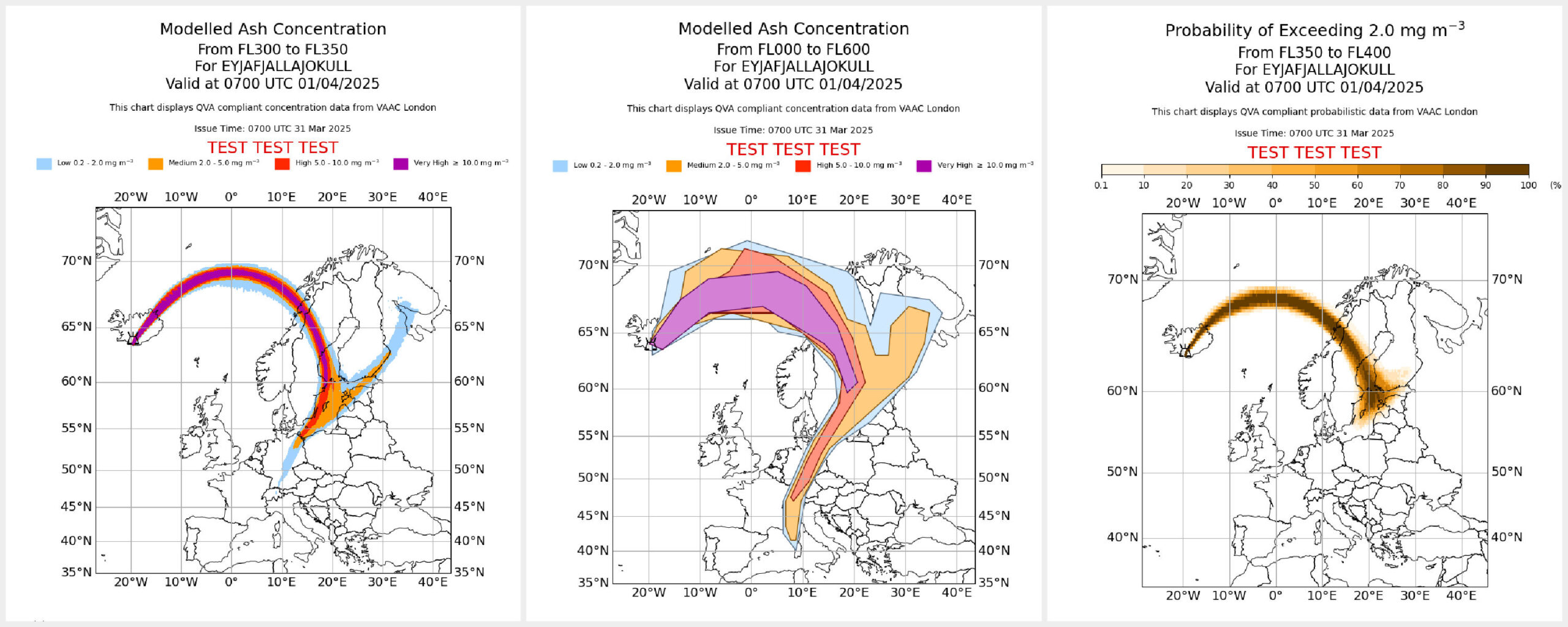
QVA gives you real ash concentration values at different flight levels. Instead of large shaded areas that simply show where ash might be, you get a detailed 3D picture of how much ash is expected in each place and at each time. This lets operators compare forecast ash directly with engine exposure limits rather than working with broad warning zones.

QVA also shows how confident the model is. Low uncertainty means you can keep margins tighter around an ash plume. High uncertainty means planning extra room into the route. It is a smarter and more practical way to think about volcanic ash when planning flights.

The forecasts have a much higher resolution than before. VAAC London says that one forecast used to take about an hour to produce. With QVA they can now generate around 150 ash fields in the same time. You get more detail and you get it faster, which is a big advantage in busy regions like the North Atlantic.

If the data is of interest to your organisation, a request can be made to VAAC London for access to their free QVA API. Just email QVA@metoffice.gov.uk with details of your organisational requirements for volcanic ash data across the north-eastern corner of the North Atlantic, including Iceland and the UK.

The API provides ash concentration and probability forecasts up to FL600 in 3-hourly time steps out to 24 hours, with new forecast runs issued at least every six hours while a significant ash cloud is a hazard. For more details you can visit the Met Office page, and you can also find additional QVA info from VAAC Toulouse.

In short, QVA looks like a real upgrade. Instead of staying far away from anything that resembles a volcano, we can finally make smarter and more precise decisions. Low concentration with low uncertainty may keep a flight close to its ideal track. High concentration with high uncertainty is your clear cue to reroute.

Ash will always be ash, but at least now we can be a bit clever about how we deal with it. We are curious to hear what you think, so we would love to hear from you at team@ops.group.

Volcanoes of the World: The Misery Tour

The last few years have given us a colourful mix of eruptions, each creating its own special brand of trouble for aviation. Here are a few highlights from our unofficial misery tour, in order from oldest to newest.

La Soufriere, St Vincent, 2021

A run of explosive eruptions blasted ash up to about 40,000 ft and spread thick clouds across the Caribbean. Airports closed with little warning and alternates quickly filled up as crews diverted around the ash.

Most affected airports: TVSV/St Vincent, TBPB/Barbados, TGPY/Grenada, TAPA/Antigua

Hunga Tonga, Tonga: 2022

This underwater volcano delivered one of the biggest bangs ever recorded. The shockwave circled the planet, ash shot well above cruise levels and satellite links struggled under the pressure. Flights across the South Pacific had to reroute or delay until conditions improved.

Most affected airports: NFTF/Fua’amotu, NFFN/Nadi, NWWW/Noumea, YSSY/Sydney, NZAA/Auckland

Icelandic volcanoes: 2023-2025

Activity around Fagradalsfjall and the Reykjanes Peninsula caused periodic airport disruptions and NAT flow adjustments. Nothing like 2010, but enough to keep everyone alert.

Most affected airports: BIKF/Keflavik, BIRK/Reykjavik, EGLL/Heathrow, EGKK/Gatwick

Etna and Stromboli, Italy: ongoing

Their eruptions are usually smaller but still a regular headache. Etna can reach flight levels and Stromboli occasionally pushes ash into southern Italian airspace.

Most affected airports: LICC/Catania, LICJ/Palermo

Sangay, Ecuador and Popocatepetl, Mexico: ongoing

Both erupt frequently and love throwing ash across busy Central and South American airways. Dispatchers in the region see SIGMETs from these two on a regular basis.

Most affected airports: SECU/Cuenca, SEQM/New Quito, MMMX/Mexico City, MMPN/Uruapan, MMTO/Toluca.

How Dispatchers and Pilots Actually Work With Volcanic Ash

When volcanic ash shows up, dispatchers start with the big picture. The VAAC advisory outlines where the eruption is, how high the ash is being thrown and how the cloud is expected to drift over time.

For actual flight planning though, SIGMETs do most of the heavy lifting. They are the operationally binding piece because they identify where ash is present or expected within the FIRs you are about to cross and at which flight levels. If a SIGMET says ash is sitting between FL200 and FL350 along your route, that plan is getting a makeover. ASHTAMs then step in to describe the major operational impacts such as airport closures or significant service limitations caused by ash.

The routine is simple: check the VAAC to understand the overall structure of the cloud, check the SIGMETs to see what actually matters to your airspace and altitude, and then draw a route that stays sensible without being overly conservative. QVA will slide into this workflow neatly because it finally shows how much ash is out there and how confident the forecast is, which makes the whole decision process a lot more grown-up.

Ash is still ash, but at least now everyone can know exactly how worried to be.

What about you?

When you plan routes in areas affected by volcanic ash, what do you rely on most? Do you start with the VAAC advisories, or do SIGMETs and ASHTAMs carry more weight for you? How do you bring all these pieces together when deciding whether to reroute, change levels or continue as planned?

We would also love to know which tools, charts or sources you find the most useful in real ash events. Let us know at team@ops.group!


2025 Flight Ops Changes: The Big Ones

Another year, another wave of changes across international flight operations. Here are some of the key ones from 2025…

January

  • Cuba overflights still aren’t free: Some Cuban overwater routes don’t need a permit, but NAV fees still apply. Miss them and you may get blocked later. Read
  • Palm Beach TFRs are back: With Trump back in office, TFRs around KPBI/Palm Beach will be frequent again. Expect TSA screening and gateway airport rules. Read
  • New NAT GPS guidance published: A new NAT Ops Bulletin explains what to do after GPS jamming or spoofing. Tell ATC early in your RCL. Read
  • NAT fire diversion planning needs care: Not all alternates have strong fire cover or night ops. Some even need advance payment. Read
  • Mexico paperwork rules tighten again: Some airports now demand original AIU documents from your first Mexico entry. Copies may not be accepted. Read
  • Antigua nav fees move online: Low-level flights below FL245 now use a new site to pay nav fees. Mainly affects TKPK/St Kitts ops. Read
  • UK ETA expands further: From Jan 8, most non-European visa-exempt passengers need a UK ETA. Crew are exempt. Read
  • EASA warns against western Russia: After a shootdown near URMG/Grozny, EASA flagged high misidentification risk from air defence systems. Read
  • EU anti-tankering rules arrive: New ReFuelEU rules restrict tankering for large commercial operators and add heavy reporting duties. Read
  • Iceland joins Eurocontrol: All flights into Icelandic airspace now need Eurocontrol IFPS validation. Watch for rejects. Read
  • Israel updates entry rules: ETA is now mandatory for visa-exempt passengers, plus a new approved airport list for the LLLL/Tel Aviv FIR. Read

February

  • EASA flags bad SAF risk: EASA warned about out-of-spec sustainable fuel entering the market. Double-check suppliers and be cautious with new ones. Read
  • UK warns naughty charter operators: Flying charter to the UK without a Foreign Carrier Permit can lead to bans and big penalties. Calling it “private” won’t help. Read
  • Myanmar airspace warning updated: New guidance for the VYYF/Yangon FIR advises staying at or above FL260, with limited alternates due to ongoing conflict. Read
  • Qatar moves permits online: From Feb 20, all Qatar landing and overflight permits must go through the new CAA portal. Email is out. Read
  • Saudi crew visas get easier: Some BizAv crew are now being issued six-month multiple-entry visas instead of the old 72-hour limit. Read
  • New FAA LOA guide available: A fresh, practical guide explains how to get FAA LOAs approved. Free for OPSGROUP members. Read

March

  • Blue Spruce Routes officially disappear: A new ICAO NAT Doc 007 took effect on Mar 20, removing the Blue Spruce Routes. You can still cross the North Atlantic, but what you can file now depends on your aircraft equipage. Read
  • False TCAS alerts raise eyebrows: False alerts near KDCA/Washington sparked fresh debate about TCAS and cyber resilience. Read
  • Mexico shuts 1,500 smaller airports: Over 1,500 private use airports are now restricted to owners only. Major AIP airports are unaffected. Read
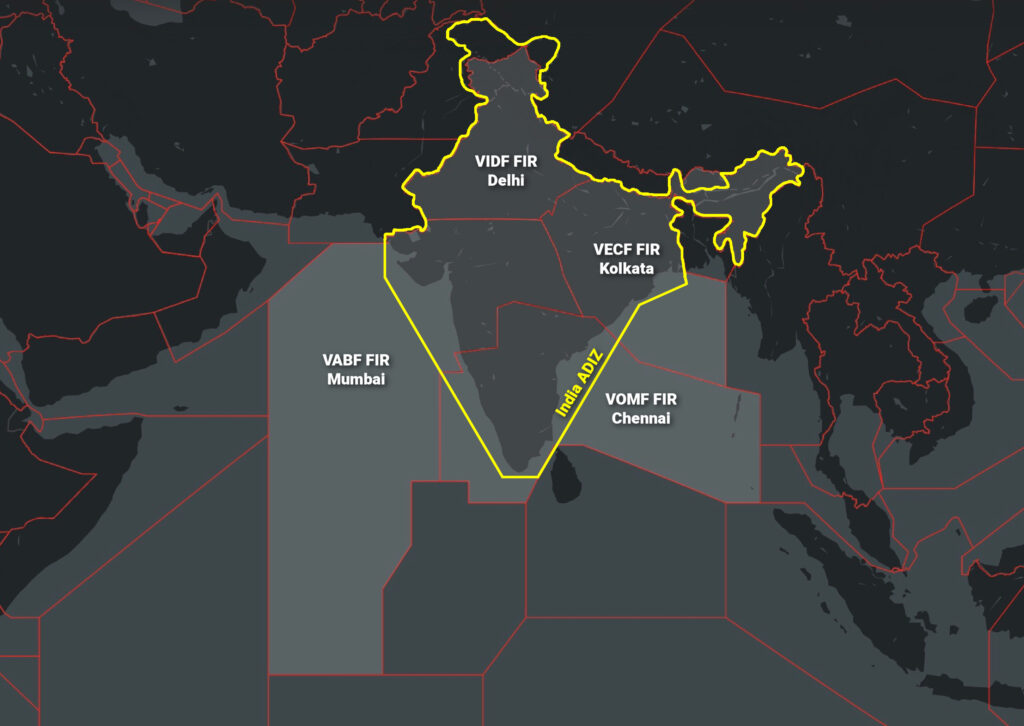
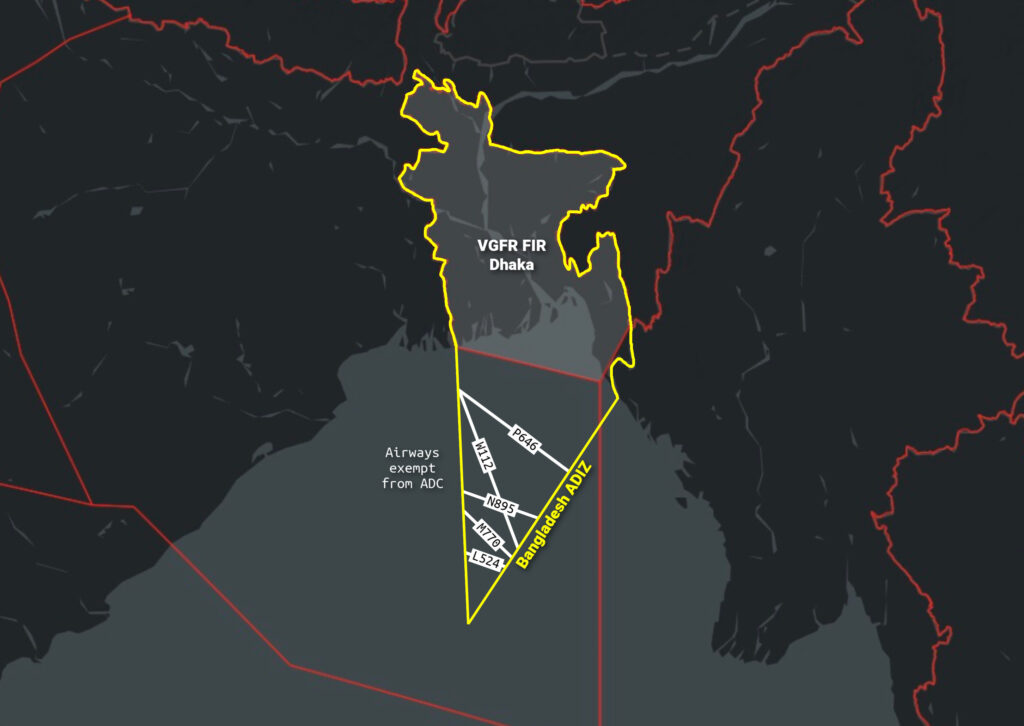
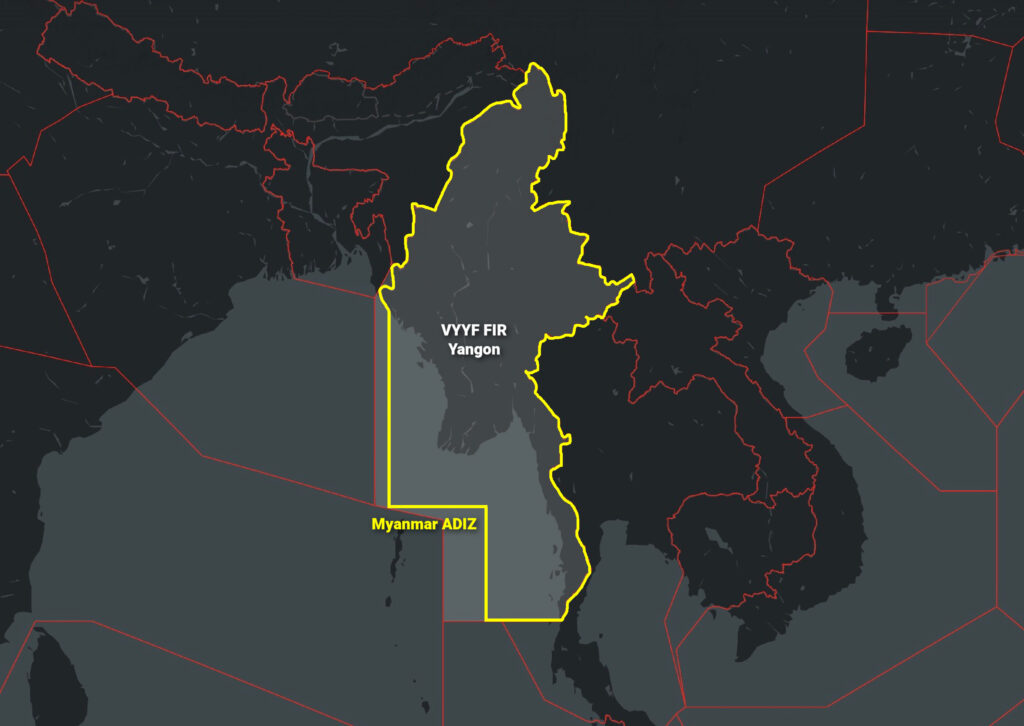
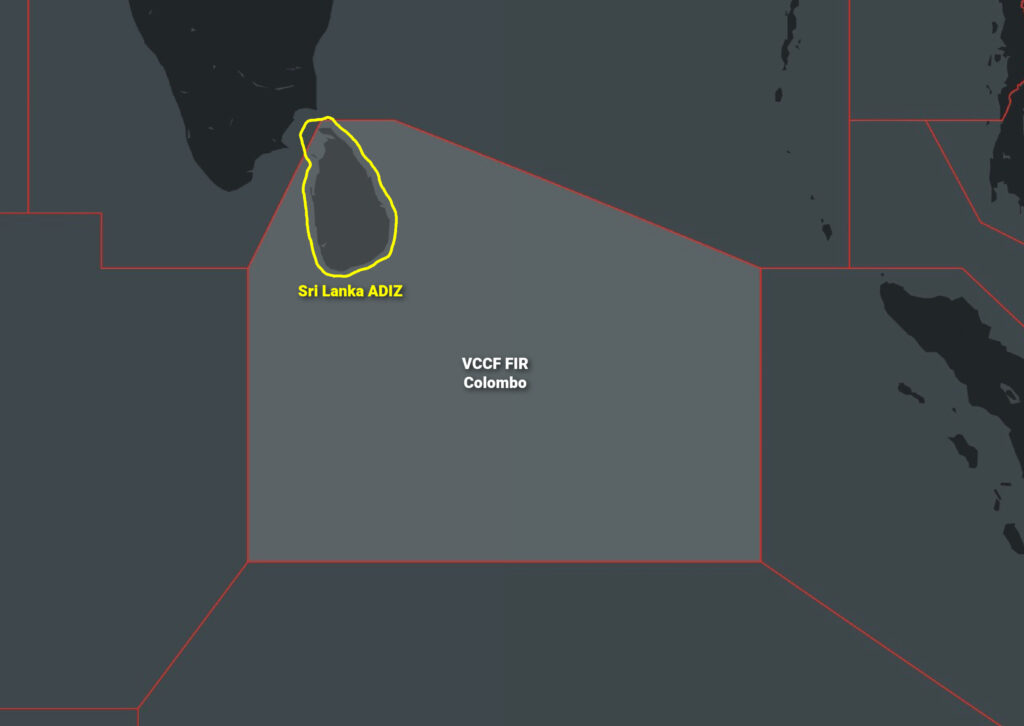
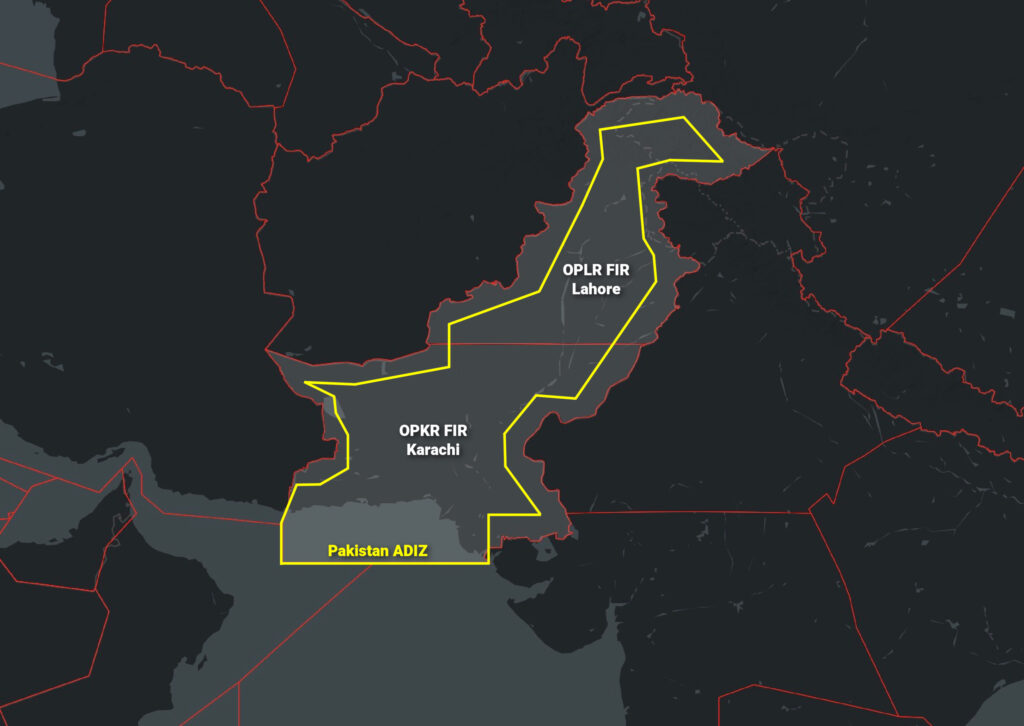
  • ADC numbers are a must in South Asia: Flying through ADIZ airspace in India, Pakistan, Bangladesh, Myanmar, or Nepal? No ADC number can mean delays or denied entry. Read
  • Europe approves ACAS Xa: Europe now allows ACAS Xa alongside ACAS II for larger aircraft. Another step toward next-gen collision avoidance. Read
  • EASA brings in ground handling safety rules: EASA has rolled out its first ground handling safety rules. Handlers have three years to comply, with new training and safety systems coming in. Aircraft safety still stays with the operator. Read
  • France’s higher passenger tax goes live: The new tax started Mar 1. Private flights are exempt, but commercial operators need to plan for it, including overseas territories. Read
  • France tightens CPDLC access: Most French airspace now requires Logon List registration to get CPDLC. Read
  • China opens an English AIP portal: China quietly launched a useful English AIP portal with routes and Notams. Read
  • Singapore eyes stricter rules for foreign AOCs: Singapore plans to expand permit rules to include ferry flights and add higher penalties. Foreign AOC holders should get ahead of it. Read

April

  • Mali and Algeria impose airspace bans: Reciprocal bans between Mali and Algeria are forcing longer routings across parts of Africa. Read
  • FAA tackles mixed traffic collision risk: The FAA is tightening rules where helicopters and airplanes share busy airspace, including Washington, Las Vegas, LA, and the Gulf Coast. More changes are coming. Read
  • US special event fees are here to stay: Temporary FBO surcharges around major US events are no longer rare surprises. With fees popping up more often and further ahead of time, they have become a real planning cost for many US destinations. Read
  • US visa and ESTA rules reinforced: Only Visa Waiver Program signatory operators can carry ESTA passengers into the US. If not, visas are required. Read
  • Brazil brings back visas for some visitors: US, Canadian, and Australian citizens now need a visa to enter Brazil. Crew exemptions exist. Read
  • Mexico customs rules get trickier: New checks on pills, vapes, and electronics are catching crews out at Mexican customs. Read
  • UK ETA expands to Europe: From Apr 2, most European visitors will need a UK ETA. Crew are exempt, but passengers must have approval before flying. Read
  • Hong Kong adds mandatory BizAv APIS: From Apr 29, all BizAv flights to VHHH/Hong Kong must file APIS for crew and pax, including transit passengers. Operators must file themselves. Read
  • Thailand goes digital for arrivals: From May 1, non-Thai arrivals must submit the Thailand Digital Arrival Card online. Crew likely included. Read

May

  • US tightens dog import rules: New US requirements now apply for importing dogs, including vet certificates and air waybills. Missing paperwork can stop entry. Read
  • Visual approaches get a safety warning: A new FAA alert reminds crews that visual approaches can reduce safety margins in busy airspace. Saying “unable” earlier is sometimes the safer call. Read
  • India and Pakistan extend airspace bans: Both countries prolonged their reciprocal bans. Border areas remain sensitive, with advice to avoid parts of the region below FL260. Read
  • Saudi Arabia allows domestic charter flights: Saudi Arabia lifted cabotage restrictions, opening the door to approved domestic charter legs. Read
  • Fuel limits affect flights to Israel: Turkish airports are no longer fuelling aircraft heading to Israel, adding routing and fuel planning constraints. Read
  • Europe updates lost comms procedures: New SERA rules for lost comms, emergency descents, and transponder codes apply across Europe from May 1. Read
  • Le Bourget enforces APU limits: Strict APU time limits at LFPB/Le Bourget are now actively enforced, with fines possible. Read

June

  • FAA requires a US address for foreign licence holders: Foreign FAA certificate holders must now list a US physical address. Read
  • Lithium battery fire risk keeps climbing: Incidents involving vapes, power banks and laptops continue to rise. New FAA and EASA alerts confirm this is now a standing cabin safety issue for BizAv. Read
  • Congo DRC airspace risk remains localized but serious: Canada narrowed its warning for the FZZA/Kinshasa FIR to eastern regions, advising flight at or above FL260 due to anti-aircraft fire risk. Read
  • South Africa mandates ADS-B: From Jun 12, ADS-B is required in RVSM and Class A airspace. No exemptions published. Read
  • Sydney BizAv fees rise: Sydney rolled out higher BizAv charges across parking, runway and ground services. Some free parking time remains, but costs climb fast. Read

July

  • Blue Spruce Routes are gone, but crossings are still possible: The Blue Spruce Routes were removed in March, but operators without full equipage still have ways to cross the North Atlantic. What you can file depends on what is on board. Read
  • FAA updates its oceanic guides: The FAA refreshed its guidance for the North Atlantic, Pacific, and WAT airspace, reflecting how oceanic ops are now being flown. Read
  • US eAPIS now supports border overflight exemptions: Operators can now apply for and renew US border overflight exemptions via eAPIS, with faster and more predictable processing. Read
  • More bizjets qualify for US domestic CPDLC: The FAA expanded its CPDLC list, bringing more business jet types into domestic datacom and PDC availability. Read
  • FAA cleans up charts and foreign procedure approvals: The FAA is removing clutter from approach charts and stepping back from approving foreign instrument procedures. Operators need to rely more on local state data. Read
  • Afghanistan overflight rules extended: The FAA extended Afghanistan overflight rules to Jul 2028, allowing US operators to overfly at high levels while highlighting ongoing risk. Read
  • China tightens power bank rules: China banned uncertified power banks on domestic flights, with possible knock on effects for departures. Read
  • Ceasefire eases tensions on the Cambodia-Thailand border: A ceasefire began on Jul 28 after days of fighting. Read
  • West Africa routing options keep shrinking: Closures, bans, and conflict zones are making routings into West Africa longer and more complex. Read
  • South Africa permits remain a moving target: Any change to a South Africa permit now requires full revalidation, often taking days. Confusion over rules continues to delay flights. Read
  • Cape Verde permits required despite AIP wording: Cape Verde requires permits for all overflights and landings, even though the AIP suggests otherwise. Read
  • Germany sneaky bizjet checks continue: Unannounced security checks on bizjets are still happening in Germany. Read
  • Heat and APU limits raise risk at Nice: Reports from LFMN/Nice link summer heat, strict APU limits, and weak GPUs to aircraft damage and electrical issues. Read
  • Milan ramps up fees for business jets: Private flights at LIML/Linate and LIMC/Malpensa are seeing steep increases in landing and parking fees, in some cases by hundreds of percent. Read

August

  • Cuba remains off limits for most private jets: Most private flights still cannot operate to Cuba. Any US registered aircraft needs a license that is rarely granted, and commercial ops face strict OFAC exposure tied to US people and payments. Read
  • US CBP updates add cost and admin friction: CBP rolled out new rules for Border Overflight Exemptions and small fee increases from Oct 1. Nothing dramatic, but it all adds up. Read
  • EU commercial ops still need a TCO: Commercial flights into the EU require a Third Country Operator approval. It is free and straightforward, but needs to be sorted early. Read
  • LFPM offers a calmer way into Paris: LFPM/Villaroche offers 24/7 ops with fewer restrictions than Le Bourget. It is Schengen only, but can be a smooth option for the right trip. Read
  • Phnom Penh switches to a new airport: VDTI/Techo opens on Sep 9, replacing VDPP/Phnom Penh for civil traffic. A permanent change for Cambodia operations. Read
  • Thailand adds another compliance trap for charters: Commercial charter operators flying regularly or staying over a month in Thailand now need a Foreign Aircraft Operator Security Programme. Miss it and permits can stall. Read
  • South Korea launches overnight CPDLC: From Sep 3, optional CPDLC is available above FL160 during overnight hours for non urgent messages. Correct equipage and flight plan coding are required. Read
  • Cybersecurity is now a real flight ops risk: BizAv is no longer flying under the radar. From hacked EFBs to leaked data, Part 91 and 135 operators are real targets and should treat cyber risk as an ops issue. Read
  • BizAv safety lessons go practical: The 2025 Nimbl safety report turns real BizAv reports into practical lessons on handling, approaches, fatigue, and GPS interference. Read

September

  • Russia sanctions remain a hard operational barrier: Overflights remain off limits for most operators, with rules differing between the EU, UK, and US. Expect ongoing paperwork and no quick easing. Read
  • Eastern Europe spillover risk continues to grow: Russian drones and aircraft have violated airspace over Poland, Romania, and Estonia, triggering NATO intercepts. Read
  • US aircraft trash rules keep catching operators out: Some US CBP ports still treat arrivals from Canada as regulated trash flights, even though Canada is exempt. Local interpretation varies, so check port requirements in advance to avoid fines. Read
  • Mexico introduces double APIS submission: From Sep 17, flights to Mexico must submit APIS twice, before departure and again after doors close. Easy to miss and still catching crews out. Read
  • UK GAR rules clarified: No GAR is needed for domestic UK flights, but trips to the Channel Islands or the Isle of Man still need both a UK GAR and a local one. Read
  • Qatar simplifies northern FIR overflights: The northern Doha FIR now requires a flight notification instead of a permit, while the southern FIR still needs a permit. A lasting change for routine routings. Read
  • Balloon and kite hazards return at Sao Paulo: Crews reported balloon and kite strings on landing gear at SBGR/Sao Paulo, with objects seen as high as FL150. A real hazard despite no Notams or ATIS warnings. Read

October

  • Europe’s datalink rules become a hard filing requirement: From Nov 4 2025, IFPS will reject flight plans above FL285 if CPDLC is not filed correctly. Read
  • Europe’s EU-LISA Entry Exit System starts going live: The EU Entry Exit System is rolling out now, with full expansion through Apr 2026. New checks and registrations are coming for commercial flights, with ETIAS next. Read
  • EASA keeps Middle East airspace risk guidance locked away: EASA has extended its Israel and Iran airspace Information Notes to end Jan 2026, with no change in content. The guidance remains non-public, covering the LLLL/Tel Aviv FIR and nearby airspace, and the entire OIIX/Tehran FIR. For non EU operators, official risk guidance stays hard to access, while N-reg aircraft remain banned from Iranian airspace. Read
  • EASA warns crews about QNH errors: After a near miss linked to incorrect QNH, EASA reminded crews how easy it is to end up low on final. Simple altimeter cross checks still matter. Read
  • Haiti airspace warning extended into 2026: The FAA extended its Haiti warning through Mar 2026. Restrictions remain below 10,000 ft near MTPP/Port au Prince due to ongoing security risks. This remains a planning constraint. Read
  • North Atlantic crews face extra checks after GPS interference: GPS spoofing and jamming continue to affect NAT flights. If you have GNSS issues before entry, Shanwick wants to know early. Include it in your RCL to avoid delays or reroutes. Read
  • US tightens rules on where crew visas are issued: Crew must now apply for US visas in their home country or country of residence, not third countries. This may affect renewal timelines. Read
  • Toronto tightens BizAv slot tolerance: From Oct 21, CYYZ/Toronto requires slots via the Global OCS Portal and cuts tolerance to plus or minus 30 minutes. Register early if you are not set up. Read
  • Saudi Arabia introduces optional CPDLC: From Oct 2, optional CPDLC is available above FL290 in the OEJD/Jeddah FIR for FANS 1/A aircraft. Voice remains required for urgent traffic. Read
  • Uzbekistan updates ICAO codes and transition levels: Uzbekistan has switched from UT to UZ ICAO codes and raised the transition altitude to 13,000 ft or FL150. The change simplifies cross border ops and better aligns with neighbours. Read
  • Pilot age limits clarified: A new guide confirms the basics. Commercial international flying stops at 65, private flying does not. Country specific rules still matter and can catch crews out. Read

November

  • Sudan risk remains: After an aircraft was reportedly shot down, Sudan’s airspace remains closed and nearby routings rely on narrow contingencies. Extra caution is needed when flying near Northeast Africa. Read
  • Somalia permit confusion continues in the north: Conflicting instructions between Somalia and Somaliland continue near HCSM/Mogadishu FIR. Read
  • GPS interference near Delhi triggers new reporting steps: After spoofing events near VIDP/Delhi, authorities introduced a new pilot reporting procedure. Crews should expect continued GNSS issues and follow the updated process. Read
  • North Atlantic procedures keep evolving: Iceland and Gander plan to drop RCL messages, GNSS interference reports are increasing, and the old HLA approval concept may be phased out. NAT planning continues to move away from legacy processes. Read
  • FAA restores BizAv access after US shutdown: On Nov 17, the FAA lifted flight reduction limits and cancelled Notams that had blocked bizjets at 12 major US airports. BizAv access is open again. Read
  • Paper Jepp charts head for retirement: Jeppesen confirmed that paper charts will be retired by Oct next year. Operators still using paper will need to complete the shift to digital and make sure compliance and crew readiness are covered. Read
  • UK GAR moves to One Login: The UK GAR site now uses One Login and old accounts no longer work. Operators need to set up new access and recheck their data before filing. Read
  • New runway opens at OKKK/Kuwait: Runway 16/34 is now open, with SID changes and a new Ground West frequency. Crews report runway confusion at night, so confirm assignments carefully. Read
  • Tahiti BizAv access is more restricted than it looks: Peak hour limits and alternate constraints mean Tahiti requires careful timing and backup planning. It is not a simple H24 stop. Read

December (and beyond!)

  • Airport incursions become a real European disruption risk: Drones and balloons have already forced airport closures and diversions across Europe Read
  • Venezuela best avoided: The FAA advisory still stands and the SVZM/Maiquetia FIR remains unstable and best avoided. Read
  • UK ETA checks move toward full enforcement: From Feb 25 2026, UK GAR submissions will actively check passenger permission to travel. Missing ETA or visas can trigger a “No Record” response. Read
  • UK confirms higher Air Passenger Duty for BizAv: From Apr 2027, higher APD will apply to business jets from 5.7 tonnes. On long haul flights, the cost per passenger will be significant. This is a future cost to plan for now. Read
  • Biometric border controls become mandatory for all non-US citizens: From Dec 26, facial biometric scanning is required for all non US citizens entering or leaving the US, including private aircraft. Most exemptions are being removed and refusal may mean denied boarding or entry. This is now standard US ops compliance. Read
  • US Special Event Fees stretch into 2026: The updated Special Event Fees Tracker shows FBO surcharges already published well into 2025 and 2026. These fees are now a regular planning cost, not a surprise. Read
  • Greenland keeps changing the NAT alternate picture: BGSF/Sondrestrom remains fully controlled, BGGH/Nuuk is upgraded but still restricted for BizAv, and BGBW/Narsarsuaq is heading toward closure. Greenland alternates remain a moving target. Read
  • NAT trials half degree coordinates on daily tracks: In mid January, some OTS tracks will use half degree coordinates. Planning stays the same, but it is another step toward more flexible NAT routing. Make sure your systems handle half degree points correctly. Read
  • Seletar reinforces VFR arrival discipline: After a runway misalignment incident, new guidance reinforces strict VFR arrivals at WSSL/Seletar. Visual GPS aids and strong situational awareness are now essential. Read
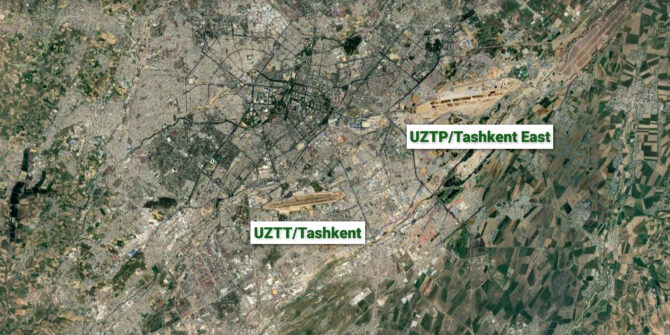
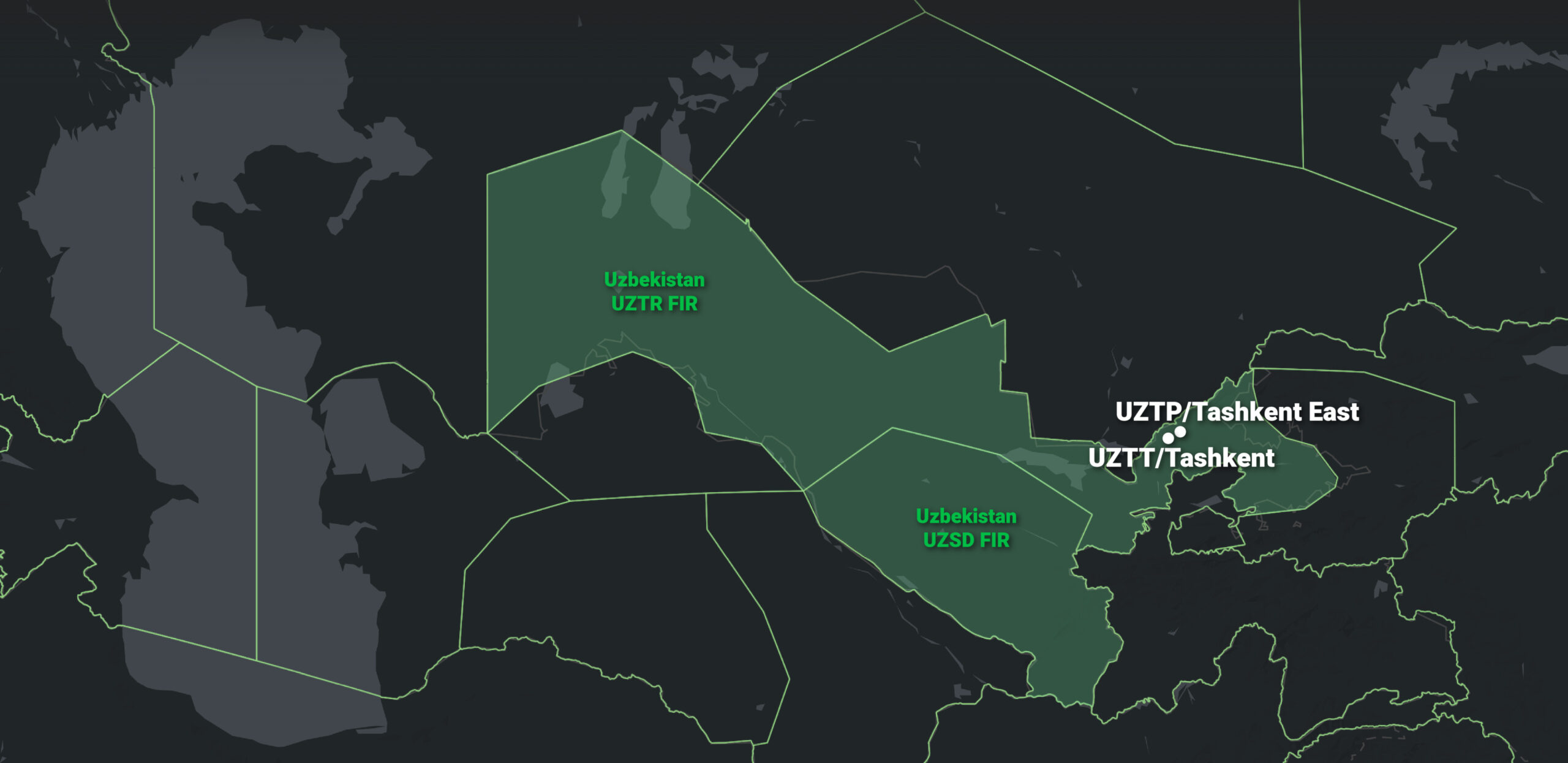
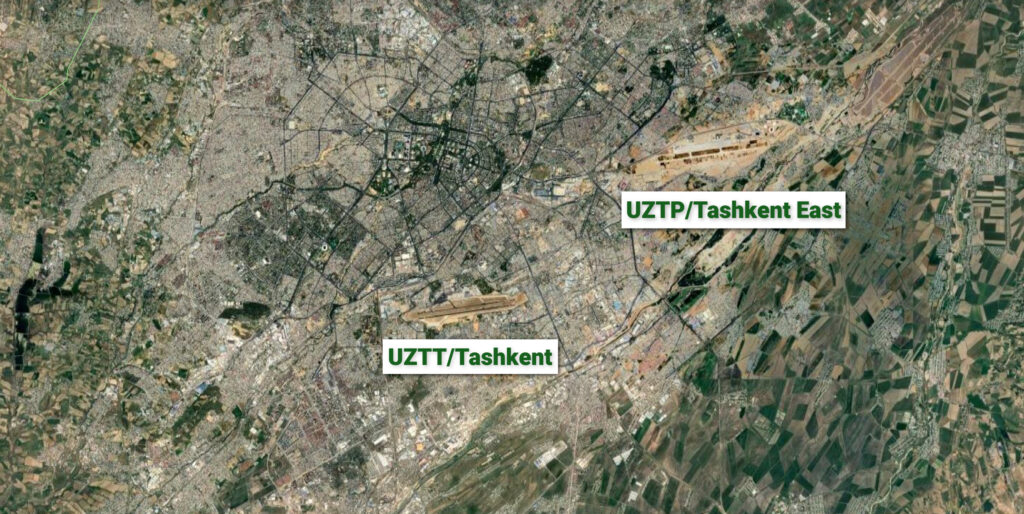
  • Uzbekistan opens a new BizAv tech stop: UZTP/Vostochny is now operational near UZTT/Tashkent with a long runway and full services. It is expected to take over most BizAv traffic and becomes a solid new Europe Asia tech stop. Read
  • South Pacific crossings demand serious prep: Flights between Australia and South America mean long legs, limited alternates and thin island support. Crews report this is a route where preparation really matters. Read

As the year wraps up, a huge thank you to everyone in OPSGROUP for being part of it, for sharing insights, experiences, and real-world stories, and for helping keep the whole community informed and safer throughout the year.

We’ll be taking a short break from the Daily Brief and Weekly Bulletin emails over the holidays. Our last day in the office will be Monday 22nd Dec, and we’ll be back on Friday 2nd Jan. Until then, happy holidays to all, enjoy the break, and see you in 2026! ❤️⚡✈️🧑‍✈️


Mexico Customs Surprises: Pills, Vapes, and Laptop Rules

Key Points
  • Crew warning: AFAC officials at MMSD asked a crew member to carry unknown pills back to the U.S. – possible setup. Decline, document, and don’t touch.
  • Vapes banned: Mexico officially outlawed vapes in January 2025. A new federal law now criminalises almost any activity involving them, including production, storage or transport for commercial purposes. Penalties can exceed USD 14,000 or result in prison sentences of up to eight years. Since the law does not define what counts as commercial activity, authorities may treat multiple devices as intent to distribute.
  • Device limits: Customs is enforcing a one-laptop/tablet rule per person. Extra devices may be taxed at 19% – no crew exemptions.

Flying to Mexico has always come with a few quirks, but there have been a few notable developments recently that crews should be aware of. Here’s a quick look at some of the latest updates – from strange inspections to unexpected customs issues. Might be worth a heads-up to your team before your next trip south.

The “would you mind taking this bag?” situation

A recent report out of MMSD/San José del Cabo raised eyebrows. After clearing customs and immigration without issue, a crew member was asked to step into the AFAC office. There, officials presented them with a ziplock bag full of prescription pill bottles and asked if they could take it back to the U.S. The crew member wisely declined.

Was it a test? A setup? It’s unclear – but it looked staged, and could easily have ended badly. If something like this happens to you, the advice is simple: stay calm, politely say no, ask for everything in writing, and don’t touch anything you haven’t personally verified. Accepting unknown items could lead to serious legal trouble or even aircraft seizure.

Vapes are banned. Like, officially.

Mexico has not only banned the import and use of vapes. A new federal law now makes almost anything involving them a criminal offence. It covers acquiring them, storing them, transporting them and selling them, and it uses the term “for commercial purposes” without explaining what that actually means. Because the wording is so vague, authorities can interpret it as they see fit. Penalties can reach fines of around USD 14,000 and prison sentences of up to eight years.

This vagueness is the real issue. You may think that bringing a few vapes clearly counts as personal use, but an inspecting officer may reach a different conclusion. There is no defined threshold, so the final judgement is entirely in the hands of the person checking your bags.

The message for passengers and crew is simple: do not bring any vapes to Mexico. Even someone who believes they are carrying only harmless extras can suddenly find themselves facing a much more serious problem.

It is much easier to avoid the situation completely and leave them at home.

That laptop in your flight bag might cost you

Mexico has a long-standing rule that only one laptop or tablet is allowed per person when entering the country. We’ve heard from members that customs officers are starting to enforce this again. One crew reported being stopped at MMSP/La Paz because they had more than one device and were told they’d be charged 19% of the declared value.

And no – aircraft iPads, iPhones or EFBs don’t get special treatment. The rule applies per person, regardless of what the devices are used for. Declaring them as commercial equipment can actually make things worse. So best to split up the gear among the crew and passengers or avoid overpacking the electronics.


If you have been to Mexico recently and have a story to share – please do! Reports like these are super useful for everyone in the group. File an Airport Spy report anonymously here.


Crossing the Quiet South: From Australia to Argentina

Every so often, a question drops into our inbox that reminds us just how big and how quiet parts of the world still are.

Not long ago, someone asked about flying from Australia to the southern tip of Argentina. It’s a trip across one of the most isolated parts of the planet: long stretches of ocean, few places to land, and very little room for error if something changes. There isn’t much written about it, and only a small number of crews have done it.

We checked with the OPSGROUP community and heard back from several operators and trip support teams who have made the crossing. They shared where they routed, where they stopped, and what they learned along the way.

This short guide brings together what we know so far, and we’ll keep adding to it as more of you share your experiences. If you’ve flown anywhere in this region, we’d love to hear from you at team@ops.group.

Few Places to Land

Once you leave Australia and head east across the South Pacific, things get quiet very quickly. It is a huge region with many small nations and islands, but only a few airports have long enough runways and operate around the clock. Many smaller fields have little or no parking, and fuel is not always guaranteed. Communication can also be slow, as email exchanges with local FBOs or authorities often take time, so it helps to plan well ahead.
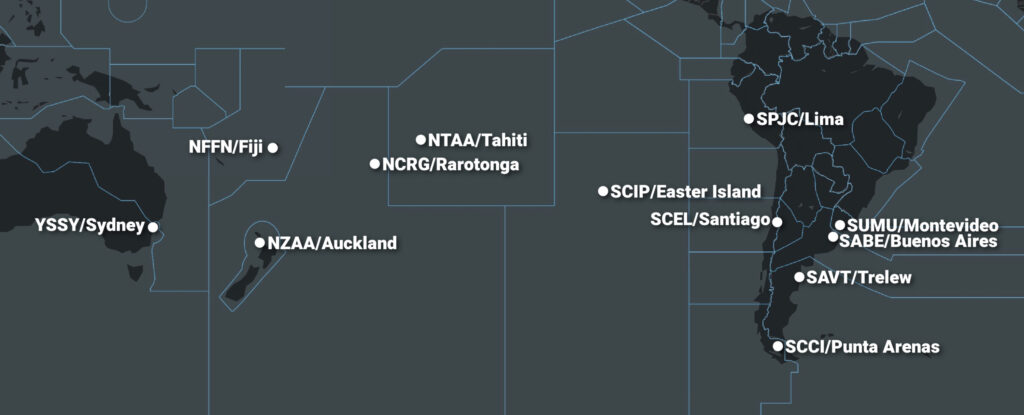
Finding suitable alternates is another key challenge. Distances between usable airports are long, and ETOPS planning can be complex. Some crews recommend keeping about five degrees of spacing between waypoints to make navigation and decision-making easier. There are also a few US military airfields in the region, such as PGUA/Guam and PKWA/Kwajalein, but these are not open to civilian traffic.

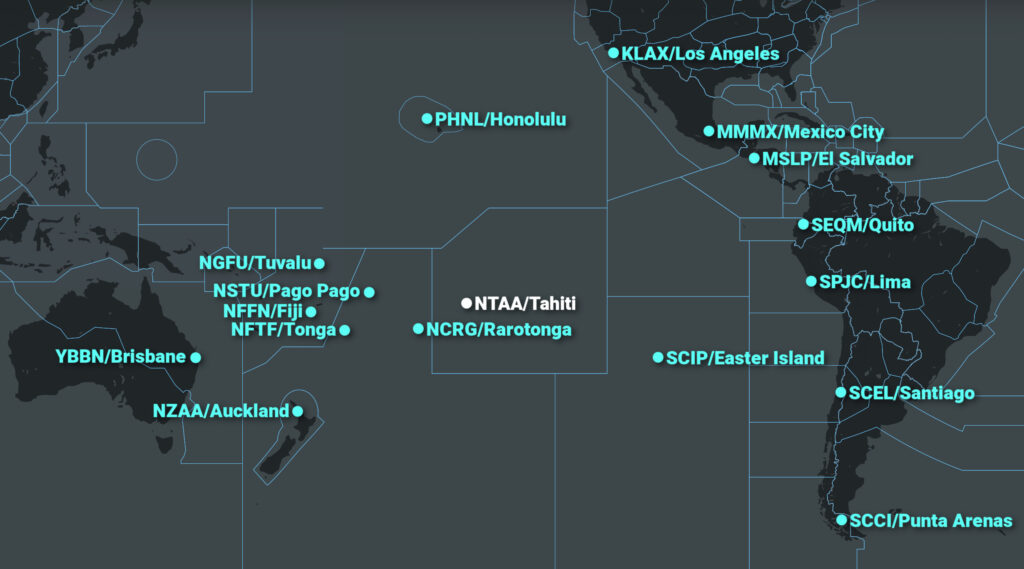
SCIP/Easter Island is the only true mid-ocean option. To the west lies NZAA/Auckland, and to the east SCCI/Punta Arenas marks the entry into South America. Antarctica may look close on a map, but it is not a realistic option because there is no fuel or services, and diversions there are reserved for real emergencies.

Most operators who have crossed the Pacific follow a similar island-hopping route:

YSSY/Sydney → NTAA/Tahiti → SCIP/Easter Island → South America (SADF, SCCI, SUMU)

Trans-polar routing is not practical for most bizjets, so this Polynesian path remains the preferred choice.

Many of the islands that can handle larger bizjets are not open 24 hours and often require slots or PPR. Last-minute diversions are rarely possible, especially in Polynesia. Even the main stops such as NTAA/Tahiti and SCIP/Easter Island can face full airport or runway closures at times. On Easter Island, handling is provided by a single agent with limited services, and cash may be preferred. Other alternates, including NCRG/Rarotonga, have similarly tight hours, so it’s best to check schedules and requirements well in advance.

Fuel shortages are uncommon (except for NCRG/Rarotonga, which has one now and then when the fuel tanker is late to arrive at the island), but arranging fuel releases in advance is always sensible. Permits and visas can also take extra time depending on the country, so it helps to build that into your schedule.

Comms and datalink are generally reliable, although one crew reported a four-hour satellite internet dropout west of Easter Island. Light turbulence can occur in the low 40s, especially during the Southern Hemisphere winter.

Once you reach the mainland, things become much easier. Handling in Chile and Argentina is efficient, fuel is reliable, and services are good. On the islands, operations are simpler but still manageable with good coordination.

How different aircraft made the trip

Several long-range bizjets have flown this route. Here are examples of routings that worked in practice.

Challenger 350

SADF/San Fernando → SCIP/Easter Island → NTAA/Tahiti
NTAA/Tahiti → SCIP/Easter Island → SADF/San Fernando
Possible with careful planning around alternates and timing.

Falcon 7X

SABE/Buenos Aires → SCIP/Easter Island → NZAA/Auckland 
YSSY/Sydney → NTAA/Tahiti → SABE/Buenos Aires
SADF/San Fernando → SCIP/Easter Island → NFFN/Nadi
NFFN/Nadi → SCIP/Easter Island → SADF/San Fernando
A flexible option with enough range to connect Polynesia with South America comfortably.

Global Express

SAVT/Trelew → NFFN/Nadi
Has no trouble with the longer Pacific legs, and Fiji works well as a fuel stop.

Gulfstream G550/G650

YSSY/Sydney → NTAA/Tahiti → SADF/San Fernando, SCCI/Punta Arenas
A straightforward option via Tahiti that keeps legs comfortable.

Airports along the way

A quick look at the key tech-stops, listed east to west, from Australia/New Zealand toward South America.

🇦🇺 YSSY/Sydney – Australia

The airport runs H24, though there is a strict 2300-0600 LT curfew. Handlers can request exceptions, but these are not guaranteed. FBOs can usually arrange CIQ directly on site. Fuel is tanker only, so plan large uplifts in advance. Slots are required. Expect standard Australian disinsection rules and have the empty spray can ready on arrival.

Jet Aviation closed its doors permanently on Nov 30, so ExecuJet is now the only FBO at the field moving forward.

FBO contact: fbo.yssy@execujet.com

🇳🇿 NZAA/Auckland – New Zealand

Another solid H24 tech stop just across the Tasman. The airport stays open all day, with short runway maintenance early on Monday and Saturday from 0130-0430 LT, which sometimes does not appear in Notams. Private flights under Part 91 do not need permits, while charter flights under Part 135 require CAA approval. CIQ operates around the clock, and fuel is available with notice, although last-minute uplifts can be slow during busy hours. New Zealand enforces strict biosecurity, and cabin disinsection is mandatory, but quarantine staff can handle it on arrival if needed.

FBO contact: fbo.nzaa@execujet.com, anz_info.s.e.a@swissport.com

🇫🇯 NFFN/Nadi – Fiji

A smooth 24-hour tech stop and refuel point midway between Polynesia and South America. The airport and customs run H24, fuel and handling are reliable, and turnarounds are quick. Wildlife can be active at dawn and dusk, but otherwise ops are straightforward.

FBO contact: info@fijiairports.com.fj, fbo@ats.com.fj

🇵🇫 NTAA/Tahiti – French Polynesia

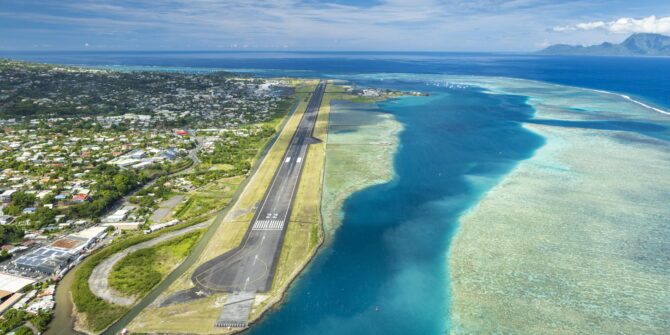
The only international airport in French Polynesia and the main South Pacific stop. NTAA runs H24, though through early February non-based BizAv (private and charter flights) face limited operating windows matching airline peaks. Movements in those periods need airport manager approval, and use as a diversion is restricted to locally based or pre-scheduled aircraft.

For example, TASC FBO confirmed full 24/7 support on the north side, including CIQ pre-clearance on arrival. They handle disinsection if needed and provide fuel exclusively under the Petropol ExxonMobil brand. Occasionally, filing flight plans through the ARO can be difficult, so it’s recommended to send the FPL by email to seac-pf-bria-bf@aviation-civile.gouv.fr and wait for confirmation.

Landing permits must be requested by operators via the French Polynesia CAA portal (72 hours for private flights, 14 days for charter). Nearby NTTB/Bora Bora  and NTTR/Raiatea are domestic with limited hours and fuel, making NTAA the only reliable international option in the region.

For details on current NTAA restrictions and seasonal procedures, see our dedicated article here.

FBO contact: nuutea@tascfbo.com, ops.ei@airtahiti.pf, ulric.allard@airtahiti.pf

🇨🇰 NCRG/Rarotonga – Cook Islands

A small but reliable entry point between French Polynesia and South America. ATC hours rotate and are published by Notam, with controllers available on request for diversions at +682 25890 or +682 71439. A landing permit is required about 14 days in advance via the CAA, and CIQ is available anytime by prior arrangement. Most nationalities receive a 30-day visa on arrival. Fuel is supplied by Pacific Energy and currently limited for non-scheduled flights. There are two international stands, and overnight parking requires a towbar.

FBO contact: ross.warwick@airraro.com, savage@airportauthority.gov.ck, nikautangaroa@airportauthority.gov.ck

🇨🇱 SCIP/Easter Island – Chile

A key mid-Pacific stop that works well for fuel and rest but needs careful planning. The airport operates roughly 0900-1700 LT on weekdays with shorter weekend hours. A landing permit is required, and once approved, it also serves as parking authorization. Fuel from WFS must be requested 24 hours in advance, and all arrivals must complete cabin disinsection and show the empty spray can as proof. Instrument approaches are often unavailable by Notam, so be ready for visual arrivals and plan alternates carefully. Parking is very limited, usually one stand overnight, and the single handler provides basic services, often accepting only cash.

FBO contact: punavai949@gmail.com, edmundserviceseirl@gmail.com

🇨🇱 SCCI/Punta Arenas – Chile

A reliable southern mainland stop. The airport operates H24 with full CIQ coverage. Three runways provide flexibility, the main one being RWY 07/25 (2790 m / 9154 ft). Fuel is available, and parking can be arranged but must be requested in advance due to limited capacity. No slot requirement.

FBO contact: fbo@aviasur.com, ygonzalez@aviasur.com

🇨🇱 SCEL/Santiago – Chile

Another entry point into South America with reliable services and straightforward procedures. The airport operates H24 with CIQ available around the clock. Parking for BizAv is generally available, fuel is offered H24, and there are no slot or PPR requirements.

FBO contact: fbo@aviasur.com, psaavedra@aviasur.com

🇦🇷 SABE/Buenos Aires – Argentina

Busy city entry point operating H24 with full CIQ coverage. According to the FBO, ramp parking is limited to about two hours, so hangar space should be arranged in advance. Fuel is available.

FBO contact: comercial@royalclass.global, info@royalclass.com.ar

🇦🇷 SADF/San Fernando – Argentina

The other BizAv option for Buenos Aires. H24 with no slots, customs available, easy parking, and fuel on site. The single runway 05/23 is shorter at 1690 m (5545 ft), but ops are smooth, making it a popular alternative to SABE.

FBO contact: fbo@flyzar.com

🇦🇷 SAVT/Trelew – Argentina

A useful southern stop when routing toward Patagonia or Chile. The airport is open H24 with fuel available, and customs work on request with a 48-hour PPR, so it’s best to plan ahead to make sure everything is ready on arrival.

FBO contact: ops@aerowise.aero

🇺🇾 SUMU/Montevideo – Uruguay

A solid H24 option for tech stops or entry into Uruguay. The airport offers full customs, long runways, and reliable support, though most parking stands have specific wingspan and pushback limits, so it’s best to confirm space in advance. Fuel is available. Note local noise restrictions prohibiting departures over Montevideo between 2100-0700 LT, except for emergencies or weather-related operations.

FBO contact: fbo@fbo.com.uy, ops@aerowise.aero

Flying between Australia and Argentina is very doable, just not the kind of trip you improvise! The distances are huge, the alternates are few, and every good piece of info makes a real difference.

If you’ve been through any of these airports recently, we’d love to hear your story. You can share it with the community by submitting an Airport Spy Report. It’s basically a little postcard about what happened on the ground so the next crew knows what to expect. Your notes help everyone who sets out across the quiet South.

Tahiti BizAv Restrictions: Peak-Time Bans and Alternate Rules

If you are planning a long hop across the South Pacific, NTAA/Tahiti is the obvious dot in the middle of the map. It is the only international airport in French Polynesia, the main South Pacific stop.

Right now though, it is not quite the simple H24 option it appears to be on paper. Airport and ATC capacity are stretched, airlines get priority, and BizAv has to fit around some fairly tight restrictions.

This is a quick guide to what is going on, and how to make NTAA/Tahiti work for you without nasty surprises.

The Not-So-Simple BizAv Reality at NTAA

For non-based BizAv, Tahiti has some quiet “avoid these hours” rules. Several daily blackout windows line up with the airline rush. During those peak periods, visiting non-scheduled flights cannot arrive or depart unless the airport manager approves it. These limits are not seasonal and seem driven by local capacity pressure during the busiest airline banks. Handlers say the squeeze has been noticeable since mid-2025.

The restrictions currently run into early June 2026. The exact hours vary by day and are published in rolling Notams, so you need to check the current version before planning.

Tahiti also has limits as a diversion alternate. During busy periods, aircraft not based locally or already scheduled at NTAA generally need approval to file it as an alternate. Medevac flights are the standing exception. These diversion limits currently run into early April 2026.

For South Pacific crossings, this turns NTAA into an airport with practical operating hours. If it’s in your plan as a destination or alternate, check the Notams carefully, in local time and UTC.

Another thing to watch out for: the ATS reporting office is not operating normally. Non-scheduled flight plans must be sent by email to SEAC-PF-BRIA-BF@aviation-civile.gouv.fr, and you should wait for acknowledgement before assuming you are filed.

What Local Handlers Say

Local handlers in Tahiti gave us a very helpful look at how things work in practice, and their insight fills in a lot of the gaps that the Notams leave out.

NTAA is H24 and fully equipped for any bizjet, but its daily rhythm follows the airline peaks. Outside the restricted hours you still get full international services, including fuel, CIQ and parking support.

Nearby NTTB/Bora Bora and NTTR/Raiatea are domestic only, with shorter hours, no CIQ and limited fuel at NTTB. They are not suitable as international alternates and cannot replace NTAA if you need a reliable option in the middle of the Pacific.

CIQ pre-clearance: TASC FBO told us they can arrange full CIQ pre-clearance before arrival. The process is simple. You send inbound and outbound GENDECs together with passport scans for all crew and passengers, and everyone fills out an immigration card in advance. Immigration then pre-clears the names and meets the aircraft on arrival for a quick visual check and passport stamp. When the paperwork is sent early enough, the entire process can be as fast as loading the bags into the car. For tight turnarounds this is a major time-saver.

Biosecurity rules: French Polynesia is strict on biosecurity, similar to Australia or New Zealand. Cabin disinsection with an approved spray is mandatory at top of descent. Plant and animal products and any live animals need prior approval. Weapons and ammunition require separate permission. Cash over 10,000 EUR equivalent must be declared. In short, paperwork matters here.

Fuel: NTAA has unlimited Jet A1 for normal bizjet demand. Fuel is supplied through different arrangements depending on the handler. For example, TASC FBO provides fueling exclusively under the Petropol (ExxonMobil) brand, which means the fuel release must be issued under Petropol for them to accept it. Releases from other suppliers cannot be used with this setup. If you arrive without a release, major credit cards such as Amex, Visa or MasterCard are accepted. Because Tahiti is such an important mid-Pacific fuel stop, sending the correct fuel release ahead of time is very helpful.

Permits: Landing permits must be requested directly by the operator through the French Polynesia CAA portal. Private flights should apply at least 72 hours ahead. Commercial and charter flights need at least 14 days. Handlers cannot apply on your behalf, but they can guide you through the process. In the portal you can nominate your preferred handling agent so everyone sees the same set of documents.

If the portal is unavailable for any reason, requests can also be submitted by email. Include:

  • Full schedule
  • Tail number
  • Aircraft type
  • MTOW
  • Company name and address
  • GENDEC
  • Name of your handling agent

Send email requests to seac-pf-sna-preflight-ld@aviation-civile.gouv.fr, ideally copying your handler so they can follow and support the request.

FBO contacts: 

Tahiti is still the key South Pacific stop for long-range BizAv, but it is a “plan it properly or it will not work” kind of place. If you plan around the peak-time restrictions and sort permits and fuel early, NTAA works smoothly. Treat it like a simple H24 diversion and it may catch you out.

If you have recent experience here, please send us an Airport Spy Report. A short postcard-style note is enough and it helps everyone flying the same route.


Pilot Age Limits – The Full Picture

Here’s something we’ve been meaning to do for a long time. It seems there’s no single place online where the rules on pilot age limits are spelled out in plain English. So here you go, friends. If you’ve got suggestions, corrections, or edge cases we’ve missed, drop us a note at blog@ops.group.

The basics:

  • For international commercial flights: all pilots must be under 65.
  • For domestic commercial flights: most countries follow the same 65-year rule, but some go further – Argentina, Australia, New Zealand, Canada and Japan all allow older pilots under certain medical and operational conditions, while others, like India, apply stricter limits.
  • For private flights: there’s no age limit anywhere. The only restriction is the pilot’s medical.

Who makes the rules?

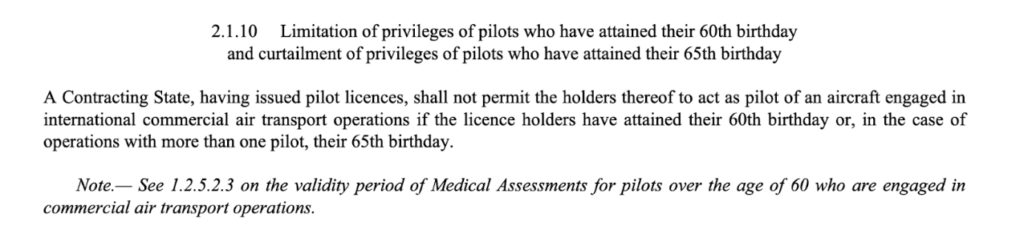
The starting point is ICAO. Annex 1 – Personnel Licensing sets the global standard for pilot age in international commercial air transport operations. The rule is simple:

  • 65 years old in multi-pilot operations
  • 60 years old in single-pilot operations

These limits apply only to commercial flights – airlines and charter. They do not apply to private flying, where ICAO sets no age restriction at all.

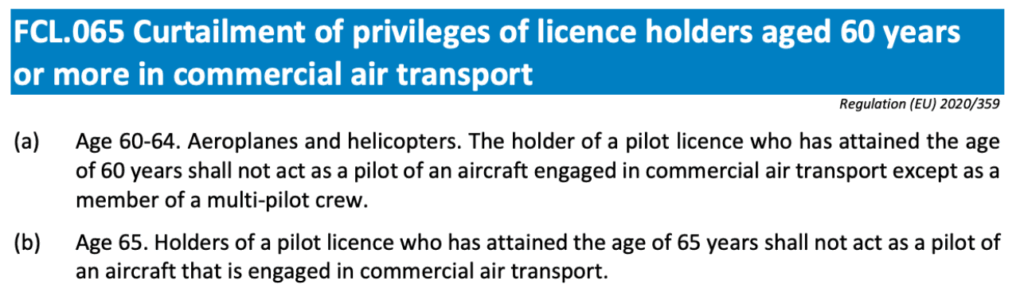
In Europe, EASA mirrors ICAO exactly:

In the US, the FAA applies the 65 limit only to Part 121 airline pilots:

Part 135  charter pilots face no FAA domestic age cap, but once those flights go international, the ICAO 65 rule applies to all pilots on board.

Part 91 private operations are not affected domestically or internationally – there is no ICAO age limit for non-commercial flights, only the medical.

In theory, all ICAO member States should apply the same rules. In practice, some do not. Inside their own borders, countries can be stricter, looser, or set no limit at all. For international flights, the countries that matter are: the State that issued the licence, the State of the operator, and the States being flown into or over. If any of those apply a stricter rule, that’s the one that decides whether the flight can operate.

Once a pilot reaches their 65th birthday, they are no longer eligible to serve on international commercial flights, unless every country on the route specifically authorises it. Under Articles 39 and 40 of the Convention, ICAO Doc 7300, a licence that does not meet ICAO standards such as age limits must be endorsed, and it can only be used internationally if the States concerned specifically accept it.

Medical requirements also tighten with age. According to ICAO Annex 1, pilots over 60 on commercial ops must renew their Class 1 medical every six months instead of once a year.

There used to be an additional condition: if the captain was between 60 and 64, the other pilot had to be under 60. ICAO removed that rule in 2014. Today, two pilots over 60 may operate together without issue.

Private flights

ICAO does not impose any age limits on private, non-commercial operations. A pilot can continue flying internationally at any age – provided they hold a valid medical certificate.

The type of medical required depends on the operation. A Class 1 (ICAO Annex 1) is needed for commercial flying, valid for 12 months until age 60 and then 6 months thereafter.

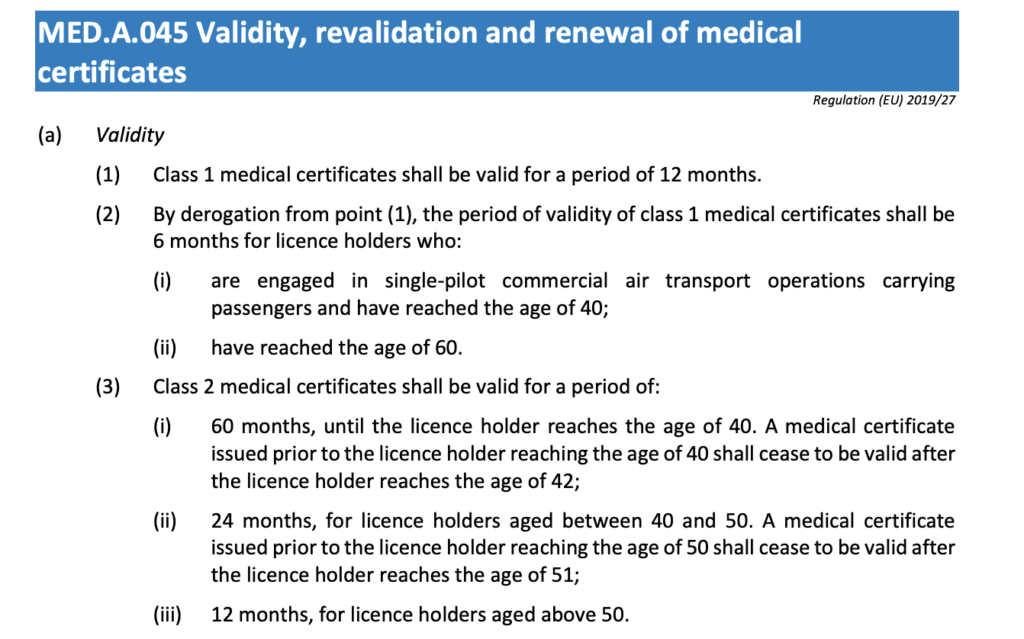
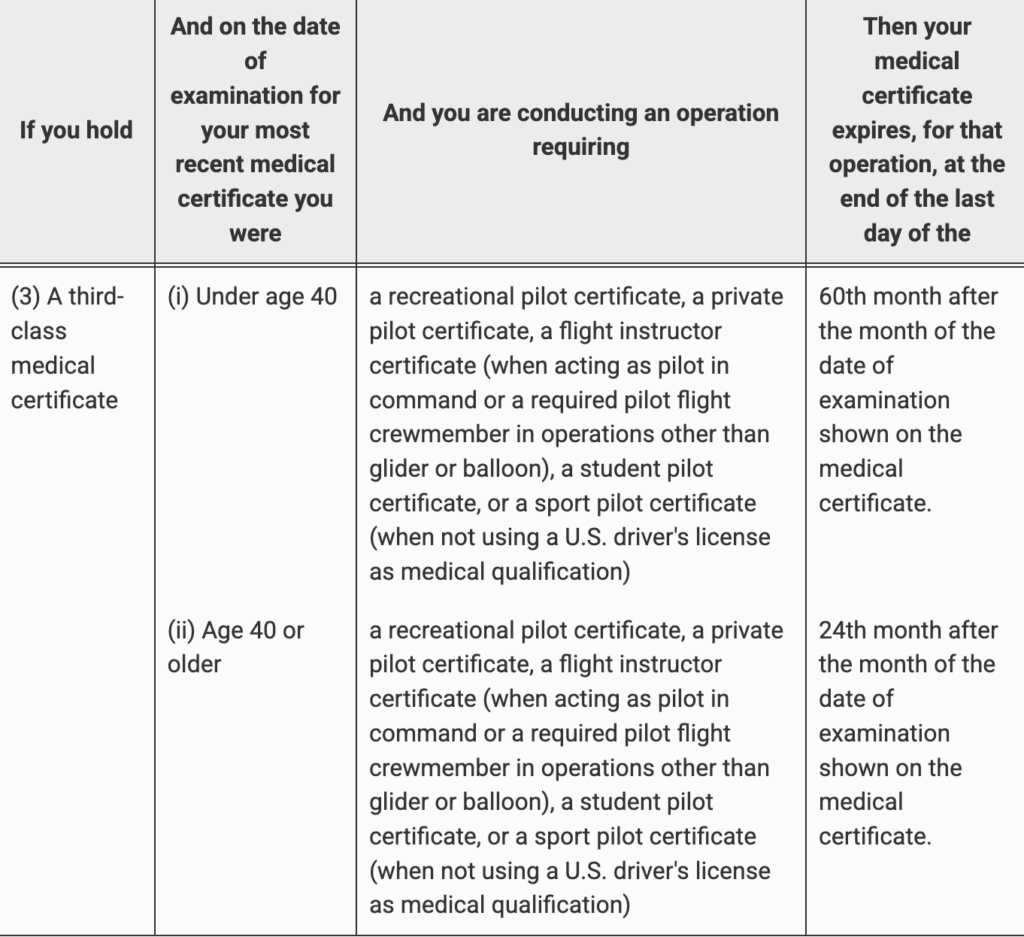
For private flying, a Class 2 (Europe) or Class 3 (US) medical is sufficient. Standards are lower, checks are less frequent, and validity periods are longer.

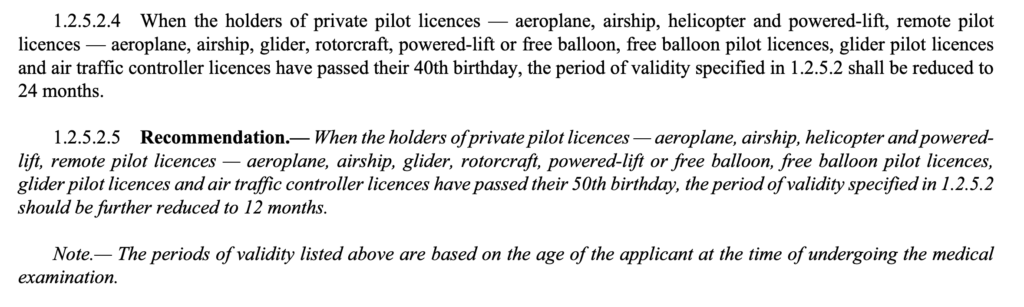
In Europe: Class 2 is valid for up to 60 months if you’re under 40, 24 months between 40-49, and 12 months once past 50:

In the US: Class 3 is valid for 60 months if you’re under 40, and 24 months once past 40:

For commercial ops, shorter medical validity periods apply – the details can be found in the same ICAO Annex 1, EASA Part-MED and FAA §61.23 references.

Different rules at home

Countries can set their own age limits for domestic operations. Many follow ICAO’s 65-year rule, but others do it differently. Here are a few examples, and if you’ve seen something else in your ops, let us know!

Argentina: Argentina dropped its old pilot age limits in 2024. Airline/charter pilots can now fly domestic ops until 66 (single-pilot) or 68 (multi-pilot). For international flights, crews must still follow the destination country’s age rules. Private flights already had no age limits here. More info here.

Australia: ICAO’s 60/65 limits don’t apply. There’s no maximum age, but pilots over 60 must pass extra medical and flight reviews. More info here.

New Zealand: Pilot licences are issued for life, with no age cap. Validity depends only on maintaining medical and competency standards. More info here.

Canada: No upper age limit and no loss of privileges after 60 or 65, provided medical and proficiency standards are met. More info here.

Mexico: Couple of issues here: first, Mexico still uses the old ICAO wording for commercial flights; and second, some local officials misapply those same rules to private operations.

  1. It looks like Mexico still uses the older ICAO wording on pilot age limits – the one that talks about the pilot-in-command (PIC) rather than all pilots. Under that version, a PIC can fly until age 60, or up to 65 only if the other pilot is under 60. The newer ICAO rule applies to all pilots and simply allows both to fly up to 65, but Mexico’s wording (Circular CO SA 14.03/20) hasn’t been updated. It still follows the old PIC-focused rule and applies only to international commercial operations, not to private or domestic flying.
  2. For private flights, there’s no official age limit – any pilot can fly as long as their medical is valid. In practice, though, enforcement can be inconsistent. Some AFAC officials, especially at MMSL/Cabo San Lucas and other tourist airports, have been known to misapply the 65-year rule even to private flights, sometimes hinting at “fees” to ignore it. If that happens, show them the Circular, which clearly limits the rule to commercial ops, and coordinate with your handler in advance if you don’t speak Spanish.

Peru: The country allows commercial pilots to fly up to age 70, based on medical findings that age alone shouldn’t determine fitness to fly. Pilots over 65 just need more frequent medical checks to keep their certification valid. More info here.

Chile: Going even further, Chile sets no maximum age limit for domestic flying. As long as pilots hold a valid medical certificate, they can keep flying indefinitely within Chilean airspace. More info here.

Japan: Commercial pilots can fly in multi-pilot operations until the day before turning 68, with extra medical and operational requirements:

China: Officially follows ICAO’s 60/65 standard, but some reports we’ve seen suggest some airlines may still apply a 60-year internal cap. Seen this yourself? Tell us!

India: For international multi-pilot flights, only one pilot may be between 60 and 65 – a holdover from ICAO’s pre-2014 “one under 60” rule. More info here.

All these national differences stop at the border. Once a flight is international, the ICAO limit of 65 applies unless a State has specifically authorised older pilots, as permitted under Articles 39 and 40 of the Convention.

Bottom line, if in doubt, always check the AIP GEN 1.7, where each country publishes its differences from ICAO!

Grey areas and edge cases

There are some places where the rules blur.

Ferry and positioning flights: These may not count as “commercial air transport” under ICAO definitions, but many authorities still apply the same limits if the aircraft is operated under an AOC, and the FAA includes ferry and positioning legs under the Part 121 age-65 rule.

Practical limits beyond regulation: Even where no regulatory age limits exist for private ops, pilots over 65 can still face practical restrictions. Some insurance underwriters set their own maximum age limits or raise premiums for older pilots, regardless of medical fitness. In addition, operators, management companies, and recruiting agencies sometimes apply informal age caps when hiring for private or corporate operations, which is a form of ageism that pilots have little means to challenge. A few countries, such as New Zealand, have human rights laws that prohibit age discrimination in employment, although these protections generally apply only to work performed within their own borders.

Wet leases and aircraft registry: When an aircraft is operated under a wet lease or similar cross-border arrangement, the stricter rule between the State of Registry and the State of the Operator may apply. Under the Article 83 bis of the Convention, these States can transfer oversight responsibilities – including crew licensing – from one to the other, meaning a tighter national age limit can override ICAO standards.

The old “no domestic age limit” lists: You’ll still find online lists of countries said to have no age limits, mostly copied from ICAO surveys in the mid-2000s. Treat these with caution! Always check each State’s AIP GEN 1.7 for the latest national differences.

Policy change in motion: IATA recently pushed to raise the international pilot age limit from 65 to 67, suggesting extra safeguards like keeping one pilot under 65 and tighter medical checks for older crews. The idea made it all the way to ICAO’s 42nd Assembly in Montreal (Sep-Oct 2025), but after some debate, it was turned down. For now, the global limit stays where it is: 65.

Corporate retirement policies: Some companies have tried setting their own age-65 limit for Part 91 pilots, but courts have often struck that down as age discrimination (except in one 2014 Exxon case). Instead of using an age cutoff, some operators take a more cautious approach by requiring their pilots to hold a First Class Medical renewed every six months – even though that’s stricter than the FAA actually requires for private or corporate flying.


How to Get Your Info to 8,000 Other Pilots

We’ve said it before, but it’s worth repeating: OPSGROUP runs on you.

Almost every Ops Alert, every Daily Brief, every Weekly Bulletin starts with someone in the group sharing a snippet. A strange new procedure. A dodgy handler. A sneaky airport fee. Or something bigger such as a new airspace restriction, a strike, or a sudden airport closure. However small it feels, if you’d tell a colleague about it in the crew room, then it’s worth telling the group too.

Over time we’ve built a few ways to make sharing easier. Some of them you might know, some you might have forgotten. So here’s the updated, all-in-one guide to reporting stuff!

How to share stuff and what to send

There are a few easy ways to get things to us.

You can drop us an email at report@ops.group if you’ve spotted something useful that others need to know.

You can also send a quick WhatsApp message to +1 747 200 1993 – pictures welcome.

If you’ve got a longer tale, something that needs more than a line or two, email it to news@ops.group and we’ll turn it into an Ops Story for everyone to read. These are the war stories, the strange sagas, the “this happened to us and it might happen to you” kind of things.

And then there’s our favourite little invention: Report-A-Thing. Or RAT, for short. 🐀

Think of it as a direct hotline to the hive mind. Built back in 2024 on a trusty Commodore-64 interface (well, almost), it lets you send in quick reports without fuss. The best part is that you can choose to do it completely anonymously. No names, no back and forth. Just your info, dropped straight into the machine. We read everything that comes in, check what needs checking, and then make sure the rest of the group hears about it.
So whether you ping us on WhatsApp from the ramp, send a quick note or a longer story by email, or fire off an anonymous RAT report, the result is the same: what you’ve seen gets shared with 8,000 members worldwide. That’s how we turn one person’s weird experience into everyone’s “good to know.”

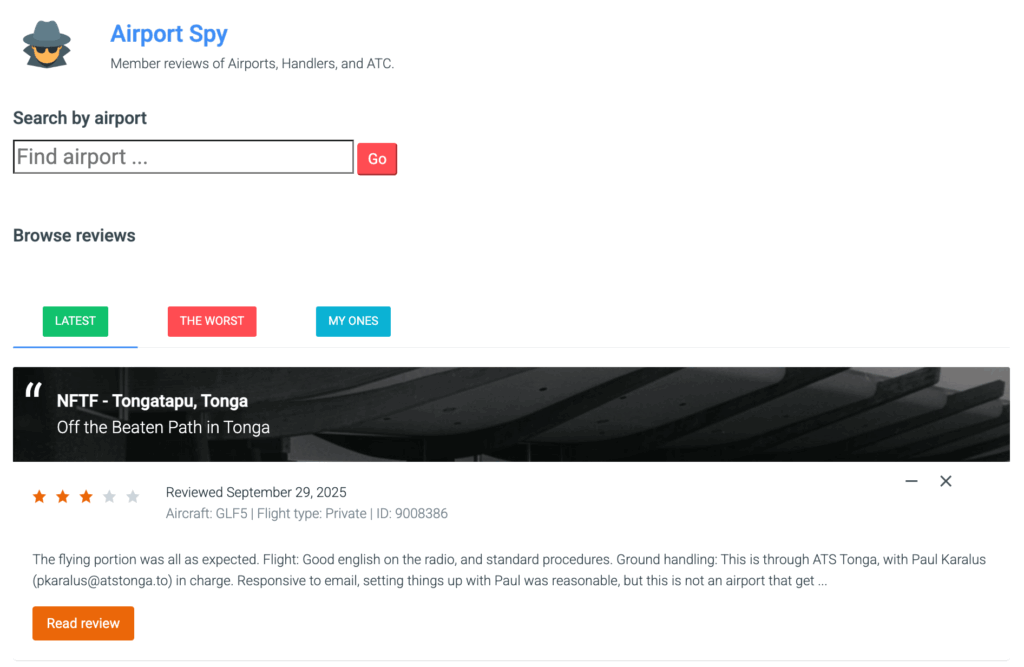
Airport Spy

Not everything fits into an email or a quick RAT note. Sometimes what helps most is simply knowing what another crew found when they flew in before you. That’s where Airport Spy comes in.

Think of it as TripAdvisor for pilots and ops teams. You land somewhere, you notice something good, bad, or just plain bizarre, and you file a Spy Report. Two minutes of your time, but invaluable for the next crew.

For pilots and operators, a good Spy Report is the kind of detail you’d share with a colleague in the crew bus. Was ATC easy to follow or impossible to understand? Was the handling slick or painfully slow? Any odd security checks or airport quirks that could catch someone out?

Pilots and Operators can file a report here!

It’s not only for pilots. FBOs and handlers can file too. Before a crew shows up at your airport, they want to know what’s new, whether hours have changed, if there are new procedures, or if there’s some local peculiarity that doesn’t show up in the AIP.

FBOs and Handlers can file a report here!

All reports go into the group dashboard, where 8,000 members can see them. The next time someone is heading to that airport, they’ll have your notes in hand and they’ll thank you for it.

Airport Spy is getting busy lately, and that’s thanks to all of you who have been filing reports!

In the end it’s simple: one small report might save another crew hours of hassle, or even something worse. Nobody knows everything, but together we know a lot.

So don’t overthink it. Just send it. We’ll do the rest.


LFPM/Villaroche: Paris Without the Pain

If LFPB/Paris Le Bourget is proving too noisy, too crowded, or just too regulated for your liking this summer – there’s another option.

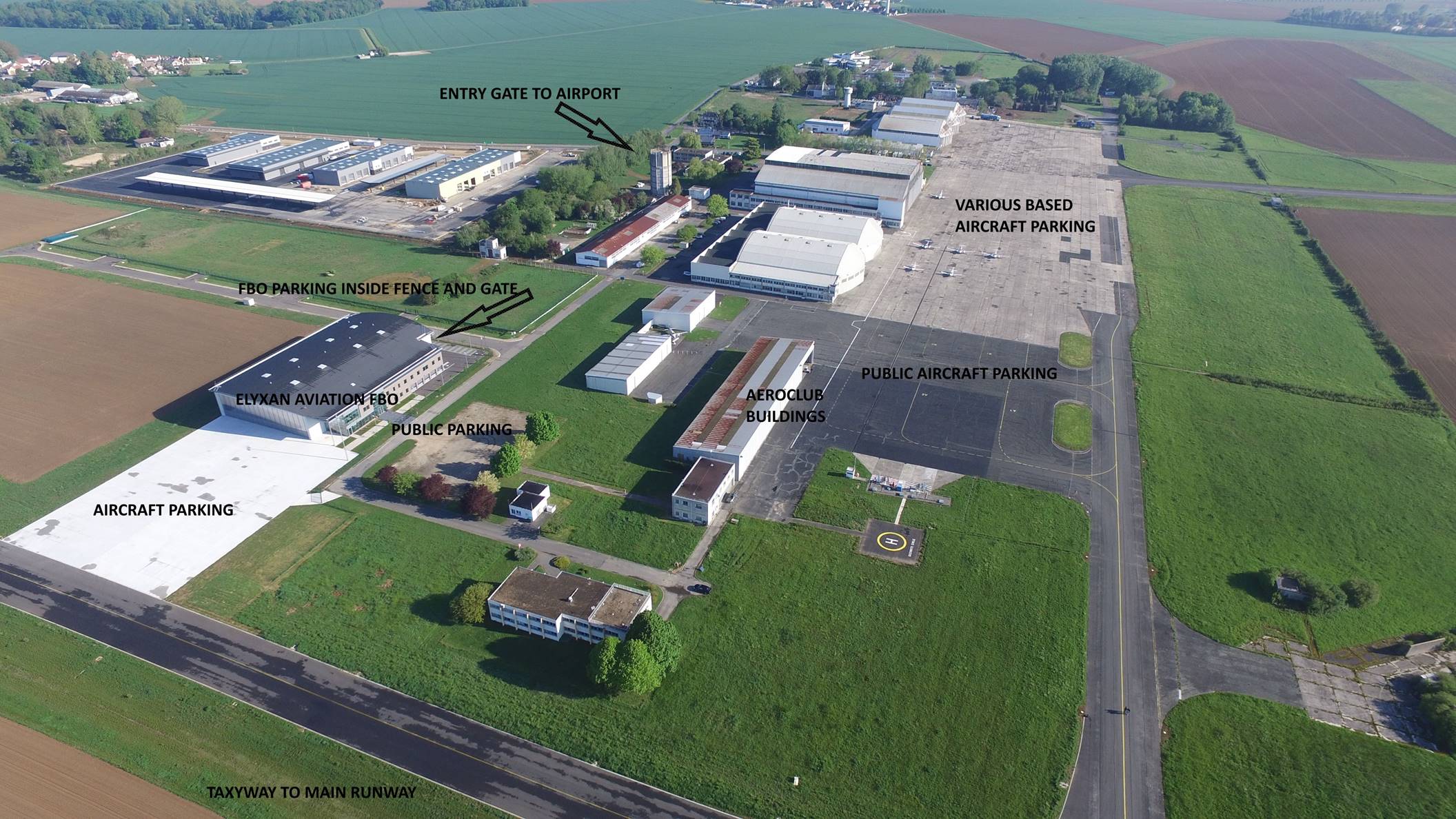
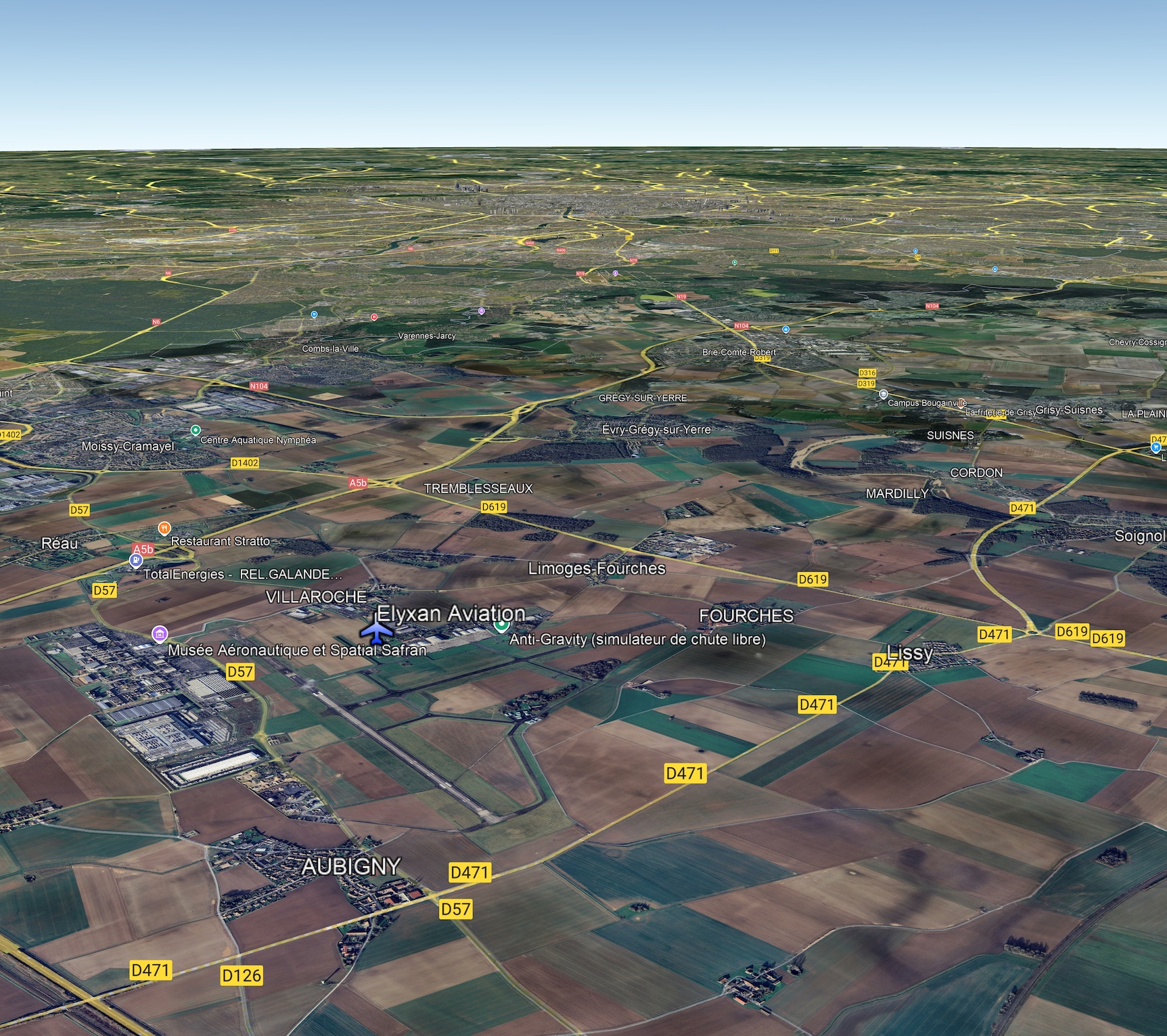
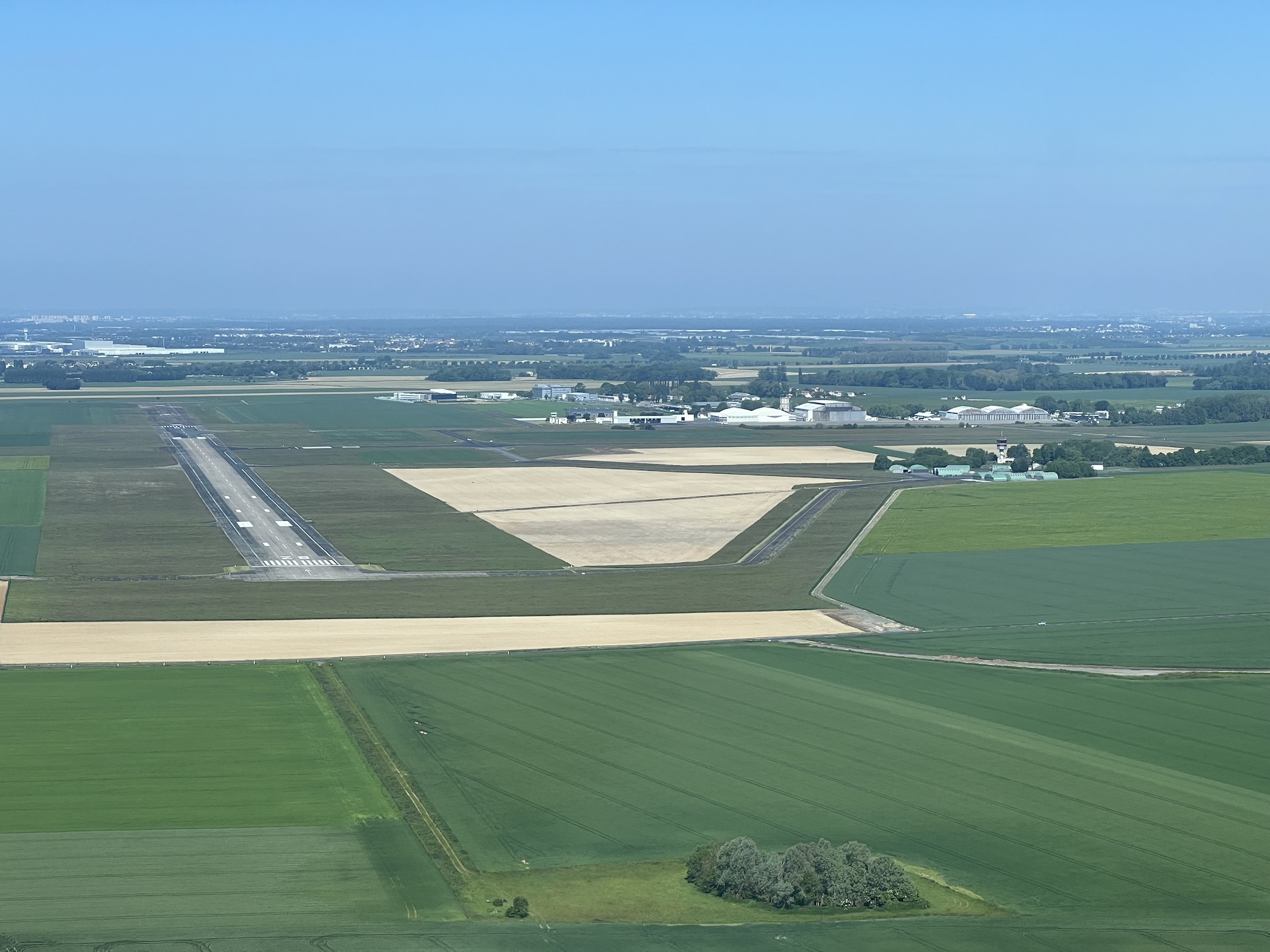
Thanks to the team at Elyxan Aviation, we’ve got the full scoop on LFPM/Paris Villaroche, a lesser-known but promising alternative for BizAv flights heading to Paris. Located about 45-50 minutes from the city center, this airport sits southeast of Paris and offers something refreshingly rare: no slots, no APU restrictions, and 24/7 availability.

Why consider LFPM?

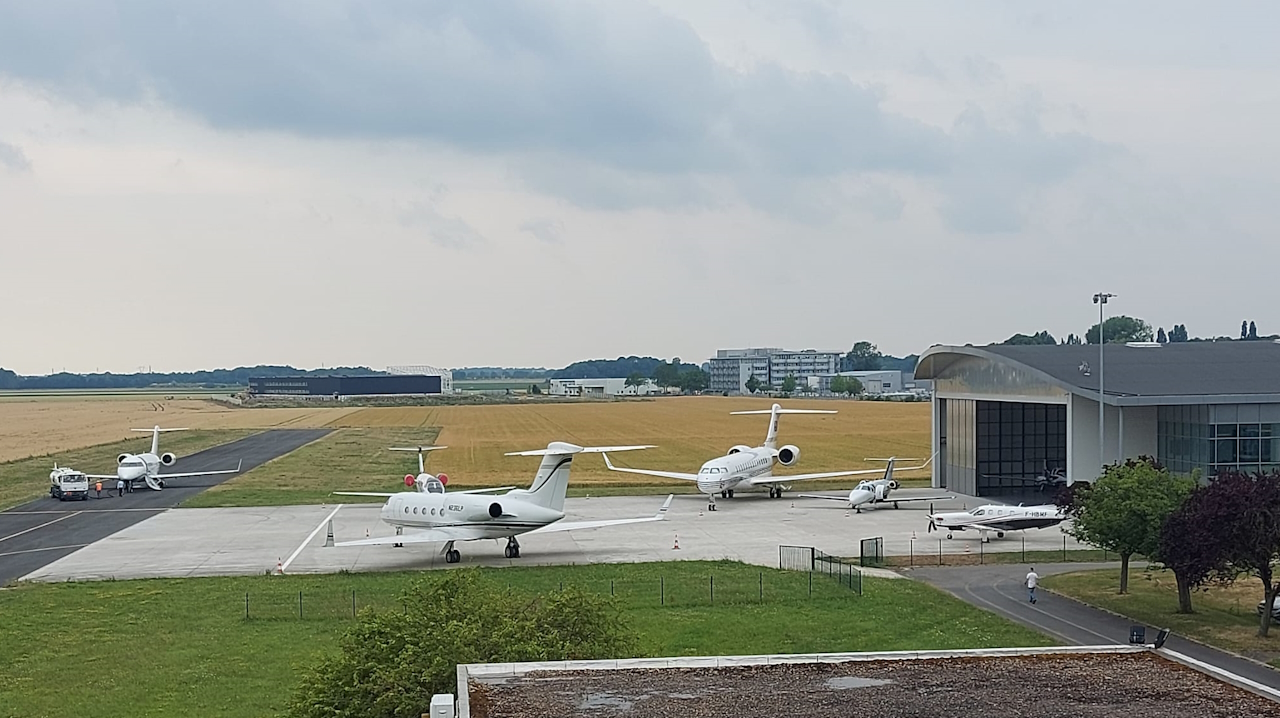
LFPM/Paris Villaroche isn’t new – it’s a former flight test site that’s been quietly evolving into a solid business aviation option southeast of Paris. It has a similar feel to EGLF/Farnborough, and although public ownership has slowed its full development, what’s already in place is pretty impressive:

  • 1972m x 45m runway with GNSS/LPV approach
  • No slots, no APU restrictions, no curfews
  • 24/7 ops capability, with English-speaking ATC available on request
  • RFFS Cat 5 available on request
  • Modern FBO with hangars for bizjets up to Global 7000/Gulfstream 700
  • Direct ramp access, VIP pax facilities, and fast turnarounds
  • No public access = high privacy for pax and high-profile ops

What’s the catch?

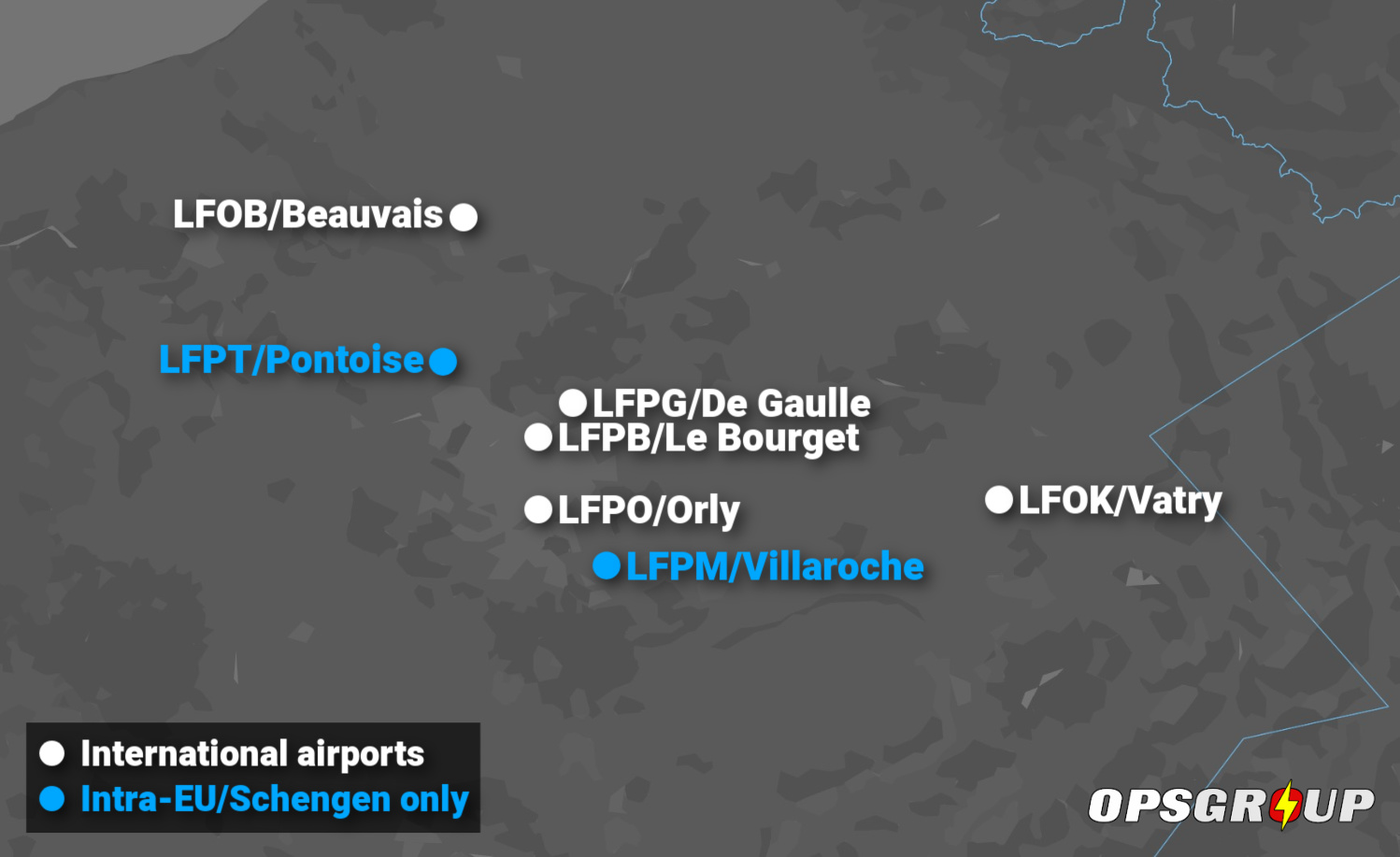
LFPM is not a designated port of entry – so it only accepts flights arriving from or departing to EU/Schengen airports (Switzerland included). No customs or immigration means international flights must route in from a Schengen stop first.

Also, while the runway can easily handle larger jets, LFPM imposes a 37-tonne (approx. 81,600 lbs) limit on actual operating weight at the time of arrival or departure – not MTOW. For heavier aircraft, fuel loads may need to be adjusted accordingly.

Looking at other options around Paris:

  • LFPB/Le Bourget is Paris’s main BizAv airport – but it’s slot-controlled, has APU restrictions, and can be congested in summer.
  • LFPG/Charles de Gaulle and LFPO/Orly are international, but mainly serve scheduled airlines and are not BizAv-friendly.
  • LFOB/Beauvais and LFOK/Vatry are international airports with customs, but they’re significantly farther from the city.
  • LFPT/Pontoise (NW of the city) is also Schengen-only, with a shorter runway and stricter weight limits. Currently undergoing refurbishment.

Faster into Paris?

Actually, yes – and not just on paper.

Even though LFPM looks farther from central Paris than LFPB, the real-world travel time is often the same or shorter. That’s especially true if you’re arriving from the south – you’ll avoid the extra flight time needed to route around LFPG/Charles de Gaulle and skip the congestion-prone A1 motorway used by LFPB/Le Bourget arrivals.

Elyxan put together a practical comparison of travel times from LFPM vs. LFPB to central Paris – factoring in flight routing, ramp access, and road traffic. 

For now, it’s Schengen-only – but if French authorities eventually install CIQ, Villaroche could become a serious player. In the meantime, it’s a great EU option: straightforward, operator-friendly, and low on red tape.

📞 Contact Elyxan Aviation for more info:
ops@elyxan-aviation.fr | +33 6 58 83 66 25


France Summer BizAv Parking Tips

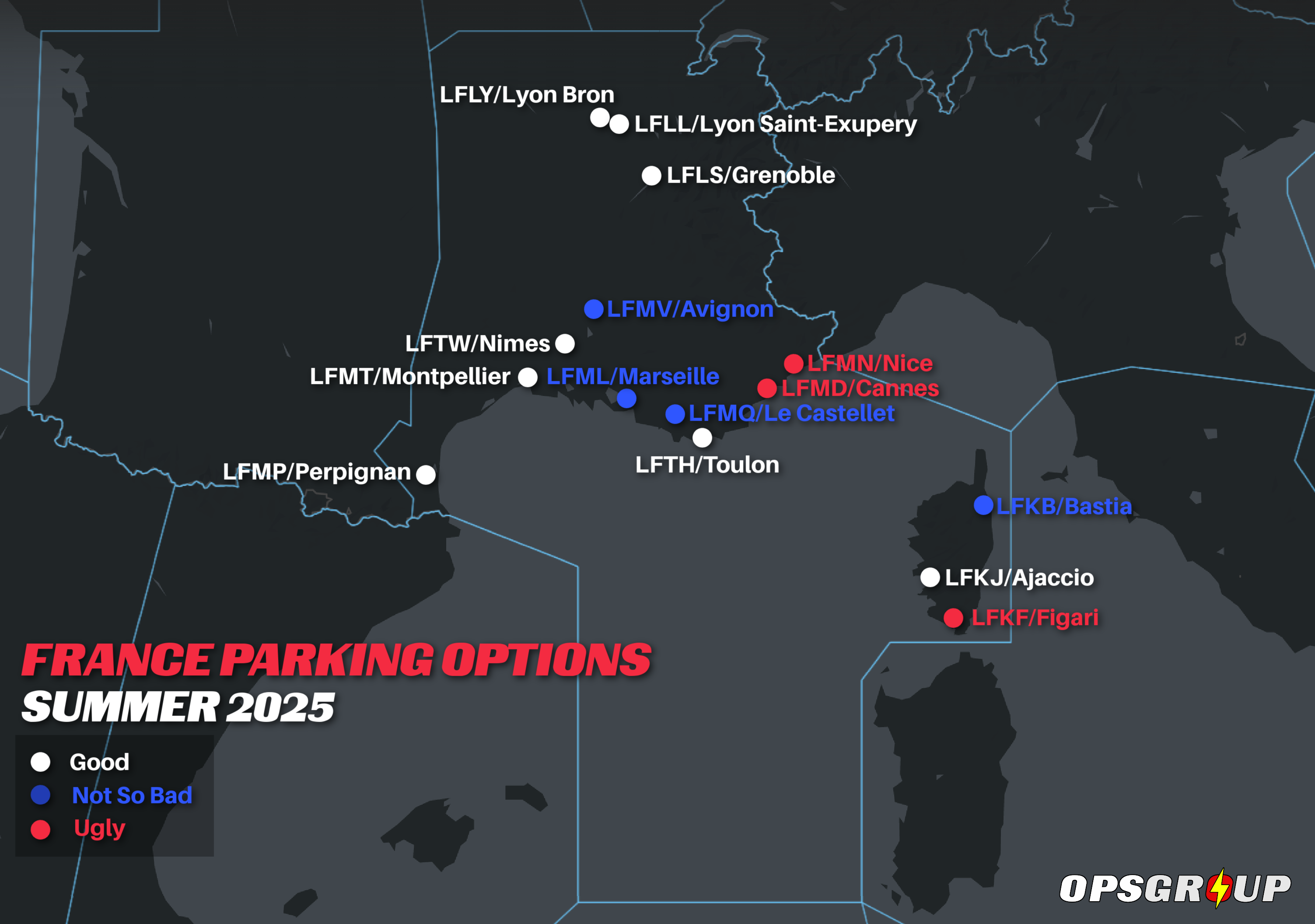
France is facing the same summer congestion we’ve seen in Spain and Greece: packed ramps, limited slot availability, and strict parking rules – both for location and duration. From the Côte d’Azur to Corsica and key inland airports, space is tight. But there are still some options if you know where to look. Here’s what we’ve found so far.

Common Themes Across France
  • Plan ahead. Most airports require advance notice for parking and handling – anywhere from 24 to 72 hours – usually via MyHandling.
  • Customs and Gendec: For international arrivals, most airports expect crew and pax lists to be submitted 24 hours ahead, even for Schengen flights.
  • Slots or PPR? It depends. Some airports like LFML/Marseille are slot- and PPR-free but limited by physical stand space. Others have strict PPR or slot rules, and some impose restrictions based on Schengen/non-Schengen status.
  • Nothing is guaranteed. Even with advance requests, parking isn’t always available – especially for longer stays. At LFMN/Nice, approval often comes just 7 days out. LFML/Marseille has only a few stands for 48h+ parking, and LFKF/Figari doesn’t allow overnight stays at all.

Riviera Airports – Busy, Tight But Accessible

LFMN/Nice

Nice has been very busy since May, and according to local FBOs, things aren’t getting any easier. If you’re planning to stay on the ground for more than 4 hours, expect a bit of a process. The airport is fully slot-controlled, and parking only gets confirmed once airport authorities approve your request – often just 7 days out.  Submitting a full schedule early gives you the best shot.

Slot tolerance is tight (+/–10 min arrival, –10/+15 min departure), and even small schedule changes can mean losing both slots and parking. Once confirmed, the slot ID needs to be in Field 18 of your FPL.

APU use is also limited to just 10 minutes before TSAT, and only after towing. Until then, it’s ground power only. But several OPSGROUP members have reported issues with GPUs and overheating, especially in high temps. For a deeper look, check out our article on heat damage in Nice.

Fuel delays are common too. Airline traffic takes priority, and BizAv can end up waiting. Crews must be onboard during refueling, so best to show up early before ETD just in case. Multiple fuel providers operate at LFMN, and availability can vary depending on the day and time.

FBO contacts:

LFMD/Cannes

Cannes may be scenic, but it’s not built for bigger jets. The airport has strict aircraft restrictions: no jets over 35T MTOW, and no turboprops over 22T. Slots are mandatory from May 12 – Sep 15, when the airport is fully coordinated for the summer season. The control tower is active from 0800 LT to sunset +30 minutes. Handling services may operate on a different schedule, so check with your local FBO directly. 

FBO contacts:

LFML/Marseille

Marseille offers a more relaxed entry point to the region, with fewer restrictions. The airport and customs are both H24. There’s no need for slots or PPR, and short-turn parking is usually available without much hassle. 

That said, longer stays are tricky – only four stands are available for 48h+, and they fill up quickly on a first-come, first-served basis. One or two nights might still be possible depending on traffic, but anything beyond that is unlikely in peak season.

FBO contacts:

Southern Coastal Options – Mixed Rules

LFTH/Toulon-Hyeres

Toulon is getting busier in the summer, but parking is still possible if you’re organized. The airport is open daily from 0800-2000 LT until Oct 28, with the possibility to arrange extensions. Customs hours are slightly different – available daily from 0800-1800 LT.

As a joint civil-military airport, LFTH has additional restrictions: according to the local FBO, flights before 0900 LT are currently not allowed due to military operations.

FBO contacts:

LFTZ/La Mole Saint-Tropez

The airport has restricted-use status, so only operators with special approval can use it. Pilots must meet specific training requirements depending on the aircraft.

If you’re thinking about flying into LFTZ, be ready for a bit of admin. The airport website and their AIP explain exactly what’s needed – from how to request access to the paperwork and pilot qualifications required. 

PPR is required and operations are permitted daily 0800-1900 LT in summer, with extensions available until sunset. Non-Schengen flights are only allowed July 1 – Oct 15, 0700-1700 LT, and any schedule changes must be re-approved.

FBO contacts:

Western Provence – Quieter Alternatives Inland

LFMT/Montpellier

Montpellier stands out as a dependable inland choice, even for heavier jets. While the airport can get busy at times, especially in peak summer weeks, it’s still worth considering if coastal airports are full. All non-based BizAv must request PPR at least 72 hours in advance. Handling is charged in full if cancelled less than 3 days before arrival and not charged if cancelled earlier.

FBO contact: Avia VIP: lfmt@aviavip.com 

LFTW/Nimes

Nimes is often overlooked, but can be a smart alternative if you plan ahead. The airport operates daily until 2000 LT. ATC is available until 1900 LT on weekdays and until 1600 LT on weekends. CIQ services are available daily from 0900-1800 LT.

FBO contact: Jetex: france@jetex.com 

LFMP/Perpignan

Perpignan is another inland option worth considering this summer. Local FBO confirms that parking is currently not congested and that the airport can accommodate larger bizjet like the G650. Parking availability is confirmed once a full schedule is submitted.

FBO contact: G-OPS: executive@g-ops.com

LFMV/Avignon

Avignon gives operators a welcome level of flexibility during the peak season. No PPR is required. The airport is open Mon-Fri from 0700-2130 LT, Sat until 1900 LT, and Sun from 0800-2000 LT. CIQ services are available daily until 2300 LT.

FBO contacts:

LFMQ/Le Castellet

Castellet remains a niche but functional option for those who can work with the limitations. Customs is available for Schengen traffic only – international (non-Schengen) flights are not permitted.

The airport operates daily 0900-1800 LT during summer. Extensions must be requested by 1600 LT the day before. Slots are required.

FBO contacts:

Corsica – Few Airports, Fewer Options

BizAv parking on Corsica is tricky during the summer too. LFKF/Figari is the most restrictive option with only quick turnarounds allowed and no long-term parking.

LFKB/Bastia may offer a bit more flexibility with some limits, but no PPR is required.

The best recommendation from local handlers goes to LFKJ/Ajaccio. Parking is more feasible here and while a slot and PPR are mandatory, availability is currently good.

FBO contact (covers LFKF, LFKB, and LFKJ): G-OPS: executive@g-ops.com 

Looking Inland – Reliable Summer Parking

If the Riviera is full, heading inland could be a smart move. LFLL/Lyon Saint-Exupery usually has parking available, even during peak summer, and can handle larger jets with ease. Just be aware of night noise restrictions between 2200-0600 LT for louder aircraft.

Nearby LFLY/Lyon Bron is smaller but also reports good availability for BizAv during the summer.

Further south, LFLS/Grenoble may be the most straightforward of the three. The airport is open daily from 0900-1800 LT, and services like handling, customs, and fuel are all available during this window. Extensions are possible upon request, but need to be arranged at least 8 days in advance.

FBO contacts:

Watch Your FPL Alternates

One final thing to note here for ops to the south of France – watch out for a common issue with flight plan alternates, as some airports cannot be used unless specific conditions are met, according to the AIP or Notams. We’ve had several reports over the years from members who have had this flagged on SAFA ramp checks.

Common ones to watch out for:

LFTH/Toulon – can’t be used as alternate without PPR.

LFMD/Cannes – can’t be used as alternate except for flights to LFTZ/La Mole.

LFMQ/Le Castellet – this sometimes gets used as an alternate for LFMN/Nice and LFML/Marseille. But LFMQ rarely publishes TAF/METAR reports, so if you want to use this, you need to make sure you select at least one other alternate with a weather report!

Do you know of any more? Let us know!

Help Us Keep This Info Fresh

Things can change fast at French airports in the summer – what worked last week might not work today. If you’ve recently operated to any of these airports, let us know! A quick Airport Spy Report helps everyone stay ahead. It’s like sending a postcard with your notes, so others know what to expect next time.


Spain Summer 2025: Where to Park When There’s Nowhere to Park

Flying to Spain this summer? Be ready for one of the most challenging seasons yet. OPSGROUP members and local FBOs have confirmed that many of Spain’s key airports are either full or close to capacity, with last-minute parking denials, repositioning chaos, and growing frustration.

The Big Picture
  • Balearic Islands are maxed out. LEPA/Palma, LEIB/Ibiza, and LEMH/Menorca are denying overnight parking in most cases. Even short turnarounds now require formal approval.
  • Mainland airports like LEVC/Valencia and LEAL/Alicante – once go-to repositioning options – are now also denying overnight stays, especially for ferry flights. Overflow traffic is being pushed to bigger hubs like LEBL/Barcelona and LEMD/Madrid, which can still work, but come with long taxi times, fueling delays, and strict slot restrictions. In Barcelona, non-based BizAv aircraft are limited to a maximum 96-hour stay. In Madrid, they’re allowed just one overnight, and turnarounds without passengers are not permitted.
  • The system is overwhelmed. We’ve received multiple reports from our members that due to poor infrastructure planning, increased aircraft size, and inflexible airport authority (AENA) policies, BizAv is being squeezed out of prime destinations.
  • Even second-tier airports like LEGR/Granada or LERS/Reus are turning away requests. Some smaller fields remain usable – but only with proper planning and early coordination.

What All Airports Have in Common
  • Slot and parking coordination opens 14-15 days prior to arrival. Earlier requests are not accepted, and even short turnarounds often require prior approval.
  • No real-time availability. Handlers can’t tell you if parking is available until you’ve submitted a full handling request (aircraft type, schedule, operator details). Confirmations often take days and even then, your request may still be denied. Final decisions are made by the airport authorities.The best advice? Submit your schedule as early as the airport window allows, and always have a backup plan ready. 
A-CDM airports in Spain: Watch Your Timings

Several major Spanish airports operate under A-CDM (Airport Collaborative Decision Making) procedures – for example, LEBL/Barcelona, LEMD/Madrid, and LEPA/Palma de Mallorca. Always double-check with your local FBO to confirm whether A-CDM rules apply at your destination.

At these airports, your filed EOBT (Estimated Off-Block Time) must exactly match your assigned departure slot. If it doesn’t, ATC will not clear you to start up or taxi. There’s no flexibility – and your handler has no power to override the system.

What often happens is this: a crew files an updated EOBT without informing the handler, but the airport system still holds the original slot. That mismatch is caught by Eurocontrol, which then assigns a much later CTOT (Calculated Take-Off Time) – often causing a delay of 1 to 2 hours, or blocking the departure entirely.

To avoid this, always coordinate any time change, even a small one, with your handler first. Once they’ve confirmed your new slot, you can safely file your updated flight plan to match.

If you’re delayed inbound and won’t make your original slot, make sure to send your updated ETA asap – this gives the airport time to adjust your arrival slot accordingly.

Spain is one of the stricter countries in Europe when it comes to A-CDM enforcement. If your times don’t match, you’re not moving. For more on how Eurocontrol and CTOTs work behind the scenes, see our explainer article

The Balearics: Parking Nightmare Central

The three main airports in the Balearic Islands – LEIB/Ibiza, LEPA/Palma de Mallorca, and LEMH/Menorca – are all experiencing major congestion this summer.

Key issues across all:

  • Parking is extremely limited, especially on weekends. Overnight stays are frequently denied – sometimes even for light jets.
  • Repositioning to the mainland is increasingly common. Local FBOs recommend LEBL/Barcelona and LEGE/Girona – both H24 – as the best alternates. LEVC/Valencia is also commonly used, but recent reports say it’s already congested.

LEIB/Ibiza

Ibiza is proving the most difficult of the three. Members report that overnight parking is nearly impossible to obtain – 90% of overnight parking requests are flatly refused, regardless of aircraft size.

According to local FBOs (not published in the AIP), aircraft with a wingspan greater than 18 meters planning to remain on the ground for more than 3 hours require a PPR – which is rarely approved during the peak season. Even short turnarounds are becoming problematic without advance coordination. 

FBO contacts:

LEPA/Palma de Mallorca

LEPA is slightly more manageable, but still highly congested.

New for 2025: From 1 June – 30 Sep, aircraft longer than 20 meters are limited to a maximum of 7 days of parking, unless specifically approved by the airport. See AIP for details.

Members report first-time outright parking refusals for light jets, and fuel delays of more than an hour due to one of the two fuel trucks being out of service.  

FBO contacts:

LEMH/Menorca

Menorca is facing similar congestion pressures as the rest of the Balearics this summer, but local FBOs suggest it may still be the easiest of the three island airports to manage. While parking is certainly limited, especially on peak days (Friday through Sunday), overnight stays are not impossible – particularly if you plan ahead.

During the summer, the airport operates from 0700-0030 local time. See AIP for details. 

Slot and parking requests can typically be submitted 14-15 days before arrival. Some FBOs note that approvals are sometimes possible even on shorter notice, especially if you provide a full itinerary. Drop-and-go remains the best strategy here too.

FBO contacts:

Mainland Spain: Where You Might Have a Chance

Need local FBOs contacts or AIP links? Click here for quick access. 

Popular Repositioning Options – but Getting Busy

LEVC/Valencia and LEAL/Alicante are among the most commonly suggested mainland alternates for traffic repositioning from the islands. But this summer, both airports are struggling with overflow demand. Overnight parking is frequently denied, even for ferry flights, and local FBOs report regular rejections, especially on peak days. 

Big Airports Still Working – with Significant Limits

LEBL/Barcelona is still one of the more reliable options for BizAv this summer. Parking is usually available and the airport operates H24. However, LEBL enforces a 96-hour parking limit for all non-based aircraft year-round, so longer stays are not possible. During the summer, aircraft with an MTOW under 15 tons are also not permitted to arrive between 0900–1159 local time. In addition, taxi times from the BizAv apron are long, typically around 20 minutes. The airport applies A-CDM rules strictly.

LEMD/Madrid is no longer an easy fallback. While it operates H24 and still offers reasonable parking availability, non-based BizAv operators are now subject to strict slot restrictions: only one overnight is allowed, and at least one leg (arrival or departure) must be a passenger flight. Turnarounds involving positioning flights only are not permitted. Crews should also plan for long taxi times (15–30 minutes), and fuel uplift may be delayed or denied without a confirmed same-day departure, as priority is given to commercial and outbound traffic.

Member report received July 2: We had an overnight 2 days ago and the airport is packed. Evidently there is no where to park in the islands and everyone is drop and go to LEMD as you have reported. We got to the airport 2.5 hours prior to our departure scheduled for 1320 local departure and waited almost 3 hours for fuel. Our slot had to be constantly updated by the handlers so we didn’t miss it.

Another member report received July 3: We were granted a week’s parking at Madrid, but on a disused taxiway arriving yesterday. The handler said it’s at capacity.

UN Summit in Sevilla – Temporary Restrictions Across Andalusia

Several airports in Andalusia are currently affected by temporary restrictions due to the UN summit in LEZL/Seville, running from June 26 – July 4. These impact BizAv ops across the region, especially in terms of parking, ground time, and access. However, once the summit ends, many of these airports may become more usable options for summer parking. Here’s a breakdown of what to expect:

LEZL/Seville is effectively off-limits for BizAv during the summit. The airport cannot be used as an alternate, and all BizAv flights require special government permission. Slots and PPR are mandatory. Local FBOs strongly advise avoiding LEZL during the summit unless absolutely necessary. Things should return to normal after July 4.

LEAM/Almeria is generally an easy airport to work with and remains a solid parking option compared to congested hubs like Palma or Valencia. At the moment, both slot and PPR are required, likely due to increased activity linked to the UN summit. Traffic may temporarily rise, but overall availability remains better than at most coastal airports.

LEGR/Granada is currently operating under an Apron Saturation Procedure until July 5. BizAv flights are limited to 60 minutes on stand and must receive prior approval, even though no official slot or PPR system is in place. All international arrivals are treated as non-Schengen, even if coming from Schengen countries, due to temporary internal border controls. Outside the summit, LEGR is a good parking fallback.

LEJR/Jerez  normally just requires a slot (no PPR) and usually has decent parking availability. Right now though, BizAv traffic is limited – only flights with a properly authorized slot are accepted, and approvals are more selective than usual. After July 3, it should return to being one of the more reliable fallback options in the region.

LEMG/Malaga is often seen as a good BizAv parking option, and we’ve received positive reports from members securing parking here. Parking restrictions relating to the summit were lifted on July 2, so there’s no issue on that front anymore.

Other Viable Options – Depends on Timing

LEGE/Girona and LERS/Reus are both decent fallback options for mainland parking and can be worth a try. While not always full, availability is limited and approvals are never guaranteed. BizAv flights to LERS require a PPR, so early coordination is essential.

Better Bets for Summer Parking

Airports in northern Spain – including LEBB/Bilbao, LEAS/Asturias, LEST/Santiago de Compostela, LEVX/Vigo, and LEXJ/Santander – are not as widely used for BizAv but are currently seeing less congestion and can be good alternatives, even for bizjets. Most require slots but not PPR. Parking is generally available, though space for long stays or bigger jets may still be assessed case-by-case. These are solid options worth exploring, especially when the more popular destinations are full. 

Situation Changing Fast – Help Us Keep It Updated

Airport conditions across Spain can change quickly during the summer – a slot that was easy yesterday might be impossible tomorrow. If you have recent experience at any of these airports, please share it with us by submitting an Airport Spy Report. Your intel helps the whole community stay informed. 

What’s Airport Spy? Well, you write a quick little postcard with “what happened” when you went to some airport somewhere. Then you, and others can refer to your notes for future flights to the same place.


Sydney BizAv Fees Set to Skyrocket

From July 1, YSSY/Sydney will move ahead with a major fee overhaul for BizAv. After strong pushback from the local community – led by ExecuJet and the Australian Business Aviation Association (ABAA) – some of the most extreme fee increases have been softened. Parking will no longer have a flat rate and now allows 180 minutes free, but fees remain steep for longer stays. Runway charges are rising sharply, and mandatory GPU/PCA fees and environmental charges will still apply. Operators should prepare for a noticeable jump in operating costs.

What’s changing?

The proposed fee increases are eye-watering:

  1. Parking fees:
    The good news is that BizAv operators will now get 180 minutes of free parking in designated BizAv areas. This replaces the originally proposed flat AUD $3,220/day rate. After the free period, fees are tiered based on aircraft weight and length of stay. For aircraft over 40,000 kg MTOW, charges start at AUD $1,000/day for days 1 to 3 and go up to AUD $2,500/day beyond 7 days. Smaller aircraft pay less, starting at AUD $500/day.
  2. Runway charges:
    The runway fee will jump from AUD $60 minimum to AUD $340 minimum, with the per-1,000 kg MTOW fee going from AUD $6.91 to AUD $17. 
  3. GPU and PCA requirements:
    Sydney Airport now mandates the use of Ground Power Units (GPU) and Preconditioned Air (PCA) where available. Even if you don’t use them, you’ll be charged a blended rate depending on aircraft code – ranging from AUD $11.35 to $21.74.
  4. Environmental spill charges:
    Expect a new AUD $300 charge for unreported fuel or oil spills, or AUD $150 if you self-report.

Why is this such a big deal?

These are not small adjustments – they represent a major change to how BizAv is charged at Sydney. Even with some softening of the original plan, the new structure will lead to substantially higher costs, especially for longer stays. Many see this as part of a broader shift toward prioritizing commercial operations.

Who’s pushing back?

ExecuJet (the main local FBO) and the Australian Business Aviation Association (ABAA) led the response, engaging directly with the airport. They submitted formal objections and encouraged all operators to speak up during the consultation. If you have any questions, contact ExecuJet directly at fbo.yssy@execujet.com.

What’s next?

The revised fee structure is confirmed and takes effect on July 1. Operators flying to Sydney should review the new rules closely and adjust planning and quoting accordingly. While the original plan was moderated thanks to community input, BizAv costs at YSSY are still about to get much steeper.


Summer Tips for Flight Planning in Europe

Summer in Europe often means one thing: traffic – and lots of it.

Eurocontrol keeps the system moving, but it can feel complex, especially when delays mount and regulations interfere with your plans.

The good news? A few smart moves can make a big difference. This guide breaks down what matters most: the tools, timing, and habits that help your flight operate on time.

For Dispatchers: Plan It Right

Keep Your EOBTs Accurate

Your Estimated Off-Block Time (EOBT) is what anchors your flight in the network. It tells the system when you plan to be ready for pushback, and everything from slot allocation to airspace planning builds on that. If the EOBT is outdated, your flight might get an unrealistic Calculated Take-Off Time (CTOT) or even be suspended.

A CTOT is a take-off window assigned based on current traffic demand. It’s valid from -5 to +10 minutes around the assigned time. You must take off within that window.

Some operators hesitate to update the EOBT, thinking it could make the CTOT worse. In fact, the system often improves the slot within a few minutes when fresh data is provided.

Tip: If a new CTOT looks worse, give it 10 minutes to settle. If there’s still no improvement, then it’s time to contact e-Helpdesk.

Don’t File YO-YO Profiles

Trying to dodge flow restrictions with unusual altitude changes (like FL360 → FL320 → FL360) only confuses the system. These so-called “YO-YO” profiles increase workload for ATC and can cause downstream problems. Use tools like NMP Flight to build efficient, compliant flight plans without trying to game the system.

Respect Arrival Slots

If your destination airport is slot-coordinated, always align your flight plan with the assigned airport arrival slot. Mismatches can lead to flight plan suspension and suspended flights aren’t included in ATFM. That means no slot, no priority, and big delays. Double-check that your slot confirmation matches what you file.

ATFM (Air Traffic Flow Management) is the system that manages demand and capacity across the network. If your flight is suspended, it’s excluded from this process – making it much harder to recover your slot.

Use IFPS Validation Tools

Before filing your flight plan, use validation tools like NMP Flight, the NOP Portal, or CHMI. These platforms let you check for errors, confirm compliance with the RAD, and fine-tune your routing. A rejected plan means wasted time, especially when the network is busy.

NMP Flight is now the main interface for flight tracking, planning validation, slot monitoring, and more. It replaces older tools like CHMI and adds useful features like custom alerts, critical flight marking, and real-time updates. If you haven’t used it yet, it’s worth getting familiar.

If you’re facing a long delay, slot swaps can help – but only in specific cases. Operators can swap CTOTs between flights under their own AOC, provided the flights are subject to the same ATFM regulation. Each flight can take part in up to three swaps, which must be submitted via NMP Flight, the NOP Portal, or B2B. Phone requests are possible but should be a last resort. Each request is reviewed by NMOC (Network Manager Operations Centre), Eurocontrol’s operational hub for managing traffic flow across Europe, so swaps aren’t instant or guaranteed. But when used correctly, they can help reduce the operational impact of delays.

Submit Slot Improvement Requests Wisely

Need a better slot? Use the e-Helpdesk, but only from EOBT minus 60 minutes. Submitting too early won’t work and flooding the system with duplicate requests won’t help either. One well-timed request is all you need. Track your flight in NMP Flight, and only follow up if absolutely necessary. 

Understanding Critical Flights

With the introduction of NMP Flight, operators now have access to a useful new feature: the ability to mark a flight as Critical. This helps Eurocontrol identify flights where delays would cause significant operational problems and gives those flights a better chance of being prioritised. This doesn’t guarantee an earlier CTOT, but it does signal urgency to the Eurocontrol network team, who may coordinate with ATC or destination airports to reduce the impact of the delay.

From 60 minutes before EOBT, you can tick the “Critical flight” box and choose a reason from a predefined list:

What to keep in mind:

  • You can only apply Critical status from 60 min before EOBT. Earlier requests won’t be accepted.
  • Once marked, you can’t change or remove the flag for that flight during the day, so be sure before using it.
  • You can mark up to 5 % of your regulated flights as Critical each day, with a maximum of 20 flights.
  • These flights are not automatically rejected, which improves the chance of receiving support from Eurocontrol.

Use this option carefully, and only for flights where delay would cause real disruption. When applied correctly, it’s a simple but powerful tool to keep your operation running smoothly.

For Pilots: Keep It Predictable

Eurocontrol doesn’t like surprises. The whole system runs more smoothly when flights do exactly what they said they would do. Sudden changes might seem harmless from the flight deck, but they can ripple through the network and cause chaos in sectors ahead. Here’s how to keep things flowing:

  • Fly what you file. Stick to your planned routing and levels unless ATC, weather, or safety require a change. That shortcut might save a minute, but it could cost someone else much more.
  • Stick to your slot. Request start-up in line with your EOBT and CTOT. Off-schedule departures can break the flow and lead to slot issues.
  • Let your dispatch team talk to Eurocontrol. The Network Manager Operations Centre (NMOC) is ready to help, but contact should come from dispatch. Unless you’re both pilot and ops – let the team handle it.
Need Help? Know Where To Go

Your first stop should always be the e-Helpdesk in NMP Flight. It’s the fastest and most efficient way to request CTOT improvements, mark Critical flights, or get slot-related support. The network team monitors it constantly and responds quicker when requests come through the system.

Calls should be a last resort, used only for urgent, time-critical situations. Phone support takes resources away from managing the wider network – so only use it when really needed.

Call only if:

  • A flight is about to miss CTOT at the holding point.
  • There’s a crew duty or curfew risk.
  • You’re repositioning a diverted aircraft.
  • You’re handling a medical or emergency flight.

Contacts:

  • AOLO (Aircraft Operator Liaison Officer) general line: +32 2 745 1992
  • Airport Function (AF) – for airport-related issues or curfew risk: +32 2 745 1903
  • AOLO Hotline – for critical/emergency issues only: +32 496 560 300
  • Airport coordination e-mail: nm.airports@eurocontrol.int 

For everything else, use the e-Helpdesk – it’s how Eurocontrol can help you best.

Want to Learn More? Start Here

If you want to go beyond the basics and build a deeper understanding of how the European network works, here are three great places to start:

EUROCONTROL Learning Zone – Free online courses and tutorials to help you better understand European flight planning and ATFM.

ThinkNetwork Guide – Summer 2025 – Eurocontrol’s seasonal briefing with key planning tips, capacity updates, and network insights.

NOP Portal Real-time source for airspace status, regulations, slots, and network operations.


Saudi Arabia Lifts Cabotage Ban

Key Points
  • Starting May 1, Saudi Arabia has removed its cabotage limits, which means foreign charter flights can now operate domestic sectors within the country – repositioning without passengers and quick drop-offs are no longer the only option.
  • To gain approval, operators need to complete three steps: register with MISA, apply to GACA with a business plan, and comply with GACAR Part 129 requirements including safety and sustainability documentation.
Here’s what you need to do:

Step 1: Register with MISA

Before anything else, you need to register with MISA (Saudi Arabia’s Ministry of Investment). They handle investment licensing, which is the starting point for getting your charter approval. If you hit any snags here, you can reach them at logistics@misa.gov.sa.

Step 2: Apply to GACA

Next, you’ll submit an official letter to the President of the General Authority of Civil Aviation (GACA) at generalaviation@gaca.gov.sa. This letter should:

  • Request approval for domestic charter operations
  • Include your business plan (GACA has provided a template)
  • Optionally include any extra economic details you want to share

Step 3: Meet the regulatory requirements

You’ll need to comply with GACAR Part 129 – basically, Saudi’s rules for foreign air carriers. Part of this includes submitting a Safety and Environmental Sustainability Sector form.

What does this change mean?

For international operators, it’s a big deal. You can now:

  • Pick up and drop off passengers on domestic segments
  • Reposition flights domestically without worrying about cabotage violations
  • Offer more flexible services to clients operating inside Saudi Arabia

This change is part of Saudi’s big push to grow its general aviation sector into a $2 billion industry by 2030, creating thousands of jobs and expanding the private aviation market. GACA says they’ve already received plenty of interest from international and regional operators, so expect some competition.

Where to get help

If you need help or have questions, GACA and MISA have both provided contact points:

MISA: logistics@misa.gov.sa

GACA: generalaviation@gaca.gov.sa


ADC Numbers in South Asia: What You Need to Know

The ADC number is a security clearance required for flights operating through the Air Defence Identification Zones (ADIZ) of several countries in South Asia: India, Pakistan, Bangladesh, Myanmar, and Nepal. Without one, flights could face delays, or potentially being denied entry into the airspace.

The process for obtaining an ADC is roughly the same in each country. So we’ll start with that, then we’ll move on to some slight variations to know about for each country.

The Process!

File the Flight Plan

  • File the flight plan as usual, including the overflight/landing permit number.
  • The ADC number is normally not included in the flight plan.

Obtain the ADC number:

  • For departures from the country where the ADC is required, the local handling agent should obtain the ADC number from ATC and then inform the crew. In some countries, ATC might provide the ADC number directly to the crew along with the start-up clearance.
  • For overflights of the country where the ADC is required, ATC will typically confirm the ADC number to the crew when the aircraft approaches the country’s ADIZ. However, it’s useful if your agent (whoever got your permit number) has also given the crew the ADC number in advance.

Main gotchas to watch out for:

  • Departures: When departing from a country where ADC is required, make sure you get the number from ATC before departure! This helps avoid any last-minute issues with routing, fees, or documentation that could delay the flight. A common best practice is for the crew to contact ATC as soon as the APU is running to allow enough time to address any issues.
  • Delays: If a flight is delayed beyond the allowed window (eg. 30 minutes up to 2 hours, depending on the country), a new ADC number must be obtained.
  • Routing: Some countries, like Bangladesh, do not require an ADC number for specific routes (more on that below). However, if you have to deviate from those routes, you may be required to obtain an ADC number.

So that’s generally how it works.

Now for some country-specific info, links to AIPs, and badly-drawn maps!

India

  • The process for getting an ADC number is kinda interesting here. You basically have to file your flight plan with your overflight/landing permit (YA number) on it, then ATC review it and issue you a FIC number (Flight Information Clearance), then the Indian Air Force reviews it plan and issues an ADC number!
  • The overflight/landing permit is valid for 48 hours. If the aircraft is returning to the same airport or operating another leg within that window, a new permit may not be needed, but this depends on how the routing and timings are filed.
  • Indian authorities will send the invoice for nav fees directly to the operator for payment.
  • Delays: If the flight is delayed by more than 1 hour, a new ADC number must be requested.
  • More info: India AIP ENR section 1.12.
Bangladesh

  • The handling agent is responsible for paying the nav fees (not the operator).
  • The Bangladesh ADIZ actually stretches down beyond Bangladesh airspace into the adjacent Indian VECF/Kolkata FIR. But overflights through this part of it (airways P646, N895, M770, L524, and W112) do NOT require an ADC number unless the aircraft deviates toward the landmass of Bangladesh.
  • After filing the flight plan, the ADC number is issued via AFTN or you can request it from the Bangladesh Air Force at adnc@baf.mil.bd.
  • Domestic flights, state aircraft, and general aviation flights within Bangladesh are now exempt from ADC requirements – a key change reflected in the latest AIP amendment.
  • Also, the option to use the same ADC number for a return flight on the same day? Gone. You’ll need to request a fresh ADC for that.
  • Delays: If the flight is delayed by more than 2 hours, a new ADC number must be requested.
  • More info: Bangladesh AIP ENR section 5.2.
Myanmar

  • Some crews report being asked for the ADC number at the departure airport if entering Myanmar airspace within 30 mins of takeoff. So if you’re heading to/over Myanmar from somewhere nearby (i.e. VGHS/Dhaka, Bangladesh), try to get the ADC Number before you depart, to avoid delays.
  • Delays: If the flight is delayed by more than 30 minutes, a new ADC number must be requested.
  • More info: Myanmar AIP ENR section 1.1.
Sri Lanka

  • Unlike the other countries on this list, the ADIZ only covers the territory of Sri Lanka including its territorial waters up to 12 NM from the coastline, rather than the entire FIR. So that’s kinda nice.
  • Delays: If the flight is delayed by more than 1 hour, a new ADC number must be requested.
  • More info: Sri Lanka AIP ENR 5.2.
Pakistan

Nepal
  • Although Nepal’s AIP doesn’t mention ADC, local handling agents confirm that an ADC Number is required! We currently don’t have any specifics on the process or any possible exemptions. If anyone has more information, please reach out to help complete this section! Email us at team@ops.group