



If you’re flying in the US, you might find yourself spending a little more time at the holding point.
From Nov 24, the FAA has tightened the rules on when controllers can issue a Line Up and Wait (LUAW) clearance. Essentially, unless there’s someone in the tower whose sole job is to supervise the operation, you’ll be holding short.
It didn’t take long for this to come up on the radio. At KABQ/Albuquerque, a controller and a Southwest crew were already discussing the new rules and the potential for delays on the day they came into effect.
What’s changed?
The FAA has issued Notice N JO 7210.979, which amends paragraph 10-3-8 of its ATC facility operations manual.
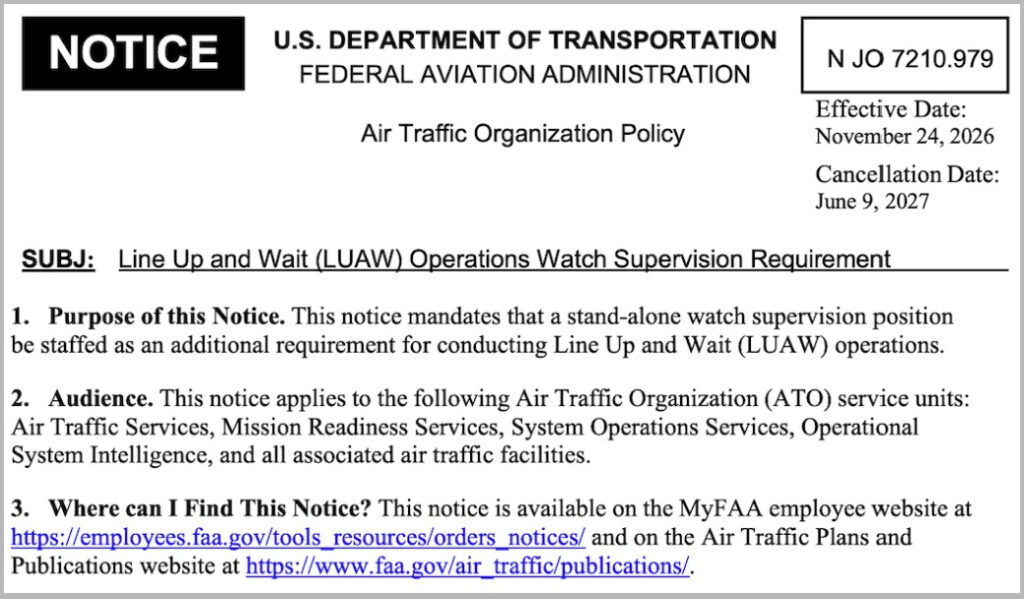
Click for PDF.
For ATC to conduct LUAW operations:
- The local controller (tower) must not be working other positions such as ground, clearance delivery or flight data. Certain combinations of local control positions are still permitted.
- There must be a dedicated Operational Supervisor (OS) or Controller-in-Charge (CIC), who cannot be working any other position.
Previously, the FAA said there should be a stand-alone watch supervision position. That should has now become a must.
The FAA wants someone keeping an eye on the operation who isn’t busy controlling aircraft themselves.
Now throw the US controller shortage into the mix
As of August 2026, the FAA had around 11,000 fully certified controllers against a staffing target of 12,563. And that’s after the FAA revised its staffing target down from 14,633.
At some of the larger airports, where there’s already a dedicated watch supervisor on duty, we probably won’t notice much difference. But what about the smaller, busy airports where controllers regularly work multiple positions?
LUAW is a particularly useful tool at airports with a mix of arriving and departing traffic. Having an aircraft lined up and ready to go allows ATC to make better use of the gaps between arrivals.
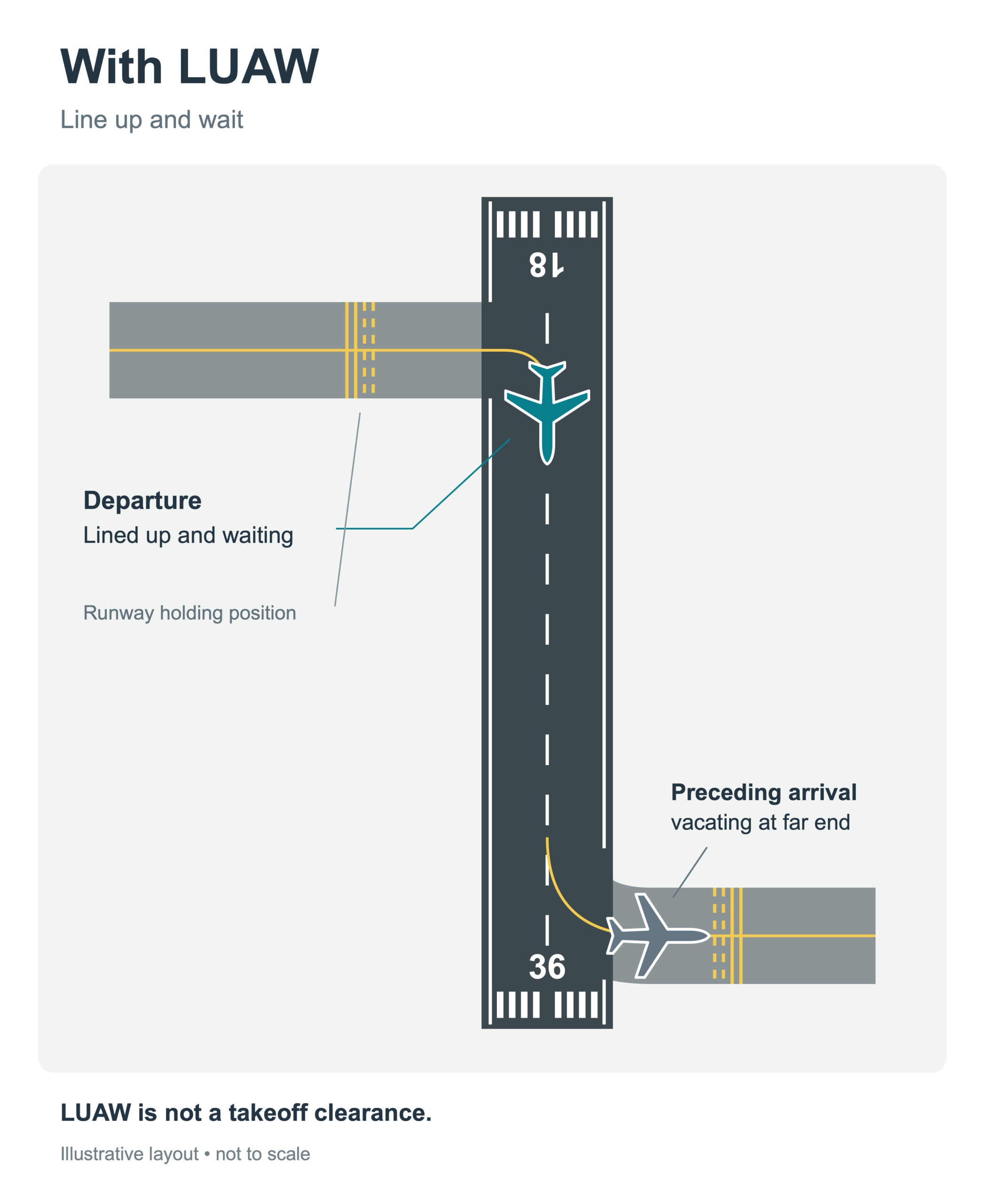
ATC can have the departing aircraft lined up and ready to go while the preceding arrival is vacating the runway, where separation requirements permit.
Without LUAW, you’ve still got to get the aircraft onto the runway, turn through 90 degrees and get going. That extra time might mean that a gap between two arrivals, which ATC could previously have used to get you airborne, is no longer big enough.
As pilots, we’ve all sat at the holding point, watched the arriving traffic and spotted a gap that we thought ATC might use to get us out. Without LUAW, you might now have to sit through another two or three arrivals before there’s a big enough gap for you to depart.
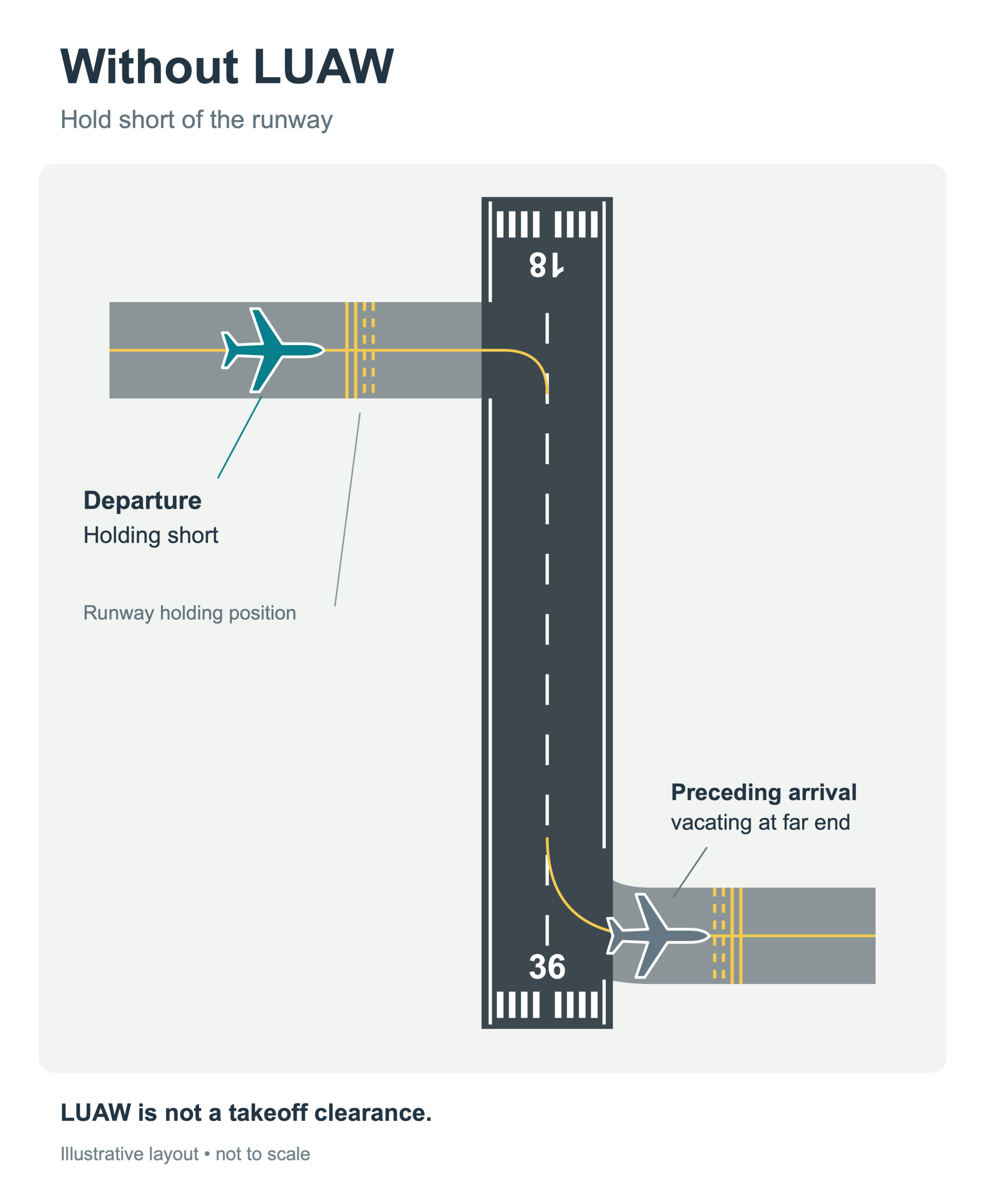
The departing aircraft remains at the holding point until ATC can issue a takeoff clearance.
So it’s the already busy airports that could become even busier, particularly if they don’t have the staffing to support LUAW throughout the day.
The FAA told CNN that the change “will not impact airport operations”. It’ll be interesting to see how this plays out over the coming weeks.
What does this mean for us?
There’s no change to our procedures as pilots, but don’t be surprised if you’re spending a bit more time holding short.
You might get a LUAW clearance at an airport in the morning, but not when you go back there that afternoon. Much will depend on how the tower is staffed at the time.
And for those of us heading into winter, a few extra minutes at the holding point aren’t particularly welcome when we’ve just spent several thousand dollars on de-icing and are watching our holdover time tick away.
At this stage, we haven’t seen a list of airports likely to be affected, and it’s too early to tell how much of an impact this will have on departure rates.
Have you noticed any changes at your regular US airports since Nov 24? Or perhaps you’re one of our ATC members who can shed a bit more light on how this is going to work at your airport. Drop us a note at news@ops.group.

More on the topic:
- More: Boston Parking Restrictions Are Back
- More: US CBP biometrics: BizAv rollout still unclear
- More: US Shutdown Ends and FAA Lifts Flight Restrictions
- More: FAA Housekeeping: Foreign Instrument Procedures, Approach Chart Clutter
- More: Do I need a TSA Waiver for a flight to the US?
More reading:
- Latest: USA: More Holding Short, Less Lining Up
- Latest: Middle East Airspace: Current Operational Picture
- Latest: Bomb Threats: What to Expect from ATC and What to Do Onboard
- Safe Airspace: Risk Database
- Weekly Ops Bulletin: Subscribe
- Membership plans: Why join OPSGROUP?







 Get the famous weekly