



On Sep 24, the FAA published a Notice of Proposed Rulemaking to rewrite the pilot oxygen rules under Part 91 and 135 (a fancy way of saying “we’re thinking about changing the rules, tell us your thoughts”).
This began back in 2024 with the FAA Reauthorization Act. Buried under Section 834, Congress directed the FAA to look at existing Part 135 oxygen rules, taking into account safety data, accident history and NTSB recommendations.
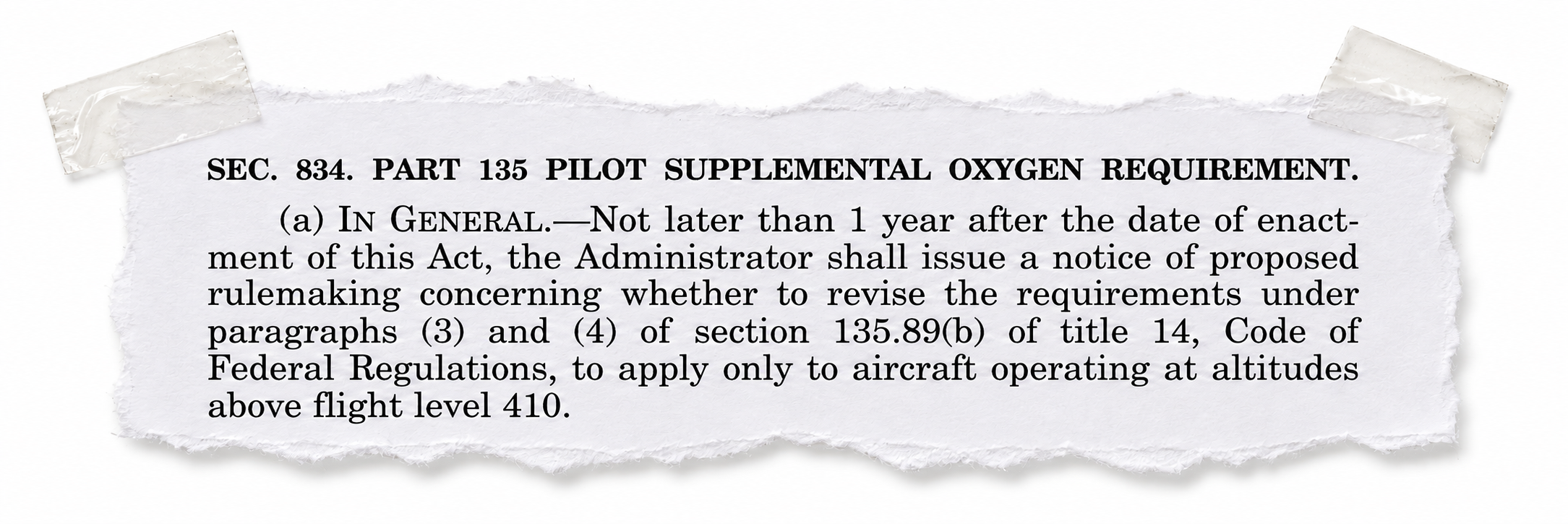 Nothing in the statute covered Part 91: the FAA has added this itself. Why? The FAA addresses this in its proposal:
Same jets but different rules: the same business jets often fly under both Part 91 and 135. The FAA simply sees no point in loosening one set of rules only to leave the other alone.
Backwards safety: there is a long-standing principle that paid passenger and cargo flights should be held to a higher safety standard than private flying. If the rules were relaxed for Part 135, and not 91, we’d end up with stricter rules for private flights which runs against the regulatory grain.
What’s being proposed
Part 135
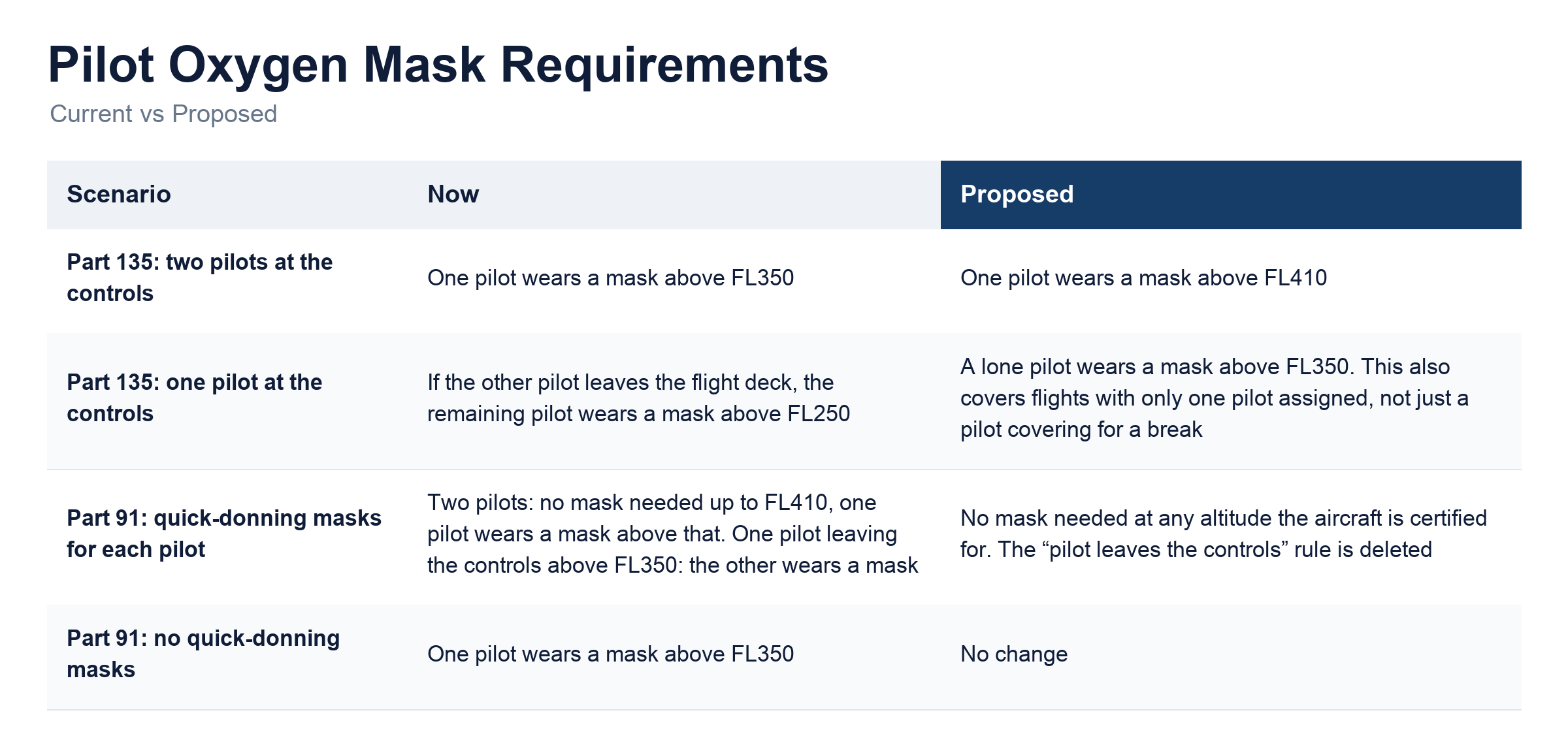
Two pilots at the controls: Today one pilot has to wear a mask above FL350. It’s proposed to change this to FL410.
One pilot at the controls: Today a mask goes on above FL250 if one pilot leaves the flight deck. Congress asked the FAA to consider FL410 also, but given the time of useful consciousness at that level after a rapid decompression (approx. 9 – 20 seconds) the FAA is a little less gung-ho, and is suggesting FL350.
The same would apply to single-pilot ops too, not just when the other pilot is on the john.
Part 91
Right now, one pilot must wear a mask above FL350 unless there are two pilots, and each has a quick-donning mask. In that case you’re off the hook up to FL410.
The FAA is proposing to drop the FL410 bit. With quick-donning masks within reach of each pilot, it’s proposed that no one will need to wear a mask at any altitude the aircraft is certified for.
This would also get rid of the rule that makes the remaining pilot wear a mask above FL350 when the other pilot leaves the controls.
If your ride doesn’t have quick-donning masks, there’s nothing to see here – the rules won’t change.
What counts as a “quick-donning?” The law has that covered. It means a mask you can get on one-handed, from the ready position, sealed and supplying oxygen within 5 seconds.
This is summarized in the table below:
Why the FAA thinks this is all okay
The FAA’s argument rests on how rarely these aircraft depressurize.
It estimates that Part 91 and 135 operators flew more than 20 million hours above FL250 between Jan 2015 and May 2025. During that time there were around 200 reported decompressions.
Of those, only four were possibly rapid or explosive. Most events were slow – often a door seal noticed during climb. In many cases the crew donned their masks at the first sign of trouble.
Then there’s design. Under certification rules, a ‘realistic’ pressurization problem (like losing a bleed source, or a stuck outflow valve) shouldn’t let the cabin altitude exceed 40,000ft. It also shouldn’t stay above 25,000ft for more than two minutes.
A sudden major loss of cabin pressure isn’t covered by this limit, but the certification treats this as so unlikely that it can be excluded. It basically almost never happens.
It’s also important to acknowledge that the existing FAA rules are stricter than ICAO’s, which only require quick-donning masks to be available above FL250, with no requirement to wear one.
And finally, if you’re feeling the pinch at the grocery store, there’s some money to be saved. The FAA says the proposed rules will save on oxygen servicing. A bottle refill typically costs $100 – 400, and every 1% of affected operations that skips a service will save $4.7 – 18.6 million a year. That’s a of a lot of hot dogs.
The FAA isn’t ignoring basic physiology
There’s no denying that the time of useful consciousness gets perilously short at the levels modern business jets are cruising at. The FAA’s own table confirms it.
These numbers come from chamber studies with people sitting still. I’d wager that if you add flying, noisy alarms, mist, sub-zero temperatures, barotrauma, startle factor and a cockpit that is suddenly extremely busy the times get shorter still. That’s why the FAA suggests you use the lower number as a more realistic figure.
But it’s about balancing practicality and risk. The proposal suggests the odds are low enough to accept.
Do you agree?
That’s why the proposal is open for comment until Nov 23. Remember, right now the existing rules still apply! Nothing has changed yet.
If you have real-world experience with decompressions (especially rapid ones) the FAA wants to hear from you, and so do we. We’d love to share your story. You can reach us at blog@ops.group – and of course, we’re glad you’re okay!

More on the topic:
- More: FAA Mobile Clearance Tool: No More Verbal Ping Pong
- More: 2026 Updated FAA Oceanic Guides
- More: US Ops Update: Speeds, Squawks and Slippery Runways
- More: FAA Warns on Runway Length Data and Overrun Risk
- More: US Shutdown Ends and FAA Lifts Flight Restrictions
More reading:
- Latest: Beijing’s New 600km Restricted Area
- Latest: FAA Proposes to Loosen Oxy Rules for Part 91 and 135
- Latest: Australia TSP Lite Explained
- Safe Airspace: Risk Database
- Weekly Ops Bulletin: Subscribe
- Membership plans: Why join OPSGROUP?






 Get the famous weekly