



Key Points
- BOBCAT allocates slots for westbound flights entering Afghanistan’s OAKX/Kabul FIR between 2000-2359 UTC each night.
- It’s run by the Bangkok ATFMU and resumed in September 2025 after a four-year suspension.
- BOBCAT manages traffic flow only. Kabul FIR remains uncontrolled Class G airspace, with crews self-separating using TIBA procedures.
- Slots are only required for westbound flights below FL410 entering Kabul FIR between 2000 and 2359 UTC. Requests are submitted via bobcat.aero before the daily 1200 UTC cutoff.
- BOBCAT is only one part of the picture. Operators still need Afghan overflight permission, appropriate insurance, and a thorough risk assessment before planning to use Kabul FIR.
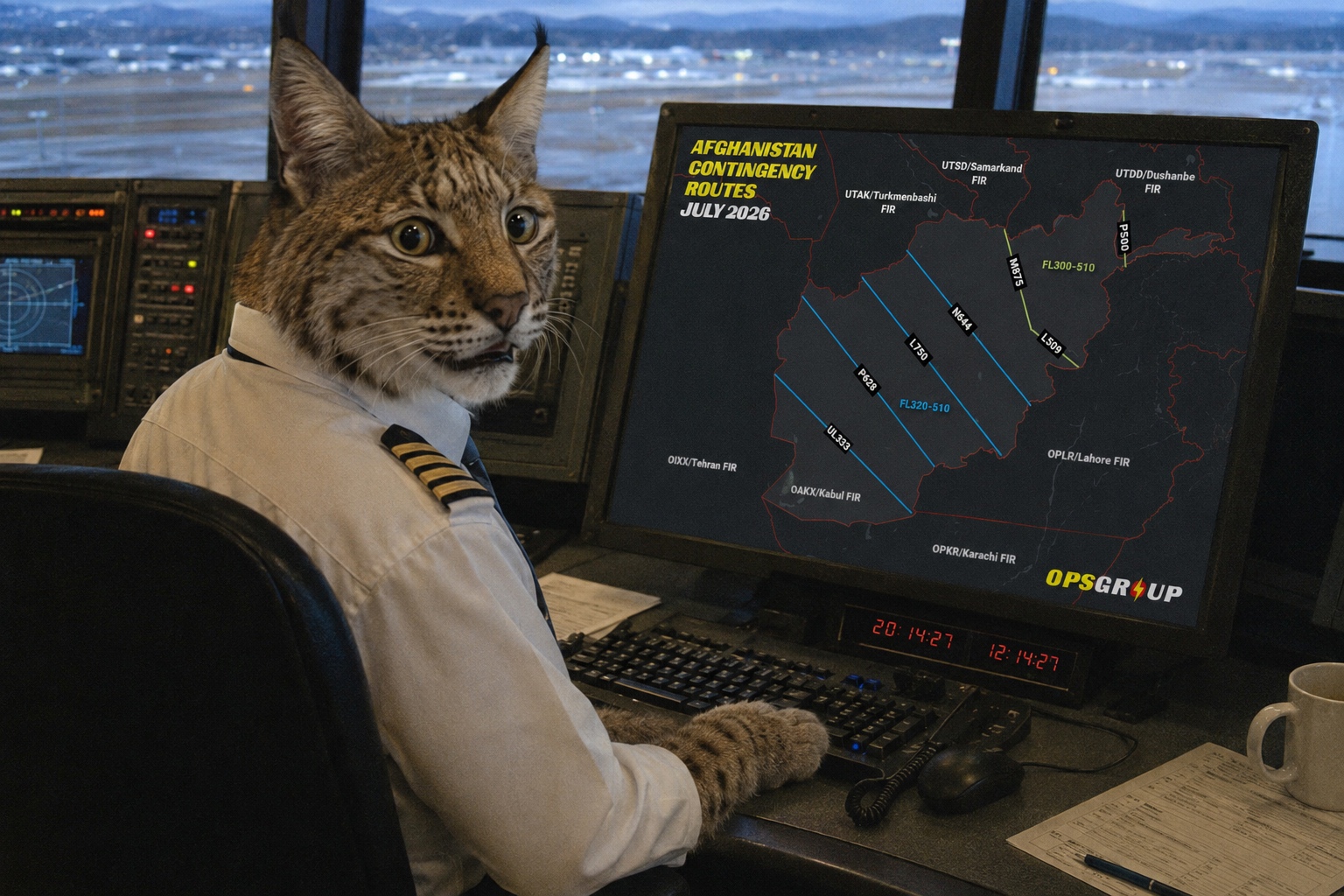
Say “BOBCAT” to most people and they’ll picture the feral cat known across North America. 😼
In aviation, it’s something else entirely: the air traffic flow system keeping aircraft properly spaced through Afghanistan’s uncontrolled airspace, and a vital link for traffic running between Southeast Asia and Europe.
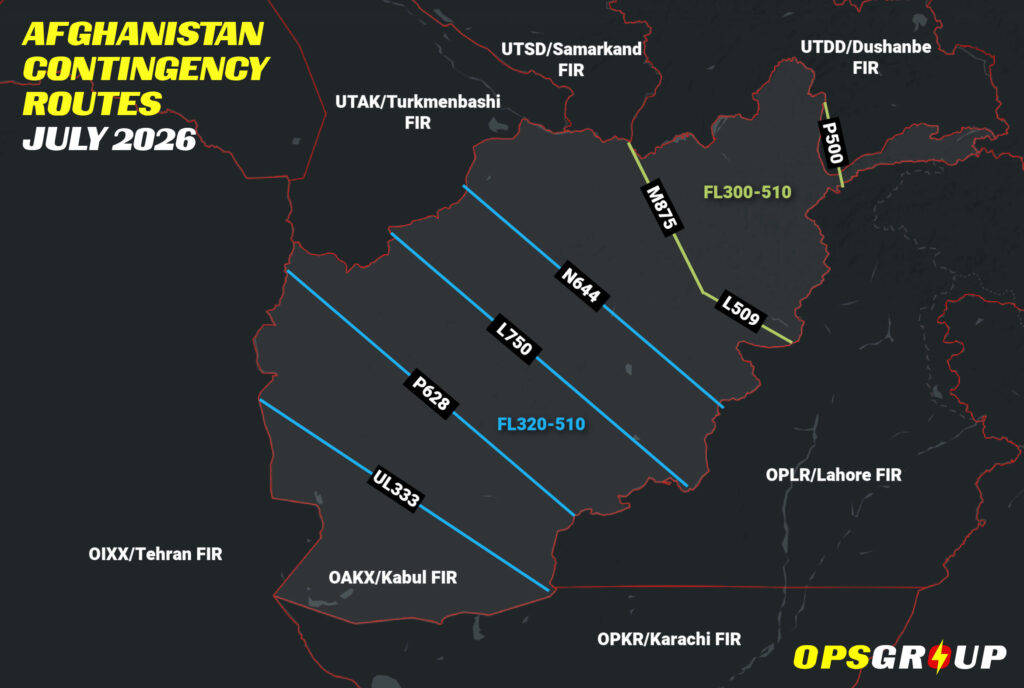
OAKX/Kabul FIR has had no air traffic control service since August 2021. That hasn’t stopped traffic through it – if anything, the opposite. The air routes themselves are bidirectional and open 24/7, but airlines and some BizAv operators still route westbound flights across Afghanistan every night, self-separating on published contingency routes using TIBA procedures, because the alternative is a long and expensive diversion around it.
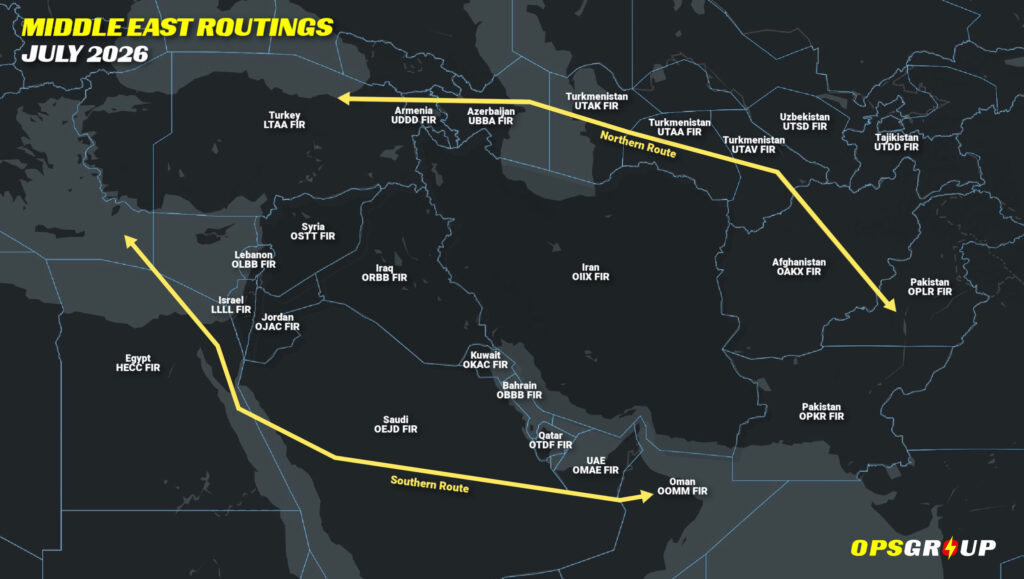
And with more Europe-Asia traffic being pushed north and east this year to avoid other closed corridors or unstable airspace in the Middle East, those routes through Kabul FIR have gotten busier, not quieter.
That’s where BOBCAT comes in. It doesn’t restore air traffic control to Afghan airspace (nothing does that right now), but it does sequence aircraft before they enter the FIR, so traffic is already spaced before crews take over their own separation using TIBA procedures.
Where BOBCAT came from
BOBCAT stands for the Bay of Bengal Cooperative Air Traffic Flow Management System. Before taking on its current role sequencing traffic into Kabul FIR, it began life as a regional flow management system for Southeast Asia. Most Europe-bound flights leave the region in a late-evening wave, creating a nightly surge of westbound traffic that BOBCAT was designed to organise.
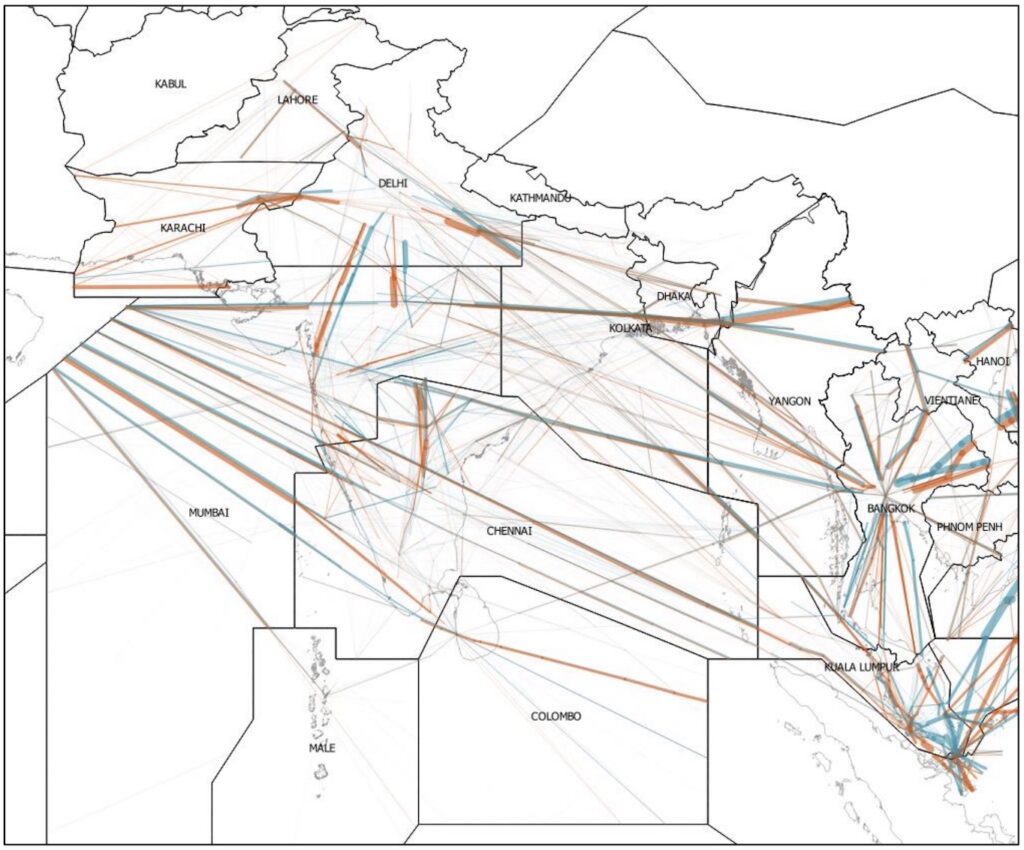
ICAO: Traffic Flow in the Bay of Bengal Area in 2024
Why it’s back on the radar
BOBCAT’s Kabul procedures were suspended in Aug 2021 when Afghanistan’s en-route ATC service ended. They returned in Sept 2025 as more Europe-Asia traffic shifted back across Afghanistan, driven by restrictions and instability on other Middle East routes.
Flow management, not air traffic control
BOBCAT allocates a slot and CTOT so aircraft enter Kabul FIR with the required spacing. Once inside the FIR though, nothing changes: there is still no radar or procedural ATC, and crews self-separate using TIBA procedures under the Contingency Plan on the Afghan CAA homepage.
BOBCAT also has nothing to do with the separate question of whether you should overfly Afghanistan at all. That’s covered in our March 2026 article on the considerations to weigh before planning to use OAKX/Kabul FIR.
A quick recap of what most BizAv operators need for a flight through OAKX/Kabul FIR:
- Prior permission from Afghan authorities, which includes paying the overflight fee ($700 USD) via an agent in India.
- Insurance considerations: some hull insurance policies require notification that you intend to operate through the FIR. This is usually no problem, but worth checking before you go.
- Awareness of the general risk picture, which can include periodic border friction with Pakistan, plus the fact that there’s no suitable airport within the FIR for an immediate diversion.
- A BOBCAT slot is only required if you’re transiting the FIR westbound toward Europe between 2000 and 2359Z, at a flight level below FL410.
How it works: waypoints, levels, and spacing
BOBCAT manages five waypoints where traffic enters the Kabul FIR, each tied to a specific airway. At each one, aircraft on the same flight level need 15 minutes of longitudinal spacing as per the Kabul FIR Contingency Plan. That’s the number BOBCAT is solving for when it assigns slots.
| Route | Metering waypoint | Available flight levels |
| L509 / M875 | LAJAK | FL300, FL320, FL340, FL360, FL380, FL400 |
| N644 | DOBAT | FL320, FL340, FL360, FL380, FL400 |
| L750 | BIROS | FL320, FL340, FL360, FL380, FL400 |
| P628 | ASLUM | FL320, FL340, FL360, FL380, FL400 |
| UL333 | SERKA | FL320, FL340, FL360, FL380, FL400 |
Aircraft must be RVSM approved, and the allocated level must be reached before entering Kabul FIR – level changes aren’t permitted once inside. BOBCAT calculates a CTOT from your departure time, taxi time and estimated flight time to the FIR boundary. Good estimates matter: a bad EET produces a bad slot!
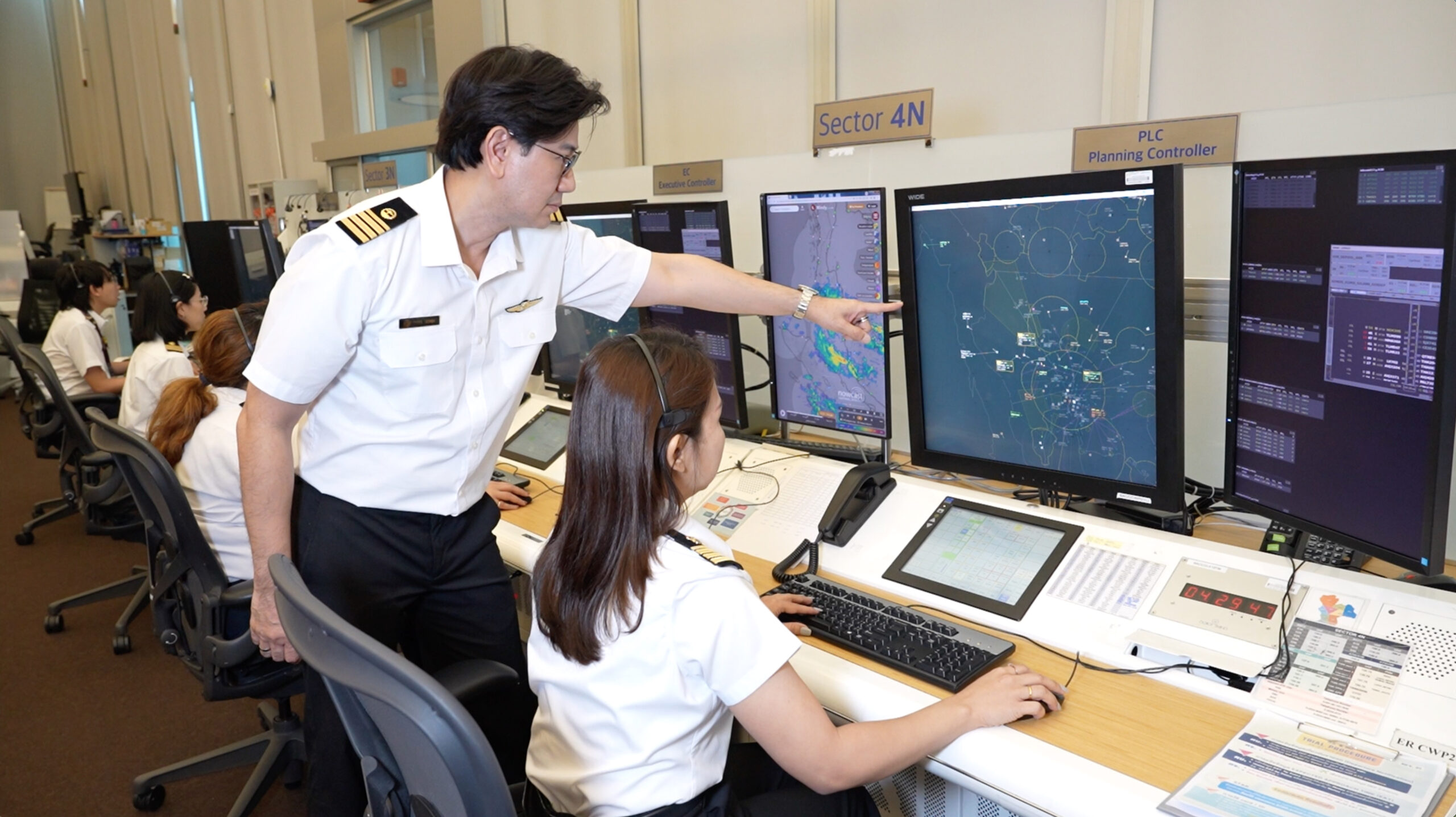
Thai ATC will point you in the right direction
How the daily slot cycle works
- 0000 to 1159 UTC: you can log slot requests at bobcat.aero, specifying preferred route, flight level, and Maximum Acceptable Delay (MAD). Requests can be amended right up to the cutoff.
- 1200 UTC: cutoff. Submit multiple route/level/MAD options if your first choice might not clear. It measurably improves your odds of getting a workable slot.
- Shortly after 1200 UTC: BOBCAT processes all requests and generates allocations.
- By 1230 UTC: results post to the BOBCAT website’s Slot Allocation page (email or AFTN as a backup if the website isn’t practical).
- After distribution: flights that didn’t get their requested slot, or never submitted one, pick from remaining unallocated slots. Miss out entirely and expect to be tactically squeezed into the flow later, which very likely means an en-route delay, often holding.
If it becomes clear a calculated take-off time won’t be met, don’t just wait. Ask your handler or ops to get a new slot as quickly as possible, either through the system or by phone to the Bangkok ATFMU.
The same goes in reverse: if a flight diverts, returns, or is cancelled after a slot’s been issued, tell the ATFMU so that slot frees up for someone else.
And if a flight departs before the 1200 UTC cutoff but still enters Afghan airspace inside the 2000 to 2359 UTC window, the dispatcher still needs to submit a request, based on actual, not planned, departure and entry times.
Exemptions
A handful of flight categories are exempt from BOBCAT:
- declared emergencies
- search and rescue or firefighting
- urgent medevacs
- Head of State flights
- any others designated by a State CAA
If you’re exempt, include “STS/ATFMX” in Field 18 of the flight plan.
The numbers so far
Since restarting in Sep 2025, here are some BOBCAT stats:
- Handled 4,851 flights over 108 nights
- Average delays of 2.2 minutes per flight
- Estimated fuel saving: 1,060 tonnes
- Estimated CO₂ reduction: 3,350 tonnes
- 93% of flights crossed the FIR at or above their allocated level
Not bad!
I’ve flown it so you don’t have to!
There’s a hefty dose of “at your own risk” in all of this, and the choice to overfly is not an easy one. I’ve flown this route dozens of times since it reopened in 2023, most recently a few months ago, and I treat it with the same caution I’d give any ETOPS-style flight: the airports within the FIR are unsuitable for diversion, so I plan around ETPs in case of an inflight emergency.
I’m risk averse – but I still find this route a better option than the western routes over the Middle East. The FIR has been stable since reopening, with no last-minute closures so far.
The permit was easy. An email to flightpermissions.acaa@gmail.com (cc flightpermission.atm@mota.gov.af), with the application form, insurance, airworthiness certificate, and registration attached, got a reply within 24 hours confirming the flat $700 USD fee. They ask for 48 hours’ notice; we gave a week.
Insurance checked out too: like most policies, ours excludes certain countries but covers ATC-approved airways, with cover intact if an emergency forces a diversion. L750 was fine.
Entering the FIR is straightforward: you get handed over to 125.2 and commence TIBA ops. Make sure your lights are on. We kept TIBA on Comm 2 (125.2), the previous sector’s ATC held on Comm 1 for another fifteen minutes or so, and 121.5 stayed monitored on Comm 3, broadcasting at each fix roughly every five minutes.
It’s busier than it used to be. Plenty of airlines now use it both day and night for Asia to Europe routes. No spoofing, no jamming, no ATC surprises, and connectivity held up too: Starlink worked perfectly
Getting set up
Infrequent users can submit slot requests using BOBCAT’s standard email form. Operators who use Kabul FIR regularly should contact the Bangkok ATFMU for direct system access.
Bangkok ATFMU – Tel +66 2 287 8024 · Mobile (contingency) +66 8 1829 5256 · AFTN VTBBZDZX · Email atfmu@bobcat.aero · web bobcat.aero
The bigger picture: BOBCAT solves one problem pretty well by sequencing aircraft into Afghanistan’s uncontrolled airspace so they aren’t all arriving at the same place at the same time. Whether you choose to route through Kabul FIR in the first place is a separate decision. For more on that, check safeairspace.net.

More on the topic:
- More: March 2026: Afghanistan Overflight Update
- More: Aug 2023: Who wants to overfly Afghanistan?
- More: Afghanistan Update – September 2021
- More: The India-Pakistan Conflict: Impact on Flight Operations
- More: Afghanistan: Do Not Fly
More reading:
- Latest: GPS trouble on the North Pacific routes
- Latest: The Luton Noise Trap
- Latest: India puts a three-aircraft limit on permits
- Safe Airspace: Risk Database
- Weekly Ops Bulletin: Subscribe
- Membership plans: Why join OPSGROUP?




 Get the famous weekly







Good article!