


Update: July 28
Good news: Cambodia and Thailand have agreed to an immediate and unconditional ceasefire starting midnight local time on Monday July 28 (1700Z), following five days of intense fighting along their shared border. Both sides have committed to reopening communication lines and setting up a monitoring mechanism to maintain the truce.
While this is a major step toward de-escalation, the situation remains fragile – caution is still advised near the border region.
There are no changes so far to the Phnom Penh FIR danger area (SFC–UNL). VDPF Notam A0092/25 remains active.
Original Article: July 25
Key Points
- A sudden military escalation began on July 24 along the central portion of the Cambodia–Thailand border, around 100–150 NM north of Siem Reap.
- Both sides accuse each other of firing first. Thailand has carried out airstrikes using F-16s.
- A danger area now extends along much of the border, SFC to UNL. Overflights may face elevated risk from unannounced military activity, including GPS interference.
Background
Cambodia and Thailand’s long-standing border dispute has flared since May, when a Cambodian soldier was killed in a skirmish. In the weeks since, alleged landmine incidents have endangered Thai troops.
Political turmoil in Thailand has added to the crisis – its Prime Minister was suspended after a leaked call with Cambodian leaders linked to the dispute.
By July 24, the conflict had escalated into one of Southeast Asia’s most serious military confrontations in over a decade, involving airstrikes, heavy artillery, and mass civilian displacement.
Danger Areas
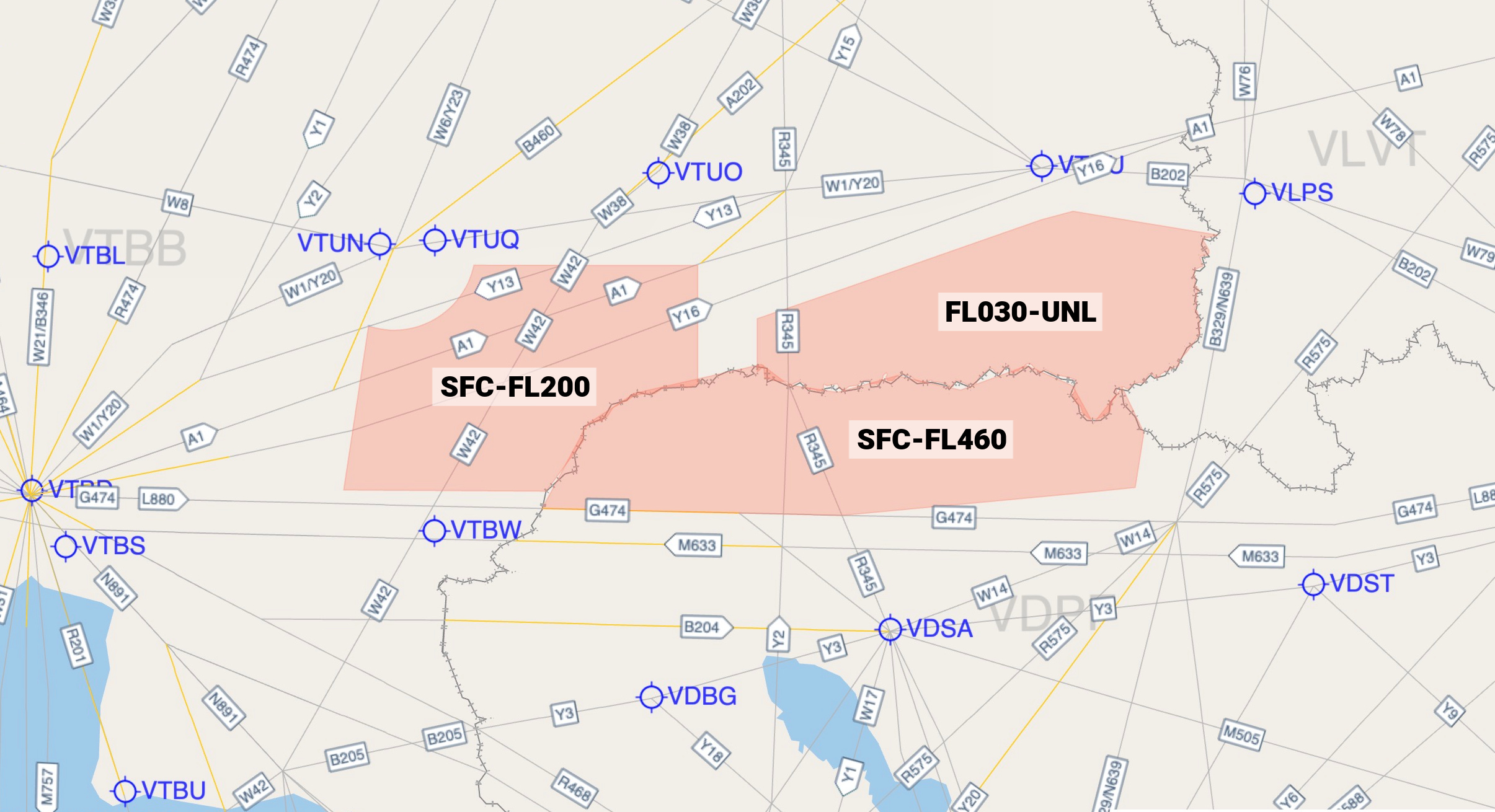
Thailand and Cambodia have both issued Notams (under the VDPF/Phnom Penh FIR and VTBB/Bangkok FIR codes), activating danger areas across a large portion of the shared border at all levels.
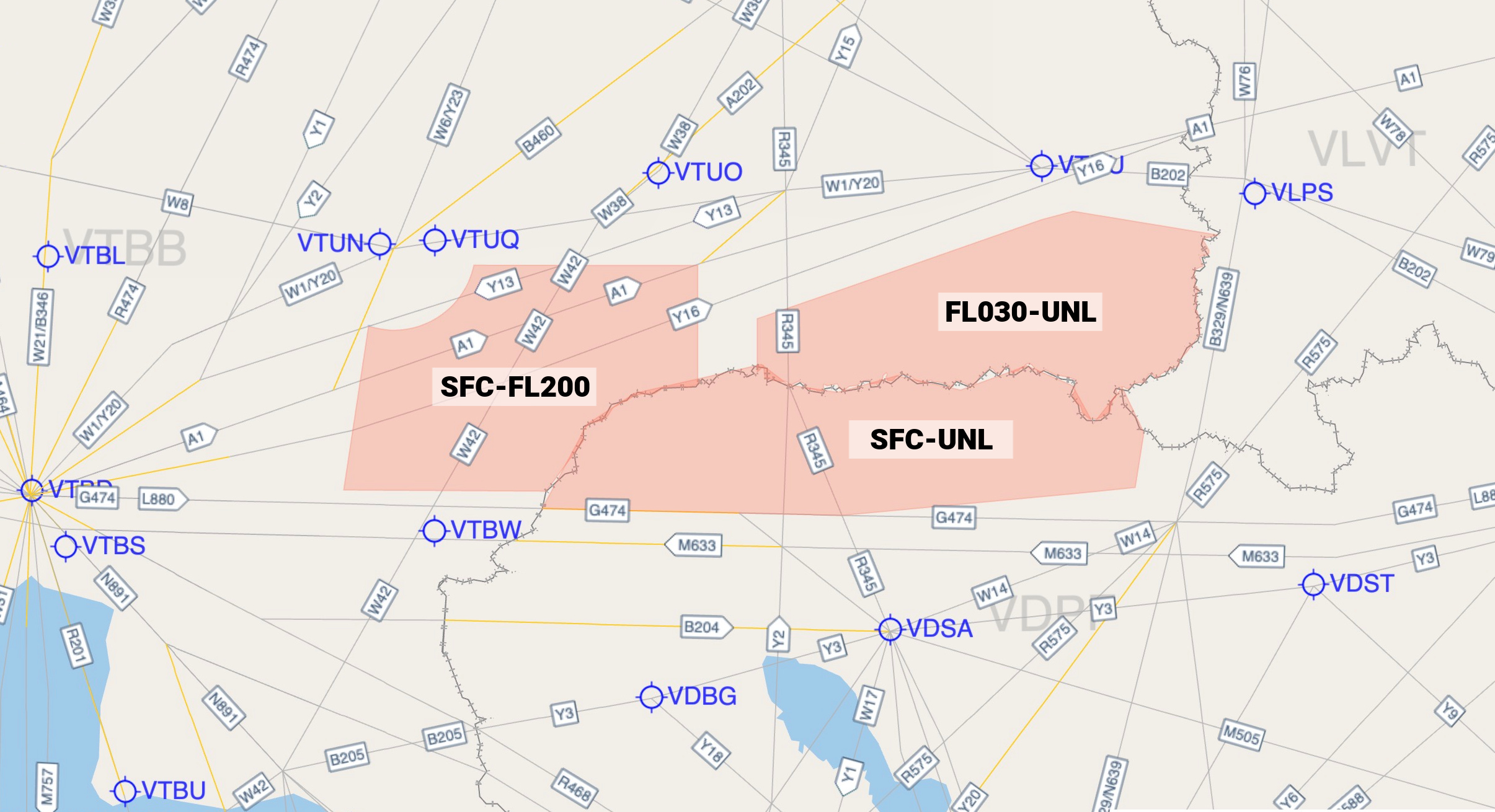 What’s notably absent from the Notams is any mention of the reason behind the danger area activations: an escalating conflict on the ground.
Cross-border fighting has involved heavy artillery and military airstrikes. Unannounced military activity poses potential risks to civil aviation at all levels – including from air defense systems and GPS interference.
We advise caution in the open airspace above.
High altitude airways affected include:
North/Southbound
R345 – the airway connecting VDSA/Siem Reap with northern Thailand.
Y2 – connects southern Cambodia with northern Thailand.
These routes are currently off-limits, as they pass through the main danger areas.
West/Eastbound
A1/Y16/Y13 – airways connecting the Bangkok airports with eastern Thailand and Vietnam. The danger area here only extends up to FL200, with airline traffic still transiting these routes.
At time of writing, there are no new state-issued airspace warnings concerning either Thai or Cambodian airspace.

More on the topic:
- More: South East Asia: Open for Business
- More: International Bulletin: Hong Kong pain in the ass, Haiti relief operations
- More: Midweek Briefing: Where is Zika, Elevated North Korea Risk
- More: Midweek Briefing 01JUN: EASA Updates ‘Suspect Aircraft’ Guidelines, 8th French ATC Strike
- More: Midweek Briefing: Australia Airport Workers Strike, ICAO Toughens Aircraft Tracking
More reading:
- Latest: NAT Pack 2026: All the North Atlantic goodies
- Latest: New 2026 NAT Oceanic Checklist
- Latest: The Bahamas wants your cash
- Safe Airspace: Risk Database
- Weekly Ops Bulletin: Subscribe
- Membership plans: Why join OPSGROUP?






 Get the famous weekly