Introducing: Airport Operational Lowdowns

Ever been bamboozled when flying into airports you’ve never been to before? You’re on your approach and all looks good – straightforward, easy, no threats – and then, they cut 50nm off your arrival track and suddenly you’re high and fast and this is when your co-pilot (who has been there before) turns around and says – “Oh yeah, they always do that!”

Or what about that airport where they built a really big hanger in a really silly spot, and you don’t find out about the wind shear off it until you are there, at 30 feet, battling with it?

Calling All Pilots… 

  • All pilots who operate into random, challenging or interesting airports.
  • All pilots who do not operate into the same airports regularly.
  • And all operators, ATC, anyone with a bit of knowledge about an airport for that matter.

Following on from our OpsChat where some of you raised the idea of briefings on specific airports, we have started to put these together…

What’s the idea?

The idea is a lot of pilots, particularly corporate folk (but this is still for everyone) might not have access to loads of shared information on specific airports. If you do not fly somewhere regularly, or do not work for a big airline, then the only information you will have on certain airports is what you can read off the charts and in the AOIs.

But we all know there are airports out there which have specific challenges you only discover when you operate in. The useful, practical, operational stuff. The threats, risks and gotchas that you discover with experience.

Introducing: Operational Lowdowns

Our Operational Lowdowns are our new way of trying to share this information between you all.

If you have experience going into an airport and spotted something unusual, odd, tricky or interesting then send in that Airport Spy report. Or even drop us an email with a full lowdown about it.

If you are operating into a new airport and want some additional info before you go, then check the airport on our Airport Spy app – there might already be a Lowdown Briefing in there. If there isn’t, let us know and we will do some digging and try and put one together for you.

Sharing is caring…

… and it is also safety!

Knowing about specific operational challenges, environmental threats and tricky procedures before you get there, so you can BRIEF about it and come up with a plan to mitigate any risks, is important.

So we hope you find these useful, and keep getting in touch with info you have to share, and what info you would like to know.

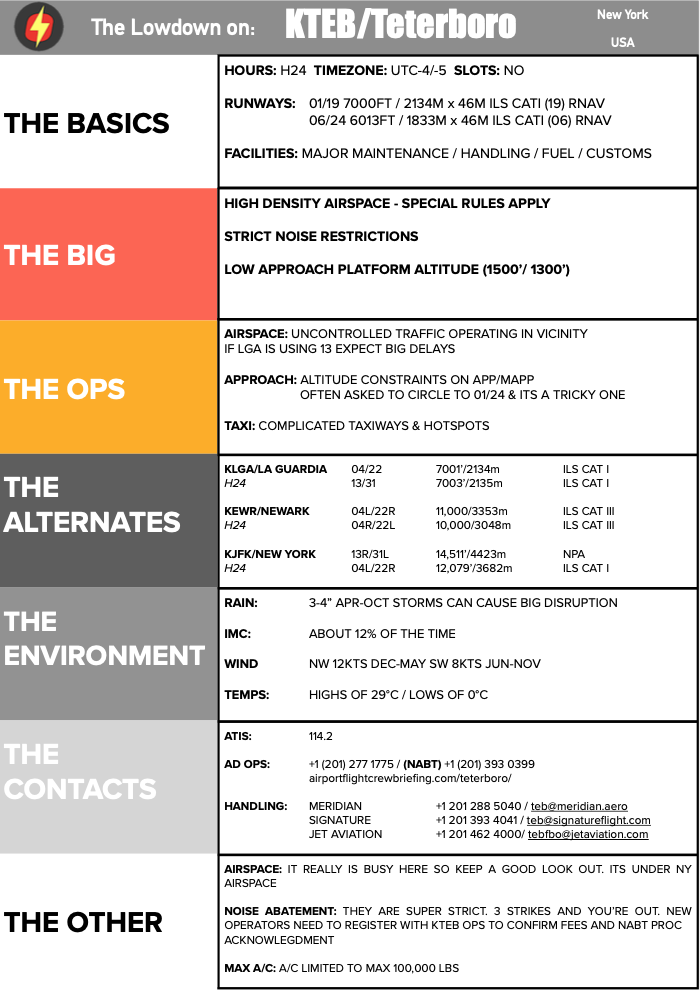
Take a look at the Operational Lowdown for KTEB if you want to see what we’re talking about 😃 ✈️


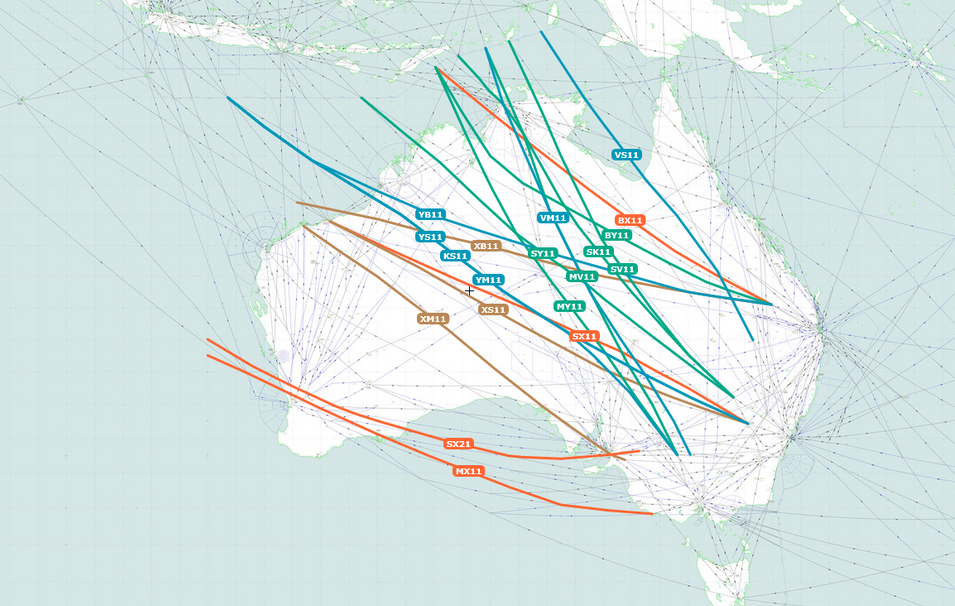
The Lowdown on AUSOTS: Australian Flex Tracks

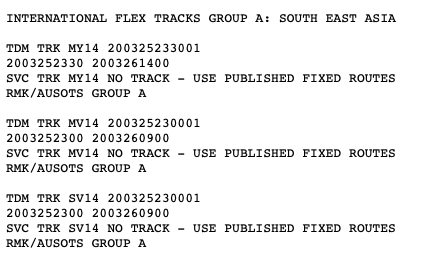
If you haven’t heard of the AUSOTS then it means the Australian Organised Track Structure, and is basically a bunch of Flex Tracks that are produced on a daily basis, aimed at helping aircraft benefit from the best wind conditions.

The inventors define it as – “A non-fixed ATS route calculated on a daily basis to provide the most efficient operational flight conditions between specific city pairs”.

Sounds familiar? That’s because it is basically the NAT OTS but over a different bit of big, not-much-out-there, airspace on the other side of the world.

Where exactly?

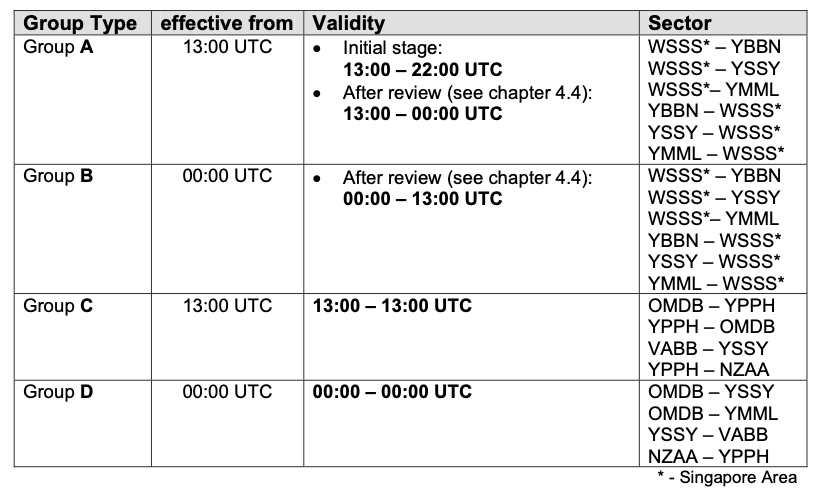
The AUSOTS are currently published for routes between Australia and the Middle East, Australia and South East Asia and for domestic routes between Brisbane and Perth. They pretty much cross the entire YBBB and YMMM FIRs and a few other parts too.

Opposite direction tracks are spaced by 50nm in Oceanic and 30nm in domestic, but with the introduction of ADS-B this is reducing. Again, probably all sounds quite familiar.
The User Preferred Routes are available in the YMMM/Melbourne, YBBB/Brisbane, AGGG/Honiara and ANAU/Nauru FIRs.

Your UPRs can be constructed between gates (entries and exits to FIRs), or by published waypoints (so long as time between them is not greater than 80mins), NAVAIDs or Lats/Longs (and you can use ones that are not whole degrees if you want).

You do need a reporting point on an FIR boundary (except for between AGGG-ANAU or YBBB-AGGG FIRs). 
What do I need?

In terms of equipment, your usual stuff giving you RNP10/ RNP4 type capabilities, Datalink (CPDLC), a couple of LRNS and bits to help you navigate accurately – all that sort of thing.

Unsurprisingly, what you put in your flight plan is much the same as well – if you are RNAV10 then write ‘GR’ and ‘I’ (if appropriate) in item 10 and PBN/A1 in item 18. If you are RNP4 then throw in a ‘GR’ and write PBN/L1 in item 18

You also need HF comms and ADS-B to fly on the UPRs.
What if something goes wrong?

If you are on a track and lose your RNP capability then as long as you can still navigate the track you can stay on it. If you can’t, you probably will want to let ATC know fairly quickish so they can put you onto a fixed track.

If you lose all your comms then it is simple as well –  try other methods, squawk 7600, do some broadcasting on 121.5 and 123.45, put your lights on, and maintain your last assigned speed and level for 60mins (following failure to report over compulsory point), then follow your flight plan. Once you leave Oceanic, follow the procedures of the state you’ve gone into.

In general, if you are flying over Australian airspace they are going to want to know if your estimate over a reporting point changes by more than 2 minutes. They are also going to want to know if you are off your track by more than 20nm (small weather deviations).

Also know that Standard ICAO Contingency and Weather Deviation Procedures apply here.

SLOP?

Yep, they like it. Up to 2nm right of track is the way to go, and in 0.1nm increments if your airplane can do that. You don’t need a clearance for it, but remember you cannot use it in addition to offsets for wake, or weather avoidance.

Block Altitudes

Also allowed in this airspace, and given you are probably flying some mega miles through it, it might be a good idea. That way you can climb up when your weight will benefit, or avoid turbulence if there are reports of it without having to talk to ATC…

You mentioned talking?

We did, but to be honest there is not a huge amount of it going on in this area. Most comms are taken care of through CPDLC. They like a position report sent via CPDLC when you get to the boundary of the FIR (all position reporting procedures are in accordance with ICAO Doc 7030).

The Australian controllers really know how to control. They are great at it. But they also have some pretty high standards which means if you make a mistake they are going to get grumpy and report/fine you. It might seem obvious, but if you’re off track for weather avoidance, once clear, don’t assume you can head direct to the next point – they want to see you regain your original track.

What will I find out there?

A whole lot of empty space and open sea. 

The distance between Singapore and Brisbane is roughly 6,000km. The distance from Perth to Brisbane is over 3,500km. In between them? A lot of dry, dusty bush, and kangaroos.
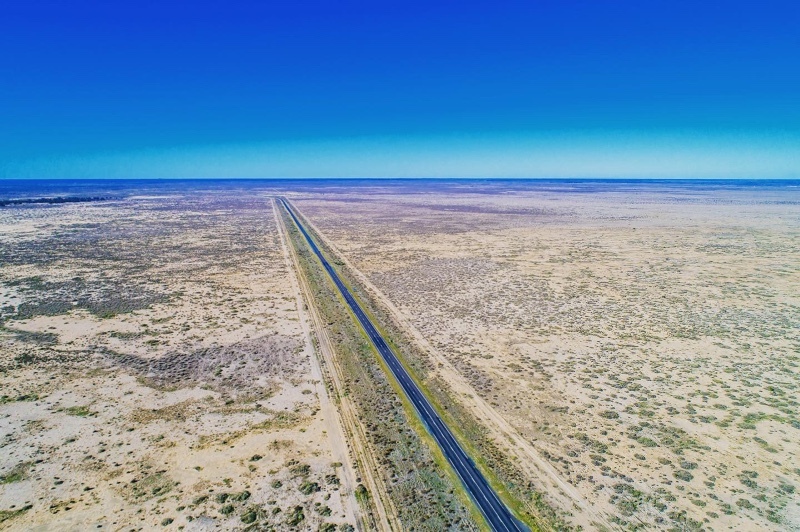
The middle of Australia is quite an empty place so if you’re looking for airports to use, we would recommend the ones around the edge of the country. YSSY/Sydney, YMEL/Melbourne, YBBN/Brisbane are the biggies on the eastern side and you’ll find nice long runways, decent approaches and good facilities at each of them. YPPH/Perth is the main south west one, while if you’re heading north-ish then YPDN/Darwin or YBCS/Cairns are probably your best bets.

You do have YBAS/Alice Springs in the middle if you really need it, and its a fairly decently equipped airport with a 7,999 ft/ 2438m runway and an ILS/RNAV approach.

Who can I ask for info on AUSOTS?

Should you need it, then you can email these folk with all your AUSOTS queries – uprs@airservicesaustralia.com

You can also try the Melbourne Center Operations Manager at Melbourne ACC on +61 3 9235 7420 or on AFTN: YMMMZRZS if you have specific questions about the published AUSOTS Flex Tracks.


The November Mega OpsChat – All the Links…

The November 24th “East/West-One-Day-Two-Calls” OpsChat Bonanza was great! Thank you to all who joined us, and those who shared some useful intel with the group.

Boy, did we cover a lot! The good news is if you missed the show, you can re-watch the recording here:

During the chat, we provided a bunch of links for each topic covered. If you weren’t quick enough to catch them at the time (we don’t blame you), here’s a little summary….


November Updates…

Greenland

What? Baffling Notam issued declaring Greenland’s airports were closed.

What else? Panic not, a better one was then reissued, saying that you could still use Greenland’s airports for ETOPS and diversion alternates. We called them and they said that tech-stops and ferry flights are also allowed (although not listed in the Notam). They’ve basically just banned passenger flights, and don’t want people staying overnight.

More Info:
Greenland Closes Its Airports To (Nearly) All Passenger Flights – Opsgroup Blog Post
Official Word from The Danish Civil Aviation 

Israel

What? You can now overfly Israel (as well as Jordan, Saudi Arabia and Bahrain).

What else? You need a local sponsor, should depart from an approved airport (but they do make exceptions) and need a permit.

More Info:
Israel overflights now allowed – Opsgroup Blog Post

Hong Kong

What? Strange ILS behaviour, especially on Runway 07R/25L. Pretty much down to antennas, terrain and Boeing AFDS…

What else? They have also updated their Covid entry restrictions for crew – it’s now slightly harder to get in.

More info:
The Thing About the ILS
Hong Kong Entry Rules for Flight Crew – OpsGroup Blog Post
The Official Word

CENEMAR (Central America)

What? There are some new flight planning requirements you need to know about.

What else? You can flight plan direct above FL200, and must include the new AFTN address MHFPZYZX when filing your flight plan.

More info:
CENEMAR: New Flight Planning Requirements – Opsgroup Blog Post


Other big updates from 2020…

November 5th ICAO changes

When? Er… November 5th!

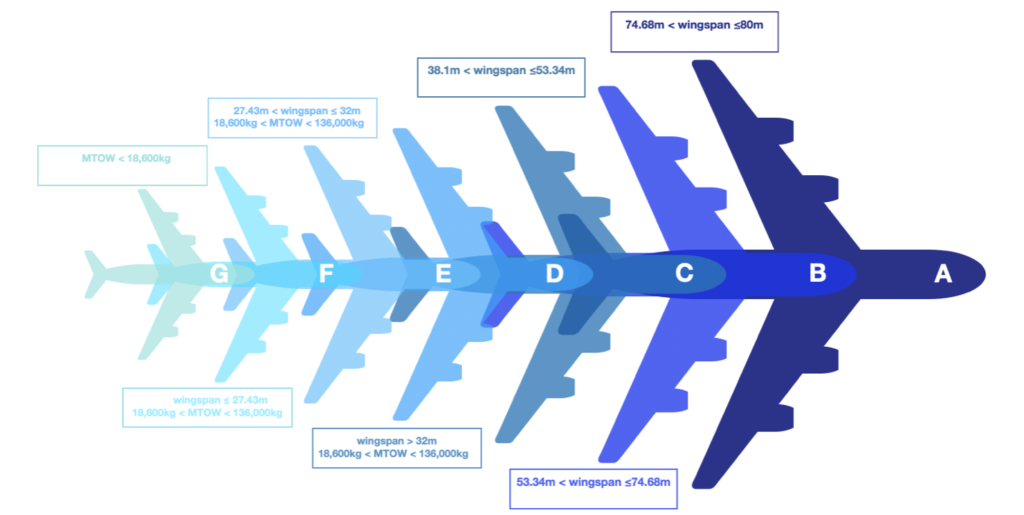
What? We are talking changes to wake turbulence categories, NAT Contingency Procedrues, SLOP and Gross Navigation Errors.

More info:
The 511 on Nov 5th Changes – Opsgroup Blog Post
Hopefully a Link to the New 4444

Other overflights that are now ok

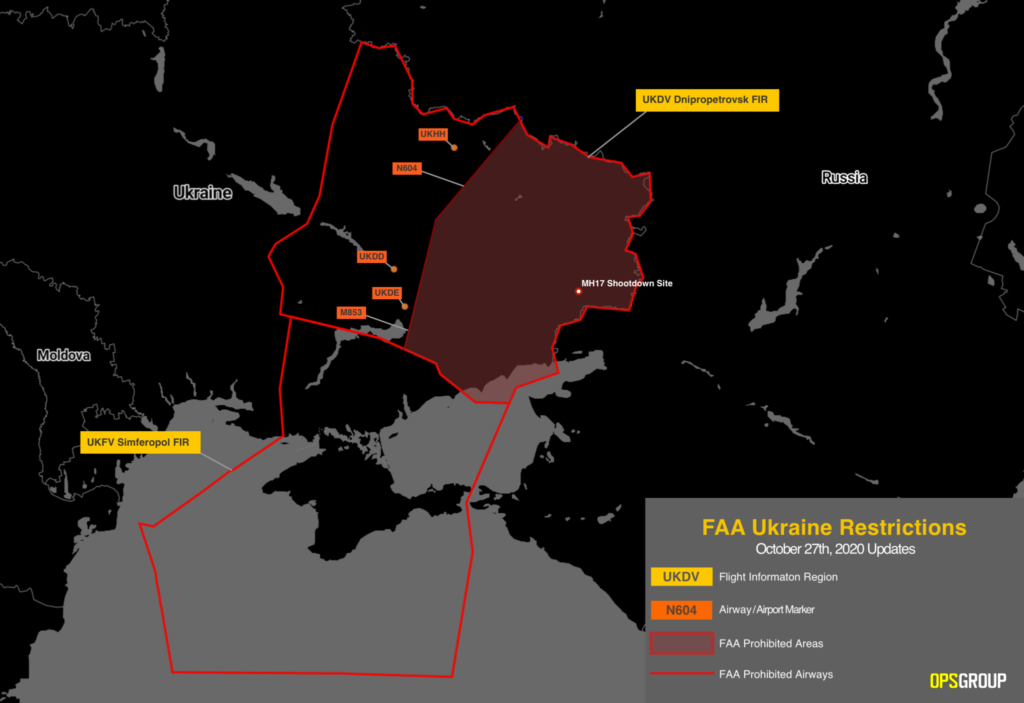
What? FAA SFAR updates – where US operators can’t go!

Where?
– Ukraine: UKFV/Simferopol FIR is ok, UKDV/Dnipro FIR is not ok.
– Iran: Not ok, but the Gulf of Oman and Persian Gulf are – Emirates, Kuwait, Bahrain and Muscat FIRs.

More info:
Safeairspace
Overflying Crimea – Opsgroup Blog Post

Russian Me-trics

What? Russia are moving to feet (referenced to QNH) below transition through their airspace, starting with major airports.

When? From December 3rd.

More info:
Russia are still playing me-trics on us – Opsgroup Blog Post
The Russian AIP (don’t worry, it is in english too)

ADS-B

What? When will you get in trouble for not having it.

Where?
– Europe: ADS-B is required from June 2023, but have your retrofit plan in by December 7 (unless your AoC is before 1995).
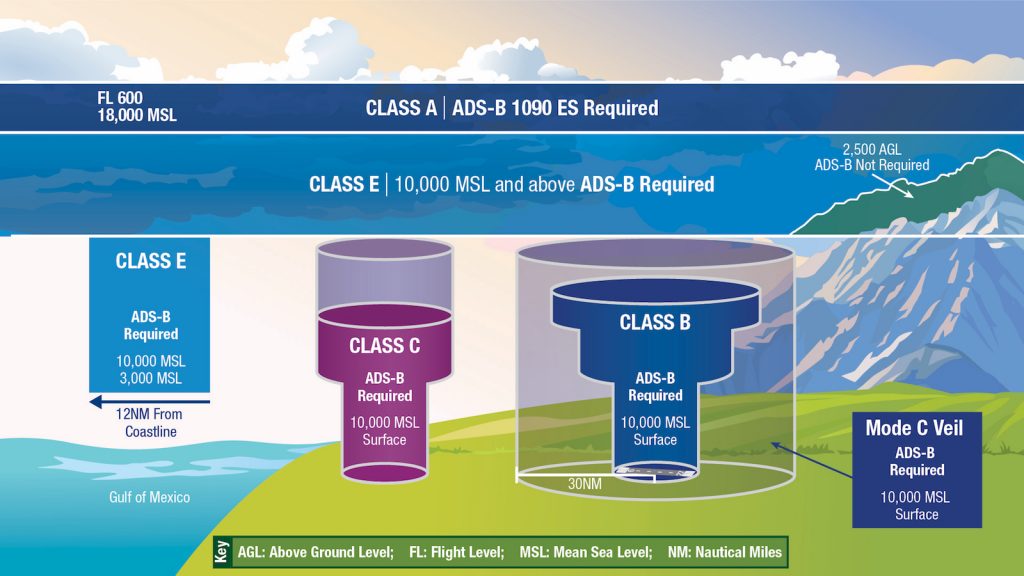
– US: ADS-B is required anywhere Mode C, or in the picture below.
– Rest of World: Above FL290, pretty much.

More info:
European ADS-B Mandate – Opsgroup Blog Post
The FAA FAQs on ADS-B

North Atlantic Datalink Mandate

What? The North Atlantic Datalink Mandate (NAT DLM) is the thing that came into effect in Jan 2020, which meant that CPDLC was then required between FL290-FL410 throughout the entire NAT region. Simply put, you must be equipped with CPDLC and ADS-C if you want to fly between these flight levels.

And then what happened? Then Covid happened. Because of the resulting reduction in traffic they suspended this mandate, and it looks set to stay this way until the end of Feb 2021. Bottom line, aircraft which do not have CPDLC and ADS-C can continue to operate across the North Atlantic between FL290-410 until then.

More info:
North Atlantic Datalink Mandate – Opsgroup Blog Post


SafeAirspace Update…

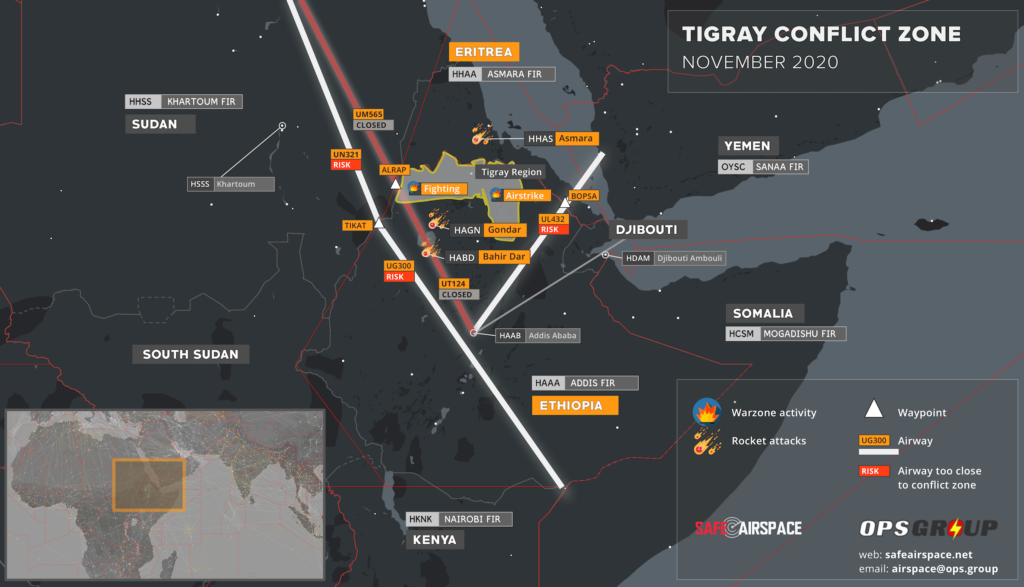
Ethiopia

What? Escalating conflict – Danger to overflying aircraft – beware of open airways!!

Where? Ethiopia – the Tigray region bordering Eritrea

More info:
Safeairspace – Ethiopia
Airspace Risk Warning: Eritrea and Ethiopia – Opsgroup Blog Post

Saudi Arabia

What? Drone and ballistic missile strikes continue from Yemen, no end in sight.

Where? Southern Saudi Arabia particularly, but Jeddah and Riyadh have also been attacked.

More info:
Safeairspace

Armenia/Azerbaijan

What? The conflict is ‘officially’ over, but the airspace remains dangerous!

Where? The airspace between Azerbaijan’s UBBA/Baku FIR and Armenia’s UDDD/Yerevan FIR.

More info:
Safeairspace

Western Sahara

What? An emerging conflict zone, with the threat of anti-aircraft weaponry. Little info or warnings, that may well affect aircraft operating into the Canarias.

Where? Northwestern Africa – a area region between Morocco and the Polisario.

More info:
Safeairspace


Stay tuned for our next Ops Chat coming up in January 2021!


On simplifying International Flight Information …

Our aim with the weekly International Ops Bulletin that we produce is to take relevant operational news affecting International Flight Operations each week, and simplify it.

It’s a learning process for us as well, because the technical language of aviation is often unnecessarily verbose, legalese, jargon-filled text. Spare a moment for those of us that don’t have English as our first language (and that’s most).

Our process is to read through the source data, translate them into bullet point plain English, and combine these with the Flight Reports, News, and Input that we get from our 25,000 or so readers.

For each item, we also ask ourselves one simple question. Would this affect my decision as an Aircraft Operator to fly to this Airport? If yes, then we’ll include it – relevance is as important as clarity.

Some stories are worth expanding into a quick blog post, primarily to gather the useful links into one spot so that you can explore more of the story if you want to, and those will appear here.

We’ve now moved to publishing the Bulletin on a Wednesday; blog posts can happen anytime. For regular email delivery, just pop your details in here.