West Africa Ops: Routing Options and Restrictions
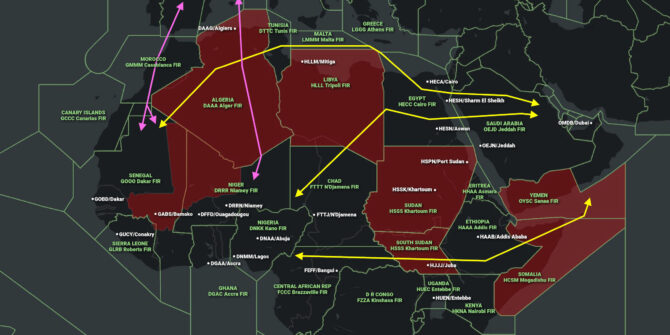
Flying into or out of West Africa is becoming increasingly tricky, with operators having to navigate a patchwork of airspace bans, conflict zones, and overflight restrictions. Two directions present the most complexity: north to Europe, and east to the Middle East.

OPSGROUP members can download this map to see exactly how these restrictions affect routing.
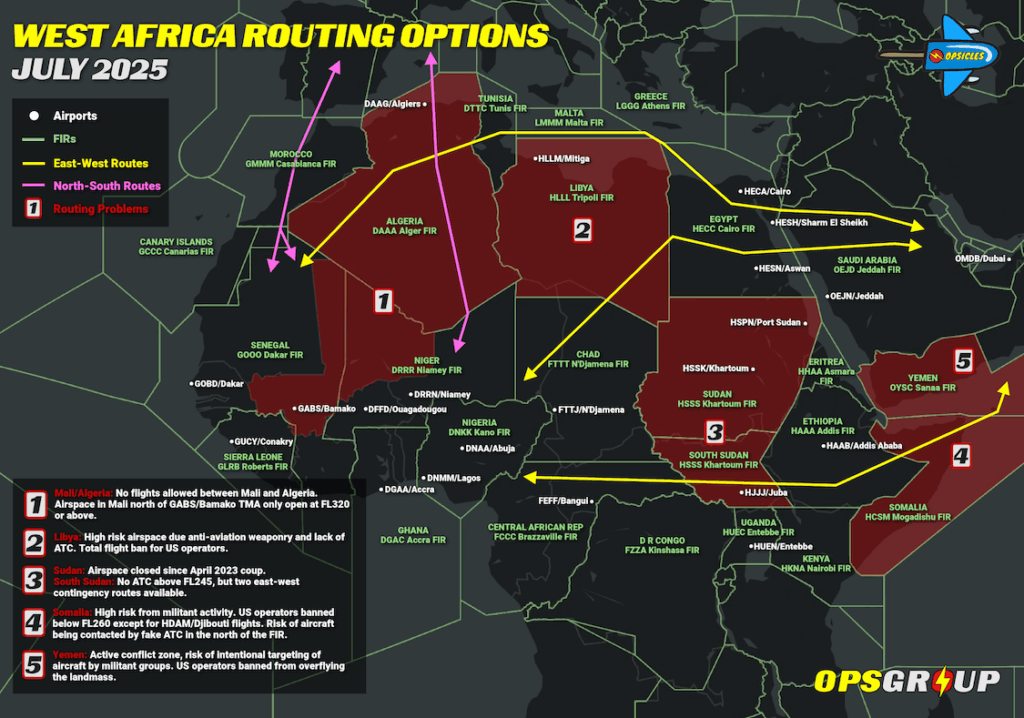
Click to download PDF.

There’s a cluster of major airports in West Africa — from Lagos to Accra to Dakar — that handle the bulk of international traffic in the region.

But getting to these hubs from Europe or the Middle East is complicated by airspace risks and closures in five key areas: Mali/Algeria, Libya, Sudan/South Sudan, Somalia, and Yemen. 

Here’s a more detailed look at each of these.

Mali/Algeria

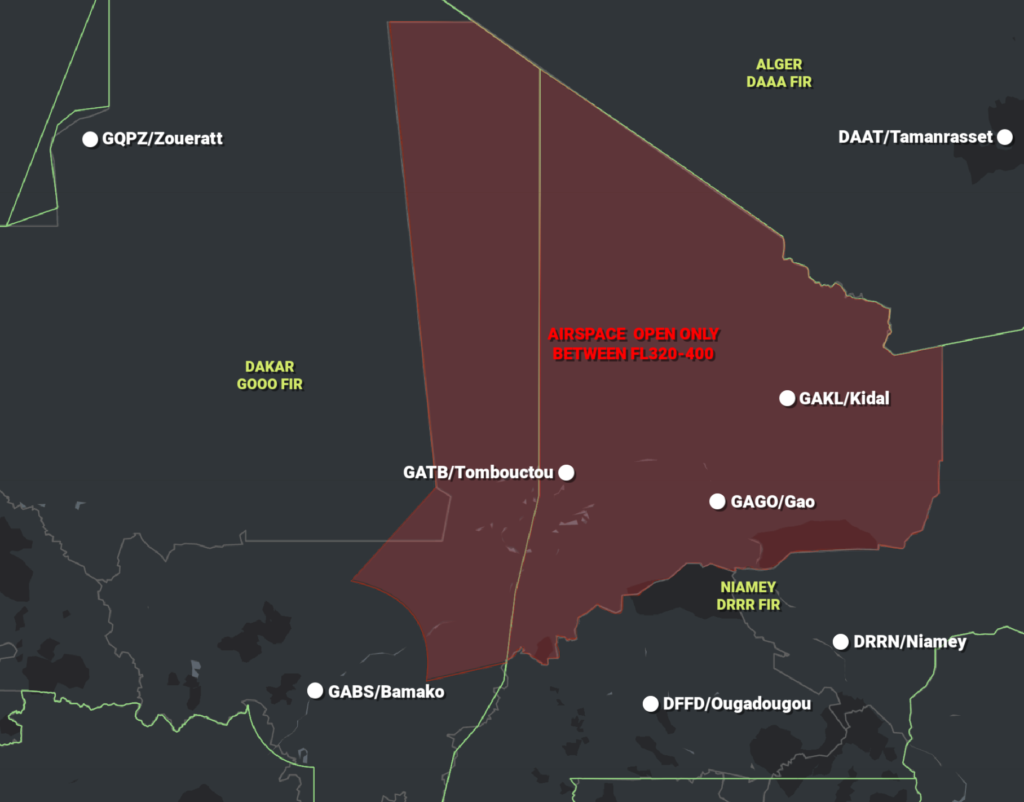
  • Northern Mali remains a war zone — ongoing since 2012.
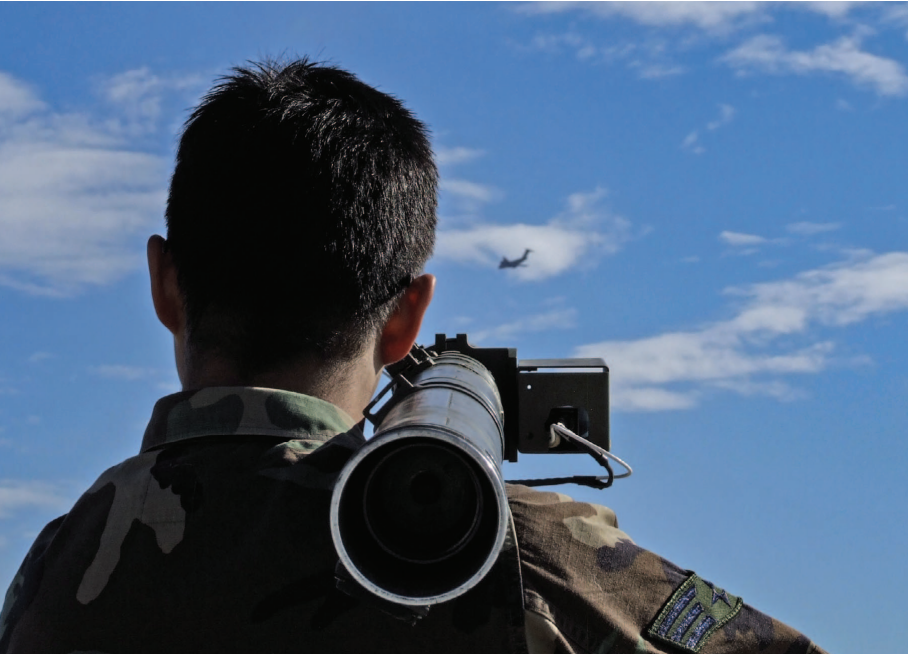
  • MANPADS, rockets, and mortars pose a threat to low-flying aircraft.
  • US advises caution at all flight levels; several states restrict ops below FL250/260.
  • Overflights above FL320 permitted, per long-standing Notams from GOOO/Dakar and DRRR/Niamey FIRs.
  • Airports GATB, GAGO, GAKL should be avoided.
  • A reciprocal airspace ban with Algeria (since April 2025) prohibits all flights between the two countries — even overflights.
  • Routing via Mauritania remains open. Algerian ATC may reroute flights via Niger.
  • More info here.

Libya

  • Active conflict zone since 2014.
  • HLLL/Tripoli FIR is high-risk. Total ban for US and UK operators.
  • Threats include misidentification by air defense systems, militia threats near Tripoli, and unreliable ATC.
  • Frequent radar and comms outages; some flights rely on Malta ATC for guidance.
  • Strongly advised to avoid all Libyan airspace, regardless of altitude. However, some airline flights between West Africa and the Middle East operate over the south-eastern corner of the HLLL/Tripoli FIR between Egypt and Chad rather than routing around Libya to the north or via South Sudan to the south.
  • More info here.

Sudan/South Sudan

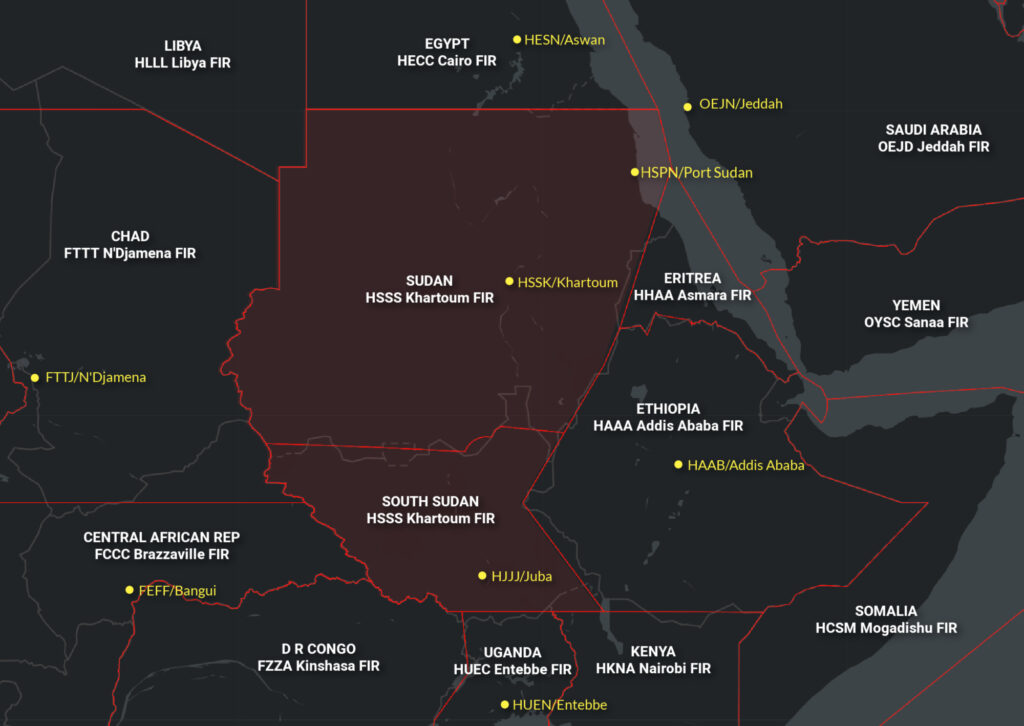
  • Airspace fully closed since the April 2023 coup.
  • HSSK/Khartoum Airport is shut; no Notams are being issued.
  • There are some contingency routes available for flights to HSPN/Port Sudan, but security remains volatile.
  • Several states prohibit overflights due to military activity and anti-aircraft threats.
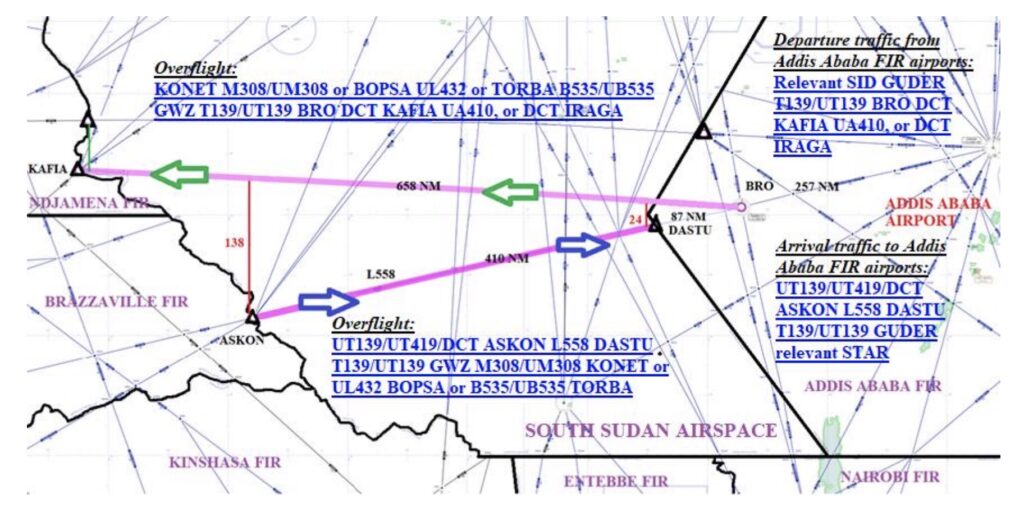
  • In South Sudan, there’s no ATC above FL245, but two east-west contingency routes are available for overflights.
  • South Sudan is open for flights to HJJJ/Juba.
  • More info here.

Somalia

  • Government control is limited; attacks by extremist militants are ongoing.
  • US prohibits flights below FL260 (except overwater to/from HDAM/Djibouti).
  • Risk of being targeted at lower altitudes by anti-aircraft weapons.
  • Reports of unauthorized ATC units issuing contacting aircraft and issuing them instructions in the northern part of the HCSM/Mogadishu FIR – genuine ATC here will only issue level changes by
    CPDLC or SATCOM.
  • More info here.

Yemen

  • Active warzone — avoid all land portions of the Sanaa FIR (OYSC).
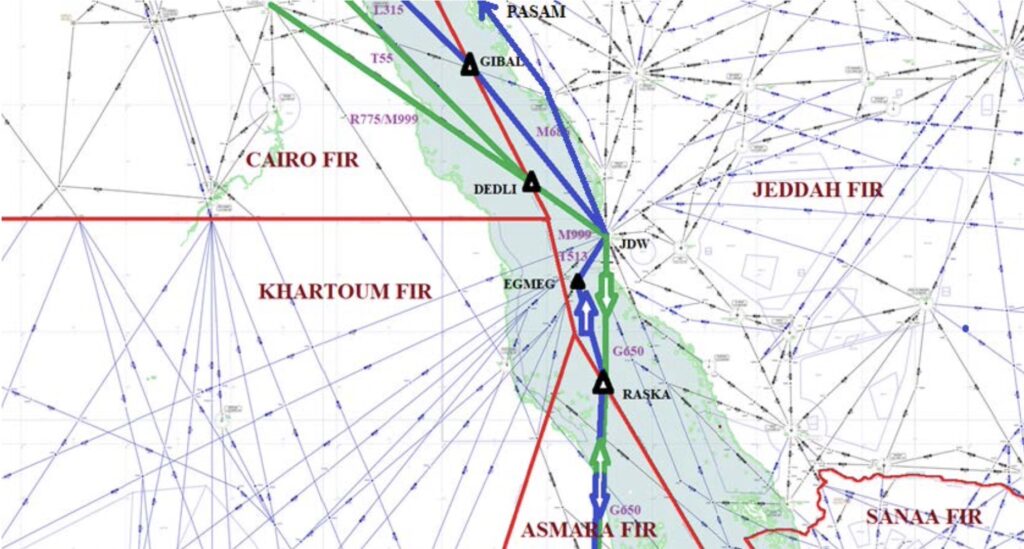
  • US operators permitted to use offshore routes UT702 and M999.
  • Other states allow overwater-only routing, avoiding the landmass.
  • Threats include drones, missiles, and intentional targeting by militants.
  • Military strikes by Saudi Arabia and Israel have been ongoing for a few years.
  • More info here.
Routing Options: West Africa to Europe
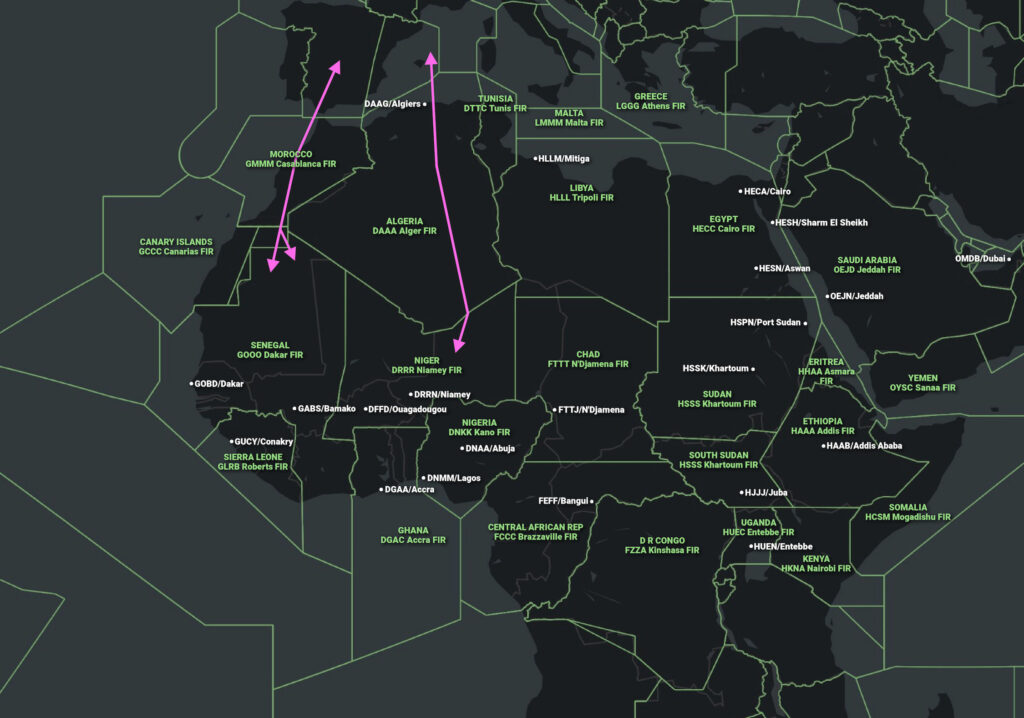
Two main options here:

Central route via Niger/Algeria: Due to the Mali-Algeria airspace ban, overflights between these two countries is not possible. Add to that the security risks at the lower levels in northern Mali, many operators choose to avoid Mali entirely by routing east into Niger, and then turning north into Algerian airspace from there.

Western route via the Atlantic: Flights route westward over the Atlantic, before turning northeast via the Canary Islands or Morocco and into Europe. This route bypasses the entire Sahel region and avoids any involvement with Mali or Algeria. Common for flights heading to Western Europe (eg. Spain, France, Portugal).

Routing Options: West Africa to the Middle East
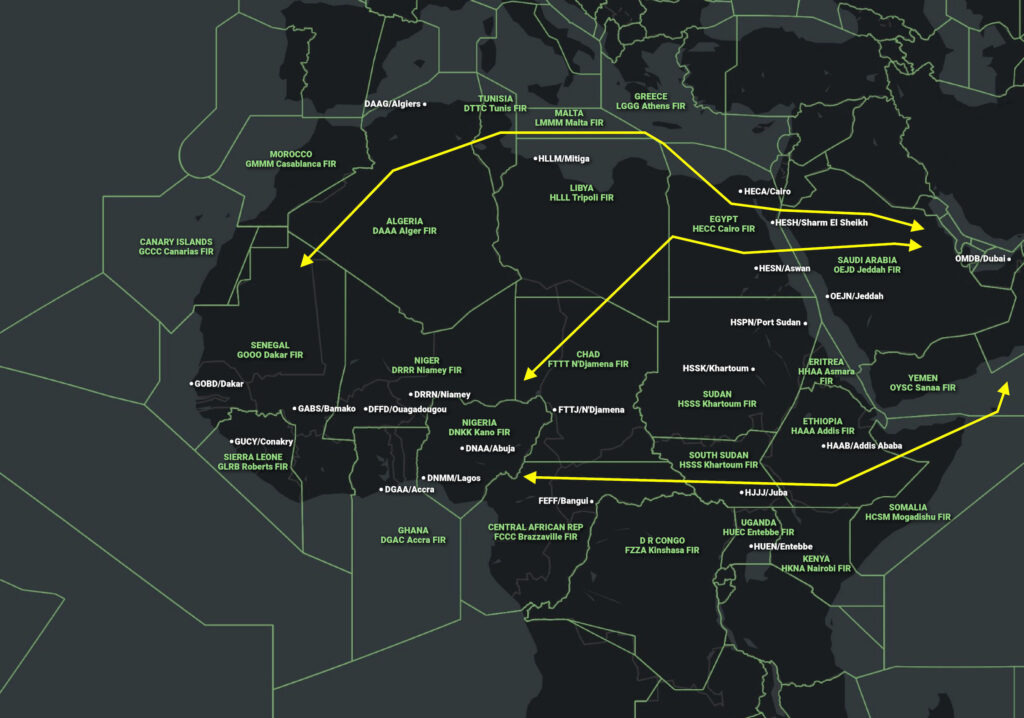
With Libya risky, Sudan closed, and Somalia/Yemen partially restricted, operators have three main options:

Central route via Libya: The shortest option routes east from Chad into the southeastern corner of Libya, then across Egypt into the Middle East. This path clips Libyan airspace, and while still considered high-risk, some airlines are using it. ATC reliability is poor, but the routing avoids longer detours.

Southern route via South Sudan: This uses one of two east-west contingency routes above FL245, then crosses Ethiopia and exits via the Gulf of Aden off the coast of Yemen and on towards the Middle East. This avoids Libya and Sudan entirely, but adds an extra 500NM or so when compared with the central route. If South Sudan isn’t viable, flights may reroute even further south via Uganda or Kenya.

Northern route avoiding Libya: This takes a northern dogleg through Niger and Algeria, then across Tunisia and Malta and into Egypt. This route avoids all high-risk airspace but is the longest of the three. It’s commonly used by operators with stricter risk thresholds or where insurance policies exclude Libyan or South Sudanese airspace.

If you’re flying any of these routings (or know of any clever alternatives we haven’t covered here), we’d love to hear from you. Email us at blog@ops.group — we’ll update this briefing and help keep other pilots and operators in the know!

Free Route Airspace in Africa

Key Points
  • Free Route Airspace (i.e. you can fly direct between waypoints) is now available across most parts of ASECNA airspace in Africa, FL250 and above, as of 25 Jan 2024.
  • There are a few other places in Africa where FRA is available too.
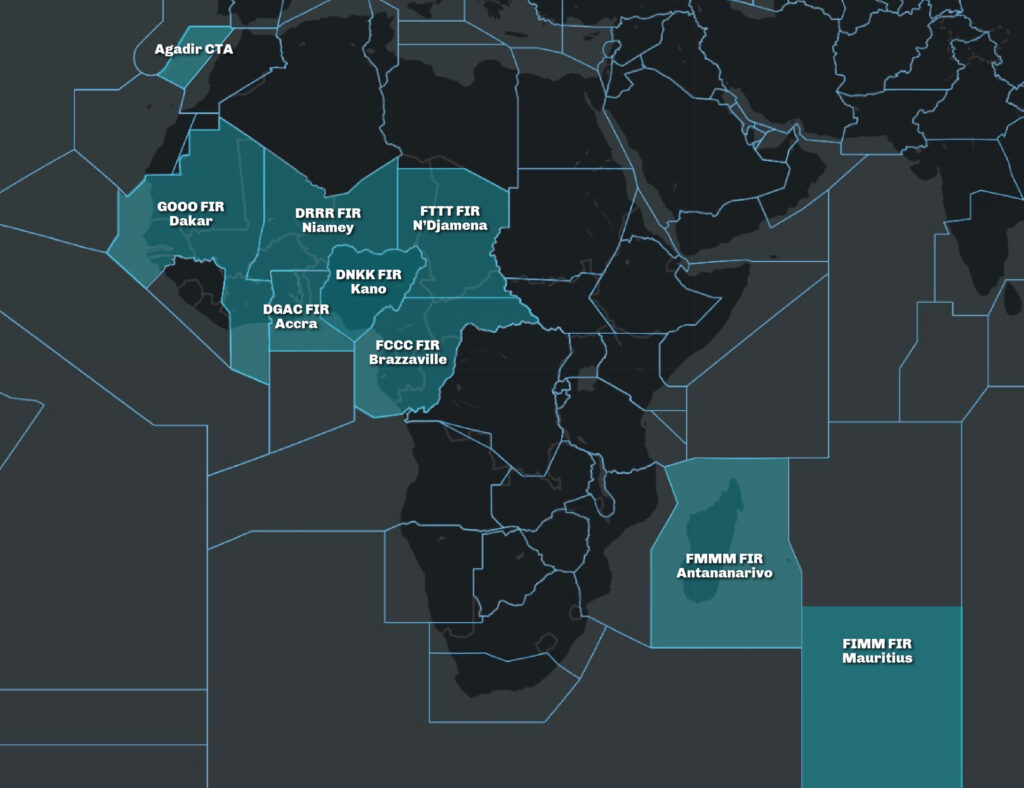
  • There doesn’t seem to be a map of where all the FRA regions in Africa are, so we made one (check the map right at the bottom of this article!)

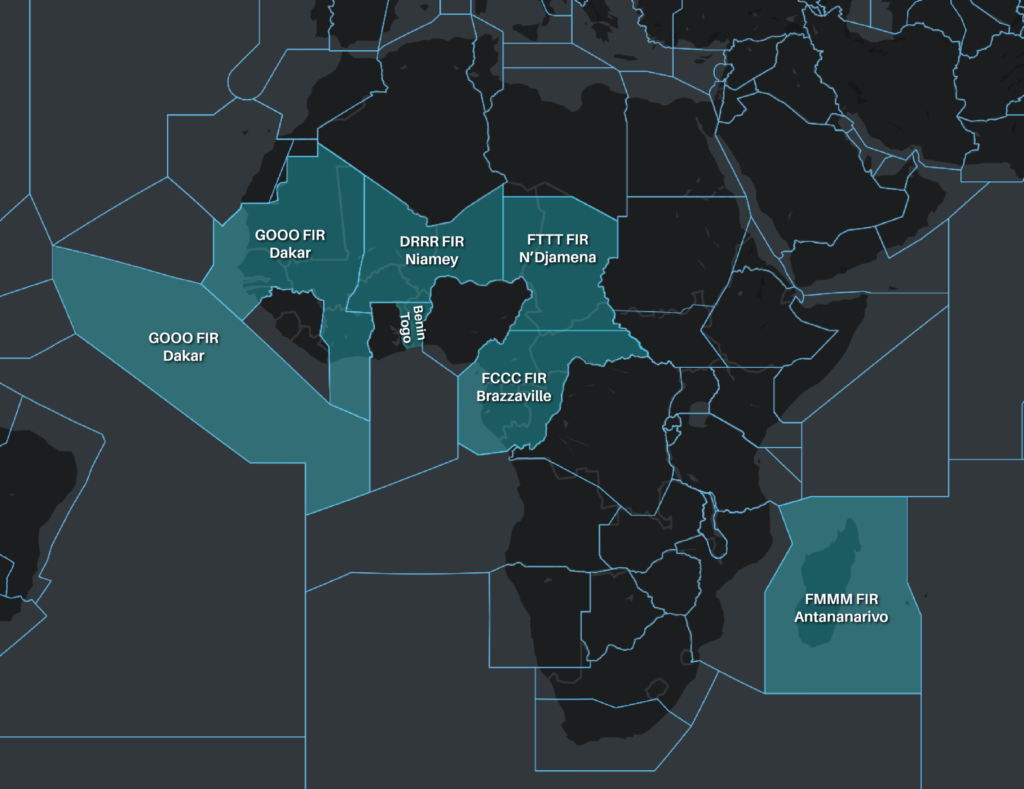
Where is ASECNA airspace?

Here:

Which parts have Free Route Airspace here?

These UTAs: Nouakchott, Bamako, Ouagadougou, Abidjan, Lome, Niamey, Douala, Libreville, and Brazzaville.

These FIRs: GOOO/Dakar, FTTT/Ndjamena, and FMMM/Antananarivo.

Flights can plan direct between the reporting points of the boundary of the respective UTA or FIR.

Unfortunately, there doesn’t seem to be one nice big map showing exactly where these all are.

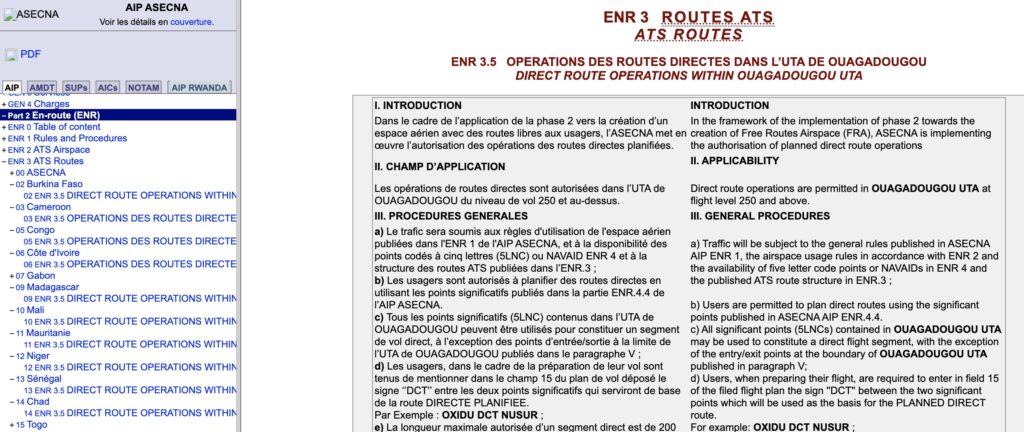
We grabbed the waypoints from the ASECNA AIP ENR Section 3. We tried plotting all these on one map, but it quickly became very messy. So here’s a turgid list of waypoints for you (sorry!) just in case you want them:

Ouagadougou UTA: OPUGO TAREN DEKAS OXIDU UMOVO NAVON TUMUT NANGA BIGOM TUXID ANIXA EBSUD EDGIB ONUSI TAVOT NUSUR.

Douala UTA: OBUDU TAKUM PONDO KEMOX ARKEV DESAM TAPEK VOLMU ARASI BTA IPOVO GEBRO ARDEX RALIN ILBAS IKROP.

Brazzaville UTA: PONDO GADUV INIGO ASSAM TJN NAMOR NARTU UMOSA EDGUM RULDO NASED MISRU ONUDA KITEK ASKON AMPER BOSKI POGBA MERON OPDAK GOPUR MPK PIPLO AGTOM EMSAT BAMAV AMSIK BZ PIRMI LIKAD ARAKI TIMAK NERUP SEMUL ARKOS GARLA ONLEN EDOTO PILVI TAPIL MOVOD NEBEX MISTI ONKAR TAPEK DESAM ARKEV KEMOX.

Abidjan UTA: BIGOM AMSAT TUSEK ONESI SESIG EGADU ARABA GANKA INAKA RASAD EMTAL URAPI ATANI ARLEM IPEKA DEVLI MEGOT UBUTU AMPAS ERMIT GUREL TUXID.

Libreville UTA: BIPIV GEBRO IPOVO BTA ARASI VOLMU ONKAR MISTI NEBEX MOVOD TAPIL PILVI EDOTO ONLEN VORET ILDAN NURIP AGSIM AGRUB GULEP BOVGA.

Bamako UTA: GUREL VOLNA MOPAL UBATI NEGLO GATAX IPUGA MESER KIMGA ILDES EREMO ONTOL ONIMI ONUSI EDGIB EBSUD ANIXA INPOS.

Nouakchott UTA: NEVDI DEMIL POVIN MOKOD TIPAD ILDES EREMO ONTOL ONIMI POTOL ODATA SBITA BRENA BULIS ECHED MIYEC.

Niamey UTA: TERAS ZAWAT INAMA EREBO ERKEL TOBUK IKTAV RAKOM NAMIS INISA IPANO SABSI RIPOL KORUT RISUB DETAR MOLIT USNAV POMPA NANOS UBEVA DOGON GULEN BOVDA LITAK SIRTO TATAT BATIA GAPAG ENOXO BULSA TAREN OPUGO GALIV NUSUR TAVOT MTI ONIMI ODATA POTOL USRUT IPOBA MOKAT.

Lome UTA: GAPAG BATIA TATAT SIRTO LITAK NASTO GANDA TENTU SEVAX OPALA TEMSA POLTO KIPSA EPITI GASLO KETAT NEPRO USTIX PAMPA BUDNO IPORI ARLEX TAMIL ENOXO.

FTTT/Ndjamena FIR: IPONO LIGAT TONBA GARIN DEKTU RAKOM NAMIS INISA IPANO SABSI RIPOL ENBUT RAVOT ONTOP SIGAL KELAK MOMIG ONSEV EBIMU ETRIS GATAG INIGO ASSAM TJN NAMOR NARTU UMOSA EDGUM RULDO NASED MISRU ONUDA KAFIA MONAN KISAL KURAM ILBIB GENEI.

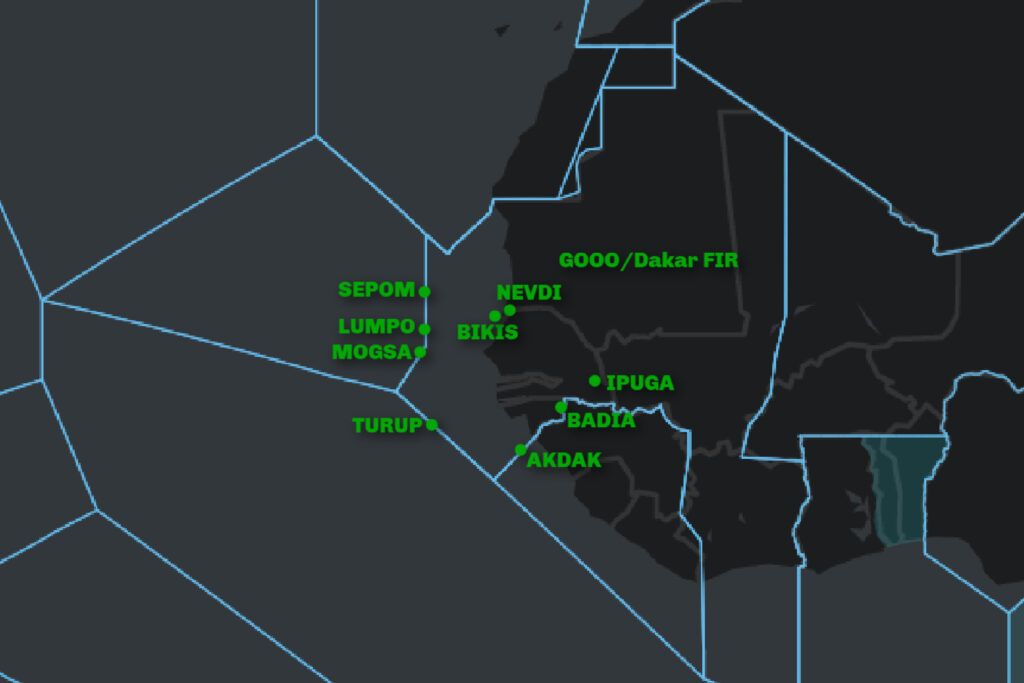
GOOO/Dakar FIR: SEPOM LUMPO MOGSA AKDAK BADIA IPUGA NEVDI BIKIS.

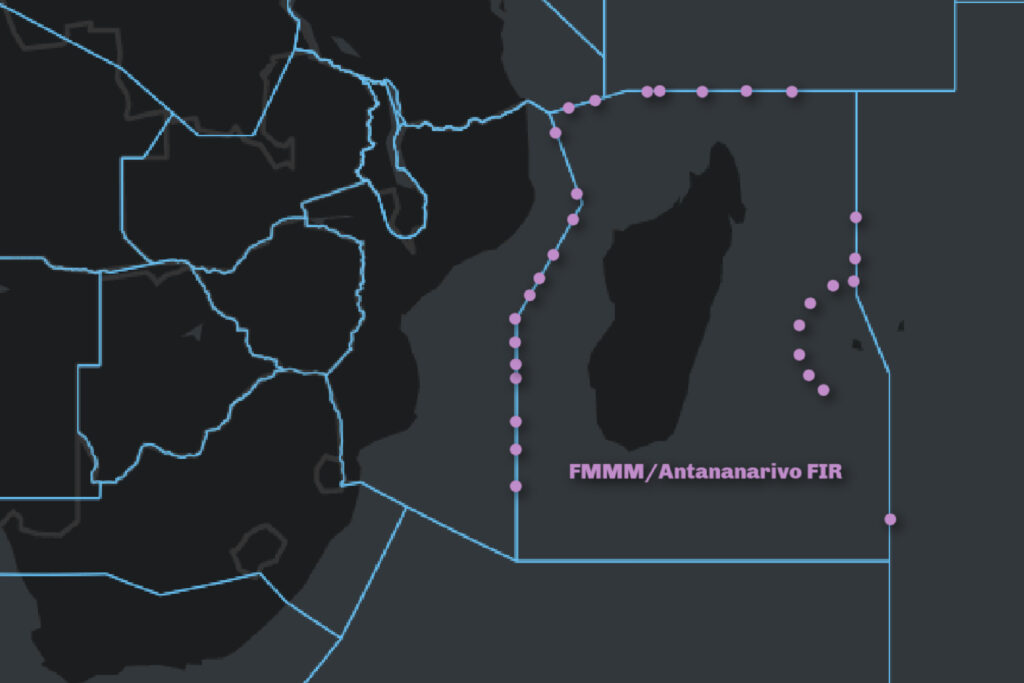
FMMM/Antananarivo FIR: ETGUN TETRO SUNIR EROPA EGMAD NERUL IXEMA IMKIB ETLEG GADNO ETLOP ENDEL SOLAL KINAN TABNO BERIL ATOLA NESAM DENLI ANKOR MIROV RUPIG AMBOD IBMAT APKOT APLEM UVENA DOBUT EGLIP UNKIK GERAG GETIR.

We did make a little map of the FMMM/Antananarivo (Madagascar) ones, cos they’re kinda funky:

And we made this little map of the GOOO/Dakar (Senegal) ones too, just because the airspace covers a massive area (and there’s also the Dakar Oceanic FIR too) but you can only plan direct within a very small area:

For more info, check the full details in the ASECNA AIP ENR 3.5 sections.

Where else in Africa has Free Route Airspace?

Good question! We think it’s just these places:

Morocco: FL195-FL460 in the Agadir CTA (currently only available between 2200-0600z)

Ghana: FL290-FL460 in the DGAC/Accra FIR between latitudes 2N and 11N.

Nigeria: FL245 and above in the DNKK/Kano FIR.

Mauritius: FL245-FL460 in the southern part of the FIMM/Mauritius FIR South of 25S.

So, putting that all together on one map (which is the thing we really wanted in the first place)…

Here are all the places in Africa which now have Free Route Airspace!

Phew, we made it there in the end.

If you know of any more places which should be added to this map (FIRs, UTAs, CTAs, etc), let us know: news@ops.group


Military Coup: Sudan Airspace Closed

Update

This article has been updated to reflect the current status as of Aug 14, 2023.

Key Points
  • Following a military coup in April 2023, Sudan airspace remains closed to all civilian flights.
  • In South Sudan, air navigation services remain suspended above FL245.
  • HSSK/Khartoum airport is closed, but no Notams are being issued.
  • There is a Contingency Plan available with published routes for ops in and out of HSPN/Port Sudan airport.
  • For overflights, there are some north-south routes available via Egypt and Saudi, and some east-west contingency routes available over South Sudan.
  • If routing via nearby airspace, be aware of other active warnings in close proximity.

The Coup

News first emerged on April 15. Sudan’s paramilitary group ‘Rapid Support Forces’ (RSF) became engaged in active fighting with the state military in Khartoum in an apparent coup attempt. While the details were scarce, they reportedly seized control of several important assets, including HSSK/Khartoum Airport.

This has been brewing for some time. There has been a power struggle between the two rival military forces since an overthrow of the government back in 2019.  A failure for the existing government to successfully transition Sudan to a freely elected one has fanned the flames. Along with this is strong public demand for the RSF to be merged with the regular armed forces. This now looks pretty unlikely.

Closed Airspace

On April 15, the HECC/Cairo FIR advised Eurocontrol that Sudanese airspace had closed, and that local authorities were unable to issue any Notams to that effect.

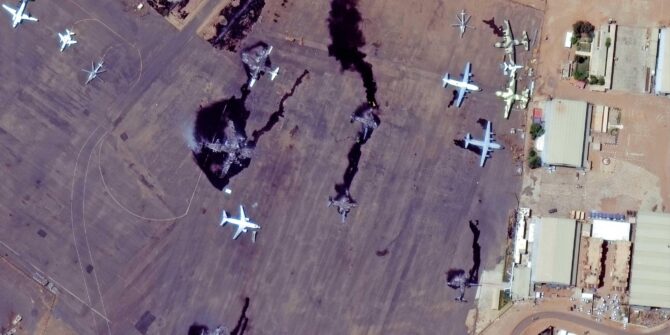
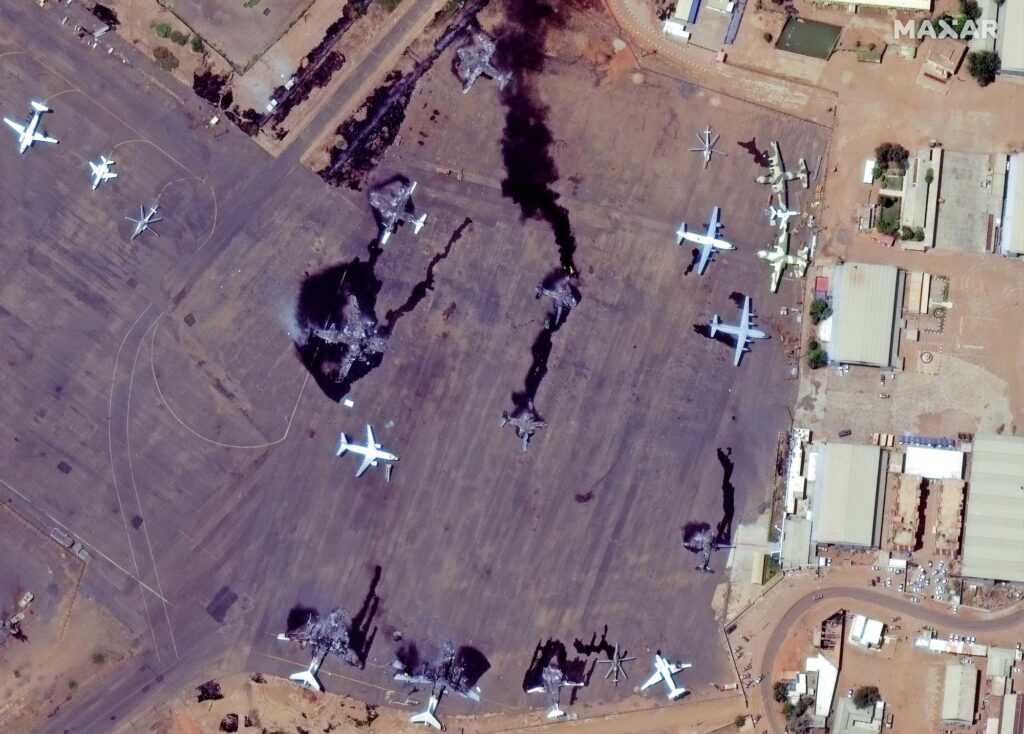
At the same time, videos began to emerge of large passenger jets on fire on the tarmac at HSSK/Khartoum Airport. This included reports that an A330 was shot at multiple times while preparing to depart. The pax and crew evacuated, and were transported to safety at a local embassy.

As of June 2023, the HSSS/Khartoum FIR is now publishing Notams again, and they have said once again that the airspace over Sudan is closed to all flights except for humanitarian and evacuation flights. And in South Sudan, air navigation services remain suspended above FL245.

For overflights, there are some north-south routes available via Egypt and Saudi, and some east-west contingency routes available over South Sudan. Check the HSSS Notams and the Contingency Plan for details.

Adjacent Airspace Warnings

The HSSS/Khartoum is a big piece of airspace. The scramble now will be how to avoid it. Unfortunately, several adjacent countries have their own airspace warnings in place and so it is important to take these into careful consideration. Here’s a summary:

South Sudan

You may be tempted to fly below FL245 through South Sudanese airspace to ensure air traffic control services. However these have been the focus of recent scrutiny. The primary risk there is poor levels of ATC provision, especially for aircraft operating in and out of HSSJ/Juba. Back in 2021, ICAO issued a letter warning of disruptions, a lack of qualified controllers, communication issues and coordination issues with adjacent airspace. There have also been reports of navaids being withdrawn from service and other changes without proper notification to crew. We’ve received no further reports of these problems since.

Chad

There are no active airspace warnings for the FTTT/N’Djamena FIR, although several states (including the US) advise against travel here. The main issue seems to be the risk of crime, kidnapping and terrorism. The general advice is to avoid landing here. We haven’t heard of any issues for overflying aircraft, but keep safety during diversions in mind.

Ethiopia

Special attention needs to be paid to the Northern Tigray Region, near the border with Eritrea. A long running conflict there has recently come under ceasefire, but there may still be some resistance to this amongst militant groups with access to portable air defence systems. These can pose a risk to low level aircraft (below FL250).

Several states including Germany, the UK, France and Canada still have airspace warnings in place. Although they are due for review, they should still be considered active in the meantime. The US warning has previously been lifted. You can view all active advisories here.

Egypt

To the north of Sudan lies the HECC/Cairo FIR. There is still a reported threat of terrorism in Egypt, particularly in the Sinai Peninsular. Only the UK and Germany still have active airspace warnings here – both countries essentially advise against overflights below FL260 in the northern part of the Sinai region. The US had a similar warning in place until it was rescinded in March 2022.

Central African Republic

The news isn’t great here. The security situation on the ground in the Central African Republic is fairly dire. There have been numerous attacks on civilians and peacekeeping troops in recent years. FEFF/Bangui airport is operating under UN control, and is subject to regular power outages. The US and UK advise against all travel to the entire country due to violent crime, civil unrest, and the presence of armed groups who control large areas of the country. There are no official airspace warnings in place for the CAR, but the general advice is to avoid landings here completely.

What will happen next?

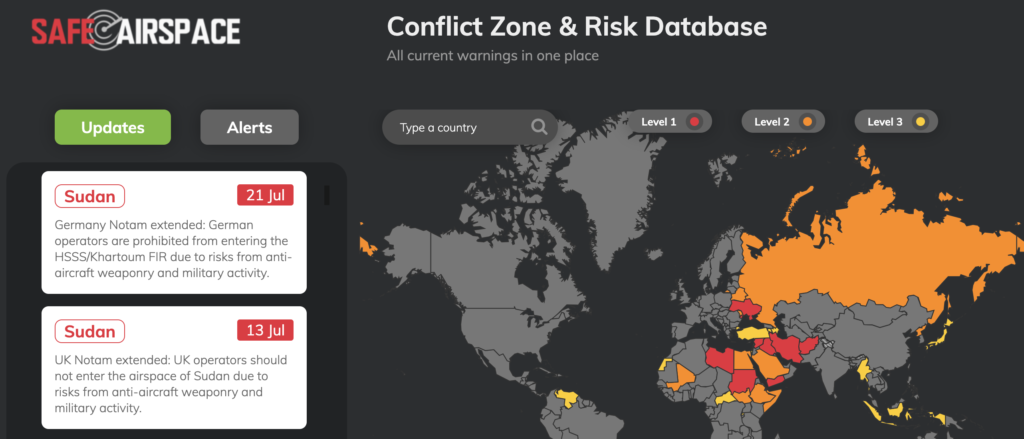
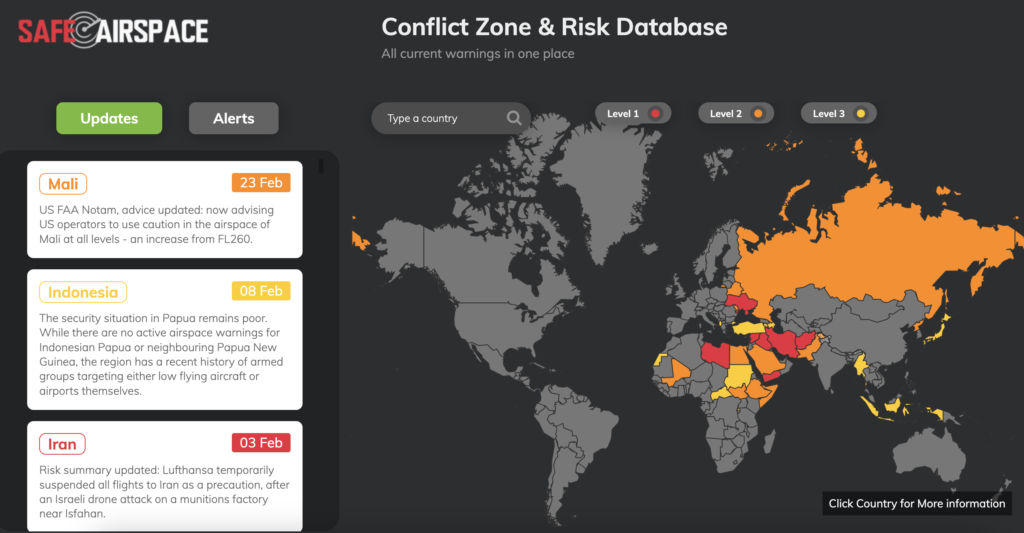
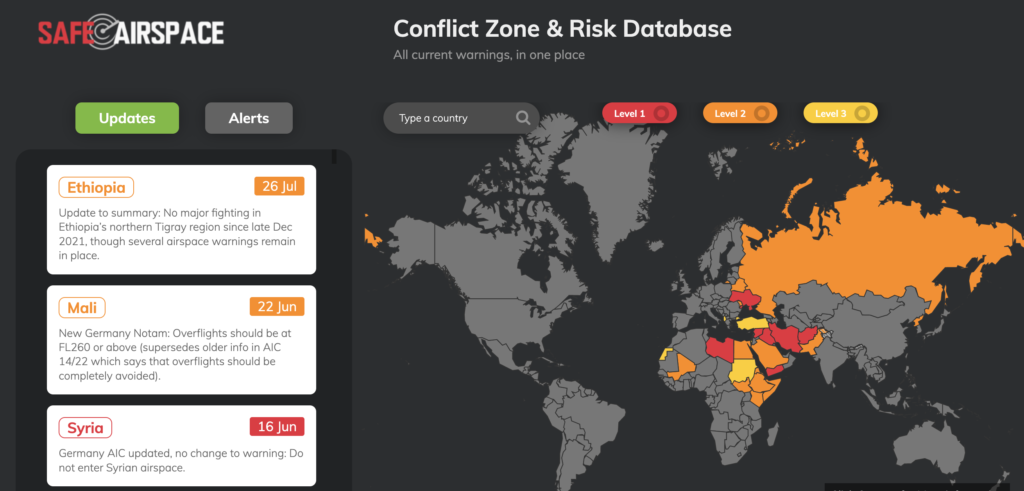
It is a developing situation and Sudan should be avoided until things stabilise. We’ll continue to publish updates as they become available, both to OPSGROUP members, and also via Safeairspace.net – our conflict zone risk database.


New FAA Airspace Warning: Mali

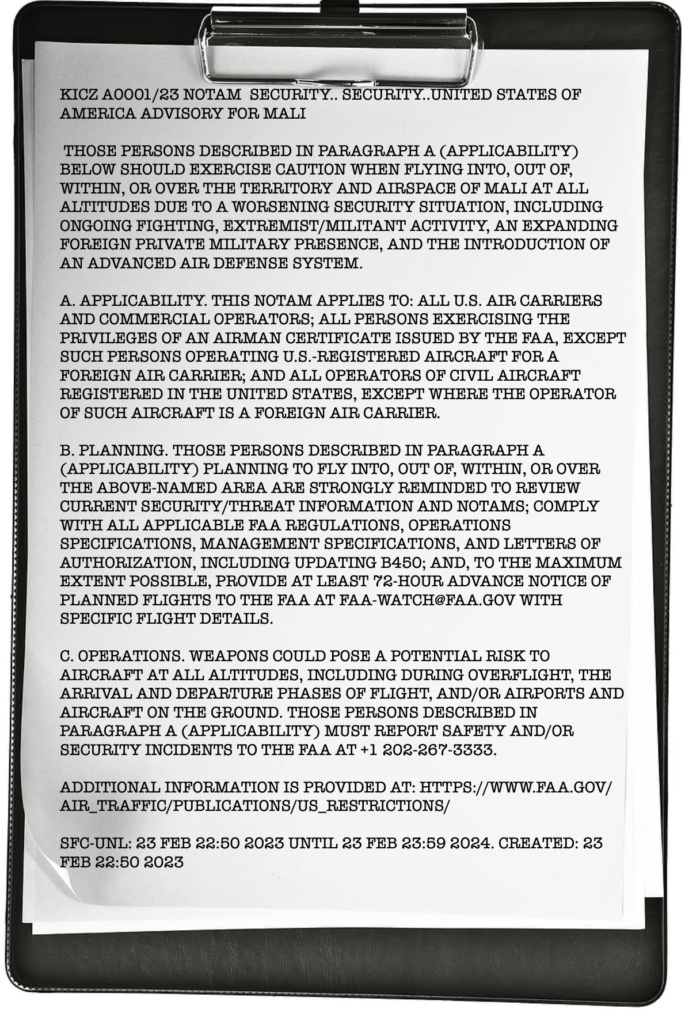
On Feb 23, the US FAA re-issued its warning for overflights of Mali, with one essential difference:

It is now dangerous to overly Mali’s airspace at all levels, not just below FL260.

Here is what the new KICZ Notam says:

So what’s changed there, and why is the FAA so concerned?
The Stage

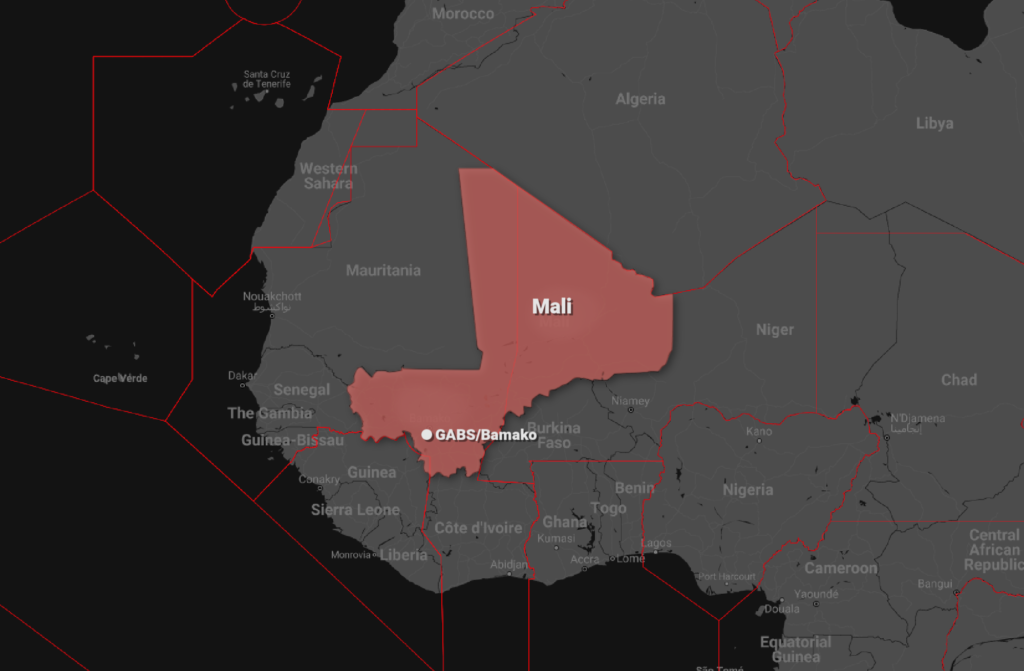
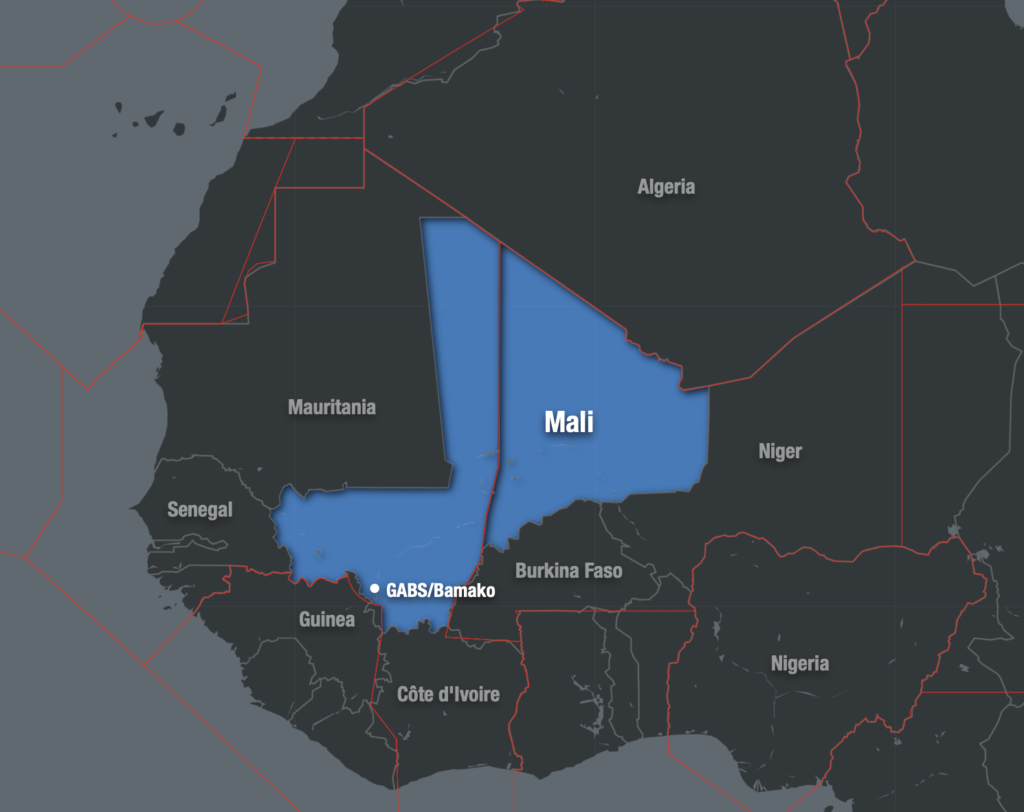
Mali is a large land locked country in Central Western Africa and borders several states including Niger, Algeria, Mauritania, Guinea and Burkina Faso.

Several major high altitude airways run through the country facilitating traffic both north and south, and east and west. They are major thoroughfares through the heart of Africa, which is why this new warning is significant.

In the past three years Mali has suffered from continuous political instability after two armed coups – the first in 2020, and then again in 2021. This has been compounded by delays in holding an election.

It was dropped from ECOWAS (Economic Community Of West African States) as a result, and has faced several international sanctions. 

It has a long history of insurgent militant activity who oppose the government, along with the intervention of foreign military to try and restore peace and stability.

Despite best efforts, insurgent militia have continued to spread and strengthen in Mali allowing well funded groups such as Al Qaeda to increase their presence there. Military operations and terrorist attacks have become more frequent.

Of special concern is the fragmented tri-border region that divides Mali, Burkina Faso and Niger. It is a hotspot for fighting that targets both the existing government, along with the foreign military presence.

What has changed?

Hot on the heels of the new KICZ Notam, the FAA has published a new information note which raises major red flags to anyone considering overflights.

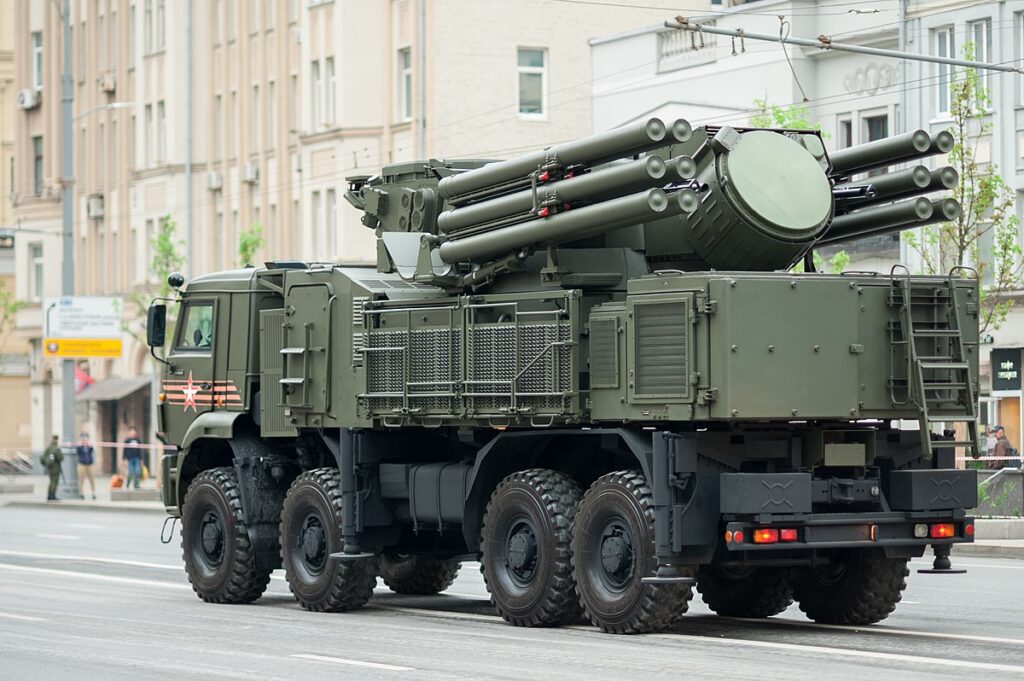
Historically the concern to aviation in Mali has been from militant use of MANPADs (man portable air defence system) to target low and slow flying aircraft up to FL250.

However as the transitional government continues to fight against insurgent militia, their emphasis has moved from the support of foreign peacekeeping forces to the use of private military. One in particular is of major concern – the Wagner Group.

In Spring last year, this Russian backed paramilitary group has deployed over one thousand troops in Mali near Bamako, along with an advanced radar guided air defence system capable of targeting aircraft as high as FL490. A similar system was used to shoot down MH17 in 2014.

While there may be no specific intent to target civilian traffic, the FAA suggests the Wagner Group have a sordid history of unprofessional and heavy handed air defence activity. This was previously evident in Libya, where US operators have been completely banned for some time.

What we’re now seeing in Mali is that civilian aircraft may be at far greater risk of advanced anti-aircraft fire through mistaken identity or mis-targeting, which can likely reach higher than you can fly.

The risk is now two-fold.

The existing risks are still present – militant groups continue to be active with MANPADS. They are likely to target foreign and local military forces which are often located close to international airports including GABS/Bamako.

At higher levels, aircraft are now at risk from radar guided air defence systems that may be used with little verification that their target is correct.

It is a dangerous brew.

Why the FAA has only cautioned US operators, rather than ban them as is the case in Syria, Libya and Iran among others where similar weapons are also present is a question we don’t have an answer for yet.

We are actively seeking more information.

I still want to overfly. Can I?

Yes you can, but it’s dangerous at all levels. Once again, the new Notam is a precaution, not a ban. The new KICZ Notam allows room for you to do so, provided you:

  • Take into account all current security and airspace warnings and perform your own risk assessment.
  • Comply with and update your OPSPEC/LOA B450 approval to operate in internationally sensitive ares.
  • Where possible, provide the FAA with at least 72 hours notice via FAA-WATCH@FAA.GOV
  • Report any safety or security issues ASAP to the FAA on +1 202-267-3333.

Where to from here?

We will report on any new FAA information on the situation in Mali as it becomes available, along with any other security or risk alerts. These will be published on OPSGROUP, along with safeairspace.net – our free risk and conflict zone database.


Africa ATC Strike

Update 01NOV

The threat of further ATC strikes in West Africa and Madagascar hasn’t completely gone away. The air traffic controllers union USYCAA have published an update claiming that ASECNA (the ATC agency) haven’t been sticking to the terms of an agreement reached on Oct 17 – they have been forcibly returning controllers to their countries of origin, cutting salaries, and freezing leave. There’s another meeting planned for Nov 7, so we should know more then.

You can read the original announcement (in French) here, or this translated copy.


Update 19OCT

USYCAA has cancelled any further strike action, following a meeting with ASECNA on Oct 17.

It looks like ASECNA have agreed to some demands (suspend pay cuts, provide indemnity insurance, set up a committee to talk with the union) but some still need to be resolved – mainly to restore all sanctioned controllers to their positions.

You can read the original announcement (in French) here, or this translated copy.


Update 11OCT

USYCAA has accused ASECNA of intimidating behaviour towards controllers ahead of a planned meeting on Oct 17 for negotiations to avert any further strike action. They cite “freezing without explanation of annual leave, verbal invectives, the unwritten suspensions of several air traffic controllers” among their claims.

You can read the original announcement (in French) here, or this translated copy.


Update 27SEP

USYCAA has suspended all strike action to allow for further negotiation with ASECNA planned for Oct 17.

You can read the original announcement (in French) here, or this translated copy.

ASECNA have also released a statement, which essentially claims there were no safety incidents during the strike, but doesn’t really say much more. You can read it from the source here (in French) or this translated copy.


Update 24SEP

As of 1200Z today, the ASECNA ATC strike action itself has ended. Per the controllers union, ops normal now. Arrested controllers have been freed, suspended controllers reinstated. However, caution should still be taken by crews as their grievances remains unresolved – both sides are now entering further negotiations for 10 days.

With so many FIR’s, ACC’s, and Terminal areas involved, the strike action has caused chaos in parts of African airspace. The heavy handed response by ASECNA, which included arresting striking controllers, has created a very sour atmosphere for ATC. This creates potential for lapses in judgement and safety concerns, even with the strike action over.

The major concern yesterday was the replacement of licensed controllers with military and other non-qualified staff, without any Notam or notification. Coordination between different units was unreliable, and many ATC centres were confused as to what the situation was.

For now, ops normal to some degree again – but all crews should still take great care until things settle down.

You can read the original announcement (in French) here, or this translated copy.


Update 23SEP

A very dangerous situation is developing today in the African ATC strike. Crews and operators should be aware that in a number of FIRs/ACCs/Towers, the normal controllers have been replaced earlier today with unqualified and unrated people. In simple terms, the voice on the radio is NOT an Air Traffic Controller.

From local sources we understand that GOOO/Dakar Oceanic and domestic, DXXX/Lomé, and FKKD/Douala all have unlicensed staff that have taken over the faciltiies. In FCBB/Brazzaville and FMCX/FMCH/Comoros, controllers have been arrested. In Niger and Madagascar, controllers have been suspended.

The situation is chaotic in many places and still developing. As of now, OPSGROUP recommends avoiding ALL ASECNA airspace unless you have certainty that the ATC service is licensed and safe, and until the situation is more clear.

If you do have to operate through these FIR’s, be careful and cautious. ASECNA controls these areas: FMMM/Antananarivo, FCCC/Brazzaville, GOOO/Dakar Oceanic and Terrestrial, DRRR/Niamey, FTTT/N’Djamena, and the airspace of Togo and Benin.

We will update this further as we get more information. We also ask members to share any information they may have – email team@ops.group or WhatsApp the OPSGROUP Team at +1 747 200 1993

IFALPA have just published a bulletin about the situation.

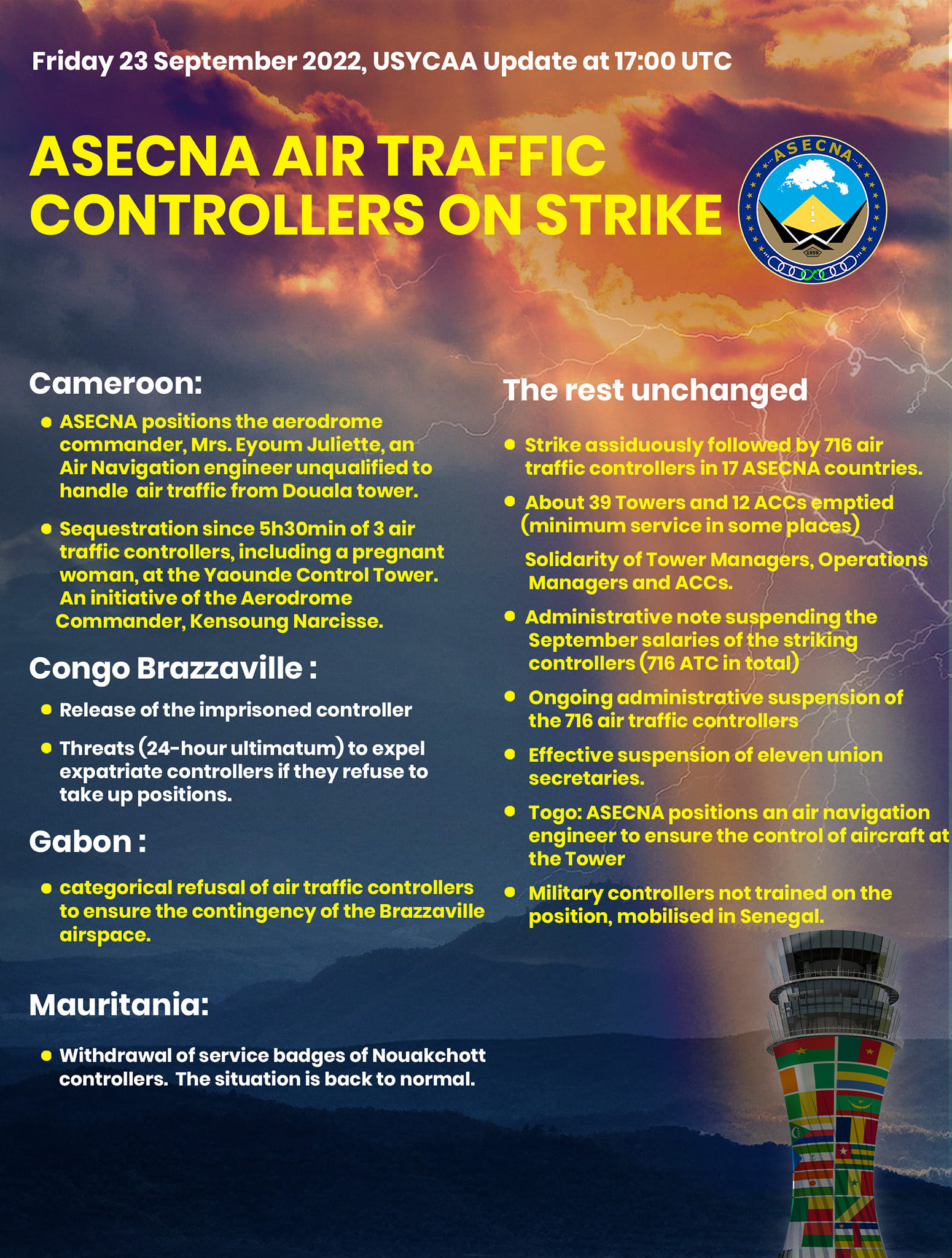
And an update from USYCAA, the ASECNA Controllers union:


Update 22SEP

Note: These updates relate to the situation when the strike was routine – before reports of unlicensed controllers started to emerge. Please use the info as background only.

  • The ATC strike in West Africa and Madagascar is now underway, and is scheduled to continue until 0800z on Sep 25.
  • The strike is taking place across several African countries covered by ASECNA: the FIRs of FMMM/Antananarivo, FCCC/Brazzaville, GOOO/Dakar Oceanic and Terrestrial, DRRR/Niamey and FTTT/N’Djamena; and the airspace of Togo and Benin.
  • For flights in these regions, the Contingency Plans now apply. Check here for those.
  • The strike is also affecting flights in neighbouring airspace of GCCC/Canarias and DAAA/Algiers – Eurocontrol have published some rules and restrictions on flight planning there until the strike is over (see below).

GCCC/Canarias:

  • Traffic crossing GCCC and exiting to the south into Cabo Verde will be restricted with low rates to FL340 and 380 on UN741 as well as FL300, 340, 360 and 380 on UN873 (except traffic arriving to GV).
  • UN857 will be closed southbound from LZR to GUNET (except traffic arriving to GV).
  • Traffic crossing GCCC and arriving to GV must file via EDUMO or IPERA.
  • Traffic departing GC via LPPOOCA to GV can not fly via GOBEG, INSAD, IXILU, KUXOV, LAPTU.

DAAA/Algiers:

  • Flight plans exiting DAAA airspace southbound not flying the contingency available routes will be invalidated with EU restrictions (i.e. For flights from Europe transiting through Algeria and into GOOO or DRRR airspace where the strike is happening, you have to make sure you flight plan to join where one of the contingency routes starts, otherwise Eurocontrol will reject your flight plan).

Where the ATC strike is happening:

ATC will ensure a minimum service is provided for flights involving:

  • heads of state and government
  • military
  • carrying out medical evacuations
  • of a purely humanitarian nature
  • participating in search and rescue operations.

The Contingency Plans

ASECNA publish Contingency Plans, with a focus on maintaining overflights for international operations in cases of no, or limited, ATC services. You can find all the Contingency Plans here.

The Contingency plans effectively transfer control to neighbouring ATC controllers. An ‘ASECNA wide’ strike will therefore disrupt the level of effectiveness of these contingency plans.

There does tend to be a prioritisation, or at least measures to help ensure overflights can continue to a certain extent. Parts of African airspace already operate or have provisions for IFBP.

Other issues for ASECNA states

The ASECNA states have faced a fair few disruptions over the past few years.

ECOWAS states closed their land and air borders to Mali following a military coup.

Chad (FTTJ/Ndjamena FIR) had some issues back in 2021 during a period of escalating conflict and military control. Initially airspace and airports were closed, before contingency procedures came into force.

The African region is volatile, with security concerns on the ground in many countries, and some overflight cautions and warnings. Libya is a ‘No Fly’ country. There are warnings in place for Sudan, South Sudan, Eritrea, (northern) Ethiopia, Somalia, Kenya (bordering other countries), Western Sahara and Mali.

The limited diversion options across certain parts of the region due to safety and security concerns present planning issues for flights routing over northern and central Africa in particular. You can find more information on this by visiting Safeairspace.


Where have Africa’s Notams gone?

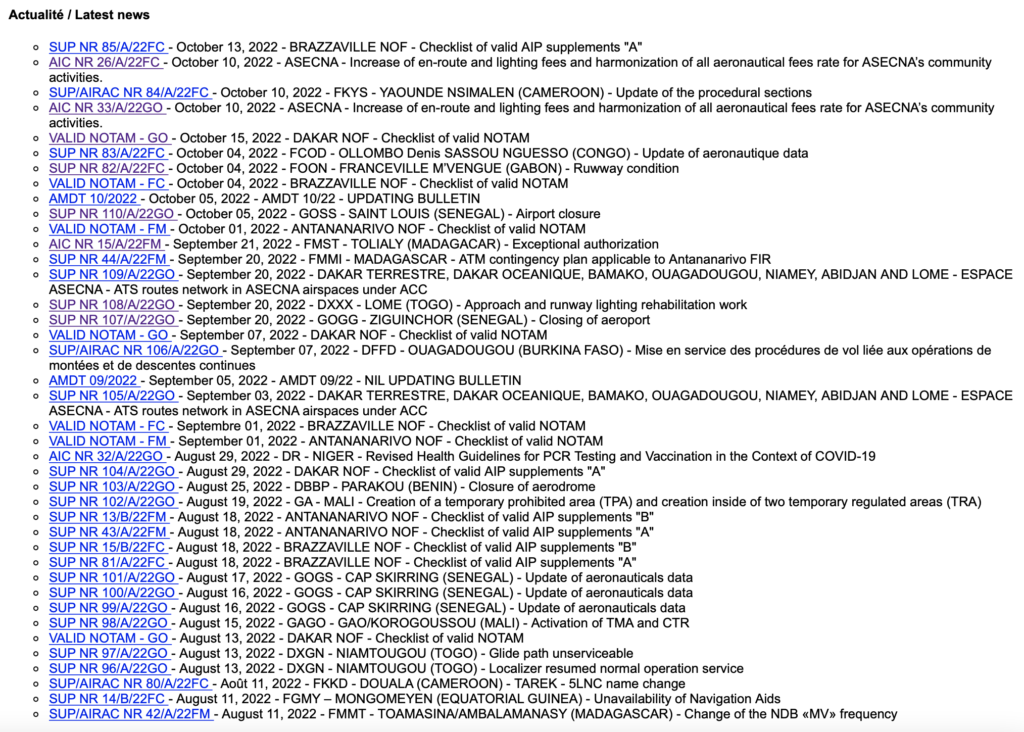
ASECNA have a secret treasure trove of AIP SUPs on all kinds of airport closures and other fairly essential info that doesn’t seem to be getting published by Notam. 

Now, it might be because these are relatively long things and as you may recall, Notams shouldn’t really be valid for longer than 3 months because then it is less temporary and more, well, lengthy.

But there are still some in there that we really would expect to see as notams. Such as:

  • FOON/Franceville, Gabon having potholes in its runway and so not allowing operations on runway 33 from Oct 4 to Dec 31.
  • GOSS/Saint Louis, Senegal is closed to all traffic for works from Oct 5 to Dec 27.
  • DXXX/Lome, Togo is having works until Dec 31 so folk should watch out for workers and their machinery during taxi.
  • GOGG/Ziguinchor, Senegal is closed from Sep 19 to Feb 28 2023 because of security works.

And that’s just the obvious ones we spotted – there are plenty more! Here’s the list of ‘latest news’ list they publish:

So the point really is, check this page if you are planning Togo into or over ASECNA countries because things that could impact your operation do not seem to be Notam-ed, and they could have a significant impact, particularly with regards alternate and en-route aerodromes.

And if you’ve Benin an ASECNA country or airspace and have experienced issues (with un-Notamed stuff or anything else) then please drop us an email with the details on news@ops.group so we can share the info around to other folk.

(Sorry for the puns. It’s been nice Chad-ing).

ASECNA are raising their fees.

Specifically, their en-route fees another airport lighting fees.

AIC 33/A/22GO was issued Oct 10 and is effective from January 1 2023. 26/A/22FC came out at the same time (and says the same thing).

  • En-route fees will increase by 5%
  • Runway lighting fees will increase by 3%

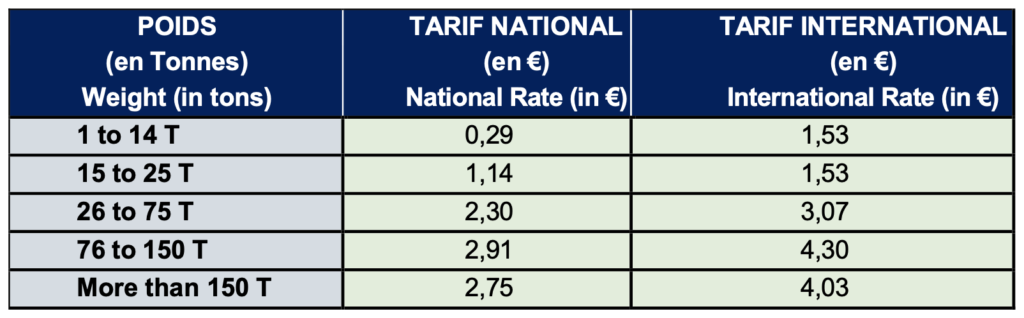
So, if you are an international flight this means the following:

  • If you weight less than 4 tonnes you won’t get charged.
  • If you weigh between 4 and 14 tonnes you will be charged 220.76 Euro
  • If you weigh more than 14 tonnes then you will be charged 110.38 Euro

But then there is the co-efficient bit, and then there are these two tables as well…

Again, here is the ASECNA AIC/AIP page so you can find any others to check them as well.

Wait… what is ASECNA?

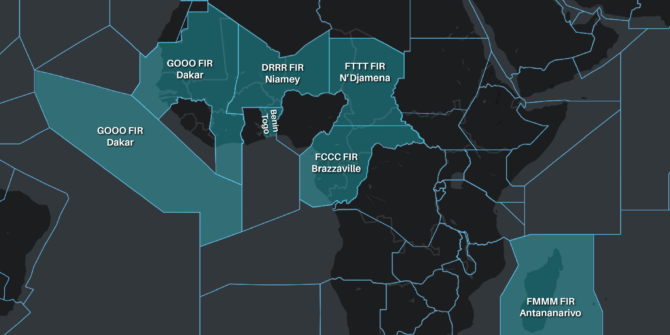
ASECNA is the Agency for Security of Air Navigation in Africa and Madagascar. They look after Benin, Burkina Faso, Cote d’Ivoire, Guinea Bissau, Mali, Mauritanie, Niger, Senegal, Togo, and Madagascar.

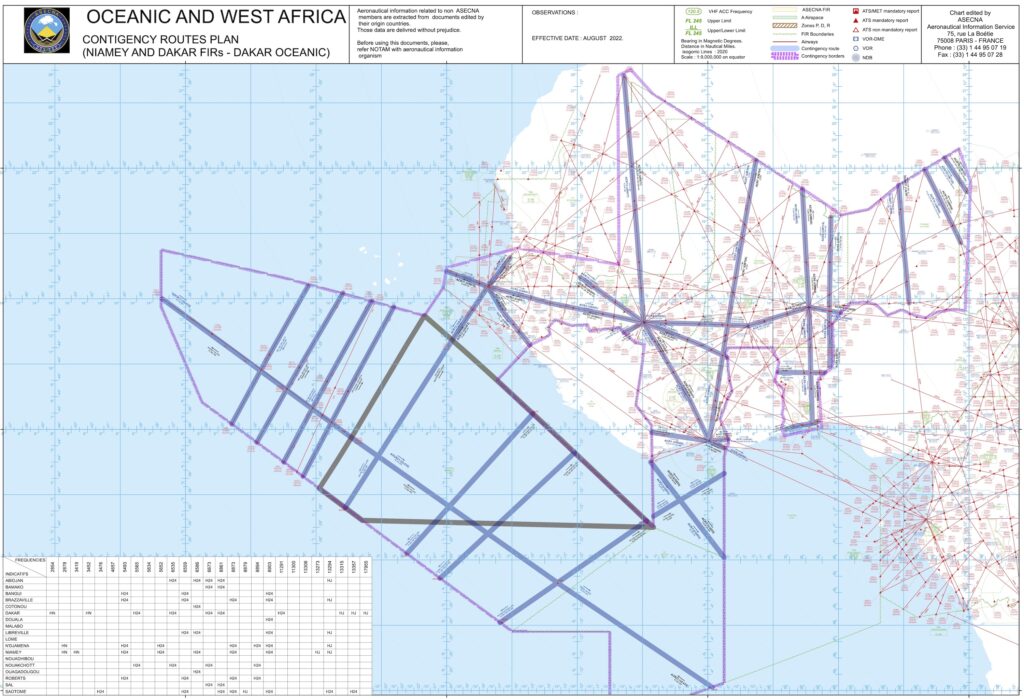
Which in terms of FIRs, means the FMMM/Antananarivo, FCCC/Brazzaville, DRRR/Niamey, FTTT/N’Djamena and GOOO/Dakar oceanic and terrestrial.

That all looks a little like this:

What else has been happening here recently?

Well, if you missed it, then a big ATC strike in October 2022 caused some trouble because they started using non-trained personnel to fill the ATC seats – a very risky practice which we obviously don’t like.

It hasn’t been all bad news with them though. In June 2022 they also started implementing Free Route Airspace, and they have a pretty decent ADS-B service set up across the region.

Then there has been the fuel shortage woes. This isn’t necessarily within ASECNA airspace, but impacts the entire region so worth a mention.

What about airspace safety?

Chad (the FTTT/N’Djamena FIR and FTTJ/N’Djamena international) saw land and air borders closures in 2021 following the death of their President and effectively a military rule brought in.

Mali had a military coup and reneged on agreements to hold elections, leading to sanctions from the rest of ECOWAS (their neighbours) which resulted in closures of land and air borders.

Flown in to any of these countries recently? Send us your report!

Please send us your Airport Spy reports so we can share the gotchas, the things to know, contacts to contact and anything else useful.

What’s Airport Spy? Well, you write a quick little postcard with “what happened” when you went to some airport somewhere. Then you, and others (that’s the magic), can refer to your notes for future flights to the same place. Try it here if you haven’t already.


Rebels Resurgent: Increasing Airspace Risk in DRC?

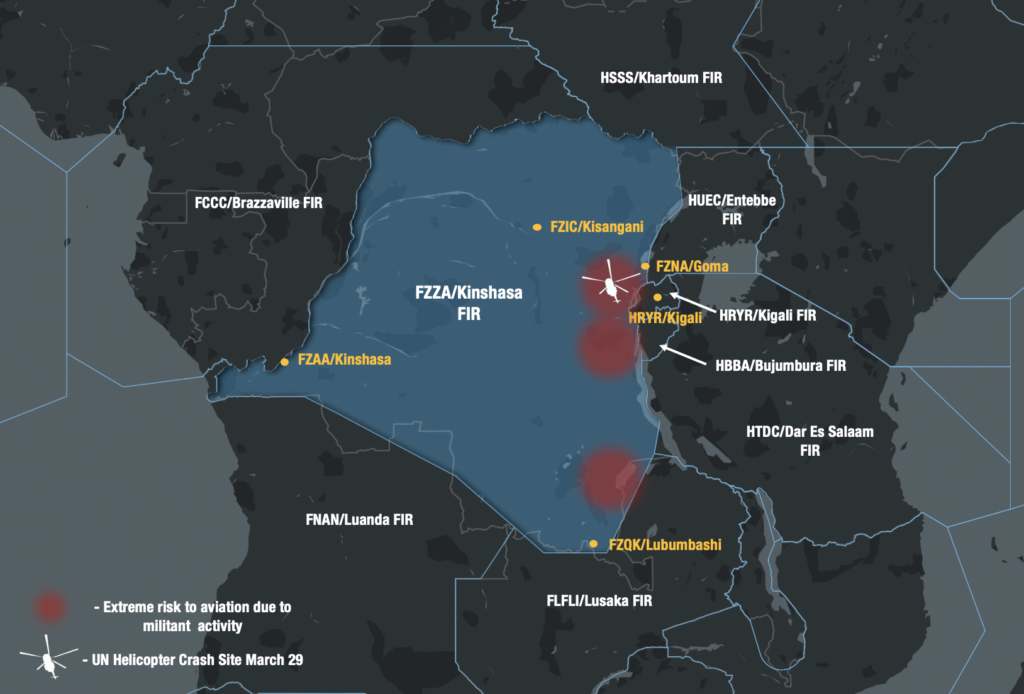
On March 29, a large UN transport helicopter crashed in Eastern Democratic Republic of the Congo while operating a surveillance flight.

The DRC Government has accused (but not proven) a recently resurgent militant group of shooting down the aircraft, after renewed fighting against the government military in recent days.

The country itself has a chequered history of non-state actors actively targeting aviation assets including aircraft and airports, and there may be more to come.

This spells danger for civil aviation, and with an absence of official airspace warnings for the FZZA/Kinshasa FIR, the risks may be on the rise.

Here’s a rundown on the current situation, and what you need to know to stay safe.

What’s been going on there?

A militant group known as M23, or March 23 Movement, has recently become active again in Eastern DRC, in a province called North Kivu. It sits close to the borders of Uganda and Rwanda.

The group were previously engaged in a conflict with the government who expelled them across the border in 2013. Then just days ago, M23 unexpectedly became active again by attacking military positions in North Kivu – which is where the UN helicopter crashed. This was amidst heavy fighting.

There is potential for the skirmish to develop into a larger and longer running war. And that means risk for aviation.

A history of attacks on aviation.

If the UN helicopter was indeed shot down by M23, it wouldn’t be the first time. They, along with other militant groups, have a known history of attacking government owned aviation assets:

  • 1998: a civilian 727 was shot down by a shoulder fired surface-to-air missile after it took off from FZOA/Kindu airport.
  • 2013: Militia attacked FZAA/Kinshasa airport.
  • 2016: FZUA/Kananga airport was attacked by armed rebels on three separate occasions.
  • 2017: An air force helicopter was shot down by anti-aircraft artillery in North Kivu, which was later claimed by M23.

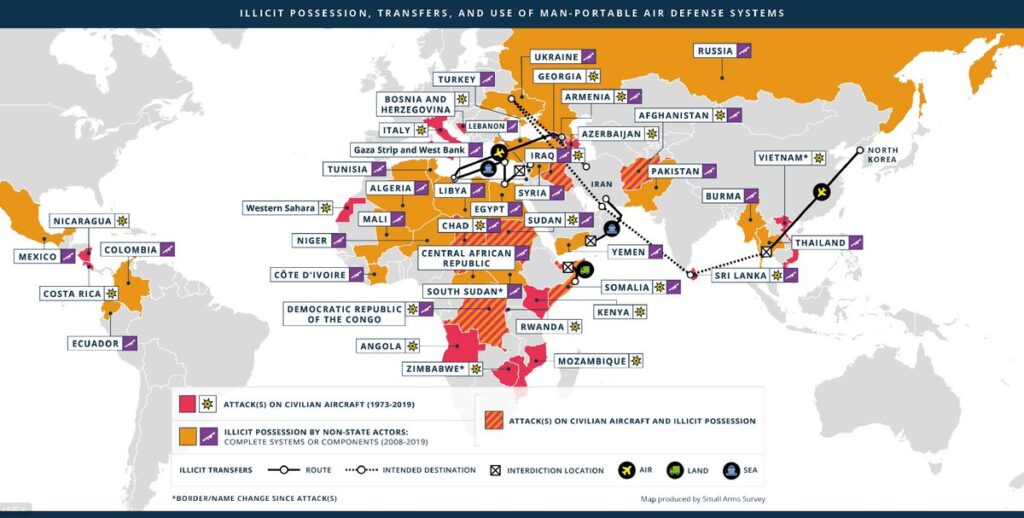
And there are fears that since the ceasefire in 2013, M23 have been retraining and rearming themselves with weapons that could target low flying aircraft. This includes Man Portable Air Defence Systems (MANPADS) and anti-aircraft artillery which are distributed among militant groups throughout many countries of Africa – including the DRC.

What’s the actual risk?

Militant groups such as M23 tend to specifically target government and military interests. There has been no indication of desire to endanger civil aviation. But the renewed intent to attack Government owned assets also increases the chance that civil aircraft may be misidentified, or mis-targeted.

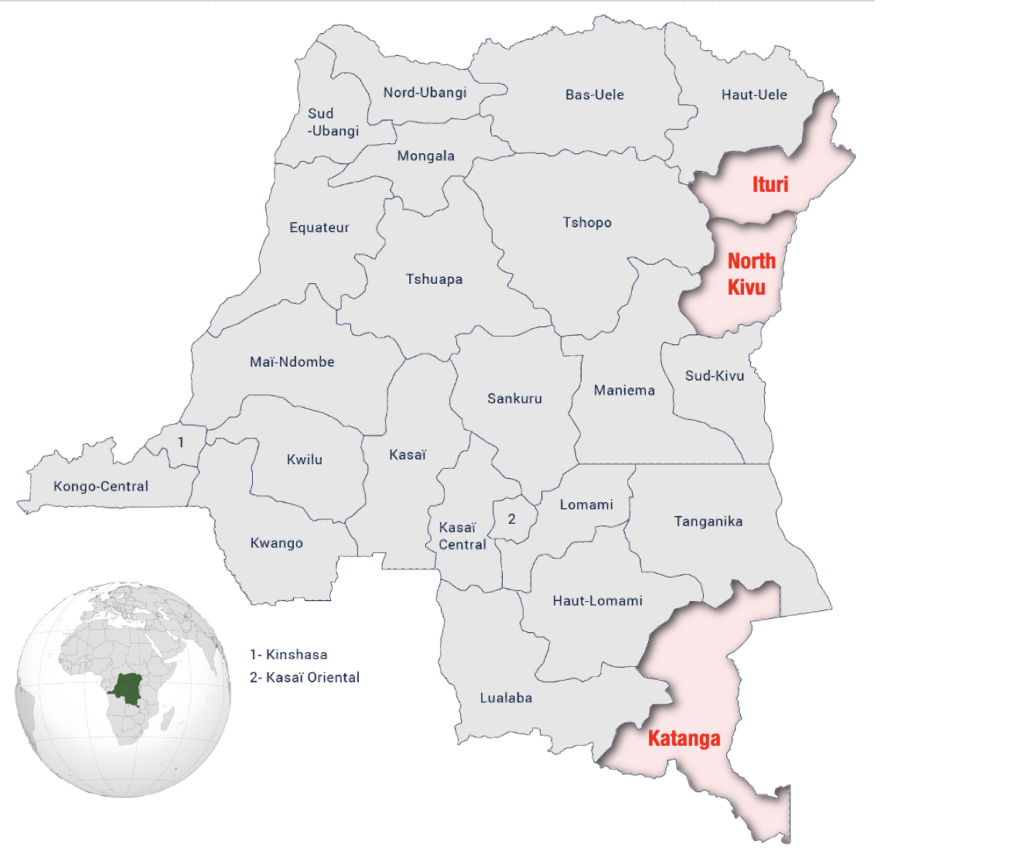
Aircraft are most at risk at low level and low speeds which means they are most vulnerable when taking off, landing or on the ground. The Eastern Provinces of Ituri, North Kivu and Katanga are particularly dangerous.

There is little risk to overflying aircraft at higher flight levels. The issue for overflights becomes the need to divert. The Democratic Republic of The Congo is a huge country, which covers almost a million square miles of Central Africa – that’s more than Alaska and Texas combined. If you’re overflying it, you’ll need somewhere to land if something goes wrong. This is when militant activity becomes more of a danger.

Diversion Planning

Security risks in Eastern DRC are very high, and special care needs to be taken right now about options for diversions.  Landings at airports in the above three regions are dangerous and should be avoided . For overflights in this region, alternates across the border are safer options – especially HRYR/Kigali in Rwanda.

In Eastern DRC, FZNA/Goma is considered to be a reliable option, along with FZQA/Lubumbashi in the south and FZIC/Kisangani to the north. Further west the best option remains FZAA/Kinshasa. It’s important to remember though that no parts of the country are fully immune to militant activity and risks may be present at varying levels throughout the country.

This means if you’re planning on operating there, it’s important to carry out a risk and security assessment using trusted sources which may include local contacts, and security services offered by companies like Medaire.

Contingencies need to be in place for ensuring crew, passenger and aircraft security in the event of both planned and unplanned landings.

We’ll keep you updated.

The ongoing situation in Eastern DRC is unpredictable. You can stay up-to-date with any changes or new risk alerts via SafeAirspace.net as they happen – it is our free Conflict Zone and Risk Database that we keep updated around the clock.


Sanctions-hit Mali bans flights from neighbouring countries

Update March 10:

ECOWAS (14 of Mali’s neighbour countries) has extended their sanctions against Mali, and in response, Mali’s land and air borders are still closed to traffic routing direct from an airport in ECOWAS to Mali. Although international flights can operate into Mali, and overfly ECOWAS and Mali, permits for Mali are problematic as must be approved by the military and then the CAA.  Mali is relatively high risk due to internal conflict and instability.


Story from Jan 20:

Mali underwent a military coup in 2020, and authorities have reneged on an agreement to hold elections in February 2022, delaying them instead to December 2025.

The result is a series of escalating sanctions from Mali’s neighbouring countries which are now impacting aviation in Mali.

What measures have been taken?

The Economic Community of West African States (ECOWAS) – a 15 state regional bloc – have condemned the Malian authority’s actions as an act of “taking the Malian people hostage.”

The result is the suspension of Mali’s membership in ECOWAS and sanctions including the freezing of assets and suspension of non-essential financial transactions. Fuel supplies are still being  permitted via regional borders at this time.

Neighbouring countries have closed both road and air borders with Mali. These closures are so far limited to preventing Mali registered aircraft movements and trade.

Then on Jan 10, Mali closed its own borders in protest. Several airlines have since cancelled flights, citing “security risks”, but have not provided further detail.

There is no indication international flights overflying Mali airspace are impacted, and GABS/Bamako airport remains open for flights to/from non-ECOWAS countries.

What might these risks be?

Security and safety in the capital, Bamako, is a high cause for concern and authorities warn against all but essential travel here. 

Large scale protests which may escalate to armed conflict are likely in Bamako as political volatility increases. Heightened security and transport disruptions are likely. Safety may be impacted if protests and riots become violent.

What risk warnings are currently in place?

Current warnings in place relate only to the ongoing threat from terrorist and militant activity. We wrote this piece in 2017 which discusses various risks including that posed by ground weapons. These risks remain and full details can also be found on the Safeairspace page.

Several countries have warnings in place advising caution if overflying or operating in Mali airspace below FL260 due to ‘ongoing fighting and extremist/militant activity’. Militants often target UN or Malian forces bases, however these are often based in close proximity to Malian civil airports and so attacks might indiscriminately impact civilian operations as well.

GABS/Bamako operations

Bamako International airport is a relatively important one due its position on the continent. It is a major alternate for western and southwestern coast airports such as GOOY/Dakar, Senegal. The interior of Africa provides few diversion options so Bamako also serves as a good en-route option.

The Risk to Aviation

The current airspace risk remains the same. The risk to safety and security on the ground may be deteriorating as political and civil conflict escalates, and armed protests and riots occur. Sanctions against the country by the region will likely also lead to more volatility. 

Contact information if operating to Mali

Permits are required for any flight looking to overfly or to land in Mali. These can be obtained from the aviation authority ANAC – +223 20 20 55 24 / +223 20 20 29 05 / survol@anac-mali.org

For more info on what services are available at GABS/Bamako airport, get in touch with local FBO Aurora Aviation: +971 4 523 5888 / ops@aurora-aviation.aero


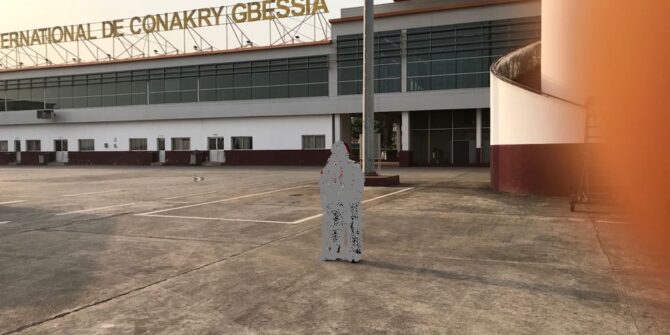
Coup in Guinea: Conakry Airport Reopens

A military coup took place in Guinea’s capital, Conakry, on Sep 5. Following hours of heavy gunfire near the presidential palace, the head of the country’s special forces announced that his soldiers had detained the president and seized power.

Initially, the coup leaders announced that the country’s land and air borders were closed, including the country’s international airport – GUCY/Conakry, where all flights were temporarily suspended.

However, on Sep 6, a military spokesman announced that land and air borders have now reopened. Local handling agent Astra Aviation have advised that the airport is open and operating normally again, with all services available, but they advise against overnight stops for the time being.

GUCY/Conakry airport has issued the following Notam:

A0095/21 - AD HOURS OF SERVICE ARE NOW 0400-2100 UTC. 
DAILY: 0400 - 2100 UTC, 07 SEP 04:00 2021 UNTIL 06 OCT 21:00 2021 ESTIMATED. 
CREATED: 07 SEP 14:40

A night curfew is now in place and there have been no signs of unrest in Conakry in response to the military takeover.

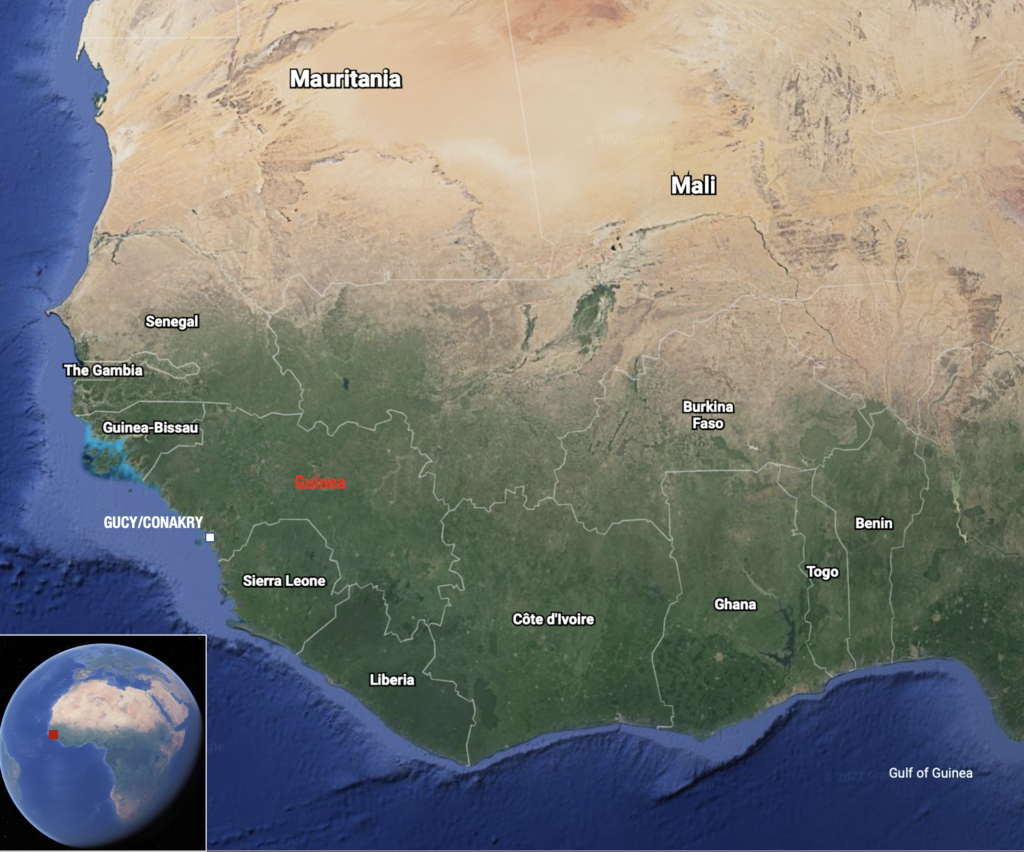
Where is Guinea?

Guinea is a country on the northwest coast of Africa, bordering Guinea-Bissau to the North, and Sierra Leone to the South.

While it has a long history of civil unrest, and crime remains a risk for visiting foreigners, Guinea is generally considered a safer option when compared to its neighbours. Which is why GUCY/Conakry is often used by civil aviation as a reasonable option for tech stops in West Africa.
What about overflights?

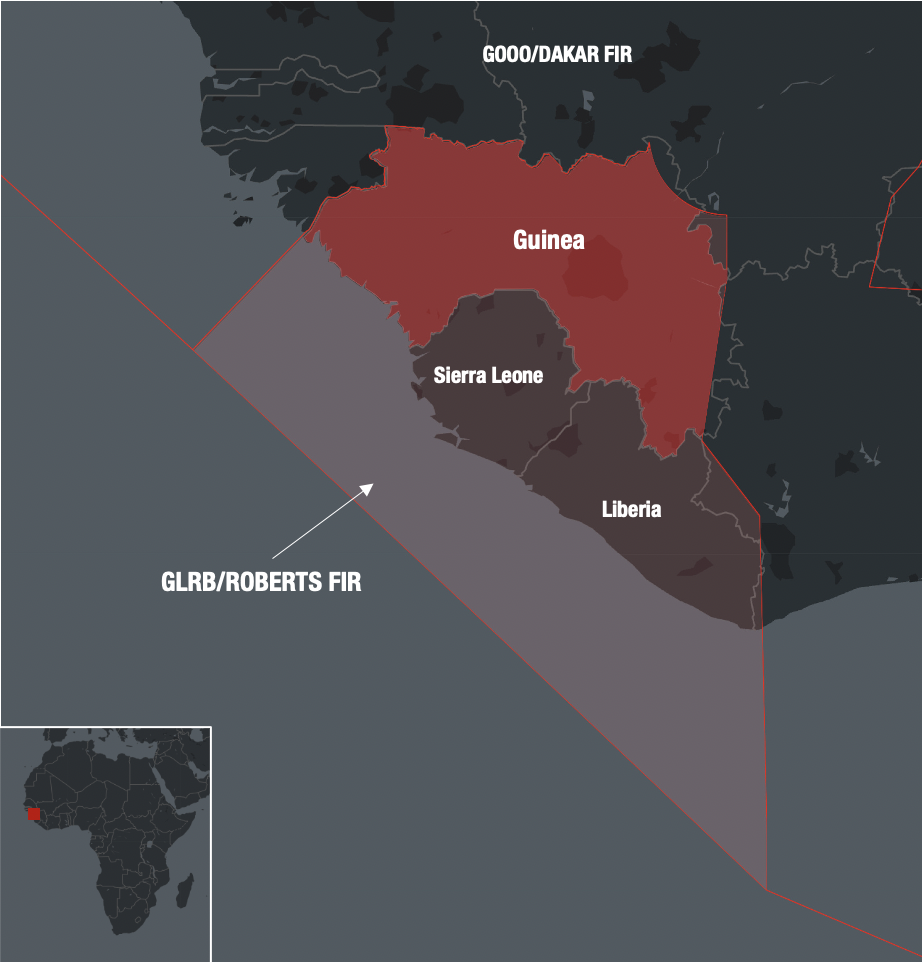
Guinea isn’t responsible for managing the overflights in the airspace above it. That job falls to the GLRB/Roberts FIR which collectively manages the upper level airspace of Guinea, Sierra Leone and Liberia together. It has yet to issue any warnings or restrictions for its airspace, but data from Flightradar shows that overflights through the airspace have continued today.

Where to from here?

The situation is evolving, and the ongoing impact to operations there is unpredictable at the moment. We will continue to update this article as more details become available.


Chad Airspace Update

Chad’s long term President, Idriss Déby died this week, having spent more than three decades in power as one of Africa’s longest-serving leaders. So why did his death result in the temporary closure of the country, and what is the impact to aviation?

The background

Chad is a large landlocked country in Africa, bordered by Sudan, Libya, the CAR, Cameroon,Nigeria and Niger.

Déby was focused on building a more democratic society and he had strong allies in France and with other Western powers through his continued fighting against Jihadist groups. Provincial elections were already underway with projections suggesting he would be successful in winning a sixth term.

However, Chad is also one of the poorest nations in the world, with big problems around poverty, corruption and human rights, and with that came civil unrest.
What happened?

Déby was injured during a visit to troops who were battling against rebels belonging to a group called Fact (the Front for Change and Concord in Chad). The big concern now is who will become the next leader – Déby’s son has stepped in – but the government has been dissolved and conflict is escalating in the country as opposing parties fight for power.

The military elected initially to close land and maritime borders, but then closed all airports as well, whilst putting in a strict countrywide curfew.

The Impact for Aviation

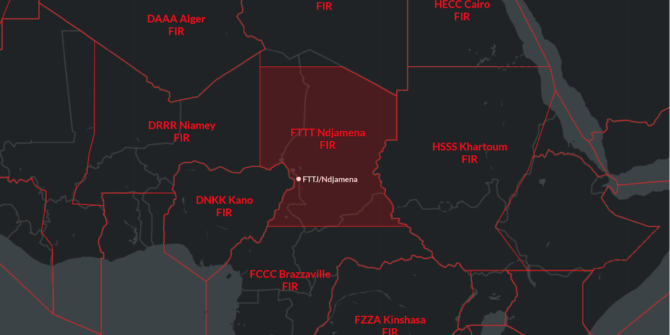
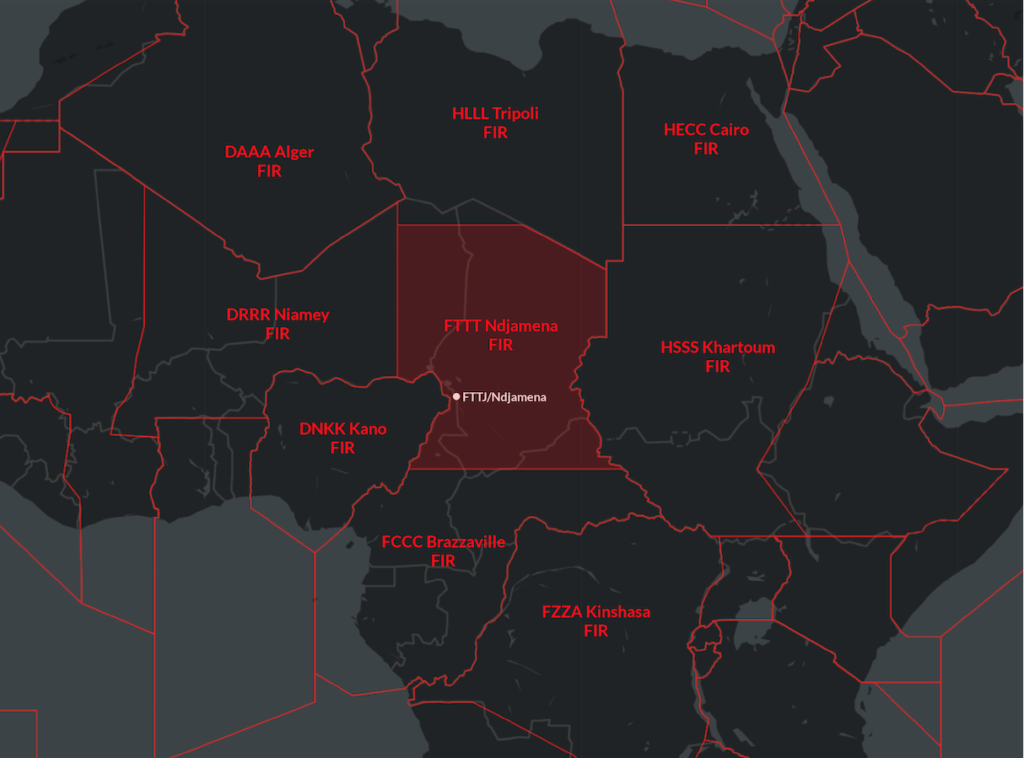
Initially, a Notam was issued stating that FTTJ/Ndjamena airport was closed, and that Contingency Procedures were in effect across the FTTT/Ndjamena FIR. Then a couple of days later, on Apr 21, the Notam was cancelled and the US Embassy issued a Security Alert advising that FTTJ airport has reopened.

In the short term however, landings are not advised, and overflying aircraft should be familiar with Contingency Procedures. You can download the Contingency Plan from the Acesna AIP here.

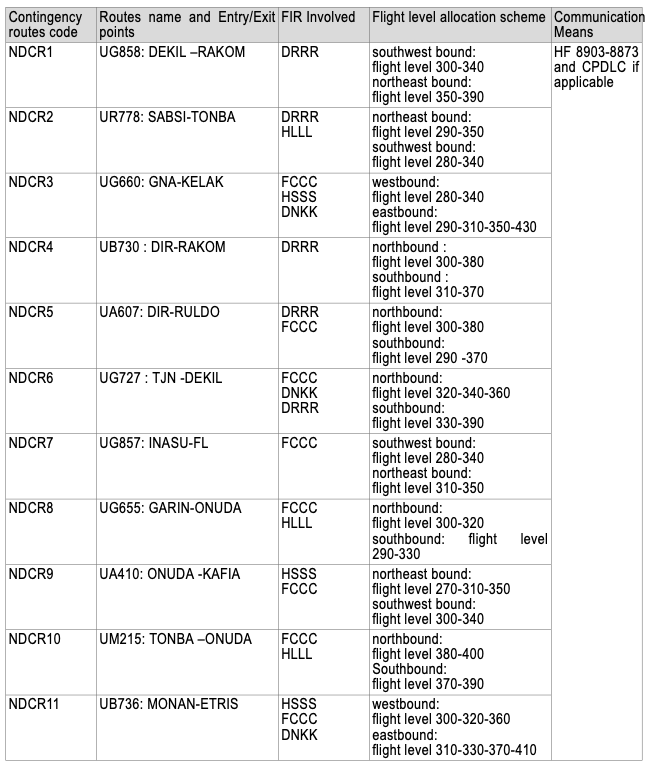
This plan lays out the arrangements for situations where the Air Navigation Services are partially or totally disrupted, and aims to ensure overflights remain possible. Effectively, it aims to coordinate with neighboring ATS units so control of the N’Djamena UIR is temporarily assigned to them – Brazzaville ACC and Niamey ACC are the primary units being used.

Pilot operating procedures while Contingency Procedures are activated are shown under section 8.3 and the advises the following:

  • Maintain contact with Brazzaville or Niamey control until entering, and contact the next control at least 10 minutes prior to exiting.
  • Operate along the assigned contingency route (as listed in the table), although SLOP is recommended.
  • Reach your assigned level at least 10 minutes prior to entering N’Djamena UIR and maintain throughout unless an emergency arises requiring you to diverge from it.
  • Listen out on 12.6 and transmit position reports.

What else do we know?

N’Djamena in the past was a popular fuel stop in central Africa, but multiple travel warnings now advise against travel here (see the UK advice here, and the US advice here). No official state Notams have been issued, but risk remains high. A state of emergency remains in place for the Lake Chad region. Overall there is a high threat for terrorism and it is strongly advised to avoid landings.


Africa: Hajj 2019 routes in operation

The Hajj routes for 2019 will take effect from 18 Jul through to 9 Oct.

What are Hajj routes?
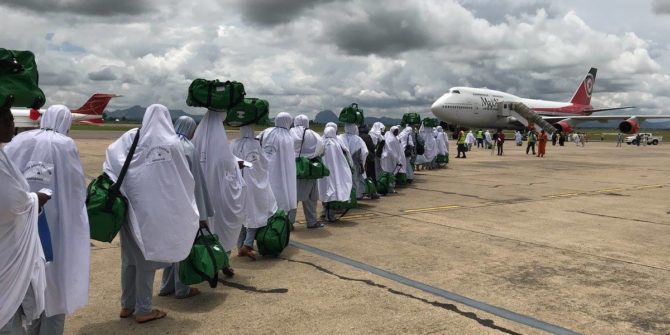
Every year, millions of pilgrims travel to Mecca and other sites in Saudi Arabia – and this changes the predominant traffic flow over the African continent. ATC in the FIRs most affected put in place standard routings to help flow that traffic.

Normally, traffic is very much north-south predominant, with Europe-Africa flights being the main flow. When Hajj operations start up, a good amount of traffic starts operating east-west (ie. Africa-Saudi Arabia and vice versa), and this is something to be aware of when cruising along at FL330 with spotty HF comms.

So, in addition to the normal IFBP belt and braces on 126.9, keep an eye out for a much higher amount of crossing traffic during the coming months.

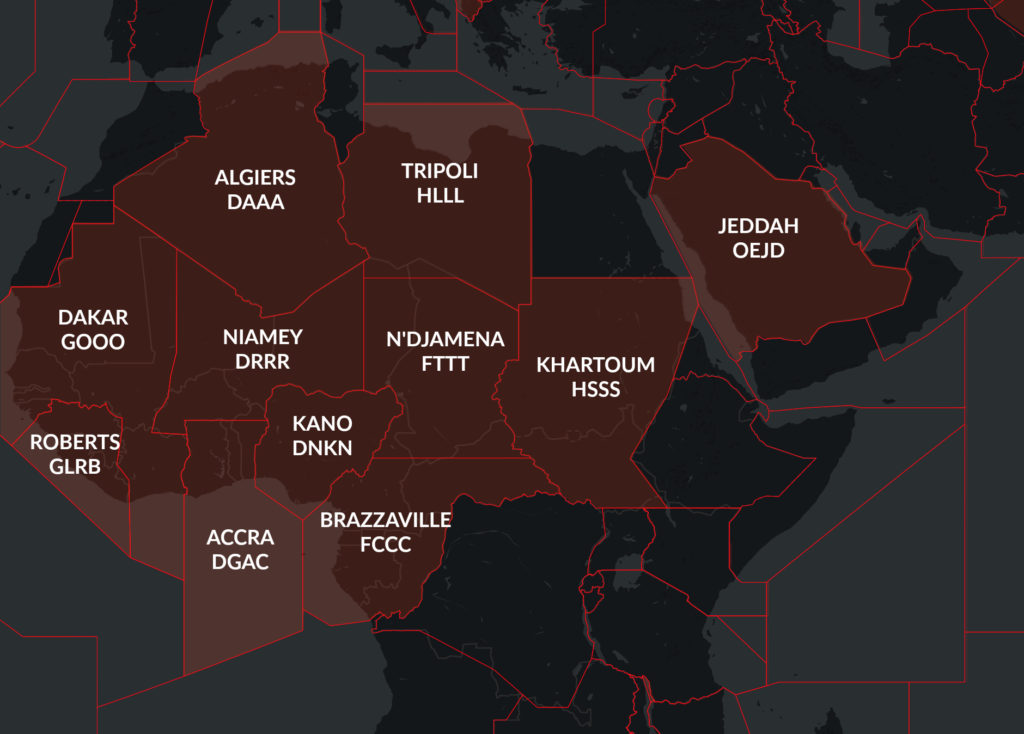
The FIR’s affected are: Algiers, Accra, Brazzaville, Dakar, Jeddah, Kano, Khartoum, N’Djamena, Niamey, Roberts, and Tripoli.

Of these, watch out for Tripoli – risk remains high across Libyan airspace at all flight levels, and multiple countries have “do not fly” warnings in place. There are daily airstrikes taking place, severe limitations in ATC services, and massive areas of the FIR are without surveillance and communications capabilities. Malta FIR is currently managing all east-west routes in this airspace, and operators can contact them for additional information on email: airspace.cell@maltats.com

The Hajj routings are contained in this ASECNA AIP Supplement.

Further reading:

  • Read IFALPA’s information on recommended procedures when operating in the African region here.


Pay up or else! Crew held hostage by Customs agents in Ivory Coast

“Beware all pilots traveling to Abidjan, Customs is waiting for you!”

That is the message we received in a disconcerting report this week from one of our long-time members which certainly troubled us here at OpsGroup. We thought it was important to share.

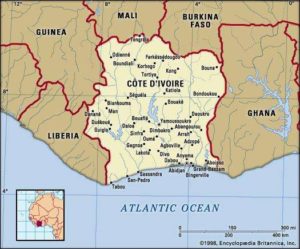
The pilot told us that he and his business jet were recently “held hostage” by airport custom officials in the port city of DIAP/Abidjan, Ivory Coast, West Africa.

The crew had all the appropriate landing and overflight permits as required. GenDec’s, passports and associated documents were also in order. Therefore, all the evidence points to a good old fashioned shakedown and a convoluted scheme setup between local Customs agents and certain ground handlers to extort bribes from foreign crew.

The report we received explains how the crew were ramp checked by Customs officials after landing. The aircraft documents were confiscated and the Captain was “interrogated until 1am” the following morning.

The officials claimed that the pilot both failed to declare their arrival, as well as the “aircraft contents, passengers and baggage.”

The fine was CFA 6,900,000,000 (yes billion!) francs, which equates to USD $12,066,720 (yes, million!)

Ay Caramba!

The offence was purported to be importing a high value item (aircraft) without customs approval. The high fine figure was “based on the insurance value of the aircraft.”

The crew were held hostage in the country for 10 days until senior Customs officials could finally agree on the appropriate “accusation” and that the associated fine was actually “legal”.

After the 10 days, the crew were able to negotiate a deal and depart safely – although not without having to involve the aircraft’s insurance underwriter, who paid a ‘substantial amount’ for the aircraft to be allowed to depart.

On reflection, the crew noted that if Customs does meet your aircraft without you arranging it in advance, “you can be sure you are about to be trapped.” They do not tell you why they are looking for documents, more specifically, your aircraft documents, and will not tell you anything as they walk away to call their seniors, carrying your documents with them.

So in short: do not let go of your documents!

The advice from our member:

  • Contact the handling agent first hand and double check that they are an approved, recognized handler and have approval from the various authorities (immigration, customs, police, anti-drug) to operate airside. Also check that they can arrange for you to get to the Customs and Immigration officers landside. Do not assume because the handler takes all your documents and gives you an invoice and receipts that the authorities have been advised of your arrival and situation.
  • The Abidjan Customs authority does not recognize a GenDec as an approved form of advice about passengers, health and cargo. They will also not sign off on the submitted GenDec. They will not come to your aircraft unless you specifically arrange for them to do so.

It’s important to stress that we are not talking about a small African airstrip in the back lots. This is a large international gateway with many major international airlines serving the city. Over 4 million people live here and it’s the economic capital of the Ivory Coast.  But corruption is endemic, it spills over every sector of the public administration; clearly even into Customs!
As Brookings put it, “for the inspector, the temptation is large because his salary is relatively small compared to the potential bribe.” It still doesn’t make it right and this experience serves a timely warning for all crew operating through the airport.

Have you been subjected to similar behavior when passing through DIAP/Abidjan? Let us know.

Extra Reading


New 19-state Upper FIR planned for Africa

Africa has inched closer to achieving a broad Upper Area FIR  following the move by 19 regional states to adopt an airspace agreement at the end of May.

Ministers of Justice and the Attorney Generals from Common Market for Eastern and Southern Africa (Comesa) adopted the legal instrument on common airspace in Lusaka.

The regional airspace agreement aims at achieving a seamless upper airspace for the region which will lead to enhanced competition in air travel and efficiency.

Zambia Minister of Justice, Hon. Given Lubinda, who opened the May meeting said the COMESA seamless airspace programme will contribute to bringing down high costs.

“The draft legal instruments aimed at the implementation of the COMESA Seamless Airspace programme speak to this.”


Extra Reading: