GPS Spoofing: Final Report published by WorkGroup

Key Points
  • Final Report of the GPS Spoofing Workgroup published today
  • 950 participants across full spectrum of aviation industry
  • Significant concern regarding safety impact of GPS Spoofing
  • Report download below


Final Report Published

The Final Report of the GPS Spoofing WorkGroup has been published today, September 6th, 2024.

Over a six-week period between July 17-August 31, the WorkGroup tackled the complex issue of GPS Spoofing affecting civil aviation.

950 people participated in the project, representing the full spectrum of the aviation industry. Led by OPSGROUP, the WorkGroup comprised hundreds of commercial pilots, safety managers, and representatives from airlines, aircraft operators, and air traffic control. Additionally, a diverse group of aviation authorities, avionics manufacturers, aircraft manufacturers, and experts in GPS and GNSS systems participated. Industry organizations including EBAA, IFATSEA, IBAC, ALPA, IFALPA, the Dutch VNV, and BALPA contributed significantly. Support and expertise were also provided by various organizations and agencies, including the Royal Institute of Navigation, Eurocontrol, the Israel National Cyber Directorate, the UK Ministry of Defence, the UK Royal Air Force (RAF), NASA (Langley), U.S. Space Command, the German Aerospace Center (DLR), Zurich University of Applied Sciences, and the University of Texas.

The result is a comprehensive study of the GPS Spoofing problem, including detailed analysis of the technical background, impacts to aircraft handling and operation, best practices for flight crew, and a series of safety concerns and recommendations for industry attention.

Overall, the Workgroup assessed that the impact of GPS Spoofing on flight safety, aircraft operation and handling, and ATC operations, is extremely significant. The WorkGroup is very concerned about the overall impact of GPS Spoofing on flight safety. A total of 8 overall safety concerns, and a further 33 specific concerns were raised.

This year, a 500% increase in spoofing has been observed. On average 1500 flights per day are now spoofed, versus 300 in Q1/Q2 of 2024. This is coincident with the summer months in spoofing affected areas. With winter approaching, the operating environment changes from predominantly good weather and VMC conditions, to poor weather, icing, and IMC conditions. This change will increase the risk factors significantly.

A survey of flight crew was carried out as part of the Workgroup. The response was excellent – almost 2,000 completed surveys were returned to the Workgroup. The results show that a full 1,400 crew members (~70%) rated their concern relating to GPS Spoofing impact on flight safety as very high or extreme. 91% of all crew members rated their concern as moderate or higher.

The future of GPS use in aviation is unclear. The Workgroup assessed that the vulnerabilities in public-use GPS that are now becoming evident (although known to experts for a decade or more), mean that the high involvement of GPS in aircraft systems is a major issue. Further, the over-reliance on GPS for primary navigation places great importance on preserving a sufficient network of conventional ground-based navaids. This aspect of the issue requires deeper study and conversation.


Download Final Report

Download the Final Report of the GPS Spoofing WorkGroup
PDF, 10 Mb, 128 pages.


Thank you!

Everything you see in this report is the result of community effort. If you know OPSGROUP, you know that this is our approach to solving problems in international flight operations. We have a strong, safety-focused industry, but sometimes things come up that affect us all, yet can’t be solved by an individual aviation authority or group. GPS Spoofing is one such “thing”.

This WorkGroup was truly something special. The participation of 950 individual people, across the entire industry – pilots, ATC, authorities, manufacturers, GPS experts, industry groups – is a marker of how much concern there is about the GPS Spoofing problem. But participation is just the first step. What stands out in this WorkGroup is the above-and-beyond efforts from so many participants.

Seemingly confounding technical questions were answered quickly, data was offered, contacts were sourced, ideas and solutions were hammered out into the small hours. For six weeks, we worked weekends and late nights, and no stone remained unturned. The energy, drive, and commitment of so many to solve this many-headed Hydra never faded.

There is so much knowledge, experience, and expertise in the international ops community, along with the key ingredient: a desire to share our skills, to tell each other what may harm us, to lead groups and to push for change. It’s amazing to see.

Thank you to everyone who took part. From here, we hope that our efforts lead to better-informed flight crews, attention on the safety risks we have listed, and consideration of the recommendations presented at the end of this report.


GPS Spoofing Guides

Some sections of the report were made available as reference guides, prior to the full release. These are available below.


Crew Guidance: GPS Spoofing

If you are operating a flight into a spoofing area tomorrow, this guidance will help to mitigate the impact of GPS Spoofing. This is based on best practices collected from the flight crew participating in the GPS Spoofing Workgroup, as well as OEM and other expert input.

  • Best practices for spoofing regions
  • Actions before, during and after spoofing
  • Typical spoofing flight profile
  • One-page Checklist style summary
  • Diagrams: GPS Spoofing Flight Profile, GPS Reception during Jamming & Spoofing


Download the Crew Guidance for GPS Spoofing, PDF, 2.7MB, 17 pages.


Technical Guide: the Where, Why and How of GPS Spoofing

This extract from the report of the GPS Spoofing Workgroup 2024 covers the technical details of GPS Spoofing:

  • Why, Where and How GPS Spoofing is happening – full technical details
  • Location Maps: Worldwide, Mediterranean, Black Sea, Russia & Baltics, India/Pakistan
  • Spoofing statistics and details by FIR
  • Aircraft types affected
  • Spoofing Patterns
  • Changes and current trends


Download the Technical Guide to GPS Spoofing, PDF, 5.3MB, 29 pages.
[This links to the Guide, available in your Members Dashboard]


Ongoing GPS Spoofing Guidance

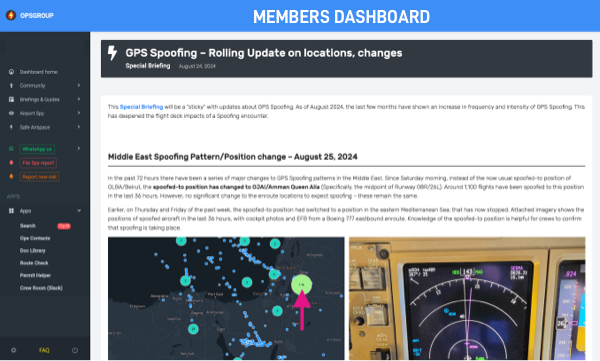
You can find a “rolling” Special Briefing in the Members Dashboard. This Special Briefing will be a “sticky” with updates about GPS Spoofing. As of August 2024, the last few months have shown an increase in frequency and intensity of GPS Spoofing. This has deepened the flight deck impacts of a Spoofing encounter.


Special Briefing: GPS Spoofing – Recent updates:


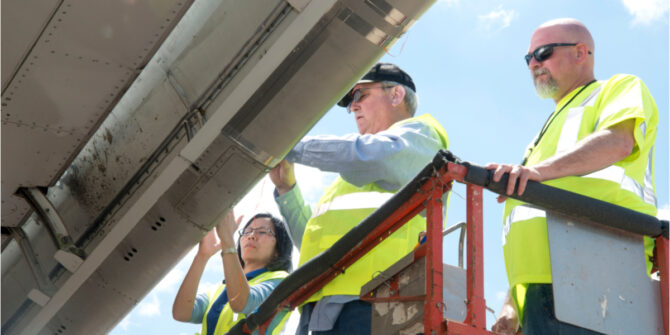
Making a Ramp Check painless (with checklist)

The EU Ramp Inspection Program (RIP) is still alive and kicking – or the EU SAFA Programme, as it used to be called.

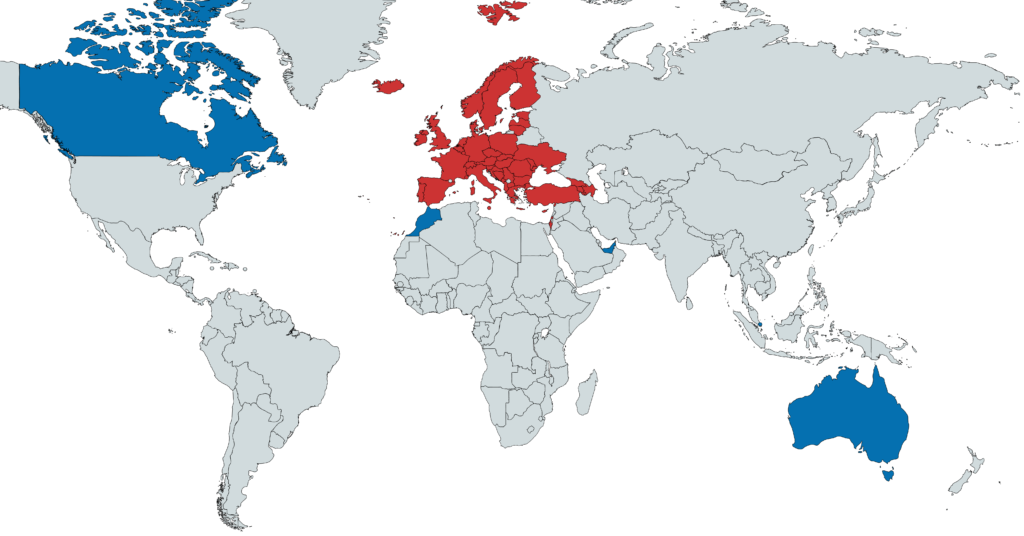
The RIP is not exclusive to Europe. Your aircraft can be inspected under the program in 49 different countries around the world, including Canada, Morocco, Singapore, and the United Arab Emirates.

Here are the key points:

  • Even though it’s now called the EU Ramp Inspection Program, ramp inspections for third country operators are still referred to as “SAFA ramp checks”. Yeah, it’s confusing.
  • Ramp checks are possible in every country in the world – but follow a more regulated and common structure in SAFA countries – totalling 49 – see the map and list below.
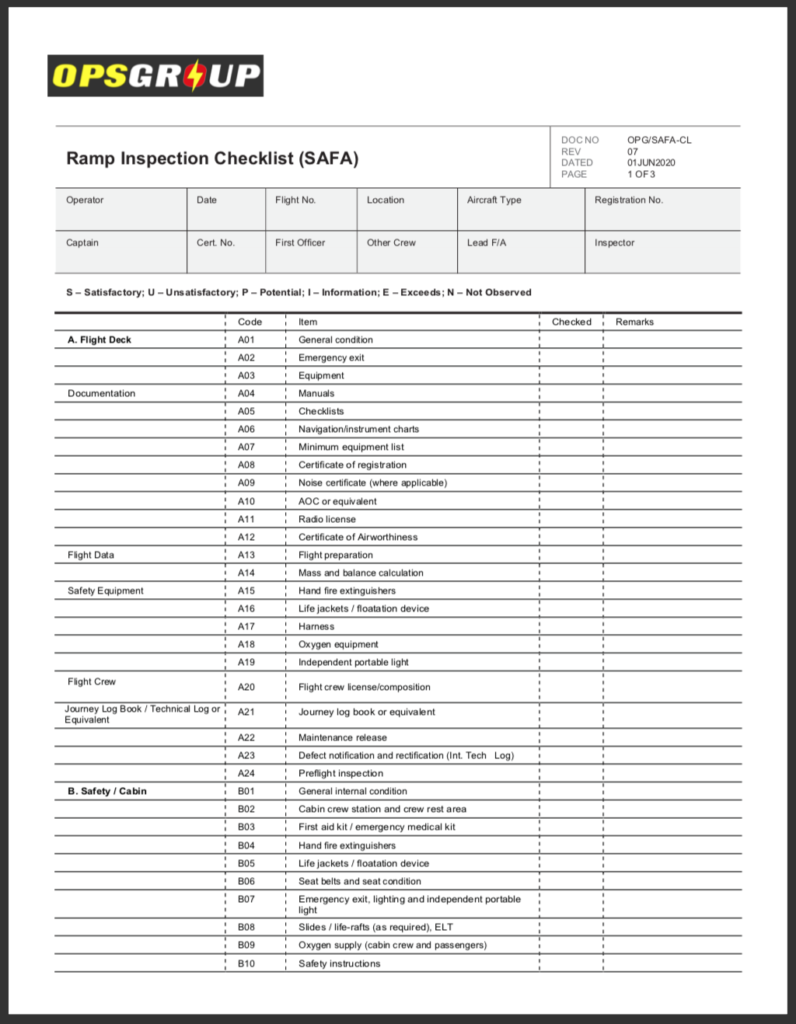
  • There is a standard checklist that is used by Inspectors in all SAFA countries, which you should be familiar with – see further down.
  • Three categories of findings have been defined. A “Category 1” finding is called a minor finding; “Category 2” is a significant finding and “Category 3” a major finding. The terms “minor”, “significant” and “major” relate to the level of influence on safety.
  • If there is a “corrective actions before flight authorised” finding – then the inspector is concerned and a repair must be made before the aircraft is released to fly.
SAFA

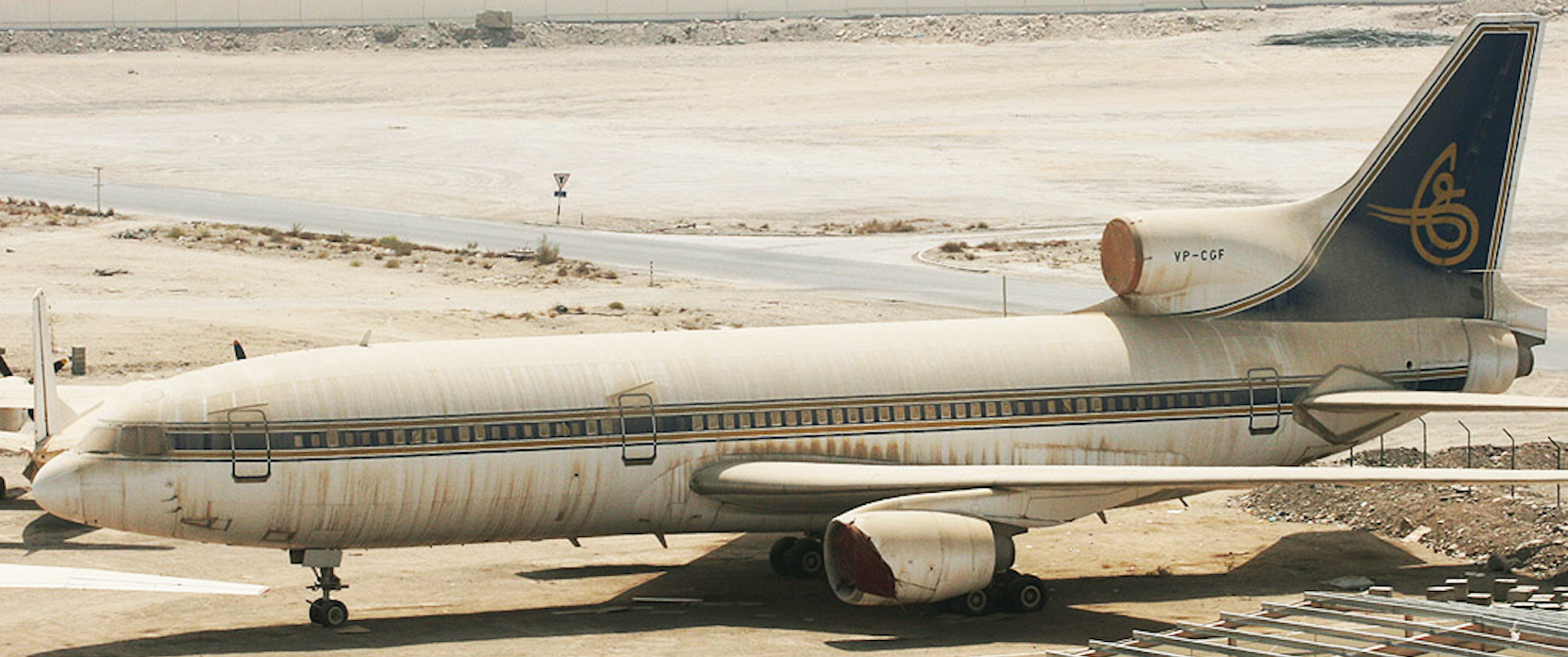
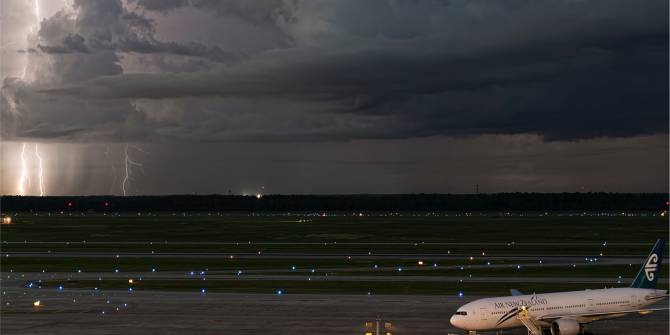
Unless your aircraft looks like this, you have little to worry about.

Here’s how a ramp check normally goes down:

  • The flight selected will either be your last of 6 legs for the day, or after a gruelling 12 hour jetlag-inducer, or at 3am when you were thinking about a quick nap during the turnaround. This much is guaranteed.
  • As you pull on to the stand, you will notice more yellow vests than normal hanging around.
  • Two of these will be your friendly ramp inspection team (to be fair, they almost always are)
  • A short time later, those yellow vests will be in the cockpit, and the first request will be for a look at your license, medical, aircraft documents (like Insurance, Airworthiness), and flight paperwork. Make sure you’ve done your fuel checks and there are a few marks on the flight plan.
  • If you get a good cop, bad cop scenario, one will disappear down the back (this will be the nice guy) and check the cabin, while the first will stay and ask you tough questions about the TCAS system.
  • Some time later, you’ll get a list of findings. The average check is probably about 30 minutes.
  • You can be guaranteed they will always have at least one finding – which will probably be obscure.
  • Sign off the checklist, and you’re on your way.

Some interesting points:

  • The Inspectors can ask you for manuals, documents, or guidance – but they are not supposed to test your knowledge of procedures, regulations, or technical matters. This doesn’t always happen in practice – so if you get a tough question – just say “I don’t know” – and let them note it if they want to. This isn’t a classroom test.
  • This guidance is given to Inspectors: Delaying an operator for a non-safety related issue is not only frustrating to the operator, it also could result in unwanted human factor issues with possible negative effects on the flight preparation. They can (should) only delay your flight for a safety related issue.
  • Remember, it’s not you that’s being inspected. It’s your aircraft. If you’re uncomfortable with the questions, get them noted and allow your operator to discuss later.
  • Every inspector is a little different. Work with them and you’ll find that 90% of your ramp checks will be over in 20 minutes with little issue.
  • Private Operators – especially in GA (even more so under the 5700kg mark) – are far less likely to get ramp checked. EASA guidelines do apply to General Aviation, but they are far more interested in Commercial Operators.
  • The items checked during ramp checks are based on a risk based approach and can differ from operator to operator (for example depending on findings raised during previous inspections). Meaning that operators who get ramp checked with findings will most likely get ramp checked again, to see if they’ve sorted out the problems!
  • EASA regulations requiring alcohol testing during ramp checks will take effect across all SAFA countries in Aug 2020. But some countries have already started doing this: Austria, Belgium, Czech Republic, France, Germany, Greece, Iceland, Ireland, Italy, Netherlands, Portugal, Spain, Switzerland, UK, and Singapore. More info

Common Findings:

See article: SAFA Ramp Checks: The Top 5 Offenders

Ramp checks cover 52 inspection items spread over 5 areas: flight deck, cabin, aircraft condition, cargo, and general/other.

But some of those 52 items generate more findings than others. A DSAC/IS-BAO study found that the top inspection items by number of CAT2 and CAT3 findings for business aviation were these ones:

1. Flight preparation (RI checklist item A13)
2. Mass and balance calculations (A14)
3. Manuals (A04)
4. MEL (A07)
5. Checklists (A05)
6. Defect notification and rectification (A23)
7. Navigation/instrument charts (A06)

So essentially, these findings all relate to five key areas: Flight Planning, Documents, Defects, Charts, Cabin Safety. Get these right, and your “sweatin over a ramp checkin” days are over, partner!

The Countries:

The 49 Participating States engaged in the EU Ramp Inspections Programme are:

Europe: Albania, Armenia, Australia, Austria, Azerbaijan, Belgium, Bosnia and Herzegovina, Bulgaria, Croatia, Cyprus, Czech Republic, Denmark, Estonia, Finland, France, Georgia, Germany, Greece, Hungary, Iceland, Ireland, Israel, Italy, Latvia, Lithuania, Luxembourg, Malta, Republic of Moldova, Monaco, Montenegro, Netherlands, Norway, Poland, Portugal, Romania, Serbia, Slovak Republic, Slovenia, Spain, Sweden, Switzerland, The Republic of North Macedonia, Turkey, Ukraine, and United Kingdom.

Rest of world: Canada, Morocco, Singapore, United Arab Emirates.

The Checklist:

Download by clicking above, or here: Opsgroup Ramp Checklist

If you want to delve deep into each item on this checklist to find out exactly what inspectors should be looking for, check out this document published by EASA in Sept 2019, which has the inspection instructions in full. For all things Ramp Inspection Program related, check EASA’s dedicated webpage here.


International Ops Bulletin

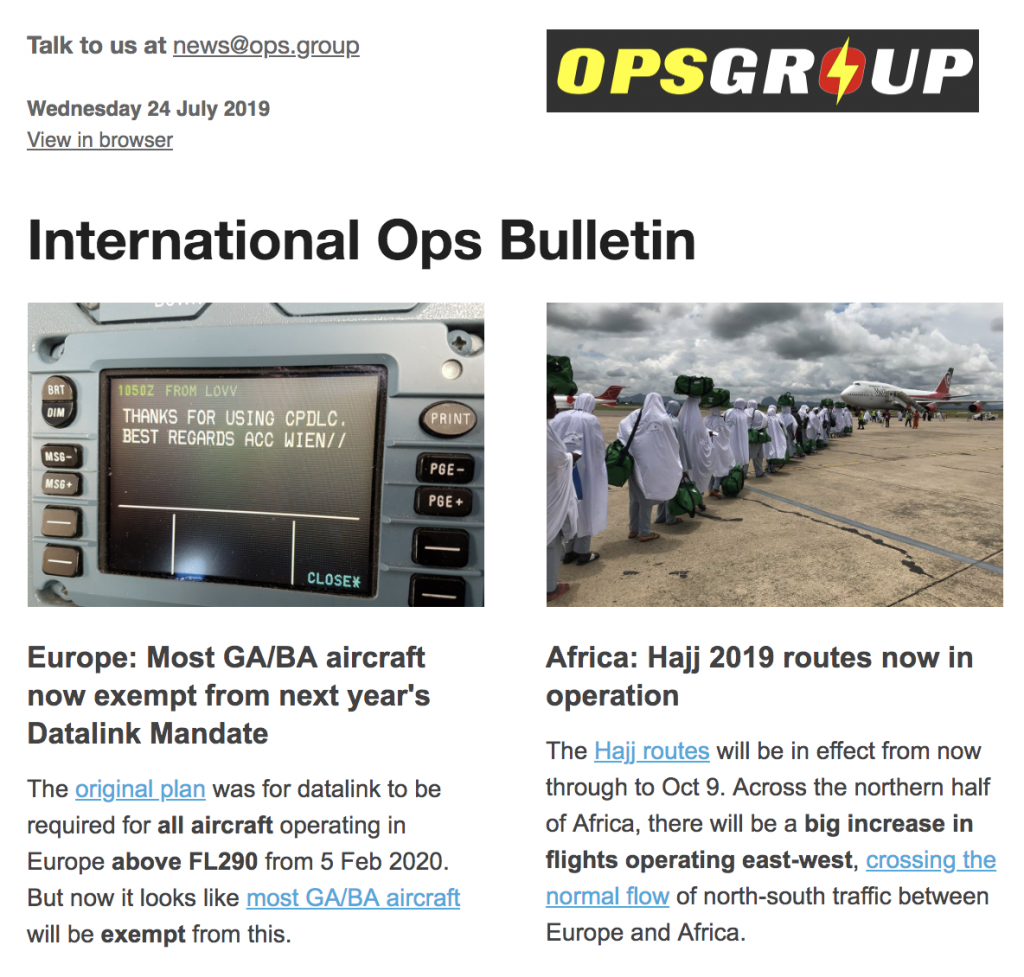
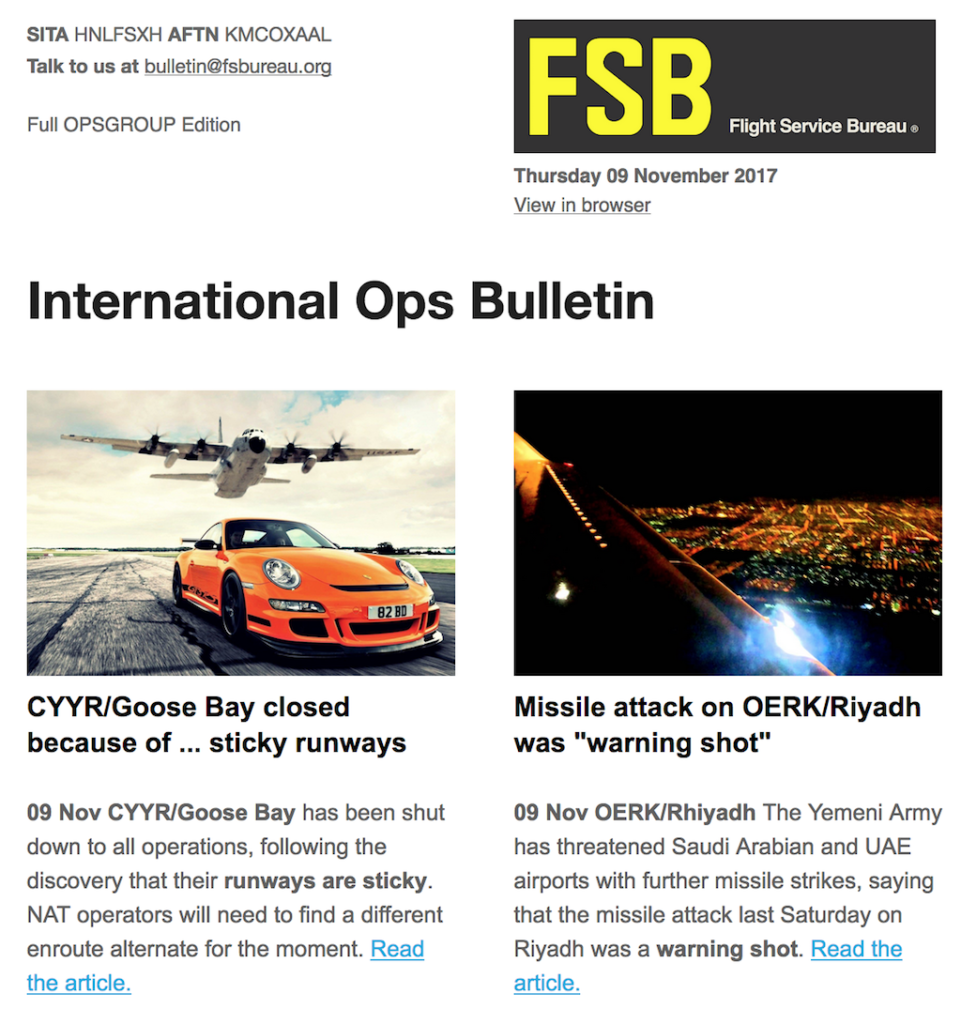
Hey! Are you here for our World Famous International Ops Bulletin? The one where you get all this weeks new dangers and changes in International Ops? The one that 50,000 people read every week?

Cool. Here’s how to get it.

Every Wednesday, OPSGROUP issues a weekly International Ops Bulletin for International Pilots, Dispatchers, ATC, Regulators, Authorities, Airlines and Aircraft Operators.

We cover this weeks changes to International Flight Operations – Airports, ATC, Procedures, New rules, Visas, Airspace alerts, Weather issues, and warnings and dangers to international aviation.

You got choices:

  1. Get the free version. Grab a copy!
  2. Join OPSGROUP and get the full version.


Want to see a sample first?

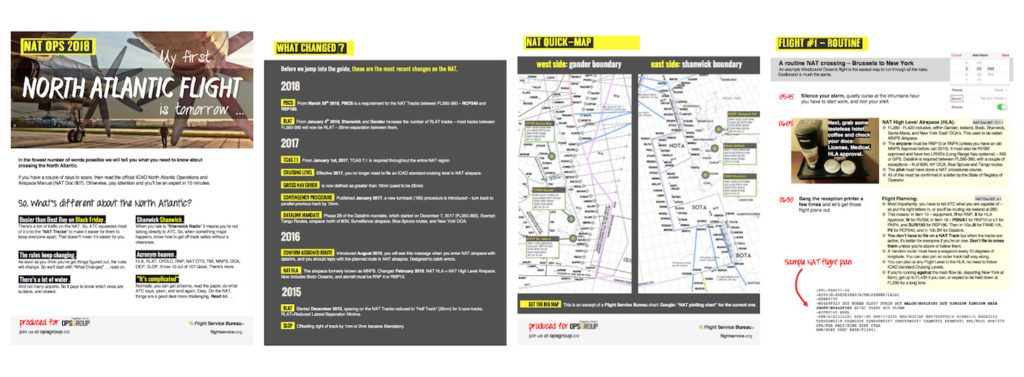
Sure thing. It looks a little like this (click to open the full sample):


Emergency: We’re all getting MAYDAYS wrong.

Pilots and Air Traffic Controllers communicate with each other every day. But it’s not very often that we get to talk to each other in real conversation: sharing experiences, exchanging ideas, learning, and just having some fun and getting to know each other. Yesterday, in Danger Club #11, that’s what we got to do, and it was eye-opening.

150 people came along to the meeting yesterday on MAYDAY’s and Emergencies. For such a critical aspect of our intertwined worlds, we found a lot of unsolved mysteries, and a lot that we’re getting wrong. We can both make life much easier on each other, it seems!

So, let’s make this a starting point for figuring out some of these mysteries. With more collaboration, we can improve how emergencies unfold, and how we handle them in the cockpit and in front of the radar screen. In no particular order, let’s jump in!

This is a living page. We’ll update and revise this as we get more feedback, so please comment below ⬇️ or email us with your thoughts!


Declaring an Emergency 🆘 MAYDAY! 🆘

The first incident we looked at was a 747 on departure from Tokyo with a cargo fire warning. For two agonizingly long minutes, the crew tried to tell ATC they had a problem and neeeded to return: without success. Why? Primarily, phraseology. There was no mention of the word MAYDAY (or PAN-PAN). Key points on this:

  • US pilots, in particular, tend to use the phrase “Declaring an Emergency“. It’s baked into the US aviation system, but it has no legal or functional basis. Officially, it’s meaningless, but in the US it’s just the way we do things (more on this below).
  • When we go international, that becomes a problem, because it’s not something controllers are trained to understand. In airspace where English is not the first language, we must say MAYDAY, or PAN-PAN. That, and only that, is the trigger for ATC to understand and help.
  • The FAA AIM 6-3-1 covers Emergencies. The wording needs urgent improvement. The opening paragraph essentially says “Say what you want, really“. It follows with “The ICAO way (MAYDAY and PAN) is better, however“, but it doesn’t mandate using it. As a result, in the US, we have no solid guidance on how to handle emergency communications, and no phraseology guidance or examples. This looks like the root of the problem. @FAA: fix this please!
  • If your GOM(Ops Manual)/SOP’s suggest using “Declaring an Emergency” as the radio call, you’re setting your pilots up for failure, especially when going international. Make it MAYDAY!

2. What does a perfect MAYDAY call sound like?

Like this:

  • AAL001: “MAYDAY, MAYDAY, MAYDAY, American 1, Engine failure, continuing straight ahead, STAND BY”
  • DFW TWR: “American 1, Tower, MAYDAY roger

And especially internationally, these points are important (we cleared up some misunderstandings here as well):

  • It doesn’t matter if it’s the first call or you’re already in contact with ATC on the frequency, always say MAYDAY.
  • It’s a trigger for ATC. The frequency may sound quiet, but the controller may be on a phone call with another sector. Hearing “MAYDAY” will ensure immediate attention. Compare that to “Uh, we gotta problem here, and blah blah“. There’s no key phrase in there to force the controllers brain to listen immediately.
  • It’s a trigger for other aircraft on frequency. As soon as a MAYDAY call is made, everyone is listening and paying attention. If the controller doesn’t come straight back with an acknowledgement, it’s likely that another aircraft will jump in to try to get their attention. Also, everyone else will know to be silent.
  • Speak slowwwwwwwwwly. Like half normal speed. Say it once, say it clearly. When you describe the problem, use no more than three words, clear and slow “Cargo … FIRE ..  warning”.
  • That STAND BY part is not in the books, but it’s critical. If you’re lucky, you’ll get that ideal ATC response above which means “Got it, and I’ll be quiet now for a bit, so you can do your thing”. You’re not likely to be lucky, so you need to ask for that silence. STANDBY will improve the chance of that happening.

3. Everyone’s panicking for a minute

Listen to Shamrock 12G declare a MAYDAY here, just airborne from Orlando.

Listen to the voice change of the pilot. The physiological response, the startle effect: you can almost hear the increased heart rate. You can also hear the controllers stress response.

  • Despite the startle, the Shamrock pilot makes a perfect MAYDAY call. This is how it’s done. (And despite that, the controller asks “Are you Declaring an Emergency“. Back to the FAA problem – very muddled guidance on emergency phraseology in the US. @FAA: fix this please!)
  • As pilots, we might not think that “our emergency” is stressful for the controller. It is. The controller is just as startled as we are. Every controllers heart skips a beat when you say “MAYDAY”.
  • For both of us – pilots and controllers – once you’ve sorted out the immediate actions, a moment to sit on your hands and breathe is essential. For pilots, Aviate, Navigate, Communicate – get the airplane safe – and then take a moment to get your physiology into a more helpful place. For controllers, Ack the call, separate the immediate traffic, and then …  Three deep breaths, perhaps (IFALPA have been discussing this recently, as the startle effect become more understood). Bottom line is we don’t make great decisions when we are responding instinctivly.


4. Dear ATC, here is our 5 minute wishlist.

This one is going to be a work in progress, but we discussed a few things that might help a controller to understand what a pilot really wants in those first five minutes. We should try to distill this into a flash card, after some more discussion?

So, “American 1, MAYDAY, STANDBY“, ATC says “American 1, MAYDAY, Roger” … what then?

  • MAYDAY is just what we say to get attention. It very, very, very rarely means that we’re going down in flames like a bad Steven Seagal movie. Even though we’ll be startled for a moment, our training kicks in and we know exactly what we have to do.
  • The biggest obstacle to us doing that is distraction. Hence, the greatest gift you can give us is SILENCE.
  • Start by letting us know that you heard us. Acknowledge the call, and “MAYDAY Roger” is just fine.
  • Depending on traffic, terrain, and when it happens, give us an altitude and a heading. “Continue runway heading, climb 3000 feet“. We’ll tell you if we need something different. A heading is the most helpful form of lateral navigation, because we just twist the dial and engage heading mode. Don’t give us a direct-to point (heads down in FMS takes time). Don’t send us off to hold somewhere, just yet. Heading, heading, heading.
  • SILENCE. The less you talk to us, the more it helps. That MAYDAY call we make is just a small part of the procedure we’re trying to run. Getting that procedure done correctly requires both pilots to pay full attention, so stopping to talk to ATC is something we’d prefer to avoid.
  • The pilots will be having an essential conversation to check the state of the aircraft, anlayse the issue, and decide on the appropriate action. A common workflow is  Power, Performance, Analysis, Action: Power: Check Thrust, ATS engaged, set correct TOGA/CLB Performance: Flaps Up, Gear Up, Min Speed, Max Speed Analysis: MFDU Indication, OHP, Situation, Time Check, Priorities Action: [PNF] Memeory Items, MFDU, QRH, OMB, OMB Ch7, ILS minima conditions, MEL [PF] ATC call, Select approach considering situation, inform Cabin. For any engine issue, at the very least we will be retarding the throttle on the “bad engine”. Pilot 1: “Confirm thrust lever 1”; Pilot 2: (points to Thrust lever 1) ..  “Thrust lever 1, idle“. If it’s a failure, we might shut it down: ““Confirm fuel lever 1” – “Fuel lever 1, Shut”. If it’s a fire, “Confirm fire handle 1” – “Pull, discharge” – “Fire bottle 1 discharged” (Start timing) … That’s a lot, right! So, until we’ve done all that, we can’t really tell you much about our plans, we don’t know yet. We just need the space to work through all that.
  • We don’t want to land right way. In 49 cases out of 50, even with an engine failure, even a fire, we’re not going to want to enter a downwind or make a 180 to land immediately. That’s not in our training. We take any immediate action needed, but then sit on our hands, run the process, assess, analsyse, run some checklists, talk to the cabin, and form a plan. So the best thing you can do is give us vectors, keep us near the airport (within 15 miles, say).
  • Don’t ask us for souls and fuel in the first five minutes. Our brains are engaged in problem solving, and distraction make that difficult. Save that for later, if at all (more on that below!)

Question: What else should we add in here? What else is on our ATC wishlist?

More to come! But, please comment below on what we have so far …


L888 – The Silk Road Airway

We received this interesting question this week:

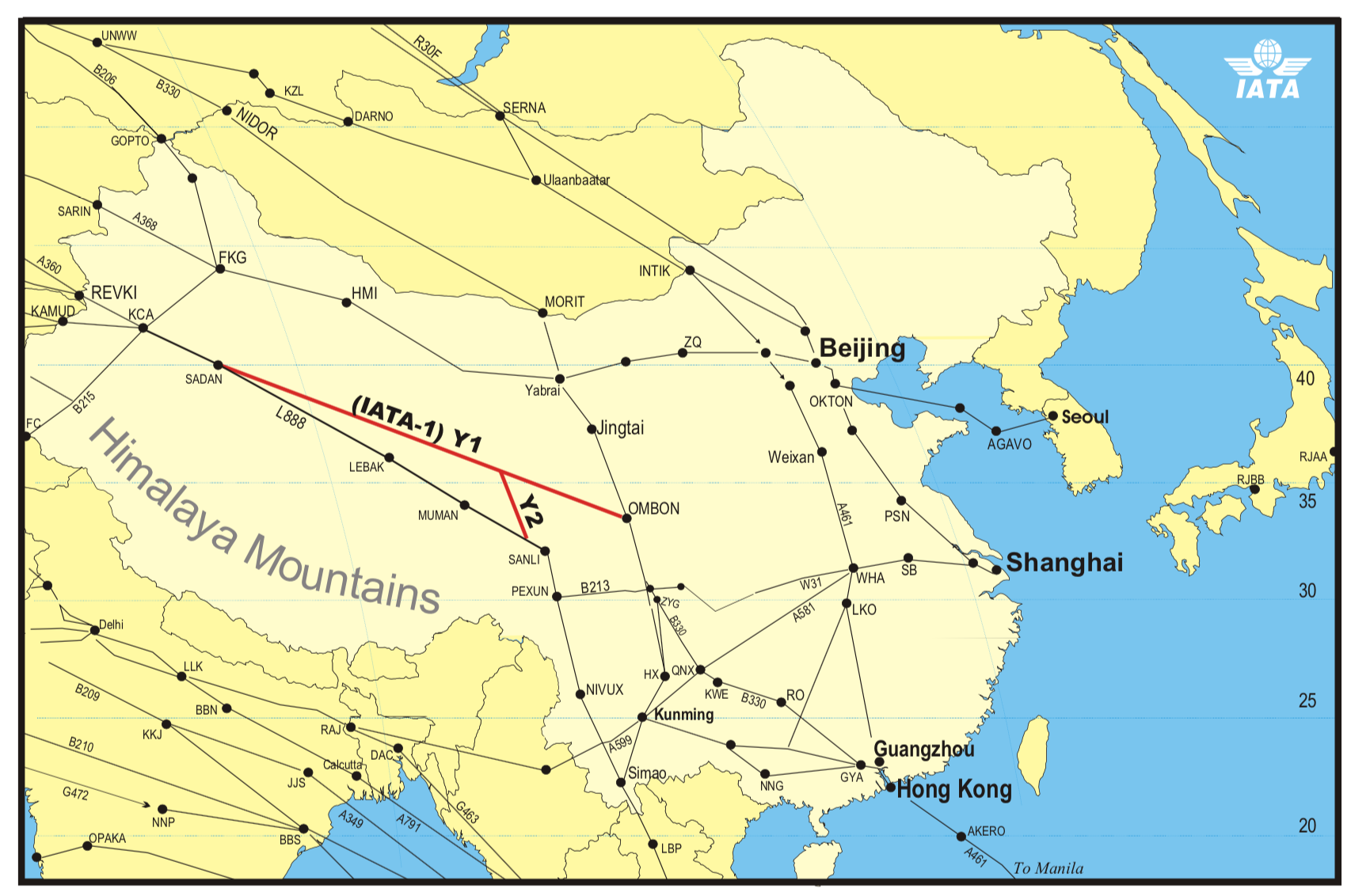
We said: “There are four airways over the Himalayas (L888, Y1, Y2, Y3) which the Chinese authorities will only let you use if you have ADS, CPDLC and satellite voice communication, and operators need to verify their equipment with them at least 60 days in advance! So they recommend that only regular scheduled flights apply to use these airways.”

Member said: “We’ve not been allowed to fly these routes, costing time between Europe and Hong Kong. I’ve been unable to get a direct answer of why not from our local Universal Aviation reps except, “the authorities won’t allow it”. Per above, there appears to be a procedure to use these airways. What is the process to gain access to these airways? Our equipment is Gulfstream with everything including the kitchen sink.”

We will start with the answer

The process to apply for access to these airways is found in AIP CHINA Section ENR 3.3.2.4 “L888, Y1, Y2”.

Excerpt from AIP CHINA published by CAAC:

12.1 A formal application shall be submitted to Air Traffic Management Bureau of the Civil Aviation Administration of China before air carriers operate data-link route, the application shall include:

” City pairs;
” Schedules;
” Starting time;
” Type of aircraft used;
” Satellite telephone numbers for the fleet;
” Procedure of emergent escape. (Y1, Y2 exceptive)

12.2 Flight plan notification of data-link capability is required before data-link services can be provided.

12.3 Aircraft equipped with serviceable ATS data-link equipment shall fill in ICAO flight plan forms as follows:
a. Advice of data-link capability shall be included in Field 10 (Communication and Navigation) by using an abbreviation “J”. b. Advice of available data-link media shall be included in field 18 by use of the prefix DAT/followed by one or more letters, as follows:

” DAT/S for satellited data-link,
” DAT/H for HF data-link,
” DAT/V for VHF data-link,
” DAT/M for SSR mode data-link,
” DAT/SAT for satellite phone.

12.4 Serviceable ADS equipment carried will be annotated by adding the letter D to the SSR equipment carried.

12.5 Air Carriers are required to provide a list of satellite telephone numbers with each aircraft which flying along route L888, Y1, Y2.

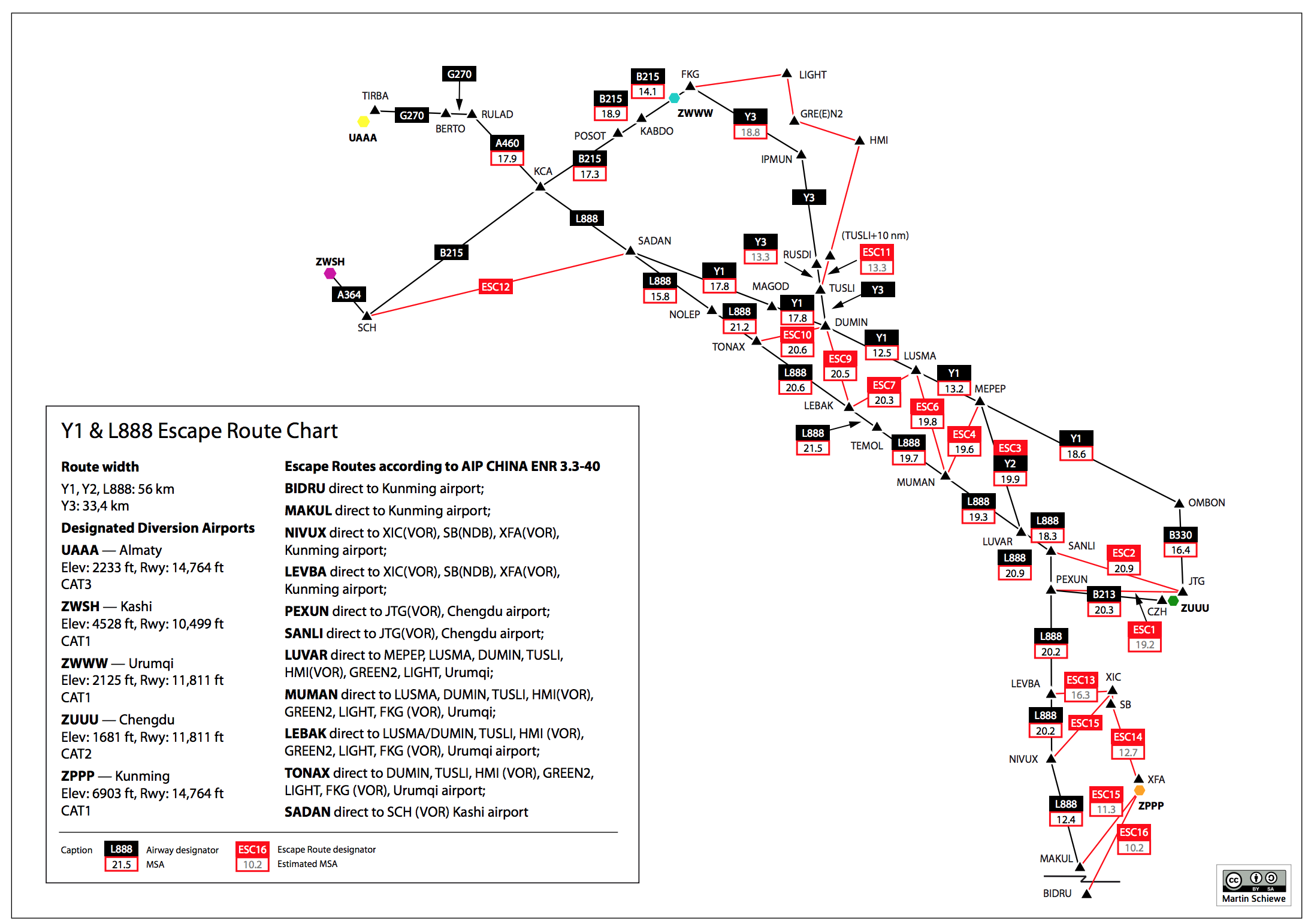
Now, onto the interesting stuff. The process requires submission of a “Procedure of emergent escape”.

The available alternate airports for route L888 are (according to the AIP);

  • ZPPP/Kunming airport;
  • ZUUU/Chengdu airport;
  • ZWWW/Urumqi airport; and
  • ZWSH/Kashi airport.

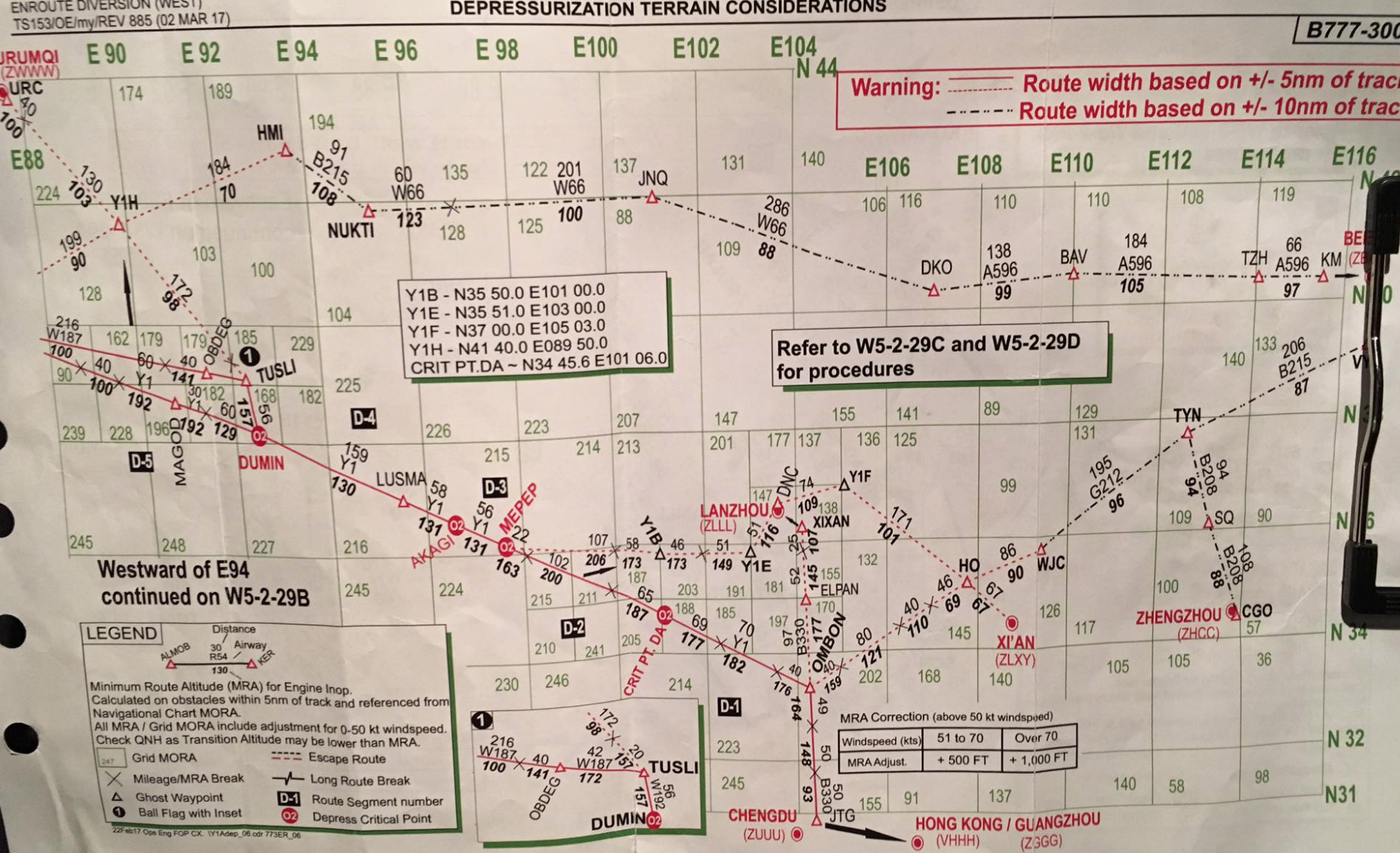
This is where it can get a little complicated. The handful of “air carriers” authorized to operate over these airways have type specific ‘escape’ procedures such as this example which shows a B777-300ER ‘Depressurization Terrain Considerations’ on Y1.

There is also the consideration of additional crew and passenger oxygen. The GRID MORA is over 20,000ft for several hours.

If you’re flying routes over this airspace regularly with the same aircraft, meet the onboard aircraft requirements and are willing to invest in developing type specific escape procedures, then a submission to CAAC might be in order. Even then, it’s a complicated approval process and there is always the potential requirement to carry an approved onboard navigator for travel to certain domestic airports.

Another tip we picked up was to make sure you don’t change callsigns between the submission of your application and the date you fly. Some flight plans have been getting rejected close to departure due to callsign confusion.

Some history…

As you’ll probably already know, the Silk Road or Silk Route was an ancient network of trade routes that were for centuries central to cultural interaction originally through regions of Eurasia connecting the East and West.

The concept behind the Silk Road initiative was not new. As long ago as 1997, the Australian airline QANTAS commissioned a study that crossed part of the Tibetan plateau which determined that there would be substantial benefits for their B747-400 aircraft, and that suitable depressurization escape routes were able to be determined.

As recently as 2013 ICAO was working to expand routes over this airspace:

“ICAO presented information on a possible high density routing initiative for traffic from Southeast Asia or Southern China to Europe via north of the Himalayas, taking advantage of the latest Performance-based Navigation (PBN) navigation specifications. The Silk Road initiative was a proof- of-concept ATS route study, utilising RNP 2, RNAV 2 or RNAV 5 navigation specifications, and was first presented to the Asia/Pacific Regional ATM Contingency Plan Task Force (RACP/TF) as a possible future contingency system for traffic operating on Major Traffic Flow (MTF) AR-4, in case of airspace unavailability in South Asian FIRs.”

Further Reading:


Shanwick’s Tango Routes – 2021 changes

When the French Controllers go on strike, the airspace surrounding France becomes of high interest to international operators, especially the north-south Tango routes within Shanwick’s airspace.

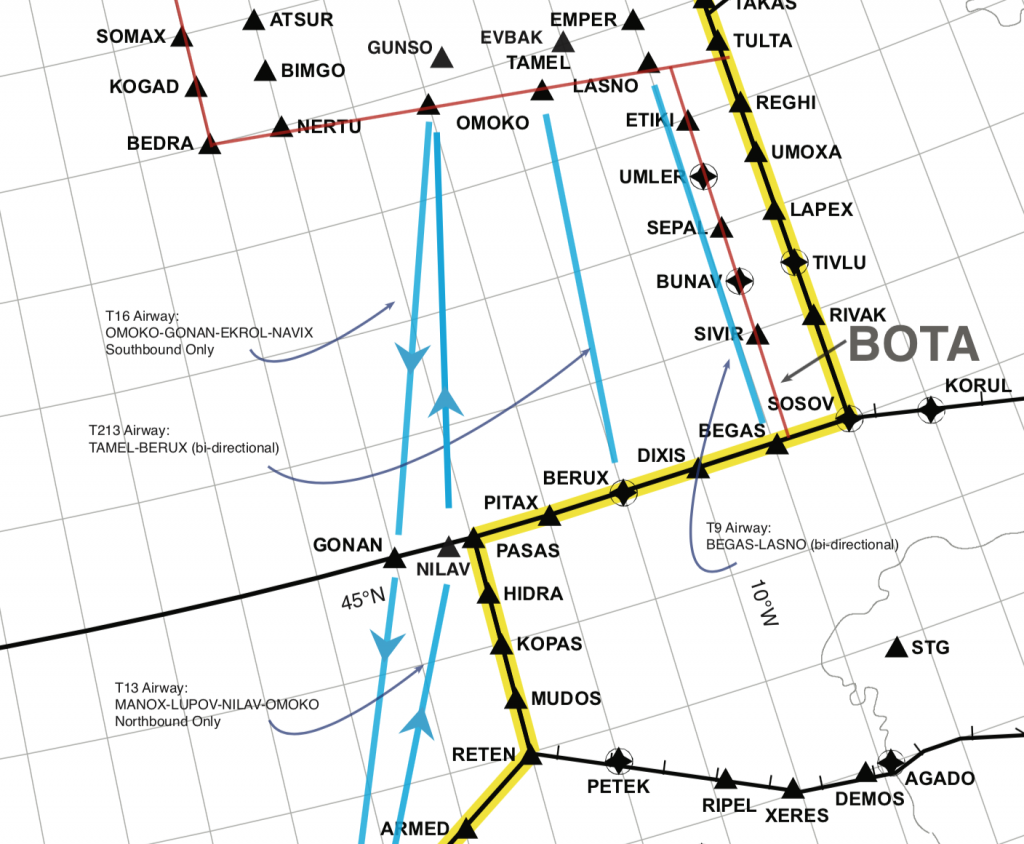
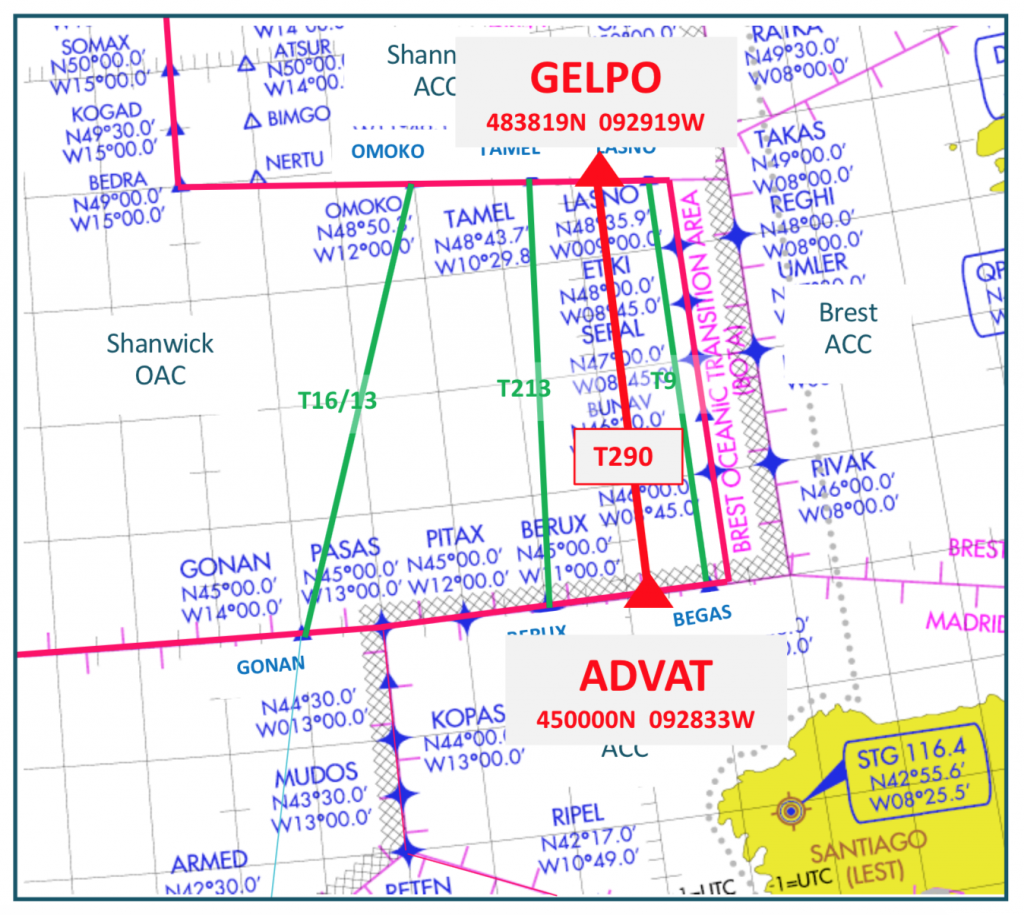
With Phase 2C of the North Atlantic Datalink Mandate effecting February 2021, CPDLC is required between FL290-FL410 throughout the entire NAT region. Some Tango routes stay exempt: T9, and a new route T290. The other Tango routes (T213, T13, T16) will all require datalink.

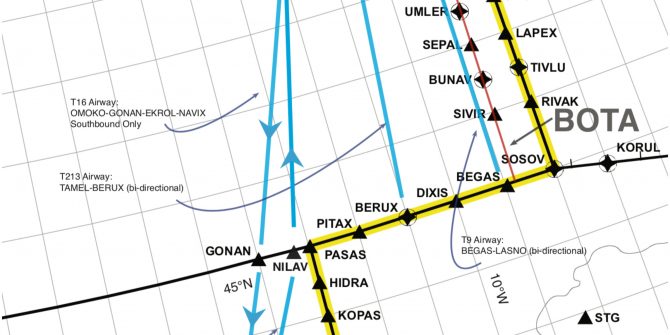
Map of the Tango Routes prior to 30 Jan 2020:


Tango 9 LASNO-BEGAS
The most popular of the Tango routes – often chock full of holiday traffic between Northern Europe and the Canaries. Requirements:

  • HF Radio. One is sufficient.
  • An Oceanic Clearance. Get it from Shanwick at least 30 minutes before you arrive at the boundary, 60 minutes is the best target time.
  • At least one LRNS/Long Range Nav System
  • HLA Approval if you want to fly above FL290 and above.

Tango 213 TAMEL-BERUX

  • HF Radio. One is sufficient.
  • An Oceanic Clearance. Get it from Shanwick at least 30 minutes before you arrive at the boundary, 60 minutes is the best target time.
  • Two LRNS/Long Range Nav Systems
  • HLA Approval if you want to fly above FL290 and above.

Tango 16 OMOKO-NAVIX

  • HF Radio. One is sufficient.
  • An Oceanic Clearance. Get it from Shanwick at least 30 minutes before you arrive at the boundary, 60 minutes is the best target time.
  • Two LRNS/Long Range Nav Systems
  • HLA Approval if you want to fly above FL290 and above.

Tango 13 MANOX-OMOKO

  • HF Radio. One is sufficient.
  • An Oceanic Clearance. Get it from Santa Maria at least 30 minutes before you arrive at the boundary, 60 minutes is the best target time.
  • Two LRNS/Long Range Nav Systems
  • HLA Approval if you want to fly FL290 and above.

T290 to be added from 30 Jan 2020:

Key Points:

  • T290 will be 20NM to the west of T9, in order to support the NAT Contingency 5NM offset procedure. T290 will go from new boundary points GELPO in the north to ADVAT in the south.
  • Both T9 and T290 will be classed as RNP2 continental offshore routes (the UK AIP says to make sure you include NAV/RNP2 in Field 18 of your FPL). Both will require: 1 LRNS, 1 HF, and ADS-B. The other Tango routes (T213, T13, T16) will all require datalink between FL290-410.
  • T9 will become southbound only, even levels between FL300-400. T290 will be northbound only, odd levels from FL290-410.
  • For T9 and T290, there will be a new VHF frequency: 128.360, which will be introduced on 30 Sep 2019. Pilots must monitor this frequency, but it’s only to be used for intervention and emergency – in other words, don’t use it unless something’s going badly wrong! You’ll still need to monitor and broadcast on 121.5 for in-flight contingencies.
  • For more info on the Tango routes, check out the UK AIP ENR 3.5 due to take effect from Jan 30.
  • You need a HF radio to enter Shanwick FIR, period. There are no exceptions.
  • You need HLA Approval to use any of the Tango routes at FL290 and above.

Operating Tips

  • You probably won’t get the level that you want – either because the airway itself is busy, or because you’re crossing a bunch of East-West NAT Traffic. If the rest of your Flight Plan shows FL380, plan FL320 for most of the Tango portion – especially T9.
  • You can make an Oceanic request by Data-link (ACARS), Clearance delivery – 127.65 VHF, 123.95 VHF or via HF (Frequencies vary on the day, but 5598 is normally a safe bet).
  • If you get a low Flight Level for the Oceanic Route, Shanwick are happy for you to check in again closer to the boundary and see if higher is now available.
  • Entering the Oceanic Airspace, make a full position report: Position and time / Flight level / Next position and estimate for that point / Following position.
  • Don’t make a full exit position report when you enter domestic airspace, just callsign and “Approaching LASNO, FL370”. Exception: Santa Maria likes one.
  • No contact on HF? Relay on 123.45, or Sat Phone EGGX 423201 or EIAA 425002.

NAT HLA Approvals

  • If you have an existing MNPS approval, it’s good until 2020.
  • If you need a new HLA approval, then you’ll need RNP4/RNP10.
  • Individual Crew need training in international procedures and HLA, as part of the process.

From Shannon ATC

Thanks to Shannon ATC for adding this useful information for crews operating on the Tango Routes:

  • EICK Departures via T9/T213/T16 should get their Oceanic clearance prior to departure – ask the Tower 45 minutes ahead of time.
  • All other EI/Irish departures can request clearance when airborne. For info, the earlier crews request their clearance the better, as it means they are more likely to get a better level and it allows ATC to plan for getting the aircraft to that level.
  • Important: Due to the risk of two aircraft using the same squawk leading to a mis-ident, Northbound traffic entering SOTA via T9, T13, or T213 should squawk 2000 at least 10 minutes prior to the Irish boundary.

ATC Farm-out must be prohibited

If you’re overflying the Tirana FIR tonight, the Air Traffic Controller in whose hands the safety of your flight rests will be one of these three: a Turkish controller, who has just been drafted in and who has never seen the airspace before; or an Albanian controller who has been forced to work under huge duress, while colleagues remain in prison.

And if you think there will be a NOTAM to tell you about any of this, you’re mistaken. Albania does not want you to know.

There are a plethora of troubling issues in the ongoing Albanian ATC dispute. Arresting workers for organizing industrial action is draconian and aggressive, and an approach discarded by nations that have moved beyond totalitarian regimes of the past. But the issue that presents the greatest risk to aircraft operations is the farm-out of ATC service: a practice whereby the ATC authority recruits foreign, untrained controllers in an attempt to break a strike.

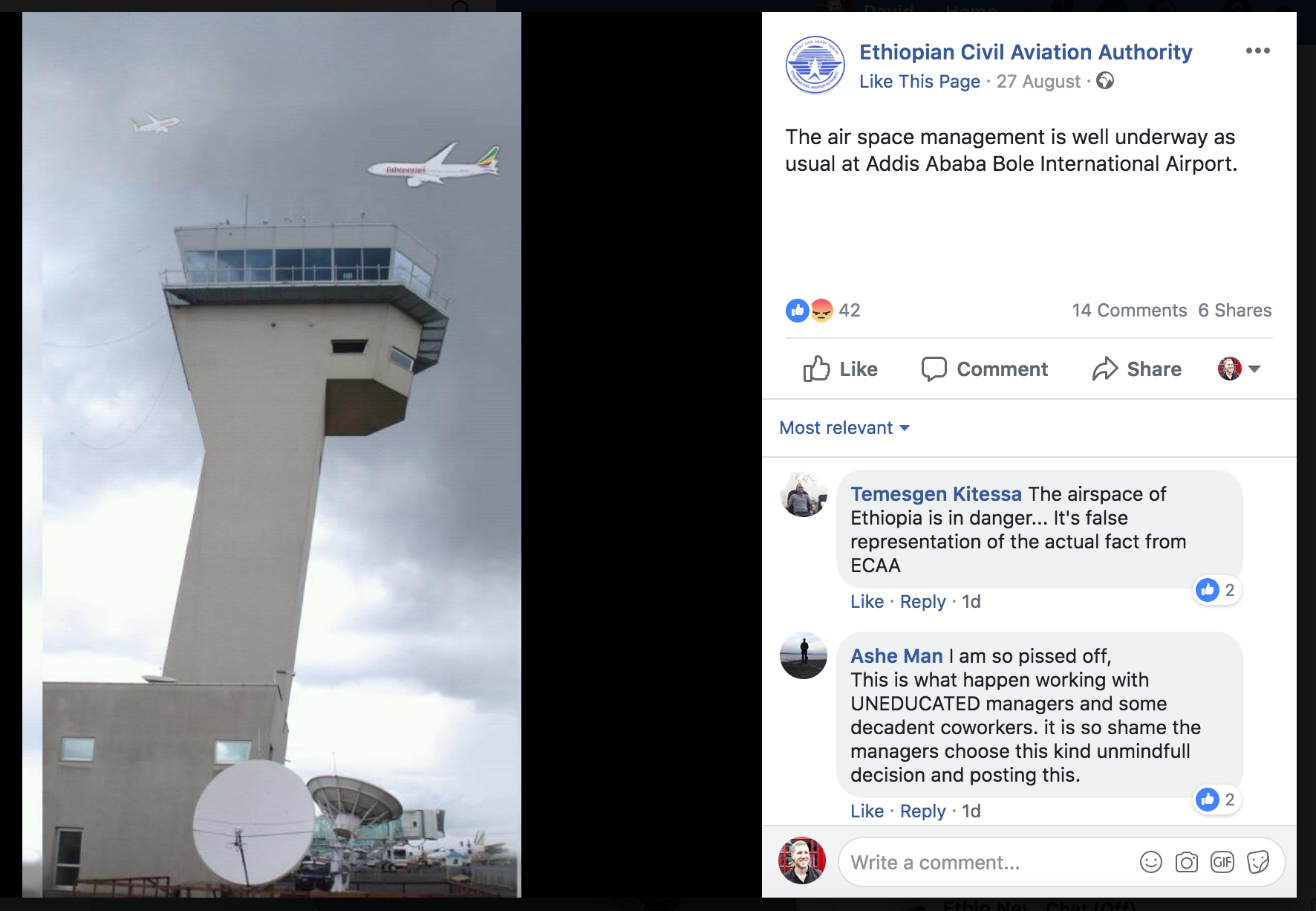
The same scenario occurred in the Ethiopian ATC strike of 2018. The Ethiopia CAA recruited stop-gap controllers from Kenya, Sudan, Zimbabwe, Malawi, and other countries, and at the same time, launched a PR campaign declaring that “everything is operating normally”, including this bizarre attempt at Photoshopping a duo of Ethiopian Airlines aircraft onto an image of Addis Tower.

In the Ethiopian case, the cover-up belied the fact that the Air Traffic Control service was in tatters – many ATCO’s were in prison, many were fired, and the idea that a busload of controllers from Sudan could somewhow safely replace the local controllers was tantamount to attempted manslaughter on the part of the Civil Aviation Authority. Safety was well down the pecking order of motivating factors – commerce, politics, and thinly-veiled vengeance came first.

In Tirana, tonight, the situation is almost identical. Three Albanian controllers are in prison, and those at work in the Tirana ACC are there only because they have been forced onto position by their government. Albcontrol has clearly signalled its intent to draft in Turkish controllers to replace the unhappy domestic ones.

This tactic carries a profound danger that at first glance may not be obvious. If we cross to the other side of the microphone, and look at pilots, we could argue that a 737-rated pilot could fly from Adelaide to Melbourne as easily as they could fly from Dublin to London, and apart from some company procedures and airport familiarisations, that would be largely true. If a group of airline pilots go on strike, management could therefore replace them with a group of other airline pilots with the same type rating – who would earn the monniker of Strikebreaker (or worse). A deeply unpopular move, which happens from time to time, but not one that carries the same risk as attempting to do this with controllers.

Why? Because safe Air Traffic Control is predicated on deeply-learned local familiarity with the airspace, the terrain, the boundaries, and above all, how the traffic flows. This is why it takes six months, on average, for a controller trained in one country to re-qualify in another. For a newly-qualifying controller, that time line is closer to two years.

OK, where are the mountains again?” is not a question you’d want to know was being asked on the floor of an Approach Control unit. But that is precisely the level of vague airspace acquaintance that a drafted-in controller, even one with thirty years experience in another unit, would have. It is simply not possible to provide a safe ATC service with a weeks training. Even more importantly, the normal time required is based on the training relationship between student and trainer being supportive and co-operative. With the resentment that a Strike breaking controller would face, that cooperation would be entirely absent: the atmosphere will be hostile.

And so, it is a fundamental breach of trust for a sovereign nation to provide ATC service to foreign aircraft under the guise of “operations normal”, when such a catastrophically misguided attempt has been made to solve the dispute.

The relationship between the ATC provider (the state), and the customer (the foreign aircraft), is an extremely unusual one. There is no written contract, no KPI’s, no audit of quality. There is nothing other than a sacrosanct, inherent commitment to safely separate aircraft, crew, and passengers flying over the state. International convention, not corporate agreement, dictates this foundational principle.

And so, international convention must make it clear to countries and ATC authorities alike, that the practice of farming out ATC to untrained, unfamiliar controllers from other countries as a strike-breaking tactic is absolutely unacceptable. Countries must find ways of solving domestic disputes without subjecting uninvolved, unaware pilots and passengers to high-risk scenarios such as this.

Organizations and agencies like CANSO, ICAO, and in this case, EASA, must ensure that this flawed and covertly dangerous pseudo-solution is placed firmly back under the rock it crawled out from.


NAT Tracks NIL – an experiment

The long-awaited and much discussed scenario on the North Atlantic finally happened this week: No published NAT Tracks, with all aircraft on Random Routes. The concept of free-routing on the NAT is one that airlines in particular have been keen to see for a long time: the ability to decide their own routes, unconstrained by an overlay of tracks that may be tangential to their flight-planning whims.

This is an experiment being led by NATS and Nav Canada (or Shanwick and Gander, if you prefer), and on the face of it, it appears straightforward. Traffic levels are lower at present – about 40% of normal. In January 2021, Shanwick managed 15,241 flights (averaging 491 flights per day), 41% of the January 2020 figure of 36,782 (averaging 1,189 flights per day). A reduction in volume goes hand in hand with a reduction in complexity from an ATC perspective. Without published tracks to assist in separation, the burden on the controller is increased – but the lower traffic levels mean it can be safely managed. Ideal time to try it out.

The concept has garnered much media interest, not least because of the timing of a scientific research paper from Reading University that suggests efficiencies of up to 16.4% can be achieved with this “new idea”. As a result, in the past 10 days the NAT Tracks have featured on CNN (“Airlines can now pick their own routes across the Atlantic. Huge fuel savings could follow”) and the Independent (“‘Surfing the wind’ could allow aircraft to cut carbon emissions and reduce flight times”). Headline: New York-London journeys could be cut by 21 minutes.

The media, and even our own industry news coverage, would have us believe that somehow we’ve just stumbled onto some preternatural scheme of harnessing the power of the wind, to spirit our hulking lumps of metal across the pond. Jet streams, you say? Pray tell.

Let’s clarify something first. Aviation contributes around 2% of global CO2 emissions. Global warming is a danger to our entire existence. We are an industry founded on innovation and ingenuity, and we should be looking for every opportunity to do something more than just shave a few dollars off a route cost. We need to open our minds, stop being quite so defensive about aviation, collaborate with science and research, and above all recognise the impact that aircraft are having on the environment. We need dramatic change.

In the cold light of operational reality, however, all is not as the public coverage seems. The Shanwick/Gander No-Tracks experiment itself is founded on solid ground – the results will provide useful insight, and the reasoning for it is sound. The research paper, however, and associated media fanfare, has shakier foundations. In fact, there are fundamental flaws in the assumptions made to reach the headline proclamations of 16.4% and 230km (125 nautical mile) savings on route distance.

We’ll look at three things in this article …

One: How an aircraft operator actually chooses a route across the NAT
Two: The ATC perspective; why No NAT Tracks is not as easy as it might sound.
Three: A review of the research report from Reading University.

Part One: How does a NAT route get chosen?

The hardest thing in life is knowing what you want. It’s no different on the NAT. The process for selecting a route across the ocean is more complex than it might seem. At first glance, it might appear that the most logical route is the best wind route, in other words, the track across the ocean where we can take maxium advantage of the jet stream. In the Reading University report, this is called the “OFW: Optimized for Wind Route“. Let’s see why this is not the case.

There are four track calculation options available to most aircraft dispatchers and flight planing systems:

A. MDT: Minimum Distance Track. Departure to destination with shortest distance (ie. Great Circle track). Only sensible if there is no wind, which never happens.
B. MFT: Minimum Fuel Track. Departure to destination with lowest possible fuel burn. Equivalent to the OFW/Optimized for Wind Route.
C. MTT: Minimum Time Track. Departure to destination in shortest possible time. Often very similar to the MFT.
D. MCT: Minimum Cost Track. Departure to destination with lowest cost – considering not just fuel, but navigation fees, and the cost of time (eg. knock on schedule effects, missing curfews etc.)

Which is the most commonly used? Minimum Cost Track, by far. Minimum Fuel is good. But for aircraft operators, we have to consider whether saving 100 kgs in fuel results in being 10 mins late to stand, or makes us overfly a much more expensive country, or miss a curfew time at the airport.

A North American OPSGROUP airline dispatcher told me: “To give you an idea of cost, a Minimum Time Track (MTT) or Minimum Fuel Track (MFT) for our Boeing 777 from the west coast of North America to east Asia can cost anywhere from $10,000 to $15,000 more than taking an MCT. The difference? The MTT and MFT will go through Russia [where navigation fees are much higher]. The MCT stays on the North Pacific in Oakland and Fukuoka airspace. But that cheaper route can be 30+ minutes longer.

And even then, that’s not the track the operator might want to fly. One big consideration: Turbulence.

In the winter months in particular, the eastbound jet stream can be nasty. The place where the most efficient route lies is efficient because that’s where the winds are strongest. This is often also where the core ‘efficient’ NAT Track Xray or Zulu lies these days. A 200 knot tailwind is great, but it comes with a sting in the tail: severe turbulence. The same dispatcher told me: “In the last week, we’ve not flown the NAT Tracks because of multiple patches of severe turbulence, both forecast and reported by other airlines”.


Planning a real-life NAT route from start to finish: eight steps

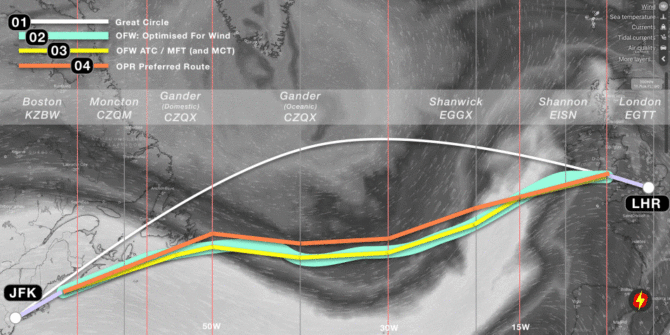
We’ll look at an eastbound flight from New York Kennedy (JFK/KJFK) to London Heathrow (LHR/EGLL). Given that the research paper mentioned above identifies maxium fuel savings eastbound of 16.4%, this is a good example to choose. On the maps that follow, you will see the there are eight steps, starting with the great circle track, and working through what happens in practice until we reach the actual route flown. The aircraft in this example is a Boeing 787, which has an optimum altitude of FL390 (presure level of 200 hPa) at operational weight (~85% of MTOW). Therefore, the winds shown are those at FL390. For track planning, we will consider only the track from Top of Climb (first point of cruising altitude) to Top of Descent (beginning of descent into LHR). The map also shows the ATC areas that will control the flight in the enroute phase. The jet stream is shown as background: the whiter, the faster.
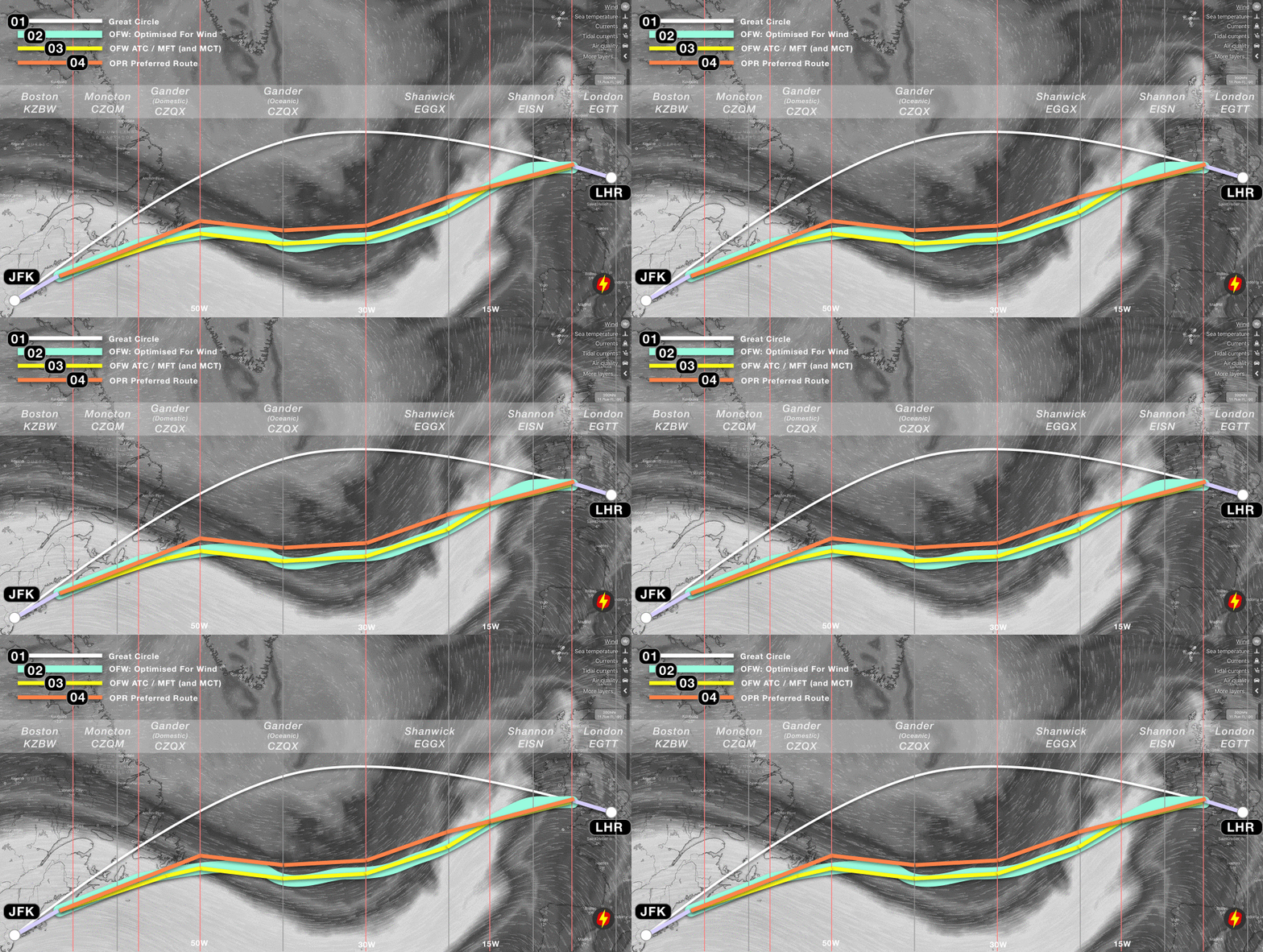
01: GC: Great Circle Route. The shortest distance between JFK and LHR. This does not take winds into account, so to find the best wind route, we must add wind from the forecast for FL390 for our time of flight.

02: OFW: Optimised For Wind route. The track taking maximum advantage of the winds at FL390 (39,000 feet, or the 200 hPa pressure level in ISA).

03: OFW ATC route. The OFW route as adjusted for oceanic ATC flight planning limitations – which are: 1. You must use fixed 1/2 degree latitude points at every 10 degrees of longitude from Oceanic Entry Point to Oceanic Exit Point. 2. You must fly a straight line from that point to the next 10 degree longitude line. This route equates to the MFT (Minimum Fuel Track) in flight planning systems, and in our case here, also the MTT (Minimum Time Track). For some NAT routes, overflight fees will be a consideration (for example, avoiding higher charges in UK and Swiss airspace on routes that go further into Europe) – but here, they are not, so MCT (Minimum Cost Track) is also the same. In other words, OFW ATC = MFT = MTT = MCT.

04: Operator Preferred Route. The next big consideration is turbulence. In this example flight, there are moderate-severe turbulence warning patches at several points on the ATC OFW/MCT route above, so the dispatcher elects to move it a little further north – still gaining from the eastbound jetstream, but outside the core jetstream which has the highest turbulence.

We can now move on to the next stage of planning in a real-world scenario: accounting for a high volume of other traffic, ie. matching the Operator Preferred Route to the closest NAT Track of those published for the day of flight.
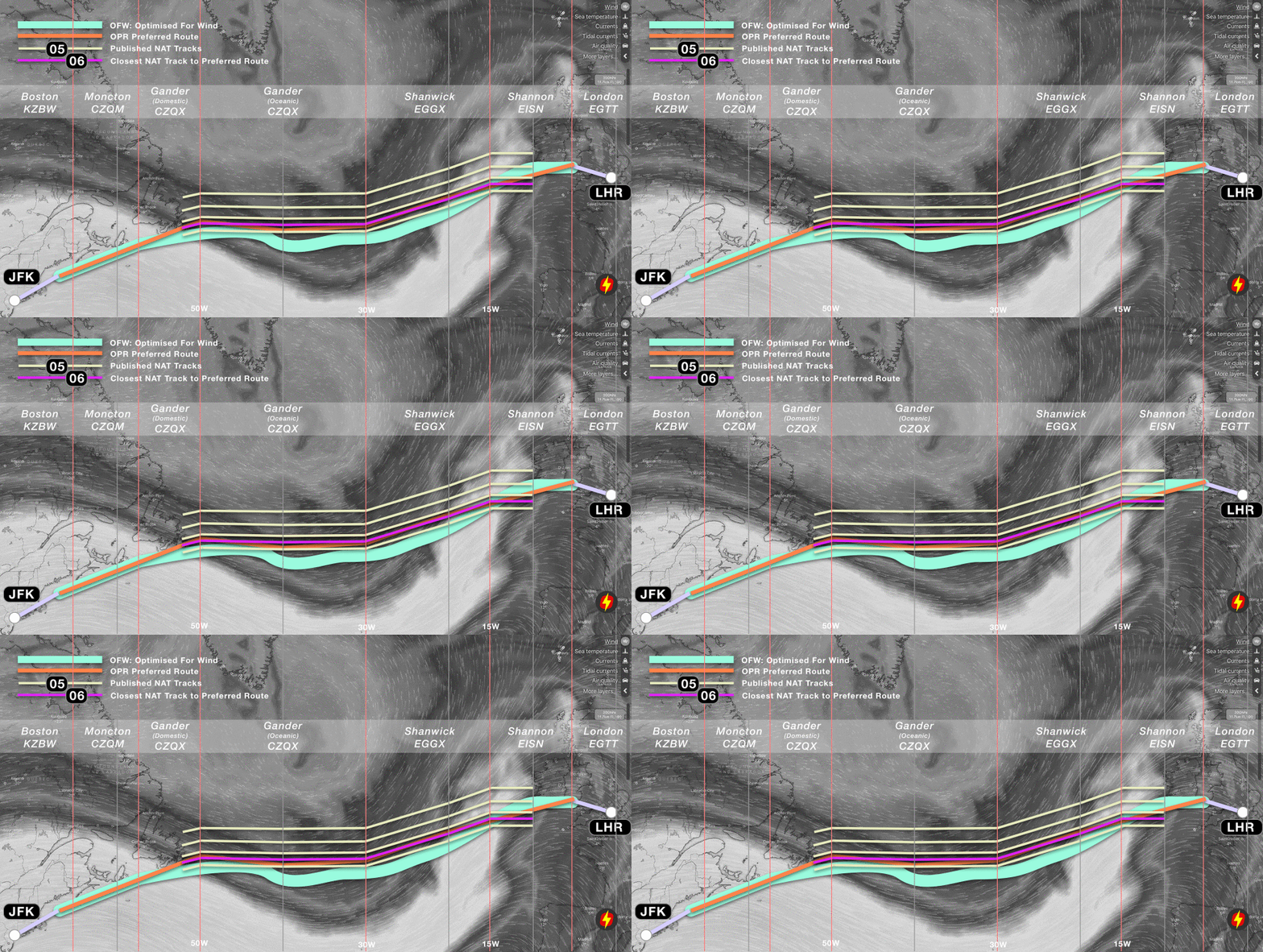
05: Published NAT Tracks. Once a day, Gander issues the NAT Track Message for Eastbound Tracks, which allows Air Traffic Control to safely separate the peak flow of flights from the US to Europe. In this case, there are five tracks.

06: Closest NAT Track to Preferred Route. This is a simple calculation – which NAT Track most closely matches the Operator Preferred Route across the ocean. In this case, it is highlighted in purple, and is a relatively close match.

Finally, we can account for what will happen at the time of flight …
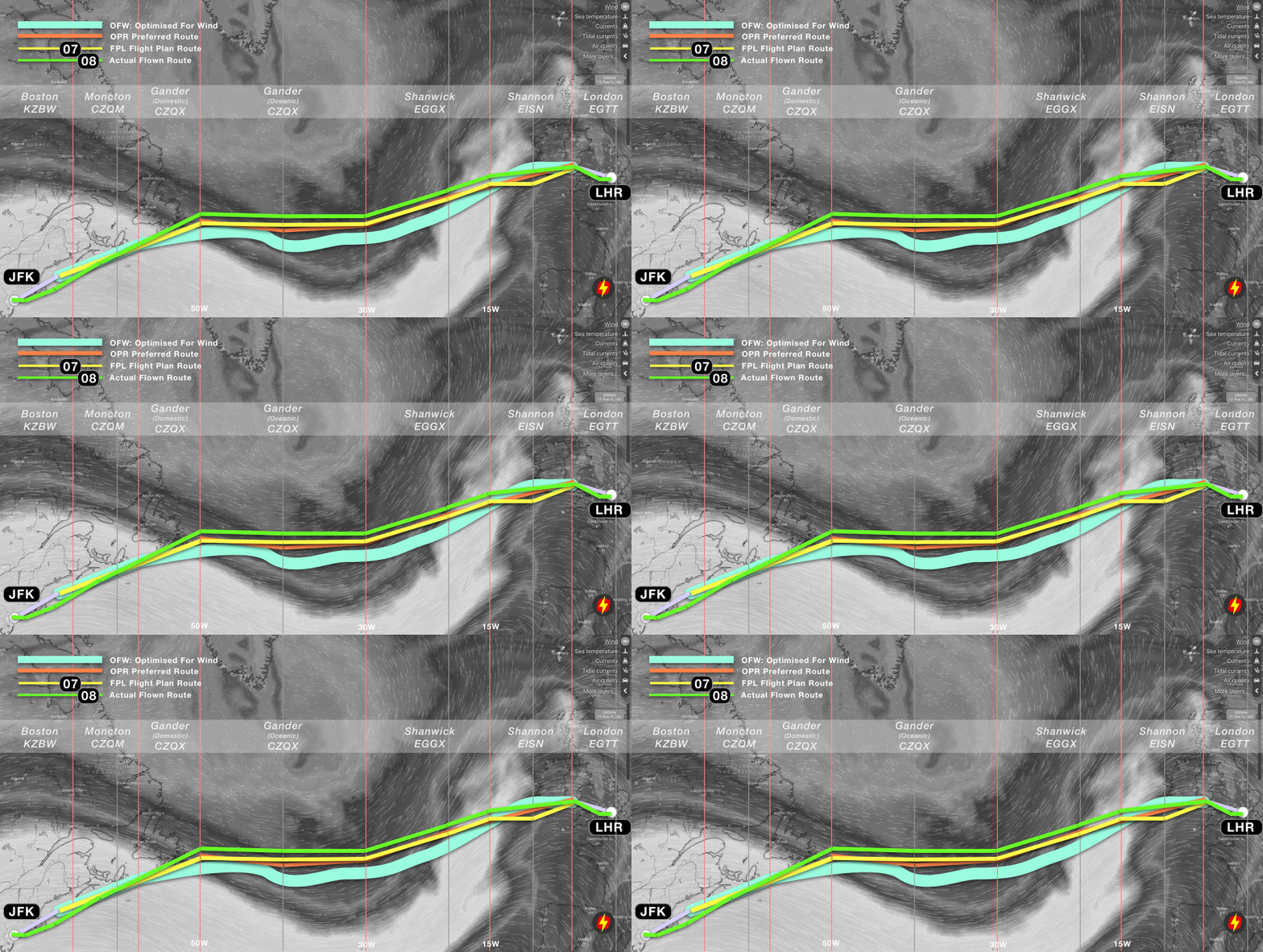
07: Flight Plan Route (FPL). With the choice of track made, the operator will then file the Flight Plan with their requested route, several hours in advance of the flights’ departure from JFK. The purple track above at Step 6 (closest NAT Track) becomes the yellow track in this step, to which the domestic ATC routings are added. Once airborne and enroute, about an hour from the Oceanic Entry Point at 50W, the crew will request their Oceanic Clearance from Gander, as per this flight plan route.

08: Actual Flown Route.  For this flight, the requested track was not available at FL390 (because of other traffic ahead). The crew were given a choice of either a more notherly NAT track at their preferred level (FL390), or their requested NAT track at FL370. The altitude difference would have made for a greater fuel burn than a slightly longer distance, so the crew elected to take the more northerly track (30 nautical miles further north laterally, but in terms of distance flown adding about 20 nautical miles). At 15W, the flight is under radar coverage from Shannon, and was cleared direct to the Strumble (STU) beacon in Wales (which was the original planned Top of Descent). The green track therefore depicts the actual route flown.


Where did we lose most efficiency?

Since the background to this article is considering the benefits of not having to follow prescribed NAT Tracks, the key question is – where has most efficiency been lost on this flight?

  1. Loss 1: The difference between the Minimum Fuel Track (MFT) (or “ATC OFW”) and the Optimized for Wind Route (OFW). Some efficiency is lost because the OFW is constrained by flight planning requirements – specifically having to flight straight lines between each 10 degrees of longitude, and having to cross each 10 degrees of longitude at 1/2 degrees of latitude. The “route of straight lines” is, of course, longer.
  2. Loss 2: The difference between the MFT and the Operator Preferred Route. In this case, the operator chose to move the track further north to avoid turbulence. This decision creates an efficiency loss in terms of fuel burn, because the minimum fuel track is no longer being followed.
  3. Loss 3: The difference between the Operator Preferred Route and the closest matching NAT Track. This is the key efficiency difference when considering gains from the “No NAT Track’s” experiment.
  4. Loss 4: The difference between the NAT Track requested (Flight Plan Route) and the Actual Route flown. There is a mixed bag here. On the one hand, if the operator has to fly anthing other than the requested route, they lose efficiency to some degree. In this case, ATC could only offer a lower level, or a more northerly route. On the other, domestic ATC (using radar) often provide shortcuts which lessen the track miles flown.

A scientific analysis of a series of actual flights would reveal the numbers involved in the four different areas of efficiency loss – and this is roughly the aim of the OTS NIL experiment that Shanwick and Gander are conducting,


Part Two: Why we might still need NAT Tracks

The narrative in the majority of recent reports about the North Atlantic tell us that because we now have ADS-B satellites, and thereby excellent surveillance, this changes the entire landscape, and allows for the disbanding of NAT Tracks. But this overlooks a key point: it’s not a surveillance problem, it’s a comms problem.

We’ve got surveillance nailed – it’s basically the same as radar, now that the full complement of Aireon ADS-B satellites are up and running, complementing the ADS-C coverage already in place. So, controllers can see the aircraft in much the same way as a domestic radar controller. That’s exciting.

However, it’s a bridge too far to assume that just because surveillance is good, we can start treating the Air Traffic Control of NAT aircraft as if it were somewhere in the centre of Europe.

And the reason: instant communication. In a domestic ATC environment, the approximate sequence of events goes like this (callsigns dropped from some calls for clarity):

Controller (thought):Hmmm, Delta and Speedbird are getting a little close. I’ll climb the Delta.
Controller: Delta 63, climb FL360.
Delta 63: Sorry, unable 360, we’re still too heavy.
Controller: Delta 63, roger, turn right 10 degrees due traffic.
Delta 63: Roger, right turn heading 280.

And Delta turns. Conflict solved. That entire sequence of events takes about 10 seconds. Now consider the Oceanic environment. CPDLC is a hell of a lot better than HF, but the target time for the same sequence of events is 240 seconds, or 4 minutes. That’s the basis of RCP240.

See the ATC problem? We can see the traffic now, but we can’t be sure that we can move it around in the same way as a real radar environment, because we don’t have VHF.

This is why the new satellite coverage does not go all the way to allowing a full reduction in separation to the standard enroute value of 5 nautical miles. Oceanic ATC, even with this additional surveillance, remains more of a procedural environment – and separation standards cannot yet drop. In the same vein, we’re not yet at the point where we can solve enroute conflicts with a few vectors and “on your way”.

And therefore, removing the NAT Organized Track Structure for high volumes of traffic is a big challenge.

Part Three: The Reading University Report

Published in January 2021, a paper from Reading University titled “Reducing transatlantic flight emissions by fuel-optimised routing” suggested that “current flight tracks [on the North Atlantic] have air distances that are typically several hundred kilometres longer than the fuel-optimised routes”, that by using the optimal wind route eastbound flights would save on average 232 km, and that an efficiency gain of up to 16.4% would be possible. These headline figures are the ones taken by the media in the last few weeks resulting in articles suggesting that the average New York-London flight could arrive 21 minutes earlier [Independent >].

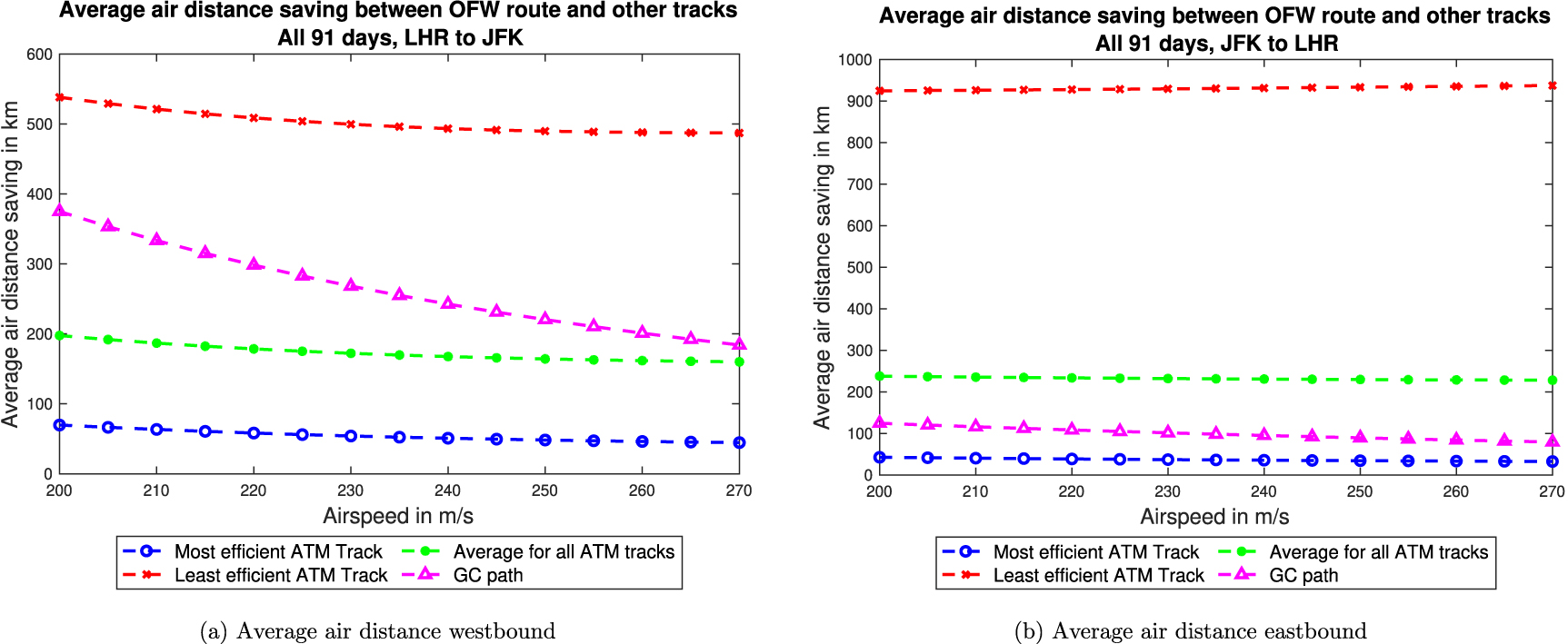
The paper shows these graphs, with the eastbound plot on the right:
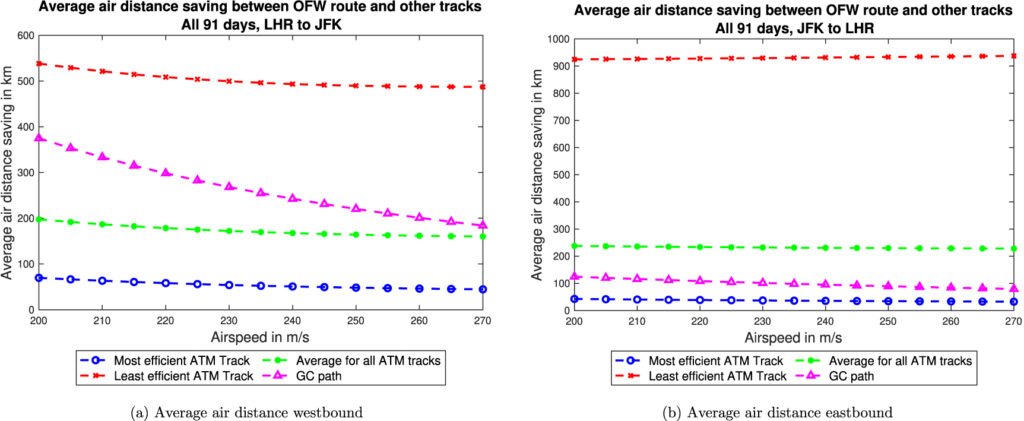
 

From an operational perspective, however, the promise of 232km (125nm) average route savings, and 16.4% increases in efficiency do not ring true. If you are a dispatcher, or pilot, you will share my instinct that this number feels extremely high.  The term “potential increase in efficiency” really means “current inefficiency” – and my gut feeling says it’s not always ideal, but far from that bad. Many plans are indeed sub-optimal, and crossing the NAT certainly has the potential to result in a track a half-degree north or south of the one requested or a level below the optimum – but is the inefficiency really that high?

Closer analysis shows that at least some of the assumptions in the report to be fundamentally flawed.

The report itself makes the flaw clear here: “Taking the results for an airspeed of 240 m s−1 and averaging savings in air distance between the most efficient ATM track and the OFW route across all 91 days of winter 2019–2020 for flights from JFK to LHR, gives an air distance saving of 37 km, but the saving for the least efficient ATM track is over 931 km. The average saving for all ATM tracks is 232 km”

The problem is that to reach these high numbers, the paper is assuming that “airlines use all provided tracks equally“. This is not what happens in reality, by any stretch. There are normally 8-10 NAT Tracks eastbound. An airline, or aircraft operator will request their Preferred Track, as we have seen in the example above. Almost all of the time, the requested track is granted, albeit with potentially a lower level (or higher) than requested. Very ocasionally, a track one north or one south is given by ATC.

The efficiency figure of 16.4% is created by dividing the air distance between LHR-JFK by additional distance flown on the least efficient eastbound NAT Track (2,997nm/503nm ~ 16.4%). That least efficient NAT Track (which will usually be Track Zulu in non-Covid ops for an eastbound flight) is normally a southerly Caribbean area route intended for traffic departing places like Miami, the Bahamas, or even Trinidad and Tobago. It will never be flown by a New York-London flight.

Therefore, we have to disregard these higher numbers entirely.

The report does identify, when looking at actual flights, that efficiency savings of “2.5% for eastbound flights and 1.7% for those flying west” would be obtained by flying the optimum wind route (OFW). Those numbers look far closer to what we might expect as total efficiency losses identified at the end of Part One, above.

However, consider further that we looked at four different types of efficiency loss: flight planning constraints, avoiding turbulence, the NAT Tracks requirement, and tactical routing by ATC. It is clear, then, that the presence of the NAT Tracks accounts only for a portion of those inefficiencies. Again, real world analysis of actual flights with the full compendium of information as to what caused the ineffciencies would give the most insight, and this is what we will hopefully see from NATS and Nav Canada as a result of the “OTS NIL” experiment.

A further paper as an iteration of the first, applying a collaborative approach with the operational world (ATC, Airlines, Aircraft Operators, Flight Crew), would be beneficial.

Over the past 25 years, there has been continual improvement in ATC efficiency. The NAT region was the first to implement reduced vertical separation (RVSM), in March 1997, and subsequent improvements in surveillance (ADS-B, ADS-C), and communications (CPDLC), have led to lateral separation improvement from 60nm to 19nm, and longitudinal from 80nm (or 10 minutes) to as low as 14nm – in addition to the altitude separation reduction from 2,000 to 1,000 feet. In simple terms, the number of aircraft that can fly closer to the optimum route for a city pair has dramatically increased.

Despite the inaccuracies in the numbers, we should look at the bigger picture: The paper does identify a key point that we should digest in this industry: “Airlines currently choose routes that minimise the total cost of operating a flight (by specifying a Cost Index, which is the ratio of time-related costs to fuel costs), not the fuel consumption or emissions.”

This, I think, is important to consider. We are not currently flight planning to minimise emissions – we flight plan to minimse cost. With the reality of our warming planet, and the thankfully growing recognition that a corporation’s profit should not come ahead of the greater good of humankind, focus should be placed on how we can operate flights more efficiently – where ‘efficient’ does not mean reduced costs, but reduced emissions.
Fake Navigation fees are still a problem

It’s a concern: instead of sending your Nav Fees payment to Eurocontrol, you’ve actually sent it to some guy sitting in his underpants in his mother’s basement. And you’re not going to get it back.

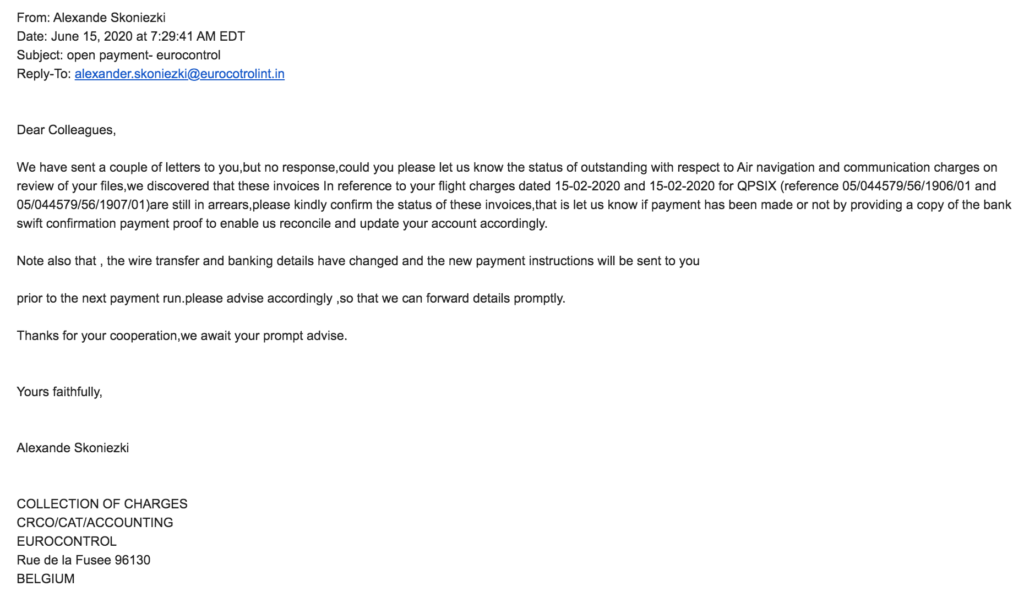
We’ve seen an increasing variety of scam emails, that at first glance look like they are from Eurocontrol – but aren’t. Here’s a good example from this week:

You’d be forgiven for glancing over it and responding to request the details of ‘their’ new bank account. And that’s where the problem begins – you’ll get a new bank account, only it won’t direct your money to Brussels.

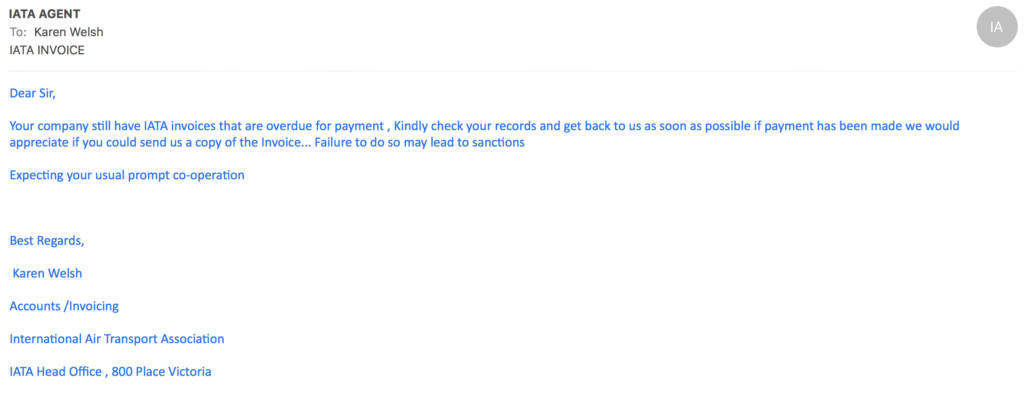
IATA has the same issue:

Fortunately, most of these emails are poorly written, and easy enough to identify as bogus – but that’s only if you are on your guard. The best solution is to simply be aware of the risk:

Eurocontrol

  1. Look at the sender address: real emails come from eurocontrol.int. Fake ones look similar, but might be something like @eurocontrolinc.com or @eurocontrolint.in.
  2. Most of the emails ask for a copy of an invoice or payment – be suspicious when you read that.
  3. Be especially alert when the email mentions a change in bank account. Eurocontrol has no plans to change bank accounts any time soon.
  4. Best advice: write to the real address: r3.crco@eurocontrol.int and ask for confirmation of any message, or call the Route Charges office on +32 2729 3838.
  5. The most secure way to handle Eurocontrol charges and payments is through their CEFA portal.

IATA

  1. Most recent fake addresses: invoice@iatahelpdesk.org, payments@iataaccounting.org
  2. Contact the real address: information.security@iata.org

The Air Charter Association have also warned that scammers have recently targeted business deals where operators charter out their aircraft to brokers. Similar to the fake IATA invoices scam, but more elaborate. Bottom line, if you’re chartering out your aircraft — or if you’re chartering one yourself — work with a reputable broker and triple-check all contact details (email addresses as well as phone numbers) and bank account details before pushing the button on any money transfers.

Even the mighty Japan Airlines fell victim to a targeted email scam back in 2017 which defrauded the company of JPY384 million yen – the equivalent of around USD $3.4 million. The airline received a series of emails purporting to be from a U.S. financial services company that had been leasing aircraft to Japan Airlines. Not realising it was scam, JAL promptly paid the money into a Hong Kong bank account, as requested. It was only later discovered to be fraudulent, when the genuine U.S. company demanded payment!

Have you been the target of similar scams? Let us know! – and we’ll add it to the list of dodgy email addresses and common scams.


IFBP – Belt and Braces in Africa

ATC in Africa is slowly improving – investment in radar and CPDLC is helping – but vast swathes of airspace remain where ATC, quite simply, is not to be trusted to the same degree as in other parts of the world. Not all of this is the fault of the controller – more so equipment – but crews should be fully aware of the need to be more situationally aware.

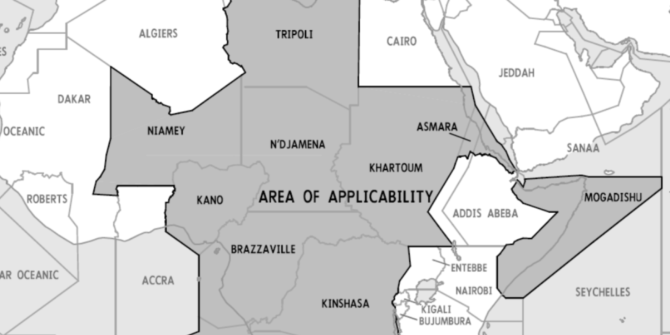
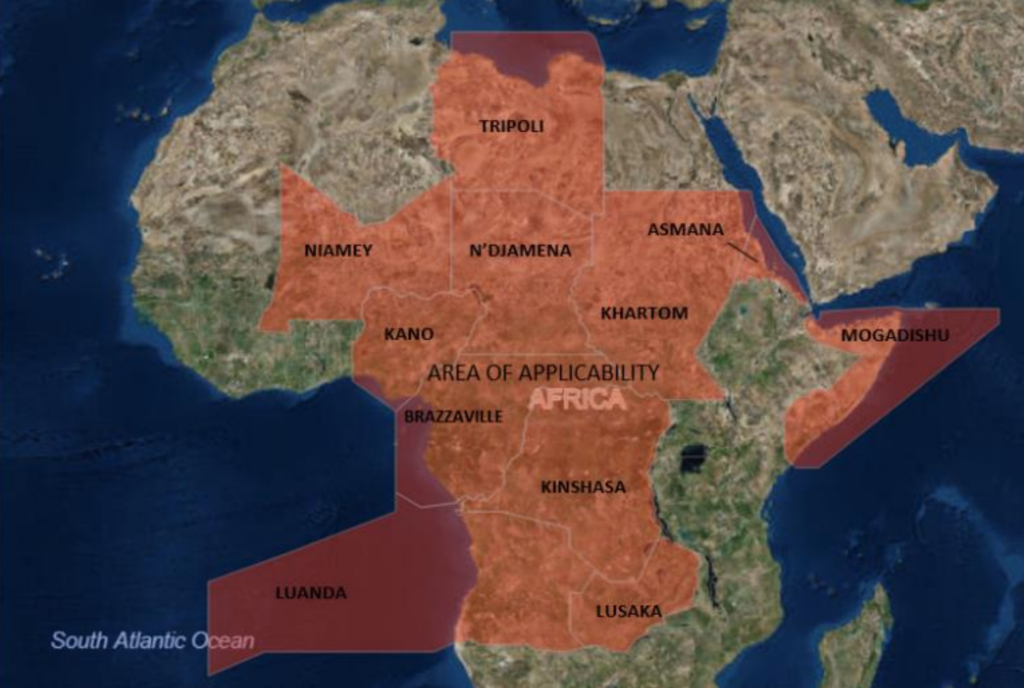
The airspace map below shows the current airspace that IATA deems “At Risk”, and recommends applying the Inflight Broadcast Procedure (IFBP).

Specifically, these  FIR’s:

• Asmara
• Brazzaville
• Kano
• Khartoum
• Kinshasa
• Luanda
• Lusaka
• Mogadishu
• Niamey
• N’Djamena
• Tripoli
• Dakar (Dakar Terrestrial and Dakar Oceanic FIR’s apply IFBP only in the case of the activation of their contingency plans)

IATA adds a note that Brazzaville, Niamey and N’djamena FIR’s provide CPDLC service, however these FIR’s are maintained in IFBP area of applicability “to accommodate users’ requirement for linear boundaries to the extent feasible”. If you were to read between the lines, you might conclude that CPDLC doesn’t remove the risk entirely.

This is the latest version of the procedure.


Cockpit napping – what are the rules?

As is too often forgotten by regulators, aircraft flown by humans require rules that match human needs.

One of those needs is sleep. Normally, we do this for about 33% of the day. If you manage to get a perfect night’s sleep, have a short ride to the airport, and then operate a long haul flight that departs on schedule, you might get away with not feeling tired during it. Most of the time, these perfect conditions don’t show up on the day.

Especially with the cumulative fatigue we suffer as pilots, a quick nap works wonders.

NASA did extensive research on this in 1994, and the findings showed that “The benefits of the nap were observed through the critical descent and landing phases of flight … The nap did not affect layover sleep or the cumulative sleep debt displayed by the majority of crew members. The nap procedures were implemented with minimal disruption to usual flight operations and there were no reported or identified concerns regarding safety.” This gave us the term, “the NASA Nap“.

So, napping is good. NASA says so. But, around the world, we have very different regulatory approaches to this. To make it sound better, the regulators call it “Controlled Rest”, or CR.

Places where you can:

Australia, Bolivia, Canada, China, Europe, Israel, India, New Zealand, Turkey, and the United Arab Emirates.
[source: Flight Safety, 2018]. Know more? Comment on the article and we’ll update.

Places where you definitely can’t:

The US. Although the Air Force and the Coast Guard allow it, the FAA does not – neither for Part 91, nor Part 121. CR was considered when the latest FAA rules were developed beginning in 2010, but it was excluded from the final regulations. FAA Advisory Circular 120-100 (FAA, 2010, page 11) states:
Although a number of foreign air carriers authorized in-seat cockpit naps during flight, the FAA does not authorize such in-seat cockpit naps.

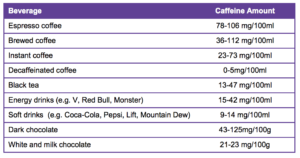
Just drink coffee!

That seems to be the FAA position. No napping allowed. There are some wonderful resource guides, listed below, that delve deep into the subject, but in terms of napping – it’s still forbidden. Why? That’s a good question. We don’t know.

Guidance Docs:

Discussion

We will discuss the topic in the Ops Chat on December 12th, 2019 at 12pm EST – register here:
https://ops.group/opschat


Incredible people making aviation a force for good, and how you can help

What does your overnight look like when you are downroute? After you’ve checked in to the hotel, and maybe had a quick nap, what’s on your list of things to pass the time? Maybe you’ll swap your pilot uniform for a tourist t-shirt, head into the city, and explore a little. Perhaps you’ll have arranged a coffee with an old friend or colleague. Or, maybe just hang out at the crew hotel and relax.

Not Kimberly Perkins.  There’s something more rewarding to be done.

Through her non-profit organization Aviation for Humanity, Kimberly will be heading to the local school, shelter, or orphanage, to meet the children and present them with backpacks and school supplies. She’s not alone. Having started the mission in 2016, they’ve already helped hundreds of people in places like Ethiopia, Tanzania, Mongolia, Nigeria, and Puerto Rico – and closer to home, in Hawaii – where kids in need in Kona received supplies over several visits.

If you’re like me, aviation has given you a lot – not just a career, but a lifetime of wonder, beauty, excitement, and joy. Aviation is special – that’s why we’re in it. And it’s no secret that we’re going through a tough time right now in the eyes of the public. So, when I see aviation giving back – doing something for the world – it’s important to highlight and bring attention to that. We need more of this.

This is why I want to celebrate and share the work that Kimberly, and the many volunteers, are doing. So, how does it work? Pretty simple:

1. You contact Aviation for Humanity, and tell them where you’re going
2. They will locate an underfunded school or orphanage for you to visit, and arrange for the supplies.
3. You go, and share the story of the journey back with Aviation for Humanity.

Imagine using your trip abroad to make a difference in the world – just one short visit, and you can give an entire school or orphanage much needed supplies.

Running a non-profit isn’t easy, and there’s another way you can help right now. Kimberly needs a volunteer Executive Director –  to manage coordination with volunteers, logistics for shelter visits, managing social media, fundraising, writing articles, and other things that move the mission forward. Is that you? Maybe you’ve recently retired and are looking for a way to contribute back to aviation? Maybe you’ve got extra time on your hands, or you know someone that this might be suited to? 2-6 hours a week will get you started.

I love seeing the work that OPSGROUP members are doing individually. As I was ‘wow-ing’ my way through the work that Kimberly does, I found another group member featured on an Aviation for Humanity trip – namely Cheryl Pitzer. Cheryl was on our Member Chat a few weeks ago (#7, see it here in the dashboard).

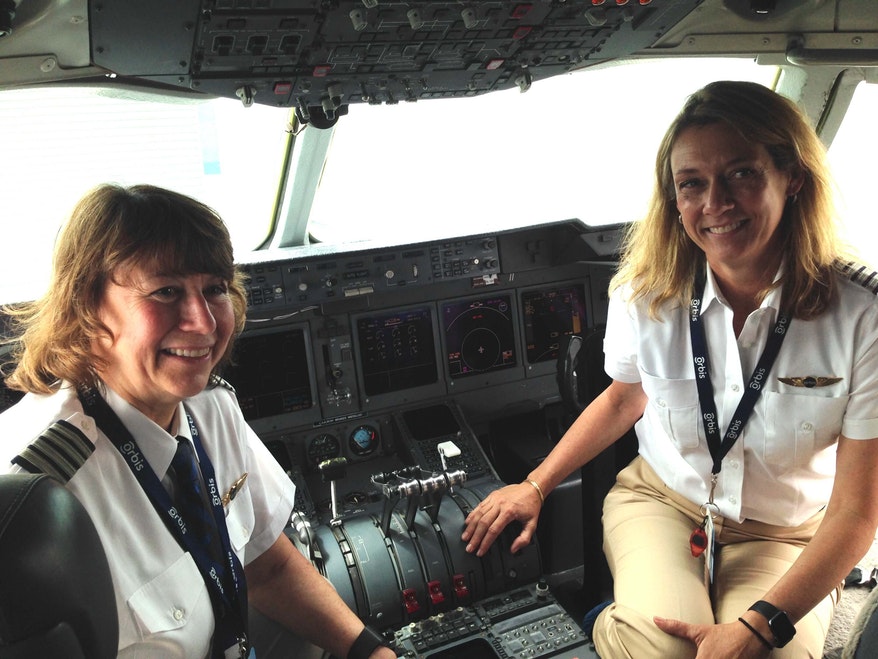
Cheryl, pictured right, flies the MD-10 “Flying Eye Hospital” for Orbis International – an amazing airplane that is part of the Orbis mission of bringing people together to fight avoidable blindness. On that call, Cheryl told us about the work Orbis does, the challenges of operating the airplane internationally, and the reward of using aviation as an agent for good in the world. This is another incredible cause that you too can get involved in.

Kimberly and Cheryl are true aviation pioneers, not just for the non-profit causes that they work so hard on, but also as pioneering women in aviation. It’s no secret that this beloved industry of ours has a massive imbalance of diversity. The numbers and statistics identify the issue  – averaging out the small amounts of data that are actually published on the subject, show that the global percentage is around 5% – that’s both the number of female pilots, and the number of women in top management positions at airlines.

Changing those numbers – attracting more women to aviation – is just part of the issue. What is life like if you are one of the 5%? From an interview that I read in another publication, Kimberly said “As I moved through my flying career, I was never lucky enough to encounter a female manager mentor. As I looked up that corporate ladder, it was a sea of men. Such an environment can be lonely, unwelcoming and intimidating“.

For me, right now, that is something that we can all do something about. What is the environment like at your airline or operation? Could you see how it could be lonely, unwelcoming and intimidating? How can you change that?

Just like the work that’s being done for the non-profits, you can do something to make a difference. That difference grows, it’s exponential. It starts with the realisation that you have the power to make things better for other people, especially if you are in a leadership position. A good place to start is by realising that if you do have the power to make things better, but you don’t, then you’re simply part of the problem.

I certainly see some of the inherent aviation gender biases here in OPSGROUP. It’s usually not intentional, nor anything usually deep rooted in opinion – it’s just been built into the system over the last 80 years of how commercial aviation used to work.  Sometimes we have group calls that end with someone saying “Thank you Gentlemen”.  The very term NOTAM is indicative of the problem – Notice to (air) Men.  I like to imagine what it would be like to turn up to work every day and read a flight briefing that is headed “Notice to Women“. I certainly would feel excluded.

You might think that this is subtle, tiny, not important. But the things that create environments that are lonely, unwelcoming and intimidating are usually subtle and unintentional. Only by putting ourselves in the position of others, can we see the full impact.

It’s a process of education that starts with the willingness to see things a little differently, and then making a decision to do something that changes things for the better. Just like Kimberly and Cheryl have done.


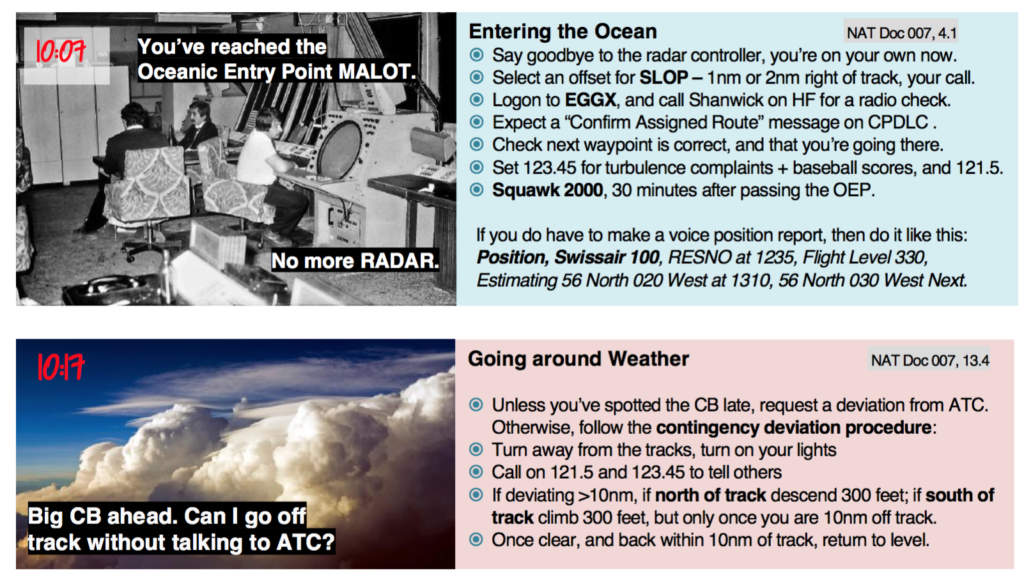
Fly it like you stole it – free speed on the NAT

This is a new one, and it’s a good one for pilots! Being introduced slowly is a new flexibility – flying without a fixed Mach speed. In simple terms, you get to decide how fast you fly.

Like all new things on the NAT, we have an acronym. This one is OWAFS. Operations Without an Assigned Fixed Speed. But you’ll also see it as referred to as “Variable Mach”, and “Resume Normal Speed”.

When does this start?

It already has! It’s starting out as a trial (everything on the NAT starts out as a trial), and some members are already reporting getting “RESUME NORMAL SPEED” messages from Shanwick. The official start date is April 8, 2019. Three OACC’s are doing this – Shanwick, Santa Maria, and New York Oceanic (not WATRS).

For no good reason, here’s a picture of the Shanwick Oceanic control room in 1989. Much has changed since!

How does it work?

You’ll get a normal oceanic clearance, with a fixed Mach Number, like you always did. Somewhere after the Oceanic Entry Point, if you are selected for the trial, you’ll get a CPDLC message saying RESUME NORMAL SPEED. You should reply with WILCO. What that means is: Fly ECON, or a Cost Index with Variable Mach.

So, once I get that, no restrictions on speed?

Correct! But, ATC will expect you to fly ECON/Cost Index, and normally, that should be pretty close to your cleared Mach (within 0.01 up or down). If you’re doing something different, tell them. If the resulting speed differs from your Oceanic Clearance Mach by 0.02, or more, you must tell ATC.

Rules for Shanwick (Don’t ask for it)

• Flight must be data link connected to EGGX
• Flight must be eastbound and operating solely in Shanwick Oceanic airspace and exiting into UK/Ireland/Continental European airspace
• Flight cannot exit into Santa Maria
• RESUME NORMAL SPEED will be offered on a “manual” tactical basis
Do not request RESUME NORMAL SPEED

Rules for New York and Santa Maria (You can ask)

• Flight must be data link connected to LPPO or KZWY
• Flights must be wholly within Santa Maria and New York East Oceanic airspace and not enter Gander or Shanwick airspace
• Flights can enter New York East Oceanic airspace or Santa Maria airspace from Gander airspace or Shanwick airspace and receive RESUME NORMAL SPEED uplink message
• New York West (WATRS airspace) is excluded
• RESUME NORMAL SPEED can be requested if not offered

Background and History

(Thanks, Jeff Miller @IATA, for this and the condensed info above!)

Both Airbus and Boeing advocate cost index (ECON) as the most efficient way to fly. Operators use cost index (ECON) globally, except for the North Atlantic (NAT) where flights are assigned a fixed Mach by ATC and flight crews are required to fly the assigned Mach. Depending on the distance from the departure airport to the oceanic entry, most operators flight plan the aircraft with cost index to the oceanic entry point and again after oceanic exit. Flight crews use the desired fixed Mach number from the computer flight plan that is generated by the cost index, as the requested Mach number for the crossing. It is possible the flight crew may request a Mach greater than or less than the flight plan Mach to improve scheduled arrival time. IATA led the ICAO NAT, Operations Without an Assigned Fixed Speed (OWAFS) project team to enable the use of a variable Mach in the NAT. The North Atlantic Systems Planning Group (NAT SPG) is expected to fully endorse OWAFS late June 2019 for an official implementation in late 2019 for all NAT OCAs. Full automation for all Air Navigation Service Providers (ANSPs) is expected by Q1 2020.

So I can use this for turbulence speed changes?

Yep, but remember, if you’re slowing down or speeding up significantly (0.02 or more), tell ATC your new speed.

Anything else?

That’s it for now. Remember, it’s a trial – later in the year full implementation is expected. Don’t ask for it if you aren’t offered, unless you’re in New York or Santa Maria airspace. Tell ATC if you’re changing by 0.02 or more from the Oceanic Clearance.

And most importantly, keep us posted on your experiences with this!


Indonesia is intercepting aircraft – outside their airspace

If you are operating in the Singapore FIR, consider this carefully: you may be overflying Indonesia without knowing it. Indonesia will know though, and they want you to have an overflight permit.

You will find out in one of three ways:

  1. You’ll be intercepted by two Indonesian Air Force fighter jets and brought to Indonesia
  2. You’ll receive a nastygram via your National Authority
  3. You’ll get a fine

2. and 3. are not cool, but 1. is something to avoid at all costs. The inside of military/police cells at outlying Indonesian Airports is not pretty.

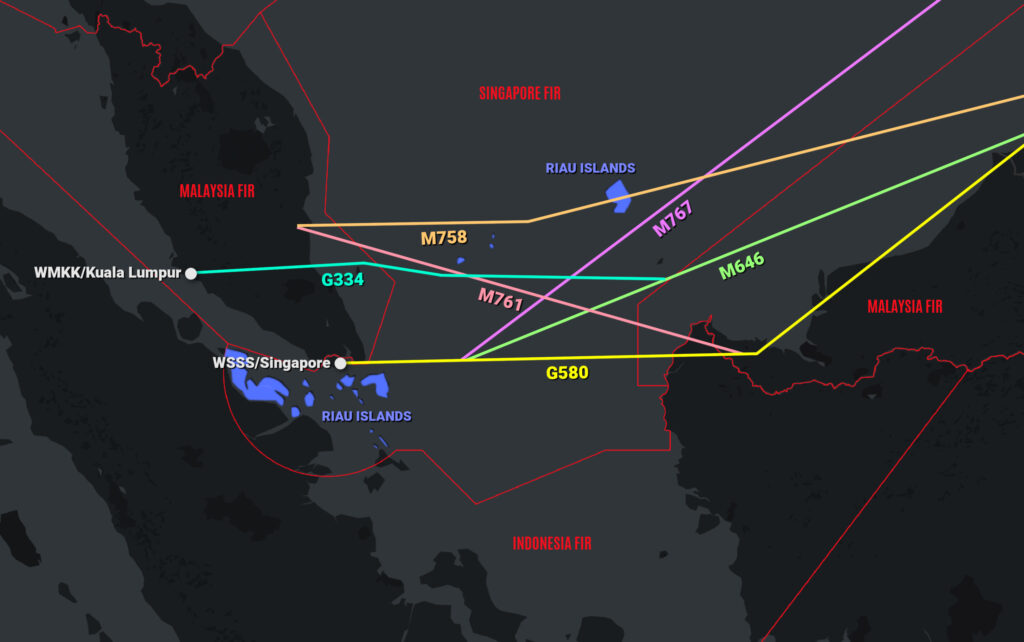
Watch out for the following airways – M758, M646, M767, G334, M761, G580. These all pass over Indonesian territory, even though the area is actually part of the Singapore and Malaysia FIRs.

Indonesia has a reputation for excessively strict enforcement of permit rules.

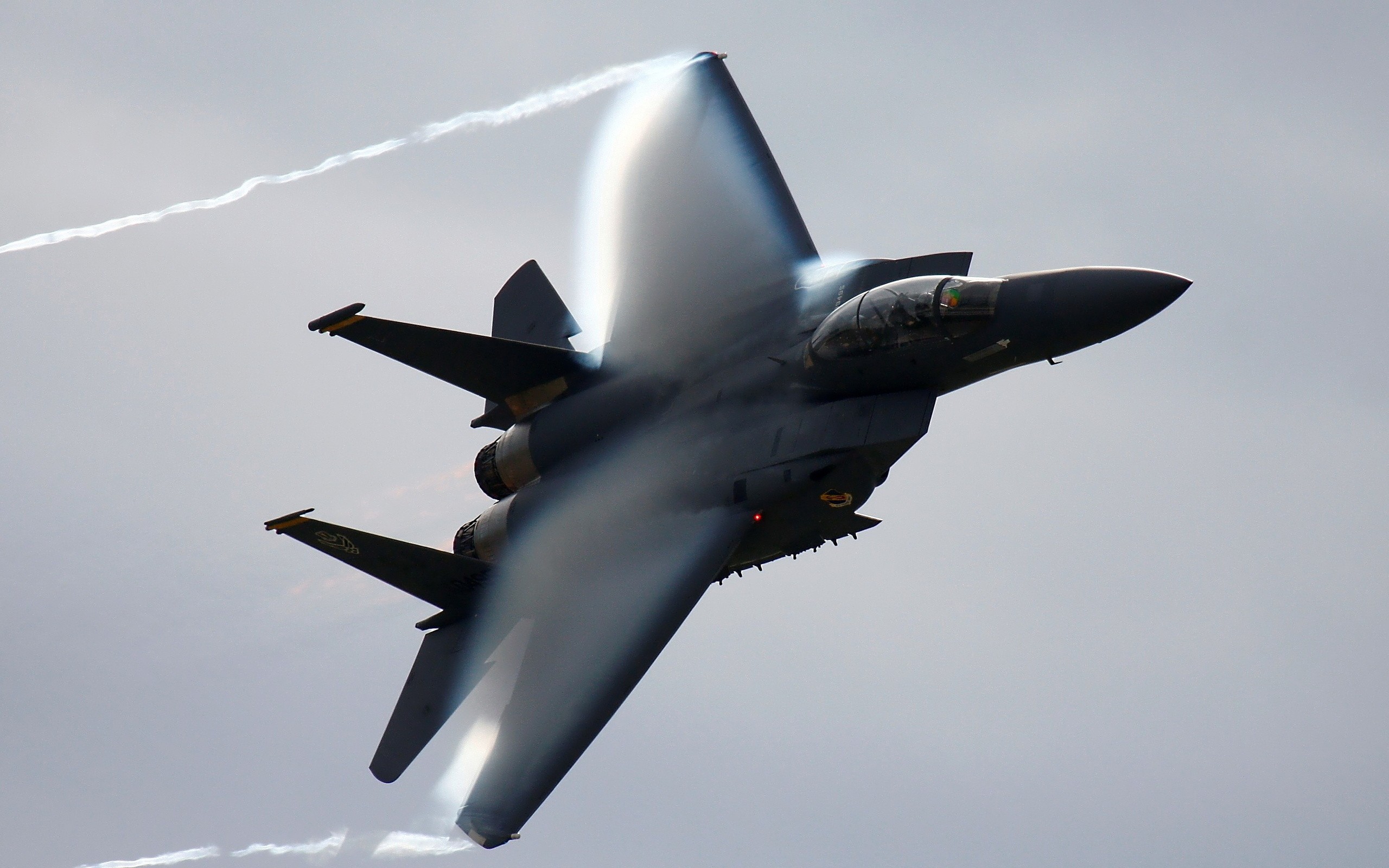
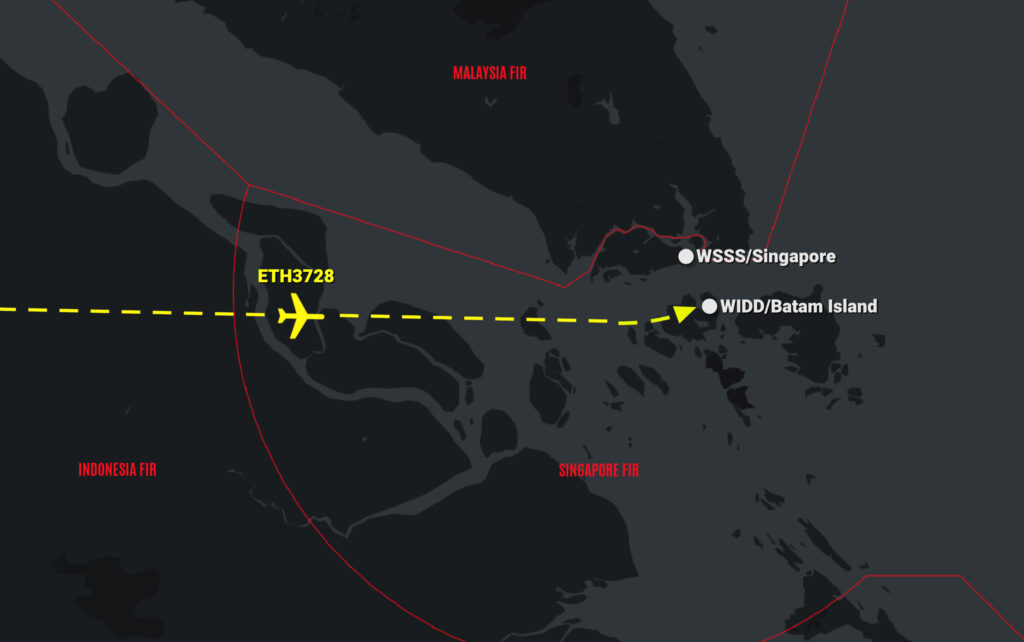
On 14 Jan 2019, two Indonesian F-16s intercepted an Ethiopian Airlines cargo flight ETH3728 for flying across Indonesian airspace without permission. The aircraft was initially supposed to operate from HAAB/Addis Ababa to VHHH/Hong Kong, but was modified at the last minute to route via WSSS/Singapore instead, to make a delivery of Rolls-Royce Trent 1000 engines.

The Ethiopian Airlines aircraft was intercepted forced to land at WIDD/Batam Island – which lies right in the middle of the chunk of airspace controlled by Singapore.

Another incident happened back in 2014, where a King Air plane en-route from WBGG/Kuching to WSSS/Singapore was intercepted by Indonesian fighter jets in the same airspace managed by Singapore, and forced to land at WIOO/Pontianak Airport in Indonesia.

The reason? Because they were overflying some Indonesian islands out in the ocean, the Indonesian Air Force claimed they were overflying Indonesia’s sovereign skies – without a permit.

Indonesia still hasn’t updated its AIP, but the rules they enforce are clear: if you’re overflying any Indonesian territory, you must get an overflight permit, regardless of the flight level.

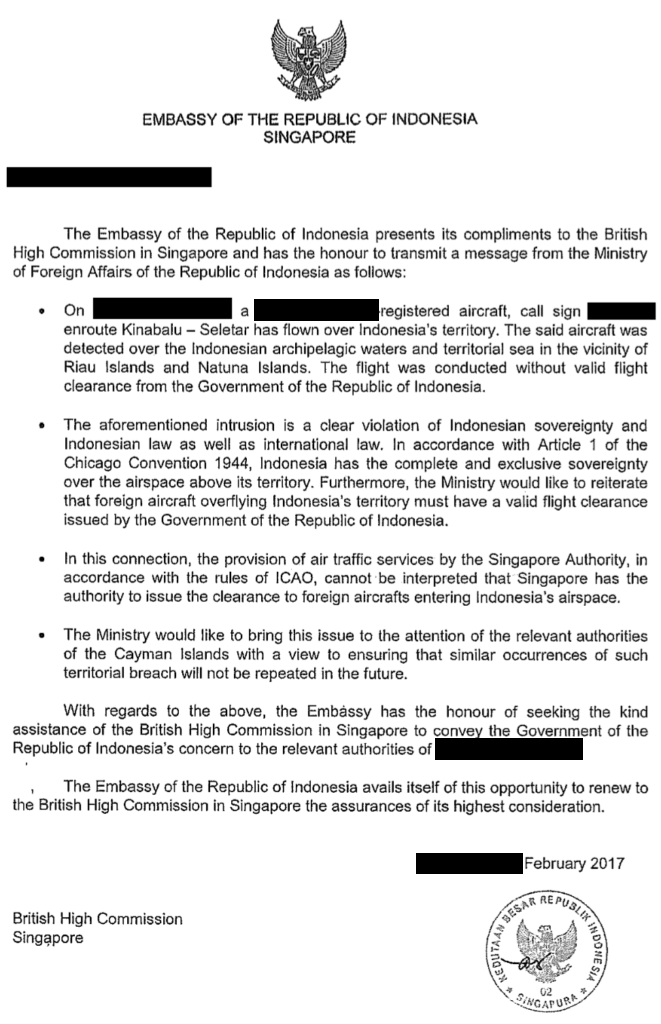
Here’s a nastygram to an OPSGROUP member, received in February 2017:


Bottom line: check your airways carefully, and make sure there are no Indonesian Island underneath. If there are, get a permit.


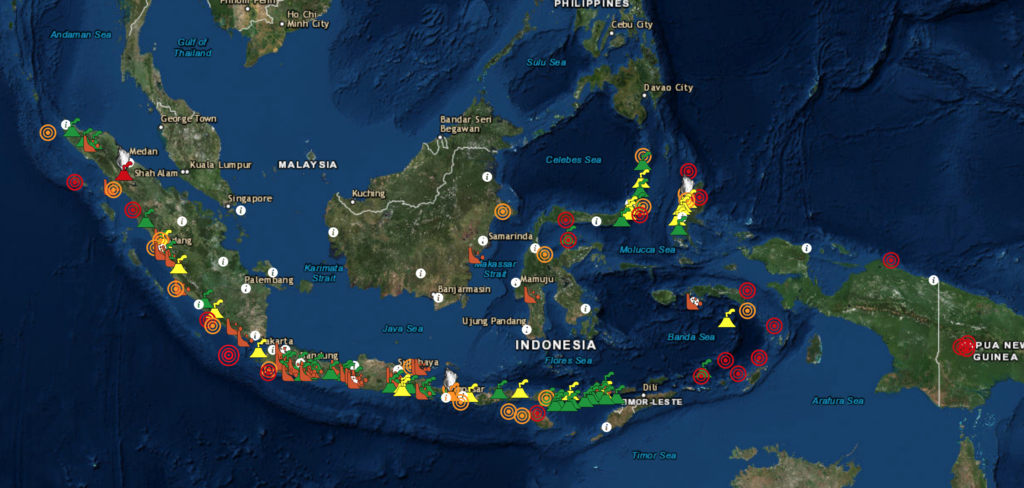
Ongoing Bali volcanic threat – update

Update June 29, 2018:

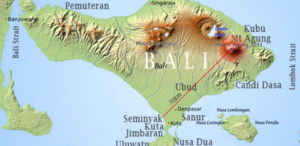
Following the volcanic eruption on Jun 28 at Bali’s Mount Agung, the airport has been closed all morning today, Jun 29, and only just reopened at 1430 local time (0630z). Over 500 flights have already been cancelled as a result. Big delays expected all day and into the weekend. Further closures due to volcanic ash are still possible.

Per latest report from Darwin VAAC, there is a volcanic ash cloud observed up to FL160 in the area, but they predict winds will carry the ash southwest toward Java, Indonesia’s most densely populated island.


In Short: Continued vigilance required for operations to Bali; The alert level for Mt Agung eruption remains at 3 (on a scale of 1-4). Last ash plume on 26 March rose to at least an altitude of 11,650 ft.

When Mount Agung erupted in November 2017, airlines faced travel chaos as flights were cancelled due to the lingering ash cloud. Since then, visitor arrivals have dropped by more than 70 percent. Facing $1bn in lost tourist revenue, the Indonesian government is trying to lure tourists back to the holiday island.

The 3,000metre high volcano sits roughly 70 kilometres away from the tropical paradise’s main airport and popular tourist areas.

In a Volcano Observatory Notice for Aviation (VONA), Volcanological Survey of Indonesia (PVMBG) reported that at 1009 on 26 March an event at Agung generated an ash plume that rose at least to an altitude of 3.6 km (11,650 ft) a.s.l. and drifted NW. The Alert Level remained at 3 (on a scale of 1-4) and the exclusion zone continued at a 4-km radius.

Best up-to-date information:

The current one to watch:

Mount Sinabung – located in Medan, Indonesia is also very active at the moment (last spewing ash on Friday April 6) and may disrupt air operations to Malaysia and Singapore.
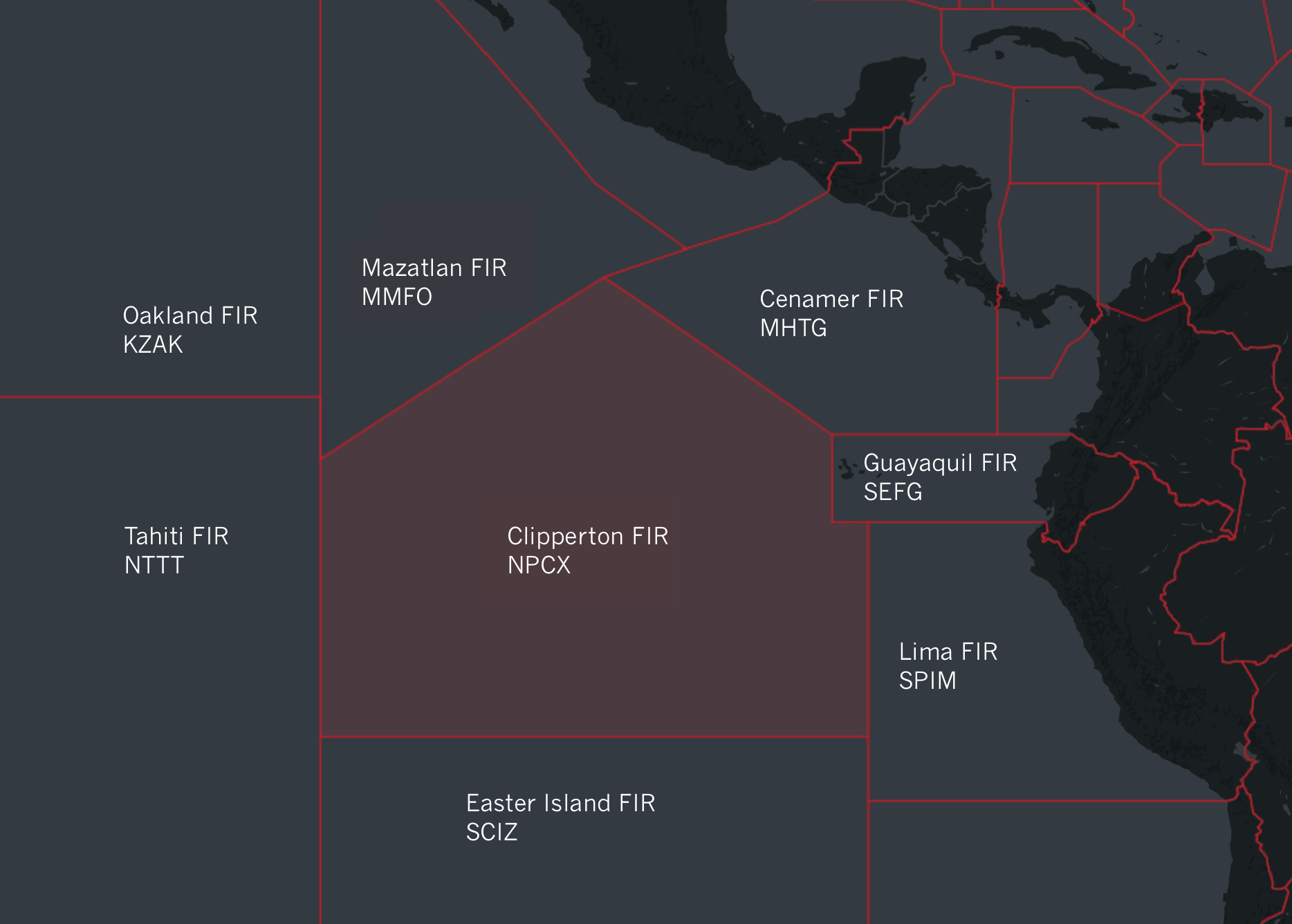
Current Aviation Color Code: RED, Eruption with volcanic ash cloud at 09:07 UTC (16:07 local). Eruption and ash emission is continuing. Ash-cloud moving to west – south. Best estimate of ash-cloud top is around 23872 FT (7460 M) above sea level, may be higher than what can be observed clearly. Source of height data: ground observer.”

We will keep an eye on this one.

Mount Sinabung roared back to life in 2010 for the first time in 400 years. After another period of inactivity it erupted once more in 2013, and has remained highly active since.

If you have travelled through the region lately and can provide members with more of an update, please get in touch. 


OPSGROUP wins bid to control 1.8 million km area of Pacific Airspace

1st April 2018: Clipperton Oceanic starts operations today, and is the world’s newest piece of airspace!

This one is different though – the users are in charge.

OPSGROUP take official control today of the Clipperton Flight Information Region (FIR) in the South Pacific, a 1.8 million square kilometre chunk of airspace west of the Galapagos Islands and north of Tahiti. The FIR has been unused since 1958, when the Clipperton Oceanic centre and radio service closed.

Announcing the news in an official Press ReleaseFrancois Renard, PM of the Clipperton Government said: “We are a little island but we are proud of our history in Pacific aviation. The years from 1937-1958, when Clipperton Oceanic was a name known to all passing aircraft, are looked back on fondly here. Now, we look forward – to a resumption of traffic on these once busy routes, and we are confident that OPSGROUP is the key to making this happen”.

For the first time, regulations are set by the users. There is no requirement for PBCS, RNP, ADS-B, ADS-C, GNS, GNSS, HLA, MNPS, RLAT, RLON, SLOP, or any of the other exponentially increasing acronyms that operators struggle to keep up with. No LOA’s, no slots, no delays. And no ramp checks. There are no Notams. Although it is large, it’s a simple piece of airspace, and that allows for a simple approach.

Juergen Meyer, a Lufthansa A350 Captain, and a long standing OpsGroup member said: “We’ve seen enough. Ercan (the Cyprus based Turkish ATC centre) doesn’t officially exist, yet you have to call them every time. French Guyana seems to have abandoned their ATC centre. Several African countries have outsourced their entire Permit Department, meaning you have to pay extortionate amounts just to secure a routine overflight. Greece and Turkey continue to hijack the Notam system for a diplomatic war. CASA Australia, like many others, continues to publish absolutely unreadable Notams, endangering safety. Nobody dares to enter the Simferopol FIR. The French ATC service is on strike more often than they are not. Libya lies about the security risks at their airports. Egypt and Kenya refuse to publish safety information because it would harm their tourism.”

Jack Peterson, an Auckland based operator of 2 G550’s, said: “If all these agencies can exist with a poor service, then why not try something different? Clipperton puts the users in charge, and we get to decide whether any of these rules or procedures actually serve us. Now that we have our own airspace, we can make it safe and user-friendly rather than user-hostile. And the South Pacific is the perfect place to start.”

OPSGROUP has also banned Ramp Checks within the region, a practice where pilots are taken hostage by the local Civil Aviation Authority during routine flights, and held accountable for the mistakes of their company, not being released from the ordeal until they submit with a signature.

The Clipperton FIR has a chequered history.

The island is named after a Pirate (John Clipperton). First activated in 1937, Clipperton Oceanic Radio provided a Flight Information and Weather service to trans-Pacific flights for 21 years, until it lost funding from a French-British-American government coalition in 1958.

In 1967, the Soviet Union attempted to takeover the airspace, offering to build several Surveillance Radars on the island. That was seen by the United Nations as a cover story, with their interest being more likely centred on having additional monitoring territory proximate to the US.

Since then, the Flight Information Region has remained dormant, appearing in most Flight Planning systems as “XX04”. Until the agreement with FSB, no service of any kind was provided.

The move has been seen by some observers as similar to the delegation of control of Kosovo airspace to Hungary in 2013, under a 5-year agreement that will likely be extended. Reinhard Kettu, newly appointed Oceanic Director, FSB, commented: “It’s not really the same thing. The Kosovo thing was just a delegation of Air Traffic Control, and at that, just for civil aircraft. Here, in Clipperton, FSB is taking full control of the aviation system. That will allow us to introduce an across-the-board user-first system.

On the Notam issue, OPSGROUP founder Mark Zee commented: “We’ve made things really simple here. Critical Notams, for the most part, tell us of a binary Yes/No for availability. Runway closed, ILS unavailable, Frequency u/s. It’s basically an On/Off switch, and the existing system handles that pretty well. When it comes to everything else, they fail, badly. So much rubbish about unlit towers, cranes, birds, and the rest. That makes up the noise. So, we’ve banned them in this new airspace, while we work on a better system. We will notify operators through the DCA of any withdrawn essential service or facility, for example if our HF is broken. Nothing else.”

Operationally, there are two new airways, UN351 and UN477, with 8 associated waypoints. HF is provided on the South Pacific MWARA Network, on the same frequencies as Auckland, Brisbane, Nadi, and Tahiti – 5643 and 8867 will be the primary ones.

Flight plans should be addressed to NPCXZQZX and NPCXZOZX. Although only HF is required to enter the airspace, CPDLC is provided and the AFN logon is NPCX. To begin, only a Flight Information Service is provided; no alerting, SAR, or Air Traffic Control service is part of the agreement. The rest is detailed in Clipperton AIC 03/18.

FSB and the Clipperton Government have also partnered with Thales and the KPA Military Construction Unit in a US$27 million agreement to build an entirely new Oceanic Control Centre on the Island, to be completed by 2021. “Until then, we will rely on HF and position reporting, but from 2021 we will be able to use space-based ADS-B”, said Mr. Kettu.

Clipperton Oceanic welcomes all. If you’re passing, say hello on HF. And if you’re planning to enter the airspace, make sure to read AIC03/18.

Media contacts:

Further Reading:


My first North Atlantic Flight is tomorrow – NAT Ops Guide (Updated 2018)

For the latest changes and updates on the North Atlantic, including our most recent Guides and Charts, use our NAT reference page at flightservicebureau.org/NAT.

Of all the hundreds of questions we see in OPSGROUP, one region stands out as the most asked about – the NAT/North Atlantic. So, we made one of our legendary guides, to get everything into one PDF.  It’s called “My first North Atlantic Flight is tomorrow” – and now we’ve updated it for 2018!

Contents:

  • 1. What’s different about the NAT?
  • 2. Changes in 2018, 2017, 2016, 2015
  • 3. NAT Quick Map – Gander boundary, Shanwick boundary
  • 4. Routine Flight Example #1 – Brussels to JFK (up at 5.45am)

  • 5. Non Routine-Flights: No RVSM, No RNP4, No HF, 1 LRNS, No HLA, No ETOPS, No TCAS, No Datalink – what you can do and where you can go
  • 6. Diversion Airports guide: Narsarsuaq, Sondy, Kef, Glasgow, Dublin, Shannon, Lajes, Fro Bay, Goose Bay, Gander, St. Johns
  • 7. Airport data
  • 8. Overflight permits – routine and special

  • 9. Special NAT procedures: Mach number technique, SLOP, Comms, Oceanic Transition Areas, A successful exit, Screwing it up, Departing from Close Airports
  • 10. North Atlantic ATC contacts for Shanwick, Gander, Iceland, Bodo, Santa Maria, New York – ATC Phone, Radio Station Phone, AFTN, Satcom, CPDLC Logon codes; and adjoining Domestic ATC units – US, Canada, Europe.
  • 11. NAT FPL Codes
  • 12. NAT Flight Levels
  • 13. Flight Plan Filing Addresses by FIR
  • 14. Links, Questions, Guidance

Excerpt from the Routine Flight #1:


Buy a copy ($20)   Get it free – join OPSGROUP

To get your copy – there are three options:

  1. OPSGROUP Members, login to the Dashboard and find it under “Publications > Guides”. All FSB content like this is included in your membership, or
  2. Join OPSGROUP with an individual, team, or department/airline plan, and get it free on joining (along with a whole bunch of other stuff), or
  3. Purchase a copy in the Flight Service Store!

The NOTAM Goat Show 2018

We’re on the hunt for prize Notams. 

In every definition of a Notam that exists, including the ICAO one, it includes these words: “the timely knowledge of which is essential“. Unfortunately, many Notam-creators’ sense of the essential shows a clear failure to understand the term . This is CNN’s version of fake news at it’s worst.

Now, we recently found one that listed peak goat-grazing times near the airport, so we thought we’d run a NOTAM Goat Show. And there will be prizes. We’re looking for the worst: the most irrelevant, the most useless, the most boring, the most unreadable. All those crappy Notams that are part of the 100 page print out you get in your flight briefing.

Send us your worst! goatams@fsbureau.org

There will be prizes, and as fun as all this is, you actually are helping to solve the problem of Bullshit Notams. We’re working on it.


It’s nice to meet you.

Yep, there is. It’s called OPSGROUP. We’re a big mix: pilots, dispatchers, controllers, managers, tech specialists, aviation authorities – all with one thing in common: International Flight Operations.

Back in 2016,  we figured out that great things happen when we solve problems together. Change is the biggest challenge, so we tell each other when we hear of something new. We keep each other safe by sharing information on risks.

Now we’d like you to get involved as well.

Why join us? Good question. Well, because if you don’t, you’ll miss a change and look like a chump. We don’t want that. You might overfly Libya. You might divert to Cayenne. You’ll only find out about the new rules when your G650 is impounded. You’ll pick the wrong handler because you didn’t get to see that Airport Spy review on Santiago from another member. You won’t know about that exemption. You won’t have anyone to ask whether you should stop at Keflavik or Reykjavik.

Life managing International Ops is hard enough without trying to do it all on your own. And we want you, because the more smart people like you we have in the group, the stronger it becomes. Pick a plan for yourself, or your team, or your entire flight department. There’s 1650 people waiting to answer your questions. And to pick your brain.

Read the reviews from existing members, and see why everyone from Airbus to the British Antarctic Survey to United Airlines is in the group. (hint: we’re all doing the same thing, and it’s getting easier).


Join OpsGroup


Welcome Pack

On joining, we will send you, and each team member if you are on a team or department plan:
– a Welcome Email, explaining the group, together with your Welcome Pack:
– The full FSB Airports Database (value $375)
– The current full International Ops Bulletin
– Our Polar Ops Planning Guide
– Current NAT Plotting Chart (value $35)

Everything

You (and each team member, if you choose a team plan) will then also get:
– Immediate access to our OpsGroup Dashboard
– The weekly International Ops Bulletin every Wednesday
Slack access to talk to the group
Ask-Us-Anything – we answer your International Ops questions
– Airspace warnings and overflight risk summaries
– Access to Aireport – 2300+ Airport and ATC TripAdvisor style reviews
– Everything we publish – Guides, Lowdowns, Charts, Member Notes
– Tools and Maps
– All previous content since the group started
See examples of all the above

Joining Process

2 straightforward steps:
– Choose an Individual, Team, or Department plan
– We send you everything you need to get started by email

You can cancel anytime you like, before the next billing period.

New members – that’s you – are welcomed several times a year. The current status is notified on this page. To make sure that new members are fully supported, and the existing group retains its high quality, we limit joining to window periods during the year.
If we’re closed, you can join the waitlist to be notified of the next opening window.


Join OpsGroup


Cathay crew witness missile re-entry from North Korea

Crew onboard a Cathay Pacific flight witnessed the re-entry of North Korea’s latest missile near their position late last week. The CX893 service from San Francisco to Hong Kong on Nov 29 was over Japan at the time when North Korea launched its missile.

The crew reported: “Be advised, we witnessed the DPRK missile blow up and fall apart near our current location.”

Here’s Cathay Pacific’s full statement:

“On 29 November, the flight crew of CX893 reported a sighting of what is suspected to be the re-entry of the recent DPRK test missile. Though the flight was far from the event location, the crew advised Japan ATC according to procedures. Operation remained normal and was not affected. We have been in contact with relevant authorities and industry bodies as well as with other carriers. At the moment, no one is changing any routes or operating parameters. We remain alert and review the situation as it evolves."

North Korea’s missiles are larger, and can fly further, than the other missiles we’ve previously seen. Over the past year, most of these missiles land in the Sea of Japan, well inside the Fukuoka Flight Information Region (Japanese airspace). But as we see with this latest test, there is clearly a danger of some of these missiles not re-entering the atmosphere intact – meaning that a debris field of missile fragments passes through the airspace, not just one complete missile. If you haven’t done so already, make sure you read this: our article on why North Korean missiles are now a real threat to Civil Aviation.

This latest test is also significant because of its unprecedented altitude – 4500km (2800 miles). Experts seem to agree that if it had been fired on a standard trajectory, the missile would have been capable of traveling around 13000km (8100 miles), meaning it could have struck anywhere in the mainland US.
If you’re operating in the region, we recommend avoiding the ZKKP/Pyongyang FIR entirely and avoiding the affected areas over the Sea of Japan. For more info, check out Safeairspace.


OpsGroup – the power of the group

The power of the group

In the last 30 years, there has been a massive change in how the world works: thank you, internet. We are witnessing a shift from the power of a central source – like government, and large corporations – to the power of the individual. Each of us is now connected to the entirety of human knowledge through a small, handheld device, and can connect with others to effect powerful and positive change.

OPSGROUP is founded on this premise.  International Flight Operations is an inherently tricky area, full of gotcha’s and unforeseen changes for even the most diligent airline or aircraft operator. One operator versus a myriad of often unreadable government-sourced regulations and information – Notams, AIC’s, FAR’s – is a battle with guaranteed casualties.

But by connecting with other people, just like you, with the same problems and challenges, you can solve and share solutions.

When we started this group last year, we had a small handful of pilots, dispatchers, and managers that figured coming together in this way was a winner. As of November 2017, we’re now heading for 4,000 OPSGROUP members, with a great variety in operations roles: Airline and Corporate pilots, Military operators, Federal agencies, Flight Dispatchers and Schedulers, ATC, and Civil Aviation Authorities – all working together.

It’s still early days, and we have a way to go. But with some basic core principles – plain language (we call a spade a spade), operator and passenger safety ahead of lawyer-speak, cooperation instead of competition  – and a huge appetite for development, there is much to gain.

So what’s good in the group? Read on …

1. Information

First on the plate for almost every operator is staying current. Rules and regulations are changing with increased voracity. Did I miss something? Yep, almost definitely. Each week we produce the International Operations Bulletin. We try to cover all the big changes in the last 7 days. If we miss something, we’ve found that someone in the group is pretty quick to tell us, and it appears in the next one.


2. Fun (including Goats)

We promise to keep it entertaining“. Without your attention, we’ve got nothing. Not only that, but we get as bored as you do with the standard aviation legal-language speak that permeates even the most important documents. Which is why sometimes we’ll run a Goat Show. Sometimes it’s just great to be “unprofessional“.

3. Members

Like we said, approaching 4,000. All working together with the same goal: making International Flight Operations better. Click on the links to read what they say.

Airlines like United, Fedex, and Etihad
Small Part 91 Flight Departments like CAT3, Fayair, Pula
Big 135 Charter Operators like Jet Aviation, TAG and Netjets
Companies like Visa, IBM, and AT&T
Manufacturers like Boeing, Airbus, and Lockheed
International Pilots like Matt Harty, Bill Stephenson, and Timothy Whalen
Organisations like IFALPA, the NBAA, and CAA Singapore


4. Airspace Risk

MH17 was a tragedy that must not be repeated. A small handful of operators were privy to information on the risk, and the Notam writers of Ukraine that were aware of previous shoot-downs released the information in a language almost designed to confuse. Through our safeairspace.net project, we can now share risk information within OPSGROUP and make sure that every single member has access to a current picture of airspace risk.


5. Airport Spy

One of our group members came to us with a great idea last year – why don’t we share our knowledge of operations at airports around the world. So we made a TripAdvisor style section in the member Dashboard, and allowed members to add their own reports on Airports, ATC, and Handlers. We now have 3000 or so reports.
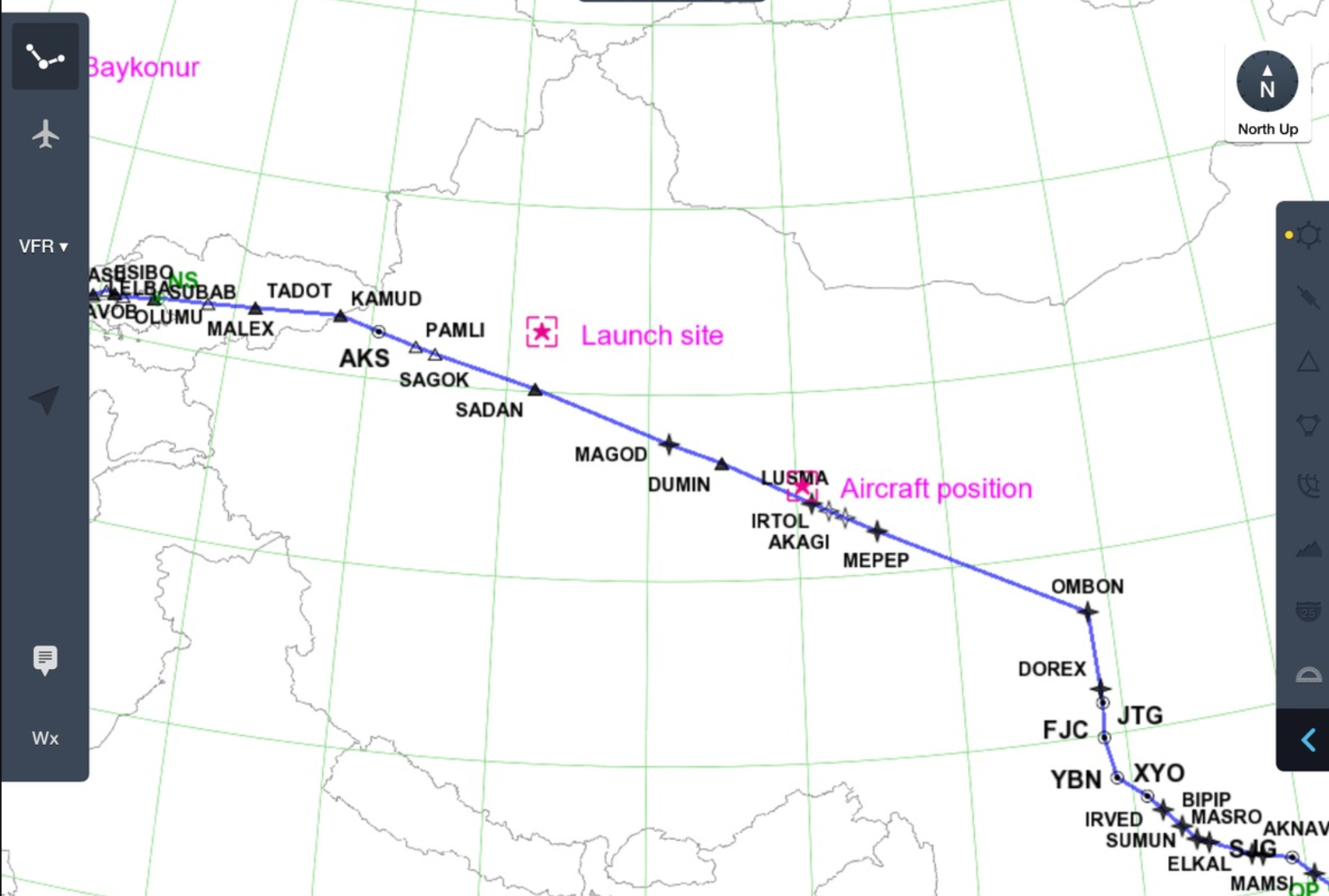
 

6. Member Dashboard

We don’t need to explain this one too much. Everything the group has, in one place.


7. Slack

Slack is cool. It’s a chat app, but it’s more than that. Internally, we don’t use email anymore, we use slack. There are different channels like #crewroom, #todays-ops, #usefuldocs, and #questions. When there are special events, like #FranceATCStrike or #NewYorkSnow we open a special group for that. About 1200 members use this regularly, and it’s the perfect way to connect with other crews, ATC, or the Feds.


8. George

George is a bot. He’ll fetch information for you on airports, get weather, the NAT Tracks, and a few other things. We’re working on making him a little smarter.


9. Ask Us Anything

Getting an answer to your question is what keeps us awake at night. There’s not much we can’t help with, but usually someone else in the group beats us to it. If not though, the FSB International Desk team will research that ops question that is threatening to make your life hell.


10. The future

The best part of OPSGROUP is that we’re really just getting started. The future of the group is unwritten, but placing the planning power in your hands as an operator rather than 3rd parties, and having the security of knowing that the group has your back, is a great way to start. There is much to build and develop, and we’d love you to be involved!


11. Joining

You can choose an Individual, Team, or Flight Department membership. All the information on that is on the OpsGroup website. We limit joining windows to certain months of the year, so that we can be all hands on deck with building new things for the group once membership is closed. If we’re not accepting new members at the moment, you can waitlist for the next opening.


Further


The mystery of the missing Russian Weather

A little while ago, Russia stopped sending out METAR and TAF weather updates on the international wires for a whole bunch of airports.

This made life difficult for international operators, especially airlines and business jet operators that use Siberian alternates. If you don’t have the weather reports, you can’t use it.

In OpsGroup, one of our members reported that they now had issues getting weather for places like
UHHH/UHMA/UHMM/UHPP/UIBB/UIII/ULAA/ULLI/UNAA/UNKL/UNNT/USCC/USNN.

Then, another member pointed us at this official site – http://metavia2.ru/index.php?lng=en. But to register, you need to send an email, and nobody got replies.

So, the mystery remains unsolved. What do you know? Comment below, or email us at bulletin@fsbureau.org.


Here’s why North Korean missiles are now a real threat to Civil Aviation

  • July 2017: First launches of ICBM’s from North Korea
  • Western portion of Japanese airspace is a new risk area
  • New OPSGROUP guidance to Members, Note 30: Japanese Missile risk

The North Korean game has changed. Even if aircraft operators stopped flying through the Pyongyang FIR last year, nobody really thought there was much of a tangible risk. The chances of a missile actually hitting an aircraft seemed slim, and any discussion on the subject didn’t last long.

Things look different now. In July, the DPRK tested two Hwasong-14 Intercontinental missiles (the July 4th one is above), the first ICBM’s successfully launched from North Korea. ICBM’s are larger, and fly further, than the other missiles we’ve previously seen. Both of these landed in the Sea of Japan, well inside the Fukuoka Flight Information Region (Japanese airspace), and significantly, at least one did not re-enter the atmosphere intact – meaning that a debris field of missile fragments passed through the airspace, not just one complete missile.

We drew a map, with our best estimates of the landing positions of all launches in the last year that ended in Japanese airspace. The results are quite clear:


View large image

Zooming in even further, we can see each of the estimated landing sites. It is important to note that the landing positions vary in the degree of accuracy with which it is possible to estimate them. The highest accuracy is for the 28JUL17 landing of the Hwasong-14 ICBM, thanks to tracking by the Japanese Defence Force and US STRATCOM, as well as visual confirmation from land in Japan. The remaining positions are less precise, but in an overall view, the area affected is quite well defined – south of AVGOK and north of KADBO. In 2017, there have been 6 distinct missile landings in this area. The primary airways affected are B451 and R211, as shown on the chart.


View large image

So, in a very specific portion of Japanese airspace, there have been regular splashdowns of North Korean missiles. As highlighted by the Air France 293 coverage, this area is crossed by several airways in regular use, predominantly by Japan-Europe flights using the Russia route.

Determining Risk

The critical question for any aircraft operator is whether there is a clear risk from these missiles returning to earth through the airspace in which we operate. Take these considerations into account:

The regularity and range of the launches are increasing. In 2015, there were 15 launches in total, of short-range ballistic and sub-launched missiles. In 2016, there were 24 launches, almost all being medium-range. In 2017, there have been 18 so far, with the first long-range missiles.

– In 2016, international aviation solved the problem by avoiding the Pyongyang FIR. This is no longer sufficient. The landing sites of these missiles have moved east, and there is a higher likelihood of a splashdown through Japanese airspace than into North Korea.

– Almost all launches are now in an easterly direction from North Korea. The launch sites are various, but the trajectory is programmed with a landing in the Sea of Japan. From North Korea’s perspective, this provides a sufficiently large area to avoid a missile coming down on land in foreign territory.

– The most recent ICBM failed on re-entry, breaking up into many fragmented pieces, creating a debris field. At about 1515Z on the 28th July, there was a large area around the R211 airway that would have presented a real risk to any aircraft there. Thankfully, there were none – although the  Air France B777 had passed through some minutes before.

– Until 2014, North Korea followed a predictable practice of notifying all missile launches to the international community. ICAO and state agencies had time to produce warnings and maps of the projected splashdown area. Now, none of the launches are notified.

– Not all launches are detected by surrounding countries or US STRATCOM. The missile flies for about 35 minutes before re-entry. Even with an immediate detection, it’s unlikely that the information would reach the Japanese radar controller in time to provide any alert to enroute traffic. Further, even with the knowledge of a launch, traffic already in the area has no avoiding option, given the large area that the missile may fall in.

Can a falling missile hit an aircraft?

What are the chances? Following the AFR293 report on July 28, the media has favoured the “billions to one” answer.

We don’t think it’s quite as low.

First of all, that “one” is actually “six” – the number of North Korean missiles landing in the AVGOK/KADBO area in 2017. Considering that at least one of them, and maybe more, broke up on re-entry, that six becomes a much higher number.

Any fragment of reasonable size hitting a tailplane, wing, or engine as the aircraft is in cruise at 450 knots creates a significant risk of loss of control of the aircraft. How many fragments were there across the six launches? Maybe as high as a hundred pieces, maybe even more.

The chances of a missile, or part of it, striking the aircraft are not as low as it may initially appear. Given that all these re-entries are occurring in quite a focused area, prudence dictates considering avoiding the airspace.

What did we learn from MH17?

Whenever we discuss missiles and overflying civil aircraft in the same paragraph,  the valuable lessons from MH17 must be remembered. In the weeks and months leading up to the shooting down of the 777 over Ukraine, there were multiple clues to the threat before the event happened.

Of greatest relevance was that State Authorities did not make clear the risk, and that even though five or six airlines decided to avoid Ukrainian airspace, most other operators did not become aware of the real risk level until after the event.

Our mission at Flight Service Bureau is to make sure all aircraft operators, crews, and dispatchers have the data they need to make a fully informed decision on whether to continue flying western Japan routes, or to avoid them.

Guidance for Aircraft Operators

Download OPSGROUP Note to Members #30: Japan Missile risk (public version here)

Review the map above to see the risk area as determined by the landing sites in 2017.

Consider rerouting to remain over the Japanese landmass or east of it. It is unlikely that North Korea would risk or target a landing of any test launch onto actual Japanese land.

Check routings carefully for arrivals/departures to Europe from Japan, especially if planning airways R211 or B451. Consider the previous missile landing sites in your planning.

– Monitor nti.org for the most recent launches, as well safeairspace.net.

OPSGROUP members will be updated with any significant additions or updates to this Note through member mail and/or weekly newsletter.

References

– Nuclear Threat Initiative – nti.org

– Opsgroup Note to members #30 – Public version

OPSGROUP – Membership available here.

– Weekly International Ops Bulletin published by OPSGROUP covering critical changes to Airports, Airspace, ATC, Weather, Safety, Threats, Procedures, Visas. Subscribe to the short free version here, or join thousands of Pilot/Dispatcher/ATC/CAA/Flight Ops colleagues in OPSGROUP for the full weekly bulletin, airspace warnings, Ops guides, tools, maps, group discussion, Ask-us-Anything, and a ton more.

– Larger area map of Japan airspace risk 2017

– Contact news@ops.group with any comments or questions.


Security Alert: Papua New Guinea Airports

AYZZ/Papua New Guinea – affecting AYPY/Port MoresbyAYMH/Mt. Hagen

The elections today and tomorrow in Papua New Guinea have created civil unrest. Counting irregularities in the highlands city of Mt Hagen sparked violent protests that have gone for several days, and led to the burning of buildings on July 27. The city’s airport has been closed, residents were warned roads were blocked and there were reports of gunfire. MPs from the Opposition National Alliance party clashed with police and members of the governing People’s National Congress (PNC) party at the Port Moresby airport.

As many operators use AYPY as a tech stop in the Pacific, please check the latest before operating.

Unannounced missile launch seen from 747 cockpit – the pics

North Korea has been the country of greatest concern when it comes to unannounced missile launches. Back in the day, they would advise ICAO of their plans, and a couple of fairly specific Notams could be issued to keep crews and airplanes away from the hot spots.

They stopped doing that for every launch a few years back – and now, there’s pretty much zero warning. On safeairspace.net, North Korea is still listed as Level 1 – Do Not Fly, primarily for this reason. Since most DPRK launches end in failure, the tracking of the missiles is anything but controlled. And therefore we worry.

This week, we’ve seen images from a Cargolux 747 enroute Hong Kong to Baku, whose crew encountered an unannounced test launch of a Chinese ballistic missile, with some amazing photos.


The route of flight, and location of the launch, can be seen here:


The full gallery can be seen at this blog.